Our Sixth Anniversary

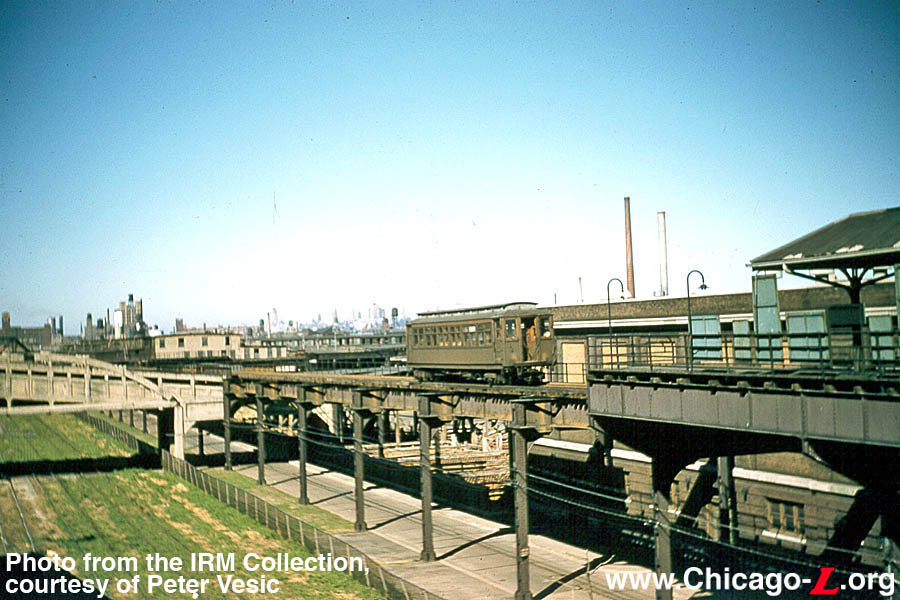
North Shore Line car 413 heads up a southbound train under wire at the Loyola curve in June 1961, from a Kodachrome II slide. Kodachrome was first introduced in 1935, and it was reformulated in 1961 although still a very slow film at ISO 25. Prior to this it was ISO 10. Don's Rail Photos: "413 was built as a trailer observation car by Cincinnati Car in June 1924, #2765. It was out of service in 1932. 413 was rebuilt on May 28, 1943." (J. William Vigrass Photo)

North Shore Line car 413 heads up a southbound train under wire at the Loyola curve in June 1961, from a Kodachrome II slide. Kodachrome was first introduced in 1935, and it was reformulated in 1961 although still a very slow film at ISO 25. Prior to this it was ISO 10. Don’s Rail Photos: “413 was built as a trailer observation car by Cincinnati Car in June 1924, #2765. It was out of service in 1932. 413 was rebuilt on May 28, 1943.” (J. William Vigrass Photo)

The Trolley Dodger blog started on January 21, 2015, making this our sixth anniversary. We chose the date deliberately, as it was also the day when the fabled North Shore Line interurban ran its last. We wanted there to be beginnings, as well as endings, associated with that date.

In our six years, we have had 262 posts. Here is a breakdown of page views by year:

2015: 107,460
2016: 127,555
2017: 118,990
2018: 121,147
2019: 101,902
2020: 133,246
2021: 8,436 (21 days)
Total: 718,736

Add to that the 297,195 page views from my previous blog, and we are now over a million page views. We thank you for your support.

We have lots for you this go-round… plenty of new images, including many in color, a rare article about the Metropolitan West Side Elevated, some submissions from our readers, and more photos from the William Shapotkin collection, and even a product review. We also have some North Shore Line content.

Enjoy!

-David Sadowski

For more photos and discussions, consider joining the Trolley Dodger Facebook group, which, although new, already has 151 members.

Our Annual Fundraiser

We thank our readers for making 2020 our most successful yet, with 133,246 page views, surpassing our previous record of 2016, and a 30% increase over the previous year. Each January, we ask our readers to help defray the expenses involved with file storage, web hosting, domain registration and other overhead, the “nuts and bolts” things that make this blog possible. Fortunately, thanks to all of you, we have have received $565 to date, meeting our original goal. Additional donations are always welcome, and will be used to purchase more classic images for this site. If you enjoy what you see here, and would like it to continue, please consider making a donation by clicking on this link, or the one at the top or bottom of this post.

We thank you in advance for your time, consideration, and your generous support.

Recent Finds

CTA 979 is southbound on State, just south of Lake Street. Romance on the High Seas, playing at the State-Lake theater, was released on June 25, 1948, probably about the time when this picture was taken. The streetcar still has a CSL emblem as this was early in the CTA era.

CTA 979 is southbound on State, just south of Lake Street. Romance on the High Seas, playing at the State-Lake theater, was released on June 25, 1948, probably about the time when this picture was taken. The streetcar still has a CSL emblem as this was early in the CTA era.

A North Shore Line train at Randolph and Wabash.

A North Shore Line train at Randolph and Wabash.

The North Shore Line's headquarters in Highwood, with line car 604 out front. Not sure what caused the lightstruck portion of the neg, but I may try to repair the image in Photoshop at some future date since it is distracting.

The North Shore Line’s headquarters in Highwood, with line car 604 out front. Not sure what caused the lightstruck portion of the neg, but I may try to repair the image in Photoshop at some future date since it is distracting.

A close-up of the previous image. Don's Rail Photos: "604 was built by the C&ME in 1914. It was acquired by IRM in 1963."

A close-up of the previous image. Don’s Rail Photos: “604 was built by the C&ME in 1914. It was acquired by IRM in 1963.”

I was very fortunate to purchase this 1950s negative showing the CTA Stock Yards branch. Daniel Adams: "The view is facing east, at the intersection of Exchange and Packers Avenues. Racine Avenue Station, the first station encountered when a train consist pulls into the famed Stock Yards loop, can be seen in the distance. This train is beginning to make the first curve of the loop, to be heading south and soon pulling into Packers Station, which just a short distance away. Way back in the background, we can see the rather hazy tower of the Stock Yards National Bank, which stood on the west side of South Halsted Street." Andre Kristopans notes, "A correction re Stock Yards - the first station on the loop was Racine, the second SWIFT, then Packers, then Armour." So this train is between Racine and Swift.

I was very fortunate to purchase this 1950s negative showing the CTA Stock Yards branch. Daniel Adams: “The view is facing east, at the intersection of Exchange and Packers Avenues. Racine Avenue Station, the first station encountered when a train consist pulls into the famed Stock Yards loop, can be seen in the distance. This train is beginning to make the first curve of the loop, to be heading south and soon pulling into Packers Station, which just a short distance away. Way back in the background, we can see the rather hazy tower of the Stock Yards National Bank, which stood on the west side of South Halsted Street.” Andre Kristopans notes, “A correction re Stock Yards – the first station on the loop was Racine, the second SWIFT, then Packers, then Armour.” So this train is between Racine and Swift.

Philadelphia Suburban Transportation Company (aka Red Arrow) double-ended car 18 at 69th Street Terminal in July 1963. Don's Rail Photos: "18 was built by St Louis Car Co in 1949, #1755. It became SEPTA 18 in 1970 sold to BERA in 1982."

Philadelphia Suburban Transportation Company (aka Red Arrow) double-ended car 18 at 69th Street Terminal in July 1963. Don’s Rail Photos: “18 was built by St Louis Car Co in 1949, #1755. It became SEPTA 18 in 1970 sold to BERA in 1982.”

Philadelphia Suburban Transportation Company (formerly the Philadelphia & Western, aka Red Arrow) Bullet car 207 in July 1963. 207 was built by Brill in 1931, order #22932, as P&W 207. It became PST 207 in 1948 and SEPTA 207 in 1970. I understand it is now preserved at Seashore Trolley Museum in Maine. This car had extended wheelbase trucks and was tested up to 100 mph.

Philadelphia Suburban Transportation Company (formerly the Philadelphia & Western, aka Red Arrow) Bullet car 207 in July 1963. 207 was built by Brill in 1931, order #22932, as P&W 207. It became PST 207 in 1948 and SEPTA 207 in 1970. I understand it is now preserved at Seashore Trolley Museum in Maine. This car had extended wheelbase trucks and was tested up to 100 mph.

Chicago Aurora & Elgin wood car 28 in Forest Park in 1952. The front of the car is not in sharp focus because it was moving towards the photographer. Back then, film speeds, and therefore shutter speeds, were quite slow. The fastest film speed in use then was Kodak Super-XX, introduced in 1940, at ISO 200. But this is probably not that film. Panatomic-X, which Kodak began selling in 1933, was ISO 32, and Plus-X, introduced in 1938, was originally ISO 50 (later bumped up to 125). Photographers often dealt with the shutter speed problem by taking their pictures while a train was still at a distance. The tracks curve off to the right in the distance. I am not sure of the exact location, although the Eisenhower expressway is here now.

Chicago Aurora & Elgin wood car 28 in Forest Park in 1952. The front of the car is not in sharp focus because it was moving towards the photographer. Back then, film speeds, and therefore shutter speeds, were quite slow. The fastest film speed in use then was Kodak Super-XX, introduced in 1940, at ISO 200. But this is probably not that film. Panatomic-X, which Kodak began selling in 1933, was ISO 32, and Plus-X, introduced in 1938, was originally ISO 50 (later bumped up to 125). Photographers often dealt with the shutter speed problem by taking their pictures while a train was still at a distance. The tracks curve off to the right in the distance. I am not sure of the exact location, although the Eisenhower expressway is here now.

North Shore Line Silverliner 740 at Howard Street, probably in the late 1950s. This was an Ektachrome slide that was not date stamped, which means it is probably before 1958, but after 1955. It had faded to red, like many other such early Ektachromes that had unstable dyes. It was an attractive alternative to Kodachrome in that era, though, because the film speed was 32 instead of Kodachrome's 10.

North Shore Line Silverliner 740 at Howard Street, probably in the late 1950s. This was an Ektachrome slide that was not date stamped, which means it is probably before 1958, but after 1955. It had faded to red, like many other such early Ektachromes that had unstable dyes. It was an attractive alternative to Kodachrome in that era, though, because the film speed was 32 instead of Kodachrome’s 10.

While not the greatest photo, from a technical perspective, this is an original Kodachrome slide taken by George Krambles. This is perhaps only the second such slide I have purchased. It was shot at North Chicago Junction on January 20, 1952. Occasionally, railfan photographers would trade original slides, and this one was owned by J. William Vigrass.

While not the greatest photo, from a technical perspective, this is an original Kodachrome slide taken by George Krambles. This is perhaps only the second such slide I have purchased. It was shot at North Chicago Junction on January 20, 1952. Occasionally, railfan photographers would trade original slides, and this one was owned by J. William Vigrass.

NSL 707 heads up a northbound train crossing Dempster Street in Skokie in September 1958. Just behind the train, you can see a tiny bit of the station, which has been preserved and moved to a slightly different location. The southbound shelter was much more basic, and was approximately where the CTA built a new platform for Skokie Swift trains in 1964. Again, this was an early Ektachrome slide that had shifted to red (actually, it was the other color dyes that badly faded, leaving mostly the red visible) and was restored in Photoshop. (J. William Vigrass Photo)

NSL 707 heads up a northbound train crossing Dempster Street in Skokie in September 1958. Just behind the train, you can see a tiny bit of the station, which has been preserved and moved to a slightly different location. The southbound shelter was much more basic, and was approximately where the CTA built a new platform for Skokie Swift trains in 1964. Again, this was an early Ektachrome slide that had shifted to red (actually, it was the other color dyes that badly faded, leaving mostly the red visible) and was restored in Photoshop. (J. William Vigrass Photo)

A northbound North Shore Line train rounds the curve at Lake and Wabash in June 1961. We are looking to the east. This is an early Kodachrome II slide. The film had a faster ISO than the original Kodachrome, and was said to be sharper, with a thinner emulsion. But not all photographers were happy about the change, and it had a bit less contrast, and some missed the "Rembrandt blacks" of the old version. (J. William Vigrass Photo)

A northbound North Shore Line train rounds the curve at Lake and Wabash in June 1961. We are looking to the east. This is an early Kodachrome II slide. The film had a faster ISO than the original Kodachrome, and was said to be sharper, with a thinner emulsion. But not all photographers were happy about the change, and it had a bit less contrast, and some missed the “Rembrandt blacks” of the old version. (J. William Vigrass Photo)

A view of the North Shore Line's massive station at Zion, taken from the front of a train in July 1960 by J. William Vigrass. The city insisted on a large station, as they were confidant that their religious community would quickly grow, which it did not. It was torn down soon after the line quit in 1963. This is from an Ektachrome slide that had not faded, suggesting that Kodak had fixed the dye fading problem by 1960.

A view of the North Shore Line’s massive station at Zion, taken from the front of a train in July 1960 by J. William Vigrass. The city insisted on a large station, as they were confidant that their religious community would quickly grow, which it did not. It was torn down soon after the line quit in 1963. This is from an Ektachrome slide that had not faded, suggesting that Kodak had fixed the dye fading problem by 1960.

Milwaukee and Suburban Transport car 995 is on Route 10, the last Milwaukee streetcar line in the classic era, in August 1957. The 995 was one of the last two cars operated (along with 975) there on March 2, 1958. Streetcar service returned to Milwaukee on November 2, 2018, when a 2.1 mile route, known as "The Hop," opened.

Milwaukee and Suburban Transport car 995 is on Route 10, the last Milwaukee streetcar line in the classic era, in August 1957. The 995 was one of the last two cars operated (along with 975) there on March 2, 1958. Streetcar service returned to Milwaukee on November 2, 2018, when a 2.1 mile route, known as “The Hop,” opened.

The North Shore Line's Harrison Street Shops in July 1960. (J. William Vigrass Photo)

The North Shore Line’s Harrison Street Shops in July 1960. (J. William Vigrass Photo)

J. William Vigrass took this picture in July 1960 and marked it as "NSL" at Harrison (presumably, by the shops in Milwaukee). Edward Skuchas: "This is a Western 20 yard air dump car. They were used on railroads and trolley lines. Wilkes-Barre Railways had 2 or 3 and they adapted the ends for a radial drawbar. Car Works imported models in O & HO scale brass. They tilt and the sides lift." David Cole thinks this may be the remains of the NSL weed sprayer shown in CERA B-106.

J. William Vigrass took this picture in July 1960 and marked it as “NSL” at Harrison (presumably, by the shops in Milwaukee). Edward Skuchas: “This is a Western 20 yard air dump car. They were used on railroads and trolley lines. Wilkes-Barre Railways had 2 or 3 and they adapted the ends for a radial drawbar. Car Works imported models in O & HO scale brass. They tilt and the sides lift.” David Cole thinks this may be the remains of the NSL weed sprayer shown in CERA B-106.

A northbound Electroliner stops at Adams and Wabash on the Loop "L" in September 1959. While I am sure the sailors are about to board, chances are the woman in the blue dress is too, since she is carrying a small suitcase. (J. William Vigrass Photo)

A northbound Electroliner stops at Adams and Wabash on the Loop “L” in September 1959. While I am sure the sailors are about to board, chances are the woman in the blue dress is too, since she is carrying a small suitcase. (J. William Vigrass Photo)

A closer view of the last image. Carl Fischer Music, at 312 S. Wabash Avenue, was a place where you could buy sheet music for both popular and classical. They still sell online. This location closed on April 16, 1999. The Epicurean Restaurant, at 316 S. Wabash, served Hungarian food and may have closed in the 1970s.

A closer view of the last image. Carl Fischer Music, at 312 S. Wabash Avenue, was a place where you could buy sheet music for both popular and classical. They still sell online. This location closed on April 16, 1999. The Epicurean Restaurant, at 316 S. Wabash, served Hungarian food and may have closed in the 1970s.

Although photographer J. William Vigrass labelled this September 1960 slide as "NSL," readers on our TD Facebook group have identified it as the Chicago & North Western's Racine Depot, which still exists, although no longer used as a train station.

Although photographer J. William Vigrass labelled this September 1960 slide as “NSL,” readers on our TD Facebook group have identified it as the Chicago & North Western’s Racine Depot, which still exists, although no longer used as a train station.

This circa 1955-58 Ektachrome slide, with the color restored, shows an Electroliner on the four-track section of the north side "L". Not sure of the exact location. (J. William Vigrass Photo) Mike Franklin: "This is looking west from the Sedgwick Station on the North side L. (House to the right is still there at 1542 Hudson Ave.)"

This circa 1955-58 Ektachrome slide, with the color restored, shows an Electroliner on the four-track section of the north side “L”. Not sure of the exact location. (J. William Vigrass Photo) Mike Franklin: “This is looking west from the Sedgwick Station on the North side L. (House to the right is still there at 1542 Hudson Ave.)”

CA&E 410 awaits scrapping at Wheaton on April 23, 1962. It was built by Pullman in 1923. sister car 409 is now at the Illinois Railway Museum. (K. C. Henkels Photo)

CA&E 410 awaits scrapping at Wheaton on April 23, 1962. It was built by Pullman in 1923. sister car 409 is now at the Illinois Railway Museum. (K. C. Henkels Photo)

Red Arrow car 83 on the Media line in September 1959. The street sign says School Lane.

Red Arrow car 83 on the Media line in September 1959. The street sign says School Lane.

Red Arrow car 77, signed for the West Chester line, is at 69th Street Terminal in January 1954.

Red Arrow car 77, signed for the West Chester line, is at 69th Street Terminal in January 1954.

From the standpoint of classic railfan photography, this is perhaps the best shot in today's post, and shows Red Arrow car 24 on the Media line in May 1956.

From the standpoint of classic railfan photography, this is perhaps the best shot in today’s post, and shows Red Arrow car 24 on the Media line in May 1956.

Red Arrow car 13 on the Media line in November 1959.

Red Arrow car 13 on the Media line in November 1959.

Red Arrow Brilliner 5 on the Ardmore line in July 1959. This narrow street may be why this line was somewhat rerouted after being converted to bus at the end of 1966.

Red Arrow Brilliner 5 on the Ardmore line in July 1959. This narrow street may be why this line was somewhat rerouted after being converted to bus at the end of 1966.

This map, although not very clear, shows the track arrangement on the Loop "L" as it was in 1906, seven years before it was changed to run counter-clockwise, with all trains going in the same direction. That was done to facilitate through-routing north side and south side trains. North is down on this map. In 1906, the Loop was bi-directional with left-hand running. The Lake Street and Northwestern "L"s also ran left-handed, while the South Side and Met trains ran right-handed. From the October 19, 1906 edition of the Electric Railway Review.

This map, although not very clear, shows the track arrangement on the Loop “L” as it was in 1906, seven years before it was changed to run counter-clockwise, with all trains going in the same direction. That was done to facilitate through-routing north side and south side trains. North is down on this map. In 1906, the Loop was bi-directional with left-hand running. The Lake Street and Northwestern “L”s also ran left-handed, while the South Side and Met trains ran right-handed. From the October 19, 1906 edition of the Electric Railway Review.

Although this old real photo postcard identifies this as the "N. W. "L"," this is actually the Met crossing the Chicago River over two side-by-side bridges. According to Daniel Adams, this picture cannot have been taken after mid-1915, as swing bridge shown, on Jackson Boulevard, was replaced then. Once I receive the original of this in the mail, I will post a better version. Thanks to J. J. Sedelmaier for improving this one.

Although this old real photo postcard identifies this as the “N. W. “L”,” this is actually the Met crossing the Chicago River over two side-by-side bridges. According to Daniel Adams, this picture cannot have been taken after mid-1915, as swing bridge shown, on Jackson Boulevard, was replaced then. Once I receive the original of this in the mail, I will post a better version. Thanks to J. J. Sedelmaier for improving this one.

The Metropolitan West Side Elevated – 1895

We recently purchased the June 6, 1895 edition of Leslie’s Weekly, which has an extensive article, including numerous photographs and drawings, of the then-new Metropolitan West Side Elevated in Chicago:

The Normandy Flats was a large apartment building, purchased by the Met and moved to a new location. The 1894 Chicago Blue Book gave the Normandy Flats' address as 2300-2302 S. Indiana Avenue, presumably where the building was relocated during the construction of the Metropolitan West Side "L", as it was apparently in the way of something.

The Normandy Flats was a large apartment building, purchased by the Met and moved to a new location. The 1894 Chicago Blue Book gave the Normandy Flats’ address as 2300-2302 S. Indiana Avenue, presumably where the building was relocated during the construction of the Metropolitan West Side “L”, as it was apparently in the way of something.

The original Franklin Street Terminal was only open from 1895 to 1897, and this is the first time I have seen a description of what it looked like. As far as I am aware, no one has yet found a photo. It closed when the Union Loop opened. At the same time, a new "L" station was opened at Franklin and Van Buren. Another terminal was later built on this site, extending back to Wells Street. It opened in 1904.

The original Franklin Street Terminal was only open from 1895 to 1897, and this is the first time I have seen a description of what it looked like. As far as I am aware, no one has yet found a photo. It closed when the Union Loop opened. At the same time, a new “L” station was opened at Franklin and Van Buren. Another terminal was later built on this site, extending back to Wells Street. It opened in 1904.

Why aren’t there more images of the Franklin Street Terminal? Well, for one thing, it opened late, apparently too late to be photographed for the big publicity push that coincided with the opening of the Met “L”. Hence this illustration. There is a photo showing the other side of the building (or buildings– the accompanying article seems to indicate the terminal went through two buildings). Then, it closed little more than two years later, coinciding with the opening of the Union Loop, and any publicity surely concentrated on that, and not the terminal closing.

From the Collections of William Shapotkin:

A "meet" between a steam train and a Chicago & West Towns Railway streetcar in LaGrange in the late 1940s. You can see evidence of the postwar construction boom in the background. Not sure if this was a fantrip.

A “meet” between a steam train and a Chicago & West Towns Railway streetcar in LaGrange in the late 1940s. You can see evidence of the postwar construction boom in the background. Not sure if this was a fantrip.

This picture has been the subject of some discussion on Facebook. It's a Pennsylvania Railroad "Doodlebug," probably after 1948, at Baltimore, MD. It is apparently a Parkton local. John Engleman: "Actually, actually, it's just sitting in what was called "the sleeper yard" at Pennsylvania Station probably between morning inbound and afternoon outbound trips to Parkton. A and B tracks and the platform that served them can be seen just beyond the Charles Street bridge."

This picture has been the subject of some discussion on Facebook. It’s a Pennsylvania Railroad “Doodlebug,” probably after 1948, at Baltimore, MD. It is apparently a Parkton local. John Engleman: “Actually, actually, it’s just sitting in what was called “the sleeper yard” at Pennsylvania Station probably between morning inbound and afternoon outbound trips to Parkton. A and B tracks and the platform that served them can be seen just beyond the Charles Street bridge.”

A Delaware, Lackawanna and Western electric commuter train in New Jersey. This railroad merged with the Erie in 1960 to form the Erie Lackawanna. The commuter service continues under NJ Transit.

A Delaware, Lackawanna and Western electric commuter train in New Jersey. This railroad merged with the Erie in 1960 to form the Erie Lackawanna. The commuter service continues under NJ Transit.

Aurora, Elgin & Fox River Electric diesel switcher #5, which continued freight operations after the remaining remnant of the line was de-electrified. A section of this line is now the trackage of the Fox River Trolley Museum in South Elgin, IL.

Aurora, Elgin & Fox River Electric diesel switcher #5, which continued freight operations after the remaining remnant of the line was de-electrified. A section of this line is now the trackage of the Fox River Trolley Museum in South Elgin, IL.

Chicago & Eastern Illinois #4, the "Whippoorwill," arrives at 63rd Street (Little Englewood Station) in July 1947.

Chicago & Eastern Illinois #4, the “Whippoorwill,” arrives at 63rd Street (Little Englewood Station) in July 1947.

A Milwaukee Road diesel engine at Fox Lake, IL.

A Milwaukee Road diesel engine at Fox Lake, IL.

Milwaukee Road passenger trains at Fox Lake, IL.

Milwaukee Road passenger trains at Fox Lake, IL.

Louisville & Nashville Railroad passenger engine #241, taking water.

Louisville & Nashville Railroad passenger engine #241, taking water.

Louisville & Nashville Railroad freight engine #1827 after being overhauled at the South Louisville Shops.

Louisville & Nashville Railroad freight engine #1827 after being overhauled at the South Louisville Shops.

Wabash #21 Blue Bird at 63rd Street (Little Englewood Station) in July 1947.

Wabash #21 Blue Bird at 63rd Street (Little Englewood Station) in July 1947.

A Chicago & Interurban Traction Company car. This line operated between 63rd and Halsted and Kankakee, and was abandoned in 1927, due to increased competition from the Illinois Central Electric.

A Chicago & Interurban Traction Company car. This line operated between 63rd and Halsted and Kankakee, and was abandoned in 1927, due to increased competition from the Illinois Central Electric.

Chicago & Joliet Railway #212. This system ran from Archer and Cicero Avenues in Chicago and connected to the Chicago, Ottawa, & Peoria interurban. It was abandoned in 1933.

Chicago & Joliet Railway #212. This system ran from Archer and Cicero Avenues in Chicago and connected to the Chicago, Ottawa, & Peoria interurban. It was abandoned in 1933.

Chicago & Joliet Electric car 200. This car, the "Louis Joliet," was built by C&JE in the 1920s.

Chicago & Joliet Electric car 200. This car, the “Louis Joliet,” was built by C&JE in the 1920s.

Milwaukee Road #E-5.

Milwaukee Road #E-5.

Long Island Railroad snow plow #193.

Long Island Railroad snow plow #193.

Pittsburgh Railways at Resee-Charleroi. The car is signed for Riverview. Larry Lovejoy adds: "The picture of Pittsburgh Railways Company low floor car 3769 is on the Charleroi line northbound at White Barn Siding. The date is 27 July 1952 and the occasion is a fantrip sponsored by the Pittsburgh Electric Railway Club. The line was abandoned ten months later. Today’s Pennsylvania Trolley Museum is the direct descendant of PERC and preserves sister car 3756. While “Riverview” was a turnback point on the Charleroi line, that destination sign is actually inappropriate at this particular location."

Pittsburgh Railways at Resee-Charleroi. The car is signed for Riverview. Larry Lovejoy adds: “The picture of Pittsburgh Railways Company low floor car 3769 is on the Charleroi line northbound at White Barn Siding. The date is 27 July 1952 and the occasion is a fantrip sponsored by the Pittsburgh Electric Railway Club. The line was abandoned ten months later. Today’s Pennsylvania Trolley Museum is the direct descendant of PERC and preserves sister car 3756. While “Riverview” was a turnback point on the Charleroi line, that destination sign is actually inappropriate at this particular location.”

Pittsburgh Railways line car M212 at the Washington Junction Yard. Larry Lovejoy: "The photo of Pittsburgh Railways line car M212 is at Castle Shannon Car House. There was no yard at Washington Junction, which is about a mile south of Castle Shannon."

Pittsburgh Railways line car M212 at the Washington Junction Yard. Larry Lovejoy: “The photo of Pittsburgh Railways line car M212 is at Castle Shannon Car House. There was no yard at Washington Junction, which is about a mile south of Castle Shannon.”

Philadelphia & Western Strafford car 161 at Norristown on December 27, 1958. It was built by Brill in 1927 and continued to operate until sometime between 1888 and 1990. It is now owned by the New York Museum of Transportation.

Philadelphia & Western Strafford car 161 at Norristown on December 27, 1958. It was built by Brill in 1927 and continued to operate until sometime between 1888 and 1990. It is now owned by the New York Museum of Transportation.

P&W Strafford car 163 on June 24, 1955. After retirement in the 1990s, it was rebuilt into a gas-mechanical car and operated in Mt. Dora, Florida, but it is not certain whether it still exists.

P&W Strafford car 163 on June 24, 1955. After retirement in the 1990s, it was rebuilt into a gas-mechanical car and operated in Mt. Dora, Florida, but it is not certain whether it still exists.

P&W Strafford car 162 on September 28, 1958. Don's Rail Photos: "62 was built by Brill in June 1927, #22529. It was rebuilt as 162 in 1931 and became PST 162 in 1948. It became SEPTA 162 in 1970. It was sold to Rockhill Trolley Museum in 1991." Today it is the only survivor of the fleet preserved as a modernized 160 series car.

P&W Strafford car 162 on September 28, 1958. Don’s Rail Photos: “62 was built by Brill in June 1927, #22529. It was rebuilt as 162 in 1931 and became PST 162 in 1948. It became SEPTA 162 in 1970. It was sold to Rockhill Trolley Museum in 1991.” Today it is the only survivor of the fleet preserved as a modernized 160 series car.

Don's Rail Photos: "64 was built by Brill in June 1927, #22529. It was rebuilt as 164 in 1931 and became PST 164 in 1948. It became SEPTA 164 in 1970 and became a de-icing car in 1989. It was sold to Travel Northern Allegheny in 1992 but never used. It was sold to East Troy Electric Ry in 1994 and rebuilt as ETE Ry 64 in 2000. It was sold to Electric City Trolley Museum and will be restored as P&W 164." Here it is on September 28, 1958.

Don’s Rail Photos: “64 was built by Brill in June 1927, #22529. It was rebuilt as 164 in 1931 and became PST 164 in 1948. It became SEPTA 164 in 1970 and became a de-icing car in 1989. It was sold to Travel Northern Allegheny in 1992 but never used. It was sold to East Troy Electric Ry in 1994 and rebuilt as ETE Ry 64 in 2000. It was sold to Electric City Trolley Museum and will be restored as P&W 164.” Here it is on September 28, 1958.

P&W 165 at 69th Street Yards on November 12, 1958.

P&W 165 at 69th Street Yards on November 12, 1958.

Product Test – The Pixl-Latr

The Pixl-Latr is an interesting new product that may be useful to people who have film negatives, but no easy way to scan them. It was developed as a Kickstarter project.

I decided to purchase one, and here are my results.

The Pixl-Latr is a negative holder that can accommodate 35mm, medium format, and 4"x5" size films. It has a diffused backing to prevent the formation of Newton Rings on your scans. It pairs well with this LED light box. I practiced using it with a cellphone camera. The Pixl-Latr is not a substitute for a flatbed scanner, but is certainly more portable, and may come in handy in certain situations where a scanner is not available.

The Pixl-Latr is a negative holder that can accommodate 35mm, medium format, and 4″x5″ size films. It has a diffused backing to prevent the formation of Newton Rings on your scans. It pairs well with this LED light box. I practiced using it with a cellphone camera. The Pixl-Latr is not a substitute for a flatbed scanner, but is certainly more portable, and may come in handy in certain situations where a scanner is not available.

My cellphone picture, before working on it with an image editor.

My cellphone picture, before working on it with an image editor.

I reversed out the negative into a positive image.

I reversed out the negative into a positive image.

After cropping and adjusting both density and contrast. But the image is still technically a color image, and could be improved further by eliminating those subtle color casts.

After cropping and adjusting both density and contrast. But the image is still technically a color image, and could be improved further by eliminating those subtle color casts.

The finished product, as a black-and-white image. Not bad! Compare with the scanned image elsewhere in this post.

The finished product, as a black-and-white image. Not bad! Compare with the scanned image elsewhere in this post.

The only downside of my usual method of scanning negatives is the formation of Newton Rings, caused by the negative coming into direct contact with the bottom glass of the scanner. I do use ANR (anti-Newton Ring) glass on top of the negative, which diffuses the light and prevents their formation. Fortunately, these are only noticeable at high magnification.

The only downside of my usual method of scanning negatives is the formation of Newton Rings, caused by the negative coming into direct contact with the bottom glass of the scanner. I do use ANR (anti-Newton Ring) glass on top of the negative, which diffuses the light and prevents their formation. Fortunately, these are only noticeable at high magnification.

You can read more about Newton’s Rings here. They are an interference pattern, caused when one of the two items pressed together acts as a lens.

Recent Correspondence

LeRoy Blommaert writes:

How I met (and rode) the North Shore Line

I remember quite vividly the first time I saw the North Shore Line as well as the first time I rode it. It was the same time.

I was a sophomore in high school and I was on the debate team. We were to participate in a round robin tournament at St Mary’s in Evanston. We were given the address and told to take the L and change at Howard—but nothing beyond that.

While I had taken the L many times from Bryn Mawr to Wilson Ave, and downtown and to my grandmother’s on the west side, it was, with one exception, with my mother. I had never taken the L north. Neither apparently had my three companions.

We get to Howard; we get off; and we wait—but not too long. Soon something pulls in unlike anything I had ever seen before on the L. It was beautiful; it was powerful. I was entranced and I wanted to ride it. And not just sometime in the future. But now! Immediately! And I did. I persuaded my colleagues that this was the train we needed to take. They were somewhat skeptical but in the end they agreed.

I was generally a good boy (a very good boy in fact) who always followed the rules and rarely did anything I thought was wrong. But this time? This time was different! I wasn’t sure that it was not the train to take, but I had doubts that it was the right train. These doubts I dismissed.

We got on. It was one of the older cars. I remember it had a stove inside. I also remember how fast it went once we left the station and entered the cut. The conductor dutifully asked for our tickets. Obviously, we did not have them. I explained where we wanted to go; he said we got the wrong train, and we were left off at the first station—Skokie.

There we waited for the first train south. It was getting dark and no one was around. In those days, unlike today, there was very little around. We waited about an hour. Needless to say, we did not make it to the debate tournament.

The next time I rode the North Shore, the trip was much longer: to Milwaukee and back. It was a fan trip. I believe it was a Klebolt trip. I went with my father. How I found out about it, I don’t remember, as I did not know any railfans then. It was on this trip that I met Roy Benedict. I remember he wore a football helmet, not the kind we know today, but a leather one, the kind they wore in the 1920s. He had made some track maps that he either gave away or sold.

As fate would have it, in my freshman or sophomore year of college, we moved to Skokie—within walking distance of that same station. One summer I got a job in the Loop—in the Insurance Exchange Building. The best part of the job was riding the North Shore each week day. I got off at Quincy and Wells and for the trip back home, I walked to the station at Adams and Wabash. It was there I met Jeff Wien, who was a ticket agent for the summer. From there it was onto CERA meetings, to and from which I was able again to ride my favorite railroad in those early days. It is still my favorite railroad, except that sadly I can no longer ride it, except at the Illinois Railway Museum, but that is not the same. The speed is absent as is the distance and the varying landscapes.

FYI, a slightly edited version of this was published in the Edgewater Historical Society newsletter.

This prompted Jon Habermaas to write:

I first became aware of the North Shore from seeing the trains stored on the L south of Roosevelt Rd. Taking the Englewood L into the loop and as our train descended into the subway our tracks were straddled by the tracks holding the stored North Shore cars. My first trip on the North Shore was when I was in HS and needed to cut short my time with family on vacation and return to Chicago. I caught the first southbound train from Racine. I became a regular weekend rider when I was getting technical training as a new swabbie at the Great Lakes Naval Training Center. Getting off at LaSalle Street Station to catch a Rock Island commuter train I now realized that the large crowd of sailors we had often encountered coming down from the L platform had come from a North Shore train from Great Lakes.

LaSalle Street Station was the only one of the Chicago downtown railroad stations with direct access to the L. As a kid when we were downtown on shopping trips we often took the L to the department stores. Because the L trains were circling the loop in one direction it wasn’t possible to return that way and we would catch the Division/Van Buren streetcar on State for the return to LaSalle Street Station.

This prompted a discussion on the Trolley Dodger Facebook group about two other not-so-direct connections between the “L” and downtown train stations. Between 1970 and 1989, the Northwest Passage connected the C&NW terminal to the Clinton “L” station. It displaced Track 1 during those years.

The Canal Street station on the Met main line had a passageway leading to Union Station until the Garfield Park “L” was replaced by the new Congress median line in 1958. Here is a description from Graham Garfield’s excellent web site:

A new Union Station, serving several main line intercity railroads, was formally opened July 23, 1925, replacing an earlier railroad station on a similar site. The Chicago Daily Tribune on same day contained a paid advertisement stating, “A short enclosed passageway connects the station directly with the Canal Street Station of the Elevated Railroad.” Within the Canal “L” station a stairway went down to Union Station’s underground track level, then a walkway ran for half a block, separated from Union Station’s track area by an iron fence, and finally into the lobby of Union Station. The article “Chicago’s Stations: Gates to Everywhere” from the August 1948 issues of Trains magazine also discussed the “L”-Union Station tunnel:

“It’s kind of tough, also, that we can’t get out on the platform and look at the prow-pointed T1 at the head end of many Pennsy trains. But Union is all business, and frowns at folk who try to sneak by the gatemen ‘just to see the trains.’ Here’s a tip, though: if you go along ‘frustration walk’ — which is the entrance leading from the Canal Street ‘L’ station — you can get a squint of a train or two at the southwestern end of the terminal. Like as not, there will be some Burlington open-platform cars used on suburban runs out Aurora way.

“‘Frustration walk’ is so dubbed because commuters must walk along an iron-railed thoroughfare beside the tracks to enter the terminal. Then to go out to the train they are obliged to hike back from whence the came on the other side of the formidable railing. Short-cutting is verboten at Union. Many a commuter has seen his train pull out as he dashed madly down ‘frustration walk’ in an attempt to catch the train.”

There are some conflicting descriptions of how the tunnel actually connected to the “L” station. According to some accounts, the passage was accessed from within the Canal Street station building, suggesting the connection was to the station house. Others recall that the passage from Union Station deposited them on the Canal station platform, not in the station house, with fare collection in between.2 It is believed that there were, in fact, two access routes between the elevated platforms and the tunnel. Passengers en route from the elevated platform walked through the headhouse of the rapid transit station. While passengers from the tunnel went directly to the platforms after passing through a fare collection point.

Stuart B. Slaymaker adds:

The walkway was along Track 2. This would have been Track Zero. I seem to recall, it dumped you at or near the original outbound cab court. It was still there in 1979, when I worked at Station Services for Amtrak. Dark. Gate was locked with a big switch lock and an iron chain. In the dim light, I could see check-in desks from long-discontinued streamliners, like The Olympian Hiawatha and the Trail Blazer. All stored along the walkway, that formerly went to the Canal Street L Station. It must have been a LONG walk. The signs and ephemera behind the locked gate were covered with inches of black sooty dirt. I left CUS in September of 1979, and never saw this, again. I always wondered if any of the displays ever got saved.

Daniel Joseph found another one– Parnell on the Englewood branch. From www-chicago-l.org:

The Parnell station was adjacent to the Chicago & Western Indiana Railroad’s 63rd Street station, sometimes also called the “Little Englewood” station. Although the C&WI’s station fronted onto 63rd Street, there was also an enclosed pedestrian connection from the Parnell “L” station to the steam railroad’s facility.

Mike Jacob writes:

Hello. I came across your website while trying to find information on a print I have. Please see the attached. Have you seen it before or have any idea on the artist? Thank you in advance.

Thanks for writing. I can’t quite make out the signature, although the first name seems to be Jerome.

The artist is not familiar to me, but I would imagine they were copying an old photograph. There were two North Shore Line stations in Wilmette, and it’s not that easy to identify which one this is. This was part of the Shore Line Route, which was abandoned in 1955.

Perhaps our readers might know something more.

John G. Gaul writes:

Dempster Street- January 20, 1963.  Nine years old at the time and living in Evanston, my Dad took my brother and I to Dempster St one last time. They’re not very good, but I’m glad I brought my little old box camera with me. It was a very cold day I recall.

Photos by John G. Gaul:

We thank all our contributors. Keep those cards and letters coming in, folks!

-David Sadowski

New Steam Audio CD:

FYI, we have digitally remastered another classic steam railroad audio LP to Compact Disc. Many additional titles, including the complete output of the Railroad Record Club, in our Online Store.

misc676-001

STEAM CDs:

RGTS
Rio Grande to Silverton:
A Sound Portrait of Mountain Railroading
Price: $14.99

These are vintage 1960 narrow gauge steam train recordings, in true stereo, and originally released on LP in 1961.  It is long out of print.
Includes:
01. Riding The Train To Silverton
02. Photo Run At Elk Park
03. Arriving At Silverton
04. Train Time At La Jara
05. Illini Special At Cumbres Pass
06. Doubleheader Starting At Monero
07. Eastbound Freight
08. Arriving At Chama
09. Whistles At Coxo
10. Freight With Pusher At Coxo

Gone are the nostalgic sounds of steam echoes and thundering exhausts, but the memory is immortal. May they live on in the locomotive lexicon, as a monument to the era when trains were pulled by STEAM POWER.

As with all of our recordings, this CD comes with the complete, original liner notes.

Total time – 45:49

The Trolley Dodger On the Air
We appeared on WGN radio in Chicago in November 2018, discussing our book Building Chicago’s Subways on the Dave Plier Show. You can hear our 19-minute conversation here.

Chicago, Illinois, December 17, 1938-- Secretary Harold Ickes, left, and Mayor Edward J. Kelly turn the first spadeful of earth to start the new $40,000,000 subway project. Many thousands gathered to celebrate the starting of work on the subway.

Chicago, Illinois, December 17, 1938– Secretary Harold Ickes, left, and Mayor Edward J. Kelly turn the first spadeful of earth to start the new $40,000,000 subway project. Many thousands gathered to celebrate the starting of work on the subway.
Order Our New Book Building Chicago’s Subways

There were three subway anniversaries in 2018 in Chicago:
60 years since the West Side Subway opened (June 22, 1958)
75 years since the State Street Subway opened (October 17, 1943)
80 years since subway construction started (December 17, 1938)
To commemorate these anniversaries, we have written a new book, Building Chicago’s Subways. While the elevated Chicago Loop is justly famous as a symbol of the city, the fascinating history of its subways is less well known. The City of Chicago broke ground on what would become the “Initial System of Subways” during the Great Depression and finished 20 years later. This gigantic construction project, a part of the New Deal, would overcome many obstacles while tunneling through Chicago’s soft blue clay, under congested downtown streets, and even beneath the mighty Chicago River. Chicago’s first rapid transit subway opened in 1943 after decades of wrangling over routes, financing, and logistics. It grew to encompass the State Street, Dearborn-Milwaukee, and West Side Subways, with the latter modernizing the old Garfield Park “L” into the median of Chicago’s first expressway. Take a trip underground and see how Chicago’s “I Will” spirit overcame challenges and persevered to help with the successful building of the subways that move millions. Building Chicago’s subways was national news and a matter of considerable civic pride–making it a “Second City” no more!

Bibliographic information:
Title Building Chicago’s Subways
Images of America
Author David Sadowski
Edition illustrated
Publisher Arcadia Publishing (SC), 2018
ISBN 1467129380, 9781467129381
Length 128 pages
Chapter Titles:
01. The River Tunnels
02. The Freight Tunnels
03. Make No Little Plans
04. The State Street Subway
05. The Dearborn-Milwaukee Subway
06. Displaced
07. Death of an Interurban
08. The Last Street Railway
09. Subways and Superhighways
10. Subways Since 1960
Building Chicago’s Subways is in stock and now available for immediate shipment. Order your copy today! All copies purchased through The Trolley Dodger will be signed by the author.
The price of $23.99 includes shipping within the United States.
For Shipping to US Addresses:

For Shipping to Canada:

For Shipping Elsewhere:

Redone tile at the Monroe and Dearborn CTA Blue Line subway station, showing how an original sign was incorporated into a newer design, May 25, 2018. (David Sadowski Photo) Redone tile at the Monroe and Dearborn CTA Blue Line subway station, showing how an original sign was incorporated into a newer design, May 25, 2018. (David Sadowski Photo)
Help Support The Trolley Dodger

This is our 262nd post, and we are gradually creating a body of work and an online resource for the benefit of all railfans, everywhere. To date, we have received over 718,000 page views, for which we are very grateful.
You can help us continue our original transit research by checking out the fine products in our Online Store.
As we have said before, “If you buy here, we will be here.”
We thank you for your support.
DONATIONS
In order to continue giving you the kinds of historic railroad images that you have come to expect from The Trolley Dodger, we need your help and support. It costs money to maintain this website, and to do the sort of historic research that is our specialty.
Your financial contributions help make this web site better, and are greatly appreciated.

The End of Summer

City Scene with Nuns (1947) by Robert W. Addison, in the collection of the Art Institute of Chicago.

City Scene with Nuns (1947) by Robert W. Addison, in the collection of the Art Institute of Chicago.

A long, hot summer is beginning to come to and end here in Chicago, and we have lots of great new images to share with you today. We thank all the original photographers, and our contributors.

We have many recent photo finds of our own, some great new ones thanks to Bill Shapotkin, and another batch that, for one reason or another, we were unable to purchase (but are still worth looking at).

We have been hard at work on our next book, Chicago’s Lost “L”s, and recently turned in all the text and images to our publisher. I am sure there will be additional changes (there always are), but I thought it would be useful to talk a bit about the process of making a book (see below).

We all have our ways of coping with situations. Working on a book has helped me keep focused during this pandemic.

Have a safe Labor Day weekend, everyone.

-David Sadowski

How a Book is Made

Technology may have changed since the 1950s, but you still have to go through your images one at a time.

Technology may have changed since the 1950s, but you still have to go through your images one at a time.

My new book Chicago’s Lost “L”s is the third part of a trilogy, along with Chicago Trolleys and Building Chicago’s Subways. I got the idea for all three books some years ago, and have been collecting images with this in mind for nearly six years.

Without an idea, there is no book. While there have been plenty of books about Chicago’s famed “L”, each one is different. The subject is so large, an author has to put their own unique “spin” on it. I decided my brief would be to showcase those aspects of the “L” that don’t exist any longer.

This, I believe, many people are interested in. Whenever the subject of various “L” lines that no longer exist comes up, I get the feeling people want to know more about this. So there is a need.

You make a proposal to your publisher, and if they like what they here, you enter into a contract that has specifics of what they need, and deadlines for when you give it to them. Books to be don’t come with instruction manuals of how to put them together, though.

There, you’re on your own, and I am sure the creative process is different for every author, and for every book.

I realized the project was doable when I had collected most of the images I would need. The first thing I did was to go through my entire image collection and look at everything. I started setting aside any images that I thought could be relevant, using an image editor. I went through 20,000 images, and I did this three times– at the beginning, middle, and near the end of the project. That was necessary, because each time I was looking for something different.

One of the most important things and author needs to determine is, how will things be organized? Chronologically, geographically, or thematically? Each approach has advantages and disadvantages, and the subject usually needs a combination of all these.

Once I decided on what the chapters in the book would be, I started a folder in my image editor for each one. Then, I started sorting the images in each folder in order, shuffling and reshuffling them until I was happy with the results.

Even after I had selected the proper number of images, I eventually ended up replacing about one-third of them. As time went on, my book’s narrative began to develop. As it did, some images fit, and others did not.

After I was satisfied with my image choices, I began writing the captions to go with them. If I couldn’t figure out a good caption for something, it had to go. Everything that stays in the book needs a good reason for being there. Writing means rewriting, over and over, as many times as necessary to say what you want to say in the most economic and efficient way possible.

Along the way, you find that no matter how much research you have done, the book needs more. You figure out what’s missing, and you do everything you can to find those things that can complete the story you are trying to tell. In general, it’s the oldest things that are hardest to find.

As you learn more while putting things together, the book tells you what it needs to be, and this is always going to be somewhat different than what you thought it was at the start. You always need to dig deeper.

The last thing I wrote was the introduction. That’s the opposite of how I approached my previous two books, but this time I wanted to see what would be included in the book first.

I also spent many, many long hours working over images in Photoshop. This includes the various maps I am using. I want everything to look its best when you open up your copy of Chicago’s Lost “L”s and start reading it.

One thing I noticed, when sorting through my images, is how sometimes, when I had duplicates of an image, they weren’t always identical. It occurs to me that when black-and-white prints were made from medium-format negatives, they were probably made in batches, and the same neg could have been printed multiple times over the years. Each time, the neg would be positioned a bit differently.

Now it is possible to combine those images using a program called Microsoft Image Composite Editor. The result is an image that is closer to the full size of the negative. I was able to do this for five or six images in the book.

More information about Chicago’s Lost “L”s will follow, as available. Once a book is published, it belongs to the readers, and you can decide whether or not it is worthwhile, but whatever the result, I have given this project 110%.

When you challenge yourself to reach a goal, it forces you to do better.  I learn so much every time I work on a new book– new skills, new methods, more efficiency, more organization, more knowledge.  And when someone reads one of my books, and appreciates it (if they do), that’s the icing on the cake.

Howard Terminal looking west in 1959. Ultimately, this picture did not make it into the book.

Howard Terminal looking west in 1959. Ultimately, this picture did not make it into the book.

The same location on June 6, 2020.

The same location on June 6, 2020.

I spent a lot of time cleaning up this image, but decided not to use it. The steam engines Chicago used on the "L" were similar to those in New York, but they weren't identical-- they were more robust. They didn't have the same specs.

I spent a lot of time cleaning up this image, but decided not to use it. The steam engines Chicago used on the “L” were similar to those in New York, but they weren’t identical– they were more robust. They didn’t have the same specs.

I took this picture of the former Linen Avenue station in Wilmette on June 6, 2020, but it didn't make the cut.

I took this picture of the former Linen Avenue station in Wilmette on June 6, 2020, but it didn’t make the cut.

I spent considerable time cleaning up this track map of the Kenwood "L" before I found something else I chose to use.

I spent considerable time cleaning up this track map of the Kenwood “L” before I found something else I chose to use.

The same goes for this map of the Stock Yards branch.

The same goes for this map of the Stock Yards branch.

In this case, after putting the two versions of this image together, only a small amount was missing at the top, not difficult to replace.

In this case, after putting the two versions of this image together, only a small amount was missing at the top, not difficult to replace.

You can see how the same negative was lined up slightly differently both times it was printed. It was not difficult to fill in the missing parts on the two corners and bottom.

You can see how the same negative was lined up slightly differently both times it was printed. It was not difficult to fill in the missing parts on the two corners and bottom.

Recent Finds

El Tracks (1949) by Robert W. Addison. The El looks like New York, but the streetcar seems more like Chicago.

El Tracks (1949) by Robert W. Addison. The El looks like New York, but the streetcar seems more like Chicago.

The Chicago Aurora & Elgin owned everything west of Laramie Avenue, and in June 1953, were storing cars mid-day at Lockwood Yard (5300 W.). Wood cars 28 and 207 are seen, among others. (Ray Mueller Photo)

The Chicago Aurora & Elgin owned everything west of Laramie Avenue, and in June 1953, were storing cars mid-day at Lockwood Yard (5300 W.). Wood cars 28 and 207 are seen, among others. (Ray Mueller Photo)

Mark Jesperson, who now lives in France, has written a Wilmette history article and is using one of our images. In turn, he sent us this nice picture, taken in the early 1950s at Linden Avenue, showing a gate car. Evanston became a shuttle to Howard starting in August 1949 (except for the Evanston Express).

Mark Jesperson, who now lives in France, has written a Wilmette history article and is using one of our images. In turn, he sent us this nice picture, taken in the early 1950s at Linden Avenue, showing a gate car. Evanston became a shuttle to Howard starting in August 1949 (except for the Evanston Express).

An early Loop photo looking north from Tower 12 at Wabash and Van Buren. I think this is pre-1913, meaning it's the left-hand-running bi-directional Loop. The Met car at left is going away from us on the Inner Loop, while that is probably a South Side car coming towards us, heading south.

An early Loop photo looking north from Tower 12 at Wabash and Van Buren. I think this is pre-1913, meaning it’s the left-hand-running bi-directional Loop. The Met car at left is going away from us on the Inner Loop, while that is probably a South Side car coming towards us, heading south.

Another early view of the Loop, again at Wabash and Van Buren, this time looking west.

Another early view of the Loop, again at Wabash and Van Buren, this time looking west.

When the Indiana Railroad interurban shut down in 1941, Lehigh Valley Transit bought high-speed car 55. Here, it's on a Pennsylvania Railroad flatcar. LVT turned it into car 1030, showcase of their fleet on the Liberty Bell Route between Allentown and Philadelphia. It is now at the Seashore Trolley Museum. (H. P. Sell Photo)

When the Indiana Railroad interurban shut down in 1941, Lehigh Valley Transit bought high-speed car 55. Here, it’s on a Pennsylvania Railroad flatcar. LVT turned it into car 1030, showcase of their fleet on the Liberty Bell Route between Allentown and Philadelphia. It is now at the Seashore Trolley Museum. (H. P. Sell Photo)

CTA PCC 7363 at Devon Station (car barn), possibly in 1957. Part of the building here was destroyed by fire years earlier.

CTA PCC 7363 at Devon Station (car barn), possibly in 1957. Part of the building here was destroyed by fire years earlier.

LVT high-speed 1022. Except for 1030, all the modern lightweight high-speed cars on the Liberty Bell Limited were ex-Cincinnati & Lake Erie.

LVT high-speed 1022. Except for 1030, all the modern lightweight high-speed cars on the Liberty Bell Limited were ex-Cincinnati & Lake Erie.

LVT 1008 in Allentown.

LVT 1008 in Allentown.

Cook County #1 was used to transport mental health patients between facilities such as Dunning on Chicago's northwest side. Don's Rail Photos: "1, hospital car, was built by CSL in 1918. It was retired on September 21, 1939."

Cook County #1 was used to transport mental health patients between facilities such as Dunning on Chicago’s northwest side. Don’s Rail Photos: “1, hospital car, was built by CSL in 1918. It was retired on September 21, 1939.”

June 21, 1958 was the day before the new Congress-Douglas-Milwaukee line went into regular service. It was also the last day the Douglas Park trains ran downtown over the Lake Street "L" . Photographer Bob Selle was riding a northbound Douglas train when he took this picture, showing the station at Madison and Paulina, which had not been used in over seven years.

June 21, 1958 was the day before the new Congress-Douglas-Milwaukee line went into regular service. It was also the last day the Douglas Park trains ran downtown over the Lake Street “L” . Photographer Bob Selle was riding a northbound Douglas train when he took this picture, showing the station at Madison and Paulina, which had not been used in over seven years.

CTA wood car 1712 is a Kenwood shuttle train at the Indiana Avenue stub terminal, probably circa 1953. It was built by St. Louis Car Company in 1903 for the Northwestern Elevated Railroad. (Robert Selle Photo)

CTA wood car 1712 is a Kenwood shuttle train at the Indiana Avenue stub terminal, probably circa 1953. It was built by St. Louis Car Company in 1903 for the Northwestern Elevated Railroad. (Robert Selle Photo)

A night shot of CTA 4219 at Laramie Avenue on the Garfield Park "L" on January 4, 1957. (Robert Selle Photo)

A night shot of CTA 4219 at Laramie Avenue on the Garfield Park “L” on January 4, 1957. (Robert Selle Photo)

A night shot of CTA 4434 at Laramie Avenue on the Garfield Park "L" on January 4,1957. (Robert Selle Photo)

A night shot of CTA 4434 at Laramie Avenue on the Garfield Park “L” on January 4,1957. (Robert Selle Photo)

CTA 2840, a Met car, at Laramie Yard on January 4, 1957. (Robert Selle Photo)

CTA 2840, a Met car, at Laramie Yard on January 4, 1957. (Robert Selle Photo)

A night shot of CTA 2810 and 2818 in the Laramie Yards on February 1, 1957. By then, the Congress Expressway was open as far as Laramie and was adjacent to the Garfield Park "L". It was still under construction west of here, and the "L" ran on temporary trackage. (Robert Selle Photo)

A night shot of CTA 2810 and 2818 in the Laramie Yards on February 1, 1957. By then, the Congress Expressway was open as far as Laramie and was adjacent to the Garfield Park “L”. It was still under construction west of here, and the “L” ran on temporary trackage. (Robert Selle Photo)

CTA 2802 at Laramie Yard (Garfield Park "L") on February 1, 1957. (Robert Selle Photo)

CTA 2802 at Laramie Yard (Garfield Park “L”) on February 1, 1957. (Robert Selle Photo)

The CTA temporarily stored many wood cars at Laramie Yard after they were retired and awaiting scrapping. Here, we see 1752, among others, on November 24, 1957. I assume these cars were last used on Evanston and Ravenswood. (Robert Selle Photo)

The CTA temporarily stored many wood cars at Laramie Yard after they were retired and awaiting scrapping. Here, we see 1752, among others, on November 24, 1957. I assume these cars were last used on Evanston and Ravenswood. (Robert Selle Photo)

CTA 1782 and 1785 at Laramie Yard on November 24, 1957. As far as I know, scrapping took place at Skokie Shops. (Robert Selle Photo)

CTA 1782 and 1785 at Laramie Yard on November 24, 1957. As far as I know, scrapping took place at Skokie Shops. (Robert Selle Photo)

CTA 3119, signed as a Lake Street local, is being stored on the third track at Hamlin in August 1948. By then, A/B "skip stop" service had been in effect for some months. It's possible this car was no longer being used on the line. Don's Rail Photos: "3119 was built by St. Louis Car in 1902 as LSERR 119. In 1913 it was renumbered 3119 and became CRT 3119 in 1923."

CTA 3119, signed as a Lake Street local, is being stored on the third track at Hamlin in August 1948. By then, A/B “skip stop” service had been in effect for some months. It’s possible this car was no longer being used on the line. Don’s Rail Photos: “3119 was built by St. Louis Car in 1902 as LSERR 119. In 1913 it was renumbered 3119 and became CRT 3119 in 1923.”

CTA Met car 2113 at Laramie Yard in August 1948. Don's Rail Photos: "2104 thru 2154 were built by Pullman in 1894 as M-WSER 104 thru 154. In 1913 they were renumbered 2104 thru 2154, and in 1923 they became CRT 2104 thru 2154." This would have been one of the original cars used on the Metropolitan West Side Elevated when it opened in 1895.

CTA Met car 2113 at Laramie Yard in August 1948. Don’s Rail Photos: “2104 thru 2154 were built by Pullman in 1894 as M-WSER 104 thru 154. In 1913 they were renumbered 2104 thru 2154, and in 1923 they became CRT 2104 thru 2154.” This would have been one of the original cars used on the Metropolitan West Side Elevated when it opened in 1895.

Chicago Rapid Transit Company medical car 2756 at Laramie Yards on September 19, 1934. It was built by Barney & Smith in 1895 and had been used as a funeral car. It could carry baggage as well as passengers.

Chicago Rapid Transit Company medical car 2756 at Laramie Yards on September 19, 1934. It was built by Barney & Smith in 1895 and had been used as a funeral car. It could carry baggage as well as passengers.

Chicago & West Towns 158 at Brookfield Zoo in the summer of 1939. This is the south entrance. The Zoo opened in 1934 and was just north of the C&WT line to LaGrange, which cut through the Forest Preserves on private right of way.

Chicago & West Towns 158 at Brookfield Zoo in the summer of 1939. This is the south entrance. The Zoo opened in 1934 and was just north of the C&WT line to LaGrange, which cut through the Forest Preserves on private right of way.

The back end of the West Towns car barn in Oak Park. The street sign identifies this as North Boulvard and Cuyler. This is undated but could be 1939. The Chicago & North Western embankment is just to the right out of view. After being used for buses into the 1980s, this building was demolished and replaced by a Dominick's Finer Foods store. After that chain went out of business, that building was remodeled into Pete's Fresh Market. We are looking to the northeast.

The back end of the West Towns car barn in Oak Park. The street sign identifies this as North Boulvard and Cuyler. This is undated but could be 1939. The Chicago & North Western embankment is just to the right out of view. After being used for buses into the 1980s, this building was demolished and replaced by a Dominick’s Finer Foods store. After that chain went out of business, that building was remodeled into Pete’s Fresh Market. We are looking to the northeast.

C&WT line car 15, probably at the car barn at Harlem and 22nd Street (Cermak), in North Riverside. On pictures, this was often mistakenly identified as Berwyn, but that's across Harlem Avenue just to the east.

C&WT line car 15, probably at the car barn at Harlem and 22nd Street (Cermak), in North Riverside. On pictures, this was often mistakenly identified as Berwyn, but that’s across Harlem Avenue just to the east.

Chicago Aurora & Elgin 406 makes a photo stop at State Road on the Batavia branch on August 8, 1954. The occasion was a Central Electric Railfans' Association fantrip. (Robert Selle Photo)

Chicago Aurora & Elgin 406 makes a photo stop at State Road on the Batavia branch on August 8, 1954. The occasion was a Central Electric Railfans’ Association fantrip. (Robert Selle Photo)

A two-car Garfield Park "L" train, just west of Laramie Avenue in August 1948.

A two-car Garfield Park “L” train, just west of Laramie Avenue in August 1948.

Caption: "Chicago El showing curve at Harrison and Wabash, taken from Congress Street station, April 2, 1939." This curve has since been straightened out. The view looks south. (Duncan L. Bryant Photo)

Caption: “Chicago El showing curve at Harrison and Wabash, taken from Congress Street station, April 2, 1939.” This curve has since been straightened out. The view looks south. (Duncan L. Bryant Photo)

A westbound Evanston Express train is on the Lake Street leg of the Loop near Clark.  The view looks east.  I assume this picture is from the 1940s, as the sign mentions Skokie instead of Niles Center.  Miles Beitler: "There appears to be a propane bus in RBK275, visible just below the motorman’s cab on the Evanston Train. If so, it dates the photo to 1950 or later."  If so, why does the sign say Skokie, as the Niles Center route was converted to bus in 1948?

A westbound Evanston Express train is on the Lake Street leg of the Loop near Clark. The view looks east. I assume this picture is from the 1940s, as the sign mentions Skokie instead of Niles Center. Miles Beitler: “There appears to be a propane bus in RBK275, visible just below the motorman’s cab on the Evanston Train. If so, it dates the photo to 1950 or later.” If so, why does the sign say Skokie, as the Niles Center route was converted to bus in 1948?

A Douglas Park "B" train heads west at (I think) Halsted on the Met main line, prior to the removal of two tracks for expressway construction.

A Douglas Park “B” train heads west at (I think) Halsted on the Met main line, prior to the removal of two tracks for expressway construction.

The two CTA freight locos, S-104 and S-105, at Howard Street.

The two CTA freight locos, S-104 and S-105, at Howard Street.

DesPlaines Avenue Yard in the 1960s, with a 2000, 6000s, and a couple of wood cars. The Met car looks like it has been converted to a snow plow, while the car on the right may have been used as an office or for storage.

DesPlaines Avenue Yard in the 1960s, with a 2000, 6000s, and a couple of wood cars. The Met car looks like it has been converted to a snow plow, while the car on the right may have been used as an office or for storage.

Chicago Aurora and Elgin 405, circa 1950, scanned from the original negative. (Railway Negative Exchange) "Railway Negative Exchange (REX), also referred to as RNE was run by Warren Miller who lived in Moraga, CA. Born in Oakland, CA--(1923) Warren was this nation's foremost authority on Western railroads and devoted virtually his entire life to assembling more than a quarter of a million negatives, most in glass plates, as well as over 200,000 photographs. Upon Warren's death (1989), his collection was left to his nephew, Bob Hall. Bob has continued his uncle's devotion to the railroad photographic hobby." (2008)

Chicago Aurora and Elgin 405, circa 1950, scanned from the original negative. (Railway Negative Exchange) “Railway Negative Exchange (REX), also referred to as RNE was run by Warren Miller who lived in Moraga, CA. Born in Oakland, CA–(1923) Warren was this nation’s foremost authority on Western railroads and devoted virtually his entire life to assembling more than a quarter of a million negatives, most in glass plates, as well as over 200,000 photographs. Upon Warren’s death (1989), his collection was left to his nephew, Bob Hall. Bob has continued his uncle’s devotion to the railroad photographic hobby.” (2008)

CA&E 411 at the Wheaton Shops. (Railway Negative Exchange)

CA&E 411 at the Wheaton Shops. (Railway Negative Exchange)

"CA&E Special #310 on the Mt. Carmel line, at the point where it switches off the main line from Chicago to Wheaton, IL (photo stop)." This was a Central Electric Railfans' Association fantrip on August 8, 1954. (Robert Selle Photo)

“CA&E Special #310 on the Mt. Carmel line, at the point where it switches off the main line from Chicago to Wheaton, IL (photo stop).” This was a Central Electric Railfans’ Association fantrip on August 8, 1954. (Robert Selle Photo)

CTA 398, D5, and 6148 at 70th and Ashland on June 28, 1952. (Robert Selle Photo)

CTA 398, D5, and 6148 at 70th and Ashland on June 28, 1952. (Robert Selle Photo)

"CTA car 649 on curve leading into south end of Limits barn (Clark and Schubert streets). 6148 at right (October 10, 1953)." (Robert Selle Photo)

“CTA car 649 on curve leading into south end of Limits barn (Clark and Schubert streets). 6148 at right (October 10, 1953).” (Robert Selle Photo)

CA&E 18 at Wheaton on August 15, 1952. Don's Rail Photos: "18 was built by Niles Car in 1902. It was modernized in March 1941 and retired in 1955."

CA&E 18 at Wheaton on August 15, 1952. Don’s Rail Photos: “18 was built by Niles Car in 1902. It was modernized in March 1941 and retired in 1955.”

"CTA "L" car lineup at DesPlaines Avenue yards, July 6, 1958." (Robert Selle Photo)

“CTA “L” car lineup at DesPlaines Avenue yards, July 6, 1958.” (Robert Selle Photo)

"CTA "L" cars view at DesPlaines Avenue yards, July 6, 1958." (Robert Selle Photo)

“CTA “L” cars view at DesPlaines Avenue yards, July 6, 1958.” (Robert Selle Photo)

"CTA-- one of the entrances to the Racine Avenue station on August 13, 1958." (Robert Selle Photo)

“CTA– one of the entrances to the Racine Avenue station on August 13, 1958.” (Robert Selle Photo)

CTA 4000s at Clark and Lake in January 1970.

CTA 4000s at Clark and Lake in January 1970.

Morning commuters on the Evanston Express in April 1970.

Morning commuters on the Evanston Express in April 1970.

Wood cars at Randolph and Wabash in July 1957. At right, the Kodak Store (133 N. Wabash Avenue) and Blackhawk Restaurant (home of the spinning salad bowl) are visible.

Wood cars at Randolph and Wabash in July 1957. At right, the Kodak Store (133 N. Wabash Avenue) and Blackhawk Restaurant (home of the spinning salad bowl) are visible.

Altman Camera, at 129 N. Wabash, was the Noah's Ark of camera stores from 1964 to 1975. Owner Ralph Altman kept two of everything in stock-- one to show, and one to go. This was literally the finest camera store in the United States. This was close to the location of the old Eastman Kodak Store, which I believe had to close in the mid-1950s due to anti-trust concerns. Here is Altman's in 1967.

Altman Camera, at 129 N. Wabash, was the Noah’s Ark of camera stores from 1964 to 1975. Owner Ralph Altman kept two of everything in stock– one to show, and one to go. This was literally the finest camera store in the United States. This was close to the location of the old Eastman Kodak Store, which I believe had to close in the mid-1950s due to anti-trust concerns. Here is Altman’s in 1967.

CTA 2519, among others, form a three-car train at Van Buren and Ogden. This must be in the early days of the temporary Garfield Park "L" operation, since the old "L" is still standing at left. The portion to Paulina (1700 W.) had to be kept until April 1954, as the Douglas Park "L" was still using it then. We are looking west at about 1800 W. Van Buren, and the "L" west of here was taken down pretty fast to facilitate expressway construction.

CTA 2519, among others, form a three-car train at Van Buren and Ogden. This must be in the early days of the temporary Garfield Park “L” operation, since the old “L” is still standing at left. The portion to Paulina (1700 W.) had to be kept until April 1954, as the Douglas Park “L” was still using it then. We are looking west at about 1800 W. Van Buren, and the “L” west of here was taken down pretty fast to facilitate expressway construction.

The same location today. The Eisenhower Expressway (formerly Congress) is behind those shrubs to the left.

The same location today. The Eisenhower Expressway (formerly Congress) is behind those shrubs to the left.

The Congress median right-of-way on November 9, 1959. I believe we are looking east.

The Congress median right-of-way on November 9, 1959. I believe we are looking east.

An Evanston Express train at Clark and Lake, possibly in the early 1970s.

An Evanston Express train at Clark and Lake, possibly in the early 1970s.

CTA 1706 is signed for Stock Yards, but is obviously a Kenwood train at Indiana Avenue. Not sure if this is before or after Kenwood became a shuttle in 1949. I assume it simply has the wrong sign on it. It's been suggested that in latter years, CTA may have through-routed Stock Yards and Kenwood trains. In actual practice, this wouldn't have been easy, as it would have involved a lot of switching across the main line here.

CTA 1706 is signed for Stock Yards, but is obviously a Kenwood train at Indiana Avenue. Not sure if this is before or after Kenwood became a shuttle in 1949. I assume it simply has the wrong sign on it. It’s been suggested that in latter years, CTA may have through-routed Stock Yards and Kenwood trains. In actual practice, this wouldn’t have been easy, as it would have involved a lot of switching across the main line here.

Miles Beitler writes:

Great photos on your newest post!

Regarding photo RBK 511, on which I left a comment, I have attached information from my 1944 Rand McNally guidebook which describes CRT operations and indicates that, during non-rush periods, Kenwood trains did run from 42nd Place all the way to the Stock Yards. Apparently the CRT had a way to run the trains straight through the Indiana station. (I long ago sent scans of my guidebook to Graham Garfield, who posted them to his website.)

Your “Lost L’s” book sounds interesting and I intend to purchase it when it’s released.

Thanks. This was in the pre-CTA era. Once the Authority took over, there was a real push to reduce the amount of such switching maneuvers, adding and cutting cars in stations, etc. as these things are quite labor intensive.

CRT 2322 on February 12, 1939. It was built for the Met in 1901 by American Car and Foundry. (La Mar M. Kelley Photo)

CRT 2322 on February 12, 1939. It was built for the Met in 1901 by American Car and Foundry. (La Mar M. Kelley Photo)

CSL "Matchbox" 1352 signed for Taylor-Sedgwick-Sheffield. I wonder where this could be? Paul Wallace identifies this as 1044 N. Orleans Street.

CSL “Matchbox” 1352 signed for Taylor-Sedgwick-Sheffield. I wonder where this could be? Paul Wallace identifies this as 1044 N. Orleans Street.

The same location today.

The same location today.

CTA 1674 on Division by the north side "L" on June 25, 1950. This station had been closed on August 1, 1949 as part of the CTA's major revision of north-south service. On the back of the print, it notes that these cars were "replaced by big Pullmans a few weeks later."

CTA 1674 on Division by the north side “L” on June 25, 1950. This station had been closed on August 1, 1949 as part of the CTA’s major revision of north-south service. On the back of the print, it notes that these cars were “replaced by big Pullmans a few weeks later.”

Elevated train tracks on Van Buren Street, looking west from Franklin Street, 1914. That's the Franklin and Van Buren station, used exclusively by the Metropolitan "L".

Elevated train tracks on Van Buren Street, looking west from Franklin Street, 1914. That’s the Franklin and Van Buren station, used exclusively by the Metropolitan “L”.

An early track arrangement, showing the four-track Metropolitan main line on the east side of the Chicago River.

An early track arrangement, showing the four-track Metropolitan main line on the east side of the Chicago River.

Figuring out which Loop tower this is took a bit of doing, but the Sterling Cycle Works was located on Wabash Avenue in 1897, making this Tower 12 at Wabash and Van Buren, looking east.

Figuring out which Loop tower this is took a bit of doing, but the Sterling Cycle Works was located on Wabash Avenue in 1897, making this Tower 12 at Wabash and Van Buren, looking east.

This circa 1897 ad shows Sterling Cycle Works on Wabash. However, this pre-dates the renumbering of Chicago streets, where the city shifted to a grid system, with numbers starting at State and Madison.

This circa 1897 ad shows Sterling Cycle Works on Wabash. However, this pre-dates the renumbering of Chicago streets, where the city shifted to a grid system, with numbers starting at State and Madison.

From the Collections of William Shapotkin

CTA 194 at Halsted and 64th in 1952.

CTA 194 at Halsted and 64th in 1952.

The Lake Street "L" in 1962, looking east at Ridgeland. This must be just before the "L" was relocated to the Chicago & North Western embankment. M&C Motors, at right, was located at 315 South Boulevard.

The Lake Street “L” in 1962, looking east at Ridgeland. This must be just before the “L” was relocated to the Chicago & North Western embankment. M&C Motors, at right, was located at 315 South Boulevard.

Ridgeland and South Boulevard today.

Ridgeland and South Boulevard today.

The Lake Street "L" ramp between Central Avenue and Laramie circa 1961-62. This was after the changeover point between third rail and overhead wire was moved west of here. I think this picture was taken looking north on Latrobe.

The Lake Street “L” ramp between Central Avenue and Laramie circa 1961-62. This was after the changeover point between third rail and overhead wire was moved west of here. I think this picture was taken looking north on Latrobe.

The same location today.

The same location today.

CTA 4227 in the shop (Skokie?) in 1956.

CTA 4227 in the shop (Skokie?) in 1956.

CTA 3073 on route 52 (Kedzie).

CTA 3073 on route 52 (Kedzie).

South Side Rapid Transit car #1 in 1962. It is now at the Chicago History Museum.

South Side Rapid Transit car #1 in 1962. It is now at the Chicago History Museum.

CTA 279.

CTA 279.

CTA 990 at 47th and Lake Park in March 1949. The Kenwood Hotel was located at 47th and Kenwood nearby.

CTA 990 at 47th and Lake Park in March 1949. The Kenwood Hotel was located at 47th and Kenwood nearby.

CTA 940.

CTA 940.

CTA 5315.

CTA 5315.

CTA 460 at 77th and Vincennes in March 1956, when it was part of the CTA Historical Collection. Looks like PCC 4021 is behind it. Both cars are now at the Illinois Railway Museum.

CTA 460 at 77th and Vincennes in March 1956, when it was part of the CTA Historical Collection. Looks like PCC 4021 is behind it. Both cars are now at the Illinois Railway Museum.

CTA 3093.

CTA 3093.

CTA 3095.

CTA 3095.

CTA 4244 on State Street in 1954.

CTA 4244 on State Street in 1954.

CTA 129. M.E.: "This scene has to be at the western end of the main 63rd St. line, at Narragansett and 63rd Place. The tight loop shown in the picture was built when one-ended PCC cars started running on 63rd. This picture had to be taken in 1952 or 1953 after the pre-war PCC cars were removed from 63rd and assigned to Cottage Grove. The last cars to run on 63rd were the old red Pullmans like this one."

CTA 129. M.E.: “This scene has to be at the western end of the main 63rd St. line, at Narragansett and 63rd Place. The tight loop shown in the picture was built when one-ended PCC cars started running on 63rd. This picture had to be taken in 1952 or 1953 after the pre-war PCC cars were removed from 63rd and assigned to Cottage Grove. The last cars to run on 63rd were the old red Pullmans like this one.”

A CTA 4000, most likely at a railway museum.

A CTA 4000, most likely at a railway museum.

CTA 7213. (Robert W. Gibson Photo) M.E.: "You might add to the caption that this car was the last one to run in Chicago. Refer to all the pictures taken at 81st and Halsted and then on the final trip to the 77th and Vincennes barn in June 1958."

CTA 7213. (Robert W. Gibson Photo) M.E.: “You might add to the caption that this car was the last one to run in Chicago. Refer to all the pictures taken at 81st and Halsted and then on the final trip to the 77th and Vincennes barn in June 1958.”

CTA 7263 at Harrison and State in 1954.

CTA 7263 at Harrison and State in 1954.

Experimental forced-air ventilation on a CTA 6000. Not sure if you could open the windows on this car or not.

Experimental forced-air ventilation on a CTA 6000. Not sure if you could open the windows on this car or not.

CTA 7023 at Clark and Van Buren on June 6, 1954.

CTA 7023 at Clark and Van Buren on June 6, 1954.

Scrapped streetcars, including work car AA57, at South Shops. Don's Rail Photos: "AA57, salt car, was built by St Louis Car Co in 1903 as CUTCo 4835. It was renumbered 1306 in 1913 and became CSL 1306 in 1914. It was rebuilt as salt car in January 1934 and renumbered AA57 on April 15, 1948. It was retired on December 14, 1956."

Scrapped streetcars, including work car AA57, at South Shops. Don’s Rail Photos: “AA57, salt car, was built by St Louis Car Co in 1903 as CUTCo 4835. It was renumbered 1306 in 1913 and became CSL 1306 in 1914. It was rebuilt as salt car in January 1934 and renumbered AA57 on April 15, 1948. It was retired on December 14, 1956.”

CTA 6669 with experimental roof-mounted air conditioning, in storage on the middle track at Western Avenue on the Ravenswood. Just about every new feature CTA introduced on the 2000s was first tried out on 6000s.

CTA 6669 with experimental roof-mounted air conditioning, in storage on the middle track at Western Avenue on the Ravenswood. Just about every new feature CTA introduced on the 2000s was first tried out on 6000s.

CTA 6151, 3196, and 554 at 69th and Ashland. M.E.: "Route 45 was the Ashland-Archer-Clark route, similar to route 42, Halsted-Archer-Clark, but different in that route 45 always used old Pullmans whereas (at this time) route 42 used postwar PCCs."

CTA 6151, 3196, and 554 at 69th and Ashland. M.E.: “Route 45 was the Ashland-Archer-Clark route, similar to route 42, Halsted-Archer-Clark, but different in that route 45 always used old Pullmans whereas (at this time) route 42 used postwar PCCs.”

CTA 3179 at Grand and Navy Pier in March 1950.

CTA 3179 at Grand and Navy Pier in March 1950.

CTA 7217 awaiting scrapping on June 30, 1959, at South Shops.

CTA 7217 awaiting scrapping on June 30, 1959, at South Shops.

CTA 3231, 369, 988, and AA103 at 69th and Ashland in May 1949. M.E.: "The Green Hornet PCC in this picture would have been assigned to Western Ave. When the 69th/Ashland barn closed, but Western still operated PCC streetcars, those cars were moved to the 77th and Vincennes barn. To get there, they traveled east on 69th St. to Wentworth, south to 73rd, then southwest on Vincennes to 77th St."

CTA 3231, 369, 988, and AA103 at 69th and Ashland in May 1949. M.E.: “The Green Hornet PCC in this picture would have been assigned to Western Ave. When the 69th/Ashland barn closed, but Western still operated PCC streetcars, those cars were moved to the 77th and Vincennes barn. To get there, they traveled east on 69th St. to Wentworth, south to 73rd, then southwest on Vincennes to 77th St.”

CTA 7113 at State and 62nd Place on November 9, 1955. This was where a PCC derailed and collided with a gasoline truck in 1950, a horrific crash that killed 34 people. M.E. "As I recall, the 1950 accident was not due to derailing, instead due to a misaligned switch on the southbound track which the motorman didn't see but put his streetcar in the path of the northbound gas truck." While that was the cause of the accident, since the PCC was going perhaps 35 mph at the time, it must have left the rails during the crash.

CTA 7113 at State and 62nd Place on November 9, 1955. This was where a PCC derailed and collided with a gasoline truck in 1950, a horrific crash that killed 34 people. M.E. “As I recall, the 1950 accident was not due to derailing, instead due to a misaligned switch on the southbound track which the motorman didn’t see but put his streetcar in the path of the northbound gas truck.” While that was the cause of the accident, since the PCC was going perhaps 35 mph at the time, it must have left the rails during the crash.

CTA 6413 at Skokie Shops on January 26, 1975. (Ronald J. Sullivan Photo)

CTA 6413 at Skokie Shops on January 26, 1975. (Ronald J. Sullivan Photo)

CSL 5177 at Archer and Cicero in March 1935. M.E.: "The building behind the streetcar has a sign for United Airlines. So this scene is at Midway Airport, most likely north of 62nd St., which is where the Cicero car line ended in front of the original Midway terminal building. The sign on the streetcar reads Archer-Cicero, which was likely its northern destination."

CSL 5177 at Archer and Cicero in March 1935. M.E.: “The building behind the streetcar has a sign for United Airlines. So this scene is at Midway Airport, most likely north of 62nd St., which is where the Cicero car line ended in front of the original Midway terminal building. The sign on the streetcar reads Archer-Cicero, which was likely its northern destination.”

CSL 5519 at Archer and Rockwell in May 1943.

CSL 5519 at Archer and Rockwell in May 1943.

CSL 5130.

CSL 5130.

CSL 5083. M.E.: "The sign on the car appears to read Pitney-Archer. I went to Google maps, entered Pitney St. Chicago, and up came a map showing that Pitney starts at Archer and heads southeast from there. (All of this is about a block east of Ashland.) So maybe there was a carbarn at Pitney and Archer, or a stub on Pitney."

CSL 5083. M.E.: “The sign on the car appears to read Pitney-Archer. I went to Google maps, entered Pitney St. Chicago, and up came a map showing that Pitney starts at Archer and heads southeast from there. (All of this is about a block east of Ashland.) So maybe there was a carbarn at Pitney and Archer, or a stub on Pitney.”

CTA 914 in March 1950. The location is given as Archer and 38th Place.

CTA 914 in March 1950. The location is given as Archer and 38th Place.

CSL 775 at 47th and Indiana in May 1945.

CSL 775 at 47th and Indiana in May 1945.

CTA 7218, 4378, and 4399 at South Shops in August 1959, more than a year after the last Chicago streetcar ran.

CTA 7218, 4378, and 4399 at South Shops in August 1959, more than a year after the last Chicago streetcar ran.

More Ones That Got Away

Both Jeff Marinoff and I regret not winning this auction, which sold for $131.32. That's a lot of money, but pictures of the Kinzie Street "L" station are rare indeed, It was located approximately where the Merchandise Mart station is now, and was open from 1900 to 1921, when it was replaced by a new station at Grand Avenue a few blocks north. Behind the "L". to the left, is the Chicago and North Western station, which closed in 1910, so the view looks west.

Both Jeff Marinoff and I regret not winning this auction, which sold for $131.32. That’s a lot of money, but pictures of the Kinzie Street “L” station are rare indeed, It was located approximately where the Merchandise Mart station is now, and was open from 1900 to 1921, when it was replaced by a new station at Grand Avenue a few blocks north. Behind the “L”. to the left, is the Chicago and North Western station, which closed in 1910, so the view looks west.

Chicago & North Western station in 1881.

Chicago & North Western station in 1881.

This, and the photos that follow, were offered as a batch of 11 original slides. I did bid on this but was not the top bidder, and they sold for about $100. That may seem like a lot, until you work out that it’s only about $9 per slide, and some of these are definitely keepers. All were taken between 1959 and 1963. Here are a pair of 6000s on the Congress line in Oak Park.

The old Lake Street Transfer station, closed since 1951. We are looking west. It was removed in 1964, along with that portion of the Paulina "L" north of here (excepting the bridge). I had originally said this was looking east. Graham Garfield: "We are looking west..." I believe we are actually looking east, from Wood St west of the station. The Met platforms began at Lake Street and projected northward (as seen in the attached Sanborn map), and in the photo they go to the left (which would be north, if we were facing east). Also, the building in the left foreground is still there today, located on the north side of Lake St near Wood St -- here is a Google Street View of it from 2009 (I chose an older one because more recently it has been repainted and had its windows changed; you can still tell it's the same building, but the older view makes it more obvious): https://goo.gl/maps/jb27nadEmRdf7BM16 "

The old Lake Street Transfer station, closed since 1951. We are looking west. It was removed in 1964, along with that portion of the Paulina “L” north of here (excepting the bridge). I had originally said this was looking east. Graham Garfield: “We are looking west…” I believe we are actually looking east, from Wood St west of the station. The Met platforms began at Lake Street and projected northward (as seen in the attached Sanborn map), and in the photo they go to the left (which would be north, if we were facing east). Also, the building in the left foreground is still there today, located on the north side of Lake St near Wood St — here is a Google Street View of it from 2009 (I chose an older one because more recently it has been repainted and had its windows changed; you can still tell it’s the same building, but the older view makes it more obvious): https://goo.gl/maps/jb27nadEmRdf7BM16

CTA single-car unit 35 at Forest Park.

CTA single-car unit 35 at Forest Park.

A two-car train of 4000s heads west on the Lake Street "L" when the outer portion still ran on the ground. I think the top of the building we see above the C&NW embankment is the Austin Town Hall, meaning we are between Laramie and Central circa 1961-62. The newspaper box at left is selling Chicago's American, an afternoon newspaper. Tracks here may be using third rail as the conversion point to overhead wire was moved to Central Avenue while work was being done to put the line onto the embankment.

A two-car train of 4000s heads west on the Lake Street “L” when the outer portion still ran on the ground. I think the top of the building we see above the C&NW embankment is the Austin Town Hall, meaning we are between Laramie and Central circa 1961-62. The newspaper box at left is selling Chicago’s American, an afternoon newspaper. Tracks here may be using third rail as the conversion point to overhead wire was moved to Central Avenue while work was being done to put the line onto the embankment.

a westbound Lake Street "L" train in Oak Park. That stairway may be where one of the other pictures in this series was taken from. I assume this was located at the east end of the C&NW's Oak Park station.

a westbound Lake Street “L” train in Oak Park. That stairway may be where one of the other pictures in this series was taken from. I assume this was located at the east end of the C&NW’s Oak Park station.

Looking east from Harlem Avenue in 1963. The Lake "L" is now on the embankment, but the old tracks and the Marion Street station are still in place. A train of CTA's high-speed cars is in the station. The fans called them "circus wagons."

Looking east from Harlem Avenue in 1963. The Lake “L” is now on the embankment, but the old tracks and the Marion Street station are still in place. A train of CTA’s high-speed cars is in the station. The fans called them “circus wagons.”

The ground-level Lake Street "L' in a somewhat underexposed shot. A "B" train heads east from the Marion Street station.

The ground-level Lake Street “L’ in a somewhat underexposed shot. A “B” train heads east from the Marion Street station.

A westbound Lake "A" train at Home Avenue in Oak Park.

A westbound Lake “A” train at Home Avenue in Oak Park.

Looking north towards the Howard "L" station.

Looking north towards the Howard “L” station.

A two-car train of CTA 6000s on the turnaround loop in Forest Park, west end of the Congress-Milwaukee line. That loop-shaped thing on the front of the train was used for route selection, since these trains shared tracks with Douglas-Milwaukee trains further east of here.

A two-car train of CTA 6000s on the turnaround loop in Forest Park, west end of the Congress-Milwaukee line. That loop-shaped thing on the front of the train was used for route selection, since these trains shared tracks with Douglas-Milwaukee trains further east of here.

An eastbound Lake Street "B" train heads east between Central and Laramie, and is about to head up the ramp to the "L" structure. This is just east of another picture in this series.

An eastbound Lake Street “B” train heads east between Central and Laramie, and is about to head up the ramp to the “L” structure. This is just east of another picture in this series.

This is Waterloo, Cedar Falls & Northern car 100, shortly before it was destroyed by fire in 1967. I was surprised when this original slide sold for very little. Don's Rail Photos: "100 was built by McGuire-Cummings in 1914. It was built as a second motor to operate behind the 140s as a two car train. The baggage compartment was a kitchen, and the rear end was an open platform observation. The buffet section was replaced with coach seats in 1918. The car was then rebuilt with a control station and baggage compartment in 1928 and the rear platform was enclosed at that time. It was the last interurban left on the WCF&N when it became diesel freight, and it was donated to the Iowa Chapter of the NRHS in 1956. It was moved to Centerville and operated on the Southern Iowa Ry. When the SI cut back its operation and dieselized, the Iowa Chapter transferred the car to the Iowa Terminal RR in 1966. Shortly after it was repainted and put into charter service, it was destroyed in the carbarn fire early November 24, 1967. It had been the only car saved from the WCF&N roundhouse fire on October 31, 1954, when the other two cars of its class burned."

This is Waterloo, Cedar Falls & Northern car 100, shortly before it was destroyed by fire in 1967. I was surprised when this original slide sold for very little. Don’s Rail Photos: “100 was built by McGuire-Cummings in 1914. It was built as a second motor to operate behind the 140s as a two car train. The baggage compartment was a kitchen, and the rear end was an open platform observation. The buffet section was replaced with coach seats in 1918. The car was then rebuilt with a control station and baggage compartment in 1928 and the rear platform was enclosed at that time. It was the last interurban left on the WCF&N when it became diesel freight, and it was donated to the Iowa Chapter of the NRHS in 1956. It was moved to Centerville and operated on the Southern Iowa Ry. When the SI cut back its operation and dieselized, the Iowa Chapter transferred the car to the Iowa Terminal RR in 1966. Shortly after it was repainted and put into charter service, it was destroyed in the carbarn fire early November 24, 1967. It had been the only car saved from the WCF&N roundhouse fire on October 31, 1954, when the other two cars of its class burned.”

The Liberty Bell Limited in 1951 at Sellersville.

The Liberty Bell Limited in 1951 at Sellersville.

4000s at Linden Avenue in 1967.

4000s at Linden Avenue in 1967.

Looks like a photo stop on the Illinois Terminal in 1956. Perhaps the final day for these lines?

Looks like a photo stop on the Illinois Terminal in 1956. Perhaps the final day for these lines?

2000s on the Lake Street "L" in 1965, looking west-southwest from the Chicago & North Western platform in Oak Park.

2000s on the Lake Street “L” in 1965, looking west-southwest from the Chicago & North Western platform in Oak Park.

6000s cross the Chicago River in 1968. We are looking east.

6000s cross the Chicago River in 1968. We are looking east.

The New York elevated, probably in the 1890s when steam was in use. Not sure which line this is.

The New York elevated, probably in the 1890s when steam was in use. Not sure which line this is.

The interior of Lehigh Valley Transit car 704 in 1951, used on the Liberty Bell interurban line in Philadelphia. The motorman would most likely punch a couple things in on that cash register and it would issue a ticket.

The interior of Lehigh Valley Transit car 704 in 1951, used on the Liberty Bell interurban line in Philadelphia. The motorman would most likely punch a couple things in on that cash register and it would issue a ticket.

Somewhere in Evanston. Graham Garfield: "This is at Madison Street, a block or so south of Main station. Here is a view of the same location today, in a video of the line posted by CTA: https://youtu.be/tag-0WOzn7o?t=6303 (pretty soon after the video starts you'll need to pause it to study the location) -- the building on the right is the back of old Evanston Fire Station #2 (now the Firehouse Grill restaurant), and although the windows have been bricked over, the brickwork along the top of the wall facing the the track and the clay tiled parapet perpendicular to the tracks are identifiable. "

Somewhere in Evanston. Graham Garfield: “This is at Madison Street, a block or so south of Main station. Here is a view of the same location today, in a video of the line posted by CTA: https://youtu.be/tag-0WOzn7o?t=6303 (pretty soon after the video starts you’ll need to pause it to study the location) — the building on the right is the back of old Evanston Fire Station #2 (now the Firehouse Grill restaurant), and although the windows have been bricked over, the brickwork along the top of the wall facing the the track and the clay tiled parapet perpendicular to the tracks are identifiable. “

This is the State Street Subway in August 1965. I would have bid on this one if it had been sharper.

This is the State Street Subway in August 1965. I would have bid on this one if it had been sharper.

The Chicago, Lake Shore and South Bend, predecessor of the South Shore Line, in East Chicago, Indiana prior to 1926.

The Chicago, Lake Shore and South Bend, predecessor of the South Shore Line, in East Chicago, Indiana prior to 1926.

The Chicago, Lake Shore and South Bend, predecessor of the South Shore Line, in East Chicago, Indiana prior to 1926.

The Chicago, Lake Shore and South Bend, predecessor of the South Shore Line, in East Chicago, Indiana prior to 1926.

North Shore Line line car 604, photo by Gordon E. Lloyd at Highwood on June 13, 1959. Another original slide.

North Shore Line line car 604, photo by Gordon E. Lloyd at Highwood on June 13, 1959. Another original slide.

I couldn't believe it when I saw that this original North Shore Line slide had sold for only $17.50. I expected it to go for a lot more and hence didn't bid on it. It was taken by Gordon E. Lloyd on October 17, 1958 at Highwood.

I couldn’t believe it when I saw that this original North Shore Line slide had sold for only $17.50. I expected it to go for a lot more and hence didn’t bid on it. It was taken by Gordon E. Lloyd on October 17, 1958 at Highwood.

A photo stop on the Hagerstown & Frederick interurban in Maryland.

A photo stop on the Hagerstown & Frederick interurban in Maryland.

Bill Shapotkin writes, "Both Andre Kristopans and I believe this is Main St. That said, he believes we are looking north (citing a curve in the distance). I am thinking we are looking south (lights to left are along Chicago Ave)." John McElroy: "I have lived in Evanston 60 years and rode the Evanston line all during this time. I believe the photo in question is taken at Davis Street, looking south, before the newer station was built here. The street visible is Benson Avenue, and the water tower is, I think, on the old building once occupied by Wieboldt’s. As you know, there is a curve south of Davis Street." Graham Garfield adds, "this isn't Main looking north, it's Davis looking south. Both stations have curves to the left right after them in the directions cited, but here are some clues as to why this is Davis: - The wooden "telephone" poles along both sides of the ROW have poles with no crossarms on the left and the ones with crossarms on the right. Photos of this part of the Evanston branch show that the crossarm poles were along the west side of the ROW, and the plain ones were along the east side of the ROW. - The water tank visible in the left background shows up in lots of shots of Davis station looking south. - They say the lights on the left under the platform are Chicago Ave, but if this was Main looking north Chicago Ave would be on the right, not the left. Also, Chicago Ave isn't that close to the ROW at Main St; it's about 60 feet from the ROW there. That's Benson Ave on the left under the platform, which does run right alongside the ROW at Davis station. - In this era, the station name signs varied in length, and were however long (or short) they needed to be to fit the station name on them. There is one visible on the left, right before the canopy, and while it is illegible we can see it is very long. While "Main" and "Davis" are short names, the ones at Main St just said the street name, but the ones at Davis were very long, reading, "Davis St - Downtown Evanston"."

Bill Shapotkin writes, “Both Andre Kristopans and I believe this is Main St. That said, he believes we are looking north (citing a curve in the distance). I am thinking we are looking south (lights to left are along Chicago Ave).” John McElroy: “I have lived in Evanston 60 years and rode the Evanston line all during this time. I believe the photo in question is taken at Davis Street, looking south, before the newer station was built here. The street visible is Benson Avenue, and the water tower is, I think, on the old building once occupied by Wieboldt’s. As you know, there is a curve south of Davis Street.” Graham Garfield adds, “this isn’t Main looking north, it’s Davis looking south. Both stations have curves to the left right after them in the directions cited, but here are some clues as to why this is Davis:
– The wooden “telephone” poles along both sides of the ROW have poles with no crossarms on the left and the ones with crossarms on the right. Photos of this part of the Evanston branch show that the crossarm poles were along the west side of the ROW, and the plain ones were along the east side of the ROW.
– The water tank visible in the left background shows up in lots of shots of Davis station looking south.
– They say the lights on the left under the platform are Chicago Ave, but if this was Main looking north Chicago Ave would be on the right, not the left. Also, Chicago Ave isn’t that close to the ROW at Main St; it’s about 60 feet from the ROW there. That’s Benson Ave on the left under the platform, which does run right alongside the ROW at Davis station.
– In this era, the station name signs varied in length, and were however long (or short) they needed to be to fit the station name on them. There is one visible on the left, right before the canopy, and while it is illegible we can see it is very long. While “Main” and “Davis” are short names, the ones at Main St just said the street name, but the ones at Davis were very long, reading, “Davis St – Downtown Evanston”.”

State and Van Buren in cable car days, between 1897 and 1906.

State and Van Buren in cable car days, between 1897 and 1906.

Congress looking west from Racine in 1967.

Congress looking west from Racine in 1967.

I think this one was undated, but I would guess maybe 1967 as 2000s are running on Douglas Park.

I think this one was undated, but I would guess maybe 1967 as 2000s are running on Douglas Park.

Looking south from Wilson Avenue in 1960.

Looking south from Wilson Avenue in 1960.

Listed as Howard, this looks like Chinatown on the Dan Ryan line, circa 1970.

Listed as Howard, this looks like Chinatown on the Dan Ryan line, circa 1970.

Could this be Isabella looking north?

Could this be Isabella looking north?

Jeff Marinoff: "It shows car #122 of the Chicago Consolidated Traction Company. The roof destination sign reads Halstead & Irving Park Blvd." CCT eventually became part of Chicago Railways Company. The photo dates to between 1900 and 1910.

Jeff Marinoff: “It shows car #122 of the Chicago Consolidated Traction Company. The roof destination sign reads Halstead & Irving Park Blvd.” CCT eventually became part of Chicago Railways Company. The photo dates to between 1900 and 1910.

This and the next picture show the aftermath of an "L" derailment at Wabash and Van Buren, which I assume took place on May 12, 1942. That's Tower 12.

This and the next picture show the aftermath of an “L” derailment at Wabash and Van Buren, which I assume took place on May 12, 1942. That’s Tower 12.

1939 Chicago Surface Lines Training Program

In 2016, we were fortunate to acquire a rare 16″ transcription disc, made in 1939 for the Chicago Surface Lines. This included an audio presentation called “Keeping Pace,” about 20 minutes long, that CSL used for employee training.

We were recently able to find someone who could play such a large disc, and now this program has been digitized and can be heard for the first time in more than 80 years. We have added it as a bonus feature to our Red Arrow Lines 1967 CD, available below and through our Online Store.

Screen Shot 03-16-16 at 06.58 PM.PNGScreen Shot 03-17-16 at 12.44 AM.PNG

RAL
Red Arrow Lines 1967: Straffords and Bullets
# of Discs – 1
Price: $14.99

This disc features rare, long out-of-print audio recordings of two 1967 round trips on the Philadelphia & Western (aka “Red Arrow Lines”) interurban between Philadelphia and Norristown, the famous third rail High-Speed Line.  One trip is by a Strafford car and the other by one of the beloved streamlined Bullets.  The line, about 13 miles long and still in operation today under SEPTA, bears many similarities to another former interurban line, the Chicago Transit Authority‘s Yellow Line (aka the “Skokie Swift”).  We have included two bonus features, audio of an entire ride along that five mile route, which was once part of the North Shore Line, and a 20-minute 1939 Chicago Surface Lines training program (“Keeping Pace”).  This was digitized from a rare original 16″ transcription disc and now can be heard again for the first time in over 80 years.

Total time – 73:32

The Trolley Dodger On the Air
We appeared on WGN radio in Chicago in November 2018, discussing our book Building Chicago’s Subways on the Dave Plier Show. You can hear our 19-minute conversation here.
Chicago, Illinois, December 17, 1938-- Secretary Harold Ickes, left, and Mayor Edward J. Kelly turn the first spadeful of earth to start the new $40,000,000 subway project. Many thousands gathered to celebrate the starting of work on the subway. Chicago, Illinois, December 17, 1938– Secretary Harold Ickes, left, and Mayor Edward J. Kelly turn the first spadeful of earth to start the new $40,000,000 subway project. Many thousands gathered to celebrate the starting of work on the subway.
Order Our New Book Building Chicago’s Subways

There were three subway anniversaries in 2018 in Chicago:
60 years since the West Side Subway opened (June 22, 1958)
75 years since the State Street Subway opened (October 17, 1943)
80 years since subway construction started (December 17, 1938)
To commemorate these anniversaries, we have written a new book, Building Chicago’s Subways.

While the elevated Chicago Loop is justly famous as a symbol of the city, the fascinating history of its subways is less well known. The City of Chicago broke ground on what would become the “Initial System of Subways” during the Great Depression and finished 20 years later. This gigantic construction project, a part of the New Deal, would overcome many obstacles while tunneling through Chicago’s soft blue clay, under congested downtown streets, and even beneath the mighty Chicago River. Chicago’s first rapid transit subway opened in 1943 after decades of wrangling over routes, financing, and logistics. It grew to encompass the State Street, Dearborn-Milwaukee, and West Side Subways, with the latter modernizing the old Garfield Park “L” into the median of Chicago’s first expressway. Take a trip underground and see how Chicago’s “I Will” spirit overcame challenges and persevered to help with the successful building of the subways that move millions. Building Chicago’s subways was national news and a matter of considerable civic pride–making it a “Second City” no more!

Bibliographic information:
Title Building Chicago’s Subways
Images of America
Author David Sadowski
Edition illustrated
Publisher Arcadia Publishing (SC), 2018
ISBN 1467129380, 9781467129381
Length 128 pages
Chapter Titles:
01. The River Tunnels
02. The Freight Tunnels
03. Make No Little Plans
04. The State Street Subway
05. The Dearborn-Milwaukee Subway
06. Displaced
07. Death of an Interurban
08. The Last Street Railway
09. Subways and Superhighways
10. Subways Since 1960
Building Chicago’s Subways is in stock and now available for immediate shipment. Order your copy today! All copies purchased through The Trolley Dodger will be signed by the author.
The price of $23.99 includes shipping within the United States.
For Shipping to US Addresses:

For Shipping to Canada:

For Shipping Elsewhere:

Redone tile at the Monroe and Dearborn CTA Blue Line subway station, showing how an original sign was incorporated into a newer design, May 25, 2018. (David Sadowski Photo) Redone tile at the Monroe and Dearborn CTA Blue Line subway station, showing how an original sign was incorporated into a newer design, May 25, 2018. (David Sadowski Photo)

Help Support The Trolley Dodger

gh1

This is our 255th post, and we are gradually creating a body of work and an online resource for the benefit of all railfans, everywhere. To date, we have received over 664,000 page views, for which we are very grateful.

You can help us continue our original transit research by checking out the fine products in our Online Store.

As we have said before, “If you buy here, we will be here.”

We thank you for your support.

DONATIONS

In order to continue giving you the kinds of historic railroad images that you have come to expect from The Trolley Dodger, we need your help and support. It costs money to maintain this website, and to do the sort of historic research that is our specialty.

Your financial contributions help make this web site better, and are greatly appreciated.

Loose Ends, Part Two

Now here is a very unusual view, taken on April 14, 1957 from the wooden trestle used by Garfield Park "L" trains to loop around at Forest Park circa 1953-59. This arrangement was necessary due to the separation of CTA and CA&E tracks, when the latter cut back service due to the Congress Expressway construction project in the city. Interurban trains turned on a loop between the CTA tracks on the east side of the terminal, while CTA trains went up and over the CA&E on the west end. To get this picture, the photographer either had to be inside a train, or on the walkway. This is only the second such picture I have seen, and the view looks to the north. In the background, you can see the Chicago Great Western freight tracks, abandoned in the early 1970s. The terminal area has been redone twice since then, and the buildings at right in the background are where a parking lot is now. The Altenheim retirement home (at left), built in 1886, is still there today at 7824 W. Madison Street. A two-car train of CTA "Baldy" 4000s negotiates the loop.

Now here is a very unusual view, taken on April 14, 1957 from the wooden trestle used by Garfield Park “L” trains to loop around at Forest Park circa 1953-59. This arrangement was necessary due to the separation of CTA and CA&E tracks, when the latter cut back service due to the Congress Expressway construction project in the city. Interurban trains turned on a loop between the CTA tracks on the east side of the terminal, while CTA trains went up and over the CA&E on the west end. To get this picture, the photographer either had to be inside a train, or on the walkway. This is only the second such picture I have seen, and the view looks to the north. In the background, you can see the Chicago Great Western freight tracks, abandoned in the early 1970s. The terminal area has been redone twice since then, and the buildings at right in the background are where a parking lot is now. The Altenheim retirement home (at left), built in 1886, is still there today at 7824 W. Madison Street. A two-car train of CTA “Baldy” 4000s negotiates the loop.

Here are more “loose ends” for your enjoyment. Most of today’s pictures were scanned a year ago as part of a much larger batch, and are from the collections of William Shapotkin, for which we are most grateful. Most of these are classic black-and-white pictures of Chicago Surface Lines streetcars.

If you have questions, comments, or additional information about any of the locations in these pictures, we would love to hear from you. As always, please refer to each image by its file name, which you can find by hovering your computer mouse over it. (For example, the image at the top of this post is rbk501.) As of July 22nd, thanks to our readers, we have updated the captions on 20 of these photos.

Enjoy!

-David Sadowski

Recent Finds

What is known today as the East Troy Electric Railroad survived to the present day due to its continued use as an electric freight line, as this scene from April 16, 1965 shows. Once part of the TMER&L interurban network, there was passenger service between East Troy and Milwaukee from 1907 to 1939. The railroad continued to operated freight for another ten years after that, and starting in 1950, the interchange line was owned and operated by East Troy. Museum operations began to be phased in as early as 1967. Here, we see line car M-15 at Mukwonago. This car is now at the Illinois Railway Museum.

What is known today as the East Troy Electric Railroad survived to the present day due to its continued use as an electric freight line, as this scene from April 16, 1965 shows. Once part of the TMER&L interurban network, there was passenger service between East Troy and Milwaukee from 1907 to 1939. The railroad continued to operated freight for another ten years after that, and starting in 1950, the interchange line was owned and operated by East Troy. Museum operations began to be phased in as early as 1967. Here, we see line car M-15 at Mukwonago. This car is now at the Illinois Railway Museum.

CSL PCC 4062, on its way toward delivery from the Pullman plant in Massachusetts to Chicago in 1946, as the city's first postwar streetcar.

CSL PCC 4062, on its way toward delivery from the Pullman plant in Massachusetts to Chicago in 1946, as the city’s first postwar streetcar.

Through a process of elimination, it can be determined that this is a rare photo of the interior of experimental CSL pre-PCC car 7001, built by Brill in 1934. The Cottage Grove destination sign means we are in Chicago, and the seat configuration is different than the 1936 PCCs. The flat back window means this is not the 4001, so this is the 7001 for sure. Interestingly, the seats looks nearly identical to those found in Washington DC pre-PCC 1053 (see the following picture). The Washington cars were built in 1935 and while the order was split between Brill and St. Louis Car Company, the seats were most likely sourced from a third vendor and were the same in all those cars (and unfortunately, none exist today).

Through a process of elimination, it can be determined that this is a rare photo of the interior of experimental CSL pre-PCC car 7001, built by Brill in 1934. The Cottage Grove destination sign means we are in Chicago, and the seat configuration is different than the 1936 PCCs. The flat back window means this is not the 4001, so this is the 7001 for sure. Interestingly, the seats looks nearly identical to those found in Washington DC pre-PCC 1053 (see the following picture). The Washington cars were built in 1935 and while the order was split between Brill and St. Louis Car Company, the seats were most likely sourced from a third vendor and were the same in all those cars (and unfortunately, none exist today).

Here are some pictures we previously posted of 7001 and 1053:

The experimental Brill-built pre-PCC 7001 as it appeared at 77th and Vincennes on September 10, 1959, shortly before it was scrapped. (Clark Frazier Photo)

The experimental Brill-built pre-PCC 7001 as it appeared at 77th and Vincennes on September 10, 1959, shortly before it was scrapped. (Clark Frazier Photo)

DC Transit pre-PCC streamlined streetcar at the National Capital Trolley Museum in 1993. Part of a 20-car order in 1935, split between Brill and St Louis Car Company. This is a St. Louis Car Company product. Sadly this car was lost to a carbarn fire at the museum in 2003. (John Smatlak Photo)

DC Transit pre-PCC streamlined streetcar at the National Capital Trolley Museum in 1993. Part of a 20-car order in 1935, split between Brill and St Louis Car Company. This is a St. Louis Car Company product. Sadly this car was lost to a carbarn fire at the museum in 2003. (John Smatlak Photo)

1053 interior. (John Smatlak Photo)

1053 interior. (John Smatlak Photo)

1053 interior. (John Smatlak Photo)

1053 interior. (John Smatlak Photo)

From the Collections of William Shapotkin:

CSL 6226 at Damen and 63rd in 1944.

CSL 6226 at Damen and 63rd in 1944.

CSL 6073 at Roosevelt and Wabash.

CSL 6073 at Roosevelt and Wabash.

CSL prewar PCC 4002 at Kedzie Station, pulling in after operating on the Madison-Fifth line.

CSL prewar PCC 4002 at Kedzie Station, pulling in after operating on the Madison-Fifth line.

CSL 6148.

CSL 6148.

CSL 1812, signed for Adams-Downtown.

CSL 1812, signed for Adams-Downtown.

CSL 6122,

CSL 6122,

CSL 1545.

CSL 1545.

CSL 1859 is near a construction site. But the extreme contrast of this picture offers no clue to the location. Andre Kristopans: "1859 at construction site WB on Adams at Clinton." Marty Robinson adds, "This improved view clearly show Adams on the street sign, and the sign on the building to the left says Franklin Bowling."

CSL 1859 is near a construction site. But the extreme contrast of this picture offers no clue to the location. Andre Kristopans: “1859 at construction site WB on Adams at Clinton.” Marty Robinson adds, “This improved view clearly show Adams on the street sign, and the sign on the building to the left says Franklin Bowling.”

CSL 3180.

CSL 3180.

CSL 3123 at Cermak and Prairie, east end of the Cermak route.

CSL 3123 at Cermak and Prairie, east end of the Cermak route.

CSL 2617.

CSL 2617.

CSL 6235 on the South Chicago-Ewing route. Mike adds, "6235 is heading south on Ewing just past 94th. The bar in the background still exists."

CSL 6235 on the South Chicago-Ewing route. Mike adds, “6235 is heading south on Ewing just past 94th. The bar in the background still exists.”

CSL 392 is heading to 74th and Ashland.

CSL 392 is heading to 74th and Ashland.

CSL 6243 on the Pershing Road line.

CSL 6243 on the Pershing Road line.

CSL 6248 is on the South Chicago-Ewing route. Mike adds, "6248 is heading north on Ewing across the 92nd St. Bridge. The tower in the background is visible in the photo of 6235, too. The blast furnaces of Youngstown Sheet & Tube are visible at left."

CSL 6248 is on the South Chicago-Ewing route. Mike adds, “6248 is heading north on Ewing across the 92nd St. Bridge. The tower in the background is visible in the photo of 6235, too. The blast furnaces of Youngstown Sheet & Tube are visible at left.”

CSL 793, signed to go to Damen and Blue Island, is near Diamond Lil's Tavern. Mike adds, "793 is at the corner of 18th & Damen – the Diamond Lil’s building is still standing."

CSL 793, signed to go to Damen and Blue Island, is near Diamond Lil’s Tavern. Mike adds, “793 is at the corner of 18th & Damen – the Diamond Lil’s building is still standing.”

CSL 3120 on a 1940s charter. Mike adds, "3120 is at the corner of 79th & Vincennes. The building in the background recently burned down and was demolished."

CSL 3120 on a 1940s charter. Mike adds, “3120 is at the corner of 79th & Vincennes. The building in the background recently burned down and was demolished.”

CSL 5723,

CSL 5723,

51st and South Park, circa 1929. The Willard Theater was located at 340 E. 51st Street. It closed in the 1950s, and the building is now used as a church and community center.

51st and South Park, circa 1929. The Willard Theater was located at 340 E. 51st Street. It closed in the 1950s, and the building is now used as a church and community center.

South Chicago and 93rd.

CSL 3266, running on the 59th-61st Street route. Mike adds, "3266 is heading south on Blackstone from 60th. The street has been vacated and none of the buildings remain."

CSL 3266, running on the 59th-61st Street route. Mike adds, “3266 is heading south on Blackstone from 60th. The street has been vacated and none of the buildings remain.”

The interior of CSL 1400.

The interior of CSL 1400.

CSL 1616 heads west on Lake Street in the 1940s, with the Lake Street "L" station at Laramie in the background. The "L" went down an inclined ramp and ran on the surface to Forest Park, and paralleled the streetcar line for a few blocks.

CSL 1616 heads west on Lake Street in the 1940s, with the Lake Street “L” station at Laramie in the background. The “L” went down an inclined ramp and ran on the surface to Forest Park, and paralleled the streetcar line for a few blocks.

CSL 4035, in an experimental color scheme, at Madison and Austin circa 1945-46. Several different designs were tried out just prior to the arrival of the 600 postwar PCCs, but the design chosen was not exactly like any of these.

CSL 4035, in an experimental color scheme, at Madison and Austin circa 1945-46. Several different designs were tried out just prior to the arrival of the 600 postwar PCCs, but the design chosen was not exactly like any of these.

State and Randolph, June 18, 1942.

CSL 4018 in an experimental paint scheme circa 1945-46. This is the Madison-Austin loop, west end of Route 20.

CSL 4018 in an experimental paint scheme circa 1945-46. This is the Madison-Austin loop, west end of Route 20.

CSL 6149 is southbound at Halsted and Chicago.

CSL 6149 is southbound at Halsted and Chicago.

CSL 6135 at Pershing and Ashland.

CSL 6135 at Pershing and Ashland.

CSL 3099. Mike: "3099 is at the corner of Leavitt and Coulter. The corner building still stands."

CSL 3099. Mike: “3099 is at the corner of Leavitt and Coulter. The corner building still stands.”

CSL 5733.

CSL 5733.

CSL 5612. Mike adds, "5612 is heading west on 56th from Stony Island. Bret Harte School is at left and in background are both the older and newer wings of the Windermere Hotel."

CSL 5612. Mike adds, “5612 is heading west on 56th from Stony Island. Bret Harte School is at left and in background are both the older and newer wings of the Windermere Hotel.”

CSL 1841. Not sure where Burny's Grill, at right, was located.

CSL 1841. Not sure where Burny’s Grill, at right, was located.

CSL 1836, signed to go to Van Buren and Dearborn.

CSL 1836, signed to go to Van Buren and Dearborn.

The interior of CSL 1218.

The interior of CSL 1218.

Chicago & West Towns 165, signed for Melrose Park. I am wondering if this could be on Lake Street in Maywood.

Chicago & West Towns 165, signed for Melrose Park. I am wondering if this could be on Lake Street in Maywood.

SF Muni double-end PCC 1008.

SF Muni double-end PCC 1008.

Chicago & West Towns 164 is eastbound on Lake Street in Oak Park, near Austin Boulevard.

Chicago & West Towns 164 is eastbound on Lake Street in Oak Park, near Austin Boulevard.

CSL 3286. Is this the interior of Kedzie Station?

CSL 3286. Is this the interior of Kedzie Station?

CSL 6221. Andre Kristopans: "6221 nb on S Chicago at 79th/ Stony Island."

CSL 6221. Andre Kristopans: “6221 nb on S Chicago at 79th/ Stony Island.”

CSL 1875. (Joe L. Diaz Photo) Mike Franklin adds, "Car 1875 is westbound on Harrison and appears to be turning northbound on Halsted. Camera is looking NE from Blue Island Ave."

CSL 1875. (Joe L. Diaz Photo) Mike Franklin adds, “Car 1875 is westbound on Harrison and appears to be turning northbound on Halsted. Camera is looking NE from Blue Island Ave.”

CSL 5746 in July 1946.

CSL 5746 in July 1946.

CSL 5724 on the South Deering route.

CSL 5724 on the South Deering route.

CSL 5737.

CSL 5737.

CSL 3174, signed for Through Route 8 (Halsted).

CSL 3174, signed for Through Route 8 (Halsted).

CSL 1522.

CSL 1522.

CSL 6143 at Wacker Drive in downtown Chicago, heading north.

CSL 6143 at Wacker Drive in downtown Chicago, heading north.

CSL 5941. S. Terman adds, "5941 is at North/Cicero carbarn."

CSL 5941. S. Terman adds, “5941 is at North/Cicero carbarn.”

CSL 1602 under the "L" (Lake Street... or 63rd?). M.E.: "I thought I read someplace that streetcars on Lake St. had to be narrower than normal because the tracks were closer together than normal because the L support beams were so close to the tracks. That, in turn, meant the auto lanes were outside the L structure. So I suspect this picture shows 63rd St. under the Jackson Park L." On the other hand, Mike writes, "1602 is on Lake near Sangamon (the street sign is half visible at far left). That is most likely the Morgan St. station for the Lake Street elevated train in the background."

CSL 1602 under the “L” (Lake Street… or 63rd?). M.E.: “I thought I read someplace that streetcars on Lake St. had to be narrower than normal because the tracks were closer together than normal because the L support beams were so close to the tracks. That, in turn, meant the auto lanes were outside the L structure. So I suspect this picture shows 63rd St. under the Jackson Park L.” On the other hand, Mike writes, “1602 is on Lake near Sangamon (the street sign is half visible at far left). That is most likely the Morgan St. station for the Lake Street elevated train in the background.”

5243 at Randolph and State. From the looks of things, this might predate the creation of the Chicago Surface Lines.

5243 at Randolph and State. From the looks of things, this might predate the creation of the Chicago Surface Lines.

CSL 5819 at Cottage Grove and 115th.

CSL 5819 at Cottage Grove and 115th.

CSL 3191 at Clark and LaSalle.

CSL 3191 at Clark and LaSalle.

CSL 3041 at Montrose and Milwaukee (west end of the Montrose line). S. Terman adds, "Since 3041 brill is a 2 man car, its looks odd as Montrose is 1 man operation unless its a school trip." Thanks to Steve D. for correcting this location (we had thought it was Montrose and Broadway, which is how the photo was marked, see his Comment.) The view looks northwest. He speculates that there was a delay on Elston, and a two-man car from that line was diverted onto west Montrose.

CSL 3041 at Montrose and Milwaukee (west end of the Montrose line). S. Terman adds, “Since 3041 brill is a 2 man car, its looks odd as Montrose is 1 man operation unless its a school trip.” Thanks to Steve D. for correcting this location (we had thought it was Montrose and Broadway, which is how the photo was marked, see his Comment.) The view looks northwest. He speculates that there was a delay on Elston, and a two-man car from that line was diverted onto west Montrose.

The same location today.

The same location today.

CSL 1415 at Laramie and Lake, near the Lake Street "L".

CSL 1415 at Laramie and Lake, near the Lake Street “L”.

CRT 4069 is, I believe northbound at Chicago Avenue, running as a Ravenswood Express sometime between 1943 and 1949, a period when the Rave was routed through the new State Street Subway. (Edward Frank, Jr. Photo) M.E.: "As your caption says, the Ravenswood ran in the State St. subway til 1949. And then it ran through to Englewood. After 1949, when the CTA implemented A and B skip-stop service, Englewood trains went instead to Howard St., and the Ravenswood got its own service using the original L structure into the Loop. As for the destination sign on the front, this style preceded A and B service. I think it's possible this picture was taken prior to 1943. Miles Beitler: "Photo img750 puzzles me. If this was in fact a subway train, the destination sign should read “VIA SUBWAY” and the train would serve the Chicago/State subway station rather than the Chicago Avenue elevated station. Since Ravenswood express trains did use the subway until 1949, and this train obviously did not, I wonder if the photo predates the opening of the subway."

CRT 4069 is, I believe northbound at Chicago Avenue, running as a Ravenswood Express sometime between 1943 and 1949, a period when the Rave was routed through the new State Street Subway. (Edward Frank, Jr. Photo) M.E.: “As your caption says, the Ravenswood ran in the State St. subway til 1949. And then it ran through to Englewood. After 1949, when the CTA implemented A and B skip-stop service, Englewood trains went instead to Howard St., and the Ravenswood got its own service using the original L structure into the Loop. As for the destination sign on the front, this style preceded A and B service. I think it’s possible this picture was taken prior to 1943. Miles Beitler: “Photo img750 puzzles me. If this was in fact a subway train, the destination sign should read “VIA SUBWAY” and the train would serve the Chicago/State subway station rather than the Chicago Avenue elevated station. Since Ravenswood express trains did use the subway until 1949, and this train obviously did not, I wonder if the photo predates the opening of the subway.”

Chicago & West Towns 1151, eastbound on Lake Street in Oak Park, a block away from the end of the line at Austin Boulevard. The building to the north is still standing.

Chicago & West Towns 1151, eastbound on Lake Street in Oak Park, a block away from the end of the line at Austin Boulevard. The building to the north is still standing.

The same location today.

The same location today.

This is a somewhat unusual view, taken along the B&OCT tracks, just west of Central Avenue. At left, you can see the CTA's Central Avenue stop on the Congress line, now the Blue Line. The station closed in 1973 due to lack of ridership. The Eisenhower expressway would be to the left of the station, which was not served by buses, and was the only walkup (other than the Forest Park terminal) on this line, which is almost all in an open cut. We are looking mainly to the east and a bit to the north.

This is a somewhat unusual view, taken along the B&OCT tracks, just west of Central Avenue. At left, you can see the CTA’s Central Avenue stop on the Congress line, now the Blue Line. The station closed in 1973 due to lack of ridership. The Eisenhower expressway would be to the left of the station, which was not served by buses, and was the only walkup (other than the Forest Park terminal) on this line, which is almost all in an open cut. We are looking mainly to the east and a bit to the north.

A two-car train of CRT gate cars at Halsted on the Stock Yards branch of the "L". This picture can be dated to about March 1946 from the advertising posters. The Olsen and Johnson comedy team, of Hellzapoppin' fame, were appearing at the Schubert Theater in Laffing Room Only.

A two-car train of CRT gate cars at Halsted on the Stock Yards branch of the “L”. This picture can be dated to about March 1946 from the advertising posters. The Olsen and Johnson comedy team, of Hellzapoppin’ fame, were appearing at the Schubert Theater in Laffing Room Only.

When we see pictures of Western Avenue PCC cars, the question is usually, which terminal is this? Berwyn and 79th had very similar turnaround loops, built around the same time (and still used today by buses). Since the buildings at rear do not match those seen at Berwyn, I am going to say this is Western and 79th. M.E.: "This has to be 79th, for two reasons: (1) Photos I have seen of the Berwyn terminal have more vegetation. (2) In the foreground of this picture are bus lanes. I don't remember any bus service at Berwyn. On the contrary, both the 49A South Western and both lines on 79th St. (route 79 east to the lake, and route 79A west to Cicero) used this terminal."

When we see pictures of Western Avenue PCC cars, the question is usually, which terminal is this? Berwyn and 79th had very similar turnaround loops, built around the same time (and still used today by buses). Since the buildings at rear do not match those seen at Berwyn, I am going to say this is Western and 79th. M.E.: “This has to be 79th, for two reasons: (1) Photos I have seen of the Berwyn terminal have more vegetation. (2) In the foreground of this picture are bus lanes. I don’t remember any bus service at Berwyn. On the contrary, both the 49A South Western and both lines on 79th St. (route 79 east to the lake, and route 79A west to Cicero) used this terminal.”

North Shore Line streetcar 360 is signed for the Naval Station, which makes this Waukegan. Joe Stupar: "The North Shore Line streetcar 360 looks like it might be at the North end of North Av? The house looks a lot like 416 W Greenwood Av, still there."

North Shore Line streetcar 360 is signed for the Naval Station, which makes this Waukegan. Joe Stupar: “The North Shore Line streetcar 360 looks like it might be at the North end of North Av? The house looks a lot like 416 W Greenwood Av, still there.”

Not sure where this rather blurry picture of a CSL car barn is. Andre Kristopans: "The blurry carbarn shot should be Burnside, looking south on Drexel from 93rd." M.E.: "I'll hazard a guess this is the carbarn on 93rd at Drexel (900 east). I say this because I think there are railroad cars in the background. A block or so east of the Drexel barn, the 93rd St. car turned right (on Kenwood, I think) to reach a private right-of-way that crossed the railroad at grade level. Altogether an interesting operation."

Not sure where this rather blurry picture of a CSL car barn is. Andre Kristopans: “The blurry carbarn shot should be Burnside, looking south on Drexel from 93rd.” M.E.: “I’ll hazard a guess this is the carbarn on 93rd at Drexel (900 east). I say this because I think there are railroad cars in the background. A block or so east of the Drexel barn, the 93rd St. car turned right (on Kenwood, I think) to reach a private right-of-way that crossed the railroad at grade level. Altogether an interesting operation.”

A North Shore Line Electroliner is off in the distance, making a stop at... where? Scott Greig: "The southbound Electroliner with the MD car at far left is looking northeast at Downey's-Great Lakes. MD cars were commonly used to move sailors' baggage, even after LCL service ended in 1947." Joe Stupar: "The Electroliner looks like it’s at Great Lakes? Looks like a coach and an MD car in the pocket there."

A North Shore Line Electroliner is off in the distance, making a stop at… where? Scott Greig: “The southbound Electroliner with the MD car at far left is looking northeast at Downey’s-Great Lakes. MD cars were commonly used to move sailors’ baggage, even after LCL service ended in 1947.” Joe Stupar: “The Electroliner looks like it’s at Great Lakes? Looks like a coach and an MD car in the pocket there.”

CSL 3258 on the 59th-61st route. Could this be the east end of the line? M.E.: "This is definitely the east end of the 59th/61st line. It is on Blackstone Ave. (1430 E.) looking north toward the Midway Plaisance (which was between 59th St. to the north and 60th St. to the south).. Across the Midway are some buildings from the University of Chicago. Notice that both trolleys are up, and the destination sign says "Central Park", referring to Central Park Ave. (3600 W.), the line's western terminus. (As I remember, the eastbound terminal sign read "60th - Blackstone".) Google maps shows where 61st St. turned left toward where Blackstone would have been. In Google, Blackstone is labelled farther north."

CSL 3258 on the 59th-61st route. Could this be the east end of the line? M.E.: “This is definitely the east end of the 59th/61st line. It is on Blackstone Ave. (1430 E.) looking north toward the Midway Plaisance (which was between 59th St. to the north and 60th St. to the south).. Across the Midway are some buildings from the University of Chicago. Notice that both trolleys are up, and the destination sign says “Central Park”, referring to Central Park Ave. (3600 W.), the line’s western terminus. (As I remember, the eastbound terminal sign read “60th – Blackstone”.) Google maps shows where 61st St. turned left toward where Blackstone would have been. In Google, Blackstone is labelled farther north.”

A North Shore Line train "at speed," as they used to say. Not sure where this is. Joe Stupar: "The North Shore train at speed looks like it might be at 4 Mile Substation? The building looks similar, and this other photo of the south side shows a similar setup with the high tension wires coming over the building, and a simple tap with no steel structure."

A North Shore Line train “at speed,” as they used to say. Not sure where this is. Joe Stupar: “The North Shore train at speed looks like it might be at 4 Mile Substation? The building looks similar, and this other photo of the south side shows a similar setup with the high tension wires coming over the building, and a simple tap with no steel structure.”

CSL 3219 is at the east end of the 43rd Street line, adjacent to an Illinois Central electric suburban service station. This was also near the end of the line of the Kenwood branch of the "L".

CSL 3219 is at the east end of the 43rd Street line, adjacent to an Illinois Central electric suburban service station. This was also near the end of the line of the Kenwood branch of the “L”.

A pair of CAT wooden "L" cars, shown here, survived into the mid-1960s, as shown by this view of the yard at Logan Square, where 6000s and 2000s are in evidence. This dates the picture to sometime between 1964 and 1970. Andre Kristopans: "The wood work motors at Logan Square hauled the rail grinder sleds until 1965 or so." Scott Greig: "Wood "L" cars at Logan...there were several wood cars (particularly the 1809-1815 group) that lasted in work service as late as 1968, maybe even 1970. Given that there's no crane or flat cars with them, they may be a rail grinder train."

A pair of CAT wooden “L” cars, shown here, survived into the mid-1960s, as shown by this view of the yard at Logan Square, where 6000s and 2000s are in evidence. This dates the picture to sometime between 1964 and 1970. Andre Kristopans: “The wood work motors at Logan Square hauled the rail grinder sleds until 1965 or so.” Scott Greig: “Wood “L” cars at Logan…there were several wood cars (particularly the 1809-1815 group) that lasted in work service as late as 1968, maybe even 1970. Given that there’s no crane or flat cars with them, they may be a rail grinder train.”

I believe this is the Chicago & West Towns car barn, which was located in North Riverside. (Many photos list it as "Berwyn," but it's across the street from that suburb.) The West Towns had two car barns, the other at Lake and Ridgeland in Oak Park. Although both were in the 'burbs, the North Riverside one was often referred to as the "suburban" barn. The area around the Oak Park barn was a lot more built up than this.

I believe this is the Chicago & West Towns car barn, which was located in North Riverside. (Many photos list it as “Berwyn,” but it’s across the street from that suburb.) The West Towns had two car barns, the other at Lake and Ridgeland in Oak Park. Although both were in the ‘burbs, the North Riverside one was often referred to as the “suburban” barn. The area around the Oak Park barn was a lot more built up than this.

1939 Chicago Surface Lines Training Program

In 2016, we were fortunate to acquire a rare 16″ transcription disc, made in 1939 for the Chicago Surface Lines. This included an audio presentation called “Keeping Pace,” about 20 minutes long, that CSL used for employee training.

We were recently able to find someone who could play such a large disc, and now this program has been digitized and can be heard for the first time in more than 80 years. We have added it as a bonus feature to our Red Arrow Lines 1967 CD, available below and through our Online Store.

Screen Shot 03-16-16 at 06.58 PM.PNGScreen Shot 03-17-16 at 12.44 AM.PNG

RAL
Red Arrow Lines 1967: Straffords and Bullets
# of Discs – 1
Price: $14.99

This disc features rare, long out-of-print audio recordings of two 1967 round trips on the Philadelphia & Western (aka “Red Arrow Lines”) interurban between Philadelphia and Norristown, the famous third rail High-Speed Line.  One trip is by a Strafford car and the other by one of the beloved streamlined Bullets.  The line, about 13 miles long and still in operation today under SEPTA, bears many similarities to another former interurban line, the Chicago Transit Authority‘s Yellow Line (aka the “Skokie Swift”).  We have included two bonus features, audio of an entire ride along that five mile route, which was once part of the North Shore Line, and a 20-minute 1939 Chicago Surface Lines training program (“Keeping Pace”).  This was digitized from a rare original 16″ transcription disc and now can be heard again for the first time in over 80 years.

Total time – 73:32

The Trolley Dodger On the Air
We appeared on WGN radio in Chicago in November 2018, discussing our book Building Chicago’s Subways on the Dave Plier Show. You can hear our 19-minute conversation here.
Chicago, Illinois, December 17, 1938-- Secretary Harold Ickes, left, and Mayor Edward J. Kelly turn the first spadeful of earth to start the new $40,000,000 subway project. Many thousands gathered to celebrate the starting of work on the subway. Chicago, Illinois, December 17, 1938– Secretary Harold Ickes, left, and Mayor Edward J. Kelly turn the first spadeful of earth to start the new $40,000,000 subway project. Many thousands gathered to celebrate the starting of work on the subway.
Order Our New Book Building Chicago’s Subways

There were three subway anniversaries in 2018 in Chicago:
60 years since the West Side Subway opened (June 22, 1958)
75 years since the State Street Subway opened (October 17, 1943)
80 years since subway construction started (December 17, 1938)
To commemorate these anniversaries, we have written a new book, Building Chicago’s Subways.

While the elevated Chicago Loop is justly famous as a symbol of the city, the fascinating history of its subways is less well known. The City of Chicago broke ground on what would become the “Initial System of Subways” during the Great Depression and finished 20 years later. This gigantic construction project, a part of the New Deal, would overcome many obstacles while tunneling through Chicago’s soft blue clay, under congested downtown streets, and even beneath the mighty Chicago River. Chicago’s first rapid transit subway opened in 1943 after decades of wrangling over routes, financing, and logistics. It grew to encompass the State Street, Dearborn-Milwaukee, and West Side Subways, with the latter modernizing the old Garfield Park “L” into the median of Chicago’s first expressway. Take a trip underground and see how Chicago’s “I Will” spirit overcame challenges and persevered to help with the successful building of the subways that move millions. Building Chicago’s subways was national news and a matter of considerable civic pride–making it a “Second City” no more!

Bibliographic information:
Title Building Chicago’s Subways
Images of America
Author David Sadowski
Edition illustrated
Publisher Arcadia Publishing (SC), 2018
ISBN 1467129380, 9781467129381
Length 128 pages
Chapter Titles:
01. The River Tunnels
02. The Freight Tunnels
03. Make No Little Plans
04. The State Street Subway
05. The Dearborn-Milwaukee Subway
06. Displaced
07. Death of an Interurban
08. The Last Street Railway
09. Subways and Superhighways
10. Subways Since 1960
Building Chicago’s Subways is in stock and now available for immediate shipment. Order your copy today! All copies purchased through The Trolley Dodger will be signed by the author.
The price of $23.99 includes shipping within the United States.
For Shipping to US Addresses:

For Shipping to Canada:

For Shipping Elsewhere:

Redone tile at the Monroe and Dearborn CTA Blue Line subway station, showing how an original sign was incorporated into a newer design, May 25, 2018. (David Sadowski Photo) Redone tile at the Monroe and Dearborn CTA Blue Line subway station, showing how an original sign was incorporated into a newer design, May 25, 2018. (David Sadowski Photo)

Help Support The Trolley Dodger

gh1

This is our 253rd post, and we are gradually creating a body of work and an online resource for the benefit of all railfans, everywhere. To date, we have received over 647,000 page views, for which we are very grateful.

You can help us continue our original transit research by checking out the fine products in our Online Store.

As we have said before, “If you buy here, we will be here.”

We thank you for your support.

DONATIONS

In order to continue giving you the kinds of historic railroad images that you have come to expect from The Trolley Dodger, we need your help and support. It costs money to maintain this website, and to do the sort of historic research that is our specialty.

Your financial contributions help make this web site better, and are greatly appreciated.

Loose Ends, Part One

On February 6, 1941, the North Shore Line ran some special trips to introduce its new, streamlined Electroliners. Here we see one of the two sets at the North Water Terminal on Chicago's "L" system.

On February 6, 1941, the North Shore Line ran some special trips to introduce its new, streamlined Electroliners. Here we see one of the two sets at the North Water Terminal on Chicago’s “L” system.

With this, and our next post, we are tying up some loose ends, so to speak. We have collected a great number of images over the last five years, and haven’t always had an opportunity to finish working on them and present them to you here. Just the caption writing alone takes a long time, and there is often research involved.

This is in addition to our usual work in scanning, cropping, straightening, color correction, spot removal, etc., which also takes a considerable effort. There are times when the images pile up, and there are various things that need to be done to them. We recently got around to some of those things.

We hope you enjoy the results, and if you have any questions or comments about these images, be sure to drop us a line. Be sure to refer to each image by its identifying file name. You can generally see what that is by moving your mouse over the image itself.

We also thank our various contributors to today’s post, Jeff Wien of the Wien-Criss Archive, Craig Berndt, and Bill Shapotkin, who have generously shared images from their collections.

I would also be remiss if I failed to note that July 15th was Ray DeGroote’s 90th birthday. Ray is a longtime friend and mentor. He is the dean of Chicago railfans, and has traveled all over, taking unforgettable pictures, sharing his wisdom and experience with others, for a lot longer than most of us have been alive. We wish him all the best.

-David Sadowski

Recent Finds

Through an act of serendipity, at almost the same time that we acquired the Electroliner picture above, we also obtained a souvenir ticket from that same event.

Through an act of serendipity, at almost the same time that we acquired the Electroliner picture above, we also obtained a souvenir ticket from that same event.

After the North Shore Line abandonment in 1963, the two Electroliners were purchased by the Philadelphia Suburban Transportation Company (aka Red Arrow), for use on their 13-mile-long Norristown High Speed Line. Liberty Liner "Valley Forge" at Bryn Mawr in September 1964. (Richard S. Short Photo)

After the North Shore Line abandonment in 1963, the two Electroliners were purchased by the Philadelphia Suburban Transportation Company (aka Red Arrow), for use on their 13-mile-long Norristown High Speed Line. Liberty Liner “Valley Forge” at Bryn Mawr in September 1964. (Richard S. Short Photo)

Although the Chicago Aurora & Elgin had an admirable safety record, I am sure, sometimes there were accidents. Here, we see cars 400 and 318 have collided. 318 must have been repaired, as it did survive the interurban, at least for a while. Don's Rail Photos notes: "318 was built by Jewett Car Co in 1914. It had steel sheating and was modernized in 1944. It was sold to Wisconsin Electric Raiway Historical Society in 1962. It was wrecked in transit and the parts were sold to IRM to restore 321." This picture was taken at Lockwood Yard, just west of Laramie, in June 1945. Not sure if the modernization was actually done prior to the crash, or as a result of it. Dates for these things are sometimes approximate. (Don Mac Bean Photo)

Although the Chicago Aurora & Elgin had an admirable safety record, I am sure, sometimes there were accidents. Here, we see cars 400 and 318 have collided. 318 must have been repaired, as it did survive the interurban, at least for a while. Don’s Rail Photos notes: “318 was built by Jewett Car Co in 1914. It had steel sheating and was modernized in 1944. It was sold to Wisconsin Electric Raiway Historical Society in 1962. It was wrecked in transit and the parts were sold to IRM to restore 321.” This picture was taken at Lockwood Yard, just west of Laramie, in June 1945. Not sure if the modernization was actually done prior to the crash, or as a result of it. Dates for these things are sometimes approximate. (Don Mac Bean Photo)

Here, we see the Chicago, South Shore & South Bend interurban (commonly known as the South Shore Line) running down the street in East Chicago, Indiana, in the late 1920s.

Here, we see the Chicago, South Shore & South Bend interurban (commonly known as the South Shore Line) running down the street in East Chicago, Indiana, in the late 1920s.

This is a Chicago & West Towns Railway streetcar, signed for the La Grange line, circa 1915.

This is a Chicago & West Towns Railway streetcar, signed for the La Grange line, circa 1915.

The names of the two C&WT employees shown in the previous photograph.

The names of the two C&WT employees shown in the previous photograph.

Here is a mystery photo, It was identified as Chicago "L" workers, but Andre Kristopans doubts that this is actually Chicago. Such vintage pictures usually have the employees wearing darker uniforms than this, and where would there have been such a structure as is shown here?

Here is a mystery photo, It was identified as Chicago “L” workers, but Andre Kristopans doubts that this is actually Chicago. Such vintage pictures usually have the employees wearing darker uniforms than this, and where would there have been such a structure as is shown here?

The lone gate car we see in this picture is identified as work car S-2, and the date is September 9, 1957. Can this be 61st Yard?

The lone gate car we see in this picture is identified as work car S-2, and the date is September 9, 1957. Can this be 61st Yard?

Our resident south side expert M.E. writes:

You might be correct that this is the 61st St. yard on the Jackson Park line. I didn’t ride that line very much, because I lived along the Englewood line, so I can’t be sure. If it is 61st St., the view looks southeast.

In the 61st St. yard, I recall the long diagonal track in your picture. I also remember this track seemed to cleave the yard into two parts, such that the trains stored in the northern part would first have to move to the southern part, then onto the diagonal track to reach the mainline. That was rather clumsy.

I tried to recollect the big building in the background on the right. Or maybe there are more than one building. Either way, I think the building(s) could have been low-income project buildings that showed up on the South Side in the 1950s. The building(s) in this picture would be located south of 63rd and west of South Park Way (now King Drive).

The most convincing reason this might be 61st St. yard is, believe it or not, the way the switch is set in the lower right. That switch is set for mainline operation, in particular the northbound track. With this in mind, everything else in this picture falls into place correctly.

UPDATE: After writing all the above, I consulted my Central Electric Railfans Association (CERA) bulletin 115, dated June 1976, which covers the L system between 1947 and 1976. In the back of that book are numerous trackage layouts, including — yes — the 61st St. yard. And that trackage looks exactly like what is in your picture.

You might wonder where the connection between the southbound mainline track and the yard is. According to CERA 115, it is right where the camera is. It is a switch from southbound to northbound mainline track. In fact, you can see part of that switch precisely where your trolleydodger label (watermark) starts.

Thanks for figuring that out.

From 1949 to 1957, the CTA operated the Kenwood branch of the "L" as a shuttle operation, and here we see three such cars at the Indiana Avenue station. By the mid-1950s, the older gate cars had been replaced by ones formerly used on the Met "L", as those lines were equipped with more modern steel cars. Not sure why there are three cars here-- Kenwood usually used one or two car trains in these days.

From 1949 to 1957, the CTA operated the Kenwood branch of the “L” as a shuttle operation, and here we see three such cars at the Indiana Avenue station. By the mid-1950s, the older gate cars had been replaced by ones formerly used on the Met “L”, as those lines were equipped with more modern steel cars. Not sure why there are three cars here– Kenwood usually used one or two car trains in these days.

M.E. writes:
I learned from this picture that the Kenwood stub at Indiana Ave. had room for three cars. I thought it was just two. I guess I never saw a third (idle) car sitting in that space, because the presence of an idle car meant the passengers had to walk farther to connect between Kenwood and mainline trains. (And if Kenwood passengers wanted to connect to southbound mainline trains, they also had to use the overhead bridge between the two mainline platforms.)

I also learned from CERA 115 that the Stock Yards line did have its own yard, east of the Halsted St. station, but that was way back in 1913. No wonder I never saw it.

There is some speculation that the Stock Yards yard from 1913 was never actually used.

Regarding three cars in the Kenwood stub, it’s possible that a portion of the rear car went past the platform, and they didn’t open the rear door, as was the practice at other stations, where the trains ended up being longer than the platforms. (This could also be done with the front door on the head car in other places, but not here.)

M.E. again:

More about your Kenwood stub picture:

Judging by the space between the two cars at the left, I’d have to say the leftmost car was not connected to the other two, and was in fact sitting idle. And, as you mentioned, perhaps the rightmost car isn’t fully next to the platform.

I’d have to agree with that, for another reason: I don’t know whether old wooden cars were ever upgraded to enable a single conductor (or maybe the motorman) to control all doors. If the old cars were not upgraded, then a three-car Kenwood train would need two conductors. The amount of business the Kenwood shuttle did would never justify two conductors. This fortifies my recollection that the Kenwood shuttle never ran with more than two cars, and ran most of the time with just one car.

This picture was taken from the old Halsted "L" station on the Met main line, which was just north of the Congress Expressway footprint. That station remained open until 1958, when the CTA Congress median line opened. I believe this picture was taken in 1954, but after the end of May, when buses replaced streetcars on Route 8 - Halsted. This section of highway opened in 1955. The two subway portals at right are used by the CTA Blue Line today, but the ones at left were never used. They were intended for use by Lake Street "L" trains, if that line had been re-routed onto the highway, and would have connected to a Clinton Street Subway, forming an underground "loop" along with the Lake, Dearborn, and Congress legs.

This picture was taken from the old Halsted “L” station on the Met main line, which was just north of the Congress Expressway footprint. That station remained open until 1958, when the CTA Congress median line opened. I believe this picture was taken in 1954, but after the end of May, when buses replaced streetcars on Route 8 – Halsted. This section of highway opened in 1955. The two subway portals at right are used by the CTA Blue Line today, but the ones at left were never used. They were intended for use by Lake Street “L” trains, if that line had been re-routed onto the highway, and would have connected to a Clinton Street Subway, forming an underground “loop” along with the Lake, Dearborn, and Congress legs. Steve D. points out that the sign has Richard J. Daley on it as mayor, which means it can’t be prior to April 20, 1955.

The old Cicero Avenue station on the Garfield Park "L" stood at regular height, but to the west, Laramie was at ground level, and to the east, the Kilbourn station was at a higher level, as the "L" crossed other railroads. Here, we are looking east around July 1, 1957. Kilbourn closed in 1953 to help speed up service on the rest of the line, which was slowed down once it started using temporary trackage in Van Buren Street, between Sacramento Avenue and Aberdeen, a distance of about two-and-a-half miles.

The old Cicero Avenue station on the Garfield Park “L” stood at regular height, but to the west, Laramie was at ground level, and to the east, the Kilbourn station was at a higher level, as the “L” crossed other railroads. Here, we are looking east around July 1, 1957. Kilbourn closed in 1953 to help speed up service on the rest of the line, which was slowed down once it started using temporary trackage in Van Buren Street, between Sacramento Avenue and Aberdeen, a distance of about two-and-a-half miles.

In this view, taken around July 1, 1957, we see a westbound Garfield Park train at the Kedzie station, which was not in the direct path of the Congress Expressway. The tall smokestack in the distance belonged to the old Garden City Laundry at 3333 W. Harrison. Here, the "L" was south of the expressway, and at other points, it was north of the highway. The station off in the distance is St. Louis (3500 W.). Both stations remained open until 1958.

In this view, taken around July 1, 1957, we see a westbound Garfield Park train at the Kedzie station, which was not in the direct path of the Congress Expressway. The tall smokestack in the distance belonged to the old Garden City Laundry at 3333 W. Harrison. Here, the “L” was south of the expressway, and at other points, it was north of the highway. The station off in the distance is St. Louis (3500 W.). Both stations remained open until 1958.

The former Garden City Laundry building today.

The former Garden City Laundry building today.

This picture, and the next one, were taken around July 1, 1957 from the Kedzie Avenue bridge over the then-Congress Expressway, looking east towards Sacramento Boulvard. Tracks are in place for the Congress median line, and in the distance, we can also see where the Garfield Park "L" crossed the highway. East of Sacramento, there was a ramp, leading down to Van Buren, where there was a temporary right-of-way at ground level. Tracks were in place for the new line at this time, but as you can see, there was no third rail yet. There is still a crossover at this location. Notice that there were support columns for the "L" right in the middle of the highway. It is inconceivable that this would be done today.

This picture, and the next one, were taken around July 1, 1957 from the Kedzie Avenue bridge over the then-Congress Expressway, looking east towards Sacramento Boulvard. Tracks are in place for the Congress median line, and in the distance, we can also see where the Garfield Park “L” crossed the highway. East of Sacramento, there was a ramp, leading down to Van Buren, where there was a temporary right-of-way at ground level. Tracks were in place for the new line at this time, but as you can see, there was no third rail yet. There is still a crossover at this location. Notice that there were support columns for the “L” right in the middle of the highway. It is inconceivable that this would be done today.

Around July 1, 1957, a westbound CTA Garfield Park "L" train is westbound on the Van Buren temporary trackage. I believe the cross street is California Avenue (2800 W.).

Around July 1, 1957, a westbound CTA Garfield Park “L” train is westbound on the Van Buren temporary trackage. I believe the cross street is California Avenue (2800 W.).

This is mid-1950s view of the then-Congress Expressway, looking east from Kedzie. We see the new CTA rapid transit line in the median, then under construction, and the old Garfield Park "L" in the distance. This portion of the highway opened in 1955 as far west as Laramie. I think this picture may have been taken before the other one in this post.

This is mid-1950s view of the then-Congress Expressway, looking east from Kedzie. We see the new CTA rapid transit line in the median, then under construction, and the old Garfield Park “L” in the distance. This portion of the highway opened in 1955 as far west as Laramie. I think this picture may have been taken before the other one in this post.

This view of the Congress Expressway looks east from Central Park (3600 W.) towards Homan (3400 W.). On the right, the smokestack closest to the highway belongs to the Garden City Laundry, which was located at 3333 W. Harrison Street, and is mentioned elsewhere in this post. This may be circa 1956, as the highway is open here, but tracks appear to only recently have been added to the median.

This view of the Congress Expressway looks east from Central Park (3600 W.) towards Homan (3400 W.). On the right, the smokestack closest to the highway belongs to the Garden City Laundry, which was located at 3333 W. Harrison Street, and is mentioned elsewhere in this post. This may be circa 1956, as the highway is open here, but tracks appear to only recently have been added to the median.

Chicago Surface Lines 3294 near the Ravenswood 'L' station at Montrose (today's CTA Brown Line)

Chicago Surface Lines 3294 near the Ravenswood ‘L’ station at Montrose (today’s CTA Brown Line)

From the Collections of Craig Berndt

Craig Berndt shared these really nice images, which he purchased from the estate of the late Ken Luttenbacher, who may be the photographer. All were taken on the north side, and many of these pictures were shot from the front of a train, looking out the window (which was most likely opened, since this was in the days before air conditioned rapid transit cars).

While we don’t see a lot of “L” cars, what we do see are some excellent shots of the rights-of-way on the Howard and Evanston lines (today’s Red and Purple Lines).

He adds:

I wrote a book about the Toledo & Chicago Interurban that operated the Ft. Wayne-Garrett-Kendallville-Waterloo line, part of which operated in freight service until May 1945. I made presentations about it at Hoosier Traction Meet a few years ago.

All the pictures in this section are from the Craig Berndt Collection.

This August 1963 view is just south of Lawrence, looking north. The overhead wire at left was used by CTA electric locomotives, a holdover from the days when the Milwaukee Road had service here, prior to this line being electrified and put up on an embankment. Apparently, North Shore Line trains sometimes used the overhead and switched over to third rail further south.

This August 1963 view is just south of Lawrence, looking north. The overhead wire at left was used by CTA electric locomotives, a holdover from the days when the Milwaukee Road had service here, prior to this line being electrified and put up on an embankment. Apparently, North Shore Line trains sometimes used the overhead and switched over to third rail further south.

Loyola, looking north, in August 1963.

North of Loyola, looking north, August 1963.

North of Loyola, looking north, August 1963.

Linden Terminal, Wilmette, in August 1963.

Linden Terminal, Wilmette, in August 1963.

Here, in August 1963, we are just north of the Berwyn station on the North-South main line. Off to the left, there was Lill Coal and Oil, which used freight service on the 'L' until 1973. In this photo, you can see part of their siding heading off from the freight track, which has overhead wire. Lill was the last freight customer the CTA had. Once they stopped using the service, the CTA was able to eliminate freight. This was a carryover from the days when this portion of the route started out as part of the Milwaukee Road. That railroad interchanged with the rapid transit just north of Irving Park Road. Freight cars were hauled by electric locomotives using overhead wire. There was a ramp up to the 'L' structure near Montrose.

Here, in August 1963, we are just north of the Berwyn station on the North-South main line. Off to the left, there was Lill Coal and Oil, which used freight service on the ‘L’ until 1973. In this photo, you can see part of their siding heading off from the freight track, which has overhead wire. Lill was the last freight customer the CTA had. Once they stopped using the service, the CTA was able to eliminate freight. This was a carryover from the days when this portion of the route started out as part of the Milwaukee Road. That railroad interchanged with the rapid transit just north of Irving Park Road. Freight cars were hauled by electric locomotives using overhead wire. There was a ramp up to the ‘L’ structure near Montrose.

The same location today.

The same location today.

Fullerton, looking north, in August 1963.

Fullerton, looking north, in August 1963.

Just south of Belmont, looking north, in August 1963.

Just south of Belmont, looking north, in August 1963.

Approaching Wilson, looking north . in August 1963. Wilson shops are visible.

Approaching Wilson, looking north . in August 1963. Wilson shops are visible.

Just south of Addison, looking north, in August 1963. You can see the Wrigley Field scoreboard at left.

Just south of Addison, looking north, in August 1963. You can see the Wrigley Field scoreboard at left.

Howard Terminal, August 1963. This station was completely redone in the early 2000s.

Howard Terminal, August 1963. This station was completely redone in the early 2000s.

Morse, looking north, in August 1963. The old No Exit Cafe, a Beatnik coffehouse established in 1958, was located not far from here, starting in 1967.

Morse, looking north, in August 1963. The old No Exit Cafe, a Beatnik coffehouse established in 1958, was located not far from here, starting in 1967.

Just north of Sheridan, looking north towards Wilson, in August 1963.

Just north of Sheridan, looking north towards Wilson, in August 1963.

We are looking south off the rear of a northbound Evanston train at Foster Station in August 1963. The station in the distance is Davis Street.

We are looking south off the rear of a northbound Evanston train at Foster Station in August 1963. The station in the distance is Davis Street.

Looking south from the old Isabella station on the Evanston line in August 1963. The bridge in the distance goes over the North Shore Channel.

Looking south from the old Isabella station on the Evanston line in August 1963. The bridge in the distance goes over the North Shore Channel.

The old Wilson Avenue Upper Yard in August 1963. The shops building burned in 1996 and was removed.

The old Wilson Avenue Upper Yard in August 1963. The shops building burned in 1996 and was removed.

This August 1963 shot shows the yard at Linden Avenue in Wilmette, at the north end of the Evanston branch. There are overhead wires at left because this branch did not use third rail until 1973 (although the yard did). The station was behind the photographer, since moved to the left (east), I believe. To the left was also where the North Shore Line continued north on its own tracks for about a block, before heading west on Greenleaf Avenue.

This August 1963 shot shows the yard at Linden Avenue in Wilmette, at the north end of the Evanston branch. There are overhead wires at left because this branch did not use third rail until 1973 (although the yard did). The station was behind the photographer, since moved to the left (east), I believe. To the left was also where the North Shore Line continued north on its own tracks for about a block, before heading west on Greenleaf Avenue.

DePaul University is near Fullerton Avenue on the North-South main line. There were four tracks north of Chicago Avenue on this line, with a few gaps between there and Howard Street, where the Evanston and Skokie branches begin. This August 1963 view, taken from out the window of a northbound train (as are some of the others) looks north to the Fullerton "L" station.

DePaul University is near Fullerton Avenue on the North-South main line. There were four tracks north of Chicago Avenue on this line, with a few gaps between there and Howard Street, where the Evanston and Skokie branches begin. This August 1963 view, taken from out the window of a northbound train (as are some of the others) looks north to the Fullerton “L” station.

The Sheridan Road CTA station in August 1963. It still looks much like this today.

The Sheridan Road CTA station in August 1963. It still looks much like this today.

The Ravenswood (today's Brown Line) terminal at Lawrence and Kimball, looking north, in January 1960.

The Ravenswood (today’s Brown Line) terminal at Lawrence and Kimball, looking north, in January 1960.

All the trains I see here in this July 1964 scene are Douglas Park ones, leading me to think this is the old Pulaski road yard on that line. This route is now called the Pink Line, but that yard has been removed. The configuration of tracks from a map I have looks like it fits what I see in the picture. On the other hand, Steve D. says this is Logan Square, due to the building in the back with a sign for the Hollander Storage & Moving Company, which is still there on Fullerton Avenue.

All the trains I see here in this July 1964 scene are Douglas Park ones, leading me to think this is the old Pulaski road yard on that line. This route is now called the Pink Line, but that yard has been removed. The configuration of tracks from a map I have looks like it fits what I see in the picture. On the other hand, Steve D. says this is Logan Square, due to the building in the back with a sign for the Hollander Storage & Moving Company, which is still there on Fullerton Avenue.

This is the bridge over the North Shore Channel on the Evanston route in August 1963. We are looking south, and the station in the distance is Central Street.

This is the bridge over the North Shore Channel on the Evanston route in August 1963. We are looking south, and the station in the distance is Central Street.

From the Wien-Criss Archive

All the images in this section were taken by the late Charles L. Tauscher, and are shared by Jeff Wien, of the Wien-Criss Archive. These pictures show Kenosha buses, most on a fantrip held by the Omnibus Society of America. Bill Shapotkin notes, “OSA Fantrip 33 operated on July 9, 1967. The carrier was then known as Lake Shore Transit/Kenosha. Two different buses where used during the trip- #705 and 709.”

I recognize the former Kenosha North Shore Line station, four years after abandonment. The building still exists, but has been altered. It served as a restaurant for many years, and is now a day car center.

There are also two pictures taken in Racine, with the Frank Lloyd Wright-designed Johnson Wax Building in the background.

The large Pepsi bottlecap ad on the front of one bus reminds me of the streetcars in Johnstown, Pennsylvania that had these too, in pictures taken near the end of service there in 1960.

If anyone can help identify the other locations, that would be greatly appreciated. Again, please refer to each image by file name, thanks.

Bill Shapotkin: "This photo looks east on 6th Street across Park Avenue in Racine, WI. Note that the Greyhound station is located on S/E corner of intersection. Aside from Greyhound, Wisconsin Coach (which operates a suburban bus service between Milwaukee and Kenosha) also served this station."

Bill Shapotkin: “This photo looks east on 6th Street across Park Avenue in Racine, WI. Note that the Greyhound station is located on S/E corner of intersection. Aside from Greyhound, Wisconsin Coach (which operates a suburban bus service between Milwaukee and Kenosha) also served this station.”

How this area looks today.

How this area looks today.

Bill Shapotkin: "This photo was taken in Racine, WI facing N/B on Main JUST NORTH of 5th Street. The view looks east."

Bill Shapotkin: “This photo was taken in Racine, WI facing N/B on Main JUST NORTH of 5th Street. The view looks east.”

Bill Shapotkin: "This photo was taken in ILLINOIS -- on SW corner of State Line (aka Russell) Road and Sheridan Road in Winthrop Harbor. View looks south (that is Sheridan Road at left)."

Bill Shapotkin: “This photo was taken in ILLINOIS — on SW corner of State Line (aka Russell) Road and Sheridan Road in Winthrop Harbor. View looks south (that is Sheridan Road at left).”

Bill Shapotkin: "This photo was taken in Kenosha, WI facing east in 57th Street between 6th and 7th Streets. The building behind the bus is still standing today!" On the other hand, Russ Schultz says this is 56th Street.

Bill Shapotkin: “This photo was taken in Kenosha, WI facing east in 57th Street between 6th and 7th Streets. The building behind the bus is still standing today!” On the other hand, Russ Schultz says this is 56th Street.

A contemporary view.

A contemporary view.

From the Collections of William Shapotkin

We will round out today’s post with four excellent images shared by Bill Shapotkin. More will follow in our next post, Loose Ends, Part Two.

This and the next image: Joseph Canfield took this picture of CTA PCCs at Western and Berwyn, the north end of Route 49, on June 13, 1956, just a few days before buses replaced streetcars on this line.

This and the next image: Joseph Canfield took this picture of CTA PCCs at Western and Berwyn, the north end of Route 49, on June 13, 1956, just a few days before buses replaced streetcars on this line.

CTA trolley bus 9300 at Grand and Nordica (west terminal of Route 65) in July 1969.

CTA trolley bus 9300 at Grand and Nordica (west terminal of Route 65) in July 1969.

CTA trolley buses 9300 and 9588 at Grand and Nordica in July 1969. This was my neighborhood, and I boarded buses here all the time back then. There was a supermarket next door (I think it was a national). In recent years this is now a resale shop.

CTA trolley buses 9300 and 9588 at Grand and Nordica in July 1969. This was my neighborhood, and I boarded buses here all the time back then. There was a supermarket next door (I think it was a national). In recent years this is now a resale shop.

Recent Correspondence

Barry S. writes:

With reference to your material on the launch of the Electroliner, I am passing along this contemporaneous promo /faux ticket. It’s about 30″ high. Due to my inept photo skills, it took three images to capture at least some details. Use and enjoy at your discretion. If any of your readers are interested, the item is for sale. It can be removed from its frame for easier/cheaper shipping.

I will make note of that, and if anyone wants to contact you, I will be sure to forward their info your way, thanks (using my ‘good offices,’ as opposed to my bad ones I guess).

Martin Baumann writes:

I recently discovered your very interesting website. In one post you said you are not sure what happened to Aurora Fox River and Elgin 305.

According to Cleveland’s Transit Vehicles: Equipment and Technology by James A. Toman and Blaine S. Hays it went to Cleveland with the rest of the batch and was retired in 1954 after its motors burned out during a blizzard at Thanksgiving.

That’s good to know, thanks!

Steve De Rose writes:

I am (still) Steve De Rose. If I did not previously mention this, I am also a member of the _American Breweriana Association_, which *just merged* with the East Coast Breweriana Association. Issue 226 of its journal arrived here very recently. John Warnik, of the sub-organization Chicagoland Breweriana Society has a fascinating story about the Yusay Brewery (formerly of 26th St. & Albany Ave). Yusay was one Chicago brewery which did a bunch of ads on transit vehicles. J. Warnik met someone who had seven medium-sized ads and he obtained them. Then came the questions of when these were used and where they appeared?

An ad for Dodge automobiles had Dodge’s 1953 slogan, “You’ve Got To Drive It To Believe It! 1953 Dodge”. This dated the signs to late 1952. He specifically focused on an ad for Yusay which illustrated its character ‘Local Boy’ at a banquet welcoming convention delegates to Chicago. As both the Democratic & Republican 1952 Presidential nomination conventions were held at the International Amphitheatre in Chicago, ‘Local Boy’ was seated between an elephant and a donkey on the dais. This more precisely identified the time frame. From your ‘Trolley Dodger’ weblog, he discerned a route 4 Cottage Grove streetcar, converted to one-man service (4056) with this ad in one of the outside slots near the front of the streetcar. He credits it to all three authors of *_Chicago Streetcar Pictorial, the PCC Car Era 1936-1958_*, including you. But the photograph he identifies and reproduces in this journal article is not the one on page 57 in the book. It looks like it is running southbound in downtown on Wabash between Wacker and Lake. (He shrewdly placed the top of the Yusay ad over the lower right corner of the photograph.)

What this informs us of is that 4056, converted to one-man service in May 1952, made many (if not all) of its runs on Cottage Grove. {Did Madison & Madison-Fifth CTA routes use one-man PCC Cars?}

Thanks for writing.

Looks like we have run two pictures of PCC 4056 with this ad, which probably dates both to the summer of 1952.

Madison and Madison-Fifth did not use one-man PCCs (and I do mean that literally, female bus operators weren’t hired until the 1970s). But after buses replaced streetcars on Madison in 1953, the branch on Fifth was operated briefly as a shuttle, using older red cars (1700-series) that were one-man.

Two-man cars, in any event, were required on any streetcar lines that crossed a railroad. The car would stop and the conductor would get out and look both ways before the car crossed the tracks.

CTA wanted to use one-man cars on 63rd Street, but first held two public hearings, and at one of them (the one on the west portion of the line), there was opposition to the plan, so the line was converted to buses instead. The one-man cars were used on Cottage Grove from 1952-55, and after that became a bus route, Western Avenue got them from 1955-56.

Another thing that CTA did was to substitute buses for PCCs on weekends. This had been a recommendation of a 1951 consultant report.

Keep those cards and letters coming in, folks.

-David Sadowski

St. Louis-built PCC 4056, signed for route 4 - Cottage Grove, has just crossed the Chicago River. While the iconic Wrigley Building and Tribune Tower are at rear, the Sun-Times building (1958) had not yet been built when this picture was taken. Note a Chicago Motor Coach bus at rear. CTA purchased Motor Coach's assets as of October 1, 1952, probably not too long after this picture was taken. In the 1950s, some Cottage Grove cars (usually signed as Route 38) went north of the river and terminated at Grand and Navy Pier. (Railway Negative Exchange Photo)

St. Louis-built PCC 4056, signed for route 4 – Cottage Grove, has just crossed the Chicago River. While the iconic Wrigley Building and Tribune Tower are at rear, the Sun-Times building (1958) had not yet been built when this picture was taken. Note a Chicago Motor Coach bus at rear. CTA purchased Motor Coach’s assets as of October 1, 1952, probably not too long after this picture was taken. In the 1950s, some Cottage Grove cars (usually signed as Route 38) went north of the river and terminated at Grand and Navy Pier. (Railway Negative Exchange Photo)

CTA 4056 is running on Route 4 - Cottage Grove in 1953. This is one of the postwar PCCs that was converted to one-man operation.

CTA 4056 is running on Route 4 – Cottage Grove in 1953. This is one of the postwar PCCs that was converted to one-man operation.

1939 Chicago Surface Lines Training Program

In 2016, we were fortunate to acquire a rare 16″ transcription disc, made in 1939 for the Chicago Surface Lines. This included an audio presentation called “Keeping Pace,” about 20 minutes long, that CSL used for employee training.

We were recently able to find someone who could play such a large disc, and now this program has been digitized and can be heard for the first time in more than 80 years. We have added it as a bonus feature to our Red Arrow Lines 1967 CD, available below and through our Online Store.

Screen Shot 03-16-16 at 06.58 PM.PNGScreen Shot 03-17-16 at 12.44 AM.PNG

RAL
Red Arrow Lines 1967: Straffords and Bullets
# of Discs – 1
Price: $14.99

This disc features rare, long out-of-print audio recordings of two 1967 round trips on the Philadelphia & Western (aka “Red Arrow Lines”) interurban between Philadelphia and Norristown, the famous third rail High-Speed Line.  One trip is by a Strafford car and the other by one of the beloved streamlined Bullets.  The line, about 13 miles long and still in operation today under SEPTA, bears many similarities to another former interurban line, the Chicago Transit Authority‘s Yellow Line (aka the “Skokie Swift”).  We have included two bonus features, audio of an entire ride along that five mile route, which was once part of the North Shore Line, and a 20-minute 1939 Chicago Surface Lines training program (“Keeping Pace”).  This was digitized from a rare original 16″ transcription disc and now can be heard again for the first time in over 80 years.

Total time – 73:32


The Trolley Dodger On the Air
We appeared on WGN radio in Chicago in November 2018, discussing our book Building Chicago’s Subways on the Dave Plier Show. You can hear our 19-minute conversation here.
Chicago, Illinois, December 17, 1938-- Secretary Harold Ickes, left, and Mayor Edward J. Kelly turn the first spadeful of earth to start the new $40,000,000 subway project. Many thousands gathered to celebrate the starting of work on the subway. Chicago, Illinois, December 17, 1938– Secretary Harold Ickes, left, and Mayor Edward J. Kelly turn the first spadeful of earth to start the new $40,000,000 subway project. Many thousands gathered to celebrate the starting of work on the subway.
Order Our New Book Building Chicago’s Subways

There were three subway anniversaries in 2018 in Chicago:
60 years since the West Side Subway opened (June 22, 1958)
75 years since the State Street Subway opened (October 17, 1943)
80 years since subway construction started (December 17, 1938)
To commemorate these anniversaries, we have written a new book, Building Chicago’s Subways.

While the elevated Chicago Loop is justly famous as a symbol of the city, the fascinating history of its subways is less well known. The City of Chicago broke ground on what would become the “Initial System of Subways” during the Great Depression and finished 20 years later. This gigantic construction project, a part of the New Deal, would overcome many obstacles while tunneling through Chicago’s soft blue clay, under congested downtown streets, and even beneath the mighty Chicago River. Chicago’s first rapid transit subway opened in 1943 after decades of wrangling over routes, financing, and logistics. It grew to encompass the State Street, Dearborn-Milwaukee, and West Side Subways, with the latter modernizing the old Garfield Park “L” into the median of Chicago’s first expressway. Take a trip underground and see how Chicago’s “I Will” spirit overcame challenges and persevered to help with the successful building of the subways that move millions. Building Chicago’s subways was national news and a matter of considerable civic pride–making it a “Second City” no more!

Bibliographic information:
Title Building Chicago’s Subways
Images of America
Author David Sadowski
Edition illustrated
Publisher Arcadia Publishing (SC), 2018
ISBN 1467129380, 9781467129381
Length 128 pages
Chapter Titles:
01. The River Tunnels
02. The Freight Tunnels
03. Make No Little Plans
04. The State Street Subway
05. The Dearborn-Milwaukee Subway
06. Displaced
07. Death of an Interurban
08. The Last Street Railway
09. Subways and Superhighways
10. Subways Since 1960
Building Chicago’s Subways is in stock and now available for immediate shipment. Order your copy today! All copies purchased through The Trolley Dodger will be signed by the author.
The price of $23.99 includes shipping within the United States.
For Shipping to US Addresses:

For Shipping to Canada:

For Shipping Elsewhere:

Redone tile at the Monroe and Dearborn CTA Blue Line subway station, showing how an original sign was incorporated into a newer design, May 25, 2018. (David Sadowski Photo) Redone tile at the Monroe and Dearborn CTA Blue Line subway station, showing how an original sign was incorporated into a newer design, May 25, 2018. (David Sadowski Photo)

Help Support The Trolley Dodger

gh1

This is our 252nd post, and we are gradually creating a body of work and an online resource for the benefit of all railfans, everywhere. To date, we have received over 644,000 page views, for which we are very grateful.

You can help us continue our original transit research by checking out the fine products in our Online Store.

As we have said before, “If you buy here, we will be here.”

We thank you for your support.

DONATIONS

In order to continue giving you the kinds of historic railroad images that you have come to expect from The Trolley Dodger, we need your help and support. It costs money to maintain this website, and to do the sort of historic research that is our specialty.

Your financial contributions help make this web site better, and are greatly appreciated.

More Railroad Record Club Rarities

Waterloo Cedar Falls and Northern car 100. This car is featured on Railroad Record Club LP #2. Don’s Rail Photos: “100 was built by McGuire-Cummings in 1914. It was built as a second motor to operate behind the 140s as a two car train. The baggage compartment was a kitchen, and the rear end was an open platform observation. The buffet section was replaced with coach seats in 1918. The car was then rebuilt with a control station and baggage compartment in 1928 and the rear platform was enclosed at that time. It was the last interurban left on the WCF&N when it became diesel freight, and it was donated to the Iowa Chapter of the NRHS in 1956. It was moved to Centerville and operated on the Southern Iowa Ry. When the SI cut back its operation and dieselized, the Iowa Chapter transferred the car to the Iowa Terminal RR in 1966. Shortly after it was repainted and put into charter service, it was destroyed in the carbarn fire early November 24, 1967. It had been the only car saved from the WCF&N roundhouse fire on October 31, 1954, when the other two cars of its class burned.”

No one person has been more responsible for preserving the historic artifacts connected with William A. Steventon‘s Railroad Record Club than our good friend Kenneth Gear. A while back, Ken acquired many of the original RRC tape recordings, some of which were never issued.

I have referred before to the RRC output being the “tip of the iceberg,” so to speak, and thanks to Ken, we are beginning to see what the rest of the RRC archive consisted of. While we had already issued some “new” RRC recordings, taken from discs found in the Steventon archive, we have something even more exciting to announce today– newly uncovered audio recordings of the Chicago, North Shore and Milwaukee interurban, the fabled North Shore Line, unheard for perhaps as much as 60 years.

These recordings have been digitized from original RRC tapes that Ken purchased, and are now available for the first time on compact disc. More details about that will be found at the end of this post.

Because we feel it is important for Ken to get back at least some of the substantial investment he has made, in order to preserve these and other historic materials, we are paying Ken a royalty of $5 for each disc sold. Our humble offerings are already reasonably priced, and we don’t make much money from them. On top of that, the Trolley Dodger has, to date, operated at a loss for every year. Our original losses were in excess of $10k per year. This was reduced to $6k in 2017, and we recently did our taxes and are pleased to report that we cut the loss to just $1400 in 2018.

Our goal with this enterprise is historic preservation and education, to provide an archive where people can get, and exchange information about electric railways. In some ways it is the modern equivalent of what my friend Ray DeGroote calls the “intelligence network” of railfans, which has been around since the 1930s or even earlier, just updated for the Internet age.

It used to be that you had to know somebody to be part of this intelligence network, and information was passed from one person to another. Now, it is accessible to anyone and everyone who wants it, via the world wide web.

With that in mind, our goal has always been to break even, in order to make the Trolley Dodger a self-sustaining enterprise.

But we have to give credit where credit is due. Without Kenneth Gear’s personal sacrifices, it’s possible that these materials would have been lost forever, and would have ended up in a dumpster somewhere. You never would even have known they existed.

That’s why I hope you will help support Ken’s gallant efforts by purchasing a copy of this new CD offering.

Because we are not entirely mercenary, Ken is also sharing dozens of classic railfan photos which he purchased as part of the Railroad Record Club archive. Presumably, all or nearly all of these were taken by the late William A. Steventon (1921-1993) himself, as many reflect the areas he lived, worked, and traveled to in his career.

A few of these we already published, but most of these appear here for the first time.

As always, if you can help provide any additional information about these photos, we would love to hear from you.

Enjoy!

-David Sadowski

Altoona and Logan Valley car 74. Don’s Rail Photos: “74 was built by Osgood-Bradley Car Co in 1930.”

This photo was originally misidentified, but actually shows Indianapolis Railways Peter Witt car #132, apparently on a fantrip, probably circa 1950. The streetcar was a Master Unit (that was a Brill trade name), built circa 1932-33, making it one of the last such orders before the PCC era. Master Units were supposed to be a standardized car, but in actuality I believe no two orders were exactly the same.

This photo was originally misidentified, but actually shows Indianapolis Railways Peter Witt car #132, apparently on a fantrip, probably circa 1950. The streetcar was a Master Unit (that was a Brill trade name), built circa 1932-33, making it one of the last such orders before the PCC era. Master Units were supposed to be a standardized car, but in actuality I believe no two orders were exactly the same.

A Chicago, Aurora & Elgin train street running in Aurora in 1931. The CA&E was relocated off-street here in 1939.

A Chicago, Aurora & Elgin train street running in Aurora in 1931. The CA&E was relocated off-street here in 1939.

A Capital Transit PCC and bus at Catholic University in the Washington, DC area.

A Capital Transit PCC and bus at Catholic University in the Washington, DC area.

Denver and Rio Grande Western 476, which was featured on Railroad Record Club LP SP-1.

Denver and Rio Grande Western 476, which was featured on Railroad Record Club LP SP-1.

Denver and Rio Grande Western 481.

Denver and Rio Grande Western 481.

Des Moines and Central Iowa cars #1701 and 1704 in the scrap line, November 19, 1939.

Des Moines and Central Iowa cars #1701 and 1704 in the scrap line, November 19, 1939.

Des Moines and Central Iowa #1705 in October 1938.

Des Moines and Central Iowa #1705 in October 1938.

Des Moines and Central Iowa car 1710.

Des Moines and Central Iowa car 1710.

East Broad Top #15 on a rainy day, very likely while Railroad Record Club LP #3 was being recorded.

East Broad Top #15 on a rainy day, very likely while Railroad Record Club LP #3 was being recorded.

Evansville and Ohio Valley car #134.

Evansville and Ohio Valley car #134.

Hagerstown and Frederick #19 in Frederick, MD on May 30, 1939.

Hagerstown and Frederick #19 in Frederick, MD on May 30, 1939.

The same picture cropped.

The same picture cropped.

A Hagerstown and Frederick work car in Fredercik, MD on May 30, 1939.

A Hagerstown and Frederick work car in Fredercik, MD on May 30, 1939.

Hagerstown and Frederick 164.

Hagerstown and Frederick 164.

Illinois Terminal car 285. Don’s rail Photos: “285 was built by St Louis Car in 1914. It was rebuilt as a parlor car in 1024 and as a coach in December 1928. It was air conditioned in August 1938 and got new seating in December 1952. It was sold for scrap to Hyman Michaels Co. on May 16, 1956.”

An Illinois Terminal local on Caldwell Hill in East Peoria about 1936.

An Illinois Terminal local on Caldwell Hill in East Peoria about 1936.

A fuzzy picture of Illinois Power Company loco #1551.

A fuzzy picture of Illinois Power Company loco #1551.

A builder's photo of Illinois Terminal #207.

A builder’s photo of Illinois Terminal #207.

Illinois Terminal 1201 at Peoria. Don’s Rail Photos: “1201 was built by McGuire-Cummings in 1910 as an express motor with 20 seats at the rear. In 1919 it was rebuilt with a small baggage section at the front and the trucks were changed from Curtis to Baldwin.”

Indiana Railroad box car #550.

Indiana Railroad box car #550.

Indiana Railroad loco #752 waiting for loads at a mine scale.

Indiana Railroad loco #752 waiting for loads at a mine scale.

Indiana Railroad lightweight high-speed car #64. Howard Pletcher adds, “Indiana Railroad lightweight high-speed car #64 is at the Fort Wayne passenger terminal.”

The Indiana Railroad passenger terminal in Fort Wayne. (Howard Pletcher Collection)

The Indiana Railroad passenger terminal in Fort Wayne. (Howard Pletcher Collection)

Indiana Railroad #93 at Anderson, IN on September 4, 1938.

Indiana Railroad #93 at Anderson, IN on September 4, 1938.

Indiana Railroad box motor #722.

Indiana Railroad box motor #722.

Indiana Railroad lightweight high-speed car #80 on an Indianapolis local. It was built by Pullman in 1931 and scrapped in 1941.

Indiana Railroad lightweight high-speed car #80 on an Indianapolis local. It was built by Pullman in 1931 and scrapped in 1941.

Indiana Railroad box motor #115.

Indiana Railroad box motor #115.

Indiana Railroad car #375. Don’s Rail Photos: “375 was built by St Louis Car Co in 1926 as Indiana Service Corp 375. It was ass1gned to IRR as 375 in 1932 and rebuilt as a RPO-combine in 1935. It was sold to Chicago South Shore & South Bend in 1941 as 503 and used as a straight baggage car. It was rebuilt in 1952 with windows removed and doors changed.”

Indiana Railroad car #446.

Indiana Railroad car #446.

Indiana Railroad car #730.

Indiana Railroad car #730.

Indiana Railroad loco #792.

Indiana Railroad loco #792.

The same picture, restored.

The same picture, restored.

Indiana Railroad Vigo with rails ripped out.

Indiana Railroad Vigo with rails ripped out.

Indiana Service Corp., looking forward from car at speed on Spy Run Avenue showing car on #6 line, May 22, 1939.

Indiana Service Corp., looking forward from car at speed on Spy Run Avenue showing car on #6 line, May 22, 1939.

Indiana Service Corporation #820 at Wabash station on August 3, 1936.

Indiana Service Corporation #820 at Wabash station on August 3, 1936.

Indiana Service Corp View across the Broadway bridge, showing double truck car in distance, August 18, 1940. (But what city is this?) Mike Peters writes: “he ISC city car is in Fort Wayne, a block away from the south end of the Broadway line. The bridge carries Bluffton Road and the ISC interurban to Bluffton over the Saint Marys River. A good map of the Ft. Wayne system can be found in “Fort Wayne’s Trolleys” (George Bradley). ISC did provide service in several smaller cities, but these lines did not survive the 1930’s.”

Interstate car #711, ex-Indiana Public Service Corporation 427, on September 3, 1939.

Interstate car #711, ex-Indiana Public Service Corporation 427, on September 3, 1939.

Interstate car 711 on shop siding west of Greencastle on June 3 1939.

Interstate car 711 on shop siding west of Greencastle on June 3 1939.

Indiana Railroad lightweight car #94. Don’s Rail Photos: “90 thru 99 were built by Cummings in 1930 as Northern Indiana Ry 350 thru 359. In 1935, they were returned to Cummings, who rebuilt them and sold them to the IRR. They were retired in 1940.”

Indiana Railroad line car 763 at the Muncie station on May 19, 1940.

Indiana Railroad line car 763 at the Muncie station on May 19, 1940.

Indiana Railroad lightweight car 96.

Indiana Railroad lightweight car 96.

Indiana Railroad lightweight car #90 at New Castle, IN on July 4, 1936. Note the Woolworth's at right.

Indiana Railroad lightweight car #90 at New Castle, IN on July 4, 1936. Note the Woolworth’s at right.

Indiana Railroad lightweight car #95 at the Indianapolis terminal.

Indiana Railroad lightweight car #95 at the Indianapolis terminal.

Indiana Railroad lightweight car #99.

Indiana Railroad lightweight car #99.

Indiana Railroad #787.

Indiana Railroad #787.

Lake Erie and Northern car #795.

Lake Erie and Northern car #795.

Lake Erie and Northern car #797.

Lake Erie and Northern car #797.

Lake Erie and Northern car #939.

Lake Erie and Northern car #939.

A Lehigh Valley Transit Allentown Limited on the Liberty Bell Route, descending the ramp at Norristown (where LVT shared tracks with the Philadelphia & Western for access to Philadelphia, at least until 1949).

A Lehigh Valley Transit Allentown Limited on the Liberty Bell Route, descending the ramp at Norristown (where LVT shared tracks with the Philadelphia & Western for access to Philadelphia, at least until 1949).

Lehigh Valley Transit lightweight high-speed car 1002, presumably in Allentown PA.

Lehigh Valley Transit lightweight high-speed car 1002, presumably in Allentown PA.

Mason City and Clear Lake car #34 (photo restored).

Mason City and Clear Lake car #34 (photo restored).

Mason City and Clear Lake car #34 (unrestored photo).

Mason City and Clear Lake car #34 (unrestored photo).

Mason City and Clear Lake car #106.

Mason City and Clear Lake car #106.

Mason City and Clear Lake car #14.

Mason City and Clear Lake car #14.

Mason City and Clear Lake steeple cab #52.

Mason City and Clear Lake steeple cab #52.

Niagara St. Catharines and Toronto Railway yard.

Niagara St. Catharines and Toronto Railway yard.

A Niagara St. Catharines and Toronto Railway snow plow.

A Niagara St. Catharines and Toronto Railway snow plow.

A Niagara St. Catharines and Toronto Railway trolley.

A Niagara St. Catharines and Toronto Railway trolley.

A nice right-of-way photo with no information, other than the date-- March 31, 1936.

A nice right-of-way photo with no information, other than the date– March 31, 1936.

Jeff Wien: “TMER&T, route 13: Clybourn Downtown Milwaukee.”
.

No information.

No information.

This is a three-car train of Indiana Railroad lightweight high-speeds in multiple-unit service on a fantrip, circa 1938-40.

This is a three-car train of Indiana Railroad lightweight high-speeds in multiple-unit service on a fantrip, circa 1938-40.

No information (photo restored).

No information (photo restored).

No information (unrestored photo).

No information (unrestored photo).

Does ST F Co RR stand for Santa Fe? At any rate, this is car #54 at Farmington, MO.

Does ST F Co RR stand for Santa Fe? At any rate, this is car #54 at Farmington, MO.

Salt Lake and Utah loco #101.

Salt Lake and Utah loco #101.

Sand Springs Railway (Oklahoma) loco #1001.

Sand Springs Railway (Oklahoma) loco #1001.

Unidentified car and person. Mike Peters: “The photo of 817 and employee would also be Fort Wayne. After passenger operations ceased, this motor was retained for switching the Spy Run power plant and several nearby industries. The roster in “Fort Wayne and Wabash Valley Trolleys” (CERA #122) shows the 817 as being retired in 1952.”

Unidentified steeple cab locomotive.

Unidentified steeple cab locomotive.

Unidentified steeple cab locomotive.

Unidentified steeple cab locomotive.

Union Electric Railway loco #80.

Union Electric Railway loco #80.

Utah Idaho Central #905 in June 1945.

Utah Idaho Central #905 in June 1945.

Utah Idaho Central #905 in June 1945.

Utah Idaho Central #905 in June 1945.

Washington and Old Dominion car #44 and a Railway Express Agency truck in Rosslyn VA.

Washington and Old Dominion car #44 and a Railway Express Agency truck in Rosslyn VA.

A Washington and Old Dominion locomotive.

A Washington and Old Dominion locomotive.

A Washington and Old Dominion RPO (Railway Post Office) on a mail run outside Rosslyn VA.

A Washington and Old Dominion RPO (Railway Post Office) on a mail run outside Rosslyn VA.

The Washington and Old Dominion shops.

The Washington and Old Dominion shops.

Recent Finds

The CTA DesPlaines Avenue terminal in Forest Park in July 1955. This is an unusal view, looking west from Desplaines Avenue. At left, you can just barely see some streetcar tracks, which were used by West Towns Railways trolleys no later than 1948. That could be a CTA Route 17 bus, and you can also see some Chicago, Aurora & Elgin interurban cars in the station. The CA&E cut back service to here in 1953.

The CTA DesPlaines Avenue terminal in Forest Park in July 1955. This is an unusal view, looking west from Desplaines Avenue. At left, you can just barely see some streetcar tracks, which were used by West Towns Railways trolleys no later than 1948. That could be a CTA Route 17 bus, and you can also see some Chicago, Aurora & Elgin interurban cars in the station. The CA&E cut back service to here in 1953.

CTA 1775 at Cermak and Kostner on March 21, 1954, about two months before streetcar service ended on Route 21.

CTA 1775 at Cermak and Kostner on March 21, 1954, about two months before streetcar service ended on Route 21.

CTA 7213 on Route 49 - Western on August 2, 1949. This car would later become the last Chicago streetcar to operate.

CTA 7213 on Route 49 – Western on August 2, 1949. This car would later become the last Chicago streetcar to operate.

North Shore Line 254

North Shore Line 254 “at freight station on “L”structure near Loop – January 27, 1962.”

The North Shore Line shops interior in Milwaukee, September 24, 1961.

The North Shore Line shops interior in Milwaukee, September 24, 1961.

Chicago Surface Lines 5258 at Lowe Avenue in the 1940s (not sure of main street, perhaps 79th?).

Chicago Surface Lines 5258 at Lowe Avenue in the 1940s (not sure of main street, perhaps 79th?).

CTA 6180, a one-man car, picks up passengers at an

CTA 6180, a one-man car, picks up passengers at an “L” station in the early 1950s.

CTA 7216, a St. Louis Car Company PCC, is northbound on Route 36 – Broadway in the 1950s. Jeff Wien: “Cars laying over on 119th at Morgan.”

CTA 4362, a Pullman PCC, on Route 8 – Halsted, most likely in the late 1940s. Jeff Wien adds, “Rt. 8 car has just pulled off of Broadway onto Waveland to head south on Halsted to 79th Street loop. Photo ca 1951 when Halsted was operated with PCCs, most Pullmans.”

TRACTION AUDIO, NOW AVAILABLE ON COMPACT DISC:

CDLayout33p85

RRCNSLR
Railroad Record Club – North Shore Line Rarities 1955-1963
# of Discs – 1
Price: $15.99

Railroad Record Club – North Shore Line Rarities 1955-1963

Newly rediscovered and digitized after 60 years, most of these audio recordings of Chicago, North Shore and Milwaukee interurban trains are previously unheard, and include on-train recordings, run-bys, and switching. Includes both Electroliners, standard cars, and locomotives. Recorded between 1955 and 1963 on the Skokie Valley Route and Mundelein branch. We are donating $5 from the sale of each disc to Kenneth Gear, who saved these and many other original Railroad Record Club master tapes from oblivion.

Total time – 73:14


Tape 4 switching at Roudout + Mundeline pic 3Tape 4 switching at Roudout + Mundeline pic 2Tape 4 switching at Roudout + Mundeline pic 1Tape 3 Mundeline Run pic 2Tape 3 Mundeline Run pic 1Tape 2 Mundeline pic 3Tape 2 Mundeline pic 2Tape 2 Mundeline pic 1Tape 1 ElectrolinerTape 1 Electroliner pic 3Tape 1 Electroliner pic 2Notes from tape 4Note from tape 2

The Trolley Dodger On the Air

We appeared on WGN radio in Chicago last November, discussing our book Building Chicago’s Subways on the Dave Plier Show. You can hear our 19-minute conversation here.

Order Our New Book Building Chicago’s Subways

There were three subway anniversaries in 2018 in Chicago:
60 years since the West Side Subway opened (June 22, 1958)
75 years since the State Street Subway opened (October 17, 1943)
80 years since subway construction started (December 17, 1938)

To commemorate these anniversaries, we have written a new book, Building Chicago’s Subways.

While the elevated Chicago Loop is justly famous as a symbol of the city, the fascinating history of its subways is less well known. The City of Chicago broke ground on what would become the “Initial System of Subways” during the Great Depression and finished 20 years later. This gigantic construction project, a part of the New Deal, would overcome many obstacles while tunneling through Chicago’s soft blue clay, under congested downtown streets, and even beneath the mighty Chicago River. Chicago’s first rapid transit subway opened in 1943 after decades of wrangling over routes, financing, and logistics. It grew to encompass the State Street, Dearborn-Milwaukee, and West Side Subways, with the latter modernizing the old Garfield Park “L” into the median of Chicago’s first expressway. Take a trip underground and see how Chicago’s “I Will” spirit overcame challenges and persevered to help with the successful building of the subways that move millions. Building Chicago’s subways was national news and a matter of considerable civic pride–making it a “Second City” no more!

Bibliographic information:

Title Building Chicago’s Subways
Images of America
Author David Sadowski
Edition illustrated
Publisher Arcadia Publishing (SC), 2018
ISBN 1467129380, 9781467129381
Length 128 pages

Chapter Titles:
01. The River Tunnels
02. The Freight Tunnels
03. Make No Little Plans
04. The State Street Subway
05. The Dearborn-Milwaukee Subway
06. Displaced
07. Death of an Interurban
08. The Last Street Railway
09. Subways and Superhighways
10. Subways Since 1960

Building Chicago’s Subways is in stock and now available for immediate shipment. Order your copy today! All copies purchased through The Trolley Dodger will be signed by the author.

The price of $23.99 includes shipping within the United States.

For Shipping to US Addresses:

For Shipping to Canada:

For Shipping Elsewhere:

Redone tile at the Monroe and Dearborn CTA Blue Line subway station, showing how an original sign was incorporated into a newer design, May 25, 2018. (David Sadowski Photo)

Redone tile at the Monroe and Dearborn CTA Blue Line subway station, showing how an original sign was incorporated into a newer design, May 25, 2018. (David Sadowski Photo)

Help Support The Trolley Dodger

gh1

This is our 229th post, and we are gradually creating a body of work and an online resource for the benefit of all railfans, everywhere. To date, we have received over 507,000 page views, for which we are very grateful.

You can help us continue our original transit research by checking out the fine products in our Online Store.

As we have said before, “If you buy here, we will be here.”

We thank you for your support.

DONATIONS

In order to continue giving you the kinds of historic railroad images that you have come to expect from The Trolley Dodger, we need your help and support. It costs money to maintain this website, and to do the sort of historic research that is our specialty.

Your financial contributions help make this web site better, and are greatly appreciated.

75 Years of Chicago’s Subways

Mayor Kelly celebrates the first ceremonial trips (using one track and only two of the stations) on the State Street Subway in April 1943, just prior to a mayoral election.

Mayor Kelly celebrates the first ceremonial trips (using one track and only two of the stations) on the State Street Subway in April 1943, just prior to a mayoral election.

Chicago’s first subway opened 75 years ago today, on October 17, 1943. To help commemorate this milestone in Chicago history, we wrote the book Building Chicago’s Subways, which is now available from us and wherever Arcadia Publishing books are sold. More information can be found at the end of this post, or via our Online Store.

Today, we are featuring over 100 images that were considered for use in our new book, but for various reasons did not make the cut. We hope you will enjoy them.

The story of Chicago’s subways is a long an convoluted one, beginning 150 years ago with the first transportation tunnels under the Chicago River, and continuing with the extensive system of freight tunnels built in the early 1900s downtown.

Wrangling over what type of subways to build, where to build them, and how to pay for them, continued for 40 years and divided Chicagoans. Then, in 1938, the City of Chicago and the FDR Administration agreed on plans to build the State Street and Dearborn-Milwaukee Subways, which opened in 1943 and 1951.

In turn, this was all part of a larger plan which included Chicago’s first true expressway in Congress Street (now the I-290 Eisenhower). Construction for the highway began in 1949 and ultimately relocated the entire Garfield Park “L” into the Congress rapid transit line, also known as the West Side Subway.

Construction of Chicago’s first subways began in 1938, and the Congress line was not 100% complete until 1960, so this was a huge construction project that lasted for more than 20 years and transformed the city forever.

The story of how this came to be is detailed in my new book.

David Sadowski

PS- I salute those Chicagoans old enough to remember the opening of the Chicago Subway. Those first-day riders included Raymond DeGroote Jr., the dean of Chicago railfans, and my two uncles Robert and Raymond Wakefield, all still going strong at age 88.

A Review of Building Chicago’s Subways by Kenneth Gear

Readers of the Trolley Dodger will certainly enjoy reading David’s new book BUILDING CHICAGO’S SUBWAYS.

I’ve visited Chicago about a dozen times in my railfanning pursuits and my interests were always confined to the yards, mainlines, and junctions of the freight railroads. I was only vaguely aware that Chicago even had a subway system. After reading this book, my next trip to the windy city will definitely include a ride on the subway.

As David has done with his previous book CHICAGO TROLLEYS, he has taken a very complex subject, spanning many decades and personalities, and whittled it down to the essential facts. He then presents these facts in a clear, understandable, and entertaining manner. The photographs are all of excellent quality, properly exposed and in razor sharp focus. David is apparently very particular and extremely selective when it comes to the photos in his books. The photographs don’t only showcase the transit equipment and property, but also include many photos of the people involved with the story of the subways. He has also included scenes of Chicago’s neighborhoods, buildings, and streets that were affected by the subways.

These are historical photos that will be of interest to any Chicagoans who have an eye for the past. The book tells the interesting story of the subway’s part in hastening the demise of the Chicago Aurora, and Elgin and the impact subways had on the famous “L”. Also much insight is given on the building of the Congress Expressway (now Eisenhower Expressway). I was also very interested in the chapter about the freight tunnels under the city. I recently watched the 1950 movie UNION STATION with William Holden and the climax of the film takes place in those tunnels.

The photographic efforts and concise writing go a long way to making David’s Arcadia books among the best the publisher has to offer.

How Chicago Kept its Subway Plan on Track

I wrote to Ron Grossman at the Chicago Tribune several months ago, suggesting they do an article for the 75th anniversary of the Chicago subway. Here is that article.

Cable cars in the LaSalle tunnel.

Cable cars in the LaSalle tunnel.

A river tunnel entrance during cable car days. This is either the Washington or LaSalle tunnel.

A river tunnel entrance during cable car days. This is either the Washington or LaSalle tunnel.

I believe this shows the Van Buren river tunnel during cable car days, prior to its lowering for use by streetcars.

I believe this shows the Van Buren river tunnel during cable car days, prior to its lowering for use by streetcars.

The Van Buren Street river tunnel in streetcar days.

The Van Buren Street river tunnel in streetcar days.

The Washington Street tunnel in 2017. (Roman Vovchak Photo)

The Washington Street tunnel in 2017. (Roman Vovchak Photo)

The Washington Street tunnel in 2017. (Roman Vovchak Photo)

The Washington Street tunnel in 2017. (Roman Vovchak Photo)

The steel tubes used to lower the LaSalle Street streetcar tunnel in 1911-1912. This same method was used in 1939 for the State Street Subway.

The steel tubes used to lower the LaSalle Street streetcar tunnel in 1911-1912. This same method was used in 1939 for the State Street Subway.

Chicago Tunnel Company trains hauling ashes away from the freight tunnels, probably for use as landfill.

Chicago Tunnel Company trains hauling ashes away from the freight tunnels, probably for use as landfill.

The freight tunnels were used to haul merchandise as well as coal and ashes beneath Chicago's downtown.

The freight tunnels were used to haul merchandise as well as coal and ashes beneath Chicago’s downtown.

The freight tunnels used electric locomotives and overhead power.

The freight tunnels used electric locomotives and overhead power.

A freight tunnel intersection.

A freight tunnel intersection.

Chicago's freight tunnels.

Chicago’s freight tunnels.

Chicago badly needed subways to help reduce congestion on the Loop "L", here shown in the early 1900s at Lake and Wells.

Chicago badly needed subways to help reduce congestion on the Loop “L”, here shown in the early 1900s at Lake and Wells.

President Franklin D. Roosevelt, shown here in Chicago in 1943, approved federal funding for Chicago's first subways.

President Franklin D. Roosevelt, shown here in Chicago in 1943, approved federal funding for Chicago’s first subways.

Indirect lighting was used in the new Moscow Subway, shown here in 1936, and would also feature in Chicago's tube.

Indirect lighting was used in the new Moscow Subway, shown here in 1936, and would also feature in Chicago’s tube.

A New York subway passage in 1937, showing the widespread use of subway tile. Chicago's subways were in turn influenced by New York's far more extensive system.

A New York subway passage in 1937, showing the widespread use of subway tile. Chicago’s subways were in turn influenced by New York’s far more extensive system.

The results of a fire that destroyed several wooden el cars on New York's system.. Wooden cars were banned from use in the Chicago subways for safety reasons.

The results of a fire that destroyed several wooden el cars on New York’s system.. Wooden cars were banned from use in the Chicago subways for safety reasons.

Wooden "L" cars were also less safe in crashes.

Wooden “L” cars were also less safe in crashes.

Subway plans from the late 1930s, showing new railcars similar to contemporary ones used in New York.

Subway plans from the late 1930s, showing new railcars similar to contemporary ones used in New York.

The BMT Bluebirds in New York.

The BMT Bluebirds in New York.

The Chicago Rapid Transit Company ordered four sets of articulated rapid transit trainsets, which were delivered in 1947-48 and largely patterned after the Bluebirds used by Brooklyn-Manhattan Transit (BMT).

The Chicago Rapid Transit Company ordered four sets of articulated rapid transit trainsets, which were delivered in 1947-48 and largely patterned after the Bluebirds used by Brooklyn-Manhattan Transit (BMT).

Chicago's subways were opened using 1920s-era steel rapid transit cars, where the conductors had to stand between cars to open and close the doors.

Chicago’s subways were opened using 1920s-era steel rapid transit cars, where the conductors had to stand between cars to open and close the doors.

The first subway construction site.

The first subway construction site.

The first subway construction site.

The first subway construction site.

An air lock used in subway construction.

An air lock used in subway construction.

Early subway construction.

Early subway construction.

An air lock used in subway construction.

An air lock used in subway construction.

Mining clay in the Chicago subway.

Mining clay in the Chicago subway.

A subway tunnel before the addition of concrete.

A subway tunnel before the addition of concrete.

Mining clay in the subway.

Mining clay in the subway.

Early "cut and cover" construction near a subway station.

Early “cut and cover” construction near a subway station.

The two steel tubes for the State Street Subway's crossing of the Chicago River, before they were sunk into place in 1939.

The two steel tubes for the State Street Subway’s crossing of the Chicago River, before they were sunk into place in 1939.

Subway construction.

Subway construction.

The old Masonic Temple, world's tallest building when it first opened in 1892, efll victim to subway construction in 1939 due to its foundation being in the way of construction. Here it is seen being torn down.

The old Masonic Temple, world’s tallest building when it first opened in 1892, efll victim to subway construction in 1939 due to its foundation being in the way of construction. Here it is seen being torn down.

In the Loop, building the subways involved a mining operation and used similar equipment.

In the Loop, building the subways involved a mining operation and used similar equipment.

Subway construction, circa 1939-40.

Subway construction, circa 1939-40.

Building subway kiosks on State Street in 1942.

Building subway kiosks on State Street in 1942.

A typical mezzanine station entrance in the Loop.

A typical mezzanine station entrance in the Loop.

The new State Street tube prior to opening.

The new State Street tube prior to opening.

An obviously posed photo prior to the opening of the State Street Subway in 1943.

An obviously posed photo prior to the opening of the State Street Subway in 1943.

The unfinished subway, circa 1941.

The unfinished subway, circa 1941.

The continuous platform in the State Street Subway, 1943.

The continuous platform in the State Street Subway, 1943.

The new subway featured automatic block signals. If a train went past a red signal, brakes were automatically applied. There were also timed signals on curves. Previously, most of the "L" used "on-sight" operation.

The new subway featured automatic block signals. If a train went past a red signal, brakes were automatically applied. There were also timed signals on curves. Previously, most of the “L” used “on-sight” operation.

CRT motorman Charles R. Blade activates a signal override in the State Street Subway, early in 1943.

CRT motorman Charles R. Blade activates a signal override in the State Street Subway, early in 1943.

The incline leading to the north end of the State Street Subway in early 1943.

The incline leading to the north end of the State Street Subway in early 1943.

A snowy scene at the north portal of the State Street Subway, early 1940s.

A snowy scene at the north portal of the State Street Subway, early 1940s.

A map of the completed State Street Subway in 1944.

A map of the completed State Street Subway in 1944.

The first ceremonial train in the State Street Subway, April 1943.

The first ceremonial train in the State Street Subway, April 1943.

Final touches on the State Street Subway in April 1943.

Final touches on the State Street Subway in April 1943.

An old-time Chicago political boss enters the State Street Subway.

An old-time Chicago political boss enters the State Street Subway.

Mayor Kelly on the ceremonial train, surrounded by reporters.

Mayor Kelly on the ceremonial train, surrounded by reporters.

A ticket taker at the April 1943 event.

A ticket taker at the April 1943 event.

The unfinished Dearborn tube in 1943. Work was halted due to materials shortages during WWII.

The unfinished Dearborn tube in 1943. Work was halted due to materials shortages during WWII.

The north State Street Subway portal in 1943.

The north State Street Subway portal in 1943.

A northbound train enters south portal of the State Street Subway in the 1940s.

A northbound train enters south portal of the State Street Subway in the 1940s.

No tracks here yet.

No tracks here yet.

Subway riders downtown could get a "walking transfer," good for 15 minutes, to change to "L" trains above.

Subway riders downtown could get a “walking transfer,” good for 15 minutes, to change to “L” trains above.

In 1950, the first of the CTA's new 6000-series rapid transit cars, on display in the North Water Street stub-end terminal.

In 1950, the first of the CTA’s new 6000-series rapid transit cars, on display in the North Water Street stub-end terminal.

When the Dearborn-Milwaukee subway opened in 1951, parts of the "L" were closed. Here. we see a Logan Suare-bound train on the Paulina portion of the Metropolitan "L", soon the be closed, probably in 1950.

When the Dearborn-Milwaukee subway opened in 1951, parts of the “L” were closed. Here. we see a Logan Suare-bound train on the Paulina portion of the Metropolitan “L”, soon the be closed, probably in 1950.

The north portal of the Dearborn-Milwaukee Subway at Evergreen Street.

The north portal of the Dearborn-Milwaukee Subway at Evergreen Street.

Construction of the Van Buren temporary trackage in 1951-52.

Construction of the Van Buren temporary trackage in 1951-52.

From 1951 to 1958, the Milwaukee-Dearborn Subway ended at a stub-end terminal at LaSalle and Congress. The station was then called Congress Terminal.

From 1951 to 1958, the Milwaukee-Dearborn Subway ended at a stub-end terminal at LaSalle and Congress. The station was then called Congress Terminal.

The Garfiled Park temporary tracks in the south half of Van Buren Street. The old Throop Street shops are at right.

The Garfiled Park temporary tracks in the south half of Van Buren Street. The old Throop Street shops are at right.

At right, the ramp going down from the existing Met main line at right to the an Buren temporary trackage at street level. On the left, the Congress median line looks like it is almost ready to be put into service.

At right, the ramp going down from the existing Met main line at right to the an Buren temporary trackage at street level. On the left, the Congress median line looks like it is almost ready to be put into service.

In 1958, work was being done to connect the Douglas Park "L" with the new Congress line.

In 1958, work was being done to connect the Douglas Park “L” with the new Congress line.

The old Met main line "L" crossed the footprint of the Northwest Expressway, then being built in 1958, and had to be shored up. Once the Congress line opened, this section of "L" was removed. The new highway opened in 1960.

The old Met main line “L” crossed the footprint of the Northwest Expressway, then being built in 1958, and had to be shored up. Once the Congress line opened, this section of “L” was removed. The new highway opened in 1960.

A crossover in the Congress median.

A crossover in the Congress median.

The Congress line opens in June 1958 with three branches (Congress, Douglas, and Milwaukee).

The Congress line opens in June 1958 with three branches (Congress, Douglas, and Milwaukee).

In the late 1950s, the CTA envisioned a sort of "bus rapid transit" line in the median of the planned Southwest (now Stevenson) Expressway. Three buses are coupled together and are running along a guide rail, and presumably would uncouple and go their separate ways at the end of the journey,

In the late 1950s, the CTA envisioned a sort of “bus rapid transit” line in the median of the planned Southwest (now Stevenson) Expressway. Three buses are coupled together and are running along a guide rail, and presumably would uncouple and go their separate ways at the end of the journey,

The DesPlaines Avenue CTA terminal, after its 1959 renovation. You can just barely see where the CA&E tracks were rebuilt at right. Unfortunately, no trains ran on them.

The DesPlaines Avenue CTA terminal, after its 1959 renovation. You can just barely see where the CA&E tracks were rebuilt at right. Unfortunately, no trains ran on them.

The new Congress rapid transit line, aka the "West Side Subway" as it is below grade.

The new Congress rapid transit line, aka the “West Side Subway” as it is below grade.

Garfield Park trains crossing DesPalines Avenue at grade in Forest Park. Tracks in the foreground were once used by West Towns Railways streetcars.

Garfield Park trains crossing DesPalines Avenue at grade in Forest Park. Tracks in the foreground were once used by West Towns Railways streetcars.

The CTA issued these button in 1969-70 when two new expressway median lines were opened. The Kennedy line also included a new one-mile subway along Kimball and Milwaukee.

The CTA issued these button in 1969-70 when two new expressway median lines were opened. The Kennedy line also included a new one-mile subway along Kimball and Milwaukee.

Order Our New Book Building Chicago’s Subways

There are three subway anniversaries this year in Chicago:
60 years since the West Side Subway opened (June 22, 1958)
75 years since the State Street Subway opened (October 17, 1943)
80 years since subway construction started (December 17, 1938)

To commemorate these anniversaries, we have written a new book, Building Chicago’s Subways.

While the elevated Chicago Loop is justly famous as a symbol of the city, the fascinating history of its subways is less well known. The City of Chicago broke ground on what would become the “Initial System of Subways” during the Great Depression and finished 20 years later. This gigantic construction project, a part of the New Deal, would overcome many obstacles while tunneling through Chicago’s soft blue clay, under congested downtown streets, and even beneath the mighty Chicago River. Chicago’s first rapid transit subway opened in 1943 after decades of wrangling over routes, financing, and logistics. It grew to encompass the State Street, Dearborn-Milwaukee, and West Side Subways, with the latter modernizing the old Garfield Park “L” into the median of Chicago’s first expressway. Take a trip underground and see how Chicago’s “I Will” spirit overcame challenges and persevered to help with the successful building of the subways that move millions. Building Chicago’s subways was national news and a matter of considerable civic pride–making it a “Second City” no more!

Bibliographic information:

Title Building Chicago’s Subways
Images of America
Author David Sadowski
Edition illustrated
Publisher Arcadia Publishing (SC), 2018
ISBN 1467129380, 9781467129381
Length 128 pages

Chapter Titles:
01. The River Tunnels
02. The Freight Tunnels
03. Make No Little Plans
04. The State Street Subway
05. The Dearborn-Milwaukee Subway
06. Displaced
07. Death of an Interurban
08. The Last Street Railway
09. Subways and Superhighways
10. Subways Since 1960

Building Chicago’s Subways is in stock and now available for immediate shipment. Order your copy today! All copies purchased through The Trolley Dodger will be signed by the author.

The price of $23.99 includes shipping within the United States.

For Shipping to US Addresses:

For Shipping to Canada:

For Shipping Elsewhere:

Redone tile at the Monroe and Dearborn CTA Blue Line subway station, showing how an original sign was incorporated into a newer design, May 25, 2018. (David Sadowski Photo)

Redone tile at the Monroe and Dearborn CTA Blue Line subway station, showing how an original sign was incorporated into a newer design, May 25, 2018. (David Sadowski Photo)

Help Support The Trolley Dodger

gh1

This is our 222nd post, and we are gradually creating a body of work and an online resource for the benefit of all railfans, everywhere. To date, we have received over 452,000 page views, for which we are very grateful.

You can help us continue our original transit research by checking out the fine products in our Online Store.

As we have said before, “If you buy here, we will be here.”

We thank you for your support.

DONATIONS

In order to continue giving you the kinds of historic railroad images that you have come to expect from The Trolley Dodger, we need your help and support. It costs money to maintain this website, and to do the sort of historic research that is our specialty.

Your financial contributions help make this web site better, and are greatly appreciated.

More Buses, Trolleys, and Trains

This amazing photo is from a glass plate negative we recently purchased, and shows a Chicago Union Traction streetcar RPO (railway post office) unpowered trailer car. CUT existed between 1899 and 1908, which helps date the photo. This car may previously have been a cable car trailer, before being pressed into mail service.

This amazing photo is from a glass plate negative we recently purchased, and shows a Chicago Union Traction streetcar RPO (railway post office) unpowered trailer car. CUT existed between 1899 and 1908, which helps date the photo. This car may previously have been a cable car trailer, before being pressed into mail service.

Instead of trains, planes, and automobiles, today we have a generous helping of classic bus, trolley, and train images courtesy of noted transit historian William Shapotkin. We thank Bill very much for sharing these with our readers. Even if you are not a huge fan of buses per se, and some electric traction fans aren’t, you still may appreciate seeing some of these locations, which offer views that you typically don’t see here on this blog. Many are contemporary to other streetcar pictures we have run, and show what types of equipment the CTA was running along with the “L” cars and streetcars that we often feature.

On the other hand, if you do like rubber-tired vehicles, then “hop on the bus, Gus!” And even if you don’t, chances are there are still plenty of railed vehicles here to keep you happy.

-David Sadowski

Please note: All photos in this section are from the collections of William Shapotkin.

This photo shows an old wooden Met car on the CTA's Kenwood shuttle in the 1950s. The view looks east from the Indiana Avenue station. The south side main line continues off to the right. Service on the Kenwood branch ended in 1957.

This photo shows an old wooden Met car on the CTA’s Kenwood shuttle in the 1950s. The view looks east from the Indiana Avenue station. The south side main line continues off to the right. Service on the Kenwood branch ended in 1957.

This image, showing CTA bus 3676 on Route 82A, was not identified, but it clearly shows the Logan Square "L" terminal with connecting bus transfer area in the early 1960s.

This image, showing CTA bus 3676 on Route 82A, was not identified, but it clearly shows the Logan Square “L” terminal with connecting bus transfer area in the early 1960s.

CTA buses at the Western and 79th loop.

CTA buses at the Western and 79th loop.

The old South Shore Line station in Gary, Indiana in July 1984. (Paul Johnsen Photo)

The old South Shore Line station in Gary, Indiana in July 1984. (Paul Johnsen Photo)

CTA Route 59 bus 5610 is at 59th and State on April 26, 1972.

CTA Route 59 bus 5610 is at 59th and State on April 26, 1972.

CTA trolley bus 9392 is at the Montrose and Narragansett loop in 1965. This loop has since been removed.

CTA trolley bus 9392 is at the Montrose and Narragansett loop in 1965. This loop has since been removed.

A Metra train stops at the Mont Clare station on the former Milwaukee Road West Line on April 13, 1999. The original station at this location was demolished in 1964, and my father and I sifted through the rubble. We found several tickets, some dating back to the 1880s, which we donated to a local historical society. As far as I know, these are still on display at the Elmwood Park Public Library.

A Metra train stops at the Mont Clare station on the former Milwaukee Road West Line on April 13, 1999. The original station at this location was demolished in 1964, and my father and I sifted through the rubble. We found several tickets, some dating back to the 1880s, which we donated to a local historical society. As far as I know, these are still on display at the Elmwood Park Public Library.

Chicao, IL: looking south on Holden Court (under teh south side "L") toward grade-separated crossing with the St. Charles Air Line from 15th Street in March 2000. (William Shapotkin Photo)

Chicao, IL: looking south on Holden Court (under the south side “L”) toward grade-separated crossing with the St. Charles Air Line from 15th Street in March 2000. (William Shapotkin Photo)

The Roosevelt Road streetcar extension, crossing the Illinois Central on its way back from the Field Museum and Soldier Field. The date is unknown, but service ended in 1953.

The Roosevelt Road streetcar extension, crossing the Illinois Central on its way back from the Field Museum and Soldier Field. The date is unknown, but service ended in 1953.

CTA 518 at Halsted and 75th on February 22, 1954. Streetcar service on Halsted ended three months later. (James J. Buckley Photo)

CTA 518 at Halsted and 75th on February 22, 1954. Streetcar service on Halsted ended three months later. (James J. Buckley Photo)

CTA 652 and 678 pass each other at Halsted and 75th on February 22, 1954. (James J. Buckley Photo)

CTA 652 and 678 pass each other at Halsted and 75th on February 22, 1954. (James J. Buckley Photo)

CTA 6148 at Halsted and 75th on February 22, 1954. (James J. Buckley Photo)

CTA 6148 at Halsted and 75th on February 22, 1954. (James J. Buckley Photo)

Chicago Aurora & Elgin 434 at the Seashore Trolley Museum in July 1963.

Chicago Aurora & Elgin 434 at the Seashore Trolley Museum in July 1963.

A Chicago Aurora & Elgin freight train at National Street in Elgin. The style of Kodachrome slide mount dates this picture to between 1955 and 1959. (Although passenger service ended in 1957, freight continued for nearly two more years.)

A Chicago Aurora & Elgin freight train at National Street in Elgin. The style of Kodachrome slide mount dates this picture to between 1955 and 1959. (Although passenger service ended in 1957, freight continued for nearly two more years.)

CSL 5130. Bill Shapotkin adds, "This is an E/B 31st car, having just crossing under the South Side 'L'. View looks west (from Wabash)." We ran another picture of 5130 on the same route on our previous post Spring Forward (April 19, 2018).

CSL 5130. Bill Shapotkin adds, “This is an E/B 31st car, having just crossing under the South Side ‘L’. View looks west (from Wabash).” We ran another picture of 5130 on the same route on our previous post Spring Forward (April 19, 2018).

CSL 5154. Bill Shapotkin adds, "This is a W/B 31st car at State St (South Side "L" in background). View looks east." Again, we previously ran another picture of this same car on the same route in our post Spring Forward (April 19, 2018).

CSL 5154. Bill Shapotkin adds, “This is a W/B 31st car at State St (South Side “L” in background). View looks east.” Again, we previously ran another picture of this same car on the same route in our post Spring Forward (April 19, 2018).

CTA bus 2566 is at 119th and Western, running on Route 49A.

CTA bus 2566 is at 119th and Western, running on Route 49A.

CTA bus 5723 is at the Western and 79th loop, probably in the 1960s.

CTA bus 5723 is at the Western and 79th loop, probably in the 1960s.

CTA bus 6541 is at the Western and 79th loop in 1953. Meanwhile, a postwar PCC (built by the St. Louis Car Co.) goes around the loop. Streetcar service on Western ended in June 1956. Jeff Wien writes, "The caption states that it is 1953 in this photo. I would guess 1948 not long after the loop opened. There is virtually no landscaping anywhere and the sidewalks look like they were recently laid. Later pictures of this loop showed green grass and bushes which was typical of CTA loops until they decided to asphalt over everything (ie: Clark-Arthur loop)." Andre Kristopans: "Bus 6541 at 79th/Western is definitely soon after loop opened. After 79th was converted, this spot is where 79th buses loaded, and 49A’s loaded about three bus lengths back, on the left side of the driveway (see 2578 shot following for new location)."

CTA bus 6541 is at the Western and 79th loop in 1953. Meanwhile, a postwar PCC (built by the St. Louis Car Co.) goes around the loop. Streetcar service on Western ended in June 1956. Jeff Wien writes, “The caption states that it is 1953 in this photo. I would guess 1948 not long after the loop opened. There is virtually no landscaping anywhere and the sidewalks look like they were recently laid. Later pictures of this loop showed green grass and bushes which was typical of CTA loops until they decided to asphalt over everything (ie: Clark-Arthur loop).” Andre Kristopans: “Bus 6541 at 79th/Western is definitely soon after loop opened. After 79th was converted, this spot is where 79th buses loaded, and 49A’s loaded about three bus lengths back, on the left side of the driveway (see 2578 shot following for new location).”

CTA bus 2578, running on Route 49A, is at the Western and 79th loop. When PCCs were introduced to Western Avenue in 1948, buses were substituted on the north and south ends of the line, which were spun off into extensions of Route 49. New loops were built, this being the one on the south end of the line.

CTA bus 2578, running on Route 49A, is at the Western and 79th loop. When PCCs were introduced to Western Avenue in 1948, buses were substituted on the north and south ends of the line, which were spun off into extensions of Route 49. New loops were built, this being the one on the south end of the line.

CTA bus 5066 is turning north from Leland onto Western, running Route 49B in 1958. Here, riders could change to the Ravenswood "L", today's Brown Line. The station has since been rebuilt. Jeff Wien adds, "I believe that the photo of CTA 5066 at Western & Leland was taken in 1956 rather than 1958 as stated in the caption. Route 49 was converted to motor bus in June 1956. The photo shows the streetcar tracks still exposed as well as the overhead wires in place. I would imagine that the wires would have been removed by 1958, and I seem to recall that the City paved Western Avenue not long after the streetcars were removed. The City built the obnoxious overpass at Western and Belmont shortly after the streetcars were removed in 1956."

CTA bus 5066 is turning north from Leland onto Western, running Route 49B in 1958. Here, riders could change to the Ravenswood “L”, today’s Brown Line. The station has since been rebuilt. Jeff Wien adds, “I believe that the photo of CTA 5066 at Western & Leland was taken in 1956 rather than 1958 as stated in the caption. Route 49 was converted to motor bus in June 1956. The photo shows the streetcar tracks still exposed as well as the overhead wires in place. I would imagine that the wires would have been removed by 1958, and I seem to recall that the City paved Western Avenue not long after the streetcars were removed. The City built the obnoxious overpass at Western and Belmont shortly after the streetcars were removed in 1956.”

Passengers board CTA bus 5470 at the Western and Berwyn loop on Chicago's north side. Route 49B was the northern extension of the Western line.

Passengers board CTA bus 5470 at the Western and Berwyn loop on Chicago’s north side. Route 49B was the northern extension of the Western line.

CTA bus 3528 is on Route 54B (South Cicero) on Cicero at 26th, circa the late 1950s.

CTA bus 3528 is on Route 54B (South Cicero) on Cicero at 26th, circa the late 1950s.

CTA bus 2543 is heading east on 103rd Street at Longwood Drive on Route 103 (103rd-106th Streets) in the late 1950s. The building directly behind the bus is now occupied by a Starbucks. Our resident south side expert M. E. writes, "Not showing in this picture (because of the trees) is Chicago's only castle, on the northwest corner of 103rd and Longwood. (Longwood is at the bottom of the "hill". Did you know: The land atop the "hill" is geologically called Blue Island? It begins north of 87th St. where the Dan Ryan's Woods toboggan slide was.)" On the other hand, Stu Slaymaker says, "The shot of ACF-Brill bus that is labeled, 103rd and Longwood, was actually taken at 111th and Longwood. My old neighborhood. Out of the picture behind the photographer, is the R. I. Suburban Line Morgan Park-111th station. The used car lot on the right corner, was a Texaco station in the 1960s. The trees are so lush, you can't see the Walker Branch Library, at the top of the hill."

CTA bus 2543 is heading east on 103rd Street at Longwood Drive on Route 103 (103rd-106th Streets) in the late 1950s. The building directly behind the bus is now occupied by a Starbucks. Our resident south side expert M. E. writes, “Not showing in this picture (because of the trees) is Chicago’s only castle, on the northwest corner of 103rd and Longwood. (Longwood is at the bottom of the “hill”. Did you know: The land atop the “hill” is geologically called Blue Island? It begins north of 87th St. where the Dan Ryan’s Woods toboggan slide was.)” On the other hand, Stu Slaymaker says, “The shot of ACF-Brill bus that is labeled, 103rd and Longwood, was actually taken at 111th and Longwood. My old neighborhood. Out of the picture behind the photographer, is the R. I. Suburban Line Morgan Park-111th station. The used car lot on the right corner, was a Texaco station in the 1960s. The trees are so lush, you can’t see the Walker Branch Library, at the top of the hill.”

CTA 3449 is on Route 31 (31st Street). Not sure which cross street the streetcar is on.

CTA 3449 is on Route 31 (31st Street). Not sure which cross street the streetcar is on.

CSL 3425 is on Route 31 (31st Street) at Pitney Court. However, the date provided (1946) must be wrong, since this line was not converted to bus until February 29, 1948. (Thanks to Daniel Joseph for pointing that out.)

CSL 3425 is on Route 31 (31st Street) at Pitney Court. However, the date provided (1946) must be wrong, since this line was not converted to bus until February 29, 1948. (Thanks to Daniel Joseph for pointing that out.)

CTA 5493 is heading south from the Western and Berwyn loop, on Route 49B (North Western). This picture was taken after streetcar service ended in 1956, as the tracks appear to already be paved over and overhead wires removed.

CTA 5493 is heading south from the Western and Berwyn loop, on Route 49B (North Western). This picture was taken after streetcar service ended in 1956, as the tracks appear to already be paved over and overhead wires removed.

On August 9, 1953 CTA bus 5306 heads west on Route 6 - Van Buren Street at Racine, next to new temporary Garfield Park "L" trackage that went into service the following month. at right, you can see the existing "L" structure, which was torn down the following year.

On August 9, 1953 CTA bus 5306 heads west on Route 6 – Van Buren Street at Racine, next to new temporary Garfield Park “L” trackage that went into service the following month. at right, you can see the existing “L” structure, which was torn down the following year.

CTA bus 5499 is at DesPlaines Avenue terminal in Forest Park, running on Route 17 - Westchester, which replaced the Westchester "L" in 1951.

CTA bus 5499 is at DesPlaines Avenue terminal in Forest Park, running on Route 17 – Westchester, which replaced the Westchester “L” in 1951.

CTA 2365 is operating on Route 58 - Ogden at 26th and Cicero Avenue in the late 1950s.

CTA 2365 is operating on Route 58 – Ogden at 26th and Cicero Avenue in the late 1950s.

CTA 6814 is on 115th Street at Michigan Avenue on Route 115 in the 1960s. Bill Shapotkin adds, "This view (correctly identified as 115th/Michigan) looks east."

CTA 6814 is on 115th Street at Michigan Avenue on Route 115 in the 1960s. Bill Shapotkin adds, “This view (correctly identified as 115th/Michigan) looks east.”

CTA 2718 and 2734 at 74th and Damen.

CTA 2718 and 2734 at 74th and Damen.

CTA 3620 at 54th Avenue in Cicero, the end of the line for the Douglas Park "L" (now the Pink Line).

CTA 3620 at 54th Avenue in
CTA 3620 at 54th Avenue in Cicero, the end of the line for the Douglas Park “L” (now the Pink Line).

CTA 2603 at 119th and Western, the south end of Route 49A.

CTA 2603 at 119th and Western, the south end of Route 49A.

CTA 6532 at the Western and 79th loop, running on Route 79.

CTA 6532 at the Western and 79th loop, running on Route 79.

Chicago & West Towns 848 at the DesPlaines Avenue CTA terminal on August 7, 1980. The second overpass, behind the bus, was for the Chicago Great Western freight line. That bridge and tracks have since been removed. (Ronald J. Sullivan Photo)

Chicago & West Towns 848 at the DesPlaines Avenue CTA terminal on August 7, 1980. The second overpass, behind the bus, was for the Chicago Great Western freight line. That bridge and tracks have since been removed. (Ronald J. Sullivan Photo)

Westbound Rock Island train #113 at the 91st Street depot on April 5, 1970. Our resident south side epert M. E. adds, "The caption says this view is "at the 91st Street depot." Not quite. The view faces north. The train is curving from west (along 89th St.) to south. Notice the railroad crossing signals and gates in the background. That trackage joined with the CRI&P traffic to the east. On that trackage ran the B&O Capitol Limited on its way to Washington DC, as captured in https://thetrolleydodger.com/wp-content/uploads/2018/07/proofs288.jpg , although in that photo the Capitol Limited is inbound to Chicago."

Westbound Rock Island train #113 at the 91st Street depot on April 5, 1970. Our resident south side epert M. E. adds, “The caption says this view is “at the 91st Street depot.” Not quite. The view faces north. The train is curving from west (along 89th St.) to south. Notice the railroad crossing signals and gates in the background. That trackage joined with the CRI&P traffic to the east. On that trackage ran the B&O Capitol Limited on its way to Washington DC, as captured in https://thetrolleydodger.com/wp-content/uploads/2018/07/proofs288.jpg , although in that photo the Capitol Limited is inbound to Chicago.”

The interlocking levers at the 91st Street Rock Island Tower on July 3, 1969.

The interlocking levers at the 91st Street Rock Island Tower on July 3, 1969.

The lineup board at the Rock Island 91st Street Tower on July 3, 1969.

The lineup board at the Rock Island 91st Street Tower on July 3, 1969.

The interlocking levers at the Rock Island's 61st Street Tower on January 5, 1969.

The interlocking levers at the Rock Island’s 61st Street Tower on January 5, 1969.

Tower man Roy Bliss and Assistant Tower man Jack Poehron are flagging all trains by the burned-out Rock Island 61st Street Tower on April 20, 1967. The wooden tower had opened in 1898.

Tower man Roy Bliss and Assistant Tower man Jack Poehron are flagging all trains by the burned-out Rock Island 61st Street Tower on April 20, 1967. The wooden tower had opened in 1898.

Rock Island train #11 (with engine #621) passes the burned-out 61st Street Tower on April 20, 1967, the day after the fire. 61st was the end of the four-track section running from LaSalle Street Station in downtown Chicago.

Rock Island train #11 (with engine #621) passes the burned-out 61st Street Tower on April 20, 1967, the day after the fire. 61st was the end of the four-track section running from LaSalle Street Station in downtown Chicago.

Rock Island train #19, as seen from the 61st Street Tower.

Rock Island train #19, as seen from the 61st Street Tower.

Rock Island 61st Street Tower on December 8, 1968. (Looking north at movable point crossing- RI "in" (L), NYC "out" (R).

Rock Island 61st Street Tower on December 8, 1968. (Looking north at movable point crossing- RI “in” (L), NYC “out” (R).

The Rock Island 91st Street Tower on April 5, 1970.

The Rock Island 91st Street Tower on April 5, 1970.

The Rock Island's 91st Street Tower, where the railroad crossed the PRR "Panhandle" route, as it looked on August 17, 1974. As you can see, the tower has received a new coat of paint since the last picture.

The Rock Island’s 91st Street Tower, where the railroad crossed the PRR “Panhandle” route, as it looked on August 17, 1974. As you can see, the tower has received a new coat of paint since the last picture.

Baltimore & Ohio #5, the Capitol Limited, passing by the Beverly Junction Tower one hour and 50 minutes late, on April 5, 1970.

Baltimore & Ohio #5, the Capitol Limited, passing by the Beverly Junction Tower one hour and 50 minutes late, on April 5, 1970.

CTA bus 8829 is at Ashland and 95th in 1973. Daniel Joseph adds, "If the destination sign is reliable, I believe this bus is on the #45 Ashland Downtown and not on #9 Ashland."

CTA bus 8829 is at Ashland and 95th in 1973. Daniel Joseph adds, “If the destination sign is reliable, I believe this bus is on the #45 Ashland Downtown and not on #9 Ashland.”

CTA 2528 is at Ogden and Cermak on Route 58 on April 29, 1961. Bill Shapotkin adds, "Yes, this is indeed Cermak/Ogden -- the view looks west."

CTA 2528 is at Ogden and Cermak on Route 58 on April 29, 1961. Bill Shapotkin adds, “Yes, this is indeed Cermak/Ogden — the view looks west.”

CTA 5863 at the Ashland and 95th Street terminal, south end of Route 9, on June 20, 1973. (John Le Beau Photo)

CTA 5863 at the Ashland and 95th Street terminal, south end of Route 9, on June 20, 1973. (John Le Beau Photo)

Chicago & West Towns bus 777 at the CTA DesPlaines Avenue terminal on March 17, 1974. The terminal has since been redone. The two sets of stairs on DesPlaines Avenue appear to provide a way for pedestrians to cross a busy street where there are no stoplights. (John Le Beau Photo)

Chicago & West Towns bus 777 at the CTA DesPlaines Avenue terminal on March 17, 1974. The terminal has since been redone. The two sets of stairs on DesPlaines Avenue appear to provide a way for pedestrians to cross a busy street where there are no stoplights. (John Le Beau Photo)

CTA "New Look" bus 9441, running on Route 17 - Westchester, is at the DesPlaines terminal on June 28, 1977. Since the previous picture was taken, the set of stairs on the west side of DesPlaines Avenue has been removed. Since the other stair still appears to be in use, it seems as though the CTA decided to extend the walkway to the platform area, so that commuters would not need to go up and down so many stairs.

CTA “New Look” bus 9441, running on Route 17 – Westchester, is at the DesPlaines terminal on June 28, 1977. Since the previous picture was taken, the set of stairs on the west side of DesPlaines Avenue has been removed. Since the other stair still appears to be in use, it seems as though the CTA decided to extend the walkway to the platform area, so that commuters would not need to go up and down so many stairs.

CTA 9461 is at Catalpa and Broadway, operating on Route 84 - Peterson on September 1, 1980. (Ronald J. Sullivan Photo)

CTA 9461 is at Catalpa and Broadway, operating on Route 84 – Peterson on September 1, 1980. (Ronald J. Sullivan Photo)

CTA 8417 is on Route 17 - Westchester in June 1971. (John Le Beau Photo)

CTA 8417 is on Route 17 – Westchester in June 1971. (John Le Beau Photo)

PACE 6338 is heading south on Harlem Avenue on Route 305, having just gone under the CTA Green Line "L" in December 2012. (Mel Bernero Photo)

PACE 6338 is heading south on Harlem Avenue on Route 305, having just gone under the CTA Green Line “L” in December 2012. (Mel Bernero Photo)

PACE 6225 heads west on Route 309 - Lake Street at Harlem Avenue. To the left, just out of view, is the former Marshall Field's store in Oak Park, a local landmark. It later housed a Border's bookstore, now also gone. This photo must have been taken a few years ago, as you would see some new tall buildings if you took the same picture today. Unable to move outward, Oak Park is moving "up." (John Le Beau Photo)

PACE 6225 heads west on Route 309 – Lake Street at Harlem Avenue. To the left, just out of view, is the former Marshall Field’s store in Oak Park, a local landmark. It later housed a Border’s bookstore, now also gone. This photo must have been taken a few years ago, as you would see some new tall buildings if you took the same picture today. Unable to move outward, Oak Park is moving “up.” (John Le Beau Photo)

CTA 2527 is at 25th and Laramie in Cicero, the west end of Route 58 - Ogden. The date appears to be the late 1950s.

CTA 2527 is at 25th and Laramie in Cicero, the west end of Route 58 – Ogden. The date appears to be the late 1950s.

Chicago & West Towns buses 839 and 804 are laying over in the middle of the street at Cermak and 47th Street in January 1979. This is near the border between Cicero and Chicago, and also adjacent to the old Western Electric plant.

Chicago & West Towns buses 839 and 804 are laying over in the middle of the street at Cermak and 47th Street in January 1979. This is near the border between Cicero and Chicago, and also adjacent to the old Western Electric plant.

RTA bus 8107 at the West Towns bus garage in oak Park on April 12, 1981. (John Le Beau Photo)

RTA bus 8107 at the West Towns bus garage in oak Park on April 12, 1981. (John Le Beau Photo)

RTA 8049 at the West Towns garage in Oak Park on May 28, 1978. This is now the site of a Pete's Fresh Market. (Ronald J. Sullivan Photo)

RTA 8049 at the West Towns garage in Oak Park on May 28, 1978. This is now the site of a Pete’s Fresh Market. (Ronald J. Sullivan Photo)

PACE bus 2092 is exiting from the CTA DesPlaines Avenue terminal in April 1992. Where the bus is, was once the approximate location of Chicago Great Western freight tracks, which spanned DesPlaines Avenue via a bridge and then connected with the Baltimore & Ohio Chicago Terminal tracks. That portion of the old CGW right-of-way between here and First Avenue has been paved, and provides a connection to the Prairie Path, which starts at First Avenue.

PACE bus 2092 is exiting from the CTA DesPlaines Avenue terminal in April 1992. Where the bus is, was once the approximate location of Chicago Great Western freight tracks, which spanned DesPlaines Avenue via a bridge and then connected with the Baltimore & Ohio Chicago Terminal tracks. That portion of the old CGW right-of-way between here and First Avenue has been paved, and provides a connection to the Prairie Path, which starts at First Avenue.

CTA 1806 is on Route 84 - Peterson at Western Avenue on April 21, 1957. (Michael N. Charnota Photo)

CTA 1806 is on Route 84 – Peterson at Western Avenue on April 21, 1957. (Michael N. Charnota Photo)

This slide was labeled "Oak Park," but actually, it's on the border between Elmwood Park and River Grove. PACE bus 22550 is heading east on Grand Avenue, going over the long crossing of the Metra Milwaukee District West Line on route 319 on May 8, 1993. There has een much talk over the years of grade-separating these tracks, where some accidents have occurred, but so far nothing has come of it. (Ronald J. Sullivan Photo)

This slide was labeled “Oak Park,” but actually, it’s on the border between Elmwood Park and River Grove. PACE bus 22550 is heading east on Grand Avenue, going over the long crossing of the Metra Milwaukee District West Line on route 319 on May 8, 1993. There has een much talk over the years of grade-separating these tracks, where some accidents have occurred, but so far nothing has come of it. (Ronald J. Sullivan Photo)

RTA bus 496 is at the Brookfield Zoo on December 11, 1977. Andre Kristopans adds, "Bus 496 is on an OSA (Omnibus Society of America) charter. Note the “9” covered with tape." (John Le Beau Photo)

RTA bus 496 is at the Brookfield Zoo on December 11, 1977. Andre Kristopans adds, “Bus 496 is on an OSA (Omnibus Society of America) charter. Note the “9” covered with tape.” (John Le Beau Photo)

RTA bus 8044 is at the old West Towns garage in Oak Park in March 1983.

RTA bus 8044 is at the old West Towns garage in Oak Park in March 1983.

CTA bus 4580 heads west on Harrison at Springfield on March 7, 1991.

CTA bus 4580 heads west on Harrison at Springfield on March 7, 1991.

CTA bus 1112 is at 115th and Perry in February 1983.

CTA bus 1112 is at 115th and Perry in February 1983.

South Suburban Safeway Lines bus 702 is northbound at 119th and Western, probably around 1970. Our resident south side expert M. E. adds, "South Suburban Safeway Lines went north on Western to 63rd, then east to Halsted, the heart of Englewood. Actually, east to Union, south to 63rd Place, and west to the L station at Halsted and 63rd Place, where it ended its northbound run. Southbound, it first took Halsted north to 63rd, then west to Western, etc. The other thing to notice in this picture is that Western Ave. was not as wide south of 119th. This is because the Chicago city limit is 119th, and south of that is Blue Island."

South Suburban Safeway Lines bus 702 is northbound at 119th and Western, probably around 1970. Our resident south side expert M. E. adds, “South Suburban Safeway Lines went north on Western to 63rd, then east to Halsted, the heart of Englewood. Actually, east to Union, south to 63rd Place, and west to the L station at Halsted and 63rd Place, where it ended its northbound run. Southbound, it first took Halsted north to 63rd, then west to Western, etc. The other thing to notice in this picture is that Western Ave. was not as wide south of 119th. This is because the Chicago city limit is 119th, and south of that is Blue Island.”

South Suburban Safeway Lines 714 on Western at 79th on October 4, 1975. (Michael N. Charnota Photo)

South Suburban Safeway Lines 714 on Western at 79th on October 4, 1975. (Michael N. Charnota Photo)

CTA 871, running on Route 49B North Western, is at the Western Avenue stop on the Ravenswood "L" in June 1973. (Michael N. Charnota Photo)

CTA 871, running on Route 49B North Western, is at the Western Avenue stop on the Ravenswood “L” in June 1973. (Michael N. Charnota Photo)

CTA 5567 is on Western near 63rd Street on April 20, 1972 (Route 49). Our resident south side expert M. E. adds, "Notice Cupid Candies on one corner and Fannie May Candies across the street." Jeff Weiner adds, "CTA 5567 appears to be at Western and 62nd, as the City maintained a traffic signal there for the Sears store. Until a closed-loop system was installed, the 62nd signal operated fixed-time during store hours, and went on yellow-red flash when the store was closed. After it was modernized, the operation was semiactuated, with coordination to the other signals on Western. Until it was modernized, the median signals were on concrete “blockbuster” foundations, replaced with mast arm signals afterwards."

CTA 5567 is on Western near 63rd Street on April 20, 1972 (Route 49). Our resident south side expert M. E. adds, “Notice Cupid Candies on one corner and Fannie May Candies across the street.” Jeff Weiner adds, “CTA 5567 appears to be at Western and 62nd, as the City maintained a traffic signal there for the Sears store. Until a closed-loop system was installed, the 62nd signal operated fixed-time during store hours, and went on yellow-red flash when the store was closed. After it was modernized, the operation was semiactuated, with coordination to the other signals on Western. Until it was modernized, the median signals were on concrete “blockbuster” foundations, replaced with mast arm signals afterwards.”

CTA 5978 is at the Western and 79th loop on June 20, 1973. (Ronald J. Sullivan Photo)

CTA 5978 is at the Western and 79th loop on June 20, 1973. (Ronald J. Sullivan Photo)

CTA Pullman 312 on Kedzie. Bill Shapotkin adds, "Car is working #52 -- Kedzie-California and is laying over in California at Roscoe. View looks north."

CTA Pullman 312 on Kedzie. Bill Shapotkin adds, “Car is working #52 — Kedzie-California and is laying over in California at Roscoe. View looks north.”

CTA Pullman 444 at Armitage and California in January 1950.

CTA Pullman 444 at Armitage and California in January 1950.

CTA one-man car 6184 at Lawrence and Luna in 1949.

CTA one-man car 6184 at Lawrence and Luna in 1949.

CTA 336, in June 1952, is on California Avenue at Logan Boulevard.

CTA 336, in June 1952, is on California Avenue at Logan Boulevard.

Chicago Surface Lines 474 is on Belmont at Clark in May 1947.

Chicago Surface Lines 474 is on Belmont at Clark in May 1947.

CSL 1644 is on Route 6 at Division and California in May 1942. The Divison and Van Buren car lines were through-routed starting in 1937.

CSL 1644 is on Route 6 at Division and California in May 1942. The Divison and Van Buren car lines were through-routed starting in 1937.

CTA 5574 at an unknown location. Jon Habermaas writes, "Photo appears to be on the Halsted route where the line is on private right of way along Vincennes Ave., paralleling the Rock Island mainline... in the background you can see the Washington Heights Rock Island depot and a cross buck along the Pennsy's Panhandle division, which crosses Vincennes Avenue and the Rock Island just south of 103rd Street. The car would be around 104th and Vincennes Ave." Our resident south side expert M. E. adds, "Mr. Habermaas's description is accurate. I will add that this private right of way started at 89th St., just south of the CRI&P Beverly branch viaduct, and ended around 107th St. where Vincennes veered farther west from the CRI&P main line. And more historically, this right-of-way originated for the Kankakee car, which had its barn at 88th and Vincennes and ran on Halsted as far north as Englewood." Andre Kristopans: "Car 5574 SB at 105th or so. You can just make out the 104th RI station in the back, and PRR crossbuck to the right in the distance." (Robert W. Gibson Photo)

CTA 5574 at an unknown location. Jon Habermaas writes, “Photo appears to be on the Halsted route where the line is on private right of way along Vincennes Ave., paralleling the Rock Island mainline… in the background you can see the Washington Heights Rock Island depot and a cross buck along the Pennsy’s Panhandle division, which crosses Vincennes Avenue and the Rock Island just south of 103rd Street. The car would be around 104th and Vincennes Ave.” Our resident south side expert M. E. adds, “Mr. Habermaas’s description is accurate. I will add that this private right of way started at 89th St., just south of the CRI&P Beverly branch viaduct, and ended around 107th St. where Vincennes veered farther west from the CRI&P main line. And more historically, this right-of-way originated for the Kankakee car, which had its barn at 88th and Vincennes and ran on Halsted as far north as Englewood.” Andre Kristopans: “Car 5574 SB at 105th or so. You can just make out the 104th RI station in the back, and PRR crossbuck to the right in the distance.” (Robert W. Gibson Photo)

CTA 1749, one of the few old streetcars repainted in green, is at Cermak and State in January 1954, running on Route 21. Note the steam engine in the background.

CTA 1749, one of the few old streetcars repainted in green, is at Cermak and State in January 1954, running on Route 21. Note the steam engine in the background.

CTA prewar PCC 4038 is eastbound on 63rd Street. PCCs ran on this line between 1948 and 1952. If the address on the building is any guide, this is probably 122 East 63rd Street.

CTA prewar PCC 4038 is eastbound on 63rd Street. PCCs ran on this line between 1948 and 1952. If the address on the building is any guide, this is probably 122 East 63rd Street.

Illinois Central Electric bi-level car 1514 at the Blue Island Yards on April 23, 1978.

Illinois Central Electric bi-level car 1514 at the Blue Island Yards on April 23, 1978.

CTA trolley bus 9553 is on its last run, a fan trip held on April 1, 1973. Here it is on Fullerton Avenue near the Milwaukee Road freight line. This was one week after trolley buses were taken out of service.

CTA trolley bus 9553 is on its last run, a fan trip held on April 1, 1973. Here it is on Fullerton Avenue near the Milwaukee Road freight line. This was one week after trolley buses were taken out of service.

CTA Marmon-Herrington trolley bus 535 at North and Cicero.

CTA Marmon-Herrington trolley bus 535 at North and Cicero.

Recent Site Addition

This photo was added to our previous post More Mystery Photos (July 29, 2016):

BEDT 0-6-0 #16 in Brooklyn, NY on October 9, 1982.

BEDT 0-6-0 #16 in Brooklyn, NY on October 9, 1982.

Chicago Subway Lecture

Samuel D. Polonetzky makes a point during his presentation at the Chicago Maritime Museum on July 25, 2018. (David Sadowski Photo)

Samuel D. Polonetzky makes a point during his presentation at the Chicago Maritime Museum on July 25, 2018. (David Sadowski Photo)

On July 25 2018, Samuel D. Polonetzky, P.E., B.Sc. gave a presentation before the Underwater Archaeological Society of Chicago, of which he is a member. The topic was “Crossing of the Chicago River by the State Street Subway.” He showed actual motion pictures of the construction of the Subway in 1938-40.

Mr. Polonetzky is a Civil Engineer who served the City of Chicago, Department of Streets & Sanitation for thirty five years, rising from Engineer-In-Training to Acting Chief Engineer. During this tenure he acquired a deep knowledge of Chicago’s public rights-of-way and the underground infrastructure. He is also an active member of the Illinois Railway Museum at Union IL and a Life Member of the American Public Works Association.

The Underwater Archaeological Society of Chicago meets in the Chicago Maritime Museum located in the Bridgeport Arts Center, 3400 S. Racine Av. Chicago Ill. 60609.

The film shown is called Streamlining Chicago (1940), and you can watch it here:

Pre-Order Our New Book Building Chicago’s Subways

There are three subway anniversaries this year in Chicago:
60 years since the West Side Subway opened (June 22, 1958)
75 years since the State Street Subway opened (October 17, 1943)
80 years since subway construction started (December 17, 1938)

To commemorate these anniversaries, we have written a new book, Building Chicago’s Subways.

While the elevated Chicago Loop is justly famous as a symbol of the city, the fascinating history of its subways is less well known. The City of Chicago broke ground on what would become the “Initial System of Subways” during the Great Depression and finished 20 years later. This gigantic construction project, a part of the New Deal, would overcome many obstacles while tunneling through Chicago’s soft blue clay, under congested downtown streets, and even beneath the mighty Chicago River. Chicago’s first rapid transit subway opened in 1943 after decades of wrangling over routes, financing, and logistics. It grew to encompass the State Street, Dearborn-Milwaukee, and West Side Subways, with the latter modernizing the old Garfield Park “L” into the median of Chicago’s first expressway. Take a trip underground and see how Chicago’s “I Will” spirit overcame challenges and persevered to help with the successful building of the subways that move millions. Building Chicago’s subways was national news and a matter of considerable civic pride–making it a “Second City” no more!

Bibliographic information:

Title Building Chicago’s Subways
Images of America
Author David Sadowski
Edition illustrated
Publisher Arcadia Publishing (SC), 2018
ISBN 1467129380, 9781467129381
Length 128 pages

Chapter Titles:
01. The River Tunnels
02. The Freight Tunnels
03. Make No Little Plans
04. The State Street Subway
05. The Dearborn-Milwaukee Subway
06. Displaced
07. Death of an Interurban
08. The Last Street Railway
09. Subways and Superhighways
10. Subways Since 1960

Building Chicago’s Subways will be published on October 1, 2018. Order your copy today, and it will be shipped on or about that date. All copies purchased through The Trolley Dodger will be signed by the author.

The price of $23.99 includes shipping within the United States.

For Shipping to US Addresses:

For Shipping to Canada:

For Shipping Elsewhere:

Redone tile at the Monroe and Dearborn CTA Blue Line subway station, showing how an original sign was incorporated into a newer design, May 25, 2018. (David Sadowski Photo)

Redone tile at the Monroe and Dearborn CTA Blue Line subway station, showing how an original sign was incorporated into a newer design, May 25, 2018. (David Sadowski Photo)

Help Support The Trolley Dodger

gh1

This is our 216th post, and we are gradually creating a body of work and an online resource for the benefit of all railfans, everywhere. To date, we have received over 425,000 page views, for which we are very grateful.

You can help us continue our original transit research by checking out the fine products in our Online Store.

As we have said before, “If you buy here, we will be here.”

We thank you for your support.

DONATIONS

In order to continue giving you the kinds of historic railroad images that you have come to expect from The Trolley Dodger, we need your help and support. It costs money to maintain this website, and to do the sort of historic research that is our specialty.

Your financial contributions help make this web site better, and are greatly appreciated.

Our 200th Post

CTA Pullman-built PCC 4281 on Route 36 - Broadway-State. Andre Kristopans: "4281 is on 119th east of Morgan."

CTA Pullman-built PCC 4281 on Route 36 – Broadway-State. Andre Kristopans: “4281 is on 119th east of Morgan.”

It is fitting that our 200th Trolley Dodger blog post should appear on Thanksgiving weekend. There is always so much in life to be thankful for.

We are thankful for our relative good health (knock on wood), and thankful for friends and family. Since we began this venture in January 2015, we have made many new friends among our readers.

I am thankful to be able to share these classic images with you.

After wandering far afield recently to such exotic places as Milwaukee and Fairmount Park in Philadelphia, we are home for the holidays with an all-new post chock full of Chicago transit pictures.

We wanted to make this one something special. But that is our goal with every post… we want #199 to be as good as #200, and #201 to be as good as this one. We may not always succeed, but it is not for lack of trying.

Enjoy!

-David Sadowski

PS- We threw in a few shots from outside the Chicago area, just because we liked them.

Meet the Author

Incredibly, this building, which served as the terminal for the Logan Square branch of Chicago's "L" until 1970, is still there, although heavily modified, and now serves as the home of City Lit Books at 2523 N. Kedzie. (Chicago Transit Authority Photo)

Incredibly, this building, which served as the terminal for the Logan Square branch of Chicago’s “L” until 1970, is still there, although heavily modified, and now serves as the home of City Lit Books at 2523 N. Kedzie. (Chicago Transit Authority Photo)

FYI, this Saturday at 5 pm (11-25) I will be at City Lit Books (2523 N. Kedzie Blvd., Chicago) to discuss my new book Chicago Trolleys. Additional authors will be there as well. Their books are Cycling in Chicago and The Great Chicago Fire. I hope to see you there.

More information here.

Recent Correspondence

Wally Weart writes:

David, I want to let you know how much I enjoy your postings. I grew up in Chicago during and after World War II and was able to ride a lot of the streetcar and “L” lines as well as those interurbans still in operation through the 50s and 60s.

Your pictures bring back a lot of memories and show me things that I missed during that period of time as well. Please do know how much your work is appreciated and keep it going.

I appreciate that, thanks! I will do my best.

Another of our regular readers writes:

Creative writing has always been your skill, whether it was the CERA blog, the Trolley Dodger blog, as well as several CERA publications. Some of your postings on the Trolley Dodger blog are mini stories in themselves. Writing seems to come easily to you and you do it well. Such has never been the case for me. Although I have done some writing, maintaining a blog like you do would be boring to me.

I was extremely impressed with your postings on the Fairmount Trolley, the CA&E 400 series Pullmans, and Andre Kristopan’s analysis of the end of the Red streetcars (see our post The Fairmount Park Trolley, November 7, 2017).

Thanks… I think that everyone has a unique contribution to make in life, and we all need to find that “niche” for ourselves. I seem to have found mine with this type of work. No doubt there are other things you excel at that would leave me clueless.

While some might think working on a blog such as this would be a burden, I consider it a privilege and a responsibility. Like many other things in life, you get back out of it what you put in. I hear from so many people who are grateful to see our posts. Like The Beatles famously sang, “And in the end, the love you take is equal to the love you make.”

It’s anything but boring to me, because in the process of researching these articles, I always learn so much. And when I do get things wrong, which does happen, our readers are quick to point that out, and I learn from that too. So, we all learn together and I feel that our readers are an integral part of what goes on here. So again, I am thankful to you.

If you challenge yourself to “think outside the box,” you can achieve more in life than you ever dreamed possible. There is so much to learn in life that I don’t see how it would ever be possible to be bored. There simply aren’t enough hours in the day to take it all in.

Recent Finds

A westbound Garfield Park "Met" car crosses the B&OCT tracks in Forest Park.

A westbound Garfield Park “Met” car crosses the B&OCT tracks in Forest Park.

In July 1965, a two-car train of flat-door CTA 6000s is on the ground-level portion of the Ravenswood route, todays' Brown Line. (Roger Puta Photo)

In July 1965, a two-car train of flat-door CTA 6000s is on the ground-level portion of the Ravenswood route, todays’ Brown Line. (Roger Puta Photo)

CSL Small Pullman 891 is on north Lincoln Avenue, running on Through route 3 (Lincoln-Indiana). Cliff Burnstein adds, "The CSL small Pullman 891 is on the northbound track at the end of the line on Lincoln at Peterson near Kedzie. . The poles have been reversed and 891 will shortly cross over to the southbound track. The north suburban gas tower is seen in the distance to the right."

CSL Small Pullman 891 is on north Lincoln Avenue, running on Through route 3 (Lincoln-Indiana). Cliff Burnstein adds, “The CSL small Pullman 891 is on the northbound track at the end of the line on Lincoln at Peterson near Kedzie. . The poles have been reversed and 891 will shortly cross over to the southbound track. The north suburban gas tower is seen in the distance to the right.”

CTA "Turtleback" 1702 is at Division and California.

CTA “Turtleback” 1702 is at Division and California.

CSL 584, a Milwaukee Avenue car, is at Madison and Canal, in front of the Chicago Daily News building.

CSL 584, a Milwaukee Avenue car, is at Madison and Canal, in front of the Chicago Daily News building.

CTA 6152 at Waveland and Halsted, north end of the Halsted car line in April 1952.

CTA 6152 at Waveland and Halsted, north end of the Halsted car line in April 1952.

CTA 1801 at Kedzie and 67th Streets on March 28, 1948.

CTA 1801 at Kedzie and 67th Streets on March 28, 1948.

CTA 407, signed for the Museum Loop, is on Roosevelt Road in August 1949.

CTA 407, signed for the Museum Loop, is on Roosevelt Road in August 1949.

CTA535 on Milwaukee at Paulina in April 1951 (this is the date that I received with this negative, however it must be wrong). Milwaukee was converted to buses on May 11, 1952. George Trapp: "The photo at Milwaukee and Paulina looks to me to be earlier than 1951, auto at far right looks like it dates to late 1920’s early 1930’s and no post war autos are in sight so I guess the photo is from the late 1930’s early 1940’s."

CTA535 on Milwaukee at Paulina in April 1951 (this is the date that I received with this negative, however it must be wrong). Milwaukee was converted to buses on May 11, 1952. George Trapp: “The photo at Milwaukee and Paulina looks to me to be earlier than 1951, auto at far right looks like it dates to late 1920’s early 1930’s and no post war autos are in sight so I guess the photo is from the late 1930’s early 1940’s.”

CTA 363 at the Pennsylvania Railroad viaduct at Ashland and Arbor in March 1951. Andre Kristopans notes, "363 Ashland north of Fulton – bridge has three railroads over it, closer behind car is PRR with Milwaukee Road also using the same tracks, beyond is C&NW. Note that street under bridge is much narrower than rest of street. Ashland was widened relatively late, and the bridges were never widened out to this day."

CTA 363 at the Pennsylvania Railroad viaduct at Ashland and Arbor in March 1951. Andre Kristopans notes, “363 Ashland north of Fulton – bridge has three railroads over it, closer behind car is PRR with Milwaukee Road also using the same tracks, beyond is C&NW. Note that street under bridge is much narrower than rest of street. Ashland was widened relatively late, and the bridges were never widened out to this day.”

CTA 415 at Cermak and Kenton. The date given is August 2, 1949, but that must be wrong, since there is a Chicago & West Towns streetcar at left and the 415 still has a CSL logo. So perhaps 1947 would be more like it as the West Towns streetcars quit in April 1948.

CTA 415 at Cermak and Kenton. The date given is August 2, 1949, but that must be wrong, since there is a Chicago & West Towns streetcar at left and the 415 still has a CSL logo. So perhaps 1947 would be more like it as the West Towns streetcars quit in April 1948.

CTA Sedan 3358, still sporting a CSL logo, is at Cottage Grove and 115th, south end of the Cottage Grove line, in May 1948.

CTA Sedan 3358, still sporting a CSL logo, is at Cottage Grove and 115th, south end of the Cottage Grove line, in May 1948.

CTA 6168, signed for Route 38, is on the Wabash Avenue bridge in October 1951.

CTA 6168, signed for Route 38, is on the Wabash Avenue bridge in October 1951.

CSL Sedan 6316 is on Wentworth and 73rd Street, running on Route 22, Clark-Wentworth.

CSL Sedan 6316 is on Wentworth and 73rd Street, running on Route 22, Clark-Wentworth.

CSL 3318 is at Damen and 74th on November 28, 1946.

CSL 3318 is at Damen and 74th on November 28, 1946.

CTA Pullman 585 is signed for Halsted and Waveland in February 1954, which suggests it is running on Route 8 - Halsted, which was bussed three months later. Andre Kristopans: "585 is on Emerald south of 79th."

CTA Pullman 585 is signed for Halsted and Waveland in February 1954, which suggests it is running on Route 8 – Halsted, which was bussed three months later. Andre Kristopans: “585 is on Emerald south of 79th.”

CTA 6172 is at Lawrence and Austin on February 26, 1950, running on Route 81.

CTA 6172 is at Lawrence and Austin on February 26, 1950, running on Route 81.

Some passengers are getting off CSL 3312, which is running on the Damen Avenue extension. This gives you an idea of how some men dressed back in the 1940s when it was cold out.

Some passengers are getting off CSL 3312, which is running on the Damen Avenue extension. This gives you an idea of how some men dressed back in the 1940s when it was cold out.

CSL work car S-53. Not sure of the location.

CSL work car S-53. Not sure of the location.

CTA 4380, signed for Clark-Wentworth, on June 30, 1955. This may be South Shops.

CTA 4380, signed for Clark-Wentworth, on June 30, 1955. This may be South Shops.

CTA Postwar PCC 7053 is signed for Route 38 in this November 1952 view. This designation was used for Route 4 - Cottage Grove cars to indicate they were terminating at Grand and Wabash. As you can see, some postwar cars were used on Cottage, and this one appears to have been converted to one-man operation.

CTA Postwar PCC 7053 is signed for Route 38 in this November 1952 view. This designation was used for Route 4 – Cottage Grove cars to indicate they were terminating at Grand and Wabash. As you can see, some postwar cars were used on Cottage, and this one appears to have been converted to one-man operation.

CSL 7054 in the late 1940s, running on Route 22, probably near the south end of the line. Andre Kristopans: "7054 is AT the south end of 22 – 81st and Halsted about to turn north into Halsted."

CSL 7054 in the late 1940s, running on Route 22, probably near the south end of the line. Andre Kristopans: “7054 is AT the south end of 22 – 81st and Halsted about to turn north into Halsted.”

CTA 4008, in "tiger stripes," is on Route 20 - Madison in March 1948. Notice the sign advertising the Chicago Herald-American, which at this time was owned by the Hearst Corporation. It was sold to the Chicago Tribune in 1956.

CTA 4008, in “tiger stripes,” is on Route 20 – Madison in March 1948. Notice the sign advertising the Chicago Herald-American, which at this time was owned by the Hearst Corporation. It was sold to the Chicago Tribune in 1956.

North Shore Line wood car 300,in the days circa 1939-42 when it was used as the "club car" for the fledgling Central Electric Railfans' Association.

North Shore Line wood car 300,in the days circa 1939-42 when it was used as the “club car” for the fledgling Central Electric Railfans’ Association.

North Shore Line "Birney" car 333 circa 1947. (Donald Ross Photo) Larry Sakar says this is "southbound at 5th & Chase."

North Shore Line “Birney” car 333 circa 1947. (Donald Ross Photo) Larry Sakar says this is “southbound at 5th & Chase.”

North Shore Line wood car 201, which looks like it is headed for the scrapper (probably in the late 1940s). (Donald Ross Photo)

North Shore Line wood car 201, which looks like it is headed for the scrapper (probably in the late 1940s). (Donald Ross Photo)

South Shore Line car 107 at the South Bend terminal near the LaSalle Hotel in 1954. (Walter Hulseweder Photo)

South Shore Line car 107 at the South Bend terminal near the LaSalle Hotel in 1954. (Walter Hulseweder Photo)

Chicago Rapid Transit Company "L" car 328 at Indiana Avenue in September 1936. It is signed as a Stock Yards local.

Chicago Rapid Transit Company “L” car 328 at Indiana Avenue in September 1936. It is signed as a Stock Yards local.

CRT "Met" car 2847 at Canal in August 1938. Riders could change here for Union Station. This station remained in service until June 1958, when the Congress rapid transit line opened.

CRT “Met” car 2847 at Canal in August 1938. Riders could change here for Union Station. This station remained in service until June 1958, when the Congress rapid transit line opened.

CTA Pullman 908 is at Navy Pier, east end of Route 65 - Grand.

CTA Pullman 908 is at Navy Pier, east end of Route 65 – Grand.

South Shore Line car 110 is in South Bend, not far from the LaSalle Hotel which was its east terminus until 1970. I presume it is heading into a storage yard.

South Shore Line car 110 is in South Bend, not far from the LaSalle Hotel which was its east terminus until 1970. I presume it is heading into a storage yard.

CSL experimental pre-PCC 4001 at South Shops in 1934. Like its counterpart 7001, it was used in service that year to bring people to A Century of Progress, the Chicago World's Fair.

CSL experimental pre-PCC 4001 at South Shops in 1934. Like its counterpart 7001, it was used in service that year to bring people to A Century of Progress, the Chicago World’s Fair.

CTA PCC 4168 is seen in 1949, signed for Route 42 - Halsted-Downtown (note the side sign says Halsted-Archer-Clark). There is a Route 8 - Halsted car behind it. The location is on Emerald south of 79th.

CTA PCC 4168 is seen in 1949, signed for Route 42 – Halsted-Downtown (note the side sign says Halsted-Archer-Clark). There is a Route 8 – Halsted car behind it. The location is on Emerald south of 79th.

CTA 7052 appears to be in dead storage at South Shops on June 30, 1955. Note the lack of overhead wire.

CTA 7052 appears to be in dead storage at South Shops on June 30, 1955. Note the lack of overhead wire.

CTA 4025 at South Shops on June 30, 1955.

CTA 4025 at South Shops on June 30, 1955.

A train of CRT steel 4000s emerges from the brand-new State Street subway in late 1943.

A train of CRT steel 4000s emerges from the brand-new State Street subway in late 1943.

Cable cars are shown here using the LaSalle Street tunnel under the Chicago River some time before they were replaced by streetcars in 1906.

Cable cars are shown here using the LaSalle Street tunnel under the Chicago River some time before they were replaced by streetcars in 1906.

CTA 4035 on Cottage Grove in 1953. Not sure of the exact location. (Walter Hulseweder Photo)

CTA 4035 on Cottage Grove in 1953. Not sure of the exact location. (Walter Hulseweder Photo)

CTA 4004 running on State Street, signed for Route 4 - Cottage Grove, in the early 1950s. (Walter Broschart Photo)

CTA 4004 running on State Street, signed for Route 4 – Cottage Grove, in the early 1950s. (Walter Broschart Photo)

CSL 4039 at the Madison and Austin Loop in August 1941.

CSL 4039 at the Madison and Austin Loop in August 1941.

CSL 7018, a Madison-Fifth car, heads west near Union Station in August 1941.

CSL 7018, a Madison-Fifth car, heads west near Union Station in August 1941.

CTA 7067 at South Shops on June 30, 1955. The "Enter at Rear" sign indicates this was a two-man car and was thus not one that had recently been assigned to Western Avenue. However, chances are the date I received is wrong, since George Trapp notes: " The photo of PCC #7067 at South Shops shows the car brand new, note CSL logo, so should be dated around May 18, 1947 when that car was delivered, for some reason St. Louis Car cranked the side signs to HALSTED on there first order of Post War cars when shipping. I have a photo of car #7089 just delivered with same side sign."

CTA 7067 at South Shops on June 30, 1955. The “Enter at Rear” sign indicates this was a two-man car and was thus not one that had recently been assigned to Western Avenue. However, chances are the date I received is wrong, since George Trapp notes: ” The photo of PCC #7067 at South Shops shows the car brand new, note CSL logo, so should be dated around May 18, 1947 when that car was delivered, for some reason St. Louis Car cranked the side signs to HALSTED on there first order of Post War cars when shipping. I have a photo of car #7089 just delivered with same side sign.”

CTA 7225 at South Shops in 1956.

CTA 7225 at South Shops in 1956.

Don's Rail Photos says that North shore Line wood car 131 "was built by Jewett Car in 1907. It was rebuilt in 1914 and rebuilt as a plow in 1930. It was retired in 1935 and scrapped in 1942."

Don’s Rail Photos says that North shore Line wood car 131 “was built by Jewett Car in 1907. It was rebuilt in 1914 and rebuilt as a plow in 1930. It was retired in 1935 and scrapped in 1942.”

CTA 7060 on June 30, 1955, possibly in dead storage.

CTA 7060 on June 30, 1955, possibly in dead storage.

CTA 7041, possibly in dead storage at South Shops on June 30, 1955.

CTA 7041, possibly in dead storage at South Shops on June 30, 1955.

CSL 7025 is downtown and signed for Madison-Fifth, which was a branch line of Route 20.

CSL 7025 is downtown and signed for Madison-Fifth, which was a branch line of Route 20.

CSL 7090 is at 81st and Halsted, south end of Route 22, in the late 1940s.

CSL 7090 is at 81st and Halsted, south end of Route 22, in the late 1940s.

CTA 7156 is signed as a one-man car (but appears to be convertible to two-man) at South Shops in October 1956. (Walter Hulseweder Photo)

CTA 7156 is signed as a one-man car (but appears to be convertible to two-man) at South Shops in October 1956. (Walter Hulseweder Photo)

CTA 4022 heading east on 63rd Street in the early 1950s.

CTA 4022 heading east on 63rd Street in the early 1950s.

CTA 4094 in dead storage at South Shops on June 30, 1955. Postwar Pullmans were an endangered species by then, practically all having been scrapped as part of the CTA's "PCC Conversion Program." I believe the date is correct; however George Trapp says, "Last Pullman PCC’s to be sent off to St. Louis were the oldest while the newest were sent first, 150 cars in series 4172-4371 went in 1953 with the rest in early 1954."

CTA 4094 in dead storage at South Shops on June 30, 1955. Postwar Pullmans were an endangered species by then, practically all having been scrapped as part of the CTA’s “PCC Conversion Program.” I believe the date is correct; however George Trapp says, “Last Pullman PCC’s to be sent off to St. Louis were the oldest while the newest were sent first, 150 cars in series 4172-4371 went in 1953 with the rest in early 1954.”

CTA 4401 on October 21, 1950.

CTA 4401 on October 21, 1950.

CTA 4401, with 4376 trailing, is heading north on Dearborn via Route 22 in 1955.

CTA 4401, with 4376 trailing, is heading north on Dearborn via Route 22 in 1955.

CTA 7268 is signed for Route 36 - Broadway-State and appears to be near Devon Station (car barn) in 1955. (Walter Hulseweder Photo)

CTA 7268 is signed for Route 36 – Broadway-State and appears to be near Devon Station (car barn) in 1955. (Walter Hulseweder Photo)

CTA side dump car N-1 at South Shops on May 16, 1954. A CERA fantrip was held on that day, over the last remaining streetcar lines that used the old red cars, which were retired from service two weeks later. (James C. Barrick Photo)

CTA side dump car N-1 at South Shops on May 16, 1954. A CERA fantrip was held on that day, over the last remaining streetcar lines that used the old red cars, which were retired from service two weeks later. (James C. Barrick Photo)

CTA side dump car N-1 at South Shops in October 1956. (Walter Hulseweder Photo)

CTA side dump car N-1 at South Shops in October 1956. (Walter Hulseweder Photo)

Capital Transit Company pre-PCC 1053 is on line 42 - Mt. Pleasant in Washington, D. C. on September 26, 1948. This was probably on a fantrip.

Capital Transit Company pre-PCC 1053 is on line 42 – Mt. Pleasant in Washington, D. C. on September 26, 1948. This was probably on a fantrip.

CTA 6163 is at Lake and Austin in the early 1950s. The Park Theater has already been closed, which would probably date this to circa 1952-54. (Walter Hulseweder Photo)

CTA 6163 is at Lake and Austin in the early 1950s. The Park Theater has already been closed, which would probably date this to circa 1952-54. (Walter Hulseweder Photo)

Lehigh Valley Transit car 702 is part of a three-car fantrip circa 1950 or 51 at stop #96 in Quakertown, Pennsylvania. This was in the waning days of the Liberty Bell Limited interurban between Allentown and Norristown. The "Bell" stopped running on the Philadelphia & Western's Norristown High-Speed Line in 1949.

Lehigh Valley Transit car 702 is part of a three-car fantrip circa 1950 or 51 at stop #96 in Quakertown, Pennsylvania. This was in the waning days of the Liberty Bell Limited interurban between Allentown and Norristown. The “Bell” stopped running on the Philadelphia & Western’s Norristown High-Speed Line in 1949.

CTA salt spreader AA-105 (ex-2854) at the North Avenue car barn in February 1952. Don's Rail Photos: "2854 was built by South Chicago City Ry in 1907 as SCCRy 340. It was rebuilt in 1907 and became C&SCRy 839 in 1908. It was renumbered 2854 in 1913 and became CSL 2854 in 1914. It was later converted as a salt car and renumbered AA105 in 1948. It was retired on February 17, 1954."

CTA salt spreader AA-105 (ex-2854) at the North Avenue car barn in February 1952. Don’s Rail Photos: “2854 was built by South Chicago City Ry in 1907 as SCCRy 340. It was rebuilt in 1907 and became C&SCRy 839 in 1908. It was renumbered 2854 in 1913 and became CSL 2854 in 1914. It was later converted as a salt car and renumbered AA105 in 1948. It was retired on February 17, 1954.”

CTA Pullmans 482, 584, and 518 on the scrap line at South Shops in March 1955. (Walter Hulseweder Photo)

CTA Pullmans 482, 584, and 518 on the scrap line at South Shops in March 1955. (Walter Hulseweder Photo)

CSL R-202 was a single-truck sand car. It is seen here on February 20, 1943.

CSL R-202 was a single-truck sand car. It is seen here on February 20, 1943.

CSL 4000 was a 1920s experiment in articulation that did not work out. It is seen here on the scrap track in the early 1940s.

CSL 4000 was a 1920s experiment in articulation that did not work out. It is seen here on the scrap track in the early 1940s.

With gas and tire rationing during World War II, CSL 2840, which had been in storage for ten years, was put back into service. Here, we see it on September 13, 1942.

With gas and tire rationing during World War II, CSL 2840, which had been in storage for ten years, was put back into service. Here, we see it on September 13, 1942.

CSL 2779 at South Shops on October 23, 1938. On this day, the Surface Lines held a fantrip that helped garner new members to the Central Electric Railfans' Association, which was just getting started. (LaMar M. Kelley Photo)

CSL 2779 at South Shops on October 23, 1938. On this day, the Surface Lines held a fantrip that helped garner new members to the Central Electric Railfans’ Association, which was just getting started. (LaMar M. Kelley Photo)

Chicago Aurora & Elgin 407 and 432 in Forest Park in April 1955.

Chicago Aurora & Elgin 407 and 432 in Forest Park in April 1955.

CA&E 413 at Wheaton on July 26, 1942.

CA&E 413 at Wheaton on July 26, 1942.

South Shore Line cars 109, 39, 353, and 103 are on west Chicago Avenue at Northcote Avenue in East Chicago, Indiana on July 16, 1956. Not long after this, street running in East Chicago came to an end, as the South Shore began using a new bypass route parallel to the Indiana Toll Road. (James C. Barrick Photo)

South Shore Line cars 109, 39, 353, and 103 are on west Chicago Avenue at Northcote Avenue in East Chicago, Indiana on July 16, 1956. Not long after this, street running in East Chicago came to an end, as the South Shore began using a new bypass route parallel to the Indiana Toll Road. (James C. Barrick Photo)

South Shore Line "Little Joe" freight loco 803, with a train of 25 cars, is in the 1100 block of west Chicago in East Chicago on July 9, 1956. (James C. Barrick Photo)

South Shore Line “Little Joe” freight loco 803, with a train of 25 cars, is in the 1100 block of west Chicago in East Chicago on July 9, 1956. (James C. Barrick Photo)

South Shore Line cars 107, 37, 27, and 5 are on east Chicago Avenue at Whiteoak Avenue in East Chicago on July 16, 1956. (James C. Barrick Photo)

South Shore Line cars 107, 37, 27, and 5 are on east Chicago Avenue at Whiteoak Avenue in East Chicago on July 16, 1956. (James C. Barrick Photo)

CRT 294 is signed as a Kenwood Local on July 21, 1934.

CRT 294 is signed as a Kenwood Local on July 21, 1934.

CTA 4109 at Madison and Austin in August 1948.

CTA 4109 at Madison and Austin in August 1948.

CTA 4383, I would assume, is turning from Clark onto westbound Devon as it is to run on Route 49 - Western.

CTA 4383, I would assume, is turning from Clark onto westbound Devon as it is to run on Route 49 – Western.

CTA Sedan 6317 is running on Route 4 - Cottage Grove in the south Loop.

CTA Sedan 6317 is running on Route 4 – Cottage Grove in the south Loop.

CSL Birney car 2000 in 1927.

CSL Birney car 2000 in 1927.

CRT 1048 is a Jackson Park Local on July 21, 1934.

CRT 1048 is a Jackson Park Local on July 21, 1934.

CRT 1763 is at Cermak Road on September 19, 1934.

CRT 1763 is at Cermak Road on September 19, 1934.

CRT 337 at Indiana Avenue in September 1936.

CRT 337 at Indiana Avenue in September 1936.

Queensboro Bridge car 534 on January 16, 1949.

Queensboro Bridge car 534 on January 16, 1949.

Queensboro Bridge car 534 on January 16, 1949.

Queensboro Bridge car 534 on January 16, 1949.

North Shore Line 719 is northbound on the Loop "L" at Adams and Wabash in June 1940.

North Shore Line 719 is northbound on the Loop “L” at Adams and Wabash in June 1940.

North Shore Line car 181 in Winnetka.

North Shore Line car 181 in Winnetka.

North Shore Line car 409 at the Milwaukee terminal yard in February 1952. (Donald Ross Photo) Don Ross adds, "North Shore 409 at the Milwaukee station yard is interesting. That car had no smoking area and it was completely open. We used that car for our ERA meetings and the North Shore people helped to make sure it was set up."

North Shore Line car 409 at the Milwaukee terminal yard in February 1952. (Donald Ross Photo) Don Ross adds, “North Shore 409 at the Milwaukee station yard is interesting. That car had no smoking area and it was completely open. We used that car for our ERA meetings and the North Shore people helped to make sure it was set up.”

North Shore Line cars 720 and 747 in Milwaukee on October 12, 1941.

North Shore Line cars 720 and 747 in Milwaukee on October 12, 1941.

North Shore Line car 725 in Milwaukee in June 1940.

North Shore Line car 725 in Milwaukee in June 1940.

North Shore Line 170 at the Highwood Shops on July 5, 1949.

North Shore Line 170 at the Highwood Shops on July 5, 1949.

North Shore Line 250 in Wilmette on July 11, 1939.

North Shore Line 250 in Wilmette on July 11, 1939.

CSL 3210 on the 51st-55th route, probably in the late 1930s.

CSL 3210 on the 51st-55th route, probably in the late 1930s.

North Shore Line Electroliner 803-804, which was new at the time, on a February 8, 1941 fantrip, making a photo stop at South Upton Junction.

North Shore Line Electroliner 803-804, which was new at the time, on a February 8, 1941 fantrip, making a photo stop at South Upton Junction.

Updated Posts

FYI, new material has been added to our post The Other Penn Central (May 9, 2016). Several additional pictures have also been added to The Fairmount Park Trolley (November 7, 2017).

Chicago Trolleys

On the Cover: Car 1747 was built between 1885 and 1893 by the Chicago City Railway, which operated lines on the South Side starting in April 1859. This is a single-truck (one set of wheels) open electric car; most likely a cable car, retrofitted with a trolley and traction motor. The man at right is conductor William Stevely Atchison (1861-1921), and this image came from his granddaughter. (Courtesy of Debbie Becker.)

On the Cover: Car 1747 was built between 1885 and 1893 by the Chicago City Railway, which operated lines on the South Side starting in April 1859. This is a single-truck (one set of wheels) open electric car; most likely a cable car, retrofitted with a trolley and traction motor. The man at right is conductor William Stevely Atchison (1861-1921), and this image came from his granddaughter. (Courtesy of Debbie Becker.)

Check out our new book Chicago Trolleys. Signed copies are available through our Online Store.

-David Sadowski

Help Support The Trolley Dodger

gh1

This is our 200th post, and we are gradually creating a body of work and an online resource for the benefit of all railfans, everywhere. To date, we have received over 341,000 page views, for which we are very grateful.

You can help us continue our original transit research by checking out the fine products in our Online Store.

As we have said before, “If you buy here, we will be here.”

We thank you for your support.

DONATIONS

In order to continue giving you the kinds of historic railroad images that you have come to expect from The Trolley Dodger, we need your help and support. It costs money to maintain this website, and to do the sort of historic research that is our specialty.

Your financial contributions help make this web site better, and are greatly appreciated.

Recent Finds, 10-14-2017

You would be forgiven if you think this is CTA red Pullman 144 heading north on Wentworth Avenue at Cermak Road in Chicago's Chinatown neighborhood. But it is actually car 225 with its number hidden by a piece of red oilcloth. This was a fantrip organized by the late Maury Klebolt in 1955. He had promised the fans that car 144 would be used. Car 225 was built in 1908 and was sold to Seashore Trolley Museum in 1957. I previously wrote a post about this fantrip in 2013.

You would be forgiven if you think this is CTA red Pullman 144 heading north on Wentworth Avenue at Cermak Road in Chicago’s Chinatown neighborhood. But it is actually car 225 with its number hidden by a piece of red oilcloth. This was a fantrip organized by the late Maury Klebolt in 1955. He had promised the fans that car 144 would be used. Car 225 was built in 1908 and was sold to Seashore Trolley Museum in 1957. I previously wrote a post about this fantrip in 2013.

This close-up of the previous picture shows how the "144" is on an oilcloth patch over the actual number 225.

This close-up of the previous picture shows how the “144” is on an oilcloth patch over the actual number 225.

Today, we are featuring many rare transit photographs that we recently collected. Most are from the Chicagoland area, but some are from Milwaukee and Philadelphia.

What they all have in common is I think they are interesting. I hope that you will agree.

October 17 is the 74th anniversary of the opening of Chicago’s first subway. We have included a few subway pictures to help commemorate that historic event.

-David Sadowski

PS- I will be making a personal appearance at 1:00 pm on Saturday, October 21, 2017 at The Museums at Lisle Station Park in Lisle, IL. This presentation is for my new book Chicago Trolleys, from Arcadia Publishing. You can purchase an autographed copy via our Online Store. We look forward to seeing you there.

Recent Finds

This is a very unusual picture. At first, I thought it might show the ramp at Sacramento on the Garfield Park "L", where the line descended to temporary trackage in Van Buren Street. Then, I noticed that this is single track. This makes it the loop at the west end of the line at DesPlaines Avenue, as it was configured in 1953 to allow the CA&E (not seen here) to pass underneath. There are lots of pictures showing this ramp taken from the ground. But to take this picture, the photographer either had to be in another railcar, or was standing on the walkway. At left, you can see the Altenhiem building, described in the next picture. The DesPlaines Avenue yard was reconfigured again in 1959 and this ramp was eliminated. We previously posted another picture of this crossover here.

This is a very unusual picture. At first, I thought it might show the ramp at Sacramento on the Garfield Park “L”, where the line descended to temporary trackage in Van Buren Street. Then, I noticed that this is single track. This makes it the loop at the west end of the line at DesPlaines Avenue, as it was configured in 1953 to allow the CA&E (not seen here) to pass underneath. There are lots of pictures showing this ramp taken from the ground. But to take this picture, the photographer either had to be in another railcar, or was standing on the walkway. At left, you can see the Altenhiem building, described in the next picture. The DesPlaines Avenue yard was reconfigured again in 1959 and this ramp was eliminated. We previously posted another picture of this crossover here.

Altenhiem, described here as an "old people's home," is still in business today.

Altenhiem, described here as an “old people’s home,” is still in business today.

Once CA&E trains were cut back to Forest Park in September 1953, joint timetables were issued for the benefit of passengers who wanted to continue to the Loop. These schedules were changed several times over the nearly four years before the CA&E abandoned passenger service. This is the 14th, and perhaps last such timetable. Over time, I assume there were fewer CA&E trains as ridership was declining. We previously posted timetable #7 here.

Once CA&E trains were cut back to Forest Park in September 1953, joint timetables were issued for the benefit of passengers who wanted to continue to the Loop. These schedules were changed several times over the nearly four years before the CA&E abandoned passenger service. This is the 14th, and perhaps last such timetable. Over time, I assume there were fewer CA&E trains as ridership was declining. We previously posted timetable #7 here.

WORK ON CHICAGO'S SUBWAY STARTED Chicago, Ill.: Above photo shows crowd on North State Street at Chicago Avenue during ceremonies marking the start of work on the new subway, which will run under State Street. Mayor Edward Kelly and Secy. of the Interior Harold Ickes used pneumatic spades to start the project. (Acme Press Photo, December 17, 1938)

WORK ON CHICAGO’S SUBWAY STARTED
Chicago, Ill.: Above photo shows crowd on North State Street at Chicago Avenue during ceremonies marking the start of work on the new subway, which will run under State Street. Mayor Edward Kelly and Secy. of the Interior Harold Ickes used pneumatic spades to start the project. (Acme Press Photo, December 17, 1938)

STREET CARS CRASH IN TUNNEL; 7 INJURED Chicago - Its brakes failing to hold as it attempted up-grade run in Chicago street car tunnel, trolley at left slid backward down incline, crashed into front end of following car. Seven passengers were taken to hospital, 100 others shaken up. (Acme Press Photo, November 6, 1941)

STREET CARS CRASH IN TUNNEL; 7 INJURED
Chicago – Its brakes failing to hold as it attempted up-grade run in Chicago street car tunnel, trolley at left slid backward down incline, crashed into front end of following car. Seven passengers were taken to hospital, 100 others shaken up. (Acme Press Photo, November 6, 1941)

AT LAST -- THE CHICAGO SUBWAY All-steel cars from the elevated lines enter the tubes on the north side near Armitage and Sheffield Avenues, about 2 1/2 miles north of the Loop. Overhead is the existing elevated structure still used by local trains. Hard rubber plates have been placed between the ties and the steel rails to cushion the subway ride. (Acme Press Photo, October 21, 1943)

AT LAST — THE CHICAGO SUBWAY
All-steel cars from the elevated lines enter the tubes on the north side near Armitage and Sheffield Avenues, about 2 1/2 miles north of the Loop. Overhead is the existing elevated structure still used by local trains. Hard rubber plates have been placed between the ties and the steel rails to cushion the subway ride. (Acme Press Photo, October 21, 1943)

NO AN ART GALLERY--BUT PART OF MOSCOW'S SUBWAY LINE Moscow, Russia-- Beautiful inverted bowls throw light to the paneled ceiling of this archway part of the lighting system of the Sokolniki station of Moscow's new subway. Indirect light is used in many parts of the system. The subway, thrown open to the public amidst scenes of great jubilation, is called the "Metro." All Moscow went joy riding on opening day. (Acme Press Photo, May 17, 1935) What interested me about his photo was how the general configuration looks a lot like the Chicago subway, which was built a few years later. Is it possible that the design was influenced by Moscow's?

NO AN ART GALLERY–BUT PART OF MOSCOW’S SUBWAY LINE
Moscow, Russia– Beautiful inverted bowls throw light to the paneled ceiling of this archway part of the lighting system of the Sokolniki station of Moscow’s new subway. Indirect light is used in many parts of the system. The subway, thrown open to the public amidst scenes of great jubilation, is called the “Metro.” All Moscow went joy riding on opening day. (Acme Press Photo, May 17, 1935) What interested me about his photo was how the general configuration looks a lot like the Chicago subway, which was built a few years later. Is it possible that the design was influenced by Moscow’s?

The interior of DC Transit car 766, during an October 8, 1961 fantrip just a few months before Washington's streetcar system was abandoned. This car is now preserved at the National Capital Trolley Museum as Capital Traction Company 27 (its original umber). We have an excellent CD featuring audio recordings of 766 in operation in Washington, DC in our Online Store.

The interior of DC Transit car 766, during an October 8, 1961 fantrip just a few months before Washington’s streetcar system was abandoned. This car is now preserved at the National Capital Trolley Museum as Capital Traction Company 27 (its original umber). We have an excellent CD featuring audio recordings of 766 in operation in Washington, DC in our Online Store.

This picture was taken on the Wells leg of Chicago's Loop on April 16, 1926. If this is Quincy and Wells, the scaffolding at left may be related to work being done on the nearby Wells Street Terminal, which started at this time. The terminal got a new facade and was expanded, reopening on August 27, 1927.

This picture was taken on the Wells leg of Chicago’s Loop on April 16, 1926. If this is Quincy and Wells, the scaffolding at left may be related to work being done on the nearby Wells Street Terminal, which started at this time. The terminal got a new facade and was expanded, reopening on August 27, 1927.

This picture shows the old Wells Street bridge, carrying the "L" across the Chicago River as it heads north-south in the early 1900s.

This picture shows the old Wells Street bridge, carrying the “L” across the Chicago River as it heads north-south in the early 1900s.

This is Racine Avenue on the Metropolitan "L" main line. The autos below the "L" would suggest this picture was taken in the 1940s.

This is Racine Avenue on the Metropolitan “L” main line. The autos below the “L” would suggest this picture was taken in the 1940s.

"L" trains at the north State Street subway portal, probably in the 1940s.

“L” trains at the north State Street subway portal, probably in the 1940s.

The view looking north from the Howard "L" station. We ran a very similar picture to this in a previous post Chicago Rapid Transit Photos, Part Eight (November 16, 2016), where George Trapp suggested in was taken in the late 1920s or 1930s. This photo is dated December 17, 1930.

The view looking north from the Howard “L” station. We ran a very similar picture to this in a previous post Chicago Rapid Transit Photos, Part Eight (November 16, 2016), where George Trapp suggested in was taken in the late 1920s or 1930s. This photo is dated December 17, 1930.

Michael Franklin has identified this picture as showing the Armour station on the Stock Yards branch. He notes, "(the) clue was a station on one side but not one on the other." See below for another view of the same station.

Michael Franklin has identified this picture as showing the Armour station on the Stock Yards branch. He notes, “(the) clue was a station on one side but not one on the other.” See below for another view of the same station.

http://www.chicago-l.org/operations/lines/images/StockYards/cta2906%40armour.jpg

The above image is from Graham Garfield’s excellent web site, and looks to the northeast. The original www.chicago-l.org caption reads:

Looking north on September 28, 1957, ex-Metropolitan Elevated car 2906 has left Armour station (seen at right) and it about to rejoin the Stock Yards main line to head east to its terminal at Indiana. The Sock Yards branch is only a week away from abandonment at this time. (Photo from the IRM Collection, courtesy of Peter Vesic)

This picture was taken on the Evanston branch of the "L", and the wooden "L" car is signed "Howard Only," which suggests this was taken during the CTA era. Previously, all Evanston trains continued south into the city. The nearby curve would indicate that this picture was taken just north of Howard, and may show the viaduct where the line crossed Chicago Avenue, which is a continuation of Clark Street.

This picture was taken on the Evanston branch of the “L”, and the wooden “L” car is signed “Howard Only,” which suggests this was taken during the CTA era. Previously, all Evanston trains continued south into the city. The nearby curve would indicate that this picture was taken just north of Howard, and may show the viaduct where the line crossed Chicago Avenue, which is a continuation of Clark Street.

This picture is identified as showing Chicago streetcar conductors and motormen, and probably dates to the early 1900s.

This picture is identified as showing Chicago streetcar conductors and motormen, and probably dates to the early 1900s.

Here, we have a westbound train of wooden Met cars at Laramie on the old Garfield Park line. This was replaced by the Congress line in 1958.

Here, we have a westbound train of wooden Met cars at Laramie on the old Garfield Park line. This was replaced by the Congress line in 1958.

Chicago Surface Lines 2779 at Cicero and Montrose in 1934. This was the north end of the Cicero Avenue line. This car is part of a series known as "Robertson Rebuilds," and was built by St. Louis Car Co. in 1903. (Edward Frank, Jr. Photo)

Chicago Surface Lines 2779 at Cicero and Montrose in 1934. This was the north end of the Cicero Avenue line. This car is part of a series known as “Robertson Rebuilds,” and was built by St. Louis Car Co. in 1903. (Edward Frank, Jr. Photo)

CSL 970 on Waveland between Broadway and Halsted in 1936. This was the north end of the Halsted line. 970 was part of a series known as the "little" Pullmans, since they were slightly shorter than cars 101-750. It was built in 1910. (Edward Frank, Jr. Photo)

CSL 970 on Waveland between Broadway and Halsted in 1936. This was the north end of the Halsted line. 970 was part of a series known as the “little” Pullmans, since they were slightly shorter than cars 101-750. It was built in 1910. (Edward Frank, Jr. Photo)

CSL experimental pre-PCC car 7001 is shown heading south on Clark Street at North Avenue, across the street from the Chicago Historical Society (now the Chicago History Museum). This picture was probably taken in the 1930s. 7001 went into service in 1934 and was repainted in 1941 before being retired around 1944. (Edward Frank, Jr. Photo)

CSL experimental pre-PCC car 7001 is shown heading south on Clark Street at North Avenue, across the street from the Chicago Historical Society (now the Chicago History Museum). This picture was probably taken in the 1930s. 7001 went into service in 1934 and was repainted in 1941 before being retired around 1944. (Edward Frank, Jr. Photo)

The view looking east at Lake Street and Ridgeland, when the Lake Street "L" ran on the ground. Many years ago, the Rapid Transit Company put advertisements on the steps leading into such ground-level stations. The "L" was relocated onto the nearby C&NW embankment in 1962. This picture may be circa 1930.

The view looking east at Lake Street and Ridgeland, when the Lake Street “L” ran on the ground. Many years ago, the Rapid Transit Company put advertisements on the steps leading into such ground-level stations. The “L” was relocated onto the nearby C&NW embankment in 1962. This picture may be circa 1930.

The north end of the Merchandise Mart "L" station. This has since been rebuilt and the curved area of the platform has been eliminated.

The north end of the Merchandise Mart “L” station. This has since been rebuilt and the curved area of the platform has been eliminated.

We are looking west along Harrison at Wabash on November 12, 1928. In 2003, the Chicago Transit Authority straightened out this jog with a section of new "L" structure, occupying the area where the building at left once was.

We are looking west along Harrison at Wabash on November 12, 1928. In 2003, the Chicago Transit Authority straightened out this jog with a section of new “L” structure, occupying the area where the building at left once was.

Oakton Street in Skokie on December 11, 1931. The tracks with overhead wire were used by the North Shore Line and the Chicago Rapid Transit Company's Niles Center branch. Both were running on the NSL's Skokie Valley Route, built in 1925. The other set of tracks belong to the Chicago & North Western and were used for freight.

Oakton Street in Skokie on December 11, 1931. The tracks with overhead wire were used by the North Shore Line and the Chicago Rapid Transit Company’s Niles Center branch. Both were running on the NSL’s Skokie Valley Route, built in 1925. The other set of tracks belong to the Chicago & North Western and were used for freight.

CSL 2601 was a Robertson Rebuild car built in 1901 by St. Louis Car Company. In this wintry scene, it is signed for the 111th Street route, presumably in the 1940s. (Joe L. Diaz Photo)

CSL 2601 was a Robertson Rebuild car built in 1901 by St. Louis Car Company. In this wintry scene, it is signed for the 111th Street route, presumably in the 1940s. (Joe L. Diaz Photo)

Here is an unusual view. This shows the ramp taking the Garfield Park "L" down to grade level between Cicero Avenue and Laramie. It must be an early picture, since the area around the "L" seems largely unbuilt. The Laramie Yard would be to the right just out of view. This "L" was torn down shortly after the CTA opened the Congress line in 1958.

Here is an unusual view. This shows the ramp taking the Garfield Park “L” down to grade level between Cicero Avenue and Laramie. It must be an early picture, since the area around the “L” seems largely unbuilt. The Laramie Yard would be to the right just out of view. This “L” was torn down shortly after the CTA opened the Congress line in 1958.

The old Cermak Road station on the south Side "L". Note there are three tracks here. This station was closed in 1977 and removed. A new station replaced it in 2015.

The old Cermak Road station on the south Side “L”. Note there are three tracks here. This station was closed in 1977 and removed. A new station replaced it in 2015.

Here. a wooden "L" car train descends the ramp near Laramie on the Lake Street "L". This must be an early photo, as it looks like Lake Street is unpaved. Streetcar service was extended west to Harlem Avenue here by the Cicero & Proviso in 1891. Chicago Railways took over the city portion in 1910. Service west of Austin Boulevard was provided by the West Towns Railways.

Here. a wooden “L” car train descends the ramp near Laramie on the Lake Street “L”. This must be an early photo, as it looks like Lake Street is unpaved. Streetcar service was extended west to Harlem Avenue here by the Cicero & Proviso in 1891. Chicago Railways took over the city portion in 1910. Service west of Austin Boulevard was provided by the West Towns Railways.

Wooden gate car 3105 and train in the Loop. This was originally built for the Lake Street "L". Don's Rail Photos says, "3103 thru 3118 were built by McGuire-Cummings in 1893 as LSERR 103 thru 118. In 1913 they were renumbered 3103 thru 3118 and became CRT 3103 thru 3118 in 1923."

Wooden gate car 3105 and train in the Loop. This was originally built for the Lake Street “L”. Don’s Rail Photos says, “3103 thru 3118 were built by McGuire-Cummings in 1893 as LSERR 103 thru 118. In 1913 they were renumbered 3103 thru 3118 and became CRT 3103 thru 3118 in 1923.”

The view looking west along the Douglas Park "L" at 49th Avenue in Cicero on February 4, 1944. The station we see in the background is 50th Avenue. After it closed in 1978, this station was moved to the Illinois Railway Museum in Union, where it is used to board the museum's fleet of retired "L" cars.

The view looking west along the Douglas Park “L” at 49th Avenue in Cicero on February 4, 1944. The station we see in the background is 50th Avenue. After it closed in 1978, this station was moved to the Illinois Railway Museum in Union, where it is used to board the museum’s fleet of retired “L” cars.

Here, we are looking south from Garfield (55th Street) on the South Side "L".

Here, we are looking south from Garfield (55th Street) on the South Side “L”.

61st Street on the South Side "L", looking north on November 13, 1944.

61st Street on the South Side “L”, looking north on November 13, 1944.

Photos of the old Humboldt Park "L" branch are quite rare. This photo looks west from Western Avenue on January 26, 1931. This branch closed in 1952, although portions of the structure remained into the early 1960s.

Photos of the old Humboldt Park “L” branch are quite rare. This photo looks west from Western Avenue on January 26, 1931. This branch closed in 1952, although portions of the structure remained into the early 1960s.

This picture looks south from Randolph and Wells on the Loop "L". The date is not known, but the construction of the building at right may provide a clue. Andre Kristopans writes, "The overhead shot on Wells showing platform construction is early 20’s, when platforms were extended to accommodate longer trains. For instance Randolph/Wells and Madison/Wells were once separate platforms, after the early 20’s they were a continuous platform. Also at that time, LaSalle/Van Buren and State/Van Buren were connected and the separate station at Dearborn/Van Buren became an auxiliary entrance to State, until a building next to it blew up in the very early 60’s and destroyed the Outer Loop side."

This picture looks south from Randolph and Wells on the Loop “L”. The date is not known, but the construction of the building at right may provide a clue. Andre Kristopans writes, “The overhead shot on Wells showing platform construction is early 20’s, when platforms were extended to accommodate longer trains. For instance Randolph/Wells and Madison/Wells were once separate platforms, after the early 20’s they were a continuous platform. Also at that time, LaSalle/Van Buren and State/Van Buren were connected and the separate station at Dearborn/Van Buren became an auxiliary entrance to State, until a building next to it blew up in the very early 60’s and destroyed the Outer Loop side.”

North Shore Line 156 and several others at Waukegan in December 1962. Since there are about a dozen cars visible, they are being stored on a siding which you will note is outside the area of the catenary. (George Niles, Jr. Photo)

North Shore Line 156 and several others at Waukegan in December 1962. Since there are about a dozen cars visible, they are being stored on a siding which you will note is outside the area of the catenary. (George Niles, Jr. Photo)

This shows TMER&T 1121 running on a 1949 fantrip on the North Shore Line at the Kenosha station. We ran a similar picture in our previous post Traction in Milwaukee (September 16, 2015).

This shows TMER&T 1121 running on a 1949 fantrip on the North Shore Line at the Kenosha station. We ran a similar picture in our previous post Traction in Milwaukee (September 16, 2015).

Speedrail car 60 at the Waukesha Quarry, date unknown but circa 1949-51.

Speedrail car 60 at the Waukesha Quarry, date unknown but circa 1949-51.


Larry Sakar
writes:

The photo of Speedrail car 60 in your latest postings at the Waukesha Gravel pit was taken on 10-16-49. The occasion was the inaugural fan trip using a 60-series curved side car. It was sponsored by the short lived Milwaukee Division of the Electric Railroaders Association and was run by Milwaukeean James P. Harper who authored CERA Bulletin 97, “The Electric Railways of Wisconsin” published in 1952.

At the start of the private right-of-way at 8th St., the motors on the rear truck began having problems. At Waukesha, the car pulled onto one of the 2 side tracks leading back into the gravel pit. George Krambles accessed the rear trucks via a panel in the floor and disconnected the motor leads to the troublesome rear trucks. From that point forward the car ran on only 2 motors for the remainder of the fan trip. Car 65 had been the car originally intended to do the trip, but it was down with mechanical problems of its own. This caused the trip to be postponed for a week and the substitution of car 60.

When the car pulled into gravel pit siding one of the fans on board remarked, “Wow, look at this. They’ve got it in the scrap line already!”.

In addition to George Krambles, Al Kalmbach was on the trip, as was well-known railfan and photographer Barney Neuberger. He can be seen siting in about the 4th row of the car on the left side wearing a pork pie hat.

I’ve attached a few items related to that fan trip including a photo of Jay Maeder walking alongside car 60. This was taken at the first photo stop which was 44th St. where Milwaukee County Stadium would be built starting a year later. Car 60 was doing a photo run-by by backing down the line. The fans formed a photo line facing the car.

Philadelphia Stories

Philadelphia Peter Witt 8534 in July 1996. Don's Rail Photos: "8534 was built by Brill Car in 1926, #22353." It is part of the Electric City Trolley Museum collection in Scranton, PA. Here, it is shown in Philadelphia, during the time it was leased to SEPTA for trolley tours.

Philadelphia Peter Witt 8534 in July 1996. Don’s Rail Photos: “8534 was built by Brill Car in 1926, #22353.” It is part of the Electric City Trolley Museum collection in Scranton, PA. Here, it is shown in Philadelphia, during the time it was leased to SEPTA for trolley tours.

SEPTA 2750 and 8534 on a fantrip in August 1996. Apparently 8534 has broken down and is being towed.

SEPTA 2750 and 8534 on a fantrip in August 1996. Apparently 8534 has broken down and is being towed.

SEPTA 2785 in November 2002.

SEPTA 2785 in November 2002.

SEPTA 2750 and 8534 in August 1996.

SEPTA 2750 and 8534 in August 1996.

Three generations of Philadelphia streetcars in May 1999.

Three generations of Philadelphia streetcars in May 1999.

2785 in November 2002.

2785 in November 2002.

SEPTA 2785 in November 2002, with a commuter train nearby. Kenneth Achtert writes, "The shot of SEPTA #2785 with the commuter train that you presumed to be in Chestnut Hill is actually approaching 11th and Susquehanna,southbound, a cut-back location for which the car is signed in the picture. The commuter train would be inbound toward Center City."

SEPTA 2785 in November 2002, with a commuter train nearby. Kenneth Achtert writes, “The shot of SEPTA #2785 with the commuter train that you presumed to be in Chestnut Hill is actually approaching 11th and Susquehanna,southbound, a cut-back location for which the car is signed in the picture. The commuter train would be inbound toward Center City.”

SEPTA 2785 in November 2002.

SEPTA 2785 in November 2002.

SEPTA PCC 2785 on the truncated route 23 in November 2002.

SEPTA PCC 2785 on the truncated route 23 in November 2002.

8534 in August 1996. Kenneth Achtert: "The view of #8534 being “manually switched” three photos later shows 8534 being coupled to its leader (2750) after apparently becoming disabled. Several of your other photos show the subsequent towing operation."

8534 in August 1996. Kenneth Achtert: “The view of #8534 being “manually switched” three photos later shows 8534 being coupled to its leader (2750) after apparently becoming disabled. Several of your other photos show the subsequent towing operation.”

The fantrip train is having trouble clearing this auto in August 1996.

The fantrip train is having trouble clearing this auto in August 1996.

Looks like an attempt was made to move the offending car out of the way. August 1996.

Looks like an attempt was made to move the offending car out of the way. August 1996.

Recent Correspondence

Kenneth Gear writes:

Look who is in the new HISTORIC RAIL & ROADS catalog!

Thanks!

In case you missed it, here is Kenneth Gear’s review of the book:

I just finished reading your book and I enjoyed it very much. Good, clear, concise, and informative writing.

I must compliment you on the choice and presentation of the photographs. It is obvious that you spent much time and effort to present these wonderful photos as perfectly restored as possible.

So many times the authors of books that are primarily “picture books” seem to have a complete disregard for the condition of the photos reproduced. I’ve often seen photos that are yellowed with age, water stained, ripped, folded, and scratched. Other times a book might contain photos that are not properly exposed, are crooked, out of focus, or the composition could have been easily corrected with a little cropping.

The photos in your book are absolutely fantastic! They are pristine, sharp, and have absolutely no blemishes at all. You also packed a lot of information into the captions as well. It’s a fine book and you should be proud, as I’m sure you are, to have your name on the cover.

Another reader writes:

Your book arrived and it is JUST AWESOME. I am completely taken by some of the imagery, and of course enjoy the way you seem to simplify historical writing. VERY nice work!! THANK YOU!!!

Help Support The Trolley Dodger

gh1

This is our 197th post, and we are gradually creating a body of work and an online resource for the benefit of all railfans, everywhere. To date, we have received over 329,000 page views, for which we are very grateful.

You can help us continue our original transit research by checking out the fine products in our Online Store.

As we have said before, “If you buy here, we will be here.”

We thank you for your support.

DONATIONS

In order to continue giving you the kinds of historic railroad images that you have come to expect from The Trolley Dodger, we need your help and support. It costs money to maintain this website, and to do the sort of historic research that is our specialty.

Your financial contributions help make this web site better, and are greatly appreciated.

Reader Mailbag, 6-25-2017

Outbound Chicago, Aurora & Elgin 460 in Aurora on May 19, 1957. Near the terminal, overhead wire was used instead of third rail. Passenger service only lasted another six weeks before abandonment.

Outbound Chicago, Aurora & Elgin 460 in Aurora on May 19, 1957. Near the terminal, overhead wire was used instead of third rail. Passenger service only lasted another six weeks before abandonment.

A close-up of the previous picture.

A close-up of the previous picture.

The Trolley Dodger mailbag is overflowing this month. We also have some new photographic finds to share with you.

Along with our upcoming book Chicago Trolleys, we are pleased to report there will also be a related item– a pack of 15 postcards, showing selected classic images from the book. This is part of Arcadia Publishing’s Postcards of America series. More information below.

Enjoy!

-David Sadowski

Recent Finds

CA&E 427 (right) at the Wheaton Shops.

CA&E 427 (right) at the Wheaton Shops.

CA&E 428, an outbound Elgin Limited, passes over Union Station on the Met "L". Looks like this picture was taken from a passing car heading east.

CA&E 428, an outbound Elgin Limited, passes over Union Station on the Met “L”. Looks like this picture was taken from a passing car heading east.

Here, we see CA&E 425 at Glen Ellyn, a photo stop during an early Central Electric Railfans' Association fantrip. Notice how everyone is dressed up for the occasion.

Here, we see CA&E 425 at Glen Ellyn, a photo stop during an early Central Electric Railfans’ Association fantrip. Notice how everyone is dressed up for the occasion.

CA&E 459 is at the tail end of a three-car outbound train at Oak Park Avenue on the Garfield "L". The building at right is still there, now fronting the Eisenhower Expressway.

CA&E 459 is at the tail end of a three-car outbound train at Oak Park Avenue on the Garfield “L”. The building at right is still there, now fronting the Eisenhower Expressway.

CA&E 424 at Harlem Avenue on the Garfield "L". Since this station was located on the west side of Harlem, it follows that this car is heading east. Fare control was on the inbound platform only. It, and Harlem Avenue, would be behind the photographer in this view. This area is now taken up by the Eisenhower Expressway.

CA&E 424 at Harlem Avenue on the Garfield “L”. Since this station was located on the west side of Harlem, it follows that this car is heading east. Fare control was on the inbound platform only. It, and Harlem Avenue, would be behind the photographer in this view. This area is now taken up by the Eisenhower Expressway.

Here is a different angle than we are usually used to seeing of the CA&E Wheaton Yards. Cars 315 and 415, among others, are present. On the other hand, Jack Bejna writes: "The photo that you labled a different view of the Wheaton Yards is probably a view of the Laramie Yards taken from a different angle (looking northeast). The crossing is probably Lockwood Avenue and the view is generally toward the tower. Zoom in the image and under the short part of the gate you can see the top half of the tower. In addition, the dark building has 6 short windows and two long windows. The photo I've attached was labled Lockwood Yard and shows the same building as well as the top of a radio tower and a water tower in the background (you can see both in your recent photo)."

Here is a different angle than we are usually used to seeing of the CA&E Wheaton Yards. Cars 315 and 415, among others, are present. On the other hand, Jack Bejna writes: “The photo that you labled a different view of the Wheaton Yards is probably a view of the Laramie Yards taken from a different angle (looking northeast). The crossing is probably Lockwood Avenue and the view is generally toward the tower. Zoom in the image and under the short part of the gate you can see the top half of the tower. In addition, the dark building has 6 short windows and two long windows. The photo I’ve attached was labled Lockwood Yard and shows the same building as well as the top of a radio tower and a water tower in the background (you can see both in your recent photo).”

Here is the photo that Jack Bejna sent us:

Here is Lackawanna & Wyoming Valley (better known as the Laurel Line) car 34 at the Scranton (PA) station on September 21, 1941. Don's Rail Photos says, "34 was built by Osgood-Bradley Car Co in 1924. It was sold to John C Bauman in 1953 and scrapped in 1956." The question has been raised in the past, as to whether the Laurel Line fleet, retired in the early 1950s, could have been any use to the Chicago, Aurora & Elgin, which needed to replace their wood cars with steel. It would appear that these cars were too long for the CA&E and would have needed modification. However, such changes had been made in 1937-38 to eight ex-Washington, Baltimore & Annapolis cars, which were renumbered into the 600 and 700-series. What was lacking in 1953, unfortunately, was the will to keep operating and investing money in a railroad that management thought was worth more dead than alive.

Here is Lackawanna & Wyoming Valley (better known as the Laurel Line) car 34 at the Scranton (PA) station on September 21, 1941. Don’s Rail Photos says, “34 was built by Osgood-Bradley Car Co in 1924. It was sold to John C Bauman in 1953 and scrapped in 1956.” The question has been raised in the past, as to whether the Laurel Line fleet, retired in the early 1950s, could have been any use to the Chicago, Aurora & Elgin, which needed to replace their wood cars with steel. It would appear that these cars were too long for the CA&E and would have needed modification. However, such changes had been made in 1937-38 to eight ex-Washington, Baltimore & Annapolis cars, which were renumbered into the 600 and 700-series. What was lacking in 1953, unfortunately, was the will to keep operating and investing money in a railroad that management thought was worth more dead than alive.

South Shore Line freight loco 702 in Michigan City on September 5, 1966. It was originally built in 1930 by Alco-General Electric for the New York Central, and came to the South Shore Line in 1955. The 700-series locos were scrapped in 1976. (Photo by Leander)

South Shore Line freight loco 702 in Michigan City on September 5, 1966. It was originally built in 1930 by Alco-General Electric for the New York Central, and came to the South Shore Line in 1955. The 700-series locos were scrapped in 1976. (Photo by Leander)

We posted a New Orleans Public Service photo recently (see Points East, West, and South, May 17, 2017), and here is another. This 1940s shot shows car 438 on Canal Street, when it still had four tracks.

We posted a New Orleans Public Service photo recently (see Points East, West, and South, May 17, 2017), and here is another. This 1940s shot shows car 438 on Canal Street, when it still had four tracks.

Here, we see Lehigh Valley Transit car 1023 at Norristown on May 9, 1950. LVT interurban service to Philadelphia on the Liberty Bell route had been cut back to this point the previous year, and even this truncated version would only last about another year before abandonment. Riders would have changed trains to ride the Philadelphia & Western the rest of the way to the 69th Street Terminal. Through a great coincidence, the man at right has been identified as Ara Mesrobian, who is mentioned elsewhere in this post!

Here, we see Lehigh Valley Transit car 1023 at Norristown on May 9, 1950. LVT interurban service to Philadelphia on the Liberty Bell route had been cut back to this point the previous year, and even this truncated version would only last about another year before abandonment. Riders would have changed trains to ride the Philadelphia & Western the rest of the way to the 69th Street Terminal. Through a great coincidence, the man at right has been identified as Ara Mesrobian, who is mentioned elsewhere in this post!

North Shore Line car 300, during its days as the official club car of Central Electric Railfans' Association, in August 1941. At left is diner 414, which was out of service at the time. It was motorized and returned to service as a coach in 1942.

North Shore Line car 300, during its days as the official club car of Central Electric Railfans’ Association, in August 1941. At left is diner 414, which was out of service at the time. It was motorized and returned to service as a coach in 1942.

North Shore Line city streetcar 359 at Great Lakes. Don's Rail Photos: "359 was built by St Louis Car Co in January 1928, #1453. It was retired in 1949 and scrapped in 1950."

North Shore Line city streetcar 359 at Great Lakes. Don’s Rail Photos: “359 was built by St Louis Car Co in January 1928, #1453. It was retired in 1949 and scrapped in 1950.”

Recent Correspondence

Hagerstown & Frederick car 48 on June 24, 1939. Don's Rail Photos: "48 was built by Brill in 1926. It came from the CG&W (Chambersburg Greencastle & Waynesboro Street Ry.), since they were owned by Potomac Edison, too. It was retired in 1949 and disposition is unknown." (Al Seibel Photo)

Hagerstown & Frederick car 48 on June 24, 1939. Don’s Rail Photos: “48 was built by Brill in 1926. It came from the CG&W (Chambersburg Greencastle & Waynesboro Street Ry.), since they were owned by Potomac Edison, too. It was retired in 1949 and disposition is unknown.” (Al Seibel Photo)

Hagerstown & Frederick combine 172 on September 24, 1939. Don's Rail Photos: "172 was built by Brill in 1921. It was retired in 1954. The disposition is unknown." (Al Seibel Photo)

Hagerstown & Frederick combine 172 on September 24, 1939. Don’s Rail Photos: “172 was built by Brill in 1921. It was retired in 1954. The disposition is unknown.” (Al Seibel Photo)

Kenneth Gear writes:

In that Railroad Record Club paper I scanned and sent to you last week there is a list of books Steventon was selling. One of them, “BLUE RIDGE TROLLEY The Hagerstown & Frederick Railway” By Herbert H. Harwood interested me. I searched online and found a copy for sale and purchased it (at a much higher price than the $10 Steventon was asking).

Many of the photos in the book were taken by Ara Mesrobian. This is the same photographer who took the photos of William Steventon along the H&F in January of 1954. These photos, as you know, were used in the article Steventon wrote for TRACTION & MODELS magazine. Since it is a certainty that Mesrobian and Steventon were together (with several others) while some of the recordings were being made that were included on RRC LP #6, the possibility exists that some of the photographs Ara Mesrobian made at the time may have been used in this book.

Using some clues from the RRC liner notes, the T&M article, and the photo captions in the book, I found a few photos that may very well have been taken at the same time as the sound recordings. I’ve scanned and attached two of them.

The first one shows car # 172 near Lewiston, MD. We know sound recordings were made here because of the T&M photo of Steventon at this location. The photo shows a snowless winter landscape that matches the T&M photo. The date of the photo is not given in the book, but this could be the visual of one of the cuts on side one.

The second photo’s caption does not give the car number but it appears to be car # 172 again. The date is not given but again the winter landscape and weather conditions are not unlike the photos in T&M.

There are a few more photos by Mesrobian in the book that could have been taken during the recording sessions but to me, these two are the most likely. Cars 171 & 172 were the only two H&F cars in operation at the time so all passenger car photos taken in this time frame would be of them.

Pinning down dates would be difficult too. The RRC #6 record label has the years 1953 -55 printed on it so we have this to work from. Steventon was in Washington DC in July of 1953 according to the liner notes of RRC 27. He was recording cars of the Capital Transit, and being that close to the H&F (and that far from Wisconsin) it’s possible he made H&F recordings on that trip. I could not find any photos in the book taken by Mesrobian that look like they may have been taken in midsummer.

Perhaps he did not accompany Steventon on that H&F trip, if indeed Steventon made one. We know he made H&F recordings on January 3, 1954 because the photos in T&M are dated. All passenger service on the H&F ended on February 20, 1954 (Steventon made his recordings just six weeks earlier) so anything recorded in 1955 had to be of the freight motors. Steventon wrote in the liner notes of RRC 6 that the in cab recordings of locomotive #12 were “made on a very cold day in January, with drifts of snow across the rails”. The T&M photos show no snow on the ground and the coat Steventon is wearing does not seem to be very heavy. Additionally he is hatless and not wearing gloves or a scarf. This indicates to me that in all likelihood it was not extremely cold that day. However, there may have been snow at higher elevations. Electric freight operations lasted, according to the book, until “early 1955”. So my guess would be the cab ride in # 12 took place in January of 1955, one year and a month after the end of passenger service.

All of this is just conjecture on my part but it seems reasonable and was a fun exercise.

Another interesting photo in the book is an interior shot of H&F car 172. This is one of the Railroad Record Club photos that you got on eBay! The photo was taken by Steventon himself and it’s a safe bet that he took it at the same time he made the on train recording, where he placed the microphone under the car’s floor, that is band 4 on side 1. Of note, Steventon’s name is spelled incorrectly in the photo credit. He is credited as William A. Stevenson! I’ve scanned and attached the page.

Anyway if you have an interest in the H&F I would recommend this book. There are many used copies available online.

Well that’s how I spent my afternoon today, it sure beat cutting the grass.

This is great detective work on your part.  I will run this in my next post.

Of course, there may have been charters using the passenger cars even after the end of passenger service.

I know someone, now close to 87 years old, who rode one of those late H&F trips.*

The book didn’t have any photos or make any mention of fan trips after the end of regular passenger service, but It can’t be ruled out. It must be remembered that the wires came down in early 1955 so that only left a window of about 12-14 months for any fan trips to have run. Also in the book’s equipment roster it lists both 171 & 172 as having been retired in 1954 but does not give any disposition info. I look for fan trip photos online.


As long as the cars were still on the property, they could have been used for fantrip service. As the last operating interurban on the east coast, chances are there would have been a demand for such trips.

I will see what I can find out.

One other fairly interesting thing I thought of today. I watched a documentary about the H&F on Youtube  (I can send the link if you wish), and in the closing credits there was a list of people whose photographs were used for the still frames in the film. One of the photographers listed was Steventon’s friend Bob Crockett. He may have been along on one or more of these recording trips. He also my be one of the people in the T&E photos too. There aren’t any of Crockett’s photos in the book however, and I can’t find any H&F photos of his online.
Also in the acknowledgments of the book Ara Mesrobian is listed and said to live in Washington. He being so close to the H&F I’m sure he made many trips to the property without Steventon.


I believe that in 1953 Steventon was working for the Federal government in Washington, D. C., so he wasn’t living in Wisconsin yet. I think he grew up in Illinois, actually.

Good point, I hadn’t thought of that. I just always associate him with being in Wisconsin. You are right about him growing up in Illinois. RRC LP #20 liner notes he says he was born and raised in Mt. Carmel. I didn’t know of his government work, at least I don’t recall having read about it.


Pretty sure it is mentioned in that newspaper article about Steventon that I posted some time ago.

I re-read the newspaper article and you are correct, it states he was working in Washington DC in 1953. I overlooked this fact and it may put a little different spin on some of my assumptions as to the dates of the recordings. He could have made the trip easily to the H&F on many occasions during the time he worked for the government, and we don’t know the years he worked in DC.
He was in Wisconsin, and apparently for some years, by the time of the newspaper piece was written in 1958. At any rate, we can be sure of the January 3, 1954 date because we have the T&M photos which are dated. As I said, it was just a fun way to fill a free afternoon and avoid doing yard chores.


Thanks!

Tracing the Hagerstown & Frederick:

Howard Sell Films of Hershey Transit and the Hagerstown & Frederick:

C&WT 127 and 104 in Maywood. The grade crossing at rear may be a clue as to the exact location. Don's Rail Photos notes: "104 was built by McGuire-Cummings in 1917. It was scrapped in 1948." The 127 looks to be the older of the pair, built by McGuire-Cummings in 1914. (Joe L. Diaz Photo) Joe writes: "The photo of C&WT cars 127 and 104 is in Maywood at 19th and Railroad Avenue looking north."

C&WT 127 and 104 in Maywood. The grade crossing at rear may be a clue as to the exact location. Don’s Rail Photos notes: “104 was built by McGuire-Cummings in 1917. It was scrapped in 1948.” The 127 looks to be the older of the pair, built by McGuire-Cummings in 1914. (Joe L. Diaz Photo) Joe writes: “The photo of C&WT cars 127 and 104 is in Maywood at 19th and Railroad Avenue looking north.”

Bill Shapotkin writes:

In your most recent post (which covers your Chicago Streetcar book), there is this photo (above). Indeed, the pic is in Maywood (just barely). We are looking N/B on 19th Ave from a point just north of St Charles Rd. The Grd Xing is the C&NW (its Melrose Park station is out-of-view to right). Busses of PACE RT #303 continue to operate in 19th, passing this location.

Thanks!

Lou Astrella writes:

I was wondering if you had a picture of the trolley barn/garage that used to be at Division & Oakley in Chicago IL many years ago. Thank you.

I don’t have such a picture at present, but will keep an eye out for one in the future. Probably the best place to look for pictures of the car barn would be in the CSL employee magazine (Surface Service), from around May 1947 when it closed. Unfortunately, I do not have either the May or June 1947 issue in my collection at present. Perhaps the CTA might, however.

Here’s a partial view of it:

Hopefully, our readers may have other pictures to share.

Jack Bejna writes:

I have enjoyed your recent posts as always, and I find myself checking often, hoping to find another of your posts waiting for me. Good work! Here are some images of the second order of CA&E cars, built by Niles in 1905. Car 205 had its motors removed in the late years. Car 209 was rebuilt in 1924 by the company shops from parlor-buffet car Carolyn. The original photo of car 207 was an in-train image that I decide to modify to show the end details better. I spent way too much time on this one but I think the end result looks much better than the original image.

Thanks, Jack, once again for all your incredible work in making these cars look better than ever. I am sure our readers appreciate it as well.

CA&E 201 at Laramie Yard.

CA&E 201 at Laramie Yard.

CA&E 203.

CA&E 203.

CA&E 205.

CA&E 205.

CA&E 207.

CA&E 207.

CA&E 209 at Wheaton Shops in 1924.

CA&E 209 at Wheaton Shops in 1924.

CTA PCC 4384 at Archer and Wentworth.

CTA PCC 4384 at Archer and Wentworth.

Warren Kostelny writes:

I would like to express my satisfaction with your book Chicago Streetcar Pictorial: The PCC Car Era.**  It is really a great book to enjoy.

Thanks!

Are you planning to publish other books for the other cities that had PCC streetcars?

They say you should write what you know, and while I have learned a lot about Chicago’s PCCs over the years, this doesn’t necessarily carry over to other cities.  I will leave that to people who know those subject much better than I could.  I will always be a Chicagoan at heart.

Meanwhile, I have a new book coming out this September called Chicago Trolleys, via Arcadia Publishing (see below).  Chicago’s PCCs, and the experimental models that preceded them, are an important part of this tome.

I did find some discrepancies.  On page 15 PCC cars #7035-7114 is listed as 90 cars built and delivered.  If you add up the postwar PCCs it comes to 610 built.  It should be only 600 cars.

That is a typo and should say 80 cars.

On page 428, cars #7035-7114 is listed as 80 cars built and delivered.  When you add up postwar PCC cars built and delivered it is 600 cars.  Which is the correct number built?

600 cars– 310 by Pullman, and 290 from St. Louis Car Company.  No doubt the order was too much for either company to build in a timely fashion, so it was split.

Also on page 15, the 4 car lines were to get 182, 150, 171, and 75 PCC cars.  This only adds up to 578.   Where did the other 22 go so it totals 600 cars?

I would expect 22 cars were to be held in reserve to account for down time caused by accidents and mechanical issues. Having a total of 600 cars does not mean you have 600 cars available at all times.

On page 321, the picture is identified as July 1955.  The car is a 1956 Pontiac.  Next year’s new models usually came out in October, November, December.

Your point is well taken.  1955 and 1956 Pontiacs have the same basic body, but slightly different bumpers.  You are correct in noting that the picture shows a 1956 model.

I recall, as a kid, that new car models were introduced during September. So, in some cases, you could have a photo with a 1956 model car that was taken in 1955. This tradition began to fray when Ford introduced the Mustang in April 1964, as a “1964 1/2” model.

1956 license plates have white background and black numerals, which this car has.

You are correct.  Chances are this picture was taken shortly before the end of streetcar service on Western Avenue (June 1956).  In some cases, the information that comes with a photo turns out not to be completely accurate.  We do our best to catch such errors.  Good eye!

I used a similar strategy to help date the photo of the Third Avenue El in our recent post Badgered (June 12, 2017). There, New York used the same plate in 1955 and 1956, but in the latter year, there was a sticker in the upper right hand corner. That helped date the picture to 1955. The type of slide mount on this “red border Kodachrome” also indicated a date no earlier than 1955.

Other 1956 photos which show this are pages 355 bottom, 322 bottom, 319 top and bottom, 309 top and bottom, 195 bottom, and 351 top.

Yes, and in those cases, the photos are correctly identified as 1956.

1955 car plates had black backgrounds and light-colored numerals.  Pages 360 top, 334 top, 337 bottom, and 351 bottom.

And those photos are accurately listed as 1955.

It is a great book and hope there are more books to come on the PCC streetcars.

I’ll settle for partial credit regarding my new book, and hope it meets with your approval.  Meanwhile, I am working hard to ensure that minor errors do not creep into Chicago Trolleys.  Books such as this are full of complexities.  Since humans are not perfect, it shouldn’t be too surprising that the books they create aren’t perfect either.  But we do strive for perfection, naturally. To err is human; to forgive, divine!

A 1956 Pontiac.

A 1956 Pontiac.

The last #36 streetcar, February 16, 1957.

The last #36 streetcar, February 16, 1957.

Meanwhile, shortly after the PCC book was published, I received the following message from our resident South Side expert M. E.:

Yesterday I received B-146 and have been poring over it since then. B-146 is one heck of an achievement. I can only imagine how deteriorated the photos must have been. Your photo editor did a Herculean job restoring the photos.

The late Bradley Criss was an absolute master with Photoshop, a true magician. But instead of waving a magic wand, it took him endless hours of hard work, dedication, and attention to detail to make these pictures look as good as they do. My new book is dedicated to him.

I found a few booboos to tell you about:

(1) On page 38, the map you contend is from 1950. I knew the south side Surface Lines routes pretty well. Most of them are represented accurately in the map. But:

— Your own text, corroborated by Alan Lind’s book, says that streetcar service on Halsted south of 79th St. was eliminated in 1949. Therefore the route to 111th and Sacramento would have disappeared by 1950.

The map in question is correct as of early December 1949, and not 1950. We regret this error.

— Also, Lind’s book says the Halsted-Downtown route was the one that first ran to 111th and Sacramento. But by the late 1940s it was route 8. Lind’s book has a picture of a red streetcar on 111th St. with a destination sign showing route 8. From my personal experience, hanging around 63rd and Halsted as often as I did, I can state it really was route 8. Incidentally, I think the route 8 number itself was a rather late development. I remember destination signs on red streetcars that had no route numbers.

Route numbers were first used internally by CSL for accounting purposes, but gradually became public due to their use with the various Through Routes. So, for example, Lake-State was Through Route 16, and eventually the Lake route itself became 16.

— Also, that map shows route 8 between 79th and 81st Sts. The CTA may have retained trolley wire between 81st and 79th to connect routes 22 and 8/42, but there was no streetcar service south of 79th after 1949.

This map, produced by Dennis McClendon and Chicago Cartographics, is basically a color-coded version of one in a contemporary CTA Annual Report. Presumably their map showed wire between 79th and 81st since it was still there and available for car movements if needed, although not actually used as part of routes 8, 22, or 42.

(2) On page 211, the upper caption has the date October 1958.

That is, of course, a typo since the last car ran in June 1958. Possibly the correct date should be October 1957, based on the automobiles present.

(3) On page 381, the caption says the location is 63rd and Lowe. Not so. The view is facing west, and you can see the spire of the Southtown Theatre. The Southtown Theatre was at 63rd and Lowe, west of the railroad tracks. The true site of this photo is 63rd and Normal Parkway, which was 500 West. How do I know? In the photo is a sign for the 505 Grill. 505 is an address just west of Normal.

I wrote the caption for that photo, and mistakenly put down the cross street for the Southtown (Lowe) instead of the one for the photographer’s location (Normal).

The photo atop page 111 shows the 63rd Place short turn adjacent to the Halsted L station. For your information, the green and white bus belonged to the Suburban Transit System, based in Oak Lawn. Its route, starting at the L station, was north on Halsted to 63rd, west to Morgan St. (1000 west), south to 87th St., east to Vincennes (which at that point was about 900 west), south on Vincennes to 95th St., then west to any of several terminals along 95th St.

Also, there is a glimpse of a red and white bus in the distance. That one belonged to South Suburban Safeway Lines, which ran two routes into Englewood. One was the Harvey bus (currently route 349), which ran north on Halsted to 63rd, west to Western Ave., then south to Blue Island and Harvey. The other was the Chicago Heights/Crete bus (currently route 352), which turned south on Halsted and ran straight to the suburbs.

Thanks for all the great information!

The only other minor errors that I know about in B-146 involve some photos taken in the vicinity of Wrigley Field. These were mistakenly attributed to the late Charles Tauscher instead of Robert Heinlein. We regret this error, and thank Mr. Heinlein for taking such wonderful photographs.

It would be difficult to name a railfan book published within the last 50 years that did not have a few minor errors in it. This would include the legendary Lind book, which is rightfully considered the “gold standard” by which all other Chicago streetcar books should be judged.

I have seen the late Joe Saitta‘s personal copy of the CSL book, which included his own copious handwritten notes, for better or for worse, detailing what he regarded as corrections.  The handwriting was very difficult to read, but there were notations on nearly every page.

-David Sadowski

*Ray DeGroote writes:

Yes, I visited the H&F for a day at Thanksgiving time, 1952. I borrowed a camera from Tom Desnoyers since I did not have my own yet. I rode the line from Frederick, MD to Thurmond, about 20 miles, where the interurban connected with the Western Maryland RR. By that time they were down to just a few trips each day, and the rest of the system had been abandoned.

If there were any fan trips around that time, I did not hear about then. But it is possible either the Baltimore or Washington groups may have arranged something.

**Published in 2015 by Central Electric Railfans’ Association.  The Trolley Dodger blog is not affiliated with CERA.

Pre-Order Our New Book Chicago Trolleys

On the Cover: Car 1747 was built between 1885 and 1893 by the Chicago City Railway, which operated lines on the South Side starting in April 1859. This is a single-truck (one set of wheels) open electric car; most likely a cable car, retrofitted with a trolley and traction motor. The man at right is conductor William Stevely Atchison (1861-1921), and this image came from his granddaughter. (Courtesy of Debbie Becker.)

On the Cover: Car 1747 was built between 1885 and 1893 by the Chicago City Railway, which operated lines on the South Side starting in April 1859. This is a single-truck (one set of wheels) open electric car; most likely a cable car, retrofitted with a trolley and traction motor. The man at right is conductor William Stevely Atchison (1861-1921), and this image came from his granddaughter. (Courtesy of Debbie Becker.)

We are pleased to report that our new book Chicago Trolleys will be released on September 25th by Arcadia Publishing. You can pre-order an autographed copy through us today (see below). Chicago Trolleys will also be available wherever Arcadia books are sold.

Overview

Chicago’s extensive transit system first started in 1859, when horsecars ran on rails in city streets. Cable cars and electric streetcars came next. Where new trolley car lines were built, people, businesses, and neighborhoods followed. Chicago quickly became a world-class city. At its peak, Chicago had over 3,000 streetcars and 1,000 miles of track—the largest such system in the world. By the 1930s, there were also streamlined trolleys and trolley buses on rubber tires. Some parts of Chicago’s famous “L” system also used trolley wire instead of a third rail. Trolley cars once took people from the Loop to such faraway places as Aurora, Elgin, Milwaukee, and South Bend. A few still run today.

The book features 221 classic black-and-white images, each with detailed captions, in 10 chapters:

1. Early Traction
2. Consolidation and Growth
3. Trolleys to the Suburbs
4. Trolleys on the “L”
5. Interurbans under Wire
6. The Streamlined Era
7. The War Years
8. Unification and Change
9. Trolley Buses
10. Preserving History

Product Details

ISBN-13: 9781467126816
Publisher: Arcadia Publishing SC
Publication date: 09/25/2017
Series: Images of Rail
Pages: 128

Meet the Author

David Sadowski has been interested in streetcars ever since his father took him for a ride on one of the last remaining lines in 1958. He grew up riding trolley buses and “L” trains all over Chicago. He coauthored Chicago Streetcar Pictorial: The PCC Car Era, 1936–1958, and runs the online Trolley Dodger blog. Come along for the ride as we travel from one side of the city to the other and see how trolley cars and buses moved Chicago’s millions of hardworking, diverse people.

Images of Rail

The Images of Rail series celebrates the history of rail, trolley, streetcar, and subway transportation across the country. Using archival photographs, each title presents the people, places, and events that helped revolutionize transportation and commerce in 19th- and 20th-century America. Arcadia is proud to play a part in the preservation of local heritage, making history available to all.

The book costs just $21.99 plus shipping. Shipping within the US is included in the price. Shipping to Canada is just $5 additional, or $10 elsewhere.

Please note that Illinois residents must pay 10.00% sales tax on their purchases.

We appreciate your business!

For Shipping to US Addresses:

For Shipping to Canada:

For Shipping Elsewhere:

NEW – Chicago Trolleys Postcard Collection

We are pleased to report that selected images from our upcoming book Chicago Trolleys will be available in a pack of 15 postcards, all for just $7.99. This is part of a series put out by Arcadia Publishing. Dimensions: 6″ wide x 4.25″ tall

The Postcards of America Series

Here in the 21st century, when everyone who’s anyone seems to do most of their communicating via Facebook and Twitter, it’s only natural to wax a little nostalgic when it comes to days gone by. What happened to more personal means of communication like hand-written letters on nice stationery? Why don’t people still send postcards when they move someplace new or go away on vacation?

If that line of thinking sounds familiar, then Arcadia Publishing’s Postcards of America was launched with you in mind. Each beautiful volume features a different collection of real vintage postcards that you can mail to your friends and family.

Pre-Order your Chicago Trolleys Postcard Pack today!

For Shipping to US Addresses:

For Shipping to Canada:

For Shipping Elsewhere:

street-railwayreview1895-002

Help Support The Trolley Dodger

gh1

This is our 187th post, and we are gradually creating a body of work and an online resource for the benefit of all railfans, everywhere. To date, we have received over 297,000 page views, for which we are very grateful.

You can help us continue our original transit research by checking out the fine products in our Online Store.

As we have said before, “If you buy here, we will be here.”

We thank you for your support.

DONATIONS

In order to continue giving you the kinds of historic railroad images that you have come to expect from The Trolley Dodger, we need your help and support. It costs money to maintain this website, and to do the sort of historic research that is our specialty.

Your financial contributions help make this web site better, and are greatly appreciated.