Chicago Surface Lines Photos, Part Nine

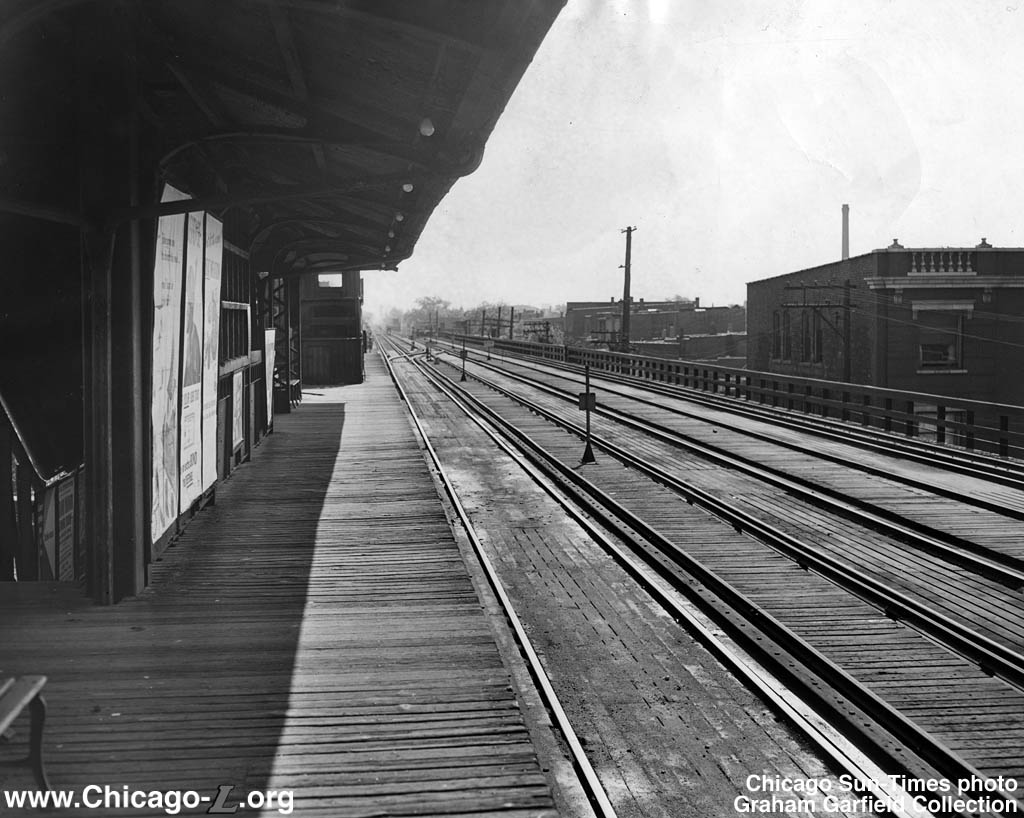
We can be very thankful that enterprising photographers took great pictures like this one. Practically everything we see here is gone now. This picture shows the end of the Normal Park "L" on 69th Street between Parnell and Normal, at about 526 West. CSL 6226 and 6236 are running on the 67-69-71 route. (Edward Frank, Jr. Photo) As you can see, the Normal Park "L" was built with the intention of extending it south of 69th, but this did not happen. This short and lightly used branch was abandoned in 1954, and "L" service did not go south of 63rd again until the opening of the Dan Ryan line in 1969. This picture looks to have been taken sometime around 1940. Starting in 1949, CTA began to operate the Normal Park branch as a shuttle operation using one or two wood cars. Eventually, the intermediate stations were gutted and conductors collected fares at those stations on the train. By 1954, ridership was so slight that no replacement service was needed.

We can be very thankful that enterprising photographers took great pictures like this one. Practically everything we see here is gone now. This picture shows the end of the Normal Park “L” on 69th Street between Parnell and Normal, at about 526 West. CSL 6226 and 6236 are running on the 67-69-71 route. (Edward Frank, Jr. Photo) As you can see, the Normal Park “L” was built with the intention of extending it south of 69th, but this did not happen. This short and lightly used branch was abandoned in 1954, and “L” service did not go south of 63rd again until the opening of the Dan Ryan line in 1969. This picture looks to have been taken sometime around 1940. Starting in 1949, CTA began to operate the Normal Park branch as a shuttle operation using one or two wood cars. Eventually, the intermediate stations were gutted and conductors collected fares at those stations on the train. By 1954, ridership was so slight that no replacement service was needed.

Here's how 526 W. 69th Street looks today.

Here’s how 526 W. 69th Street looks today.

Here is another sampling of classic Chicago Surface Lines photos from the collections of George Trapp, who has generously shared them with us. If you would like to see other pictures in this series, please use the search window at the top of this page. Watch this space for more CSL pictures in the near future.

As always, if you know some useful tidbit of information about these images and would like to share them with us, you can either leave a comment on this post, or contact us directly at:

thetrolleydodger@gmail.com

Thanks.

-David Sadowski

PS- We hope you will join us in wishing Jeff Wien, co-author of CERA Bulletin 146, a happy 75th birthday.


Easter Parade in Toronto

Our previous post Trolley Dodger Mailbag, 3-27-2016 showed pictures of Toronto Peter Witt car 2766 being readied for the Easter parade. Here are some videos showing five generations of Toronto streetcars in that parade:


Chicago or Philadelphia?

luzernedepot1913

This 1913 picture was recently sold on eBay, identified as being Chicago. Having our doubts, we asked the members of the Philadelphia Transit discussion group on Yahoo to weigh in with their opinions. Several people identified it as being the west apron of Luzerne Depot.

Michael T. Greene wrote:

It’s Luzerne Depot in Philadelphia. BTW, this isn’t the first time that I’ve seen a Philadelphia photo mislabeled as a Chicago photo. In 2003, there was a photo from the Bob Redden Archives that showed a touring London RT bus in what was billed as “Chicago”…until I noticed a Mack C-41-GT in a 1500-series, signed for a line lettered “C”. In addition, there were streetlights I never knew existed in Chicago, but did see use on Broad Street in Philadelphia. It turned out that the photo was Broad Street, between South Penn Square and Chestnut.

Doing further research, I determined that the photo was taken March 25, 1952, and the London bus was part of a nationwide tour to promote the UK as a tourist destination. Another photo was shown of the RT passing an old-ish building that looked suspiciously similar to Broad Street Station…it was Broad Street Station, taken the same day as the first photo. (We are talking the Bob Redden Archives, so either version of “taken” might apply here.) Now, if we had a skyline shot, we’d be able to determine awfully fast…most US cities have a “signature” tall building where you can tell what city a picture was taken.

Interestingly, since J. G. Brill was located in Philadelphia, many Chicago streetcars were built there, and today’s post includes a few pictures of CSL streetcars at the factory in Philly. Luzerne Depot was used from 1913 to 1997.


Help Support The Trolley Dodger

gh1

This is our 131st post, and we are gradually creating a body of work and an online resource for the benefit of all railfans, everywhere. To date, we have received over 143,000 page views, for which we are very grateful.

You can help us continue our original transit research by checking out the fine products in our Online Store.

As we have said before, “If you buy here, we will be here.”

We thank you for your support.


DONATIONS

In order to continue giving you the kinds of historic railroad images that you have come to expect from The Trolley Dodger, we need your help and support. It costs money to maintain this website, and to do the sort of historic research that is our specialty. Your financial contributions help make this possible and are greatly appreciated.


CSL Sedan 3342 is southbound on Clark just north of North Avenue, probably in the 1930s. (Edward Frank, Jr. Photo)

CSL Sedan 3342 is southbound on Clark just north of North Avenue, probably in the 1930s. (Edward Frank, Jr. Photo)

CSL 3341 at South Shops on October 23, 1938. This was the day of a famous Surface Lines fantrip, instrumental in recruiting a lot of new members for Central Electric Railfans' Association, which was just getting on its feet. You can read more about that here (just disregard the error message that might come up). (Krambles-Peterson Archive)

CSL 3341 at South Shops on October 23, 1938. This was the day of a famous Surface Lines fantrip, instrumental in recruiting a lot of new members for Central Electric Railfans’ Association, which was just getting on its feet. You can read more about that here (just disregard the error message that might come up). (Krambles-Peterson Archive)

The back end of CSL 3341 at Devon Station (car barn). (Krambles-Peterson Archive)

The back end of CSL 3341 at Devon Station (car barn). (Krambles-Peterson Archive)

CSL Pullman 149 and Sedan 6280 at Devon Station (car barn) in the 1930s. 6280 was built by CSL in 1929. This building was built by the Chicago Union Traction Co. in 1900. (Edward Frank, Jr. Photo)

CSL Pullman 149 and Sedan 6280 at Devon Station (car barn) in the 1930s. 6280 was built by CSL in 1929. This building was built by the Chicago Union Traction Co. in 1900. (Edward Frank, Jr. Photo)

CSL 3327 is southbound, most likely on route 22 Clark-Wentworth, in this 1930s scene. It's possible this may be north Clark Street just south of Birchwood, where there is a curve. That is just a few blocks south of Howard, which was the end of the line. There is a building at Clark and Howard that resembles the one at right. (Edward Frank, Jr. Photo)

CSL 3327 is southbound, most likely on route 22 Clark-Wentworth, in this 1930s scene. It’s possible this may be north Clark Street just south of Birchwood, where there is a curve. That is just a few blocks south of Howard, which was the end of the line. There is a building at Clark and Howard that resembles the one at right. (Edward Frank, Jr. Photo)

The building at Clark and Howard as it looks today. We are facing north.

The building at Clark and Howard as it looks today. We are facing north.

CSL Sedan 3323 is southbound on Clark at Sheffield. The rather odd building at right is still there. (Edward Frank, Jr. Photo)

CSL Sedan 3323 is southbound on Clark at Sheffield. The rather odd building at right is still there. (Edward Frank, Jr. Photo)

Clark and Sheffield today.

Clark and Sheffield today.

A closer up view of that triangular-shaped building. In this photo, it is being renovated. These type of structures were often hamburger stands back in the 1930s.

A closer up view of that triangular-shaped building. In this photo, it is being renovated. These type of structures were often hamburger stands back in the 1930s.

CSL 3322 on route 22 - Clark-Wentworth. (Joe L. Diaz Photo)

CSL 3322 on route 22 – Clark-Wentworth. (Joe L. Diaz Photo)

CSL 3322, heading southbound on Clark at Lincoln. (Edward Frank, Jr. Photo)

CSL 3322, heading southbound on Clark at Lincoln. (Edward Frank, Jr. Photo)

Clark and Lincoln today.

Clark and Lincoln today.

CSL 3303 on the 59-61st Street route. Andre Kristopans: "3303 on 59/61 is just east of Western. These days CSX’s big intermodal terminal is overhead where the S2 is." (Joe L. Diaz Photo) 3303 was part of a series known as Multiple Unit cars. According to Don's Rail Photos, "These cars were built by CSL and have the same body style as the 1923 12-window cars, but were built with maximum traction trucks. A number were converted to one man operation as indicated by the white stripe on the ends. 3203 was built by CSL in 1924. It was rebuilt (for) one man service in 1932."

CSL 3303 on the 59-61st Street route. Andre Kristopans: “3303 on 59/61 is just east of Western. These days CSX’s big intermodal terminal is overhead where the S2 is.” (Joe L. Diaz Photo) 3303 was part of a series known as Multiple Unit cars. According to Don’s Rail Photos, “These cars were built by CSL and have the same body style as the 1923 12-window cars, but were built with maximum traction trucks. A number were converted to one man operation as indicated by the white stripe on the ends. 3203 was built by CSL in 1924. It was rebuilt (for) one man service in 1932.”

59th Street just east of Western Avenue today.

59th Street just east of Western Avenue today.

CTA 3321 at Chicago's lakefront in the early 1950s. Andre Kristopans: "3321 is on 67th just west of Oglesby. LSD in background."

CTA 3321 at Chicago’s lakefront in the early 1950s. Andre Kristopans: “3321 is on 67th just west of Oglesby. LSD in background.”

CSL 32XX in a rather contrasty picture. Andre Kristopans: "The 3200 with unknown exact number is EB on Montrose at Lincoln. Welles Park in background."

CSL 32XX in a rather contrasty picture. Andre Kristopans: “The 3200 with unknown exact number is EB on Montrose at Lincoln. Welles Park in background.”

According to Andre Kristopans, CSL 3304 is "EB on Montrose at Elston."

According to Andre Kristopans, CSL 3304 is “EB on Montrose at Elston.”

CTA 6233 on the 67-69-71 route. May Motor Sales had two locations, and this one is 501 E. 69th Street. If so, this is where the Chicago Skyway runs today. (Joe L. Diaz Collection) Andre Kristopans: "6233 is westbound, so indeed this is Keefe/Anthony/69th right were the Skyway now is."

CTA 6233 on the 67-69-71 route. May Motor Sales had two locations, and this one is 501 E. 69th Street. If so, this is where the Chicago Skyway runs today. (Joe L. Diaz Collection) Andre Kristopans: “6233 is westbound, so indeed this is Keefe/Anthony/69th right were the Skyway now is.”

The same location today, where the Chicago Skyway now runs. We are looking east at about 501 W. 69th.

The same location today, where the Chicago Skyway now runs. We are looking east at about 501 W. 69th.

CSL 3311 in a McGuire-Cummings builder's photo, taken at Paris, Illinois. Don's Rail Photos says, "3311 was built by Cummings Car Co in 1926. It was rebuilt as one man service in 1932."

CSL 3311 in a McGuire-Cummings builder’s photo, taken at Paris, Illinois. Don’s Rail Photos says, “3311 was built by Cummings Car Co in 1926. It was rebuilt as one man service in 1932.”

Another builder's photo of CSL 3311.

Another builder’s photo of CSL 3311.

CSL 3306 is heading west on route 73 - Armitage, and is about ready to turn south on Racine. (Ed Frank, Jr. Photo) We ran a photo taken around the corner from here in our earlier post Chicago Surface Lines Photos, Part Three (November 21, 2015). Andre Kristopans adds, "note that north of Armitage Racine had southbound track only all the way from Webster – that had not seen any regular service since the teens but was retained for emergency use."

CSL 3306 is heading west on route 73 – Armitage, and is about ready to turn south on Racine. (Ed Frank, Jr. Photo) We ran a photo taken around the corner from here in our earlier post Chicago Surface Lines Photos, Part Three (November 21, 2015). Andre Kristopans adds, “note that north of Armitage Racine had southbound track only all the way from Webster – that had not seen any regular service since the teens but was retained for emergency use.”

CSL Multiple Unit cars 6272 and 6270, apparently being operated that way sometime between 1923, when they were built, and 1932, the date they were converted to one-man operation. (Krambles-Peterson Archive)

CSL Multiple Unit cars 6272 and 6270, apparently being operated that way sometime between 1923, when they were built, and 1932, the date they were converted to one-man operation. (Krambles-Peterson Archive)

CSL 3320 and 3314 connected for multiple unit operation, most likely in the 1920s. The need for MU disappeared after the 1929 stock market crash. Andre Kristopans adds, "while they are signed for Grand, most likely they are at South Shops."

CSL 3320 and 3314 connected for multiple unit operation, most likely in the 1920s. The need for MU disappeared after the 1929 stock market crash. Andre Kristopans adds, “while they are signed for Grand, most likely they are at South Shops.”

I'm not sure why CSL 3288 is hanging over the edge in this photo, or what building is being constructed behind it. Andre Kristopans: "3288 was built by St Louis Car. It is obviously brand new, so it can be assumed to be at St. Louis’s plant. It would appear the plant is being expanded."

I’m not sure why CSL 3288 is hanging over the edge in this photo, or what building is being constructed behind it. Andre Kristopans: “3288 was built by St Louis Car. It is obviously brand new, so it can be assumed to be at St. Louis’s plant. It would appear the plant is being expanded.”

CSL 6247 at South Shops, signed for Halsted-Archer-Clark. This was another Multiple Unit type car. Don's Rail Photos says, "6247 was built by Brill Car Co in 1926, #22417. It was rebuilt as one man service in 1932. It was returned as two man service in 1948 and back to one man in 1949." (Chicago Surface Lines Photo)

CSL 6247 at South Shops, signed for Halsted-Archer-Clark. This was another Multiple Unit type car. Don’s Rail Photos says, “6247 was built by Brill Car Co in 1926, #22417. It was rebuilt as one man service in 1932. It was returned as two man service in 1948 and back to one man in 1949.” (Chicago Surface Lines Photo)

Another CSL picture showing 6247 at South Shops.

Another CSL picture showing 6247 at South Shops.

The as-built interior of CSL 3279. Don's Rail Photos says, "3279 was built by Brill Car Co in 1926 #22417. It was rebuilt as one man service in 1932. It was returned as two man serive in 1948 and back as one man in 1949." (J. G. Brill Photo, Historical Society of Pennsylvania Collection)

The as-built interior of CSL 3279. Don’s Rail Photos says, “3279 was built by Brill Car Co in 1926 #22417. It was rebuilt as one man service in 1932. It was returned as two man serive in 1948 and back as one man in 1949.” (J. G. Brill Photo, Historical Society of Pennsylvania Collection)

Another 1926 builder's photo of 3279 at the Brill plant in Philadelphia. (J. G. Brill Photo, Historical Society of Philadelphia Collection)

Another 1926 builder’s photo of 3279 at the Brill plant in Philadelphia. (J. G. Brill Photo, Historical Society of Philadelphia Collection)

CSL 6222 at Clark and Chicago. (George Krambles Photo, Edward Frank, Jr. Collection) Another Multiple Unit type car, Don's Rail Photos says, "6222 was built by Lightweight Noiseless Streetcar Co in 1924. It was rebuilt as one man service in 1932."

CSL 6222 at Clark and Chicago. (George Krambles Photo, Edward Frank, Jr. Collection) Another Multiple Unit type car, Don’s Rail Photos says, “6222 was built by Lightweight Noiseless Streetcar Co in 1924. It was rebuilt as one man service in 1932.”

Trolley Dodger Mailbag, 3-27-2016

cop1923

Chicago, Ottawa & Peoria

Tim McGuire writes:

I’m attaching a photo of my grandfather, Arthur Defenbaugh from Streator, who was a conductor on the Streator to Ottawa branch, with his engineer, standing in front of their trolley. I don’t know when or where the picture was taken. We think it was Streator. I believe it was in the late 20’s as this is a metal trolley car. The trolley car number appears to be 18. I read on your website that you don’t have many operational era photos for the CO&P. I thought you would enjoy it.

If you have information about my grandfather or the other gentleman, please let me know.


Arthur Ingram Defenbaugh was born on October 6, 1881, and died in July 1972, aged 90. It appears he spent most of his working life as a farmer. His wife died in 1926 and it does not appear he ever remarried.

If any of our readers have additional information, please let us know, thanks.


Toronto Peter Witt Car 2766

Dave Barrett recently did some volunteer work on Toronto’s sole remaining Peter Witt streetcar (whiich is now 93 years old) at Hillcrest shops, to get the car ready for the annual Beaches Easter parade. He has generously shared his photos of car 2766 with us:

Mar.24-16 -a

Mar.24-16 -b

Mar.24-16 -d

Mar.24-16 -e

Mar.24-16 -f

Mar.24-16 -g


CTA Kenwood, Stock Yards and Normal Park Shuttles

M. E. writes:

In this note I want to comment about photos of Indiana Ave. and Harvard Ave. in Chicago Rapid Transit Photos, Part Three (March 23, 2016).

You show the South Side L Indiana Ave. station in two pictures. I saw Andre Kristopans’ comment at the bottom, and I learned something from his comment: I had no idea the middle track west of the station was used for storing spare Stock Yards L cars. But I am sure Andre is correct.

The first photo shows a bigger scope. Let me start with the platform at the right.

Notice that the section of wood nearest the track looks newer than the wood under the cover. This is because the newer wood was constructed over the third track that went through the station. Yes, there were three tracks on the north / south main. The three tracks actually continued east of the station, then south on the north / south main to just north of the 43rd St. station, where the easternmost track merged into the middle track.

Also, prior to (I think) 1949, the Kenwood L did not end at Indiana Ave. Instead, it went downtown onto the Loop. I’m not sure where it went from the Loop — some sources say to Ravenswood, others say to Wilson. My own experience is that the Englewood ran to Ravenswood, and the Jackson Park ran to Howard, through the State St. subway. And I think the Kenwood ran to Wilson. There were several smaller stations north of Indiana that were serviced by the Kenwood L. The Englewood and Jackson Park were supposed to be express through that area but were frequently delayed by being behind Kenwood trains.

Back at the Indiana station, both the Kenwood trains and the Englewood / Jackson Park trains used the two outer tracks of the three-track main. South/east-bound Kenwood trains crossed over from the southernmost main track to the Kenwood L structure to head east.

Later, when the Kenwood was cut back to shuttle service from Indiana to 42nd Place, the wood was added to cover most of the north/westernmost outer main track, leaving (at the east end of the platform) the terminal for the Kenwood shuttle. As I recall, that space could accommodate two cars. When Kenwood cars needed service, they turned south onto the easternmost main track, merged into the northbound main near 43rd St., switched over to the southbound main, and made their way to the Jackson Park yards at 61st St. and lower 63rd St.

So the photo shows two main tracks through the station, which had been the middle and south/westernmost tracks of the three-track setup.

Regarding the platform at the left, you see that the Stock Yards L terminated on the south side of that platform. Its only connection to the rest of the L system was the set of switches west of the Indiana station.

The Indiana station had an overhead bridge connecting the two platforms, thus enabling north/west-bound customers to access the Stock Yards L, and south/east-bound customers to access the Kenwood shuttle.

Now, on to the picture showing the Normal Park L shuttle. I think it was in 1949 that the CTA relegated the Normal Park line to shuttle service. Before that, the Normal Park cars were hitched onto the rear of Englewood trains. So people riding the Englewood L southbound had to be alert that the last car would be split off and go to 69th and Normal. If someone was in the wrong car, he/she could move between cars, which is apparently taboo today.

The structures along the sides of the L track are where the connections were made and unmade. Workers were stationed there to do this. Yes, even in frigid weather. And with live third rails. OSHA would have had a fit. The motormen of northbound Normal Park trains rode the trains into the Harvard station, then down and under to the southbound platform, then onto the last car of incoming southbound trains.

You also see in the distance the switch tower where the Normal Park line branched off to the south.

When the Normal Park line became shuttle service, northbound trains went into the Harvard station. The motorman quickly changed ends, then immediately (so as not to delay northbound Englewood trains) proceeded to the switch over to the south/west-bound track. You can see this switch next to the bigger structure.

In the photo, I have no idea why the motorman of the Normal Park car is standing in the walkway between the tracks. Perhaps this picture was deliberately posed.

This photo was taken from the southwest end of the south/west-bound L platform at Harvard. The address on the food shop below is 6316 S. Harvard. Busy 63rd St. was just to the right, and a block south at 64th St. and Harvard Ave. was St. Bernard’s Hospital, which I believe is still there. Two blocks east of the Harvard L station was Englewood Union Station (New York Central, Nickel Plate, Pennsylvania, Rock Island), and three blocks west was the other Englewood train station (Erie, Monon, Wabash, Chicago and Eastern Illinois, Chicago and Western Indiana). Plus, there were several streetcar lines. All told, for a fan of anything on rails, it was nirvana.


Chicago or Copenhagen?

copenhagen1

I recently wrote to the Chicagotransit Yahoo discussion group about the above photo:

There’s a photo negative on eBay that is identified as showing a couple streetcars at the 1933-34 Chicago World’s Fair. Yet I don’t recognize where this could have been taken there.

I know that Chicago Surface Lines had a couple of line extensions built to bring people to the fair, but was not aware of any trolleys on the grounds themselves.

Is the photo misidentified, and if so, what does it actually show? To me, it looks like it could have been taken in Europe.

Dennis McClendon wrote:

The famous Copenhagen church (Grundtvigskirke) just behind the trams might be a good clue.

Pardon my stupidity, but I assume you mean the famous Copenhagen church in Copenhagen, and not one that was moved, brick by brick, to the 1933-34 Chicago World’s Fair?

I wonder what it was about this picture that made the seller guess that it was taken in Chicago. For transit on the fair grounds themselves, I am pretty sure they used buses of a type similar to those used at the 1939-40 New York World’s Fair.

Dennis McClendon replied:

The Century of Progress grounds stretched for three miles along the lakefront, from Roosevelt to 39th. Greyhound got the concession for motorized transport within the fairgrounds, driving these open-air trailer conveyances along a portion of Leif Eriksen Drive that later was part of South Lake Shore Drive.

Within the exhibits area, where motorized vehicles weren’t allowed, you could ride in a pushchair, providing summer employment to dozens of high school and college students.


Cent of Progress buses

Similar buses (actually, they look more like trucks) were also used at the 1939-40 NY World’s Fair. As it tuns out, they were not the same vehicles. This is explained in an article from Hemmings Motor News.

Apparently, the Chicago buses used at the fair were one-offs made by General Motors.

There were at least two types of buses used at the New York World’s Fair, a “tractor train” and a more streamlined bus. Neither looks much like the ones used in Chicago. The streamlined buses were made by Yellow Coach.

ny1939a

ny1939b

ny1939c

nyworldsfairbus

After the fair ended in 1940, some of the streamlined buses were used to transport WAACs.

After the fair ended in 1940, some of the streamlined buses were used to transport WAACs.

The question has been raised as to whether or not the Chicago buses were then sold to Bowen Motor Coach for use at the Texas Centennial Exposition in 1936. You can see pictures of the Texas buses below, and there is also a quick view of them in a video clip here.

At this point, it’s not clear whether they were the same buses that were used in Chicago with a bit of new sheet metal attached, or simply similar buses built later by General Motors.

1933bus2

A Greyhound Bus' tram drives in front of Chrysler motors Building at the Chicago World's Fair. (Photographer Unknown/www.bcpix.com)

A Greyhound Bus’ tram drives in front of Chrysler motors Building at the Chicago World’s Fair. (Photographer Unknown/www.bcpix.com)

1933bus4

1933bus5

1933bus1

Buses purported to be those from the 1933-34 World's Fair, shown in Texas in 1939, where they were owned by the Bowen Bus Company.

Buses purported to be those from the 1933-34 World’s Fair, shown in Texas in 1939, where they were owned by the Bowen Bus Company.

A Bowen bus at the Texas Centennial Exposition in 1936. (J. Elmore Hudson Photo)

A Bowen bus at the Texas Centennial Exposition in 1936. (J. Elmore Hudson Photo)

The west facade of Grundtvigskirken today. Photo by Hans Andersen - Own work, CC BY-SA 3.0, https://commons.wikimedia.org/w/index.php?curid=266140

The west facade of Grundtvigskirken today. Photo by Hans AndersenOwn work, CC BY-SA 3.0, https://commons.wikimedia.org/w/index.php?curid=266140


FYI, we have added another Liberty Bell Limited photo to our recent post Alphabet Soup (March 15, 2016):

LVT 1006 heads from Norristown to Philadelphia over the P&W in June 1949.

LVT 1006 heads from Norristown to Philadelphia over the P&W in June 1949.


“Keeping Pace” – A Rare Chicago Surface Lines Recording

csl04

We have a unique opportunity to buy a 16″ transcription disc made by the Chicago Surface Lines‘ public relations department in 1939. Chances are, this is a 30-minute radio program promoting CSL, most likely played a few times on local radio stations, and has been unheard since then. The script was written by Hollis Farley Peck (1909-1971).

For all we know, this recording may include the sounds of Chicago streetcars, which would be very rare.

It will not be easy to play this record due to the large (16″) size. Although this is a 33 1/3 rpm record, it used the same technology as the 78 rpm records of its time. The current LP system of vinyl records did not come about until 1948.

Such large recordings were necessary to provide a longer running time than a standard 78 rpm record, which could only last about 3:20. I assume that each side of this transcription disc has 15 minutes on it.

Once I have the record, I plan to consult with the Museum of Broadcast Communications here in Chicago. Possibly they may have the necessary equipment for playing it. If a successful recording can be made, we will digitally remaster it and issue it on a compact disc.

If MBC can help us, we may donate the original disc to the museum for their collection. After all, this is local history.

However, before we can do that, we first have to complete the purchase. If you can help contribute to the $60 cost of this rare recording, your donation will be greatly appreciated.

Thanks.

-David Sadowski


DONATIONS

In order to continue giving you the kinds of historic railroad images that you have come to expect from The Trolley Dodger, we need your help and support. It costs money to maintain this website, and to do the sort of historic research that is our specialty. Your financial contributions help make this possible and are greatly appreciated.

csl06

csl07

csl08

csl09

csl10

csl11

csl05

Specialized equipment is required to play a 16" transcription disc. This is one such turntable made by Esoteric Sound.

Specialized equipment is required to play a 16″ transcription disc. This is one such turntable made by Esoteric Sound.

A 1936 phonograph for playing transcription discs. This one played records from the inside out, with a maximum running time of one hour per side.

A 1936 phonograph for playing transcription discs. This one played records from the inside out, with a maximum running time of one hour per side.


Help Support The Trolley Dodger

gh1

This is our 130th post, and we are gradually creating a body of work and an online resource for the benefit of all railfans, everywhere. To date, we have received over 141,000 page views, for which we are very grateful.

You can help us continue our original transit research by checking out the fine products in our Online Store. You can make a donation there as well.

As we have said before, “If you buy here, we will be here.”

We thank you for your support.


Chicago Rapid Transit Photos, Part Three

CTA articulated "Doodlebug" 5003 southbound at Main Street in Evanston. (C. Edward Hedstrom Photo)

CTA articulated “Doodlebug” 5003 southbound at Main Street in Evanston. (C. Edward Hedstrom Photo)

An aerial view, showing where the picture of 5003 was taken near Main and Chicago. There is a gap between the CTA Evanston branch and the Metra UP-North Line (formerly, the Chicago & North Western), large enough for a short paved road, now mainly used for parking.

An aerial view, showing where the picture of 5003 was taken near Main and Chicago. There is a gap between the CTA Evanston branch and the Metra UP-North Line (formerly, the Chicago & North Western), large enough for a short paved road, now mainly used for parking.

Today, we have another batch of classic Chicago rapid transit photos to share with you. These are not easy to come by, and as far as I can tell, this is only the third time we have devoted an entire post to them.

The two previous articles were Chicago Rapid Transit Mystery Photos – Solved (April 28, 2015) and More Chicago Rapid Transit Photos (September 21, 2015), although of course we have sprinkled plenty of other rapid transit photos into other postings.

We have some great pictures of the experimental articulated “Doodlebugs” ordered by the Chicago Rapid Transit Company, which were delivered in 1947-48. These were the first new Chicago rapid transit cars in nearly 25 years, and were inspired by the similar “Bluebird” compartment cars purchased by New York’s Brooklyn-Manhattan Transit in 1939-40.*

Chicago’s Loop “L” is famous world-wide. What is perhaps less known is how a few other cities had short stretches of elevateds, and we have included a couple pictures of those as well. In addition to Baltimore and Boston, shown here, there were also “els” of some sort in Kansas City and Hoboken, New Jersey. To this day, there is more elevated trackage in New York than in Chicago.

Some of today’s pictures were taken at much the same times and places as pictures in those two earlier posts. Sometimes we have been able to identify the times and places when these pictures could have been taken, other times not. As always, if you can help provide any information that might shed light on what’s going on here, we would definitely appreciate it.

You can either leave a comment on this post, or contact us directly at:

thetrolleydodger@gmail.com

Thanks.

-David Sadowski

PS- These images are being added to our E-book The New Look in Chicago Transit: 1938-1973, available through our Online Store.


Help Support The Trolley Dodger

gh1

This is our 129th post, and we are gradually creating a body of work and an online resource for the benefit of all railfans, everywhere. To date, we have received over 139,000 page views, for which we are very grateful.

You can help us continue our original transit research by checking out the fine products in our Online Store. You can make a donation there as well.

As we have said before, “If you buy here, we will be here.”

We thank you for your support.


*Here are some films of the Bluebirds in action circa 1954, shortly before they were retired:

CTA 5001 at Laramie on September 27, 1948. (Stephen D. Maguire Photo)

CTA 5001 at Laramie on September 27, 1948. (Stephen D. Maguire Photo)

CTA 5003 on the Met "L" near Throop Street Shops in 1948. (St. Louis Car Company Photo)

CTA 5003 on the Met “L” near Throop Street Shops in 1948. (St. Louis Car Company Photo)

Brand-new CTA 5003 on C&NW flatcars in 1948. (St. Louis Car Company Photo)

Brand-new CTA 5003 on C&NW flatcars in 1948. (St. Louis Car Company Photo)

CTA "L" car 3115 at West Shops in April 1949. This was one of the few places where CTA rapid transit cars and streetcars could operate on the same tracks, the other being at 63rd Street Lower Yard. The location is approximately 3900 W. Lake Street. There was a ramp, a rather steep grade in fact, connecting with the Lake Street "L", which lasted until 1987. Can that be a streetcar at right?

CTA “L” car 3115 at West Shops in April 1949. This was one of the few places where CTA rapid transit cars and streetcars could operate on the same tracks, the other being at 63rd Street Lower Yard. The location is approximately 3900 W. Lake Street. There was a ramp, a rather steep grade in fact, connecting with the Lake Street “L”, which lasted until 1987. Can that be a streetcar at right?

The approximate location of the previous picture. Since that photo was taken, CTA has built a substation here for the Lake Street "L".

The approximate location of the previous picture. Since that photo was taken, CTA has built a substation here for the Lake Street “L”.

Streetcar tracks are still visible today at CTA's West Shops, which was built by the West Chicago Street Railroad, which became part of Chicago Surface Lines in 1914. CTA used West Shops for rapid transit car work for a few years into the early 1950s, before such work was consolidated elsewhere. The tracks crossing Lake Street itself were only removed a couple years ago.

Streetcar tracks are still visible today at CTA’s West Shops, which was built by the West Chicago Street Railroad, which became part of Chicago Surface Lines in 1914. CTA used West Shops for rapid transit car work for a few years into the early 1950s, before such work was consolidated elsewhere. The tracks crossing Lake Street itself were only removed a couple years ago.

The first train of new 6000s on display at the North Water Street terminal on August 17, 1950. This terminal provided a convenient place to display a train without interfering with regular service.

The first train of new 6000s on display at the North Water Street terminal on August 17, 1950. This terminal provided a convenient place to display a train without interfering with regular service.

A rare CTA three-car train of singe car units on the Ravenswood (Brown Line) "L" on May 28, 1978. In general, three-car trains resulted from one of the cars in a four-car train being taken out of service. This picture was taken at Chicago Avenue. (Gordon E. Lloyd Photo) It's been pointed out to me that this picture was taken on a Sunday, during a time when the Ravenswood did not run on Sundays. So, this was a fantrip train that would have had the run of the Ravenswood south of Belmont. This picture looks like it was taken at track level. Now the Brown Line runs downtown seven days a week. Gordon Earl Lloyd (1924-2006) was a well-known railfan author and photographer.

A rare CTA three-car train of singe car units on the Ravenswood (Brown Line) “L” on May 28, 1978. In general, three-car trains resulted from one of the cars in a four-car train being taken out of service. This picture was taken at Chicago Avenue. (Gordon E. Lloyd Photo) It’s been pointed out to me that this picture was taken on a Sunday, during a time when the Ravenswood did not run on Sundays. So, this was a fantrip train that would have had the run of the Ravenswood south of Belmont. This picture looks like it was taken at track level. Now the Brown Line runs downtown seven days a week. Gordon Earl Lloyd (1924-2006) was a well-known railfan author and photographer.

The Guiford Avenue el in Baltimore, circa 1949. (Lester K. Wismer Photo)

The Guiford Avenue el in Baltimore, circa 1949. (Lester K. Wismer Photo)

A Boston Elevated Railway train of 0300-class cars , near Rowes Wharf station on the last day of the Atlantic Avenue el, September 28, 1938. (Robert Stanley Collection)

A Boston Elevated Railway train of 0300-class cars , near Rowes Wharf station on the last day of the Atlantic Avenue el, September 28, 1938. (Robert Stanley Collection)

The mount on this Kodachrome slide helps narrow down the time frame on this photo to 1955-57. We are at the Indiana Avenue station on the South Side "L", looking west. We posted a picture showing the view looking east at this station in a previous post. That picture shows a Kenwood shuttle train, but the wood cars in the distance here are very likely Stock Yards cars. Wooden "L" cars would not have been running on the Howard-Jackson Park-Englewood line, as that went through the State Street subway. According to Graham Garfield's excellent web site, Stock Yards shuttle cars would have stopped at the south platform (to the left in this picture) via a single track. Presumably, the two-car wood train in this picture is heading west, and the mainline train of 6000s is heading east. Running parallel to the "L" at this point, just to the north, is the Chicago Junction Railway, which built and owned the Kenwood branch of the "L." This part of the CJ was abandoned in the 1960s after the Union Stock Yards had dwindled down to next to nothing.

The mount on this Kodachrome slide helps narrow down the time frame on this photo to 1955-57. We are at the Indiana Avenue station on the South Side “L”, looking west. We posted a picture showing the view looking east at this station in a previous post. That picture shows a Kenwood shuttle train, but the wood cars in the distance here are very likely Stock Yards cars. Wooden “L” cars would not have been running on the Howard-Jackson Park-Englewood line, as that went through the State Street subway. According to Graham Garfield’s excellent web site, Stock Yards shuttle cars would have stopped at the south platform (to the left in this picture) via a single track. Presumably, the two-car wood train in this picture is heading west, and the mainline train of 6000s is heading east. Running parallel to the “L” at this point, just to the north, is the Chicago Junction Railway, which built and owned the Kenwood branch of the “L.” This part of the CJ was abandoned in the 1960s after the Union Stock Yards had dwindled down to next to nothing.

A close-up view of the previous scene.

A close-up view of the previous scene.

An early 1940s map of the Stock Yards branch of the "L". Indiana station is just to the right of the green line. You can see how the Chicago Junction ran parallel to the "L" just to the north. The Stock Yards branch was abandoned in 1957, shortly before Kenwood.

An early 1940s map of the Stock Yards branch of the “L”. Indiana station is just to the right of the green line. You can see how the Chicago Junction ran parallel to the “L” just to the north. The Stock Yards branch was abandoned in 1957, shortly before Kenwood.

An early 1940s map of the Kenwood branch of the "L", which was abandoned in 1957.

An early 1940s map of the Kenwood branch of the “L”, which was abandoned in 1957.

CTA 4357 at South Boulevard and Maple in October 1952, at the west end of the Lake Street "L" when it ran on the ground.

CTA 4357 at South Boulevard and Maple in October 1952, at the west end of the Lake Street “L” when it ran on the ground.

South Boulevard and Maple in Oak Park today. The Lake Street "L", today's Green Lin, was relocated to the Chicago & North Western embankment in 1962. That's the Harlem station at left, which has its main entrance at Marion Street.

South Boulevard and Maple in Oak Park today. The Lake Street “L”, today’s Green Lin, was relocated to the Chicago & North Western embankment in 1962. That’s the Harlem station at left, which has its main entrance at Marion Street.

There was only a brief period when this May 1969 photo could have been taken. What we see is the west end of the Englewood "L" yard near Loomis. The yard itself was renovated in the early 1960s, as evidenced by the concrete supports. We are standing on a newly built section of "L", soon to be connected to the rest of the structure, that extended this line to Ashland, a more practical terminus that provides a better place for bus transfers. We are looking east.

There was only a brief period when this May 1969 photo could have been taken. What we see is the west end of the Englewood “L” yard near Loomis. The yard itself was renovated in the early 1960s, as evidenced by the concrete supports. We are standing on a newly built section of “L”, soon to be connected to the rest of the structure, that extended this line to Ashland, a more practical terminus that provides a better place for bus transfers. We are looking east.

CTA Met car 2888 heads up a Garfield Park train on the Loop "L" circa 1950.

CTA Met car 2888 heads up a Garfield Park train on the Loop “L” circa 1950.

A Douglas Park local at the west end of the line at Oak Park Avenue in Berwyn, circa 1950. This is before A/B "skip stop" service began on this route, which was soon cut back to 54th Avenue, its present terminus.

A Douglas Park local at the west end of the line at Oak Park Avenue in Berwyn, circa 1950. This is before A/B “skip stop” service began on this route, which was soon cut back to 54th Avenue, its present terminus.

A CTA single car unit running under wire at the Linden terminal in Wilmette in 1964. We are looking south. The Evanston branch was changed over to third rail along with the retirement of 4000-series "L" cars in 1973.

A CTA single car unit running under wire at the Linden terminal in Wilmette in 1964. We are looking south. The Evanston branch was changed over to third rail along with the retirement of 4000-series “L” cars in 1973.

A woman on CTA "baldy" car 4031 notices her picture is being taken at an unidentified location. As you can see, these 1913 "L" cars featured sideways seating.

A woman on CTA “baldy” car 4031 notices her picture is being taken at an unidentified location. As you can see, these 1913 “L” cars featured sideways seating.

We previously ran a very similar picture in an earlier post. In fact, it seems likely both pictures were taken at much the same time, although they are not identical. In any case, the previous caption information will do just as well here: According to Andre Kristopans, it shows a “Normal Park shuttle between Harvard Englewood and Stewart Jct – appears inbound.” Edward Maurath notes that car “223 was made by Jewett in 1902 for the South Side Line, then known as the ”alley L’.”

We previously ran a very similar picture in an earlier post. In fact, it seems likely both pictures were taken at much the same time, although they are not identical. In any case, the previous caption information will do just as well here: According to Andre Kristopans, it shows a “Normal Park shuttle between Harvard Englewood and Stewart Jct – appears inbound.” Edward Maurath notes that car “223 was made by Jewett in 1902 for the South Side Line, then known as the ”alley L’.”

A Douglas Park "L" train, signed to go to Lawndale, at Randolph and Wabash. CTA had a small storage yard at Kenton, which was abandoned in the early 1950s.

A Douglas Park “L” train, signed to go to Lawndale, at Randolph and Wabash. CTA had a small storage yard at Kenton, which was abandoned in the early 1950s.

The same location as the last picture, and another Douglas Park train going to Lanwdale only, but this is a different car (2821) and run number (316 vs. 315). Interesting that consecutive runs would only be going that far. There must not have been much demand for outbound service when this picture was taken.

The same location as the last picture, and another Douglas Park train going to Lanwdale only, but this is a different car (2821) and run number (316 vs. 315). Interesting that consecutive runs would only be going that far. There must not have been much demand for outbound service when this picture was taken.

This is the old Clark and Lake "L" station and we are looking east. An outbound Ravenswood "A" train is stopped at the station. The signs at right are advertising a stage version of Mister Roberts at the Erlanger Theatre. A/B "skip stop" service was instituted on the Ravenswood on August 1, 1949, which is probably around the time this picture was taken. Prior to this, most Ravenswood service was operated by 4000s running via the subway. By Spring of 1951, base service on the Rave was being operated by new 6000s.

This is the old Clark and Lake “L” station and we are looking east. An outbound Ravenswood “A” train is stopped at the station. The signs at right are advertising a stage version of Mister Roberts at the Erlanger Theatre. A/B “skip stop” service was instituted on the Ravenswood on August 1, 1949, which is probably around the time this picture was taken. Prior to this, most Ravenswood service was operated by 4000s running via the subway. By Spring of 1951, base service on the Rave was being operated by new 6000s.

Where this picture could have been taken was somewhat of a mystery, but the one place that seems a good fit is the old Lawndale terminal on the Humboldt Park "L". There, only one track served the platform, while there were two tracks for storage. Gate cars such as these were used during the CTA era, and the "L" itself was shoehorned between buildings such as the one at left. There was a tower at the end of the platform, such as the one seen here. In that scenario, the "M" may simply stand for Metropolitan, as Humboldt Park was part of the Met "L".

Where this picture could have been taken was somewhat of a mystery, but the one place that seems a good fit is the old Lawndale terminal on the Humboldt Park “L”. There, only one track served the platform, while there were two tracks for storage. Gate cars such as these were used during the CTA era, and the “L” itself was shoehorned between buildings such as the one at left. There was a tower at the end of the platform, such as the one seen here. In that scenario, the “M” may simply stand for Metropolitan, as Humboldt Park was part of the Met “L”.

For the sake of comparison, Graham Garfield’s excellent web site shows a picture taken at Lawndale, but looking in the opposite direction (east):

http://www.chicago-l.org/stations/images/HumboldtPark/lawndale02.jpg

The building shown in the last picture, as it looks today on Lawndale just north of North Avenue. The buildings to the west of here have been torn down (there is a car wash on that site today), but note the similarity in construction to the building shown in our mystery photo.

The building shown in the last picture, as it looks today on Lawndale just north of North Avenue. The buildings to the west of here have been torn down (there is a car wash on that site today), but note the similarity in construction to the building shown in our mystery photo.

Trolley Dodger Mailbag, 3-20-2016

The building in question at about 6242 S. Wabash Ave. in Chicago.

The building in question at about 6242 S. Wabash Ave. in Chicago.

Old Chicago City Railway Building

Marcin Sienkiel writes:

I’m from Poland and I interested a streetcar in Chicago. I have question about old bulding on S Wabash Str., near E 63rd Str. Is it old horse streetcar barn? On portal is wrote C.C.Ry.C – Does it mean: Chicago City Railway Company?
https://www.google.pl/maps/@41.7807066,-87.6236948,3a,26.4y,268.49h,89.68t/data=!3m6!1e1!3m4!1sykVd2dGms0KaYSbC-MfF8Q!2e0!7i13312!8i6656?hl=pl

And I have question to Mr. Sadowski:
Are you speak Polish (your name is very Polish;)? Because my English is very bad and easier when I will be writing in Polish.

Thank you and have nice day.

My grandparents on my father’s side came to America from Poland in the early 1900s. Their children were forbidden from speaking Polish at home. My dad only knew a few words. My aunt could understand it, but couldn’t speak it.

While I don’t know any Polish, I do see that this building, whatever it was, is not listed as a car barn on this useful web site:

http://www.chicagorailfan.com/rosctaxi.html

Fortunately, members of the Chicagotransit Yahoo discussion group came up with a lot of useful information:

George Foelschow:

Interesting question. Marcin must have very sharp eyes to note the portal inscription. It would seem the streetcar loop on the east side of State Street north of 63rd (site of the 1950 PCC disaster) would be behind this facility. 63rd Street was not a cable car line, so it may well date from the horse car era .The door dimensions may well be a clue, since horse cars were generally smaller than electric cars. Fire insurance maps, not at my finger tips, would be useful. (Chicago’s horse car system represents a book that hasn’t been written yet.)

Perhaps a few clues can be found in the dates when transit service began in the vicinity of this building, which is located just north of 63rd Street on Wabash, which is near State.

63rd Street did not have horse car service in this area. But according to http://www.chicagorailfan.com:

1898 – electric streetcar service introduced State St. to Halsted
1899 – electric streetcar service introduced State St. to Cottage Grove

As for State Street, horse car service was extended south to 63rd in 1882, and then converted to cable car operation in 1887. North of 63rd, cable cars remained in service until July 22, 1906.

Electric streetcar service was introduced between 63rd St. and 71st St. in 1898. As of July 1, 1901, this service was extended south to 81st Street, replacing a battery operated streetcar.

According to Cable Railways of Chicago by George W. Hilton (ERHS bulletin 10, page 5)* cable car service south of 39th was run from a powerhouse at 52nd and State. The Chicago City Railway’s main car house for the cable operation on State was located at 39th Street. There was another car barn at 61st and State.

So, it’s possible the building in question was used by CCR’s horse car operation between 1882 and 1887.

However, it’s possible that it may also have been used for trolleys starting in 1898. Some of the first Chicago streetcars were actually cable trailers that were electrified.

This is at least possible because the building would be strategically located to serve both 63rd and State. However, once cable service ended in 1906, it might have been necessary to use other car barns (“stations”) instead.

Interesting that this building is still standing after all these years.

*Available in The Complete ERHS Collection, an E-book published by Central Electric Railfans’ Association. Trolley Dodger Press is not affiliated with Central Electric Railfans’ Association.

Dennis McClendon:

The 1926 fire insurance map shows the building as Chicago Surface Lines Wrecking Wagon House.

The 1895 fire insurance map shows the property on Wabash without a building, but has a small structure at 6235 State, labeled as Conductor’s Room. This was the end of track for the State Street cable car line.

Chicago’s Street Railways in 1890

An adjacent building and all other buildings on State are labeled S, for Store. The few facing Wabash are marked D, for Dwelling.

My 1906 CSL track map shows a building there, identified only as Company Property.

Screenshot 2016-03-19 13.38.30

Another reader adds:

Several years ago Dave Diamond of IRM showed me some photos that he had taken of the building located near Wabash and 63rd that had a CCRys entablature on it. He said that his research found that the building had been used for horsecar supplies and later was used by CSL as a storage facility. I do not know whether it still exists. I doubt that it is owned by the CTA at this time.

So, there you have it. There are two possibilities here. On the one hand, if the building actually dates back to horse car days, it would have been built around 1882 and used for this purpose until 1887. That would not explain why there is no building shown on an 1895 map.

Another theory would be that the building was built around 1898 and was used in some fashion when streetcar service was instituted on both State and 63rd in this area. If it was in fact used as a car barn, this was short-lived since the rapid expansion of electric streetcar service would have rendered this inadequate by 1906. Some of the first streetcars used here were actually retrofitted cable trailers.

In 1914, the Chicago City Railway Company became a part of Chicago Surface Lines, which was like an umbrella agency. CSL continued to use the building for various purposes. Chances are, it was then owned by the successor Chicago Transit Authority starting in 1947. With the rapid consolidation of CTA facilities, it would not surprise me if the building was sold during the 1950s.

This was also the general vicinity of the horrific May 25, 1950 crash between a PCC streetcar and a gasoline truck, the subject of an earlier post.

-David Sadowski

PS- We have added videos to three previous posts:

Traction in Milwaukee

More Chicago PCC Photos – Part Seven

Alphabet Soup

Screen Shot 03-20-16 at 05.13 AM.PNG

Screen Shot 03-20-16 at 05.14 AM.PNG

Screen Shot 03-20-16 at 04.52 AM.PNG

A close-up of the area from a 1941 CSL track map, which can be found in our E-book Chicago's PCC Streetcars: The Rest of the Story, available from our Online Store. It looks like there were tracks leading to this building.

A close-up of the area from a 1941 CSL track map, which can be found in our E-book Chicago’s PCC Streetcars: The Rest of the Story, available from our Online Store. It looks like there were tracks leading to this building.

From a previous post, here is a picture showing one of those retrofitted cable trailers in streetcar service:

Chicago City Railway car 2169 on the 75th Street route. According to Central Electric Railfans' Association bulletin 27 (July 1941), this car was part of an order of 69 closed cable trailer cars (with double door in bulkheads) built by Wells-French in 1896. These cars were electrified in 1908, and most were renumbered. My guess is we are at 75th and South Chicago. This picture would have been taken between 1908 and 1914, when CCR became part of the Chicago Surface Lines. If I am reading B-27 correctly, this car would originally have been numbered 2129. It was scrapped after CSL was formed. Bob Lalich adds, "I agree, Chicago City Railway car 2169 is at 75th and South Chicago Ave. It appears that the Grand Crossing grade separation project was underway, judging by the construction shacks."

Chicago City Railway car 2169 on the 75th Street route. According to Central Electric Railfans’ Association bulletin 27 (July 1941), this car was part of an order of 69 closed cable trailer cars (with double door in bulkheads) built by Wells-French in 1896. These cars were electrified in 1908, and most were renumbered. My guess is we are at 75th and South Chicago. This picture would have been taken between 1908 and 1914, when CCR became part of the Chicago Surface Lines. If I am reading B-27 correctly, this car would originally have been numbered 2129. It was scrapped after CSL was formed. Bob Lalich adds, “I agree, Chicago City Railway car 2169 is at 75th and South Chicago Ave. It appears that the Grand Crossing grade separation project was underway, judging by the construction shacks.”


Help Support The Trolley Dodger

gh1

This is our 128th post, and we are gradually creating a body of work and an online resource for the benefit of all railfans, everywhere. To date, we have received over 137,000 page views, for which we are very grateful.

You can help us continue our original transit research by checking out the fine products in our Online Store. You can make a donation there as well.

As we have said before, “If you buy here, we will be here.”

We thank you for your support.


New From Trolley Dodger Records

Screen Shot 03-16-16 at 06.58 PM.PNG Screen Shot 03-17-16 at 12.44 AM.PNG

Red Arrow Lines 1967: Straffords and Bullets
# of Discs – 1
Price: $14.95

This disc features rare, long out-of-print audio recordings of two 1967 round trips on the Philadelphia & Western (aka “Red Arrow Lines”) interurban between Philadelphia and Norristown, the famous third rail High-Speed Line. One trip is by a Strafford car and the other by one of the beloved streamlined Bullets. The line, about 13 miles long and still in operation today under SEPTA, bears many similarities to another former interurban line, the Chicago Transit Authority‘s Yellow Line (aka the “Skokie Swift”). As a bonus feature, we have included audio of an entire ride along that five mile route, which was once part of the North Shore Line.

Total time – 53:08


P1060550

AFR
Steam Sounds of America’s First Railroad
(Baltimore & Ohio)
# of Discs – 1
Price: $14.95

This set represents the only professionally produced audio recordings of a large assortment of Baltimore and Ohio steam locomotives. Every type of steam power operated by the B&O in the 1950s is included. This release is for the serious railfan and railroad historian who want to accurately hear regular revenue steam motive power operations. No excursion or railfan trips have been included. All recordings are from 1952-1955.

Total time – 66:54


P1060549 P1060551

RRC #21 and SIC
Duluth and Northeastern
Steam in Colorado
# of Discs – 1
Price: $14.95

Railroad Record Club #21:
The Duluth and Northeastern Railroad, as of 1961 when this recording was made, was an all steam short line operating from Cloquet to Saginaw, Minnesota, a distance of approximately 11.5 miles. Its primary industry was the Northwest Paper Company mill at Cloquet where it handled loads to and from the interchange at Saginaw with the Duluth, Missabe and Iron Range. It also connected with the N. P., G. N. and C. M. ST. P & P., at Cloquet. We hear from locomotives No. 27 (2-8-0) and 29 (0-8-0).

Record #SIC:
Steam in Colorado (1958) presents five great railroads, depicting the passing of an era. Roads represented are the Union Pacific, Burlington, Colorado & Southern, Rio Grande and Great Western. Steam in Colorado portrays the daily tasks of the “Iron Horse” in high country and each track has been carefully selected for the listener’s enjoyment. All aboard!

Total time – 61:55


Chicago Surface Lines Photos, Part Eight

CTA 192 at 63rd Place and Major (5700 W.) in June 1952, after the prewar PCCs had been removed from the 63rd Street route. Some postwar PCCs would also be used on this line before streetcars were abandoned in 1953. Major was the end of the private right-of-way on the west end of this route.

CTA 192 at 63rd Place and Major (5700 W.) in June 1952, after the prewar PCCs had been removed from the 63rd Street route. Some postwar PCCs would also be used on this line before streetcars were abandoned in 1953. Major was the end of the private right-of-way on the west end of this route.

63rd Place and Major today. After streetcars were abandoned, bus service on this portion of the line was relocated to 63rd Street. The same terminal at Narragansett and 63rd Place remained in use, however. We are looking west.

63rd Place and Major today. After streetcars were abandoned, bus service on this portion of the line was relocated to 63rd Street. The same terminal at Narragansett and 63rd Place remained in use, however. We are looking west.

The older house in the middle of the picture (5714 W. 63rd Place) also appears in the 1952 image.

The older house in the middle of the picture (5714 W. 63rd Place) also appears in the 1952 image.

Here is another generous helping of classic Chicago streetcar photos from the latter part of the Chicago Surface Lines era as well as the early days of its successor, the Chicago Transit Authority. We even have one picture from before CSL days.

As always, if you can help identify locations, or have interesting facts or reminiscences to add, don’t hesitate to drop us a line. You can leave comments on this post, or write us directly at:

thetrolleydodger@gmail.com

FYI, there will be additional posts in this series coming up in the near future, so watch this space. To see previous posts, use the search window on this page.

-David Sadowski


Help Support The Trolley Dodger

gh1

This is our 126th post, and we are gradually creating a body of work and an online resource for the benefit of all railfans, everywhere. To date, we have received over 134,000 page views, for which we are very grateful.

You can help us continue our original transit research by checking out the fine products in our Online Store. You can make a donation there as well.

As we have said before, “If you buy here, we will be here.”

We thank you for your support.


CSL 1812 at Harrison and Central, ready to head back downtown. That's Columbus Park at rear. (Joe L. Diaz Photo)

CSL 1812 at Harrison and Central, ready to head back downtown. That’s Columbus Park at rear. (Joe L. Diaz Photo)

Harrison and Central today. Now there is a turnaround loop for CTA buses just west of Central.

Harrison and Central today. Now there is a turnaround loop for CTA buses just west of Central.

75th and Vincennes in the 1940s. At left, CSL 241 heads south on through route 22 - Clark-Wentworth, while 2774 heads west on the 74-75 route. (Joe L. Diaz Photo)

75th and Vincennes in the 1940s. At left, CSL 241 heads south on through route 22 – Clark-Wentworth, while 2774 heads west on the 74-75 route. (Joe L. Diaz Photo)

Vincennes and 75th today. We are looking northeast.

Vincennes and 75th today. We are looking northeast.

CSL 3304 is heading westbound at Armitage and Cicero on route 73. This picture was originally identified as being at Grand, but the buildings do not match up, and there actually was no direct track connection between the Armitage and Grand streetcar lines. (Joe L. Diaz Photo)

CSL 3304 is heading westbound at Armitage and Cicero on route 73. This picture was originally identified as being at Grand, but the buildings do not match up, and there actually was no direct track connection between the Armitage and Grand streetcar lines. (Joe L. Diaz Photo)

Armitage and Cicero today. We are facing east.

Armitage and Cicero today. We are facing east.

CSL 3278 is identified as being at 51st and Western, on the 51-55 line. (Joe L. Diaz Photo)

CSL 3278 is identified as being at 51st and Western, on the 51-55 line. (Joe L. Diaz Photo)

CSL 2904, 3110, and 2908 at the Blue Island Station (car house), showing its fireproof concrete and brick construction. (Joe L. Diaz Photo)

CSL 2904, 3110, and 2908 at the Blue Island Station (car house), showing its fireproof concrete and brick construction. (Joe L. Diaz Photo)

CSL 5998 on the Archer line.

CSL 5998 on the Archer line.

This photo of CSL 2589 is at Michigan and 121st on the Riverdale line, crossing the Blue Island branch of the Illinois Central electric suburban service (today's Metra Electric). There is another picture of the same car in our post Chicago Streetcars in Black-and-White, Part 6 (May 11, 2015), which explains why 2589 has "keep to right" scrawled on it. That was to warn drivers not to try passing the car on the left while on the bridge over the Little Calumet River, where the line was single track. 2589 was a so-called "Robertson" car, built by St. Louis Car Company in 1901. (Joe L. Diaz Photo)

This photo of CSL 2589 is at Michigan and 121st on the Riverdale line, crossing the Blue Island branch of the Illinois Central electric suburban service (today’s Metra Electric). There is another picture of the same car in our post Chicago Streetcars in Black-and-White, Part 6 (May 11, 2015), which explains why 2589 has “keep to right” scrawled on it. That was to warn drivers not to try passing the car on the left while on the bridge over the Little Calumet River, where the line was single track. 2589 was a so-called “Robertson” car, built by St. Louis Car Company in 1901. (Joe L. Diaz Photo)

Michigan and 121st today.

Michigan and 121st today.

The interior of CTA 3034 as it appeared in March 1951. This car was built by Brill in 1914. You will find more than a dozen copies of the Rider's Reader in our E-book The “New Look” in Chicago Transit: 1938-1973, available in our Online Store. (Chicago Transit Authority Photo)

The interior of CTA 3034 as it appeared in March 1951. This car was built by Brill in 1914. You will find more than a dozen copies of the Rider’s Reader in our E-book The “New Look” in Chicago Transit: 1938-1973, available in our Online Store. (Chicago Transit Authority Photo)

CSL 3304 is westbound at Armitage and Campbell on route 73, having just passed under the Logan Square branch on the "L". That looks like a Model A Ford at left.

CSL 3304 is westbound at Armitage and Campbell on route 73, having just passed under the Logan Square branch on the “L”. That looks like a Model A Ford at left.

CSL 3111 is westbound at 18th and State, just west of the South Side "L". I see a 1940s Cadillac at left. Andre Kristopans: "Note also the nominal WB track has no overhead!" (Joe L. Diaz Photo) M. E. adds, "Andre Kristopans points out the westbound track has no trolley wire. That is because this photo shows the eastern terminal of the 18th St. line. The streetcar will switch over to the westbound track to continue west. Behind the streetcar is the 18th St. station on the South Side L. The streetcar's destination sign says Leavitt - Blue Island, which was the sign on a streetcar in an photo posted previously. You also have a photo at 18th and Sangamon. Together with your earlier photos, It seems the photographer was all over the 18th St. line that day."

CSL 3111 is westbound at 18th and State, just west of the South Side “L”. I see a 1940s Cadillac at left. Andre Kristopans: “Note also the nominal WB track has no overhead!” (Joe L. Diaz Photo) M. E. adds, “Andre Kristopans points out the westbound track has no trolley wire. That is because this photo shows the eastern terminal of the 18th St. line. The streetcar will switch over to the westbound track to continue west. Behind the streetcar is the 18th St. station on the South Side L. The streetcar’s destination sign says Leavitt – Blue Island, which was the sign on a streetcar in an photo posted previously. You also have a photo at 18th and Sangamon. Together with your earlier photos, It seems the photographer was all over the 18th St. line that day.”

CSL 1520 is southbound on Sheffield at Belmont. It's hard to make out the sign, but that's the Hotel Sheffield Manor. (Joe L. Diaz Photo) Steve adds, "Photograph chicago160 with car 1520, faces northwest from the southeast corner of Belmont and Sheffield; a location with which I am very familiar. "Ben Hartman Drugs" is now "Big City Tap" (a 4:00 am bar), occupies the edifice on the northwest corner there. A particularly intriguing bar, "Trader Todd’s", with a fun karaoke night, is on the ground floor of the Sheffield Manor hotel. The car is signed for Taylor-Western, which I believe means it is on the Taylor-Sedgwick-Sheffield line."

CSL 1520 is southbound on Sheffield at Belmont. It’s hard to make out the sign, but that’s the Hotel Sheffield Manor. (Joe L. Diaz Photo) Steve adds, “Photograph chicago160 with car 1520, faces northwest from the southeast corner of Belmont and Sheffield; a location with which I am very familiar. “Ben Hartman Drugs” is now “Big City Tap” (a 4:00 am bar), occupies the edifice on the northwest corner there. A particularly intriguing bar, “Trader Todd’s”, with a fun karaoke night, is on the ground floor of the Sheffield Manor hotel. The car is signed for Taylor-Western, which I believe means it is on the Taylor-Sedgwick-Sheffield line.”

Belmont and Sheffield today. We are looking northwest.

Belmont and Sheffield today. We are looking northwest.

CSL 3304 passes 3310 at Montrose and Western. (Joe L. Diaz Photo)

CSL 3304 passes 3310 at Montrose and Western. (Joe L. Diaz Photo)

CSL 2808 on the 74th-75th Street route. I spy a 1940s Ford at left. Andre Kristopans: "2808 is at 75th and Exchange. IC South Chicago branch is in background." (Joe L. Diaz Photo)

CSL 2808 on the 74th-75th Street route. I spy a 1940s Ford at left. Andre Kristopans: “2808 is at 75th and Exchange. IC South Chicago branch is in background.” (Joe L. Diaz Photo)

CSL 3192 is heading south on Wabash on route 4 - Cottage Grove. We are just south of Harrison. The building to the right of the streetcar has an interesting ironwork facade. It is now the Leviton Gallery, and is located at 619 S. Wabash. Jeff Wien adds, "CSL through Route Number 1 was BROADWAY-COTTAGE GROVE which terminated at Lake Park and 55th. CSL Route 4 was COTTAGE GROVE and it terminated at Cottage Grove and 115th. Prior to the CTA, many of the cars ran without route numbers, just route names and destinations. Since car 3192 is signed up to go to Lake Park & 55th, I would say that it is a Route 1 car, not a Route 4. I realize that I am being very trivial on this point. Meanwhile, the streetcar behind it is a Nearside which would be running on Route 4 Cottage Grove."

CSL 3192 is heading south on Wabash on route 4 – Cottage Grove. We are just south of Harrison. The building to the right of the streetcar has an interesting ironwork facade. It is now the Leviton Gallery, and is located at 619 S. Wabash. Jeff Wien adds, “CSL through Route Number 1 was BROADWAY-COTTAGE GROVE which terminated at Lake Park and 55th. CSL Route 4 was COTTAGE GROVE and it terminated at Cottage Grove and 115th. Prior to the CTA, many of the cars ran without route numbers, just route names and destinations. Since car 3192 is signed up to go to Lake Park & 55th, I would say that it is a Route 1 car, not a Route 4. I realize that I am being very trivial on this point. Meanwhile, the streetcar behind it is a Nearside which would be running on Route 4 Cottage Grove.”

Wabash just south of Harrison today. The "L" has been relocated just north of here to soften out a curve.

Wabash just south of Harrison today. The “L” has been relocated just north of here to soften out a curve.

CSL 3095 is heading west on the 18th Street line at Jefferson. (Joe L. Diaz Photo)

CSL 3095 is heading west on the 18th Street line at Jefferson. (Joe L. Diaz Photo)

CSL 3116 on the 18th Street line. Andre Kristopans: "3116 is at 18th and Sangamon. The railroad is a Burlington branch from the main at 15th down to the “Lumber District” branch along Blue island and Cermak, and was very recently (2015) torn out." (Joe L. Diaz Photo)

CSL 3116 on the 18th Street line. Andre Kristopans: “3116 is at 18th and Sangamon. The railroad is a Burlington branch from the main at 15th down to the “Lumber District” branch along Blue island and Cermak, and was very recently (2015) torn out.” (Joe L. Diaz Photo)

18th and Sangamon today. We are looking northeast.

18th and Sangamon today. We are looking northeast.

Chicago City Railway car 2169 on the 75th Street route. According to Central Electric Railfans' Association bulletin 27 (July 1941), this car was part of an order of 69 closed cable trailer cars (with double door in bulkheads) built by Wells-French in 1896. These cars were electrified in 1908, and most were renumbered. My guess is we are at 75th and South Chicago. This picture would have been taken between 1908 and 1914, when CCR became part of the Chicago Surface Lines. If I am reading B-27 correctly, this car would originally have been numbered 2129. It was scrapped after CSL was formed. Bob Lalich adds, "I agree, Chicago City Railway car 2169 is at 75th and South Chicago Ave. It appears that the Grand Crossing grade separation project was underway, judging by the construction shacks."

Chicago City Railway car 2169 on the 75th Street route. According to Central Electric Railfans’ Association bulletin 27 (July 1941), this car was part of an order of 69 closed cable trailer cars (with double door in bulkheads) built by Wells-French in 1896. These cars were electrified in 1908, and most were renumbered. My guess is we are at 75th and South Chicago. This picture would have been taken between 1908 and 1914, when CCR became part of the Chicago Surface Lines. If I am reading B-27 correctly, this car would originally have been numbered 2129. It was scrapped after CSL was formed. Bob Lalich adds, “I agree, Chicago City Railway car 2169 is at 75th and South Chicago Ave. It appears that the Grand Crossing grade separation project was underway, judging by the construction shacks.”

75th and South Chicago today.

75th and South Chicago today.

CTA 6167 on the 67-69-71 line. Andre Kristopans: "6167 is at (the) 71st/California terminal."

CTA 6167 on the 67-69-71 line. Andre Kristopans: “6167 is at (the) 71st/California terminal.”

CSL 3314 on the 67-69-71 line. Andre Kristopans: "3314 (is) WB at 67th at Rhodes."

CSL 3314 on the 67-69-71 line. Andre Kristopans: “3314 (is) WB at 67th at Rhodes.”

CSL 5637 on Stony Island on December 1, 1946. Bob Lalich: "CSL 5637 is a little north of 93rd St. The open space immediately east of Stony Island was a small quarry. CVS high school at 87th and Jeffery can be seen in the background to the right of the car."

CSL 5637 on Stony Island on December 1, 1946. Bob Lalich: “CSL 5637 is a little north of 93rd St. The open space immediately east of Stony Island was a small quarry. CVS high school at 87th and Jeffery can be seen in the background to the right of the car.”

CSL 2755 clatters over the Illinois Central's South Chicago branch at 79th and Exchange. (Joe L. Diaz Photo)

CSL 2755 clatters over the Illinois Central’s South Chicago branch at 79th and Exchange. (Joe L. Diaz Photo)

CSL 1401 on the 87th Street line by the Gresham station on the Rock Island. The line ended east of the station and there was no direct track connection to Vincennes on the other side of the RI. We published another photo taken at the same location in our previous post Chicago Surface Lines Photos, Part Four (November 27, 2015) (Joe L. Diaz Photo)

CSL 1401 on the 87th Street line by the Gresham station on the Rock Island. The line ended east of the station and there was no direct track connection to Vincennes on the other side of the RI. We published another photo taken at the same location in our previous post Chicago Surface Lines Photos, Part Four (November 27, 2015) (Joe L. Diaz Photo)

More Chicago PCC Photos – Part Seven

Pullman-built CTA PCC 4148 southbound at Clark and Thome on May 13, 1950. That is a safety island at right, to protect passengers from errant vehicles. (John D. Koschwanez Photo, John F. Bromley Collection)

Pullman-built CTA PCC 4148 southbound at Clark and Thome on May 13, 1950. That is a safety island at right, to protect passengers from errant vehicles. (John D. Koschwanez Photo, John F. Bromley Collection)

As a way of saying thank you to our readers, we have decided to pull out all the stops for this, our 125th Trolley Dodger blog post, with a bevy of Chicago PCC photos. We have been saving some up for a while now in anticipation of this milestone, and rather than break this batch into two, we have decided to give them all to you at once. Along with the prewar and postwar Chicago streamliners, we have thrown in a few rare shots of pre-PCCs and even a couple of Sedans as well.

The Sedans are sometimes overlooked, but these 100 cars, built in 1929, were fast and modern, and could have continued to serve alongside the PCCs for some years past their 1952 retirement date. They provided Chicago with a total of 785 modern cars, including the two experimental units.

This is part of a series of Chicago PCC posts, and to see the earlier ones, please use the search window on this page.

I would also like to thank all the photographers (including some of the greats) who took these great photos so that we could enjoy them today. Thanks also to John F. Bromley for sharing some excellent color photos from his vast collection with us.

As we look ahead to what will hopefully be our next 125 posts, keep in mind that “from little trees, do big acorns grow.” Or maybe it was the other way around?

-David Sadowski

PS- These photos are being added to our E-book collection Chicago’s PCC Streetcars: The Rest of the Story, available through our Online Store. If you have already purchased a copy, we offer a low-cost updating service. Write us at thetrolleydodger@gmail.com for more details.


Help Support The Trolley Dodger

gh1

This is our 125th post, and we are gradually creating a body of work and an online resource for the benefit of all railfans, everywhere. To date, we have received over 132,000 page views, for which we are very grateful.

You can help us continue our original transit research by checking out the fine products in our Online Store. You can make a donation there as well.

As we have said before, “If you buy here, we will be here.”

We thank you for your support.


New From Trolley Dodger Press:

P1060517

American Streetcar R.P.O.s: 1893-1929

Mainline Railway Post Offices were in use in the United States from 1862 to 1978 (with the final year being operated by boat instead of on rails), but for a much briefer era, cable cars and streetcars were also used for mail handling in the following 15 cities*:

Baltimore
Boston
Brooklyn
Chicago
Cincinnati
Cleveland
New Bedford, Massachusetts
New York City
Philadelphia
Pittsburgh
Rochester, New York
St. Louis
San Francisco
Seattle
Washington, D.C.


*As noted by some of our readers, this list does not include interurban RPOs.

Our latest E-book American Streetcar R.P.O.s collects 12 books on this subject (over 1000 pages in all) onto a DVD data disc that can be read on any computer using Adobe Acrobat Reader, which is free software. All have been out of print for decades and are hard to find. In addition, there is an introductory essay by David Sadowski.

The rolling stock, routes, operations, and cancellation markings of the various American street railway post office systems are covered in detail. The era of the streetcar R.P.O. was relatively brief, covering 1893 to 1929, but it represented an improvement in mail handling over what came before, and it moved a lot of mail. In many places, it was possible to deposit a letter into a mail slot on a streetcar or cable car and have it delivered across town within a short number of hours.

These operations present a very interesting history, but are not well-known to railfans. We feel they deserve greater scrutiny, and therefore we are donating $1 from each sale of this item to the Mobile Post Office Society, in support of their efforts.

# of Discs – 1
Price: $19.95


CTA 4409 and 4390 at the beautifully landscaped Western-Berwyn loop on May 13, 1950. (John D. Koschwanez Photo, John F. Bromley Collection)

CTA 4409 and 4390 at the beautifully landscaped Western-Berwyn loop on May 13, 1950. (John D. Koschwanez Photo, John F. Bromley Collection)

Prewar CTA PCC 7020, now converted to one-man operation, is southbound at Western and Maypole in May 1956, about a month before the end of streetcar service on route 49. The prewar cars were used for 364 days on this line. In the back, that is the Lake Street "L", which, oddly enough, does not have a stop on this busy street. (John F. Bromley Collection)

Prewar CTA PCC 7020, now converted to one-man operation, is southbound at Western and Maypole in May 1956, about a month before the end of streetcar service on route 49. The prewar cars were used for 364 days on this line. In the back, that is the Lake Street “L”, which, oddly enough, does not have a stop on this busy street. (John F. Bromley Collection)

Western and Maypole today. We are looking north.

Western and Maypole today. We are looking north.

CTA Sedan 3377, showing the original door configuration, southbound on Cottage Grove at 95th Street on May 6, 1951. (John D. Koschwanez Photo, John F. Bromley Collection)

CTA Sedan 3377, showing the original door configuration, southbound on Cottage Grove at 95th Street on May 6, 1951. (John D. Koschwanez Photo, John F. Bromley Collection)

CTA Sedans (Peter Witts) 3360 and 3347 are shown here at south Shops in 1952, having been converted to one-man with the removal of some center doors. There were 25 cars so modified, but as far as I know, only one ran in service in this setup. (Robert W. Gibson Photo, John F. Bromley Collection)

CTA Sedans (Peter Witts) 3360 and 3347 are shown here at south Shops in 1952, having been converted to one-man with the removal of some center doors. There were 25 cars so modified, but as far as I know, only one ran in service in this setup. (Robert W. Gibson Photo, John F. Bromley Collection)

CTA 4317 on Route 36 Broadway-State in March 1952.

CTA 4317 on Route 36 Broadway-State in March 1952.

CTA 7080 at State and 62nd in June 1950, near the site of the tragic collision between car 7078 and a gasoline truck, which took place on May 25.

CTA 7080 at State and 62nd in June 1950, near the site of the tragic collision between car 7078 and a gasoline truck, which took place on May 25.

The same general area today.

The same general area today.

This picture is a bit blurred due to motion, but it does show prewar CTA PCC in July 1948, heading west at Englewood Union Station, at that time an important train hub. M. E. writes: "Actually, the westbound streetcar is in the process of passing the Englewood Union Station, which is the building on the right. Behind the streetcar is the platform for New York Central and Nickel Plate trains. Behind the photographer is the platform for Rock Island trains. To the right of the station is the platform for Pennsylvania Railroad trains."

This picture is a bit blurred due to motion, but it does show prewar CTA PCC in July 1948, heading west at Englewood Union Station, at that time an important train hub. M. E. writes: “Actually, the westbound streetcar is in the process of passing the Englewood Union Station, which is the building on the right. Behind the streetcar is the platform for New York Central and Nickel Plate trains. Behind the photographer is the platform for Rock Island trains. To the right of the station is the platform for Pennsylvania Railroad trains.”

PCC 4393, "Another New CTA Streetcar," at the 79th and Western loop in 1948.

PCC 4393, “Another New CTA Streetcar,” at the 79th and Western loop in 1948.

According to George Trapp, CTA 7113 "appears to be at Devon Station at the southwest end of the south yard."

According to George Trapp, CTA 7113 “appears to be at Devon Station at the southwest end of the south yard.”

CTA 4031 in the wye at 63rd and Central Park, ready to head east.

CTA 4031 in the wye at 63rd and Central Park, ready to head east.

George Trapp: "CTA 7242 is on Schreiber just west of Clark laying over at the north end of Route 36."

George Trapp: “CTA 7242 is on Schreiber just west of Clark laying over at the north end of Route 36.”

This picture, most likely taken from an "L" platform, gives an excellent view contrasting the roof treatments on these two PCCs. 7203 is at right, in regular service, while the other car is being towed.

This picture, most likely taken from an “L” platform, gives an excellent view contrasting the roof treatments on these two PCCs. 7203 is at right, in regular service, while the other car is being towed.

Pullman-built CTA 4132 at the Madison-Austin loop on July 6, 1949.

Pullman-built CTA 4132 at the Madison-Austin loop on July 6, 1949.

CTA 4358 is on route 8 - Halsted at Congress in June 1952, during construction of the bridge that will go over the Congress expressway. The car at rear is on a shoo-fly.

CTA 4358 is on route 8 – Halsted at Congress in June 1952, during construction of the bridge that will go over the Congress expressway. The car at rear is on a shoo-fly.

CTA 7148 is next to sprinkler/plow D3 at Devon Station on May 16, 1954. D3 was scrapped on December 14, 1956.

CTA 7148 is next to sprinkler/plow D3 at Devon Station on May 16, 1954. D3 was scrapped on December 14, 1956.

Here is a rare shot of CSL experimental pre-PCC 7001 at 81st and Halsted, most likely in the 1930s.

Here is a rare shot of CSL experimental pre-PCC 7001 at 81st and Halsted, most likely in the 1930s.

In this November 1945 view at Kedzie Station (car barn), six cars in experimental paint schemes are lined up. From left, we have 4050, 4020, 4022, 4035, 4010, and 4018. To see what the color schemes were, go to page 12 of CERA Bulletin 146. (CSL Photo)

In this November 1945 view at Kedzie Station (car barn), six cars in experimental paint schemes are lined up. From left, we have 4050, 4020, 4022, 4035, 4010, and 4018. To see what the color schemes were, go to page 12 of CERA Bulletin 146. (CSL Photo)

A side view of the six experimental CSL paint schemes in November 1945. (CSL Photo)

A side view of the six experimental CSL paint schemes in November 1945. (CSL Photo)

Again, the six experimental paint schemes at Kedzie and Van Buren in November 1945. The eventual choice for the new postwar PCCs was not exactly like any of these, but fairly close to one. (CSL Photo)

Again, the six experimental paint schemes at Kedzie and Van Buren in November 1945. The eventual choice for the new postwar PCCs was not exactly like any of these, but fairly close to one. (CSL Photo)

CSL 7003 in front of the old Chicago & North Western station on Madison on July 25, 1939. In an earlier post, we have another picture of the same car at nearly the same location, taken around this time, but it has a different run number. (Charles A. Brown Photo)

CSL 7003 in front of the old Chicago & North Western station on Madison on July 25, 1939. In an earlier post, we have another picture of the same car at nearly the same location, taken around this time, but it has a different run number. (Charles A. Brown Photo)

CSL 7001 on route 22 at Clark and Adams. The Banker's Building at rear, now known as the Clark-Adams building, is located at 105 W. Adams. 476 feet tall, it is the tallest building ever built in Chicago to be clad entirely in brick. It was built in 1927 and this photo was probably taken in the 1930s.

CSL 7001 on route 22 at Clark and Adams. The Banker’s Building at rear, now known as the Clark-Adams building, is located at 105 W. Adams. 476 feet tall, it is the tallest building ever built in Chicago to be clad entirely in brick. It was built in 1927 and this photo was probably taken in the 1930s.

CSL 4037 is at Madison and Laramie. (Joe L. Diaz Photo)

CSL 4037 is at Madison and Laramie. (Joe L. Diaz Photo)

Brand-new PCC 7003 at Kedzie and Van Buren on November 23, 1936. (General Electric Photo)

Brand-new PCC 7003 at Kedzie and Van Buren on November 23, 1936. (General Electric Photo)

CSL 4098 at South Shops on January 8, 1947. (General Electric Photo)

CSL 4098 at South Shops on January 8, 1947. (General Electric Photo)

CSL 7029 at Madison and Austin on July 16, 1938. (M. D. McCarter Collection)

CSL 7029 at Madison and Austin on July 16, 1938. (M. D. McCarter Collection)

CSL 4051 at Kedzie and Van Buren on May 24, 1939. This is part of a series of photos of this car taken by CSL, possibly in preparation for the experimental modification of the doors on this car in 1940-41. This car helped determine the door arrangement used on the postwar PCCs. You will find another picture from this series in one of our earlier posts.

CSL 4051 at Kedzie and Van Buren on May 24, 1939. This is part of a series of photos of this car taken by CSL, possibly in preparation for the experimental modification of the doors on this car in 1940-41. This car helped determine the door arrangement used on the postwar PCCs. You will find another picture from this series in one of our earlier posts.

CSL 4051 is shown at Kedzie and Van Buren with an experimental door arrangement, which was tested on the busy Milwaukee Avenue car line. We ran another version of this same photo in a previous post, but this one has less cropping. (CSL Photo)

CSL 4051 is shown at Kedzie and Van Buren with an experimental door arrangement, which was tested on the busy Milwaukee Avenue car line. We ran another version of this same photo in a previous post, but this one has less cropping. (CSL Photo)

CSL 4051 at Madison and Austin, always a favorite spot for photographers. This photo was probably taken circa 1945-46 and by this time, the car had been returned to its original door arrangement. (Joe L. Diaz Photo)

CSL 4051 at Madison and Austin, always a favorite spot for photographers. This photo was probably taken circa 1945-46 and by this time, the car had been returned to its original door arrangement. (Joe L. Diaz Photo)

CSL 4051 at Milwaukee and Central on August 4, 1940, during the door arrangement test. This was the only PCC to run in regular service on route 56 - Milwaukee. (Frank E. Butts Collection)

CSL 4051 at Milwaukee and Central on August 4, 1940, during the door arrangement test. This was the only PCC to run in regular service on route 56 – Milwaukee. (Frank E. Butts Collection)

CTA 4120 eastbound at Madison and Franklin circa 1952-53. The newspaper trucks are advertising Lucille Ball and Desi Arnaz, then at the height of their popularity on I Love Lucy. (Roy W. Bruce Photo)

CTA 4120 eastbound at Madison and Franklin circa 1952-53. The newspaper trucks are advertising Lucille Ball and Desi Arnaz, then at the height of their popularity on I Love Lucy. (Roy W. Bruce Photo)

CTA 4106 at the same location. (Roy W. Bruce Photo)

CTA 4106 at the same location. (Roy W. Bruce Photo)

CTA 4071 at Madison and Franklin, circa 1952-53. (Roy W. Bruce Photo)

CTA 4071 at Madison and Franklin, circa 1952-53. (Roy W. Bruce Photo)

Since CTA 4109 is westbound in this Loop photo, it is most likely on either Dearborn, Washington, Franklin, or Monroe. (Eastbound cars used Madison.)

Since CTA 4109 is westbound in this Loop photo, it is most likely on either Dearborn, Washington, Franklin, or Monroe. (Eastbound cars used Madison.)

CTA 4125 is eastbound at Harrison and Fifth Avenue. We posted a different picture taken at this location here. This car was on the Madison-Fifth branch line on route 20. Oddly enough, streetcar service on the branch line lasted longer than the main line. The building behind the streetcar is the Kux Machine Company, located at 3924-44 W. Harrison St. We are facing west, and everything on the right side of the picture was cleared away in the early 1950s to build the Congress (Eisenhower) expressway. (Roy W. Bruce Photo)

CTA 4125 is eastbound at Harrison and Fifth Avenue. We posted a different picture taken at this location here. This car was on the Madison-Fifth branch line on route 20. Oddly enough, streetcar service on the branch line lasted longer than the main line. The building behind the streetcar is the Kux Machine Company, located at 3924-44 W. Harrison St. We are facing west, and everything on the right side of the picture was cleared away in the early 1950s to build the Congress (Eisenhower) expressway. (Roy W. Bruce Photo)

The same location today. Fifth Avenue is cut off by the expressway, probably because it would have crossed at an angle and wasn't considered that major of a street. It only goes just over a mile west of here anyway. Fifth Avenue has also been truncated at Madison Street, reducing its importance even further.

The same location today. Fifth Avenue is cut off by the expressway, probably because it would have crossed at an angle and wasn’t considered that major of a street. It only goes just over a mile west of here anyway. Fifth Avenue has also been truncated at Madison Street, reducing its importance even further.

This photo was marked as being at Cottage Grove and 103rd, but it is actually at 113th. By blowing up the image, I was able to read the street signs. CTA prewar car 4050 is shown in May 1953, after having been converted to one-man.

This photo was marked as being at Cottage Grove and 103rd, but it is actually at 113th. By blowing up the image, I was able to read the street signs. CTA prewar car 4050 is shown in May 1953, after having been converted to one-man.

Cottage Grove and 113th today.

Cottage Grove and 113th today.

CTA 4101 heads east on Madison after having crossed the Chicago River during construction of Lower Wacker Drive. That's the former Chicago Daily News building at rear. The date is July 4, 1951.

CTA 4101 heads east on Madison after having crossed the Chicago River during construction of Lower Wacker Drive. That’s the former Chicago Daily News building at rear. The date is July 4, 1951.

In this July 4, 1951 photo taken on Madison near Wacker, car 4132 is described as having a new paint job, the upper portion of which was different than any other car. There is a color picture of it in one of our previous posts.

In this July 4, 1951 photo taken on Madison near Wacker, car 4132 is described as having a new paint job, the upper portion of which was different than any other car. There is a color picture of it in one of our previous posts.

This picture of 7001 at Clark and Schreiber, with Devon Station at left, was taken just a few seconds after one you will find here. The pre-PCC car is in the same position in both shots but the automobile at left has pulled up in the other photo. That version gives the photo credit to R. J. Anderson, while this one gives the date-- February 29, 1940. The car's colors are listed as their original silver and green.

This picture of 7001 at Clark and Schreiber, with Devon Station at left, was taken just a few seconds after one you will find here. The pre-PCC car is in the same position in both shots but the automobile at left has pulled up in the other photo. That version gives the photo credit to R. J. Anderson, while this one gives the date– February 29, 1940. The car’s colors are listed as their original silver and green.

CSL's other experimental pre-PCC was streamlined car 4001, shown here at South Shops in 1936. Its colors are described as silver and blue. This car's aluminum body shell is preserved at the Illinois Railway Museum in Union.

CSL’s other experimental pre-PCC was streamlined car 4001, shown here at South Shops in 1936. Its colors are described as silver and blue. This car’s aluminum body shell is preserved at the Illinois Railway Museum in Union.

This picture is a bit blurred due to motion, but it does show prewar CTA PCC in July 1948, heading west after having just passed Englewood Union Station, at that time an important train hub.

This picture is a bit blurred due to motion, but it does show prewar CTA PCC in July 1948, heading west after having just passed Englewood Union Station, at that time an important train hub.

Although CSL prewar car 7008 is signed for Madison-Fifth, this photo appears to show the Madison-Austin loop. PCCs are probably being phased in late 1936 or early 1937, as evidenced by the older cars in the photo. Once the route was equipped with 83 PCCs, they still required a number of the fast 1929 Sedans to fill out the schedules. Those buildings in back are still there today. Maybe it's just a pull-in heading back to Kedzie Station. The car still has some shine on it.

Although CSL prewar car 7008 is signed for Madison-Fifth, this photo appears to show the Madison-Austin loop. PCCs are probably being phased in late 1936 or early 1937, as evidenced by the older cars in the photo. Once the route was equipped with 83 PCCs, they still required a number of the fast 1929 Sedans to fill out the schedules. Those buildings in back are still there today. Maybe it’s just a pull-in heading back to Kedzie Station. The car still has some shine on it.

The houses behind the Madison-Austin loop as they appear today.

The houses behind the Madison-Austin loop as they appear today.

CSL 4044 at Madison and Austin. The picture is dated 1941, but the "tiger stripes" on the car at rear would indicate it may be more like 1945-46.

CSL 4044 at Madison and Austin. The picture is dated 1941, but the “tiger stripes” on the car at rear would indicate it may be more like 1945-46.

CTA 4406, a product of St. Louis Car Company, in charter service on Clark Street north of Cermak Road, October 21, 1956. This may or may not be the same photo we posted here, it's hard to tell. However, this was apparently a photo stop on a fantrip where the PCC followed red Pullman 225, and it's likely there were a bunch of people taking this same photo. (Roy W. Bruce Photo)

CTA 4406, a product of St. Louis Car Company, in charter service on Clark Street north of Cermak Road, October 21, 1956. This may or may not be the same photo we posted here, it’s hard to tell. However, this was apparently a photo stop on a fantrip where the PCC followed red Pullman 225, and it’s likely there were a bunch of people taking this same photo. (Roy W. Bruce Photo)

In this August 1955 view, CTA 7106 is apparently heading northbound on route 36 - Broadway-State. Andre Kristopans adds, "7106 is NB at State and 91st about to go under C&WI/BRC/RI bridges. Note how street slopes downward. Everything on the right is gone, replaced by Dan Ryan Expressway." (Roy W. Bruce Photo)

In this August 1955 view, CTA 7106 is apparently heading northbound on route 36 – Broadway-State. Andre Kristopans adds, “7106 is NB at State and 91st about to go under C&WI/BRC/RI bridges. Note how street slopes downward. Everything on the right is gone, replaced by Dan Ryan Expressway.” (Roy W. Bruce Photo)

State and 91st today. We are looking south.

State and 91st today. We are looking south.

CTA 4203 at the Vincennes and 80th loop on May 20, 1951.

CTA 4203 at the Vincennes and 80th loop on May 20, 1951.

CTA 4228 at the Vincennes and 80th loop on May 20, 1951.

CTA 4228 at the Vincennes and 80th loop on May 20, 1951.

The location of the 80th and Vincennes loop today.

The location of the 80th and Vincennes loop today.

PS- Here is a short video showing Chicago PCCs in action in 1955-56. While this also purports to show red Pullman #144, it’s actually a fantrip with 225. Since the trip organizers had advertised that 144 would be used, they placed a piece of oilcloth with 144 on it over the car’s actual number. Fortunately, both cars were preserved, 144 at the Illinois Railway Museum and 225 at the Seashore Trolley Museum.

Trolley Dodger Mailbag, 2-28-2016

In 1957, CTA PCC 7271 and 7215 pass on Clark Street, just north of North Avenue. The old Plaza Hotel, located at 59 W. North Avenue, is in the background. A Hasty Tasty restaurant was located in the building, with a Pixley and Ehler's across the street. These were "greasy spoon" chains that were known for offering cheap eats. Local mobsters were known to hang out at the Plaza. The Chicago Historical Society, now known as the Chicago History Museum, would be just to the left, out of view in this picture. The Moody Bible Institute would be out of view on the right. (Russel Kriete Photo)

In 1957, CTA PCC 7271 and 7215 pass on Clark Street, just north of North Avenue. The old Plaza Hotel, located at 59 W. North Avenue, is in the background. A Hasty Tasty restaurant was located in the building, with a Pixley and Ehler’s across the street. These were “greasy spoon” chains that were known for offering cheap eats. Local mobsters were known to hang out at the Plaza. The Chicago Historical Society, now known as the Chicago History Museum, would be just to the left, out of view in this picture. The Moody Bible Institute would be out of view on the right. (Russel Kriete Photo)

In this close-up, that looks like 7215 at right. Photographer Russel A. Kreite (1923-2015), of Downers Grove, Illinois, was a member of the Photographic Society of America and had many of his photos published in books and magazines.

In this close-up, that looks like 7215 at right. Photographer Russel A. Kreite (1923-2015), of Downers Grove, Illinois, was a member of the Photographic Society of America and had many of his photos published in books and magazines.

Chicago PCC Station Assignments

Robert Dillon writes:

For the last several months I have been over and thoroughly enjoying CERA Bulletin 146 and your compendium “Chicago’s PCC Streetcars: The Rest of the Story”. It brings back a wealth of wonderful memories from my childhood growing up in Rogers Park. I was a frequent rider on the “Clark Street Car” and was immediately smitten with the post-war PCC from the day in 1947 that I first heard the gong and witnessed an otherwise unbelievably silent arrival and breathtaking appearance of a Howard bound PCC at Clark Street and Morse Avenue.

The trivia set forth on page 429 of Bulletin 146 indicates that 400 Pullman and St Louis post-war PCCs were assigned to the Clark-Wentworth and Broadway-State routes for runs out of the Clark-Devon and 77th-Vincennes Carbarns. What I have not been able to find in any of the literature is how those 400 cars were allocated by post-war PCC manufacturer and/or by car number series to those stations. Were there an equal number of Pullmans and St. Louis PCCs at each of Clark-Devon and 77th-Vincennes? I would imagine that after 49 Western was equipped exclusively with St.Louis PCCs in 1948 the St.Louis PCCs would have predominated at Clark-Devon.

There are several other car assignment questions that arise from the PCC Trivia Page. Thus, during 1948 and 1949 when the 69th St. Carbarn was handling both Western Ave and 63rd St. PCC-assigned runs, it presumably stabled all 83 of the pre-war PCCs, but how many St. Louis post-war PCCs were also then housed at 69th Street?

It is indicated that by the end of 1948, there were a few PCC cars assigned to the Cottage Grove-38th Street Carbarn Were these pre-war or post-war PCCs (Pullman or St.Louis) and what routes were they used on?

Finally, I am aware there were a number of 8 Halsted runs out of Limits Carbarn. And, maybe some Broadway-State runs as well. That suggests there were Pullman and/or St.Louis PCCs stationed at Limits, at least during the earlier 1950s. If that is true, is there any info as to the number of Pullmans vs St. Louis PCCs at Limits?

I would be very grateful for any illumination you could provide on the questions set forth above. Or, if you could point me toward resources where I might be able to find answers that would be very much appreciated as well.

Thanks very much for all of your terrific efforts on the Chicago PCCs. I can’t begin to express how much enjoyment it has given me.

There are a few different ways we can approach these questions. First of all, it’s possible that CTA records indicating which cars were assigned to which stations (car barns) and routes may still exist and can provide the necessary information.

In the absence of that, a lot can be learned by studying photographs. This would be a statistical approach. It would take some time and effort, but a lot could be learned that way. I would have to create a spreadsheet and compile data from a large number of images.

Over time, the number of cars required for each individual route changed. In general, the numbers declined since there were substantial ridership losses during the first decade of the CTA era. Some of the brochures CTA distributed when routes were changed over from streetcars to buses give the numbers of PCCs that were in use at the time of the switch to buses.

When Madison first got PCCs in late 1936, the route needed about 100 cars as I recall. Since there were only 83 prewar PCCs made, some of the 1929 Sedans filled out the schedule. These were fast cars and could keep up with the PCCs.

By the time PCCs were taken off Madison in 1953, I doubt this many cars were needed.

This reduction in the number of cars on individual routes also helps explain why it was possible for CTA to use the postwar PCCs on more routes than the four that were originally planned. Between 1947 and 1958, ridership on the CTA’s surface system was nearly cut in half.

I would be interested to know what information our readers can share with us. Hopefully, some of our frequent contributors can weigh in on this subject, thanks.

M. E. writes:

Your latest blog update contains a question about the 38th St. car barn: Which streetcar lines were served by the PCCs kept there?

It seems to me the answer is easy: Only 4 Cottage Grove. This line received some pre-war PCC cars a few years before it was converted to bus. (I have seen photos of post-war PCCs on Cottage Grove, but that would have been short-lived.)

The other south side PCC lines used south side barns as follows:

36 Broadway-State, 22 Clark-Wentworth, 8 Halsted, and 42 Halsted-Archer-Clark (all post-war PCC lines) used the barn at 77th and Vincennes. Line 22 ran in front of the barn. Line 36 ran behind the barn a few blocks on State St., and likely used 79th St. west to Vincennes to reach the barn.. I believe Halsted cars used 79th St. east to Vincennes to reach the barn (although I am not certain).

63 63rd St. (pre-war PCC) and 49 Western (post-war PCC) used the barn at 69th and Ashland. 63rd St. cars used Ashland south to 69th to reach the barn.

When the 69th and Ashland barn closed, I’m pretty sure 63rd was no longer a streetcar line, and Western Ave. cars used 69th St. east to Wentworth, south to Vincennes, southwest to 77th and Vincennes.

Andre Kristopans has a great answer:

Jan 1951:
Prewar – 75 69th, 8 Kedzie
St Louis 40 Limits, 50 69th, 199 Devon
Pullman 225 77th, 85 Kedzie

May 1953:

Prewar 83 Cottage Grove
St Louis 20 Cottage Grove, 66 77th, 41 69th, 160 Devon
Pullman 215 77th, 63 Kedzie, 31 Limits

March 1954:

Prewar 83 Cottage Grove
St Louis 20 Cottage Grove, 74 77th, 38 69th, 155 Devon
Pullman 87 77th

June 1957

4372-4411 77th
7136-7181 Devon
7182-7224 77th

Prior to 1957, assignment sheets only showed series by barn, not actual car numbers.

To get more specific than that, we would have to study photos to figure out where particular cars were assigned at various times. By 1957, all remaining cars in use were made by St. Louis Car Company in 1946-48.

Regarding 4391, the only postwar car saved, I know it spent time on Western Avenue before ending its days on Wentworth. According to the excellent Hicks Car Works blog, it was assigned to 69th station and later 77th. Therefore it was spared a lot of outdoor storage, which would have been the case at Devon.

There were various mechanical differences between the postwar Pullmans and the St. Louis cars. Some stations (car barns) were equipped to handle both types, and others were not.

These mechanical differences were spelled out in detail in a 24-page CTA troubleshooting manual for PCC operators. If anyone has a copy of this manual and can provide us with the information, we would very much appreciate it. This brochure was a greatly expanded version of one that CSL issued in 1946, which was only four pages.

The same location as above, perhaps taken a few years earlier.

The same location as above, perhaps taken a few years earlier.

plazahotel

Clark Street at North Avenue today. We are looking south. A bank has replaced the Pixley's, and the Latin School of Chicago now occupies the location of the old Plaza Hotel.

Clark Street at North Avenue today. We are looking south. A bank has replaced the Pixley’s, and the Latin School of Chicago now occupies the location of the old Plaza Hotel.


1920s Mystery Photos Redux

These two pictures appeared in The Rider’s Reader (January 31, 2016):

This picture, and the next, appear to have been taken in the late 1920s or early 1930s. The banners would indicate an event, but we are not sure of the occasion. One of our readers says this is "State and Washington looking south." This could also be circa 1926 at the time of the Eucharistic Congress.

This picture, and the next, appear to have been taken in the late 1920s or early 1930s. The banners would indicate an event, but we are not sure of the occasion. One of our readers says this is “State and Washington looking south.” This could also be circa 1926 at the time of the Eucharistic Congress.

Our readers have identified this as being "Holy Name Cathedral at State and Chicago." The occasion may be the Eucharistic Congress in 1926.

Our readers have identified this as being “Holy Name Cathedral at State and Chicago.” The occasion may be the Eucharistic Congress in 1926.

Miles Beitler writes:

I’m writing about two unidentified photos on your trolleydodger.com blog. The captions state that the photos appear to be of State Street in the loop in the 1920s or 1930s. One reader suggested that it was part of the 1926 Eucharistic Congress.

I don’t think it was the Eucharistic Congress (which I know was held that year in Mundelein) but I do think the year was 1926. All of the flags and patriotic decorations lead me to believe that it was the celebration of the United States sesquicentennial (150th birthday) which would have been July 4, 1926.

That’s an interesting suggestion, thanks. But one picture does show a large crowd outside Holy Name Cathedral. What would that have to do with the Fourth of July?

Miles replied:

The two photos might have nothing to do with each other except for the fact that both show patriotic decorations along State Street. I was referring to those decorations which I believe were there for the sesquicentennial.

The crowd outside Holy Name Cathedral could have been there for the Eucharistic Congress (although the Congress was held far away in Mundelein), or for a special Sesquicentennial Mass, or maybe even for the funeral of a prominent local politician or notorious gangster. But someone at Holy Name should be able to tell you.

Your blog also has a photo of a NSL Electroliner speeding through Skokie at “East Prairie Road circa 1960”, and a current photo of the CTA Yellow Line labeled “East Prairie Road looking east along the CTA Yellow Line today”. I believe the “today” photo is actually looking WEST; you can see the remnants of the Crawford Avenue station, as well as Crawford Avenue itself, one block to the west. As for the Electroliner photo, the eastbound and westbound mainline tracks are closer together near the CTA Skokie Shops than this photo indicates. So I think it might be just east of Kostner Avenue; there was a half-mile long siding along the westbound track which ended at that point, as well as a crossover between the two mainline tracks which is visible in the distance.

You may be correct about the North Shore Line picture. I will revise the caption accordingly.

The other two pictures appear to have been taken at one time and so I am inclined to think they relate to the same event, whatever it was.

Thanks.

Finally, Miles wrote:

I did some quick research and it seems clear that the photo of Holy Name Cathedral is indeed of the Eucharistic Congress procession. There was an outdoor mass at Soldier Field in addition to the larger one held in Mundelein. The photo of State and Washington Streets seems to depict similar decorations which may have been placed along the route to Soldier Field.

Thanks for your interesting blog and photos!

Well, thank you for all your help. As we have noted before, the information that comes with photos may or may not be correct. There were a couple of instances recently where the this info turned out not to be correct. This sometimes happened when the photographer was from out-of-town and thus was not as familiar with locations as one of the locals.

In the case of the North Shore Line photo, what’s written on the negative envelope actually matches what you say. I chose the opposite direction since I was unaware of the siding you mention. Now it all makes sense. However, further research has led me to think the photo was taken

Here is the photo in question, which originally appeared in Lost and Found (February 12, 2016):

An Electroliner at speed near Crawford looking west. This picture was taken from a passing train in 1960, three years before the North Shore Line quit. CTA's Skokie Swift began running in 1964. (Richard H. Young Photo)

An Electroliner at speed near Crawford looking west. This picture was taken from a passing train in 1960, three years before the North Shore Line quit. CTA’s Skokie Swift began running in 1964. (Richard H. Young Photo)

Today's CTA Yellow Line looking west from Crawford.

Today’s CTA Yellow Line looking west from Crawford.

Detail from an old CERA North Shore Line map, with the location of this photo indicated.

Detail from an old CERA North Shore Line map, with the location of this photo indicated.

The True Colors of Chicago’s Postwar PCCs

Although signed for Clark-Wentworth, this shot of 4160 is actually on Madison in Garfield Park. (CSL Photo) George Trapp says he got this picture from the late Robert Gibson.

Although signed for Clark-Wentworth, this shot of 4160 is actually on Madison in Garfield Park. (CSL Photo) George Trapp says he got this picture from the late Robert Gibson.

Pantone 151 is Swamp Holly Orange.

Pantone 151 is Swamp Holly Orange.

On the Chicagotransit Yahoo group, Damin Keenan writes:

What recommendations would you have for matching CTA’s colors using model paints?

Specifically I need Mercury Green, Croydon Cream, and Swamp Holly Orange and Mint Green and Alpine White.

Mercury Green, Croydon Cream, and Swamp Holly Orange are famous among railfans as the original color scheme adopted by the Chicago Surface Lines for their 600 postwar PCC streetcars. Some of these paints were also used on cars and trucks in that era.

FYI, I found a 1950 truck paint called Swamp Holly Orange:

http://paintref.com/cgi-bin/colorcodedisplay.cgi?color=Swamp%20Holly%20Orange

Ironically, this color was associated with the Yellow Freight Lines. According to the Wikipedia:

In 1929, A.J. Harrell enlisted the help of E. I. du Pont de Nemours and Company to improve highway safety by determining the vehicle color that would be the most visible on the nation’s highways. After the review was completed, it was determined that the color of the Swamp Holly Orange would be most visible from the greatest distance. Swamp Holly Orange became the color used on all company tractors.

There is also a commercially available enamel paint by that name:

https://www.imperialsupplies.com/item/0850700

However, to my eye these may look darker than what I recall seeing from photos. This was all in an era before the Pantone Matching System. Apparently, Swamp Holly Orange is Pantone 151.

You might try this for Mercury Green:

Click to access paintcodes.pdf

Croydon Cream is a color used on Harley-Davidson motorcycles:

Croyden Cream

Mint Green and Alpine White shouldn’t bee too hard to find, but then again, there are many variables that determine how color will look, which include indoor viewing, outdoor viewing, how many coats there are, etc. plus how much sun and weathering the paint got prior to when pictures were taken.

Even in the old days, you will notice how touch-up paints did not always match the original. That was one factor that led CTA to switch to a darker green on the PCCs in the early 1950s.

Modern paints are also, most likely, made of somewhat different ingredients than the original paints were.

You might do just as well to try and “eyeball” the color based on good quality photographs. Even in the old days, I expect there were variations in these colors, as there were in such things as “Traction Orange.”

I recall hearing a story that there was a heated argument out at IRM between some people who were wrangling over what constituted Traction Orange. Finally, they consulted an old-timer who told them that it was simply whatever was on sale at the paint store at that particular time.

Some of these issues were discussed in a blog post I wrote a while back:

Any Color You Like (Transit Trivia #1)

Pay particular attention to the comments, thanks.

PS- Here are a few formulas for Swamp Holly Orange, from the October 1988 issue of Model Railroader:

Accu-Paint: 2 parts AP-72 D&RGW Yellow, 1 part AP-73 Chessie Yellow

Floquil: 3 parts D&RGW Yellow, 1 part Reefer Yelow

Polly S: 2 parts Reefer Yellow, 1 part Reefer Orange

Scalecoat: 1 part 15 Reefer Yellow, 1 part 39 D&RGW Old Yellow

Keep those cards and letters coming in, folks! Especially if they have a streetcar RPO postmark (see below). You can reach us either by leaving a comment on this post, or at:

thetrolleydodger@gmail.com

-David Sadowski


Help Support The Trolley Dodger

gh1

This is our 124th post, and we are gradually creating a body of work and an online resource for the benefit of all railfans, everywhere. To date, we have received over 130,000 page views, for which we are very grateful.

You can help us continue our original transit research by checking out the fine products in our Online Store. You can make a donation there as well.

As we have said before, “If you buy here, we will be here.”

We thank you for your support.


New From Trolley Dodger Press:

P1060517

American Streetcar R.P.O.s: 1893-1929

Mainline Railway Post Offices were in use in the United States from 1862 to 1978 (with the final year being operated by boat instead of on rails), but for a much briefer era, cable cars and streetcars were also used for mail handling in the following 15 cities*:

Baltimore
Boston
Brooklyn
Chicago
Cincinnati
Cleveland
New Bedford, Massachusetts
New York City
Philadelphia
Pittsburgh
Rochester, New York
St. Louis
San Francisco
Seattle
Washington, D.C.


*As noted by some of our readers, this list does not include interurban RPOs.

Our latest E-book American Streetcar R.P.O.s collects 12 books on this subject (over 1000 pages in all) onto a DVD data disc that can be read on any computer using Adobe Acrobat Reader, which is free software. All have been out of print for decades and are hard to find. In addition, there is an introductory essay by David Sadowski.

The rolling stock, routes, operations, and cancellation markings of the various American street railway post office systems are covered in detail. The era of the streetcar R.P.O. was relatively brief, covering 1893 to 1929, but it represented an improvement in mail handling over what came before, and it moved a lot of mail. In many places, it was possible to deposit a letter into a mail slot on a streetcar or cable car and have it delivered across town within a short number of hours.

These operations present a very interesting history, but are not well-known to railfans. We feel they deserve greater scrutiny, and therefore we are donating $1 from each sale of this item to the Mobile Post Office Society, in support of their efforts.

# of Discs – 1
Price: $19.95


Chicago Surface Lines Photos, Part Seven

CSL Sedan 6317 at 10559 South Ewing. That bus at right is on the 103rd Street route. That's the old Eastside Theater behind the streetcar. According to Cinema Treasures, "The Eastside Theater opened in 1922, at Ewing Avenue between 105th Street and 106th Street, in the East Side neighborhood of Chicago, not far from the Illinois-Indiana border. The Eastside Theater closed in 1951. Today, a bank is located on the site of the Eastside Theater, in a building dating from the late-1970’s." (Joe L. Diaz Photo)

CSL Sedan 6317 at 10559 South Ewing. That bus at right is on the 103rd Street route. That’s the old Eastside Theater behind the streetcar. According to Cinema Treasures, “The Eastside Theater opened in 1922, at Ewing Avenue between 105th Street and 106th Street, in the East Side neighborhood of Chicago, not far from the Illinois-Indiana border. The Eastside Theater closed in 1951. Today, a bank is located on the site of the Eastside Theater, in a building dating from the late-1970’s.” (Joe L. Diaz Photo)

The same location today.

The same location today.

Here is another generous helping of classic Chicago streetcar photos from the latter part of the CSL era as well as the early days of its successor, the Chicago Transit Authority.

As always, if you can help identify locations, or have interesting facts or reminiscences to add, don’t hesitate to drop us a line. You can leave comments on this post, or write us directly at:

thetrolleydodger@gmail.com

FYI, there will be additional posts in this series coming up in the near future, so watch this space. To see previous posts, use the search window on this page.

-David Sadowski


Help Support The Trolley Dodger

gh1

This is our 123rd post, and we are gradually creating a body of work and an online resource for the benefit of all railfans, everywhere. To date, we have received over 129,000 page views, for which we are very grateful.

You can help us continue our original transit research by checking out the fine products in our Online Store. You can make a donation there as well.

As we have said before, “If you buy here, we will be here.”

We thank you for your support.


New From Trolley Dodger Press:

P1060517

American Streetcar R.P.O.s: 1893-1929

Mainline Railway Post Offices were in use in the United States from 1862 to 1978 (with the final year being operated by boat instead of on rails), but for a much briefer era, cable cars and streetcars were also used for mail handling in the following 15 cities*:

Baltimore
Boston
Brooklyn
Chicago
Cincinnati
Cleveland
New Bedford, Massachusetts
New York City
Philadelphia
Pittsburgh
Rochester, New York
St. Louis
San Francisco
Seattle
Washington, D.C.


*As noted by some of our readers, this list does not include interurban RPOs.

Our latest E-book American Streetcar R.P.O.s collects 12 books on this subject (over 1000 pages in all) onto a DVD data disc that can be read on any computer using Adobe Acrobat Reader, which is free software. All have been out of print for decades and are hard to find. In addition, there is an introductory essay by David Sadowski.

The rolling stock, routes, operations, and cancellation markings of the various American street railway post office systems are covered in detail. The era of the streetcar R.P.O. was relatively brief, covering 1893 to 1929, but it represented an improvement in mail handling over what came before, and it moved a lot of mail. In many places, it was possible to deposit a letter into a mail slot on a streetcar or cable car and have it delivered across town within a short number of hours.

These operations present a very interesting history, but are not well-known to railfans. We feel they deserve greater scrutiny, and therefore we are donating $1 from each sale of this item to the Mobile Post Office Society, in support of their efforts.

# of Discs – 1
Price: $19.95


CSL 702, shown here in 1951, was built by the Pressed Steel Car Company in 1909. The photo caption describes this as being the last car left in the 701-750 series. (C. Edward Hedstrom Photo) Andre Kristopans: "750 is at South Shops, on what would be 78th St just east of Vincennes."

CSL 702, shown here in 1951, was built by the Pressed Steel Car Company in 1909. The photo caption describes this as being the last car left in the 701-750 series. (C. Edward Hedstrom Photo) Andre Kristopans: “750 is at South Shops, on what would be 78th St just east of Vincennes.”

Westbound car 3109 crosses the 18th Street bridge. This CSL Safety Car, also known as a Sewing Machine(?), was built by CSL in 1922. It was scrapped in 1948. (Joe L. Diaz Photo)

Westbound car 3109 crosses the 18th Street bridge. This CSL Safety Car, also known as a Sewing Machine(?), was built by CSL in 1922. It was scrapped in 1948. (Joe L. Diaz Photo)

Blue Island car 3111 on the 18th Street line, at about 1738 West. (Joe L. Diaz Collection) Andre Kristopans: "3111 is on 18th Street WB, just west of Halsted where 18th had a major jog to the south. Leavitt/Blue Island was the west end of the 18th line."

Blue Island car 3111 on the 18th Street line, at about 1738 West. (Joe L. Diaz Collection) Andre Kristopans: “3111 is on 18th Street WB, just west of Halsted where 18th had a major jog to the south. Leavitt/Blue Island was the west end of the 18th line.”

CSL Sedan 6281 at South Shops,probably when new (1929). (Chicago Surface Lines Photo)

CSL Sedan 6281 at South Shops,probably when new (1929). (Chicago Surface Lines Photo)

CSL 6237 at 51st and State. (Joe L. Diaz Photo)

CSL 6237 at 51st and State. (Joe L. Diaz Photo)

51st and State today. The school in the background is now called the Crispus Attucks Community Academy.

51st and State today. The school in the background is now called the Crispus Attucks Community Academy.

CSL 1533, signed for 16th and Kenton, on September 27, 1947, just a few days before the CTA takeover.

CSL 1533, signed for 16th and Kenton, on September 27, 1947, just a few days before the CTA takeover.

CSL 6139 on the 35th Street route on April 27, 1951. This was one of the "Odd 17" cars (actually 19) in the two series 3090-3091 and 6138-6154. According to Don's Rail Photos, "6139 was built by American Car Co in February 1918, (job) #1079."

CSL 6139 on the 35th Street route on April 27, 1951. This was one of the “Odd 17” cars (actually 19) in the two series 3090-3091 and 6138-6154. According to Don’s Rail Photos, “6139 was built by American Car Co in February 1918, (job) #1079.”

CSL 5068 on the Wallace-Racine route, circa 1948-49, near the Santa Fe Hotel. This was a Brill-American-Kuhlman car. According to Don's Rail Photos, "5001 thru 5200 were built by Brill in 1905, #14318, for the Chicago City Ry. where they carried the same numbers. They were rebuilt in 1908 to bring them up to the standard of the later cars." George Foelschow: "I believe car 5068 is on Polk Street just west of State Street downtown, on the Wallace-Racine line. The Santa Fe was a modestly-appointed hotel in the South Loop and the restaurant carries a “10” on its awning. I don’t believe South Side Brills ever saw Webster Street on the North Side."

CSL 5068 on the Wallace-Racine route, circa 1948-49, near the Santa Fe Hotel. This was a Brill-American-Kuhlman car. According to Don’s Rail Photos, “5001 thru 5200 were built by Brill in 1905, #14318, for the Chicago City Ry. where they carried the same numbers. They were rebuilt in 1908 to bring them up to the standard of the later cars.” George Foelschow: “I believe car 5068 is on Polk Street just west of State Street downtown, on the Wallace-Racine line. The Santa Fe was a modestly-appointed hotel in the South Loop and the restaurant carries a “10” on its awning. I don’t believe South Side Brills ever saw Webster Street on the North Side.”

CTA 1599 at Van Buren and Damen on September 24, 1949. This car was built by Chicago Railways in 1912. Don's Rail Photos says, "These cars were improved versions of the Pullmans of a couple years earlier." We are looking to the east, and the Paulina "L" is visible at rear. During construction of the Congress expressway, half of Van Buren in this area was used for ground-level rapid transit service between 1953 and 1958.

CTA 1599 at Van Buren and Damen on September 24, 1949. This car was built by Chicago Railways in 1912. Don’s Rail Photos says, “These cars were improved versions of the Pullmans of a couple years earlier.” We are looking to the east, and the Paulina “L” is visible at rear. During construction of the Congress expressway, half of Van Buren in this area was used for ground-level rapid transit service between 1953 and 1958.

Van Buren and Damen today.

Van Buren and Damen today.

CTA Pullman 199, signed for Baltimore and 93rd.

CTA Pullman 199, signed for Baltimore and 93rd.

CSL 6021 at Archer and Pitney Court on September 6, 1947. To paraphrase Don's Rail Photos, It was "built by Brill Car Co in July 1914, (job) #19450. It was rebuilt as one-man in 1945 and restored as two-man in 1946."

CSL 6021 at Archer and Pitney Court on September 6, 1947. To paraphrase Don’s Rail Photos, It was “built by Brill Car Co in July 1914, (job) #19450. It was rebuilt as one-man in 1945 and restored as two-man in 1946.”

CTA 6070 on the California shuttle on December 31, 1948. Andre Kristopans: "6070 is at California and Belmont SB. The building to the left still stands, the old “Immel State Bank”, now a banquet hall."

CTA 6070 on the California shuttle on December 31, 1948. Andre Kristopans: “6070 is at California and Belmont SB. The building to the left still stands, the old “Immel State Bank”, now a banquet hall.”

California and Belmont today. We are looking north.

California and Belmont today. We are looking north.

CTA 5565 on September 10, 1949. This was known as a Brill-American-Kuhlman car. M. E. writes, "Methinks this photo is at Root St. (4130 South) and Halsted. Under that assumption, the view faces north, the L is the Stock Yards L, and the streetcar is on the 44 Wallace-Racine line, heading from westbound on Root to southbound on Halsted."

CTA 5565 on September 10, 1949. This was known as a Brill-American-Kuhlman car. M. E. writes, “Methinks this photo is at Root St. (4130 South) and Halsted. Under that assumption, the view faces north, the L is the Stock Yards L, and the streetcar is on the 44 Wallace-Racine line, heading from westbound on Root to southbound on Halsted.”

CTA 3105 at Leavitt and Cermak on April 9, 1948. This is another Safety Car, aka a "Sewing Machine."

CTA 3105 at Leavitt and Cermak on April 9, 1948. This is another Safety Car, aka a “Sewing Machine.”

Leavitt and Cermak today.

Leavitt and Cermak today.

CSL 1382. To paraphrase Don's Rail Photos, "1382 was built by St Louis Car Co in 1906 as CUT 4911. It became CSL 1382 in 1914."

CSL 1382. To paraphrase Don’s Rail Photos, “1382 was built by St Louis Car Co in 1906 as CUT 4911. It became CSL 1382 in 1914.”

CSL 6162 on the Broadway-State line. Don's Rail Photos says, "6162 was built by Brill Car Co in December 1922, #21686. It was rebuilt as one-man in 1949." This was part of a group known as "169" or Broadway-State cars.

CSL 6162 on the Broadway-State line. Don’s Rail Photos says, “6162 was built by Brill Car Co in December 1922, #21686. It was rebuilt as one-man in 1949.” This was part of a group known as “169” or Broadway-State cars.

1537 and 1559 on the Taylor Street shuttle, after the mid-section of this line had been abandoned. (Joe L. Diaz Photo)

1537 and 1559 on the Taylor Street shuttle, after the mid-section of this line had been abandoned. (Joe L. Diaz Photo)

CSL 2514 crossing the Rock Island at Givins station. According to www.chicagorailfan.com, the "earlier station was located on the north side of 111th St. west of Laflin Ave., on the east side of the tracks. A later station was constructed south of 111th St. on the west side of Marshfield Ave., on the east side of the tracks, discontinued in 1984. Construction of Interstate Highway 57 may have affected the station location." This was part of a series called "Robertson" Rebuild Cars, built in 1901 by St. Louis Car Company. (Joe L. Diaz Photo) Andre Kristopans adds, "RI Givins station at the end was a small (maybe 10×20) cinder block structure south of 111th. It hung around for many years after no more trains stopped there until being demolished circa 2000."

CSL 2514 crossing the Rock Island at Givins station. According to http://www.chicagorailfan.com, the “earlier station was located on the north side of 111th St. west of Laflin Ave., on the east side of the tracks. A later station was constructed south of 111th St. on the west side of Marshfield Ave., on the east side of the tracks, discontinued in 1984. Construction of Interstate Highway 57 may have affected the station location.” This was part of a series called “Robertson” Rebuild Cars, built in 1901 by St. Louis Car Company. (Joe L. Diaz Photo) Andre Kristopans adds, “RI Givins station at the end was a small (maybe 10×20) cinder block structure south of 111th. It hung around for many years after no more trains stopped there until being demolished circa 2000.”

Where the Rock Island crosses 111th today, just west of I-57.

Where the Rock Island crosses 111th today, just west of I-57.

CSL 5649 at Division and Western. This was another Brill-American-Kuhlman car. (Krambles-Peterson Archive)

CSL 5649 at Division and Western. This was another Brill-American-Kuhlman car. (Krambles-Peterson Archive)

CSL 3189 at Cottage Grove and 38th. This was known as a "Sun Parlor" car and was built by CSL in 1923.

CSL 3189 at Cottage Grove and 38th. This was known as a “Sun Parlor” car and was built by CSL in 1923.

CTA Pressed Steel car 730. It was built in 1909 to the same specs as the Pullmans.

CTA Pressed Steel car 730. It was built in 1909 to the same specs as the Pullmans.

CSL's Navy tribute car during World War II. (Seth Bramson Collection)

CSL’s Navy tribute car during World War II. (Seth Bramson Collection)

CSL's War Bond car during World War II. This picture was probably taken around 1942 on State Street while the streetcar tracks were being redone as part of the subway construction project.

CSL’s War Bond car during World War II. This picture was probably taken around 1942 on State Street while the streetcar tracks were being redone as part of the subway construction project.

CSL 922, probably circa 1915. This was known as a "Little" Pullman and was built in 1910. (Seth Bramson Collection) Andre Kristopans: "922 – very early shot indeed. Note car is still in all green, not red and cream. Also note a date that looks like “3-22-15”? date painted on panel under front door. I imagine this is a paint date. Also note car has no side route signs. It is sitting at West Shops."

CSL 922, probably circa 1915. This was known as a “Little” Pullman and was built in 1910. (Seth Bramson Collection) Andre Kristopans: “922 – very early shot indeed. Note car is still in all green, not red and cream. Also note a date that looks like “3-22-15”? date painted on panel under front door. I imagine this is a paint date. Also note car has no side route signs. It is sitting at West Shops.”

CSL Pullman 677 on the outer end of Milwaukee Avenue on March 4, 1946. (John F. Bromley Collection) Andre Kristopans: "677 – Most likely on Milwaukee north of Central where many cars turned back. Originally turnback point was Gale St, right where Jefferson Park terminal now is, but later was moved to Central."

CSL Pullman 677 on the outer end of Milwaukee Avenue on March 4, 1946. (John F. Bromley Collection) Andre Kristopans: “677 – Most likely on Milwaukee north of Central where many cars turned back. Originally turnback point was Gale St, right where Jefferson Park terminal now is, but later was moved to Central.”

CSL Pullman 696 at the Museum Loop in Grant Park in April 1940. (John F. Bromley Collection)

CSL Pullman 696 at the Museum Loop in Grant Park in April 1940. (John F. Bromley Collection)

CSL Pullman 431 on Cicero Avenue, February 22, 1940. (John F. Bromley Collection)

CSL Pullman 431 on Cicero Avenue, February 22, 1940. (John F. Bromley Collection)

Chicago Surface Lines Photos, Part Six

The date is October 21, 1956, and the occasion is a weekend fantrip using red Pullman 225 and postwar PCC 4406. We have posted other photos from this fantrip before. By this time, Chicago only had two streetcar lines left, and they only operated on weekdays. Car 225 is one of three Pullmans that were saved, and it is now at the Seashore Trolley Museum in Maine. Bob Lalich adds, "The photo of red Pullman 225 on a fan trip was taken at 18th and Clark. The car is SB." The church was called Old St. John's, and was demolished around 1962.

The date is October 21, 1956, and the occasion is a weekend fantrip using red Pullman 225 and postwar PCC 4406. We have posted other photos from this fantrip before. By this time, Chicago only had two streetcar lines left, and they only operated on weekdays. Car 225 is one of three Pullmans that were saved, and it is now at the Seashore Trolley Museum in Maine.
Bob Lalich adds, “The photo of red Pullman 225 on a fan trip was taken at 18th and Clark. The car is SB.” The church was called Old St. John’s, and was demolished around 1962.

The same location today. The large shadow is from an "L" extension that did not exist when the previous picture was taken. It was built in 1969 for the Dan Ryan line and is now used by the Orange Line.

The same location today. The large shadow is from an “L” extension that did not exist when the previous picture was taken. It was built in 1969 for the Dan Ryan line and is now used by the Orange Line.

Here is another generous helping of classic Chicago streetcar photos. They date to the latter part of the CSL era as well as the early days of its successor, the Chicago Transit Authority. (We also have a trolley bus photo.)

As always, if you can help identify locations, or have interesting facts or reminiscences to add, don’t hesitate to drop us a line. You can leave comments on this post, or write us directly at:

thetrolleydodger@gmail.com

FYI, there will be additional posts in this series coming up in the near future, so watch this space. To see previous posts, use the search window on this page.

-David Sadowski


Help Support The Trolley Dodger

gh1

This is our 122nd post, and we are gradually creating a body of work and an online resource for the benefit of all railfans, everywhere. To date, we have received over 128,000 page views, for which we are very grateful.

You can help us continue our original transit research by checking out the fine products in our Online Store. You can make a donation there as well.

As we have said before, “If you buy here, we will be here.”

We thank you for your support.


New From Trolley Dodger Press:

P1060517

American Streetcar R.P.O.s: 1893-1929

Mainline Railway Post Offices were in use in the United States from 1862 to 1978 (with the final year being operated by boat instead of on rails), but for a much briefer era, cable cars and streetcars were also used for mail handling in the following 15 cities*:

Baltimore
Boston
Brooklyn
Chicago
Cincinnati
Cleveland
New Bedford, Massachusetts
New York City
Philadelphia
Pittsburgh
Rochester, New York
St. Louis
San Francisco
Seattle
Washington, D.C.


*As noted by some of our readers, this list does not include interurban RPOs.

Our latest E-book American Streetcar R.P.O.s collects 12 books on this subject (over 1000 pages in all) onto a DVD data disc that can be read on any computer using Adobe Acrobat Reader, which is free software. All have been out of print for decades and are hard to find. In addition, there is an introductory essay by David Sadowski.

The rolling stock, routes, operations, and cancellation markings of the various American street railway post office systems are covered in detail. The era of the streetcar R.P.O. was relatively brief, covering 1893 to 1929, but it represented an improvement in mail handling over what came before, and it moved a lot of mail. In many places, it was possible to deposit a letter into a mail slot on a streetcar or cable car and have it delivered across town within a short number of hours.

These operations present a very interesting history, but are not well-known to railfans. We feel they deserve greater scrutiny, and therefore we are donating $1 from each sale of this item to the Mobile Post Office Society, in support of their efforts.

# of Discs – 1
Price: $19.95


CTA 9193 is on what is billed as "Chicago's first trackless trolley special," March 2, 1958. Andre Kristopans: "Trolleybus 9193 is on Kedzie just north of the Sanitary & Ship Canal (about 33rd). Bridge is IC Iowa Division, background bridge is Chicago & Illinois Western. Clue was the big tank to the right. 1938 aerial photo shows this tank. Note how little traffic there is on Sunday!" The occasion was the very first Omnibus Society of America fantrip, which used a prewar trolley bus on south side areas where they had not been used in service.

CTA 9193 is on what is billed as “Chicago’s first trackless trolley special,” March 2, 1958. Andre Kristopans: “Trolleybus 9193 is on Kedzie just north of the Sanitary & Ship Canal (about 33rd). Bridge is IC Iowa Division, background bridge is Chicago & Illinois Western. Clue was the big tank to the right. 1938 aerial photo shows this tank. Note how little traffic there is on Sunday!” The occasion was the very first Omnibus Society of America fantrip, which used a prewar trolley bus on south side areas where they had not been used in service.

The same location today, approximately 3374 S. Kedzie. There is an incline at this point leading up a bridge, behind the photographer, going over the Sanitary & Ship Canal.

The same location today, approximately 3374 S. Kedzie. There is an incline at this point leading up a bridge, behind the photographer, going over the Sanitary & Ship Canal.

CTA 5426 is on route 8 at Halsted and Lake, having just passed the "L". The National Cash Register Company was located at 178 N. Halsted, just south of the "L", so we are looking north.

CTA 5426 is on route 8 at Halsted and Lake, having just passed the “L”. The National Cash Register Company was located at 178 N. Halsted, just south of the “L”, so we are looking north.

The same scene today is almost unrecognizable.  National Cash Register's former location is now a parking lot.  The "L" station at Halsted was closed in 1994, during the Green Line rebuild, and demolished in 1996.  It was replaced, more or less, by the Morgan station two blocks west, which opened in 2012.  Chicago's downtown is moving west and this area is undergoing rapid change.

The same scene today is almost unrecognizable. National Cash Register’s former location is now a parking lot. The “L” station at Halsted was closed in 1994, during the Green Line rebuild, and demolished in 1996. It was replaced, more or less, by the Morgan station two blocks west, which opened in 2012. Chicago’s downtown is moving west and this area is undergoing rapid change.

Chicago and Calumet District Transit Company car 59, built by St. Louis Car Company in 1901. Joint service to Hammond, Whiting, and East Chicago, Indiana was operated with the Chicago Surface Lines until June 9, 1940.

Chicago and Calumet District Transit Company car 59, built by St. Louis Car Company in 1901. Joint service to Hammond, Whiting, and East Chicago, Indiana was operated with the Chicago Surface Lines until June 9, 1940.

CTA Sedan 3337 is southbound on Wabash for route 4 - Cottage Grove in the early 1950s.

CTA Sedan 3337 is southbound on Wabash for route 4 – Cottage Grove in the early 1950s.

CTA 1771 says it is on route 60 - Blue Island in this early 1950s photo. But, as Andre Kristopans notes, "Look carefully – this is on Lake near Austin! Destination sign reads “Lake-Austin”, route # sign is set wrong!" (Walter Hulseweder Photo)

CTA 1771 says it is on route 60 – Blue Island in this early 1950s photo. But, as Andre Kristopans notes, “Look carefully – this is on Lake near Austin! Destination sign reads “Lake-Austin”, route # sign is set wrong!” (Walter Hulseweder Photo)

The same location today. This is around 5994 W. Lake.

The same location today. This is around 5994 W. Lake.

CTA 5304 is eastbound on the private right-of-way at the west end of route 63, followed by prewar PCC 4002. Note how 5304 is using the front trolley pole, reversed. (R. J. Anderson Photo)

CTA 5304 is eastbound on the private right-of-way at the west end of route 63, followed by prewar PCC 4002. Note how 5304 is using the front trolley pole, reversed. (R. J. Anderson Photo)

The same location today. This is about 5938 W. 63rd Place. As you can see, the middle building, once a storefront, has been converted to residential. That explains why it goes all the way out to the sidewalk. The bungalow at right looks much as it did, while the building at left has had its top redone at some point, due to deterioration of the brick, as you can see on the side of the building.

The same location today. This is about 5938 W. 63rd Place. As you can see, the middle building, once a storefront, has been converted to residential. That explains why it goes all the way out to the sidewalk. The bungalow at right looks much as it did, while the building at left has had its top redone at some point, due to deterioration of the brick, as you can see on the side of the building.

CTA 928 is on route 47 in this September 2, 1949 view. Andre Kristopans: "at end of line at 47th and Kedzie."

CTA 928 is on route 47 in this September 2, 1949 view. Andre Kristopans: “at end of line at 47th and Kedzie.”

47th and Kedzie today. One building is still there, but the top has been redone.

47th and Kedzie today. One building is still there, but the top has been redone.

CTA salt spreader AA105, formerly car 2854, at 69th and Ashland. This car was scrapped on February 17, 1954. (C. Edward Hedstrom Collection)

CTA salt spreader AA105, formerly car 2854, at 69th and Ashland. This car was scrapped on February 17, 1954. (C. Edward Hedstrom Collection)

#28 Stony Island cars also went to the Pier at times. After Indiana & Stony went Bus, Cottage (for awhile) was extended to Grand & Wabash to State, but not to the Pier.

In this September 12, 1951 view, CTA 982 is heading south at about 400 N. Wabash, approaching the bridge over the Chicago River. The Silver Frolics nightclub at rear, said to be run by The Outfit, closed in the early 1960s and became the second location of the famous Chez Paree. (C. Edward Hedstrom, Jr. Photo) Jim writes: ‘This is a route #38 Indiana car from Navy Pier to 51st Street its south terminal. It is not a 51st St car.
#28 Stony Island cars also went to the Pier at times. After Indiana & Stony went Bus, Cottage (for awhile) was extended to Grand & Wabash to State, but not to the Pier.
Cottage used the #38 Short turn front roll sign for Wabash-Grand & PCC cars were used.”

There is a modern parking garage on the site of the old Silver Frolics on Wabash today.

There is a modern parking garage on the site of the old Silver Frolics on Wabash today.

CTA 6180 is at 43rd and Oakenwald on August 8, 1953, the last day of streetcar service on the 43rd-Root Street line. Note the Illinois Central station at rear. (C. Edward Hedstrom Photo)

CTA 6180 is at 43rd and Oakenwald on August 8, 1953, the last day of streetcar service on the 43rd-Root Street line. Note the Illinois Central station at rear. (C. Edward Hedstrom Photo)

43rd and Oakenwald today.

43rd and Oakenwald today.

CTA 5508 at 79th and Western on May 29, 1949. That looks like a 1948-50 Packard at left, which some have nicknamed the "pregnant elephant" styling. We can catch a glimpse of the nearby CTA turnback loop for route 49 - Western at right. (John F. Bromley Collection)

CTA 5508 at 79th and Western on May 29, 1949. That looks like a 1948-50 Packard at left, which some have nicknamed the “pregnant elephant” styling. We can catch a glimpse of the nearby CTA turnback loop for route 49 – Western at right. (John F. Bromley Collection)

CTA 6236 at 71st and California on the 67-69-71 route on May 29, 1949. (John F. Bromley Collection)

CTA 6236 at 71st and California on the 67-69-71 route on May 29, 1949. (John F. Bromley Collection)

CTA 3266 at 71st and California on the 67-69-71 route on May 29, 1949. (John F. Bromley Collection)

CTA 3266 at 71st and California on the 67-69-71 route on May 29, 1949. (John F. Bromley Collection)

CTA work car R202 at 93rd and Drexel on December 30, 1947. (J. William Vigrass Photo) Andre Kristopans: "R202 is a sand car. It was used to deliver sand to the sand boxes that were located at most terminals and other places where streetcars might encounter slippery conditions. Remember, in the 1950’s streets were not salted, and all that was plowed was basically the car tracks, using mostly sweepers."

CTA work car R202 at 93rd and Drexel on December 30, 1947. (J. William Vigrass Photo) Andre Kristopans: “R202 is a sand car. It was used to deliver sand to the sand boxes that were located at most terminals and other places where streetcars might encounter slippery conditions. Remember, in the 1950’s streets were not salted, and all that was plowed was basically the car tracks, using mostly sweepers.”

CSL 2802 is on Anthony Avenue at Commercial Avenue in this July 13, 1941 photo. Note the Pennsylvania Railroad station at rear. (John F. Bromley Collection) Bob Laich: "The building immediately behind CSL 2802 on Anthony Avenue was PRR’s South Chicago freight station, which was built at street level. The platform for the South Chicago passenger station can be seen on the elevation in the right background." Andre Kristopans adds, "something odd here – note “Special” sign in front window. Appears to be a charter waiting for its party off the PRR." This must be Central Electric Railfans' Association fantrip #35, which used this car on that date.

CSL 2802 is on Anthony Avenue at Commercial Avenue in this July 13, 1941 photo. Note the Pennsylvania Railroad station at rear. (John F. Bromley Collection) Bob Laich: “The building immediately behind CSL 2802 on Anthony Avenue was PRR’s South Chicago freight station, which was built at street level. The platform for the South Chicago passenger station can be seen on the elevation in the right background.” Andre Kristopans adds, “something odd here – note “Special” sign in front window. Appears to be a charter waiting for its party off the PRR.” This must be Central Electric Railfans’ Association fantrip #35, which used this car on that date.

CSL 3212 heads up the line-up at Archer Station (car house) on October 16, 1946. (John F. Bromley Collection)

CSL 3212 heads up the line-up at Archer Station (car house) on October 16, 1946. (John F. Bromley Collection)

CSL 3217 is on route 73 - Armitage on July 1, 1946. (John F. Bromley Collection) Andre Kristopans: "EB passing Mozart Park at Armitage and Avers."

CSL 3217 is on route 73 – Armitage on July 1, 1946. (John F. Bromley Collection) Andre Kristopans: “EB passing Mozart Park at Armitage and Avers.”

CSL 5814 (route 4 - Cottage Grove) is southbound on Wabash at Roosevelt Road on June 13, 1947. At rear, you can see where the Roosevelt Road streetcar line was extended to the Museum Loop for the 1933-34 world's fair (A Century of Progress). (J. William Vigrass Photo)

CSL 5814 (route 4 – Cottage Grove) is southbound on Wabash at Roosevelt Road on June 13, 1947. At rear, you can see where the Roosevelt Road streetcar line was extended to the Museum Loop for the 1933-34 world’s fair (A Century of Progress). (J. William Vigrass Photo)

Wabash and Roosevelt Road today. Since the previous picture was taken, Roosevelt was extended east, in roughly the same location as the old CSL viaduct over the Illinois Central.

Wabash and Roosevelt Road today. Since the previous picture was taken, Roosevelt was extended east, in roughly the same location as the old CSL viaduct over the Illinois Central.

CTA 6034 is at Kedzie and Bryn Mawr, the north end of route 17, on April 16, 1949. (John F. Bromley Collection)

CTA 6034 is at Kedzie and Bryn Mawr, the north end of route 17, on April 16, 1949. (John F. Bromley Collection)

CTA 5802 in August 1948 at one of the Stations (car houses) serving the Cottage Grove line. As you can see, at one time CSL (and CTA) were very much interested in landscaping and beautification. (Carl Hehl Photo) Bob Lalich: "CTA 5802 in August 1948 was taken at the Burnside car barn. The IC tracks can be seen in the background. There was an article about the Burnside car barn gardens in First & Fastest a couple of years ago." Andre Kristopans adds, "definitely the back yard at Burnside."

CTA 5802 in August 1948 at one of the Stations (car houses) serving the Cottage Grove line. As you can see, at one time CSL (and CTA) were very much interested in landscaping and beautification. (Carl Hehl Photo) Bob Lalich: “CTA 5802 in August 1948 was taken at the Burnside car barn. The IC tracks can be seen in the background. There was an article about the Burnside car barn gardens in First & Fastest a couple of years ago.” Andre Kristopans adds, “definitely the back yard at Burnside.”

CSL 1933 at Chicago Avenue and Lake Shore Drive on May 12, 1947. (John F. Bromley Collection)

CSL 1933 at Chicago Avenue and Lake Shore Drive on May 12, 1947. (John F. Bromley Collection)

CSL 287 on route 52, Kedzie-California. (John Buff Photo) Andre Kristopans: "287 looks like Kedzie at Marquette. Note trolley wire tensioners behind car that would indicate near a terminal."

CSL 287 on route 52, Kedzie-California. (John Buff Photo) Andre Kristopans: “287 looks like Kedzie at Marquette. Note trolley wire tensioners behind car that would indicate near a terminal.”

Although the photo says this is Madison, that sure looks like Chicago Union Station, which means car 701 is probably on Adams instead, heading east. (B. H. Nichols Photo) Bob Lalich: "I agree with your comment, car 701 is passing CUS on Adams." Andre Kristopans: "701 should be on Adams EB at Canal."

Although the photo says this is Madison, that sure looks like Chicago Union Station, which means car 701 is probably on Adams instead, heading east. (B. H. Nichols Photo) Bob Lalich: “I agree with your comment, car 701 is passing CUS on Adams.” Andre Kristopans: “701 should be on Adams EB at Canal.”

Adams and Canal today.

Adams and Canal today.

CTA 3250 is at the end of the line on route 67. The presence of "wings" on this car would indicate this car has probably been repainted green. (John Buff Photo)

CTA 3250 is at the end of the line on route 67. The presence of “wings” on this car would indicate this car has probably been repainted green. (John Buff Photo)

CSL Sedan 3343 at around 7740 S. Vincennes Avenue on December 1, 1940, passing South Shops.

CSL Sedan 3343 at around 7740 S. Vincennes Avenue on December 1, 1940, passing South Shops.

The same area today.

The same area today.

CSL Red Cross tribute car near the Wrigley Building in June 1944. This car was in the 1700-series. (Gordon Lloyd Photo)

CSL Red Cross tribute car near the Wrigley Building in June 1944. This car was in the 1700-series. (Gordon Lloyd Photo)

CTA 5421 at South Shops on May 20, 1951.

CTA 5421 at South Shops on May 20, 1951.

CTA Pullman 848 at South Shops on May 20, 1951

CTA Pullman 848 at South Shops on May 20, 1951.

CSL 3132 on Broadway-State. Andre Kristopans adds, "just a feeling based on background buildings, but I’ll bet it’s on 119th between Halsted and Michigan." (Comparison with other photos indicates the location is most likely 119th and Morgan.)

CSL 3132 on Broadway-State. Andre Kristopans adds, “just a feeling based on background buildings, but I’ll bet it’s on 119th between Halsted and Michigan.” (Comparison with other photos indicates the location is most likely 119th and Morgan.)

The Roebuck Stops Here

This 1939 view looks east on Congress from State St.. That's Sears at left. The 'L' station in the foreground is the Old Congress St. stub terminal, and the Congress & Wabash 'L' station is directly behind it. After the Congress stub was no longer needed for rush-hour rapid transit service, the North Shore Line continued to use it as a baggage terminal. (Eric Bronsky Collection)

This 1939 view looks east on Congress from State St.. That’s Sears at left. The ‘L’ station in the foreground is the Old Congress St. stub terminal, and the Congress & Wabash ‘L’ station is directly behind it. After the Congress stub was no longer needed for rush-hour rapid transit service, the North Shore Line continued to use it as a baggage terminal. (Eric Bronsky Collection)

From guest contributor Eric Bronsky:

Sears has been in the news lately. The onetime catalog/mail order champion is fading fast. I was never a fan of Sears, but I was curious to see what this company has brought to the table over the years. One thing led to another and I ended up writing a piece about Sears’ State Street stores (that’s right, there were two Sears flagships in downtown Chicago). I illustrated it with my own photography plus some great historic images from my collection (including the monorail ride in Sears’ toy department).

The file ended up being too big to send as an email attachment, so I posted it online. To view, click on this link:

The Roebuck Stops Here

As a bonus, here are then-and-now photos of Congress Street.

Here's the same view in November, 2015. During the 1950s, Congress St. was rebuilt into an artery feeding the Congress (now Eisenhower or I-290) Expressway. Street widening required cutting through Sears (and other buildings) to build arcaded sidewalks. The Congress & Wabash 'L' station was razed during the '50s and the stub terminal followed in 1964. CTA Green and Orange Line trains currently run on the 'L' visible in the distance. The building which once housed Sears is now Robert Morris Center. CERA meetings are currently held in University Center, the building at right.

Here’s the same view in November, 2015. During the 1950s, Congress St. was rebuilt into an artery feeding the Congress (now Eisenhower or I-290) Expressway. Street widening required cutting through Sears (and other buildings) to build arcaded sidewalks. The Congress & Wabash ‘L’ station was razed during the ’50s and the stub terminal followed in 1964. CTA Green and Orange Line trains currently run on the ‘L’ visible in the distance. The building which once housed Sears is now Robert Morris Center. CERA meetings are currently held in University Center, the building at right.

Several major department stores along State Street once had direct connections to ‘L’ stations on Wabash and subway stations along State. The first downtown Sears established a direct basement-level entrance to the Van Buren & Congress mezzanine of the Jackson & State station in 1943. When that store closed, this station entrance also closed. The basement arcade of the building at 22 W. Madison / 2 N. State (the Boston Store until 1948) had a subway entrance, but the new Sears store never used that entrance and it remained sealed. Macy’s (formerly Marshall Field’s) connection to the State St. subway is the last remaining department store entrance.

Of course, you are welcome to share this with others! You may also print out The Roebuck Stops Here or download it to save on your computer.

— Eric

Selected FSA/OWI Photos, 1935-45

The Library of Congress has uploaded a great many photos taken between 1935 and 1945 by the Farm Security Administration and the Office of War Information. You can search through their collections here.

We have selected some Chicago-area photos from this archive to share with you. These are mainly the ones that are, in some fashion, transportation related, although I have also included a few that aren’t. I hope that you will enjoy them.

There is not a lot of information provided with each photo, but our readers should be able to figure out most of the locations without too much difficulty. I think the picture showing sidewalks in an area where there aren’t any houses yet may be Westchester, where development started in the late 1920s and was delayed until after the end of World War II by the Great Depression.

The pictures of the “L” are from the south side. You should have no difficulty recognizing the Maxwell Street market, the Stockyards, etc. etc. The train station pictures are from Union Station. One photo shows the Illinois Central electric suburban commuter service, today’s Metra Electric.

I only found a few streetcar pictures in the archive. It may not be possible to determine where some were taken due to the fog.

-David Sadowski

8c00696v

8a33221v

8a33219v

8a33215v

8a33205v

8a33202v

8a33198v

8a32982v

8a32980v

8a32969v

8a32949v

8a32928v

8a32786v

8a32591v

8a06716v

8a06728v

8a29814v

8a29866v

8a06726v

8a06709v

8a06708v

8a06485v

8a06454v

8a11022v

8c00898v

8c19538v

8c19539v

8d13034v

8d13035v

8d13160v

8d23805v

8d23807v

8d23808v

8d23809v

8d24835v

8d24836v

8d24845v

8d24846v

8d33177v

8d33180v

8d33297v

8d33309v

Finally, here are a few from Milwaukee, circa WWII. I believe these may show the old Milwaukee Electric interurban right-of-way going west of the city, which was known as the “Rapid Transit” line. Portions of this are now taken up by an expressway.

8b28625v

8b28645v

8b28622v


Help Support The Trolley Dodger

gh1

This is our 121st post, and we are gradually creating a body of work and an online resource for the benefit of all railfans, everywhere. To date, we have received over 127,000 page views, for which we are very grateful.

You can help us continue our original transit research by checking out the fine products in our Online Store. You can make a donation there as well.

As we have said before, “If you buy here, we will be here.”

We thank you for your support.


New From Trolley Dodger Press:

P1060517

American Streetcar R.P.O.s: 1893-1929

Mainline Railway Post Offices were in use in the United States from 1862 to 1978 (with the final year being operated by boat instead of on rails), but for a much briefer era, cable cars and streetcars were also used for mail handling in the following 15 cities*:

Baltimore
Boston
Brooklyn
Chicago
Cincinnati
Cleveland
New Bedford, Massachusetts
New York City
Philadelphia
Pittsburgh
Rochester, New York
St. Louis
San Francisco
Seattle
Washington, D.C.


*As noted by some of our readers, this list does not include interurban RPOs.

Our latest E-book American Streetcar R.P.O.s collects 12 books on this subject (over 1000 pages in all) onto a DVD data disc that can be read on any computer using Adobe Acrobat Reader, which is free software. All have been out of print for decades and are hard to find. In addition, there is an introductory essay by David Sadowski.

The rolling stock, routes, operations, and cancellation markings of the various American street railway post office systems are covered in detail. The era of the streetcar R.P.O. was relatively brief, covering 1893 to 1929, but it represented an improvement in mail handling over what came before, and it moved a lot of mail. In many places, it was possible to deposit a letter into a mail slot on a streetcar or cable car and have it delivered across town within a short number of hours.

These operations present a very interesting history, but are not well-known to railfans. We feel they deserve greater scrutiny, and therefore we are donating $1 from each sale of this item to the Mobile Post Office Society, in support of their efforts.

# of Discs – 1
Price: $19.95