Recent Finds, 10-14-2017

You would be forgiven if you think this is CTA red Pullman 144 heading north on Wentworth Avenue at Cermak Road in Chicago's Chinatown neighborhood. But it is actually car 225 with its number hidden by a piece of red oilcloth. This was a fantrip organized by the late Maury Klebolt in 1955. He had promised the fans that car 144 would be used. Car 225 was built in 1908 and was sold to Seashore Trolley Museum in 1957. I previously wrote a post about this fantrip in 2013.

You would be forgiven if you think this is CTA red Pullman 144 heading north on Wentworth Avenue at Cermak Road in Chicago’s Chinatown neighborhood. But it is actually car 225 with its number hidden by a piece of red oilcloth. This was a fantrip organized by the late Maury Klebolt in 1955. He had promised the fans that car 144 would be used. Car 225 was built in 1908 and was sold to Seashore Trolley Museum in 1957. I previously wrote a post about this fantrip in 2013.

This close-up of the previous picture shows how the "144" is on an oilcloth patch over the actual number 225.

This close-up of the previous picture shows how the “144” is on an oilcloth patch over the actual number 225.

Today, we are featuring many rare transit photographs that we recently collected. Most are from the Chicagoland area, but some are from Milwaukee and Philadelphia.

What they all have in common is I think they are interesting. I hope that you will agree.

October 17 is the 74th anniversary of the opening of Chicago’s first subway. We have included a few subway pictures to help commemorate that historic event.

-David Sadowski

PS- I will be making a personal appearance at 1:00 pm on Saturday, October 21, 2017 at The Museums at Lisle Station Park in Lisle, IL. This presentation is for my new book Chicago Trolleys, from Arcadia Publishing. You can purchase an autographed copy via our Online Store. We look forward to seeing you there.

Recent Finds

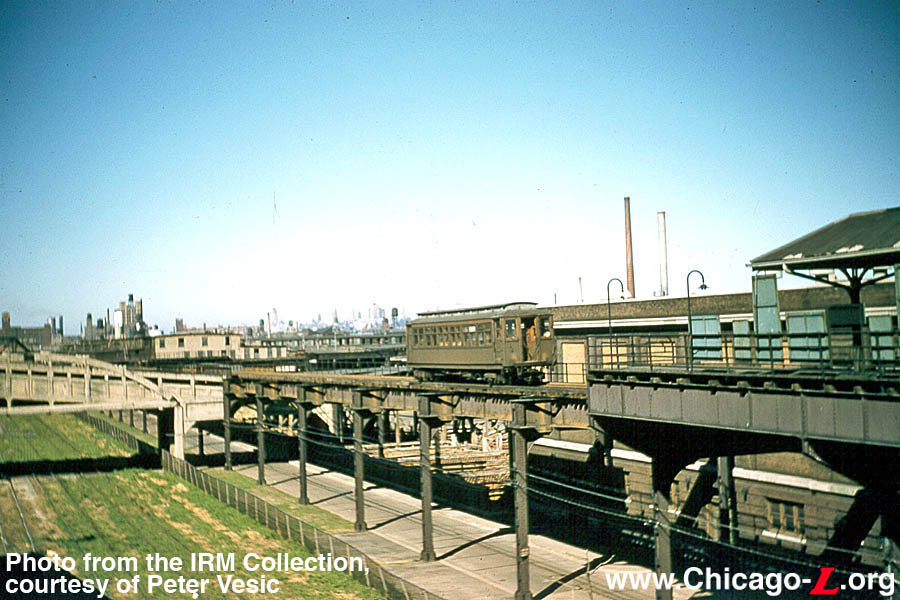
This is a very unusual picture. At first, I thought it might show the ramp at Sacramento on the Garfield Park "L", where the line descended to temporary trackage in Van Buren Street. Then, I noticed that this is single track. This makes it the loop at the west end of the line at DesPlaines Avenue, as it was configured in 1953 to allow the CA&E (not seen here) to pass underneath. There are lots of pictures showing this ramp taken from the ground. But to take this picture, the photographer either had to be in another railcar, or was standing on the walkway. At left, you can see the Altenhiem building, described in the next picture. The DesPlaines Avenue yard was reconfigured again in 1959 and this ramp was eliminated. We previously posted another picture of this crossover here.

This is a very unusual picture. At first, I thought it might show the ramp at Sacramento on the Garfield Park “L”, where the line descended to temporary trackage in Van Buren Street. Then, I noticed that this is single track. This makes it the loop at the west end of the line at DesPlaines Avenue, as it was configured in 1953 to allow the CA&E (not seen here) to pass underneath. There are lots of pictures showing this ramp taken from the ground. But to take this picture, the photographer either had to be in another railcar, or was standing on the walkway. At left, you can see the Altenhiem building, described in the next picture. The DesPlaines Avenue yard was reconfigured again in 1959 and this ramp was eliminated. We previously posted another picture of this crossover here.

Altenhiem, described here as an "old people's home," is still in business today.

Altenhiem, described here as an “old people’s home,” is still in business today.

Once CA&E trains were cut back to Forest Park in September 1953, joint timetables were issued for the benefit of passengers who wanted to continue to the Loop. These schedules were changed several times over the nearly four years before the CA&E abandoned passenger service. This is the 14th, and perhaps last such timetable. Over time, I assume there were fewer CA&E trains as ridership was declining. We previously posted timetable #7 here.

Once CA&E trains were cut back to Forest Park in September 1953, joint timetables were issued for the benefit of passengers who wanted to continue to the Loop. These schedules were changed several times over the nearly four years before the CA&E abandoned passenger service. This is the 14th, and perhaps last such timetable. Over time, I assume there were fewer CA&E trains as ridership was declining. We previously posted timetable #7 here.

WORK ON CHICAGO'S SUBWAY STARTED Chicago, Ill.: Above photo shows crowd on North State Street at Chicago Avenue during ceremonies marking the start of work on the new subway, which will run under State Street. Mayor Edward Kelly and Secy. of the Interior Harold Ickes used pneumatic spades to start the project. (Acme Press Photo, December 17, 1938)

WORK ON CHICAGO’S SUBWAY STARTED
Chicago, Ill.: Above photo shows crowd on North State Street at Chicago Avenue during ceremonies marking the start of work on the new subway, which will run under State Street. Mayor Edward Kelly and Secy. of the Interior Harold Ickes used pneumatic spades to start the project. (Acme Press Photo, December 17, 1938)

STREET CARS CRASH IN TUNNEL; 7 INJURED Chicago - Its brakes failing to hold as it attempted up-grade run in Chicago street car tunnel, trolley at left slid backward down incline, crashed into front end of following car. Seven passengers were taken to hospital, 100 others shaken up. (Acme Press Photo, November 6, 1941)

STREET CARS CRASH IN TUNNEL; 7 INJURED
Chicago – Its brakes failing to hold as it attempted up-grade run in Chicago street car tunnel, trolley at left slid backward down incline, crashed into front end of following car. Seven passengers were taken to hospital, 100 others shaken up. (Acme Press Photo, November 6, 1941)

AT LAST -- THE CHICAGO SUBWAY All-steel cars from the elevated lines enter the tubes on the north side near Armitage and Sheffield Avenues, about 2 1/2 miles north of the Loop. Overhead is the existing elevated structure still used by local trains. Hard rubber plates have been placed between the ties and the steel rails to cushion the subway ride. (Acme Press Photo, October 21, 1943)

AT LAST — THE CHICAGO SUBWAY
All-steel cars from the elevated lines enter the tubes on the north side near Armitage and Sheffield Avenues, about 2 1/2 miles north of the Loop. Overhead is the existing elevated structure still used by local trains. Hard rubber plates have been placed between the ties and the steel rails to cushion the subway ride. (Acme Press Photo, October 21, 1943)

NO AN ART GALLERY--BUT PART OF MOSCOW'S SUBWAY LINE Moscow, Russia-- Beautiful inverted bowls throw light to the paneled ceiling of this archway part of the lighting system of the Sokolniki station of Moscow's new subway. Indirect light is used in many parts of the system. The subway, thrown open to the public amidst scenes of great jubilation, is called the "Metro." All Moscow went joy riding on opening day. (Acme Press Photo, May 17, 1935) What interested me about his photo was how the general configuration looks a lot like the Chicago subway, which was built a few years later. Is it possible that the design was influenced by Moscow's?

NO AN ART GALLERY–BUT PART OF MOSCOW’S SUBWAY LINE
Moscow, Russia– Beautiful inverted bowls throw light to the paneled ceiling of this archway part of the lighting system of the Sokolniki station of Moscow’s new subway. Indirect light is used in many parts of the system. The subway, thrown open to the public amidst scenes of great jubilation, is called the “Metro.” All Moscow went joy riding on opening day. (Acme Press Photo, May 17, 1935) What interested me about his photo was how the general configuration looks a lot like the Chicago subway, which was built a few years later. Is it possible that the design was influenced by Moscow’s?

The interior of DC Transit car 766, during an October 8, 1961 fantrip just a few months before Washington's streetcar system was abandoned. This car is now preserved at the National Capital Trolley Museum as Capital Traction Company 27 (its original umber). We have an excellent CD featuring audio recordings of 766 in operation in Washington, DC in our Online Store.

The interior of DC Transit car 766, during an October 8, 1961 fantrip just a few months before Washington’s streetcar system was abandoned. This car is now preserved at the National Capital Trolley Museum as Capital Traction Company 27 (its original umber). We have an excellent CD featuring audio recordings of 766 in operation in Washington, DC in our Online Store.

This picture was taken on the Wells leg of Chicago's Loop on April 16, 1926. If this is Quincy and Wells, the scaffolding at left may be related to work being done on the nearby Wells Street Terminal, which started at this time. The terminal got a new facade and was expanded, reopening on August 27, 1927.

This picture was taken on the Wells leg of Chicago’s Loop on April 16, 1926. If this is Quincy and Wells, the scaffolding at left may be related to work being done on the nearby Wells Street Terminal, which started at this time. The terminal got a new facade and was expanded, reopening on August 27, 1927.

This picture shows the old Wells Street bridge, carrying the "L" across the Chicago River as it heads north-south in the early 1900s.

This picture shows the old Wells Street bridge, carrying the “L” across the Chicago River as it heads north-south in the early 1900s.

This is Racine Avenue on the Metropolitan "L" main line. The autos below the "L" would suggest this picture was taken in the 1940s.

This is Racine Avenue on the Metropolitan “L” main line. The autos below the “L” would suggest this picture was taken in the 1940s.

"L" trains at the north State Street subway portal, probably in the 1940s.

“L” trains at the north State Street subway portal, probably in the 1940s.

The view looking north from the Howard "L" station. We ran a very similar picture to this in a previous post Chicago Rapid Transit Photos, Part Eight (November 16, 2016), where George Trapp suggested in was taken in the late 1920s or 1930s. This photo is dated December 17, 1930.

The view looking north from the Howard “L” station. We ran a very similar picture to this in a previous post Chicago Rapid Transit Photos, Part Eight (November 16, 2016), where George Trapp suggested in was taken in the late 1920s or 1930s. This photo is dated December 17, 1930.

Michael Franklin has identified this picture as showing the Armour station on the Stock Yards branch. He notes, "(the) clue was a station on one side but not one on the other." See below for another view of the same station.

Michael Franklin has identified this picture as showing the Armour station on the Stock Yards branch. He notes, “(the) clue was a station on one side but not one on the other.” See below for another view of the same station.

http://www.chicago-l.org/operations/lines/images/StockYards/cta2906%40armour.jpg

The above image is from Graham Garfield’s excellent web site, and looks to the northeast. The original www.chicago-l.org caption reads:

Looking north on September 28, 1957, ex-Metropolitan Elevated car 2906 has left Armour station (seen at right) and it about to rejoin the Stock Yards main line to head east to its terminal at Indiana. The Sock Yards branch is only a week away from abandonment at this time. (Photo from the IRM Collection, courtesy of Peter Vesic)

This picture was taken on the Evanston branch of the "L", and the wooden "L" car is signed "Howard Only," which suggests this was taken during the CTA era. Previously, all Evanston trains continued south into the city. The nearby curve would indicate that this picture was taken just north of Howard, and may show the viaduct where the line crossed Chicago Avenue, which is a continuation of Clark Street.

This picture was taken on the Evanston branch of the “L”, and the wooden “L” car is signed “Howard Only,” which suggests this was taken during the CTA era. Previously, all Evanston trains continued south into the city. The nearby curve would indicate that this picture was taken just north of Howard, and may show the viaduct where the line crossed Chicago Avenue, which is a continuation of Clark Street.

This picture is identified as showing Chicago streetcar conductors and motormen, and probably dates to the early 1900s.

This picture is identified as showing Chicago streetcar conductors and motormen, and probably dates to the early 1900s.

Here, we have a westbound train of wooden Met cars at Laramie on the old Garfield Park line. This was replaced by the Congress line in 1958.

Here, we have a westbound train of wooden Met cars at Laramie on the old Garfield Park line. This was replaced by the Congress line in 1958.

Chicago Surface Lines 2779 at Cicero and Montrose in 1934. This was the north end of the Cicero Avenue line. This car is part of a series known as "Robertson Rebuilds," and was built by St. Louis Car Co. in 1903. (Edward Frank, Jr. Photo)

Chicago Surface Lines 2779 at Cicero and Montrose in 1934. This was the north end of the Cicero Avenue line. This car is part of a series known as “Robertson Rebuilds,” and was built by St. Louis Car Co. in 1903. (Edward Frank, Jr. Photo)

CSL 970 on Waveland between Broadway and Halsted in 1936. This was the north end of the Halsted line. 970 was part of a series known as the "little" Pullmans, since they were slightly shorter than cars 101-750. It was built in 1910. (Edward Frank, Jr. Photo)

CSL 970 on Waveland between Broadway and Halsted in 1936. This was the north end of the Halsted line. 970 was part of a series known as the “little” Pullmans, since they were slightly shorter than cars 101-750. It was built in 1910. (Edward Frank, Jr. Photo)

CSL experimental pre-PCC car 7001 is shown heading south on Clark Street at North Avenue, across the street from the Chicago Historical Society (now the Chicago History Museum). This picture was probably taken in the 1930s. 7001 went into service in 1934 and was repainted in 1941 before being retired around 1944. (Edward Frank, Jr. Photo)

CSL experimental pre-PCC car 7001 is shown heading south on Clark Street at North Avenue, across the street from the Chicago Historical Society (now the Chicago History Museum). This picture was probably taken in the 1930s. 7001 went into service in 1934 and was repainted in 1941 before being retired around 1944. (Edward Frank, Jr. Photo)

The view looking east at Lake Street and Ridgeland, when the Lake Street "L" ran on the ground. Many years ago, the Rapid Transit Company put advertisements on the steps leading into such ground-level stations. The "L" was relocated onto the nearby C&NW embankment in 1962. This picture may be circa 1930.

The view looking east at Lake Street and Ridgeland, when the Lake Street “L” ran on the ground. Many years ago, the Rapid Transit Company put advertisements on the steps leading into such ground-level stations. The “L” was relocated onto the nearby C&NW embankment in 1962. This picture may be circa 1930.

The north end of the Merchandise Mart "L" station. This has since been rebuilt and the curved area of the platform has been eliminated.

The north end of the Merchandise Mart “L” station. This has since been rebuilt and the curved area of the platform has been eliminated.

We are looking west along Harrison at Wabash on November 12, 1928. In 2003, the Chicago Transit Authority straightened out this jog with a section of new "L" structure, occupying the area where the building at left once was.

We are looking west along Harrison at Wabash on November 12, 1928. In 2003, the Chicago Transit Authority straightened out this jog with a section of new “L” structure, occupying the area where the building at left once was.

Oakton Street in Skokie on December 11, 1931. The tracks with overhead wire were used by the North Shore Line and the Chicago Rapid Transit Company's Niles Center branch. Both were running on the NSL's Skokie Valley Route, built in 1925. The other set of tracks belong to the Chicago & North Western and were used for freight.

Oakton Street in Skokie on December 11, 1931. The tracks with overhead wire were used by the North Shore Line and the Chicago Rapid Transit Company’s Niles Center branch. Both were running on the NSL’s Skokie Valley Route, built in 1925. The other set of tracks belong to the Chicago & North Western and were used for freight.

CSL 2601 was a Robertson Rebuild car built in 1901 by St. Louis Car Company. In this wintry scene, it is signed for the 111th Street route, presumably in the 1940s. (Joe L. Diaz Photo)

CSL 2601 was a Robertson Rebuild car built in 1901 by St. Louis Car Company. In this wintry scene, it is signed for the 111th Street route, presumably in the 1940s. (Joe L. Diaz Photo)

Here is an unusual view. This shows the ramp taking the Garfield Park "L" down to grade level between Cicero Avenue and Laramie. It must be an early picture, since the area around the "L" seems largely unbuilt. The Laramie Yard would be to the right just out of view. This "L" was torn down shortly after the CTA opened the Congress line in 1958.

Here is an unusual view. This shows the ramp taking the Garfield Park “L” down to grade level between Cicero Avenue and Laramie. It must be an early picture, since the area around the “L” seems largely unbuilt. The Laramie Yard would be to the right just out of view. This “L” was torn down shortly after the CTA opened the Congress line in 1958.

The old Cermak Road station on the south Side "L". Note there are three tracks here. This station was closed in 1977 and removed. A new station replaced it in 2015.

The old Cermak Road station on the south Side “L”. Note there are three tracks here. This station was closed in 1977 and removed. A new station replaced it in 2015.

Here. a wooden "L" car train descends the ramp near Laramie on the Lake Street "L". This must be an early photo, as it looks like Lake Street is unpaved. Streetcar service was extended west to Harlem Avenue here by the Cicero & Proviso in 1891. Chicago Railways took over the city portion in 1910. Service west of Austin Boulevard was provided by the West Towns Railways.

Here. a wooden “L” car train descends the ramp near Laramie on the Lake Street “L”. This must be an early photo, as it looks like Lake Street is unpaved. Streetcar service was extended west to Harlem Avenue here by the Cicero & Proviso in 1891. Chicago Railways took over the city portion in 1910. Service west of Austin Boulevard was provided by the West Towns Railways.

Wooden gate car 3105 and train in the Loop. This was originally built for the Lake Street "L". Don's Rail Photos says, "3103 thru 3118 were built by McGuire-Cummings in 1893 as LSERR 103 thru 118. In 1913 they were renumbered 3103 thru 3118 and became CRT 3103 thru 3118 in 1923."

Wooden gate car 3105 and train in the Loop. This was originally built for the Lake Street “L”. Don’s Rail Photos says, “3103 thru 3118 were built by McGuire-Cummings in 1893 as LSERR 103 thru 118. In 1913 they were renumbered 3103 thru 3118 and became CRT 3103 thru 3118 in 1923.”

The view looking west along the Douglas Park "L" at 49th Avenue in Cicero on February 4, 1944. The station we see in the background is 50th Avenue. After it closed in 1978, this station was moved to the Illinois Railway Museum in Union, where it is used to board the museum's fleet of retired "L" cars.

The view looking west along the Douglas Park “L” at 49th Avenue in Cicero on February 4, 1944. The station we see in the background is 50th Avenue. After it closed in 1978, this station was moved to the Illinois Railway Museum in Union, where it is used to board the museum’s fleet of retired “L” cars.

Here, we are looking south from Garfield (55th Street) on the South Side "L".

Here, we are looking south from Garfield (55th Street) on the South Side “L”.

61st Street on the South Side "L", looking north on November 13, 1944.

61st Street on the South Side “L”, looking north on November 13, 1944.

Photos of the old Humboldt Park "L" branch are quite rare. This photo looks west from Western Avenue on January 26, 1931. This branch closed in 1952, although portions of the structure remained into the early 1960s.

Photos of the old Humboldt Park “L” branch are quite rare. This photo looks west from Western Avenue on January 26, 1931. This branch closed in 1952, although portions of the structure remained into the early 1960s.

This picture looks south from Randolph and Wells on the Loop "L". The date is not known, but the construction of the building at right may provide a clue. Andre Kristopans writes, "The overhead shot on Wells showing platform construction is early 20’s, when platforms were extended to accommodate longer trains. For instance Randolph/Wells and Madison/Wells were once separate platforms, after the early 20’s they were a continuous platform. Also at that time, LaSalle/Van Buren and State/Van Buren were connected and the separate station at Dearborn/Van Buren became an auxiliary entrance to State, until a building next to it blew up in the very early 60’s and destroyed the Outer Loop side."

This picture looks south from Randolph and Wells on the Loop “L”. The date is not known, but the construction of the building at right may provide a clue. Andre Kristopans writes, “The overhead shot on Wells showing platform construction is early 20’s, when platforms were extended to accommodate longer trains. For instance Randolph/Wells and Madison/Wells were once separate platforms, after the early 20’s they were a continuous platform. Also at that time, LaSalle/Van Buren and State/Van Buren were connected and the separate station at Dearborn/Van Buren became an auxiliary entrance to State, until a building next to it blew up in the very early 60’s and destroyed the Outer Loop side.”

North Shore Line 156 and several others at Waukegan in December 1962. Since there are about a dozen cars visible, they are being stored on a siding which you will note is outside the area of the catenary. (George Niles, Jr. Photo)

North Shore Line 156 and several others at Waukegan in December 1962. Since there are about a dozen cars visible, they are being stored on a siding which you will note is outside the area of the catenary. (George Niles, Jr. Photo)

This shows TMER&T 1121 running on a 1949 fantrip on the North Shore Line at the Kenosha station. We ran a similar picture in our previous post Traction in Milwaukee (September 16, 2015).

This shows TMER&T 1121 running on a 1949 fantrip on the North Shore Line at the Kenosha station. We ran a similar picture in our previous post Traction in Milwaukee (September 16, 2015).

Speedrail car 60 at the Waukesha Quarry, date unknown but circa 1949-51.

Speedrail car 60 at the Waukesha Quarry, date unknown but circa 1949-51.


Larry Sakar
writes:

The photo of Speedrail car 60 in your latest postings at the Waukesha Gravel pit was taken on 10-16-49. The occasion was the inaugural fan trip using a 60-series curved side car. It was sponsored by the short lived Milwaukee Division of the Electric Railroaders Association and was run by Milwaukeean James P. Harper who authored CERA Bulletin 97, “The Electric Railways of Wisconsin” published in 1952.

At the start of the private right-of-way at 8th St., the motors on the rear truck began having problems. At Waukesha, the car pulled onto one of the 2 side tracks leading back into the gravel pit. George Krambles accessed the rear trucks via a panel in the floor and disconnected the motor leads to the troublesome rear trucks. From that point forward the car ran on only 2 motors for the remainder of the fan trip. Car 65 had been the car originally intended to do the trip, but it was down with mechanical problems of its own. This caused the trip to be postponed for a week and the substitution of car 60.

When the car pulled into gravel pit siding one of the fans on board remarked, “Wow, look at this. They’ve got it in the scrap line already!”.

In addition to George Krambles, Al Kalmbach was on the trip, as was well-known railfan and photographer Barney Neuberger. He can be seen siting in about the 4th row of the car on the left side wearing a pork pie hat.

I’ve attached a few items related to that fan trip including a photo of Jay Maeder walking alongside car 60. This was taken at the first photo stop which was 44th St. where Milwaukee County Stadium would be built starting a year later. Car 60 was doing a photo run-by by backing down the line. The fans formed a photo line facing the car.

Philadelphia Stories

Philadelphia Peter Witt 8534 in July 1996. Don's Rail Photos: "8534 was built by Brill Car in 1926, #22353." It is part of the Electric City Trolley Museum collection in Scranton, PA. Here, it is shown in Philadelphia, during the time it was leased to SEPTA for trolley tours.

Philadelphia Peter Witt 8534 in July 1996. Don’s Rail Photos: “8534 was built by Brill Car in 1926, #22353.” It is part of the Electric City Trolley Museum collection in Scranton, PA. Here, it is shown in Philadelphia, during the time it was leased to SEPTA for trolley tours.

SEPTA 2750 and 8534 on a fantrip in August 1996. Apparently 8534 has broken down and is being towed.

SEPTA 2750 and 8534 on a fantrip in August 1996. Apparently 8534 has broken down and is being towed.

SEPTA 2785 in November 2002.

SEPTA 2785 in November 2002.

SEPTA 2750 and 8534 in August 1996.

SEPTA 2750 and 8534 in August 1996.

Three generations of Philadelphia streetcars in May 1999.

Three generations of Philadelphia streetcars in May 1999.

2785 in November 2002.

2785 in November 2002.

SEPTA 2785 in November 2002, with a commuter train nearby. Kenneth Achtert writes, "The shot of SEPTA #2785 with the commuter train that you presumed to be in Chestnut Hill is actually approaching 11th and Susquehanna,southbound, a cut-back location for which the car is signed in the picture. The commuter train would be inbound toward Center City."

SEPTA 2785 in November 2002, with a commuter train nearby. Kenneth Achtert writes, “The shot of SEPTA #2785 with the commuter train that you presumed to be in Chestnut Hill is actually approaching 11th and Susquehanna,southbound, a cut-back location for which the car is signed in the picture. The commuter train would be inbound toward Center City.”

SEPTA 2785 in November 2002.

SEPTA 2785 in November 2002.

SEPTA PCC 2785 on the truncated route 23 in November 2002.

SEPTA PCC 2785 on the truncated route 23 in November 2002.

8534 in August 1996. Kenneth Achtert: "The view of #8534 being “manually switched” three photos later shows 8534 being coupled to its leader (2750) after apparently becoming disabled. Several of your other photos show the subsequent towing operation."

8534 in August 1996. Kenneth Achtert: “The view of #8534 being “manually switched” three photos later shows 8534 being coupled to its leader (2750) after apparently becoming disabled. Several of your other photos show the subsequent towing operation.”

The fantrip train is having trouble clearing this auto in August 1996.

The fantrip train is having trouble clearing this auto in August 1996.

Looks like an attempt was made to move the offending car out of the way. August 1996.

Looks like an attempt was made to move the offending car out of the way. August 1996.

Recent Correspondence

Kenneth Gear writes:

Look who is in the new HISTORIC RAIL & ROADS catalog!

Thanks!

In case you missed it, here is Kenneth Gear’s review of the book:

I just finished reading your book and I enjoyed it very much. Good, clear, concise, and informative writing.

I must compliment you on the choice and presentation of the photographs. It is obvious that you spent much time and effort to present these wonderful photos as perfectly restored as possible.

So many times the authors of books that are primarily “picture books” seem to have a complete disregard for the condition of the photos reproduced. I’ve often seen photos that are yellowed with age, water stained, ripped, folded, and scratched. Other times a book might contain photos that are not properly exposed, are crooked, out of focus, or the composition could have been easily corrected with a little cropping.

The photos in your book are absolutely fantastic! They are pristine, sharp, and have absolutely no blemishes at all. You also packed a lot of information into the captions as well. It’s a fine book and you should be proud, as I’m sure you are, to have your name on the cover.

Another reader writes:

Your book arrived and it is JUST AWESOME. I am completely taken by some of the imagery, and of course enjoy the way you seem to simplify historical writing. VERY nice work!! THANK YOU!!!

Help Support The Trolley Dodger

gh1

This is our 197th post, and we are gradually creating a body of work and an online resource for the benefit of all railfans, everywhere. To date, we have received over 329,000 page views, for which we are very grateful.

You can help us continue our original transit research by checking out the fine products in our Online Store.

As we have said before, “If you buy here, we will be here.”

We thank you for your support.

DONATIONS

In order to continue giving you the kinds of historic railroad images that you have come to expect from The Trolley Dodger, we need your help and support. It costs money to maintain this website, and to do the sort of historic research that is our specialty.

Your financial contributions help make this web site better, and are greatly appreciated.

Back in Boston

This August marks 50 years since my first trip to Boston. This picture of MBTA 3295 was taken on Beacon Street on August 31, 1967, and shows the PCCs just as I remember them from that time. (Frederick F. Marder Photo)

This August marks 50 years since my first trip to Boston. This picture of MBTA 3295 was taken on Beacon Street on August 31, 1967, and shows the PCCs just as I remember them from that time. (Frederick F. Marder Photo)

This summer marks 50 years since my first trip to Boston, which quickly became one of my favorite cities. I came there as a 12-year-old, to attend my uncle Robert’s wedding along with my mother.

I was astonished to find that Boston still had PCC streetcars, of a type very similar to those Chicago had retired nearly a decade earlier. While my relatives were out making merry, I went off to ride all the various lines.

I have returned to Boston numerous times since then. Recently, I spent a few days there to help my uncle celebrate his 87th birthday.

While PCCs are long gone from the MBTA Green Line, a few still soldier on between Ashmont and Mattapan. This “high-speed trolley” has been running in an old railroad right-of-way since the 1920s, on private right-of-way with just a couple of grade crossings. Along with the MBTA’s Riverside line, which began service in 1959, it is considered a forerunner of modern light rail.

Although I did not have time to do as much railfanning as I might have hoped, here are some pictures from that trip.

-David Sadowski

PS- We expect to receive our shipment of Chicago Trolleys books by September 22nd, which should allow us to ship all copies that have been pre-ordered by the release date on the 25th. More information is at the end of this post.

This giant steaming teakettle has been a Boston landmark since 1873.

This giant steaming teakettle has been a Boston landmark since 1873.

The subway station at Government Center was closed for renovations when I last visited Boston three years ago, but has since reopened.

The subway station at Government Center was closed for renovations when I last visited Boston three years ago, but has since reopened.

The Green Line subway, oldest in the United States, first opened in 1897. I believe this is Government Center.

The Green Line subway, oldest in the United States, first opened in 1897. I believe this is Government Center.

The Red Line subway.

The Red Line subway.

It's incredible that this PCC is still in service. According to Don's Rail Photos, "3087 was built by Pullman-Standard in 1945, #W6710A. It was rebuilt in 2000 for service." Here, we see it pulling in to the Ashmont Terminal, where riders can switch to the Red Line subway. Unlike the other light rail lines, the Ashmont-Mattapan line is considered part of the Red Line. When we were there, it was operating as a free shuttle, although the trains had fare boxes.

It’s incredible that this PCC is still in service. According to Don’s Rail Photos, “3087 was built by Pullman-Standard in 1945, #W6710A. It was rebuilt in 2000 for service.” Here, we see it pulling in to the Ashmont Terminal, where riders can switch to the Red Line subway. Unlike the other light rail lines, the Ashmont-Mattapan line is considered part of the Red Line. When we were there, it was operating as a free shuttle, although the trains had fare boxes.

3087 at Mattapan.

3087 at Mattapan.

The turnaround loop at Mattapan.

The turnaround loop at Mattapan.

The PCCs are not air conditioned, but have forced-air ventilation and sealed windows.

The PCCs are not air conditioned, but have forced-air ventilation and sealed windows.

3087 at Ashmont.

3087 at Ashmont.

The Red Line at Ashmont.

The Red Line at Ashmont.

Out of Town News, which occupies the famed former Harvard Square subway kiosk built in 1928, may eventually be forced out as part of a redevelopment scheme.

Out of Town News, which occupies the famed former Harvard Square subway kiosk built in 1928, may eventually be forced out as part of a redevelopment scheme.

A trip to Harvard Square would not be complete without visiting Leavitt & Peirce, which has been there since 1884.

A trip to Harvard Square would not be complete without visiting Leavitt & Peirce, which has been there since 1884.

This "cigar store Indian" princess graces the store's entry way.

This “cigar store Indian” princess graces the store’s entry way.

Besides cigars, they sell chess sets at Leavitt and Peirce.

Besides cigars, they sell chess sets at Leavitt and Peirce.

The Green Line at Park Street, where you can switch between the B, C, D, and E branches or change to the Red Line.

The Green Line at Park Street, where you can switch between the B, C, D, and E branches or change to the Red Line.

Currently, the Green Line's northern end is at Lechmere, although there are plans to extend it another 4.7 miles to Somerville and Medford.

Currently, the Green Line’s northern end is at Lechmere, although there are plans to extend it another 4.7 miles to Somerville and Medford.

These "Type 7" LRVs were built between 1986 and 1997, and have been rehabbed since I was last in Boston three years ago. Now they are all paired in service with the newer Type 8s, which are handicapped accessible.

These “Type 7” LRVs were built between 1986 and 1997, and have been rehabbed since I was last in Boston three years ago. Now they are all paired in service with the newer Type 8s, which are handicapped accessible.

On our way to Logan airport, I had time to take a few shots at the west end of Green Line route "B," which goes to Boston College.

On our way to Logan airport, I had time to take a few shots at the west end of Green Line route “B,” which goes to Boston College.

My final MBTA shots were taken near the west end of Green Line route "C", which is Beacon Street. It is a bit confusing that the B line runs on Commonwealth Avenue, while the C line is on Beacon. But the lines were assigned letters due to their position on maps. Watertown was assigned "A" as it was furthest north, but rail service there was abandoned in 1969, before the letters were used on any roll signs. The best explanation for why Watertown got bussed is that streetcars had to go against traffic on a one-way expressway feeder ramp that became a real bottleneck. It was easier to re-route buses around this, although the tracks and wire remained for many years for access to Watertown Yard.

My final MBTA shots were taken near the west end of Green Line route “C”, which is Beacon Street. It is a bit confusing that the B line runs on Commonwealth Avenue, while the C line is on Beacon. But the lines were assigned letters due to their position on maps. Watertown was assigned “A” as it was furthest north, but rail service there was abandoned in 1969, before the letters were used on any roll signs. The best explanation for why Watertown got bussed is that streetcars had to go against traffic on a one-way expressway feeder ramp that became a real bottleneck. It was easier to re-route buses around this, although the tracks and wire remained for many years for access to Watertown Yard.

There is a station called Fenway on Boston's Green Line, but that's not where you want to go to see a ballgame. Kenmore Square is closer, and three of the four Green Line branches stop there.

There is a station called Fenway on Boston’s Green Line, but that’s not where you want to go to see a ballgame. Kenmore Square is closer, and three of the four Green Line branches stop there.

It's been 40 years since I first visited Fenway Park. On this night, the Red Sox defeated the Tampa Bay Rays, 9-3.

It’s been 40 years since I first visited Fenway Park. On this night, the Red Sox defeated the Tampa Bay Rays, 9-3.

Fenway is one of the most beloved ballparks in Major League Baseball, in part because of its 40-foot "Green Monster" wall in left field.

Fenway is one of the most beloved ballparks in Major League Baseball, in part because of its 40-foot “Green Monster” wall in left field.

Boston double-end PCC 3327, signed for Heath on the MBTA Green Line "E" branch (formerly called Arborway), is heading up the Northeastern Incline from the Huntington Avenue Subway in this March 1974 view.

Boston double-end PCC 3327, signed for Heath on the MBTA Green Line “E” branch (formerly called Arborway), is heading up the Northeastern Incline from the Huntington Avenue Subway in this March 1974 view.

A period illustration for the M.T.A. song (aka Charlie on the M.T.A.), see Comments below.

A period illustration for the M.T.A. song (aka Charlie on the M.T.A.), see Comments below.

Horsecars in Roxbury

While visting the Simon Willard House and Clock Museum, I was intrigued by this early photograph, which shows a horse car near the First Church of Roxbury. The picture was dated as "circa 1910," but must have been taken many years before that.

While visting the Simon Willard House and Clock Museum, I was intrigued by this early photograph, which shows a horse car near the First Church of Roxbury. The picture was dated as “circa 1910,” but must have been taken many years before that.

A close-up of the photo, showing a horse car on the line to Norfolk House, operated between Boston and Roxbury by the Metropolitan Railroad Co., which operated between 1856 and 1886.

A close-up of the photo, showing a horse car on the line to Norfolk House, operated between Boston and Roxbury by the Metropolitan Railroad Co., which operated between 1856 and 1886.

While researching when the above photograph could have been taken, I learned quite a bit about the early history of public transit in Boston. Roxbury was once its own municipality, but was annexed into Boston in 1868.

Before horse-drawn streetcars, there was the “Omnibus.” This was a large passenger coach, similar to a stagecoach, that ran on a fixed route between Boston and Roxbury, and offered frequent service (hourly, in some places). This ran from 1832 until 1856.

Streetcars offered some advantages, as they ran on tracks laid in city streets, which were frequently unpaved in this era and could be turned to a muddy mess when it rained. Often pedestrians would walk along the middle of the tracks.

One source says horse cars “began at Boylston Market to Norfolk House in Eliot Square, (and a) second line met at Tremont House, traveled over the neck to Norfolk House and then via Center Street over Hogs Bridge to West Roxbury.”

The Metropolitan Railroad Co. continued to operate horsecars until 1886, when it was bought out by the West End Street Railway Co. Thus, the dates when this photo could have been taken are probably between 1856 and 1886.

West End sought to improve service and reduce costs. After looking into the feasibility of building cable car lines, the railroad became aware of a new invention, electric streetcars. After examining Frank J. Sprague’s pioneering operation in Richmond, Virginia, the West End introduced electric streetcars to Boston in 1889.

I was unable to find a definitive date when horsecars stopped running in Boston. The various dates I did find were 1891, 1895, and 1900. But the latter seems unlikely.

During construction of the open-cut MBTA Orange Line in the 1980s, which replaced an elevated, the former site of a Metropolitan R. R. horsecar barn was excavated, and thousands of artifacts recovered. You can read a full report here, in someone’s masters thesis.

Interestingly, the First Church of Roxbury building, which dates to about 1804, is still there, although the steeple had to be replaced after it was damaged by rough weather in 1954.

Norfolk House was built in 1853 and is also still standing. The four-and-a-half story building has now been converted to condos.

-David Sadowski

The Right Here in Roxbury Wiki says: "The Norfolk House has served as a hotel and public house when Roxbury was a prominent stop on the road out of Boston. Later it was converted to a settlement house with a branch of the Boston Public library. Currently the first floor is retail space and the upper floors are condominiums."

The Right Here in Roxbury Wiki says: “The Norfolk House has served as a hotel and public house when Roxbury was a prominent stop on the road out of Boston. Later it was converted to a settlement house with a branch of the Boston Public library. Currently the first floor is retail space and the upper floors are condominiums.”

This early 19th century gallery clock is the original from the First Church of Roxbury, and is on loan to the Willard House. Meanwhile, an exact replica was made and hangs in the church.

This early 19th century gallery clock is the original from the First Church of Roxbury, and is on loan to the Willard House. Meanwhile, an exact replica was made and hangs in the church.

Recent Finds

This January 1962 image shows DC Transit pre-PCC car 1053, just prior to the end of streetcar service in our nation's capitol. Unfortunately, this historically important streetcar was later destroyed in a fire at the National Capital Trolley Museum in 2003.

This January 1962 image shows DC Transit pre-PCC car 1053, just prior to the end of streetcar service in our nation’s capitol. Unfortunately, this historically important streetcar was later destroyed in a fire at the National Capital Trolley Museum in 2003.

You might be mistaken for thinking this funicular was in a rural location, but this picture (and the next) shows the Angel's Flight Railway in Los Angeles in August 1968. By then, much of the surrounding area in the Bunker Hill neighborhood had been cleared for redevelopment. Angel's Flight itself was dismantled in 1969, as part of the hill was leveled. After being in storage for many years, it was finally relocated and has now once again resumed operations, with important new safety features after a series of accidents.

You might be mistaken for thinking this funicular was in a rural location, but this picture (and the next) shows the Angel’s Flight Railway in Los Angeles in August 1968. By then, much of the surrounding area in the Bunker Hill neighborhood had been cleared for redevelopment. Angel’s Flight itself was dismantled in 1969, as part of the hill was leveled. After being in storage for many years, it was finally relocated and has now once again resumed operations, with important new safety features after a series of accidents.

Sacramento Northern MW-302 on an early 1960s fantrip. Don's Rail Photos: "1020 was built by Hall-Scott Motor Car Co in 1913, as OA&E 1020. It became SF-S 1020 in 1920 and SN 1020 in 1928. It was renumbered as MW302 in 1941 and went to Western Railway Museum in 1962."

Sacramento Northern MW-302 on an early 1960s fantrip. Don’s Rail Photos: “1020 was built by Hall-Scott Motor Car Co in 1913, as OA&E 1020. It became SF-S 1020 in 1920 and SN 1020 in 1928. It was renumbered as MW302 in 1941 and went to Western Railway Museum in 1962.”

A postwar Pullman-built PCC prepares to cross the Chicago River on Madison Street, probably in the early 1950s. That's the old Chicago Daily News building in the background.

A postwar Pullman-built PCC prepares to cross the Chicago River on Madison Street, probably in the early 1950s. That’s the old Chicago Daily News building in the background.

Postwar Pullman PCC 4112, signed to go west on the Madison-Fifth branch of Route 20, turns onto Franklin Street, probably in the early 1950s.

Postwar Pullman PCC 4112, signed to go west on the Madison-Fifth branch of Route 20, turns onto Franklin Street, probably in the early 1950s.

This picture shows a CTA crane in operation on the old Metropolitan or Garfield Park "L" in the early 1950s. You can see how many nearby buildings have already been cleared away in order to build the Congress Expressway.

This picture shows a CTA crane in operation on the old Metropolitan or Garfield Park “L” in the early 1950s. You can see how many nearby buildings have already been cleared away in order to build the Congress Expressway.

A wooden Met car on the CTA's Kenwood shuttle in August 1957, just a few short moths before this branch line was abandoned. The CTA (and CRT before it) was a tenant and this complicated operation of the line. In addition, the CTA during this period closed several branch lines, in their efforts to consolidate and streamline service.

A wooden Met car on the CTA’s Kenwood shuttle in August 1957, just a few short moths before this branch line was abandoned. The CTA (and CRT before it) was a tenant and this complicated operation of the line. In addition, the CTA during this period closed several branch lines, in their efforts to consolidate and streamline service.

This picture of CTA postwar PCC (built by St. Louis Car Company) at South Shops was probably taken at around the same time (and by the same unknown photographer) as the Kenwood picture, i.e. August 1957. The nearby bus is 3625. If the date is correct, all the postwar Pullmans had been gone from the property for more than two years already.

This picture of CTA postwar PCC (built by St. Louis Car Company) at South Shops was probably taken at around the same time (and by the same unknown photographer) as the Kenwood picture, i.e. August 1957. The nearby bus is 3625. If the date is correct, all the postwar Pullmans had been gone from the property for more than two years already.

Quincy Station Landmarking Recommendation Approved by Commission on Chicago Landmarks

Alderman Brendan Reilly (42nd Ward) is very pleased to announce that the final recommendation for landmarking the Quincy Elevated Station at 220 S. Wells Street was recently approved at the September 7, 2017 meeting of the Commission on Chicago Landmarks.

Opened for service on October 3, 1897, the Quincy Elevated Station has served generations of Chicagoans and visitors to the City, and remains the best example of an original Loop “‘L’ Station.

More information here.

Pre-Order Our New Book Chicago Trolleys

On the Cover: Car 1747 was built between 1885 and 1893 by the Chicago City Railway, which operated lines on the South Side starting in April 1859. This is a single-truck (one set of wheels) open electric car; most likely a cable car, retrofitted with a trolley and traction motor. The man at right is conductor William Stevely Atchison (1861-1921), and this image came from his granddaughter. (Courtesy of Debbie Becker.)

On the Cover: Car 1747 was built between 1885 and 1893 by the Chicago City Railway, which operated lines on the South Side starting in April 1859. This is a single-truck (one set of wheels) open electric car; most likely a cable car, retrofitted with a trolley and traction motor. The man at right is conductor William Stevely Atchison (1861-1921), and this image came from his granddaughter. (Courtesy of Debbie Becker.)

We are pleased to report that our new book Chicago Trolleys will be released on September 25th by Arcadia Publishing. You can pre-order an autographed copy through us today (see below). Chicago Trolleys will also be available wherever Arcadia books are sold.

Overview

Chicago’s extensive transit system first started in 1859, when horsecars ran on rails in city streets. Cable cars and electric streetcars came next. Where new trolley car lines were built, people, businesses, and neighborhoods followed. Chicago quickly became a world-class city. At its peak, Chicago had over 3,000 streetcars and 1,000 miles of track—the largest such system in the world. By the 1930s, there were also streamlined trolleys and trolley buses on rubber tires. Some parts of Chicago’s famous “L” system also used trolley wire instead of a third rail. Trolley cars once took people from the Loop to such faraway places as Aurora, Elgin, Milwaukee, and South Bend. A few still run today.

The book features 226 classic black-and-white images, each with detailed captions, in 10 chapters:

1. Early Traction
2. Consolidation and Growth
3. Trolleys to the Suburbs
4. Trolleys on the “L”
5. Interurbans Under Wire
6. The Streamlined Era
7. The War Years
8. Unification and Change
9. Trolley Buses
10. Preserving History

Product Details

ISBN-13: 9781467126816
Publisher: Arcadia Publishing SC
Publication date: 09/25/2017
Series: Images of Rail
Pages: 128

Meet the Author

David Sadowski has been interested in streetcars ever since his father took him for a ride on one of the last remaining lines in 1958. He grew up riding trolley buses and “L” trains all over Chicago. He coauthored Chicago Streetcar Pictorial: The PCC Car Era, 1936–1958, and runs the online Trolley Dodger blog. Come along for the ride as we travel from one side of the city to the other and see how trolley cars and buses moved Chicago’s millions of hardworking, diverse people.

Images of Rail

The Images of Rail series celebrates the history of rail, trolley, streetcar, and subway transportation across the country. Using archival photographs, each title presents the people, places, and events that helped revolutionize transportation and commerce in 19th- and 20th-century America. Arcadia is proud to play a part in the preservation of local heritage, making history available to all.

The book costs just $21.99 plus shipping.

Please note that Illinois residents must pay 10.00% sales tax on their purchases.

We appreciate your business!

For Shipping to US Addresses:

For Shipping to Canada:

For Shipping Elsewhere:

NEW – Chicago Trolleys Postcard Collection

We are pleased to report that selected images from our upcoming book Chicago Trolleys will be available on September 25th in a pack of 15 postcards, all for just $7.99. This is part of a series put out by Arcadia Publishing. Dimensions: 6″ wide x 4.25″ tall

The Postcards of America Series

Here in the 21st century, when everyone who’s anyone seems to do most of their communicating via Facebook and Twitter, it’s only natural to wax a little nostalgic when it comes to days gone by. What happened to more personal means of communication like hand-written letters on nice stationery? Why don’t people still send postcards when they move someplace new or go away on vacation?

If that line of thinking sounds familiar, then Arcadia Publishing’s Postcards of America was launched with you in mind. Each beautiful volume features a different collection of real vintage postcards that you can mail to your friends and family.

Pre-Order your Chicago Trolleys Postcard Pack today!

For Shipping to US Addresses:

For Shipping to Canada:

For Shipping Elsewhere:

street-railwayreview1895-002

Help Support The Trolley Dodger

gh1

This is our 194th post, and we are gradually creating a body of work and an online resource for the benefit of all railfans, everywhere. To date, we have received over 320,000 page views, for which we are very grateful.

You can help us continue our original transit research by checking out the fine products in our Online Store.

As we have said before, “If you buy here, we will be here.”

We thank you for your support.

DONATIONS

In order to continue giving you the kinds of historic railroad images that you have come to expect from The Trolley Dodger, we need your help and support. It costs money to maintain this website, and to do the sort of historic research that is our specialty.

Your financial contributions help make this web site better, and are greatly appreciated.

Badgered

Chicago, South Shore & South Bend car 30 was built in 1926 by Pullman, and retired in the early 1980s. It, and several of its sister cars, are an important part of East Troy's fleet.

Chicago, South Shore & South Bend car 30 was built in 1926 by Pullman, and retired in the early 1980s. It, and several of its sister cars, are an important part of East Troy’s fleet.

There’s plenty of traction action going on nowadays in Wisconsin, the Badger State. We just spent an eventful weekend checking it out.

On Friday, we stopped by Kenosha for a ride on their two-mile streetcar loop. 4616, the Cincinnati tribute car, was out on the line that day.

On Saturday, I spent some time in Milwaukee, where track construction on Phase 1 of their new modern streetcar line is well underway. A few blocks of track are already in place on St. Paul Street.

The 2.5 mile-long line begins near the Milwaukee Intermodal Station (Amtrak), and heads east into the historic Third Ward. It will cross the Milwaukee River, but as of this writing no work has been done to add tracks to the existing bridge on St. Paul.

From the Third Ward, home of the Milwaukee Public Market, the line heads north into the Lower East Side, via two one-way routes, before turning north and east to its initial terminus at Burns Commons.

Here is a map showing the planned lines. Cars will be stored underneath nearby highway 94.

This is the first time I have seen new streetcar construction. I’m used to seeing decades-old tracks, long buried under asphalt, being torn out. The idea that this line will be completed sometime within the next two years is an exciting prospect.

Here is a recently discovered video, showing the final day of service on Route 10, Milwaukee’s last streetcar line, on March 1, 1958:

On Sunday, we headed out to the East Troy Electric Railroad, to ride on the last remaining original interurban trackage in Wisconsin.

South Shore Line car 30, which is one that was never lengthened and modernized, was out that day, as was Twin cities Rapid Transit 1583. The two 4000s are out of service and being worked on, as are the two Milwaukee cars.

We rode 1583 last year (see our previous post Badger Traction, 2016).

This was our first time riding a South Shore Line car at East Troy, and they seem to do quite well there. The South Shore cars, which were capable of high speeds, used 1500 volt DC current on their home tracks, but now have to make do with just 600. This is not a problem, as top speed on this demonstration railroad is about 15-20 mph.

The South Shore cars are wider than the line was designed for, which means tighter clearances with the line poles. If you do travel there, be sure not to stick anything out the windows.

While tourist trolleys and railroad museums are important and deserve your support, I for one will be glad when Wisconsonites will be able to use a streetcar for its original intended purpose, which is to get from one place to another.

-David Sadowski

Don's Rail Photos: "4616 was built by St Louis Car Co in 1950, #1674, and completed by Canadian Car & Foundry in 1951, #1912, as TTC 4515, Class A8. It was rebuilt in 1991 as 4616, Class A15. It was sold to Vintage Electric Streetcar Co in 1996 and sold to KTL as 4616. It was painted in a Cincinnati Street Ry scheme."

Don’s Rail Photos: “4616 was built by St Louis Car Co in 1950, #1674, and completed by Canadian Car & Foundry in 1951, #1912, as TTC 4515, Class A8. It was rebuilt in 1991 as 4616, Class A15. It was sold to Vintage Electric Streetcar Co in 1996 and sold to KTL as 4616. It was painted in a Cincinnati Street Ry scheme.”

At left, the Milwaukee Intermodal Station.

At left, the Milwaukee Intermodal Station.

This was originally a smoking compartment.

This was originally a smoking compartment.

Car 30 still has its original mahogany wood, unlike the South Shore cars that were lengthened and modernized in the 1940s.

Car 30 still has its original mahogany wood, unlike the South Shore cars that were lengthened and modernized in the 1940s.

Recent Finds

This August marks 50 years since my first trip to Boston. This picture of MBTA 3295 was taken on Beacon Street on August 31, 1967, and shows the PCCs just as I remember them from that time. (Frederick F. Marder Photo)

This August marks 50 years since my first trip to Boston. This picture of MBTA 3295 was taken on Beacon Street on August 31, 1967, and shows the PCCs just as I remember them from that time. (Frederick F. Marder Photo)

Chicago Missouri & Western GP 40 3025, as it looked on September 5, 1987. If the CM&W logo looks surprisingly familiar, that's because it was copied from the CA&E. All of which should be no surprise, as the Venango River folks, who owned the South shore Line at that time, were involved. In fact, it was taking on this railroad that proved their undoing. (Bruno Berzins Photo)

Chicago Missouri & Western GP 40 3025, as it looked on September 5, 1987. If the CM&W logo looks surprisingly familiar, that’s because it was copied from the CA&E. All of which should be no surprise, as the Venango River folks, who owned the South shore Line at that time, were involved. In fact, it was taking on this railroad that proved their undoing. (Bruno Berzins Photo)

Here is a very interesting streetscape. It shows one of the old Third Avenue El stations in the Bowery, Manhattan in 1955, possibly after the line closed on May 12. Those two convertibles are Fords.

Here is a very interesting streetscape. It shows one of the old Third Avenue El stations in the Bowery, Manhattan in 1955, possibly after the line closed on May 12. Those two convertibles are Fords.

This is indeed a rare and historic photo. By comparison with a postcard view on Don Ross' web site, taken at exactly the same time, we can say with certainty that this shows Chicago, Ottawa & Peoria freight loco 25 pulling some coaches into Princeton, Illinois on July 31, 1908. This was the first CO&P train to this area.

This is indeed a rare and historic photo. By comparison with a postcard view on Don Ross’ web site, taken at exactly the same time, we can say with certainty that this shows Chicago, Ottawa & Peoria freight loco 25 pulling some coaches into Princeton, Illinois on July 31, 1908. This was the first CO&P train to this area.

Interior shots from long ago are fairly rare. This one shows Shaker Heights Rapid Transit PCC 42 in May 1967. Don's Rail Photos says, "42 was built by St. Louis Car in 1946, #1655, as SLPS 1767. It was sold as SHRT 42 in 1959 and converted to MU operation after purchase."

Interior shots from long ago are fairly rare. This one shows Shaker Heights Rapid Transit PCC 42 in May 1967. Don’s Rail Photos says, “42 was built by St. Louis Car in 1946, #1655, as SLPS 1767. It was sold as SHRT 42 in 1959 and converted to MU operation after purchase.”

Old-time railfanning was, unfortunately, often a series of "lasts." Here we see DC Transit 1101 at the Peace Monument in front of the Capitol building on January 27, 1962, the last day of service. Streetcars have since returned to Washington, D. C.

Old-time railfanning was, unfortunately, often a series of “lasts.” Here we see DC Transit 1101 at the Peace Monument in front of the Capitol building on January 27, 1962, the last day of service. Streetcars have since returned to Washington, D. C.

Here is a northbound five-car North Shore Line train at Great Lakes on December 30, 1951, with 706 at the rear.

Here is a northbound five-car North Shore Line train at Great Lakes on December 30, 1951, with 706 at the rear.

Chicago, Aurora & Elgin woods 317 and 316 went to the end of the line on the Batavia branch on an Illini Railroad Club fantrip on October 16, 1955.

Chicago, Aurora & Elgin woods 317 and 316 went to the end of the line on the Batavia branch on an Illini Railroad Club fantrip on October 16, 1955.

North Shore Line 733 is at Chicago Avenue on the "L" in June 1953.

North Shore Line 733 is at Chicago Avenue on the “L” in June 1953.

CA&E caboose 1001 at Wheaton, February 21, 1959. This was just prior to the end of freight service on the railroad. Passenger service ended on July 3, 1957, except for a few charters.

CA&E caboose 1001 at Wheaton, February 21, 1959. This was just prior to the end of freight service on the railroad. Passenger service ended on July 3, 1957, except for a few charters.

CTA trolley bus 9440, northbound on Lake Park at 56th, in October 1958. Trolley bus service ended on the 51st-55th route on June 21, 1959, exactly one year after the last Chicago streetcar ran. This was the beginning of a 14-year phase out of electric bus service.

CTA trolley bus 9440, northbound on Lake Park at 56th, in October 1958. Trolley bus service ended on the 51st-55th route on June 21, 1959, exactly one year after the last Chicago streetcar ran. This was the beginning of a 14-year phase out of electric bus service.

Recent Correspondence

Jack Bejna writes:

The Chicago Aurora & Elgin Railway started operations with 8 motors and 2 trailers built by the Niles Car Company in 1902, and 16 motors and 5 trailers built by the John Stephenson Car Company, also in 1902. Here are images of the Stephenson cars except for: CA&E 32 (rebuilt to flat car 1936), CA&E 40 (retired 1911), CA&E 50 (no image found), CA&E 58 (burned 1911).

Thanks for the CA&E photos!

Great stuff, as always.

Jack replies:

My plan is to eventually provide you with as complete a photographic record of the CA&E roster that you may use as you see fit. As I find new images that are worthy of your wonderful site I will provide them to you. The latest group of the original Stephenson order is missing a few of the cars that either were off the roster early or were not photographed much. Car 38 is, of course, the only car that was converted to rectangular end windows so I created an image that highlights the windows.

Thanks for the last two posts of The Trolley Dodger; both of them present a huge amount of information, images, etc., of properties that disappeared many years ago but still live thanks to your continuing efforts!

Good job!!

Chicago Trolleys

Work continues on our upcoming book Chicago Trolleys, which is now in the layout and proofreading stage. The expected publication date is September 25th of this year. We will keep you advised as things progress.

street-railwayreview1895-002

Help Support The Trolley Dodger

gh1

This is our 185th post, and we are gradually creating a body of work and an online resource for the benefit of all railfans, everywhere. To date, we have received over 293,000 page views, for which we are very grateful.

You can help us continue our original transit research by checking out the fine products in our Online Store.

As we have said before, “If you buy here, we will be here.”

We thank you for your support.

DONATIONS

In order to continue giving you the kinds of historic railroad images that you have come to expect from The Trolley Dodger, we need your help and support. It costs money to maintain this website, and to do the sort of historic research that is our specialty.

Your financial contributions help make this web site better, and are greatly appreciated.

More Color Restorations

Chicago, Aurora & Elgin interurban car 460 at Trolleyville USA in July 1963. This was part of an order of 10 cars built by St. Louis Car Company in 1945-46. Brookins managed to save four of these cars.

Chicago, Aurora & Elgin interurban car 460 at Trolleyville USA in July 1963. This was part of an order of 10 cars built by St. Louis Car Company in 1945-46. Brookins managed to save four of these cars.

Time was, faded-out color slides, usually old Ektachromes from around 1956 that had turned red, were considered a “lost cause,” suitable only for converting to black-and-white. But today’s software and digital technology has made it possible to bring many of these old images back to life, with spectacular results.

However, we tackle an even more intractable problem today- Anscochrome, a “grade Z” cheaper alternative to Kodak film that appealed to thrifty photographers back in the 1950s and 60s. These images have not held up well over the years, exhibiting color shifts that are all over the place. In some cases, it may not be possible to make these pictures look 100% normal, even with all the tools in our digital toolbox.

We have also included some faded Ektachrome slides, and even one Kodachrome example. For many years, Kodachrome was the benchmark, the “gold standard” against which all other slide films had to be judged, in terms of dye stability and color accuracy.

By the 1990s, Fujichrome Velvia had caught up to Kodachrome in terms of sharpness, color, and resistance to fading. With the rise of digital photography, demand for Kodachrome slide film gradually declined, to the point where Kodak discontinued it, and the last roll was developed in 2010. It used a considerably more complicated and difficult developing process than other slide films.

Most pictures in today’s post were shot on Anscochrome in the early 1960s, at two early railway museum operations in Ohio, Trolleyville USA and the Ohio Railway Museum. Presumably, they were taken by the same unidentified photographer.

The former operation is now history, after an aborted effort to re-establish it in Cleveland, while the latter has had its problems over the years. (As of this writing, the Ohio Railway Museum has not yet opened for the 2016 season, with an August 21 date scheduled.)

Trolleyville USA was a labor of love for the late Gerald E. Brookins, who owned a trailer park in Olmsted Township, Ohio. He built an operating trolley to bring people who lived in the trailer park to his general store. Starting around 1954, Mr. Brookins developed an extensive collection of equipment, and was responsible for saving many streetcars and interurbans from what would have been certain destruction.

While the Brookins concern no longer exists, much of its collection lives on in a variety of other places, such as the Illinois Railway Museum. (To see a list of equipment owned at various times by the Ohio Railway Museum, go here.)

In addition, there are a few interesting shots taken on other electric railways of the 1950s and 60s. I have only included a few of the “before” pictures, but except for the two shots from 1972, all of the originals looked just as bad as the samples shown.

These images will give you a good idea of what these two early museum operations were like in the 1960s. Recently, we learned that North Shore Line car 154 (a sister to the 160 at Union), built in 1915 and now 101 years old, has deteriorated so much in outdoor storage at the Ohio railway Museum that it is going to be scrapped.

Norfolk and Western steam engine 578, shown in operation below, last ran in 1978.

This makes the point that historic preservation will likely always be two steps forward and one step backward, in spite of everyone’s best efforts. However, there is also good news– Chicago “L” car 24, built in 1898, is far along in its restoration at IRM, and recently ran under its own power for the first time in more than 50 years.

In a few instances, we show the process of color restoration step-by-step. Of course, we can only work with what’s already there to begin with. There is a difference between color restoration such as this, and “colorizing” a black-and-white image. To see examples of colorized railfan images, you can check out Rick Foss‘ work on his Facebook page.

Enjoy!

-David Sadowski

PS- This article is intended to be a brief introduction to the subject of color-correcting badly faded images. It’s been pointed out to me that several of these still have a definite color cast.

In most cases, I spent only a few minutes working on each one. Otherwise, this post would still be far off in the future. Sometimes it is necessary to work for hours on a single image to make it look “right,” if it can be made to look that way.

However, using the right tools, including Photoshop, even the worst of the images shown here is a definite improvement on its badly faded original. It’s remarkable that ANY of these pictures can be color-corrected, all things considered.

In some cases, you may get lucky, and it may take a few brief minutes to make your problem picture look 100% better.

Chances are, I will continue to work on these as time permits, and will post improved versions of some images in future.

As always, you can leave a Comment on this post, or contact us directly at:

thetrolleydodger@gmail.com


Trolleyville USA (most pictures taken in July 1963):

Before.

Before.

After.

After.

tv18

tv19

tv21

Here is Chicago, Aurora & Elgin car 36 at Trolleyville sometime in mid-1962. This car left Wheaton on April 14, 1962, and had already been repainted by January 1, 1963, so this picture must have been taken between those dates.

Here is Chicago, Aurora & Elgin car 36 at Trolleyville sometime in mid-1962. This car left Wheaton on April 14, 1962, and had already been repainted by January 1, 1963, so this picture must have been taken between those dates.

This is CA&E car 36 after being repainted at Trolleyville sometime during 1962.

This is CA&E car 36 after being repainted at Trolleyville sometime during 1962.

tv25

tv26

tv27

tv16

tv15

tv14

tv13

tv12

tv11

tv10

tv09

tv08

tv07

tv06

tv04

tv03

tv02

tv01

These last two pictures were taken a few years later, circa 1972:

tv24

tv05


Ohio Railway Museum, circa 1965:

orm13

orm12

orm11

orm08

orm07

orm06

orm05

orm04

orm03

orm02

orm01

nw02

nw01


Montreal and Southern Counties interurban (quit in 1956):

msc01

msc02

msc03

msc04


Chicago North Shore & Milwaukee (North Shore Line, including a CERA fantrip:

cerafantrip0

The location of this photo has puzzled even some experts. However, one of our regular readers may have the answer: "I think that it is looking north on the old Shore Line route post abandonment say in 1957 or 1958 when brush had grown up on the right of way. I would say that the location is where the old Lake Bluff Shore Line station was located, you can see a part of the old platform on the left side of the photo. If you go to that location today, the North Shore bike path curves slightly just south of where the Mundelein-Lake Bluff shuttle used to pass under the CNW. One track of the Shore Line route was retained from North Chicago Jct to the Highwood Shops until the last day of service. That was how they got cars to the Highwood Shops to be serviced and painted. The train is on the remaining track that led south to Highwood."

The location of this photo has puzzled even some experts. However, one of our regular readers may have the answer: “I think that it is looking north on the old Shore Line route post abandonment say in 1957 or 1958 when brush had grown up on the right of way. I would say that the location is where the old Lake Bluff Shore Line station was located, you can see a part of the old platform on the left side of the photo. If you go to that location today, the North Shore bike path curves slightly just south of where the Mundelein-Lake Bluff shuttle used to pass under the CNW. One track of the Shore Line route was retained from North Chicago Jct to the Highwood Shops until the last day of service. That was how they got cars to the Highwood Shops to be serviced and painted. The train is on the remaining track that led south to Highwood.”

cerafantrip2

cerafantrip1

restore01

restore01-001

restore03

restore17

restore18


South Shore Line/Illinois Central Electric:

restore05

restore16

restore13


Red Ektachromes

Noted railfan Ray DeGroote recently celebrated his 86th birthday. In his honor, I have attempted to color-correct an Ektacrhome slide he shot in 1955.

The original Ektachrome had a film speed of 32, slow by today’s standards, but preferable to its contemporary, Kodachrome 10. Unfortunately, the dyes used in early Ektachrome were unstable. This problem was corrected by the early 1960s.

Ray DeGroote took this picture at the old CTA Garfield Park "L" Laramie stop on May 1, 1955. We are looking to the west. About 30 years later, he had a duplicate slide made for me. That's what I scanned. Chances are, the original slide looks even more red than this today.

Ray DeGroote took this picture at the old CTA Garfield Park “L” Laramie stop on May 1, 1955. We are looking to the west. About 30 years later, he had a duplicate slide made for me. That’s what I scanned. Chances are, the original slide looks even more red than this today.

First, I brought the image up in Photoshop, and let the program try to color-correct the image automatically. As you can see, it already looks better but still has a ways to go.

First, I brought the image up in Photoshop, and let the program try to color-correct the image automatically. As you can see, it already looks better but still has a ways to go.

Next, I added some yellow to remove an overall blue cast. But due to how the original color dyes had faded, the resulting image is lacking in color intensity. It looks "flat." Keep in mind that the amount of red had to be greatly reduced to match the intensity of the greens and blues, which were greatly diminished.

Next, I added some yellow to remove an overall blue cast. But due to how the original color dyes had faded, the resulting image is lacking in color intensity. It looks “flat.” Keep in mind that the amount of red had to be greatly reduced to match the intensity of the greens and blues, which were greatly diminished.

Here, I increased the overall color saturation and tweaked the color balance a bit. The picture looks better now, but we are not yet satisfied.

Here, I increased the overall color saturation and tweaked the color balance a bit. The picture looks better now, but we are not yet satisfied.

Finally, I boosted the color saturation again. This seems to me about the best result. The sky is blue, the grass is green, and the top of the railcars are close to a neutral grey. While the platforms may be slightly red, they may have looked that way, and meanwhile the lighter parts of the CTA cars look slightly cyan. Since we do not want to add any more red back into the picture, this is where we stop and say we are done.

Finally, I boosted the color saturation again. This seems to me about the best result. The sky is blue, the grass is green, and the top of the railcars are close to a neutral grey. While the platforms may be slightly red, they may have looked that way, and meanwhile the lighter parts of the CTA cars look slightly cyan. Since we do not want to add any more red back into the picture, this is where we stop and say we are done.

I also corrected a couple of Ektachrome slides from 1959 that have shifted to red. They show D.C. Transit car 766 in fantrip service. These are extreme cases, and it wasn’t possible to bring the color back to 100% normal for these two slides:

Don’s Rail Photos says:

766 was built by Kuhlman Car Co in 1918 as Capital Traction Co 27. It was rebuilt in 1931 and became Capital Transit 766 in 1934. It is now at the National Capital Trolley Museum.

dctransit1959a

dctransit1959b

dctransit1959c

dctransit1959d

Here’s a picture showing Pacific Electric 1543 and others in a yard in the Los Angeles area on August 11, 1959:

Here is the original faded slide.

Here is the original faded slide.

Here, we have applied the auto color function in Photoshop. It has taken us part of the way, but we are not done yet.

Here, we have applied the auto color function in Photoshop. It has taken us part of the way, but we are not done yet.

We have reduced the amount of red further, and increased color saturation a bit. The picture is starting to look better.

We have reduced the amount of red further, and increased color saturation a bit. The picture is starting to look better.

Finally, we boosted the contrast a bit to give the image some "snap." Now we are finished. The dirt is red, but that is probably how things looked, since the sky is blue, without any trace of red.

Finally, we boosted the contrast a bit to give the image some “snap.” Now we are finished. The dirt is red, but that is probably how things looked, since the sky is blue, without any trace of red.


Faded Kodachrome

Yes, Virginia, there is such a thing as a faded Kodachrome slide. This 1939 photo of the Trylon and Perisphere at the New York World's Fair has shifted to magenta over the years. Apparently, the dyes in the earliest Kodachromes were nowhere near as stable as they soon became.

Yes, Virginia, there is such a thing as a faded Kodachrome slide. This 1939 photo of the Trylon and Perisphere at the New York World’s Fair has shifted to magenta over the years. Apparently, the dyes in the earliest Kodachromes were nowhere near as stable as they soon became.

We have eliminated the magenta cast, but now there hardly seems to be any color at all. It's almost monochrome now.

We have eliminated the magenta cast, but now there hardly seems to be any color at all. It’s almost monochrome now.

Here, we have boosted color saturation and have added some yellow. Unfortunately, it looks like we have gone too far, since the sky is now beginning to turn yellow as well.

Here, we have boosted color saturation and have added some yellow. Unfortunately, it looks like we have gone too far, since the sky is now beginning to turn yellow as well.

Here, we have backed off a bit on color saturation and while there is still a bit of yellow in the sky, the image overall looks much better than it originally did.

Here, we have backed off a bit on color saturation and while there is still a bit of yellow in the sky, the image overall looks much better than it originally did.


Recent Correspondence

Spence Ziegler writes, regarding the Illinois Central Electric suburban service (now the Metra Electric):

Dates of all of the station closures, last run of the turnaround trains (Hyde Park, 72nd St., Burnside) and on what date the original Blue Island Coach yard closed and when the CJ/CR&I viaduct was removed. Any information would greatly be appreciated. Thank you in advance.

We will try to find answers to your questions, thanks.


Help Support The Trolley Dodger

gh1

This is our 151st post, and we are gradually creating a body of work and an online resource for the benefit of all railfans, everywhere. To date, we have received over 185,000 page views, for which we are very grateful.

You can help us continue our original transit research by checking out the fine products in our Online Store. You can make a contribution there as well.

As we have said before, “If you buy here, we will be here.”

We thank you for your support.

Night Beat

In this classic July 1963 shot, South Shore Line car 25 is parked at the east end of the line in downtown South Bend, across from the Hotel LaSalle. Service was cut back to Bendix at the outskirts of town in 1970, and later extended to the local airport. Don's Rail Photos adds, "25 was built by Pullman in 1927. It was lengthened and air conditioned, and got picture windows in 1947."

In this classic July 1963 shot, South Shore Line car 25 is parked at the east end of the line in downtown South Bend, across from the Hotel LaSalle. Service was cut back to Bendix at the outskirts of town in 1970, and later extended to the local airport. Don’s Rail Photos adds, “25 was built by Pullman in 1927. It was lengthened and air conditioned, and got picture windows in 1947.”

nightbeat

Chicagoans of a certain age might recall Night Beat, a WGN-TV late night news show that aired after the Late Movie between 1958 and 1983. For much of that time, baritone Carl Greyson was the announcer.*

We begin today’s post with our very own Night Beat of sorts, an exhibit of some fine night photography from the early 1960s. We rightly celebrate 3/4 views of streetcars taken on days with bright sunshine and cloudless skies, but there is also something to be said for those few railfan shutterbugs who experimented and documented what some cities call “Owl Service.”

Back in the days of film and manually set cameras, many photographers operated using the “sunny f/16” rule, or some variation thereof, where your shutter speed corresponds to the film speed, and your lens opening is f/16 on a bright sunny day. So, with ISO 64 film, this gives a setting of 1/60th of a second at f/16, and you can extrapolate from there (i.e., this is equivalent to 1/125th at f/11, 1/250th at f/8, etc.).

But this relationship begins to fail when you are talking about longer exposures. It is an effect called “reciprocity failure.” Now, your general idea of reciprocity might be that if I scratch your back, you’ll scratch mine. But for our purposes, this means that photographic materials may not behave in a predictable manner when used outside of the norm.

So, long exposure times of several seconds may not give predictable results. There are other problems with night shots, including the different colors of mixed light sources (incandescent plus fluorescent), and problems with determining the proper exposure when light sources have such a wide range of brightness.

This means you really can’t follow any special rule for available light photography at night; it’s really a matter of trial and error. The best method is to steady your camera on a tripod and experiment with different exposures, in hopes that perhaps one image out of the lot might turn out really well.

What we have here are some excellent shots, taken by an unknown photographer who was good at this sort of thing and was willing to travel the country. Chances are, for every acceptable photo, there were several that ended up in the circular file.

Here’s to those unnamed Night Owls who prowled around in the 1960s and covered the traction Night Beat.

-David Sadowski

*You can hear the classic 1970s Night Beat theme here. A fuller version of the theme, which many associate with Chicago night life, can be heard in a 1977 special that featured actor Bill Bixby. Supposedly, the music was composed by Dave Grusin, although nobody seems to know for sure what the piece was called, or where it originated.**

**It’s been identified!  The piece is called “Gadabout,” composed by William Loose and Emil Cadkin.  It was part of the CPM (Carlin Production Music) Library of music licensed to television broadcasters and producers who needed themes and incidental music.  In turn, it may previously have been part of the Capitol Hi-“Q” Library that preceded it.  The details, and some alternate versions, are in this Facebook video.

A two-car train of 6000s prepares to head east from the DesPlaines Avenue terminal on the CTA Congress branch in April 1964. This was the station arrangement from 1959 until the early 1980s. As I recall, the entrance at right in front of the train led to a narrow sidewalk where you had to cross the tracks in order to access the platform, hardly an ideal setup. At right there was a parking lot, and a few streaks of light show you where I-290 is located. The tracks today are in pretty much the same exact location, however.

A two-car train of 6000s prepares to head east from the DesPlaines Avenue terminal on the CTA Congress branch in April 1964. This was the station arrangement from 1959 until the early 1980s. As I recall, the entrance at right in front of the train led to a narrow sidewalk where you had to cross the tracks in order to access the platform, hardly an ideal setup. At right there was a parking lot, and a few streaks of light show you where I-290 is located. The tracks today are in pretty much the same exact location, however.

I believe this July 1963 picture shows the South Shore Line station at Roosevelt Road. Frank Hicks writes, "Chicago South Shore & South Bend 504. This interurban freight trailer has a more unusual history than most. It was built for ISC as an interurban combine, and ran on that system's lines in Indiana for five years until ISC became part of the great Indiana Railroad system. IR rebuilt the three cars of the 375-377 series into railway post office cars and put them to use in this unusual capacity. The three RPO's survived on IR until the end of interurban service in 1941, at which time all three were sold to the only other interurban line then operating in Indiana: the South Shore. The South Shore converted 376 into a line car while 375 and 377 became express package trailers. These cars were designed to run in passenger trains and had control lines so that they could be run mid-train; they were often used to transport newspapers. Car 504 was retired in 1975 and acquired by IRM, which has repainted it and put it on display." (Editor's Note: car 377 became 504.)

I believe this July 1963 picture shows the South Shore Line station at Roosevelt Road. Frank Hicks writes, “Chicago South Shore & South Bend 504. This interurban freight trailer has a more unusual history than most. It was built for ISC as an interurban combine, and ran on that system’s lines in Indiana for five years until ISC became part of the great Indiana Railroad system. IR rebuilt the three cars of the 375-377 series into railway post office cars and put them to use in this unusual capacity. The three RPO’s survived on IR until the end of interurban service in 1941, at which time all three were sold to the only other interurban line then operating in Indiana: the South Shore. The South Shore converted 376 into a line car while 375 and 377 became express package trailers. These cars were designed to run in passenger trains and had control lines so that they could be run mid-train; they were often used to transport newspapers. Car 504 was retired in 1975 and acquired by IRM, which has repainted it and put it on display.” (Editor’s Note: car 377 became 504.)

This slide showing one of the North Shore Line Electroliners is dated January 1963, and who knows, it may have been taken on that last frigid night. Jerry Wiatrowski writes, "The unidentified picture of the Electroliner was taken at North Chicago Junction. The train is Southbound coming off of the Waukegan bypass to Edison Court and Milwaukee."

This slide showing one of the North Shore Line Electroliners is dated January 1963, and who knows, it may have been taken on that last frigid night. Jerry Wiatrowski writes, “The unidentified picture of the Electroliner was taken at North Chicago Junction. The train is Southbound coming off of the Waukegan bypass to Edison Court and Milwaukee.”

When this April 1964 picture was taken at the 69th Street Terminal in Upper Darby, Pennsylvania, the Red Arrow Lines were still privately held, and the Ardmore trolley was still running. Two and a half years later, it would be replaced by bus service. 1941-era Brilliner #1, a Sharon Hill car, is in the station.

When this April 1964 picture was taken at the 69th Street Terminal in Upper Darby, Pennsylvania, the Red Arrow Lines were still privately held, and the Ardmore trolley was still running. Two and a half years later, it would be replaced by bus service. 1941-era Brilliner #1, a Sharon Hill car, is in the station.

It's August 1963 in Boston, and MTA PCC 3243 stands ready for another trip on the Green Line. Phil Bergen writes, "The night view of the Boston PCC that appears in today’s posting was taken at Riverside terminal. Although picture window PCCs were originally used on this line, other PCCs were added to meet the demand. The side roll sign, once enlarged, indicates this is a Riverside car, and the terminal itself is the only place where there were multiple tracks." The Riverside line started running on July 4, 1959 and occupies a right-of-way once used by a steam commuter railroad. It is considered a pioneer in what we today call "light rail."

It’s August 1963 in Boston, and MTA PCC 3243 stands ready for another trip on the Green Line. Phil Bergen writes, “The night view of the Boston PCC that appears in today’s posting was taken at Riverside terminal. Although picture window PCCs were originally used on this line, other PCCs were added to meet the demand. The side roll sign, once enlarged, indicates this is a Riverside car, and the terminal itself is the only place where there were multiple tracks.” The Riverside line started running on July 4, 1959 and occupies a right-of-way once used by a steam commuter railroad. It is considered a pioneer in what we today call “light rail.”

From 1949 until 1963, the North Shore Line had the CTA's Roosevelt Road station all to itself, as this July 1962 picture of car 752 shows. Don's Rail Photos: "752 was built by Standard Steel Car in 1930. It was modernized in 1940."

From 1949 until 1963, the North Shore Line had the CTA’s Roosevelt Road station all to itself, as this July 1962 picture of car 752 shows. Don’s Rail Photos: “752 was built by Standard Steel Car in 1930. It was modernized in 1940.”

The North Shore Line terminal in Milwaukee in January 1963.

The North Shore Line terminal in Milwaukee in January 1963.

A North Shore Line train stops at Edison Court in January 1963.

A North Shore Line train stops at Edison Court in January 1963.

A Toronto subway train in August 1963.

A Toronto subway train in August 1963.

Toronto Peter Witt 2766 at Vincent Loop in November 1964. (R. McMann Photo)

Toronto Peter Witt 2766 at Vincent Loop in November 1964. (R. McMann Photo)

TTC crane C-2 at work at Queen Street and Eastern Avenue in October 1966. (R. McMann Photo)

TTC crane C-2 at work at Queen Street and Eastern Avenue in October 1966. (R. McMann Photo)

A postcard view of C-2 at work in 1967.

A postcard view of C-2 at work in 1967.

Originally, I thought this was early 1960s night shot showed a CTA single-car unit in the 1-50 series, and those cars were used on the Congress-Douglas-Milwaukee line. But as Andre Kristopans has pointed out, the doors on those cars were closer to the ends than this one, which he identifies as being part of the 6511-6720 series. It just looks like there's one car, since the other "married pair" behind it is not illuminated. This picture was most likely taken at the end of the line at DesPlaines Avenue.

Originally, I thought this was early 1960s night shot showed a CTA single-car unit in the 1-50 series, and those cars were used on the Congress-Douglas-Milwaukee line. But as Andre Kristopans has pointed out, the doors on those cars were closer to the ends than this one, which he identifies as being part of the 6511-6720 series. It just looks like there’s one car, since the other “married pair” behind it is not illuminated. This picture was most likely taken at the end of the line at DesPlaines Avenue.

From left to right, we see New Orleans Public Service cars 930, 934, and 900 in the barn. All were built by Perley-Thomas Car Co in 1924, and are signed for the St. Charles line. New Orleans is practically unique in North America, in that it never modernized its fleet with PCCs, yet has maintained uninterrupted service with vintage equipment. (Even the newer cars New Orleans has now are "retro" styled.) The date of this photo is not known.

From left to right, we see New Orleans Public Service cars 930, 934, and 900 in the barn. All were built by Perley-Thomas Car Co in 1924, and are signed for the St. Charles line. New Orleans is practically unique in North America, in that it never modernized its fleet with PCCs, yet has maintained uninterrupted service with vintage equipment. (Even the newer cars New Orleans has now are “retro” styled.) The date of this photo is not known.

A South Shore Line train at the old Gary station in August 1970.

A South Shore Line train at the old Gary station in August 1970.

South Shore Line car 110 laying over at South Bend, Indiana in July 1963. This was the east end of the line until 1970, when service was cut back to the outskirts of town, and South Bend street running was eliminated. In 1992, service was extended to the South Bend International Airport, 3 miles northwest of downtown South Bend.

South Shore Line car 110 laying over at South Bend, Indiana in July 1963. This was the east end of the line until 1970, when service was cut back to the outskirts of town, and South Bend street running was eliminated. In 1992, service was extended to the South Bend International Airport, 3 miles northwest of downtown South Bend.

This remarkable picture was taken at the North Shore Line's Milwaukee terminal in January 1963. For all we know, this may be the last night of operation. If so, the temperature was below zero.

This remarkable picture was taken at the North Shore Line’s Milwaukee terminal in January 1963. For all we know, this may be the last night of operation. If so, the temperature was below zero.

A Dayton (Ohio) trolley bus at night in September 1972.

A Dayton (Ohio) trolley bus at night in September 1972.

This is another remarkable photograph, showing Monongahela West Penn car 320 at night in June 1946. Such night shots were very difficult to achieve back then, due to the slow film speed of the time (this is Kodachrome 10, as in ASA/ISO 10). About the only way to take such a picture would have been with a very long exposure, with the camera resting on a tripod. (Dr. H. Blackbunn Photo)

This is another remarkable photograph, showing Monongahela West Penn car 320 at night in June 1946. Such night shots were very difficult to achieve back then, due to the slow film speed of the time (this is Kodachrome 10, as in ASA/ISO 10). About the only way to take such a picture would have been with a very long exposure, with the camera resting on a tripod. (Dr. H. Blackbunn Photo)

Another great night shot, this time it's Illinois Terminal 473 on the line that ran from St. Louis to Granite City in the 1950s. This was IT's final passenger line and was abandoned in June 1958, on the same weekend that the last Chicago streetcar ran.

Another great night shot, this time it’s Illinois Terminal 473 on the line that ran from St. Louis to Granite City in the 1950s. This was IT’s final passenger line and was abandoned in June 1958, on the same weekend that the last Chicago streetcar ran.

BTC Baltimore Streetcar Trolley #3738 Location: Baltimore, Maryland (Route 8 - Gilmore Street) Date: May 19, 1961 Photographer: Jeffrey L. Wien Here, we see a classic night shot of an ancient Baltimore streetcar, most likely built around 1900. It does not appear to have survived to the present day.

BTC Baltimore Streetcar Trolley #3738
Location: Baltimore, Maryland (Route 8 – Gilmore Street)
Date: May 19, 1961
Photographer: Jeffrey L. Wien
Here, we see a classic night shot of an ancient Baltimore streetcar, most likely built around 1900. It does not appear to have survived to the present day.


pic304.png

The next three photos have been added to our previous post Love For Selle (June 8, 2016):

Caption: "3 cars on North Shore Line northbound at Kenilworth (714 on rear of train), July 13, 1955. This was shortly before the end of service on the Shore Line Route. (Bob Selle Photo) Don's Rail Photos: "714 was built by Cincinnati Car Co in 1926, #2890. It is modernized in 1939 and preserved in 1963 by the Illinois Railway Museum."

Caption: “3 cars on North Shore Line northbound at Kenilworth (714 on rear of train), July 13, 1955. This was shortly before the end of service on the Shore Line Route. (Bob Selle Photo) Don’s Rail Photos: “714 was built by Cincinnati Car Co in 1926, #2890. It is modernized in 1939 and preserved in 1963 by the Illinois Railway Museum.”

This looks like a 1952 Chevrolet 4-door Fleetline fastback to me, which would be a somewhat rare model with only a few thousand produced. The fastback, which had enjoyed a brief vogue starting around 1941, was dropped for the 1953 model year.

This looks like a 1952 Chevrolet 4-door Fleetline fastback to me, which would be a somewhat rare model with only a few thousand produced. The fastback, which had enjoyed a brief vogue starting around 1941, was dropped for the 1953 model year.

It's May 30, 1958 and Chicago Surface Lines car 1467 (former CTA salt car AA72) is at the Electric Railway Historical Society site on Plainfield Road in Downer's Grove. Don's Rail Photos says this "Bowling Alley" car "was built by CUTCo in 1900 as CUT 4516. It was rebuilt as 1467 in 1911 and became CSL 1467 in 1914. It was rebuilt as salt car and renumbered AA72 on April 15, 1948. It was retired on February 28, 1958. It was sold to Electric Railway Historical Society in 1959 and went to Illinois Railway Museum in 1973." Actually it must have been sold earlier, as the negative envelope has written on it "owned now by ERHS!" (Bob Selle Photo)

It’s May 30, 1958 and Chicago Surface Lines car 1467 (former CTA salt car AA72) is at the Electric Railway Historical Society site on Plainfield Road in Downer’s Grove. Don’s Rail Photos says this “Bowling Alley” car “was built by CUTCo in 1900 as CUT 4516. It was rebuilt as 1467 in 1911 and became CSL 1467 in 1914. It was rebuilt as salt car and renumbered AA72 on April 15, 1948. It was retired on February 28, 1958. It was sold to Electric Railway Historical Society in 1959 and went to Illinois Railway Museum in 1973.” Actually it must have been sold earlier, as the negative envelope has written on it “owned now by ERHS!” (Bob Selle Photo)

North Shore Line cars 411 and 715 at an unidentified location. Don's Rail Photos says, "411 was built as a trailer observation car by Cincinnati Car in June 1923 #2640. It was out of service in 1932. 411 got the same treatment on February 25, 1943, and sold to Trolley Museum of New York in 1963. It was sold to Wisconsin Electric Railway & Historical Society in 1973 and sold to Escanaba & Lake Superior in 1989." As for the other car, Don says, "715 was built by Cincinnati Car Co in 1926, #2890. It is modernized in 1939 and purchased by Mid-Continent Railroad Museum in 1963. It was sold to Wisconsin Electric Railway Museum in 1967 and then sold to Fox River Trolley in 1988."

North Shore Line cars 411 and 715 at an unidentified location. Don’s Rail Photos says, “411 was built as a trailer observation car by Cincinnati Car in June 1923 #2640. It was out of service in 1932. 411 got the same treatment on February 25, 1943, and sold to Trolley Museum of New York in 1963. It was sold to Wisconsin Electric Railway & Historical Society in 1973 and sold to Escanaba & Lake Superior in 1989.” As for the other car, Don says, “715 was built by Cincinnati Car Co in 1926, #2890. It is modernized in 1939 and purchased by Mid-Continent Railroad Museum in 1963. It was sold to Wisconsin Electric Railway Museum in 1967 and then sold to Fox River Trolley in 1988.”

North Shore Line car 255 is laying over on middle storage track at the Roosevelt Road station on the Chicago "L". Don's Rail Photos": "255 was built by Jewett in 1917. It had all of the seats removed in the 1920s to provide a full length baggage car which ran in passenger trains. It was used for the Chicago Symphony Orchestra to move equipment to Ravinia. On July 2, 1942, the 40 seats were replaced. Then on December 1, 1946, the seats were again removed. In addition to the Symphony, the car was used for sailors' baggage from Great Lakes." (C. Edward Hedstrom, Jr. Photo)

North Shore Line car 255 is laying over on middle storage track at the Roosevelt Road station on the Chicago “L”. Don’s Rail Photos”: “255 was built by Jewett in 1917. It had all of the seats removed in the 1920s to provide a full length baggage car which ran in passenger trains. It was used for the Chicago Symphony Orchestra to move equipment to Ravinia. On July 2, 1942, the 40 seats were replaced. Then on December 1, 1946, the seats were again removed. In addition to the Symphony, the car was used for sailors’ baggage from Great Lakes.” (C. Edward Hedstrom, Jr. Photo)

CSL "Little" Pullman 985 at Wabash and Roosevelt in September 1936. It was built in 1910. It appears to be on through route 3 - Lincoln-Indiana, which operated from 1912 to 1951.

CSL “Little” Pullman 985 at Wabash and Roosevelt in September 1936. It was built in 1910. It appears to be on through route 3 – Lincoln-Indiana, which operated from 1912 to 1951.

CSL "Big" Pullman 144 on Cermak Road, September 19, 1934. Don's Rail Photos: "144 was built by Pullman in 1908. It was acquired by Illinois Railway Museum in 1959." It is rare to find pictures of the 144 in actual service as opposed to some 1950s fantrip.

CSL “Big” Pullman 144 on Cermak Road, September 19, 1934. Don’s Rail Photos: “144 was built by Pullman in 1908. It was acquired by Illinois Railway Museum in 1959.” It is rare to find pictures of the 144 in actual service as opposed to some 1950s fantrip.

A close-up of the car in the last photo. It closely resembles two very similar, low-production front wheel drive cars on the market circa 1930, the Cord L-29 and the even rarer Ruxton. However, Dan Cluley seems to have correctly identified this as a 1930 Checker Model M. The auto on the other side of the streetcar looks like an early 1930s Auburn, which was also built by Auburn-Cord-Duesenberg, headquartered in Auburn, Indiana.

A close-up of the car in the last photo. It closely resembles two very similar, low-production front wheel drive cars on the market circa 1930, the Cord L-29 and the even rarer Ruxton. However, Dan Cluley seems to have correctly identified this as a 1930 Checker Model M. The auto on the other side of the streetcar looks like an early 1930s Auburn, which was also built by Auburn-Cord-Duesenberg, headquartered in Auburn, Indiana.

The 1930 Checker Model M.

The 1930 Checker Model M.

This is a 1929 Ruxton Model A Baker-Raulang Roadster.

This is a 1929 Ruxton Model A Baker-Raulang Roadster.

And this is a 1930 Cord L-29 Convertible.

And this is a 1930 Cord L-29 Convertible.

An early 1930s Auburn with fancy hood ornament.

An early 1930s Auburn with fancy hood ornament.

Chicago Surface Lines 5241 on 111th Street near Vincennes on August 3, 1947. The sign on the front of the car indicates this was on through route 8. According to www.chicagrailfan.com, "Various Through Route combinations existed throughout the early history of this route. Original Through Route operated between Grace/Halsted and 63rd/Stony Island via Halsted and 63rd St. Beginning in 1912, some Halsted service, mainly route 42 Halsted-Downtown service, began operating south of 79th St. via Vincennes and 111th St. to Sacramento, over what now is the 112 route. While for most of through service continuing north on Halsted, the south terminal remained 79th St. Effective 5/24/31, the through Halsted service generally turned around at 111th/Sacramento, with the downtown service generally turning at 79th St. Through service south of 79th St. discontinued 12/4/49, when segment south of 79th St. was converted to buses." (John F. Bromley Collection) Our resident South Side expert M. E. adds, "The caption begins: "Chicago Surface Lines 5241 on 111th Street near Vincennes on August 3, 1947." Not quite. 111th St. approaches Vincennes Ave. only from the east. The car line on 111th St. was not route 8. Instead, route 8 was on Vincennes. Vincennes Ave. continued south of 111th one block to Monterey Ave., whereupon route 8 cars turned right onto Monterey, then about three blocks later, onto 111th St. heading west. (To see all this on a map, use maps.google.com and plug in '60643 post office'.) As for the photo, I'd say this car is on Vincennes, heading south, anywhere between 109th and Monterey. I say 109th because route 8 left its private right-of-way (which started at 89th St.) at 107th St. and ran south from 107th on the street."

Chicago Surface Lines 5241 on 111th Street near Vincennes on August 3, 1947. The sign on the front of the car indicates this was on through route 8. According to http://www.chicagrailfan.com, “Various Through Route combinations existed throughout the early history of this route. Original Through Route operated between Grace/Halsted and 63rd/Stony Island via Halsted and 63rd St. Beginning in 1912, some Halsted service, mainly route 42 Halsted-Downtown service, began operating south of 79th St. via Vincennes and 111th St. to Sacramento, over what now is the 112 route. While for most of through service continuing north on Halsted, the south terminal remained 79th St. Effective 5/24/31, the through Halsted service generally turned around at 111th/Sacramento, with the downtown service generally turning at 79th St. Through service south of 79th St. discontinued 12/4/49, when segment south of 79th St. was converted to buses.” (John F. Bromley Collection) Our resident South Side expert M. E. adds, “The caption begins: “Chicago Surface Lines 5241 on 111th Street near Vincennes on August 3, 1947.” Not quite. 111th St. approaches Vincennes Ave. only from the east. The car line on 111th St. was not route 8. Instead, route 8 was on Vincennes. Vincennes Ave. continued south of 111th one block to Monterey Ave., whereupon route 8 cars turned right onto Monterey, then about three blocks later, onto 111th St. heading west. (To see all this on a map, use maps.google.com and plug in ‘60643 post office’.) As for the photo, I’d say this car is on Vincennes, heading south, anywhere between 109th and Monterey. I say 109th because route 8 left its private right-of-way (which started at 89th St.) at 107th St. and ran south from 107th on the street.”

This July 1963 view shows the Wabash leg of Chicago's Loop "L" between Van Buren and Jackson. We are looking north, so the buildings behind the train of CTA 4000s are on the west side of the street. As you can see by the sign advertising Baldwin pianos and organs, this was once Chicago's "Music Row." The flagship Rose Records location was near here, as were Carl Fischer, the Guitar Gallery, American Music World and many others. The Chicago Symphony is still nearby, but nearly all the other music-related retailers are now gone from this area. You can just catch a glimpse of the iconic Kodak sign that still graces Central Camera under the "L". The old North Shore Line station, which closed about six months before this picture was taken, would have been up the street on the right just out of view. Until 1969 trains operated counterclockwise around the Loop on both tracks, so we are looking at the back end of this Lake Street "B" train. Adams and Wabash station is at the far right of the picture.

This July 1963 view shows the Wabash leg of Chicago’s Loop “L” between Van Buren and Jackson. We are looking north, so the buildings behind the train of CTA 4000s are on the west side of the street. As you can see by the sign advertising Baldwin pianos and organs, this was once Chicago’s “Music Row.” The flagship Rose Records location was near here, as were Carl Fischer, the Guitar Gallery, American Music World and many others. The Chicago Symphony is still nearby, but nearly all the other music-related retailers are now gone from this area. You can just catch a glimpse of the iconic Kodak sign that still graces Central Camera under the “L”. The old North Shore Line station, which closed about six months before this picture was taken, would have been up the street on the right just out of view. Until 1969 trains operated counterclockwise around the Loop on both tracks, so we are looking at the back end of this Lake Street “B” train. Adams and Wabash station is at the far right of the picture.

Enlarging a small section of the slide shows the Kodak sign in front of Central Camera at 230 S. Wabash.

Enlarging a small section of the slide shows the Kodak sign in front of Central Camera at 230 S. Wabash.

Central Camera today. The Kodak sign is still there.

Central Camera today. The Kodak sign is still there.

The corner of Wabash and Jackson today.

The corner of Wabash and Jackson today.

Two of the buildings in the 1963 photograph were torn down to make a parking lot, while the building to their right is still there.

Two of the buildings in the 1963 photograph were torn down to make a parking lot, while the building to their right is still there.

If you are curious about just what a Birney car is, you can read the definitive account by Dr. Harold E. Cox here.

Fort Collins Municipal Railway Birney car 20 in Colorado. There were three lines, and all three cars met in the town center once an hour so riders could transfer. Service ended in 1951, but a portion of one line was restored to service in the 1980s. Don's Rail Photos says, "20 was built by American Car Co. in April 1919, #1184. It was sold in 1951 and moved to the Stuhr Museum of the Prairie Pioneer in Minden, NE. and has been on static display there ever since." (Joseph P. Saitta Photo)

Fort Collins Municipal Railway Birney car 20 in Colorado. There were three lines, and all three cars met in the town center once an hour so riders could transfer. Service ended in 1951, but a portion of one line was restored to service in the 1980s. Don’s Rail Photos says, “20 was built by American Car Co. in April 1919, #1184. It was sold in 1951 and moved to the Stuhr Museum of the Prairie Pioneer in Minden, NE. and has been on static display there ever since.” (Joseph P. Saitta Photo)

Feel the Birn(ey)! After service in Fort Collins ended in 1951, car 26 was sold to the Henry Ford Museum in Dearborn, Michigan. But prior to being put on static display, it operated in a Detroit parade of street railway equipment in August 1953. Don's Rail Photos: "26 was built by American Car Co. in November 1922, #1324 as CERy 7. It was sold as FCM 26 it in 1924. It was sold to Henry Ford Museum and moved to Michigan in 1953 where it is on static display. It was operated several times on the trackage of the Department of Street Railways." (C. Edward Hedstrom Photo) To read more about 26's Michigan sojourn, click here.

Feel the Birn(ey)! After service in Fort Collins ended in 1951, car 26 was sold to the Henry Ford Museum in Dearborn, Michigan. But prior to being put on static display, it operated in a Detroit parade of street railway equipment in August 1953. Don’s Rail Photos: “26 was built by American Car Co. in November 1922, #1324 as CERy 7. It was sold as FCM 26 it in 1924. It was sold to Henry Ford Museum and moved to Michigan in 1953 where it is on static display. It was operated several times on the trackage of the Department of Street Railways.” (C. Edward Hedstrom Photo) To read more about 26’s Michigan sojourn, click here.

Laurel Line (Lackawanna and Wyoming Valley Railroad) car 37 at the G.E. plant on the Minooka branch on May 9, 1948. The occasion was an ERA (Electric Railroader's Association) fantrip. Nearly all this Scranton, Pennsylvania interurban was third-rail operated on private right-of-way, something it had in common with the Chicago, Aurora & Elgin. Some have wondered if the Laurel Line's fleet of steel cars, which ended service at the end of 1952, could have been used on the CA&E. They appear to have been too long to operate on the Chicago "L" system, but I do not know if such clearance issues would have kept them from running west of Forest Park. As it was, all these cars were scrapped, and ironically, some thought was given later to restoring a CA&E curved-side car as an ersatz Laurel Line replica. Wisely, it was decided against this.

Laurel Line (Lackawanna and Wyoming Valley Railroad) car 37 at the G.E. plant on the Minooka branch on May 9, 1948. The occasion was an ERA (Electric Railroader’s Association) fantrip. Nearly all this Scranton, Pennsylvania interurban was third-rail operated on private right-of-way, something it had in common with the Chicago, Aurora & Elgin. Some have wondered if the Laurel Line’s fleet of steel cars, which ended service at the end of 1952, could have been used on the CA&E. They appear to have been too long to operate on the Chicago “L” system, but I do not know if such clearance issues would have kept them from running west of Forest Park. As it was, all these cars were scrapped, and ironically, some thought was given later to restoring a CA&E curved-side car as an ersatz Laurel Line replica. Wisely, it was decided against this.

The next three photos have been added to our earlier post Chicago’s Pre-PCCs (May 5, 2015):

Scranton Transit 508, an "Electromobile," was built by Osgood-Bradley Co in 1929. It was another attempt at a modern standardized streetcar in the pre-PCC era.

Scranton Transit 508, an “Electromobile,” was built by Osgood-Bradley Co in 1929. It was another attempt at a modern standardized streetcar in the pre-PCC era.

Baltimore Peter Witt 6146. Don's Rail Photos says it was "built by Brill in 1930 and retired in 1955." Sister car 6119 is at the Baltimore Streetcar Museum, while 6144 is at Seashore. These were some of the most modern cars around, prior to the PCCs.

Baltimore Peter Witt 6146. Don’s Rail Photos says it was “built by Brill in 1930 and retired in 1955.” Sister car 6119 is at the Baltimore Streetcar Museum, while 6144 is at Seashore. These were some of the most modern cars around, prior to the PCCs.

Indianapolis Railways 146, shown here on a special run in 1949, was a Brill "Master Unit" but appears very similar to the Baltimore Peter Witts. This car was built in 1933, one of the last streetcars built before the PCC era. Brill tried to sell street railways on standardized cars (hence the name "Master Units") but as you might expect, no two orders were identical.

Indianapolis Railways 146, shown here on a special run in 1949, was a Brill “Master Unit” but appears very similar to the Baltimore Peter Witts. This car was built in 1933, one of the last streetcars built before the PCC era. Brill tried to sell street railways on standardized cars (hence the name “Master Units”) but as you might expect, no two orders were identical.

We’ve added this next picture to our post Ringing the Bell (December 7, 2015):

Lehigh Valley Transit's Liberty Bell Limited lightweight high-speed car 1001 (ex-Cincinnati & Lake Erie 128) at the 69th Street Terminal on the Philadelphia & Western, September 21, 1949. Soon after this picture was taken, LVT passenger service was cut back to Norristown.

Lehigh Valley Transit’s Liberty Bell Limited lightweight high-speed car 1001 (ex-Cincinnati & Lake Erie 128) at the 69th Street Terminal on the Philadelphia & Western, September 21, 1949. Soon after this picture was taken, LVT passenger service was cut back to Norristown.

PE double-end PCCs 5006 and 5012 at West Hollywood car house on September 8, 1946. These were used on the Glendale-Burbank line, which was "light rail" before the term ever existed. Service was abandoned in 1955 and I'll bet Angelinos wish they had it back today. (Norman Rolfe Photo)

PE double-end PCCs 5006 and 5012 at West Hollywood car house on September 8, 1946. These were used on the Glendale-Burbank line, which was “light rail” before the term ever existed. Service was abandoned in 1955 and I’ll bet Angelinos wish they had it back today. (Norman Rolfe Photo)

Pacific Electric double-end PCC 502x is boarded up for a trip to Buenos Aires, Argentina. Don's Rail Photos says this car was "built by Pullman-Standard in October 1940, #W6642. It was retired in 1956 and was sold as FGU M.1523 and made modifications in 1959. It was retired in short time." You can see some additional pictures of these cars as they appeared in 1959 after being damaged by dripping lime deposits in the damp PE Subway here.

Pacific Electric double-end PCC 502x is boarded up for a trip to Buenos Aires, Argentina. Don’s Rail Photos says this car was “built by Pullman-Standard in October 1940, #W6642. It was retired in 1956 and was sold as FGU M.1523 and made modifications in 1959. It was retired in short time.” You can see some additional pictures of these cars as they appeared in 1959 after being damaged by dripping lime deposits in the damp PE Subway here.

Brilliner 9 on the Red Arrow's Ardmore line in May 1965. About 18 months later, this line was converted to bus.

Brilliner 9 on the Red Arrow’s Ardmore line in May 1965. About 18 months later, this line was converted to bus.

A Septa Bullet car at the Norristown (Pennsylvania) terminal in August 1986.

A Septa Bullet car at the Norristown (Pennsylvania) terminal in August 1986.

Not all Bullets were double-ended, or built for the Philadelphia & Western. Here we see Bamberger Railroad car 125 in Salt Lake City on September 4, 1950. A single-end Bullet car, it originally came from the Fonda Johnstown & Gloversville. Don's Rail Photos says, "125 was built by Brill in 1932, #22961. It was sold as Bamberger RR 125 in 1939 and retired in 1952. The body was sold to Utah Pickle Co." We ran a picture of sister car 129 in our previous post Trolley Dodgers (January 15, 2016).

Not all Bullets were double-ended, or built for the Philadelphia & Western. Here we see Bamberger Railroad car 125 in Salt Lake City on September 4, 1950. A single-end Bullet car, it originally came from the Fonda Johnstown & Gloversville. Don’s Rail Photos says, “125 was built by Brill in 1932, #22961. It was sold as Bamberger RR 125 in 1939 and retired in 1952. The body was sold to Utah Pickle Co.” We ran a picture of sister car 129 in our previous post Trolley Dodgers (January 15, 2016).

Here is another photo of Chicago, Aurora & Elgin wood car 315. Don's Rail Photos says, "315 was built by Kuhlman Car Co in 1909, #404. It was modernized at an unknown date and sold to Rockhill Trolley Museum in 1962."

Here is another photo of Chicago, Aurora & Elgin wood car 315. Don’s Rail Photos says, “315 was built by Kuhlman Car Co in 1909, #404. It was modernized at an unknown date and sold to Rockhill Trolley Museum in 1962.”

D. C. Transit 1484 on route 30. Streetcar service in Washington ended in 1962, but recently started up again.

D. C. Transit 1484 on route 30. Streetcar service in Washington ended in 1962, but recently started up again.

Capital Transit Company PCC 1101 in Washington, D. C., with the U. S. Capitol in the background. From the looks of the car in the background, this picture was probably taken in the mid1950s. Don't ask me why there are two different spellings of capitol/capital.

Capital Transit Company PCC 1101 in Washington, D. C., with the U. S. Capitol in the background. From the looks of the car in the background, this picture was probably taken in the mid1950s. Don’t ask me why there are two different spellings of capitol/capital.


WGN's Late Movie "open," seen above, used a simple title image and not the sophisticated graphics of today. If you heard Dave Brubeck's "Take Five" coming out of your TV set in the 1960s or 70s, that most likely meant you were about to watch the Late Movie. (The afternoon "Early Show" movie on our local CBS station WBBM-TV used Leroy Anderson's "The Syncopated Clock" as their theme.) To see a clip of what the Late Movie open looked and sounded like, click here. Take Five was written by Paul Desmond, alto sax player in Brubeck's combo. If you are wondering who the man in the kaleidoscope image is, that's British actor/comedian Terry-Thomas.

WGN’s Late Movie “open,” seen above, used a simple title image and not the sophisticated graphics of today. If you heard Dave Brubeck‘s “Take Five” coming out of your TV set in the 1960s or 70s, that most likely meant you were about to watch the Late Movie. (The afternoon “Early Show” movie on our local CBS station WBBM-TV used Leroy Anderson‘s “The Syncopated Clock” as their theme.) To see a clip of what the Late Movie open looked and sounded like, click here. Take Five was written by Paul Desmond, alto sax player in Brubeck’s combo. If you are wondering who the man in the kaleidoscope image is, that’s British actor/comedian Terry-Thomas.

In the days before 24 hour a day television, most stations went off the air late at night. Some went completely off the air, leaving nothing but static and white noise, while others broadcast test patterns. This was perhaps the most popular type used and should be familiar to anyone of a certain age.

In the days before 24 hour a day television, most stations went off the air late at night. Some went completely off the air, leaving nothing but static and white noise, while others broadcast test patterns. This was perhaps the most popular type used and should be familiar to anyone of a certain age.


Recent Correspondence

IMG_0108

IMG_0107

Barry Shanoff writes:

I was born and raised in Chicago, and left in 1975, at age 32, for the Washington, DC area where I have lived ever since. I recently discovered your website, and I enjoy what you have posted.

I have an extensive collection of Chicago transit memorabilia, including vintage CSL, CA&E and CNS&M items, that I am interested in selling. In particular, I have a CTA Rapid Transit sign roll as pictured and described in the attachments to this message.

Rather than posting the items on eBay or consigning them to an auction firm, I’d like to first offer them to Chicago area enthusiasts.

The price sign roll is $325 plus shipping. My guess is that it weighs about four pounds with the mailing tube. Shipping costs will depend on the destination. Best if a would-be buyer contacts me and we complete the arrangements via e-mail or phone.

As for my CTA and interurban material, I don’t have photos of the timetables and brochures, but I can put together a list with prices. Discounts for multi-item purchases. Anyone interested in this or that item can contact me and I will provide a cover photo.

You can contact Barry at: barry_5678@yahoo.com

Screen Shot 06-20-16 at 12.49 AM.PNG

Phil Bergen writes:

Big fan of your site, though I’ve only been to Chicago once (1973) and am fascinated by the multiplicity of transit historically and today in Chicago.

Long-time subscriber to First & Fastest. several years ago I wrote to then-editor Roy Benedict suggesting an article for a fictional one-day fan trip around Chicago in a past year of his choice, for an out-of-towner, one that would show a variety of neighborhoods, equipment, and could be done in a day. I created one myself for Boston that ran in Roll Sign.

Mr. Benedict replied with interest in my proposal, but I never heard more about it. With your knowledge and wealth of photos, it might be something to try.

Thanks for your work. I belong to CERA and have enjoyed your PCC book very much. So full of material that it is sometime hard to hold such a tome!!

Glad you like the site and the PCC book. I’ll give your article proposal some thought.

Sometimes these things come together in unusual ways. There are times when I don’t really know what a post is about until it’s finished. Take this one, for example. On the one hand, it’s mainly about night photography, but the additional pictures, oddly enough seem to include quite a lot of preserved equipment, more so than you would expect. You could make quite a list of them. Then again, there are many things in this post that are “paired.” There is a picture of a North Shore car at Roosevelt Road at night, but also one in the day, and so on.

My general idea is to use pictures to tell a story. Often times, the individual pictures are like pieces of a mosaic or jigsaw puzzle. I fiddle around with them and rearrange them until they seem to fit together, and hopefully have some deeper meaning.

My understanding is that Roy Benedict does not have any current involvement with First & Fastest and has not for some years, although naturally I don’t speak for him. The current person to talk to regarding article ideas for that magazine would be Norm Carlson, who does excellent work. It’s a fine publication and sets a high standard for others to follow.

The Chicago PCC book was a labor of love for everyone who collaborated on it. At first, the idea was just for a standard-length picture book, but after we had collected a lot of material, we realized that quite a lot would have to be left out. So, the book grew in length, and at the same time we gradually decided there were other things that needed to go into the book, in order to tell the whole story.

So, the final product is twice standard length, and includes a lot of the history and background material that helps the reader put Chicago’s PCC era into context. It’s somewhere in between a picture book and a more scholarly text, and it seems a very worthwhile addition to the slim shelf of Chicago streetcar books. In the year since its release, it appears to have found an audience.

-David Sadowski

PS- Keep those cards and letters coming in, folks. You can either leave a Comment directly on this post, or contact us at:

thetrolleydodger@gmail.com


Help Support The Trolley Dodger

gh1

This is our 142nd post, and we are gradually creating a body of work and an online resource for the benefit of all railfans, everywhere. To date, we have received over 171,000 page views, for which we are very grateful.

You can help us continue our original transit research by checking out the fine products in our Online Store.

As we have said before, “If you buy here, we will be here.”

We thank you for your support.

Alphabet Soup

LVT 1030 at Acorn Siding on August 19, 1951, less than a month before the Liberty Bell Limited interurban was abandoned.

LVT 1030 at Acorn Siding on August 19, 1951, less than a month before the Liberty Bell Limited interurban was abandoned.

Today, we take a bit of a spring break from our usual Chicago-area posts to head for other parts. In fact, we have a veritable alphabet soup of other properties to offer, with the most notable letters being LVT, DCT, and CO&P.

LVT

LVT stands for Lehigh Valley Transit, a Pennsylvania streetcar and interurban operator based out of Allentown. We have featured LVT photos on a couple of other occasions, and there are many great ones, LVT being one of the most well-documented transit networks of its time, the first half of the 20th century.

I would say that anyone who is a fan of the Chicago, North Shore & Milwaukee, the fabled North Shore Line, might very well like LVT’s Liberty Bell Limited too. They both operated at high speeds over long distances, but there were significant differences too. While the North Shore Line ran largely on flat Midwest plains, LVT had to contend with various hills and mountains, which presented numerous challenges.

LVT pulled off a very successful modernization between 1938 and 1941, which served them well during the difficult war years that followed. It’s a shame that they were only able to buy one of the Indiana Railroad lightweight high-speeds to go along with a dozen or so ex-Cincinnati & Lake Erie “Red Devils.” The IR cars could be coupled together and sometimes ran as many as three in a train, which LVT could not do with the C&LE cars.

The C&LE interurban had no use for multiple unit operation, as they barely had enough power supply to run the cars one at a time. But LVT would have benefited from them, as during World War II it often had to run multiple cars closely following each other in order to meet demand. Since the Liberty Bell Limited was mainly single track with numerous passing sidings, this was an accident literally waiting to happen. Some bad accidents did take place, which signaled the beginning of the end for the storied interurban, which ceased running in September 1951.

In our post Ringing “The Bell” (December 7, 2015) we offered a glowing review of Central Electric Railfans’ Association bulletin 147, which is about the Liberty Bell interurban. If you have had any difficulty in obtaining a copy of this fine book, we are pleased to note that it is now back in stock and readily available from CERA. (Trolley Dodger Press is not affiliated with Central Electric Railfans’ Association.)

If you like these LVT photos, we posted more here back on December 14. Railfan and Railroad magazine also gave B-147 an excellent review in their March 2016 issue.

While few LVT cars were saved, 1030 is lovingly preserved at the Seashore Trolley Museum in Maine.

DCT

Streetcars have finally returned to the streets of Washington, D. C. after an absence of 54 years. While this has surely been controversial, mainly because of some very protracted delays and testing that ran on for years, they are back and that is a good thing, since people in general like streetcars. They are increasingly seen as an urban development tool, and more often than not, new systems soon lead to line extensions.

However, it’s also good to remember the fine system that the District of Columbia once had. If we could only have kept much of what there was, we would probably be better off today. And this is a lesson that must be learned in order to avoid repeating the mistakes of the past.

So, we offer some fine photos of both DC Transit and its predecessor, Capital Transit. DC Transit wanted to keep running streetcars but was forced to abandon by Act of Congress.

Here also are some rare films of Capital Transit from the 1950s:

C&OP

Our last bit of “alphabet soup” is the Chicago, Ottawa & Peoria, which never actually made it to Chicago, except via a connecting interurban. Once it lost this connection, it could not survive the Great Depression, and service went out in 1934.

Therefore, it should be no surprise that photos of the CO&P are extremely scarce and many of the pictures we do have are post-abandonment. The railfan movement was in its infancy in 1934.

The CO&P had another alphabet connection, and that is to the IT, or Illinois Terminal. It was a part of the Illinois Traction System, later reorganized as the Illinois Terminal Railroad, although its interurbans did not connect with the others owned by its parent. Some of its equipment did find later use on IT, however, including IT city streetcar 415, now at the Illinois Railway Museum.

Here are four rare CO&P photos for your enjoyment.

-David Sadowski

PS- We have three new audio CD collections available for your listening pleasure. See more details at the end of this post.

The former Indiana Railroad car 55, newly transformed into LVT 1030, at 8th and St. John streets on September 17, 1941. This is the rear of the car. Presumably, it's making a backup move. The success of LVT's 1938-39 modernization program encouraged management to buy one more car, which became the jewel of the fleet. Note the rounded rear end as opposed to the squared-off ends of the similar ex-Cincinnati & Lake Erie cars. The difference is that the IR lightweights could operate in multiple units, and hence needed more clearance for turning.

The former Indiana Railroad car 55, newly transformed into LVT 1030, at 8th and St. John streets on September 17, 1941. This is the rear of the car. Presumably, it’s making a backup move. The success of LVT’s 1938-39 modernization program encouraged management to buy one more car, which became the jewel of the fleet. Note the rounded rear end as opposed to the squared-off ends of the similar ex-Cincinnati & Lake Erie cars. The difference is that the IR lightweights could operate in multiple units, and hence needed more clearance for turning.

LVT 1002 picks up some passengers on Washington Street on April 1, 1951. Note the dent on the front of the car.

LVT 1002 picks up some passengers on Washington Street on April 1, 1951. Note the dent on the front of the car.

Don's Rail Photos says, "1102 was built by Cincinnati Car in August 1929, #3025, as D&TRy 203. It was returned to Cincinnati Car in 1932, and in 1938 it was sold to LVT as 1102. In 1949 it was sold to Speedrail, but was not rehabilitated until March 1951. But it only ran for 3 months as 66 before the line was abandoned and then scrapped in 1952." Here, LVT 1102 is shown on a flatcar at Riverside in late 1949 for its trip to Speedrail. This was a Cincinnati curved-side car, and had been used on LVT's "other" interurban, the Easton Limited, where these cars proved to be underpowered for the hilly terrain and had difficulty maintaining schedules kept by the cars they replaced.

Don’s Rail Photos says, “1102 was built by Cincinnati Car in August 1929, #3025, as D&TRy 203. It was returned to Cincinnati Car in 1932, and in 1938 it was sold to LVT as 1102. In 1949 it was sold to Speedrail, but was not rehabilitated until March 1951. But it only ran for 3 months as 66 before the line was abandoned and then scrapped in 1952.” Here, LVT 1102 is shown on a flatcar at Riverside in late 1949 for its trip to Speedrail. This was a Cincinnati curved-side car, and had been used on LVT’s “other” interurban, the Easton Limited, where these cars proved to be underpowered for the hilly terrain and had difficulty maintaining schedules kept by the cars they replaced.

LVT 702 is "at speed" southbound at West Point in this wintry February 11, 1951 view.

LVT 702 is “at speed” southbound at West Point in this wintry February 11, 1951 view.

Either this April 1, 1951 picture of LVT 1020 was taken with a fisheye lens, or it demonstrates the kind of hilly terrain that LVT had to navigate through, unlike the Midwest interurbans. This broadside was taken at Jordan and Washington streets.

Either this April 1, 1951 picture of LVT 1020 was taken with a fisheye lens, or it demonstrates the kind of hilly terrain that LVT had to navigate through, unlike the Midwest interurbans. This broadside was taken at Jordan and Washington streets.

It's April 21, 1952, seven months after abandonment of the Liberty Bell interurban, and work cars #1 and 548 are in the scrap line at Bethlehem Steel on Daly Avenue. By this point, anything not needed for the city streetcars, which continued to run for another year, was being gotten rid of.

It’s April 21, 1952, seven months after abandonment of the Liberty Bell interurban, and work cars #1 and 548 are in the scrap line at Bethlehem Steel on Daly Avenue. By this point, anything not needed for the city streetcars, which continued to run for another year, was being gotten rid of.

LVT 702 passes one of the ex-C&LE lightweights in the 1000-series at Seller's Siding on February 11, 1951.

LVT 702 passes one of the ex-C&LE lightweights in the 1000-series at Seller’s Siding on February 11, 1951.

LVT 812 at Allentown in August, 1947. (C. Edward Hedstrom Photo)

LVT 812 at Allentown in August, 1947. (C. Edward Hedstrom Photo)

An interior view of newly renovated LVT 812, as it looked on November 11, 1939. It is a shame that this car was not saved.

An interior view of newly renovated LVT 812, as it looked on November 11, 1939. It is a shame that this car was not saved.

Most of the Liberty Bell route was single track with numerous passing sidings, such as this one, where 1020, on a fantrip, has to telephone in to the dispatcher and wait for instructions before proceeding. This type of operation, once so common among early interurbans, resulted in some terrible collisions over the years.

Most of the Liberty Bell route was single track with numerous passing sidings, such as this one, where 1020, on a fantrip, has to telephone in to the dispatcher and wait for instructions before proceeding. This type of operation, once so common among early interurbans, resulted in some terrible collisions over the years.

LVT 912, dressed in bunting at Fairview car barn for the last run of an Allentown streetcar, on June 7 1953.

LVT 912, dressed in bunting at Fairview car barn for the last run of an Allentown streetcar, on June 7 1953.

LVT express freight motor C-16 near 69th Street terminal in January 1951. Even though LVT stopped running passenger service over the Red Arrow in 1949, freight service continued over the line as it helped pay the bills.

LVT express freight motor C-16 near 69th Street terminal in January 1951. Even though LVT stopped running passenger service over the Red Arrow in 1949, freight service continued over the line as it helped pay the bills.

LVT freight motor C-17 approaches Norristown terminal on the Philadelphia and Western in January 1951. Although the Liberty Bell Limited cars stopped running on the P&W in 1949, freight operations continued right up to the time of the September 1951 abandonment.

LVT freight motor C-17 approaches Norristown terminal on the Philadelphia and Western in January 1951. Although the Liberty Bell Limited cars stopped running on the P&W in 1949, freight operations continued right up to the time of the September 1951 abandonment.

LVT 1006 heads from Norristown to Philadelphia over the P&W in June 1949.

LVT 1006 heads from Norristown to Philadelphia over the P&W in June 1949.

DC Transit 1101 in front of the Capitol Building on January 21, 1962, shortly before the end of streetcar service, for 54 years, anyway. Sderailway adds: "car 1101 (St. Louis Car 1937) heads west on Pennsylvania Ave. NW from the Navy Yard at 8th and M sts SE. The car has just passed the Peace Monument seen between the back of the car and the US Capitol Building."

DC Transit 1101 in front of the Capitol Building on January 21, 1962, shortly before the end of streetcar service, for 54 years, anyway. Sderailway adds: “car 1101 (St. Louis Car 1937) heads west on Pennsylvania Ave. NW from the Navy Yard at 8th and M sts SE. The car has just passed the Peace Monument seen between the back of the car and the US Capitol Building.”

DC Transit 1122 on Pennsylvania Avenue at 14th St. NW on March 2, 1956. Sderailway writes: "car 1122 is completing its turn from south on 14th to south east on Pennsylvania Ave. NW on its way to the rt. 54 terminal at the Navy Yard carbarn. The ornate beaux-arts Willard hotel (1901) looms in the background."

DC Transit 1122 on Pennsylvania Avenue at 14th St. NW on March 2, 1956. Sderailway writes: “car 1122 is completing its turn from south on 14th to south east on Pennsylvania Ave. NW on its way to the rt. 54 terminal at the Navy Yard carbarn. The ornate beaux-arts Willard hotel (1901) looms in the background.”

Capitol Transit 1051, a 1935 pre-PCC car, stops for photos on a 1950s fantrip. Looks like the young man in front of the car has just taken a picture of the passing PCC. That odd line on the front of 1051's front window appears to be some sort of windshield wiper. Sderailway adds: "car 1051 and 1587, St. Louis Car 1935 and 1945 respectively are operating on overhead most likely somewhere on the Maryland lines, Rts 80-82. Note the automatic trolley pole retriever device mounted on car 1578. Only a few cars in the system were fitted with this device. This device would be activated when the car was spotted over the plow-pit on an outbound trip and the pit-man would remove the conduit current-collecting plow* and the trolley pole would automatically be raised until the trolley-shoe nested onto the underside of a flat tapered pan that would self engage the shoe onto the overhead as the car moved forward. On the inbound trip a plow would be attached from the plow-pit and the trolley pole lowered by the retriever. * when operating under overhead the cars carried no conduit plow."

Capitol Transit 1051, a 1935 pre-PCC car, stops for photos on a 1950s fantrip. Looks like the young man in front of the car has just taken a picture of the passing PCC. That odd line on the front of 1051’s front window appears to be some sort of windshield wiper. Sderailway adds: “car 1051 and 1587, St. Louis Car 1935 and 1945 respectively are operating on overhead most likely somewhere on the Maryland lines, Rts 80-82. Note the automatic trolley pole retriever device mounted on car 1578. Only a few cars in the system were fitted with this device. This device would be activated when the car was spotted over the plow-pit on an outbound trip and the pit-man would remove the conduit current-collecting plow* and the trolley pole would automatically be raised until the trolley-shoe nested onto the underside of a flat tapered pan that would self engage the shoe onto the overhead as the car moved forward. On the inbound trip a plow would be attached from the plow-pit and the trolley pole lowered by the retriever. * when operating under overhead the cars carried no conduit plow.”

Before Marvel Comics had a "silver Surfer," DC Transit had their own superhero, the "Silver Sightseer," the first air-conditioned streetcar. While 1512 managed to survive the 1962 shutdown, it was later damaged in a fire at the National Capital Trolley Museum and scrapped.

Before Marvel Comics had a “silver Surfer,” DC Transit had their own superhero, the “Silver Sightseer,” the first air-conditioned streetcar. While 1512 managed to survive the 1962 shutdown, it was later damaged in a fire at the National Capital Trolley Museum and scrapped.

chicago184

The Silver Sightseer began running in 1957. Washington, D. C. can get very hot in the summer, and I am sure this car was a welcome relief.

The Silver Sightseer began running in 1957. Washington, D. C. can get very hot in the summer, and I am sure this car was a welcome relief.

CO&P city car 112 at the La Salle car barns.

CO&P city car 112 at the La Salle car barns.

CO&P express freight motor 1050 at the La Salle car barns in 1934. According to Don's Rail Photos, "1050 was built by St. Louis in 1905 for the Illinois Traction. On September 11, 1928, it went to Ottawa, It appears that it was not relettered before retirement in 1934."

CO&P express freight motor 1050 at the La Salle car barns in 1934. According to Don’s Rail Photos, “1050 was built by St. Louis in 1905 for the Illinois Traction. On September 11, 1928, it went to Ottawa, It appears that it was not relettered before retirement in 1934.”

CO&P freight motor 1523 at the Ottawa shops in 1934. This was a so-called "pull car" that was used as a locomotive.

CO&P freight motor 1523 at the Ottawa shops in 1934. This was a so-called “pull car” that was used as a locomotive.

CO&P car 57, the "Western Special," at the Ottawa Shops in 1934.

CO&P car 57, the “Western Special,” at the Ottawa Shops in 1934.


Help Support The Trolley Dodger

gh1

This is our 127th post, and we are gradually creating a body of work and an online resource for the benefit of all railfans, everywhere. To date, we have received over 136,000 page views, for which we are very grateful.

You can help us continue our original transit research by checking out the fine products in our Online Store. You can make a donation there as well.

As we have said before, “If you buy here, we will be here.”

We thank you for your support.


New From Trolley Dodger Records

Screen Shot 03-16-16 at 06.58 PM.PNG Screen Shot 03-17-16 at 12.44 AM.PNG

Red Arrow Lines 1967: Straffords and Bullets
# of Discs – 1
Price: $14.95

This disc features rare, long out-of-print audio recordings of two 1967 round trips on the Philadelphia & Western (aka “Red Arrow Lines”) interurban between Philadelphia and Norristown, the famous third rail High-Speed Line. One trip is by a Strafford car and the other by one of the beloved streamlined Bullets. The line, about 13 miles long and still in operation today under SEPTA, bears many similarities to another former interurban line, the Chicago Transit Authority‘s Yellow Line (aka the “Skokie Swift”). As a bonus feature, we have included audio of an entire ride along that five mile route, which was once part of the North Shore Line.

Total time – 53:08


P1060550

AFR
Steam Sounds of America’s First Railroad
(Baltimore & Ohio)
# of Discs – 1
Price: $14.95

This set represents the only professionally produced audio recordings of a large assortment of Baltimore and Ohio steam locomotives. Every type of steam power operated by the B&O in the 1950s is included. This release is for the serious railfan and railroad historian who want to accurately hear regular revenue steam motive power operations. No excursion or railfan trips have been included. All recordings are from 1952-1955.

Total time – 66:54


P1060549 P1060551

RRC #21 and SIC
Duluth and Northeastern
Steam in Colorado
# of Discs – 1
Price: $14.95

Railroad Record Club #21:
The Duluth and Northeastern Railroad, as of 1961 when this recording was made, was an all steam short line operating from Cloquet to Saginaw, Minnesota, a distance of approximately 11.5 miles. Its primary industry was the Northwest Paper Company mill at Cloquet where it handled loads to and from the interchange at Saginaw with the Duluth, Missabe and Iron Range. It also connected with the N. P., G. N. and C. M. ST. P & P., at Cloquet. We hear from locomotives No. 27 (2-8-0) and 29 (0-8-0).

Record #SIC:
Steam in Colorado (1958) presents five great railroads, depicting the passing of an era. Roads represented are the Union Pacific, Burlington, Colorado & Southern, Rio Grande and Great Western. Steam in Colorado portrays the daily tasks of the “Iron Horse” in high country and each track has been carefully selected for the listener’s enjoyment. All aboard!

Total time – 61:55


The Trolley Dodger Online Store

Railroad Record Club disc #13.

Railroad Record Club disc #13.

FYI, we now have an online store, where you can purchase historic railfan audio recordings on compact discs. We will update our catalog as additional titles become available, and you can also find our online store via a link on our home page. We can accept orders for both US and international shipment.

Payment can be made via PayPal, or credit and debit cards. Credit card processing is done via a secure third-party vendor and you will not be sharing any of your credit card information with us.

You can now also make a donation towards keeping this website going, and help us continue to offer you the finest historic railfan photographs available, and the important research we are doing. We thank you in advance for your purchases and your support.

If you prefer to pay by check sent through the mail, drop us a line and we will give you the particulars.

Please note that Illinois residents must pay 9.25% sale tax on their purchases.

Thanks.

-The Trolley Dodger

Historic Audio Recordings on Compact Disc

The Trolley Dodger is making some historic public domain audio recordings available once again, digitally remastered to compact discs. All recordings are new digital transfers made in 2015 using the newest and most advanced technology. These “orphan works” were originally issued on vinyl in the 1950s and 1960s and have been out of print for a long time.

Our intention is to eventually reissue the entire output of the long-defunct Railroad Record Club. If you can assist with this effort, helping us find additional recordings that can be transferred, please contact us at: thetrolleydodger@gmail.com

These prices include shipping within the United States. If you need international shipping, there is an additional $5 charge per order that you can add to your shopping cart using one of the buttons below.

You can find detailed information on each RRC recording via our discography.

Most single discs include approximately 60 minutes of hi-fi audio. Orders will be shipped by either USPS First Class or Media Mail. All items on this list are in stock and available for immediate shipment. A copy of the original liner notes for each record will be enclosed.


RRC #02 and 25 (Traction)
Waterloo, Cedar Falls & Northern, Southern Iowa Railway
Illinois Terminal Railroad
# of Discs – 1
Price: $14.95


RRC #06 and 27 (Traction)
Potomac Edison (Hagerstown & Frederick)
Capital Transit Company
# of Discs – 1
Price: $14.95


RRC #07 and 13 (Steam)
Norfolk & Western, Illinois Central (also includes a bit of Illinois Terminal Railroad traction)
Nickel Plate Road
# of Discs – 1
Price: $14.95


RRC #11 (Traction)
Shaker Heights Rapid Transit
# of Discs – 1
Price: $7.95

This recording is being offered at a reduced price since it is only about 30 minutes long. We expect to pair it up with an additional recording in the future.


RRC #14 and SP6 (Traction)
Pacific Electric
The Milwaukee Road (electric freight)
# of Discs – 1
Price: $14.95


RRC #18 and 26 (Traction)
Chicago, North Shore & Milwaukee (passenger)
Chicago, North Shore & Milwaukee (freight)
# of Discs – 1
Price: $14.95


RRC #35 and 36 (Traction)
Milwaukee & Suburban Transport, Chicago, North Shore & Milwaukee
Chicago, Aurora & Elgin, Chicago Transit Authority
# of Discs – 1
Price: $14.95


RRC #SP4 (Traction)
Chicago, South Shore & South Bend Railroad
# of Discs – 2
Price: $19.95

This two-disc set contains about 90 minutes of audio and documents an entire 1962 trip on the South Shore Line between Chicago and South Bend.


IM (Traction)
Interurban Memories
# of Discs – 1
Price: $14.95

Interurban Memories includes approximately 46 minutes of hi-fi audio of the Pacific Electric and the North Shore Line in their twilight years 1959-1960. This was originally issued on LP by a record company that has long been out of business.


International Shipping Surcharge
Price: $5.00 USD

For use on orders that will be shipped outside the United States. Orders will be shipped via USPS First Class International.


Donations

In order to continue giving you the kinds of historic railroad images that you have come to expect from The Trolley Dodger, we need your help and support. It costs money to maintain this website, and to do the sort of historic research that is our specialty. Your financial contributions help make this possible and are greatly appreciated.

img768

img769