Back On Track

The Chicago Surface Lines ran a fantrip on October 23, 1938 using PCC #4002, then just two years old. It toured the city carrying many railfans, and was credited as giving the fledgling Central Electric Railfans' Association a big membership boost. The excursion was also covered extensively in Surface Service, the CSL's employee publication. This scan was taken from an original 3 1/4 x 5 1/2" negative. The photographer is not known, although one of the two men was apparently named Ranke. The location is also not known, although we appear to be on an angle street, which could mean Clark, Broadway, or Milwaukee.

The Chicago Surface Lines ran a fantrip on October 23, 1938 using PCC #4002, then just two years old. It toured the city carrying many railfans, and was credited as giving the fledgling Central Electric Railfans’ Association a big membership boost. The excursion was also covered extensively in Surface Service, the CSL’s employee publication. This scan was taken from an original 3 1/4 x 5 1/2″ negative. The photographer is not known, although one of the two men was apparently named Ranke. The location is also not known, although we appear to be on an angle street, which could mean Clark, Broadway, or Milwaukee.

Our regular readers may note this is our first post since April. We have been hard at work on our next book, The Chicago Aurora and Elgin Railway, for Arcadia Publishing. this will be our fifth book for them.

Books are our gift to future generations, and we have but one chance to get this right. It is an awesome responsibility, and one we take very seriously.

A tremendous amount of work has already been done. We have deadlines approaching, and everything has to be ready. We think you will be very pleased with the results. The book should come out sometime next year.

It is a complicated and at times controversial subject, and it deserves to be done right.

In the meantime, we have some excellent photos to share with you today, from places both far and near.

You can read more about the 1938 CSL fantrip here.

Enjoy!

-David Sadowski

PS- You might also like our Trolley Dodger Facebook auxiliary, a private group that now has 1,762 members.

Our friend Kenneth Gear has a Facebook group for the Railroad Record Club. If you enjoy listening to audio recordings of classic railroad trains, whether steam, electric, or diesel, you might consider joining.

FYI, the Hoosier Traction Facebook Group celebrates electric transit in Indiana and the Midwest. It also supports the activities of the annual Hoosier Traction Meet (although not affiliated with the North American Transit Historical Society, which organizes that event).

Our Next Book Project

This picture, credited to Louis Paus, ran on the vintagetribune Instagram page a few years ago. It would appear to have been taken on September 20, 1953 at DesPlaines Avenue. This was the first day when Chicago Aurora and Elgin trains were cut back to Forest Park instead of continuing downtown via the Garfield Park "L". The canopy has not yet been installed on the hastily built transfer platform, and the riders appear to be confused as to what they are supposed to be doing. Unfortunately, the Chicago Tribune media people were not able to find a high resolution version of this image, and therefore it won't be in my upcoming book. It's not clear what the date of publication might have been, if indeed it was actually published in the newspaper.

This picture, credited to Louis Paus, ran on the vintagetribune Instagram page a few years ago. It would appear to have been taken on September 20, 1953 at DesPlaines Avenue. This was the first day when Chicago Aurora and Elgin trains were cut back to Forest Park instead of continuing downtown via the Garfield Park “L”. The canopy has not yet been installed on the hastily built transfer platform, and the riders appear to be confused as to what they are supposed to be doing. Unfortunately, the Chicago Tribune media people were not able to find a high resolution version of this image, and therefore it won’t be in my upcoming book. It’s not clear what the date of publication might have been, if indeed it was actually published in the newspaper.

FYI, we are hard at work researching our next book about the Chicago Aurora and Elgin interurban. Although we already have thousands of images, we start out on these book projects with some of what we need, and then have to find the rest. Some have generously shared their images with us, and some we have to pay real money for. In case you would like to help contribute to this effort, either by sharing images or making a donation, we would like to hear from you. All contributors will be mentioned in the book, which will be dedicated to the memory of the late Robert D. Heinlein. The most difficult images to find are always the earliest ones. You can contact me via Facebook messenger, at thetrolleydodger@gmail.com or via my blog. I thank you for your time and consideration.

Dennis McClendon – An Appreciation

I was shocked and saddened to hear that my longtime friend Dennis McClendon recently died from pancreatic cancer, aged 67. I had been told only a couple weeks before that he was ill by a mutual friend. I reached out to him at that time, but didn’t hear back. And now he is gone.

I first met Dennis in 1981, when he was involved with the Friends of Downtown Chicago, an advocacy group. He had grown up in Texas, and had also lived in Oklahoma and California before making his home in Chicago. Although not a native, he quickly became enamored with the city and its history.

Dennis had a law degree, but wasn’t interested in practicing law. When I met him, he called himself a “Planner,” as in city planner, and he was for some years the editor of Planning, the magazine of the American Planning Association.

For the rest of his life, Dennis had a strong interest in the City of Chicago, its history, and future. He participated in innumerable meetings, hearings, and presentations about his beloved South Loop neighborhood and many others.

After he left the APA, he became a mapmaker and started his own firm, Chicago Cartographics. Over time, he produced maps for the Chicago Transit Authority, the Regional Transportation Authority, and many other clients.

When I co-authored a book about Chicago’s PCC streetcars about ten years ago, we hired Dennis to make one of the maps, and his work was outstanding.

More recently, he did the design and layout for Transit in the Triangle Part 2, Bulletin 152 from the Central Electric Railfans’ Association. It is a very attractive looking book.

Over time, Dennis became a “go to guy” for local media, when they had questions that needed answering, like why Chicago has alleys, and cities like New York do not. He was a frequent contributor to WTTW’s Chicago Tonight. If you have ever watched that show regularly, you probably saw him answer some question posed to him by Geoffrey Baer. Or you saw the answers he provided, which were always factual, interesting, and informative.

There was no one like him in his areas of expertise, but he wasn’t just serious. He had a finely developed sense of humor.

I think it would be fitting if the City of Chicago would rename one of the South Loop streets Honorary Dennis McClendon Way in his honor.

There is now an obit in the Chicago Tribune.

His Twitter/X account name was mrdowntownchi, and that is how I will remember him, as Mister Downtown Chicago, because that’s what he was.

I purchased this old press photo recently because I thought it might amuse my friend Dennis. Although I sent it to him, now I do not know if he even saw it.

I purchased this old press photo recently because I thought it might amuse my friend Dennis. Although I sent it to him, now I do not know if he even saw it.

Recent Finds

Chicago Aurora and Elgin car #430 looks to be freshly painted in this photo at Wheaton, circa July 1949.

Chicago Aurora and Elgin car #430 looks to be freshly painted in this photo at Wheaton, circa July 1949.

CA&E freight locos 4005-4006 are working in Elgin, circa 1958.

CA&E freight locos 4005-4006 are working in Elgin, circa 1958.

By August 1960, the Chicago Aurora and Elgin's trackage in downtown Elgin had been cut back to this point. The Milwaukee Road continued servicing some of CA&E's former freight customers.

By August 1960, the Chicago Aurora and Elgin’s trackage in downtown Elgin had been cut back to this point. The Milwaukee Road continued servicing some of CA&E’s former freight customers.

A CA&E freight train crosses over the Chicago and North Western's tracks in Wheaton in 1958, heading outbound on the Elgin branch. Front Street is at left.

A CA&E freight train crosses over the Chicago and North Western’s tracks in Wheaton in 1958, heading outbound on the Elgin branch. Front Street is at left.

Here's how the bridge looked on August 3, 2024. Since 1983, it has become a part of the Illinois Prairie Path.

Here’s how the bridge looked on August 3, 2024. Since 1983, it has become a part of the Illinois Prairie Path.

CA&E 2001-2002 head up an eastbound freight train in 1959, coming off the Elgin branch. The cross street is Liberty, which took a jog here to circumvent the Wheaton Yard.

CA&E 2001-2002 head up an eastbound freight train in 1959, coming off the Elgin branch. The cross street is Liberty, which took a jog here to circumvent the Wheaton Yard.

Here is the same view today. The two large Wheaton Center buildings dominate Liberty Drive, which was extended west after the CA&E site was cleared in the early 1960s.

Here is the same view today. The two large Wheaton Center buildings dominate Liberty Drive, which was extended west after the CA&E site was cleared in the early 1960s.

William C. Hoffman took this picture of a CTA test train on new temporary trackage in Van Buren Street on September 19, 1953, the day before Garfield Park "L" service was rerouted there due to construction of the Congress (now Eisenhower) expressway. The "L" cars are #2794, 2116, and 2807-- a gate car between two Met cars. The photographer was at the Marshfield Junction "L" station, looking to the northeast.

William C. Hoffman took this picture of a CTA test train on new temporary trackage in Van Buren Street on September 19, 1953, the day before Garfield Park “L” service was rerouted there due to construction of the Congress (now Eisenhower) expressway. The “L” cars are #2794, 2116, and 2807– a gate car between two Met cars. The photographer was at the Marshfield Junction “L” station, looking to the northeast.

The presence of car 314 at the head of a six-car Chicago Aurora and Elgin train would suggest this is the "Cannonball" that ran (prior to the 1953 cutback) express from Downtown to Wheaton in about 40 minutes.

The presence of car 314 at the head of a six-car Chicago Aurora and Elgin train would suggest this is the “Cannonball” that ran (prior to the 1953 cutback) express from Downtown to Wheaton in about 40 minutes.

This is the Wagner Road stop on the Chicago Aurora and Elgin's Batavia branch. Like many other lightly used stations, this was a flag stop, meaning you had to signal to get on or off here. As you can see, the railroad hadn't painted the small shelter in some time. I believe this photo may have been taken in June 1958, nearly a year after the end of passenger service. The Illinois Prairie Path runs through here now, but the area around it has been built up.

This is the Wagner Road stop on the Chicago Aurora and Elgin’s Batavia branch. Like many other lightly used stations, this was a flag stop, meaning you had to signal to get on or off here. As you can see, the railroad hadn’t painted the small shelter in some time. I believe this photo may have been taken in June 1958, nearly a year after the end of passenger service. The Illinois Prairie Path runs through here now, but the area around it has been built up.

Displaced commuters packed a suburban train station on November 11, 1944, as employees of two Chicago interurbans (the North Shore Line and the Chicago Aurora and Elgin) embarked on a 17-day strike for higher wages. The strike was settled after the workers accepted a five cents per hour increase recommended by a board appointed by President Franklin D. Roosevelt. They had been holding out for nine cents per hour. The march of Patton's third Army through Europe dominated the headlines that day during World War II. The exact location is not known. (Acme Photo)

Displaced commuters packed a suburban train station on November 11, 1944, as employees of two Chicago interurbans (the North Shore Line and the Chicago Aurora and Elgin) embarked on a 17-day strike for higher wages. The strike was settled after the workers accepted a five cents per hour increase recommended by a board appointed by President Franklin D. Roosevelt. They had been holding out for nine cents per hour. The march of Patton’s third Army through Europe dominated the headlines that day during World War II. The exact location is not known. (Acme Photo)

A six-car Chicago Aurora and Elgin train, traveling 70 miles per hour (according to what's written on this slide), is eastbound in Bellwood on December 24, 1951.

A six-car Chicago Aurora and Elgin train, traveling 70 miles per hour (according to what’s written on this slide), is eastbound in Bellwood on December 24, 1951.

Chicago Aurora and Elgin car #30 heads up an eastbound three-car train in Bellwood on December 24, 1951. The platform curving off to the left belongs to the Westchester branch of the "L", which had only recently (December 9th) been abandoned by the CTA and replaced by the #17 bus. (Gordon E. Lloyd Photo)

Chicago Aurora and Elgin car #30 heads up an eastbound three-car train in Bellwood on December 24, 1951. The platform curving off to the left belongs to the Westchester branch of the “L”, which had only recently (December 9th) been abandoned by the CTA and replaced by the #17 bus. (Gordon E. Lloyd Photo)

The view looking west towards the Chicago Aurora and Elgin station at Liberty Avenue and Main Street in Wheaton on September 11, 1952. Two cars are in the station; the one at right is #409 and the left one may be #420, although it's hard to tell. You can also see part of the Chicago and North Western commuter train station just to the north. (Edward S. Miller Photo)

The view looking west towards the Chicago Aurora and Elgin station at Liberty Avenue and Main Street in Wheaton on September 11, 1952. Two cars are in the station; the one at right is #409 and the left one may be #420, although it’s hard to tell. You can also see part of the Chicago and North Western commuter train station just to the north. (Edward S. Miller Photo)

When CA&E trains ran to Elgin, it was possible to get a spectacular reflection off the Fox River in pictures such as this. There are many such examples, some widely duplicated, but this one was taken by Lawson K. Hill on September 8, 1953.

When CA&E trains ran to Elgin, it was possible to get a spectacular reflection off the Fox River in pictures such as this. There are many such examples, some widely duplicated, but this one was taken by Lawson K. Hill on September 8, 1953.

A westbound CA&E train of wood cars, headed by #38, is stopped at DesPlaines Avenue in Forest Park on September 9, 1953. This was but ten days before theses trains stopped running downtown due to highway construction. (Lawson K. Hill Photo) We previously ran a photo of the following train in an earlier post. For the sake of completeness, we will include it below.

A westbound CA&E train of wood cars, headed by #38, is stopped at DesPlaines Avenue in Forest Park on September 9, 1953. This was but ten days before theses trains stopped running downtown due to highway construction. (Lawson K. Hill Photo) We previously ran a photo of the following train in an earlier post. For the sake of completeness, we will include it below.

Chicago Aurora and Elgin wood car 317 is at the head of a westbound train at DesPlaines Avenue in Forest Park on September 9, 1953. This was about ten days before the CA&E stopped running downtown via the CTA and cut back service to here. The old station you see here was replaced with a hastily built one just a bit to the north, with a loop for interurban trains to turn back, and cross platform connections with CTA Garfield Park "L" trains. The old station was on the east side of DesPlaines Avenue, with the new station to the west. The terminal was once again reconfigured in 1959, during construction of the adjacent expressway, but by then the CA&E had stopped running (although new tracks were put in place in case it had been able to continue). I am sure I will include this picture in my upcoming book. (Lawson K. Hill Photo) Lawson Kingsbury Hill (1910-1998) lived in Massachusetts, where he worked as a rate clerk.

Chicago Aurora and Elgin wood car 317 is at the head of a westbound train at DesPlaines Avenue in Forest Park on September 9, 1953. This was about ten days before the CA&E stopped running downtown via the CTA and cut back service to here. The old station you see here was replaced with a hastily built one just a bit to the north, with a loop for interurban trains to turn back, and cross platform connections with CTA Garfield Park “L” trains. The old station was on the east side of DesPlaines Avenue, with the new station to the west.
The terminal was once again reconfigured in 1959, during construction of the adjacent expressway, but by then the CA&E had stopped running (although new tracks were put in place in case it had been able to continue). I am sure I will include this picture in my upcoming book. (Lawson K. Hill Photo) Lawson Kingsbury Hill (1910-1998) lived in Massachusetts, where he worked as a rate clerk.

David H. Cope took this picture of CA&E express motor #7 in Wheaton on October 24, 1948. Don's Rail Photos (via Archive.org): "7 was built by Jewett Car in 1906. In 1941 it was rebuilt as a tool car."

David H. Cope took this picture of CA&E express motor #7 in Wheaton on October 24, 1948. Don’s Rail Photos (via Archive.org): “7 was built by Jewett Car in 1906. In 1941 it was rebuilt as a tool car.”

CA&E #403, built by Pullman in 1923, is shown by the old Batavia Power Station sometime in the 1950s.

CA&E #403, built by Pullman in 1923, is shown by the old Batavia Power Station sometime in the 1950s.

The sign on the CA&E Dispatcher's office after the abrupt "temporary" end of passenger service in 1957.

The sign on the CA&E Dispatcher’s office after the abrupt “temporary” end of passenger service in 1957.

CA&E snow plow #3 at Wheaton in August 1960, after the abandonment, next to car #453.

CA&E snow plow #3 at Wheaton in August 1960, after the abandonment, next to car #453.

CA&E car #20, built by Niles in 1902, is operating at the Fox River Trolley Museum in July 1980 here.

CA&E car #20, built by Niles in 1902, is operating at the Fox River Trolley Museum in July 1980 here.

An early view of the main Chicago Aurora and Elgin station in Wheaton, which opened in 1912. As this gives the name of the railroad as the AE&C, chances are this photo predates the 1922 corporate reorganization. The station closed in 1957 and was demolished in 1966. From a real photo postcard.

An early view of the main Chicago Aurora and Elgin station in Wheaton, which opened in 1912. As this gives the name of the railroad as the AE&C, chances are this photo predates the 1922 corporate reorganization. The station closed in 1957 and was demolished in 1966. From a real photo postcard.

A tale of two postcards. The Libertyville one shows the Chicago & Milwaukee Electric (later the North Shore Line) in 1907. This would have been a good candidate for my last book. The Oak Park one, postmarked in 1905, shows the Chicago and North Western line looking west, most likely at Wisconsin Avenue (or, as it is known at that point today, Marion Street). This was a few years before the tracks were elevated onto an embankment. The Lake Street "L" is just barely visible at left. Those tracks were put on the embankment in 1962. If I ever do a book on the Lake Street "L", I will try to get this one in there, although it probably won't reproduce well. The caption shows how this was the start of suburbia and a bedroom community.

A tale of two postcards. The Libertyville one shows the Chicago & Milwaukee Electric (later the North Shore Line) in 1907. This would have been a good candidate for my last book.
The Oak Park one, postmarked in 1905, shows the Chicago and North Western line looking west, most likely at Wisconsin Avenue (or, as it is known at that point today, Marion Street). This was a few years before the tracks were elevated onto an embankment.
The Lake Street “L” is just barely visible at left. Those tracks were put on the embankment in 1962.
If I ever do a book on the Lake Street “L”, I will try to get this one in there, although it probably won’t reproduce well. The caption shows how this was the start of suburbia and a bedroom community.

I wish the quality on this postcard image were better, but at least it does show the Lake Street "L" (at left) and the Chicago and North Western (at right) when both ran at ground level through Oak Park prior to about 1909.

I wish the quality on this postcard image were better, but at least it does show the Lake Street “L” (at left) and the Chicago and North Western (at right) when both ran at ground level through Oak Park prior to about 1909.

North Shore Line car #162 heads up a northbound train approaching the CTA Wilson Avenue "L" station on July 4, 1954. This car is now at the East Troy Railroad Museum, where it will be restored.

North Shore Line car #162 heads up a northbound train approaching the CTA Wilson Avenue “L” station on July 4, 1954. This car is now at the East Troy Railroad Museum, where it will be restored.

The late Jeffrey L. Wien took these pictures of CTA trailer (i.e., no motor) car 4055 in June 1959 at Skokie Shops. This car was built in 1914 by the Cincinnati Car Company, and was known as a "Baldie" 4000, as opposed to the second series of such cars built in the early 1920s, aka the "Plushies." This car was retired on November 15, 1963, according to information provided by Andre Kristopans. Apparently, the only trailer in the series 4001-4066 that still exists is 4043, which is in poor shape and is at the Northern Ohio Railway Museum.

The late Jeffrey L. Wien took these pictures of CTA trailer (i.e., no motor) car 4055 in June 1959 at Skokie Shops. This car was built in 1914 by the Cincinnati Car Company, and was known as a “Baldie” 4000, as opposed to the second series of such cars built in the early 1920s, aka the “Plushies.” This car was retired on November 15, 1963, according to information provided by Andre Kristopans. Apparently, the only trailer in the series 4001-4066 that still exists is 4043, which is in poor shape and is at the Northern Ohio Railway Museum.

The Madison-Fifth streetcar line in Chicago was a branch off Route 20 - Madison, and ran southwest to Pulaski Road. After the CTA replaced streetcars on Madison with buses in 1953, Fifth operated as a shuttle for several months, before being discontinued about a month after this picture was taken on January 1, 1954. One-man car 1757 is one of a few that got repainted into CTA green and creme circa 1952. The car is heading east on Fifth Avenue at Millard Avenue (about 3700 West). When the Congress expressway was planned, it was decided to truncate Fifth Avenue instead of bridging it at an angle. Since then, there have been several such cutbacks to Fifth, to the point where it functions today as a side street. There is even a cul-de-sac where it meets Madison Street.

The Madison-Fifth streetcar line in Chicago was a branch off Route 20 – Madison, and ran southwest to Pulaski Road. After the CTA replaced streetcars on Madison with buses in 1953, Fifth operated as a shuttle for several months, before being discontinued about a month after this picture was taken on January 1, 1954. One-man car 1757 is one of a few that got repainted into CTA green and creme circa 1952. The car is heading east on Fifth Avenue at Millard Avenue (about 3700 West). When the Congress expressway was planned, it was decided to truncate Fifth Avenue instead of bridging it at an angle. Since then, there have been several such cutbacks to Fifth, to the point where it functions today as a side street. There is even a cul-de-sac where it meets Madison Street.

CTA PCC 4384 is parked on a short-turn track at 80th and Vincennes in May 1958. Since the car is signed for Western, I assume this was a fantrip. This was nearly two years after buses replaced streetcars on Western Avenue, and it was common practice to put up signs for routes that weren't running any longer. The last chicago streetcar ran the following month.

CTA PCC 4384 is parked on a short-turn track at 80th and Vincennes in May 1958. Since the car is signed for Western, I assume this was a fantrip. This was nearly two years after buses replaced streetcars on Western Avenue, and it was common practice to put up signs for routes that weren’t running any longer. The last chicago streetcar ran the following month.

Chicago Transit Authority PCC #4383 is at the 77th Street car barn on June 20, 1958, the last full day of streetcar service. This slide was shot on an early version of Ektachrome that had unstable dyes. We were able to color correct it using modern technology. (Robert D. Heinlein Photo)

Chicago Transit Authority PCC #4383 is at the 77th Street car barn on June 20, 1958, the last full day of streetcar service. This slide was shot on an early version of Ektachrome that had unstable dyes. We were able to color correct it using modern technology. (Robert D. Heinlein Photo)

This is a real photo postcard of the Lake Forest station on the Chicago and Milwaukee Electric (which became the North Shore Line in 1916). Eventually, this portion of the railroad was known as the Shore Line Route, once the Skokie Valley Route opened in 1926. This must be an early picture, since it is postmarked February 11, 1908. The station was built in 1907, but was not actually opened until 1910, due to a mechanic's lien. The Shore Line Route quit in 1955 and the building was demolished around 1970.

This is a real photo postcard of the Lake Forest station on the Chicago and Milwaukee Electric (which became the North Shore Line in 1916). Eventually, this portion of the railroad was known as the Shore Line Route, once the Skokie Valley Route opened in 1926. This must be an early picture, since it is postmarked February 11, 1908. The station was built in 1907, but was not actually opened until 1910, due to a mechanic’s lien. The Shore Line Route quit in 1955 and the building was demolished around 1970.

In May 1959, a Waukegan-North Chicago Transit bus is stopped at the North Shore Line station at Edison Court in Waukegan. The interurban owned the bus company, which was sold off after the 1963 abandonment of rail service. Bus service in this area is now handled by PACE.

In May 1959, a Waukegan-North Chicago Transit bus is stopped at the North Shore Line station at Edison Court in Waukegan. The interurban owned the bus company, which was sold off after the 1963 abandonment of rail service. Bus service in this area is now handled by PACE.

A Chicago and Milwaukee Electric interurban is on Greenleaf Avenue in Wilmette circa 1910. According to J. J. Sedelmaier, we are looking east. The C&ME became the North Shore Line in 1916.

A Chicago and Milwaukee Electric interurban is on Greenleaf Avenue in Wilmette circa 1910. According to J. J. Sedelmaier, we are looking east. The C&ME became the North Shore Line in 1916.

The Chicago North Shore & Milwaukee's Shore Line Route was abandoned in 1955. This is how the right-of-way looked at Indian Hill on March 31, 1962, facing south. This section was part of the Winnetka Grade Separation Project (1938-43), which eliminated numerous dangerous grade crossings for the North Shore Line and the adjacent Chicago and North Western at right. Interestingly, a few of the support poles for the trolley wire were still up, nearly seven years after service ended. There is a hiking and biking path here now. Jack Coladarci adds, "All the cement bases are still there, and all the station platform supports at Harbor St, Hubbard Woods, Eldorado, Winnetka Elm street, Willow Road, and Indian Hill. This view is looking south towards Indian Hill from the Cherry Street bridge. You can see the Willow Road staircase to the platforms visible in the distance, as the two white structures on either side of the trail. A local citizens group formed in 1964 to turn the old rail bed into the actual Green Bay Trail, currently used for running biking walking and all sorts of other community activities. Also visible on the right hand side over the Chicago Northwestern tracks is a "telltale" holding wires that hung down over the train cars which were used to worn railroad workers on the tops of trains of approaching low bridges or tunnels or other low structures. This one was warning of the approaching Cherry Street, Oak Street, Elm Street, Pine Street, Eldorado, and Tower Road Bridges plus a pedestrian overpass coming after Tower road, and at the Elm Street Station."

The Chicago North Shore & Milwaukee’s Shore Line Route was abandoned in 1955. This is how the right-of-way looked at Indian Hill on March 31, 1962, facing south. This section was part of the Winnetka Grade Separation Project (1938-43), which eliminated numerous dangerous grade crossings for the North Shore Line and the adjacent Chicago and North Western at right. Interestingly, a few of the support poles for the trolley wire were still up, nearly seven years after service ended. There is a hiking and biking path here now. Jack Coladarci adds, “All the cement bases are still there, and all the station platform supports at Harbor St, Hubbard Woods, Eldorado, Winnetka Elm street, Willow Road, and Indian Hill. This view is looking south towards Indian Hill from the Cherry Street bridge. You can see the Willow Road staircase to the platforms visible in the distance, as the two white structures on either side of the trail. A local citizens group formed in 1964 to turn the old rail bed into the actual Green Bay Trail, currently used for running biking walking and all sorts of other community activities. Also visible on the right hand side over the Chicago Northwestern tracks is a “telltale” holding wires that hung down over the train cars which were used to worn railroad workers on the tops of trains of approaching low bridges or tunnels or other low structures. This one was warning of the approaching Cherry Street, Oak Street, Elm Street, Pine Street, Eldorado, and Tower Road Bridges plus a pedestrian overpass coming after Tower road, and at the Elm Street Station.”

I recently purchased an original 4x5 negative of Chicago Surface Lines Little Pullman #1000, probably from the 1930s. The car was built in 1910. CSL had 1000 Pullmans in all, numbered from 100 to 1100 as follows: Big Pullmans 100-700, Pressed Steel Cars 701-750, and Little Pullmans 751-1100. I think the latter were slightly shorter than the Big Pullmans. All were built between 1908 and 1910. This car is signed for Western Avenue, and we are at either the north or south end of its route. This picture is sharp enough that you can almost read the badge number (2957?) on the man's hat, and you can see smoke coming off his pipe. Three Big Pullmans have been preserved-- cars 144 and 460 at the Illinois Railway Museum, and 225 at Seashore Trolley Museum in Maine. Our resident south side expert M.E. adds, "Western Ave. streetcars, at one time, ran all the way from 111th St. to Howard. That's a 22.5-mile-long route. The destination sign says Western-Howard, yet the streetcar is empty of passengers. So it could be at either 111th St. or at the end of its run at Howard, as you conjecture. Lind's book says the newly formed CTA chopped up the Western route in 1948 into three parts. Corroborating this is https://www.chicagorailfan.com/rte04049.html , which says: "Split into the present three separate routes 8/1/48, when buses replaced streetcars on south segment (route 49A) and on north segment (route 49B)." The autos in the picture might be models from right after World War II. If so, then the photo could have been taken prior to 1 August 1948. Let's say the Western Av. trackage ended just north of 111th St. Then I would expect to see the 111th St. car line in the photo, and maybe a few buildings such as a corner drugstore, rather than a huge building in the southwest background. Ergo, I'm leaning toward this photo being taken south of Howard St.

I recently purchased an original 4×5 negative of Chicago Surface Lines Little Pullman #1000, probably from the 1930s. The car was built in 1910. CSL had 1000 Pullmans in all, numbered from 100 to 1100 as follows: Big Pullmans 100-700, Pressed Steel Cars 701-750, and Little Pullmans 751-1100. I think the latter were slightly shorter than the Big Pullmans. All were built between 1908 and 1910.
This car is signed for Western Avenue, and we are at either the north or south end of its route. This picture is sharp enough that you can almost read the badge number (2957?) on the man’s hat, and you can see smoke coming off his pipe.
Three Big Pullmans have been preserved– cars 144 and 460 at the Illinois Railway Museum, and 225 at Seashore Trolley Museum in Maine.
Our resident south side expert M.E. adds, “Western Ave. streetcars, at one time, ran all the way from 111th St. to Howard. That’s a 22.5-mile-long route. The destination sign says Western-Howard, yet the streetcar is empty of passengers. So it could be at either 111th St. or at the end of its run at Howard, as you conjecture.
Lind’s book says the newly formed CTA chopped up the Western route in 1948 into three parts. Corroborating this is
https://www.chicagorailfan.com/rte04049.html , which says: “Split into the present three separate routes 8/1/48, when buses replaced streetcars on south segment (route 49A) and on north segment (route 49B).”
The autos in the picture might be models from right after World War II. If so, then the photo could have been taken prior to 1 August 1948. Let’s say the Western Av. trackage ended just north of 111th St. Then I would expect to see the 111th St. car line in the photo, and maybe a few buildings such as a corner drugstore, rather than a huge building in the southwest background. Ergo, I’m leaning toward this photo being taken south of Howard St.

An early view of a streetcar on Fifth Avenue in Maywood, from a real photo postcard.

An early view of a streetcar on Fifth Avenue in Maywood, from a real photo postcard.

While Chicago's wooden "L" cars were taken out of regular service in 1957, similar cars continued to run in New York on Brooklyn's Myrtle Avenue El until October 10, 1969. This picture, showing a section of elevated about to be torn down, was taken by James P. Marcus on October 4, 1969.

While Chicago’s wooden “L” cars were taken out of regular service in 1957, similar cars continued to run in New York on Brooklyn’s Myrtle Avenue El until October 10, 1969. This picture, showing a section of elevated about to be torn down, was taken by James P. Marcus on October 4, 1969.

Philadelphia Transportation Company #7258 (Nearside) @Lehigh near Douglas (and Mt. Vernon Cemetery) 54 - Lehigh Avenue Line November 27, 1954 (Raymond DeGroote, Jr. Photo) Here's what the Wikipedia says about Nearsides: The Nearside (or Near-side) Car was a streetcar (trolley car or tram) designed by in-house engineers of the Thomas E. Mitten management team, which ran the Philadelphia Rapid Transit Company (PRT). Nearside refers to the fact the car would pick up and discharge passengers on the “nearside” of an intersection rather than the “farside” as the previous generation of “conventional” cars did (this method of operation caused frequent gridlock, as the stopped cars blocked cross traffic). The 1,500 cars that the PRT ordered from the J. G. Brill Company in South Philadelphia was the largest single order of streetcars in North American history. The cars were initially designed as “muzzle loaders” with only double front doors for passenger entry and exit. Later, most of the fleet would have center exit doors cut into them making them Peter Witt cars. The cars were in service in Philadelphia from 1911 to 1955, when they were scrapped in favor of the more modern PCC streetcar. Nearside cars were also purchased by the International Railway Company of Buffalo, NY and in Chicago by the Chicago Surface Lines, both properties were also managed by Mitten.

Philadelphia Transportation Company #7258 (Nearside)
@Lehigh near Douglas (and Mt. Vernon Cemetery)
54 – Lehigh Avenue Line
November 27, 1954
(Raymond DeGroote, Jr. Photo)
Here’s what the Wikipedia says about Nearsides:
The Nearside (or Near-side) Car was a streetcar (trolley car or tram) designed by in-house engineers of the Thomas E. Mitten management team, which ran the Philadelphia Rapid Transit Company (PRT). Nearside refers to the fact the car would pick up and discharge passengers on the “nearside” of an intersection rather than the “farside” as the previous generation of “conventional” cars did (this method of operation caused frequent gridlock, as the stopped cars blocked cross traffic). The 1,500 cars that the PRT ordered from the J. G. Brill Company in South Philadelphia was the largest single order of streetcars in North American history. The cars were initially designed as “muzzle loaders” with only double front doors for passenger entry and exit. Later, most of the fleet would have center exit doors cut into them making them Peter Witt cars. The cars were in service in Philadelphia from 1911 to 1955, when they were scrapped in favor of the more modern PCC streetcar. Nearside cars were also purchased by the International Railway Company of Buffalo, NY and in Chicago by the Chicago Surface Lines, both properties were also managed by Mitten.

Two views of Philadelphia Suburban Transportation Company (aka Red Arrow Lines) trolleys 13 and 15 on the Ardmore line in latter days. Buses were substituted for trolleys at the end of 1966. These double-ended cars, resembling PCCs, were built by the St. Louis Car Company in 1949 and were retired in 1982. (Robert Heinlein Photos)

Two views of Philadelphia Suburban Transportation Company (aka Red Arrow Lines) trolleys 13 and 15 on the Ardmore line in latter days. Buses were substituted for trolleys at the end of 1966. These double-ended cars, resembling PCCs, were built by the St. Louis Car Company in 1949 and were retired in 1982. (Robert Heinlein Photos)

Don's Rail Photos (via Archive.org): "(Milwaukee Electric) 882 was built by St. Louis Car Co. in 1920, (order) #1239. It was one manned in 1926 and rebuilt in 1954 with a plow on one end and a pilot on the other for use at the Lakeside Power Plant of WEPCo. It also had interurban headlights added. It ran until May 8, 1961." This was more than three years after the last streetcar ran in Milwaukee. Here, we see #882 at K-K Avenue in Milwaukee on July 13, 1958, where it is changing ends. A new modern streetcar line (The Hop) opened in Milwaukee on November 2, 2018. (Robert Selle Photo)

Don’s Rail Photos (via Archive.org): “(Milwaukee Electric) 882 was built by St. Louis Car Co. in 1920, (order) #1239. It was one manned in 1926 and rebuilt in 1954 with a plow on one end and a pilot on the other for use at the Lakeside Power Plant of WEPCo. It also had interurban headlights added. It ran until May 8, 1961.” This was more than three years after the last streetcar ran in Milwaukee. Here, we see #882 at K-K Avenue in Milwaukee on July 13, 1958, where it is changing ends. A new modern streetcar line (The Hop) opened in Milwaukee on November 2, 2018. (Robert Selle Photo)

Subject: BTC Baltimore PCC Streetcar Trolley #7115 Location: Baltimore, Maryland (Route 8 - York Road Carhouse) Date: November 2, 1963 (the last full day of streetcar service) Photographer: Jeffrey L. Wien

Subject: BTC Baltimore PCC Streetcar Trolley #7115
Location: Baltimore, Maryland (Route 8 – York Road Carhouse)
Date: November 2, 1963 (the last full day of streetcar service)
Photographer: Jeffrey L. Wien

Subject: BTC Baltimore PCC Streetcar Trolley #7388 (and the Hippodrome Theatre at left, plus Baltimore and Annapolis "old look" bus #701) Location: Baltimore, Maryland (Eutaw and Baltimore) Date: November 2, 1963 (the last full day of service) Photographer: Jeffrey L. Wien

Subject: BTC Baltimore PCC Streetcar Trolley #7388 (and the Hippodrome Theatre at left, plus Baltimore and Annapolis “old look” bus #701)
Location: Baltimore, Maryland (Eutaw and Baltimore)
Date: November 2, 1963 (the last full day of service)
Photographer: Jeffrey L. Wien

Baltimore Transit Company PCC #7128 is at Eutaw and Fayette on July 5, 1959, having just passed the Town Theatre, where Walt Disney's Sleeping Beauty was being shown. The Town first opened in 1911 and closed in 1937. It was rebuilt in 1946 and became a Cinerama theatre in 1953. It closed again in 1990, and appeared headed for the wrecking ball. But it was saved by the Everyman Theatre troupe and reopened in 2012. (Jeffrey L. Wien Photo)

Baltimore Transit Company PCC #7128 is at Eutaw and Fayette on July 5, 1959, having just passed the Town Theatre, where Walt Disney’s Sleeping Beauty was being shown. The Town first opened in 1911 and closed in 1937. It was rebuilt in 1946 and became a Cinerama theatre in 1953. It closed again in 1990, and appeared headed for the wrecking ball. But it was saved by the Everyman Theatre troupe and reopened in 2012. (Jeffrey L. Wien Photo)

Baltimore PCC #7382 is on Eutaw at Baltimore on November 2, 1963, the last full day of streetcar service. The Trans-Lux Hippodrome was featuring Cleopatra, starring Richard Burton and Elizabeth Taylor, probably the most expensive film ever made up until that time and widely regarded as a "bomb." The Hippodrome opened in 1914 and closed in 1990. It is now part of the France-Merrick Performing Arts Center, and is the last surviving movie palace in Baltimore. (Jeffrey L. Wien Photo)

Baltimore PCC #7382 is on Eutaw at Baltimore on November 2, 1963, the last full day of streetcar service. The Trans-Lux Hippodrome was featuring Cleopatra, starring Richard Burton and Elizabeth Taylor, probably the most expensive film ever made up until that time and widely regarded as a “bomb.” The Hippodrome opened in 1914 and closed in 1990. It is now part of the France-Merrick Performing Arts Center, and is the last surviving movie palace in Baltimore. (Jeffrey L. Wien Photo)

BTC Baltimore Streetcar Trolley #3738 Location: Baltimore, Maryland (Route 8 - Gilmore Street) Date: May 19, 1961 Photographer: Jeffrey L. Wien Here, we see a classic night shot of an ancient Baltimore streetcar, most likely built around 1900. It does not appear to have survived to the present day.

BTC Baltimore Streetcar Trolley #3738
Location: Baltimore, Maryland (Route 8 – Gilmore Street)
Date: May 19, 1961
Photographer: Jeffrey L. Wien
Here, we see a classic night shot of an ancient Baltimore streetcar, most likely built around 1900. It does not appear to have survived to the present day.

Baltimore Transit Company PCC #7124 is running on Route 15 on August 19, 1958. Buses replaced streetcars in Baltimore in 1963. Mike Franklin adds, "Looking west on Fayette St across Howard St, Baltimore MD."

Baltimore Transit Company PCC #7124 is running on Route 15 on August 19, 1958. Buses replaced streetcars in Baltimore in 1963. Mike Franklin adds, “Looking west on Fayette St across Howard St, Baltimore MD.”

Seaboard Air Line diesel #2028, built in 1936 by the St. Louis Car Company, was an obvious influence on the pair of Electroliners built in 1940 for the North Shore Line. This picture was taken in April 1964 in Florida. From the Wikipedia: The St. Louis Car Company "Doodlebug" was a model of lightweight, streamlined diesel-electric railcars built by the St. Louis Car Company in 1936 for the Seaboard Air Line Railroad. Electromotive Corporation supplied the 600 hp (450 kW), eight-cylinder Winton 8-201A prime mover and electric transmission components, though unit 2028 would be rebuilt in 1948 with a more modern EMD 567 prime mover. The units had a B-2 wheel arrangement, mounted atop a pair of road trucks. The aft section was divided into two separate compartments: one was used to transport baggage and the other served as a small railway post office, or RPO (the forward door, located just behind the radiator louvers, was equipped with a mail hook). Two units were manufactured for the Seaboard Air Line Railroad (SAL) and were numbered 2027 and 2028. Unit 2027 was destroyed in a collision with a gas tanker truck at Arcadia, Florida in 1956. Unit 2028 remained in service, and was primarily used on the Silver Meteor between Tampa, Florida and Venice, Florida through the 1950s and 60s. Unit 2028 was renumbered to 4900 after the Seaboard Coast Line merger in 1967 between the SAL and the Atlantic Coast Line Railroad (ACL). Unit 2028, now numbered 4900, was reassigned to operate the Champion between Lakeland, Florida and Naples, Florida. Unit 2028 was removed from service and scrapped after Amtrak took over national passenger service in 1971.

Seaboard Air Line diesel #2028, built in 1936 by the St. Louis Car Company, was an obvious influence on the pair of Electroliners built in 1940 for the North Shore Line. This picture was taken in April 1964 in Florida.
From the Wikipedia:
The St. Louis Car Company “Doodlebug” was a model of lightweight, streamlined diesel-electric railcars built by the St. Louis Car Company in 1936 for the Seaboard Air Line Railroad. Electromotive Corporation supplied the 600 hp (450 kW), eight-cylinder Winton 8-201A prime mover and electric transmission components, though unit 2028 would be rebuilt in 1948 with a more modern EMD 567 prime mover. The units had a B-2 wheel arrangement, mounted atop a pair of road trucks. The aft section was divided into two separate compartments: one was used to transport baggage and the other served as a small railway post office, or RPO (the forward door, located just behind the radiator louvers, was equipped with a mail hook).
Two units were manufactured for the Seaboard Air Line Railroad (SAL) and were numbered 2027 and 2028. Unit 2027 was destroyed in a collision with a gas tanker truck at Arcadia, Florida in 1956. Unit 2028 remained in service, and was primarily used on the Silver Meteor between Tampa, Florida and Venice, Florida through the 1950s and 60s. Unit 2028 was renumbered to 4900 after the Seaboard Coast Line merger in 1967 between the SAL and the Atlantic Coast Line Railroad (ACL). Unit 2028, now numbered 4900, was reassigned to operate the Champion between Lakeland, Florida and Naples, Florida. Unit 2028 was removed from service and scrapped after Amtrak took over national passenger service in 1971.

Boston MTA PCC #3027 makes a stop at Broadway and Tremont streets in May 1961, and is about to head into the subway via a portal that no longer exists. (Jeffrey L. Wien Photo)

Boston MTA PCC #3027 makes a stop at Broadway and Tremont streets in May 1961, and is about to head into the subway via a portal that no longer exists. (Jeffrey L. Wien Photo)

Boston MTA PCC #3051 makes a stop at Broadway and Tremont streets in May 1961. The Pleasant Street Portal connected to Boston's subway system here, starting in 1897. From the Wikipedia: "On March 2, 1953, the City Point line was replaced by the 9 bus route. The tracks to Tremont Street, formerly connected to the west tracks of the portal, were realigned to the east tracks, allowing a bus transfer station to be built where the west tracks had been. The Tremont Street line was bustituted as the 43 route on November 20, 1961, and a streetcar shuttle started between the portal and Boylston, with transfers to the subway. This shuttle was short-lived, ending with closure of the portal on April 6, 1962. The Pleasant Street portal is now covered by Elliot Norton Park at the intersection of Tremont Street, Shawmut Avenue, and Oak Street West." (Jeffrey L. Wien Photo)

Boston MTA PCC #3051 makes a stop at Broadway and Tremont streets in May 1961. The Pleasant Street Portal connected to Boston’s subway system here, starting in 1897. From the Wikipedia: “On March 2, 1953, the City Point line was replaced by the 9 bus route. The tracks to Tremont Street, formerly connected to the west tracks of the portal, were realigned to the east tracks, allowing a bus transfer station to be built where the west tracks had been. The Tremont Street line was bustituted as the 43 route on November 20, 1961, and a streetcar shuttle started between the portal and Boylston, with transfers to the subway. This shuttle was short-lived, ending with closure of the portal on April 6, 1962. The Pleasant Street portal is now covered by Elliot Norton Park at the intersection of Tremont Street, Shawmut Avenue, and Oak Street West.” (Jeffrey L. Wien Photo)

Subject: DCT DC Transit PCC Streetcar Trolley #1477 Location: Washington, DC (Route 54 - Pennsylvania and 14th) Date: September 1961 Photographer: Jeffrey L. Wien

Subject: DCT DC Transit PCC Streetcar Trolley #1477
Location: Washington, DC (Route 54 – Pennsylvania and 14th)
Date: September 1961
Photographer: Jeffrey L. Wien

Subject: DCT DC Transit PCC Streetcar Trolley #1506 Location: Washington, DC (Route 40 - Columbia Road - U Street) Date: September 1961 Photographer: Jeffrey L. Wien

Subject: DCT DC Transit PCC Streetcar Trolley #1506
Location: Washington, DC (Route 40 – Columbia Road – U Street)
Date: September 1961
Photographer: Jeffrey L. Wien

Subject: DCT DC Transit PCC Streetcar Trolley #1506 Location: Washington, DC (Route 42 - Columbia Road - Ontario) Date: September 1961 Photographer: Jeffrey L. Wien

Subject: DCT DC Transit PCC Streetcar Trolley #1506
Location: Washington, DC (Route 42 – Columbia Road – Ontario)
Date: September 1961
Photographer: Jeffrey L. Wien

Subject: DCT DC Transit PCC Streetcar Trolley #1499 Location: Washington, DC (Route 92 - Calvert Bridge) Date: September 1961 Photographer: Jeffrey L. Wien

Subject: DCT DC Transit PCC Streetcar Trolley #1499
Location: Washington, DC (Route 92 – Calvert Bridge)
Date: September 1961
Photographer: Jeffrey L. Wien

Recent Correspondence

Dave Neff writes:

I live in Wildwood, NJ. Although I ‘like’ trolleys, I’m nowhere near the aficionado that my father was. When I was a young child back in the 1940s, my father and a good friend of his designed, manufactured and sold trolley kits nationwide. My dad died back in 2005 at age 90, but it was only a few months ago that my sister, with whom he and our mom had lived, presented me with materials he had saved having to do with his trolley manufacturing days. Although I had known about that venture, I didn’t really appreciate the amount of work involved in the enterprise.

Impressed with what I learned, I scanned a few of the documents and passed them along to a fellow in Wildwood who has owned and operated ‘The Holly Beach Train Depot’ here for many years. He responded that he had seen an ad in an old model train magazine advertising trolley kits for sale which gave a North Wildwood NJ address and had always wondered who the guys were that made and sold the kits. Inasmuch as he is active in our local Historical Society, he proposed preparing some sort of display for the Society’s museum. I volunteered to write a short piece for the display and have copied it below.

My father had come to Wildwood as a boy and the Five Mile Beach Electric Railway trolley line ran right down the middle of the street where he lived. The trolley kits that he designed were models of the trolleys that ran on that line. When researching Wildwood trolleys on the internet I came across your blog from 3/14/2021 which pictured trolley car 22 on the Five Mile Beach Electric Railway line. Thus, I thought that you might be interested in my story, and also wondered if you or any of your readers may have come across a Beach Island Manufacturing Co. (BIMCO) advertisement in a Model Craftsman or Model Railroader magazine, or a BIMCO trolley kit. If so, I’d very much like to hear about it.

Perhaps some of our readers might know something about these model trolleys.  In the meantime, here are a couple more pictures I have found of Wildwood streetcars:

Five Mile Beach Electric Railway car #25 is on Schellenger Avenue in Wildwood, New Jersey on July 2, 1943. Trolleys ran at this seaside resort until 1945. World War II blackouts disrupted business, and Nazi U-Boats were not far off shore. German sailors would occasionally sneak into town looking for food.

Five Mile Beach Electric Railway car #25 is on Schellenger Avenue in Wildwood, New Jersey on July 2, 1943. Trolleys ran at this seaside resort until 1945. World War II blackouts disrupted business, and Nazi U-Boats were not far off shore. German sailors would occasionally sneak into town looking for food.

Five Mile Beach Electric Railway car #23 is at the beginning of double track in Wildwood, New Jersey on July 1, 1943. Four trolleys (#20, 34, 36, and 651) have been preserved from this operation, but none are in operating condition.

Five Mile Beach Electric Railway car #23 is at the beginning of double track in Wildwood, New Jersey on July 1, 1943. Four trolleys (#20, 34, 36, and 651) have been preserved from this operation, but none are in operating condition.

Christopher Lemm just sent me this picture of a very unusual Chicago Aurora and Elgin pin. The railroad branded itself as the "Sunset Lines" in the 1920s and 30s. His grandfather worked as a track foreman for the CA&E until his death in 1936. Lemm grew up in a house in Bellwood on Madison Street, next to the Westchester branch of the "L" that ran until December 1951.

Christopher Lemm just sent me this picture of a very unusual Chicago Aurora and Elgin pin. The railroad branded itself as the “Sunset Lines” in the 1920s and 30s. His grandfather worked as a track foreman for the CA&E until his death in 1936. Lemm grew up in a house in Bellwood on Madison Street, next to the Westchester branch of the “L” that ran until December 1951.

Keep those cards and letters coming in, folks.

-David Sadowski

Our Latest Book, Now Available:

The North Shore Line

FYI, my new Arcadia Publishing book The North Shore Line is now available for immediate shipment. My publisher decided to expand it to 160 pages, instead of the usual 128. That’s a 25% increase, without any change to the $23.99 price. I am quite pleased with how this turned out.

From the back cover:

As late as 1963, it was possible to board high-speed electric trains on Chicago’s famous Loop “L” that ran 90 miles north to Milwaukee. This was the Chicago North Shore & Milwaukee Railroad, commonly known as the North Shore Line. It rose from humble origins in the 1890s as a local streetcar line in Waukegan to eventually become America’s fastest interurban under the visionary management of Midwest utilities tycoon Samuel Insull. The North Shore Line, under Insull, became a worthy competitor to the established steam railroads. Hobbled by the Great Depression, the road fought back in 1941 with two streamlined, air-conditioned, articulated trains called Electroliners, which included dining service. It regained its popularity during World War II, when gasoline and tires were rationed, but eventually, it fell victim to highways and the automobile. The North Shore Line had intercity rail, commuter rail, electric freight, city streetcars, and even buses. It has been gone for nearly 60 years, but it will always remain the Road of Service.

Each copy purchased here will be signed by the author, and you will also receive a bonus North Shore Line map.  Books will ship by USPS Media Mail.

Chapters:
01. Beginnings
02. The Milwaukee Division
03. The Shore Line Route
04. The Skokie Valley Route
05. The Mundelein Branch
06. On the “L”
07. City Streetcars
08. Trolley Freight
09. The Long Goodbye
10. The Legacy

Title The North Shore Line
Images of America
Author David Sadowski
Edition illustrated
Publisher Arcadia Publishing (SC), 2023
ISBN 1467108960, 978-1467108966
Length 160 pages

The price of $23.99 includes shipping within the United States.

For Shipping to US Addresses:

New Compact Disc Titles, Now Available:

HFIH
Hi-Fi Iron Horse
Price: $15.99

Hi-Fi Iron Horse is a unique collection of early steam recordings, made between 1949 and 1954. Portable tape recorders were not yet available when the earliest of these was made, but there was still another source for making high-quality audio– the optical sound track of motion picture film.

Featuring in-service steam of the Baltimore & Ohio, Bessemer & Lake Erie, Burlington, Canadian National, Delaware & Hudson, East Broad Top, Erie, Grand Trunk Western, Huntingdon & Broad Top Mountain, Western Maryland, and Rutland Railway.

Total time – 50:49

TSOS
The Sound of Steam
Reading 2124

Price: $19.99

Three very rare, out of print North Jersey Recordings LPs, now digitally remastered on two CDs at a special price.

The Sound of Steam offers a comprehensive overview of the twilight days of steam railroading in North America, with sounds recorded between 1957 and 1964. Railroads featured include the Denver & Rio Grande Western, Union Pacific, Canadian Pacific, Duluth, Missabe & Iron Range Railway, Gainesville Midland Railroad, Pennsylvania Railroad, Reading Railroad, Canadian National, Twin Seams Mining Company, Nickel Plate, Colorado & Southern, Norfolk & Western, Buffalo Creek & Gauley, Monadnock, Steamtown & Northern, Rockton & Rion Railway, and the National Railways of Mexico.

Reading 2124 features recordings made in 1959 and 1960 on a series of “Iron Horse Rambles,” excursion trips through eastern Pennsylvania.  The Reading Company had retained this class T-1 4-8-4 for emergency use after steam was retired on the railroad.  Seven years after the last Reading steam loco had hauled a passenger train, a series of 51 special excursion trips were held, ending in 1964.  These have since been revived, and the Rambles continue.

Total time – 69:54 (Disc 1) and 61:20 (Disc 2)

RWW-V103
Rods, Wheels, and Whistles
Voice of the 103

Price: $19.99

Two very rare, out of print North Jersey Recordings LPs, now digitally remastered on two CDs at a special price.

Rods, Wheels, and Whistles features the sounds of the Pennsylvania Railroad and the Norfolk and Western Railway, recorded in the twilight years of steam. This LP was originally issued in 1958, but our version is taken from the revised and expanded edition, which includes additional recordings from 1959.

Voice of the 103 documents the former Sumter and Choctaw Railroad #103, a 2-6-2 locomotive built in 1925 by the Baldwin Locomotive Works, after it was refurbished in 1962 to operate on the Middletown and New Jersey. This was an excursion service of the Empire State Railway Museum, which has since moved to a new location and no longer operates trains.  The 103 is now on static display.

Our collection is rounded out with three bonus tracks from the Strasbourg Railroad, when old number 31 ran excursion trains on the oldest short line railroad in the United States (chartered in June 1832), joining the Pennsylvania Dutch towns of Strasbourg and Paradise in the early 1960s.

Total time – 46:15 (RWW) and 49:26 (V103)

Help Support The Trolley Dodger

This is our 313th post, and we are gradually creating a body of work and an online resource for the benefit of all railfans, everywhere. To date, we have received over 1,100,000 page views, for which we are very grateful.

You can help us continue our original transit research by checking out the fine products in our Online Store.
As we have said before, “If you buy here, we will be here.”

We thank you for your support.

DONATIONS

In order to continue giving you the kinds of historic railroad images that you have come to expect from The Trolley Dodger, we need your help and support. It costs money to maintain this website, and to do the sort of historic research that is our specialty.

Your financial contributions help make this web site better, and are greatly appreciated.


Faded Love

CSL/CTA 4021, the only prewar Chicago car that survives, at the Illinois Railway Museum in 2002. (John Marton Photo)

CSL/CTA 4021, the only prewar Chicago car that survives, at the Illinois Railway Museum in 2002. (John Marton Photo)

I was going through my things the other day, and came across some images that were given to me a few years ago by the late John Marton. It’s hard to believe that he’s been gone for two-and-a-half years now.

Anyhow, mostly these are rare color images showing experimental paint schemes tried out by the Chicago Surface Lines on six of their prewar PCCs in late 1945 and early 1946. This helped CSL determine the eventual colors (Mercury Green, Croydon Cream, and Swamp Holly Orange) used on the 600 postwar PPCCs that were put into service starting in September 1946.

Unfortunately, these images were not of sufficient quality to merit inclusion in Central Electric Railfans’ Association Bulletin 146, Chicago Streetcar Pictorial: The PCC Car Era, 1936-1958. There are reasons for that.

The pictures were originally taken by John Marton’s uncle. Somehow, John ended up with color prints that had a textured finish. I assume these were made from color negatives. The prints were later damaged in a basement flood. Eventually, John had slides made from the prints.

Although not of the greatest quality, these photos do have historical importance as possibly the only surviving color still pictures taken of the cars in these experimental colors. Fortunately, the late Bill Hoffman took color films, and these are included in the Chicago Streetcar Memories DVD that comes with each copy of B-146.

Fortunately, the St. Petersburg Tram Collection includes highly detailed, very accurate scale models of nearly all the various paint schemes and door configurations for the Chicago PCCs (I say nearly all, since there was one postwar car (4132) that had a unique roof treatment and has not so far been modeled. We have a color photo of that car in our post More Chicago PCC Photos – Part Three from October 7, 2015.)

Canadian railfan John F. Bromley owns all six models of the experimental PCCs, and generously provided us with pictures for use in B-146.

Here are reference pictures of models showing the various colors that Chicago PCCs, both prewar and postwar, were decorated in. That should provide you with a frame of reference for the Marton photos that follow.

We present those in tribute to John Marton, a good man who is unfortunately gone, but is certainly not forgotten by those who knew him.

-David Sadowski

PS- These faded old color photos remind me of a song by Bob Wills and His Texas Playboys:

Faded Love

As I look at the letters that you wrote to me
It’s you that I am thinking of
As I read the lines that to me were so sweet
I remember our faded love

I miss you darling more and more every day
As heaven would miss the stars above
With every heartbeat I still think of you
And remember our faded love

As I think of the past and all the pleasures we had
As I watch the mating of the dove
It was in the springtime when you said goodbye
I remember our faded love

I miss you darling more and more every day
As heaven would miss the stars above
With every heartbeat I still think of you
And remember our faded love


CSL 4021 in the standard prewar paint scheme.

CSL 4021 in the standard prewar paint scheme.

Chicago Surface Lines 1940-41 experimental door configuration.

Chicago Surface Lines 1940-41 experimental door configuration.

Chicago Surface Lines "tiger stripes," 1945.

Chicago Surface Lines “tiger stripes,” 1945.

CSL 4010 in experimental paint, 1945-46.

CSL 4010 in experimental paint, 1945-46.

CSL 4018 in experimental paint, 1945-46.

CSL 4018 in experimental paint, 1945-46.

CSL 4020 in experimental paint, 1945-46.

CSL 4020 in experimental paint, 1945-46.

CSL 4022 in experimental paint, 1945-46.

CSL 4022 in experimental paint, 1945-46.

CSL 4035 in experimental paint, 1945-46.

CSL 4035 in experimental paint, 1945-46.

CSL 4050 in experimental paint, 1945-46.

CSL 4050 in experimental paint, 1945-46.

1952 CTA one-man conversion.

1952 CTA one-man conversion.

1946 Chicago Surface Lines as-delivered with white standee windows.

1946 Chicago Surface Lines as-delivered with white standee windows.

1946 Chicago Surface Lines in Mercury Green, Croydon Cream, and Swamp Holly Orange.

1946 Chicago Surface Lines in Mercury Green, Croydon Cream, and Swamp Holly Orange.

1952 Chicago Transit Authority Everglade Green and Cream.

1952 Chicago Transit Authority Everglade Green and Cream.

A CSL prewar car in standard colors on Madison, somewhere west of the Loop. (John Marton Collection)

A CSL prewar car in standard colors on Madison, somewhere west of the Loop. (John Marton Collection)

A CSL prewar car in standard colors on Madison, near the west end of the line. (John Marton Collection)

A CSL prewar car in standard colors on Madison, near the west end of the line. (John Marton Collection)

CSL 4035 on Madison near the west end of the line. (John Marton Collection)

CSL 4035 on Madison near the west end of the line. (John Marton Collection)

A CSL "tiger stripes" car near the old State Theatre, which was located at 5814 W. Madison. (John Marton Collection)

A CSL “tiger stripes” car near the old State Theatre, which was located at 5814 W. Madison. (John Marton Collection)

"Tiger stripes" on route 20 - Madison, pulling out from the Madison-Austin loop. (John Marton Collection)

“Tiger stripes” on route 20 – Madison, pulling out from the Madison-Austin loop. (John Marton Collection)

A CTA "tiger stripes" car at the east end of the 63rd Street line. (John Marton Collection)

A CTA “tiger stripes” car at the east end of the 63rd Street line. (John Marton Collection)

A CSL prewar car in standard colors neat the west end of the Madison line. (Joh n Marton Collection)

A CSL prewar car in standard colors neat the west end of the Madison line. (Joh n Marton Collection)

CSL 4018 in experimental colors, at the Madison-Austin loop. (John Marton Collection)

CSL 4018 in experimental colors, at the Madison-Austin loop. (John Marton Collection)

There's not much color here, but the shape of the stripe would indicate this is CSL 4018 heading towards is on the west end of Madison, while the yellow color would suggest that's 4050 in the opposite direction. (John Marton Collection)

There’s not much color here, but the shape of the stripe would indicate this is CSL 4018 heading towards is on the west end of Madison, while the yellow color would suggest that’s 4050 in the opposite direction. (John Marton Collection)

A CTA prewar car in "tiger stripes" on 63rd Street. (John Marton Collection) Andre Kristopans: "The shot of the prewar car on 63rd in tiger stripes between shots of 4018 and 4010 is just east of 63rd and Indiana. For some reason, 63rd St is offset to the south about 50 feet from State to Indiana, this is why there appears to be a curve behind the car, as there really is a jog there."

A CTA prewar car in “tiger stripes” on 63rd Street. (John Marton Collection) Andre Kristopans: “The shot of the prewar car on 63rd in tiger stripes between shots of 4018 and 4010 is just east of 63rd and Indiana. For some reason, 63rd St is offset to the south about 50 feet from State to Indiana, this is why there appears to be a curve behind the car, as there really is a jog there.”

CSL 4010 in experimental colors, near the State Theater (5814 W. Madison). (John Marton Collection)

CSL 4010 in experimental colors, near the State Theater (5814 W. Madison). (John Marton Collection)

This picture was taken at Madison and Austin, west end of route 20. Interstingly, two prewar CSL PCCs are posted side by side. That's 4018 in experimental paint at left, next to a car in "tiger stripes." (John Marton Collection)

This picture was taken at Madison and Austin, west end of route 20. Interstingly, two prewar CSL PCCs are posted side by side. That’s 4018 in experimental paint at left, next to a car in “tiger stripes.” (John Marton Collection)

A CSL prewar car in standard colors stops at a safety island near the old State Theatre, which was located at 5814 W. Madison. The State, opened in 1925, could seat 1,900. It was taken over by the Balaban and Katz chain in the 1930s and remained open into the late 1970s. Sadly, it was demolished in 1995. (John Marton Collection)

A CSL prewar car in standard colors stops at a safety island near the old State Theatre, which was located at 5814 W. Madison. The State, opened in 1925, could seat 1,900. It was taken over by the Balaban and Katz chain in the 1930s and remained open into the late 1970s. Sadly, it was demolished in 1995. (John Marton Collection)

CSL 4020 in experimental colors, on route 20 - Madison just west of the Loop. (John Marton Collection)

CSL 4020 in experimental colors, on route 20 – Madison just west of the Loop. (John Marton Collection)

A westbound PCC nearing the west end of route 20 - Madison. You can tell by the radio tower, which is still located at the Madison-Austin loop. (John Marton Collection)

A westbound PCC nearing the west end of route 20 – Madison. You can tell by the radio tower, which is still located at the Madison-Austin loop. (John Marton Collection)

CSL 4020, in experimental paint, at the Madison-Austin loop. (John Marton Collection)

CSL 4020, in experimental paint, at the Madison-Austin loop. (John Marton Collection)

"Tiger stripes" on route 20 - Madison, leaving the Madison-Austin terminal. (John Marton Collection)

“Tiger stripes” on route 20 – Madison, leaving the Madison-Austin terminal. (John Marton Collection)

"Tiger stripes" on route 20 - Madison just west of the Loop. (John Marton Collection)

“Tiger stripes” on route 20 – Madison just west of the Loop. (John Marton Collection)


Recent Correspondence

Andre Kristopans writes:

Sending you two files which were originally researched by George Chaisson in the early 1990’s, one detailing 6000 assignments thru 6/58 and the other 4000 assignments 1949 thru 1958. Put them on your blog.

Thanks very much. I am sure our readers will appreciate having the information.


Island Model Works offers this model of a Chicago 4000-series "L" car (among others). This is the earlier 1913 version with center doors that were not used in service this way. The idea was to speed loading and unloading, but the doors were sealed before these cars were put into service and seats were put there. These cars were built by the Cincinnati Car Company and many were in service for 50 years.

Island Model Works offers this model of a Chicago 4000-series “L” car (among others). This is the earlier 1913 version with center doors that were not used in service this way. The idea was to speed loading and unloading, but the doors were sealed before these cars were put into service and seats were put there. These cars were built by the Cincinnati Car Company and many were in service for 50 years.

CTA Rapid Transit Cars 4067-4455 History 1949-58:

07/49 4001-4455 on NS (North-South)
08/52 4251-4262 move NS to LS (Logan Square)
4299-4328 move NS to RV (Ravenswood)
10/52 4001-4051 move NS to LS
4052-4066 move NS to LK (Lake) (trailers off NS)
4261-4298 move NS to LS
4299-4301 move RV to LS
4302-4328 move RV to LK (1st 4000’s on Lake)
4329-4340 move NS to LK
12/52 4037-4051 move LS to NS
4052-4066 move LK to NS (trailers off LK, return to NS)
4302-4322 move LK to LS
4341-4370 move NS to LK
02/53 4101-4136 move NS to LS, coupled to 4001-4036
4137-4166 coupled to 4037-4066 on NS
04/53 4011/4111, 4044/4144 destroyed in fire at Logan Square (note 4044/4144 were NS cars)
05/53 4371-4455 (NS assigned) used on EV (Evanston) on weekends
03/54 4026-4028 move LS to NS
4099-4100 move NS to LS
4126-4136 move LS to NS
4299-4322 move LS to LK
4355-4370 move LK to NS
04/54 4126-4131 move NS to LS
4293-4298 move LS to LK
4335-4336 move NS to LK
05/54 4026-4028 move NS to LK
4037-4039 move NS to LK
4337-4360 move NS to LK
Status 5/22/54:
4001-4010 LS
4011 retired
4012-4025 LS
4026-4028 LK
4029-4036 LS
4037-4039 LK
4040-4043 NS
4044 retired
4045-4066 NS
4067-4098 NS
4099-4110 LS
4111 retired
4112-4131 LS
4132-4143 NS
4144 retired
4145-4250 NS
4251-4292 LS
4293-4360 LK
4361-4455 NS (also EV Sat-Sun)
07/54 4066 r# 4044 on NS
4040-4047 move NS to LK
4361-4402 move NS to LK
10/54 4048-4057 move NS to LK
4403-4448 move NS to LK
4455 move NS to LK
01/55 4067-4098 move NS to DP (Douglas Park) (1st 4000’s on DP)
05/55 4019-4025 move LS to LK
4029-4036 move LS to LK
4046-4057 move LK to DP
4067-4098 move DP to LS
4125-4131 move LS to DP
4132-4143 move NS to DP
4145-4194 move NS to DP
4283-4292 move LS to LK
4433-4448 move LK to GP (Garfield park) (1st 4000’s on GP)
4455 move LK to GP
Status 05/55:
4001-4010 LS
4011 retired
4012-4018 LS
4019-4045 LK
4046-4057 DP
4058-4065 NS
4066 r# 4044
4067-4110 LS
4111 retired
4112-4124 LS
4125-4143 DP
4144 retired
4145-4194 DP
4195-4250 NS
4251-4282 LS
4283-4432 LK
4433-4448 GP
4449-4454 NS (EV Sat-Sun)
4455 GP
07/55 4058-4065 move NS to GP (trailers off NS)
4195-4250 move NS to GP
4449-4454 move NS to GP (4000’s off NS)
4045 move LK to DP
4121-4124 move LS to DP
08/55 4005 off LS for motorization
09/55 4019 move LK to LS
4045 move DP to LK
4055-4058 move GP to DP
4186-4208 move GP to DP
4433-4455 move GP to DP
11/55 4455 move DP to LS
4005 return to service LS as 4456
4121-4126 move DP to LS
02/57 4046-4047 move DP to LK
4048-4049 move DP to LS
4058 move DP to GP
4127-4143 move DP to RV
4195-4208 move DP to GP
4433-4454 move DP to GP
05/57 4060-4065 move GP to RV
4127-4143 move RV to DP
4179-4194 move DP to RV
4195-4220 move GP to RV
06/57 4067-4088 move LS to RV
4127-4143 move DP to LS
4221-4242 move GP to RV
08/57 4058-4059 move GP to RV
4119-4142 move LS to DP
4172-4178 move DP to RV
4243-4250 move GP to RV
4433-4454 move GP to LS
09/57 4119-4142 move LS to DP
4145-4149 move LS to DP
4251-4282 move LS to EV (1st 4000’s assigned to EV)
12/57 4001-4004 move LS to EV
4006 move LS to EV
4050-4057 move DP to RV
4150-4171 move DP to LS
4172-4178 move RV to LS
4433-4455 move LS to EV
(note 4456 recoupled to 4143)
06/58 4007, 4107 retired off LS (fire)
4003-4004 retired off EV
4028-4029, 4032-4033, 4039 retired off LK
4065 retired off RV
06/22/58 status:
4001-4002 EV
4006 EV
4008-4010 LS to WNW (West-Northwest)
4012-4019 LS to WNW
4020-4027 LK
4030-4031 LK
4034-4038 LK
4040-4047 LK
4048-4049 LS to WNW
4050-4064 RV
4067-4088 RV
4089-4106 LS to WNW
4108-4110 LS to WNW
4112-4143 LS to WNW
4145-4178 LS to WNW
4179-4250 RV
4251-4282 EV
4283-4432 LK
4433-4455 EV
4456 LS to WNW


Chicago Transit Authority 6000-series "L" cars in their 1950 as-delivered colors.

Chicago Transit Authority 6000-series “L” cars in their 1950 as-delivered colors.

CTA Rapid Transit Cars 6000s 1950-1958:

08-12/50 6001-6084 new to LS (Logan Square)
12/50-03/51 6085-6130 new to RV (Ravenswood)
09-12/51 6131-6200 new to RV
6085-6090 move RV to LS
6091-6110 move RV to DP (Douglas Park)
07/52 6047-6048 move LS to RV
6085-6086 move DP to LS
6131-6134, 6141-6142 move RV to DP
08/52 6069-6086 move LS to RV
6087-6128, 6131-6134, 6141-6142 move DP to RV
10/52 6001-6068 move LS to NS (North-South)
6069-6146 move RV to NS (all 6000’s off LS, DP)
3/54 6201-6228 new to GP (Garfield Park) (1st on route)
03-07/54 6229-6350 new to NS
6201-6228 move GP to NS
6111-6146 move NS to GP
6091-6110, 6177-6200 move NS to DP (6000’s return to DP)
12/54-04/55 6351-6450 new to NS
6041-6090 move NS to DP
6177-6200 move DP to RV
05-07/55 6451-6470 new to NS
6041-6110 move DP to NS
6111-6112 move GP to NS
6127-6130 off GP for modifications
6145-6146 move GP to DP
6147-6168 move RV to DP
07/55 6113-6126, 6131-6144 move GP to NS (6000’s off GP)
09/55 6145-6168 move DP to NS (6000’s off DP)
11/55 6127-6130 reinstated on EV (Evanston) as high-speed cars
03/56 6123-6126 move NS to EV, poles installed
06/56 6159-6168 move NS to RV
10/56-04/57 6471-6550 new to NS
6001-6034 move NS to DP (6000’s return to DP)
04-06/57 6551-6600 new to NS
6035-6066 move NS to GP (6000’s return to GP)
07/57-04/58 6601-6670 new to NS
6067-6092 move NS to GP
6093-6122 move NS to DP
6123-6130 move EV to NS
6131-6144 move NS to DP
06/58 6145-6152 move NS to DP
6153-6158 move NS to RV
6511-6522 move NS to GP
6/22/58 6001-6034 DP to WNW (West-Northwest)
6035-6092 GP to WNW
6093-6122 DP to WNW
6123-6130 on NS
6131-6152 DP to WNW
6153-6200 on RV
6201-6510 on NS
6511-6522 GP to WNW
6523-6670 on NS


On the Chicagotransit Yahoo discussion group, Dennis McClendon asked:

Did Chicago Motor Coach—or, for that matter, CSL’s bus operations—ever use conductors or onboard collectors in addition to drivers?

Andre Kristopans:

CMC certainly did, on the open-top double-decks from 1917 until WW2, when the last were retired. There was no reasonable way to convert them to one-man as they were rear-entrance/exit. The 1930’s Double-deckers were one-man, with a front entrance. The rest of the CMC single-level fleet, from the early 20’s onward, were always one-man, as they were relatively small.

CSL never had two-man buses, as before CTA took over, CSL buses were really rather tiny by comparison to a streetcar, and were used strictly on what would be considered minor and feeder routes. However, in 1950 when the CTA ordered the 5000 Twins, there was some question whether two man buses would be needed to convert the remaining streetcar routes, as some were very heavy, and it was thought a one-man bus would suffer from excessive dwell time at stops loading and unloading, resulting in extremely slow schedules. However, as “luck” would have it, riding fell so dramatically in the early to mid 1950’s that by the time the heaviest main lines were being converted, buses were quite able to handle the loads on a reasonable schedule.

I replied:

I have seen a picture, taken in the 1950s, showing a CTA employee standing outside a trolley bus, taking fares and letting people in through the back door.

This was a practice that CTA also seems to have done, at least at first, at certain times and certain points along streetcar routes that had recently been converted to one-man.

Chances are the practice did not last too long, for the reasons you mention– surface ridership was in decline, and as a result, there was less crowding on the buses.

Andre again:

The last remnants of this lasted into the 1980’s. Last place I know of was at Belmont/Kimball L stating in the PM rush, mostly on WB Belmont buses. In the 1960’s there were a lot of loaders at L stations (and also at high schools). From what I gather, many of these guys were “medical cases”, drivers who could no longer drive buses for one reason or another, and they were given part-time work to help out with their work-related disability pensions. Towards the last years, there were also regular drivers doing this as overtime.

There is still a very minimal version of this to this day at one location that I know of – Belmont/Sheffield L station, where in the PM rush they send a guy with a portable Ventra reader to help load up westbounds, but as far as I know it is somebody from the office detailed to do this. On Cubs game days they also use this same portable reader at Cubs Park to help load westbound extras.

robyer2000 adds (on Chicagotransit):

CTA used to have collectors at choke points and major events, like the ball parks, to take fares and admit people using the rear doors. ‎ I saw it many times.


THE RAILROAD RECORD CLUB & THE 60th ANNIVERSARY CD

By Kenneth Gear

I’ve been a fan of the Railroad Record Club albums ever since I played the first one. That was in the late 1970s when my Uncle, a huge PRR fan, loaned me his copy of RRC # 10. That record contained the sounds of Pennsylvania RR steam and I enjoyed it so much, that I wrote to Hawkins, Wisconsin to find out if I could buy my own copy. I could and did. I was in high school then and funds were rather scarce, and I was only able to buy a few more LPs before the Railroad Record Club ceased to exist.

Just a year or so ago, my interest in these recordings was rekindled. I began bidding on the RRC LPs on eBay, then sending them out to a sound lab to be converted to CD. The resulting CDs were disappointing because the sound lab employees had no idea what to do to improve these sounds, they were used to working with music, not the traction motor sounds of a CSS&SB MU car.
Enter Trolley Dodger Records!

When I found out that David Sadowski was releasing CDs of the old RRC albums I couldn’t wait to buy some. Not only was I now able to get many of the albums that I never bought on vinyl, but David made these recordings sound better than they ever had before! I sent him my entire RRC collection (and searched eBay for more) and he converted them to digital, improved the sound quality, and made those great recordings available again!

Now David has taken the next step and has recorded a brand new Railroad Record Club album, RRC # 37, a 60th anniversary tribute to William A. Steventon and his legacy of preserving the sounds of America’s railroading history.

This new CD was recorded at the Illinois Railway Museum, a place that I’m sure the late Mr. Steventon would have been be very fond of. The Railroad Record Club released many recordings of traction sounds over the years and the new CD pays tribute to that legacy. It contains the sounds of a large assortment of Chicago area trolleys and interurban cars including CTA single car units, CA&E wood and steel cars, a PCC (a favorite track of mine since I rode PCCs in revenue service on the Newark, NJ City subway) and many others. There are even a few cameo appearances from Frisco 2-10-0 #1630!

Some of the tracks on the CD contain a brief history of the cars being ridden as told by the conductor on the train. The inclusion of this bit of narration gives the listener a better appreciation of the equipment and puts a historical context to the sounds that follow.

Tracks 4, 5 & 6 on disc one of the CA&E steel cars making a main line run really invokes the “on train” recordings of the RRC interurban records! The sounds of these wonderful cars come through perfectly, so crisp and clear that you can almost feel the bounce and sway of the cars as they hit each rail joint. It’s not hard to imagine how it felt to ride on the “Roarin’ Elgin” albeit at a slower speed.

Another interesting nod to the original RRC recordings is track 7 of Commonwealth Edison electric locomotive # 4. Just as the train was leaving the station, a gusty wind began to blow and the resulting wind noise is plainly audible. This reminded me instantly of a favorite track on RRC # 10, the PRR album. Track 3 is of PRR # 4249 at Paxinos, PA on a windy day in 1954. Here, as on the PRR LP, the wind is as much a part of the “sound picture” as the locomotive on the train.

Track 9 is a great but much too short “on train” speed run of CTA single unit cars # 22 & 41.

Track 3 on disc 2 is a real treat! It’s another trip on the “Roarin’ Elgin”, this time on board the wood cars. Every little moan, creak, bang, & rattle of these 100 year old cars is splendidly recorded in digital audio. Also of note on this track is a “meet” between the train of CA&E “woods” and Frisco 2-10-0 # 1630. Heard here is the sound of a steam locomotive recorded from inside a transit car. Mr. Steventon did a very similar thing in May of 1954 when he recorded a NYC 4-8-2 in Cleveland, OH from a Shaker Heights Rapid Transit car. This track is on RRC # 20 NYC/C&IM.

Track 4 is also reminiscent of RRC recordings of the past. In this case, CSL red Pullman car 144 departs the depot. The gear noise is plainly heard but the best part is when the sound of the departing transit car mixes with the high pitched excited voices of young children, just as they did on RRC # 18. The first track on RRC # 18 has the sound of CNS&M car 754 at Racine, WI leaving the station to a chorus of children’s shouting.

Another fine recording of CSL car 144 is track 6. This is a complete trolley loop circuit and the gear nose couldn’t come through any clearer.

The last track, number 11, contains another mix of traction and steam. On RRC # 7 the last track is also a traction/steam mix but there IC # 2507, a 4-8-2, is at center stage while a IT interurban is heard in the background. On the new CD the roles are reversed and the traction is in the lead role and the steamer reduced to the background.

These CDs are great modern digital recordings of vintage railroad equipment with more than a little inspiration coming from those wonderful old Railroad Record Club recordings!

Another interesting comparison between the new CDs and the old RRC LPs. These new CDs contain as much audio as five of the original RRC LPs and costs $19.95. According to a 1966 Railroad Record Club catalog, 5 LPs would cost $21.00. What else can be bought today at lower than 1966 prices!


RRC37ARRC37B

RRC #37
Railroad Record Club
60th Anniversary Tribute
# of Discs – 2

Railroad Record Club #37:
We celebrate the Railroad Record Club with a 60th anniversary tribute containing all new audio of vintage streetcars, interurbans, trolley buses, and even a bit of steam, recorded in 2016 at the Illinois Railway Museum. Electric equipment featured includes CTA PCC 4391, CSL red Pullman 144, CSL “Matchbox” 1374, CTA “L” single car units 22 and 41, CTA trolley bus 9553, and the interurbans of the Chicago, Aurora & Elgin, and Chicago, North Shore & Milwaukee (North Shore Line). Steam sounds are provided by Frisco 1630. Recorded with the finest quality digital equipment of today, this is a fitting tribute to the late William Steventon and the Railroad Record Club of Hawkins, Wisconsin, with all the bells and whistles, dings, and gear sounds we could fit onto a pair of CDs. The material presented here is equivalent in length to about five of the original RRC LPs.

Total time:
Disc 1- 79:38
Disc 2- 79:55

Editor’s note: This title is no longer available for purchase.


NOW AVAILABLE, DIGITALLY REMASTERED ON COMPACT DISC:

cover025gtcover

SEGT
Steam Echoes
Ghost Train
# of Discs – 1
Price: $14.95

Steam Echoes:
First published in 1959, and long out of print, Steam Echoes captures the unforgettable sound drama of steam engines in action. Like Whistles West, it features the recordings of E. P. Ripley, made in the waning days of steam during the 1950s.

The scenes were selected for listening pleasure as well as to create an historical document. They represent the everyday workings of our old steam friends, selected for the most interest, or the most beauty. The series are purposely kept short to preserve their brilliance. They show the steam engine in all four of the ways it may be heard at work– riding in it, on the train behind it, traveling along beside it, and standing at trackside while it goes by, or stops and takes off again.

Railroads featured include Southern Pacific, Union Pacific, and Canadian National.

Ghost Train:
Ghost Train, first issued in 1962 and also long unavailable, is a Hi-Fi stereo sound panorama of haunting memories, highlighting the final days of steam railroading. Railroads featured include the Grand Trunk Western, Norfolk & Western, Nickel Plate Road, Union Pacific, and the Reading Company. A particular highlight is a special whistle recording, demonstrating the famous “Doppler Effect” in true stereophonic sound.

Total time – 79:45


Help Support The Trolley Dodger

gh1

This is our 148th post, and we are gradually creating a body of work and an online resource for the benefit of all railfans, everywhere. To date, we have received over 180,000 page views, for which we are very grateful.

You can help us continue our original transit research by checking out the fine products in our Online Store. You can make a contribution there as well.

As we have said before, “If you buy here, we will be here.”

We thank you for your support.

Trolley Dodger Mailbag, 3-27-2016

cop1923

Chicago, Ottawa & Peoria

Tim McGuire writes:

I’m attaching a photo of my grandfather, Arthur Defenbaugh from Streator, who was a conductor on the Streator to Ottawa branch, with his engineer, standing in front of their trolley. I don’t know when or where the picture was taken. We think it was Streator. I believe it was in the late 20’s as this is a metal trolley car. The trolley car number appears to be 18. I read on your website that you don’t have many operational era photos for the CO&P. I thought you would enjoy it.

If you have information about my grandfather or the other gentleman, please let me know.


Arthur Ingram Defenbaugh was born on October 6, 1881, and died in July 1972, aged 90. It appears he spent most of his working life as a farmer. His wife died in 1926 and it does not appear he ever remarried.

If any of our readers have additional information, please let us know, thanks.


Toronto Peter Witt Car 2766

Dave Barrett recently did some volunteer work on Toronto’s sole remaining Peter Witt streetcar (whiich is now 93 years old) at Hillcrest shops, to get the car ready for the annual Beaches Easter parade. He has generously shared his photos of car 2766 with us:

Mar.24-16 -a

Mar.24-16 -b

Mar.24-16 -d

Mar.24-16 -e

Mar.24-16 -f

Mar.24-16 -g


CTA Kenwood, Stock Yards and Normal Park Shuttles

M. E. writes:

In this note I want to comment about photos of Indiana Ave. and Harvard Ave. in Chicago Rapid Transit Photos, Part Three (March 23, 2016).

You show the South Side L Indiana Ave. station in two pictures. I saw Andre Kristopans’ comment at the bottom, and I learned something from his comment: I had no idea the middle track west of the station was used for storing spare Stock Yards L cars. But I am sure Andre is correct.

The first photo shows a bigger scope. Let me start with the platform at the right.

Notice that the section of wood nearest the track looks newer than the wood under the cover. This is because the newer wood was constructed over the third track that went through the station. Yes, there were three tracks on the north / south main. The three tracks actually continued east of the station, then south on the north / south main to just north of the 43rd St. station, where the easternmost track merged into the middle track.

Also, prior to (I think) 1949, the Kenwood L did not end at Indiana Ave. Instead, it went downtown onto the Loop. I’m not sure where it went from the Loop — some sources say to Ravenswood, others say to Wilson. My own experience is that the Englewood ran to Ravenswood, and the Jackson Park ran to Howard, through the State St. subway. And I think the Kenwood ran to Wilson. There were several smaller stations north of Indiana that were serviced by the Kenwood L. The Englewood and Jackson Park were supposed to be express through that area but were frequently delayed by being behind Kenwood trains.

Back at the Indiana station, both the Kenwood trains and the Englewood / Jackson Park trains used the two outer tracks of the three-track main. South/east-bound Kenwood trains crossed over from the southernmost main track to the Kenwood L structure to head east.

Later, when the Kenwood was cut back to shuttle service from Indiana to 42nd Place, the wood was added to cover most of the north/westernmost outer main track, leaving (at the east end of the platform) the terminal for the Kenwood shuttle. As I recall, that space could accommodate two cars. When Kenwood cars needed service, they turned south onto the easternmost main track, merged into the northbound main near 43rd St., switched over to the southbound main, and made their way to the Jackson Park yards at 61st St. and lower 63rd St.

So the photo shows two main tracks through the station, which had been the middle and south/westernmost tracks of the three-track setup.

Regarding the platform at the left, you see that the Stock Yards L terminated on the south side of that platform. Its only connection to the rest of the L system was the set of switches west of the Indiana station.

The Indiana station had an overhead bridge connecting the two platforms, thus enabling north/west-bound customers to access the Stock Yards L, and south/east-bound customers to access the Kenwood shuttle.

Now, on to the picture showing the Normal Park L shuttle. I think it was in 1949 that the CTA relegated the Normal Park line to shuttle service. Before that, the Normal Park cars were hitched onto the rear of Englewood trains. So people riding the Englewood L southbound had to be alert that the last car would be split off and go to 69th and Normal. If someone was in the wrong car, he/she could move between cars, which is apparently taboo today.

The structures along the sides of the L track are where the connections were made and unmade. Workers were stationed there to do this. Yes, even in frigid weather. And with live third rails. OSHA would have had a fit. The motormen of northbound Normal Park trains rode the trains into the Harvard station, then down and under to the southbound platform, then onto the last car of incoming southbound trains.

You also see in the distance the switch tower where the Normal Park line branched off to the south.

When the Normal Park line became shuttle service, northbound trains went into the Harvard station. The motorman quickly changed ends, then immediately (so as not to delay northbound Englewood trains) proceeded to the switch over to the south/west-bound track. You can see this switch next to the bigger structure.

In the photo, I have no idea why the motorman of the Normal Park car is standing in the walkway between the tracks. Perhaps this picture was deliberately posed.

This photo was taken from the southwest end of the south/west-bound L platform at Harvard. The address on the food shop below is 6316 S. Harvard. Busy 63rd St. was just to the right, and a block south at 64th St. and Harvard Ave. was St. Bernard’s Hospital, which I believe is still there. Two blocks east of the Harvard L station was Englewood Union Station (New York Central, Nickel Plate, Pennsylvania, Rock Island), and three blocks west was the other Englewood train station (Erie, Monon, Wabash, Chicago and Eastern Illinois, Chicago and Western Indiana). Plus, there were several streetcar lines. All told, for a fan of anything on rails, it was nirvana.


Chicago or Copenhagen?

copenhagen1

I recently wrote to the Chicagotransit Yahoo discussion group about the above photo:

There’s a photo negative on eBay that is identified as showing a couple streetcars at the 1933-34 Chicago World’s Fair. Yet I don’t recognize where this could have been taken there.

I know that Chicago Surface Lines had a couple of line extensions built to bring people to the fair, but was not aware of any trolleys on the grounds themselves.

Is the photo misidentified, and if so, what does it actually show? To me, it looks like it could have been taken in Europe.

Dennis McClendon wrote:

The famous Copenhagen church (Grundtvigskirke) just behind the trams might be a good clue.

Pardon my stupidity, but I assume you mean the famous Copenhagen church in Copenhagen, and not one that was moved, brick by brick, to the 1933-34 Chicago World’s Fair?

I wonder what it was about this picture that made the seller guess that it was taken in Chicago. For transit on the fair grounds themselves, I am pretty sure they used buses of a type similar to those used at the 1939-40 New York World’s Fair.

Dennis McClendon replied:

The Century of Progress grounds stretched for three miles along the lakefront, from Roosevelt to 39th. Greyhound got the concession for motorized transport within the fairgrounds, driving these open-air trailer conveyances along a portion of Leif Eriksen Drive that later was part of South Lake Shore Drive.

Within the exhibits area, where motorized vehicles weren’t allowed, you could ride in a pushchair, providing summer employment to dozens of high school and college students.


Cent of Progress buses

Similar buses (actually, they look more like trucks) were also used at the 1939-40 NY World’s Fair. As it tuns out, they were not the same vehicles. This is explained in an article from Hemmings Motor News.

Apparently, the Chicago buses used at the fair were one-offs made by General Motors.

There were at least two types of buses used at the New York World’s Fair, a “tractor train” and a more streamlined bus. Neither looks much like the ones used in Chicago. The streamlined buses were made by Yellow Coach.

ny1939a

ny1939b

ny1939c

nyworldsfairbus

After the fair ended in 1940, some of the streamlined buses were used to transport WAACs.

After the fair ended in 1940, some of the streamlined buses were used to transport WAACs.

The question has been raised as to whether or not the Chicago buses were then sold to Bowen Motor Coach for use at the Texas Centennial Exposition in 1936. You can see pictures of the Texas buses below, and there is also a quick view of them in a video clip here.

At this point, it’s not clear whether they were the same buses that were used in Chicago with a bit of new sheet metal attached, or simply similar buses built later by General Motors.

1933bus2

A Greyhound Bus' tram drives in front of Chrysler motors Building at the Chicago World's Fair. (Photographer Unknown/www.bcpix.com)

A Greyhound Bus’ tram drives in front of Chrysler motors Building at the Chicago World’s Fair. (Photographer Unknown/www.bcpix.com)

1933bus4

1933bus5

1933bus1

Buses purported to be those from the 1933-34 World's Fair, shown in Texas in 1939, where they were owned by the Bowen Bus Company.

Buses purported to be those from the 1933-34 World’s Fair, shown in Texas in 1939, where they were owned by the Bowen Bus Company.

A Bowen bus at the Texas Centennial Exposition in 1936. (J. Elmore Hudson Photo)

A Bowen bus at the Texas Centennial Exposition in 1936. (J. Elmore Hudson Photo)

The west facade of Grundtvigskirken today. Photo by Hans Andersen - Own work, CC BY-SA 3.0, https://commons.wikimedia.org/w/index.php?curid=266140

The west facade of Grundtvigskirken today. Photo by Hans AndersenOwn work, CC BY-SA 3.0, https://commons.wikimedia.org/w/index.php?curid=266140


FYI, we have added another Liberty Bell Limited photo to our recent post Alphabet Soup (March 15, 2016):

LVT 1006 heads from Norristown to Philadelphia over the P&W in June 1949.

LVT 1006 heads from Norristown to Philadelphia over the P&W in June 1949.


“Keeping Pace” – A Rare Chicago Surface Lines Recording

csl04

We have a unique opportunity to buy a 16″ transcription disc made by the Chicago Surface Lines‘ public relations department in 1939. Chances are, this is a 30-minute radio program promoting CSL, most likely played a few times on local radio stations, and has been unheard since then. The script was written by Hollis Farley Peck (1909-1971).

For all we know, this recording may include the sounds of Chicago streetcars, which would be very rare.

It will not be easy to play this record due to the large (16″) size. Although this is a 33 1/3 rpm record, it used the same technology as the 78 rpm records of its time. The current LP system of vinyl records did not come about until 1948.

Such large recordings were necessary to provide a longer running time than a standard 78 rpm record, which could only last about 3:20. I assume that each side of this transcription disc has 15 minutes on it.

Once I have the record, I plan to consult with the Museum of Broadcast Communications here in Chicago. Possibly they may have the necessary equipment for playing it. If a successful recording can be made, we will digitally remaster it and issue it on a compact disc.

If MBC can help us, we may donate the original disc to the museum for their collection. After all, this is local history.

However, before we can do that, we first have to complete the purchase. If you can help contribute to the $60 cost of this rare recording, your donation will be greatly appreciated.

Thanks.

-David Sadowski


DONATIONS

In order to continue giving you the kinds of historic railroad images that you have come to expect from The Trolley Dodger, we need your help and support. It costs money to maintain this website, and to do the sort of historic research that is our specialty. Your financial contributions help make this possible and are greatly appreciated.

csl06

csl07

csl08

csl09

csl10

csl11

csl05

Specialized equipment is required to play a 16" transcription disc. This is one such turntable made by Esoteric Sound.

Specialized equipment is required to play a 16″ transcription disc. This is one such turntable made by Esoteric Sound.

A 1936 phonograph for playing transcription discs. This one played records from the inside out, with a maximum running time of one hour per side.

A 1936 phonograph for playing transcription discs. This one played records from the inside out, with a maximum running time of one hour per side.


Help Support The Trolley Dodger

gh1

This is our 130th post, and we are gradually creating a body of work and an online resource for the benefit of all railfans, everywhere. To date, we have received over 141,000 page views, for which we are very grateful.

You can help us continue our original transit research by checking out the fine products in our Online Store. You can make a donation there as well.

As we have said before, “If you buy here, we will be here.”

We thank you for your support.


The Rider’s Reader

The Rider's Reader was a small four page periodical put out by CTA and distributed via buses, streetcars, and "L" cars between 1948 and 1951.

The Rider’s Reader was a small four page periodical put out by CTA and distributed via buses, streetcars, and “L” cars between 1948 and 1951.

One of the advantages of an electronic book, besides the ease of use on your home computer, is that it can easily be updated when new information becomes available. We have recently obtained14 additional issues of the CTA Rider’s Reader, which was published from 1948 to 1951. In addition, we now have the 1964 CTA rapid transit system track map.

Since we already had two copies of Rider’s Reader before, this brings our collection to 16 out of what appear to be 18 issues in all:

Volume 1, Number 1 – March 1948
Volume 1, Number 2 -May 1948
Volume 1, Number 3 – July-August 1948
Volume 1, Number 4 – October 1948
Volume 1, Number 5 – December 1948
Volume 2, Number 1 – March 1949
Volume 3, Number 1 – May 1949
(appears to be a numbering error– should be Volume 2, Number 2)
Volume 2, Number 3 – August 1949
Volume 2, Number 4 – November 1949
Volume 2, Number 5 – December 1949
Volume 2, Number 6 – February 1950
Volume 3, Number 1 – May 1950
Volume 3, Number 2 – July 1950
Volume 3, Number 3 – October 1950
Volume 3, Number 5 – February 1951
Volume 4, Number 1 – June 1951

The final issue has a very different format than the others, de-emphasizing the Rider’s Reader name, probably suggesting a change in direction at CTA that led to this publication being discontinued. Perhaps it was felt preferable to use flyers that were targeted to more specific topics. It’s been our experience that such publications often include a lot of useful tidbits of information not found elsewhere.

We are still in need of Volume 3, Number 4 – late 1950 or early 1951. If any of our readers can help us fill out our collection, we would be greatly appreciative. (We’re not entirely sure, but there may also have been a Volume 3, Number 6 in early 1951, which would make 19 issues in all. If so, we need that one too.)

High-resolution scans have been made of these issues, and the 14 additional ones have now been added our two E-books that cover the CTA:

Chicago’s PCC Streetcars: The Rest of the Story – DVD02
The “New Look” in Chicago Transit: 1938-1973 – DVD03

While most of the material on these discs is unique, there is inevitably some overlap between them, there is inevitably some overlap, since CTA publications often covered both the surface system and rapid transit. But in general, DVD02 concentrates on streetcars, while DVD03 favors the rapid transit and buses.

You will find these and other fine products in our Online Store.

Update Service

We haven’t forgotten those who have already purchased these DVD data discs from us. If you bought one of these before, and now wish to have an updated disc, we can send you one for just $5.00 within the United States. Just drop us a line and we can send you an online invoice.

Your other alternative is to download the updated files via Dropbox, a cloud-based file sharing service that you can use for free. That is usually the preferred alternative if you live outside the US.

We will continue to add to both these titles in the future.


Help Support The Trolley Dodger

gh1

This is our 116th post, and we are gradually creating a body of work and an online resource for the benefit of all railfans, everywhere. To date, we have received over 118,000 page views, for which we are very grateful.

You can help us continue our original transit research by checking out the fine products in our Online Store. You can make a donation there as well.

As we have said before, “If you buy here, we will be here.”

We thank you for your support.


Some highlights from the Rider’s Reader:

CTA surface system improvements for the second quarter of 1948 included putting PCC streetcars on Madison and 63rd Street. They were already running on Clark-Wentworth and Broadway-State. They would be put on Western Avenue in the third quarter, which involved a partial substitution by buses on the outer ends of the route.

CTA surface system improvements for the second quarter of 1948 included putting PCC streetcars on Madison and 63rd Street. They were already running on Clark-Wentworth and Broadway-State. They would be put on Western Avenue in the third quarter, which involved a partial substitution by buses on the outer ends of the route.

"Another New CTA Bus," in this case, is a trolley bus. These were put into service on Montrose Avenue in late March, 1948.

“Another New CTA Bus,” in this case, is a trolley bus. These were put into service on Montrose Avenue in late March, 1948.

CTA A/B "skip stop" service, introduced on the Lake Street "L" in April 1948, may very well have saved this line from eventual elimination. A/B service was soon expanded to other routes but has since been discontinued.

CTA A/B “skip stop” service, introduced on the Lake Street “L” in April 1948, may very well have saved this line from eventual elimination. A/B service was soon expanded to other routes but has since been discontinued.

The #97 was CTA's first suburban bus route and replaced the Niles Center "L" service on March 27, 1948. Just over 16 years later, however, CTA introduced the Skokie Swift over the same trackage. The #97 bus continued in service.

The #97 was CTA’s first suburban bus route and replaced the Niles Center “L” service on March 27, 1948. Just over 16 years later, however, CTA introduced the Skokie Swift over the same trackage. The #97 bus continued in service.

Artist's rendering of a "flat door" 6000-series "L" car. These were needed to begin service in the Dearborn-Milwaukee subway. As it turned out, deliveries did not begin until 1950 and the subway opened in February 1951.

Artist’s rendering of a “flat door” 6000-series “L” car. These were needed to begin service in the Dearborn-Milwaukee subway. As it turned out, deliveries did not begin until 1950 and the subway opened in February 1951.

Once A/B service was put into effect on the LakeStreet "L" in 1948, CTA considered the Market Street stub terminal unnecessary and it was torn down. At the time, it was also reported that the City of Chicago wanted it removed, probably because it stood in the way of eventual construction of Lower Wacker Drive, which was related to the Congress Expressway project.

Once A/B service was put into effect on the LakeStreet “L” in 1948, CTA considered the Market Street stub terminal unnecessary and it was torn down. At the time, it was also reported that the City of Chicago wanted it removed, probably because it stood in the way of eventual construction of Lower Wacker Drive, which was related to the Congress Expressway project.

9763, the CTA's first and only articulated trolley bus, was termed the "Queen Mary" by fans. It seems to have been a semi-official name since it is called that in an issue of the Rider's Reader. It has since been preserved at the Illinois Railway Museum.

9763, the CTA’s first and only articulated trolley bus, was termed the “Queen Mary” by fans. It seems to have been a semi-official name since it is called that in an issue of the Rider’s Reader. It has since been preserved at the Illinois Railway Museum.

In this 1950 diagram, CTA explained why it was sometimes necessary to use switchbacks to prevent the bunching up of streetcars.

In this 1950 diagram, CTA explained why it was sometimes necessary to use switchbacks to prevent the bunching up of streetcars.

The Rider's Reader gave a rundown on the Met "L" bridge over the Chicago River, which was actually two bridges with a total of four tracks. Since this bridge served three lines, service could continue to operate even if something happened to one of the bridges. This river bridge, unlike the others, was operated by CTA and not the city.

The Rider’s Reader gave a rundown on the Met “L” bridge over the Chicago River, which was actually two bridges with a total of four tracks. Since this bridge served three lines, service could continue to operate even if something happened to one of the bridges. This river bridge, unlike the others, was operated by CTA and not the city.

CTA reproduced this Minneapolis Star editorial cartoon in July 1950. We will let the readers decide whether this was indicative of an increasing anti-streetcar sentiment on the part of CTA.

CTA reproduced this Minneapolis Star editorial cartoon in July 1950. We will let the readers decide whether this was indicative of an increasing anti-streetcar sentiment on the part of CTA.

The first train of new 6000-series cars put into service in 1950.

The first train of new 6000-series cars put into service in 1950.

CTA streetcars in the winter of 1950-51. One of our readers says this is "Clark Street looking north around Hubbard."

CTA streetcars in the winter of 1950-51. One of our readers says this is “Clark Street looking north around Hubbard.”

We have three of the four 1948 issues.

We have three of the four 1948 issues.

Five issues came out in 1949.

Five issues came out in 1949.

We have four out of the five issues from 1950.

We have four out of the five issues from 1950.

Only two issues appear to have come out in 1951. The final issue has a completely different format.

Only two issues appear to have come out in 1951. The final issue has a completely different format.

The October 1964 CTA rapid transit track map joins the June 1958 version in two of our publications.

The October 1964 CTA rapid transit track map joins the June 1958 version in two of our publications.

Mystery Photos

Finally, here are a couple of “mystery photos” from downtown Chicago in the late 1920s or early 1930s. If you can help us figure out the locations and what event this might have been, we would appreciate it:

This picture, and the next, appear to have been taken in the late 1920s or early 1930s. The banners would indicate an event, but we are not sure of the occasion. One of our readers says this is "State and Washington looking south." This could also be circa 1926 at the time of the Eucharistic Congress.

This picture, and the next, appear to have been taken in the late 1920s or early 1930s. The banners would indicate an event, but we are not sure of the occasion. One of our readers says this is “State and Washington looking south.” This could also be circa 1926 at the time of the Eucharistic Congress.

Our readers have identified this as being "Holy Name Cathedral at State and Chicago." The occasion may be the Eucharistic Congress in 1926.

Our readers have identified this as being “Holy Name Cathedral at State and Chicago.” The occasion may be the Eucharistic Congress in 1926.

Recently, there was another such mystery posed to the Chicagotransit Yahoo group by P. Chavin:

Roughly a quarter of the way down on the web page linked below, at “May 23, 2015 – 6:24 pm”, is a color photo of a streetcar and a wide boulevard. The caption reads: “PHOTO – CHICAGO – DOUGLAS PARK – PULLMAN STREETCAR – 1951 – EDITED FROM AN AL CHIONE IMAGE”
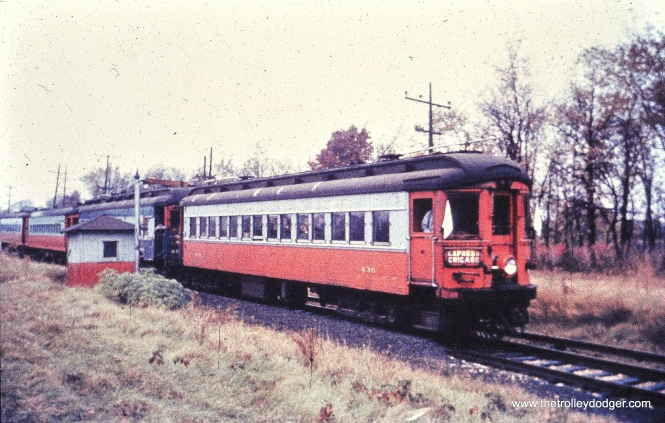
I assume this photo shows a westbound Ogden Ave. car at about S. California Ave. and that the view is northeasterly down Ogden Ave. (Blvd.).

If anyone can confirm or correct my assumption, I’d appreciate it.

https://chuckmanchicagonostalgia.wordpress.com/2015/05/


That sounds plausible. There is some evidence in the picture that we are near a park. But what is the explanation for the streetcar taking a jog at this point?

If this is Ogden and California, then there don’t appear to be any of the old buildings left that could be checked against the picture. (PS- I note there are a few pictures on that page that could have been lifted from The Trolley Dodger, but that’s OK.)

P. Chavin:

Thanks, David, for giving it a shot. At least I know my query wasn’t completely underwhelming to the group. The explanation for the streetcar taking a jog could well be that the car was coming off tracks that were on the sides of the wide boulevard but at this point, they were narrowing to a normal middle-of-the-street double track layout.


Later, Dennis McClendon came up with a very good answer:

The sun angle, the US34 and US66 signs, the view of the Board of Trade, and the park benches on the left all make me think we’re indeed looking northeast across California. The four-story round-cornered apartment building on the corner matches the fire insurance map.

Why are the tracks shifting from the service drives to the center roadway? My only theory is that the Park District was in charge of the service drives through Douglas Park, but not the original width of Ogden (which predated establishment of the West Parks Commission), and declined to permit the streetcar line to occupy the park service drives. The 1938 and 1953 aerial photos aren’t clear enough to show the tracks.


Daniel Joseph
writes:

I rode this part of the Ogden streetcar line many times as a child and can explain the “what” but not the “why”. North east of the location of this photo (which is about mid way between Sacramento and California) the streetcar tracks were in the service drive until Roosevelt Road. East of Ogden on Roosevelt the tracks continued in the service drive until Ashland. On Ogden. west of the location of the photo, the track continued in the center of the street and the service drive was a boulevard until the end at Albany.


Ogden and California Avenue today, looking to the northeast.

Ogden and California Avenue today, looking to the northeast.

Keep those cards and letters coming in, folks. You can leave a comment on this or any other post directly, or you can drop us a line at:

thetrolleydodger@gmail.com

-David Sadowski


PS- Thanks to the generosity of Mark Llanuza, we have added a few more pictures to our previous post Trolley Dodger Mailbag, 1-29-2016:

The CERA fantrip train in Lombard, still just three cars at this point. The date is October 26, 1958. (Mark Llanuza Collection)

The CERA fantrip train in Lombard, still just three cars at this point. The date is October 26, 1958. (Mark Llanuza Collection)

The four-car CERA fantrip train at Raymond Street in Elgin. Mark Llanuza says the entire day was cold and rainy, and they had to add a fourth car at Wheaton because of the large number of people on this trip. (Mark Llanuza Collection)

The four-car CERA fantrip train at Raymond Street in Elgin. Mark Llanuza says the entire day was cold and rainy, and they had to add a fourth car at Wheaton because of the large number of people on this trip. (Mark Llanuza Collection)

This must be the April 1962 train taking CA&E equipment purchased by RELIC, the predecessor to the Fox River Trolley Museum. According to Don’s Rail Photos, “11 was built by Brill in 1910, (order) #16483. It was rebuilt to a line car in 1947 and replaced 45. It was acquired by Railway Equipment Leasing & Investment Co in 1962 and came to Fox River Trolley Museum in 1984. It was lettered as Fox River & Eastern." This picture was taken in Glen Ellyn along the C&NW. (Mark Llanuza Collection)

This must be the April 1962 train taking CA&E equipment purchased by RELIC, the predecessor to the Fox River Trolley Museum. According to Don’s Rail Photos, “11 was built by Brill in 1910, (order) #16483. It was rebuilt to a line car in 1947 and replaced 45. It was acquired by Railway Equipment Leasing & Investment Co in 1962 and came to Fox River Trolley Museum in 1984. It was lettered as Fox River & Eastern.” This picture was taken in Glen Ellyn along the C&NW. (Mark Llanuza Collection)

The rescue train taking CA&E cars purchased by RELIC through Glen Ellyn. (Mark Llanuza Collection)

The rescue train taking CA&E cars purchased by RELIC through Glen Ellyn. (Mark Llanuza Collection)