Our 150th Post

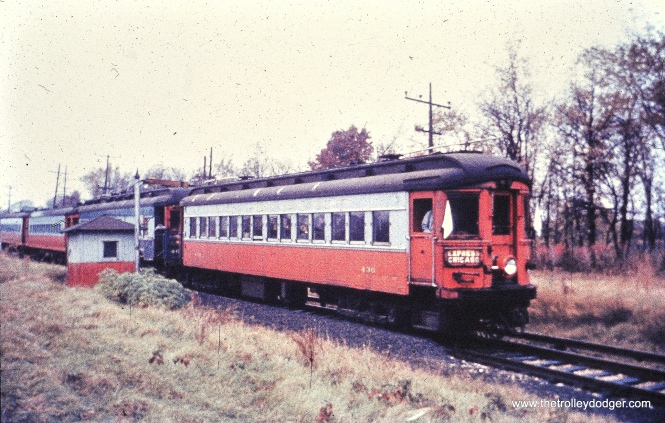
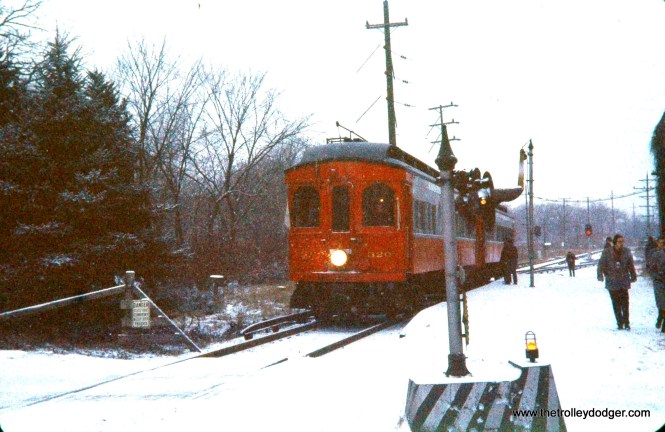
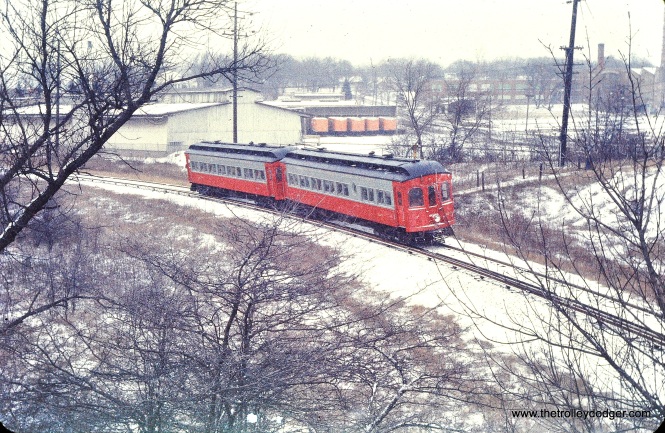
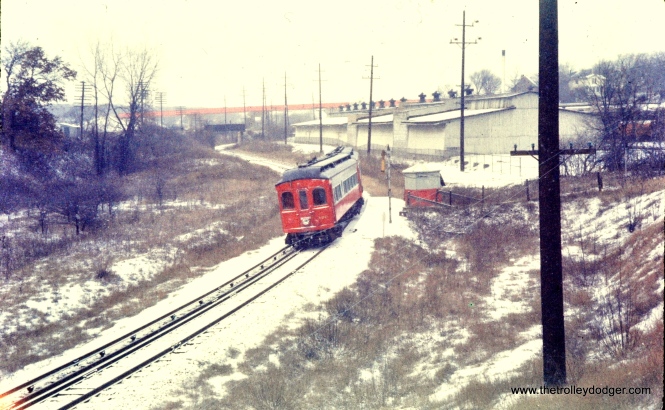
NSL 420 heading south at Dempster, current end of the line for the CTA Yellow Line (aka the "Skokie Swift"), which revived a small portion of the old interurban a year after service ended in January 1963.

NSL 420 heading south at Dempster, current end of the line for the CTA Yellow Line (aka the “Skokie Swift”), which revived a small portion of the old interurban a year after service ended in January 1963.

The Trolley Dodger blog has reached another milestone with this, our 150th post since we started on January 21, 2015. As time goes on, it becomes both easier and harder to come up with new ideas. On the one hand, we have to work harder to avoid repeating ourselves, since we have already posted thousands of images to date.

On the other hand, there always seems to be more material out there to be had. So in that sense, it seems unlikely that we will ever run out of new material. However, it’s always good to remind our faithful readers that all this historical research costs real money. It costs nothing to read our blog, of course, but the quality and frequency of future posts is entirely dependent on the financial support we get from you.

We are committed to maintaining a very high quality standard in what we put out, and our goal is not only to share information, but to create something of lasting value. We will let others be the judge of whether or not we have succeeded to date, but it’s interesting to note that I often find my own posts coming up to the top of Google searches, when I am researching things.

What makes a good blog post? Well, as I have said before, in general my idea is to use pictures to tell a story. But beyond that, it becomes more difficult to put your finger on what works and what doesn’t.

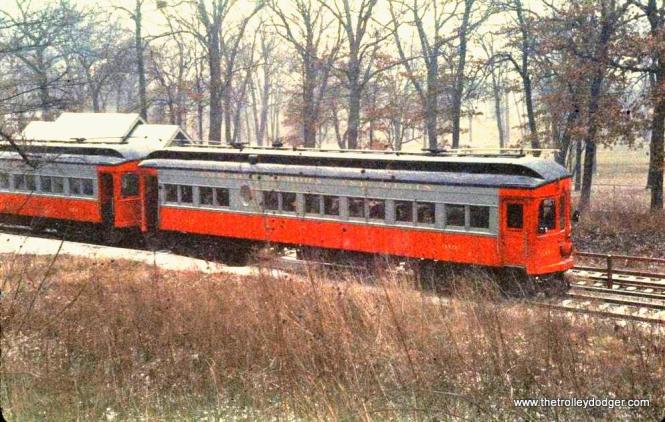
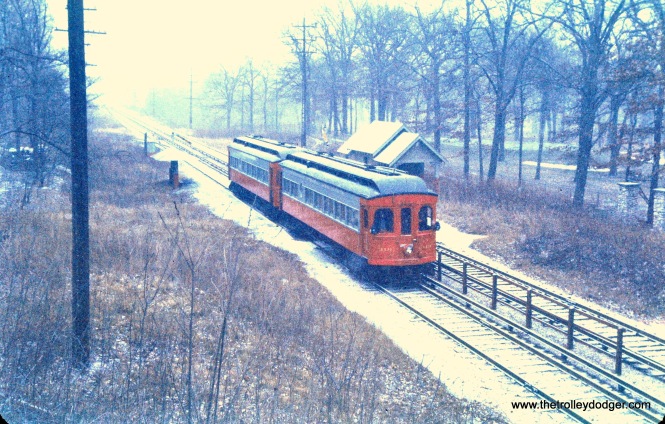
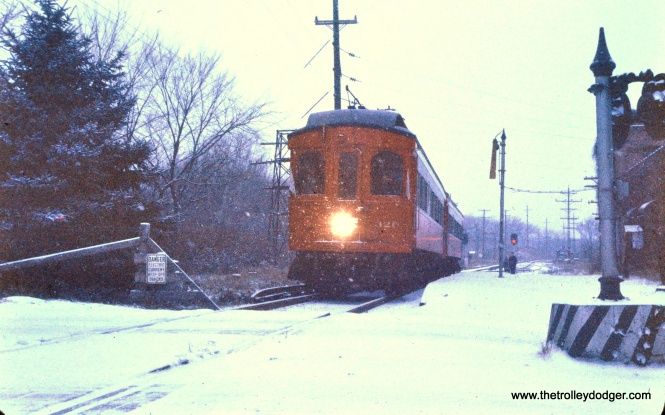
I would liken it to being a chef in a restaurant who takes whatever fresh ingredients are on hand, and tries to whip them up into a tasty dish. Since our first post featured the North Shore Line, we have a generous helping of classic CNS&M images on today’s menu.

In addition, we have a sprinkling of Chicago, Aurora & Elgin photos, plus some other Chicago/Illinois material, since that is where we are from. Hopefully, all this adds up to a complete “meal,” a feast for the eyes that is also designed to make you think.

But we have not forgotten “dessert.” Our last post (More Mystery Photos, July 29, 2016) included a picture of what appeared to be a Birney car that was not, according to Frank Hicks, an actual Birney. (If anyone is interested in learning what attributes of a streetcar make it into a “true” Birney, look no further than Dr. Harold E. Cox’s book on just that subject. What constitutes a PCC car is also somewhat debatable, another area where the esteemed Dr. Cox has weighed in with an expert opinion.)

While Birney cars, due to their small size, were unsuccessful in larger cities like Chicago, there can be no doubt they were a great success in Fort Collins, Colorado, the “Birney-est” place of all. The Fort Collins Municipal Railway purchased nine such cars for use between 1919 and 1951, a couple for parts. Of these, there’s been a pretty good survival rate, with fully five cars (#s 20, 21, 22, second 25, and 26) still extant.

These cars were so beloved in the area that they never completely left, and efforts to restore a car and revive at least a small portion of service began as early as the 1970s. Service on a mile-and-a-half line began in 1984 and continue to this day, meaning that the resurrected Birney car service in Fort Collins has lasted 32 years now, the same length of time that the original service ran.

Don Ross (in Don’s Rail Photos) writes:

The last regular operation of Birney cars in the U. S. was in Fort Collins, CO. The line was originally built by the Denver & Interurban Ry in 1907. In July 1918, the D&I stopped operating the local lines. A bus system was tried, but was very unpopular. In January 1919, the voters, by an 8 to 1 majority, decided to take over the system. Four Birneys were purchased from American Car of St. Louis and began operation in May. Over the years additional cars were added and replaced. Finally, in 1951, the system was abandoned on June 30th. The city had grown beyond the car lines, and riders had gone to the automobile. Car 21 was preserved locally. Other cars were saved at other locations. A local group began to restore 21 in 1977, and operation began on Mountain Avenue on December 29, 1984. Over the next two years, 1.5 miles of track was restored for operation. For a complete story about this system, check out their web site.

But wait, there’s more! There was also a double-truck version of the Birney, so we have posted a couple pictures of Johnstown 311, a much-loved car by the fans who took it on many trips back in the day. It ran in service in Pennsylvania until 1960 and has been preserved at the Rockhill Trolley Museum.

We are featuring color photos today, and will have several new black-and-white images to share in the near future. Thanks for coming along for the ride.

Bon Appétit!

-David Sadowski

PS- If you can help identify any of missing locations, or have other interesting thoughts on these pictures, don’t hesitate to drop us a line, either as a Comment here, or via:

thetrolleydodger@gmail.com


Chicago, North Shore & Milwaukee (aka North Shore Line)

NSL 706 heads south from Dempster in this June 9, 1961 photo by Clark Frazier. This is the current terminal of the CTA Yellow Line. The area under the electrical tower at left is where the "pocket" track went, when this was the end-of-the-line for the CRT's Niles Center Branch. This local service ended in 1948. CTA "L" service resumed here in 1964.

NSL 706 heads south from Dempster in this June 9, 1961 photo by Clark Frazier. This is the current terminal of the CTA Yellow Line. The area under the electrical tower at left is where the “pocket” track went, when this was the end-of-the-line for the CRT’s Niles Center Branch. This local service ended in 1948. CTA “L” service resumed here in 1964.

A solitary North Shore Line car crosses the Chicago River at Wacker Drive on the "L".

A solitary North Shore Line car crosses the Chicago River at Wacker Drive on the “L”.

NSL 739 and train at Lake Bluff.

NSL 739 and train at Lake Bluff.

NSL 737 at the Loyola curve on the CTA.

NSL 737 at the Loyola curve on the CTA.

NSL 713 heads up a five-car train at Sedgwick in October 1958.

NSL 713 heads up a five-car train at Sedgwick in October 1958.

NSL 737 and head "at speed" near Sheridan Elms in Lake Forest.

NSL 737 and head “at speed” near Sheridan Elms in Lake Forest.

NSL 735 et al at North Chicago.

NSL 735 et al at North Chicago.

"Silverliner" 756 and train in Skokie.

“Silverliner” 756 and train in Skokie.

A southbound Electroliner at Edison Court.

A southbound Electroliner at Edison Court.

NSL 182 and train at St. Mary's Road (Thornbury Village) on the Mundelein branch on May 31, 1962. Notice the difference in right-of-way construction here, versus the main line.

NSL 182 and train at St. Mary’s Road (Thornbury Village) on the Mundelein branch on May 31, 1962. Notice the difference in right-of-way construction here, versus the main line.

NSL 743 and train at Green Bay Junction. Jerry Wiatrowski: "NSL 743 and train are on the Skokie Valley route westbound crossing the Mundelein branch at Lake Bluff. The Green Bay Road overpass can be seen in the background." Joey Morrow: "NSL 743 is at Green Bay junction, the catenary poles are still there today. It parallels IL-176 (Rockland Ave)."

NSL 743 and train at Green Bay Junction. Jerry Wiatrowski: “NSL 743 and train are on the Skokie Valley route westbound crossing the Mundelein branch at Lake Bluff. The Green Bay Road overpass can be seen in the background.” Joey Morrow: “NSL 743 is at Green Bay junction, the catenary poles are still there today. It parallels IL-176 (Rockland Ave).”

NSL "Greenliner" 751 and a Silverliner at Lake Bluff in June 1962.

NSL “Greenliner” 751 and a Silverliner at Lake Bluff in June 1962.

A photo run-by on a February 21, 1960 North Shore Line fantrip.

A photo run-by on a February 21, 1960 North Shore Line fantrip.

I don't know just when this picture of a North Shore Line "special" train was taken, but Gustafson Motors was located in Libertyville, along the Mundelein branch. FYI, we have several North Shore Line audio recordings available on compact disc in our Online Store, including some from the Mundelein branch. Garrett Patterson: "nsl003 would have been taken just weeks before the end of service system-wide. The 1962 Bel Air in the lot dates the photo." One of our regular readers adds: "This was the CERA fantrip that was operated in April 1962. George Krambles operated the train in Evanston, and there are movies and slides of the train going south from Isabella going up the hill to the North Shore Channel bridge. The scene is seen in The Tribute to the North Shore Line video, which has been presented at January CERA meetings (although it is not commercially available). Of course the above photo is at Libertyville (which was a beautiful place in the country at one time)."

I don’t know just when this picture of a North Shore Line “special” train was taken, but Gustafson Motors was located in Libertyville, along the Mundelein branch. FYI, we have several North Shore Line audio recordings available on compact disc in our Online Store, including some from the Mundelein branch. Garrett Patterson: “nsl003 would have been taken just weeks before the end of service system-wide. The 1962 Bel Air in the lot dates the photo.” One of our regular readers adds: “This was the CERA fantrip that was operated in April 1962. George Krambles operated the train in Evanston, and there are movies and slides of the train going south from Isabella going up the hill to the North Shore Channel bridge. The scene is seen in The Tribute to the North Shore Line video, which has been presented at January CERA meetings (although it is not commercially available). Of course the above photo is at Libertyville (which was a beautiful place in the country at one time).”

NSL 705 and 709 are near the Mundelein terminal on March 25, 1962.

NSL 705 and 709 are near the Mundelein terminal on March 25, 1962.


Chicago, Aurora & Elgin

CA&E 460 and an older car are in fantrip service during the late 1950s. Nancy Grove Mollenkamp writes: "This is at West Street looking west in Wheaton. The bridge over Liberty Drive at the start of the Elgin branch is seen in the background."

CA&E 460 and an older car are in fantrip service during the late 1950s. Nancy Grove Mollenkamp writes: “This is at West Street looking west in Wheaton. The bridge over Liberty Drive at the start of the Elgin branch is seen in the background.”

CA&E 452 at Geneva Road on March 9, 1957. Nancy Grove Mollenkamp: "This is in Winfield. I believe looking north."

CA&E 452 at Geneva Road on March 9, 1957. Nancy Grove Mollenkamp: “This is in Winfield. I believe looking north.”

CA&E 404 is part of a two-car train at the Halsted curve on the old Garfield Park "L", probably not long before the end of downtown service in September 1953.

CA&E 404 is part of a two-car train at the Halsted curve on the old Garfield Park “L”, probably not long before the end of downtown service in September 1953.

CA&E 423 is part of a two-car train at Collingbourne. Nancy Grove Mollenkamp: "Collingbourne is along the Elgin branch near Raymond St. and Elgin Ave."

CA&E 423 is part of a two-car train at Collingbourne. Nancy Grove Mollenkamp: “Collingbourne is along the Elgin branch near Raymond St. and Elgin Ave.”

One can only wish that the photographer had aimed the camera a bit lower, but nonetheless, CA&E 428 is part of a four-car train in July 1953 on the Halsted curve.

One can only wish that the photographer had aimed the camera a bit lower, but nonetheless, CA&E 428 is part of a four-car train in July 1953 on the Halsted curve.

CA&E 454 at an unidentified location. Nancy Grove Mollenkamp: "This slide was identified by someone in a Wheaton FB group as being taken in 1952 at Jewell Road in Wheaton. Another person in the group said he believed it was looking south. He thinks that is Electric Avenue on the right or west."

CA&E 454 at an unidentified location. Nancy Grove Mollenkamp: “This slide was identified by someone in a Wheaton FB group as being taken in 1952 at Jewell Road in Wheaton. Another person in the group said he believed it was looking south. He thinks that is Electric Avenue on the right or west.”

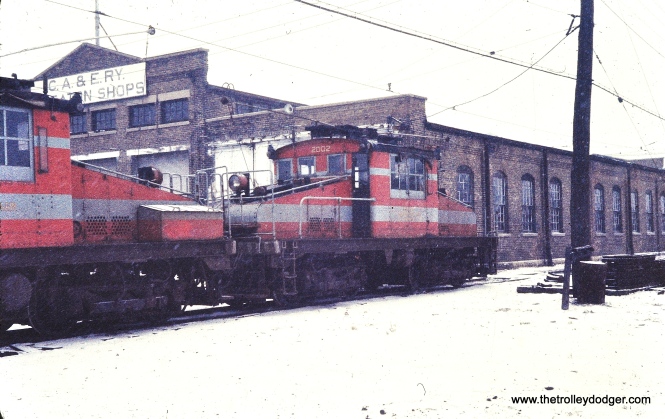
CA&E work motors 2001 and 2002 in service in March 1959. By this time, it had been nearly two years since the end of passenger service. Freight only continued for a few more months after this. (B. J. Misek Photo)

CA&E work motors 2001 and 2002 in service in March 1959. By this time, it had been nearly two years since the end of passenger service. Freight only continued for a few more months after this. (B. J. Misek Photo)

We are not sure of the location where this picture of CA&E 403 was taken. Presumably, the box the conductor is carrying holds work-related materials. George Foelschow: "I believe CA&E Pullman 403 and unattached car 410 or 419 are on the eastbound track at Wheaton station. Presumably the two cars, one each from Aurora and Elgin, will be joined for the trip east, and the conductor of 403 would be redundant and no doubt be on the next Fox Valley train due in a few minutes to be split. One could travel between Elgin and Aurora in the same time as a City Lines bus taking a more direct route along the Fox River." Nancy Grove Mollenkamp: "I agree. Definitely at Wheaton station."

We are not sure of the location where this picture of CA&E 403 was taken. Presumably, the box the conductor is carrying holds work-related materials. George Foelschow: “I believe CA&E Pullman 403 and unattached car 410 or 419 are on the eastbound track at Wheaton station. Presumably the two cars, one each from Aurora and Elgin, will be joined for the trip east, and the conductor of 403 would be redundant and no doubt be on the next Fox Valley train due in a few minutes to be split. One could travel between Elgin and Aurora in the same time as a City Lines bus taking a more direct route along the Fox River.” Nancy Grove Mollenkamp: “I agree. Definitely at Wheaton station.”

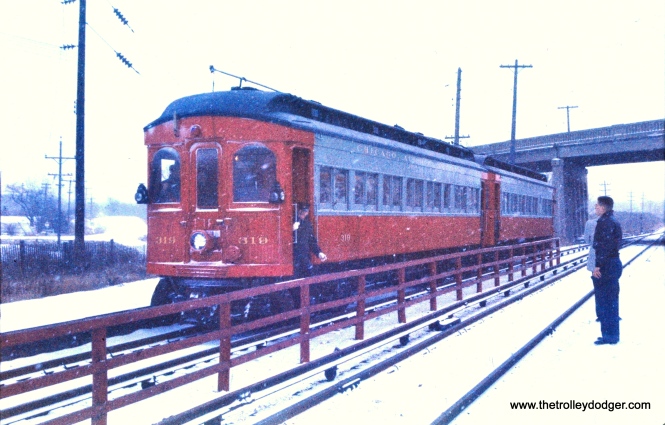
CA&E 420 at Church Road (Aurora).

CA&E 420 at Church Road (Aurora).

CA&E 424 near the end of the line, along the Fox River in Elgin. Meister Brau was a well-known Chicago beer for many years. Each spring, they would sell "Bock" beer, a stronger concoction made (I think) by scraping the bottom of the barrel. They introduced Meister Brau Lite in 1967. After Meister Brau got into financial difficulty in 1972, their brands were bought by Miller, who used Meister Brau Lite as the basis for developing Miller Lite.

CA&E 424 near the end of the line, along the Fox River in Elgin. Meister Brau was a well-known Chicago beer for many years. Each spring, they would sell “Bock” beer, a stronger concoction made (I think) by scraping the bottom of the barrel. They introduced Meister Brau Lite in 1967. After Meister Brau got into financial difficulty in 1972, their brands were bought by Miller, who used Meister Brau Lite as the basis for developing Miller Lite.

CA&E 405 is part of a two-car train. Nancy Grove Mollenkamp: "This is identified by Mark Llanuza as being taken in 1956 between the College Ave station in Wheaton and Glen Ellyn. Photographer unknown."

CA&E 405 is part of a two-car train. Nancy Grove Mollenkamp: “This is identified by Mark Llanuza as being taken in 1956 between the College Ave station in Wheaton and Glen Ellyn. Photographer unknown.”

CA&E 317 is part of a four-car train of woods.

CA&E 317 is part of a four-car train of woods.


Chicago and Illinois

Indiana Railroad hi-speed lightweight interurban car 65 at the Illinois Electric Railway Museum in North Chicago in October 1956. It had last run in 1953 on the CRANDIC (Cedar Rapids and Iowa City) before being purchased by the museum as their first acquisition. That's Chicago & Milwaukee Electric 354, another early purchase, behind it.

Indiana Railroad hi-speed lightweight interurban car 65 at the Illinois Electric Railway Museum in North Chicago in October 1956. It had last run in 1953 on the CRANDIC (Cedar Rapids and Iowa City) before being purchased by the museum as their first acquisition. That’s Chicago & Milwaukee Electric 354, another early purchase, behind it.

Illinois Terminal double-end PCC 457 is part of a two-car train, northbound at 19th and State in the mid-1950s. Don's Rail Photos says, "457 was built by St Louis Car Co in 1949, #1672. It was sold for scrap to Biermann Iron & Metal Co on July 24, 1959, and was scrapped in 1964."

Illinois Terminal double-end PCC 457 is part of a two-car train, northbound at 19th and State in the mid-1950s. Don’s Rail Photos says, “457 was built by St Louis Car Co in 1949, #1672. It was sold for scrap to Biermann Iron & Metal Co on July 24, 1959, and was scrapped in 1964.”

The same location today.

The same location today.

In this undated photo, probably taken circa 1952, tracks are being laid in the southern half of Van Buren Street to create a temporary right-of-way for the Garfield Park "L", to allow the demolition of 2 1/2 miles of the old structure that were in the way of Congress (now Eisenhower) expressway construction. At right, you can see the old Throop Street Shops. This temporary alignment was used from September 1953 to June 1958.

In this undated photo, probably taken circa 1952, tracks are being laid in the southern half of Van Buren Street to create a temporary right-of-way for the Garfield Park “L”, to allow the demolition of 2 1/2 miles of the old structure that were in the way of Congress (now Eisenhower) expressway construction. At right, you can see the old Throop Street Shops. This temporary alignment was used from September 1953 to June 1958.

A two-car train of CTA 4000s heads west on temporary trackage at Van Buren and Western on July 1, 1956. This was just two weeks after streetcar service ended on Western Avenue. This picture was taken around the time that the sounds of 4000-series "L" cars were recorded on the Garfield Park "L" for Railroad Record Club LP #36, which has been digitally remastered and is now available on compact disc in our Online Store.

A two-car train of CTA 4000s heads west on temporary trackage at Van Buren and Western on July 1, 1956. This was just two weeks after streetcar service ended on Western Avenue. This picture was taken around the time that the sounds of 4000-series “L” cars were recorded on the Garfield Park “L” for Railroad Record Club LP #36, which has been digitally remastered and is now available on compact disc in our Online Store.

Western and Van Buren today, looking to the northeast.

Western and Van Buren today, looking to the northeast.

Since CTA PCC 4406 is signed for charter service, this picture was probably taken on October 21, 1956, when this car ran on a fantrip with red Pullman 225. We have run photos from that fantrip before. You can see one in our post Chicago Surface Lines Photos, Part Six (February 22, 2016). Perhaps someone more knowledgeable than me can tell which station (car barn) this is, whether Devon or 77th. Car 4406 lasted until the end of Chicago streetcar service and had a scrap date of June 23, 1959.

Since CTA PCC 4406 is signed for charter service, this picture was probably taken on October 21, 1956, when this car ran on a fantrip with red Pullman 225. We have run photos from that fantrip before. You can see one in our post Chicago Surface Lines Photos, Part Six (February 22, 2016). Perhaps someone more knowledgeable than me can tell which station (car barn) this is, whether Devon or 77th. Car 4406 lasted until the end of Chicago streetcar service and had a scrap date of June 23, 1959.

A two car train of Lake Street "L" cars crosses the Chicago River with the Merchandise Mart in the background, probably in the early 1950s.

A two car train of Lake Street “L” cars crosses the Chicago River with the Merchandise Mart in the background, probably in the early 1950s.

We ran a black-and-white picture of CSL/CTA sweeper E57 in our post Chicago Surface Lines Work Cars – Part 2 (September 7, 2015).

We ran a black-and-white picture of CSL/CTA sweeper E57 in our post Chicago Surface Lines Work Cars – Part 2 (September 7, 2015).

CSL/CTA Y303 is listed as a "baggage car," although some have called it a MoW or maintenance of way car. It was retired on September 27, 1956. Don's Rail Photos says, "Y303. baggage car, was built by C&ST in 1911 as 59. It was renumbered Y303 in 1913 and became CSL Y303 in 1914."

CSL/CTA Y303 is listed as a “baggage car,” although some have called it a MoW or maintenance of way car. It was retired on September 27, 1956. Don’s Rail Photos says, “Y303. baggage car, was built by C&ST in 1911 as 59. It was renumbered Y303 in 1913 and became CSL Y303 in 1914.”

This 1920s-era Chicago Surface Lines trailer was looking pretty shopworn by the 1950s, when this picture was taken at South Shops.

This 1920s-era Chicago Surface Lines trailer was looking pretty shopworn by the 1950s, when this picture was taken at South Shops.

CSL/CTA streetcar 1497 was renumbered as AA85 for work service as a salt spreader, the configuration we see it in here in this 1950s photo. It was scrapped on September 27, 1956. This was known as a "Bowling Alley" car. Don's Rail Photos: "1497 was built by CUTCo in 1900 as CUT 4546. It was rebuilt as 1497 in 1911 and became CSL 1497 in 1914. It was rebuilt as salt car and renumbered AA85 on April 15, 1948."

CSL/CTA streetcar 1497 was renumbered as AA85 for work service as a salt spreader, the configuration we see it in here in this 1950s photo. It was scrapped on September 27, 1956. This was known as a “Bowling Alley” car. Don’s Rail Photos: “1497 was built by CUTCo in 1900 as CUT 4546. It was rebuilt as 1497 in 1911 and became CSL 1497 in 1914. It was rebuilt as salt car and renumbered AA85 on April 15, 1948.”

According to Graham Garfield's excellent web site www.chicago-l.org, "CTA work car S-328 -- built by American Car & Foundry in 1907 as Northwestern Elevated trailer 1283, motorized and renumbered to 1792 in 1914 by the CER -- was converted for work service and renumbered in 1958." It was retired in August 1970 and scrapped. Wooden "L" cars were last used in regular service by the CTA in 1957. After spending their final days in work service, cars like these were replaced by retired 4000-series "L" cars. Here we see S-328 at DesPlaines Avenue terminal in June 1962. (George Niles Photo)

According to Graham Garfield’s excellent web site www.chicago-l.org, “CTA work car S-328 — built by American Car & Foundry in 1907 as Northwestern Elevated trailer 1283, motorized and renumbered to 1792 in 1914 by the CER — was converted for work service and renumbered in 1958.” It was retired in August 1970 and scrapped. Wooden “L” cars were last used in regular service by the CTA in 1957. After spending their final days in work service, cars like these were replaced by retired 4000-series “L” cars. Here we see S-328 at DesPlaines Avenue terminal in June 1962. (George Niles Photo)

In this June 1962 view. we see the CTA's DesPlaines Avenue terminal as it had been reconfigured in 1959. these very basic amenities continued n use until the station was rebuilt in the 1980s. I would assume that the pile of rubble in the foreground was related to the recent construction of a new maintenance facility here. The nearby expressway had been in operation since 1960. Presumably, the CTA bus is running route 17, which replaced the Westchester "L" branch in 1951. (George Niles Photo)

In this June 1962 view. we see the CTA’s DesPlaines Avenue terminal as it had been reconfigured in 1959. these very basic amenities continued n use until the station was rebuilt in the 1980s. I would assume that the pile of rubble in the foreground was related to the recent construction of a new maintenance facility here. The nearby expressway had been in operation since 1960. Presumably, the CTA bus is running route 17, which replaced the Westchester “L” branch in 1951. (George Niles Photo)

A pair of old Metropolitan "L" cars, now in work service, share space with CTA curved-door 6000s in this June 1962 view at DesPlaines Avenue. The new shops facility is at left. The large gas holder at right was a Forest Park landmark for many years. (George Niles Photo)

A pair of old Metropolitan “L” cars, now in work service, share space with CTA curved-door 6000s in this June 1962 view at DesPlaines Avenue. The new shops facility is at left. The large gas holder at right was a Forest Park landmark for many years. (George Niles Photo)


Authentic Birney Cars

This circa 1940 postcard shows the Ft. Collins Birneys in a different paint scheme, which is actually the one currently being used for the one operating car. Caption: "The intersection of College and Mountain Avenues is the 42nd and Broadway of Ft. Collins. It is the heart of the business district, the crossroads of the town. Where all street cars meet and all highways converge."

This circa 1940 postcard shows the Ft. Collins Birneys in a different paint scheme, which is actually the one currently being used for the one operating car. Caption: “The intersection of College and Mountain Avenues is the 42nd and Broadway of Ft. Collins. It is the heart of the business district, the crossroads of the town. Where all street cars meet and all highways converge.”

Car 26 in the Fort Collins car barn in June 1948.

Car 26 in the Fort Collins car barn in June 1948.

Fort Collins Municipal Railway Birney car 22 in the city park on April 30, 1947.

Fort Collins Municipal Railway Birney car 22 in the city park on April 30, 1947.

25 in reverse rush hour loop service downtown in October 1950.

25 in reverse rush hour loop service downtown in October 1950.

21 near Colorado State University in late June 1951.

21 near Colorado State University in late June 1951.

25 in southeast Fort Collins in October 1950.

25 in southeast Fort Collins in October 1950.

21 downtown in June 1948.

21 downtown in June 1948.

25 in reverse rush hour loop service downtown in October 1950.

25 in reverse rush hour loop service downtown in October 1950.

22 in downtown Fort Collins in October 1950.

22 in downtown Fort Collins in October 1950.

25 in southeast Fort Collins in October 1950. Here's what the Wikipedia has to say about the film advertised on the side of the car: "Ecstasy (Czech: Extase, German: Ekstase) is a 1933 Czech-Austrian romantic drama film directed by Gustav Machatý and starring Hedy Lamarr (then Hedy Kiesler), Aribert Mog, and Zvonimir Rogoz." Containing some nudity, although tame by today's standards, the film was banned in the United States until 1940, and played to adult audiences at independent theaters and art houses, without the approval of the Hays Office.

25 in southeast Fort Collins in October 1950. Here’s what the Wikipedia has to say about the film advertised on the side of the car: “Ecstasy (Czech: Extase, German: Ekstase) is a 1933 Czech-Austrian romantic drama film directed by Gustav Machatý and starring Hedy Lamarr (then Hedy Kiesler), Aribert Mog, and Zvonimir Rogoz.” Containing some nudity, although tame by today’s standards, the film was banned in the United States until 1940, and played to adult audiences at independent theaters and art houses, without the approval of the Hays Office.

22 near Colorado State University in October 1950.

22 near Colorado State University in October 1950.

21 at the south end of town in June 1948.

21 at the south end of town in June 1948.

21 near Colorado State University in late June 1951.

21 near Colorado State University in late June 1951.

22 in northwest Fort Collins in October 1950.

22 in northwest Fort Collins in October 1950.

24 in front of the car barn in October 1950. According to Don's Rail Photos, "2nd 24 was built by Brill Car Co in December 1922, #21530, as Virginia Railway & Power Co 1530 It was sold as FCM 24 in 1946 but seldom operated. Parts kept second Car 25 operating."

24 in front of the car barn in October 1950. According to Don’s Rail Photos, “2nd 24 was built by Brill Car Co in December 1922, #21530, as Virginia Railway & Power Co 1530 It was sold as FCM 24 in 1946 but seldom operated. Parts kept second Car 25 operating.”

21 at a passing siding in northwest Fort Collins in October 1950.

21 at a passing siding in northwest Fort Collins in October 1950.

Fort Collins Municipal Railway "Birney" car 21, at the intersection of Johnson and Mountain Avenues. (Ward Photo)

Fort Collins Municipal Railway “Birney” car 21, at the intersection of Johnson and Mountain Avenues. (Ward Photo)

FCMR 22 on October 26, 1949. Its paint scheme is described as green, red, and aluminum.

FCMR 22 on October 26, 1949. Its paint scheme is described as green, red, and aluminum.

FCMR 25 at the car barn. (Ward Photo)

FCMR 25 at the car barn. (Ward Photo)

Feel the Birn(ey)! After service in Fort Collins ended in 1951, car 26 was sold to the Henry Ford Museum in Dearborn, Michigan. But prior to being put on static display, it operated in a Detroit parade of street railway equipment in August 1953. Don's Rail Photos: "26 was built by American Car Co. in November 1922, #1324 as CERy 7. It was sold as FCM 26 it in 1924. It was sold to Henry Ford Museum and moved to Michigan in 1953 where it is on static display. It was operated several times on the trackage of the Department of Street Railways." (C. Edward Hedstrom Photo) To read more about 26's Michigan sojourn, click here.

Feel the Birn(ey)! After service in Fort Collins ended in 1951, car 26 was sold to the Henry Ford Museum in Dearborn, Michigan. But prior to being put on static display, it operated in a Detroit parade of street railway equipment in August 1953. Don’s Rail Photos: “26 was built by American Car Co. in November 1922, #1324 as CERy 7. It was sold as FCM 26 it in 1924. It was sold to Henry Ford Museum and moved to Michigan in 1953 where it is on static display. It was operated several times on the trackage of the Department of Street Railways.” (C. Edward Hedstrom Photo) To read more about 26’s Michigan sojourn, click here.

25 stored at Woodland Park, Colorado on September 4, 1953.

25 stored at Woodland Park, Colorado on September 4, 1953.

25 stored at Woodland Park, Colorado on September 4, 1953. This was the second car 25, the first having been scrapped. Don's Rail Photos adds, "2nd 25 was built by Brill Car Co in December 1922, #21530, as VR&P 1520. It was sold as FCM 25 in 1946. It was sold to James Stitzel in 1953 and resided next to the former Midland Terminal depot in Victor, CO, until it was sold to a South Carolina party about 1980. It was cosmetically restored. In 1998 it was sold to the Charlotte Trolley painted as South Carolina Public Service Co 407. It was sold to Fort Colins Municipal in 2008 and is being restored as 25."

25 stored at Woodland Park, Colorado on September 4, 1953. This was the second car 25, the first having been scrapped. Don’s Rail Photos adds, “2nd 25 was built by Brill Car Co in December 1922, #21530, as VR&P 1520. It was sold as FCM 25 in 1946. It was sold to James Stitzel in 1953 and resided next to the former Midland Terminal depot in Victor, CO, until it was sold to a South Carolina party about 1980. It was cosmetically restored. In 1998 it was sold to the Charlotte Trolley painted as South Carolina Public Service Co 407. It was sold to Fort Colins Municipal in 2008 and is being restored as 25.”

22 on static display at Golden, Colorado in July 1963.

22 on static display at Golden, Colorado in July 1963.

According to Don's Rail Photos, "22 was built by American Car Co in April 1919, #1184. It was retired in 1951 and sold to the Rocky Mountain Railroad Club in 1952. It was on static display at the Colorado Railroad Museum though 1997. It was leased to the Colorado Springs Transportation Society and presently being restored in the former Rock Island engine house. as Colorado Springs & Interurban Ry. 135." It is shown here in September 1972.

According to Don’s Rail Photos, “22 was built by American Car Co in April 1919, #1184. It was retired in 1951 and sold to the Rocky Mountain Railroad Club in 1952. It was on static display at the Colorado Railroad Museum though 1997. It was leased to the Colorado Springs Transportation Society and presently being restored in the former Rock Island engine house. as Colorado Springs & Interurban Ry. 135.” It is shown here in September 1972.

Restored FCMR 21 as it appeared on May 14, 1995. (Mark D. Meyer Photo)

Restored FCMR 21 as it appeared on May 14, 1995. (Mark D. Meyer Photo)

Before the Birneys, the Ft. Collins system used conventional streetcars, as seen in this postcard from circa 1910.

Before the Birneys, the Ft. Collins system used conventional streetcars, as seen in this postcard from circa 1910.

ftcollins05

Many other cities had Birneys, of course. Here, we see Brantford (Ontario) Municipal Railway car 137 on July 1, 1935. This was ex-Lock Haven, Pa. Electric Railway car #2. (George Slyford Photo)

Many other cities had Birneys, of course. Here, we see Brantford (Ontario) Municipal Railway car 137 on July 1, 1935. This was ex-Lock Haven, Pa. Electric Railway car #2. (George Slyford Photo)

Johnstown Traction double-truck Birney 311 on September 3, 1958. (Clark Frazier Photo) Rockhill Trolley Museum: "The first car acquired by Rockhill Trolley Museum was car #311. This car is a double truck "Birney Safety Car" built by Wason Manufacturing Co. of Springfield, MA. It was part of an order of cars for the city of Bangor, Maine, where it operated at number 14. It was sold to the Johnstown Traction Co. and went there in 1941. It served that city well, running until the end of service in 1960. Car #311 was the last Birney type car to be operated in any United States city on a regular schedule. Car 311 was chartered repeatedly by trolley fans in the 1950's, as it was a favorite car of many." (Clark Frazier Photo)

Johnstown Traction double-truck Birney 311 on September 3, 1958. (Clark Frazier Photo) Rockhill Trolley Museum: “The first car acquired by Rockhill Trolley Museum was car #311. This car is a double truck “Birney Safety Car” built by Wason Manufacturing Co. of Springfield, MA. It was part of an order of cars for the city of Bangor, Maine, where it operated at number 14. It was sold to the Johnstown Traction Co. and went there in 1941. It served that city well, running until the end of service in 1960. Car #311 was the last Birney type car to be operated in any United States city on a regular schedule. Car 311 was chartered repeatedly by trolley fans in the 1950’s, as it was a favorite car of many.” (Clark Frazier Photo)

Johnstown Traction double-truck Birney 311 at Coopersdale on September 3, 1958. (Clark Frazier Photo) The sounds of car 311, in service during the 1950s, can be heard of Railroad Record Club LP #23, which has been digitally remastered and is now available on compact disc via our Online Store.

Johnstown Traction double-truck Birney 311 at Coopersdale on September 3, 1958. (Clark Frazier Photo) The sounds of car 311, in service during the 1950s, can be heard of Railroad Record Club LP #23, which has been digitally remastered and is now available on compact disc via our Online Store.

Here is Johnstown 311 on June 30, 1957.

Here is Johnstown 311 on June 30, 1957.


NOW AVAILABLE, DIGITALLY REMASTERED ON COMPACT DISC:

cover025gtcover

SEGT
Steam Echoes
Ghost Train
# of Discs – 1
Price: $14.95

Steam Echoes:
First published in 1959, and long out of print, Steam Echoes captures the unforgettable sound drama of steam engines in action. Like Whistles West, it features the recordings of E. P. Ripley, made in the waning days of steam during the 1950s.

The scenes were selected for listening pleasure as well as to create an historical document. They represent the everyday workings of our old steam friends, selected for the most interest, or the most beauty. The series are purposely kept short to preserve their brilliance. They show the steam engine in all four of the ways it may be heard at work– riding in it, on the train behind it, traveling along beside it, and standing at trackside while it goes by, or stops and takes off again.

Railroads featured include Southern Pacific, Union Pacific, and Canadian National.

Ghost Train:
Ghost Train, first issued in 1962 and also long unavailable, is a Hi-Fi stereo sound panorama of haunting memories, highlighting the final days of steam railroading. Railroads featured include the Grand Trunk Western, Norfolk & Western, Nickel Plate Road, Union Pacific, and the Reading Company. A particular highlight is a special whistle recording, demonstrating the famous “Doppler Effect” in true stereophonic sound.

Total time – 79:45


Help Support The Trolley Dodger

gh1

This is our 150th post, and we are gradually creating a body of work and an online resource for the benefit of all railfans, everywhere. To date, we have received over 184,000 page views, for which we are very grateful.

You can help us continue our original transit research by checking out the fine products in our Online Store. You can make a contribution there as well.

As we have said before, “If you buy here, we will be here.”

We thank you for your support.

The 63rd Street Rumble

CTA Sedans (Peter Witts) 3360 and 3347 are shown here at south Shops in 1952, having been converted to one-man with the removal of some center doors. There were 25 cars so modified, but as far as I know, none ran in regular service in this setup. (Robert W. Gibson Photo, John F. Bromley Collection)

CTA Sedans (Peter Witts) 3360 and 3347 are shown here at south Shops in 1952, having been converted to one-man with the removal of some center doors. There were 25 cars so modified, but as far as I know, none ran in regular service in this setup. (Robert W. Gibson Photo, John F. Bromley Collection)

Recent Correspondence

Anthony Waller writes:

Re: The possible role played by the Sedans in the termination of Chicago streetcar operations

I was only seven when the Chicago streetcars quit, but I still have memories of riding them. Best of all was a 1957 excursion with my mother to Lincoln Park Zoo from 81st & Halsted. We came home via the 151 bus and the Rock Island commuter train, however.

While looking through the numerous Trolley Dodger photo sets, I came across one with several recently rebuilt and repainted Chicago “Sedan” cars sitting, apparently, at South Shops. Years ago I came across material whose source I can’t recall. It seemed to show that there was a battle within CTA between pro and anti-streetcar forces. I don’t know if you will have any of this material, but I’ll tell you here what I recall of it. I was reminded of it when I saw that photo of the Sedans rebuilt for one-man operations and painted Everglade green and cream.

The first point was the fact that some of the original CTA bond money went for new equipment for CSL in lieu of cash. This was for the 600 PCC cars and the simultaneous order of new motor and trolley buses. The thought that was expressed in my long-forgotten source was that CSL personnel moving into positions at CTA (remember this was pre-McCarter) were convinced that there was a future for streetcars to such an extent that they were confident that the entire rapid transit system could be replaced by fast-accelerating PCCs. Hence, very little new equipment for the Chicago Rapid Transit company was purchased with the bond money (only the four experimental articulated trainsets). The pro-streetcar people were proposing the “Social Good” of getting rid of the noisy, unsightly, blight-inducing elevated structure. That view of elevated structure was commonly held at the time.

The second point is more indicative of a battle within the CTA bureaucracy between McCarter and the pro-streetcar personnel. The source had stated that in addition to pre-and post-war PCCs, the Peter Witt cars or ”Sedans” as they were called in Chicago, also would have remained in service at least somewhat longer than all the pre-1929 red streetcars. They were shifted from Clark-Wentworth and Madison to Cottage Grove-Pullman when the first batch of post-war PCCs arrived (In James Johnson’s CSL book, there is a photo of one on Cottage Grove/South Chicago.).

The Sedans had leather seats inside, and much faster acceleration than the older red streetcars. Their only difference from PCCs was their noisier operation. The caption for the map on page 38 of the CERA book is in error, as there was no plan to put PCCs on Cottage Grove at that time (1950). The Sedans were regarded by CTA at the time as modern streetcars, having two of the three characteristics of a modern streetcar.

This source stated that it was a battle over the Sedans that held the fate of of Chicago’s streetcars! The conversion of the pre-war PCCs (and a few post-war cars) to one-man operation was a step embraced by the pro-streetcar people to reduce operating costs. Eventually, all of the post-war PCCs would have been rebuilt, as part of the program proposed by the Deleuw Cather consultant study.

However, the Sedans were included in the program by the pro-streetcar elements. They were to be assigned to 63rd St., which was being operated by old red streetcars after the pre-war PCCs were taken off to be rebuilt for one-man service. Reportedly there were howls from the community, first by the return of the old red cars after several years of modern service, and then seeing their PCCs assigned to Cottage Grove.

The conversion work on the Sedans began after they were replaced on Cottage Grove by the pre-war PCCs in May 1952. The caption on the photo said that 25 were so completed. The rebuild program halted after 25 or so had been so altered (the hand of McCarter?). Meanwhile the howls from the community along 63rd St. continued. Finally, CTA proposed a meeting with the 63rd St. businessmen’s group where they could vote on alternatives. The meeting was held in October of 1952.

Two Sedans thoroughly rebuilt on the interior, set up for one man operation, with additional seats replacing the conductor’s position and two of the center doors, and painted in CTA’s new darker Everglade green and cream color scheme were used to gather up all the members of the businessmen’s group in a special charter move. One car started at the east end of the route (Stony Island Ave.) and one from the west (Narragansett Ave.); picking up the business owners and bringing them to a private banquet hall centrally located along 63rd St. (Western Ave. is the central point, but it may have been in the then-busy 63rd & Halsted shopping district.)

At the luncheon meeting, the businessmen were offered the alternative of rebuilt Sedans similar to what they had ridden, or buses. PCCs were off the table. The businessmen voted for buses. No doubt Walter McCarter trumpeted the vote as a victory for his point of view.

The result of that October 1952 meeting was felt within CTA immediately. Two post-war PCCs were sent to Pullman and St. Louis Car Co. respectively; to determine if they could be directly rebuilt into rapid transit cars. An internal staff study at CTA commenced about the future of Chicago streetcars. Released in January 1953, it stated that street congestion was hampering streetcar operations and that buses replace them all as fast as possible. The 1,000 bus order was placed with Flexible for propane buses, and the back-up plan to use parts salvaged from the post-war PCCs for building new rapid transit cars was developed.

As for the Sedans? The 25 rebuilt for one-man operation never ran a mile in revenue service. Amazingly, some of the non-rebuilt cars were taken out of their five-month storage and placed in service on 63rd St.; running alongside Red Pullmans and a few post-war PCCs diverted from Western Ave. after peak periods (with buses taking over on weekends and holidays). They were used there until full bus service on the route began in May, 1953.

Any thoughts?


Thank you for your very interesting and detailed query. I actually have a lot of thoughts, and will try to respond point-by-point. There are things you say that I agree with, some I disagree with, and others that cannot be proven definitively one way or the other.

The map you refer to in CERA B-146, in the “key,” states correctly that Cottage Grove did not get PCCs until 1952. We wanted to choose a date that would still show a lot of the red car lines, so we chose 1950 as being representative with that caveat. However, as it turns out, the map shown is accurate as of early December 1949 and not 1950. It is a color-coded version of one found in the 1949 CTA Annual Report.

A Note on Source Documents

I did some additional research to check the facts, in order to establish a timeline for events. I studied contemporary newspaper articles and Chicago Transit Board minutes, and then compared these to various photographs from the period.

Having been on some boards myself over the years, I realize that there is a lot that does not appear in such minutes. In general, board minutes cover resolutions, and, if there are dissenting voices, may or may not document some of the discussion.

In the case of the CTA, much went on behind the scenes. Boards, generally speaking, set the policy and direction that management puts into practice. Oftentimes, the board was considering motions in light of management recommendations that are not always detailed in these minutes.

In particular, there is a reference to a CTA Five Year Plan that most likely covered the years 1953 through 1957. It is implied that this was something developed by General Manager Walter J. McCarter. It would be very interesting and informative to read this document, but I have not found a source for it at the present time.

If there were disagreements, these were almost always worked out behind the scenes. Most votes by the Chicago Transit Board in this era were unanimous. Even the most contentious issues CTA dealt with at these board meetings were generally resolved by a unanimous vote, although some members offered reservations before doing so.

There are two such instances from the 1950s that come to mind. First, there was the very controversial and much criticized CTA purchase of the Chicago Motor Coach Company assets in October 1952. Then, there was the rather rushed decision to cut the Broadway-State streetcar line in half in 1955 and substitute buses for the southern portion.

Now, it may be that the change in Broadway-State was rushed through intentionally, in order to stifle potential opposition. Board Chairman Virgil Gunlock stated that the employee “pick” for the revised route had already been made. A City of Chicago spokesman said that they had not been given enough time to properly study the issue.

Since Gunlock estimated that as many as 5,000 riders would have to transfer daily as a result of the elimination of the through-route, some board members were uneasy about the change. In fact, some claimed not to know very much about the so-called “PCC Conversion Program” that made the change necessary.

In 1960, there was an even more contentious internal debate on the CTA board regarding the relative merits of propane buses versus diesel. This actually spilled out into the public, as board members took sides. Although the cost differences between these types of fuels were small, CTA ultimately decided to abandon propane, and began purchasing “New Look” GM diesel buses.

Purchase of Postwar Cars

The Chicago Transit Authority was created in 1945 by an act of the Illinois legislature, and passage of a referendum. Although the CTA did not purchase the Chicago Surface Lines and the Chicago Rapid Transit Company until October 1, 1947, the fledgling Chicago Transit Board felt that it had been given a mandate to hit the ground running and make transit improvements immediately.

Therefore, the period from June 1945 through September 1947 can best be considered a transition period between private and public ownership. I have seen references to a CTA-CSL “joint operating committee,” and for all I know, there may have been one for CRT as well.

CSL management knew that a purchase was inevitable and thus cooperated with the CTA and the courts (they were under bankruptcy protection) to coordinate their efforts.

While the 600 postwar PCC streetcars were technically ordered by CSL, with judicial approval, it and other 1945-47 equipment purchases were “stage managed” by the CTA. Over the years, CSL had accumulated a large modernization fund, and the Chicago Transit Authority wanted to put it to use immediately. The CTA assured CSL that such purchases would have no effect on the buyout price ($75m) eventually paid. (In other words, the new cars were counted as assets for the purposes of the CTA buyout.)

In the mid-1950s, CTA board member Werner W, Schroeder, in his 12-chapter Metropolitan Transit Research Study, pointed out that the actual purchase price was far less than $75m, because it included $30m in cash (or the equivalent) that CSL had. It was some of this cash that was used to leverage the purchase of 600 postwar PCC streetcars that were delivered in 1946-48. (This cash amount had been reduced to about $25m by the October 1, 1947 takeover.)

Although the rapid transit system had needs of its own that were as great, or even greater than CSL’s, they were a financial basket case by 1945 and thus could not afford to buy large numbers of new all-steel rapid transit cars. As it was, four sets of articulated cars were ordered (the equivalent of about eight individual cars) at a cost of about $100,000.

While the PCC streetcar had been around for nearly a decade when the postwar order was made in November 1945, and specifications for the Chicago cars had been finalized in 1941 (and delayed by the defense buildup to WWII), the situation was different with regard to rapid transit cars.

By 1945, the only rapid transit cars that used PCC technology were the six sets of “Bluebird” compartment cars for the BMT (Brooklyn-Manhattan Transit), circa 1939-40. And while these were the “state of the art” for their time, once the BMT came under municipal ownership in 1940, the order was truncated and the cars were never utilized to their full potential on the New York system. They quickly became orphans.

Since there was no standardized PCC rapid transit car available, it is just as well that the Chicago order was limited to a small number of experimental cars. As it was, the CTA’s experience with these cars led to numerous improvements (including a change from articulated cars to “married pairs”) that were incorporated into the 6000s that were first ordered in 1948.

CTA Management

Various civic groups in Chicago had been pushing for a unified transit system since the World War I era. Although transit was provided by private companies, which by the 1920s included the Chicago Motor Coach Company, there was substantial involvement by the City of Chicago. The City and CSL jointly ran the Board of Supervising Engineers, Chicago Traction. During the 1930s the BoSE was very much involved in the development of the PCC streetcar.

The Chicago City Council passed a transit unification ordinance in 1930, and work nearly began on the State Street subway at this time, but this and other attempts to form a new private company (to be called the Chicago Local Transportation Co., and later the Chicago Transit Co.) were stillborn. Once it became clear that the Illinois Commerce Commission would not approve such an arrangement, since it did not make financial sense, the City decided that municipal ownership was the choice of last result in 1943.

Once the CTA became a reality in 1945, Philip Harrington, principal author of the 1937 “Green Book” plan to improve Chicago’s transportation system, became the first chairman. At first, the CTA was an offshoot of the city’s Department of Subways and Superhighways, and rented office space from them.

When the takeover finally did become a reality on October 1, 1947, the CTA had its own bureaucracy and management in place. It wasn’t simply a matter of using the existing CSL and CRT management.

As this was municipal ownership, the CTA’s interests were, in the beginning, pretty much the City of Chicago’s interests. The City Council was, for a time, micro-managing transit, voting on ordinances for things like converting a streetcar line to bus.

Things changed over time, with the CTA flexing its muscles and taking on more of an independent role. Eventually, local politicians found they could adopt a sort of “good cop, bad cop” stance towards the CTA, taking credit for themselves when things went right, and blaming the authority when things went wrong.

Mayor Martin H. Kennelly‘s response to the CTA’s impending purchase of the Chicago Motor Coach Company assets in 1952 is instructive. Privately, Kennelly is said to have supported the buyout. But he feared the GOP would try to use it against the Democrats in the upcoming elections, so he wrote a highly critical letter to the CTA just before the takeover became official, suggesting they were paying too much. Of course, the letter was widely reported in the newspapers, but came much too late to have any effect in stopping the sale.

The CTA hired Walter J. McCarter to be their first general manager on June 27, 1947, a few months prior to the operations takeover. He had been general manager of the Cleveland streetcar system when it became publicly owned in 1942. A 1947 Chicago Tribune article said he had been hired here because of his success in “rubberizing” the Cleveland system. In the same article. McCarter stated his opposition to any additional streetcar purchases.

This was at a time when only about 1/3rd of the 600-car order had been delivered.

Much of the CTA’s original Modernization Program originated years earlier. As far back as 1930, it anticipated buying 1000 new streetcars and 1000 new rapid transit cars. By the early 1940s, this amount was reduced to 800 streetcars, which is the number used in the 1947 CTA Modernization Plan. 600 cars were delivered in 1946-48 and an additional 200 were supposed to be purchased a few years later.

The same CTA 10-year plan, which covered the years 1946 through 1955, called for continual conversions of streetcar lines to bus, so that by 1955 only three PCC lines would still be operating. Presumably, even these were to be phased out eventually. For purposes of depreciation, the CTA assumed that streetcars had a 20-year useful life. Even without the PCC Conversion Program, this time would have been up by 1966-68.

The wholesale scrapping of PCCs speeded up the trolleys’ demise by about 8-10 years.  But many American cities have gotten way more than 20 years of life out of their PCCs, and some are still in daily use.

The CTA’s First Five Years

As I mentioned, the CTA’s Modernization Program had largely been developed some years before it was implemented. Meanwhile, due to the Great Depression and the war years, there was a lot of pent-up need for change in the system.

If not for these factors, it is likely that Chicago’s transition from streetcars to buses would have been more gradual than what did take place. But these types of changes were already occurring and had started as far back as 1930, when the Surface Lines established several successful new lines in Chicago’s northwest side using trolley buses.

At first, the CSL said these lines would eventually be converted to streetcars, but this never happened.

During the years 1947-52 the CTA attempted to put the Modernization Program into effect, and this included the 600 new PCC streetcars. However, with the end of the war, certain trends started to take place that would undermine their use here.

Surface system ridership declined as automakers began producing new cars in large quantities. The five-day workweek became standard, which reduced weekend ridership, as did increased automobile use.

The CTA was under a lot of pressure to increase wages, and fares doubled during the first five years, which further depressed ridership. One of the main ways that CTA tried to keep expenses down in this period was by reducing the number of employees.

This was largely done by replacing two-man streetcars with one-man buses. It is a process that was largely completed in 1954, when the last red streetcar ran. At that point, CTA estimated that there were no more such savings to be had– by then, some PCCs had already been converted to one-man, and the two-man cars were on the busiest lines, where they were still advantageous.

CTA estimated that it took 1.5 buses to replace each streetcar. The 600 postwar PCCs were eventually replaced by 900 buses, but as funds were tight, CTA ended up leasing 100 of these instead of outright purchase.

When a two-man streetcar was replaced by 1 1/2 buses, that was a labor savings, but when a one-man car was replaced by bus, that was a labor loss. In many cases, CTA could profitably replace streetcars with buses on the weekends, as they had surplus buses available then, and ridership was much reduced. The PCCs, with their higher capacity, were not needed as much.

The 1951 Consultant’s Report

In 1951, CTA retained the respected consulting firm of DeLeuw, Cather & Company to do a thorough review of the entire agency and its operations. Among their recommendations were the conversion of all PCC streetcars to one-man operation, and their indefinite retention.

On the other hand, the report argued against purchasing any additional electric vehicles, due to the high cost of electric power. According to documents associated with the 1952 CTA $23m bond sale, most of which went to purchase the Motor Coach, Commonwealth Edison had increased the cost of electricity by about 35% between 1948 and 1952.

During this same period, the CTA enthusiastically embraced propane as a very cheap fuel for buses. Many streetcar lines were replaced by propane buses, but their performance was poor and the buses were very much under-powered.

CTA ordered 349 trolley buses in 1951, the largest single order of its kind at the time, but those were the last such buses ordered. The trolley bus system began to be phased out starting in 1959 and the final such bus ran in 1973.

By October 1, 1951 CTA had purchased 551 propane buses, the largest fleet in the nation.

One-Man Conversions

In line with the 1951 consultant’s report, CTA began converting streetcars to one-man. The Chicago Transit Board authorized conversions of potentially all 683 PCCs and the 100 1929 Sedans in early 1952, although the actual numbers of cars converted was actually much less than this.

In early 1952, the CTA proposed converting both the Cottage Grove and 63rd Street car lines to one-man. The City of Chicago requested that public hearings be held. This is most likely due to the influence of 13th ward Alderman John E. Egan, whose territory covered a large part of route 63 (the entire portion west of Kedzie). He appears to have mobilized the business community against the conversion on the grounds that it would be ponderously slow and unsafe.

The Chicago Tribune reported on February 7 and 8 on community opposition to one-man PCCs on 63rd Street. In spite of this, CTA GM McCarter stated in the March 4th Trib that they still intended to convert both lines. He also said that about 110 cars would be needed, which works out to the 83 prewar PCCs and 25 of the 100 1929 Sedans. (Andre Kristopans has done some research, which you can read in the Comments section of this post, indicating this was the number of cars needed on Cottage Grove only.)

Similar opposition does not seem to have materialized along the Cottage Grove line. The public hearings were closed as of April 30, 1952, and the CTA board approved conversion of Cottage Grove the following day. No action was taken at the time regarding 63rd.

While I did not find any record of an October businessmen’s meeting with CTA, as described by Mr. Waller, there is nothing I found that would prevent such a meeting from having taken place. It’s very possible it did happen, as he described, and that local leaders were given the choice of one-man streetcars, or one-man buses. If so, they chose buses, perhaps Egan had feared that one operator would be hard pressed to handle fares, transfers, unruly passengers, and safely handle the very fast PCCs.

Another factor may have been the change in routing between Central and Narragansett that buses made possible.  The streetcars ran on private right-of-way for the westernmost mile of the route via 63rd Place, the next block south of 63rd Street.  The trolley line had been built at a time when the area was largely undeveloped, as numerous pictures show.

By 1952, development was underway, and once the bus began operating the following year, the route was shifted over to 63rd Street for this last mile, which would have been advantageous to local businesses.  63rd Place became a quiet residential street, which it remains today.

As it was, CTA took no further action until they had enough buses on hand to operate the replacement service. This was approved by the board on April 13, 1953 and went into effect on May 24th the same year.

By then it would seem that CTA was afraid of negative public reaction if the fast PCCs were replaced by slow propane buses. Therefore, it should perhaps be no surprise that PCCs were withdrawn months earlier and replaced by slower, much older red streetcars.

Although Mr. Waller says that some of these replacement cars were two-man Sedans, I was unable to find a picture showing any. All the pictures I have seen of this late trolley service show Pullmans. That does not mean, of course, that this did not happen.

In similar fashion, PCCs were later withdrawn from the busy Halsted line and replaced temporarily by older red cars before bus substitution went into effect on May 30, 1954. Likewise, red cars temporarily replaced PCCs on the Madison-Fifth portion of route 20 in December 1953 before that service was terminated the following year, a victim of expressway construction.

Effect of the Motor Coach Purchase

With the CTA’s controversial purchase of the Motor Coach lines, effective October 1, 1952, its first five years of operations came to an end. By then, the agency was awash in red ink and had to take drastic action to increase revenues and reduce expenses.

Buying out their only remaining competitor was seen as a necessary move, whatever the cost. Motor Coach was profitable, and its ridership was increasing, at a time when CTA’s was decreasing. It was natural that CTA would claim that CMC was siphoning off profits that should have been CTA’s. However, the privately owned Motor Coach balked at selling, and only agreed to it after getting CTA to substantially increase their offer.

As a result, the agency’s intended $20m bond issue was increased to $23m at the last minute.

The Motor Coach purchase was not popular with the general public, mainly because it meant an instant fare increase to CTA’s higher levels. That a public entity would put a profitable competitor out of business was also bothersome to many. Yet CTA had little choice, and previous transit unification plans had always anticipated including the Motor Coach along with CSL and CRT.

Perhaps because of this criticism, the CTA was very much in need of a public relations “coup,” one that would show the agency could achieve millions of dollars in future savings to atone for the CMC acquisition.

This is the climate in which the so-called PCC Conversion Program was hatched. In fact, the beginnings of this plan became the Chicago Transit Board’s first order of business after approving the Motor Coach purchase.

The February 1951 opening of the Dearborn-Milwaukee subway had been very successful in speeding up service and increasing ridership. Meanwhile, even with modern, fast PCC equipment on the streets, CTA operations were hampered by traffic congestion that it could not control.

This brought about a “sea change” in the agency’s priorities. From this point forward, with their last remaining competitor out of the way, CTA devoted 70% of their investments towards the rapid transit system, which had only represented about 15-20% of overall system ridership in 1947.

The agency became convinced that the best way for transit and traffic to coexist was via low-cost rapid transit lines in the medians of the new expressways that were then being planned. The Congress line was already under construction, and such lines were eventually opened in the south and northwest side expressways in 1969-70, once Federal funding became possible.

Once CTA had made this change in priorities, the surface system was downgraded, relatively speaking, in the overall scheme of things. After all, it no longer had any competitors, and the public would have no choice but to accept whatever type of service that CTA would offer. This had been upheld by the courts when activists had protested the CTA’s abandonment of the Humboldt Park “L” branch. If the CTA wanted riders to use trolley buses on North Avenue instead of the “L”, they were within their rights and the courts did not want to interfere. If transit problems were really a concern, the voters had remedies through their elected representatives and the legislature.

Once the cost of electricity increased, and propane became a cheap alternative, PCC cars were no more attractive to CTA than the old red streetcars were. Their days were numbered, since CTA did not have any taxing power and had to live out of the farebox.

A noted transit historian once pointed out to me that in the 1950s, the CTA did everything possible “on the cheap.”

This is the context in which CTA Chairman Virgil Gunlock’s 1959 statement should be viewed, when he remarked on a radio program that the PCCs were the finest transit vehicles ever to operate on the city streets, but they “cost too much to operate.”

Unintended Consequences

While these were the motivations that led to CTA’s decision, starting in October 1952, to abandon streetcar service as soon as possible, there were unintended negative consequences that undermined any advantages that might have been realized as a result.

From a labor standpoint, CTA knew that it would not realize any additional savings by eliminating PCCs, once the last of the two-man red cars was retired in 1954. In fact, if a one-man car was replaced by a one-man bus, that was a net loss in labor cost, since it took 1.5 buses to provide the same capacity.

I have analyzed the Conversion Program in great detail in my E-book Chicago’s PCC Streetcars: The Rest of the Story, available through our Online Store. But whatever grandiose claims were originally made for the $20k or $25k in savings per car that was originally claimed, in all likelihood little if any money was ultimately saved.

Numerous problems came up almost immediately. Two PCCs were sent out for potential conversion to “L” cars in late 1952, but when only St. Louis Car Company wanted to continue with the project, it was no longer being done on a competitive bidding basis.

Soon, CTA found out that the bodies would have to be scrapped, since floor heights were different, and there would be costs of $3,000 per car to modify controller equipment. Over the life of the program, costs rose due to the need to refurbish parts that had received more use, so that by 1958, when the last such order was placed, CTA was receiving just about scrap value for each PCC turned in.

One of the main benefits of the program, from the CTA’s viewpoint, was to take the only partly depreciated cars off of the books, and this is spelled out in Chicago Transit Board documents of the period. Once it became obvious that this was no “magic bullet” with $20k or $25k in savings per car, the goal changed to selling each car to St. Louis Car Company for the estimated depreciated value, and allowing the additional costs of parts reuse and conversion to simply be added in turn to each new rapid transit car purchased.

Since the 570 cars involved were purchased on a non-competitive basis, with specifications written so that St. Louis Car Company would be the only bidder (each bidder on the new car order was required to also be the purchaser of used PCCs, whih only SLCC would do), there is no way to know just how much additional cost was buried in the price of each car, but it was substantial.

Another unintended consequence was that, by offering a lesser quality service on city streets, and paving over the streetcar tracks, CTA actually made the streets more inviting to cars and trucks, which created more traffic congestion in turn, thus reducing ridership even more.

In retrospect, CTA’s best bet might have been to continue using PCCs on the major lines, with all cars converted to one-man. Additional standard PCC cars were readily available in the 1950s in good condition from other cities.

This is the approach that Toronto took, and it has served them well. Meanwhile, Chicago’s non-standard PCCs, the largest and widest single-ended cars of their type, were prescient of the changes in streetcar technology since their 1958 demise.

They are now small in comparison to the Flexitys that are gradually being introduced to Toronto streets.

Meanwhile, in some ways Chicago’s surface system has never recovered from being downgraded in 1952 at the expense of the rapid transit system. “L” ridership continues to grow while bus ridership continues to shrink.

To this day, the years of greatest decline in Chicago’s surface transit system are from 1947 to 1958, when Chicago’s once mighty streetcar system was dismantled bit by bit.

If Chicago had kept its PCCs, proposals such as the “bus rapid transit”line planned for Ashland Avenue might not be necessary, as there would still be effective crosstown transit that does not operate in a hub and spoke pattern with the center city, but instead would have helped keep Chicago’s many neighborhoods strong and vibrant.

-David Sadowski

PS- To see more pictures of Chicago’s Peter Witts, see our previous post The CSL Sedans (December 24, 2015).

The entire 48-page prospectus for the CTA’s 1952 $23m bond issue, and much more, has been added to our E-book Chicago’s PCC Streetcars: The Rest of the Story, available through our Online Store.


Correspondence

M. E. writes:

Observations about 63rd St. Rumble from someone who lived half a block from 63rd St.:

I don’t remember ever seeing a sedan car on 63rd St. The 63rd St. line migrated from red cars to the pre-war PCCs that came from Madison St. Although my memory isn’t precise, I believe there were still red cars during rush hour to augment the PCCs. All of this was two-man service. To my knowledge there were never any one-man cars on 63rd St. because it was a very busy line.

I do remember seeing lots of two-man sedans on the 4 Cottage Grove Ave. line. In 1952 the 63rd St. PCCs were moved to Cottage Grove as one-man cars. I’m unsure whether sedans augmented PCC rush-hour service on Cottage Grove. The CTA would not have mixed two-man and one-man cars on the same line, so any rush-hour sedans on Cottage Grove would have had to be one-man. Ergo, if one-man sedans were actually used someplace, it would have been on Cottage Grove.

When the pre-war PCCs moved from 63rd (two-man) to Cottage Grove (one-man), two-man red cars once again had to cover 63rd St. service. This lasted until 63rd was converted to a bus line in the spring of 1953. The one-man PCC service on Cottage Grove lasted until mid-1955, when the line was converted to bus.

I do not recall seeing post-war PCCs on 63rd St., although you have photos to prove it. Because the 69th and Ashland carbarn served both 63rd (pre-war PCCs) and Western (post-war PCCs), perhaps an occasional post-war PCC was sent to 63rd.


CTA Sedan 3377, showing the original door configuration, southbound on Cottage Grove at 95th Street on May 6, 1951. (John D. Koschwanez Photo, John F. Bromley Collection)

CTA Sedan 3377, showing the original door configuration, southbound on Cottage Grove at 95th Street on May 6, 1951. (John D. Koschwanez Photo, John F. Bromley Collection)

CTA 3381, now in CTA green, near the south end of route 4 - Cottage Grove, circa 1952. We cannot tell whether it had yet been converted to one man operation. (Earl Clark Photo)

CTA 3381, now in CTA green, near the south end of route 4 – Cottage Grove, circa 1952. We cannot tell whether it had yet been converted to one man operation. (Earl Clark Photo)

CTA 3381 at Cottage Grove and 111th, near the south end of route 4, on February 2, 1952. The landmark Hotel Florence is in the background, in Chicago's Pullman neighborhood. (Thomas H. Desnoyers Photo, Krambles-Peterson Archive)

CTA 3381 at Cottage Grove and 111th, near the south end of route 4, on February 2, 1952. The landmark Hotel Florence is in the background, in Chicago’s Pullman neighborhood. (Thomas H. Desnoyers Photo, Krambles-Peterson Archive)

CTA 3381 at Cottage Grove and 115th, south end of route 4, on April 2, 1952. (Thomas H. Desnoyers Photo, Krambles-Peterson Archive)

CTA 3381 at Cottage Grove and 115th, south end of route 4, on April 2, 1952. (Thomas H. Desnoyers Photo, Krambles-Peterson Archive)

Prewar PCC 4016, circa 1951, may very well be the first of the one-man conversions. The rear door here is completely blocked off, but soon the City of Chicago insisted on the addition of a rear emergency exit door. This was only a year after the terrible accident where a PCC collided with a gas truck and 33 people were killed. Notice how the middle door (for exit only) has been narrowed to try and keep people from sneaking on without paying. The location is Kedzie Station (car house). (Chicago Transit Authority Photo)

Prewar PCC 4016, circa 1951, may very well be the first of the one-man conversions. The rear door here is completely blocked off, but soon the City of Chicago insisted on the addition of a rear emergency exit door. This was only a year after the terrible accident where a PCC collided with a gas truck and 33 people were killed. Notice how the middle door (for exit only) has been narrowed to try and keep people from sneaking on without paying. The location is Kedzie Station (car house). (Chicago Transit Authority Photo)

CTA 4029 lays over on 64th Street near Stony Island on March 10, 1952. This was the east end of route 63. The sign says "Enter at Font," but we don't know whether this prewar PCC had been converted to one-man operation yet. However, this picture was taken around the time CTA held public hearings about converting 63rd to one-man operation.

CTA 4029 lays over on 64th Street near Stony Island on March 10, 1952. This was the east end of route 63. The sign says “Enter at Font,” but we don’t know whether this prewar PCC had been converted to one-man operation yet. However, this picture was taken around the time CTA held public hearings about converting 63rd to one-man operation.

CTA 7012 at the Narragansett Loop on the west end of route 63. Tony Waller adds, "In image 257, the pre-war PCC must have been photographed in December 1951. All pre-war PCCs were removed from 63rd St. in Spring 1952 and rebuilt for one man operations (with elimination of one of the center doors). They were then assigned to Cottage Grove."

CTA 7012 at the Narragansett Loop on the west end of route 63. Tony Waller adds, “In image 257, the pre-war PCC must have been photographed in December 1951. All pre-war PCCs were removed from 63rd St. in Spring 1952 and rebuilt for one man operations (with elimination of one of the center doors). They were then assigned to Cottage Grove.”

CTA 4022, with some obvious front end damage, eastbound on the 63rd Street line. There is an ad on the side of the car promoting Hawthorne Race Course, which opened in 1891. One of our readers writes, "I believe that this car is laying over on the wye at 63rd and Central Park waiting to head east to Stony Island. The car was still two man at the time, but being in Everglade Green, I would date it as mid 1952 before the cars were sent to Cottage Grove after being converted to one-man operation." (R. Alexander Photo, Krambles-Peterson Archive)

CTA 4022, with some obvious front end damage, eastbound on the 63rd Street line. There is an ad on the side of the car promoting Hawthorne Race Course, which opened in 1891. One of our readers writes, “I believe that this car is laying over on the wye at 63rd and Central Park waiting to head east to Stony Island. The car was still two man at the time, but being in Everglade Green, I would date it as mid 1952 before the cars were sent to Cottage Grove after being converted to one-man operation.” (R. Alexander Photo, Krambles-Peterson Archive)

CTA 4031 on 63rd Street.

CTA 4031 on 63rd Street.

CTA 7016 on 63rd Place near Narragansett.

CTA 7016 on 63rd Place near Narragansett.

Postwar CTA 7269 at 63rd Place and Narragansett on November 23, 1952. (Thomas H. Desnoyers Photo)

Postwar CTA 7269 at 63rd Place and Narragansett on November 23, 1952. (Thomas H. Desnoyers Photo)

Prewar PCC 4027 at an unknown location. Likely possibilities are routes 4, 49, or 63. Tony Waller writes, "Image 243 is on 63rd St. Look at the pre-war PCC. It’s door arrangement is that of a two-man car. Cottage Grove and Western only had pre-war PCCs in one man operation."

Prewar PCC 4027 at an unknown location. Likely possibilities are routes 4, 49, or 63. Tony Waller writes, “Image 243 is on 63rd St. Look at the pre-war PCC. It’s door arrangement is that of a two-man car. Cottage Grove and Western only had pre-war PCCs in one man operation.”

CTA 248 at 63rd and Ashland in May 1953, shortly before the end of streetcar service on route 63. Note the safety island.

CTA 248 at 63rd and Ashland in May 1953, shortly before the end of streetcar service on route 63. Note the safety island.

CTA Sedan (aka "Peter Witt") 6310 appears to have been converted to one-man in this view circa 1952 view at South Shops. However, it may not have been used in service this way before being scrapped. (Roy W. Bruce Photo)

CTA Sedan (aka “Peter Witt”) 6310 appears to have been converted to one-man in this view circa 1952 view at South Shops. However, it may not have been used in service this way before being scrapped. (Roy W. Bruce Photo)

CTA prewar PCC 4021, last survivor of its type, in dead storage at South Shops in the late 1950s. This car is now preserved at the Illinois Railway Museum.

CTA prewar PCC 4021, last survivor of its type, in dead storage at South Shops in the late 1950s. This car is now preserved at the Illinois Railway Museum.

Excerpts from Chicago Transit Board Meeting Minutes:

StitchSCAN0178-SCAN0179

StitchSCAN0180-SCAN0181

StitchSCAN0182-SCAN0190

StitchSCAN0194-SCAN0195

StitchSCAN0196-SCAN0203

StitchSCAN0204-SCAN0207

StitchSCAN0208-SCAN0211

StitchSCAN0212-SCAN0213

StitchSCAN0214-SCAN0223

StitchSCAN0225-SCAN0230

StitchSCAN0231-SCAN0232

StitchSCAN0233-SCAN0238

StitchSCAN0239-SCAN0240

StitchSCAN0241-SCAN0244

StitchSCAN0245-SCAN0252

StitchSCAN0253-SCAN0256

StitchSCAN0257-SCAN0258

StitchSCAN0259-SCAN0263

StitchSCAN0264-SCAN0266

StitchSCAN0267-SCAN0270

Screen Shot 07-02-16 at 07.18 PM.PNG

Screen Shot 07-02-16 at 07.20 PM.PNG

Screen Shot 07-03-16 at 01.26 AM.PNG


Help Support The Trolley Dodger

gh1

This is our 145th post, and we are gradually creating a body of work and an online resource for the benefit of all railfans, everywhere. To date, we have received over 175,000 page views, for which we are very grateful.

You can help us continue our original transit research by checking out the fine products in our Online Store.

As we have said before, “If you buy here, we will be here.”

We thank you for your support.

Night Beat

In this classic July 1963 shot, South Shore Line car 25 is parked at the east end of the line in downtown South Bend, across from the Hotel LaSalle. Service was cut back to Bendix at the outskirts of town in 1970, and later extended to the local airport. Don's Rail Photos adds, "25 was built by Pullman in 1927. It was lengthened and air conditioned, and got picture windows in 1947."

In this classic July 1963 shot, South Shore Line car 25 is parked at the east end of the line in downtown South Bend, across from the Hotel LaSalle. Service was cut back to Bendix at the outskirts of town in 1970, and later extended to the local airport. Don’s Rail Photos adds, “25 was built by Pullman in 1927. It was lengthened and air conditioned, and got picture windows in 1947.”

nightbeat

Chicagoans of a certain age might recall Night Beat, a WGN-TV late night news show that aired after the Late Movie between 1958 and 1983. For much of that time, baritone Carl Greyson was the announcer.*

We begin today’s post with our very own Night Beat of sorts, an exhibit of some fine night photography from the early 1960s. We rightly celebrate 3/4 views of streetcars taken on days with bright sunshine and cloudless skies, but there is also something to be said for those few railfan shutterbugs who experimented and documented what some cities call “Owl Service.”

Back in the days of film and manually set cameras, many photographers operated using the “sunny f/16” rule, or some variation thereof, where your shutter speed corresponds to the film speed, and your lens opening is f/16 on a bright sunny day. So, with ISO 64 film, this gives a setting of 1/60th of a second at f/16, and you can extrapolate from there (i.e., this is equivalent to 1/125th at f/11, 1/250th at f/8, etc.).

But this relationship begins to fail when you are talking about longer exposures. It is an effect called “reciprocity failure.” Now, your general idea of reciprocity might be that if I scratch your back, you’ll scratch mine. But for our purposes, this means that photographic materials may not behave in a predictable manner when used outside of the norm.

So, long exposure times of several seconds may not give predictable results. There are other problems with night shots, including the different colors of mixed light sources (incandescent plus fluorescent), and problems with determining the proper exposure when light sources have such a wide range of brightness.

This means you really can’t follow any special rule for available light photography at night; it’s really a matter of trial and error. The best method is to steady your camera on a tripod and experiment with different exposures, in hopes that perhaps one image out of the lot might turn out really well.

What we have here are some excellent shots, taken by an unknown photographer who was good at this sort of thing and was willing to travel the country. Chances are, for every acceptable photo, there were several that ended up in the circular file.

Here’s to those unnamed Night Owls who prowled around in the 1960s and covered the traction Night Beat.

-David Sadowski

*You can hear the classic 1970s Night Beat theme here. A fuller version of the theme, which many associate with Chicago night life, can be heard in a 1977 special that featured actor Bill Bixby. Supposedly, the music was composed by Dave Grusin, although nobody seems to know for sure what the piece was called, or where it originated.**

**It’s been identified!  The piece is called “Gadabout,” composed by William Loose and Emil Cadkin.  It was part of the CPM (Carlin Production Music) Library of music licensed to television broadcasters and producers who needed themes and incidental music.  In turn, it may previously have been part of the Capitol Hi-“Q” Library that preceded it.  The details, and some alternate versions, are in this Facebook video.

A two-car train of 6000s prepares to head east from the DesPlaines Avenue terminal on the CTA Congress branch in April 1964. This was the station arrangement from 1959 until the early 1980s. As I recall, the entrance at right in front of the train led to a narrow sidewalk where you had to cross the tracks in order to access the platform, hardly an ideal setup. At right there was a parking lot, and a few streaks of light show you where I-290 is located. The tracks today are in pretty much the same exact location, however.

A two-car train of 6000s prepares to head east from the DesPlaines Avenue terminal on the CTA Congress branch in April 1964. This was the station arrangement from 1959 until the early 1980s. As I recall, the entrance at right in front of the train led to a narrow sidewalk where you had to cross the tracks in order to access the platform, hardly an ideal setup. At right there was a parking lot, and a few streaks of light show you where I-290 is located. The tracks today are in pretty much the same exact location, however.

I believe this July 1963 picture shows the South Shore Line station at Roosevelt Road. Frank Hicks writes, "Chicago South Shore & South Bend 504. This interurban freight trailer has a more unusual history than most. It was built for ISC as an interurban combine, and ran on that system's lines in Indiana for five years until ISC became part of the great Indiana Railroad system. IR rebuilt the three cars of the 375-377 series into railway post office cars and put them to use in this unusual capacity. The three RPO's survived on IR until the end of interurban service in 1941, at which time all three were sold to the only other interurban line then operating in Indiana: the South Shore. The South Shore converted 376 into a line car while 375 and 377 became express package trailers. These cars were designed to run in passenger trains and had control lines so that they could be run mid-train; they were often used to transport newspapers. Car 504 was retired in 1975 and acquired by IRM, which has repainted it and put it on display." (Editor's Note: car 377 became 504.)

I believe this July 1963 picture shows the South Shore Line station at Roosevelt Road. Frank Hicks writes, “Chicago South Shore & South Bend 504. This interurban freight trailer has a more unusual history than most. It was built for ISC as an interurban combine, and ran on that system’s lines in Indiana for five years until ISC became part of the great Indiana Railroad system. IR rebuilt the three cars of the 375-377 series into railway post office cars and put them to use in this unusual capacity. The three RPO’s survived on IR until the end of interurban service in 1941, at which time all three were sold to the only other interurban line then operating in Indiana: the South Shore. The South Shore converted 376 into a line car while 375 and 377 became express package trailers. These cars were designed to run in passenger trains and had control lines so that they could be run mid-train; they were often used to transport newspapers. Car 504 was retired in 1975 and acquired by IRM, which has repainted it and put it on display.” (Editor’s Note: car 377 became 504.)

This slide showing one of the North Shore Line Electroliners is dated January 1963, and who knows, it may have been taken on that last frigid night. Jerry Wiatrowski writes, "The unidentified picture of the Electroliner was taken at North Chicago Junction. The train is Southbound coming off of the Waukegan bypass to Edison Court and Milwaukee."

This slide showing one of the North Shore Line Electroliners is dated January 1963, and who knows, it may have been taken on that last frigid night. Jerry Wiatrowski writes, “The unidentified picture of the Electroliner was taken at North Chicago Junction. The train is Southbound coming off of the Waukegan bypass to Edison Court and Milwaukee.”

When this April 1964 picture was taken at the 69th Street Terminal in Upper Darby, Pennsylvania, the Red Arrow Lines were still privately held, and the Ardmore trolley was still running. Two and a half years later, it would be replaced by bus service. 1941-era Brilliner #1, a Sharon Hill car, is in the station.

When this April 1964 picture was taken at the 69th Street Terminal in Upper Darby, Pennsylvania, the Red Arrow Lines were still privately held, and the Ardmore trolley was still running. Two and a half years later, it would be replaced by bus service. 1941-era Brilliner #1, a Sharon Hill car, is in the station.

It's August 1963 in Boston, and MTA PCC 3243 stands ready for another trip on the Green Line. Phil Bergen writes, "The night view of the Boston PCC that appears in today’s posting was taken at Riverside terminal. Although picture window PCCs were originally used on this line, other PCCs were added to meet the demand. The side roll sign, once enlarged, indicates this is a Riverside car, and the terminal itself is the only place where there were multiple tracks." The Riverside line started running on July 4, 1959 and occupies a right-of-way once used by a steam commuter railroad. It is considered a pioneer in what we today call "light rail."

It’s August 1963 in Boston, and MTA PCC 3243 stands ready for another trip on the Green Line. Phil Bergen writes, “The night view of the Boston PCC that appears in today’s posting was taken at Riverside terminal. Although picture window PCCs were originally used on this line, other PCCs were added to meet the demand. The side roll sign, once enlarged, indicates this is a Riverside car, and the terminal itself is the only place where there were multiple tracks.” The Riverside line started running on July 4, 1959 and occupies a right-of-way once used by a steam commuter railroad. It is considered a pioneer in what we today call “light rail.”

From 1949 until 1963, the North Shore Line had the CTA's Roosevelt Road station all to itself, as this July 1962 picture of car 752 shows. Don's Rail Photos: "752 was built by Standard Steel Car in 1930. It was modernized in 1940."

From 1949 until 1963, the North Shore Line had the CTA’s Roosevelt Road station all to itself, as this July 1962 picture of car 752 shows. Don’s Rail Photos: “752 was built by Standard Steel Car in 1930. It was modernized in 1940.”

The North Shore Line terminal in Milwaukee in January 1963.

The North Shore Line terminal in Milwaukee in January 1963.

A North Shore Line train stops at Edison Court in January 1963.

A North Shore Line train stops at Edison Court in January 1963.

A Toronto subway train in August 1963.

A Toronto subway train in August 1963.

Toronto Peter Witt 2766 at Vincent Loop in November 1964. (R. McMann Photo)

Toronto Peter Witt 2766 at Vincent Loop in November 1964. (R. McMann Photo)

TTC crane C-2 at work at Queen Street and Eastern Avenue in October 1966. (R. McMann Photo)

TTC crane C-2 at work at Queen Street and Eastern Avenue in October 1966. (R. McMann Photo)

A postcard view of C-2 at work in 1967.

A postcard view of C-2 at work in 1967.

Originally, I thought this was early 1960s night shot showed a CTA single-car unit in the 1-50 series, and those cars were used on the Congress-Douglas-Milwaukee line. But as Andre Kristopans has pointed out, the doors on those cars were closer to the ends than this one, which he identifies as being part of the 6511-6720 series. It just looks like there's one car, since the other "married pair" behind it is not illuminated. This picture was most likely taken at the end of the line at DesPlaines Avenue.

Originally, I thought this was early 1960s night shot showed a CTA single-car unit in the 1-50 series, and those cars were used on the Congress-Douglas-Milwaukee line. But as Andre Kristopans has pointed out, the doors on those cars were closer to the ends than this one, which he identifies as being part of the 6511-6720 series. It just looks like there’s one car, since the other “married pair” behind it is not illuminated. This picture was most likely taken at the end of the line at DesPlaines Avenue.

From left to right, we see New Orleans Public Service cars 930, 934, and 900 in the barn. All were built by Perley-Thomas Car Co in 1924, and are signed for the St. Charles line. New Orleans is practically unique in North America, in that it never modernized its fleet with PCCs, yet has maintained uninterrupted service with vintage equipment. (Even the newer cars New Orleans has now are "retro" styled.) The date of this photo is not known.

From left to right, we see New Orleans Public Service cars 930, 934, and 900 in the barn. All were built by Perley-Thomas Car Co in 1924, and are signed for the St. Charles line. New Orleans is practically unique in North America, in that it never modernized its fleet with PCCs, yet has maintained uninterrupted service with vintage equipment. (Even the newer cars New Orleans has now are “retro” styled.) The date of this photo is not known.

A South Shore Line train at the old Gary station in August 1970.

A South Shore Line train at the old Gary station in August 1970.

South Shore Line car 110 laying over at South Bend, Indiana in July 1963. This was the east end of the line until 1970, when service was cut back to the outskirts of town, and South Bend street running was eliminated. In 1992, service was extended to the South Bend International Airport, 3 miles northwest of downtown South Bend.

South Shore Line car 110 laying over at South Bend, Indiana in July 1963. This was the east end of the line until 1970, when service was cut back to the outskirts of town, and South Bend street running was eliminated. In 1992, service was extended to the South Bend International Airport, 3 miles northwest of downtown South Bend.

This remarkable picture was taken at the North Shore Line's Milwaukee terminal in January 1963. For all we know, this may be the last night of operation. If so, the temperature was below zero.

This remarkable picture was taken at the North Shore Line’s Milwaukee terminal in January 1963. For all we know, this may be the last night of operation. If so, the temperature was below zero.

A Dayton (Ohio) trolley bus at night in September 1972.

A Dayton (Ohio) trolley bus at night in September 1972.

This is another remarkable photograph, showing Monongahela West Penn car 320 at night in June 1946. Such night shots were very difficult to achieve back then, due to the slow film speed of the time (this is Kodachrome 10, as in ASA/ISO 10). About the only way to take such a picture would have been with a very long exposure, with the camera resting on a tripod. (Dr. H. Blackbunn Photo)

This is another remarkable photograph, showing Monongahela West Penn car 320 at night in June 1946. Such night shots were very difficult to achieve back then, due to the slow film speed of the time (this is Kodachrome 10, as in ASA/ISO 10). About the only way to take such a picture would have been with a very long exposure, with the camera resting on a tripod. (Dr. H. Blackbunn Photo)

Another great night shot, this time it's Illinois Terminal 473 on the line that ran from St. Louis to Granite City in the 1950s. This was IT's final passenger line and was abandoned in June 1958, on the same weekend that the last Chicago streetcar ran.

Another great night shot, this time it’s Illinois Terminal 473 on the line that ran from St. Louis to Granite City in the 1950s. This was IT’s final passenger line and was abandoned in June 1958, on the same weekend that the last Chicago streetcar ran.

BTC Baltimore Streetcar Trolley #3738 Location: Baltimore, Maryland (Route 8 - Gilmore Street) Date: May 19, 1961 Photographer: Jeffrey L. Wien Here, we see a classic night shot of an ancient Baltimore streetcar, most likely built around 1900. It does not appear to have survived to the present day.

BTC Baltimore Streetcar Trolley #3738
Location: Baltimore, Maryland (Route 8 – Gilmore Street)
Date: May 19, 1961
Photographer: Jeffrey L. Wien
Here, we see a classic night shot of an ancient Baltimore streetcar, most likely built around 1900. It does not appear to have survived to the present day.


pic304.png

The next three photos have been added to our previous post Love For Selle (June 8, 2016):

Caption: "3 cars on North Shore Line northbound at Kenilworth (714 on rear of train), July 13, 1955. This was shortly before the end of service on the Shore Line Route. (Bob Selle Photo) Don's Rail Photos: "714 was built by Cincinnati Car Co in 1926, #2890. It is modernized in 1939 and preserved in 1963 by the Illinois Railway Museum."

Caption: “3 cars on North Shore Line northbound at Kenilworth (714 on rear of train), July 13, 1955. This was shortly before the end of service on the Shore Line Route. (Bob Selle Photo) Don’s Rail Photos: “714 was built by Cincinnati Car Co in 1926, #2890. It is modernized in 1939 and preserved in 1963 by the Illinois Railway Museum.”

This looks like a 1952 Chevrolet 4-door Fleetline fastback to me, which would be a somewhat rare model with only a few thousand produced. The fastback, which had enjoyed a brief vogue starting around 1941, was dropped for the 1953 model year.

This looks like a 1952 Chevrolet 4-door Fleetline fastback to me, which would be a somewhat rare model with only a few thousand produced. The fastback, which had enjoyed a brief vogue starting around 1941, was dropped for the 1953 model year.

It's May 30, 1958 and Chicago Surface Lines car 1467 (former CTA salt car AA72) is at the Electric Railway Historical Society site on Plainfield Road in Downer's Grove. Don's Rail Photos says this "Bowling Alley" car "was built by CUTCo in 1900 as CUT 4516. It was rebuilt as 1467 in 1911 and became CSL 1467 in 1914. It was rebuilt as salt car and renumbered AA72 on April 15, 1948. It was retired on February 28, 1958. It was sold to Electric Railway Historical Society in 1959 and went to Illinois Railway Museum in 1973." Actually it must have been sold earlier, as the negative envelope has written on it "owned now by ERHS!" (Bob Selle Photo)

It’s May 30, 1958 and Chicago Surface Lines car 1467 (former CTA salt car AA72) is at the Electric Railway Historical Society site on Plainfield Road in Downer’s Grove. Don’s Rail Photos says this “Bowling Alley” car “was built by CUTCo in 1900 as CUT 4516. It was rebuilt as 1467 in 1911 and became CSL 1467 in 1914. It was rebuilt as salt car and renumbered AA72 on April 15, 1948. It was retired on February 28, 1958. It was sold to Electric Railway Historical Society in 1959 and went to Illinois Railway Museum in 1973.” Actually it must have been sold earlier, as the negative envelope has written on it “owned now by ERHS!” (Bob Selle Photo)

North Shore Line cars 411 and 715 at an unidentified location. Don's Rail Photos says, "411 was built as a trailer observation car by Cincinnati Car in June 1923 #2640. It was out of service in 1932. 411 got the same treatment on February 25, 1943, and sold to Trolley Museum of New York in 1963. It was sold to Wisconsin Electric Railway & Historical Society in 1973 and sold to Escanaba & Lake Superior in 1989." As for the other car, Don says, "715 was built by Cincinnati Car Co in 1926, #2890. It is modernized in 1939 and purchased by Mid-Continent Railroad Museum in 1963. It was sold to Wisconsin Electric Railway Museum in 1967 and then sold to Fox River Trolley in 1988."

North Shore Line cars 411 and 715 at an unidentified location. Don’s Rail Photos says, “411 was built as a trailer observation car by Cincinnati Car in June 1923 #2640. It was out of service in 1932. 411 got the same treatment on February 25, 1943, and sold to Trolley Museum of New York in 1963. It was sold to Wisconsin Electric Railway & Historical Society in 1973 and sold to Escanaba & Lake Superior in 1989.” As for the other car, Don says, “715 was built by Cincinnati Car Co in 1926, #2890. It is modernized in 1939 and purchased by Mid-Continent Railroad Museum in 1963. It was sold to Wisconsin Electric Railway Museum in 1967 and then sold to Fox River Trolley in 1988.”

North Shore Line car 255 is laying over on middle storage track at the Roosevelt Road station on the Chicago "L". Don's Rail Photos": "255 was built by Jewett in 1917. It had all of the seats removed in the 1920s to provide a full length baggage car which ran in passenger trains. It was used for the Chicago Symphony Orchestra to move equipment to Ravinia. On July 2, 1942, the 40 seats were replaced. Then on December 1, 1946, the seats were again removed. In addition to the Symphony, the car was used for sailors' baggage from Great Lakes." (C. Edward Hedstrom, Jr. Photo)

North Shore Line car 255 is laying over on middle storage track at the Roosevelt Road station on the Chicago “L”. Don’s Rail Photos”: “255 was built by Jewett in 1917. It had all of the seats removed in the 1920s to provide a full length baggage car which ran in passenger trains. It was used for the Chicago Symphony Orchestra to move equipment to Ravinia. On July 2, 1942, the 40 seats were replaced. Then on December 1, 1946, the seats were again removed. In addition to the Symphony, the car was used for sailors’ baggage from Great Lakes.” (C. Edward Hedstrom, Jr. Photo)

CSL "Little" Pullman 985 at Wabash and Roosevelt in September 1936. It was built in 1910. It appears to be on through route 3 - Lincoln-Indiana, which operated from 1912 to 1951.

CSL “Little” Pullman 985 at Wabash and Roosevelt in September 1936. It was built in 1910. It appears to be on through route 3 – Lincoln-Indiana, which operated from 1912 to 1951.

CSL "Big" Pullman 144 on Cermak Road, September 19, 1934. Don's Rail Photos: "144 was built by Pullman in 1908. It was acquired by Illinois Railway Museum in 1959." It is rare to find pictures of the 144 in actual service as opposed to some 1950s fantrip.

CSL “Big” Pullman 144 on Cermak Road, September 19, 1934. Don’s Rail Photos: “144 was built by Pullman in 1908. It was acquired by Illinois Railway Museum in 1959.” It is rare to find pictures of the 144 in actual service as opposed to some 1950s fantrip.

A close-up of the car in the last photo. It closely resembles two very similar, low-production front wheel drive cars on the market circa 1930, the Cord L-29 and the even rarer Ruxton. However, Dan Cluley seems to have correctly identified this as a 1930 Checker Model M. The auto on the other side of the streetcar looks like an early 1930s Auburn, which was also built by Auburn-Cord-Duesenberg, headquartered in Auburn, Indiana.

A close-up of the car in the last photo. It closely resembles two very similar, low-production front wheel drive cars on the market circa 1930, the Cord L-29 and the even rarer Ruxton. However, Dan Cluley seems to have correctly identified this as a 1930 Checker Model M. The auto on the other side of the streetcar looks like an early 1930s Auburn, which was also built by Auburn-Cord-Duesenberg, headquartered in Auburn, Indiana.

The 1930 Checker Model M.

The 1930 Checker Model M.

This is a 1929 Ruxton Model A Baker-Raulang Roadster.

This is a 1929 Ruxton Model A Baker-Raulang Roadster.

And this is a 1930 Cord L-29 Convertible.

And this is a 1930 Cord L-29 Convertible.

An early 1930s Auburn with fancy hood ornament.

An early 1930s Auburn with fancy hood ornament.

Chicago Surface Lines 5241 on 111th Street near Vincennes on August 3, 1947. The sign on the front of the car indicates this was on through route 8. According to www.chicagrailfan.com, "Various Through Route combinations existed throughout the early history of this route. Original Through Route operated between Grace/Halsted and 63rd/Stony Island via Halsted and 63rd St. Beginning in 1912, some Halsted service, mainly route 42 Halsted-Downtown service, began operating south of 79th St. via Vincennes and 111th St. to Sacramento, over what now is the 112 route. While for most of through service continuing north on Halsted, the south terminal remained 79th St. Effective 5/24/31, the through Halsted service generally turned around at 111th/Sacramento, with the downtown service generally turning at 79th St. Through service south of 79th St. discontinued 12/4/49, when segment south of 79th St. was converted to buses." (John F. Bromley Collection) Our resident South Side expert M. E. adds, "The caption begins: "Chicago Surface Lines 5241 on 111th Street near Vincennes on August 3, 1947." Not quite. 111th St. approaches Vincennes Ave. only from the east. The car line on 111th St. was not route 8. Instead, route 8 was on Vincennes. Vincennes Ave. continued south of 111th one block to Monterey Ave., whereupon route 8 cars turned right onto Monterey, then about three blocks later, onto 111th St. heading west. (To see all this on a map, use maps.google.com and plug in '60643 post office'.) As for the photo, I'd say this car is on Vincennes, heading south, anywhere between 109th and Monterey. I say 109th because route 8 left its private right-of-way (which started at 89th St.) at 107th St. and ran south from 107th on the street."

Chicago Surface Lines 5241 on 111th Street near Vincennes on August 3, 1947. The sign on the front of the car indicates this was on through route 8. According to http://www.chicagrailfan.com, “Various Through Route combinations existed throughout the early history of this route. Original Through Route operated between Grace/Halsted and 63rd/Stony Island via Halsted and 63rd St. Beginning in 1912, some Halsted service, mainly route 42 Halsted-Downtown service, began operating south of 79th St. via Vincennes and 111th St. to Sacramento, over what now is the 112 route. While for most of through service continuing north on Halsted, the south terminal remained 79th St. Effective 5/24/31, the through Halsted service generally turned around at 111th/Sacramento, with the downtown service generally turning at 79th St. Through service south of 79th St. discontinued 12/4/49, when segment south of 79th St. was converted to buses.” (John F. Bromley Collection) Our resident South Side expert M. E. adds, “The caption begins: “Chicago Surface Lines 5241 on 111th Street near Vincennes on August 3, 1947.” Not quite. 111th St. approaches Vincennes Ave. only from the east. The car line on 111th St. was not route 8. Instead, route 8 was on Vincennes. Vincennes Ave. continued south of 111th one block to Monterey Ave., whereupon route 8 cars turned right onto Monterey, then about three blocks later, onto 111th St. heading west. (To see all this on a map, use maps.google.com and plug in ‘60643 post office’.) As for the photo, I’d say this car is on Vincennes, heading south, anywhere between 109th and Monterey. I say 109th because route 8 left its private right-of-way (which started at 89th St.) at 107th St. and ran south from 107th on the street.”

This July 1963 view shows the Wabash leg of Chicago's Loop "L" between Van Buren and Jackson. We are looking north, so the buildings behind the train of CTA 4000s are on the west side of the street. As you can see by the sign advertising Baldwin pianos and organs, this was once Chicago's "Music Row." The flagship Rose Records location was near here, as were Carl Fischer, the Guitar Gallery, American Music World and many others. The Chicago Symphony is still nearby, but nearly all the other music-related retailers are now gone from this area. You can just catch a glimpse of the iconic Kodak sign that still graces Central Camera under the "L". The old North Shore Line station, which closed about six months before this picture was taken, would have been up the street on the right just out of view. Until 1969 trains operated counterclockwise around the Loop on both tracks, so we are looking at the back end of this Lake Street "B" train. Adams and Wabash station is at the far right of the picture.

This July 1963 view shows the Wabash leg of Chicago’s Loop “L” between Van Buren and Jackson. We are looking north, so the buildings behind the train of CTA 4000s are on the west side of the street. As you can see by the sign advertising Baldwin pianos and organs, this was once Chicago’s “Music Row.” The flagship Rose Records location was near here, as were Carl Fischer, the Guitar Gallery, American Music World and many others. The Chicago Symphony is still nearby, but nearly all the other music-related retailers are now gone from this area. You can just catch a glimpse of the iconic Kodak sign that still graces Central Camera under the “L”. The old North Shore Line station, which closed about six months before this picture was taken, would have been up the street on the right just out of view. Until 1969 trains operated counterclockwise around the Loop on both tracks, so we are looking at the back end of this Lake Street “B” train. Adams and Wabash station is at the far right of the picture.

Enlarging a small section of the slide shows the Kodak sign in front of Central Camera at 230 S. Wabash.

Enlarging a small section of the slide shows the Kodak sign in front of Central Camera at 230 S. Wabash.

Central Camera today. The Kodak sign is still there.

Central Camera today. The Kodak sign is still there.

The corner of Wabash and Jackson today.

The corner of Wabash and Jackson today.

Two of the buildings in the 1963 photograph were torn down to make a parking lot, while the building to their right is still there.

Two of the buildings in the 1963 photograph were torn down to make a parking lot, while the building to their right is still there.

If you are curious about just what a Birney car is, you can read the definitive account by Dr. Harold E. Cox here.

Fort Collins Municipal Railway Birney car 20 in Colorado. There were three lines, and all three cars met in the town center once an hour so riders could transfer. Service ended in 1951, but a portion of one line was restored to service in the 1980s. Don's Rail Photos says, "20 was built by American Car Co. in April 1919, #1184. It was sold in 1951 and moved to the Stuhr Museum of the Prairie Pioneer in Minden, NE. and has been on static display there ever since." (Joseph P. Saitta Photo)

Fort Collins Municipal Railway Birney car 20 in Colorado. There were three lines, and all three cars met in the town center once an hour so riders could transfer. Service ended in 1951, but a portion of one line was restored to service in the 1980s. Don’s Rail Photos says, “20 was built by American Car Co. in April 1919, #1184. It was sold in 1951 and moved to the Stuhr Museum of the Prairie Pioneer in Minden, NE. and has been on static display there ever since.” (Joseph P. Saitta Photo)

Feel the Birn(ey)! After service in Fort Collins ended in 1951, car 26 was sold to the Henry Ford Museum in Dearborn, Michigan. But prior to being put on static display, it operated in a Detroit parade of street railway equipment in August 1953. Don's Rail Photos: "26 was built by American Car Co. in November 1922, #1324 as CERy 7. It was sold as FCM 26 it in 1924. It was sold to Henry Ford Museum and moved to Michigan in 1953 where it is on static display. It was operated several times on the trackage of the Department of Street Railways." (C. Edward Hedstrom Photo) To read more about 26's Michigan sojourn, click here.

Feel the Birn(ey)! After service in Fort Collins ended in 1951, car 26 was sold to the Henry Ford Museum in Dearborn, Michigan. But prior to being put on static display, it operated in a Detroit parade of street railway equipment in August 1953. Don’s Rail Photos: “26 was built by American Car Co. in November 1922, #1324 as CERy 7. It was sold as FCM 26 it in 1924. It was sold to Henry Ford Museum and moved to Michigan in 1953 where it is on static display. It was operated several times on the trackage of the Department of Street Railways.” (C. Edward Hedstrom Photo) To read more about 26’s Michigan sojourn, click here.

Laurel Line (Lackawanna and Wyoming Valley Railroad) car 37 at the G.E. plant on the Minooka branch on May 9, 1948. The occasion was an ERA (Electric Railroader's Association) fantrip. Nearly all this Scranton, Pennsylvania interurban was third-rail operated on private right-of-way, something it had in common with the Chicago, Aurora & Elgin. Some have wondered if the Laurel Line's fleet of steel cars, which ended service at the end of 1952, could have been used on the CA&E. They appear to have been too long to operate on the Chicago "L" system, but I do not know if such clearance issues would have kept them from running west of Forest Park. As it was, all these cars were scrapped, and ironically, some thought was given later to restoring a CA&E curved-side car as an ersatz Laurel Line replica. Wisely, it was decided against this.

Laurel Line (Lackawanna and Wyoming Valley Railroad) car 37 at the G.E. plant on the Minooka branch on May 9, 1948. The occasion was an ERA (Electric Railroader’s Association) fantrip. Nearly all this Scranton, Pennsylvania interurban was third-rail operated on private right-of-way, something it had in common with the Chicago, Aurora & Elgin. Some have wondered if the Laurel Line’s fleet of steel cars, which ended service at the end of 1952, could have been used on the CA&E. They appear to have been too long to operate on the Chicago “L” system, but I do not know if such clearance issues would have kept them from running west of Forest Park. As it was, all these cars were scrapped, and ironically, some thought was given later to restoring a CA&E curved-side car as an ersatz Laurel Line replica. Wisely, it was decided against this.

The next three photos have been added to our earlier post Chicago’s Pre-PCCs (May 5, 2015):

Scranton Transit 508, an "Electromobile," was built by Osgood-Bradley Co in 1929. It was another attempt at a modern standardized streetcar in the pre-PCC era.

Scranton Transit 508, an “Electromobile,” was built by Osgood-Bradley Co in 1929. It was another attempt at a modern standardized streetcar in the pre-PCC era.

Baltimore Peter Witt 6146. Don's Rail Photos says it was "built by Brill in 1930 and retired in 1955." Sister car 6119 is at the Baltimore Streetcar Museum, while 6144 is at Seashore. These were some of the most modern cars around, prior to the PCCs.

Baltimore Peter Witt 6146. Don’s Rail Photos says it was “built by Brill in 1930 and retired in 1955.” Sister car 6119 is at the Baltimore Streetcar Museum, while 6144 is at Seashore. These were some of the most modern cars around, prior to the PCCs.

Indianapolis Railways 146, shown here on a special run in 1949, was a Brill "Master Unit" but appears very similar to the Baltimore Peter Witts. This car was built in 1933, one of the last streetcars built before the PCC era. Brill tried to sell street railways on standardized cars (hence the name "Master Units") but as you might expect, no two orders were identical.

Indianapolis Railways 146, shown here on a special run in 1949, was a Brill “Master Unit” but appears very similar to the Baltimore Peter Witts. This car was built in 1933, one of the last streetcars built before the PCC era. Brill tried to sell street railways on standardized cars (hence the name “Master Units”) but as you might expect, no two orders were identical.

We’ve added this next picture to our post Ringing the Bell (December 7, 2015):

Lehigh Valley Transit's Liberty Bell Limited lightweight high-speed car 1001 (ex-Cincinnati & Lake Erie 128) at the 69th Street Terminal on the Philadelphia & Western, September 21, 1949. Soon after this picture was taken, LVT passenger service was cut back to Norristown.

Lehigh Valley Transit’s Liberty Bell Limited lightweight high-speed car 1001 (ex-Cincinnati & Lake Erie 128) at the 69th Street Terminal on the Philadelphia & Western, September 21, 1949. Soon after this picture was taken, LVT passenger service was cut back to Norristown.

PE double-end PCCs 5006 and 5012 at West Hollywood car house on September 8, 1946. These were used on the Glendale-Burbank line, which was "light rail" before the term ever existed. Service was abandoned in 1955 and I'll bet Angelinos wish they had it back today. (Norman Rolfe Photo)

PE double-end PCCs 5006 and 5012 at West Hollywood car house on September 8, 1946. These were used on the Glendale-Burbank line, which was “light rail” before the term ever existed. Service was abandoned in 1955 and I’ll bet Angelinos wish they had it back today. (Norman Rolfe Photo)

Pacific Electric double-end PCC 502x is boarded up for a trip to Buenos Aires, Argentina. Don's Rail Photos says this car was "built by Pullman-Standard in October 1940, #W6642. It was retired in 1956 and was sold as FGU M.1523 and made modifications in 1959. It was retired in short time." You can see some additional pictures of these cars as they appeared in 1959 after being damaged by dripping lime deposits in the damp PE Subway here.

Pacific Electric double-end PCC 502x is boarded up for a trip to Buenos Aires, Argentina. Don’s Rail Photos says this car was “built by Pullman-Standard in October 1940, #W6642. It was retired in 1956 and was sold as FGU M.1523 and made modifications in 1959. It was retired in short time.” You can see some additional pictures of these cars as they appeared in 1959 after being damaged by dripping lime deposits in the damp PE Subway here.

Brilliner 9 on the Red Arrow's Ardmore line in May 1965. About 18 months later, this line was converted to bus.

Brilliner 9 on the Red Arrow’s Ardmore line in May 1965. About 18 months later, this line was converted to bus.

A Septa Bullet car at the Norristown (Pennsylvania) terminal in August 1986.

A Septa Bullet car at the Norristown (Pennsylvania) terminal in August 1986.

Not all Bullets were double-ended, or built for the Philadelphia & Western. Here we see Bamberger Railroad car 125 in Salt Lake City on September 4, 1950. A single-end Bullet car, it originally came from the Fonda Johnstown & Gloversville. Don's Rail Photos says, "125 was built by Brill in 1932, #22961. It was sold as Bamberger RR 125 in 1939 and retired in 1952. The body was sold to Utah Pickle Co." We ran a picture of sister car 129 in our previous post Trolley Dodgers (January 15, 2016).

Not all Bullets were double-ended, or built for the Philadelphia & Western. Here we see Bamberger Railroad car 125 in Salt Lake City on September 4, 1950. A single-end Bullet car, it originally came from the Fonda Johnstown & Gloversville. Don’s Rail Photos says, “125 was built by Brill in 1932, #22961. It was sold as Bamberger RR 125 in 1939 and retired in 1952. The body was sold to Utah Pickle Co.” We ran a picture of sister car 129 in our previous post Trolley Dodgers (January 15, 2016).

Here is another photo of Chicago, Aurora & Elgin wood car 315. Don's Rail Photos says, "315 was built by Kuhlman Car Co in 1909, #404. It was modernized at an unknown date and sold to Rockhill Trolley Museum in 1962."

Here is another photo of Chicago, Aurora & Elgin wood car 315. Don’s Rail Photos says, “315 was built by Kuhlman Car Co in 1909, #404. It was modernized at an unknown date and sold to Rockhill Trolley Museum in 1962.”

D. C. Transit 1484 on route 30. Streetcar service in Washington ended in 1962, but recently started up again.

D. C. Transit 1484 on route 30. Streetcar service in Washington ended in 1962, but recently started up again.

Capital Transit Company PCC 1101 in Washington, D. C., with the U. S. Capitol in the background. From the looks of the car in the background, this picture was probably taken in the mid1950s. Don't ask me why there are two different spellings of capitol/capital.

Capital Transit Company PCC 1101 in Washington, D. C., with the U. S. Capitol in the background. From the looks of the car in the background, this picture was probably taken in the mid1950s. Don’t ask me why there are two different spellings of capitol/capital.


WGN's Late Movie "open," seen above, used a simple title image and not the sophisticated graphics of today. If you heard Dave Brubeck's "Take Five" coming out of your TV set in the 1960s or 70s, that most likely meant you were about to watch the Late Movie. (The afternoon "Early Show" movie on our local CBS station WBBM-TV used Leroy Anderson's "The Syncopated Clock" as their theme.) To see a clip of what the Late Movie open looked and sounded like, click here. Take Five was written by Paul Desmond, alto sax player in Brubeck's combo. If you are wondering who the man in the kaleidoscope image is, that's British actor/comedian Terry-Thomas.

WGN’s Late Movie “open,” seen above, used a simple title image and not the sophisticated graphics of today. If you heard Dave Brubeck‘s “Take Five” coming out of your TV set in the 1960s or 70s, that most likely meant you were about to watch the Late Movie. (The afternoon “Early Show” movie on our local CBS station WBBM-TV used Leroy Anderson‘s “The Syncopated Clock” as their theme.) To see a clip of what the Late Movie open looked and sounded like, click here. Take Five was written by Paul Desmond, alto sax player in Brubeck’s combo. If you are wondering who the man in the kaleidoscope image is, that’s British actor/comedian Terry-Thomas.

In the days before 24 hour a day television, most stations went off the air late at night. Some went completely off the air, leaving nothing but static and white noise, while others broadcast test patterns. This was perhaps the most popular type used and should be familiar to anyone of a certain age.

In the days before 24 hour a day television, most stations went off the air late at night. Some went completely off the air, leaving nothing but static and white noise, while others broadcast test patterns. This was perhaps the most popular type used and should be familiar to anyone of a certain age.


Recent Correspondence

IMG_0108

IMG_0107

Barry Shanoff writes:

I was born and raised in Chicago, and left in 1975, at age 32, for the Washington, DC area where I have lived ever since. I recently discovered your website, and I enjoy what you have posted.

I have an extensive collection of Chicago transit memorabilia, including vintage CSL, CA&E and CNS&M items, that I am interested in selling. In particular, I have a CTA Rapid Transit sign roll as pictured and described in the attachments to this message.

Rather than posting the items on eBay or consigning them to an auction firm, I’d like to first offer them to Chicago area enthusiasts.

The price sign roll is $325 plus shipping. My guess is that it weighs about four pounds with the mailing tube. Shipping costs will depend on the destination. Best if a would-be buyer contacts me and we complete the arrangements via e-mail or phone.

As for my CTA and interurban material, I don’t have photos of the timetables and brochures, but I can put together a list with prices. Discounts for multi-item purchases. Anyone interested in this or that item can contact me and I will provide a cover photo.

You can contact Barry at: barry_5678@yahoo.com

Screen Shot 06-20-16 at 12.49 AM.PNG

Phil Bergen writes:

Big fan of your site, though I’ve only been to Chicago once (1973) and am fascinated by the multiplicity of transit historically and today in Chicago.

Long-time subscriber to First & Fastest. several years ago I wrote to then-editor Roy Benedict suggesting an article for a fictional one-day fan trip around Chicago in a past year of his choice, for an out-of-towner, one that would show a variety of neighborhoods, equipment, and could be done in a day. I created one myself for Boston that ran in Roll Sign.

Mr. Benedict replied with interest in my proposal, but I never heard more about it. With your knowledge and wealth of photos, it might be something to try.

Thanks for your work. I belong to CERA and have enjoyed your PCC book very much. So full of material that it is sometime hard to hold such a tome!!

Glad you like the site and the PCC book. I’ll give your article proposal some thought.

Sometimes these things come together in unusual ways. There are times when I don’t really know what a post is about until it’s finished. Take this one, for example. On the one hand, it’s mainly about night photography, but the additional pictures, oddly enough seem to include quite a lot of preserved equipment, more so than you would expect. You could make quite a list of them. Then again, there are many things in this post that are “paired.” There is a picture of a North Shore car at Roosevelt Road at night, but also one in the day, and so on.

My general idea is to use pictures to tell a story. Often times, the individual pictures are like pieces of a mosaic or jigsaw puzzle. I fiddle around with them and rearrange them until they seem to fit together, and hopefully have some deeper meaning.

My understanding is that Roy Benedict does not have any current involvement with First & Fastest and has not for some years, although naturally I don’t speak for him. The current person to talk to regarding article ideas for that magazine would be Norm Carlson, who does excellent work. It’s a fine publication and sets a high standard for others to follow.

The Chicago PCC book was a labor of love for everyone who collaborated on it. At first, the idea was just for a standard-length picture book, but after we had collected a lot of material, we realized that quite a lot would have to be left out. So, the book grew in length, and at the same time we gradually decided there were other things that needed to go into the book, in order to tell the whole story.

So, the final product is twice standard length, and includes a lot of the history and background material that helps the reader put Chicago’s PCC era into context. It’s somewhere in between a picture book and a more scholarly text, and it seems a very worthwhile addition to the slim shelf of Chicago streetcar books. In the year since its release, it appears to have found an audience.

-David Sadowski

PS- Keep those cards and letters coming in, folks. You can either leave a Comment directly on this post, or contact us at:

thetrolleydodger@gmail.com


Help Support The Trolley Dodger

gh1

This is our 142nd post, and we are gradually creating a body of work and an online resource for the benefit of all railfans, everywhere. To date, we have received over 171,000 page views, for which we are very grateful.

You can help us continue our original transit research by checking out the fine products in our Online Store.

As we have said before, “If you buy here, we will be here.”

We thank you for your support.

More Chicago PCC Photos – Part Seven

Pullman-built CTA PCC 4148 southbound at Clark and Thome on May 13, 1950. That is a safety island at right, to protect passengers from errant vehicles. (John D. Koschwanez Photo, John F. Bromley Collection)

Pullman-built CTA PCC 4148 southbound at Clark and Thome on May 13, 1950. That is a safety island at right, to protect passengers from errant vehicles. (John D. Koschwanez Photo, John F. Bromley Collection)

As a way of saying thank you to our readers, we have decided to pull out all the stops for this, our 125th Trolley Dodger blog post, with a bevy of Chicago PCC photos. We have been saving some up for a while now in anticipation of this milestone, and rather than break this batch into two, we have decided to give them all to you at once. Along with the prewar and postwar Chicago streamliners, we have thrown in a few rare shots of pre-PCCs and even a couple of Sedans as well.

The Sedans are sometimes overlooked, but these 100 cars, built in 1929, were fast and modern, and could have continued to serve alongside the PCCs for some years past their 1952 retirement date. They provided Chicago with a total of 785 modern cars, including the two experimental units.

This is part of a series of Chicago PCC posts, and to see the earlier ones, please use the search window on this page.

I would also like to thank all the photographers (including some of the greats) who took these great photos so that we could enjoy them today. Thanks also to John F. Bromley for sharing some excellent color photos from his vast collection with us.

As we look ahead to what will hopefully be our next 125 posts, keep in mind that “from little trees, do big acorns grow.” Or maybe it was the other way around?

-David Sadowski

PS- These photos are being added to our E-book collection Chicago’s PCC Streetcars: The Rest of the Story, available through our Online Store. If you have already purchased a copy, we offer a low-cost updating service. Write us at thetrolleydodger@gmail.com for more details.


Help Support The Trolley Dodger

gh1

This is our 125th post, and we are gradually creating a body of work and an online resource for the benefit of all railfans, everywhere. To date, we have received over 132,000 page views, for which we are very grateful.

You can help us continue our original transit research by checking out the fine products in our Online Store. You can make a donation there as well.

As we have said before, “If you buy here, we will be here.”

We thank you for your support.


New From Trolley Dodger Press:

P1060517

American Streetcar R.P.O.s: 1893-1929

Mainline Railway Post Offices were in use in the United States from 1862 to 1978 (with the final year being operated by boat instead of on rails), but for a much briefer era, cable cars and streetcars were also used for mail handling in the following 15 cities*:

Baltimore
Boston
Brooklyn
Chicago
Cincinnati
Cleveland
New Bedford, Massachusetts
New York City
Philadelphia
Pittsburgh
Rochester, New York
St. Louis
San Francisco
Seattle
Washington, D.C.


*As noted by some of our readers, this list does not include interurban RPOs.

Our latest E-book American Streetcar R.P.O.s collects 12 books on this subject (over 1000 pages in all) onto a DVD data disc that can be read on any computer using Adobe Acrobat Reader, which is free software. All have been out of print for decades and are hard to find. In addition, there is an introductory essay by David Sadowski.

The rolling stock, routes, operations, and cancellation markings of the various American street railway post office systems are covered in detail. The era of the streetcar R.P.O. was relatively brief, covering 1893 to 1929, but it represented an improvement in mail handling over what came before, and it moved a lot of mail. In many places, it was possible to deposit a letter into a mail slot on a streetcar or cable car and have it delivered across town within a short number of hours.

These operations present a very interesting history, but are not well-known to railfans. We feel they deserve greater scrutiny, and therefore we are donating $1 from each sale of this item to the Mobile Post Office Society, in support of their efforts.

# of Discs – 1
Price: $19.95


CTA 4409 and 4390 at the beautifully landscaped Western-Berwyn loop on May 13, 1950. (John D. Koschwanez Photo, John F. Bromley Collection)

CTA 4409 and 4390 at the beautifully landscaped Western-Berwyn loop on May 13, 1950. (John D. Koschwanez Photo, John F. Bromley Collection)

Prewar CTA PCC 7020, now converted to one-man operation, is southbound at Western and Maypole in May 1956, about a month before the end of streetcar service on route 49. The prewar cars were used for 364 days on this line. In the back, that is the Lake Street "L", which, oddly enough, does not have a stop on this busy street. (John F. Bromley Collection)

Prewar CTA PCC 7020, now converted to one-man operation, is southbound at Western and Maypole in May 1956, about a month before the end of streetcar service on route 49. The prewar cars were used for 364 days on this line. In the back, that is the Lake Street “L”, which, oddly enough, does not have a stop on this busy street. (John F. Bromley Collection)

Western and Maypole today. We are looking north.

Western and Maypole today. We are looking north.

CTA Sedan 3377, showing the original door configuration, southbound on Cottage Grove at 95th Street on May 6, 1951. (John D. Koschwanez Photo, John F. Bromley Collection)

CTA Sedan 3377, showing the original door configuration, southbound on Cottage Grove at 95th Street on May 6, 1951. (John D. Koschwanez Photo, John F. Bromley Collection)

CTA Sedans (Peter Witts) 3360 and 3347 are shown here at south Shops in 1952, having been converted to one-man with the removal of some center doors. There were 25 cars so modified, but as far as I know, only one ran in service in this setup. (Robert W. Gibson Photo, John F. Bromley Collection)

CTA Sedans (Peter Witts) 3360 and 3347 are shown here at south Shops in 1952, having been converted to one-man with the removal of some center doors. There were 25 cars so modified, but as far as I know, only one ran in service in this setup. (Robert W. Gibson Photo, John F. Bromley Collection)

CTA 4317 on Route 36 Broadway-State in March 1952.

CTA 4317 on Route 36 Broadway-State in March 1952.

CTA 7080 at State and 62nd in June 1950, near the site of the tragic collision between car 7078 and a gasoline truck, which took place on May 25.

CTA 7080 at State and 62nd in June 1950, near the site of the tragic collision between car 7078 and a gasoline truck, which took place on May 25.

The same general area today.

The same general area today.

This picture is a bit blurred due to motion, but it does show prewar CTA PCC in July 1948, heading west at Englewood Union Station, at that time an important train hub. M. E. writes: "Actually, the westbound streetcar is in the process of passing the Englewood Union Station, which is the building on the right. Behind the streetcar is the platform for New York Central and Nickel Plate trains. Behind the photographer is the platform for Rock Island trains. To the right of the station is the platform for Pennsylvania Railroad trains."

This picture is a bit blurred due to motion, but it does show prewar CTA PCC in July 1948, heading west at Englewood Union Station, at that time an important train hub. M. E. writes: “Actually, the westbound streetcar is in the process of passing the Englewood Union Station, which is the building on the right. Behind the streetcar is the platform for New York Central and Nickel Plate trains. Behind the photographer is the platform for Rock Island trains. To the right of the station is the platform for Pennsylvania Railroad trains.”

PCC 4393, "Another New CTA Streetcar," at the 79th and Western loop in 1948.

PCC 4393, “Another New CTA Streetcar,” at the 79th and Western loop in 1948.

According to George Trapp, CTA 7113 "appears to be at Devon Station at the southwest end of the south yard."

According to George Trapp, CTA 7113 “appears to be at Devon Station at the southwest end of the south yard.”

CTA 4031 in the wye at 63rd and Central Park, ready to head east.

CTA 4031 in the wye at 63rd and Central Park, ready to head east.

George Trapp: "CTA 7242 is on Schreiber just west of Clark laying over at the north end of Route 36."

George Trapp: “CTA 7242 is on Schreiber just west of Clark laying over at the north end of Route 36.”

This picture, most likely taken from an "L" platform, gives an excellent view contrasting the roof treatments on these two PCCs. 7203 is at right, in regular service, while the other car is being towed.

This picture, most likely taken from an “L” platform, gives an excellent view contrasting the roof treatments on these two PCCs. 7203 is at right, in regular service, while the other car is being towed.

Pullman-built CTA 4132 at the Madison-Austin loop on July 6, 1949.

Pullman-built CTA 4132 at the Madison-Austin loop on July 6, 1949.

CTA 4358 is on route 8 - Halsted at Congress in June 1952, during construction of the bridge that will go over the Congress expressway. The car at rear is on a shoo-fly.

CTA 4358 is on route 8 – Halsted at Congress in June 1952, during construction of the bridge that will go over the Congress expressway. The car at rear is on a shoo-fly.

CTA 7148 is next to sprinkler/plow D3 at Devon Station on May 16, 1954. D3 was scrapped on December 14, 1956.

CTA 7148 is next to sprinkler/plow D3 at Devon Station on May 16, 1954. D3 was scrapped on December 14, 1956.

Here is a rare shot of CSL experimental pre-PCC 7001 at 81st and Halsted, most likely in the 1930s.

Here is a rare shot of CSL experimental pre-PCC 7001 at 81st and Halsted, most likely in the 1930s.

In this November 1945 view at Kedzie Station (car barn), six cars in experimental paint schemes are lined up. From left, we have 4050, 4020, 4022, 4035, 4010, and 4018. To see what the color schemes were, go to page 12 of CERA Bulletin 146. (CSL Photo)

In this November 1945 view at Kedzie Station (car barn), six cars in experimental paint schemes are lined up. From left, we have 4050, 4020, 4022, 4035, 4010, and 4018. To see what the color schemes were, go to page 12 of CERA Bulletin 146. (CSL Photo)

A side view of the six experimental CSL paint schemes in November 1945. (CSL Photo)

A side view of the six experimental CSL paint schemes in November 1945. (CSL Photo)

Again, the six experimental paint schemes at Kedzie and Van Buren in November 1945. The eventual choice for the new postwar PCCs was not exactly like any of these, but fairly close to one. (CSL Photo)

Again, the six experimental paint schemes at Kedzie and Van Buren in November 1945. The eventual choice for the new postwar PCCs was not exactly like any of these, but fairly close to one. (CSL Photo)

CSL 7003 in front of the old Chicago & North Western station on Madison on July 25, 1939. In an earlier post, we have another picture of the same car at nearly the same location, taken around this time, but it has a different run number. (Charles A. Brown Photo)

CSL 7003 in front of the old Chicago & North Western station on Madison on July 25, 1939. In an earlier post, we have another picture of the same car at nearly the same location, taken around this time, but it has a different run number. (Charles A. Brown Photo)

CSL 7001 on route 22 at Clark and Adams. The Banker's Building at rear, now known as the Clark-Adams building, is located at 105 W. Adams. 476 feet tall, it is the tallest building ever built in Chicago to be clad entirely in brick. It was built in 1927 and this photo was probably taken in the 1930s.

CSL 7001 on route 22 at Clark and Adams. The Banker’s Building at rear, now known as the Clark-Adams building, is located at 105 W. Adams. 476 feet tall, it is the tallest building ever built in Chicago to be clad entirely in brick. It was built in 1927 and this photo was probably taken in the 1930s.

CSL 4037 is at Madison and Laramie. (Joe L. Diaz Photo)

CSL 4037 is at Madison and Laramie. (Joe L. Diaz Photo)

Brand-new PCC 7003 at Kedzie and Van Buren on November 23, 1936. (General Electric Photo)

Brand-new PCC 7003 at Kedzie and Van Buren on November 23, 1936. (General Electric Photo)

CSL 4098 at South Shops on January 8, 1947. (General Electric Photo)

CSL 4098 at South Shops on January 8, 1947. (General Electric Photo)

CSL 7029 at Madison and Austin on July 16, 1938. (M. D. McCarter Collection)

CSL 7029 at Madison and Austin on July 16, 1938. (M. D. McCarter Collection)

CSL 4051 at Kedzie and Van Buren on May 24, 1939. This is part of a series of photos of this car taken by CSL, possibly in preparation for the experimental modification of the doors on this car in 1940-41. This car helped determine the door arrangement used on the postwar PCCs. You will find another picture from this series in one of our earlier posts.

CSL 4051 at Kedzie and Van Buren on May 24, 1939. This is part of a series of photos of this car taken by CSL, possibly in preparation for the experimental modification of the doors on this car in 1940-41. This car helped determine the door arrangement used on the postwar PCCs. You will find another picture from this series in one of our earlier posts.

CSL 4051 is shown at Kedzie and Van Buren with an experimental door arrangement, which was tested on the busy Milwaukee Avenue car line. We ran another version of this same photo in a previous post, but this one has less cropping. (CSL Photo)

CSL 4051 is shown at Kedzie and Van Buren with an experimental door arrangement, which was tested on the busy Milwaukee Avenue car line. We ran another version of this same photo in a previous post, but this one has less cropping. (CSL Photo)

CSL 4051 at Madison and Austin, always a favorite spot for photographers. This photo was probably taken circa 1945-46 and by this time, the car had been returned to its original door arrangement. (Joe L. Diaz Photo)

CSL 4051 at Madison and Austin, always a favorite spot for photographers. This photo was probably taken circa 1945-46 and by this time, the car had been returned to its original door arrangement. (Joe L. Diaz Photo)

CSL 4051 at Milwaukee and Central on August 4, 1940, during the door arrangement test. This was the only PCC to run in regular service on route 56 - Milwaukee. (Frank E. Butts Collection)

CSL 4051 at Milwaukee and Central on August 4, 1940, during the door arrangement test. This was the only PCC to run in regular service on route 56 – Milwaukee. (Frank E. Butts Collection)

CTA 4120 eastbound at Madison and Franklin circa 1952-53. The newspaper trucks are advertising Lucille Ball and Desi Arnaz, then at the height of their popularity on I Love Lucy. (Roy W. Bruce Photo)

CTA 4120 eastbound at Madison and Franklin circa 1952-53. The newspaper trucks are advertising Lucille Ball and Desi Arnaz, then at the height of their popularity on I Love Lucy. (Roy W. Bruce Photo)

CTA 4106 at the same location. (Roy W. Bruce Photo)

CTA 4106 at the same location. (Roy W. Bruce Photo)

CTA 4071 at Madison and Franklin, circa 1952-53. (Roy W. Bruce Photo)

CTA 4071 at Madison and Franklin, circa 1952-53. (Roy W. Bruce Photo)

Since CTA 4109 is westbound in this Loop photo, it is most likely on either Dearborn, Washington, Franklin, or Monroe. (Eastbound cars used Madison.)

Since CTA 4109 is westbound in this Loop photo, it is most likely on either Dearborn, Washington, Franklin, or Monroe. (Eastbound cars used Madison.)

CTA 4125 is eastbound at Harrison and Fifth Avenue. We posted a different picture taken at this location here. This car was on the Madison-Fifth branch line on route 20. Oddly enough, streetcar service on the branch line lasted longer than the main line. The building behind the streetcar is the Kux Machine Company, located at 3924-44 W. Harrison St. We are facing west, and everything on the right side of the picture was cleared away in the early 1950s to build the Congress (Eisenhower) expressway. (Roy W. Bruce Photo)

CTA 4125 is eastbound at Harrison and Fifth Avenue. We posted a different picture taken at this location here. This car was on the Madison-Fifth branch line on route 20. Oddly enough, streetcar service on the branch line lasted longer than the main line. The building behind the streetcar is the Kux Machine Company, located at 3924-44 W. Harrison St. We are facing west, and everything on the right side of the picture was cleared away in the early 1950s to build the Congress (Eisenhower) expressway. (Roy W. Bruce Photo)

The same location today. Fifth Avenue is cut off by the expressway, probably because it would have crossed at an angle and wasn't considered that major of a street. It only goes just over a mile west of here anyway. Fifth Avenue has also been truncated at Madison Street, reducing its importance even further.

The same location today. Fifth Avenue is cut off by the expressway, probably because it would have crossed at an angle and wasn’t considered that major of a street. It only goes just over a mile west of here anyway. Fifth Avenue has also been truncated at Madison Street, reducing its importance even further.

This photo was marked as being at Cottage Grove and 103rd, but it is actually at 113th. By blowing up the image, I was able to read the street signs. CTA prewar car 4050 is shown in May 1953, after having been converted to one-man.

This photo was marked as being at Cottage Grove and 103rd, but it is actually at 113th. By blowing up the image, I was able to read the street signs. CTA prewar car 4050 is shown in May 1953, after having been converted to one-man.

Cottage Grove and 113th today.

Cottage Grove and 113th today.

CTA 4101 heads east on Madison after having crossed the Chicago River during construction of Lower Wacker Drive. That's the former Chicago Daily News building at rear. The date is July 4, 1951.

CTA 4101 heads east on Madison after having crossed the Chicago River during construction of Lower Wacker Drive. That’s the former Chicago Daily News building at rear. The date is July 4, 1951.

In this July 4, 1951 photo taken on Madison near Wacker, car 4132 is described as having a new paint job, the upper portion of which was different than any other car. There is a color picture of it in one of our previous posts.

In this July 4, 1951 photo taken on Madison near Wacker, car 4132 is described as having a new paint job, the upper portion of which was different than any other car. There is a color picture of it in one of our previous posts.

This picture of 7001 at Clark and Schreiber, with Devon Station at left, was taken just a few seconds after one you will find here. The pre-PCC car is in the same position in both shots but the automobile at left has pulled up in the other photo. That version gives the photo credit to R. J. Anderson, while this one gives the date-- February 29, 1940. The car's colors are listed as their original silver and green.

This picture of 7001 at Clark and Schreiber, with Devon Station at left, was taken just a few seconds after one you will find here. The pre-PCC car is in the same position in both shots but the automobile at left has pulled up in the other photo. That version gives the photo credit to R. J. Anderson, while this one gives the date– February 29, 1940. The car’s colors are listed as their original silver and green.

CSL's other experimental pre-PCC was streamlined car 4001, shown here at South Shops in 1936. Its colors are described as silver and blue. This car's aluminum body shell is preserved at the Illinois Railway Museum in Union.

CSL’s other experimental pre-PCC was streamlined car 4001, shown here at South Shops in 1936. Its colors are described as silver and blue. This car’s aluminum body shell is preserved at the Illinois Railway Museum in Union.

This picture is a bit blurred due to motion, but it does show prewar CTA PCC in July 1948, heading west after having just passed Englewood Union Station, at that time an important train hub.

This picture is a bit blurred due to motion, but it does show prewar CTA PCC in July 1948, heading west after having just passed Englewood Union Station, at that time an important train hub.

Although CSL prewar car 7008 is signed for Madison-Fifth, this photo appears to show the Madison-Austin loop. PCCs are probably being phased in late 1936 or early 1937, as evidenced by the older cars in the photo. Once the route was equipped with 83 PCCs, they still required a number of the fast 1929 Sedans to fill out the schedules. Those buildings in back are still there today. Maybe it's just a pull-in heading back to Kedzie Station. The car still has some shine on it.

Although CSL prewar car 7008 is signed for Madison-Fifth, this photo appears to show the Madison-Austin loop. PCCs are probably being phased in late 1936 or early 1937, as evidenced by the older cars in the photo. Once the route was equipped with 83 PCCs, they still required a number of the fast 1929 Sedans to fill out the schedules. Those buildings in back are still there today. Maybe it’s just a pull-in heading back to Kedzie Station. The car still has some shine on it.

The houses behind the Madison-Austin loop as they appear today.

The houses behind the Madison-Austin loop as they appear today.

CSL 4044 at Madison and Austin. The picture is dated 1941, but the "tiger stripes" on the car at rear would indicate it may be more like 1945-46.

CSL 4044 at Madison and Austin. The picture is dated 1941, but the “tiger stripes” on the car at rear would indicate it may be more like 1945-46.

CTA 4406, a product of St. Louis Car Company, in charter service on Clark Street north of Cermak Road, October 21, 1956. This may or may not be the same photo we posted here, it's hard to tell. However, this was apparently a photo stop on a fantrip where the PCC followed red Pullman 225, and it's likely there were a bunch of people taking this same photo. (Roy W. Bruce Photo)

CTA 4406, a product of St. Louis Car Company, in charter service on Clark Street north of Cermak Road, October 21, 1956. This may or may not be the same photo we posted here, it’s hard to tell. However, this was apparently a photo stop on a fantrip where the PCC followed red Pullman 225, and it’s likely there were a bunch of people taking this same photo. (Roy W. Bruce Photo)

In this August 1955 view, CTA 7106 is apparently heading northbound on route 36 - Broadway-State. Andre Kristopans adds, "7106 is NB at State and 91st about to go under C&WI/BRC/RI bridges. Note how street slopes downward. Everything on the right is gone, replaced by Dan Ryan Expressway." (Roy W. Bruce Photo)

In this August 1955 view, CTA 7106 is apparently heading northbound on route 36 – Broadway-State. Andre Kristopans adds, “7106 is NB at State and 91st about to go under C&WI/BRC/RI bridges. Note how street slopes downward. Everything on the right is gone, replaced by Dan Ryan Expressway.” (Roy W. Bruce Photo)

State and 91st today. We are looking south.

State and 91st today. We are looking south.

CTA 4203 at the Vincennes and 80th loop on May 20, 1951.

CTA 4203 at the Vincennes and 80th loop on May 20, 1951.

CTA 4228 at the Vincennes and 80th loop on May 20, 1951.

CTA 4228 at the Vincennes and 80th loop on May 20, 1951.

The location of the 80th and Vincennes loop today.

The location of the 80th and Vincennes loop today.

PS- Here is a short video showing Chicago PCCs in action in 1955-56. While this also purports to show red Pullman #144, it’s actually a fantrip with 225. Since the trip organizers had advertised that 144 would be used, they placed a piece of oilcloth with 144 on it over the car’s actual number. Fortunately, both cars were preserved, 144 at the Illinois Railway Museum and 225 at the Seashore Trolley Museum.

Lost and Found

A close-up of Columbia Park & Southwestern 306 on the "Mobile Home Route."

A close-up of Columbia Park & Southwestern 306 on the “Mobile Home Route.”

Today’s post ties a number of photos together under the heading “Lost and Found.” There are images from the Chicago, Aurora & Elgin, the North Shore Line, and various early preservation efforts. Two of the three great Chicago-area interurbans are lost to history.

Interestingly, among the “saved” equipment shown in these early photos, none of these cars is still at the same location where the pictures were taken. In the case of Milwaukee Electric car 882, it was still in use at a Wisconsin electric power plant as late as 1961, three years after the last Milwaukee streetcar ran on the streets. Yet, oddly enough, it does not appear to have been preserved.

While many of these early museum-type operations such as Trolleyville USA* are no longer with us, they should not be regarded as failures. They played a crucial role in saving many electric railcars from the dustbin of history, and provided a “bridge” to a welcome home in some of today’s more durable institutions.

So, while much of our transit history has been lost, thanks to a few dedicated individuals, not all of it was lost. And despite all the travails and convoluted ways that various cars were saved, there is still a rich history that survives to be found by future generations.

-David Sadowski

PS- Trolleyville USA in Olmstead Township, Ohio, which I visited in 1984, was part trolley museum, and part common carrier. It provided much-needed transportation between a trailer park and general store, both of which were owned by the late Gerald E. Brookins. It is thanks to him that many unique pieces of equipment were saved.

Let me take this opportunity to clear up a Trolleyville “factoid” that has circulated.

Cleveland was where Peter Witt developed his namesake streetcar design, but it is one of the ironies of history that none were saved. A solitary Cleveland Peter Witt car lasted until 1962 before it too was unfortunately scrapped.

Don’s Rail Photos reports, “4144 was built by Kuhlman Car Co in August 1929, (order) #951. It was retired in 1954 and sold to an individual in Lorain. It was lettered as Arlington Traction Co 4144.” Owner Norman Muller had the car in his yard with an organ installed inside.

Some have pondered why Gerald E. Brookins did not save the car. Some have speculated that he was tapped out after purchasing four of the curved-side CA&E cars or that Mrs. Brookins would not let him buy another car.

In 2014, author Blaine Hays told me the real story. He says Brookins had plenty of money and could easily have afforded to purchase the 4144. However, in general his interest in trolley cars was limited to purchasing ones that could be readily run on his short railroad. By 1962, the 4144 did not fit into this category and after having been changed around and stored outside for years, would have required a substantial amount of restoration work, in any case a lot more than Brookins wanted to do.

Thanks to Brookins, four of the ten Ca&E St. Louis-built cars from 1945 were saved. But of fate had turned a different way, all ten cars might have ended up in service on the Cleveland rapid on the airport extension. In the early 1960s, Cleveland transit officials were planning to build this extension “on the cheap,” using local funds. If they had, the CA&E cars would likely have provided the original rolling stock. As things turned out, the project got put off for a few years until Federal funds were available. It opened in 1968 with new equipment.

Ironically, at least one CA&E car (303) did eventually run on the Cleveland system. The Lake Shore Electric Railway was a short-lived successor to Trolleyville that planned to operate in Cleveland. Ultimately, the effort failed due to lack of funding, and the cars in the Brookins collection were sold at auction. Some ended up at the Illinois Railway Museum and the Fox River Trolley Museum, but I have seen pictures of the 303 running in Cleveland in the early 21st century with a pantograph installed.

Who’da thunk it?


Help Support The Trolley Dodger

gh1

This is our 119th post, and we are gradually creating a body of work and an online resource for the benefit of all railfans, everywhere. To date, we have received over 123,000 page views, for which we are very grateful.

You can help us continue our original transit research by checking out the fine products in our Online Store. You can make a donation there as well.

As we have said before, “If you buy here, we will be here.”

We thank you for your support.


img994srpo1

American Streetcar R.P.O.s

Mainline Railway Post Offices were in use in the United States from 1862 to 1978 (with the final year being operated by boat instead of on rails), but for a much briefer era, cable cars and streetcars were also used for mail handling in the following 15 cities*:

Baltimore
Boston
Brooklyn
Chicago
Cincinnati
Cleveland
New Bedford, Massachusetts
New York City
Philadelphia
Pittsburgh
Rochester, New York
St. Louis
San Francisco
Seattle
Washington, D.C.


*As noted by some of our readers, this list does not include interurban RPOs.

Our latest E-book American Streetcar R.P.O.s collects 12 books on this subject (nearly 1000 pages in all) onto a DVD data disc that can be read on any computer using Adobe Acrobat Reader, which is free software. All have been out of print for decades and are hard to find. In addition, there is an introductory essay by David Sadowski.

The rolling stock, routes, operations, and cancellation markings of the various American street railway post office systems are covered in detail. The era of the streetcar R.P.O. was relatively brief, covering 1893 to 1929, but it represented an improvement in mail handling over what came before, and it moved a lot of mail. In many places, it was possible to deposit a letter into a mail slot on a streetcar or cable car and have it delivered across town within a short number of hours.

These operations present a very interesting history, but are not well-known to railfans. We feel they deserve greater scrutiny, and therefore we are donating $1 from each sale of this item to the Mobile Post Office Society, in support of their efforts.

# of Discs – 1
Price: $19.95


CA&E 423 and 433 have just passed each other just west of the Forest Park terminal at DesPlaines Avenue in October 1953. Concordia cemetery is to the left. This is now the site of I-290.

CA&E 423 and 433 have just passed each other just west of the Forest Park terminal at DesPlaines Avenue in October 1953. Concordia cemetery is to the left. This is now the site of I-290.

Don's Rail Photos says CA&E 18 was "built by Niles Car in 1902. It was modernized in March 1941 and retired in 1955." Here it is at Wheaton on March 15, 1952.

Don’s Rail Photos says CA&E 18 was “built by Niles Car in 1902. It was modernized in March 1941 and retired in 1955.” Here it is at Wheaton on March 15, 1952.

Curved-sided CA&E car 455, built by St. Louis Car Company in 1945, at Wheaton on July 7, 1954.

Curved-sided CA&E car 455, built by St. Louis Car Company in 1945, at Wheaton on July 7, 1954.

Don's Rail Photos says CA&E merchandise express car 9 was "built by Niles Car in 1907. It was scrapped in 1959." It is shown here at Wheaton in August 1948.

Don’s Rail Photos says CA&E merchandise express car 9 was “built by Niles Car in 1907. It was scrapped in 1959.” It is shown here at Wheaton in August 1948.

CA&E 427 parked at Laramie Avenue in August 1948. It was built by the Cincinnati Car Company in 1927.

CA&E 427 parked at Laramie Avenue in August 1948. It was built by the Cincinnati Car Company in 1927.

The view looking south towards the Wilmette station on the CNS&M Shore Line Route, which was abandoned in 1955. For a view from the other end of the same station, look here. Northbound trains began street running on Greenleaf Avenue here.

The view looking south towards the Wilmette station on the CNS&M Shore Line Route, which was abandoned in 1955. For a view from the other end of the same station, look here. Northbound trains began street running on Greenleaf Avenue here.

The same location today, where the North Shore Line curved to the right to head west on Greenleaf.

The same location today, where the North Shore Line curved to the right to head west on Greenleaf.

Once the North shore Line entered Greenleaf, the street widened. We are looking west.

Once the North shore Line entered Greenleaf, the street widened. We are looking west.

Perhaps one of our keen-eyed readers can tell us if this photo of car 158 was also taken along Greenleaf Avenue in Wilmette.

Perhaps one of our keen-eyed readers can tell us if this photo of car 158 was also taken along Greenleaf Avenue in Wilmette.

Don's Rail Photos says that North Shore Line caboose 1003 "was built by American Car & Foundry Co in 1926. It was rebuilt without a cupola but restored when it was acquired by IRM." There was some discussion recently on a Yahoo group concerning CNS&M cabooses. Someone was interested in making a model, and this nice side view should help determine the dimensions.

Don’s Rail Photos says that North Shore Line caboose 1003 “was built by American Car & Foundry Co in 1926. It was rebuilt without a cupola but restored when it was acquired by IRM.” There was some discussion recently on a Yahoo group concerning CNS&M cabooses. Someone was interested in making a model, and this nice side view should help determine the dimensions.

An Electroliner at speed near Crawford looking west. This picture was taken from a passing train in 1960, three years before the North Shore Line quit. CTA's Skokie Swift began running in 1964. (Richard H. Young Photo)

An Electroliner at speed near Crawford looking west. This picture was taken from a passing train in 1960, three years before the North Shore Line quit. CTA’s Skokie Swift began running in 1964. (Richard H. Young Photo)

Today's CTA Yellow Line looking west from Crawford.

Today’s CTA Yellow Line looking west from Crawford.

CNS&M Silverliner 738 heads up a four-car special train making a station stop at Northbrook during a snowstorm in February 1960. (Richard H. Young Photo)

CNS&M Silverliner 738 heads up a four-car special train making a station stop at Northbrook during a snowstorm in February 1960. (Richard H. Young Photo)

CNS&M 150 in a night scene at Waukegan on January 26, 1962.

CNS&M 150 in a night scene at Waukegan on January 26, 1962.

Electroliner 804-803 at the CTA Roosevelt Road "L" station in Chicago on February 17, 1957.

Electroliner 804-803 at the CTA Roosevelt Road “L” station in Chicago on February 17, 1957.

CNS&M Electroliner 803-804 at Deerpath, Illinois, February 17, 1957. Could be the photographer boarded the train in the previous picture at Roosevelt road and got off here.

CNS&M Electroliner 803-804 at Deerpath, Illinois, February 17, 1957. Could be the photographer boarded the train in the previous picture at Roosevelt road and got off here.

Columbia Park and Southwestern 306, ex-Aurora, Elgin & Fox River Electric, ex-Shaker Heights Rapid Transit, at Gerald E. Brookins' Trolleyville USA in 1962. Electric operations appear to be underway already, or nearly so.

Columbia Park and Southwestern 306, ex-Aurora, Elgin & Fox River Electric, ex-Shaker Heights Rapid Transit, at Gerald E. Brookins’ Trolleyville USA in 1962. Electric operations appear to be underway already, or nearly so.

Don's Rail Photos says, "306 was built by St Louis Car in 1924, #1306. In 1936 it was sold to CI/SHRT as 306 and in 1954 it was sold to CP&SW as 306. It was transferred to the Illinois Railway Museum in 1984 where it is being restored as AE&FRECo 306."

Don’s Rail Photos says, “306 was built by St Louis Car in 1924, #1306. In 1936 it was sold to CI/SHRT as 306 and in 1954 it was sold to CP&SW as 306. It was transferred to the Illinois Railway Museum in 1984 where it is being restored as AE&FRECo 306.”

photo089

CTA Red Pullman 144 and Milwaukee streetcar 972 at the Illinois Electric Railway Museum in North Chicago, February 1960.

CTA Red Pullman 144 and Milwaukee streetcar 972 at the Illinois Electric Railway Museum in North Chicago, February 1960.

A snowy view of the 144 in February 1960, less than two years after this car last ran on the streets of Chicago (in a May 1958 fantrip).

A snowy view of the 144 in February 1960, less than two years after this car last ran on the streets of Chicago (in a May 1958 fantrip).

Indiana Railroad lightweight high-speed interurban car 65 at IERM in February 1960.

Indiana Railroad lightweight high-speed interurban car 65 at IERM in February 1960.

Don's Rail Photos says Milwaukee electric car 882 "was built by St Louis Car Co in 1920, (order) #1239. It was one manned in 1926 and rebuilt in 1954 with a plow on one end and a pilot on the other for use at the Lakeside Power Plant of WEPCo. It also had interurban headlights added. It ran until May 8, 1961." Unfortunately, it does not appear this car was saved.

Don’s Rail Photos says Milwaukee electric car 882 “was built by St Louis Car Co in 1920, (order) #1239. It was one manned in 1926 and rebuilt in 1954 with a plow on one end and a pilot on the other for use at the Lakeside Power Plant of WEPCo. It also had interurban headlights added. It ran until May 8, 1961.” Unfortunately, it does not appear this car was saved.

The two North Shore Line Electroliner sets had a second life for a while as Liberty Liners on the Red Arrow line between Philadelphia and Norristown. Red Arrow President Merritt H. Taylor Jr. (1922-2010) was a closet railfan, and the pride he took in saving these fine streamlined cars is clearly evident in the picture on this 1964 timetable, when they were put into service. This was a morale booster for both the railroad and its riders after enduring a 34-day strike in 1963, the only one in its history.

The two North Shore Line Electroliner sets had a second life for a while as Liberty Liners on the Red Arrow line between Philadelphia and Norristown. Red Arrow President Merritt H. Taylor Jr. (1922-2010) was a closet railfan, and the pride he took in saving these fine streamlined cars is clearly evident in the picture on this 1964 timetable, when they were put into service. This was a morale booster for both the railroad and its riders after enduring a 34-day strike in 1963, the only one in its history.

CNS&M 162 at the American Museum of Electricity in Schenectady, New York in 1968. Don's Rail Photos says, "162 was built by Brill in 1915, #19605. It was acquired by American Museum of Electricity in 1963 and resold to Connecticut Trolley Museum."

CNS&M 162 at the American Museum of Electricity in Schenectady, New York in 1968. Don’s Rail Photos says, “162 was built by Brill in 1915, #19605. It was acquired by American Museum of Electricity in 1963 and resold to Connecticut Trolley Museum.”

This 1968 photo presents a bit of a mystery. The only other North Shore car owned by the American Museum of Electricity was 710, sold along with the 162 to the Connecticut Trolley Museum in 1971. But there are other cars shown in this line-up, and the partial number for this one looks like it's in the 750-series. Stephen B. Rudolph adds, "I just dug up an identical print of the photo of the boarded-up CNS&M 755. The back of my print is machine-dated by the photofinisher "JUNE 64." This wasn't somebody's rubber date stamper, so I think it's correct. Consequently, I believe the 1968 date stated above is incorrect."

This 1968 photo presents a bit of a mystery. The only other North Shore car owned by the American Museum of Electricity was 710, sold along with the 162 to the Connecticut Trolley Museum in 1971. But there are other cars shown in this line-up, and the partial number for this one looks like it’s in the 750-series. Stephen B. Rudolph adds, “I just dug up an identical print of the photo of the boarded-up CNS&M 755. The back of my print is machine-dated by the photofinisher “JUNE 64.” This wasn’t somebody’s rubber date stamper, so I think it’s correct. Consequently, I believe the 1968 date stated above is incorrect.”

The Rider’s Reader

The Rider's Reader was a small four page periodical put out by CTA and distributed via buses, streetcars, and "L" cars between 1948 and 1951.

The Rider’s Reader was a small four page periodical put out by CTA and distributed via buses, streetcars, and “L” cars between 1948 and 1951.

One of the advantages of an electronic book, besides the ease of use on your home computer, is that it can easily be updated when new information becomes available. We have recently obtained14 additional issues of the CTA Rider’s Reader, which was published from 1948 to 1951. In addition, we now have the 1964 CTA rapid transit system track map.

Since we already had two copies of Rider’s Reader before, this brings our collection to 16 out of what appear to be 18 issues in all:

Volume 1, Number 1 – March 1948
Volume 1, Number 2 -May 1948
Volume 1, Number 3 – July-August 1948
Volume 1, Number 4 – October 1948
Volume 1, Number 5 – December 1948
Volume 2, Number 1 – March 1949
Volume 3, Number 1 – May 1949
(appears to be a numbering error– should be Volume 2, Number 2)
Volume 2, Number 3 – August 1949
Volume 2, Number 4 – November 1949
Volume 2, Number 5 – December 1949
Volume 2, Number 6 – February 1950
Volume 3, Number 1 – May 1950
Volume 3, Number 2 – July 1950
Volume 3, Number 3 – October 1950
Volume 3, Number 5 – February 1951
Volume 4, Number 1 – June 1951

The final issue has a very different format than the others, de-emphasizing the Rider’s Reader name, probably suggesting a change in direction at CTA that led to this publication being discontinued. Perhaps it was felt preferable to use flyers that were targeted to more specific topics. It’s been our experience that such publications often include a lot of useful tidbits of information not found elsewhere.

We are still in need of Volume 3, Number 4 – late 1950 or early 1951. If any of our readers can help us fill out our collection, we would be greatly appreciative. (We’re not entirely sure, but there may also have been a Volume 3, Number 6 in early 1951, which would make 19 issues in all. If so, we need that one too.)

High-resolution scans have been made of these issues, and the 14 additional ones have now been added our two E-books that cover the CTA:

Chicago’s PCC Streetcars: The Rest of the Story – DVD02
The “New Look” in Chicago Transit: 1938-1973 – DVD03

While most of the material on these discs is unique, there is inevitably some overlap between them, there is inevitably some overlap, since CTA publications often covered both the surface system and rapid transit. But in general, DVD02 concentrates on streetcars, while DVD03 favors the rapid transit and buses.

You will find these and other fine products in our Online Store.

Update Service

We haven’t forgotten those who have already purchased these DVD data discs from us. If you bought one of these before, and now wish to have an updated disc, we can send you one for just $5.00 within the United States. Just drop us a line and we can send you an online invoice.

Your other alternative is to download the updated files via Dropbox, a cloud-based file sharing service that you can use for free. That is usually the preferred alternative if you live outside the US.

We will continue to add to both these titles in the future.


Help Support The Trolley Dodger

gh1

This is our 116th post, and we are gradually creating a body of work and an online resource for the benefit of all railfans, everywhere. To date, we have received over 118,000 page views, for which we are very grateful.

You can help us continue our original transit research by checking out the fine products in our Online Store. You can make a donation there as well.

As we have said before, “If you buy here, we will be here.”

We thank you for your support.


Some highlights from the Rider’s Reader:

CTA surface system improvements for the second quarter of 1948 included putting PCC streetcars on Madison and 63rd Street. They were already running on Clark-Wentworth and Broadway-State. They would be put on Western Avenue in the third quarter, which involved a partial substitution by buses on the outer ends of the route.

CTA surface system improvements for the second quarter of 1948 included putting PCC streetcars on Madison and 63rd Street. They were already running on Clark-Wentworth and Broadway-State. They would be put on Western Avenue in the third quarter, which involved a partial substitution by buses on the outer ends of the route.

"Another New CTA Bus," in this case, is a trolley bus. These were put into service on Montrose Avenue in late March, 1948.

“Another New CTA Bus,” in this case, is a trolley bus. These were put into service on Montrose Avenue in late March, 1948.

CTA A/B "skip stop" service, introduced on the Lake Street "L" in April 1948, may very well have saved this line from eventual elimination. A/B service was soon expanded to other routes but has since been discontinued.

CTA A/B “skip stop” service, introduced on the Lake Street “L” in April 1948, may very well have saved this line from eventual elimination. A/B service was soon expanded to other routes but has since been discontinued.

The #97 was CTA's first suburban bus route and replaced the Niles Center "L" service on March 27, 1948. Just over 16 years later, however, CTA introduced the Skokie Swift over the same trackage. The #97 bus continued in service.

The #97 was CTA’s first suburban bus route and replaced the Niles Center “L” service on March 27, 1948. Just over 16 years later, however, CTA introduced the Skokie Swift over the same trackage. The #97 bus continued in service.

Artist's rendering of a "flat door" 6000-series "L" car. These were needed to begin service in the Dearborn-Milwaukee subway. As it turned out, deliveries did not begin until 1950 and the subway opened in February 1951.

Artist’s rendering of a “flat door” 6000-series “L” car. These were needed to begin service in the Dearborn-Milwaukee subway. As it turned out, deliveries did not begin until 1950 and the subway opened in February 1951.

Once A/B service was put into effect on the LakeStreet "L" in 1948, CTA considered the Market Street stub terminal unnecessary and it was torn down. At the time, it was also reported that the City of Chicago wanted it removed, probably because it stood in the way of eventual construction of Lower Wacker Drive, which was related to the Congress Expressway project.

Once A/B service was put into effect on the LakeStreet “L” in 1948, CTA considered the Market Street stub terminal unnecessary and it was torn down. At the time, it was also reported that the City of Chicago wanted it removed, probably because it stood in the way of eventual construction of Lower Wacker Drive, which was related to the Congress Expressway project.

9763, the CTA's first and only articulated trolley bus, was termed the "Queen Mary" by fans. It seems to have been a semi-official name since it is called that in an issue of the Rider's Reader. It has since been preserved at the Illinois Railway Museum.

9763, the CTA’s first and only articulated trolley bus, was termed the “Queen Mary” by fans. It seems to have been a semi-official name since it is called that in an issue of the Rider’s Reader. It has since been preserved at the Illinois Railway Museum.

In this 1950 diagram, CTA explained why it was sometimes necessary to use switchbacks to prevent the bunching up of streetcars.

In this 1950 diagram, CTA explained why it was sometimes necessary to use switchbacks to prevent the bunching up of streetcars.

The Rider's Reader gave a rundown on the Met "L" bridge over the Chicago River, which was actually two bridges with a total of four tracks. Since this bridge served three lines, service could continue to operate even if something happened to one of the bridges. This river bridge, unlike the others, was operated by CTA and not the city.

The Rider’s Reader gave a rundown on the Met “L” bridge over the Chicago River, which was actually two bridges with a total of four tracks. Since this bridge served three lines, service could continue to operate even if something happened to one of the bridges. This river bridge, unlike the others, was operated by CTA and not the city.

CTA reproduced this Minneapolis Star editorial cartoon in July 1950. We will let the readers decide whether this was indicative of an increasing anti-streetcar sentiment on the part of CTA.

CTA reproduced this Minneapolis Star editorial cartoon in July 1950. We will let the readers decide whether this was indicative of an increasing anti-streetcar sentiment on the part of CTA.

The first train of new 6000-series cars put into service in 1950.

The first train of new 6000-series cars put into service in 1950.

CTA streetcars in the winter of 1950-51. One of our readers says this is "Clark Street looking north around Hubbard."

CTA streetcars in the winter of 1950-51. One of our readers says this is “Clark Street looking north around Hubbard.”

We have three of the four 1948 issues.

We have three of the four 1948 issues.

Five issues came out in 1949.

Five issues came out in 1949.

We have four out of the five issues from 1950.

We have four out of the five issues from 1950.

Only two issues appear to have come out in 1951. The final issue has a completely different format.

Only two issues appear to have come out in 1951. The final issue has a completely different format.

The October 1964 CTA rapid transit track map joins the June 1958 version in two of our publications.

The October 1964 CTA rapid transit track map joins the June 1958 version in two of our publications.

Mystery Photos

Finally, here are a couple of “mystery photos” from downtown Chicago in the late 1920s or early 1930s. If you can help us figure out the locations and what event this might have been, we would appreciate it:

This picture, and the next, appear to have been taken in the late 1920s or early 1930s. The banners would indicate an event, but we are not sure of the occasion. One of our readers says this is "State and Washington looking south." This could also be circa 1926 at the time of the Eucharistic Congress.

This picture, and the next, appear to have been taken in the late 1920s or early 1930s. The banners would indicate an event, but we are not sure of the occasion. One of our readers says this is “State and Washington looking south.” This could also be circa 1926 at the time of the Eucharistic Congress.

Our readers have identified this as being "Holy Name Cathedral at State and Chicago." The occasion may be the Eucharistic Congress in 1926.

Our readers have identified this as being “Holy Name Cathedral at State and Chicago.” The occasion may be the Eucharistic Congress in 1926.

Recently, there was another such mystery posed to the Chicagotransit Yahoo group by P. Chavin:

Roughly a quarter of the way down on the web page linked below, at “May 23, 2015 – 6:24 pm”, is a color photo of a streetcar and a wide boulevard. The caption reads: “PHOTO – CHICAGO – DOUGLAS PARK – PULLMAN STREETCAR – 1951 – EDITED FROM AN AL CHIONE IMAGE”

I assume this photo shows a westbound Ogden Ave. car at about S. California Ave. and that the view is northeasterly down Ogden Ave. (Blvd.).

If anyone can confirm or correct my assumption, I’d appreciate it.

https://chuckmanchicagonostalgia.wordpress.com/2015/05/


That sounds plausible. There is some evidence in the picture that we are near a park. But what is the explanation for the streetcar taking a jog at this point?

If this is Ogden and California, then there don’t appear to be any of the old buildings left that could be checked against the picture. (PS- I note there are a few pictures on that page that could have been lifted from The Trolley Dodger, but that’s OK.)

P. Chavin:

Thanks, David, for giving it a shot. At least I know my query wasn’t completely underwhelming to the group. The explanation for the streetcar taking a jog could well be that the car was coming off tracks that were on the sides of the wide boulevard but at this point, they were narrowing to a normal middle-of-the-street double track layout.


Later, Dennis McClendon came up with a very good answer:

The sun angle, the US34 and US66 signs, the view of the Board of Trade, and the park benches on the left all make me think we’re indeed looking northeast across California. The four-story round-cornered apartment building on the corner matches the fire insurance map.

Why are the tracks shifting from the service drives to the center roadway? My only theory is that the Park District was in charge of the service drives through Douglas Park, but not the original width of Ogden (which predated establishment of the West Parks Commission), and declined to permit the streetcar line to occupy the park service drives. The 1938 and 1953 aerial photos aren’t clear enough to show the tracks.


Daniel Joseph
writes:

I rode this part of the Ogden streetcar line many times as a child and can explain the “what” but not the “why”. North east of the location of this photo (which is about mid way between Sacramento and California) the streetcar tracks were in the service drive until Roosevelt Road. East of Ogden on Roosevelt the tracks continued in the service drive until Ashland. On Ogden. west of the location of the photo, the track continued in the center of the street and the service drive was a boulevard until the end at Albany.


Ogden and California Avenue today, looking to the northeast.

Ogden and California Avenue today, looking to the northeast.

Keep those cards and letters coming in, folks. You can leave a comment on this or any other post directly, or you can drop us a line at:

thetrolleydodger@gmail.com

-David Sadowski


PS- Thanks to the generosity of Mark Llanuza, we have added a few more pictures to our previous post Trolley Dodger Mailbag, 1-29-2016:

The CERA fantrip train in Lombard, still just three cars at this point. The date is October 26, 1958. (Mark Llanuza Collection)

The CERA fantrip train in Lombard, still just three cars at this point. The date is October 26, 1958. (Mark Llanuza Collection)

The four-car CERA fantrip train at Raymond Street in Elgin. Mark Llanuza says the entire day was cold and rainy, and they had to add a fourth car at Wheaton because of the large number of people on this trip. (Mark Llanuza Collection)

The four-car CERA fantrip train at Raymond Street in Elgin. Mark Llanuza says the entire day was cold and rainy, and they had to add a fourth car at Wheaton because of the large number of people on this trip. (Mark Llanuza Collection)

This must be the April 1962 train taking CA&E equipment purchased by RELIC, the predecessor to the Fox River Trolley Museum. According to Don’s Rail Photos, “11 was built by Brill in 1910, (order) #16483. It was rebuilt to a line car in 1947 and replaced 45. It was acquired by Railway Equipment Leasing & Investment Co in 1962 and came to Fox River Trolley Museum in 1984. It was lettered as Fox River & Eastern." This picture was taken in Glen Ellyn along the C&NW. (Mark Llanuza Collection)

This must be the April 1962 train taking CA&E equipment purchased by RELIC, the predecessor to the Fox River Trolley Museum. According to Don’s Rail Photos, “11 was built by Brill in 1910, (order) #16483. It was rebuilt to a line car in 1947 and replaced 45. It was acquired by Railway Equipment Leasing & Investment Co in 1962 and came to Fox River Trolley Museum in 1984. It was lettered as Fox River & Eastern.” This picture was taken in Glen Ellyn along the C&NW. (Mark Llanuza Collection)

The rescue train taking CA&E cars purchased by RELIC through Glen Ellyn. (Mark Llanuza Collection)

The rescue train taking CA&E cars purchased by RELIC through Glen Ellyn. (Mark Llanuza Collection)

A Cold Last Ride

319-320 in Wheaton. (Mark Llanuza Collection)

319-320 in Wheaton. (Mark Llanuza Collection)

Thanks to the generosity of Mark Llanuza, we are today featuring photos from his collection that were taken on December 7, 1958, on the final passenger movement on the Chicago, Aurora & Elgin interurban. This was a fantrip sponsored by the Illini Railroad Club.

As you can see in the flyer reproduced below, the trip started and ended at 5th Avenue in Maywood. This was as far east as CA&E could go in 1958. To get there from the DesPlaines Avenue CTA terminal, fans would have taken the CTA #17 bus (which replaced the Westchester “L” in 1951), got off at Madison and First, and walked about three blocks south.

In a previous post (“The CTA, the CA&E, and “Political Influence,” Feb. 18, 2015) we delved into some of the issues surrounding efforts to save the CA&E, and why they ultimately failed.

In short, CA&E was allowed to “temporarily” abandon passenger service as of July 3, 1957 because, at that moment, it was in the best interests of all the various power brokers who were involved.

The State of Illinois wanted very much to begin expressway construction near the DesPlaines River, so that two segments of highway could be connected. CA&E owned a crucial piece of property where the highway was to be built, and if they had not agreed to sell it, this could have held up construction for two years.

CA&E, in turn, had been operating at a loss since they voluntarily stopped running their trains over CTA trackage in September 1953. They had received a lot of income, on the other hand, through the sale of various parts of their right-of-way. For example, the CTA bought CA&E’s infrastructure between Laramie and DesPlaines Avenue (but not, apparently, the terminal itself) for $1m. Instead of using this money to purchase new equipment, the railroad distributed the proceeds from this partial liquidation to their shareholders.

These kinds of actions invited speculators to purchase CA&E stock and helped hasten the eventual liquidation of the entire railroad. It was worth more dead than alive. Operating, it lost money, but liquidated, it meant a handsome profit to the shareholders.

A CA&E stock certificate issued in 1956 to Curtis M. Wylie (1890-1958), a Michigan businessman. The stock was redeemed in 1959 after his death. Wylie left a bequest of $6.2m to the Grand Rapids Foundation, which continues to benefit the community today.

A CA&E stock certificate issued in 1956 to Curtis M. Wylie (1890-1958), a Michigan businessman. The stock was redeemed in 1959 after his death. Wylie left a bequest of $6.2m to the Grand Rapids Foundation, which continues to benefit the community today.

caestock2

If CA&E had wanted to continue operating passenger service, it would have been possible to build a temporary track connection with the CTA Forest Park terminal via the Chicago Great Western starting at First Avenue using overhead wire. But CA&E was only interested in either selling the entire railroad (to the State or the CTA) or liquidating it. The highway project became an expedient excuse for abandonment. Meanwhile, CA&E insisted on being reimbursed for the operating losses they had incurred since 1953, and this appears to have been folded into the amount they were paid for their right-of-way between First Avenue and DesPlaines.

There were, in fact, additional portions of CA&E right-of-way that were needed for highway construction elsewhere. In retrospect, it would have saved the state money if they had simply purchased the entire railroad for $6m, as they nearly did in 1956. But this would have made the state responsible for maintaining service.

Likewise, it did not benefit the CTA to keep the CA&E running. Better to let them abandon service, in case it would have been possible for the CTA to resume service over a portion of the interurban (to Wheaton) later on. In any event, CTA did not want to operate any service over former CA&E trackage until and unless their additional operating expenses would be paid for. And nobody stepped forward to make that happen.

So, once CA&E had distributed the proceeds from various land sales to their shareholders, there was little or nothing left in the till to pay for a resumption of passenger service in 1959. And although there was a modest increase in freight traffic after the 1957 abandonment of passenger service, the railroad was still losing money. Without a firm sale or an additional funding source, the railroad’s choices were to either dissipate all their remaining assets, or simply go out of business.

It was hoped that the December 1958 fantrip would help generate interest in a resumption of passenger service on the CA&E. Unfortunately, this did not happen.

If service had been resumed, there likely would have been continued short-term losses in passengers due to completion of the Congress (now Eisenhower) expressway in the suburbs. But over time, this trend surely would have reversed itself and passenger counts would have once again increased as the western suburbs became more and more built up.

As it turned out, the state and CTA wanted to be the “good cops,” who would resume some partial level of service on the interurban if DuPage County would cover the costs, and were perfectly happy to let CA&E act as the “bad cop” who discontinued service. And in this, they rose to the occasion, with an abrupt midday shutdown that stranded thousands of riders on July 3, 1957. They were content to “take the money and run,” so to speak.

The great majority of images in this post were shot by one unknown photographer who went on the 1959 fantrip. Mark Llanuza purchased them from the man’s daughter after he died.

Film speeds were much slower in 1958 than they are today. Kodachrome was ISO 10, meaning it was mainly usable only on sunny days. However, Kodak had also introduced Ektachrome, another slide film with an initial speed of 32. I believe this is the film used on that day.

These images have a larger grain structure than is typical for Kodachrome, and are, in general, underexposed. This was a day when ISO 400 would have been a better choice, if such a thing had existed. Even the most popular black-and-white film of the time, Super-XX, only had a speed of 200 ISO.

Many railfan photographers were turned off to Ektachrome because the version available around 1956 faded badly to red in a short period of time. (Technically speaking, the red layer stayed the same, while the green and blue layers faded.) This problem appears to have been solved by 1958, when these pictures were taken.

Under the circumstances, we can be glad that the pictures turned out as well as they did. Since the film was somewhat underexposed, there are reciprocity shifts in color, which generally gave these images an overall blue cast which is unnatural. We have attempted to correct for these color shifts as best we could, but it was not always possible to eliminate all of them without increasing the contrast in each image to an excessive degree. In other words, if there is snow in the picture, you want the snow to look white and not blue, yellow, or gray.

Looking at these pictures, it’s possible to figure out somewhat the itinerary for the trip, including the photo stops and where there were staged run-bys for the benefit of motion picture cameras. Presumably, if there weren’t any freight movements on that Sunday, the fantrip had the entire railroad to itself and didn’t have to worry about any meets.

The flyer mentions a “speed run” back from Elgin but I do not know offhand to what extent CA&E’s automatic gates were still in use at this point. Freight service continued for but a few more months after this before it, too, was abandoned forever.

Thanks again to Mark for sharing these rare images with us, the last gasp of the legendary “Roarin’ Elgin.”

-David Sadowski

PS- You can hear rare audio recordings of the Chicago, Aurora & Elgin on Railroad Record Club LP #36. This recording has been digitally remastered onto compact disc, along with RRC 35, and is available in our Online Store. Along with the CA&E, this disc also features recordings of the CTA Garfield Park “L”, the North Shore Line, and Milwaukee city streetcars.

Mark Llanuza writes:

You did a really great job putting this together for your fans and members. I talked to Norm Carlson who rode this trip on a very cold December 7th 1958 trip. He said it was cold and damp, then started to rain and got colder and snow came. They ran five photo run bys– one at Elgin station, Lakewood, Wheaton Golf club, Price Crossing rd., Glen Oak, and a grand tour of the Wheaton shops in the snow storm.


Help Support The Trolley Dodger

gh1

This is our 114th post, and we are gradually creating a body of work and an online resource for the benefit of all railfans, everywhere. To date, we have received over 116,000 page views, for which we are very grateful.

You can help us continue our original transit research by checking out the fine products in our Online Store. You can make a donation there as well.

As we have said before, “If you buy here, we will be here.”

We thank you for your support.


http://www.greatthirdrail.org/images/ROW_despl_br.jpg
When the fantrip took place, the CA&E’s former right-of-way near the DesPlaines River was torn up for expressway construction. As you can see in this photo, the bridge was in the process of being shifted to the north, with a new track alignment. This process was not completed until the second half of 1959, by which time the railroad was unable to resume service even on a trial basis. The new track connection to the CTA Forest Park terminal was never used.

The Chicago Tribune weather forecast for December 7, 1958 called for cloudy and cold conditions, with a temperature between 12 and 20 degrees.

The Chicago Tribune weather forecast for December 7, 1958 called for cloudy and cold conditions, with a temperature between 12 and 20 degrees.

The flyer for what became the final passenger movement on the CA&E. Freight service lasted a few months into 1959 before it too was abandoned. Various efforts to revive the interurban failed, and it received government permission for complete abandonment in 1961. (William Barber Collection)

The flyer for what became the final passenger movement on the CA&E. Freight service lasted a few months into 1959 before it too was abandoned. Various efforts to revive the interurban failed, and it received government permission for complete abandonment in 1961. (William Barber Collection)

A CA&E pocket map made by Roy G. Benedict in 1958, when the "Roarin' Elgin" had already abandoned passenger service (except for charters) but was still running freight. Roy mimeographed these and sold them to aspiring railfans. He has made many additional maps since, and has had a successful career in the publishing industry.

A CA&E pocket map made by Roy G. Benedict in 1958, when the “Roarin’ Elgin” had already abandoned passenger service (except for charters) but was still running freight. Roy mimeographed these and sold them to aspiring railfans. He has made many additional maps since, and has had a successful career in the publishing industry.

photo016

When the fantrip began at 10:00 am, it had not started snowing yet. By the time it ended, at 5:00 pm, a substantial amount of snow was on the ground.

On December 7, 1958, CA&E wood cars 319 and 320 operated the last passenger train on that venerable railroad as a charter. Here, we are at Fifth Avenue station looking east. After the CTA abandoned the Westchester branch, this station was repainted in CA&E colors, and the interurban took over all service here from 1951-57.

On December 7, 1958, CA&E wood cars 319 and 320 operated the last passenger train on that venerable railroad as a charter. Here, we are at Fifth Avenue station looking east. After the CTA abandoned the Westchester branch, this station was repainted in CA&E colors, and the interurban took over all service here from 1951-57.

319-320 at the Aurora terminal. (Mark Llanuza Collection)

319-320 at the Aurora terminal. (Mark Llanuza Collection)

Aurora terminal. (Mark Llanuza Collection)

Aurora terminal. (Mark Llanuza Collection)

319-320 at Glen Oak. (Mark Llanuza Collection)

319-320 at Glen Oak. (Mark Llanuza Collection)

319-320 at Glen Oak. (Mark Llanuza Collection)

319-320 at Glen Oak. (Mark Llanuza Collection)

320-319 at Prince Crossing on the Elgin branch. (Mark Llanuza Collection)

320-319 at Prince Crossing on the Elgin branch. (Mark Llanuza Collection)

320-319 at Prince Crossing Road. (Mark Llanuza Collection)

320-319 at Prince Crossing Road. (Mark Llanuza Collection)

Chicago Golf Club at Wheaton. (Mark Llanuza Collection)

Chicago Golf Club at Wheaton. (Mark Llanuza Collection)

319-320 at the Chicago Golf Club in Wheaton. (Mark Llanuza Collection)

319-320 at the Chicago Golf Club in Wheaton. (Mark Llanuza Collection)

319 at Wheaton Shops. (Mark Llanuza Collection)

319 at Wheaton Shops. (Mark Llanuza Collection)

Freight motors at Wheaton Shops. (Mark Llanuza Collection)

Freight motors at Wheaton Shops. (Mark Llanuza Collection)

Wheaton Shops. (Mark Llanuza Collection)

Wheaton Shops. (Mark Llanuza Collection)

Wheaton Shops. (Mark Llanuza Collection)

Wheaton Shops. (Mark Llanuza Collection)

Wheaton Shops. (Mark Llanuza Collection)[/caption]

Wheaton Shops. (Mark Llanuza Collection)

[/caption]

Wheaton Shops. (Mark Llanuza Collection)[/caption]

Wheaton Shops. (Mark Llanuza Collection)

[/caption]

Wheaton Shops. (Mark Llanuza Collection)

Wheaton Shops. (Mark Llanuza Collection)

319-320 at Lakewood Station in West Chicago. (Mark Llanuza Collection)

319-320 at Lakewood Station in West Chicago. (Mark Llanuza Collection)

The former Lakewood station as it looked last summer. It is now part of the Illinois Prairie Path. (Mark Llanuza Photo)

The former Lakewood station as it looked last summer. It is now part of the Illinois Prairie Path. (Mark Llanuza Photo)

At speed near Lakewood Station, West Chicago. (Mark Llanuza Collection)

At speed near Lakewood Station, West Chicago. (Mark Llanuza Collection)

319-320 near the Clintonville Station on the Elgin branch, December 7, 1958. (Mark Llanuza Collection)

319-320 near the Clintonville Station on the Elgin branch, December 7, 1958. (Mark Llanuza Collection)

319-320 in Elgin. (Mark Llanuza Collection)

319-320 in Elgin. (Mark Llanuza Collection)

At the Corrugated Box Co., Elgin. (Mark Llanuza Collection)

At the Corrugated Box Co., Elgin. (Mark Llanuza Collection)

At the Corrugated Box Co., Elgin. (Mark Llanuza Collection)

At the Corrugated Box Co., Elgin. (Mark Llanuza Collection)

At the Corrugated Box Co., Elgin. (Mark Llanuza Collection)

At the Corrugated Box Co., Elgin. (Mark Llanuza Collection)

320-319 near the Corrugated Box Company on the Elgin branch, December 7, 1958. (Mark Llanuza Collection)

320-319 near the Corrugated Box Company on the Elgin branch, December 7, 1958. (Mark Llanuza Collection)

320-319 at the Elgin terminal. (Mark Llanuza Collection)

320-319 at the Elgin terminal. (Mark Llanuza Collection)

320 at the Elgin terminal. (Mark Llanuza Collection)

320 at the Elgin terminal. (Mark Llanuza Collection)

319-320 arcing in Maywood. (Mark Llanuza Collection)

319-320 arcing in Maywood. (Mark Llanuza Collection)

320-319 at 5th Avenue, Maywood. (Mark Llanuza Collection)

320-319 at 5th Avenue, Maywood. (Mark Llanuza Collection)


After Abandonment:

Dunham Road, Wayne IL, January 1960. (Mark Llanuza Collection)

Dunham Road, Wayne IL, January 1960. (Mark Llanuza Collection)

Dunham Road, Wayne IL, January 1960. (Mark Llanuza Collection)

Dunham Road, Wayne IL, January 1960. (Mark Llanuza Collection)

The former CA&E station at Wayne (Army Trail Road) as it looked in November 1961. (Mark Llanuza Collection)

The former CA&E station at Wayne (Army Trail Road) as it looked in November 1961. (Mark Llanuza Collection)

Glen Ellyn Station in 1961. (Mark Llanuza Collection)

Glen Ellyn Station in 1961. (Mark Llanuza Collection)

The Elgin Watch Factory in January 1963. It closed the following year. (Mark Llanuza Collection)

The Elgin Watch Factory in January 1963. It closed the following year. (Mark Llanuza Collection)

More Chicago PCC Photos – Part Two

CTA 7100, as repainted. George Trapp notes, 7100 “may be (the) first painted in the ugly Everglade Green and Cream.” If so, this picture was probably taken in 1951. CTA chose a darker color green for repainting, since they were having difficulty matching the lighter Mercury Green paint, which had a tendency to fade over time. There were some variations in the roof treatment on some cars, and you can see examples of that in CERA Bulletin 146. (Krambles-Peterson Archive)

Today we offer a third installment of pictures from the collections of George Trapp. You can find Part One of the Chicago PCC series here, and we also posted many photos of historic Chicago buses here.

Thanks to Mr. Trapp’s generosity, we now have close to another 150 additional images of Chicago PCC streetcars. Nearly all of these are previously unknown to me. Mr. Trapp has been collecting these type of pictures for nearly the last 50 years, and has let us borrow some of them so that we might feature them here and add them to our electronic book Chicago’s PCC Streetcars: The Rest of the Story, available through our Online Store.

Mr. Trapps’ photos are an embarrassment of riches. Since there are too many to post all at once, check this space in coming days from further installments in this series.

This time out, a few of the pictures are in color, and we have done some restoration work on them. When older color prints have faded or have developed a color cast, sometimes we can correct for this using today’s computer technology.

Of course, the deluxe hardcover book Chicago Streetcar Pictorial: The PCC Car Era 1936-1958, published in June by Central Electric Railfans’ Association, is the premier volume covering the rise and fall of the modern streetcar in the Windy City. That book contains hundreds of great color photos and is a must-have for anyone who is interested in the subject, or even anyone who is interested in knowing what Chicago’s disparate neighborhoods looked like in a bygone era. While I am proud to be a co-author of that work, B-146 is available directly from the publisher. I would be remiss if I did not mention that Trolley Dodger Press is not affiliated with CERA.

In my humble opinion, B-146 is a fantastic bargain and a great value for the money, and I urge you to get a copy if you have not already done so.

My more recent E-book, available on a data disc in PDF format, is intended as a very unofficial supplement and companion to that noble work. One advantage that an electronic book has over a printed one is that more information can be added to it as things become available. We have already added numerous photos, maps, etc. to it, and the material from the Trapp Collection is a tremendous addition, which we are very grateful to have.

On top of that, we are adding another section of photographs to the book covering Chicago’s rapid transit system as it appeared early in the CTA era. That will give the reader a very clear idea of how badly the system was in need of improvement and modernization, a factor in the process by which CTA ultimately decided to eliminate streetcars.

With the E-book, we are not attempting to duplicate anything covered in B-146, which mainly showcases color photography. But there are still lots of great black-and-white photos that deserve to be seen, and lots of other information which could not be included even in a 448-page book. Chicago once had the largest streetcar system in the world, and chances are it will be a long time, if ever, before anyone has the “last word” about it.

If you have already purchased our E-book, and wish to get an updated copy with the additional information, this can be done at little or no cost to you. We always intended that it would be improved over time and offer an upgrade service to our purchasers on an ongoing basis.

As always, clicking on each photo with your mouse should bring up a larger version of the picture in your browser. You may be able to magnify this if you then see a “+” on your screen.

Chicago’s postwar PCCs were built by Pullman-Standard (310 cars) and the St. Louis Car Company (290 cars). You can readily tell which ones are which, since the Pullmans are more squarish in appearance, especially the windows, and the St. Louies have more curved lines.

Finally, if you have any interesting tidbits of information to share about the photos you see here, don’t hesitate to let us know, either by making a comment on this post, or by dropping us a line to:

thetrolleydodger@gmail.com

Thanks.

-David Sadowski

Thanks to the generosity of George Trapp, all of the photos in today's post are being added to our E-book Chicago's PCC Streetcars: The Rest of the Story.

Thanks to the generosity of George Trapp, all of the photos in today’s post are being added to our E-book Chicago’s PCC Streetcars: The Rest of the Story.

CSL 7100 when newly delivered. (Ed Frank, Jr. Photo)

CSL 7100 when newly delivered. (Ed Frank, Jr. Photo)

CSL 7108, southbound on route 22. (Ed Frank, Jr. Photo)

CSL 7108, southbound on route 22. (Ed Frank, Jr. Photo)

CSL 7108 at 81st and Halsted on August 15, 1947. (James J. Buckley Photo, Krambles-Peterson Archive)

CSL 7108 at 81st and Halsted on August 15, 1947. (James J. Buckley Photo, Krambles-Peterson Archive)

Glare on the front of the car makes the number more difficult to see, but it's 4054 at 81st and Halsted. Since the cars are all signed for CSL, this photo probably dates to 1947.

Glare on the front of the car makes the number more difficult to see, but it’s 4054 at 81st and Halsted. Since the cars are all signed for CSL, this photo probably dates to 1947.

CTA 4052 southbound on Western just north of North Avenue (see the 1607 address at right), making that the old Humboldt Park “L” at the rear. (Ed Frank, Jr. Photo)

CSL 4060, probably in 1947. (Ed Frank, Jr. Photo)

CSL 4060, probably in 1947. (Ed Frank, Jr. Photo)

PCC 4061, a St. Louis product, southbound on Halsted. (Ed Frank, Jr. Photo)

PCC 4061, a St. Louis product, southbound on Halsted. (Ed Frank, Jr. Photo)

CSL 4061 southbound on route 22, probably in 1947. (Ed Frank, Jr. Photo)

CSL 4061 southbound on route 22, probably in 1947. (Ed Frank, Jr. Photo)

A builder's photo of Pullman PCC 4172's interior.

A builder’s photo of Pullman PCC 4172’s interior.

A builder's photo of Pullman PCC 4172 as new.

A builder’s photo of Pullman PCC 4172 as new.

Another builder's photo of Pullman PCC 4172's interior.

Another builder’s photo of Pullman PCC 4172’s interior.

A builder's photo of Pullman PCC 4172 as new.

A builder’s photo of Pullman PCC 4172 as new.

An early color photo of CSL 4179.

An early color photo of CSL 4179.

The boxiness of the Pullmans, compared to the St. Louis version, is clearly evident in this side view of CSL 4179.

The boxiness of the Pullmans, compared to the St. Louis version, is clearly evident in this side view of CSL 4179.

4306 up in the air at the Pullman plant.

4306 up in the air at the Pullman plant.

4346 is southbound on Clark at Lunt in this 1948 view. A banner on the front of the car heralds “Another New CTA Streetcar.” This one was delivered on December 29, 1947. (Ed Frank, Jr. Photo)

This Pullman PCC is northbound on route 36 Broadway-State. Andre Kristopans adds, “on State, between Pershing and 40th. The building is the old cable powerhouse and carbarn. Note in background the two-level bridge. Bottom is CR&I from the IC to Stock Yards, top is the Stock Yards L.” (Ed Frank, Jr. Photo)

State between Pershing and 40th as it appears today. The building at left is the Dawson Technical Institute, part of the City Colleges of Chicago. It was established in 1968.

State between Pershing and 40th as it appears today. The building at left is the Dawson Technical Institute, part of the City Colleges of Chicago. It was established in 1968.

Remnants of the the two-level bridge Andre refers to. The lower level took the Chicago & Rock Island from the Illinois Central to the Stock Yards, on top was the old Stock Yards "L", which closed in 1957.

Remnants of the the two-level bridge Andre refers to. The lower level took the Chicago & Rock Island from the Illinois Central to the Stock Yards, on top was the old Stock Yards “L”, which closed in 1957.

Is 4233 coming or going? I guess a case could be made either way. The car doesn't seem to have any dents, and there isn't a logo. Yet it's not shiny, either, although that could simply be due to the weather. That decides it- this car was scrapped on 8/20/53 and delivered on 3/6/48, so this must be its arrival. (Joe L. Diaz Photo)

Is 4233 coming or going? I guess a case could be made either way. The car doesn’t seem to have any dents, and there isn’t a logo. Yet it’s not shiny, either, although that could simply be due to the weather. That decides it- this car was scrapped on 8/20/53 and delivered on 3/6/48, so this must be its arrival. (Joe L. Diaz Photo)

Pullman PCC 4259 is turning from diversion trackage on Chicago Avenue onto southbound Halsted on July 30, 1952. This would be due to the bridge carrying Halsted over the Chicago River being out of service. The landmark Montgomery Wards complex is at rear. (Thomas H. Desnoyers Photo, Krambles-Peterson Archive)

Pullman PCC 4259 is turning from diversion trackage on Chicago Avenue onto southbound Halsted on July 30, 1952. This would be due to the bridge carrying Halsted over the Chicago River being out of service. The landmark Montgomery Wards complex is at rear. (Thomas H. Desnoyers Photo, Krambles-Peterson Archive)

PCC 4232 is northbound on Clark at Armitage (on route 22) in this June 1948 view. Note the lack of either a CSL or CTA logo on the side of this car. (Krambles-Peterson Archive)

PCC 4232 is northbound on Clark at Armitage (on route 22) in this June 1948 view. Note the lack of either a CSL or CTA logo on the side of this car. (Krambles-Peterson Archive)

It's May 1951, and CTA 4248, newly repainted in Everglade Green and Cream, is at 119th and Morgan on the south end of route 36 - Broadway-State. There is an ad for Gibson refrigerators on the side of the car-- not the same company that makes guitars. (Krambles-Peterson Archive)

It’s May 1951, and CTA 4248, newly repainted in Everglade Green and Cream, is at 119th and Morgan on the south end of route 36 – Broadway-State. There is an ad for Gibson refrigerators on the side of the car– not the same company that makes guitars. (Krambles-Peterson Archive)

The interior of a PCC on the St. Louis Car Company assembly line. Car 7227 is ahead, which means this is probably either 7226 or 7228. All were delivered to CTA on March 29, 1948.

The interior of a PCC on the St. Louis Car Company assembly line. Car 7227 is ahead, which means this is probably either 7226 or 7228. All were delivered to CTA on March 29, 1948.

This picture of CTA 7129 has the appearance of a posed shot. The woman at right is apparently a “Bobby Soxer.” According to the wikipedia, “A bobby sock is a type of sock that was especially fashionable in the 1940s and 1950s. Bobby socks had thick uppers that were turned down to form a thick cuff at ankle height. They were sometimes worn by girls as part of a school uniform. They were popular to wear with saddle shoes, loafers, or Oxfords.” My mother was a Bobby Soxer. 7129, delivered on January 20, 1948, is labelled as “Another New CTA Streetcar.” (Krambles-Peterson Archive)

St. Louis-built 7155 is on Ravenswood Avenue with the Chicago & North Western embankment in the background. The side sign advertises AM radio station WGN, which still offers news and sports, but very little music nowadays. (CTA Photo)

St. Louis-built 7155 is on Ravenswood Avenue with the Chicago & North Western embankment in the background. The side sign advertises AM radio station WGN, which still offers news and sports, but very little music nowadays. (CTA Photo)

CTA 7142, “Another New CTA streetcar,” is southbound at Wentworth and 24th. (Ed Frank, Jr. Photo)

7178 and 7199 at Devon Station (car barn) circa 1954. George Trapp says you can tell this is Devon since they had wooden beams near the front, not steel. (Charlie Preston Photo)

7178 and 7199 at Devon Station (car barn) circa 1954. George Trapp says you can tell this is Devon since they had wooden beams near the front, not steel. (Charlie Preston Photo)

PCC 7179 in front of red car 5096. From the destination sign you would think we are southbound on Western Avenue. Not sure what route the older car is on. Don's Rail Photos says, "5001 thru 5200 were built by Brill in 1905, #14318, for the Chicago City Ry. where they carried the same numbers. They were rebuilt in 1908 to bring them up to the standard of the later cars." George Trapp adds, "car 5096 could be on way from Archer car barn to 77th shops for scrapping as these cars were taken out of service in 1948 after Archer was converted to bus. Car 7179 may be in service on Western before official date of PCC service on Western as photo looks to be in Summer of 1948, 7179 has no logo." Andre Kristopans writes, "I would bet at Western and 71st SB. The 5000 would have been on 67th-69th going to 71st & California. It looks like they are changing crews as the conductor is walking towards the car." On the other hand, George Trapp says, " Andris Kristopans mentions that he thinks it was taken near 71st St. because 5096 was on the 67th-69th-71st Route. I don't believe this to be the case as that route used one man MU cars. Also, if you enlarge the photo, car 5096 is missing its side route sign box, there's no glass in the upper sash window opening, the front destination sign seems to be missing as well. Perhaps the conductor of car 7179 just finished throwing the switch so it could go into the 79th loop and had to wait for it to pass so he could throw it back to the straight route for 5096 to continue south to 79th Street to go East. Car 7179 looks very pristine and is missing a CTA logo so this has to be right around the Aug. 1st official debut of PCC's on Western or possibly earlier. The run number indicates a car from Devon Depot." (Ed Frank, Jr. Photo)

PCC 7179 in front of red car 5096. From the destination sign you would think we are southbound on Western Avenue. Not sure what route the older car is on. Don’s Rail Photos says, “5001 thru 5200 were built by Brill in 1905, #14318, for the Chicago City Ry. where they carried the same numbers. They were rebuilt in 1908 to bring them up to the standard of the later cars.” George Trapp adds, “car 5096 could be on way from Archer car barn to 77th shops for scrapping as these cars were taken out of service in 1948 after Archer was converted to bus. Car 7179 may be in service on Western before official date of PCC service on Western as photo looks to be in Summer of 1948, 7179 has no logo.” Andre Kristopans writes, “I would bet at Western and 71st SB. The 5000 would have been on 67th-69th going to 71st & California. It looks like they are changing crews as the conductor is walking towards the car.” On the other hand, George Trapp says, ” Andris Kristopans mentions that he thinks it was taken near 71st St. because 5096 was on the 67th-69th-71st Route. I don’t believe this to be the case as that route used one man MU cars. Also, if you enlarge the photo, car 5096 is missing its side route sign box, there’s no glass in the upper sash window opening, the front destination sign seems to be missing as well. Perhaps the conductor of car 7179 just finished throwing the switch so it could go into the 79th loop and had to wait for it to pass so he could throw it back to the straight route for 5096 to continue south to 79th Street to go East. Car 7179 looks very pristine and is missing a CTA logo so this has to be right around the Aug. 1st official debut of PCC’s on Western or possibly earlier. The run number indicates a car from Devon Depot.” (Ed Frank, Jr. Photo)

This photo of PCC 7195 was probably taken by the CTA and the car is heading south on Clark Street opposite Lincoln Park. The ad is for TV station WBKB, which was originally called W9XBK and was Chicago's first television station starting in 1940. The B and K in WBKB stood for the owners, the Balaban and Katz chain of movie palaces. It was eventually a CBS affiliate on channel 4 and became WBBM-TV channel 2 when the FCC reassigned frequencies. There was a second WBKB then on channel 7, now WLS-TV, and there is yet a third WBKB nowadays in Alpena, Michigan, a CBS affiliate that airs on channel 11.

This photo of PCC 7195 was probably taken by the CTA and the car is heading south on Clark Street opposite Lincoln Park. The ad is for TV station WBKB, which was originally called W9XBK and was Chicago’s first television station starting in 1940. The B and K in WBKB stood for the owners, the Balaban and Katz chain of movie palaces. It was eventually a CBS affiliate on channel 4 and became WBBM-TV channel 2 when the FCC reassigned frequencies. There was a second WBKB then on channel 7, now WLS-TV, and there is yet a third WBKB nowadays in Alpena, Michigan, a CBS affiliate that airs on channel 11.

I believe this iconic picture of CTA 7213, leaving Clark and Kinzie on the last Chicago streetcar run in the early morning hours of June 21, 1958, is a CTA photo.

I believe this iconic picture of CTA 7213, leaving Clark and Kinzie on the last Chicago streetcar run in the early morning hours of June 21, 1958, is a CTA photo.

CTA 7218 is heading north on shoofly trackage at Hasted and Congress circa 1952, while the bridge that would take Halsted over the Congress (later Eisenhower) expressway was being built. There was a photo taken near this location, facing west, in our first post of PCC photos from the Trapp Collection. (Originally from the collections of Joe L. Diaz)

CTA 7218 is heading north on shoofly trackage at Hasted and Congress circa 1952, while the bridge that would take Halsted over the Congress (later Eisenhower) expressway was being built. There was a photo taken near this location, facing west, in our first post of PCC photos from the Trapp Collection. (Originally from the collections of Joe L. Diaz)

CTA 7254, southbound on Clark and Wacker on April 6, 1950, having just crossed over the Chicago River. (Traction Chicago Photo)

CTA 7254, southbound on Clark and Wacker on April 6, 1950, having just crossed over the Chicago River. (Traction Chicago Photo)

George Trapp writes, “7244 is westbound on Devon at Ravenswood, (the) car is getting ready to turn north on Ravenswood , then will turn East on Schreiber and lay over just west of Clark before making it’s run to 119th-Morgan.” Jeff Wien adds, “Car 7244 is a Broadway-State car on Devon at Ravenswood heading west. The conductor was throwing the switch so that the car would head north on Ravenswood to Schreiber. With the 36 119-Morgan destination sign, I would gather that the car was going to make a run to the south end of the line.” (Ed Frank, Jr. Photo)

PCC 4390, “Another New CTA Streetcar,” is heading eastbound on Roosevelt between Paulina and Ashland in 1948. Route 9 – Ashland cars ran on Paulina between Lake and Roosevelt, since streetcars were not allowed on boulevards, but Ashland never had PCCs and this car is not in service. In the background at left we see the marquee of the Broadway Strand Theatre. According to http://www.cinematreasures.org, “The Broadway Strand Theatre opened on November 10, 1917 on Roosevelt Road (then still called 12th Street) at Ashland Avenue on the Near West Side (close to what is today the University of Illinois at Chicago Medical Center). In its prime, this theatre had a 2/8 Kimball theater organ.
The Broadway Strand Theatre was demolished in 1998 after a long period of disuse.” A Chicago Motor Coach bus is at right, and a route 12 – Roosevelt Road red car behind the PCC. (Ed Frank, Jr. Photo)

PCC 7267, “Another New CTA Streetcar,” stopped at a safety island southbound on route 49 – Western. (Ed Frank, Jr. Photo)

CTA 4402 at the Western and 79th terminal, ready to head back north. (Traction Chicago Photo)

CTA 4402 at the Western and 79th terminal, ready to head back north. (Traction Chicago Photo)

The curved lines of St. Louis-built PCC 4404 are evident in this view. The car is signed for Western and Devon on route 49, meaning we are heading northbound. Likely, this picture was taken prior to the opening of the CTA loop at Western and Berwyn on August 1, 1948. George Trapp adds that this photo was probably taken "between Aug. 10th, 1948 when the car was delivered and Dec. 12th, 1948 when Berwyn became the official North terminal. Before Dec. 12th, 1948 the Schreiber Loop at the Devon Depot was the North terminal when PCC's were put on Western and the route was cut back from Howard on the North and 111th on the South." (Joe L. Diaz Photo)

The curved lines of St. Louis-built PCC 4404 are evident in this view. The car is signed for Western and Devon on route 49, meaning we are heading northbound. Likely, this picture was taken prior to the opening of the CTA loop at Western and Berwyn on August 1, 1948. George Trapp adds that this photo was probably taken “between Aug. 10th, 1948 when the car was delivered and Dec. 12th, 1948 when Berwyn became the official North terminal. Before Dec. 12th, 1948 the Schreiber Loop at the Devon Depot was the North terminal when PCC’s were put on Western and the route was cut back from Howard on the North and 111th on the South.” (Joe L. Diaz Photo)

It would appear that CTA L-201 is taking PCC 7142 off to be scrapped in this scene from 77th and Vincennes. The scrap date for 7142 was May 23, 1958, which is probably about when this picture was taken. (J. Schmidt Photo)

It would appear that CTA L-201 is taking PCC 7142 off to be scrapped in this scene from 77th and Vincennes. The scrap date for 7142 was May 23, 1958, which is probably about when this picture was taken. (J. Schmidt Photo)

CTA 4384 is apparently southbound on Western in the mid-1950s. and signed to go only as far as 69th, making this a pull-in.

CTA 4384 is apparently southbound on Western in the mid-1950s. and signed to go only as far as 69th, making this a pull-in.

A PCC passes the historic Pui Tak Center Building in Chinatown while heading south on route 22. The building is at 2216 South Wentworth Avenue, just south of Cermak Road. The car at left is a 1957 Buick. There is a similar (better, actually) picture taken at this location by Charles L. Tauscher on page 211 of CERA Bulletin 146.

A PCC passes the historic Pui Tak Center Building in Chinatown while heading south on route 22. The building is at 2216 South Wentworth Avenue, just south of Cermak Road. The car at left is a 1957 Buick.
There is a similar (better, actually) picture taken at this location by Charles L. Tauscher on page 211 of CERA Bulletin 146.

An undated view of PCC 4391 at the Illinois Railway Museum, probably in the 1980s.

An undated view of PCC 4391 at the Illinois Railway Museum, probably in the 1980s.

An undated view of PCC 4391 at the Illinois Railway Museum, probably in the 1980s.

An undated view of PCC 4391 at the Illinois Railway Museum, probably in the 1980s.

CTA 4248 is heading north on Halsted at Root on the south side in this July 21, 1952 view. The occasion was the Democratic Convention, held at the nearby International Amphitheatre, which took place from July 21 to the 26th. The Republican Convention was held there as well between July 7th and the 11th. The Dems nominated Illinois Governor Adlai Stevenson for president, and the GOP General Dwight D. Eisenhower. (Thomas H. Desnoyers Photo, Krambles-Peterson Archive)

CTA 4248 is heading north on Halsted at Root on the south side in this July 21, 1952 view. The occasion was the Democratic Convention, held at the nearby International Amphitheatre, which took place from July 21 to the 26th. The Republican Convention was held there as well between July 7th and the 11th. The Dems nominated Illinois Governor Adlai Stevenson for president, and the GOP General Dwight D. Eisenhower. (Thomas H. Desnoyers Photo, Krambles-Peterson Archive)

More Chicago PCC Photos – Part One

CTA 4061, a product of St. Louis Car Company, heads southbound on route 8 – Halsted near Congress. A shoofly is under construction to divert streetcars around the site where a bridge will soon be built for the Congress expressway. The old Garfield Park “L” at rear remained in service until the new Congress median rapid transit line opened in June 1958. In this area, the “L” ran just north of the highway. Other photos taken in this area show the shoofly in use during 1952. Car 4062, the next in sequence, was built by Pullman and was the first postwar PCC delivered to Chicago Surface Lines. Despite being numbered lower, 4061 was delivered 10 months later. (Edward Frank, Jr. Photo)

I like to think of this web site as a collaborative effort with our readers. Since we started this enterprise at the beginning of this year, I believe I have learned as much from you as vice versa, and today’s post is but the latest example of how that can work to everyone’s benefit. If people are willing to share their material with us, and this seems to be happening with increasing frequency, it is probably because our previous 80 posts have shown that we are serious about the original research we are engaged in, and sharing it with you.

Thanks to the incredible generosity of George Trapp, we now have close to another 150 images of Chicago PCC streetcars that we can post. Nearly all of these are previously unknown to me. Mr. Trapp has been collecting these type of pictures for nearly the last 50 years, and has let us borrow some of them so that we might feature them here and add them to our electronic book Chicago’s PCC Streetcars: The Rest of the Story, which is available through our Online Store.

Mr. Trapps’ photos are an embarrassment of riches. Since there are too many to post all at once, check this space in coming days from further installments in this series.

Of course, the deluxe hardcover book Chicago Streetcar Pictorial: The PCC Car Era 1936-1958, published in June by Central Electric Railfans’ Association, is the premier volume covering the rise and fall of the modern streetcar in the Windy City. That book contains hundreds of great color photos and is a must-have for anyone who is interested in the subject, or even anyone who is interested in knowing what Chicago’s disparate neighborhoods looked like in a bygone era. While I am proud to be a co-author of that work, B-146 is available directly from the publisher. I would be remiss if I did not mention that Trolley Dodger Press is not affiliated with CERA.

In my humble opinion, B-146 is a fantastic bargain and a great value for the money, and I urge you to get a copy if you have not already done so.

My more recent E-book, available on a data disc in PDF format, is intended as a very unofficial supplement and companion to that noble work. One advantage that an electronic book has over a printed one is that more information can be added to it as things become available. We have already added numerous photos, maps, etc. to it, and the material from the Trapp Collection is a tremendous addition, which we are very grateful to have.

On top of that, we are adding another section of photographs to the book covering Chicago’s rapid transit system as it appeared early in the CTA era. That will give the reader a very clear idea of how badly the system was in need of improvement and modernization, a factor in the process by which CTA ultimately decided to eliminate streetcars.

With the E-book, we are not attempting to duplicate anything covered in B-146, which mainly showcases color photography. But there are still lots of great black-and-white photos that deserve to be seen, and lots of other information which could not be included even in a 448-page book. Chicago once had the largest streetcar system in the world, and chances are it will be a long time, if ever, before anyone has the “last word” about it.

If you have already purchased our E-book, and wish to get an updated copy with the additional information, this can be done at little or no cost to you. We always intended that it would be improved over time and offer an upgrade service to our purchasers on an ongoing basis.

As always, clicking on each photo with your mouse should bring up a larger version of the picture in your browser. You may be able to magnify this if you then see a “+” on your screen.

This being our 81st post, perhaps it is fitting that several of the pictures here were taken at 81st and Halsted.

Finally, if you have any interesting tidbits of information to share about the photos you see here, don’t hesitate to let us know, either by making a comment on this post, or by dropping us a line to:

thetrolleydodger@gmail.com

Thanks.

-David Sadowski

PS- I did some checking on the Railway Negative Exchange, the source for many of the photos in today’s post. It was started by Warren Miller (1923-1989) who operated out of California. Upon Mr. Miller’s passing, his collection went to his nephew, Bob Hall, who I understand was still continuing these efforts as of 1996. I do not know whether they are still in business today.

All the photos from today's post, and many more courtesy of Mr. George Trapp, are being added to our E-book this week, along with a section covering Chicago's rapid transit system early in the CTA era.

All the photos from today’s post, and many more courtesy of Mr. George Trapp, are being added to our E-book this week, along with a section covering Chicago’s rapid transit system early in the CTA era.

7213 and 7274 are side-by-side in this scene from 81st and Halsted. As the south end of the busy Clark-Wentworth route, it was a favorite place for railfan photographers (and also close to the south terminus of route 8 – Halsted’s PCC at 79th). Due to the advertising signs on the PCCs, this photo is from 1950 or later. 7213 was the last streetcar to run in Chicago in 1958. Jon Habermaas adds, "The cars at 81st and Halsted were turned by wye-ing using a portion of abandoned track of the former Halsted line to 111th." (Railway Negative Exchange Photo)

7213 and 7274 are side-by-side in this scene from 81st and Halsted. As the south end of the busy Clark-Wentworth route, it was a favorite place for railfan photographers (and also close to the south terminus of route 8 – Halsted’s PCC at 79th). Due to the advertising signs on the PCCs, this photo is from 1950 or later. 7213 was the last streetcar to run in Chicago in 1958. Jon Habermaas adds, “The cars at 81st and Halsted were turned by wye-ing using a portion of abandoned track of the former Halsted line to 111th.” (Railway Negative Exchange Photo)

The interior of prewar PCC 4051, as it appeared in July 1939, at the Madison and Austin loop. Circa 1940-41, CSL modified the doors on this car as part of their work on the development of the postwar cars. With the revised configuration, 4051 was tested extensively on route 56 - Milwaukee, which did not otherwise use PCCs. (S. Walker Photo)

The interior of prewar PCC 4051, as it appeared in July 1939, at the Madison and Austin loop. Circa 1940-41, CSL modified the doors on this car as part of their work on the development of the postwar cars. With the revised configuration, 4051 was tested extensively on route 56 – Milwaukee, which did not otherwise use PCCs. (S. Walker Photo)

CTA 4400 at Ashland and 71st. This picture was probably taken in the Fall of 1952. (Railway Negative Exchange Photo)

CTA 4400 at Ashland and 71st. This picture was probably taken in the Fall of 1952. (Railway Negative Exchange Photo)

CTA 7122, signed for route 49 - Western, at Ashland and 71st. The election ad on the side of the car and the lack of leaves on the trees would date this picture to the Fall of 1952. Sherwood Dixon (1896-1973) was the unsuccessful Democratic candidate for governor that year, losing to State Treasurer William G. Stratton, who served two terms. (Railway Negative Exchange Photo)

CTA 7122, signed for route 49 – Western, at Ashland and 71st. The election ad on the side of the car and the lack of leaves on the trees would date this picture to the Fall of 1952. Sherwood Dixon (1896-1973) was the unsuccessful Democratic candidate for governor that year, losing to State Treasurer William G. Stratton, who served two terms. (Railway Negative Exchange Photo)

PCC 7132 going south on route 36 - Broadway-State, having just passed the Santa Fe Freight Office. Just to the left of the streetcar, you can see an entrance to the State Street subway, which opened in 1943. That looks like a Continental Air Transport bus behind the PCC. (Railway Negative Exchange Photo)

PCC 7132 going south on route 36 – Broadway-State, having just passed the Santa Fe Freight Office. Just to the left of the streetcar, you can see an entrance to the State Street subway, which opened in 1943. That looks like a Continental Air Transport bus behind the PCC. (Railway Negative Exchange Photo)

CTA PCC 7262 at the Western and 79th loop when it was brand new. (Railway Negative Exchange Photo)

CTA PCC 7262 at the Western and 79th loop when it was brand new. (Railway Negative Exchange Photo)

PCC 7116 is laying over at 119th and Morgan before heading north on route 36 - Broadway-State. (Railway Negative Exchange Photo)

PCC 7116 is laying over at 119th and Morgan before heading north on route 36 – Broadway-State. (Railway Negative Exchange Photo)

PCC 7228, signed for route 36 Broadway-State, crosses the Chicago River towards the Loop. This car was delivered March 29, 1948, and scrapped March 1, 1957, a service life of about 9 years. (Railway Negative Exchange Photo)

PCC 7228, signed for route 36 Broadway-State, crosses the Chicago River towards the Loop. This car was delivered March 29, 1948, and scrapped March 1, 1957, a service life of about 9 years. (Railway Negative Exchange Photo)

CTA 7116, built by St. Louis, at the Museum Loop. The Field Museum of Natural History would be off to the left, as is Lake Shore Drive. At rear, we can see the old Chicago Park District headquarters and Soldier Field. This loop was built to bring large numbers of visitors to A Century of Progress in 1933, Chicago's second World's Fair. The Illinois Central suburban electric tracks are at right. The streamlined moderne Park District building was built as the headquarters of the World's Fair administration. Unfortunately it was demolished as part of the project to renovate Soldier Field. (Railway Negative Exchange Photo)

CTA 7116, built by St. Louis, at the Museum Loop. The Field Museum of Natural History would be off to the left, as is Lake Shore Drive. At rear, we can see the old Chicago Park District headquarters and Soldier Field. This loop was built to bring large numbers of visitors to A Century of Progress in 1933, Chicago’s second World’s Fair. The Illinois Central suburban electric tracks are at right. The streamlined moderne Park District building was built as the headquarters of the World’s Fair administration. Unfortunately it was demolished as part of the project to renovate Soldier Field. (Railway Negative Exchange Photo)

PCC 4057 is laying over at Cottage Grove and 115th before heading north on route 4. (Railway Negative Exchange Photo)

PCC 4057 is laying over at Cottage Grove and 115th before heading north on route 4. (Railway Negative Exchange Photo)

St. Louis-built PCC 4056. At irst I thought this was 81st and Halsted, but as Mike Engelberg points out, "Notice there is only a single track on this street. Therefore it is not at 81st and Halsted. Methinks this is on Emerald south of 79th, particularly because the roll sign is for Halsted route 8, not Clark-Wentworth route 22. Also compare the two-story building here versus the two-story building in photos of 81st and Halsted. They are not the same." That appears to be a 1949 Ford at right, but this picture was taken later, due to the presence of advertising frames on the side of the streetcar. (Railway Negative Exchange Photo)

St. Louis-built PCC 4056. At irst I thought this was 81st and Halsted, but as Mike Engelberg points out, “Notice there is only a single track on this street. Therefore it is not at 81st and Halsted. Methinks this is on Emerald south of 79th, particularly because the roll sign is for Halsted route 8, not Clark-Wentworth route 22. Also compare the two-story building here versus the two-story building in photos of 81st and Halsted. They are not the same.”
That appears to be a 1949 Ford at right, but this picture was taken later, due to the presence of advertising frames on the side of the streetcar. (Railway Negative Exchange Photo)

St. Louis-built PCC 4056, signed for route 4 - Cottage Grove, has just crossed the Chicago River. While the iconic Wrigley Building and Tribune Tower are at rear, the Sun-Times building (1958) had not yet been built when this picture was taken. Note a Chicago Motor Coach bus at rear. CTA purchased Motor Coach's assets as of October 1, 1952, probably not too long after this picture was taken. In the 1950s, some Cottage Grove cars (usually signed as Route 38) went north of the river and terminated at Grand and Navy Pier. (Railway Negative Exchange Photo)

St. Louis-built PCC 4056, signed for route 4 – Cottage Grove, has just crossed the Chicago River. While the iconic Wrigley Building and Tribune Tower are at rear, the Sun-Times building (1958) had not yet been built when this picture was taken. Note a Chicago Motor Coach bus at rear. CTA purchased Motor Coach’s assets as of October 1, 1952, probably not too long after this picture was taken. In the 1950s, some Cottage Grove cars (usually signed as Route 38) went north of the river and terminated at Grand and Navy Pier. (Railway Negative Exchange Photo)

PCC service on Cottage Grove was mainly provided by prewar PCCs in the early 1950s, but here is postwar car 7044, which has been converted to one-man. (And we do mean “man,” since CTA did not hire any female operators until 1974.) Here, we are at Cottage Grove and 115th, the south end of the Cottage Grove line on route 4. The car is using route 38 as a sign although PCCs never ran there. The reason is the northern terminus of route 4 was changed, and this roll sign had the correct end point. 7044 was delivered on April 29, 1947 and was scrapped on January 16, 1957, a service life just short of 10 years. (Railway Negative Exchange Photo)

St. Louis PCC 4054 at 81st and Halsted. It was delivered on July 17, 1947 and scrapped on January 10, 1957, a service life of less than 10 years. (Railway Negative Exchange Photo)

St. Louis PCC 4054 at 81st and Halsted. It was delivered on July 17, 1947 and scrapped on January 10, 1957, a service life of less than 10 years. (Railway Negative Exchange Photo)

PCC 4227, at Clark and Howard, prepares to head south on route 22 - Clark-Wentworth. The building on the left is still there. You would hardly recognize this location, which has been converted to an outdoor cafe. When this turnback loop was constructed, the surface and rapid transit systems competed against each other and there was little effort to coordinate them. After CTA was created, buses were diverted to bring passengers directly to the Howard "L" terminal, some distance behind the scene of this photo. Car 4227, a Pullman product, was delivered on March 7, 1948, and scrapped on August 15, 1953, a service live of less than 5 1/2 years. (Railway Negative Exchange Photo)

PCC 4227, at Clark and Howard, prepares to head south on route 22 – Clark-Wentworth. The building on the left is still there. You would hardly recognize this location, which has been converted to an outdoor cafe. When this turnback loop was constructed, the surface and rapid transit systems competed against each other and there was little effort to coordinate them. After CTA was created, buses were diverted to bring passengers directly to the Howard “L” terminal, some distance behind the scene of this photo. Car 4227, a Pullman product, was delivered on March 7, 1948, and scrapped on August 15, 1953, a service live of less than 5 1/2 years. (Railway Negative Exchange Photo)

A current view of the location of the previous picture. Streetcars once ran right between these two buildings. Interestingly, the address on the building at right has been changed from 7547 to 7545. Jeff Wien writes, "The building identified now as 7545 is not the same structure that was there in streetcar days. The original building was torn down and replaced with a new brick building which looks similar as a part of the redevelopment of the Clark/Howard Mall about 15 to 20 years ago. How the address of the two commercial spaces located at almost the same spot could change by two digits is something that only the County Assessor would be able to explain."

A current view of the location of the previous picture. Streetcars once ran right between these two buildings. Interestingly, the address on the building at right has been changed from 7547 to 7545. Jeff Wien writes, “The building identified now as 7545 is not the same structure that was there in streetcar days. The original building was torn down and replaced with a new brick building which looks similar as a part of the redevelopment of the Clark/Howard Mall about 15 to 20 years ago. How the address of the two commercial spaces located at almost the same spot could change by two digits is something that only the County Assessor would be able to explain.”

CTA 7207 at Schreiber and Clark. Half the car barn lacked a roof due to a fire in the early 1920s. This photo probably dates to circa 1955-56 due to the presence of a prewar car at rear, which would have been used on route 49 - Western. 7207 had a scrap date of July 30, 1958, meaning it lasted until the end of Chicago streetcar service on June 21st of that year. The "Enter at Rear" sign means this car was still being used as two-man, with a conductor. (Railway Negative Exchange Photo)

CTA 7207 at Schreiber and Clark. Half the car barn lacked a roof due to a fire in the early 1920s. This photo probably dates to circa 1955-56 due to the presence of a prewar car at rear, which would have been used on route 49 – Western. 7207 had a scrap date of July 30, 1958, meaning it lasted until the end of Chicago streetcar service on June 21st of that year. The “Enter at Rear” sign means this car was still being used as two-man, with a conductor. (Railway Negative Exchange Photo)

CSL 7047, delivered on May 3, 1947, at 81st and Halsted, site of many railfan photos back in the day. (Railway Negative Exchange Photo)

CSL 7047, delivered on May 3, 1947, at 81st and Halsted, site of many railfan photos back in the day. (Railway Negative Exchange Photo)

CSL 4010, in 1945-46 experimental paint, heads east at 5322 West Madison. The Surface Lines tried out various color schemes before deciding on the iconic combination of Mercury Green, Croydon Cream, and Swamp Holly Orange for the postwar cars. Interestingly, none of the six cars that were repainted had the exact color scheme that was ultimately selected. (Railway Negative Exchange Photo)

CSL 4010, in 1945-46 experimental paint, heads east at 5322 West Madison. The Surface Lines tried out various color schemes before deciding on the iconic combination of Mercury Green, Croydon Cream, and Swamp Holly Orange for the postwar cars. Interestingly, none of the six cars that were repainted had the exact color scheme that was ultimately selected. (Railway Negative Exchange Photo)

Prewar PCC 7027, in “tiger stripes,” heads east at 5054 West Madison. (Railway Negative Exchange Photo)

The experimental pre-PCC car 7001, built by Brill in 1934, spent its final years as a shed at 77th and Vincennes before being scrapped in 1959. It was briefly considered for purchase by the fledgling Illinois Electric Railway Museum, but was passed up because its windows were considered to be at the wrong height for its intended use as a hot dog stand. Ideas about historic preservation were different back then. (Railway Negative Exchange Photo)

The experimental pre-PCC car 7001, built by Brill in 1934, spent its final years as a shed at 77th and Vincennes before being scrapped in 1959. It was briefly considered for purchase by the fledgling Illinois Electric Railway Museum, but was passed up because its windows were considered to be at the wrong height for its intended use as a hot dog stand. Ideas about historic preservation were different back then. (Railway Negative Exchange Photo)

Prewar PCC 4050, in experimental colors, heads east about a block from the turnaround loop at Madison and Austin on route 20. This photo was taken circa 1945-46 and you can just barely make out a Chicago & West Towns streetcar further back. Austin Boulevard is the boundary between Chicago and Oak Park. (Railway Negative Exchange Photo)

Prewar PCC 4050, in experimental colors, heads east about a block from the turnaround loop at Madison and Austin on route 20. This photo was taken circa 1945-46 and you can just barely make out a Chicago & West Towns streetcar further back. Austin Boulevard is the boundary between Chicago and Oak Park. (Railway Negative Exchange Photo)

CSL 4080 heads southbound on the route 22 – Clark-Wentworth. According to Jeff Wien, this is “Vincennes Avenue near 76th.” (Joe L. Diaz Photo)

Pullman-built PCC 4205, without a logo on the side, does have a sign at front heralding “Another New CTA Streetcar.” It was delivered on on February 18, 1948 and is shown here at 81st and Halsted, the south end of route 22 – Clark-Wentworth. (Joe L. Diaz Photo)

Brand new PCC 4315, which already appears to have been sideswiped by something, does not have a CTA logo on the side in this view taken at the loop at State and 84th. But it does have a banner across the front advertising “Another New CTA Streetcar.” This car was delivered in December 5, 1947, just two months after the CTA takeover. (Joe L. Diaz Photo)

Experimental 1934 pre-PCC car 4001, built by Pullman. This is similar to a photo on page 5 of CERA Bulletin 146, although it is a different photo. They may have been taken at the same time, however, and if so, the date would be July 1936. The location is 78th and Vincennes. It's definitely early, since the trolley is still painted like a barber pole.

Experimental 1934 pre-PCC car 4001, built by Pullman. This is similar to a photo on page 5 of CERA Bulletin 146, although it is a different photo. They may have been taken at the same time, however, and if so, the date would be July 1936. The location is 78th and Vincennes. It’s definitely early, since the trolley is still painted like a barber pole.

Some PCCs are visible at rear in this view of the barn at 77th and Vincennes. But the foreground shows both Twin Coach buses and trolley coaches. George Trapp says, “The trolley buses in the photo with the new Twin Coach gas buses are St. Louis Car products, also new in early spring of 1948 and mainly used on 78 Montrose line.” Jeff Wien adds that they were also used on route 80 – Irving Park.

PCC 4396 southbound at Clark and Devon. The election poster would indicate a date of 1955 for this picture, since, as Jeff Wien notes, this car has already been repainted in Everglade Green, which the CTA started doing around July 1952. (Railway Negative Exchange Photo)

PCC 4396 southbound at Clark and Devon. The election poster would indicate a date of 1955 for this picture, since, as Jeff Wien notes, this car has already been repainted in Everglade Green, which the CTA started doing around July 1952. (Railway Negative Exchange Photo)

Chicago PCC Updates

CTA 7261 is southbound on Halsted, at the intersection with Grand and Milwaukee Avenues. This car is incorrectly signed for route 42 (should be 8).

CTA 7261 is southbound on Halsted, at the intersection with Grand and Milwaukee Avenues. This car is incorrectly signed for route 42 (should be 8).

One of the advantages of an electronic book is that it can be updated and improved as new information becomes available. Today’s post features the latest updates to our E-book Chicago’s PCC Streetcars: The Rest of the Story, which is available in our Online Store.

First off, we have acquired another rare supervisor’s track map from December 1946. Now, our E-book includes the CSL maps from 1941, 1946, and the CTA versions from 1948, 1952, and 1954.

These maps are much more detailed than the usual route maps and show the locations of crossovers, wyes, loops, stations (car barns), etc. etc. in great detail. They include the trolley coach and motor bus routes as well as streetcars.

Our E-book now includes five supervisor's track maps, from 1941, 1946, 1948, 1952, and 1954.

Our E-book now includes five supervisor’s track maps, from 1941, 1946, 1948, 1952, and 1954.

Detail from the Chicago Surface Lines supervisor's map from 1941, as featured in our E-book.

Detail from the Chicago Surface Lines supervisor’s map from 1941, as featured in our E-book.

We have also added more photos, some of which are reproduced here. Over the last few months, we have added at least 30 new photos to the book.

E-book Update Service

If you purchase a copy today, you will receive most current version of the book. If you already bought one, we can provide you with an updated version at little or no cost. We can set you up to download the new files via Dropbox, a free file sharing service, at no additional charge.

If you would prefer an updated disc, we can send you one for just $5 to addresses within the United States. Contact us at thetrolleydodger@gmail.com for further details.

We want you to be able to buy the E-book with confidence that you will not miss out on any future improvements.

PCC Correspondence

Frank Weed writes:

I enjoyed the DVD Chicago’s PCC Streetcars: The Rest of the Story. I especially like the track maps of the system. My question — Is there any diagrams of the shops and barns? I am interested in the track arrangement of the yards.

The Surface Lines had numerous “stations,” as the car barns were called. If we can get hold of the information, we will add it to the E-book, thanks.

George Trapp writes:

The revised disc arrived the day after you mailed it, which was quite surprising. The list of scrapping dates for each individual car was very interesting, hopefully the inservice dates for each individual car can be found and published in the future.

Regarding the Pullman built cars, Lot 6749 for series 4062-4171, car 4062 was photographed at Pullman’s former Osgood-Bradley plant on 9-3-46, while car 4067 was photographed over a month later on 10-8-46, leaving me to believe that 4062 was shipped over a month before the rest of the cars started delivery.

The Lot 6786 cars series 4172-4371, car 4172 was photographed by Pullman’s studio the E. B. Luce Company on 9-16-47 and car 4306 hoisted up by the plant crane has a photo date of 11-20-47. In the series cars 4172-4196 were delivered first, then deliveries jumped to 4272-4371 with 4197-4271 being the last. This may have been done because of the CTA trying to cancel the order.

On your disc, Post War PCC’s #1, on Page 12 lower, page 15 upper and page 28 both views have photos dates of Oct. 1, 1949. I think they were taken later, probably 1951 or 1952. Per the Aug. 1950 issue of MASS TRANSPORTATION outside advertising on the CTA wasn’t authorized by city ordinance until 4-13-1950. Also, I doubt if any cars were painted dark green before the arrival of the propane Twin Coach 5000 series buses in late 1950.

On page 13, believe location is Clark and Roosevelt.

On page 26, lower view is of car 4055 not 4065.

On PostWar PCC’s #2, Page 2, upper photo of car being towed, it’s probably headed to West Shops for repair, I have this print as well from the late Joe Diaz and it looks like there’s some body damage on the PCC.

Pages 38 bottom view and page 46 upper view are 81st street looking east from Halsted.

Thanks… we will make corrections to the captions you cite. Sometimes the information written on a print or slide turns out to be wrong.

We know that the Chicago Transit Authority did try to cancel the PCC order, since this was reported in the press (see page 39 of Chicago Streetcar Pictorial: The PCC Car Era, 1936-1958, Bulletin 146 of the Central Electric Railfans’ Association*), but I believe this happened in 1947, not 1946.

The newly-formed CTA, you may recall, was instrumental in getting the 600 Postwar PCC cars ordered in 1945. This was part of a long-range plan to modernize all of Chicago’s transportation systems, first published in 1937 (and detailed in our E-book). Philip Harringon, the main author of what was commonly called the “Green Book,” became the first chairman of the Chicago Transit Board. It should therefore be no surprise that the City of Chicago’s plans were carried over into the early days of the CTA.

Chicago Surface Lines believed in the superiority of the streetcar for use on the busiest routes. Following national trends, the Green Book plan of 1937 envisioned replacing about half of Chicago’s streetcars with buses. By the time CTA took over in 1947, this “busstitution” plan had increased to 75 or 80%.

In 1945, CTA was all in favor of ordering 800 modern streetcars– 600 to start, and 200 more within a few years. Along with the 83 Prewar PCCs and the 100 Peter Witt “Sedans,” this would have given CTA a fleet of nearly 1000 modern cars. The City of Chicago had been very much involved in determining the specifications for the new postwar cars, which were finalized in 1941.

Since CSL had a modernization fund available, the CTA had no difficulty persuading the bankruptcy courts, which were in control of CSL, to approve orders for new equipment. And even though CTA did not take official control until October 1, 1947, they were very much involved in deciding not only what was ordered, but where and when it would run once delivered. CTA felt it had been given a “mandate” by the State and the voters to make transit improvements as soon as possible.

If not for World War II, there might have been a slower and more orderly transition to rubber tired vehicles. But with wartime shortages, orders for new buses were put on hold for four years. War’s end coincided with the creation of the CTA, and there was a pent-up need for change. But the winds of change in local transit circles changed very quickly.

Even as the first of 600 Postwar PCC cars were delivered in 1946, you can sense a certain ambivalence in such things as Chicago Tribune editorials, as this example from November 20, 1946 shows:

The street car is dead. With the exception of a few long haul, heavy traffic routes, street cars, which came in before paved streets, are obsolete. They should be replaced by buses.

You can read the rest of this editorial in our post Chicago’s Postwar PCCs (June 9th).

A year later, Walter J. McCarter, new General Manager of the CTA, reported that CTA had tried to cancel the remainder of the PCC order, but had been unsuccessful. Chances are this action could not have been taken prior to October 1, 1947. Until then, CTA would have needed to work through the courts and the Surface Lines.

These issues, and many more, are covered in detail in our E-book, which can be read on any computer with Adobe Acrobat Reader installed.

We will continue to improve Chicago’s PCC Streetcars: The Rest of the Story as new information becomes available. We are committed to making this the best book possible and a real (albeit unofficial) companion piece to Bulletin 146, which is itself a must-have for any railfan who is seriously interested in Chicago streetcars.

-David Sadowski

*Bulletin 146 is available directly from CERA. Trolley Dodger Press is not affiliated with Central Electric Railfans’ Association.

PS- We thank our readers for their continued support as The Trolley Dodger has reached another milestone, with more than 65,000 page views (from nearly 20,000 individuals) since our first post in January.

CTA 4282, a Pullman, passes the Congress expressway construction site on Halsted in 1952. In general, bridges were built first, and areas around them dug out afterwards. This section of highway opened in late 1955, by which time the streetcars had been replaced by buses.

CTA 4282, a Pullman, passes the Congress expressway construction site on Halsted in 1952. In general, bridges were built first, and areas around them dug out afterwards. This section of highway opened in late 1955, by which time the streetcars had been replaced by buses.

CTA Prewar PCC 4032 being shipped out from South Shops for scrapping. According to the list compiled by Andre Kristopans, the date is around August 13, 1956, about two months after streetcar service ended on route 49 Western.

CTA Prewar PCC 4032 being shipped out from South Shops for scrapping. According to the list compiled by Andre Kristopans, the date is around August 13, 1956, about two months after streetcar service ended on route 49 Western.

CTA 4346, built by Pullman-Standard, on route 36 Broadway-State.

CTA 4346, built by Pullman-Standard, on route 36 Broadway-State.

CTA 4406, a product of St. Louis Car Company, in charter service on Clark Street north of Cermak Road, October 21, 1956.

CTA 4406, a product of St. Louis Car Company, in charter service on Clark Street north of Cermak Road, October 21, 1956.

A two-car train of “flat door” 6000-series cars at the ground-level Oak Park Avenue station on the Garfield Park “L” in the 1950s. These used PCC technology and were built with all new parts, unlike the later curved door cars that were partly built with parts salvaged from PCC streetcars. The building at rear, located at approximately 814 Harrison Street, is still standing in Oak Park.

The approximate location of the last picture as it looks today. The Forest Park branch of the CTA Blue Line is in the foreground. The old Garfield Park alignment, at ground level, would be about where the truck is in this picture.

The approximate location of the last picture as it looks today. The Forest Park branch of the CTA Blue Line is in the foreground. The old Garfield Park alignment, at ground level, would be about where the truck is in this picture.

The building at 814 Harrison as it looks today.

The building at 814 Harrison as it looks today.