Loose Ends, Part Two

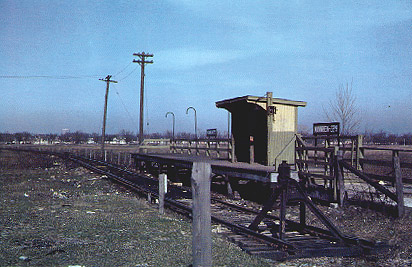
Now here is a very unusual view, taken on April 14, 1957 from the wooden trestle used by Garfield Park "L" trains to loop around at Forest Park circa 1953-59. This arrangement was necessary due to the separation of CTA and CA&E tracks, when the latter cut back service due to the Congress Expressway construction project in the city. Interurban trains turned on a loop between the CTA tracks on the east side of the terminal, while CTA trains went up and over the CA&E on the west end. To get this picture, the photographer either had to be inside a train, or on the walkway. This is only the second such picture I have seen, and the view looks to the north. In the background, you can see the Chicago Great Western freight tracks, abandoned in the early 1970s. The terminal area has been redone twice since then, and the buildings at right in the background are where a parking lot is now. The Altenheim retirement home (at left), built in 1886, is still there today at 7824 W. Madison Street. A two-car train of CTA "Baldy" 4000s negotiates the loop.

Now here is a very unusual view, taken on April 14, 1957 from the wooden trestle used by Garfield Park “L” trains to loop around at Forest Park circa 1953-59. This arrangement was necessary due to the separation of CTA and CA&E tracks, when the latter cut back service due to the Congress Expressway construction project in the city. Interurban trains turned on a loop between the CTA tracks on the east side of the terminal, while CTA trains went up and over the CA&E on the west end. To get this picture, the photographer either had to be inside a train, or on the walkway. This is only the second such picture I have seen, and the view looks to the north. In the background, you can see the Chicago Great Western freight tracks, abandoned in the early 1970s. The terminal area has been redone twice since then, and the buildings at right in the background are where a parking lot is now. The Altenheim retirement home (at left), built in 1886, is still there today at 7824 W. Madison Street. A two-car train of CTA “Baldy” 4000s negotiates the loop.

Here are more “loose ends” for your enjoyment. Most of today’s pictures were scanned a year ago as part of a much larger batch, and are from the collections of William Shapotkin, for which we are most grateful. Most of these are classic black-and-white pictures of Chicago Surface Lines streetcars.

If you have questions, comments, or additional information about any of the locations in these pictures, we would love to hear from you. As always, please refer to each image by its file name, which you can find by hovering your computer mouse over it. (For example, the image at the top of this post is rbk501.) As of July 22nd, thanks to our readers, we have updated the captions on 20 of these photos.

Enjoy!

-David Sadowski

Recent Finds

What is known today as the East Troy Electric Railroad survived to the present day due to its continued use as an electric freight line, as this scene from April 16, 1965 shows. Once part of the TMER&L interurban network, there was passenger service between East Troy and Milwaukee from 1907 to 1939. The railroad continued to operated freight for another ten years after that, and starting in 1950, the interchange line was owned and operated by East Troy. Museum operations began to be phased in as early as 1967. Here, we see line car M-15 at Mukwonago. This car is now at the Illinois Railway Museum.

What is known today as the East Troy Electric Railroad survived to the present day due to its continued use as an electric freight line, as this scene from April 16, 1965 shows. Once part of the TMER&L interurban network, there was passenger service between East Troy and Milwaukee from 1907 to 1939. The railroad continued to operated freight for another ten years after that, and starting in 1950, the interchange line was owned and operated by East Troy. Museum operations began to be phased in as early as 1967. Here, we see line car M-15 at Mukwonago. This car is now at the Illinois Railway Museum.

CSL PCC 4062, on its way toward delivery from the Pullman plant in Massachusetts to Chicago in 1946, as the city's first postwar streetcar.

CSL PCC 4062, on its way toward delivery from the Pullman plant in Massachusetts to Chicago in 1946, as the city’s first postwar streetcar.

Through a process of elimination, it can be determined that this is a rare photo of the interior of experimental CSL pre-PCC car 7001, built by Brill in 1934. The Cottage Grove destination sign means we are in Chicago, and the seat configuration is different than the 1936 PCCs. The flat back window means this is not the 4001, so this is the 7001 for sure. Interestingly, the seats looks nearly identical to those found in Washington DC pre-PCC 1053 (see the following picture). The Washington cars were built in 1935 and while the order was split between Brill and St. Louis Car Company, the seats were most likely sourced from a third vendor and were the same in all those cars (and unfortunately, none exist today).

Through a process of elimination, it can be determined that this is a rare photo of the interior of experimental CSL pre-PCC car 7001, built by Brill in 1934. The Cottage Grove destination sign means we are in Chicago, and the seat configuration is different than the 1936 PCCs. The flat back window means this is not the 4001, so this is the 7001 for sure. Interestingly, the seats looks nearly identical to those found in Washington DC pre-PCC 1053 (see the following picture). The Washington cars were built in 1935 and while the order was split between Brill and St. Louis Car Company, the seats were most likely sourced from a third vendor and were the same in all those cars (and unfortunately, none exist today).

Here are some pictures we previously posted of 7001 and 1053:

The experimental Brill-built pre-PCC 7001 as it appeared at 77th and Vincennes on September 10, 1959, shortly before it was scrapped. (Clark Frazier Photo)

The experimental Brill-built pre-PCC 7001 as it appeared at 77th and Vincennes on September 10, 1959, shortly before it was scrapped. (Clark Frazier Photo)

DC Transit pre-PCC streamlined streetcar at the National Capital Trolley Museum in 1993. Part of a 20-car order in 1935, split between Brill and St Louis Car Company. This is a St. Louis Car Company product. Sadly this car was lost to a carbarn fire at the museum in 2003. (John Smatlak Photo)

DC Transit pre-PCC streamlined streetcar at the National Capital Trolley Museum in 1993. Part of a 20-car order in 1935, split between Brill and St Louis Car Company. This is a St. Louis Car Company product. Sadly this car was lost to a carbarn fire at the museum in 2003. (John Smatlak Photo)

1053 interior. (John Smatlak Photo)

1053 interior. (John Smatlak Photo)

1053 interior. (John Smatlak Photo)

1053 interior. (John Smatlak Photo)

From the Collections of William Shapotkin:

CSL 6226 at Damen and 63rd in 1944.

CSL 6226 at Damen and 63rd in 1944.

CSL 6073 at Roosevelt and Wabash.

CSL 6073 at Roosevelt and Wabash.

CSL prewar PCC 4002 at Kedzie Station, pulling in after operating on the Madison-Fifth line.

CSL prewar PCC 4002 at Kedzie Station, pulling in after operating on the Madison-Fifth line.

CSL 6148.

CSL 6148.

CSL 1812, signed for Adams-Downtown.

CSL 1812, signed for Adams-Downtown.

CSL 6122,

CSL 6122,

CSL 1545.

CSL 1545.

CSL 1859 is near a construction site. But the extreme contrast of this picture offers no clue to the location. Andre Kristopans: "1859 at construction site WB on Adams at Clinton." Marty Robinson adds, "This improved view clearly show Adams on the street sign, and the sign on the building to the left says Franklin Bowling."

CSL 1859 is near a construction site. But the extreme contrast of this picture offers no clue to the location. Andre Kristopans: “1859 at construction site WB on Adams at Clinton.” Marty Robinson adds, “This improved view clearly show Adams on the street sign, and the sign on the building to the left says Franklin Bowling.”

CSL 3180.

CSL 3180.

CSL 3123 at Cermak and Prairie, east end of the Cermak route.

CSL 3123 at Cermak and Prairie, east end of the Cermak route.

CSL 2617.

CSL 2617.

CSL 6235 on the South Chicago-Ewing route. Mike adds, "6235 is heading south on Ewing just past 94th. The bar in the background still exists."

CSL 6235 on the South Chicago-Ewing route. Mike adds, “6235 is heading south on Ewing just past 94th. The bar in the background still exists.”

CSL 392 is heading to 74th and Ashland.

CSL 392 is heading to 74th and Ashland.

CSL 6243 on the Pershing Road line.

CSL 6243 on the Pershing Road line.

CSL 6248 is on the South Chicago-Ewing route. Mike adds, "6248 is heading north on Ewing across the 92nd St. Bridge. The tower in the background is visible in the photo of 6235, too. The blast furnaces of Youngstown Sheet & Tube are visible at left."

CSL 6248 is on the South Chicago-Ewing route. Mike adds, “6248 is heading north on Ewing across the 92nd St. Bridge. The tower in the background is visible in the photo of 6235, too. The blast furnaces of Youngstown Sheet & Tube are visible at left.”

CSL 793, signed to go to Damen and Blue Island, is near Diamond Lil's Tavern. Mike adds, "793 is at the corner of 18th & Damen – the Diamond Lil’s building is still standing."

CSL 793, signed to go to Damen and Blue Island, is near Diamond Lil’s Tavern. Mike adds, “793 is at the corner of 18th & Damen – the Diamond Lil’s building is still standing.”

CSL 3120 on a 1940s charter. Mike adds, "3120 is at the corner of 79th & Vincennes. The building in the background recently burned down and was demolished."

CSL 3120 on a 1940s charter. Mike adds, “3120 is at the corner of 79th & Vincennes. The building in the background recently burned down and was demolished.”

CSL 5723,

CSL 5723,

51st and South Park, circa 1929. The Willard Theater was located at 340 E. 51st Street. It closed in the 1950s, and the building is now used as a church and community center.

51st and South Park, circa 1929. The Willard Theater was located at 340 E. 51st Street. It closed in the 1950s, and the building is now used as a church and community center.

South Chicago and 93rd.

CSL 3266, running on the 59th-61st Street route. Mike adds, "3266 is heading south on Blackstone from 60th. The street has been vacated and none of the buildings remain."

CSL 3266, running on the 59th-61st Street route. Mike adds, “3266 is heading south on Blackstone from 60th. The street has been vacated and none of the buildings remain.”

The interior of CSL 1400.

The interior of CSL 1400.

CSL 1616 heads west on Lake Street in the 1940s, with the Lake Street "L" station at Laramie in the background. The "L" went down an inclined ramp and ran on the surface to Forest Park, and paralleled the streetcar line for a few blocks.

CSL 1616 heads west on Lake Street in the 1940s, with the Lake Street “L” station at Laramie in the background. The “L” went down an inclined ramp and ran on the surface to Forest Park, and paralleled the streetcar line for a few blocks.

CSL 4035, in an experimental color scheme, at Madison and Austin circa 1945-46. Several different designs were tried out just prior to the arrival of the 600 postwar PCCs, but the design chosen was not exactly like any of these.

CSL 4035, in an experimental color scheme, at Madison and Austin circa 1945-46. Several different designs were tried out just prior to the arrival of the 600 postwar PCCs, but the design chosen was not exactly like any of these.

State and Randolph, June 18, 1942.

CSL 4018 in an experimental paint scheme circa 1945-46. This is the Madison-Austin loop, west end of Route 20.

CSL 4018 in an experimental paint scheme circa 1945-46. This is the Madison-Austin loop, west end of Route 20.

CSL 6149 is southbound at Halsted and Chicago.

CSL 6149 is southbound at Halsted and Chicago.

CSL 6135 at Pershing and Ashland.

CSL 6135 at Pershing and Ashland.

CSL 3099. Mike: "3099 is at the corner of Leavitt and Coulter. The corner building still stands."

CSL 3099. Mike: “3099 is at the corner of Leavitt and Coulter. The corner building still stands.”

CSL 5733.

CSL 5733.

CSL 5612. Mike adds, "5612 is heading west on 56th from Stony Island. Bret Harte School is at left and in background are both the older and newer wings of the Windermere Hotel."

CSL 5612. Mike adds, “5612 is heading west on 56th from Stony Island. Bret Harte School is at left and in background are both the older and newer wings of the Windermere Hotel.”

CSL 1841. Not sure where Burny's Grill, at right, was located.

CSL 1841. Not sure where Burny’s Grill, at right, was located.

CSL 1836, signed to go to Van Buren and Dearborn.

CSL 1836, signed to go to Van Buren and Dearborn.

The interior of CSL 1218.

The interior of CSL 1218.

Chicago & West Towns 165, signed for Melrose Park. I am wondering if this could be on Lake Street in Maywood.

Chicago & West Towns 165, signed for Melrose Park. I am wondering if this could be on Lake Street in Maywood.

SF Muni double-end PCC 1008.

SF Muni double-end PCC 1008.

Chicago & West Towns 164 is eastbound on Lake Street in Oak Park, near Austin Boulevard.

Chicago & West Towns 164 is eastbound on Lake Street in Oak Park, near Austin Boulevard.

CSL 3286. Is this the interior of Kedzie Station?

CSL 3286. Is this the interior of Kedzie Station?

CSL 6221. Andre Kristopans: "6221 nb on S Chicago at 79th/ Stony Island."

CSL 6221. Andre Kristopans: “6221 nb on S Chicago at 79th/ Stony Island.”

CSL 1875. (Joe L. Diaz Photo) Mike Franklin adds, "Car 1875 is westbound on Harrison and appears to be turning northbound on Halsted. Camera is looking NE from Blue Island Ave."

CSL 1875. (Joe L. Diaz Photo) Mike Franklin adds, “Car 1875 is westbound on Harrison and appears to be turning northbound on Halsted. Camera is looking NE from Blue Island Ave.”

CSL 5746 in July 1946.

CSL 5746 in July 1946.

CSL 5724 on the South Deering route.

CSL 5724 on the South Deering route.

CSL 5737.

CSL 5737.

CSL 3174, signed for Through Route 8 (Halsted).

CSL 3174, signed for Through Route 8 (Halsted).

CSL 1522.

CSL 1522.

CSL 6143 at Wacker Drive in downtown Chicago, heading north.

CSL 6143 at Wacker Drive in downtown Chicago, heading north.

CSL 5941. S. Terman adds, "5941 is at North/Cicero carbarn."

CSL 5941. S. Terman adds, “5941 is at North/Cicero carbarn.”

CSL 1602 under the "L" (Lake Street... or 63rd?). M.E.: "I thought I read someplace that streetcars on Lake St. had to be narrower than normal because the tracks were closer together than normal because the L support beams were so close to the tracks. That, in turn, meant the auto lanes were outside the L structure. So I suspect this picture shows 63rd St. under the Jackson Park L." On the other hand, Mike writes, "1602 is on Lake near Sangamon (the street sign is half visible at far left). That is most likely the Morgan St. station for the Lake Street elevated train in the background."

CSL 1602 under the “L” (Lake Street… or 63rd?). M.E.: “I thought I read someplace that streetcars on Lake St. had to be narrower than normal because the tracks were closer together than normal because the L support beams were so close to the tracks. That, in turn, meant the auto lanes were outside the L structure. So I suspect this picture shows 63rd St. under the Jackson Park L.” On the other hand, Mike writes, “1602 is on Lake near Sangamon (the street sign is half visible at far left). That is most likely the Morgan St. station for the Lake Street elevated train in the background.”

5243 at Randolph and State. From the looks of things, this might predate the creation of the Chicago Surface Lines.

5243 at Randolph and State. From the looks of things, this might predate the creation of the Chicago Surface Lines.

CSL 5819 at Cottage Grove and 115th.

CSL 5819 at Cottage Grove and 115th.

CSL 3191 at Clark and LaSalle.

CSL 3191 at Clark and LaSalle.

CSL 3041 at Montrose and Milwaukee (west end of the Montrose line). S. Terman adds, "Since 3041 brill is a 2 man car, its looks odd as Montrose is 1 man operation unless its a school trip." Thanks to Steve D. for correcting this location (we had thought it was Montrose and Broadway, which is how the photo was marked, see his Comment.) The view looks northwest. He speculates that there was a delay on Elston, and a two-man car from that line was diverted onto west Montrose.

CSL 3041 at Montrose and Milwaukee (west end of the Montrose line). S. Terman adds, “Since 3041 brill is a 2 man car, its looks odd as Montrose is 1 man operation unless its a school trip.” Thanks to Steve D. for correcting this location (we had thought it was Montrose and Broadway, which is how the photo was marked, see his Comment.) The view looks northwest. He speculates that there was a delay on Elston, and a two-man car from that line was diverted onto west Montrose.

The same location today.

The same location today.

CSL 1415 at Laramie and Lake, near the Lake Street "L".

CSL 1415 at Laramie and Lake, near the Lake Street “L”.

CRT 4069 is, I believe northbound at Chicago Avenue, running as a Ravenswood Express sometime between 1943 and 1949, a period when the Rave was routed through the new State Street Subway. (Edward Frank, Jr. Photo) M.E.: "As your caption says, the Ravenswood ran in the State St. subway til 1949. And then it ran through to Englewood. After 1949, when the CTA implemented A and B skip-stop service, Englewood trains went instead to Howard St., and the Ravenswood got its own service using the original L structure into the Loop. As for the destination sign on the front, this style preceded A and B service. I think it's possible this picture was taken prior to 1943. Miles Beitler: "Photo img750 puzzles me. If this was in fact a subway train, the destination sign should read “VIA SUBWAY” and the train would serve the Chicago/State subway station rather than the Chicago Avenue elevated station. Since Ravenswood express trains did use the subway until 1949, and this train obviously did not, I wonder if the photo predates the opening of the subway."

CRT 4069 is, I believe northbound at Chicago Avenue, running as a Ravenswood Express sometime between 1943 and 1949, a period when the Rave was routed through the new State Street Subway. (Edward Frank, Jr. Photo) M.E.: “As your caption says, the Ravenswood ran in the State St. subway til 1949. And then it ran through to Englewood. After 1949, when the CTA implemented A and B skip-stop service, Englewood trains went instead to Howard St., and the Ravenswood got its own service using the original L structure into the Loop. As for the destination sign on the front, this style preceded A and B service. I think it’s possible this picture was taken prior to 1943. Miles Beitler: “Photo img750 puzzles me. If this was in fact a subway train, the destination sign should read “VIA SUBWAY” and the train would serve the Chicago/State subway station rather than the Chicago Avenue elevated station. Since Ravenswood express trains did use the subway until 1949, and this train obviously did not, I wonder if the photo predates the opening of the subway.”

Chicago & West Towns 1151, eastbound on Lake Street in Oak Park, a block away from the end of the line at Austin Boulevard. The building to the north is still standing.

Chicago & West Towns 1151, eastbound on Lake Street in Oak Park, a block away from the end of the line at Austin Boulevard. The building to the north is still standing.

The same location today.

The same location today.

This is a somewhat unusual view, taken along the B&OCT tracks, just west of Central Avenue. At left, you can see the CTA's Central Avenue stop on the Congress line, now the Blue Line. The station closed in 1973 due to lack of ridership. The Eisenhower expressway would be to the left of the station, which was not served by buses, and was the only walkup (other than the Forest Park terminal) on this line, which is almost all in an open cut. We are looking mainly to the east and a bit to the north.

This is a somewhat unusual view, taken along the B&OCT tracks, just west of Central Avenue. At left, you can see the CTA’s Central Avenue stop on the Congress line, now the Blue Line. The station closed in 1973 due to lack of ridership. The Eisenhower expressway would be to the left of the station, which was not served by buses, and was the only walkup (other than the Forest Park terminal) on this line, which is almost all in an open cut. We are looking mainly to the east and a bit to the north.

A two-car train of CRT gate cars at Halsted on the Stock Yards branch of the "L". This picture can be dated to about March 1946 from the advertising posters. The Olsen and Johnson comedy team, of Hellzapoppin' fame, were appearing at the Schubert Theater in Laffing Room Only.

A two-car train of CRT gate cars at Halsted on the Stock Yards branch of the “L”. This picture can be dated to about March 1946 from the advertising posters. The Olsen and Johnson comedy team, of Hellzapoppin’ fame, were appearing at the Schubert Theater in Laffing Room Only.

When we see pictures of Western Avenue PCC cars, the question is usually, which terminal is this? Berwyn and 79th had very similar turnaround loops, built around the same time (and still used today by buses). Since the buildings at rear do not match those seen at Berwyn, I am going to say this is Western and 79th. M.E.: "This has to be 79th, for two reasons: (1) Photos I have seen of the Berwyn terminal have more vegetation. (2) In the foreground of this picture are bus lanes. I don't remember any bus service at Berwyn. On the contrary, both the 49A South Western and both lines on 79th St. (route 79 east to the lake, and route 79A west to Cicero) used this terminal."

When we see pictures of Western Avenue PCC cars, the question is usually, which terminal is this? Berwyn and 79th had very similar turnaround loops, built around the same time (and still used today by buses). Since the buildings at rear do not match those seen at Berwyn, I am going to say this is Western and 79th. M.E.: “This has to be 79th, for two reasons: (1) Photos I have seen of the Berwyn terminal have more vegetation. (2) In the foreground of this picture are bus lanes. I don’t remember any bus service at Berwyn. On the contrary, both the 49A South Western and both lines on 79th St. (route 79 east to the lake, and route 79A west to Cicero) used this terminal.”

North Shore Line streetcar 360 is signed for the Naval Station, which makes this Waukegan. Joe Stupar: "The North Shore Line streetcar 360 looks like it might be at the North end of North Av? The house looks a lot like 416 W Greenwood Av, still there."

North Shore Line streetcar 360 is signed for the Naval Station, which makes this Waukegan. Joe Stupar: “The North Shore Line streetcar 360 looks like it might be at the North end of North Av? The house looks a lot like 416 W Greenwood Av, still there.”

Not sure where this rather blurry picture of a CSL car barn is. Andre Kristopans: "The blurry carbarn shot should be Burnside, looking south on Drexel from 93rd." M.E.: "I'll hazard a guess this is the carbarn on 93rd at Drexel (900 east). I say this because I think there are railroad cars in the background. A block or so east of the Drexel barn, the 93rd St. car turned right (on Kenwood, I think) to reach a private right-of-way that crossed the railroad at grade level. Altogether an interesting operation."

Not sure where this rather blurry picture of a CSL car barn is. Andre Kristopans: “The blurry carbarn shot should be Burnside, looking south on Drexel from 93rd.” M.E.: “I’ll hazard a guess this is the carbarn on 93rd at Drexel (900 east). I say this because I think there are railroad cars in the background. A block or so east of the Drexel barn, the 93rd St. car turned right (on Kenwood, I think) to reach a private right-of-way that crossed the railroad at grade level. Altogether an interesting operation.”

A North Shore Line Electroliner is off in the distance, making a stop at... where? Scott Greig: "The southbound Electroliner with the MD car at far left is looking northeast at Downey's-Great Lakes. MD cars were commonly used to move sailors' baggage, even after LCL service ended in 1947." Joe Stupar: "The Electroliner looks like it’s at Great Lakes? Looks like a coach and an MD car in the pocket there."

A North Shore Line Electroliner is off in the distance, making a stop at… where? Scott Greig: “The southbound Electroliner with the MD car at far left is looking northeast at Downey’s-Great Lakes. MD cars were commonly used to move sailors’ baggage, even after LCL service ended in 1947.” Joe Stupar: “The Electroliner looks like it’s at Great Lakes? Looks like a coach and an MD car in the pocket there.”

CSL 3258 on the 59th-61st route. Could this be the east end of the line? M.E.: "This is definitely the east end of the 59th/61st line. It is on Blackstone Ave. (1430 E.) looking north toward the Midway Plaisance (which was between 59th St. to the north and 60th St. to the south).. Across the Midway are some buildings from the University of Chicago. Notice that both trolleys are up, and the destination sign says "Central Park", referring to Central Park Ave. (3600 W.), the line's western terminus. (As I remember, the eastbound terminal sign read "60th - Blackstone".) Google maps shows where 61st St. turned left toward where Blackstone would have been. In Google, Blackstone is labelled farther north."

CSL 3258 on the 59th-61st route. Could this be the east end of the line? M.E.: “This is definitely the east end of the 59th/61st line. It is on Blackstone Ave. (1430 E.) looking north toward the Midway Plaisance (which was between 59th St. to the north and 60th St. to the south).. Across the Midway are some buildings from the University of Chicago. Notice that both trolleys are up, and the destination sign says “Central Park”, referring to Central Park Ave. (3600 W.), the line’s western terminus. (As I remember, the eastbound terminal sign read “60th – Blackstone”.) Google maps shows where 61st St. turned left toward where Blackstone would have been. In Google, Blackstone is labelled farther north.”

A North Shore Line train "at speed," as they used to say. Not sure where this is. Joe Stupar: "The North Shore train at speed looks like it might be at 4 Mile Substation? The building looks similar, and this other photo of the south side shows a similar setup with the high tension wires coming over the building, and a simple tap with no steel structure."

A North Shore Line train “at speed,” as they used to say. Not sure where this is. Joe Stupar: “The North Shore train at speed looks like it might be at 4 Mile Substation? The building looks similar, and this other photo of the south side shows a similar setup with the high tension wires coming over the building, and a simple tap with no steel structure.”

CSL 3219 is at the east end of the 43rd Street line, adjacent to an Illinois Central electric suburban service station. This was also near the end of the line of the Kenwood branch of the "L".

CSL 3219 is at the east end of the 43rd Street line, adjacent to an Illinois Central electric suburban service station. This was also near the end of the line of the Kenwood branch of the “L”.

A pair of CAT wooden "L" cars, shown here, survived into the mid-1960s, as shown by this view of the yard at Logan Square, where 6000s and 2000s are in evidence. This dates the picture to sometime between 1964 and 1970. Andre Kristopans: "The wood work motors at Logan Square hauled the rail grinder sleds until 1965 or so." Scott Greig: "Wood "L" cars at Logan...there were several wood cars (particularly the 1809-1815 group) that lasted in work service as late as 1968, maybe even 1970. Given that there's no crane or flat cars with them, they may be a rail grinder train."

A pair of CAT wooden “L” cars, shown here, survived into the mid-1960s, as shown by this view of the yard at Logan Square, where 6000s and 2000s are in evidence. This dates the picture to sometime between 1964 and 1970. Andre Kristopans: “The wood work motors at Logan Square hauled the rail grinder sleds until 1965 or so.” Scott Greig: “Wood “L” cars at Logan…there were several wood cars (particularly the 1809-1815 group) that lasted in work service as late as 1968, maybe even 1970. Given that there’s no crane or flat cars with them, they may be a rail grinder train.”

I believe this is the Chicago & West Towns car barn, which was located in North Riverside. (Many photos list it as "Berwyn," but it's across the street from that suburb.) The West Towns had two car barns, the other at Lake and Ridgeland in Oak Park. Although both were in the 'burbs, the North Riverside one was often referred to as the "suburban" barn. The area around the Oak Park barn was a lot more built up than this.

I believe this is the Chicago & West Towns car barn, which was located in North Riverside. (Many photos list it as “Berwyn,” but it’s across the street from that suburb.) The West Towns had two car barns, the other at Lake and Ridgeland in Oak Park. Although both were in the ‘burbs, the North Riverside one was often referred to as the “suburban” barn. The area around the Oak Park barn was a lot more built up than this.

1939 Chicago Surface Lines Training Program

In 2016, we were fortunate to acquire a rare 16″ transcription disc, made in 1939 for the Chicago Surface Lines. This included an audio presentation called “Keeping Pace,” about 20 minutes long, that CSL used for employee training.

We were recently able to find someone who could play such a large disc, and now this program has been digitized and can be heard for the first time in more than 80 years. We have added it as a bonus feature to our Red Arrow Lines 1967 CD, available below and through our Online Store.

Screen Shot 03-16-16 at 06.58 PM.PNGScreen Shot 03-17-16 at 12.44 AM.PNG

RAL
Red Arrow Lines 1967: Straffords and Bullets
# of Discs – 1
Price: $14.99

This disc features rare, long out-of-print audio recordings of two 1967 round trips on the Philadelphia & Western (aka “Red Arrow Lines”) interurban between Philadelphia and Norristown, the famous third rail High-Speed Line.  One trip is by a Strafford car and the other by one of the beloved streamlined Bullets.  The line, about 13 miles long and still in operation today under SEPTA, bears many similarities to another former interurban line, the Chicago Transit Authority‘s Yellow Line (aka the “Skokie Swift”).  We have included two bonus features, audio of an entire ride along that five mile route, which was once part of the North Shore Line, and a 20-minute 1939 Chicago Surface Lines training program (“Keeping Pace”).  This was digitized from a rare original 16″ transcription disc and now can be heard again for the first time in over 80 years.

Total time – 73:32

The Trolley Dodger On the Air
We appeared on WGN radio in Chicago in November 2018, discussing our book Building Chicago’s Subways on the Dave Plier Show. You can hear our 19-minute conversation here.
Chicago, Illinois, December 17, 1938-- Secretary Harold Ickes, left, and Mayor Edward J. Kelly turn the first spadeful of earth to start the new $40,000,000 subway project. Many thousands gathered to celebrate the starting of work on the subway. Chicago, Illinois, December 17, 1938– Secretary Harold Ickes, left, and Mayor Edward J. Kelly turn the first spadeful of earth to start the new $40,000,000 subway project. Many thousands gathered to celebrate the starting of work on the subway.
Order Our New Book Building Chicago’s Subways

There were three subway anniversaries in 2018 in Chicago:
60 years since the West Side Subway opened (June 22, 1958)
75 years since the State Street Subway opened (October 17, 1943)
80 years since subway construction started (December 17, 1938)
To commemorate these anniversaries, we have written a new book, Building Chicago’s Subways.

While the elevated Chicago Loop is justly famous as a symbol of the city, the fascinating history of its subways is less well known. The City of Chicago broke ground on what would become the “Initial System of Subways” during the Great Depression and finished 20 years later. This gigantic construction project, a part of the New Deal, would overcome many obstacles while tunneling through Chicago’s soft blue clay, under congested downtown streets, and even beneath the mighty Chicago River. Chicago’s first rapid transit subway opened in 1943 after decades of wrangling over routes, financing, and logistics. It grew to encompass the State Street, Dearborn-Milwaukee, and West Side Subways, with the latter modernizing the old Garfield Park “L” into the median of Chicago’s first expressway. Take a trip underground and see how Chicago’s “I Will” spirit overcame challenges and persevered to help with the successful building of the subways that move millions. Building Chicago’s subways was national news and a matter of considerable civic pride–making it a “Second City” no more!

Bibliographic information:
Title Building Chicago’s Subways
Images of America
Author David Sadowski
Edition illustrated
Publisher Arcadia Publishing (SC), 2018
ISBN 1467129380, 9781467129381
Length 128 pages
Chapter Titles:
01. The River Tunnels
02. The Freight Tunnels
03. Make No Little Plans
04. The State Street Subway
05. The Dearborn-Milwaukee Subway
06. Displaced
07. Death of an Interurban
08. The Last Street Railway
09. Subways and Superhighways
10. Subways Since 1960
Building Chicago’s Subways is in stock and now available for immediate shipment. Order your copy today! All copies purchased through The Trolley Dodger will be signed by the author.
The price of $23.99 includes shipping within the United States.
For Shipping to US Addresses:

For Shipping to Canada:

For Shipping Elsewhere:

Redone tile at the Monroe and Dearborn CTA Blue Line subway station, showing how an original sign was incorporated into a newer design, May 25, 2018. (David Sadowski Photo) Redone tile at the Monroe and Dearborn CTA Blue Line subway station, showing how an original sign was incorporated into a newer design, May 25, 2018. (David Sadowski Photo)

Help Support The Trolley Dodger

gh1

This is our 253rd post, and we are gradually creating a body of work and an online resource for the benefit of all railfans, everywhere. To date, we have received over 647,000 page views, for which we are very grateful.

You can help us continue our original transit research by checking out the fine products in our Online Store.

As we have said before, “If you buy here, we will be here.”

We thank you for your support.

DONATIONS

In order to continue giving you the kinds of historic railroad images that you have come to expect from The Trolley Dodger, we need your help and support. It costs money to maintain this website, and to do the sort of historic research that is our specialty.

Your financial contributions help make this web site better, and are greatly appreciated.

Hard Work

This is the back end of a southbound CTA Jackson Park "B" train at Sheridan Road on July 7, 1966.

This is the back end of a southbound CTA Jackson Park “B” train at Sheridan Road on July 7, 1966.

It’s been more than a month since our last post, but that’s not for lack of effort. We have been hard at work on the images in this post. I have put it many, many hours with these pictures in Photoshop to make them look their best, or least, better than how I found them.

Sometimes, it seems that if something can go wrong, it will go wrong. I was up late last night writing more than 50 captions, and somehow they all vanished, and I had to rewrite them. But that’s okay, since the new versions you see here are better.

It’s been our experience that hard work often pays off. You be the judge.

We have also been hard at work on a new book– Chicago’s Lost “L”s, which will focus on those aspects of the system that either no longer exist, or have been completely changed. Work on this book is pretty far along. All the photo selections have been made, and the cover is finished.

We are excited about this new project, and hope you will be too. More information will be forthcoming as things progress.

Enjoy!

-David Sadowski

PS- Our thanks go out to Jeff Wien for sharing some fantastic images from the Wien-Criss Archive.

Recent Finds

The North Shore Line's Milwaukee Terminal on a wintry night in January 1963. This is a remarkable photo for the time, as it surely involved a long exposure time of at least a few seconds, with the camera held perfectly still on a tripod. Film speeds for color slide film were very slow and those films were designed for use in bright sunlight. (Wien-Criss Archive)

The North Shore Line’s Milwaukee Terminal on a wintry night in January 1963. This is a remarkable photo for the time, as it surely involved a long exposure time of at least a few seconds, with the camera held perfectly still on a tripod. Film speeds for color slide film were very slow and those films were designed for use in bright sunlight. (Wien-Criss Archive)

A northbound North Shore Line train stops at Dempster in January 1963, the final month. Just over a year later, after the abandonment, the CTA resumed service between here and Howard as the Skokie Swift. Note the sign at left for a yarn store in the terminal building. (Wien-Criss Archive)

A northbound North Shore Line train stops at Dempster in January 1963, the final month. Just over a year later, after the abandonment, the CTA resumed service between here and Howard as the Skokie Swift. Note the sign at left for a yarn store in the terminal building. (Wien-Criss Archive)

This and the following picture: A Kenosha Motor Coach bus is posed next to the former North Shore Line station circa 1967. The building remains, but has been altered over the years for use, first by a restaurant, then as a day care center. (Charles L. Tauscher Photo, Wien-Criss Archive)

This and the following picture: A Kenosha Motor Coach bus is posed next to the former North Shore Line station circa 1967. The building remains, but has been altered over the years for use, first by a restaurant, then as a day care center. (Charles L. Tauscher Photo, Wien-Criss Archive)

This, and the next three images are from "superslides," meaning film larger than 35mm, but still able to fit in a regular 2x2 slide mount. This was possible with both 127 and 828 film, but it's the latter here, in this shot by W. H. Higginbotham showing an Electroliner at Grange Avenue in Milwaukee County. (Wien-Criss Archive)

This, and the next three images are from “superslides,” meaning film larger than 35mm, but still able to fit in a regular 2×2 slide mount. This was possible with both 127 and 828 film, but it’s the latter here, in this shot by W. H. Higginbotham showing an Electroliner at Grange Avenue in Milwaukee County. (Wien-Criss Archive)

NSL 741 creeps south along the old 6th Street viaduct in Milwaukee, next to a 1958 Chevy. (Wien-Criss Archive)

NSL 741 creeps south along the old 6th Street viaduct in Milwaukee, next to a 1958 Chevy. (Wien-Criss Archive)

An Electroliner at 6th and Oklahoma in Milwaukee in 1962. (W. H. Higginbotham Photo, Wien-Criss Archive)

An Electroliner at 6th and Oklahoma in Milwaukee in 1962. (W. H. Higginbotham Photo, Wien-Criss Archive)

An Electroliner at Edison Court in Waukegan on May 26, 1959. (Wien-Criss Archive)

An Electroliner at Edison Court in Waukegan on May 26, 1959. (Wien-Criss Archive)

A truly historic photo that probably hasn't seen the light in 57 years. The late Charles L. Tauscher rode the last North Shore Line train ever, which ended its run at Roosevelt Road in the early morning hours of a very cold January 21, 1963. Motorman Bill Livings has just taken off the headlight and poses for a few pictures. This must be a long exposure (this was Ektachrome, and the film speed was 32) and you can see some motion blur on other parts of the platform. Truly the end of an era. (Wien-Criss Archive)

A truly historic photo that probably hasn’t seen the light in 57 years. The late Charles L. Tauscher rode the last North Shore Line train ever, which ended its run at Roosevelt Road in the early morning hours of a very cold January 21, 1963. Motorman Bill Livings has just taken off the headlight and poses for a few pictures. This must be a long exposure (this was Ektachrome, and the film speed was 32) and you can see some motion blur on other parts of the platform. Truly the end of an era. (Wien-Criss Archive)

The El Paso trolley, in its original incarnation, was an international affair, with service to Juarez, Mexico. This picture was taken in 1962. (Wien-Criss Archive)

The El Paso trolley, in its original incarnation, was an international affair, with service to Juarez, Mexico. This picture was taken in 1962. (Wien-Criss Archive)

This picture of the CTA Stockyards line was taken in September 1957, shortly before the line was abandoned. There is little in this picture that still exists today, except for the shuttered Stock Yards National Bank Building, at 4146 S. Halsted Street. (Wien-Criss Archive)

This picture of the CTA Stockyards line was taken in September 1957, shortly before the line was abandoned. There is little in this picture that still exists today, except for the shuttered Stock Yards National Bank Building, at 4146 S. Halsted Street. (Wien-Criss Archive)

A gate car (345) and a Met car are in the process of being scrapped at Skokie Shops in September 1957. (Wien-Criss Archive)

A gate car (345) and a Met car are in the process of being scrapped at Skokie Shops in September 1957. (Wien-Criss Archive)

As much as we would like Chicago "L" cars to remain on the structure, there have been a few times when they did not. This April 12, 1974 photo shows one that came pretty close to falling down, but fortunately did not. This looks like downtown, but I am not sure of the exact location. Andre Kristopans adds, "Wreck was at Lake/Wells with 6047-48. Took W to N curve way too fast. This was probably last wreck cleaned up with only Rail derricks, S363 and S367. No rubber tired cranes used."

As much as we would like Chicago “L” cars to remain on the structure, there have been a few times when they did not. This April 12, 1974 photo shows one that came pretty close to falling down, but fortunately did not. This looks like downtown, but I am not sure of the exact location. Andre Kristopans adds, “Wreck was at Lake/Wells with 6047-48. Took W to N curve way too fast. This was probably last wreck cleaned up with only Rail derricks, S363 and S367. No rubber tired cranes used.”

We ran a lo-fi version of this picture in a previous post. The location at first was a real mystery, but turned out to be 42nd Place, the terminal of the CTA Kenwood branch, looking west. The next photo was taken further down the platform. (We ran originally ran this with other pictures that we saw on eBay, but hadn't been able to purchase. It was relisted and we decided to buy it after all.) Ross Harano adds, "The view is looking north rather than west. The building with the chimney is Oakenwald Grammar School at 4071 S. Lake Park that I attended. The tower on the right is the "Kiosk Sphinx" that was on an estate just north of the grammar school. Geoffrey Baer had a segment on his WTTW's "Ask Geoffrey" about the wealthy family that built a Mediterranean style home with a pool and "Eiffel" tower. The property to the west of the station was owned by Nelson Coal. You can see the coal moving equipment in the photo. Nelson Coal stored mountains of coal east of the terminal tracks next to the Illinois Central Tracks. We used to play soldiers on the coal until we would be chased away by Nelson Coal workers."

We ran a lo-fi version of this picture in a previous post. The location at first was a real mystery, but turned out to be 42nd Place, the terminal of the CTA Kenwood branch, looking west. The next photo was taken further down the platform. (We ran originally ran this with other pictures that we saw on eBay, but hadn’t been able to purchase. It was relisted and we decided to buy it after all.) Ross Harano adds, “The view is looking north rather than west. The building with the chimney is Oakenwald Grammar School at 4071 S. Lake Park that I attended. The tower on the right is the “Kiosk Sphinx” that was on an estate just north of the grammar school. Geoffrey Baer had a segment on his WTTW’s “Ask Geoffrey” about the wealthy family that built a Mediterranean style home with a pool and “Eiffel” tower. The property to the west of the station was owned by Nelson Coal. You can see the coal moving equipment in the photo. Nelson Coal stored mountains of coal east of the terminal tracks next to the Illinois Central Tracks. We used to play soldiers on the coal until we would be chased away by Nelson Coal workers.”

This is the view looking west from the east terminal of the Kenwood branch at 42nd Place. There was a short stretch of steel structure, before the line ran on an embankment owned by the Chicago Junction Railway. Ross Harano: "This view is also looking north. The photo was taken from the north end of the platform next to the control tower building. The tall building in the background is one of the first CHA buildings on the lakefront at Lake Park and Oakwood Boulevard. The railroad tracks that ran with the "L" tracks went east over the Illinois Central tracks and ran south."

This is the view looking west from the east terminal of the Kenwood branch at 42nd Place. There was a short stretch of steel structure, before the line ran on an embankment owned by the Chicago Junction Railway. Ross Harano: “This view is also looking north. The photo was taken from the north end of the platform next to the control tower building. The tall building in the background is one of the first CHA buildings on the lakefront at Lake Park and Oakwood Boulevard. The railroad tracks that ran with the “L” tracks went east over the Illinois Central tracks and ran south.”

A wooden Chicago "L" car at the Illinois Railway Museum in Union, May 1968. The museum had moved here in 1964 from its original location in North Chicago. I believe that is a Milwaukee streetcar at left.

A wooden Chicago “L” car at the Illinois Railway Museum in Union, May 1968. The museum had moved here in 1964 from its original location in North Chicago. I believe that is a Milwaukee streetcar at left.

This postcard, circa 1910, shows one of the single track "L" stations that were a unique feature of the old Stockyards branch.

This postcard, circa 1910, shows one of the single track “L” stations that were a unique feature of the old Stockyards branch.

On February 24, 1957 we see a Douglas Park "L" train crossing over a Garfield Park one, running on temporary tracks in Van Buren Street, while the Congress median line (foreground) is under construction.

On February 24, 1957 we see a Douglas Park “L” train crossing over a Garfield Park one, running on temporary tracks in Van Buren Street, while the Congress median line (foreground) is under construction.

On February 24, 1957 a two-car train of CTA 4000s heads east on Van Buren at Ashland. This was the temporary route for part of the Garfield Park “L” from 1953 to 1958.

This is the view looking south from the Lake Street "L" at Paulina on March 17, 1954. The tracks at right were where the Met "L" went over the Lake line. At left is a new connection, just about to be put into service, that allowed Douglas Park trains to go to the Loop via Lake Street. This connection was used from 1954 to 1958, and is now used again by Pink Line trains (the successor to Douglas).

This is the view looking south from the Lake Street “L” at Paulina on March 17, 1954. The tracks at right were where the Met “L” went over the Lake line. At left is a new connection, just about to be put into service, that allowed Douglas Park trains to go to the Loop via Lake Street. This connection was used from 1954 to 1958, and is now used again by Pink Line trains (the successor to Douglas).

A two-car Kenwood "L" train, including 2910, is in the stub at Indiana Avenue station on February 25, 1955.

A two-car Kenwood “L” train, including 2910, is in the stub at Indiana Avenue station on February 25, 1955.

A Garfield Park "L" train of 4000s heads west at Kedzie on November 6, 1955. Unlike some other stations on the line, this one remained in service until 1958 as it was not directly in the expressway footprint. The first car is a "Baldie," built circa 1915, and the second is a "Plushie," from around 1924. These were state of the art cars when new, and were in service for nearly 50 years.

A Garfield Park “L” train of 4000s heads west at Kedzie on November 6, 1955. Unlike some other stations on the line, this one remained in service until 1958 as it was not directly in the expressway footprint. The first car is a “Baldie,” built circa 1915, and the second is a “Plushie,” from around 1924. These were state of the art cars when new, and were in service for nearly 50 years.

Here, a former Lake Street "L" car heads up a Stockyards shuttle train at Indiana Avenue on April 11, 1954.

Here, a former Lake Street “L” car heads up a Stockyards shuttle train at Indiana Avenue on April 11, 1954.

Car 1715 is a Lake Street Local at Marion Street in Oak Park. In 1948, locals and expresses were replaced by the CTA's A/B "skip stop" service.

Car 1715 is a Lake Street Local at Marion Street in Oak Park. In 1948, locals and expresses were replaced by the CTA’s A/B “skip stop” service.

CTA 3147 is at the front of a Lake Street "B" train at Marion. Despite the age of the car at left (circa 1939) this picture cannot have been taken prior to 1948.

CTA 3147 is at the front of a Lake Street “B” train at Marion. Despite the age of the car at left (circa 1939) this picture cannot have been taken prior to 1948.

CTA 1780 heads up a Lake Street "A" train at Marion Street. This was not quite the end of the line, as there was a station just west of Harlem Avenue in Forest Park. But this station was far more popular and Harlem and Marion serves today as the end of the line, since the Lake Street "L" was relocated to the adjacent North Western embankment in 1962.

CTA 1780 heads up a Lake Street “A” train at Marion Street. This was not quite the end of the line, as there was a station just west of Harlem Avenue in Forest Park. But this station was far more popular and Harlem and Marion serves today as the end of the line, since the Lake Street “L” was relocated to the adjacent North Western embankment in 1962.

This two-car train (including #299) is at Indiana Avenue station. The photo says this is a Kenwood train, but I am wondering if this is Stock Yards instead.

This two-car train (including #299) is at Indiana Avenue station. The photo says this is a Kenwood train, but I am wondering if this is Stock Yards instead.

When the CTA realigned the north and south side routes, Kenwood became a shuttle. These wooden gate cars (200-series) are being stored on an otherwise unused track on the South Side main. The Kenwood branch itself is at left.

When the CTA realigned the north and south side routes, Kenwood became a shuttle. These wooden gate cars (200-series) are being stored on an otherwise unused track on the South Side main. The Kenwood branch itself is at left.

Riders are coming and going from Kenwood car 273 at Indiana Avenue.

Riders are coming and going from Kenwood car 273 at Indiana Avenue.

CTA gate car #268 (or at least that is what is written on the picture) at Indiana Avenue, operating as a Kenwood shuttle. By the mid-1950s these cars were replaced by former Met "L" cars as they were taken off other lines.

CTA gate car #268 (or at least that is what is written on the picture) at Indiana Avenue, operating as a Kenwood shuttle. By the mid-1950s these cars were replaced by former Met “L” cars as they were taken off other lines.

Gate car #204 at Halsted on the Stock Yards branch.

Gate car #204 at Halsted on the Stock Yards branch.

I find this picture of car 1109 and train interesting for a number of reasons. It took a while to figure out where this is, but I believe it is on the Wabash leg of the Loop "L" heading north at Jackson. This area was, for many years, Chicago's "music row," and Kimball Pianos is at right. Since we are south of Adams, the station in the rear is Congress and Wabash, which was closed in 1949 and removed soon after, as Congress was widened for the expressway project. The train is an Evanston Express, going to Wilmette, but also mentions Skokie as a destination. Niles Center changed its name to Skokie in 1941, so this picture dates to the 1940s. Then, as now, it is not advisable to put your head or arms outside the car window.

I find this picture of car 1109 and train interesting for a number of reasons. It took a while to figure out where this is, but I believe it is on the Wabash leg of the Loop “L” heading north at Jackson. This area was, for many years, Chicago’s “music row,” and Kimball Pianos is at right. Since we are south of Adams, the station in the rear is Congress and Wabash, which was closed in 1949 and removed soon after, as Congress was widened for the expressway project. The train is an Evanston Express, going to Wilmette, but also mentions Skokie as a destination. Niles Center changed its name to Skokie in 1941, so this picture dates to the 1940s. Then, as now, it is not advisable to put your head or arms outside the car window.

Car 1048 is in the pocket track at Dempster, end of the line for Niles Center. The CTA replaced this with buses in 1948, but the line was revived as the Skokie Swift in 1964, following the North Shore Line's abandonment the previous year. The historic station building has since been moved slightly to the north and east to provide a bus lane.

Car 1048 is in the pocket track at Dempster, end of the line for Niles Center. The CTA replaced this with buses in 1948, but the line was revived as the Skokie Swift in 1964, following the North Shore Line’s abandonment the previous year. The historic station building has since been moved slightly to the north and east to provide a bus lane.

Gate car 2324 at Skokie Shops.

Gate car 2324 at Skokie Shops.

4000s going over the North Shore Channel bridge in Evanston, when it appears to be brand new. Not sure of the date. Miles Beitler adds, "It may have been taken during the elevation of the north end of the Evanston line from University Place to just north of Central Street. That project was completed in 1931. There would have been a bridge over the North Shore Channel long before then, as the channel was completed in 1910 and was crossed by a steam railroad at that point, but perhaps the elevation of the line required replacement or reconstruction of the existing bridge."

4000s going over the North Shore Channel bridge in Evanston, when it appears to be brand new. Not sure of the date. Miles Beitler adds, “It may have been taken during the elevation of the north end of the Evanston line from University Place to just north of Central Street. That project was completed in 1931. There would have been a bridge over the North Shore Channel long before then, as the channel was completed in 1910 and was crossed by a steam railroad at that point, but perhaps the elevation of the line required replacement or reconstruction of the existing bridge.”

2756 was a Met, car built in 1895, that at some point was converted for use as a medical car, and traveled over the Insull properties whenever it was necessary to give physical exams. Here, we see it on the Cross Street team track in Wheaton. Since the car did not have trolley poles, when it went on the North Shore Line, it had to be towed by something else, like a box motor car.

2756 was a Met, car built in 1895, that at some point was converted for use as a medical car, and traveled over the Insull properties whenever it was necessary to give physical exams. Here, we see it on the Cross Street team track in Wheaton. Since the car did not have trolley poles, when it went on the North Shore Line, it had to be towed by something else, like a box motor car.

Pullman PCC 4062 being delivered in 1946. This was the first of 600 new postwar streetcars for Chicago.

Pullman PCC 4062 being delivered in 1946. This was the first of 600 new postwar streetcars for Chicago.

The view looking north from Howard Street in 1930. The North Shore Line's Skokie Valeey Route is at left. Straight ahead leads to Evanston and Wilmette.

The view looking north from Howard Street in 1930. The North Shore Line’s Skokie Valeey Route is at left. Straight ahead leads to Evanston and Wilmette.

In the mid-1950s, some new 6000s are being delivered to 63rd Street Lower Yard.

In the mid-1950s, some new 6000s are being delivered to 63rd Street Lower Yard.

The Kenwood branch was mainly on an embankment owned by the Chicago Junction Railway.

The Kenwood branch was mainly on an embankment owned by the Chicago Junction Railway.

The Kenwood branch, near the east end of the line. The Nelson Coal Company was located at 1119 East 42nd Street. This must be near the end of service, as that looks like a 1957 Dodge at left.

The Kenwood branch, near the east end of the line. The Nelson Coal Company was located at 1119 East 42nd Street. This must be near the end of service, as that looks like a 1957 Dodge at left.

Met cars passing each other at DesPlaines Avenue in Forest Park, possibly circa 1952. There is a bus visible, which could be the CTA #17, which replaced the Westchester branch in December 1951. But it looks like this predates the rearrangement of this area which took place in 1953, when the Chicago Aurora and Elgin cut back service to Forest Park.

Met cars passing each other at DesPlaines Avenue in Forest Park, possibly circa 1952. There is a bus visible, which could be the CTA #17, which replaced the Westchester branch in December 1951. But it looks like this predates the rearrangement of this area which took place in 1953, when the Chicago Aurora and Elgin cut back service to Forest Park.

Although this circa 1905 postcard view is not very clear, this appears to be the Central Avenue station on the ground level portion of the Lake Street "L", at a time before the nearby Chicago & North Western elevated its tracks onto an embankment. According to Bill Shapotkin, the C&NW called this station either Austin or "Boulevard." Clarification from Bill: "This image is indeed of the Central St station of the Lake St 'L'. That said, the C&NW station was known as "Austin," NOT "Boulevard." As confusing as it is, The "Austin" C&NW station was at Central Ave and the "Boulevard" station was at Austin Blvd. This threw me for a while as well -- and had to have a old-timer explain it to me."

Although this circa 1905 postcard view is not very clear, this appears to be the Central Avenue station on the ground level portion of the Lake Street “L”, at a time before the nearby Chicago & North Western elevated its tracks onto an embankment. According to Bill Shapotkin, the C&NW called this station either Austin or “Boulevard.” Clarification from Bill: “This image is indeed of the Central St station of the Lake St ‘L’. That said, the C&NW station was known as “Austin,” NOT “Boulevard.” As confusing as it is, The “Austin” C&NW station was at Central Ave and the “Boulevard” station was at Austin Blvd. This threw me for a while as well — and had to have a old-timer explain it to me.”

In March 1958, the Illinois Electric Railway Museum ran a fantrip on parts of the CTA "L" system, using car 1024 and a work car. This was some months after the last wood car was used in regular service. Here, we see train on a siding in Evanston. We previously ran a photo of the same train on the Garfield Park "L" temporary trackage. 1024 went to IERM and has since been restored as car 24.

In March 1958, the Illinois Electric Railway Museum ran a fantrip on parts of the CTA “L” system, using car 1024 and a work car. This was some months after the last wood car was used in regular service. Here, we see train on a siding in Evanston. We previously ran a photo of the same train on the Garfield Park “L” temporary trackage. 1024 went to IERM and has since been restored as car 24.

There was only a short time frame when this picture could have been taken at Halsted and Congress. In the late 1940s, PCCs were used on Halsted, but they were removed starting in 1953, and service ended the following year with older red cars such as this. Under the new bridge, part of the Congress Expressway project, are the subway portals which now serve the rapid transit line that replaced the Garfield Park "L" seen at left.

There was only a short time frame when this picture could have been taken at Halsted and Congress. In the late 1940s, PCCs were used on Halsted, but they were removed starting in 1953, and service ended the following year with older red cars such as this. Under the new bridge, part of the Congress Expressway project, are the subway portals which now serve the rapid transit line that replaced the Garfield Park “L” seen at left.

New 6000s being delivered to Skokie Shops via the North Shore Line. Unfortunately, this picture is too fuzzy to make out the car numbers.

New 6000s being delivered to Skokie Shops via the North Shore Line. Unfortunately, this picture is too fuzzy to make out the car numbers.

This and the following picture show DC Transit pre-PCC 1053 in June 1961. n This historic car survived for many years before being destroyed in a museum fire. (Charles L. Tauscher Photos)

This and the following picture show DC Transit pre-PCC 1053 in June 1961. n This historic car survived for many years before being destroyed in a museum fire. (Charles L. Tauscher Photos)

The Homan station on the Lake Street "L" in August 1965. This station was closed as part of the 1990s semi-rebuild of the lake line, and was then moved a few blocks to become the Garfield Park Conservatory station.

The Homan station on the Lake Street “L” in August 1965. This station was closed as part of the 1990s semi-rebuild of the lake line, and was then moved a few blocks to become the Garfield Park Conservatory station.

A family portrait by CTA articulated compartment car 51 at Dempster in Skokie in October 1968. This car was originally 5001 as delivered in 1947.

A family portrait by CTA articulated compartment car 51 at Dempster in Skokie in October 1968. This car was originally 5001 as delivered in 1947.

In June 1978, work is already underway on the new Forest Park CTA terminal. This was made much easier after the nearby Chicago Great Western train line was abandoned around 1972. The temporary station here occupies the oldd CGW right-of-way and used their bridge over DesPlaines Avenue. Once teh new station was built, the temporary one was torn down (along with the bridge) and the north side of the station now has pickup/dropoff lanes for buses.

In June 1978, work is already underway on the new Forest Park CTA terminal. This was made much easier after the nearby Chicago Great Western train line was abandoned around 1972. The temporary station here occupies the oldd CGW right-of-way and used their bridge over DesPlaines Avenue. Once teh new station was built, the temporary one was torn down (along with the bridge) and the north side of the station now has pickup/dropoff lanes for buses.

The late Gordon E. Lloyd took this picture at North Chicago Junction on April 23, 1961. Chuck W. notes, "The fan trip train on the left, is coming off the Shore Line Route. The train on the right, is the mainline to Chicago, which will split at Upton Junction, with the main line continuing on the Skokie Valley Route and the other branch heading to Libertyville and Mundelein."

The late Gordon E. Lloyd took this picture at North Chicago Junction on April 23, 1961. Chuck W. notes, “The fan trip train on the left, is coming off the Shore Line Route. The train on the right, is the mainline to Chicago, which will split at Upton Junction, with the main line continuing on the Skokie Valley Route and the other branch heading to Libertyville and Mundelein.”

The CTA station at Linden Avenue in Wilmette in January 1970. The building has been preserved, but is no longer used as the station entrance.

The CTA station at Linden Avenue in Wilmette in January 1970. The building has been preserved, but is no longer used as the station entrance.

The Chicago Surface Lines kept some historic streetcars for use in parades and special events. Since the experimental pre-PCC 7001 is present here, I would say this picture most likely predates the arrival of PCCs in late 1936. It could be from a couple of events in 1936, when Ashland was extended across a new bridge, or when two segments of 87th Street were joined by a new connection.

The Chicago Surface Lines kept some historic streetcars for use in parades and special events. Since the experimental pre-PCC 7001 is present here, I would say this picture most likely predates the arrival of PCCs in late 1936. It could be from a couple of events in 1936, when Ashland was extended across a new bridge, or when two segments of 87th Street were joined by a new connection.

This picture was found together with the previous one, and as they are sequentially numbered, it may or may not be from the same event. The occasion is a parade, and here we see an authentic 1859 horse car, probably in 1936. This is now at the Illinois Railway Museum. CSL made some recreations of things in 1934, including a faux cable car, but this is the real thing.

This picture was found together with the previous one, and as they are sequentially numbered, it may or may not be from the same event. The occasion is a parade, and here we see an authentic 1859 horse car, probably in 1936. This is now at the Illinois Railway Museum. CSL made some recreations of things in 1934, including a faux cable car, but this is the real thing.

A northbound Ravenswood "A" train at Chicago Avenue in the late 1950s.

A northbound Ravenswood “A” train at Chicago Avenue in the late 1950s.

There were several Red Arrow cars used in afantrip on the West Chester line in Philadelphia's suburbs on June 6, 1954, and car 68 appears to be one of them. There was a photo stop here at Patrick Avenue, and the bridge is highway 202. This 19-mile interurban line had good ridership, but fell victim to a project that widened West Chester Pike. It was replaced by buses.

There were several Red Arrow cars used in afantrip on the West Chester line in Philadelphia’s suburbs on June 6, 1954, and car 68 appears to be one of them. There was a photo stop here at Patrick Avenue, and the bridge is highway 202. This 19-mile interurban line had good ridership, but fell victim to a project that widened West Chester Pike. It was replaced by buses.

Recent Correspondence

Wooje Song writes:

I’m looking for the copyright holder who took attached photos. Attached are the photos I’m looking for.

I’m working in Chopin Theatre as an intern and my boss wants to use those pictures.

The surrounding streets in the first photo are Division and Milwaukee Avenue. The two cars pictured are No. 3208 and No. 3256.

The second one was taken at Ashland (left-right) and Milwaukee (up-down) at the Polish Triangle.

I googled to find out and finally reached you. I hope you have any ideas about this.

Chances are these pictures, circa 1930, are in the public domain. Back then, you had to individually copyright photos. There wasn’t the sort of automatic protection we have today.

Also, any new claim of copyright would depend, today, on their having been unpublished until now. Obviously, that is not the case. These pictures have likely been circulating for a long time.

They don’t look familiar, but I can also ask my readers if they might know who took these.

Hope this helps.

From Our Resident South Side Expert M.E.:

Let me start off by saying your hard work is much appreciated. The CNS&M pictures in particular are dazzling.

Now, on to my commentary for today.

https://thetrolleydodger.com/wp-content/uploads/2020/06/rbk335.jpg
I have a lot to say about this photo.

First: Your caption says “The photo says this is a Kenwood train, but I am
wondering if this is Stock Yards instead.” The answer is: neither. These cars are just sitting idle in storage. But they are probably assigned to the Stock Yards line.

Second: Judging by the water tower in front of the stored cars, and seeing the barrier along the rear of the platform at the right, I conclude this view looks west. The barrier convinced me there is no Stock Yards stub track on the other side of that platform. Ergo, the Stock Yards stub track is off the left side of the picture. And the Stock Yards train went west from Indiana. So the view is west.

Third: The 4000-series steel train is a through train from the north side to either Englewood or Jackson Park. That train, heading east through the station but on its way south, was on either the Howard-Jackson Park line or the Ravenwood-Englewood line. The corresponding westbound/northbound track used the track farthest from the camera.

I tried reading the destination sign on the 4000-series front car, but it is too faint. As I recall, it would have said either
Howard St.- or Ravenswood-
Jackson Park Englewood
via subway via subway
and the signs in the opposite direction would have said either
Jackson Park- or Englewood-
Howard St. Ravenswood
via subway via subway

The three-track setup through the station means the picture was taken before several major system revisions were made on 1 August 1949:
— the northern terminus of the Englewood line became Howard St.
— Ravenwood got its own separate line into downtown.
— Englewood/Howard A and Jackson Park/Howard B skip-stop service started.
— the Kenwood-to-Wilson line was cut back to a shuttle from Indiana Ave. to 42nd Place.

At that time, the trackage and platforms at Indiana Ave. also changed:
— the track at the right was almost totally covered over by extending the west/northbound platform out over the track.
— the remaining (uncovered) portion of that track became the stub terminal for the Kenwood shuttle.
— what was the middle track became the west/northbound track.

Third: The three tracks continued in both directions out of the station. From the east end of the station, the north/south service turned south, and all three tracks continued to just north of the 43rd St. station. From the west end of the station, the north/south service turned north, and all three tracks continued all the way past 18th St. to where the subway began.

This meant the middle track was available for car storage, even through the station. And that is what you see in the picture.

Fourth: Were these stored cars used on the Kenwood or Stock Yards line? I’m going with the Stock Yards line, for four reasons:
— The Kenwood line, at its eastern end at 42nd Place, had storage tracks. The Stock Yards line never had a place on its own trackage to store cars.
— As your photo in
https://thetrolleydodger.com/wp-content/uploads/2020/06/rbk334.jpg
illustrates, Kenwood cars could also be stored around the curve east/south of Indiana.
— West of the Indiana station, there were five tracks — two for the Stock Yards line and three for the north/south lines. And there were lots and lots of switches between the five tracks. In order to keep the switches clear, Stock Yards cars had to be stored someplace else, such as right there in the station.
— I tried reading the sign on the closest stored car (next to the car’s number), and I think the first word says “Stock”.

Your next three photos,
https://thetrolleydodger.com/wp-content/uploads/2020/06/rbk332.jpg
and
https://thetrolleydodger.com/wp-content/uploads/2020/06/rbk333.jpg
and
https://thetrolleydodger.com/wp-content/uploads/2020/06/rbk334.jpg
further illustrate the setup at Indiana Ave. post-1949 change.

https://thetrolleydodger.com/wp-content/uploads/2020/06/rbk327.jpg Your caption says “…the station in the rear is Congress and Wabash, which was closed in 1949 and removed soon after, as Congress was widened for the expressway project.” I contend it was closed on 1 August 1949 when the Kenwood line no longer ran downtown and then up to Wilson. Furthermore, this station could not have been closed due to Congress Xwy construction because, given the timeline in https://thetrolleydodger.com/wp-content/uploads/2020/06/rbk315.jpg ,
construction didn’t begin until 1952 or 1953.

Several other stations south of downtown were also closed on 1 August 1949: 18th, 26th, 29th, 33rd, and Pershing (leaving Cermak and 35th). Those stations also served the north/south line, but with the new skip/stop service, the stations were closed, and customers had to use surface routes. Here is a list of all closed L stations:
https://en.wikipedia.org/wiki/List_of_former_Chicago_%22L%22_stations

Thanks very much as always for your insightful comments.

The idea of a Congress Parkway highway goes back to the Burnham Plan at least, but was kicked around locally through the 20s and 30s before being pushed by Harold Ickes, FDR’s Secretary of the Interior, who came from the northern suburbs. This was his favored alternative to the plan Mayor Kelly was pushing, starting in 1937, which would have converted several of the “L” lines into elevated highways. (A plan which, if realized, would have been a disaster IMHO.)

Congress was not a wide street downtown. It had to be widened for the highway project, and from Dearborn to the west, there was also additional subway construction. The first phase of subway work only brought the Dearborn line as far as Congress, where it stopped.

This work was quite complicated near LaSalle Street Station, as the subway was built, and the street widened, at the same time that trains had to be kept running there.

Work on widening Congress as far east as Michigan Avenue was already happening in 1949, and it was around this time that buildings on the north and south sides of Congress were altered, and new sidewalks were carved out of those structures (including the Auditorium Theater building) so the street could be made wider. In other areas further west, some buildings were actually demolished.

Likewise, work on creating the lower level of Wacker Drive, the section running north and south along what had been Market Street, also began in 1949. The old Market Street Stub was in the way and was torn down. Work proceeded at the rate of about one block per year on that major project, which I think had reached Madison Street by about 1953. A bit further south, this also resulted in the old Met “L” connection to the Loop being rerouted through the former Wells Street Terminal. This took place in 1955 and then a section of “L”, including the station at Franklin and Van Buren, was removed.

All this was taking place, even though many parts of the expressway itself did not open until later– 1955, I believe.  Once it was decided to build a highway that would end downtown, the question of how traffic would be distributed there was a major concern, and one which had to be addressed fully even before the highway itself was opened.

-David Sadowski

Product News

We recently acquired some documents that have been scanned, and added to our E-Book The “New Look” in Chicago Transit: 1938-1973, available as a DVD data disc in our Online Store. The first is a brochure detailing (as of 1953) the reasons for the creation of the Chicago Transit Authority, and their accomplishments up to that time.

The second is the Report of the Committee on Signals and Interlocking for the Chicago Subway, dated June 1941. This committee was made up of representatives from the Department of Subways and Superhighways (City of Chicago), the Committee on Local Transporation (City of Chicago), the Illinois Commerce Commission, Chicago Surface Lines, and Chicago Rapid Transit Company.

Faced with answering the question of what type of signals and interlocking equipment should be used in the subway, which opened in October 1943, the committee did research and made recommendations, as well as presenting their rationale for their particular choices and the reasoning behind certain policies and practices.

Keep those cards and letters coming in, folks!

-David Sadowski

Now Available On Compact Disc
CDLayout33p85
RRCNSLR
Railroad Record Club – North Shore Line Rarities 1955-1963
# of Discs – 1
Price: $15.99

Railroad Record Club – North Shore Line Rarities 1955-1963
Newly rediscovered and digitized after 60 years, most of these audio recordings of Chicago, North Shore and Milwaukee interurban trains are previously unheard, and include on-train recordings, run-bys, and switching. Includes both Electroliners, standard cars, and locomotives. Recorded between 1955 and 1963 on the Skokie Valley Route and Mundelein branch. We are donating $5 from the sale of each disc to Kenneth Gear, who saved these and many other original Railroad Record Club master tapes from oblivion.
Total time – 73:14
[/caption]


Tape 4 switching at Roudout + Mundeline pic 3Tape 4 switching at Roudout + Mundeline pic 2Tape 4 switching at Roudout + Mundeline pic 1Tape 3 Mundeline Run pic 2Tape 3 Mundeline Run pic 1Tape 2 Mundeline pic 3Tape 2 Mundeline pic 2Tape 2 Mundeline pic 1Tape 1 ElectrolinerTape 1 Electroliner pic 3Tape 1 Electroliner pic 2Notes from tape 4Note from tape 2

RRC-OMTT
Railroad Record Club Traction Rarities – 1951-58
From the Original Master Tapes
# of Discs- 3
Price: $24.99


Railroad Record Club Traction Rarities – 1951-58
From the Original Master Tapes

Our friend Kenneth Gear recently acquired the original Railroad Record Club master tapes. These have been digitized, and we are now offering over three hours of 1950s traction audio recordings that have not been heard in 60 years.
Properties covered include:

Potomac Edison (Hagerstown & Frederick), Capital Transit, Altoona & Logan Valley, Shaker Heights Rapid Transit, Pennsylvania Railroad, Illinois Terminal, Baltimore Transit, Niagara St. Catharines & Toronto, St. Louis Public Transit, Queensboro Bridge, Third Avenue El, Southern Iowa Railway, IND Subway (NYC), Johnstown Traction, Cincinnati Street Railway, and the Toledo & Eastern
$5 from the sale of each set will go to Kenneth Gear, who has invested thousands of dollars to purchase all the remaining artifacts relating to William A. Steventon’s Railroad Record Club of Hawkins, WI. It is very unlikely that he will ever be able to recoup his investment, but we support his efforts at preserving this important history, and sharing it with railfans everywhere.
Disc One
Potomac Edison (Hagerstown & Frederick):
01. 3:45 Box motor #5
02. 3:32 Box motor #5, May 24, 1953
03. 4:53 Engine whistle signals, loco #12, January 17, 1954
04. 4:13 Loco #12
Capital Transit:
05. 0:56 PCC car 1557, Route 20 – Cabin John line, July 19, 1953
06. 1:43
Altoona & Logan Valley:
07. 4:00 Master Unit car #74, August 8, 1953
Shaker Heights Rapid Transit:
08. 4:17 Car 306 (ex-AE&FRE), September 27, 1953
09. 4:04
10. 1:39
Pennsylvania Railroad GG-1s:
11. 4:35 August 27, 1954
12. 4:51
Illinois Terminal:
13. 5:02 Streamliner #300, northward from Edwardsville, February 14, 1955
14. 12:40 Car #202 (ex-1202), between Springfield and Decatur, February 1955
Baltimore Transit:
15. 4:56 Car 5706, January 16, 1954
16. 4:45 Car 5727, January 16, 1954
Niagara, St. Catharines & Toronto:
17. 4:19 Interurbans #83 and #80, October 1954
18. 5:20 #80, October 1954
Total time: 79:30
Disc Two
St. Louis Public Service:
01. 4:34 PCCs #1708, 1752, 1727, 1739, December 6, 1953
Queensboro Bridge Company (New York City):
02. 5:37 Cars #606, 605, and 601, December 31, 1954
03. 5:17
Third Avenue El (New York City):
04. 5:07 December 31. 1954
05. 4:47 Cars #1797, 1759, and 1784 at 59th Street, December 31, 1954
Southern Iowa Railway:
06. 4:46 Loco #400, August 17, 1955
07. 5:09 Passenger interurban #9
IND Subway (New York City):
08. 8:40 Queens Plaza station, December 31, 1954
Last Run of the Hagerstown & Frederick:
09. 17:34 Car #172, February 20, 1954 – as broadcast on WJEJ, February 21, 1954, with host Carroll James, Sr.
Total time: 61:31
Disc Three
Altoona & Logan Valley/Johnstown Traction:
01. 29:34 (Johnstown Traction recordings were made August 9, 1953)
Cincinnati Street Railway:
02. 17:25 (Car 187, Brighton Car House, December 13, 1951– regular service abandoned April 29, 1951)
Toledo & Eastern:
03. 10:36 (recorded May 3-7, 1958– line abandoned July 1958)
Capital Transit:
04. 16:26 sounds recorded on board a PCC (early 1950s)
Total time: 74:02
Total time (3 discs) – 215:03


The Trolley Dodger On the Air
We appeared on WGN radio in Chicago in November 2018, discussing our book Building Chicago’s Subways on the Dave Plier Show. You can hear our 19-minute conversation here.
Chicago, Illinois, December 17, 1938-- Secretary Harold Ickes, left, and Mayor Edward J. Kelly turn the first spadeful of earth to start the new $40,000,000 subway project. Many thousands gathered to celebrate the starting of work on the subway. Chicago, Illinois, December 17, 1938– Secretary Harold Ickes, left, and Mayor Edward J. Kelly turn the first spadeful of earth to start the new $40,000,000 subway project. Many thousands gathered to celebrate the starting of work on the subway.
Order Our New Book Building Chicago’s Subways

There were three subway anniversaries in 2018 in Chicago:
60 years since the West Side Subway opened (June 22, 1958)
75 years since the State Street Subway opened (October 17, 1943)
80 years since subway construction started (December 17, 1938)
To commemorate these anniversaries, we have written a new book, Building Chicago’s Subways.

While the elevated Chicago Loop is justly famous as a symbol of the city, the fascinating history of its subways is less well known. The City of Chicago broke ground on what would become the “Initial System of Subways” during the Great Depression and finished 20 years later. This gigantic construction project, a part of the New Deal, would overcome many obstacles while tunneling through Chicago’s soft blue clay, under congested downtown streets, and even beneath the mighty Chicago River. Chicago’s first rapid transit subway opened in 1943 after decades of wrangling over routes, financing, and logistics. It grew to encompass the State Street, Dearborn-Milwaukee, and West Side Subways, with the latter modernizing the old Garfield Park “L” into the median of Chicago’s first expressway. Take a trip underground and see how Chicago’s “I Will” spirit overcame challenges and persevered to help with the successful building of the subways that move millions. Building Chicago’s subways was national news and a matter of considerable civic pride–making it a “Second City” no more!

Bibliographic information:
Title Building Chicago’s Subways
Images of America
Author David Sadowski
Edition illustrated
Publisher Arcadia Publishing (SC), 2018
ISBN 1467129380, 9781467129381
Length 128 pages
Chapter Titles:
01. The River Tunnels
02. The Freight Tunnels
03. Make No Little Plans
04. The State Street Subway
05. The Dearborn-Milwaukee Subway
06. Displaced
07. Death of an Interurban
08. The Last Street Railway
09. Subways and Superhighways
10. Subways Since 1960
Building Chicago’s Subways is in stock and now available for immediate shipment. Order your copy today! All copies purchased through The Trolley Dodger will be signed by the author.
The price of $23.99 includes shipping within the United States.
For Shipping to US Addresses:

For Shipping to Canada:

For Shipping Elsewhere:

Redone tile at the Monroe and Dearborn CTA Blue Line subway station, showing how an original sign was incorporated into a newer design, May 25, 2018. (David Sadowski Photo) Redone tile at the Monroe and Dearborn CTA Blue Line subway station, showing how an original sign was incorporated into a newer design, May 25, 2018. (David Sadowski Photo)

Help Support The Trolley Dodger

gh1

This is our 251st post, and we are gradually creating a body of work and an online resource for the benefit of all railfans, everywhere. To date, we have received over 637,000 page views, for which we are very grateful.

You can help us continue our original transit research by checking out the fine products in our Online Store.

As we have said before, “If you buy here, we will be here.”

We thank you for your support.

DONATIONS

In order to continue giving you the kinds of historic railroad images that you have come to expect from The Trolley Dodger, we need your help and support. It costs money to maintain this website, and to do the sort of historic research that is our specialty.

Your financial contributions help make this web site better, and are greatly appreciated.

Sweet Home Chicago

In 1938, a visitor to Chicago from the Soviet Union snapped this picture of Chicago PCC 4032 running on route 20 - Madison downtown, and brought it home. Now, more than 80 years later, it has returned to Chicago.

In 1938, a visitor to Chicago from the Soviet Union snapped this picture of Chicago PCC 4032 running on route 20 – Madison downtown, and brought it home. Now, more than 80 years later, it has returned to Chicago.

They say you can never go home again. But no matter how far we may wander from home, there is something, almost like an unseen force, that calls us back to the places we lived in, grew up in, or love the most. And while we often feature transit photos from other cities, Chicago remains our home and will always be our favorite. So today, we are featuring Chicago-area streetcars, rapid transit, interurbans, and buses.

We do have a couple examples of things that, improbably, did find their way home. First, a picture of a Chicago PCC streetcar that has come back “from Russia with love.” Second, prints and negatives of Chicago transit, taken in 1952, that have been reunited after who knows how many years.

We also have some recent photo finds of our own, including a news report from Miles Beitler on the new Pulse bus rapid transit operation in Chicago’s northwest suburbs, and more classic photos shared by Bill Shapotkin and Jeff Wien of the Wien-Criss Archive.  Finally, there is some correspondence with Andre Kristopans.

We thank all our contributors.

Enjoy!

-David Sadowski

PS- If you have comments on individual photos, and I am sure you will, please refer to them by their image number, which you can find by hovering your mouse over the photo (for example, the picture at the top of this post is img882). That is more helpful to me than just saying something was the seventh photo down, etc. We always appreciate hearing from you if you have useful information to contribute regarding locations and other details. Thanks in advance.

We also should not let the opportunity pass to wish Raymond DeGroote, Jr. a happy belated 89th birthday. Ray is a world traveler, a raconteur, and the Dean of Chicago railfans.

Recent Finds

CSL "Matchbox" 1412 is on the Morgan-Racine-Sangamon route in this photo by Edward Frank, Jr. Don's Rail Photos adds, "1412 was built by St Louis Car Co in 1906 as CUT 4641. It was renumbered 1412 in 1913 and became CSL 1412 in 1914. It was retired on March 30, 1948... These cars were built by St. Louis Car in 1903 and 1906 for Chicago Union Traction Co. They are similar to the Robertson design without the small windows. Cars of this series were converted to one man operation in later years and have a wide horizontal stripe on the front to denote this. Two were used for an experimental articulated train. A number of these cars were converted to sand and salt service and as flangers." Car 1374 in this series has been lovingly restored to operating condition, at the Illinois Railway Museum.

CSL “Matchbox” 1412 is on the Morgan-Racine-Sangamon route in this photo by Edward Frank, Jr. Don’s Rail Photos adds, “1412 was built by St Louis Car Co in 1906 as CUT 4641. It was renumbered 1412 in 1913 and became CSL 1412 in 1914. It was retired on March 30, 1948… These cars were built by St. Louis Car in 1903 and 1906 for Chicago Union Traction Co. They are similar to the Robertson design without the small windows. Cars of this series were converted to one man operation in later years and have a wide horizontal stripe on the front to denote this. Two were used for an experimental articulated train. A number of these cars were converted to sand and salt service and as flangers.” Car 1374 in this series has been lovingly restored to operating condition, at the Illinois Railway Museum.

A two-car Chicago Aurora & Elgin train, headed up by 433, is just west of the Canal Street station on the Metropolitan four-track main line in August 1953, a month before CA&E service was cut back to Forest Park. (John Szwajkart Photo)

A two-car Chicago Aurora & Elgin train, headed up by 433, is just west of the Canal Street station on the Metropolitan four-track main line in August 1953, a month before CA&E service was cut back to Forest Park. (John Szwajkart Photo)

CTA 4060 is at the front of a two-car Ravenswood "L" train approaching Kimball and Lawrence in this undated photo (1950s-60s).

CTA 4060 is at the front of a two-car Ravenswood “L” train approaching Kimball and Lawrence in this undated photo (1950s-60s).

CTA Pullman 460 is on either Route 8 - Halsted or 9 - Ashland in the early 1950s, you can't quite make it out on the roll sign. However, I am leaning towards Halsted, as Ashland got bussed in 1951, and the auto at left looks more like 1953 vintage. This streetcar was saved by the CTA, and is now at the Illinois Railway Museum. It is one of only three red Pullmans saved, the others being 144 (also at IRM) and 225 (at the Seashore Trolley Museum in Maine). Charles F. Amstein adds that 460 is "on Ashland, just north of 95th Street, looking north-northwet. I grew up in this area and spent much of my time at Beverly Bowling Lanes, seen in the distance at right."

CTA Pullman 460 is on either Route 8 – Halsted or 9 – Ashland in the early 1950s, you can’t quite make it out on the roll sign. However, I am leaning towards Halsted, as Ashland got bussed in 1951, and the auto at left looks more like 1953 vintage. This streetcar was saved by the CTA, and is now at the Illinois Railway Museum. It is one of only three red Pullmans saved, the others being 144 (also at IRM) and 225 (at the Seashore Trolley Museum in Maine). Charles F. Amstein adds that 460 is “on Ashland, just north of 95th Street, looking north-northwet. I grew up in this area and spent much of my time at Beverly Bowling Lanes, seen in the distance at right.”

CTA 4374 is southbound on Clark Street, just south of Diversey, on September 6, 1957, the last day for the north half of Route 22 - Clark-Wentworth. Ricketts (no relation to the current Cubs ownership) was a popular restaurant. At left, down the street, you can just make out the marquee of the Parkway Theater. Autos visible include several Chevys, a Studebaker, and (at left) a 1957 Ford. (Charles H. Thorpe Photo) The tracks curving off to the left went into the CTA's Limits car barn (station), which was located at 2684 N. Clark. It got its name because, a long time earlier, this had been the city limits. There were facilities for cable cars at this location dating back to 1888. Limits car house opened in 1909, and was last used by streetcars in 1954 (the end of the Red Car era). It was used by buses until 1994, and the building was torn down in 1998.

CTA 4374 is southbound on Clark Street, just south of Diversey, on September 6, 1957, the last day for the north half of Route 22 – Clark-Wentworth. Ricketts (no relation to the current Cubs ownership) was a popular restaurant. At left, down the street, you can just make out the marquee of the Parkway Theater. Autos visible include several Chevys, a Studebaker, and (at left) a 1957 Ford. (Charles H. Thorpe Photo) The tracks curving off to the left went into the CTA’s Limits car barn (station), which was located at 2684 N. Clark. It got its name because, a long time earlier, this had been the city limits. There were facilities for cable cars at this location dating back to 1888. Limits car house opened in 1909, and was last used by streetcars in 1954 (the end of the Red Car era). It was used by buses until 1994, and the building was torn down in 1998.

CTA Met car 2907 is at Indiana Avenue, running the Kenwood shuttle on the last day of service, November 30, 1957 (also the last day for regular passenger service for wooden "L" cars).

CTA Met car 2907 is at Indiana Avenue, running the Kenwood shuttle on the last day of service, November 30, 1957 (also the last day for regular passenger service for wooden “L” cars).

CTA one-man car 1769 (here painted green, not red) is at Lake and Austin, west end of Route 16. The date of this Bob Selle photo is December 19, 1953, one year to the day before I was born. The Park Theater at right appears to already be closed.

CTA one-man car 1769 (here painted green, not red) is at Lake and Austin, west end of Route 16. The date of this Bob Selle photo is December 19, 1953, one year to the day before I was born. The Park Theater at right appears to already be closed.

CTA one-man car 1732, in red, heads southwest on Fifth Avenue at Harrison on July 5, 1953. Madison-Fifth was part of Route 20, but as of May 11, 1952, buses were substituted for streetcars on weekends– except for the Fifth Avenue branch, which used streetcars. That must be a Harrison bus in the background. (Robert Selle Photo)

On June 19, 1953 CTA PCC 7070 heads south on Roue 8 - Halsted, passing by the Congress Expressway construction site. PCCs were soon taken off Halsted, which ended streetcar service the following year using older equipment. This photo was taken from the nearby Halsted "L" station, which was not in the expressway footprint. (Robert Selle Photo)

On June 19, 1953 CTA PCC 7070 heads south on Roue 8 – Halsted, passing by the Congress Expressway construction site. PCCs were soon taken off Halsted, which ended streetcar service the following year using older equipment. This photo was taken from the nearby Halsted “L” station, which was not in the expressway footprint. (Robert Selle Photo)

On May 12, 1954, Bob Selle took this picture of CTA Pullman 600, southbound on Route 8 - Halsted. This was less than three weeks before the end of streetcar service on this line. We are just south of the Metropolitan "L" station at Halsted, and crossing over the Congress Expressway construction. That looks like a Studebaker at left.

On May 12, 1954, Bob Selle took this picture of CTA Pullman 600, southbound on Route 8 – Halsted. This was less than three weeks before the end of streetcar service on this line. We are just south of the Metropolitan “L” station at Halsted, and crossing over the Congress Expressway construction. That looks like a Studebaker at left.

In this undated (probably late 1960s) photo taken on the Red Arrow Lines in suburban Philadelphia, Brilliner 10 appears to be changing ends. It is signed for the Media route, although this is not the end of that line. Perhaps there was track work going on. Matthew Nawn adds, "The photo of Red Arrow Lines #10 was taken at the Penn Street stop in Clifton Heights, PA. This is a stop on the Sharon Hill Line."

In this undated (probably late 1960s) photo taken on the Red Arrow Lines in suburban Philadelphia, Brilliner 10 appears to be changing ends. It is signed for the Media route, although this is not the end of that line. Perhaps there was track work going on. Matthew Nawn adds, “The photo of Red Arrow Lines #10 was taken at the Penn Street stop in Clifton Heights, PA. This is a stop on the Sharon Hill Line.”

This is how the interior of Chicago Aurora & Elgin car 301 looked on August 8, 1954, the date of a fantrip for the Central Electric Railfans' Association. Don's Rail Photos: "301 was built by Niles Car & Mfg Co in 1906. It was modernized in December 1940." (Robert Selle Photo)

This is how the interior of Chicago Aurora & Elgin car 301 looked on August 8, 1954, the date of a fantrip for the Central Electric Railfans’ Association. Don’s Rail Photos: “301 was built by Niles Car & Mfg Co in 1906. It was modernized in December 1940.” (Robert Selle Photo)

CA&E car 434 at an unidentified terminal. possibly Elgin.

CA&E car 434 at an unidentified terminal. possibly Elgin.

Once CA&E service stopped running to downtown Chicago, less equipment was needed. Here, wooden cars 137 and 141 are on the scrap track at the Wheaton Shops. Bob Selle took this picture on August 8, 1954. These cars were purchased from the North Shore Line in 1946.

Once CA&E service stopped running to downtown Chicago, less equipment was needed. Here, wooden cars 137 and 141 are on the scrap track at the Wheaton Shops. Bob Selle took this picture on August 8, 1954. These cars were purchased from the North Shore Line in 1946.

CA&E car 701, ex-Washington, Baltimore & Annapolis. Don's Rail Photos: "701 was built by Cincinnati Car Co in 1913 as WB&A 81. It was sold as CA&E 701 in 1938." Don also notes, "In 1937, the CA&E needed additional equipment. Much was available, but most of the cars suffered from extended lack of maintenance. Finally, 5 coaches were found on the Washington Baltimore & Annapolis which were just the ticket. 35 thru 39, built by Cincinnati Car in 1913, were purchased and remodeled for service as 600 thru 604. The ends were narrowed for service on the El. They had been motors, but came out as control trailers. Other modifications included drawbars, control, etc. A new paint scheme was devised. Blue and grey with red trim and tan roof was adopted from several selections. They entered service between July and October in 1937."

CA&E car 701, ex-Washington, Baltimore & Annapolis. Don’s Rail Photos: “701 was built by Cincinnati Car Co in 1913 as WB&A 81. It was sold as CA&E 701 in 1938.”
Don also notes, “In 1937, the CA&E needed additional equipment. Much was available, but most of the cars suffered from extended lack of maintenance. Finally, 5 coaches were found on the Washington Baltimore & Annapolis which were just the ticket. 35 thru 39, built by Cincinnati Car in 1913, were purchased and remodeled for service as 600 thru 604. The ends were narrowed for service on the El. They had been motors, but came out as control trailers. Other modifications included drawbars, control, etc. A new paint scheme was devised. Blue and grey with red trim and tan roof was adopted from several selections. They entered service between July and October in 1937.”

CA&E 401 at the end of the line in Elgin.

CA&E 401 at the end of the line in Elgin.

CA&E 452 at either Elgin or Aurora.

CA&E 452 at either Elgin or Aurora.

CA&E 457 at the front of a two-car train near the end of either the Aurora or Elgin terminals, as it is operating with overhead wire instead of third rail.

CA&E 457 at the front of a two-car train near the end of either the Aurora or Elgin terminals, as it is operating with overhead wire instead of third rail.

CA&E 429 at the head of a two-car train.

CA&E 429 at the head of a two-car train.

CA&E 451 heads up a two-car limited heading towards Chicago.

CA&E 451 heads up a two-car limited heading towards Chicago.

Speedrail (Milwaukee) car 63, a curved-sided product of Cincinnati Car Company, is operating as a local on the turnback track in Waukesha, on June 28 1951, two days before abandonment. (Photo by R. H. Adams, Jr.)

Speedrail (Milwaukee) car 63, a curved-sided product of Cincinnati Car Company, is operating as a local on the turnback track in Waukesha, on June 28 1951, two days before abandonment. (Photo by R. H. Adams, Jr.)

Six years ago, I purchased a couple strips of 35mm Super-XX black-and-white negatives and ran the photos on the blog I had at that time. There was no way to tell the exact date the pictures were taken, but they did contain various clues that helped narrow down the date. I posted the images, and several people guessed as to when they were shot. The consensus that eventually emerged was they were taken between Fall 1952 and Spring 1953. Well, in an act of serendipity, Jeff Wien (by way of Mr. Edward Springer) donated a set of snapshots to me that were made from these same negatives. They are dated December 1952, which is a better answer than we had before. You can see the rest of the photos here.

Six years ago, I purchased a couple strips of 35mm Super-XX black-and-white negatives and ran the photos on the blog I had at that time. There was no way to tell the exact date the pictures were taken, but they did contain various clues that helped narrow down the date. I posted the images, and several people guessed as to when they were shot. The consensus that eventually emerged was they were taken between Fall 1952 and Spring 1953. Well, in an act of serendipity, Jeff Wien (by way of Mr. Edward Springer) donated a set of snapshots to me that were made from these same negatives. They are dated December 1952, which is a better answer than we had before. You can see the rest of the photos here.

Pulse Bus Rapid Transit Celebration

Pace launched its Pulse bus rapid transit this week with the Pulse Milwaukee line which runs between Golf Mill in Niles and the Jefferson Park transit center in Chicago. Pace held a celebration event earlier today (August 15th) at Milwaukee and Touhy in Niles featuring speeches by various politicians, agency bureaucrats, and public transit advocates. A new Pulse bus was parked at the event and was available for public inspection, as well as a Pulse bus station with its passenger amenities.
Since you include bus photos on your blog, I have attached several photos of the event. Feel free to post any or all of them. The Pace website has detailed information about the Pulse service.
Ironically, Richmond (VA) has operated a bus rapid transit line for over a year which is very similar, and it’s also called “Pulse”. I don’t know if this is just a coincidence or if there is some connection between them. However, the Richmond line has dedicated bus-only lanes for part of its length, while our line runs in mixed traffic along Milwaukee Avenue.
-Miles Beitler

From the Collections of William Shapotkin:

On June 21, 1958 an eastbound CTA train is in the station at Pulaski Road on the new Congress rapid transit line, then also known as the West Side Subway. Notice how little fencing there was separating the right-of-way from the highway. Eventually, this was replaced by concrete Jersey barriers after numerous vehicle crashes that impacted the "L". That way, when something hits the fence, it can take a "Jersey bounce."

On June 21, 1958 an eastbound CTA train is in the station at Pulaski Road on the new Congress rapid transit line, then also known as the West Side Subway. Notice how little fencing there was separating the right-of-way from the highway. Eventually, this was replaced by concrete Jersey barriers after numerous vehicle crashes that impacted the “L”. That way, when something hits the fence, it can take a “Jersey bounce.”

On June 21, 1958 a woman enters the new CTA rapid transit station at Pulaski Road on the Congress line, which replaced the Garfield Park "L" the following day. On this day, free rides were given out between Halsted and Cicero Avenues. The fiberglass panels on the sides of the entrance ramp were eventually cut down to allow for better visibility from outside.

On June 21, 1958 a woman enters the new CTA rapid transit station at Pulaski Road on the Congress line, which replaced the Garfield Park “L” the following day. On this day, free rides were given out between Halsted and Cicero Avenues. The fiberglass panels on the sides of the entrance ramp were eventually cut down to allow for better visibility from outside.

A North Shore Line Electroliner on December 28, 1962, less than a month before the end of the line for this interurban.

A North Shore Line Electroliner on December 28, 1962, less than a month before the end of the line for this interurban.

A new 2000-series CTA train at (I am guessing) the Douglas Park yards at 54th Avenue in Cicero on October 25, 1964.

A new 2000-series CTA train at (I am guessing) the Douglas Park yards at 54th Avenue in Cicero on October 25, 1964.

What I presume is the Douglas Park yard on October 25, 1964.

What I presume is the Douglas Park yard on October 25, 1964.

CTA articulated car set 51 (formerly 5001) found new life on the Skokie Swift after being oddball equipment on other lines, along with its three mates. Here, they are seen on the Swift on October 25, 1964, where they helped provide much-needed capacity in the face of unexpectedly large ridership several months after the new branch line began service.

CTA articulated car set 51 (formerly 5001) found new life on the Skokie Swift after being oddball equipment on other lines, along with its three mates. Here, they are seen on the Swift on October 25, 1964, where they helped provide much-needed capacity in the face of unexpectedly large ridership several months after the new branch line began service.

The date stamped on this slide is April 18, 1964, when demonstration rides were given out on the new CTA Skokie Swift branch line. However, that date may be incorrect, as my understanding is on that day, single car units 1-4 were coupled together and operated as a unit to provide demonstration rides, Regular service began on April 20, 1964. So either the units were uncoupled, or the date is wrong. Here, one of the high-speed cars is lowering its pan trolley, at the point where the line changed from overhead wire to third rail "on the fly."

The date stamped on this slide is April 18, 1964, when demonstration rides were given out on the new CTA Skokie Swift branch line. However, that date may be incorrect, as my understanding is on that day, single car units 1-4 were coupled together and operated as a unit to provide demonstration rides, Regular service began on April 20, 1964. So either the units were uncoupled, or the date is wrong. Here, one of the high-speed cars is lowering its pan trolley, at the point where the line changed from overhead wire to third rail “on the fly.”

On October 25, 1964 a pair of 4000-series "L" cars are seen at the Dempster terminal on the Skokie Swift, presumably on a fantrip.

On October 25, 1964 a pair of 4000-series “L” cars are seen at the Dempster terminal on the Skokie Swift, presumably on a fantrip.

This picture of the Dempster terminal is dated April 18, 1964, which would have been the very first day people could ride the Skokie Swift.

This picture of the Dempster terminal is dated April 18, 1964, which would have been the very first day people could ride the Skokie Swift.

Line car S-606 at the Dempster terminal on October 25, 1964. Don's Rail Photos adds, "S-606 was built by Cincinnati in January 1923, #2620, as Chicago North Shore & Milwaukee 606. In 1963 it became CTA S-606 and burned in 1978. The remains were sold to the Indiana Transportation Museum." Since the museum was evicted from its home, whatever portion of the car that survives has been taken on by another preservation group, in hopes that it can eventually be rebuilt or restored.

Line car S-606 at the Dempster terminal on October 25, 1964. Don’s Rail Photos adds, “S-606 was built by Cincinnati in January 1923, #2620, as Chicago North Shore & Milwaukee 606. In 1963 it became CTA S-606 and burned in 1978. The remains were sold to the Indiana Transportation Museum.” Since the museum was evicted from its home, whatever portion of the car that survives has been taken on by another preservation group, in hopes that it can eventually be rebuilt or restored.

The following South Shore Line photos, again courtesy of William Shapotkin, are all dated October 1965 and are from a fantrip.

Here are some classic postcard views, again from the collections of William Shapotkin:

From Jeff Wien and the Wien-Criss Archive:

These pictures of the Illinois Terminal Railroad were taken on July 4, 1950:

Don's Rail Photos: "1565, Class B, was built at Decatur in 1910. It was sold to Illinois Power & Light Co at Campaign on April 10, 1955. It was acquired by Illinois Railway Museum in 1960."

Don’s Rail Photos: “1565, Class B, was built at Decatur in 1910. It was sold to Illinois Power & Light Co at Campaign on April 10, 1955. It was acquired by Illinois Railway Museum in 1960.”

IT 270.

IT 270.

IT 273.

IT 273.

Don's Rail Photos: "276 was built by St Louis Car in 1913. It was air conditioned and the arch windows were covered. It was sold for scrap to Compressed Steel Co on March 13, 1956."

Don’s Rail Photos: “276 was built by St Louis Car in 1913. It was air conditioned and the arch windows were covered. It was sold for scrap to Compressed Steel Co on March 13, 1956.”

IT 281.

IT 281.

IT 284.

IT 284.

Don's Rail Photos: "1201 was built by McGuire-Cummings in 1910 as an express motor with 20 seats at the rear. In 1919 it was rebuilt with a small baggage section at the front and the trucks were changed from Curtis to Baldwin."

Don’s Rail Photos: “1201 was built by McGuire-Cummings in 1910 as an express motor with 20 seats at the rear. In 1919 it was rebuilt with a small baggage section at the front and the trucks were changed from Curtis to Baldwin.”

IT 052. This looks like a sleeping car or bunk car and is unpowered.

IT 052. This looks like a sleeping car or bunk car and is unpowered.

Again from the Wien-Criss Archive, here are a series of photos taken at the Chicago Aurora & Elgin’s Wheaton Yards, in August 1959 after the line had stopped running even freight service. Several cars were sold to museum interests and moved off the property in early 1962. Everything else was scrapped. It’s possible that these pictures may have been taken by the late Joseph Saitta of New York.

Looking somewhat worse for wear, here is CA&E car 321 as it looked at the Illinois Electric Railway Museum in North Chicago on June 9, 1962. This and the other cars that were saved from the line had been stored outdoors for a few years, and exposure to the elements took their toll. The museum, now just IRM, moved to Union in 1964. (Wien-Criss Archive Photo)

Looking somewhat worse for wear, here is CA&E car 321 as it looked at the Illinois Electric Railway Museum in North Chicago on June 9, 1962. This and the other cars that were saved from the line had been stored outdoors for a few years, and exposure to the elements took their toll. The museum, now just IRM, moved to Union in 1964. (Wien-Criss Archive Photo)

The following pictures, also from the Wien-Criss Archive, are not very sharp, but do show Chicago transit vehicles in September 1953 and May 1954. There are several shots of the temporary ground-level trackage used from 1953 to 1958 by the Garfield Park “L”, during construction of the Congress Expressway. Those pictures were taken at Van Buren and Western. Some of the PCC photos were snapped in the vicinity of Roosevelt Road, which is also where the Greyhound bus picture was probably taken.

Recent Correspondence

We recently asked Andre Kristopans about which Chicago streetcars, including PCCs, were converted to one-man operation in the CTA era.  Here’s what he reports:

In 1951, all 83 prewar PCCs to OMC on AFE S14000. At same time, 21 Sedans to OMC (3325,3347-3349,3351-3352,3354-3355,3357,3360-3363,3368,3372,3378-3379,6303,6305,6310,6319) on AFE S14001

However almost immediately 20 postwars 4052-4061,7035-7044 to OMC on S14011

155 older cars 1721-1785,3119-3178,6155-6198 to convertible OMC 1948 on S11381

Some additional info. Of the 169 cars in the three groups listed for one-manning, the following were already gone when the plan was announced:

6 under CSL 1945-47 1738,1754,1770,3133,3170,3176
8 under CTA 1948 1727,1763,3130,3150,3152,3155,3159,6197

169 minus above 14 leaves 155 for conversion in 1949

Me: Thanks… and none of the Peter Witts were used in one-man service, right?

Andre: Redone then scrapped replaced by postwars?

Me: Didn’t this have to do with the decision not to one-man 63rd Street? Or was it simply that mixing the Sedans with PCCs would have slowed things down?

Andre: Supposedly one of the aldermen along 63rd pitched a bitch about the sedans after he saw one. Thought they would be “unsafe”. Not sure on what grounds, suspect had to do with center door arrangement. But plan was dropped and sedans scrapped.

Me: Thanks!

Now Available On Compact Disc
CDLayout33p85
RRCNSLR
Railroad Record Club – North Shore Line Rarities 1955-1963
# of Discs – 1
Price: $15.99

Railroad Record Club – North Shore Line Rarities 1955-1963
Newly rediscovered and digitized after 60 years, most of these audio recordings of Chicago, North Shore and Milwaukee interurban trains are previously unheard, and include on-train recordings, run-bys, and switching. Includes both Electroliners, standard cars, and locomotives. Recorded between 1955 and 1963 on the Skokie Valley Route and Mundelein branch. We are donating $5 from the sale of each disc to Kenneth Gear, who saved these and many other original Railroad Record Club master tapes from oblivion.
Total time – 73:14
[/caption]


Tape 4 switching at Roudout + Mundeline pic 3Tape 4 switching at Roudout + Mundeline pic 2Tape 4 switching at Roudout + Mundeline pic 1Tape 3 Mundeline Run pic 2Tape 3 Mundeline Run pic 1Tape 2 Mundeline pic 3Tape 2 Mundeline pic 2Tape 2 Mundeline pic 1Tape 1 ElectrolinerTape 1 Electroliner pic 3Tape 1 Electroliner pic 2Notes from tape 4Note from tape 2

RRC-OMTT
Railroad Record Club Traction Rarities – 1951-58
From the Original Master Tapes
# of Discs- 3
Price: $24.99


Railroad Record Club Traction Rarities – 1951-58
From the Original Master Tapes

Our friend Kenneth Gear recently acquired the original Railroad Record Club master tapes. These have been digitized, and we are now offering over three hours of 1950s traction audio recordings that have not been heard in 60 years.
Properties covered include:

Potomac Edison (Hagerstown & Frederick), Capital Transit, Altoona & Logan Valley, Shaker Heights Rapid Transit, Pennsylvania Railroad, Illinois Terminal, Baltimore Transit, Niagara St. Catharines & Toronto, St. Louis Public Transit, Queensboro Bridge, Third Avenue El, Southern Iowa Railway, IND Subway (NYC), Johnstown Traction, Cincinnati Street Railway, and the Toledo & Eastern
$5 from the sale of each set will go to Kenneth Gear, who has invested thousands of dollars to purchase all the remaining artifacts relating to William A. Steventon’s Railroad Record Club of Hawkins, WI. It is very unlikely that he will ever be able to recoup his investment, but we support his efforts at preserving this important history, and sharing it with railfans everywhere.
Disc One
Potomac Edison (Hagerstown & Frederick):
01. 3:45 Box motor #5
02. 3:32 Box motor #5, May 24, 1953
03. 4:53 Engine whistle signals, loco #12, January 17, 1954
04. 4:13 Loco #12
Capital Transit:
05. 0:56 PCC car 1557, Route 20 – Cabin John line, July 19, 1953
06. 1:43
Altoona & Logan Valley:
07. 4:00 Master Unit car #74, August 8, 1953
Shaker Heights Rapid Transit:
08. 4:17 Car 306 (ex-AE&FRE), September 27, 1953
09. 4:04
10. 1:39
Pennsylvania Railroad GG-1s:
11. 4:35 August 27, 1954
12. 4:51
Illinois Terminal:
13. 5:02 Streamliner #300, northward from Edwardsville, February 14, 1955
14. 12:40 Car #202 (ex-1202), between Springfield and Decatur, February 1955
Baltimore Transit:
15. 4:56 Car 5706, January 16, 1954
16. 4:45 Car 5727, January 16, 1954
Niagara, St. Catharines & Toronto:
17. 4:19 Interurbans #83 and #80, October 1954
18. 5:20 #80, October 1954
Total time: 79:30
Disc Two
St. Louis Public Service:
01. 4:34 PCCs #1708, 1752, 1727, 1739, December 6, 1953
Queensboro Bridge Company (New York City):
02. 5:37 Cars #606, 605, and 601, December 31, 1954
03. 5:17
Third Avenue El (New York City):
04. 5:07 December 31. 1954
05. 4:47 Cars #1797, 1759, and 1784 at 59th Street, December 31, 1954
Southern Iowa Railway:
06. 4:46 Loco #400, August 17, 1955
07. 5:09 Passenger interurban #9
IND Subway (New York City):
08. 8:40 Queens Plaza station, December 31, 1954
Last Run of the Hagerstown & Frederick:
09. 17:34 Car #172, February 20, 1954 – as broadcast on WJEJ, February 21, 1954, with host Carroll James, Sr.
Total time: 61:31
Disc Three
Altoona & Logan Valley/Johnstown Traction:
01. 29:34 (Johnstown Traction recordings were made August 9, 1953)
Cincinnati Street Railway:
02. 17:25 (Car 187, Brighton Car House, December 13, 1951– regular service abandoned April 29, 1951)
Toledo & Eastern:
03. 10:36 (recorded May 3-7, 1958– line abandoned July 1958)
Capital Transit:
04. 16:26 sounds recorded on board a PCC (early 1950s)
Total time: 74:02
Total time (3 discs) – 215:03


The Trolley Dodger On the Air
We appeared on WGN radio in Chicago last November, discussing our book Building Chicago’s Subways on the Dave Plier Show. You can hear our 19-minute conversation here.
Chicago, Illinois, December 17, 1938-- Secretary Harold Ickes, left, and Mayor Edward J. Kelly turn the first spadeful of earth to start the new $40,000,000 subway project. Many thousands gathered to celebrate the starting of work on the subway. Chicago, Illinois, December 17, 1938– Secretary Harold Ickes, left, and Mayor Edward J. Kelly turn the first spadeful of earth to start the new $40,000,000 subway project. Many thousands gathered to celebrate the starting of work on the subway.
Order Our New Book Building Chicago’s Subways

There were three subway anniversaries in 2018 in Chicago:
60 years since the West Side Subway opened (June 22, 1958)
75 years since the State Street Subway opened (October 17, 1943)
80 years since subway construction started (December 17, 1938)
To commemorate these anniversaries, we have written a new book, Building Chicago’s Subways.

While the elevated Chicago Loop is justly famous as a symbol of the city, the fascinating history of its subways is less well known. The City of Chicago broke ground on what would become the “Initial System of Subways” during the Great Depression and finished 20 years later. This gigantic construction project, a part of the New Deal, would overcome many obstacles while tunneling through Chicago’s soft blue clay, under congested downtown streets, and even beneath the mighty Chicago River. Chicago’s first rapid transit subway opened in 1943 after decades of wrangling over routes, financing, and logistics. It grew to encompass the State Street, Dearborn-Milwaukee, and West Side Subways, with the latter modernizing the old Garfield Park “L” into the median of Chicago’s first expressway. Take a trip underground and see how Chicago’s “I Will” spirit overcame challenges and persevered to help with the successful building of the subways that move millions. Building Chicago’s subways was national news and a matter of considerable civic pride–making it a “Second City” no more!

Bibliographic information:
Title Building Chicago’s Subways
Images of America
Author David Sadowski
Edition illustrated
Publisher Arcadia Publishing (SC), 2018
ISBN 1467129380, 9781467129381
Length 128 pages
Chapter Titles:
01. The River Tunnels
02. The Freight Tunnels
03. Make No Little Plans
04. The State Street Subway
05. The Dearborn-Milwaukee Subway
06. Displaced
07. Death of an Interurban
08. The Last Street Railway
09. Subways and Superhighways
10. Subways Since 1960
Building Chicago’s Subways is in stock and now available for immediate shipment. Order your copy today! All copies purchased through The Trolley Dodger will be signed by the author.
The price of $23.99 includes shipping within the United States.
For Shipping to US Addresses:

For Shipping to Canada:

For Shipping Elsewhere:

Redone tile at the Monroe and Dearborn CTA Blue Line subway station, showing how an original sign was incorporated into a newer design, May 25, 2018. (David Sadowski Photo) Redone tile at the Monroe and Dearborn CTA Blue Line subway station, showing how an original sign was incorporated into a newer design, May 25, 2018. (David Sadowski Photo)

Help Support The Trolley Dodger

gh1

This is our 236th post, and we are gradually creating a body of work and an online resource for the benefit of all railfans, everywhere. To date, we have received over 539,000 page views, for which we are very grateful.

You can help us continue our original transit research by checking out the fine products in our Online Store.

As we have said before, “If you buy here, we will be here.”

We thank you for your support.

DONATIONS

In order to continue giving you the kinds of historic railroad images that you have come to expect from The Trolley Dodger, we need your help and support. It costs money to maintain this website, and to do the sort of historic research that is our specialty.

Your financial contributions help make this web site better, and are greatly appreciated.

Richard Hofer’s Chicago “L” Pictures

It’s July 1969, and the original Tower 18 at Lake and Wells is being demolished to permit a new track connection to be put in on the Loop “L”. This was necessary so the CTA Lake Street “L” could be through-routed with the new Dan Ryan line that opened on September 28 of that year. The new tower is at left and has itself since been replaced. Prior to this, trains ran counter-clockwise in the same direction on both sets of Loop tracks. Henceforth, they became bi-directional. This is a Richard Hofer photo, from the David Stanley collection. The view looks north, and that is a southbound Ravenswood (today’s Brown Line) train at left.

I recently traveled to Milwaukee and visited David Stanley, and while I was there, he generously allowed me to scan some of his extensive collection of traction slides. Today we are featuring a small part of that collection, some classic photos of the Chicago “L” system, taken by the late Richard R. Hofer (1941-2010). Many of you may recall him from railfan meetings in years past. These pictures show he was an excellent photographer.

You can read Mr. Hofer’s obituary here, and you will note he was a proud Navy veteran. There are also some pictures of him on his Find-A-Grave page.

Scanning a photo, negative, or slide is just the starting point in obtaining the best possible version of that image. Each of these images represents my interpretation of the original source material, which often exhibits a lot of fading or color shift. For many of these images, we are also posting the uncorrected versions, just to show the substantial amount of work that goes into “making things look right.”

In addition, we have some recent photo finds of our own, as well as picture from our Milwaukee sojourn. As always, of you can provide any additional information on what you see in these pictures, do not hesitate to drop us a line.

We also have a new CD collection of rare traction audio from a variety of cities. These were recently digitized from original master tapes from the collections of William A. Steventon, of the Railroad Record Club of Hawkins, WI. You will find more information about that towards the end of our post.

Enjoy!

-David Sadowski

Richard R. Hofer Photos From the David Stanley Collection:

On April 20, 1964, CTA and local officials cut the ribbon at Dempster, commencing service on the new five-mile-long Skokie Swift line. This represented but a small portion of the Chicago North Shore and Milwaukee interurban that abandoned service on January 21, 1963. The Chicago Transit Authority had to purchase about half of the Swift route anyway, as their connection to Skokie Shops went over NSL tracks. The CTA decided to offer an express service between Dempster and Howard stations, and put in a large parking lot. Service was put into place using existing equipment at the lowest possible cost. The late George Krambles was put in charge of this project, which received some federal funding as a “demonstration” service, at a time when that was still somewhat unusual. But CTA officials at the time indicated that they would still have started the Swift, even without federal funds. I was nine years old at the time, and rode these trains on the very first day. I can assure you they went 65 miles per hour, as I was watching the speedometer. Needless to say, the experiment was quite successful, and service continues on what is now the Yellow Line today, with the addition of one more stop at Oakton.

The Skokie Swift on April 20, 1964.

The Skokie Swift on April 20, 1964.

The Skokie Swift on April 20, 1964. Note the old tower at right near Dempster, which had been used when “L” service ran on the Niles Center branch here from 1925-48. This tower remained standing for many years.

The Swift on opening day, April 20, 1964.

The Swift on opening day, April 20, 1964.

The Swift strikes a dramatic post on May 10, 1965. The slide identifies this as Main Street.

The Swift strikes a dramatic post on May 10, 1965. The slide identifies this as Main Street.

This car sports an experimental pantograph in October 1966.

This car sports an experimental pantograph in October 1966.

A 5000-series articulated train, renumbered into the 51-54 series, at Dempster in October 1966.

A 5000-series articulated train, renumbered into the 51-54 series, at Dempster in October 1966.

In October 1966, we see one of the four articulated 5000s (this was the original 5000-series, circa 1947-48) at Dempster, after having been retrofitted for Swift service, where they continued to run for another 20 years or so.

In October 1966, we see one of the four articulated 5000s (this was the original 5000-series, circa 1947-48) at Dempster, after having been retrofitted for Swift service, where they continued to run for another 20 years or so.

The Skokie Swift in September 1964.

The Skokie Swift in September 1964.

From 1925 until 1948, the Niles Center line provided local "L" service between Howard and Dempster on tracks owned by the North Shore Line. There were several stations along the way, and here we see one of them, as it appeared in September 1964 before it was removed to improve visibility at this grade crossing. I would have to check to see just which station this was, and whether the third track at left was simply a siding, or went to Skokie Shops. Miles Beitler says this is the "Kostner station looking east. The third track on the left was simply a siding, a remnant of North Shore Line freight service."

From 1925 until 1948, the Niles Center line provided local “L” service between Howard and Dempster on tracks owned by the North Shore Line. There were several stations along the way, and here we see one of them, as it appeared in September 1964 before it was removed to improve visibility at this grade crossing. I would have to check to see just which station this was, and whether the third track at left was simply a siding, or went to Skokie Shops. Miles Beitler says this is the “Kostner station looking east. The third track on the left was simply a siding, a remnant of North Shore Line freight service.”

Here is a nice view of the relatively spartan facilities at Dempster terminal on the Skokie Swift in September 1964. Service had been running for five months. This has since been improved and upgraded.

Here is a nice view of the relatively spartan facilities at Dempster terminal on the Skokie Swift in September 1964. Service had been running for five months. This has since been improved and upgraded.

In October 1966, a southbound Howard train has just left Howard terminal, and a single-car Evanston shuttle train has taken its place. After its riders depart, it will change ends on a siding just south of the station, and then head north after picking up passengers at the opposite platform.

In October 1966, a southbound Howard train has just left Howard terminal, and a single-car Evanston shuttle train has taken its place. After its riders depart, it will change ends on a siding just south of the station, and then head north after picking up passengers at the opposite platform.

A Skokie Swift single-car unit at Howard in December 1968.

A Skokie Swift single-car unit at Howard in December 1968.

An Evanston train of 4000s at Howard in December 1968.

An Evanston train of 4000s at Howard in December 1968.

Two Swift trains at Howard, December 1968.

Two Swift trains at Howard, December 1968.

At left, a northbound Skokie Swift car, and at right, a southbound Howard “A” train at the Howard terminal in October 1966.

Two single car units in October 1966, both equipped for overhead wire, but for different purposes. In the foreground, an Evanston shuttle car has trolley poles, while the Skokie Swift car at rear uses pantographs. Evanston was converted to third rail in 1973, and the Swift about 30 years after that.

Two single car units in October 1966, both equipped for overhead wire, but for different purposes. In the foreground, an Evanston shuttle car has trolley poles, while the Skokie Swift car at rear uses pantographs. Evanston was converted to third rail in 1973, and the Swift about 30 years after that.

Same as the previous picture, this overhead shot from the transfer bridge, taken in October 1966, shows the difference in current collection on two of the CTA's 50 single car units.

Same as the previous picture, this overhead shot from the transfer bridge, taken in October 1966, shows the difference in current collection on two of the CTA’s 50 single car units.

A southbound Evanston shuttle train approaches the Howard terminal. Third rail was banned in Evanston by local ordinance until 1973.

A southbound Evanston shuttle train approaches the Howard terminal. Third rail was banned in Evanston by local ordinance until 1973.

In September 1964, a four-car Evanston Express train approaches (I think) the old station at State and Van Buren. All four cars are single car units equipped with trolley poles, for use in Evanston where local laws did not permit use of third rail for current collection. In the early 1970s, this station was closed and removed, but was eventually put back, to serve the Harold Washington Library. This leg of the Loop "L" had a continuous platform for some time, which is visible here. George Trapp: "The September 1964 photo of four single unit cars 25-28, 39-50 on the Evanston Express are at Madison & Wells not State & Van Buren. Note crossover at Washington where non rush Ravenswood and late AM Evanston Expresses crossed over to the Inner Loop after stopping at Randolph & Wells on the Outer Loop. There was also a long continuous platform from Randolph to Madison."

In September 1964, a four-car Evanston Express train approaches (I think) the old station at State and Van Buren. All four cars are single car units equipped with trolley poles, for use in Evanston where local laws did not permit use of third rail for current collection. In the early 1970s, this station was closed and removed, but was eventually put back, to serve the Harold Washington Library. This leg of the Loop “L” had a continuous platform for some time, which is visible here. George Trapp: “The September 1964 photo of four single unit cars 25-28, 39-50 on the Evanston Express are at Madison & Wells not State & Van Buren. Note crossover at Washington where non rush Ravenswood and late AM Evanston Expresses crossed over to the Inner Loop after stopping at Randolph & Wells on the Outer Loop. There was also a long continuous platform from Randolph to Madison.”

In September 1964, at a time when the Loop "L" had uni-directional service (counter-clockwise), a Ravenswood "A" train approaches Clark and Lake. On the other hand, George Trapp says we are "at Madison & Wells, notice the clocktower for Grand Central Station with B&O in distance. At that time many more cars is series 6001-6130 still had their original headlight arrangement."

In September 1964, at a time when the Loop “L” had uni-directional service (counter-clockwise), a Ravenswood “A” train approaches Clark and Lake. On the other hand, George Trapp says we are “at Madison & Wells, notice the clocktower for Grand Central Station with B&O in distance. At that time many more cars is series 6001-6130 still had their original headlight arrangement.”

Logan Square yard in December 1966.

Logan Square yard in December 1966.

The tail end of a Congress-Milwaukee "A" train at the Logan Square terminal in September 1964. As you can see, space here was at a premium. George Trapp adds, "Tail end of freshly painted 6592-6591 at Logan Square in Sept. 1964. This set was in builder’s photos by St. Louis Car around June 1957. When new were originally assigned to North-South route as were all high 6000’s until mid 1960, although some 6600’s were on Ravenswood in 1959-60. I always though the old Logan Square terminal was neat, certainly had more character than present one."

The tail end of a Congress-Milwaukee “A” train at the Logan Square terminal in September 1964. As you can see, space here was at a premium. George Trapp adds, “Tail end of freshly painted 6592-6591 at Logan Square in Sept. 1964. This set was in builder’s photos by St. Louis Car around June 1957. When new were originally assigned to North-South route as were all high 6000’s until mid 1960, although some 6600’s were on Ravenswood in 1959-60. I always though the old Logan Square terminal was neat, certainly had more character than present one.”

A southbound Howard "A" train is on the center track. and served stations that either had a center platform or (like Wilson) had two sets of platforms. "B" trains (and the Evanston Express) used the outer tracks and served stations with side platforms. This picture was taken in May 1968. Note the southbound outer track has overhead wire in addition to third rail, for use by freight trains that ran at night until 1973. George Trapp: "Southbound Howard to Englewood “A” train has two cars of 6511-6550 series on head end. This series was split between the North-South and West-Northwest in the 1960’s with cars up to 6550 and 6551-6558 from next series being on North-South in winter months. Note that track 4 was being redone at that time and is missing."

A southbound Howard “A” train is on the center track. and served stations that either had a center platform or (like Wilson) had two sets of platforms. “B” trains (and the Evanston Express) used the outer tracks and served stations with side platforms. This picture was taken in May 1968. Note the southbound outer track has overhead wire in addition to third rail, for use by freight trains that ran at night until 1973. George Trapp: “Southbound Howard to Englewood “A” train has two cars of 6511-6550 series on head end. This series was split between the North-South and West-Northwest in the 1960’s with cars up to 6550 and 6551-6558 from next series being on North-South in winter months. Note that track 4 was being redone at that time and is missing.”

In August 1963, a four-car Douglas-Milwaukee “B” train prepares to leave Logan Square terminal. Until 1970, this was as far into the northwest side of the city that “L” service went. By 1984, the “L” had been extended all the way to O’Hare airport. This train sports a fire extinguisher on its front, a practice that did not last, apparently because some of them were stolen. While this elevated station was replaced by a nearby subway, the building underneath the “L” actually still exists, although it has been so heavily modified that you would never know it is the same structure. The Logan Square terminal was always my favorite “L” station when I was a kid.

Workers are removing the old Tower 18 structure in this July 1969 view. When service on the Loop “L” was made bi-directional, due to the through-routing of the Lake Street “L” and the new Dan Ryan line, the old tower was in the way of new tracks that needed to be installed.

The same basic scene as the last photo, from July 1969. We can tell that this picture was taken prior to the opening of the Dan Ryan line (September 28, 1969) because the train making the turn here is simply signed for Lake. Prior to the through-routing, Lake Street trains went around the Loop, and all traffic went counter-clockwise. The new track connection that allowed bi-directional operation had not yet been installed here.

The same basic scene as the last photo, from July 1969. We can tell that this picture was taken prior to the opening of the Dan Ryan line (September 28, 1969) because the train making the turn here is simply signed for Lake. Prior to the through-routing, Lake Street trains went around the Loop, and all traffic went counter-clockwise. The new track connection that allowed bi-directional operation had not yet been installed here.

A Lake-Dan Ryan train in October 1969, and what appears to be left-hand running.

A Lake-Dan Ryan train in October 1969, and what appears to be left-hand running.

It’s October 1969, and this westbound Lake-Dan Ryan train appears to be running on the “wrong” track, perhaps due to weekend track work on the Loop. This train has just left State and Lake and is heading towards Clark and Lake. Through-routing Lake and the new Dan Ryan line, which happened in September 1969, meant the end of unidirectional operations on the Loop.

Track work near Tower 18, July 1969. A work train of 4000-series “L” cars is most likely parked here.

This picture was taken in April 1973 at one of the Howard line stations near the north end of the line. The two outer tracks are used for express trains, and the inner tracks for locals.

This picture was taken in April 1973 at one of the Howard line stations near the north end of the line. The two outer tracks are used for express trains, and the inner tracks for locals.

The southbound express track on the northern portion of the Howard line had overhead wire equipped, for use by freight trains that the CTA was obliged to operate for customers along this line north of Irving Park Road. This was a holdover of service that originally had been offered by the Milwaukee Road, which leased this line to the Chicago Rapid Transit Company. The Chicago Transit Authority purchased it in the early 1950s, and freight service ended right around the time this picture was taken.

The southbound express track on the northern portion of the Howard line had overhead wire equipped, for use by freight trains that the CTA was obliged to operate for customers along this line north of Irving Park Road. This was a holdover of service that originally had been offered by the Milwaukee Road, which leased this line to the Chicago Rapid Transit Company. The Chicago Transit Authority purchased it in the early 1950s, and freight service ended right around the time this picture was taken.

Wilson Avenue, April 1973.

Wilson Avenue, April 1973.

An Englewood-Howard train at Wilson Avenue in April 1973. This station has since been completely redone.

An Englewood-Howard train at Wilson Avenue in April 1973. This station has since been completely redone.

In the late 1950s, a fourth track was added to a small portion of the Howard line that previously only had three tracks. This platform was added at that time, and was used by southbound North Shore Line trains. I was actually on a southbound Howard train one day when it unexpectedly stopped here, so I got off and took a look around, just to see what it was like. This has all been removed now, of course. The overhead wire was used by freight trains that ran at night. This picture was taken in April 1973.

In the late 1950s, a fourth track was added to a small portion of the Howard line that previously only had three tracks. This platform was added at that time, and was used by southbound North Shore Line trains. I was actually on a southbound Howard train one day when it unexpectedly stopped here, so I got off and took a look around, just to see what it was like. This has all been removed now, of course. The overhead wire was used by freight trains that ran at night. This picture was taken in April 1973.

The view looking the other way from the platform at Wilson that opened around 1960 (this picture taken in April 1973).

The view looking the other way from the platform at Wilson that opened around 1960 (this picture taken in April 1973).

CTA's Tower 18 at Lake and Wells in July 1971, looking north.

CTA’s Tower 18 at Lake and Wells in July 1971, looking north.

A work train of 4000s is southbound just north of the Loop in July 1971.

A work train of 4000s is southbound just north of the Loop in July 1971.

Here, we are looking north from the old Randolph and Wells station in May 1971, looking to the junction of Wells and Lake. This station has since been replaced by Washington and Wells.

Here, we are looking north from the old Randolph and Wells station in May 1971, looking to the junction of Wells and Lake. This station has since been replaced by Washington and Wells.

In May 1971, we see the rear of a northbound Evanston Express train of 4000s, just leaving the old Randolph and Wells station.

In May 1971, we see the rear of a northbound Evanston Express train of 4000s, just leaving the old Randolph and Wells station.

If I had to guess the location of this July 1971 picture, taken on Chicago's north side, it would be between Wilson and Sheridan.

If I had to guess the location of this July 1971 picture, taken on Chicago’s north side, it would be between Wilson and Sheridan.

This Howard "A" train is heading southbound in July 1971, under a section that still had overhead wire for use by freight trains that ran at night. The Howard train, of course, used third rail for current collection exclusively. Walton Snowden writes, "I have identified the location of the attached photo from you 5/19 page as Granville. I did so by using Google Maps aerial view. The tall building on the left really stands out in the area."

This Howard “A” train is heading southbound in July 1971, under a section that still had overhead wire for use by freight trains that ran at night. The Howard train, of course, used third rail for current collection exclusively. Walton Snowden writes, “I have identified the location of the attached photo from you 5/19 page as Granville. I did so by using Google Maps aerial view. The tall building on the left really stands out in the area.”

This picture was taken at Granville on the Howard line in May 1971.

This picture was taken at Granville on the Howard line in May 1971.

Again, Granville on the Howard line in May 1971.

Again, Granville on the Howard line in May 1971.

The rest of the work train, in July 1971.

The rest of the work train, in July 1971.

This July 1971 photo shows either the Halsted or Racine station on the Congress line. The train is heading west, away from the photographer. In those days, many stations had these “pay on train” signs, and when illuminated, that meant there was no ticket agent on duty, and the conductor would collect your fare on the train. There are no more conductors now, so this practice ended a long time ago. There were large grassy areas on each side of the tracks along portions of the right-of-way, because plans originally called for four tracks here. There had been four tracks when this was part of the Metrolpolitan “L” main line. In the new arrangement, two tracks would have been used by Lake Street “L” trains, which were at one time intended to be re-routed onto the Congress line.

If this is the same location as the last picture, this is the Racine station, this time looking to the east. Again, this is July 1971. This is a westbound Congress-Milwaukee “A” train.

Finally, here is the uncorrected version of the picture at the top of this post.

Finally, here is the uncorrected version of the picture at the top of this post.

Milwaukee Trip

Here are some photos I took in Milwaukee on May 3rd. They show the new Milwaukee streetcar circulator line, which began service last November, and memorabilia from the Dave Stanley collection. On the way up, I stopped in Kenosha and snapped a few pictures of the tourist PCC line there.

Recent Finds

Two CTA “L” trains pass each other at Wabash and Lake in April 1975. At left, we see a Loop Shuttle made up of 6000s; at right, a Lake-Dan Ryan set of 2000s. The Loop Shuttle was intended to make it easier to get from one downtown station to another, but was not really necessary and was eventually discontinued. It originally came about in the wake of the 1969 changes, whereby the Loop was made bi-directional. At rear we see the old Sun-Times/Daily News building, which stood at 401 N. Wabash from 1958 until 2005. It is now the site of the Trump International Hotel and Tower. Just over two years after this picture was taken, part of an “L” train fell off the structure at this curve.

On March 2, 1980, photographer Arthur H. Peterson snapped this picture of CTA Historic Cars 4271-4272 at the Dempster terminal in Skokie. The occasion was a fantrip.

On March 2, 1980, photographer Arthur H. Peterson snapped this picture of CTA Historic Cars 4271-4272 at the Dempster terminal in Skokie. The occasion was a fantrip.

In February 1977, a two-car CTA Ravenswood train of “flat door” 6000s is about to stop at the old Clark and Lake station in the Loop, on its way towards Kimball and Lawrence on Chicago’s northwest side. This station has since been replaced by a more modern one, with entrances connected to nearby buildings.

Chicago & North Western steam locomotive 511, a 4-6-2, is northbound at the EJ&E (Elgin Joliet & Eastern Railway) overpass in North Chicago, IL on the afternoon of July 13, 1955. In the foreground, we see the tracks of the Chicago North Shore & Milwaukee, the North Shore Line. North Chicago was also the original home of the Illinois Electric Railway Museum, which relocated to Union in the early 1960s. (Robert Selle Photo)

Chicago & North Western steam locomotive 511, a 4-6-2, is northbound at the EJ&E (Elgin Joliet & Eastern Railway) overpass in North Chicago, IL on the afternoon of July 13, 1955. In the foreground, we see the tracks of the Chicago North Shore & Milwaukee, the North Shore Line. North Chicago was also the original home of the Illinois Electric Railway Museum, which relocated to Union in the early 1960s. (Robert Selle Photo)

Recent Correspondence:

Miles Beitler writes:

This may be of interest to the history buffs — just before the opening day of Skokie Swift revenue service in 1964, the CTA ran free demonstration rides between Dempster and Howard. I was with a group of people on the Chicago Avenue bridge watching the trains coming in and out of Howard. I overheard a conversation among several of them, possibly CTA officials or workers, to the effect that the CRT/North Shore had originally planned for the tracks to run under Chicago Avenue and the C&NW but then to immediately rise and pass through the rest of Evanston on an embankment. However, this would have required the closing of Custer Avenue, which the City of Evanston refused to do. So the open cut was continued past Asbury, and the embankment did not begin until just east of Dodge.

Dave, you know much more about the Lake Street line than I do. How was the transition from 3rd rail to trolley poles done on Lake? Did they raise or lower the poles at Laramie, or was it done on the fly between Laramie and Central?

On Lake, the transition point was originally at Laramie, but some time prior to the 1962 changeover to the embankment, this was moved further west, to a point closer to Central, most likely to facilitate construction. This may have been done in 1961. I believe we have posted pictures in the past showing both changeover points.

Miles Beitler, again (in reference to some of the comments at the end of this post):

I want to clarify an earlier comment regarding when the Evanston Express began using track 1 between Howard and Granville. Andre Kristopans claimed that it wasn’t until the late ’60s, but I’m sure it was before that based on my personal knowledge and information from Graham Garfield. I mentioned that in my earlier comment — see the paragraph below — but let me expand on that.

Graham Garfield states on his website “No gauntlet track was needed for third rail clearance on Track 1 between Howard and Granville because there was no third rail there until November 1964, this section instead being solely powered by overhead wire.” Garfield also states that this is when SB afternoon Evanston Express trains began using track 1 out of Howard, but this may only be an assumption.

Why do I say that this may only be an assumption? Because elsewhere on his website, Garfield says:

“The year 1955 brought a new express service. On November 28th, the Shoppers Special service was reinstated on an experimental basis. The service ran Monday through Friday midday to the Loop using 6000-series cars 6123-6130 (specially equipped with trolley poles) and 5000-series cars 5001-5004. The Shoppers Special made all stops between Linden and South Boulevard, then Fullerton, the Merchandise Mart, and the Loop.”

So according to Garfield, these trains came from Evanston with their poles raised, and they breezed right through Howard without stopping. Were the poles quickly lowered while the train was passing Howard on track 2? It would seem more logical for the train to pass Howard on track 1, keeping its poles raised, and lower the poles at Granville instead. But then Garfield mentions that Howard was added as a stop the following year, and he displays a photo of a Shoppers Special stopped at Howard with its poles down. So I just don’t know which track these trains used, and perhaps Garfield isn’t sure either.

One point I’m absolutely clear on: I vividly recall watching from the Chicago Avenue (Evanston) bridge as North Shore trains approached Howard while the conductors or trainmen stood outside the cars and raised the trolley poles. Andre Kristopans confirmed this as well.

Prewar Chicago PCC 7010 is at the western terminal of Route 63 - 63rd Street, located at 63rd Place and Narragansett Avenue. After streetcars were cut back to this loop in 1948 (double-ended cars had previously gone a half mile west to Oak Park Avenue) this became a transfer point for buses heading west. This bus is heading to Argo, which is not the name of a suburb, but the name of a factory in suburban Summit that produced Argo corn starch. If you could see the front of the PCC, there were "tiger stripes," intended to make the cars more visible to motorists and pedestrians. PCCs ran on 63rd Street from 1948-52. (William Hoffman Photo, Wien-Criss Archive)

Prewar Chicago PCC 7010 is at the western terminal of Route 63 – 63rd Street, located at 63rd Place and Narragansett Avenue. After streetcars were cut back to this loop in 1948 (double-ended cars had previously gone a half mile west to Oak Park Avenue) this became a transfer point for buses heading west. This bus is heading to Argo, which is not the name of a suburb, but the name of a factory in suburban Summit that produced Argo corn starch. If you could see the front of the PCC, there were “tiger stripes,” intended to make the cars more visible to motorists and pedestrians. PCCs ran on 63rd Street from 1948-52. (William Hoffman Photo, Wien-Criss Archive)

Our resident South side expert M. E. writes:

Regarding
https://thetrolleydodger.com/wp-content/uploads/2019/04/img066-1.jpg
I want to discuss the name of the town. Is it Summit or Argo?

I remember using the names interchangeably. There was, and still is, Argo Community High School. But Amtrak and Metra call their station Summit.If you Google “Summit Illinois”, up comes another possibility: Summit-Argo.  If you go to http://www.usps.com/zip4 and enter the address 6400 Archer Av, which is where Corn Products (maker of Argo Starch) is located, up comes “6400 S Archer Rd, Summit Argo IL 60501-1935”. Finally, if you google “Corn Products Illinois”, up comes that same street address, but in Bedford Park.

All of which means the area southwest of 63rd and Archer is sort of in no-man’s-land.

OK, here’s a nit comment about the picture itself. The bus headed for Argo may have said Argo rather than Summit because there is no place to turn around at 63rd and Archer. So the bus probably had to turn left onto Archer and proceed to Corn Products’ parking lot in order to turn around.

There is no town called Argo… the entire area is Summit. The Argo name comes from the factory, which has led locals to nickname it “Summit-Argo.” Here is a map, which shows the area in question is Summit, even though there is an Argo High School:

M. E. replies:

If there is no town called Argo, wherefore cometh the name Summit Argo? Why not just Summit?

The only current pure use of the name Argo is for the high school. But why did that name originate? Might the town have been named Argo when the school began?

Here’s something interesting I just discovered at http://www.usps.com/zip4 . There, you can look up a ZIP code and see which cities have that ZIP code.
For 60501, I see:

Recommended city name
SUMMIT ARGO

Other city names recognized for addresses in this ZIP code
ARGO
BEDFORD PARK
SUMMIT

This tells me some people still use Argo as the town name.

Back to the CTA bus sign 63A ARGO. Why would the CTA do that? They could just as easily have accommodated 63A SUMMIT. I contend they used ARGO because the locals in that area called the town Argo. And I contend the town was called Argo because its largest employer, Corn Products, manufactured Argo Starch.

I have yet another source: A book titled “Train Watcher’s Guide to Chicago”, authored by John Szwajkart, dated 1976. It is accompanied by a map of railroad tracks in the entire Chicago area. The map shows two separate stations: Argo and Summit. The Argo station is south of Summit, around where Corn Products is located.

Finally, I fall back on what I remember calling that area when I was a kid. I called it Argo. Anecdotal, of course.

So it boils down to this: We can agree to disagree.

But isn’t this fun?

M E

The town of Summit was founded in 1890, and the Argo factory was started in 1907 in an unincorporated area to the south of Summit. Summit annexed it in 1911.

The USPS will accept names for areas that are not, strictly speaking, the actual municipal names. I can think of numerous instances of this happening. Sometimes, these are neighborhood nicknames. Such is the case with “Summit Argo.”

Interestingly, there is a film called Argo, which has nothing to do with Summit or Argo in Illinois.

Arrrgh!!!

-David Sadowski

Now Available On Compact Disc

RRC-OMTT
Railroad Record Club Traction Rarities – 1951-58
From the Original Master Tapes
# of Discs- 3
Price: $24.99


Railroad Record Club Traction Rarities – 1951-58
From the Original Master Tapes

Our friend Kenneth Gear recently acquired the original Railroad Record Club master tapes. These have been digitized, and we are now offering over three hours of 1950s traction audio recordings that have not been heard in 60 years.
Properties covered include:

Potomac Edison (Hagerstown & Frederick), Capital Transit, Altoona & Logan Valley, Shaker Heights Rapid Transit, Pennsylvania Railroad, Illinois Terminal, Baltimore Transit, Niagara St. Catharines & Toronto, St. Louis Public Transit, Queensboro Bridge, Third Avenue El, Southern Iowa Railway, IND Subway (NYC), Johnstown Traction, Cincinnati Street Railway, and the Toledo & Eastern

$5 from the sale of each set will go to Kenneth Gear, who has invested thousands of dollars to purchase all the remaining artifacts relating to William A. Steventon’s Railroad Record Club of Hawkins, WI. It is very unlikely that he will ever be able to recoup his investment, but we support his efforts at preserving this important history, and sharing it with railfans everywhere.

Disc One
Potomac Edison (Hagerstown & Frederick):
01. 3:45 Box motor #5
02. 3:32 Box motor #5, May 24, 1953
03. 4:53 Engine whistle signals, loco #12, January 17, 1954
04. 4:13 Loco #12
Capital Transit:
05. 0:56 PCC car 1557, Route 20 – Cabin John line, July 19, 1953
06. 1:43
Altoona & Logan Valley:
07. 4:00 Master Unit car #74, August 8, 1953
Shaker Heights Rapid Transit:
08. 4:17 Car 306 (ex-AE&FRE), September 27, 1953
09. 4:04
10. 1:39
Pennsylvania Railroad GG-1s:
11. 4:35 August 27, 1954
12. 4:51
Illinois Terminal:
13. 5:02 Streamliner #300, northward from Edwardsville, February 14, 1955
14. 12:40 Car #202 (ex-1202), between Springfield and Decatur, February 1955
Baltimore Transit:
15. 4:56 Car 5706, January 16, 1954
16. 4:45 Car 5727, January 16, 1954
Niagara, St. Catharines & Toronto:
17. 4:19 Interurbans #83 and #80, October 1954
18. 5:20 #80, October 1954
Total time: 79:30

Disc Two
St. Louis Public Service:
01. 4:34 PCCs #1708, 1752, 1727, 1739, December 6, 1953
Queensboro Bridge Company (New York City):
02. 5:37 Cars #606, 605, and 601, December 31, 1954
03. 5:17
Third Avenue El (New York City):
04. 5:07 December 31. 1954
05. 4:47 Cars #1797, 1759, and 1784 at 59th Street, December 31, 1954
Southern Iowa Railway:
06. 4:46 Loco #400, August 17, 1955
07. 5:09 Passenger interurban #9
IND Subway (New York City):
08. 8:40 Queens Plaza station, December 31, 1954
Last Run of the Hagerstown & Frederick:
09. 17:34 Car #172, February 20, 1954 – as broadcast on WJEJ, February 21, 1954, with host Carroll James, Sr.
Total time: 61:31

Disc Three
Altoona & Logan Valley/Johnstown Traction:
01. 29:34 (Johnstown Traction recordings were made August 9, 1953)
Cincinnati Street Railway:
02. 17:25 (Car 187, Brighton Car House, December 13, 1951– regular service abandoned April 29, 1951)
Toledo & Eastern:
03. 10:36 (recorded May 3-7, 1958– line abandoned July 1958)
Capital Transit:
04. 16:26 sounds recorded on board a PCC (early 1950s)
Total time: 74:02

Total time (3 discs) – 215:03


The Trolley Dodger On the Air

We appeared on WGN radio in Chicago last November, discussing our book Building Chicago’s Subways on the Dave Plier Show. You can hear our 19-minute conversation here.

Chicago, Illinois, December 17, 1938-- Secretary Harold Ickes, left, and Mayor Edward J. Kelly turn the first spadeful of earth to start the new $40,000,000 subway project. Many thousands gathered to celebrate the starting of work on the subway.

Chicago, Illinois, December 17, 1938– Secretary Harold Ickes, left, and Mayor Edward J. Kelly turn the first spadeful of earth to start the new $40,000,000 subway project. Many thousands gathered to celebrate the starting of work on the subway.

Order Our New Book Building Chicago’s Subways

There were three subway anniversaries in 2018 in Chicago:
60 years since the West Side Subway opened (June 22, 1958)
75 years since the State Street Subway opened (October 17, 1943)
80 years since subway construction started (December 17, 1938)

To commemorate these anniversaries, we have written a new book, Building Chicago’s Subways.

While the elevated Chicago Loop is justly famous as a symbol of the city, the fascinating history of its subways is less well known. The City of Chicago broke ground on what would become the “Initial System of Subways” during the Great Depression and finished 20 years later. This gigantic construction project, a part of the New Deal, would overcome many obstacles while tunneling through Chicago’s soft blue clay, under congested downtown streets, and even beneath the mighty Chicago River. Chicago’s first rapid transit subway opened in 1943 after decades of wrangling over routes, financing, and logistics. It grew to encompass the State Street, Dearborn-Milwaukee, and West Side Subways, with the latter modernizing the old Garfield Park “L” into the median of Chicago’s first expressway. Take a trip underground and see how Chicago’s “I Will” spirit overcame challenges and persevered to help with the successful building of the subways that move millions. Building Chicago’s subways was national news and a matter of considerable civic pride–making it a “Second City” no more!

Bibliographic information:

Title Building Chicago’s Subways
Images of America
Author David Sadowski
Edition illustrated
Publisher Arcadia Publishing (SC), 2018
ISBN 1467129380, 9781467129381
Length 128 pages

Chapter Titles:
01. The River Tunnels
02. The Freight Tunnels
03. Make No Little Plans
04. The State Street Subway
05. The Dearborn-Milwaukee Subway
06. Displaced
07. Death of an Interurban
08. The Last Street Railway
09. Subways and Superhighways
10. Subways Since 1960

Building Chicago’s Subways is in stock and now available for immediate shipment. Order your copy today! All copies purchased through The Trolley Dodger will be signed by the author.

The price of $23.99 includes shipping within the United States.

For Shipping to US Addresses:

For Shipping to Canada:

For Shipping Elsewhere:

Redone tile at the Monroe and Dearborn CTA Blue Line subway station, showing how an original sign was incorporated into a newer design, May 25, 2018. (David Sadowski Photo)

Redone tile at the Monroe and Dearborn CTA Blue Line subway station, showing how an original sign was incorporated into a newer design, May 25, 2018. (David Sadowski Photo)

Help Support The Trolley Dodger

gh1

This is our 231st post, and we are gradually creating a body of work and an online resource for the benefit of all railfans, everywhere. To date, we have received over 517,000 page views, for which we are very grateful.

You can help us continue our original transit research by checking out the fine products in our Online Store.

As we have said before, “If you buy here, we will be here.”

We thank you for your support.

DONATIONS

In order to continue giving you the kinds of historic railroad images that you have come to expect from The Trolley Dodger, we need your help and support. It costs money to maintain this website, and to do the sort of historic research that is our specialty.

Your financial contributions help make this web site better, and are greatly appreciated.

Giving Thanks

This photo is interesting, as it shows a 6-car train of old wooden "L" cars on the CTA's temporary Garfield Park "L" trackage in Van Buren Street, possibly before service was transferred there in September 1953.

This photo is interesting, as it shows a 6-car train of old wooden “L” cars on the CTA’s temporary Garfield Park “L” trackage in Van Buren Street, possibly before service was transferred there in September 1953.

This year, in this holiday season, we give thanks for many things… among them, our health, our friends, and our family. And on behalf of this blog, I am thankful for you, our readers, for it is due to your generous support that we can continue to share these fine, old photos with you here.

Today, we have a 1959 CTA commemorative booklet, shared by Miles Beitler, plus some interesting recent finds of our own. Enjoy!

-David Sadowski

The Trolley Dodger On the Air

We were recently asked by WGN radio here in Chicago to discuss our book Building Chicago’s Subways on the Dave Plier Show. You can hear our 19-minute conversation here.

Meet the Author

FYI, I will be at Centuries and Sleuths bookstore in suburban Forest Park, Illinois from 3 to 5 pm on Saturday, November 24th, to discuss and sign copies of my new book Building Chicago’s Subways. We hope to see you there.

Centuries and Sleuths Bookstore
7419 Madison St.
Forest Park, IL 60130
(708)771-7243

1959 CTA Commemorative Brochure

Miles Beitler writes:

In 1959, a commemorative booklet was issued by the CTA as the new Congress line (referred to at the times as the “West Side Subway”) was being completed. I have had the booklet since that time.

The entire booklet is 23 pages (page 2 was omitted as it is blank), and although it features the West-Northwest route, it also covers the other CTA rail lines in operation at that time, along with bus lines, streetcar service which had just ended, Chicago transit history, and future plans for Chicago area transit. There are numerous photos as well.

Thanks!


Recent Finds

CSL 4081 and 7074 are heading northbound on Clark Street near Wacker Drive on June 13, 1947.

CSL 4081 and 7074 are heading northbound on Clark Street near Wacker Drive on June 13, 1947.

CSL 5814 is southbound on Wabash at Roosevelt Road on June 13, 1947. In the background, you can see how Roosevelt Road streetcars crossed over the Illinois Central tracks (and around Central Station) to reach the Field Museum and Soldier Field. This extension was built for the 1933-34 A Century of Progress world's fair.

CSL 5814 is southbound on Wabash at Roosevelt Road on June 13, 1947. In the background, you can see how Roosevelt Road streetcars crossed over the Illinois Central tracks (and around Central Station) to reach the Field Museum and Soldier Field. This extension was built for the 1933-34 A Century of Progress world’s fair.

CSL 5960 is westbound on Grand Avenue at Wabash on August 21, 1947.

CSL 5960 is westbound on Grand Avenue at Wabash on August 21, 1947.

CSL 5395 is westbound on 63rd Street at the Illinois Central underpass, east of Dorchester, on June 13, 1947. The "L" has since been cut back to a point west of here at Cottage Grove. Its eventual destination will be Oak Park Avenue.

CSL 5395 is westbound on 63rd Street at the Illinois Central underpass, east of Dorchester, on June 13, 1947. The “L” has since been cut back to a point west of here at Cottage Grove. Its eventual destination will be Oak Park Avenue.

Philadelphia Transportation Company Birney car #1, signed for a fantrip sponsored by the Philadelphia chapter of the National Railway Historical Society.

Philadelphia Transportation Company Birney car #1, signed for a fantrip sponsored by the Philadelphia chapter of the National Railway Historical Society.

Philadelphia Suburban Transportation Company (aka Red Arrow Lines) "Master Unit" car 83 is at the end of the line in West Chester, PA. Service on this interurban was replaced by bus in 1954, to facilitate the widening of West Chester Pike.

Philadelphia Suburban Transportation Company (aka Red Arrow Lines) “Master Unit” car 83 is at the end of the line in West Chester, PA. Service on this interurban was replaced by bus in 1954, to facilitate the widening of West Chester Pike.

Red Arrow cars 82 and 80 are on the West Chester line, at a passing siding. This interurban was mostly single track, operating alongside West Chester Pike.

Red Arrow cars 82 and 80 are on the West Chester line, at a passing siding. This interurban was mostly single track, operating alongside West Chester Pike.

Red Arrow car 78, built by Brill in 1932, is at Newtown Siding in Newtown Square, PA on May 30, 1949 (on the West Chester route).

Red Arrow car 78, built by Brill in 1932, is at Newtown Siding in Newtown Square, PA on May 30, 1949 (on the West Chester route).

Red Arrow car 22, a double-ended 1949 product of St. Louis Car Company, is presumably at the west end of the Media interurban line. These cars, which closely resemble PCCs, are not classified as such as they used standard interurban undergear.

Red Arrow car 22, a double-ended 1949 product of St. Louis Car Company, is presumably at the west end of the Media interurban line. These cars, which closely resemble PCCs, are not classified as such as they used standard interurban undergear.

CTA gate cars and Met cars are on display at Laramie Yard in this August 1948 view (on the Garfield Park "L").

CTA gate cars and Met cars are on display at Laramie Yard in this August 1948 view (on the Garfield Park “L”).

North Shore Line 715 is on the Mundelein branch in July 1950.

North Shore Line 715 is on the Mundelein branch in July 1950.

On August 17, 1966, Pittsburgh Railways PCC 1542 is on Route 71 - Highland Park. (Richard S. Short Photo)

On August 17, 1966, Pittsburgh Railways PCC 1542 is on Route 71 – Highland Park. (Richard S. Short Photo)

Chicago Rapid Transit Company 2731 is at Laramie Yard (on the Garfield Park "L") in September 1936.

Chicago Rapid Transit Company 2731 is at Laramie Yard (on the Garfield Park “L”) in September 1936.

CRT 2881 is at Gunderson Avenue (in suburban Oak Park), one of the ground-level stations on the Garfield Park "L", on September 19, 1934. This location is now the site of I-290, the Eisenhower Expressway.

CRT 2881 is at Gunderson Avenue (in suburban Oak Park), one of the ground-level stations on the Garfield Park “L”, on September 19, 1934. This location is now the site of I-290, the Eisenhower Expressway.

CTA 3164 is at the Hamlin station on the Lake Street "L" in August 1948.

CTA 3164 is at the Hamlin station on the Lake Street “L” in August 1948.

CA&E 421 is at Wheaton Yard in September 1936.

CA&E 421 is at Wheaton Yard in September 1936.

Don's Rail Photos says CA&E express motor 5 "was built by Cincinnati Car in 1921 to replace 1st 5 which was built by American Car in 1909 and wrecked in 1920. It was retired in 1953." Here, we see it in Wheaton in August 1948.

Don’s Rail Photos says CA&E express motor 5 “was built by Cincinnati Car in 1921 to replace 1st 5 which was built by American Car in 1909 and wrecked in 1920. It was retired in 1953.” Here, we see it in Wheaton in August 1948.

CTA PCC 4390 is presumably northbound at 95th Street, heading towards Broadway and Devon on Route 36 in August 1955. (Roy W. Bruce Photo)

CTA PCC 4390 is presumably northbound at 95th Street, heading towards Broadway and Devon on Route 36 in August 1955. (Roy W. Bruce Photo)

Building Chicago's Subways is dedicated to the late Charlie Petzold. His widow Beverly sent us this newspaper clipping, showing him with various family members in 1984, when the "L" was extended to O'Hare airport.

Building Chicago’s Subways is dedicated to the late Charlie Petzold. His widow Beverly sent us this newspaper clipping, showing him with various family members in 1984, when the “L” was extended to O’Hare airport.

An early 1900s view of Chicago's Union Stock Yards. The Stock Yards "L" branch can be seen at left. It closed in 1957.

An early 1900s view of Chicago’s Union Stock Yards. The Stock Yards “L” branch can be seen at left. It closed in 1957.

CTA 6565 is eastbound on the Congress rapid transit line at Morgan on July 16, 1971.

CTA 6565 is eastbound on the Congress rapid transit line at Morgan on July 16, 1971.

A train of CTA 6000s waits for the signal to leave the terminal at Lawrence and Kimball on April 21, 1965. The Ravenswood "L" is now the Brown Line.

A train of CTA 6000s waits for the signal to leave the terminal at Lawrence and Kimball on April 21, 1965. The Ravenswood “L” is now the Brown Line.

CTA prewar PCC 4023 is northbound on Route 4 - Cottage Grove circa 1952-55, having just crossed under the Illinois Central tracks.

CTA prewar PCC 4023 is northbound on Route 4 – Cottage Grove circa 1952-55, having just crossed under the Illinois Central tracks.

CTA 4054 is on private right-of-way on the south end of the Cottage Grove line, running parallel to the Illinois Central Electric suburban service.

CTA 4054 is on private right-of-way on the south end of the Cottage Grove line, running parallel to the Illinois Central Electric suburban service.

The date on this slide mount is March 1964. If so, this two-car train on the CTA Skokie Swift must be a test train, prior to the beginning of regular service in April.

The date on this slide mount is March 1964. If so, this two-car train on the CTA Skokie Swift must be a test train, prior to the beginning of regular service in April.

CTA "Peter Witt" car 6287 is on the Cottage Grove private right-of-way on June 10, 1951.

CTA “Peter Witt” car 6287 is on the Cottage Grove private right-of-way on June 10, 1951.

North Shore Line freight motor 456 is running on battery power on a siding, as there are no overhead wires present.

North Shore Line freight motor 456 is running on battery power on a siding, as there are no overhead wires present.

On June 27, 1964, a two-car train of CTA 4000s is inbound running local service at Isabella. This station closed in the early 1970s and was quickly removed.

On June 27, 1964, a two-car train of CTA 4000s is inbound running local service at Isabella. This station closed in the early 1970s and was quickly removed.

CTA red Pullman 238 is on Kedzie Avenue on a snowy January 17, 1951.

CTA red Pullman 238 is on Kedzie Avenue on a snowy January 17, 1951.

CTA PCC 4405 is southbound on Western Avenue on August 5, 1949.

CTA PCC 4405 is southbound on Western Avenue on August 5, 1949.

CTA 6205, a one-man car, is on 87th Street in April 1951.

CTA 6205, a one-man car, is on 87th Street in April 1951.

CTA 6203, another one-man car, is on the 93rd Street line in March 1951.

CTA 6203, another one-man car, is on the 93rd Street line in March 1951.

Since CTA 4406 is on a charter, this is most likely the fantrip that took place on October 21, 1956.

Since CTA 4406 is on a charter, this is most likely the fantrip that took place on October 21, 1956.

MBTA (Boston) double-end PCC 3335 (ex-Dallas) is at Milton on the Ashmont-Mattapan line in the 1960s (Photo by Frederick F. Marder)

MBTA (Boston) double-end PCC 3335 (ex-Dallas) is at Milton on the Ashmont-Mattapan line in the 1960s (Photo by Frederick F. Marder)

This photo is interesting, as it shows a 6-car train of old wooden "L" cars on the CTA's temporary Garfield Park "L" trackage in Van Buren Street, possibly before service was transferred there in September 1953.

This photo is interesting, as it shows a 6-car train of old wooden “L” cars on the CTA’s temporary Garfield Park “L” trackage in Van Buren Street, possibly before service was transferred there in September 1953.

Order Our New Book Building Chicago’s Subways

There are three subway anniversaries this year in Chicago:
60 years since the West Side Subway opened (June 22, 1958)
75 years since the State Street Subway opened (October 17, 1943)
80 years since subway construction started (December 17, 1938)

To commemorate these anniversaries, we have written a new book, Building Chicago’s Subways.

While the elevated Chicago Loop is justly famous as a symbol of the city, the fascinating history of its subways is less well known. The City of Chicago broke ground on what would become the “Initial System of Subways” during the Great Depression and finished 20 years later. This gigantic construction project, a part of the New Deal, would overcome many obstacles while tunneling through Chicago’s soft blue clay, under congested downtown streets, and even beneath the mighty Chicago River. Chicago’s first rapid transit subway opened in 1943 after decades of wrangling over routes, financing, and logistics. It grew to encompass the State Street, Dearborn-Milwaukee, and West Side Subways, with the latter modernizing the old Garfield Park “L” into the median of Chicago’s first expressway. Take a trip underground and see how Chicago’s “I Will” spirit overcame challenges and persevered to help with the successful building of the subways that move millions. Building Chicago’s subways was national news and a matter of considerable civic pride–making it a “Second City” no more!

Bibliographic information:

Title Building Chicago’s Subways
Images of America
Author David Sadowski
Edition illustrated
Publisher Arcadia Publishing (SC), 2018
ISBN 1467129380, 9781467129381
Length 128 pages

Chapter Titles:
01. The River Tunnels
02. The Freight Tunnels
03. Make No Little Plans
04. The State Street Subway
05. The Dearborn-Milwaukee Subway
06. Displaced
07. Death of an Interurban
08. The Last Street Railway
09. Subways and Superhighways
10. Subways Since 1960

Building Chicago’s Subways is in stock and now available for immediate shipment. Order your copy today! All copies purchased through The Trolley Dodger will be signed by the author.

The price of $23.99 includes shipping within the United States.

For Shipping to US Addresses:

For Shipping to Canada:

For Shipping Elsewhere:

Redone tile at the Monroe and Dearborn CTA Blue Line subway station, showing how an original sign was incorporated into a newer design, May 25, 2018. (David Sadowski Photo)

Redone tile at the Monroe and Dearborn CTA Blue Line subway station, showing how an original sign was incorporated into a newer design, May 25, 2018. (David Sadowski Photo)

Help Support The Trolley Dodger

gh1

This is our 223rd post, and we are gradually creating a body of work and an online resource for the benefit of all railfans, everywhere. To date, we have received over 464,000 page views, for which we are very grateful.

You can help us continue our original transit research by checking out the fine products in our Online Store.

As we have said before, “If you buy here, we will be here.”

We thank you for your support.

DONATIONS

In order to continue giving you the kinds of historic railroad images that you have come to expect from The Trolley Dodger, we need your help and support. It costs money to maintain this website, and to do the sort of historic research that is our specialty.

Your financial contributions help make this web site better, and are greatly appreciated.

Reader Showcase, 9-9-2018

This photo purports to show the actual last run on Milwaukee's ill-fated Speedrail interurban on June 30, 1951. However, according to Larry Sakar, author of Speedrail: Milwaukee's Last Rapid Transit?, "The last run to Waukesha which left Milwaukee at a little after 8:00 pm and returned to Milwaukee at 10:08 pm, 2 minutes ahead of schedule, was handled by duplex 37-38. The final round trip to Hales Corners was handled by curved side car 63, not 66. 66 did run on the last day, but it was by no means the final run." Chances are this photo was at least taken on the last day. The line could not survive the repercussions of a terrible head-on collision in 1950, and Milwaukee area officials wanted to use the interurban's right-of-way, which it did not own, for a new highway. Don's Rail Photos: "66 was built by Cincinnati Car in August 1929, #3025, as Dayton & Troy Ry 203. It was returned to Cincinnati Car in 1932, and in 1938 it was sold to Lehigh Valley Transit as 1102. In 1949 it was sold to Speedrail, but was not rehabilitated until March 1951. But it only ran for 3 months before the line was abandoned and then scrapped in 1952." (Photo by George Harris)

This photo purports to show the actual last run on Milwaukee’s ill-fated Speedrail interurban on June 30, 1951. However, according to Larry Sakar, author of Speedrail: Milwaukee’s Last Rapid Transit?, “The last run to Waukesha which left Milwaukee at a little after 8:00 pm and returned to Milwaukee at 10:08 pm, 2 minutes ahead of schedule, was handled by duplex 37-38. The final round trip to Hales Corners was handled by curved side car 63, not 66. 66 did run on the last day, but it was by no means the final run.” Chances are this photo was at least taken on the last day. The line could not survive the repercussions of a terrible head-on collision in 1950, and Milwaukee area officials wanted to use the interurban’s right-of-way, which it did not own, for a new highway. Don’s Rail Photos: “66 was built by Cincinnati Car in August 1929, #3025, as Dayton & Troy Ry 203. It was returned to Cincinnati Car in 1932, and in 1938 it was sold to Lehigh Valley Transit as 1102. In 1949 it was sold to Speedrail, but was not rehabilitated until March 1951. But it only ran for 3 months before the line was abandoned and then scrapped in 1952.” (Photo by George Harris)

This post features many great contributions from our readers that we hope you will enjoy. Our sincere thanks go out to Larry Sakar, Miles Beitler, Jack Bejna, Jeffrey Haertlein, Kathryn Boyer, and Mitch Markovitz.

-David Sadowski

PS- Happy 88th birthday to two of my uncles, Raymond and Robert Wakefield, fraternal twins born September 10, 1930. They are my late mother’s younger brothers.

I hope they each have a wonderful day.

According to my mother’s memoirs, they were both first day riders on the new Chicago subway, which opened on October 17, 1943, nearly 75 years ago. My new book Building Chicago’s Subways, which will be released on October 1st, tells the story of how this came to be.

Larry Sakar writes:

Hi Dave,

Recently you asked if car 66 was the used for the last run to Hales Corners and back on MRT’s (Speedrail) last day, 6-30-51. As I said, the 66 did make at least one round trip to Hales Corners that day. The first photo I am attaching shows it westbound at 85th St. The water tower in the background is at N. 84th St. The 84th St. stop on the Rapid Transit Line was adjacent to it. The tower is still there today. No trace of the station or the right of way exists. Car 66 would be adjacent to the present day Honey Creek business park which would be at right.

As I also mentioned car 63 made the last round trip to Hales Corners and back shortly before midnight. Here we see it earlier in the evening of 6-30-51. In the second photo the motorman has just called for orders at the call in booth you see at right It was adjacent to the West Jct. stop just beyond the platform on the single track .

In the last photo car 63 has turned on Hillcrest loop and is laying over before returning to Milwaukee. Note some of photographer Robert Townley’s equipment sitting on the platform. The poor motorman looks rather forlorn. As of tomorrow 7-1-51 he will be unemployed.

The Hales Corners station was located on the southeast corner of Highway 100 (S.108th St.) and W. Janesville Rd. (Hwy. 24). The northbound curb lane of Highway 100 now occupies the former r.o.w. Except for the power lines, no traces of the line can be found today. The Hales Corners loop which was located about a half mile or so southwest of the station is now the site of a Menards store. For anyone unfamiliar with Menards, it’s a home improvement chain like Home Depot.

These photos and others including the last round trip to Waukesha were taken by Robert Townley. His capture of Speedrail’s last day were somewhat of an unplanned event. Remember this was during the height of the Korean War and guys were being drafted or were enlisting. Bob had enlisted in the Navy in order to avoid being drafted into the Army. His enlistment point was somewhere south of Chicago but definitely not Great Lakes Naval Training Station. I have forgotten where he said it was located.

Anyway, Bob was in Council Bluffs, Iowa taking pictures of whatever traction system they had in that city. He happened to overhear a couple of railfans mention that the next day 6-30-51 was Speedrail’s last. He had planned to visit Milwaukee later on, but now that Speedrail was about to shut down it became a priority. The next day he boarded a bus for Peoria, Illinois where he caught the Rock Island’s Peoria Rocket for Chicago. Upon arriving in Chicago in the afternoon he made his way to the Adams & Wabash “L” station where he took the next North Shore train to Milwaukee. He arrived in the late afternoon and headed from the NSL station at 6th & Michigan to the Public Service Building. He rode the trip to Hales Corners you see photographed. I’m sure he took either a Hales Corners local or a West Jct. train and got off at 84th St. which is how he was able to capture car 66 bound for Hales Corners.

One other interesting coincidence. Bob, who is from Columbia, CA. (that’s in Gold Rush country east of Sacramento) met up with another Milwaukee traction fan/photographer – Don Ross! It was while both men were serving in Korea. Small world!

I mentioned the Hales Corners station site at Highway 100 & Janesville Rd. I took the attached photo around 1995 but it really doesn’t look much different today. You are looking north along Highway 100. The curb lane is where the TM r.o.w. would have been.

The station stood right in front of the traffic light you see center right. Janesville Rd. was only a two lane highway in the days of TM and Speedrail. Where you see the car on the right edge of the photo there was only grass. Where you see the two cars across from it was the extent of Janesville Rd. back then. None of the buildings behind those two cars were there then either. The grassy median you see dividing the north and south lanes of Highway 100 was also not there back then. The highway consisted of the lane where you see the dark colored car passing the second light pole on the left, and the lanes on the other side of that median.

Today there is no transit service to this area. At one time MCTS Rt 28-Highway 100 did go all the way to Hales Corners. Subsequent budget cuts saw it cut back to the MCTS Hales Corners Park ‘n’ Ride lot which ironically is not in Hales Corners!

For anyone confused, highway 100 goes by three different names, depending what part of it you’re traveling on. It is S. 108th St. to the point that south streets end and north streets begin. Then, it’s technically N. 108th St. It is Highway 100 from Franklin which is south of Hales Corners to Wauwatosa and Brown Deer. At that point, Highway 100 becomes an east-west and it is also known as Brown Deer Rd. On the far south side, it also turns to running east-west and it is Ryan Rd., the same Ryan Rd. crossed by the North Shore Line (but way, way east in the suburb of Oak Creek). The idea was to make it a sort of belt line highway around Milwaukee. Want more confusion? Through parts of Wauwatosa, it is also known as Lovers Lane Rd.

Larry

PS- Here are three additional pictures of the TM Watertown line abandoned r.o.w. from the point where street running in Oconomowoc ended and the p.r.o.w. heading for Watertown began. The one looking east to where eastbound trains entered the street on Oconomowoc’s west side was taken to try and match the picture of the same spot on p.261 of the TM book. I took these in the summer of 1976.

Abandoned TM r.o.w. heading toward Watertown from Oconomowoc in 1976.

Abandoned TM r.o.w. heading toward Watertown from Oconomowoc in 1976.

Abandoned TM r.o.w. heading west from end of street running in Oconomowoc in 1976.

Abandoned TM r.o.w. heading west from end of street running in Oconomowoc in 1976.

TM r.o.w. entering street on west side of Oconomoc, looking east in 1976.

TM r.o.w. entering street on west side of Oconomoc, looking east in 1976.

Miles Beitler writes:

Here are a couple of Chicago and North Western photos that I took in the late 1970s or early 1980s at the old Dee Road station in Park Ridge. The old station was torn down and moved one block west some time in the 1990s. (Editor’s note: Bill Wulfert says the new station was dedicated in 2006- see his Comment below.)

I located a few more photos but unfortunately only one has a locomotive in view. The rest only show tracks or stations. I’ll keep looking — maybe I can find more.

The two Metra photos show the Amtrak/Milwaukee District tracks approaching Union Station. The photo of the Lake Street L was taken near Lake and Des Plaines on the near west side. All of these photos were taken circa March 2001.

The shots of the downtown Des Plaines C&NW station are late 1970s (pre-Metra) and although no trains are shown, the photos show the tracks running through the station as well as two buses (one Nortran and the second RTA) across the street. Both bus operators later were merged into the PACE suburban bus system.

Jack Bejna writes:

In my continuing search for CA&E photos and information I came across this interesting item from the John Stephenson Company describing quite a ride with brand new CA&E Car 32.

Here is another batch of Michigan photos. I believe these photos were taken circa 1921 as they were in the notebooks containing DUR photographs used for an audit for an upcoming fare increase request.

These photos don’t include the location where they were taken, and again, since I’m not familiar with Michigan towns and cities, I don’t have any idea where the pictures were taken, with some exceptions. It is interesting that many non-DUR photos were in the notebooks; perhaps the photographer was a railfan!

As far as I know the DUR triple car 5000 was unique, and it was used to accommodate large numbers of Ford employees at shift change.

The Benton Harbor & St Joseph photos are not the best but I’ve included several shots taken in winter. As you can see, the BH&StJ served the Graham & Morton Steamship Lines, but the steamship business was not enough to maintain the line and it quit in the mid-thirties.

I hope that readers of your fine blog may help to identify locations of some of the photographs.

Detroit United Railway

Benton Harbor & St Joseph Railway

Jeffrey Haertlein writes:

The Wisconsin Dells MINIRAMA was an O scale layout in operation as a tourist attraction from 1960 thru 1969. It was a great train layout, one in which I marveled at for decades, even after it closed.

Long story short, after many years I was able to purchase quite a bit of it starting in 2005. It was sold to a guy in Milwaukee (130 mi.), and now a good amount of it is only 15 miles away from where it started.

I’ll attach a few pictures of the attraction. Sure wish I could find more of it.

OLYMPUS DIGITAL CAMERA

OLYMPUS DIGITAL CAMERA

Kathryn Boyer writes:

I am an art historian, and I am trying to find someone who knows enough about trains of the 1930s to help with some specific information related to the Edward Hopper painting Compartment C, Car 193, painted in 1938. (See above.)

After looking at some websites and a YouTube clip with John Smatlak, it seems as though the painting rather accurately presents many of the features of a McKeever Pullman Sleeper. The lamp in the corner does not seem to correspond to any of the images I’ve seen, but the other elements are fairly similar.

I was wondering if someone is able to pinpoint more specifically
– the train(s)/cars that this image most closely represents
– when it was first made
– how long it was out in circulation
-and what do you notice in the painting that deviates from actuality?
That is, basic information about the train/car.

But I’m also wondering if you know if there is a place to seek out information about facts such as
– how much would a ticket on this train/in this car cost (including the sleeping berth)?

Also, are you aware of any information put together or research done on the profiles of passengers of this era, for example, the number of men and women and their socio-economic status.

I appreciate any leads or directions as well as photos and documents that you can provide.

I am no expert on Pullman sleepers, but let’s hope some of our readers can help you out, thanks.

I posted this picture to Facebook, and this led to some discussion with Mitch Markovitz. He is an accomplished artist who has been researching both Edward Hopper and the Pullman Company for the last 60 years.  Here is what Mitch has to say:

As a railroad historian, and with Edward Hopper’s work having a great influence on my own i can say this. Hopper would never fly anywhere. His wife, Josephine, complained that on trips he spent much time in railroad yards painting engines. He has several great works that include Pullman equipment including “Pennsylvania Morning.” In most of his works his model was his wife. This is just your standard Pullman section sleeper of the time. Once during one of his only TV interviews he was on a Sunday morning program on Boston Public Television being interviewed by Brian O’Dougherity. Brian asked Hopper, “We noticed you came up to Boston by train today (instead of flying.) Isn’t that a bit old fashioned?” Hopper looked down for a moment, thought, and then replied, “No. It isn’t. I just didn’t feel like dying this morning.”

The art historian wants to know what the factual basis is for the painting, whether the artist made any changes… how much a train ticket would have cost, and the socio-economic status of train travelers in the 1930s.

The factual basis would be one of Hopper’s many trips by rail in a standard sleeping car. This accommodation, the section, was the least expensive one available. Used by people of middle income. This type of car would have had one or two “drawing rooms” at one end. More expensive priced accommodations for people that expected more privacy. A traveler in a section sleeper would have to use a general washroom at each end of the car for both shaving and brushing of teeth in the morning, and for the other prerequisites. Traveling salesmen used sections a lot. A traveler would pay the first class railroad fare, and then the appropriate Pullman accommodation fare in a separate ticket between the two stations. If one were to travel on a premiere train and desired a shower and the services of a barber they were available in the club car, front of the train. Please keep asking questions, I’m happy to answer.

Is this something that the average person could afford back then?

In general yes. But during the depression it would depend on the definition of “average.” In this era we saw the rise of the “All coach train.” The section sleeper was the bottom of services. If one were to travel on say the “Twentieth Century Limited,” with a premium schedule, a premium dining car, and a barber shop with a shower one would pay the rail fare, the Pullman accommodation fare, and then, on top an “extra fare,” which in today’s dollars would be an additional $100 or so. A successful artist who lived in a 4th floor walk-up apartment, and had a small cottage on Martha’s Vineyard could afford this accommodation. (Hopper was cheap by the way.)

“Pennsylvania Hotel,” 20″x30″ Pastel on sand paper, 1989. One of my works that people compare to those of Hopper.

The car depicted would be of heavyweight construction before streamliners. Into the late 1930s all private rooms began to rise in popularity aboard streamlined (modern) trains. Pictured below is a standard Pullman sleeper. There were the Pullman Manufacturing Company, who built many types of railroad cars, and “The PULLMAN Company,” who owned, operated, and maintained sleeping, parlor, lounge, and restaurant cars. Both companies were part of Pullman Inc.

Thanks… did Hopper, in this painting, change anything in the interior of the sleeping car for artistic license?

Everything seen is correct. Including the interior color. The only thing I could mention is the lamp. The shade would have had a golden yellow-orange color to it on a brass or bronze colored fixture.

From www.edwardhopper.net:

Hopper also took an interest in cars and trains. It is a pity he didn’t live long into the jet age, though we sense his shadow in many contemporary works. The artist was drawn to the introspective mood that travelling seems to put us into. He captured the atmosphere in half-empty carriages making their way across a landscape: the silence that reigns inside while the wheels beat in rhythm against the rails outside, the dreaminess fostered by the noise and the view from the windows – a dreaminess in which we seem to stand outside our normal selves and have access to thoughts and memories that may not emerge in more settled circumstances. The woman in Hopper’s Compartment C Car 1938 seems in such a frame of mind, reading her book and shifting her gaze between the carriage and the view.

Hopper’s people give the impression of being people attempting to escape something. They are involved in themselves and cannot seem to get their lives straight. They escape the society of others, and would like to escape themselves. They are not really at home anywhere, neither in a room nor outside, neither at work nor at play, neither alone nor with others. That is why they are on the move. Their home is a train station, a highway restaurant, a gas station, a hotel or motel, a train compartment, a snack bar, a theater foyer, a movie house.

They are going somewhere without being able to arrive. They have personality traits that seem mutually exclusive. They are mobile and restless, yet statically tied to some location from which they will probably never escape.

Our thanks to everyone else who contributed to this post. Keep those cards and letters coming in, folks!

-David Sadowski
Recent Finds

Here are a few pictures we have recently acquired.

Chicago Aurora & Elgin 419 is eastbound in June 1952, just east of First Avenue in Maywood.

Chicago Aurora & Elgin 419 is eastbound in June 1952, just east of First Avenue in Maywood.

In this original red border Kodachrome slide, we see a two-car train of CTA wooden "L" cars, possibly on a fantrip, on the ground-level section of the Garfield Park "L" (possibly Central or Austin?). The date is April 14, 1957. In the foreground, we see a new temporary track alignment under construction.

In this original red border Kodachrome slide, we see a two-car train of CTA wooden “L” cars, possibly on a fantrip, on the ground-level section of the Garfield Park “L” (possibly Central or Austin?). The date is April 14, 1957. In the foreground, we see a new temporary track alignment under construction.

CTA PCC 4168, a Pullman, heads west on diversion trackage along Chicago Avenue. This is a southbound Halsted car, probably circa 1952. This routing was used when the Halsted Street bridge over the Chicago River was out of service. The building in the background is the historic Montgomery Wards headquarters, a local landmark, at 618 W. Chicago Avenue.

CTA PCC 4168, a Pullman, heads west on diversion trackage along Chicago Avenue. This is a southbound Halsted car, probably circa 1952. This routing was used when the Halsted Street bridge over the Chicago River was out of service. The building in the background is the historic Montgomery Wards headquarters, a local landmark, at 618 W. Chicago Avenue.

On January 1, 1947, Chicago Surface Lines 789 heads south on Damen Avenue at the intersection of Lincoln and Irving Park Road. I lived about a block away from here in the 1980s and this neighborhood is known as North Center.

On January 1, 1947, Chicago Surface Lines 789 heads south on Damen Avenue at the intersection of Lincoln and Irving Park Road. I lived about a block away from here in the 1980s and this neighborhood is known as North Center.

This photo, taken at the CTA's South Shops in the second half of 1956, shows various prewar PCCs (including 4006) that were out of service following the bustitution of Route 49 - Western. Trolley poles have already been removed, and it appears that seat frames are stacked nearby. From an original medium format transparency.

This photo, taken at the CTA’s South Shops in the second half of 1956, shows various prewar PCCs (including 4006) that were out of service following the bustitution of Route 49 – Western. Trolley poles have already been removed, and it appears that seat frames are stacked nearby. From an original medium format transparency.

CTA 6573 is shown in Pekin, Illinois, on its way from the St. Louis Car Company to Chicago in the mid-1950s. Once on CTA property, it will be coupled with 6574 as a permanently married pair.

CTA 6573 is shown in Pekin, Illinois, on its way from the St. Louis Car Company to Chicago in the mid-1950s. Once on CTA property, it will be coupled with 6574 as a permanently married pair.

Queensboro Bridge trolleys 601 and 611 at Queens Plaza on April 19, 1949. This bridge line was abandoned in 1957 and was the last trolley operation in the state of New York. These cars were called "Electromobiles," and were built by Osgood Bradley in the late 1920s.

Queensboro Bridge trolleys 601 and 611 at Queens Plaza on April 19, 1949. This bridge line was abandoned in 1957 and was the last trolley operation in the state of New York. These cars were called “Electromobiles,” and were built by Osgood Bradley in the late 1920s.

CTA PCC 4396, a product of the St. Louis Car Company, is southbound on Clark Street, having just crossed the Chicago River, on July 9, 1957. This is from an original 35mm Kodachrome slide, processed by Technicolor.

CTA PCC 4396, a product of the St. Louis Car Company, is southbound on Clark Street, having just crossed the Chicago River, on July 9, 1957. This is from an original 35mm Kodachrome slide, processed by Technicolor.

The Chicago Aurora & Elgin's Wheaton Yards on April 13, 1957. From an original red border Kodachrome.

The Chicago Aurora & Elgin’s Wheaton Yards on April 13, 1957. From an original red border Kodachrome.

Various North Shore Line cars are seen in Waukegan in June 1961, including 159. (F. R. Burke Photo)

Various North Shore Line cars are seen in Waukegan in June 1961, including 159. (F. R. Burke Photo)

New Steam Audio CD:

FTS
Farewell To Steam
Mister D’s Machine
# of Discs – 1
Price: $14.99

Farewell To Steam
On February 6, 1955 the Santa Fe Railway ran a railfan train from Los Angeles to Barstow and back for the Railway Club of Southern California. This was Santa Fe’s last run powered by a steam locomotive over this route. The engine was a 4-8-4, #3759. We have used the original, rare 1955 mono version of this recording, and not the later 1958 reissue that had a bunch of echo added to create a fake stereo effect.

Mister D’s Machine
When diesel locomotives replaced steam in the 1950s, they offered a multitude of different sounds. This original 1963 stereo recording showcases the many sounds of diesels on the San Joaquin and Los Angeles Divisions of the Southern Pacific, including the Tahachappi Loop, an engineering feat that made modern railroading famous.

As with all of our recordings, this CD comes with the complete, original liner notes.

Total time – 72:56

Pre-Order Our New Book Building Chicago’s Subways

There are three subway anniversaries this year in Chicago:
60 years since the West Side Subway opened (June 22, 1958)
75 years since the State Street Subway opened (October 17, 1943)
80 years since subway construction started (December 17, 1938)

To commemorate these anniversaries, we have written a new book, Building Chicago’s Subways.

While the elevated Chicago Loop is justly famous as a symbol of the city, the fascinating history of its subways is less well known. The City of Chicago broke ground on what would become the “Initial System of Subways” during the Great Depression and finished 20 years later. This gigantic construction project, a part of the New Deal, would overcome many obstacles while tunneling through Chicago’s soft blue clay, under congested downtown streets, and even beneath the mighty Chicago River. Chicago’s first rapid transit subway opened in 1943 after decades of wrangling over routes, financing, and logistics. It grew to encompass the State Street, Dearborn-Milwaukee, and West Side Subways, with the latter modernizing the old Garfield Park “L” into the median of Chicago’s first expressway. Take a trip underground and see how Chicago’s “I Will” spirit overcame challenges and persevered to help with the successful building of the subways that move millions. Building Chicago’s subways was national news and a matter of considerable civic pride–making it a “Second City” no more!

Bibliographic information:

Title Building Chicago’s Subways
Images of America
Author David Sadowski
Edition illustrated
Publisher Arcadia Publishing (SC), 2018
ISBN 1467129380, 9781467129381
Length 128 pages

Chapter Titles:
01. The River Tunnels
02. The Freight Tunnels
03. Make No Little Plans
04. The State Street Subway
05. The Dearborn-Milwaukee Subway
06. Displaced
07. Death of an Interurban
08. The Last Street Railway
09. Subways and Superhighways
10. Subways Since 1960

Building Chicago’s Subways will be published on October 1, 2018. Order your copy today, and it will be shipped on or about that date. All copies purchased through The Trolley Dodger will be signed by the author.

The price of $23.99 includes shipping within the United States.

For Shipping to US Addresses:

For Shipping to Canada:

For Shipping Elsewhere:

Redone tile at the Monroe and Dearborn CTA Blue Line subway station, showing how an original sign was incorporated into a newer design, May 25, 2018. (David Sadowski Photo)

Redone tile at the Monroe and Dearborn CTA Blue Line subway station, showing how an original sign was incorporated into a newer design, May 25, 2018. (David Sadowski Photo)

Help Support The Trolley Dodger

gh1

This is our 219th post, and we are gradually creating a body of work and an online resource for the benefit of all railfans, everywhere. To date, we have received over 440,000 page views, for which we are very grateful.

You can help us continue our original transit research by checking out the fine products in our Online Store.

As we have said before, “If you buy here, we will be here.”

We thank you for your support.

DONATIONS

In order to continue giving you the kinds of historic railroad images that you have come to expect from The Trolley Dodger, we need your help and support. It costs money to maintain this website, and to do the sort of historic research that is our specialty.

Your financial contributions help make this web site better, and are greatly appreciated.

The Magic of Jack Bejna

CA&E Car 52 (Stephenson, 1902).

CA&E Car 52 (Stephenson, 1902).

Some of you have a device called a Magic Jack to make telephone calls using your home computer. But as many of our readers know, this blog also has a “Magic Jack” all of its own.

Today’s post features the work of Jack Bejna, whose pictures have been featured here many times previously. He loves finding old photographs and works his own brand of magic on them, making them look better using Photoshop.

We thank him for sharing these great images with our readers. The comments that follow, in this section, are Jack’s. Just to keep a hand in, we also have a few additional photos of our own that follow.

Enjoy!

-David Sadowski

Chicago Aurora & Elgin at Laramie Avenue

Here are a few shots of the yard at Laramie Avenue. The first shows the yard looking east with the freight shed at the right, and at the left a CTA train heads west. The second shot features a CA&E train heading west (not sure but looks like a motorman in the front window). The third shot is at the freight house looking west. The tracks in the foreground were used to store CA&E trains when not needed, and many photographs of CA&E cars were taken at this location through the years. The fourth shot shows a CA&E freight at Flournoy Street heading west. In the background can be seen the mid-day storage tracks for CA&E cars.

CA&E Lockwood Yard at Laramie.

CA&E Lockwood Yard at Laramie.

CA&E Laramie Yard overview.

CA&E Laramie Yard overview.

CA&E Laramie Ave freight house.

CA&E Laramie Ave freight house.

CA&E 7 at Flournoy Street, Laramie Yard.

CA&E 7 at Flournoy Street, Laramie Yard.

Chicago Aurora & Elgin Wheaton Yards

CA&E car 18 (Niles 1902), plus cars 44 and 423.

CA&E car 18 (Niles 1902), plus cars 44 and 423.

CA&E car 24 (Niles 1902).

CA&E car 24 (Niles 1902).

CA&E car 26 (Niles 1902).

CA&E car 26 (Niles 1902).

CA&E car 28 (Niles 1902).

CA&E car 28 (Niles 1902).

CA&E Car 34 end view (Stephenson, 1902).

CA&E Car 34 end view (Stephenson, 1902).

CA&E Car 34 (Stephenson, 1902).

CA&E Car 34 (Stephenson, 1902).

CA&E Car 36 (Stephenson, 1902).

CA&E Car 36 (Stephenson, 1902).

CA&E Car 48 (Stephenson, 1902).

CA&E Car 48 (Stephenson, 1902).

CA&E Car 52 (Stephenson, 1902).

CA&E Car 52 (Stephenson, 1902).

Detroit Jackson & Chicago

I believe that all of these pictures were taken in or near Jackson, Michigan. The Jackson depot is lettered Michigan United Railways in one picture, Michigan United Traction Comapny in another, and the cars are lettered Michigan Railway Lines, all as a result of several changes of ownership of the Detroit Jackson and Chicago lines. Also included is a map of downtown Jackson.

Jackson Interurban Station postcard.

Jackson Interurban Station postcard.

Jackson Interurban Station.

Jackson Interurban Station.

Jackson, Michigan Traction Map.

Jackson, Michigan Traction Map.

Michigan Railway Lines - Car 1.

Michigan Railway Lines – Car 1.

Michigan Railway Lines - Car 2.

Michigan Railway Lines – Car 2.

Michigan Railway Lines - Car 3.

Michigan Railway Lines – Car 3.

Michigan Railway Lines - Car 16.

Michigan Railway Lines – Car 16.

Michigan Railway Lines - Cars 27 and 64.

Michigan Railway Lines – Cars 27 and 64.

Michigan Railway Lines - Car 65.

Michigan Railway Lines – Car 65.

Michigan Railway Lines - Car 85.

Michigan Railway Lines – Car 85.

Michigan Railway Lines - Car 647.

Michigan Railway Lines – Car 647.

Detroit United Railway

Some years ago a friend of mine told me that her uncle had died and left a lot of railroadiana behind, and I could have a look and take anything I wanted. Most of the stuff was not worth anything but I did come across two small (4”x 6”) two ring binders that were full of Detroit United Railways and Michigan Interurban equipment photos. The DUR photos had in-depth tech specs on the photo back for the particular car pictured. The pre-printed tech spec info form was dated: Rep cost 10-1-1921. I believe these photos were part of an audit for an upcoming fare increase request. I therefore believe that the photos were taken circa 1921.

I kept the binders and several years ago I started scanning them and Photoshopping them when I had time to spare. The quality of the pictures (i.e., exposure, lighting, etc.) varies but there are a number that are fine following a lot of Photoshop work.

Most of the photos don’t include the location where the photo were taken, and, since I’m not familiar with Michigan towns and cities, I don’t have any idea where the pictures were taken, with some exceptions.

I hope that readers of your fine blog may help to identify locations of some of the photographs.

DUR Car 1026

DUR Car 1026

DUR Car 1857

DUR Car 1857

DUR Car 1939

DUR Car 1939

DUR Car 2004

DUR Car 2004

DUR Car 2046

DUR Car 2046

DUR Car 2105

DUR Car 2105

DUR Car 5200

DUR Car 5200

DUR Car 5623

DUR Car 5623

DUR Car 7001

DUR Car 7001

DUR Car 7051

DUR Car 7051

DUR Car 13

DUR Car 13

DUR Car 1861

DUR Car 1861

DUR Car 7053.

DUR Car 7053.

DUR Car 7067.

DUR Car 7067.

DUR Car 7081.

DUR Car 7081.

DUR Car 7103.

DUR Car 7103.

DUR Car 7105.

DUR Car 7105.

DUR Car 7256.

DUR Car 7256.

DUR Car 7263.

DUR Car 7263.

DUR Car 7272.

DUR Car 7272.

DUR Car 7288.

DUR Car 7288.

DUR Car 7292.

DUR Car 7292.

DUR Car 7312.

DUR Car 7312.

Recent Finds

CTA wooden "L" car 1024 at the Illinois Electric Railway Museum in North Chicago, February 1960. The original museum location was at the Chicago Hardware Foundry Company, adjacent to the North Shore Line tracks. Some of the wooden "L" cars were operated under their own power to North Chicago. This car, originally built by Pullman in 1898 as Northwestern Elevated Railroad 24, has since been restored to its original condition at IRM in Union.

CTA wooden “L” car 1024 at the Illinois Electric Railway Museum in North Chicago, February 1960. The original museum location was at the Chicago Hardware Foundry Company, adjacent to the North Shore Line tracks. Some of the wooden “L” cars were operated under their own power to North Chicago. This car, originally built by Pullman in 1898 as Northwestern Elevated Railroad 24, has since been restored to its original condition at IRM in Union.

Illinois Terminal Railroad line car 1702, built by that operator in 1922, at North Chicago in February 1960.

Illinois Terminal Railroad line car 1702, built by that operator in 1922, at North Chicago in February 1960.

Illinois Terminal car 101 at IERM in North Chicago in February 1960. Don's Rail Photos: "101 was built by American Car in 1917 as AG&StL 61. In 1926 the car became StL&ARy 61 and in 1930 it became IT 101. On March 9, 1956, it was sold to the Illinois Electric Railway Museum and is now at Union, IL." This car ran between St. Louis and Alton.

Illinois Terminal car 101 at IERM in North Chicago in February 1960. Don’s Rail Photos: “101 was built by American Car in 1917 as AG&StL 61. In 1926 the car became StL&ARy 61 and in 1930 it became IT 101. On March 9, 1956, it was sold to the Illinois Electric Railway Museum and is now at Union, IL.” This car ran between St. Louis and Alton.

Don's Rail Photos says, (North Shore Line) "213 was built by Cincinnati in March 1920, #2445, as a merchandise despatch car. In 1940 it was rebuilt as a disc harrow ice cutter. It was retired in 1955 and sold to CHF as their 242. It was donated to Illinois Railway Museum in 1964." Here, we see the car at the Chicago Hardware Foundry Company in February 1960. This was also then the location of the Illinois Electric Railway Museum.

Don’s Rail Photos says, (North Shore Line) “213 was built by Cincinnati in March 1920, #2445, as a merchandise despatch car. In 1940 it was rebuilt as a disc harrow ice cutter. It was retired in 1955 and sold to CHF as their 242. It was donated to Illinois Railway Museum in 1964.” Here, we see the car at the Chicago Hardware Foundry Company in February 1960. This was also then the location of the Illinois Electric Railway Museum.

Chicago Aurora & Elgin car 419 is eastbound west of DesPlaines Avenue in Forest Park in November 1951. The gas holder, at right, was a local landmark for many years.

Chicago Aurora & Elgin car 419 is eastbound west of DesPlaines Avenue in Forest Park in November 1951. The gas holder, at right, was a local landmark for many years.

This photo appears to have been taken on Clark Street across from Lincoln Park during one of those late 1950s Chicago streetcar fantrips (possibly October 21, 1956). I thought this one was intersesting, since the man at left may very well be noted railfan William Hoffman, whose films and slides are now part of the Wien-Criss Archive.

This photo appears to have been taken on Clark Street across from Lincoln Park during one of those late 1950s Chicago streetcar fantrips (possibly October 21, 1956). I thought this one was interesting, since the man at left may very well be noted railfan William C. Hoffman, whose films and slides are now part of the Wien-Criss Archive.

I realize this is not the greatest quality picture, but it does appear to show the late Bill Hoffman shooting film using a tripod to steady his camera.

I realize this is not the greatest quality picture, but it does appear to show the late Bill Hoffman shooting film using a tripod to steady his camera.

Bill Hoffman and his sister Dorothy at their home at 6622 S. Maplewood Avenue in Chicago on December 26, 1981. Two nicer people, you will never meet. Both are sadly long gone. (Wien-Criss Archive)

Bill Hoffman and his sister Dorothy at their home at 6622 S. Maplewood Avenue in Chicago on December 26, 1981. Two nicer people, you will never meet. Both are sadly long gone. (Wien-Criss Archive)

More about the Hoffmans from Jeff Wien:

Dorothy and Bill were twins. They were born on May 15, 1910. Bill was 78 when he died (July 5, 1988) and Dorothy was 88 when she died. Dorothy died on May 10, 1999, five days short of her 89th birthday.

Dorothy was a wonderful person. Very generous in her donations to the Illinois Railway Museum in Bill’s memory. She funded the Hoffman Garage and other motor bus related projects. Dorothy donated over $800,000 to IRM, mostly motor bus related.

The Chicago Transit Authority, whose operating area covers most of Cook County, added the words "Metropolitan Transit" to its logo around 1958. This image was made from an original Kodalith originally in the collections of the late Robert Selle. My guess is he obtained it from the CTA back in the late 1950s. A Kodalith uses graphic arts film, and was likely made from the original logo artwork. Graphic arts film renders things in either black or white, and does not include gray tones as would conventional film. This image was not made by taking a picture of a logo on the side of a bus or "L" car. (Wien-Criss Archive)

The Chicago Transit Authority, whose operating area covers most of Cook County, added the words “Metropolitan Transit” to its logo around 1958. This image was made from an original Kodalith originally in the collections of the late Robert Selle. My guess is he obtained it from the CTA back in the late 1950s. A Kodalith uses graphic arts film, and was likely made from the original logo artwork. Graphic arts film renders things in either black or white, and does not include gray tones as would conventional film. This image was not made by taking a picture of a logo on the side of a bus or “L” car. (Wien-Criss Archive)

Don's Rail Photos says that North Shore Line car 231 "was built by Cincinnati in May 1924, #2720, as a merchandise despatch car. It was rebuilt as a plow in 1949." That's the configuration we see it in here. It does not appear to have been saved.

Don’s Rail Photos says that North Shore Line car 231 “was built by Cincinnati in May 1924, #2720, as a merchandise despatch car. It was rebuilt as a plow in 1949.” That’s the configuration we see it in here. It does not appear to have been saved.

This interesting scene shows North Shore Line car 413 (and train) turning off street running on Greenleaf Avenue in Wilmette on the Shore Line Route, which uit in 1955. The building at right is still standing.

This interesting scene shows North Shore Line car 413 (and train) turning off street running on Greenleaf Avenue in Wilmette on the Shore Line Route, which uit in 1955. The building at right is still standing.

The same location today. We are looking east. North Shore Line cars turned into what is now the parking lot at left, before running north parallel to the Chicago & North Western tracks.

The same location today. We are looking east. North Shore Line cars turned into what is now the parking lot at left, before running north parallel to the Chicago & North Western tracks.

Lehigh Valley Transit 812 is shown running a special at Souderton PA on May 14, 1951. Service on the Liberty Bell interurban ended in September 1951, and unfortunately, this car was not saved.

Lehigh Valley Transit 812 is shown running a special at Souderton PA on May 14, 1951. Service on the Liberty Bell interurban ended in September 1951, and unfortunately, this car was not saved.

Baltimore Transit Company "Peter Witt" car 6076 is on Route 8 on Fayette. Don's Rail Photos adds, "6051 thru 6100 were built by Cincinnati in 1930 and retired in 1955." I thought of this since the body of a similar 1930s Peter Witt car from Indianapolis was being stored at the ill-fated Indiana Transportation Museum in Noblesville. Hopefully, it can be saved. (Walter Broschart Photo)

Baltimore Transit Company “Peter Witt” car 6076 is on Route 8 on Fayette. Don’s Rail Photos adds, “6051 thru 6100 were built by Cincinnati in 1930 and retired in 1955.” I thought of this since the body of a similar 1930s Peter Witt car from Indianapolis was being stored at the ill-fated Indiana Transportation Museum in Noblesville. Hopefully, it can be saved. (Walter Broschart Photo)

Chicago Aurora & Elgin wood car 301 at the Wheaton Yards on July 8, 1955. Don's Rail Photos: "301 was built by Niles Car & Mfg Co in 1906. It was modernized in December 1940." As part of this modernization, the car's stained glass windows were covered up. Unfortunately, this car was not saved.

Chicago Aurora & Elgin wood car 301 at the Wheaton Yards on July 8, 1955. Don’s Rail Photos: “301 was built by Niles Car & Mfg Co in 1906. It was modernized in December 1940.” As part of this modernization, the car’s stained glass windows were covered up. Unfortunately, this car was not saved.

Chicago Aurora & Elgin 138 at Laramie Yards on May 17, 1948. Don's Rail Photos: "138 was built by American Car Co in March 1910, #844, as C&ME 138. It was rebuilt in 1914 and no retired date." Starting in 1936, the CA&E leased several wood cars from the North Shore Line, including this one. They were returned to the NSL in 1945 and operated there briefly before being purchased by CA&E the following year. These cars were no longer needed after the September 1953 cutback in service to Forest Park and were scrapped. I believe we are looking to the west. (Richard J. Anderson Photo)

Chicago Aurora & Elgin 138 at Laramie Yards on May 17, 1948. Don’s Rail Photos: “138 was built by American Car Co in March 1910, #844, as C&ME 138. It was rebuilt in 1914 and no retired date.” Starting in 1936, the CA&E leased several wood cars from the North Shore Line, including this one. They were returned to the NSL in 1945 and operated there briefly before being purchased by CA&E the following year. These cars were no longer needed after the September 1953 cutback in service to Forest Park and were scrapped. I believe we are looking to the west. (Richard J. Anderson Photo)

This three-car train of Chicago Transit Authority 4000-series "L" cars is signed as a Howard Street Express in June 1949. (L. L. Bonney Photo) Our resident south side expert M. E. adds, "Methinks this photo was taken looking west at the Indiana Av. (at 40th St.) station. Because the train destination sign says Howard Express, the location has to be on the main north/south line. (Plus, this train had to originate on the Jackson Park branch, because Englewood trains at that time ran to Ravenswood.) Also, I don't recall any other three-track main anywhere else on the north/south line. Also, Indiana Ave. had the overhead walkway to get to and from the Stock Yards L, which terminated to the left of the left-hand platform in the photo. When this photo was taken, the Kenwood L ran as through service from 42nd Place, through Indiana Ave., up to Wilson Ave. Later in 1949, the Kenwood service was cut back to a shuttle ending at Indiana Ave. The inbound station platform was extended over the northernmost track, then mainline north/south service used the middle track heading downtown. A fuller explanation is at https://www.chicago-l.org/operations/lines/kenwood.html . Also of interest is that this photo shows a three-car train. Before the advent of new equipment in 1950 there were no "married pairs" of cars. Trains could be as small as a single car, which I recall seeing on the Englewood branch on Sunday mornings. Plus, the three-car train shown in the photo would have had two conductors whose job was to open the passenger entry doors (which were on the sides, at the ends of the cars) using controls situated between the cars. So conductor #1 operated the doors at the rear of car 1 and the front of car 2. Conductor #2 operated the doors at the rear of car 2 and the front of car 3. Side doors at the front of car 1 and the rear of car 3 were not used by passengers. To operate his side doors, a conductor had to stand between the cars. (Yes, in any weather.) And the conductors had to notify the motorman when to proceed. To do this, the conductors had to observe when there was no more boarding or alighting at their doors. They used a bell system to notify the motorman. Two dings meant "proceed". One ding meant "hold". The rearmost conductor started with his bell, then the next rearmost, etc., until two dings rang in the motorman's compartment, his signal to go. The longer the train, the longer it took to leave the station."

This three-car train of Chicago Transit Authority 4000-series “L” cars is signed as a Howard Street Express in June 1949. (L. L. Bonney Photo) Our resident south side expert M. E. adds, “Methinks this photo was taken looking west at the Indiana Av. (at 40th St.) station.
Because the train destination sign says Howard Express, the location has to be on the main north/south line. (Plus, this train had to originate on the Jackson Park branch, because Englewood trains at that time ran to Ravenswood.) Also, I don’t recall any other three-track main anywhere else on the north/south line. Also, Indiana Ave. had the overhead walkway to get to and from the Stock Yards L, which terminated to the left of the left-hand platform in the photo.
When this photo was taken, the Kenwood L ran as through service from 42nd Place, through Indiana Ave., up to Wilson Ave. Later in 1949, the Kenwood service was cut back to a shuttle ending at Indiana Ave. The inbound station platform was extended over the northernmost track, then mainline north/south service used the middle track heading downtown. A fuller explanation is at
https://www.chicago-l.org/operations/lines/kenwood.html .
Also of interest is that this photo shows a three-car train. Before the advent of new equipment in 1950 there were no “married pairs” of cars. Trains could be as small as a single car, which I recall seeing on the Englewood branch on Sunday mornings.
Plus, the three-car train shown in the photo would have had two conductors whose job was to open the passenger entry doors (which were on the sides, at the ends of the cars) using controls situated between the cars. So conductor #1 operated the doors at the rear of car 1 and the front of car 2. Conductor #2 operated the doors at the rear of car 2 and the front of car 3. Side doors at the front of car 1 and the rear of car 3 were not used by passengers. To operate his side doors, a conductor had to stand between the cars. (Yes, in any weather.)
And the conductors had to notify the motorman when to proceed. To do this, the conductors had to observe when there was no more boarding or alighting at their doors. They used a bell system to notify the motorman. Two dings meant “proceed”. One ding meant “hold”. The rearmost conductor started with his bell, then the next rearmost, etc., until two dings rang in the motorman’s compartment, his signal to go. The longer the train, the longer it took to leave the station.”

The late photographer Robert Selle writes, "CTA one-man car 6180 turning north onto State Street from 43rd Street (43rd Street line), August 1, 1953."

The late photographer Robert Selle writes, “CTA one-man car 6180 turning north onto State Street from 43rd Street (43rd Street line), August 1, 1953.”

The Chicago Surface Lines decorated several of its streetcars for patriotic purposes during World War II, but here we see 1741 postwar on March 19, 1946, promoting the American Red Cross. I believe this southbound Broadway-State car is operating on Wabash just north of the Chicago River, as the new State Street bridge did not open until 1949.

The Chicago Surface Lines decorated several of its streetcars for patriotic purposes during World War II, but here we see 1741 postwar on March 19, 1946, promoting the American Red Cross. I believe this southbound Broadway-State car is operating on Wabash just north of the Chicago River, as the new State Street bridge did not open until 1949.

Bob Selle: "CTA car 115 northbound on Kedzie Street line at 35th and Kedzie, July 23, 1953." Daniel Joseph adds, "I do not believe this photo is at Kedzie & 35th Street. 35th Street never went to Kedzie and 36th Street had street car tracks."

Bob Selle: “CTA car 115 northbound on Kedzie Street line at 35th and Kedzie, July 23, 1953.” Daniel Joseph adds, “I do not believe this photo is at Kedzie & 35th Street. 35th Street never went to Kedzie and 36th Street had street car tracks.”

Philadelphia Transportation Company 2023 was one of only three "Brilliners" in its fleet. Don's Rail Photos: '2023 was built by Brill Car Co in April 1939, #23763-006. It was scrapped in August 1956." Presumably PTC did not purchase any additional Brilliners, as it considered them inferior in some ways to PCC cars. Here we see 2023 at an unknown location on July 23, 1950. Jeff Wien adds, "The Philadelphia Rapid Transit Company, predecessor to PTC, purchased three Brilliners (2021-2023) in 1939. Thus, PRT/PTC owned more than one Brilliner. Brilliner 2021-2023 3 Brill *1939 **1956 GE 1198G1 * Date Acquired **Date Retired They were unpopular with operators because they were not PCC cars and there were only 3 of them in the fleet. They looked like PCC cars to the naked eye, which the riding public probably assumed they were."

Philadelphia Transportation Company 2023 was one of only three “Brilliners” in its fleet. Don’s Rail Photos: ‘2023 was built by Brill Car Co in April 1939, #23763-006. It was scrapped in August 1956.” Presumably PTC did not purchase any additional Brilliners, as it considered them inferior in some ways to PCC cars. Here we see 2023 at an unknown location on July 23, 1950. Jeff Wien adds, “The Philadelphia Rapid Transit Company, predecessor to PTC, purchased three Brilliners (2021-2023) in 1939. Thus, PRT/PTC owned more than one Brilliner.
Brilliner 2021-2023 3 Brill *1939 **1956 GE 1198G1
* Date Acquired **Date Retired
They were unpopular with operators because they were not PCC cars and there were only 3 of them in the fleet. They looked like PCC cars to the naked eye, which the riding public probably assumed they were.”

California Street Cable RR car 41 is on Hyde Street at Union Street in San Francisco in 1947. (W. Sievert Photo)

California Street Cable RR car 41 is on Hyde Street at Union Street in San Francisco in 1947. (W. Sievert Photo)

Recent Correspondence


Miles Beitler writes:

I have seen the attached photo in various sites on the internet. The photo shows a Lake Street train which apparently failed to stop at the Market Street terminal at Madison Street and ran through the bumper at the end of the line, derailing the first car which hangs over the edge of the structure. I thought the purpose of the bumper was to prevent a train from running beyond the end of the line, but it apparently didn’t work too well in this case.

The date would appear to be the late 1930s or 1940s (pre-CTA), but I have not found any information or newspaper articles describing what happened. I assume that means there were no deaths or injuries. It could even have been an empty train. Do you have any information about this?

I continue to enjoy your blog — keep it up!

I reached out to Andre Kristopans, who replied:

Not seeing the photo in question makes it harder, but this is what I can say. In wood car days, a wood car could take a pretty bad hit and survive to see service again. CRT was so broke that they were forced to fix anything that wasn’t totally destroyed as they could not afford to replace anything. That said, this is a possible list of candidates it the car in question was totaled:

3055 (trailer) 1929
1732 1944

Other early retirements are all shown as “fire”, so not likely. However, there were about a dozen cars that CTA retired in 1948 which were apparently in wrecked or burned condition before 10/1/47 but still on the books that were simply written off without any actual scrapping dates recorded. Lake St cars on this list were trailers trailers, so not likely.

As far as Market St service, it was thought that three AM trains circled the loop and then backed into Market St. This is not correct. Three trains left Austin at 656, 709, 727AM making all stops to Hamlin, then Oakley and all stops to Madison/Market and laid up. There might have been additional layups coming off the loop, however. Then they left between 507 and 613PM (6.5 to 12 min headway, so more than three trains) making all stops to Oakley, then Hamlin and all stops to Forest Park.

Sorry, I thought the photo would come across. At any rate, it does look like a trailer, and the number is 3053, although it desn’t appear to be wrecked, really.

The picture certainly does look like the 1940s, though.

Thanks.

Andre replied:

Well, this explains a lot. 3053 lasted until 4/51, so it certainly survived. Also, it was not a control trailer, so the motorman was at the other end of the train, backing in, and overshot his stopping point.

Pittsburgh Mystery Photo

Jeff Wien recently obtained this photo processed in September 1965, but without any other information, noting, “The photo was taken after route 55 was converted to motor bus, so it is not route 55 streetcars that we see in the photo.”

Jeff contacted James B. Holland, who writes:

It is at the Flood Control Barrier (one can see track goes single immediately right of PCCs) on the 55 line and within ‘eye+sight’ of E. Pittsburgh, except for the curve in the road!!! It is worked by an extended 65-line: Lincoln Place (loop on 56) to Homestead Loop on 8th. The 65-line loop in Homestead (also shared by former 60-line shuttle to East Liberty) was just west of Rankin Bridge. The 55-line shared track with 65 thru Homestead on 8th between Amity and 60/65 Loop and beyond to Rankin Bridge which 55 crossed to East Pittsburgh. Thus, with demise of 55, the 65 was extended from Homestead to E. Pittsburgh for ‘some time.’ The 60/65 line loop in Homestead was used by the 55A, a rush Hour tripper To/From downtown Pittsburgh.

The Carlson PCC book Coast To Coast lists both 65 and 55 as ending on the same date, 5 September 1965. A note in the table (Pgs168-169) indicates: “[55] Hays to Pittsburgh (including 57) abandoned 04 Jul 1964 balance [worked by extended 65 abandoned] by PAT modernization on [09 Sep] 1965.” Thus It Seems the 65 line was extended for 1 year plus two months. Many are not aware of this. I have pictures distinctly signed 65 also distinctly working the 55.

With Glenwood Car House closed in 1961 and routes operated from South Hills, several years before PAT, and with Glenwood Bridge banned to trolleys, 65 line left South Hills and probably used Forbes and Braddock to Rankin Jct and ‘to extended route’ from there. (Interesting to note: 55 Owl terminal was Rankin Bridge, at least post-rebuild.)

I do not know if the extended 65 used the old dedicated loop in East Pittsburgh which was not quite in “downtown E. Pittsburgh”. The 65 line may have looped in E. Pittsburgh proper on Braddock to Electric, Linden, Beech and Braddock.

In case any of our readers have additional information, Jeff is still trying to find out the name of the steel mill shown in the photo. (Editor’s note: John Suhayda adds, “The Pittsburgh Mystery Photo shows the Edgar Thomson Steel Works in Braddock, east of Pittsburgh, along the Monongahela River.”)

Richard Wilke
writes:

What a wonderful website! Thank you for all the information I was able locate about the CA&E! I am looking for any photo of the last stop at Mannheim & 22nd Street on the Westchester branch. My uncle lived in Wheaton on Electric Avenue. He somehow acquired the station signage from that last stop, and I have yet to confirm that the sign that I now have, as being from that end of line stop! Is there someone in your organization that might be able to confirm its existence with a picture of said sign? It’s a 14″ x 7′, deep blue with white block lettering, reading, MANNHEIM-22nd. Would appreciate any information to find its true history!

I found a picture of that station on Graham Garfield’s excellent web site. It is dated 1951, which was when service ended, and although it is not very sharp, you can see two signs.  The photo is credited to Bernard L. Stone:

https://www.chicago-l.org/stations/images/Westchester/mannheim-22nd01.jpg

On the other hand, Mitch Markovitz writes:

I saw the photo of the sign that reads “MANNHEIM 22nd STREET” in the latest Dodger. I don’t think it’s authentic at all. The type is way too contemporary, and doesn’t match anything else the “L” did as far as signs. Including the photos with the two signs at the platform. The blue is way too light as well.

Keep those cards and letters coming in, folks.

-David Sadowski

Finally, Jack Bejna writes:

Thanks for the kind comments and the forum to share my photographic efforts with the interurban/streetcar community. It’s nice to know that someday when I’m gone my collection will have been shared with the electric railroad enthusiasts that remain.

There are more Detroit United Railway photos to be posted as well as photographs from the Michigan interurbans that vanished long ago so stay tuned to this great blog!

Pre-Order Our New Book Building Chicago’s Subways

There are three subway anniversaries this year in Chicago:
60 years since the West Side Subway opened (June 22, 1958)
75 years since the State Street Subway opened (October 17, 1943)
80 years since subway construction started (December 17, 1938)

To commemorate these anniversaries, we have written a new book, Building Chicago’s Subways.

While the elevated Chicago Loop is justly famous as a symbol of the city, the fascinating history of its subways is less well known. The City of Chicago broke ground on what would become the “Initial System of Subways” during the Great Depression and finished 20 years later. This gigantic construction project, a part of the New Deal, would overcome many obstacles while tunneling through Chicago’s soft blue clay, under congested downtown streets, and even beneath the mighty Chicago River. Chicago’s first rapid transit subway opened in 1943 after decades of wrangling over routes, financing, and logistics. It grew to encompass the State Street, Dearborn-Milwaukee, and West Side Subways, with the latter modernizing the old Garfield Park “L” into the median of Chicago’s first expressway. Take a trip underground and see how Chicago’s “I Will” spirit overcame challenges and persevered to help with the successful building of the subways that move millions. Building Chicago’s subways was national news and a matter of considerable civic pride–making it a “Second City” no more!

Bibliographic information:

Title Building Chicago’s Subways
Images of America
Author David Sadowski
Edition illustrated
Publisher Arcadia Publishing (SC), 2018
ISBN 1467129380, 9781467129381
Length 128 pages

Chapter Titles:
01. The River Tunnels
02. The Freight Tunnels
03. Make No Little Plans
04. The State Street Subway
05. The Dearborn-Milwaukee Subway
06. Displaced
07. Death of an Interurban
08. The Last Street Railway
09. Subways and Superhighways
10. Subways Since 1960

Building Chicago’s Subways will be published on October 1, 2018. Order your copy today, and it will be shipped on or about that date. All copies purchased through The Trolley Dodger will be signed by the author.

The price of $23.99 includes shipping within the United States.

For Shipping to US Addresses:

For Shipping to Canada:

For Shipping Elsewhere:

Redone tile at the Monroe and Dearborn CTA Blue Line subway station, showing how an original sign was incorporated into a newer design, May 25, 2018. (David Sadowski Photo)

Redone tile at the Monroe and Dearborn CTA Blue Line subway station, showing how an original sign was incorporated into a newer design, May 25, 2018. (David Sadowski Photo)

Help Support The Trolley Dodger

gh1

This is our 217th post, and we are gradually creating a body of work and an online resource for the benefit of all railfans, everywhere. To date, we have received over 428,000 page views, for which we are very grateful.

You can help us continue our original transit research by checking out the fine products in our Online Store.

As we have said before, “If you buy here, we will be here.”

We thank you for your support.

DONATIONS

In order to continue giving you the kinds of historic railroad images that you have come to expect from The Trolley Dodger, we need your help and support. It costs money to maintain this website, and to do the sort of historic research that is our specialty.

Your financial contributions help make this web site better, and are greatly appreciated.

Recent Finds, 1-12-2018

Lehigh Valley Transit express freight car C7. built by Jewett in 1913, is seen here at the Fairview car barn in the 1940s.

Lehigh Valley Transit express freight car C7. built by Jewett in 1913, is seen here at the Fairview car barn in the 1940s.

Here are some of our recent photographic finds, which include some very rare scenes. In addition, we have some interesting correspondence, and great Chicago Aurora & Elgin pictures courtesy of Jack Bejna.

Enjoy!

-David Sadowski

PS- We note with great regret the passing of Al Reinschmidt, who was an occasional poster on the Chicagotransit Yahoo discussion group (as “Buslist”), and also left a few comments on this blog. We learned of his passing from the Illinois Railway Museum Facebook page:

We are saddened to report the passing of one of our regular volunteers, Al Reinschmidt. Al was a civil engineer known as one of the foremost experts on rail design and performance and worked on high speed rail projects around the world. At IRM he volunteered in our restoration shop and as a streetcar motorman but he was probably best known to visitors as one of the regular announcers at our Day Out With Thomas event and as the reader of “‘Twas the Night Before Christmas” during Happy Holiday Railway. His kindness, geniality and vast store of knowledge will be missed.

Our deepest condolences go out to his family and friends. He will be missed by all who knew him.

Annual Fundraiser

In about 20 day’s time, our annual bill to fund this site and its web domain comes due.  That comes to $400, or just over $1 per day for the entire year.  So far, we have collected $60 of the required amount. If you have already contributed, we are particularly grateful.

If you enjoy reading this blog, and want to see it continue, we hope you will consider supporting it via a donation.  You can also purchase items from our Online Store. With your help, we cannot fail.

Recent Finds

Lehigh Valley Transit cars 701 (left) and 812 (right) on a fantrip, some time prior to the 1951 abandonment of interurban service on the Liberty Bell route.

Lehigh Valley Transit cars 701 (left) and 812 (right) on a fantrip, some time prior to the 1951 abandonment of interurban service on the Liberty Bell route.

CSL 6268 is at the east end of the 43rd - Root line (approximately 1146 E. 43rd Street) in the 1940s. In the background, you can see a pedestrian bridge over the nearby Illinois Central Electric tracks. 6268 was known as a Multiple Unit caar. Don's Rail Photos says, "6268 was built by Cummings Car Co in 1926. It was rebuilt as one man service in 1932." (Joe L. Diaz Photo)

CSL 6268 is at the east end of the 43rd – Root line (approximately 1146 E. 43rd Street) in the 1940s. In the background, you can see a pedestrian bridge over the nearby Illinois Central Electric tracks. 6268 was known as a Multiple Unit caar. Don’s Rail Photos says, “6268 was built by Cummings Car Co in 1926. It was rebuilt as one man service in 1932.” (Joe L. Diaz Photo)

The same location today.

The same location today.

John Smatlak writes:

I really enjoyed seeing that photo of CSL 6268 is at the east end of the 43rd – Root line. This location was of course just a block away from the terminus of the Kenwood branch of the L. Here is a photo your readers may enjoy taken 11-12-28 of the L terminal and the Chicago Junction freight tracks that passed under the L at that location. Thanks!

"Though still carrying a faded passenger car paint scheme, and sporting a South Chicago - Sheffield route sign, CSL #2828 has long since entered work service to pull cars around the shops." Don's Rail Photos: "2828 was built by Kuhlman Car Co in July 1904, #242, as CERy 123. It became C&SC Ry 813 in 1908 and renumbered 2828 in 1913. It became CSL 2828 in 1914 and scrapped in 1946." (Joe L. Diaz Photo)

“Though still carrying a faded passenger car paint scheme, and sporting a South Chicago – Sheffield route sign, CSL #2828 has long since entered work service to pull cars around the shops.” Don’s Rail Photos: “2828 was built by Kuhlman Car Co in July 1904, #242, as CERy 123. It became C&SC Ry 813 in 1908 and renumbered 2828 in 1913. It became CSL 2828 in 1914 and scrapped in 1946.” (Joe L. Diaz Photo)

CTA prewar PCC 7033 at 115th and Cottage Grove, the south end of Route 4, circa 1952-55. In the background, you can see the adjacent Illinois Central Electric embankment.

CTA prewar PCC 7033 at 115th and Cottage Grove, the south end of Route 4, circa 1952-55. In the background, you can see the adjacent Illinois Central Electric embankment.

CTA prewar PCC 4034, presumably at 71st and Ashland.

CTA prewar PCC 4034, presumably at 71st and Ashland.

The old Larrabee "L" station at North Avenue. This station was also called Larrabee and Ogden, after Ogden was extended north between 1926 and 1930. It was closed by the CTA in 1949 as part of a service revision.

The old Larrabee “L” station at North Avenue. This station was also called Larrabee and Ogden, after Ogden was extended north between 1926 and 1930. It was closed by the CTA in 1949 as part of a service revision.

These old wooden "L" cars may be in storage at Skokie Shops, before the facilities were expanded.

These old wooden “L” cars may be in storage at Skokie Shops, before the facilities were expanded.

This view looks north towards the Wilson "L" yard and shops. You can see the interlocking tower, and at left, part of the ramp down to Buena Yard, which was used for freight. Dan Cluley writes, "Looking at the Wilson Shops photo, am I correct that those are some of the piggyback flat cars in between the grass and the L structure?" I asked an expert. Here’s what J. J. Sedelmaier says: “It’s absolutely the NSL Ferry-Truck equipment! That’s the old Wilson Shops building in the background and that’s the north end of Montrose Yards and transfer station.” Bill Shapotkin says this is Montrose Tower.

This view looks north towards the Wilson “L” yard and shops. You can see the interlocking tower, and at left, part of the ramp down to Buena Yard, which was used for freight. Dan Cluley writes, “Looking at the Wilson Shops photo, am I correct that those are some of the piggyback flat cars in between the grass and the L structure?” I asked an expert. Here’s what J. J. Sedelmaier says: “It’s absolutely the NSL Ferry-Truck equipment! That’s the old Wilson Shops building in the background and that’s the north end of Montrose Yards and transfer station.” Bill Shapotkin says this is Montrose Tower.

Wilson Yard and Shops. Note the North Shore Line freight station at lower left. (J. J. Sedelmaier Collection)

Wilson Yard and Shops. Note the North Shore Line freight station at lower left. (J. J. Sedelmaier Collection)

Although this is not the sharpest picture, it does show the Austin Boulevard station on the Garfield park "L", probably circa 1954. We are looking east. To the left, you can see the southern edge of Columbus Park. At the far left, temporary tracks are already being built, which the "L" would shift to in this area on August 29, 1954. This is the present site of the Eisenhower Expressway.

Although this is not the sharpest picture, it does show the Austin Boulevard station on the Garfield park “L”, probably circa 1954. We are looking east. To the left, you can see the southern edge of Columbus Park. At the far left, temporary tracks are already being built, which the “L” would shift to in this area on August 29, 1954. This is the present site of the Eisenhower Expressway.

Here, we are looking east along Van Buren, just west of Paulina. The tracks in the foreground are the temporary Garfield Park "L" right of way. The Congress (later Eisenhower) expressway is under construction to the right, with the Douglas Park "L" in the background. This photo was probably taken in early 1954. The Garfield Park "L" west of Paulina has already been demolished, but the Marshfield station still appears intact. This could not be removed until the Douglas line was re-reouted over the Lake Street "L".

Here, we are looking east along Van Buren, just west of Paulina. The tracks in the foreground are the temporary Garfield Park “L” right of way. The Congress (later Eisenhower) expressway is under construction to the right, with the Douglas Park “L” in the background. This photo was probably taken in early 1954. The Garfield Park “L” west of Paulina has already been demolished, but the Marshfield station still appears intact. This could not be removed until the Douglas line was re-reouted over the Lake Street “L”.

CTA 6123-6124 on the outer end of the Douglas Park line, probably in the early 1950s.

CTA 6123-6124 on the outer end of the Douglas Park line, probably in the early 1950s.

This is an unusual picture, as it shows the Calvary "L" station in Evanston, which was a flag stop in both directions. Located opposite the entrance to Calvary cemetery, this station closed in 1931 and was replaced by South Boulevard a few blocks north. This view looks north from the southern edge of the cemetery. As you can see, the platforms appear relatively short. They were removed in the 1930s, but the rest of the station was not demolished until 1995. This photo probably dates to around 1930.

This is an unusual picture, as it shows the Calvary “L” station in Evanston, which was a flag stop in both directions. Located opposite the entrance to Calvary cemetery, this station closed in 1931 and was replaced by South Boulevard a few blocks north. This view looks north from the southern edge of the cemetery. As you can see, the platforms appear relatively short. They were removed in the 1930s, but the rest of the station was not demolished until 1995. This photo probably dates to around 1930.

A close-up of the Calvary station.

A close-up of the Calvary station.

J.J. Sedelmaier writes:

Does ANYone have shots of the Calvary stop on the “L” while still in service, prior to the opening of South Boulevard in 1930?

I think we may have something (see above).

J.J. replies:

YES !! I saw this last week ! So exciting ! The best shot so far, and I’ve been searching for decades !! Thanks for the heads-up David !!

The funny thing is, the photographer, whoever it was, doesn’t seem to have been trying to take a picture of the Calvary station at all. Otherwise, they surely would have moved in a lot closer first. It is a picture of a largely empty street, that just happens to show the station in the distance, which at the time was probably considered fairly unimportant.

J.J. continues:

Here are the shots I have here. I took the 1970’s pics. Bruce Moffat took the 1994 pics. The 1931 shot is a company photo that I got from Malcolm D. MacCarter in the mid-90s.

This January 12, 1931 photo shows the South Boulevard station under construction. It was in a better location from the standpoint of patronage, and replaced the Calvary station a few blocks away (which you can see in the distance). (Chicago Rapid Transit Company Photo)

This January 12, 1931 photo shows the South Boulevard station under construction. It was in a better location from the standpoint of patronage, and replaced the Calvary station a few blocks away (which you can see in the distance). (Chicago Rapid Transit Company Photo)

A close-up of the previous image, showing the Calvary station in the distance.

A close-up of the previous image, showing the Calvary station in the distance.

The entrance to the former Calvary station, as it appeared in 1970 when it was being used by a monument company. (J. J. Sedelmaier Photo)

The entrance to the former Calvary station, as it appeared in 1970 when it was being used by a monument company. (J. J. Sedelmaier Photo)

A side view of the former Calvary station in 1970. The platforms were removed in the 1930s and hardly any photos exist showing them in service. (J. J. Sedelmaier Photo)

A side view of the former Calvary station in 1970. The platforms were removed in the 1930s and hardly any photos exist showing them in service. (J. J. Sedelmaier Photo)

Bruce Moffat took this picture on February 15, 1994 just before the station entrance was demolished.

Bruce Moffat took this picture on February 15, 1994 just before the station entrance was demolished.

The interior of the former Calvary "L" station as it appeared on February 15, 1994. (Bruce Moffat Photo)

The interior of the former Calvary “L” station as it appeared on February 15, 1994. (Bruce Moffat Photo)

In addition, here is a classic shot that Mr. Sedelmaier shared with us:

On July 23, 1955, John D. Emery, then president of the Evanston Historical Society, purchased the last Shore Line ticket sold at the Church Street station from agent George Kennedy. The ticket window was closed the following day (Sunday), and the last Shore Line train ran in the early hours of July 25 (Monday). The ticket remains in the Historical Society collection. Emery was later (1962-1970) the mayor of Evanston, during which time he vetoed an anti-discrimination housing ordinance. (Evanston Photographic Service/J.J. Sedelmaier Collection Photo)

On July 23, 1955, John D. Emery, then president of the Evanston Historical Society, purchased the last Shore Line ticket sold at the Church Street station from agent George Kennedy. The ticket window was closed the following day (Sunday), and the last Shore Line train ran in the early hours of July 25 (Monday). The ticket remains in the Historical Society collection. Emery was later (1962-1970) the mayor of Evanston, during which time he vetoed an anti-discrimination housing ordinance. (Evanston Photographic Service/J.J. Sedelmaier Collection Photo)

(J.J. Sedelmaier Collection)

(J.J. Sedelmaier Collection)

Chicago & Calumet District Transit Company (aka Hammond, Whiting & East chicago) car 70 in Hammond. In our post More Hoosier Traction (September 2, 2015), we ran another photo that appears to have been taken at the same time as this. If so, the date is February 1939. There is some damage to this old print, in the area around car 70's headlight. Trolley service here ended in 1940. (Richard J. Anderson Photo)

Chicago & Calumet District Transit Company (aka Hammond, Whiting & East chicago) car 70 in Hammond. In our post More Hoosier Traction (September 2, 2015), we ran another photo that appears to have been taken at the same time as this. If so, the date is February 1939. There is some damage to this old print, in the area around car 70’s headlight. Trolley service here ended in 1940. (Richard J. Anderson Photo)

Chicago North Shore and Milwaukee wood car 300 on a fantrip on the streets of Waukegan circa 1940. From 1939 until 1942, the North Shore Line allowed Central Electric Railfans' Association to use 300 as their "club car." Here, we see it parked in front of Immaculate Conception school.

Chicago North Shore and Milwaukee wood car 300 on a fantrip on the streets of Waukegan circa 1940. From 1939 until 1942, the North Shore Line allowed Central Electric Railfans’ Association to use 300 as their “club car.” Here, we see it parked in front of Immaculate Conception school.

North Shore Line car 731 (and train) at the Wisconsin State Fair, possibly circa 1930. In order to access the fairgrounds, North Shore Line cars had to get there via the Milwaukee Electric. Incompatibilities between the two interurbans' wheel profiles resulted in wheel damage to the NSL.

North Shore Line car 731 (and train) at the Wisconsin State Fair, possibly circa 1930. In order to access the fairgrounds, North Shore Line cars had to get there via the Milwaukee Electric. Incompatibilities between the two interurbans’ wheel profiles resulted in wheel damage to the NSL.

The North Shore Line in Highland Park, circa 1930. Here, we are looking north along the Shore Line Route, which quit in 1955. NSL tracks ran parallel to the nearby Chicago & North Western commuter line, which would be to the left of this view.

The North Shore Line in Highland Park, circa 1930. Here, we are looking north along the Shore Line Route, which quit in 1955. NSL tracks ran parallel to the nearby Chicago & North Western commuter line, which would be to the left of this view.

The information on the back of this picture says we are looking south from Central Avenue in Highland Park. At right, there are North Shore Line tracks on the old Shore Line Route. A small shelter is visible at right. This picture is circa 1930. The area the North Shore Line once occupied is now a parking lot.

The information on the back of this picture says we are looking south from Central Avenue in Highland Park. At right, there are North Shore Line tracks on the old Shore Line Route. A small shelter is visible at right. This picture is circa 1930. The area the North Shore Line once occupied is now a parking lot.

The same location today.

The same location today.

These photos have been added to our post The Fairmount Park Trolley (November 7, 2017), which included several other photos of the Five Mile Beach Electric Railway in Wildwood, New Jersey:

Five Mile Beach electric Railway car 27 at Atlantic and Oak Avenues in Wildwood, on the Angelsea-Crest line, June 1945. A bus is also visible. (Walter Hulseweder Photo)

Five Mile Beach electric Railway car 27 at Atlantic and Oak Avenues in Wildwood, on the Angelsea-Crest line, June 1945. A bus is also visible. (Walter Hulseweder Photo)

Five Mile Beach electric Railway cars 22 and 27 at the Wildwood carhouse on May 30, 1945, shortly before abandonment. (Walter Hulseweder Photo)

Five Mile Beach electric Railway cars 22 and 27 at the Wildwood carhouse on May 30, 1945, shortly before abandonment. (Walter Hulseweder Photo)

Five Mile Beach Electric Railway car 30 in the car barn, circa the mid-1940s. (Walter Broschart Photo)

Five Mile Beach Electric Railway car 30 in the car barn, circa the mid-1940s. (Walter Broschart Photo)

Recent Correspondence

On June 26, 1960 a pair of CTA single-car units went out on a portion of the Lake Street "L", but apparently did not go on the ground-level portion of the route. Here, we see the train heading westbound at Clinton and Lake. (Charles L. Tauscher Photo)

On June 26, 1960 a pair of CTA single-car units went out on a portion of the Lake Street “L”, but apparently did not go on the ground-level portion of the route. Here, we see the train heading westbound at Clinton and Lake. (Charles L. Tauscher Photo)

Miles Beitler writes:

I was doing some online research recently and followed a link to a photo on your blog. The photo was posted under “Chicago Rapid Transit Photos, Part 6” and included the following in the caption:

“Here’s an interesting streetscape that could not be duplicated today. According to the back of the picture, it shows the view looking east from South Boulevard and Austin, on the eastern edge of Oak Park. The Lake Street “L”, where it ran on the ground, had a very narrow right-of-way that the 6000s, with their bulging sides, could not fit in.”

I have read similar comments posted by others, i.e., that the reason no 6000s were used on the Lake Street “L” is that the cars were too wide. While it’s true that the curved body 6000s were wider than the 4000s and wood cars, the difference was slight — not more than a foot at their widest point. So I don’t think that would explain why they weren’t used. I think a more logical explanation is that the ground level portion of the Lake Street “L” used trolley wire, and none of the original 6000s had trolley poles. (I believe that the only exception was one experimental high performance trainset (6127-6130) that was used in Evanston Express service.) You will note that the original “baldy” 4000s also were not used in Lake Street service for the same reason. The steel roofs of those 4000s made it very difficult to retrofit them with trolley poles.

By the time the western portion of the line was elevated and converted to third rail in 1962, the high performance 2000s were already ordered. So the CTA probably decided to just keep using the older cars until the 2000s arrived. Cars 1-50 did have trolley poles, but those cars were not received until shortly before the elevation of the Lake Street “L” at which time they would not have been needed anyway, so they were used on the Evanston line instead, and later some were used on the Skokie Swift.

Does this make sense, or am I all wet?

Either way, keep up your fantastic blog!

Thanks for writing. You have made an interesting hypothesis, which deserves consideration.

First of all, I have heard enough stories regarding the tight clearances on the ground-level portion of Lake to believe there was some sort of clearance problem that prevented the use of curved-sided rapid transit cars there. The most logical explanation so far is that this involved the gatemen’s shantys.

Having ridden the Lake Street “L” numerous times prior to the October 28, 1962 relocation of the outer portion of the route onto the C&NW embankment, I can assure you that clearances were very tight, as two tracks and platforms were shoehorned into a side street, which continued to have two-way auto traffic.

There was a fantrip on Lake during 1960 using one of the single-car units in the 1-50 series, and while this train did venture down to the lower level of Hamlin Yard, it apparently made no effort to go west of Laramie. You would think they would have done so had this been possible. (See photo above.)

Similar clearance restrictions have existed on other parts of the system. Skokie Swift cars that had pan trolleys fitted were not allowed to go downtown, and cars with poles cannot go into the Kimball subway. (At the moment, this restriction would only apply to 4271-4272.)

That being said, let us take a step back and review how the Lake Street “L” fit in with the strategic thinking of various planners over the decades.

In 1937, the City of Chicago proposed building an aerial highway on the Lake Street “L” structure, and some other “L”s such as Humboldt Park. In theory this would have been something like the West Side Elevated Highway in New York City, which was built between 1929 and 1951 and which partially collapsed in 1973.

Express bus service would have replaced the rapid transit line, as would have a beefed-up Garfield Park “L” in this plan. We can be glad this was not built.

By 1939, this plan was abandoned in favor of the Congress Parkway Expressway that was built starting a decade later, and opened in stages between 1955 and 1960.

The City was proposing various subways all over town, in addition to the State Street and Dearborn-Milwaukee tubes that were built starting in 1938. One goal was to tear down the Loop “L”, starting with the Lake and Wabash legs.

The Lake Street “L” would have been diverted into a subway connection just west of the Loop that of course was never built. Neither was a connection built to divert the Lake “L” into the Congress line via an elevated connection near Kedzie, or Kostner, although the CTA was still intent on doing these things as of 1948.

There is some question whether the entire Lake Street “L” might have been abandoned early in the CTA era, if not for the innovation of A/B “skip stop” service that was begun in 1948. This was so successful that it was gradually used on other parts of the CTA system.

When and how were curved-side “L” cars developed? It seems likely this idea, like many others, came from New York, where some experimental 1930s BMT railcars such as the so-called “Green Hornet” had mildly curved sides.

In Chicago, curved sides appeared on ten interurbans, #451-460 for the Chicago Aurora & Elgin, designed in 1941 but not built by St. Louis Car Company until 1945, as well as the two North Shore Line Electroliners.

These were followed by four experimental sets of articulated rapid transit cars $5001-5004, delivered in 1947-48. Except for the curved sides, largely patterned after the BMT “Bluebirds: from 1939-40.

Chicago’s Initial System of Subways was designed to allow for longer and wider cars, closer to New York standards. The City may have hoped these standards could gradually be applied to the entire system, but it was not to be.

When the Chicago Transit Authority took over from the Chicago Rapid Transit Company in 1947, one primary goal was to purchase enough new steel railcars to allow the Dearborn-Milwaukee subway to open. Another goal was to get rid of the wooden “L” cars, which were getting very old and were not permitted in the subways.

When the first 6000s were delivered starting in 1950, they were first used on Douglas, but that was for test purposes. After another year or two, CTA switched things around, so the new 6000s were used in the State Street subway, and the 4000s on the more lightly used Dearborn-Milwaukee.

Meanwhile, the last wood cars were used on Lake around 1955. The last wooden :”L” cars were used in service in 1957, by which time there were enough new 6000s on hand to permit their retirements.

But else what was happening on Lake during the 1950s? By 1951-5, CTA appears to have figured out that the “problem” portion of Lake was the outer end, not the parts east of Laramie. The first suggestion was to truncate the line to Laramie, but this did not go over well in Oak Park, so the various parties got together, and the embankment plan was the result.

These plans were finalized around 1958. The relocation took place in 1962, at which time the CTA probably hoped to have taken delivery on what became the 2000-series. But there were so many changes and innovations in these cars that delivery did not occur until 1964.

So yes, it does not appear that it was ever a high priority for the CTA to use 6000s on the ground-level portion of Lake. Wood cars were replaced by 4000s around 1955, which was considered a service improvement, and within three years from that, plans were afoot to relocate service anyway.

However, if the CTA had really wanted to run 6000s on Lake, I expect changes could have been made in the locations of whatever obstacles prevented it, and additional cars could have been equipped with trolley poles, as was done for Evanston.

I doubt these would have been single-car units, though, since those were intended for “off peak” one-man operation on Evanston, something which I don’t think would have been suitable on Lake.

As it was, I don’t recall seeing 6000s on Lake much before 1979. In the wake of that year’s blizzard, which shut down the line west of Laramie for a week, so many of the newer cars had burned-out motors that it became necessary to use the older 6000s.

I hope this answers your questions.

-David Sadowski

Miles Beitler again:

Dave, you obviously know FAR more about Chicago transit than I do. You could probably give Graham Garfield some stiff competition.

I believe you recently wrote a book about trolleys. I grew up not far from the terminal of the Clark Street car line at Howard Street and I remember riding the Green Hornets to the local branch of the Chicago public library. I also remember visiting my cousins who lived a block away from the Devon car barn and seeing all of the streetcars stored there. However, I’m more interested in the “L” and interurban history. I spent my childhood watching the North Shore Line trains, and I was fortunate enough to ride an Electroliner to Racine, Wisconsin about a year before the NSL folded.

Have you given or considered giving presentations about Chicago transit at schools, libraries, etc.? WTTW channel 11 might also like to use you as a resource on Chicago transit history or for the production of programs on the subject, similar to the ones produced by Geoffrey Baer over the past 25 years.

There are a number of people, several in fact, who qualify as experts on Chicago transit. We all tend to know each other to some extent, as we’re interested in many of the same things.

I don’t feel like I am competing with any of the other “experts.” We have each found our own niche, and have different contributions to make. In fact, this blog is only successful because it is based on sharing and cooperation.

Actually, I have given a number of presentations to various groups over the years.

WTTW actually did feature the Chicago PCC book I co-authored once on Chicago Tonight. You can read about it in our post A Window to the World of Streetcars (June 2, 2016).

Our pictures do get around. Several photos that I posted to the Internet ended up being featured in an article called Displaced, which tried to determine what happened to the people who were living in the path of the Congress expressway when it was built. (See our post Some Thoughts on Displaced, August 30, 2016.)

Who knows when or where our stuff will show up in the future. We’ll just have to wait and see.

Thanks.

Ron Smolen adds:

In your last post this comment was posted in the sections about 6000s on Lake street:

“You will note that the original “baldy” 4000s also were not used in Lake Street service for the same reason. The steel roofs of those 4000s made it very difficult to retrofit them with trolley poles.”

TRUE… however, near the end of the Baldies operations, I do recall seeing LIVE and in photos
some single baldies that were placed in trains with 4000 pole equipped cars that DID operate in regular service to Harlem under wire.

Ron adds that, according to www.chicago-l.org, “baldy” 4000s ran on Lake from 1959 to 1964, paired with pole-equipped “plushies.”

Jack Bejna writes:

A Tale of Two Pictures

A short time ago there was a question raised by a reader about changing original photographs with Photoshop, thereby eliminating the original intent of the image. As an example of what I do, refer to the first image of CA&E 209. From my experience of working with CA&E images, I believe that the image was captured at the Laramie Freight House area, but of course that is only a guess. My goal is to try to improve the original image and enhance the background while preserving the original intent of the photographer when the image was captured. With this image I decided to place Car 209 in a typical situation, that is, on one of the storage tracks behind the freight house. Further, I like the look of the Niles wood cars so I added the front of sister car 207 to present an unblocked image of Car 209. I spent the rest of my efforts on improving the photograph itself with Photoshop. The final result is pretty much the way I think it looked at the time and represents a cleaner roster shot of a classic Niles interurban.


Moving right along with the CA&E roster, here are some images of the work cars and locomotives that kept the railroad running.
-Jack

CA&E Express Cars – Line Cars – Locomotives – Tool Cars

CA&E rostered a variety of Motors to fit the job at hand. First, the Newspaper Special, obviously a motor that probably spent time doing whatever job was needed in addition to delivering newspapers. I’ve never found a number for this car or any record of when or how it was retired.

Next, express cars 9, 11, & 15 illustrate the differences in length, configuration, etc., in the CA&E roster. Line cars 11 and 45 are next. Car 45 was purchased from the Chicago & Interurban Traction when the line quit in 1927. When Car 45 was retired it was replaced by car 11, rebuilt as a line car.

Locomotive 3 was built as a double ended plow and was used as a work motor by removing the plows.

Next up are the CA&E locomotives, including 2001-2002 built by GE in 1920, 3003-3004 built by BLW-WH in 1923-4, and 4005-4006 built by Oklahoma Railway in 1929.

Finally, Tool Cars 7 and B are shown. Tool Car B was rebuilt from a boxcar.

Here are a few more CA&E freight motors. First is an image of 5-15 in a winter scene. Before the railroad purchased 2001-2002 these two cars were commonly used as locomotives on the freight trains. Second is tool car in an unusual paint scheme. I’m glad they didn’t paint all the motors like this! Finally, here is a scene of Line Car 45 in action on a line relocation in Aurora.

Here’s a real gem that I came across searching the Internet. CA&E had a fire in the early days that destroyed many of their records, photographs, etc., so much of the early days is lost forever. Somehow this image survived somewhere, and we are able to see what express car 4 looked like, albeit with a lot of Photoshop help. I have no idea who built it or when, and how long it lasted.

Enjoy!

Jack

As always, we thank Jack for sharing these wonderful photos.

Fernandes writes:

Hello. I’m doing some reading about bus history. In 1921, Fageol launched Safety Coach and then, Model 20 and 40. Then the Twin Coach style.

I found it very interesting that they always adopted a design style similar to trains and not cars.

Well, we are the product of our time. Back in 1920 when the Fageols designed their first bus, what style reference did they have? Trains, of course.

But it’s interesting because their first “bus”, the Safety Coach, had a vehicle body. Not related to train. Some years later, they created the Twin Coach with a train looking style.

Would you provide me some info about bus/train design inspiration?

I forwarded this to Andre Kristopans, who knows much more than I ever could about bus history. Here is his reply:

At least part of the deal was that early intercity coaches often replaced branch line trains or directly competed with them. So, why not make something sort of train-like? As for the 40s, they sort of mimic what a “modern” streetcar looked like in the 1920s. Why not? Imitation can be a big compliment. By the 930s some elements of streetcar design such as rear door in very rear were replaced by designs more practical for a bus like a rear door 3/4 way back. But then new streetcars like PCCs started mimicking buses!

Kenneth Gear writes:

Another Railroad Record Club mystery solved!

Remember a year or so ago we saw RRC records for sale on eBay that were stamped “This is an audition set record and is the property of the Railroad Record Club?” We speculated that Steventon may have sent records to radio stations in an attempt to get them played on air. Well, that was not the case.

Along with the RRC catalog I received with the RRC #10 record I recently purchased was a two page notice of an “audition set program” the club was offering. The notice explains the whole program so I won’t go into detail about it since you can read it right from the notice. Interesting stuff and another RRC question answered!

The catalog was the same one that you posted in the Trolley Dodger.

This audition thing couldn’t have worked out very well. For every new order that it generated, there were likely problems with people not returning the records or paying for them.

I can see how Steventon wanted to bend over backwards to get people to hear these things, but this seems like a lot of extra work, with probably not enough reward.

Thanks very much for your detective work.

Frank Kennedy writes:

Thank you so much for the trolley book, David. Not only is it a great gift, it is a work of such devotional power. There looks to be years of searching for appropriate photographs in all of this. I really don’t know what to say except thank you for the hours future spent in great reading.

This is probably the nicest thing anyone has ever said about me. I didn’t respond right away, because it left me speechless.

Work on the book, from the initial proposal to the book being published, was actually less than a year. But if I think about it, I spent much of my life preparing to write such a book.

-David Sadowski

PS- Frank Kennedy is the founder of the Chicagotransit Yahoo discussion group.

Chicago Trolleys

On the Cover: Car 1747 was built between 1885 and 1893 by the Chicago City Railway, which operated lines on the South Side starting in April 1859. This is a single-truck (one set of wheels) open electric car; most likely a cable car, retrofitted with a trolley and traction motor. The man at right is conductor William Stevely Atchison (1861-1921), and this image came from his granddaughter. (Courtesy of Debbie Becker.)

On the Cover: Car 1747 was built between 1885 and 1893 by the Chicago City Railway, which operated lines on the South Side starting in April 1859. This is a single-truck (one set of wheels) open electric car; most likely a cable car, retrofitted with a trolley and traction motor. The man at right is conductor William Stevely Atchison (1861-1921), and this image came from his granddaughter. (Courtesy of Debbie Becker.)

Check out our new book Chicago Trolleys. Signed copies are available through our Online Store.

This book makes an excellent gift and costs just $17.99 plus shipping. That’s $4.00 off the list price.

Help Support The Trolley Dodger

gh1

This is our 205th post, and we are gradually creating a body of work and an online resource for the benefit of all railfans, everywhere. To date, we have received over 358,000 page views, for which we are very grateful.

You can help us continue our original transit research by checking out the fine products in our Online Store.

As we have said before, “If you buy here, we will be here.”

We thank you for your support.

DONATIONS

In order to continue giving you the kinds of historic railroad images that you have come to expect from The Trolley Dodger, we need your help and support. It costs money to maintain this website, and to do the sort of historic research that is our specialty.

Your financial contributions help make this web site better, and are greatly appreciated.

Odds and Ends

CTA Prewar PCC 4041 is northbound on Western Avenue near Fulton Street on July 7, 1955. (Chuck Wlodarczyk Photo)

CTA Prewar PCC 4041 is northbound on Western Avenue near Fulton Street on July 7, 1955. (Chuck Wlodarczyk Photo)

Here in Chicago, April showers (and there were many) have finally given way to May flowers. What better time to do some late Spring cleaning, and sort out a bunch of recently acquired material to share with you, our readers.

In spite of the lack of an overall theme, somehow this post grew like Topsy, to the point where it now has more images in it (100+) than any of our previous installments.

Enjoy!

-David Sadowski

In the 1950s, CTA PCC 7125 is heading southbound at State and Kinzie while track work is underway nearby.

In the 1950s, CTA PCC 7125 is heading southbound at State and Kinzie while track work is underway nearby.

We've run a couple pictures from this, the first Omnibus Society of America fantrip, in previous posts (Tip of the Iceberg, March 10, 2017 and Chicago Surface Lines Photos, Part Six, February 22, 2016), but this one actually provides the date, March 2, 1958. CTA trolley bus 9193 is heading south on Kedzie at the Congress (now Eisenhower) Expressway. As you can see, the entrance to the Kedzie rapid transit station is not quite finished. The line would open on June 22, 1958, replacing the old Garfield Park "L".

We’ve run a couple pictures from this, the first Omnibus Society of America fantrip, in previous posts (Tip of the Iceberg, March 10, 2017 and Chicago Surface Lines Photos, Part Six, February 22, 2016), but this one actually provides the date, March 2, 1958. CTA trolley bus 9193 is heading south on Kedzie at the Congress (now Eisenhower) Expressway. As you can see, the entrance to the Kedzie rapid transit station is not quite finished. The line would open on June 22, 1958, replacing the old Garfield Park “L”.

On May 16, 1954, two weeks before the end of Red Car service, the Central Electric Railfans' Association held a fantrip on several lines. Here, we see fantrip car 479 at right and regular service car 1758 on the left. The location is Lake and Laramie, as you can see the ramp that brought the Lake Street "L" down to street level for the last 2.5 miles of its route. Car 473 also took part in the excursion.

On May 16, 1954, two weeks before the end of Red Car service, the Central Electric Railfans’ Association held a fantrip on several lines. Here, we see fantrip car 479 at right and regular service car 1758 on the left. The location is Lake and Laramie, as you can see the ramp that brought the Lake Street “L” down to street level for the last 2.5 miles of its route. Car 473 also took part in the excursion.

The same location today. The Lake Street "L" (today's CTA Green Line) was relocated onto the nearby Chicago & North Western embankment in 1962, and a new structure replaced the former ramp. Steel support columns were relocated to the curb. We are facing west.

The same location today. The Lake Street “L” (today’s CTA Green Line) was relocated onto the nearby Chicago & North Western embankment in 1962, and a new structure replaced the former ramp. Steel support columns were relocated to the curb. We are facing west.

This picture of CTA 473 was also taken on the May 16, 1954 fantrip, during a photo stop at 79th Place and Emerald.

This picture of CTA 473 was also taken on the May 16, 1954 fantrip, during a photo stop at 79th Place and Emerald.

Westbound CTA 1758 is turning from Lake onto Pine. This picture may also have been taken on May 16, 1954, as the same car shows up in some of the fantrip pictures. That looks like a 1953 Kaiser at left. Kaiser was an upstart automaker that got started after WWII and ceased American car production in 1955 to concentrate on making Jeeps. Kaisers had nice styling and interiors, but were underpowered compared to the Buicks and Oldsmobiles they competed against, lacking a V-8 engine.

Westbound CTA 1758 is turning from Lake onto Pine. This picture may also have been taken on May 16, 1954, as the same car shows up in some of the fantrip pictures. That looks like a 1953 Kaiser at left. Kaiser was an upstart automaker that got started after WWII and ceased American car production in 1955 to concentrate on making Jeeps. Kaisers had nice styling and interiors, but were underpowered compared to the Buicks and Oldsmobiles they competed against, lacking a V-8 engine.

CTA PCC 7170 is heading southbound at Clark and Granville in this wintry 1950s scene. The Kroger grocery store was located at 6157 N. Clark, in a building now occupied by the Raven Theatre Company.

CTA PCC 7170 is heading southbound at Clark and Granville in this wintry 1950s scene. The Kroger grocery store was located at 6157 N. Clark, in a building now occupied by the Raven Theatre Company.

Photo caption: "Chicago, North Shore & Milwaukee RR 352 passenger interurban (Built Cincinnati). Only car on Mundelein branch." Don's Rail Photos: "352 was built by St Louis Car Co in January 1928, #1453. It was retired and scrapped in 1951."

Photo caption: “Chicago, North Shore & Milwaukee RR 352 passenger interurban (Built Cincinnati). Only car on Mundelein branch.” Don’s Rail Photos: “352 was built by St Louis Car Co in January 1928, #1453. It was retired and scrapped in 1951.”

A Dayton (Ohio) trolley bus at night in September 1972.

A Dayton (Ohio) trolley bus at night in September 1972.

A Lehigh Valley Transit Liberty Bell Limited interurban car in Lansdale (note the nearby Reading catenary). While the interurban quit in 1951, electric commuter rail service to Lansdale continues under the auspices of SEPTA. Between 1949 and 1951, LVT considered terminating the interurban here instead of continuing to Norristown. This would have involved building a loop to turn the single-ended cars. Ultimately, this was not done.

A Lehigh Valley Transit Liberty Bell Limited interurban car in Lansdale (note the nearby Reading catenary). While the interurban quit in 1951, electric commuter rail service to Lansdale continues under the auspices of SEPTA. Between 1949 and 1951, LVT considered terminating the interurban here instead of continuing to Norristown. This would have involved building a loop to turn the single-ended cars. Ultimately, this was not done.

Lehigh Valley Transit 1100 on a New York Central flat car at Riverside Yard in Allentown PA. Don's Rail Photos: "1100 was built by Cincinnati Car in August 1929, #3025, as Dayton & Troy Ry 201. It was returned to Cincinnati Car in 1932, and in 1938 it was sold to LVT as 1100. In 1949 it was sold to Milwaukee Rapid Transit & Speedrail. It was in such bad condition that it was not rehabilitated and was scrapped in 1952." It seems likely that the 1100 was sold to Speedrail for use as a parts car. The photo date is given as February 14, 1948, but this may be wrong, as this was more than a year prior to the abandonment of the Easton Limited interurban line, where this car ran. However, it may have been out of service for some time.

Lehigh Valley Transit 1100 on a New York Central flat car at Riverside Yard in Allentown PA. Don’s Rail Photos: “1100 was built by Cincinnati Car in August 1929, #3025, as Dayton & Troy Ry 201. It was returned to Cincinnati Car in 1932, and in 1938 it was sold to LVT as 1100. In 1949 it was sold to Milwaukee Rapid Transit & Speedrail. It was in such bad condition that it was not rehabilitated and was scrapped in 1952.” It seems likely that the 1100 was sold to Speedrail for use as a parts car. The photo date is given as February 14, 1948, but this may be wrong, as this was more than a year prior to the abandonment of the Easton Limited interurban line, where this car ran. However, it may have been out of service for some time.

Lehigh Valley Transit 1102 loaded on an Lehigh Valley RR flat car in Allentown, PA (November 1949). Don's Rail Photos: "1102 was built by Cincinnati Car in August 1929, #3025, as D&TRy 203. It was returned to Cincinnati Car in 1932, and in 1938 it was sold to LVT as 1102. In 1949 it was sold to Speedrail, but was not rehabilitated until March 1951. But it only ran for 3 months as 66 before the line was abandoned and then scrapped in 1952."

Lehigh Valley Transit 1102 loaded on an Lehigh Valley RR flat car in Allentown, PA (November 1949). Don’s Rail Photos: “1102 was built by Cincinnati Car in August 1929, #3025, as D&TRy 203. It was returned to Cincinnati Car in 1932, and in 1938 it was sold to LVT as 1102. In 1949 it was sold to Speedrail, but was not rehabilitated until March 1951. But it only ran for 3 months as 66 before the line was abandoned and then scrapped in 1952.”

"LVT 1102 loaded on an NYC flat car at Riverside to be shipped to Milwaukee, Wisconsin."

“LVT 1102 loaded on an NYC flat car at Riverside to be shipped to Milwaukee, Wisconsin.”

Chicago Streetcar R.P.O. (Railway Post Office)

We recently acquired this envelope, and enclosures, that were cancelled in 1946 on an old Chicago streetcar. Streetcars had last been used to sort and transport mail in 1915. The event was a stamp collector’s convention.

Don's Rail Photos: "H7, mail car, was built by American Car Co in 1891, as a C&PS (Cicero & Proviso Street Ry) passenger car. It was rebuilt as CUT 8 in 1900 as a mail car and as CRys 8 in 1903. It was renumbered H7 in 1913 and became CSL H7 in 1914. It was retired on May 16, 1949."

Don’s Rail Photos: “H7, mail car, was built by American Car Co in 1891, as a C&PS (Cicero & Proviso Street Ry) passenger car. It was rebuilt as CUT 8 in 1900 as a mail car and as CRys 8 in 1903. It was renumbered H7 in 1913 and became CSL H7 in 1914. It was retired on May 16, 1949.”

Hagerstown & Frederick (Potomac Edison)

We recently purchased a number of rare photos showing the Hagerstown & Frederick, a Maryland interurban. This was a real-lie “Toonerville Trolley,” which, despite not having a lot of ridership, somehow managed to survive into the 1950s.

Here is what Don’s Rail Photos says about the H&F:

It’s hard to describe the H&F since it seems to be more of a country trolley than an interurban line. Yet they did operate freight service and covered some 76 miles of line in western Maryland. It was the last passenger interurban east of Chicago. The H&F was a consolidation of several lines dating back to 1902. They joined together in 1913. Abandonments began in 1932. In 1938 the main line was cut so that there were two separate sections, one at Hagerstown, and the other at Frederick. The Hagerstown line finally quit in 1947, but the Frederick to Thurmont passenger service lasted until February 20, 1954. Freight service was later dieselized but lasted only until 1958. I was fortunate enough to visit Frederick the year after passenger service ended, but some of the freight equipment was still around.

Interestingly, some of these pictures were part of a set produced by the Railroad Record Club. I had no idea that the RRC sold sets of photos, but apparently they did. This is only part of one such set, #12. That would imply there are more RRC photo sets out there waiting to be rediscovered.

There is a Railroad Record Club discs featuring the H&F, but it is disc #6 and not 12. RRC #6 is one of the ones we have already digitized.

H&F car 48 on May 18, 1941. "Wood steel sheathed city car. Green and cream." Don's Rail Photos adds, "48 was built by Brill in 1926. It came from the CG&W, also, since they were owned by Potomac Edison, too. It was retired in 1949 and disposition is unknown."

H&F car 48 on May 18, 1941. “Wood steel sheathed city car. Green and cream.” Don’s Rail Photos adds, “48 was built by Brill in 1926. It came from the CG&W, also, since they were owned by Potomac Edison, too. It was retired in 1949 and disposition is unknown.”

H&F 151.

H&F 151.

The last passenger trolley (1947) on the Hagerstown-Williamsport line.

The last passenger trolley (1947) on the Hagerstown-Williamsport line.

The last passenger trolley (1947) on the Hagerstown-Williamsport line.

The last passenger trolley (1947) on the Hagerstown-Williamsport line.

H&F 169 in Hagerstown. Don's Rail Photos: "169 was built by Brill in 1917 and was sold for other uses in 1947."

H&F 169 in Hagerstown. Don’s Rail Photos: “169 was built by Brill in 1917 and was sold for other uses in 1947.”

H&F 172 in Braddock Heights, Maryland. Don's Rail Photos: "172 was built by Brill in 1921. It was retired in 1954. The disposition is unknown."

H&F 172 in Braddock Heights, Maryland. Don’s Rail Photos: “172 was built by Brill in 1921. It was retired in 1954. The disposition is unknown.”

H&F 49 at Hagerstown on May 29, 1938. On the back of the photo, it says this car was built by Brill in 1924.

H&F 49 at Hagerstown on May 29, 1938. On the back of the photo, it says this car was built by Brill in 1924.

The Union Street Substation in Cumberland, MD, installed prior to 1900.

The Union Street Substation in Cumberland, MD, installed prior to 1900.

H&F in downtown Hagerstown.

H&F in downtown Hagerstown.

Williamsport, Maryland about 1944. That looks like a 1934 Ford at left.

Williamsport, Maryland about 1944. That looks like a 1934 Ford at left.

H&F 31.

H&F 31.

H&F freight loco 12 in Frederick about 1947. Don's Rail Photos adds, "12 was built by General Electric, December, 1917, #6238, as Chicago North Shore & Milwaukee 452, but was diverted to the government for use as Watervliet Arsenal E-2. It came to the H&F in 1947. Disposition is unknown."

H&F freight loco 12 in Frederick about 1947. Don’s Rail Photos adds, “12 was built by General Electric, December, 1917, #6238, as Chicago North Shore & Milwaukee 452, but was diverted to the government for use as Watervliet Arsenal E-2. It came to the H&F in 1947. Disposition is unknown.”

"Potomac Edison Co. Car #48 at Cumberland in 1926, on Greene Street at the Dingle intersection with Fayette Street. (Note: House on the left, at 903 Fayette Street, still existed in 1997.) Don's Rail Photos: "48 was built by Brill in 1926. It came from the CG&W, also, since they were owned by Potomac Edison, too. It was retired in 1949 and disposition is unknown."

“Potomac Edison Co. Car #48 at Cumberland in 1926, on Greene Street at the Dingle intersection with Fayette Street. (Note: House on the left, at 903 Fayette Street, still existed in 1997.) Don’s Rail Photos: “48 was built by Brill in 1926. It came from the CG&W, also, since they were owned by Potomac Edison, too. It was retired in 1949 and disposition is unknown.”

H&F #9. Don's Rail Photos: "9 was built by the Washington & Old Dominion in 1918 as their 25. It came to the H&F in 1944. It was retired in 1955 and the disposition is unknown."

H&F #9. Don’s Rail Photos: “9 was built by the Washington & Old Dominion in 1918 as their 25. It came to the H&F in 1944. It was retired in 1955 and the disposition is unknown.”

H&F 171. Don's Rail Photos adds, "171 was built by Brill in 1919. It was retired in 1954 and became a private residence. It is now a fishing cabin." The car body has been preserved in Mountaindale, Maryland.

H&F 171. Don’s Rail Photos adds, “171 was built by Brill in 1919. It was retired in 1954 and became a private residence. It is now a fishing cabin.” The car body has been preserved in Mountaindale, Maryland.

H&F #3 (left) and 15 (right). Don's Rail Photos: "3 was built by H&F in 1914. It was retired in 1945. 15 was built by the Chambersburg Greencastle & Waynesboro Street Ry. in 1917 as their 15. It came to the H&F from this line which was a connection at Shady Grove, Pa. in 1932. Disposition is unknown."(Railroad Record Club photo #12-107)

H&F #3 (left) and 15 (right). Don’s Rail Photos: “3 was built by H&F in 1914. It was retired in 1945. 15 was built by the Chambersburg Greencastle & Waynesboro Street Ry. in 1917 as their 15. It came to the H&F from this line which was a connection at Shady Grove, Pa. in 1932. Disposition is unknown.”(Railroad Record Club photo #12-107)

H&F 178 on a fantrip, probably circa 1954. (Railroad Record Club photo #12-129)

H&F 178 on a fantrip, probably circa 1954. (Railroad Record Club photo #12-129)

(Railroad Record Club photo #12-138)

(Railroad Record Club photo #12-138)

H&F 164. Don's Rail Photos: "164 was built by Brill in 1910 as Frederick RR 32 and scrapped in 1945." (Railroad Record Club photo #12-101)

H&F 164. Don’s Rail Photos: “164 was built by Brill in 1910 as Frederick RR 32 and scrapped in 1945.” (Railroad Record Club photo #12-101)

H&F #12. Don's Rail Photos: "12 was built by General Electric, December, 1917, #6238, as Chicago North Shore & Milwaukee 452, but was diverted to the government for use as Watervliet Arsenal E-2. It came to the H&F in 1947. Disposition is unknown." (Railroad Record Club photo #12-120)

H&F #12. Don’s Rail Photos: “12 was built by General Electric, December, 1917, #6238, as Chicago North Shore & Milwaukee 452, but was diverted to the government for use as Watervliet Arsenal E-2. It came to the H&F in 1947. Disposition is unknown.” (Railroad Record Club photo #12-120)

(Railroad Record Club photo #12-162)

(Railroad Record Club photo #12-162)

H&F #160. Don's Rail Photos: "160 was built by Cincinnati in 1909 as Hagerstown Ry. 45. Disposition is unknown." (Railroad Record Club photo #12-100)

H&F #160. Don’s Rail Photos: “160 was built by Cincinnati in 1909 as Hagerstown Ry. 45. Disposition is unknown.” (Railroad Record Club photo #12-100)

H&F 178 (Railroad Record Club photo #12-112)

H&F 178 (Railroad Record Club photo #12-112)

Looks like fantrip time in Thurmont, possibly in 1954, with H&F 171 at the head of the line. (Railroad Record Club photo #12-127)

Looks like fantrip time in Thurmont, possibly in 1954, with H&F 171 at the head of the line. (Railroad Record Club photo #12-127)

H&F work car #7 at Frederick, Maryland, on April 11, 1954. It was built in the H&F shops in 1927 and had four Westinghouse 101B2 motors. On the other hand, Don's Rail Photos says, "7 was acquired in 1918 from an unknown source. Other information showed it as being built in the company shop in 1927. It served double duty in the winter as a plow. The disposition is unknown." (Gene Connelly Photo)

H&F work car #7 at Frederick, Maryland, on April 11, 1954. It was built in the H&F shops in 1927 and had four Westinghouse 101B2 motors. On the other hand, Don’s Rail Photos says, “7 was acquired in 1918 from an unknown source. Other information showed it as being built in the company shop in 1927. It served double duty in the winter as a plow. The disposition is unknown.” (Gene Connelly Photo)

H&F 167 at Frederick Yard in June, 1945. Don's Rail Photos: "167 was built by Brill in 1914. It was wrecked in 1946." (Walter Hulseweder Photo)

H&F 167 at Frederick Yard in June, 1945. Don’s Rail Photos: “167 was built by Brill in 1914. It was wrecked in 1946.” (Walter Hulseweder Photo)

Upstate New York

We received these pictures recently as a gift. They are all from upstate New York. Otherwise, we don’t profess to know much about these properties. Perhaps some of our knowledgeable readers can help us fill in the blanks.

Photo caption: "Franklin Sqaure is one block south of (the )railroad crossing on River Street. Troy (NY)."

Photo caption: “Franklin Sqaure is one block south of (the )railroad crossing on River Street. Troy (NY).”

United Traction Co. - Franklin Square, Troy, NY.

United Traction Co. – Franklin Square, Troy, NY.

United Traction Co. - Franklin Square, Troy, NY.

United Traction Co. – Franklin Square, Troy, NY.

United Traction Co. - Franklin Square, Troy, NY. Don's Rail Photos: "The company was formed in 1899 as a consolidated of various street railway properties in Albany NY and surrounding cities. The last car operated in Albany in 1946."

United Traction Co. – Franklin Square, Troy, NY. Don’s Rail Photos: “The company was formed in 1899 as a consolidated of various street railway properties in Albany NY and surrounding cities. The last car operated in Albany in 1946.”

Schenectady Railway - State Street from Park.

Schenectady Railway – State Street from Park.

"650 type entering Saratoga terminal. Taken during last days of operation- H. V. (Hudson Valley?) tracks removed in 1929- was once 4-track far out at this point."

“650 type entering Saratoga terminal. Taken during last days of operation- H. V. (Hudson Valley?) tracks removed in 1929- was once 4-track far out at this point.”

Schenectady Railway #53. "Wood suburban car, built by St. Louis Car Co. in 1901 as part of the 50-55 series. Renumbered 550-555, Albany car." According to Dr. Harold E. Cox, the renumbering took place in 1902 and the series was converted to PAYE (pay as you enter) in 1915.

Schenectady Railway #53. “Wood suburban car, built by St. Louis Car Co. in 1901 as part of the 50-55 series. Renumbered 550-555, Albany car.” According to Dr. Harold E. Cox, the renumbering took place in 1902 and the series was converted to PAYE (pay as you enter) in 1915.

Surface Service

We recently acquired 14 more copies of Surface Service, the Chicago Surface Lines employee magazine, with the following dates:

1942 – May, June, August
1943 – December
1944 – January, March, May, June
1945 – January, February, March
1946 – February, August, September

Surface Service was published from the early 1920s until CSL became part of the Chicago Transit Authority on October 1, 1947, a period of about 25 years. These magazines are full of interesting tidbits of information that are invaluable for historical research.

In particular, most of these issues cover the World War II era, and show the various way the CSL helped support the war effort. For example, unless you read one of these magazines, you would have no way of knowing that the War Bond car, shown on the August, 1942 cover, was used on 17 different routes throughout the city, one week at a time. The routes and dates are listed, and this information can be used to date photographs showing the car, a “rolling billboard,” in service.

These 14 issues are each 16 pages, meaning we have added 224 additional pages of information to our E-Book, Chicago’s PCC Streetcars: The Rest of the Story, which is available through our Online Store.

The June 1942 cover is quite interesting, as it features a rare “bird’s eye view” of the loop at Madison and Austin, with no less than five pre-war PCCs on hand. The radio tower was a recent addition. Radio communications back then did not involve streetcar or bus operators, but were used by supervisors.

The radio tower is still there in the middle of the loop, which has since been shortened by lopping off the portion to the west. Now, buses turn north on Austin Boulevard before entering the loop, which is no longer “U” shaped, but more like an “L”.

Adventures in Restoration

We recently purchased an original Ektachrome slide shot in December, 1960 by Earl W. Clark, which has faded badly to red. It turned out that some of the dye layers on early Ektachrome films were very unstable. (A similar problem, interestingly, also happened to some pre-1940 Kodachrome slides.)

The dye layers on today’s slide films have excellent longevity.

The late Bradley Criss was an expert at restoring these types of images. He once gave me some advice on how to best approach this.

Most people would probably scan the slide, then try to color correct it. But since there is such an extreme amount of correction involved, he recommended color correcting in the scanning stage as a first step.

Here are some pictures showing the various steps along the way towards restoring this slide to something like its original appearance. I’m not saying that the results are perfect by any means, but they are a vast improvement.

Before tools like scanners and Photoshop were available, about the best you could do with an image like this was to convert it to black-and-white.

Often, a photographer’s slides don’t come up on the open market until they have passed from the scene. I was hoping this was not the case for Earl W. Clark. I made some inquiries, and it appears that Mr. Clark, the dean of Cincinnati railfans, is still very much on the scene, as this report from last Fall would indicate.

I would imagine Mr. Clark is overjoyed that streetcars have returned to Cincinnati.

-David Sadowski

This is an early Ektachrome slide that has faded badly over the years due to having unstable dyes. They longevity of such dyes has been greatly improved since. The green and blue layers have badly faded, leaving very little but the red. This is how the slide scanned without any color correction.

This is an early Ektachrome slide that has faded badly over the years due to having unstable dyes. They longevity of such dyes has been greatly improved since. The green and blue layers have badly faded, leaving very little but the red. This is how the slide scanned without any color correction.

Before scanning the slide again, this time I manipulated the colors using adjustments in the scanning software. This gave me a "leg up" when starting work in Photoshop, which was the next step.

Before scanning the slide again, this time I manipulated the colors using adjustments in the scanning software. This gave me a “leg up” when starting work in Photoshop, which was the next step.

Here is what the slide looked like after using Photoshop's Auto Color feature. The color is still not right, having a rather magenta (red-blue) cast. Green is the opposite of magenta. You can either reduce the amount of magenta or increase the amount of green-- it all amounts to the same thing.

Here is what the slide looked like after using Photoshop’s Auto Color feature. The color is still not right, having a rather magenta (red-blue) cast. Green is the opposite of magenta. You can either reduce the amount of magenta or increase the amount of green– it all amounts to the same thing.

Here, in Photoshop, I am adjusting the color by using the sliders until the overall color looks right. Notice there are three sets of color opposites.

Here, in Photoshop, I am adjusting the color by using the sliders until the overall color looks right. Notice there are three sets of color opposites.

Here, I am increasing the color saturation in Photoshop to make up for dye fading.

Here, I am increasing the color saturation in Photoshop to make up for dye fading.

Since 2/3rds of the dye layers on this slide have faded badly, the overall level of color saturation has to be increased in order to restore the proper amount of contrast.

Since 2/3rds of the dye layers on this slide have faded badly, the overall level of color saturation has to be increased in order to restore the proper amount of contrast.

The slide has bee brightened up somewhat and I have removed some of the crud that has accumulated on it over the decades. However, ultimately I decided this was slightly too light.

The slide has bee brightened up somewhat and I have removed some of the crud that has accumulated on it over the decades. However, ultimately I decided this was slightly too light.

The end result. This photo of Chicago, Aurora & Elgin wood car 315 was taken by Earl W. Clark in December 1960. Don's Rail Photos: "315 was built by Kuhlman Car Co in 1909, #404. It was modernized at an unknown date and sold to Rockhill Trolley Museum in 1962."

The end result. This photo of Chicago, Aurora & Elgin wood car 315 was taken by Earl W. Clark in December 1960. Don’s Rail Photos: “315 was built by Kuhlman Car Co in 1909, #404. It was modernized at an unknown date and sold to Rockhill Trolley Museum in 1962.”

Charles L. Tauscher in Memoriam

FYI, sad news to report. Charles L. Tauscher‘s niece Jennifer Fulbrook wrote on Facebook that he passed away on April 21st:

Hello. I am sorry for this somewhat off topic post. I know some of you were friends with my uncle (Chuck Tauscher) I wanted to let you know he passed away today after suffering a massive stroke last week.

We do not have any public memorials planned as of yet. Please share this post as you see fit.

Tauscher had a keen interest in history. He was one of the founders of the Omnibus Society of America and was also an excellent photographer. We used several of his pictures in CERA Bulletin 146.

My upcoming book Chicago Trolleys will also have a number of his pictures in it.

I believe he was about 76 years old.

Recent Correspondence

Greg Ross writes:

I’m a student at the University of Chicago, and I am currently working on a story for our student paper, the Chicago Maroon. The story is about the history of the former Garfield Green Line station, the oldest standing L station in the city. I’m writing to ask if you have any information about either the station of the Green Line (the Alley “L”) that I could use in my story. I’ve browsed your blog and would love to see any pictures you may have of the station as well. Please let me know if you would be available to talk.

Thank you for your time, and I hope to hear back!

I posted a picture of the Garfield station to the blog I did before this one (see CTA Red Line Reroute, July 13, 2013), but that is a picture anybody could take today. I am assuming you have already read the station history on Graham Garfield’s excellent web site www.chicago-l.org?

Perhaps some of our readers might have additional information that can help you.

Bill Downes writes:

This is way off the topic, but anyone have a link to an authoritative source regarding the issue dates of some West Towns transfers I have?? There are rather large numerals “22” and “23” superimposed on the body of transfer which shows direction of travel, month, route etc but no date or day of week!! If I had day of week and date could look at calendar and approximate year. Thanks.

An interesting question. Unfortunately, I do not know the answer. Perhaps one of our readers might be able to help, thanks.

Kenneth Muellner writes:

Just wanted to say how much I am enjoying your website. I’ve always had a soft spot for streetcars, interurbans, trolley buses and the like, and really enjoy your site. You mentioned that you grew up near Grand and Harlem, and I grew up not too far away at Addison and Oak Park. We had lots of family that lived over on Mont Clare Ave., just south of Diversey, and we were in the area a lot. I still remember being with my grandfather, waiting for my mother shopping in High Low on Harlem Avenue, and going over with him over to Caputo’s, which was just a garage at that time, with my grandfather telling him how to run his business!

My dumb question is about streetcars. I have a lot of books about them, but one thing I am unclear on is how did the streetcars turn at switches? Did the motorman have to go out of the car and manually move the switch, or was there some sort of remote control where they could switch the track, and then back again for cars following? I never have really understood how that worked.

Thanks again.

There are no dumb questions in my book. Thanks for asking.

Track switches can be hand thrown by the conductor or operator, who would have to stop, get off the streetcar in traffic, and use a long metal rod called a “switch iron.”  Eventually, motorized switches were developed for use in places where route changes were frequent.

Here’s an excellent explanation of such switches, written about the Brooklyn system, but I would imagine applicable elsewhere:

ELECTRIC TRACK SWITCHES

To avoid delaying service, electric track switches were installed at busy intersections. These switches were set by the Motorman while the car was in motion. The current in a contactor located on the trolley wire controlled the track switch. A car coasting under the contactor set the switch for the straight route. If the car’s controller was set on the first point when it passed under the contactor, the switch was set for the diverging route. Because the PCCs had high acceleration, their high starting current would have burned up the contactor. To correct this condition, a switch and a resistor was installed on a separate circuit. Therefore, all PCCs coasted when they approached an electric track switch. For the diverging route, the Motorman actuated this special switch on his desk.

-From the ERA Bulletin (Electric Railroader’s Association) , February 2009.

Max Hoffman writes:

Is Iowa Traction 727 serviceable at Mason City? Is it running in 2017? I would love to photograph it. We have a sister car at Illinois Railway Museum.

That’s an excellent question. Hopefully one of our readers may have an answer.

The Iowa Traction Railway, as it is now called, is a subsidiary of Progressive Rail. You might try contacting them directly.  To the best of my knowledge, ITR owns North Shore 727, but I do not know who maintains it or handles its use on charters.

Miles Beitler writes:

I attached three photos (originally color slides) of CTA trains. The 1972 Halsted photo shows a 2200 series train at the UIC-Halsted station. Note the Sears Tower under construction in the background. The 1972 Morgan photo shows a 6000 series train eastbound at Morgan siding. The last photo shows a 2000 series train in its original paint scheme at Wabash near Randolph. I took all of these photos so feel free to post them to your blog and you may use my name as well.

Thanks for sharing these with our readers.

One of our readers, who prefers to remain anonymous, writes:

I noticed that you recently posted about the CA&E and the North Shore Line, so I attached some old photos which might interest you.

The first three attached photos are from an old North Shore Line calendar. The first photo (CER-NSL Church St) was taken by Fred Borchert probably in the early 1920s and shows the NSL Evanston terminal with the Evanston L station in the background. The other two photos have self-explanatory captions.

I have no copyright information about these photos, but you know that Fred Borchert died long ago. The calendar was “produced by Joe L. Diaz, editor and publisher of The Street Railway Review, 1414 Elmdale, Chicago 60660”.

The fourth photo is of the Wells Street Bridge and the last photo is a CA&E train running on the old Garfield Park line. I’m not sure of the location but it could be the St Louis Avenue curve. These are from Model Transport magazine, June 1982. I did not find any copyright notice in this railfan publication.

Wells St Bridge — from the Chicago Dept of Public Works archives (so this should be public domain)

CA&E on Garfield Pk elevated circa 1940 — photographer unknown

Unfortunately, Joe L. Diaz is also no longer with us. Thanks for sharing!

Jack Bejna writes:

Hi David, Here are a few images of the CA&E ex WB&A trailers, except for 600 and 702 (I can’t find any images so far). I’ve always wondered why CA&E didn’t use them as motors instead of rebuilding them as trailers. Also, I’ve also sent an image of a CA&E caboose with part of the original dispatcher’s office in the background….still looking for s good shot! Thanks for the excellent Easter post; most enjoyable; another winner!

Many of our readers will recognize Mr. Bejna’s fantastic work from previous posts. We all appreciate seeing these great images that he has made look as if they were shot yesterday, through his hard work and talent.

Kenneth Gear writes:

Hi David,

The post office did a good job today and delivered the package containing the April 1982 issue of Traction & Models. That is two days earlier than expected. This is the issue with William Steventon’s article about recording railroad sounds. I’m sending it to you quickly so you can use it in the next Trolley Dodger post, if that was your intention.

The article does, as I had hoped, contain a photo of him trackside making a recording, three actually. It has a lot of very interesting information in it, some of which is about the Railroad Record Club specifically . Steventon tells of a few things that happened to him out in the field while recording sounds that were used on RRC LPs, how he recorded certain sounds, and why he chose the locations he recorded at. He talks about sounds recorded for records numbers 7, 4, and 18, and a few others.

He also talks about recording the sounds of CSS&SB locomotive number 1013. I think the recording should be on one of the LPs that you were just given.

Two of the photos show him and his group trackside getting ready to record the H&F at Lewistown, MD on January 3, 1954, could you have recently purchased the photos taken this day?

He also writes about recording sounds of the New York City subway, another recording that never made it to vinyl.

It is interesting to read that he felt that sound recordings were a valuable historic record, he was so right. Without his work, I would never had been able to hear the sounds of most of the railroad equipment he captured on tape.

Here is a PDF of the Steventon article mentioned above. Traction and Models magazine is long defunct (I could not find any record of issues after 1984.) As always, we are very grateful to Ken for tracking this down and making it available to our readers.

William A Steventon recording the compressor operation on North Shore car number 724 at Mundelein Station.

William A Steventon recording the compressor operation on North Shore car number 724 at Mundelein Station.

William Steventon and friends waiting to record the passing of a car on the Hagerstown & Frederick (Potomac Edison) near Bethel, MD Jan. 3 1954.

William Steventon and friends waiting to record the passing of a car on the Hagerstown & Frederick (Potomac Edison) near Bethel, MD Jan. 3 1954.

Kenneth Gear also writes:

I was thinking it might help our RRC info collecting efforts if you were to ask the readers of the blog to contribute any Railroad Record Club materials they may have. Ask if they would scan any newsletters, catalogs, advertisements, or correspondence and Email it to you or as comments to the post. You might also mention that we still need 3 of the records (#22 Buffalo Creek & Gauley, #31 Sound Scrapbook, Steam & #32 New York Central) and all of the samplers. With luck, this may bare some fruit.

As some of you may know, Kenneth Gear, a great friend of this blog, has been very helpful in tracking down many of the Railroad Record Club LPs and ephemera in our joint quest to document, as completely as possible, the RRC’s output and activities. Of the 42 or so different recordings issued by the RRC, we need only the three titles mentioned above to complete our efforts at digitally remastering them for a whole new generation of railfans.

We recently acquired three RRC titles (#19, 33 and 34), fully half the ones we were missing, and two of the three are traction recordings, which are far less numerous than steam. More details on these new CDs appear in the section below.

PS- We are also looking for the Sacramento Northern Electrics LP, and any other important out-of-print, “orphan works” traction recordings that we don’t already have.

Sacramento Northern Maintenance of Way car 302 at Mallard, California on November 29, 1953 on a Bay Area Electric Railroad Association fantrip. Don's Rail Photos says, "1020 was built by Hall-Scott Motor Car Co in 1913, as OA&E 1020. It became SF-S 1020 in 1920 and SN 1020 in 1928. It was renumbered as MW302 in 1941 and went to Western Railway Museum in 1962." (William R. Smith Photo)

Sacramento Northern Maintenance of Way car 302 at Mallard, California on November 29, 1953 on a Bay Area Electric Railroad Association fantrip. Don’s Rail Photos says, “1020 was built by Hall-Scott Motor Car Co in 1913, as OA&E 1020. It became SF-S 1020 in 1920 and SN 1020 in 1928. It was renumbered as MW302 in 1941 and went to Western Railway Museum in 1962.” (William R. Smith Photo)

Three New CD Collections

FYI, we have three new CD collections available:


RRC #19
Duluth, Missabe and Iron Range
# of Discs – 1
Price: $12.95

In steam days, the DM&IR was controlled by the U.S. Steel Co., and its main activity was the haulage of iron ore from the Missabe iron mines to the docks at Two Harbors and Duluth, Minnesota. The Iron Range 2-8-8-4 locomotives, simple articulated “Yellowstone” types, were among the largest U.S. locomotive designs. As with the Nickel Plate, the Iron Range used steam power long into the diesel era. The last revenue steam run took place in 1961, and these recordings were made between 1958 and 1960. Includes a very interesting sequence in a dispatcher’s office. Besides RRC #19, this disc includes the EP Sounds of Steam on the Iron Range.

Total time – 49:48


RRC #33 and 34
Chicago, South Shore & South Bend
(South Shore Line) Electric Freight
# of Discs – 1
Price: $14.95

Railroad Record Club #33 and 34
On September 14, 1962, William A. Steventon recorded South Shore Line electric freight locomotives 1012 and 1013 on a run between Michigan City and South Bend, Indiana. Originally, this was planned as a single LP disc with a switching scene on one side, and a road run on the other. As it turned out, the two locos, although similar, made substantially different sounds, so it was decided to issue two discs instead. Both are now included on a single compact disc, along with the original liner notes for each. Since Diesel replaced electric freight on the South Shore Line in 1981, these are sounds that are impossible to duplicate today.

Total time – 62:04


HC-FFNP
Steam in the High Country
Fast Freight on the Nickel Plate
# of Discs – 1
Price: $14.95

Steam in the High Country:
The land of mile high prairies and shining snow-capped mountains formed a dramatic backdrop for the sight and sound of the steam locomotive in action. Here is a tremendous contrast in power, from the giant Union Pacific #4-8-8-4, to the Denver and Rio Grande Western miniature Mikado, in a symphony of steam, steel and cinders. Featuring steam locomotives of the Union Pacific, Colorado & Southern, Great Western, Denver & Rio Grande Western, and the Burlington, recorded between 1957 and 1962.

Fast Freight on the Nickel Plate:
The New York, Chicago and St. Louis Railroad is perhaps better known by its official nickname, “The Nickel Plate Road.” The road’s main line ran from Buffalo to Chicago, with numerous branches into southern Ohio coal fields and a line to St. Louis. The main line closely paralleled the route of the New York Central, so the Nickel Plate had to offer superior service to attract business from the lines of the neighboring giant. The road lived up to its motto “Nickel Plate for high speed service.” Until early 1958 this line was serviced by a fleet of modern 2-8-4 Berkshire steam locomotives, being one of the last important main line jobs for steam power in the U.S. Anyone who has watched these fine engines in action, as they moved 100 plus cars of freight at a mile a minute or better speed, can attest to the fine job they did. It was only after many refinements and improvements that diesel locomotives became worthy replacements of the famous Berkshires heard here in recordings made in the early part of 1958.

Total time – 75:34

Chicago Trolleys

Work continues on our upcoming book Chicago Trolleys, which is now in the layout and proofreading stage. The expected publication date is September 25th of this year. We will keep you advised as things progress.

street-railwayreview1895-002

Help Support The Trolley Dodger

gh1

This is our 181st post, and we are gradually creating a body of work and an online resource for the benefit of all railfans, everywhere. To date, we have received over 280,000 page views, for which we are very grateful.

You can help us continue our original transit research by checking out the fine products in our Online Store.

As we have said before, “If you buy here, we will be here.”

We thank you for your support.

DONATIONS

In order to continue giving you the kinds of historic railroad images that you have come to expect from The Trolley Dodger, we need your help and support. It costs money to maintain this website, and to do the sort of historic research that is our specialty.

Your financial contributions help make this web site better, and are greatly appreciated.

Trolley Dodger Mailbag, 2-28-2016

In 1957, CTA PCC 7271 and 7215 pass on Clark Street, just north of North Avenue. The old Plaza Hotel, located at 59 W. North Avenue, is in the background. A Hasty Tasty restaurant was located in the building, with a Pixley and Ehler's across the street. These were "greasy spoon" chains that were known for offering cheap eats. Local mobsters were known to hang out at the Plaza. The Chicago Historical Society, now known as the Chicago History Museum, would be just to the left, out of view in this picture. The Moody Bible Institute would be out of view on the right. (Russel Kriete Photo)

In 1957, CTA PCC 7271 and 7215 pass on Clark Street, just north of North Avenue. The old Plaza Hotel, located at 59 W. North Avenue, is in the background. A Hasty Tasty restaurant was located in the building, with a Pixley and Ehler’s across the street. These were “greasy spoon” chains that were known for offering cheap eats. Local mobsters were known to hang out at the Plaza. The Chicago Historical Society, now known as the Chicago History Museum, would be just to the left, out of view in this picture. The Moody Bible Institute would be out of view on the right. (Russel Kriete Photo)

In this close-up, that looks like 7215 at right. Photographer Russel A. Kreite (1923-2015), of Downers Grove, Illinois, was a member of the Photographic Society of America and had many of his photos published in books and magazines.

In this close-up, that looks like 7215 at right. Photographer Russel A. Kreite (1923-2015), of Downers Grove, Illinois, was a member of the Photographic Society of America and had many of his photos published in books and magazines.

Chicago PCC Station Assignments

Robert Dillon writes:

For the last several months I have been over and thoroughly enjoying CERA Bulletin 146 and your compendium “Chicago’s PCC Streetcars: The Rest of the Story”. It brings back a wealth of wonderful memories from my childhood growing up in Rogers Park. I was a frequent rider on the “Clark Street Car” and was immediately smitten with the post-war PCC from the day in 1947 that I first heard the gong and witnessed an otherwise unbelievably silent arrival and breathtaking appearance of a Howard bound PCC at Clark Street and Morse Avenue.

The trivia set forth on page 429 of Bulletin 146 indicates that 400 Pullman and St Louis post-war PCCs were assigned to the Clark-Wentworth and Broadway-State routes for runs out of the Clark-Devon and 77th-Vincennes Carbarns. What I have not been able to find in any of the literature is how those 400 cars were allocated by post-war PCC manufacturer and/or by car number series to those stations. Were there an equal number of Pullmans and St. Louis PCCs at each of Clark-Devon and 77th-Vincennes? I would imagine that after 49 Western was equipped exclusively with St.Louis PCCs in 1948 the St.Louis PCCs would have predominated at Clark-Devon.

There are several other car assignment questions that arise from the PCC Trivia Page. Thus, during 1948 and 1949 when the 69th St. Carbarn was handling both Western Ave and 63rd St. PCC-assigned runs, it presumably stabled all 83 of the pre-war PCCs, but how many St. Louis post-war PCCs were also then housed at 69th Street?

It is indicated that by the end of 1948, there were a few PCC cars assigned to the Cottage Grove-38th Street Carbarn Were these pre-war or post-war PCCs (Pullman or St.Louis) and what routes were they used on?

Finally, I am aware there were a number of 8 Halsted runs out of Limits Carbarn. And, maybe some Broadway-State runs as well. That suggests there were Pullman and/or St.Louis PCCs stationed at Limits, at least during the earlier 1950s. If that is true, is there any info as to the number of Pullmans vs St. Louis PCCs at Limits?

I would be very grateful for any illumination you could provide on the questions set forth above. Or, if you could point me toward resources where I might be able to find answers that would be very much appreciated as well.

Thanks very much for all of your terrific efforts on the Chicago PCCs. I can’t begin to express how much enjoyment it has given me.

There are a few different ways we can approach these questions. First of all, it’s possible that CTA records indicating which cars were assigned to which stations (car barns) and routes may still exist and can provide the necessary information.

In the absence of that, a lot can be learned by studying photographs. This would be a statistical approach. It would take some time and effort, but a lot could be learned that way. I would have to create a spreadsheet and compile data from a large number of images.

Over time, the number of cars required for each individual route changed. In general, the numbers declined since there were substantial ridership losses during the first decade of the CTA era. Some of the brochures CTA distributed when routes were changed over from streetcars to buses give the numbers of PCCs that were in use at the time of the switch to buses.

When Madison first got PCCs in late 1936, the route needed about 100 cars as I recall. Since there were only 83 prewar PCCs made, some of the 1929 Sedans filled out the schedule. These were fast cars and could keep up with the PCCs.

By the time PCCs were taken off Madison in 1953, I doubt this many cars were needed.

This reduction in the number of cars on individual routes also helps explain why it was possible for CTA to use the postwar PCCs on more routes than the four that were originally planned. Between 1947 and 1958, ridership on the CTA’s surface system was nearly cut in half.

I would be interested to know what information our readers can share with us. Hopefully, some of our frequent contributors can weigh in on this subject, thanks.

M. E. writes:

Your latest blog update contains a question about the 38th St. car barn: Which streetcar lines were served by the PCCs kept there?

It seems to me the answer is easy: Only 4 Cottage Grove. This line received some pre-war PCC cars a few years before it was converted to bus. (I have seen photos of post-war PCCs on Cottage Grove, but that would have been short-lived.)

The other south side PCC lines used south side barns as follows:

36 Broadway-State, 22 Clark-Wentworth, 8 Halsted, and 42 Halsted-Archer-Clark (all post-war PCC lines) used the barn at 77th and Vincennes. Line 22 ran in front of the barn. Line 36 ran behind the barn a few blocks on State St., and likely used 79th St. west to Vincennes to reach the barn.. I believe Halsted cars used 79th St. east to Vincennes to reach the barn (although I am not certain).

63 63rd St. (pre-war PCC) and 49 Western (post-war PCC) used the barn at 69th and Ashland. 63rd St. cars used Ashland south to 69th to reach the barn.

When the 69th and Ashland barn closed, I’m pretty sure 63rd was no longer a streetcar line, and Western Ave. cars used 69th St. east to Wentworth, south to Vincennes, southwest to 77th and Vincennes.

Andre Kristopans has a great answer:

Jan 1951:
Prewar – 75 69th, 8 Kedzie
St Louis 40 Limits, 50 69th, 199 Devon
Pullman 225 77th, 85 Kedzie

May 1953:

Prewar 83 Cottage Grove
St Louis 20 Cottage Grove, 66 77th, 41 69th, 160 Devon
Pullman 215 77th, 63 Kedzie, 31 Limits

March 1954:

Prewar 83 Cottage Grove
St Louis 20 Cottage Grove, 74 77th, 38 69th, 155 Devon
Pullman 87 77th

June 1957

4372-4411 77th
7136-7181 Devon
7182-7224 77th

Prior to 1957, assignment sheets only showed series by barn, not actual car numbers.

To get more specific than that, we would have to study photos to figure out where particular cars were assigned at various times. By 1957, all remaining cars in use were made by St. Louis Car Company in 1946-48.

Regarding 4391, the only postwar car saved, I know it spent time on Western Avenue before ending its days on Wentworth. According to the excellent Hicks Car Works blog, it was assigned to 69th station and later 77th. Therefore it was spared a lot of outdoor storage, which would have been the case at Devon.

There were various mechanical differences between the postwar Pullmans and the St. Louis cars. Some stations (car barns) were equipped to handle both types, and others were not.

These mechanical differences were spelled out in detail in a 24-page CTA troubleshooting manual for PCC operators. If anyone has a copy of this manual and can provide us with the information, we would very much appreciate it. This brochure was a greatly expanded version of one that CSL issued in 1946, which was only four pages.

The same location as above, perhaps taken a few years earlier.

The same location as above, perhaps taken a few years earlier.

plazahotel

Clark Street at North Avenue today. We are looking south. A bank has replaced the Pixley's, and the Latin School of Chicago now occupies the location of the old Plaza Hotel.

Clark Street at North Avenue today. We are looking south. A bank has replaced the Pixley’s, and the Latin School of Chicago now occupies the location of the old Plaza Hotel.


1920s Mystery Photos Redux

These two pictures appeared in The Rider’s Reader (January 31, 2016):

This picture, and the next, appear to have been taken in the late 1920s or early 1930s. The banners would indicate an event, but we are not sure of the occasion. One of our readers says this is "State and Washington looking south." This could also be circa 1926 at the time of the Eucharistic Congress.

This picture, and the next, appear to have been taken in the late 1920s or early 1930s. The banners would indicate an event, but we are not sure of the occasion. One of our readers says this is “State and Washington looking south.” This could also be circa 1926 at the time of the Eucharistic Congress.

Our readers have identified this as being "Holy Name Cathedral at State and Chicago." The occasion may be the Eucharistic Congress in 1926.

Our readers have identified this as being “Holy Name Cathedral at State and Chicago.” The occasion may be the Eucharistic Congress in 1926.

Miles Beitler writes:

I’m writing about two unidentified photos on your trolleydodger.com blog. The captions state that the photos appear to be of State Street in the loop in the 1920s or 1930s. One reader suggested that it was part of the 1926 Eucharistic Congress.

I don’t think it was the Eucharistic Congress (which I know was held that year in Mundelein) but I do think the year was 1926. All of the flags and patriotic decorations lead me to believe that it was the celebration of the United States sesquicentennial (150th birthday) which would have been July 4, 1926.

That’s an interesting suggestion, thanks. But one picture does show a large crowd outside Holy Name Cathedral. What would that have to do with the Fourth of July?

Miles replied:

The two photos might have nothing to do with each other except for the fact that both show patriotic decorations along State Street. I was referring to those decorations which I believe were there for the sesquicentennial.

The crowd outside Holy Name Cathedral could have been there for the Eucharistic Congress (although the Congress was held far away in Mundelein), or for a special Sesquicentennial Mass, or maybe even for the funeral of a prominent local politician or notorious gangster. But someone at Holy Name should be able to tell you.

Your blog also has a photo of a NSL Electroliner speeding through Skokie at “East Prairie Road circa 1960”, and a current photo of the CTA Yellow Line labeled “East Prairie Road looking east along the CTA Yellow Line today”. I believe the “today” photo is actually looking WEST; you can see the remnants of the Crawford Avenue station, as well as Crawford Avenue itself, one block to the west. As for the Electroliner photo, the eastbound and westbound mainline tracks are closer together near the CTA Skokie Shops than this photo indicates. So I think it might be just east of Kostner Avenue; there was a half-mile long siding along the westbound track which ended at that point, as well as a crossover between the two mainline tracks which is visible in the distance.

You may be correct about the North Shore Line picture. I will revise the caption accordingly.

The other two pictures appear to have been taken at one time and so I am inclined to think they relate to the same event, whatever it was.

Thanks.

Finally, Miles wrote:

I did some quick research and it seems clear that the photo of Holy Name Cathedral is indeed of the Eucharistic Congress procession. There was an outdoor mass at Soldier Field in addition to the larger one held in Mundelein. The photo of State and Washington Streets seems to depict similar decorations which may have been placed along the route to Soldier Field.

Thanks for your interesting blog and photos!

Well, thank you for all your help. As we have noted before, the information that comes with photos may or may not be correct. There were a couple of instances recently where the this info turned out not to be correct. This sometimes happened when the photographer was from out-of-town and thus was not as familiar with locations as one of the locals.

In the case of the North Shore Line photo, what’s written on the negative envelope actually matches what you say. I chose the opposite direction since I was unaware of the siding you mention. Now it all makes sense. However, further research has led me to think the photo was taken

Here is the photo in question, which originally appeared in Lost and Found (February 12, 2016):

An Electroliner at speed near Crawford looking west. This picture was taken from a passing train in 1960, three years before the North Shore Line quit. CTA's Skokie Swift began running in 1964. (Richard H. Young Photo)

An Electroliner at speed near Crawford looking west. This picture was taken from a passing train in 1960, three years before the North Shore Line quit. CTA’s Skokie Swift began running in 1964. (Richard H. Young Photo)

Today's CTA Yellow Line looking west from Crawford.

Today’s CTA Yellow Line looking west from Crawford.

Detail from an old CERA North Shore Line map, with the location of this photo indicated.

Detail from an old CERA North Shore Line map, with the location of this photo indicated.

The True Colors of Chicago’s Postwar PCCs

Although signed for Clark-Wentworth, this shot of 4160 is actually on Madison in Garfield Park. (CSL Photo) George Trapp says he got this picture from the late Robert Gibson.

Although signed for Clark-Wentworth, this shot of 4160 is actually on Madison in Garfield Park. (CSL Photo) George Trapp says he got this picture from the late Robert Gibson.

Pantone 151 is Swamp Holly Orange.

Pantone 151 is Swamp Holly Orange.

On the Chicagotransit Yahoo group, Damin Keenan writes:

What recommendations would you have for matching CTA’s colors using model paints?

Specifically I need Mercury Green, Croydon Cream, and Swamp Holly Orange and Mint Green and Alpine White.

Mercury Green, Croydon Cream, and Swamp Holly Orange are famous among railfans as the original color scheme adopted by the Chicago Surface Lines for their 600 postwar PCC streetcars. Some of these paints were also used on cars and trucks in that era.

FYI, I found a 1950 truck paint called Swamp Holly Orange:

http://paintref.com/cgi-bin/colorcodedisplay.cgi?color=Swamp%20Holly%20Orange

Ironically, this color was associated with the Yellow Freight Lines. According to the Wikipedia:

In 1929, A.J. Harrell enlisted the help of E. I. du Pont de Nemours and Company to improve highway safety by determining the vehicle color that would be the most visible on the nation’s highways. After the review was completed, it was determined that the color of the Swamp Holly Orange would be most visible from the greatest distance. Swamp Holly Orange became the color used on all company tractors.

There is also a commercially available enamel paint by that name:

https://www.imperialsupplies.com/item/0850700

However, to my eye these may look darker than what I recall seeing from photos. This was all in an era before the Pantone Matching System. Apparently, Swamp Holly Orange is Pantone 151.

You might try this for Mercury Green:

Click to access paintcodes.pdf

Croydon Cream is a color used on Harley-Davidson motorcycles:

Croyden Cream

Mint Green and Alpine White shouldn’t bee too hard to find, but then again, there are many variables that determine how color will look, which include indoor viewing, outdoor viewing, how many coats there are, etc. plus how much sun and weathering the paint got prior to when pictures were taken.

Even in the old days, you will notice how touch-up paints did not always match the original. That was one factor that led CTA to switch to a darker green on the PCCs in the early 1950s.

Modern paints are also, most likely, made of somewhat different ingredients than the original paints were.

You might do just as well to try and “eyeball” the color based on good quality photographs. Even in the old days, I expect there were variations in these colors, as there were in such things as “Traction Orange.”

I recall hearing a story that there was a heated argument out at IRM between some people who were wrangling over what constituted Traction Orange. Finally, they consulted an old-timer who told them that it was simply whatever was on sale at the paint store at that particular time.

Some of these issues were discussed in a blog post I wrote a while back:

Any Color You Like (Transit Trivia #1)

Pay particular attention to the comments, thanks.

PS- Here are a few formulas for Swamp Holly Orange, from the October 1988 issue of Model Railroader:

Accu-Paint: 2 parts AP-72 D&RGW Yellow, 1 part AP-73 Chessie Yellow

Floquil: 3 parts D&RGW Yellow, 1 part Reefer Yelow

Polly S: 2 parts Reefer Yellow, 1 part Reefer Orange

Scalecoat: 1 part 15 Reefer Yellow, 1 part 39 D&RGW Old Yellow

Keep those cards and letters coming in, folks! Especially if they have a streetcar RPO postmark (see below). You can reach us either by leaving a comment on this post, or at:

thetrolleydodger@gmail.com

-David Sadowski


Help Support The Trolley Dodger

gh1

This is our 124th post, and we are gradually creating a body of work and an online resource for the benefit of all railfans, everywhere. To date, we have received over 130,000 page views, for which we are very grateful.

You can help us continue our original transit research by checking out the fine products in our Online Store. You can make a donation there as well.

As we have said before, “If you buy here, we will be here.”

We thank you for your support.


New From Trolley Dodger Press:

P1060517

American Streetcar R.P.O.s: 1893-1929

Mainline Railway Post Offices were in use in the United States from 1862 to 1978 (with the final year being operated by boat instead of on rails), but for a much briefer era, cable cars and streetcars were also used for mail handling in the following 15 cities*:

Baltimore
Boston
Brooklyn
Chicago
Cincinnati
Cleveland
New Bedford, Massachusetts
New York City
Philadelphia
Pittsburgh
Rochester, New York
St. Louis
San Francisco
Seattle
Washington, D.C.


*As noted by some of our readers, this list does not include interurban RPOs.

Our latest E-book American Streetcar R.P.O.s collects 12 books on this subject (over 1000 pages in all) onto a DVD data disc that can be read on any computer using Adobe Acrobat Reader, which is free software. All have been out of print for decades and are hard to find. In addition, there is an introductory essay by David Sadowski.

The rolling stock, routes, operations, and cancellation markings of the various American street railway post office systems are covered in detail. The era of the streetcar R.P.O. was relatively brief, covering 1893 to 1929, but it represented an improvement in mail handling over what came before, and it moved a lot of mail. In many places, it was possible to deposit a letter into a mail slot on a streetcar or cable car and have it delivered across town within a short number of hours.

These operations present a very interesting history, but are not well-known to railfans. We feel they deserve greater scrutiny, and therefore we are donating $1 from each sale of this item to the Mobile Post Office Society, in support of their efforts.

# of Discs – 1
Price: $19.95