Ravenswood Rarities

CTA 4271-4272 head up a Ravenswood "A" train leaving Kimball and Lawrence on October 21, 1973. This shows how this pair of cars looked before they were renovated as part of CTA's historical fleet. (Apparently, in spite of the sign, this wasn't a regular service train, but was part of a CERA fantrip that day.)

CTA 4271-4272 head up a Ravenswood “A” train leaving Kimball and Lawrence on October 21, 1973. This shows how this pair of cars looked before they were renovated as part of CTA’s historical fleet. (Apparently, in spite of the sign, this wasn’t a regular service train, but was part of a CERA fantrip that day.)

This time around, we have lots of classic traction photos for your consideration. For whatever reason, many of them were taken in the vicinity of Lawrence and Kimball, terminus of the CTA Brown Line (formerly known as the Ravenswood “L”).

There was a recent fantrip on the CTA “L” system, using historic cars 4271-4272. This sold out quickly, and unfortunately, we were not able to participate. But it did help raise money for two very worthy causes. Besides helping to keep these early 1920s railcars running on the CTA, funds also went to assist the Fox River Trolley Museum recover from the vandalism they suffered last year. We encourage our readers to help with these efforts by contacting those organizations directly.

We do have several images of 4271-4272 from previous fantrips, however (and one, at the top of this page, from one of the last times they were used in regular service).

Many of these images come courtesy of Bill Shapotkin. We hope that you will support Mr. Shapotkin’s efforts by attending his programs, which include the upcoming Hoosier Traction Meet this September. More about that will be found further down in this post. We also have some additional recent photo finds of our own.

Just to dispel any notion that these images always looked this way, this time we have included some “before” shots that you can contrast with the “after” ones. There is a lot of work that goes into making these images look better.

As always, if you can help provide any additional information about these photos, we would love to hear from you.

Enjoy!

-David Sadowski

PS- A few of our readers have pointed out that in our last couple of posts, clicking on the various images with your mouse would not bring up a larger version of that picture, so you can study it more closely. We have fixed that issue in this new post, and promise we will go back soon and correct it on those two as well.

From the Collections of William Shapotkin:

CTA PCC 4380 on the Wentworth line on June 16, 1958, less than a week before the end of streetcar service in Chicago.

CTA PCC 4380 on the Wentworth line on June 16, 1958, less than a week before the end of streetcar service in Chicago.

This is a duplicate slide, but started out as a 1958 Ektachrome slide, where the color layers other than red were unstable and faded badly. This left very little to work with, but I did the best I could.

This is a duplicate slide, but started out as a 1958 Ektachrome slide, where the color layers other than red were unstable and faded badly. This left very little to work with, but I did the best I could.

Here it is again, tweaked by our good friend J. J. Sedelmaier.

Here it is again, tweaked by our good friend J. J. Sedelmaier.

CTA historic cars 4271-4272 on the Skokie Swift on December 11, 1976.

CTA historic cars 4271-4272 on the Skokie Swift on December 11, 1976.

This and several other similar photos were seriously underexposed.

This and several other similar photos were seriously underexposed.

CTA 2200-series "L" cars at Skokie Shops on December 11, 1976.

CTA 2200-series “L” cars at Skokie Shops on December 11, 1976.

CTA Wheel Car S-313 at Skokie Shops on December 11, 1976.

CTA Wheel Car S-313 at Skokie Shops on December 11, 1976.

CTA "Met" cars at Kimball Yard, being used either as offices or for storage, in August 1967. (Compare with the picture of these same cars a few years later, showing how they had deteriorated somewhat after being stored outdoors.)

CTA “Met” cars at Kimball Yard, being used either as offices or for storage, in August 1967. (Compare with the picture of these same cars a few years later, showing how they had deteriorated somewhat after being stored outdoors.)

CTA 5001 in the Kimball Yard on July 14, 1961.

CTA 5001 in the Kimball Yard on July 14, 1961.

Restoring this photo was particularly satisfying.

Restoring this photo was particularly satisfying.

CTA 2858 at Kimball on the Ravenswood line on April 14, 1957. I believe the occasion was a charter trip, held by the Illinois Electric Railway Museum. Don's Rail Photos: "2858 was built by Pullman in 1906 as M-WSER 858. In 1913 it was renumbered 2858 and in 1923 it became CRT 2858."

CTA 2858 at Kimball on the Ravenswood line on April 14, 1957. I believe the occasion was a charter trip, held by the Illinois Electric Railway Museum. Don’s Rail Photos: “2858 was built by Pullman in 1906 as M-WSER 858. In 1913 it was renumbered 2858 and in 1923 it became CRT 2858.”

CTA 4063 at Kimball and Lawrence on January 31, 1958.

CTA 4063 at Kimball and Lawrence on January 31, 1958.

CTA 6706 at the Kimball Yard on November 1, 1986. (Ronald J. Sullivan Photo)

CTA 6706 at the Kimball Yard on November 1, 1986. (Ronald J. Sullivan Photo)

CTA 6049-6050 at Kimball Yard on March 16, 1980.

CTA 6049-6050 at Kimball Yard on March 16, 1980.

CTA 6041-6042 at Kimball and Lawrence on March 2, 1977. (Ronald J. Sullivan Photo)

CTA 6041-6042 at Kimball and Lawrence on March 2, 1977. (Ronald J. Sullivan Photo)

CTA 4271-4272 and 3441-3442 at Lawrence and Kimball. These cars were used on a Central Electric Railfans' Association fantrip in 2000. (John Allen Photo)

CTA 4271-4272 and 3441-3442 at Lawrence and Kimball. These cars were used on a Central Electric Railfans’ Association fantrip in 2000. (John Allen Photo)

CTA 2411-2412 have derailed at Kimball Yard on August 25, 1978.

CTA 2411-2412 have derailed at Kimball Yard on August 25, 1978.

Here, a couple of old CTA "Met" cars are being used as either offices or storage at Kimball Yard in April 1974.

Here, a couple of old CTA “Met” cars are being used as either offices or storage at Kimball Yard in April 1974.

CTA 6643-6644 in the Kimball Yard on February 1, 1987.

CTA 6643-6644 in the Kimball Yard on February 1, 1987.

CTA 4387 and 4432 in the Kimball yard on July 25, 1970.

CTA 4387 and 4432 in the Kimball yard on July 25, 1970.

CTA 6165-6166 at Kimball, the outer terminal on the Ravenswood line (today's Brown Line), on May 21, 1977. (Ronald J. Sullivan Photo)

CTA 6165-6166 at Kimball, the outer terminal on the Ravenswood line (today’s Brown Line), on May 21, 1977. (Ronald J. Sullivan Photo)

CTA 6166-6165, working a westbound trip on CTA's Ravenswood Line, approaches the Kimball and Lawrence terminal on June 20, 1952.

CTA 6166-6165, working a westbound trip on CTA’s Ravenswood Line, approaches the Kimball and Lawrence terminal on June 20, 1952.

CTA 6139-6140 at Kimball and Lawrence on November 13, 1977. (Ronald J. Sullivan Photo)

CTA 6139-6140 at Kimball and Lawrence on November 13, 1977. (Ronald J. Sullivan Photo)

CTA 4271-4272 at Kimball and Lawrence., during an NRHS fantrip on December 13, 1998. During the fantrip, these cars were operated between the terminal and the storage yard, for the benefit of ticket-holders. (William Shapotkin Photo)

CTA 4271-4272 at Kimball and Lawrence., during an NRHS fantrip on December 13, 1998. During the fantrip, these cars were operated between the terminal and the storage yard, for the benefit of ticket-holders. (William Shapotkin Photo)

On December 13, 1998, CTA historic cars 4271-4272 are being operated as part of an NRHS fantrip. At left, 3455-3456 has just arrived as an in-service train, and is about to be moved to the yard. The view looks north, off the south end of track 3. (William Shapotkin Photo)

On December 13, 1998, CTA historic cars 4271-4272 are being operated as part of an NRHS fantrip. At left, 3455-3456 has just arrived as an in-service train, and is about to be moved to the yard. The view looks north, off the south end of track 3. (William Shapotkin Photo)

CTA gate car (either 280 or 390) at Kimball and Lawrence on a Central Electric Railfans' Associaiton fantrip in the 1950s. (Ken Rieger Photo)

CTA gate car (either 280 or 390) at Kimball and Lawrence on a Central Electric Railfans’ Associaiton fantrip in the 1950s. (Ken Rieger Photo)

As you can see, the original for this 1950s slide was somewhat washed out and devoid of much color.

As you can see, the original for this 1950s slide was somewhat washed out and devoid of much color.

CTA 2769-2770 at Kimball and Lawrence on a Central Electric Railfans' Association fantrip on August 29, 1994. (William Shapotkin Photo)

CTA 2769-2770 at Kimball and Lawrence on a Central Electric Railfans’ Association fantrip on August 29, 1994. (William Shapotkin Photo)

CTA 6101-6102 at Kimball and Lawrence in March 1993. (John J. Le Beau Photo)

CTA 6101-6102 at Kimball and Lawrence in March 1993. (John J. Le Beau Photo)

CTA 6139-6140 at Kimball and Lawrence on June 12, 1976. (Ronald J. Sullivan Photo)

CTA 6139-6140 at Kimball and Lawrence on June 12, 1976. (Ronald J. Sullivan Photo)

It appears CTA 6138 is at the tail end of a train that is approaching the Ravenswood terminal at Kimball and Lawrence in August 1978.

It appears CTA 6138 is at the tail end of a train that is approaching the Ravenswood terminal at Kimball and Lawrence in August 1978.

CTA articulated 5003 near Kimball and Lawrence on September 9, 1958.

CTA articulated 5003 near Kimball and Lawrence on September 9, 1958.

CTA gate car 270 at Kimball yard on September 13, 1953.

CTA gate car 270 at Kimball yard on September 13, 1953.

There is a difference between the faded-out brown here, and "Traction Orange."

There is a difference between the faded-out brown here, and “Traction Orange.”

CTA wooden "L" cars 361 and 257 in the Kimball Yard on February 4, 1951.

CTA wooden “L” cars 361 and 257 in the Kimball Yard on February 4, 1951.

CTA 6103-6104 are at the head of a 6-car Ravenswood train at Kimball and Lawrence on January 23, 1979. (Ronald J. Sullivan Photo)

CTA 6103-6104 are at the head of a 6-car Ravenswood train at Kimball and Lawrence on January 23, 1979. (Ronald J. Sullivan Photo)

A CTA single-car Skokie Swift train near Skokie Shops on December 11, 1976.

A CTA single-car Skokie Swift train near Skokie Shops on December 11, 1976.

CTA Flatcar S-300 at Skokie Shops on May 21, 1977.

CTA Flatcar S-300 at Skokie Shops on May 21, 1977.

CTA Flatcar S-324 at Skokie Shops on May 21, 1977.

CTA Flatcar S-324 at Skokie Shops on May 21, 1977.

CTA Flatcar S-329 at Skokie Shops on May 21, 1977.

CTA Flatcar S-329 at Skokie Shops on May 21, 1977.

CTA Flatcar S-1500 at Skokie Shops on May 21, 1977.

CTA Flatcar S-1500 at Skokie Shops on May 21, 1977.

A train of CTA 2000s (on the Lake-Dan Ryan line) are on the Loop "L" on September 13, 1976.

A train of CTA 2000s (on the Lake-Dan Ryan line) are on the Loop “L” on September 13, 1976.

The CTA Randolph and Wells station on September 13, 1976. This station has since been replaced by Washington and Wells.

The CTA Randolph and Wells station on September 13, 1976. This station has since been replaced by Washington and Wells.

I was particularly happy that I could improve this picture, which is practically monochrome.

I was particularly happy that I could improve this picture, which is practically monochrome.

At left, CTA's Tower 18, at the junction of Lake and Wells, on September 13, 1976. The view looks north.

At left, CTA’s Tower 18, at the junction of Lake and Wells, on September 13, 1976. The view looks north.

CTA articulated train at Skokie Shops in August 1986. Here, it has been repainted to its original Chicago Rapid Transit Company livery. Don's Rail Photos: '5001 was built by Pullman-Standard in 1947, #6747. It was renumbered 51 in 1963 and acquired by Fox River Trolley Museum in 1986. It was restored as 5001."

CTA articulated train at Skokie Shops in August 1986. Here, it has been repainted to its original Chicago Rapid Transit Company livery. Don’s Rail Photos: ‘5001 was built by Pullman-Standard in 1947, #6747. It was renumbered 51 in 1963 and acquired by Fox River Trolley Museum in 1986. It was restored as 5001.”

CTA Flatcar S-1501 at Skokie Shops on May 21, 1977.

CTA Flatcar S-1501 at Skokie Shops on May 21, 1977.

A CTA work train, powered by 6000-series "L" cars, including S-406, at Skokie Shops on May 21, 1977.

A CTA work train, powered by 6000-series “L” cars, including S-406, at Skokie Shops on May 21, 1977.

The CTA bridge over the Chicago & North Western, used by the Lake-Dan Ryan line, in September 1977.

The CTA bridge over the Chicago & North Western, used by the Lake-Dan Ryan line, in September 1977.

CTA 4271 at Skokie Shops on December 11, 1976.

CTA 4271 at Skokie Shops on December 11, 1976.

The front trucks of CTA 4271, at Skokie Shops on December 11, 1976.

The front trucks of CTA 4271, at Skokie Shops on December 11, 1976.

A CTA single-car unit, equipped with an airfoil pan trolley, on the Skokie Swift on December 11, 1976.

A CTA single-car unit, equipped with an airfoil pan trolley, on the Skokie Swift on December 11, 1976.

A CTA single-car unit, equipped with an airfoil pan trolley, on the Skokie Swift on December 11, 1976.

A CTA single-car unit, equipped with an airfoil pan trolley, on the Skokie Swift on December 11, 1976.

If you are used to seeing old slides that look this way, you may not realize that much of the original color has faded, or that it is even possible to bring it back now.

If you are used to seeing old slides that look this way, you may not realize that much of the original color has faded, or that it is even possible to bring it back now.

A train of CTA 2200-series "L" cars at Clinton on the Lake branch of the Lake-Dan Ryan line in September 1977. the view looks west.

A train of CTA 2200-series “L” cars at Clinton on the Lake branch of the Lake-Dan Ryan line in September 1977. the view looks west.

A train of CTA 2000-series "L" cars, running on the Lake-Dan Ryan line, approaches the bridge over the Chicago & North Western in September 1977, heading westbound.

A train of CTA 2000-series “L” cars, running on the Lake-Dan Ryan line, approaches the bridge over the Chicago & North Western in September 1977, heading westbound.

Bringing back the color in this shot made this photo into something special.

Bringing back the color in this shot made this photo into something special.

A train of CTA 2000-series "L" cars at Clinton on the Lake Street "L" (today's Green Line) in September 1977.

A train of CTA 2000-series “L” cars at Clinton on the Lake Street “L” (today’s Green Line) in September 1977.

A CTA single-car unit, equipped with trolley poles, is running on the Evanston branch near Howard on May 28, 1977. Although overhead wire was no longer being used on Evanston, poles were left on a few such cars to serve as backups on the Skokie Swift if needed.

A CTA single-car unit, equipped with trolley poles, is running on the Evanston branch near Howard on May 28, 1977. Although overhead wire was no longer being used on Evanston, poles were left on a few such cars to serve as backups on the Skokie Swift if needed.

CTA Line Car S-606 at Howard Yard on May 28, 1977. Don's Rail Photos: "S-606 was built by Cincinnati in January 1923, #2620, as Chicago North Shore & Milwaukee 606. In 1963 it became CTA S-606 and burned in 1978. The remains were sold to the Indiana Transportation Museum." With the demise of the ITM site in Noblesville, Indiana in 2018, the 606 was acquired by another group, with the intention of restoring it.

CTA Line Car S-606 at Howard Yard on May 28, 1977. Don’s Rail Photos: “S-606 was built by Cincinnati in January 1923, #2620, as Chicago North Shore & Milwaukee 606. In 1963 it became CTA S-606 and burned in 1978. The remains were sold to the Indiana Transportation Museum.” With the demise of the ITM site in Noblesville, Indiana in 2018, the 606 was acquired by another group, with the intention of restoring it.

CTA historic cars 4271-4272 on the Skokie Swift on December 11, 1976.

CTA historic cars 4271-4272 on the Skokie Swift on December 11, 1976.

The east side of Skokie Shops on December 11, 1976.

The east side of Skokie Shops on December 11, 1976.

The CTA junction of Lake and Wells, by Tower 18, on September 13, 1976.

The CTA junction of Lake and Wells, by Tower 18, on September 13, 1976.

CTA Wheel Car S-313 at Skokie Shops on December 11, 1976.

CTA Wheel Car S-313 at Skokie Shops on December 11, 1976.

CTA MoW car S-365 at Skokie Shops on December 11, 1976.

CTA MoW car S-365 at Skokie Shops on December 11, 1976.

CTA MoW car S-365 at Skokie Shops on December 11, 1976.

CTA MoW car S-365 at Skokie Shops on December 11, 1976.

CTA Wheel Car S-313 at Skokie Shops on December 11, 1976.

CTA Wheel Car S-313 at Skokie Shops on December 11, 1976.

The CTA Skokie Swift (today's Yellow Line) on December 11, 1976.

The CTA Skokie Swift (today’s Yellow Line) on December 11, 1976.

A CTA single car unit on the Skokie Swift (today's Yellow Line), on May 28, 1977.

A CTA single car unit on the Skokie Swift (today’s Yellow Line), on May 28, 1977.

CTA 6000s on the Evanston branch at Howard Yard on May 28, 1977.

CTA 6000s on the Evanston branch at Howard Yard on May 28, 1977.

A CTA 6000-series "L" car at Skokie Shops on December 11, 1976.

A CTA 6000-series “L” car at Skokie Shops on December 11, 1976.

Hoosier Traction 2019

This PDF file explains what’s happening in Indianapolis this September 6-7:

hoosiertractionmeet_2019_05_public

Recent Finds

Steinway Lines Birney car 1660 in September 1937, signed for the H line in Pelham Manor, NY. According to a knowledgable historian: "There's a rather long story behind this. Yes, it's a Steinway car, and yes, it's on the TARS line in Westchester County. (The specific line was the route from New Rochelle to Pelham Manor.) Fontaine Fox, a Pelham native and creator of the "Toonerville Trolley" cartoons, said that he used this line as his original inspiration for the cartoon. So when the line was discontinued in 1937, the locals put on a big celebration at which Fox held forth as honored guest. For the occasion, TARS imported the Birney from Queens as the closest thing to the Toonerville Trolley. (Normal service was TARS convertibles or 700s.) The photo shows the car some time before or after the ceremony."

Steinway Lines Birney car 1660 in September 1937, signed for the H line in Pelham Manor, NY. According to a knowledgable historian: “There’s a rather long story behind this. Yes, it’s a Steinway car, and yes, it’s on the TARS line in Westchester County. (The specific line was the route from New Rochelle to Pelham Manor.) Fontaine Fox, a Pelham native and creator of the “Toonerville Trolley” cartoons, said that he used this line as his original inspiration for the cartoon. So when the line was discontinued in 1937, the locals put on a big celebration at which Fox held forth as honored guest. For the occasion, TARS imported the Birney from Queens as the closest thing to the Toonerville Trolley. (Normal service was TARS convertibles or 700s.) The photo shows the car some time before or after the ceremony.”

Prewar Chicago PCC 7010 is at the western terminal of Route 63 - 63rd Street, located at 63rd Place and Narragansett Avenue. After streetcars were cut back to this loop in 1948 (double-ended cars had previously gone a half mile west to Oak Park Avenue) this became a transfer point for buses heading west. This bus is heading to Argo, which is not the name of a suburb, but the name of a factory in suburban Summit that produced Argo corn starch. If you could see the front of the PCC, there were "tiger stripes," intended to make the cars more visible to motorists and pedestrians. PCCs ran on 63rd Street from 1948-52. (William Hoffman Photo, Wien-Criss Archive)

Prewar Chicago PCC 7010 is at the western terminal of Route 63 – 63rd Street, located at 63rd Place and Narragansett Avenue. After streetcars were cut back to this loop in 1948 (double-ended cars had previously gone a half mile west to Oak Park Avenue) this became a transfer point for buses heading west. This bus is heading to Argo, which is not the name of a suburb, but the name of a factory in suburban Summit that produced Argo corn starch. If you could see the front of the PCC, there were “tiger stripes,” intended to make the cars more visible to motorists and pedestrians. PCCs ran on 63rd Street from 1948-52. (William Hoffman Photo, Wien-Criss Archive)

Here, we see CTA PCC 7236, a postwar product of the St. Louis Car Company. Jeff Wien: "It is on Western Avenue Avenue during the one man period 1955-56. Because of the grass in the foreground, it seems park-like, which was the case where Western Avenue was paralleled by Western Blvd., which I believe extended from Archer to Garfield. I would guess that the slide is on Western Ave south of Archer." (Wien-Criss Archive)

Here, we see CTA PCC 7236, a postwar product of the St. Louis Car Company. Jeff Wien: “It is on Western Avenue Avenue during the one man period 1955-56. Because of the grass in the foreground, it seems park-like, which was the case where Western Avenue was paralleled by Western Blvd., which I believe extended from Archer to Garfield. I would guess that the slide is on Western Ave south of Archer.” (Wien-Criss Archive)

Philadelphia Suburban Transportation Company (aka Red Arrow Lines) car 18, a double-ended product of St. Louis Car Company that closely resembled a PCC but had conventional running gear, at the end of the line in West Chester. Rail service on this long interurban line was replaced by buses in June 1954.

Philadelphia Suburban Transportation Company (aka Red Arrow Lines) car 18, a double-ended product of St. Louis Car Company that closely resembled a PCC but had conventional running gear, at the end of the line in West Chester. Rail service on this long interurban line was replaced by buses in June 1954.

CTA 4355 and it's semi-permanently attached mate (not sure of the #) at Marion Street, on the ground level portion of the Lake Street "L", on September 10, 1957.

CTA 4355 and it’s semi-permanently attached mate (not sure of the #) at Marion Street, on the ground level portion of the Lake Street “L”, on September 10, 1957.

Chicago Aurora & Elgin car 50 (with 44 at left) at the Wheaton yards on September 13, 1953. (Robert Selle Photo)

Chicago Aurora & Elgin car 50 (with 44 at left) at the Wheaton yards on September 13, 1953. (Robert Selle Photo)

Chicago Aurora & Elgin car 428 at the Forest Park loop at DesPlaines Avenue on October 10, 1953. Less than a month earlier, CA&E trains stopped running downtown, and a new terminal arrangement was hurriedly put into use, so riders could switch between CA&E and CTA trains. (Robert Selle Photo)

Chicago Aurora & Elgin car 428 at the Forest Park loop at DesPlaines Avenue on October 10, 1953. Less than a month earlier, CA&E trains stopped running downtown, and a new terminal arrangement was hurriedly put into use, so riders could switch between CA&E and CTA trains. (Robert Selle Photo)

A three-car Chicago Aurora & Elgin train, including cars 316 and 314, as seen from the Halsted Street platform of the Garfield Park "L". The view looks east on June 18, 1953, about three months before CA%E service was cut back to Forest Park. (Robert Selle Photo)

A three-car Chicago Aurora & Elgin train, including cars 316 and 314, as seen from the Halsted Street platform of the Garfield Park “L”. The view looks east on June 18, 1953, about three months before CA%E service was cut back to Forest Park. (Robert Selle Photo)

Someone gave me this slide. I am not sure of the circumstances, but it seems to show Blue Bird Coach Lines bus #1.

Someone gave me this slide. I am not sure of the circumstances, but it seems to show Blue Bird Coach Lines bus #1.

This is an interesting photo for several reasons. It shows the temporary ground-level operation on the Garfield Park "L" in the south portion of Van Buren Street, used from 1953-58 while construction of the new Congress rapid transit line was underway in the nearby expressway. But this is not a regular service train-- it's a fantrip for the Illinois Electric Railway Museum. By the time this photo was taken (1958), wooden "L" cars were no longer in use on this line. The second car has been repainted for use in work service. We are at Van Buren and Ogden. In the distance, you can see the old Paulina "L" crossing Ogden. By this time, it was being used by Douglas Park trains to reach the Lake Street "L", as the Pink Line does today.

This is an interesting photo for several reasons. It shows the temporary ground-level operation on the Garfield Park “L” in the south portion of Van Buren Street, used from 1953-58 while construction of the new Congress rapid transit line was underway in the nearby expressway. But this is not a regular service train– it’s a fantrip for the Illinois Electric Railway Museum. By the time this photo was taken (1958), wooden “L” cars were no longer in use on this line. The second car has been repainted for use in work service. We are at Van Buren and Ogden. In the distance, you can see the old Paulina “L” crossing Ogden. By this time, it was being used by Douglas Park trains to reach the Lake Street “L”, as the Pink Line does today.

Chicago Aurora & Elgin interurban box motor 5 at Wheaton in 1949.

Chicago Aurora & Elgin interurban box motor 5 at Wheaton in 1949.

A single CTA wooden "L" car heads east on the ground-level portion of the Lake Street "L" circa 1955. This was relocated onto the adjacent Chicago & North Western embankment in 1962.

A single CTA wooden “L” car heads east on the ground-level portion of the Lake Street “L” circa 1955. This was relocated onto the adjacent Chicago & North Western embankment in 1962.

A mother and her two kids have just gotten off a northbound Evanston train of 4000s at Isabella in June 1972. This station closed on July 16, 1973 and within a short period of time, all traces of it were removed, as it was a short distance from the Linden terminal and had low ridership. That same year, the Evanston branch was converted to third rail operation, and overhead wire was removed.

A mother and her two kids have just gotten off a northbound Evanston train of 4000s at Isabella in June 1972. This station closed on July 16, 1973 and within a short period of time, all traces of it were removed, as it was a short distance from the Linden terminal and had low ridership. That same year, the Evanston branch was converted to third rail operation, and overhead wire was removed.

Recent Correspondence

Andre Kristopans
writes:

In 1935 CSL and CRT began exchanging transfers. In 1936 CMC and CRT transfers followed.Some time soon, exact date unknown to me, CRT and West Towns transfers followed, but these were gone sometime after 1938. Each transfer type was its own color as follows:

CRT to CSL – yellow (actually “newsprint?”)
CRT to CMC – green
CRT to West Towns – pink
CSL to CRT – blue
CMC to CRT – unknown to me
CWT to CRT – unknown – any ideas what they looked like?

In 1943 CSL and CMC transfers began and colors were revised:

CRT – CSL – blue
CRT – CMC – green
CMC – CSL – pink

Around 1947 CMC to CSL and CRT became orange. Once CTA was formed all L transfers became blue, both to CTA durface system and to CMC, while surface to CMC remained green and CMC to CTA surface or L remained orange. In 1953 orange transfers were eliminated as former CMC routes were put on regular surface transfers. L transfers remained blue until about 1962 when they became green.

If anybody has any additional information or can offer any corrections, they would be very welcomed!

Jon Roma writes:

I can offer the attached color image of CNS&M/C&NW Ryan Tower, given your recent feature on the subject along with the statement that there are few shots of the location. This is digitized from a slide by unknown photographer that resides in my collection; it’s obviously a railfan excursion taken on or about March 1962. Please feel free to use if you’d like.

We thank all our contributors!

TRACTION AUDIO, NOW AVAILABLE ON COMPACT DISC:

CDLayout33p85

RRCNSLR
Railroad Record Club – North Shore Line Rarities 1955-1963
# of Discs – 1
Price: $15.99

Railroad Record Club – North Shore Line Rarities 1955-1963

Newly rediscovered and digitized after 60 years, most of these audio recordings of Chicago, North Shore and Milwaukee interurban trains are previously unheard, and include on-train recordings, run-bys, and switching. Includes both Electroliners, standard cars, and locomotives. Recorded between 1955 and 1963 on the Skokie Valley Route and Mundelein branch. We are donating $5 from the sale of each disc to Kenneth Gear, who saved these and many other original Railroad Record Club master tapes from oblivion.

Total time – 73:14


Tape 4 switching at Roudout + Mundeline pic 3Tape 4 switching at Roudout + Mundeline pic 2Tape 4 switching at Roudout + Mundeline pic 1Tape 3 Mundeline Run pic 2Tape 3 Mundeline Run pic 1Tape 2 Mundeline pic 3Tape 2 Mundeline pic 2Tape 2 Mundeline pic 1Tape 1 ElectrolinerTape 1 Electroliner pic 3Tape 1 Electroliner pic 2Notes from tape 4Note from tape 2

The Trolley Dodger On the Air

We appeared on WGN radio in Chicago last November, discussing our book Building Chicago’s Subways on the Dave Plier Show. You can hear our 19-minute conversation here.

Chicago, Illinois, December 17, 1938-- Secretary Harold Ickes, left, and Mayor Edward J. Kelly turn the first spadeful of earth to start the new $40,000,000 subway project. Many thousands gathered to celebrate the starting of work on the subway.

Chicago, Illinois, December 17, 1938– Secretary Harold Ickes, left, and Mayor Edward J. Kelly turn the first spadeful of earth to start the new $40,000,000 subway project. Many thousands gathered to celebrate the starting of work on the subway.

Order Our New Book Building Chicago’s Subways

There were three subway anniversaries in 2018 in Chicago:
60 years since the West Side Subway opened (June 22, 1958)
75 years since the State Street Subway opened (October 17, 1943)
80 years since subway construction started (December 17, 1938)

To commemorate these anniversaries, we have written a new book, Building Chicago’s Subways.

While the elevated Chicago Loop is justly famous as a symbol of the city, the fascinating history of its subways is less well known. The City of Chicago broke ground on what would become the “Initial System of Subways” during the Great Depression and finished 20 years later. This gigantic construction project, a part of the New Deal, would overcome many obstacles while tunneling through Chicago’s soft blue clay, under congested downtown streets, and even beneath the mighty Chicago River. Chicago’s first rapid transit subway opened in 1943 after decades of wrangling over routes, financing, and logistics. It grew to encompass the State Street, Dearborn-Milwaukee, and West Side Subways, with the latter modernizing the old Garfield Park “L” into the median of Chicago’s first expressway. Take a trip underground and see how Chicago’s “I Will” spirit overcame challenges and persevered to help with the successful building of the subways that move millions. Building Chicago’s subways was national news and a matter of considerable civic pride–making it a “Second City” no more!

Bibliographic information:

Title Building Chicago’s Subways
Images of America
Author David Sadowski
Edition illustrated
Publisher Arcadia Publishing (SC), 2018
ISBN 1467129380, 9781467129381
Length 128 pages

Chapter Titles:
01. The River Tunnels
02. The Freight Tunnels
03. Make No Little Plans
04. The State Street Subway
05. The Dearborn-Milwaukee Subway
06. Displaced
07. Death of an Interurban
08. The Last Street Railway
09. Subways and Superhighways
10. Subways Since 1960

Building Chicago’s Subways is in stock and now available for immediate shipment. Order your copy today! All copies purchased through The Trolley Dodger will be signed by the author.

The price of $23.99 includes shipping within the United States.

For Shipping to US Addresses:

For Shipping to Canada:

For Shipping Elsewhere:

Redone tile at the Monroe and Dearborn CTA Blue Line subway station, showing how an original sign was incorporated into a newer design, May 25, 2018. (David Sadowski Photo)

Redone tile at the Monroe and Dearborn CTA Blue Line subway station, showing how an original sign was incorporated into a newer design, May 25, 2018. (David Sadowski Photo)

Help Support The Trolley Dodger

gh1

This is our 230th post, and we are gradually creating a body of work and an online resource for the benefit of all railfans, everywhere. To date, we have received over 513,000 page views, for which we are very grateful.

You can help us continue our original transit research by checking out the fine products in our Online Store.

As we have said before, “If you buy here, we will be here.”

We thank you for your support.

DONATIONS

In order to continue giving you the kinds of historic railroad images that you have come to expect from The Trolley Dodger, we need your help and support. It costs money to maintain this website, and to do the sort of historic research that is our specialty.

Your financial contributions help make this web site better, and are greatly appreciated.

101 Dalmatians

CSL prewar PCC 4022 heads west on Madison Street in the late 1940s. It is signed for the Madison-Fifth branch line. Fifth Avenue is an angle street that heads southwest. Service on the branch line terminated at the Garfield Park

CSL prewar PCC 4022 heads west on Madison Street in the late 1940s. It is signed for the Madison-Fifth branch line. Fifth Avenue is an angle street that heads southwest. Service on the branch line terminated at the Garfield Park “L” station at Pulaski Road. Several parts of Fifth Avenue have been truncated since streetcars stopped running there in early 1954. (Edward Frank, Jr. Photo)

It has been nearly two months since our last post, but we are back with a bevy of classic traction photos for your consideration.

Things have been quite busy of late, as we worked as an election judge for two recent elections (three in the last six months). Although you have not seen a new post for a while, work behind the scenes continued. We scanned hundreds of images, and many needed extra help in Photoshop.

When you see as post such as this, it is like the tip of an iceberg. For every image we share, there are others that, for whatever reason, do not make the grade, as well as others that are being stored up in an inventory of images, waiting for their moment in the sun.

Leopards, they say, never change their spots… but I assume you can identify certain breeds of dogs, such as Dalmatians, by the location of their spots. Spots factor into our images in any number of ways. Our readers often help us determine just which spot a picture was taken at. And we often have to do spot removal, a tedious practice, on old images.

Brian Wilson has his Pet Sounds, and we have our own pet images. Today’s batch are particular favorites, but each one is a different animal– a horse of a different color, you could say. You should have seen some of these pictures before we got hold of them and gave them triage. On second thought, just stick to the finished product you see here.

There are many, many hours of work that go into each post, and money too. When you see an image here, figure that it cost at least $10 on average to obtain it. We are fortunate that some of our readers have shared images from their extensive collections with us.

In particular, today’s post benefited tremendously from the generosity of both William Shapotkin and Jeffrey L. Wien, both of whom recently celebrated birthdays.

So, we are calling this post 101 Dalmatians, as we have at least that many new pictures here, and after working on them for so long, we are starting to see spots everywhere we look. We hope you will appreciate our modest efforts, and we will be back soon with more posts.

-David Sadowski

Our best wishes also go out to Ray DeGroote, the dean of Chicago railfans at age 88, who was recently injured in a fall. We wish him a speedy recovery. If anyone can do it at that age, Ray can.

Recent Finds

A bird's-eye view of the Wells Street Terminal used by the Chicago, Aurora and Elgin interurban on September 19, 1953. The following day, CA&E stopped running trains downtown, and their track connection with the CTA was severed forever in suburban Forest Park. There is a similar image, taken in 1960, showing the same terminal, or what was left after the CTA built a new track connection to the Loop elevated through it in 1955. You can find that in my book Building Chicago's Subways.

A bird’s-eye view of the Wells Street Terminal used by the Chicago, Aurora and Elgin interurban on September 19, 1953. The following day, CA&E stopped running trains downtown, and their track connection with the CTA was severed forever in suburban Forest Park. There is a similar image, taken in 1960, showing the same terminal, or what was left after the CTA built a new track connection to the Loop elevated through it in 1955. You can find that in my book Building Chicago’s Subways.

On July 27, 1962, a CTA Douglas Park “B” train pulls away from us at the Racine stop on the Congress rapid transit line., then only four years old. The train will go downtown through the Dearborn Subway, and then out to Logan Square via the Milwaukee Avenue tube.

On May 28, 1978, photographer William D. Lloyd caught this picture of CTA Historic cars 4271-4272 on the north side “L”. Now nearing the century mark, they are still on the property today. Here, they were only about five years out of regular service.

On January 26, 1964, approximately one year after the North Shore Line quit, the two Electroliners were rechristened as Liberty Liners on the Red Arrow's 13-mile line between Philadelphia and Norristown. In the distance, we see a pair of early 1930s Bullet cars, which had a storied history of their own.

On January 26, 1964, approximately one year after the North Shore Line quit, the two Electroliners were rechristened as Liberty Liners on the Red Arrow’s 13-mile line between Philadelphia and Norristown. In the distance, we see a pair of early 1930s Bullet cars, which had a storied history of their own.

MBTA (Boston) ex-Dallas double-end PCC 3336 at Mattapan yards on December 5, 1976. (Ed McKernan Photo)

MBTA (Boston) ex-Dallas double-end PCC 3336 at Mattapan yards on December 5, 1976. (Ed McKernan Photo)

picture255

Two CRT Met cars at the Laramie Shops in 1947. (John Gibb Smith, Jr. Photo)

In the last couple years of red car service in Chicago, which ended in 1954, the CTA painted a few of the older streetcars green. It was not an attractive color for them. Here, we see inbound car 6172 jogging from one side of Lake Street to another via Pine Avenue. To this day, tracks are still visible under the viaduct. At this point, streetcars crossed the Lake Street

In the last couple years of red car service in Chicago, which ended in 1954, the CTA painted a few of the older streetcars green. It was not an attractive color for them. Here, we see inbound car 6172 jogging from one side of Lake Street to another via Pine Avenue. To this day, tracks are still visible under the viaduct. At this point, streetcars crossed the Lake Street “L”, which ran on the ground here until 1962.

CSL 1466 was used as a training car for the three river tunnels. (Edward Frank, Jr. Photo)

CSL 1466 was used as a training car for the three river tunnels. (Edward Frank, Jr. Photo)

CSL 173X (full number not visible) is heading west on Madison Street in the 1930s. The Civic Opera House, built by Samuel Insull in 1929, is visible at rear. (Edward Frank, Jr. Photo)

CSL 173X (full number not visible) is heading west on Madison Street in the 1930s. The Civic Opera House, built by Samuel Insull in 1929, is visible at rear. (Edward Frank, Jr. Photo)

A maintenance of way car along the overhead section of the North Side “L”, exact date and location unknown. Jeff Wien adds that this is: “Wilson Avenue, freight connection to Buena Yards, probably in the early 50s.”

Laurel Line car 31 is at the Plains substation on August 3, 1952. Edward Skuchas writes: “I believe the locations of the two Laurel Line photos are incorrect. The top photo is Pittston. The lower photo may be the Plains sub-station. West Pittston is on the other side of the Susquehanna River, and the Laurel Line did not go there.”

Laurel Line car 39 is at the Plains sub-station on December 28, 1952, shortly before abandonment.

Laurel Line car 39 is at the Plains sub-station on December 28, 1952, shortly before abandonment.

The interior of Lehigh Valley Transit car 1007, showing its leather bucket seats, which were popular when this car was built for the Cincinnati and Lake Erie in the early 1930s.

The interior of Lehigh Valley Transit car 1007, showing its leather bucket seats, which were popular when this car was built for the Cincinnati and Lake Erie in the early 1930s.

Conductors on a Humboldt Park

Conductors on a Humboldt Park “L” train, circa 1907-15.

A Loop-bound Metropolitan

A Loop-bound Metropolitan “L” train, circa 1907-15.

The Chicago Surface Lines used trailers during the 1920s, as a way of dealing with increasing crowds of riders. But with the advent of the Great Depression, ridership fell sharply, and the trailers were no longer needed. Some thought was given to reviving them during World War II, but this did not happen. Here, 1756 pulls 8049. Don's Rail Photos notes,

The Chicago Surface Lines used trailers during the 1920s, as a way of dealing with increasing crowds of riders. But with the advent of the Great Depression, ridership fell sharply, and the trailers were no longer needed. Some thought was given to reviving them during World War II, but this did not happen. Here, 1756 pulls 8049. Don’s Rail Photos notes, “8056 was built by Brill in 1921, #21272. It became a shed at 77th and scrapped on July 17, 1957.” 1756 was a “169” or Broadway-State car. Again, Don Ross: “1756 was built by CSL in 1923. It was rebuilt as one-man in 1949.”

CTA prewar PCC 7028 on private right-of-way at the south end of Route 4 - Cottage Grove, in June 1953.

CTA prewar PCC 7028 on private right-of-way at the south end of Route 4 – Cottage Grove, in June 1953.

CTA Sedan (aka Peter Witt) 3848 on priate right-of-way at the south end of Route 4 - Cottage Grove in June 1952. Here, the line ran parallel to the Illinois Central Electric suburban service, now the Metra Electric.

CTA Sedan (aka Peter Witt) 3848 on priate right-of-way at the south end of Route 4 – Cottage Grove in June 1952. Here, the line ran parallel to the Illinois Central Electric suburban service, now the Metra Electric.

After the Chicago Transit Authority retired the last of the wooden

After the Chicago Transit Authority retired the last of the wooden “L” cars in 1957, some were used for a few more years in work service. Here, a Met car has been renumbered as S-308 at Skokie Shops.

CTA single cat unit 23 is outbound on the Skokie Swift at Niles Center Road on August 20, 1970.

CTA single cat unit 23 is outbound on the Skokie Swift at Niles Center Road on August 20, 1970.

CTA single car unit 26 on the open-cut section of the Skokie Swift in August 1978.

CTA single car unit 26 on the open-cut section of the Skokie Swift in August 1978.

CTA postwar PCC 4337, built by Pullman, heads south on State Street in the early 1950s.

CTA postwar PCC 4337, built by Pullman, heads south on State Street in the early 1950s.

An outbound CTA Douglas Park train ascends the ramp that will take from the Congress (now Eisenhower) Expressway to the old

An outbound CTA Douglas Park train ascends the ramp that will take from the Congress (now Eisenhower) Expressway to the old “L” structure in the mid-1960s. This ramp is not used much now, as Douglas trains, now renamed the Pink Line, have been rerouted to the Lake Street “L” via the Paulina Connector. (Mark D. Meyer Photo)

I ought this Red Border Kodachrome slide, which dates to the early 1950s, thinking perhaps it might e the old Park Theater on Chicago’s west side (on Lake near Austin). But after studying the image for a while, I am inclined to think it’s somewhere else. While the facade looks similar to the actual Park Theater, it is not identical. There should be streetcar tracks visible– the movie theater closed in 1952, about two years before the streetcar quit. And the theater on Lake Street at Austin Boulevard did not have a streetlight such as the one seen at right. There was a light attached to a line pole that held the trolley wire– a line pole not visible in this picture. That, plus the rounded nature of the signage, which I have never seen in any other pictures of the Park, tell me that this is not it. But we have in the past posted several pictures of streetcars near the actual theater. If you type “park theater” or “lake austin” in the search window on our page, these various pictures will come up.

CSL 1039 at Wabash and Lake in June 1947. Signed for the Indiana-Lincoln through route #3, it is southbound, and headed to Indiana and 51st.

CSL 1039 at Wabash and Lake in June 1947. Signed for the Indiana-Lincoln through route #3, it is southbound, and headed to Indiana and 51st.

CSL 6284 on Wabash at Roosevelt Road on June 13, 1947. Although the car is full of people, for some reason the side sign says Not In Service.

CSL 6284 on Wabash at Roosevelt Road on June 13, 1947. Although the car is full of people, for some reason the side sign says Not In Service.

A two-car CTA train of 4000s at right, in Evanston shuttle service, heads southbound approaching Howard in the 1950s.

A two-car CTA train of 4000s at right, in Evanston shuttle service, heads southbound approaching Howard in the 1950s.

TMER&T 1121, on a December 4, 1949 fantrip on the North Shore Line.

TMER&T 1121, on a December 4, 1949 fantrip on the North Shore Line.

CTA historic cars 4271-4272 at McCormick Boulevard (Yellow Line aka Skokie Swift) on July 16, 1989. (Bruce C. Nelson Photo)

CTA historic cars 4271-4272 at McCormick Boulevard (Yellow Line aka Skokie Swift) on July 16, 1989. (Bruce C. Nelson Photo)

The CTA has a yard for the Green Line (formerly the Lake Street

The CTA has a yard for the Green Line (formerly the Lake Street “L”) just west of the Harlem Avenue terminal in suburban Forest Park. Here, various cars in the 2000-series are seen, along with a Metra commuter train on the adjacent Union Pacific West Line. This picture was most likely taken during the 1990s. (Bruce C. Nelson Photo)

CTA gate car 2318 is parked along the outer portion of the Douglas Park line in February 1950.

CTA gate car 2318 is parked along the outer portion of the Douglas Park line in February 1950.

Chicago Rapid Transit Company gate car 305 is seen on the Loop

Chicago Rapid Transit Company gate car 305 is seen on the Loop “L” in the 1940s, signed as a Wilson Avenue Local.

The presence of double track would seem to indicate that this picture of a South Shore Line train was taken in East Chicago, Indiana in the 1950s. The street running through the middle of town was replaced by a new section running parallel to the Indiana Toll Road in 1956.

The presence of double track would seem to indicate that this picture of a South Shore Line train was taken in East Chicago, Indiana in the 1950s. The street running through the middle of town was replaced by a new section running parallel to the Indiana Toll Road in 1956.

CTA Holiday Trains have become an annual tradition. Photographer Bruce C. Nelson captured this one on December 2, 2017.

CTA Holiday Trains have become an annual tradition. Photographer Bruce C. Nelson captured this one on December 2, 2017.

Chicago Surface Lines red Pullman 426 is most likely running on Route 65 - Grand, as it is signed to go to Grand and Armitage. Chances are, this photo was taken circa 1939-40, and shows temporary trackage for construction of Chicago's first subways.

Chicago Surface Lines red Pullman 426 is most likely running on Route 65 – Grand, as it is signed to go to Grand and Armitage. Chances are, this photo was taken circa 1939-40, and shows temporary trackage for construction of Chicago’s first subways.

October 27, 1962 was the last day of ground-level operation on the CTA Lake Street

October 27, 1962 was the last day of ground-level operation on the CTA Lake Street “L”. The following day, service was relocated to the adjacent Chicago & North Western embankment. Here, we see a pair of 4000s heading west on South Boulevard at Kenilworth.

After serving Chicago for many years, some of the original CTA

After serving Chicago for many years, some of the original CTA “flat door” 6000s had a second life on Philadelphia’s Norristown High-Speed Line. 6089-6090 are approaching Radnor on April 10, 1987.

Here is a view of the old Tower 18 on Chicago's Loop

Here is a view of the old Tower 18 on Chicago’s Loop “L”, when this was the world’s busiest railroad crossing. The old Loop ran both tracks in only one direction, but this changed in 1969, when the CTA wanted to connect the Lake Street “L” with the new Dan Ryan line. Therefore, the old tower had to go, as it was situated right where the new tracks had to go.

Both CTA and CA&E trains are visible in this July 8, 1953 photo taken at Laramie on the Garfield Park

Both CTA and CA&E trains are visible in this July 8, 1953 photo taken at Laramie on the Garfield Park “L”. Just a little over two months later, the CA&E interurban cut back service to Forest Park, a few miles west of here (and behind the photographer).

The Milwaukee Rapid Transit & Speedrail Company's car 60, seen here in 1950, was a Cincinnati curved-side car. The ill-fated attempt to keep electric transit service going in Milwaukee was doomed to failure, once a horrific head-on collision took the lives of several people.

The Milwaukee Rapid Transit & Speedrail Company’s car 60, seen here in 1950, was a Cincinnati curved-side car. The ill-fated attempt to keep electric transit service going in Milwaukee was doomed to failure, once a horrific head-on collision took the lives of several people.

CA&E 425 is passing over Union Station in this undated photo. Trains going more or less straight would end up at the Wells Street Terminal, while the tracks in the background leading off to the right connected to the Loop

CA&E 425 is passing over Union Station in this undated photo. Trains going more or less straight would end up at the Wells Street Terminal, while the tracks in the background leading off to the right connected to the Loop “L” Van Buren. When Lower Wacker Drive was being built, this necessitated tearing down this second connection to thee Loop, and building a new one through the second floor of Wells Terminal. The switchover between the two took place in 1955.

Riders at the old Laramie stop on the CTA's Garfield Park

Riders at the old Laramie stop on the CTA’s Garfield Park “L” in 1947. Met cars are seen in storage in the background. (John Gibb Smith, Jr. Photo)

A CRT gate car, running in service on the old Garfield Park

A CRT gate car, running in service on the old Garfield Park “L” in 1947. This is the Laramie stop. (Charles R. Griffin Photo)

This CTA brochure, dated July 1949, explains the changes that were coming from the CTA's plan to revise north-south

This CTA brochure, dated July 1949, explains the changes that were coming from the CTA’s plan to revise north-south “L” and subway service. This included A/B “skip stop” service and making the Evanston branch a shuttle.

new935new936new937

From the Wien-Criss Archive:

One of the two North Shore Line Electroliners on Chicago's South Side

One of the two North Shore Line Electroliners on Chicago’s South Side “L” on February 17, 1962. (Wien-Criss Archive)

A North Shore Line Electroliner barrels through, having just crossed under the EJ&E, on January 12, 1963, a little over a week before the end of service. (Wien-Criss Archive)

A North Shore Line Electroliner barrels through, having just crossed under the EJ&E, on January 12, 1963, a little over a week before the end of service. (Wien-Criss Archive)

A North Shore Line Electroliner on June 1, 1962. (Wien-Criss Archive)

A North Shore Line Electroliner on June 1, 1962. (Wien-Criss Archive)

A North Shore Line Electroliner at Edison Court on February 17, 1962. (Wien-Criss Archive)

A North Shore Line Electroliner at Edison Court on February 17, 1962. (Wien-Criss Archive)

Chicago Surface Lines experimental pre-PCC car 7001 at 77th and Vincennes in October 1956. It is a shame that this historic car, which ran in Chicago from 1934 to 1944, was not saved. (Wien-Criss Archive)

Chicago Surface Lines experimental pre-PCC car 7001 at 77th and Vincennes in October 1956. It is a shame that this historic car, which ran in Chicago from 1934 to 1944, was not saved. (Wien-Criss Archive)

A Milwaukee streetcar, presumably on Route 10, in the 1950s. (Wien-Criss Archive)

A Milwaukee streetcar, presumably on Route 10, in the 1950s. (Wien-Criss Archive)

Interior shots were not easy for photographers on September 4, 1962, when Robert F. Collins took this picture of the North Shore Line's Milwaukee terminal. (Wien-Criss Archive)

Interior shots were not easy for photographers on September 4, 1962, when Robert F. Collins took this picture of the North Shore Line’s Milwaukee terminal. (Wien-Criss Archive)

Don's Rail Photos:

Don’s Rail Photos: “E223, sweeper, was built by McGuire-Cummings in 1908 as CCRys E23. It was renumbered E223 in 1913 and became CSL E223 in 1914. It was sold to Illinois Railway Museum on August 29, 1958.” (Wien-Criss Archive)

On March 17, 1957 the late James J. Buckley caught this terrific 3/4 view of a Chicago, Aurora & Elgin freight train at Lakewood. (Wien-Criss Archive)

On March 17, 1957 the late James J. Buckley caught this terrific 3/4 view of a Chicago, Aurora & Elgin freight train at Lakewood. (Wien-Criss Archive)

It's June 1963, several months after the CTA elevated the Lake Street

It’s June 1963, several months after the CTA elevated the Lake Street “L” onto the Chicago & North Western embankment. A four-car train made up of “circus wagons,” the fan’s name for experimental high-speed cars, is making a rare appearance at Harlem Avenue, the end of the line. This view looks east. (Wien-Criss Archive)

CTA postwar PCC 7237 is running southbound on Clark Street in the late 1950s. (Wien-Criss Archive)

CTA postwar PCC 7237 is running southbound on Clark Street in the late 1950s. (Wien-Criss Archive)

CTA postwar PCC 7196 is at 81st and Halsted, the southern end of Route 22 - Clark-Wentworth. (Wien-Criss Archive)

CTA postwar PCC 7196 is at 81st and Halsted, the southern end of Route 22 – Clark-Wentworth. (Wien-Criss Archive)

CTA 7195 is southbound on Clark at Washington. (Heier Industrial Photo, Wien-Criss Archive)

CTA 7195 is southbound on Clark at Washington. (Heier Industrial Photo, Wien-Criss Archive)

CTA red Pullman 144, which is now at the Illinois Railway Museum. (Wien-Criss Archive)

CTA red Pullman 144, which is now at the Illinois Railway Museum. (Wien-Criss Archive)

CTA red Pullman 144, which is now at the Illinois Railway Museum. (Wien-Criss Archive)

CTA red Pullman 144, which is now at the Illinois Railway Museum. (Wien-Criss Archive)

CTA PCC 7187 on Clark Street on September 6, 1957, the last day of street railway service on Chicago's north side. (Charles H. Thorpe Photo, Wien-Criss Archive)

CTA PCC 7187 on Clark Street on September 6, 1957, the last day of street railway service on Chicago’s north side. (Charles H. Thorpe Photo, Wien-Criss Archive)

On September 6, 1957, CTA 4372 pulls into the turnaround loop at Clark and Howard. (Charles H. Thorpe Photo, Wien-Criss Archive)

On September 6, 1957, CTA 4372 pulls into the turnaround loop at Clark and Howard. (Charles H. Thorpe Photo, Wien-Criss Archive)

CTA 7189 is southbound at Clark and Ohio on September 6, 1957. (Charles H. Thorpe Photo, Wien-Criss Archive) Daniel Joseph notes, "The Hotel Wacker was at Clark and Huron."

CTA 7189 is southbound at Clark and Ohio on September 6, 1957. (Charles H. Thorpe Photo, Wien-Criss Archive) Daniel Joseph notes, “The Hotel Wacker was at Clark and Huron.”

On September 6, 1957, Charles H. Thorpe took this picture of CTA 7139, the last pull-out from Devon Station (car barn). (Wien-Criss Archive)

On September 6, 1957, Charles H. Thorpe took this picture of CTA 7139, the last pull-out from Devon Station (car barn). (Wien-Criss Archive)

CTA 4379 is on north Clark Street on September 6, 1957. (Charles H. Thorpe Photo, Wien-Criss Archive) Daniel Joseph adds, "This streetcar is traveling southbound to 81st & Halsted (as the destination sign states) somewhere near Clark and Glenlake." (This is, however, on the northern portion of Clark Street as we stated.)

CTA 4379 is on north Clark Street on September 6, 1957. (Charles H. Thorpe Photo, Wien-Criss Archive) Daniel Joseph adds, “This streetcar is traveling southbound to 81st & Halsted (as the destination sign states) somewhere near Clark and Glenlake.” (This is, however, on the northern portion of Clark Street as we stated.)

CTA 7195 is on Halsted Street, near the south end of Route 22 - Clark-Wentworth. (Heier Industrial Photo, Wien-Criss Archive)

CTA 7195 is on Halsted Street, near the south end of Route 22 – Clark-Wentworth. (Heier Industrial Photo, Wien-Criss Archive)

CTA Sedan (aka Peter Witt) 3360 is running Route 4 - Cottage Grove, circa 1951-52. (Wien-Criss Archive)

CTA Sedan (aka Peter Witt) 3360 is running Route 4 – Cottage Grove, circa 1951-52. (Wien-Criss Archive)

CTA 7154 is near Limits Station (car barn), near 2700 N. Clark Street, on September 6, 1957. (Charles H. Thorpe Photo, Wien-Criss Archive)

CTA 7154 is near Limits Station (car barn), near 2700 N. Clark Street, on September 6, 1957. (Charles H. Thorpe Photo, Wien-Criss Archive)

CTA steeple cab S-343, a

CTA steeple cab S-343, a “yard shifter,” serving the rapid transit system, is at 64th and Prairie. Don’s Rail Photos notes, “S-343 was built by Chicago City Ry in 1909 as Chicago City Ry C50. It was renumbered L202 in 1913 and became CSL L202 in 1914. It was rebuilt as S-343 in 1959 and acquired by Railway Equipment Leasing & Investment Co in 1979. It was acquired by Fox River Trolley Museum in 1983 and restored as L202.” (Wien-Criss Archive)

Chicago Surface Lines crane car X-4 at the Illinois Railway Museum. Don's Rail Photos says,

Chicago Surface Lines crane car X-4 at the Illinois Railway Museum. Don’s Rail Photos says,”X4, derrick, was built by McGuire-Cummings in 1910 as CRys 2. It was renumbered N2 in 1913 and became CSL N2 in 1914. It was rebuilt as X4 in 1947 and rebuilt as S344 in 1958. It was sold to Electric Railway Historical Society in 1963 and donated to Illinois Railway Museum in 1973.” (Wien-Criss Archive)

CTA postwar PCC 7220, a product of the St. Louis Car Company, on Route 22. (Wien-Criss Archive)

CTA postwar PCC 7220, a product of the St. Louis Car Company, on Route 22. (Wien-Criss Archive)

From the William Shapotkin Collection:

CSL 5301 is at Lake and Ashland, running on Route 9, in April 1937. Streetcars were not permitted on boulevards, and the section of Ashland between Lake and Roosevelt was just such a boulevard. Therefore, in that stretch, Ashland streetcars jogged over the nearby Paulina. (William Shapotkin Collection)

CSL 5301 is at Lake and Ashland, running on Route 9, in April 1937. Streetcars were not permitted on boulevards, and the section of Ashland between Lake and Roosevelt was just such a boulevard. Therefore, in that stretch, Ashland streetcars jogged over the nearby Paulina. (William Shapotkin Collection)

This picture was taken on a Central Electric Railfans' Association fantrip on the Illinois Central Electric on April 24, 1966. (William Shapotkin Collection)

This picture was taken on a Central Electric Railfans’ Association fantrip on the Illinois Central Electric on April 24, 1966. (William Shapotkin Collection)

The slide mount for this had the word

The slide mount for this had the word “junk” written on it, but I don’t agree. This is also from that same April 24, 1966 fantrip. (William Shapotkin Collection)

picture056

A photo stop at Washington Park race track on the April 24, 1966 CERA fantrip on the IC. (William Shapotkin Collection)

Illinois Central Electric 1427 and 1186 on the Washington Park Branch on the April 24, 1966 CERA fantrip. Note that the motor unit in this pair faces north. (William Shapotkin Collection)

Illinois Central Electric 1427 and 1186 on the Washington Park Branch on the April 24, 1966 CERA fantrip. Note that the motor unit in this pair faces north. (William Shapotkin Collection)

The Illinois Central Electric at Blue Island in June 1978. (William Shapotkin Collection)

The Illinois Central Electric at Blue Island in June 1978. (William Shapotkin Collection)

This slide mount has George Strombeck written on it, but I am not sure whether that is the name of the photographer, or the man in the picture. Either way, this shows a Milwaukee Road commuter train in Downtown Chicago on April 21, 1973. (William Shapotkin Collection)

This slide mount has George Strombeck written on it, but I am not sure whether that is the name of the photographer, or the man in the picture. Either way, this shows a Milwaukee Road commuter train in Downtown Chicago on April 21, 1973. (William Shapotkin Collection)

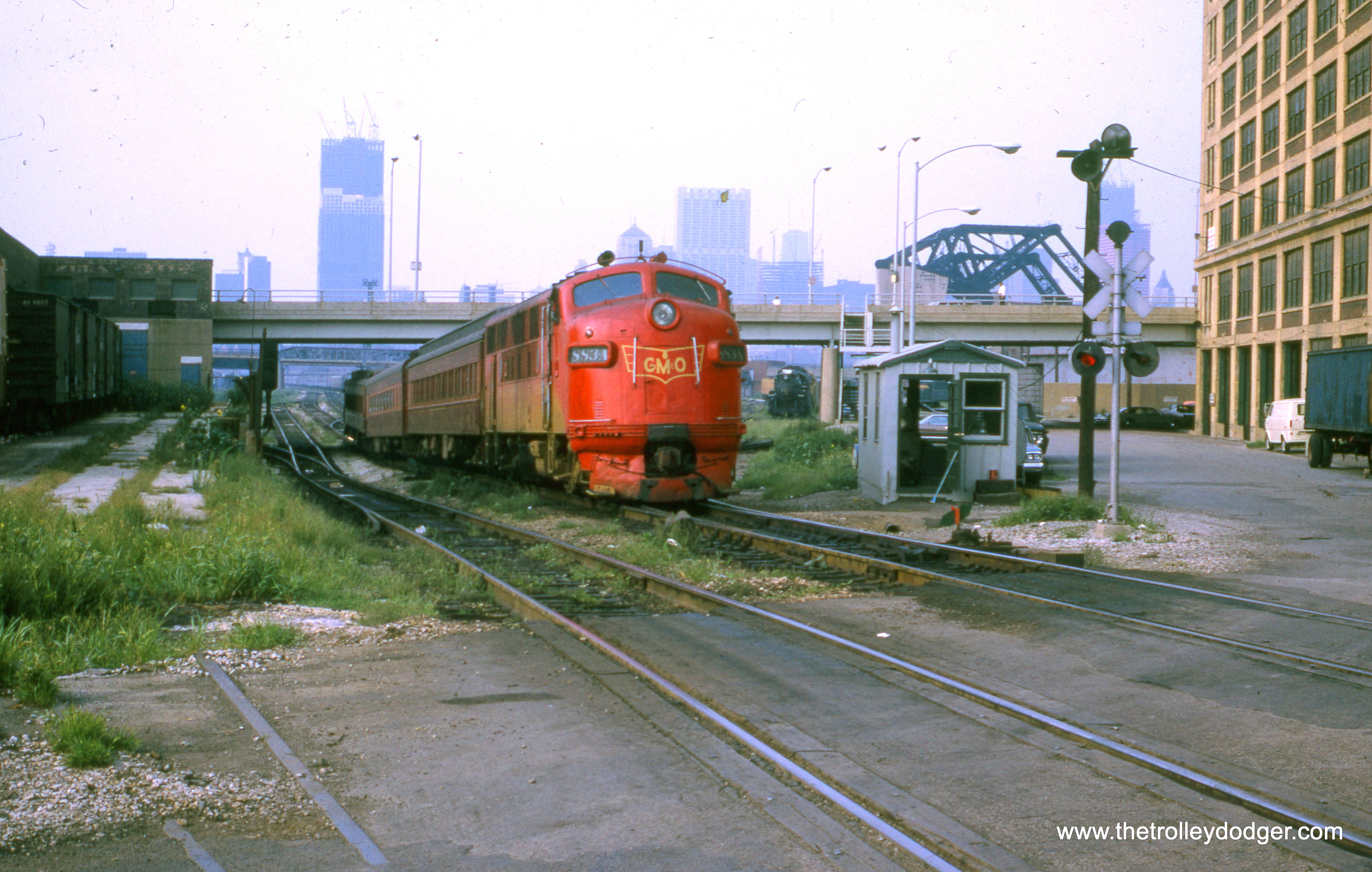
The GM&O

The GM&O “Abe Lincoln” at 18th Street in Chicago on April 22, 1966. (William Shapotkin Collection)

Ryan Tower

Photos of Ryan Tower, where the North Shore Line crossed the Chicago & North Western, are scarce, as this was a somewhat remote location for fans. But thanks to the good offices of Bill Shapotkin, here are several such views, along with his usual contemporary photos showing what the area looks like today.

Milwaukee County, WI - A pair of CNS&M cars (the

Milwaukee County, WI – A pair of CNS&M cars (the “Silverliner” at left is on a fantrip) pass one another at Ryan Tower – crossing with the C&NW “New Line.” Note that the once-double-tracked C&NW is now ut a single-track line through here (the one-time westbound main has been removed). The view looks north. (William Shapotkin Collection)

Ryan Tower, WI - TM interurban #1121, in fantrip service, heads southbound on the CNS&M as it crosses over the C&NW

Ryan Tower, WI – TM interurban #1121, in fantrip service, heads southbound on the CNS&M as it crosses over the C&NW “New Line” at Ryan Tower on December 4, 1949. The view looks north. (William Shapotkin Collection)

Milwaukee County, WI - A southbound CNS&M

Milwaukee County, WI – A southbound CNS&M “Silverliner” (in fantrip service) is about to cross over the (now single-track) C&NW “New Line” at Ryan Tower. View looks north. (William Shapotkin Collection)

On the stretch between Milwaukee limits and Racine station, a North Shore train crosses North Western freight route at Ryan Road. (A. C. Kalmbach Photo, William Shapotkin Collection)

On the stretch between Milwaukee limits and Racine station, a North Shore train crosses North Western freight route at Ryan Road. (A. C. Kalmbach Photo, William Shapotkin Collection)

Milwaukee County, WI - In 1958, a southbound CNS&M passenger train approaches the crossing with C&NW

Milwaukee County, WI – In 1958, a southbound CNS&M passenger train approaches the crossing with C&NW “New Line” at Ryan Road (that’s Ryan Tower at left). The view looks north. (William Shapotkin Collection)

Near the Milwaukee County line, a North Shore car crosses the C&NW freight line at an acute angle. (A. C. Kalmbach Photo, William Shapotkin Collection)

Near the Milwaukee County line, a North Shore car crosses the C&NW freight line at an acute angle. (A. C. Kalmbach Photo, William Shapotkin Collection)

Milwaukee County, WI - Looking N/NW (timetable NB) on long-abandoned right-of-way of CNS&M from

Milwaukee County, WI – Looking N/NW (timetable NB) on long-abandoned right-of-way of CNS&M from “Old Ryan Road,” (formerly Ryan Road). The CNS&M once crossed the C&NW (now UP) “New Line” – visible at right at “Ryan Tower,” located behind the photographer on the south side of the road. Photo by William Shapotkin on September 20, 2003.

(William Shapotkin Photo)

(William Shapotkin Photo)

Milwaukee, WI - Looking SB on UP (ex-C&NW)

Milwaukee, WI – Looking SB on UP (ex-C&NW) “New Line” from “Old Ryan Road” (new Ryan Road is visible overhead in the distance). This once double-tracked line once crossed the long-abandoned CNS&M at “Ryan Tower,” located south of the Roadway. Photo by William Shapotkin on September 6, 2003.

C&WT 104 at the end of the line in LaGrange. (William Shapotkin Collection)

C&WT 104 at the end of the line in LaGrange. (William Shapotkin Collection)

C&WT 164 on Lake Street. (William Shapotkin Collection)

C&WT 164 on Lake Street. (William Shapotkin Collection)

C&WT 145 is westbound on Lake Street at Harlem Avenue. To the left is the Marshall Field & Company store, a local landmark. (William Shapotkin Collection)

C&WT 145 is westbound on Lake Street at Harlem Avenue. To the left is the Marshall Field & Company store, a local landmark. (William Shapotkin Collection)

This picture is not very sharp, but it does show a C&WT streetcar stopped at the south parking lot of Brookfield Zoo, sometime in the 1940s. (William Shapotkin Collection)

This picture is not very sharp, but it does show a C&WT streetcar stopped at the south parking lot of Brookfield Zoo, sometime in the 1940s. (William Shapotkin Collection)

C&WT 133 has changed ends at Madison and Austin, and is ready to head west. Across the street from Oak Park into Chicago, riders could change to a Chicago Surface Lines PCC for a fast ride into the city. (William Shapotkin Collection)

C&WT 133 has changed ends at Madison and Austin, and is ready to head west. Across the street from Oak Park into Chicago, riders could change to a Chicago Surface Lines PCC for a fast ride into the city. (William Shapotkin Collection)

This shows westbound C&WT car 108, signed Berwyn-Lyons, on Stanley having just passed Oak Park Avenue circa 1941. At right is the Berwyn stop on the Chicago Burlington & Quincy. Today, Pace bus route 302 runs here, and commuter train service is under the auspices of Metra. (William Shapotkin Collection)

This shows westbound C&WT car 108, signed Berwyn-Lyons, on Stanley having just passed Oak Park Avenue circa 1941. At right is the Berwyn stop on the Chicago Burlington & Quincy. Today, Pace bus route 302 runs here, and commuter train service is under the auspices of Metra. (William Shapotkin Collection)

I am not sure of where this C&WT photo was taken. (William Shapotkin Collection) Patrick Cunningham: “The unidentified C&WT photo looks like it was taken just east of the Stone Ave. station on the CB&Q in LaGrange. The view is east. If you look at the prior photo of the end of the C&WT in LaGrange (which was at Brainard Ave.), you’ll note that the line was single track. This appears to be a passing siding or layover point.” On the other hand. Michael Murray writes, “I believe the 7th C&WT picture is looking east at Harlem and Stanley Aves. Page 128 of the Buckley book shows the signal on the pole, the track alignment, the CBQ shelter, and the CBQ signal in a photo near where yours was taken. I originally thought the same about the C&WT picture, but it’s Berwyn, not La Grange. The Buckley book confirms the location. ” Charles R. Vlk: “The “I am not sure of where this C&WT photo was taken. (William Shapotkin Collection)” photo is looking East on Stanley Avenue where the single track line crossing the Burlington at Harlem Avenue goes to double track. Harlem Avenue is behind the camera to the West.”

C&WT 112 is eastbound at Stanley and Oak Park Avenue. The CB&Q Berwyn stop is at left. (William Shapotkin Collection)

C&WT 112 is eastbound at Stanley and Oak Park Avenue. The CB&Q Berwyn stop is at left. (William Shapotkin Collection)

We have seen this picture of C&WT 141 before (it is also in my book Chicago Trolleys), but why pass up another chance to see it again? This is the bridge where the LaGrange line crossed the DesPlaines River, and I believe we are looking the the southeast. (William Shapotkin Collection)

We have seen this picture of C&WT 141 before (it is also in my book Chicago Trolleys), but why pass up another chance to see it again? This is the bridge where the LaGrange line crossed the DesPlaines River, and I believe we are looking the the southeast. (William Shapotkin Collection)

I assume these are the C&WT tracks in LaGrange. (William Shapotkin Collection) Michael Murray: “I’m skeptical that photo 10 is on the La Grange line. There wasn’t any single track on the line similar to the one in the photo. My guess is perhaps the Berwyn-Lyons line? Ogden Ave. on the right, and this is the easternmost passing track, which, according to the Buckley book, was west of Harlem. Note that the line poles are only briefly wide of the main “march” of poles into the distance.”

A C&WT streetcar in LaGrange. (William Shapotkin Collection) Michael Murray: “Photo 11, which you have captioned as “A C&WT streetcar in LaGrange” is found on page 129 of the Buckley book, and is captioned: “Between Harlem Ave and the Des Plaines River, the Berwyn-Lyons streetcar line was built on private right-of-way on the south side of Ogden Ave. It was abandoned October 26, 1933 because the land was wanted to widen Ogden Ave. The railway here was single track with two passing sidings. Car 133 was photographed on the passing siding near the Des Plaines River in October 1933, a few days before abandonment.”

C&WT 111. (William Shapotkin Collection)

C&WT 111. (William Shapotkin Collection)

C&WT 105 on Cermak Road. (William Shapotkin Collection)

C&WT 105 on Cermak Road. (William Shapotkin Collection)

An unidentified C&WT car, probably in the 1930s. (William Shapotkin Collection)

An unidentified C&WT car, probably in the 1930s. (William Shapotkin Collection)

C&WT 107. (William Shapotkin Collection)

C&WT 107. (William Shapotkin Collection)

C&WT 165 is at Lake and Austin, the east end of the line, in suburban Oak Park. (William Shapotkin Collection)

C&WT 165 is at Lake and Austin, the east end of the line, in suburban Oak Park. (William Shapotkin Collection)

C&WT 158 in LaGrange. Not sure why this section of track is blocked off, except that perhaps it is due to the tracks being unstable, due to the nearby excavation going on. (William Shapotkin Collection) Patrick Cunningham adds, “C&WT 158 is just east of LaGrange Road. In the background, you can just make out the Jackson Moving and Storage sign on the building with the towers. The building is there, the towers are gone. Probably about here: https://www.google.com/maps/@41.8166104,-87.8687401,3a,75y,70.46h,80.48t/data=!3m6!1e1!3m4!1st0yuoCYe7FXm6EGEmBkuQA!2e0!7i16384!8i8192!5m1!1e1

From a high vantage point, here we see C&WT 112 has just turned from Ridgeland onto Stanley in suburban Berwyn, and is heading west, just north of the CB&Q, which it will cross at Harlem Avenue one mile west of here. (William Shapotkin Collection)

From a high vantage point, here we see C&WT 112 has just turned from Ridgeland onto Stanley in suburban Berwyn, and is heading west, just north of the CB&Q, which it will cross at Harlem Avenue one mile west of here. (William Shapotkin Collection)

C&WT 132 on Cermak Road in the late 1930s. (William Shapotkin Collection)

C&WT 132 on Cermak Road in the late 1930s. (William Shapotkin Collection)

C&WT 105 at the Harlem and Cermak car barn. (William Shapotkin Photo)

C&WT 105 at the Harlem and Cermak car barn. (William Shapotkin Photo)

C&WT 111 on Cermak Road. (William Shapotkin Photo)

C&WT 111 on Cermak Road. (William Shapotkin Photo)

The Trolley Dodger On the Air

We appeared on WGN radio in Chicago last November, discussing our book Building Chicago’s Subways on the Dave Plier Show. You can hear our 19-minute conversation here.

Order Our New Book Building Chicago’s Subways

There were three subway anniversaries in 2018 in Chicago:
60 years since the West Side Subway opened (June 22, 1958)
75 years since the State Street Subway opened (October 17, 1943)
80 years since subway construction started (December 17, 1938)

To commemorate these anniversaries, we have written a new book, Building Chicago’s Subways.

While the elevated Chicago Loop is justly famous as a symbol of the city, the fascinating history of its subways is less well known. The City of Chicago broke ground on what would become the “Initial System of Subways” during the Great Depression and finished 20 years later. This gigantic construction project, a part of the New Deal, would overcome many obstacles while tunneling through Chicago’s soft blue clay, under congested downtown streets, and even beneath the mighty Chicago River. Chicago’s first rapid transit subway opened in 1943 after decades of wrangling over routes, financing, and logistics. It grew to encompass the State Street, Dearborn-Milwaukee, and West Side Subways, with the latter modernizing the old Garfield Park “L” into the median of Chicago’s first expressway. Take a trip underground and see how Chicago’s “I Will” spirit overcame challenges and persevered to help with the successful building of the subways that move millions. Building Chicago’s subways was national news and a matter of considerable civic pride–making it a “Second City” no more!

Bibliographic information:

Title Building Chicago’s Subways
Images of America
Author David Sadowski
Edition illustrated
Publisher Arcadia Publishing (SC), 2018
ISBN 1467129380, 9781467129381
Length 128 pages

Chapter Titles:
01. The River Tunnels
02. The Freight Tunnels
03. Make No Little Plans
04. The State Street Subway
05. The Dearborn-Milwaukee Subway
06. Displaced
07. Death of an Interurban
08. The Last Street Railway
09. Subways and Superhighways
10. Subways Since 1960

Building Chicago’s Subways is in stock and now available for immediate shipment. Order your copy today! All copies purchased through The Trolley Dodger will be signed by the author.

The price of $23.99 includes shipping within the United States.

For Shipping to US Addresses:

For Shipping to Canada:

For Shipping Elsewhere:

Redone tile at the Monroe and Dearborn CTA Blue Line subway station, showing how an original sign was incorporated into a newer design, May 25, 2018. (David Sadowski Photo)

Redone tile at the Monroe and Dearborn CTA Blue Line subway station, showing how an original sign was incorporated into a newer design, May 25, 2018. (David Sadowski Photo)

Help Support The Trolley Dodger

gh1

This is our 228th post, and we are gradually creating a body of work and an online resource for the benefit of all railfans, everywhere. To date, we have received over 504,000 page views, for which we are very grateful.

You can help us continue our original transit research by checking out the fine products in our Online Store.

As we have said before, “If you buy here, we will be here.”

We thank you for your support.

DONATIONS

In order to continue giving you the kinds of historic railroad images that you have come to expect from The Trolley Dodger, we need your help and support. It costs money to maintain this website, and to do the sort of historic research that is our specialty.

Your financial contributions help make this web site better, and are greatly appreciated.

Traction Valentines

I believe this photo postcard of Chicago Surface Lines 5812 was taken at the 72nd and Cottage Grove loop. Don's Rail Photos says, "5712 was built by Brill Car Co in 1912, #18322. It was rebuilt as one man/two man service in 1933 and retired on August 25, 1947." This picture appears to date between 1914 and 1933.

I believe this photo postcard of Chicago Surface Lines 5812 was taken at the 72nd and Cottage Grove loop. Don’s Rail Photos says, “5712 was built by Brill Car Co in 1912, #18322. It was rebuilt as one man/two man service in 1933 and retired on August 25, 1947.” This picture appears to date between 1914 and 1933.

Valentine’s Day is fast approaching, and here we have some tasty traction Valentines for your consideration. First, we have some recent finds of our own, followed by many generously shared from the collections of William Shapotkin. We finish this post with an important find from J. J. Sedelmaier.

-David Sadowski

Recent Finds

LVT 812 in front of the Easton car barn on a June 30, 1947 fantrip. (James Maloney, Jr. Photo)

LVT 812 in front of the Easton car barn on a June 30, 1947 fantrip. (James Maloney, Jr. Photo)

LVT 710 at Philadelphia, PA on August 19, 1945. (James Maloney, Jr. Photo)

LVT 710 at Philadelphia, PA on August 19, 1945. (James Maloney, Jr. Photo)

LVT 1000 is on an ERA fantrip, "at the east end of the Ham Street Bridge," in Allentown on October 29, 1950. (James Maloney, Jr. Photo)

LVT 1000 is on an ERA fantrip, “at the east end of the Ham Street Bridge,” in Allentown on October 29, 1950. (James Maloney, Jr. Photo)

LVT 1003 is at the Allentown car barn in September, 1940. (James Maloney, Jr. Photo)

LVT 1003 is at the Allentown car barn in September, 1940. (James Maloney, Jr. Photo)

LVT 1004 in Allentown, October 1939. (James Maloney, Jr. Photo)

LVT 1004 in Allentown, October 1939. (James Maloney, Jr. Photo)

LT 1006 at Allentown on January 23, 1943. (James Maloney, Jr. Photo)

LT 1006 at Allentown on January 23, 1943. (James Maloney, Jr. Photo)

LVT 803, in dead storage awaiting scrapping in Allentown, on November 8, 1939. (James Maloney, Jr. Photo)

LVT 803, in dead storage awaiting scrapping in Allentown, on November 8, 1939. (James Maloney, Jr. Photo)

A single-car CTA Skokie Swift train leaves Howard Street in June 1977.

A single-car CTA Skokie Swift train leaves Howard Street in June 1977.

An artist's rendering of the high-level us subway the CTA envisioned for Washington Street between Canal and Michigan, 1961.

An artist’s rendering of the high-level us subway the CTA envisioned for Washington Street between Canal and Michigan, 1961.

Indiana Railroad #1150 is southbound at Springport station on the New Castle line on January 1, 1941 in the waning days of that storied Hoosier interurban. (Eugene Van Dusen Photo)

Indiana Railroad #1150 is southbound at Springport station on the New Castle line on January 1, 1941 in the waning days of that storied Hoosier interurban. (Eugene Van Dusen Photo)

SF Muni cable car 524 is at Powell and Market at 1 am on September 2, 1956.

SF Muni cable car 524 is at Powell and Market at 1 am on September 2, 1956.

SF Muni cable car 503 at Washington and Octavia on September 1, 1956.

SF Muni cable car 503 at Washington and Octavia on September 1, 1956.

Cable car track work at Powell and California on October 31, 1957.

Cable car track work at Powell and California on October 31, 1957.

Red Arrow Lines Brilliner #7 is running on the street, presumably on the Sharon Hill branch, on November 27, 1960.

Red Arrow Lines Brilliner #7 is running on the street, presumably on the Sharon Hill branch, on November 27, 1960.

On June 3, 1962 Red Arrow car 20 is turning onto a cobblestone street on the Sharon Hill line.

On June 3, 1962 Red Arrow car 20 is turning onto a cobblestone street on the Sharon Hill line.

At first, you might think this lineup of NSL cars in dead storage at Highwood (headed up by 158) is post-abandonment, but apparently not. The slide not only has a 1/20/63 date stamped on it (last full day of operations), the slide was processed by Kodak in January 1963.

At first, you might think this lineup of NSL cars in dead storage at Highwood (headed up by 158) is post-abandonment, but apparently not. The slide not only has a 1/20/63 date stamped on it (last full day of operations), the slide was processed by Kodak in January 1963.

In this April 11, 1964 view, one of the former North Shore Line Electroliners has been rechristened as a Red Arrow Liberty Liner on the Norristown High Speed Line in Philadelphia's suburbs. I would expect that the abandoned right-of-way at left is where the Strafford branch once was.

In this April 11, 1964 view, one of the former North Shore Line Electroliners has been rechristened as a Red Arrow Liberty Liner on the Norristown High Speed Line in Philadelphia’s suburbs. I would expect that the abandoned right-of-way at left is where the Strafford branch once was.

North Shore Line electric loco 456 heads up a short freight train on January 20, 1963-- the last full day of operations prior to abandonment.

North Shore Line electric loco 456 heads up a short freight train on January 20, 1963– the last full day of operations prior to abandonment.

CTA 7108, already signed for its northbound trip on Route 36, is near 120th and Halsted in the 1950s.

CTA 7108, already signed for its northbound trip on Route 36, is near 120th and Halsted in the 1950s.

CTA 4095 is eastbound at Lake and Ashland on June 24, 1961. In the background, you can see the old Lake Transfer station, where riders could change (up until February 1951) for Logan Square and Humboldt Park trains.

CTA 4095 is eastbound at Lake and Ashland on June 24, 1961. In the background, you can see the old Lake Transfer station, where riders could change (up until February 1951) for Logan Square and Humboldt Park trains.

A CTA two-car Lake Street "L" train heads east in this 1960 photo by Al Holtz.

A CTA two-car Lake Street “L” train heads east in this 1960 photo by Al Holtz.

April 1963.

April 1963.

From the Collections of William Shapotkin

CTA trolley us 9377 is at Irving Park and Neenah. This bus turnaround is no longer in use by CTA, and has now become part of a driveway for a development.

CTA trolley us 9377 is at Irving Park and Neenah. This bus turnaround is no longer in use by CTA, and has now become part of a driveway for a development.

At right, 2411-2412 are on the same fantrip mentioned in the revious photo. At left, a southbound Howard-Dan Ryan train passes the Diversey station on the Ravenswood "L". William Shapotkin took this picture on December 13, 1998.

At right, 2411-2412 are on the same fantrip mentioned in the revious photo. At left, a southbound Howard-Dan Ryan train passes the Diversey station on the Ravenswood “L”. William Shapotkin took this picture on December 13, 1998.

At right, CTA cars 2411-2412 are on an NRHS (National Railway Historical Society) fantrip. At left, a southbound Howard-Dan Ryan train blasts by the Armitage station on the Ravenswood "L". William Shapotkin took this photo on December 13, 1998.

At right, CTA cars 2411-2412 are on an NRHS (National Railway Historical Society) fantrip. At left, a southbound Howard-Dan Ryan train blasts by the Armitage station on the Ravenswood “L”. William Shapotkin took this photo on December 13, 1998.

CTA 2177 heads up an Evanston Express train at Armitage on July 10, 1989.

CTA 2177 heads up an Evanston Express train at Armitage on July 10, 1989.

CTA bus 8413 is southbound on Broadway at Lawrence in October 1973, running on Route 36. (Ronald J. Sullivan Photo)

CTA bus 8413 is southbound on Broadway at Lawrence in October 1973, running on Route 36. (Ronald J. Sullivan Photo)

CTA 3140, working a southbound trip on CTA Route 38 - Indiana, heads southbound on Wabash Avenue, crossing Roosevelt Road. Visible above the red car at right is the one-time Union Bus Deport. The view looks north.

CTA 3140, working a southbound trip on CTA Route 38 – Indiana, heads southbound on Wabash Avenue, crossing Roosevelt Road. Visible above the red car at right is the one-time Union Bus Deport. The view looks north.

CTA trolley bus 9537, working Route 12 - Roosevelt Road, departs its east end terminal at Roosevelt Road east of Wabash Avenue. the view looks north.

CTA trolley bus 9537, working Route 12 – Roosevelt Road, departs its east end terminal at Roosevelt Road east of Wabash Avenue. the view looks north.

CSL 5925 heads southbound on Wabash Avenue and crosses Roosevelt Road. The Union Bus Depot is on the northeast corner. The view looks northeast.

CSL 5925 heads southbound on Wabash Avenue and crosses Roosevelt Road. The Union Bus Depot is on the northeast corner. The view looks northeast.

CTA trolley bus 9453, working a westbound trip on Route 12 - Roosevelt Road, has just crossed Wabash Avenue. (The building on the northeast corner is the one-time Union Bus Depot.) The view looks northeast on May 27, 1967, taken from the CTA Roosevelt Road station.) Jeffrey L. Wien Photo, Wien-Criss Archive)

CTA trolley bus 9453, working a westbound trip on Route 12 – Roosevelt Road, has just crossed Wabash Avenue. (The building on the northeast corner is the one-time Union Bus Depot.) The view looks northeast on May 27, 1967, taken from the CTA Roosevelt Road station.) Jeffrey L. Wien Photo, Wien-Criss Archive)

A northbound Lake-Englewood "A" train of 2000-series cars approaches the "L" station at 40th and Indiana in September 1993. (Myron Lane Photo)

A northbound Lake-Englewood “A” train of 2000-series cars approaches the “L” station at 40th and Indiana in September 1993. (Myron Lane Photo)

A northbound CTA train approaches the Indiana "L" station on the south side of Chicago on June 28, 1992. The occasion was a Central Electric Railfans' Association fantrip, celebrating a century of rapid transit. (Jim Arvites Photo)

A northbound CTA train approaches the Indiana “L” station on the south side of Chicago on June 28, 1992. The occasion was a Central Electric Railfans’ Association fantrip, celebrating a century of rapid transit. (Jim Arvites Photo)

CTA 2821, a wooden Met car running northbound on the Kenwood shuttle circa 1956-57. These were the last type of cars used for that service, which ended in 1957.

CTA 2821, a wooden Met car running northbound on the Kenwood shuttle circa 1956-57. These were the last type of cars used for that service, which ended in 1957.

We are looking east off the CTA's Indiana Avenue "L" station in the early 1950s. At left, a Kenwood train has just departed en route to 42nd Place. At right, two 200-series cars (used as equipment on the Kenwood line) are in storage on what once had been the northbound local track of the South Side "L".

We are looking east off the CTA’s Indiana Avenue “L” station in the early 1950s. At left, a Kenwood train has just departed en route to 42nd Place. At right, two 200-series cars (used as equipment on the Kenwood line) are in storage on what once had been the northbound local track of the South Side “L”.

CTA gate car 268 at the Indiana Avenue station "pocket."

CTA gate car 268 at the Indiana Avenue station “pocket.”

CTA 268 is a Kenwood local, at the Indiana Avenue station.

CTA 268 is a Kenwood local, at the Indiana Avenue station.

A two-car train, including #227, is being stored for Kenwood service, on what had once been the northbound local track on the South Side "L", in the early 1950s.

A two-car train, including #227, is being stored for Kenwood service, on what had once been the northbound local track on the South Side “L”, in the early 1950s.

CTA 385 is at the Indiana Avenue station in July 1948,signed as a Wilson Avenue local via the elevated (instead of the State Street subway, which opened in 1943). The following year, the CTA introduced A/B "skip stop" service to North-South and the Kenwood and Stockyards branches became shuttles.

CTA 385 is at the Indiana Avenue station in July 1948,signed as a Wilson Avenue local via the elevated (instead of the State Street subway, which opened in 1943). The following year, the CTA introduced A/B “skip stop” service to North-South and the Kenwood and Stockyards branches became shuttles.

CTA car #273, working the Kenwood "L" shuttle, is seen at the 40th and Indiana Avenue station. The view looks northeast.

CTA car #273, working the Kenwood “L” shuttle, is seen at the 40th and Indiana Avenue station. The view looks northeast.

Once the Kenwood and Stockyards ranch lines became full-time shuttle operations, the CTA station at 40th and Indiana Avenue was reconfigured. Here is a Kenwood car in the "pocket."

Once the Kenwood and Stockyards ranch lines became full-time shuttle operations, the CTA station at 40th and Indiana Avenue was reconfigured. Here is a Kenwood car in the “pocket.”

Looking west from the west end of the Indiana Avenue "L" station, 4000-series "L" cars are laying over on the Stockyards "L". 4000s were used on this branch during the 1952 and 1956 political conventions held at the International Amphitheater. (Joseph N. Canfield Photo)

Looking west from the west end of the Indiana Avenue “L” station, 4000-series “L” cars are laying over on the Stockyards “L”. 4000s were used on this branch during the 1952 and 1956 political conventions held at the International Amphitheater. (Joseph N. Canfield Photo)

The Indiana Avenue station on the South Side "L" circa 1956. A northbound Englewood-Howard train departs the station, while a Stockyards shuttle train awaits departure time. The view looks east. (Joseph N. Canfield Photo)

The Indiana Avenue station on the South Side “L” circa 1956. A northbound Englewood-Howard train departs the station, while a Stockyards shuttle train awaits departure time. The view looks east. (Joseph N. Canfield Photo)

Looking east (timetable south) into 63rd and Cottage Grove station on the Jackson Park "L" on May 12, 1996. (William Shapotkin Photo)

Looking east (timetable south) into 63rd and Cottage Grove station on the Jackson Park “L” on May 12, 1996. (William Shapotkin Photo)

A Lake-Jackson Park train approaching 63rd and Cottage Grove on May 12, 1996. The train has crossed over to the northbound track and is arriving at the station. (William Shapotkin Photo)

A Lake-Jackson Park train approaching 63rd and Cottage Grove on May 12, 1996. The train has crossed over to the northbound track and is arriving at the station. (William Shapotkin Photo)

A southbound Jackson Park train approaches 63rd and Cottage Grove on May 12, 1996. The train is about to cross over and arrive at the station. The view looks west (timetable north) from the north platform. (William Shapotkin Photo)

A southbound Jackson Park train approaches 63rd and Cottage Grove on May 12, 1996. The train is about to cross over and arrive at the station. The view looks west (timetable north) from the north platform. (William Shapotkin Photo)

Chicago, IL. Looking westbound on O'Neil Street (now 23rd Place) from Halsted Street. Well into the 1900s, this was an important terminal/transfer point. Note cable slots-- the West Chicago Street Railroad Company's Halsted-Van Buren cable line terminated in the carbarn at left. This was also the south terminal of Chicago Union Traction's Halsted line. CUT car #4171 (Pullman 1898) prepares for its northward journey. (Fred J. Borchert Photo)

Chicago, IL. Looking westbound on O’Neil Street (now 23rd Place) from Halsted Street. Well into the 1900s, this was an important terminal/transfer point. Note cable slots– the West Chicago Street Railroad Company’s Halsted-Van Buren cable line terminated in the carbarn at left. This was also the south terminal of Chicago Union Traction’s Halsted line. CUT car #4171 (Pullman 1898) prepares for its northward journey. (Fred J. Borchert Photo)

Chicago, IL. Looking westbound on 23rd (O'Neil) Street from Halsted Street, once a busy street-- once a busy streetcar/cable car terminal (with a carbarn). The rails (along with a crossover) are still intact and visible in this July 30, 2004 photo by William Shapotkin.

Chicago, IL. Looking westbound on 23rd (O’Neil) Street from Halsted Street, once a busy street– once a busy streetcar/cable car terminal (with a carbarn). The rails (along with a crossover) are still intact and visible in this July 30, 2004 photo by William Shapotkin.

(William Shapotkin Photo)

(William Shapotkin Photo)

Bus stop sign at the northwest corner of 23rd (O'Neil) Street and Halsted Street. The view looks northeast on July 30, 2004. (William Shapotkin Photo)

Bus stop sign at the northwest corner of 23rd (O’Neil) Street and Halsted Street. The view looks northeast on July 30, 2004. (William Shapotkin Photo)

Chicago, IL. Looking eastbound on 3rd (O'Neil) Street towards Halsted Street, once a busy streetcar/cable car terminal. Both sets of rails (which head onto northbound Halsted) are still visible (as of July 30, 2004) lo these many years since the discontinuance of streetcar service. (William Shapotkin Photo)

Chicago, IL. Looking eastbound on 3rd (O’Neil) Street towards Halsted Street, once a busy streetcar/cable car terminal. Both sets of rails (which head onto northbound Halsted) are still visible (as of July 30, 2004) lo these many years since the discontinuance of streetcar service. (William Shapotkin Photo)

Indiana Avenue station on the South Side "L". Left-- a northbound Kenwood train arrives, while at right, a westbound Howard train also arrives. The view looks east off the overhead transfer ridge in 1950. (Joseph N. Canfield Photo)

Indiana Avenue station on the South Side “L”. Left– a northbound Kenwood train arrives, while at right, a westbound Howard train also arrives. The view looks east off the overhead transfer ridge in 1950. (Joseph N. Canfield Photo)


Another North Shore Line Poster

Following up on our previous post Anniversaries (January 24, 2019), here is an interesting find, courtesy of our friend J. J. Sedelmaier.

Looking north on Chicago's Michigan Avenue at Ohio Street circa mid-late 1920s. BTW - the billboard on the right was originally produced in 1925 as a South Shore Line one-sheet poster. (J. J. Sedelmaier Collection)

Looking north on Chicago’s Michigan Avenue at Ohio Street circa mid-late 1920s. BTW – the billboard on the right was originally produced in 1925 as a South Shore Line one-sheet poster. (J. J. Sedelmaier Collection)

The Trolley Dodger On the Air

We appeared on WGN radio in Chicago last November, discussing our book Building Chicago’s Subways on the Dave Plier Show. You can hear our 19-minute conversation here.

Order Our New Book Building Chicago’s Subways

There were three subway anniversaries in 2018 in Chicago:
60 years since the West Side Subway opened (June 22, 1958)
75 years since the State Street Subway opened (October 17, 1943)
80 years since subway construction started (December 17, 1938)

To commemorate these anniversaries, we have written a new book, Building Chicago’s Subways.

While the elevated Chicago Loop is justly famous as a symbol of the city, the fascinating history of its subways is less well known. The City of Chicago broke ground on what would become the “Initial System of Subways” during the Great Depression and finished 20 years later. This gigantic construction project, a part of the New Deal, would overcome many obstacles while tunneling through Chicago’s soft blue clay, under congested downtown streets, and even beneath the mighty Chicago River. Chicago’s first rapid transit subway opened in 1943 after decades of wrangling over routes, financing, and logistics. It grew to encompass the State Street, Dearborn-Milwaukee, and West Side Subways, with the latter modernizing the old Garfield Park “L” into the median of Chicago’s first expressway. Take a trip underground and see how Chicago’s “I Will” spirit overcame challenges and persevered to help with the successful building of the subways that move millions. Building Chicago’s subways was national news and a matter of considerable civic pride–making it a “Second City” no more!

Bibliographic information:

Title Building Chicago’s Subways
Images of America
Author David Sadowski
Edition illustrated
Publisher Arcadia Publishing (SC), 2018
ISBN 1467129380, 9781467129381
Length 128 pages

Chapter Titles:
01. The River Tunnels
02. The Freight Tunnels
03. Make No Little Plans
04. The State Street Subway
05. The Dearborn-Milwaukee Subway
06. Displaced
07. Death of an Interurban
08. The Last Street Railway
09. Subways and Superhighways
10. Subways Since 1960

Building Chicago’s Subways is in stock and now available for immediate shipment. Order your copy today! All copies purchased through The Trolley Dodger will be signed by the author.

The price of $23.99 includes shipping within the United States.

For Shipping to US Addresses:

For Shipping to Canada:

For Shipping Elsewhere:

Redone tile at the Monroe and Dearborn CTA Blue Line subway station, showing how an original sign was incorporated into a newer design, May 25, 2018. (David Sadowski Photo)

Redone tile at the Monroe and Dearborn CTA Blue Line subway station, showing how an original sign was incorporated into a newer design, May 25, 2018. (David Sadowski Photo)

Help Support The Trolley Dodger

gh1

This is our 227th post, and we are gradually creating a body of work and an online resource for the benefit of all railfans, everywhere. To date, we have received over 488,000 page views, for which we are very grateful.

You can help us continue our original transit research by checking out the fine products in our Online Store.

As we have said before, “If you buy here, we will be here.”

We thank you for your support.

DONATIONS

In order to continue giving you the kinds of historic railroad images that you have come to expect from The Trolley Dodger, we need your help and support. It costs money to maintain this website, and to do the sort of historic research that is our specialty.

Your financial contributions help make this web site better, and are greatly appreciated.

Anniversaries

For fans of the North Shore Line interurban, January 21, 1963 will always be a day that will “live in infamy,” to borrow a phrase from Franklin D. Roosevelt, as that was the date of abandonment.

But January 21 is also the day we started this blog, four years ago. We can’t do anything to bring back the NSL, but we can honor its memory going forward, and a lot of other memories besides, in this space.

As far as we are concerned, every day is a day to celebrate the North Shore Line. But today, as we begin our fifth year, we are fortunate to have much NSL material to share. First, courtesy of Jim Huffman, we have nearly 60 images of North Shore Line posters. To these, we have added some additional classic photos from the collections of William Shapotkin.

To round things out, we have some recent photo finds of our own, plus some interesting correspondence from Jeff Marinoff.

Throughout its existence, the Chicago, North Shore & Milwaukee prided itself on SERVICE. In our own small way, we try to do the same for you and the railfan community.

-David Sadowski

Annual Fundraiser

Thanks to the generosity of our readers, we have already exceeded our goal of raising $436 by the end of this month. To date, we have received $725. We have tried to personally thank everyone who contributed. Unfortunately, a couple of e-mail addresses we were given, along with these donations, appear to be out of date, as our thank you messages were returned by the mail server. So, if you did not receive a thank you note from us, that is probably why, but we are still thankful nonetheless.

It is a fact of life that this blog has run at a deficit since it began. Our goal is to get it to a point where it can be self-sufficient. We lost at least $10k in each of our first two years, and $6k in our third year.

While we have not yet determined the amount of loss for last year, it is expected to have been less than $6k.

It costs real money to bring you many of these classic images. We have already paid our fees for the coming year, and additional donations in excess of that goal will be used to pay for more images that will show up in future posts.

On average, it probably costs about $10 for each image we purchase for this blog. So if you have 50 images in a post, that represents a $500 expenditure, and $1000 for 100 images. Now you can see the challenge, and how beneficial it is when individuals share their material with us.

We also hope to work on another book project this year. The costs of doing the necessary research on our first two volumes are far in excess of the revenue received. But it is possible these books will continue to sell over time, and in the long run, may also eventually reach a break-even point.

So, while we have now met our immediate goal, the need is ongoing throughout the year. Your generous contributions are always appreciated, in whatever amount you choose to give.

You will find links for donations at the end of this post.

Thanks.

North Shore Line Posters

Again, we thank Jim Huffman for sharing these with our readers. There are color variations for a few of the posters. Presumably, these went through more than one printing.

As you can see, many of these iconic posters have little, if anything, to do with actually riding on the North Shore Line. But they were tremendously successful in promoting the North Shore itself, its beauty, charm, and history, along with the idea of easy and convenient travel, resulting in a greater sense of freedom and ultimate satisfaction in life. Now, they are an important part of our history.

North Shore Line Photos

These are from the collections of William Shapotkin:

CNS&M 756 is at the rear of the 10:55 am train to Milwaukee, leaving Roosevelt Road station on November 7, 1962. (William Shapotkin Collection)

CNS&M 756 is at the rear of the 10:55 am train to Milwaukee, leaving Roosevelt Road station on November 7, 1962. (William Shapotkin Collection)

CNS&M Electroliner 802-801 at Roosevelt Road in Chicago on November 11, 1962. (William Shapotkin Collection)

CNS&M Electroliner 802-801 at Roosevelt Road in Chicago on November 11, 1962. (William Shapotkin Collection)

The Roosevelt Road/Holden Court station on the South Side "L". The view looks north. (William Shapotkin Collection)

The Roosevelt Road/Holden Court station on the South Side “L”. The view looks north. (William Shapotkin Collection)

North Shore Line cars are stored on the center track at the CTA's Roosevelt Road station on November 7, 1962. The view looks south. CNS&M had exclusive use of the station from 1949 to 1963, as rapid transit cars on North-South were routed through the State Street subway. The station was eventually removed, but since put back. (William Shapotkin Collection)

North Shore Line cars are stored on the center track at the CTA’s Roosevelt Road station on November 7, 1962. The view looks south. CNS&M had exclusive use of the station from 1949 to 1963, as rapid transit cars on North-South were routed through the State Street subway. The station was eventually removed, but since put back. (William Shapotkin Collection)

North Shore Line Electroliner 801-802 at Roosevelt Road in Chicago, 1962. (William Shapotkin Collection)

North Shore Line Electroliner 801-802 at Roosevelt Road in Chicago, 1962. (William Shapotkin Collection)

Recent Finds

CTA 6186 heads east over the Illinois Central right-of-way in the early 1950s, heading towards the Field Museum and Soldier Field. This extension of the Roosevelt Road streetcar line was built for A Century of Progress, the 1933-34 Chicago World's Fair.

CTA 6186 heads east over the Illinois Central right-of-way in the early 1950s, heading towards the Field Museum and Soldier Field. This extension of the Roosevelt Road streetcar line was built for A Century of Progress, the 1933-34 Chicago World’s Fair.

CTA 3173, at right, is a one-man car running on Route 38, as is the red car it is passing. At left is a Route 4 - Cottage Grove prewar PCC. We are looking south on Wabash Avenue, just north of the Chicago River, in the early 1950s.

CTA 3173, at right, is a one-man car running on Route 38, as is the red car it is passing. At left is a Route 4 – Cottage Grove prewar PCC. We are looking south on Wabash Avenue, just north of the Chicago River, in the early 1950s.

CTA 4180 heads southbound at State and 86th Streets in May 1952. (John D. Koschwanez Photo)

CTA 4180 heads southbound at State and 86th Streets in May 1952. (John D. Koschwanez Photo)

CTA 4164, a Pullman PCC, heads north on Clark Street circa 1948, ready to cross LaSalle Drive, which runs at an angle at this point. In the background, you can see the Chicago Historical Society (now Chicago History Museum) building. The Standard gas station at right is now a BP.

CTA 4164, a Pullman PCC, heads north on Clark Street circa 1948, ready to cross LaSalle Drive, which runs at an angle at this point. In the background, you can see the Chicago Historical Society (now Chicago History Museum) building. The Standard gas station at right is now a BP.

CTA 4111 heads south on Route 22 - Clark-Wentworth in this undated view. This image was restored from a badly faded Kodacolor print.

CTA 4111 heads south on Route 22 – Clark-Wentworth in this undated view. This image was restored from a badly faded Kodacolor print.

Chicago Surface Lines 7008, in "tiger stripes," is in the Madison-Austin loop, circa 1945-46. (Robert J. Mahar Photo)

Chicago Surface Lines 7008, in “tiger stripes,” is in the Madison-Austin loop, circa 1945-46. (Robert J. Mahar Photo)

Four generations of Chicago rapid transit cars, as they were posed in Forest Park on January 9, 1994-- cars 6102, 1992 (formerly 2008), 1, and 4271. After this, their fates diverged; car 1 is now at the Chicago History Museum, 1992 eventually went to the Illinois Railway Museum for parts scrapping, 4271 is still part of the CTA's Heritage Fleet, and 6102 was stored at the Fox River Trolley Museum for several years, before returning to CTA in 2017, where it will hopefully one day run again. (Bruce C. Nelson Photo)

Four generations of Chicago rapid transit cars, as they were posed in Forest Park on January 9, 1994– cars 6102, 1992 (formerly 2008), 1, and 4271. After this, their fates diverged; car 1 is now at the Chicago History Museum, 1992 eventually went to the Illinois Railway Museum for parts scrapping, 4271 is still part of the CTA’s Heritage Fleet, and 6102 was stored at the Fox River Trolley Museum for several years, before returning to CTA in 2017, where it will hopefully one day run again. (Bruce C. Nelson Photo)

Philadelphia Suburban Transportation Company (aka Red Arrow Lines) car #17 is near West Chester on May 1, 1954. Much of this line was single track, running along the side of West Chester Pike.

Philadelphia Suburban Transportation Company (aka Red Arrow Lines) car #17 is near West Chester on May 1, 1954. Much of this line was single track, running along the side of West Chester Pike.

Recent Correspondence

Jeff Marinoff writes:

Among the several post cards that I’ve added to my collection lately are two awesome Chicago Union Traction Company cards from 1906. Note that car # 4911 is pulling an open trailer. Also, if you zoom in on the rear of car # 4911, you’ll see on the opposite track in the distant background is another car pulling an open trailer car in the other direction.

Also of interest is the wooden roof sign on car # 4911. It reads N. CLARK STREET. The side roll sign on # 4911 reads CLARK – DEVON. The front roll sign reads CLARK ST . Possibly helping to identify the location is the address painted on the window of the building behind car # 4911 which looks like it says 4362. I wonder if this was 4362 North Clark Street. I’m being told that the scene showing # 4911 is in the area of the Devon Station car barn and near the intersection of Clark and Devon. In September 1909, the City of Chicago changed its street numbering system. In the c1906 post card photo, you see the street number 4362. That number was changed in 1909 to 6333 N. Clark, which is about a block south of Devon Avenue, which is 6400 North.

On the card that shows the Chicago Union Traction Company crews in 1906, note that one of the conductors has hung the round metal run number sign on his uniform jacket. A novel place to carry it to his assignment. This post card scene is said to be outside of the Devon Station car barn.

As usual, I am indebted to Walter Keevil for technical info on Chicago Union Traction Company car # 4911.

Thanks for sharing these wonderful photos, plus your research. Keep those cards and letters coming in, folks.

-David Sadowski

The Trolley Dodger On the Air

We appeared on WGN radio in Chicago last November, discussing our book Building Chicago’s Subways on the Dave Plier Show. You can hear our 19-minute conversation here.

Order Our New Book Building Chicago’s Subways

There were three subway anniversaries in 2018 in Chicago:
60 years since the West Side Subway opened (June 22, 1958)
75 years since the State Street Subway opened (October 17, 1943)
80 years since subway construction started (December 17, 1938)

To commemorate these anniversaries, we have written a new book, Building Chicago’s Subways.

While the elevated Chicago Loop is justly famous as a symbol of the city, the fascinating history of its subways is less well known. The City of Chicago broke ground on what would become the “Initial System of Subways” during the Great Depression and finished 20 years later. This gigantic construction project, a part of the New Deal, would overcome many obstacles while tunneling through Chicago’s soft blue clay, under congested downtown streets, and even beneath the mighty Chicago River. Chicago’s first rapid transit subway opened in 1943 after decades of wrangling over routes, financing, and logistics. It grew to encompass the State Street, Dearborn-Milwaukee, and West Side Subways, with the latter modernizing the old Garfield Park “L” into the median of Chicago’s first expressway. Take a trip underground and see how Chicago’s “I Will” spirit overcame challenges and persevered to help with the successful building of the subways that move millions. Building Chicago’s subways was national news and a matter of considerable civic pride–making it a “Second City” no more!

Bibliographic information:

Title Building Chicago’s Subways
Images of America
Author David Sadowski
Edition illustrated
Publisher Arcadia Publishing (SC), 2018
ISBN 1467129380, 9781467129381
Length 128 pages

Chapter Titles:
01. The River Tunnels
02. The Freight Tunnels
03. Make No Little Plans
04. The State Street Subway
05. The Dearborn-Milwaukee Subway
06. Displaced
07. Death of an Interurban
08. The Last Street Railway
09. Subways and Superhighways
10. Subways Since 1960

Building Chicago’s Subways is in stock and now available for immediate shipment. Order your copy today! All copies purchased through The Trolley Dodger will be signed by the author.

The price of $23.99 includes shipping within the United States.

For Shipping to US Addresses:

For Shipping to Canada:

For Shipping Elsewhere:

Redone tile at the Monroe and Dearborn CTA Blue Line subway station, showing how an original sign was incorporated into a newer design, May 25, 2018. (David Sadowski Photo)

Redone tile at the Monroe and Dearborn CTA Blue Line subway station, showing how an original sign was incorporated into a newer design, May 25, 2018. (David Sadowski Photo)

Help Support The Trolley Dodger

gh1

This is our 226th post, and we are gradually creating a body of work and an online resource for the benefit of all railfans, everywhere. To date, we have received over 483,000 page views, for which we are very grateful.

You can help us continue our original transit research by checking out the fine products in our Online Store.

As we have said before, “If you buy here, we will be here.”

We thank you for your support.

DONATIONS

In order to continue giving you the kinds of historic railroad images that you have come to expect from The Trolley Dodger, we need your help and support. It costs money to maintain this website, and to do the sort of historic research that is our specialty.

Your financial contributions help make this web site better, and are greatly appreciated.

Our 225th Post

A Ravenswood "L" train at State and Lake in April 1964. Trains ran counter-clockwise around the Loop in one direction until the opening of the Dan Ryan line in 1969. Fritzel's restaurant is at left. At right, you can just make out one of those "praying mantis" street lights, installed in 1959. Steve Felsenthal adds, "Ravenswood trains switched to the inner track after stopping on the outer track at Randolph & Wells except during weekdays rush hours during the CTA era from sometime in the early to mid 50s until 1969 when the direction of the inner loop track was reversed."

A Ravenswood “L” train at State and Lake in April 1964. Trains ran counter-clockwise around the Loop in one direction until the opening of the Dan Ryan line in 1969. Fritzel’s restaurant is at left. At right, you can just make out one of those “praying mantis” street lights, installed in 1959. Steve Felsenthal adds, “Ravenswood trains switched to the inner track after stopping on the outer track at Randolph & Wells except during weekdays rush hours during the CTA era from sometime in the early to mid 50s until 1969 when the direction of the inner loop track was reversed.”

Happy New Year! We begin 2019 with classic traction photos for our 225th post. William Shapotkin has generously shared more with us, and we have some recent finds of our own to round things out.

It costs real money to bring you these fine images, and soon the bill will come due for maintaining this site. It’s the time of year for our annual fundraiser, and our goal is to raise $436, to keep the Trolley Dodger blog around for another year. Can you help us?

We thank you in advance for your generosity in helping to keep this site going and free of advertising.  If you wish to contribute, there are links at the end of this post.

We finished 2018 with 122,358 page views from 38,469 visitors.  Page views increased by nearly 3% from the year before, making this our second-best year to date.  We had about 10% more visitors than the year before, and in that category, it was our best year yet.

January 21 marks our fourth anniversary, and we will have another new post for you then.

During 2018, we made 22 posts in all. While this was less than in previous years, several of these posts had more than 100 images apiece (as does this one). With 225 posts, we have achieved our initial goal of creating an online archive and resource for people who are interested in vintage transit images. Our current goal is to keep the quality high while avoiding repeating ourselves.

We also published Building Chicago’s Subways, our second book in two years. Information on that book can be found at the end of this post.

Enjoy!

-David Sadowski

From the William Shapotkin Collection

Classic South Shore Line Photos

Here are 49 great South Shore Line images, all from the William Shapotkin Collection. We are very grateful to Mr. Shapotkin for his generosity in sharing these photos with our readers and the railfan community.

#8 heads up train #511 at Miller on May 30, 1988. (Gordon E. Lloyd Photo)

#8 heads up train #511 at Miller on May 30, 1988. (Gordon E. Lloyd Photo)

#44 at Dune Park, headquarters of the Northern Indiana Commuter Transit District that funded the electric operation and the new cars. This was a charter train. (Walter Veilbaum Photo)

#44 at Dune Park, headquarters of the Northern Indiana Commuter Transit District that funded the electric operation and the new cars. This was a charter train. (Walter Veilbaum Photo)

#3 at Michigan City in 1938. (C. V. Hess Photo)

#3 at Michigan City in 1938. (C. V. Hess Photo)

#4 at Gary on June 16, 1946. (Gordon E. Lloyd Photo)

#4 at Gary on June 16, 1946. (Gordon E. Lloyd Photo)

#6 at Michigan City in 1938. (C. V. Hess Photo)

#6 at Michigan City in 1938. (C. V. Hess Photo)

#12 at Michigan City in 1939. (C. V. Hess Photo)

#12 at Michigan City in 1939. (C. V. Hess Photo)

#22 in East Chicago, Indiana in 1953. (Richard Brown Photo)

#22 in East Chicago, Indiana in 1953. (Richard Brown Photo)

#26 in Gary on October 29, 1949. (Gordon E. Lloyd Photo)

#26 in Gary on October 29, 1949. (Gordon E. Lloyd Photo)

#30 at South Bend in August 1938. (C. V. Hess Photo)

#30 at South Bend in August 1938. (C. V. Hess Photo)

#30 at Tremont on May 17, 1941. (Charles Savage Photo)

#30 at Tremont on May 17, 1941. (Charles Savage Photo)

#32 at South Bend on September 15, 1948. (Paul Stringham Photo)

#32 at South Bend on September 15, 1948. (Paul Stringham Photo)

#34 at Michigan City in September 1953. That's the note that came with the photo... on the other hand, Spence Ziegler says, "Looks more like CSS&SB Car #34 is in the South Bend coach yard." (Richard Brown Photo)

#34 at Michigan City in September 1953. That’s the note that came with the photo… on the other hand, Spence Ziegler says, “Looks more like CSS&SB Car #34 is in the South Bend coach yard.” (Richard Brown Photo)

#100 at Chicago on February 8, 1944. The only patriotic car of CSS&SB. (Gordon E. Lloyd Photo) (Editor's note: there is a different picture of car 100 in this paint scheme in my book Chicago Trolleys.)

#100 at Chicago on February 8, 1944. The only patriotic car of CSS&SB. (Gordon E. Lloyd Photo) (Editor’s note: there is a different picture of car 100 in this paint scheme in my book Chicago Trolleys.)

#100 at South Bend, apparently in the 1940s. (Charles Savage Photo)

#100 at South Bend, apparently in the 1940s. (Charles Savage Photo)

Another photo of #100 at South Bend, but not taken at the same time. Note how the windows have been changed, with the installation of air conditioning. This photo appears to date to the early 1950s. (Charles Savage Photo)

Another photo of #100 at South Bend, but not taken at the same time. Note how the windows have been changed, with the installation of air conditioning. This photo appears to date to the early 1950s. (Charles Savage Photo)

#100 at Wagner Siding, east of Gary, on May 30, 1940. (Eugene Van Dusen Photo)

#100 at Wagner Siding, east of Gary, on May 30, 1940. (Eugene Van Dusen Photo)

#100 at Wagner Siding, east of Gary, on May 30, 1940. (Eugene Van Dusen Photo)

#100 at Wagner Siding, east of Gary, on May 30, 1940. (Eugene Van Dusen Photo)

#103 on September 20, 1942. (Paul Stringham Photo)

#103 on September 20, 1942. (Paul Stringham Photo)

#106A at Chicago on August 22, 1968. (Will Whittaker Photo)

#106A at Chicago on August 22, 1968. (Will Whittaker Photo)

#102 at South Bend on July 8, 1947. At right, the auto appears to be a 1947 Studebaker, known as the "which way is it going" model. (Charles Savage Photo)

#102 at South Bend on July 8, 1947. At right, the auto appears to be a 1947 Studebaker, known as the “which way is it going” model. (Charles Savage Photo)

#201 at Michigan City in September 1953. (Richard Brown Photo)

#201 at Michigan City in September 1953. (Richard Brown Photo)

Trailer #203 at South Bend in October 1938. (C. V. Hess Photo)

Trailer #203 at South Bend in October 1938. (C. V. Hess Photo)

Dining car #301 in 1939. (Photo by A. Q.)

Dining car #301 in 1939. (Photo by A. Q.)

Parlor car #352 at Lydick, Indiana on September 20, 1942. It appears to have been rebuilt later and gone to the Canada Gulf & Terminal Railway. See their car 504 for comparison. (Paul Stringham Photo)

Parlor car #352 at Lydick, Indiana on September 20, 1942. It appears to have been rebuilt later and gone to the Canada Gulf & Terminal Railway. See their car 504 for comparison. (Paul Stringham Photo)

#354 was built by Pullman in 1927 as a parlor car trailer, and rebuilt as a passenger car trailer in 1939.

#354 was built by Pullman in 1927 as a parlor car trailer, and rebuilt as a passenger car trailer in 1939.

Loco #802 at Fremont, Indiana in June 1956. (Will Whittaker Photo)

Loco #802 at Fremont, Indiana in June 1956. (Will Whittaker Photo)

Loco #701 at Michigan City on August 22, 1968. (Gordon E. Lloyd Photo)

Loco #701 at Michigan City on August 22, 1968. (Gordon E. Lloyd Photo)

Loco 702, lettered for South Shore RR.

Loco 702, lettered for South Shore RR.

Loco #900. (R. Biermann Photo)

Loco #900. (R. Biermann Photo)

Loco #903 (ex-IC), and #503 (ex-Indiana Railroad #375.

Loco #903 (ex-IC), and #503 (ex-Indiana Railroad #375.

Loco #1005 at Michigan City in April 1940.

Loco #1005 at Michigan City in April 1940.

Locos #1009 and 1004 at Michigan City in June 1939. (Birney Miller Photo)

Locos #1009 and 1004 at Michigan City in June 1939. (Birney Miller Photo)

Loco #1013 at Michigan City. (Gordon E. Lloyd Photo)

Loco #1013 at Michigan City. (Gordon E. Lloyd Photo)

Loco #1014 at Michigan City. (C. V. Hess Photo)

Loco #1014 at Michigan City. (C. V. Hess Photo)

Line car #1100. (Gus Wilson Photo)

Line car #1100. (Gus Wilson Photo)

Line car #1100 at Chicago on June 28, 1986 (for a fantrip, which I also attended). (Gordon E. Lloyd Photo)

Line car #1100 at Chicago on June 28, 1986 (for a fantrip, which I also attended). (Gordon E. Lloyd Photo)

#1100 in Chicago on June 28, 1986. (Gordon E. Lloyd Photo)

#1100 in Chicago on June 28, 1986. (Gordon E. Lloyd Photo)

Don's Rail Photos says, "73 was built by Niles in 1908. In 1927 it was rebuilt into work motor 1126. In 1941 it was sold and converted to a house. In 1994 it was purchased for restoration from a buyer who had picked it up the month before for back taxes. He really did not want the car, just the land. Bob Harris began restoration in 2005. There were delays when Bob had a heart attack. There is a recent report on June 17, 2017."

Don’s Rail Photos says, “73 was built by Niles in 1908. In 1927 it was rebuilt into work motor 1126. In 1941 it was sold and converted to a house. In 1994 it was purchased for restoration from a buyer who had picked it up the month before for back taxes. He really did not want the car, just the land. Bob Harris began restoration in 2005. There were delays when Bob had a heart attack. There is a recent report on June 17, 2017.”

#1100 at Hudson Lake on June 28, 1986. (Gordon E. Lloyd Photo)

#1100 at Hudson Lake on June 28, 1986. (Gordon E. Lloyd Photo)

#1100 at Dune Park on June 28, 1986. (Gordon E. Lloyd Photo)

#1100 at Dune Park on June 28, 1986. (Gordon E. Lloyd Photo)

Loco #1014A at New Carlisle, Indiana on August 7, 1938, during an Illinois Central excursion. (Eugene Van Dusen Photo)

Loco #1014A at New Carlisle, Indiana on August 7, 1938, during an Illinois Central excursion. (Eugene Van Dusen Photo)

Line car #1101, formerly a passenger car, at Michigan City in April 1940. (Eugene Van Dusen Photo)

Line car #1101, formerly a passenger car, at Michigan City in April 1940. (Eugene Van Dusen Photo)

#1126 in August 1938. (Photo by R. S.)

#1126 in August 1938. (Photo by R. S.)

CSS&SB combo, used by railfans at South Bend on March 22, 1938.

CSS&SB combo, used by railfans at South Bend on March 22, 1938.

An 8-car train at Lake Park in Fall 1940.

An 8-car train at Lake Park in Fall 1940.

RTA loco #126 heads a leased 10-car train, which supplemented electric service for a time due to a car shortage. It made one round-trip a day out of Michigan City.

RTA loco #126 heads a leased 10-car train, which supplemented electric service for a time due to a car shortage. It made one round-trip a day out of Michigan City.

Loco #2000 at Michigan City in May 1988. (Walter H. Vielbaum Photo)

Loco #2000 at Michigan City in May 1988. (Walter H. Vielbaum Photo)

#2004 and caboose #003 at Michigan City in May 1988. (Walter H. Veilbaum Photo)

#2004 and caboose #003 at Michigan City in May 1988. (Walter H. Veilbaum Photo)

Misc. Photos From the Shapotkin Collection

On July 25, 1943 several railfans posed on the northbound platform of the as-yet unopened State Street Subway station at North and Clybourn. From left to right, we have John Goehst, O. Scheer, George Krambles, N. Strodte, John R. Williams, J. E. Merriken Jr., R. Burns, J. Hughes, and R. E. Geis. (William Shapotkin Collection)

On July 25, 1943 several railfans posed on the northbound platform of the as-yet unopened State Street Subway station at North and Clybourn. From left to right, we have J. Goehst, O. Scheer, George Krambles, N. Strodte, John R. Williams, J. E. Merriken Jr., R. Burns, J. Hughes, and R. E. Geis. (William Shapotkin Collection)

A train station at an unidentified location in February 1970. (William Shapotkin Collection)

A train station at an unidentified location in February 1970. (William Shapotkin Collection)

This is car #202 of the Chippewa Valley Electric in Eau Claire, Wisconsin. (William Shapotkin Collection)

This is car #202 of the Chippewa Valley Electric in Eau Claire, Wisconsin. (William Shapotkin Collection)

Grand River Railway (Canada) baggage car 622. (William Shapotkin Collection)

Grand River Railway (Canada) baggage car 622. (William Shapotkin Collection)

Yakima (Washington) trolley #1776 in 1976. (William Shapotkin Collection)

Yakima (Washington) trolley #1776 in 1976. (William Shapotkin Collection)

Two CTA 4000-series "L" cars in Sylvania, Ohio in August 1976. (William Shapotkin Collection)

Two CTA 4000-series “L” cars in Sylvania, Ohio in August 1976. (William Shapotkin Collection)

Recent Finds

We have a picture of South Shore Line car 100 of our own. This one was taken on October 15, 1967 at the shops in Michigan City.

We have a picture of South Shore Line car 100 of our own. This one was taken on October 15, 1967 at the shops in Michigan City.

This picture shows CTA trolleybus 234 (prior to the renumbering, where a "9" was added before all TB #s) running on the 51st-55th line. Perhaps the machine at left is removing streetcar track. Presumably this is the early 1950s. (William Hoffman Photo, Wien-Criss Archive)

This picture shows CTA trolleybus 234 (prior to the renumbering, where a “9” was added before all TB #s) running on the 51st-55th line. Perhaps the machine at left is removing streetcar track. Presumably this is the early 1950s. (William Hoffman Photo, Wien-Criss Archive)

CTA trolleybus 9672 and red Pullman 685 are near the Montgomery Wards complex at Chicago and Larrabee. This would be a Halsted streetcar, running on diversion trackage via Division to Crosby and Larrabee, then Chicago to Halsted, when work was being done on the Halsted Street bridge over the Chicago River. That dates the picture to 1953-- after Marmon trolleybuses were delivered, but before streetcars stopped running on Halsted in 1954. (William Hoffman Photo, Wien-Criss Archive)

CTA trolleybus 9672 and red Pullman 685 are near the Montgomery Wards complex at Chicago and Larrabee. This would be a Halsted streetcar, running on diversion trackage via Division to Crosby and Larrabee, then Chicago to Halsted, when work was being done on the Halsted Street bridge over the Chicago River. That dates the picture to 1953– after Marmon trolleybuses were delivered, but before streetcars stopped running on Halsted in 1954. (William Hoffman Photo, Wien-Criss Archive)

Chicago's Initial System of Subways originally had parcel lockers for public use. This picture helps explain why they were eliminated. In this April 17, 1962 photo, bomb squad detectives are carefully removing some hand grenades that were found in just such a locker at State and Randolph, along with machine gun ammunition.

Chicago’s Initial System of Subways originally had parcel lockers for public use. This picture helps explain why they were eliminated. In this April 17, 1962 photo, bomb squad detectives are carefully removing some hand grenades that were found in just such a locker at State and Randolph, along with machine gun ammunition.

Jim Huffman: Pix #564 & 565 (below) are SB Cottages returning from Grand and State on Wabash. The #38 Indiana north terminal was Navy Pier via Wabash and Grand, when it ended as a route, the #4 Cottage took its place north to Grand on State & south on Wabash, for awhile.

CTA 4056 is running on Route 4 - Cottage Grove in 1953. This is one of the postwar PCCs that was converted to one-man operation.

CTA 4056 is running on Route 4 – Cottage Grove in 1953. This is one of the postwar PCCs that was converted to one-man operation.

CTA 7013 running on Route 4 - Cottage Grove in 1953.

CTA 7013 running on Route 4 – Cottage Grove in 1953.

A colorized postcard view of a two-car Lake Street train crossing the Chicago River in the early 1900s. The postcard itself was mailed in 1907.

A colorized postcard view of a two-car Lake Street train crossing the Chicago River in the early 1900s. The postcard itself was mailed in 1907.

This transit worker is wearing a Chicago Union Traction cap, and a Chicago Railways jacket. This may help date the photo, as Chicago Railways acquired Chicago Union Traction in 1908.

This transit worker is wearing a Chicago Union Traction cap, and a Chicago Railways jacket. This may help date the photo, as Chicago Railways acquired Chicago Union Traction in 1908.

CSL 7003 on Madison.

CSL 7003 on Madison.

CSL 4018 in experimental colors, at Kedzie Station circa 1945-46. It's signed for the Madison-Fifth branch line. (Joe L. Diaz Photo)

CSL 4018 in experimental colors, at Kedzie Station circa 1945-46. It’s signed for the Madison-Fifth branch line. (Joe L. Diaz Photo)

CTA 4012 and 4090 at Kedzie Station. Since neither PCC has a logo, this is probably early in the CTA era that started on October 1, 1947. Both cars would have been running on Route 20 - Madison. (Joe L. Diaz Photo)

CTA 4012 and 4090 at Kedzie Station. Since neither PCC has a logo, this is probably early in the CTA era that started on October 1, 1947. Both cars would have been running on Route 20 – Madison. (Joe L. Diaz Photo)

CTA prewar PCC 4047 is running on the 10-cent Madison Shuttle.

CTA prewar PCC 4047 is running on the 10-cent Madison Shuttle.

CSL 7053, 4145, and follower, at the Vincennes and 80th turning loop.

CSL 7053, 4145, and follower, at the Vincennes and 80th turning loop.

CSL 3300 on Montrose. Note the old Divco milk truck at left. Jim Hufman adds that we are "looking west on Montrose from Ashland, the building on the right is on the NW corner." (Joe L. Diaz Photo)

CSL 3300 on Montrose. Note the old Divco milk truck at left. Jim Hufman adds that we are “looking west on Montrose from Ashland, the building on the right is on the NW corner.” (Joe L. Diaz Photo)

CTA prewar PCC 4007 at 63rd Place and Narragansett, west end of Route 63, on September 11, 1948.

CTA prewar PCC 4007 at 63rd Place and Narragansett, west end of Route 63, on September 11, 1948.

CSL 2730 and 2728, among others, at an unknown location. Jim Huffman: "Seems to be a Riverview-Larrabee car, could be Wrightwood car barn." (Joe L. Diaz Photo)

CSL 2730 and 2728, among others, at an unknown location. Jim Huffman: “Seems to be a Riverview-Larrabee car, could be Wrightwood car barn.” (Joe L. Diaz Photo)

CSL 4080, a Pullman PCC newly delivered at South Shops.

CSL 4080, a Pullman PCC newly delivered at South Shops.

CSL 3210 on Montrose at Milwaukee, west end of the line. Streetcars were replaced by buses on July 29, 1946. Trolley buses ran west o here. The entire line was converted to trolley bus on April 19, 1948, and they continued in used until January 13, 1973. Jim Huffman adds, "car #3310 is behind the car waiting to go east. This was always a problem with PM pull-out trippers at the end of line crossovers. The regular cars would have a longer layover/recovery time than the pull-outs would have. Often the tripper would arrive after their follower, hence the follower at the extreme end with its leader squeezed in so as to leave first. If two followers were there first, one would have to take the crossover & back up on the adjacent track. This I learned from observation when I was younger & also from CSL family members. Buses do not have this problem, they just go around." (Joe L. Diaz Photo)

CSL 3210 on Montrose at Milwaukee, west end of the line. Streetcars were replaced by buses on July 29, 1946. Trolley buses ran west o here. The entire line was converted to trolley bus on April 19, 1948, and they continued in used until January 13, 1973. Jim Huffman adds, “car #3310 is behind the car waiting to go east. This was always a problem with PM pull-out trippers at the end of line crossovers. The regular cars would have a longer layover/recovery time than the pull-outs would have. Often the tripper would arrive after their follower, hence the follower at the extreme end with its leader squeezed in so as to leave first. If two followers were there first, one would have to take the crossover & back up on the adjacent track. This I learned from observation when I was younger & also from CSL family members. Buses do not have this problem, they just go around.” (Joe L. Diaz Photo)

CSL 3298 on Montrose. (Joe L. Diaz Photo)

CSL 3298 on Montrose. (Joe L. Diaz Photo)

CSL 5702 on Archer. (Joe L. Diaz Photo)

CSL 5702 on Archer. (Joe L. Diaz Photo)

CSL 5731 on Route 5, South Chicago Avenue. Note two fans on the railroad embankment, taking pictures. (Joe L. Diaz Photo)

CSL 5731 on Route 5, South Chicago Avenue. Note two fans on the railroad embankment, taking pictures. (Joe L. Diaz Photo)

CTA 4036 is turning westbound on 63rd Place at Central. There was a section of nearly a mile of private right-of-way west of here. (Joe L. Diaz Photo)

CTA 4036 is turning westbound on 63rd Place at Central. There was a section of nearly a mile of private right-of-way west of here. (Joe L. Diaz Photo)

CSL 3287 on Montrose near Kedzie. (Joe L. Diaz Photo)

CSL 3287 on Montrose near Kedzie. (Joe L. Diaz Photo)

CSL 3307 on Montrose. (Joe L. Diaz Photo)

CSL 3307 on Montrose. (Joe L. Diaz Photo)

CSL 2616, signed for 115th and Halsted. (Joe L. Diaz Photo)

CSL 2616, signed for 115th and Halsted. (Joe L. Diaz Photo)

CSL 2733, signed for Downtown. Jim Huffman: "Riverview-Larrabee." (Joe L. Diaz Photo)

CSL 2733, signed for Downtown. Jim Huffman: “Riverview-Larrabee.” (Joe L. Diaz Photo)

CSL 5073, signed for Archer and Western. (Joe L. Diaz Photo)

CSL 5073, signed for Archer and Western. (Joe L. Diaz Photo)

CSL 2754 on a wintry day, signed or Roscoe and Western. Andre Kristopans writes, "I strongly suspect (2754 is) northbound on Larrabee at Clybourn on Route 40 Riverview-Larrabee." (Joe L. Diaz Photo)

CSL 2754 on a wintry day, signed or Roscoe and Western. Andre Kristopans writes, “I strongly suspect (2754 is) northbound on Larrabee at Clybourn on Route 40 Riverview-Larrabee.” (Joe L. Diaz Photo)

CSL 3298 on Montrose. (Joe L. Diaz Photo)

CSL 3298 on Montrose. (Joe L. Diaz Photo)

CSL 2816, signed or Cottage Grove and 38th.

CSL 2816, signed or Cottage Grove and 38th.

CTA 4330, a Pullman PCC, heads south on Halsted, crossing a brand-new bridge over the Congress Expressway, then under construction, in 1950. In the background is the Met "L" main line, which remained in use at this location until June 1958. The PCC is signed for Route 42, Halsted-Downtown. M. E. adds, "The streetcar's destination sign reads route 42, but route 42 did not run when and where the picture was taken (Halsted at Congress). At that spot, only route 8 ran. The correct sign would have said 8 Halsted-79." Jim Huffman adds, "The motorman saw the 79th thru the little view window & stopped there."

CTA 4330, a Pullman PCC, heads south on Halsted, crossing a brand-new bridge over the Congress Expressway, then under construction, in 1950. In the background is the Met “L” main line, which remained in use at this location until June 1958. The PCC is signed for Route 42, Halsted-Downtown. M. E. adds, “The streetcar’s destination sign reads route 42, but route 42 did not run when and where the picture was taken (Halsted at Congress). At that spot, only route 8 ran. The correct sign would have said 8 Halsted-79.” Jim Huffman adds, “The motorman saw the 79th thru the little view window & stopped there.”

CTA 282 and 285 at 63rd and Kedzie in August 1953.

CTA 282 and 285 at 63rd and Kedzie in August 1953.

The same location today, looking north on Kedzie at 63rd Street.

The same location today, looking north on Kedzie at 63rd Street.

CTA 6101-6102 on the Paulina Connector, crossing the Congress rapid transit line, on April 21, 1991. This trackage is now used by the CTA Pink Line. Ater being stored at the Fox River Trolley Museum for many years, these cars are now back on CTA property as part of their historical collection and it is hoped they will someday run again. (Albert J. Reinschmidt Photo)

CTA 6101-6102 on the Paulina Connector, crossing the Congress rapid transit line, on April 21, 1991. This trackage is now used by the CTA Pink Line. Ater being stored at the Fox River Trolley Museum for many years, these cars are now back on CTA property as part of their historical collection and it is hoped they will someday run again. (Albert J. Reinschmidt Photo)

CTA red Pullman 225 and PCC 4406 on an October 21, 1956 fantrip. M. E. adds, "This picture is at 16th and Clark, facing north. Streetcars had their own private right-of-way west of Clark going under the two railroad viaducts located here."

CTA red Pullman 225 and PCC 4406 on an October 21, 1956 fantrip. M. E. adds, “This picture is at 16th and Clark, facing north. Streetcars had their own private right-of-way west of Clark going under the two railroad viaducts located here.”

CA&E #321 is at the rear of an outbound train at Marshfield Junction.

CA&E #321 is at the rear of an outbound train at Marshfield Junction.

A train of CA&E woods near Wells Street Terminal in downtown Chicago.

A train of CA&E woods near Wells Street Terminal in downtown Chicago.

CTA 2067-2068 head up a westbound Lake Street train in June 1965.

CTA 2067-2068 head up a westbound Lake Street train in June 1965.

CTA 2175-2176, a northbound Lake-Dan Ryan "B" train, near Adams and Wabash station on August 2, 1974. (Douglas N. Grotjahn Photo)

CTA 2175-2176, a northbound Lake-Dan Ryan “B” train, near Adams and Wabash station on August 2, 1974. (Douglas N. Grotjahn Photo)

Chicago, Aurora & Elgin wood car #30. Don's Rail Photos notes, "These 15 motor cars and 5 trailers were built by Stephenson Car Co. in 1903 and were part of the original stock. 30 was built by Stephenson in 1903. It was retired in 1959."

Chicago, Aurora & Elgin wood car #30. Don’s Rail Photos notes, “These 15 motor cars and 5 trailers were built by Stephenson Car Co. in 1903 and were part of the original stock. 30 was built by Stephenson in 1903. It was retired in 1959.”

North Shore Line city streetcar #354, which once ran on the streets of Milwaukee and Waukegan, at the Illinois Electric Railway Museum in North Chicago, September 15, 1957.

North Shore Line city streetcar #354, which once ran on the streets of Milwaukee and Waukegan, at the Illinois Electric Railway Museum in North Chicago, September 15, 1957.

CTA Pullman PCC 4111 heads west on Monroe Street in 1950, running on Route 20 - Madison.

CTA Pullman PCC 4111 heads west on Monroe Street in 1950, running on Route 20 – Madison.

A two-car train of CTA 6000s heads east on Garfield Park temporary trackage at Paulina on April 3, 1954. The photographer was standing on the platform of the Met "L" station at Marshfield Junction, then still in use or Douglas Park trains.

A two-car train of CTA 6000s heads east on Garfield Park temporary trackage at Paulina on April 3, 1954. The photographer was standing on the platform of the Met “L” station at Marshfield Junction, then still in use or Douglas Park trains.

Red Arrow Brilliner #9 at the end of the Ardmore line in May 1965.

Red Arrow Brilliner #9 at the end of the Ardmore line in May 1965.

Philadelphia Suburban Transportation Co. (aka Red Arrow) #17, a double-ended interurban car built by St. Louis Car Co. in 1949, is at the west end of the long West Chester line, which was bussed in 1954 to facilitate the widening of West Chester Pike.

Philadelphia Suburban Transportation Co. (aka Red Arrow) #17, a double-ended interurban car built by St. Louis Car Co. in 1949, is at the west end of the long West Chester line, which was bussed in 1954 to facilitate the widening of West Chester Pike.

Philadelphia Transportation Co. PCC #2031 is on a section of private right-of-way at the end of Route 6 in the early 1950s. That looks like aa 1953 Cadillac at right. This section of route was eventually cut back due to highway construction. (Walter Broschart Photo)

Philadelphia Transportation Co. PCC #2031 is on a section of private right-of-way at the end of Route 6 in the early 1950s. That looks like aa 1953 Cadillac at right. This section of route was eventually cut back due to highway construction. (Walter Broschart Photo)

Public Service #2695 is inbound on the Hudson line on the old Hoboken elevated near the Summit turnoff at Palisade Avenue.

Public Service #2695 is inbound on the Hudson line on the old Hoboken elevated near the Summit turnoff at Palisade Avenue.

A Brooklyn-Manhattan Transit articulated "Bluebird" set of cars, on its inaugural run in 1939.

A Brooklyn-Manhattan Transit articulated “Bluebird” set of cars, on its inaugural run in 1939.

A set of articulated Brooklyn-Manhattan Transit "Bluebird" cars on Fulton Street at Tompkins Avenue.

A set of articulated Brooklyn-Manhattan Transit “Bluebird” cars on Fulton Street at Tompkins Avenue.

We recently purchased some original plans from the Initial System of Subways, which detail where various utilities were intended to be relocated at the subway station at Grand and State. This just goes to show the incredible level of detail required for a project of this sort. Interestingly, these plans were in London, England and have now been repatriated back to Chicago. They are dated October 1939, and this document was voided out in December of that same year (and no doubt replaced with an updated version, based on the actual locations of utilities).

Recent Correspondence

Ashley Koda writes:

I came across your website while researching the history of my apartment building. I have the attached photo reflecting a Chicago Surface Line Car No. 3098 on the corner of Erie & Bishop. I understand that this line was in operation between 1913-1947. I found a photo on your website of a 3098 car at Erie & Racine which looks identical to the one attached, so I was hoping you could please help me narrow the time frame of this photo or perhaps point me to some resources that may assist.

Thanks for writing.

Your note doesn’t mention which route the streetcar is on, and neither does the caption on the picture you found on my blog. However, it is probably this one, although the dates don’t quite match up with 1913-1947 (information from www.chicagorailfan.com):

23 Morgan-Racine
Horse car route introduced by Chicago Passenger Railway
Streetcar route introduced by West Chicago Street Railroad/Chicago Railways (north of 21st St.)
Streetcar route introduced by Southern Street Railway (21st St. to Archer)
Streetcar route introduced by Chicago City Railway (south of Archer)

1886 – horse car service introduced primarily on Erie between downtown and Ashland
1886 – horse car service introduced on Racine between downtown and 21st St.
1896 – service on Erie and Racine converted to electric streetcar
1898 – Racine streetcar extended south via Throop and Morgan to Union Stockyards
12/1/12 – Through Route streetcar introduced, combining Erie and Racine routes
7/25/48 – streetcar route converted to buses
9/13/81 – discontinued

Through Route operated between Union Stockyards and near northwest side. Segment between 21st St. and Archer actually introduced by Chicago General Railway Co., acquired by Southern Street Railway Co. in 1905.

Midday service discontinued 9/10/61

Car House: Noble (until 8/31/47)
Blue Island (8/31/47-7/25/48)
Bus Garage: Blue Island (7/25/48-1/16/55)
Archer (1/16/55-9/13/81)

As for the streetcar itself, Don’s Rail Photos gives the following information:

3098 was built by CSL in 1922. It was scrapped in 1948.

More pictures of streetcars were taken by fans in the 1940s than in the 1930s, perhaps in part because it was widely known that the older ones would soon be disappearing. So while there may not be much in the picture that can help date it, chances are it is from the period 1940-1948 than anything earlier than that, just due to statistics.

I hope this helps.

-David Sadowski

PS- Here is the other picture of 3098 that we previously ran.

Andre Kristopans: "3098 SB turning off Erie into Racine." (Railway Negative Exchange Photo)

Andre Kristopans: “3098 SB turning off Erie into Racine.” (Railway Negative Exchange Photo)

The Trolley Dodger On the Air

We appeared on WGN radio in Chicago last November, discussing our book Building Chicago’s Subways on the Dave Plier Show. You can hear our 19-minute conversation here.

Order Our New Book Building Chicago’s Subways

There were three subway anniversaries in 2018 in Chicago:
60 years since the West Side Subway opened (June 22, 1958)
75 years since the State Street Subway opened (October 17, 1943)
80 years since subway construction started (December 17, 1938)

To commemorate these anniversaries, we have written a new book, Building Chicago’s Subways.

While the elevated Chicago Loop is justly famous as a symbol of the city, the fascinating history of its subways is less well known. The City of Chicago broke ground on what would become the “Initial System of Subways” during the Great Depression and finished 20 years later. This gigantic construction project, a part of the New Deal, would overcome many obstacles while tunneling through Chicago’s soft blue clay, under congested downtown streets, and even beneath the mighty Chicago River. Chicago’s first rapid transit subway opened in 1943 after decades of wrangling over routes, financing, and logistics. It grew to encompass the State Street, Dearborn-Milwaukee, and West Side Subways, with the latter modernizing the old Garfield Park “L” into the median of Chicago’s first expressway. Take a trip underground and see how Chicago’s “I Will” spirit overcame challenges and persevered to help with the successful building of the subways that move millions. Building Chicago’s subways was national news and a matter of considerable civic pride–making it a “Second City” no more!

Bibliographic information:

Title Building Chicago’s Subways
Images of America
Author David Sadowski
Edition illustrated
Publisher Arcadia Publishing (SC), 2018
ISBN 1467129380, 9781467129381
Length 128 pages

Chapter Titles:
01. The River Tunnels
02. The Freight Tunnels
03. Make No Little Plans
04. The State Street Subway
05. The Dearborn-Milwaukee Subway
06. Displaced
07. Death of an Interurban
08. The Last Street Railway
09. Subways and Superhighways
10. Subways Since 1960

Building Chicago’s Subways is in stock and now available for immediate shipment. Order your copy today! All copies purchased through The Trolley Dodger will be signed by the author.

The price of $23.99 includes shipping within the United States.

For Shipping to US Addresses:

For Shipping to Canada:

For Shipping Elsewhere:

Redone tile at the Monroe and Dearborn CTA Blue Line subway station, showing how an original sign was incorporated into a newer design, May 25, 2018. (David Sadowski Photo)

Redone tile at the Monroe and Dearborn CTA Blue Line subway station, showing how an original sign was incorporated into a newer design, May 25, 2018. (David Sadowski Photo)

Help Support The Trolley Dodger

gh1

This is our 225th post, and we are gradually creating a body of work and an online resource for the benefit of all railfans, everywhere. To date, we have received over 480,000 page views, for which we are very grateful.

You can help us continue our original transit research by checking out the fine products in our Online Store.

As we have said before, “If you buy here, we will be here.”

We thank you for your support.

DONATIONS

In order to continue giving you the kinds of historic railroad images that you have come to expect from The Trolley Dodger, we need your help and support. It costs money to maintain this website, and to do the sort of historic research that is our specialty.

Your financial contributions help make this web site better, and are greatly appreciated.

Giving Thanks

This photo is interesting, as it shows a 6-car train of old wooden "L" cars on the CTA's temporary Garfield Park "L" trackage in Van Buren Street, possibly before service was transferred there in September 1953.

This photo is interesting, as it shows a 6-car train of old wooden “L” cars on the CTA’s temporary Garfield Park “L” trackage in Van Buren Street, possibly before service was transferred there in September 1953.

This year, in this holiday season, we give thanks for many things… among them, our health, our friends, and our family. And on behalf of this blog, I am thankful for you, our readers, for it is due to your generous support that we can continue to share these fine, old photos with you here.

Today, we have a 1959 CTA commemorative booklet, shared by Miles Beitler, plus some interesting recent finds of our own. Enjoy!

-David Sadowski

The Trolley Dodger On the Air

We were recently asked by WGN radio here in Chicago to discuss our book Building Chicago’s Subways on the Dave Plier Show. You can hear our 19-minute conversation here.

Meet the Author

FYI, I will be at Centuries and Sleuths bookstore in suburban Forest Park, Illinois from 3 to 5 pm on Saturday, November 24th, to discuss and sign copies of my new book Building Chicago’s Subways. We hope to see you there.

Centuries and Sleuths Bookstore
7419 Madison St.
Forest Park, IL 60130
(708)771-7243

1959 CTA Commemorative Brochure

Miles Beitler writes:

In 1959, a commemorative booklet was issued by the CTA as the new Congress line (referred to at the times as the “West Side Subway”) was being completed. I have had the booklet since that time.

The entire booklet is 23 pages (page 2 was omitted as it is blank), and although it features the West-Northwest route, it also covers the other CTA rail lines in operation at that time, along with bus lines, streetcar service which had just ended, Chicago transit history, and future plans for Chicago area transit. There are numerous photos as well.

Thanks!


Recent Finds

CSL 4081 and 7074 are heading northbound on Clark Street near Wacker Drive on June 13, 1947.

CSL 4081 and 7074 are heading northbound on Clark Street near Wacker Drive on June 13, 1947.

CSL 5814 is southbound on Wabash at Roosevelt Road on June 13, 1947. In the background, you can see how Roosevelt Road streetcars crossed over the Illinois Central tracks (and around Central Station) to reach the Field Museum and Soldier Field. This extension was built for the 1933-34 A Century of Progress world's fair.

CSL 5814 is southbound on Wabash at Roosevelt Road on June 13, 1947. In the background, you can see how Roosevelt Road streetcars crossed over the Illinois Central tracks (and around Central Station) to reach the Field Museum and Soldier Field. This extension was built for the 1933-34 A Century of Progress world’s fair.

CSL 5960 is westbound on Grand Avenue at Wabash on August 21, 1947.

CSL 5960 is westbound on Grand Avenue at Wabash on August 21, 1947.

CSL 5395 is westbound on 63rd Street at the Illinois Central underpass, east of Dorchester, on June 13, 1947. The "L" has since been cut back to a point west of here at Cottage Grove. Its eventual destination will be Oak Park Avenue.

CSL 5395 is westbound on 63rd Street at the Illinois Central underpass, east of Dorchester, on June 13, 1947. The “L” has since been cut back to a point west of here at Cottage Grove. Its eventual destination will be Oak Park Avenue.

Philadelphia Transportation Company Birney car #1, signed for a fantrip sponsored by the Philadelphia chapter of the National Railway Historical Society.

Philadelphia Transportation Company Birney car #1, signed for a fantrip sponsored by the Philadelphia chapter of the National Railway Historical Society.

Philadelphia Suburban Transportation Company (aka Red Arrow Lines) "Master Unit" car 83 is at the end of the line in West Chester, PA. Service on this interurban was replaced by bus in 1954, to facilitate the widening of West Chester Pike.

Philadelphia Suburban Transportation Company (aka Red Arrow Lines) “Master Unit” car 83 is at the end of the line in West Chester, PA. Service on this interurban was replaced by bus in 1954, to facilitate the widening of West Chester Pike.

Red Arrow cars 82 and 80 are on the West Chester line, at a passing siding. This interurban was mostly single track, operating alongside West Chester Pike.

Red Arrow cars 82 and 80 are on the West Chester line, at a passing siding. This interurban was mostly single track, operating alongside West Chester Pike.

Red Arrow car 78, built by Brill in 1932, is at Newtown Siding in Newtown Square, PA on May 30, 1949 (on the West Chester route).

Red Arrow car 78, built by Brill in 1932, is at Newtown Siding in Newtown Square, PA on May 30, 1949 (on the West Chester route).

Red Arrow car 22, a double-ended 1949 product of St. Louis Car Company, is presumably at the west end of the Media interurban line. These cars, which closely resemble PCCs, are not classified as such as they used standard interurban undergear.

Red Arrow car 22, a double-ended 1949 product of St. Louis Car Company, is presumably at the west end of the Media interurban line. These cars, which closely resemble PCCs, are not classified as such as they used standard interurban undergear.

CTA gate cars and Met cars are on display at Laramie Yard in this August 1948 view (on the Garfield Park "L").

CTA gate cars and Met cars are on display at Laramie Yard in this August 1948 view (on the Garfield Park “L”).

North Shore Line 715 is on the Mundelein branch in July 1950.

North Shore Line 715 is on the Mundelein branch in July 1950.

On August 17, 1966, Pittsburgh Railways PCC 1542 is on Route 71 - Highland Park. (Richard S. Short Photo)

On August 17, 1966, Pittsburgh Railways PCC 1542 is on Route 71 – Highland Park. (Richard S. Short Photo)

Chicago Rapid Transit Company 2731 is at Laramie Yard (on the Garfield Park "L") in September 1936.

Chicago Rapid Transit Company 2731 is at Laramie Yard (on the Garfield Park “L”) in September 1936.

CRT 2881 is at Gunderson Avenue (in suburban Oak Park), one of the ground-level stations on the Garfield Park "L", on September 19, 1934. This location is now the site of I-290, the Eisenhower Expressway.

CRT 2881 is at Gunderson Avenue (in suburban Oak Park), one of the ground-level stations on the Garfield Park “L”, on September 19, 1934. This location is now the site of I-290, the Eisenhower Expressway.

CTA 3164 is at the Hamlin station on the Lake Street "L" in August 1948.

CTA 3164 is at the Hamlin station on the Lake Street “L” in August 1948.

CA&E 421 is at Wheaton Yard in September 1936.

CA&E 421 is at Wheaton Yard in September 1936.

Don's Rail Photos says CA&E express motor 5 "was built by Cincinnati Car in 1921 to replace 1st 5 which was built by American Car in 1909 and wrecked in 1920. It was retired in 1953." Here, we see it in Wheaton in August 1948.

Don’s Rail Photos says CA&E express motor 5 “was built by Cincinnati Car in 1921 to replace 1st 5 which was built by American Car in 1909 and wrecked in 1920. It was retired in 1953.” Here, we see it in Wheaton in August 1948.

CTA PCC 4390 is presumably northbound at 95th Street, heading towards Broadway and Devon on Route 36 in August 1955. (Roy W. Bruce Photo)

CTA PCC 4390 is presumably northbound at 95th Street, heading towards Broadway and Devon on Route 36 in August 1955. (Roy W. Bruce Photo)

Building Chicago's Subways is dedicated to the late Charlie Petzold. His widow Beverly sent us this newspaper clipping, showing him with various family members in 1984, when the "L" was extended to O'Hare airport.

Building Chicago’s Subways is dedicated to the late Charlie Petzold. His widow Beverly sent us this newspaper clipping, showing him with various family members in 1984, when the “L” was extended to O’Hare airport.

An early 1900s view of Chicago's Union Stock Yards. The Stock Yards "L" branch can be seen at left. It closed in 1957.

An early 1900s view of Chicago’s Union Stock Yards. The Stock Yards “L” branch can be seen at left. It closed in 1957.

CTA 6565 is eastbound on the Congress rapid transit line at Morgan on July 16, 1971.

CTA 6565 is eastbound on the Congress rapid transit line at Morgan on July 16, 1971.

A train of CTA 6000s waits for the signal to leave the terminal at Lawrence and Kimball on April 21, 1965. The Ravenswood "L" is now the Brown Line.

A train of CTA 6000s waits for the signal to leave the terminal at Lawrence and Kimball on April 21, 1965. The Ravenswood “L” is now the Brown Line.

CTA prewar PCC 4023 is northbound on Route 4 - Cottage Grove circa 1952-55, having just crossed under the Illinois Central tracks.

CTA prewar PCC 4023 is northbound on Route 4 – Cottage Grove circa 1952-55, having just crossed under the Illinois Central tracks.

CTA 4054 is on private right-of-way on the south end of the Cottage Grove line, running parallel to the Illinois Central Electric suburban service.

CTA 4054 is on private right-of-way on the south end of the Cottage Grove line, running parallel to the Illinois Central Electric suburban service.

The date on this slide mount is March 1964. If so, this two-car train on the CTA Skokie Swift must be a test train, prior to the beginning of regular service in April.

The date on this slide mount is March 1964. If so, this two-car train on the CTA Skokie Swift must be a test train, prior to the beginning of regular service in April.

CTA "Peter Witt" car 6287 is on the Cottage Grove private right-of-way on June 10, 1951.

CTA “Peter Witt” car 6287 is on the Cottage Grove private right-of-way on June 10, 1951.

North Shore Line freight motor 456 is running on battery power on a siding, as there are no overhead wires present.

North Shore Line freight motor 456 is running on battery power on a siding, as there are no overhead wires present.

On June 27, 1964, a two-car train of CTA 4000s is inbound running local service at Isabella. This station closed in the early 1970s and was quickly removed.

On June 27, 1964, a two-car train of CTA 4000s is inbound running local service at Isabella. This station closed in the early 1970s and was quickly removed.

CTA red Pullman 238 is on Kedzie Avenue on a snowy January 17, 1951.

CTA red Pullman 238 is on Kedzie Avenue on a snowy January 17, 1951.

CTA PCC 4405 is southbound on Western Avenue on August 5, 1949.

CTA PCC 4405 is southbound on Western Avenue on August 5, 1949.

CTA 6205, a one-man car, is on 87th Street in April 1951.

CTA 6205, a one-man car, is on 87th Street in April 1951.

CTA 6203, another one-man car, is on the 93rd Street line in March 1951.

CTA 6203, another one-man car, is on the 93rd Street line in March 1951.

Since CTA 4406 is on a charter, this is most likely the fantrip that took place on October 21, 1956.

Since CTA 4406 is on a charter, this is most likely the fantrip that took place on October 21, 1956.

MBTA (Boston) double-end PCC 3335 (ex-Dallas) is at Milton on the Ashmont-Mattapan line in the 1960s (Photo by Frederick F. Marder)

MBTA (Boston) double-end PCC 3335 (ex-Dallas) is at Milton on the Ashmont-Mattapan line in the 1960s (Photo by Frederick F. Marder)

This photo is interesting, as it shows a 6-car train of old wooden "L" cars on the CTA's temporary Garfield Park "L" trackage in Van Buren Street, possibly before service was transferred there in September 1953.

This photo is interesting, as it shows a 6-car train of old wooden “L” cars on the CTA’s temporary Garfield Park “L” trackage in Van Buren Street, possibly before service was transferred there in September 1953.

Order Our New Book Building Chicago’s Subways

There are three subway anniversaries this year in Chicago:
60 years since the West Side Subway opened (June 22, 1958)
75 years since the State Street Subway opened (October 17, 1943)
80 years since subway construction started (December 17, 1938)

To commemorate these anniversaries, we have written a new book, Building Chicago’s Subways.

While the elevated Chicago Loop is justly famous as a symbol of the city, the fascinating history of its subways is less well known. The City of Chicago broke ground on what would become the “Initial System of Subways” during the Great Depression and finished 20 years later. This gigantic construction project, a part of the New Deal, would overcome many obstacles while tunneling through Chicago’s soft blue clay, under congested downtown streets, and even beneath the mighty Chicago River. Chicago’s first rapid transit subway opened in 1943 after decades of wrangling over routes, financing, and logistics. It grew to encompass the State Street, Dearborn-Milwaukee, and West Side Subways, with the latter modernizing the old Garfield Park “L” into the median of Chicago’s first expressway. Take a trip underground and see how Chicago’s “I Will” spirit overcame challenges and persevered to help with the successful building of the subways that move millions. Building Chicago’s subways was national news and a matter of considerable civic pride–making it a “Second City” no more!

Bibliographic information:

Title Building Chicago’s Subways
Images of America
Author David Sadowski
Edition illustrated
Publisher Arcadia Publishing (SC), 2018
ISBN 1467129380, 9781467129381
Length 128 pages

Chapter Titles:
01. The River Tunnels
02. The Freight Tunnels
03. Make No Little Plans
04. The State Street Subway
05. The Dearborn-Milwaukee Subway
06. Displaced
07. Death of an Interurban
08. The Last Street Railway
09. Subways and Superhighways
10. Subways Since 1960

Building Chicago’s Subways is in stock and now available for immediate shipment. Order your copy today! All copies purchased through The Trolley Dodger will be signed by the author.

The price of $23.99 includes shipping within the United States.

For Shipping to US Addresses:

For Shipping to Canada:

For Shipping Elsewhere:

Redone tile at the Monroe and Dearborn CTA Blue Line subway station, showing how an original sign was incorporated into a newer design, May 25, 2018. (David Sadowski Photo)

Redone tile at the Monroe and Dearborn CTA Blue Line subway station, showing how an original sign was incorporated into a newer design, May 25, 2018. (David Sadowski Photo)

Help Support The Trolley Dodger

gh1

This is our 223rd post, and we are gradually creating a body of work and an online resource for the benefit of all railfans, everywhere. To date, we have received over 464,000 page views, for which we are very grateful.

You can help us continue our original transit research by checking out the fine products in our Online Store.

As we have said before, “If you buy here, we will be here.”

We thank you for your support.

DONATIONS

In order to continue giving you the kinds of historic railroad images that you have come to expect from The Trolley Dodger, we need your help and support. It costs money to maintain this website, and to do the sort of historic research that is our specialty.

Your financial contributions help make this web site better, and are greatly appreciated.

Spring Forward

CTA 6151 is southbound at Halsted and Congress on October 5, 1953 running on Route 8. The bridge 6151 is on spanned the Congress Expressway construction site. The highway was not yet open, and service continued on the Halsted "L" station at rear (with two tracks instead of the original four) until June 1958. (William Shapotkin Collection)

CTA 6151 is southbound at Halsted and Congress on October 5, 1953 running on Route 8. The bridge 6151 is on spanned the Congress Expressway construction site. The highway was not yet open, and service continued on the Halsted “L” station at rear (with two tracks instead of the original four) until June 1958. (William Shapotkin Collection)

Spring is here again, at least sort of, since we are expecting snow today here in Chicago. It’s been some time since our last post, but we have been busy collecting more streetcar and interurban pictures for your enjoyment. Plus, there are important contributions from some of our readers, for which we are thankful.

Each year, we turn our clocks forward one hour in the spring. But many of us wish we could simply turn back the clock instead, although hindsight is always 20/20 and we should always keep our eyes on the future.

But regardless, let’s “spring forward” with some great traction images from days gone by! We also have a few bonus images for our bus and diesel fans as well.

-David Sadowski

PS- We are gratified that despite not having a new post for two months, our readers have continued to support us. In fact, we are still very much on track to show a 15% increase in page views this year.

Waterloo, Cedar Falls & Northern car 100 on the Southern Iowa Railway on October 13, 1963. Don's Rail Photos: "100 was built by McGuire-Cummings in 1914. It was built as a second motor to operate behind the 140s as a two car train. The baggage compartment was a kitchen, and the rear end was an open platform observation. The buffet section was replaced with coach seats in 1918. The car was then rebuilt with a control station and baggage compartment in 1928 and the rear platform was enclosed at that time. It was the last interurban left on the WCF&N when it became diesel freight, and it was donated to the Iowa Chapter of the NRHS in 1956. It was moved to Centerville and operated on the Southern Iowa Ry. When the SI cut back its operation and dieselized, the Iowa Chapter transferred the car to the Iowa Terminal RR in 1966. Shortly after it was repainted and put into charter service, it was destroyed in the carbarn fire early November 24, 1967. It had been the only car saved from the WCF&N roundhouse fire on October 31, 1954, when the other two cars of its class burned." This slide has "Q transfer" noted on it-- not sure what that means. (James J. Buckley Photo)

Waterloo, Cedar Falls & Northern car 100 on the Southern Iowa Railway on October 13, 1963. Don’s Rail Photos: “100 was built by McGuire-Cummings in 1914. It was built as a second motor to operate behind the 140s as a two car train. The baggage compartment was a kitchen, and the rear end was an open platform observation. The buffet section was replaced with coach seats in 1918. The car was then rebuilt with a control station and baggage compartment in 1928 and the rear platform was enclosed at that time. It was the last interurban left on the WCF&N when it became diesel freight, and it was donated to the Iowa Chapter of the NRHS in 1956. It was moved to Centerville and operated on the Southern Iowa Ry. When the SI cut back its operation and dieselized, the Iowa Chapter transferred the car to the Iowa Terminal RR in 1966. Shortly after it was repainted and put into charter service, it was destroyed in the carbarn fire early November 24, 1967. It had been the only car saved from the WCF&N roundhouse fire on October 31, 1954, when the other two cars of its class burned.” This slide has “Q transfer” noted on it– not sure what that means. (James J. Buckley Photo)

The new and the old. CTA 5007 and 2269 at Rosemont on August 26, 2010. The 2200s have since been retired. (Bruce Nelson Photo)

The new and the old. CTA 5007 and 2269 at Rosemont on August 26, 2010. The 2200s have since been retired. (Bruce Nelson Photo)

An Oshawa steeple cab with a Philadelphia & Reading coach at the Connecticut Trolley Museum in May 1967. (Gerald H. Landau Photo)

An Oshawa steeple cab with a Philadelphia & Reading coach at the Connecticut Trolley Museum in May 1967. (Gerald H. Landau Photo)

An Oshawa steeple cab at the Connecticut Trolley Museum in May 1967. (Gerald H. Landau Photo)

An Oshawa steeple cab at the Connecticut Trolley Museum in May 1967. (Gerald H. Landau Photo)

Montreal observation car #4 at the Connecticut Trolley Museum in May 1967. (Gerald H. Landau Photo)

Montreal observation car #4 at the Connecticut Trolley Museum in May 1967. (Gerald H. Landau Photo)

Connecticut Company Birney car 3001 at the Connecticut Trolley Museum in May 1967. (Gerald H. Landau Photo)

Connecticut Company Birney car 3001 at the Connecticut Trolley Museum in May 1967. (Gerald H. Landau Photo)

Illinois Terminal double-ended PCC 451 at the Connecticut Trolley Museum in May 1967. (Gerald H. Landau Photo)

Illinois Terminal double-ended PCC 451 at the Connecticut Trolley Museum in May 1967. (Gerald H. Landau Photo)

New Orleans #836 and Rio car #1850 at the Connecticut Trolley Museum in May 1967. (Gerald H. Landau Photo)

New Orleans #836 and Rio car #1850 at the Connecticut Trolley Museum in May 1967. (Gerald H. Landau Photo)

Rio car #1850 at the Connecticut Trolley Museum in May 1967. (Gerald H. Landau Photo)

Rio car #1850 at the Connecticut Trolley Museum in May 1967. (Gerald H. Landau Photo)

Connecticut Company open car 1414 was built by Osgood Bradley in 1911. Here, we see it at the Shore Line Trolley Museum located at Branford, Connecticut on June 18, 1966. (William C. Janssen Photo)

Connecticut Company open car 1414 was built by Osgood Bradley in 1911. Here, we see it at the Shore Line Trolley Museum located at Branford, Connecticut on June 18, 1966. (William C. Janssen Photo)

Connecticut Company open car 1414 at Branford on May 30, 1964. (J. W. Vigrass Photo)

Connecticut Company open car 1414 at Branford on May 30, 1964. (J. W. Vigrass Photo)

Connecticut Company open car 1414 was built by Osgood Bradley in 1911. Here, we see it at the Shore Line Trolley Museum located at Branford, Connecticut on June 18, 1966. (William C. Janssen Photo)

Connecticut Company open car 1414 was built by Osgood Bradley in 1911. Here, we see it at the Shore Line Trolley Museum located at Branford, Connecticut on June 18, 1966. (William C. Janssen Photo)

You would be forgiven for thinking this December 18, 1955 photo shows CTA Pullman 144. But this was actually the excursion where car 144 was promised, but 225 was substituted in its place-- renumbered with the help of a few pieces of oilcloth. Here, the fantrip car is seen at Broadway and Devon.

You would be forgiven for thinking this December 18, 1955 photo shows CTA Pullman 144. But this was actually the excursion where car 144 was promised, but 225 was substituted in its place– renumbered with the help of a few pieces of oilcloth. Here, the fantrip car is seen at Broadway and Devon.

CTA PCC 7138, a product of the St. Louis Car Company, at the State Street loop near 84th on February 11, 1950. This location is now occupied by the Dan Ryan expressway.

CTA PCC 7138, a product of the St. Louis Car Company, at the State Street loop near 84th on February 11, 1950. This location is now occupied by the Dan Ryan expressway.

CTA PCC 7070 at the Clark and Howard loop on July 4, 1954.

CTA PCC 7070 at the Clark and Howard loop on July 4, 1954.

Philadelphia & Western (aka Red Arrow) Bullet car 202 at Norristown in 1949. Behind 202, you can see the ramp leading down to street level, used by Lehigh Valley Transit's Liberty Bell route trains. (S. Bogen Photo)

Philadelphia & Western (aka Red Arrow) Bullet car 202 at Norristown in 1949. Behind 202, you can see the ramp leading down to street level, used by Lehigh Valley Transit’s Liberty Bell route trains. (S. Bogen Photo)

By May 1961, when this photo was taken in Norristown, Liberty Bell Limited trains had been gone for nearly a decade. As you can see at left, the ramp leading down to ground level was removed and blocked off with an advertising sign.

By May 1961, when this photo was taken in Norristown, Liberty Bell Limited trains had been gone for nearly a decade. As you can see at left, the ramp leading down to ground level was removed and blocked off with an advertising sign.

Philadelphia Suburban (aka Red Arrow) Brilliner car 3 at Gay and High Streets in West Chester on June 6, 1954, at the end of trolley service on this route. The longest Red Arrow line was mainly a single-track side-of-the-road operation, which had to give way for the widening of West Chester Pike. (Edward S. Miller Photo)

Philadelphia Suburban (aka Red Arrow) Brilliner car 3 at Gay and High Streets in West Chester on June 6, 1954, at the end of trolley service on this route. The longest Red Arrow line was mainly a single-track side-of-the-road operation, which had to give way for the widening of West Chester Pike. (Edward S. Miller Photo)

Philadelphia Suburban (aka Red Arrow) car 78 at Larchmont Station on West Chester Pike at Media Line Road, Newtown Township, PA on May 9, 1954. Photographer Edward S. Miller noted that he later operated this car at the Arden trolley museum.

Philadelphia Suburban (aka Red Arrow) car 78 at Larchmont Station on West Chester Pike at Media Line Road, Newtown Township, PA on May 9, 1954. Photographer Edward S. Miller noted that he later operated this car at the Arden trolley museum.

Philadelphia Suburban double-end car 19, which looked like a PCC but does not technically qualify as one, since it had standard interurban trucks and motors. It is captured on May 9, 1954 at Broomall Station on West Chester Pike at Sproul Road in Marple Township, PA. (Edward S. Miller Photo)

Philadelphia Suburban double-end car 19, which looked like a PCC but does not technically qualify as one, since it had standard interurban trucks and motors. It is captured on May 9, 1954 at Broomall Station on West Chester Pike at Sproul Road in Marple Township, PA. (Edward S. Miller Photo)

A pair of Bullet cars running in multiple units on the Red Arrow Norristown High Speed Line on September 9, 1958. (Clark Frazier Photo)

A pair of Bullet cars running in multiple units on the Red Arrow Norristown High Speed Line on September 9, 1958. (Clark Frazier Photo)

Philadelphia Suburban (aka red Arrow) car 11 at the end of the line on the short Ardmore branch on September 9, 1958. (Clark Frazier Photo)

Philadelphia Suburban (aka red Arrow) car 11 at the end of the line on the short Ardmore branch on September 9, 1958. (Clark Frazier Photo)

Philadelphia Suburban (aka red Arrow) car 13, a product of the St. Louis Car Company, on the Media line on September 9, 1958. Garrett Patterson says the location is "Drexelbrook, inbound." (Clark Frazier Photo)

Philadelphia Suburban (aka red Arrow) car 13, a product of the St. Louis Car Company, on the Media line on September 9, 1958. Garrett Patterson says the location is “Drexelbrook, inbound.” (Clark Frazier Photo)

Philadelphia Suburban double-ended car 15, built by St. Louis Car Company in 1949, is seen at Gay and High Streets in West Chester, at the end of the long West Chester trolley line.

Philadelphia Suburban double-ended car 15, built by St. Louis Car Company in 1949, is seen at Gay and High Streets in West Chester, at the end of the long West Chester trolley line.

To see many more Philadelphia pictures like the ones above,take a look at our previous post Red Arrow in West Chester (September 13, 2016).

Fairmount Park Transit closed car #1 on May 19, 1935.

Fairmount Park Transit closed car #1 on May 19, 1935.

Fairmount Park Transit open car 18 at the car barn.

Fairmount Park Transit open car 18 at the car barn.

For more pictures like the two above, check out our previous post The Fairmount Park Trolley (November 7, 2017).

CTA one-man car 1743 (signed for Route 21 - Cermak, but the photographer has written "Lake Street") entering Kedzie Station at 5th Avenue and Jackson Boulevard on July 21, 1952. This picture looks to have been taken at about the same time as another, which shows a PCC car, on page 102 of my book Chicago Trolleys. (Robert Selle Photo)

CTA one-man car 1743 (signed for Route 21 – Cermak, but the photographer has written “Lake Street”) entering Kedzie Station at 5th Avenue and Jackson Boulevard on July 21, 1952. This picture looks to have been taken at about the same time as another, which shows a PCC car, on page 102 of my book Chicago Trolleys. (Robert Selle Photo)

Indianapolis Railways "Peter Witt" car 173 is shown at the Broad Ripple loop on June 6, 1951. Broad Ripple Village is an Indy neighborhood that was once an independent municipality. It was annexed into Indianapolis in 1922. (Robert Selle Photo)

Indianapolis Railways “Peter Witt” car 173 is shown at the Broad Ripple loop on June 6, 1951. Broad Ripple Village is an Indy neighborhood that was once an independent municipality. It was annexed into Indianapolis in 1922. (Robert Selle Photo)

CSL "Matchbox" 1169 at Damen and Taylor on June 2, 1945. Don's Rail Photos says, "1169 was built by St Louis Car Co in 1903 as CUT 4698. It was renumbered 1169 in 1913 and became CSL 1169 in 1914. It was retired on September 16, 1944." Not sure about the discrepancy in dates, but some renumbering of these cars did take place.

CSL “Matchbox” 1169 at Damen and Taylor on June 2, 1945. Don’s Rail Photos says, “1169 was built by St Louis Car Co in 1903 as CUT 4698. It was renumbered 1169 in 1913 and became CSL 1169 in 1914. It was retired on September 16, 1944.” Not sure about the discrepancy in dates, but some renumbering of these cars did take place.

Chicago Aurora & Elgin cars 401 and 431 are crossing the DesPlaines River westbound on August 29, 1953, about a half mile west of the DesPlaines Avenue station. This is now the site of I-290. The CA&E tracks and bridge were moved north of the highway in 1959 but were never used by the interurban, which was subsequently abandoned. In this section, the CA&E ran parallel to Harrison Street, which has also been taken up by the highway. (Robert Selle Photo)

Chicago Aurora & Elgin cars 401 and 431 are crossing the DesPlaines River westbound on August 29, 1953, about a half mile west of the DesPlaines Avenue station. This is now the site of I-290. The CA&E tracks and bridge were moved north of the highway in 1959 but were never used by the interurban, which was subsequently abandoned. In this section, the CA&E ran parallel to Harrison Street, which has also been taken up by the highway. (Robert Selle Photo)

Three CTA arch-roof cars awaiting scrapping on May 16, 1954: two-man 6141, one-man cars 6167 and 3128 at South Shops. This was just two weeks before the end of all red car service in Chicago, and was also the date of a fantrip that ran on all the lines that were about to be "bustituted." (Robert Selle Photo)

Three CTA arch-roof cars awaiting scrapping on May 16, 1954: two-man 6141, one-man cars 6167 and 3128 at South Shops. This was just two weeks before the end of all red car service in Chicago, and was also the date of a fantrip that ran on all the lines that were about to be “bustituted.” (Robert Selle Photo)

Images From the Wien-Criss Archive

Our thanks to Jeffrey L. Wien for sharing these classic pictures with our readers.

A three-car train of Boston MTA PCCs, running on Commonwealth Avenue east of Summit Avenue on May 31, 1961. (Clark Frazier Photo, Wien-Criss Archive)

A three-car train of Boston MTA PCCs, running on Commonwealth Avenue east of Summit Avenue on May 31, 1961. (Clark Frazier Photo, Wien-Criss Archive)

The Chicago Great Western Railway merged with the Chicago & North Western in 1968, and most of its trackage was thereafter abandoned. But on February 21, 1965, we see CGW freight #91, running westbound on Baltimore & Ohio Chicago Terminal tracks, parallel to I-290 just west of Lombard in suburban Oak Park, Illinois. The motive power consisted of 104A, 105B, 106C, 116F, 1100, 112C, and 177. At right, you can see the secondary entrance to the CTA's Congress rapid transit line at Lombard. The main entrance at Austin Boulevard is two blocks east of there. The CGW split off from the B&OCT in Forest Park a few miles west of here, and then ran parallel to the Chicago Aurora & Elgin interurban through Bellwood. (James J. Buckley Photo, Wien-Criss Archive)

The Chicago Great Western Railway merged with the Chicago & North Western in 1968, and most of its trackage was thereafter abandoned. But on February 21, 1965, we see CGW freight #91, running westbound on Baltimore & Ohio Chicago Terminal tracks, parallel to I-290 just west of Lombard in suburban Oak Park, Illinois. The motive power consisted of 104A, 105B, 106C, 116F, 1100, 112C, and 177. At right, you can see the secondary entrance to the CTA’s Congress rapid transit line at Lombard. The main entrance at Austin Boulevard is two blocks east of there. The CGW split off from the B&OCT in Forest Park a few miles west of here, and then ran parallel to the Chicago Aurora & Elgin interurban through Bellwood. (James J. Buckley Photo, Wien-Criss Archive)

Kansas City Public Service PCCs 712 and 796 at the 48th and Harrison yard on October 16, 1956. PCCs last ran in Kansas City in 1957, but streetcars returned to Kansas City in 2016. (Robert Selle Photo, Wien-Criss Archive)

Kansas City Public Service PCCs 712 and 796 at the 48th and Harrison yard on October 16, 1956. PCCs last ran in Kansas City in 1957, but streetcars returned to Kansas City in 2016. (Robert Selle Photo, Wien-Criss Archive)

Chicago North Shore & Milwaukee city car 360 on Glen Flora Avenue in Waukegan, Illinois. This picture could not have been taken after 1947. (Robert Selle Photo, Wien-Criss Archive)

Chicago North Shore & Milwaukee city car 360 on Glen Flora Avenue in Waukegan, Illinois. This picture could not have been taken after 1947. (Robert Selle Photo, Wien-Criss Archive)

CTA Pullman 529, as seen from the Ashland station on the Lake Street "L", on May 7, 1953. (Robert Selle Photo, Wien-Criss Archive)

CTA Pullman 529, as seen from the Ashland station on the Lake Street “L”, on May 7, 1953. (Robert Selle Photo, Wien-Criss Archive)

CTA 1725 is operating as a one-man shuttle car on the Madison-Fifth branch line on Route 20 on February 15, 1953. The car is heading southwest on Fifth Avenue approaching Harrison Street and Pulaski Avenue, which was the end of the line near the adjacent Garfield Park "L" station. I thought at first that the date might actually have been 1954, but subsequent research shows the 1953 date to be correct (see correspondence with Tony Waller below). (Robert Selle Photo, Wien-Criss Archive)

CTA 1725 is operating as a one-man shuttle car on the Madison-Fifth branch line on Route 20 on February 15, 1953. The car is heading southwest on Fifth Avenue approaching Harrison Street and Pulaski Avenue, which was the end of the line near the adjacent Garfield Park “L” station. I thought at first that the date might actually have been 1954, but subsequent research shows the 1953 date to be correct (see correspondence with Tony Waller below). (Robert Selle Photo, Wien-Criss Archive)

CTA Pullman 540 at 70th and Ashland (69th Street Station) on May 23, 1953. The sign above the streetcar bays is now at the Illinois Railway Museum. (Robert Selle Photo, Wien-Criss Archive)

CTA Pullman 540 at 70th and Ashland (69th Street Station) on May 23, 1953. The sign above the streetcar bays is now at the Illinois Railway Museum. (Robert Selle Photo, Wien-Criss Archive)

Chicago Surface Lines 4118, built by Pullman, heads southbound on Clark at Wacker on June 13, 1947. We ran a version of this picture before, in our post More Chicago PCC Photos - Part Six (November 30, 2015), but this one is better, as it is a scan from the original medium format negative. (Wien-Criss Archive)

Chicago Surface Lines 4118, built by Pullman, heads southbound on Clark at Wacker on June 13, 1947. We ran a version of this picture before, in our post More Chicago PCC Photos – Part Six (November 30, 2015), but this one is better, as it is a scan from the original medium format negative. (Wien-Criss Archive)

CTA Pullman 230 is southbound on Clark Street, having just crossed the bridge over the Chicago River on May 18, 1954. This was less than two weeks before the end of red car service in Chicago. (Robert Selle Photo, Wien-Criss Archive)

CTA Pullman 230 is southbound on Clark Street, having just crossed the bridge over the Chicago River on May 18, 1954. This was less than two weeks before the end of red car service in Chicago. (Robert Selle Photo, Wien-Criss Archive)

In this November 4, 1952 view, CTA 593 is on Clark Street, heading south to the Limits car barn, while car 562 is on Southport, the north end of the Ashland route. (Robert Selle Photo, Wien-Criss Archive)

In this November 4, 1952 view, CTA 593 is on Clark Street, heading south to the Limits car barn, while car 562 is on Southport, the north end of the Ashland route. (Robert Selle Photo, Wien-Criss Archive)

On August 7, 1952, CTA 452 is at the north end of Route #9 - Ashland, on Southport just north of Irving Park Road. (Robert Selle Photo, Wien-Criss Archive)

On August 7, 1952, CTA 452 is at the north end of Route #9 – Ashland, on Southport just north of Irving Park Road. (Robert Selle Photo, Wien-Criss Archive)

On May 24, 1958 the Central Electric Railfans' Association operated a fantrip on the South Shore Line, using Illinois Central equipment. Normally, South Shore cars ran on the IC, but not the other way around. Here, they are having a photo stop at the "new" East Chicago station, parallel to the Indiana Toll Road, which opened in 1956. It replaced street running in East Chicago. The view looks east. (Robert Selle Photo, Wien-Criss Archive)

On May 24, 1958 the Central Electric Railfans’ Association operated a fantrip on the South Shore Line, using Illinois Central equipment. Normally, South Shore cars ran on the IC, but not the other way around. Here, they are having a photo stop at the “new” East Chicago station, parallel to the Indiana Toll Road, which opened in 1956. It replaced street running in East Chicago. The view looks east. (Robert Selle Photo, Wien-Criss Archive)

On July 13, 1955, a 700-series North Shore Line car is being converted into a Silverliner, while flanked by cars 419 and 746 at the Highwood Shops. (Robert Selle Photo, Wien-Criss Archive)

On July 13, 1955, a 700-series North Shore Line car is being converted into a Silverliner, while flanked by cars 419 and 746 at the Highwood Shops. (Robert Selle Photo, Wien-Criss Archive)

Clark in December 1951. Note the outdoor scale at left. (Robert Selle Photo, Wien-Criss Archive)

CTA one-man car 6171 is at Lawrence and Clark in December 1951. Note the outdoor scale at left. (Robert Selle Photo, Wien-Criss Archive)

CTA one-man car 1784 is heading southwest on Ogden (Route 58) at Van Buren and Honore. To the right, buildings are being cleared away for the Congress Expressway. To the north, you can see a Wieboldt's department store, which was located on Adams between Ogden and Ashland. The "L" to the rear is the Met branch leading to Logan Suare, already out of service for several months when this picture was taken in August 1951. The Garfield Park "L" would have been directly behind the photographer, smack dab in the middle of what became the expressway footprint. (Robert Selle Photo, Wien-Criss Archive)

CTA one-man car 1784 is heading southwest on Ogden (Route 58) at Van Buren and Honore. To the right, buildings are being cleared away for the Congress Expressway. To the north, you can see a Wieboldt’s department store, which was located on Adams between Ogden and Ashland. The “L” to the rear is the Met branch leading to Logan Suare, already out of service for several months when this picture was taken in August 1951. The Garfield Park “L” would have been directly behind the photographer, smack dab in the middle of what became the expressway footprint. (Robert Selle Photo, Wien-Criss Archive)

CTA Pullmans 546 and 553 cross near a safety island at 71st and Ashland on June 29, 1953. (Robert Selle Photo, Wien-Criss Archive)

CTA Pullmans 546 and 553 cross near a safety island at 71st and Ashland on June 29, 1953. (Robert Selle Photo, Wien-Criss Archive)

In this amazing June 22, 1953 view of the junction at Tower 18, on Chicago's Loop "L" at Lake and Wells, we see CTA Evanston Express and Garfield Park trains, with a North Shore Line train in the background. Until 1969, both Loop tracks ran in the same direction, so the two cars are heading towards the photographer, while the North Shore Line train is going away. The photographer was standing on the Randolph and Wells platform. That station has since been replaced by Washington and Wells. (Robert Selle Photo, Wien-Criss Archive)

In this amazing June 22, 1953 view of the junction at Tower 18, on Chicago’s Loop “L” at Lake and Wells, we see CTA Evanston Express and Garfield Park trains, with a North Shore Line train in the background. Until 1969, both Loop tracks ran in the same direction, so the two cars are heading towards the photographer, while the North Shore Line train is going away. The photographer was standing on the Randolph and Wells platform. That station has since been replaced by Washington and Wells. (Robert Selle Photo, Wien-Criss Archive)

On November 9, 1952, a two-car CTA "L" train, headed by car 1019, is on the trestle at Central on the Evanston branch. (Robert Selle Photo, Wien-Criss Archive)

On November 9, 1952, a two-car CTA “L” train, headed by car 1019, is on the trestle at Central on the Evanston branch. (Robert Selle Photo, Wien-Criss Archive)

CTA Pullman 643 is westbound at North and Halsted on August 14, 1948. That section of "L" at the rear, part of a section known as the "triple curve," is still there today, and is used by Brown and Purple Line trains. (Robert Selle Photo, Wien-Criss Archive)

CTA Pullman 643 is westbound at North and Halsted on August 14, 1948. That section of “L” at the rear, part of a section known as the “triple curve,” is still there today, and is used by Brown and Purple Line trains. (Robert Selle Photo, Wien-Criss Archive)

CTA Clark Street PCC 4361 and Broadway PCC 7175 meet at Clark, Broadway, and Diversey on November 8, 1953. (Robert Selle Photo, Wien-Criss Archive)

CTA Clark Street PCC 4361 and Broadway PCC 7175 meet at Clark, Broadway, and Diversey on November 8, 1953. (Robert Selle Photo, Wien-Criss Archive)

CTA Pullman 558, turning onto Ashland from Irving Park Road on May 19, 1953. (Robert Selle Photo, Wien-Criss Archive)

CTA Pullman 558, turning onto Ashland from Irving Park Road on May 19, 1953. (Robert Selle Photo, Wien-Criss Archive)

CTA one-man car 3276 on Route 50 - Damen at about 2300 North. (Robert Selle Photo, Wien-Criss Archive)

CTA one-man car 3276 on Route 50 – Damen at about 2300 North. (Robert Selle Photo, Wien-Criss Archive)

CTA 926 is a Lincoln-Peterson car at Division and Clark in June 1951. (Robert Selle Photo, Wien-Criss Archive)

CTA 926 is a Lincoln-Peterson car at Division and Clark in June 1951. (Robert Selle Photo, Wien-Criss Archive)

CTA Pullman 58 is running as a "tripper" on Broadway-State on May 18, 1954. Here, we see it southbound on State Street, crossing the Chicago River over the bridge that was put into service in 1949. (Robert Selle Photo, Wien-Criss Archive)

CTA Pullman 58 is running as a “tripper” on Broadway-State on May 18, 1954. Here, we see it southbound on State Street, crossing the Chicago River over the bridge that was put into service in 1949. (Robert Selle Photo, Wien-Criss Archive)

CTA 575 is southbound on Paulina near Washington Boulevard, running on Route 9 - Ashland on September 15, 1953. (Robert Selle Photo, Wien-Criss Archive)

CTA 575 is southbound on Paulina near Washington Boulevard, running on Route 9 – Ashland on September 15, 1953. (Robert Selle Photo, Wien-Criss Archive)

A green and cream "L" car passes a green and cream trolley. CTA 4327 is at the front of a Lake Street "L" train, running at ground level under trolley wire at Pine Street, while CTA 3141 prepares to turn and cross the tracks, heading to the other side of the Chicago & North Western embankment on September 26, 1953. (Robert Selle Photo, Wien-Criss Archive)

A green and cream “L” car passes a green and cream trolley. CTA 4327 is at the front of a Lake Street “L” train, running at ground level under trolley wire at Pine Street, while CTA 3141 prepares to turn and cross the tracks, heading to the other side of the Chicago & North Western embankment on September 26, 1953. (Robert Selle Photo, Wien-Criss Archive)

Trolley scrapping: except for a few stragglers, nearly all red cars were scrapped by the CTA after being taken out of regular service on May 30, 1954. On November 6, 1954, we see Big Pullmans 248 and 585 at right, and one of the cars at left is 604 in this scene at South Shops. (Robert Selle Photo, Wien-Criss Archive)

Trolley scrapping: except for a few stragglers, nearly all red cars were scrapped by the CTA after being taken out of regular service on May 30, 1954. On November 6, 1954, we see Big Pullmans 248 and 585 at right, and one of the cars at left is 604 in this scene at South Shops. (Robert Selle Photo, Wien-Criss Archive)

The late Robert Selle, a very gifted photographer, took his own picture inside CTA streetcar 3217 at 69th Street Station on July 12, 1952. (Wien-Criss Archive)

The late Robert Selle, a very gifted photographer, took his own picture inside CTA streetcar 3217 at 69th Street Station on July 12, 1952. (Wien-Criss Archive)

Bob Selle took a "fast shot" of CTA 681 just inside the gates at Limits Station on June 28, 1952. Limits was located at 2650 North Clark Street, which was the city limits in the late 1800s. (Wien-Criss Archive)

Bob Selle took a “fast shot” of CTA 681 just inside the gates at Limits Station on June 28, 1952. Limits was located at 2650 North Clark Street, which was the city limits in the late 1800s. (Wien-Criss Archive)

In this September 5, 1953 view, looking west from the CTA Racine Avenue station on the old Metropolitan main line, we see the Throop Street Shops at right. A CA&E train is approaching us, heading toward the Loop. (Robert Selle Photo, Wien-Criss Archive)

In this September 5, 1953 view, looking west from the CTA Racine Avenue station on the old Metropolitan main line, we see the Throop Street Shops at right. A CA&E train is approaching us, heading toward the Loop. (Robert Selle Photo, Wien-Criss Archive)

A 6-car CTA Ravenswood "A" train, made up of 200 and 300-series "L" cars, approaches Clark and Lake on September 15, 1953. (Robert Selle Photo, Wien-Criss Archive)

A 6-car CTA Ravenswood “A” train, made up of 200 and 300-series “L” cars, approaches Clark and Lake on September 15, 1953. (Robert Selle Photo, Wien-Criss Archive)

Chicago & North Western steam loco 555, a 4-6-2, heads up a northwest line commuter train at Kinzie and 400 West on August 20, 1953. (Robert Selle Photo, Wien-Criss Archive)

Chicago & North Western steam loco 555, a 4-6-2, heads up a northwest line commuter train at Kinzie and 400 West on August 20, 1953. (Robert Selle Photo, Wien-Criss Archive)

A two-car CTA train of railroad-roof cars is on the bridge over the North Shore Channel on the Evanston line on November 29, 1952. (Robert Selle Photo, Wien-Criss Archive)

A two-car CTA train of railroad-roof cars is on the bridge over the North Shore Channel on the Evanston line on November 29, 1952. (Robert Selle Photo, Wien-Criss Archive)

A view of the first 6400-series CTA "L" cars head into Chicago on a North Shore Line freight train on February 19, 1955. The location is just south of the Highmoor, Illinois station. Some of the parts used on these cars were recycled from scrapped CTA PCCs that had less than 10 years' service. (Robert Selle Photo, Wien-Criss Archive)

A view of the first 6400-series CTA “L” cars head into Chicago on a North Shore Line freight train on February 19, 1955. The location is just south of the Highmoor, Illinois station. Some of the parts used on these cars were recycled from scrapped CTA PCCs that had less than 10 years’ service. (Robert Selle Photo, Wien-Criss Archive)

CTA Pullman PCC 4063 is turning from Madison Street onto Franklin on its way into the Loop, running on Route 20 - Madison. In this September 16, 1953 view, car 4063 appears to have suffered some front-end damage that has gone unrepaired. This is probably due to the CTA's desire to scrap these cars within the next year or so. (Robert Selle Photo, Wien-Criss Archive)

CTA Pullman PCC 4063 is turning from Madison Street onto Franklin on its way into the Loop, running on Route 20 – Madison. In this September 16, 1953 view, car 4063 appears to have suffered some front-end damage that has gone unrepaired. This is probably due to the CTA’s desire to scrap these cars within the next year or so. (Robert Selle Photo, Wien-Criss Archive)

CTA PCC 4081, heading south on Route 22 - Clark-Wentworth, proceeds slowly through a work zone at Clark and Van Buren on July 17, 1954. For more pictures of this, see our previous post Track Work @Clark & Van Buren, 1954 (February 1, 2015). This negative was apparently sold by an "RJA" at one point, which may mean the photo was taken by railfan Richard J. Anderson. This track work was related to the conversion of Clark and Dearborn into one-way streets downtown. (Wien-Criss Archive)

CTA PCC 4081, heading south on Route 22 – Clark-Wentworth, proceeds slowly through a work zone at Clark and Van Buren on July 17, 1954. For more pictures of this, see our previous post Track Work @Clark & Van Buren, 1954 (February 1, 2015). This negative was apparently sold by an “RJA” at one point, which may mean the photo was taken by railfan Richard J. Anderson. This track work was related to the conversion of Clark and Dearborn into one-way streets downtown. (Wien-Criss Archive)

From the Collections of William Shapotkin

Again, our tanks to Bill for sharing these with us.

CTA PCCs 7182 and 4380 (or is it 4390?) are turning from Wentworth onto Vincennes at 73rd Street on Route 22. From the looks of the automobiles, this picture may have been taken in 1958. (William Shapotkin Collection)

CTA PCCs 7182 and 4380 (or is it 4390?) are turning from Wentworth onto Vincennes at 73rd Street on Route 22. From the looks of the automobiles, this picture may have been taken in 1958. (William Shapotkin Collection)

CSL/CTA 6213 at 93rd and Exchange Avenue. The slide said the cross street was Anthony, but as Tony Waller points out, "The photo of the red streetcar on route 95 captioned as being at 93rd and Anthony Ave. is actually at 93rd and Exchange Ave. The streetcar line westbound turned from Exchange onto 93rd. Anthony Ave. parallels the PRR/NYC viaducts (and now the Skyway bridge alignment) that is in the near distance; crossing the streetcar line at a perpendicular angle." (William Shapotkin Collection)

CSL/CTA 6213 at 93rd and Exchange Avenue. The slide said the cross street was Anthony, but as Tony Waller points out, “The photo of the red streetcar on route 95 captioned as being at 93rd and Anthony Ave. is actually at 93rd and Exchange Ave. The streetcar line westbound turned from Exchange onto 93rd. Anthony Ave. parallels the PRR/NYC viaducts (and now the Skyway bridge alignment) that is in the near distance; crossing the streetcar line at a perpendicular angle.” (William Shapotkin Collection)

CSL 5130, signed for 31st and Lake Park. Bill Shapotkin says this car "is at Archer/Pitney. The view looks N-N/W on Pitney. The car has just changed ends and will take the crossover to head east." (William Shapotkin Collection)

CSL 5130, signed for 31st and Lake Park. Bill Shapotkin says this car “is at Archer/Pitney. The view looks N-N/W on Pitney. The car has just changed ends and will take the crossover to head east.” (William Shapotkin Collection)

CSL 5083 is signed for Pitney and Archer. Bill Shapotkin say this location "is E/B in 31st, the car has just x/o South Park (now King Dr). The church on the S/E corner is still-standing and either is or has just undergone renovation." (William Shapotkin Collection)

CSL 5083 is signed for Pitney and Archer. Bill Shapotkin say this location “is E/B in 31st, the car has just x/o South Park (now King Dr). The church on the S/E corner is still-standing and either is or has just undergone renovation.” (William Shapotkin Collection)

CSL 5147, signed for Pitney and Archer. Bill Shapotkin says this location "is W/B at Wallace (note address of 556 on building at left and car tracks in Wallace). View looks E-N/E." (William Shapotkin Collection)

CSL 5147, signed for Pitney and Archer. Bill Shapotkin says this location “is W/B at Wallace (note address of 556 on building at left and car tracks in Wallace). View looks E-N/E.” (William Shapotkin Collection)

CTA 6199 is signed for Route 87A. (William Shapotkin Collection)

CTA 6199 is signed for Route 87A. (William Shapotkin Collection)

This close-up from the previous image, although not very sharp, does show that this car is a Frazer, a product of the Kaiser-Frazer company, If I had to guess, I would say it's a 1947 model, possibly a Frazer Manhattan. Most of the styling on this car is attributed to "Dutch" Darrin. Kaiser-Frazer was an independent automaker between 1946 and 1954, started by aluminum magnate Henry J. Kaiser.

This close-up from the previous image, although not very sharp, does show that this car is a Frazer, a product of the Kaiser-Frazer company, If I had to guess, I would say it’s a 1947 model, possibly a Frazer Manhattan. Most of the styling on this car is attributed to “Dutch” Darrin. Kaiser-Frazer was an independent automaker between 1946 and 1954, started by aluminum magnate Henry J. Kaiser.

CTA one-man car 3224 is at 92nd and Baltimore. That's a bus trailing behind. (William Shapotkin Collection)

CTA one-man car 3224 is at 92nd and Baltimore. That’s a bus trailing behind. (William Shapotkin Collection)

CTA Pullman 144, possibly on a late 1950s fantrip. This car is now at the Illinois Railway Museum. (William Shapotkin Collection)

CTA Pullman 144, possibly on a late 1950s fantrip. This car is now at the Illinois Railway Museum. (William Shapotkin Collection)

CTA one-man car 3219 is at 87th and Escanaba in May 1950, at the end of the line for Route 87A. The operator is changing ends. (William Shapotkin Collection)

CTA one-man car 3219 is at 87th and Escanaba in May 1950, at the end of the line for Route 87A. The operator is changing ends. (William Shapotkin Collection)

CTA one-man car 3220 is at 67th and Oglesby in June 1952, on Route 67. (William Shapotkin Collection)

CTA one-man car 3220 is at 67th and Oglesby in June 1952, on Route 67. (William Shapotkin Collection)

CTA 6153. (William Shapotkin Collection)

CTA 6153. (William Shapotkin Collection)

CTA 7191 is at 81st and Wallace on Route - Clark-Wentworth. (Robert W. Gibson Photo, William Shapotkin collection)

CTA 7191 is at 81st and Wallace on Route – Clark-Wentworth. (Robert W. Gibson Photo, William Shapotkin collection)

CTA Pullman 459 is at Ashland and 27th Street on Route 9 in February 1951. (William Shapotkin Collection)

CTA Pullman 459 is at Ashland and 27th Street on Route 9 in February 1951. (William Shapotkin Collection)

CSL 5147, signed for Pitney and Archer. Michael D. Franklin adds, "This picture shows 6181 heading south on Larrabee St between Crosby St and Kingsbury Street. Building with 'Adams Mfg. Co.' is still standing at 907 N. Larrabee Ave." (William Shapotkin Collection)

CSL 5147, signed for Pitney and Archer. Michael D. Franklin adds, “This picture shows 6181 heading south on Larrabee St between Crosby St and Kingsbury Street. Building with ‘Adams Mfg. Co.’ is still standing at 907 N. Larrabee Ave.” (William Shapotkin Collection)

CSL 5154, signed for Piney and Archer. Bill Shapotkin says, "This car is at East end-of-line in 26th east of Lake Park Ave -- note IC catenary in background. View looks N/E." (William Shapotkin Collection)

CSL 5154, signed for Piney and Archer. Bill Shapotkin says, “This car is at East end-of-line in 26th east of Lake Park Ave — note IC catenary in background. View looks N/E.” (William Shapotkin Collection)

CTA 5278 at 79th and Western in March 1948 on Route 79. (William Shapotkin Collection)

CTA 5278 at 79th and Western in March 1948 on Route 79. (William Shapotkin Collection)

CTA one-man car 6224 is at 92nd and Commercial in April 1948. (William Shapotkin Collection)

CTA one-man car 6224 is at 92nd and Commercial in April 1948. (William Shapotkin Collection)

CTA one-man car 6272 is at 89th and Buffalo on Route 93 in April 1948. (William Shapotkin Collection)

CTA one-man car 6272 is at 89th and Buffalo on Route 93 in April 1948. (William Shapotkin Collection)

CSL one-man car 6213 is at 89th and Avenue O in October 1946, on Route 93-95. (William Shapotkin Collection)

CSL one-man car 6213 is at 89th and Avenue O in October 1946, on Route 93-95. (William Shapotkin Collection)

CTA 6209 is at 94th on July 2, 1949, running on Route 93-95. (William Shapotkin Collection)

CTA 6209 is at 94th on July 2, 1949, running on Route 93-95. (William Shapotkin Collection)

CTA Pullman 677 is at Pulaski and Bryn Mawr in 1949 on Route 53. (William Shapotkin Collection)

CTA Pullman 677 is at Pulaski and Bryn Mawr in 1949 on Route 53. (William Shapotkin Collection)

Bill Shapotkin writes:

All the pix of a ‘GM&O” passenger train are of the southbound “Plug,” the Chicago-Joliet suburban train. Even after the ICG merger, the train continued to operate with GM&O equipment — and indeed, the loco (do not recall if it was 880-B or not), even got a new GM&O logo stenciled onto its nose. Bi-level equipment arrived (I believe) circa 1977-79, when a second “Plug” was added to the schedule.

A Gulf, Mobile & Ohio passenger train near Chicago's Loop. This slide was process in August 1972, right around the time that the GM&O was merged into the Illinois Central. (William Shapotkin Collection)

A Gulf, Mobile & Ohio passenger train near Chicago’s Loop. This slide was process in August 1972, right around the time that the GM&O was merged into the Illinois Central. (William Shapotkin Collection)

A GM&O diesel in August 1972, near some Penn Central motive power. (William Shapotkin Collection)

A GM&O diesel in August 1972, near some Penn Central motive power. (William Shapotkin Collection)

A diesel loco, still in GM&O colors, on August 15, 1978. (William Shapotkin Collection)

A diesel loco, still in GM&O colors, on August 15, 1978. (William Shapotkin Collection)

A GM&O loco heads up a passenger train in August 1975 and prepares to pass an Amtrak train. (William Shapotkin Collection)

A GM&O loco heads up a passenger train in August 1975 and prepares to pass an Amtrak train. (William Shapotkin Collection)

A Chicago & North Western commuter train near Chicago's Loop in August 1970. (William Shapotkin Collection)

A Chicago & North Western commuter train near Chicago’s Loop in August 1970. (William Shapotkin Collection)

A Chicago & North Western commuter train in Maywood on August 4, 1969. (William Shapotkin Collection)

A Chicago & North Western commuter train in Maywood on August 4, 1969. (William Shapotkin Collection)

CTA "Fishbowl" bus 1253 at Jefferson Park on June 25, 1978, running on Route 81. (Ronald J. Sullivan Photo, William Shapotkin Collection)

CTA “Fishbowl” bus 1253 at Jefferson Park on June 25, 1978, running on Route 81. (Ronald J. Sullivan Photo, William Shapotkin Collection)

CTA "Fishbowl" 1178 leaving Jefferson Park on Route 81 on March 10, 1980. (William Shapotkin Collection)

CTA “Fishbowl” 1178 leaving Jefferson Park on Route 81 on March 10, 1980. (William Shapotkin Collection)

CTA bus 6286 is turning from Clark onto Southport in April 2008. This is the north end for Route 9 - Ashland. (John J. Le Beau Photo, William Shapotkin Collection)

CTA bus 6286 is turning from Clark onto Southport in April 2008. This is the north end for Route 9 – Ashland. (John J. Le Beau Photo, William Shapotkin Collection)

Milwaukee County Transit System 4718 at the Mitchell International Airport cell phone parking lot on September 30, 2016. (William Shapotkin Collection)

Milwaukee County Transit System 4718 at the Mitchell International Airport cell phone parking lot on September 30, 2016. (William Shapotkin Collection)

Milwaukee County Transit System 5612 at the Mitchell International Airport cell phone parking lot on April 26, 2017. (William Shapotkin Collection)

Milwaukee County Transit System 5612 at the Mitchell International Airport cell phone parking lot on April 26, 2017. (William Shapotkin Collection)

Milwaukee County Transit System 5180 at the Bayshore loop on February 20, 2012, running the Green Line to Mitchell Airport. (William Shapotkin Collection)

Milwaukee County Transit System 5180 at the Bayshore loop on February 20, 2012, running the Green Line to Mitchell Airport. (William Shapotkin Collection)

Milwaukee County Transit System 5174 at the 60th and Vliet loop on May 27, 2012, running Route 33. (William Shapotkin Collection)

Milwaukee County Transit System 5174 at the 60th and Vliet loop on May 27, 2012, running Route 33. (William Shapotkin Collection)

Milwaukee County Transit System 5129 at 35th and Silver Spring on June 9, 2012, running Route 19. (William Shapotkin Collection)

Milwaukee County Transit System 5129 at 35th and Silver Spring on June 9, 2012, running Route 19. (William Shapotkin Collection)

Milwaukee County Transit System 5162 at the 60th and Vliet loop on February 19, 2012, running Route 33. (William Shapotkin Collection)

Milwaukee County Transit System 5162 at the 60th and Vliet loop on February 19, 2012, running Route 33. (William Shapotkin Collection)

Milwaukee County Transit System 5137 at the 60th and Vliet loop on March 5, 2012, running Route 33. (William Shapotkin Collection)

Milwaukee County Transit System 5137 at the 60th and Vliet loop on March 5, 2012, running Route 33. (William Shapotkin Collection)

Railroad Record Club News

From Kenneth Gear:

I just found an interesting RRC document on line. It is a list of all RRC records available at the time of RRC 12 the DM&IR record’s release. I found it on a British vinyl record website but the copy of RRC 12 it came with was already sold. Unfortunately the scan is low res and there wasn’t much I could do to fix it. I color corrected it and sharpened the image. It is readable and contains a little bit of info about the club membership.

Recent Correspondence

Barry Shanoff writes:

I haven’t seen any updates in a while. I hope all is well.

Thanks for writing.

I worked 15 out of 16 days in a row last month as an election judge, and that pretty much wore me out for a while. After that, it took me a couple weeks to get back up to speed.

Meanwhile, I have also been working hard on my next book, now scheduled for publication on October 1st. It’s close to being finished. I am also collecting material for what I hope will be next year’s book.

I have also been collecting lots of new images for the blog (see this post!).  There’s a major article coming soon by Larry Sakar about Milwaukee streetcars, plus lots of images that other people have shared with me, in addition to ones I have purchased.

So although there hasn’t been a post in a while, a lot of work, as always, has been going on behind the scenes.

Charlie Vlk writes:

In case you haven’t come across this site the Indiana Historical Society has photos of 4200s being built and North Shore and South Shore items.

http://images.indianahistory.org/cdm/search/collection/p16797coll21/searchterm/chicago/order/title

There is an excellent film of a North Shore Line wreck filmed on February 24, 1930 at https://mirc.sc.edu/islandora/object/usc%3A48292

PS- Still looking for photos of the Douglas Park CB&Q / El stations.

Thanks very much for sharing these links!

Thomas Kruse writes, regarding our previous post A Shoebox Full of Dreams (September 21, 2017)

A caregiver for my father sent this to me. My father is the Marvin C. Kruse you cited. A few corrections. My dad just celebrated his 96th birthday a few weeks ago, alive and well. Also he never said he was POW.

I LOVE what you have done with his photos that my brother sold. This is a real benefit for all. Very good memories; Dad enjoyed this blog, too.

Looks like some of the information I dug up applied to a different Marvin C. Kruse. We have corrected the post, thanks. Glad he likes it.

Jack Bejna writes:

Another great post! The time you spend in preparation of these posts has to be enormous and just want you to know that your efforts are appreciated!

More CA&E images to come!

Tony Waller writes:

While I commend you for keeping up the great work, I believe I detected some errors in your photos. In the photo of the Fifth Avenue shuttle’s one-man red car that you said must be 1954 and not the cited 1953. It could well have been 1953. When streetcars were replaced by weekend/holiday buses on Route 20 Madison and Madison/Fifth in March 1952, buses ran on the Fifth Avenue branch only on Saturdays (through to the Loop). One-man red cars instituted the shuttle service on Fifth Avenue on Sundays and major holidays. Following complete bus substitution on the main line of Madison in December 1953, the one-man red car shuttle provided all service (seven days per week) on Fifth Avenue until February 1954 when the branch was discontinued without replacement.

The photo of the IC electric suburban train does not appear to me to be at Halsted (West Pullman) station on the Blue Island branch. I can’t say where it is, however.

The photo of the two wooden “railroad roof” Chicago Rapid Transit cars are not on the Central St., Evanston elevation; but are on the bridge over the nearby North Shore Channel waterway.

The photo of the red streetcar on route 95 captioned as being at 93rd and Anthony Ave. is actually at 93rd and Exchange Ave. The streetcar line westbound turned from Exchange onto 93rd. Anthony Ave. parallels the PRR/NYC viaducts (and now the Skyway bridge alignment) that is in the near distance; crossing the streetcar line at a perpendicular angle.

But as I said above, keep up your great work!

Thanks for the corrections. I did already fix the caption for the IC picture, which was the result of the neg envelopes getting switched between two negs. Not sure whether Bob Selle did this, but in any event I purchased one neg and Jeff Wien the other. Once we swap neg envelopes, order will be restored in the universe.

The www.chicagorailfan.com web site gives May 11, 1952 as the date when buses were substituted for streetcars on weekends for Route 20, but did not say anything about the Madison-Fifth branch line still being operated with trolleys as a shuttle until December 13, 1953.  Admittedly, some of this minutiae does get a bit confusing.

However, this is all clarified on page 284 of Chicago Surface Lines: An Illustrated History (Third Edition), where author Alan R. Lind notes:

“CTA substituted buses for the Madison main line cars on weekends only starting May 11, 1952… (regarding the Madison-Fifth branch) On May 11, 1952 it remained a two-man car route on weekdays to downtown, but became a bus route to downtown on Saturdays only, and a one-man shuttle car route on Sundays only.”

One reason Madison-Fifth was eventually discontinued without bus replacement was the construction of the Congress (now Eisenhower) expressway. It was decided to simply truncate Fifth Avenue at the highway and no bridge was built crossing it. Other cutbacks to that street have followed, to the point where today it is perhaps a vestige of what it once was.

The other thing that cinches it is the calendar. February 15, 1953 was a Sunday, when shuttle cars would have been running, while the following year the 15th was a Monday.  Since Bob Selle marked on his neg envelope that this was a Sunday, the 1953 date must be correct after all.

Our resident South Side expert M. E. writes:

Missed you, wondered where you went. Glad you’re back.

https://thetrolleydodger.com/wp-content/uploads/2018/04/image616.jpg
Your caption says “signed for route 1 – Cermak.” Cermak was — and still is — route 21, as is displayed on the streetcar’s front sign.

https://thetrolleydodger.com/wp-content/uploads/2018/04/image742.jpg
The reason the original year given was 1953 is simple — everyone forgets to adjust for a new year until a few months into the new year. I’m sure you have written checks with the prior year’s date.

https://thetrolleydodger.com/wp-content/uploads/2018/04/image691.jpg
Behind the streetcar you see the tracks and the trolley wires curving to the left. Also, this streetcar is crossing a railroad. Also, the sign indicates the car is westbound to 95th and State. All of this tells me this is the area west of Stony Island Ave. where the 93rd/95th streetcar wiggled through several streets, heading west and south, before crossing the railroad seen in the picture. I also think the person in the front left window of the streetcar is its conductor. When the streetcar approached the railroad crossing, it stopped. The conductor had to get out of the streetcar, walk up to the railroad track, look both ways for trains, and then signal to the motorman if it was okay to cross the railroad tracks. The conductor probably re-boarded the streetcar at the front. He could stay there a while because the next streetcar stop was a fair distance west. By the way, this crossing required a two-man crew, which otherwise would have been only one man because of relatively light patronage on that line. The customers on this particular run were most likely steelworkers heading home.

https://thetrolleydodger.com/wp-content/uploads/2018/04/image688.jpg
I wondered why there was a Gulf, Mobile and Ohio passenger train in 1972, because most passenger railroads yielded to Amtrak in April 1971 (the only exceptions being the Rock Island, Southern, and Rio Grande). So I guessed this picture has to depict a commuter train. I looked up “GM&O commuter train” in Google, and sure enough, it was GM&O’s only commuter train of the day, called the Plug.

The “2” key on my computer keyboard has been malfunctioning recently, which explains why I typed 1 instead of 21.

Additional research seems to show the 1953 date is correct for image742. See my correspondence with Tony Waller, which I have posted to the main body of the post.

I will post your other corrections later today, thanks! Always great to hear from you.

George Trapp writes:

Great to see your latest post. I do have one small correction on one photo and a couple of observations on another.

The June 22, 1953 view of Tower 18 on the Loop Elevated: The train approaching on the left is an Evanston Express not a Ravenswood. The lead car is a former Northwestern Elevated 1000 series gate car, note left hand cab and trolley poles. The Ravenswood used former South Side gate cars that had been used on the Wilson-Kenwood locals at this time in addition to new 6000’s.. Also, run #509 is an Evanston run number, Ravenswood’s were in the 400’s. Train behind is a Ravenswood at Merchandise Mart with 6131-6200 series cars.

Photo of Air-Door Pullman #528 on State Street bridge running as a Broadway-State tripper on May 18, 1954. Interesting because some of these cars were retained for emergencies after Ashland was converted to bus in Feb., 1954. In your CERA bulletin 146, there’s a photo of a line of them at Devon next to PCC #7195. By May 1954 the Post War PCC fleet was down to 347 cars. One other thing is the former Chicago Motor Coach 1001-1008 series Mack C-50 on the Wabash bridge. Unusual because they were not GM’s CMC’s usual supplier. They were probably purchased at GM’s encouragement because of anti-trust pressure GM was feeling. CMC reverted back to GM for 50 more TDH5103’s delivered four months after the Macks.

It’s great to hear from you; thanks for writing.

Ravenswood was what Bob Selle, the photographer, wrote on his negative envelope, so I went with that. But as we know, no one is infallible, and sometimes what’s written on a neg, slide, or print can turn out to be wrong.

Mr. Selle was a stickler for details, often putting down the day of the week and even the time of day when his pictures were taken, so for him, it’s a rare mistake. I will correct the caption, thanks.

We have written about the last few red cars before, the ones that were kept after May 30, 1954 for emergency use. I am pretty sure we were able to determine which cars they were, and how many.

Adam Platt writes:

Thanks again for the wonderful posts. They keep me up way too late some nights.

You’re welcome!

Wally Weart writes:

A home run, really one of the best so far.

Thanks!!

Glad you like this post.  Again, special thanks to Jeff Wien and Bill Shapotkin for their contributions.

-David Sadowski

Chicago Trolleys

On the Cover: Car 1747 was built between 1885 and 1893 by the Chicago City Railway, which operated lines on the South Side starting in April 1859. This is a single-truck (one set of wheels) open electric car; most likely a cable car, retrofitted with a trolley and traction motor. The man at right is conductor William Stevely Atchison (1861-1921), and this image came from his granddaughter. (Courtesy of Debbie Becker.)

On the Cover: Car 1747 was built between 1885 and 1893 by the Chicago City Railway, which operated lines on the South Side starting in April 1859. This is a single-truck (one set of wheels) open electric car; most likely a cable car, retrofitted with a trolley and traction motor. The man at right is conductor William Stevely Atchison (1861-1921), and this image came from his granddaughter. (Courtesy of Debbie Becker.)

Check out our new book Chicago Trolleys. Signed copies are available through our Online Store.

This book makes an excellent gift and costs just $17.99 plus shipping. That’s $4.00 off the list price.

Help Support The Trolley Dodger

gh1

This is our 210th post, and we are gradually creating a body of work and an online resource for the benefit of all railfans, everywhere. To date, we have received over 395,000 page views, for which we are very grateful.

You can help us continue our original transit research by checking out the fine products in our Online Store.

As we have said before, “If you buy here, we will be here.”

We thank you for your support.

DONATIONS

In order to continue giving you the kinds of historic railroad images that you have come to expect from The Trolley Dodger, we need your help and support. It costs money to maintain this website, and to do the sort of historic research that is our specialty.

Your financial contributions help make this web site better, and are greatly appreciated.

Recent Finds, 8-16-2017

Chicago Aurora & Elgin wood car 301 sports a new paint job at Wheaton Yard in August 1959, two years after the end of passenger service. It sits forlornly while waiting for a buyer that never came. Fortunately, some other cars were saved.

Chicago Aurora & Elgin wood car 301 sports a new paint job at Wheaton Yard in August 1959, two years after the end of passenger service. It sits forlornly while waiting for a buyer that never came. Fortunately, some other cars were saved.

We have been hard at work since our last post. Here are lots of great, classic pictures for your consideration.

In addition, we have new CD titles, which include about six hours of classic train audio. This means we have now digitized the complete Railroad Record Club collection and have made these long out-of-print recordings available to a new generation of fans. For each hour of CD audio, there is at least 10 hours of work involved. I hope that you will enjoy the results.

Our new book Chicago Trolleys is now 100% finished and has gone to press. There is also a set of 15 postcards available for a very reasonable price, using selected images from the book. The details are at the end of this post.

Enjoy!

-David Sadowski

CTA one-man streetcar 3144 heads east on Route 16 - Lake Street somewhere between Laramie and Pine Street, while a two-car train of 400-series "L" cars runs at ground level parallel to the streetcar. The time must be near the end of red car service here, which was May 30, 1954, as that is a 1953 or 1954 Cadillac at left. The C&NW signal tower on the embankment is still there today, at about Pine Street, which is where streetcars crossed the "L" to run north of the embankment for a few blocks before terminating at Austin Boulevard, the city limits.

CTA one-man streetcar 3144 heads east on Route 16 – Lake Street somewhere between Laramie and Pine Street, while a two-car train of 400-series “L” cars runs at ground level parallel to the streetcar. The time must be near the end of red car service here, which was May 30, 1954, as that is a 1953 or 1954 Cadillac at left. The C&NW signal tower on the embankment is still there today, at about Pine Street, which is where streetcars crossed the “L” to run north of the embankment for a few blocks before terminating at Austin Boulevard, the city limits.

CTA 1777 is on Lake Street heading east near Laramie, next to the ramp that once took the Lake Street "L" up to steel structure. A few of the older red trolleys were repainted in this color scheme by CTA, but I don't know anyone who found this very attractive when compared to what it replaced. The total distance where streetcars and "L" cars ran side-by-side was only a few blocks.

CTA 1777 is on Lake Street heading east near Laramie, next to the ramp that once took the Lake Street “L” up to steel structure. A few of the older red trolleys were repainted in this color scheme by CTA, but I don’t know anyone who found this very attractive when compared to what it replaced. The total distance where streetcars and “L” cars ran side-by-side was only a few blocks.

The same location today, at about 5450 West Lake Street.

The same location today, at about 5450 West Lake Street.

A two-car train of CTA 4000s at the west end of the Lake Street "L" in Forest Park. This picture was probably taken circa 1961-62, since you can see that at right, work is already underway on expanding the embankment to create space for a rail yard. On October 28, 1962, the out end of Lake was relocated to the C&NW embankment at left.

A two-car train of CTA 4000s at the west end of the Lake Street “L” in Forest Park. This picture was probably taken circa 1961-62, since you can see that at right, work is already underway on expanding the embankment to create space for a rail yard. On October 28, 1962, the out end of Lake was relocated to the C&NW embankment at left.

Here, we see the Garfield Park "L" temporary tracks on Van Buren at Loomis, looking east on July 1, 1956. Construction on the adjacent Congress Expressway (now Eisenhower) is pretty far along. This operation would continue until the opening of the Congress median line on June 22, 1958.

Here, we see the Garfield Park “L” temporary tracks on Van Buren at Loomis, looking east on July 1, 1956. Construction on the adjacent Congress Expressway (now Eisenhower) is pretty far along. This operation would continue until the opening of the Congress median line on June 22, 1958.

At left, we can see Chicago Pullman 225 under a makeshift shelter at the Seashore Trolley Museum. 225 went there in 1957, but offhand, I'm not sure when the UK double-decker tram made the trip across the Atlantic.

At left, we can see Chicago Pullman 225 under a makeshift shelter at the Seashore Trolley Museum. 225 went there in 1957, but offhand, I’m not sure when the UK double-decker tram made the trip across the Atlantic.

A night shot from the National Tramway Museum in Crich (UK), which is home to more than 60 trams built between 1900 and 1950.

A night shot from the National Tramway Museum in Crich (UK), which is home to more than 60 trams built between 1900 and 1950.

CTA's line car S-606 at the Dempster terminal of the Skokie Swift (today's Yellow Line). According to Don's Rail Photos, "S-606 was built by Cincinnati in January 1923, #2620, as Chicago North Shore & Milwaukee 606. In 1963 it became CTA S-606 and burned in 1978. The remains were sold to the Indiana Transportation Museum." (Photo by Bob Harris) Bob Harris adds, "By the way, the body of 606 is back in Illinois. When CLS&SB #73 comes out of the restoration shop, 606 goes in. We have the Cincinnati Car Company drawings. But since 606 was virtually destroyed in the November 26, 1977 fire, this will be more of a re-creation rather than a restoration."

CTA’s line car S-606 at the Dempster terminal of the Skokie Swift (today’s Yellow Line). According to Don’s Rail Photos, “S-606 was built by Cincinnati in January 1923, #2620, as Chicago North Shore & Milwaukee 606. In 1963 it became CTA S-606 and burned in 1978. The remains were sold to the Indiana Transportation Museum.” (Photo by Bob Harris) Bob Harris adds, “By the way, the body of 606 is back in Illinois. When CLS&SB #73 comes out of the restoration shop, 606 goes in. We have the Cincinnati Car Company drawings. But since 606 was virtually destroyed in the November 26, 1977 fire, this will be more of a re-creation rather than a restoration.”

Here, we are looking south on State Street from Monroe in 1942. Construction of the State Street Subway is being finished up, with the construction of stairway entrances. New streetcar tracks have been set in concrete, while it looks like some street paving work is still going on. The famous Palmer House is at left. There are a few references to WWII visible, meaning this picture was taken after Pearl Harbor. The subway was put into regular service on October 17, 1943.

Here, we are looking south on State Street from Monroe in 1942. Construction of the State Street Subway is being finished up, with the construction of stairway entrances. New streetcar tracks have been set in concrete, while it looks like some street paving work is still going on. The famous Palmer House is at left. There are a few references to WWII visible, meaning this picture was taken after Pearl Harbor. The subway was put into regular service on October 17, 1943.

A close-up of the previous picture.

A close-up of the previous picture.

This aerial view shows the old Main Chicago Post Office and the near west side in 1946, before work started on building the Congress Expressway (now Eisenhower), which now runs right through the center of the building. That will give you an idea of just what a massive project this was. The old Metropolitan "L", parts of which were displaced by the highway, has already curved off to the left, where it can be seen crossing the Union Station train sheds. Two side-by-side bridges carried the four tracks over the Chicago River. Then, tracks split, one part going to the Wells Street Terminal, the other continuing to a connection with the Loop structure at Wells and Van Buren. Now, the CTA Blue Line subway goes underneath the post office and river.

This aerial view shows the old Main Chicago Post Office and the near west side in 1946, before work started on building the Congress Expressway (now Eisenhower), which now runs right through the center of the building. That will give you an idea of just what a massive project this was. The old Metropolitan “L”, parts of which were displaced by the highway, has already curved off to the left, where it can be seen crossing the Union Station train sheds. Two side-by-side bridges carried the four tracks over the Chicago River. Then, tracks split, one part going to the Wells Street Terminal, the other continuing to a connection with the Loop structure at Wells and Van Buren. Now, the CTA Blue Line subway goes underneath the post office and river.

A close-up of the previous picture shows the Met "L" in greater detail. An eastbound two-car "L" train and a red CSL streetcar are visible.

A close-up of the previous picture shows the Met “L” in greater detail. An eastbound two-car “L” train and a red CSL streetcar are visible.

In this picture, it looks like the Congress Expressway (now Eisenhower) has just opened, which would date the picture to November 1960. We are looking east near Oak Park Avenue. Many things are unfinished, and traffic is limited to two lanes in each direction (and already very crowded). According to Graham Garfield's excellent web site, the new Oak Park station opened on March 19, 1960, and the station house was finished on March 27, 1961.

In this picture, it looks like the Congress Expressway (now Eisenhower) has just opened, which would date the picture to November 1960. We are looking east near Oak Park Avenue. Many things are unfinished, and traffic is limited to two lanes in each direction (and already very crowded). According to Graham Garfield’s excellent web site, the new Oak Park station opened on March 19, 1960, and the station house was finished on March 27, 1961.

Chicago, North Shore & Milwaukee car 772 in 1959 at the barn lead to the Harrison Street Shops in Milwaukee..

Chicago, North Shore & Milwaukee car 772 in 1959 at the barn lead to the Harrison Street Shops in Milwaukee..

North Shore Line car 158 is a northbound Waukegan Express on the Shore Line Route at North Chicago, July 4, 1949. This was the also date of an Electric Railroaders Association (ERA) fantrip. 158 was built by Brill in 1915.

North Shore Line car 158 is a northbound Waukegan Express on the Shore Line Route at North Chicago, July 4, 1949. This was the also date of an Electric Railroaders Association (ERA) fantrip. 158 was built by Brill in 1915.

North Shore Line city streetcar 356 in the 1940s. The consensus is this shows Waukegan, as there was no curve in Milwaukee that matches the buildings in this picture. Jerry Wiatrowski adds, "This is in Waukegan! The photographer is standing on the South side of Belvidere Street looking East/Northeast. The Westbound streetcar is turning off of Marion Street (now South Genesee Street) and will shortly turn right onto South Genesee Street as it travels North thru the center of downtown Waukegan. If I recall correctly, the “s-curve” this streetcar is on was known as “Merchants curve”. The sailors that can be seen in the windows of the car are going to downtown Waukegan from the Great Lakes Naval Base, the South end of the streetcar line."

North Shore Line city streetcar 356 in the 1940s. The consensus is this shows Waukegan, as there was no curve in Milwaukee that matches the buildings in this picture. Jerry Wiatrowski adds, “This is in Waukegan! The photographer is standing on the South side of Belvidere Street looking East/Northeast. The Westbound streetcar is turning off of Marion Street (now South Genesee Street) and will shortly turn right onto South Genesee Street as it travels North thru the center of downtown Waukegan. If I recall correctly, the “s-curve” this streetcar is on was known as “Merchants curve”. The sailors that can be seen in the windows of the car are going to downtown Waukegan from the Great Lakes Naval Base, the South end of the streetcar line.”

Randolph Street looking east in the late 1940s. The RKO Palace Theatre, located at 151 West Randolph, is now the Cadillac Palace.

Randolph Street looking east in the late 1940s. The RKO Palace Theatre, located at 151 West Randolph, is now the Cadillac Palace.

CTA Pullman 106 at South Shops on September 10, 1952.

CTA Pullman 106 at South Shops on September 10, 1952.

A view of the north side of CTA's South Shops on September 10, 1952. In a previous post, we ran a picture of car 4001 taken on this trackage. That picture was taken in the 1930s, and by 1952 it appears one track had been taken out of service.

A view of the north side of CTA’s South Shops on September 10, 1952. In a previous post, we ran a picture of car 4001 taken on this trackage. That picture was taken in the 1930s, and by 1952 it appears one track had been taken out of service.

PS- Here is that photo of 4001, which we previously ran in our post More Chicago PCC Photos – Part Four (10-12-2015):

CSL 4001 may be on non-revenue trackage at the north end of South Shops. (Edward Frank, Jr. Photo)

CSL 4001 may be on non-revenue trackage at the north end of South Shops. (Edward Frank, Jr. Photo)

This picture was taken on September 9, 1952, looking north from the Main Street station on CTA's Evanston branch.

This picture was taken on September 9, 1952, looking north from the Main Street station on CTA’s Evanston branch.

On September 9, 1952, a southbound North Shore Line train, running via the Shore Line Route, stops at Foster Street in Evanston. Here, NSL had its own platform to keep passengers from transferring to the "L" without paying another fare. The stairs descended to a free area. It was not necessary to have a similar platform for northbound riders, as North Shore Line conductors would check tickets on the train.

On September 9, 1952, a southbound North Shore Line train, running via the Shore Line Route, stops at Foster Street in Evanston. Here, NSL had its own platform to keep passengers from transferring to the “L” without paying another fare. The stairs descended to a free area. It was not necessary to have a similar platform for northbound riders, as North Shore Line conductors would check tickets on the train.

A view from the 15th floor of the YMCA Hotel on Wabash Avenue on September 9, 1952.

A view from the 15th floor of the YMCA Hotel on Wabash Avenue on September 9, 1952.

Another view from the same location.

Another view from the same location.

From the door configuration, you can tell that this prewar Chicago PCC has been converted to one-man operation. It is running on Route 4 - Cottage Grove in this blow-up of the previous image.

From the door configuration, you can tell that this prewar Chicago PCC has been converted to one-man operation. It is running on Route 4 – Cottage Grove in this blow-up of the previous image.

CTA work car L-203 and various PCCs parked behind South Shops on September 10, 1952.

CTA work car L-203 and various PCCs parked behind South Shops on September 10, 1952.

A CSL trailer being used as an office at South Shops on September 10, 1952.

A CSL trailer being used as an office at South Shops on September 10, 1952.

Here, one-man car 3266 is on the south side (Route 67). The car is at Harvard, heading westbound, and I believe the destination sign reads 79th and California. On the other hand, our resident south side expert M. E. writes: "In pict662.jpg , your caption says "I believe the destination sign reads 79th and California." No, it is 71st and California. Route 67 was known as 67th-69th-71st; abbreviated, just 69th, because that was the longest stretch. In fact, you might want to revise the caption to note that the photo is at 69th and Harvard."

Here, one-man car 3266 is on the south side (Route 67). The car is at Harvard, heading westbound, and I believe the destination sign reads 79th and California. On the other hand, our resident south side expert M. E. writes: “In pict662.jpg , your caption says “I believe the destination sign reads 79th and California.” No, it is 71st and California. Route 67 was known as 67th-69th-71st; abbreviated, just 69th, because that was the longest stretch. In fact, you might want to revise the caption to note that the photo is at 69th and Harvard.”

69th and Harvard today, looking east.

69th and Harvard today, looking east.

CTA 6193, a "169" or Broadway-State car, was built by Cummings in 1923. It was converted to one-man operation in 1949 and has suffered some damage in this September 10, 1952 view at South Shops.

CTA 6193, a “169” or Broadway-State car, was built by Cummings in 1923. It was converted to one-man operation in 1949 and has suffered some damage in this September 10, 1952 view at South Shops.

CTA 4314 and 4304 on the west side of South Shops, September 10, 1952. On the other hand, M. E. writes: "In pict664.jpg, you say "on the west side of South Shops." No, this has to be the east side of South Shops. That's because South Shops was on the east side of Vincennes, so its west side faced Vincennes. There is no Vincennes in this photo." We were just going by the information written in the negative envelope that came with this image, which turns out to be incorrect. Gosh darn those out-of-town photographers!!

CTA 4314 and 4304 on the west side of South Shops, September 10, 1952. On the other hand, M. E. writes: “In pict664.jpg, you say “on the west side of South Shops.” No, this has to be the east side of South Shops. That’s because South Shops was on the east side of Vincennes, so its west side faced Vincennes. There is no Vincennes in this photo.” We were just going by the information written in the negative envelope that came with this image, which turns out to be incorrect. Gosh darn those out-of-town photographers!!

CTA 4314 and 4304 on the east side of South Shops, September 10, 1952.

CTA 4314 and 4304 on the east side of South Shops, September 10, 1952.

CTA prewar PCC 4047 and postwar car 7038 at South Shops on September 10, 1952.

CTA prewar PCC 4047 and postwar car 7038 at South Shops on September 10, 1952.

Two CTA freight locos at South Shops, September 10, 1952.

Two CTA freight locos at South Shops, September 10, 1952.

A CTA freight loco, possibly L-201, at South Shops on September 10, 1952.

A CTA freight loco, possibly L-201, at South Shops on September 10, 1952.

A CTA wood car at 42nd Place, end of the Kenwood branch, during the 1950s. (Walter Broschart Photo)

A CTA wood car at 42nd Place, end of the Kenwood branch, during the 1950s. (Walter Broschart Photo)

A two car train of singles just north of Main Street in Evanston. #27 is the lead car.

A two car train of singles just north of Main Street in Evanston. #27 is the lead car.

A CTA single-car unit under wire on the Evanston branch, just north of Main Street. This might be car 47.

A CTA single-car unit under wire on the Evanston branch, just north of Main Street. This might be car 47.

A CTA single-car unit heads south from Isabella on the Evanston branch, sometime between 1961 and 1973.

A CTA single-car unit heads south from Isabella on the Evanston branch, sometime between 1961 and 1973.

A train of 4000s, signed for Jackson Park via the Subway, in 1947. If I am reading the sign correctly, this is 31st Street, a station the CTA closed in 1949. There was also apparently a Chicago White Sox home game when this picture was taken. M. E. writes: "pict673.jpg features a Jackson Park train at 31st St. Notice three tracks. The middle track was used, although I am unsure under what circumstances. One possibility that comes to mind is that the Kenwood line (until it became a shuttle out of Indiana Ave.) ran on this trackage into the Loop and up to Wilson. The Kenwood was a local. The Englewood and Jackson Park trains sometimes bypassed the Kenwood locals using the middle track. There were switches up and down the line to enable moving to and from the middle track. Another possibility is that at one point the North Shore ran trains south as far as 63rd and Dorchester (1400 East) on the Jackson Park line. Perhaps some CNS&M trains used the middle track. One impossibility is that the Englewood and Jackson Park trains used the middle track the whole way from south of Indiana Ave. to the Loop. I say this was not possible because all the stations on this line were on the outer sides of the outside tracks. I don't recall any Englewood or Jackson Park trains running express on the middle track along this stretch. By the way, prior to the 1949 changes, only the Jackson Park line ran north to Howard. The Englewood ran to Ravenswood (to Lawrence and Kimball)."

A train of 4000s, signed for Jackson Park via the Subway, in 1947. If I am reading the sign correctly, this is 31st Street, a station the CTA closed in 1949. There was also apparently a Chicago White Sox home game when this picture was taken. M. E. writes: “pict673.jpg features a Jackson Park train at 31st St. Notice three tracks. The middle track was used, although I am unsure under what circumstances. One possibility that comes to mind is that the Kenwood line (until it became a shuttle out of Indiana Ave.) ran on this trackage into the Loop and up to Wilson. The Kenwood was a local. The Englewood and Jackson Park trains sometimes bypassed the Kenwood locals using the middle track. There were switches up and down the line to enable moving to and from the middle track.
Another possibility is that at one point the North Shore ran trains south as far as 63rd and Dorchester (1400 East) on the Jackson Park line. Perhaps some CNS&M trains used the middle track.
One impossibility is that the Englewood and Jackson Park trains used the middle track the whole way from south of Indiana Ave. to the Loop. I say this was not possible because all the stations on this line were on the outer sides of the outside tracks. I don’t recall any Englewood or Jackson Park trains running express on the middle track along this stretch.
By the way, prior to the 1949 changes, only the Jackson Park line ran north to Howard. The Englewood ran to Ravenswood (to Lawrence and Kimball).”

A close-up of the previous picture.

A close-up of the previous picture.

North Shore Line city streetcar 509 in August 1941. Don's Rail Photos says, "509 was built by St Louis Car in 1909. It was rebuilt to one man and transferred to Waukegan on November 3, 1922. It was used as a waiting room at 10th Street, North Chicago, for a short time in 1947, until a new station could be built at the truncated north end of the Shore Line Route. It was sold for scrap in 1949."

North Shore Line city streetcar 509 in August 1941. Don’s Rail Photos says, “509 was built by St Louis Car in 1909. It was rebuilt to one man and transferred to Waukegan on November 3, 1922. It was used as a waiting room at 10th Street, North Chicago, for a short time in 1947, until a new station could be built at the truncated north end of the Shore Line Route. It was sold for scrap in 1949.”

North Shore Line wood car 304, built by American Car in 1910, as it looked in June 1938. It became a sleet cutter in 1939 and was scrapped the following year.

North Shore Line wood car 304, built by American Car in 1910, as it looked in June 1938. It became a sleet cutter in 1939 and was scrapped the following year.

Gary Railways 19 at Indiana Harbor on May 1, 1938 during the very first fantrip of Central Electric Railfans' Association. This car was built by Cummings in 1927. (LaMar M. Kelley Photo)

Gary Railways 19 at Indiana Harbor on May 1, 1938 during the very first fantrip of Central Electric Railfans’ Association. This car was built by Cummings in 1927. (LaMar M. Kelley Photo)

Gary Railways 22 on May 10, 1940.

Gary Railways 22 on May 10, 1940.

Gary Railways 21 in 1938, signed for 22nd Avenue. It was built by Cummings in 1927.

Gary Railways 21 in 1938, signed for 22nd Avenue. It was built by Cummings in 1927.

Northern Indiana Railways 216 in South Bend, Indiana on June 25, 1939. The occasion was Central Electric Railfans' Association fantrip #9, which brought people here via the South Shore Line. This deck roof car was built by Kuhlman in 1923.

Northern Indiana Railways 216 in South Bend, Indiana on June 25, 1939. The occasion was Central Electric Railfans’ Association fantrip #9, which brought people here via the South Shore Line. This deck roof car was built by Kuhlman in 1923.

Gary Railways 5, a 1925 Kuhlman product, is shown at Indiana Harbor on May 1, 1938, date of the very first Central Electric Railfans' Association fantrip. (LaMar M. Kelley Photo)

Gary Railways 5, a 1925 Kuhlman product, is shown at Indiana Harbor on May 1, 1938, date of the very first Central Electric Railfans’ Association fantrip. (LaMar M. Kelley Photo)

Here, we see New Castle Electric Street Railway 352 in Grant Street at the Erie/B&O/P&LE station in New Castle, PA on August 24, 1941. This was a Birney car, a 1919 National product that, to these eyes, reminds me of the Osgood-Bradley Electromobiles of ten years later. All streetcar service in this area was discontinued on December 11, 1941. (W. Lupher Hay Photo)

Here, we see New Castle Electric Street Railway 352 in Grant Street at the Erie/B&O/P&LE station in New Castle, PA on August 24, 1941. This was a Birney car, a 1919 National product that, to these eyes, reminds me of the Osgood-Bradley Electromobiles of ten years later. All streetcar service in this area was discontinued on December 11, 1941. (W. Lupher Hay Photo)

The Queensboro Bridge trolley, which last ran on April 7, 1957, making it New York City's final (to date) streetcar. Our new audio collection has a "mystery track" on it that may or may not be the Queensboro Bridge trolley. You be the judge. It takes a serious railfan to distinguish an Osgood Bradley Electromobile, as we see here, from the very similar Brill Master Unit. Parts from sister car 601 are now being used to help the Electric City Trolley Museum Association restore Scranton Transit car 505.

The Queensboro Bridge trolley, which last ran on April 7, 1957, making it New York City’s final (to date) streetcar. Our new audio collection has a “mystery track” on it that may or may not be the Queensboro Bridge trolley. You be the judge.
It takes a serious railfan to distinguish an Osgood Bradley Electromobile, as we see here, from the very similar Brill Master Unit. Parts from sister car 601 are now being used to help the Electric City Trolley Museum Association restore Scranton Transit car 505.

Indianapolis Railways 175 was a Brill "Master Unit" built in 1934. These were among the last cars built by Brill prior to the pre-PCCs. Brill's idea behind the "Master Unit" was to create a standardized car, but as it turned out, no two orders placed were exactly alike.

Indianapolis Railways 175 was a Brill “Master Unit” built in 1934. These were among the last cars built by Brill prior to the pre-PCCs. Brill’s idea behind the “Master Unit” was to create a standardized car, but as it turned out, no two orders placed were exactly alike.

North Shore Line city streetcar 352 at Harrison Street Shops in Milwaukee, June 1941.

North Shore Line city streetcar 352 at Harrison Street Shops in Milwaukee, June 1941.

Philadelphia Suburban Transportation Co. (aka Red Arrow) 13, a 1949 product of St. Louis Car Co., in side-of-the-road operation on West Chester Pike, June 2, 1954. Buses replaced trolleys a few days later to allow for the widening of this important thoroughfare.

Philadelphia Suburban Transportation Co. (aka Red Arrow) 13, a 1949 product of St. Louis Car Co., in side-of-the-road operation on West Chester Pike, June 2, 1954. Buses replaced trolleys a few days later to allow for the widening of this important thoroughfare.

Here, Red Arrow 61 approaches the 69th Street Terminal in Upper Darby, sometime in the 1930s. Car 61 was a Brill product from about 1927. Note the man wearing a straw hat, which is something people used to do on hot days.

Here, Red Arrow 61 approaches the 69th Street Terminal in Upper Darby, sometime in the 1930s. Car 61 was a Brill product from about 1927. Note the man wearing a straw hat, which is something people used to do on hot days.

North Shore Line car 760 in Milwaukee. Don's Rail Photos says: "760 was built by Standard Steel Car Co in 1930. It was modernized in 1945 and rebuilt as (a) Silverliner on September 23, 1952." Since photographer LaMar M. Kelley died on January 5, 1948 (see below), this picture cannot be later than that date.

North Shore Line car 760 in Milwaukee. Don’s Rail Photos says: “760 was built by Standard Steel Car Co in 1930. It was modernized in 1945 and rebuilt as (a) Silverliner on September 23, 1952.” Since photographer LaMar M. Kelley died on January 5, 1948 (see below), this picture cannot be later than that date.

We don't often know much about the people who took some of these historic photographs. But here is an obituary of LaMar M. Kelley appeared in the February 1948 issue of Central Headlight, an employee publication of the New York Central railroad. I also found this online (even though it gets the date wrong): "Lamar M. Kelly (d. 1947) of Elkhart IN worked as a helper at the sand house and coal pockets at Elkhart . He was crippled by polio and devoted most his time to rail photography. He traded negatives with Jerry Best who considered Kelley's work to be of varied quality. Kelley died suddenly in a workplace accident in 1947. His negative collection was sold piecemeal." I object to the author's use of the word "crippled," which implies limitations in someone's life that are more than just physical disabilities. Personally, I think LaMar M. Kelley's photography was quite good, and that he led a life of great accomplishment in his 50 short years.

We don’t often know much about the people who took some of these historic photographs. But here is an obituary of LaMar M. Kelley appeared in the February 1948 issue of Central Headlight, an employee publication of the New York Central railroad. I also found this online (even though it gets the date wrong): “Lamar M. Kelly (d. 1947) of Elkhart IN worked as a helper at the sand house and coal pockets at Elkhart . He was crippled by polio and devoted most his time to rail photography. He traded negatives with Jerry Best who considered Kelley’s work to be of varied quality. Kelley died suddenly in a workplace accident in 1947. His negative collection was sold piecemeal.” I object to the author’s use of the word “crippled,” which implies limitations in someone’s life that are more than just physical disabilities. Personally, I think LaMar M. Kelley’s photography was quite good, and that he led a life of great accomplishment in his 50 short years.

"View of two passenger interurban cars on side track for local southbound loading at Edison Court, Waukegan, Ill. Note sign on post, "Save Your North Shore Line." Photo taken circa 1960 by Richard H. Young. Ultimately, these efforts failed, but the demise of the North Shore Line (and the Chicago Aurora & Elgin) helped spur the Federal Government into action to begin subsidizing transit across the country.

“View of two passenger interurban cars on side track for local southbound loading at Edison Court, Waukegan, Ill. Note sign on post, “Save Your North Shore Line.” Photo taken circa 1960 by Richard H. Young. Ultimately, these efforts failed, but the demise of the North Shore Line (and the Chicago Aurora & Elgin) helped spur the Federal Government into action to begin subsidizing transit across the country.

As new streetcar tracks are being laid in Milwaukee, it is important to know what we once had that was lost. Here, the North Shore Line terminal in downtown Milwaukee is being reduced to rubble in 1964, a year after passenger service ended. If only we could have found some way to keep what we had, we wouldn't now need to build so much. An important lesson in life-- it is better to create than it is to destroy.

As new streetcar tracks are being laid in Milwaukee, it is important to know what we once had that was lost. Here, the North Shore Line terminal in downtown Milwaukee is being reduced to rubble in 1964, a year after passenger service ended. If only we could have found some way to keep what we had, we wouldn’t now need to build so much. An important lesson in life– it is better to create than it is to destroy.

Recent Correspondence

Jack Bejna writes:

Here’s the latest. The Chicago Aurora & Elgin Railway ordered 5 cars to be built by the G C Kuhlman Car Company in 1909, numbered 311-315. The wood siding extended down to cover the previously exposed side sill channel, enhancing the look of these classic beauties.

The final wooden car order was placed with the Jewett Car Company in 1914 for six cars numbered 316-321. Car 318 was unique, with the sides being steel up to the belt line, the only wood car built this way. In the 1920s cars 319-321 were upgraded with more powerful motors and thereafter they were used together and/or with trailers.

I don’t know how you manage to put out an interesting, informative post every month, so thanks again for your website and all of the interesting stories within.

And we, in turn, really enjoy seeing these wonderful pictures that you have managed to make look better than ever, using all your skills and hard work.

Larry Sakar writes:

Hi Dave,

I just returned from my 6500 mile Amtrak trip to San Francisco, LA & Portland. I took the Hiawatha from Milwaukee to Chicago and connected to #5 the California Zephyr. Spent 2 days in SFO then took train 710 the San Joaquin to Bakersfield where they bus you to LA. The bus takes I-5 for most of the 100 mile trip to LA. As we got close to LA we were coming into Glendale and looking to my right I saw the abandoned PE r.o.w. where it crossed Fletcher Dr. There’s a picture that has been reproduced numerous times of a 3 car train of PCC’s crossing the bridge over Fletcher Dr. I thought the abandoned North Shore Line r.o.w. here in Milwaukee was high up but the PE r.o.w. is twice as high. The LA Downtown Hotel where I stayed was a block away from what used to be the Subway Terminal Bldg. at 4th & Hill.

When I was leaving the next day I rode the Red Cap’s motorized vehicle to the platform from the Metropolitan lounge. the lounge which is exclusively for 1st Class (sleeping car) passengers is on the second floor of LAUPT (Los Angeles Union Passenger Terminal). They travel down a ramp and in the process cross the light rail tracks. We had to stop at the crossing for the passage of a Gold Line train headed to Pasadena and Cucamonga. Bit by bit LA is rebuilding the PE at a cost of billions! So far lines to Long Beach, Pasadena and Santa Monica have been rebuilt. Light rail has become very big in LA.

Two days later on my way back to Portland Union Station my taxi was traveling eight alongside a Portland MAX light rail train. In SFO the F-Line streetcars to Fisherman’s Wharf were packed to the rafters. Articulated buses were operating in place of the JKLM & N light rail lines that run in the Market St. subway. The new cars that are replacing the present BREDA cars were being tested. Saw BART when the Zephyr stopped in Richmond, CA. I know they have new cars coming but they don’t appear to be there as yet. BART is experiencing a significant increase in crime on its lines. Same holds true for Portland. In fact the Portland city council voted to ban anyone convicted of a serious crime on any of its light rail lines, buses or the Portland streetcar for life.

Coming home from Portland on the Portland section of the Empire Builder we heard that the previous day’s train was hit at a crossing (don’t know where) by a water truck. The 24 year old driver smashed thru the crossing gates and slammed into the second Genesis engine destroying it, the baggage car and part of the Superliner crew car behind it. No one was injured, luckily. The cause of the accident was the truck driver texting on his cell phone and not paying attention to driving. He’ll have lots of time to text now as I’m sure he’ll be fired. He’ll lose his CDL (Commercial Drivers License) and I’m sure the trucking company’s insurance carrier will be suing him for the damages they have to pay to Amtrak.

The day I was heading up the California coast from LA to Portland our train was held for almost an hour at LA for late connecting San Diego to LA (Pacific Surfliner) train 763 which is a guaranteed connection to #14. The train hit and killed some guy who was walking on the tracks north of San Diego and south of San Juan Capistrano.

It was a great trip and I’d do it again in a heartbeat.

Thanks for sharing!

FYI, Larry Sakar comments:

Hi Dave,

Fantastic posts! Those poor CA&E cars died a slow death rotting away in Wheaton yards until everything was finally scrapped in 1961.

I enjoyed the aerial shots of Canal St. station on the Metropolitan “L” (CTA). It’s not a station that seems to have been photographed a lot but there is a giant wall-sized shot of it on display in the Clinton St. CTA blue line subway station which replaced it. In the days of the “Met” there was a passageway from the south end of Union Station to the “L”. It’s still there and I understand it leads to the present day parking garage south of the station.

In the caption for that shot of the 2 car train of 4000’s on the Lake St. “L”, I don’t think the Lake St. “L” goes to Forest Park. The Green Line as it’s known today ends in Oak Park unless it’s been extended.

Looking at that North Shore Line city car photo I’d guess that is somewhere in Waukegan – Merchant’s curve perhaps? The only place in Milwaukee that had that kind of a curve was where the NSL went between 5th & 6th Sts. None of the buildings in this photo seem to match the ones that were along that curve. The curve was reconstructed after the NSL quit and is now the way you get on to southbound I-94 at Greenfield Ave. The factory building seen in so many of the photos of NSL trains on that curve still stands. Some sort of auto repair facility has been built in front of it. I just rode over that curve last Saturday in the taxi that was taking me home from the Milwaukee Intermodal station downtown. Here’s a Bob Genack photo I have showing that curve. Larry Sakar

Thanks… actually, the Lake Street “L” ground-level operation did cross Harlem Avenue into Forest Park, and there was actually a station there a short distance west which was technically the end of the line.  But few people got on there, the great majority using Marion Street instead.  The Harlem station on the embankment has entrances at Marion and on the west side of Harlem, and thus serves both Oak Park and Forest Park.

An Early History of the Railroad Record Club

Kenneth Gear and I have some new theories about the early history of the Railroad Record Club. This is based on careful study of the new material featured in our recent post Railroad Record Club Treasure Hunt (July 30, 2017).

One of the homemade 78 rpm records Ken recently bought was marked as having William A. Steventon‘s first recordings. These were dated March 24, 1953.

In a 1958 newspaper interview, Steventon said his wife had given him a tape recorder for Christmas in 1953. He probably meant to say 1952, and it took him a few months to get used to operating it.

Steventon always said that the club started in 1953. However, this seemed odd since he did not issue his first 10″ 33 1/3 rpm records until some years later. The 36 numbered discs came out at the rate of four per year from 1958 through 1966.

There was an Introductory Record, which was probably issued in 1957, and a few “special” releases, the most notable of which (SP-4) documents an entire 1962 trip of the South South Shore Line in real time on three 12″ discs as a box set. That was Steventon’s masterpiece.

In 1967, RCA Custom Records closed up shop, and it was not until some years later that Steventon began reissuing some of his recordings on 12″, using a different pressing plant in Nashville. But what was the Railroad Record Club doing from 1953 through 56?

Apparently, during those years, Steventon was distributing 78 rpm records made using a portable disc cutter. These had been available for home use starting in about 1929, and were often used to record things off the radio.

A few enterprising individuals like the late Jerry Newman took such machines to jazz clubs. This is how he made several recordings of Charlie Christian jamming at Minton’s Playhouse in Harlem in 1941.

In similar fashion, a portable disc cutter was used to record Duke Ellington and his Orchestra in Fargo, North Dakota in 1940. You can read about that here.

While Steventon was using a tape recorder, made portable by being hooked up to an auto battery, tape was not yet an effective way to distribute recordings in 1953. Very few people had such machines.

But most people did have record players, and the standard format of the time was 78 rpm, which yielded at most five minutes per side on 10″ aluminum discs covered with acetate. “Long Playing” 33 1/3 rpm records were a new format, just beginning to gain popularity.

No doubt Steventon dated the RRC’s beginnings to 1953, since that is when he began making recordings, but it is alsolikely that is when he started distributing them. Using a homemade disc cutter meant the records were made in real time. As things gained in popularity, this would have taken up more and more of his time.

To distill much longer recordings to fit the five minute limit, Steventon spliced together all sorts of bits and pieces, and recorded brief introductions later, to tell listeners what they were about to hear.

Some of the homemade discs that Ken purchased have numbers on them. Others have stamped titles, which would indicate to me that Steventon was making them in quantity, and had rubber stamps made for the most popular titles.

These early records were distributed using a number sequence that is totally different than the later one adopted for the 10″ records issued in 1958 or later. Here is a partial list of these early releases:

01. Potomac Edison (aka Hagerstown & Frederick)
02. Shenandoah Central
03. Capital Transit
04. Johnstown Traction
05. Altoona & Logan Valley
06. Baltimore & Ohio
07. Shaker Heights Rapid Transit
08. Claude Mahoney Radio Program about NRHS fantrip (1953)
09. Pennsylvania Railroad
10. Nickel Plate Road
11. St. Louis Public Service
15. Baltimore Transit
16. Norfolk & Western
17. Western Maryland Railway
22. East Broad Top
24. Chicago & Illinois Midland

In this period (1953-55), Steventon was living in Washington, D.C., so many of his recordings were made in that area. He was originally from Mount Carmel, Illinois, which is near the Indiana border. That explains his Hoosier accent as heard on his introductions.

Over time, Steventon branched out, making recordings in other cities when he was on vacation. Regarding his traction recordings, he generally preferred to tape the older equipment, since these made all the right noises. It was more difficult to make successful recordings of PCC cars, since they were much quieter by design, but he did do some.

The success of these records surely inspired Steventon to have records made in quantity by a pressing plant, the RCA Custom Records Division. By 1957, the 33 1/3 rpm format had become the norm, and this permitted about 15 minutes per side on a 10″ record. The resulting disc could hold as much sound as three of the 78s, and weighed a lot less, saving on postage.

Eventually, Steventon began including detailed liner notes with his records, and largely abandoned the spoken introductions.

The 1958 newspaper article mentioned above said that Steventon had sold 1000 records in the previous year. Without his previous experience with homemade records, it is unlikely that Steventon would have records pressed commercially.

We have now cleaned up and digitized many of these early recordings, which are now available under the title Railroad Record Club Rarities. The Traction recordings fill two discs, and the Steam and Diesel tracks are on a single disc. More details are below.

Sometimes, in the absence of written records, or spoken introductions, it is only possible to identify certain recordings through a bit of detective work. As an example, on one recording, the only clues we have are Steventon’s brief mention of riding cars 80 and 83.

This narrows down considerably the list of possible locations. The most likely is the Philadelphia Suburban Transporation Company, also known as the Red Arrow Lines. Cars 80 and 83, which fortunately have survived, were 1932 Brill-built “Master Units.”

We know that Steventon made recordings of similar cars. On one of the Altoona discs, he even refers to an Osgood Bradley Electromobile at one point as a “Master Unit.”

Car 80 still runs to this day at the Electric City Trolley Museum in Scranton, PA., so there are YouTube recordings that I compared with this one. They sound very much the same.

Finally, the Steventon recording shows cars 80 and 83 running at speed, frequently blowing the horn, very much in interurban mode. The longest Red Arrow route, and the most interurban in character, was the West Chester line, which was largely side-of-the-road operation along West Chester Pike.

The final trolley trips on West Chester took place on June 6, 1954. We have written about this before– see Red Arrow in West Chester, September 13, 2016. Buses replaced trolleys so that West chester Pike could be widened.

The National Railway Historical Society held a fantrip after the last revenue runs were made. We know that Steventon participated in NRHS events, since one of the 78 rpm records he distributed features a radio program that discusses a 1953 NRHS excursion.

So, the most logical conclusion is that this rare recording was made by Steventon in 1953 or 1954, and documents the Red Arrow line to West Chester. This recording is included on Railroad Record Club Rarities – Traction.

While we are happy to report that we have finally achieved our long-sought goal of digitizing the Railroad Record Club’s later output, it seems very likely there are still more of these early recordings waiting to be discovered.

-David Sadowski

Now Available on Compact Disc

RRC-RT
Railroad Record Club Rarities – Traction!
# of Discs – 2
Price: $19.95

Railroad Record Club Rarities – Traction!
These are rare recordings, which date to 1953-55 and predate the 10″ LPs later issued by the Railroad Record Club. Many are previously unissued, and some are available here in a different (and longer) format than later releases, often including William A. Steventon’s spoken introductions. We have used the best available sources, and while some recordings sound excellent, others have some imperfections. But all are rare, rare, rare!

Includes Altoona & Logan Valley, Baltimore Transit, Capital Transit (Washington D.C.), Johnstown Traction, Pennsylvania GG-1s, Potomac Edison (Hagerstown & Frederick), Red Arrow, St. Louis Public Service, Shaker Heights Rapid Transit, and South Shore Line Electric Freight.

Total time – 149:52


RRC-RSD
Railroad Record Club Rarities – Steam and Diesel!
# of Discs – 1
Price: $14.95

Railroad Record Club Rarities – Steam and Diesel
These are rare recordings, made by William A. Steventon between 1953 and 1955, and include his earliest recordings. These predate the regular output of the Railroad Record Club. Many are previously unissued, and some are available here in a different (and longer) format than later releases, often including William A. Steventon’s spoken introductions. In general, audio quality is good, but some recordings have imperfections. However, the best available sources have been used, and you won’t find them anywhere else. Much of this material has not been heard in over 60 years.

Includes: Baltimore & Ohio, Chicago & Illinois Midland, East Broad Top, Illinois Central, Nickel Plate road, Pennsylvania Railroad, Shenadoah Central, and even a 1953 radio broadcast by Claude Mahoney that discusses an NRHS fantrip.

Total time – 69:36


RRC #22 and 31
Buffalo Creek & Gauley
Sound Scrapbook – Steam!
# of Discs – 1
Price: $14.95

Railroad Record Club #22 and 31:

The Buffalo Creek and Gauley Railroad (BC&G) was a railroad chartered on April 1, 1904 and ran along Buffalo Creek in Clay County, West Virginia. The original Buffalo Creek and Gauley ended service in 1965.

The BC&G was one of the last all-steam railroads, never operating a diesel locomotive to the day it shut down in 1965. Its primary purpose was to bring coal out of the mountains above Widen to an interchange with the Baltimore and Ohio Railroad at Dundon. These recordings were made in 1960.

Sound Scrapbook – Steam! covers several different steam railroads, including Canadian National, National Railways of Mexico, McCloud River Railway, Union Pacific, Southern Pacific, Westside Lumber Company, Duluth Missabe & Iron Range, and Pickering Lumber Corp.

Total time – 62:43


RRC #32, Sampler for Years 3 & 4, and Steam Whistles and Bells
# of Discs – 1
Price: $14.95

RRC #32, Sampler for Years 3 & 4, and Steam Whistles and Bells
This disc features the New York Central, recorded in 1954-55. It’s mainly steam, but with some diesel. In addition, the Railroad Record Club Sampler for years 3 and 4 includes selections from discs 9 through 16. Finally, we have included a very rare circa 1955 recording, Steam Whistles and Bells, which covers several properties across the country.

Total time – 72:07


Pre-Order Our New Book Chicago Trolleys

On the Cover: Car 1747 was built between 1885 and 1893 by the Chicago City Railway, which operated lines on the South Side starting in April 1859. This is a single-truck (one set of wheels) open electric car; most likely a cable car, retrofitted with a trolley and traction motor. The man at right is conductor William Stevely Atchison (1861-1921), and this image came from his granddaughter. (Courtesy of Debbie Becker.)

On the Cover: Car 1747 was built between 1885 and 1893 by the Chicago City Railway, which operated lines on the South Side starting in April 1859. This is a single-truck (one set of wheels) open electric car; most likely a cable car, retrofitted with a trolley and traction motor. The man at right is conductor William Stevely Atchison (1861-1921), and this image came from his granddaughter. (Courtesy of Debbie Becker.)

We are pleased to report that our new book Chicago Trolleys will be released on September 25th by Arcadia Publishing. You can pre-order an autographed copy through us today (see below). Chicago Trolleys will also be available wherever Arcadia books are sold.

Overview

Chicago’s extensive transit system first started in 1859, when horsecars ran on rails in city streets. Cable cars and electric streetcars came next. Where new trolley car lines were built, people, businesses, and neighborhoods followed. Chicago quickly became a world-class city. At its peak, Chicago had over 3,000 streetcars and 1,000 miles of track—the largest such system in the world. By the 1930s, there were also streamlined trolleys and trolley buses on rubber tires. Some parts of Chicago’s famous “L” system also used trolley wire instead of a third rail. Trolley cars once took people from the Loop to such faraway places as Aurora, Elgin, Milwaukee, and South Bend. A few still run today.

The book features 226 classic black-and-white images, each with detailed captions, in 10 chapters:

1. Early Traction
2. Consolidation and Growth
3. Trolleys to the Suburbs
4. Trolleys on the “L”
5. Interurbans Under Wire
6. The Streamlined Era
7. The War Years
8. Unification and Change
9. Trolley Buses
10. Preserving History

Product Details

ISBN-13: 9781467126816
Publisher: Arcadia Publishing SC
Publication date: 09/25/2017
Series: Images of Rail
Pages: 128

Meet the Author

David Sadowski has been interested in streetcars ever since his father took him for a ride on one of the last remaining lines in 1958. He grew up riding trolley buses and “L” trains all over Chicago. He coauthored Chicago Streetcar Pictorial: The PCC Car Era, 1936–1958, and runs the online Trolley Dodger blog. Come along for the ride as we travel from one side of the city to the other and see how trolley cars and buses moved Chicago’s millions of hardworking, diverse people.

Images of Rail

The Images of Rail series celebrates the history of rail, trolley, streetcar, and subway transportation across the country. Using archival photographs, each title presents the people, places, and events that helped revolutionize transportation and commerce in 19th- and 20th-century America. Arcadia is proud to play a part in the preservation of local heritage, making history available to all.

The book costs just $21.99 plus shipping. Shipping within the US is included in the price. Shipping to Canada is just $5 additional, or $10 elsewhere.

Please note that Illinois residents must pay 10.00% sales tax on their purchases.

We appreciate your business!

For Shipping to US Addresses:

For Shipping to Canada:

For Shipping Elsewhere:

NEW – Chicago Trolleys Postcard Collection

We are pleased to report that selected images from our upcoming book Chicago Trolleys will be available on September 25th in a pack of 15 postcards, all for just $7.99. This is part of a series put out by Arcadia Publishing. Dimensions: 6″ wide x 4.25″ tall

The Postcards of America Series

Here in the 21st century, when everyone who’s anyone seems to do most of their communicating via Facebook and Twitter, it’s only natural to wax a little nostalgic when it comes to days gone by. What happened to more personal means of communication like hand-written letters on nice stationery? Why don’t people still send postcards when they move someplace new or go away on vacation?

If that line of thinking sounds familiar, then Arcadia Publishing’s Postcards of America was launched with you in mind. Each beautiful volume features a different collection of real vintage postcards that you can mail to your friends and family.

Pre-Order your Chicago Trolleys Postcard Pack today!

For Shipping to US Addresses:

For Shipping to Canada:

For Shipping Elsewhere:

street-railwayreview1895-002

Help Support The Trolley Dodger

gh1

This is our 191st post, and we are gradually creating a body of work and an online resource for the benefit of all railfans, everywhere. To date, we have received over 311,000 page views, for which we are very grateful.

You can help us continue our original transit research by checking out the fine products in our Online Store.

As we have said before, “If you buy here, we will be here.”

We thank you for your support.

DONATIONS

In order to continue giving you the kinds of historic railroad images that you have come to expect from The Trolley Dodger, we need your help and support. It costs money to maintain this website, and to do the sort of historic research that is our specialty.

Your financial contributions help make this web site better, and are greatly appreciated.

Points East, West and South

This remarkable Kodachrome image was taken on Canal Street in New Orleans on June 19, 1940. It was shot on size 828 film, which has an image area of 28x40mm, about 30% larger than 35mm. (828 film, which Kodak introduced in the late 1930s, was essentially 35mm film without sprocket holes, but with a paper backing like other roll film formats.) One of our regular readers writes, "The 4 tracks were taken out about 1948 when a number of the car lines that operated off of Canal were converted to trolley bus." The location is the intersection of Canal and St. Charles. Car 444 is looping at the end of the St. Charles route and will be turning to the left in the picture. WSMB (now WWWL) was an AM radio station at 1350 on the dial. Its old call letters reflect its original ownership by the Saenger theater chain and Maison Blanche department store. Its studios were located in the Maison Blanche department store building at right, now the Ritz-Carlton hotel. The Saenger Theatre, another local landmark, is also on the right side of the picture. In the days before air conditioning, men used to wear white suits, as you see here, since white reflects more heat than darker clothing. When this picture was taken, France had just fallen to Nazi Germany. The US did not enter World War II directly until 18 months later.

This remarkable Kodachrome image was taken on Canal Street in New Orleans on June 19, 1940. It was shot on size 828 film, which has an image area of 28x40mm, about 30% larger than 35mm. (828 film, which Kodak introduced in the late 1930s, was essentially 35mm film without sprocket holes, but with a paper backing like other roll film formats.)
One of our regular readers writes, “The 4 tracks were taken out about 1948 when a number of the car lines that operated off of Canal were converted to trolley bus.” The location is the intersection of Canal and St. Charles. Car 444 is looping at the end of the St. Charles route and will be turning to the left in the picture.
WSMB (now WWWL) was an AM radio station at 1350 on the dial. Its old call letters reflect its original ownership by the Saenger theater chain and Maison Blanche department store. Its studios were located in the Maison Blanche department store building at right, now the Ritz-Carlton hotel.
The Saenger Theatre, another local landmark, is also on the right side of the picture.
In the days before air conditioning, men used to wear white suits, as you see here, since white reflects more heat than darker clothing. When this picture was taken, France had just fallen to Nazi Germany. The US did not enter World War II directly until 18 months later.

Our theme today is points east, west, and south. We’re going off in three directions, every which way but north.

We are especially glad to feature both the Chicago & West Towns Railways and Gary Railways. These photos have been generously shared by George Trapp, long a friend of this blog.

The West Towns map and photos of other properties come from our own collections. As always, to see a larger version of each photo, just click on it with your mouse. And, if you have useful information to add, please be sure to contact us.

Enjoy!

-David Sadowski

NOLA

A streamlined Kodak Bantam camera, using size 828 roll film, of a type that may have taken the New Orleans picture.

A streamlined Kodak Bantam camera, using size 828 roll film, of a type that may have taken the New Orleans picture.

The same location today. The St. Charles line still loops as it did in the 1940 picture. Streetcars were absent from Canal Street for 40 years starting in 1964, but have returned. There is a crossover track, visible in this picture, connecting the two lines.

The same location today. The St. Charles line still loops as it did in the 1940 picture. Streetcars were absent from Canal Street for 40 years starting in 1964, but have returned. There is a crossover track, visible in this picture, connecting the two lines.

This close-up shows New Orleans Public Service car 444. One of our regular readers says, "It is not a Perley-Thomas built car but rather a Southern Car Company car built in 1914. Starting in 1914, all of the car bodies appeared the same starting with car #400 even though they were not all built by Perley-Thomas." It was part of a group of 50 cars, numbered 400-449. Behind the streetcar, you can see part of the marquee for the Loew's State Theatre (also known as the State Palace), at 1108 Canal Street. It opened in 1926, but is currently closed and awaiting restoration. You can see some pictures of that theater's interior here.

This close-up shows New Orleans Public Service car 444. One of our regular readers says, “It is not a Perley-Thomas built car but rather a Southern Car Company car built in 1914. Starting in 1914, all of the car bodies appeared the same starting with car #400 even though they were not all built by Perley-Thomas.” It was part of a group of 50 cars, numbered 400-449.
Behind the streetcar, you can see part of the marquee for the Loew’s State Theatre (also known as the State Palace), at 1108 Canal Street. It opened in 1926, but is currently closed and awaiting restoration. You can see some pictures of that theater’s interior here.

A bus crosses Canal.

A bus crosses Canal.

Loew's State circa 1930. From the Wikipedia: "The Rogue Song is a 1930 romantic musical film which tells the story of a Russian bandit who falls in love with a princess, but takes his revenge on her when her brother rapes and kills his sister. The Metro-Goldwyn-Mayer production was directed by Lionel Barrymore and released in two versions, with and without sound. Hal Roach wrote and directed the Laurel and Hardy sequences and was not credited. The film stars Metropolitan Opera singer Lawrence Tibbett— who was nominated for an Academy Award for Best Actor for his performance— and Catherine Dale Owen. Laurel and Hardy were third-billed; their sequences were filmed at the last minute and interspersed throughout the film in an attempt to boost its potential box office appeal. This film, which was MGM's first all-talking (two-color) Technicolor film, is partially lost, as there are no known complete prints of this film. Fragments do exist."

Loew’s State circa 1930. From the Wikipedia: “The Rogue Song is a 1930 romantic musical film which tells the story of a Russian bandit who falls in love with a princess, but takes his revenge on her when her brother rapes and kills his sister. The Metro-Goldwyn-Mayer production was directed by Lionel Barrymore and released in two versions, with and without sound. Hal Roach wrote and directed the Laurel and Hardy sequences and was not credited. The film stars Metropolitan Opera singer Lawrence Tibbett— who was nominated for an Academy Award for Best Actor for his performance— and Catherine Dale Owen. Laurel and Hardy were third-billed; their sequences were filmed at the last minute and interspersed throughout the film in an attempt to boost its potential box office appeal. This film, which was MGM’s first all-talking (two-color) Technicolor film, is partially lost, as there are no known complete prints of this film. Fragments do exist.”

Loew's circa 1940, showing I Love You Again, an MGM comedy starring William Powell and Myrna Loy, directed by W. S. Van Dyke. All three were associated with the Thin Man series of films, which were very popular.

Loew’s circa 1940, showing I Love You Again, an MGM comedy starring William Powell and Myrna Loy, directed by W. S. Van Dyke. All three were associated with the Thin Man series of films, which were very popular.

A postcard view of Canal Street, showing the same general area as the 1940 slide, but looking from the opposite direction.

A postcard view of Canal Street, showing the same general area as the 1940 slide, but looking from the opposite direction.

Chicago & West Towns

A Chicago & West Towns route map, from April 1942. By this time, only three streetcar lines were left: LaGrange, Lake, and Madison. The owner of the map crossed out (with hash marks) some routes that were abandoned later. There was, by 1942, no track connection between the two north side lines and the LaGrange line. When the Lake and Madison lines were finally bustituted, the remaining streetcar fleet was moved at night in 1947 on a circuitous route via Chicago Surface Lines trackage.

A Chicago & West Towns route map, from April 1942. By this time, only three streetcar lines were left: LaGrange, Lake, and Madison. The owner of the map crossed out (with hash marks) some routes that were abandoned later. There was, by 1942, no track connection between the two north side lines and the LaGrange line. When the Lake and Madison lines were finally bustituted, the remaining streetcar fleet was moved at night in 1947 on a circuitous route via Chicago Surface Lines trackage.

The Chicago & West Towns was a major streetcar operator in Chicago’s western suburbs until April 1948, when the last line was converted to bus. Bus operation continues today as part of Pace, a public agency.

C&WT 127 and 104 in Maywood. The grade crossing at rear may be a clue as to the exact location. Don's Rail Photos notes: "104 was built by McGuire-Cummings in 1917. It was scrapped in 1948." The 127 looks to be the older of the pair, built by McGuire-Cummings in 1914. (Joe L. Diaz Photo) Joe writes: "The photo of C&WT cars 127 and 104 is in Maywood at 19th and Railroad Avenue looking north."

C&WT 127 and 104 in Maywood. The grade crossing at rear may be a clue as to the exact location. Don’s Rail Photos notes: “104 was built by McGuire-Cummings in 1917. It was scrapped in 1948.” The 127 looks to be the older of the pair, built by McGuire-Cummings in 1914. (Joe L. Diaz Photo) Joe writes: “The photo of C&WT cars 127 and 104 is in Maywood at 19th and Railroad Avenue looking north.”

C&WT 135, making a turn, is signed for Melrose Park, possibly on the Lake or Madison lines. Don's Rail Photos: "135 was built by McGuire-Cummings in 1919. It was scrapped in 1947." (Joe L. Diaz Photo) Joe writes: "The photo of C&WT car 135 is looking east at Madison and 19th in Maywood. The apartment building is still there." Andre Kristopans: "CWT 135 turning from W on Madison to N on 19th Ave."

C&WT 135, making a turn, is signed for Melrose Park, possibly on the Lake or Madison lines. Don’s Rail Photos: “135 was built by McGuire-Cummings in 1919. It was scrapped in 1947.” (Joe L. Diaz Photo) Joe writes: “The photo of C&WT car 135 is looking east at Madison and 19th in Maywood. The apartment building is still there.” Andre Kristopans: “CWT 135 turning from W on Madison to N on 19th Ave.”

C&WT 134 at the North Riverside barn. (Joe L. Diaz Photo)

C&WT 134 at the North Riverside barn. (Joe L. Diaz Photo)

C&WT 153, 140 and 119 on the LaGrange line. Comparison with some other photos in this series shows this location is DesPlaines Avenue just south of 26th Street in Riverside. We are looking north. Don's Rail Photos: "153 was built by Cummings Car Co in 1927. It was scrapped in 1948. 140 was built by McGuire-Cummings in 1924. It was rebuilt in 1939 and scrapped in 1948. 119 was built by McGuire-Cummings in 1912. It was scrapped in 1948." (Joe L. Diaz Photo)

C&WT 153, 140 and 119 on the LaGrange line. Comparison with some other photos in this series shows this location is DesPlaines Avenue just south of 26th Street in Riverside. We are looking north. Don’s Rail Photos: “153 was built by Cummings Car Co in 1927. It was scrapped in 1948. 140 was built by McGuire-Cummings in 1924. It was rebuilt in 1939 and scrapped in 1948. 119 was built by McGuire-Cummings in 1912. It was scrapped in 1948.” (Joe L. Diaz Photo)

C&WT 116, 115, and 158 at Cermak and Kenton, east end of the LaGrange line. Riders heading east could change here for Chicago Surface Lines route 21 streetcars like the one shown at rear. (Joe L. Diaz Photo)

C&WT 116, 115, and 158 at Cermak and Kenton, east end of the LaGrange line. Riders heading east could change here for Chicago Surface Lines route 21 streetcars like the one shown at rear. (Joe L. Diaz Photo)

C&WT 152 is heading east on private right-of-way on the busy LaGrange route. The exact location is about 82 Park Place in Riverside. Car 152 has just crossed the DesPlaines River, passing through the Forest Preserves after stopping at the Brookfield Zoo. From here, it will turn north on Woodside Drive, which changes into DesPlaines Avenue, before heading east on 26th Street. (Joe L. Diaz Photo)

C&WT 152 is heading east on private right-of-way on the busy LaGrange route. The exact location is about 82 Park Place in Riverside. Car 152 has just crossed the DesPlaines River, passing through the Forest Preserves after stopping at the Brookfield Zoo. From here, it will turn north on Woodside Drive, which changes into DesPlaines Avenue, before heading east on 26th Street. (Joe L. Diaz Photo)

The same location today.

The same location today.

C&WT 112 crosses the Indiana Harbor Belt on the LaGrange line, with a steam train off in the distance. Don's Rail Photos: "112 was built by McGuire-Cummings in 1912. It was scrapped in 1948." (Joe L. Diaz Photo)

C&WT 112 crosses the Indiana Harbor Belt on the LaGrange line, with a steam train off in the distance. Don’s Rail Photos: “112 was built by McGuire-Cummings in 1912. It was scrapped in 1948.” (Joe L. Diaz Photo)

C&WT 101 is turning from 26th Street onto DesPlaines Avenue in Riverside on the LaGrange line. Don's Rail Photos: "101 was built by McGuire-Cummings in 1917. It was scrapped in 1948." (Joe L. Diaz Photo)

C&WT 101 is turning from 26th Street onto DesPlaines Avenue in Riverside on the LaGrange line. Don’s Rail Photos: “101 was built by McGuire-Cummings in 1917. It was scrapped in 1948.” (Joe L. Diaz Photo)

C&WT 134 and 124 meet at Madison and Harlem. Note how Madison took a jog when crossing between Oak Park and Forest Park. We are looking east. Don's Rail Photos: "124 was built by McGuire-Cummings in 1914. It was rebuilt in 1936 and scrapped in 1948." (Joe L. Diaz Photo)

C&WT 134 and 124 meet at Madison and Harlem. Note how Madison took a jog when crossing between Oak Park and Forest Park. We are looking east. Don’s Rail Photos: “124 was built by McGuire-Cummings in 1914. It was rebuilt in 1936 and scrapped in 1948.” (Joe L. Diaz Photo)

Madison and Harlem today. A route 318 Pace bus is turning from Harlem onto Madison. Pace is the successor to the West Towns. At some point, it appears that Madison was widened to eliminate the jog seen in the earlier photo.

Madison and Harlem today. A route 318 Pace bus is turning from Harlem onto Madison. Pace is the successor to the West Towns. At some point, it appears that Madison was widened to eliminate the jog seen in the earlier photo.

C&WT 101 is at Lake and Austin in Oak Park, the east end of its route. Two Chicago Surface Lines streetcars, including 1743, are across Austin Boulevard at the west end of route 16. Don's Rail Photos: "101 was built by McGuire-Cummings in 1917. It was scrapped in 1948. 1743 was built by CSL in 1923. It was rebuilt as one-man in 1949." The car at left looks like a 1941 Packard model One Twenty-- very stylish. (Joe L. Diaz Photo)

C&WT 101 is at Lake and Austin in Oak Park, the east end of its route. Two Chicago Surface Lines streetcars, including 1743, are across Austin Boulevard at the west end of route 16. Don’s Rail Photos: “101 was built by McGuire-Cummings in 1917. It was scrapped in 1948. 1743 was built by CSL in 1923. It was rebuilt as one-man in 1949.” The car at left looks like a 1941 Packard model One Twenty– very stylish. (Joe L. Diaz Photo)

A 1941 Packard One Twenty sedan.

A 1941 Packard One Twenty sedan.

C&WT 136 and 132 on Lake Street just west of Austin Boulevard in suburban Oak Park. This was the east end of the line. (Joe L. Diaz Photo)

C&WT 136 and 132 on Lake Street just west of Austin Boulevard in suburban Oak Park. This was the east end of the line. (Joe L. Diaz Photo)

Lake Street just west of Austin Boulevard today.

Lake Street just west of Austin Boulevard today.

Here, C&WT 119 appears to be crossing the Illinois Central at 26th Street, since that is an IC caboose at the rear of the passing freight train. Don's Rail Photos: "119 was built by McGuire-Cummings in 1912. It was scrapped in 1948." (Joe L. Diaz Photo)

Here, C&WT 119 appears to be crossing the Illinois Central at 26th Street, since that is an IC caboose at the rear of the passing freight train. Don’s Rail Photos: “119 was built by McGuire-Cummings in 1912. It was scrapped in 1948.” (Joe L. Diaz Photo)

Here, we are looking north along DesPlaines Avenue just south of 26th Street in Riverside. Cars from the LaGrange line turned east on 26th to Harlem, where they continued north to Cermak Road. Cars may be operating on a single track here due to track work. Southbound C&WT 107 waits for 161 to cross over to the northbound track, while a work car is on 26th. Don's Rail Photos: "107 was built by McGuire-Cummings in 1912. It was scrapped in 1948. 161 was built by Cummings Car Co in 1927. It was scrapped in 1948." (Joe L. Diaz Photo)

Here, we are looking north along DesPlaines Avenue just south of 26th Street in Riverside. Cars from the LaGrange line turned east on 26th to Harlem, where they continued north to Cermak Road. Cars may be operating on a single track here due to track work. Southbound C&WT 107 waits for 161 to cross over to the northbound track, while a work car is on 26th. Don’s Rail Photos: “107 was built by McGuire-Cummings in 1912. It was scrapped in 1948. 161 was built by Cummings Car Co in 1927. It was scrapped in 1948.” (Joe L. Diaz Photo)

A close-up of the previous image. This may be C&WT work car 12. Don's Rail Photos says, "12 was built by McGuire-Cummings in 1912. It was scrapped in 1948."

A close-up of the previous image. This may be C&WT work car 12. Don’s Rail Photos says, “12 was built by McGuire-Cummings in 1912. It was scrapped in 1948.”

The top of this building, on 26th Street just east of DesPlaines Avenue in North Riverside, has been altered, but it is still recognizable as the same building in the previous picture.

The top of this building, on 26th Street just east of DesPlaines Avenue in North Riverside, has been altered, but it is still recognizable as the same building in the previous picture.

C&WT 152 on the LaGrange line. (Joe L. Diaz Photo)

C&WT 152 on the LaGrange line. (Joe L. Diaz Photo)

C&WT 144 at the North Riverside car barn. Don's Rail Photos: "144 was built by McGuire-Cummings in 1924. It was scrapped in 1947." (Joe L. Diaz Photo)

C&WT 144 at the North Riverside car barn. Don’s Rail Photos: “144 was built by McGuire-Cummings in 1924. It was scrapped in 1947.” (Joe L. Diaz Photo)

C&WT 164 on Lake Street just west of Austin Boulevard in Oak Park. (Joe L. Diaz Photo)

C&WT 164 on Lake Street just west of Austin Boulevard in Oak Park. (Joe L. Diaz Photo)

C&WT 107 and a work car (12 or 13, hard to tell) plus a flat car on DesPlaines Avenue just south of 26th Street in Riverside. Don's Rail Photos: "107 was built by McGuire-Cummings in 1912. It was scrapped in 1948." (Joe L. Diaz Photo)

C&WT 107 and a work car (12 or 13, hard to tell) plus a flat car on DesPlaines Avenue just south of 26th Street in Riverside. Don’s Rail Photos: “107 was built by McGuire-Cummings in 1912. It was scrapped in 1948.” (Joe L. Diaz Photo)

C&WT 158 crossing the Illinois Central at 26th Street in Riverside. I believe the car is heading east. If it was heading west, the sign on the front of the car would probably advertise service direct to the Brookfield Zoo. (Joe L. Diaz Photo)

C&WT 158 crossing the Illinois Central at 26th Street in Riverside. I believe the car is heading east. If it was heading west, the sign on the front of the car would probably advertise service direct to the Brookfield Zoo. (Joe L. Diaz Photo)

C&WT 158 and 157 cross on the bridge over the DesPlaines River (LaGrange line). I believe we are looking south. (Joe L. Diaz Photo)

C&WT 158 and 157 cross on the bridge over the DesPlaines River (LaGrange line). I believe we are looking south. (Joe L. Diaz Photo)

C&WT 100, most likely at the North Riverside car barn. Car 130 is at right. Don's Rail Photos: "100 was built by McGuire-Cummings in 1917. It was scrapped in 1948. 130 was built by McGuire-Cummings in 1914. It was scrapped in 1948." (Joe L. Diaz Photo)

C&WT 100, most likely at the North Riverside car barn. Car 130 is at right. Don’s Rail Photos: “100 was built by McGuire-Cummings in 1917. It was scrapped in 1948. 130 was built by McGuire-Cummings in 1914. It was scrapped in 1948.” (Joe L. Diaz Photo)

C&WT 141 at the North Riverside car barn. Don's Rail Photos: "141 was built by McGuire-Cummings in 1924. It was rebuilt in 1939 and the body sold as a shed in 1948. It was purchased by Electric Railway Historical Society in 1958. It went to Illinois Railway Museum in 1973 and began restoring." The 141 is now in operating condition. (Joe L. Diaz Photo)

C&WT 141 at the North Riverside car barn. Don’s Rail Photos: “141 was built by McGuire-Cummings in 1924. It was rebuilt in 1939 and the body sold as a shed in 1948. It was purchased by Electric Railway Historical Society in 1958. It went to Illinois Railway Museum in 1973 and began restoring.” The 141 is now in operating condition. (Joe L. Diaz Photo)

C&WT 157 and 155 meet on DesPlaines Avenue and 26th street. Single track operation is in effect due to track work. (Joe L. Diaz Photo)

C&WT 157 and 155 meet on DesPlaines Avenue and 26th street. Single track operation is in effect due to track work. (Joe L. Diaz Photo)

C&WT line car 15 at an undetermined location. Don's Rail Photos: "15 was built by Pullman Car in 1897 as Suburban RR 512. It was renumbered 515 and rebuilt as 15 in 1927. It was rebuilt in 1940 and scrapped in 1948." (Joe L. Diaz Photo)

C&WT line car 15 at an undetermined location. Don’s Rail Photos: “15 was built by Pullman Car in 1897 as Suburban RR 512. It was renumbered 515 and rebuilt as 15 in 1927. It was rebuilt in 1940 and scrapped in 1948.” (Joe L. Diaz Photo)

C&WT 156 is on Cermak at Cicero Avenue. The Pinkert State Bank (built in 1919) at rear was located at 4810-12 W. Cerak (22nd Street) in Cicero. It featured prominently in the government's tax evasion cases against Al and Ralph Capone. Don's Rail Photos: "156 was built by Cummings Car Co in 1927. It was rebuilt in 1942 and scrapped in 1948." (Joe L. Diaz Photo)

C&WT 156 is on Cermak at Cicero Avenue. The Pinkert State Bank (built in 1919) at rear was located at 4810-12 W. Cerak (22nd Street) in Cicero. It featured prominently in the government’s tax evasion cases against Al and Ralph Capone. Don’s Rail Photos: “156 was built by Cummings Car Co in 1927. It was rebuilt in 1942 and scrapped in 1948.” (Joe L. Diaz Photo)

C&WT 140 on the LaGrange line. Don's Rail Photos: "140 was built by McGuire-Cummings in 1924. It was rebuilt in 1939 and scrapped in 1948." (Joe L. Diaz Photo)

C&WT 140 on the LaGrange line. Don’s Rail Photos: “140 was built by McGuire-Cummings in 1924. It was rebuilt in 1939 and scrapped in 1948.” (Joe L. Diaz Photo)

C&WT 136 and 132 are eastbound on one of the lines that terminated at Austin Boulevard (either Lake or Madison). (Joe L. Diaz Photo) Joe writes: "The photo of C&WT cars 132 and 136 may have been taken at Lake and 25th, the west end of the Lake Street line." Andre Kristopans: "CWT 132, 136 at west end of Lake St line at 25th Ave."

C&WT 136 and 132 are eastbound on one of the lines that terminated at Austin Boulevard (either Lake or Madison). (Joe L. Diaz Photo) Joe writes: “The photo of C&WT cars 132 and 136 may have been taken at Lake and 25th, the west end of the Lake Street line.” Andre Kristopans: “CWT 132, 136 at west end of Lake St line at 25th Ave.”

Three C&WT streetcars, including 103 and 104, are on Lake Street at Austin Boulevard. We are looking to the east, which explains why the head car is signed for Maywood. According to Don's Rail Photos, both 103 and 104 were built by McGuire-Cummings in 1917 and scrapped in 1948. (Joe L. Diaz Photo)

Three C&WT streetcars, including 103 and 104, are on Lake Street at Austin Boulevard. We are looking to the east, which explains why the head car is signed for Maywood. According to Don’s Rail Photos, both 103 and 104 were built by McGuire-Cummings in 1917 and scrapped in 1948. (Joe L. Diaz Photo)

The laundry in the previous photo is now a beauty parlor.

The laundry in the previous photo is now a beauty parlor.

C&WT 141 is westbound, crossing the DesPlaines River on the LaGrange line. This car, sole survivor of the fleet, has been restored and you can ride it at the Illinois Railway Museum. (Joe L. Diaz Photo)

C&WT 141 is westbound, crossing the DesPlaines River on the LaGrange line. This car, sole survivor of the fleet, has been restored and you can ride it at the Illinois Railway Museum. (Joe L. Diaz Photo)

C&WT 128, on either the Madison or Lake lines, is signed for Melrose Park. Not sure which railroad that tower belongs to. (Joe L. Diaz Photo) Andre Kristopans: "CWT 128 is crossing the Soo Line on Madison west of Jackson (a half mile west of Desplaines Av.)."

C&WT 128, on either the Madison or Lake lines, is signed for Melrose Park. Not sure which railroad that tower belongs to. (Joe L. Diaz Photo) Andre Kristopans: “CWT 128 is crossing the Soo Line on Madison west of Jackson (a half mile west of Desplaines Av.).”

C&WT snow sweepers 9 and 5 in their element at the North Riverside car barn. Don's Rail Photso: "5 was built by McGuire-Cummings in 1913. It was scrapped in 1948. 9 was built by McGuire-Cummings in 1928. It was sold to Sand Springs Ry in 1948." (Joe L. Diaz Photo)

C&WT snow sweepers 9 and 5 in their element at the North Riverside car barn. Don’s Rail Photso: “5 was built by McGuire-Cummings in 1913. It was scrapped in 1948. 9 was built by McGuire-Cummings in 1928. It was sold to Sand Springs Ry in 1948.” (Joe L. Diaz Photo)

C&WT 156 is eastbound on Cermak at Ridgeland in front of the old Berwyn Theatre, which opened in 1924. It was damaged by fire in 1990 and demolished. This picture was probably taken not long after the theatre was modernized in 1936. Don's Rail Photos: "156 was built by Cummings Car Co in 1927. It was rebuilt in 1942 and scrapped in 1948." (Edward Frank, Jr. Photo)

C&WT 156 is eastbound on Cermak at Ridgeland in front of the old Berwyn Theatre, which opened in 1924. It was damaged by fire in 1990 and demolished. This picture was probably taken not long after the theatre was modernized in 1936. Don’s Rail Photos: “156 was built by Cummings Car Co in 1927. It was rebuilt in 1942 and scrapped in 1948.” (Edward Frank, Jr. Photo)

C&WT 151 on the Lake line, possibly at the west end. Don's Rail Photos: "151 was built by McGuire and Cummings in 1924. It was scrapped in 1947." (Edward Frank, Jr. Photo)

C&WT 151 on the Lake line, possibly at the west end. Don’s Rail Photos: “151 was built by McGuire and Cummings in 1924. It was scrapped in 1947.” (Edward Frank, Jr. Photo)

C&WT 151 on the Lake Street line. Don's Rail Photos: "151 was built by McGuire and Cummings in 1924. It was scrapped in 1947." (Edward Frank, Jr. Photo)

C&WT 151 on the Lake Street line. Don’s Rail Photos: “151 was built by McGuire and Cummings in 1924. It was scrapped in 1947.” (Edward Frank, Jr. Photo)

South Shore Line

CSS&SB 10, signed for South Bend. (Photo by Anderson)

CSS&SB 10, signed for South Bend. (Photo by Anderson)

CSS&SB 24. Don's Rail Photos: "24 was built by Pullman in 1927. It was lengthened and air conditioned, and got picture windows in 1947." (Photo by Anderson)

CSS&SB 24. Don’s Rail Photos: “24 was built by Pullman in 1927. It was lengthened and air conditioned, and got picture windows in 1947.” (Photo by Anderson)

CSS&SB 109 in the yard at Chicago in the mid-1960s. Don's Rail Photos: "109 was built by Pullman in 1926. It was lengthened in 1944. Air conditioning and picture windows came in 1949." (Walter Broschart Photo)

CSS&SB 109 in the yard at Chicago in the mid-1960s. Don’s Rail Photos: “109 was built by Pullman in 1926. It was lengthened in 1944. Air conditioning and picture windows came in 1949.” (Walter Broschart Photo)

The way to distinguish South Shore Line street running photos from one city to another usually includes counting the number of tracks. Only East Chicago was double tracked. However, this is Michigan City, as there are two tracks for a short distance near the station seen at rear, since many runs begin and end here. This picture, showing car 105 and train, was taken on August 6, 1948. The station building still exists but is no longer in use.

The way to distinguish South Shore Line street running photos from one city to another usually includes counting the number of tracks. Only East Chicago was double tracked. However, this is Michigan City, as there are two tracks for a short distance near the station seen at rear, since many runs begin and end here. This picture, showing car 105 and train, was taken on August 6, 1948. The station building still exists but is no longer in use.

CSS&SB cars 2 and 504 at the Michigan City station on August 30, 1960 (note the 1960 Ford at left). Don's Rail Photos: "2 was built by Pullman in 1926." Frank Hicks writes: "This interurban freight trailer has a more unusual history than most. It was built for ISC as an interurban combine, and ran on that system's lines in Indiana for five years until ISC became part of the great Indiana Railroad system. IR rebuilt the three cars of the 375-377 series into railway post office cars and put them to use in this unusual capacity. The three RPO's survived on IR until the end of interurban service in 1941, at which time all three were sold to the only other interurban line then operating in Indiana: the South Shore. The South Shore converted 376 into a line car while 375 and 377 became express package trailers. These cars were designed to run in passenger trains and had control lines so that they could be run mid-train; they were often used to transport newspapers. Car 504 was retired in 1975 and acquired by IRM, which has repainted it and put it on display." (Photo by Meyer)

CSS&SB cars 2 and 504 at the Michigan City station on August 30, 1960 (note the 1960 Ford at left). Don’s Rail Photos: “2 was built by Pullman in 1926.” Frank Hicks writes: “This interurban freight trailer has a more unusual history than most. It was built for ISC as an interurban combine, and ran on that system’s lines in Indiana for five years until ISC became part of the great Indiana Railroad system. IR rebuilt the three cars of the 375-377 series into railway post office cars and put them to use in this unusual capacity. The three RPO’s survived on IR until the end of interurban service in 1941, at which time all three were sold to the only other interurban line then operating in Indiana: the South Shore. The South Shore converted 376 into a line car while 375 and 377 became express package trailers. These cars were designed to run in passenger trains and had control lines so that they could be run mid-train; they were often used to transport newspapers. Car 504 was retired in 1975 and acquired by IRM, which has repainted it and put it on display.” (Photo by Meyer)

Chicago Lake Shore & South Bend Ry. (predecessor of the South Shore Line) car 68 at an unknown location near a wooden Chicago "L" car. This photo is a real mystery, since, as far as I know, this car has not been preserved (although car 73 is being restored). Joe writes: "Car 68 is Lake Shore Electric, not CLS&SB, built by Brill in 1903. The car behind it is one of the LSE’s Barney & Smith interurban cars." That clears up the mystery. The information that came with this negative was incorrect.

Chicago Lake Shore & South Bend Ry. (predecessor of the South Shore Line) car 68 at an unknown location near a wooden Chicago “L” car. This photo is a real mystery, since, as far as I know, this car has not been preserved (although car 73 is being restored). Joe writes: “Car 68 is Lake Shore Electric, not CLS&SB, built by Brill in 1903. The car behind it is one of the LSE’s Barney & Smith interurban cars.” That clears up the mystery. The information that came with this negative was incorrect.

CSS&SB 27 near the Art Institute of Chicago on May 7, 1963. (Photo by Anderson)

CSS&SB 27 near the Art Institute of Chicago on May 7, 1963. (Photo by Anderson)

CSS&SB 111 at Randolph Street Terminal in downtown Chicago in May 1953. This station has since been rebuilt and is now underneath Millennium Park.

CSS&SB 111 at Randolph Street Terminal in downtown Chicago in May 1953. This station has since been rebuilt and is now underneath Millennium Park.

A three-car CSS&SB train, including car 31, makes a photo stop on an early Central Electric Railfans' Association fantrip near Wilson, Indiana.

A three-car CSS&SB train, including car 31, makes a photo stop on an early Central Electric Railfans’ Association fantrip near Wilson, Indiana.

CSS&SB 105 heads up a six-car train near Miller, Indiana on June 1, 1939. This appears to be a photo stop on a fantrip. (Photo by Anderson)

CSS&SB 105 heads up a six-car train near Miller, Indiana on June 1, 1939. This appears to be a photo stop on a fantrip. (Photo by Anderson)

Chicago, South Shore & South Bend freight locos 902 and 903 in Michigan City, Indiana. (Photo by Anderson)

Chicago, South Shore & South Bend freight locos 902 and 903 in Michigan City, Indiana. (Photo by Anderson)

Gary Railways

Even the city trolley lines of Gary Railways, operating between 1908 and 1947, had an interurbanish character. Industrial development in the area meant there were large tracts of land reserved for future use. In 1938-39, Central Electric Railfans’ Association (CERA) ran three fantrips on Gary Railways interurbans in their waning days. We have run pictures from some of those trips in previous posts.

Here is a timeline of transit developments in the Gary area.

Gary Railways 101. The sign says street railway service in Gary was inaugurated 21 years ago with this car. If service began in 1912, that would date this photo to 1933.

Gary Railways 101. The sign says street railway service in Gary was inaugurated 21 years ago with this car. If service began in 1912, that would date this photo to 1933.

Gary Railways 24.

Gary Railways 24.

Gary Railways 128.

Gary Railways 128.

Gary Railways 120.

Gary Railways 120.

Gary Railways 15 at Kennedy siding on the Hammond line on March 9, 1941. According to the photo information, this car was built by Cummings in 1926.

Gary Railways 15 at Kennedy siding on the Hammond line on March 9, 1941. According to the photo information, this car was built by Cummings in 1926.

Gary Railways 16, signed for Hammond.

Gary Railways 16, signed for Hammond.

Gary Railways 14, at a loop on the Hammond line, on October 27, 1940. According to the photo information, it was built by Cummings in 1926.

Gary Railways 14, at a loop on the Hammond line, on October 27, 1940. According to the photo information, it was built by Cummings in 1926.

Gary Railways 19 at Tolleston, with both poles up. This lightweight safety car was built by Cummings Car & Coach in 1927. This car body, sole survivor of the fleet, is now at the Illinois Railway Museum.

Gary Railways 19 at Tolleston, with both poles up. This lightweight safety car was built by Cummings Car & Coach in 1927. This car body, sole survivor of the fleet, is now at the Illinois Railway Museum.

Gary Railways 27.

Gary Railways 27.

Gary Railways 22 on May 16, 1940. (Gordon E. Lloyd Photo)

Gary Railways 22 on May 16, 1940. (Gordon E. Lloyd Photo)

Gary Railways 20 on July 21, 1946.

Gary Railways 20 on July 21, 1946.

Gary Railways 22.

Gary Railways 22.

Gary Railways 12. Don's Rail Photos: "12 was built by Cummings Car Co in 1926. It was scrapped in 1946." (Jack Beers Photo)

Gary Railways 12. Don’s Rail Photos: “12 was built by Cummings Car Co in 1926. It was scrapped in 1946.” (Jack Beers Photo)

Gary Railways car 19, the only car preserved, on a Central Electric Railfans' Association fantrip. This matches a picture we previously published in our previous post More Hoosier Traction (September 2, 2015). Bill Shapotkin said that other picture was taken "taken on March 19, 1939 -- the day AFTER the last day of service on the Indiana Harbor (and Hobart) lines." The difference in tonality between the two pictures may simply be the difference between panchromatic and orthochromatic film.

Gary Railways car 19, the only car preserved, on a Central Electric Railfans’ Association fantrip. This matches a picture we previously published in our previous post More Hoosier Traction (September 2, 2015). Bill Shapotkin said that other picture was taken “taken on March 19, 1939 — the day AFTER the last day of service on the Indiana Harbor (and Hobart) lines.” The difference in tonality between the two pictures may simply be the difference between panchromatic and orthochromatic film.

A close-up of the previous picture.

A close-up of the previous picture.

Gary Railways 9 at Hobart, Indiana in 1934.

Gary Railways 9 at Hobart, Indiana in 1934.

Gary Railways cars 12 and 9.

Gary Railways cars 12 and 9.

Gary Railways 14.

Gary Railways 14.

Gary Railways 19.

Gary Railways 19.

Gary Railways 17 at the North Broadway loop.

Gary Railways 17 at the North Broadway loop.

Gary Railways 51.

Gary Railways 51.

Birney Cars

Johnston Traction 311, a double-truck Birney car (ex-Bangor, Maine) on June 24, 1956. Don's Rail Photos: " 307 thru 311 came from Bangor Hydro Electric in 1941 where they were 10, 12, 14, 16, and 18. They were scrapped in 1957 except for 311 which was preserved at Rockhill Trolley Museum which acquired it in 1960." Audio recordings of car 311 in service in Johnstown are included on Railroad Record Club LP #23.

Johnston Traction 311, a double-truck Birney car (ex-Bangor, Maine) on June 24, 1956. Don’s Rail Photos: ” 307 thru 311 came from Bangor Hydro Electric in 1941 where they were 10, 12, 14, 16, and 18. They were scrapped in 1957 except for 311 which was preserved at Rockhill Trolley Museum which acquired it in 1960.” Audio recordings of car 311 in service in Johnstown are included on Railroad Record Club LP #23.

Fort Collins Municipal Railway Birney car 25 in October 1950. Don's Rail Photos: "2nd 25 was built by Brill Car Co in December 1922, #21530, as VR&P 1520. It was sold as FCM 25 in 1946. It was sold to James Stitzel in 1953 and resided next to the former Midland Terminal depot in Victor, CO, until it was sold to a South Carolina party about 1980. It was cosmetically restored. In 1998 it was sold to the Charlotte Trolley painted as South Carolina Public Service Co 407. It was sold to Fort Colins Municipal in 2008 and is being restored as 25." (Robert C. Gray Photo)

Fort Collins Municipal Railway Birney car 25 in October 1950. Don’s Rail Photos: “2nd 25 was built by Brill Car Co in December 1922, #21530, as VR&P 1520. It was sold as FCM 25 in 1946. It was sold to James Stitzel in 1953 and resided next to the former Midland Terminal depot in Victor, CO, until it was sold to a South Carolina party about 1980. It was cosmetically restored. In 1998 it was sold to the Charlotte Trolley painted as South Carolina Public Service Co 407. It was sold to Fort Colins Municipal in 2008 and is being restored as 25.” (Robert C. Gray Photo)

Fort Collins Municipal Railway 24 on the Mountain Street line in October 1950. Don's Rail Photos: "2nd 24 was built by Brill Car Co in December 1922, #21530, as Virginia Railway & Power Co 1530 It was sold as FCM 24 in 1946 but seldom operated. Parts kept second Car 25 operating." (Robert C. Gray Photo)

Fort Collins Municipal Railway 24 on the Mountain Street line in October 1950. Don’s Rail Photos: “2nd 24 was built by Brill Car Co in December 1922, #21530, as Virginia Railway & Power Co 1530 It was sold as FCM 24 in 1946 but seldom operated. Parts kept second Car 25 operating.” (Robert C. Gray Photo)

Fort Collins Municipal Railway 26 in 1946. Don's Rail Photos: "26 was built by American Car Co. in November 1922, #1324 as CERy 7. It was sold as FCM 26 it in 1924. It was sold to Henry Ford Museum and moved to Michigan in 1953 where it is on static display. It was operated several times on the trackage of the Department of Street Railways." (Richard H. Young Photo)

Fort Collins Municipal Railway 26 in 1946. Don’s Rail Photos: “26 was built by American Car Co. in November 1922, #1324 as CERy 7. It was sold as FCM 26 it in 1924. It was sold to Henry Ford Museum and moved to Michigan in 1953 where it is on static display. It was operated several times on the trackage of the Department of Street Railways.” (Richard H. Young Photo)

Keystone-State Traction

Lehigh Valley Transit 702 and 812 on a fantrip. Don's Rail Photos: "702 was built by Southern Car Co in 1916. It was rebuilt on August 8, 1931 and scrapped on January 8, 1952. 812 was built by St Louis Car in 1901 as 159. It was rebuilt as 999 in 1914 and rebuilt as 812 in 1921. It was scrapped in November 1951."

Lehigh Valley Transit 702 and 812 on a fantrip. Don’s Rail Photos: “702 was built by Southern Car Co in 1916. It was rebuilt on August 8, 1931 and scrapped on January 8, 1952. 812 was built by St Louis Car in 1901 as 159. It was rebuilt as 999 in 1914 and rebuilt as 812 in 1921. It was scrapped in November 1951.”

Lehigh Valley Transit 702 and 812 on a Liberty Bell route fantrip, probably not long before service ended in 1951. Ed Skuchas adds, "The LVT fan trip cars are sitting on the spur at the LVT station in Perkasie at Walnut and Penn St."

Lehigh Valley Transit 702 and 812 on a Liberty Bell route fantrip, probably not long before service ended in 1951. Ed Skuchas adds, “The LVT fan trip cars are sitting on the spur at the LVT station in Perkasie at Walnut and Penn St.”

The former LVT station in Perkasie is now the headquarters for the local historical society.

The former LVT station in Perkasie is now the headquarters for the local historical society.

Not sure offhand where this picture was taken, along the LVT Liberty Bell interurban route between Philadelphia and Allentown. Ed Skuchas: "The "tunnel" photo is the underpass in Perkasie under the Reading tracks. Location is Walnut and 7th. The photo was taken from a block back at about 6th and Walnut."

Not sure offhand where this picture was taken, along the LVT Liberty Bell interurban route between Philadelphia and Allentown. Ed Skuchas: “The “tunnel” photo is the underpass in Perkasie under the Reading tracks. Location is Walnut and 7th. The photo was taken from a block back at about 6th and Walnut.”

A close-up of the previous picture.

A close-up of the previous picture.

The former LVT underpass in Perkasie today.

The former LVT underpass in Perkasie today.

The ramp you see is at Norristown, and shows how Lehigh Valley Transit interurban cars descended to street level to continue north to Allentown. Service on the Liberty Bell Limited ended in September 1951. Service between Philadelphia and Norristown, started by the Philadelphia & Western, continues today under SEPTA.

The ramp you see is at Norristown, and shows how Lehigh Valley Transit interurban cars descended to street level to continue north to Allentown. Service on the Liberty Bell Limited ended in September 1951. Service between Philadelphia and Norristown, started by the Philadelphia & Western, continues today under SEPTA.

Philadelphia & West Chester Traction (later Philadelphia Suburban Transportation Co.) cars 86, 73 and 83 at 69th Street Terminal in 1936. Don's Rail Photos: "73 was built by Brill Car Co in April 1927, #22212. It became SEPTA 73 in 1970 and sold to Pennsylvania Trolley Museum in 1990. 83 was built by Brill Car Co in March 1932, #22980. It became SEPTA 83 in 1970 and sold to Middletown & Hummelstown in 1982."

Philadelphia & West Chester Traction (later Philadelphia Suburban Transportation Co.) cars 86, 73 and 83 at 69th Street Terminal in 1936. Don’s Rail Photos: “73 was built by Brill Car Co in April 1927, #22212. It became SEPTA 73 in 1970 and sold to Pennsylvania Trolley Museum in 1990. 83 was built by Brill Car Co in March 1932, #22980. It became SEPTA 83 in 1970 and sold to Middletown & Hummelstown in 1982.”

Philadelphia Suburban Transportation car 84, a 1932 Brill "Master Unit," on the West Chester line. This long line was mainly single-track with occasional passing siidngs such as this one.

Philadelphia Suburban Transportation car 84, a 1932 Brill “Master Unit,” on the West Chester line. This long line was mainly single-track with occasional passing siidngs such as this one.

Philadelphia Suburban double-end cars 14 and 18 on West Chester Pike, April 25, 1954. Buses replaced trolley cars in June so that West Chester Pike could be widened.

Philadelphia Suburban double-end cars 14 and 18 on West Chester Pike, April 25, 1954. Buses replaced trolley cars in June so that West Chester Pike could be widened.

Brilliner 10 is on side-of-the-road trackage on the Philadelphia Suburban's West Chester line, which was bustituted in 1954.

Brilliner 10 is on side-of-the-road trackage on the Philadelphia Suburban’s West Chester line, which was bustituted in 1954.

A close-up of the previous photo.

A close-up of the previous photo.

Philadelphia Suburban Transportation Co. double-ended car 12 at 69th Street and Garrett Road on April 14, 1951. It is outbound on the Ardmore line.

Philadelphia Suburban Transportation Co. double-ended car 12 at 69th Street and Garrett Road on April 14, 1951. It is outbound on the Ardmore line.

Lehigh Valley Transit high-speed, lightweight interurban car 1000 at the 69th Street Terminal in 1947. This car, formerly Cincinnati & Lake Erie 125, was sold to LVT in 1938 for use on the Liberty Bell Limited line between Philadelphia and Allentown, and was scrapped in 1952. (Cliff Scholes Photo)

Lehigh Valley Transit high-speed, lightweight interurban car 1000 at the 69th Street Terminal in 1947. This car, formerly Cincinnati & Lake Erie 125, was sold to LVT in 1938 for use on the Liberty Bell Limited line between Philadelphia and Allentown, and was scrapped in 1952. (Cliff Scholes Photo)

The double-end Bullet cars on the Philadelphia & Western were not the only Bullets. There were also some single-ended cars such as Bamberger 125, shown here in Ogden, Utah. Don's Rail Photos: "125 was built by Brill in 1932, #22961, as Fonda Johnstown & Gloversville 125. It was sold as Bamberger 125 in 1939 and retired in 1952. The body was sold to Utah Pickle Co."

The double-end Bullet cars on the Philadelphia & Western were not the only Bullets. There were also some single-ended cars such as Bamberger 125, shown here in Ogden, Utah. Don’s Rail Photos: “125 was built by Brill in 1932, #22961, as Fonda Johnstown & Gloversville 125. It was sold as Bamberger 125 in 1939 and retired in 1952. The body was sold to Utah Pickle Co.”

Boston

Boston double-end PCC 3327, signed for Heath on the MBTA Green Line "E" branch (formerly called Arborway), is heading up the Northeastern Incline from the Huntington Avenue Subway in this March 1974 view.

Boston double-end PCC 3327, signed for Heath on the MBTA Green Line “E” branch (formerly called Arborway), is heading up the Northeastern Incline from the Huntington Avenue Subway in this March 1974 view.

MBTA double-end PC 3346 at Mattapan on March 31, 1978. These cars were painted red, since the Ashmont-Mattapan branch line is considered an extension of the Red Line subway.

MBTA double-end PC 3346 at Mattapan on March 31, 1978. These cars were painted red, since the Ashmont-Mattapan branch line is considered an extension of the Red Line subway.

Outbound double-end PCC 3345 at Ashmont in August 1968.

Outbound double-end PCC 3345 at Ashmont in August 1968.

3345 at Ashmont in August 1968 with a standing room crowd. Despite the roll sign, the Ashmont-Mattapan tracks are separate from Boston's Green Line system.

3345 at Ashmont in August 1968 with a standing room crowd. Despite the roll sign, the Ashmont-Mattapan tracks are separate from Boston’s Green Line system.

3330 at Ashmont in August 1968.

3330 at Ashmont in August 1968.

MBTA 3296, operated in multiple units, at the old North Station on September 28, 1970.

MBTA 3296, operated in multiple units, at the old North Station on September 28, 1970.

Boston stretcar 5202 at Valley Road on the Ashmont-Mattapan line on February 11, 1935. This "light rail" line continues in service with PCC cars. (M. L. Young Photo)

Boston stretcar 5202 at Valley Road on the Ashmont-Mattapan line on February 11, 1935. This “light rail” line continues in service with PCC cars. (M. L. Young Photo)

Odds and Ends

A view of the Seattle monorail at its downtown terminal in 1975. The monorail was built to serve the 1962 Seattle World's Fair. (Walter Broschart Photo)

A view of the Seattle monorail at its downtown terminal in 1975. The monorail was built to serve the 1962 Seattle World’s Fair. (Walter Broschart Photo)

This 1958 picture shows the old Garfield Park "L" crossing the area now occupied by the Kennedy expressway. The "L" was replaced by the Congress Expressway median line on June 22, 1958, after which these tracks were removed. But prior to that, they had to be shored up with new supports due to excavation work for the new highway, which opened on November 5, 1960. We ran another picture taken at this location in our previous post Some Thoughts on “Displaced” (August 30, 2016). You can also see a 1957 Chevy in the picture, plus an early Volkswagen. The last year for the split rear window Beetles was 1953, so this one is later.

This 1958 picture shows the old Garfield Park “L” crossing the area now occupied by the Kennedy expressway. The “L” was replaced by the Congress Expressway median line on June 22, 1958, after which these tracks were removed. But prior to that, they had to be shored up with new supports due to excavation work for the new highway, which opened on November 5, 1960. We ran another picture taken at this location in our previous post Some Thoughts on “Displaced” (August 30, 2016). You can also see a 1957 Chevy in the picture, plus an early Volkswagen. The last year for the split rear window Beetles was 1953, so this one is later.

This picture of various Chicago, Aurora & Elgin trains was taken around September 1953 at DesPlaines Avenue in Forest Park. Construction is underway to reconfigure the terminal for a new track arrangement, where CA&E trains will no longer head downtown, but will terminate and loop here. The wooden ramp in the background was built so that CTA trains could loop without crossing CA&E tracks, which were no longer going to be connected to the CTA. This new arrangement continued until the CA&E quit operating passenger service on July 3, 1957.

This picture of various Chicago, Aurora & Elgin trains was taken around September 1953 at DesPlaines Avenue in Forest Park. Construction is underway to reconfigure the terminal for a new track arrangement, where CA&E trains will no longer head downtown, but will terminate and loop here. The wooden ramp in the background was built so that CTA trains could loop without crossing CA&E tracks, which were no longer going to be connected to the CTA. This new arrangement continued until the CA&E quit operating passenger service on July 3, 1957.

The three Chicago Rapid Transit cars shown here are at 22nd and Mannheim, the end of the Westchester branch. The occasion was a February 12, 1939 Central Electric Railfans' Association fantrip. We have posted other photos from this excursion in previous posts. There was a photo stop scheduled at this location from 1:15 to 1:30 p.m.

The three Chicago Rapid Transit cars shown here are at 22nd and Mannheim, the end of the Westchester branch. The occasion was a February 12, 1939 Central Electric Railfans’ Association fantrip. We have posted other photos from this excursion in previous posts. There was a photo stop scheduled at this location from 1:15 to 1:30 p.m.

Illinois Terminal 273 in Springfield. (Walter Broschart Photo)

Illinois Terminal 273 in Springfield. (Walter Broschart Photo)

Illinois Terminal 274 in Decatur at 9:25 a.m. on August 10, 1954. This interurban combine car was built by the St. Louis Car Company in 1913. This was westbound train #61. This picture was taken using Kodak Super-XX film (4" x 5" size). (John A. Rehor Photo)

Illinois Terminal 274 in Decatur at 9:25 a.m. on August 10, 1954. This interurban combine car was built by the St. Louis Car Company in 1913. This was westbound train #61. This picture was taken using Kodak Super-XX film (4″ x 5″ size). (John A. Rehor Photo)

Recent Correspondence

Jack Bejna writes:

Hi David, Here are two images that I think you’ll like. First, an eastbound CA&E train passes the tower at Laramie. In the left background is the CA&E freight station (I think), and the CA&E storage yard. The second image is a shot of CA&E 304 at the freight station after quite a bit of creative Photoshopping to improve an otherwise so so image taken in the 1920s. Enjoy, Jack

PS- My never ending search for CA&E was rewarded with this route map (circa 1940) that I had never seen before.

Recent Additions

We are pleased to report that hi-resolutions scans for 12 more issues* of Surface Service, the Chicago Surface Lines emplyee magazine, have been added to our E-book Chicago’s PCC Streetcars: The Rest of the Story (available in our Online Store). This totals 200 additional pages of information.

*October and November 1942, February and March 1943, October, November and December 1944, May, July and August 1945, April and May 1946

Chicago Trolleys

Work continues on our upcoming book Chicago Trolleys, which is now in the layout and proofreading stage. The expected publication date is September 25th of this year. We will keep you advised as things progress.

street-railwayreview1895-002

Help Support The Trolley Dodger

gh1

This is our 182nd post, and we are gradually creating a body of work and an online resource for the benefit of all railfans, everywhere. To date, we have received over 284,000 page views, for which we are very grateful.

You can help us continue our original transit research by checking out the fine products in our Online Store.

As we have said before, “If you buy here, we will be here.”

We thank you for your support.

DONATIONS

In order to continue giving you the kinds of historic railroad images that you have come to expect from The Trolley Dodger, we need your help and support. It costs money to maintain this website, and to do the sort of historic research that is our specialty.

Your financial contributions help make this web site better, and are greatly appreciated.

A Tale of Two Cities

This remarkable picture was taken at the North Shore Line's Milwaukee terminal in January 1963. for all we know, this may be the last night of operation. If so, the temperature was below zero.

This remarkable picture was taken at the North Shore Line’s Milwaukee terminal in January 1963. for all we know, this may be the last night of operation. If so, the temperature was below zero.

Today, we feature color slides taken in Chicago and Philadelphia. Those are the “two cities” in our title, but we also make brief side trips to Los Angeles and Mexico City. Somehow, though A Tale of Four Cities just doesn’t have the same ring.

Come to think of it, some of these pictures were taken in Milwaukee and South Bend, so that’s even more cities.

Chicago’s transit system and Philadelphia’s have shared a few things in common over the years. After the North Shore Line quit in 1963, the two articulated Electroliners (see one in our lead picture) were bought by the Philadelphia Suburban Transportation Company, better known as the Red Arrow Lines. Rechristened Liberty Liners, they continued in service from 1964 until about 1976.

Dr. Thomas Conway, Jr., who helped modernize the Chicago, Aurora & Elgin interurban in the 1920s, did the same with the Philadelphia & Western, which later became part of Red Arrow.

In the late 1980s, Red Arrow’s successor SEPTA purchased several pairs of used Chicago Transit Authority rapid transit cars (from the 6001-6200 series) to help keep service going, as their existing equipment (Bullets and Strafford cars) was really showing its age.

While the CA&E’s 1953 cutback in service to Forest Park helped speed its demise but a few years later, the P&W Norristown line, which survives today, has never had direct service to downtown Philly.

The CA&E’s 10 curved-sided cars, built in 1945, are often cited as the last “standard” interurbans built in this country. Depending on how you define the word standard, some double-ended cars built for Red Arrow by St. Louis Car Company (they also built the CA&E cars) in 1949 might take the prize instead. These closely resemble PCC cars but don’t qualify as “true” PCCs because they used standard trucks and motors.

The other contenders for last standard interurban are two series built for the Illinois Terminal in the late 1940s. Double-end PCCs were purchased for the St. Louis to Granite City line, and streamliners for longer inter-city use.

For that matter, Pittsburgh Railways used PCC cars (built in the late 1940s) on their interurban lines to Washington and Charleroi. These cars continued in service in Pittsburgh for many years after the last interurban ran in 1953.

Scanning these images was just a starting point. I put in many hours of work in Photoshop to remove imperfections and improve the color. As always, if you have location information you can give us, don’t hesitate to drop us a line.

We salute the many fine photographers, whose names are unfortunately not known to us, who took these exceptional pictures. It is important to give credit where credit is due, but in too many cases, when we receive a slide, negative, or print, there isn’t a name associated with it. We wish it were otherwise, but we are grateful that so many fine images have survived the decades in order to be shared with you. Our intentions are always to give these images, and the people who took them, the respect they deserve. When we have such information, we always give proper credit.

Enjoy!

-David Sadowski

PS- You can see more great night shots in our previous post Night Beat (June 21, 2016).

Chicago Area

South Shore Line car 110 laying over at South Bend, Indiana in July 1963. This was the east end of the line until 1970, when service was cut back to the outskirts of town, and South Bend street running was eliminated. In 1992, service was extended to the South Bend International Airport, 3 miles northwest of downtown South Bend.

South Shore Line car 110 laying over at South Bend, Indiana in July 1963. This was the east end of the line until 1970, when service was cut back to the outskirts of town, and South Bend street running was eliminated. In 1992, service was extended to the South Bend International Airport, 3 miles northwest of downtown South Bend.

Sailors board a North Shore Line train at Great Lakes on June 1, 1962. Car 751 is at rear.

Sailors board a North Shore Line train at Great Lakes on June 1, 1962. Car 751 is at rear.

North Shore Line 731 is at Libertyville on the Mundelein branch. We featured another picture at this location, taken in warmer weather, in Our 150th Post (August 6, 2016).

North Shore Line 731 is at Libertyville on the Mundelein branch. We featured another picture at this location, taken in warmer weather, in Our 150th Post (August 6, 2016).

North Shore Line 723 at the front of a three-car train at an unidentified location. Andre Kristopans: "NSL 723 is on the Evanston L, I would say between Central and Noyes." George Trapp: " I believe the train is Northbound on the Evanston "L" somewhere between the Foster Street and Central Street stations, probably closer to the latter on the last section of the line to be elevated starting in 1928."

North Shore Line 723 at the front of a three-car train at an unidentified location. Andre Kristopans: “NSL 723 is on the Evanston L, I would say between Central and Noyes.” George Trapp: ” I believe the train is Northbound on the Evanston “L” somewhere between the Foster Street and Central Street stations, probably closer to the latter on the last section of the line to be elevated starting in 1928.”

North Shore Line car 773 and train on the Loop "L". The car is signed as a Chicago Express on the Shore Line Route, which was abandoned in July 1955.

North Shore Line car 773 and train on the Loop “L”. The car is signed as a Chicago Express on the Shore Line Route, which was abandoned in July 1955.

We ran another version of this image in a previous post, but this one is better because there is less cropping. A northbound CNS&M Shore Line Route train, headed up by 413, at the downtown Wilmette station in June 1954. The Shore Line was abandoned not much more than one year later. We are looking to the southeast.

We ran another version of this image in a previous post, but this one is better because there is less cropping. A northbound CNS&M Shore Line Route train, headed up by 413, at the downtown Wilmette station in June 1954. The Shore Line was abandoned not much more than one year later. We are looking to the southeast.

An Illinois Central Electric suburban commuter train in 1963. (Fred Byerly Collection)

An Illinois Central Electric suburban commuter train in 1963. (Fred Byerly Collection)

This picture, taken in September 1958, appears to show the back end of a CTA Congress branch train heading east over temporary trackage just east of DesPlaines Avenue, where there was a crossing at grade. Construction work was underway for I290, and the previous June, the new rapid transit line in the Congress expressway median had opened as far west as Cicero Avenue.

This picture, taken in September 1958, appears to show the back end of a CTA Congress branch train heading east over temporary trackage just east of DesPlaines Avenue, where there was a crossing at grade. Construction work was underway for I290, and the previous June, the new rapid transit line in the Congress expressway median had opened as far west as Cicero Avenue.

CTA Pullman-built PCC 4223 on a shoo-fly at Halsted and Congress circa 1952. The Congress expressway was under construction, and the first thing built were the bridges. That is the Garfield Park "L" in the background, which continued to operate until June 1958. The temporary trackage in Van Buren Street was a short distance west of here. We are facing north. Those lines on the car are shadows from nearby telephone wires.

CTA Pullman-built PCC 4223 on a shoo-fly at Halsted and Congress circa 1952. The Congress expressway was under construction, and the first thing built were the bridges. That is the Garfield Park “L” in the background, which continued to operate until June 1958. The temporary trackage in Van Buren Street was a short distance west of here. We are facing north. Those lines on the car are shadows from nearby telephone wires.

A two-car train of CTA 4000s goes up the ramp toward the Laramie station on the Lake Street "L" on July 5, 1960. The portion of the line west of here was relocated onto the nearby Chicao & North Western embankment on October 28, 1962. Earlier that year, power on the ramp was changed from overhead wire to third rail, to facilitate the transition.

A two-car train of CTA 4000s goes up the ramp toward the Laramie station on the Lake Street “L” on July 5, 1960. The portion of the line west of here was relocated onto the nearby Chicao & North Western embankment on October 28, 1962. Earlier that year, power on the ramp was changed from overhead wire to third rail, to facilitate the transition.

CTA Red Pullmans 532 and 153 pass each other on Route 8 - Halsted at Chicago. We are looking north.

CTA Red Pullmans 532 and 153 pass each other on Route 8 – Halsted at Chicago. We are looking north.

A train of CTA 4000s on a fantrip on the Skokie Swift (today's Yellow Line). These were last used in regular service in 1973, but this slide is dated March 1975. (Rex K. Nelson Photo)

A train of CTA 4000s on a fantrip on the Skokie Swift (today’s Yellow Line). These were last used in regular service in 1973, but this slide is dated March 1975. (Rex K. Nelson Photo)

CTA prewar PCC 4018 on Cottage Grove at 13th in February 1955. (William C. Janssen Photo)

CTA prewar PCC 4018 on Cottage Grove at 113th in February 1955. (William C. Janssen Photo)

CTA Red Pullman 109 is heading westbound on Blue Island at Western.

CTA Red Pullman 109 is heading westbound on Blue Island at Western.

CA&E 422 at the head of a four-car train.

CA&E 422 at the head of a four-car train.

CA&E 317 and 316 on an Illini Railroad Club fantrip in the 1950s.

CA&E 317 and 316 on an Illini Railroad Club fantrip in the 1950s.

CA&E 432 in winter.

CA&E 432 in winter.

CA&E 317.

CA&E 317.

CA&E 406 at State Road on the Batavia branch.

CA&E 406 at State Road on the Batavia branch.

To me, this looks like CA&E 419 is approaching the Forest Park terminal at DesPlaines Avenue. CTA Garfield Park "L" trains would loop via the wooden flyover at rear. Construction is underway at the station, which make me wonder if this picture was taken around the time of the September 1953 cutback.

To me, this looks like CA&E 419 is approaching the Forest Park terminal at DesPlaines Avenue. CTA Garfield Park “L” trains would loop via the wooden flyover at rear. Construction is underway at the station, which make me wonder if this picture was taken around the time of the September 1953 cutback.

CA&E 454. Methinks this is Bellwood, near 25th Avenue, where the nearby Chicago Great Western had a freight yard.

CA&E 454. Methinks this is Bellwood, near 25th Avenue, where the nearby Chicago Great Western had a freight yard.

CA&E 430 at Batavia Junction in 1957. (Fred Byerly Collection)

CA&E 430 at Batavia Junction in 1957. (Fred Byerly Collection)

CA&E 319 heads up a train of woods.

CA&E 319 heads up a train of woods.

CA&E 316 and 317 have just departed Forest Park and are heading west in the 1950s. CTA Garfield Park "L" cars would loop using the wooden trestle at rear. This is the approximate location of I290 today.

CA&E 316 and 317 have just departed Forest Park and are heading west in the 1950s. CTA Garfield Park “L” cars would loop using the wooden trestle at rear. This is the approximate location of I290 today.

CA&E 406 on a 1950s fantrip, most likely on the Batavia branch.

CA&E 406 on a 1950s fantrip, most likely on the Batavia branch.

CA&E 314 is at the rear of a two-car train that has just crossed the B&OCT tracks just east of DesPlaines Avenue. The station at left would be DesPlaines Avenue, so we are looking to the west. Note the large gas holder that was a local landmark for years.

CA&E 314 is at the rear of a two-car train that has just crossed the B&OCT tracks just east of DesPlaines Avenue. The station at left would be DesPlaines Avenue, so we are looking to the west. Note the large gas holder that was a local landmark for years.

CA&E 402 and train.

CA&E 402 and train.

CA&E 307 at the Wheaton Shops.

CA&E 307 at the Wheaton Shops.

If I had to guess, I would say this picture of a CTA wooden "L" car and CA&E 422 was taken at DesPlaines Avenue, shortly before the September 1953 cutback in service. The old station was on the east side of DesPlaines Avenue.

If I had to guess, I would say this picture of a CTA wooden “L” car and CA&E 422 was taken at DesPlaines Avenue, shortly before the September 1953 cutback in service. The old station was on the east side of DesPlaines Avenue.

A short CA&E freight train, complete with caboose. Some other interurbans did not use cabooses.

A short CA&E freight train, complete with caboose. Some other interurbans did not use cabooses.

CA&E 408 heads up a train that appears to be heading eastbound, possibly just west of DesPlaines Avenue.

CA&E 408 heads up a train that appears to be heading eastbound, possibly just west of DesPlaines Avenue.

CA&E 316 and 317, possibly on the same Illini Railroad Club fantrip shown in a few other pictures in this post. The location may perhaps be the Mt. Carmel branch, which operated on overhead wire instead of third rail.

CA&E 316 and 317, possibly on the same Illini Railroad Club fantrip shown in a few other pictures in this post. The location may perhaps be the Mt. Carmel branch, which operated on overhead wire instead of third rail.

CA&E 460 is at Fifth Avenue in Maywood on March 6, 1958. This was one of a handful of fantrips that were run after passenger service was abandoned on July 3, 1957. The second car may be 417. This was about as far east as trains could go at this point, as the CA&E's suspension of service had facilitated construction of what we now know as I290 near the DesPlaines River. The CA&E tracks were relocated slightly north of where they had crossed the river, and were ready for service again in 1959, but by then the railroad had abandoned all service and no trains were run on the new alignment.

CA&E 460 is at Fifth Avenue in Maywood on March 6, 1958. This was one of a handful of fantrips that were run after passenger service was abandoned on July 3, 1957. The second car may be 417. This was about as far east as trains could go at this point, as the CA&E’s suspension of service had facilitated construction of what we now know as I290 near the DesPlaines River. The CA&E tracks were relocated slightly north of where they had crossed the river, and were ready for service again in 1959, but by then the railroad had abandoned all service and no trains were run on the new alignment.

A CA&E freight train. Tom writes: "The Unknown CAE with the two freight motors is an Eastbound Freight at Berkeley under the I 294 / Eisenhower Expressway . I grew up a block away from there in Elmhurst."

A CA&E freight train. Tom writes: “The Unknown CAE with the two freight motors is an Eastbound Freight at Berkeley under the I 294 / Eisenhower Expressway . I grew up a block away from there in Elmhurst.”

A pair of curved-sided CA&E cars, headed up by 452.

A pair of curved-sided CA&E cars, headed up by 452.

CA&E 452 at the DesPlaines Avenue Terminal in Forest Park, where passengers could transfer to eastbound CTA trains from 1953 to 1957.

CA&E 452 at the DesPlaines Avenue Terminal in Forest Park, where passengers could transfer to eastbound CTA trains from 1953 to 1957.

CA&E 432 and 459 on the Met "L" just west of the Loop, prior to the September 20, 1953 cutback in service to Forest Park.

CA&E 432 and 459 on the Met “L” just west of the Loop, prior to the September 20, 1953 cutback in service to Forest Park.

This picture may show CA&E 319 and 320 on a December 7, 1958 fantrip. This was the last passenger operation on the railroad. Freight service continued for a few more months before it too was abandoned.

This picture may show CA&E 319 and 320 on a December 7, 1958 fantrip. This was the last passenger operation on the railroad. Freight service continued for a few more months before it too was abandoned.

CA&E electric locos 2001 and 2002 and train.

CA&E electric locos 2001 and 2002 and train.

Looks like CA&E 458 and (I think) 434.

Looks like CA&E 458 and (I think) 434.

A CA&E freight train on the Mt. Carmel branch. I can't quite make out the loco's number (400x).

A CA&E freight train on the Mt. Carmel branch. I can’t quite make out the loco’s number (400x).

Philadelphia Area

SEPTA car 15 picks up a passenger across from the Media Theater (which is showing the film Taxi Driver) in May 1976.

SEPTA car 15 picks up a passenger across from the Media Theater (which is showing the film Taxi Driver) in May 1976.

A close-up of the previous picture. We are facing east.

A close-up of the previous picture. We are facing east.

SEPTA 19 on the Sharon Hill line in May 1976. Kenneth Achtert adds, "SEPTA 19 on the Sharon Hill line is outbound at Drexel Hill Junction."

SEPTA 19 on the Sharon Hill line in May 1976. Kenneth Achtert adds, “SEPTA 19 on the Sharon Hill line is outbound at Drexel Hill Junction.”

SEPTA double-ended car 15, built in 1949, in May 1976. Not sure whether this is the Media or the Sharon Hill line. Kenneth Achtert: "Car 15 is on the Media line at the east end of the Media street-running, crossing Providence Road about to reach Bowling Green station."

SEPTA double-ended car 15, built in 1949, in May 1976. Not sure whether this is the Media or the Sharon Hill line. Kenneth Achtert: “Car 15 is on the Media line at the east end of the Media street-running, crossing Providence Road about to reach Bowling Green station.”

SEPTA 22 near the 69th Street Terminal in May 1976.

SEPTA 22 near the 69th Street Terminal in May 1976.

SEPTA Brilliner 4, signed as an instruction vehicle, in downtown Media in May 1976. These cars continued in service into the early 1980s, when they were replaced by the current fleet of double-ended Kawasaki LRVs.

SEPTA Brilliner 4, signed as an instruction vehicle, in downtown Media in May 1976. These cars continued in service into the early 1980s, when they were replaced by the current fleet of double-ended Kawasaki LRVs.

A SEPTA Bullet car crosses the Schuylkill River in May 1976.

A SEPTA Bullet car crosses the Schuylkill River in May 1976.

SEPTA "Master Unit" 83 (left) and Brilliner 8 meet at Drexel Hill Junction on August 16, 1981. Kenneth Achtert: "The shot of 83 and 8 at Drexel Hill Junction is on a fantrip, with 83 inbound from Media and 8 on the pocket track."

SEPTA “Master Unit” 83 (left) and Brilliner 8 meet at Drexel Hill Junction on August 16, 1981. Kenneth Achtert: “The shot of 83 and 8 at Drexel Hill Junction is on a fantrip, with 83 inbound from Media and 8 on the pocket track.”

SEPTA Strafford car 160 in May 1976. This looks like the Norrsitown Terminal.

SEPTA Strafford car 160 in May 1976. This looks like the Norrsitown Terminal.

One of the Liberty Liners on the Schuylkill River bridge in May 1976.

One of the Liberty Liners on the Schuylkill River bridge in May 1976.

A berthed Liberty Liner in May 1976.

A berthed Liberty Liner in May 1976.

SEPTA Bullet car 7 (207?) in May 1976. Kenneth Achtert adds, "Bullet car 7 in May 1976 is, in fact, #207. The ten bullets were always numbered 200-209, but carried the single last digit on the roof over the ventilation scoop as an aid for the dispatcher located at Bryn Mawr above the track area. (The tracks were in a cut at that location.) The older cars also carried numbers on the roof, but this practice was discontinued on all but the bullets, no doubt since the bullets had no other number visible from the front."

SEPTA Bullet car 7 (207?) in May 1976. Kenneth Achtert adds, “Bullet car 7 in May 1976 is, in fact, #207. The ten bullets were always numbered 200-209, but carried the single last digit on the roof over the ventilation scoop as an aid for the dispatcher located at Bryn Mawr above the track area. (The tracks were in a cut at that location.) The older cars also carried numbers on the roof, but this practice was discontinued on all but the bullets, no doubt since the bullets had no other number visible from the front.”

SEPTA Brill Master Units 82 and 86 in May 1976. This may be the storage tracks near 69th Street Terminal, which are a short vestige of the old West Chester line. Kenneth Achtert: "82 and 86 are indeed on the storage tracks on West Chester Pike west of 69th St. Terminal."

SEPTA Brill Master Units 82 and 86 in May 1976. This may be the storage tracks near 69th Street Terminal, which are a short vestige of the old West Chester line. Kenneth Achtert: “82 and 86 are indeed on the storage tracks on West Chester Pike west of 69th St. Terminal.”

A "railfan seat" view out the front or back window of a Norristown train on the Schuylkill River bridge in May 1976.

A “railfan seat” view out the front or back window of a Norristown train on the Schuylkill River bridge in May 1976.

A Liberty Liner crosses the Schuylkill River on February 16, 1964, about a month after they were put in service on the Norristown line.

A Liberty Liner crosses the Schuylkill River on February 16, 1964, about a month after they were put in service on the Norristown line.

One of the SEPTA Liberty Liners in February 1972. Kenneth Achtert: "The Liberty Liner in February 1972 appears to be southbound leaving Wynnewood Road."

One of the SEPTA Liberty Liners in February 1972. Kenneth Achtert: “The Liberty Liner in February 1972 appears to be southbound leaving Wynnewood Road.”

Red Arrow car 24 at the 69th Street Terminal in August 1960.

Red Arrow car 24 at the 69th Street Terminal in August 1960.

Red Arrow Bullet car 8 on the Norristown High Speed Line. I'm not sure at what point this car was renumbered to 208. This picture may have been taken shortly after the SEPTA takeover in 1970. Kenneth Achtert: "Bullet car 8 was always 208 (see previous), and the picture was definitely after the SEPTA takeover as evidenced by the blue-backed patches for the logos."

Red Arrow Bullet car 8 on the Norristown High Speed Line. I’m not sure at what point this car was renumbered to 208. This picture may have been taken shortly after the SEPTA takeover in 1970. Kenneth Achtert: “Bullet car 8 was always 208 (see previous), and the picture was definitely after the SEPTA takeover as evidenced by the blue-backed patches for the logos.”

The control cab of one of the two Liberty Liners, as it looked in May 1976, near the end of service.

The control cab of one of the two Liberty Liners, as it looked in May 1976, near the end of service.

The interior of a Liberty Liner in May 1976.

The interior of a Liberty Liner in May 1976.

Bullet car 208 (left) and Strafford car 160 (right) in May 1976. I was fortunate to ride both such cars on this line in 1985.

Bullet car 208 (left) and Strafford car 160 (right) in May 1976. I was fortunate to ride both such cars on this line in 1985.

Red Arrow car 13 in downtown Media in May 1976.

Red Arrow car 13 in downtown Media in May 1976.

A SEPTA Bullet car crosses the Schuylkill River in May 1976.

A SEPTA Bullet car crosses the Schuylkill River in May 1976.

Besides the Brilliners and postwar St. Louis cars, older equipment continued in use on Red Arrow into the early 1980s. Here, we see Brill "Master Unit" 80, built in 1932, in SEPTA colors in May 1976 near the 69th Street Terminal.

Besides the Brilliners and postwar St. Louis cars, older equipment continued in use on Red Arrow into the early 1980s. Here, we see Brill “Master Unit” 80, built in 1932, in SEPTA colors in May 1976 near the 69th Street Terminal.

The next two scenes are from medium format transparancies, which were mounted in oversized mounts as seen here. Standard 35mm slide mounts are 2" x 2", and these are 2.75" x 2.75". I don't know if slide projectors were made that could handle these giants. You wouldn't exactly call these "super slides," since that term refers to size 127 or 828 film (which is larger than 35mm) mounted in 2x2 mounts.

The next two scenes are from medium format transparancies, which were mounted in oversized mounts as seen here. Standard 35mm slide mounts are 2″ x 2″, and these are 2.75″ x 2.75″. I don’t know if slide projectors were made that could handle these giants. You wouldn’t exactly call these “super slides,” since that term refers to size 127 or 828 film (which is larger than 35mm) mounted in 2×2 mounts.

SEPTA Brilliner 5 in February 1971. Kenneth Achtert: "Brilliner #5 in the medium format transparency is just past the Naylor’s Run trestle approaching the Congress Ave. stop."

SEPTA Brilliner 5 in February 1971. Kenneth Achtert: “Brilliner #5 in the medium format transparency is just past the Naylor’s Run trestle approaching the Congress Ave. stop.”

SEPTA Brilliners 9 and 3 meet in February 1971. Kenneth Achtert: "Brilliners 9 and 3 are at Lansdowne Ave. (#9 outbound). The teenagers are students from Monsignor Bonner HS (boys) and Archbishop Prendergast HS (girls), out of view to the left. The schools have since been combined."

SEPTA Brilliners 9 and 3 meet in February 1971. Kenneth Achtert: “Brilliners 9 and 3 are at Lansdowne Ave. (#9 outbound). The teenagers are students from Monsignor Bonner HS (boys) and Archbishop Prendergast HS (girls), out of view to the left. The schools have since been combined.”

A close-up of the previous scene.

A close-up of the previous scene.

Angel’s Flight (Los Angeles)

We have posted several pictures of Angel’s Flight before. To find those, type Angel’s Flight in the search window at the top of this page.

The view looking down the Angel's Flight Railway in August 1966. Nearby buildings had already been torn down as part of the redevelopment of this area, which included leveling part of Bunker Hill.

The view looking down the Angel’s Flight Railway in August 1966. Nearby buildings had already been torn down as part of the redevelopment of this area, which included leveling part of Bunker Hill.

A family rides the Angel's Flight funicular in Los Angeles' Bunker Hill neighborhood in May 1969. Service ended later that year, and Angel's Flight was dismantled and put into storage for many years before being reopened a short distance from here.

A family rides the Angel’s Flight funicular in Los Angeles’ Bunker Hill neighborhood in May 1969. Service ended later that year, and Angel’s Flight was dismantled and put into storage for many years before being reopened a short distance from here.

Angel's Flight, May 1969.

Angel’s Flight, May 1969.

Angel's Flight, May 1969.

Angel’s Flight, May 1969.

Angel's Flight, May 1969.

Angel’s Flight, May 1969.

Mexico City

This, and the three pictures that follow, were taken in Mexico City in May 1957, apparently by a pretty good photographer. Mexico's last remaining streetcar line (Tasqueña–Xochimilco) was converted to light rail in 1986. The PCCs were purchased second-hand from North American properties, including Detroit.

This, and the three pictures that follow, were taken in Mexico City in May 1957, apparently by a pretty good photographer. Mexico’s last remaining streetcar line (Tasqueña–Xochimilco) was converted to light rail in 1986. The PCCs were purchased second-hand from North American properties, including Detroit.

2017 Hoosier Traction Meet

Bill Shapotkin writes:

On September 8th-9th, a group of men and women will converge upon Indianapolis, IN for the annual gathering of the Hoosier Traction Meet. Considered by many to be the premier event of its kind, this conference of interested enthusiasts, historians, published authors and rail and transit professions consists of two complete days of audio/visual presentations on the history, operation and technology of electric railway and transit operations throughout the Midwest. In addition to the numerous auditorium events, there is an exhibition of electric rail and transit, where items of interest from transfers and photographs to fare boxes and operating models are for sale.

This year marks the 34th annual Hoosier Traction Meet. Founded by Dr. Howard Blackburn, the Hoosier Traction Meet features, in addition to its auditorium events and exhibition hall, a opportunity for those interested in electric railway and transit to exchange ideas and swap stories with old acquaintances and meet new friends.

Allow me to take this opportunity to cordially invite each and every one of you to this special event — an event which has been the rail and transit highlight of my year for nearly twenty years.

Click here for a Prospectus.

Note that by mailing in your reservation in advance, the admission price is half that paid at the door — now that’s a bargain in anybody’s book! In addition, there are numerous restaurants and shops nearby, allowing plenty of opportunities to and have lunch or supper with your fellow enthusiasts.

Please consider joining us for this year’s event.

Wm Shapotkin
Auditorium Manager
Hoosier Traction Meet

Chicago Trolleys

Work continues on our upcoming book Chicago Trolleys, which is now in the layout and proofreading stage. Lots of work has been done on the text, and the final selection of photos has been made. We will keep you advised as things progress.

street-railwayreview1895-002

Help Support The Trolley Dodger

gh1

This is our 179th post, and we are gradually creating a body of work and an online resource for the benefit of all railfans, everywhere. To date, we have received over 267,000 page views, for which we are very grateful.

You can help us continue our original transit research by checking out the fine products in our Online Store.

As we have said before, “If you buy here, we will be here.”

We thank you for your support.

DONATIONS

In order to continue giving you the kinds of historic railroad images that you have come to expect from The Trolley Dodger, we need your help and support. It costs money to maintain this website, and to do the sort of historic research that is our specialty.

Your financial contributions will help make this web site better, and are greatly appreciated.