A New Beginning– A Renewed Commitment

April Blizzard Ripples Chicago Traffic (April 7, 1938): Chicago- Passengers, bystanders and a policeman pushing a Chicago trolley bus so it could get traction on a slippery street, after the city suffered a record April snowfall of more than 7 inches of wet snow that crippled traffic. (Editor's note: This picture was taken on Central Avenue, where CSL route 85 crossed the CRT's Lake Street "L" at ground level. You can see several CRT cars in the background. As far as I know, this was the only place in Chicago where a trolley bus crossed a trolley "L". The bus was heading south.)

April Blizzard Ripples Chicago Traffic (April 7, 1938): Chicago- Passengers, bystanders and a policeman pushing a Chicago trolley bus so it could get traction on a slippery street, after the city suffered a record April snowfall of more than 7 inches of wet snow that crippled traffic. (Editor’s note: This picture was taken on Central Avenue, where CSL route 85 crossed the CRT’s Lake Street “L” at ground level. You can see several CRT cars in the background. As far as I know, this was the only place in Chicago where a trolley bus crossed a trolley “L”. The bus was heading south.)

2016 in Review

We finished our second year with 127,545 page views, and increase of more than 20,000 (18%) over 2015. There were 35,315 individual visitors, up from 30,743 the year before.

Amazingly, this was done with fewer posts (63 vs. 108). This means the average number of page views per post more than doubled, to just over 2000.

What does that tell us? To me, it shows there is an avid and growing audience for this type of material, if you know how to connect with them.

To successfully reach this audience takes a lot of work. As 2017 begins, we make a renewed commitment to keep this going and do our very best. We are committed to excellence.

But of course, we are not really doing this alone, because all of you are an essential part of our success. As we have shared our material and information with our readers, you in turn have shared more and more with us.

To present this kind of original research does cost money, however. Right now, we are less than 30 days away from the expiration of our WordPress subscription, which costs $300 per year. Yes, $300 per year is a lot of money, but this includes not only an unlimited amount of online storage space for the more than 22gb of image files we have posted, but our domain registration as well.

$300 per year works out to about 82 cents per day during the course of one year, and that is for all our more than 35,000 readers. Of course, the great majority of people pay nothing, and we want to do our best to keep this site free of annoying third-party advertising and such.

Last year, our readers generously paid for half of the $300 subscription amount. Every dollar that you contribute is one more dollar that we will have available for our original research. Help us continue to provide uninterrupted service.

Your help is greatly appreciated as we look forward to another successful year. Here are more great classic photos for your enjoyment.

Happy New Year!

-David Sadowski

PS- The new Bob Selle photos have been added to our post Love For Selle (June 8, 2016).


Over-Age Streetcar Becomes Family's Home (April 16, 1946): Chicago- Mrs. Edith Sands prepares dinner on the small stove in the over-age streetcar where she and her husband, Arthur, and their five-months-old son, Jimmy, have just moved. The trolley car, which has seen nearly 50 years of service on Chicago streets, was purchased by the Sands at a recent public sale and propped up on a 5-acre site near Chicago's southern edge. The car is lighted by gasoline lamps. (Editor's Note: You can see the car number (1384) in this picture. This was part of the same series as the "Matchbox" 1374 that has been restored to running condition at the Illinois Railway Museum. The bodies of a couple other cars in this series have been found over the years and saved.)

Over-Age Streetcar Becomes Family’s Home (April 16, 1946): Chicago- Mrs. Edith Sands prepares dinner on the small stove in the over-age streetcar where she and her husband, Arthur, and their five-months-old son, Jimmy, have just moved. The trolley car, which has seen nearly 50 years of service on Chicago streets, was purchased by the Sands at a recent public sale and propped up on a 5-acre site near Chicago’s southern edge. The car is lighted by gasoline lamps. (Editor’s Note: You can see the car number (1384) in this picture. This was part of the same series as the “Matchbox” 1374 that has been restored to running condition at the Illinois Railway Museum. The bodies of a couple other cars in this series have been found over the years and saved.)

On January 23, 1965, the operator of CTA Marmon trolley bus 9572 has to get out at Grand and State and put the poles back on the wires. This was an occasional occurrence that CTA riders of a certain age will probably remember.

On January 23, 1965, the operator of CTA Marmon trolley bus 9572 has to get out at Grand and State and put the poles back on the wires. This was an occasional occurrence that CTA riders of a certain age will probably remember.

CTA 7260 is turning from westbound Devon onto northbound Ravenswood in the mid-1950s.

CTA 7260 is turning from westbound Devon onto northbound Ravenswood in the mid-1950s.

CTA Pullman 144 is heading southwest on Archer approaching Wentworth on June 15, 1958. This was four years after red cars were retired from active service, and less than a week before the end of all Chicago streetcars. The occasion was a fantrip sponsored by the Electric Railway Historical Society (ERHS). Car 144 now operates at the Illinois Railway Museum. (Bob Selle Photo)

CTA Pullman 144 is heading southwest on Archer approaching Wentworth on June 15, 1958. This was four years after red cars were retired from active service, and less than a week before the end of all Chicago streetcars. The occasion was a fantrip sponsored by the Electric Railway Historical Society (ERHS). Car 144 now operates at the Illinois Railway Museum. (Bob Selle Photo)

On Sunday, September 13, 1953, CTA one-man shuttle car 3175 is on Fifth Avenue at Pulaski (Crawford), the west end of the Fifth Avenue line. This had been a branch line from route 20 - Madison. From this point, the cars looped via Pulaski and Harrison before going back NE on Fifth. The photographer was on the Garfield Park "L" at Pulaski. The "L" was heading east and west at this point, just south of where the Eisenhower expressway is today. This "L" station remained in use until June 1958. Streetcar service on Fifth Avenue continued into early 1954. The Fifth Avenue line used gauntlet track on Pulaski, so as not to interfere with Pulaski streetcars. This is confirmed by studying the 1948 supervisor's track map. Danny Joseph adds, "As a child I lived near this triangle when both Pulaski and Fifth still operated street cars and Harrison did not. I was very fascinated by the gauntlet on Pulaski which was the first time I saw such construction." (Bob Selle Photo)

On Sunday, September 13, 1953, CTA one-man shuttle car 3175 is on Fifth Avenue at Pulaski (Crawford), the west end of the Fifth Avenue line. This had been a branch line from route 20 – Madison. From this point, the cars looped via Pulaski and Harrison before going back NE on Fifth. The photographer was on the Garfield Park “L” at Pulaski. The “L” was heading east and west at this point, just south of where the Eisenhower expressway is today. This “L” station remained in use until June 1958. Streetcar service on Fifth Avenue continued into early 1954. The Fifth Avenue line used gauntlet track on Pulaski, so as not to interfere with Pulaski streetcars. This is confirmed by studying the 1948 supervisor’s track map. Danny Joseph adds, “As a child I lived near this triangle when both Pulaski and Fifth still operated street cars and Harrison did not. I was very fascinated by the gauntlet on Pulaski which was the first time I saw such construction.” (Bob Selle Photo)

An overview of the Fifth-Pulaski-Harrison area as it appears today. When the Congress (now Eisenhower) expressway was built, Fifth Avenue was cut off at this point just out of the right of the picture. The Garfield Park "L", which ran east and west at this point, was replaced by the Congress median rapid transit line in 1958.

An overview of the Fifth-Pulaski-Harrison area as it appears today. When the Congress (now Eisenhower) expressway was built, Fifth Avenue was cut off at this point just out of the right of the picture. The Garfield Park “L”, which ran east and west at this point, was replaced by the Congress median rapid transit line in 1958.

On August 9, 1955 CTA wooden "L" car 345 is at the front of a northbound Ravenswood "A" train at Chicago Avenue. (Bob Selle Photo)

On August 9, 1955 CTA wooden “L” car 345 is at the front of a northbound Ravenswood “A” train at Chicago Avenue. (Bob Selle Photo)

Here, we see the lineup at 71st and Ashland on May 23, 1953. From left to rigth, we have CTA 572, sprinklers D-210, D-212, D-203 and 504. (Bob Selle Photo)

Here, we see the lineup at 71st and Ashland on May 23, 1953. From left to rigth, we have CTA 572, sprinklers D-210, D-212, D-203 and 504. (Bob Selle Photo)

CTA 4247 is southbound at Clark just north of Irving Park in March 1953.

CTA 4247 is southbound at Clark just north of Irving Park in March 1953.

Clark just north of Irving today. The building at right, shown in the 1953 photo, is still there.

Clark just north of Irving today. The building at right, shown in the 1953 photo, is still there.

CTA 4297 at Clark and Madison in the early 1950s. The PCC is on Clark. This must be winter, as some women are wearing fur coats. Back then, a fur coat was a real status symbol, mink especially. Clark was still a two-way street at this point. In the early 1950s, it was converted to one-way southbound, and Dearborn to northbound.

CTA 4297 at Clark and Madison in the early 1950s. The PCC is on Clark. This must be winter, as some women are wearing fur coats. Back then, a fur coat was a real status symbol, mink especially. Clark was still a two-way street at this point. In the early 1950s, it was converted to one-way southbound, and Dearborn to northbound.

Clark and Madison today, looking north.

Clark and Madison today, looking north.

CTA Sedan (Peter Witt) 6296 at Cottage Grove and 93rd on December 10, 1949. This was a short turn-- the usual end of route 4 was at 115th.

CTA Sedan (Peter Witt) 6296 at Cottage Grove and 93rd on December 10, 1949. This was a short turn– the usual end of route 4 was at 115th.

CSL 5639 on the Stony Island route, May 17, 1938.

CSL 5639 on the Stony Island route, May 17, 1938.

CTA Small Brill 5201 on May 27, 1950. Andre Kristopans: "5201 is at 111th and Sacramento. That is the Grand Trunk Western in the background, not the Illinois Central."

CTA Small Brill 5201 on May 27, 1950. Andre Kristopans: “5201 is at 111th and Sacramento. That is the Grand Trunk Western in the background, not the Illinois Central.”

CSL 5324 is a southbound Ashland car on Southport at Lincoln on August 17, 1947. The building at right was a funeral home.

CSL 5324 is a southbound Ashland car on Southport at Lincoln on August 17, 1947. The building at right was a funeral home.

Southport and Lincoln today.

Southport and Lincoln today.

CTA 4283 is southbound on Halsted at Cermak (22nd Street) in May 1954.

CTA 4283 is southbound on Halsted at Cermak (22nd Street) in May 1954.

Halsted and Cermak today. We are looking north.

Halsted and Cermak today. We are looking north.

Here, CTA 4232 is entering the loop at 80th and Vincennes in May 1953.

Here, CTA 4232 is entering the loop at 80th and Vincennes in May 1953.

CSL 5530 at 63rd Pace and Oak Park Avenue in December 1946. This was the west end of route 63 before PCCs took over the line in 1948. At that point, a turnback loop was built a half mile east of here at Narragansett. As you can see, the area was largely undeveloped at this point, but you could transfer here for service going farther west.

CSL 5530 at 63rd Pace and Oak Park Avenue in December 1946. This was the west end of route 63 before PCCs took over the line in 1948. At that point, a turnback loop was built a half mile east of here at Narragansett. As you can see, the area was largely undeveloped at this point, but you could transfer here for service going farther west.

The motorman of CTA 4051 poses with the prewar PCC at 63rd and Narragansett on May 5, 1950. This was the west end of route 63.

The motorman of CTA 4051 poses with the prewar PCC at 63rd and Narragansett on May 5, 1950. This was the west end of route 63.

CSL 1858 on North Avenue on July 3, 1940. Michael D. Franklin writes: "There’s enough here to say that this is North & Narragansett. The trolley bus wires are above the building to the right and angled onto Narragansett. The bus would have turned into the alley, gone around the bar with (Schlitz sign) and then make a left back onto North Ave heading east. Historical Aerials confirms all of this." The North Avenue cars turned back on the west side of Narragansett. Between Narragansett and Cicero Avenue, there was two miles of shared wire between streetcars and trolley buses, unusual in Chicago. That was to permit Narragansett trolley buses access to the garage at North and Cicero.

CSL 1858 on North Avenue on July 3, 1940. Michael D. Franklin writes: “There’s enough here to say that this is North & Narragansett. The trolley bus wires are above the building to the right and angled onto Narragansett. The bus would have turned into the alley, gone around the bar with (Schlitz sign) and then make a left back onto North Ave heading east. Historical Aerials confirms all of this.” The North Avenue cars turned back on the west side of Narragansett. Between Narragansett and Cicero Avenue, there was two miles of shared wire between streetcars and trolley buses, unusual in Chicago. That was to permit Narragansett trolley buses access to the garage at North and Cicero.

North and Narragansett today.

North and Narragansett today.

CSL 3010 is westbound on Randolph in Chicago's Loop. The film Holiday, starring Katherine Hepburn and Cary Grant, is on one of the theater marquees, which dates this picture to 1938. Besides the Hotel Sherman, we can see the Oriental, United Artists, and Woods theaters, plus Henrici's restaurant.

CSL 3010 is westbound on Randolph in Chicago’s Loop. The film Holiday, starring Katherine Hepburn and Cary Grant, is on one of the theater marquees, which dates this picture to 1938. Besides the Hotel Sherman, we can see the Oriental, United Artists, and Woods theaters, plus Henrici’s restaurant.

CTA 3381 is one of the few Sedans that got repainted green. This is on Cottage Grove, probably near 103rd.

CTA 3381 is one of the few Sedans that got repainted green. This is on Cottage Grove, probably near 103rd.

This picture shows a Logan Square train on the Met main line at Peoria, prior to the February 1951 opening of the Dearborn-Milwaukee subway.

This picture shows a Logan Square train on the Met main line at Peoria, prior to the February 1951 opening of the Dearborn-Milwaukee subway.

The same location today. The Met "L", at this point, ran just to the north of the expressway footprint.

The same location today. The Met “L”, at this point, ran just to the north of the expressway footprint.

CTA 7145 on route 36 - Broadway-State. (Chicagoland Hobby Collection)

CTA 7145 on route 36 – Broadway-State. (Chicagoland Hobby Collection)

Broadway and Irving Park Road looking NW in 1948. (Edward Frank, Jr. Photo)

Broadway and Irving Park Road looking NW in 1948. (Edward Frank, Jr. Photo)

Broadway, Sheridan Road, and Montrose looking north in 1955. (Edward Frank, Jr. Photo)

Broadway, Sheridan Road, and Montrose looking north in 1955. (Edward Frank, Jr. Photo)

Irving Park and Broadway looking east in 1948. Car 888 is at the east end of route 80 - Irving Park. (Edward Frank, Jr. Photo)

Irving Park and Broadway looking east in 1948. Car 888 is at the east end of route 80 – Irving Park. (Edward Frank, Jr. Photo)

CSL PCC 4067 is southbound on Clark just north of Belmont circa 1946-47. Note the standee windows on this car are in their original livery, which was soon changed. (Edward Frank, Jr. Photo)

CSL PCC 4067 is southbound on Clark just north of Belmont circa 1946-47. Note the standee windows on this car are in their original livery, which was soon changed. (Edward Frank, Jr. Photo)

Clark and Belmont today, looking north.

Clark and Belmont today, looking north.

Here, CSL 5558 is northbound at the intersection of Clark, Diversey, and Broadway. The southbound car is on Broadway. The time period is probably circa 1940. (Edward Frank, Jr. Photo)

Here, CSL 5558 is northbound at the intersection of Clark, Diversey, and Broadway. The southbound car is on Broadway. The time period is probably circa 1940. (Edward Frank, Jr. Photo)

The intersection of Clark, Diversey, and Broadway in the 1930s. That's the Century Theater on Clark. Behold My Wife was a 1934 film starring Sylvia Sidney and Gene Raymond. (Edward Frank, Jr. Photo)

The intersection of Clark, Diversey, and Broadway in the 1930s. That’s the Century Theater on Clark. Behold My Wife was a 1934 film starring Sylvia Sidney and Gene Raymond. (Edward Frank, Jr. Photo)

CSL 6152 is southbound at Clark and Division in the 1930s. (Edward Frank, Jr. Photo)

CSL 6152 is southbound at Clark and Division in the 1930s. (Edward Frank, Jr. Photo)

CSL 299 at Clark and Halsted in 1935. (Edward Frank, Jr. Photo)

CSL 299 at Clark and Halsted in 1935. (Edward Frank, Jr. Photo)

CSL Sedan 6306 is southbound at Clark and Wrightwood in the 1930s. (Edward Frank, Jr. Photo)

CSL Sedan 6306 is southbound at Clark and Wrightwood in the 1930s. (Edward Frank, Jr. Photo)

Clark and Wrightwood today.

Clark and Wrightwood today.

CSL 5589 is northbound at Clark and Wrightwood in the 1930s. (Edward Frank, Jr. Photo)

CSL 5589 is northbound at Clark and Wrightwood in the 1930s. (Edward Frank, Jr. Photo)

Clark (left) and Halsted (right) in 1948. (Edward Frank, Jr. Photo)

Clark (left) and Halsted (right) in 1948. (Edward Frank, Jr. Photo)


New Site Additions

The following pictures have been added to our previous post Red Arrow in West Chester (September 13, 2016):

Red Arrow 66 and 7t6 at St. Albans Siding in Newtown Square on June 6, 1954.

Red Arrow 66 and 7t6 at St. Albans Siding in Newtown Square on June 6, 1954.

Here, we see Red Arrow car 66 heading up a two-car train on May 6, 1962. This is the Clifton-Aldan stop on the Sharon Hill line.

Here, we see Red Arrow car 66 heading up a two-car train on May 6, 1962. This is the Clifton-Aldan stop on the Sharon Hill line.

The same location today.

The same location today.

Red Arrow car 21 on the private right-of-way section of the Ardmore line. Since Ardmore was converted to bus at the end of 1966, this area has been paved over to create a dedicated busway.

Red Arrow car 21 on the private right-of-way section of the Ardmore line. Since Ardmore was converted to bus at the end of 1966, this area has been paved over to create a dedicated busway.


Help Support The Trolley Dodger

gh1

This is our 172nd post, and we are gradually creating a body of work and an online resource for the benefit of all railfans, everywhere. To date, we have received over 232,000 page views, for which we are very grateful.

You can help us continue our original transit research by checking out the fine products in our Online Store.

As we have said before, “If you buy here, we will be here.”

We thank you for your support.

DONATIONS

In order to continue giving you the kinds of historic railroad images that you have come to expect from The Trolley Dodger, we need your help and support. It costs money to maintain this website, and to do the sort of historic research that is our specialty. Your financial contributions help make this possible and are greatly appreciated.


Recent Finds, Part 2

CTA pre-war PCCs 4016 and 4050 at Western and 79th, southern terminal of route 49. This picture was taken seconds after a similar one on page 363 of CERA Bulletin 146. That picture is dated May 1956 and is attributed to William C. Janssen.

CTA pre-war PCCs 4016 and 4050 at Western and 79th, southern terminal of route 49. This picture was taken seconds after a similar one on page 363 of CERA Bulletin 146. That picture is dated May 1956 and is attributed to William C. Janssen.

The CTA terminal at Western and 79th today.

The CTA terminal at Western and 79th today.

Here are more classic traction photos we recently acquired. While many are from Chicago, our trip this time takes us all around the country, and even across our northern border.

As always, if you have interesting tidbits of information to add, you can either post a Comment here, or drop us a line directly aat:

thetrolleydodger@gmail.com

Don’t forget, if you click on each picture with your mouse, you can bring up a larger version in your browser, and zoom in on that one too for closer inspection.

Thanks.

-David Sadowski


Chicago Area

When I got this slide, it was identified as being a station on the Garfield Park "L". However, I did some further research, and it is actually the old Austin Boulevard stop on the Douglas Park line. The house and apartment buildings in the background are still there. The Douglas branch was cut back to 54th Avenue in 1952 and the former right-of-way is now used for parking. Locals still call it the "L" Strip.

When I got this slide, it was identified as being a station on the Garfield Park “L”. However, I did some further research, and it is actually the old Austin Boulevard stop on the Douglas Park line. The house and apartment buildings in the background are still there. The Douglas branch was cut back to 54th Avenue in 1952 and the former right-of-way is now used for parking. Locals still call it the “L” Strip.

The same view today.

The same view today.

CTA 2163-2164, then brand new, in the 54th Avenue Yard, west end of the Douglas Park "L" (now the Pink Line) in 1964. The roadway at left is where the line continued before it was cut back in 1952. (Walter Broschart Photo)

CTA 2163-2164, then brand new, in the 54th Avenue Yard, west end of the Douglas Park “L” (now the Pink Line) in 1964. The roadway at left is where the line continued before it was cut back in 1952. (Walter Broschart Photo)

CTA 4002 is shown heading north on route 49 - Western on July 14, 1953. The photographer was up on the Logan Square "L" platform. The people at right are waiting for a southbound car at a safety island. In the distance, we see what was then the Bloomingdale freight spur of the Milwaukee Road, but is now part of the 606 Trail. Jim Huffman adds, "Photo #525. “CTA 4002 is shown heading north on route 49 – Western on July 14, 1953”, I feel is incorrect. 1. There is a 1955 Chevrolet on the left, precludes 1953. 2. 1-Man, Pre-War PCC were assigned in June 1955 (as well as 1-Man Post-Wars), prior to that Western used 2-Man Post-War PCCs only. Went Bus in June 1956. 3. People standing on the safety island are waiting at the end for the front door boarding of an 1-man car. Prior to 1-Man cars, they waited at the other end for the rear doors. 4. Although there is no proof, the 55 Chev looks somewhat used, I would say this is a 1956 photo."

CTA 4002 is shown heading north on route 49 – Western on July 14, 1953. The photographer was up on the Logan Square “L” platform. The people at right are waiting for a southbound car at a safety island. In the distance, we see what was then the Bloomingdale freight spur of the Milwaukee Road, but is now part of the 606 Trail. Jim Huffman adds, “Photo #525. “CTA 4002 is shown heading north on route 49 – Western on July 14, 1953”, I feel is incorrect.
1. There is a 1955 Chevrolet on the left, precludes 1953.
2. 1-Man, Pre-War PCC were assigned in June 1955 (as well as 1-Man Post-Wars), prior to that Western used 2-Man Post-War PCCs only. Went Bus in June 1956.
3. People standing on the safety island are waiting at the end for the front door boarding of an 1-man car. Prior to 1-Man cars, they waited at the other end for the rear doors.
4. Although there is no proof, the 55 Chev looks somewhat used, I would say this is a 1956 photo.”

CSL single-truck mail car H2, apparently still operational, is shown years after streetcar RPO (Railway Post Office) service ended in 1915. It was scrapped on October 2, 1942. From the looks of the autos in the background, this picture may date to the 1920s.

CSL single-truck mail car H2, apparently still operational, is shown years after streetcar RPO (Railway Post Office) service ended in 1915. It was scrapped on October 2, 1942. From the looks of the autos in the background, this picture may date to the 1920s.

CTA red Pullman 225 is shown here on a mid-1950s fantrip at the 77th Street Shops. The big man at front is Maurice Klebolt (1930-1988), who organized many such trips for the Illini Railroad Club. He later moved to San Francisco and helped start the historic trolley festival there. Car 225 is preserved at the Seashore Trolley Museum in Maine. (Chuck Wlodarczyk Photo)

CTA red Pullman 225 is shown here on a mid-1950s fantrip at the 77th Street Shops. The big man at front is Maurice Klebolt (1930-1988), who organized many such trips for the Illini Railroad Club. He later moved to San Francisco and helped start the historic trolley festival there. Car 225 is preserved at the Seashore Trolley Museum in Maine. (Chuck Wlodarczyk Photo)

On this fantrip, Maury is calling the shots. Looks like he's wearing a tie with various railroad insignias.

On this fantrip, Maury is calling the shots. Looks like he’s wearing a tie with various railroad insignias.

Car 225 under makeshift cover at Seashore (Kennebunkport, Maine) in the late 1950s. (Walter Broschart Photo)

Car 225 under makeshift cover at Seashore (Kennebunkport, Maine) in the late 1950s. (Walter Broschart Photo)

CSL 2601 is shown running on the last day of streetcar service on route 111 (111th Street), September 22, 1945. As for the exact location, Andre Kristopans says this is "probably just west of Indiana Av., looks like the school campus in background that is between King and Indiana to this day."

CSL 2601 is shown running on the last day of streetcar service on route 111 (111th Street), September 22, 1945. As for the exact location, Andre Kristopans says this is “probably just west of Indiana Av., looks like the school campus in background that is between King and Indiana to this day.”

CSL 4033 passes the Garfield Park field house on Madison in 1938.

CSL 4033 passes the Garfield Park field house on Madison in 1938.

CSL Pullman 318 is heading west on Fullerton in the mid-1930s picture. At right, you can just make out the marquee of the old Liberty Theatre, which opened in 1911 and closed in 1951. The building is now a banquet hall. Will Rogers' name is on the marquee. The photo date is given as September 8, 1937 and I guess that is possible although Rogers died in August 1935.

CSL Pullman 318 is heading west on Fullerton in the mid-1930s picture. At right, you can just make out the marquee of the old Liberty Theatre, which opened in 1911 and closed in 1951. The building is now a banquet hall. Will Rogers’ name is on the marquee. The photo date is given as September 8, 1937 and I guess that is possible although Rogers died in August 1935.

The same area today.

The same area today.

The former Liberty Theatre at 3705 W. Fullerton.

The former Liberty Theatre at 3705 W. Fullerton.

CSL 7024 is westbound on Madison just west of the Chicago River in this September 8, 1937 view. The photo caption describes this as a "noiseless streetcar," with magnetic air brakes and rubber cushioned wheels.

CSL 7024 is westbound on Madison just west of the Chicago River in this September 8, 1937 view. The photo caption describes this as a “noiseless streetcar,” with magnetic air brakes and rubber cushioned wheels.

The view from 400 W. Madison today. We are looking to the southeast.

The view from 400 W. Madison today. We are looking to the southeast.

CTA 7093 is southbound on State Street near Lake, as a route 36 Broadway-State car. The film Scaramouche, playing at the State-Lake, was released on June 27, 1952, so that is the approximate date of this picture. Note a Chicago Motor Coach Company bus at left. The State-Lake opened in 1919 and closed in 1985. It was taken over by WLS-TV for use as a studio. (Walter Hulseweder Photo)

CTA 7093 is southbound on State Street near Lake, as a route 36 Broadway-State car. The film Scaramouche, playing at the State-Lake, was released on June 27, 1952, so that is the approximate date of this picture. Note a Chicago Motor Coach Company bus at left. The State-Lake opened in 1919 and closed in 1985. It was taken over by WLS-TV for use as a studio. (Walter Hulseweder Photo)

State and Lake today.

State and Lake today.

CTA 7051 is northbound at State and Delaware as a route 36 Broadway-State car in the early 1950s. (Walter Hulseweder Photo)

CTA 7051 is northbound at State and Delaware as a route 36 Broadway-State car in the early 1950s. (Walter Hulseweder Photo)

State and Delaware today, looking south.

State and Delaware today, looking south.

CTA 1784, on route 16, has just turned from eastbound Lake Street south on Dearborn, and is passing the Selwyn Theater. A poster advertises Joan Bennett and Zachary Scott in the play Bell, Book and Candle. They took over those parts on May 9, 1952, which is the approximate date of this picture. Bell, Book and Candle was later made into a movie in 1958, starring James Stewart and Kim Novak. Michael Todd eventually bought the Harris and Selwyn later in the 1950s and they were converted into movie theaters. The facades of those two buildings have been saved and are now part of the Goodman Theater complex. (Walter Hulsweder Photo)

CTA 1784, on route 16, has just turned from eastbound Lake Street south on Dearborn, and is passing the Selwyn Theater. A poster advertises Joan Bennett and Zachary Scott in the play Bell, Book and Candle. They took over those parts on May 9, 1952, which is the approximate date of this picture. Bell, Book and Candle was later made into a movie in 1958, starring James Stewart and Kim Novak. Michael Todd eventually bought the Harris and Selwyn later in the 1950s and they were converted into movie theaters. The facades of those two buildings have been saved and are now part of the Goodman Theater complex. (Walter Hulsweder Photo)

Dearborn and Lake today.

Dearborn and Lake today.

Joan Bennett and Zachary Scott in the 1952 off-Broadway version of Bell, Book and Candle.

Joan Bennett and Zachary Scott in the 1952 off-Broadway version of Bell, Book and Candle.

Bell, Book and Candle helped inspire the later TV series Bewitched.

Bell, Book and Candle helped inspire the later TV series Bewitched.

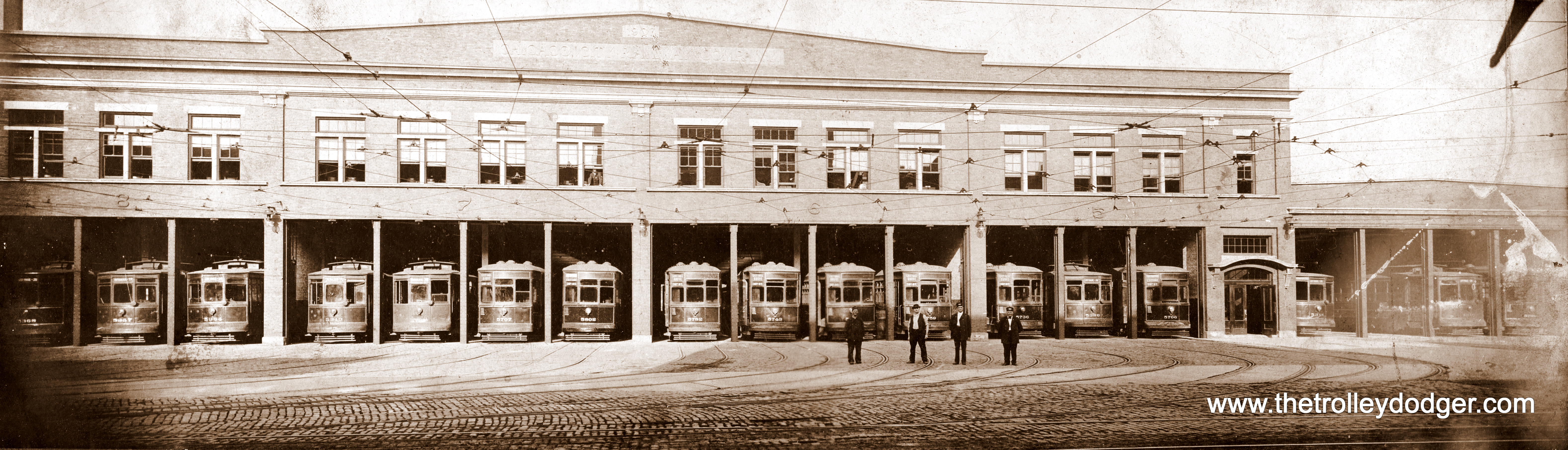
This undated photo shows the station (car house) at Cottage Grove and 38th. It is undated, but the newest car shown here was built in 1912. So a good guess would be sometime between 1912 and the early 1920s, when streetcars were painted red to make them more visible to motorists. Several cars can be identified in this picture. From left to right, I see 5368, 5357, 5364, 5378, 5707, 5802, 5782, 5743, 5759, 5736, 5386, 5706, and 5348. All are either Brill-American-Kuhlman cars, or Nearsides. Streetcars last ran out of Cottage Grove in 1955, after which the building was demolished.

This undated photo shows the station (car house) at Cottage Grove and 38th. It is undated, but the newest car shown here was built in 1912. So a good guess would be sometime between 1912 and the early 1920s, when streetcars were painted red to make them more visible to motorists. Several cars can be identified in this picture. From left to right, I see 5368, 5357, 5364, 5378, 5707, 5802, 5782, 5743, 5759, 5736, 5386, 5706, and 5348. All are either Brill-American-Kuhlman cars, or Nearsides. Streetcars last ran out of Cottage Grove in 1955, after which the building was demolished.

A close-up of four unidentified men in the photo. Presumably, all worked out of the Cottage Grove station.

A close-up of four unidentified men in the photo. Presumably, all worked out of the Cottage Grove station.

It's April 23, 1939, and Chicago & West Towns cars 140 and 141 are operating on an early Central Electric Railfans' Association fantrip. Car 141, the lone survivor of the fleet, is now restored to operable condition at the Illinois Railway Museum.

It’s April 23, 1939, and Chicago & West Towns cars 140 and 141 are operating on an early Central Electric Railfans’ Association fantrip. Car 141, the lone survivor of the fleet, is now restored to operable condition at the Illinois Railway Museum.


New Site Additions

FYI, these Birney car pictures have been added to Our 150th Post (August 6, 2016):

Fort Collins Municipal Railway "Birney" car 21, at the intersection of Johnson and Mountain Avenues. (Ward Photo)

Fort Collins Municipal Railway “Birney” car 21, at the intersection of Johnson and Mountain Avenues. (Ward Photo)

Restored FCMR 21 as it appeared on May 14, 1995. (Mark D. Meyer Photo)

Restored FCMR 21 as it appeared on May 14, 1995. (Mark D. Meyer Photo)

FCMR 22 on October 26, 1949. Its paint scheme is described as green, red, and aluminum.

FCMR 22 on October 26, 1949. Its paint scheme is described as green, red, and aluminum.

FCMR 25 at the car barn. (Ward Photo)

FCMR 25 at the car barn. (Ward Photo)

Many other cities had Birneys, of course. Here, we see Brantford (Ontario) Municipal Railway car 137 on July 1, 1935. This was ex-Lock Haven, Pa. Electric Railway car #2. (George Slyford Photo)

Many other cities had Birneys, of course. Here, we see Brantford (Ontario) Municipal Railway car 137 on July 1, 1935. This was ex-Lock Haven, Pa. Electric Railway car #2. (George Slyford Photo)

This picture has been added to our post Badger Traction, 2016 (June 14, 2016):

In this mid-1950s view, Village of East Troy Railway freight motor M-15 is shown here in East Troy, Wisconsin, near the power station which now serves as the waiting room for the East Troy Electric Railroad museum operation. It was built by TMER&L in 1920 and is now preserved at the Illinois Railway Museum. (Walter Broschart Photo)

In this mid-1950s view, Village of East Troy Railway freight motor M-15 is shown here in East Troy, Wisconsin, near the power station which now serves as the waiting room for the East Troy Electric Railroad museum operation. It was built by TMER&L in 1920 and is now preserved at the Illinois Railway Museum. (Walter Broschart Photo)

We have added this one to The “Other” Penn Central (May 29, 2016):

Montreal Tramways had four of these unique observation cars in their fleet, which were used for sightseeing tours. Here, car #3 is at St. Joseph's Shrine on August 14, 1948. All four cars have been preserved, and car 3 is now at Exporail, the Canadian Railway Museum. A few years ago, I rode the very similar car #2 at the Seashore Trolley Museum.

Montreal Tramways had four of these unique observation cars in their fleet, which were used for sightseeing tours. Here, car #3 is at St. Joseph’s Shrine on August 14, 1948. All four cars have been preserved, and car 3 is now at Exporail, the Canadian Railway Museum. A few years ago, I rode the very similar car #2 at the Seashore Trolley Museum.

These pictures have been added to Red Arrow in West Chester (September 13, 2016):

This picture shows Red Arrow Brilliner 8 and an older car at the end of the Ardmore branch on May 15, 1949. It looks like the older car is in fantrip service, while the Brilliner is the regular service car ahead of it. The Ardmore branch was replaced by buses in 1966.

This picture shows Red Arrow Brilliner 8 and an older car at the end of the Ardmore branch on May 15, 1949. It looks like the older car is in fantrip service, while the Brilliner is the regular service car ahead of it. The Ardmore branch was replaced by buses in 1966.

Here, Red Arrow Brill Master Unit 86 is the regular service car at the end of the line in West Chester, with the older fantrip car behind it. Again, the date is May 15, 1949.

Here, Red Arrow Brill Master Unit 86 is the regular service car at the end of the line in West Chester, with the older fantrip car behind it. Again, the date is May 15, 1949.

The photo caption reads, "Two car streamline train arriving at Norristown, looking up from R. R. tracks." The date is May 12, 1935, meaning these "Bullet" cars were just a few years old.

The photo caption reads, “Two car streamline train arriving at Norristown, looking up from R. R. tracks.” The date is May 12, 1935, meaning these “Bullet” cars were just a few years old.

This picture was added to Chicago’s Pre-PCCs (May 5, 2015):

Baltimore Transit Company car 6105, shown here on route 15 - Ostend St., is one of the last modern streetcars built before PCCs took over the market. The sign on front says that September 7 will be the last day for 6 hour local rides. Perhaps that can help date the picture.

Baltimore Transit Company car 6105, shown here on route 15 – Ostend St., is one of the last modern streetcars built before PCCs took over the market. The sign on front says that September 7 will be the last day for 6 hour local rides. Perhaps that can help date the picture.


Bonus Pictures

The Lackawanna & Wyoming Valley (aka the Laurel Line) was a Scranton-area interurban powered by third rail, much as the Chicago, Aurora & Elgin was. Here, we see coach #37 in Scranton on September 9, 1950. The line quit at the end of 1952. There were no takers for these cars and all were scrapped. It has been suggested that perhaps CA&E might have benefited from buying some of these cars, although it does seem they were too long for tight turns on the Chicago "L". However, I do not know if this would have prevented them from running on the CA&E after the system was cut back to Forest Park. In any case, CA&E had previously reduced the length of other cars purchased from the Baltimore & Annapolis in 1938. What was missing in 1953, apparently, was a willingness to continue trying to operate.

The Lackawanna & Wyoming Valley (aka the Laurel Line) was a Scranton-area interurban powered by third rail, much as the Chicago, Aurora & Elgin was. Here, we see coach #37 in Scranton on September 9, 1950. The line quit at the end of 1952. There were no takers for these cars and all were scrapped. It has been suggested that perhaps CA&E might have benefited from buying some of these cars, although it does seem they were too long for tight turns on the Chicago “L”. However, I do not know if this would have prevented them from running on the CA&E after the system was cut back to Forest Park. In any case, CA&E had previously reduced the length of other cars purchased from the Baltimore & Annapolis in 1938. What was missing in 1953, apparently, was a willingness to continue trying to operate.

The Hagerstown & Frederick was a Maryland interurban in sparsely populated rural areas, a veritable real-life "Toonerville Trolley." Despite having practically no ridership, it subsisted on freight and somehow managed to survive into the mid-1950s. Here, we see freight motor #5 in Frederick, Maryland on April 11, 1954. (Gene Connelly Photo)

The Hagerstown & Frederick was a Maryland interurban in sparsely populated rural areas, a veritable real-life “Toonerville Trolley.” Despite having practically no ridership, it subsisted on freight and somehow managed to survive into the mid-1950s. Here, we see freight motor #5 in Frederick, Maryland on April 11, 1954. (Gene Connelly Photo)

In some sense, the Charles City Western in Iowa was comparable to the Hagerstown & Frederick, in that it had sparse ridership, yet managed to survive into the 1950s with freight. Here we see combine 50 in March 1937. Don's Rail Photos notes, "50 was built by McGuire-Cummings in 1915. It became Iowa Terminal 101 in December 1964. It was sent to Mount Pleasant and restored as CCW 50. It was then sent to Boone & Scenic Valley RR." Vintage audio of the Charles City Western in operation can be heard on Railroad Record Club disc #28, which is available on compact disc via our Online Store.

In some sense, the Charles City Western in Iowa was comparable to the Hagerstown & Frederick, in that it had sparse ridership, yet managed to survive into the 1950s with freight. Here we see combine 50 in March 1937. Don’s Rail Photos notes, “50 was built by McGuire-Cummings in 1915. It became Iowa Terminal 101 in December 1964. It was sent to Mount Pleasant and restored as CCW 50. It was then sent to Boone & Scenic Valley RR.” Vintage audio of the Charles City Western in operation can be heard on Railroad Record Club disc #28, which is available on compact disc via our Online Store.

The Omaha & Council Bluffs Street Railway operated between Nebraska and Iowa. Here, car 814 is shown in Council Bluffs in September 1936, unloading passengers next to a natty-looking 1935 V8 Ford Sedan Delivery, advertising Old gold cigarettes. I assume this car was built by O&CB in 1908 and was rebuilt in 1932, possibly to convert it to one-man service. If so, riders would board at the rear and pay as they left through the front. Note the "people catcher" device at front.

The Omaha & Council Bluffs Street Railway operated between Nebraska and Iowa. Here, car 814 is shown in Council Bluffs in September 1936, unloading passengers next to a natty-looking 1935 V8 Ford Sedan Delivery, advertising Old gold cigarettes. I assume this car was built by O&CB in 1908 and was rebuilt in 1932, possibly to convert it to one-man service. If so, riders would board at the rear and pay as they left through the front. Note the “people catcher” device at front.


Recent Correspondence

Virginia Sammis writes:

I wrote you once before, and I was hoping you might be able to help me again. I am still trying to find CSL employee photos. I had a researcher in Chicago spend some hours looking at the CHM archives of the CSL newsletter and she did find Gustav Johnson’s brief obituary in there for 1946. But very few photos. Do you know of any other place I might find photos of employees of CSL?

(She had written some months ago, looking for information on Gustav Johnson, who emigrated to America around 1880, worked for the Chicago Surface Lines, and died in 1946.)

The employee newsletter would have been the best bet. However, I do know a genealogist, and I can ask her to see what she can find out.

In the CTA era, which started in October 1947, the newsletter ran more pictures of retirees, of which there were many. However, we are talking about several thousands of people working there at any one given time, so the odds of finding one person are not good.

If you know which routes, or which car houses (aka “stations”) he might have worked at, that would help.

I just got a picture (see elsewhere in this post) showing four guys standing outside the car barn at Cottage Grove and 38th, taken in the early 20th century, but have no way of knowing who the people in the picture are.

I will run your request in my blog, and see what other people might suggest.

Ms. Sammis replied:

This is what his obituary said:
“Gustave Johnsen, 84, motorman from Devon, died 11-22-46, after along illness. He had been with the company for 35 years.”

It was actually spelled Gustav Johnson. Does that mean that he would have reported to work every day at the Devon Station at 6454 N. Clark St/Devon St.? Also, can you confirm that a “motorman” was the engineer on the trolley and the “conductor” collected the fares?

Thank you for your help David. I am determined to find a photograph of Gustav SOMEWHERE!

Yes, that means he worked out of the Devon station, or car house. And yes, the motorman operated the streetcar, while the conductor collected the fares. We have run lots of pictures in previous posts showing streetcars at or near Devon station. You can find those by typing Devon into the search window at the top of this page.

Thanks.

-David Sadowski


Our resident South Side expert M. E. writes:

Your latest post, Recent Finds Part 2, includes a photo of the carbarn at 38th and Cottage Grove. This photo obviates my wild guess that perhaps the photo ostensibly of the 69th and Ashland carbarn instead might have been the 38th & Cottage barn. (See our previous post Recent Finds, December 2, 2016.)

In the new photo, https://thetrolleydodger.com/wp-content/uploads/2016/12/dave511.jpg , the bay numbers under the Chicago City Railway logo are 7 and 6. In the previous photo, https://thetrolleydodger.com/wp-content/uploads/2016/12/dave4891.jpg , the bay number under the logo is 4.

This observation, together with the Campbell barn label (Campbell is nowhere near Cottage Grove), cements my opinion that you are correct saying the previous photo is of the 69th and Ashland carbarn.

None of which solves the mysteries of why there are so many 4 Cottage Grove cars at the 69th and Ashland barn, and how they got there from Cottage Grove.

It’s a mystery, alright… hopefully one we will eventually clear up, thanks!


Kenneth Gear writes:

Hi David. I’ve been falling behind on my reading lately and just today read the latest Trolley Dodger “Recent Finds 2”.

I was very interested in the photo of Hagerstown & Frederick Railway freight motor # 5.

Back in 2008 while chasing and photographing the Maryland Midland RR train UBHF from Union Bridge to Highfield, I was surprised to find H&F freight motor #5 displayed at the former site of the H&F Thurmont Station along Main Street.

It was apparently under going restoration at the time. The building in the background is a former H&F electric sub station. I’m not sure how this restoration has progressed in the ensuing years, but here is the photo I took back on March 9, 2008:

hagerstown-and-frederrick-rr-freight-motor-at-power-sub-station-thurmont-md-3-9-08

Thanks! Good to know this car was saved. Here’s what Don’s Rail Photos says: “5 was built by H&F in 1920. It was retired in 1955 and went to Shade Gap Electric Ry. It then was returned to home by H&F Ry Historical Society.”

About the line in general, Don Ross adds:

“It’s hard to describe the H&F since it seems to be more of a country trolley than an interurban line. Yet they did operate freight service and covered some 76 miles of line in western Maryland. It was the last passenger interurban east of Chicago. The H&F was a consolidation of several lines dating back to 1902. They joined together in 1913. Abandonments began in 1932. In 1938 the main line was cut so that there were two separate sections, one at Hagerstown, and the other at Frederick. The Hagerstown line finally quit in 1947, but the Frederick to Thurmont passenger service lasted until February 20, 1954. Freight service was later dieselized but lasted only until 1958.”

I checked and it looks like the car went from the Rockhill Trolley Museum to Thurmont in 2006. The car is now owned by the City and there are trucks under the body.

As for the Shade Gap name, here is how the Wikipedia explains it:

The museum operates what has been historically referred to as the Shade Gap Electric Railway to demonstrate the operable pieces in its collection. “Shade Gap” refers to the name of a branch of the East Broad Top Railroad, from whom the museum leases it property.

-David Sadowski


Charles Turek writes:

re: Recent Finds, Part 2 – image dave513.jpg

Having grown up at 27th & Harvey in Berwyn, IL, effective walking distance from Austin/Cermak in the 1950s, I can confirm the station is, indeed, Austin on the Douglas Park line. The distinctive chain gate, which was atypical for the line, was my first clue. I used to find this gate fascinating to watch and enjoyed hearing the pulleys (in the towers on each side of Austin) crank it up and down. This was a very busy area in those days and the chain gate was effective in stopping traffic in both lanes that would otherwise attempt to get past standard gates to make the signals at Cermak Road. Nonetheless, the gateman who holed up in the little house in front of the station was still necessary.

Love your web pages and visit them often.


Stained Glass from New York’s Third Avenue El

p1070344

p1070342

FYI, to raise money to help fund the original research we do on this site, we are selling two unique artifacts— decorative stained glass, circa 1878, from stations on the old IRT Third Avenue El in New York, which was torn down in 1955. We purchased these several years ago from a noted New York collector.

You can check out our eBay auction here. This may be your only opportunity to own a true piece of history from that fabled line, which has yet to be replaced more than 60 years after it was abandoned.

Thanks.


New Book Project

We are now working on a new paperback book Chicago Trolleys, that we expect will be published in 2017. Original research does cost money, so please consider making a donation to cover our costs. We will keep you updated as we progress, and thank you in advance for your help.


Help Support The Trolley Dodger

gh1

This is our 170th post, and we are gradually creating a body of work and an online resource for the benefit of all railfans, everywhere. To date, we have received over 228,000 page views, for which we are very grateful.

You can help us continue our original transit research by checking out the fine products in our Online Store. You can make a contribution there as well.

As we have said before, “If you buy here, we will be here.”

We thank you for your support.

Guy Wicksall and His Films

South Shore Line car 102 in downtown Chicago.

South Shore Line car 102 in downtown Chicago.

You probably have not ever heard of Guy J. Wicksall before, but he has been shooting movies of trains for a long time now. He recently had some of his rare 16mm color films converted to video. By special arrangement with the photographer, we are now able to offer our readers The Guy Wicksall Traction Collection (1963-1975) on DVD (details below, at the end of this post).

All the photos in this post are screen grabs from the Wicksall Collection. We figured the best way to introduce these films to you would be to go to the source, and discuss them with Guy himself.

Here is an edited transcript of my conversation with the man behind the movies from October 10, 2016.  Mr. Wicksall is now 81 years old and lives in the Finger Lakes area in upstate New York.

-David Sadowski


How long have you been making movies?

I started making movies in 1960. I have right now, some 59 DVDs. If I could ever get the money together, I have enough material for another 30 or 40.

That’s pretty incredible. What subject matter would most of them be?

Most of it is anything that ran on steel rails (laughs), there are a few exceptions, I have a few of the aerial cable ways in Switzerland. I have a real short piece, a 15-minute piece, on the Minnesota Transportation Museum trolleys.

And what percentage of your film footage would you say is devoted to electric traction?

Oh, probably 5 percent, maybe as much as 10 when you count in the European stuff.

And was it all 16mm that you shot?

Not all of it. The first few years I was shooting 8mm. When Kodak came out with their Super 8, my local photo shop loaned me a sample of Kodak Super 8 film, and I looked at that, and compared it with the 8mm, and decided that the 8mm wasn’t suitable, and the Super 8 wasn’t any better, so I changed at that time to 16mm.

(Editor’s note: Kodak introduced Super 8 in 1965, but some of Mr. Wicksall’s 16mm films date back to 1963. You can read more about these film formats here.)

And how much larger is the 16mm film area that the 8mm?

Oh, well, it’s at least four times the area.

That makes a tremendous difference as far as the quality is concerned. I’m very pleased with the excellent quality of the films that you made, because I am used to seeing videos made up from 8mm, where the picture is so fuzzy that if you made a screen shot of it, you’d hardly know what it was a picture of.

Right. I know what you mean. And, talking with people, it seems that the Super 8 got worse as the years went by. They tried to push the speed, it hurt the quality of the image.

Was it Kodachrome or Ektachrome, or both?

Kodachrome.

What was the film speed back then?

Well, I started out with 25 ASA, and I think I got to 64 at some point.

And what kind of film was available for 16mm? Was it also Kodachrome?

Yes. I always shot Kodachrome on the 16mm.

And then, at some point, did you switch over to using video?

Yes, I got pushed into it by the cost, when I started shooting 16 it was about $9 for a 50-foot reel, and it went to $70, and I just couldn’t stand it anymore. I had to go to something that was a little more reasonable. Unfortunately, I lost a little quality on the early Hi8 camera I used.

Sure. But now they keep coming up with new formats for the video, they’ve got this new one called 4k, which is the best one yet.

Well, the big problem is they keep changing formats so quickly. Now I’ve had three different video cameras with three different setups. A couple used Hi8, and the last one is digital video on SD cards, and things keep changing.

Regarding some of the film on the two traction discs, I could ask you a few questions. You made some business trips to Chicago, is that how you ended up making some films around Chicago?

Some of it was business trips to Chicago, and some of it was just plain vacation. I didn’t get a lot of business trips. The stuff shot in New York was on business trips, and some of the stuff shot in Chicago was on business trips, but not all of it.

In ’63 or so, you took some film on the “L”. It looked like you were at what they now call Adams and Wabash station, watching some trains come around into the station, and you’ve got some footage where you rode out on the Lake Street “L” to Oak Park.

Right.

That was the year after they had elevated that one section, the outer end of the Lake Street “L”, it ran on the ground for 2 ½ miles on the west end, and I saw that you had a glimpse there showing the track was still in place, even though you were up on the embankment. But it looks like they had paved over the grade crossings.

I was wondering a little bit what that track was.

Until October 28, 1962, the west end of the Lake Street “L” ran on the ground, west of the Laramie station. There was a ramp that went down to ground level and it ran parallel to the Chicago and North Western embankment there, using overhead wire. They had trolley poles on the trains, and clearances were very tight. There were something like 22 grade crossings, blind crossings, where you could easily have an accident where a vehicle would run under that viaduct and run right into a train. It was kind of dangerous. These were manually operated gates, so there was a lot of manpower involved.

The CTA wanted to reduce expenses, improve the running time, and safety, so they made a deal with the Chicago and North Western in the 1950s to relocate the tracks onto the embankment, which had probably been put up sometime around 1910. It was a big project which involved a variety of different government bodies, the Village of Oak Park, the City of Chicago, the Chicago Transit Authority, the State of Illinois, and it was a “win-win” situation, because everybody benefited from the relocation of the tracks. When they got rid of those tracks, that made the street wider, and it allowed for more parking, and of course there were a lot of improvements based on the quicker running time for the trains, and since it was grade separated, there weren’t going to be any more accidents with pedestrians and vehicles.

I grew up in the area around Oak Park, so we rode those trains many times when they ran on the ground. The clearances were so tight that they couldn’t run the 6000-series “L” cars, which had curved sides, and just that little bit of extra room was enough that they couldn’t run those cars on that part of the line. I noticed also that you had taken some film showing trains going up the ramp out of the old Hamlin Yard, which was near Lake and Pulaski.

You remind me of what was in that video. A lot of it, I’ve forgotten. Of course, it’s been a few years, I’ve had some time to forget stuff.

Yeah, for car storage then, they really didn’t have a proper yard as such at the end of the line, which was in Forest Park, just west of Harlem Avenue. For car storage, they had this Hamlin Yard, across the street from West Shops, used by the Surface Lines. They had streetcar trackage running in and out of there, where they had overhead wire. They also had a third track on the Lake Street “L” where they stored some cars. You had some great shots of all of that.

And then you had shots of the South Shore Line and the Illinois Central Electric, showing the old IC cars from 1926, plus the Highliners, the bi-levels that were replacing them back in the ’70s.

Yes, yes.

All great stuff. Those first generation Highliners have now been retired, just within the last year or so, and they’ve been replaced by something very similar, but more modern.

That’s the thing about a lot of this railfanning. I’ve been at it long enough that sometimes, the things have been replaced, and sometimes the replacements have been replaced.

Right. And on the South Shore Line, all those old cars have been replaced. I think that many of them have been saved, by many railway museums, and there are a few of them that actually operate some, like the Illinois Railway Museum, and the East Troy Electric Railroad in Wisconsin. I did ride those cars a few times in their twilight years. Those cars were replaced by some Japanese-made vehicles around 1981, and now they even have some bi-levels of their own. They piggybacked on an order of cars for the Metra Electric, which runs the service now that used to be the Illinois Central suburban. They just use them during weekday rush hours. There is even now some talk of double-tracking the rest of the line out to South Bend.

It’s been a lot of changes.

Your first shots there of the South Shore Line were taken in 1971 or so. Up until the summer of 1970, they ran all the way into downtown South Bend. They had some street running there, which they cut back to the outskirts of town. Since that time, they built some new track to a nearby airport. There’s always been talk about grade separating the track that runs on the streets through Michigan City, but they haven’t done that yet. They keep arguing over which route they would use. So, at the moment, all those South Shore trains run right down the street through Michigan City, like they have for many, many decades.

You had some great footage in other places too, like in San Francisco, amazing shots of all that wonderful old equipment. Fortunately, they still have some old equipment running, on those historic lines they’ve come up with, and then Red Arrow, some great footage there of the Red Arrow Lines. Do you have some memories of those visits?

Oh yes. I have some memories, but I don’t have the details. I have to watch the videos to see what I saw.

There’s a lot out east, New York and New Jersey.

I’ve got a lot of, oh dear, Conrail. I was looking here, I’ve got Minnesota Transportation Museum, September ’74, that’s 11 minutes. There’s another one that’s about 15 minutes, that shows the same stuff years later.

Some of the east coast stuff would be interesting to many people. There’s a friend of mine who lives in New Jersey. I’m sure he would love to see your footage of the Gladstone Branch, the Erie Lackawanna. Some of that reminds me of, the old cars there, reminds me a lot of the ones that were used on the Illinois Central.

Trains have changed so much in the last 50 years.

Sure, those lines are running too, but they’re all NJ Transit.

Now, the Como-Harriet trolley (Minneapolis-St. Paul), I have the one reel from 1974, and another one that shows the same thing in 1998, with expansion and so on. Anyway, I’ve got these two, which add up to another oh, 26 minutes. They might be of some small interest too.

Oh, sure.

I used to show my movies to the Syracuse chapter of the NRHS. I wore out a projector doing that. Now I’ve gotta get off the phone. My wife is calling me for supper.

I have no objection to your making copies of these DVDs, and to sell them. I am quite happy with it. My thought is, it does no good sitting on my shelf. I would rather have it spread as widely as possible, and you look like you might be a good person to do that.

It’s been so nice talking to you. We’ll be in touch. Thanks so much. Take care.

You’re welcome.


The original Illinois Central Electric trains, which were built in 1926.

The original Illinois Central Electric trains, which were built in 1926.

4000s pass the old Tower 12 at Wabash and Van Buren in Chicago's Loop.

4000s pass the old Tower 12 at Wabash and Van Buren in Chicago’s Loop.

A Lake train of 4000s approaches Adams and Wabash in 1963, when the Loop was single-directional.

A Lake train of 4000s approaches Adams and Wabash in 1963, when the Loop was single-directional.

A two-car CTA Ravenswood train approaches Adams and Wabash in 1963.

A two-car CTA Ravenswood train approaches Adams and Wabash in 1963.

In 1963, the old Lake Street Transfer station had not yet been torn down. It was removed the following year. Logan Square and Humboldt Park trains stopped running on the other level here in 1951.

In 1963, the old Lake Street Transfer station had not yet been torn down. It was removed the following year. Logan Square and Humboldt Park trains stopped running on the other level here in 1951.

A quick glimpse of CTA trolley bus 9649.

A quick glimpse of CTA trolley bus 9649.

A Milwaukee Road train in the early 1960s. Not sure if this is inter-city or commuter service. Bi-levels were being phased in on the MR commuter lines. David Vartanoff adds: "The Milw Road train is a commuter run. By the time he was filming, intercity cars had been repainted to UP as the E-7 was."

A Milwaukee Road train in the early 1960s. Not sure if this is inter-city or commuter service. Bi-levels were being phased in on the MR commuter lines. David Vartanoff adds: “The Milw Road train is a commuter run. By the time he was filming, intercity cars had been repainted to UP as the E-7 was.”

The photographer was on a northbound Evanston train that was pacing a Howard train of 6000s.

The photographer was on a northbound Evanston train that was pacing a Howard train of 6000s.

4000s pass the old Tower 18 in Chicago's Loop. It was torn down and relocated in 1969 so that Lake Street trains could go directly east at this point, when that line was paired with the new Dan Ryan service.

4000s pass the old Tower 18 in Chicago’s Loop. It was torn down and relocated in 1969 so that Lake Street trains could go directly east at this point, when that line was paired with the new Dan Ryan service.

CTA single-car units under wire in Evanston in 1963.

CTA single-car units under wire in Evanston in 1963.

A Pennsy GG1.

A Pennsy GG1.

A New Haven train emerges from a tunnel in Manhattan.

A New Haven train emerges from a tunnel in Manhattan.

A New York rapid transit train on the 7 line in 1964.

A New York rapid transit train on the 7 line in 1964.

The New York Central in Manhattan.

The New York Central in Manhattan.

To this day, San Francisco operates trolley buses as well as PCCs.

To this day, San Francisco operates trolley buses as well as PCCs.

SF Muni PCC 1021 and a 1955-57 two-seater Thunderbird roadster.

SF Muni PCC 1021 and a 1955-57 two-seater Thunderbird roadster.

SF Muni double-end PCC 1015.

SF Muni double-end PCC 1015.

A San Francisco cable car in the late 1960s.

A San Francisco cable car in the late 1960s.

Red Arrow Strafford car 163 on a curve.

Red Arrow Strafford car 163 on a curve.

Red Arrow Strafford car 164.

Red Arrow Strafford car 164.

A Strafford car with a Liberty Liner (ex-North Shore Line Electroliner) behind it at 69th Street.

A Strafford car with a Liberty Liner (ex-North Shore Line Electroliner) behind it at 69th Street.

A Bullet car on the Norristown High-Speed Line.

A Bullet car on the Norristown High-Speed Line.

A train of Philadelphia "Almond Joys" at 69th Street Terminal.

A train of Philadelphia “Almond Joys” at 69th Street Terminal.

St. Louis-built double-end car 16 (not an official PCC, although it certainly looks like one) on the Red Arrow.

St. Louis-built double-end car 16 (not an official PCC, although it certainly looks like one) on the Red Arrow.

Red Arrow Brilliner #1 at 69th Street.

Red Arrow Brilliner #1 at 69th Street.

David Vartanoff: "PRR never had RDCs. That is an NYC (New York Central) car."

David Vartanoff: “PRR never had RDCs. That is an NYC (New York Central) car.”

David Vartanoff: "The PRR EMU you show is NYC (New York Central). The under running third rail is the clue."

David Vartanoff: “The PRR EMU you show is NYC (New York Central). The under running third rail is the clue.”

Erie Lackawanna.

Erie Lackawanna.

A Penn Central train.

A Penn Central train.

An Erie Lackawanna train in New Jersey.

An Erie Lackawanna train in New Jersey.

700-series electric freight locos.

700-series electric freight locos.

The South Shore Line shops in Michigan City.

The South Shore Line shops in Michigan City.

The South Shore Line in Indiana.

The South Shore Line in Indiana.

South Shore Line car 108 in Chicago.

South Shore Line car 108 in Chicago.

An Illinois Central bi-level whose end has not yet been repainted in brighter colors.

An Illinois Central bi-level whose end has not yet been repainted in brighter colors.

IC Highliners downtown.

IC Highliners downtown.

Illinois Central bi-levels in Chicago, with the old Central Station in the background.

Illinois Central bi-levels in Chicago, with the old Central Station in the background.


Recent Correspondence

Father Thomas Nagle writes:

Hello…hope you can point me in the right direction. I remember seeing CTA wreck wagons as a kid and was always fascinated by them. They looked like CFD rigs to me with Mars lights, gongs and sirens and even red and green headlights. Are there any photos of them available anywhere? I’ve googled them and come up empty. Thank you.

Fr Thomas Nangle
CPD chaplain retired

Perhaps our readers may have some pictures, thanks!

One of our regular readers writes:

Why didn’t the CSL/CTA ever install Post War PCC cars on Ashland Avenue? The street was as wide as Western Avenue from the north end to the south end. All that would have been necessary would have been the construction of an off street loop (such as Western and Berwyn) at 95th Street and a connecting track off of northbound Clark to southbound Southport at the north terminal.

PS: Is it possible that Ashland and Milwaukee might have been slated for PCCs if they had ordered 1,000 as had been originally thought?

In 1937, when the “Green Book” plan was issued, the City of Chicago envisioned replacing half the existing streetcar fleet with PCCs, and the other half with buses (some of which would have been trolley buses). But the report noted that at some future date, buses might be able to handle all the traffic.

Half the fleet, at that time, would have been something more like 1,500 PCC cars. That the number was soon reduced to 1,000 probably reflects the continuing trend toward buses.

Milwaukee would have to be a candidate for PCCs, since one PCC (4051) was operated there in 1940-41, on a test basis with the altered door configuration that CSL adopted for the postwar cars.

On the other hand, arguing against that is the plan, formulated in 1939, for the Dearborn-Milwaukee subway. Only the outer portion of Milwaukee truly made sense to run PCCs if you were going to have a greatly improved, more direct rapid transit service running in a subway on Milwaukee. PCCs would have done well in feeder service between the Imlay Loop at the city limits and the Logan Square terminal.

Offhand, I don’t know where Ashland would stack up in a list of the heaviest lines. But certainly the prevailing wisdom at CSL in the 1930s and 40s was to use streetcars for the heaviest lines, trolley buses for the medium ones, and gas or diesel buses for the rest. I assume that Ashland had plenty enough ridership to be considered for PCCs, though, and it would have been an excellent choice.

Ridership in the WWII era was heavy enough that CSL and the City planned to assign the 600 postwar PCCs to just four major lines. But by the time the deliveries were complete, this had been expanded to six lines, since ridership was declining.

What we don’t know is how strategic these assignments were, with the thought of creating an ongoing streetcar system for Chicago that could have continued into the future. One thought is that perhaps the CTA and the City felt that they had to spread the new cars around, so that more neighborhoods would benefit from the new service.

If that was a consideration, it would argue against Ashland, since it ran parallel to Western and went to many of the same parts of town. It would argue in favor of choosing a street like 63rd, which ran east-west on the south side and therefore served different neighborhoods.

In any event, by 1947 the CTA, even as it was still taking deliveries on the postwar order, seems to have planned for the gradual phasing out of streetcars, even the PCC ones. The 1947 CTA modernization plan (which you can read in my E-book Chicago’s PCC Streetcars: The Rest of the Story), which covered the years 1946-1955, anticipated having only three streetcar lines left by 1955, which is pretty much what actually did happen. Presumably, they would have phased those out in the years following 1955, if another such plan had been published.

Furthermore, it was not always possible for CTA to put turnback loops where they wanted them. The area around 95th and Ashland was built up and who knows what locations would have been available.

There were plans to build a loop for the 36-Broadway at 115th that never materialized, due to neighborhood opposition. And the Grand-Nordica trolley bus loop for route 65 – Grand could only be put a couple blocks away from Harlem, which would have been much the preferred location.

Keep those cards and letters coming in, folks. You can always reach us at:

thetrolleydodger@gmail.com


New From Trolley Dodger Press

VIDEOS ON DVD:

South Shore Line car 102 in downtown Chicago.

South Shore Line car 102 in downtown Chicago.

The Guy Wicksall Traction Collection (1963-1975)

Our latest release, by special arrangement with Guy Wicksall, features video transfers of rare, high quality 16mm color films of electric railroads taken across the country between 1963 and 1975. These are much better quality than the more typical 8mm films railfans used back then. If you like classic railfan videos, you are sure to enjoy this collection, which features narration by the photographer. Mr. Wicksall receives a royalty on each disc sold.

Disc 1: 38 Chicago and New York Commuter Trains, 1963-1964 (18:24)
Includes Illinois Central Electric, South Shore Line, Chicago Transit Authority “L” trains in the Loop, on Lake Street, Howard, and Evanston lines, Chicago & North Western and Milwaukee Road commuters, Pennsylvania Railroad, New York Central, Long Island Rail Road, New Haven, and New York elevated trains.

Disc 2: 48 Commuter Trains, 1968-1975 (57:22)
Includes San Francisco Municipal Railway (Muni) PCCs (some double-ended), trolley buses, and cable cars, Philadelphia Suburban (Red Arrow Lines), including Straffords and Bullets), Penn Central, New Haven, Erie Lackawanna, South Shore Line, Illinois Central Electric, and more.

Total time – 75:46

# of Discs – 2
Price: $24.95


Help Support The Trolley Dodger

gh1

This is our 161st post, and we are gradually creating a body of work and an online resource for the benefit of all railfans, everywhere. To date, we have received over 206,000 page views, for which we are very grateful.

You can help us continue our original transit research by checking out the fine products in our Online Store. You can make a contribution there as well.

As we have said before, “If you buy here, we will be here.”

We thank you for your support.

Red Arrow in West Chester

Double-ended Red Arrow 13 at the end of the line in West Chester (Gay and High Streets) circa 1954.

Double-ended Red Arrow 13 at the end of the line in West Chester (Gay and High Streets) circa 1954.

The same location today.

The same location today.

The Red Arrow Lines in Philadelphia’s western suburbs are a real example of perseverance. Privately owned and operated until 1970, and now by SEPTA (Southeastern Pennsylvania Transportation Authority), Red Arrow (or, as it was known for some time, the Philadelphia Suburban Transportation Company) can trace its origins back to 1848.

Only two lines (Media and Sharon Hill) remain of its vaunted interurban network. The smaller Ardmore trolley was replaced by bus at the end of 1966, with its private right-of-way portion converted into a dedicated busway.

Today, we celebrate the Red Arrow with some classic pictures, mainly featuring its longest line, between 69th Street Terminal in Upper Darby and West Chester. This is a distance of some 19 miles end to end along West Chester Pike.

The West Chester line was to some degree a victim of its own success. It helped stimulate growth in the region to such an extent that West Chester Pike was widened in 1954, displacing the trolley. It was replaced by buses.

The Red Arrow story is made all the more remarkable when you consider that much of this line was single-track, and still does not provide a one-seat ride into downtown Philadelphia. Riders must change trains at 69th Street Terminal and ride the Market-Frankford subway into town.

Lack of a one-seat ride into Chicago’s Loop is widely credited with killing off the Chicago, Aurora & Elgin interurban, which ended passenger service in 1957. But Red Arrow has never had a one-seat ride and its service continues to this day.

Much credit for its survival must go to Merritt H. Taylor, Jr. (1922-2010), who guided it into the modern era, and finally had little choice but to sell out to SEPTA. Red Arrow was one of the very last holdouts against public ownership and set a very high standard for the industry.

From what I have heard, Merritt Taylor was something of a “closet railfan,” who learned to operate the cars as a youth and sometimes took them out for late-night “joy rides” to West Chester.

In 1954, Philadelphia Suburban Transportation purchased the Philadelphia and Western, which operated the Norristown High-Speed Line. This 13 1/2 mile long, grade-separated third-rail route also continues today under SEPTA.

Until 1956, the Norristown line included a branch to Strafford, which gave name to the famous Strafford cars that ran alongside the more well-known Bullets. Today, SEPTA is working on plans to extend the High-speed Line to King of Prussia.

For the longest time, Red Arrow favored J. G. Brill railcars, which were built in nearby Philadelphia, including Master Units and Brilliners in the 1930s and 40s. But with that firm’s exit from the market in the early 1940s, there was one order of double-ended cars circa 1949, made by St. Louis Car Company.

Although those cars had styling very much like PCC streetcars, they had conventional interurban running gear and are thus not technically considered “true” PCCs. Service on the Media and Sharon Hill lines is handled by 29 modern Kawasaki cars, built in 1981.

We hope that you will enjoy this trip down memory lane in the Keystone State. Meanwhile, back here in Chicago, one can only wonder what fate might have awaited the Chicago, Aurora & Elgin if it had been run by Merritt Taylor, Jr. in the 1950s. For all we know, it might still be with us in some form.

As for West Chester, SEPTA ran commuter rail service there until 1986, when it was cut back due to deteriorating track conditions. There are hopes for restoring service by the year 2040. Meanwhile, the bus service that replaced the West Chester trolley remains popular and convenient.

You can read my 2013 report on the Media trolley centennial fantrip here. (Videos are here.)

-David Sadowski

PS- You can read an interesting report on the Ardmore line and its busway successor here.

Red Arrow 78 and 80 in 1959. These were Brill-built “Master Units.” Garrett Patterson adds, “It might be pointed out with the second image, that both 78 & 80 operate to this day, #78 at PTM in Washington, PA, and #80 at Steamtown.”

Red Arrow 17. Michael T. Greene writes, “The first picture of Red Arrow 17 was taken in Media, probably at the end of the line, sometime starting in 1956, based on the 1956 Plymouth parked (or passing) by the trolley.” Kenneth Achtert: “The shot of #17 is at the end of the line in Media (Orange St.) as evidenced by the two poles raised as the operator is in the process of changing ends.”

350 W. State Street in Media, the end of the Media light rail line.

350 W. State Street in Media, the end of the Media light rail line.

Near 69th Street Terminal. This is where the Ardore and West Chester lines (left) converged with Media and Sharon Hill (right). Over the years, the tracks to the left have been cut back to just a few short blocks where cars can be stored.

Near 69th Street Terminal. This is where the Ardore and West Chester lines (left) converged with Media and Sharon Hill (right). Over the years, the tracks to the left have been cut back to just a few short blocks where cars can be stored.

Brilliner 6 in Ardmore service near 69th Street Terminal circa 1954.

Brilliner 6 in Ardmore service near 69th Street Terminal circa 1954.

Near 69th Street Terminal.

Near 69th Street Terminal.

A Brilliner near 69th Street Terminal.

A Brilliner near 69th Street Terminal.

A West Chester car at 63rd and Market in 1905. (Robert Foley, Jr. Collection)

A West Chester car at 63rd and Market in 1905. (Robert Foley, Jr. Collection)

Car 12 at a passing siding along West Chester Pike circa 1954.

Car 12 at a passing siding along West Chester Pike circa 1954.

Near 69th Street Terminal circa 1954.

Near 69th Street Terminal circa 1954.

Car 12 at a passing siding along West Chester Pike circa 1954.

Car 12 at a passing siding along West Chester Pike circa 1954.

Brilliner 3 at the end of the line in West Chester, circa 1954. This car is an Express. There were many photos taken here over the years, by the W. T. Grant dime store. The line was single track going into town.

Brilliner 3 at the end of the line in West Chester, circa 1954. This car is an Express. There were many photos taken here over the years, by the W. T. Grant dime store. The line was single track going into town.

An outbound car in “side of the road” operation along West Chester Pike, circa 1954. Matt Nawn: “The scene of #22 outbound along West Chester Pike appears to be near Broomall. The homes along this part of West Chester Pike look much the same today. Zooming in on the photo, a former Acme store near the intersection of West Chester Pike and PA Route 320 can be seen in the background. “

The same location today. That certainly appears to be the same house at right. We are looking west on West Chester Pike in Broomall, just east of PA Route 320.

The same location today. That certainly appears to be the same house at right. We are looking west on West Chester Pike in Broomall, just east of PA Route 320.

screen-shot-09-15-16-at-04-07-am-png

Near 69th Street Terminal.

Near 69th Street Terminal.

A Sharon Hill train at 69th Street Terminal, circa 1954. Garrett Patterson: “Sharon Hill Train of Center Doors was most likely a School Tripper servicing Archbishop Pendergast (girls) and Msgr. Bonner (boys) at Lansdowne Ave.” On the other hand, Matt Nawn says, “The two-car train of center door cars is probably a few years too early to be a school tripper to Monsignor Bonner and Archbishop Prendergast High Schools (combined into one school in recent years). These schools did not open until the late 1950s.”

Double-end car 14, a product of St. Louis Car Company, signed for Sharon Hill in the 69th Street Terminal circa 1954. Garrett Patterson: “Where #14 is shown loading at 69th St., the track was paved to street rail condition days before the cessation of West Chester car service for the startup of the W Bus which took its place.”

Caption: 2 car “MU” Train, which operated along with an extra single car behind it on the last rail trip (by MPRA Club) to West Chester, PA., Sunday, June 6, 1954.

Car 12 in August 1952. Garrett Patterson: “Llanerch Car house.” Kenneth Achtert: “That shot of #12 in August 1952 would be at the Llanerch car barn. The street at the top of the hill behind the cars is West Chester Pike, and the car barn structure is to the right out of the frame.” (Arthur B. Johnson Photo)

This postcard, showing the end of the line in West Chester, was mailed in 1907. The view is the opposite of the one shown at the top of this page. Caption: “You might take the early trolley to Atlantic. Think the photo is something worth having, thanks.”

The same view today. That's the Greentree building at left, built around 1930.

The same view today. That’s the Greentree building at left, built around 1930.

Red Arrow 41 on the West Chester line in 1945.

Red Arrow 41 on the West Chester line in 1945.

Cars 14, 20 and 68 at a photo stop along the West Chester line on the June 6, 1954 NRHS fantrip.

Cars 14, 20 and 68 at a photo stop along the West Chester line on the June 6, 1954 NRHS fantrip.

Brill “Master Unit” 78, built in 1932, at the West Chester end of the line on August 24, 1941. This car is now preserved at the Pennsylvania Trolley Museum in Washington, PA.

Car 19 along West Chester Pike. What was once a “side of the road” operation is now part of the road. This long view gives you some idea of the distances involved on this 19-mile line.

Car 17 at a passing siding along West Chester Pike on April 25, 1954.

Car 17 at a passing siding along West Chester Pike on April 25, 1954.

Car 66 (plus one) at Edgemont Siding on the West Chester line.

Car 66 (plus one) at Edgemont Siding on the West Chester line.

Cars 14 and 15 running in multiple unit operation at the West Chester end of the line on June 6, 1954.

Cars 14 and 15 running in multiple unit operation at the West Chester end of the line on June 6, 1954.

Cars 69 and 71 at the West Chester end of the line on June 6, 1954.

Cars 69 and 71 at the West Chester end of the line on June 6, 1954.

Cars 69 and 71 at the West Chester end of the line on June 6, 1954.

Cars 69 and 71 at the West Chester end of the line on June 6, 1954.

Cars 14 and 15 at the West Chester end of the line on June 6, 1954.

Cars 14 and 15 at the West Chester end of the line on June 6, 1954.

Young railfan with a box camera, 62 years ago.

Young railfan with a box camera, 62 years ago.

This picture shows Red Arrow Brilliner 8 and an older car at the end of the Ardmore branch on May 15, 1949. It looks like the older car is in fantrip service, while the Brilliner is the regular service car ahead of it. The Ardmore branch was replaced by buses in 1966.

This picture shows Red Arrow Brilliner 8 and an older car at the end of the Ardmore branch on May 15, 1949. It looks like the older car is in fantrip service, while the Brilliner is the regular service car ahead of it. The Ardmore branch was replaced by buses in 1966.

Here, Red Arrow Brill Master Unit 86 is the regular service car at the end of the line in West Chester, with the older fantrip car behind it. Again, the date is May 15, 1949.

Here, Red Arrow Brill Master Unit 86 is the regular service car at the end of the line in West Chester, with the older fantrip car behind it. Again, the date is May 15, 1949.

Red Arrow 66 and 76 at St. Albans Siding in Newtown Square on June 6, 1954.

Red Arrow 66 and 76 at St. Albans Siding in Newtown Square on June 6, 1954.

Here, we see Red Arrow car 66 heading up a two-car train on May 6, 1962. This is the Clifton-Aldan stop on the Sharon Hill line.

Here, we see Red Arrow car 66 heading up a two-car train on May 6, 1962. This is the Clifton-Aldan stop on the Sharon Hill line.

The same location today.

The same location today.

Red Arrow car 21 on the private right-of-way section of the Ardmore line. Since Ardmore was converted to bus at the end of 1966, this area has been paved over to create a dedicated busway.

Red Arrow car 21 on the private right-of-way section of the Ardmore line. Since Ardmore was converted to bus at the end of 1966, this area has been paved over to create a dedicated busway.

The photo caption reads, "Two car streamline train arriving at Norristown, looking up from R. R. tracks." The date is May 12, 1935, meaning these "Bullet" cars were just a few years old.

The photo caption reads, “Two car streamline train arriving at Norristown, looking up from R. R. tracks.” The date is May 12, 1935, meaning these “Bullet” cars were just a few years old.

Although the late Merritt Taylor, Jr. may have been, in some fashion, a "closet railfan," he was also responsible for the ill-fated Railbus experiment on the Red Arrow Lines in 1967-68. This was an attempt to replace rail with buses that could also run on railroad tracks. Fortunately, the effort proved to be a failure. Taylor had found that he couldn't simply convert all his rail lines to bus service, without losing much of the rights-of-way in turn due to the terms under which rail service had started many years earlier. It turns out that the requirements of a railcar and a bus are too much different to be combined into a single vehicle. Within a couple years of this experiment, Taylor sold Red Arrow to SEPTA, and the Norristown, Media and Sharon Hill lines remain rail to this day.

Although the late Merritt Taylor, Jr. may have been, in some fashion, a “closet railfan,” he was also responsible for the ill-fated Railbus experiment on the Red Arrow Lines in 1967-68. This was an attempt to replace rail with buses that could also run on railroad tracks. Fortunately, the effort proved to be a failure. Taylor had found that he couldn’t simply convert all his rail lines to bus service, without losing much of the rights-of-way in turn due to the terms under which rail service had started many years earlier. It turns out that the requirements of a railcar and a bus are too much different to be combined into a single vehicle. Within a couple years of this experiment, Taylor sold Red Arrow to SEPTA, and the Norristown, Media and Sharon Hill lines remain rail to this day.

Red Arrow "Master Unit" 79 is inbound in 1949 on either the Media or Sharon Hill line, in spite of the sign saying Ardmore (thanks to Kenneth Achtert for that correction). He adds, "It was (still is) standard practice for Red Arrow operators, when changing ends at the outer end of their route, to set the sign on what would be the rear of the car for the inbound trip to read their next outbound destination. Thus, when the car arrived at 69th St. Terminal and went around the loop to the boarding platform the rear destination sign was already set. This was actually the more important sign, as most passengers approached the cars from the rear coming from the main terminal (and from the Market-Frankford Elevated line)." (Mark D. Meyer Photo)

Red Arrow “Master Unit” 79 is inbound in 1949 on either the Media or Sharon Hill line, in spite of the sign saying Ardmore (thanks to Kenneth Achtert for that correction). He adds, “It was (still is) standard practice for Red Arrow operators, when changing ends at the outer end of their route, to set the sign on what would be the rear of the car for the inbound trip to read their next outbound destination. Thus, when the car arrived at 69th St. Terminal and went around the loop to the boarding platform the rear destination sign was already set. This was actually the more important sign, as most passengers approached the cars from the rear coming from the main terminal (and from the Market-Frankford Elevated line).” (Mark D. Meyer Photo)

Red Arrow "Master Unit" 82 is at the 69th Street Terminal on August 8, 1948. (Walter Broschart Photo)

Red Arrow “Master Unit” 82 is at the 69th Street Terminal on August 8, 1948. (Walter Broschart Photo)

On September 12, 1959, Philadelphia Suburban Transportation 3, a 1941 "Brilliner," is on Lippincott Avenue north of County Line Road, on the short Ardmore line which was bussed in 1966.

On September 12, 1959, Philadelphia Suburban Transportation 3, a 1941 “Brilliner,” is on Lippincott Avenue north of County Line Road, on the short Ardmore line which was bussed in 1966.

Philadelphia Suburban Transportation Company (aka "Red Arrow") cars 5 and 14 pose at 69th Street Terminal on June 22, 1963. The car at left is a Brilliner, from the last batch of trolleys built by Brill in 1941. The car at right was built by the St. Louis Car Company in 949. Although it looks much like a PCC, it was not considered such as it had standard interurban trucks and motors. Both types of cars were double-ended.

Philadelphia Suburban Transportation Company (aka “Red Arrow”) cars 5 and 14 pose at 69th Street Terminal on June 22, 1963. The car at left is a Brilliner, from the last batch of trolleys built by Brill in 1941. The car at right was built by the St. Louis Car Company in 949. Although it looks much like a PCC, it was not considered such as it had standard interurban trucks and motors. Both types of cars were double-ended.

A SEPTA commuter train, ex-PRR, at West Chester in May 1979. SEPTA rail service to this station ended in 1986, but the West Chester Railroad began running a not-for-profit tourist operation of train service on weekends between West Chester and Glen Mills in 1997. (Photo by Paul Kutta)

A SEPTA commuter train, ex-PRR, at West Chester in May 1979. SEPTA rail service to this station ended in 1986, but the West Chester Railroad began running a not-for-profit tourist operation of train service on weekends between West Chester and Glen Mills in 1997. (Photo by Paul Kutta)

PS- Here is a video with many additional pictures of the Red Arrow Railbus:


A Red Arrow PCC!

Kenneth Gear writes:

I really enjoyed the latest Trolley Dodger installment about the Red Arrow Lines.

Although the Philadelphia Suburban Transportation Company never owned a “true” PCC, one SEPTA PCC car, number 2799, was painted in their red & cream paint scheme! This car is single ended, unlike Red Arrow cars, but it was built by the St. Louis Car Company only a year earlier than the red arrow cars.

On May 7, 1995 I rode a Wilmington (DE) Chapter NRHS fan trip using Red Arrow painted car# 2799. Here are a few pictures.

For the last ten years or so, 2799 has been in the collection of the Baltimore Streetcar Museum.

All photos by Kenneth Gear:

PCC 2799 at Woodland Avenue & 60th Street, Kingsessing, PA

PCC 2799 at Woodland Avenue & 60th Street, Kingsessing, PA.

2799 on Girard Avenue at St. Bernard, West Philadelphia, note cobble stones in road.

2799 on Girard Avenue at St. Bernard, West Philadelphia, note cobble stones in road.

2799 on Lancaster Avenue & 41st Street, Barins, PA.

2799 on Lancaster Avenue & 41st Street, Barins, PA.

2799 on Girard Avenue at Corinthian, North Philadelphia.

2799 on Girard Avenue at Corinthian, North Philadelphia.

2799 at the Market Frankford Line Girard station, Philadelphia.

2799 at the Market Frankford Line Girard station, Philadelphia.

The Red Arrow logo as applied to SEPTA PCC car # 2799.

The Red Arrow logo as applied to SEPTA PCC car # 2799.


PS- Here is a video tour of the Ardmore busway:

Also, video of West Chester trolleys:


The Chicago, Aurora & Elgin

Chicago, Aurora & Elgin 309 heads up a four-car train of woods circa 1940. This “coffee and cream” paint job is not often seen in color pictures. This one, however, has the appearance of being hand-colored, most likely not digital, either. The original was faded, which would not happen with digital. This is more like an old colorized postcard.

The CA&E Spring Road station in Elmhurst in the mid-1950s.

The CA&E Spring Road station in Elmhurst in the mid-1950s.

My guess is this 1950 CA&E scene shows the end of the line in Elgin, If so, the commuter rail coaches on the other side of the river belong to the Milwaukee Road.

My guess is this 1950 CA&E scene shows the end of the line in Elgin, If so, the commuter rail coaches on the other side of the river belong to the Milwaukee Road.

A CA&E for-car train of steels, headed up by 460. Some think this may be 25th Avenue in Bellwood.

A CA&E for-car train of steels, headed up by 460. Some think this may be 25th Avenue in Bellwood.

CA&E wood car 26. (Paul H, Stringham Photo) Don’s Rail Photos: “26 was built by Niles Car in 1902. It was modernized in June 1943 and retired in 1959.”

CA&E wood car 314 at an unknown location. Don’s Rail Photos says, “314 was built by Kuhlman Car Co in 1909, #404. It was modernized at an unknown date.” (Paul H. Stringham Photo)


Mystery Photo

This Chicago “mystery photo” showing two young girls is dated 1943. But where was it taken? The “L” structure in the background has some ornamentation, and we see a gate car as well as a 4000. Since the 4000s were all put onto the State Street subway when it opened in October 1943, this picture probably dates to a late snowfall in spring. So far, our best guess is this may be Independence Boulevard on the Garfield Park “L”.


Recent Correspondence

From Andre Kristopans, following up on some earlier correspondence we had regarding CTA transfer regulations:

A few items –

Half-fare for high school students started 5/10/1943. Before that half fare was strictly for 7 to 11 years old, and I guess grammar school kids, though this I have never seen actually spelled out anywhere. Until 7/23/1961 there were two kinds of student permits, those that allowed reduced rate travel 24/7 and cost $1 per year, and those that allowed travel only to and from school on school days that were issued by the schools free. I remember those – they would be accepted anywhere from about 6 to 8 am, and only within one block of the school after letout.

Transfer regulations remained remarkably constant for all the years that map transfers were in use. Basically good at points of intersection, divergence, convergence, and extension with travel only in the same general direction. Walking transfers were basically within two city blocks, such as between the 92-Foster/NW Highway bus and 151-Sheridan bus at Berwyn.

Transfers were free until 7/23/61, then charged 5 cents. This also caused two minor changes in procedures. ID checks showing that you paid the express fare were now needed on Evanston Express trains south of Loyola, and ID checks of a different sort were issued by ticket agents when they were opening and closing stations. Before, you just got a regular transfer.

The problem with CMC was that CMC fares were HIGHER than CTA’s. CSL went from 7 to 8 cents 4/20/42, while CMC and CRT were already 10. CRT went to 12 cents 5/24/46. CTA went to 10 cents 10/1/47 on surface, CMC was 20 by 10/1/52, while CTA had only hit 20 on 6/1/52. Unfortunately I do not have any better info on changes in this time period. I have a CTA listing somewhere that detailed some of this, maybe I will find it one day… When I was doing much of this research in the 1980’s, I basically just went thru the service bulletins that sometimes had fare stuff, but often not, and I never did dig thru the fares bulletins.

This much I can tell you, though: As of 10/1/47 transfers surface to surface were free, transferring to the L paid 2 cents to agent at station, as L fare was 12 cents. I do not know for sure what CMC was at the time, but coming from CMC to surface was free, to L was 2 cents to the ticket agent, so CMC fare must have been 10c as of 10/1/47. Only thing I can surmise is that CMC must have raised fares more or less as CTA did, to 13 in 1948, 15 in 1949, 17 in 1951 and 20 in 1952.

If you want to see how the transfers worked, look under irm-cta.org – documentation – service pamphlets – 02/60 transfer regulations. In some ways a very complex system, but in other ways very straight-forward and very hard to cheat.

As a note of interest – on 10/1/43 when the subway opened, the schedule for the North-South, which included Ravenswood-Loop, Wilson-Loop, Wilson-Kenwood, and Stock Yards wood car routes, called for 416 steel and 284 wood cars, 840 trainmen, 230 ticket agents, 20 switchmen, 54 towermen, 38 porters, and carried 64% (325,000) of the L system’s passengers.


Help Support The Trolley Dodger

gh1

This is our 157th post, and we are gradually creating a body of work and an online resource for the benefit of all railfans, everywhere. To date, we have received over 197,000 page views, for which we are very grateful.

You can help us continue our original transit research by checking out the fine products in our Online Store. You can make a contribution there as well.

As we have said before, “If you buy here, we will be here.”

We thank you for your support.

More Mystery Photos

Tony Manthos: "Birney 93 (very elaborate 3), destination boards read "Willard via Third." Looks like end of line loop in pretty remote spot." Frank Hicks: "This is the Jamestown Street Railway in Jamestown, NY. This exact car (this isn't actually a Birney, it's a 1926 St. Louis Car Company product*) is currently being restored by a group there." http://jamestowntrolley.org/trolrest/index.html

Tony Manthos: “Birney 93 (very elaborate 3), destination boards read “Willard via Third.” Looks like end of line loop in pretty remote spot.” Frank Hicks: “This is the Jamestown Street Railway in Jamestown, NY. This exact car (this isn’t actually a Birney, it’s a 1926 St. Louis Car Company product*) is currently being restored by a group there.” http://jamestowntrolley.org/trolrest/index.html

Recent Correspondence

Dear Sir:

I have been struggling to identify some trolley-related photos which came in mixed auction lots.

One significant score this morning was interurban 302, which I found to be Jamestown Westfield & NW. Others remain a mystery. Do you think you would have time to take a look at them?

Thanks and regards.

Tony Manthos
London UK

Thanks for sharing. We’ll see what our readers think. Likewise, I am sure they would also like to see the pictures that you have identified, including interurban 302.

If you can shed any light on these photos, you can either leave a Comment on this post, or write us directly at:

thetrolleydodger@gmail.com

Thanks!

-David Sadowski

Tony Manthos: "Here is the photo of no. 128. I am hoping that this is San Diego Elec. Ry. 128 (St. Louis Car Co. 1912). I understand the series had centre doors but they were removed in 1924. I can't read the signs on the side and front. The car on the right seems to have the same sign, but only the H of the first word is visible. The box-like appendage on the roof seems to be a feature of SD cars. The flame shaped streetlight globes are distinctive. Are they a SD feature? There are 5 trolley cars in the picture, which seems a lot for a relatively quiet street. My big question is this - No. 128 and some others were apparently sold to make private residences around1937, but the California license plate on the auto has a 1948 tag in the corner. I hope you can make sense of this. Many thanks." Don Ross: "The 128 was Municipal Ry of San Francisco." Tunnelstation writes: "The cars you think are SD cars are indeed San Francisco Municipal Railway streetcars. The location is on Duboce Street passing the “New” Mint just off of Market street. In the background is where the Sunset Tunnel (built in 1928) is located, which took the Muni cars through the hills to the Inner Sunset District on their way to the Beach and the Pacific Ocean where the “N” Judah Street line ended in a loop."

Tony Manthos: “Here is the photo of no. 128. I am hoping that this is San Diego Elec. Ry. 128 (St. Louis Car Co. 1912). I understand the series had centre doors but they were removed in 1924. I can’t read the signs on the side and front. The car on the right seems to have the same sign, but only the H of the first word is visible. The box-like appendage on the roof seems to be a feature of SD cars. The flame shaped streetlight globes are distinctive. Are they a SD feature? There are 5 trolley cars in the picture, which seems a lot for a relatively quiet street. My big question is this – No. 128 and some others were apparently sold to make private residences around1937, but the California license plate on the auto has a 1948 tag in the corner. I hope you can make sense of this. Many thanks.” Don Ross: “The 128 was Municipal Ry of San Francisco.” Tunnelstation writes: “The cars you think are SD cars are indeed San Francisco Municipal Railway streetcars. The location is on Duboce Street passing the “New” Mint just off of Market street. In the background is where the Sunset Tunnel (built in 1928) is located, which took the Muni cars through the hills to the Inner Sunset District on their way to the Beach and the Pacific Ocean where the “N” Judah Street line ended in a loop.”

James B. Holland writes:

The above is clearly San Francisco on Duboce with Market Street behind the photographer and Church Street the first intersection in the distance. Part way up the hill in the distance the tracks cross the right-sidewalk to enter the Sunset Tunnel (the picture is not clear but it does appear to show the tunnel portal outline itself!). The photographer is facing West which is Outbound. The strong cliff on the right supports the San Francisco Mint.

The Trolleys are on top of the current entrance for the “N” and “J” lines into the Market Street Subway. Indeed, the car coming toward us has “N” in the cube on the roof immediately behind the doors.

The “trestle” photo hints at West Penn but could be most any ‘smaller’ interurban line up and over a mainline RR!

Thank You! Thank You! Thank You … for these excellent emails on trolleys. A native of Pittsburgh, I lived a decade in Zion, IL, following my stint in Uncle Sam’s Canoe Club! This is the latter 1960s and early 1970s! After this I did 3.5+decades in San Francisco but am now in upstate NY!

Duboce and Market today.

Duboce and Market today.

Tony Manthos: "There is a vertical diamond lozenge logo on the cab side which looks like it might be a Ft. Dodge, Des Moines & Southern. Looks like edges to it so it could be a plate. Mighty steep grade it's on. I can't see any headlights and what's even stranger, no pole and no wire. If there was a wire would that guy be on the boxcar roof? Has it been converted to battery power or internal combustion?" Don Ross: "The loco seems to be FtDDM&S but it is a little shaky."

Tony Manthos: “There is a vertical diamond lozenge logo on the cab side which looks like it might be a Ft. Dodge, Des Moines & Southern. Looks like edges to it so it could be a plate. Mighty steep grade it’s on. I can’t see any headlights and what’s even stranger, no pole and no wire. If there was a wire would that guy be on the boxcar roof? Has it been converted to battery power or internal combustion?” Don Ross: “The loco seems to be FtDDM&S but it is a little shaky.”

Tony Manthos writes: "Apart from being No.70 with zebra stripes I have nothing else to observe. I'll rely on your expertise." Don Ross: "70 was Sand Springs." http://donsdepot.donrossgroup.net/dr2452.htm

Tony Manthos writes: “Apart from being No.70 with zebra stripes I have nothing else to observe. I’ll rely on your expertise.” Don Ross: “70 was Sand Springs.” http://donsdepot.donrossgroup.net/dr2452.htm

Unidentified by Tony Manthos. Don Ross: Don Ross: "Milwaukee Sweeper." http://donsdepot.donrossgroup.net/dr022.htm

Unidentified by Tony Manthos. Don Ross: Don Ross: “Milwaukee Sweeper.” http://donsdepot.donrossgroup.net/dr022.htm

Unidentified by Tony Manthos. Don Ross: Don Ross: "Milwaukee Sweeper." http://donsdepot.donrossgroup.net/dr022.htm

Unidentified by Tony Manthos. Don Ross: Don Ross: “Milwaukee Sweeper.” http://donsdepot.donrossgroup.net/dr022.htm

Tony Manthos: "All I can see on the sweeper is No.6 under the front middle window." Don Ross: "I think the other sweeper was Third Avenue Ry." http://donsdepot.donrossgroup.net/dr180.htm Frank Hicks: "Sweeper 6 - this is the Chicago & West Towns."

Tony Manthos: “All I can see on the sweeper is No.6 under the front middle window.” Don Ross: “I think the other sweeper was Third Avenue Ry.” http://donsdepot.donrossgroup.net/dr180.htm Frank Hicks: “Sweeper 6 – this is the Chicago & West Towns.”

Tony Manthos: "As for the trestle, it's a long shot, just in case you have encountered it before or know the site. The main line underneath is very well maintained. They obviously didn't want an interurban diamond getting in their way." Don Ross: "The trestle was Milwaukee at Grafton." http://donsdepot.donrossgroup.net/dr2672.htm On the other hand, Scott Greig says, "The Milwaukee Electric viaduct identified as Grafton is actually the viaduct near Mequon quarry. The view is looking north, from the side of Highway 57."

Tony Manthos: “As for the trestle, it’s a long shot, just in case you have encountered it before or know the site. The main line underneath is very well maintained. They obviously didn’t want an interurban diamond getting in their way.” Don Ross: “The trestle was Milwaukee at Grafton.” http://donsdepot.donrossgroup.net/dr2672.htm On the other hand, Scott Greig says, “The Milwaukee Electric viaduct identified as Grafton is actually the viaduct near Mequon quarry. The view is looking north, from the side of Highway 57.”

Other than the number (1101), Tony Manthos has no information on this car. Don Ross: "1101 was Portland, OR." http://donsdepot.donrossgroup.net/dr328.htm

Other than the number (1101), Tony Manthos has no information on this car. Don Ross: “1101 was Portland, OR.” http://donsdepot.donrossgroup.net/dr328.htm

Tony Manthos: "Interurban 818. The snow tempted me to Denver & Intermountain 818 but I believe it had a center door." Don Ross: "818 is Denver. The center door was only on one side." http://donsdepot.donrossgroup.net/dr2234.htm

Tony Manthos: “Interurban 818. The snow tempted me to Denver & Intermountain 818 but I believe it had a center door.” Don Ross: “818 is Denver. The center door was only on one side.” http://donsdepot.donrossgroup.net/dr2234.htm

Tony Manthos writes:

I am blown away by the response from your readers. Very many thanks to you and all of them.

I know where to go if I get more of the same.

I had actually already identified the little Jamestown car and have been in correspondence with the guys who are doing the restoration. They kindly sent me a photo similar to mine taken at the same spot and one of the scene today, taken from the same place on the sidewalk. It hasn’t changed much. The loop is paved and the local bus turns on it. They also sent me photos of when they rescued it – it was a fishing shack on a nearby lake and they had to haul it out of thick trees. They found a good space to work on it, in the old depot, and they are doing a first rate job.

Unfortunately a big wrench has been thrown into the works, in the shape of a theatrical company which is going to convert the depot into a theatre venue in honor of Lucille Ball, who was born in Jamestown, and they don’t feel a trolley is compatible. The restoration group is in despair because they have no place to move to and continue the work. I did suggest they spread a rumor that Lucy used to go to school in that trolley but my contact had already tried that and the committee shot it down. I wish I could do something to help them out.

Thanks again and best regards.


Another Mystery Photo

MBTA (Boston) PCC 3147 at an unidentified location in October 1966. Could this be the old Braves Field loop? Tunnelstation writes:"The Boston PCC picture is located at the end of the “C” line near the Chestnut Hill Reservoir off Beacon Street. The scene is the exit from the Reservoir Car yard out to the street which also serves as the end of the line return loop going to Downtown Boston. That is one of the oldest continuous running trolley lines in America and is still in service today using cars built in Japan." Beacon Street is the MBTA Green Line "C" branch.

MBTA (Boston) PCC 3147 at an unidentified location in October 1966. Could this be the old Braves Field loop? Tunnelstation writes:”The Boston PCC picture is located at the end of the “C” line near the Chestnut Hill Reservoir off Beacon Street. The scene is the exit from the Reservoir Car yard out to the street which also serves as the end of the line return loop going to Downtown Boston. That is one of the oldest continuous running trolley lines in America and is still in service today using cars built in Japan.” Beacon Street is the MBTA Green Line “C” branch.

The general area of the 1966 photo. That may be the same building at left, with the fire escape.

The general area of the 1966 photo. That may be the same building at left, with the fire escape.

A contemporary aerial view.

A contemporary aerial view.

Phil Bergen writes:

The second color Boston photo is indeed the same large building that trolleys loop around at the corner of Beacon Street and Chestnut Hill Avenue.

The only remaining portion of Braves Field that shows on the Sanborn map is the section marked Pavilion A. The stadium has gradually been reduced in size from its baseball configuration. It was the original home field of the AFL Boston (New England) Patriots and later became the property and home field of Boston University. After BU dropped football, it has evolved into a soccer/field hockey/intramural multipurpose field.

A map showing the Braves Field loop in 1916. A portion of this old ballpark still exists.

A map showing the Braves Field loop in 1916. A portion of this old ballpark still exists.


Steamed Up

We recently came across some interesting photos showing the last days of steam operation on the Brooklyn East District Terminal Railroad, which was a rail-marine terminal that operated until 1983. Small steam engines were used until October 25, 1963. These had been converted from coal to oil in the 1930s. A number of these locos have been preserved.

S. Berliner III writes:

The Brooklyn Eastern District Terminal Railroad was a “pocket” railroad, one with no connection to other railroads by land. It had a main pocket yard on the Brooklyn waterfront at Kent Avenue from North 4th Street (the PRR N. 4th St. yard, immediately north of the Domino Sugar plant and the Williamsburgh Bridge, in an area formerly known as Palmer’s Docks), extending north to North 10th Street and east inland only a few blocks, and a small yard directly across Newtown Creek in Queens, Pidgeon Street Terminal, and a third yard, Navy Terminal, down at the Brooklyn Navy Yard (New York Naval Shipyard), but this latter was strictly for in-yard transfer. It now (Jan 01) appears that there was a second Queens yard. All commerce by rail was via carfloats, barges with rails on them, which were moved by tugboats across or along the East, North (Hudson), and Harlem Rivers to railheads at St. George on Staten Island (B&O) or in the Bronx (EL, NYC, NH) or New Jersey (PRR, CNJ, LV) where connections to the mainland railroads were available. It is also possible that connections with the LIRR via its marine terminals in Bay Ridge or LIC might have given mainland access via the New Haven over the Hell Gate Bridge but I have never seen any indication this was so, nor is the LIRR listed on the BEDT’s Feb 1964 connections list. Historian Tom Flagg advised 19 Jan 01 that there was even a Warren St. Terminal in Jersey City which only lasted from about 1910-1915 until shortly after 1920; its track plan looked much more like a Christmas Tree layout, with a loop, than it did a real railroad. Tom suggests that perhaps that’s why it didn’t last long! Further, he advised that the BEDT became a common carrier in 1940, which certainly changes its status (source: Plowden, April 1961, article on BEDT in Railroad Magazine). Aha, interstate commerce for sure!

Several of these color images were Ektachrome slides that have faded to red over the past 50 or 60 years. Usually, red Ektachromes date to around 1956 or so– the stability of the dyes was eventually improved. The problem is not the red dye layer itself, but the greens and blues that receded, leaving practically nothing but red.

People used to think these were unsalvageable, other than to convert them to black and white. But with today’s digital technology, it is possible to restore many of these classic images to something like their original appearance. To show you what is possible, we are including the “before” versions in addition to the “after.”

-David Sadowski

PS- If you are interested in knowing what became of the BEDT property after it was abandoned in 1983, go here. There is also a very comprehensive site devoted to the BEDT here.

bedt1

bedt1a

bedt2

bedt2a

bedt3

bedt3a

bedt4

bedt4a

bedt5

bedt5a

bedt6

bedt6a

bedt7

bedt7a

bedt8

bedt8a

bedt9

bedt10

bedt11

bedt12

bedt13

bedt14

bedt15

bedt16

bedt17

bedt18

bedt19

bedt20

BEDT 0-6-0 #16 in Brooklyn, NY on October 9, 1982.

BEDT 0-6-0 #16 in Brooklyn, NY on October 9, 1982.

The BEDT tug "Invincible" nudges a car float on the Brooklyn side of the East River in June 1956.

The BEDT tug “Invincible” nudges a car float on the Brooklyn side of the East River in June 1956.

You can hear the sounds of steam on the Brooklyn East District Terminal in our CD collection Twilight of Steam, available through our Online Store.

From The New York Times – Oct. 26, 1963:

DIESEL REPLACES LAST IRON HORSE

Buffs Sad, Engineer Happy at Brooklyn Ceremony

By John F. Callahan

The last regularly operating steam locomotive in the East died yesterday.

With a hiss of steam that roared and then faded to a gasping whisper, No. 10 ended a 44-year run in the shuttling yard of the Brooklyn East District Terminal.

Begrimed, and clouded in her own steam from the last of her banked-down boiler fires, the old black, 28-foot six-wheeler looked tired– especially alongside the bright blue, 44-foot diesel electric locomotive that has taken its place.

A few sad facial expressions were noticeable among steam locomotive buffs who were snapping pictures from all angles. But there was an absence of sadness on the part of Joseph Keane, engineer on No. 10.

Too Hot For Comfort

“There’s no use feeling badly,” he remarked. “The diesel is better in every way, and I can’t forget how hot that cab was in the winter, as well as in the sweltering summer. Just step up in there and see for yourself, and mind, the fire is about out.”

Then he was joined in the ventilated cab of the diesel locomotive, where there was an air-cooled supply of drinking water and but three main switch- and engine-throttles, compared with more than 20 knobs, handles, bars and cords, and no drinking water, in old No. 10’s cab.

The terminal is one of three in Brooklyn that transport freight cars on floats between the New Jersey side of the Hudson River and piers along the Brooklyn side of the East River, Brooklyn’s Eastern District’s No. 10 is one of four sister steam locomotives that were replaced yesterday by four diesel electric engines.

Nicholas G. Cutler, a railroad man since 1926 and vice president of operations for the terminal, said he would miss the sound of locomotive steam.

“It was an old-world sound, and it was good to hear on a bitter winter day; it seemed to warm one a bit,” he remarked, looking down into the yard from his second-floor office window at 86 Kent Avenue in the Williamsburgh section of Brooklyn.

“Actually, I think we might have kept at least one of the steam engines if we could replace parts, but no iron works make them anymore,” he said. “That factor, plus the economies of operation offered by the diesel, decided us in burying the steam engine.”

It was the same decision that influenced the major railroads to abandon the old Iron Horse beginning in 1925, when the diesel first edged its way onto the nation’s railroad tracks.

In the mid-20s there were about 65,000 steam locomotives, some with as many as 12 wheels, and many of them making, if not beating, the diesel’s speed. As long ago as 1893, old 999 ran at a top speed of 112.5 miles an hour up near Buffalo. A diesel’s maximum today is about 100 miles an hour.

The last steam engine operated by the New York Central was No. 1977. She finished her run in May, 1957, and since then her counterparts have been nostalgic conversation pieces.

Except for a few steam locomotives working in marble quarries in Vermont and on narrow-gauge tracks in outdoor railroad museums and along spurs in some southern states, the Iron Horse is dead in the eastern half of the country, and her plaintive whoooo, hoooo, whoooo has been replaced by the shrilly efficient blast of the staid diesel.

Kenneth Gear adds:

Hi David, I enjoyed the BEDT story in the latest Trolley Dodger and thought I’d share a little info about, and an few photos of 0-6-0T # 16.

Back in the early 1990’s I paid a few visits to the ex-PRR Greenville car float in Jersey City, NJ to photograph the New York Cross Harbor RR’s Alco switchers in action. The NYCH had taken over the operations of the BEDT and a few other remaining waterfront rail lines in New York, as well as the New Jersey side car float.

In 1992 and 1993 the New York Cross Harbor held “Railfan Days”. The railroad welcomed railfans onto the property for tours of the yard and photo ops of the car floats being loaded/unloaded.

I knew the NYCH used ex-BEDT Alco switcher locomotives but I was very surprised to find that 0-6-0T # 16 was still here on the property at Bush Terminal in Brooklyn. The railroad pulled the steamer out of the engine house and spotted it next to Alco S-1 switchers 22 & 25 for both day and night photos! I’ve attached a few photos of #16 that I took that day.

Happily, BEDT 16 is under going a restoration at the Railroad Museum of Long Island. http://rmli.org/RMLI/Restoration.html

BEDT 0-6-0T 16 6-5-93

BEDT 0-6-0T 16 NYCH S-1 25 Bush Term 6-5-93

BEDT 16 NYCH 25 22 6-5-93

Interestingly, cross ferry car float operations continue in this area today via New York New Jersey Rail, LLC, successor to the New York Cross Harbor and earlier railroads. It is owned by the Port Authority of New York and New Jersey.

I asked Kenneth Gear:

The way #16 was painted in the early 1990s is different than how it looked when it last ran in 1963. That would suggest it was repainted at some later date, but by who?

Did the #16 get abandoned later on, and was it vandalized (stripped for brass) before it was saved? Or was it sent to a museum while still in good shape?

He replied:

As I remember it, BEDT sold the # 16 shortly after it was replaced with diesels in 1963 but it never left Brooklyn.

Who repainted it and why I’m not sure but there was some talk of restoration on a tourist Railroad. The New York Cross Harbor RR ceased operations very quickly and management was under suspicion of some legal wrong doing and the whole railroad was abandoned and eventually taken over by the Port Authority of New York & New Jersey. 16 was still on the property at this time and the Port Authority disposed of the locomotive and it ended up on Long Island.

I found a website with just about everything you would want to know about BEDT 16, Here is the link:
http://members.trainweb.com/bedt/bedt/BEDT16.html

Some info from that website:

BEDT documents dated June 24, 1963 request $7,000 asking price of #16.

Non-BEDT documents (5/90 issue of Semaphore) show #16 was sold to a G. Foster, then resold, then (erroneously) state it was scrapped!

In actuality, #16 had been sold to George Foster, for use in conjunction with BEDT #12 & Ron Ziel’s Sag Harbor & Scuttle Hole operation; but was never removed from the Kent Ave. property and was abandoned in place when BEDT ceased operations in 1983.

It remained there until late 1993, at which time #16 was brought to NY Cross Harbor RR for cosmetic restoration.

From the time of move from Kent Avenue and during restoration in NY Cross Harbor shops, Robert Diamond (of BHRA) claims ownership. Mr. Diamond was kind enough to send a copy of receipt from owner of Kent Avenue property authorizing #16 to be moved by Mr. Diamond and transfers ownership of #16 to Mr. Diamond. According to Mr. Diamond, sometime after restoration and “unveiling” in 1993, NYCH donated #16 without his consent.

According to sources at the Trolley Museum of New York in Kingston, they were supposed to acquire it. Unfortunately, the TMNY could not fund the rigging and move from Brooklyn to Kingston, so #16 was offered by NYCH to Friends of Locomotive 35 in Oyster Bay, which accepted it. However, it was allegedly brought to the RR Museum of Long Island in Riverhead in error, but has remained at that location as their project.

New information states #16 was NOT brought to Riverhead in error, but was sent there intentionally with the knowledge of Friends of Loco #35, as a RR Museum of LI banner was hung on 16 during its move.


A Redder Red Arrow

Here is another example of photo restoration. Fittingly, this is from the Red Arrow Lines (Philadelphia Suburban Transportation Company) in 1960 at an unidentified location. Even the Red Arrow wasn’t this red!

redarrow1960

redarrow1960-002

Bob adds:

The photo on Red Arrow is at Drexel Hill jct the car is headed towards 69th st coming from Sharon Hill. The tracks in the foreground are the pocket tracks at the jct where they short turn cars behind the photographer are the tracks to Media. All still remains today although the 80 class car is long gone.

Fired Up

On July 24, a lightning bolt hit the long ramp leading to the Chicago Transit Authority’s Medical Center station on the Blue Line, completely destroying a long section of the original late 1950s canopy. It made for some very compelling video:

Fortunately, no one was hurt. CTA service was fully restored by the next morning, after all the debris was removed from the tracks. This station was originally called Damen-Ogden-Paulina, and it’s the Paulina entrance that remains closed.

On the Philly_Traction Yahoo discussion group, Andre Kristopans remarked:

Basically, if you see the video somebody captured from a car on the expressway, the lightning went up the ramp over about 20 seconds, totally destroying, mostly melting, all the aluminum parts of the walkway, walls, railings, with part of the roof falling onto the tracks and causing a massive arc. I have never seen anything even similar to this!


Recent Additions

These three pictures have been added to our previous post Night Beat (June 21, 2016):

The North Shore Line terminal in Milwaukee in January 1963.

The North Shore Line terminal in Milwaukee in January 1963.

A North Shore Line train stops at Edison Court in January 1963.

A North Shore Line train stops at Edison Court in January 1963.

A Toronto subway train in August 1963.

A Toronto subway train in August 1963.

This picture has been added to our post Love For Selle (June 8, 2016):

CTA 3025 is running inbound on Elston on June 30, 1949. (Bob Selle Photo) Neil Arsenty adds, "Although this is the Elston Avenue line, this is actually taken at Milwaukee and Kinzie going southeast. The building behind the streetcar still stands at the Northwest corner."

CTA 3025 is running inbound on Elston on June 30, 1949. (Bob Selle Photo) Neil Arsenty adds, “Although this is the Elston Avenue line, this is actually taken at Milwaukee and Kinzie going southeast. The building behind the streetcar still stands at the Northwest corner.”

Milwaukee and Kinzie today.

Milwaukee and Kinzie today.


NOW AVAILABLE, DIGITALLY REMASTERED ON COMPACT DISC:

cover025gtcover

SEGT
Steam Echoes
Ghost Train
# of Discs – 1
Price: $14.95

Steam Echoes:
First published in 1959, and long out of print, Steam Echoes captures the unforgettable sound drama of steam engines in action. Like Whistles West, it features the recordings of E. P. Ripley, made in the waning days of steam during the 1950s.

The scenes were selected for listening pleasure as well as to create an historical document. They represent the everyday workings of our old steam friends, selected for the most interest, or the most beauty. The series are purposely kept short to preserve their brilliance. They show the steam engine in all four of the ways it may be heard at work– riding in it, on the train behind it, traveling along beside it, and standing at trackside while it goes by, or stops and takes off again.

Railroads featured include Southern Pacific, Union Pacific, and Canadian National.

Ghost Train:
Ghost Train, first issued in 1962 and also long unavailable, is a Hi-Fi stereo sound panorama of haunting memories, highlighting the final days of steam railroading. Railroads featured include the Grand Trunk Western, Norfolk & Western, Nickel Plate Road, Union Pacific, and the Reading Company. A particular highlight is a special whistle recording, demonstrating the famous “Doppler Effect” in true stereophonic sound.

Total time – 79:45


Help Support The Trolley Dodger

gh1

This is our 149th post, and we are gradually creating a body of work and an online resource for the benefit of all railfans, everywhere. To date, we have received over 182,000 page views, for which we are very grateful.

You can help us continue our original transit research by checking out the fine products in our Online Store. You can make a contribution there as well.

As we have said before, “If you buy here, we will be here.”

We thank you for your support.

Night Beat

In this classic July 1963 shot, South Shore Line car 25 is parked at the east end of the line in downtown South Bend, across from the Hotel LaSalle. Service was cut back to Bendix at the outskirts of town in 1970, and later extended to the local airport. Don's Rail Photos adds, "25 was built by Pullman in 1927. It was lengthened and air conditioned, and got picture windows in 1947."

In this classic July 1963 shot, South Shore Line car 25 is parked at the east end of the line in downtown South Bend, across from the Hotel LaSalle. Service was cut back to Bendix at the outskirts of town in 1970, and later extended to the local airport. Don’s Rail Photos adds, “25 was built by Pullman in 1927. It was lengthened and air conditioned, and got picture windows in 1947.”

nightbeat

Chicagoans of a certain age might recall Night Beat, a WGN-TV late night news show that aired after the Late Movie between 1958 and 1983. For much of that time, baritone Carl Greyson was the announcer.*

We begin today’s post with our very own Night Beat of sorts, an exhibit of some fine night photography from the early 1960s. We rightly celebrate 3/4 views of streetcars taken on days with bright sunshine and cloudless skies, but there is also something to be said for those few railfan shutterbugs who experimented and documented what some cities call “Owl Service.”

Back in the days of film and manually set cameras, many photographers operated using the “sunny f/16” rule, or some variation thereof, where your shutter speed corresponds to the film speed, and your lens opening is f/16 on a bright sunny day. So, with ISO 64 film, this gives a setting of 1/60th of a second at f/16, and you can extrapolate from there (i.e., this is equivalent to 1/125th at f/11, 1/250th at f/8, etc.).

But this relationship begins to fail when you are talking about longer exposures. It is an effect called “reciprocity failure.” Now, your general idea of reciprocity might be that if I scratch your back, you’ll scratch mine. But for our purposes, this means that photographic materials may not behave in a predictable manner when used outside of the norm.

So, long exposure times of several seconds may not give predictable results. There are other problems with night shots, including the different colors of mixed light sources (incandescent plus fluorescent), and problems with determining the proper exposure when light sources have such a wide range of brightness.

This means you really can’t follow any special rule for available light photography at night; it’s really a matter of trial and error. The best method is to steady your camera on a tripod and experiment with different exposures, in hopes that perhaps one image out of the lot might turn out really well.

What we have here are some excellent shots, taken by an unknown photographer who was good at this sort of thing and was willing to travel the country. Chances are, for every acceptable photo, there were several that ended up in the circular file.

Here’s to those unnamed Night Owls who prowled around in the 1960s and covered the traction Night Beat.

-David Sadowski

*You can hear the classic 1970s Night Beat theme here. A fuller version of the theme, which many associate with Chicago night life, can be heard in a 1977 special that featured actor Bill Bixby. Supposedly, the music was composed by Dave Grusin, although nobody seems to know for sure what the piece was called, or where it originated.**

**It’s been identified!  The piece is called “Gadabout,” composed by William Loose and Emil Cadkin.  It was part of the CPM (Carlin Production Music) Library of music licensed to television broadcasters and producers who needed themes and incidental music.  In turn, it may previously have been part of the Capitol Hi-“Q” Library that preceded it.  The details, and some alternate versions, are in this Facebook video.

A two-car train of 6000s prepares to head east from the DesPlaines Avenue terminal on the CTA Congress branch in April 1964. This was the station arrangement from 1959 until the early 1980s. As I recall, the entrance at right in front of the train led to a narrow sidewalk where you had to cross the tracks in order to access the platform, hardly an ideal setup. At right there was a parking lot, and a few streaks of light show you where I-290 is located. The tracks today are in pretty much the same exact location, however.

A two-car train of 6000s prepares to head east from the DesPlaines Avenue terminal on the CTA Congress branch in April 1964. This was the station arrangement from 1959 until the early 1980s. As I recall, the entrance at right in front of the train led to a narrow sidewalk where you had to cross the tracks in order to access the platform, hardly an ideal setup. At right there was a parking lot, and a few streaks of light show you where I-290 is located. The tracks today are in pretty much the same exact location, however.

I believe this July 1963 picture shows the South Shore Line station at Roosevelt Road. Frank Hicks writes, "Chicago South Shore & South Bend 504. This interurban freight trailer has a more unusual history than most. It was built for ISC as an interurban combine, and ran on that system's lines in Indiana for five years until ISC became part of the great Indiana Railroad system. IR rebuilt the three cars of the 375-377 series into railway post office cars and put them to use in this unusual capacity. The three RPO's survived on IR until the end of interurban service in 1941, at which time all three were sold to the only other interurban line then operating in Indiana: the South Shore. The South Shore converted 376 into a line car while 375 and 377 became express package trailers. These cars were designed to run in passenger trains and had control lines so that they could be run mid-train; they were often used to transport newspapers. Car 504 was retired in 1975 and acquired by IRM, which has repainted it and put it on display." (Editor's Note: car 377 became 504.)

I believe this July 1963 picture shows the South Shore Line station at Roosevelt Road. Frank Hicks writes, “Chicago South Shore & South Bend 504. This interurban freight trailer has a more unusual history than most. It was built for ISC as an interurban combine, and ran on that system’s lines in Indiana for five years until ISC became part of the great Indiana Railroad system. IR rebuilt the three cars of the 375-377 series into railway post office cars and put them to use in this unusual capacity. The three RPO’s survived on IR until the end of interurban service in 1941, at which time all three were sold to the only other interurban line then operating in Indiana: the South Shore. The South Shore converted 376 into a line car while 375 and 377 became express package trailers. These cars were designed to run in passenger trains and had control lines so that they could be run mid-train; they were often used to transport newspapers. Car 504 was retired in 1975 and acquired by IRM, which has repainted it and put it on display.” (Editor’s Note: car 377 became 504.)

This slide showing one of the North Shore Line Electroliners is dated January 1963, and who knows, it may have been taken on that last frigid night. Jerry Wiatrowski writes, "The unidentified picture of the Electroliner was taken at North Chicago Junction. The train is Southbound coming off of the Waukegan bypass to Edison Court and Milwaukee."

This slide showing one of the North Shore Line Electroliners is dated January 1963, and who knows, it may have been taken on that last frigid night. Jerry Wiatrowski writes, “The unidentified picture of the Electroliner was taken at North Chicago Junction. The train is Southbound coming off of the Waukegan bypass to Edison Court and Milwaukee.”

When this April 1964 picture was taken at the 69th Street Terminal in Upper Darby, Pennsylvania, the Red Arrow Lines were still privately held, and the Ardmore trolley was still running. Two and a half years later, it would be replaced by bus service. 1941-era Brilliner #1, a Sharon Hill car, is in the station.

When this April 1964 picture was taken at the 69th Street Terminal in Upper Darby, Pennsylvania, the Red Arrow Lines were still privately held, and the Ardmore trolley was still running. Two and a half years later, it would be replaced by bus service. 1941-era Brilliner #1, a Sharon Hill car, is in the station.

It's August 1963 in Boston, and MTA PCC 3243 stands ready for another trip on the Green Line. Phil Bergen writes, "The night view of the Boston PCC that appears in today’s posting was taken at Riverside terminal. Although picture window PCCs were originally used on this line, other PCCs were added to meet the demand. The side roll sign, once enlarged, indicates this is a Riverside car, and the terminal itself is the only place where there were multiple tracks." The Riverside line started running on July 4, 1959 and occupies a right-of-way once used by a steam commuter railroad. It is considered a pioneer in what we today call "light rail."

It’s August 1963 in Boston, and MTA PCC 3243 stands ready for another trip on the Green Line. Phil Bergen writes, “The night view of the Boston PCC that appears in today’s posting was taken at Riverside terminal. Although picture window PCCs were originally used on this line, other PCCs were added to meet the demand. The side roll sign, once enlarged, indicates this is a Riverside car, and the terminal itself is the only place where there were multiple tracks.” The Riverside line started running on July 4, 1959 and occupies a right-of-way once used by a steam commuter railroad. It is considered a pioneer in what we today call “light rail.”

From 1949 until 1963, the North Shore Line had the CTA's Roosevelt Road station all to itself, as this July 1962 picture of car 752 shows. Don's Rail Photos: "752 was built by Standard Steel Car in 1930. It was modernized in 1940."

From 1949 until 1963, the North Shore Line had the CTA’s Roosevelt Road station all to itself, as this July 1962 picture of car 752 shows. Don’s Rail Photos: “752 was built by Standard Steel Car in 1930. It was modernized in 1940.”

The North Shore Line terminal in Milwaukee in January 1963.

The North Shore Line terminal in Milwaukee in January 1963.

A North Shore Line train stops at Edison Court in January 1963.

A North Shore Line train stops at Edison Court in January 1963.

A Toronto subway train in August 1963.

A Toronto subway train in August 1963.

Toronto Peter Witt 2766 at Vincent Loop in November 1964. (R. McMann Photo)

Toronto Peter Witt 2766 at Vincent Loop in November 1964. (R. McMann Photo)

TTC crane C-2 at work at Queen Street and Eastern Avenue in October 1966. (R. McMann Photo)

TTC crane C-2 at work at Queen Street and Eastern Avenue in October 1966. (R. McMann Photo)

A postcard view of C-2 at work in 1967.

A postcard view of C-2 at work in 1967.

Originally, I thought this was early 1960s night shot showed a CTA single-car unit in the 1-50 series, and those cars were used on the Congress-Douglas-Milwaukee line. But as Andre Kristopans has pointed out, the doors on those cars were closer to the ends than this one, which he identifies as being part of the 6511-6720 series. It just looks like there's one car, since the other "married pair" behind it is not illuminated. This picture was most likely taken at the end of the line at DesPlaines Avenue.

Originally, I thought this was early 1960s night shot showed a CTA single-car unit in the 1-50 series, and those cars were used on the Congress-Douglas-Milwaukee line. But as Andre Kristopans has pointed out, the doors on those cars were closer to the ends than this one, which he identifies as being part of the 6511-6720 series. It just looks like there’s one car, since the other “married pair” behind it is not illuminated. This picture was most likely taken at the end of the line at DesPlaines Avenue.

From left to right, we see New Orleans Public Service cars 930, 934, and 900 in the barn. All were built by Perley-Thomas Car Co in 1924, and are signed for the St. Charles line. New Orleans is practically unique in North America, in that it never modernized its fleet with PCCs, yet has maintained uninterrupted service with vintage equipment. (Even the newer cars New Orleans has now are "retro" styled.) The date of this photo is not known.

From left to right, we see New Orleans Public Service cars 930, 934, and 900 in the barn. All were built by Perley-Thomas Car Co in 1924, and are signed for the St. Charles line. New Orleans is practically unique in North America, in that it never modernized its fleet with PCCs, yet has maintained uninterrupted service with vintage equipment. (Even the newer cars New Orleans has now are “retro” styled.) The date of this photo is not known.

A South Shore Line train at the old Gary station in August 1970.

A South Shore Line train at the old Gary station in August 1970.

South Shore Line car 110 laying over at South Bend, Indiana in July 1963. This was the east end of the line until 1970, when service was cut back to the outskirts of town, and South Bend street running was eliminated. In 1992, service was extended to the South Bend International Airport, 3 miles northwest of downtown South Bend.

South Shore Line car 110 laying over at South Bend, Indiana in July 1963. This was the east end of the line until 1970, when service was cut back to the outskirts of town, and South Bend street running was eliminated. In 1992, service was extended to the South Bend International Airport, 3 miles northwest of downtown South Bend.

This remarkable picture was taken at the North Shore Line's Milwaukee terminal in January 1963. For all we know, this may be the last night of operation. If so, the temperature was below zero.

This remarkable picture was taken at the North Shore Line’s Milwaukee terminal in January 1963. For all we know, this may be the last night of operation. If so, the temperature was below zero.

A Dayton (Ohio) trolley bus at night in September 1972.

A Dayton (Ohio) trolley bus at night in September 1972.

This is another remarkable photograph, showing Monongahela West Penn car 320 at night in June 1946. Such night shots were very difficult to achieve back then, due to the slow film speed of the time (this is Kodachrome 10, as in ASA/ISO 10). About the only way to take such a picture would have been with a very long exposure, with the camera resting on a tripod. (Dr. H. Blackbunn Photo)

This is another remarkable photograph, showing Monongahela West Penn car 320 at night in June 1946. Such night shots were very difficult to achieve back then, due to the slow film speed of the time (this is Kodachrome 10, as in ASA/ISO 10). About the only way to take such a picture would have been with a very long exposure, with the camera resting on a tripod. (Dr. H. Blackbunn Photo)

Another great night shot, this time it's Illinois Terminal 473 on the line that ran from St. Louis to Granite City in the 1950s. This was IT's final passenger line and was abandoned in June 1958, on the same weekend that the last Chicago streetcar ran.

Another great night shot, this time it’s Illinois Terminal 473 on the line that ran from St. Louis to Granite City in the 1950s. This was IT’s final passenger line and was abandoned in June 1958, on the same weekend that the last Chicago streetcar ran.

BTC Baltimore Streetcar Trolley #3738 Location: Baltimore, Maryland (Route 8 - Gilmore Street) Date: May 19, 1961 Photographer: Jeffrey L. Wien Here, we see a classic night shot of an ancient Baltimore streetcar, most likely built around 1900. It does not appear to have survived to the present day.

BTC Baltimore Streetcar Trolley #3738
Location: Baltimore, Maryland (Route 8 – Gilmore Street)
Date: May 19, 1961
Photographer: Jeffrey L. Wien
Here, we see a classic night shot of an ancient Baltimore streetcar, most likely built around 1900. It does not appear to have survived to the present day.


pic304.png

The next three photos have been added to our previous post Love For Selle (June 8, 2016):

Caption: "3 cars on North Shore Line northbound at Kenilworth (714 on rear of train), July 13, 1955. This was shortly before the end of service on the Shore Line Route. (Bob Selle Photo) Don's Rail Photos: "714 was built by Cincinnati Car Co in 1926, #2890. It is modernized in 1939 and preserved in 1963 by the Illinois Railway Museum."

Caption: “3 cars on North Shore Line northbound at Kenilworth (714 on rear of train), July 13, 1955. This was shortly before the end of service on the Shore Line Route. (Bob Selle Photo) Don’s Rail Photos: “714 was built by Cincinnati Car Co in 1926, #2890. It is modernized in 1939 and preserved in 1963 by the Illinois Railway Museum.”

This looks like a 1952 Chevrolet 4-door Fleetline fastback to me, which would be a somewhat rare model with only a few thousand produced. The fastback, which had enjoyed a brief vogue starting around 1941, was dropped for the 1953 model year.

This looks like a 1952 Chevrolet 4-door Fleetline fastback to me, which would be a somewhat rare model with only a few thousand produced. The fastback, which had enjoyed a brief vogue starting around 1941, was dropped for the 1953 model year.

It's May 30, 1958 and Chicago Surface Lines car 1467 (former CTA salt car AA72) is at the Electric Railway Historical Society site on Plainfield Road in Downer's Grove. Don's Rail Photos says this "Bowling Alley" car "was built by CUTCo in 1900 as CUT 4516. It was rebuilt as 1467 in 1911 and became CSL 1467 in 1914. It was rebuilt as salt car and renumbered AA72 on April 15, 1948. It was retired on February 28, 1958. It was sold to Electric Railway Historical Society in 1959 and went to Illinois Railway Museum in 1973." Actually it must have been sold earlier, as the negative envelope has written on it "owned now by ERHS!" (Bob Selle Photo)

It’s May 30, 1958 and Chicago Surface Lines car 1467 (former CTA salt car AA72) is at the Electric Railway Historical Society site on Plainfield Road in Downer’s Grove. Don’s Rail Photos says this “Bowling Alley” car “was built by CUTCo in 1900 as CUT 4516. It was rebuilt as 1467 in 1911 and became CSL 1467 in 1914. It was rebuilt as salt car and renumbered AA72 on April 15, 1948. It was retired on February 28, 1958. It was sold to Electric Railway Historical Society in 1959 and went to Illinois Railway Museum in 1973.” Actually it must have been sold earlier, as the negative envelope has written on it “owned now by ERHS!” (Bob Selle Photo)

North Shore Line cars 411 and 715 at an unidentified location. Don's Rail Photos says, "411 was built as a trailer observation car by Cincinnati Car in June 1923 #2640. It was out of service in 1932. 411 got the same treatment on February 25, 1943, and sold to Trolley Museum of New York in 1963. It was sold to Wisconsin Electric Railway & Historical Society in 1973 and sold to Escanaba & Lake Superior in 1989." As for the other car, Don says, "715 was built by Cincinnati Car Co in 1926, #2890. It is modernized in 1939 and purchased by Mid-Continent Railroad Museum in 1963. It was sold to Wisconsin Electric Railway Museum in 1967 and then sold to Fox River Trolley in 1988."

North Shore Line cars 411 and 715 at an unidentified location. Don’s Rail Photos says, “411 was built as a trailer observation car by Cincinnati Car in June 1923 #2640. It was out of service in 1932. 411 got the same treatment on February 25, 1943, and sold to Trolley Museum of New York in 1963. It was sold to Wisconsin Electric Railway & Historical Society in 1973 and sold to Escanaba & Lake Superior in 1989.” As for the other car, Don says, “715 was built by Cincinnati Car Co in 1926, #2890. It is modernized in 1939 and purchased by Mid-Continent Railroad Museum in 1963. It was sold to Wisconsin Electric Railway Museum in 1967 and then sold to Fox River Trolley in 1988.”

North Shore Line car 255 is laying over on middle storage track at the Roosevelt Road station on the Chicago "L". Don's Rail Photos": "255 was built by Jewett in 1917. It had all of the seats removed in the 1920s to provide a full length baggage car which ran in passenger trains. It was used for the Chicago Symphony Orchestra to move equipment to Ravinia. On July 2, 1942, the 40 seats were replaced. Then on December 1, 1946, the seats were again removed. In addition to the Symphony, the car was used for sailors' baggage from Great Lakes." (C. Edward Hedstrom, Jr. Photo)

North Shore Line car 255 is laying over on middle storage track at the Roosevelt Road station on the Chicago “L”. Don’s Rail Photos”: “255 was built by Jewett in 1917. It had all of the seats removed in the 1920s to provide a full length baggage car which ran in passenger trains. It was used for the Chicago Symphony Orchestra to move equipment to Ravinia. On July 2, 1942, the 40 seats were replaced. Then on December 1, 1946, the seats were again removed. In addition to the Symphony, the car was used for sailors’ baggage from Great Lakes.” (C. Edward Hedstrom, Jr. Photo)

CSL "Little" Pullman 985 at Wabash and Roosevelt in September 1936. It was built in 1910. It appears to be on through route 3 - Lincoln-Indiana, which operated from 1912 to 1951.

CSL “Little” Pullman 985 at Wabash and Roosevelt in September 1936. It was built in 1910. It appears to be on through route 3 – Lincoln-Indiana, which operated from 1912 to 1951.

CSL "Big" Pullman 144 on Cermak Road, September 19, 1934. Don's Rail Photos: "144 was built by Pullman in 1908. It was acquired by Illinois Railway Museum in 1959." It is rare to find pictures of the 144 in actual service as opposed to some 1950s fantrip.

CSL “Big” Pullman 144 on Cermak Road, September 19, 1934. Don’s Rail Photos: “144 was built by Pullman in 1908. It was acquired by Illinois Railway Museum in 1959.” It is rare to find pictures of the 144 in actual service as opposed to some 1950s fantrip.

A close-up of the car in the last photo. It closely resembles two very similar, low-production front wheel drive cars on the market circa 1930, the Cord L-29 and the even rarer Ruxton. However, Dan Cluley seems to have correctly identified this as a 1930 Checker Model M. The auto on the other side of the streetcar looks like an early 1930s Auburn, which was also built by Auburn-Cord-Duesenberg, headquartered in Auburn, Indiana.

A close-up of the car in the last photo. It closely resembles two very similar, low-production front wheel drive cars on the market circa 1930, the Cord L-29 and the even rarer Ruxton. However, Dan Cluley seems to have correctly identified this as a 1930 Checker Model M. The auto on the other side of the streetcar looks like an early 1930s Auburn, which was also built by Auburn-Cord-Duesenberg, headquartered in Auburn, Indiana.

The 1930 Checker Model M.

The 1930 Checker Model M.

This is a 1929 Ruxton Model A Baker-Raulang Roadster.

This is a 1929 Ruxton Model A Baker-Raulang Roadster.

And this is a 1930 Cord L-29 Convertible.

And this is a 1930 Cord L-29 Convertible.

An early 1930s Auburn with fancy hood ornament.

An early 1930s Auburn with fancy hood ornament.

Chicago Surface Lines 5241 on 111th Street near Vincennes on August 3, 1947. The sign on the front of the car indicates this was on through route 8. According to www.chicagrailfan.com, "Various Through Route combinations existed throughout the early history of this route. Original Through Route operated between Grace/Halsted and 63rd/Stony Island via Halsted and 63rd St. Beginning in 1912, some Halsted service, mainly route 42 Halsted-Downtown service, began operating south of 79th St. via Vincennes and 111th St. to Sacramento, over what now is the 112 route. While for most of through service continuing north on Halsted, the south terminal remained 79th St. Effective 5/24/31, the through Halsted service generally turned around at 111th/Sacramento, with the downtown service generally turning at 79th St. Through service south of 79th St. discontinued 12/4/49, when segment south of 79th St. was converted to buses." (John F. Bromley Collection) Our resident South Side expert M. E. adds, "The caption begins: "Chicago Surface Lines 5241 on 111th Street near Vincennes on August 3, 1947." Not quite. 111th St. approaches Vincennes Ave. only from the east. The car line on 111th St. was not route 8. Instead, route 8 was on Vincennes. Vincennes Ave. continued south of 111th one block to Monterey Ave., whereupon route 8 cars turned right onto Monterey, then about three blocks later, onto 111th St. heading west. (To see all this on a map, use maps.google.com and plug in '60643 post office'.) As for the photo, I'd say this car is on Vincennes, heading south, anywhere between 109th and Monterey. I say 109th because route 8 left its private right-of-way (which started at 89th St.) at 107th St. and ran south from 107th on the street."

Chicago Surface Lines 5241 on 111th Street near Vincennes on August 3, 1947. The sign on the front of the car indicates this was on through route 8. According to http://www.chicagrailfan.com, “Various Through Route combinations existed throughout the early history of this route. Original Through Route operated between Grace/Halsted and 63rd/Stony Island via Halsted and 63rd St. Beginning in 1912, some Halsted service, mainly route 42 Halsted-Downtown service, began operating south of 79th St. via Vincennes and 111th St. to Sacramento, over what now is the 112 route. While for most of through service continuing north on Halsted, the south terminal remained 79th St. Effective 5/24/31, the through Halsted service generally turned around at 111th/Sacramento, with the downtown service generally turning at 79th St. Through service south of 79th St. discontinued 12/4/49, when segment south of 79th St. was converted to buses.” (John F. Bromley Collection) Our resident South Side expert M. E. adds, “The caption begins: “Chicago Surface Lines 5241 on 111th Street near Vincennes on August 3, 1947.” Not quite. 111th St. approaches Vincennes Ave. only from the east. The car line on 111th St. was not route 8. Instead, route 8 was on Vincennes. Vincennes Ave. continued south of 111th one block to Monterey Ave., whereupon route 8 cars turned right onto Monterey, then about three blocks later, onto 111th St. heading west. (To see all this on a map, use maps.google.com and plug in ‘60643 post office’.) As for the photo, I’d say this car is on Vincennes, heading south, anywhere between 109th and Monterey. I say 109th because route 8 left its private right-of-way (which started at 89th St.) at 107th St. and ran south from 107th on the street.”

This July 1963 view shows the Wabash leg of Chicago's Loop "L" between Van Buren and Jackson. We are looking north, so the buildings behind the train of CTA 4000s are on the west side of the street. As you can see by the sign advertising Baldwin pianos and organs, this was once Chicago's "Music Row." The flagship Rose Records location was near here, as were Carl Fischer, the Guitar Gallery, American Music World and many others. The Chicago Symphony is still nearby, but nearly all the other music-related retailers are now gone from this area. You can just catch a glimpse of the iconic Kodak sign that still graces Central Camera under the "L". The old North Shore Line station, which closed about six months before this picture was taken, would have been up the street on the right just out of view. Until 1969 trains operated counterclockwise around the Loop on both tracks, so we are looking at the back end of this Lake Street "B" train. Adams and Wabash station is at the far right of the picture.

This July 1963 view shows the Wabash leg of Chicago’s Loop “L” between Van Buren and Jackson. We are looking north, so the buildings behind the train of CTA 4000s are on the west side of the street. As you can see by the sign advertising Baldwin pianos and organs, this was once Chicago’s “Music Row.” The flagship Rose Records location was near here, as were Carl Fischer, the Guitar Gallery, American Music World and many others. The Chicago Symphony is still nearby, but nearly all the other music-related retailers are now gone from this area. You can just catch a glimpse of the iconic Kodak sign that still graces Central Camera under the “L”. The old North Shore Line station, which closed about six months before this picture was taken, would have been up the street on the right just out of view. Until 1969 trains operated counterclockwise around the Loop on both tracks, so we are looking at the back end of this Lake Street “B” train. Adams and Wabash station is at the far right of the picture.

Enlarging a small section of the slide shows the Kodak sign in front of Central Camera at 230 S. Wabash.

Enlarging a small section of the slide shows the Kodak sign in front of Central Camera at 230 S. Wabash.

Central Camera today. The Kodak sign is still there.

Central Camera today. The Kodak sign is still there.

The corner of Wabash and Jackson today.

The corner of Wabash and Jackson today.

Two of the buildings in the 1963 photograph were torn down to make a parking lot, while the building to their right is still there.

Two of the buildings in the 1963 photograph were torn down to make a parking lot, while the building to their right is still there.

If you are curious about just what a Birney car is, you can read the definitive account by Dr. Harold E. Cox here.

Fort Collins Municipal Railway Birney car 20 in Colorado. There were three lines, and all three cars met in the town center once an hour so riders could transfer. Service ended in 1951, but a portion of one line was restored to service in the 1980s. Don's Rail Photos says, "20 was built by American Car Co. in April 1919, #1184. It was sold in 1951 and moved to the Stuhr Museum of the Prairie Pioneer in Minden, NE. and has been on static display there ever since." (Joseph P. Saitta Photo)

Fort Collins Municipal Railway Birney car 20 in Colorado. There were three lines, and all three cars met in the town center once an hour so riders could transfer. Service ended in 1951, but a portion of one line was restored to service in the 1980s. Don’s Rail Photos says, “20 was built by American Car Co. in April 1919, #1184. It was sold in 1951 and moved to the Stuhr Museum of the Prairie Pioneer in Minden, NE. and has been on static display there ever since.” (Joseph P. Saitta Photo)

Feel the Birn(ey)! After service in Fort Collins ended in 1951, car 26 was sold to the Henry Ford Museum in Dearborn, Michigan. But prior to being put on static display, it operated in a Detroit parade of street railway equipment in August 1953. Don's Rail Photos: "26 was built by American Car Co. in November 1922, #1324 as CERy 7. It was sold as FCM 26 it in 1924. It was sold to Henry Ford Museum and moved to Michigan in 1953 where it is on static display. It was operated several times on the trackage of the Department of Street Railways." (C. Edward Hedstrom Photo) To read more about 26's Michigan sojourn, click here.

Feel the Birn(ey)! After service in Fort Collins ended in 1951, car 26 was sold to the Henry Ford Museum in Dearborn, Michigan. But prior to being put on static display, it operated in a Detroit parade of street railway equipment in August 1953. Don’s Rail Photos: “26 was built by American Car Co. in November 1922, #1324 as CERy 7. It was sold as FCM 26 it in 1924. It was sold to Henry Ford Museum and moved to Michigan in 1953 where it is on static display. It was operated several times on the trackage of the Department of Street Railways.” (C. Edward Hedstrom Photo) To read more about 26’s Michigan sojourn, click here.

Laurel Line (Lackawanna and Wyoming Valley Railroad) car 37 at the G.E. plant on the Minooka branch on May 9, 1948. The occasion was an ERA (Electric Railroader's Association) fantrip. Nearly all this Scranton, Pennsylvania interurban was third-rail operated on private right-of-way, something it had in common with the Chicago, Aurora & Elgin. Some have wondered if the Laurel Line's fleet of steel cars, which ended service at the end of 1952, could have been used on the CA&E. They appear to have been too long to operate on the Chicago "L" system, but I do not know if such clearance issues would have kept them from running west of Forest Park. As it was, all these cars were scrapped, and ironically, some thought was given later to restoring a CA&E curved-side car as an ersatz Laurel Line replica. Wisely, it was decided against this.

Laurel Line (Lackawanna and Wyoming Valley Railroad) car 37 at the G.E. plant on the Minooka branch on May 9, 1948. The occasion was an ERA (Electric Railroader’s Association) fantrip. Nearly all this Scranton, Pennsylvania interurban was third-rail operated on private right-of-way, something it had in common with the Chicago, Aurora & Elgin. Some have wondered if the Laurel Line’s fleet of steel cars, which ended service at the end of 1952, could have been used on the CA&E. They appear to have been too long to operate on the Chicago “L” system, but I do not know if such clearance issues would have kept them from running west of Forest Park. As it was, all these cars were scrapped, and ironically, some thought was given later to restoring a CA&E curved-side car as an ersatz Laurel Line replica. Wisely, it was decided against this.

The next three photos have been added to our earlier post Chicago’s Pre-PCCs (May 5, 2015):

Scranton Transit 508, an "Electromobile," was built by Osgood-Bradley Co in 1929. It was another attempt at a modern standardized streetcar in the pre-PCC era.

Scranton Transit 508, an “Electromobile,” was built by Osgood-Bradley Co in 1929. It was another attempt at a modern standardized streetcar in the pre-PCC era.

Baltimore Peter Witt 6146. Don's Rail Photos says it was "built by Brill in 1930 and retired in 1955." Sister car 6119 is at the Baltimore Streetcar Museum, while 6144 is at Seashore. These were some of the most modern cars around, prior to the PCCs.

Baltimore Peter Witt 6146. Don’s Rail Photos says it was “built by Brill in 1930 and retired in 1955.” Sister car 6119 is at the Baltimore Streetcar Museum, while 6144 is at Seashore. These were some of the most modern cars around, prior to the PCCs.

Indianapolis Railways 146, shown here on a special run in 1949, was a Brill "Master Unit" but appears very similar to the Baltimore Peter Witts. This car was built in 1933, one of the last streetcars built before the PCC era. Brill tried to sell street railways on standardized cars (hence the name "Master Units") but as you might expect, no two orders were identical.

Indianapolis Railways 146, shown here on a special run in 1949, was a Brill “Master Unit” but appears very similar to the Baltimore Peter Witts. This car was built in 1933, one of the last streetcars built before the PCC era. Brill tried to sell street railways on standardized cars (hence the name “Master Units”) but as you might expect, no two orders were identical.

We’ve added this next picture to our post Ringing the Bell (December 7, 2015):

Lehigh Valley Transit's Liberty Bell Limited lightweight high-speed car 1001 (ex-Cincinnati & Lake Erie 128) at the 69th Street Terminal on the Philadelphia & Western, September 21, 1949. Soon after this picture was taken, LVT passenger service was cut back to Norristown.

Lehigh Valley Transit’s Liberty Bell Limited lightweight high-speed car 1001 (ex-Cincinnati & Lake Erie 128) at the 69th Street Terminal on the Philadelphia & Western, September 21, 1949. Soon after this picture was taken, LVT passenger service was cut back to Norristown.

PE double-end PCCs 5006 and 5012 at West Hollywood car house on September 8, 1946. These were used on the Glendale-Burbank line, which was "light rail" before the term ever existed. Service was abandoned in 1955 and I'll bet Angelinos wish they had it back today. (Norman Rolfe Photo)

PE double-end PCCs 5006 and 5012 at West Hollywood car house on September 8, 1946. These were used on the Glendale-Burbank line, which was “light rail” before the term ever existed. Service was abandoned in 1955 and I’ll bet Angelinos wish they had it back today. (Norman Rolfe Photo)

Pacific Electric double-end PCC 502x is boarded up for a trip to Buenos Aires, Argentina. Don's Rail Photos says this car was "built by Pullman-Standard in October 1940, #W6642. It was retired in 1956 and was sold as FGU M.1523 and made modifications in 1959. It was retired in short time." You can see some additional pictures of these cars as they appeared in 1959 after being damaged by dripping lime deposits in the damp PE Subway here.

Pacific Electric double-end PCC 502x is boarded up for a trip to Buenos Aires, Argentina. Don’s Rail Photos says this car was “built by Pullman-Standard in October 1940, #W6642. It was retired in 1956 and was sold as FGU M.1523 and made modifications in 1959. It was retired in short time.” You can see some additional pictures of these cars as they appeared in 1959 after being damaged by dripping lime deposits in the damp PE Subway here.

Brilliner 9 on the Red Arrow's Ardmore line in May 1965. About 18 months later, this line was converted to bus.

Brilliner 9 on the Red Arrow’s Ardmore line in May 1965. About 18 months later, this line was converted to bus.

A Septa Bullet car at the Norristown (Pennsylvania) terminal in August 1986.

A Septa Bullet car at the Norristown (Pennsylvania) terminal in August 1986.

Not all Bullets were double-ended, or built for the Philadelphia & Western. Here we see Bamberger Railroad car 125 in Salt Lake City on September 4, 1950. A single-end Bullet car, it originally came from the Fonda Johnstown & Gloversville. Don's Rail Photos says, "125 was built by Brill in 1932, #22961. It was sold as Bamberger RR 125 in 1939 and retired in 1952. The body was sold to Utah Pickle Co." We ran a picture of sister car 129 in our previous post Trolley Dodgers (January 15, 2016).

Not all Bullets were double-ended, or built for the Philadelphia & Western. Here we see Bamberger Railroad car 125 in Salt Lake City on September 4, 1950. A single-end Bullet car, it originally came from the Fonda Johnstown & Gloversville. Don’s Rail Photos says, “125 was built by Brill in 1932, #22961. It was sold as Bamberger RR 125 in 1939 and retired in 1952. The body was sold to Utah Pickle Co.” We ran a picture of sister car 129 in our previous post Trolley Dodgers (January 15, 2016).

Here is another photo of Chicago, Aurora & Elgin wood car 315. Don's Rail Photos says, "315 was built by Kuhlman Car Co in 1909, #404. It was modernized at an unknown date and sold to Rockhill Trolley Museum in 1962."

Here is another photo of Chicago, Aurora & Elgin wood car 315. Don’s Rail Photos says, “315 was built by Kuhlman Car Co in 1909, #404. It was modernized at an unknown date and sold to Rockhill Trolley Museum in 1962.”

D. C. Transit 1484 on route 30. Streetcar service in Washington ended in 1962, but recently started up again.

D. C. Transit 1484 on route 30. Streetcar service in Washington ended in 1962, but recently started up again.

Capital Transit Company PCC 1101 in Washington, D. C., with the U. S. Capitol in the background. From the looks of the car in the background, this picture was probably taken in the mid1950s. Don't ask me why there are two different spellings of capitol/capital.

Capital Transit Company PCC 1101 in Washington, D. C., with the U. S. Capitol in the background. From the looks of the car in the background, this picture was probably taken in the mid1950s. Don’t ask me why there are two different spellings of capitol/capital.


WGN's Late Movie "open," seen above, used a simple title image and not the sophisticated graphics of today. If you heard Dave Brubeck's "Take Five" coming out of your TV set in the 1960s or 70s, that most likely meant you were about to watch the Late Movie. (The afternoon "Early Show" movie on our local CBS station WBBM-TV used Leroy Anderson's "The Syncopated Clock" as their theme.) To see a clip of what the Late Movie open looked and sounded like, click here. Take Five was written by Paul Desmond, alto sax player in Brubeck's combo. If you are wondering who the man in the kaleidoscope image is, that's British actor/comedian Terry-Thomas.

WGN’s Late Movie “open,” seen above, used a simple title image and not the sophisticated graphics of today. If you heard Dave Brubeck‘s “Take Five” coming out of your TV set in the 1960s or 70s, that most likely meant you were about to watch the Late Movie. (The afternoon “Early Show” movie on our local CBS station WBBM-TV used Leroy Anderson‘s “The Syncopated Clock” as their theme.) To see a clip of what the Late Movie open looked and sounded like, click here. Take Five was written by Paul Desmond, alto sax player in Brubeck’s combo. If you are wondering who the man in the kaleidoscope image is, that’s British actor/comedian Terry-Thomas.

In the days before 24 hour a day television, most stations went off the air late at night. Some went completely off the air, leaving nothing but static and white noise, while others broadcast test patterns. This was perhaps the most popular type used and should be familiar to anyone of a certain age.

In the days before 24 hour a day television, most stations went off the air late at night. Some went completely off the air, leaving nothing but static and white noise, while others broadcast test patterns. This was perhaps the most popular type used and should be familiar to anyone of a certain age.


Recent Correspondence

IMG_0108

IMG_0107

Barry Shanoff writes:

I was born and raised in Chicago, and left in 1975, at age 32, for the Washington, DC area where I have lived ever since. I recently discovered your website, and I enjoy what you have posted.

I have an extensive collection of Chicago transit memorabilia, including vintage CSL, CA&E and CNS&M items, that I am interested in selling. In particular, I have a CTA Rapid Transit sign roll as pictured and described in the attachments to this message.

Rather than posting the items on eBay or consigning them to an auction firm, I’d like to first offer them to Chicago area enthusiasts.

The price sign roll is $325 plus shipping. My guess is that it weighs about four pounds with the mailing tube. Shipping costs will depend on the destination. Best if a would-be buyer contacts me and we complete the arrangements via e-mail or phone.

As for my CTA and interurban material, I don’t have photos of the timetables and brochures, but I can put together a list with prices. Discounts for multi-item purchases. Anyone interested in this or that item can contact me and I will provide a cover photo.

You can contact Barry at: barry_5678@yahoo.com

Screen Shot 06-20-16 at 12.49 AM.PNG

Phil Bergen writes:

Big fan of your site, though I’ve only been to Chicago once (1973) and am fascinated by the multiplicity of transit historically and today in Chicago.

Long-time subscriber to First & Fastest. several years ago I wrote to then-editor Roy Benedict suggesting an article for a fictional one-day fan trip around Chicago in a past year of his choice, for an out-of-towner, one that would show a variety of neighborhoods, equipment, and could be done in a day. I created one myself for Boston that ran in Roll Sign.

Mr. Benedict replied with interest in my proposal, but I never heard more about it. With your knowledge and wealth of photos, it might be something to try.

Thanks for your work. I belong to CERA and have enjoyed your PCC book very much. So full of material that it is sometime hard to hold such a tome!!

Glad you like the site and the PCC book. I’ll give your article proposal some thought.

Sometimes these things come together in unusual ways. There are times when I don’t really know what a post is about until it’s finished. Take this one, for example. On the one hand, it’s mainly about night photography, but the additional pictures, oddly enough seem to include quite a lot of preserved equipment, more so than you would expect. You could make quite a list of them. Then again, there are many things in this post that are “paired.” There is a picture of a North Shore car at Roosevelt Road at night, but also one in the day, and so on.

My general idea is to use pictures to tell a story. Often times, the individual pictures are like pieces of a mosaic or jigsaw puzzle. I fiddle around with them and rearrange them until they seem to fit together, and hopefully have some deeper meaning.

My understanding is that Roy Benedict does not have any current involvement with First & Fastest and has not for some years, although naturally I don’t speak for him. The current person to talk to regarding article ideas for that magazine would be Norm Carlson, who does excellent work. It’s a fine publication and sets a high standard for others to follow.

The Chicago PCC book was a labor of love for everyone who collaborated on it. At first, the idea was just for a standard-length picture book, but after we had collected a lot of material, we realized that quite a lot would have to be left out. So, the book grew in length, and at the same time we gradually decided there were other things that needed to go into the book, in order to tell the whole story.

So, the final product is twice standard length, and includes a lot of the history and background material that helps the reader put Chicago’s PCC era into context. It’s somewhere in between a picture book and a more scholarly text, and it seems a very worthwhile addition to the slim shelf of Chicago streetcar books. In the year since its release, it appears to have found an audience.

-David Sadowski

PS- Keep those cards and letters coming in, folks. You can either leave a Comment directly on this post, or contact us at:

thetrolleydodger@gmail.com


Help Support The Trolley Dodger

gh1

This is our 142nd post, and we are gradually creating a body of work and an online resource for the benefit of all railfans, everywhere. To date, we have received over 171,000 page views, for which we are very grateful.

You can help us continue our original transit research by checking out the fine products in our Online Store.

As we have said before, “If you buy here, we will be here.”

We thank you for your support.

Electroliner Restoration Update

This shows the Liner (car 801A) at IRM in 2013 when the campaign began. We held an open house, arranged for special air conditioning, and gave tours/explanations of the planned restoration project. It was towed to and from the barn and displayed at the 50th Ave Platform.

This shows the Liner (car 801A) at IRM in 2013 when the campaign began. We held an open house, arranged for special air conditioning, and gave tours/explanations of the planned restoration project. It was towed to and from the barn and displayed at the 50th Ave Platform.

Today’s post is by guest contributor Tom Sharratt, who gives an update on the ongoing project to restore the Electroliner at the Illinois Railway Museum.  All photos are by Tom, unless otherwise indicated.

ELECTROLINER UPDATE

Progress continued during the cold and snowy winter months, a lot of it in preparation for removing the trucks from the train. In service, this was accomplished by the North Shore Line at Milwaukee’s Harrison Street Shop which built a transfer table specifically to allow removing the articulate trucks from the Liner. IRM does not have a transfer table, although there is a drop pit in the steam shop. A drop pit is not designed to do the same job as a transfer table. Removal of the trucks will mark the first of the “heavy” work projects that need to be done: repair of all motors, as required; inspection and turning or replacement of wheels, as necessary; and inspection and repairs to the trucks themselves.

As reported earlier, the pit in barn 4 has been modified with the addition of makeshift gas heating. After some fine tuning of the heating components to maximize the heat produced and developing a means of keeping the heat in the area where the work is done, volunteers succeeded in removing all electrical leads to the motors, uncoupling all air leads to the brakes, and all ground straps. The trucks are now ready to be removed from the train.

But how to remove them from the articulated train? That has been a question that has caused a lot of brainstorming over the past six months. Several options have been considered. One proposal is to “de-articulate” the cars by replacing each of the three trucks that are between cars with two individual shop trucks thereby allowing each individual car to move independently. The two end trucks would also be replaced with shop trucks. This option would have several advantages, a big one being to open the pit track for other cars that need to be worked on using the pit. The Liner is so long that if it is on the pit track, there is insufficient room for effective work on other equipment. This option, if selected, would allow one or two Liner cars to remain on the stub end of the pit track while interior work is being done, and the other cars would be moved to another barn.

It would also allow some very unique pictures of the Electroliner! When the train was moved from Pennsylvania, it had to be moved several miles over the highway on flatbeds to the nearest active rail line where the cars were mounted in pairs on two TTX cars and shipped to IRM where the train was “reassembled.” We’re not aware of any other time that the cars were separated – if anyone knows of such a case, please let us know.

Because of the difficulty and expected expense of accomplishing this work, the Museum Board decided to get three bids on how to best proceed and the estimated cost. The process of contacting possible contractors is ongoing, and it is hoped that by the end of July a decision can be made and a contract signed. Of course, we have no way of knowing at this time how soon the work may begin or how long it might take, but the process of selecting a contractor has begun.

We are able to move forward with the “heavy” work only because of our success in raising funds – we have the money to do what has been described above. There will be more expensive, specialized work to be done, in particular restoration or replacement of the air conditioning system. Donations continue to come in to support the restoration, and in the first four months of 2015 alone just over $45,000 has been received. The Electroliner campaign has raised over $550,000 since fund raising began just under two years ago!

Your continued help is needed, and you can get a nice authentic piece of the Liner by “Buying a Seat” for a donation of $300! To donate via credit card, call Jan Nunez (she works daily except Thurs/Fri) and talk to her ONLY. The number is: 815-923-4391 #2. Otherwise, use the address below.

Your donation can be made online by visiting the IRM online store.

You can also send a check to:

Campaign for the Electroliner
Illinois Railway Museum
PO BOX 427
Union, IL
60180

Thanks!

-Tom Sharratt

PS- The Electroliner fundraiser also has a Facebook page you can check out.

Editor’s Note: You can contact Tom directly at: tssharratt@mwt.net

Here is a very early picture. Not sure who took the original - not me. The color of the fabric is redder than what we are finding under the seats as we reupholster. Of course, what we are finding is AT LEAST 52 years old, more like at least 60.

Here is a very early picture. Not sure who took the original – not me. The color of the fabric is redder than what we are finding under the seats as we reupholster. Of course, what we are finding is AT LEAST 52 years old, more like at least 60.

This shows some of the work we are doing on the windows. Each is being opened and cleaned, metal repaired as necessary, and the “seal” or gasket replaced. This is probably the first time this work has ever been done - my guess only. The gaskets are all in need of replacement. PROBLEM: It is a non standard seal, therefore we will have to have a die made specially which will be the biggest cost. We’ll then order enough to do all our windows with a 50% overrun to cover mistakes in installation, etc. We have talked with Rockhill Trolley Museum about sharing some of this cost as they will want to do the same thing at some point - but they are a lot further from this stage than we are. Estimated cost: $12 - 15K. We have asked for grants to pay for this work, but none have been approved yet.

This shows some of the work we are doing on the windows. Each is being opened and cleaned, metal repaired as necessary, and the “seal” or gasket replaced. This is probably the first time this work has ever been done – my guess only. The gaskets are all in need of replacement. PROBLEM: It is a non standard seal, therefore we will have to have a die made specially which will be the biggest cost. We’ll then order enough to do all our windows with a 50% overrun to cover mistakes in installation, etc. We have talked with Rockhill Trolley Museum about sharing some of this cost as they will want to do the same thing at some point – but they are a lot further from this stage than we are. Estimated cost: $12 – 15K. We have asked for grants to pay for this work, but none have been approved yet.

This shows the motorman’s seat. Only a few swatches can be made from these - two have been sold already. If anyone is interested, get your order in soon.

This shows the motorman’s seat. Only a few swatches can be made from these – two have been sold already. If anyone is interested, get your order in soon.

This shows the motorman’s cabin gauge.

This shows the motorman’s cabin gauge.

Another shot of the liner on display in 2013.

Another shot of the liner on display in 2013.

This shows the animal illustrations in the lounge car. The Red Arrow lines left these, but replaced the ones in the coaches with Liberty Bells.

This shows the animal illustrations in the lounge car. The Red Arrow lines left these, but replaced the ones in the coaches with Liberty Bells.

This one shows a seat that will be reupholstered. You can see the material (cut) that Red Arrow installed; beneath it is the NSL fabric (I believe it was reupholstered once by the NSL.) A swatch of the red material is what will be given to those who “Buy a Seat” for $300. (Rod Turner Photo)

This one shows a seat that will be reupholstered. You can see the material (cut) that Red Arrow installed; beneath it is the NSL fabric (I believe it was reupholstered once by the NSL.) A swatch of the red material is what will be given to those who “Buy a Seat” for $300. (Rod Turner Photo)

This is one of a number of slides that I bought from Chuck Westerman. I have no idea who took the picture. It shows combine 253 outside the Harrison Street shops. Of special interest are the planks shown in the foreground between the nearest two tracks. These are the southern most of four tracks that went into the shop, and just outside the doors. They cover the transfer table that was built especially for removing the Liners' trucks.

This is one of a number of slides that I bought from Chuck Westerman. I have no idea who took the picture.
It shows combine 253 outside the Harrison Street shops. Of special interest are the planks shown in the foreground between the nearest two tracks. These are the southern most of four tracks that went into the shop, and just outside the doors. They cover the transfer table that was built especially for removing the Liners’ trucks.

(Rod Turner Photo)

(Rod Turner Photo)

An Electroliner at the Milwaukee terminal in 1949. (Trolley Dodger Collection - Photographer Unknown)

An Electroliner at the Milwaukee terminal in 1949. (Trolley Dodger Collection – Photographer Unknown)