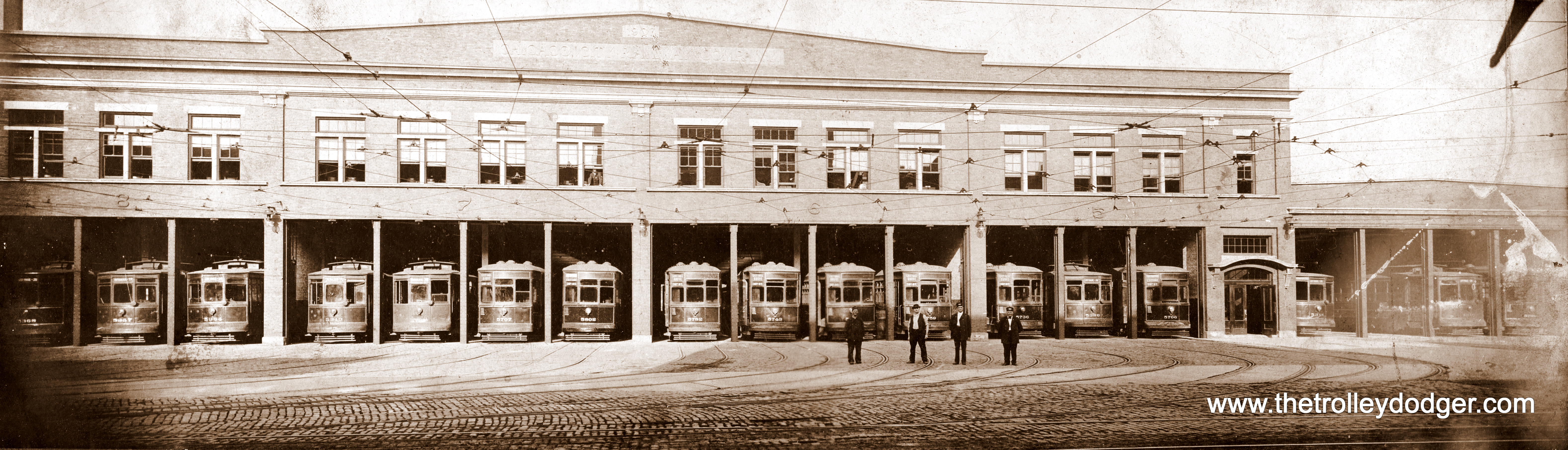
The Great Chicago Interurbans – Part Two (CNS&M)

This remarkable very early color picture shows NSL Birney car 332 and a variety of interurban cars in Milwaukee. In back, that’s car 300 in fantrip service. It was used by CERA as a club car circa 1939-42, which helps date the photo. Don’s Rail Photos: “332 was built by Cincinnati Car Co in December 1922, #2625. It was retired in 1947 and scrapped in April 1948… 300 thru 302 were built by Jewett in 1909 as mainline coaches. As the steel cars arrived, they were downgraded to local and school tripper service. In 1936 they became sleet cutters. In 1939 300 was turned over to the Central Electric Railfans’ Association as a private car. The ownership remained with the CNS&M, but the maintenance was taken over by CERA. During the war, with many members in service, CERA relinquished control, and the car was scrapped in 1947. 301 and 302 were retired in 1939 and scrapped in 1940.” CERA bulletins of the time say that fantrips, being non-essential travel were not allowed for much of the war, starting in 1942. By the time the war ended, car 300 had been stripped of some parts in order to keep other wood cars running. Several were sold to the Chicago, Aurora & Elgin in 1946. The North Shore Line had decided it no longer wanted to run wood cars in passenger service. Then, the 300 was vandalized and some windows were smashed. It was scrapped by CNS&M.

Today, we continue our look at the great Chicago interurbans* by featuring the North Shore Line. The Chicago, North Shore & Milwaukee last ran on January 21, 1963, just over 54 years ago.

This is widely considered the end of the Interurban Era.

But wait, there’s much more on offer in this, our 175th post. All of today’s black-and-white photos are scanned from the original negatives. This includes an original medium format neg taken by Edward Frank, Jr., which he traded with another collector. I don’t know what became of the rest of his negatives.

-David Sadowski

See our last post (January 28, 2017) for part one.

North Shore Line

<img class="size-large wp-image-9191" src="https://thetrolleydodger.com/wp-content/uploads/2017/01/dave588.jpg?w=665" alt="On a June 17, 1962 CERA fantrip, we see NSL car 744 posing for pictures on a section of track that was once part of the old Shore Line Route, abandoned in 1955. Don's Rail Photos: "744 was built by Pullman in 1928. It was modernized in 1940." We previously featured another picture taken at this location in our post More Color Restorations (August 9, 2016).” width=”665″ height=”407″ /> On a June 17, 1962 CERA fantrip, we see NSL car 744 posing for pictures on a section of track that was once part of the old Shore Line Route, abandoned in 1955. Don’s Rail Photos: “744 was built by Pullman in 1928. It was modernized in 1940.” We previously featured another picture taken at this location in our post More Color Restorations (August 9, 2016).

CNS&M wooden interurban car 303 in its days as a sleet cutter. Don’s Rail Photos: “303 thru 305 were built by American Car in 1910 and were almost identical. In 1939 they became sleet cutters and were retired and scrapped in 1940.”

CNS&M 704 getting washed at the Milwaukee terminal. Don’s Rail Photos: “704 was built by Cincinnati Car Co in May 1923, #2635.” (Walter Broschart Photo)

The information I received with this negative says that CNS&M 169 is a Special on the Shore Line Route in Wilmette in 1954. On the other hand, one of our long-time readers says this is actually Mundelein terminal on that branch line. Since this is apparently a fantrip car, the Shore Line Route sign may be incorrect. Don’s Rail Photos: “169 was built by Jewett in 1917.”

A not too sharp picture of a southbound train on the Shore Line Route at Wilmette.

A not too sharp picture of a southbound train on the Shore Line Route at Wilmette.

Richard H. Young took this picture on June 2, 1960 from the back of a moving North Shore car somewhere near Mundelein. We see a line car at work on the other track. One of our regular readers says that we are looking east toward South Upton tower, with Rt. 176 at left (north).

Richard H. Young took this picture on June 2, 1960 from the back of a moving North Shore car somewhere near Mundelein. We see a line car at work on the other track. One of our regular readers says that we are looking east toward South Upton tower, with Rt. 176 at left (north).

A close-up of the line car. Not sure whether this is the 604 or the 606.

A close-up of the line car. Not sure whether this is the 604 or the 606.

The same location today.

The same location today.

CNS&M 774 at the Milwaukee terminal. Don’s Rail Photos: “774 was built by Standard Steel Car Co in 1930, It was rebuilt as (a) Silverliner on May 9, 1950.” This photo appears to predate that.

CNS&M 761 at the Milwaukee terminal on May 29, 1950. Don’s Rail Photos: “761 was built by Standard Steel Car Co in 1930. It was modernized in 1949 and rebuilt as Silverliner in October 11, 1957.”

One of the two Electroliners passes a train of older cars in this wintry scene. Not sure of the exact location. The Electroliners entered service in 1941. Don Ross: “The Electroliner in the snow was at North Chicago. I have one similar from a different angle and no snow.” Jerry Wiatrowski: “The picture of the Southbound Electroliner is entering the curve to North Chicago Junction. The photographer is looking Northwest from North Chicago Junction. The bypass line continues South to the left.”

The same location today. We are looking north at about 2225 Commonwealth Avenue in North Chicago, IL. The cross-street, which was 22nd Street, is now Martin Luther King, Jr. Dr.

The same location today. We are looking north at about 2225 Commonwealth Avenue in North Chicago, IL. The cross-street, which was 22nd Street, is now Martin Luther King, Jr. Dr.

North Shore steeple cab 459 looks like it is backing up to connect with a couple of stalled cars. The information I got with this negative says this is Cudahy, Wisconsin in April 1954. That is just south of Milwaukee. However, it’s been pointed out to me that this municipality was a couple miles west of the right-of-way and the station in the picture looks more like Waukegan. Don’s Rail Photos: “459 was built by the SP&S in August 1941 as OERy 51. It was purchased by the North Shore in December 1947 and was completed as 459 on November 22, 1948.”

North Shore Birney car 335 in July 1947. Don’s Rail Photos: “335 was built by Cincinnati Car Co in December 1922, #2625. It was retired in 1947 and scrapped in April 1948.” The car is signed for Oklahoma Avenue in Milwaukee.

Car 409 on an early CERA fantrip, which may have been on June 4, 1939. It appears to be coupled to 716. The car at left may be 168. Car 255 is also supposed to have been used on that 1939 fantrip, but at that time, it was a full-length baggage car that had no seats and was often used to move musician’s instruments to and from Ravinia Park. The seats were not put in again until 1942. Don’s Rail Photos: “409 was built by Cincinnati Car in May 1923, #2465, as a dining car motor. In 1942 it was rebuilt as a coach and rebuilt as a Silverliner on March 30, 1955. Since it had no bulkhead between smoking and non-smoking sections, it was our favorite car to be used for meetings of the Milwaukee Division of the Electric Railroaders Association in Milwaukee. The North Shore was very cooperative in making sure that the car was in the location shown on meeting nights.”

I received no information with this negative, but this may show a bunch of North Shore Line cars in dead storage after the 1963 abandonment. Notice the destination sign is missing from combine 254. This car was not saved. Don’s Rail Photos: “254 was built by Jewett in 1917. The seating was changed to 28 on August 26, 1955.”

CNS&M 759 and train at South Upton on June 15, 1947. Don’s Rail Photos: “759 was built by Standard Steel Car Co in 1930. It was modernized in 1949.”

CNS&M 737 at Highwood in 1950. Don’s Rail Photos: “737 was built by Pullman in 1928. It was modernized in 1940 and rebuilt as Silverliner on June 30, 1950.” (Richard S. Short Photo)

CNS&M 739 near Glencoe. The date given is June 21, 1941; however, there was a CERA fantrip the following day, so the date may actually be June 22. The car is signed for charter service on the Shore Line Route. June 22, 1941 was also the day that Hitler invaded the Soviet Union. Don’s Rail Photos: “739 was built by Pullman in 1928. It was modernized in 1940 and rebuilt as (a) Silverliner on August 31, 1950.”

CNS&M 155 is a Skokie Valley Route Special at North Chicago on April 17, 1952. Don’s Rail Photos: “155 was built by Brill in 1915, #19605. It was damaged by fire at Highwood on August 11, 1955, and scrapped. One end from it was used to repair 735.”

South Shore Line

The other great Chicago interurban, of course, is the South Shore Line, which continues to operate between Chicago and South Bend, Indiana. We have just a couple vintage photos to show you today, but are sure to have more soon.

CSS&SB car 1 heads up a train at Randolph Street in downtown Chicago in 1946. Don’s Rail Photos: “1 was built by Pullman in 1926. It was later air-conditioned. It went to National Park Service in 1983 and (was) loaned to (the) Southern Michigan RR.” Spence Ziegler says, “The photo of CSS&SB #1 was more likely 1950-52; I have a slide from the Interurbans Slide set from 1983 showing #1 leaving Kensington in 1949 (on the rear of a train) still with the destination sign and train number sign on it’s end, though both were disused. Bill Wasik: “The CSS&SB car 1 at Randolph Street in downtown Chicago photo dated 1946 instead likely was taken between July 1952, when the giant Pabst sign on Randolph was dismantled, and mid-1953, when steel going up for the Prudential Building would have been visible in this view.”

CSS&SB freight motor 903 at Michigan City on July 17, 1956. Don’s Rail Photos: “903 was built by Baldwin-Westinghouse in September 1929, #61047, as IC 10001. It became CSS&SB 903 in July 1941.”

Chicago & West Towns Railways

The Chicago & West Towns Railways operated streetcars in Chicago’s western suburbs. But a 1942 Chicago guidebook referred to it as an “interurban,” probably referring to its longest and busiest line, which ran from Cicero to LaGrange and had sections of private right-of-way. Starting in 1934, it went to the Brookfield Zoo.

C&WT 163 at the Oak Park car barn on April 23, 1939. There was a CERA fantrip on the West Towns on this date. 163 was built by the Cummings Car Company in 1927. (LaMar M. Kelley Photo)

C&WT 163 at the Oak Park car barn on April 23, 1939. There was a CERA fantrip on the West Towns on this date. 163 was built by the Cummings Car Company in 1927. (LaMar M. Kelley Photo)

C&WT line car 15 at the Harlem and Cermak car barn. Don’s Rail Photos: “15 was built by Pullman Car in 1897 as Suburban RR 512. It was renumbered 515 and rebuilt as 15 in 1927. It was rebuilt in 1940 and scrapped in 1948.” (Edward Frank, Jr. Photo)

Edward Frank, Jr.'s famous bicycle, which appears in many of his pictures.

Edward Frank, Jr.’s famous bicycle, which appears in many of his pictures.

C&WT 146 at Lake and Austin, east end of the line. Riders could change across the street for a Chicago car. The Park Theater, at right, was showing Sutter's Gold, starring Edward Arnold. That film was released in 1936, which may be the date of this photo. This car was built by McGuire-Cummings in 1924.

C&WT 146 at Lake and Austin, east end of the line. Riders could change across the street for a Chicago car. The Park Theater, at right, was showing Sutter’s Gold, starring Edward Arnold. That film was released in 1936, which may be the date of this photo. This car was built by McGuire-Cummings in 1924.

C&WT 105, described as being tan in color, in front of the North Riverside car barn on April 28, 1939. (However, if the date was actually the 23rd, there was a CERA fantrip.) Don’s Rail Photos: “105 was built by McGuire-Cummings in 1915.” (Gordon E. Lloyd Photo) Gordon E. Lloyd grew up in the Chicago area and would have been 14 years old at the time. He later became a well-known railfan photographer and authored some books. He died aged 81 in 2006. Pretty good picture for a teenager!

C&WT 105 at Cermak and Kenton, probably in the late 1930s. This was the east end of the long LaGrange line and this car is signed for the Brookfield Zoo. Note the CSL car at rear. Riders could change here to go east on route 21 – Cermak. Don’s Rail Photos: “105 was built by McGuire-Cummings in 1915.”

Angel’s Flight

The Angel’s Flight Railway is a narrow gauge funicular in the Bunker Hill neighborhood in Los Angeles. A funicular is somewhat like an elevator that goes up the side of a hill; when one car goes up, the other goes down. I’ve been on three of these myself– two in Pittsburgh and one in Dubuque, Iowa.

Most of these have operated for over a century without major incidents, but Angel’s Flight has been plagued by bad luck for a long time. First, starting in the early 1960s, the area around it was slated for redevelopment, and the surrounding buildings were torn down. The hill it was on was partly leveled.

Fortunately, Angel’s Flight was disassembled after it stopped running in 1969, and put into storage. It was moved a half block south and reopened in 1996.

Unfortunately, there were some problems with how the thing was engineered as reconstructed, which led to some accidents. While Angel’s Flight has not run for a few years, these safety concerns have been addressed one by one, and now all that stands in the way of its reopening is the installation of an emergency walkway in case the thing breaks down on its 298-foot journey. Meanwhile, the not-for-profit group that operates it has to pay thousands of dollars each month for insurance.

Still, Angel’s Flight is an LA landmark and we hope that it will operate once again, and safely.

In the meantime, I was surprised to find it featured in a brief scene in the film La La Land. The two leads (Ryan Gosling and Emma Stone) are shown riding and kissing on the funicular.

Although Angel’s Flight is closed to the public, the operators thought it would be OK to use it in a film, and I’m sure they benefit a great deal from the publicity. But while they have been reprimanded (right now, no one is supposed to ride except employees), I am glad it appears in the film.

Angel’s Flight has been appearing in movies for nearly 100 years now. You can read an article about this here.

af1

af2

af3

Angel's Flight at its original location (3rd and Hill Streets) on July 5, 1962, before nearby buildings were torn down. (Leo Callos Photo)

Angel’s Flight at its original location (3rd and Hill Streets) on July 5, 1962, before nearby buildings were torn down. (Leo Callos Photo)

A view of Angel's Flight in 1964, showing the building at left demolished.

A view of Angel’s Flight in 1964, showing the building at left demolished.

A side view of Angel's Flight in 1964, after nearby buildings were being demolished. (Leo Callos Photo)

A side view of Angel’s Flight in 1964, after nearby buildings were being demolished. (Leo Callos Photo)

The Angel's Flight funicular on June 13, 1961. (George Basch Photo)

The Angel’s Flight funicular on June 13, 1961. (George Basch Photo)

Recent Correspondence

Jack Bejna writes:

I enjoy the Trolley Dodger immensely, especially anything CA&E! I grew up in Broadview and walked to Proviso High School every day along the CA&E right of way from 9th avenue to 5th Avenue. This month’s CA&E images are some that I haven’t seen before and are great, especially since they’re medium format images. I have a request….I would like to see a good image of the old dispatcher’s office (before it was repainted and the upper windows covered over. I’m sure someone took pictures of the office but I’ve never seen one.

Thanks for all you do; it sure makes my day!

I post these images practically as soon as I can buy them, but I can put this request in my next post, in hopes that someone might be able to help.

Glad you enjoy the blog.

Thanks David, I’ll be looking and hoping for a good shot. Again, thanks for all you do for us CA&E fanatics!

Bill Shapotkin writes:

Dave — in your January 2015 posting, this photo was included:

CTA 78 is shown at the east end of the Madison-Fifth shuttle in February, 1954. But wait-- wouldn't car 78 be on the Hammond, Whiting, and East Chicago? According to Alan R. Lind's CSL book, the CTA renumbered car 1780 to 78 in the waning days of red car service, in order to free up numbers in the 1780s for some buses. This was the only time a CSL streetcar was given a two-digit number, except for work cars. That's one school of thought. On the other hand, the number on the side of this car looks like 1781, and according to Andre Kristopans, it was still 1781 when scrapped. It may in fact not be a renumbering at all, just a case where either the car's paint got touched up and obscured part of the number, or part of the number fell off and did not get replaced, since red car service was ending in a few months anyway. At left in the background you can see Fohrman Motors, a Chicago car dealer from 1912 to 1979. Three people were killed at the dealership by a disgruntled customer on January 7, 1966. The neighborhood, not far from the construction site for the Congress (now Eisenhower) expressway, is already showing signs of urban decay. We discuss this in our post Some Thoughts on “Displaced” (August 30, 2016).

CTA 78 is shown at the east end of the Madison-Fifth shuttle in February, 1954. But wait– wouldn’t car 78 be on the Hammond, Whiting, and East Chicago? According to Alan R. Lind’s CSL book, the CTA renumbered car 1780 to 78 in the waning days of red car service, in order to free up numbers in the 1780s for some buses. This was the only time a CSL streetcar was given a two-digit number, except for work cars.
That’s one school of thought. On the other hand, the number on the side of this car looks like 1781, and according to Andre Kristopans, it was still 1781 when scrapped. It may in fact not be a renumbering at all, just a case where either the car’s paint got touched up and obscured part of the number, or part of the number fell off and did not get replaced, since red car service was ending in a few months anyway.
At left in the background you can see Fohrman Motors, a Chicago car dealer from 1912 to 1979. Three people were killed at the dealership by a disgruntled customer on January 7, 1966. The neighborhood, not far from the construction site for the Congress (now Eisenhower) expressway, is already showing signs of urban decay. We discuss this in our post Some Thoughts on “Displaced” (August 30, 2016).

Your caption read (in part):

“CTA 78 is shown at the east end of the Madison-Fifth shuttle in February, 1954. But wait– wouldn’t car 78 be on the Hammond, Whiting, and East Chicago? In actuality, I think this is car 1781. Perhaps part of the number has fallen off”

Well, I have an explanation (courtesy of Roy Benedict — who seems to recall that he heard this from Glen Anderson). It JUST SO HAPPENED, both car #1781 AND bus #1781 were assigned to Kedzie station at the time. To avoid confusion, the decals for the digit”1″ were removed off the streetcar — thus avoiding any confusion. Roy had ridden car #78 on the Fifth Ave Shuttle on at least two occasions (and noticed the strange two-digit car number) — only to find out years later (again, he recalls that it was via Glen) as to the reason.

That’s great to know, thanks. I recently bought another copy of the Lind book, and while it does mention the renumbering, offers no explanation. (I have owned several copies of Chicago Surface Lines, An Illustrated History over the years, but have given some of them away, and other copies are in storage.)

The only thing that would need to be double-checked is whether there really was a bus 1781 working out of the Kedzie car house. I suppose Andre would know that.

Andre Kristopans writes:

There was a bus 1781 in 1954, but not at Kedzie. 1700’s at the time were at North Av, North Park, and Limits. Best explanation I can give is that when 1781 was last repainted, they didn’t have any “1” decals, and so out it went as “78”, and the problem was never corrected. Note it does appear the side number is 78 also! However, CTA’s streetcar retirements documentation show 1781, both in the AFR and the scrap ledger.

Gina Sammis wrote us a while back, looking for information on Gustav Johnson, a longtime Chicago Surface Lines employee (born June 23, 1855 – died November 23, 1946). He retired around 1925, after having worked on streetcars for 35 years.

As it happens, I recently purchased a copy of the December 1946 Surface Service, the CSL employee magazine. These do not often come up for sale, in comparison with the later CTA Transit News.

Mr. Johnson is mentioned in two places. There is the one you already know about on page 15, in a section titled In Memoriam.

But there are also reports from individual car houses (barns), and on page 8 it says,”Retired Motorman Gus Johnson passed away November 24.”

So, at least that tells you that he was driving the streetcars, and not just the conductor taking fares.

I took the liberty of writing to George Trapp, in order to find out just what streetcar lines would have been operating out of Devon Station (car house) in the early 1900s. Here is his reply:

I would guess the Evanston cars before 1913 or so before the barn on Central Street in Evanston was built and after 1901 when the Devon barn was built. The North Shore & Western dinkey may also have been stored there in the Winter when the golf club was closed. The Devon shuttle and the Lawrence Avenue lines as well and possibly the North Western line before being through routed with Western which also used the barn for part of the service from sometime in the 1930’s and half the service in the PCC era.

His answer needs a bit of further explaining.  I did some additional research,  From 1901, when the Devon car house opened, until 1913, Evanston streetcars would have used the facility. After that, they had their own barn.

You need to consider that this area was just getting built up around this time. So, there were a lot of changes. In general, the dates of the changes will give you a clue to about when development was happening.

Here is what the Rogers Park/West Ridge Historical Society says about the North Shore and Western Railway:

The North Shore & Western Railway Company was formed and owned by the members of the Glen View Club in Golf, Illinois. It comprised two pieces of equipment, one streetcar and a snow plow. There were two employees, a motorman and conductor. The hours of operation were set for the convenience of the members of the golf club.

It operated from the golf club through a portion of Harms Woods crossing the North Branch of the Chicago River in the woods and ran straight east on what is now known as Old Orchard Road to Evanston, where the street becomes Harrison Street. It was nicknamed the Toonerville Trolley and a piece of a rail is on display at the Skokie Historical Society.

The membership tired of the trolley’s ownership and sold the line to the Evanston Railway Company.

George Trapp refers to their sole streetcar as a “dinky,” meaning it was small.

The “Devon Avenue Shuttle” would have run east-west. According to Alan R. Lind on page 254 of Chicago Surface Lines, An Illustrated History (Third Edition):

This short North Side shuttle started operation May 20, 1917 from Clark to Western. One-man cars took over the service March 13, 1921. A west extension opened December 14, 1925 from Western to Kedzie, and an east extension opened from Clark to Magnolia January 30, 1928. When Broadway cars began to run to Devon and Kedzie on July 10, 1932, the Devon shuttle car was discontinued.”

North Western Avenue is covered in the same book on page 312:

This extension of the regular Western route began October 18, 1915 between Lawrence and Bryn Mawr. Extensions brought the line to Devon on December 11, 1915, and to Howard on December 16, 1916. The line was through-routed with Western on May 1, 1923.

The busiest route working out of Devon station would have always been Clark, which started running downtown (from Howard) on October 21, 1906. It was through-routed with the south side Wentworth line on March 17, 1908.

Here is what Lind says about the Broadway route on page 231:

In 1906 this North Side trunk route ran from Clark and Howard at the city limits to a loop in downtown Chicago via Cark, Devon, Broadway, Clark, Randolph, LaSalle, Monroe, Dearborn, and Randolph. At this time streetcars to north suburban Evanston also ran on the Broadway route from the old Limits carbarn at Drummond and Clark to Central and Bennett in Evanston. The route was the same as the Broadway cars to Howard, then via Chicago, Dempster, Sherman, and Central to Bennett.

On July 24, 1907 the Evanston line was extended west from Bennett to Lincolnwood Dr. On the same day a single track extension line known as the North Shore & Western Railway began service via Lincolnwood and Harrison to the Glenview Golf Club west of the Chicago River.

The local Broadway cars and the Evanston service to Lincolnwood Dr. were operated by the Chicago Union Traction Company, a Yerkes property. The track north of Irving Park was owned by the Chicago Consolidated Traction Company. (The North Shore & Western was owned by some men with a stake in the golf club.) On February 25, 1908 CUT was reorganized as Chicago Railways Company. On December 27, 1910 Chicago Railways sold its suburban lines to the County Traction Company. At midnight on that date the track connection between the Broadway line, still under CRYs, and the Evanston line was cut at Clark and Howard. Through passengers had to walk across a 30-foot gap in the track from the Evanston cars, now in local Evanston service only under County Traction, to the Broadway cars, still under Chicago Railways.

Because of a franchise requirement of one of the underlying companies,, free transfers from Evanston to Broadway cars were issued starting December 31, 1910. County Traction was split into two companies on August 5, 1913: Evanston Traction and Chicago & West Towns Railway Co. Evanston Traction became (the Evanston Railways Company and in 1936) Evanston Bus Company.

In sum, if your relative worked at Devon station in the early 1900s, chances are most of his work would have been on the Clark and Broadway lines. On my blog, if you do a search on the words Clark or Broadway, you will turn up lots of photos showing service on those lines.

Gina replied:

You have been so helpful and I am very appreciative. Thank you David.

We have added a complete scan of the December 1946 Surface Service to our E-book Chicago's PCC Streetcars: The Rest of the Story, available in our Online Store.

We have added a complete scan of the December 1946 Surface Service to our E-book Chicago’s PCC Streetcars: The Rest of the Story, available in our Online Store.

dave763

dave771

Keep those cards and letters coming in, folks. But better yet, why not write us at:

thetrolleydodger@gmail.com

Thanks.

-David Sadowski

street-railwayreview1895-002

Help Support The Trolley Dodger

gh1

This is our 175th post, and we are gradually creating a body of work and an online resource for the benefit of all railfans, everywhere. To date, we have received over 248,000 page views, for which we are very grateful.

You can help us continue our original transit research by checking out the fine products in our Online Store.

As we have said before, “If you buy here, we will be here.”

We thank you for your support.

DONATIONS

In order to continue giving you the kinds of historic railroad images that you have come to expect from The Trolley Dodger, we need your help and support. It costs money to maintain this website, and to do the sort of historic research that is our specialty.

As we mentioned in a previous post, we also are on a tight deadline to finish our new book Chicago Trolleys. Your financial contributions will help make this book better, and are greatly appreciated.

The Great Chicago Interurbans – Part One (CA&E and AE&FRE)

Here is a very rare photo taken at Laramie Yards in 1936. At left we see North Shore Line car 722, heading up a four-car train and signed for Wheaton. CNS&M cars did, of course, operate on parts of the Chicago "L" system, of course, but this is the first picture I have seen showing them at this location, posed next to CA&E cars 421 and 401. 722 was buit by Cincinnati Car Co. in 1926. I wonder what the occasion was that brought four North Shore Line cars to Wheaton? (Edward Frank, Jr. Photo)

Here is a very rare photo taken at Laramie Yards in 1936. At left we see North Shore Line car 722, heading up a four-car train and signed for Wheaton. CNS&M cars did, of course, operate on parts of the Chicago “L” system, of course, but this is the first picture I have seen showing them at this location, posed next to CA&E cars 421 and 401. 722 was buit by Cincinnati Car Co. in 1926. I wonder what the occasion was that brought four North Shore Line cars to Wheaton? (Edward Frank, Jr. Photo)

The last Chicago, North Shore & Milwaukee interurban train ran in the early hours of a very cold January 21, 1963. George Hilton and John Due, in their classic book The Electric Interurban Railways in America called this the end of the Interurban Era in the United States. The 54th anniversary was just a few days ago.

Since this was also the second anniversary of this blog, we thought this an excellent opportunity to showcase the three great Chicago-area interurbans- the North Shore Line, South Shore Line, and Chicago, Aurora & Elgin.

We have been saving up images of these lines, and now find ourselves with enough for two posts. So today, we will begin with the “Roarin’ Elgin” and its one-time subsidiary, the Aurora, Elgin & Fox River Electric. The great majority of these images were scanned from the original medium-format negatives.

While we do lament the passing of the Interurban Era and two of the three major Chicago systems, we can celebrate them with these classic pictures. Some of these were made possible thanks to your recent generous donations.

We will round out January in a few days with our second installment of great Chicago interurbans, featuring the North Shore Line and South Shore Line. Watch this space!

-David Sadowski

A Bird’s Eye View

While visiting a friend at Rush hospital earlier this month, I took a few pictures from out the window. It just so happened his room had a spectacular view of where the Chicago Transit Authority’s Pink Line crosses over the Blue Line. There is a ramp at this location, which is also where the old Marshfied Junction was on the Met “L”. In previous posts, we have run pictures showing how this looked like before expressway construction in the early 1950s.

An inbound Blue Line train passes the point where part of an access ramp at the Damen-Ogden-Paulina station was damaged during a lightning storm. With the addition of chain-link fencing, it has since been reopened.

An inbound Blue Line train passes the point where part of an access ramp at the Damen-Ogden-Paulina station was damaged during a lightning storm. With the addition of chain-link fencing, it has since been reopened.

A southbound Pink Line train about to cross over the Blue Line.

A southbound Pink Line train about to cross over the Blue Line.

An inbound Blue Line train.

An inbound Blue Line train.

A northbound Pink Line train has just passed the location of the old Marshfield Junction on the Met "L".

A northbound Pink Line train has just passed the location of the old Marshfield Junction on the Met “L”.

The CA&E and AE&FRE

This is a rare photo, as it shows AE&FRE car 304 sometime prior to the abandonment of passenger service in 1935. Don's Rail Photos: "304 was built by St Louis Car in 1924. #1306. In 1936 it was sold CI/SHRT (aka Shaker Heights Rapid Transit) as 304 and in 1954 it was sold to CP&SW (Trolleyville USA) as 304. It was sold to Fox River Trolley Museum in 2009." I have had the pleasure of riding on this fine car at the Fox River Trolley Museum, as it has returned to its home rais after a 75-year absence. You can see pictures I took of it there on the previous blog that I worked on here. Long may it run.

This is a rare photo, as it shows AE&FRE car 304 sometime prior to the abandonment of passenger service in 1935. Don’s Rail Photos: “304 was built by St Louis Car in 1924. #1306. In 1936 it was sold CI/SHRT (aka Shaker Heights Rapid Transit) as 304 and in 1954 it was sold to CP&SW (Trolleyville USA) as 304. It was sold to Fox River Trolley Museum in 2009.” I have had the pleasure of riding on this fine car at the Fox River Trolley Museum, as it has returned to its home rais after a 75-year absence. You can see pictures I took of it there on the previous blog that I worked on here. Long may it run.

Here is an excellent model that shows AE&FRE 300's colors. (Bruce Moffat Photo)

Here is an excellent model that shows AE&FRE 300’s colors. (Bruce Moffat Photo)

CA&E wood car 138 at the Wheaton Yard on July 3, 1949. Don's Rail Photos says, "138 was built by American Car Co in March 1910, #844, as C&ME 138. It was rebuilt in 1914 and no retired date." This was one of several cars leased from the North Shore Line in 1936 and purchased from them a decade later. Ironically, this made them the last passenger cars bought by CA&E. They were considered surplus after service was cut back to Forest Park in 1953 and were scrapped shortly thereafter.

CA&E wood car 138 at the Wheaton Yard on July 3, 1949. Don’s Rail Photos says, “138 was built by American Car Co in March 1910, #844, as C&ME 138. It was rebuilt in 1914 and no retired date.” This was one of several cars leased from the North Shore Line in 1936 and purchased from them a decade later. Ironically, this made them the last passenger cars bought by CA&E. They were considered surplus after service was cut back to Forest Park in 1953 and were scrapped shortly thereafter.

Don's Rail Photos: "301 was built by Niles Car & Mfg Co in 1906. It was modernized in December 1940."

Don’s Rail Photos: “301 was built by Niles Car & Mfg Co in 1906. It was modernized in December 1940.”

Don's Rail Photos: "105 was built by Stephenson in 1903. It was modernized in August 1940 and retired in 1955. "

Don’s Rail Photos: “105 was built by Stephenson in 1903. It was modernized in August 1940 and retired in 1955. “

CA&E 302 at the Wheaton Yard in July 1948. Don's Rail Photos: "302 was built by Niles Car & Mfg Co in 1906. It was modernized in May 1940."

CA&E 302 at the Wheaton Yard in July 1948. Don’s Rail Photos: “302 was built by Niles Car & Mfg Co in 1906. It was modernized in May 1940.”

Express car 15 at Wheaton on June 18, 1947. Don's Rail Photos says, "15 was built by McGuire-Cummings in 1910. It was scrapped in 1953."

Express car 15 at Wheaton on June 18, 1947. Don’s Rail Photos says, “15 was built by McGuire-Cummings in 1910. It was scrapped in 1953.”

CA&E 458 at Wheaton on June 18, 1947. This was part of an order of 10 curved-sided cars built in 1945 by St. Louis Car Company. Some consider these the last standard interurban cars built.

CA&E 458 at Wheaton on June 18, 1947. This was part of an order of 10 curved-sided cars built in 1945 by St. Louis Car Company. Some consider these the last standard interurban cars built.

Don's Rail Photos: "11 was built by Brill in 1910, #16483. It was rebuilt to a line car in 1947 and replaced 45. It was acquired by Railway Equipment Leasing & Invenstment Co in 1962 and became Fox River Trolley Museum in 1984. It was lettered as Fox River & Eastern." Here we see it at Wheaton in July 1948.

Don’s Rail Photos: “11 was built by Brill in 1910, #16483. It was rebuilt to a line car in 1947 and replaced 45. It was acquired by Railway Equipment Leasing & Invenstment Co in 1962 and became Fox River Trolley Museum in 1984. It was lettered as Fox River & Eastern.” Here we see it at Wheaton in July 1948.

In the days before scanners, fans tried to document things as best they could. Here is a not-so-successful attempt to photograph the blueprint for car 451 in August 1949.

In the days before scanners, fans tried to document things as best they could. Here is a not-so-successful attempt to photograph the blueprint for car 451 in August 1949.

Don's Rai Photos: "9 was built by Niles Car in 1907. It was scrapped in 1959." This picture was taken at Wheaton in April 1952.

Don’s Rai Photos: “9 was built by Niles Car in 1907. It was scrapped in 1959.” This picture was taken at Wheaton in April 1952.

Here is 425 at the Aurora terminal in October 1949. While the CA&E used third rail extensively, the Aurora and Elgin terminals had overhead wire. This terminal replaced street running in downtown Aurora in the late 1930s. The 425 was built by Cincinnati Car Co. in 1927.

Here is 425 at the Aurora terminal in October 1949. While the CA&E used third rail extensively, the Aurora and Elgin terminals had overhead wire. This terminal replaced street running in downtown Aurora in the late 1930s. The 425 was built by Cincinnati Car Co. in 1927.

Here, we see freight motor 9 at Wheaton in 1947. (Walter Broschart Photo)

Here, we see freight motor 9 at Wheaton in 1947. (Walter Broschart Photo)

CA&E 38 at the CTA Laramie Avenue Yards on May 17, 1948. Trackage west of here was owned by CA&E. Don's Rail Photos: "38 was built by Stephenson in 1903. It was modernized in September 1939 and retired in 1959."

CA&E 38 at the CTA Laramie Avenue Yards on May 17, 1948. Trackage west of here was owned by CA&E. Don’s Rail Photos: “38 was built by Stephenson in 1903. It was modernized in September 1939 and retired in 1959.”

CA&E 139 heads up a five-car train of woods in the maroon and cream paint scheme. I don't know where this was taken. There is a siding with overhead wire, so perhaps that is a clue towards figuring it out. The water tower in the background may indicate that we are somewhere west of Laramie. Randall Hicks: "I believe the picture of 139 and train was taken facing north at Childs St. crossover. The train is pulling south off the west ladder. There was a short team track there under wire. And that is indeed somewhere west of Laramie. 🙂" Yes, Wheaton is indeed west of Laramie, thanks.

CA&E 139 heads up a five-car train of woods in the maroon and cream paint scheme. I don’t know where this was taken. There is a siding with overhead wire, so perhaps that is a clue towards figuring it out. The water tower in the background may indicate that we are somewhere west of Laramie. Randall Hicks: “I believe the picture of 139 and train was taken facing north at Childs St. crossover. The train is pulling south off the west ladder. There was a short team track there under wire. And that is indeed somewhere west of Laramie. 🙂” Yes, Wheaton is indeed west of Laramie, thanks.

CA&E 300 and 453 in Wheaton. Don's Rail Photos: "300 was built by Niles Car & Mfg Co in 1906. It was modernized in May 1942." (Anderson Photo)

CA&E 300 and 453 in Wheaton. Don’s Rail Photos: “300 was built by Niles Car & Mfg Co in 1906. It was modernized in May 1942.” (Anderson Photo)

CA&E 311 at the CTA Laramie Avenue Yards on May 17, 1948. This shows a small area in the yards where CA&E could store a few trains in mid-day for use in the afternoon rush hour. I am pretty sure those 1920s Chicago bungalows at left are still there. Don's Rail Photos adds, "311 was built by Kuhlman Car Co in 1909, #404. It was modernized at an unknown date."

CA&E 311 at the CTA Laramie Avenue Yards on May 17, 1948. This shows a small area in the yards where CA&E could store a few trains in mid-day for use in the afternoon rush hour. I am pretty sure those 1920s Chicago bungalows at left are still there. Don’s Rail Photos adds, “311 was built by Kuhlman Car Co in 1909, #404. It was modernized at an unknown date.”

The approximate location of the previous photo is 5413 W. Flournoy, on Chicago's west side. The area once occupied by the CA&E's storage tracks is now part of the Eisenhower expressway footprint.

The approximate location of the previous photo is 5413 W. Flournoy, on Chicago’s west side. The area once occupied by the CA&E’s storage tracks is now part of the Eisenhower expressway footprint.

A two-car train of 300-series woods on a July 8, 1949 fantrip. From the "side of the road" location under wire, I would guess this is the Mt. Carmel branch along Mannheim Road.

A two-car train of 300-series woods on a July 8, 1949 fantrip. From the “side of the road” location under wire, I would guess this is the Mt. Carmel branch along Mannheim Road.

Sunset Lines indeed! (Or sunrise, depending on the angle.) Here we see wood car 38 at an unknown location. (Walter Broschart Photo)

Sunset Lines indeed! (Or sunrise, depending on the angle.) Here we see wood car 38 at an unknown location. (Walter Broschart Photo)

CA&E 407, built by Pullman in 1923, at Wheaton Yard. (Walter Broschart Photo)

CA&E 407, built by Pullman in 1923, at Wheaton Yard. (Walter Broschart Photo)

CA&E 5 at Wheaton Yards in July 1948.

CA&E 5 at Wheaton Yards in July 1948.

CA&E 141 on single-track private right-of-way at Batavia Junction on August 13, 1952. This was one of several woods that CA&E bought from the North Shore Line in 1946, after the latter decided it no longer wanted to run wood cars in passenger service. CA&E ran wood cars right up until the end of service.

CA&E 141 on single-track private right-of-way at Batavia Junction on August 13, 1952. This was one of several woods that CA&E bought from the North Shore Line in 1946, after the latter decided it no longer wanted to run wood cars in passenger service. CA&E ran wood cars right up until the end of service.

CA&E 34 at the Wheaton Yards in June 1947. Don's Rail Photos: "34 was built by Stephenson in 1903. It was modernized in February 1940 and retired in 1959." (Walter Hulseweder Photo)

CA&E 34 at the Wheaton Yards in June 1947. Don’s Rail Photos: “34 was built by Stephenson in 1903. It was modernized in February 1940 and retired in 1959.” (Walter Hulseweder Photo)

Here, part of the caption information I received with this negative must be wrong. This is CA&E 431 at the Illinois (Electric) Railway Museum. The date is given as November 17, 1962 but the location is said to be Union. Since the date is so specific, I would venture this is actually North Chicago instead. Cars were not moved to Union until 1964. (Richard S. Short Photo)

Here, part of the caption information I received with this negative must be wrong. This is CA&E 431 at the Illinois (Electric) Railway Museum. The date is given as November 17, 1962 but the location is said to be Union. Since the date is so specific, I would venture this is actually North Chicago instead. Cars were not moved to Union until 1964. (Richard S. Short Photo)

CA&E wood car 26 in Aurora. Don's Rail Photos notes: "26 was built by Niles Car in 1902. It was modernized in June 1943 and retired in 1959."

CA&E wood car 26 in Aurora. Don’s Rail Photos notes: “26 was built by Niles Car in 1902. It was modernized in June 1943 and retired in 1959.”

CA&E 142 at Wheaton in July 1948. Some of these cars were used on the North Shore Line as late as 1946. We wrote about that on the previous blog we worked on. Check out the post A Mystery Solved (August 6, 2013) for more details.

CA&E 142 at Wheaton in July 1948. Some of these cars were used on the North Shore Line as late as 1946. We wrote about that on the previous blog we worked on. Check out the post A Mystery Solved (August 6, 2013) for more details.

AE&FRE loco 23. The caption gives the location as Aurora, but this may be in error. After passenger service ended in 1935, this line was reduced to three miles of track in the South Elgin area-- the current site of the Fox River Trolley Museum. Electric locos ran unti 1947, and the last freight move took place in 1972. Around 1940, there were a couple of fantrips.

AE&FRE loco 23. The caption gives the location as Aurora, but this may be in error. After passenger service ended in 1935, this line was reduced to three miles of track in the South Elgin area– the current site of the Fox River Trolley Museum. Electric locos ran unti 1947, and the last freight move took place in 1972. Around 1940, there were a couple of fantrips.

AE&FRE electric freight loco 49 in Elgin in November 1939. This was one of two that the railroad had in its latter days.

AE&FRE electric freight loco 49 in Elgin in November 1939. This was one of two that the railroad had in its latter days.

AE&FRE loco 49. The neg envelope says this is Aurora, but it is much more likely to be Elgin.

AE&FRE loco 49. The neg envelope says this is Aurora, but it is much more likely to be Elgin.

You may have seen this picture before, but here we now have it from the original medium format negative. It shows a two-car train of Chicago Rapid Transit Company 4000s on an early CERA fantrip (#6) that took place on February 12, 1939. The CA&E connection is that here we see the cars on the Mt. Carmel branch. These rapid transit cars did get around-- during World War II, some were operated on the North Shore Line to move service personnel around. (Anderson Photo)

You may have seen this picture before, but here we now have it from the original medium format negative. It shows a two-car train of Chicago Rapid Transit Company 4000s on an early CERA fantrip (#6) that took place on February 12, 1939. The CA&E connection is that here we see the cars on the Mt. Carmel branch. These rapid transit cars did get around– during World War II, some were operated on the North Shore Line to move service personnel around. (Anderson Photo)

This is a well-known photo showing the Wells Street Terminal, where CA&E cars ended up in downtown Chicago starting in 1905. CA&E trains did not go around the Loop, although this terminal was adjacent to it. There is some question as to whether all CA&E cars could actually make the Loop's tight clearances. To the best of my knowledge, some could and perhaps others could not.

This is a well-known photo showing the Wells Street Terminal, where CA&E cars ended up in downtown Chicago starting in 1905. CA&E trains did not go around the Loop, although this terminal was adjacent to it. There is some question as to whether all CA&E cars could actually make the Loop’s tight clearances. To the best of my knowledge, some could and perhaps others could not.

CA&E 428 at the Laramie Avenue Yards on November 3, 1940. This was built by the Cincinnati Car Co. in 1927. (Frank Krejcik Photo)

CA&E 428 at the Laramie Avenue Yards on November 3, 1940. This was built by the Cincinnati Car Co. in 1927. (Frank Krejcik Photo)

CA&E 426 at the Elgin terminal. Although this was the "Great Third Rail," overhead wire was used here.

CA&E 426 at the Elgin terminal. Although this was the “Great Third Rail,” overhead wire was used here.

The CA&E's Aurora terminal, after it was moved here in the late 1930s.

The CA&E’s Aurora terminal, after it was moved here in the late 1930s.

A 6-car train of CA&E woods near Laramie Avenue on May 7, 1937.

A 6-car train of CA&E woods near Laramie Avenue on May 7, 1937.

A two-car train of CA&E woods at the Bellwood station. (Edward Frank, Jr. Photo)

A two-car train of CA&E woods at the Bellwood station. (Edward Frank, Jr. Photo)

CA&E 134 and 137 under wire at State Road crossing on the Batavia branch, August 30, 1942. The flags would seem to indicate this was CERA fantrip #39. Wire was used here for a short distance instead of third rail, due to the width of the crossing.

CA&E 134 and 137 under wire at State Road crossing on the Batavia branch, August 30, 1942. The flags would seem to indicate this was CERA fantrip #39. Wire was used here for a short distance instead of third rail, due to the width of the crossing.

A four-car train of the woods that were (at that time) being leased to CA&E by the North Shore Line. We see them at York Road in 1937. (Edward Frank, Jr. Photo)

A four-car train of the woods that were (at that time) being leased to CA&E by the North Shore Line. We see them at York Road in 1937. (Edward Frank, Jr. Photo)

Recent Correspondence

Jade C. Huguenot writes:

I’d like to ask you a question about some historical research I’ve been doing about my hometown, Mystic, CT. I’ve got a very old postcard (1907) that features two trolleys and a utility pole with several black and white diagonal stripes at its base on our main street, just a few hundred feet away from our bascule drawbridge (it can be seen here on the left utility pole http://www.groton-ct.gov/history/detail.asp?bibid=1079).

At first, I wondered if this signaled a trolley stop, but I know from researching other postcards from my area in that time period that a trolley stop was designated by a thick band of white (several feet thick) painted onto the utility pole, usually several feet up from the ground.

Then I wondered if it could be some sort of safety alert with “black and white stripes” placed several hundred feet before a drawbridge, like the one Boston instituted after a trolley of theirs crashed into the river while the drawbridge was open, killing 47 people (https://www.bostonglobe.com/metro/2016/10/29/trolleydisaster/c451CX1qx9SpPo5tJAupFP/story.html). However, the original report from Boston’s Public Safety Commission in 1917 said that the black and white striped alert should be on a mechanized gate.

Do you have any clue if this is related to trolleys at all? I would greatly appreciate your help with this!!

I will put it in my next post, thanks. Got any pictures I can use?

Yes! Here is the picture of the trolleys on our main street. The striped utility pole is shown to the left. Trolleys first began running in Mystic in 1905, and this postcard is dated 1907. I have also included a picture of a woman waiting by a trolley stop- which looks very different from the striped pole seen in the postcard. If you need any more pictures, let me know!

Perhaps one of our readers may know, thanks. A few years ago, I had the pleasure of spending an evening in Mystic, CT and even ate at Mystic Pizza, which was made famous by a film of the same name.

Keep those cards and letters coming in, folks. But better yet, why not write us at:

thetrolleydodger@gmail.com

Thanks.

-David Sadowski

176-west-main-street-2-trolleys-1907-gpl

1907-trolley-stop

Help Support The Trolley Dodger

gh1

This is our 174th post, and we are gradually creating a body of work and an online resource for the benefit of all railfans, everywhere. To date, we have received over 244,000 page views, for which we are very grateful.

You can help us continue our original transit research by checking out the fine products in our Online Store.

As we have said before, “If you buy here, we will be here.”

We thank you for your support.

DONATIONS

In order to continue giving you the kinds of historic railroad images that you have come to expect from The Trolley Dodger, we need your help and support. It costs money to maintain this website, and to do the sort of historic research that is our specialty.

As we mentioned in a previous post, we are on a tight deadline to finish our new book Chicago Trolleys. Your financial contributions will help make this book better, and are greatly appreciated.

One Good Turn

Here, we see one-man CTA 3150(?) and its operator at the east end of route 21 on Cermak and Prairie Avenue in June 1951. Prairie Avenue was also the location of the local Kodak processing plant, which handled Kodachrome until the early 1980s.

Here, we see one-man CTA 3150(?) and its operator at the east end of route 21 on Cermak and Prairie Avenue in June 1951. Prairie Avenue was also the location of the local Kodak processing plant, which handled Kodachrome until the early 1980s.

“One good turn deserves another.” Or at least, that is how the saying goes.

We started this blog on January 21, 2015, so this post (our 173rd) is the last one for our full second year. When we started, we had no clue what the reaction would be. But, we had to believe that some good would come from sharing our transit photos and information with you.

Our experience from the past two years has shown this very much to be the case. As we have shared our information, others have come forward to share theirs with us. We have reached an audience, and our continued growth demonstrates that railfan interest is growing, not shrinking.

Now, we are being contacted by more and more researchers, who are using us as a resource for their own work.

Another word that comes to mind is “sustainability.” I don’t consider this a commercial site, since everything here is free for all to enjoy. But it does take both time and resources to keep providing you with a steady stream of high-quality images.

We are happy to put in the time, but resources are always limited.  As a general rule, for each image you see here, it probably costs us $10 to bring that to you. That is the average cost of a print, negative, or slide, including the shipping. Some images cost more, some less.

When you have as many as 40 or 50 high-quality images in a single post, you can see how that can add up in a real hurry.  Every little bit we can raise helps.

Often there is one and only one opportunity to purchase these images. Collections come to market, often when the original photographer or collector has unfortunately died, and their images are sold off one at a time and scattered to the four winds. If you see something unique, and pass on the opportunity to acquire it, you may never see it again.

Such are opportunities are fleeting.

So there has always been a gap between the images that we get to share with you, and the ones that we could if we only had the resources. Our goal is to make this gap as small as possible.

Luckily, some people have shared images with us, and we appreciate it. But as much as we may try, soliciting donations and offering items for sale in our Online Store, this blog still runs a substantial deficit.

Now, it may come to pass that this will always be so, but it is our goal to make The Trolley Dodger a “sustainable” enterprise, for now and the future. That will give us the best chance to keep it going.

We are encouraged by the response to our last post, where we asked for donations to help pay our domain registration and web site upkeep costs for the coming year. We received more than enough money for the costs that come due on February 3rd. So we will be here for another year, and thank everyone who so generously contributed.

We used the additional funds we received to pay for some of the images you see in today’s post.

Meanwhile, we are quickly coming up on the deadline to finish our new book Chicago Trolleys. This will be our own modest contribution to the slim shelf of books about Chicago’s once-great streetcar system.

Some fantastic images have come up for sale recently, which would make tremendous additions to the book. Once finished, chances are it won’t get revised or updated again for a long time.

We want this book, which will include about 215 classic back-and-white pictures, to be the best that it can be. With the help of your donations and purchases, we can make this dream a reality.

Chicago Trolleys is expected to be published later this year.  We will keep you posted on our progress.

Meanwhile, here is another batch of classic images of Chicago streetcars. And, as always, we hope that this will be “one good turn” that “deserves another,” and not just “another fine mess.”

Thanks.

-David Sadowski

PS- Our next post, the first for our third year, will feature all three great Chicago interurbans. Watch this space.

It's August 17, 1956, and southbound PCC 7192 is about to stop at a safety island at Clark and Armitage. (Joseph M. Canfield Photo)

It’s August 17, 1956, and southbound PCC 7192 is about to stop at a safety island at Clark and Armitage. (Joseph M. Canfield Photo)

On august 21, 1956, PCC 7215 turns from Broadway onto Devon, as a northbound route 36 car with the North Side "L" in the background. (Joseph M. Canfield Photo)

On August 21, 1956, PCC 7215 turns from Broadway onto Devon, as a northbound route 36 car with the North Side “L” in the background. (Joseph M. Canfield Photo)

The "Broadway Downtown" sign on this car, and the appearance of the autos in the background, would probably indicate that this picture was taken circa 1956. The south portion of the route 36 Broadway-State Through Route was bussed on December 3, 1955, and the remaining half on February 16, 1957.

The “Broadway Downtown” sign on this car, and the appearance of the autos in the background, would probably indicate that this picture was taken circa 1956. The south portion of the route 36 Broadway-State Through Route was bussed on December 3, 1955, and the remaining half on February 16, 1957.

Prewar PCC 4012 on Cottage Grove in 1952. Jack Fuller adds, "The Green Hornet view along Route 4, Cottage Grove is actually at 99th Street. This is the only opening under the Illinois Central tracks between 95th Street and 103rd Street." (C. R. Scholes Photo)

Prewar PCC 4012 on Cottage Grove in 1952. Jack Fuller adds, “The Green Hornet view along Route 4, Cottage Grove is actually at 99th Street. This is the only opening under the Illinois Central tracks between 95th Street and 103rd Street.” (C. R. Scholes Photo)

This birds-eye view of CTA 1744 was taken from the Pulaski Road "L" station on the Garfield Park branch in April 1950. However, what we are looking at may actually be a Madison-Fifth car at the west end of its route, ready to loop back via Pulaski and Harrison. Bill Shapotkin adds, "This image is looking E-N/E on Fifth Ave from the Garfield Pk 'L'...no question about it. The intersection behind the streetcar is Harrison."

This birds-eye view of CTA 1744 was taken from the Pulaski Road “L” station on the Garfield Park branch in April 1950. However, what we are looking at may actually be a Madison-Fifth car at the west end of its route, ready to loop back via Pulaski and Harrison. Bill Shapotkin adds, “This image is looking E-N/E on Fifth Ave from the Garfield Pk ‘L’…no question about it. The intersection behind the streetcar is Harrison.”

CTA one-man car 1778 heads west on Lake in May 1954, shorty before route 16 was bussed. Kevin Doerksen adds, "I believe that One-man car 1778 is actually looking East on Lake at Ogden/Loomis. The building on the right hand side is right at the corner of Loomis and Lake. It’s also under threat of demolition, I believe." Daniel Joseph: "I believe this photo is at Lake Street at Randolph at Justine. Ogden did not have car tracks north of Randolph but Randolph went northwest along Union Park with (car tracks) connecting with Lake."

CTA one-man car 1778 heads west on Lake in May 1954, shorty before route 16 was bussed. Kevin Doerksen adds, “I believe that One-man car 1778 is actually looking East on Lake at Ogden/Loomis. The building on the right hand side is right at the corner of Loomis and Lake. It’s also under threat of demolition, I believe.” Daniel Joseph: “I believe this photo is at Lake Street at Randolph at Justine. Ogden did not have car tracks north of Randolph but Randolph went northwest along Union Park with (car tracks) connecting with Lake.”

CTA one-man car 1760 on Cermak at the CB&Q (Burlington) tracks on March 21, 1954.

CTA one-man car 1760 on Cermak at the CB&Q (Burlington) tracks on March 21, 1954.

CTA 6141 at Navy Pier in June 1951. This was the location of the University of Illinois Chicago campus until it moved to its present home about 15 years later.

CTA 6141 at Navy Pier in June 1951. This was the location of the University of Illinois Chicago campus until it moved to its present home about 15 years later.

CTA 6177 at Cermak and Clark in March 1950 on route 21.

CTA 6177 at Cermak and Clark in March 1950 on route 21.

CTA 3178 on Cermak in April 1950. We sometimes get a late snow like this here in Chicago. The billboard advertises "squint-free, strain free" Hoffman TVs.

CTA 3178 on Cermak in April 1950. We sometimes get a late snow like this here in Chicago. The billboard advertises “squint-free, strain free” Hoffman TVs.

CTA 201 at the Lawndale Station (car barn) in May 1951. Later, this became the home for the CTA's collection of historic streetcars, until they were dispersed to museums in the mid-1980s. Jeff Weiner notes, "Ah, the Lawndale barn. It was inactive when I surveyed Ogden, Pulaski, and Cermak for signal modernization in the early 2000’s, and has since been torn down. The City put in sidewalks, curb and gutter, and you’d never know that a carbarn had been there."

CTA 201 at the Lawndale Station (car barn) in May 1951. Later, this became the home for the CTA’s collection of historic streetcars, until they were dispersed to museums in the mid-1980s. Jeff Weiner notes, “Ah, the Lawndale barn. It was inactive when I surveyed Ogden, Pulaski, and Cermak for signal modernization in the early 2000’s, and has since been torn down. The City put in sidewalks, curb and gutter, and you’d never know that a carbarn had been there.”

CTA 4084 at 81st and Wallace on March 24, 1954 on route 22. By this time, Pullman PCCs were fast disappearing as they were scrapped for parts recycling into new rapid transit cars. There is a picture of another car at this location on page 233 of CERA Bulletin 146.

CTA 4084 at 81st and Wallace on March 24, 1954 on route 22. By this time, Pullman PCCs were fast disappearing as they were scrapped for parts recycling into new rapid transit cars. There is a picture of another car at this location on page 233 of CERA Bulletin 146.

CTA 4063 at Cermak and Clark on April 11, 1954. There was a jog on route 22, where cars went between Clark and Wentworth.

CTA 4063 at Cermak and Clark on April 11, 1954. There was a jog on route 22, where cars went between Clark and Wentworth.

CTA 7266 on Clark at around 15th on Apri 11, 1954, about ready to go under the St. Charles Air Line.

CTA 7266 on Clark at around 15th on April 11, 1954, about ready to go under the St. Charles Air Line.

CTA 692 at the Museum Loop in May 1950. This extension of the Roosevelt Road line was built for the 1933-34 Chicago World's Fair (A Century of Progress).

CTA 692 at the Museum Loop in May 1950. This extension of the Roosevelt Road line was built for the 1933-34 Chicago World’s Fair (A Century of Progress).

One-man car 1722 is on Washington at LaSalle in downtown Chicago, running route 58 (Ogden). George Foelschow: "Red car 1722 is westbound on Washington Street at LaSalle Street. The building on the left with arches and bay windows is genius starchitect Louis Sullivan’s Stock Exchange Building now, sadly, demolished. Photographer Richard Nickel was killed when documenting demolition and the floor above him collapsed. The stock trading room as well as the main entrance were saved and can be visited at the Art Institute." Kevin Doerksen: "One-man car 1722 is on Washington. The Chicago Eye, Ear Nose and Throat Hospital, pictured in the background, was located at 258 W Washington (at Franklin)."

One-man car 1722 is on Washington at LaSalle in downtown Chicago, running route 58 (Ogden). George Foelschow: “Red car 1722 is westbound on Washington Street at LaSalle Street. The building on the left with arches and bay windows is genius starchitect Louis Sullivan’s Stock Exchange Building now, sadly, demolished. Photographer Richard Nickel was killed when documenting demolition and the floor above him collapsed. The stock trading room as well as the main entrance were saved and can be visited at the Art Institute.” Kevin Doerksen: “One-man car 1722 is on Washington. The Chicago Eye, Ear Nose and Throat Hospital, pictured in the background, was located at 258 W Washington (at Franklin).”

CTA 1758, at the east end of route 16, has just turned from Lake onto Dearborn circa 1953, while a train of 6000s roars overhead.

CTA 1758, at the east end of route 16, has just turned from Lake onto Dearborn circa 1953, while a train of 6000s roars overhead.

Circa 1952, a CTA red Pullman passes a Pullman PCC on temporary trackage at Halsted and Congress, during expressway construction.

Circa 1952, a CTA red Pullman passes a Pullman PCC on temporary trackage at Halsted and Congress, during expressway construction.

CTA 225 is on Roosevelt near State in Apri1 1951. This car is now preserved at the Seashore Trolley Museum in Maine.

CTA 225 is on Roosevelt near State in Apri1 1951. This car is now preserved at the Seashore Trolley Museum in Maine.

CTA 1760 at Cermak and Kenton, west end of route 21, on March 21, 1954. This was the city limits. When the nearby Douglas Park "L" was cut back to 54th Avenue in 1952, CTA began running an "interurban" bus west of here. Bus route 21 now goes all the way to the North Riverside Mall, just west of Harlem Avenue.

CTA 1760 at Cermak and Kenton, west end of route 21, on March 21, 1954. This was the city limits. When the nearby Douglas Park “L” was cut back to 54th Avenue in 1952, CTA began running an “interurban” bus west of here. Bus route 21 now goes all the way to the North Riverside Mall, just west of Harlem Avenue.

CTA 3153 is turning from Pine onto Lake Street in January 1952, crossing ground-level tracks of the Lake Street "L". These were elevated onto the nearby embankment in 1962.

CTA 3153 is turning from Pine onto Lake Street in January 1952, crossing ground-level tracks of the Lake Street “L”. These were elevated onto the nearby embankment in 1962.

CTA 4317 on State Street near the Loop in March 1952.

CTA 4317 on State Street near the Loop in March 1952.

This is not a very sharp photograph, but CTA 4242, shown here in November 1950, may be on Halsted, having just crossed the Chicago River.

This is not a very sharp photograph, but CTA 4242, shown here in November 1950, may be on Halsted, having just crossed the Chicago River.

CTA 4392 is at the south end of route 36 on March 21, 1954, somewhere in the vicinity of 120th and Morgan. CTA had plans to build a new off-street loop for these cars at 115th and Michigan, which would have eliminated this portion of the route, but such was never built before streetcar service ended.

CTA 4392 is at the south end of route 36 on March 21, 1954, somewhere in the vicinity of 120th and Morgan. CTA had plans to build a new off-street loop for these cars at 115th and Michigan, which would have eliminated this portion of the route, but such was never built before streetcar service ended.

CTA 4067 at 120th and Halsted on March 21, 1954, near the south end of route 36.

CTA 4067 at 120th and Halsted on March 21, 1954, near the south end of route 36.

This was a tough one to figure out, but my best guess is we are on Halsted looking north just south of 119th. The route 36 PCC 7264 is turning east onto 119th on March 21, 1954, making a jog from 120th. Under the gas sign, you can just barely see a small part of the gateman's tower at this location. Route 8 Halsted PCCs ony ran as far south as 79th.

This was a tough one to figure out, but my best guess is we are on Halsted looking north just south of 119th. The route 36 PCC 7264 is turning east onto 119th on March 21, 1954, making a jog from 120th. Under the gas sign, you can just barely see a small part of the gateman’s tower at this location. Route 8 Halsted PCCs ony ran as far south as 79th.

The same location today.

The same location today.

This is the view on 119th looking east at Hasted. This is shown in the top picture on page 292 of CERA Bulletin 146. The building at left is the same as in that earlier picture.

This is the view on 119th looking east at Hasted. This is shown in the top picture on page 292 of CERA Bulletin 146. The building at left is the same as in that earlier picture.

This enlargement from the 1952 CTA supervisor's track map shows how route 36 streetcars turned around at 120th and Morgan and where they crossed various railroad tracks. The track at an angle was the old PRR "Panhandle" route that went between Chicago and Logansport, Indiana. It was abandoned in the Conrail days.

This enlargement from the 1952 CTA supervisor’s track map shows how route 36 streetcars turned around at 120th and Morgan and where they crossed various railroad tracks. The track at an angle was the old PRR “Panhandle” route that went between Chicago and Logansport, Indiana. It was abandoned in the Conrail days.

In the aftermath of the catastrophic collision between PCC 7078 and a gasoline truck on May 25, 1950, in which 33 people tragically lost their lives, we see one of the fortunate survivors, 14-year-old Beverly Clark. She was thrown to the floor by the collision, but managed to escape with relatively minor injuries. News reports indicated that 44 riders survived.

In the aftermath of the catastrophic collision between PCC 7078 and a gasoline truck on May 25, 1950, in which 33 people tragically lost their lives, we see one of the fortunate survivors, 14-year-old Beverly Clark. She was thrown to the floor by the collision, but managed to escape with relatively minor injuries. News reports indicated that 44 riders survived.

CSL 185 on the Roosevelt Road extension in 1946. (Walter Hulseweder Photo)

CSL 185 on the Roosevelt Road extension in 1946. (Walter Hulseweder Photo)

San Francisco cable car 524, shown here at the Chicago Railroad Fair in 1949, operated over a short section of track where the cable pulled it up an incline over a short distance. This made it the last cable car to operate in Chicago. 524 is back in San Francisco, and still operates there as far as I know.

San Francisco cable car 524, shown here at the Chicago Railroad Fair in 1949, operated over a short section of track where the cable pulled it up an incline over a short distance. This made it the last cable car to operate in Chicago. 524 is back in San Francisco, and still operates there as far as I know.

CTA Pullman 122, signed for route 53 Pulaski, on September 2, 1949.

CTA Pullman 122, signed for route 53 Pulaski, on September 2, 1949.

CTA salt car AA96 in the early 1950s. Formerly CSL 2844, this car had a scrap date of December 27, 1955.

CTA salt car AA96 in the early 1950s. Formerly CSL 2844, this car had a scrap date of December 27, 1955.

Here is an oddity. In this picture, CSL work car 106 has been decorated for Anti-Litter Week as part of a parade.

Here is an oddity. In this picture, CSL work car 106 has been decorated for Anti-Litter Week as part of a parade.

CSL Pullman 127 passes the old North Western Station on Madison on August 18, 1941, while a man in a straw hat wonders why anyone would want to take a picture of a streetcar.

CSL Pullman 127 passes the old North Western Station on Madison on August 18, 1941, while a man in a straw hat wonders why anyone would want to take a picture of a streetcar.

This July 1948 picture of CSL 161 shows it in the weeds at that portion of the Cermak line extended to the lakefront for the Chicago World's Fair.

This July 1948 picture of CSL 161 shows it in the weeds at that portion of the Cermak line extended to the lakefront for the Chicago World’s Fair.

This picture is a bit of a mystery. Although CSL 1899 says it is destined for 63rd and State, that is not this location, since we see the "L" in the background. Sandy Terman: "The photo of flexible 1899 I believe was taken in the lower yard north of west shops just north of Lake street.The trains above I think were actually Lake Street. the 1899 may have been pulled out of service from the State-Lake route according to the destination sign." That's a pretty good theory, and backing it up, you can see trolley poles on some of the "L" cars in the picture. If Mr. Terman is right, those cars are being stored on a third track on the Lake line, which did not have a "proper" yard at the end of the line until after the 1962 elevation.

This picture is a bit of a mystery. Although CSL 1899 says it is destined for 63rd and State, that is not this location, since we see the “L” in the background. Sandy Terman: “The photo of flexible 1899 I believe was taken in the lower yard north of west shops just north of Lake street.The trains above I think were actually Lake Street. the 1899 may have been pulled out of service from the State-Lake route according to the destination sign.” That’s a pretty good theory, and backing it up, you can see trolley poles on some of the “L” cars in the picture. If Mr. Terman is right, those cars are being stored on a third track on the Lake line, which did not have a “proper” yard at the end of the line until after the 1962 elevation.

CTA 3226 at 71st and California in 1950.

CTA 3226 at 71st and California in 1950.

CTA work car W-204, described as a "two-cab flat," in May 1950.

CTA work car W-204, described as a “two-cab flat,” in May 1950.

CSL one-man car 3281 is at Division and Austin, west end of that line. Before there were off-street turnback loops, double-ended streetcars typically stopped right in the middle of the street before going back the other way. Across Austin, that's suburban Oak Park.

CSL one-man car 3281 is at Division and Austin, west end of that line. Before there were off-street turnback loops, double-ended streetcars typically stopped right in the middle of the street before going back the other way. Across Austin, that’s suburban Oak Park.

CSL 1964 is at Chicago and Austin, west end of line, at the city limits.

CSL 1964 is at Chicago and Austin, west end of line, at the city limits.

<img class="size-large wp-image-9206" src="https://thetrolleydodger.com/wp-content/uploads/2017/01/dave661.jpg?w=665" alt="We ran a similar picture as this in our most recent post, This one was taken shortly after that one, and shows CSL 3082 westbound on Randolph in the summer of 1938. Holiday, starring Cary Grant and Katherine Hepburn, is playing at one of the many movie palaces the Loop once had.” width=”665″ height=”486″ /> We ran a similar picture as this in our most recent post, This one was taken shortly after that one, and shows CSL 3082 westbound on Randolph in the summer of 1938. Holiday, starring Cary Grant and Katherine Hepburn, is playing at one of the many movie palaces the Loop once had.
CTA 3200 heads east on the Roosevelt road extension over the IC tracks, which ran to the Field Museum and Soldier Field. By this time, streetcar service on Roosevelt had been reduced to a shuttle operation between Wabash and the Museum Loop. This picture was taken in May 1952, and the shuttle was discontinued the following year.

CTA 3200 heads east on the Roosevelt road extension over the IC tracks, which ran to the Field Museum and Soldier Field. By this time, streetcar service on Roosevelt had been reduced to a shuttle operation between Wabash and the Museum Loop. This picture was taken in May 1952, and the shuttle was discontinued the following year.

CSL 4024 at the Madison-Austin loop on October 14, 1946. Note the modified trolley shroud on this car.

CSL 4024 at the Madison-Austin loop on October 14, 1946. Note the modified trolley shroud on this car.

CTA 7251 at State and Washington in August 1948. That's one of the iconic Marshall Field's clocks at left.

CTA 7251 at State and Washington in August 1948. That’s one of the iconic Marshall Field’s clocks at left.

Clybourn (left) and Halsted (right) in 1938. There are no streetcars present, but plenty of tracks. In the background, we see part of the Northside "L", generally called the "triple curve." The State Street subway had not yet been built when this picture was taken, but a station at North and Clybourn would eventually replace the one here on the "L". This section of line is still used today by Brown and Purple Line trains, and has not been straightened out.

Clybourn (left) and Halsted (right) in 1938. There are no streetcars present, but plenty of tracks. In the background, we see part of the Northside “L”, generally called the “triple curve.” The State Street subway had not yet been built when this picture was taken, but a station at North and Clybourn would eventually replace the one here on the “L”. This section of line is still used today by Brown and Purple Line trains, and has not been straightened out.

CTA Pullman 996 at the 69th and Ashland Station (car barn).

CTA Pullman 996 at the 69th and Ashland Station (car barn).

CTA 3196 at Wabash and Roosevelt in March 1953.

CTA 3196 at Wabash and Roosevelt in March 1953.

CTA PCC 4100, built by Pullman, is turning from Kinzie onto Clark in November 1953, with Tribune Tower and the Wrigley Building at rear.

CTA PCC 4100, built by Pullman, is turning from Kinzie onto Clark in November 1953, with Tribune Tower and the Wrigley Building at rear.

CSL 5408 is on Roosevelt at Ashland on January 15, 1937. Daniel Joseph: "I believe this photo is at Roosevelt at Ashland with Immanuel Lutheran Church in the background."

CSL 5408 is on Roosevelt at Ashland on January 15, 1937. Daniel Joseph: “I believe this photo is at Roosevelt at Ashland with Immanuel Lutheran Church in the background.”

CTA 7217 at 77th and Vincennes in February 1953. We have run this picture before (in More Chicago PCC Photos – Part Five, October 28, 2015), but now we own the original negative. One of our readers thinks that CTA 7217 is likely eastbound on 78th pulling off of Vincennes Avenue. They continue, "Since the sun is obviously in the east, this appears to be a route 22 pull-in after the AM rush." The date given for that other version of the picture was December 1953, and it was credited to Harold A. Smith.

CTA 7217 at 77th and Vincennes in February 1953. We have run this picture before (in More Chicago PCC Photos – Part Five, October 28, 2015), but now we own the original negative. One of our readers thinks that CTA 7217 is likely eastbound on 78th pulling off of Vincennes Avenue. They continue, “Since the sun is obviously in the east, this appears to be a route 22 pull-in after the AM rush.” The date given for that other version of the picture was December 1953, and it was credited to Harold A. Smith.

You would be forgiven for thinking that this photo of CSL Brill car 5986 was taken on State. In actuality, this is Lake and Austin, with the old Park Theater in the background. This was the west end of the line, at the city limits. This car was on the Lake-State through route 16. The through route was discontinued in 1946, and streetcar service on Lake in 1954. This picture dates to the 1930s.

You would be forgiven for thinking that this photo of CSL Brill car 5986 was taken on State. In actuality, this is Lake and Austin, with the old Park Theater in the background. This was the west end of the line, at the city limits. This car was on the Lake-State through route 16. The through route was discontinued in 1946, and streetcar service on Lake in 1954. This picture dates to the 1930s.

Riders wait to board the rear of CSL 3156 at Lake and Austin in the late 1930s. This car was on Through Route 16 (State-Lake). That is the Park Theater behind the car. It closed sometime around 1952.

Riders wait to board the rear of CSL 3156 at Lake and Austin in the late 1930s. This car was on Through Route 16 (State-Lake). That is the Park Theater behind the car. It closed sometime around 1952.

Help Support The Trolley Dodger

gh1

This is our 173rd post, and we are gradually creating a body of work and an online resource for the benefit of all railfans, everywhere. To date, we have received over 241,000 page views, for which we are very grateful.

You can help us continue our original transit research by checking out the fine products in our Online Store.

As we have said before, “If you buy here, we will be here.”

We thank you for your support.

DONATIONS

In order to continue giving you the kinds of historic railroad images that you have come to expect from The Trolley Dodger, we need your help and support. It costs money to maintain this website, and to do the sort of historic research that is our specialty. Your financial contributions help make this possible and are greatly appreciated.

Under Our Tree

Here are some Christmas colors for you. On January 23, 1954, CTA 1782 passes 1774 at the west end of the Lake Street line near Austin Boulevard. Since 1782 has already been repainted green, it most likely could not have been the car in the 1780 series that was oddly renumbered as "78" on the Madison-Fifth shuttle a short time later (see a picture on our previous post Chicago Streetcars in Black-and-White (January 23, 2015). The Park Theater, by then already shuttered, was behind the two streetcars.

Here are some Christmas colors for you. On January 23, 1954, CTA 1782 passes 1774 at the west end of the Lake Street line near Austin Boulevard. Since 1782 has already been repainted green, it most likely could not have been the car in the 1780 series that was oddly renumbered as “78” on the Madison-Fifth shuttle a short time later (see a picture on our previous post Chicago Streetcars in Black-and-White (January 23, 2015). The Park Theater, by then already shuttered, was behind the two streetcars.

I'm having difficulty identifying this car. But note it has a "continental" spare tire, implying it is not one of the cheaper models. The newest it could be is a 1954. The 1955 models wouldn't have been on the market until some months after streetcars quit on Lake Street. So far, my best guess is this may be a 1953 Dodge Coronet. Gary Kleinedler: I believe that the CTA 1782 & 1774 photo shows a 1953 Dodge Coronet Diplomat 2-door hardtop. All 1952 Dodge models had separate, bolted-on rear fenders; the photo shows a straight fender sideline. The 1953 Coronet series was the top trim line (Meadowbrook--Coronet; Wayfarer models were discontinued after 1952), and a Coronet 2-door hardtop would have a three-piece wraparound rear window and V-8 Hemi engine. The 1954 Dodge Coronet (and new top-line Royal) models had the model name in script on the rear fenders, which doesn't seem to be present in the photo. A Continental spare wheel kit and wire wheels (which appear to be present) were both offered as factory options in 1953. I took the above info from the Standard Catalog of American Cars, 1946-1974, John Gunnel, ed.

I’m having difficulty identifying this car. But note it has a “continental” spare tire, implying it is not one of the cheaper models. The newest it could be is a 1954. The 1955 models wouldn’t have been on the market until some months after streetcars quit on Lake Street. So far, my best guess is this may be a 1953 Dodge Coronet.
Gary Kleinedler:

I believe that the CTA 1782 & 1774 photo shows a 1953 Dodge Coronet Diplomat 2-door hardtop. All 1952 Dodge models had separate, bolted-on rear fenders; the photo shows a straight fender sideline. The 1953 Coronet series was the top trim line (Meadowbrook–Coronet; Wayfarer models were discontinued after 1952), and a Coronet 2-door hardtop would have a three-piece wraparound rear window and V-8 Hemi engine. The 1954 Dodge Coronet (and new top-line Royal) models had the model name in script on the rear fenders, which doesn’t seem to be present in the photo. A Continental spare wheel kit and wire wheels (which appear to be present) were both offered as factory options in 1953. I took the above info from the Standard Catalog of American Cars, 1946-1974, John Gunnel, ed.

A 1953 Dodge Coronet.

A 1953 Dodge Coronet.

dodge-coronet-1953-7


There are lots of great photos under the Trolley Dodger tree this year. Besides the color shots, we have many rare, classic black-and-whites, which came out of one railfan’s scrapbook and were taken in the early-to-mid 1930s. Many of these were taken by one Earl W. McLaughlin of Chicago. There was a man by the same name who worked for the CTA in 1958 (and did some reporting for the Transit News, their employee publication), but I am not yet sure if they are one and the same.

Some railfans like to ride, and others prefer to take pictures. Edward Frank, Jr., whose work we have featured on many occasions, was in the latter category– he rode his bicycle everywhere instead of taking the streetcar, in order to save up money for film. Given the number of shots Mr. McLaughlin took at ends of various lines, I’d say he liked to ride as well as photograph.

As always, if you have any interesting tidbits of information to add to the discussion, after seeing these pictures, don’t hesitate to drop us a line at:

thetrolleydodger@gmail.com

Happy Holidays!

-David Sadowski

PS- So far, I have determined that Earl W. McLaughlin was born in 1915 and died in 1969. For much of his life, he lived on the north side of Chicago, and died in Des Plaines. In 1940, his profession was grading furs.

Illinois Central Electric car 1210 heads up a Randolph St. Express on September 9, 1959. Don's Rail Photos adds, "1100 thru 1239 were built by Pullman in 1929. 1198 went to Illinois Railway Museum in 1972." (Clark Frazier Photo) Andre Kristopans: "IC 1210 – arriving at 91st/South Chicago. Tracks on right were B&O. Note trailers were always at the NORTH end of an IC Electric train, as only a trailer would fit under the old South Water St entrance to Randolph St Station, so in order to use the full track length, trailers always had to lead north." Daniel Gornstein adds, "I'm not sure if anyone else has replied on the IC 91st St. photo yet, but the unquestionable answer is on the catenary pole. If you look closely on the macro view you will see, arranged vertically, this: "SC4-33," meaning South Chicago Subdistrict, located at MP 4.33. The 2 branches used to have independent MP's, but are now shown on Engineering Dept. files as the same distance to South Water St., as the Univ. Pk. mainline does. To the photographer's rear is 91st St. and in the distance, just north of 90th St., is NB signal 420, or approx. MP 4.2. IRM's operable "Suburban Unit" is motor 1198, as noted, and trailer 1380."

Illinois Central Electric car 1210 heads up a Randolph St. Express on September 9, 1959. Don’s Rail Photos adds, “1100 thru 1239 were built by Pullman in 1929. 1198 went to Illinois Railway Museum in 1972.” (Clark Frazier Photo) Andre Kristopans: “IC 1210 – arriving at 91st/South Chicago. Tracks on right were B&O. Note trailers were always at the NORTH end of an IC Electric train, as only a trailer would fit under the old South Water St entrance to Randolph St Station, so in order to use the full track length, trailers always had to lead north.” Daniel Gornstein adds, “I’m not sure if anyone else has replied on the IC 91st St. photo yet, but the unquestionable answer is on the catenary pole. If you look closely on the macro view you will see, arranged vertically, this: “SC4-33,” meaning South Chicago Subdistrict, located at MP 4.33. The 2 branches used to have independent MP’s, but are now shown on Engineering Dept. files as the same distance to South Water St., as the Univ. Pk. mainline does. To the photographer’s rear is 91st St. and in the distance, just north of 90th St., is NB signal 420, or approx. MP 4.2. IRM’s operable “Suburban Unit” is motor 1198, as noted, and trailer 1380.”

This picture, showing a Skokie Swift single car unit at the Dempster terminal, was taken on August 11, 1964. We see an interesting variety of 1960s cars in the parking lot, including a first-generation Corvair. The slide says this is car #30, but under magnification, the number looks more like 39. However, as far as I know, car 39 was then being used in Evanston service with trolley poles. So perhaps 30 is correct. That car is preserved at the Illinois Railway Museum. (Douglas N. Brotjahn Photo)

This picture, showing a Skokie Swift single car unit at the Dempster terminal, was taken on August 11, 1964. We see an interesting variety of 1960s cars in the parking lot, including a first-generation Corvair. The slide says this is car #30, but under magnification, the number looks more like 39. However, as far as I know, car 39 was then being used in Evanston service with trolley poles. So perhaps 30 is correct. That car is preserved at the Illinois Railway Museum. (Douglas N. Brotjahn Photo)

Here, we see MBTA (Boston) double-end PCC 3346 at the Ashmont end of the Ashmont-Mattapan line in November 1977. This picture has special significance to me, as I rode these cars for the first and only time just three months earlier. They were nearing the end of their service lives, however, and by the time I revisited, had been replaced by single-ended PCCs. Over time, the terminals at both ends of this feeder line have been changed, and I don't believe the cars run here any longer. I recall there was a sign somewhere in the vicinity, probably from the 1920s, calling this the "High Speed Trolley." I hope someone managed to save that sign.

Here, we see MBTA (Boston) double-end PCC 3346 at the Ashmont end of the Ashmont-Mattapan line in November 1977. This picture has special significance to me, as I rode these cars for the first and only time just three months earlier. They were nearing the end of their service lives, however, and by the time I revisited, had been replaced by single-ended PCCs. Over time, the terminals at both ends of this feeder line have been changed, and I don’t believe the cars run here any longer. I recall there was a sign somewhere in the vicinity, probably from the 1920s, calling this the “High Speed Trolley.” I hope someone managed to save that sign.

I have wondered for some time where this picture of CTA 4389 was taken. I had a gut feeling it was somewhere on the south side. Turns out, this is Wentworth and 59th. There is a picture taken at this location on page 217 of CERA B-146. All the buildings on the left are gone now, as this is where the Dan Ryan expressway now runs. As for the date, that truck appears to have a 1955 Illinois license plate. M. E. writes: "When compared with the photo on p. 217 of B-146, this is indeed 59th and Wentworth. What confuses me is the trackage turning from westbound 59th onto southbound Wentworth. Lind says the 59th St. streetcar line converted to bus in 1948. So my guess is that the CTA wanted to keep trackage open on 59th between Wentworth and State St., and the CTA built the turning trackage at Wentworth after 59th went to bus."

I have wondered for some time where this picture of CTA 4389 was taken. I had a gut feeling it was somewhere on the south side. Turns out, this is Wentworth and 59th. There is a picture taken at this location on page 217 of CERA B-146. All the buildings on the left are gone now, as this is where the Dan Ryan expressway now runs. As for the date, that truck appears to have a 1955 Illinois license plate. M. E. writes: “When compared with the photo on p. 217 of B-146, this is indeed 59th and Wentworth. What confuses me is the trackage turning from westbound 59th onto southbound Wentworth. Lind says the 59th St. streetcar line converted to bus in 1948. So my guess is that the CTA wanted to keep trackage open on 59th between Wentworth and State St., and the CTA built the turning trackage at Wentworth after 59th went to bus.”

Here is an enlargement of part of the 1952 CTA Surface System track map. It does show a track connection between Wentworth and State. Possibly some of these connections were kept for bypass use in case of flooded viaducts, such as the one that resulted in the infamous 1950 crash between a PCC car and a gasoline truck. M. E. writes: "The enlarged map you added of the 59th-Wentworth trackage made me think about how the 4 Cottage Grove cars got to the 69th and Ashland barn. Try this: Cottage Grove to 61st, west to State, north to 59th, west to Wentworth, south to 63rd, west to Ashland, south to 69th. You suggested that all this trackage was kept open (at least as late as 1952) to bypass flooded viaducts such as the one on State south of 63rd. This theory would also apply to the viaducts on the 63rd St. line. Much of that line between Wentworth and State consisted of viaducts for four passenger railroads (New York Central + Nickel Plate; Pennsylvania; and Rock Island), as well as Englewood Union Station. In fact, between the station and State St. there was a big yard for New York Central freight, which accounted for the majority of the viaduct over 63rd St. So, if the 63rd St. viaducts were to flood, the 63rd St. cars (let's say heading east) would turn north on Wentworth to 59th, east to State, south to 63rd, then east on 63rd.

Here is an enlargement of part of the 1952 CTA Surface System track map. It does show a track connection between Wentworth and State. Possibly some of these connections were kept for bypass use in case of flooded viaducts, such as the one that resulted in the infamous 1950 crash between a PCC car and a gasoline truck. M. E. writes: “The enlarged map you added of the 59th-Wentworth trackage made me think about how the 4 Cottage Grove cars got to the 69th and Ashland barn. Try this: Cottage Grove to 61st, west to State, north to 59th, west to Wentworth, south to 63rd, west to Ashland, south to 69th. You suggested that all this trackage was kept open (at least as late as 1952) to bypass flooded viaducts such as the one on State south of 63rd. This theory would also apply to the viaducts on the 63rd St. line. Much of that line between Wentworth and State consisted of viaducts for four passenger railroads (New York Central + Nickel Plate; Pennsylvania; and Rock Island), as well as Englewood Union Station. In fact, between the station and State St. there was a big yard for New York Central freight, which accounted for the majority of the viaduct over 63rd St. So, if the 63rd St. viaducts were to flood, the 63rd St. cars (let’s say heading east) would turn north on Wentworth to 59th, east to State, south to 63rd, then east on 63rd.

The same location today.

The same location today.

You might think, at first glance, that this picture of CSL 453 was taken downtown, but you would be wrong. This is the east end of the Lawrence line at Broadway in Chicago's Uptown neighborhood. The motorman and conductor are talking before making the trip west to Austin on August 4, 1934. (Earl W. McLaughlin Photo)

You might think, at first glance, that this picture of CSL 453 was taken downtown, but you would be wrong. This is the east end of the Lawrence line at Broadway in Chicago’s Uptown neighborhood. The motorman and conductor are talking before making the trip west to Austin on August 4, 1934. (Earl W. McLaughlin Photo)

The same location today.

The same location today.

On a foggy day in December 1932, we see CSL "maximum traction" car 6109 southbound at State and Wacker.

On a foggy day in December 1932, we see CSL “maximum traction” car 6109 southbound at State and Wacker.

This photo of CSL 6170 heading northbound, was taken at State and Wacker, probably also in December 1932.

This photo of CSL 6170 heading northbound, was taken at State and Wacker, probably also in December 1932.

This damaged photo of CSL 581 was taken at the Imlay Loop at the outer end of route 56 - Milwaukee, on August 4, 1935. (Earl W. McLaughlin Photo)

This damaged photo of CSL 581 was taken at the Imlay Loop at the outer end of route 56 – Milwaukee, on August 4, 1935. (Earl W. McLaughlin Photo)

Here, we see CSL 6176 on Broadway at Berwyn (5300 N.). This Broadway-Wabash car is going direct to the World's Fair gates at 18th and 23rd Streets on August 4, 1934. (Earl W. McLaughlin Photo)

Here, we see CSL 6176 on Broadway at Berwyn (5300 N.). This Broadway-Wabash car is going direct to the World’s Fair gates at 18th and 23rd Streets on August 4, 1934. (Earl W. McLaughlin Photo)

The same location today.

The same location today.

This picture of CSL 335 may have been taken on route 65 - Grand. If so, it is heading east.

This picture of CSL 335 may have been taken on route 65 – Grand. If so, it is heading east.

CSL 1333, built in 1908.

CSL 1333, built in 1908.

CSL 5383 is laying over at the north end of the Ashland line, at Southport and Clark, on August 4, 1934. Since the Ashland bridge over the Chicago River was not opened until 1936, this car would have crossed the river via Southport. (Earl W. McLaughlin Photo)

CSL 5383 is laying over at the north end of the Ashland line, at Southport and Clark, on August 4, 1934. Since the Ashland bridge over the Chicago River was not opened until 1936, this car would have crossed the river via Southport. (Earl W. McLaughlin Photo)

CSL 381. Andre Kristopans: "Probably somewhere in Devon Carbarn yard. Lawrence and Broadway/Wabash both ran out of there." George Trapp adds, "I am pretty sure the location is at the Devon Depot, the east end of the South open yard, the ladder track curves out into Schreiber Avenue behind the photographer. Car 381 is signed for Cottage Grove-Broadway TR#1. Car 3201 to it's left is signed for Lawrence which operated out of Devon in the 1930's, it is one of the two original MU cars, 3200-3201 with 4 motors. These cars operated on Broadway during the daytime as two man cars and as night cars on Lawrence as one man. The car barn structure also looks like Devon Depot."

CSL 381. Andre Kristopans: “Probably somewhere in Devon Carbarn yard. Lawrence and Broadway/Wabash both ran out of there.” George Trapp adds, “I am pretty sure the location is at the Devon Depot, the east end of the South open yard, the ladder track curves out into Schreiber Avenue behind the photographer. Car 381 is signed for Cottage Grove-Broadway TR#1. Car 3201 to it’s left is signed for Lawrence which operated out of Devon in the 1930’s, it is one of the two original MU cars, 3200-3201 with 4 motors. These cars operated on Broadway during the daytime as two man cars and as night cars on Lawrence as one man. The car barn structure also looks like Devon Depot.”

Caption: "Chicago Surface Lines #3284. i man car built by Lightweight Noiseless Car Co. in 1925. Taken: Chicago, Ill., 8-4-34. Former two-man (car) also in MU (multiple unit) service. Now equipped with stop light and foot brakes." The car is shown at the east end of the Montrose line, just west of Broadway. (Earl W. McLaughlin Photo)

Caption: “Chicago Surface Lines #3284. i man car built by Lightweight Noiseless Car Co. in 1925. Taken: Chicago, Ill., 8-4-34. Former two-man (car) also in MU (multiple unit) service. Now equipped with stop light and foot brakes.” The car is shown at the east end of the Montrose line, just west of Broadway. (Earl W. McLaughlin Photo)

This photo of CSL Sedan (Peter Witt) 3325, taken August 4, 1935, was a challenge to identify. These cars were being used exclusively on the Clark-Wentworth line then. The sign for the Heinsen Photo Studio (located at 6221 N. Clark) provided the necessary clue to ID this as Clark and Granville. The car is heading south. (Earl W. McLaughlin Photo)

This photo of CSL Sedan (Peter Witt) 3325, taken August 4, 1935, was a challenge to identify. These cars were being used exclusively on the Clark-Wentworth line then. The sign for the Heinsen Photo Studio (located at 6221 N. Clark) provided the necessary clue to ID this as Clark and Granville. The car is heading south. (Earl W. McLaughlin Photo)

Clark and Granville today. The building that once had a photo studio is still there.

Clark and Granville today. The building that once had a photo studio is still there.

CSL 1984, built by the Chicago Railways Company in 1913-1914, is shown at the east end of the North Avenue line on November 24, 1934. That's Clark Street in the rear. When route 72 was changed to trolley bus in 1949, buses continued to a new turnaround loop east of Clark. The building at rear is the old Plaza Hotel. To see it from another angle, check out our post Trolley Dodger Mailbag, 2-28-2016. (Earl W. McLaughlin Photo)

CSL 1984, built by the Chicago Railways Company in 1913-1914, is shown at the east end of the North Avenue line on November 24, 1934. That’s Clark Street in the rear. When route 72 was changed to trolley bus in 1949, buses continued to a new turnaround loop east of Clark. The building at rear is the old Plaza Hotel. To see it from another angle, check out our post Trolley Dodger Mailbag, 2-28-2016. (Earl W. McLaughlin Photo)

North and Clark today.

North and Clark today.

Here is an interesting photo of CSL one-man car 3110, taken on August 4, 1934. The location is Ashland and Irving Park Road, and the large building at rear is Lake View High School, where my mother graduated in 1946. Since this was two years before the north and south portions of Ashland were connected by a new bridge over the Chicago River, this is a North Ashland Shuttle car, running the two miles between Irving Park (4000 N.) and Fullerton (2400 N.). (Actually, the sign says the car is going to Clybourn, which is just south of Fullerton.) We ran another North Ashland Shuttle photo in our post Chicago Surface Lines Photos, Part Eleven (September 2, 2016). (Earl W. McLaughlin Photo)

Here is an interesting photo of CSL one-man car 3110, taken on August 4, 1934. The location is Ashland and Irving Park Road, and the large building at rear is Lake View High School, where my mother graduated in 1946. Since this was two years before the north and south portions of Ashland were connected by a new bridge over the Chicago River, this is a North Ashland Shuttle car, running the two miles between Irving Park (4000 N.) and Fullerton (2400 N.). (Actually, the sign says the car is going to Clybourn, which is just south of Fullerton.) We ran another North Ashland Shuttle photo in our post Chicago Surface Lines Photos, Part Eleven (September 2, 2016). (Earl W. McLaughlin Photo)

Ashland and Irving Park today.

Ashland and Irving Park today.

It's not easy to determine just where this picture of CSL 1589 was taken on August 4, 1934. The car is signed for Irving Park and Neenah, and with the track configuration, you would expect we are at the east end of the Irving Park line. However, according to my CSL track maps, the crossover was just west of Broadway. If so, that doesn't explain the traffic signal in the picture. Perhaps Irving Park cars turned back just east of Broadway? (Earl W. McLaughlin Photo) Andre Kristopans: "More likely Irving and Clark. Note cemetery behind car."

It’s not easy to determine just where this picture of CSL 1589 was taken on August 4, 1934. The car is signed for Irving Park and Neenah, and with the track configuration, you would expect we are at the east end of the Irving Park line. However, according to my CSL track maps, the crossover was just west of Broadway. If so, that doesn’t explain the traffic signal in the picture. Perhaps Irving Park cars turned back just east of Broadway? (Earl W. McLaughlin Photo) Andre Kristopans: “More likely Irving and Clark. Note cemetery behind car.”

Irving Park and Broadway today.

Irving Park and Broadway today.

CSL 6042 on the State route on November 24, 1934. The Broadway-State through-route did not start until August 19, 1937, so this is likely to be somewhere on the south side. (Earl W. McLaughlin Photo) Andre Kristopans: "I’d bet at the north end of the line, on Division east of Wells. Note car is switching back."

CSL 6042 on the State route on November 24, 1934. The Broadway-State through-route did not start until August 19, 1937, so this is likely to be somewhere on the south side. (Earl W. McLaughlin Photo) Andre Kristopans: “I’d bet at the north end of the line, on Division east of Wells. Note car is switching back.”

Chicago and West Towns car 156 on 22nd Street (or was it already called Cermak road) in Cicero, 1936. The car is heading west and we can just see a glimpse of the Douglas Park "L", which runs just north of Cermak. The car is signed to go to Riverside. Don's Rail Photos: "156 was built by Cummings Car Co in 1927. It was rebuilt in 1942 and scrapped in 1948."

Chicago and West Towns car 156 on 22nd Street (or was it already called Cermak road) in Cicero, 1936. The car is heading west and we can just see a glimpse of the Douglas Park “L”, which runs just north of Cermak. The car is signed to go to Riverside. Don’s Rail Photos: “156 was built by Cummings Car Co in 1927. It was rebuilt in 1942 and scrapped in 1948.”

Don's Rail Photos says Chicago & West Towns car 106 "was built by McGuire-Cummings in 1915. It was dismantled in 1943." Here, we see it heading north on Harlem and Stanley in 1936, having just crossed the Burlington RR.

Don’s Rail Photos says Chicago & West Towns car 106 “was built by McGuire-Cummings in 1915. It was dismantled in 1943.” Here, we see it heading north on Harlem and Stanley in 1936, having just crossed the Burlington RR.

C&WT 101 at the same location in 1936. Note the Harlem stop on the Burlington commuter line at right. Don's Rail Photos adds, "101 was built by McGuire-Cummings in 1917. It was scrapped in 1948."

C&WT 101 at the same location in 1936. Note the Harlem stop on the Burlington commuter line at right. Don’s Rail Photos adds, “101 was built by McGuire-Cummings in 1917. It was scrapped in 1948.”

Harlem and Stanley in Berwyn today. The Harlem stop on the Burlington has been updated, but is still in the same location as the 1936 picture.

Harlem and Stanley in Berwyn today. The Harlem stop on the Burlington has been updated, but is still in the same location as the 1936 picture.

This is not a very good picture, technically (it appears to be a double exposure) but it does show the North Shore Line in Milwaukee in 1934.

This is not a very good picture, technically (it appears to be a double exposure) but it does show the North Shore Line in Milwaukee in 1934.

South Shore Line cars 33, 24 and ? near Chicago's Art Institute on August 17, 1931.

South Shore Line cars 33, 24 and ? near Chicago’s Art Institute on August 17, 1931.

Caption: "Chicago, South Shore and South Bend trailer 207. Although this car has no motors, it has controls, and can be used as (the) head car in (a) train. These trains make the 90 miles to South Bend in 2 hours and go over 100 to keep up schedule, and they go through city streets in several cities, among them Gary. They use tracks of the Illinois Central out and in Chicago. Builder- Pullman."

Caption: “Chicago, South Shore and South Bend trailer 207. Although this car has no motors, it has controls, and can be used as (the) head car in (a) train. These trains make the 90 miles to South Bend in 2 hours and go over 100 to keep up schedule, and they go through city streets in several cities, among them Gary. They use tracks of the Illinois Central out and in Chicago. Builder- Pullman.”

Chicago, North Shore & Milwaukee dining car 417 at Highwood. Don's Rail Photos: "417 were built by Cincinnati Car in June 1924, #2905 as dining car trailer. It was rebuilt as a tavern-lounge on November 8, 1940. It was out service by 1951, retired on December 31, 1955, and scrapped in 1959."

Chicago, North Shore & Milwaukee dining car 417 at Highwood. Don’s Rail Photos: “417 were built by Cincinnati Car in June 1924, #2905 as dining car trailer. It was rebuilt as a tavern-lounge on November 8, 1940. It was out service by 1951, retired on December 31, 1955, and scrapped in 1959.”

This picture of CSS&SB 109 has been restored. The original was not properly fixed in development, and the print has continued to develop over the last 80 years. Eventually, it will fade out completely. Don's Rail Photos adds, "109 was built by Pullman in 1926. It was lengthened in 1944. Air conditioning and picture windows came in 1949." (James B. M. Johnson Photo)

This picture of CSS&SB 109 has been restored. The original was not properly fixed in development, and the print has continued to develop over the last 80 years. Eventually, it will fade out completely. Don’s Rail Photos adds, “109 was built by Pullman in 1926. It was lengthened in 1944. Air conditioning and picture windows came in 1949.” (James B. M. Johnson Photo)

This is another photo that was not properly fixed in development. Don's Rail Photos: "1126 was a work motor built by Niles in 1908 as CLS&SB 73. In 1927 it was rebuilt into work motor 1126. In 1941 it was sold and converted to a house. In 1994 it was purchased for restoration from a buyer who had picked it up the month before for back taxes. He really did not want the car, just the land. Bob Harris began restoration in 2005 and plans to complete it in 2009." (James B. M. Johnson Photo)

This is another photo that was not properly fixed in development. Don’s Rail Photos: “1126 was a work motor built by Niles in 1908 as CLS&SB 73. In 1927 it was rebuilt into work motor 1126. In 1941 it was sold and converted to a house. In 1994 it was purchased for restoration from a buyer who had picked it up the month before for back taxes. He really did not want the car, just the land. Bob Harris began restoration in 2005 and plans to complete it in 2009.” (James B. M. Johnson Photo)

South Shore Line car 37. Don's Rail Photos: "37 was built by Standard Car in 1929,, #P-3380. It was air conditioned and sold to IRM in 1983."

South Shore Line car 37. Don’s Rail Photos: “37 was built by Standard Car in 1929,, #P-3380. It was air conditioned and sold to IRM in 1983.”

Here is a rare picture. Don's Rail Photos notes, "222 was built by Kuhlman in 1908 for the CLS&SB and was numbered between 101 and 110. It was rebuilt in 1927 to a deluxe coach and numbered 222. Shortly afterwards, when the 200s arrived, it was used by the Way & Structures Dept. Later it was used as a newspaper car, and it was scrapped in 1941." It is identified in this picture as a maintenance of way car.

Here is a rare picture. Don’s Rail Photos notes, “222 was built by Kuhlman in 1908 for the CLS&SB and was numbered between 101 and 110. It was rebuilt in 1927 to a deluxe coach and numbered 222. Shortly afterwards, when the 200s arrived, it was used by the Way & Structures Dept. Later it was used as a newspaper car, and it was scrapped in 1941.” It is identified in this picture as a maintenance of way car.

Here is another rare photo of CSS&SB wooden combine car 1126.

Here is another rare photo of CSS&SB wooden combine car 1126.

Illinois Terminal car 121, as it appeared at Granite City on June 7, 1936. It was then being used in local service on the route between St. Louis and Alton. Don's Rail Photos adds, "121 was built by East St Louis & Suburban in 1924 as 5. It became StL&ARy 5 in 1930 and IT 121 in January 1931. It was sold for scrap to Hyman Michaels Co on July 23, 1953." (Glenn Niceley Photo)

Illinois Terminal car 121, as it appeared at Granite City on June 7, 1936. It was then being used in local service on the route between St. Louis and Alton. Don’s Rail Photos adds, “121 was built by East St Louis & Suburban in 1924 as 5. It became StL&ARy 5 in 1930 and IT 121 in January 1931. It was sold for scrap to Hyman Michaels Co on July 23, 1953.” (Glenn Niceley Photo)

Illinois Terminal car 273 in Bloomington in March 1936. (Robert M. Hanft Photo)

Illinois Terminal car 273 in Bloomington in March 1936. (Robert M. Hanft Photo)

Another rare photo. This is Aurora, Elgin & Fox River Electric "Birney" city car #72 in May 1934. Caption: "Color: Orange. 2 Motors. This system, which operated local cars in Aurora and Elgin, as well as an interurban line between those two cities, abandoned April 1, 1935." Actually, a small portion of the AE&FRE did survive in South Elgin as a freight line, which has now morphed into the Fox River trolley Museum. (Earl W. McLaughlin Photo)

Another rare photo. This is Aurora, Elgin & Fox River Electric “Birney” city car #72 in May 1934. Caption: “Color: Orange. 2 Motors. This system, which operated local cars in Aurora and Elgin, as well as an interurban line between those two cities, abandoned April 1, 1935.” Actually, a small portion of the AE&FRE did survive in South Elgin as a freight line, which has now morphed into the Fox River trolley Museum. (Earl W. McLaughlin Photo)

Again, a rare picture. This is AE&FRE car #206 in Aurora in May 1934. Color: Brown. (Earl W. McLaughlin Photo)

Again, a rare picture. This is AE&FRE car #206 in Aurora in May 1934. Color: Brown. (Earl W. McLaughlin Photo)

Chicago, Aurora & Elgin car 107 under trolley wire in downtown Aurora in 1936. Within a short period of time, the street running in Aurora was eliminated and replaced by a new terminal with private right-of-way. Don's Rail Photos: "107 was built by Stephenson in 1903. It was wrecked in 1914 and rebuilt as an express trailer. It was retired in 1937." I'm not sure if this is really car 107 (as the photo says it is), since this car looks like it can run under its own power, which an express trailer could not do. Andre Kristopans: "CAE car in Aurora – probably 407. 107 was a woodie to begin with!" Don's Rail Photos says, "407 was built by Pullman in 1923." Bill Shapotkin adds, "This pic is indeed in Broadway at the CB&Q overcrossing (just south of Benson). When the streetcars quit in Aurora, the car tracks (which had at one time gone under the CB&Q) were cut-back to this point. The view looks N/E."

Chicago, Aurora & Elgin car 107 under trolley wire in downtown Aurora in 1936. Within a short period of time, the street running in Aurora was eliminated and replaced by a new terminal with private right-of-way. Don’s Rail Photos: “107 was built by Stephenson in 1903. It was wrecked in 1914 and rebuilt as an express trailer. It was retired in 1937.” I’m not sure if this is really car 107 (as the photo says it is), since this car looks like it can run under its own power, which an express trailer could not do. Andre Kristopans: “CAE car in Aurora – probably 407. 107 was a woodie to begin with!” Don’s Rail Photos says, “407 was built by Pullman in 1923.” Bill Shapotkin adds, “This pic is indeed in Broadway at the CB&Q overcrossing (just south of Benson). When the streetcars quit in Aurora, the car tracks (which had at one time gone under the CB&Q) were cut-back to this point. The view looks N/E.”

Caption: "Chicago, Aurora & Elgin trailer 209. This car has controls (like CSS&SB 207) but no motors. Built by Niles." Don's Rail Photos: ""Carolyn" was built by Niles Car in 1904. It was rebuilt as 209, a trailer coach, in 1924 and rebuilt in May 1939. It was retired in 1959."

Caption: “Chicago, Aurora & Elgin trailer 209. This car has controls (like CSS&SB 207) but no motors. Built by Niles.” Don’s Rail Photos: “”Carolyn” was built by Niles Car in 1904. It was rebuilt as 209, a trailer coach, in 1924 and rebuilt in May 1939. It was retired in 1959.”

Caption: "Chicago, Aurora & Elgin 433, geared for 95 miles an hour." 433 was built by Cincinnati Car Co. in 1927. There is some debate as to just how fast CA&E cars ran. The general consensus is they could do at least 60 mph but that close proximity to nearby buildings might have inflated the "illusion of speed" relative to, say, the North Shore Line, which was in more open areas.

Caption: “Chicago, Aurora & Elgin 433, geared for 95 miles an hour.” 433 was built by Cincinnati Car Co. in 1927. There is some debate as to just how fast CA&E cars ran. The general consensus is they could do at least 60 mph but that close proximity to nearby buildings might have inflated the “illusion of speed” relative to, say, the North Shore Line, which was in more open areas.

Don's Rail Photos says CA&E car 20 "was built by Niles Car in 1902. It was preserved by Railway Electric Leasing & Investing Corp in 1962. It was then transferred to Fox River Trolley Museum in 1984. It is the oldest operating interurban in the United States."

Don’s Rail Photos says CA&E car 20 “was built by Niles Car in 1902. It was preserved by Railway Electric Leasing & Investing Corp in 1962. It was then transferred to Fox River Trolley Museum in 1984. It is the oldest operating interurban in the United States.”


Recent Correspondence

csl-5990-at-carbarn

John Smatlak writes:

I picked up this interesting shot of CSL 5990 at a swap meet. I was intrigued by the transfer table pit and the apartment buildings alongside; it’s obviously at one of the carbarns / shops, any idea of which one?

Before I could post this, John solved his own riddle:

Mystery solved, the photo was taken at West Shops.

That’s incredible detective work… how did you figure it out?

Just looking at the B&W photo one day and got the idea that I’d seen the location in another one of my photos, and upon checking, sure enough that was it.

Always enjoy the Trolley Dodger site, keep up the good work!

Thanks!

cta-west-shops-yesterday-and-7-88


Book Review

The book's cover shows the Hagerstown & Frederick, a Maryland interurban. Ironically, considering the title, it had very few riders.

The book’s cover shows the Hagerstown & Frederick, a Maryland interurban. Ironically, considering the title, it had very few riders.

Electric Interurbans and the American People
By H. Roger Grant, with an introduction by Norman Carlson
Published by Indiana University Press

Here his how the publisher describes this book:

One of the most intriguing yet neglected pieces of American transportation history, electric interurban railroads were designed to assist shoppers, salesmen, farmers, commuters, and pleasure-seekers alike with short distance travel. At a time when most roads were unpaved and horse and buggy travel were costly and difficult, these streetcar-like electric cars were essential to economic growth. But why did interurban fever strike so suddenly and extensively in the Midwest and other areas? Why did thousands of people withdraw their savings to get onto what they believed to be a “gravy train?” How did officials of competing steam railroads respond to these challenges to their operations? H. Roger Grant explores the rise and fall of this fleeting form of transportation that started in the early 1900s and was defunct just 30 years later. Perfect for railfans, Electric Interurbans and the American People is a comprehensive contribution for those who love the flanged wheel.

At its core, the word “interurban” means between cities. The definition of an interurban railway has always been a bit difficult to pin down. Some say it should not include suburbs, or lines that were shorter than 15 miles, or that originated with steam railroads.

No matter what definition you might accept, however, you are likely to find exceptions to all of these rules that still seem “interurban-ish” in character. The Philadelphia & Western is not quite 15 miles long, and yet it was always considered an interurban. The Erie Lackawanna’s Gladstone Branch began life as a steam railroad, yet has always seemed like an interurban at heart.

George Hilton and John Due, in their book The Electric Interurban Railways in America, first published in 1964, declared the interurban era at an end with the demise of the Pacific Electric and North Shore Line. Yet while there are remnants of that era all over this country, they are no longer considered “interurbans.”

Everyone agrees that the Chicago, South Shore & South Bend (now operated by NICTD) is the last surviving major interurban in America. But I would bet that 90% or more of its riders think of it as a commuter rail line today.

Likewise, there is the Blue Line, which runs 22 miles between Los Angeles and Long Beach, much of it in the exact same right-of-way that a Pacific Electric interurban line used until 1961. But the Blue Line is not considered an interurban– it is “light rail.”

There are other latter-day interurbans, such as BART, which runs between San Francisco, Oakland, and other places. In any other era, the PATCO Speedline, which runs between Philadelphia and New Jersey, would likewise be called an interurban and not “rapid transit.”

With all this in mind, I welcome the publication of Electric Interurbans and the American People by H. Roger Grant, simply because its focus is largely on people, and people have often been left out of many such previous books on this subject.* Investing in an interurban railway was always a very risky and speculative venture. But for a time in the early 1900s, thousands of miles of such lines were built.

While Hilton and Due considered the interurban era to have been practically an accident of history, noting that had autos and paved roads been available just a few short years earlier, it might not have happened at all, its effects on America were beneficial and long-lasting. While interurban stockholders may have been caught short in the long run, the connections that these railroads made between cities and communities have been permanent and long-lasting.

With the development of new rail lines, whether called rapid transit, light rail, or high-speed rail, interurbans have made a bit of a comeback in the US, and this seems likely to continue into the future.

The best parts of this book are the ones that deal with various interurban abandonments. I am particularly fond of how the late Maurice Klebolt organized the last passenger trip on the Illinois Terminal interurbans in 1956. Entire towns along the way turned out to pay tribute, many dressed in period costume. We ran a picture of Mr. Klebolt in a recent post.

At just 192 pages, this book, while a welcome addition, just scratches the surface in examining the sociological dimensions of the interurban era. I highly recommend this book to anyone with such an interest. We can only hope that this rich historical vein will continue to be mined by other authors in the future.

-David Sadowski

*I can think of many books where the author seemed to think that people just get in the way of a good photo of an empty railcar.


Marx Trains

Louis Marx and Company was a major toymaker when I was growing up, but they went out of business in 1980. They made a number of metal train sets, and during the 1990s, another firm (Marx Trains) made some interesting O-scale tribute vehicles that I’ve just recently learned about.

These trains aren’t easy to find now, and they don’t come cheap– expect to pay somewhere in the range of $500-750 a set.

This is one car from a three-car CTA "4500s" powered train set that will actually operate on a layout and has sound effects and lights. This was obviously patterned after the 6000s but with only one set of "blinker" doors.

This is one car from a three-car CTA “4500s” powered train set that will actually operate on a layout and has sound effects and lights. This was obviously patterned after the 6000s but with only one set of “blinker” doors.

marxtrainirt4

marxtrainirt6

marxtrainirt9

marxtrainirt2


New Book Project

We are now working on a new paperback book Chicago Trolleys, that we expect will be published in 2017. Original research does cost money, so please consider making a donation to cover our costs. We will keep you updated as we progress, and thank you in advance for your help.


Help Support The Trolley Dodger

gh1

This is our 171st post, and we are gradually creating a body of work and an online resource for the benefit of all railfans, everywhere. To date, we have received over 232,000 page views, for which we are very grateful.

You can help us continue our original transit research by checking out the fine products in our Online Store. You can make a contribution there as well.

As we have said before, “If you buy here, we will be here.”

We thank you for your support.

Recent Finds, Part 2

CTA pre-war PCCs 4016 and 4050 at Western and 79th, southern terminal of route 49. This picture was taken seconds after a similar one on page 363 of CERA Bulletin 146. That picture is dated May 1956 and is attributed to William C. Janssen.

CTA pre-war PCCs 4016 and 4050 at Western and 79th, southern terminal of route 49. This picture was taken seconds after a similar one on page 363 of CERA Bulletin 146. That picture is dated May 1956 and is attributed to William C. Janssen.

The CTA terminal at Western and 79th today.

The CTA terminal at Western and 79th today.

Here are more classic traction photos we recently acquired. While many are from Chicago, our trip this time takes us all around the country, and even across our northern border.

As always, if you have interesting tidbits of information to add, you can either post a Comment here, or drop us a line directly aat:

thetrolleydodger@gmail.com

Don’t forget, if you click on each picture with your mouse, you can bring up a larger version in your browser, and zoom in on that one too for closer inspection.

Thanks.

-David Sadowski


Chicago Area

When I got this slide, it was identified as being a station on the Garfield Park "L". However, I did some further research, and it is actually the old Austin Boulevard stop on the Douglas Park line. The house and apartment buildings in the background are still there. The Douglas branch was cut back to 54th Avenue in 1952 and the former right-of-way is now used for parking. Locals still call it the "L" Strip.

When I got this slide, it was identified as being a station on the Garfield Park “L”. However, I did some further research, and it is actually the old Austin Boulevard stop on the Douglas Park line. The house and apartment buildings in the background are still there. The Douglas branch was cut back to 54th Avenue in 1952 and the former right-of-way is now used for parking. Locals still call it the “L” Strip.

The same view today.

The same view today.

CTA 2163-2164, then brand new, in the 54th Avenue Yard, west end of the Douglas Park "L" (now the Pink Line) in 1964. The roadway at left is where the line continued before it was cut back in 1952. (Walter Broschart Photo)

CTA 2163-2164, then brand new, in the 54th Avenue Yard, west end of the Douglas Park “L” (now the Pink Line) in 1964. The roadway at left is where the line continued before it was cut back in 1952. (Walter Broschart Photo)

CTA 4002 is shown heading north on route 49 - Western on July 14, 1953. The photographer was up on the Logan Square "L" platform. The people at right are waiting for a southbound car at a safety island. In the distance, we see what was then the Bloomingdale freight spur of the Milwaukee Road, but is now part of the 606 Trail. Jim Huffman adds, "Photo #525. “CTA 4002 is shown heading north on route 49 – Western on July 14, 1953”, I feel is incorrect. 1. There is a 1955 Chevrolet on the left, precludes 1953. 2. 1-Man, Pre-War PCC were assigned in June 1955 (as well as 1-Man Post-Wars), prior to that Western used 2-Man Post-War PCCs only. Went Bus in June 1956. 3. People standing on the safety island are waiting at the end for the front door boarding of an 1-man car. Prior to 1-Man cars, they waited at the other end for the rear doors. 4. Although there is no proof, the 55 Chev looks somewhat used, I would say this is a 1956 photo."

CTA 4002 is shown heading north on route 49 – Western on July 14, 1953. The photographer was up on the Logan Square “L” platform. The people at right are waiting for a southbound car at a safety island. In the distance, we see what was then the Bloomingdale freight spur of the Milwaukee Road, but is now part of the 606 Trail. Jim Huffman adds, “Photo #525. “CTA 4002 is shown heading north on route 49 – Western on July 14, 1953”, I feel is incorrect.
1. There is a 1955 Chevrolet on the left, precludes 1953.
2. 1-Man, Pre-War PCC were assigned in June 1955 (as well as 1-Man Post-Wars), prior to that Western used 2-Man Post-War PCCs only. Went Bus in June 1956.
3. People standing on the safety island are waiting at the end for the front door boarding of an 1-man car. Prior to 1-Man cars, they waited at the other end for the rear doors.
4. Although there is no proof, the 55 Chev looks somewhat used, I would say this is a 1956 photo.”

CSL single-truck mail car H2, apparently still operational, is shown years after streetcar RPO (Railway Post Office) service ended in 1915. It was scrapped on October 2, 1942. From the looks of the autos in the background, this picture may date to the 1920s.

CSL single-truck mail car H2, apparently still operational, is shown years after streetcar RPO (Railway Post Office) service ended in 1915. It was scrapped on October 2, 1942. From the looks of the autos in the background, this picture may date to the 1920s.

CTA red Pullman 225 is shown here on a mid-1950s fantrip at the 77th Street Shops. The big man at front is Maurice Klebolt (1930-1988), who organized many such trips for the Illini Railroad Club. He later moved to San Francisco and helped start the historic trolley festival there. Car 225 is preserved at the Seashore Trolley Museum in Maine. (Chuck Wlodarczyk Photo)

CTA red Pullman 225 is shown here on a mid-1950s fantrip at the 77th Street Shops. The big man at front is Maurice Klebolt (1930-1988), who organized many such trips for the Illini Railroad Club. He later moved to San Francisco and helped start the historic trolley festival there. Car 225 is preserved at the Seashore Trolley Museum in Maine. (Chuck Wlodarczyk Photo)

On this fantrip, Maury is calling the shots. Looks like he's wearing a tie with various railroad insignias.

On this fantrip, Maury is calling the shots. Looks like he’s wearing a tie with various railroad insignias.

Car 225 under makeshift cover at Seashore (Kennebunkport, Maine) in the late 1950s. (Walter Broschart Photo)

Car 225 under makeshift cover at Seashore (Kennebunkport, Maine) in the late 1950s. (Walter Broschart Photo)

CSL 2601 is shown running on the last day of streetcar service on route 111 (111th Street), September 22, 1945. As for the exact location, Andre Kristopans says this is "probably just west of Indiana Av., looks like the school campus in background that is between King and Indiana to this day."

CSL 2601 is shown running on the last day of streetcar service on route 111 (111th Street), September 22, 1945. As for the exact location, Andre Kristopans says this is “probably just west of Indiana Av., looks like the school campus in background that is between King and Indiana to this day.”

CSL 4033 passes the Garfield Park field house on Madison in 1938.

CSL 4033 passes the Garfield Park field house on Madison in 1938.

CSL Pullman 318 is heading west on Fullerton in the mid-1930s picture. At right, you can just make out the marquee of the old Liberty Theatre, which opened in 1911 and closed in 1951. The building is now a banquet hall. Will Rogers' name is on the marquee. The photo date is given as September 8, 1937 and I guess that is possible although Rogers died in August 1935.

CSL Pullman 318 is heading west on Fullerton in the mid-1930s picture. At right, you can just make out the marquee of the old Liberty Theatre, which opened in 1911 and closed in 1951. The building is now a banquet hall. Will Rogers’ name is on the marquee. The photo date is given as September 8, 1937 and I guess that is possible although Rogers died in August 1935.

The same area today.

The same area today.

The former Liberty Theatre at 3705 W. Fullerton.

The former Liberty Theatre at 3705 W. Fullerton.

CSL 7024 is westbound on Madison just west of the Chicago River in this September 8, 1937 view. The photo caption describes this as a "noiseless streetcar," with magnetic air brakes and rubber cushioned wheels.

CSL 7024 is westbound on Madison just west of the Chicago River in this September 8, 1937 view. The photo caption describes this as a “noiseless streetcar,” with magnetic air brakes and rubber cushioned wheels.

The view from 400 W. Madison today. We are looking to the southeast.

The view from 400 W. Madison today. We are looking to the southeast.

CTA 7093 is southbound on State Street near Lake, as a route 36 Broadway-State car. The film Scaramouche, playing at the State-Lake, was released on June 27, 1952, so that is the approximate date of this picture. Note a Chicago Motor Coach Company bus at left. The State-Lake opened in 1919 and closed in 1985. It was taken over by WLS-TV for use as a studio. (Walter Hulseweder Photo)

CTA 7093 is southbound on State Street near Lake, as a route 36 Broadway-State car. The film Scaramouche, playing at the State-Lake, was released on June 27, 1952, so that is the approximate date of this picture. Note a Chicago Motor Coach Company bus at left. The State-Lake opened in 1919 and closed in 1985. It was taken over by WLS-TV for use as a studio. (Walter Hulseweder Photo)

State and Lake today.

State and Lake today.

CTA 7051 is northbound at State and Delaware as a route 36 Broadway-State car in the early 1950s. (Walter Hulseweder Photo)

CTA 7051 is northbound at State and Delaware as a route 36 Broadway-State car in the early 1950s. (Walter Hulseweder Photo)

State and Delaware today, looking south.

State and Delaware today, looking south.

CTA 1784, on route 16, has just turned from eastbound Lake Street south on Dearborn, and is passing the Selwyn Theater. A poster advertises Joan Bennett and Zachary Scott in the play Bell, Book and Candle. They took over those parts on May 9, 1952, which is the approximate date of this picture. Bell, Book and Candle was later made into a movie in 1958, starring James Stewart and Kim Novak. Michael Todd eventually bought the Harris and Selwyn later in the 1950s and they were converted into movie theaters. The facades of those two buildings have been saved and are now part of the Goodman Theater complex. (Walter Hulsweder Photo)

CTA 1784, on route 16, has just turned from eastbound Lake Street south on Dearborn, and is passing the Selwyn Theater. A poster advertises Joan Bennett and Zachary Scott in the play Bell, Book and Candle. They took over those parts on May 9, 1952, which is the approximate date of this picture. Bell, Book and Candle was later made into a movie in 1958, starring James Stewart and Kim Novak. Michael Todd eventually bought the Harris and Selwyn later in the 1950s and they were converted into movie theaters. The facades of those two buildings have been saved and are now part of the Goodman Theater complex. (Walter Hulsweder Photo)

Dearborn and Lake today.

Dearborn and Lake today.

Joan Bennett and Zachary Scott in the 1952 off-Broadway version of Bell, Book and Candle.

Joan Bennett and Zachary Scott in the 1952 off-Broadway version of Bell, Book and Candle.

Bell, Book and Candle helped inspire the later TV series Bewitched.

Bell, Book and Candle helped inspire the later TV series Bewitched.

This undated photo shows the station (car house) at Cottage Grove and 38th. It is undated, but the newest car shown here was built in 1912. So a good guess would be sometime between 1912 and the early 1920s, when streetcars were painted red to make them more visible to motorists. Several cars can be identified in this picture. From left to right, I see 5368, 5357, 5364, 5378, 5707, 5802, 5782, 5743, 5759, 5736, 5386, 5706, and 5348. All are either Brill-American-Kuhlman cars, or Nearsides. Streetcars last ran out of Cottage Grove in 1955, after which the building was demolished.

This undated photo shows the station (car house) at Cottage Grove and 38th. It is undated, but the newest car shown here was built in 1912. So a good guess would be sometime between 1912 and the early 1920s, when streetcars were painted red to make them more visible to motorists. Several cars can be identified in this picture. From left to right, I see 5368, 5357, 5364, 5378, 5707, 5802, 5782, 5743, 5759, 5736, 5386, 5706, and 5348. All are either Brill-American-Kuhlman cars, or Nearsides. Streetcars last ran out of Cottage Grove in 1955, after which the building was demolished.

A close-up of four unidentified men in the photo. Presumably, all worked out of the Cottage Grove station.

A close-up of four unidentified men in the photo. Presumably, all worked out of the Cottage Grove station.

It's April 23, 1939, and Chicago & West Towns cars 140 and 141 are operating on an early Central Electric Railfans' Association fantrip. Car 141, the lone survivor of the fleet, is now restored to operable condition at the Illinois Railway Museum.

It’s April 23, 1939, and Chicago & West Towns cars 140 and 141 are operating on an early Central Electric Railfans’ Association fantrip. Car 141, the lone survivor of the fleet, is now restored to operable condition at the Illinois Railway Museum.


New Site Additions

FYI, these Birney car pictures have been added to Our 150th Post (August 6, 2016):

Fort Collins Municipal Railway "Birney" car 21, at the intersection of Johnson and Mountain Avenues. (Ward Photo)

Fort Collins Municipal Railway “Birney” car 21, at the intersection of Johnson and Mountain Avenues. (Ward Photo)

Restored FCMR 21 as it appeared on May 14, 1995. (Mark D. Meyer Photo)

Restored FCMR 21 as it appeared on May 14, 1995. (Mark D. Meyer Photo)

FCMR 22 on October 26, 1949. Its paint scheme is described as green, red, and aluminum.

FCMR 22 on October 26, 1949. Its paint scheme is described as green, red, and aluminum.

FCMR 25 at the car barn. (Ward Photo)

FCMR 25 at the car barn. (Ward Photo)

Many other cities had Birneys, of course. Here, we see Brantford (Ontario) Municipal Railway car 137 on July 1, 1935. This was ex-Lock Haven, Pa. Electric Railway car #2. (George Slyford Photo)

Many other cities had Birneys, of course. Here, we see Brantford (Ontario) Municipal Railway car 137 on July 1, 1935. This was ex-Lock Haven, Pa. Electric Railway car #2. (George Slyford Photo)

This picture has been added to our post Badger Traction, 2016 (June 14, 2016):

In this mid-1950s view, Village of East Troy Railway freight motor M-15 is shown here in East Troy, Wisconsin, near the power station which now serves as the waiting room for the East Troy Electric Railroad museum operation. It was built by TMER&L in 1920 and is now preserved at the Illinois Railway Museum. (Walter Broschart Photo)

In this mid-1950s view, Village of East Troy Railway freight motor M-15 is shown here in East Troy, Wisconsin, near the power station which now serves as the waiting room for the East Troy Electric Railroad museum operation. It was built by TMER&L in 1920 and is now preserved at the Illinois Railway Museum. (Walter Broschart Photo)

We have added this one to The “Other” Penn Central (May 29, 2016):

Montreal Tramways had four of these unique observation cars in their fleet, which were used for sightseeing tours. Here, car #3 is at St. Joseph's Shrine on August 14, 1948. All four cars have been preserved, and car 3 is now at Exporail, the Canadian Railway Museum. A few years ago, I rode the very similar car #2 at the Seashore Trolley Museum.

Montreal Tramways had four of these unique observation cars in their fleet, which were used for sightseeing tours. Here, car #3 is at St. Joseph’s Shrine on August 14, 1948. All four cars have been preserved, and car 3 is now at Exporail, the Canadian Railway Museum. A few years ago, I rode the very similar car #2 at the Seashore Trolley Museum.

These pictures have been added to Red Arrow in West Chester (September 13, 2016):

This picture shows Red Arrow Brilliner 8 and an older car at the end of the Ardmore branch on May 15, 1949. It looks like the older car is in fantrip service, while the Brilliner is the regular service car ahead of it. The Ardmore branch was replaced by buses in 1966.

This picture shows Red Arrow Brilliner 8 and an older car at the end of the Ardmore branch on May 15, 1949. It looks like the older car is in fantrip service, while the Brilliner is the regular service car ahead of it. The Ardmore branch was replaced by buses in 1966.

Here, Red Arrow Brill Master Unit 86 is the regular service car at the end of the line in West Chester, with the older fantrip car behind it. Again, the date is May 15, 1949.

Here, Red Arrow Brill Master Unit 86 is the regular service car at the end of the line in West Chester, with the older fantrip car behind it. Again, the date is May 15, 1949.

The photo caption reads, "Two car streamline train arriving at Norristown, looking up from R. R. tracks." The date is May 12, 1935, meaning these "Bullet" cars were just a few years old.

The photo caption reads, “Two car streamline train arriving at Norristown, looking up from R. R. tracks.” The date is May 12, 1935, meaning these “Bullet” cars were just a few years old.

This picture was added to Chicago’s Pre-PCCs (May 5, 2015):

Baltimore Transit Company car 6105, shown here on route 15 - Ostend St., is one of the last modern streetcars built before PCCs took over the market. The sign on front says that September 7 will be the last day for 6 hour local rides. Perhaps that can help date the picture.

Baltimore Transit Company car 6105, shown here on route 15 – Ostend St., is one of the last modern streetcars built before PCCs took over the market. The sign on front says that September 7 will be the last day for 6 hour local rides. Perhaps that can help date the picture.


Bonus Pictures

The Lackawanna & Wyoming Valley (aka the Laurel Line) was a Scranton-area interurban powered by third rail, much as the Chicago, Aurora & Elgin was. Here, we see coach #37 in Scranton on September 9, 1950. The line quit at the end of 1952. There were no takers for these cars and all were scrapped. It has been suggested that perhaps CA&E might have benefited from buying some of these cars, although it does seem they were too long for tight turns on the Chicago "L". However, I do not know if this would have prevented them from running on the CA&E after the system was cut back to Forest Park. In any case, CA&E had previously reduced the length of other cars purchased from the Baltimore & Annapolis in 1938. What was missing in 1953, apparently, was a willingness to continue trying to operate.

The Lackawanna & Wyoming Valley (aka the Laurel Line) was a Scranton-area interurban powered by third rail, much as the Chicago, Aurora & Elgin was. Here, we see coach #37 in Scranton on September 9, 1950. The line quit at the end of 1952. There were no takers for these cars and all were scrapped. It has been suggested that perhaps CA&E might have benefited from buying some of these cars, although it does seem they were too long for tight turns on the Chicago “L”. However, I do not know if this would have prevented them from running on the CA&E after the system was cut back to Forest Park. In any case, CA&E had previously reduced the length of other cars purchased from the Baltimore & Annapolis in 1938. What was missing in 1953, apparently, was a willingness to continue trying to operate.

The Hagerstown & Frederick was a Maryland interurban in sparsely populated rural areas, a veritable real-life "Toonerville Trolley." Despite having practically no ridership, it subsisted on freight and somehow managed to survive into the mid-1950s. Here, we see freight motor #5 in Frederick, Maryland on April 11, 1954. (Gene Connelly Photo)

The Hagerstown & Frederick was a Maryland interurban in sparsely populated rural areas, a veritable real-life “Toonerville Trolley.” Despite having practically no ridership, it subsisted on freight and somehow managed to survive into the mid-1950s. Here, we see freight motor #5 in Frederick, Maryland on April 11, 1954. (Gene Connelly Photo)

In some sense, the Charles City Western in Iowa was comparable to the Hagerstown & Frederick, in that it had sparse ridership, yet managed to survive into the 1950s with freight. Here we see combine 50 in March 1937. Don's Rail Photos notes, "50 was built by McGuire-Cummings in 1915. It became Iowa Terminal 101 in December 1964. It was sent to Mount Pleasant and restored as CCW 50. It was then sent to Boone & Scenic Valley RR." Vintage audio of the Charles City Western in operation can be heard on Railroad Record Club disc #28, which is available on compact disc via our Online Store.

In some sense, the Charles City Western in Iowa was comparable to the Hagerstown & Frederick, in that it had sparse ridership, yet managed to survive into the 1950s with freight. Here we see combine 50 in March 1937. Don’s Rail Photos notes, “50 was built by McGuire-Cummings in 1915. It became Iowa Terminal 101 in December 1964. It was sent to Mount Pleasant and restored as CCW 50. It was then sent to Boone & Scenic Valley RR.” Vintage audio of the Charles City Western in operation can be heard on Railroad Record Club disc #28, which is available on compact disc via our Online Store.

The Omaha & Council Bluffs Street Railway operated between Nebraska and Iowa. Here, car 814 is shown in Council Bluffs in September 1936, unloading passengers next to a natty-looking 1935 V8 Ford Sedan Delivery, advertising Old gold cigarettes. I assume this car was built by O&CB in 1908 and was rebuilt in 1932, possibly to convert it to one-man service. If so, riders would board at the rear and pay as they left through the front. Note the "people catcher" device at front.

The Omaha & Council Bluffs Street Railway operated between Nebraska and Iowa. Here, car 814 is shown in Council Bluffs in September 1936, unloading passengers next to a natty-looking 1935 V8 Ford Sedan Delivery, advertising Old gold cigarettes. I assume this car was built by O&CB in 1908 and was rebuilt in 1932, possibly to convert it to one-man service. If so, riders would board at the rear and pay as they left through the front. Note the “people catcher” device at front.


Recent Correspondence

Virginia Sammis writes:

I wrote you once before, and I was hoping you might be able to help me again. I am still trying to find CSL employee photos. I had a researcher in Chicago spend some hours looking at the CHM archives of the CSL newsletter and she did find Gustav Johnson’s brief obituary in there for 1946. But very few photos. Do you know of any other place I might find photos of employees of CSL?

(She had written some months ago, looking for information on Gustav Johnson, who emigrated to America around 1880, worked for the Chicago Surface Lines, and died in 1946.)

The employee newsletter would have been the best bet. However, I do know a genealogist, and I can ask her to see what she can find out.

In the CTA era, which started in October 1947, the newsletter ran more pictures of retirees, of which there were many. However, we are talking about several thousands of people working there at any one given time, so the odds of finding one person are not good.

If you know which routes, or which car houses (aka “stations”) he might have worked at, that would help.

I just got a picture (see elsewhere in this post) showing four guys standing outside the car barn at Cottage Grove and 38th, taken in the early 20th century, but have no way of knowing who the people in the picture are.

I will run your request in my blog, and see what other people might suggest.

Ms. Sammis replied:

This is what his obituary said:
“Gustave Johnsen, 84, motorman from Devon, died 11-22-46, after along illness. He had been with the company for 35 years.”

It was actually spelled Gustav Johnson. Does that mean that he would have reported to work every day at the Devon Station at 6454 N. Clark St/Devon St.? Also, can you confirm that a “motorman” was the engineer on the trolley and the “conductor” collected the fares?

Thank you for your help David. I am determined to find a photograph of Gustav SOMEWHERE!

Yes, that means he worked out of the Devon station, or car house. And yes, the motorman operated the streetcar, while the conductor collected the fares. We have run lots of pictures in previous posts showing streetcars at or near Devon station. You can find those by typing Devon into the search window at the top of this page.

Thanks.

-David Sadowski


Our resident South Side expert M. E. writes:

Your latest post, Recent Finds Part 2, includes a photo of the carbarn at 38th and Cottage Grove. This photo obviates my wild guess that perhaps the photo ostensibly of the 69th and Ashland carbarn instead might have been the 38th & Cottage barn. (See our previous post Recent Finds, December 2, 2016.)

In the new photo, https://thetrolleydodger.com/wp-content/uploads/2016/12/dave511.jpg , the bay numbers under the Chicago City Railway logo are 7 and 6. In the previous photo, https://thetrolleydodger.com/wp-content/uploads/2016/12/dave4891.jpg , the bay number under the logo is 4.

This observation, together with the Campbell barn label (Campbell is nowhere near Cottage Grove), cements my opinion that you are correct saying the previous photo is of the 69th and Ashland carbarn.

None of which solves the mysteries of why there are so many 4 Cottage Grove cars at the 69th and Ashland barn, and how they got there from Cottage Grove.

It’s a mystery, alright… hopefully one we will eventually clear up, thanks!


Kenneth Gear writes:

Hi David. I’ve been falling behind on my reading lately and just today read the latest Trolley Dodger “Recent Finds 2”.

I was very interested in the photo of Hagerstown & Frederick Railway freight motor # 5.

Back in 2008 while chasing and photographing the Maryland Midland RR train UBHF from Union Bridge to Highfield, I was surprised to find H&F freight motor #5 displayed at the former site of the H&F Thurmont Station along Main Street.

It was apparently under going restoration at the time. The building in the background is a former H&F electric sub station. I’m not sure how this restoration has progressed in the ensuing years, but here is the photo I took back on March 9, 2008:

hagerstown-and-frederrick-rr-freight-motor-at-power-sub-station-thurmont-md-3-9-08

Thanks! Good to know this car was saved. Here’s what Don’s Rail Photos says: “5 was built by H&F in 1920. It was retired in 1955 and went to Shade Gap Electric Ry. It then was returned to home by H&F Ry Historical Society.”

About the line in general, Don Ross adds:

“It’s hard to describe the H&F since it seems to be more of a country trolley than an interurban line. Yet they did operate freight service and covered some 76 miles of line in western Maryland. It was the last passenger interurban east of Chicago. The H&F was a consolidation of several lines dating back to 1902. They joined together in 1913. Abandonments began in 1932. In 1938 the main line was cut so that there were two separate sections, one at Hagerstown, and the other at Frederick. The Hagerstown line finally quit in 1947, but the Frederick to Thurmont passenger service lasted until February 20, 1954. Freight service was later dieselized but lasted only until 1958.”

I checked and it looks like the car went from the Rockhill Trolley Museum to Thurmont in 2006. The car is now owned by the City and there are trucks under the body.

As for the Shade Gap name, here is how the Wikipedia explains it:

The museum operates what has been historically referred to as the Shade Gap Electric Railway to demonstrate the operable pieces in its collection. “Shade Gap” refers to the name of a branch of the East Broad Top Railroad, from whom the museum leases it property.

-David Sadowski


Charles Turek writes:

re: Recent Finds, Part 2 – image dave513.jpg

Having grown up at 27th & Harvey in Berwyn, IL, effective walking distance from Austin/Cermak in the 1950s, I can confirm the station is, indeed, Austin on the Douglas Park line. The distinctive chain gate, which was atypical for the line, was my first clue. I used to find this gate fascinating to watch and enjoyed hearing the pulleys (in the towers on each side of Austin) crank it up and down. This was a very busy area in those days and the chain gate was effective in stopping traffic in both lanes that would otherwise attempt to get past standard gates to make the signals at Cermak Road. Nonetheless, the gateman who holed up in the little house in front of the station was still necessary.

Love your web pages and visit them often.


Stained Glass from New York’s Third Avenue El

p1070344

p1070342

FYI, to raise money to help fund the original research we do on this site, we are selling two unique artifacts— decorative stained glass, circa 1878, from stations on the old IRT Third Avenue El in New York, which was torn down in 1955. We purchased these several years ago from a noted New York collector.

You can check out our eBay auction here. This may be your only opportunity to own a true piece of history from that fabled line, which has yet to be replaced more than 60 years after it was abandoned.

Thanks.


New Book Project

We are now working on a new paperback book Chicago Trolleys, that we expect will be published in 2017. Original research does cost money, so please consider making a donation to cover our costs. We will keep you updated as we progress, and thank you in advance for your help.


Help Support The Trolley Dodger

gh1

This is our 170th post, and we are gradually creating a body of work and an online resource for the benefit of all railfans, everywhere. To date, we have received over 228,000 page views, for which we are very grateful.

You can help us continue our original transit research by checking out the fine products in our Online Store. You can make a contribution there as well.

As we have said before, “If you buy here, we will be here.”

We thank you for your support.

Recent Finds

On August 1, 1951, CTA surface system fares were increased to 17 cents. Here, on two-man PCC 4188, Miss Elma Parrssinen dutifully pays her fare to conductor James Long. According to information provided by Andre Kristopans, which we ran in a previous post, car 4188 had a retirement date of June 9, 1953, making it one of the first postwar cars scrapped as part of the so-called "PCC Conversion Program," whereby some parts from these cars were recycled into new 6000-series "L" cars.

On August 1, 1951, CTA surface system fares were increased to 17 cents. Here, on two-man PCC 4188, Miss Elma Parrssinen dutifully pays her fare to conductor James Long. According to information provided by Andre Kristopans, which we ran in a previous post, car 4188 had a retirement date of June 9, 1953, making it one of the first postwar cars scrapped as part of the so-called “PCC Conversion Program,” whereby some parts from these cars were recycled into new 6000-series “L” cars.

Here are lots of “new” old photos that we have recently unearthed for your viewing pleasure. As always, if you have interesting tidbits of information to add, including locations, do not hesitate to drop us a line, either by leaving a Comment on this post, or by writing us directly at:

thetrolleydodger@gmail.com

Thanks.

-David Sadowski


Chicago Transit

This photo of CTA streetcar 6149 was taken from an original red-border Kodachrome, which identifies the location as the "Campbell Avenue barn yard." However, to me it looks like 69th and Ashland. The slide mount is of a type used by Kodak between 1950 and 1955. I would say this is closer in date the the former.

This photo of CTA streetcar 6149 was taken from an original red-border Kodachrome, which identifies the location as the “Campbell Avenue barn yard.” However, to me it looks like 69th and Ashland. The slide mount is of a type used by Kodak between 1950 and 1955. I would say this is closer in date the the former.

M. E. writes:

Regarding https://thetrolleydodger.com/wp-content/uploads/2016/12/dave4891.jpg
which was labelled “Campbell Av. barn yard” but you think it is the 69th and Ashland carbarn:

Campbell is 2500 West, which puts it a block west of Western (2400 West). Suppose the original location statement was a mile off. Paulina is 1700 West, a block west of Ashland (1600 West), and at 69th St., Paulina was just west of the carbarn. So I agree with you that this is probably the 69th and Ashland carbarn.

As confirmation, the 67th-69th-71st St. line (route 67) went right past the carbarn, and the destination sign aboard the route 67 car says 71st and California, the western terminus, where the route 67 car will go after leaving the barn.

However, I cannot explain the presence of route 4 Cottage Grove cars at the 69th and Ashland carbarn. The readable destination sign on car 6149 says Cottage Grove and 79th, which is a lot closer to the big carbarn at 77th and Vincennes than it is to 69th and Ashland.

I consulted my Lind book to find out when the 79th Street line and the 67th-69th-71st Street line were converted to buses. Lind says 79th was converted in September 1951 and 67th-69th-71st was converted in May 1953.

So I think this photo was taken after September 1951 and before May 1953. Somehow Cottage Grove cars were able to get to the 69th and Ashland carbarn, even though the trackage diagrams in the Lind book show no switches at 67th and Cottage Grove. Maybe the CTA built switches at 67th and Cottage Grove after September 1951 just for this purpose.

The 69th and Ashland carbarn also housed Western Ave. cars. But that carbarn must have closed soon after May 1953, because after that date, PCC cars on Western used 69th St. trackage to go east to Wentworth, south to Vincennes, and southwest to the 77th and Vincennes carbarn. That lasted until Western was converted to buses in 1956.

Thanks… I will have to look up the closing date for the 69th station (car house).
M. E. replied:
As I recall, the 69th and Ashland carbarn served these lines in the 1950s:
 9 Ashland
49 Western
63 63rd
67 67th-69th-71stLind says both lines 63 and 67 converted to buses in May 1953. But Ashland did not convert until February 1954. And as I said earlier, Western converted in 1956.Therefore, the 69th and Ashland carbarn closed in February 1954, after which Western cars lived at 77th and Vincennes until 1956.

I looked it up on the Internet, and after streetcars left, 69th and Ashland continued to handle buses for many years:

69TH STREET
1601 W. 69th St. (at Ashland Ave.)
Opened in 1908
Capacity in 1911: 191 cars inside/25 cars outside
Capacity in 1943: 191 cars inside/133 cars outside
First used for buses in 1953
Used for propane buses 1953-1973
Last used for streetcars 1954
First diesel buses 1973
Closed June 18, 1995
Replaced by 74th Street Garage
Building demolished in 1998

Source: www.chicagorailfan.com

M. E.:

I moved out of Englewood in November 1954. I wasn’t aware that the 69th and Ashland carbarn became a bus barn and lasted another four decades. Live and learn.

The fact that the 69th and Ashland barn stayed open after May 1954 begs this question: Why didn’t the Western Ave. streetcars continue to use it, rather than travel all the way to 77th and Vincennes?

I think I have an answer. After May 1954 there were only a few remaining streetcar lines:

4 Cottage Grove
22 Clark-Wentworth
36 Broadway-State
49 Western

The CTA probably wanted to consolidate all streetcar operations in one or two barns. The 22 line ran right past the 77th and Vincennes barn; the 36 line was half a mile away; and the 49 line used 69th St. to reach the 77th and Vincennes barn. The 4 line continued to use the 38th and Cottage Grove barn until the 4 line was converted to bus in June 1955. (I found this on the same Web page you cited: http://chicagorailfan.com/rosctaxh.html .)

But herein lies a further question: If 38th and Cottage Grove was kept open until the Cottage Grove line was converted, then why were Cottage Grove cars in the photo of 69th and Ashland? I already mentioned that I saw no trackage that would allow Cottage Grove cars to reach 69th and Ashland.

I had the radical notion that perhaps the photo was not of 69th and Ashland, but instead of 38th and Cottage Grove. But then why would a 67 route streetcar be there? And the same lack of switches at 67th and Cottage Grove would preclude allowing 67th-69th-71st cars to travel to 38th and Cottage Grove.

All told, a mystery.

A mystery alright, and one that perhaps our readers might help solve, thanks.

CTA red cars 612 and 407 at 95th and Ashland in December 1951.

CTA red cars 612 and 407 at 95th and Ashland in December 1951.

Ashland and 95th today, looking north.

Ashland and 95th today, looking north.

In this September 14, 1960 view, we see a pair of CTA 4000s heading east on the ground-level portion of the Lake Street "L", running alongside South Boulevard just west of Oak Park Avenue in suburban Oak Park. Just over two years later, this portion of the line would be relocated to the adjacent Chicago & North Western embankment, where it continues to run today as the Green Line. (Clark Frazier Photo)

In this September 14, 1960 view, we see a pair of CTA 4000s heading east on the ground-level portion of the Lake Street “L”, running alongside South Boulevard just west of Oak Park Avenue in suburban Oak Park. Just over two years later, this portion of the line would be relocated to the adjacent Chicago & North Western embankment, where it continues to run today as the Green Line. (Clark Frazier Photo)

Here is what South Boulevard looks like today, at approximately the same spot.

Here is what South Boulevard looks like today, at approximately the same spot.

Here, we see CTA red Pullman 165 heading west on the private right-of-way portion of the 63rd Street route, a few blocks west of Central Avenue. The date is given as August 17, 1951, although some might argue for 1952 instead. These tracks ran in 63rd Place, which is now a completely built-up residential area a short distance south of 63rd Street.

Here, we see CTA red Pullman 165 heading west on the private right-of-way portion of the 63rd Street route, a few blocks west of Central Avenue. The date is given as August 17, 1951, although some might argue for 1952 instead. These tracks ran in 63rd Place, which is now a completely built-up residential area a short distance south of 63rd Street.

63rd Place today. After streetcars quit, the CTA bus was re-routed onto 63rd Street in this area.

63rd Place today. After streetcars quit, the CTA bus was re-routed onto 63rd Street in this area.

This picture of a 1926-vintage Illinois Central Electric suburban train was taken on September 9, 1959. I am not sure of the location, but it is marked as a Randolph Street Express, and the smokestack at right belongs to a laundry. Service continues today under the aegis of Metra Electric with modern bi-level cars. David Vartanoff writes: "The IC Electric pic is likely Kensington. Look at extreme magnification and one sees the r-o-w expand to 4 tracks." Jack Ferry adds: "The IC Suburban Train is heading northbound at 115th St. Kensington." This would be the same station near where the CTA route 4 - Cottage Grove streetcar ended. That was the site of many pictures over the years.(Clark Frazier Photo)

This picture of a 1926-vintage Illinois Central Electric suburban train was taken on September 9, 1959. I am not sure of the location, but it is marked as a Randolph Street Express, and the smokestack at right belongs to a laundry. Service continues today under the aegis of Metra Electric with modern bi-level cars. David Vartanoff writes: “The IC Electric pic is likely Kensington. Look at extreme magnification and one sees the r-o-w expand to 4 tracks.” Jack Ferry adds: “The IC Suburban Train is heading northbound at 115th St. Kensington.” This would be the same station near where the CTA route 4 – Cottage Grove streetcar ended. That was the site of many pictures over the years.(Clark Frazier Photo)

Here, we are at Cottage Grove and 115th, the south end of route 4. CTA red cars 3182 and 660 are visible. The date given is December 1952, but some might argue for an earlier date than that since there are no PCCs in sight here. The line ran parallel to the Illinois Central Electric suburban service embankment.

Here, we are at Cottage Grove and 115th, the south end of route 4. CTA red cars 3182 and 660 are visible. The date given is December 1952, but some might argue for an earlier date than that since there are no PCCs in sight here. The line ran parallel to the Illinois Central Electric suburban service embankment.

Cottage Grove and 115th today.

Cottage Grove and 115th today.

This wintry scene shows CTA red Pullman 636 on Cottage Grove near the 115th Street end of the line. The date is given as December 1952 but some might argue it should be earlier.

This wintry scene shows CTA red Pullman 636 on Cottage Grove near the 115th Street end of the line. The date is given as December 1952 but some might argue it should be earlier.

It's June 10, 1951, and CTA red Pullman 230 is heading west on Chicago Avenue in this view taken from the Ravenswood "L".

It’s June 10, 1951, and CTA red Pullman 230 is heading west on Chicago Avenue in this view taken from the Ravenswood “L”.

A contemporary view of Chicago Avenue looking east from the "L".

A contemporary view of Chicago Avenue looking east from the “L”.

Here, CSL car 19xx is heading eastbound on Chicago Avenue, having passed the north-south "L" and a safety island.

Here, CSL car 19xx is heading eastbound on Chicago Avenue, having passed the north-south “L” and a safety island.

Chicago Avenue looking west toward the "L".

Chicago Avenue looking west toward the “L”.

CSL 1433.

CSL 1433.

CSL 1724. I'm wondering if this is on Wabash, just north of the Chicago River. (Joe L. Diaz Photo)

CSL 1724. I’m wondering if this is on Wabash, just north of the Chicago River. (Joe L. Diaz Photo)

CSL 1856. Not sure of the exact location, but it appears to be one of Chicago's angle streets. Patrick writes: "CSL 1856 looks to be eastbound on Harrison (it appears signed for Harrison), crossing Ogden. The building on the northeast corner is still there." (Joe L. Diaz Photo)

CSL 1856. Not sure of the exact location, but it appears to be one of Chicago’s angle streets. Patrick writes: “CSL 1856 looks to be eastbound on Harrison (it appears signed for Harrison), crossing Ogden. The building on the northeast corner is still there.” (Joe L. Diaz Photo)

The J.L. Higgie building, at Ogden and Harrison, as it appears today.

The J.L. Higgie building, at Ogden and Harrison, as it appears today.

CSL 1300, signed for Cicero Avenue. (Edward Frank, Jr. Photo)

CSL 1300, signed for Cicero Avenue. (Edward Frank, Jr. Photo)

CSL 1301 on the 14-16th Street line. (Edward Frank, Jr. Photo)

CSL 1301 on the 14-16th Street line. (Edward Frank, Jr. Photo)

Madison and Wells in the early 1900s. Not sure if we are looking east or west. Mike Payne writes, "I believe the picture on Madison and Wells is looking west; in the distance you can see Market St, and the weird “L” stub structure ending on the south side of Madison."

Madison and Wells in the early 1900s. Not sure if we are looking east or west. Mike Payne writes, “I believe the picture on Madison and Wells is looking west; in the distance you can see Market St, and the weird “L” stub structure ending on the south side of Madison.”

The old Market Street stub-end "L" terminal, which was used by Lake Street trains until the late 1940s. It was demolished shortly thereafter, and Market Street itself was turned into the north-south portion of Wacker Drive in the 1950s.

The old Market Street stub-end “L” terminal, which was used by Lake Street trains until the late 1940s. It was demolished shortly thereafter, and Market Street itself was turned into the north-south portion of Wacker Drive in the 1950s.

CSL 1371, signed for Taylor-Sedgwick-Sheffield.

CSL 1371, signed for Taylor-Sedgwick-Sheffield.

CTA 1693 on the Division route, probably in the late 1940s. (Edward Frank, Jr. Photo)

CTA 1693 on the Division route, probably in the late 1940s. (Edward Frank, Jr. Photo)

CSL 1885 southbound on the Kedzie line. From the street addresses, I'd say we are on California Avenue. The sign on the from of the car advertises "1275 New Streetcars and Buses - Soon," so perhaps this is circa 1945-46. I recently came across a CTA document advertising the 1275 figure, and it was dated January 1946. (Joe L. Diaz Photo)

CSL 1885 southbound on the Kedzie line. From the street addresses, I’d say we are on California Avenue. The sign on the from of the car advertises “1275 New Streetcars and Buses – Soon,” so perhaps this is circa 1945-46. I recently came across a CTA document advertising the 1275 figure, and it was dated January 1946. (Joe L. Diaz Photo)

CSL 1459. (Edward Frank, Jr. Photo)

CSL 1459. (Edward Frank, Jr. Photo)

CSL 1076 is southbound in the 1940s, but on which line? Perhaps the sign, indicating a route via Larrabee and Wells, offers a clue. Phil Oellrich says, "CSL car 1076 is southbound on Damen Avenue about to turn south on Lincoln Avenue at Irving Park Blvd. The route is Lincoln-Rosehill . On August 1, 1948, the CTA discontinued Lincoln-Rosehill service, while extending the North Damen Bus to follow roughly the same route north of Irving Park. The white Terra-Cotta building behind car 1076 housed the North Center Theatre at 4031 N Lincoln, which opened on February 3, 1926 and closed in 1963. The building was demolished in 1966-67." (Edward Frank, Jr. Photo)

CSL 1076 is southbound in the 1940s, but on which line? Perhaps the sign, indicating a route via Larrabee and Wells, offers a clue. Phil Oellrich says, “CSL car 1076 is southbound on Damen Avenue about to turn south on Lincoln Avenue at Irving Park Blvd. The route is Lincoln-Rosehill . On August 1, 1948, the CTA discontinued Lincoln-Rosehill service, while extending the North Damen Bus to follow roughly the same route north of Irving Park. The white Terra-Cotta building behind car 1076 housed the North Center Theatre at 4031 N Lincoln, which opened on February 3, 1926 and closed in 1963. The building was demolished in 1966-67.” (Edward Frank, Jr. Photo)

The same corner today. Lincoln is to the left, Damen to the right, and Irving Park would be right behind us. We are looking north.

The same corner today. Lincoln is to the left, Damen to the right, and Irving Park would be right behind us. We are looking north.

CSL 3106. But which line is this, and which "L" is in the background? It's hard to make out for sure, but the side sign may say 18th Street. Patrick writes: "CSL 3106 is on Leavitt, northbound, at 21st Street. The buildings are still there. The Douglas L is in the background." (Joe L. Diaz Photo)

CSL 3106. But which line is this, and which “L” is in the background? It’s hard to make out for sure, but the side sign may say 18th Street. Patrick writes: “CSL 3106 is on Leavitt, northbound, at 21st Street. The buildings are still there. The Douglas L is in the background.” (Joe L. Diaz Photo)

21st and Leavitt today.

21st and Leavitt today.

CSL Pullman 620 is southbound on Western Avenue, while some track work goes on nearby. (Joe L. Diaz Photo)

CSL Pullman 620 is southbound on Western Avenue, while some track work goes on nearby. (Joe L. Diaz Photo)

The caption on this photo reads, "Westbound car 2623 passes under the Illinois Central main line at 75th and South Chicago Avenue, over the diagonal tracks of the busy South Chicago line." Bill Shapotkin notes, "Indeed, this car is on 75th St and has just x/o UNDER the IC. The car is W/B (note platform of IC's Grand Crossing station at left atop embankment)." (Joe L. Diaz Photo)

The caption on this photo reads, “Westbound car 2623 passes under the Illinois Central main line at 75th and South Chicago Avenue, over the diagonal tracks of the busy South Chicago line.” Bill Shapotkin notes, “Indeed, this car is on 75th St and has just x/o UNDER the IC. The car is W/B (note platform of IC’s Grand Crossing station at left atop embankment).” (Joe L. Diaz Photo)

CSL 2813 on the Hammond, Whiting, and East Chicago line, which was jointly through-routed by both the Surface Lines and the aforementioned Indiana operator. Streetcar service was eliminated on this line in 1940, but this picture looks older than that. Bill Shapotkin: "This picture (of which I have a copy myself) was taken in Exchange (JUST EAST of Indianapolis Blvd) looking west in East Chicago. Note the "Y" in the wire behind the car. As an aside, the tracks in Exchange are still in-place. David Stanley and I JUST HAPPENED to visit here when Exchange was being repaved. The pavement was removed up to the railhead -- with the rails left in-place and (within a few days) paved over AGAIN."

CSL 2813 on the Hammond, Whiting, and East Chicago line, which was jointly through-routed by both the Surface Lines and the aforementioned Indiana operator. Streetcar service was eliminated on this line in 1940, but this picture looks older than that. Bill Shapotkin: “This picture (of which I have a copy myself) was taken in Exchange (JUST EAST of Indianapolis Blvd) looking west in East Chicago. Note the “Y” in the wire behind the car. As an aside, the tracks in Exchange are still in-place. David Stanley and I JUST HAPPENED to visit here when Exchange was being repaved. The pavement was removed up to the railhead — with the rails left in-place and (within a few days) paved over AGAIN.”

The photo caption reads, "The open fields behind car 2701 notwithstanding, the corner of 79th and State was a busy transfer point. This eastbound 79th Street car clatters over the CSL tracks on State." (Joe L. Diaz Photo)

The photo caption reads, “The open fields behind car 2701 notwithstanding, the corner of 79th and State was a busy transfer point. This eastbound 79th Street car clatters over the CSL tracks on State.” (Joe L. Diaz Photo)

It's October 1871, shortly after the Great Chicago Fire. The view is of State and Madison, looking northeast. The various horse cars we see are serving the Madison, Blue Island, and State Street lines.

It’s October 1871, shortly after the Great Chicago Fire. The view is of State and Madison, looking northeast. The various horse cars we see are serving the Madison, Blue Island, and State Street lines.

Here, the caption reads, "43rd-Root. Westbound car 3280, about to cross Halsted Street to reach its west terminal at the Stock Yards. This line competed with the Stock Yards "L" and lasted until 1953." Andre Kristopans adds, "3280 turning from nb State into wb Root. Old Bowman dairy bldg still there." (Joe L. Diaz Photo)

Here, the caption reads, “43rd-Root. Westbound car 3280, about to cross Halsted Street to reach its west terminal at the Stock Yards. This line competed with the Stock Yards “L” and lasted until 1953.” Andre Kristopans adds, “3280 turning from nb State into wb Root. Old Bowman dairy bldg still there.” (Joe L. Diaz Photo)

The old Bowman Dairy building at 43rd and Root as it looks today.

The old Bowman Dairy building at 43rd and Root as it looks today.


Chicago Buses

CTA trolley bus 9713 is shown heading westbound on North Avenue at Cicero on April 26, 1970. The last Chicago trolley bus ran in 1973.

CTA trolley bus 9713 is shown heading westbound on North Avenue at Cicero on April 26, 1970. The last Chicago trolley bus ran in 1973.

CTA Flxible propane bus 8050, shown here on Central Avenue near the end of its service life in 1971, was part of a series delivered in 1956-57. These buses replaced some of the last Chicago streetcars, but they were woefully underpowered for the job they had to do. I believe we are just south of Belmont Avenue. Trolley buses last ran on Central on January 7, 1970. The old street lamps were holdovers from an earlier era, and were retained in some shopping areas of the city for some time, even after more modern lights were installed.

CTA Flxible propane bus 8050, shown here on Central Avenue near the end of its service life in 1971, was part of a series delivered in 1956-57. These buses replaced some of the last Chicago streetcars, but they were woefully underpowered for the job they had to do. I believe we are just south of Belmont Avenue. Trolley buses last ran on Central on January 7, 1970. The old street lamps were holdovers from an earlier era, and were retained in some shopping areas of the city for some time, even after more modern lights were installed.

The same area today. We are looking south on Central Avenue, just south of Belmont.

The same area today. We are looking south on Central Avenue, just south of Belmont.

After the Chicago Cubs won their first world championship since 1908, the Chicago Transit Authority put a special "wrap" on one bus (I think the number is 8305) for a limited time, and ran it on Addison, which passes right by Wrigley Field. The following two pictures were taken there on November 9, 2016. Bill Shapotkin adds, "While the Cub's victory was the first in 108 years, it was also the first since moving to Wrigley Field (formerly Weegman Park). When the Cub's won the 1908 series, they were still playing on the West Side grounds (roughly Wood/Polk, if I recall the location correctly)." Yes, that is also where games for the 1906 WS between the Cubs and White Sox were played (the Sox won, 4 games to 2). Legend has it there was an insane asylum located near West Side Grounds, which is supposedly the origin of the expression, "from out of left field."

After the Chicago Cubs won their first world championship since 1908, the Chicago Transit Authority put a special “wrap” on one bus (I think the number is 8305) for a limited time, and ran it on Addison, which passes right by Wrigley Field. The following two pictures were taken there on November 9, 2016.
Bill Shapotkin adds, “While the Cub’s victory was the first in 108 years, it was also the first since moving to Wrigley Field (formerly Weegman Park). When the Cub’s won the 1908 series, they were still playing on the West Side grounds (roughly Wood/Polk, if I recall the location correctly).” Yes, that is also where games for the 1906 WS between the Cubs and White Sox were played (the Sox won, 4 games to 2). Legend has it there was an insane asylum located near West Side Grounds, which is supposedly the origin of the expression, “from out of left field.”

Here, 8305 heads west on Addison. There is a lot of construction around the ballpark these days, as entire blocks have been cleared, and a couple of large hotels are going up.

Here, 8305 heads west on Addison. There is a lot of construction around the ballpark these days, as entire blocks have been cleared, and a couple of large hotels are going up.

I was lucky to get all of 8305 in the frame here, as it was "at speed" and I had to dodge traffic in the middle of the busy street to get this unobstructed shot.

I was lucky to get all of 8305 in the frame here, as it was “at speed” and I had to dodge traffic in the middle of the busy street to get this unobstructed shot.

CTA bus 700 is powered by Lithium batteries, and is one of two currently owned by the authority, although there are plans for 20 or 30 more. These are the first electric buses the CTA has had since the last trolley bus ran in 1973. I did not board this bus, but would expect it to provide a ride similar to a trolley bus.

CTA bus 700 is powered by Lithium batteries, and is one of two currently owned by the authority, although there are plans for 20 or 30 more. These are the first electric buses the CTA has had since the last trolley bus ran in 1973. I did not board this bus, but would expect it to provide a ride similar to a trolley bus.

CTA electric bus 700 at the west end of route 21 (Cermak), which is the North Riverside Mall, on November 29, 2016.

CTA electric bus 700 at the west end of route 21 (Cermak), which is the North Riverside Mall, on November 29, 2016.


Interurbans

It's June 1962 at Rondout, and we see a North Shore Line freight train, headed up by electric loco 455.

It’s June 1962 at Rondout, and we see a North Shore Line freight train, headed up by electric loco 455.

This June 1962 North Shore Line photo looks like it was taken at about the same time as one in our previous post More Color Restorations (August 9, 2016). As you can see from the sign on car 744, the occasion was a Central Electric Railfans' Association fantrip. This may be the excursion on June 22, 1962, which was billed as a farewell trip. As it turned out, a few additional fantrips were held before the interurban was abandoned on January 21, 1963. Don's Rail Photos says, "744 was built by Pullman in 1928. It was modernized in 1940." This car is on the wye at the Harrison Street Shops in Milwaukee.

This June 1962 North Shore Line photo looks like it was taken at about the same time as one in our previous post More Color Restorations (August 9, 2016). As you can see from the sign on car 744, the occasion was a Central Electric Railfans’ Association fantrip. This may be the excursion on June 22, 1962, which was billed as a farewell trip. As it turned out, a few additional fantrips were held before the interurban was abandoned on January 21, 1963. Don’s Rail Photos says, “744 was built by Pullman in 1928. It was modernized in 1940.” This car is on the wye at the Harrison Street Shops in Milwaukee.

cerafantrip2

This photo of North Shore Line 774 plus 3 looks to have been taken where the line shifted from 5th to 6th Street in Milwaukee. The date is January 13, 1963, just eight days before service ended. (J. W. Vigrass Photo)

This photo of North Shore Line 774 plus 3 looks to have been taken where the line shifted from 5th to 6th Street in Milwaukee. The date is January 13, 1963, just eight days before service ended. (J. W. Vigrass Photo)

A photo stop on the same January 13, 1963 fantrip. Perhaps one of our keen-eyed readers can help identify the location. Don's Rail Photos says, "774 was built by Standard Steel Car Co in 1930, It was rebuilt as Silverliner on May 9, 1950." Joey Morrow writes: "NSL 774 is west of Green Bay Jct. The line to the west leads to the Highwood shops and offices. In the distance you can see the bridge that is currently used by the Metra UP-N. You can still see where the NSL once ran under the bridge. The line to the east leads to The Lake Bluff station just across the street out of the shot. Not totally sure if the cement that once held the catenary supports is still there or not, but the telephone POLES behind the camera man are still there." (J. W. Vigrass Photo)

A photo stop on the same January 13, 1963 fantrip. Perhaps one of our keen-eyed readers can help identify the location. Don’s Rail Photos says, “774 was built by Standard Steel Car Co in 1930, It was rebuilt as Silverliner on May 9, 1950.” Joey Morrow writes: “NSL 774 is west of Green Bay Jct. The line to the west leads to the Highwood shops and offices. In the distance you can see the bridge that is currently used by the Metra UP-N. You can still see where the NSL once ran under the bridge. The line to the east leads to The Lake Bluff station just across the street out of the shot. Not totally sure if the cement that once held the catenary supports is still there or not, but the telephone POLES behind the camera man are still there.” (J. W. Vigrass Photo)

It's April 1964, more than a year after North Shore Line service ended. Car 251 is at the head of the line here, and has already been sold to the Illinois Railway Museum, where she runs today. This may also be a J. W. Vigrass photo, but it is not marked as such.

It’s April 1964, more than a year after North Shore Line service ended. Car 251 is at the head of the line here, and has already been sold to the Illinois Railway Museum, where she runs today. This may also be a J. W. Vigrass photo, but it is not marked as such.

A close-up of the last picture shows a sign: "Acq'd for Ill. Ry. Museum. Do not climb, tamper with, or remove parts from this car." Sound advice, indeed!

A close-up of the last picture shows a sign: “Acq’d for Ill. Ry. Museum. Do not climb, tamper with, or remove parts from this car.” Sound advice, indeed!

Our previous post The Littlest Hobo (November 27, 2016), which featured some pictures of scrapped Pacific Electric “Hollywood” cars stacked up like cordwood, inspired me to run this photo, showing one of the cars that actually was saved:

Pacific Electric "Hollywood" car 5112 in Watts local service on April 9, 1958. By then, the service was being operated by the Los Angeles Metropolitan Transit Authority. Don's Rail Photos says, "637 was built by St Louis Car Co in 1922. It was rebuilt in 1939 and rebuilt in 1950 as 5112. It became LAMTA 1801 in 1958. It was retired and restored as 637 at Orange Empire Railway Museum in March 1960."

Pacific Electric “Hollywood” car 5112 in Watts local service on April 9, 1958. By then, the service was being operated by the Los Angeles Metropolitan Transit Authority. Don’s Rail Photos says, “637 was built by St Louis Car Co in 1922. It was rebuilt in 1939 and rebuilt in 1950 as 5112. It became LAMTA 1801 in 1958. It was retired and restored as 637 at Orange Empire Railway Museum in March 1960.”

The following photo has been added to our post Red Arrow in Westchester (September 13, 2016):

Although the late Merritt Taylor, Jr. may have been, in some fashion, a "closet railfan," he was also responsible for the ill-fated Railbus experiment on the Red Arrow Lines in 1967-68. This was an attempt to replace rail with buses that could also run on railroad tracks. Fortunately, the effort proved to be a failure. Taylor had found that he couldn't simply convert all his rail lines to bus service, without losing much of the rights-of-way in turn due to the terms under which rail service had started many years earlier. It turns out that the requirements of a railcar and a bus are too much different to be combined into a single vehicle. Within a couple years of this experiment, Taylor sold Red Arrow to SEPTA, and the Norristown, Media and Sharon Hill lines remain rail to this day.

Although the late Merritt Taylor, Jr. may have been, in some fashion, a “closet railfan,” he was also responsible for the ill-fated Railbus experiment on the Red Arrow Lines in 1967-68. This was an attempt to replace rail with buses that could also run on railroad tracks. Fortunately, the effort proved to be a failure. Taylor had found that he couldn’t simply convert all his rail lines to bus service, without losing much of the rights-of-way in turn due to the terms under which rail service had started many years earlier. It turns out that the requirements of a railcar and a bus are too much different to be combined into a single vehicle. Within a couple years of this experiment, Taylor sold Red Arrow to SEPTA, and the Norristown, Media and Sharon Hill lines remain rail to this day.

PS- Here is a video with many additional pictures of the Red Arrow Railbus:


Recent Correspondence

The experimental Brill-built pre-PCC 7001 as it appeared at 77th and Vincennes on September 10, 1959, shortly before it was scrapped. (Clark Frazier Photo)

The experimental Brill-built pre-PCC 7001 as it appeared at 77th and Vincennes on September 10, 1959, shortly before it was scrapped. (Clark Frazier Photo)

Hampton Wayt writes:

I am trying to research the history of the design (industrial design or “styling”) of the PCC streetcars. Over the years, two different people have independently indicated to me that industrial designer Donald R. Dohner was responsible for the design of the PCC, but I have been unable to verify it. Dohner was the head of design for Westinghouse Electric and Manufacturing Company from 1930 through 1934 and would work on many transportation designs while employed there. He also had an industrial design firm in Pittsburgh after leaving Westinghouse.

Dohner was the unrecognized primary designer of the Pennsylvania Railroad’s iconic GG-1 electric locomotive for which Raymond Loewy got (or should I say, “took”) full credit. For years, retired industrial designers that I met told me that Dohner designed the GG-1 despite what Loewy claimed, and after doing some serious in depth research I was finally able to prove they were right (Loewy made some very minor changes to the GG-1 prior to manufacturing, but would take credit for much, much more than he actually did). Dohner never received credit for the design during his lifetime, and only began to receive recognition for it for the first time 75 years later after the fact, thanks to an article I wrote on the matter for Classic Trains magazine in 2009.

A couple of years ago I was also able to verify that Dohner designed the New Haven Comet Train with the Goodyear Zeppelin Corporation, his having worked heavily on the design in 1933. He never received credit for the design of this train either.

Neither of the two individuals who credited Dohner with the PCC design knew the name of the streetcar, but both stated that it was a design that was used universally all over the country. One of the men also stated that the cars were in Brooklyn first and then “all over.” That suggests the PCC to me, but I do not know where to begin to research it.

Do you happen to know if any of the original paperwork for the Presidents Conference Committee exists for researchers? If so, I would love visit the archives and take a close look and see if Dohner’s name appears anywhere in the record as it did in Pennsylvania Railroad paperwork found during my research on the GG-1.

It also occurred to me that Dohner could have been involved in the design of the experimental CSL 4001 car, which was developed with Westinghouse. Do you happen to know if there is any documentation on the development of this unit?

Any guidance you can give me would be greatly appreciated, and I look forward to your response.

Best Regards,
Hampton C. Wayt
http://www.hamptoncwayt.com

Thanks for writing. In one of my previous blog posts, I note the following:

Starting in 1929, CSL* was a very active participant in the Electric Railway Presidents’ Conference Committee, whose work developed the standardized PCC car, which soon dominated the industry.

The PCC patents were assigned to the Transit Research Corporation, whose stock was owned by the various transit operators who took part in the program. CSL apparently owned the largest amount of stock, which in turn was owned by the Chicago Transit Authority starting in 1947. Eventually Walter J. McCarter, first general manager of CTA, became the head of TRC, which I think has since been disbanded.

*Chicago Surface Lines

TRC’s successor, in turn, was the Institute for Rapid Transit, which merged with the American Public Transit Association, and is now called the American Public Transportation Association. So, you might try contacting them to see what they may know.

However, if Dr. Harold E. Cox is to be believed, TRC’s main focus was technical patents involving components such as truck and wheel design. (See his 1965 article, “What is a PCC Car?”)

Dr. Cox is, as far as I know, still living, so you might try contacting him as well. However, according to this news story from 2015, Dr. Cox is fighting a courageous public battle with Alzheimer’s.

It may be that a lot of the familiar PCC design “look” came from each individual car manufacturer, building on previous work done by others. The progression would be from the 1934 Brill car 7001, built for the Chicago Surface Lines, to the very similar cars built for Washington, D.C. in 1935 (the order split between Brill and St. Louis Car Company), to the 1936 PCCs from SLCC (Brooklyn, Chicago, et al) and the one car built by the Clark Equipment Co. (which has standee windows, not seen on many cars prior to the end of WWII).

The efforts from various manufacturers to develop a “type car” preceded the PCC effort, as can be seen in the Brill “Master Units” circa 1932. But these efforts were never 100% successful, although the PCC car did come the closest. Still, there were numerous variations between cities, Chicago’s being the most different of them all.

Even after the concept of a “standard” PCC car became the norm for North American cities, the PCCs made by SLCC competitor Pullman have subtle differences in styling, including a somewhat boxier overall appearance. This may have been the result of differences in manufacturing techniques between the two companies.

So, chances are the styling of the PCC cars cannot be ascribed to a single individual, but it is certainly possible that one person, such as your candidate, may have played a very important part.

There is also a complicating factor regarding Brill. While Brill built the CSL 7001, and part of the 1935 order for DC, the company had a policy of not paying any patent royalties to other firms. Thus, they parted ways with the PCC project at this point.

However, they did come up with their own PCC knock-off, which was called the Brilliner. They first started marketing these in 1938, and the last ones were sold in 1941. Very few were sold.

The Brilliner came too late to save Brill. By then, St. Louis Car Company had the bulk of the streetcar market to themselves, with Pullman taking a much smaller share.

Brill exited the streetcar market at this point, and merged with ACF in 1944 to form ACF-Brill. They made buses, including some trolley buses.

I hope other people who read this may be able to offer additional insights of their own. I am assuming you are familiar with the available literature, which includes various books such as PCC From Coast to Coast. There is at least one book about the St. Louis Car Company, written by the late Alan R. Lind. Some of the other PCC books, which you might find for cheap or in public libraries, include PCC: The Car That Fought Back, An American Original: The PCC Car, and Dr. Cox’s PCC Cars of North America.

Thanks.


Jay Maeder, Sr.

John Edward Maeder's 1925 high school yearbook picture. Hawken School is located in Cleveland, Ohio, and was founded in 1915.

John Edward Maeder’s 1925 high school yearbook picture. Hawken School is located in Cleveland, Ohio, and was founded in 1915.

We have written about the short-lived and ill-fated Speedrail project before. This was a 1949-51 attempt to continue interurban service between Milwaukee and Waukesha, Wisconsin, led by Jay Maeder, Sr. (1908-1975).

This was a noble effort. Maeder grew up in Cleveland, Ohio, where a former interurban still runs today as the Shaker Heights Rapid Transit line.

Milwaukee’s TMER&L (aka TMER&T) west line was known locally as the “Rapid Transit” line, and with a little less bad luck, could have evolved into something akin to what Cleveland has today. But alas, it was not to be, due to a horrific head-on collision in 1950 that killed several people.

Jay Maeder, Sr. was at the controls of one of the two cars involved in the collision, which remains controversial to this day. The question recently came up on one of the online transit forums I belong to, as to what Maeder’s background was. I did manage to come up with a few things:

His real name was John Edward Maeder. Jay was a nickname. In the 1930 census, the family was living in South Euclid, Ohio.

In a 1949 newspaper article, regarding the Speedrail purchase, Maeder is referred to as a “Cleveland industrial engineer.” Apparently, he was an efficiency expert.

“Jay” probably was a nickname based on his first initial. Perhaps, like many other people, he did not like his first name (cf. James Paul McCartney).

Here is his high school yearbook from 1925:

Click to access misc_112653.pdf

At that time, John Edward Maeder was nicknamed “Ed,” which is how they had him in some of the census records. Apparently, he did not like his first name.

John Edward Maeder’s birth certificate gives the same date of birth as that given for Jay Edward Maeder (March 11, 1908).

The 1910 US census says there was a two-year-old child named Edward in the household, but does not mention other siblings. Since his father’s name was also John, that may be why they were calling him Edward from an early age.

The 1920 census has him as J. Edward, but again mentions no siblings.

In the 1930 census, they have him as Edward J., but again there are no siblings listed. He was 22 years old then, and his occupation is listed as a newspaper solicitor (salesman?).

So, everything seems to indicate he was an only child. Haven’t found an obit for Jay Maeder Sr. yet though.

Jay Maeder Sr.’s wife Catherine died in Houston, Texas in 2009, aged about 99.

I don’t know if Jay Maeder Sr. ever lived in Texas, or if, sometime after the 1950 crash, he reverted to using John, his real name.  His son, Jay Maeder, Jr. lived from 1947 to 2014, and was the last writer for the Little Orphan Annie cartoon strip before it was retired in 2010.

If Speedrail had survived, it surely would have received a shot in the arm from the opening of County Stadium along its route in 1953. The Boston Braves moved to Milwaukee that year, and had good attendance for several years before moving to Atlanta in 1965. The Braves were in the World Series two years running (1957-58), winning the world championship in 1957 over the New York Yankees.


Bonus Photo

Pictures of the Grand Rapids (Michigan) streetcar system are rare, as it quit in 1935. Creating a roster would be difficult, as the cars had names rather than numbers. Here, we see the "F. W. Wurtzburg," built by St. Louis Car Company in 1926. This type of lightweight city car helped the Grand Rapids Railroad win the prestigious Coffin Medal in 1926. (James B. M. Johnson Photo)

Pictures of the Grand Rapids (Michigan) streetcar system are rare, as it quit in 1935. Creating a roster would be difficult, as the cars had names rather than numbers. Here, we see the “F. W. Wurtzburg,” built by St. Louis Car Company in 1926. This type of lightweight city car helped the Grand Rapids Railroad win the prestigious Coffin Medal in 1926. (James B. M. Johnson Photo)


New Book Project

We are now working on a new paperback book Chicago Trolleys, that we expect will be published in 2017. Original research does cost money, so please consider making a donation to cover our costs. We will keep you updated as we progress, and thank you in advance for your help.


Help Support The Trolley Dodger

gh1

This is our 168th post, and we are gradually creating a body of work and an online resource for the benefit of all railfans, everywhere. To date, we have received over 224,000 page views, for which we are very grateful.

You can help us continue our original transit research by checking out the fine products in our Online Store. You can make a contribution there as well.

As we have said before, “If you buy here, we will be here.”

We thank you for your support.

Chicago Rapid Transit Photos, Part Eight

This famous photo shows Tower 18 at Lake and Wells in 1917, a very busy intersection indeed. We are looking north along Wells. In 1969, the tower was torn down and replaced in a slightly different location, so that Lake Street trains could continue directly east instead of having to turn south on Wells. This was done to facilitate pairing the Lake line with the new Dan Ryan service. (George Trapp collection)

This famous photo shows Tower 18 at Lake and Wells in 1917, a very busy intersection indeed. We are looking north along Wells. In 1969, the tower was torn down and replaced in a slightly different location, so that Lake Street trains could continue directly east instead of having to turn south on Wells. This was done to facilitate pairing the Lake line with the new Dan Ryan service. (George Trapp collection)

I apologize for the 16-day gap since our last post, but I recently worked 15 straight days as an election judge. It usually takes me a while to recover when I do this. On the other hand, I have friends who say it will take them the next four years to recover from this election, so I should consider myself fortunate.

Today we have another generous selection of Chicago rapid transit photos from the collections of George Trapp. We thank him again for sharing these with our readers.

Today, we are mainly featuring the South Side “L”, used by today’s CTA Green Line, plus Howard Street on the North side, and the Niles Center/Skokie branch, today’s Yellow Line.

As always, if you have anything interesting to add to the discussion, you can either leave a comment here on this post, or contact us directly at:

thetrolleydodger@gmail.com

Thanks.

-David Sadowski

PS- To find earlier posts in our series, just type “Chicago rapid transit” in the search window at the top of the page.


CTA hi-speed 6129 at Chicago Avenue on the Ravenswood (today's Brown Line) in 1961. (Pete Busack Photo, George Trapp Collection)

CTA hi-speed 6129 at Chicago Avenue on the Ravenswood (today’s Brown Line) in 1961. (Pete Busack Photo, George Trapp Collection)

CTA high-speeds 32 and 4 at Kimball on the Ravenswood in 1961. (Pete Busack Photo, George Trapp Collection)

CTA high-speeds 32 and 4 at Kimball on the Ravenswood in 1961. (Pete Busack Photo, George Trapp Collection)

CTA high-speed 3 at Kimball in 1961. (Pete Busack Photo, George Trapp Collection)

CTA high-speed 3 at Kimball in 1961. (Pete Busack Photo, George Trapp Collection)

This look like the Linden Yard in Wilmette to me. The date is 1957-58. George Trapp: "Linden Yard but looking North toward Linden Station." (Allen T. Zagel Photo, George Trapp Collection) This and the other photos taken at the same time are "Kodachrome prints" (see the next picture).

This look like the Linden Yard in Wilmette to me. The date is 1957-58. George Trapp: “Linden Yard but looking North toward Linden Station.” (Allen T. Zagel Photo, George Trapp Collection) This and the other photos taken at the same time are “Kodachrome prints” (see the next picture).

The phrase "Kodachrome print" has gone by the wayside. But back in the old days, there were two different ways to make color prints-- a Type C print from a negative, and a Type R print from a slide. You could also have a C print made from a slide by way of an internegative, which somewhat reduced the inevitable buildup in contrast printing direct, but also sacrificed some sharpness. Scanning and modern color printing has replaced much of this.

The phrase “Kodachrome print” has gone by the wayside. But back in the old days, there were two different ways to make color prints– a Type C print from a negative, and a Type R print from a slide. You could also have a C print made from a slide by way of an internegative, which somewhat reduced the inevitable buildup in contrast printing direct, but also sacrificed some sharpness. Scanning and modern color printing has replaced much of this.

A pair of flat-door 6000s at Howard Yard circa 1957-58. (Allen T. Zagel Photo, George Trapp Collection)

A pair of flat-door 6000s at Howard Yard circa 1957-58. (Allen T. Zagel Photo, George Trapp Collection)

Howard Yard, 1957-58. This was taken at the same time as the previous photo. (Allen T. Zagel Photo, George Trapp Collection)

Howard Yard, 1957-58. This was taken at the same time as the previous photo. (Allen T. Zagel Photo, George Trapp Collection)

THe view looking north from the transfer bridge at Howard in 1957-58. The tracks going to the north are Evanston; at left, the North Shore Line's Skokie Valley Route, site of today's Yellow Line. (Allen T. Zagel Photo, George Trapp Collection)

THe view looking north from the transfer bridge at Howard in 1957-58. The tracks going to the north are Evanston; at left, the North Shore Line’s Skokie Valley Route, site of today’s Yellow Line. (Allen T. Zagel Photo, George Trapp Collection)

In response to demands that the struggling Chicago Rapid Transit Company replace their aging fleet of wooden cars with modern ones, the company had a mock-up built for a proposed 5000-series car at Skokie Shops. This shows some influence from New York City cars. The 5001-5004 articulated cars that were eventually built in 1947-48 were patterned after the Brooklyn-Manhattan Transit "Bluebirds," but styling from this mock-up does seem to be reflected in the 6000s that followed in 1950. (George Trapp Collection)

In response to demands that the struggling Chicago Rapid Transit Company replace their aging fleet of wooden cars with modern ones, the company had a mock-up built for a proposed 5000-series car at Skokie Shops. This shows some influence from New York City cars. The 5001-5004 articulated cars that were eventually built in 1947-48 were patterned after the Brooklyn-Manhattan Transit “Bluebirds,” but styling from this mock-up does seem to be reflected in the 6000s that followed in 1950. (George Trapp Collection)

CRT gate car 2509, shown here coupled to 4395, is signed for Westchester, so this may be Laramie Yard on the Garfield Park "L". (Joe L. Diaz Photo, George Trapp Collection)

CRT gate car 2509, shown here coupled to 4395, is signed for Westchester, so this may be Laramie Yard on the Garfield Park “L”. (Joe L. Diaz Photo, George Trapp Collection)

A Niles Center car at Main Street in Skokie. (George Trapp Collection)

A Niles Center car at Main Street in Skokie. (George Trapp Collection)

When the Niles Center branch ran (1925-1948), Chicago's rapid transit lines depended on a lot of walk-in riders from the neighborhoods. Unfortunately, large parts of Skokie were not built up until after World War II. (George Trapp Collection)

When the Niles Center branch ran (1925-1948), Chicago’s rapid transit lines depended on a lot of walk-in riders from the neighborhoods. Unfortunately, large parts of Skokie were not built up until after World War II. (George Trapp Collection)

CRT 1804, shown here at Crawford, has just changed over from overhead wire to third rail on its inbound journey. George Trapp: "This car, built by A. C. F., was originally a trailer as were all the cars from 1789-1815. These cars are quite similar to the 1769-1788 built by Pullman in 1909." (George Trapp Collection)

CRT 1804, shown here at Crawford, has just changed over from overhead wire to third rail on its inbound journey. George Trapp: “This car, built by A. C. F., was originally a trailer as were all the cars from 1789-1815. These cars are quite similar to the 1769-1788 built by Pullman in 1909.” (George Trapp Collection)

CRT 1807 in the pocket track at Dempster, northern end of the Niles Center branch. (George Trapp Collection)

CRT 1807 in the pocket track at Dempster, northern end of the Niles Center branch. (George Trapp Collection)

A train of CRT 4000s on the North Shore Line. (George Trapp Collection)

A train of CRT 4000s on the North Shore Line. (George Trapp Collection)

The north end of Howard Yard in CRT days. (George Trapp Collection)

The north end of Howard Yard in CRT days. (George Trapp Collection)

The north end of Howard Yard in CRT days. George Trapp: "Note cars 1776 and 1779, which head up the two trains at right. Built by Pullman in 1909, these were the last wooden cars built new in Chicago." (George Trapp Collection)

The north end of Howard Yard in CRT days. George Trapp: “Note cars 1776 and 1779, which head up the two trains at right. Built by Pullman in 1909, these were the last wooden cars built new in Chicago.” (George Trapp Collection)

Construction at Skokie Shops. By comparing this photo to a similar one on Graham Garfield's web site, we can date this to about 1930. George Trapp: "Construction at Skokie (Niles Center at time of photo) is late 1920's or early 1930's. Wood cars at right are in CRT Green and Orange scheme." (Allen T. Zagel Photo, George Trapp Collection)

Construction at Skokie Shops. By comparing this photo to a similar one on Graham Garfield’s web site, we can date this to about 1930. George Trapp: “Construction at Skokie (Niles Center at time of photo) is late 1920’s or early 1930’s. Wood cars at right are in CRT Green and Orange scheme.” (Allen T. Zagel Photo, George Trapp Collection)

The view looking north from Howard Street. George Trapp dates this to the "late 1920's - 1930's." (Allen T. Zagel Photo, George Trapp Collection)

The view looking north from Howard Street. George Trapp dates this to the “late 1920’s – 1930’s.” (Allen T. Zagel Photo, George Trapp Collection)

The Ravenswood terminal at Lawrence and Kimball in CRT days. (George Trapp Collection)

The Ravenswood terminal at Lawrence and Kimball in CRT days. (George Trapp Collection)

CTA high-speed car 4, built by St. Louis Car Company in 1960, at Skokie Shops in December 1962. (George Trapp Photo)

CTA high-speed car 4, built by St. Louis Car Company in 1960, at Skokie Shops in December 1962. (George Trapp Photo)

CTA 29 outbound from Howard on the new Skokie Swift in 1964. (George Trapp Photo)

CTA 29 outbound from Howard on the new Skokie Swift in 1964. (George Trapp Photo)

CTA high-speed car 2 at Skokie Shops in June 1962. (George Trapp Photo)

CTA high-speed car 2 at Skokie Shops in June 1962. (George Trapp Photo)

CTA car 4 near Howard in 1964. (George Trapp Photo)

CTA car 4 near Howard in 1964. (George Trapp Photo)

CTA car 2 near Howard in 1964. (George Trapp Photo)

CTA car 2 near Howard in 1964. (George Trapp Photo)

CRT 4320 at Skokie Shops, freshly repainted. George Trapp: "CRT 4320 not CTA, car is freshly painted in CRT Green and Orange and is a Met assigned car note position of safety springs and Van Dorn coupler." Comparison with a similar photograph dates this one to 1937. (Allen T. Zagel Photo, George Trapp Collection)

CRT 4320 at Skokie Shops, freshly repainted. George Trapp: “CRT 4320 not CTA, car is freshly painted in CRT Green and Orange and is a Met assigned car note position of safety springs and Van Dorn coupler.” Comparison with a similar photograph dates this one to 1937. (Allen T. Zagel Photo, George Trapp Collection)

Gate cars at Howard. (George Trapp Collection)

Gate cars at Howard. (George Trapp Collection)

A CTA single car unit at Howard on the Evanston shuttle. (Lou Gerard Photo, George Trapp Collection)

A CTA single car unit (28) at Howard on the Evanston shuttle. (Lou Gerard Photo, George Trapp Collection)

George Trapp: "Car 2788 is probably at 54th Avenue yard on Douglas Park branch as that is what rear side sign says." (Joe L. Diaz Photo, George Trapp Collection)

George Trapp: “Car 2788 is probably at 54th Avenue yard on Douglas Park branch as that is what rear side sign says.” (Joe L. Diaz Photo, George Trapp Collection)

An old postcard view of the Wells Street bridge over the Chicago River. I assume we are looking north. The clock tower is part of the old Chicago & North Western station. It would be nice to see this one in color. (George Trapp Collection)

An old postcard view of the Wells Street bridge over the Chicago River. I assume we are looking north. The clock tower is part of the old Chicago & North Western station. It would be nice to see this one in color. (George Trapp Collection)

Metropolitan Elevated Railway car 800 heads up a train in the early 1900s at the old Glenwood amusement park in Batavia on the Aurora, Elgin & Chicago (later the CA&E). That's the branch's large powerhouse in the background. Circa 1960, this was considered (but rejected) as the new home for the fledgling Illinois Electric Railway Museum. (George Trapp Collection)

Metropolitan Elevated Railway car 800 heads up a train in the early 1900s at the old Glenwood amusement park in Batavia on the Aurora, Elgin & Chicago (later the CA&E). That’s the branch’s large powerhouse in the background. Circa 1960, this was considered (but rejected) as the new home for the fledgling Illinois Electric Railway Museum. (George Trapp Collection)

Unlike this one, most 4000-series "L" cars did not have giant thumbprints on them. So, either the Cardiff Giant has paid a visit, or someone put their thumb onto a wet print or negative. (Joe L. Diaz Photo, George Trapp Collection)

Unlike this one, most 4000-series “L” cars did not have giant thumbprints on them. So, either the Cardiff Giant has paid a visit, or someone put their thumb onto a wet print or negative. (Joe L. Diaz Photo, George Trapp Collection)

This photo of two gate cars on the Loop "L" is a bit scratchy, but I think I recognize the Insurance Exchange Building at right, which would make this the Wells leg of the Loop, looking north. (George Trapp Collection)

This photo of two gate cars on the Loop “L” is a bit scratchy, but I think I recognize the Insurance Exchange Building at right, which would make this the Wells leg of the Loop, looking north. (George Trapp Collection)

The South Side "L" crossing Garfield Boulevard (55th), circa the 1920s. (George Trapp Collection)

The South Side “L” crossing Garfield Boulevard (55th), circa the 1920s. (George Trapp Collection)

CRT gate car 50. Don's Rail Photos says, "50 was built by Jackson & Sharpe in 1892 as SSRT 50. It became CERy 50 in 1913 and CRT 50 in 1923. It was rebuilt as S2 in 1939." (George Trapp Collection)

CRT gate car 50. Don’s Rail Photos says, “50 was built by Jackson & Sharpe in 1892 as SSRT 50. It became CERy 50 in 1913 and CRT 50 in 1923. It was rebuilt as S2 in 1939.” (George Trapp Collection)

CRT 4265 heads up a northbound train going into the State Street subway not far south of Roosevelt Road. It is signed as going to both Howard and Skokie. This picture must have been taken between 1943 and 1948. (Joe L. Diaz Photo, George Trapp Collection)

CRT 4265 heads up a northbound train going into the State Street subway not far south of Roosevelt Road. It is signed as going to both Howard and Skokie. This picture must have been taken between 1943 and 1948. (Joe L. Diaz Photo, George Trapp Collection)

61st Street on the South Side "L". (George Trapp Collection)

61st Street on the South Side “L”. (George Trapp Collection)

M. E. says this is "the view facing west at Indiana, again while the Kenwood line was a through line." George Trapp: "The center-door steel car is a loop-bound Kenwood train, shown at the junction with the main South Side "L". The 4-car train is a north-south through train. The wood train about to cross in front of the Kenwood train is probably a Loop-bound Englewood train." The tracks at right were used for freight. This photo was taken from the roof of the building shown on the left of the next picture that follows. Contrast this with a photo taken circa 1955-57 at much the same spot in our previous post Chicago Rapid Transit Photos, Part Three (March 23, 2016). (George Trapp Collection)

M. E. says this is “the view facing west at Indiana, again while the Kenwood line was a through line.” George Trapp: “The center-door steel car is a loop-bound Kenwood train, shown at the junction with the main South Side “L”. The 4-car train is a north-south through train. The wood train about to cross in front of the Kenwood train is probably a Loop-bound Englewood train.” The tracks at right were used for freight. This photo was taken from the roof of the building shown on the left of the next picture that follows. Contrast this with a photo taken circa 1955-57 at much the same spot in our previous post Chicago Rapid Transit Photos, Part Three (March 23, 2016). (George Trapp Collection)

I thought perhaps this was a Stock Yards train, but close examination of the sign seems to indicate it's a Kenwood instead. If you zoom in, you can also see freight tracks at left, which paralleled the Kenwood line on an embankment. If so, we are looking east from where the Kenwood branch met the South Side main line near Indiana Avenue. (George Trapp Collection)

I thought perhaps this was a Stock Yards train, but close examination of the sign seems to indicate it’s a Kenwood instead. If you zoom in, you can also see freight tracks at left, which paralleled the Kenwood line on an embankment. If so, we are looking east from where the Kenwood branch met the South Side main line near Indiana Avenue. (George Trapp Collection)

An enlargement of the previous photo, showing the Kenwood right-of-way adjacent to freight tracks on an embankment. I am not sure which movie theater that is in the background-- the only Park Theater I know of was located at Lake and Austin. This picture was probably taken in Kenwood shuttle days on the CTA (1949-1957), since there is only the one track connecting it with the main line. Two tracks were visible in the earlier picture taken from the roof of a nearby building. Chris Cole adds, "The Park Theater is listed in Cinema Treasures at 3955 S King Dr. That matches the location in the picture."

An enlargement of the previous photo, showing the Kenwood right-of-way adjacent to freight tracks on an embankment. I am not sure which movie theater that is in the background– the only Park Theater I know of was located at Lake and Austin. This picture was probably taken in Kenwood shuttle days on the CTA (1949-1957), since there is only the one track connecting it with the main line. Two tracks were visible in the earlier picture taken from the roof of a nearby building. Chris Cole adds, “The Park Theater is listed in Cinema Treasures at 3955 S King Dr. That matches the location in the picture.”

The facade of the old Park Theater, located at 3955 S. Dr. Marin Luther King Jr. Drive, is still there, next to the abandoned embankment that once housed the Kenwood "L".

The facade of the old Park Theater, located at 3955 S. Dr. Marin Luther King Jr. Drive, is still there, next to the abandoned embankment that once housed the Kenwood “L”.

M. E. writes: "The sign says Kenwood to Indiana Ave., which was the shuttle service."

M. E. writes: “The sign says Kenwood to Indiana Ave., which was the shuttle service.”

We are looking east from the Indiana Avenue station. Off in the distance, more or less straight ahead, is the Kenwood branch of the "L". The north-south main line heads off to the right (south) at this point, and Stock Yards service would go behind us to the west. M. E. adds: "The caption also says Stock Yards service is behind the photographer. It would be more accurate to say the Stock Yards L used the south side of the south platform, which is visible in the picture. From there the Stock Yards L headed west (behind the photographer) to Halsted, then into the stock yards. This picture was taken while the Kenwood line was still a through line into the Loop (and possibly north to Wilson). The same view after the Kenwood line was cut back to a shuttle is in photo dave408." George Trapp adds: "straight ahead with jog is the Kenwood Branch, which shared embankment with Chicago Junction Ry." (George Trapp Collection)

We are looking east from the Indiana Avenue station. Off in the distance, more or less straight ahead, is the Kenwood branch of the “L”. The north-south main line heads off to the right (south) at this point, and Stock Yards service would go behind us to the west. M. E. adds: “The caption also says Stock Yards service is behind the photographer. It would be more accurate to say the Stock Yards L used the south side of the south platform, which is visible in the picture. From there the Stock Yards L headed west (behind the photographer) to Halsted, then into the stock yards. This picture was taken while the Kenwood line was still a through line into the Loop (and possibly north to Wilson). The same view after the Kenwood line was cut back to a shuttle is in photo dave408.” George Trapp adds: “straight ahead with jog is the Kenwood Branch, which shared embankment with Chicago Junction Ry.” (George Trapp Collection)

David Vartanoff noticed that this Chicago Blues LP features a cover shot of the "L", taken where Kenwood branched off from the main line.

David Vartanoff noticed that this Chicago Blues LP features a cover shot of the “L”, taken where Kenwood branched off from the main line.

61st Street on the South side "L". (George Trapp Collection)

61st Street on the South side “L”. (George Trapp Collection)

George Trapp: "The pair of South Side gate cars are at Lake between State and Wabash on a Wilson Ave. Local, probably originating on the Kenwood Branch." (Joe L. Diaz Photo, George Trapp Collection)

George Trapp: “The pair of South Side gate cars are at Lake between State and Wabash on a Wilson Ave. Local, probably originating on the Kenwood Branch.” (Joe L. Diaz Photo, George Trapp Collection)

This old photo shows South Side Rapid Transit car 131 at 63rd Street in 1899. (George Trapp Collection)

This old photo shows South Side Rapid Transit car 131 at 63rd Street in 1899. (George Trapp Collection)

South Side Rapid Transit car 139 rounding the curve at Harrison and State, probably in the late 1890s. George Foelschow: "The photo of South Side car 139 on the Harrison curve April 16, 1898 appears on page 35 of CERA B-131, authored by Bruce Moffat. Multiple-unit inventor Frank Sprague may be at the controls, since he is pictured on the following page the next day on an M-U test at 61st Street yard. These tests presaged the steam to electric conversion on the South Side “L”." (George Trapp Collection)

South Side Rapid Transit car 139 rounding the curve at Harrison and State, probably in the late 1890s. George Foelschow: “The photo of South Side car 139 on the Harrison curve April 16, 1898 appears on page 35 of CERA B-131, authored by Bruce Moffat. Multiple-unit inventor Frank Sprague may be at the controls, since he is pictured on the following page the next day on an M-U test at 61st Street yard. These tests presaged the steam to electric conversion on the South Side “L”.” (George Trapp Collection)

It is not widely known, but during its first few years, the South side "L" was powered by steam. This picture was taken at Indiana Avenue in the 1890s. (George Trapp Collection)

It is not widely known, but during its first few years, the South side “L” was powered by steam. This picture was taken at Indiana Avenue in the 1890s. (George Trapp Collection)

Finally, here are a few more pictures from a 4000s fantrip on the Skokie Swift in the late 1970s or early 1980s:

(George Trapp Photo)

(George Trapp Photo)

(George Trapp Photo)

(George Trapp Photo)

(George Trapp Photo)

(George Trapp Photo)

(George Trapp Photo)

(George Trapp Photo)

(George Trapp Photo)

(George Trapp Photo)

(George Trapp Photo)

(George Trapp Photo)


Recent Correspondence

Adam Platt from Minneapolis writes:

Hello David… very much enjoy the blog and look forward to your posts.

A couple of notes regarding the current post.

—Re Kenwood shuttle–The Park theater at 40th and Grand Blvd opened as the Grand Oak, a vaudeville house, but became the Park during the period 1937-1958.

—The single unit at Howard NB on Evanston shuttle is car 28. Throughout the late 1960s and 70s, the car assignments on Evanston (still hard to think of it as the Purple Line) were single units 27, 28, 39-50. I practically lived on these cars growing up in east Wilmette. Later the CTA moved single units 5-22 and 31-38 from the Ravenswood to Linden and they operated in rush hour Evanston Express service, but I believe lacking fireboxes, they did not run in shuttle service.

1-4 were retired early, though I remember riding 4 on Skokie in the 1970s, in normal green/white CTA paint, though service there was held down mostly by cars 23-26, 29-30, which had pan trolleys, with doodlebugs 51-54 running in rush hour. Ultimately all 5-50 finished their lives on Evanston, I believe, though perhaps the Skokie cars migrated straight to the scrapper.

The Evanston shuttle operation was really one of the most interesting in the system because it ran one-man with the motorman collecting fares from many of the low volume Evanston stations until approx 1980. And notably, these motormen managed to collect fares, operate the doors, and run the line faster than most current CTA one-man operators. And Evanston ran one-man all but roughly 35 hours a week, which is amazing when you consider today’s volumes, though I think there are half as many off peak runs on Evanston than there were back in single unit days. I recall 4 cars typically active at once (but don’t hold me to it). Of course, some stations had agents in rush hours, some in middays. I do believe around 1980 CTA went to mostly two-car trains on Evanston shuttle and this unique operation was history.

Adam adds:

And of course after I sent this I discovered that all the 5-50 cars ended their life running infrequently on weekends on the Blue Line, as the CTA could not retire them due to the constraints of a federally funded rehab.


Stephen M. Scalzo, In Memoriam

We are shocked by the news that long-time railfan historian Stephen M. Scalzo has died at the age of 73.  His family has graciously shared the notice they have prepared with us. You can read it here.

Steve was a long-time member of the Chicagotransit Yahoo discussion group, and had a background as a railfan journalist and historian going back more than 50 years. He will be sorely missed by all of us.

-David Sadowski


Another Milestone

In the first few days of November, we passed last year’s total of 107,460 page views, even though there have been fewer posts (57 vs. 108). This year’s posts, on the other hand, are longer and contain more pictures. Our current total of 218,332 page views in less than two years now exceeds that of the previous blog we worked on, and we have done this in a shorter period of time.

We must be doing something right, eh?


New Book Project

We are now working on a new paperback book Chicago Trolleys, that we expect will be published in 2017. Original research does cost money, so please consider making a donation to cover our costs. We will keep you updated as we progress, and thank you in advance for your help.


Help Support The Trolley Dodger

gh1

This is our 165th post, and we are gradually creating a body of work and an online resource for the benefit of all railfans, everywhere. To date, we have received over 218,000 page views, for which we are very grateful.

You can help us continue our original transit research by checking out the fine products in our Online Store. You can make a contribution there as well.

As we have said before, “If you buy here, we will be here.”

We thank you for your support.

Chicago Streetcars in Color, Part Four

CTA 3182 and 660 at Cottage Grove and 115th in December 1951. This was the south end of route 4. The Illinois Central Electric is up on the embankment.

CTA 3182 and 660 at Cottage Grove and 115th in December 1951. This was the south end of route 4. The Illinois Central Electric is up on the embankment.

For our latest post, we have a collection of nice color images of classic Chicago streetcars, both red cars and PCCs. We have spent many, many hours working to improve the quality of these images, including both color correction and restoration, plus quite a bit of tedious “spot removal.” We feel the results, while not always perfect, are a great improvement compared to how they looked when we got them.

We hope that you too will enjoy our efforts. As always, if you can have anything interesting to say about these pictures, don’t hesitate to either leave a Comment on this post, or drop us a line at:

thetrolleydodger@gmail.com

Thanks.

-David Sadowski

PS- To see earlier posts in this series, type Chicago streetcars in color in the search window at the top of the page.

CTA 7116 on the Museum Loop trackage near Soldier Field in January 1954. This would have been a short-turn on route 22 - Clark-Wentworth. These tracks were built in the early 1930s to serve the Century of Progress World's Fair. In CERA Bulletin 146, there is another picture of this same car on the Museum Loop in 1951. It's dark, but you can just make out an Illinois Central Electric train at right.

CTA 7116 on the Museum Loop trackage near Soldier Field in January 1954. This would have been a short-turn on route 22 – Clark-Wentworth. These tracks were built in the early 1930s to serve the Century of Progress World’s Fair. In CERA Bulletin 146, there is another picture of this same car on the Museum Loop in 1951. It’s dark, but you can just make out an Illinois Central Electric train at right.

CTA PCC 7058 crossing the Congress Expressway construction site on Halsted in May 1952.

CTA PCC 7058 crossing the Congress Expressway construction site on Halsted in May 1952.

A Pullman-built PCC at the same location. Here, the bridge has been completed.

A Pullman-built PCC at the same location. Here, the bridge has been completed.

In the latter days of streetcar service on Halsted (1953-54), PCCs were replaced by older red Pullman streetcars such as this one. More progress has been made building the highway, as compared with the previous pictures.

In the latter days of streetcar service on Halsted (1953-54), PCCs were replaced by older red Pullman streetcars such as this one. More progress has been made building the highway, as compared with the previous pictures.

CTA 4387 heading north on Clark, just north of Devon. On page 241 in CERA Bulletin 146, there is a different picture taken near this location.

CTA 4387 heading north on Clark, just north of Devon. On page 241 in CERA Bulletin 146, there is a different picture taken near this location.

The same location today.

The same location today.

This picture of CTA 528 was taken in January 1952 on Roosevelt Road near Ashland, where route 9 took a jog from Ashland to Paulina. There was a portion of Ashland where streetcars were not permitted to operate. One of our readers asks, "Why is there a gauntlet track in the foreground?" This is a picture of Roosevelt and Ashland (the north side of the street), where two different tracks converged into one. First, there was the Ashland car line turning onto Roosevelt towards Paulina. The other track would have been for Roosevelt, since at this point the line took a jog, and went off onto a sort of "service drive" on the sides of the street. In general, Roosevelt ran in the main part of the street, except for the section between Ogden and Ashland, which used this arrangement. (This arrangement is no longer used here, and the area where streetcars ran is now covered with grass.) So the two tracks, coming from different directions, could have converged into one at this spot. This is shown on the supervisor's track maps. Lending credence to my theory, you can see the "L" on Paulina in the background.

This picture of CTA 528 was taken in January 1952 on Roosevelt Road near Ashland, where route 9 took a jog from Ashland to Paulina. There was a portion of Ashland where streetcars were not permitted to operate. One of our readers asks, “Why is there a gauntlet track in the foreground?” This is a picture of Roosevelt and Ashland (the north side of the street), where two different tracks converged into one. First, there was the Ashland car line turning onto Roosevelt towards Paulina. The other track would have been for Roosevelt, since at this point the line took a jog, and went off onto a sort of “service drive” on the sides of the street. In general, Roosevelt ran in the main part of the street, except for the section between Ogden and Ashland, which used this arrangement. (This arrangement is no longer used here, and the area where streetcars ran is now covered with grass.) So the two tracks, coming from different directions, could have converged into one at this spot. This is shown on the supervisor’s track maps. Lending credence to my theory, you can see the “L” on Paulina in the background.

The same view today, looking west from Roosevelt and Ashland.

The same view today, looking west from Roosevelt and Ashland.

This is an enlargement from the 1948 CTA supervisor's track map, which can be found in our E-book Chicago's PCC Streetcars: The Rest of the Story, available through our Online Store. Roosevelt is the street between Taylor and 14th.

This is an enlargement from the 1948 CTA supervisor’s track map, which can be found in our E-book Chicago’s PCC Streetcars: The Rest of the Story, available through our Online Store. Roosevelt is the street between Taylor and 14th.

CTA Pullman 136 on Roosevelt near Ashland. This is an Ashland car, making the jog between Paulina and Ashland, while the bus is serving Roosevelt. Daniel Joseph adds, "The 5000 series Twin Coach propane buses were not being delivered to Chicago until December 1950 according to the data in Andre Kristopans' book." So the picture cannot be earlier than that date. The marquee of the Joy Theater, located at 1611 W. Roosevelt Road, provides another clue. According to Cinema Treasures, "Located on the Near West Side, on Roosevelt Road at the intersection of Ashland Avenue, the Orpheus Theatre opened in 1913. The movie house was later operated by the Marks Brothers circuit, and still later, by the Essaness circuit. By the 1940’s, the theatre was renamed the Joy Theatre. In 1952, the Joy Theatre was acquired by the Gomez family, who renamed it the Cine Tampico, for their home town in Mexico. It was still in operation as a Spanish-language movie house by the mid-1970’s. A drive-up bank is located today where this movie theatre once stood." That would make 1952 the latest date this photo could have been taken.

CTA Pullman 136 on Roosevelt near Ashland. This is an Ashland car, making the jog between Paulina and Ashland, while the bus is serving Roosevelt. Daniel Joseph adds, “The 5000 series Twin Coach propane buses were not being delivered to Chicago until December 1950 according to the data in Andre Kristopans’ book.” So the picture cannot be earlier than that date. The marquee of the Joy Theater, located at 1611 W. Roosevelt Road, provides another clue. According to Cinema Treasures, “Located on the Near West Side, on Roosevelt Road at the intersection of Ashland Avenue, the Orpheus Theatre opened in 1913. The movie house was later operated by the Marks Brothers circuit, and still later, by the Essaness circuit. By the 1940’s, the theatre was renamed the Joy Theatre. In 1952, the Joy Theatre was acquired by the Gomez family, who renamed it the Cine Tampico, for their home town in Mexico. It was still in operation as a Spanish-language movie house by the mid-1970’s. A drive-up bank is located today where this movie theatre once stood.” That would make 1952 the latest date this photo could have been taken.

The same location today. We are looking to the southwest. The bus is heading east, as was the streetcar in the preceding picture.

The same location today. We are looking to the southwest. The bus is heading east, as was the streetcar in the preceding picture.

CSL 1786 under the Lake Street "L" on November 23, 1952. Note the Chicago Motor Coach yard at right. CMC's assets had been purchased by CTA a few months earlier, and were gradually being integrated into regular CTA operations. Bill Shapotkin adds, "This pic is actually at Lake/Kenton (not Cicero). The car is E/B. This is the only such photo I have ever seen at this location."

CSL 1786 under the Lake Street “L” on November 23, 1952. Note the Chicago Motor Coach yard at right. CMC’s assets had been purchased by CTA a few months earlier, and were gradually being integrated into regular CTA operations. Bill Shapotkin adds, “This pic is actually at Lake/Kenton (not Cicero). The car is E/B. This is the only such photo I have ever seen at this location.”

CTA 1745 is westbound at Lake and Long in June 1952 on route 16. Here, it ran parallel to the ground-level portion of the Lake Street "L", also under wire.

CTA 1745 is westbound at Lake and Long in June 1952 on route 16. Here, it ran parallel to the ground-level portion of the Lake Street “L”, also under wire.

Lake and Long today. We are looking east. The CTA Green Line (formerly the Lake Street "L") has run on the embankment since 1962 and connects with the steel "L" structure at Laramie.

Lake and Long today. We are looking east. The CTA Green Line (formerly the Lake Street “L”) has run on the embankment since 1962 and connects with the steel “L” structure at Laramie.

Here, we see CTA 1745 at Lake and Austin, the west end of route 16, on June 15, 1952. In this view, looking east from suburban Oak Park, the Park Theatre is still in business. By the time streetcar service ended here in 1954, it had closed.

Here, we see CTA 1745 at Lake and Austin, the west end of route 16, on June 15, 1952. In this view, looking east from suburban Oak Park, the Park Theatre is still in business. By the time streetcar service ended here in 1954, it had closed.

The same location today.

The same location today.

This view of CTA 1751 looks west from the Chicago side of Lake and Austin in December 1953. The movie theater has closed, and was eventually demolished. Riders heading west from here could take a Chicago & West Towns bus across the street. The Lake Street "L", just to the south, continued west for another 1.5 miles.

This view of CTA 1751 looks west from the Chicago side of Lake and Austin in December 1953. The movie theater has closed, and was eventually demolished. Riders heading west from here could take a Chicago & West Towns bus across the street. The Lake Street “L”, just to the south, continued west for another 1.5 miles.

CSL Pullman 786 on Van Buren in February 1952. Mike Franklin: "Car 786 is southbound on Clinton turning west onto Van Buren. The large buildings in the background are still there on Jefferson."

CSL Pullman 786 on Van Buren in February 1952. Mike Franklin: “Car 786 is southbound on Clinton turning west onto Van Buren. The large buildings in the background are still there on Jefferson.”

Among these red cars at 77th and Vincennes, we see CTA Pullman 142 at left in November 1949.

Among these red cars at 77th and Vincennes, we see CTA Pullman 142 at left in November 1949.

CTA 3277 heads north on Cicero Avenue near Cermak in October 1951, crossing the Douglas Park "L".

CTA 3277 heads north on Cicero Avenue near Cermak in October 1951, crossing the Douglas Park “L”.

The same location today.

The same location today.

CTA 370 in the old Van Buren streetcar tunnel that ran under the Chicago River. This picture is dated October 1953.

CTA 370 in the old Van Buren streetcar tunnel that ran under the Chicago River. This picture is dated October 1953.

CTA Pullman 812 crossing the Illinois Central Electric suburban service in August 1948. Not sure which line this is. Bill Shapotkin: "As for the "line" (presume you mean the IC, not CSL/CTA line), the one in the next photo is the IC South Chicago line. The carline is Stony Island." M. E. writes, "I blew up this photo to read the destination sign. It seems to say 28 Stony Island, 93rd. If so, then this view is at 71st and Stony Island, and the streetcar is heading south. It was probably just south of 71st St. that Stony Island became very wide, with a private right-of-way for streetcars right down the middle of the street, then grassy swales on either side of the streetcar path, then one-way auto traffic on each side of the swales. I'm pretty sure this separation existed at 75th St. You see this private right-of-way in your photo here. Confirmation is at https://en.wikipedia.org/wiki/South_Shore,_Chicago where one paragraph states: Before the community came to be known as South Shore in the 1920s, it was a collection of settlements in southern Hyde Park Township. The names of these settlements—Essex, Bryn Mawr, Parkside, Cheltenham Beach, and Windsor Park—indicate the British heritage of the Illinois Central Railroad and steel mill workers who had come to inhabit them. Most of these settlements were already in place when the Illinois Central built the South Kenwood Station in 1881 at what is now 71st and Jeffrey Boulevard." Tony Waller: "The photo at 71st & Stony Island could have been of a Stony Island car or a Windsor Park car, as the latter line diverged from Stony Island at 73rd St." David Vartanoff: "pic of 812 might well be Stony Island and 71st. clues are, median streetcar ROW, and the name Parkside on the corner building. Parkside was the original name of the IC station at Stony Island." Bob Lalich: "I agree. The view is NW."

CTA Pullman 812 crossing the Illinois Central Electric suburban service in August 1948. Not sure which line this is. Bill Shapotkin: “As for the “line” (presume you mean the IC, not CSL/CTA line), the one in the next photo is the IC South Chicago line. The carline is Stony Island.” M. E. writes, “I blew up this photo to read the destination sign. It seems to say 28 Stony Island, 93rd. If so, then this view is at 71st and Stony Island, and the streetcar is heading south. It was probably just south of 71st St. that Stony Island became very wide, with a private right-of-way for streetcars right down the middle of the street, then grassy swales on either side of the streetcar path, then one-way auto traffic on each side of the swales. I’m pretty sure this separation existed at 75th St. You see this private right-of-way in your photo here. Confirmation is at https://en.wikipedia.org/wiki/South_Shore,_Chicago where one paragraph states: Before the community came to be known as South Shore in the 1920s, it was a collection of settlements in southern Hyde Park Township. The names of these settlements—Essex, Bryn Mawr, Parkside, Cheltenham Beach, and Windsor Park—indicate the British heritage of the Illinois Central Railroad and steel mill workers who had come to inhabit them. Most of these settlements were already in place when the Illinois Central built the South Kenwood Station in 1881 at what is now 71st and Jeffrey Boulevard.” Tony Waller: “The photo at 71st & Stony Island could have been of a Stony Island car or a Windsor Park car, as the latter line diverged from Stony Island at 73rd St.” David Vartanoff: “pic of 812 might well be Stony Island and 71st. clues are, median streetcar ROW, and the name Parkside on the corner building. Parkside was the original name of the IC station at Stony Island.” Bob Lalich: “I agree. The view is NW.”

71st and Stony Island today. We are looking north.

71st and Stony Island today. We are looking north.

Several CTA Sedans (aka Peter Witts) in the scrap yard on December 26, 1952. These cars were part of an order of 100 built in 1929 and potentially could have provided many more years of good service. Unfortunately, none were saved.

Several CTA Sedans (aka Peter Witts) in the scrap yard on December 26, 1952. These cars were part of an order of 100 built in 1929 and potentially could have provided many more years of good service. Unfortunately, none were saved.

In 1953, the City of Chicago sold part of Cottage Grove Avenue (between 31st and 35th) to developers, who eventually built the Lake Meadows Apartments. This portion of street was closed to traffic, except for the route 4 streetcar, which received a series of reprieves from the City Council until buses replaced the PCCs in June 1955. If we can identify the church at left, we should be able to determine if we are facing north or south. This car is 4032. M. E. adds: "The destination sign seems to read 4 Cottage Grove, then either 93rd or 115th. Either way, the view is north, the streetcar is heading south. Confirming this are all the tall buildings at the right side, which must be near downtown." Frank Hicks: "The photo on Cottage Grove is facing north, probably at 33rd; the church in the left background is Olivet Baptist at 31st & King Drive." Eugene King: "The church in the pic with southbound Blue Goose 4032 is the Olivet Baptist Church. It is located at the south east corner of 31st Street and King Dr (South Parkway at the time of the photo). I am a member and know at least one other member who attends regularly lived in the neighborhood prior to the construction of the Lake Meadows and Prairie Shores apartments."

In 1953, the City of Chicago sold part of Cottage Grove Avenue (between 31st and 35th) to developers, who eventually built the Lake Meadows Apartments. This portion of street was closed to traffic, except for the route 4 streetcar, which received a series of reprieves from the City Council until buses replaced the PCCs in June 1955. If we can identify the church at left, we should be able to determine if we are facing north or south. This car is 4032. M. E. adds: “The destination sign seems to read 4 Cottage Grove, then either 93rd or 115th. Either way, the view is north, the streetcar is heading south. Confirming this are all the tall buildings at the right side, which must be near downtown.” Frank Hicks: “The photo on Cottage Grove is facing north, probably at 33rd; the church in the left background is Olivet Baptist at 31st & King Drive.” Eugene King: “The church in the pic with southbound Blue Goose 4032 is the Olivet Baptist Church. It is located at the south east corner of 31st Street and King Dr (South Parkway at the time of the photo). I am a member and know at least one other member who attends regularly lived in the neighborhood prior to the construction of the Lake Meadows and Prairie Shores apartments.”

Olivet Baptist Church today, with the Lake Meadows Apartments in the background. (This view is from a different vantage point than the preceding photo. Here we are north of the church on Martin Luther King Drive.)

Olivet Baptist Church today, with the Lake Meadows Apartments in the background. (This view is from a different vantage point than the preceding photo. Here we are north of the church on Martin Luther King Drive.)

CTA 4011 and other PCCs at the west end of the 63rd Street line in December 1951.

CTA 4011 and other PCCs at the west end of the 63rd Street line in December 1951.

CTA 4047 crossing the Chicago River at State Street on December 7, 1953. This is a route 4 - Cottage Grove car.

CTA 4047 crossing the Chicago River at State Street on December 7, 1953. This is a route 4 – Cottage Grove car.

CTA Pullman 252 in the early 1950s at an unknown location. One of regular readers thinks this is "Van Buren, one block east of Ashland, with the car heading east." If so, the date can't be later than 1951. Streetcar service on Van Buren ended then to allow for construction of the temporary Garfield Park "L" right-of-way at ground level, which opened in September 1953.

CTA Pullman 252 in the early 1950s at an unknown location. One of regular readers thinks this is “Van Buren, one block east of Ashland, with the car heading east.” If so, the date can’t be later than 1951. Streetcar service on Van Buren ended then to allow for construction of the temporary Garfield Park “L” right-of-way at ground level, which opened in September 1953.

The same location today. We are looking west on Van Buren, just east of Ashland.

The same location today. We are looking west on Van Buren, just east of Ashland.

CTA 6204 on 93rd at Stony Island Avenue in 1949.

CTA 6204 on 93rd at Stony Island Avenue in 1949.

CTA 7197 is southbound at Clark and Thome. There is a similar picture taken at this location on page 155 of CERA Bulletin 146.

CTA 7197 is southbound at Clark and Thome. There is a similar picture taken at this location on page 155 of CERA Bulletin 146.

CTA D-304, a sprinkler converted into a snow plow, shown at 77th and Vincennes in September 1951.

CTA D-304, a sprinkler converted into a snow plow, shown at 77th and Vincennes in September 1951.

CTA 3122 and 1764 at the east end of the Chicago Avenue line on March 29, 1952. A few of the older streetcars were painted green, but I don't know of anyone who preferred this to CSL red.

CTA 3122 and 1764 at the east end of the Chicago Avenue line on March 29, 1952. A few of the older streetcars were painted green, but I don’t know of anyone who preferred this to CSL red.


New From Trolley Dodger Press

VIDEOS ON DVD:

DVD05CoverA.pmd

The Guy Wicksall Traction Collection (1963-1975)

Our latest release, by special arrangement with Guy Wicksall, features video transfers of rare, high quality 16mm color films of electric railroads taken across the country between 1963 and 1975. These are much better quality than the more typical 8mm films railfans used back then. If you like classic railfan videos, you are sure to enjoy this collection, which features narration by the photographer. Mr. Wicksall receives a royalty on each disc sold.

Disc 1: 38 Chicago and New York Commuter Trains, 1963-1964 (18:24)
Includes Illinois Central Electric, South Shore Line, Chicago Transit Authority “L” trains in the Loop, on Lake Street, Howard, and Evanston lines, Chicago & North Western and Milwaukee Road commuters, Pennsylvania Railroad, New York Central, Long Island Rail Road, New Haven, and New York elevated trains.

Disc 2: 48 Commuter Trains, 1968-1975 (57:22)
Includes San Francisco Municipal Railway (Muni) PCCs (some double-ended), trolley buses, and cable cars, Philadelphia Suburban (Red Arrow Lines), including Straffords and Bullets), Penn Central, New Haven, Erie Lackawanna, South Shore Line, Illinois Central Electric, and more.

Total time – 75:46

# of Discs – 2
Price: $24.95


Help Support The Trolley Dodger

gh1

This is our 163rd post, and we are gradually creating a body of work and an online resource for the benefit of all railfans, everywhere. To date, we have received over 211,000 page views, for which we are very grateful.

You can help us continue our original transit research by checking out the fine products in our Online Store. You can make a contribution there as well.

As we have said before, “If you buy here, we will be here.”

We thank you for your support.

CSL by the Numbers

CTA 78 is shown at the east end of the Madison-Fifth shuttle in February, 1954. But wait-- wouldn't car 78 be on the Hammond, Whiting, and East Chicago? According to Alan R. Lind's CSL book, the CTA renumbered car 1780 to 78 in the waning days of red car service, in order to free up numbers in the 1780s for some buses. This was the only time a CSL streetcar was given a two-digit number, except for work cars. That's one school of thought. On the other hand, the number on the side of this car looks like 1781, and according to Andre Kristopans, it was still 1781 when scrapped. It may in fact not be a renumbering at all, just a case where either the car's paint got touched up and obscured part of the number, or part of the number fell off and did not get replaced, since red car service was ending in a few months anyway. At left in the background you can see Fohrman Motors, a Chicago car dealer from 1912 to 1979. Three people were killed at the dealership by a disgruntled customer on January 7, 1966. The neighborhood, not far from the construction site for the Congress (now Eisenhower) expressway, is already showing signs of urban decay. We discuss this in our post Some Thoughts on “Displaced” (August 30, 2016).

CTA 78 is shown at the east end of the Madison-Fifth shuttle in February, 1954. But wait– wouldn’t car 78 be on the Hammond, Whiting, and East Chicago? According to Alan R. Lind’s CSL book, the CTA renumbered car 1780 to 78 in the waning days of red car service, in order to free up numbers in the 1780s for some buses. This was the only time a CSL streetcar was given a two-digit number, except for work cars.
That’s one school of thought. On the other hand, the number on the side of this car looks like 1781, and according to Andre Kristopans, it was still 1781 when scrapped. It may in fact not be a renumbering at all, just a case where either the car’s paint got touched up and obscured part of the number, or part of the number fell off and did not get replaced, since red car service was ending in a few months anyway.
At left in the background you can see Fohrman Motors, a Chicago car dealer from 1912 to 1979. Three people were killed at the dealership by a disgruntled customer on January 7, 1966. The neighborhood, not far from the construction site for the Congress (now Eisenhower) expressway, is already showing signs of urban decay. We discuss this in our post Some Thoughts on “Displaced” (August 30, 2016).

Here is Hammond, Whiting and East Chicago car 78, very similar to CSL equipment. It was built by American in 1919.

Here is Hammond, Whiting and East Chicago car 78, very similar to CSL equipment. It was built by American in 1919.

Chicago once had the largest street railway system in the world, and, as such, you would expect it to have a complicated roster. This is certainly true, but there is an additional complicating factor, in that the Chicago Surface Lines was an operating entity or association, a “brand” that functioned as the public face of several smaller constituent companies.

According to the Wikipedia:

Four companies formed the CSL: the Chicago Railways Company, Chicago City Railway, Calumet and South Chicago Railway, and Southern Street Railway. (The Chicago City Railway had a subsidiary, the Chicago & Western Railway, and 95% of the stock of the City Railway and all of the stock of the Southern, Calumet, and Western were in a collateral trust, to secure certain bonds.)

Of these, Chicago Railways and Chicago City Railway were by far the most important. Rolling stock was about 60% CRYs and 40% CCRY. As far as the public was concerned, however, everything was CSL.

In anticipation of the creation of CSL in 1914, the various rosters of its underlying companies were rationalized, and in many cases, cars were renumbered so as to avoid duplication. It also seems as though blocks of car numbers were reserved for the four firms.

New cars ordered after 1914 were, generally speaking, split 60-40 between CRYs and CCRY. This often meant that there were at least two sets of numbers assigned to one type of car, as was the case with the 1929 Sedans and 1936 prewar PCCs.

The same car order might be split between different builders. The 100 Sedans were divided up three ways, between J. G. Brill, the Cummings Car Company, and CSL itself.  The groups of car “types” used by CSL did not always imply one particular builder, although they often did.

Things got even more complicated with the 600 postwar PCCs. The 310 Pullmans were technically owned by CRYs, while the 290 St. Louis Car Company cars were split into three different number groups. In part, this was due to CRYs having 60% of the order (360) and CCRY 40% (240), meaning that the St. Louies had to be split between the two companies.

I used to think that perhaps the fans had sorted out the all-time CSL roster into various car types, with nicknames for each. Interestingly, the CSL roster in Central Electric Railfans’ Association bulletin 27, issued in 1941 at the peak of the streetcar system, did not use any of these group names.

Turns out the nicknames originated within CSL, and appear on lists of car assignments used over the years.  This includes the “Odd 17,” which lumped together a few small batches of cars that did not fit easily into other categories.

Even then, there were “oddball” series that weren’t even put into the Odd 17 (which actually turns out to have been 19 cars for some reason).  1424-1428, five cars built by Brill but with St. Louis Car Company trucks, are not in the Odd 17, and neither were 5701-5702.

As Ralph Waldo Emerson put it in his essay on Self-Reliance:

A foolish consistency is the hobgoblin of little minds, adored by little statesmen and philosophers and divines. With consistency a great soul has simply nothing to do. He may as well concern himself with his shadow on the wall. Speak what you think now in hard words, and to-morrow speak what to-morrow thinks in hard words again, though it contradict every thing you said to-day. — ‘Ah, so you shall be sure to be misunderstood.’ — Is it so bad, then, to be misunderstood? Pythagoras was misunderstood, and Socrates, and Jesus, and Luther, and Copernicus, and Galileo, and Newton, and every pure and wise spirit that ever took flesh. To be great is to be misunderstood.

With that in mind, we have put together a short guide, that can be used to identify CSL car types by number. Since the numbers were, to some extent, related to the underlying ownership, we have also included the company names.

A few things are worth noting. There were no regular cars numbered 1-99. This was probably due to the joint operation of the Hammond, Whiting, and East Chicago service between Chicago and Indiana.

As Don Ross writes:

HW&EC was formed in 1892 in Hammond where 2 miles of track were built. It was then extended through East Chicago and Whiting to the state line and a connection to the South Chicago City Railway. It came under SCCRy control and service was extended to 63rd and Stony Island. In 1901 a fire destroyed the Hammond Packing Co which caused such a financial impact that all but 12 cars were sold. In 1908 the SCCRy merged with the Calumet Electric Street Ry as the Calumet & South Chicago Ry which retained control of the HW&EC. Joint service was maintained using cars of both companies. After World War I the line was plagued by private auto and jitney competition and finally filed for abandonment in 1929. A new company, Calumet Railways was formed, but it failed and was replaced by C&CDT. The Indiana Harbor line was abandoned in 1934 and the remainder of the system on June 9, 1940.

The Calumet & South Chicago, which controlled the HW&EC, was one of the constituent companies of CSL and therefore, it seems an effort was made to avoid car number duplication between the HW&EC, which had cars numbered between 46 and 80, and CSL.

Here’s how the Hammond, Whiting, and East Chicago cars break out by manufacturer:

hwec

These cars were very much like Chicago Surface Lines equipment, which caused some consternation among our readers a while back, when trying to figure out a couple of “mystery photos” showing HW&EC cars in action.

Still, there are various anomalies. Even in a small batch of cars, such as the 10 single-truck Birneys CSL had, there were variations. CERA B-27 says that 2000-2005 were Birney safety cars, 2006 was “modified” (but does not say how), and 2900-2903 were “similar” to Birneys, but does not call them such, even though they were part of the same order. The 2006 was built by Chicago Surface Lines, while the other nine cars in the series were built by Brill.

Here is what Dr. Harold E. Cox wrote about them in his classic work The Birney Car (copyright 1966):

screen-shot-09-10-16-at-02-14-pm-png

What about something like CSL mail car 6? This operated as a streetcar RPO (railway post office) for about a year into the CSL era. The car itself has been preserved and is now at the Fox River Trolley Museum in South Elgin, Illinois. Where does that fit into the CSL numbering system?

Well, the work cars had their own number sequences, preceded by a letter. So, for example, you could have car S-201, a supply car, and also have Big Pullman 201. There were many instances where work cars had the same number, but they were preceded by different letter designations, as they were in different classes.

As we have recently discussed in the Comments section of our post Chicago Surface Lines Photos, Part Eleven (September 2, 2016), CSL had a habit of storing unused cars around, often for decades. (When new equipment arrived, such as the 83 prewar PCCs, the City of Chicago mandated that an “equal value” of older equipment be scrapped.)

In some cases, this means there were cars in storage well into the CSL era that still had their old, pre-CSL numbers.  We have included a picture of just one such example here, taken nearly 20 years after the creation of CSL.

In at least one other case, parts of the numbers actually fell off a car, giving the impression that it had a different number than was actually the case.

Car 2859 is another oddity. This was a replacement car, built by CSL in 1924. It was owned by the Calumet and South Chicago Railway, yet it was a “169” or Broadway-State car. Curious indeed!

Don’s Rail Photos has an excellent page for CSL car information. This has a lot more information than can be presented here, and often includes details about individual cars. Although naturally there are going to be typographical errors on such a huge and complex web site, I hope you will join me in saluting Don Ross for creating such an invaluable resource.

Here is my own modest contribution to the subject. If there are any errors, or if you can think of some way to improve this chart, please let us know. Consider this a “finding aid” for CSL car types. If you can see the car number in a photo, you can easily look up which type it is using this chart.

To create this, we have consulted not only Don’s Rail Photos, but CERA bulletins 27 (1941) and 146 (2015), The Birney Car by Dr. Harold E. Cox (1966), and Electric Railway Historical Society bulletin 8, The Hammond Whiting and East Chicago Ry. by James J. Buckley (1953).

You can even extrapolate a few things from this exercise. If more postwar PCCs had been ordered, as was originally planned, the first new Chicago Railways car would have been 4412, and 7275 for the Chicago City Railway.

Likewise, there is a large unused block of numbers after the Chicago Railways Birneys. Does this mean there were hopes to order more Birneys, which were not realized, since they proved too small for such a big city?

I guess, when there are so many factors involved, it’s too much to expect that you can make all the numbers add up, all the time. This way lies madness.

To paraphrase Emerson, since the Surface Lines was perhaps the greatest streetcar system of all time, it can also be the most misunderstood.  I hope that we have made that a little easier.

-David Sadowski

cslroster

Chicago City Railway car 2169 on the 75th Street route. According to Central Electric Railfans' Association bulletin 27 (July 1941), this car was part of an order of 69 closed cable trailer cars (with double door in bulkheads) built by Wells-French in 1896. These cars were electrified in 1908, and most were renumbered. My guess is we are at 75th and South Chicago. This picture would have been taken between 1908 and 1914, when CCR became part of the Chicago Surface Lines. If I am reading B-27 correctly, this car would originally have been numbered 2129. It was scrapped after CSL was formed. Bob Lalich adds, "I agree, Chicago City Railway car 2169 is at 75th and South Chicago Ave. It appears that the Grand Crossing grade separation project was underway, judging by the construction shacks." Note that 2169 is an unassigned CSL roster number.

Chicago City Railway car 2169 on the 75th Street route. According to Central Electric Railfans’ Association bulletin 27 (July 1941), this car was part of an order of 69 closed cable trailer cars (with double door in bulkheads) built by Wells-French in 1896. These cars were electrified in 1908, and most were renumbered. My guess is we are at 75th and South Chicago. This picture would have been taken between 1908 and 1914, when CCR became part of the Chicago Surface Lines. If I am reading B-27 correctly, this car would originally have been numbered 2129. It was scrapped after CSL was formed. Bob Lalich adds, “I agree, Chicago City Railway car 2169 is at 75th and South Chicago Ave. It appears that the Grand Crossing grade separation project was underway, judging by the construction shacks.” Note that 2169 is an unassigned CSL roster number.

Ancient CSL car 2144 at Clark and Devon, c1930-32. The side sign reads, "Base Ball." (George Krambles Photo, Edward Frank, Jr. Collection) Note that 2144 is not an assigned CSL number.

Ancient CSL car 2144 at Clark and Devon, c1930-32. The side sign reads, “Base Ball.” (George Krambles Photo, Edward Frank, Jr. Collection) Note that 2144 is not an assigned CSL number.

Is Chicago City Railway 2503 the same car as CSL 2503? Andre Kristopans says yes. (See the Comments section of this post.)

Is Chicago City Railway 2503 the same car as CSL 2503? Andre Kristopans says yes. (See the Comments section of this post.)

Chicago Union Traction streetcar 5801, definitely not the same as CSL "Nearside" 5801.

Chicago Union Traction streetcar 5801, definitely not the same as CSL “Nearside” 5801.

Trailer 8000 being used as a shed. (Joe L. Diaz Photo)

Trailer 8000 being used as a shed. (Joe L. Diaz Photo)

West Chicago Street Railway #4 was pulled out for pictures on May 25, 1958, the occasion of the final fantrip on Chicago's streetcar system. That is not a CSL assigned number.

West Chicago Street Railway #4 was pulled out for pictures on May 25, 1958, the occasion of the final fantrip on Chicago’s streetcar system. That is not a CSL assigned number.

Former Chicago Surface Lines mail car 6, built in 1891, as it looked on May 25, 1958. This car is now at the Fox River Trolley Museum. You can see a black-and-white photo of this car, taken at the same time as this one, in our previous post Throwback Thursday (January 7, 2016). To see a picture of West Chicago Street Railway car 4, also taken the same day, there's one in our post Chicago Streetcars In Color (February 22, 2015).

Former Chicago Surface Lines mail car 6, built in 1891, as it looked on May 25, 1958. This car is now at the Fox River Trolley Museum. You can see a black-and-white photo of this car, taken at the same time as this one, in our previous post Throwback Thursday (January 7, 2016). To see a picture of West Chicago Street Railway car 4, also taken the same day, there’s one in our post Chicago Streetcars In Color (February 22, 2015).

Don's Rail Photos says the "Sunbeam" was built by Pullman in 1891. It was used as a party car, later for storage. (Joe L. Diaz Photo) This car doesn't even have a number!

Don’s Rail Photos says the “Sunbeam” was built by Pullman in 1891. It was used as a party car, later for storage. (Joe L. Diaz Photo) This car doesn’t even have a number!

This old Chicago Daily News photo is identified as being at the end of a cable car route, where horses were used to move the cars around. However, the Chicago Auto Show is being advertised, which would help date this photo. This car is #1325.

This old Chicago Daily News photo is identified as being at the end of a cable car route, where horses were used to move the cars around. However, the Chicago Auto Show is being advertised, which would help date this photo. This car is #1325.

Chicago City Railway cable trailer 209 in October 1938. Supposedly built around 1892, it appears to be a replica built by CSL in 1934 using some original parts. It is now preserved at the Illinois Railway Museum. (Alfred Seibel Photo)

Chicago City Railway cable trailer 209 in October 1938. Supposedly built around 1892, it appears to be a replica built by CSL in 1934 using some original parts. It is now preserved at the Illinois Railway Museum. (Alfred Seibel Photo)

North Chicago Street Railroad horse car 8 on January 2, 1925. The occasion was the opening of the new Cicero Avenue extension. This car, built in 1859 by the John Stephenson Car Company, is preserved at the Illinois Railway Museum.

North Chicago Street Railroad horse car 8 on January 2, 1925. The occasion was the opening of the new Cicero Avenue extension. This car, built in 1859 by the John Stephenson Car Company, is preserved at the Illinois Railway Museum.

It's August 28, 1936 on north Ashland Avenue, and time for a parade. One week earlier, streetcar service had been extended north of Cortland in one of the final extensions under CSL. Prior to this time, this portion of the route had run on Southport, two blocks to the east. North Chicago Street Railroad "Bombay roof" horsecar 8 is ahead of the experimental 1934 Brill pre-PCC car 7001. Ironically, the older car survives at the Illinois Railway Museum, while 7001 was scrapped in 1959.

It’s August 28, 1936 on north Ashland Avenue, and time for a parade. One week earlier, streetcar service had been extended north of Cortland in one of the final extensions under CSL. Prior to this time, this portion of the route had run on Southport, two blocks to the east. North Chicago Street Railroad “Bombay roof” horsecar 8 is ahead of the experimental 1934 Brill pre-PCC car 7001. Ironically, the older car survives at the Illinois Railway Museum, while 7001 was scrapped in 1959.

This supposed Chicago City Railway horse car #10 was actually a 1930s replica. It was also used at the Chicago Railroad Fair. This picture was taken by Charles Cushman (1896-1972) in 1949. (Charles W. Cushman Collection, University Archives, at Indiana University, Bloomington.)

This supposed Chicago City Railway horse car #10 was actually a 1930s replica. It was also used at the Chicago Railroad Fair. This picture was taken by Charles Cushman (1896-1972) in 1949. (Charles W. Cushman Collection, University Archives, at Indiana University, Bloomington.)


Recent Correspondence

scranton409

Tony Zadjura writes:

In need of a little advice. I am the Chairman of the Jefferson Township Historical Society, Lackawanna County PA.  Our area includes Moosic Lake, which at one time had trolley service to the lake and amusement park (Gateway to the Clouds).  We have recently been given a photograph of # 409 which shows Moosic Lake as its destination. A question has been raised as to whether the Moosic Lake destination sign has been added.

The trolley service to Moosic Lake terminated in 1926.

Is it possible to give a date of this car being built or first being available for use by STC in service. I am enclosing the photo in question, cropped to show the front of the car a little better. Any help would be appreciated. Thanks in advance.

Thanks for writing. According to Don’s Rail Photos, “409 was built by Osgood-Bradley Co. in 1925” for the Scranton Transit Company.

So, it is possible that this car could have operated to Moosic Lake, but not for very long.

Hope this helps.

Tony Zadjura replies:

Thanks for the quick reply. According to accounts, the trolley ride over the Moosic mountain must have been a thrill!

Keep those cards and letters coming in, folks. You can reach us at: thetrolleydodger@gmail.com or leave a Comment on this post.

-David Sadowski


Help Support The Trolley Dodger

gh1

This is our 156th post, and we are gradually creating a body of work and an online resource for the benefit of all railfans, everywhere. To date, we have received over 196,000 page views, for which we are very grateful.

You can help us continue our original transit research by checking out the fine products in our Online Store. You can make a contribution there as well.

As we have said before, “If you buy here, we will be here.”

We thank you for your support.

Chicago Surface Lines Photos, Part Twelve

CSL 6149, an Odd 17 car built by CSL in 1919, is on through route 1 (Cottage Grove-Broadway), which ran from 1912 until October 7, 1946. The bicycle at right is very likely the photographer's. Ed Frank rode his bike all over the city instead of taking the streetcar, so he could save money to buy film. (Edward Frank, Jr. Photo)

CSL 6149, an Odd 17 car built by CSL in 1919, is on through route 1 (Cottage Grove-Broadway), which ran from 1912 until October 7, 1946. The bicycle at right is very likely the photographer’s. Ed Frank rode his bike all over the city instead of taking the streetcar, so he could save money to buy film. (Edward Frank, Jr. Photo)

Today’s post features the final batch of Chicago Surface Lines photos from the George Trapp collection. To find earlier posts in this series, just type “George Trapp” into the search window at the top of this page.

As always, if you can help us with locations and other tidbits of information about what you see here, don’t hesitate to let us know so we can update the captions and share the information with our readers. You can comment on this post, or write us directly at:

thetrolleydodger@gmail.com

We are very grateful for the generosity of George Trapp in sharing these great classic images with us. We also wish to thank the original photographers who took these pictures.

The good news is that George Trapp is going to share his extensive collection of Chicago rapid transit photos with us. Watch this space.

-David Sadowski


CSL 1457. Don's Rail Photos: "1457 was built by CUT in 1900 as CUT 4505. It was rebuilt as 1457 in 1911 and became CSL 1457 in 1914. It was rebuilt as (a) salt car and renumbered AA68 on April 15, 1948. It was retired on December 17, 1958." (Joe L. Diaz Photo)

CSL 1457. Don’s Rail Photos: “1457 was built by CUT in 1900 as CUT 4505. It was rebuilt as 1457 in 1911 and became CSL 1457 in 1914. It was rebuilt as (a) salt car and renumbered AA68 on April 15, 1948. It was retired on December 17, 1958.” (Joe L. Diaz Photo)

CSL/CTA Calt Car AA17. Don's Rail Photos: "AA17, salt car, was built by CUTCo in 1900 as CUT 4523. It was rebuilt as 1475 in 1911 and became CSL 1475 in 1914. It was rebuilt as salt car in 1930 and renumbered AA17 on October 1, 1941. It was retired on October 30, 1951." (Joe L. Diaz Photo)

CSL/CTA Calt Car AA17. Don’s Rail Photos: “AA17, salt car, was built by CUTCo in 1900 as CUT 4523. It was rebuilt as 1475 in 1911 and became CSL 1475 in 1914. It was rebuilt as salt car in 1930 and renumbered AA17 on October 1, 1941. It was retired on October 30, 1951.” (Joe L. Diaz Photo)

CSL 2605, a Robertson Rebuild car. Don's Rail Photos: "2605 was built by St Louis Car Co in 1901. It was stored at Devon Barn in 1948 and scrapped there in 1954." (Joe L. Diaz Photo)

CSL 2605, a Robertson Rebuild car. Don’s Rail Photos: “2605 was built by St Louis Car Co in 1901. It was stored at Devon Barn in 1948 and scrapped there in 1954.” (Joe L. Diaz Photo)

An early photo of CSL 1494 in charter service. This was called a "Bowling Alley" car due to the sideways seating. Don's Rail Photos: "1494 was built by CUTCo in 1900 as CUT 4543. It was rebuilt as 1494 n 1911 and became CSL 1494 in 1914. It was rebuilt as salt car and renumbered AA83 on April 15, 1948. It was retired on October 7, 1954."

An early photo of CSL 1494 in charter service. This was called a “Bowling Alley” car due to the sideways seating. Don’s Rail Photos: “1494 was built by CUTCo in 1900 as CUT 4543. It was rebuilt as 1494 n 1911 and became CSL 1494 in 1914. It was rebuilt as salt car and renumbered AA83 on April 15, 1948. It was retired on October 7, 1954.”

CSL Pullman 362 on the trestle over the Illinois Central at Roosevelt Road, heading to the Museum Loop.

CSL Pullman 362 on the trestle over the Illinois Central at Roosevelt Road, heading to the Museum Loop.

A 1910 builder's photo of Chicago Railways Pullman 751. (Krambles-Peterson Archive)

A 1910 builder’s photo of Chicago Railways Pullman 751. (Krambles-Peterson Archive)

A close-up of the Chicago Railways logo.

A close-up of the Chicago Railways logo.

CSL Pullman 870 is at Devon and Western. One of our keen-eyed readers notes, "I believe that this photo was actually taken in the Summer of 1948, rather than 1946 as stated in your caption. The reason that I say that is because the ACF-Brill bus seen at the curb on the left hand side of the photo was most likely operating on route 36A which was a shuttle on Devon from Kedzie to Broadway and Ardmore Loop. It was started on 12/15/1947 when route 36 - Broadway-State was cutback to Devon-Ravenswood when PCCs were instituted. PCCs were introduced on Western Avenue on August 1, 1948 which explains why Small Pullmans are shown running on Western Avenue in the photo. The car is heading west on Devon. In the distance, you can see the slight rise to Ridge Avenue near Misericordia." (Edward Frank, Jr. Photo)

CSL Pullman 870 is at Devon and Western. One of our keen-eyed readers notes, “I believe that this photo was actually taken in the Summer of 1948, rather than 1946 as stated in your caption. The reason that I say that is because the ACF-Brill bus seen at the curb on the left hand side of the photo was most likely operating on route 36A which was a shuttle on Devon from Kedzie to Broadway and Ardmore Loop. It was started on 12/15/1947 when route 36 – Broadway-State was cutback to Devon-Ravenswood when PCCs were instituted. PCCs were introduced on Western Avenue on August 1, 1948 which explains why Small Pullmans are shown running on Western Avenue in the photo. The car is heading west on Devon. In the distance, you can see the slight rise to Ridge Avenue near Misericordia.” (Edward Frank, Jr. Photo)

CSL 903 at the same location as the last photo, probably taken at the same time. Another factor, weighing in favor of a 1948 date, is the CTA recruitment poster on the front of the car. In its early days, the agency had quite a labor shortage. (Edward Frank, Jr. Photo)

CSL 903 at the same location as the last photo, probably taken at the same time. Another factor, weighing in favor of a 1948 date, is the CTA recruitment poster on the front of the car. In its early days, the agency had quite a labor shortage. (Edward Frank, Jr. Photo)

Although not identical, here is a similar sign on another Western Avenue streetcar, in a photo taken on May 22, 1948. That is probably not much different than when the previous two pictures were taken. The CTA had a lot of different signs like this, and many were variations on the same theme. To see the original picture, go to our post Chicago Surface Lines Photos, Part Three (November 21, 2015).

Although not identical, here is a similar sign on another Western Avenue streetcar, in a photo taken on May 22, 1948. That is probably not much different than when the previous two pictures were taken. The CTA had a lot of different signs like this, and many were variations on the same theme. To see the original picture, go to our post Chicago Surface Lines Photos, Part Three (November 21, 2015).

CSL Small St. Louis 1412. Andre Kristopans says it is at Noble Station (car house). Don's Rail Photos: "These cars were built by St. Louis Car in 1903 and 1906 for Chicago Union Traction Co. They are similar to the Robertson design without the small windows. Cars of this series were converted to one man operation in later years and have a wide horizontal stripe on the front to denote this. Two were used for an experimental articulated train. A number of these cars were converted to sand and salt service and as flangers." The 1374, which has been restored to operating condition at the Illinois Railway Museum, is part of this same series. Here is what www.chicagorailfan.com says about Noble Station: NOBLE 1901 N. Hermitage Ave. (at Cortland Ave.) Opened before 1908 Capacity in 1911: 18 cars inside/60 cars outside Capacity in 1943: 17 cars inside/103 cars outside Closed August 31, 1947 Building demolished (Joe L. Diaz Photo)

CSL Small St. Louis 1412. Andre Kristopans says it is at Noble Station (car house). Don’s Rail Photos: “These cars were built by St. Louis Car in 1903 and 1906 for Chicago Union Traction Co. They are similar to the Robertson design without the small windows. Cars of this series were converted to one man operation in later years and have a wide horizontal stripe on the front to denote this. Two were used for an experimental articulated train. A number of these cars were converted to sand and salt service and as flangers.” The 1374, which has been restored to operating condition at the Illinois Railway Museum, is part of this same series. Here is what http://www.chicagorailfan.com says about Noble Station:
NOBLE
1901 N. Hermitage Ave. (at Cortland Ave.)
Opened before 1908
Capacity in 1911: 18 cars inside/60 cars outside
Capacity in 1943: 17 cars inside/103 cars outside
Closed August 31, 1947
Building demolished
(Joe L. Diaz Photo)

CSL 1353, shown on the 14th-16th Street route, was part of this same series. (Joe L. Diaz Photo)

CSL 1353, shown on the 14th-16th Street route, was part of this same series. (Joe L. Diaz Photo)

CSL 1422, also a Small St. Louis car, signed for 14-Canal-Fulton.

CSL 1422, also a Small St. Louis car, signed for 14-Canal-Fulton.

CSL 1348, again part of the same series as the "Matchbox" at IRM.

CSL 1348, again part of the same series as the “Matchbox” at IRM.

CSL 1427. Frank Hicks: "Cars 1427 and 1428 weren’t Bowling Alleys; they were part of a series of five cars, 1424-1428, that were built in 1903 by Brill and were very similar overall to the Matchboxes. The car ends and St Louis 47 trucks match the St Louis-built Matchboxes but the side windows are different. I’m not sure what the backstory with this series is, as it’s unusual that Brill would build cars with St Louis trucks. These cars were numbered below the Matchboxes on CUT but above them on CSL." It was retired on April 30, 1937. (Edward Frank, Jr. Photo)

CSL 1427. Frank Hicks: “Cars 1427 and 1428 weren’t Bowling Alleys; they were part of a series of five cars, 1424-1428, that were built in 1903 by Brill and were very similar overall to the Matchboxes. The car ends and St Louis 47 trucks match the St Louis-built Matchboxes but the side windows are different. I’m not sure what the backstory with this series is, as it’s unusual that Brill would build cars with St Louis trucks. These cars were numbered below the Matchboxes on CUT but above them on CSL.” It was retired on April 30, 1937. (Edward Frank, Jr. Photo)

CSL 1428 was retired on May 10, 1937. See the caption for the previous picture for a description of this series. (Edward Frank, Jr. Photo)

CSL 1428 was retired on May 10, 1937. See the caption for the previous picture for a description of this series. (Edward Frank, Jr. Photo)

CSL 2816 was a Calumet Electric Railway car. Don's Rail Photos: "2816 was built by Brill Car Co in 1902, #12109, as Calumet Electric Ry 110. It became Calumet & Street Chicago Ry 801 in 1908 and rebuilt from single end to double end in 1910. It was renumbered 2816 in 1913. It became CSL 2816 in 1914 and scrapped in 1946."

CSL 2816 was a Calumet Electric Railway car. Don’s Rail Photos: “2816 was built by Brill Car Co in 1902, #12109, as Calumet Electric Ry 110. It became Calumet & Street Chicago Ry 801 in 1908 and rebuilt from single end to double end in 1910. It was renumbered 2816 in 1913. It became CSL 2816 in 1914 and scrapped in 1946.”

CSL 1584 was a Chicago Railways car, built in 1912. Don's Rail Photos: "These cars were improved versions of the Pullmans of a couple years earlier." It's odd that the car body would appear so light. It would have been dark green originally, then red starting in the early 1920s. Even if orthochromatic film had been used, this would have rendered the red darker than usual, not lighter. Perhaps it is just a "trick of the light."

CSL 1584 was a Chicago Railways car, built in 1912. Don’s Rail Photos: “These cars were improved versions of the Pullmans of a couple years earlier.” It’s odd that the car body would appear so light. It would have been dark green originally, then red starting in the early 1920s. Even if orthochromatic film had been used, this would have rendered the red darker than usual, not lighter. Perhaps it is just a “trick of the light.”

CSL 1592 was another Chicago Railways car, built in 1912. Andre Kristopans says 1592 is "on Division just west of California, by Humboldt Park." (Joe L. Diaz Photo)

CSL 1592 was another Chicago Railways car, built in 1912. Andre Kristopans says 1592 is “on Division just west of California, by Humboldt Park.” (Joe L. Diaz Photo)

CSL 5704 was a Nearside or Muzzleloader car. Don's Rail Photos:" 5704 was built by Brill Car Co. in 1912, #18322. It was rebuilt as one man/two man service in 1933."

CSL 5704 was a Nearside or Muzzleloader car. Don’s Rail Photos: “5704 was built by Brill Car Co. in 1912, #18322. It was rebuilt as one man/two man service in 1933.”

CSL 5983 at Broadway and Wilson. (Fred J. Borchert Photo, Edward Frank, Jr. Collection)

CSL 5983 at Broadway and Wilson. (Fred J. Borchert Photo, Edward Frank, Jr. Collection)

CSL 3091, signed for Elston, was called an "Odd 17" car, although there were actually 19. It was built by CSL in 1919.

CSL 3091, signed for Elston, was called an “Odd 17” car, although there were actually 19. It was built by CSL in 1919.

CSL 6152, an Odd 17 car, on through route 1, Cottage Grove-Broadway. This picture was taken at the same location as another we previously posted, which George Trapp identified as Devon and Glenwood (1400 W). The car is heading westbound. You can find that photo in our post Chicago Surface Lines Photos, Part Ten (May 6, 2016). (Krambles-Peterson Archive)

CSL 6152, an Odd 17 car, on through route 1, Cottage Grove-Broadway. This picture was taken at the same location as another we previously posted, which George Trapp identified as Devon and Glenwood (1400 W). The car is heading westbound. You can find that photo in our post Chicago Surface Lines Photos, Part Ten (May 6, 2016). (Krambles-Peterson Archive)

The two buildings in the previous picture are still there today.

The two buildings in the previous picture are still there today.

CSL 6153, another Odd 17 car, circa 1933-34. Our regular reader M. E. has identified the location as being Devon, just west of Western. He adds, "route 1 ran to Devon and Kedzie starting in 1932." So, this car is heading east on Devon, which explains why it is signed for Lake Park and 55th. (Krambles-Peterson Archive)

CSL 6153, another Odd 17 car, circa 1933-34. Our regular reader M. E. has identified the location as being Devon, just west of Western. He adds, “route 1 ran to Devon and Kedzie starting in 1932.” So, this car is heading east on Devon, which explains why it is signed for Lake Park and 55th. (Krambles-Peterson Archive)

The same location today.

The same location today.

CSL 6148, another Odd 17 car, is sporting an NRA (National Recovery Administration) sticker, which dates it to 1933-1935. (Edward Frank, Jr. Photo)

CSL 6148, another Odd 17 car, is sporting an NRA (National Recovery Administration) sticker, which dates it to 1933-1935. (Edward Frank, Jr. Photo)

CSL 3092 was known as a "Sewing Machine" or Safety car. Don's Rail Photos: "3092 was built by CSL in 1921. It was scrapped in 1946." The lower part of this car, which is probably red, may appear darker due to the use of orthochromatic film. This may show the car as new. (Krambles-Peterson Archive)

CSL 3092 was known as a “Sewing Machine” or Safety car. Don’s Rail Photos: “3092 was built by CSL in 1921. It was scrapped in 1946.” The lower part of this car, which is probably red, may appear darker due to the use of orthochromatic film. This may show the car as new. (Krambles-Peterson Archive)

We featured previously featured Birney cars in Our 150th Post (August 6, 2016). Birneys were not very successful in large cities such as Chicago, but had a long life in some smaller cities like Ft. Collins, Colorado. Don's Rail Photos does not list information on CSL 2000, but like the other Birneys he mentions, it was "built by Brill Car Co in October 1920, #21211. It was retired in 1932 and scrapped in March 1937." Since it looks in pretty good shape in this photo, this photo probably dates to 1932 or earlier. Andre Kristopans: "2000 also at Noble carhouse – note car signed for the north end of the 46-Noble route!"

We featured previously featured Birney cars in Our 150th Post (August 6, 2016). Birneys were not very successful in large cities such as Chicago, but had a long life in some smaller cities like Ft. Collins, Colorado. Don’s Rail Photos does not list information on CSL 2000, but like the other Birneys he mentions, it was “built by Brill Car Co in October 1920, #21211. It was retired in 1932 and scrapped in March 1937.” Since it looks in pretty good shape in this photo, this photo probably dates to 1932 or earlier. Andre Kristopans: “2000 also at Noble carhouse – note car signed for the north end of the 46-Noble route!”

Another view of CSL 3109 at Devon station (car house). (Krambles-Peterson Archive)

CSL 3109 at Clark and Devon. (Krambles-Peterson Archive)

CSL 3109 at Devon station (car house). Not sure what those sheets are doing hanging in the windows. (Krambles-Peterson Archive)

CSL 3109 at Devon station (car house). Not sure what those sheets are doing hanging in the windows. (Krambles-Peterson Archive)

Another view of CSL 3109 at Devon station (car house). (Krambles-Peterson Archive)

Another view of CSL 3109 at Devon station (car house). (Krambles-Peterson Archive)

An Evanston Railways car on Dempster Street, with the "L" in the background. We are looking west from the corner of Dempster and Chicago. Evanston Railways pictures are as scarce as hen's teeth. The "L" was elevated between 1908 and 1910. This picture was taken sometime between 1913, when ER got these cars, and 1935, when streetcars were replaced by buses.

An Evanston Railways car on Dempster Street, with the “L” in the background. We are looking west from the corner of Dempster and Chicago. Evanston Railways pictures are as scarce as hen’s teeth. The “L” was elevated between 1908 and 1910. This picture was taken sometime between 1913, when ER got these cars, and 1935, when streetcars were replaced by buses.

The same location today.

The same location today.


Recent Additions

An improved scan of this photo has been added to our post Trolley Dodger Mailbag, 2-28-2016:

In 1957, CTA PCC 7271 and 7215 pass on Clark Street, just north of North Avenue. The old Plaza Hotel, located at 59 W. North Avenue, is in the background. A Hasty Tasty restaurant was located in the building, with a Pixley and Ehler's across the street. These were "greasy spoon" chains that were known for offering cheap eats. Local mobsters were known to hang out at the Plaza. The Chicago Historical Society, now known as the Chicago History Museum, would be just to the left, out of view in this picture. The Moody Bible Institute would be out of view on the right. (Russel Kriete Photo)

In 1957, CTA PCC 7271 and 7215 pass on Clark Street, just north of North Avenue. The old Plaza Hotel, located at 59 W. North Avenue, is in the background. A Hasty Tasty restaurant was located in the building, with a Pixley and Ehler’s across the street. These were “greasy spoon” chains that were known for offering cheap eats. Local mobsters were known to hang out at the Plaza. The Chicago Historical Society, now known as the Chicago History Museum, would be just to the left, out of view in this picture. The Moody Bible Institute would be out of view on the right. (Russel Kriete Photo)

In this close-up, that looks like 7215 at right. Photographer Russel A. Kreite (1923-2015), of Downers Grove, Illinois, was a member of the Photographic Society of America and had many of his photos published in books and magazines.

In this close-up, that looks like 7215 at right. Photographer Russel A. Kreite (1923-2015), of Downers Grove, Illinois, was a member of the Photographic Society of America and had many of his photos published in books and magazines.


Help Support The Trolley Dodger

gh1

This is our 155th post, and we are gradually creating a body of work and an online resource for the benefit of all railfans, everywhere. To date, we have received over 195,000 page views, for which we are very grateful.

You can help us continue our original transit research by checking out the fine products in our Online Store. You can make a contribution there as well.

As we have said before, “If you buy here, we will be here.”

We thank you for your support.