In this scene at Kedzie station (car house), we have CSL prewar PCC 7019, along with cars 3376, 3381, 3355, 6076, 3007, and 6072, with another PCC behind it. PCC service on busy route 20 – Madison was supplemented with some of the 1929 Sedans since the 83 cars purchased in 1936 were not enough for the line, which needed about 100 cars total in the late 1930s. (Robert V. Mehlenbeck Photo, Joe L. Diaz Collection)
For today’s post, we offer another ample selection of Chicago Surface Lines photos from the George Trapp collection. To find earlier posts in this series, just type “George Trapp” into the search window at the top of this page.
As always, if you can help us with locations and other tidbits of information about what you see here, don’t hesitate to let us know so we can update the captions and share the information with our readers. You can comment on this post, or write us directly at:
thetrolleydodger@gmail.com
We are very grateful for the generosity of George Trapp in sharing these great classic images with us. We also wish to thank the original photographers who took these pictures, most notably the late Edward Frank, Jr. and Joe Diaz, who tirelessly roamed the streets of Chicago in the 1930s and 1940s to document what was then the largest streetcar system in the world. In addition, we should also thank Fred J. Borchert, who took similar photos going back to the 1910s and 1920s, Robert V. Mehlenbeck, and George Krambles, who got a very early start as a railfan, as you can see in some of these pictures.
Unfortunately, all five of these individuals are gone from the scene, but fortunately, we can still benefit from all their hard work in taking these wonderful old photographs. Let us never forget that we are, as Sir Issac Newton said, “standing on the shoulders of giants.”
Since Monday is Labor Day, we have been sure to include some photos of CSL work cars too.
-David Sadowski
CSL 1767 on Broadway-State. One of our regular readers writes, “On Broadway SB near Surf Street (my best guess) post 1937.” (Robert V. Mehlenbeck Photo, Joe L. Diaz Collection)
This sure looks like the same building as in the previous picture. It’s around 2883 N. Broadway, which is just north of Surf.
CSL 6211 on the Hammond, Whiting and East Chicago (Indiana) route, which was jointly operated as a through-route with, logically enough, the Hammond, Whiting and East Chicago Railway. As the Shore Line Interurban Historical Society notes, “Common ownership with the South Chicago City Railway Company brought through operation into Chicago as early as 1896. Similarly, Chicago cars ran to Hammond and East Chicago. However, each company advertised the service on its side of the state line as a local route, retaining the fares from that portion.” Service ended in 1940. (Robert V. Mehlenbeck Photo, Joe L. Diaz Collection)
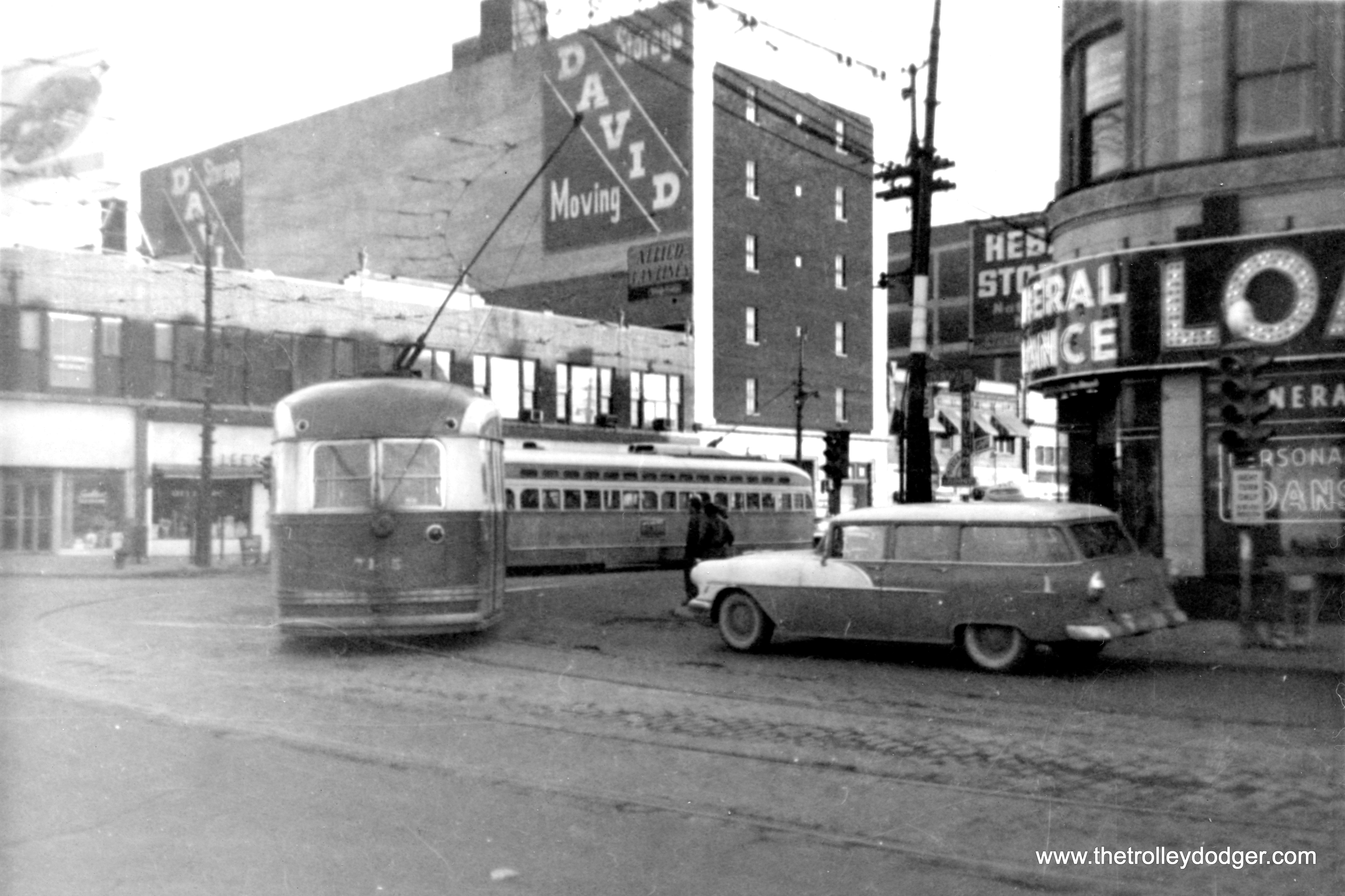
The presence of Chicago’s famous Como Inn restaurant (which closed in 2001, after being in business for 77 years) helps identify this location as the “six corners” intersection of Halsted, Milwaukee and Grand. Andre Kristopans: “The street you are looking down is Milwaukee, cars could be Milwaukee, Elston, or Division routes. The 1900 on the left in the first photo is on Grand, and Halsted crosses both left to right.” Scott writes, “The photographer is looking northwest up Milwaukee Avenue; the “turtleback” car at the left in the first picture is on Grand. The block in the background (with the corner bar and Schlitz billboard) was recently torn down for new construction; the buildings had all been painted a bluish-gray and left to deteriorate for years.” We posted a later photo showing a PCC car at this location in our post Chicago PCC Updates (August 30, 2015). (Robert V. Mehlenbeck Photo, Joe L. Diaz Collection)
CSL 3058 passes car 687 on Milwaukee at the intersection with Grand and Halsted. (Robert V. Mehlenbeck Photo, Joe L. Diaz Collection)
The same location today. Grand is on the left, Milwaukee on the right.
CSL 6259 at the Imlay loop, the north end of the Milwaukee Avenue route. (Robert V. Mehlenbeck Photo, Joe L. Diaz Collection)
CSL Sedan (Peter Witt) 3367 in service on the Cottage Grove route. Andre Kristopans: “Sedan 3367 is turning west to north at 95th and Cottage Grove.” M. E. writes, “The photo titled “CSL Sedan (Peter Witt) 3367 in service on the Cottage Grove route” must have been taken at 95th and Cottage Grove, because the streetcar is turning from one road to another. At 95th St. there were actually two Cottage Grove Aves.– one heading north along the west side of the Illinois Central main line, the other heading south along the east side of the IC main line. To connect from one Cottage Grove to the other (whether north- or southbound), the streetcars turned left onto 95th St., went under the IC, then turned right on the other Cottage Grove. As for which side of the IC this picture depicts, I believe it is the west side, because I recall a wall along the south side of 95th St. Ergo, this view is west on 95th and the streetcar is heading north.” (Robert V. Mehlenbeck Photo, Joe L. Diaz Collection)
The same location today. We are looking west along 95th, and Cottage Grove is to the right.
CSL 3113 on the Ashland route. Andre Kristopans: “3113 is at Ashland and Irving Park, on the NORTH ASHLAND shuttle route between Irving Park and Fullerton. It was made part of the main route in the 1930’s when the Ashland bridge over the North Branch was built.” (Robert V. Mehlenbeck Photo, Joe L. Diaz Collection)
Ashland and Irving Park today. We are looking east.
CSL 1260 on Montrose. Andre Kristopans: “1260 on Montrose might be at Knox. Does not appear to be at Milwaukee, but that was a 1930 extension, and this is likely before then.” (Robert V. Mehlenbeck Photo, Joe L. Diaz Collection)
One of our regular readers says that CSL Pullman 184 is in the Clark-Arthur Loop, across the street from Devon Station. (Robert V. Mehlenbeck Photo, Joe L. Diaz Collection)
Motion blur makes it hard to read the car number, but this is a Pullman in the (natch) “Pullman green” color scheme prior to the adoption of red in the 1920s. One of our regular readers writes, “Chicago Railways Pullman No. 191. Note the Chicago Railways logo on the side of the car. The CRys logo was very similar to the CSL logo. This photo was probably taken between 1908 and 1914 when CSL started operations. The cars were not painted red and cream until the early 1920s when CSL adopted that color scheme.” (Fred J. Borchert Photo, Edward Frank, Jr. Collection)
This is a circa 1940 view taken by Edward Frank, Jr. showing the old Edgewater car house. We previously posted a Fred J. Borchert photo showing a street railway post office car at this location, in Chicago Surface Lines Photos, Part One (November 3, 2015). Such services ended in 1915. According to www.chicagorailfan.com:
CHICAGO NORTH SHORE STREET RAILWAY EDGEWATER 5847 N. Broadway (near Ardmore Ave.) Opened in 1893 Replaced by Devon car house in 1901 Used as Ardmore bus garage 1937-1950 Building remains standing, abandoned except for CTA substation within northwest corner. Chicago North Shore Street Railway Co. was sold in 1894 to North Chicago Electric Railway Co., and merged in 1899 into Chicago Consolidated Traction Co.
5847 N. Broadway today.
I’m not sure of the exact location of this car at Chicago’s lakefront. Is this Navy Pier? Oak Street beach? Or somewhere else entirely? Andre Kristopans: “The lakefront shot is indeed Oak St, the Chicago Ave loop which was on the NORTH side of Grand about where the entrance to the water filtration plant now is.” George Foelschow: “The lakefront picture features the Furniture Mart at Lake Shore Drive at Erie Street, built in 1926 and the largest building in Chicago for a time. The tiny beach would be at Ohio Street. The Chicago Avenue line approached Navy Pier until the drive was “improved”, though I believe its tracks were separate from the Grand Avenue line.” M. E. writes, “The photo titled “I’m not sure of the exact location of this car at Chicago’s lakefront” is probably, as you surmise, at Navy Pier. There was a huge building on the west side of Lake Shore Drive, which I think was the Furniture Mart. That would have been only a block north of Grand Ave., where Navy Pier is. There were no streetcars anywhere near the Oak St. beach.”
The number on this car at Navy Pier looks like 3010, which would make it a Brill. Andre Kristopans: “3010 at Navy Pier is probably working Stony Island-Wabash. This was the “short loop” roughly in the middle of Navy Pier Park, surrounded by Streeter Drive. Grand cars turned back next to the ramp on the left, which had once had streetcar track going to the upper level of the pier, but by this point was for truck access. The short loop was paved for trolley bus use in 1951, and by 1955 or so replaced by a new TT loop which was accessed from Streeter & Illinois, which lasted until the complete rebuilding of the area in the 1990’s.” (Edward Frank, Jr. Photo)
This is the old LaSalle Street streetcar tunnel, seen here north of Randolph. The tunnel was in use from 1871 until 1939, when it became an access point for construction of the Dearborn-Milwaukee subway. (Fred J. Borchert Photo, Edward Frank, Jr. Collection)
The old LaSalle Street streetcar tunnel, north of Randolph. (Fred J. Borchert Photo, Edward Frank, Jr. Collection)
Perhaps one of our readers can help identify this bridge. Andre Kristopans: “The first bridge photo is Kedzie across the Sanitary & Ship Canal. The IC bridge in the background is still there, the Kedzie bridge was replaced mid-1960’s, which caused the conversion of the Kedzie-California trolley bus route to motor buses, because CTA did not want to put wires on the shoo-fly.” Bill Shapotkin adds, “This is the Kedzie Ave bridge over the river south of 31st St. View looks E-N/E. Note the still-in-service IC bridge in background (which I did ride over under Amtrak).” (Edward Frank, Jr. Photo)
Again, maybe one of our readers can help identify this bridge. Andre Kristopans: “The second bridge photo is much harder to ID. However, notice that while the bridge is for lanes, the streetcar is on the “wrong side”, as both tracks are on the near half of the bridge!” Perhaps the bridge was expanded at some point, and the car tracks were left on the one side only. (Edward Frank, Jr. Photo)
Eric Bronsky writes:
This photo shows a car operating northbound on South Western Ave. Bridge over the Chicago Drainage Canal (known today as the Sanitary & Ship Canal), probably in the 1930s. This center pier swing bridge was built in 1906 and removed in 1939. Actually this bridge carried two separate thoroughfares – S. Western Ave. and S. Western Blvd., the latter being a component of Chicago’s historic boulevard system with limited access to local streets between 31st Blvd. and 54th St. Then as now, both thoroughfares were bi-directional. The car tracks were on the avenue (westernmost) side of the bridge.
The main problems with the old swing bridge were its low clearance and the center pier obstructing river traffic. The current bridge, originally completed in 1940 as a fixed span, was soon converted to a vertical lift bridge to accommodate WWII traffic from a shipyard along the canal. It was later converted back to a fixed span.
I have attached a photo which you may use in the blog. Dated Sept. 8, 1938, it looks north. Evidently S. Western Ave. was widened at some point after the bridge was built, but the car tracks were not relocated to the center of the rebuilt roadway, which would explain the offset on the curved approach to the bridge. Please credit Eric Bronsky Collection.
Thanks very much, Eric. There were other places along Western Avenue where the streetcar tracks ended up being offset after the street was widened. You can see such pictures, and a variety of pictures showing the 1940 replacement bridge, in Central Electric Railfans’ Association Bulletin 146, Chicago Streetcar Pictorial: the PCC Car Era 1936-1958.
According to the caption on this Chicago Historical Society photo, we are looking east at Devon station on September 23, 1923. This is a new repair bay at teh west end of the new pit, after much of the building here was destroyed by fire in early 1922.
Looking east at Clark and north of Schreiber, this February 10, 1922 Chicago Historical Society photo shows the aftermath of the fire that burned down half of Devon station (car house).
One of our regular readers thinks this photo shows Evanston Avenue (now Broadway) between Devon and Lawrence. “I believe that the streetcar is a Chicago Union Traction car, but it is too far away in the photo to identify. I believe that the view is looking north somewhere in Edgewater.”
CSL Snow Plow F28. Don’s Rail Photos says, “F28, plow, was built by McGuire-Cummings in 1924. It was retired on December 14, 1956.” (Joe L. Diaz Photo)
Don’s Rail Photos says, “E57, sweeper, was built by Russell in 1930. It was retired on March 11, 1959.” (Joe L. Diaz Photo)
This, and the series of photos that follow, were taken between 1930 and 1932 by George Krambles at the Devon car house, where a lot of very old equipment (including single-truck streetcars) was stored. Since GK was born in 1915, he would have been in high school at this time. CSL often kept obsolete equipment for decades. Some of these cars were used for work service. Another reason for keeping them was their potential sale as assets, in case transit unification came to pass. The young man at left is unidentified. (George Krambles Photo, Edward Frank, Jr. Collection)
CSL Sand Car R4 at Clark and Devon, circa 1930-32. Don’s Rail Photos says, “R4, sand car, was rebuilt by Chicago Rys in 1913 as M4. It came from 5569, passenger car. It was renumbered R4 in 1913 and became CSL R4 in 1914. It was retired in 1942.” (George Krambles Photo, Edward Frank, Jr. Collection)
Ancient CSL car 2144 at Clark and Devon, c1930-32. The side sign reads, “Base Ball.” (George Krambles Photo, Edward Frank, Jr. Collection)
CSL 1142 at Devon car house. Many cars in this series were sold in 1946 for use as temporary housing. I am not sure if this picture was taken around 1930-32 like the few that precede it. (George Krambles Photo, Edward Frank, Jr. Collection)
CSL Supply Car S201. Don’s Rail Photos: “S201, supply car, was built by Chicago City Ry in 1908 as CCRy C45. It was renumbered S201 in 1913 and became CSL S201 in 1914. It was retired on September 27, 1956.” (Joe L. Diaz Photo)
CSL 1465 was called a “Bowling Alley” car due to its sideways seating. Don’s Rail Photos says, “1465 was built by CUT in 1900 as CUT 4514. It was rebuilt as 1465 in 1911 and became CSL 1465 in 1914. It was rebuilt as (a) salt car and renumbered AA71 on April 15, 1948. It was retired on August 2, 1951.” (Joe L. Diaz Photo)
As we near the end of summer here in Chicago, we will leave you with this wintry scene of CSL 1455. Don’s Rail Photos says, “1455 was built by CUT in 1900 as CUT 4504. It was rebuilt as 1455 in 1911 and became CSL 1455 in 1914. It was rebuilt as (a) salt car and renumbered AA67 on April 15, 1948. It was retired on August 17, 1951.” (Joe L. Diaz Photo)
Help Support The Trolley Dodger
This is our 154th post, and we are gradually creating a body of work and an online resource for the benefit of all railfans, everywhere. To date, we have received over 193,000 page views, for which we are very grateful.
You can help us continue our original transit research by checking out the fine products in our Online Store. You can make a contribution there as well.
As we have said before, “If you buy here, we will be here.”
Some railfans would not have taken this picture, due to the position of the signal, which obstructs the view of the train. But it does give you an idea of how “L” train movements were hampered during the nearly five years of operation on temporary trackage along Van Buren Street from 1953 to 1958. As the expressway, to the left, appears unfinished, I would guess this picture dates to around 1954. All trains had to come to a complete stop at each intersection, which is likely how that signal operates. I believe the cross street here is Western Avenue, and we are facing west. (Walter Hulseweder Photo)
Chicago author Robert Loerzel has written an article for Chicago public radio about the people who were displaced by the construction of the Eisenhower (formerly Congress) expressway. (It’s also a podcast, which you can listen to here.)
Several of the images used in “Displaced” were sourced from a series of blog posts I wrote for the CERA Members Blog a few years ago. My focus was on how the expressway project transformed the old Garfield Park “L” into today’s median rapid transit line. Robert’s piece takes a different tack, but is fascinating nonetheless.
From Garfield “L” to Congress MedianPart 4, Part 5, and Part 6 (August 22 to December 1, 2013) – Some of the articles listed above make up the first three posts in this series.
You can also find additional pictures of expressway construction in previous Trolley Dodger posts. Just type “Congress” or “Garfield” into the search window at the top of this page, and links to these things will come up.
A Few Thoughts on “Displaced”
Although the article doesn’t mention it, some buildings that were in the way of the expressway were moved rather than torn down. House moving, and building moving, seems to be a long Chicago tradition. (In 1929, Our Lady of Lourdes church at 1601 W. Leland was moved, lock stock and barrel, across the street to permit the widening of Ashland.)
In the old CERA blog, I posted pictures of a five-story building being moved near downtown, and a brick apartment building further west.
I know that there were houses moved as far west as Maywood during the expressway construction. Of course, since that was an area with lower density, it would have been easy to find empty lots.
I am pretty sure some buildings in Oak Park were also moved. Contemporary newspaper accounts say so.
As for where the people went who were displaced by the highway, my guess is they were dispersed all over the place, and some moved to other parts of the city and not just to the suburbs as the article implies. Most likely, a majority of displaced residents remained in the city.
Keep in mind that in the period after WWII, when construction began, there were still areas of the city that had not yet been developed.
During WWII, in the area of Galewood where I used to live, fully half the lots were still vacant. In the early 1960s, the last of these vacant lots got developed. (We did not get paved alleys until 1964. I was surprised recently when in Edgebrook to see that there are still unpaved alleys in that otherwise built-up neighborhood.)
And while I am sure that some of the Italians from the old neighborhood ended up in Elmwood Park, when my family moved there in 1964, it was still largely German. It became a lot more Italian after 1964, more than 10 years after people in the expressway’s path would have been displaced.
Although “Displaced” implies that expressway construction was responsible for the Jewish migration from the west side to the north side, I believe this trend was already occurring, going back to the 1930s.
As for the “Burnham connection” between his 1909 Plan of Chicago and the Congress expressway, there is a connection, but it’s more of a zig-zag line than a straight line.
Yes, Daniel Burnham envisioned an improved roadway along Congress, but this would have been more of a landscaped boulevard than a modern expressway. There weren’t a lot of automobiles in 1909, and the idea of such a highway didn’t exist yet. However, with publication of the plan, speculators bought up land along its path, and as time went on, wanted to cash in.
While the old Main Post Office building, as expanded in 1932, left a space for Burnham’s Congress parkway, as late as 1937, the roadway’s future was in considerable doubt.
It did not appear in highway plans proposed in 1937 by Mayor Edward J. Kelly, which favored turning several of Chicago’s “L”s (the Douglas, Humboldt Park, and Lake Street lines) into a disconnected series of elevated highways, which would have resembled New York’s ill-fated West Side Elevated Highway.
Chances are, this plan would have been a disaster. It would have decimated large parts of our rapid transit system, without really solving the highway problem as a whole. Since the City sought federal money for the project, as a works project, it needed the approval of FDR’s Harold L. Ickes. He did not like the plan.
Ickes put his clout behind a Congress parkway expressway, plans for which were finally approved in 1939.
We are gratified that posts we have made in this, and in our previous blog, are being used by researchers looking for source material. That has always been our goal.
For Further Reading
Of particular interest is a 1952 letter, sent by the Chicago, Aurora & Elgin interurban to their shareholders, detailing the railroad’s position at the beginnings of the expressway construction project.
If any of you have read Cooperation Moves the Public (Dispatch 1 of the Shore Line Interurban Historical Society) by Bruce Moffat, you know how CA&E operations on the CTA’s Garfield Park “L” depended on a high degree of professionalism and split-second timing. Once service on the “L” was shifted to the slow and ponderous temporary trackage on Van Buren Street, this level of service became impossible.
Whatever difficulties the CTA experienced from 1953 to 1958 with this operation would have been exacerbated by the additional of CA&E trains. The interurban was truly put into an impossible situation, which left them with little choice but to either sell out to another entity such as the CTA, or liquidate entirely.
Once the expressway portion crossing the DesPlaines River opened in October 1960, there would have been additional ridership losses on the CA&E, which was also facing stiff competition from the Chicago & North Western, which had by then put new air-conditioned bi-levels into service.
In the long run, if CA&E had survived, ridership would eventually have bounced back. But the railroad was unable to survive the many lean times that would have been ahead. The CA&E’s main interest in the 1950s became a gradual liquidation of assets, with the proceeds being distributed among their shareholders.
My conclusion is that the CA&E could only have been saved through a pro-active plan adopted at the beginnings of highway construction, and not the last-ditch efforts at the end. (See also our earlier post The CTA, the CA&E, and “Political Influence”, February 18, 2015).
Here is the original agreement between Oak Park and the State of Illinois for the construction of the expressway.
Plans were changed as they went along. Oak Park had the highway reduced by one lane in each direction, because of the number of buildings that would need to be demolished. Entrance and exit ramps at East Avenue were cancelled, after the village objected. They thought that this would detract from the quiet residential nature of the neighborhood, and would also lead to the widening of East Avenue.
Through Oak Park, both the rapid transit line and the B&O CT freight line were originally intended to run in the middle of the highway, but this would have cut off several local businesses from rail service, probably putting them out of business. Therefore, plans were changed so that the rail lines were put to the south of expressway traffic. There were a couple ramps along the freight line that connected to sidings. One was just east of Austin Boulevard, the other east of Harlem Avenue. Those are no longer in use.
Today, the only customer that still uses the freight line in this area is the Ferrara Candy Company in Forest Park.
Here are some Oak Park newspaper articles, covering the period from 1945 to 1960 concerning expressway construction:
In 2010, the Village of Oak Park proposed making the unusual left-hand exit and entrance ramps at Harlem and Austin landmarks. You can read some of that correspondence here.
-David Sadowski
It’s 1953, and just prior to the opening of the temporary Van Buren trackage, we see a test train crossing Paulina. The streetcar tracks are for CTA route 9 – Ashland, which was still in service until early 1954. The photographer was standing on the platform at Marshfield Junction. The tracks veering off to the right, where Logan Square and Humboldt Park trains once ran, had been out of service since 1951. Garfield and Douglas trains were still running on the “L” when this picture was taken.
The Van Buren Street temporary trackage as it appeared on July 17, 1954. The two-car train of flat-door 6000s may be 6071-6072. As for the cross street, my guess is California Avenue (2800 W.) meaning we are near the west end of the 2 1/2 miles of temporary right-of-way. There is a CTA bus just barely visible behind the train. Since the “L” made no stops along this section, bus service continued on Van Buren, even though it was only half a street for five years. Just to the left of the train, you can see streetcar trackage that would have been used until 1951. (Ed Malloy Photo)
Van Buren at California today. We are looking to the east.
Another view of the Van Buren trackage, circa 1953 since the old “L” is still extant at right.
In this March 17, 1958 photo by Kelly Powell, I think we are looking at construction just west of the Loop related to the Northwest expressway, and not Congress. By 1958, any such work for Congress had been taken care of years earlier. On the other hand, as of this date, CTA service was still running on the old Met “L” east of Aberdeen Street (1100 West), and would have crossed the NW highway footprint just east of Halsted. Once service in this area was shifted to the new expressway median line in June 1958, this section of “L” was removed.
CA&E 430 heads up a two car train at DesPlaines Avenue in the 1950s, while some CTA 6000s are at right.
To show you just how bad Chicago’s postwar housing shortage was, some people purchased surplus streetcar bodies for use as temporary homes. The caption on this press photo reads, “OVER-AGE STREET CAR BECOMES FAMILY’S HOME. CHICAGO- Mrs. Edith Sands prepares dinner on the small stove in the over-age streetcar where she and her husband, Arthur, and their five-month-old son, Jimmy, have just moved. The trolley car, which has seen nearly 50 years of service on Chicago streets, was purchased by the Sands at a recent public sale and propped up on a 5-acre site near Chicago’s southern edge. The car is lighted by gasoline lamps.” (April 16, 1946) In our post Lost and Found: Chicago Streetcar #1137 (June 5, 2015), we wrote about how one of these old streetcars, once used for housing, was recently discovered in Wisconsin. It has since been moved to a museum where it will hopefully be preserved.
If you’ve ever wondered where the old and new CTA tracks converged between 1958 and 1960, this blow-up of an old Roy Benedict map (dated May 15, 1959) shows how it was done. Service east of here began running in the new expressway median as of June 22, 1958, but construction between here and Forest Park was still ongoing, and there were various temporary rights-of-way involved. A track connection was retained to the old Laramie Yard for nearly a year, to permit shop work. This map shows a barrier where the old track connection would have been, probably indicating it had just been cut off. The median line made a turn to the north, immediately after leaving the Lotus Tunnel, to connect up with the old ground-level alignment west of here. All this would have been in the way of extending the Congress expressway west of Central. Once the old tracks connecting with Laramie Yard were removed in mid-1959, the expressway was opened to Central in early 1960. After CTA tracks were put into their current alignment south of the highway, roadwork proceeded quickly and the highway opened as far as First Avenue on October 12, 1960, essentially connecting all the separate links that had been built. On this map, there are diversions where both Central and Austin cross the CTA tracks. At Austin, a bridge was under construction, and at Central, it was an underpass. Regular traffic was routed around this.
Originally, I thought this was early 1960s night shot showed a CTA single-car unit in the 1-50 series, and those cars were used on the Congress-Douglas-Milwaukee line. But as Andre Kristopans has pointed out, the doors on those cars were closer to the ends than this one, which he identifies as being part of the 6511-6720 series. It just looks like there’s one car, since the other “married pair” behind it is not illuminated. This picture was most likely taken at the end of the line at DesPlaines Avenue. Anyway, this prompted some interesting correspondence with Andre Kristopans on the Philly Traction Yahoo Group.
I wrote:
Were the CTA’s single car units (first delivered in 1959), which were designed for one-man operation, ever used as one-car trains on any line besides Evanston or Skokie? I have seen a picture* of a single car on West-Northwest, but that was at the end of the line.
It was my impression that one-car trains were limited to certain lines due to labor union agreements. So, in general, on lines other than Skokie or Evanston, they were run in trains of two cars or longer.
Andre replied:
It COULD have been done, but wasn’t. The 1-50 series of 50 cars were bought with the intent they would be one-man operated. Obviously 50 was way too many for Evanston, in fact only 12 came with trolley poles (39-50) intended for Evanston. Skokie wasn’t even thought of in 1959. The rest were intended apparently for overnight and weekend West-Northwest service, where riding at the time (1959) was quite light. In fact the west side lines had been running single cars since the late 1940’s on some services, such as the Westchester non-rush service where a car was cut off WB from a Forest Park train at Laramie, ran to Westchester and back, then was added back to a Forest Park train. Normal Park on the south side was also a single car cut off an Englewood train at Harvard. Skokie before 1949 was a single woodie, too. But CTA quickly realized that if you had to have a 2-man crew, why not run a 2 car train, so the 1-50 cars always were in pairs on WNW, and used almost exclusively in rush hours.
Me again:
So, in the PCC era, it would have been possible to operate a one-car train on other lines than Evanston or Skokie, but only with a two-man crew?
Andre:
Correct. In the PCC era, single cars were only on Evanston and Skokie. In wood car days, they were used on practically all lines except North-South at one time or another, but with 2-man crews.
*I thought I had seen a picture… see the photo caption above.
The Van Buren Signal System
At intersections, the CTA used an innovative electric eye beam to make sure that stoplights did not change while trains were in the crossing. There were about 15 such cross streets along the 2.5 miles of this surface operation.
In the Comments section for this post, Jeff Weiner and I discussed whether the train signal system on the Van Buren temporary trackage interfaced with the stoplights at the various intersections. I did some research and here’s what I found:
Chicago Tribune, December 14, 1952:
ELECTRIC EYE PLAN PROPOSED FOR C. A. & E.
Aid for Traffic in Van Buren St.
An electronics expert last week put his stamp of approval on the electric eye traffic control system proposed by the city during the temporary operation of Chicago transit authority and Chicago, Aurora and Elgin railway trains at grade level in Van Buren st., pending completion of the Congress st. expressway.
Dean Charles C. Caveny of the Chicago branch of the University of Illinois, an engineer and physical scientist, told the Illinois commerce commission the photo-electric cell system will be satisfactory if properly installed. He said it will probably be as reliable as the more conventional track circuit system.
Testifies at Hearing
The educator testified at a hearing on the Aurora and Elgin petition to suspend rail operations and substitute buses. He said the photoelectric cell system of control is unconventional as far as the proposed type of operation is concerned, but it has been used successfully at the approaches to railroad tunnels.
The city proposes electric eyes at both sides of Van Buren st. intersections. The devices would control north-south traffic signals and would prevent north-south traffic from entering the intersections while trains are in the intersections. The track circuit system does the same thing, but is a much more expensive device.
The city also amended its Van Buren st, operation plan by eliminating five of the 15 intersections crossed by the grade level operations between Sacramento blvd. and Racine av.
Richard A. Walons, a city traffic engineer, testified that CTA officials had said their trains would be unable to maintain a consistent schedule unless the number of intersections was cut down.
Average 11.5 M. P. H.
Walons said that when the grade level operation begins, probably in the spring. Campbell, Washtenaw, and Hoyne avs., and Throop and Laflin sts. will be barricaded to north-south traffic. The move is designed to allow trains to average 11.5 miles per hour in the street.
Under questioning by Joseph T. Zoline, attorney for the Aurora and Elgin, Walons said this was about the sixth plan the city has proposed for the operation. The Aurora and Elgin contended any Van Buren st. operation would not be safe.
Then, on August 14, 1953, the Tribune reported:
Electronic Signal Protection on Ground Level L
A modern electronic signal system has been installed for the operation of Garfield Park elevated trains in temporary tracks at ground level between Racine and Sacramento avs., Walter J. McCarter, general manager of the Chicago transit authority, announced yesterday.
The signal system will govern the operation of trains at 10 street intersections along the temporary route in Van Buren st. All trains will stop at all crossings, with the electronic system providing special signals to instruct the motormen. Electric “eyes” at the intersections will hold traffic lights at red until the trains have cleared the crossings.
The temporary tracks at grade level were necessitated by the construction of the Congress st. super-highway, which requires razing of the elevated tracks. Regular use of the new route is scheduled to begin Sept. 15. The CTA will begin experimenting with the temporary route next week.
So, trains of the Van Buren trackage probably followed this procedure:
1. Trains pull up to a signal at each intersection, come to a complete stop, and look both ways for oncoming traffic 2. If the light is green, proceed with caution. The train breaks an electric eye beam, and as long as it is still in the intersection, the traffic light is prevented from turning green for north-south traffic. 3. If the light is red, wait for it to cycle and see step 2.
When I was a kid, the old High-Low grocery store in my neighborhood had an electric eye beam that opened the door automatically. This is not all that different from the technology used on the Van Buren operation.
I imagine CTA was naturally concerned that you could have a situation where the train started to cross the street, the light changed to green for cross traffic, and a vehicle, having the right-of-way, would try to cut in front of the train, potentially causing an accident. Without some way to change the regular sequence of red and green lights, this was a possibility, which the addition of the electric eye system helped prevent.
A wooden “Met” car was one of the first test trains on the CTA’s Van Buren temporary trackage. The date is August 18, 1953. Testing continued for a month to familiarize pedestrians and motorists with the operation.
Recent Additions
An improved scan of the following picture has been added to our previous post Around Town (August 19, 2016):
Here is a very interesting photograph that could only have been taken in a limited time period. It shows the 4-track Met “L” right-of-way looking east from Marshfield, with a train of newish flat-door 6000s assigned to Douglas. The street at left is Van Buren, and while the area has been cleared out for construction of the Congress (now Eisenhower) expressway (I290), work has not yet begun on the temporary right-of-way that would replace the “L” structure in this area starting in September 1953. I believe this work began in late 1951, shortly after streetcar service on Van Buren was replaced by buses. The first 6000s assigned to Douglas were sent there between September and December 1951. Since this is a wintry scene, chances are the date of this photo is circa December 1951. The building protruding at the center is the old Throop Street Shops.
These three images have been added to our post Night Beat (June 21, 2016):
Toronto Peter Witt 2766 at Vincent Loop in November 1964. (R. McMann Photo)
TTC crane C-2 at work at Queen Street and Eastern Avenue in October 1966. (R. McMann Photo)
A postcard view of C-2 at work in 1967.
And for our friends at the Illinois Railway Museum, here are four classic views of Chicago red Pullman 144, one of the earliest additions to the museum’s collection:
CTA red Pullman 144, as it looked at 77th and Vincennes in 1958, just prior to the abandonment of streetcar service in Chicago. The occasion was most likely the final red car fantrip, which took place on May 25th.
144, looking somewhat worse for the wear, at the Illinois Railway Museum in Union on May 15, 1967. (K. C. Henkels Photo)
Another view of 144 on May 15, 1967. Some makeshift repairs are in evidence on this car, nine years after it last operated in Chicago. It has since been one of IRM’s mainstays. (K. C. Henkels Photo)
144 at the Illinois Railway Museum, probably in the 1980s.
E-Book Additions
FYI, a seven page article from the January 1939 of Mass Transportation, taking an in-depth look at the entire Chicago public transit system, has been added to our E-books The “New Look” in Chicago Transit: 1938-1973 and Chicago’s PCC Streetcars: The Rest of the Story. Both are available via our Online Store.
If you have already purchased one of these discs, an updated version is available for just $5, with free shipping withing the United States. Contact us at thetrolleydodger@gmail.com for further details.
Concerning CSL’s Madison route, the article notes that “this operation is conducted entirely with P.C.C. cars of a type representing nearly as great an advance over the standard P.C.C. car as that car was an advance over the types previously operated.”
Andre Kristopans: “#4 is at McCormick Blvd on the Skokie branch, the bridge over the North Shore Channel, etc. #5 is an EB? train at Sacramento on the Garfield line.”
Help Support The Trolley Dodger
This is our 153rd post, and we are gradually creating a body of work and an online resource for the benefit of all railfans, everywhere. To date, we have received over 192,000 page views, for which we are very grateful.
You can help us continue our original transit research by checking out the fine products in our Online Store. You can make a contribution there as well.
As we have said before, “If you buy here, we will be here.”
NSL 420 heading south at Dempster, current end of the line for the CTA Yellow Line (aka the “Skokie Swift”), which revived a small portion of the old interurban a year after service ended in January 1963.
The Trolley Dodger blog has reached another milestone with this, our 150th post since we started on January 21, 2015. As time goes on, it becomes both easier and harder to come up with new ideas. On the one hand, we have to work harder to avoid repeating ourselves, since we have already posted thousands of images to date.
On the other hand, there always seems to be more material out there to be had. So in that sense, it seems unlikely that we will ever run out of new material. However, it’s always good to remind our faithful readers that all this historical research costs real money. It costs nothing to read our blog, of course, but the quality and frequency of future posts is entirely dependent on the financial support we get from you.
We are committed to maintaining a very high quality standard in what we put out, and our goal is not only to share information, but to create something of lasting value. We will let others be the judge of whether or not we have succeeded to date, but it’s interesting to note that I often find my own posts coming up to the top of Google searches, when I am researching things.
What makes a good blog post? Well, as I have said before, in general my idea is to use pictures to tell a story. But beyond that, it becomes more difficult to put your finger on what works and what doesn’t.
I would liken it to being a chef in a restaurant who takes whatever fresh ingredients are on hand, and tries to whip them up into a tasty dish. Since our first post featured the North Shore Line, we have a generous helping of classic CNS&M images on today’s menu.
In addition, we have a sprinkling of Chicago, Aurora & Elgin photos, plus some other Chicago/Illinois material, since that is where we are from. Hopefully, all this adds up to a complete “meal,” a feast for the eyes that is also designed to make you think.
But we have not forgotten “dessert.” Our last post (More Mystery Photos, July 29, 2016) included a picture of what appeared to be a Birney car that was not, according to Frank Hicks, an actual Birney. (If anyone is interested in learning what attributes of a streetcar make it into a “true” Birney, look no further than Dr. Harold E. Cox’s book on just that subject. What constitutes a PCC car is also somewhat debatable, another area where the esteemed Dr. Cox has weighed in with an expert opinion.)
While Birney cars, due to their small size, were unsuccessful in larger cities like Chicago, there can be no doubt they were a great success in Fort Collins, Colorado, the “Birney-est” place of all. The Fort Collins Municipal Railway purchased nine such cars for use between 1919 and 1951, a couple for parts. Of these, there’s been a pretty good survival rate, with fully five cars (#s 20, 21, 22, second 25, and 26) still extant.
These cars were so beloved in the area that they never completely left, and efforts to restore a car and revive at least a small portion of service began as early as the 1970s. Service on a mile-and-a-half line began in 1984 and continue to this day, meaning that the resurrected Birney car service in Fort Collins has lasted 32 years now, the same length of time that the original service ran.
The last regular operation of Birney cars in the U. S. was in Fort Collins, CO. The line was originally built by the Denver & Interurban Ry in 1907. In July 1918, the D&I stopped operating the local lines. A bus system was tried, but was very unpopular. In January 1919, the voters, by an 8 to 1 majority, decided to take over the system. Four Birneys were purchased from American Car of St. Louis and began operation in May. Over the years additional cars were added and replaced. Finally, in 1951, the system was abandoned on June 30th. The city had grown beyond the car lines, and riders had gone to the automobile. Car 21 was preserved locally. Other cars were saved at other locations. A local group began to restore 21 in 1977, and operation began on Mountain Avenue on December 29, 1984. Over the next two years, 1.5 miles of track was restored for operation. For a complete story about this system, check out their web site.
But wait, there’s more! There was also a double-truck version of the Birney, so we have posted a couple pictures of Johnstown 311, a much-loved car by the fans who took it on many trips back in the day. It ran in service in Pennsylvania until 1960 and has been preserved at the Rockhill Trolley Museum.
We are featuring color photos today, and will have several new black-and-white images to share in the near future. Thanks for coming along for the ride.
Bon Appétit!
-David Sadowski
PS- If you can help identify any of missing locations, or have other interesting thoughts on these pictures, don’t hesitate to drop us a line, either as a Comment here, or via:
thetrolleydodger@gmail.com
Chicago, North Shore & Milwaukee (aka North Shore Line)
NSL 706 heads south from Dempster in this June 9, 1961 photo by Clark Frazier. This is the current terminal of the CTA Yellow Line. The area under the electrical tower at left is where the “pocket” track went, when this was the end-of-the-line for the CRT’s Niles Center Branch. This local service ended in 1948. CTA “L” service resumed here in 1964.
A solitary North Shore Line car crosses the Chicago River at Wacker Drive on the “L”.
NSL 739 and train at Lake Bluff.
NSL 737 at the Loyola curve on the CTA.
NSL 713 heads up a five-car train at Sedgwick in October 1958.
NSL 737 and head “at speed” near Sheridan Elms in Lake Forest.
NSL 735 et al at North Chicago.
“Silverliner” 756 and train in Skokie.
A southbound Electroliner at Edison Court.
NSL 182 and train at St. Mary’s Road (Thornbury Village) on the Mundelein branch on May 31, 1962. Notice the difference in right-of-way construction here, versus the main line.
NSL 743 and train at Green Bay Junction. Jerry Wiatrowski: “NSL 743 and train are on the Skokie Valley route westbound crossing the Mundelein branch at Lake Bluff. The Green Bay Road overpass can be seen in the background.” Joey Morrow: “NSL 743 is at Green Bay junction, the catenary poles are still there today. It parallels IL-176 (Rockland Ave).”
NSL “Greenliner” 751 and a Silverliner at Lake Bluff in June 1962.
A photo run-by on a February 21, 1960 North Shore Line fantrip.
I don’t know just when this picture of a North Shore Line “special” train was taken, but Gustafson Motors was located in Libertyville, along the Mundelein branch. FYI, we have several North Shore Line audio recordings available on compact disc in our Online Store, including some from the Mundelein branch. Garrett Patterson: “nsl003 would have been taken just weeks before the end of service system-wide. The 1962 Bel Air in the lot dates the photo.” One of our regular readers adds: “This was the CERA fantrip that was operated in April 1962. George Krambles operated the train in Evanston, and there are movies and slides of the train going south from Isabella going up the hill to the North Shore Channel bridge. The scene is seen in The Tribute to the North Shore Line video, which has been presented at January CERA meetings (although it is not commercially available). Of course the above photo is at Libertyville (which was a beautiful place in the country at one time).”
NSL 705 and 709 are near the Mundelein terminal on March 25, 1962.
Chicago, Aurora & Elgin
CA&E 460 and an older car are in fantrip service during the late 1950s. Nancy Grove Mollenkamp writes: “This is at West Street looking west in Wheaton. The bridge over Liberty Drive at the start of the Elgin branch is seen in the background.”
CA&E 452 at Geneva Road on March 9, 1957. Nancy Grove Mollenkamp: “This is in Winfield. I believe looking north.”
CA&E 404 is part of a two-car train at the Halsted curve on the old Garfield Park “L”, probably not long before the end of downtown service in September 1953.
CA&E 423 is part of a two-car train at Collingbourne. Nancy Grove Mollenkamp: “Collingbourne is along the Elgin branch near Raymond St. and Elgin Ave.”
One can only wish that the photographer had aimed the camera a bit lower, but nonetheless, CA&E 428 is part of a four-car train in July 1953 on the Halsted curve.
CA&E 454 at an unidentified location. Nancy Grove Mollenkamp: “This slide was identified by someone in a Wheaton FB group as being taken in 1952 at Jewell Road in Wheaton. Another person in the group said he believed it was looking south. He thinks that is Electric Avenue on the right or west.”
CA&E work motors 2001 and 2002 in service in March 1959. By this time, it had been nearly two years since the end of passenger service. Freight only continued for a few more months after this. (B. J. Misek Photo)
We are not sure of the location where this picture of CA&E 403 was taken. Presumably, the box the conductor is carrying holds work-related materials. George Foelschow: “I believe CA&E Pullman 403 and unattached car 410 or 419 are on the eastbound track at Wheaton station. Presumably the two cars, one each from Aurora and Elgin, will be joined for the trip east, and the conductor of 403 would be redundant and no doubt be on the next Fox Valley train due in a few minutes to be split. One could travel between Elgin and Aurora in the same time as a City Lines bus taking a more direct route along the Fox River.” Nancy Grove Mollenkamp: “I agree. Definitely at Wheaton station.”
CA&E 420 at Church Road (Aurora).
CA&E 424 near the end of the line, along the Fox River in Elgin. Meister Brau was a well-known Chicago beer for many years. Each spring, they would sell “Bock” beer, a stronger concoction made (I think) by scraping the bottom of the barrel. They introduced Meister Brau Lite in 1967. After Meister Brau got into financial difficulty in 1972, their brands were bought by Miller, who used Meister Brau Lite as the basis for developing Miller Lite.
CA&E 405 is part of a two-car train. Nancy Grove Mollenkamp: “This is identified by Mark Llanuza as being taken in 1956 between the College Ave station in Wheaton and Glen Ellyn. Photographer unknown.”
CA&E 317 is part of a four-car train of woods.
Chicago and Illinois
Indiana Railroad hi-speed lightweight interurban car 65 at the Illinois Electric Railway Museum in North Chicago in October 1956. It had last run in 1953 on the CRANDIC (Cedar Rapids and Iowa City) before being purchased by the museum as their first acquisition. That’s Chicago & Milwaukee Electric 354, another early purchase, behind it.
Illinois Terminal double-end PCC 457 is part of a two-car train, northbound at 19th and State in the mid-1950s. Don’s Rail Photos says, “457 was built by St Louis Car Co in 1949, #1672. It was sold for scrap to Biermann Iron & Metal Co on July 24, 1959, and was scrapped in 1964.”
The same location today.
In this undated photo, probably taken circa 1952, tracks are being laid in the southern half of Van Buren Street to create a temporary right-of-way for the Garfield Park “L”, to allow the demolition of 2 1/2 miles of the old structure that were in the way of Congress (now Eisenhower) expressway construction. At right, you can see the old Throop Street Shops. This temporary alignment was used from September 1953 to June 1958.
A two-car train of CTA 4000s heads west on temporary trackage at Van Buren and Western on July 1, 1956. This was just two weeks after streetcar service ended on Western Avenue. This picture was taken around the time that the sounds of 4000-series “L” cars were recorded on the Garfield Park “L” for Railroad Record Club LP #36, which has been digitally remastered and is now available on compact disc in our Online Store.
Western and Van Buren today, looking to the northeast.
Since CTA PCC 4406 is signed for charter service, this picture was probably taken on October 21, 1956, when this car ran on a fantrip with red Pullman 225. We have run photos from that fantrip before. You can see one in our post Chicago Surface Lines Photos, Part Six (February 22, 2016). Perhaps someone more knowledgeable than me can tell which station (car barn) this is, whether Devon or 77th. Car 4406 lasted until the end of Chicago streetcar service and had a scrap date of June 23, 1959.
A two car train of Lake Street “L” cars crosses the Chicago River with the Merchandise Mart in the background, probably in the early 1950s.
CSL/CTA Y303 is listed as a “baggage car,” although some have called it a MoW or maintenance of way car. It was retired on September 27, 1956. Don’s Rail Photos says, “Y303. baggage car, was built by C&ST in 1911 as 59. It was renumbered Y303 in 1913 and became CSL Y303 in 1914.”
This 1920s-era Chicago Surface Lines trailer was looking pretty shopworn by the 1950s, when this picture was taken at South Shops.
CSL/CTA streetcar 1497 was renumbered as AA85 for work service as a salt spreader, the configuration we see it in here in this 1950s photo. It was scrapped on September 27, 1956. This was known as a “Bowling Alley” car. Don’s Rail Photos: “1497 was built by CUTCo in 1900 as CUT 4546. It was rebuilt as 1497 in 1911 and became CSL 1497 in 1914. It was rebuilt as salt car and renumbered AA85 on April 15, 1948.”
According to Graham Garfield’s excellent web site www.chicago-l.org, “CTA work car S-328 — built by American Car & Foundry in 1907 as Northwestern Elevated trailer 1283, motorized and renumbered to 1792 in 1914 by the CER — was converted for work service and renumbered in 1958.” It was retired in August 1970 and scrapped. Wooden “L” cars were last used in regular service by the CTA in 1957. After spending their final days in work service, cars like these were replaced by retired 4000-series “L” cars. Here we see S-328 at DesPlaines Avenue terminal in June 1962. (George Niles Photo)
In this June 1962 view. we see the CTA’s DesPlaines Avenue terminal as it had been reconfigured in 1959. these very basic amenities continued n use until the station was rebuilt in the 1980s. I would assume that the pile of rubble in the foreground was related to the recent construction of a new maintenance facility here. The nearby expressway had been in operation since 1960. Presumably, the CTA bus is running route 17, which replaced the Westchester “L” branch in 1951. (George Niles Photo)
A pair of old Metropolitan “L” cars, now in work service, share space with CTA curved-door 6000s in this June 1962 view at DesPlaines Avenue. The new shops facility is at left. The large gas holder at right was a Forest Park landmark for many years. (George Niles Photo)
Authentic Birney Cars
This circa 1940 postcard shows the Ft. Collins Birneys in a different paint scheme, which is actually the one currently being used for the one operating car. Caption: “The intersection of College and Mountain Avenues is the 42nd and Broadway of Ft. Collins. It is the heart of the business district, the crossroads of the town. Where all street cars meet and all highways converge.”
Car 26 in the Fort Collins car barn in June 1948.
Fort Collins Municipal Railway Birney car 22 in the city park on April 30, 1947.
25 in reverse rush hour loop service downtown in October 1950.
21 near Colorado State University in late June 1951.
25 in southeast Fort Collins in October 1950.
21 downtown in June 1948.
25 in reverse rush hour loop service downtown in October 1950.
22 in downtown Fort Collins in October 1950.
25 in southeast Fort Collins in October 1950. Here’s what the Wikipedia has to say about the film advertised on the side of the car: “Ecstasy (Czech: Extase, German: Ekstase) is a 1933 Czech-Austrian romantic drama film directed by Gustav Machatý and starring Hedy Lamarr (then Hedy Kiesler), Aribert Mog, and Zvonimir Rogoz.” Containing some nudity, although tame by today’s standards, the film was banned in the United States until 1940, and played to adult audiences at independent theaters and art houses, without the approval of the Hays Office.
22 near Colorado State University in October 1950.
21 at the south end of town in June 1948.
21 near Colorado State University in late June 1951.
22 in northwest Fort Collins in October 1950.
24 in front of the car barn in October 1950. According to Don’s Rail Photos, “2nd 24 was built by Brill Car Co in December 1922, #21530, as Virginia Railway & Power Co 1530 It was sold as FCM 24 in 1946 but seldom operated. Parts kept second Car 25 operating.”
21 at a passing siding in northwest Fort Collins in October 1950.
Fort Collins Municipal Railway “Birney” car 21, at the intersection of Johnson and Mountain Avenues. (Ward Photo)
FCMR 22 on October 26, 1949. Its paint scheme is described as green, red, and aluminum.
FCMR 25 at the car barn. (Ward Photo)
Feel the Birn(ey)! After service in Fort Collins ended in 1951, car 26 was sold to the Henry Ford Museum in Dearborn, Michigan. But prior to being put on static display, it operated in a Detroit parade of street railway equipment in August 1953. Don’s Rail Photos: “26 was built by American Car Co. in November 1922, #1324 as CERy 7. It was sold as FCM 26 it in 1924. It was sold to Henry Ford Museum and moved to Michigan in 1953 where it is on static display. It was operated several times on the trackage of the Department of Street Railways.” (C. Edward Hedstrom Photo) To read more about 26’s Michigan sojourn, click here.
25 stored at Woodland Park, Colorado on September 4, 1953.
25 stored at Woodland Park, Colorado on September 4, 1953. This was the second car 25, the first having been scrapped. Don’s Rail Photos adds, “2nd 25 was built by Brill Car Co in December 1922, #21530, as VR&P 1520. It was sold as FCM 25 in 1946. It was sold to James Stitzel in 1953 and resided next to the former Midland Terminal depot in Victor, CO, until it was sold to a South Carolina party about 1980. It was cosmetically restored. In 1998 it was sold to the Charlotte Trolley painted as South Carolina Public Service Co 407. It was sold to Fort Colins Municipal in 2008 and is being restored as 25.”
22 on static display at Golden, Colorado in July 1963.
According to Don’s Rail Photos, “22 was built by American Car Co in April 1919, #1184. It was retired in 1951 and sold to the Rocky Mountain Railroad Club in 1952. It was on static display at the Colorado Railroad Museum though 1997. It was leased to the Colorado Springs Transportation Society and presently being restored in the former Rock Island engine house. as Colorado Springs & Interurban Ry. 135.” It is shown here in September 1972.
Restored FCMR 21 as it appeared on May 14, 1995. (Mark D. Meyer Photo)
Before the Birneys, the Ft. Collins system used conventional streetcars, as seen in this postcard from circa 1910.
Many other cities had Birneys, of course. Here, we see Brantford (Ontario) Municipal Railway car 137 on July 1, 1935. This was ex-Lock Haven, Pa. Electric Railway car #2. (George Slyford Photo)
Johnstown Traction double-truck Birney 311 on September 3, 1958. (Clark Frazier Photo) Rockhill Trolley Museum: “The first car acquired by Rockhill Trolley Museum was car #311. This car is a double truck “Birney Safety Car” built by Wason Manufacturing Co. of Springfield, MA. It was part of an order of cars for the city of Bangor, Maine, where it operated at number 14. It was sold to the Johnstown Traction Co. and went there in 1941. It served that city well, running until the end of service in 1960. Car #311 was the last Birney type car to be operated in any United States city on a regular schedule. Car 311 was chartered repeatedly by trolley fans in the 1950’s, as it was a favorite car of many.” (Clark Frazier Photo)
Johnstown Traction double-truck Birney 311 at Coopersdale on September 3, 1958. (Clark Frazier Photo) The sounds of car 311, in service during the 1950s, can be heard of Railroad Record Club LP #23, which has been digitally remastered and is now available on compact disc via our Online Store.
Here is Johnstown 311 on June 30, 1957.
NOW AVAILABLE, DIGITALLY REMASTERED ON COMPACT DISC:
Steam Echoes:
First published in 1959, and long out of print, Steam Echoes captures the unforgettable sound drama of steam engines in action. Like Whistles West, it features the recordings of E. P. Ripley, made in the waning days of steam during the 1950s.
The scenes were selected for listening pleasure as well as to create an historical document. They represent the everyday workings of our old steam friends, selected for the most interest, or the most beauty. The series are purposely kept short to preserve their brilliance. They show the steam engine in all four of the ways it may be heard at work– riding in it, on the train behind it, traveling along beside it, and standing at trackside while it goes by, or stops and takes off again.
Railroads featured include Southern Pacific, Union Pacific, and Canadian National.
Ghost Train: Ghost Train, first issued in 1962 and also long unavailable, is a Hi-Fi stereo sound panorama of haunting memories, highlighting the final days of steam railroading. Railroads featured include the Grand Trunk Western, Norfolk & Western, Nickel Plate Road, Union Pacific, and the Reading Company. A particular highlight is a special whistle recording, demonstrating the famous “Doppler Effect” in true stereophonic sound.
Total time – 79:45
Help Support The Trolley Dodger
This is our 150th post, and we are gradually creating a body of work and an online resource for the benefit of all railfans, everywhere. To date, we have received over 184,000 page views, for which we are very grateful.
You can help us continue our original transit research by checking out the fine products in our Online Store. You can make a contribution there as well.
As we have said before, “If you buy here, we will be here.”
Chicago Union Traction car 4858. According to Don’s Rail Photos, “These cars were built by St. Louis Car in 1903 and 1906 for Chicago Union Traction Co. They are similar to the Robertson design without the small windows. Cars of this series were converted to one man operation in later years and have a wide horizontal stripe on the front to denote this. Two were used for an experimental articulated train. A number of these cars were converted to sand and salt service and as flangers.” This car was probably renumbered to CSL 1329 and thus would be part of the same series as 1374, which has been restored to operable condition at the Illinois Railway Museum. The 1374 is one of the cars heard on our new Railroad Record Club tribute.
Recent Correspondence
Gina Sammis writes:
I am doing research on Gustav Johnson, who was a “motorman” in Chicago for the Chicago Surface Lines for many decades. He is listed this way in the 1900, 1910, 1920 and 1930 census records. Do you by any chance have a photo of what a street car (am I using the right word or is it trolley?) looked like on the streets of Chicago in those days? He immigrated from Sweden in about 1880.
Thanks for writing. We have included a picture in this post showing one of these early streetcars as it appeared prior to 1914, when the Chicago Surface Lines became the “umbrella” operating entity for several local companies. Our previous post IRM Times Two (July 7, 2016) has some color pictures in it of CSL 1374, which has been restored to how it appeared starting in the early 1920s. That’s when Chicago”s streetcars were painted red, in order to make them more visible to motorists. Prior to that, the main color was Pullman green, which is rather dark.*
Here is another picture dated 1914, showing early Chicago streetcars in this darker green. Of course, this is a hand-colored image as color photography did not become popular until the late 1930s with the development of Kodachrome.
The word streetcar is interchangeable with trolley. Back in the day, newspapers like the Chicago Tribune typically had it as two words, i.e. “street car.”
I hope this helps.
*You can read a discussion of what Pullman green is here.
Charlie Vlk writes:
Just found the info via Facebook. Have found better link on YouTube. What goes around, comes around….
Interesting… the same idea as a trolley bus, adapted to trucks. Thanks for sharing.
Andre Kristopans writes:
Here is a complete list of CTA streetcar retirements to put on your blog. I might also suggest you take the list of one-man conversions that I sent you some months ago and move it to the same installment.
Thanks very much. We are always very appreciative of Andre’s hard work in researching these things, and sharing them with our readers.
102 01/08/46 105 02/19/46 108 12/10/45 111 01/04/46 116 01/26/22 Devon Fire 139 01/26/22 Devon Fire 159 01/26/22 Devon Fire 162 01/26/22 Devon Fire 164 01/26/22 Devon Fire 166 01/26/22 Devon Fire 168 01/26/22 Devon Fire 169 01/26/22 Devon Fire
179 01/26/22 Devon Fire 189 01/26/22 Devon Fire 193 02/08/46 198 01/26/22 Devon Fire 210 06/05/47 212 01/26/22 Devon Fire 226 01/26/22 Devon Fire 231 12/10/45 244 01/18/46 247 01/14/46 264 02/01/46 266 01/26/22 Devon Fire 268 03/24/38 Fire 02/14/38 Lawndale 294 02/08/46 300 01/14/46 316 01/26/22 Devon Fire 332 01/26/22 Devon Fire 351 02/08/46 360 07/17/45 371 01/26/22 Devon Fire 376 01/26/22 Devon Fire 386 02/08/46 387 01/26/22 Devon Fire 394 12/10/45 404 01/26/22 Devon Fire 405 01/26/22 Devon Fire 406 01/26/22 Devon Fire 408 01/26/22 Devon Fire 413 01/18/46 420 01/26/22 Devon Fire 428 02/08/46 438 01/26/22 Devon Fire 454 01/26/22 Devon Fire 456 01/26/22 Devon Fire 457 01/26/22 Devon Fire 464 01/26/22 Devon Fire 465 02/01/46 466 01/26/22 Devon Fire 467 02/01/46 468 01/26/22 Devon Fire 471 01/26/22 Devon Fire 472 01/14/46 476 01/26/22 Devon Fire 487 09/20/47 502 01/26/22 Devon Fire 505 01/14/46 516 01/26/22 Devon Fire 519 01/26/22 Devon Fire 524 01/26/22 Devon Fire 539 01/26/22 Devon Fire 552 01/18/46 564 01/26/22 Devon Fire 576 01/26/22 Devon Fire 583 01/26/22 Devon Fire 589 02/08/46
3262-3281 Brill 09-10/26 6240-6252 Brill 10/26 3282-3301 St Louis 09-10/26 6253-6265 St Louis 10/26 3302-3321 Cummings 09-10/26 6266-6279 Cummings 10-11/26
4052-4061 St Louis 07-08/47 4062-4171 Pullman 09/46-02/47 4172-4371 Pullman 09/47-02/48 4372-4411 St Louis 05-10/48 7035-7114 St Louis 03-06/47 7115-7274 St Louis 12/47-05/48
1994-1999 to convertibles (can be operated one or two man) 1936 2841,2842,2845 to one-man 1926-27 5703-5722 to convertibles 1933 5723-5731 to convertibles 1935 6000-6019 to one-man 1945, back to 2-man 1946 6061-6065 to convertibles 1936 1721-1726,1728-1737,1739-1753,1755-1762,1764-1769,1771-1785, 6155-6158 to one-man 1949-50 3119-3129,3131-3132,3134-3149,3151,3153,3154,3156-3158,3160, 6159-6186 to one-man 1949-50 3161-3169,3171-3175,3177,3178,6187-6196,6198 to one-man 1949-50 3179 to convertible 1935 3200-3201 to convertibles 1936 3202-3231,6199-6218,3232-3261,6219-6238 to one-man 1932 3204-3206,3210-3216,3220,3222-3224,3227,3229,3244,6219-6221,6223-6227,6229,6235 return to 2-man 1948, back again to 1-man 1949 3262-3281,6240-6252 to one-man 1932 3262,3264,3265,3267-3270,3275,3276,3278,3279,6241-6252 return to 2-man 1948, back again to 1-man 1949 3282-3301,6253-6265 to one-man 1932 6253,6255,6257,6258,6261,6264,6265 return to 2-man 1948, back again to 1-man 1949 3302-3321,6266-6279 to one-man 1932 3319,3321 return to 2-man 1948, back again to 1-man 1949 3325,3347-3349,3351,3352,3354,3355,3357,3360,3361-3363,3368,3372,3378,3379,6303,6305,6310,6319 to one-man 1952, never operated as such 4002-4051,7002-7034 to one-man 1952 4052-4061 to one-man 1952, 4059-4061 back to 2-man 1954, then all 4052-4061 to convertibles 1955 7035-7044 to one-man 1952, back to 2-man 1954, to convertibles 1955 7049,7052,7053,7057,7058,7060,7062,7064,7066,7067,7070-7074 to one-man 1952, but back to 2-man same year 7235-7249,7251,7253-7259 to convertibles 1955
Barry Shanoff writes:
Here is my list of items for sale. You’ll note that it has my e-mail address for direct contact by anyone interested. Please post at your convenience. Thanks for your assistance.
Three more documents have been added to our E-book Chicago’s PCC Streetcars: The Rest of the Story, available in our Online Store.
A 60th ANNIVERSARY TRIBUTE TO THE RAILROAD RECORD CLUB
The Railroad Record Club, of Hawkins, Wisconsin was active from the mid-1950s through the early 1980s. They issued about 40 LPs of steam and traction recordings over about a ten-year stretch, starting in 1956. Some of the recordings were made a few years before that.
The development of wire recorders, which had a brief heyday circa 1946-54, made “field” recordings of train sounds practical. Previously, portable disc cutters were used and these obviously would have been impractical on a moving vehicle. Wire recorders were soon replaced by portable tape recorders that could be powered by batteries.
William A. Steventon became interested in such recordings. He began making some himself, and this naturally brought him into contact with others who did the same. Collectors swapped recordings and eventually, the best of these were culled onto 10” vinyl discs, pressed especially for the Railroad Record Club by RCA. Each LP had about 30 minutes of audio.
Club members received three or four LPs per year, and these records were also advertised through train magazines, and sold to the general public. During the 1950s and 60s, steam trains more or less disappeared from American rails, as did the great majority of streetcars. Perhaps, over time, it became more and more difficult to find subjects for new recordings.
Train videos are very popular today, but interest in sound recordings continues. While the technology has improved, the ultimate aim is still the same—to paint a picture with sound, using interesting sounds that are music to the ears of railfans, instead of the “noise” others may think them. The sounds have to stand or fall on their own, without the benefit of pictures.
We present these new recordings in the spirit of the Railroad Record Club, as a 60th anniversary tribute. Here are the sounds of vintage streetcars, interurbans, and steam engines, recorded using today’s digital technology. We would like to thank the volunteers at the Illinois Railway Museum, whose hard work and dedication in creating a “demonstration railroad” helps keep history alive for future generations.
Several hours of audio got recorded each day, using two digital recorders. The results were synched up, and the four channels mixed to stereo to provide a full dimensional recording with excellent fidelity to the original sounds. We selected the best of what we captured to provide you with an audio “snapshot” of these events.
In spite of the occasional wind noise here (this is, after all, the “Windy City”), we’d like to think the late William A. Steventon would approve of our efforts.
Electronic Memory is truly one of the most useful additions to the modern home. Not only does it afford never ending amusement of hearing ones voice or dramatic productions, but it is also invaluable for wire recording outstanding programs and fine music from radio or record discs, speech development, family events, the voices of growing children and home movies. The Electronic Memory is extremely easy to use and comes complete with microphone and three spools of wire in an attractive light weight carrying case and gives beautiful results. Wire recordings may be played indefinitely or erased by recording over the same wire. Webster-Chicago $149.50 Prices slightly higher west of the Rockies Copyright 1948
An early Wollensak-3M portable tape recorder.
Chicago, Aurora & Elgin car 36, looking rather shopworn at Trolleyville USA in 1962. Now restored at the Illinois Railway Museum, this car is among those hear on our new Railroad Record Club tribute recording.
A color version of the same badly faded Anscochrome image. Frank Hicks adds, “Neat photo! The car is definitely still in CA&E red and light blue/gray. The color is badly washed out but that’s definitely the same lettering that the car left Wheaton with (Brookins lettered the car for Columbia Park & Southwestern as soon as they repainted it green). It looks like the car has been rigged for road transport. I’m guessing that this photo was taken when the 36 arrived at the Columbia Park trailer park for the first time. If memory serves, the CA&E cars that went to Brookins traveled to Ohio on their own wheels and sat on a siding near Columbia Park for a period before being trucked over to Trolleyville. I’d guess that the splotchy appearance is due to white primer or paint being applied over bad spots in the original paint during its period on the siding.”
RRC #37
Railroad Record Club
60th Anniversary Tribute
# of Discs – 2
Railroad Record Club #37:
We celebrate the Railroad Record Club with a 60th anniversary tribute containing all new audio of vintage streetcars, interurbans, trolley buses, and even a bit of steam, recorded in 2016 at theIllinois Railway Museum. Electric equipment featured includes CTA PCC 4391, CSL red Pullman 144, CSL “Matchbox” 1374, CTA “L” single car units 22 and 41, CTA trolley bus 9553, and the interurbans of the Chicago, Aurora & Elgin, and Chicago, North Shore & Milwaukee (North Shore Line). Steam sounds are provided by Frisco 1630. Recorded with the finest quality digital equipment of today, this is a fitting tribute to the late William Steventon and the Railroad Record Club of Hawkins, Wisconsin, with all the bells and whistles, dings, and gear sounds we could fit onto a pair of CDs. The material presented here is equivalent in length to about five of the original RRC LPs.
Total time:
Disc 1- 79:38
Disc 2- 79:55
This title is no longer available for purchase.
Help Support The Trolley Dodger
This is our 147th post, and we are gradually creating a body of work and an online resource for the benefit of all railfans, everywhere. To date, we have received over 178,000 page views, for which we are very grateful.
You can help us continue our original transit research by checking out the fine products in our Online Store.
As we have said before, “If you buy here, we will be here.”
We generally try to get out to the Illinois Railway Museum at least a few times each year. Here are some pictures from two recent visits (June 18th and July 3rd).
These were “themed” days to some extent. June 18th was Chicago Day, commemorating when the last Chicago streetcar ran on June 21, 1958. July 3rd was the 59th anniversary of the end of regular passenger service on the Chicago, Aurora & Elgin interurban.
As part of that anniversary, the museum staged a “re-enactment” of sorts of the line’s quick abandonment. Once a judge had issued an order allowing the railroad to temporarily suspend passenger service, the order went out for all trains to let out their passengers and deadhead back to Wheaton.
Thousands of commuters were left stranded. In the 2016 version, two trains of CA&E cars (one steel, one wood) brought passengers out on the main line and left them there to be picked up by a steam commuter train. (In real life, steam had already been replaced by diesel on the Chicago & North Western, which ran parallel to the CA&E along part of its route through Chicago’s western suburbs.
While we did not get stranded ourselves, we did a lot of trolley riding on those two days. All photos in this post are mine. We hope you will enjoy them.
If you have not visited the Illinois Railway Museum, we hope that you will soon. It is always worth the trip. IRM is also unique in having an operating trolley bus loop. I got to ride a Chicago trolley bus for the first time in many years last Sunday. That brought back many fond memories.
-David Sadowski
PS- We have a new trolley CD– a 60th anniversary tribute to the late lamented Railroad Record Club. You will find the details at the end of this post, and, as always, the proceeds from the sale of these recordings help cover part of the cost of running this site. We thank you in advance for your support.
June 18, 2016:
Autographed copies of CERA B-146, which covers the entire history of PCC streetcars in Chicago in voluminous detail, are available in the IRM bookstore.
July 3, 2016:
RRC #37
Railroad Record Club
60th Anniversary Tribute
# of Discs – 2
Railroad Record Club #37:
We celebrate the Railroad Record Club with a 60th anniversary tribute containing all new audio of vintage streetcars, interurbans, trolley buses, and even a bit of steam, recorded in 2016 at theIllinois Railway Museum. Electric equipment featured includes CTA PCC 4391, CSL red Pullman 144, CSL “Matchbox” 1374, CTA “L” single car units 22 and 41, CTA trolley bus 9553, and the interurbans of the Chicago, Aurora & Elgin, and Chicago, North Shore & Milwaukee (North Shore Line). Steam sounds are provided by Frisco 1630. Recorded with the finest quality digital equipment of today, this is a fitting tribute to the late William Steventon and the Railroad Record Club of Hawkins, Wisconsin, with all the bells and whistles, dings, and gear sounds we could fit onto a pair of CDs. The material presented here is equivalent in length to about five of the original RRC LPs.
Total time:
Disc 1- 79:38
Disc 2- 79:55
Editor’s note: This title is no longer available for purchase.
Help Support The Trolley Dodger
This is our 146th post, and we are gradually creating a body of work and an online resource for the benefit of all railfans, everywhere. To date, we have received over 176,000 page views, for which we are very grateful.
You can help us continue our original transit research by checking out the fine products in our Online Store.
As we have said before, “If you buy here, we will be here.”
CTA Sedans (Peter Witts) 3360 and 3347 are shown here at south Shops in 1952, having been converted to one-man with the removal of some center doors. There were 25 cars so modified, but as far as I know, none ran in regular service in this setup. (Robert W. Gibson Photo, John F. Bromley Collection)
Recent Correspondence
Anthony Waller writes:
Re: The possible role played by the Sedans in the termination of Chicago streetcar operations
I was only seven when the Chicago streetcars quit, but I still have memories of riding them. Best of all was a 1957 excursion with my mother to Lincoln Park Zoo from 81st & Halsted. We came home via the 151 bus and the Rock Island commuter train, however.
While looking through the numerous Trolley Dodger photo sets, I came across one with several recently rebuilt and repainted Chicago “Sedan” cars sitting, apparently, at South Shops. Years ago I came across material whose source I can’t recall. It seemed to show that there was a battle within CTA between pro and anti-streetcar forces. I don’t know if you will have any of this material, but I’ll tell you here what I recall of it. I was reminded of it when I saw that photo of the Sedans rebuilt for one-man operations and painted Everglade green and cream.
The first point was the fact that some of the original CTA bond money went for new equipment for CSL in lieu of cash. This was for the 600 PCC cars and the simultaneous order of new motor and trolley buses. The thought that was expressed in my long-forgotten source was that CSL personnel moving into positions at CTA (remember this was pre-McCarter) were convinced that there was a future for streetcars to such an extent that they were confident that the entire rapid transit system could be replaced by fast-accelerating PCCs. Hence, very little new equipment for the Chicago Rapid Transit company was purchased with the bond money (only the four experimental articulated trainsets). The pro-streetcar people were proposing the “Social Good” of getting rid of the noisy, unsightly, blight-inducing elevated structure. That view of elevated structure was commonly held at the time.
The second point is more indicative of a battle within the CTA bureaucracy between McCarter and the pro-streetcar personnel. The source had stated that in addition to pre-and post-war PCCs, the Peter Witt cars or ”Sedans” as they were called in Chicago, also would have remained in service at least somewhat longer than all the pre-1929 red streetcars. They were shifted from Clark-Wentworth and Madison to Cottage Grove-Pullman when the first batch of post-war PCCs arrived (In James Johnson’s CSL book, there is a photo of one on Cottage Grove/South Chicago.).
The Sedans had leather seats inside, and much faster acceleration than the older red streetcars. Their only difference from PCCs was their noisier operation. The caption for the map on page 38 of the CERA book is in error, as there was no plan to put PCCs on Cottage Grove at that time (1950). The Sedans were regarded by CTA at the time as modern streetcars, having two of the three characteristics of a modern streetcar.
This source stated that it was a battle over the Sedans that held the fate of of Chicago’s streetcars! The conversion of the pre-war PCCs (and a few post-war cars) to one-man operation was a step embraced by the pro-streetcar people to reduce operating costs. Eventually, all of the post-war PCCs would have been rebuilt, as part of the program proposed by the Deleuw Cather consultant study.
However, the Sedans were included in the program by the pro-streetcar elements. They were to be assigned to 63rd St., which was being operated by old red streetcars after the pre-war PCCs were taken off to be rebuilt for one-man service. Reportedly there were howls from the community, first by the return of the old red cars after several years of modern service, and then seeing their PCCs assigned to Cottage Grove.
The conversion work on the Sedans began after they were replaced on Cottage Grove by the pre-war PCCs in May 1952. The caption on the photo said that 25 were so completed. The rebuild program halted after 25 or so had been so altered (the hand of McCarter?). Meanwhile the howls from the community along 63rd St. continued. Finally, CTA proposed a meeting with the 63rd St. businessmen’s group where they could vote on alternatives. The meeting was held in October of 1952.
Two Sedans thoroughly rebuilt on the interior, set up for one man operation, with additional seats replacing the conductor’s position and two of the center doors, and painted in CTA’s new darker Everglade green and cream color scheme were used to gather up all the members of the businessmen’s group in a special charter move. One car started at the east end of the route (Stony Island Ave.) and one from the west (Narragansett Ave.); picking up the business owners and bringing them to a private banquet hall centrally located along 63rd St. (Western Ave. is the central point, but it may have been in the then-busy 63rd & Halsted shopping district.)
At the luncheon meeting, the businessmen were offered the alternative of rebuilt Sedans similar to what they had ridden, or buses. PCCs were off the table. The businessmen voted for buses. No doubt Walter McCarter trumpeted the vote as a victory for his point of view.
The result of that October 1952 meeting was felt within CTA immediately. Two post-war PCCs were sent to Pullman and St. Louis Car Co. respectively; to determine if they could be directly rebuilt into rapid transit cars. An internal staff study at CTA commenced about the future of Chicago streetcars. Released in January 1953, it stated that street congestion was hampering streetcar operations and that buses replace them all as fast as possible. The 1,000 bus order was placed with Flexible for propane buses, and the back-up plan to use parts salvaged from the post-war PCCs for building new rapid transit cars was developed.
As for the Sedans? The 25 rebuilt for one-man operation never ran a mile in revenue service. Amazingly, some of the non-rebuilt cars were taken out of their five-month storage and placed in service on 63rd St.; running alongside Red Pullmans and a few post-war PCCs diverted from Western Ave. after peak periods (with buses taking over on weekends and holidays). They were used there until full bus service on the route began in May, 1953.
Any thoughts?
Thank you for your very interesting and detailed query. I actually have a lot of thoughts, and will try to respond point-by-point. There are things you say that I agree with, some I disagree with, and others that cannot be proven definitively one way or the other.
The map you refer to in CERA B-146, in the “key,” states correctly that Cottage Grove did not get PCCs until 1952. We wanted to choose a date that would still show a lot of the red car lines, so we chose 1950 as being representative with that caveat. However, as it turns out, the map shown is accurate as of early December 1949 and not 1950. It is a color-coded version of one found in the 1949 CTA Annual Report.
A Note on Source Documents
I did some additional research to check the facts, in order to establish a timeline for events. I studied contemporary newspaper articles and Chicago Transit Board minutes, and then compared these to various photographs from the period.
Having been on some boards myself over the years, I realize that there is a lot that does not appear in such minutes. In general, board minutes cover resolutions, and, if there are dissenting voices, may or may not document some of the discussion.
In the case of the CTA, much went on behind the scenes. Boards, generally speaking, set the policy and direction that management puts into practice. Oftentimes, the board was considering motions in light of management recommendations that are not always detailed in these minutes.
In particular, there is a reference to a CTA Five Year Plan that most likely covered the years 1953 through 1957. It is implied that this was something developed by General Manager Walter J. McCarter. It would be very interesting and informative to read this document, but I have not found a source for it at the present time.
If there were disagreements, these were almost always worked out behind the scenes. Most votes by the Chicago Transit Board in this era were unanimous. Even the most contentious issues CTA dealt with at these board meetings were generally resolved by a unanimous vote, although some members offered reservations before doing so.
There are two such instances from the 1950s that come to mind. First, there was the very controversial and much criticized CTA purchase of the Chicago Motor Coach Company assets in October 1952. Then, there was the rather rushed decision to cut the Broadway-State streetcar line in half in 1955 and substitute buses for the southern portion.
Now, it may be that the change in Broadway-State was rushed through intentionally, in order to stifle potential opposition. Board Chairman Virgil Gunlock stated that the employee “pick” for the revised route had already been made. A City of Chicago spokesman said that they had not been given enough time to properly study the issue.
Since Gunlock estimated that as many as 5,000 riders would have to transfer daily as a result of the elimination of the through-route, some board members were uneasy about the change. In fact, some claimed not to know very much about the so-called “PCC Conversion Program” that made the change necessary.
In 1960, there was an even more contentious internal debate on the CTA board regarding the relative merits of propane buses versus diesel. This actually spilled out into the public, as board members took sides. Although the cost differences between these types of fuels were small, CTA ultimately decided to abandon propane, and began purchasing “New Look” GM diesel buses.
Purchase of Postwar Cars
The Chicago Transit Authority was created in 1945 by an act of the Illinois legislature, and passage of a referendum. Although the CTA did not purchase the Chicago Surface Lines and the Chicago Rapid Transit Company until October 1, 1947, the fledgling Chicago Transit Board felt that it had been given a mandate to hit the ground running and make transit improvements immediately.
Therefore, the period from June 1945 through September 1947 can best be considered a transition period between private and public ownership. I have seen references to a CTA-CSL “joint operating committee,” and for all I know, there may have been one for CRT as well.
CSL management knew that a purchase was inevitable and thus cooperated with the CTA and the courts (they were under bankruptcy protection) to coordinate their efforts.
While the 600 postwar PCC streetcars were technically ordered by CSL, with judicial approval, it and other 1945-47 equipment purchases were “stage managed” by the CTA. Over the years, CSL had accumulated a large modernization fund, and the Chicago Transit Authority wanted to put it to use immediately. The CTA assured CSL that such purchases would have no effect on the buyout price ($75m) eventually paid. (In other words, the new cars were counted as assets for the purposes of the CTA buyout.)
In the mid-1950s, CTA board member Werner W, Schroeder, in his 12-chapter Metropolitan Transit Research Study, pointed out that the actual purchase price was far less than $75m, because it included $30m in cash (or the equivalent) that CSL had. It was some of this cash that was used to leverage the purchase of 600 postwar PCC streetcars that were delivered in 1946-48. (This cash amount had been reduced to about $25m by the October 1, 1947 takeover.)
Although the rapid transit system had needs of its own that were as great, or even greater than CSL’s, they were a financial basket case by 1945 and thus could not afford to buy large numbers of new all-steel rapid transit cars. As it was, four sets of articulated cars were ordered (the equivalent of about eight individual cars) at a cost of about $100,000.
While the PCC streetcar had been around for nearly a decade when the postwar order was made in November 1945, and specifications for the Chicago cars had been finalized in 1941 (and delayed by the defense buildup to WWII), the situation was different with regard to rapid transit cars.
By 1945, the only rapid transit cars that used PCC technology were the six sets of “Bluebird” compartment cars for the BMT (Brooklyn-Manhattan Transit), circa 1939-40. And while these were the “state of the art” for their time, once the BMT came under municipal ownership in 1940, the order was truncated and the cars were never utilized to their full potential on the New York system. They quickly became orphans.
Since there was no standardized PCC rapid transit car available, it is just as well that the Chicago order was limited to a small number of experimental cars. As it was, the CTA’s experience with these cars led to numerous improvements (including a change from articulated cars to “married pairs”) that were incorporated into the 6000s that were first ordered in 1948.
CTA Management
Various civic groups in Chicago had been pushing for a unified transit system since the World War I era. Although transit was provided by private companies, which by the 1920s included the Chicago Motor Coach Company, there was substantial involvement by the City of Chicago. The City and CSL jointly ran the Board of Supervising Engineers, Chicago Traction. During the 1930s the BoSE was very much involved in the development of the PCC streetcar.
The Chicago City Council passed a transit unification ordinance in 1930, and work nearly began on the State Street subway at this time, but this and other attempts to form a new private company (to be called the Chicago Local Transportation Co., and later the Chicago Transit Co.) were stillborn. Once it became clear that the Illinois Commerce Commission would not approve such an arrangement, since it did not make financial sense, the City decided that municipal ownership was the choice of last result in 1943.
Once the CTA became a reality in 1945, Philip Harrington, principal author of the 1937 “Green Book” plan to improve Chicago’s transportation system, became the first chairman. At first, the CTA was an offshoot of the city’s Department of Subways and Superhighways, and rented office space from them.
When the takeover finally did become a reality on October 1, 1947, the CTA had its own bureaucracy and management in place. It wasn’t simply a matter of using the existing CSL and CRT management.
As this was municipal ownership, the CTA’s interests were, in the beginning, pretty much the City of Chicago’s interests. The City Council was, for a time, micro-managing transit, voting on ordinances for things like converting a streetcar line to bus.
Things changed over time, with the CTA flexing its muscles and taking on more of an independent role. Eventually, local politicians found they could adopt a sort of “good cop, bad cop” stance towards the CTA, taking credit for themselves when things went right, and blaming the authority when things went wrong.
Mayor Martin H. Kennelly‘s response to the CTA’s impending purchase of the Chicago Motor Coach Company assets in 1952 is instructive. Privately, Kennelly is said to have supported the buyout. But he feared the GOP would try to use it against the Democrats in the upcoming elections, so he wrote a highly critical letter to the CTA just before the takeover became official, suggesting they were paying too much. Of course, the letter was widely reported in the newspapers, but came much too late to have any effect in stopping the sale.
The CTA hired Walter J. McCarter to be their first general manager on June 27, 1947, a few months prior to the operations takeover. He had been general manager of the Cleveland streetcar system when it became publicly owned in 1942. A 1947 Chicago Tribune article said he had been hired here because of his success in “rubberizing” the Cleveland system. In the same article. McCarter stated his opposition to any additional streetcar purchases.
This was at a time when only about 1/3rd of the 600-car order had been delivered.
Much of the CTA’s original Modernization Program originated years earlier. As far back as 1930, it anticipated buying 1000 new streetcars and 1000 new rapid transit cars. By the early 1940s, this amount was reduced to 800 streetcars, which is the number used in the 1947 CTA Modernization Plan. 600 cars were delivered in 1946-48 and an additional 200 were supposed to be purchased a few years later.
The same CTA 10-year plan, which covered the years 1946 through 1955, called for continual conversions of streetcar lines to bus, so that by 1955 only three PCC lines would still be operating. Presumably, even these were to be phased out eventually. For purposes of depreciation, the CTA assumed that streetcars had a 20-year useful life. Even without the PCC Conversion Program, this time would have been up by 1966-68.
The wholesale scrapping of PCCs speeded up the trolleys’ demise by about 8-10 years. But many American cities have gotten way more than 20 years of life out of their PCCs, and some are still in daily use.
The CTA’s First Five Years
As I mentioned, the CTA’s Modernization Program had largely been developed some years before it was implemented. Meanwhile, due to the Great Depression and the war years, there was a lot of pent-up need for change in the system.
If not for these factors, it is likely that Chicago’s transition from streetcars to buses would have been more gradual than what did take place. But these types of changes were already occurring and had started as far back as 1930, when the Surface Lines established several successful new lines in Chicago’s northwest side using trolley buses.
At first, the CSL said these lines would eventually be converted to streetcars, but this never happened.
During the years 1947-52 the CTA attempted to put the Modernization Program into effect, and this included the 600 new PCC streetcars. However, with the end of the war, certain trends started to take place that would undermine their use here.
Surface system ridership declined as automakers began producing new cars in large quantities. The five-day workweek became standard, which reduced weekend ridership, as did increased automobile use.
The CTA was under a lot of pressure to increase wages, and fares doubled during the first five years, which further depressed ridership. One of the main ways that CTA tried to keep expenses down in this period was by reducing the number of employees.
This was largely done by replacing two-man streetcars with one-man buses. It is a process that was largely completed in 1954, when the last red streetcar ran. At that point, CTA estimated that there were no more such savings to be had– by then, some PCCs had already been converted to one-man, and the two-man cars were on the busiest lines, where they were still advantageous.
CTA estimated that it took 1.5 buses to replace each streetcar. The 600 postwar PCCs were eventually replaced by 900 buses, but as funds were tight, CTA ended up leasing 100 of these instead of outright purchase.
When a two-man streetcar was replaced by 1 1/2 buses, that was a labor savings, but when a one-man car was replaced by bus, that was a labor loss. In many cases, CTA could profitably replace streetcars with buses on the weekends, as they had surplus buses available then, and ridership was much reduced. The PCCs, with their higher capacity, were not needed as much.
The 1951 Consultant’s Report
In 1951, CTA retained the respected consulting firm of DeLeuw, Cather & Company to do a thorough review of the entire agency and its operations. Among their recommendations were the conversion of all PCC streetcars to one-man operation, and their indefinite retention.
On the other hand, the report argued against purchasing any additional electric vehicles, due to the high cost of electric power. According to documents associated with the 1952 CTA $23m bond sale, most of which went to purchase the Motor Coach, Commonwealth Edison had increased the cost of electricity by about 35% between 1948 and 1952.
During this same period, the CTA enthusiastically embraced propane as a very cheap fuel for buses. Many streetcar lines were replaced by propane buses, but their performance was poor and the buses were very much under-powered.
CTA ordered 349 trolley buses in 1951, the largest single order of its kind at the time, but those were the last such buses ordered. The trolley bus system began to be phased out starting in 1959 and the final such bus ran in 1973.
By October 1, 1951 CTA had purchased 551 propane buses, the largest fleet in the nation.
One-Man Conversions
In line with the 1951 consultant’s report, CTA began converting streetcars to one-man. The Chicago Transit Board authorized conversions of potentially all 683 PCCs and the 100 1929 Sedans in early 1952, although the actual numbers of cars converted was actually much less than this.
In early 1952, the CTA proposed converting both the Cottage Grove and 63rd Street car lines to one-man. The City of Chicago requested that public hearings be held. This is most likely due to the influence of 13th ward Alderman John E. Egan, whose territory covered a large part of route 63 (the entire portion west of Kedzie). He appears to have mobilized the business community against the conversion on the grounds that it would be ponderously slow and unsafe.
The Chicago Tribune reported on February 7 and 8 on community opposition to one-man PCCs on 63rd Street. In spite of this, CTA GM McCarter stated in the March 4th Trib that they still intended to convert both lines. He also said that about 110 cars would be needed, which works out to the 83 prewar PCCs and 25 of the 100 1929 Sedans. (Andre Kristopans has done some research, which you can read in the Comments section of this post, indicating this was the number of cars needed on Cottage Grove only.)
Similar opposition does not seem to have materialized along the Cottage Grove line. The public hearings were closed as of April 30, 1952, and the CTA board approved conversion of Cottage Grove the following day. No action was taken at the time regarding 63rd.
While I did not find any record of an October businessmen’s meeting with CTA, as described by Mr. Waller, there is nothing I found that would prevent such a meeting from having taken place. It’s very possible it did happen, as he described, and that local leaders were given the choice of one-man streetcars, or one-man buses. If so, they chose buses, perhaps Egan had feared that one operator would be hard pressed to handle fares, transfers, unruly passengers, and safely handle the very fast PCCs.
Another factor may have been the change in routing between Central and Narragansett that buses made possible. The streetcars ran on private right-of-way for the westernmost mile of the route via 63rd Place, the next block south of 63rd Street. The trolley line had been built at a time when the area was largely undeveloped, as numerous pictures show.
By 1952, development was underway, and once the bus began operating the following year, the route was shifted over to 63rd Street for this last mile, which would have been advantageous to local businesses. 63rd Place became a quiet residential street, which it remains today.
As it was, CTA took no further action until they had enough buses on hand to operate the replacement service. This was approved by the board on April 13, 1953 and went into effect on May 24th the same year.
By then it would seem that CTA was afraid of negative public reaction if the fast PCCs were replaced by slow propane buses. Therefore, it should perhaps be no surprise that PCCs were withdrawn months earlier and replaced by slower, much older red streetcars.
Although Mr. Waller says that some of these replacement cars were two-man Sedans, I was unable to find a picture showing any. All the pictures I have seen of this late trolley service show Pullmans. That does not mean, of course, that this did not happen.
In similar fashion, PCCs were later withdrawn from the busy Halsted line and replaced temporarily by older red cars before bus substitution went into effect on May 30, 1954. Likewise, red cars temporarily replaced PCCs on the Madison-Fifth portion of route 20 in December 1953 before that service was terminated the following year, a victim of expressway construction.
Effect of the Motor Coach Purchase
With the CTA’s controversial purchase of the Motor Coach lines, effective October 1, 1952, its first five years of operations came to an end. By then, the agency was awash in red ink and had to take drastic action to increase revenues and reduce expenses.
Buying out their only remaining competitor was seen as a necessary move, whatever the cost. Motor Coach was profitable, and its ridership was increasing, at a time when CTA’s was decreasing. It was natural that CTA would claim that CMC was siphoning off profits that should have been CTA’s. However, the privately owned Motor Coach balked at selling, and only agreed to it after getting CTA to substantially increase their offer.
As a result, the agency’s intended $20m bond issue was increased to $23m at the last minute.
The Motor Coach purchase was not popular with the general public, mainly because it meant an instant fare increase to CTA’s higher levels. That a public entity would put a profitable competitor out of business was also bothersome to many. Yet CTA had little choice, and previous transit unification plans had always anticipated including the Motor Coach along with CSL and CRT.
Perhaps because of this criticism, the CTA was very much in need of a public relations “coup,” one that would show the agency could achieve millions of dollars in future savings to atone for the CMC acquisition.
This is the climate in which the so-called PCC Conversion Program was hatched. In fact, the beginnings of this plan became the Chicago Transit Board’s first order of business after approving the Motor Coach purchase.
The February 1951 opening of the Dearborn-Milwaukee subway had been very successful in speeding up service and increasing ridership. Meanwhile, even with modern, fast PCC equipment on the streets, CTA operations were hampered by traffic congestion that it could not control.
This brought about a “sea change” in the agency’s priorities. From this point forward, with their last remaining competitor out of the way, CTA devoted 70% of their investments towards the rapid transit system, which had only represented about 15-20% of overall system ridership in 1947.
The agency became convinced that the best way for transit and traffic to coexist was via low-cost rapid transit lines in the medians of the new expressways that were then being planned. The Congress line was already under construction, and such lines were eventually opened in the south and northwest side expressways in 1969-70, once Federal funding became possible.
Once CTA had made this change in priorities, the surface system was downgraded, relatively speaking, in the overall scheme of things. After all, it no longer had any competitors, and the public would have no choice but to accept whatever type of service that CTA would offer. This had been upheld by the courts when activists had protested the CTA’s abandonment of the Humboldt Park “L” branch. If the CTA wanted riders to use trolley buses on North Avenue instead of the “L”, they were within their rights and the courts did not want to interfere. If transit problems were really a concern, the voters had remedies through their elected representatives and the legislature.
Once the cost of electricity increased, and propane became a cheap alternative, PCC cars were no more attractive to CTA than the old red streetcars were. Their days were numbered, since CTA did not have any taxing power and had to live out of the farebox.
A noted transit historian once pointed out to me that in the 1950s, the CTA did everything possible “on the cheap.”
This is the context in which CTA Chairman Virgil Gunlock’s 1959 statement should be viewed, when he remarked on a radio program that the PCCs were the finest transit vehicles ever to operate on the city streets, but they “cost too much to operate.”
Unintended Consequences
While these were the motivations that led to CTA’s decision, starting in October 1952, to abandon streetcar service as soon as possible, there were unintended negative consequences that undermined any advantages that might have been realized as a result.
From a labor standpoint, CTA knew that it would not realize any additional savings by eliminating PCCs, once the last of the two-man red cars was retired in 1954. In fact, if a one-man car was replaced by a one-man bus, that was a net loss in labor cost, since it took 1.5 buses to provide the same capacity.
I have analyzed the Conversion Program in great detail in my E-book Chicago’s PCC Streetcars: The Rest of the Story, available through our Online Store. But whatever grandiose claims were originally made for the $20k or $25k in savings per car that was originally claimed, in all likelihood little if any money was ultimately saved.
Numerous problems came up almost immediately. Two PCCs were sent out for potential conversion to “L” cars in late 1952, but when only St. Louis Car Company wanted to continue with the project, it was no longer being done on a competitive bidding basis.
Soon, CTA found out that the bodies would have to be scrapped, since floor heights were different, and there would be costs of $3,000 per car to modify controller equipment. Over the life of the program, costs rose due to the need to refurbish parts that had received more use, so that by 1958, when the last such order was placed, CTA was receiving just about scrap value for each PCC turned in.
One of the main benefits of the program, from the CTA’s viewpoint, was to take the only partly depreciated cars off of the books, and this is spelled out in Chicago Transit Board documents of the period. Once it became obvious that this was no “magic bullet” with $20k or $25k in savings per car, the goal changed to selling each car to St. Louis Car Company for the estimated depreciated value, and allowing the additional costs of parts reuse and conversion to simply be added in turn to each new rapid transit car purchased.
Since the 570 cars involved were purchased on a non-competitive basis, with specifications written so that St. Louis Car Company would be the only bidder (each bidder on the new car order was required to also be the purchaser of used PCCs, whih only SLCC would do), there is no way to know just how much additional cost was buried in the price of each car, but it was substantial.
Another unintended consequence was that, by offering a lesser quality service on city streets, and paving over the streetcar tracks, CTA actually made the streets more inviting to cars and trucks, which created more traffic congestion in turn, thus reducing ridership even more.
In retrospect, CTA’s best bet might have been to continue using PCCs on the major lines, with all cars converted to one-man. Additional standard PCC cars were readily available in the 1950s in good condition from other cities.
This is the approach that Toronto took, and it has served them well. Meanwhile, Chicago’s non-standard PCCs, the largest and widest single-ended cars of their type, were prescient of the changes in streetcar technology since their 1958 demise.
They are now small in comparison to the Flexitys that are gradually being introduced to Toronto streets.
Meanwhile, in some ways Chicago’s surface system has never recovered from being downgraded in 1952 at the expense of the rapid transit system. “L” ridership continues to grow while bus ridership continues to shrink.
To this day, the years of greatest decline in Chicago’s surface transit system are from 1947 to 1958, when Chicago’s once mighty streetcar system was dismantled bit by bit.
If Chicago had kept its PCCs, proposals such as the “bus rapid transit”line planned for Ashland Avenue might not be necessary, as there would still be effective crosstown transit that does not operate in a hub and spoke pattern with the center city, but instead would have helped keep Chicago’s many neighborhoods strong and vibrant.
-David Sadowski
PS- To see more pictures of Chicago’s Peter Witts, see our previous post The CSL Sedans (December 24, 2015).
The entire 48-page prospectus for the CTA’s 1952 $23m bond issue, and much more, has been added to our E-book Chicago’s PCC Streetcars: The Rest of the Story, available through our Online Store.
Correspondence
M. E. writes:
Observations about 63rd St. Rumble from someone who lived half a block from 63rd St.:
I don’t remember ever seeing a sedan car on 63rd St. The 63rd St. line migrated from red cars to the pre-war PCCs that came from Madison St. Although my memory isn’t precise, I believe there were still red cars during rush hour to augment the PCCs. All of this was two-man service. To my knowledge there were never any one-man cars on 63rd St. because it was a very busy line.
I do remember seeing lots of two-man sedans on the 4 Cottage Grove Ave. line. In 1952 the 63rd St. PCCs were moved to Cottage Grove as one-man cars. I’m unsure whether sedans augmented PCC rush-hour service on Cottage Grove. The CTA would not have mixed two-man and one-man cars on the same line, so any rush-hour sedans on Cottage Grove would have had to be one-man. Ergo, if one-man sedans were actually used someplace, it would have been on Cottage Grove.
When the pre-war PCCs moved from 63rd (two-man) to Cottage Grove (one-man), two-man red cars once again had to cover 63rd St. service. This lasted until 63rd was converted to a bus line in the spring of 1953. The one-man PCC service on Cottage Grove lasted until mid-1955, when the line was converted to bus.
I do not recall seeing post-war PCCs on 63rd St., although you have photos to prove it. Because the 69th and Ashland carbarn served both 63rd (pre-war PCCs) and Western (post-war PCCs), perhaps an occasional post-war PCC was sent to 63rd.
CTA Sedan 3377, showing the original door configuration, southbound on Cottage Grove at 95th Street on May 6, 1951. (John D. Koschwanez Photo, John F. Bromley Collection)
CTA 3381, now in CTA green, near the south end of route 4 – Cottage Grove, circa 1952. We cannot tell whether it had yet been converted to one man operation. (Earl Clark Photo)
CTA 3381 at Cottage Grove and 111th, near the south end of route 4, on February 2, 1952. The landmark Hotel Florence is in the background, in Chicago’s Pullman neighborhood. (Thomas H. Desnoyers Photo, Krambles-Peterson Archive)
CTA 3381 at Cottage Grove and 115th, south end of route 4, on April 2, 1952. (Thomas H. Desnoyers Photo, Krambles-Peterson Archive)
Prewar PCC 4016, circa 1951, may very well be the first of the one-man conversions. The rear door here is completely blocked off, but soon the City of Chicago insisted on the addition of a rear emergency exit door. This was only a year after the terrible accident where a PCC collided with a gas truck and 33 people were killed. Notice how the middle door (for exit only) has been narrowed to try and keep people from sneaking on without paying. The location is Kedzie Station (car house). (Chicago Transit Authority Photo)
CTA 4029 lays over on 64th Street near Stony Island on March 10, 1952. This was the east end of route 63. The sign says “Enter at Font,” but we don’t know whether this prewar PCC had been converted to one-man operation yet. However, this picture was taken around the time CTA held public hearings about converting 63rd to one-man operation.
CTA 7012 at the Narragansett Loop on the west end of route 63. Tony Waller adds, “In image 257, the pre-war PCC must have been photographed in December 1951. All pre-war PCCs were removed from 63rd St. in Spring 1952 and rebuilt for one man operations (with elimination of one of the center doors). They were then assigned to Cottage Grove.”
CTA 4022, with some obvious front end damage, eastbound on the 63rd Street line. There is an ad on the side of the car promoting Hawthorne Race Course, which opened in 1891. One of our readers writes, “I believe that this car is laying over on the wye at 63rd and Central Park waiting to head east to Stony Island. The car was still two man at the time, but being in Everglade Green, I would date it as mid 1952 before the cars were sent to Cottage Grove after being converted to one-man operation.” (R. Alexander Photo, Krambles-Peterson Archive)
CTA 4031 on 63rd Street.
CTA 7016 on 63rd Place near Narragansett.
Postwar CTA 7269 at 63rd Place and Narragansett on November 23, 1952. (Thomas H. Desnoyers Photo)
Prewar PCC 4027 at an unknown location. Likely possibilities are routes 4, 49, or 63. Tony Waller writes, “Image 243 is on 63rd St. Look at the pre-war PCC. It’s door arrangement is that of a two-man car. Cottage Grove and Western only had pre-war PCCs in one man operation.”
CTA 248 at 63rd and Ashland in May 1953, shortly before the end of streetcar service on route 63. Note the safety island.
CTA Sedan (aka “Peter Witt”) 6310 appears to have been converted to one-man in this view circa 1952 view at South Shops. However, it may not have been used in service this way before being scrapped. (Roy W. Bruce Photo)
CTA prewar PCC 4021, last survivor of its type, in dead storage at South Shops in the late 1950s. This car is now preserved at the Illinois Railway Museum.
Excerpts from Chicago Transit Board Meeting Minutes:
Help Support The Trolley Dodger
This is our 145th post, and we are gradually creating a body of work and an online resource for the benefit of all railfans, everywhere. To date, we have received over 175,000 page views, for which we are very grateful.
You can help us continue our original transit research by checking out the fine products in our Online Store.
As we have said before, “If you buy here, we will be here.”
In this classic July 1963 shot, South Shore Line car 25 is parked at the east end of the line in downtown South Bend, across from the Hotel LaSalle. Service was cut back to Bendix at the outskirts of town in 1970, and later extended to the local airport. Don’s Rail Photos adds, “25 was built by Pullman in 1927. It was lengthened and air conditioned, and got picture windows in 1947.”
Chicagoans of a certain age might recall Night Beat, a WGN-TV late night news show that aired after the Late Movie between 1958 and 1983. For much of that time, baritone Carl Greyson was the announcer.*
We begin today’s post with our very own Night Beat of sorts, an exhibit of some fine night photography from the early 1960s. We rightly celebrate 3/4 views of streetcars taken on days with bright sunshine and cloudless skies, but there is also something to be said for those few railfan shutterbugs who experimented and documented what some cities call “Owl Service.”
Back in the days of film and manually set cameras, many photographers operated using the “sunny f/16” rule, or some variation thereof, where your shutter speed corresponds to the film speed, and your lens opening is f/16 on a bright sunny day. So, with ISO 64 film, this gives a setting of 1/60th of a second at f/16, and you can extrapolate from there (i.e., this is equivalent to 1/125th at f/11, 1/250th at f/8, etc.).
But this relationship begins to fail when you are talking about longer exposures. It is an effect called “reciprocity failure.” Now, your general idea of reciprocity might be that if I scratch your back, you’ll scratch mine. But for our purposes, this means that photographic materials may not behave in a predictable manner when used outside of the norm.
So, long exposure times of several seconds may not give predictable results. There are other problems with night shots, including the different colors of mixed light sources (incandescent plus fluorescent), and problems with determining the proper exposure when light sources have such a wide range of brightness.
This means you really can’t follow any special rule for available light photography at night; it’s really a matter of trial and error. The best method is to steady your camera on a tripod and experiment with different exposures, in hopes that perhaps one image out of the lot might turn out really well.
What we have here are some excellent shots, taken by an unknown photographer who was good at this sort of thing and was willing to travel the country. Chances are, for every acceptable photo, there were several that ended up in the circular file.
Here’s to those unnamed Night Owls who prowled around in the 1960s and covered the traction Night Beat.
-David Sadowski
*You can hear the classic 1970s Night Beat theme here. A fuller version of the theme, which many associate with Chicago night life, can be heard in a 1977 special that featured actor Bill Bixby. Supposedly, the music was composed by Dave Grusin, although nobody seems to know for sure what the piece was called, or where it originated.**
**It’s been identified! The piece is called “Gadabout,” composed by William Loose and Emil Cadkin. It was part of the CPM (Carlin Production Music) Library of music licensed to television broadcasters and producers who needed themes and incidental music. In turn, it may previously have been part of the Capitol Hi-“Q” Library that preceded it. The details, and some alternate versions, are in this Facebook video.
A two-car train of 6000s prepares to head east from the DesPlaines Avenue terminal on the CTA Congress branch in April 1964. This was the station arrangement from 1959 until the early 1980s. As I recall, the entrance at right in front of the train led to a narrow sidewalk where you had to cross the tracks in order to access the platform, hardly an ideal setup. At right there was a parking lot, and a few streaks of light show you where I-290 is located. The tracks today are in pretty much the same exact location, however.
I believe this July 1963 picture shows the South Shore Line station at Roosevelt Road. Frank Hicks writes, “Chicago South Shore & South Bend 504. This interurban freight trailer has a more unusual history than most. It was built for ISC as an interurban combine, and ran on that system’s lines in Indiana for five years until ISC became part of the great Indiana Railroad system. IR rebuilt the three cars of the 375-377 series into railway post office cars and put them to use in this unusual capacity. The three RPO’s survived on IR until the end of interurban service in 1941, at which time all three were sold to the only other interurban line then operating in Indiana: the South Shore. The South Shore converted 376 into a line car while 375 and 377 became express package trailers. These cars were designed to run in passenger trains and had control lines so that they could be run mid-train; they were often used to transport newspapers. Car 504 was retired in 1975 and acquired by IRM, which has repainted it and put it on display.” (Editor’s Note: car 377 became 504.)
This slide showing one of the North Shore Line Electroliners is dated January 1963, and who knows, it may have been taken on that last frigid night. Jerry Wiatrowski writes, “The unidentified picture of the Electroliner was taken at North Chicago Junction. The train is Southbound coming off of the Waukegan bypass to Edison Court and Milwaukee.”
When this April 1964 picture was taken at the 69th Street Terminal in Upper Darby, Pennsylvania, the Red Arrow Lines were still privately held, and the Ardmore trolley was still running. Two and a half years later, it would be replaced by bus service. 1941-era Brilliner #1, a Sharon Hill car, is in the station.
It’s August 1963 in Boston, and MTA PCC 3243 stands ready for another trip on the Green Line. Phil Bergen writes, “The night view of the Boston PCC that appears in today’s posting was taken at Riverside terminal. Although picture window PCCs were originally used on this line, other PCCs were added to meet the demand. The side roll sign, once enlarged, indicates this is a Riverside car, and the terminal itself is the only place where there were multiple tracks.” The Riverside line started running on July 4, 1959 and occupies a right-of-way once used by a steam commuter railroad. It is considered a pioneer in what we today call “light rail.”
From 1949 until 1963, the North Shore Line had the CTA’s Roosevelt Road station all to itself, as this July 1962 picture of car 752 shows. Don’s Rail Photos: “752 was built by Standard Steel Car in 1930. It was modernized in 1940.”
The North Shore Line terminal in Milwaukee in January 1963.
A North Shore Line train stops at Edison Court in January 1963.
A Toronto subway train in August 1963.
Toronto Peter Witt 2766 at Vincent Loop in November 1964. (R. McMann Photo)
TTC crane C-2 at work at Queen Street and Eastern Avenue in October 1966. (R. McMann Photo)
A postcard view of C-2 at work in 1967.
Originally, I thought this was early 1960s night shot showed a CTA single-car unit in the 1-50 series, and those cars were used on the Congress-Douglas-Milwaukee line. But as Andre Kristopans has pointed out, the doors on those cars were closer to the ends than this one, which he identifies as being part of the 6511-6720 series. It just looks like there’s one car, since the other “married pair” behind it is not illuminated. This picture was most likely taken at the end of the line at DesPlaines Avenue.
From left to right, we see New Orleans Public Service cars 930, 934, and 900 in the barn. All were built by Perley-Thomas Car Co in 1924, and are signed for the St. Charles line. New Orleans is practically unique in North America, in that it never modernized its fleet with PCCs, yet has maintained uninterrupted service with vintage equipment. (Even the newer cars New Orleans has now are “retro” styled.) The date of this photo is not known.
A South Shore Line train at the old Gary station in August 1970.
South Shore Line car 110 laying over at South Bend, Indiana in July 1963. This was the east end of the line until 1970, when service was cut back to the outskirts of town, and South Bend street running was eliminated. In 1992, service was extended to the South Bend International Airport, 3 miles northwest of downtown South Bend.
This remarkable picture was taken at the North Shore Line’s Milwaukee terminal in January 1963. For all we know, this may be the last night of operation. If so, the temperature was below zero.
A Dayton (Ohio) trolley bus at night in September 1972.
This is another remarkable photograph, showing Monongahela West Penn car 320 at night in June 1946. Such night shots were very difficult to achieve back then, due to the slow film speed of the time (this is Kodachrome 10, as in ASA/ISO 10). About the only way to take such a picture would have been with a very long exposure, with the camera resting on a tripod. (Dr. H. Blackbunn Photo)
Another great night shot, this time it’s Illinois Terminal 473 on the line that ran from St. Louis to Granite City in the 1950s. This was IT’s final passenger line and was abandoned in June 1958, on the same weekend that the last Chicago streetcar ran.
BTC Baltimore Streetcar Trolley #3738 Location: Baltimore, Maryland (Route 8 – Gilmore Street) Date: May 19, 1961 Photographer: Jeffrey L. Wien Here, we see a classic night shot of an ancient Baltimore streetcar, most likely built around 1900. It does not appear to have survived to the present day.
The next three photos have been added to our previous post Love For Selle (June 8, 2016):
Caption: “3 cars on North Shore Line northbound at Kenilworth (714 on rear of train), July 13, 1955. This was shortly before the end of service on the Shore Line Route. (Bob Selle Photo) Don’s Rail Photos: “714 was built by Cincinnati Car Co in 1926, #2890. It is modernized in 1939 and preserved in 1963 by the Illinois Railway Museum.”
This looks like a 1952 Chevrolet 4-door Fleetline fastback to me, which would be a somewhat rare model with only a few thousand produced. The fastback, which had enjoyed a brief vogue starting around 1941, was dropped for the 1953 model year.
It’s May 30, 1958 and Chicago Surface Lines car 1467 (former CTA salt car AA72) is at the Electric Railway Historical Society site on Plainfield Road in Downer’s Grove. Don’s Rail Photos says this “Bowling Alley” car “was built by CUTCo in 1900 as CUT 4516. It was rebuilt as 1467 in 1911 and became CSL 1467 in 1914. It was rebuilt as salt car and renumbered AA72 on April 15, 1948. It was retired on February 28, 1958. It was sold to Electric Railway Historical Society in 1959 and went to Illinois Railway Museum in 1973.” Actually it must have been sold earlier, as the negative envelope has written on it “owned now by ERHS!” (Bob Selle Photo)
North Shore Line cars 411 and 715 at an unidentified location. Don’s Rail Photos says, “411 was built as a trailer observation car by Cincinnati Car in June 1923 #2640. It was out of service in 1932. 411 got the same treatment on February 25, 1943, and sold to Trolley Museum of New York in 1963. It was sold to Wisconsin Electric Railway & Historical Society in 1973 and sold to Escanaba & Lake Superior in 1989.” As for the other car, Don says, “715 was built by Cincinnati Car Co in 1926, #2890. It is modernized in 1939 and purchased by Mid-Continent Railroad Museum in 1963. It was sold to Wisconsin Electric Railway Museum in 1967 and then sold to Fox River Trolley in 1988.”
North Shore Line car 255 is laying over on middle storage track at the Roosevelt Road station on the Chicago “L”. Don’s Rail Photos”: “255 was built by Jewett in 1917. It had all of the seats removed in the 1920s to provide a full length baggage car which ran in passenger trains. It was used for the Chicago Symphony Orchestra to move equipment to Ravinia. On July 2, 1942, the 40 seats were replaced. Then on December 1, 1946, the seats were again removed. In addition to the Symphony, the car was used for sailors’ baggage from Great Lakes.” (C. Edward Hedstrom, Jr. Photo)
CSL “Little” Pullman 985 at Wabash and Roosevelt in September 1936. It was built in 1910. It appears to be on through route 3 – Lincoln-Indiana, which operated from 1912 to 1951.
CSL “Big” Pullman 144 on Cermak Road, September 19, 1934. Don’s Rail Photos: “144 was built by Pullman in 1908. It was acquired by Illinois Railway Museum in 1959.” It is rare to find pictures of the 144 in actual service as opposed to some 1950s fantrip.
A close-up of the car in the last photo. It closely resembles two very similar, low-production front wheel drive cars on the market circa 1930, the Cord L-29 and the even rarer Ruxton. However, Dan Cluley seems to have correctly identified this as a 1930 Checker Model M. The auto on the other side of the streetcar looks like an early 1930s Auburn, which was also built by Auburn-Cord-Duesenberg, headquartered in Auburn, Indiana.
The 1930 Checker Model M.
This is a 1929 Ruxton Model A Baker-Raulang Roadster.
And this is a 1930 Cord L-29 Convertible.
An early 1930s Auburn with fancy hood ornament.
Chicago Surface Lines 5241 on 111th Street near Vincennes on August 3, 1947. The sign on the front of the car indicates this was on through route 8. According to http://www.chicagrailfan.com, “Various Through Route combinations existed throughout the early history of this route. Original Through Route operated between Grace/Halsted and 63rd/Stony Island via Halsted and 63rd St. Beginning in 1912, some Halsted service, mainly route 42 Halsted-Downtown service, began operating south of 79th St. via Vincennes and 111th St. to Sacramento, over what now is the 112 route. While for most of through service continuing north on Halsted, the south terminal remained 79th St. Effective 5/24/31, the through Halsted service generally turned around at 111th/Sacramento, with the downtown service generally turning at 79th St. Through service south of 79th St. discontinued 12/4/49, when segment south of 79th St. was converted to buses.” (John F. Bromley Collection) Our resident South Side expert M. E. adds, “The caption begins: “Chicago Surface Lines 5241 on 111th Street near Vincennes on August 3, 1947.” Not quite. 111th St. approaches Vincennes Ave. only from the east. The car line on 111th St. was not route 8. Instead, route 8 was on Vincennes. Vincennes Ave. continued south of 111th one block to Monterey Ave., whereupon route 8 cars turned right onto Monterey, then about three blocks later, onto 111th St. heading west. (To see all this on a map, use maps.google.com and plug in ‘60643 post office’.) As for the photo, I’d say this car is on Vincennes, heading south, anywhere between 109th and Monterey. I say 109th because route 8 left its private right-of-way (which started at 89th St.) at 107th St. and ran south from 107th on the street.”
This July 1963 view shows the Wabash leg of Chicago’s Loop “L” between Van Buren and Jackson. We are looking north, so the buildings behind the train of CTA 4000s are on the west side of the street. As you can see by the sign advertising Baldwin pianos and organs, this was once Chicago’s “Music Row.” The flagship Rose Records location was near here, as were Carl Fischer, the Guitar Gallery, American Music World and many others. The Chicago Symphony is still nearby, but nearly all the other music-related retailers are now gone from this area. You can just catch a glimpse of the iconic Kodak sign that still graces Central Camera under the “L”. The old North Shore Line station, which closed about six months before this picture was taken, would have been up the street on the right just out of view. Until 1969 trains operated counterclockwise around the Loop on both tracks, so we are looking at the back end of this Lake Street “B” train. Adams and Wabash station is at the far right of the picture.
Enlarging a small section of the slide shows the Kodak sign in front of Central Camera at 230 S. Wabash.
Central Camera today. The Kodak sign is still there.
The corner of Wabash and Jackson today.
Two of the buildings in the 1963 photograph were torn down to make a parking lot, while the building to their right is still there.
If you are curious about just what a Birney car is, you can read the definitive account by Dr. Harold E. Coxhere.
Fort Collins Municipal Railway Birney car 20 in Colorado. There were three lines, and all three cars met in the town center once an hour so riders could transfer. Service ended in 1951, but a portion of one line was restored to service in the 1980s. Don’s Rail Photos says, “20 was built by American Car Co. in April 1919, #1184. It was sold in 1951 and moved to the Stuhr Museum of the Prairie Pioneer in Minden, NE. and has been on static display there ever since.” (Joseph P. Saitta Photo)
Feel the Birn(ey)! After service in Fort Collins ended in 1951, car 26 was sold to the Henry Ford Museum in Dearborn, Michigan. But prior to being put on static display, it operated in a Detroit parade of street railway equipment in August 1953. Don’s Rail Photos: “26 was built by American Car Co. in November 1922, #1324 as CERy 7. It was sold as FCM 26 it in 1924. It was sold to Henry Ford Museum and moved to Michigan in 1953 where it is on static display. It was operated several times on the trackage of the Department of Street Railways.” (C. Edward Hedstrom Photo) To read more about 26’s Michigan sojourn, click here.
Laurel Line (Lackawanna and Wyoming Valley Railroad) car 37 at the G.E. plant on the Minooka branch on May 9, 1948. The occasion was an ERA (Electric Railroader’s Association) fantrip. Nearly all this Scranton, Pennsylvania interurban was third-rail operated on private right-of-way, something it had in common with the Chicago, Aurora & Elgin. Some have wondered if the Laurel Line’s fleet of steel cars, which ended service at the end of 1952, could have been used on the CA&E. They appear to have been too long to operate on the Chicago “L” system, but I do not know if such clearance issues would have kept them from running west of Forest Park. As it was, all these cars were scrapped, and ironically, some thought was given later to restoring a CA&E curved-side car as an ersatz Laurel Line replica. Wisely, it was decided against this.
The next three photos have been added to our earlier post Chicago’s Pre-PCCs (May 5, 2015):
Scranton Transit 508, an “Electromobile,” was built by Osgood-Bradley Co in 1929. It was another attempt at a modern standardized streetcar in the pre-PCC era.
Baltimore Peter Witt 6146. Don’s Rail Photos says it was “built by Brill in 1930 and retired in 1955.” Sister car 6119 is at the Baltimore Streetcar Museum, while 6144 is at Seashore. These were some of the most modern cars around, prior to the PCCs.
Indianapolis Railways 146, shown here on a special run in 1949, was a Brill “Master Unit” but appears very similar to the Baltimore Peter Witts. This car was built in 1933, one of the last streetcars built before the PCC era. Brill tried to sell street railways on standardized cars (hence the name “Master Units”) but as you might expect, no two orders were identical.
We’ve added this next picture to our post Ringing the Bell (December 7, 2015):
Lehigh Valley Transit’s Liberty Bell Limited lightweight high-speed car 1001 (ex-Cincinnati & Lake Erie 128) at the 69th Street Terminal on the Philadelphia & Western, September 21, 1949. Soon after this picture was taken, LVT passenger service was cut back to Norristown.
PE double-end PCCs 5006 and 5012 at West Hollywood car house on September 8, 1946. These were used on the Glendale-Burbank line, which was “light rail” before the term ever existed. Service was abandoned in 1955 and I’ll bet Angelinos wish they had it back today. (Norman Rolfe Photo)
Pacific Electric double-end PCC 502x is boarded up for a trip to Buenos Aires, Argentina. Don’s Rail Photos says this car was “built by Pullman-Standard in October 1940, #W6642. It was retired in 1956 and was sold as FGU M.1523 and made modifications in 1959. It was retired in short time.” You can see some additional pictures of these cars as they appeared in 1959 after being damaged by dripping lime deposits in the damp PE Subway here.
Brilliner 9 on the Red Arrow’s Ardmore line in May 1965. About 18 months later, this line was converted to bus.
A Septa Bullet car at the Norristown (Pennsylvania) terminal in August 1986.
Not all Bullets were double-ended, or built for the Philadelphia & Western. Here we see Bamberger Railroad car 125 in Salt Lake City on September 4, 1950. A single-end Bullet car, it originally came from the Fonda Johnstown & Gloversville. Don’s Rail Photos says, “125 was built by Brill in 1932, #22961. It was sold as Bamberger RR 125 in 1939 and retired in 1952. The body was sold to Utah Pickle Co.” We ran a picture of sister car 129 in our previous post Trolley Dodgers (January 15, 2016).
Here is another photo of Chicago, Aurora & Elgin wood car 315. Don’s Rail Photos says, “315 was built by Kuhlman Car Co in 1909, #404. It was modernized at an unknown date and sold to Rockhill Trolley Museum in 1962.”
D. C. Transit 1484 on route 30. Streetcar service in Washington ended in 1962, but recently started up again.
Capital Transit Company PCC 1101 in Washington, D. C., with the U. S. Capitol in the background. From the looks of the car in the background, this picture was probably taken in the mid1950s. Don’t ask me why there are two different spellings of capitol/capital.
WGN’s Late Movie “open,” seen above, used a simple title image and not the sophisticated graphics of today. If you heard Dave Brubeck‘s “Take Five” coming out of your TV set in the 1960s or 70s, that most likely meant you were about to watch the Late Movie. (The afternoon “Early Show” movie on our local CBS station WBBM-TV used Leroy Anderson‘s “The Syncopated Clock” as their theme.) To see a clip of what the Late Movie open looked and sounded like, click here. Take Five was written by Paul Desmond, alto sax player in Brubeck’s combo. If you are wondering who the man in the kaleidoscope image is, that’s British actor/comedian Terry-Thomas.
In the days before 24 hour a day television, most stations went off the air late at night. Some went completely off the air, leaving nothing but static and white noise, while others broadcast test patterns. This was perhaps the most popular type used and should be familiar to anyone of a certain age.
Recent Correspondence
Barry Shanoff writes:
I was born and raised in Chicago, and left in 1975, at age 32, for the Washington, DC area where I have lived ever since. I recently discovered your website, and I enjoy what you have posted.
I have an extensive collection of Chicago transit memorabilia, including vintage CSL, CA&E and CNS&M items, that I am interested in selling. In particular, I have a CTA Rapid Transit sign roll as pictured and described in the attachments to this message.
Rather than posting the items on eBay or consigning them to an auction firm, I’d like to first offer them to Chicago area enthusiasts.
The price sign roll is $325 plus shipping. My guess is that it weighs about four pounds with the mailing tube. Shipping costs will depend on the destination. Best if a would-be buyer contacts me and we complete the arrangements via e-mail or phone.
As for my CTA and interurban material, I don’t have photos of the timetables and brochures, but I can put together a list with prices. Discounts for multi-item purchases. Anyone interested in this or that item can contact me and I will provide a cover photo.
You can contact Barry at: barry_5678@yahoo.com
Phil Bergen writes:
Big fan of your site, though I’ve only been to Chicago once (1973) and am fascinated by the multiplicity of transit historically and today in Chicago.
Long-time subscriber to First & Fastest. several years ago I wrote to then-editor Roy Benedict suggesting an article for a fictional one-day fan trip around Chicago in a past year of his choice, for an out-of-towner, one that would show a variety of neighborhoods, equipment, and could be done in a day. I created one myself for Boston that ran in Roll Sign.
Mr. Benedict replied with interest in my proposal, but I never heard more about it. With your knowledge and wealth of photos, it might be something to try.
Thanks for your work. I belong to CERA and have enjoyed your PCC book very much. So full of material that it is sometime hard to hold such a tome!!
Glad you like the site and the PCC book. I’ll give your article proposal some thought.
Sometimes these things come together in unusual ways. There are times when I don’t really know what a post is about until it’s finished. Take this one, for example. On the one hand, it’s mainly about night photography, but the additional pictures, oddly enough seem to include quite a lot of preserved equipment, more so than you would expect. You could make quite a list of them. Then again, there are many things in this post that are “paired.” There is a picture of a North Shore car at Roosevelt Road at night, but also one in the day, and so on.
My general idea is to use pictures to tell a story. Often times, the individual pictures are like pieces of a mosaic or jigsaw puzzle. I fiddle around with them and rearrange them until they seem to fit together, and hopefully have some deeper meaning.
My understanding is that Roy Benedict does not have any current involvement with First & Fastest and has not for some years, although naturally I don’t speak for him. The current person to talk to regarding article ideas for that magazine would be Norm Carlson, who does excellent work. It’s a fine publication and sets a high standard for others to follow.
The Chicago PCC book was a labor of love for everyone who collaborated on it. At first, the idea was just for a standard-length picture book, but after we had collected a lot of material, we realized that quite a lot would have to be left out. So, the book grew in length, and at the same time we gradually decided there were other things that needed to go into the book, in order to tell the whole story.
So, the final product is twice standard length, and includes a lot of the history and background material that helps the reader put Chicago’s PCC era into context. It’s somewhere in between a picture book and a more scholarly text, and it seems a very worthwhile addition to the slim shelf of Chicago streetcar books. In the year since its release, it appears to have found an audience.
-David Sadowski
PS- Keep those cards and letters coming in, folks. You can either leave a Comment directly on this post, or contact us at:
thetrolleydodger@gmail.com
Help Support The Trolley Dodger
This is our 142nd post, and we are gradually creating a body of work and an online resource for the benefit of all railfans, everywhere. To date, we have received over 171,000 page views, for which we are very grateful.
You can help us continue our original transit research by checking out the fine products in our Online Store.
As we have said before, “If you buy here, we will be here.”
Chicago & North Western loco 608, a 4-6-2, heads an eastbound commuter train at Oak Park Avenue on March 23, 1955. This shows how the wide C&NW embankment made it possible, within a few years, to elevate the outer end of CTA’s Lake Street “L”. In the process, several close-in C&NW stations were closed. (Bob Selle Photo)
The building shown in the previous picture still stands on North Boulevard, just east of Oak Park Avenue, in Oak Park.
The late Robert A. Selle (1929-2013) was a notable railfan photographer who seems to have worked exclusively in black-and-white throughout his career. After his passing, his photo collection was sold, and recently some of his original negatives have hit the open market, where we have been fortunate enough to buy a few of them.
I know there are many people who are only interested in color photography, but personally, I appreciate great black-and-white work every bit as much. If you want to see pictures that date to before the 1940s or 1950s, that pretty much eliminates color. Even then, the early versions of Kodachrome were much more limited in how they could be used– after all, the original film speed was ISO 10.
By comparison, black-and-white films were “high speed” with ratings like 32, 64, or even 100. By the late 1950s, Kodak put out Super-XX which had a film speed of perhaps 200, depending on who you talk to.
We ran a couple of Bob Selle photos in older posts, which we are including here along with the others. We also posted a few some time back on the CERA Members Blog. To find those, just type “Selle” in the search window at the top of the page and the posts that include them will come up.
Anyhow, while I did not know the man personally, all the Bob Selle photos that I have seen have been pretty great, and I hope you think so too. Along with our tribute to Bob Selle, I am including some of our other recent photo finds that you may find interesting.
As always, if you have additional questions, comments, or other information you can add regarding what you see here, don’t hesitate to let us know. You can either leave a Comment on this post, or write us directly at:
thetrolleydodger@gmail.com
In addition to his shutterbug work, Bob Selle was also one of the founding members of the Electric Railway Historical Society, which published 49 important historical publications and preserved several electric railcars that are now at the Illinois Railway Museum. In 2014 I helped put together The Complete ERHS Collection, an E-book that includes all 49 publications. It is available from Central Electric Railfans Assocation.*
Keep those cards and letters coming in, folks.
-David Sadowski
PS- While in a sense it is a shame that when many railfan photographers pass on, their collections get scattered to the four winds, or determined by the highest bidder, that also presents us with an opportunity to try and collect some of these great images and pass them on to you. How many pictures we can save this way, and the quality of the ones we do present, is largely determined by the amount of financial support we can get from our readers.
*Trolley Dodger Press is not affiliated with Central Electric Railfans’ Association.
Help Support The Trolley Dodger
This is our 140th post, and we are gradually creating a body of work and an online resource for the benefit of all railfans, everywhere. To date, we have received over 167,000 page views, for which we are very grateful.
You can help us continue our original transit research by checking out the fine products in our Online Store.
As we have said before, “If you buy here, we will be here.”
We thank you for your support.
In the twilight days of steam, C&NW locomotive 532, a 4-6-2, heads a commuter train in February 1956. Although this negative is marked as having been taken at Euclid Avenue in Oak Park, where UP freight and Metra commuter trains now share space with the CTA’s Green Line rapid transit, this certainly looks like it was taken somewhere else at ground level. (Bob Selle Photo) Andre Kristopans: “The CNW “Euclid Ave” shot most likely is about where Kilpatrick Av now crosses the tracks. If one blows up the photo, you see a railroad overpass in the background that certainly looks like the BRC bridge at Kenton. Box cars on right would be on one of the tracks at 40th St Yard, while the lower-level track in foreground would be an industrial lead. Train would be EB.”
CTA salt spreader AA98 was former “Interstate” car 2846, shown here being operated for probably the last time ever on May 25, 1958 at CTA’s South Shops. The occasion was a CERA fantrip on the last remaining Chicago streetcar line, so everything old that could run was trotted out for pictures. This car was soon purchased by the Electric Railway Historical Society, and eventually made its way to the Illinois Railway Museum, where it is preserved. (Bob Selle Photo)
There are a lot of pictures like this, showing CTA PCC 7142 and locomotive L-201 at South Shops on May 25, 1958. This was the occasion of one of the final fantrips on Chicago’s last remaining streetcar line, organized by the Central Electric Railfans’ Association, which was abandoned less than one month later. 7142 was on its way down to the St. Louis Car Company for scrapping so that parts could be reused in Chicago rapid transit cars. (Bob Selle Photo)
CTA two-man arch roof 6141 coing off the south end of the Halsted Street bridge over the Milwaukee Road on November 16, 1953. This car was known as one of the “Odd 17” (actually 19), probably because it did not fit into some other series. Don’s Rail Photos says, “6141 was built by American Car Co in February 1918, #1079.” (Bob Selle Photo)
CTA “Big Pullman” 511 at Lake and Paulina Streets on the Ashland Avenue line on August 26, 1953. (Bob Selle Photo)
It’s the evening rush hour on June 3rd, 1959, and North Shore Line car 161 is on the tail end of a northbound train at Chicago Avenue on the “L”. (Bob Selle Photo)
The experimental pre-PCC car 4001 ended its days on CTA property as a storage shed. It is shown here at South Shops on December 18, 1955. The body shell of 4001 is now preserved at the Illinois Railway Museum. (Bob Selle Photo)
The late Bob Selle took this great shot of an outbound Milwaukee Road commuter train leaving Union Station in Chicago on August 8, 1958. These were some of the consists I saw as a child, since I lived very close to what is now the Metra Milwaukee District West Line. Ridership was nothing compared to what it is today, and I believe bi-levels were not introduced here until around 1961-62. That’s the Merchandise Mart across the Chicago River. This picture was taken from the Lake Street overpass. That looks like a 1957 Oldsmobile convertible at left.
According to Don’s Rail Photos, Chicago North Shore & Milwaukee 213 “was built by Cincinnati in March 1920, #2445, as a merchandise dispatch car. In 1940 it was rebuilt as a disc harrow ice cutter. It was retired in 1955 and sold to CHF as their 242. It was donated to Illinois Railway Museum in 1964.” This photo by the late Bob Selle shows it newly delivered to the Chicago Hardware Foundry in North Chicago on August 7, 1955.
Caption: “3 cars on North Shore Line northbound at Kenilworth (714 on rear of train), July 13, 1955. This was shortly before the end of service on the Shore Line Route. (Bob Selle Photo) Don’s Rail Photos: “714 was built by Cincinnati Car Co in 1926, #2890. It is modernized in 1939 and preserved in 1963 by the Illinois Railway Museum.”
This looks like a 1952 Chevrolet 4-door Fleetline fastback to me, which would be a somewhat rare model with only a few thousand produced. The fastback, which had enjoyed a brief vogue starting around 1941, was dropped for the 1953 model year.
It’s May 30, 1958 and Chicago Surface Lines car 1467 (former CTA salt car AA72) is at the Electric Railway Historical Society site on Plainfield Road in Downer’s Grove. Don’s Rail Photos says this “Bowling Alley” car “was built by CUTCo in 1900 as CUT 4516. It was rebuilt as 1467 in 1911 and became CSL 1467 in 1914. It was rebuilt as salt car and renumbered AA72 on April 15, 1948. It was retired on February 28, 1958. It was sold to Electric Railway Historical Society in 1959 and went to Illinois Railway Museum in 1973.” Actually it must have been sold earlier, as the negative envelope has written on it “owned now by ERHS!” (Bob Selle Photo)
CTA 3025 is running inbound on Elston on June 30, 1949. (Bob Selle Photo) Neil Arsenty adds, “Although this is the Elston Avenue line, this is actually taken at Milwaukee and Kinzie going southeast. The building behind the streetcar still stands at the Northwest corner.”
Milwaukee and Kinzie today.
CTA Pullman 144 is heading southwest on Archer approaching Wentworth on June 15, 1958. This was four years after red cars were retired from active service, and less than a week before the end of all Chicago streetcars. The occasion was a fantrip sponsored by the Electric Railway Historical Society (ERHS). (Bob Selle Photo)
On Sunday, September 13, 1953, CTA one-man shuttle car 3175 is on Fifth Avenue at Pulaski (Crawford), the west end of the Fifth Avenue line. This had been a branch line from route 20 – Madison. From this point, the cars looped via Pulaski and Harrison before going back NE on Fifth. The photographer was on the Garfield Park “L” at Pulaski. The “L” was heading east and west at this point, just south of where the Eisenhower expressway is today. This “L” station remained in use until June 1958. Streetcar service on Fifth Avenue continued into early 1954. (Bob Selle Photo)
An overview of the Fifth-Pulaski-Harrison area as it appears today. When the Congress (now Eisenhower) expressway was built, Fifth Avenue was cut off at this point just out of the right of the picture. The Garfield Park “L”, which ran east and west at this point, was replaced by the Congress median rapid transit line in 1958.
On August 9, 1955 CTA wooden “L” car 345 is at the front of a northbound Ravenswood “A” train at Chicago Avenue. (Bob Selle Photo)
Here, we see the lineup at 71st and Ashland on May 23, 1953. From left to rigth, we have CTA 572, sprinklers D-210, D-212, D-203 and 504. (Bob Selle Photo)
Recent Photo Finds
CTA 7095 heads south on State Street on route 36 Broadway-State on August 18, 1954. You can see the Mandel Brothers department store in the background. We discussed this retailer in our previous post Lifting the Lid in the Loop (April 12, 2016), which makes Madison the cross street. Mandel Brothers was bought out by Wieboldt’s in 1960, and their store occupied this site into the 1980s. This image was taken on size 828 film, which was meant to be Kodak’s answer to 35mm starting in the late 1930s. It offered 8 pictures on a roll, with an image area nearly 30% bigger than 35mm, and had notches in the film so that cameras could use an automatic frame counter/spacer, potentially eliminating the troublesome little red window on the back of the camera. Although Kodak promoted this format in the stylish Art Deco Bantam series of cameras, it did not catch on and 828 film was discontinued by Kodak in 1985. However, the technology behind 828 was later used in the very much more successful 126 cartridge format starting in 1963. It is actually still possible to get 828 film today that has been respooled and cut to size from larger formats.
A comparison of a standard 35mm Kodachrome slide with a “superslide” in 828 film format. At 28x40mm as opposed to 24x36mm, the superslide has a nearly 30% larger surface area. Despite the different style of these two slide mounts, these pictures were taken only about one year apart (left 1956, right 1955). There were also 40x40mm superslides using size 127 roll film, taking up nearly the entire area of a standard 2×2″ slide mount, but as far as I know Kodachrome was never made in that format, although Ektachrome certainly was. So, the term superslide can refer to either size 828 or 127 transparencies.
CTA postwar PCC 7236 is shown northbound at Clark and Armitage on Sunday, December 18, 1955 in fantrip service. It was preferable in this period to run fantrips on weekends, since regular service on these lines was now being operated by buses, such as the ones shown in the background. We have run three other photos from this same fantrip in previous posts. Red car 225 was used ahead of this car. Since the trip organizers had advertised that car 144 would be used, they put a piece of oilcloth with that number on it over the Pullman’s actual number. I also wrote about this same trip in the post The Old Math (144 = 225) March 13, 2013 on the CERA Members Blog. At that time, I thought the date of the trip was 1956, but a variety of sources since then say it was actually 1955. George Foelschow adds, “The tan building directly behind the car is the North Park Hotel, the apex of the Old Town Triangle, site of the Chandelier Room, where I cast my first vote in 1960, since I lived just south of there on Lincoln Avenue. Sadly, the streetcars and trolley wires were gone by then, and only the tracks remained for a time.”
CTA one-man prewar PCC 4032 is shown southbound on route 4 – Cottage Grove in the early 1950s, where the line ran parallel to the Illinois Central’s electric suburban commuter service.
CTA 7012 at the Narragansett Loop on the west end of route 63. Tony Waller adds, “In image 257, the pre-war PCC must have been photographed in December 1951. All pre-war PCCs were removed from 63rd St. in Spring 1952 and rebuilt for one man operations (with elimination of one of the center doors). They were then assigned to Cottage Grove.”
Chicago, Aurora & Elgin wood car 318 under wire on a July 4, 1949 fantrip. The index card with this negative reads: Monitor roof double end steel interurban. Builder: Jewett 1909; Weight 100,000 lbs.; Motors 4 GE 66 HP 500; Seats 52; Length 54′ Width 8′ 8″ Height 13′ 6″. On the same day, the New York-based Electric Railroader’s Association held a Chicago fantrip on south side streetcar lines that were soon to be abandoned. You can see a picture from that trip in our post Chicago Surface Lines Photos, Part Five.
Chicago, Aurora & Elgin wood car 319 heads west, having just left the CTA’s Wells Street Terminal, sometime prior to the end of CA&E service downtown in September 1953. This was a stub-end terminal, and the tracks at right curved around to Van Buren and connected to the southwest corner of the Loop “L”. In 1955, that connecting track was removed as part of the construction of lower Wacker Drive. A new connection to the Loop was made by extending two tracks through the old Wells Street Terminal, which was by then no longer in use. The CTA’s Garfield Park trains continued to use this connection until June 1958, when the Congress median line opened. Parts of the old “L” structure here were not demolished until the early 1960s.
“Congress St. expressway under construction with rapid transit tracks in center strip, October 8, 1955.” The Garfield Park “L” tracks, whether temporary or existing, are not visible in this picture. The first tracks in the median line were laid on July 28, 1955 at Pulaski Road, with Mayor Richard J. Daley driving the first spike. Matt Cajda adds, “In the Congress Expressway photo, the elevated Garfield Park tracks look visible to me just above the two bridges over the expressway. This would indicate that the photo could possibly be taken from the Homan Ave. or Kedzie Ave. bridge.” Andre Kristopans: “The Congress construction is looking east at Kostner. Remember, Kostner station came later.” (Yes, the short-lived Kostner station, built on a curve, opened in 1962 as the result of lobbying by three local aldermen whose wards were nearby. It closed in 1973.)
This photo was marked as being taken in April 1951. Unfortunately, what the picture shows makes that date impossible. The buildings behind the ground level “L” show that this is Western Avenue at Van Buren, during the 1953-58 rerouting of part of the Garfield Park “L”. Red car 473 is on a curve because the tracks are on a shoo-fly while the bridge that would go over the Congress (now Eisenhower) expressway was under construction to the left of this view, which looks north. This phase of construction, and the presence of car 473, would imply that this picture actually dates to May 16, 1954, when this car and 479 were used on a CERA “farewell to red cars” fantrip on Chicago’s streetcar system. Meanwhile, a two-car train of flat door 6000-series “L” cars (6049-6050), with numbers painted on their roofs, proceeds on the ponderously slow 2.5 mile temporary trackage.
Although CTA postwar PCC 4400 is not front and center in this September 1, 1955 press photograph, taken at Clark and Leland, looking northeast, that is actually part of its charm. This was part of a series showing neighborhood life in Uptown, during a time when streetcars were still a part of everyday life in Chicago. (Ralph Arvidson Photo)
The same location today. Leland is a block south of Lawrence.
Chicago Surface Lines “Sedan” (Peter Witt) 6281, southbound on route 22 – Clark-Wentworth, most likely in the late 1930s.
CTA 4026 is eastbound on private right-of-way at the west end of route 63.
Chicago Surface Lines Brill car 6072 at Kedzie Station on January 28, 1942. (John F. Bromley Collection) I believe this car was built in 1914. You can see part of a Sedan in the background. These were used for fill-in service on Madison along with the prewar PCCs.
The interior of CSL Pullman 616 during Surface Lines days. (Joe L. Diaz Collection)
CSL 2779 in a wintry scene, probably in the 1940s. The location is unknown, as the roll sign on the car simply reads “Downtown.” According to Don’s Rail Photos, this car was part of a series known as Robertson Rebuilds, built by St. Louis Car Company in 1903. Don Ross: “These cars were similar to 2501-2625 but were longer and heavier. They were built with McGuire 10-A trucks but were replaced with Brill 51-E-1 trucks in 1918. An additional 20 cars were ordered, 2781-2800, but they were delivered to St Louis & Suburban Ry as 600-619. It replaced most of their cars in a carbarn fire that destroyed most of their equipment.” (Joe L. Diaz Photo) Michael Franklin: “Headed south on Damen Ave with Roscoe St. in the distance.”
I believe this is CSL car 2811 on the Riverdale line. If so, this car is part of a series (2801-2815) built by St. Louis Car Company in 1901. Don’s Rail Photos says, “These cars were built for Chicago City Ry and sold to Calumet & South Chicago Railway in 1908. 2811 was built by St Louis Car Co in 1901 as CCRy 2586. It was sold as C&CS 711 in 1908 and renumbered 2811 in 1913. It became CSL 2811 in 1914.” (Joe L. Diaz Photo) Michael Franklin: “Northbound on Indiana Ave turning west on 134th St.”
This photo is supposed to show the traction motor in CTA trolley bus 370. If so, it was built by St. Louis Car Company in 1948. This bus would have been renumbered to 9370 in 1952, to avoid duplication with bus numbers from the Chicago Motor Coach Company, which CTA purchased that year. A while back I asked our readers whether the North Shore Line Electroliner was fitted with trolley bus motors. I don’t think I got a definitive answer, although in some sense, a traction motor is a traction motor.
CTA 384, a Pullman, sits at the west end of route 66 at Chicago Avenue and Austin Boulevard. That looks like a West Towns bus across the way in suburban Oak Park in the background.
Updates
It’s conclusively been shown that the following two “mystery” photos below show the Hammond, Whiting & East Chicago Railway, which operated a through service to Chicago with the Chicago Surface Lines. In its final years, the Indiana half of this operation was under the management of Chicago & Calumet District Transit. Chicago cars ran into Indiana, and Indiana cars ran into Illinois, up until the cessation of streetcar service in 1940. Operators were changed at the state line, and each car had two sets of fare boxes.
HW&EC was formed in 1892 in Hammond where 2 miles of track were built. It was then extended through East Chicago and Whiting to the state line and a connection to the South Chicago City Railway. It came under SCCRy control and service was extended to 63rd and Stony Island. In 1901 a fire destroyed the Hammond Packing Co which caused such a financial impact that all but 12 cars were sold. In 1908 the SCCRy merged with the Calumet Electric Street Ry as the Calumet & South Chicago Ry which retained control of the HW&EC. Joint service was maintained using cars of both companies. After World War I the line was plagued by private auto and jitney competition and finally filed for abandonment in 1929. A new company, Calumet Railways was formed, but it failed and was replaced by C&CDT. The Indiana Harbor line was abandoned in 1934 and the remainder of the system on June 9, 1940.
This is a higher-res version of a photo that originally appeared in our post The “Other” Penn Central (May 29, 2016). Bob Lalich writes, “The location of photo csl127 is East Chicago, IN. The road is Indianapolis Blvd and the bridge spans the west leg of the Indiana Harbor Canal. The car is SB.”
A close-up of the previous photo. This appears to be Chicago and Calumet District car 78, built by American in 1919.
This is a higher-res version of a photo that originally appeared in our post The “Other” Penn Central (May 29, 2016). Bob Lalich writes, “After studying photo csl26 several more times and the HW&EC map in James Buckley’s book I am convinced the location is Schrage Ave near Steiber St in Whiting. The car is SB and the crossing track is the IHB branch which connected to the B&OCT Whiting Branch, seen in the background. Everything fits.”
A close-up of the previous photo. This appears to be Chicago and Calumet District car 78, built by American in 1919.
We previously ran another version of this photograph in our post Chicago Streetcars in Black-and-White, Part 3 (March 29, 2015), although that version was cropped somewhat. There, the caption read as follows: CSL 6200 by Hammond Station (car house), 1939. According to Andre Kristopans, this street is called Gostlin. (M.D. McCarter Collection)
This is a higher-res version of a photo that originally appeared in our post The “Other” Penn Central (May 29, 2016). It shows Chicago Surface Lines prewar PCC 4003 at the Madison-Austin Loop.
We now have a nearly complete set of hi-res scans of the CTA Transit News, an employee publication, covering the years from 1947 to 1973. That’s an amazing 282 issues in all, on average 24 pages per copy. It’s a wealth of information, covering several thousand pages of material, added to our E-Book The “New Look” in Chicago Transit: 1938-1973, available through our Online Store.
These issues of the CTA Transit News are full of interesting tidbits of information contained in theses publications, some of which are not to be found anywhere else.
The June 1956 issue, published 60 years ago, is no exception.
On page 20 of the June 1956 issue, we find the following:
On the preceding day, Sunday, June 17, the Western avenue one-man streetcar line was converted to bus operation… The conversion from streetcars to buses on Western was necessary to clear the way for the City of Chicago to proceed with its program of building vehicular traffic grade separations in heavily used intersections.
That was written 60 years ago, and the grade separation project they refer to was the flyover at Western, Belmont and Clybourn, which opened on November 22, 1961. This was mainly built due to traffic congestion from nearby Riverview amusement park, but that closed after the 1967 season. The flyover has long outlived its usefulness and was recently demolished.
On page 3, we find:
GARFIELD PARK TRACKS RELOCATED AGAIN– HERE’S WHY
In order to speed up construction work on the Congress street expressway, the section of CTA tracks on the Garfield Park line of the rapid transit system from east of Central avenue to Austin boulevard that was relocated last year has again been relocated and will be cut into service sometime in June.
This speed-up program will permit the highway building agencies to prepare simultaneously the permanent right-of-way and necessary facilities for CTA and B & O CT and the Chicago Great Western R. R. operations in this area. Originally the highway building agencies had planned to construct these permanent facilities in two stages, one after the other. This would have consumed considerably more time than the revised plan will require, even though this seems to duplicate the temporary work that was done a year ago.
Both of the temporary routings for CTA operations, as well as CTA permanent right-of-way and station facilities, are being paid for by the public agencies that are constructing the Congress street expressway.
The second relocation project involved the laying of two additional tracks approximately 40 feet to the north between Central avenue and Austin boulevard, It also involved the construction of a new station at Central avenue and alterations to the Austin boulevard station.
Work has already been completed on all operating facilities required for this relocation. The actual cutting in of service is contingent upon completion of new water main facilities through Oak Park and Forest Park.
After CTA service has been diverted to the temporary tracks, the existing CTA tracks will be taken over and used by the other two railroads in accomplishing their temporary relocation.
On page 7, some CTA employees were asked about their plans for the summer. Edward T. Mizerocki, a repairman at Wilson shops, replied:
Since I’m a rail fan, I will devote much of my spare time at the Illinois Electrical (sic) Railway Museum in North Chicago taking a lot of pictures. Another of my aims will be to help restore and preserve old streetcars and other electric railway equipment.
Ed Mizerocki is mentioned a couple of times in the June 2013 issue of Rail and Wire, the magazine of the Illinois Railway Museum, which you can read here.
We salute all those who helped to preserve transit history over the years, whether we know their names or not.
-David Sadowski
Upgrade Service
We strive to improve our E-books whenever we can, with the addition of new material. If you have already purchased a copy, and want to obtain the latest version, we would be happy to send you a new disc for just $5.00 within the United States. Drop us a line at thetrolleydodger@gmail.com for further details.
Bonus Feature:
The Bantamweight Division
A compendium of Kodak Bantam cameras and the size 828 roll film they used.
On June 19, 1953, CTA Pullman-built PCC 4337 is at the Halsted and 79th loop, south end of route 8. But the car is signed for route 42, Halsted-Downtown, which was a variant on the line. CTA bus 2581 is at left. Soon, the Pullmans would begin disappearing from this route as they were sent off to St. Louis Car Company for scrapping in the “PCC Conversion Program.” There are very few photos of PCCs on route 42, making this one a rarity.
The bus loop at Halsted and 79th as it appears today. Andre Kristopans: “Regarding 79th/Halsted loop, the driveway is actually just as wide in both photos. It is an optical illusion because where once there were three lanes, now there are only two, wider, lanes, and a single, wide, platform. Also, in the early photo, all buses and cars went around the block via 79th and Emerald, and exited westbound. Later there was a large section added in the back, behind the buildings you see, so buses could enter directly off Halsted, loop around, and come back out onto Halsted.”
Here we have another bevy of Chicago PCC streetcar photos for your enjoyment. To see previous installments in this series, just use the search window at the top of this page.
As always, if you have interesting tidbits of information to add to what we have written here, don’t hesitate to add your comments or drop us a line to:
thetrolleydodger@gmail.com
-David Sadowski
PS- These photos are also being added to our E-book collection Chicago’s PCC Streetcars: The Rest of the Story, available in our Online Store.
If you are interested in PCC trucks, the motors that make these things go, there is an interesting article you can read about them, written by Bill Becwar, who is one of our readers. It explains how trucks from actual Chicago streetcars came to power ones used now In Kenosha, by way of scrapped 6000-series “L” cars.
Help Support The Trolley Dodger
This is our 135th post, and we are gradually creating a body of work and an online resource for the benefit of all railfans, everywhere. To date, we have received over 151,000 page views, for which we are very grateful.
You can help us continue our original transit research by checking out the fine products in our Online Store.
As we have said before, “If you buy here, we will be here.”
We thank you for your support.
Now Updated with 46 Pages of New Material:
Lifting the Lid in the Loop, 1915
The Chicago Freight Tunnels, 1928
Chicago Elevated Railroads Consolidation of Operations, 1913
The Chicago Tunnel Company (1906-1959) operated an elaborate network of 2 ft (610 mm) narrow gauge track in 7.5-by-6-foot (2.3 m × 1.8 m) tunnels running under the streets throughout the central business district including and surrounding the Loop, delivering freight, parcels, and coal, and disposed of ash and excavation debris.
Our E-book collection includes two short books issued by the Tunnel Company, detailing their operations. Lifting the Lid in the Loop is 46 pages long, has many great illustrations, and was published in 1915. To this we add a different 32-page illustrated book from 1928.
The third volume in this collection, Chicago Elevated Railroads Consolidation of Operations (60 pages) was published in 1913 to help facilitate the through-routing of the South Side and Northwestern elevated lines. As Britton I. Budd wrote in the introduction, “This book of instructions is issued for the purpose of familiarizing the employees of the South Side Elevated Railroad with the character, service, track arrangement, and general features of the system of the Northwestern Elevated Railroad, and to familiarize the employees of the Northwestern elevated Railroad with the same details of the South Side Elevated Railroad, before through-routed operation of cars is begun.”
Now The Trolley Dodger is making all three of these long-out-of-print works available once again on a single DVD data disc. Includes a Tribute to the late bookseller Owen Davies, who reprinted the “L” book in 1967, a 1966 Chicago Tribune profile of Davies, and reproductions of several Davies flyers. 177 pages in all.
This collection is a tremendous value, since an original copy of Lifting the Lid in the Loop alone recently sold for over $200 on eBay.
# of Discs – 1 Price: $14.95
It’s November 14, 1948, and CTA PCC 4341 and its follower are on Southport at Clark Street, the north end of the #9 Ashland route– a very unusual place for PCCs to be. That’s Graceland cemetery on the east side of Clark. Andre Kristopans writes, “The Clark PCC’s parked on Southport are Cubs extras. Would have come down from Devon (note CLARK-LAWRENCE sign), and would be put away on normally-unused track on Southport. When game would let out, they would be backed back out onto Clark, and sent south.” Which all sounds very plausible except for the date of the photograph. But as Andre pointed out in a later note, on November 14, 1948 the Chicago Bears played the Green Bay Packers, and that game took place in Wrigley Field. So these PCCs are being held back until the end of the game. The Bears won that day, 7-6.
Clark and Southport today.
Someone’s just gotten off CTA PCC 4246 via the middle door on October 8, 1948. The car is heading southbound on route 36 – Broadway-State and is just north of Lake Street in this Mervin E. Borgnis photo. Borgnis wrote a number of different railfan books, and at one time worked as a motorman for the Lehigh Valley Transit Company in Allentown, Pennsylvania. Jim Huffman writes: “It does not look like State St, to me it looks like Wabash. The Broadway-State route used Wabash as a detour until the State St bridge was constructed. The new bridge was Dedicated on 5/28/1949, which precludes it being on State.”
Wabash and Lake today. We are looking north.
CTA PCCS 4372 and 7261 are at 81st and Halsted, the south end of the busy Clark-Wentworth line.
CTA pre-war PCC 4007 speeds east on private right-of-way near the Narragansett terminal of the 63rd Street line. (Joe L. Diaz Photo)
CSL pre-war PCC 7002 is in the Madison-Austin loop, at the west end of busy route 20, circa 1945-46 in “tiger stripes” livery.
In this posed press photo, probably taken in late 1936, two well-dressed models show how easy it is to get on the new “streamliners.” This may be car 7002. (Chicago Architectural Photographing Company)
CSL PCC 4062, the first postwar car delivered, heads west on Madison just east of Laramie, probably in the fall of 1946. (Joe L. Diaz Photo)
5146 W. Madison today.
CTA 4010 and 4035 lay over at the expansive loop at 63rd Place and Narragansett in December 1952.
CTA 4029 lays over on 64th Street near Stony Island on March 10, 1952. This was the east end of route 63.
Dave Carlson asks:
Great pics, as always. What was that interesting building on the left side of the photo at 63rd and Stony? Is it still there?
63rd and Stony Island was once the eastern terminus of the Jackson Park branch of the South Side “L”, so it was an important transfer point to other places. Greyhound had a terminal there, and there were various other retail businesses.
However, now the Jackson Park “L” has been cut back to Cottage Grove and, in a reversal of sorts, part of the abandonment involved a local group who argued that removing the “L” would actually stimulate economic growth. Usually, it’s the opposite.
The first cutback of this branch involved the bridge over the Illinois Central, which was not as well built as some others. It was declared unsafe and the first cutback was supposed to be just west of the IC, where there was to be a transfer point with what is now the Metra Electric.
Some work was done on this station, using federal money, but ultimately it was never used as the line was cut back even further. Not sure whether CTA had to pay back the government for this.
So, no, the large retail building in the picture, which took up a square block, is gone. Besides the Greyhound station there was a golf shop (still in business, but elsewhere) and I think a bowling alley among other things. A YMCA now occupies the site.
64th and Stony Island today. Jackson Park, site of the 1893 World’s Columbian Exposition, is east of here. The “L”, which once ran here, has been cut back to Cottage Grove. If anything is still here, it’s probably the tracks under the pavement.
It’s winter, and CTA 7272 heads south. The local movie theater is showing The King and I, a musical starring Yul Brynner that was first released in June 1956. This picture probably dates to the winter of 1956-57, and there is a 1957 Plymouth visible at rear. One of our readers notes: “The movie theater was the CALO THEATER at Clark and Balmoral. It is now occupied by a thrift store called The Brown Elephant. Photo was probably taken in December 1956 because of the Christmas decorations hanging on the line poles. Car is heading south on Clark.” You can read more about the Calo Theater here.
Clark and Balmoral today. We are looking north.
CTA PCC 7174 heads south on route 36 at Broadway amd Wilson, with a three-car train of wooden “L” cars up above, probably in Evanston Express service. This historic Uptown “L” station also served the North Shore Line.
Broadway and Wilson today. The CTA station is being completely rebuilt, at substantial cost. To read more about architect Arthur U. Gerber, who designed the original rapid transit station and many others, go here.
CTA prewar PCC 4021, last survivor of its type, in dead storage at South Shops in the late 1950s. This car is now preserved at the Illinois Railway Museum.
We are looking north on Clark and Devon in 1957, and a southbound route 22 – Clark-Wentworth car heads our way. It’s difficult to make out the car number, but this may be 4390.
Clark and Devon today, looking north.
CTA 7165 at Broadway and Devon, circa 1956-57. (Jay Viena Photo)
Broadway and Devon today. We are facing south.
CTA 7169 at Clark and Schubert. (Jay Viena Photo)
CTA 7142 is on a flatcar in August 1958, ready to be pulled by locomotive L-201 to an interchange for its trip to St. Louis for scrapping and parts recycling for rapid transit cars. (Jay Viena Photo)
CTA 7189 at the Clark-Howard loop, circa 1956-57, northern terminus of busy route 22. (Jay Viena Photo)
In this fantrip photo, which I believe is from December 1955, PCC 7236 follows red Pullman 225, which has been temporarily renumbered as 144 just for the day, thanks to the Illini Railroad Club. To read more about this fantrip, go here. This location may be on Irving Park just west of Sheridan Road.
The St. Petersburg Tram Collection is now producing a very handsome model of the 1934 Chicago Surface Lines experimental pre-PCC car 4001.
CTA 4377, a product of the St. Louis Car Company, is southbound on Clark Street at Harrison in June 1958. (Joe Testagrose Collection)
Andre Kristopans comments on this 1930s photo: “Look carefully at the shot of 7003 – it is a posed picture. Probably everybody is a CSL engineering department employee. Several things of note: 1) That is not trolley bus overhead. It is two positive wires side by side. Look at the street carefully. That is gauntlet track. Most carbarns had a gauntlet track so there would be fewer switches in the normal running rail. Besides, the TB wire on Pulaski existed as far as Maypole, then turned east into the shops in 1936. 2) Behind is a southbound Kedzie car. 3) Street is way too narrow to be anywhere on Madison. Conclusion – this is on Kedzie in front of Kedzie carhouse, and indeed 7003 is on the yard lead, loading up “dignitaries” for an inspection trip.”
About the above picture, Bill Shapotkin writes:
This pic of a W/B Madison St car is unidentified. Believe view may be WB at Pulaski (note trolley bus wire overhead). Would this have been for pull-outs on Pulaski (from West Shops?). Do not see a corresponding trackless wire for E/B Madison.
Any such shared wire, between trolley buses and streetcars, does not seem to be noted on the track maps in my possession. Perhaps one of our readers will know more, thanks.
Stan Nettis adds:
The picture of the pre war PCC is not at Pulaski. It is probably at Cicero as I don’t recognize any of those buildings at Pulaski.
Looks like Andre Kristopans has hit upon the answer (see the revised photo caption above).
CTA rapid transit cars 6199-6200, also known as “flat door” PCCs, were the final pair built with all-new parts before the wholesale recycling of Chicago’s PCC streetcar fleet began. (St. Louis Car Company Photo)
A St. Louis Car Company photo of CTA 4381. But you can’t exactly call this a “builder’s photo,” since this car was sent to St. Louis in October 1952 to see if it would be feasible to convert streetcars into “L” cars. As it turned out, there were too many differences, in floor height for example. Thus it was decided to simply scrap the cars and reuse as many of the parts as possible, or, in some cases, resell them, as SLCC did with some of the backup controllers, which went to St. Louis Public Service.
Another shot of CTA 4381 at the St. Louis Car Company plant. This car was not officially retired by CTA until April 15, 1953. Another car was sent to Pullman for similar experiments.
CTA PCC 4094 near downtown. George Foelschow: “Car 4094 is making the turn from northbound Dearborn Street into Kinzie Street. When Clark and Dearborn were made one-way, northbound cars on Dearborn used the former southbound track. I have heard that after both Broadway and Clark were abandoned and only Wentworth remained, CTA briefly considered turning cars on Randolph Street, but the two river crossings persisted until the end.”
Dearborn and Kinzie today. We are looking south.
It’s hard to make out the location of this Pullman-built postwar PCC. One of our readers writes: “I believe that this photo was taken on Dearborn Street just north of Adams. The building in the background on the far left looks like the Marquette Building. The front destination sign reads 42 and the side sign reads Halsted-Archer-Clark.”
PCCs and buses share State Street in December 1954. The former State-Lake theater is now used by ABC station WLS-TV to tape live performances.
We can be very thankful that enterprising photographers took great pictures like this one. Practically everything we see here is gone now. This picture shows the end of the Normal Park “L” on 69th Street between Parnell and Normal, at about 526 West. CSL 6226 and 6236 are running on the 67-69-71 route. (Edward Frank, Jr. Photo) As you can see, the Normal Park “L” was built with the intention of extending it south of 69th, but this did not happen. This short and lightly used branch was abandoned in 1954, and “L” service did not go south of 63rd again until the opening of the Dan Ryan line in 1969. This picture looks to have been taken sometime around 1940. Starting in 1949, CTA began to operate the Normal Park branch as a shuttle operation using one or two wood cars. Eventually, the intermediate stations were gutted and conductors collected fares at those stations on the train. By 1954, ridership was so slight that no replacement service was needed.
Here’s how 526 W. 69th Street looks today.
Here is another sampling of classic Chicago Surface Lines photos from the collections of George Trapp, who has generously shared them with us. If you would like to see other pictures in this series, please use the search window at the top of this page. Watch this space for more CSL pictures in the near future.
As always, if you know some useful tidbit of information about these images and would like to share them with us, you can either leave a comment on this post, or contact us directly at:
thetrolleydodger@gmail.com
Thanks.
-David Sadowski
PS- We hope you will join us in wishing Jeff Wien, co-author of CERA Bulletin 146, a happy 75th birthday.
Easter Parade in Toronto
Our previous post Trolley Dodger Mailbag, 3-27-2016 showed pictures of Toronto Peter Witt car 2766 being readied for the Easter parade. Here are some videos showing five generations of Toronto streetcars in that parade:
Chicago or Philadelphia?
This 1913 picture was recently sold on eBay, identified as being Chicago. Having our doubts, we asked the members of the Philadelphia Transit discussion group on Yahoo to weigh in with their opinions. Several people identified it as being the west apron of Luzerne Depot.
Michael T. Greene wrote:
It’s Luzerne Depot in Philadelphia. BTW, this isn’t the first time that I’ve seen a Philadelphia photo mislabeled as a Chicago photo. In 2003, there was a photo from the Bob Redden Archives that showed a touring London RT bus in what was billed as “Chicago”…until I noticed a Mack C-41-GT in a 1500-series, signed for a line lettered “C”. In addition, there were streetlights I never knew existed in Chicago, but did see use on Broad Street in Philadelphia. It turned out that the photo was Broad Street, between South Penn Square and Chestnut.
Doing further research, I determined that the photo was taken March 25, 1952, and the London bus was part of a nationwide tour to promote the UK as a tourist destination. Another photo was shown of the RT passing an old-ish building that looked suspiciously similar to Broad Street Station…it was Broad Street Station, taken the same day as the first photo. (We are talking the Bob Redden Archives, so either version of “taken” might apply here.) Now, if we had a skyline shot, we’d be able to determine awfully fast…most US cities have a “signature” tall building where you can tell what city a picture was taken.
Interestingly, since J. G. Brill was located in Philadelphia, many Chicago streetcars were built there, and today’s post includes a few pictures of CSL streetcars at the factory in Philly. Luzerne Depot was used from 1913 to 1997.
Help Support The Trolley Dodger
This is our 131st post, and we are gradually creating a body of work and an online resource for the benefit of all railfans, everywhere. To date, we have received over 143,000 page views, for which we are very grateful.
You can help us continue our original transit research by checking out the fine products in our Online Store.
As we have said before, “If you buy here, we will be here.”
We thank you for your support.
DONATIONS
In order to continue giving you the kinds of historic railroad images that you have come to expect from The Trolley Dodger, we need your help and support. It costs money to maintain this website, and to do the sort of historic research that is our specialty. Your financial contributions help make this possible and are greatly appreciated.
CSL Sedan 3342 is southbound on Clark just north of North Avenue, probably in the 1930s. (Edward Frank, Jr. Photo)
CSL 3341 at South Shops on October 23, 1938. This was the day of a famous Surface Lines fantrip, instrumental in recruiting a lot of new members for Central Electric Railfans’ Association, which was just getting on its feet. You can read more about that here (just disregard the error message that might come up). (Krambles-Peterson Archive)
The back end of CSL 3341 at Devon Station (car barn). (Krambles-Peterson Archive)
CSL Pullman 149 and Sedan 6280 at Devon Station (car barn) in the 1930s. 6280 was built by CSL in 1929. This building was built by the Chicago Union Traction Co. in 1900. (Edward Frank, Jr. Photo)
CSL 3327 is southbound, most likely on route 22 Clark-Wentworth, in this 1930s scene. It’s possible this may be north Clark Street just south of Birchwood, where there is a curve. That is just a few blocks south of Howard, which was the end of the line. There is a building at Clark and Howard that resembles the one at right. (Edward Frank, Jr. Photo)
The building at Clark and Howard as it looks today. We are facing north.
CSL Sedan 3323 is southbound on Clark at Sheffield. The rather odd building at right is still there. (Edward Frank, Jr. Photo)
Clark and Sheffield today.
A closer up view of that triangular-shaped building. In this photo, it is being renovated. These type of structures were often hamburger stands back in the 1930s.
CSL 3322 on route 22 – Clark-Wentworth. (Joe L. Diaz Photo)
CSL 3322, heading southbound on Clark at Lincoln. (Edward Frank, Jr. Photo)
Clark and Lincoln today.
CSL 3303 on the 59-61st Street route. Andre Kristopans: “3303 on 59/61 is just east of Western. These days CSX’s big intermodal terminal is overhead where the S2 is.” (Joe L. Diaz Photo) 3303 was part of a series known as Multiple Unit cars. According to Don’s Rail Photos, “These cars were built by CSL and have the same body style as the 1923 12-window cars, but were built with maximum traction trucks. A number were converted to one man operation as indicated by the white stripe on the ends. 3203 was built by CSL in 1924. It was rebuilt (for) one man service in 1932.”
59th Street just east of Western Avenue today.
CTA 3321 at Chicago’s lakefront in the early 1950s. Andre Kristopans: “3321 is on 67th just west of Oglesby. LSD in background.”
CSL 32XX in a rather contrasty picture. Andre Kristopans: “The 3200 with unknown exact number is EB on Montrose at Lincoln. Welles Park in background.”
According to Andre Kristopans, CSL 3304 is “EB on Montrose at Elston.”
CTA 6233 on the 67-69-71 route. May Motor Sales had two locations, and this one is 501 E. 69th Street. If so, this is where the Chicago Skyway runs today. (Joe L. Diaz Collection) Andre Kristopans: “6233 is westbound, so indeed this is Keefe/Anthony/69th right were the Skyway now is.”
The same location today, where the Chicago Skyway now runs. We are looking east at about 501 W. 69th.
CSL 3311 in a McGuire-Cummings builder’s photo, taken at Paris, Illinois. Don’s Rail Photos says, “3311 was built by Cummings Car Co in 1926. It was rebuilt as one man service in 1932.”
Another builder’s photo of CSL 3311.
CSL 3306 is heading west on route 73 – Armitage, and is about ready to turn south on Racine. (Ed Frank, Jr. Photo) We ran a photo taken around the corner from here in our earlier post Chicago Surface Lines Photos, Part Three (November 21, 2015). Andre Kristopans adds, “note that north of Armitage Racine had southbound track only all the way from Webster – that had not seen any regular service since the teens but was retained for emergency use.”
CSL Multiple Unit cars 6272 and 6270, apparently being operated that way sometime between 1923, when they were built, and 1932, the date they were converted to one-man operation. (Krambles-Peterson Archive)
CSL 3320 and 3314 connected for multiple unit operation, most likely in the 1920s. The need for MU disappeared after the 1929 stock market crash. Andre Kristopans adds, “while they are signed for Grand, most likely they are at South Shops.”
I’m not sure why CSL 3288 is hanging over the edge in this photo, or what building is being constructed behind it. Andre Kristopans: “3288 was built by St Louis Car. It is obviously brand new, so it can be assumed to be at St. Louis’s plant. It would appear the plant is being expanded.”
CSL 6247 at South Shops, signed for Halsted-Archer-Clark. This was another Multiple Unit type car. Don’s Rail Photos says, “6247 was built by Brill Car Co in 1926, #22417. It was rebuilt as one man service in 1932. It was returned as two man service in 1948 and back to one man in 1949.” (Chicago Surface Lines Photo)
Another CSL picture showing 6247 at South Shops.
The as-built interior of CSL 3279. Don’s Rail Photos says, “3279 was built by Brill Car Co in 1926 #22417. It was rebuilt as one man service in 1932. It was returned as two man serive in 1948 and back as one man in 1949.” (J. G. Brill Photo, Historical Society of Pennsylvania Collection)
Another 1926 builder’s photo of 3279 at the Brill plant in Philadelphia. (J. G. Brill Photo, Historical Society of Philadelphia Collection)
CSL 6222 at Clark and Chicago. (George Krambles Photo, Edward Frank, Jr. Collection) Another Multiple Unit type car, Don’s Rail Photos says, “6222 was built by Lightweight Noiseless Streetcar Co in 1924. It was rebuilt as one man service in 1932.”