The Spice of Life

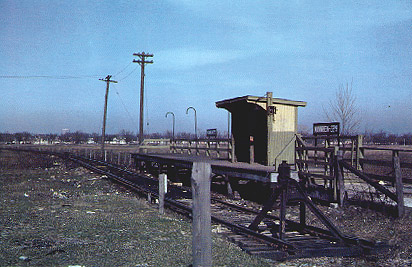
The date of this picture is not known, but it must have been in the early 1950s. We see a Chicago & North Western commuter train (aka a "Scoot") at left on an embankment, while an eastbound CTA train is on the ground level portion of the Lake Street "L". Perhaps a more exact location can be determined by the signal tower shown in the photo. I think the woods were off of Lake by the end of 1954, and steam only lasted a couple more years on the C&NW. Now both Metra commuter trains and CTA's Green Line trains share this embankment. (William Shapotkin Collection)

The date of this picture is not known, but it must have been in the early 1950s. We see a Chicago & North Western commuter train (aka a “Scoot”) at left on an embankment, while an eastbound CTA train is on the ground level portion of the Lake Street “L”. Perhaps a more exact location can be determined by the signal tower shown in the photo. I think the woods were off of Lake by the end of 1954, and steam only lasted a couple more years on the C&NW. Now both Metra commuter trains and CTA’s Green Line trains share this embankment. (William Shapotkin Collection)

Variety, they say, is the spice of life, and we certainly have a spicy batch of photos for you today. Most are from the collections of William Shapotkin, whose interests range far afield. Looking through all these photos was, for me at least, like Christmas in July.

We hope that you will enjoy them as much as we do. We thank Mr. Shapotkin for generously sharing these images with our readers.

-David Sadowski

PS- If you enjoy reading these posts, you might consider joining our Trolley Dodger Facebook Group as well. We currently have 391 members.

Meet the Author

We will be appearing at City Lit Books (2523 N. Kedzie Avenue in Chicago) at 1:00 pm this Saturday, July 24, to discuss our new book Chicago’s Lost “L”s.

Our program will start with a 20 minute audiovisual presentation, followed by questions and answers from the audience, and a book signing. We hope to see you there.

Interestingly, City Lit Books occupies the same building that once housed the Logan Square “L” Terminal, although you would hardly know it by looking at the exterior. Our presentation will give an overview of the book, and then delve further into the historic “L”s of the northwest side (Logan Square, Humboldt Park, and Ravenswood), with plenty of pictures of the Logan Square Terminal.

The Trolley Dodger On the Air

On July 16th, I was invited to appear on the Dave Plier Show on WGN radio, to discuss Chicago’s Lost “L”s. You can hear that discussion here.

Recent Finds

CA&E 318 is on a mid-1950s fantrip sponsored by the Illini Railroad Club. The car is out on the Mount Carmel branch. You can see Maury Klebolt (1930-1988), the trip organizer, in the window. Mike Franklin: "This photo is looking west on the north side of Roosevelt Rd in Hillside taken from Oak Ridge Ave. That is not a cemetery on the right but rather the outdoor show room for Peter Troost Monument Co, same as today. Queen of Heaven Mausoleum at Wolf & Roosevelt can be seen in the distant left."

CA&E 318 is on a mid-1950s fantrip sponsored by the Illini Railroad Club. The car is out on the Mount Carmel branch. You can see Maury Klebolt (1930-1988), the trip organizer, in the window. Mike Franklin: “This photo is looking west on the north side of Roosevelt Rd in Hillside taken from Oak Ridge Ave. That is not a cemetery on the right but rather the outdoor show room for Peter Troost Monument Co, same as today. Queen of Heaven Mausoleum at Wolf & Roosevelt can be seen in the distant left.”

The same location today.

The same location today.

We are looking east along Lake Street, just west of Laramie, in the early 1950s. The Lake Street "L" descended to ground level here, running parallel to the CTA Route 16 streetcar for a few blocks. Streetcar service was replaced by buses on May 30, 1954.

We are looking east along Lake Street, just west of Laramie, in the early 1950s. The Lake Street “L” descended to ground level here, running parallel to the CTA Route 16 streetcar for a few blocks. Streetcar service was replaced by buses on May 30, 1954.

The CTA State and Lake station on April 21, 1980, looking north. This is why I am not sorry to see the old station replaced by a new one-- the old one was messed with a lot over the years. It was also damaged by fire, with the result that very little that is original remains. (Clark Frazier Photo)

The CTA State and Lake station on April 21, 1980, looking north. This is why I am not sorry to see the old station replaced by a new one– the old one was messed with a lot over the years. It was also damaged by fire, with the result that very little that is original remains. (Clark Frazier Photo)

On February 19, 2017, thanks to a substantial donation from the late Jeffrey L. Wien, the Central Electric Railfans' Association held a fantrip on the CTA using a four-car train wrapped to celebrate the Chicago Cubs' World Series victory the previous fall. The lead car was 5695. (Bruce C. Nelson Photo)

On February 19, 2017, thanks to a substantial donation from the late Jeffrey L. Wien, the Central Electric Railfans’ Association held a fantrip on the CTA using a four-car train wrapped to celebrate the Chicago Cubs’ World Series victory the previous fall. The lead car was 5695. (Bruce C. Nelson Photo)

On June 1, 1950 CTA PCC 7217 was used as part of an inquest into the fatal collision between car 7078 and a gasoline truck that killed 33 people (and injured many others) on May 25th of that year. The location is 6242 S. State Street. The resulting fire destroyed several nearby buildings. This accident is the subject of a book (The Green Hornet Streetcar Disaster).

On June 1, 1950 CTA PCC 7217 was used as part of an inquest into the fatal collision between car 7078 and a gasoline truck that killed 33 people (and injured many others) on May 25th of that year. The location is 6242 S. State Street. The resulting fire destroyed several nearby buildings. This accident is the subject of a book (The Green Hornet Streetcar Disaster).

Chicago Aurora & Elgin car 205 heads up a westbound four-car train at Cicero Avenue on the Garfield Park "L".

Chicago Aurora & Elgin car 205 heads up a westbound four-car train at Cicero Avenue on the Garfield Park “L”.

The beginnings of demolition of the Stohr Arcade building at Broadway and Wilson in December 1922. This Frank Lloyd Wright-designed triangular structure, partially hidden underneath the Northwestern "L". barely lasted a decade and was replaced by Arthur U. Gerber's Uptown Union Station the following year. (Chicago Daily News Collection, DN-0075219, Chicago History Museum)

The beginnings of demolition of the Stohr Arcade building at Broadway and Wilson in December 1922. This Frank Lloyd Wright-designed triangular structure, partially hidden underneath the Northwestern “L”. barely lasted a decade and was replaced by Arthur U. Gerber’s Uptown Union Station the following year. (Chicago Daily News Collection, DN-0075219, Chicago History Museum)

There was once a veritable railfan comic strip that appeared in hundreds of daily newspapers– Fontaine Fox‘s Toonerville Trolley. Here are eight daily panels from December 1939. You will note that most do not feature the trolley or its Skipper.

December 2, 1939.

December 2, 1939.

December 4, 1939. The reference to Holland relates to the "phony war" period of World War II. War had broken out in Europe, but Germany did not invade Holland until the Spring of 1940.

December 4, 1939. The reference to Holland relates to the “phony war” period of World War II. War had broken out in Europe, but Germany did not invade Holland until the Spring of 1940.

December 6, 1939.

December 6, 1939.

December 7, 1939.

December 7, 1939.

December 9, 1939.

December 9, 1939.

December 11, 1939.

December 11, 1939.

December 13, 1939.

December 13, 1939.

December 14, 1939.

December 14, 1939.

From the Collections of William Shapotkin:

Bill had three different duplicate slides, all of this same image. I tried to stitch them all together to see if the result would be sharper than the three rather fuzzy slides. It didn't seem to help much. All I know about this North Shore Line scene is that it was taken in 1957. One of the dupes was from Ashland Car Works.

Bill had three different duplicate slides, all of this same image. I tried to stitch them all together to see if the result would be sharper than the three rather fuzzy slides. It didn’t seem to help much. All I know about this North Shore Line scene is that it was taken in 1957. One of the dupes was from Ashland Car Works.

CTA 6238 at 71st and Western on February 3, 1953.

CTA 6238 at 71st and Western on February 3, 1953.

February 22, 1956 at the Chicago & North Western's Lake Bluff station. At right, an eastbound passenger train arrives, while a westbound freight (coming off the "New Line") passes. The view looks north.

February 22, 1956 at the Chicago & North Western’s Lake Bluff station. At right, an eastbound passenger train arrives, while a westbound freight (coming off the “New Line”) passes. The view looks north.

CTA single-car unit 41 in July 1992. This car is now at the Illinois Railway Museum. During the 1980s it was usually paired with car 28, which unfortunately was not saved.

CTA single-car unit 41 in July 1992. This car is now at the Illinois Railway Museum. During the 1980s it was usually paired with car 28, which unfortunately was not saved.

North Shore Line 758 heads up a four-car train, while a nearby Milwaukee Electric interurban is visiting on a 1949 fantrip.

North Shore Line 758 heads up a four-car train, while a nearby Milwaukee Electric interurban is visiting on a 1949 fantrip.

CTA 6151, a Stony Island car, at Navy Pier on July 4, 1951.

CTA 6151, a Stony Island car, at Navy Pier on July 4, 1951.

CA&E bus 101.

CA&E bus 101.

CA&E 409 at Trolleyville, USA in Olmstead Falls, OH in July 1966. Since 2009, this car has been at the Illinois Railway Museum.

CA&E 409 at Trolleyville, USA in Olmstead Falls, OH in July 1966. Since 2009, this car has been at the Illinois Railway Museum.

CTA 2923 at the Addison station on the (now) Red Line in June 1993. It was suggested that this might be Addison on the Ravenswood (today's Brown Line) because there are only two tracks visible. However, Graham Garfield says, "No no! This is actually a very special photo! This is a temporary platform at Addison Red Line (only recently having become the “Red Line”, née North-South Route) built as part of the staging for reconstructing the station, which was rather involved because the structure had to be widened to change from dual side platforms to a single island platform. I was interested to see this photo, as I have only seen a handful of photos of the staging and temp facilities from this project. To accommodate the island platform, the space between the center tracks had to the widened, so the two northbound tracks (3 & 4) stayed on the original steel structure and the southbound tracks (1 & 2) were placed on a new concrete deck with direct track fixation instead of the standard cut spikes and tie plates on the steel-deck elevated. While this concrete structure was being built, southbound Evanston and Howard trains ran on track 3 until August 19, 1994, when both where shifted onto track 1 on the new decking. On August 21, southbound Howard trains moved onto their permanent home on track 2. The new island platform had opened earlier in the summer. The layout of the switches in Addison Interlocking north of the station were arranged specifically to make that reroute scheme possible. So this view looks north on the temporary SB platform along track 3, with a SB Red Line A train stopping."

CTA 2923 at the Addison station on the (now) Red Line in June 1993. It was suggested that this might be Addison on the Ravenswood (today’s Brown Line) because there are only two tracks visible. However, Graham Garfield says, “No no! This is actually a very special photo! This is a temporary platform at Addison Red Line (only recently having become the “Red Line”, née North-South Route) built as part of the staging for reconstructing the station, which was rather involved because the structure had to be widened to change from dual side platforms to a single island platform. I was interested to see this photo, as I have only seen a handful of photos of the staging and temp facilities from this project.
To accommodate the island platform, the space between the center tracks had to the widened, so the two northbound tracks (3 & 4) stayed on the original steel structure and the southbound tracks (1 & 2) were placed on a new concrete deck with direct track fixation instead of the standard cut spikes and tie plates on the steel-deck elevated. While this concrete structure was being built, southbound Evanston and Howard trains ran on track 3 until August 19, 1994, when both where shifted onto track 1 on the new decking. On August 21, southbound Howard trains moved onto their permanent home on track 2. The new island platform had opened earlier in the summer.
The layout of the switches in Addison Interlocking north of the station were arranged specifically to make that reroute scheme possible.
So this view looks north on the temporary SB platform along track 3, with a SB Red Line A train stopping.”

A three-car CA&E train at the Aurora terminal.

A three-car CA&E train at the Aurora terminal.

A five-car North Shore Line train on July 5, 1957. (Joseph Canfield Photo)

A five-car North Shore Line train on July 5, 1957. (Joseph Canfield Photo)

CTA Pullman 550 at Madison and Canal in November 1951, presumably running on Route 56 - Milwaukee Avenue. That's the Chicago Daily News building at rear.

CTA Pullman 550 at Madison and Canal in November 1951, presumably running on Route 56 – Milwaukee Avenue. That’s the Chicago Daily News building at rear.

CTA trolley bus 9761 is running on Route 85 - Central near the end of electric bus service. This slide was processed in April 1973. The Manor Theater was located at 5609 W. North Avenue, and was eventually converted into a banquet hall (Ferrara Manor) after it was purchased by the same family that owned the Ferrara Pan Candy Company. So, the location of this slide is at Central and North Avenues, looking to the southwest as the bus is heading north to Bryn Mawr.

CTA trolley bus 9761 is running on Route 85 – Central near the end of electric bus service. This slide was processed in April 1973. The Manor Theater was located at 5609 W. North Avenue, and was eventually converted into a banquet hall (Ferrara Manor) after it was purchased by the same family that owned the Ferrara Pan Candy Company. So, the location of this slide is at Central and North Avenues, looking to the southwest as the bus is heading north to Bryn Mawr.

CTA 550 entering the Imlay loop at Milwaukee and Devon in September 1951.

CTA 550 entering the Imlay loop at Milwaukee and Devon in September 1951.

This is a former Toronto PCC streetcar, but I have no other information about the picture.

This is a former Toronto PCC streetcar, but I have no other information about the picture.

CSL 6022 at Kedzie and 47th Place in June 1943 (?) Not sure if this date is correct, considering the slab-sided postwar auto on the next block. Dan Cluley writes, "Regarding the date of bills188 the sign on the streetcar advertises “Park and Recreation week – May 21-30” That seems to have been a national promotion in 1948. My guess on the car would be postwar Hudson." So let's call it June 1948 then.

CSL 6022 at Kedzie and 47th Place in June 1943 (?) Not sure if this date is correct, considering the slab-sided postwar auto on the next block. Dan Cluley writes, “Regarding the date of bills188 the sign on the streetcar advertises “Park and Recreation week – May 21-30” That seems to have been a national promotion in 1948. My guess on the car would be postwar Hudson.” So let’s call it June 1948 then.

CTA Pullman 900 at 93rd and Stony Island on November 16, 1951.

CTA Pullman 900 at 93rd and Stony Island on November 16, 1951.

CTA 3191 at Stony Island and 93rd on July 11, 1951.

CTA 3191 at Stony Island and 93rd on July 11, 1951.

The Pioneer Limited (live steam) at Kiddieland amusement park in August 1992. After Kiddieland closed, the steam engines were purchased by the Hesston Steam Museum.

The Pioneer Limited (live steam) at Kiddieland amusement park in August 1992. After Kiddieland closed, the steam engines were purchased by the Hesston Steam Museum.

The observation car on the Kiddieland Express at Kiddieland amusement park in Melrose Park, IL in August 1992. (William Shapotkin Photo)

The observation car on the Kiddieland Express at Kiddieland amusement park in Melrose Park, IL in August 1992. (William Shapotkin Photo)

Milwaukee Road "bipolar" electric loco E-2 on display at the National Museum of Transportation in Kirkwood, MO on August 2, 1995. (William Shapotkin Photo)

Milwaukee Road “bipolar” electric loco E-2 on display at the National Museum of Transportation in Kirkwood, MO on August 2, 1995. (William Shapotkin Photo)

CTA gate car 322 is signed as a Kenwood Local on Chicago's Loop "L" in July 1`1948. Kenwood became a shuttle, running only as far as the Indiana Avenue station, in August 1949 as part of CTA's major revision of north-south service.

CTA gate car 322 is signed as a Kenwood Local on Chicago’s Loop “L” in July 1`1948. Kenwood became a shuttle, running only as far as the Indiana Avenue station, in August 1949 as part of CTA’s major revision of north-south service.

Chicago, IL. CTA car 5010 leads the inaugural revenue run of 5000-series cars on CTA's Howard-Dan Ryan Line at Howard terminal. The view looks W-NW on April 19, 2010. (William Shapotkin Photo)

Chicago, IL. CTA car 5010 leads the inaugural revenue run of 5000-series cars on CTA’s Howard-Dan Ryan Line at Howard terminal. The view looks W-NW on April 19, 2010. (William Shapotkin Photo)

Chicago, IL. Rear-end interior view of CTA "L" car 5010. Photo taken during inaugural revenue run of 5000-series cars on the Howard-Dan Ryan line (April 19, 2010). (William Shapotkin Photo)

Chicago, IL. Rear-end interior view of CTA “L” car 5010. Photo taken during inaugural revenue run of 5000-series cars on the Howard-Dan Ryan line (April 19, 2010). (William Shapotkin Photo)

CA&E 604 and 427 in Wheaton.

CA&E 604 and 427 in Wheaton.

CA&E 405.

CA&E 405.

CA&E 56.

CA&E 56.

CA&E car 20 at the Fox River Trolley Museum in July 1987, with CTA 5001 and a 4000 in the background.

CA&E car 20 at the Fox River Trolley Museum in July 1987, with CTA 5001 and a 4000 in the background.

A CTA freight train is on the north side "L" in this undated photo, looking south. Electric freight service was the "L"s responsibility from 1920 to 1973, a holdover from the days when this was a Milwaukee Road line operating at ground level.

A CTA freight train is on the north side “L” in this undated photo, looking south. Electric freight service was the “L”s responsibility from 1920 to 1973, a holdover from the days when this was a Milwaukee Road line operating at ground level.

CA&E 422.

CA&E 422.

The CA&E Wheaton Yard and Shops.

The CA&E Wheaton Yard and Shops.

"In the last days of the last streetcar line in Milwaukee, a Wells Street car trundels through downtown." This would have to be no later than 1958. A new modern streetcar line began operations in Milwaukee a few years ago. (A. C. Kalmbach Photo)

“In the last days of the last streetcar line in Milwaukee, a Wells Street car trundels through downtown.” This would have to be no later than 1958. A new modern streetcar line began operations in Milwaukee a few years ago. (A. C. Kalmbach Photo)

CA&E 430.

CA&E 430.

I did the best I could with this image, which was completely faded to red. It shows Illinois Terminal 451 being used in regular service on the Shaker Heights Rapid Transit line in October 1976, due to a car shortage. (Jim Walker Photo)

I did the best I could with this image, which was completely faded to red. It shows Illinois Terminal 451 being used in regular service on the Shaker Heights Rapid Transit line in October 1976, due to a car shortage. (Jim Walker Photo)

Cleveland RTA PCC 75 is at East 83rd Street on the Shaker Heights Rapid Transit line on May 30, 1976.

Cleveland RTA PCC 75 is at East 83rd Street on the Shaker Heights Rapid Transit line on May 30, 1976.

SEPTA 6139-6140 (ex-CTA) at the Norristown terminal on March 10, 1987. Until 1951, there was a ramp continuing north from here, leading to street trackage used by the Lehigh Valley Transit's Liberty Bell interurban, which continued to Allentown. This terminal has since been replaced.

SEPTA 6139-6140 (ex-CTA) at the Norristown terminal on March 10, 1987. Until 1951, there was a ramp continuing north from here, leading to street trackage used by the Lehigh Valley Transit’s Liberty Bell interurban, which continued to Allentown. This terminal has since been replaced.

This is one of the North Shore Line stations designed by Arthur U. Gerber. But which one? My guess is Kenosha. The original slide, from November 1987, was so underexposed that it almost looked opaque, but I did what I could with it.

This is one of the North Shore Line stations designed by Arthur U. Gerber. But which one? My guess is Kenosha. The original slide, from November 1987, was so underexposed that it almost looked opaque, but I did what I could with it.

This picture shows the Lake Street "L" at Laramie Avenue (5200 W.) in a state of transition on October 22, 1962-- just six days before service west of here was moved to the nearby Chicago & North Western embankment. This two-car train of 4000s (4383-4384) is descending the ramp to ground level, but as you can see, the connection to the embankment is already in place to the left (north). It appears that a section of the ramp was modified when the new track connection was made, as you can see the tracks leading down to ground level bump out a bit to the south. Once the new arrangement was placed in service, the ramp leading to ground level was removed, and the trolley poles were taken off the 4000s used on Lake. They were replaced by new 2000-series cars in 1964.

This picture shows the Lake Street “L” at Laramie Avenue (5200 W.) in a state of transition on October 22, 1962– just six days before service west of here was moved to the nearby Chicago & North Western embankment. This two-car train of 4000s (4383-4384) is descending the ramp to ground level, but as you can see, the connection to the embankment is already in place to the left (north). It appears that a section of the ramp was modified when the new track connection was made, as you can see the tracks leading down to ground level bump out a bit to the south. Once the new arrangement was placed in service, the ramp leading to ground level was removed, and the trolley poles were taken off the 4000s used on Lake. They were replaced by new 2000-series cars in 1964.

CSL trolley bus 87 is on Central Avenue near Lake Street on June 7, 1930. These are probably CSL officials, since trolley bus service on Route 85 - Central began the next day, replacing a Chicago Motor Coach route. CSL had begun trolley bus service on Diversey Avenue on April 17, 1930, which explains why this chartered bus was signed for Route 76. Diversey lost its trolley buses in 1955. CSL chose trolley buses for some northwest side routes as they were in competition with the Chicago Motor Coach company to extend service there. It was quicker (and cheaper) for CSL to institute service with electric buses, with the intention (never realized) to convert them to streetcar lines once ridership justified it. This was part of what CSL called "balanced" transit.

CSL trolley bus 87 is on Central Avenue near Lake Street on June 7, 1930. These are probably CSL officials, since trolley bus service on Route 85 – Central began the next day, replacing a Chicago Motor Coach route. CSL had begun trolley bus service on Diversey Avenue on April 17, 1930, which explains why this chartered bus was signed for Route 76. Diversey lost its trolley buses in 1955. CSL chose trolley buses for some northwest side routes as they were in competition with the Chicago Motor Coach company to extend service there. It was quicker (and cheaper) for CSL to institute service with electric buses, with the intention (never realized) to convert them to streetcar lines once ridership justified it. This was part of what CSL called “balanced” transit.

Milwaukee streetcar 998 in the 1950s.

Milwaukee streetcar 998 in the 1950s.

CTA buses 5076 and 5300 at the Imlay loop, at Milwaukee and Devon.

CTA buses 5076 and 5300 at the Imlay loop, at Milwaukee and Devon.

CTA buses 5253 and 5218 at the Imlay loop.

CTA buses 5253 and 5218 at the Imlay loop.

CTA buses 5143 and 5300 at the Imlay loop, which is still in use today.

CTA buses 5143 and 5300 at the Imlay loop, which is still in use today.

CA&E cars 600 and 702.

CA&E cars 600 and 702.

We are looking to the west/northwest along the Kennedy expressway at Canfield. An inbound CTA Blue Line train approaches the Harlem Avenue station (located behind the photographer). This picture was taken around October 2019.

We are looking to the west/northwest along the Kennedy expressway at Canfield. An inbound CTA Blue Line train approaches the Harlem Avenue station (located behind the photographer). This picture was taken around October 2019.

CTA trolley bus 9657 on Route 53 - Pulaski. Daniel Joseph: "Location is Pulaski/Peterson Terminal."

CTA trolley bus 9657 on Route 53 – Pulaski. Daniel Joseph: “Location is Pulaski/Peterson Terminal.”

Illinois Terminal sleeping car 504, the "Peoria," at the Illinois Railway Museum in May 1977. It was built by American Car and Foundry in 1910.

Illinois Terminal sleeping car 504, the “Peoria,” at the Illinois Railway Museum in May 1977. It was built by American Car and Foundry in 1910.

CA&E car 303.

CA&E car 303.

I am not sure just which CA&E wood car this is, at the Wheaton yards. I stitched together two versions of this slide, both badly faded to red, and attempted to restore the colors.

I am not sure just which CA&E wood car this is, at the Wheaton yards. I stitched together two versions of this slide, both badly faded to red, and attempted to restore the colors.

CA&E 406 at Elgin.

CA&E 406 at Elgin.

CTA 3163 on the ground level portion of the Lake Street "L" in Oak Park on April 27, 1952.

CTA 3163 on the ground level portion of the Lake Street “L” in Oak Park on April 27, 1952.

CA&E 424 and train at the Elgin terminal in August 1953.

CA&E 424 and train at the Elgin terminal in August 1953.

CA&E 428 at the terminal in Elgin on August 10, 1956.

CA&E 428 at the terminal in Elgin on August 10, 1956.

CTA 5436 at 79th and Perry in March 1950.

CTA 5436 at 79th and Perry in March 1950.

CTA 3232 on Route 67. M.E. adds, "This photo was likely taken at 69th and Western. This is an eastbound car making the turn from going north on Western to going east on 69th. After the 69th St. line was converted to buses, the CTA kept the tracks in operation so that PCC cars running along Western could access the barn at Vincennes and 77th."

CTA 3232 on Route 67. M.E. adds, “This photo was likely taken at 69th and Western. This is an eastbound car making the turn from going north on Western to going east on 69th. After the 69th St. line was converted to buses, the CTA kept the tracks in operation so that PCC cars running along Western could access the barn at Vincennes and 77th.”

CTA 3254 at 71st and California on February 3, 1953.

CTA 3254 at 71st and California on February 3, 1953.

CTA 3318 at 71st and California on May 28, 1950.

CTA 3318 at 71st and California on May 28, 1950.

CTA 422 on Kedzie at 47th on May 13, 1954. It would appear this one of one a few locations where there was wire shared by streetcars and trolley buses. M.E. adds, "There was no trolley bus service along Kedzie, so the only explanation for the trolley bus here is that it was going either to or from the trolley bus barn. I don't know precisely where that barn was, but judging by the picture, it had to be somewhere along Kedzie between 47th and 51st Sts., which had the only two trolley bus lines on the south side." John V.: "CTA 422 on Kedzie: Trolley buses for routes 47 & 51 utilized Archer Car Station for storage, accessed via Kedzie north of 47th Street. Kedzie itself changed over to trolley buses in 1955."

CTA 422 on Kedzie at 47th on May 13, 1954. It would appear this one of one a few locations where there was wire shared by streetcars and trolley buses. M.E. adds, “There was no trolley bus service along Kedzie, so the only explanation for the trolley bus here is that it was going either to or from the trolley bus barn. I don’t know precisely where that barn was, but judging by the picture, it had to be somewhere along Kedzie between 47th and 51st Sts., which had the only two trolley bus lines on the south side.” John V.: “CTA 422 on Kedzie: Trolley buses for routes 47 & 51 utilized Archer Car Station for storage, accessed via Kedzie north of 47th Street. Kedzie itself changed over to trolley buses in 1955.”

CTA trolley bus 9289 at the turnaround loop at Belmont and Cumberland.

CTA trolley bus 9289 at the turnaround loop at Belmont and Cumberland.

The same location today.

The same location today.

CTA trolley bus 9504 on Route 53 - Pulaski in 1970. Mike Charnota Photo)

CTA trolley bus 9504 on Route 53 – Pulaski in 1970. Mike Charnota Photo)

We are looking east along Randolph Street on October 16, 1958. We see the old Trailways bus depot, and what was then the newly remodeled CTA "L" station, which was replaced a few years ago by a new station a block south and Washington and Wabash. I am not sure whether the giant CTA logo was saved off the old station.

We are looking east along Randolph Street on October 16, 1958. We see the old Trailways bus depot, and what was then the newly remodeled CTA “L” station, which was replaced a few years ago by a new station a block south and Washington and Wabash. I am not sure whether the giant CTA logo was saved off the old station.

This is an Ashland Car Works duplicate slide, sold by the late Jack Bailey. This is a North Shore Line train in one of the northern suburbs, running on the Shore Line Route, parallel to the Chicago & North Western (which would be just to the right of the frame). Which means we are looking to the south. KV writes that this "appears to be St. Johns Avenue in Highland Park."

This is an Ashland Car Works duplicate slide, sold by the late Jack Bailey. This is a North Shore Line train in one of the northern suburbs, running on the Shore Line Route, parallel to the Chicago & North Western (which would be just to the right of the frame). Which means we are looking to the south. KV writes that this “appears to be St. Johns Avenue in Highland Park.”

Blue Island, IL on September 6, 2001. This two-car section of the Blue Island (Vermont Street) Metra (IC) Electric station platform is all that's left of the original 1926 station. The head house and remainder of the platform have been demolished and a new facility is under construction. The view looks N-NE across the west pocket track.

Blue Island, IL on September 6, 2001. This two-car section of the Blue Island (Vermont Street) Metra (IC) Electric station platform is all that’s left of the original 1926 station. The head house and remainder of the platform have been demolished and a new facility is under construction. The view looks N-NE across the west pocket track.

Near the Armitage CTA "L" station in April 1968.

Near the Armitage CTA “L” station in April 1968.

A Chicago Great Western "piggyback" freight train on Baltimore & Ohio Chicago Terminal tracks on September 13, 1965. The CGW was abandoned in the 1970s. We are looking west from Harlem Avenue in Forest Park, IL, with the CTA Congress rapid transit station at right (part of today's Blue Line). Note how the fiberglass panels on the ramp are arranged in a colorful pattern. Some years later, many of these were removed after some riders were robbed in these secluded walkways. (Dick Talbott Photo)

A Chicago Great Western “piggyback” freight train on Baltimore & Ohio Chicago Terminal tracks on September 13, 1965. The CGW was abandoned in the 1970s. We are looking west from Harlem Avenue in Forest Park, IL, with the CTA Congress rapid transit station at right (part of today’s Blue Line). Note how the fiberglass panels on the ramp are arranged in a colorful pattern. Some years later, many of these were removed after some riders were robbed in these secluded walkways. (Dick Talbott Photo)

South Shore Line car 16 in July 1977.

South Shore Line car 16 in July 1977.

A southbound North Shore Line Electroliner at Lake Bluff. (A. C. Kalmbach Photo)

A southbound North Shore Line Electroliner at Lake Bluff. (A. C. Kalmbach Photo)

This was taken on a Central Electric Railfans' Association fantrip on the Metra Electric around May 1990. The South Shore Line also runs on these tracks somewhere on Chicago's south side.

This was taken on a Central Electric Railfans’ Association fantrip on the Metra Electric around May 1990. The South Shore Line also runs on these tracks somewhere on Chicago’s south side.

South Shore Line 10 in December 1983. (Gregory Markey Photo)

South Shore Line 10 in December 1983. (Gregory Markey Photo)

CA&E 309 at the Wheaton Shops.

CA&E 309 at the Wheaton Shops.

CTA PCC 7171 heads south on State Street at Wacker Drive, most likely on Route 36. The CTA "L" station at State and Lake Streets is a block away, with Fritzel's restaurant and the Chicago Theater visible. This picture dates to the mid-1950s.

CTA PCC 7171 heads south on State Street at Wacker Drive, most likely on Route 36. The CTA “L” station at State and Lake Streets is a block away, with Fritzel’s restaurant and the Chicago Theater visible. This picture dates to the mid-1950s.

A train of Met cars on the Garfield Park "L". (John J. Kelly, Jr. Photo)

A train of Met cars on the Garfield Park “L”. (John J. Kelly, Jr. Photo)

CTA 4053-4336 on the Lake Street "L" in Oak Park on October 19, 1952.

CTA 4053-4336 on the Lake Street “L” in Oak Park on October 19, 1952.

CSL 5222 on Halsted at 79th Street, apparently in the late 1920s. The Capitol Theater was located at 7941 S. Halsted and opened in 1925. The view looks south. M.E. notes: "In this photo you see tracks switching between Halsted and 79th St. These switches took Halsted cars east on 79th St. to Vincennes, then north to 77th St. to the big CSL barn. Those tracks could also have led to Emerald Ave. (a half block east of Halsted), where the Halsted cars turned south, then west into the terminal at roughly 79th Place between Emerald and Halsted. From the picture, I can't determine whether that terminal existed in the 1920s. Halsted cars could have also used the barn farther south at 88th and Vincennes, which had been the barn for the interurban line that ran from Kankakee to the L at 63rd Place and Halsted." "I don't know when the barn at 103rd and Vincennes (also on the Halsted route) opened, but even had it existed in the 1920s, there would not have been a track connection between the Halsted cars running on a private right-of-way east of Vincennes, and the barn on the southwest corner of 103rd and Vincennes. I say this with certainty because, at the intersection of 103rd St., Vincennes Ave. and Beverly Blvd. (which came in from the northwest), there was also the freight line of the Pennsylvania Railroad that ran alongside Beverly Blvd. and crossed both the CSL Vincennes line and the Rock Island main line. So there would not have been any room to run streetcar trackage to the barn! Plus, I believe the 103rd St. barn was strictly a bus barn. But the junction of 103rd and Vincennes, the center of the neighborhood called Washington Heights, would have been a great railfanning location, with Rock Island mainline and commuter trains, CSL Vincennes streetcars, and the Pennsy freights."

CSL 5222 on Halsted at 79th Street, apparently in the late 1920s. The Capitol Theater was located at 7941 S. Halsted and opened in 1925. The view looks south. M.E. notes: “In this photo you see tracks switching between Halsted and 79th St. These switches took Halsted cars east on 79th St. to Vincennes, then north to 77th St. to the big CSL barn. Those tracks could also have led to Emerald Ave. (a half block east of Halsted), where the Halsted cars turned south, then west into the terminal at roughly 79th Place between Emerald and Halsted. From the picture, I can’t determine whether that terminal existed in the 1920s. Halsted cars could have also used the barn farther south at 88th and Vincennes, which had been the barn for the interurban line that ran from Kankakee to the L at 63rd Place and Halsted.”
“I don’t know when the barn at 103rd and Vincennes (also on the Halsted route) opened, but even had it existed in the 1920s, there would not have been a track connection between the Halsted cars running on a private right-of-way east of Vincennes, and the barn on the southwest corner of 103rd and Vincennes. I say this with certainty because, at the intersection of 103rd St., Vincennes Ave. and Beverly Blvd. (which came in from the northwest), there was also the freight line of the Pennsylvania Railroad that ran alongside Beverly Blvd. and crossed both the CSL Vincennes line and the Rock Island main line. So there would not have been any room to run streetcar trackage to the barn! Plus, I believe the 103rd St. barn was strictly a bus barn. But the junction of 103rd and Vincennes, the center of the neighborhood called Washington Heights, would have been a great railfanning location, with Rock Island mainline and commuter trains, CSL Vincennes streetcars, and the Pennsy freights.”

Our Latest Book, Now Available:

Chicago’s Lost “L”s

From the back cover:

Chicago’s system of elevated railways, known locally as the “L,” has run continuously since 1892 and, like the city, has never stood still. It helped neighborhoods grow, brought their increasingly diverse populations together, and gave the famous Loop its name. But today’s system has changed radically over the years. Chicago’s Lost “L”s tells the story of former lines such as Garfield Park, Humboldt Park, Kenwood, Stockyards, Normal Park, Westchester, and Niles Center. It was once possible to take high-speed trains on the L directly to Aurora, Elgin, and Milwaukee, Wisconsin. The L started out as four different companies, two starting out using steam engines instead of electricity. Eventually, all four came together via the Union Loop. The L is more than a way of getting around. Its trains are a place where people meet and interact. Some say the best way to experience the city is via the L, with its second-story view. Chicago’s Lost “L”s is virtually a “secret history” of Chicago, and this is your ticket. David Sadowski grew up riding the L all over the city. He is the author of Chicago Trolleys and Building Chicago’s Subways and runs the online Trolley Dodger blog.

The Images of America series celebrates the history of neighborhoods, towns, and cities across the country. Using archival photographs, each title presents the distinctive stories from the past that shape the character of the community today. Arcadia is proud to play a part in the preservation of local heritage, making history available to all.

Title Chicago’s Lost “L”s
Images of America
Author David Sadowski
Edition illustrated
Publisher Arcadia Publishing (SC), 2021
ISBN 1467100007, 9781467100007
Length 128 pages

Chapters:
01. The South Side “L”
02. The Lake Street “L”
03. The Metropolitan “L”
04. The Northwestern “L”
05. The Union Loop
06. Lost Equipment
07. Lost Interurbans
08. Lost Terminals
09. Lost… and Found

Each copy purchased here will be signed by the author, and you will also receive a bonus facsimile of a 1926 Chicago Rapid Transit Company map, with interesting facts about the “L” on the reverse side.

The price of $23.99 includes shipping within the United States.

For Shipping to US Addresses:

For Shipping to Canada:

For Shipping Elsewhere:

NEW DVD:

A Tribute to the North Shore Line

To commemorate the 50th anniversary of the demise of the fabled North Shore Line interurban in January 2013, Jeffrey L. Wien and Bradley Criss made a very thorough and professional video presentation, covering the entire route between Chicago and Milwaukee and then some. Sadly, both men are gone now, but their work remains, making this video a tribute to them, as much as it is a tribute to the Chicago North Shore & Milwaukee.

Jeff drew on his own vast collections of movie films, both his own and others such as the late William C. Hoffman, wrote and gave the narration. Bradley acted as video editor, and added authentic sound effects from archival recordings of the North Shore Line.

It was always Jeff’s intention to make this video available to the public, but unfortunately, this did not happen in his lifetime. Now, as the caretakers of Jeff’s railfan legacy, we are proud to offer this excellent two-hour program to you for the first time.  The result is a fitting tribute to what Jeff called his “Perpetual Adoration,” which was the name of a stop on the interurban.

Jeff was a wholehearted supporter of our activities, and the proceeds from the sale of this disc will help defray some of the expenses of keeping the Trolley Dodger web site going.

Total time – 121:22

# of Discs – 1
Price: $19.99 (Includes shipping within the United States)

Help Support The Trolley Dodger

This is our 272nd post, and we are gradually creating a body of work and an online resource for the benefit of all railfans, everywhere. To date, we have received over 784,000 page views, for which we are very grateful.
You can help us continue our original transit research by checking out the fine products in our Online Store.
As we have said before, “If you buy here, we will be here.”
We thank you for your support.
DONATIONS
In order to continue giving you the kinds of historic railroad images that you have come to expect from The Trolley Dodger, we need your help and support. It costs money to maintain this website, and to do the sort of historic research that is our specialty.
Your financial contributions help make this web site better, and are greatly appreciated.

Reflections in a Golden Wye

This photo, showing a mirror at the North Shore Line's Milwaukee terminal, was taken on January 21, 1963 (after abandonment) by Allan Y. Scott for the Milwaukee Journal. You can see the photographer in the picture, apparently using a Leica M2 or M3. This picture came from the collection of the late John Horachek. Rather than being a double exposure, it seems like the ghostly image of an Electroliner was applied to the mirror using a stencil and a product known as Glass Wax.

This photo, showing a mirror at the North Shore Line’s Milwaukee terminal, was taken on January 21, 1963 (after abandonment) by Allan Y. Scott for the Milwaukee Journal. You can see the photographer in the picture, apparently using a Leica M2 or M3. This picture came from the collection of the late John Horachek. Rather than being a double exposure, it seems like the ghostly image of an Electroliner was applied to the mirror using a stencil and a product known as Glass Wax.

For today’s post, we are going back in time, often even further back in time than we usually do, to feature some important historical images. Each one is like a small ray of light, that form a beacon when taken together, illuminating the past, like the reflections in a mirror.

It’s the earliest, and oldest pictures that are the hardest to find. So, we’ve had to redouble our efforts to seek them out.

In addition, we have important news about our new book Chicago’s Lost “L”s. We recently received a small number of “author’s copies” from the publisher, and the book is now a reality. We hope you will like the results.

Our initial order is on the way to us, and we are confident that we will soon begin shipping out books to our contributors and everyone who has ordered one in our pre-sale. All such books should be in the post prior to the July 12 release date.

More information about Chicago’s Lost “L”s, including how to order, can be found at the end of this post, or you can click on the link at the top of this page to go to our Online Store.

We would like to thank Kevin Horachek, Andre Kristopans, and William Shapotkin for their contributions to this post.

Enjoy!

-David Sadowski

Recent Finds

As a practical matter, color photography didn't exist in 1910, which is the postmark date of this postcard showing the Lake Street "L" at ground level in the Austin neighborhood on Chicago's west side. The view looks west from Central Avenue along South Boulevard (or, more appropriately, Lake Street, since the name did not change until the line reached suburban Oak Park). The "L" was extended there in 1901. This colorized photo may date to a bit before 1910, though, as by then, the Chicago & North Western trains, which ran parallel to the "L", had already been raised onto the embankment where the "L" joined them in 1962. This is a westbound train, as Lake Street ran left handed in those days (as did the C&NW).

As a practical matter, color photography didn’t exist in 1910, which is the postmark date of this postcard showing the Lake Street “L” at ground level in the Austin neighborhood on Chicago’s west side. The view looks west from Central Avenue along South Boulevard (or, more appropriately, Lake Street, since the name did not change until the line reached suburban Oak Park). The “L” was extended there in 1901. This colorized photo may date to a bit before 1910, though, as by then, the Chicago & North Western trains, which ran parallel to the “L”, had already been raised onto the embankment where the “L” joined them in 1962. This is a westbound train, as Lake Street ran left handed in those days (as did the C&NW).

The same location today. This portion of Lake Street was renamed to Corcoran Place in the mid-1960s, to honor the late Chicago Alderman in this area, who was a close friend of Mayor Richard J. Daley. Lake Street used to run north and south of the two railroads here for a few blocks between Pine Avenue and Austin Boulevard. There were no duplicate street numbers.

The same location today. This portion of Lake Street was renamed to Corcoran Place in the mid-1960s, to honor the late Chicago Alderman in this area, who was a close friend of Mayor Richard J. Daley. Lake Street used to run north and south of the two railroads here for a few blocks between Pine Avenue and Austin Boulevard. There were no duplicate street numbers.

I recently purchased this turn-of-the-century photo showing a Chicago Union Traction streetcar on the Lincoln Avenue line. CUT existed from 1899 to 1908, when it was absorbed into Chicago Railways. Sharpshooter's Park is where Riverview Amusement Park opened in 1904, which narrows down the time of this photo to circa 1899-1903. But the car itself looks like the "Matchbox" type, which was built by St. Louis Car Company in 1903. Car 1374 in this series has been restored and is at the Illinois Railway Museum. In 2015, the body of car 1137 was found in Wisconsin, where it had been used as an addition to someone's house. It is now in Grass Lake, MI.

I recently purchased this turn-of-the-century photo showing a Chicago Union Traction streetcar on the Lincoln Avenue line. CUT existed from 1899 to 1908, when it was absorbed into Chicago Railways. Sharpshooter’s Park is where Riverview Amusement Park opened in 1904, which narrows down the time of this photo to circa 1899-1903. But the car itself looks like the “Matchbox” type, which was built by St. Louis Car Company in 1903. Car 1374 in this series has been restored and is at the Illinois Railway Museum. In 2015, the body of car 1137 was found in Wisconsin, where it had been used as an addition to someone’s house. It is now in Grass Lake, MI.

CSL "Sedan" (aka Peter Witt) 6283 appears to be southbound on Clark, just south of downtown, in this circa 1940 photo. Don's Rail Photos: "6283 was built by CSL in 1929." This might seem unusual, that the Surface Lines had the capability or even the desire to build their own streetcars. But CSL was very much involved with the project that eventually created the PCC car just a few years after this, and it was CSL and not the ERPCC that had the two experimental pre-PCCs (4001 and 7001) built in 1934. Eventually, the CTA became the largest stockholder in the Transit Research Corporation, the successor to the ERPCC.

CSL “Sedan” (aka Peter Witt) 6283 appears to be southbound on Clark, just south of downtown, in this circa 1940 photo. Don’s Rail Photos: “6283 was built by CSL in 1929.” This might seem unusual, that the Surface Lines had the capability or even the desire to build their own streetcars. But CSL was very much involved with the project that eventually created the PCC car just a few years after this, and it was CSL and not the ERPCC that had the two experimental pre-PCCs (4001 and 7001) built in 1934. Eventually, the CTA became the largest stockholder in the Transit Research Corporation, the successor to the ERPCC.

Chicago Surface Line experimental pre-PCC 4001 in 1935, running on Route 22 - Clark-Wentworth. 40001 was built in 1934 by Pullman-Standard and was retired in 1944. The body has survived and is now at the Illinois Railway Museum. Here, it still has the striped trolley pole.

Chicago Surface Line experimental pre-PCC 4001 in 1935, running on Route 22 – Clark-Wentworth. 40001 was built in 1934 by Pullman-Standard and was retired in 1944. The body has survived and is now at the Illinois Railway Museum. Here, it still has the striped trolley pole.

Chicago Surface Lines experimental pre-PCC 7001 on Route 22 - Clark-Wentworth in 1935. It was built by Brill in 1934 and retired in 1944, scrapped in 1959. Here, it already appears to have a dent on the front end.

Chicago Surface Lines experimental pre-PCC 7001 on Route 22 – Clark-Wentworth in 1935. It was built by Brill in 1934 and retired in 1944, scrapped in 1959. Here, it already appears to have a dent on the front end.

Don's Rail Photos: "51 was built by the SP&S in August 1941. It was purchased by the North Shore in December 1947 and was completed as 459 on November 22, 1948." Here it is at the Portland yard on September 9, 1946.

Don’s Rail Photos: “51 was built by the SP&S in August 1941. It was purchased by the North Shore in December 1947 and was completed as 459 on November 22, 1948.” Here it is at the Portland yard on September 9, 1946.

A two-car train of North Shore Line Silverliners in Milwaukee in 1962. Larry Sakar writes: "The train is northbound at the north end of the 6th Street viaduct (which no longer exists). Below it on the right of the train is what was then Fowler Street. Today, that is St. Paul Ave which in NSL days used to end at 6th St. All of that changed when The Milwaukee Road built their new station at 5th St. Impending construction of the Marquette interchange and the end of the Milwaukee Road's 4th & everett St. station gave the city the opportunity to continue St. Paul Ave. beneath 6th St. to connect with then Fowler St. which then became the continuation of W. St. Paul Ave. The warehouse next to the train is also long gone. If you were standing here today you would be looking at the Milwaukee Intermodal station on the right and the main Post Office immediately next door east. If you look two blocks down on the left that is where the present day HOP Streetcar terminates. The train is northbound at the north end of the 6th Street viaduct (which no longer exists). Below it on the right of the train is what was then Fowler Street. Today, that is St. Paul Ave which in NSL days used to end at 6th St. All of that changed when The Milwaukee Road built their new station at 5th St. Impending construction of the Marquette interchange and the end of the Milwaukee Road's 4th & everett St. station gave the city the opportunity to continue St. Paul Ave. beneath 6th St. to connect with then Fowler St. which then became the continuation of W. St. Paul Ave. The warehouse next to the train is also long gone. If you were standing here today you would be looking at the Milwaukee Intermodal station on the right and the main Post Office immediately next door east. If you look two blocks down on the left that is where the present day HOP Streetcar terminates."

A two-car train of North Shore Line Silverliners in Milwaukee in 1962. Larry Sakar writes: “The train is northbound at the north end of the 6th Street viaduct (which no longer exists). Below it on the right of the train is what was then Fowler Street. Today, that is St. Paul Ave which in NSL days used to end at 6th St. All of that changed when The Milwaukee Road built their new station at 5th St. Impending construction of the Marquette interchange and the end of the Milwaukee Road’s 4th & everett St. station gave the city the opportunity to continue St. Paul Ave. beneath 6th St. to connect with then Fowler St. which then became the continuation of W. St. Paul Ave. The warehouse next to the train is also long gone. If you were standing here today you would be looking at the Milwaukee Intermodal station on the right and the main Post Office immediately next door east. If you look two blocks down on the left that is where the present day HOP Streetcar terminates. The train is northbound at the north end of the 6th Street viaduct (which no longer exists). Below it on the right of the train is what was then Fowler Street. Today, that is St. Paul Ave which in NSL days used to end at 6th St. All of that changed when The Milwaukee Road built their new station at 5th St. Impending construction of the Marquette interchange and the end of the Milwaukee Road’s 4th & everett St. station gave the city the opportunity to continue St. Paul Ave. beneath 6th St. to connect with then Fowler St. which then became the continuation of W. St. Paul Ave. The warehouse next to the train is also long gone. If you were standing here today you would be looking at the Milwaukee Intermodal station on the right and the main Post Office immediately next door east. If you look two blocks down on the left that is where the present day HOP Streetcar terminates.”

A Chicago & North Western train of bi-levels at the Milwaukee station on the Lakefront in 1962.

A Chicago & North Western train of bi-levels at the Milwaukee station on the Lakefront in 1962.

This is how the Chicago & North Western's right-of-way looked in Winnetka in July 1964. We are looking south from Elm Street. This area was grade-separated around 1940, with some financial help from the federal government through the PWA agency, in a similar fashion to how Chicago's Initial System of Subways was built. The North Shore Line's Shore Line Route ran at left until July 1955. (William Shapotkin Collection)

This is how the Chicago & North Western’s right-of-way looked in Winnetka in July 1964. We are looking south from Elm Street. This area was grade-separated around 1940, with some financial help from the federal government through the PWA agency, in a similar fashion to how Chicago’s Initial System of Subways was built. The North Shore Line’s Shore Line Route ran at left until July 1955. (William Shapotkin Collection)

An eastbound Lake Street "L" train is in Oak Park in July 1960, running alongside South Boulevard. (William Shapotkin Collection)

An eastbound Lake Street “L” train is in Oak Park in July 1960, running alongside South Boulevard. (William Shapotkin Collection)

A westbound C&NW commuter train stops in Oak Park in July 1960. (William Shapotkin Collection)

A westbound C&NW commuter train stops in Oak Park in July 1960. (William Shapotkin Collection)

A westbound Chicago & North Western commuter train departs from Oak Park in July 1960. Note the ground-level Lake Street "L" station at Marion Street at left. Just over two years later, the "L" was moved to this embankment. (William Shapotkin Collection)

A westbound Chicago & North Western commuter train departs from Oak Park in July 1960. Note the ground-level Lake Street “L” station at Marion Street at left. Just over two years later, the “L” was moved to this embankment. (William Shapotkin Collection)

An eastbound C&NW "scoot" (commuter train) has just departed the Elmhurst station and is seen crossing York Road. The view looks west. (William Shapotkin Collection)

An eastbound C&NW “scoot” (commuter train) has just departed the Elmhurst station and is seen crossing York Road. The view looks west. (William Shapotkin Collection)

What was billed as Manhattan's last elevated train heads north on the Third Avenue El on May 12, 1955.

What was billed as Manhattan’s last elevated train heads north on the Third Avenue El on May 12, 1955.

CSL 5769 on Route 5 - Cottage Grove-South Chicago circa 1940. According to Don's Rail Photos, Nearside 5769 "was built by Brill Car Co in 1912, (order) #18322, It was retired on November 8, 1948."

CSL 5769 on Route 5 – Cottage Grove-South Chicago circa 1940. According to Don’s Rail Photos, Nearside 5769 “was built by Brill Car Co in 1912, (order) #18322, It was retired on November 8, 1948.”

CSL Pullman 621, signed for Clark and Devon, is apparently running on Route 22 and headed north on Clark, having just passed Lake Street in this circa 1940 scene. The Shreve Building, built in 1875, was located at the northwest corner of Clark and Lake. Its construction was supervised by William Warren Boyington (1818-1898), who designed the landmark Chicago Water Tower. Not sure when it was demolished.

CSL Pullman 621, signed for Clark and Devon, is apparently running on Route 22 and headed north on Clark, having just passed Lake Street in this circa 1940 scene. The Shreve Building, built in 1875, was located at the northwest corner of Clark and Lake. Its construction was supervised by William Warren Boyington (1818-1898), who designed the landmark Chicago Water Tower. Not sure when it was demolished.

CSL pre-war PCC 7024 is eastbound on Madison Street at Mayfield Avenue (5900 W.) circa 1940.

CSL pre-war PCC 7024 is eastbound on Madison Street at Mayfield Avenue (5900 W.) circa 1940.

CSL Pullman 329 is on Route 21 - Cermak Road, possibly at the west end of the line, circa 1940.

CSL Pullman 329 is on Route 21 – Cermak Road, possibly at the west end of the line, circa 1940.

CSL 1801 is signed for Adams-Downtown in this circa 1940 photo. Part of Route 7 - Harrison Street went downtown via Adams Street. A nearby truck is delivering Ogden's Milk.

CSL 1801 is signed for Adams-Downtown in this circa 1940 photo. Part of Route 7 – Harrison Street went downtown via Adams Street. A nearby truck is delivering Ogden’s Milk.

The U.S. Patent Office in Washington, DC in the 1920s, with a streetcar out front, apparently powered by conduit via a electric plow running in a trough between the two rails.

The U.S. Patent Office in Washington, DC in the 1920s, with a streetcar out front, apparently powered by conduit via a electric plow running in a trough between the two rails.

Chicago Aurora & Elgin car 403 at Laramie Avenue on July 19, 1933. It was described as "red with gold trim." 403 was a Pullman product, built in 1923. Sister car 409 is at the Illinois Railway Museum. The view looks to the northeast.

Chicago Aurora & Elgin car 403 at Laramie Avenue on July 19, 1933. It was described as “red with gold trim.” 403 was a Pullman product, built in 1923. Sister car 409 is at the Illinois Railway Museum. The view looks to the northeast.

CTA trolley bus 9421 on February 12, 1973. Andre Kristopans adds, "Trolley bus 9421 SB on Pulaski at Sunnyside (4500 N). Old police station, now community center, on right." William Shapotkin Collection)

CTA trolley bus 9421 on February 12, 1973. Andre Kristopans adds, “Trolley bus 9421 SB on Pulaski at Sunnyside (4500 N). Old police station, now community center, on right.”
William Shapotkin Collection)

CTA trolley bus 9458 on February 10, 1973. (Michael N. Charnota Photo, William Shapotkin Collection) Bill Jas: "The pic of the Pulaski trolley bus is just North of Grand. You can see the old streetcar power house on the right. The same building that later collapsed onto Jimmy’s Hot Dog Stand."

CTA trolley bus 9458 on February 10, 1973. (Michael N. Charnota Photo, William Shapotkin Collection) Bill Jas: “The pic of the Pulaski trolley bus is just North of Grand. You can see the old streetcar power house on the right. The same building that later collapsed onto Jimmy’s Hot Dog Stand.”

The Chicago & Milwaukee Electric

The North Shore Line started out as the Chicago & Milwaukee Electric, before it was reorganized by Samuel Insull in 1916. Here are some early photos that reflect that history.

The Chicago & Milwaukee Electric station in Lake Forest. It was torn down around 1970, 15 years after the last North Shore Line trains ran here on the Shore Line Route.

The Chicago & Milwaukee Electric station in Lake Forest. It was torn down around 1970, 15 years after the last North Shore Line trains ran here on the Shore Line Route.

A close-up of the previous image, showing Chicago & Milwaukee Electric car 10. It was built by Pullman in 1899.

A close-up of the previous image, showing Chicago & Milwaukee Electric car 10. It was built by Pullman in 1899.

After the North Shore Line abandoned service on the Shore Line Route in 1955, their former Lake Forest station was used as a campaign headquarters in the 1956 presidential election. (Chicago Tribune Photo)

After the North Shore Line abandoned service on the Shore Line Route in 1955, their former Lake Forest station was used as a campaign headquarters in the 1956 presidential election. (Chicago Tribune Photo)

A Chicago & Milwaukee electric buffet observation car, from an undated postcard. Don's Rail Photos: "401 was built by Jewett Car in 1909 as parlor-buffet car. In 1917 it was converted to straight coach and retired in 1935. It was leased to Chicago Aurora & Elgin and renumbered 142 in 1936. It came back for a short time with the CA&E number in 1945 and sold to CA&E in 1946. It was retired in 1953."

A Chicago & Milwaukee electric buffet observation car, from an undated postcard. Don’s Rail Photos: “401 was built by Jewett Car in 1909 as parlor-buffet car. In 1917 it was converted to straight coach and retired in 1935. It was leased to Chicago Aurora & Elgin and renumbered 142 in 1936. It came back for a short time with the CA&E number in 1945 and sold to CA&E in 1946. It was retired in 1953.”

The Chicago & Milwaukee Electric's Zion station, from a postcard postmarked 1911. The religious fanatics who started this town made the interurban build a large station, in anticipation of rapid growth that did not occur.

The Chicago & Milwaukee Electric’s Zion station, from a postcard postmarked 1911. The religious fanatics who started this town made the interurban build a large station, in anticipation of rapid growth that did not occur.

The Chicago & Milwaukee electric station in Libertyville, from a real photo postcard postmarked 1906.

The Chicago & Milwaukee electric station in Libertyville, from a real photo postcard postmarked 1906.

Chicago & Milwaukee Electric Birney car 334 at 6th and Clybourn in Milwaukee. Don's Rail Photos: "334 was built by Cincinnati Car Co in December 1922, #2625. It was retired in 1947 and scrapped in April 1948." The C&ME name was used on these North Shore Line city streetcars, since that was the franchise holder in Milwaukee.

Chicago & Milwaukee Electric Birney car 334 at 6th and Clybourn in Milwaukee. Don’s Rail Photos: “334 was built by Cincinnati Car Co in December 1922, #2625. It was retired in 1947 and scrapped in April 1948.” The C&ME name was used on these North Shore Line city streetcars, since that was the franchise holder in Milwaukee.

North Shore Line wood car 305 (former Chicago & Milwaukee Electric) in Kenilworth circa 1930, running as a Chicago local on the Shore Line Route. Don's Rail Photos: " 303 thru 305 were built by American Car in 1910 and were almost identical. In 1939 they became sleet cutters and were retired and scrapped in 1940." (Kenilworth Historical Society)

North Shore Line wood car 305 (former Chicago & Milwaukee Electric) in Kenilworth circa 1930, running as a Chicago local on the Shore Line Route. Don’s Rail Photos: ” 303 thru 305 were built by American Car in 1910 and were almost identical. In 1939 they became sleet cutters and were retired and scrapped in 1940.” (Kenilworth Historical Society)

Did Not Win

They say you can’t win ’em all, and we certainly don’t. But while we did not win the auctions for these images, they definitely still worth looking at:

1899 New York City Shopping @ 22nd St & 6th Avenue L Train Glass Photo Negative recently sold for $247.50. Looks like the 6th Avenue line was still using steam power then.

1899 New York City Shopping @ 22nd St & 6th Avenue L Train Glass Photo Negative recently sold for $247.50. Looks like the 6th Avenue line was still using steam power then.

I did not win this auction, but I still think this is a pretty neat picture, of a four-car train of CTA 4000s southbound at Bryn Mawr in 1970. This is a southbound Evanston Express. By then, only freight locos were using the overhead wire here.

I did not win this auction, but I still think this is a pretty neat picture, of a four-car train of CTA 4000s southbound at Bryn Mawr in 1970. This is a southbound Evanston Express. By then, only freight locos were using the overhead wire here.

The following three glass plate negatives were identified as “1915 New York 7th Ave Subway Explosion Collapse 7 Dead.”

The next three glass plate images show women working as streetcar conductors on the New York Railways during World War I:

North Shore Line box motor 230 at the Milwaukee Terminal in 1941. By the late 1950s, the apartment building at rear had been torn down.

North Shore Line box motor 230 at the Milwaukee Terminal in 1941. By the late 1950s, the apartment building at rear had been torn down.

Book Review:

From Garfield ‘L’ to Blue Line Rapid Transit
by David A. Wilson
Dispatch Number 11 of the Shore Line Interurban Historical Society

Congratulations to David Wilson on his excellent new book From Garfield ‘L’ to Blue Line Rapid Transit. I would naturally like this book, since these are subjects I have written about extensively, in my own books and blogs.

Like many other people my age, I became fascinated with the extensive changes going on in the west side during the late 1950s, as construction of the Congress Expressway proceeded west and approached suburban Oak Park. I recall seeing the Garfield Park “L” and Chicago Aurora & Elgin interurban trains, but I never rode on them. We mostly took the Lake Street “L” downtown, and until 1962, that still ran on the ground west of Laramie.

I recall seeing “L” cars parked in Lockwood Yard, and I vividly remember our first drives on the new Congress Expressway, which partially opened in 1955, although it only went as far as Laramie Avenue (5200 W.). It was extended in stages in 1960, first to Central Avenue (5600 W.), and then all the way through Oak Park and Forest Park, to connect with existing highways west of there. I have naturally been a frequent rider on the Congress line (today’s Forest Park branch of the Blue Line) my whole life.

So, I have been interested in learning the details of how all this came to be for a long time, and I have been researching this subject ever since I was a small child. This interest culminated in my 2018 Arcadia book Building Chicago’s Subways, which is available from our Online Store and elsewhere.

The approach I took with that book was a comprehensive overview of the entire subject of Chicago Subways, starting with the river tunnels, first opened in 1869, the extensive downtown freight tunnel system, the various subway plans that were hashed out over 40 years, the Initial System of Subways (first started in 1938), and its culmination in the West Side Subway in 1958, as the Congress rapid transit line was originally known.

This is a large topic, and therefore it should hardly be possible for anyone to have the “last word” on these matters. Chances are, after we are all long gone, others will still find new things to say.

Dave Wilson has lived in Oak Park for a long time, and is also fascinated with this history.  His new book concentrates on just the transition from the Garfield “L” to the current Blue Line setup, and therefore it goes into greater detail than it was possible to do in my book. It will answer just about any questions that anyone might have had about how this all happened, excepting fanatics like me, who are constantly trying to learn more. (In fact, I bring up a few additional related topics later on in this post.)

Now that I have a few volumes under my belt, I tend to pay close attention to editorial decisions that others make, in their own works. This book packs a lot of information into its pages, and it should be no surprise that a few compromises had to be made.  There are only so many pages to fill in any book, something I know from personal experience.

Unfortunately there is no biographical information about the author, and I wish there were. I have known Dave Wilson for a long time, and he has been an avid railfan photographer since his teenage years. He has scanned thousands of his images, and has posted them to Flickr, for all to enjoy. You would do well to check them out.

For a time he worked for the Wisconsin Central railroad, and later, in bus planning for the Chicago Transit Authority.

The maps in this new book are excellent, and were made by Dennis McClendon, who always does fine work. In fact, he also did the book layout, which is attractive and skillfully done.

The photo selection is excellent. While there are a few images that also appear in Building Chicago’s Subways, they are great images in both books.

Another editorial decision was to include some lo-res images in the book. One in particular is rather pixilated, but in general when the image quality suffers, those images are made smaller in turn, so this is less noticeable. I am probably the only person who would notice this, though.  Any author has to collect the best images that are available, and they are not all going to be of the same resolution.

There is yet another book I can recommend, if you are still interested in learning why it was not possible to save the Chicago Aurora & Elgin interurban, despite the best efforts of three powerful Illinois politicians (Mayor Richard J. Daley, Governor William Stratton, and Cook County Board President Dan Ryan): Political Influence by Edward C. Banfield, originally published in 1961 by the Free Press of Glencoe.  I covered that book extensively in a 2015 blog post that you can read here.

In the meantime, I can wholeheartedly recommend David Wilson’s book, which is available anywhere that Shore Line products are sold. They are called Dispatches, even though the North Shore Line used the unusual spelling “despatch” back in the day.

Garfield Park, Where Are You?

A portion of a CTA track map dated October 1955. The tracks curved south west of Lockwood, unlike the way it appears here.

A portion of a CTA track map dated October 1955. The tracks curved south west of Lockwood, unlike the way it appears here.

As you can see here, the Garfield "L" ran straight east and west through Laramie Yard between Laramie (5200 W.) and Lavergne (5000 W.). (From a CTA track map dated October 1955.)

As you can see here, the Garfield “L” ran straight east and west through Laramie Yard between Laramie (5200 W.) and Lavergne (5000 W.). (From a CTA track map dated October 1955.)

For many years, I have been interested in just where the old Garfield Park “L” once ran. By 1960, it was completely replaced by the current Forest Park branch of the Blue Line (formerly the Congress line), most of which runs in the median of I-290.

The Chicago Tribune reported on June 4, 1928 that the Chicago Rapid Transit Company wanted to expand the Garfield Park “L” from two tracks to four between Marshfield and Cicero Avenues. The article states that CRT had already purchased 60% of the necessary land for expansion via private sale.

This expansion never took place (perhaps due to the Great Depression), but naturally the idea behind it may have been a factor in planning for the Congress median line, which has space for four tracks in approximately the same locations as the 1928 CRT plan, in addition to the section east of Marshfield, which leads to four subway portals near Halsted, only two of which have ever been used.

As noted in my book Building Chicago’s Subways (Arcadia Publishing, 2018), when the highway plans were being formulated, the idea was to relocate the Lake Street “L” into the median of the expressway, via a connection either at 4600 West, or near Kedzie (3200 W.).  Lake trains would have then run next to, but separate from, regular Congress rapid transit trains.

At the subway portal, Lake trains would have continued into a new Clinton Street Subway, which would have formed a subway “Loop,” connecting with the sections on Lake, Dearborn, and Congress.  Presumably, Lake trains were intended to circle this subway Loop before heading back out towards the west side.

The City of Chicago’s goal in all this was to tear down the Loop “L”, inspired by New York City’s gradual elimination of all the elevated lines in Manhattan.  This remained the City’s plan until Mayor Jane Byrne decided the Loop “L” was worth saving after all.  Chicago eventually built a new “L” line, the Orange Line, which opened in 1993 and connects to the Loop.

I traced the old right-of-way of the Garfield Park “L” on Google Street View recently, and came to a few interesting conclusions.  Although the “L” ran pretty much in a straight line between Kedzie Avenue (3200 W.) and Lockwood Avenue (5300 W.), heading west, at times, the “L’ is south of the adjacent alleyway, and at other times, it is north of it.

In general, the Garfield line was built mid-block, but at times, the location is about 620 South, and at other times, it is more like 650 South.  Maps seem to show a slight jog just west of Tripp Avenue (4232 W.), but this doesn’t seem like a definitive explanation for the change in alignment relative to the alleys.

The “L” crossed a railroad at around 4600 West, and it’s likely that the areas west of there were not yet developed when the “L” was built.  Early photos seem to show a rather barren area.  Perhaps the alleys preceded the “L” east of here, while they were built after the “L” in the western section.

Interestingly, there weren’t alleys for the entire stretch between Kedzie and Lockwood, because Fifth Avenue, an angle street that was once an important thoroughfare, crossed through near Pulaski Road (4000 W.).  The block narrows near that location, and alleys come to an end.

In general, it seems as though the “L” ran mostly south of the alley east of Cicero Avenue (4800 W.), which was the original end-of-the-line starting in 1895.  It was extended to Laramie (5200 W.) in 1902, and west of Cicero, the “L” seems to run north of the alley.  But of course, there were no alleys in the Laramie Yard area until after the “L” was demolished and the yard removed.  There is an alley where parts of Lockwood Yard once were, but it’s possible there were still tracks in place there for perhaps a year or so after the Congress line opened in June 1958.

Here are some pictures from Google Street View:

649 S. Homan (3400 W.), looking east. Here, the "L" was definitely south of the alley.

649 S. Homan (3400 W.), looking east. Here, the “L” was definitely south of the alley.

649 S. Homan (3400 W.), looking west, showing the area south of the alley, once occupied by the Garfield Park "L".

649 S. Homan (3400 W.), looking west, showing the area south of the alley, once occupied by the Garfield Park “L”.

648 S. St. Louis (3500 W.), looking west. The "L" was south of the alley here.

648 S. St. Louis (3500 W.), looking west. The “L” was south of the alley here.

617 S. Pulaski, looking east. The cross street is Fifth Avenue, which is at an angle running northeast/southwest. The Garfield Park "L" ran east-west here, and crossed Pulaski and Fifth at the same time. The "L" ran right over the area occupied by the building near the mailbox. Not sure if it was the same building then, but parts of it do look similar. There is no alley here, due to the narrowing of this block, as Fifth Avenue approaches from the north.

617 S. Pulaski, looking east. The cross street is Fifth Avenue, which is at an angle running northeast/southwest. The Garfield Park “L” ran east-west here, and crossed Pulaski and Fifth at the same time. The “L” ran right over the area occupied by the building near the mailbox. Not sure if it was the same building then, but parts of it do look similar. There is no alley here, due to the narrowing of this block, as Fifth Avenue approaches from the north.

614 S. Karlov (4100 W.), looking west. The "L" ran south of the alley here.

614 S. Karlov (4100 W.), looking west. The “L” ran south of the alley here.

This is around 650 S. Kilbourn (4500 W.), looking southwest. There was a Garfield Park "L" station at Kilbourn, and it appears to have been south of the alley.

This is around 650 S. Kilbourn (4500 W.), looking southwest. There was a Garfield Park “L” station at Kilbourn, and it appears to have been south of the alley.

At approximately 650 S. Kolmar (4532 W.), the Chicago Transit Authority has a building. Not sure what it is used for, or if the Garfield Park "L" ran over head. It's possible that the "L" ran in the area just north of the alley here. This view looks west.

At approximately 650 S. Kolmar (4532 W.), the Chicago Transit Authority has a building. Not sure what it is used for, or if the Garfield Park “L” ran over head. It’s possible that the “L” ran in the area just north of the alley here. This view looks west.

At around 620 S. Kilpatrick (4700 W.), the Garfield Park "L" ran south of the alley. This view looks east.

At around 620 S. Kilpatrick (4700 W.), the Garfield Park “L” ran south of the alley. This view looks east.

At 650 S. Lavergne (5000 W.), the Garfield Park "L" ran just north of the alley. Laramie Yard was just west of here, and the "L" at this point was descending to ground level from the Cicero Avenue "L" station, two blocks east. This view looks east.

At 650 S. Lavergne (5000 W.), the Garfield Park “L” ran just north of the alley. Laramie Yard was just west of here, and the “L” at this point was descending to ground level from the Cicero Avenue “L” station, two blocks east. This view looks east.

The Garfield Park "L" tracks crossed Lockwood at about 650 South. A short distance west of here, they made a sweeping curve and went a bit to the south, and ran parallel to the B&OCT railroad tracks through Oak Park and Forest Park.

The Garfield Park “L” tracks crossed Lockwood at about 650 South. A short distance west of here, they made a sweeping curve and went a bit to the south, and ran parallel to the B&OCT railroad tracks through Oak Park and Forest Park.

The view looking south at 646 S. Lockwood Avenue (5300 W.), showing the hump where the Garfield Park "L" crossed here. There was no alley to the right until after the "L" was removed, as that was where Lockwood Yard had been.

The view looking south at 646 S. Lockwood Avenue (5300 W.), showing the hump where the Garfield Park “L” crossed here. There was no alley to the right until after the “L” was removed, as that was where Lockwood Yard had been.

And here are some additional clues from the CTA Transit News, reporting on the demolition of the Garfield Park (and Metropolitan main line) “L” after the Congress line opened in June 1958. They show that the “L” ran south of the alley at Kilpatrick Avenue (4700 W.) but at Lavergne Avenue (5000 W.), it was north of the alley.

The Garfield Park "L" crossed over railroad tracks at about 4600 West. Interestingly, note that between the two sides of the railroad embankment, the alley between Harrison and Flournoy is not quite in the same location.

The Garfield Park “L” crossed over railroad tracks at about 4600 West. Interestingly, note that between the two sides of the railroad embankment, the alley between Harrison and Flournoy is not quite in the same location.

Recent Correspondence

We recently wrote to fellow historian Andres Kristopans:

It has been my understanding for many years that the CTA right-of-way between the Lotus Tunnel (5400 W.) and Forest Park was planned for three tracks.

This is a self-evident fact; the tunnel has portals on both sides, there is room for a third track north of the existing two west of there, and the bridge over DesPlaines Avenue was obviously designed for three tracks.

The question of what this third track was intended for recently came up in a discussion on the Facebook Chicago Elevated group. My source on that point, that the third track was intended for use by the Chicago Aurora & Elgin interurban, was my discussions and correspondence with George Krambles some 40 years ago).

But that did get me interested in looking into the matter further.

By 1940, planning for the new Congress expressway envisioned replacing the Garfield Park “L” with a line in the expressway median to Laramie Avenue (5200 W.), at least according to the film Streamlining Chicago.

This raises the question, when was the Lotus Tunnel planned, and why are there three tunnels?

The Congress median right-of-way was, to some extent, based on the existing Garfield setup. Garfield had four tracks as far as Paulina (1700 W.), although there had been plans to add two more tracks west of there in the late 1920s.

The three branches of the Met came together at Marshfield Junction, and this was undoubtedly seen as an undesirable situation, one that should be avoided in the future. By routing abandoning the Humboldt Park branch, and re-routing Logan Square into the new Milwaukee-Dearborn subway, this problem was solved.

But another goal of city planners was the gradual elimination of all the “L”s and their replacement by subways. The Lake Street “L” was targeted for this process, first with a plan to connect it to the Milwaukee-Dearborn subway just west of the Loop, and later by diverting it to the Congress median via a mile-long subway or elevated connection, either at Kedzie (3200 W.) or later, at 4600 W.

The Lake Street tracks were to be kept separate from other Congress line trains, therefore requiring a four-track right-of-way all the way to the subway portals just east of Halsted Street. The two unused portals were intended for a Clinton Street subway, a north-south branch that would have created a downtown subway loop in conjunction with the portions on Lake, Dearborn, and Congress.

Lake Street trains could have circled this loop, since otherwise, there was no obvious way to through-route them with another line at that time. It was thought that this change would have made it possible to tear down half of the Loop “L”, namely the Lake Street and Wabash Avenue legs, the exact opposite of what the City hoped to do in the 1970s.

So, the Congress median line, in the planning stages, had space enough for four tracks from Halsted to wherever the Lake line could have been brought in, which could have been as far as 4600 W.

This still does not explain why planners thought there should be three tracks starting at the Lotus Tunnel (5400 W.) and heading west.

As far back as 1945, it was expected that the CA&E tracks running through Forest Park, and the B&OCT, would run in an open cut in the expressway through suburban Oak Park. There are Cook County plans with such illustrations.

CRT leased CA&E’s tracks west of Laramie, and CA&E leased CRT’s tracks east of there, an arrangement that largely resulted in a wash financially for both companies (and, later, CRT’s successor, the CTA).

In the stretch between Forest Park and Laramie, the CA&E operated what amounted to an express service, and CRT, locals. There was a passing track at Gunderson, where express trains could pass slower locals.

That was the “old” way of operating a railroad, one increasingly at odds with the more modern way of doing things. It was labor-intensive and required a high level of competence; split-second timing, in fact.

IMHO, the solution to this in the new plan was simply to keep the locals and expresses separated. There would be two tracks for the CRT locals and one for the CA&E expresses.

As the highway plans neared fruition, the CA&E reported in 1950 that they lacked the funds to build new tracks in a highway right-of-way west of Austin Boulevard. CA&E owned the current trackage west of Laramie Avenue. The City of Chicago only had responsibility to build the Congress expressway as far as the city limits (Austin, 6000 W.).

The Lotus Tunnel was needed all along, because there needed to be some way to connect the CA&E tracks with CRT’s, and it made sense to have the new track alignment run on the south side of the highway footprint, parallel to the B&OCT. It must have been planned early on, perhaps as far back as 1945.

The CTA proposed taking over the right-of-way to Forest Park in 1952, as a way to solve the problems with CA&E. By then, the interurban had already decided not to run downtown on CTA’s tracks. The CTA had abandoned the Westchester branch in December 1951, as a means of saving money. So, CA&E no longer had income to offset the cost of using CTA’s tracks. Continuing operations into the City would be a drain of CA&E’s coffers, whatever the merits pro and con would have been for running on the Van Buren Street temporary trackage.

The highway planners, in the early 1950s, understood that if CA&E had been unable to connect with the CTA somewhere, this would have immediately put them out of business. Hence the county was very much interested in a solution to this problem. CA&E said they could not afford to build new tracks and facilities in the two miles or so of the relocated right-of-way between Austin Boulevard and DesPlaines Avenue.

All the more reason not to change the plans, likely made circa 1945, for three tracks in the new section. Cook County government did not want to be the cause of CA&E’s demise.

It was fortunate that the CTA stepped in and offered a creative solution to this problem, which also allowed them, as a result, to continue operating service to Forest Park.

So, in 1953 CA&E sold their right-of-way to the county as far west as DesPlaines Avenue (but not the river crossing, not until 1957), and the CTA purchased their fixed assets, the tracks, signals, stations, etc., which would all need to be replaced anyway.

This gave the CTA “skin in the game” to continue operating service to Forest Park. The plan to hand off CA&E riders to the CTA at DesPlaines Avenue did not come about until 1953. This is evidenced both in contemporary newspaper reports, and in how the Forest Park Terminal was hurriedly altered at practically the last minute to adopt the new arrangements.

Until then, it was expected that this handoff would take place at Laramie Avenue, where CA&E’s tracks ended and CTA’s began. There was also an intermediate plan to make Central Avenue the changeover point instead, as the CTA briefly considered building a bus-rail facility there instead of Forest Park. CTA made an artist’s rendering of this, which I have seen.

So, in sum, the plan for three tracks west of Laramie probably dated as far back as 1945, when engineering was being done for the expressway extension into the western suburbs. This plan was not changed when the facilities were built. The Lotus Tunnel has three tunnels, the right-of-way has space for three tracks (north of the existing two), and the steel bridge over the DesPlaines Avenue underpass was designed for three tracks.

By the time the final design work was done for the stations in this section, in the late 1950s, the CA&E was no longer an issue. The CTA had built what they needed built, and did the minimum that was necessary just in case it might have been possible for the CA&E to resume operations downtown.

And this is something that CA&E went back and forth on. Both CTA and CA&E seemed perfectly happy to separate their tracks from each other in 1953. It is my belief that, early on, the CA&E decided on a policy of a gradual or piecemeal abandonment, selling off parts of their line, and distributing the proceeds to their shareholders, instead of using it to buy new equipment.

This is based on the notion that the new highway itself had doomed the interurban, which in an era where there were no government subsidies, was likely the only logical conclusion.

The CTA still had to figure out where their yard would be for the new Congress service. In the late 1950s, they were still considering using Laramie Yard, which would need to be connected to the median line by an elevated connection, estimated to cost $1m.

Building a new yard at DesPlaines Avenue was a cost-saving alternative. But there was still the question of who owned the terminal there, as CA&E hadn’t sold it as part of the 1953 deal. It wasn’t part of the highway project, and in fact, in 1957, CA&E had filed suit to evict the CTA from the Forest Park terminal, as a way of putting pressure on the powers-that-be to get more money for the river crossing (which they did) and get the courts to agree to a “temporary” abandonment of passenger service (which they did).

That those two events happened almost simultaneously makes one wonder if perhaps there was a “quid pro quo” involved, although at this stage, there is probably no way to prove it.

Andre replies:

I will go along with your analysis. The whole problem was a lack of money. CTA in 1945 was set up on the premise of taking over all local transportation in the metro area, but there was a fatal flaw in that CTA had no outside income except by selling bonds. When the suburban bus and rail lines were found to be more highly valued than expected, CTA could not come up with enough money to buy them out. There were ideas to take over CA&E to Wheaton and North Shore to Waukegan, but nothing came of them because the various towns along the lines could not agree on financial assistance. Those directly on line demanded those further, especially along CA&E, kick in as they would also benefit, but places like Addison and Bloomingdale refused, so nothing could be agreed to and the idea died. It took until RTA in 1982 to finally do this, with federal money.

In many ways, CTA was an idea way ahead of its time. Remember CTA was the very first “transit authority”. Before you had municipal operations like Cleveland where city took over failing private operations, but this was the first “independent governmental body” with jurisdiction not based on municipal boundaries. Too bad nobody thought to give it taxing authority at the time, as everyone thought once relieved of regulation and duplication, transit would be profitable again, and in fact the idea was that CTA would only be a “temporary” owner, who after restructuring Chicago area transit into profitability would then sell the system to a private operator and use the proceeds to retire the bonds sold to buy and modernize the system. But because nothing could be done with the suburban operators, CTA became the permanent owner of the city system, for 74 years now.

There was the negative example of municipal ownership in New York City, where building the IND subway practically bankrupted the city. So it is no wonder that Chicago had to be dragged, kicking and screaming, into it.

The City of Chicago resisted the idea of public ownership for years, until all the various schemes for unifying CSL and CRT had failed, and there was no other viable option (by 1943). The situation might have festered, but the city had pledged to push through transit unification as a condition of accepting federal funds to pay for 45% of the Initial System of Subways (which ended up being more like 33% by the time the Milwaukee-Dearborn subway opened).

When WWII ended, the City resumed work on the unfinished Dearborn-Milwaukee subway, and soon work began in earnest on building the Congress superhighway. But there was no more federal money in the offing, and it was a struggle just to get the subway open by 1951.

The City had to float a $25m bond issue, which in essence reimbursed the transit improvement fund for monies that were taken from it during the Great Depression.

The scope of projects had to be scaled back. It seems as though the idea of re-routing Lake onto Congress was still alive as of 1948, but got put off into an indefinite future, due to the cost of building a mile long connection between the two lines, plus the Clinton subway.

Once CTA was in charge, they quickly identified the Lake Street “L”s problem area as the grade-level outer end, and not the elevated portion. And service was speeded up by using A/B skip-stop service, which became a model for the rest of the system.

The ultimate solution to Lake’s problems was not realized until 1962, when the line was elevated onto the Chicago & North Western embankment, followed by a proper yard west of Harlem.

The Van Buren temporary trackage gummed things up on Garfield for a few years, but inadvertently helped turn the eventual Congress line into something more like an express service. The CTA responded to the slow running times on Van Buren by closing some of the more minor stations on the line west of there, to the point where Garfield travel times in 1958 were largely the same as they had been prior to the September 1953 change.

This, in turn, influenced the locations of stations on the new Congress line. Whereas at first, plans called for merely replacing the old Garfield stations with new ones on Congress, over time, fewer new stations were planned.

The one glaring exception, of course, was Kostner, which was mandated by the City Council for political reasons, as there were three Aldermen lobbying for it (their wards were nearby). This one example of the “old” way of doing things turned out to be a dismal failure, and the station barely lasted a decade.

Andre:

Actually since 1913 CSL was a strange situation of private ownership but municipal operation. Chicago Surface Lines Joint Board of Management and Operation (the full name) was a city agency that directed day to day operations while CRys, CCRy, C&SCRys, all stock companies, were the actual owners. Probably only such arrangement anywhere. So in fact in 1945 city ceded control to an independent agency, though ownership transfer of assets took two more years to arrange.

CSL was not in trouble per se. Bankruptcy was more to keep franchise from expiring than any real financial collapse, whereas CRT was basically barely able to make payroll, with nothing left over for maintenance, etc. If CRT could not be foisted off on CSL, it would have been abandoned soon.

The Dean of Chicago Railfans

Raymond DeGroote, Jr. waits for DC Transit pre-PCC streetcar 1053 to descend a viaduct in Washington, DC on October 15, 1961, so he can get his picture. Streetcars in portions of the District of Columbia were forbidden to use overhead wire, and were powered by an underground conduit instead. (William C. Hoffman Photo)

Raymond DeGroote, Jr. waits for DC Transit pre-PCC streetcar 1053 to descend a viaduct in Washington, DC on October 15, 1961, so he can get his picture. Streetcars in portions of the District of Columbia were forbidden to use overhead wire, and were powered by an underground conduit instead. (William C. Hoffman Photo)

My friend Raymond DeGroote, Jr. will turn 91 years old on July 15th. He has been very active in Chicago’s railfan community since the 1940s. He was most likely a first-day rider when Chicago’s first subway opened on October 17, 1943, over 77 years ago.

He has taken thousands of photos over the years, starting in about 1948 with black-and-white, and color slides since 1954. Ray is a world traveler, has written numerous articles, and has given numerous presentations on a wide range of railfan subjects. His work has appeared in many books, and he has been a mentor to me in this field since we first met in the late 1970s.  He has worked tirelessly for many of the leading railfan organizations over the years.

Thanks to Ray, I became part of what he likes to call the “intelligence network” of railfans, in an era before the Internet made it possible to have a world of information at your fingertips.

Therefore, when I started work on my new book Chicago’s Lost “L”s, I could not think of anyone more deserving to dedicate the book to than Ray, who I consider the Dean of Chicago railfans. Once I received a small number of “author’s copies,” I sent one to him.

Here is his reply:

Thank you very much for my copy of Chicago’s Lost “L”s. The book is much appreciated and will provide many hours of pleasure reading and looking at the pictures.

I already found several very interesting ones. For example, I had never seen a picture of Willow or Calvary, the latter going even before my time, and the former just as I was becoming interested in the hobby. Also the view of Lower Level Wilson looking southeast (interesting angle) before the structure was above it, and Merchandise Mart under construction. Both must be relatively rare pictures.

On page 17 you had a view of a Robertson streetcar at 63rd. I remember those cars on South Side lines such as Riverdale, but we also had them up north on Riverview-Larrabee– slow cars, but with a commanding presence.

I am glad you included the Lost Interurbans section and also the Lost Terminals section. I vaguely remember Market Street, but know I rode out of Congress Street a few times, and many times out of North Water. That was even used as a display area to introduce and show off the new North Shore Silverliner paint scheme.

This is another good book to your credit. Keep up the good work.

Apparently, he did not initially notice that the book is dedicated to him, so I had to bring that to his attention.

He then wrote:

I am terribly embarrassed that I did not notice my name on the dedication page. I remember looking at the top of the page and seeing the Library of Congress data, and then going right to the Table of Contents. When I saw Northwestern “L” I turned right there to see what pictures you had included.

This is the first time anyone has dedicated a book to me, and I am very surprised and honored. It was totally unexpected. Thank you very much for this recognition, although I do not think I merit the title of “Dean”. “Old Man” might have been more appropriate as there are many others who deserve to be called “Dean.”

So, thank you again for the book dedication. It is a fine book, and I hope it will generate many sales.

Sincerely, Ray

When I can slip a few pictures in there that Ray DeGroote hasn’t seen before, I think I have done pretty well, because Ray has seen just about everything before.  And, he is characteristically modest about his accomplishments.  I can only hope for a small fraction of his wisdom, if I am lucky enough to reach his years.

Keep those cards and letters coming in, folks!

-David Sadowski

Our Latest Book, Now Available for Pre-Order:

Chicago’s Lost “L”s

Arcadia Publishing will release our new book Chicago’s Lost “L”s on July 12, 2021. Reserve your copy today!

From the back cover:

Chicago’s system of elevated railways, known locally as the “L,” has run continuously since 1892 and, like the city, has never stood still. It helped neighborhoods grow, brought their increasingly diverse populations together, and gave the famous Loop its name. But today’s system has changed radically over the years. Chicago’s Lost “L”s tells the story of former lines such as Garfield Park, Humboldt Park, Kenwood, Stockyards, Normal Park, Westchester, and Niles Center. It was once possible to take high-speed trains on the L directly to Aurora, Elgin, and Milwaukee, Wisconsin. The L started out as four different companies, two starting out using steam engines instead of electricity. Eventually, all four came together via the Union Loop. The L is more than a way of getting around. Its trains are a place where people meet and interact. Some say the best way to experience the city is via the L, with its second-story view. Chicago’s Lost “L”s is virtually a “secret history” of Chicago, and this is your ticket. David Sadowski grew up riding the L all over the city. He is the author of Chicago Trolleys and Building Chicago’s Subways and runs the online Trolley Dodger blog.

The Images of America series celebrates the history of neighborhoods, towns, and cities across the country. Using archival photographs, each title presents the distinctive stories from the past that shape the character of the community today. Arcadia is proud to play a part in the preservation of local heritage, making history available to all.

Title Chicago’s Lost “L”s
Images of America
Author David Sadowski
Edition illustrated
Publisher Arcadia Publishing (SC), 2021
ISBN 1467100007, 9781467100007
Length 128 pages

Chapters:
01. The South Side “L”
02. The Lake Street “L”
03. The Metropolitan “L”
04. The Northwestern “L”
05. The Union Loop
06. Lost Equipment
07. Lost Interurbans
08. Lost Terminals
09. Lost… and Found

Each copy purchased here will be signed by the author, and you will also receive a bonus facsimile of a 1926 Chicago Rapid Transit Company map, with interesting facts about the “L” on the reverse side.

The price of $23.99 includes shipping within the United States.

For Shipping to US Addresses:

For Shipping to Canada:

For Shipping Elsewhere:

NEW DVD:

A Tribute to the North Shore Line

To commemorate the 50th anniversary of the demise of the fabled North Shore Line interurban in January 2013, Jeffrey L. Wien and Bradley Criss made a very thorough and professional video presentation, covering the entire route between Chicago and Milwaukee and then some. Sadly, both men are gone now, but their work remains, making this video a tribute to them, as much as it is a tribute to the Chicago North Shore & Milwaukee.

Jeff drew on his own vast collections of movie films, both his own and others such as the late William C. Hoffman, wrote and gave the narration. Bradley acted as video editor, and added authentic sound effects from archival recordings of the North Shore Line.

It was always Jeff’s intention to make this video available to the public, but unfortunately, this did not happen in his lifetime. Now, as the caretakers of Jeff’s railfan legacy, we are proud to offer this excellent two-hour program to you for the first time.  The result is a fitting tribute to what Jeff called his “Perpetual Adoration,” which was the name of a stop on the interurban.

Jeff was a wholehearted supporter of our activities, and the proceeds from the sale of this disc will help defray some of the expenses of keeping the Trolley Dodger web site going.

Total time – 121:22

# of Discs – 1
Price: $19.99 (Includes shipping within the United States)

Keep those cards and letters coming in, folks!

-David Sadowski

Help Support The Trolley Dodger

This is our 269th post, and we are gradually creating a body of work and an online resource for the benefit of all railfans, everywhere. To date, we have received over 777,000 page views, for which we are very grateful.
You can help us continue our original transit research by checking out the fine products in our Online Store.
As we have said before, “If you buy here, we will be here.”
We thank you for your support.
DONATIONS
In order to continue giving you the kinds of historic railroad images that you have come to expect from The Trolley Dodger, we need your help and support. It costs money to maintain this website, and to do the sort of historic research that is our specialty.
Your financial contributions help make this web site better, and are greatly appreciated.

The Magic of Jack Bejna

CA&E Car 52 (Stephenson, 1902).

CA&E Car 52 (Stephenson, 1902).

Some of you have a device called a Magic Jack to make telephone calls using your home computer. But as many of our readers know, this blog also has a “Magic Jack” all of its own.

Today’s post features the work of Jack Bejna, whose pictures have been featured here many times previously. He loves finding old photographs and works his own brand of magic on them, making them look better using Photoshop.

We thank him for sharing these great images with our readers. The comments that follow, in this section, are Jack’s. Just to keep a hand in, we also have a few additional photos of our own that follow.

Enjoy!

-David Sadowski

Chicago Aurora & Elgin at Laramie Avenue

Here are a few shots of the yard at Laramie Avenue. The first shows the yard looking east with the freight shed at the right, and at the left a CTA train heads west. The second shot features a CA&E train heading west (not sure but looks like a motorman in the front window). The third shot is at the freight house looking west. The tracks in the foreground were used to store CA&E trains when not needed, and many photographs of CA&E cars were taken at this location through the years. The fourth shot shows a CA&E freight at Flournoy Street heading west. In the background can be seen the mid-day storage tracks for CA&E cars.

CA&E Lockwood Yard at Laramie.

CA&E Lockwood Yard at Laramie.

CA&E Laramie Yard overview.

CA&E Laramie Yard overview.

CA&E Laramie Ave freight house.

CA&E Laramie Ave freight house.

CA&E 7 at Flournoy Street, Laramie Yard.

CA&E 7 at Flournoy Street, Laramie Yard.

Chicago Aurora & Elgin Wheaton Yards

CA&E car 18 (Niles 1902), plus cars 44 and 423.

CA&E car 18 (Niles 1902), plus cars 44 and 423.

CA&E car 24 (Niles 1902).

CA&E car 24 (Niles 1902).

CA&E car 26 (Niles 1902).

CA&E car 26 (Niles 1902).

CA&E car 28 (Niles 1902).

CA&E car 28 (Niles 1902).

CA&E Car 34 end view (Stephenson, 1902).

CA&E Car 34 end view (Stephenson, 1902).

CA&E Car 34 (Stephenson, 1902).

CA&E Car 34 (Stephenson, 1902).

CA&E Car 36 (Stephenson, 1902).

CA&E Car 36 (Stephenson, 1902).

CA&E Car 48 (Stephenson, 1902).

CA&E Car 48 (Stephenson, 1902).

CA&E Car 52 (Stephenson, 1902).

CA&E Car 52 (Stephenson, 1902).

Detroit Jackson & Chicago

I believe that all of these pictures were taken in or near Jackson, Michigan. The Jackson depot is lettered Michigan United Railways in one picture, Michigan United Traction Comapny in another, and the cars are lettered Michigan Railway Lines, all as a result of several changes of ownership of the Detroit Jackson and Chicago lines. Also included is a map of downtown Jackson.

Jackson Interurban Station postcard.

Jackson Interurban Station postcard.

Jackson Interurban Station.

Jackson Interurban Station.

Jackson, Michigan Traction Map.

Jackson, Michigan Traction Map.

Michigan Railway Lines - Car 1.

Michigan Railway Lines – Car 1.

Michigan Railway Lines - Car 2.

Michigan Railway Lines – Car 2.

Michigan Railway Lines - Car 3.

Michigan Railway Lines – Car 3.

Michigan Railway Lines - Car 16.

Michigan Railway Lines – Car 16.

Michigan Railway Lines - Cars 27 and 64.

Michigan Railway Lines – Cars 27 and 64.

Michigan Railway Lines - Car 65.

Michigan Railway Lines – Car 65.

Michigan Railway Lines - Car 85.

Michigan Railway Lines – Car 85.

Michigan Railway Lines - Car 647.

Michigan Railway Lines – Car 647.

Detroit United Railway

Some years ago a friend of mine told me that her uncle had died and left a lot of railroadiana behind, and I could have a look and take anything I wanted. Most of the stuff was not worth anything but I did come across two small (4”x 6”) two ring binders that were full of Detroit United Railways and Michigan Interurban equipment photos. The DUR photos had in-depth tech specs on the photo back for the particular car pictured. The pre-printed tech spec info form was dated: Rep cost 10-1-1921. I believe these photos were part of an audit for an upcoming fare increase request. I therefore believe that the photos were taken circa 1921.

I kept the binders and several years ago I started scanning them and Photoshopping them when I had time to spare. The quality of the pictures (i.e., exposure, lighting, etc.) varies but there are a number that are fine following a lot of Photoshop work.

Most of the photos don’t include the location where the photo were taken, and, since I’m not familiar with Michigan towns and cities, I don’t have any idea where the pictures were taken, with some exceptions.

I hope that readers of your fine blog may help to identify locations of some of the photographs.

DUR Car 1026

DUR Car 1026

DUR Car 1857

DUR Car 1857

DUR Car 1939

DUR Car 1939

DUR Car 2004

DUR Car 2004

DUR Car 2046

DUR Car 2046

DUR Car 2105

DUR Car 2105

DUR Car 5200

DUR Car 5200

DUR Car 5623

DUR Car 5623

DUR Car 7001

DUR Car 7001

DUR Car 7051

DUR Car 7051

DUR Car 13

DUR Car 13

DUR Car 1861

DUR Car 1861

DUR Car 7053.

DUR Car 7053.

DUR Car 7067.

DUR Car 7067.

DUR Car 7081.

DUR Car 7081.

DUR Car 7103.

DUR Car 7103.

DUR Car 7105.

DUR Car 7105.

DUR Car 7256.

DUR Car 7256.

DUR Car 7263.

DUR Car 7263.

DUR Car 7272.

DUR Car 7272.

DUR Car 7288.

DUR Car 7288.

DUR Car 7292.

DUR Car 7292.

DUR Car 7312.

DUR Car 7312.

Recent Finds

CTA wooden "L" car 1024 at the Illinois Electric Railway Museum in North Chicago, February 1960. The original museum location was at the Chicago Hardware Foundry Company, adjacent to the North Shore Line tracks. Some of the wooden "L" cars were operated under their own power to North Chicago. This car, originally built by Pullman in 1898 as Northwestern Elevated Railroad 24, has since been restored to its original condition at IRM in Union.

CTA wooden “L” car 1024 at the Illinois Electric Railway Museum in North Chicago, February 1960. The original museum location was at the Chicago Hardware Foundry Company, adjacent to the North Shore Line tracks. Some of the wooden “L” cars were operated under their own power to North Chicago. This car, originally built by Pullman in 1898 as Northwestern Elevated Railroad 24, has since been restored to its original condition at IRM in Union.

Illinois Terminal Railroad line car 1702, built by that operator in 1922, at North Chicago in February 1960.

Illinois Terminal Railroad line car 1702, built by that operator in 1922, at North Chicago in February 1960.

Illinois Terminal car 101 at IERM in North Chicago in February 1960. Don's Rail Photos: "101 was built by American Car in 1917 as AG&StL 61. In 1926 the car became StL&ARy 61 and in 1930 it became IT 101. On March 9, 1956, it was sold to the Illinois Electric Railway Museum and is now at Union, IL." This car ran between St. Louis and Alton.

Illinois Terminal car 101 at IERM in North Chicago in February 1960. Don’s Rail Photos: “101 was built by American Car in 1917 as AG&StL 61. In 1926 the car became StL&ARy 61 and in 1930 it became IT 101. On March 9, 1956, it was sold to the Illinois Electric Railway Museum and is now at Union, IL.” This car ran between St. Louis and Alton.

Don's Rail Photos says, (North Shore Line) "213 was built by Cincinnati in March 1920, #2445, as a merchandise despatch car. In 1940 it was rebuilt as a disc harrow ice cutter. It was retired in 1955 and sold to CHF as their 242. It was donated to Illinois Railway Museum in 1964." Here, we see the car at the Chicago Hardware Foundry Company in February 1960. This was also then the location of the Illinois Electric Railway Museum.

Don’s Rail Photos says, (North Shore Line) “213 was built by Cincinnati in March 1920, #2445, as a merchandise despatch car. In 1940 it was rebuilt as a disc harrow ice cutter. It was retired in 1955 and sold to CHF as their 242. It was donated to Illinois Railway Museum in 1964.” Here, we see the car at the Chicago Hardware Foundry Company in February 1960. This was also then the location of the Illinois Electric Railway Museum.

Chicago Aurora & Elgin car 419 is eastbound west of DesPlaines Avenue in Forest Park in November 1951. The gas holder, at right, was a local landmark for many years.

Chicago Aurora & Elgin car 419 is eastbound west of DesPlaines Avenue in Forest Park in November 1951. The gas holder, at right, was a local landmark for many years.

This photo appears to have been taken on Clark Street across from Lincoln Park during one of those late 1950s Chicago streetcar fantrips (possibly October 21, 1956). I thought this one was intersesting, since the man at left may very well be noted railfan William Hoffman, whose films and slides are now part of the Wien-Criss Archive.

This photo appears to have been taken on Clark Street across from Lincoln Park during one of those late 1950s Chicago streetcar fantrips (possibly October 21, 1956). I thought this one was interesting, since the man at left may very well be noted railfan William C. Hoffman, whose films and slides are now part of the Wien-Criss Archive.

I realize this is not the greatest quality picture, but it does appear to show the late Bill Hoffman shooting film using a tripod to steady his camera.

I realize this is not the greatest quality picture, but it does appear to show the late Bill Hoffman shooting film using a tripod to steady his camera.

Bill Hoffman and his sister Dorothy at their home at 6622 S. Maplewood Avenue in Chicago on December 26, 1981. Two nicer people, you will never meet. Both are sadly long gone. (Wien-Criss Archive)

Bill Hoffman and his sister Dorothy at their home at 6622 S. Maplewood Avenue in Chicago on December 26, 1981. Two nicer people, you will never meet. Both are sadly long gone. (Wien-Criss Archive)

More about the Hoffmans from Jeff Wien:

Dorothy and Bill were twins. They were born on May 15, 1910. Bill was 78 when he died (July 5, 1988) and Dorothy was 88 when she died. Dorothy died on May 10, 1999, five days short of her 89th birthday.

Dorothy was a wonderful person. Very generous in her donations to the Illinois Railway Museum in Bill’s memory. She funded the Hoffman Garage and other motor bus related projects. Dorothy donated over $800,000 to IRM, mostly motor bus related.

The Chicago Transit Authority, whose operating area covers most of Cook County, added the words "Metropolitan Transit" to its logo around 1958. This image was made from an original Kodalith originally in the collections of the late Robert Selle. My guess is he obtained it from the CTA back in the late 1950s. A Kodalith uses graphic arts film, and was likely made from the original logo artwork. Graphic arts film renders things in either black or white, and does not include gray tones as would conventional film. This image was not made by taking a picture of a logo on the side of a bus or "L" car. (Wien-Criss Archive)

The Chicago Transit Authority, whose operating area covers most of Cook County, added the words “Metropolitan Transit” to its logo around 1958. This image was made from an original Kodalith originally in the collections of the late Robert Selle. My guess is he obtained it from the CTA back in the late 1950s. A Kodalith uses graphic arts film, and was likely made from the original logo artwork. Graphic arts film renders things in either black or white, and does not include gray tones as would conventional film. This image was not made by taking a picture of a logo on the side of a bus or “L” car. (Wien-Criss Archive)

Don's Rail Photos says that North Shore Line car 231 "was built by Cincinnati in May 1924, #2720, as a merchandise despatch car. It was rebuilt as a plow in 1949." That's the configuration we see it in here. It does not appear to have been saved.

Don’s Rail Photos says that North Shore Line car 231 “was built by Cincinnati in May 1924, #2720, as a merchandise despatch car. It was rebuilt as a plow in 1949.” That’s the configuration we see it in here. It does not appear to have been saved.

This interesting scene shows North Shore Line car 413 (and train) turning off street running on Greenleaf Avenue in Wilmette on the Shore Line Route, which uit in 1955. The building at right is still standing.

This interesting scene shows North Shore Line car 413 (and train) turning off street running on Greenleaf Avenue in Wilmette on the Shore Line Route, which uit in 1955. The building at right is still standing.

The same location today. We are looking east. North Shore Line cars turned into what is now the parking lot at left, before running north parallel to the Chicago & North Western tracks.

The same location today. We are looking east. North Shore Line cars turned into what is now the parking lot at left, before running north parallel to the Chicago & North Western tracks.

Lehigh Valley Transit 812 is shown running a special at Souderton PA on May 14, 1951. Service on the Liberty Bell interurban ended in September 1951, and unfortunately, this car was not saved.

Lehigh Valley Transit 812 is shown running a special at Souderton PA on May 14, 1951. Service on the Liberty Bell interurban ended in September 1951, and unfortunately, this car was not saved.

Baltimore Transit Company "Peter Witt" car 6076 is on Route 8 on Fayette. Don's Rail Photos adds, "6051 thru 6100 were built by Cincinnati in 1930 and retired in 1955." I thought of this since the body of a similar 1930s Peter Witt car from Indianapolis was being stored at the ill-fated Indiana Transportation Museum in Noblesville. Hopefully, it can be saved. (Walter Broschart Photo)

Baltimore Transit Company “Peter Witt” car 6076 is on Route 8 on Fayette. Don’s Rail Photos adds, “6051 thru 6100 were built by Cincinnati in 1930 and retired in 1955.” I thought of this since the body of a similar 1930s Peter Witt car from Indianapolis was being stored at the ill-fated Indiana Transportation Museum in Noblesville. Hopefully, it can be saved. (Walter Broschart Photo)

Chicago Aurora & Elgin wood car 301 at the Wheaton Yards on July 8, 1955. Don's Rail Photos: "301 was built by Niles Car & Mfg Co in 1906. It was modernized in December 1940." As part of this modernization, the car's stained glass windows were covered up. Unfortunately, this car was not saved.

Chicago Aurora & Elgin wood car 301 at the Wheaton Yards on July 8, 1955. Don’s Rail Photos: “301 was built by Niles Car & Mfg Co in 1906. It was modernized in December 1940.” As part of this modernization, the car’s stained glass windows were covered up. Unfortunately, this car was not saved.

Chicago Aurora & Elgin 138 at Laramie Yards on May 17, 1948. Don's Rail Photos: "138 was built by American Car Co in March 1910, #844, as C&ME 138. It was rebuilt in 1914 and no retired date." Starting in 1936, the CA&E leased several wood cars from the North Shore Line, including this one. They were returned to the NSL in 1945 and operated there briefly before being purchased by CA&E the following year. These cars were no longer needed after the September 1953 cutback in service to Forest Park and were scrapped. I believe we are looking to the west. (Richard J. Anderson Photo)

Chicago Aurora & Elgin 138 at Laramie Yards on May 17, 1948. Don’s Rail Photos: “138 was built by American Car Co in March 1910, #844, as C&ME 138. It was rebuilt in 1914 and no retired date.” Starting in 1936, the CA&E leased several wood cars from the North Shore Line, including this one. They were returned to the NSL in 1945 and operated there briefly before being purchased by CA&E the following year. These cars were no longer needed after the September 1953 cutback in service to Forest Park and were scrapped. I believe we are looking to the west. (Richard J. Anderson Photo)

This three-car train of Chicago Transit Authority 4000-series "L" cars is signed as a Howard Street Express in June 1949. (L. L. Bonney Photo) Our resident south side expert M. E. adds, "Methinks this photo was taken looking west at the Indiana Av. (at 40th St.) station. Because the train destination sign says Howard Express, the location has to be on the main north/south line. (Plus, this train had to originate on the Jackson Park branch, because Englewood trains at that time ran to Ravenswood.) Also, I don't recall any other three-track main anywhere else on the north/south line. Also, Indiana Ave. had the overhead walkway to get to and from the Stock Yards L, which terminated to the left of the left-hand platform in the photo. When this photo was taken, the Kenwood L ran as through service from 42nd Place, through Indiana Ave., up to Wilson Ave. Later in 1949, the Kenwood service was cut back to a shuttle ending at Indiana Ave. The inbound station platform was extended over the northernmost track, then mainline north/south service used the middle track heading downtown. A fuller explanation is at https://www.chicago-l.org/operations/lines/kenwood.html . Also of interest is that this photo shows a three-car train. Before the advent of new equipment in 1950 there were no "married pairs" of cars. Trains could be as small as a single car, which I recall seeing on the Englewood branch on Sunday mornings. Plus, the three-car train shown in the photo would have had two conductors whose job was to open the passenger entry doors (which were on the sides, at the ends of the cars) using controls situated between the cars. So conductor #1 operated the doors at the rear of car 1 and the front of car 2. Conductor #2 operated the doors at the rear of car 2 and the front of car 3. Side doors at the front of car 1 and the rear of car 3 were not used by passengers. To operate his side doors, a conductor had to stand between the cars. (Yes, in any weather.) And the conductors had to notify the motorman when to proceed. To do this, the conductors had to observe when there was no more boarding or alighting at their doors. They used a bell system to notify the motorman. Two dings meant "proceed". One ding meant "hold". The rearmost conductor started with his bell, then the next rearmost, etc., until two dings rang in the motorman's compartment, his signal to go. The longer the train, the longer it took to leave the station."

This three-car train of Chicago Transit Authority 4000-series “L” cars is signed as a Howard Street Express in June 1949. (L. L. Bonney Photo) Our resident south side expert M. E. adds, “Methinks this photo was taken looking west at the Indiana Av. (at 40th St.) station.
Because the train destination sign says Howard Express, the location has to be on the main north/south line. (Plus, this train had to originate on the Jackson Park branch, because Englewood trains at that time ran to Ravenswood.) Also, I don’t recall any other three-track main anywhere else on the north/south line. Also, Indiana Ave. had the overhead walkway to get to and from the Stock Yards L, which terminated to the left of the left-hand platform in the photo.
When this photo was taken, the Kenwood L ran as through service from 42nd Place, through Indiana Ave., up to Wilson Ave. Later in 1949, the Kenwood service was cut back to a shuttle ending at Indiana Ave. The inbound station platform was extended over the northernmost track, then mainline north/south service used the middle track heading downtown. A fuller explanation is at
https://www.chicago-l.org/operations/lines/kenwood.html .
Also of interest is that this photo shows a three-car train. Before the advent of new equipment in 1950 there were no “married pairs” of cars. Trains could be as small as a single car, which I recall seeing on the Englewood branch on Sunday mornings.
Plus, the three-car train shown in the photo would have had two conductors whose job was to open the passenger entry doors (which were on the sides, at the ends of the cars) using controls situated between the cars. So conductor #1 operated the doors at the rear of car 1 and the front of car 2. Conductor #2 operated the doors at the rear of car 2 and the front of car 3. Side doors at the front of car 1 and the rear of car 3 were not used by passengers. To operate his side doors, a conductor had to stand between the cars. (Yes, in any weather.)
And the conductors had to notify the motorman when to proceed. To do this, the conductors had to observe when there was no more boarding or alighting at their doors. They used a bell system to notify the motorman. Two dings meant “proceed”. One ding meant “hold”. The rearmost conductor started with his bell, then the next rearmost, etc., until two dings rang in the motorman’s compartment, his signal to go. The longer the train, the longer it took to leave the station.”

The late photographer Robert Selle writes, "CTA one-man car 6180 turning north onto State Street from 43rd Street (43rd Street line), August 1, 1953."

The late photographer Robert Selle writes, “CTA one-man car 6180 turning north onto State Street from 43rd Street (43rd Street line), August 1, 1953.”

The Chicago Surface Lines decorated several of its streetcars for patriotic purposes during World War II, but here we see 1741 postwar on March 19, 1946, promoting the American Red Cross. I believe this southbound Broadway-State car is operating on Wabash just north of the Chicago River, as the new State Street bridge did not open until 1949.

The Chicago Surface Lines decorated several of its streetcars for patriotic purposes during World War II, but here we see 1741 postwar on March 19, 1946, promoting the American Red Cross. I believe this southbound Broadway-State car is operating on Wabash just north of the Chicago River, as the new State Street bridge did not open until 1949.

Bob Selle: "CTA car 115 northbound on Kedzie Street line at 35th and Kedzie, July 23, 1953." Daniel Joseph adds, "I do not believe this photo is at Kedzie & 35th Street. 35th Street never went to Kedzie and 36th Street had street car tracks."

Bob Selle: “CTA car 115 northbound on Kedzie Street line at 35th and Kedzie, July 23, 1953.” Daniel Joseph adds, “I do not believe this photo is at Kedzie & 35th Street. 35th Street never went to Kedzie and 36th Street had street car tracks.”

Philadelphia Transportation Company 2023 was one of only three "Brilliners" in its fleet. Don's Rail Photos: '2023 was built by Brill Car Co in April 1939, #23763-006. It was scrapped in August 1956." Presumably PTC did not purchase any additional Brilliners, as it considered them inferior in some ways to PCC cars. Here we see 2023 at an unknown location on July 23, 1950. Jeff Wien adds, "The Philadelphia Rapid Transit Company, predecessor to PTC, purchased three Brilliners (2021-2023) in 1939. Thus, PRT/PTC owned more than one Brilliner. Brilliner 2021-2023 3 Brill *1939 **1956 GE 1198G1 * Date Acquired **Date Retired They were unpopular with operators because they were not PCC cars and there were only 3 of them in the fleet. They looked like PCC cars to the naked eye, which the riding public probably assumed they were."

Philadelphia Transportation Company 2023 was one of only three “Brilliners” in its fleet. Don’s Rail Photos: ‘2023 was built by Brill Car Co in April 1939, #23763-006. It was scrapped in August 1956.” Presumably PTC did not purchase any additional Brilliners, as it considered them inferior in some ways to PCC cars. Here we see 2023 at an unknown location on July 23, 1950. Jeff Wien adds, “The Philadelphia Rapid Transit Company, predecessor to PTC, purchased three Brilliners (2021-2023) in 1939. Thus, PRT/PTC owned more than one Brilliner.
Brilliner 2021-2023 3 Brill *1939 **1956 GE 1198G1
* Date Acquired **Date Retired
They were unpopular with operators because they were not PCC cars and there were only 3 of them in the fleet. They looked like PCC cars to the naked eye, which the riding public probably assumed they were.”

California Street Cable RR car 41 is on Hyde Street at Union Street in San Francisco in 1947. (W. Sievert Photo)

California Street Cable RR car 41 is on Hyde Street at Union Street in San Francisco in 1947. (W. Sievert Photo)

Recent Correspondence


Miles Beitler writes:

I have seen the attached photo in various sites on the internet. The photo shows a Lake Street train which apparently failed to stop at the Market Street terminal at Madison Street and ran through the bumper at the end of the line, derailing the first car which hangs over the edge of the structure. I thought the purpose of the bumper was to prevent a train from running beyond the end of the line, but it apparently didn’t work too well in this case.

The date would appear to be the late 1930s or 1940s (pre-CTA), but I have not found any information or newspaper articles describing what happened. I assume that means there were no deaths or injuries. It could even have been an empty train. Do you have any information about this?

I continue to enjoy your blog — keep it up!

I reached out to Andre Kristopans, who replied:

Not seeing the photo in question makes it harder, but this is what I can say. In wood car days, a wood car could take a pretty bad hit and survive to see service again. CRT was so broke that they were forced to fix anything that wasn’t totally destroyed as they could not afford to replace anything. That said, this is a possible list of candidates it the car in question was totaled:

3055 (trailer) 1929
1732 1944

Other early retirements are all shown as “fire”, so not likely. However, there were about a dozen cars that CTA retired in 1948 which were apparently in wrecked or burned condition before 10/1/47 but still on the books that were simply written off without any actual scrapping dates recorded. Lake St cars on this list were trailers trailers, so not likely.

As far as Market St service, it was thought that three AM trains circled the loop and then backed into Market St. This is not correct. Three trains left Austin at 656, 709, 727AM making all stops to Hamlin, then Oakley and all stops to Madison/Market and laid up. There might have been additional layups coming off the loop, however. Then they left between 507 and 613PM (6.5 to 12 min headway, so more than three trains) making all stops to Oakley, then Hamlin and all stops to Forest Park.

Sorry, I thought the photo would come across. At any rate, it does look like a trailer, and the number is 3053, although it desn’t appear to be wrecked, really.

The picture certainly does look like the 1940s, though.

Thanks.

Andre replied:

Well, this explains a lot. 3053 lasted until 4/51, so it certainly survived. Also, it was not a control trailer, so the motorman was at the other end of the train, backing in, and overshot his stopping point.

Pittsburgh Mystery Photo

Jeff Wien recently obtained this photo processed in September 1965, but without any other information, noting, “The photo was taken after route 55 was converted to motor bus, so it is not route 55 streetcars that we see in the photo.”

Jeff contacted James B. Holland, who writes:

It is at the Flood Control Barrier (one can see track goes single immediately right of PCCs) on the 55 line and within ‘eye+sight’ of E. Pittsburgh, except for the curve in the road!!! It is worked by an extended 65-line: Lincoln Place (loop on 56) to Homestead Loop on 8th. The 65-line loop in Homestead (also shared by former 60-line shuttle to East Liberty) was just west of Rankin Bridge. The 55-line shared track with 65 thru Homestead on 8th between Amity and 60/65 Loop and beyond to Rankin Bridge which 55 crossed to East Pittsburgh. Thus, with demise of 55, the 65 was extended from Homestead to E. Pittsburgh for ‘some time.’ The 60/65 line loop in Homestead was used by the 55A, a rush Hour tripper To/From downtown Pittsburgh.

The Carlson PCC book Coast To Coast lists both 65 and 55 as ending on the same date, 5 September 1965. A note in the table (Pgs168-169) indicates: “[55] Hays to Pittsburgh (including 57) abandoned 04 Jul 1964 balance [worked by extended 65 abandoned] by PAT modernization on [09 Sep] 1965.” Thus It Seems the 65 line was extended for 1 year plus two months. Many are not aware of this. I have pictures distinctly signed 65 also distinctly working the 55.

With Glenwood Car House closed in 1961 and routes operated from South Hills, several years before PAT, and with Glenwood Bridge banned to trolleys, 65 line left South Hills and probably used Forbes and Braddock to Rankin Jct and ‘to extended route’ from there. (Interesting to note: 55 Owl terminal was Rankin Bridge, at least post-rebuild.)

I do not know if the extended 65 used the old dedicated loop in East Pittsburgh which was not quite in “downtown E. Pittsburgh”. The 65 line may have looped in E. Pittsburgh proper on Braddock to Electric, Linden, Beech and Braddock.

In case any of our readers have additional information, Jeff is still trying to find out the name of the steel mill shown in the photo. (Editor’s note: John Suhayda adds, “The Pittsburgh Mystery Photo shows the Edgar Thomson Steel Works in Braddock, east of Pittsburgh, along the Monongahela River.”)

Richard Wilke
writes:

What a wonderful website! Thank you for all the information I was able locate about the CA&E! I am looking for any photo of the last stop at Mannheim & 22nd Street on the Westchester branch. My uncle lived in Wheaton on Electric Avenue. He somehow acquired the station signage from that last stop, and I have yet to confirm that the sign that I now have, as being from that end of line stop! Is there someone in your organization that might be able to confirm its existence with a picture of said sign? It’s a 14″ x 7′, deep blue with white block lettering, reading, MANNHEIM-22nd. Would appreciate any information to find its true history!

I found a picture of that station on Graham Garfield’s excellent web site. It is dated 1951, which was when service ended, and although it is not very sharp, you can see two signs.  The photo is credited to Bernard L. Stone:

https://www.chicago-l.org/stations/images/Westchester/mannheim-22nd01.jpg

On the other hand, Mitch Markovitz writes:

I saw the photo of the sign that reads “MANNHEIM 22nd STREET” in the latest Dodger. I don’t think it’s authentic at all. The type is way too contemporary, and doesn’t match anything else the “L” did as far as signs. Including the photos with the two signs at the platform. The blue is way too light as well.

Keep those cards and letters coming in, folks.

-David Sadowski

Finally, Jack Bejna writes:

Thanks for the kind comments and the forum to share my photographic efforts with the interurban/streetcar community. It’s nice to know that someday when I’m gone my collection will have been shared with the electric railroad enthusiasts that remain.

There are more Detroit United Railway photos to be posted as well as photographs from the Michigan interurbans that vanished long ago so stay tuned to this great blog!

Pre-Order Our New Book Building Chicago’s Subways

There are three subway anniversaries this year in Chicago:
60 years since the West Side Subway opened (June 22, 1958)
75 years since the State Street Subway opened (October 17, 1943)
80 years since subway construction started (December 17, 1938)

To commemorate these anniversaries, we have written a new book, Building Chicago’s Subways.

While the elevated Chicago Loop is justly famous as a symbol of the city, the fascinating history of its subways is less well known. The City of Chicago broke ground on what would become the “Initial System of Subways” during the Great Depression and finished 20 years later. This gigantic construction project, a part of the New Deal, would overcome many obstacles while tunneling through Chicago’s soft blue clay, under congested downtown streets, and even beneath the mighty Chicago River. Chicago’s first rapid transit subway opened in 1943 after decades of wrangling over routes, financing, and logistics. It grew to encompass the State Street, Dearborn-Milwaukee, and West Side Subways, with the latter modernizing the old Garfield Park “L” into the median of Chicago’s first expressway. Take a trip underground and see how Chicago’s “I Will” spirit overcame challenges and persevered to help with the successful building of the subways that move millions. Building Chicago’s subways was national news and a matter of considerable civic pride–making it a “Second City” no more!

Bibliographic information:

Title Building Chicago’s Subways
Images of America
Author David Sadowski
Edition illustrated
Publisher Arcadia Publishing (SC), 2018
ISBN 1467129380, 9781467129381
Length 128 pages

Chapter Titles:
01. The River Tunnels
02. The Freight Tunnels
03. Make No Little Plans
04. The State Street Subway
05. The Dearborn-Milwaukee Subway
06. Displaced
07. Death of an Interurban
08. The Last Street Railway
09. Subways and Superhighways
10. Subways Since 1960

Building Chicago’s Subways will be published on October 1, 2018. Order your copy today, and it will be shipped on or about that date. All copies purchased through The Trolley Dodger will be signed by the author.

The price of $23.99 includes shipping within the United States.

For Shipping to US Addresses:

For Shipping to Canada:

For Shipping Elsewhere:

Redone tile at the Monroe and Dearborn CTA Blue Line subway station, showing how an original sign was incorporated into a newer design, May 25, 2018. (David Sadowski Photo)

Redone tile at the Monroe and Dearborn CTA Blue Line subway station, showing how an original sign was incorporated into a newer design, May 25, 2018. (David Sadowski Photo)

Help Support The Trolley Dodger

gh1

This is our 217th post, and we are gradually creating a body of work and an online resource for the benefit of all railfans, everywhere. To date, we have received over 428,000 page views, for which we are very grateful.

You can help us continue our original transit research by checking out the fine products in our Online Store.

As we have said before, “If you buy here, we will be here.”

We thank you for your support.

DONATIONS

In order to continue giving you the kinds of historic railroad images that you have come to expect from The Trolley Dodger, we need your help and support. It costs money to maintain this website, and to do the sort of historic research that is our specialty.

Your financial contributions help make this web site better, and are greatly appreciated.

A Chicago Traction Valentine

This "red border" Kodachrome shows CTA salt car AA-104 at South Shops on January 4, 1956. Don's Rail Photos says, "AA104, salt car, was built by South Chicago City Ry in 1907 as SCCRy 339. It was rebuilt in 1907 and became C&SCRy (Calumet and South Chicago Railway) 838 in 1908. It was renumbered 2853 in 1913 and became CSL 2853 in 1914. It was later converted as a salt car and renumbered AA104 in 1948. It was retired on December 14, 1956." This was one of the few railroad-roof cars on the Chicago system. The main color here is Pullman Green. (James J. Buckley Photo)

This “red border” Kodachrome shows CTA salt car AA-104 at South Shops on January 4, 1956. Don’s Rail Photos says, “AA104, salt car, was built by South Chicago City Ry in 1907 as SCCRy 339. It was rebuilt in 1907 and became C&SCRy (Calumet and South Chicago Railway) 838 in 1908. It was renumbered 2853 in 1913 and became CSL 2853 in 1914. It was later converted as a salt car and renumbered AA104 in 1948. It was retired on December 14, 1956.” This was one of the few railroad-roof cars on the Chicago system. The main color here is Pullman Green. (James J. Buckley Photo)

After our recent forays to the East Coast, part of a series by guest contributor Kenneth Gear, we are back in Sweet Home Chicago for this one. Watch this space for additional posts in Ken’s series.

Although we are a few days late for Valentine’s Day, we nonetheless have many photographic gifts for Chicago-area traction fans in today’s post, that constitute a virtual Valentine to our readers. First, we have some recent finds. Next, a few color slides courtesy of William Shapotkin. Then, a bevy of classic black-and-white images taken by the late Robert Selle, one of the greatest railfan photographers.

We also have a book review, and there are two new audio CD collections in our ongoing efforts to digitize 1950s steam railroad audio for the 21st Century.

Enjoy!

-David Sadowski

Recent Finds

When the CTA opened the five-mile long Skokie Swift branch in April 1964 (over a small portion of the former North Shore Line) ridership far exceeded expectations. So the four articulated 5000-series cars were quickly renovated and adapted for Swift service. These were experimental when built in 1947-48 and became "oddballs" on the CTA system. Here, we see car 51 (renumbered from 5001) in October 1964 at Kostner. These cars continued to run into the 1980s. Two of the four sets were saved, and this set is now at the Fox River Trolley Museum. (Color correction by J. J. Sedelmaier)

When the CTA opened the five-mile long Skokie Swift branch in April 1964 (over a small portion of the former North Shore Line) ridership far exceeded expectations. So the four articulated 5000-series cars were quickly renovated and adapted for Swift service. These were experimental when built in 1947-48 and became “oddballs” on the CTA system. Here, we see car 51 (renumbered from 5001) in October 1964 at Kostner. These cars continued to run into the 1980s. Two of the four sets were saved, and this set is now at the Fox River Trolley Museum. (Color correction by J. J. Sedelmaier)

Three CTA trains of 6000-series "L"/Subway cars are lined up by the old Tower 18 in the early 1950s. As you can see, with the tower in the middle of the junction, not all moves could be made. For example, eastbound trains coming from Lake Street could not go straight east, but had to turn south. At this time, traffic on both the inner and outer Loop tracks went in the same direction (counter-clockwise). This arrangement was changed in 1969 when the CTA wanted to through-route Lake with the new Dan Ryan line. The tower was moved and replaced with a new one, and new eastbound trackage was built where the old tower was. That was also the beginning of bi-directional operations on the Loop, which continue to this day.

Three CTA trains of 6000-series “L”/Subway cars are lined up by the old Tower 18 in the early 1950s. As you can see, with the tower in the middle of the junction, not all moves could be made. For example, eastbound trains coming from Lake Street could not go straight east, but had to turn south. At this time, traffic on both the inner and outer Loop tracks went in the same direction (counter-clockwise). This arrangement was changed in 1969 when the CTA wanted to through-route Lake with the new Dan Ryan line. The tower was moved and replaced with a new one, and new eastbound trackage was built where the old tower was. That was also the beginning of bi-directional operations on the Loop, which continue to this day.

One-man CSL 3117 is eastbound on 18th Street at Carpenter (approx. 1100 West) in the 1940s. Don's Rail Photos: "3117 was built by CSL in 1922. It was scrapped in 1948." This was part of a series known as CSL Safety Cars, aka "Sewing Machines." (Joe L. Diaz Photo)

One-man CSL 3117 is eastbound on 18th Street at Carpenter (approx. 1100 West) in the 1940s. Don’s Rail Photos: “3117 was built by CSL in 1922. It was scrapped in 1948.” This was part of a series known as CSL Safety Cars, aka “Sewing Machines.” (Joe L. Diaz Photo)

The same location today.

The same location today.

Two CTA PCCs (4064 and 4115) and red car 368, all Pullmans, at Kedzie Station (Fifth and Kedzie) on August 22, 1953. The main portion of Route 20 - Madison was converted to bus on December 13 of that year, and the Fifth Avenue branch continued for a few more months as a shuttle operation. The PCC at left is in its original colors (Mercury Green, Croydon Cream and Swamp Holly Orange), while the one in the center has been repainted in Everglade Green and Alpine White. (Robert Selle Photo)

Two CTA PCCs (4064 and 4115) and red car 368, all Pullmans, at Kedzie Station (Fifth and Kedzie) on August 22, 1953. The main portion of Route 20 – Madison was converted to bus on December 13 of that year, and the Fifth Avenue branch continued for a few more months as a shuttle operation. The PCC at left is in its original colors (Mercury Green, Croydon Cream and Swamp Holly Orange), while the one in the center has been repainted in Everglade Green and Alpine White. (Robert Selle Photo)

CTA Postwar PCC 7200, a product of the St. Louis Car Company, at 81st and Halsted on January 2, 1954. This was the south end of Route 22, Clark-Wentworth. It's been pointed out to me that fans took a lot of pictures at this location, but here we had the opportunity to purchase the original medium-format neg, and not just a print. Notice the dents on the front of 7200. (Robert Selle Photo)

CTA Postwar PCC 7200, a product of the St. Louis Car Company, at 81st and Halsted on January 2, 1954. This was the south end of Route 22, Clark-Wentworth. It’s been pointed out to me that fans took a lot of pictures at this location, but here we had the opportunity to purchase the original medium-format neg, and not just a print. Notice the dents on the front of 7200. (Robert Selle Photo)

"One-man PCC 4021, now northbound on the (private right-of-way) portion of the South Cottage Grove line." This was on May 30, 1955. 4021 is now the only preserved prewar PCC, and is now at the Illinois Railway Museum. (Robert Selle Photo)

“One-man PCC 4021, now northbound on the (private right-of-way) portion of the South Cottage Grove line.” This was on May 30, 1955. 4021 is now the only preserved prewar PCC, and is now at the Illinois Railway Museum. (Robert Selle Photo)

Color Slides, Courtesy of William Shapotkin:

"Looking westbound on (North) Lake Street toward Austin Boulevard., cars 3153 and 1757, woring CTA Lake Street line, lay over at west end-of-line. In distance (SW corner of Lake and Austin in Oak Park), a bus working the Chicago & West Towns Lake Street line takes its layover. May 15, 1954." (About two weeks before the end of streetcar service on Route 16).

“Looking westbound on (North) Lake Street toward Austin Boulevard., cars 3153 and 1757, woring CTA Lake Street line, lay over at west end-of-line. In distance (SW corner of Lake and Austin in Oak Park), a bus working the Chicago & West Towns Lake Street line takes its layover. May 15, 1954.” (About two weeks before the end of streetcar service on Route 16).

"Chicago, IL. CTA car #3153, working an eastbound trip on Route 16 - Lake, is eastbound in (North) Lake Street, having just crossed over Central Avenue. View looks west/northwest from the Chicago & North Western embankment. May 15, 1954."

“Chicago, IL. CTA car #3153, working an eastbound trip on Route 16 – Lake, is eastbound in (North) Lake Street, having just crossed over Central Avenue. View looks west/northwest from the Chicago & North Western embankment. May 15, 1954.”

CTA 1812 at Lake and Pine in February 1953, heading west on the ground-level portion of the Lake Street "L", which was elevated onto the adjacent embankment in 1962. Pine is where Route 16 streetcars crossed the "L" to go from what was then called South Lake Street to North Lake Street. In 1964, the South Lake Street portion in this area was renamed Corcoran Place, after the death of the local alderman. (Thanks to J. J. Sedelmaier for twerking, er "tweaking" this one to make it look better.)

CTA 1812 at Lake and Pine in February 1953, heading west on the ground-level portion of the Lake Street “L”, which was elevated onto the adjacent embankment in 1962. Pine is where Route 16 streetcars crossed the “L” to go from what was then called South Lake Street to North Lake Street. In 1964, the South Lake Street portion in this area was renamed Corcoran Place, after the death of the local alderman. (Thanks to J. J. Sedelmaier for twerking, er “tweaking” this one to make it look better.)

The same location today (Lake and Pine). This is where Lake Street takes a jog to the north side of the former Chicago & North Western embankment, and the CSL/CTA Route 16 streetcar went along with it. Since Lake Street pretty much split in two at this point, the section west of here (behind the photographer) was referred to as either North Lake or South Lake, depending on which side of the embankment you were on. This was a reasonable system, since there were no duplicate street numbers. But in 1964, the south portion between Pine and Austin (a distance of just over half a mile) was renamed Corcoran Place, after the local alderman, an ally of then-Mayor Richard J. Daley's, who died suddenly from a heart attack. The "L" was relocated onto the embankment in 1962 and the street it was in (either Lake Street, South Lake Street aka Corcoan Place, or South Boulevard in Oak Park) made wider, or made into parking lots.

The same location today (Lake and Pine). This is where Lake Street takes a jog to the north side of the former Chicago & North Western embankment, and the CSL/CTA Route 16 streetcar went along with it. Since Lake Street pretty much split in two at this point, the section west of here (behind the photographer) was referred to as either North Lake or South Lake, depending on which side of the embankment you were on. This was a reasonable system, since there were no duplicate street numbers. But in 1964, the south portion between Pine and Austin (a distance of just over half a mile) was renamed Corcoran Place, after the local alderman, an ally of then-Mayor Richard J. Daley’s, who died suddenly from a heart attack. The “L” was relocated onto the embankment in 1962 and the street it was in (either Lake Street, South Lake Street aka Corcoan Place, or South Boulevard in Oak Park) made wider, or made into parking lots.

"Chicago, IL. CTA car #4333 brings up the rear of an eastbound Lake Street "L" train. View looks east from Lake/Laramie station. Note pull-offs for overhead trolley wire, used west from Laramie station. June 23, 1959,"

“Chicago, IL. CTA car #4333 brings up the rear of an eastbound Lake Street “L” train. View looks east from Lake/Laramie station. Note pull-offs for overhead trolley wire, used west from Laramie station. June 23, 1959,”

"Chicago, IL. Looking westbound on CTA's Lake Street "L" at (South) Lake Street (now Corcoran Place), at Menard Avenue. Line car #S200 is seen doing wire work. In distance is the Austin/Lake "L" station. At right (on embankment) is one-time "Boulevard" Chicago & North Western station (located at Austin Boulevard). May 27, 1960." Don Ross: "S-200 was built by Barney & Smith in 1901 at M-WSER 783. It was renumbered in 1913 as 2783. In 1916 it was rebuilt as a work motor and numbered S-200. It became CRT S-200 in 1924."

“Chicago, IL. Looking westbound on CTA’s Lake Street “L” at (South) Lake Street (now Corcoran Place), at Menard Avenue. Line car #S200 is seen doing wire work. In distance is the Austin/Lake “L” station. At right (on embankment) is one-time “Boulevard” Chicago & North Western station (located at Austin Boulevard). May 27, 1960.” Don Ross: “S-200 was built by Barney & Smith in 1901 at M-WSER 783. It was renumbered in 1913 as 2783. In 1916 it was rebuilt as a work motor and numbered S-200. It became CRT S-200 in 1924.”

"Oak Park, IL. A pair of 4000s, working a westbound trip on CTA's Lake Street "L", are on South Boulevard at Kenilworth Avenue. Visible in distance (on embankment) is one-time "Avenue" Chicago & North Western passenger station, located at Oak Park Avenue. View looks east on January 18, 1962."

“Oak Park, IL. A pair of 4000s, working a westbound trip on CTA’s Lake Street “L”, are on South Boulevard at Kenilworth Avenue. Visible in distance (on embankment) is one-time “Avenue” Chicago & North Western passenger station, located at Oak Park Avenue. View looks east on January 18, 1962.”

In the center, we see the portal at the north end of the State Street subway, just south of Armitage. The two middle "L" tracks were moved to the outer edge of the structure when the subway was built. The "L" continued south from this point with four tracks to Chicago Avenue. In recent years, the two outer tracks have been removed, and just a siding remains at this point.

In the center, we see the portal at the north end of the State Street subway, just south of Armitage. The two middle “L” tracks were moved to the outer edge of the structure when the subway was built. The “L” continued south from this point with four tracks to Chicago Avenue. In recent years, the two outer tracks have been removed, and just a siding remains at this point.

Chicago, Burlington & Qunict locomotive 4978 in Mendota, IL on September 2, 2010 with a Metra Electric (ex-Illinois Central "Highliner" at left. Both are at the Union Depot Railroad Museum. (Mike Sosalla Photo)

Chicago, Burlington & Qunict locomotive 4978 in Mendota, IL on September 2, 2010 with a Metra Electric (ex-Illinois Central “Highliner” at left. Both are at the Union Depot Railroad Museum. (Mike Sosalla Photo)

Classic Bob Selle Images

If you are a regular reader of this blog, you probably already know that the late Robert Selle (1929-2013) was an excellent photographer who specialized in black-and-white. As with many other railfan photographers, his extensive collection of images got scattered after his death.

Now and again, some of them pop up on eBay, but not always identified as his work in the auction listings. Fortunately, Selle is one of those few photographers whose work can be recognized at a glance, as it is often a cut above the rest.

Over the years, we have purchased a few Bob Selle negatives, which have been featured on this blog (including three in today’s post).

In 2011, Jeff Wien and the late Bradley Criss visited Mr. Selle in Florida, and he generously allowed them to scan some of his negatives. Tragically, Bradley Criss passed away in 2016 (you can read an appreciation of him here). He would have been 55 years old on February 4th.

As a tribute to both Bob Selle and Bradley Criss, here is a selection from the images they scanned, courtesy of Jeff Wien and the Wien-Criss Archive.

CTA Pullman 495 at Limits Station (car barn), so named because it was once at the north end of the city limits when first built. (Robert Selle Photo, Wien-Criss Archive)

CTA Pullman 495 at Limits Station (car barn), so named because it was once at the north end of the city limits when first built. (Robert Selle Photo, Wien-Criss Archive)

CTA Pullman 581 at Milwaukee and Clinton, in front of Chicago & North Western steam loco 1564. (Robert Selle Photo, Wien-Criss Archive)

CTA Pullman 581 at Milwaukee and Clinton, in front of Chicago & North Western steam loco 1564. (Robert Selle Photo, Wien-Criss Archive)

CTA 4200 northbound on Clark near Montrose. (Robert Selle Photo, Wien-Criss Archive)

CTA 4200 northbound on Clark near Montrose. (Robert Selle Photo, Wien-Criss Archive)

CTA postwar PCC 4224 (a Pullman) at the Limits car barn. (Robert Selle Photo, Wien-Criss Archive)

CTA postwar PCC 4224 (a Pullman) at the Limits car barn. (Robert Selle Photo, Wien-Criss Archive)

The group photo from the last Chicago streetcar fantrip on May 25, 1958. This was less than a month before the end of streetcar service in Chicago. (Robert Selle Photo, Wien-Criss Archive)

The group photo from the last Chicago streetcar fantrip on May 25, 1958. This was less than a month before the end of streetcar service in Chicago. (Robert Selle Photo, Wien-Criss Archive)

CTA 6136 on the Museum Loop in Grant Park, just east of the Illinois Central Electric. (Robert Selle Photo, Wien-Criss Archive)

CTA 6136 on the Museum Loop in Grant Park, just east of the Illinois Central Electric. (Robert Selle Photo, Wien-Criss Archive)

CTA snow sweeper E223 was saved from destruction by Dick Lukin, and it is shown here in 1958, on its way to the Illinois Electric Railway Museum site in North Chicago. (Robert Selle Photo, Wien-Criss Archive)

CTA snow sweeper E223 was saved from destruction by Dick Lukin, and it is shown here in 1958, on its way to the Illinois Electric Railway Museum site in North Chicago. (Robert Selle Photo, Wien-Criss Archive)

A young (and shiirtless) Nick Kallas at the ERHS (Electric Railway Historical Society) site in Downers Grove, where streetcars such as Chicago & West Towns 141, shown here, were stored between 1959 and 1973, when the collection went to the Illinois Railway Museum. (Robert Selle Photo, Wien-Criss Archive)

A young (and shiirtless) Nick Kallas at the ERHS (Electric Railway Historical Society) site in Downers Grove, where streetcars such as Chicago & West Towns 141, shown here, were stored between 1959 and 1973, when the collection went to the Illinois Railway Museum. (Robert Selle Photo, Wien-Criss Archive)

Chicago Aurora & Elgin 433, built by the Cincinnati Car Company in 1927. The tower, just barely visible at rear, was part of Wheaton Yard. (Robert Selle Photo, Wien-Criss Archive)

Chicago Aurora & Elgin 433, built by the Cincinnati Car Company in 1927. The tower, just barely visible at rear, was part of Wheaton Yard. (Robert Selle Photo, Wien-Criss Archive)

CA&E 453, a 1945 product of St. Louis Car Company, at the Wheaton station. (Robert Selle Photo, Wien-Criss Archive)

CA&E 453, a 1945 product of St. Louis Car Company, at the Wheaton station. (Robert Selle Photo, Wien-Criss Archive)

A six-car CA&E train westbound at the Halsted curve. (Robert Selle Photo, Wien-Criss Archive)

A six-car CA&E train westbound at the Halsted curve. (Robert Selle Photo, Wien-Criss Archive)

CA&E 458 heads a three-car train westbound at Western Avenue. The CTA bus on Van Buren indicates that this picture was taken no earlier than August 12, 1951. The Van Buren Street temporary trackage appears to be in place already, but testing has not started yet, as there are barriers in place. "L" service shifted to the temporary trackage in September 1953 and the CA&E cut back service to Forest Park. At left you can see the imposing structure of Richard T. Crane Medical Preparatory High School, otherwise known as Crane Tech. We are looking to the east. (Robert Selle Photo, Wien-Criss Archive)

CA&E 458 heads a three-car train westbound at Western Avenue. The CTA bus on Van Buren indicates that this picture was taken no earlier than August 12, 1951. The Van Buren Street temporary trackage appears to be in place already, but testing has not started yet, as there are barriers in place. “L” service shifted to the temporary trackage in September 1953 and the CA&E cut back service to Forest Park. At left you can see the imposing structure of Richard T. Crane Medical Preparatory High School, otherwise known as Crane Tech. We are looking to the east. (Robert Selle Photo, Wien-Criss Archive)

Two North Shore Line trains pass at Ravinia on a 1953 Shore Line Route fantrip. This is not the same stop as Ravinia Park, which is some distance away. The area taken up by the NSL tracks is now a parking lot for the Metra station (former Chicago & North Western), whose tracks are at left. We are looking southeast. Presumably the Silverliner at right is the fantrip train as the other train is not flying flags. (Robert Selle Photo, Wien-Criss Archive)

Two North Shore Line trains pass at Ravinia on a 1953 Shore Line Route fantrip. This is not the same stop as Ravinia Park, which is some distance away. The area taken up by the NSL tracks is now a parking lot for the Metra station (former Chicago & North Western), whose tracks are at left. We are looking southeast. Presumably the Silverliner at right is the fantrip train as the other train is not flying flags. (Robert Selle Photo, Wien-Criss Archive)

The building just visible in the previous picture, located at 514 Roger Williams Avenue in Highland Park.

The building just visible in the previous picture, located at 514 Roger Williams Avenue in Highland Park.

Chicago & North Western loco 505 heads up at train at Kinzie Street. (Robert Selle Photo, Wien-Criss Archive)

Chicago & North Western loco 505 heads up at train at Kinzie Street. (Robert Selle Photo, Wien-Criss Archive)

C&NW loco 531 and train at Edison Park. (Robert Selle Photo, Wien-Criss Archive)

C&NW loco 531 and train at Edison Park. (Robert Selle Photo, Wien-Criss Archive)

C&NW 545 and train in Edison Park on Chicago's northwest side. (Robert Selle Photo, Wien-Criss Archive)

C&NW 545 and train in Edison Park on Chicago’s northwest side. (Robert Selle Photo, Wien-Criss Archive)

CTA Pullman 291 at 63rd and Narragansett, possibly during the period just before Route 63 was converted to bus on May 24, 1953. (Robert Selle Photo, Wien-Criss Archive)

CTA Pullman 291 at 63rd and Narragansett, possibly during the period just before Route 63 was converted to bus on May 24, 1953. (Robert Selle Photo, Wien-Criss Archive)

CTA Pullman 475, running on Route 56 - Milwaukee Avenue, emerges from the east portal of the Washington streetcar tunnel at Franklin Street, having traveled under the Chicago River. (Robert Selle Photo, Wien-Criss Archive)

CTA Pullman 475, running on Route 56 – Milwaukee Avenue, emerges from the east portal of the Washington streetcar tunnel at Franklin Street, having traveled under the Chicago River. (Robert Selle Photo, Wien-Criss Archive)

CTA Pullman 384 at Roosevelt and Paulina. Cars on Route 9 - Ashland took a jog here, as streetcars were not allowed to run on boulevards. (Robert Selle Photo, Wien-Criss Archive)

CTA Pullman 384 at Roosevelt and Paulina. Cars on Route 9 – Ashland took a jog here, as streetcars were not allowed to run on boulevards. (Robert Selle Photo, Wien-Criss Archive)

CTA Pullman 124 at Division and Wells on Route 6 - Van Buren. The latest this photo could have been taken is 1951. (Robert Selle Photo, Wien-Criss Archive)

CTA Pullman 124 at Division and Wells on Route 6 – Van Buren. The latest this photo could have been taken is 1951. (Robert Selle Photo, Wien-Criss Archive)

CTA Pullman 265 is northbound at State and Archer on Route 45 (Ashland-Downtown). At left, we see a Route 44 CTA bus. This helps date the picture to between July 7, 1951 (when 44 converted to bus) and February 14, 1954 (when routes 9 and 45 were converted). (Robert Selle Photo, Wien-Criss Archive)

CTA Pullman 265 is northbound at State and Archer on Route 45 (Ashland-Downtown). At left, we see a Route 44 CTA bus. This helps date the picture to between July 7, 1951 (when 44 converted to bus) and February 14, 1954 (when routes 9 and 45 were converted). (Robert Selle Photo, Wien-Criss Archive)

CTA 276 is eastbound at 63rd and Paulina on Route 63, probably in 1953 near the end of streetcar service on this line. (Robert Selle Photo, Wien-Criss Archive)

CTA 276 is eastbound at 63rd and Paulina on Route 63, probably in 1953 near the end of streetcar service on this line. (Robert Selle Photo, Wien-Criss Archive)

CTA Pullman 377, also at 63rd and Paulina. (Robert Selle Photo, Wien-Criss Archive)

CTA Pullman 377, also at 63rd and Paulina. (Robert Selle Photo, Wien-Criss Archive)

CTA Pullman 289 is eastbound on Grand near Milwaukee on Route 65. This route was converted to bus on April 1, 1951. (Robert Selle Photo, Wien-Criss Archive)

CTA Pullman 289 is eastbound on Grand near Milwaukee on Route 65. This route was converted to bus on April 1, 1951. (Robert Selle Photo, Wien-Criss Archive)

CTA Pullman 452 is on Southport at Clark, the north end of Route 9 - Ashland. (Robert Selle Photo, Wien-Criss Archive)

CTA Pullman 452 is on Southport at Clark, the north end of Route 9 – Ashland. (Robert Selle Photo, Wien-Criss Archive)

CTA Pullman 453 is heading west on diversion trackage on Route 8 - Halsted at Chicago Avenue in 1953. I believe the PCC at the rear is 7228, a product of the St. Louis Car Company. The diversion was between Division and Chicago, and was used when work was being done on the Halsted Street bridge over the Chicago River. The two streetcars are about to turn from eastbound Chicago Avenue onto southbound Halsted. PCCs were being phased out on Halsted during this period, as CTA had begun shipping the 310 Pullmans to the St. Louis Car Company for scrapping and parts reuse on a like number of 6000-series rapid transit cars. By the time streetcar service ended on Halsted in 1954, service was being provided entirely by the older red cars. (Robert Selle Photo, Wien-Criss Archive)

CTA Pullman 453 is heading west on diversion trackage on Route 8 – Halsted at Chicago Avenue in 1953. I believe the PCC at the rear is 7228, a product of the St. Louis Car Company. The diversion was between Division and Chicago, and was used when work was being done on the Halsted Street bridge over the Chicago River. The two streetcars are about to turn from eastbound Chicago Avenue onto southbound Halsted. PCCs were being phased out on Halsted during this period, as CTA had begun shipping the 310 Pullmans to the St. Louis Car Company for scrapping and parts reuse on a like number of 6000-series rapid transit cars. By the time streetcar service ended on Halsted in 1954, service was being provided entirely by the older red cars. (Robert Selle Photo, Wien-Criss Archive)

The note that came with this image of CTA Pullman 469 says it is on Kedzie near Chicago Avenue. But the sign on the streetcar says route 66, which is Chicago and not Kedzie. So perhaps we are on Chicago Avenue near Kedzie. (Robert Selle Photo, Wien-Criss Archive) Patrick Cunningham adds: "The Pullman 469 photo is on Chicago Ave. looking east from the CNW viaduct towards Sacramento. The building in the far background still exists."

The note that came with this image of CTA Pullman 469 says it is on Kedzie near Chicago Avenue. But the sign on the streetcar says route 66, which is Chicago and not Kedzie. So perhaps we are on Chicago Avenue near Kedzie. (Robert Selle Photo, Wien-Criss Archive) Patrick Cunningham adds: “The Pullman 469 photo is on Chicago Ave. looking east from the CNW viaduct towards Sacramento. The building in the far background still exists.”

The view looking east from about 3037 West Chicago Avenue, which is probably just a bit east of where the above photo was taken. You can see that the same building is at rear on Sacramento Boulevard.

The view looking east from about 3037 West Chicago Avenue, which is probably just a bit east of where the above photo was taken. You can see that the same building is at rear on Sacramento Boulevard.

CTA Pullman 381 at 63rd Place and Narragansett, the west end of Route 63. This picture may have been taken early in 1953, after PCCs had been replaced by older cars on this line, shortly before it was converted to bus. (Robert Selle Photo, Wien-Criss Archive)

CTA Pullman 381 at 63rd Place and Narragansett, the west end of Route 63. This picture may have been taken early in 1953, after PCCs had been replaced by older cars on this line, shortly before it was converted to bus. (Robert Selle Photo, Wien-Criss Archive)

CTA 409 is on Southport at Clark, the north end of Route 9 - Ashland. (Robert Selle Photo, Wien-Criss Archive)

CTA 409 is on Southport at Clark, the north end of Route 9 – Ashland. (Robert Selle Photo, Wien-Criss Archive)

CTA Pullman n 504 exiting the Washington Street tunnel, operating on Route 56 - Milwaukee Avenue. (Robert Selle Photo, Wien-Criss Archive)

CTA Pullman n 504 exiting the Washington Street tunnel, operating on Route 56 – Milwaukee Avenue. (Robert Selle Photo, Wien-Criss Archive)

CTA 523 at the same location. (Robert Selle Photo, Wien-Criss Archive)

CTA 523 at the same location. (Robert Selle Photo, Wien-Criss Archive)

CTA Pullman 540 at Southport and Clark, ready to head south on another trip on Route 9 - Ashland. (Robert Selle Photo, Wien-Criss Archive)

CTA Pullman 540 at Southport and Clark, ready to head south on another trip on Route 9 – Ashland. (Robert Selle Photo, Wien-Criss Archive)

CTA Pullman 610, an Ashland car, heads south on Clark at School Street. There is a similar photo on page 104 in my book Chicago Trolleys, showing car 144 at the same location. That picture is dated May 7, 1953 which may be when this picture was taken. That car was a pull-in to the Limits car barn, which may also be the case here. (Robert Selle Photo, Wien-Criss Archive)

CTA Pullman 610, an Ashland car, heads south on Clark at School Street. There is a similar photo on page 104 in my book Chicago Trolleys, showing car 144 at the same location. That picture is dated May 7, 1953 which may be when this picture was taken. That car was a pull-in to the Limits car barn, which may also be the case here. (Robert Selle Photo, Wien-Criss Archive)

CTA 669 at 63rd and Paulina, probably in early 1953. (Robert Selle Photo, Wien-Criss Archive)

CTA 669 at 63rd and Paulina, probably in early 1953. (Robert Selle Photo, Wien-Criss Archive)

CTA 675 is westbound on Chicago Avenue at Grand Avenue on Route 66. Note the cool Bowman Dairy truck. (Robert Selle Photo, Wien-Criss Archive)

CTA 675 is westbound on Chicago Avenue at Grand Avenue on Route 66. Note the cool Bowman Dairy truck. (Robert Selle Photo, Wien-Criss Archive)

CTA Pullman 839 is on Ashland at Chicago on Route 9. (Robert Selle Photo, Wien-Criss Archive)

CTA Pullman 839 is on Ashland at Chicago on Route 9. (Robert Selle Photo, Wien-Criss Archive)

Ther motorman of CTA Pullman 879 waves at the photographer as he rounds the turn from Wells onto Division, running Through Route 3 - Lincoln-Indiana, which was discontinued on March 11, 1951. (Robert Selle Photo, Wien-Criss Archive)

Ther motorman of CTA Pullman 879 waves at the photographer as he rounds the turn from Wells onto Division, running Through Route 3 – Lincoln-Indiana, which was discontinued on March 11, 1951. (Robert Selle Photo, Wien-Criss Archive)

The same location today. Things have sure changed a lot!

The same location today. Things have sure changed a lot!

CTA 171 on Ogden at Ashland, operating on Route 58. The white stripe indicates that this is a one-man car. 1721 was part of a series known as "169" or Broadway-State cars. (Robert Selle Photo, Wien-Criss Archive)

CTA 171 on Ogden at Ashland, operating on Route 58. The white stripe indicates that this is a one-man car. 1721 was part of a series known as “169” or Broadway-State cars. (Robert Selle Photo, Wien-Criss Archive)

CTA 173 is on Chicago Avenue near Ashland, on Route 66. Note the Goldblatt's nearby. Goldblatt's was a local department store chain that operated from 1914 until 2000. In 1946, they had 15 local stores, with annual sales of $62m. (Robert Selle Photo, Wien-Criss Archive)

CTA 173 is on Chicago Avenue near Ashland, on Route 66. Note the Goldblatt’s nearby. Goldblatt’s was a local department store chain that operated from 1914 until 2000. In 1946, they had 15 local stores, with annual sales of $62m. (Robert Selle Photo, Wien-Criss Archive)

CTA 1765 is at the west end of Route 16 - Lake, at Austin Boulevard, the city limits, in 1952. The old Park Theater is behind the streetcar. It closed around this time, although it may still have been open when this picture was taken. (Robert Selle Photo, Wien-Criss Archive)

CTA 1765 is at the west end of Route 16 – Lake, at Austin Boulevard, the city limits, in 1952. The old Park Theater is behind the streetcar. It closed around this time, although it may still have been open when this picture was taken. (Robert Selle Photo, Wien-Criss Archive)

Another view, a "roster shot," showing 1765 by the Park Theater. Note the movie theater is not boarded up, which probably means it was still open when this picture was taken in 1952. Chances are, it fell victim to competition from television. (Robert Selle Photo, Wien-Criss Archive)

Another view, a “roster shot,” showing 1765 by the Park Theater. Note the movie theater is not boarded up, which probably means it was still open when this picture was taken in 1952. Chances are, it fell victim to competition from television. (Robert Selle Photo, Wien-Criss Archive)

CTA 17778 is on Route 66 - Chicago Avenue at Ashland, passing by a Woolworth's dime store. (Robert Selle Photo, Wien-Criss Archive)

CTA 17778 is on Route 66 – Chicago Avenue at Ashland, passing by a Woolworth’s dime store. (Robert Selle Photo, Wien-Criss Archive)

CTA 1781 at the same location. The white stripe on the front let riders know that this was a one-man car, and therefore they should enter at the front, instead of the rear, as they would on a two-man car. (Robert Selle Photo, Wien-Criss Archive)

CTA 1781 at the same location. The white stripe on the front let riders know that this was a one-man car, and therefore they should enter at the front, instead of the rear, as they would on a two-man car. (Robert Selle Photo, Wien-Criss Archive)

Book Review: Chicago Streetcar Memories

Chicago Streetcar Memories
By Kenneth C. Springirth
Publisher: ???? (2018)
Softcover, 128 pages

A new Chicago streetcar book is always a welcome addition to one’s library. Someone recently gave me a copy of Chicago Streetcar Memories by Kenneth C. Springirth, which came out last month.

As the author of Chicago Trolleys (see below), and co-author of a Chicago PCC book, I probably have a different perspective on this type of work than many people who will read it. I’ll put in my two cents for what it’s worth, but feel free to make up your own mind on these matters.

Mr. Springirth, who is about 78 years old and lives in Erie, Pennsylvania, has written numerous traction picture books over the years. Looking him up on Amazon, I found at least two dozen titles going back to 1968, although, for whatever reason, I did not see this new one listed there. Another source credits him with 35 books.

This new volume does not have any ISBN information, and no publisher is listed. So, in the absence of knowledge to the contrary, I am going to assume that it is a self-published work. In recent years, Springirth has been prolific, putting out a few such picture books per year.

Usually an author collects a royalty, if he or she is lucky, from a publisher who is willing to take a chance on their work. This generally involves an editor, who works with the author. There is back-and-forth until both parties are satisfied they have done their best, and then the book is published. It is a partnership.

Self-publishing, by my way of looking at it, is a bit of a double-edged sword. On the one hand, for those authors with deep enough pockets to finance the production costs, there is the chance to keep a lot more of the profits– as long as you can find a way to sell your books in sufficient quantities to create a profit.

Having absolute creative control over your book can be the ideal situation. On the other hand, an editor is a useful sounding board, and can also elevate the quality of your writing by asking you to revise your work and do better. An editor tries to get your best work out of you. The goal of a publisher should be to take what the author has done and improve it, to make a better book.

Whether by coincidence or otherwise, this book has the same name as a DVD put out some years back by Chicago Transport Memories, LLC. However, titles cannot be copyrighted (although sometimes they may be trademarked), and any way you look at it, this is a good title. The same author also has a recent book out called Baltimore Streetcar Memories, so perhaps he envisions this as part of a series.

It is worth noting that there is no connection between the DVD put out by Chicago Transport Memories, LLC and this new book, even though they have the same exact title.  Complicating matters even further, the Chicago Streetcar Memories DVD was included along with copies of Chicago Streetcar Pictorial: The PCC Car Era, 1936-1958, Bulletin 146 from the Central Electric Railfans’ Association, which I co-authored.

All the pictures in this new book, except for the cover, are black-and-white. The overall effect, at 128 pages, is somewhat like an oversized Arcadia book in their Images of Rail series, perhaps not surprising as Mr. Springirth has written a few of those also.

Unfortunately, the larger format was not put to best use, as the images in general are not very sharp and a few are downright fuzzy. I do not know if this is due to the choice of dpi (dots per inch) when the original images were scanned, or whether this somehow relates to the printing process used, or both.  In general, it would be fair to say that the images in Chicago Trolleys are sharper and more detailed than those in the Chicago Streetcar Memories book, even though our book is somewhat smaller in overall dimensions.

I don’t know why this should be the case, but it is true.

Except for a few pictures taken by the author, the bulk of images between the covers come from a single source– the collections of the late Clifford R. Scholes (1927-2018), who died less than a month ago. For that reason, it practically makes Scholes a co-author of the book, although he is not named as such, for the book inevitably reflects Scholes’ viewpoint as much as Springirth’s.

Getting all your images from a single source makes writing such a book a lot more convenient, I am sure, but it is a practice that I do not subscribe to for my own book projects. My philosophy is to leave no stone unturned, making a thorough and exhaustive search for images that will provide the reader with enough variety to make things interesting.

I keep digging into a subject until I feel I have a foundation for a book, and then I keep digging deeper. There is always the chance that if you dig deep enough, you will reach a deeper understanding of your subject than you started with.

There is a danger in using photos from a single source, and that is they reflect a singular point of view. You run the risk of having too many similar-looking types of pictures, and miss out on different perspectives.

Having such a large collection to draw upon may be useful to an author who is trying to put out several books a year. But everyone is different, and as an author, it is not the path I have chosen for myself.

When you stop searching for new material, you run the risk that you also stop learning.  And there is a temptation to stop looking when you say, “I have enough material to make a book,” even though there still might be better information out there.

I notice that in this book, there is not one picture showing the interior of a streetcar. My own book Chicago Trolleys has several such interior shots. I based my own work on the idea that history is the story of people, so I made it a point to show the motormen, conductors and riders in various situations, including paying their fares on a two-man PCC.

Although the title would tell you this is a streetcar book, the final chapter features Chicago trolley buses (although, inexplicably, they are referred to as “trackless trolleys,” a term that may have been popular in other places, but was never commonly used by Chicagoans).

One of the first rules of writing is to write what you know.  I know Chicago, having lived my entire life here.  Therefore, I wouldn’t dream of writing a book about Erie, Pennsylvania or some other city, because that is not what I know the best.  But that is just me.

Perhaps inspired by some recent Dispatches from the Shore Line Interurban Historical Society, this book goes into some detail on various streetcar routes. But since this is mainly a picture book, a single page of text at the start of several chapters is not sufficient space to cover seven routes apiece, as the author tries to do.  The overall effect here is confusing, as the author tries to do too much in the limited amount of space available.

Personally, I found the maps in this book to be somewhat amateurish. They are hand-drawn, and scanned in such a way as to not be very sharp. In fact, you could say they are downright pixilated.

I chose not to use maps in Chicago Trolleys, since there were so many streetcar lines at one time that a Surface Lines map would look like a plate of spaghetti.  My book did not try to be a route history per se. But there are several maps in the book project I am working on now, and I had to look long and hard to find ones that will be easy to read, and convey the information I want the reader to have. It is not easy to do.

In my humble opinion, the text in such books should be more than a mere recitation of facts.  There are numerous sources for transit facts, such as how the Chicago Transit Authority took over operations of the “L” and surface systems on October 1, 1947 or that the last Chicago streetcar ran on June 21, 1958.  It is an author’s responsibility to provide insight as well as facts.  Yes, these things happened, but why did they happen?  What were the circumstances and influences that made this so?

Whether by sheer coincidence, or otherwise, the last two pictures in Chicago Streeetcar Memories are very similar to the ones that conclude Chicago Trolleys, and show a Chicago PCC and a Chicago trolley bus at the Illinois Railway Museum.

All in all, I was somewhat disappointed in the Chicago Streetcar Memories book. But far be it from me to discourage anyone from buying it, since a book about Chicago streetcars is better than no book at all. Reading is always something to be encouraged, and authors applauded for their efforts at preserving history for the benefit of future generations.

If you are looking for detailed Chicago route histories, I would suggest getting a copy of the third edition of the late Alan R. Lind’s Chicago Surface Lines: An Illustrated History, which will probably remain for all time the best-ever Chicago streetcar book, and the standard by which all others are judged. Since it was published four decades ago, important contributions have been made to route histories by some of the Shore Line Dispatches.

If you are interested in Chicago PCC cars, CERA B-146 is the ne plus ultra, and our intention in writing it was to provide, at least for this aspect, a kind of updated color descendant of the Lind book, which is only black-and-white.

Chicago’s streetcar system was once so vast that no single book could do full justice to it, but we authors must continue to try.

That being said, my own recent work Chicago Trolleys provides an overview, which in my case was anything electric that ran in the Chicago area and used overhead wire instead of third rail. I also cover horsecars and cable cars, which preceded electric streetcars. My intention was to introduce the novice to the subject, while at the same time provide enough new material and previously unseen photographs to entertain even the most diehard railfan. We will leave it to our readers to tell us whether we succeeded.

Whatever my own reservations might be about it, the fact remains that you may still enjoy this new book.

While Chicago Streetcar Memories is not available (yet) on Amazon, you can purchase a copy from either Ron’s Books or the Seashore Trolley Museum.  Expect to pay about 50% more for a copy, compared to Chicago Trolleys.

-David Sadowski

New 1950s Steam Train Audio CDs:

HF-123
The Howard Fogg Steam Train Collection
# of Discs- 3
Price: $24.99


The Howard Fogg Steam Train Collection

Howard Fogg (1917-1996) was a renaissance man, the dean of American railroad illustrators. But it is not as well-known that he recorded the sounds of steam trains in their waning mainline days starting in 1954.

These recordings were released on four LPs by the long-defunct Owl Records label between 1959 and 1969. They have since become collector’s items.

They are excellent recordings. Fogg knew everybody in the railroad industry, so he had access to railroad towers and places ordinary folks could not get to. In addition, he did his own narration, and had a great voice for it.

The four Fogg LPs are widely regarded as being classics, and the equal of anything put out by the Railroad Record Club. The titles were Power of the Past!, The Talking Giants, All Steamed Up! and The Big Steam…, Union Pacific.

These “orphan works” have been digitally remastered for the 21st century and are now available on a three-CD set for your listening pleasure. Railroads covered include the Baltimore & Ohio, Grand Trunk Western, Nickel Plate, Detroit Toledo & Ironton, Illinois Central, New York Central, Pennsylvania Railroad, Colorado & Southern, Rio Grande, and Union Pacific.

Total time – 174:59


HD
Highball
Doubleheader
# of Discs- 1
Price: $14.99

Highball, narrated by Jim Ameche (Don Ameche’s brother), was originally issued in 1959 on LP by a long-defunct record label. Railroads featured include Colorado & Southern, Great Western, Santa Maria Valley, Union Pacific, and Southern Pacific. Bonus tracks feature the Denver and Rio Grande Western, Canadian Pacific, and Pennsylvania Railroad.

Total time: 77:08

Chicago Trolleys

On the Cover: Car 1747 was built between 1885 and 1893 by the Chicago City Railway, which operated lines on the South Side starting in April 1859. This is a single-truck (one set of wheels) open electric car; most likely a cable car, retrofitted with a trolley and traction motor. The man at right is conductor William Stevely Atchison (1861-1921), and this image came from his granddaughter. (Courtesy of Debbie Becker.)

On the Cover: Car 1747 was built between 1885 and 1893 by the Chicago City Railway, which operated lines on the South Side starting in April 1859. This is a single-truck (one set of wheels) open electric car; most likely a cable car, retrofitted with a trolley and traction motor. The man at right is conductor William Stevely Atchison (1861-1921), and this image came from his granddaughter. (Courtesy of Debbie Becker.)

Check out our new book Chicago Trolleys. Signed copies are available through our Online Store.

This book makes an excellent gift and costs just $17.99 plus shipping. That’s $4.00 off the list price.

Help Support The Trolley Dodger

gh1

This is our 209th post, and we are gradually creating a body of work and an online resource for the benefit of all railfans, everywhere. To date, we have received over 373,000 page views, for which we are very grateful.

You can help us continue our original transit research by checking out the fine products in our Online Store.

As we have said before, “If you buy here, we will be here.”

We thank you for your support.

DONATIONS

In order to continue giving you the kinds of historic railroad images that you have come to expect from The Trolley Dodger, we need your help and support. It costs money to maintain this website, and to do the sort of historic research that is our specialty.

Your financial contributions help make this web site better, and are greatly appreciated.

Recent Finds, 1-12-2018

Lehigh Valley Transit express freight car C7. built by Jewett in 1913, is seen here at the Fairview car barn in the 1940s.

Lehigh Valley Transit express freight car C7. built by Jewett in 1913, is seen here at the Fairview car barn in the 1940s.

Here are some of our recent photographic finds, which include some very rare scenes. In addition, we have some interesting correspondence, and great Chicago Aurora & Elgin pictures courtesy of Jack Bejna.

Enjoy!

-David Sadowski

PS- We note with great regret the passing of Al Reinschmidt, who was an occasional poster on the Chicagotransit Yahoo discussion group (as “Buslist”), and also left a few comments on this blog. We learned of his passing from the Illinois Railway Museum Facebook page:

We are saddened to report the passing of one of our regular volunteers, Al Reinschmidt. Al was a civil engineer known as one of the foremost experts on rail design and performance and worked on high speed rail projects around the world. At IRM he volunteered in our restoration shop and as a streetcar motorman but he was probably best known to visitors as one of the regular announcers at our Day Out With Thomas event and as the reader of “‘Twas the Night Before Christmas” during Happy Holiday Railway. His kindness, geniality and vast store of knowledge will be missed.

Our deepest condolences go out to his family and friends. He will be missed by all who knew him.

Annual Fundraiser

In about 20 day’s time, our annual bill to fund this site and its web domain comes due.  That comes to $400, or just over $1 per day for the entire year.  So far, we have collected $60 of the required amount. If you have already contributed, we are particularly grateful.

If you enjoy reading this blog, and want to see it continue, we hope you will consider supporting it via a donation.  You can also purchase items from our Online Store. With your help, we cannot fail.

Recent Finds

Lehigh Valley Transit cars 701 (left) and 812 (right) on a fantrip, some time prior to the 1951 abandonment of interurban service on the Liberty Bell route.

Lehigh Valley Transit cars 701 (left) and 812 (right) on a fantrip, some time prior to the 1951 abandonment of interurban service on the Liberty Bell route.

CSL 6268 is at the east end of the 43rd - Root line (approximately 1146 E. 43rd Street) in the 1940s. In the background, you can see a pedestrian bridge over the nearby Illinois Central Electric tracks. 6268 was known as a Multiple Unit caar. Don's Rail Photos says, "6268 was built by Cummings Car Co in 1926. It was rebuilt as one man service in 1932." (Joe L. Diaz Photo)

CSL 6268 is at the east end of the 43rd – Root line (approximately 1146 E. 43rd Street) in the 1940s. In the background, you can see a pedestrian bridge over the nearby Illinois Central Electric tracks. 6268 was known as a Multiple Unit caar. Don’s Rail Photos says, “6268 was built by Cummings Car Co in 1926. It was rebuilt as one man service in 1932.” (Joe L. Diaz Photo)

The same location today.

The same location today.

John Smatlak writes:

I really enjoyed seeing that photo of CSL 6268 is at the east end of the 43rd – Root line. This location was of course just a block away from the terminus of the Kenwood branch of the L. Here is a photo your readers may enjoy taken 11-12-28 of the L terminal and the Chicago Junction freight tracks that passed under the L at that location. Thanks!

"Though still carrying a faded passenger car paint scheme, and sporting a South Chicago - Sheffield route sign, CSL #2828 has long since entered work service to pull cars around the shops." Don's Rail Photos: "2828 was built by Kuhlman Car Co in July 1904, #242, as CERy 123. It became C&SC Ry 813 in 1908 and renumbered 2828 in 1913. It became CSL 2828 in 1914 and scrapped in 1946." (Joe L. Diaz Photo)

“Though still carrying a faded passenger car paint scheme, and sporting a South Chicago – Sheffield route sign, CSL #2828 has long since entered work service to pull cars around the shops.” Don’s Rail Photos: “2828 was built by Kuhlman Car Co in July 1904, #242, as CERy 123. It became C&SC Ry 813 in 1908 and renumbered 2828 in 1913. It became CSL 2828 in 1914 and scrapped in 1946.” (Joe L. Diaz Photo)

CTA prewar PCC 7033 at 115th and Cottage Grove, the south end of Route 4, circa 1952-55. In the background, you can see the adjacent Illinois Central Electric embankment.

CTA prewar PCC 7033 at 115th and Cottage Grove, the south end of Route 4, circa 1952-55. In the background, you can see the adjacent Illinois Central Electric embankment.

CTA prewar PCC 4034, presumably at 71st and Ashland.

CTA prewar PCC 4034, presumably at 71st and Ashland.

The old Larrabee "L" station at North Avenue. This station was also called Larrabee and Ogden, after Ogden was extended north between 1926 and 1930. It was closed by the CTA in 1949 as part of a service revision.

The old Larrabee “L” station at North Avenue. This station was also called Larrabee and Ogden, after Ogden was extended north between 1926 and 1930. It was closed by the CTA in 1949 as part of a service revision.

These old wooden "L" cars may be in storage at Skokie Shops, before the facilities were expanded.

These old wooden “L” cars may be in storage at Skokie Shops, before the facilities were expanded.

This view looks north towards the Wilson "L" yard and shops. You can see the interlocking tower, and at left, part of the ramp down to Buena Yard, which was used for freight. Dan Cluley writes, "Looking at the Wilson Shops photo, am I correct that those are some of the piggyback flat cars in between the grass and the L structure?" I asked an expert. Here’s what J. J. Sedelmaier says: “It’s absolutely the NSL Ferry-Truck equipment! That’s the old Wilson Shops building in the background and that’s the north end of Montrose Yards and transfer station.” Bill Shapotkin says this is Montrose Tower.

This view looks north towards the Wilson “L” yard and shops. You can see the interlocking tower, and at left, part of the ramp down to Buena Yard, which was used for freight. Dan Cluley writes, “Looking at the Wilson Shops photo, am I correct that those are some of the piggyback flat cars in between the grass and the L structure?” I asked an expert. Here’s what J. J. Sedelmaier says: “It’s absolutely the NSL Ferry-Truck equipment! That’s the old Wilson Shops building in the background and that’s the north end of Montrose Yards and transfer station.” Bill Shapotkin says this is Montrose Tower.

Wilson Yard and Shops. Note the North Shore Line freight station at lower left. (J. J. Sedelmaier Collection)

Wilson Yard and Shops. Note the North Shore Line freight station at lower left. (J. J. Sedelmaier Collection)

Although this is not the sharpest picture, it does show the Austin Boulevard station on the Garfield park "L", probably circa 1954. We are looking east. To the left, you can see the southern edge of Columbus Park. At the far left, temporary tracks are already being built, which the "L" would shift to in this area on August 29, 1954. This is the present site of the Eisenhower Expressway.

Although this is not the sharpest picture, it does show the Austin Boulevard station on the Garfield park “L”, probably circa 1954. We are looking east. To the left, you can see the southern edge of Columbus Park. At the far left, temporary tracks are already being built, which the “L” would shift to in this area on August 29, 1954. This is the present site of the Eisenhower Expressway.

Here, we are looking east along Van Buren, just west of Paulina. The tracks in the foreground are the temporary Garfield Park "L" right of way. The Congress (later Eisenhower) expressway is under construction to the right, with the Douglas Park "L" in the background. This photo was probably taken in early 1954. The Garfield Park "L" west of Paulina has already been demolished, but the Marshfield station still appears intact. This could not be removed until the Douglas line was re-reouted over the Lake Street "L".

Here, we are looking east along Van Buren, just west of Paulina. The tracks in the foreground are the temporary Garfield Park “L” right of way. The Congress (later Eisenhower) expressway is under construction to the right, with the Douglas Park “L” in the background. This photo was probably taken in early 1954. The Garfield Park “L” west of Paulina has already been demolished, but the Marshfield station still appears intact. This could not be removed until the Douglas line was re-reouted over the Lake Street “L”.

CTA 6123-6124 on the outer end of the Douglas Park line, probably in the early 1950s.

CTA 6123-6124 on the outer end of the Douglas Park line, probably in the early 1950s.

This is an unusual picture, as it shows the Calvary "L" station in Evanston, which was a flag stop in both directions. Located opposite the entrance to Calvary cemetery, this station closed in 1931 and was replaced by South Boulevard a few blocks north. This view looks north from the southern edge of the cemetery. As you can see, the platforms appear relatively short. They were removed in the 1930s, but the rest of the station was not demolished until 1995. This photo probably dates to around 1930.

This is an unusual picture, as it shows the Calvary “L” station in Evanston, which was a flag stop in both directions. Located opposite the entrance to Calvary cemetery, this station closed in 1931 and was replaced by South Boulevard a few blocks north. This view looks north from the southern edge of the cemetery. As you can see, the platforms appear relatively short. They were removed in the 1930s, but the rest of the station was not demolished until 1995. This photo probably dates to around 1930.

A close-up of the Calvary station.

A close-up of the Calvary station.

J.J. Sedelmaier writes:

Does ANYone have shots of the Calvary stop on the “L” while still in service, prior to the opening of South Boulevard in 1930?

I think we may have something (see above).

J.J. replies:

YES !! I saw this last week ! So exciting ! The best shot so far, and I’ve been searching for decades !! Thanks for the heads-up David !!

The funny thing is, the photographer, whoever it was, doesn’t seem to have been trying to take a picture of the Calvary station at all. Otherwise, they surely would have moved in a lot closer first. It is a picture of a largely empty street, that just happens to show the station in the distance, which at the time was probably considered fairly unimportant.

J.J. continues:

Here are the shots I have here. I took the 1970’s pics. Bruce Moffat took the 1994 pics. The 1931 shot is a company photo that I got from Malcolm D. MacCarter in the mid-90s.

This January 12, 1931 photo shows the South Boulevard station under construction. It was in a better location from the standpoint of patronage, and replaced the Calvary station a few blocks away (which you can see in the distance). (Chicago Rapid Transit Company Photo)

This January 12, 1931 photo shows the South Boulevard station under construction. It was in a better location from the standpoint of patronage, and replaced the Calvary station a few blocks away (which you can see in the distance). (Chicago Rapid Transit Company Photo)

A close-up of the previous image, showing the Calvary station in the distance.

A close-up of the previous image, showing the Calvary station in the distance.

The entrance to the former Calvary station, as it appeared in 1970 when it was being used by a monument company. (J. J. Sedelmaier Photo)

The entrance to the former Calvary station, as it appeared in 1970 when it was being used by a monument company. (J. J. Sedelmaier Photo)

A side view of the former Calvary station in 1970. The platforms were removed in the 1930s and hardly any photos exist showing them in service. (J. J. Sedelmaier Photo)

A side view of the former Calvary station in 1970. The platforms were removed in the 1930s and hardly any photos exist showing them in service. (J. J. Sedelmaier Photo)

Bruce Moffat took this picture on February 15, 1994 just before the station entrance was demolished.

Bruce Moffat took this picture on February 15, 1994 just before the station entrance was demolished.

The interior of the former Calvary "L" station as it appeared on February 15, 1994. (Bruce Moffat Photo)

The interior of the former Calvary “L” station as it appeared on February 15, 1994. (Bruce Moffat Photo)

In addition, here is a classic shot that Mr. Sedelmaier shared with us:

On July 23, 1955, John D. Emery, then president of the Evanston Historical Society, purchased the last Shore Line ticket sold at the Church Street station from agent George Kennedy. The ticket window was closed the following day (Sunday), and the last Shore Line train ran in the early hours of July 25 (Monday). The ticket remains in the Historical Society collection. Emery was later (1962-1970) the mayor of Evanston, during which time he vetoed an anti-discrimination housing ordinance. (Evanston Photographic Service/J.J. Sedelmaier Collection Photo)

On July 23, 1955, John D. Emery, then president of the Evanston Historical Society, purchased the last Shore Line ticket sold at the Church Street station from agent George Kennedy. The ticket window was closed the following day (Sunday), and the last Shore Line train ran in the early hours of July 25 (Monday). The ticket remains in the Historical Society collection. Emery was later (1962-1970) the mayor of Evanston, during which time he vetoed an anti-discrimination housing ordinance. (Evanston Photographic Service/J.J. Sedelmaier Collection Photo)

(J.J. Sedelmaier Collection)

(J.J. Sedelmaier Collection)

Chicago & Calumet District Transit Company (aka Hammond, Whiting & East chicago) car 70 in Hammond. In our post More Hoosier Traction (September 2, 2015), we ran another photo that appears to have been taken at the same time as this. If so, the date is February 1939. There is some damage to this old print, in the area around car 70's headlight. Trolley service here ended in 1940. (Richard J. Anderson Photo)

Chicago & Calumet District Transit Company (aka Hammond, Whiting & East chicago) car 70 in Hammond. In our post More Hoosier Traction (September 2, 2015), we ran another photo that appears to have been taken at the same time as this. If so, the date is February 1939. There is some damage to this old print, in the area around car 70’s headlight. Trolley service here ended in 1940. (Richard J. Anderson Photo)

Chicago North Shore and Milwaukee wood car 300 on a fantrip on the streets of Waukegan circa 1940. From 1939 until 1942, the North Shore Line allowed Central Electric Railfans' Association to use 300 as their "club car." Here, we see it parked in front of Immaculate Conception school.

Chicago North Shore and Milwaukee wood car 300 on a fantrip on the streets of Waukegan circa 1940. From 1939 until 1942, the North Shore Line allowed Central Electric Railfans’ Association to use 300 as their “club car.” Here, we see it parked in front of Immaculate Conception school.

North Shore Line car 731 (and train) at the Wisconsin State Fair, possibly circa 1930. In order to access the fairgrounds, North Shore Line cars had to get there via the Milwaukee Electric. Incompatibilities between the two interurbans' wheel profiles resulted in wheel damage to the NSL.

North Shore Line car 731 (and train) at the Wisconsin State Fair, possibly circa 1930. In order to access the fairgrounds, North Shore Line cars had to get there via the Milwaukee Electric. Incompatibilities between the two interurbans’ wheel profiles resulted in wheel damage to the NSL.

The North Shore Line in Highland Park, circa 1930. Here, we are looking north along the Shore Line Route, which quit in 1955. NSL tracks ran parallel to the nearby Chicago & North Western commuter line, which would be to the left of this view.

The North Shore Line in Highland Park, circa 1930. Here, we are looking north along the Shore Line Route, which quit in 1955. NSL tracks ran parallel to the nearby Chicago & North Western commuter line, which would be to the left of this view.

The information on the back of this picture says we are looking south from Central Avenue in Highland Park. At right, there are North Shore Line tracks on the old Shore Line Route. A small shelter is visible at right. This picture is circa 1930. The area the North Shore Line once occupied is now a parking lot.

The information on the back of this picture says we are looking south from Central Avenue in Highland Park. At right, there are North Shore Line tracks on the old Shore Line Route. A small shelter is visible at right. This picture is circa 1930. The area the North Shore Line once occupied is now a parking lot.

The same location today.

The same location today.

These photos have been added to our post The Fairmount Park Trolley (November 7, 2017), which included several other photos of the Five Mile Beach Electric Railway in Wildwood, New Jersey:

Five Mile Beach electric Railway car 27 at Atlantic and Oak Avenues in Wildwood, on the Angelsea-Crest line, June 1945. A bus is also visible. (Walter Hulseweder Photo)

Five Mile Beach electric Railway car 27 at Atlantic and Oak Avenues in Wildwood, on the Angelsea-Crest line, June 1945. A bus is also visible. (Walter Hulseweder Photo)

Five Mile Beach electric Railway cars 22 and 27 at the Wildwood carhouse on May 30, 1945, shortly before abandonment. (Walter Hulseweder Photo)

Five Mile Beach electric Railway cars 22 and 27 at the Wildwood carhouse on May 30, 1945, shortly before abandonment. (Walter Hulseweder Photo)

Five Mile Beach Electric Railway car 30 in the car barn, circa the mid-1940s. (Walter Broschart Photo)

Five Mile Beach Electric Railway car 30 in the car barn, circa the mid-1940s. (Walter Broschart Photo)

Recent Correspondence

On June 26, 1960 a pair of CTA single-car units went out on a portion of the Lake Street "L", but apparently did not go on the ground-level portion of the route. Here, we see the train heading westbound at Clinton and Lake. (Charles L. Tauscher Photo)

On June 26, 1960 a pair of CTA single-car units went out on a portion of the Lake Street “L”, but apparently did not go on the ground-level portion of the route. Here, we see the train heading westbound at Clinton and Lake. (Charles L. Tauscher Photo)

Miles Beitler writes:

I was doing some online research recently and followed a link to a photo on your blog. The photo was posted under “Chicago Rapid Transit Photos, Part 6” and included the following in the caption:

“Here’s an interesting streetscape that could not be duplicated today. According to the back of the picture, it shows the view looking east from South Boulevard and Austin, on the eastern edge of Oak Park. The Lake Street “L”, where it ran on the ground, had a very narrow right-of-way that the 6000s, with their bulging sides, could not fit in.”

I have read similar comments posted by others, i.e., that the reason no 6000s were used on the Lake Street “L” is that the cars were too wide. While it’s true that the curved body 6000s were wider than the 4000s and wood cars, the difference was slight — not more than a foot at their widest point. So I don’t think that would explain why they weren’t used. I think a more logical explanation is that the ground level portion of the Lake Street “L” used trolley wire, and none of the original 6000s had trolley poles. (I believe that the only exception was one experimental high performance trainset (6127-6130) that was used in Evanston Express service.) You will note that the original “baldy” 4000s also were not used in Lake Street service for the same reason. The steel roofs of those 4000s made it very difficult to retrofit them with trolley poles.

By the time the western portion of the line was elevated and converted to third rail in 1962, the high performance 2000s were already ordered. So the CTA probably decided to just keep using the older cars until the 2000s arrived. Cars 1-50 did have trolley poles, but those cars were not received until shortly before the elevation of the Lake Street “L” at which time they would not have been needed anyway, so they were used on the Evanston line instead, and later some were used on the Skokie Swift.

Does this make sense, or am I all wet?

Either way, keep up your fantastic blog!

Thanks for writing. You have made an interesting hypothesis, which deserves consideration.

First of all, I have heard enough stories regarding the tight clearances on the ground-level portion of Lake to believe there was some sort of clearance problem that prevented the use of curved-sided rapid transit cars there. The most logical explanation so far is that this involved the gatemen’s shantys.

Having ridden the Lake Street “L” numerous times prior to the October 28, 1962 relocation of the outer portion of the route onto the C&NW embankment, I can assure you that clearances were very tight, as two tracks and platforms were shoehorned into a side street, which continued to have two-way auto traffic.

There was a fantrip on Lake during 1960 using one of the single-car units in the 1-50 series, and while this train did venture down to the lower level of Hamlin Yard, it apparently made no effort to go west of Laramie. You would think they would have done so had this been possible. (See photo above.)

Similar clearance restrictions have existed on other parts of the system. Skokie Swift cars that had pan trolleys fitted were not allowed to go downtown, and cars with poles cannot go into the Kimball subway. (At the moment, this restriction would only apply to 4271-4272.)

That being said, let us take a step back and review how the Lake Street “L” fit in with the strategic thinking of various planners over the decades.

In 1937, the City of Chicago proposed building an aerial highway on the Lake Street “L” structure, and some other “L”s such as Humboldt Park. In theory this would have been something like the West Side Elevated Highway in New York City, which was built between 1929 and 1951 and which partially collapsed in 1973.

Express bus service would have replaced the rapid transit line, as would have a beefed-up Garfield Park “L” in this plan. We can be glad this was not built.

By 1939, this plan was abandoned in favor of the Congress Parkway Expressway that was built starting a decade later, and opened in stages between 1955 and 1960.

The City was proposing various subways all over town, in addition to the State Street and Dearborn-Milwaukee tubes that were built starting in 1938. One goal was to tear down the Loop “L”, starting with the Lake and Wabash legs.

The Lake Street “L” would have been diverted into a subway connection just west of the Loop that of course was never built. Neither was a connection built to divert the Lake “L” into the Congress line via an elevated connection near Kedzie, or Kostner, although the CTA was still intent on doing these things as of 1948.

There is some question whether the entire Lake Street “L” might have been abandoned early in the CTA era, if not for the innovation of A/B “skip stop” service that was begun in 1948. This was so successful that it was gradually used on other parts of the CTA system.

When and how were curved-side “L” cars developed? It seems likely this idea, like many others, came from New York, where some experimental 1930s BMT railcars such as the so-called “Green Hornet” had mildly curved sides.

In Chicago, curved sides appeared on ten interurbans, #451-460 for the Chicago Aurora & Elgin, designed in 1941 but not built by St. Louis Car Company until 1945, as well as the two North Shore Line Electroliners.

These were followed by four experimental sets of articulated rapid transit cars $5001-5004, delivered in 1947-48. Except for the curved sides, largely patterned after the BMT “Bluebirds: from 1939-40.

Chicago’s Initial System of Subways was designed to allow for longer and wider cars, closer to New York standards. The City may have hoped these standards could gradually be applied to the entire system, but it was not to be.

When the Chicago Transit Authority took over from the Chicago Rapid Transit Company in 1947, one primary goal was to purchase enough new steel railcars to allow the Dearborn-Milwaukee subway to open. Another goal was to get rid of the wooden “L” cars, which were getting very old and were not permitted in the subways.

When the first 6000s were delivered starting in 1950, they were first used on Douglas, but that was for test purposes. After another year or two, CTA switched things around, so the new 6000s were used in the State Street subway, and the 4000s on the more lightly used Dearborn-Milwaukee.

Meanwhile, the last wood cars were used on Lake around 1955. The last wooden :”L” cars were used in service in 1957, by which time there were enough new 6000s on hand to permit their retirements.

But else what was happening on Lake during the 1950s? By 1951-5, CTA appears to have figured out that the “problem” portion of Lake was the outer end, not the parts east of Laramie. The first suggestion was to truncate the line to Laramie, but this did not go over well in Oak Park, so the various parties got together, and the embankment plan was the result.

These plans were finalized around 1958. The relocation took place in 1962, at which time the CTA probably hoped to have taken delivery on what became the 2000-series. But there were so many changes and innovations in these cars that delivery did not occur until 1964.

So yes, it does not appear that it was ever a high priority for the CTA to use 6000s on the ground-level portion of Lake. Wood cars were replaced by 4000s around 1955, which was considered a service improvement, and within three years from that, plans were afoot to relocate service anyway.

However, if the CTA had really wanted to run 6000s on Lake, I expect changes could have been made in the locations of whatever obstacles prevented it, and additional cars could have been equipped with trolley poles, as was done for Evanston.

I doubt these would have been single-car units, though, since those were intended for “off peak” one-man operation on Evanston, something which I don’t think would have been suitable on Lake.

As it was, I don’t recall seeing 6000s on Lake much before 1979. In the wake of that year’s blizzard, which shut down the line west of Laramie for a week, so many of the newer cars had burned-out motors that it became necessary to use the older 6000s.

I hope this answers your questions.

-David Sadowski

Miles Beitler again:

Dave, you obviously know FAR more about Chicago transit than I do. You could probably give Graham Garfield some stiff competition.

I believe you recently wrote a book about trolleys. I grew up not far from the terminal of the Clark Street car line at Howard Street and I remember riding the Green Hornets to the local branch of the Chicago public library. I also remember visiting my cousins who lived a block away from the Devon car barn and seeing all of the streetcars stored there. However, I’m more interested in the “L” and interurban history. I spent my childhood watching the North Shore Line trains, and I was fortunate enough to ride an Electroliner to Racine, Wisconsin about a year before the NSL folded.

Have you given or considered giving presentations about Chicago transit at schools, libraries, etc.? WTTW channel 11 might also like to use you as a resource on Chicago transit history or for the production of programs on the subject, similar to the ones produced by Geoffrey Baer over the past 25 years.

There are a number of people, several in fact, who qualify as experts on Chicago transit. We all tend to know each other to some extent, as we’re interested in many of the same things.

I don’t feel like I am competing with any of the other “experts.” We have each found our own niche, and have different contributions to make. In fact, this blog is only successful because it is based on sharing and cooperation.

Actually, I have given a number of presentations to various groups over the years.

WTTW actually did feature the Chicago PCC book I co-authored once on Chicago Tonight. You can read about it in our post A Window to the World of Streetcars (June 2, 2016).

Our pictures do get around. Several photos that I posted to the Internet ended up being featured in an article called Displaced, which tried to determine what happened to the people who were living in the path of the Congress expressway when it was built. (See our post Some Thoughts on Displaced, August 30, 2016.)

Who knows when or where our stuff will show up in the future. We’ll just have to wait and see.

Thanks.

Ron Smolen adds:

In your last post this comment was posted in the sections about 6000s on Lake street:

“You will note that the original “baldy” 4000s also were not used in Lake Street service for the same reason. The steel roofs of those 4000s made it very difficult to retrofit them with trolley poles.”

TRUE… however, near the end of the Baldies operations, I do recall seeing LIVE and in photos
some single baldies that were placed in trains with 4000 pole equipped cars that DID operate in regular service to Harlem under wire.

Ron adds that, according to www.chicago-l.org, “baldy” 4000s ran on Lake from 1959 to 1964, paired with pole-equipped “plushies.”

Jack Bejna writes:

A Tale of Two Pictures

A short time ago there was a question raised by a reader about changing original photographs with Photoshop, thereby eliminating the original intent of the image. As an example of what I do, refer to the first image of CA&E 209. From my experience of working with CA&E images, I believe that the image was captured at the Laramie Freight House area, but of course that is only a guess. My goal is to try to improve the original image and enhance the background while preserving the original intent of the photographer when the image was captured. With this image I decided to place Car 209 in a typical situation, that is, on one of the storage tracks behind the freight house. Further, I like the look of the Niles wood cars so I added the front of sister car 207 to present an unblocked image of Car 209. I spent the rest of my efforts on improving the photograph itself with Photoshop. The final result is pretty much the way I think it looked at the time and represents a cleaner roster shot of a classic Niles interurban.


Moving right along with the CA&E roster, here are some images of the work cars and locomotives that kept the railroad running.
-Jack

CA&E Express Cars – Line Cars – Locomotives – Tool Cars

CA&E rostered a variety of Motors to fit the job at hand. First, the Newspaper Special, obviously a motor that probably spent time doing whatever job was needed in addition to delivering newspapers. I’ve never found a number for this car or any record of when or how it was retired.

Next, express cars 9, 11, & 15 illustrate the differences in length, configuration, etc., in the CA&E roster. Line cars 11 and 45 are next. Car 45 was purchased from the Chicago & Interurban Traction when the line quit in 1927. When Car 45 was retired it was replaced by car 11, rebuilt as a line car.

Locomotive 3 was built as a double ended plow and was used as a work motor by removing the plows.

Next up are the CA&E locomotives, including 2001-2002 built by GE in 1920, 3003-3004 built by BLW-WH in 1923-4, and 4005-4006 built by Oklahoma Railway in 1929.

Finally, Tool Cars 7 and B are shown. Tool Car B was rebuilt from a boxcar.

Here are a few more CA&E freight motors. First is an image of 5-15 in a winter scene. Before the railroad purchased 2001-2002 these two cars were commonly used as locomotives on the freight trains. Second is tool car in an unusual paint scheme. I’m glad they didn’t paint all the motors like this! Finally, here is a scene of Line Car 45 in action on a line relocation in Aurora.

Here’s a real gem that I came across searching the Internet. CA&E had a fire in the early days that destroyed many of their records, photographs, etc., so much of the early days is lost forever. Somehow this image survived somewhere, and we are able to see what express car 4 looked like, albeit with a lot of Photoshop help. I have no idea who built it or when, and how long it lasted.

Enjoy!

Jack

As always, we thank Jack for sharing these wonderful photos.

Fernandes writes:

Hello. I’m doing some reading about bus history. In 1921, Fageol launched Safety Coach and then, Model 20 and 40. Then the Twin Coach style.

I found it very interesting that they always adopted a design style similar to trains and not cars.

Well, we are the product of our time. Back in 1920 when the Fageols designed their first bus, what style reference did they have? Trains, of course.

But it’s interesting because their first “bus”, the Safety Coach, had a vehicle body. Not related to train. Some years later, they created the Twin Coach with a train looking style.

Would you provide me some info about bus/train design inspiration?

I forwarded this to Andre Kristopans, who knows much more than I ever could about bus history. Here is his reply:

At least part of the deal was that early intercity coaches often replaced branch line trains or directly competed with them. So, why not make something sort of train-like? As for the 40s, they sort of mimic what a “modern” streetcar looked like in the 1920s. Why not? Imitation can be a big compliment. By the 930s some elements of streetcar design such as rear door in very rear were replaced by designs more practical for a bus like a rear door 3/4 way back. But then new streetcars like PCCs started mimicking buses!

Kenneth Gear writes:

Another Railroad Record Club mystery solved!

Remember a year or so ago we saw RRC records for sale on eBay that were stamped “This is an audition set record and is the property of the Railroad Record Club?” We speculated that Steventon may have sent records to radio stations in an attempt to get them played on air. Well, that was not the case.

Along with the RRC catalog I received with the RRC #10 record I recently purchased was a two page notice of an “audition set program” the club was offering. The notice explains the whole program so I won’t go into detail about it since you can read it right from the notice. Interesting stuff and another RRC question answered!

The catalog was the same one that you posted in the Trolley Dodger.

This audition thing couldn’t have worked out very well. For every new order that it generated, there were likely problems with people not returning the records or paying for them.

I can see how Steventon wanted to bend over backwards to get people to hear these things, but this seems like a lot of extra work, with probably not enough reward.

Thanks very much for your detective work.

Frank Kennedy writes:

Thank you so much for the trolley book, David. Not only is it a great gift, it is a work of such devotional power. There looks to be years of searching for appropriate photographs in all of this. I really don’t know what to say except thank you for the hours future spent in great reading.

This is probably the nicest thing anyone has ever said about me. I didn’t respond right away, because it left me speechless.

Work on the book, from the initial proposal to the book being published, was actually less than a year. But if I think about it, I spent much of my life preparing to write such a book.

-David Sadowski

PS- Frank Kennedy is the founder of the Chicagotransit Yahoo discussion group.

Chicago Trolleys

On the Cover: Car 1747 was built between 1885 and 1893 by the Chicago City Railway, which operated lines on the South Side starting in April 1859. This is a single-truck (one set of wheels) open electric car; most likely a cable car, retrofitted with a trolley and traction motor. The man at right is conductor William Stevely Atchison (1861-1921), and this image came from his granddaughter. (Courtesy of Debbie Becker.)

On the Cover: Car 1747 was built between 1885 and 1893 by the Chicago City Railway, which operated lines on the South Side starting in April 1859. This is a single-truck (one set of wheels) open electric car; most likely a cable car, retrofitted with a trolley and traction motor. The man at right is conductor William Stevely Atchison (1861-1921), and this image came from his granddaughter. (Courtesy of Debbie Becker.)

Check out our new book Chicago Trolleys. Signed copies are available through our Online Store.

This book makes an excellent gift and costs just $17.99 plus shipping. That’s $4.00 off the list price.

Help Support The Trolley Dodger

gh1

This is our 205th post, and we are gradually creating a body of work and an online resource for the benefit of all railfans, everywhere. To date, we have received over 358,000 page views, for which we are very grateful.

You can help us continue our original transit research by checking out the fine products in our Online Store.

As we have said before, “If you buy here, we will be here.”

We thank you for your support.

DONATIONS

In order to continue giving you the kinds of historic railroad images that you have come to expect from The Trolley Dodger, we need your help and support. It costs money to maintain this website, and to do the sort of historic research that is our specialty.

Your financial contributions help make this web site better, and are greatly appreciated.

Recent Finds, 8-16-2017

Chicago Aurora & Elgin wood car 301 sports a new paint job at Wheaton Yard in August 1959, two years after the end of passenger service. It sits forlornly while waiting for a buyer that never came. Fortunately, some other cars were saved.

Chicago Aurora & Elgin wood car 301 sports a new paint job at Wheaton Yard in August 1959, two years after the end of passenger service. It sits forlornly while waiting for a buyer that never came. Fortunately, some other cars were saved.

We have been hard at work since our last post. Here are lots of great, classic pictures for your consideration.

In addition, we have new CD titles, which include about six hours of classic train audio. This means we have now digitized the complete Railroad Record Club collection and have made these long out-of-print recordings available to a new generation of fans. For each hour of CD audio, there is at least 10 hours of work involved. I hope that you will enjoy the results.

Our new book Chicago Trolleys is now 100% finished and has gone to press. There is also a set of 15 postcards available for a very reasonable price, using selected images from the book. The details are at the end of this post.

Enjoy!

-David Sadowski

CTA one-man streetcar 3144 heads east on Route 16 - Lake Street somewhere between Laramie and Pine Street, while a two-car train of 400-series "L" cars runs at ground level parallel to the streetcar. The time must be near the end of red car service here, which was May 30, 1954, as that is a 1953 or 1954 Cadillac at left. The C&NW signal tower on the embankment is still there today, at about Pine Street, which is where streetcars crossed the "L" to run north of the embankment for a few blocks before terminating at Austin Boulevard, the city limits.

CTA one-man streetcar 3144 heads east on Route 16 – Lake Street somewhere between Laramie and Pine Street, while a two-car train of 400-series “L” cars runs at ground level parallel to the streetcar. The time must be near the end of red car service here, which was May 30, 1954, as that is a 1953 or 1954 Cadillac at left. The C&NW signal tower on the embankment is still there today, at about Pine Street, which is where streetcars crossed the “L” to run north of the embankment for a few blocks before terminating at Austin Boulevard, the city limits.

CTA 1777 is on Lake Street heading east near Laramie, next to the ramp that once took the Lake Street "L" up to steel structure. A few of the older red trolleys were repainted in this color scheme by CTA, but I don't know anyone who found this very attractive when compared to what it replaced. The total distance where streetcars and "L" cars ran side-by-side was only a few blocks.

CTA 1777 is on Lake Street heading east near Laramie, next to the ramp that once took the Lake Street “L” up to steel structure. A few of the older red trolleys were repainted in this color scheme by CTA, but I don’t know anyone who found this very attractive when compared to what it replaced. The total distance where streetcars and “L” cars ran side-by-side was only a few blocks.

The same location today, at about 5450 West Lake Street.

The same location today, at about 5450 West Lake Street.

A two-car train of CTA 4000s at the west end of the Lake Street "L" in Forest Park. This picture was probably taken circa 1961-62, since you can see that at right, work is already underway on expanding the embankment to create space for a rail yard. On October 28, 1962, the out end of Lake was relocated to the C&NW embankment at left.

A two-car train of CTA 4000s at the west end of the Lake Street “L” in Forest Park. This picture was probably taken circa 1961-62, since you can see that at right, work is already underway on expanding the embankment to create space for a rail yard. On October 28, 1962, the out end of Lake was relocated to the C&NW embankment at left.

Here, we see the Garfield Park "L" temporary tracks on Van Buren at Loomis, looking east on July 1, 1956. Construction on the adjacent Congress Expressway (now Eisenhower) is pretty far along. This operation would continue until the opening of the Congress median line on June 22, 1958.

Here, we see the Garfield Park “L” temporary tracks on Van Buren at Loomis, looking east on July 1, 1956. Construction on the adjacent Congress Expressway (now Eisenhower) is pretty far along. This operation would continue until the opening of the Congress median line on June 22, 1958.

At left, we can see Chicago Pullman 225 under a makeshift shelter at the Seashore Trolley Museum. 225 went there in 1957, but offhand, I'm not sure when the UK double-decker tram made the trip across the Atlantic.

At left, we can see Chicago Pullman 225 under a makeshift shelter at the Seashore Trolley Museum. 225 went there in 1957, but offhand, I’m not sure when the UK double-decker tram made the trip across the Atlantic.

A night shot from the National Tramway Museum in Crich (UK), which is home to more than 60 trams built between 1900 and 1950.

A night shot from the National Tramway Museum in Crich (UK), which is home to more than 60 trams built between 1900 and 1950.

CTA's line car S-606 at the Dempster terminal of the Skokie Swift (today's Yellow Line). According to Don's Rail Photos, "S-606 was built by Cincinnati in January 1923, #2620, as Chicago North Shore & Milwaukee 606. In 1963 it became CTA S-606 and burned in 1978. The remains were sold to the Indiana Transportation Museum." (Photo by Bob Harris) Bob Harris adds, "By the way, the body of 606 is back in Illinois. When CLS&SB #73 comes out of the restoration shop, 606 goes in. We have the Cincinnati Car Company drawings. But since 606 was virtually destroyed in the November 26, 1977 fire, this will be more of a re-creation rather than a restoration."

CTA’s line car S-606 at the Dempster terminal of the Skokie Swift (today’s Yellow Line). According to Don’s Rail Photos, “S-606 was built by Cincinnati in January 1923, #2620, as Chicago North Shore & Milwaukee 606. In 1963 it became CTA S-606 and burned in 1978. The remains were sold to the Indiana Transportation Museum.” (Photo by Bob Harris) Bob Harris adds, “By the way, the body of 606 is back in Illinois. When CLS&SB #73 comes out of the restoration shop, 606 goes in. We have the Cincinnati Car Company drawings. But since 606 was virtually destroyed in the November 26, 1977 fire, this will be more of a re-creation rather than a restoration.”

Here, we are looking south on State Street from Monroe in 1942. Construction of the State Street Subway is being finished up, with the construction of stairway entrances. New streetcar tracks have been set in concrete, while it looks like some street paving work is still going on. The famous Palmer House is at left. There are a few references to WWII visible, meaning this picture was taken after Pearl Harbor. The subway was put into regular service on October 17, 1943.

Here, we are looking south on State Street from Monroe in 1942. Construction of the State Street Subway is being finished up, with the construction of stairway entrances. New streetcar tracks have been set in concrete, while it looks like some street paving work is still going on. The famous Palmer House is at left. There are a few references to WWII visible, meaning this picture was taken after Pearl Harbor. The subway was put into regular service on October 17, 1943.

A close-up of the previous picture.

A close-up of the previous picture.

This aerial view shows the old Main Chicago Post Office and the near west side in 1946, before work started on building the Congress Expressway (now Eisenhower), which now runs right through the center of the building. That will give you an idea of just what a massive project this was. The old Metropolitan "L", parts of which were displaced by the highway, has already curved off to the left, where it can be seen crossing the Union Station train sheds. Two side-by-side bridges carried the four tracks over the Chicago River. Then, tracks split, one part going to the Wells Street Terminal, the other continuing to a connection with the Loop structure at Wells and Van Buren. Now, the CTA Blue Line subway goes underneath the post office and river.

This aerial view shows the old Main Chicago Post Office and the near west side in 1946, before work started on building the Congress Expressway (now Eisenhower), which now runs right through the center of the building. That will give you an idea of just what a massive project this was. The old Metropolitan “L”, parts of which were displaced by the highway, has already curved off to the left, where it can be seen crossing the Union Station train sheds. Two side-by-side bridges carried the four tracks over the Chicago River. Then, tracks split, one part going to the Wells Street Terminal, the other continuing to a connection with the Loop structure at Wells and Van Buren. Now, the CTA Blue Line subway goes underneath the post office and river.

A close-up of the previous picture shows the Met "L" in greater detail. An eastbound two-car "L" train and a red CSL streetcar are visible.

A close-up of the previous picture shows the Met “L” in greater detail. An eastbound two-car “L” train and a red CSL streetcar are visible.

In this picture, it looks like the Congress Expressway (now Eisenhower) has just opened, which would date the picture to November 1960. We are looking east near Oak Park Avenue. Many things are unfinished, and traffic is limited to two lanes in each direction (and already very crowded). According to Graham Garfield's excellent web site, the new Oak Park station opened on March 19, 1960, and the station house was finished on March 27, 1961.

In this picture, it looks like the Congress Expressway (now Eisenhower) has just opened, which would date the picture to November 1960. We are looking east near Oak Park Avenue. Many things are unfinished, and traffic is limited to two lanes in each direction (and already very crowded). According to Graham Garfield’s excellent web site, the new Oak Park station opened on March 19, 1960, and the station house was finished on March 27, 1961.

Chicago, North Shore & Milwaukee car 772 in 1959 at the barn lead to the Harrison Street Shops in Milwaukee..

Chicago, North Shore & Milwaukee car 772 in 1959 at the barn lead to the Harrison Street Shops in Milwaukee..

North Shore Line car 158 is a northbound Waukegan Express on the Shore Line Route at North Chicago, July 4, 1949. This was the also date of an Electric Railroaders Association (ERA) fantrip. 158 was built by Brill in 1915.

North Shore Line car 158 is a northbound Waukegan Express on the Shore Line Route at North Chicago, July 4, 1949. This was the also date of an Electric Railroaders Association (ERA) fantrip. 158 was built by Brill in 1915.

North Shore Line city streetcar 356 in the 1940s. The consensus is this shows Waukegan, as there was no curve in Milwaukee that matches the buildings in this picture. Jerry Wiatrowski adds, "This is in Waukegan! The photographer is standing on the South side of Belvidere Street looking East/Northeast. The Westbound streetcar is turning off of Marion Street (now South Genesee Street) and will shortly turn right onto South Genesee Street as it travels North thru the center of downtown Waukegan. If I recall correctly, the “s-curve” this streetcar is on was known as “Merchants curve”. The sailors that can be seen in the windows of the car are going to downtown Waukegan from the Great Lakes Naval Base, the South end of the streetcar line."

North Shore Line city streetcar 356 in the 1940s. The consensus is this shows Waukegan, as there was no curve in Milwaukee that matches the buildings in this picture. Jerry Wiatrowski adds, “This is in Waukegan! The photographer is standing on the South side of Belvidere Street looking East/Northeast. The Westbound streetcar is turning off of Marion Street (now South Genesee Street) and will shortly turn right onto South Genesee Street as it travels North thru the center of downtown Waukegan. If I recall correctly, the “s-curve” this streetcar is on was known as “Merchants curve”. The sailors that can be seen in the windows of the car are going to downtown Waukegan from the Great Lakes Naval Base, the South end of the streetcar line.”

Randolph Street looking east in the late 1940s. The RKO Palace Theatre, located at 151 West Randolph, is now the Cadillac Palace.

Randolph Street looking east in the late 1940s. The RKO Palace Theatre, located at 151 West Randolph, is now the Cadillac Palace.

CTA Pullman 106 at South Shops on September 10, 1952.

CTA Pullman 106 at South Shops on September 10, 1952.

A view of the north side of CTA's South Shops on September 10, 1952. In a previous post, we ran a picture of car 4001 taken on this trackage. That picture was taken in the 1930s, and by 1952 it appears one track had been taken out of service.

A view of the north side of CTA’s South Shops on September 10, 1952. In a previous post, we ran a picture of car 4001 taken on this trackage. That picture was taken in the 1930s, and by 1952 it appears one track had been taken out of service.

PS- Here is that photo of 4001, which we previously ran in our post More Chicago PCC Photos – Part Four (10-12-2015):

CSL 4001 may be on non-revenue trackage at the north end of South Shops. (Edward Frank, Jr. Photo)

CSL 4001 may be on non-revenue trackage at the north end of South Shops. (Edward Frank, Jr. Photo)

This picture was taken on September 9, 1952, looking north from the Main Street station on CTA's Evanston branch.

This picture was taken on September 9, 1952, looking north from the Main Street station on CTA’s Evanston branch.

On September 9, 1952, a southbound North Shore Line train, running via the Shore Line Route, stops at Foster Street in Evanston. Here, NSL had its own platform to keep passengers from transferring to the "L" without paying another fare. The stairs descended to a free area. It was not necessary to have a similar platform for northbound riders, as North Shore Line conductors would check tickets on the train.

On September 9, 1952, a southbound North Shore Line train, running via the Shore Line Route, stops at Foster Street in Evanston. Here, NSL had its own platform to keep passengers from transferring to the “L” without paying another fare. The stairs descended to a free area. It was not necessary to have a similar platform for northbound riders, as North Shore Line conductors would check tickets on the train.

A view from the 15th floor of the YMCA Hotel on Wabash Avenue on September 9, 1952.

A view from the 15th floor of the YMCA Hotel on Wabash Avenue on September 9, 1952.

Another view from the same location.

Another view from the same location.

From the door configuration, you can tell that this prewar Chicago PCC has been converted to one-man operation. It is running on Route 4 - Cottage Grove in this blow-up of the previous image.

From the door configuration, you can tell that this prewar Chicago PCC has been converted to one-man operation. It is running on Route 4 – Cottage Grove in this blow-up of the previous image.

CTA work car L-203 and various PCCs parked behind South Shops on September 10, 1952.

CTA work car L-203 and various PCCs parked behind South Shops on September 10, 1952.

A CSL trailer being used as an office at South Shops on September 10, 1952.

A CSL trailer being used as an office at South Shops on September 10, 1952.

Here, one-man car 3266 is on the south side (Route 67). The car is at Harvard, heading westbound, and I believe the destination sign reads 79th and California. On the other hand, our resident south side expert M. E. writes: "In pict662.jpg , your caption says "I believe the destination sign reads 79th and California." No, it is 71st and California. Route 67 was known as 67th-69th-71st; abbreviated, just 69th, because that was the longest stretch. In fact, you might want to revise the caption to note that the photo is at 69th and Harvard."

Here, one-man car 3266 is on the south side (Route 67). The car is at Harvard, heading westbound, and I believe the destination sign reads 79th and California. On the other hand, our resident south side expert M. E. writes: “In pict662.jpg , your caption says “I believe the destination sign reads 79th and California.” No, it is 71st and California. Route 67 was known as 67th-69th-71st; abbreviated, just 69th, because that was the longest stretch. In fact, you might want to revise the caption to note that the photo is at 69th and Harvard.”

69th and Harvard today, looking east.

69th and Harvard today, looking east.

CTA 6193, a "169" or Broadway-State car, was built by Cummings in 1923. It was converted to one-man operation in 1949 and has suffered some damage in this September 10, 1952 view at South Shops.

CTA 6193, a “169” or Broadway-State car, was built by Cummings in 1923. It was converted to one-man operation in 1949 and has suffered some damage in this September 10, 1952 view at South Shops.

CTA 4314 and 4304 on the west side of South Shops, September 10, 1952. On the other hand, M. E. writes: "In pict664.jpg, you say "on the west side of South Shops." No, this has to be the east side of South Shops. That's because South Shops was on the east side of Vincennes, so its west side faced Vincennes. There is no Vincennes in this photo." We were just going by the information written in the negative envelope that came with this image, which turns out to be incorrect. Gosh darn those out-of-town photographers!!

CTA 4314 and 4304 on the west side of South Shops, September 10, 1952. On the other hand, M. E. writes: “In pict664.jpg, you say “on the west side of South Shops.” No, this has to be the east side of South Shops. That’s because South Shops was on the east side of Vincennes, so its west side faced Vincennes. There is no Vincennes in this photo.” We were just going by the information written in the negative envelope that came with this image, which turns out to be incorrect. Gosh darn those out-of-town photographers!!

CTA 4314 and 4304 on the east side of South Shops, September 10, 1952.

CTA 4314 and 4304 on the east side of South Shops, September 10, 1952.

CTA prewar PCC 4047 and postwar car 7038 at South Shops on September 10, 1952.

CTA prewar PCC 4047 and postwar car 7038 at South Shops on September 10, 1952.

Two CTA freight locos at South Shops, September 10, 1952.

Two CTA freight locos at South Shops, September 10, 1952.

A CTA freight loco, possibly L-201, at South Shops on September 10, 1952.

A CTA freight loco, possibly L-201, at South Shops on September 10, 1952.

A CTA wood car at 42nd Place, end of the Kenwood branch, during the 1950s. (Walter Broschart Photo)

A CTA wood car at 42nd Place, end of the Kenwood branch, during the 1950s. (Walter Broschart Photo)

A two car train of singles just north of Main Street in Evanston. #27 is the lead car.

A two car train of singles just north of Main Street in Evanston. #27 is the lead car.

A CTA single-car unit under wire on the Evanston branch, just north of Main Street. This might be car 47.

A CTA single-car unit under wire on the Evanston branch, just north of Main Street. This might be car 47.

A CTA single-car unit heads south from Isabella on the Evanston branch, sometime between 1961 and 1973.

A CTA single-car unit heads south from Isabella on the Evanston branch, sometime between 1961 and 1973.

A train of 4000s, signed for Jackson Park via the Subway, in 1947. If I am reading the sign correctly, this is 31st Street, a station the CTA closed in 1949. There was also apparently a Chicago White Sox home game when this picture was taken. M. E. writes: "pict673.jpg features a Jackson Park train at 31st St. Notice three tracks. The middle track was used, although I am unsure under what circumstances. One possibility that comes to mind is that the Kenwood line (until it became a shuttle out of Indiana Ave.) ran on this trackage into the Loop and up to Wilson. The Kenwood was a local. The Englewood and Jackson Park trains sometimes bypassed the Kenwood locals using the middle track. There were switches up and down the line to enable moving to and from the middle track. Another possibility is that at one point the North Shore ran trains south as far as 63rd and Dorchester (1400 East) on the Jackson Park line. Perhaps some CNS&M trains used the middle track. One impossibility is that the Englewood and Jackson Park trains used the middle track the whole way from south of Indiana Ave. to the Loop. I say this was not possible because all the stations on this line were on the outer sides of the outside tracks. I don't recall any Englewood or Jackson Park trains running express on the middle track along this stretch. By the way, prior to the 1949 changes, only the Jackson Park line ran north to Howard. The Englewood ran to Ravenswood (to Lawrence and Kimball)."

A train of 4000s, signed for Jackson Park via the Subway, in 1947. If I am reading the sign correctly, this is 31st Street, a station the CTA closed in 1949. There was also apparently a Chicago White Sox home game when this picture was taken. M. E. writes: “pict673.jpg features a Jackson Park train at 31st St. Notice three tracks. The middle track was used, although I am unsure under what circumstances. One possibility that comes to mind is that the Kenwood line (until it became a shuttle out of Indiana Ave.) ran on this trackage into the Loop and up to Wilson. The Kenwood was a local. The Englewood and Jackson Park trains sometimes bypassed the Kenwood locals using the middle track. There were switches up and down the line to enable moving to and from the middle track.
Another possibility is that at one point the North Shore ran trains south as far as 63rd and Dorchester (1400 East) on the Jackson Park line. Perhaps some CNS&M trains used the middle track.
One impossibility is that the Englewood and Jackson Park trains used the middle track the whole way from south of Indiana Ave. to the Loop. I say this was not possible because all the stations on this line were on the outer sides of the outside tracks. I don’t recall any Englewood or Jackson Park trains running express on the middle track along this stretch.
By the way, prior to the 1949 changes, only the Jackson Park line ran north to Howard. The Englewood ran to Ravenswood (to Lawrence and Kimball).”

A close-up of the previous picture.

A close-up of the previous picture.

North Shore Line city streetcar 509 in August 1941. Don's Rail Photos says, "509 was built by St Louis Car in 1909. It was rebuilt to one man and transferred to Waukegan on November 3, 1922. It was used as a waiting room at 10th Street, North Chicago, for a short time in 1947, until a new station could be built at the truncated north end of the Shore Line Route. It was sold for scrap in 1949."

North Shore Line city streetcar 509 in August 1941. Don’s Rail Photos says, “509 was built by St Louis Car in 1909. It was rebuilt to one man and transferred to Waukegan on November 3, 1922. It was used as a waiting room at 10th Street, North Chicago, for a short time in 1947, until a new station could be built at the truncated north end of the Shore Line Route. It was sold for scrap in 1949.”

North Shore Line wood car 304, built by American Car in 1910, as it looked in June 1938. It became a sleet cutter in 1939 and was scrapped the following year.

North Shore Line wood car 304, built by American Car in 1910, as it looked in June 1938. It became a sleet cutter in 1939 and was scrapped the following year.

Gary Railways 19 at Indiana Harbor on May 1, 1938 during the very first fantrip of Central Electric Railfans' Association. This car was built by Cummings in 1927. (LaMar M. Kelley Photo)

Gary Railways 19 at Indiana Harbor on May 1, 1938 during the very first fantrip of Central Electric Railfans’ Association. This car was built by Cummings in 1927. (LaMar M. Kelley Photo)

Gary Railways 22 on May 10, 1940.

Gary Railways 22 on May 10, 1940.

Gary Railways 21 in 1938, signed for 22nd Avenue. It was built by Cummings in 1927.

Gary Railways 21 in 1938, signed for 22nd Avenue. It was built by Cummings in 1927.

Northern Indiana Railways 216 in South Bend, Indiana on June 25, 1939. The occasion was Central Electric Railfans' Association fantrip #9, which brought people here via the South Shore Line. This deck roof car was built by Kuhlman in 1923.

Northern Indiana Railways 216 in South Bend, Indiana on June 25, 1939. The occasion was Central Electric Railfans’ Association fantrip #9, which brought people here via the South Shore Line. This deck roof car was built by Kuhlman in 1923.

Gary Railways 5, a 1925 Kuhlman product, is shown at Indiana Harbor on May 1, 1938, date of the very first Central Electric Railfans' Association fantrip. (LaMar M. Kelley Photo)

Gary Railways 5, a 1925 Kuhlman product, is shown at Indiana Harbor on May 1, 1938, date of the very first Central Electric Railfans’ Association fantrip. (LaMar M. Kelley Photo)

Here, we see New Castle Electric Street Railway 352 in Grant Street at the Erie/B&O/P&LE station in New Castle, PA on August 24, 1941. This was a Birney car, a 1919 National product that, to these eyes, reminds me of the Osgood-Bradley Electromobiles of ten years later. All streetcar service in this area was discontinued on December 11, 1941. (W. Lupher Hay Photo)

Here, we see New Castle Electric Street Railway 352 in Grant Street at the Erie/B&O/P&LE station in New Castle, PA on August 24, 1941. This was a Birney car, a 1919 National product that, to these eyes, reminds me of the Osgood-Bradley Electromobiles of ten years later. All streetcar service in this area was discontinued on December 11, 1941. (W. Lupher Hay Photo)

The Queensboro Bridge trolley, which last ran on April 7, 1957, making it New York City's final (to date) streetcar. Our new audio collection has a "mystery track" on it that may or may not be the Queensboro Bridge trolley. You be the judge. It takes a serious railfan to distinguish an Osgood Bradley Electromobile, as we see here, from the very similar Brill Master Unit. Parts from sister car 601 are now being used to help the Electric City Trolley Museum Association restore Scranton Transit car 505.

The Queensboro Bridge trolley, which last ran on April 7, 1957, making it New York City’s final (to date) streetcar. Our new audio collection has a “mystery track” on it that may or may not be the Queensboro Bridge trolley. You be the judge.
It takes a serious railfan to distinguish an Osgood Bradley Electromobile, as we see here, from the very similar Brill Master Unit. Parts from sister car 601 are now being used to help the Electric City Trolley Museum Association restore Scranton Transit car 505.

Indianapolis Railways 175 was a Brill "Master Unit" built in 1934. These were among the last cars built by Brill prior to the pre-PCCs. Brill's idea behind the "Master Unit" was to create a standardized car, but as it turned out, no two orders placed were exactly alike.

Indianapolis Railways 175 was a Brill “Master Unit” built in 1934. These were among the last cars built by Brill prior to the pre-PCCs. Brill’s idea behind the “Master Unit” was to create a standardized car, but as it turned out, no two orders placed were exactly alike.

North Shore Line city streetcar 352 at Harrison Street Shops in Milwaukee, June 1941.

North Shore Line city streetcar 352 at Harrison Street Shops in Milwaukee, June 1941.

Philadelphia Suburban Transportation Co. (aka Red Arrow) 13, a 1949 product of St. Louis Car Co., in side-of-the-road operation on West Chester Pike, June 2, 1954. Buses replaced trolleys a few days later to allow for the widening of this important thoroughfare.

Philadelphia Suburban Transportation Co. (aka Red Arrow) 13, a 1949 product of St. Louis Car Co., in side-of-the-road operation on West Chester Pike, June 2, 1954. Buses replaced trolleys a few days later to allow for the widening of this important thoroughfare.

Here, Red Arrow 61 approaches the 69th Street Terminal in Upper Darby, sometime in the 1930s. Car 61 was a Brill product from about 1927. Note the man wearing a straw hat, which is something people used to do on hot days.

Here, Red Arrow 61 approaches the 69th Street Terminal in Upper Darby, sometime in the 1930s. Car 61 was a Brill product from about 1927. Note the man wearing a straw hat, which is something people used to do on hot days.

North Shore Line car 760 in Milwaukee. Don's Rail Photos says: "760 was built by Standard Steel Car Co in 1930. It was modernized in 1945 and rebuilt as (a) Silverliner on September 23, 1952." Since photographer LaMar M. Kelley died on January 5, 1948 (see below), this picture cannot be later than that date.

North Shore Line car 760 in Milwaukee. Don’s Rail Photos says: “760 was built by Standard Steel Car Co in 1930. It was modernized in 1945 and rebuilt as (a) Silverliner on September 23, 1952.” Since photographer LaMar M. Kelley died on January 5, 1948 (see below), this picture cannot be later than that date.

We don't often know much about the people who took some of these historic photographs. But here is an obituary of LaMar M. Kelley appeared in the February 1948 issue of Central Headlight, an employee publication of the New York Central railroad. I also found this online (even though it gets the date wrong): "Lamar M. Kelly (d. 1947) of Elkhart IN worked as a helper at the sand house and coal pockets at Elkhart . He was crippled by polio and devoted most his time to rail photography. He traded negatives with Jerry Best who considered Kelley's work to be of varied quality. Kelley died suddenly in a workplace accident in 1947. His negative collection was sold piecemeal." I object to the author's use of the word "crippled," which implies limitations in someone's life that are more than just physical disabilities. Personally, I think LaMar M. Kelley's photography was quite good, and that he led a life of great accomplishment in his 50 short years.

We don’t often know much about the people who took some of these historic photographs. But here is an obituary of LaMar M. Kelley appeared in the February 1948 issue of Central Headlight, an employee publication of the New York Central railroad. I also found this online (even though it gets the date wrong): “Lamar M. Kelly (d. 1947) of Elkhart IN worked as a helper at the sand house and coal pockets at Elkhart . He was crippled by polio and devoted most his time to rail photography. He traded negatives with Jerry Best who considered Kelley’s work to be of varied quality. Kelley died suddenly in a workplace accident in 1947. His negative collection was sold piecemeal.” I object to the author’s use of the word “crippled,” which implies limitations in someone’s life that are more than just physical disabilities. Personally, I think LaMar M. Kelley’s photography was quite good, and that he led a life of great accomplishment in his 50 short years.

"View of two passenger interurban cars on side track for local southbound loading at Edison Court, Waukegan, Ill. Note sign on post, "Save Your North Shore Line." Photo taken circa 1960 by Richard H. Young. Ultimately, these efforts failed, but the demise of the North Shore Line (and the Chicago Aurora & Elgin) helped spur the Federal Government into action to begin subsidizing transit across the country.

“View of two passenger interurban cars on side track for local southbound loading at Edison Court, Waukegan, Ill. Note sign on post, “Save Your North Shore Line.” Photo taken circa 1960 by Richard H. Young. Ultimately, these efforts failed, but the demise of the North Shore Line (and the Chicago Aurora & Elgin) helped spur the Federal Government into action to begin subsidizing transit across the country.

As new streetcar tracks are being laid in Milwaukee, it is important to know what we once had that was lost. Here, the North Shore Line terminal in downtown Milwaukee is being reduced to rubble in 1964, a year after passenger service ended. If only we could have found some way to keep what we had, we wouldn't now need to build so much. An important lesson in life-- it is better to create than it is to destroy.

As new streetcar tracks are being laid in Milwaukee, it is important to know what we once had that was lost. Here, the North Shore Line terminal in downtown Milwaukee is being reduced to rubble in 1964, a year after passenger service ended. If only we could have found some way to keep what we had, we wouldn’t now need to build so much. An important lesson in life– it is better to create than it is to destroy.

Recent Correspondence

Jack Bejna writes:

Here’s the latest. The Chicago Aurora & Elgin Railway ordered 5 cars to be built by the G C Kuhlman Car Company in 1909, numbered 311-315. The wood siding extended down to cover the previously exposed side sill channel, enhancing the look of these classic beauties.

The final wooden car order was placed with the Jewett Car Company in 1914 for six cars numbered 316-321. Car 318 was unique, with the sides being steel up to the belt line, the only wood car built this way. In the 1920s cars 319-321 were upgraded with more powerful motors and thereafter they were used together and/or with trailers.

I don’t know how you manage to put out an interesting, informative post every month, so thanks again for your website and all of the interesting stories within.

And we, in turn, really enjoy seeing these wonderful pictures that you have managed to make look better than ever, using all your skills and hard work.

Larry Sakar writes:

Hi Dave,

I just returned from my 6500 mile Amtrak trip to San Francisco, LA & Portland. I took the Hiawatha from Milwaukee to Chicago and connected to #5 the California Zephyr. Spent 2 days in SFO then took train 710 the San Joaquin to Bakersfield where they bus you to LA. The bus takes I-5 for most of the 100 mile trip to LA. As we got close to LA we were coming into Glendale and looking to my right I saw the abandoned PE r.o.w. where it crossed Fletcher Dr. There’s a picture that has been reproduced numerous times of a 3 car train of PCC’s crossing the bridge over Fletcher Dr. I thought the abandoned North Shore Line r.o.w. here in Milwaukee was high up but the PE r.o.w. is twice as high. The LA Downtown Hotel where I stayed was a block away from what used to be the Subway Terminal Bldg. at 4th & Hill.

When I was leaving the next day I rode the Red Cap’s motorized vehicle to the platform from the Metropolitan lounge. the lounge which is exclusively for 1st Class (sleeping car) passengers is on the second floor of LAUPT (Los Angeles Union Passenger Terminal). They travel down a ramp and in the process cross the light rail tracks. We had to stop at the crossing for the passage of a Gold Line train headed to Pasadena and Cucamonga. Bit by bit LA is rebuilding the PE at a cost of billions! So far lines to Long Beach, Pasadena and Santa Monica have been rebuilt. Light rail has become very big in LA.

Two days later on my way back to Portland Union Station my taxi was traveling eight alongside a Portland MAX light rail train. In SFO the F-Line streetcars to Fisherman’s Wharf were packed to the rafters. Articulated buses were operating in place of the JKLM & N light rail lines that run in the Market St. subway. The new cars that are replacing the present BREDA cars were being tested. Saw BART when the Zephyr stopped in Richmond, CA. I know they have new cars coming but they don’t appear to be there as yet. BART is experiencing a significant increase in crime on its lines. Same holds true for Portland. In fact the Portland city council voted to ban anyone convicted of a serious crime on any of its light rail lines, buses or the Portland streetcar for life.

Coming home from Portland on the Portland section of the Empire Builder we heard that the previous day’s train was hit at a crossing (don’t know where) by a water truck. The 24 year old driver smashed thru the crossing gates and slammed into the second Genesis engine destroying it, the baggage car and part of the Superliner crew car behind it. No one was injured, luckily. The cause of the accident was the truck driver texting on his cell phone and not paying attention to driving. He’ll have lots of time to text now as I’m sure he’ll be fired. He’ll lose his CDL (Commercial Drivers License) and I’m sure the trucking company’s insurance carrier will be suing him for the damages they have to pay to Amtrak.

The day I was heading up the California coast from LA to Portland our train was held for almost an hour at LA for late connecting San Diego to LA (Pacific Surfliner) train 763 which is a guaranteed connection to #14. The train hit and killed some guy who was walking on the tracks north of San Diego and south of San Juan Capistrano.

It was a great trip and I’d do it again in a heartbeat.

Thanks for sharing!

FYI, Larry Sakar comments:

Hi Dave,

Fantastic posts! Those poor CA&E cars died a slow death rotting away in Wheaton yards until everything was finally scrapped in 1961.

I enjoyed the aerial shots of Canal St. station on the Metropolitan “L” (CTA). It’s not a station that seems to have been photographed a lot but there is a giant wall-sized shot of it on display in the Clinton St. CTA blue line subway station which replaced it. In the days of the “Met” there was a passageway from the south end of Union Station to the “L”. It’s still there and I understand it leads to the present day parking garage south of the station.

In the caption for that shot of the 2 car train of 4000’s on the Lake St. “L”, I don’t think the Lake St. “L” goes to Forest Park. The Green Line as it’s known today ends in Oak Park unless it’s been extended.

Looking at that North Shore Line city car photo I’d guess that is somewhere in Waukegan – Merchant’s curve perhaps? The only place in Milwaukee that had that kind of a curve was where the NSL went between 5th & 6th Sts. None of the buildings in this photo seem to match the ones that were along that curve. The curve was reconstructed after the NSL quit and is now the way you get on to southbound I-94 at Greenfield Ave. The factory building seen in so many of the photos of NSL trains on that curve still stands. Some sort of auto repair facility has been built in front of it. I just rode over that curve last Saturday in the taxi that was taking me home from the Milwaukee Intermodal station downtown. Here’s a Bob Genack photo I have showing that curve. Larry Sakar

Thanks… actually, the Lake Street “L” ground-level operation did cross Harlem Avenue into Forest Park, and there was actually a station there a short distance west which was technically the end of the line.  But few people got on there, the great majority using Marion Street instead.  The Harlem station on the embankment has entrances at Marion and on the west side of Harlem, and thus serves both Oak Park and Forest Park.

An Early History of the Railroad Record Club

Kenneth Gear and I have some new theories about the early history of the Railroad Record Club. This is based on careful study of the new material featured in our recent post Railroad Record Club Treasure Hunt (July 30, 2017).

One of the homemade 78 rpm records Ken recently bought was marked as having William A. Steventon‘s first recordings. These were dated March 24, 1953.

In a 1958 newspaper interview, Steventon said his wife had given him a tape recorder for Christmas in 1953. He probably meant to say 1952, and it took him a few months to get used to operating it.

Steventon always said that the club started in 1953. However, this seemed odd since he did not issue his first 10″ 33 1/3 rpm records until some years later. The 36 numbered discs came out at the rate of four per year from 1958 through 1966.

There was an Introductory Record, which was probably issued in 1957, and a few “special” releases, the most notable of which (SP-4) documents an entire 1962 trip of the South South Shore Line in real time on three 12″ discs as a box set. That was Steventon’s masterpiece.

In 1967, RCA Custom Records closed up shop, and it was not until some years later that Steventon began reissuing some of his recordings on 12″, using a different pressing plant in Nashville. But what was the Railroad Record Club doing from 1953 through 56?

Apparently, during those years, Steventon was distributing 78 rpm records made using a portable disc cutter. These had been available for home use starting in about 1929, and were often used to record things off the radio.

A few enterprising individuals like the late Jerry Newman took such machines to jazz clubs. This is how he made several recordings of Charlie Christian jamming at Minton’s Playhouse in Harlem in 1941.

In similar fashion, a portable disc cutter was used to record Duke Ellington and his Orchestra in Fargo, North Dakota in 1940. You can read about that here.

While Steventon was using a tape recorder, made portable by being hooked up to an auto battery, tape was not yet an effective way to distribute recordings in 1953. Very few people had such machines.

But most people did have record players, and the standard format of the time was 78 rpm, which yielded at most five minutes per side on 10″ aluminum discs covered with acetate. “Long Playing” 33 1/3 rpm records were a new format, just beginning to gain popularity.

No doubt Steventon dated the RRC’s beginnings to 1953, since that is when he began making recordings, but it is alsolikely that is when he started distributing them. Using a homemade disc cutter meant the records were made in real time. As things gained in popularity, this would have taken up more and more of his time.

To distill much longer recordings to fit the five minute limit, Steventon spliced together all sorts of bits and pieces, and recorded brief introductions later, to tell listeners what they were about to hear.

Some of the homemade discs that Ken purchased have numbers on them. Others have stamped titles, which would indicate to me that Steventon was making them in quantity, and had rubber stamps made for the most popular titles.

These early records were distributed using a number sequence that is totally different than the later one adopted for the 10″ records issued in 1958 or later. Here is a partial list of these early releases:

01. Potomac Edison (aka Hagerstown & Frederick)
02. Shenandoah Central
03. Capital Transit
04. Johnstown Traction
05. Altoona & Logan Valley
06. Baltimore & Ohio
07. Shaker Heights Rapid Transit
08. Claude Mahoney Radio Program about NRHS fantrip (1953)
09. Pennsylvania Railroad
10. Nickel Plate Road
11. St. Louis Public Service
15. Baltimore Transit
16. Norfolk & Western
17. Western Maryland Railway
22. East Broad Top
24. Chicago & Illinois Midland

In this period (1953-55), Steventon was living in Washington, D.C., so many of his recordings were made in that area. He was originally from Mount Carmel, Illinois, which is near the Indiana border. That explains his Hoosier accent as heard on his introductions.

Over time, Steventon branched out, making recordings in other cities when he was on vacation. Regarding his traction recordings, he generally preferred to tape the older equipment, since these made all the right noises. It was more difficult to make successful recordings of PCC cars, since they were much quieter by design, but he did do some.

The success of these records surely inspired Steventon to have records made in quantity by a pressing plant, the RCA Custom Records Division. By 1957, the 33 1/3 rpm format had become the norm, and this permitted about 15 minutes per side on a 10″ record. The resulting disc could hold as much sound as three of the 78s, and weighed a lot less, saving on postage.

Eventually, Steventon began including detailed liner notes with his records, and largely abandoned the spoken introductions.

The 1958 newspaper article mentioned above said that Steventon had sold 1000 records in the previous year. Without his previous experience with homemade records, it is unlikely that Steventon would have records pressed commercially.

We have now cleaned up and digitized many of these early recordings, which are now available under the title Railroad Record Club Rarities. The Traction recordings fill two discs, and the Steam and Diesel tracks are on a single disc. More details are below.

Sometimes, in the absence of written records, or spoken introductions, it is only possible to identify certain recordings through a bit of detective work. As an example, on one recording, the only clues we have are Steventon’s brief mention of riding cars 80 and 83.

This narrows down considerably the list of possible locations. The most likely is the Philadelphia Suburban Transporation Company, also known as the Red Arrow Lines. Cars 80 and 83, which fortunately have survived, were 1932 Brill-built “Master Units.”

We know that Steventon made recordings of similar cars. On one of the Altoona discs, he even refers to an Osgood Bradley Electromobile at one point as a “Master Unit.”

Car 80 still runs to this day at the Electric City Trolley Museum in Scranton, PA., so there are YouTube recordings that I compared with this one. They sound very much the same.

Finally, the Steventon recording shows cars 80 and 83 running at speed, frequently blowing the horn, very much in interurban mode. The longest Red Arrow route, and the most interurban in character, was the West Chester line, which was largely side-of-the-road operation along West Chester Pike.

The final trolley trips on West Chester took place on June 6, 1954. We have written about this before– see Red Arrow in West Chester, September 13, 2016. Buses replaced trolleys so that West chester Pike could be widened.

The National Railway Historical Society held a fantrip after the last revenue runs were made. We know that Steventon participated in NRHS events, since one of the 78 rpm records he distributed features a radio program that discusses a 1953 NRHS excursion.

So, the most logical conclusion is that this rare recording was made by Steventon in 1953 or 1954, and documents the Red Arrow line to West Chester. This recording is included on Railroad Record Club Rarities – Traction.

While we are happy to report that we have finally achieved our long-sought goal of digitizing the Railroad Record Club’s later output, it seems very likely there are still more of these early recordings waiting to be discovered.

-David Sadowski

Now Available on Compact Disc

RRC-RT
Railroad Record Club Rarities – Traction!
# of Discs – 2
Price: $19.95

Railroad Record Club Rarities – Traction!
These are rare recordings, which date to 1953-55 and predate the 10″ LPs later issued by the Railroad Record Club. Many are previously unissued, and some are available here in a different (and longer) format than later releases, often including William A. Steventon’s spoken introductions. We have used the best available sources, and while some recordings sound excellent, others have some imperfections. But all are rare, rare, rare!

Includes Altoona & Logan Valley, Baltimore Transit, Capital Transit (Washington D.C.), Johnstown Traction, Pennsylvania GG-1s, Potomac Edison (Hagerstown & Frederick), Red Arrow, St. Louis Public Service, Shaker Heights Rapid Transit, and South Shore Line Electric Freight.

Total time – 149:52


RRC-RSD
Railroad Record Club Rarities – Steam and Diesel!
# of Discs – 1
Price: $14.95

Railroad Record Club Rarities – Steam and Diesel
These are rare recordings, made by William A. Steventon between 1953 and 1955, and include his earliest recordings. These predate the regular output of the Railroad Record Club. Many are previously unissued, and some are available here in a different (and longer) format than later releases, often including William A. Steventon’s spoken introductions. In general, audio quality is good, but some recordings have imperfections. However, the best available sources have been used, and you won’t find them anywhere else. Much of this material has not been heard in over 60 years.

Includes: Baltimore & Ohio, Chicago & Illinois Midland, East Broad Top, Illinois Central, Nickel Plate road, Pennsylvania Railroad, Shenadoah Central, and even a 1953 radio broadcast by Claude Mahoney that discusses an NRHS fantrip.

Total time – 69:36


RRC #22 and 31
Buffalo Creek & Gauley
Sound Scrapbook – Steam!
# of Discs – 1
Price: $14.95

Railroad Record Club #22 and 31:

The Buffalo Creek and Gauley Railroad (BC&G) was a railroad chartered on April 1, 1904 and ran along Buffalo Creek in Clay County, West Virginia. The original Buffalo Creek and Gauley ended service in 1965.

The BC&G was one of the last all-steam railroads, never operating a diesel locomotive to the day it shut down in 1965. Its primary purpose was to bring coal out of the mountains above Widen to an interchange with the Baltimore and Ohio Railroad at Dundon. These recordings were made in 1960.

Sound Scrapbook – Steam! covers several different steam railroads, including Canadian National, National Railways of Mexico, McCloud River Railway, Union Pacific, Southern Pacific, Westside Lumber Company, Duluth Missabe & Iron Range, and Pickering Lumber Corp.

Total time – 62:43


RRC #32, Sampler for Years 3 & 4, and Steam Whistles and Bells
# of Discs – 1
Price: $14.95

RRC #32, Sampler for Years 3 & 4, and Steam Whistles and Bells
This disc features the New York Central, recorded in 1954-55. It’s mainly steam, but with some diesel. In addition, the Railroad Record Club Sampler for years 3 and 4 includes selections from discs 9 through 16. Finally, we have included a very rare circa 1955 recording, Steam Whistles and Bells, which covers several properties across the country.

Total time – 72:07


Pre-Order Our New Book Chicago Trolleys

On the Cover: Car 1747 was built between 1885 and 1893 by the Chicago City Railway, which operated lines on the South Side starting in April 1859. This is a single-truck (one set of wheels) open electric car; most likely a cable car, retrofitted with a trolley and traction motor. The man at right is conductor William Stevely Atchison (1861-1921), and this image came from his granddaughter. (Courtesy of Debbie Becker.)

On the Cover: Car 1747 was built between 1885 and 1893 by the Chicago City Railway, which operated lines on the South Side starting in April 1859. This is a single-truck (one set of wheels) open electric car; most likely a cable car, retrofitted with a trolley and traction motor. The man at right is conductor William Stevely Atchison (1861-1921), and this image came from his granddaughter. (Courtesy of Debbie Becker.)

We are pleased to report that our new book Chicago Trolleys will be released on September 25th by Arcadia Publishing. You can pre-order an autographed copy through us today (see below). Chicago Trolleys will also be available wherever Arcadia books are sold.

Overview

Chicago’s extensive transit system first started in 1859, when horsecars ran on rails in city streets. Cable cars and electric streetcars came next. Where new trolley car lines were built, people, businesses, and neighborhoods followed. Chicago quickly became a world-class city. At its peak, Chicago had over 3,000 streetcars and 1,000 miles of track—the largest such system in the world. By the 1930s, there were also streamlined trolleys and trolley buses on rubber tires. Some parts of Chicago’s famous “L” system also used trolley wire instead of a third rail. Trolley cars once took people from the Loop to such faraway places as Aurora, Elgin, Milwaukee, and South Bend. A few still run today.

The book features 226 classic black-and-white images, each with detailed captions, in 10 chapters:

1. Early Traction
2. Consolidation and Growth
3. Trolleys to the Suburbs
4. Trolleys on the “L”
5. Interurbans Under Wire
6. The Streamlined Era
7. The War Years
8. Unification and Change
9. Trolley Buses
10. Preserving History

Product Details

ISBN-13: 9781467126816
Publisher: Arcadia Publishing SC
Publication date: 09/25/2017
Series: Images of Rail
Pages: 128

Meet the Author

David Sadowski has been interested in streetcars ever since his father took him for a ride on one of the last remaining lines in 1958. He grew up riding trolley buses and “L” trains all over Chicago. He coauthored Chicago Streetcar Pictorial: The PCC Car Era, 1936–1958, and runs the online Trolley Dodger blog. Come along for the ride as we travel from one side of the city to the other and see how trolley cars and buses moved Chicago’s millions of hardworking, diverse people.

Images of Rail

The Images of Rail series celebrates the history of rail, trolley, streetcar, and subway transportation across the country. Using archival photographs, each title presents the people, places, and events that helped revolutionize transportation and commerce in 19th- and 20th-century America. Arcadia is proud to play a part in the preservation of local heritage, making history available to all.

The book costs just $21.99 plus shipping. Shipping within the US is included in the price. Shipping to Canada is just $5 additional, or $10 elsewhere.

Please note that Illinois residents must pay 10.00% sales tax on their purchases.

We appreciate your business!

For Shipping to US Addresses:

For Shipping to Canada:

For Shipping Elsewhere:

NEW – Chicago Trolleys Postcard Collection

We are pleased to report that selected images from our upcoming book Chicago Trolleys will be available on September 25th in a pack of 15 postcards, all for just $7.99. This is part of a series put out by Arcadia Publishing. Dimensions: 6″ wide x 4.25″ tall

The Postcards of America Series

Here in the 21st century, when everyone who’s anyone seems to do most of their communicating via Facebook and Twitter, it’s only natural to wax a little nostalgic when it comes to days gone by. What happened to more personal means of communication like hand-written letters on nice stationery? Why don’t people still send postcards when they move someplace new or go away on vacation?

If that line of thinking sounds familiar, then Arcadia Publishing’s Postcards of America was launched with you in mind. Each beautiful volume features a different collection of real vintage postcards that you can mail to your friends and family.

Pre-Order your Chicago Trolleys Postcard Pack today!

For Shipping to US Addresses:

For Shipping to Canada:

For Shipping Elsewhere:

street-railwayreview1895-002

Help Support The Trolley Dodger

gh1

This is our 191st post, and we are gradually creating a body of work and an online resource for the benefit of all railfans, everywhere. To date, we have received over 311,000 page views, for which we are very grateful.

You can help us continue our original transit research by checking out the fine products in our Online Store.

As we have said before, “If you buy here, we will be here.”

We thank you for your support.

DONATIONS

In order to continue giving you the kinds of historic railroad images that you have come to expect from The Trolley Dodger, we need your help and support. It costs money to maintain this website, and to do the sort of historic research that is our specialty.

Your financial contributions help make this web site better, and are greatly appreciated.

Spring Cleaning

A couple of CA&E woods (including 308) head east, approaching the Des Plaines Avenue terminal in April 1957, a few months before abandonment of passenger service. Another CA&E train is in the terminal, while a train of CTA 4000s, including a "baldy" with the blocked-off center door, turns around on a wooden trestle. This arrangement began when the CA&E stopped running downtown in September 1953.

A couple of CA&E woods (including 308) head east, approaching the Des Plaines Avenue terminal in April 1957, a few months before abandonment of passenger service. Another CA&E train is in the terminal, while a train of CTA 4000s, including a “baldy” with the blocked-off center door, turns around on a wooden trestle. This arrangement began when the CA&E stopped running downtown in September 1953.

April showers have given way to May flowers, and it is high time here at Trolley Dodger HQ for a little spring cleaning.

A long time ago, railfans would put together dossiers on various subjects. Our own method, we confess, is to do something similar. We collect photographs and artifacts on various subjects, and after we have collected a sufficiency, that provides enough material for a blog post.

Inevitably, however, there are some odds and ends left over. So, this weekend we have cleaned out our closets, so to speak, and have rounded up some interesting classic images that we are adding to previous posts. People do look at our older posts, and when we can improve them, we do so. After all, we want this site to be an online resource for information that people will use as much in the future as they do today.

To this, we have added some recent correspondence and even a few interesting eBay items for your enjoyment. Add a few “mystery photos” to the mix, and you’ll have a complete feast for the eyes to rival anything put on a plate by the old Holloway House cafeteria.

Enjoy!

-David Sadowski

hollowayhouse


Help Support The Trolley Dodger

gh1

This is our 137th post, and we are gradually creating a body of work and an online resource for the benefit of all railfans, everywhere. To date, we have received over 157,000 page views, for which we are very grateful.

You can help us continue our original transit research by checking out the fine products in our Online Store.

As we have said before, “If you buy here, we will be here.”

We thank you for your support.


The eBay Beat

berwynexpress1

berwynexpress2

This old metal sign dates to the 1940s or early 50s and was used on Douglas Park “L” trains prior to the introduction of A/B “skip stop” service, which started in December 1951. It’s remarkable that this sign, obsolete for more than 64 years, still exists. It was recently offered for sale on eBay, but the seller was asking about $500 for it and it did not sell.

You can see pictures of similar signs in use in our earlier post Chicago Rapid Transit Photos, Part Three (March 23, 2016). In practice, a train that was not an express would simply flip the sign over and become a local, unless it was a “short turn” going to Lawndale only, to be put into storage, which involved a different sign.

The seller says:

The sign is made by the Chicago Veribrite sign company that was very well know in sign making and went out of business in 1965. Sign measures about 19.5 x 11 in size.

I found a list of sign manufacturers online that says the Veribrite Sign Company was in business from 1915 to 1965.

There were other signs used that were not metal. Some paper signs were used to identify Garfield Park trains in the 1950s, and a few of these have also survived.

Mystery Photos

The three photos below are listed for sale on eBay as being from Chicago, but this is obviously in error. Perhaps some of our keen-eyed readers can tell us where they actually do come from. If we can determine the real locations, we will contact the seller so they can update their listings accordingly. (See the Comments section for the answers.)

mystery1

mystery2

mystery3

Englewood “L” Extension

Prior to the construction of the CTA Orange Line, which opened in 1993, the City of Chicago and CTA seemed more interested in tearing down elevated lines than in building them. However, the 1969 two-block extension of the Englewood branch of the South Side “L” (part of today’s Green Line) was an exception to this. It was even thought there might be further extensions of this branch all the way to Midway airport, but that is now served by the Orange Line. There was only a brief period of time when these construction pictures could have been taken. According to Graham Garfield’s excellent web site, the extension opened on May 6, 1969. At this time the new Ashland station, with more convenient interchange with buses, replaced the old Loomis terminal.

FYI, we posted another photo of the Englewood extension construction in our previous post Chicago Rapid Transit Photos, Part Three (March 23, 2016).

pic171

pic172

pic173

pic174

pic175


Farewell to Red Cars Fantrip

This picture has been added to our post Chicago Surface Lines Photos, Part Five (December 11, 2015), which featured another photo taken at the same location, on the same fantrip:

CTA regular service car 3167, painted green, is at Cermak and Kenton, west end of route 21. Red cars 479 and 473, at the rear, are on the famous CERA "farewell to red cars" fantrip. The date is May 16, 1954, two weeks before the end of red car service in Chicago.

CTA regular service car 3167, painted green, is at Cermak and Kenton, west end of route 21. Red cars 479 and 473, at the rear, are on the famous CERA “farewell to red cars” fantrip. The date is May 16, 1954, two weeks before the end of red car service in Chicago.


LVT on the P&W

We’ve added another photo showing Lehigh Valley Transit freight operations on the Philadelphia and Western after (passenger service there was abandoned) to our post Alphabet Soup (March 15, 2016), which already had a similar picture:

LVT freight motor C-17 approaches Norristown terminal ion the Philadelphia and Western in January 1951. Although the Liberty Bell Limited cars stopped running on the P&W in 1949, freight operations continued right up to the time of the September 1951 abandonment.

LVT freight motor C-17 approaches Norristown terminal ion the Philadelphia and Western in January 1951. Although the Liberty Bell Limited cars stopped running on the P&W in 1949, freight operations continued right up to the time of the September 1951 abandonment.


More CA&E Action

The Chicago, Aurora & Elgin picture at the top of this page, plus these two others, have been added to our previous post More CA&E Jewels (February 9, 2016).

This undated 1950s photo shows a westbound Chicago, Aurora & Elgin train (cars 406 and 41x) at the Villa Park station. According to the Great Third Rail web site, "The station was rebuilt again in 1929. During this reconstruction, the eastbound platform was moved to the west side of Villa Avenue with the construction of an expansive Tudor Revival station designed by Samuel Insull’s staff architect, Arthur U. Gerber. The westbound platform remained in place and was outfitted with a flat roofed wooden passenger shelter. Villa Park was one of a few stations to survive the demise of the Chicago, Aurora and Elgin. Both it and Ardmore (the next station west) were purchased by the village of Villa Park and refurbished with an official dedication by the Villa Park Bicentennial Commission on July 5, 1976. It is now home to the Villa Park Historical Society which hosts an annual ice cream social on July 3, the anniversary of the day the CA&E ended passenger service."

This undated 1950s photo shows a westbound Chicago, Aurora & Elgin train (cars 406 and 41x) at the Villa Park station. According to the Great Third Rail web site, “The station was rebuilt again in 1929. During this reconstruction, the eastbound platform was moved to the west side of Villa Avenue with the construction of an expansive Tudor Revival station designed by Samuel Insull’s staff architect, Arthur U. Gerber. The westbound platform remained in place and was outfitted with a flat roofed wooden passenger shelter. Villa Park was one of a few stations to survive the demise of the Chicago, Aurora and Elgin. Both it and Ardmore (the next station west) were purchased by the village of Villa Park and refurbished with an official dedication by the Villa Park Bicentennial Commission on July 5, 1976. It is now home to the Villa Park Historical Society which hosts an annual ice cream social on July 3, the anniversary of the day the CA&E ended passenger service.”

I believe this photo shows CA&E freight loco 4006 on the Mt. Carmel branch.

I believe this photo shows CA&E freight loco 4006 on the Mt. Carmel branch.

Here is Lackawana & Wyoming Valley 31 as it appeared on August 3, 1952. Passenger service ended on this third-rail line at the end of that year. Some have wondered if the LL rolling stock could have benefited the Chicago, Aurora & Elgin, but the general consensus is these cars would have been too long to navigate the tight curves on the Loop "L", although perhaps they could have been used west of Forest Park. As it was, there were no takers and all were scrapped. Ironically, some thought was later given by a museum of adapting a CA&E curved-side car into an ersatz Laurel Line replica, but this idea was dropped.

Here is Lackawana & Wyoming Valley 31 as it appeared on August 3, 1952. Passenger service ended on this third-rail line at the end of that year. Some have wondered if the LL rolling stock could have benefited the Chicago, Aurora & Elgin, but the general consensus is these cars would have been too long to navigate the tight curves on the Loop “L”, although perhaps they could have been used west of Forest Park. As it was, there were no takers and all were scrapped. Ironically, some thought was later given by a museum of adapting a CA&E curved-side car into an ersatz Laurel Line replica, but this idea was dropped.

The next photo has been added to our post The Mass Transit Special (February 4, 2016):

pic209


North Shore Line Action

These Chicago, North Shore & Milwaukee photos have been added to our post A North Shore Line Potpourri, Part Two (August 22, 2015):

A northbound CNS&M Shore Line Route train, headed up by 413, at the downtown Wilmette station in June 1954. The Shore Line was abandoned not much more than one year later. We are looking to the southeast.

A northbound CNS&M Shore Line Route train, headed up by 413, at the downtown Wilmette station in June 1954. The Shore Line was abandoned not much more than one year later. We are looking to the southeast.

A current view of where the North Shore Line station in downtown Wilmette was once located. We are at the corner of Wilmette Avenue and Poplar Drive, looking to the southeast. The station was located in what is now the parking lot of a strip mall. The storefronts at rear are on Greenleaf Avenue, where the CNS&M Shore Line Route turned east for some slow street running before connecting up with the CRT/CTA at Linden Avenue.

A current view of where the North Shore Line station in downtown Wilmette was once located. We are at the corner of Wilmette Avenue and Poplar Drive, looking to the southeast. The station was located in what is now the parking lot of a strip mall. The storefronts at rear are on Greenleaf Avenue, where the CNS&M Shore Line Route turned east for some slow street running before connecting up with the CRT/CTA at Linden Avenue.

CNS&M line car 606 on October 12, 1961. Don's Rail Photos says, "606 was built by Cincinnati in January 1923, #2620. In 1963 it became Chicago Transit Authority S-606 and burned in 1978. The remains were sold to the Indiana Transportation Museum." Joseph Hazinski writes, "The picture of North Shore Line car 606 is Northbound at Harrison Avenue on the mainline just before entering S. 5th Street. After adjustments are made to the overhead 606 will continue its patrol to the downtown Milwaukee terminal and lunch before returning south to Highwood."

CNS&M line car 606 on October 12, 1961. Don’s Rail Photos says, “606 was built by Cincinnati in January 1923, #2620. In 1963 it became Chicago Transit Authority S-606 and burned in 1978. The remains were sold to the Indiana Transportation Museum.” Joseph Hazinski writes, “The picture of North Shore Line car 606 is Northbound at Harrison Avenue on the mainline just before entering S. 5th Street. After adjustments are made to the overhead 606 will continue its patrol to the downtown Milwaukee terminal and lunch before returning south to Highwood.”

The North Shore Line's Silverliners, when freshly painted and seen in bright sunlight, positively gleamed.

The North Shore Line’s Silverliners, when freshly painted and seen in bright sunlight, positively gleamed.


More South Shore Line Action

These Chicago, South Shore and South Bend interurban photos have been added to our post Tokens of Our Esteem (January 20, 2016):

CSS&SB 106 heads up a two-car train going east from the South Shore's old South Bend terminal. This street running was eliminated in 1970 when the line was cut back to Bendix at the outskirts of town. Since then, it has been extended to the local airport.

CSS&SB 106 heads up a two-car train going east from the South Shore’s old South Bend terminal. This street running was eliminated in 1970 when the line was cut back to Bendix at the outskirts of town. Since then, it has been extended to the local airport.

George Foelschow: "The latest Trolley Dodger installment, which included a photo of a South Shore Line train on East LaSalle Avenue in South Bend, reminded me of a watercolor painting I acquired before moving from Chicago in 1978. The artist is David Tutwiler and the painting is dated (19)77. It depicts a similar scene. I thought you may want to share it with Trolley Dodger readers." Thanks, George!

George Foelschow: “The latest Trolley Dodger installment, which included a photo of a South Shore Line train on East LaSalle Avenue in South Bend, reminded me of a watercolor painting I acquired before moving from Chicago in 1978. The artist is David Tutwiler and the painting is dated (19)77. It depicts a similar scene. I thought you may want to share it with Trolley Dodger readers.” Thanks, George!

The same location today.

The same location today.

South Shore Line cars 28 and 19 at the Randolph Street station in downtown Chicago in March 1978. By then, these cars were more than 50 years old and had but a few more years to run. That's the Prudential Building in the background. Since then, this station has been rebuilt and is now underneath Millennium Park.

South Shore Line cars 28 and 19 at the Randolph Street station in downtown Chicago in March 1978. By then, these cars were more than 50 years old and had but a few more years to run. That’s the Prudential Building in the background. Since then, this station has been rebuilt and is now underneath Millennium Park.


Whither Watertown

On my first trip to Boston in 1967 I rode all the lines, including the Watertown trolley which briefly was designated as the A line (although I don’t recall ever seeing any photos of that designation on roll signs. I’ve read that officially, Watertown was “temporarily” bussed in 1969 due to a shortage of PCCs for the other lines. The tracks and wire were retained until about 1994 for access to Watertown Yard, where some maintenance work was done.

Recently, I found a blog post that offers perhaps the best explanation of why the Watertown trolley was replaced by buses. Starting in 1964, a choke point got added to the Watertown trackage in the form of an on ramp for the Mass Pike highway, which was one way. So, streetcars had not only to fight massive traffic congestion at this one point, but going against the regular traffic flow as well. Therefore, the MBTA decided to replace the Watertown trolley with buses (the 57) that were re-routed around this choke point.

Here are some pictures showing a 1988 fantrip on the Watertown line, which had by then not seen regular revenue service with streetcars in nearly 20 years. How I wish I was on that trip.

Three generations of Boston streetcars on a June 12, 1988 Watertown fantrip. That's a Type 5 car (5734) behind PCC 3295, with Boeing-Vertol LRV 3404 behind it. (Clark Frazier Photo)

Three generations of Boston streetcars on a June 12, 1988 Watertown fantrip. That’s a Type 5 car (5734) behind PCC 3295, with Boeing-Vertol LRV 3404 behind it. (Clark Frazier Photo)

MBTA LRV 3404, signed as an instruction car (probably so regular passengers would not try to board it) on a June 12, 1988 fantrip on Boston's former Watertown line. (Clark Frazier Photo)

MBTA LRV 3404, signed as an instruction car (probably so regular passengers would not try to board it) on a June 12, 1988 fantrip on Boston’s former Watertown line. (Clark Frazier Photo)


Recent Correspondence

Railroad Record Club Audition Records

rrcauditionlabel

Kenneth Gear writes:

Hi David. Recently there was an auction on eBay for 4 RRC LPs. Interestingly each of the album jackets have a rubber stamping on them. It reads: THIS IS AN AUDITION SET RECORD AND IS THE PROPERTY OF THE RAILROAD RECORD CLUB HAWKINS, WI 54530.

The person selling these LPs offered no explanation but I can only conclude that these records were (or were planned to be) played on the radio or sent to a railroad or audiophile magazine for review. If they were played on air, wouldn’t it be great to know where and when. Perhaps the broadcast included an interview with Mr. Steventon. Have you ever seen a review of a RRC record in any magazine or newspaper archive?

I saw that too, thanks. One possibility is that these were demonstration records to be played in booths at record stores. Or perhaps they were used to try and drum up orders from people who had no idea what a railroad record was like?

Maybe the radio station idea is best… in any event, these must have been at least at one time owned by Steventon. Perhaps one of our readers might have a better idea what such audition records were used for.

We have written about the Railroad Record Club several times before. Don’t forget that we offer more than 80% of their entire output on CDs, attractively priced and digitally remastered, in our Online Store.


Farnham Third Rail System

Charlie Vlk writes:

Does anyone know the origin/disposition of the experimental interurban car used by Farnham in his demonstration of the Farnham Third Rail System? A section of side track at Hawthorne on the CB&Q was modified with Farnham’s third rail which was an under-running system that was only energized when the car was collecting power in a segment. Variations of this system were used by the NYC and other railroads. The trial took place in 1897 and he car looks similar to, but not identical, to Suburban Railroad (West Towns) equipment but had different trucks and slightly different window spacing.

Let’s hope there is someone out there who will have an answer for you, thanks.


St. Louis PCC Will Run Again

Steve Binning writes:

Hi, just thought that you might like to know about the PCC restoration at Museum of Transportation in St. Louis.

On May 21, 50 years to the day from the last streetcar operation in St. Louis, the Museum will present to the public a restored and operational PCC. We will be giving rides all day long. This car will be added to the other 3 cars operating at the Museum.

StL PS 1743


Green Hornet Streetcar Disaster

greenhornetcrash1950

greenhornetcrash1950a

Finally, there was some interesting correspondence regarding the Green Hornet Streetcar Disaster, which we wrote about on May 19, 2015.

Jeff Wilson writes:

The driver of the gasoline truck, Melvin (Mel) Wilson was my paternal grandfather who left behind a wife and four young boys.

It was a horrible tragedy that should never be forgotten.

Craig Cleve, author of The Green Hornet Streetcar Disaster added:

Jeff,

I regret not being able to find more information about your grandfather when I wrote my book about the accident. Obviously, you didn’t know him. But what can you tell us about him?

Jeff Wilson replied:

Like you said, I never met him. My father told me stories and I’ve seen many pictures of Mel. After Pearl Harbor Mel enlisted in the Navy and served during WWII. He died on my father’s 8th grade graduation night. My Dad had asked Mel to stay at home that evening to attend his graduation ceremony. Mel knowing he had 4 boys to support decided that he would drive that evening and earn some extra money to buy his boy’s new shoes. They never saw him alive again.

I am gratified that we are helping to make these personal connections. It is important that the personal stories behind this tragedy be told.

Keep those cards and letters coming in, folks.

Lost and Found

A close-up of Columbia Park & Southwestern 306 on the "Mobile Home Route."

A close-up of Columbia Park & Southwestern 306 on the “Mobile Home Route.”

Today’s post ties a number of photos together under the heading “Lost and Found.” There are images from the Chicago, Aurora & Elgin, the North Shore Line, and various early preservation efforts. Two of the three great Chicago-area interurbans are lost to history.

Interestingly, among the “saved” equipment shown in these early photos, none of these cars is still at the same location where the pictures were taken. In the case of Milwaukee Electric car 882, it was still in use at a Wisconsin electric power plant as late as 1961, three years after the last Milwaukee streetcar ran on the streets. Yet, oddly enough, it does not appear to have been preserved.

While many of these early museum-type operations such as Trolleyville USA* are no longer with us, they should not be regarded as failures. They played a crucial role in saving many electric railcars from the dustbin of history, and provided a “bridge” to a welcome home in some of today’s more durable institutions.

So, while much of our transit history has been lost, thanks to a few dedicated individuals, not all of it was lost. And despite all the travails and convoluted ways that various cars were saved, there is still a rich history that survives to be found by future generations.

-David Sadowski

PS- Trolleyville USA in Olmstead Township, Ohio, which I visited in 1984, was part trolley museum, and part common carrier. It provided much-needed transportation between a trailer park and general store, both of which were owned by the late Gerald E. Brookins. It is thanks to him that many unique pieces of equipment were saved.

Let me take this opportunity to clear up a Trolleyville “factoid” that has circulated.

Cleveland was where Peter Witt developed his namesake streetcar design, but it is one of the ironies of history that none were saved. A solitary Cleveland Peter Witt car lasted until 1962 before it too was unfortunately scrapped.

Don’s Rail Photos reports, “4144 was built by Kuhlman Car Co in August 1929, (order) #951. It was retired in 1954 and sold to an individual in Lorain. It was lettered as Arlington Traction Co 4144.” Owner Norman Muller had the car in his yard with an organ installed inside.

Some have pondered why Gerald E. Brookins did not save the car. Some have speculated that he was tapped out after purchasing four of the curved-side CA&E cars or that Mrs. Brookins would not let him buy another car.

In 2014, author Blaine Hays told me the real story. He says Brookins had plenty of money and could easily have afforded to purchase the 4144. However, in general his interest in trolley cars was limited to purchasing ones that could be readily run on his short railroad. By 1962, the 4144 did not fit into this category and after having been changed around and stored outside for years, would have required a substantial amount of restoration work, in any case a lot more than Brookins wanted to do.

Thanks to Brookins, four of the ten Ca&E St. Louis-built cars from 1945 were saved. But of fate had turned a different way, all ten cars might have ended up in service on the Cleveland rapid on the airport extension. In the early 1960s, Cleveland transit officials were planning to build this extension “on the cheap,” using local funds. If they had, the CA&E cars would likely have provided the original rolling stock. As things turned out, the project got put off for a few years until Federal funds were available. It opened in 1968 with new equipment.

Ironically, at least one CA&E car (303) did eventually run on the Cleveland system. The Lake Shore Electric Railway was a short-lived successor to Trolleyville that planned to operate in Cleveland. Ultimately, the effort failed due to lack of funding, and the cars in the Brookins collection were sold at auction. Some ended up at the Illinois Railway Museum and the Fox River Trolley Museum, but I have seen pictures of the 303 running in Cleveland in the early 21st century with a pantograph installed.

Who’da thunk it?


Help Support The Trolley Dodger

gh1

This is our 119th post, and we are gradually creating a body of work and an online resource for the benefit of all railfans, everywhere. To date, we have received over 123,000 page views, for which we are very grateful.

You can help us continue our original transit research by checking out the fine products in our Online Store. You can make a donation there as well.

As we have said before, “If you buy here, we will be here.”

We thank you for your support.


img994srpo1

American Streetcar R.P.O.s

Mainline Railway Post Offices were in use in the United States from 1862 to 1978 (with the final year being operated by boat instead of on rails), but for a much briefer era, cable cars and streetcars were also used for mail handling in the following 15 cities*:

Baltimore
Boston
Brooklyn
Chicago
Cincinnati
Cleveland
New Bedford, Massachusetts
New York City
Philadelphia
Pittsburgh
Rochester, New York
St. Louis
San Francisco
Seattle
Washington, D.C.


*As noted by some of our readers, this list does not include interurban RPOs.

Our latest E-book American Streetcar R.P.O.s collects 12 books on this subject (nearly 1000 pages in all) onto a DVD data disc that can be read on any computer using Adobe Acrobat Reader, which is free software. All have been out of print for decades and are hard to find. In addition, there is an introductory essay by David Sadowski.

The rolling stock, routes, operations, and cancellation markings of the various American street railway post office systems are covered in detail. The era of the streetcar R.P.O. was relatively brief, covering 1893 to 1929, but it represented an improvement in mail handling over what came before, and it moved a lot of mail. In many places, it was possible to deposit a letter into a mail slot on a streetcar or cable car and have it delivered across town within a short number of hours.

These operations present a very interesting history, but are not well-known to railfans. We feel they deserve greater scrutiny, and therefore we are donating $1 from each sale of this item to the Mobile Post Office Society, in support of their efforts.

# of Discs – 1
Price: $19.95


CA&E 423 and 433 have just passed each other just west of the Forest Park terminal at DesPlaines Avenue in October 1953. Concordia cemetery is to the left. This is now the site of I-290.

CA&E 423 and 433 have just passed each other just west of the Forest Park terminal at DesPlaines Avenue in October 1953. Concordia cemetery is to the left. This is now the site of I-290.

Don's Rail Photos says CA&E 18 was "built by Niles Car in 1902. It was modernized in March 1941 and retired in 1955." Here it is at Wheaton on March 15, 1952.

Don’s Rail Photos says CA&E 18 was “built by Niles Car in 1902. It was modernized in March 1941 and retired in 1955.” Here it is at Wheaton on March 15, 1952.

Curved-sided CA&E car 455, built by St. Louis Car Company in 1945, at Wheaton on July 7, 1954.

Curved-sided CA&E car 455, built by St. Louis Car Company in 1945, at Wheaton on July 7, 1954.

Don's Rail Photos says CA&E merchandise express car 9 was "built by Niles Car in 1907. It was scrapped in 1959." It is shown here at Wheaton in August 1948.

Don’s Rail Photos says CA&E merchandise express car 9 was “built by Niles Car in 1907. It was scrapped in 1959.” It is shown here at Wheaton in August 1948.

CA&E 427 parked at Laramie Avenue in August 1948. It was built by the Cincinnati Car Company in 1927.

CA&E 427 parked at Laramie Avenue in August 1948. It was built by the Cincinnati Car Company in 1927.

The view looking south towards the Wilmette station on the CNS&M Shore Line Route, which was abandoned in 1955. For a view from the other end of the same station, look here. Northbound trains began street running on Greenleaf Avenue here.

The view looking south towards the Wilmette station on the CNS&M Shore Line Route, which was abandoned in 1955. For a view from the other end of the same station, look here. Northbound trains began street running on Greenleaf Avenue here.

The same location today, where the North Shore Line curved to the right to head west on Greenleaf.

The same location today, where the North Shore Line curved to the right to head west on Greenleaf.

Once the North shore Line entered Greenleaf, the street widened. We are looking west.

Once the North shore Line entered Greenleaf, the street widened. We are looking west.

Perhaps one of our keen-eyed readers can tell us if this photo of car 158 was also taken along Greenleaf Avenue in Wilmette.

Perhaps one of our keen-eyed readers can tell us if this photo of car 158 was also taken along Greenleaf Avenue in Wilmette.

Don's Rail Photos says that North Shore Line caboose 1003 "was built by American Car & Foundry Co in 1926. It was rebuilt without a cupola but restored when it was acquired by IRM." There was some discussion recently on a Yahoo group concerning CNS&M cabooses. Someone was interested in making a model, and this nice side view should help determine the dimensions.

Don’s Rail Photos says that North Shore Line caboose 1003 “was built by American Car & Foundry Co in 1926. It was rebuilt without a cupola but restored when it was acquired by IRM.” There was some discussion recently on a Yahoo group concerning CNS&M cabooses. Someone was interested in making a model, and this nice side view should help determine the dimensions.

An Electroliner at speed near Crawford looking west. This picture was taken from a passing train in 1960, three years before the North Shore Line quit. CTA's Skokie Swift began running in 1964. (Richard H. Young Photo)

An Electroliner at speed near Crawford looking west. This picture was taken from a passing train in 1960, three years before the North Shore Line quit. CTA’s Skokie Swift began running in 1964. (Richard H. Young Photo)

Today's CTA Yellow Line looking west from Crawford.

Today’s CTA Yellow Line looking west from Crawford.

CNS&M Silverliner 738 heads up a four-car special train making a station stop at Northbrook during a snowstorm in February 1960. (Richard H. Young Photo)

CNS&M Silverliner 738 heads up a four-car special train making a station stop at Northbrook during a snowstorm in February 1960. (Richard H. Young Photo)

CNS&M 150 in a night scene at Waukegan on January 26, 1962.

CNS&M 150 in a night scene at Waukegan on January 26, 1962.

Electroliner 804-803 at the CTA Roosevelt Road "L" station in Chicago on February 17, 1957.

Electroliner 804-803 at the CTA Roosevelt Road “L” station in Chicago on February 17, 1957.

CNS&M Electroliner 803-804 at Deerpath, Illinois, February 17, 1957. Could be the photographer boarded the train in the previous picture at Roosevelt road and got off here.

CNS&M Electroliner 803-804 at Deerpath, Illinois, February 17, 1957. Could be the photographer boarded the train in the previous picture at Roosevelt road and got off here.

Columbia Park and Southwestern 306, ex-Aurora, Elgin & Fox River Electric, ex-Shaker Heights Rapid Transit, at Gerald E. Brookins' Trolleyville USA in 1962. Electric operations appear to be underway already, or nearly so.

Columbia Park and Southwestern 306, ex-Aurora, Elgin & Fox River Electric, ex-Shaker Heights Rapid Transit, at Gerald E. Brookins’ Trolleyville USA in 1962. Electric operations appear to be underway already, or nearly so.

Don's Rail Photos says, "306 was built by St Louis Car in 1924, #1306. In 1936 it was sold to CI/SHRT as 306 and in 1954 it was sold to CP&SW as 306. It was transferred to the Illinois Railway Museum in 1984 where it is being restored as AE&FRECo 306."

Don’s Rail Photos says, “306 was built by St Louis Car in 1924, #1306. In 1936 it was sold to CI/SHRT as 306 and in 1954 it was sold to CP&SW as 306. It was transferred to the Illinois Railway Museum in 1984 where it is being restored as AE&FRECo 306.”

photo089

CTA Red Pullman 144 and Milwaukee streetcar 972 at the Illinois Electric Railway Museum in North Chicago, February 1960.

CTA Red Pullman 144 and Milwaukee streetcar 972 at the Illinois Electric Railway Museum in North Chicago, February 1960.

A snowy view of the 144 in February 1960, less than two years after this car last ran on the streets of Chicago (in a May 1958 fantrip).

A snowy view of the 144 in February 1960, less than two years after this car last ran on the streets of Chicago (in a May 1958 fantrip).

Indiana Railroad lightweight high-speed interurban car 65 at IERM in February 1960.

Indiana Railroad lightweight high-speed interurban car 65 at IERM in February 1960.

Don's Rail Photos says Milwaukee electric car 882 "was built by St Louis Car Co in 1920, (order) #1239. It was one manned in 1926 and rebuilt in 1954 with a plow on one end and a pilot on the other for use at the Lakeside Power Plant of WEPCo. It also had interurban headlights added. It ran until May 8, 1961." Unfortunately, it does not appear this car was saved.

Don’s Rail Photos says Milwaukee electric car 882 “was built by St Louis Car Co in 1920, (order) #1239. It was one manned in 1926 and rebuilt in 1954 with a plow on one end and a pilot on the other for use at the Lakeside Power Plant of WEPCo. It also had interurban headlights added. It ran until May 8, 1961.” Unfortunately, it does not appear this car was saved.

The two North Shore Line Electroliner sets had a second life for a while as Liberty Liners on the Red Arrow line between Philadelphia and Norristown. Red Arrow President Merritt H. Taylor Jr. (1922-2010) was a closet railfan, and the pride he took in saving these fine streamlined cars is clearly evident in the picture on this 1964 timetable, when they were put into service. This was a morale booster for both the railroad and its riders after enduring a 34-day strike in 1963, the only one in its history.

The two North Shore Line Electroliner sets had a second life for a while as Liberty Liners on the Red Arrow line between Philadelphia and Norristown. Red Arrow President Merritt H. Taylor Jr. (1922-2010) was a closet railfan, and the pride he took in saving these fine streamlined cars is clearly evident in the picture on this 1964 timetable, when they were put into service. This was a morale booster for both the railroad and its riders after enduring a 34-day strike in 1963, the only one in its history.

CNS&M 162 at the American Museum of Electricity in Schenectady, New York in 1968. Don's Rail Photos says, "162 was built by Brill in 1915, #19605. It was acquired by American Museum of Electricity in 1963 and resold to Connecticut Trolley Museum."

CNS&M 162 at the American Museum of Electricity in Schenectady, New York in 1968. Don’s Rail Photos says, “162 was built by Brill in 1915, #19605. It was acquired by American Museum of Electricity in 1963 and resold to Connecticut Trolley Museum.”

This 1968 photo presents a bit of a mystery. The only other North Shore car owned by the American Museum of Electricity was 710, sold along with the 162 to the Connecticut Trolley Museum in 1971. But there are other cars shown in this line-up, and the partial number for this one looks like it's in the 750-series. Stephen B. Rudolph adds, "I just dug up an identical print of the photo of the boarded-up CNS&M 755. The back of my print is machine-dated by the photofinisher "JUNE 64." This wasn't somebody's rubber date stamper, so I think it's correct. Consequently, I believe the 1968 date stated above is incorrect."

This 1968 photo presents a bit of a mystery. The only other North Shore car owned by the American Museum of Electricity was 710, sold along with the 162 to the Connecticut Trolley Museum in 1971. But there are other cars shown in this line-up, and the partial number for this one looks like it’s in the 750-series. Stephen B. Rudolph adds, “I just dug up an identical print of the photo of the boarded-up CNS&M 755. The back of my print is machine-dated by the photofinisher “JUNE 64.” This wasn’t somebody’s rubber date stamper, so I think it’s correct. Consequently, I believe the 1968 date stated above is incorrect.”

A North Shore Line Potpourri, Part Two

CNS&M 163 at the head of a two-car train at Ravinia on the Shore Line Route, July 24, 1955, the last day of service. (C. Edward Hedstrom, Jr. Photo)

CNS&M 163 at the head of a two-car train at Ravinia on the Shore Line Route, July 24, 1955, the last day of service. (C. Edward Hedstrom, Jr. Photo)

This is the second of a two-part series on the Chicago, North Shore and Milwaukee interurban that ran between Chicago and Milwaukee until January 21, 1963. (You will find the first installment here.)

Here are nearly two dozen classic North Shore Line images in glorious black-and-white, from some legendary railfan shutterbugs. We were lucky enough to track down the original negatives for all of today’s pictures, which even include a couple that measure 4×5 inches.

The late C. Edward Hedstrom, Jr. (1918-2009) took the Shore Line photo (reproduced above) at Ravinia on the final day of service, July 24, 1955. He was employed by the South Shore Line, mainly as a motorman, from 1939 until he retired in 1983, following in his father’s footsteps. C. Edward Hedstrom Sr. worked there from 1921 to 1960, so their combined South Shore service covers 63 years. Chances are Mr. Hedstrom also took the other 1955 Shore Line photo we are featuring today, but it is not so marked.

Today’s photos show how much variety there once was in North Shore Line operations, including the Shore Line as well as the Skokie Valley Route, the branch line between Mundelein and Lake Bluff, city streetcars (including Birneys), freight locos as well as merchandise dispatch. It was quite an operation.

There is a trail now along much of the Shore Line Route, which has now been gone for 60 years. But the memories of this fine interurban railroad live on.

-David Sadowski

PS- If you enjoy seeing these great images, check out the fine offerings in our Online Store. The proceeds help support the original research that our readers like. We need your help and support to continue this work in the future, for the benefit of all railfans, everywhere.

A two-car (170-709) Chicago Express “at speed” (although most likely moving very slowly) at Greenleaf and Fifth Avenues in Wilmette on the Shore Line Route, October 24, 1948. (Richard H. Young Photo)

Car 775 heads up a northbound Milwaukee Limited on South 5th Street at West Greenfield Avenue on October 31, 1948. (Richard H. Young Photo, Super XX Film)
Joseph Hazinski adds, “One could board or exit a train at this intersection. I grew up near 6th and Greenfield and observed many a train pass this way. This was the location where I saw the last Southbound train depart Milwaukee on that cold night in January 1963. Someone was tolling the rear gong in the last car as it went by. It was too cold to cry.”

Coach 746 on 6th Street at Clybourn near the North Shore Line terminal in Milwaukee on May 12, 1945. This car was equipped with small diaphragms for use next to diners. (Richard H. Young Photo, Verichrome Film)

Coach 746 on 6th Street at Clybourn near the North Shore Line terminal in Milwaukee on May 12, 1945. This car was equipped with small diaphragms for use next to diners. (Richard H. Young Photo, Verichrome Film)

Silverliner 758 at the CNS&M terminal at 6th and Michigan in Milwaukee, circa 1960. (Richard H. Young Photo)

Silverliner 758 at the CNS&M terminal at 6th and Michigan in Milwaukee, circa 1960. (Richard H. Young Photo)

Steeple cab loco 452 at Pettibone Yard, North Chicago Junction, during a snowstorm on February 13, 1960.

Steeple cab loco 452 at Pettibone Yard, North Chicago Junction, during a snowstorm on February 13, 1960. (Richard H. Young Photo)

One of the two Electroliners at North Chicago Junction nortbound approaching Junction station. This picture was taken no later than 1955, as the Shore Line route via Sheridan Road to Waukegan is still present.

One of the two Electroliners at North Chicago Junction nortbound approaching Junction station. This picture was taken no later than 1955, as the Shore Line route via Sheridan Road to Waukegan is still present.

Car 163 heads up a southbound two-car train at the North Shore Line's Wilmette station at East Railroad and Greenleaf Avenues on the Shore Line Route on October 24, 1948. (Richard H. Young Photo, Super XX Film)

Car 163 heads up a southbound two-car train at the North Shore Line’s Wilmette station at East Railroad and Greenleaf Avenues on the Shore Line Route on October 24, 1948. (Richard H. Young Photo, Super XX Film)

A northbound CNS&M Shore Line Route train, headed up by 413, at the downtown Wilmette station in June 1954. The Shore Line was abandoned not much more than one year later. We are looking to the southeast.

A northbound CNS&M Shore Line Route train, headed up by 413, at the downtown Wilmette station in June 1954. The Shore Line was abandoned not much more than one year later. We are looking to the southeast.

A current view of where the North Shore Line station in downtown Wilmette was once located. We are at the corner of Wilmette Avenue and Poplar Drive, looking to the southeast. The station was located in what is now the parking lot of a strip mall. The storefronts at rear are on Greenleaf Avenue, where the CNS&M Shore Line Route turned east for some slow street running before connecting up with the CRT/CTA at Linden Avenue.

A current view of where the North Shore Line station in downtown Wilmette was once located. We are at the corner of Wilmette Avenue and Poplar Drive, looking to the southeast. The station was located in what is now the parking lot of a strip mall. The storefronts at rear are on Greenleaf Avenue, where the CNS&M Shore Line Route turned east for some slow street running before connecting up with the CRT/CTA at Linden Avenue.

The North Shore Line's Silverliners, when freshly painted and seen in bright sunlight, positively gleamed.

The North Shore Line’s Silverliners, when freshly painted and seen in bright sunlight, positively gleamed.

CNS&M line car 606 at Harrison Yard on October 12, 1961. Don's Rail Photos says, "606 was built by Cincinnati in January 1923, #2620. In 1963 it became Chicago Transit Authority S-606 and burned in 1978. The remains were sold to the Indiana Transportation Museum."

CNS&M line car 606 at Harrison Yard on October 12, 1961. Don’s Rail Photos says, “606 was built by Cincinnati in January 1923, #2620. In 1963 it became Chicago Transit Authority S-606 and burned in 1978. The remains were sold to the Indiana Transportation Museum.”

Electric locos 454, 452, and 453 head up a southbound freight train that will soon switch off from the Skokie Valley to the Mundelein branch at Lake Bluff in this June 3, 1960 scene. (Richard H. Young Photo)

Electric locos 454, 452, and 453 head up a southbound freight train that will soon switch off from the Skokie Valley to the Mundelein branch at Lake Bluff in this June 3, 1960 scene. (Richard H. Young Photo)

CNS&M 767 at Highwood on the Shore Line Route on April 29, 1940.

CNS&M 767 at Highwood on the Shore Line Route on April 29, 1940.

A southbound Chicago Limited, headed for the Skokie Valley Route, crosses the 6th Street bridge in Milwaukee. (Charles K. Willhoft Photo)

A southbound Chicago Limited, headed for the Skokie Valley Route, crosses the 6th Street bridge in Milwaukee. (Charles K. Willhoft Photo)

Car 775 at the Milwaukee terminal on May 1, 1952. Note the sign at right, advertising “Blatz, Milwaukee’s Finest Beer.” (Charles K. Willhoft Photo)

Car 714 at the Harrison shops in Milwaukee in January 1950. This car, built by Cincinnati Car Company in 1926, operates now at the Illinois Railway Museum. (Charles K. Willhoft Photo)

Car 714 at the Harrison shops in Milwaukee in January 1950. This car, built by Cincinnati Car Company in 1926, operates now at the Illinois Railway Museum. (Charles K. Willhoft Photo)

Cars 751 and 775 at Harrison shops on May 21, 1952. (Charles K. Willhoft Photo)

Cars 751 and 775 at Harrison shops on May 21, 1952. (Charles K. Willhoft Photo)

North Shore Birney cars 332 and 334 at Harrison shops in 1948. (Charles K. Willhoft Photo)

North Shore Birney cars 332 and 334 at Harrison shops in 1948. (Charles K. Willhoft Photo)

A Birney “at speed” near the Harrison shops, probably in the late 1940s.

CNS&M 760 and a Birney streetcar at Harrison shops in Milwaukee. Looks like the 760 is being cleaned.

CNS&M 760 and a Birney streetcar at Harrison shops in Milwaukee. Looks like the 760 is being cleaned.

An Electroliner heads north on the 6th Street bridge on December 28, 1953. (Charles K. Willhoft Photo)

An Electroliner heads north on the 6th Street bridge on December 28, 1953. (Charles K. Willhoft Photo)

Car 168 at Fort Sheridan on the Shore Line Route on July 24, 1955, the last day of service.

Car 168 at Fort Sheridan on the Shore Line Route on July 24, 1955, the last day of service.

North Shore city streetcar 360 at 5th and Harrison in Milwaukee on May 12, 1949.

North Shore city streetcar 360 at 5th and Harrison in Milwaukee on May 12, 1949.

Cars 757 and 168 at 5th and Harrison in Milwaukee on May 12, 1949. Car 757, built by Standard Steel Car Company in 1930, is preserved at the Illinois Railway Museum.

Cars 757 and 168 at 5th and Harrison in Milwaukee on May 12, 1949. Car 757, built by Standard Steel Car Company in 1930, is preserved at the Illinois Railway Museum.

Merchandise dispatch car 228 at Harrison Street, Milwaukee, on July 17, 1947. This car is now preserved at the East Troy Electric Railroad in Wisconsin.

Merchandise dispatch car 228 at Harrison Street, Milwaukee, on July 17, 1947. This car is now preserved at the East Troy Electric Railroad in Wisconsin.

Westbound car 179 at South Upton tower, approaching the crossing with the Chicago and North Western, on June 3, 1960. (Richard H. Young Photo)

Westbound car 179 at South Upton tower, approaching the crossing with the Chicago and North Western, on June 3, 1960. (Richard H. Young Photo)

CNS&M 168 heads up a three-car Chicago Local on the Shore Line Route, stopping at Linden Avenue in Wilmette. The date is February 11, 1939 and we are looking north.

CNS&M 168 heads up a three-car Chicago Local on the Shore Line Route, stopping at Linden Avenue in Wilmette. The date is February 11, 1939 and we are looking north.

The same location today. Not sure if the building at left incorporates any of the old building seen in the 1939 picture.

The same location today. Not sure if the building at left incorporates any of the old building seen in the 1939 picture.

A North Shore Line Potpourri, Part One

Electroliner set 803-804 departs Kenosha in January 1963, shortly before the end of service.

Electroliner set 803-804 departs Kenosha in January 1963, shortly before the end of service.

Our very first post (January 21st) featured the Chicago, North Shore and Milwaukee railroad, and it is high time for another look at that storied interurban.

Last month was the 60th anniversary of the abandonment of the Shore Line portion of the North Shore Line system, but since we showcased the Chicago, Aurora & Elgin in several posts last month, we did not have the opportunity to commemorate that. In the first of two posts, we offer a potpourri of classic North Shore Line scenes for your enjoyment.

CNS&M line car 606 at Kelly Siding on July 14, 1959. The colors on this slide have been digitally restored, after having been shifted to red. The original slide must have been one of the early Ektachromes or Agfachromes that turned out not to have stable dyes.

CNS&M line car 606 at Kelly Siding on July 14, 1959. The colors on this slide have been digitally restored, after having been shifted to red. The original slide must have been one of the early Ektachromes or Agfachromes that turned out not to have stable dyes.

CNS&M 159, 169, and 175 heading southbound from Milwaukee at the Racine Quarry siding on April 19, 1959. Fans today sometimes refer to these as "Greenliners."

CNS&M 159, 169, and 175 heading southbound from Milwaukee at the Racine Quarry siding on April 19, 1959. Fans today sometimes refer to these as “Greenliners.”

NSL 711 passing a CTA gate car at Jarvis looking south in the 1950s, headed for the Mundelein branch.

NSL 711 passing a CTA gate car at Jarvis looking south in the 1950s, headed for the Mundelein branch.

A snowy Skokie Valley Route photo run-by during a North Shore Line fantrip on February 21, 1960.

A snowy Skokie Valley Route photo run-by during a North Shore Line fantrip on February 21, 1960.

NSL 167 is at the tail end of a northbound two-car train approaching the CTA Sheridan Road station on July 6, 1955. This was a Chicago Express on the Shore Line Route during its final weeks of service.

NSL 167 is at the tail end of a northbound two-car train approaching the CTA Sheridan Road station on July 6, 1955. This was a Chicago Express on the Shore Line Route during its final weeks of service.

A single car NSL Chicago Limited crosses the Chicago River heading south on Chicago’s “L” system.

CNS&M 182 heads up an eastbound train at St. Mary's Road in the Thornbury Village subdivision (Glen Oaks,IL) on the Mundelein branch on May 31, 1962.

CNS&M 182 heads up an eastbound train at St. Mary’s Road in the Thornbury Village subdivision (Glen Oaks,IL) on the Mundelein branch on May 31, 1962.

A three-car North Shore Line train heads north on Chicago’s north side “L”, signed for Highwood on the Shore Line Route. Cliff Burnstein adds, “The train is passing Swift School, the only Chicago grade school with an Olympic-sized swimming pool (at the time, at least). The school is still there, approx. 5600 North Winthrop. I attended Swift 1949-1951 and remember well the distraction of passing “L” trains and the NSL. I was probably the only kid in class thus distracted.”

CNS&M Diner-Lounge car 415.

CNS&M Diner-Lounge car 415.

Limited/Special Train Consists

Kyle V. writes:

I am seeking your assistance in figuring this out, as you seem to be particularly knowledgeable in matters pertaining to Chicago interurban history, and your blog posts have been filled with helpful resources.

For a while now (and to no avail) I have been trying to determine what a typical consist would have been on one of the CNS&M Limited/Special trains (e.g. the Prairie State Limited, the Badger Special, Gold Coast Limited etc.) in the Insull years.

I am currently attempting to model one of these trains (though not any one in particular) in N scale, and I have so far acquired both a steel coach and a parlor-observation car (#420). Unfortunately, I cannot seem to find any resource that would let me know what other coaches to acquire for this purpose.

Most photographs (that I have come across) featuring these trains focus primarily on the parlor-observation car, and are taken at such an angle that the numbers and window configurations of the other coaches cannot be determined with any accuracy. I have thus far been unable to find any sort of car assignment records from this era.

I come to you with this in the hopes that perhaps you are privy to some sort of documentation, photographic or otherwise, that could help me solve this issue once and for all (Or could perhaps point me in the direction where I could find this information myself).

Thank you.

We will do my best to help you out, thanks.  I posted your request to various online discussion groups, where people who might know the answer would read it.  Here are the responses:

Randy Stahl:

Two coaches from the 737-776 Pullman or Standard cars , followed by the 418 or 419 diner and on the tail end you can use your 420.

If you want to back date the train a few years use the 409, 414-416 diners and some coaches from the last order from Cincinnati along with Observation cars from the 410-413 group.

I don’t think the train length ever or rarely exceeded 4-5 cars on the name trains. I have seen pictures of North Shore trains with 6-7 cars and two diners but I don’t believe they were name trains.

I wanted to model these trains too, I couldn’t make up my mind which ones so I am modeling all of them!!

Scott Greig:

It’s been a long time since I looked at any of my CNS&M timetables, let alone any from the name train era…but I want to say that you would see a diner OR an obs car on a given name train, but not both. To a certain degree, that would be duplicating services, as both types of equipment had parlor and/or meal service.

Randy Stahl:

I assumed the diners were for the coach passengers on the named trains?

Seth Bramson:

I believe that the name trains in those days, pre-Electroliners (and maybe some even after the E-liners) carried a dining car.

Lynn Willer:

The North Shore used to be able to loop in Milwaukee so the parlor open end cars could turn easily. North Shore used to terminate further north until the new station was built.

Obviously pre-Electroliner. The Liner solved turning trains.

The Limiteds could have the usual coach cars, the diner and the Parlor.

Probably if you can find the CERA books on the North Shore you may have good info there.

Mitch Markovitz:

The parlors were deadheaded to Harrison to use the wye and be re-stocked.

There would only be coach passengers on a train with diners. I believe for a very short time the noon train, The Cream City, carried both a diner and a parlor.

After the work rule of one trainman per car was changed diners ran second out in a consist leaving the hind end free for making adds and cuts. The kitchen was generally placed facing the rear so the conductor who worked the head 2 cars would not have to continually pass through the corridor into the dining room.

After 1932 when full parlors were discontinued some of the diners had two rows of tables and chairs removed which were replaced by parlor chairs taken from the full parlors. Thus we see printed materials referring to “Parlor-Dining” service with the admonition, “Parlor chairs may be occupied for the service of meals. Patrons occupying chairs beyond the service will be charged the regular fixed rate for such service.”

That (a diner car and a parlor car) makes a nice looking train but I don’t think it’s prototypical. I note in another email that only one train for a very short time carried both.

Diners didn’t provide parlor accommodations until after ’32 when the full parlors were discontinued. Parlor meal service remains a mystery to me. I’ve never seen a photo of the kitchen or a menu. 1923 – 1930 was still in the prohibition era so all my imagination tells me is lemonade and a sandwich.

Parlors ran in non-meal time periods.

As for diners during the ’20s during breakfast departures, the lunch departures of 11am, noon, ans 1pm, and dinner time diners were in consists of non-name trains and I’m not sure they were mentioned in the timetables (CERA Bulletins.)

Joseph Hazinski:

If you look at the track diagrams, the observation cars could also be wyed downtown at 2nd and Wells St. on the streetcar line, a much shorter deadhead then Harrison Avenue. I don’t know if they were but it was possible. The first dinner-parlor cars operated from this location when the terminal was located there before the 6th and Michigan location was built. Also I think restocking took place at the 6th and Michigan terminal. Harrison Avenue shops did not seem to have a place for a commissary while there was food service in the downtown station.

Joe Stupar:

Employee timetable 23, from June 05, 1926, lists the train numbers of trains carrying dining and parlor cars. They are:

Dining cars: Daily; 901, 415, 905, 900, 414, and 906. Daily, except Sunday; 405, 413, 429, 412, 904, and 426.

Parlor Cars: 915, 903, 415, 421, 900, 902, 420, and 916.

The two trains that had both, 415 and 900, the 415 was the Cream City Special departing 63rd-Dorchester at 11:33am for Milwaukee via the Skokie Valley Route, arriving Milwaukee at 2:05 PM. The 900 was the Interstate Limited, departing Milwaukee at 7:15 AM and operating via Skokie Valley to 63-Dorchester, arriving 9:46.

These are the named trains listed in that timetable, with direction and departure time:
900 – Interstate Limited (SB) 7:15 AM (possible misprint, also labeled Badger Limited)
901 – Badger Limited (NB) 6:48 AM
902 – Eastern Limited (SB) 10:00 AM
903 – Eastern Limited (NB) 9:23 AM
414 – Cream City Special (SB) 12:00 Noon
415 – Cream City Special (NB) 11:33 AM
420 – Prairie State Special (SB) 3:00PM
421 – Prairie State Special (NB) 2:33PM
916 – Metropolitan (SB) 3:55 PM
905 – Interstate Limited (NB) 4:26 PM
904 – Illinois Limited (SB) 4:45 PM
906 – Badger Limited (SB) 5:15 PM

Hope this is helpful. Of course, I’m sure it changed from timetable to timetable.

Mitch Markovitz:

That diner and parlor consist didn’t last long. Hard to find in timetables. The thought of it fascinated me for many decades.

On the South Shore after the arrival of the short parlors, Diner + parlor consist existed on 3 round trips with the long parlors appearing only mid-morning and mid-afternoon. I’ve seen photos of the kitchen in a long South Shore parlor and it had a broiler arrangement similar to Pullman broiler buffet cars indicating some form of hot meal service.

I wasn’t there, and I can only report on histories I’ve read. Yes, physically you could tote a parlor with a motor on to the street, then shove the thing all the way in to the midst of downtown Milwaukee streetcar traffic, both NSL and Milwaukee Electric, cross over to the opposite main for the return to the depot, and then re-stock, clean and prepare for the return trip in an hour.

The prospect of that move in my mind as an operating railroader is questionable.

Joe Stupar:

It is also interesting that in 1923 there were no trains with both (dining cars and parlor cars). Timetable 18 lists:

Dining Cars: Daily; 901, 415, 905, 900, 414, 904. Monday only; 921. Saturday only; 417. Daily except Sun; 413, 427, 412, 426. Daily except Sat/Sun; 436.

Parlor Cars: 903, 421, 431, 902, 420, 430.

I have not scanned all of the timetables yet, it jumps from 23 to 52 which was in 1942. This does not tell much about the consist, but I would have to guess the cars other than dining or parlor cars would be however many motors they needed. Perhaps 3 or 4 given the publicity photos I have seen from the 1920s.

George Campbell:

In addition to handling of diners and observation cars in Milwaukee, before the new terminal how did the NSL handle empty incoming cars after passengers were unloaded?

Chuck (mr600v):

Although dining and/or parlor/observation cars sometimes were wyed at Harrison, it was much shorter and easier to wye them at 2nd and Wells.

After unloading, the last coach (motor car) and the parlor/ob could have been cut from the train, backed into the intersection, changed ends then proceeded to 2nd and Wells with the motor car leading. There it would likely pull south on 2nd, then back across Wells, then headed west on Wells again with the motor car leading.

At the station, the two cars could be backed into the station and additional cars added to the front to make up the next train out.

If they were wyed at Harrison, a motor car would have been added to the rear of the parlor/ob to pull it through the city, not push it.

Mitch Markovitz:

Do you have direct evidence that this was the way? I know in Campbell’s book he says he saw the cars taken to Harrison.

After service terminated at 6th and Michigan my opinion, and it’s merely my opinion that making a move with those cars into downtown traffic (streetcar, pedestrian, and other) along with trying to fit the move on Wells Street where the tracks were also used by Transport Company streetcars, along with presenting limited train equipment in the area where the old depot was would be questionable. The distance may be shorter to run up, but my opinion is that the safer. Most efficient route would be down to Harrison.

Before the new depot opened and the trains went to 2nd and Grand (Wisconsin I believe) there were no obs cars. There were the parlor diners.
My opinion, and it’s merely my opinion, is that the consist changed ends, crossed over and waited to depart.

I think we can consult some early timetables to see the times and frequencies.

It was that very short span in 1926 where there was a consist with both.

The brochure “A Trip on the North Shore Line” discusses a train with both and there’s an illustration showing the obs platform with a drum sign reading, “Cream City.”

Randy Stahl:

I based my consist info on that very article (business trip on the Cream City Special). I also know that in the old footage of the Eucharistic Congress they clearly show not only a parlor obs but the sharp viewer will also spot a 404-406 (I think) parlor diner made up as a full parlor car.

I think that there were plenty of instances and opportunity where the two were used together, granted perhaps not on a scheduled train.

I am thinking about the number of cars they had after 1928.

404, 405 and 406 were converted to coaches by Cincinnati in 1923 (734, 735 and 736).

407-408-409, 414-417, 418,419. I think some were stored in 1928 (maybe the 407 and 408), I don’t know how many were still in use by the time the 418, 419 and 420 were delivered in 1928 but it could be as many as seven diners.

410-413 and 420. So there were enough parlor obs and dining cars cars to cover at least 5 trains a day in both directions.

I spoke to George Campbell (years ago) and he was very certain the cars were towed to Harrison St. to be turned and serviced.

Lynn Willer:

That makes the best sense, to clean them up after every run, check the cars out, keep them hot and ready.

Milwaukee had lots of street trackage and the new depot existed then during the parlor years. NS had only recently exited the older terminal.
I found a timetable in the North Shore Memories book listing the parlor trains.

Mitch Markovitz:

The first parlor train of the day arrived in Milwaukee at 10am. The next parlor departure was at 3pm.

That’s a gap of 5 hours. So there was no rush to make a difficult move up to Wells Street.

We haven’t discussed the need to wash a limited train. The line, in competition with and in good operation wouldn’t receive passengers, let alone parlor passengers in a soiled car.

I’ve done a lot of research on the Eucharistic consist. The diners were very new 416 and 417. Indeed the car closest to the obs was stripped of tables and chairs and replaced by parlor chairs. The car was returned to its diner self right after the move. All cars on the train were brand new except the obs which I believe we determined was 413 as it had just been painted.

Lynn Willer:

I was just reading something of that, the tables removed from one end of the diner and chairs placed, parlor seating charged and food was served.

Some limiteds made zero stops between Milwaukee and Evanston.

Just a reminder, the Milwaukee station had pits to service. If you could loop the Parlors around in Milwaukee and spot them at the station that’s a possibility, not that they didn’t or wouldn’t, but when that might have been lost, they would have to run to Harrison.

But the Station may not have had heavy service tools if needed. Quick lubes possible tho. The main roster cars obviously could use it.

I don’t know of many steam road passenger stations having drop pits right at the station…

Mitch Markovitz:

All I’m saying as a former operating guy from the South Shore is that me, Mitch, would not run a 3 car consist into a busy area clogged with traffic and trolleys to turn equipment not needed for another 5 hours or so, only to leave it sit, unwashed, in the depot. That is only my opinion, not specific knowledge or a directive. It’s merely my opinion that a consist in limited train service in those highly competitive years would warrant more of a detailing sort of washing aside from washing the windows as the South Shore used to do at Randolph Street.

Wells Street on the CA&E had pits. Other than that I know of no other operation that had that at terminals.

My years of looking tells me, and again this is only what I gleaned from looking as no one has ever told me directly that after the full parlors were removed several of the diners (one of the 418-419 class or both) had the 4 tables at the vestibule end (2 2-tops and 2 4-tops) removed and replaced with parlor chairs. As the Volstead Act (prohibition) had been repealed the railroad was no free to serve booze. Alcohol was (and remains to be) very profitable. We see parlor car cash fare receipts that may be punched for incremental amounts indicating a revised seat charge plan instead of the flat 50 cent fare with the notation that if you sit in that chair longer than for a meal or beverages you have to pay the “regular fixed charge for such accommodations.” I have seen advertisements showing a female model having a
meal, served on a tray, sitting in a parlor seat, with chairs and tables behind her in what could only be a diner.

Public timetables listed “Parlor-dining car.” The arrangement seemed to be the base for converting 2 cars to “Tavern lounges.”

If you have the book “Route of the Electroliners” and you go to the equipment section under the 418-419 dining cars there’s a broadside photo. One can see in the location I mentioned the backs of several parlor chairs. Something I had always wondered about until I started looking deeper into the matter.

Randy Stahl:

I’m with Mitch , as a current railroad employee I would not want to do switching on city streets either. What a hassle that would be with single point switches and high potential for a high profile derailment and employee injury. Harrison Street is the safe course.

This is a VERY interesting conversation.

Charlie Pitts:

If the comment about washing the exterior of the train was valid, Harrison Street it is.

Randy Stahl:

I don’t believe the North Shore wheels worked well on TMER&L street track so I wouldn’t risk damage or derailment.

That brings up another issue. In CERA 112 it does talk about the North Shore’s display at the Wisconsin State fair and states that the wheels had some damage from this incompatible wheel rail interface. George Campbell also adds that Tony Bauer recalled it in George’s book “North Shore Line Memories”.

How did the somewhat well documented special trains to St. John’s military academy (with a diner) make it to Delafield without wheel damage? I believe this was before the rapid transit line so some TMER&L street running had to happen?

Joseph Hazinski:

It is my understanding that on that portion of Wells Street the track belonged to the North Shore as it was part of their city line which started before the interurban service started as by franchise they had to provide local city service for entry into Milwaukee. This was also true for the Milwaukee Northern which also had its own city service as well.

I suspect the issue with wheels was tread width with the North Shore using a “railroad” wheel and the TM which used a compromise wheel with a somewhat narrower tread.

Don Ross:

North Shore used a standard width wheel while TM were narrower. When we ran TM 1121 to Green Bay Junction it was the only car accepted.

There was a festival which included a race using pump cars between Milwaukee Road and North Western on Wisconsin Road. One of them had the flanges cut back and the race became a joke. I don’t remember which one but it was a toot.

In addition, North Shore wheels were different than standard wheels. North Shore wheels didn’t have a slant, instead they were even. They felt they would be smoother.

I don’t think the turned cars were done at 2nd but rather to Harrison. It was a lot easier and other services were there.

Mitch Markovitz:

We know that standard NSL equipment used that route until 1920. That of course would include the early steel cars. But this was before the NSL changed the wheel profiles that were the result of movies made of what has been described as “nosing,” or lateral motion (CERA bulletin.)

The tracks on Wells Street in question were the property of Chicago and Milwaukee (NSL.) But in order to make a wye move, and this is a question, wouldn’t part of the wye move be made on ME trackage, and disrupt their car service?

If I were a betting guy I’d bet the equipment was washed thoroughly, and they may have even given the brass railing a dab of polish.

Chuck (mr600v):

The trackage on Wells between 5th and 2nd was NSL (C&ME). TMER&L later got permission to use it, connecting to its own tracks on each end.

The wye was made using trackage on Wells west of 2nd, trackage on 2nd south of Wells (old station), and trackage on 2nd north of Wells. This would have been all NSL trackage.

Although turning the parlor/ob cars at 2nd and Wells would have meant several blocks of running through downtown traffic, it still would have been much quicker than running all the way to Harrison and back.

Mitch Markovitz:

If street traffic was clear I guess it would be. But the consist had to be washed and the first parlor arriving in Milwaukee showed up at 10am and didn’t have to go out until 3pm. So, again, what’s the rush?

Kyle V.:

Thank you to David and all of the list members who contributed information to the discussion.

I do believe I now have enough information to determine my consist, and I will upload images of the finished product at some point down the line.

Our thanks to the members of the North Shore Line Railroad Yahoo Group who contributed to this discussion. Hopefully this provides the requested information.

In 1940, car 415 was converted to a “tavern lounge.” June 4, 1949 was the last day of dining car service on the North Shore Line, except for the Electroliners. By October 1950, car 415 had been repainted as a “Silverliner,” and was used on the ‘substitute Liner’ when those cars were in the shop for regular service.

After CNS&M abandoned service on January 21, 1963, car 415 was sold to the Railway Equipment Leasing & Investment Corporation, which was associated with what we now know as the Fox River Trolley Museum in South Elgin, Illinois. The car was then sold to Seashore Trolley Museum in 1977 where it remains today.

-David Sadowski