A Long Time Gone

Chicago postwar PCC 7216 is shown heading south on Clark at Harrison on March 11, 1958. I was attracted to this shot since the woman and child who are about to board could just as well be me and my mother at that time. (Photo by A. Goddard)

Chicago postwar PCC 7216 is shown heading south on Clark at Harrison on March 11, 1958. I was attracted to this shot since the woman and child who are about to board could just as well be me and my mother at that time. (Photo by A. Goddard)

June 21st marks 60 years since the last Chicago streetcar ran. If you consider that 80 years is, perhaps, about an average lifespan, that means 3/4ths of such a time has now passed since that historic event.

The number of people still living who rode Chicago streetcars is dwindling, and is certainly only a small fraction of the current population. At age 63, I must be among the youngest people who can say they rode a Chicago streetcar on the streets of Chicago, much less remember it.

But the number of people who have taken a ride on a Chicago streetcar does increase, since there are a number of them that are operable at the Illinois Railway Museum in Union. The Seashore Trolley Museum (Kennebunkport, ME) has another car (225) that is operated infrequently.

The experience of riding at a railway museum is, of necessity, somewhat different than what people experienced 60+ years ago on the streets of Chicago. However, as a “streetcar renaissance” is underway across the country in various cities, the number of track miles in city streets has been increasing. In those places, it is possible to experience something more like what Chicago once had.

Milwaukee, Wisconsin will soon join that list, just 90 miles north of Chicago. After a similar 60-year gap in streetcar service, their first new line, aka “The Hop,” is expected to begin service mid-November. (You can read our recent update here. Since our article appeared, the new cars have begun testing out on the streets.)

Interestingly, a heritage trolley recently began service in Rockford, Illinois, which is also about 90 miles from Chicago.

For the past 18 years, Kenosha, Wisconsin (about 65 miles from Chicago) has operated a tourist trolley, which you can even reach using Metra‘s Union Pacific North Line.

Perhaps the streetcar line that would offer a ride closest to what Chicagoans could once experience, however, is the SEPTA #15 Girard Avenue line in Philadelphia, which is operated with modernized PCC cars.

I can also recommend the Muni F-Market and Wharves line in San Francisco, which operates using a variety of historic equipment.

Anyway you look at it, this anniversary is a good excuse to feature some classic Chicago traction photos, which we hope you will enjoy.

But wait– there’s more!

June 22, 1958 is another important date in Chicago transit history. 60 years ago, a new CTA rapid transit line opened in the median of the Congress (now Eisenhower) expressway. This line, also known as the “West Side Subway,” replaced the Garfield Park “L” and was the culmination of plans made 20 years before.

Another important anniversary is approaching on October 17th– the 75th anniversary of the opening of Chicago’s first subway. In December, it will be 80 years since subway construction began.

For these reasons, and more, we have written a new book called Building Chicago’s Subways, to be released by Arcadia Publishing this October 1st. Information about how to pre-order this book appears further down in this post.

The idea for Building Chicago’s Subways first came to me a few years ago, when I realized these important anniversaries were approaching. A few months after the publication of Chicago Trolleys last fall, I pitched the idea to Arcadia, and that is when the real work began.

Much additional research had to be done. I read everything I could find on the subject. Photos came from my own collections and those of other collectors, who have graciously permitted their use in this project.

Here is a short description of the book:

While the elevated Chicago Loop is justly famous as a symbol of the city, the fascinating history of its subways is less well known. The City of Chicago broke ground on what would become the “Initial System of Subways” during the Great Depression and finished 20 years later. This gigantic construction project, a part of the New Deal, would overcome many obstacles while tunneling through Chicago’s soft blue clay, under congested downtown streets, and even beneath the mighty Chicago River. Chicago’s first rapid transit subway opened in 1943 after decades of wrangling over routes, financing, and logistics. It grew to encompass the State Street, Dearborn-Milwaukee, and West Side Subways, with the latter modernizing the old Garfield Park “L” into the median of Chicago’s first expressway. Take a trip underground and see how Chicago’s “I Will” spirit overcame challenges and persevered to help with the successful building of the subways that move millions. Building Chicago’s subways was national news and a matter of considerable civic pride–making it a “Second City” no more!

The story goes back much further than that… before there were rapid transit tunnels, there were tunnels under the Chicago River, used by cable cars and streetcars. In the early 1900s, private enterprise built an extensive system of freight tunnels under the downtown area. And there was about 40 years of wrangling over what kind of subway to build, where to build it, and who should pay for it.

I found it a fascinating tale, and am gratified that I have been able to complete this new book in time for the anniversary, and within the living memory of Chicagoans who were here to witness these events 75 long years ago. The State Street, Dearborn-Milwaukee and West Side Subways have changed life for everyday Chicagoans forever.

-David Sadowski

PS- The Chicago Transit Authority posted this excellent video showing the last run of car 7213 in the early morning hours of June 21, 1958 (the June 22 date in the video is not correct):

Jeffrey L. Wien and I, along with the late Bradley Criss, collaborated on the book Chicago Streetcar Pictorial: The PCC Car Era, 1936-1958, published in 2015 as Bulletin 146 of the Central Electric Railfans’ Association.

For this anniversary, I asked Mr. Wien, who rode on the last Chicago streetcar, to reminisce for our readers:

Today, June 21, 2018, marks the 60th anniversary of my ride on the Last Chicago Streetcar with my high school friend Greer Nielsen. Thinking back 60 years I recall that it was a very melancholy event, one that remained in my mind for the rest of my life.

Thinking back 60 years can be a challenging task, but I do remember that it was a warm and muggy night on that last ride. CTA PCC 7213 was the last car on the shortened route 22 Wentworth line. The last run south from Clark and Kinzie began around 4am. There were probably at least 100 people crammed into that car so that they could say that they rode the Last Chicago Streetcar. As the car headed south through the Loop headed to 81st and Halsted, the group was quite loud and raucous, but as we went farther and farther south, the crowd quieted down, perhaps because we wanted to hear the sound of the streetcar in the streets of Chicago for the very last time.

When we arrived at 81st and Halsted, everyone got off the car for photos, private and official, and then reboarded the car for the last time for the short trip to Vincennes and 78th where the car pulled off of the street. It was about 6:15am by that point in time, and the Sun was just rising.

As the 7213 pulled away from Vincennes Avenue heading into the Rising Sun, we knew that we had witnessed an historic event in the history of Chicago. 99 years of traction history in Chicago ended at that moment. For me, it was a very sad moment for it was like losing a very good friend.

Jeff Wien

Chicago Area Recent Finds

Chicago's PCCs did not operate in multiple units, but you would be forgiven for thinking so from this photo. Car 4172 and a very close follower are heading south at Clark and Division circa 1950. Note there are not yet any advertising brackets on the sides of the PCCs. At right, there is an entrance to a CTA subway station, which is today part of the Red Line.

Chicago’s PCCs did not operate in multiple units, but you would be forgiven for thinking so from this photo. Car 4172 and a very close follower are heading south at Clark and Division circa 1950. Note there are not yet any advertising brackets on the sides of the PCCs. At right, there is an entrance to a CTA subway station, which is today part of the Red Line.

CTA PCC 4366, a Pullman, heads north on diversion trackage on Halsted at Congress in 1950. This was necessitated by construction of the bridge that would go over the Congress expressway (now the Eisenhower, I290). Bridges that crossed the highway were the first things built, since traffic could be routed around them. Once a bridge was finished, the area around it could be dug out.

CTA PCC 4366, a Pullman, heads north on diversion trackage on Halsted at Congress in 1950. This was necessitated by construction of the bridge that would go over the Congress expressway (now the Eisenhower, I290). Bridges that crossed the highway were the first things built, since traffic could be routed around them. Once a bridge was finished, the area around it could be dug out.

CTA PCC 7148, running northbound on Route 36 - Broadway, turns from Broadway onto westbound Devon in 1955, with the Howard line "L" in the background. The date written on this slide mount was 8-14-56, but the turning car has a 1955 Illinois license plate on it, so perhaps the correct date is 8-14-55. (William Shapotkin Collection)

CTA PCC 7148, running northbound on Route 36 – Broadway, turns from Broadway onto westbound Devon in 1955, with the Howard line “L” in the background. The date written on this slide mount is 8-14-56, but the turning car has a 1955 Illinois license plate on it, so perhaps the correct date is 8-14-55. (William Shapotkin Collection)

CTA Pullman-built PCC 4124 is eastbound on Route 20 - Madison at Cicero Avenue in 1953. The PCC is signed for Kedzie, so it is most likely a tripper, heading back to the barn. Streetcar service on the main portion of Madison ended on December 13, 1953.

CTA Pullman-built PCC 4124 is eastbound on Route 20 – Madison at Cicero Avenue in 1953. The PCC is signed for Kedzie, so it is most likely a tripper, heading back to the barn. Streetcar service on the main portion of Madison ended on December 13, 1953.

The same building as in the previous picture.

The same building as in the previous picture.

Rust never sleeps, as the saying goes, and that is evident in this picture of a Chicago Surface Lines (now CTA, but still sporting a CSL logo) electric loco as it looked in the 1950s. Behind it is one of the CSL trailers that were used during the 1920s, pulled along behind other streetcars. Once ridership dropped during the Great Depression, these were used for storage at various CSL yards.

Rust never sleeps, as the saying goes, and that is evident in this picture of a Chicago Surface Lines (now CTA, but still sporting a CSL logo) electric loco as it looked in the 1950s. Behind it is one of the CSL trailers that were used during the 1920s, pulled along behind other streetcars. Once ridership dropped during the Great Depression, these were used for storage at various CSL yards.

In August 1960, a four-car train of CTA 4000-series cars heads west on the ground-level portion of the Lake Street "L". Since it appears there are passengers waiting for a Chicago & North Western commuter train on the adjacent embankment, I would say it's possible the location is near Marion Street in suburban Oak Park. The outer 2.5 miles of the Lake route were relocated onto the embankment in October 1962.

In August 1960, a four-car train of CTA 4000-series cars heads west on the ground-level portion of the Lake Street “L”. Since it appears there are passengers waiting for a Chicago & North Western commuter train on the adjacent embankment, I would say it’s possible the location is near Marion Street in suburban Oak Park. The outer 2.5 miles of the Lake route were relocated onto the embankment in October 1962.

CTA 4295 heads up a train in Oak Park on the ground-level portion of the Lake Street "L" on August 7, 1954. (Photo by Mark D. Meyer)

CTA 4295 heads up a train in Oak Park on the ground-level portion of the Lake Street “L” on August 7, 1954. (Photo by Mark D. Meyer)

Two CTA 4000s go up the ramp on Lake Street, just west of Laramie, to rejoin the steel "L" structure east of here on November 30, 1952. (Robert Selle Photo)

Two CTA 4000s go up the ramp on Lake Street, just west of Laramie, to rejoin the steel “L” structure east of here on November 30, 1952. (Robert Selle Photo)

In September 1959, we see a two-car train of CTA 4000s, preparing to head east. I believe the location is Marion Street in Oak Park and not Marengo Avenue in Forest Park as written on the slide mount. Marengo is a short distance west of Harlem, and although Lake Street trains did go there, the buildings in this picture match Marion. We have another picture in this post showing what the area west of Harlem actually looked like. (William Shapotkin Collection)

In September 1959, we see a two-car train of CTA 4000s, preparing to head east. I believe the location is Marion Street in Oak Park and not Marengo Avenue in Forest Park as written on the slide mount. Marengo is a short distance west of Harlem, and although Lake Street trains did go there, the buildings in this picture match Marion. We have another picture in this post showing what the area west of Harlem actually looked like. (William Shapotkin Collection)

Photographer Bob Selle notes: Two-car "L" train (4420 at right) on Lake Street line just west of Harlem Avenue." In the distance, you can see the actual terminal. Not that many people boarded there, compared to the Marion Street station just east of Harlem Avenue. This picture was taken on May 1, 1955.

Photographer Bob Selle notes: Two-car “L” train (4420 at right) on Lake Street line just west of Harlem Avenue.” In the distance, you can see the actual terminal. Not that many people boarded there, compared to the Marion Street station just east of Harlem Avenue. This picture was taken on May 1, 1955.

A close-up of the previous picture, showing some wavy track and the actual station and bumper post (or is it turned-up rail?) at the west end of the Lake Street "L" prior to 1962. Riders could board trains at the station, which was located about two blocks west of Harlem Avenue.

A close-up of the previous picture, showing some wavy track and the actual station and bumper post (or is it turned-up rail?) at the west end of the Lake Street “L” prior to 1962. Riders could board trains at the station, which was located about two blocks west of Harlem Avenue.

CTA one-man car 3125, heading west on Route 16, is turning north from Lake Street onto Pine Street, where Lake takes a jog. In the process, it crosses the ground-level Lake Street "L". This picture was taken on September 26, 1953. (Robert Selle Photo)

CTA one-man car 3125, heading west on Route 16, is turning north from Lake Street onto Pine Street, where Lake takes a jog. In the process, it crosses the ground-level Lake Street “L”. This picture was taken on September 26, 1953. (Robert Selle Photo)

A two-car train of 4000s is on the Lake Street "L" during construction of the Northwest (now Kennedy) expressway on February 25, 1958. The new highway opened in 1960. Further south, the Garfield Park "L" also crossed the highway footprint and had to be shored up around the same time this photo was taken. But once the new Congress rapid transit line opened on June 22, 1958 the Garfield line was no longer needed and the structure was removed where it crossed the highway, cutting the line off from the rest of the system. The remaining portions of structure west of there were removed in 1959; east of there, parts remained until 1964. The Lake Street "L", on the other hand, rechristened the Green Line, is still here.

A two-car train of 4000s is on the Lake Street “L” during construction of the Northwest (now Kennedy) expressway on February 25, 1958. The new highway opened in 1960. Further south, the Garfield Park “L” also crossed the highway footprint and had to be shored up around the same time this photo was taken. But once the new Congress rapid transit line opened on June 22, 1958 the Garfield line was no longer needed and the structure was removed where it crossed the highway, cutting the line off from the rest of the system. The remaining portions of structure west of there were removed in 1959; east of there, parts remained until 1964. The Lake Street “L”, on the other hand, rechristened the Green Line, is still here.

In this picture, taken in April 1964, we see the back end of a CTA two-car train of 4000s as they head east at Halsted on the Lake Street "L". By this time, the western portion of the line had been relocated onto the C&NW embankment, and therefore there was no further need to use overhead wire. But the new 2000-series "L" cars had not yet replaced the 4000s in this line, which they would do shortly. This station, built in 1892-93, was closed in 1994 for the Green Line rehabilitation project, but never reopened. It was demolished in 1996 and the new Morgan station, two blocks to the west, more or less replaced it when it opened in 2012.

In this picture, taken in April 1964, we see the back end of a CTA two-car train of 4000s as they head east at Halsted on the Lake Street “L”. By this time, the western portion of the line had been relocated onto the C&NW embankment, and therefore there was no further need to use overhead wire. But the new 2000-series “L” cars had not yet replaced the 4000s in this line, which they would do shortly. This station, built in 1892-93, was closed in 1994 for the Green Line rehabilitation project, but never reopened. It was demolished in 1996 and the new Morgan station, two blocks to the west, more or less replaced it when it opened in 2012.

On August 13, 1964 CTA single-car unit 45 prepares to stop at Isabella station on the Evanston line. The car is signed as an Evanston Express, but I do not think it would have operated downtown as a single car. Therefore, it must be in Evanston shuttle service. (August 13, 1964 was a Thursday, so the Evanston Express was running that day, though.) (Photo by Douglas N. Grotjahn)

On August 13, 1964 CTA single-car unit 45 prepares to stop at Isabella station on the Evanston line. The car is signed as an Evanston Express, but I do not think it would have operated downtown as a single car. Therefore, it must be in Evanston shuttle service. (August 13, 1964 was a Thursday, so the Evanston Express was running that day, though.) (Photo by Douglas N. Grotjahn)

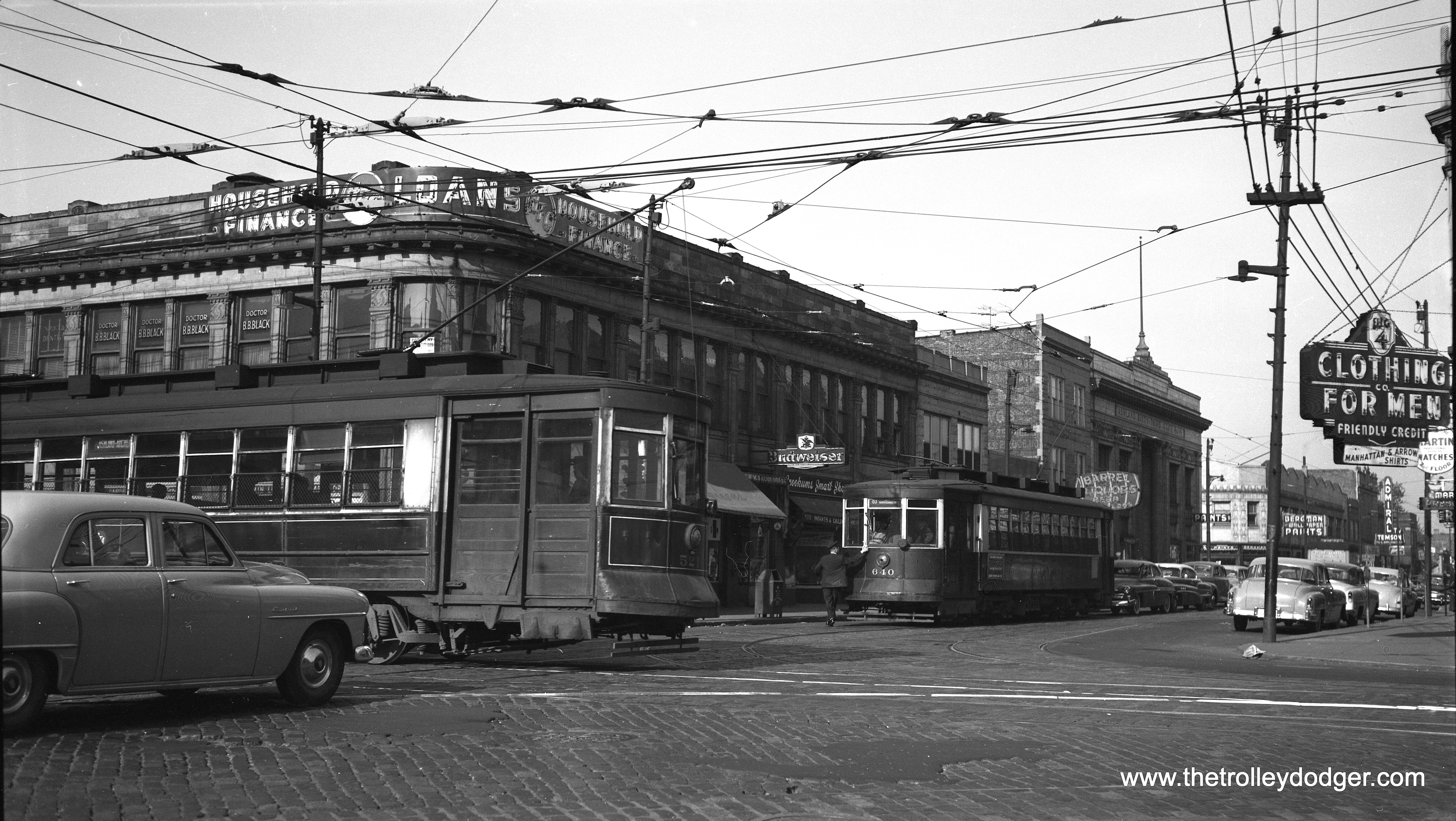
CTA red Pullmans 521 (on Ashland) and 640 (on 63rd Street) meet on May 14, 1953. This was near the end of streetcar service on 63rd. By then, PCC cars had been transferred from 63rd to Cottage Grove. The Curtis restaurant, located in this vicinity but behind the photographer, was a favorite of my parents. It is perhaps no coincidence that I have a brother named Curtis. (Robert Selle Photo)

CTA red Pullmans 521 (on Ashland) and 640 (on 63rd Street) meet on May 14, 1953. This was near the end of streetcar service on 63rd. By then, PCC cars had been transferred from 63rd to Cottage Grove. The Curtis restaurant, located in this vicinity but behind the photographer, was a favorite of my parents. It is perhaps no coincidence that I have a brother named Curtis. (Robert Selle Photo)

CTA PCC 4095, built by Pullman, has just left the Madison-Austin loop on the west end of Route 20 on June 1, 1953. Buses continue to use this loop today, although it has been somewhat reconfigured. (Robert Selle Photo)

CTA PCC 4095, built by Pullman, has just left the Madison-Austin loop on the west end of Route 20 on June 1, 1953. Buses continue to use this loop today, although it has been somewhat reconfigured. (Robert Selle Photo)

CTA 4271-4272 head up a northbound Evanston Express train passing through the Chicago Avenue station on June 26, 1958. These two cars, which were originally independent but were converted to semi-permanent "married pairs" in the 1950s, are still on CTA property and within a few years will celebrate their centennial. When the last of the 4000-series "L" cars were retired in 1973, these were chosen for preservation as historic cars. They are occasionally used for special events. (Robert Selle Photo)

CTA 4271-4272 head up a northbound Evanston Express train passing through the Chicago Avenue station on June 26, 1958. These two cars, which were originally independent but were converted to semi-permanent “married pairs” in the 1950s, are still on CTA property and within a few years will celebrate their centennial. When the last of the 4000-series “L” cars were retired in 1973, these were chosen for preservation as historic cars. They are occasionally used for special events. (Robert Selle Photo)

CTA red Pullman 270 is on Cicero at North Avenue, where Cicero took a bit of a jog which has since been somewhat straightened out. The date is July 19, 1948. (William Shapotkin Collection)

CTA red Pullman 270 is on Cicero at North Avenue, where Cicero took a bit of a jog which has since been somewhat straightened out. The date is July 19, 1948. (William Shapotkin Collection)

CTA trolleybus 9219 on Route 77 - Belmont, running eastbound at approximately 952 W. Belmont (near Sheffield). The photographer was up on the north-south "L" platform. (William Shapotkin Collection)

CTA trolleybus 9219 on Route 77 – Belmont, running eastbound at approximately 952 W. Belmont (near Sheffield). The photographer was up on the north-south “L” platform. (William Shapotkin Collection)

The building in the previous picture is still there. For several years, there was a club on the second floor, first called the Quiet Knight, later on Tut's. I attended many great concerts there in the 1970s and 80s.

The building in the previous picture is still there. For several years, there was a club on the second floor, first called the Quiet Knight, later on Tut’s. I attended many great concerts there in the 1970s and 80s.

Chicago Surface Lines 1775 crosses the Chicago River at Wabash Avenue on May 30, 1945, promoting the WAVES (Women Accepted for Volunteer Emergency Service). The nearby State Street bridge was out of service from 1939 to 1949 due to subway construction and wartime materials shortages.

Chicago Surface Lines 1775 crosses the Chicago River at Wabash Avenue on May 30, 1945, promoting the WAVES (Women Accepted for Volunteer Emergency Service). The nearby State Street bridge was out of service from 1939 to 1949 due to subway construction and wartime materials shortages.

CSL 1775, decorated to promote the SPARS*, is on 119th one block west of Halsted in August 1943. Car 1775 was chosen for patriotic duty because that was the year the Revolutionary War broke out, with the Battles of Lexington and Concord. *The United States Coast Guard (USCG) Women's Reserve, better known as the SPARS, was the World War II women's branch of the USCG Reserve. It was established by the United States Congress and signed into law by President Franklin D. Roosevelt on 23 November 1942.

CSL 1775, decorated to promote the SPARS*, is on 119th one block west of Halsted in August 1943. Car 1775 was chosen for patriotic duty because that was the year the Revolutionary War broke out, with the Battles of Lexington and Concord.
*The United States Coast Guard (USCG) Women’s Reserve, better known as the SPARS, was the World War II women’s branch of the USCG Reserve. It was established by the United States Congress and signed into law by President Franklin D. Roosevelt on 23 November 1942.

On August 25, 1946 CSL one-man car 3093 is running outbound on private right-of-way between Morgan and Throop on Route 23, Morgan-Racine-Sangamon.

On August 25, 1946 CSL one-man car 3093 is running outbound on private right-of-way between Morgan and Throop on Route 23, Morgan-Racine-Sangamon.

On May 25, 1958 we see CTA two-man PCCs 7206 and 4390 at 78th and Wentworth (South Shops). Both were products of St. Louis Car Company, as all 310 postwar Pullman PCCs had been scrapped by then for the "PCC conversion program" that used some of their parts in new 6000-series rapid transit cars. In spite of the roll signs shown here, Chicago streetcars were limited to running on a single route between downtown and the south side. The last northside car ran in 1957. (Robert Selle Photo)

On May 25, 1958 we see CTA two-man PCCs 7206 and 4390 at 78th and Wentworth (South Shops). Both were products of St. Louis Car Company, as all 310 postwar Pullman PCCs had been scrapped by then for the “PCC conversion program” that used some of their parts in new 6000-series rapid transit cars. In spite of the roll signs shown here, Chicago streetcars were limited to running on a single route between downtown and the south side. The last northside car ran in 1957. (Robert Selle Photo)

CTA PCC 7151, a product of St. Louis Car Company, heads south on Route 49 - Western at North Avenue in 1953. The "L" station behind it was part of the Humboldt Park branch, which was abandoned in 1952. Once the station was closed, signs advertising "L" service were removed although I don't believe this portion of the structure was removed until the early 1960s. Note that riders at this safety island are boarding at the rear, as this is a two-man car.

CTA PCC 7151, a product of St. Louis Car Company, heads south on Route 49 – Western at North Avenue in 1953. The “L” station behind it was part of the Humboldt Park branch, which was abandoned in 1952. Once the station was closed, signs advertising “L” service were removed although I don’t believe this portion of the structure was removed until the early 1960s. Note that riders at this safety island are boarding at the rear, as this is a two-man car.

CTA 4393 is at the 79th and Western loop, south end of Route 49, on July 19, 1954. (Robert Selle Photo)

CTA 4393 is at the 79th and Western loop, south end of Route 49, on July 19, 1954. (Robert Selle Photo)

CTA PCC 4376 is turning into the loop at 79th and Western, south end of Route 49, on July 19, 1954. (Robert Selle Photo)

CTA PCC 4376 is turning into the loop at 79th and Western, south end of Route 49, on July 19, 1954. (Robert Selle Photo)

On May 1, 1955 CERA held a fantrip using 2800-series wooden "L" cars. Here, the train makes a photo stop at DesPlaines Avenue in Forest Park, then the western end of the Garfield Park "L". The terminal had been reconfigured in 1953 when CA&E trains stopped running downtown. It would be reconfigured again in 1959. By 1960, the Congress expressway was extended through this area. (Robert Selle Photo)

On May 1, 1955 CERA held a fantrip using 2800-series wooden “L” cars. Here, the train makes a photo stop at DesPlaines Avenue in Forest Park, then the western end of the Garfield Park “L”. The terminal had been reconfigured in 1953 when CA&E trains stopped running downtown. It would be reconfigured again in 1959. By 1960, the Congress expressway was extended through this area. (Robert Selle Photo)

CTA two-man arch roof car 3189 is southbound on Halsted Street near the Garfield Park "L" overpass, south of Van Buren Street on September 17, 1953. As had previously happened with 63rd Street, PCCs had been taken off this route and replaced by older red cars for the final few months of service. 3189 is on the bridge that would eventually go over the Congress expressway, which was then under construction. (Robert Selle Photo)

CTA two-man arch roof car 3189 is southbound on Halsted Street near the Garfield Park “L” overpass, south of Van Buren Street on September 17, 1953. As had previously happened with 63rd Street, PCCs had been taken off this route and replaced by older red cars for the final few months of service. 3189 is on the bridge that would eventually go over the Congress expressway, which was then under construction. (Robert Selle Photo)

Here's what photographer Bob Selle wrote on this negative envelope: ""L" cars fresh from the paint shops, MU-coupled, for trip to South side "L" lines: deck roofer 2912 and steel car 4224 at Quincy and Wells platform. June 14th, 1955."

Here’s what photographer Bob Selle wrote on this negative envelope: “”L” cars fresh from the paint shops, MU-coupled, for trip to South side “L” lines: deck roofer 2912 and steel car 4224 at Quincy and Wells platform. June 14th, 1955.”

CSL 4062 was the first postwar PCC put into service. It was built by Pullman. Here, we see it as delivered at 78th and Vincennes on September 30, 1946. Note the different paint scheme the first cars had in the "standee" windows area.

CSL 4062 was the first postwar PCC put into service. It was built by Pullman. Here, we see it as delivered at 78th and Vincennes on September 30, 1946. Note the different paint scheme the first cars had in the “standee” windows area.

CSL 298 is on Wabash at Cermak on September 14, 1934.

CSL 298 is on Wabash at Cermak on September 14, 1934.

This picture of CTA one-man car 3236, taken on January 14, 1950 shows it crossing Maplewood Avenue on what is obviously an east-west trolley line. John F. Bromley, who sold me this negative, was unsure of the location. Jeff Wien writes, "I would guess that it is at 71st & Maplewood. Bill Hoffman lived all of his life at 6664 S. Maplewood which was a half mile north. Maplewood is a block or two west of Western. Route 67 covered 67th, 69th and 71st as far west as California (2800). Maplewood is around 2600 West. Check out the streets to see if I am correct. The one man cars were used on route 67." Looks like Jeff is correct, as further research shows that the house at left is still standing at 7053 S. Maplewood.

This picture of CTA one-man car 3236, taken on January 14, 1950 shows it crossing Maplewood Avenue on what is obviously an east-west trolley line. John F. Bromley, who sold me this negative, was unsure of the location. Jeff Wien writes, “I would guess that it is at 71st & Maplewood. Bill Hoffman lived all of his life at 6664 S. Maplewood which was a half mile north. Maplewood is a block or two west of Western. Route 67 covered 67th, 69th and 71st as far west as California (2800). Maplewood is around 2600 West. Check out the streets to see if I am correct. The one man cars were used on route 67.” Looks like Jeff is correct, as further research shows that the house at left is still standing at 7053 S. Maplewood.

Photographer Bob Selle writes, "CTA one-man car 6174 eastbound as it crosses Halsted Street on Root Street (43rd Street line), leaving west end of line. August 1, 1953."

Photographer Bob Selle writes, “CTA one-man car 6174 eastbound as it crosses Halsted Street on Root Street (43rd Street line), leaving west end of line. August 1, 1953.”

Photographer Bob Selle writes, "Car 6177 leaving south end of Kedzie barn for Cermak Road, February 14, 1953."

Photographer Bob Selle writes, “Car 6177 leaving south end of Kedzie barn for Cermak Road, February 14, 1953.”

CTA Pullman-built PCC 4084 leaving the Kedzie Station (car barn) on September 13, 1950. The car at right appears to be either a 1949 or 1950 Ford. My father had a 1949 model, and as cars were very much in demand after the end of World War II, the dealer put him on a waiting list. After being on the list for six months, he found that he had actually gone further down the list than he was at the start! So he wrote a letter complaining about this to Henry Ford II, and the next thing you know, they sold him a car. Presumably the PCC is heading out on Route 20 - Madison. (Robert Selle Photo)

CTA Pullman-built PCC 4084 leaving the Kedzie Station (car barn) on September 13, 1950. The car at right appears to be either a 1949 or 1950 Ford. My father had a 1949 model, and as cars were very much in demand after the end of World War II, the dealer put him on a waiting list. After being on the list for six months, he found that he had actually gone further down the list than he was at the start! So he wrote a letter complaining about this to Henry Ford II, and the next thing you know, they sold him a car. Presumably the PCC is heading out on Route 20 – Madison. (Robert Selle Photo)

This negative did not come with any identifying information, but it is obviously from a February 12, 1939 fantrip where the fledgling Central Electric Railfans' Association chartered Chicago Rapid Transit Company "L" cars 4317 and 4401 and took them out on parts of the CA&E including the Mount Carmel branch. However, since that line used overhead wire, that's not where this picture was taken. Instead, it appears to be out near the end of the line at Mannheim and 22nd Street on the CRT's lightly used Westchester line, which was built in anticipation of housing being built in this area (which did not come about until the 1950s). South of Roosevelt Road, the line was single-track, which appears to be the case here. If not for the Great Depression, more housing would have been built here. We have previously run two other pictures from the same fantrip, both taken on the Mt. Carmel branch. The CTA substituted bus service for "L" on the Westchester line in 1951 as it did not want to continue paying rent to the CA&E, which had already announced its intentions to truncate passenger service to Forest Park, which meant similar rent payments to the CTA were about to cease.

This negative did not come with any identifying information, but it is obviously from a February 12, 1939 fantrip where the fledgling Central Electric Railfans’ Association chartered Chicago Rapid Transit Company “L” cars 4317 and 4401 and took them out on parts of the CA&E including the Mount Carmel branch. However, since that line used overhead wire, that’s not where this picture was taken. Instead, it appears to be out near the end of the line at Mannheim and 22nd Street on the CRT’s lightly used Westchester line, which was built in anticipation of housing being built in this area (which did not come about until the 1950s). South of Roosevelt Road, the line was single-track, which appears to be the case here. If not for the Great Depression, more housing would have been built here. We have previously run two other pictures from the same fantrip, both taken on the Mt. Carmel branch. The CTA substituted bus service for “L” on the Westchester line in 1951 as it did not want to continue paying rent to the CA&E, which had already announced its intentions to truncate passenger service to Forest Park, which meant similar rent payments to the CTA were about to cease.

CTA PCC 4087 leaves the Kedzie car barn during the morning rush on July 1, 1953 and is signed for the Madison-Fifth branch line. (Robert Selle Photo)

CTA PCC 4087 leaves the Kedzie car barn during the morning rush on July 1, 1953 and is signed for the Madison-Fifth branch line. (Robert Selle Photo)

The end is near for CTA 4402 and the other couple dozen or so PCC cars that remained at the end of service. Ultimately, only car 4391, now at the Illinois Railway Museum, was saved. This picture was taken at 77th Street yards on June 15, 1958. (Robert Selle Photo)

The end is near for CTA 4402 and the other couple dozen or so PCC cars that remained at the end of service. Ultimately, only car 4391, now at the Illinois Railway Museum, was saved. This picture was taken at 77th Street yards on June 15, 1958. (Robert Selle Photo)

CSL 5387 is westbound at 63rd and Dorchester, having just gone under the Illinois Central viaduct on June 13, 1947. Even though this neg was lightstruck on the top edge (almost all of which I cropped out), I thought it was an interesting streetscape with the diner and what appears to be some sort of pawn shop or resale shop. The Jackson Park branch of the "L" went over the IC at this point, and has since been cut back.

CSL 5387 is westbound at 63rd and Dorchester, having just gone under the Illinois Central viaduct on June 13, 1947. Even though this neg was lightstruck on the top edge (almost all of which I cropped out), I thought it was an interesting streetscape with the diner and what appears to be some sort of pawn shop or resale shop. The Jackson Park branch of the “L” went over the IC at this point, and has since been cut back.

On August 28, 1955 Illinois Central Electric suburban 1161 and its trailer are crossing Halsted Street at 121st on their way to Blue Island. There was a fantrip that day (hence the fans,), but this was not the fantrip train apparently. (Robert Selle Photo)

On August 28, 1955 Illinois Central Electric suburban 1161 and its trailer are crossing Halsted Street at 121st on their way to Blue Island. There was a fantrip that day (hence the fans,), but this was not the fantrip train apparently. (Robert Selle Photo)

CSL 1872 is on Franklin at Jackson on June 13, 1947.

CSL 1872 is on Franklin at Jackson on June 13, 1947.

CSL red Pullman 293 is at Roosevelt and Wabash on June 13, 1947.

CSL red Pullman 293 is at Roosevelt and Wabash on June 13, 1947.

This Chicago, Aurora & Elgin image is from an original 1950s Kodachrome slide that was not processed by Kodak. I am not quite able to make out the car number, but it looks like it is one of the 420s. The location is downtown Elgin, along the Fox River. The Rialto Theater burned down in 1956.

This Chicago, Aurora & Elgin image is from an original 1950s Kodachrome slide that was not processed by Kodak. I am not quite able to make out the car number, but it looks like it is one of the 420s. The location is downtown Elgin, along the Fox River. The Rialto Theater burned down in 1956.

This picture is somewhat blurred, which makes one wonder why the late Edward Frank, Jr. printed it and sold it. But it does show CSL 1819 and a passing Chicago, Aurora & Elgin train. The curved section of track suggests this may have been taken near the Sacramento curve. That's probably Ed Frank's bicycle in the lower right hand corner.

This picture is somewhat blurred, which makes one wonder why the late Edward Frank, Jr. printed it and sold it. But it does show CSL 1819 and a passing Chicago, Aurora & Elgin train. The curved section of track suggests this may have been taken near the Sacramento curve. That’s probably Ed Frank’s bicycle in the lower right hand corner.

It is not often that individual employees can be identified in an old photo such as this, which shows CA&E express freight car #5 (presumably, the second #5, built by Cincinnati Car Company). But the man at left is Clyde Goodrich, a longtime engineer on the interurban. As far as I know, he was still employed there up to the final 1959 abandonment of service.

It is not often that individual employees can be identified in an old photo such as this, which shows CA&E express freight car #5 (presumably, the second #5, built by Cincinnati Car Company). But the man at left is Clyde Goodrich, a longtime engineer on the interurban. As far as I know, he was still employed there up to the final 1959 abandonment of service.

Clyde B. Goodrich, the man in the left, was born in DeKalb, Illinois on May 17, 1887 and died in Florida on September 1, 1970. His wife's name was Winifred (1882-1955). In 1920, Clyde lived in Aurora and was employed by the Chicago, Burlington & Quincy. In the 1940 census, he was living in Wheaton and worked as an engineer on the Chicago, Aurora & Elgin. Clyde B. Goodrich and his wife are buried in Wheaton Cemetery.

Clyde B. Goodrich, the man in the left, was born in DeKalb, Illinois on May 17, 1887 and died in Florida on September 1, 1970. His wife’s name was Winifred (1882-1955). In 1920, Clyde lived in Aurora and was employed by the Chicago, Burlington & Quincy. In the 1940 census, he was living in Wheaton and worked as an engineer on the Chicago, Aurora & Elgin. Clyde B. Goodrich and his wife are buried in Wheaton Cemetery.

The caption here reads, "North Western and electric lines stations, Wheaton." The CA&E is in the foreground. The photo is not dated, but it must be quite early.

The caption here reads, “North Western and electric lines stations, Wheaton.” The CA&E is in the foreground. The photo is not dated, but it must be quite early.

This photo, dated May 1966, shows the CA&E's Wheaton station being torn down.

This photo, dated May 1966, shows the CA&E’s Wheaton station being torn down.

Demolition is nearly complete in this photo, also dated May 1966.

Demolition is nearly complete in this photo, also dated May 1966.

CA&E wooden interurban car 54. Don's Rail Photos: "54 was built by Stephonsin in 1903. It was modernized in July 1946 and retired in 1959."

CA&E wooden interurban car 54. Don’s Rail Photos: “54 was built by Stephonsin in 1903. It was modernized in July 1946 and retired in 1959.”

CA&E wooden freight motor 9. Don's Rail Photos: "9 was built by Niles Car in 1907. It was scrapped in 1959."

CA&E wooden freight motor 9. Don’s Rail Photos: “9 was built by Niles Car in 1907. It was scrapped in 1959.”

A crane on a CA&E flat car. This appears to be Wheaton Yard.

A crane on a CA&E flat car. This appears to be Wheaton Yard.

North Shore Line car 182 is southbound on the Shore Line Route in North Chicago, Illinois on June 12, 1954. Don's Rail Photos: "182 was built by Cincinnati Car in September 1920, #2455." (Robert Selle Photo)

North Shore Line car 182 is southbound on the Shore Line Route in North Chicago, Illinois on June 12, 1954. Don’s Rail Photos: “182 was built by Cincinnati Car in September 1920, #2455.” (Robert Selle Photo)

While Chicago's Congress expressway (now the Eisenhower) is rightly considered its first, Lake Shore Drive preceded it as an "almost" expressway. Here. we see construction taking place on December 13, 1940. Until 1979 LSD had lanes that could be reversed in rush hour by raising and lowering these short barriers. Unfortunately, this resulted in a number of head-on collisions, and these were eventually deactivated. The photo caption reads, "Workmen install line of elevating curbs in new express highway on Chicago's lake front. The curbs, placed two lanes apart on the eight lane roadway, give extra lanes to rush hour traffic to ease traffic flow. The elevating jacks shown raise the curb to height of nine inches, exert pressure of 12 tons. The retracting springs, having a 10-ton pressure, pull the curbs down when the hydraulic jacks are released. The entire curb system is operated from one central control station." (Photo by Acme)

While Chicago’s Congress expressway (now the Eisenhower) is rightly considered its first, Lake Shore Drive preceded it as an “almost” expressway. Here. we see construction taking place on December 13, 1940. Until 1979 LSD had lanes that could be reversed in rush hour by raising and lowering these short barriers. Unfortunately, this resulted in a number of head-on collisions, and these were eventually deactivated. The photo caption reads, “Workmen install line of elevating curbs in new express highway on Chicago’s lake front. The curbs, placed two lanes apart on the eight lane roadway, give extra lanes to rush hour traffic to ease traffic flow. The elevating jacks shown raise the curb to height of nine inches, exert pressure of 12 tons. The retracting springs, having a 10-ton pressure, pull the curbs down when the hydraulic jacks are released. The entire curb system is operated from one central control station.” (Photo by Acme)

Chicago’s Loop in 1959

The following ten images are part of a larger batch we recently purchased. Several of the others show various downtown movie theaters (including the Clark and Garrick) and will be posted in the near future on our “sister” Clark Theater blog. By studying the various films that were playing, I have determined these pictures were taken during the summer of 1959.

Here's a rather unique view showing the front of the old Wells Street Terminal, or what was left of it anyway, as it appeared in 1959. This terminal was last used by the CA&E in 1953. Two years later, the upper portion of the attractive facade was removed and a new track connection was built so that Garfield Park trains could connect to the Loop "L". A new connection was needed, since the old one had to give way to construction on Wacker Drive. The remainder of the terminal, and the track connection, were no longer needed after the Congress rapid transit line replaced the Garfield Park "L" in 1958, and they were removed in 1964. Note there is a barber shop occupying part of the building.

Here’s a rather unique view showing the front of the old Wells Street Terminal, or what was left of it anyway, as it appeared in 1959. This terminal was last used by the CA&E in 1953. Two years later, the upper portion of the attractive facade was removed and a new track connection was built so that Garfield Park trains could connect to the Loop “L”. A new connection was needed, since the old one had to give way to construction on Wacker Drive. The remainder of the terminal, and the track connection, were no longer needed after the Congress rapid transit line replaced the Garfield Park “L” in 1958, and they were removed in 1964. Note there is a barber shop occupying part of the building.

A two-car train of CTA 4000s, running on the Lake Street "L", are at Wabash and Van Buren on the Loop. In the background, you can see the Auditorium Theater building.

A two-car train of CTA 4000s, running on the Lake Street “L”, are at Wabash and Van Buren on the Loop. In the background, you can see the Auditorium Theater building.

The old Epicurean restaurant, at left, was located at 316 S. Wabash and served Hugarian cuisine. A CTA Lake Street train rumbles by above.

The old Epicurean restaurant, at left, was located at 316 S. Wabash and served Hugarian cuisine. A CTA Lake Street train rumbles by above.

A street sign is just barely visible in this photo taken under the Loop "L", identifying the cross street as Dearborn. Since that is one way southbound downtown, and the arrow is pointing to the right, that implies we are in Lake Street and are looking to the east.

A street sign is just barely visible in this photo taken under the Loop “L”, identifying the cross street as Dearborn. Since that is one way southbound downtown, and the arrow is pointing to the right, that implies we are in Lake Street and are looking to the east.

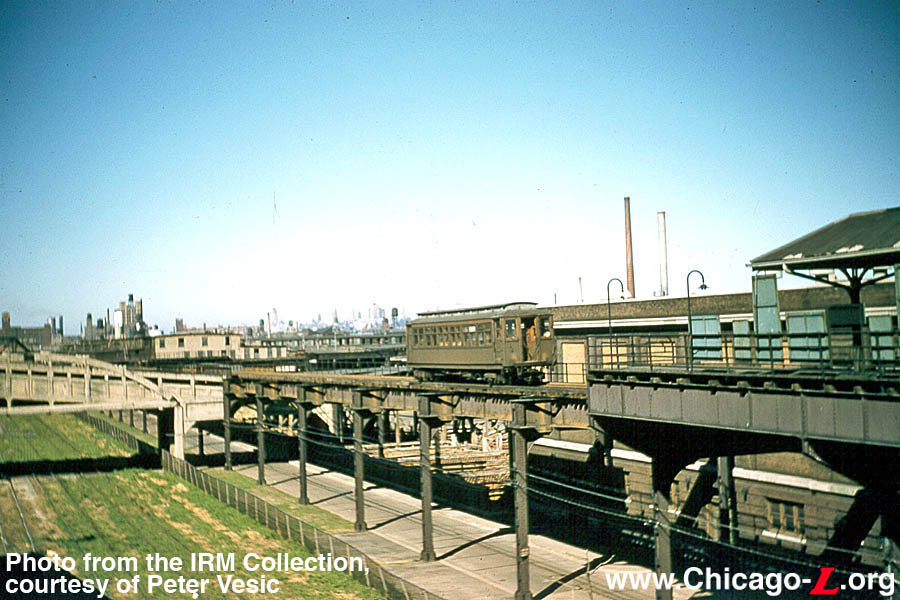
The old Metropolitan "L" crossed the Chicago River just south of Union Station (just visible at left) and had four tracks, necessitating two bridges. After these tracks were taken out of service in June 1958, the bridges were permanently raised, and razed in 1964.

The old Metropolitan “L” crossed the Chicago River just south of Union Station (just visible at left) and had four tracks, necessitating two bridges. After these tracks were taken out of service in June 1958, the bridges were permanently raised, and razed in 1964.

Another view of the same two Met "L" bridges in 1959.

Another view of the same two Met “L” bridges in 1959.

Another photo of the two Met "L" bridges.

Another photo of the two Met “L” bridges.

It's not clear where this picture was taken. The two wires that cross the trolley bus wires are, I am told, "feeder span hangers." The last Chicago trolley bus ran in 1973. The CTA currently has two electric buses that run on batteries, and has just placed an order for 20 more.

It’s not clear where this picture was taken. The two wires that cross the trolley bus wires are, I am told, “feeder span hangers.” The last Chicago trolley bus ran in 1973. The CTA currently has two electric buses that run on batteries, and has just placed an order for 20 more.

Another view of the Loop "L" on south Wabash, probably taken near the locations if the other similar photos showing Lake Street trains.

Another view of the Loop “L” on south Wabash, probably taken near the locations if the other similar photos showing Lake Street trains.

This photo shows what State Street, that great street, looked like during the summer of 1959. We are looking north from about 400 S. State. The Goldblatt's department store is at right, and that's a CTA #36 bus heading south. Streetcar tracks on State have either been removed, or paved over. Note the "grasshopper" style street lights that were installed in 1959.

This photo shows what State Street, that great street, looked like during the summer of 1959. We are looking north from about 400 S. State. The Goldblatt’s department store is at right, and that’s a CTA #36 bus heading south. Streetcar tracks on State have either been removed, or paved over. Note the “grasshopper” style street lights that were installed in 1959.

FYI, here is another view from the same location, taken after streetcar tracks were removed, but before the 1959 installation of those unique street lights:

https://portal-ccc.s3.amazonaws.com/media/images/uic/26/j09wx3v.jpg

(See attribution information for this photo via the link provided above.)

Miscellaneous New Finds

This photo purports to show the actual last run on Milwaukee's ill-fated Speedrail interurban on June 30, 1951. However, according to Larry Sakar, author of Speedrail: Milwaukee's Last Rapid Transit?, "The last run to Waukesha which left Milwaukee at a little after 8:00 pm and returned to Milwaukee at 10:08 pm, 2 minutes ahead of schedule, was handled by duplex 37-38. The final round trip to Hales Corners was handled by curved side car 63, not 66. 66 did run on the last day, but it was by no means the final run." Chances are this photo was at least taken on the last day. The line could not survive the repercussions of a terrible head-on collision in 1950, and Milwaukee area officials wanted to use the interurban's right-of-way, which it did not own, for a new highway. Don's Rail Photos: "66 was built by Cincinnati Car in August 1929, #3025, as Dayton & Troy Ry 203. It was returned to Cincinnati Car in 1932, and in 1938 it was sold to Lehigh Valley Transit as 1102. In 1949 it was sold to Speedrail, but was not rehabilitated until March 1951. But it only ran for 3 months before the line was abandoned and then scrapped in 1952." (Photo by George Harris)

This photo purports to show the actual last run on Milwaukee’s ill-fated Speedrail interurban on June 30, 1951. However, according to Larry Sakar, author of Speedrail: Milwaukee’s Last Rapid Transit?, “The last run to Waukesha which left Milwaukee at a little after 8:00 pm and returned to Milwaukee at 10:08 pm, 2 minutes ahead of schedule, was handled by duplex 37-38. The final round trip to Hales Corners was handled by curved side car 63, not 66. 66 did run on the last day, but it was by no means the final run.” Chances are this photo was at least taken on the last day. The line could not survive the repercussions of a terrible head-on collision in 1950, and Milwaukee area officials wanted to use the interurban’s right-of-way, which it did not own, for a new highway. Don’s Rail Photos: “66 was built by Cincinnati Car in August 1929, #3025, as Dayton & Troy Ry 203. It was returned to Cincinnati Car in 1932, and in 1938 it was sold to Lehigh Valley Transit as 1102. In 1949 it was sold to Speedrail, but was not rehabilitated until March 1951. But it only ran for 3 months before the line was abandoned and then scrapped in 1952.” (Photo by George Harris)

Early Kodachrome images such as this are rare. Here, we see a San Francisco cable car (signed for Powell and Mason) in operation during the summer of 1945. When this picture was taken, the war in Europe had ended, but the US was still fighting Japan. According to the Cable Car Museum web site, this car is currently in service as #3: "Built by the Carter Bros. of Newark, California during 1893-1894 for the Market Street Railway's Sacramento-Clay cable car line. The United Railroads transferred it to the Powell Street cable car lines in 1907, after the Earthquake and Fire of 1906. Until 1973, numbered as No. 503. No. 3 is painted in Muni's green and cream paint scheme, which is based on the green and white scheme of the Muni's former rival between 1921-1944, the Market Street Railway. This was the basic paint scheme for Powell Street cable cars from 1947 to 1982. Extensive rebuilding, by Muni 1955."

Early Kodachrome images such as this are rare. Here, we see a San Francisco cable car (signed for Powell and Mason) in operation during the summer of 1945. When this picture was taken, the war in Europe had ended, but the US was still fighting Japan. According to the Cable Car Museum web site, this car is currently in service as #3: “Built by the Carter Bros. of Newark, California during 1893-1894 for the Market Street Railway’s Sacramento-Clay cable car line. The United Railroads transferred it to the Powell Street cable car lines in 1907, after the Earthquake and Fire of 1906. Until 1973, numbered as No. 503. No. 3 is painted in Muni’s green and cream paint scheme, which is based on the green and white scheme of the Muni’s former rival between 1921-1944, the Market Street Railway. This was the basic paint scheme for Powell Street cable cars from 1947 to 1982. Extensive rebuilding, by Muni 1955.”

PTC "Peter Witt" 8057 was built by Brill in 1923. Here it is seen on Route 34 in the 1950s. Michael T. Greene writes: "The picture of the Route 34 Peter Witt was taken at 38th and Locust Streets, on what’s now the campus of the University of Pennsylvania. (An alum now resides at 1600 Pennsylvania Avenue, NW, in Washington, but enough of that!). The trolley is using detour trackage onto Locust Street EB, as part of the subway-surface extension of the 1950’s…westbound trackage continued on Locust to 40th Street, where it hung a left turn. Today, 38th Street has been widened to a 2-way street, but still with a trolley track, used as a diversion route for subway-surface Routes 11, 13, 34, and 36. Locust Street was been turned into a pedestrian walkway, and a pedestrian bridge goes over 38th Street these days."

PTC “Peter Witt” 8057 was built by Brill in 1923. Here it is seen on Route 34 in the 1950s. Michael T. Greene writes: “The picture of the Route 34 Peter Witt was taken at 38th and Locust Streets, on what’s now the campus of the University of Pennsylvania. (An alum now resides at 1600 Pennsylvania Avenue, NW, in Washington, but enough of that!). The trolley is using detour trackage onto Locust Street EB, as part of the subway-surface extension of the 1950’s…westbound trackage continued on Locust to 40th Street, where it hung a left turn. Today, 38th Street has been widened to a 2-way street, but still with a trolley track, used as a diversion route for subway-surface Routes 11, 13, 34, and 36. Locust Street was been turned into a pedestrian walkway, and a pedestrian bridge goes over 38th Street these days.”

Philadelphia Transportation Company 7266 is on Route 9, sometime in the 1950s during street construction. Micheal T. Greene writes: "The Route 9 car is on 5th Street south of Market Street. At this time, 5th Street was being widened as part of Independence Mall. Independence Hall is out of this picture to the right."

Philadelphia Transportation Company 7266 is on Route 9, sometime in the 1950s during street construction. Micheal T. Greene writes: “The Route 9 car is on 5th Street south of Market Street. At this time, 5th Street was being widened as part of Independence Mall. Independence Hall is out of this picture to the right.”

Indianapolis Railways "Peter Witt" car 181, also known as a "Master Unit," a Brill trademark, is signed for College-Broad Ripple on April 16, 1952. This car was built in March 1934 and was one of the last streetcar orders filled before the PCC era. (Robert Selle Photo)

Indianapolis Railways “Peter Witt” car 181, also known as a “Master Unit,” a Brill trademark, is signed for College-Broad Ripple on April 16, 1952. This car was built in March 1934 and was one of the last streetcar orders filled before the PCC era. (Robert Selle Photo)

Indianapolis Railways 155 was built by Brill in September 1933. On May 21, 1950 it is at the east end of the Washington Street line on a fantrip.

Indianapolis Railways 155 was built by Brill in September 1933. On May 21, 1950 it is at the east end of the Washington Street line on a fantrip.

On August23, 1946, photographer Walter Hulseweder snapped this picture of Indianapolis Railways 131 on Washington Street at Illinois Avenue on the Washington-Sheridan line.

On August23, 1946, photographer Walter Hulseweder snapped this picture of Indianapolis Railways 131 on Washington Street at Illinois Avenue on the Washington-Sheridan line.

By strange coincidence, this photo showing a Rock Island Motor Transit Company bus was taken in June 21, 1958. Bill shapotkin adds, "The photo was taken at the joint CGW/Greyhound/Jefferson bus station in Rochester, MN. This bus provided connections from/to ROCK trains at Owatonna, MN." (William Shapotkin Collection)

By strange coincidence, this photo showing a Rock Island Motor Transit Company bus was taken in June 21, 1958. Bill shapotkin adds, “The photo was taken at the joint CGW/Greyhound/Jefferson bus station in Rochester, MN. This bus provided connections from/to ROCK trains at Owatonna, MN.” (William Shapotkin Collection)

Mystery Photo

This picture, which could be as old as the 1930s, was listed by the seller as being Chicago. However, I have my doubts, as I am unable to think of a location this could be around here, or what the construction project might be. The sign says "Detour to temporary bridge." Jeff Wien thinks this might be Philadelphia.

This picture, which could be as old as the 1930s, was listed by the seller as being Chicago. However, I have my doubts, as I am unable to think of a location this could be around here, or what the construction project might be. The sign says “Detour to temporary bridge.” Jeff Wien thinks this might be Philadelphia.

Updates

We’ve added another image to our previous post The Fairmount Park Trolley (November 7. 2017), which includes an extensive section about the Five Mile Beach Electric Railway in Wildwood, New Jersey:

Five Mile Beach Electric Railway car 36 at Warehouse Point, Connecticut on August 16, 1952.

Five Mile Beach Electric Railway car 36 at Warehouse Point, Connecticut on August 16, 1952.

These photos were added to our previous post Red Arrow in West Chester (September 13, 2016):

A SEPTA commuter train, ex-PRR, at West Chester in May 1979. SEPTA rail service to this station ended in 1986, but the West Chester Railroad began running a not-for-profit tourist operation of train service on weekends between West Chester and Glen Mills in 1997. (Photo by Paul Kutta)

A SEPTA commuter train, ex-PRR, at West Chester in May 1979. SEPTA rail service to this station ended in 1986, but the West Chester Railroad began running a not-for-profit tourist operation of train service on weekends between West Chester and Glen Mills in 1997. (Photo by Paul Kutta)

Red Arrow "Master Unit" 79 is inbound in 1949 on either the Media or Sharon Hill line, in spite of the sign saying Ardmore (thanks to Kenneth Achtert for that correction). He adds, "It was (still is) standard practice for Red Arrow operators, when changing ends at the outer end of their route, to set the sign on what would be the rear of the car for the inbound trip to read their next outbound destination. Thus, when the car arrived at 69th St. Terminal and went around the loop to the boarding platform the rear destination sign was already set. This was actually the more important sign, as most passengers approached the cars from the rear coming from the main terminal (and from the Market-Frankford Elevated line)." (Mark D. Meyer Photo)

Red Arrow “Master Unit” 79 is inbound in 1949 on either the Media or Sharon Hill line, in spite of the sign saying Ardmore (thanks to Kenneth Achtert for that correction). He adds, “It was (still is) standard practice for Red Arrow operators, when changing ends at the outer end of their route, to set the sign on what would be the rear of the car for the inbound trip to read their next outbound destination. Thus, when the car arrived at 69th St. Terminal and went around the loop to the boarding platform the rear destination sign was already set. This was actually the more important sign, as most passengers approached the cars from the rear coming from the main terminal (and from the Market-Frankford Elevated line).” (Mark D. Meyer Photo)

Red Arrow "Master Unit" 82 is at the 69th Street Terminal on August 8, 1948. (Walter Broschart Photo)

Red Arrow “Master Unit” 82 is at the 69th Street Terminal on August 8, 1948. (Walter Broschart Photo)

On September 12, 1959, Philadelphia Suburban Transportation 3, a 1941 "Brilliner," is on Lippincott Avenue north of County Line Road, on the short Ardmore line which was bussed in 1966.

On September 12, 1959, Philadelphia Suburban Transportation 3, a 1941 “Brilliner,” is on Lippincott Avenue north of County Line Road, on the short Ardmore line which was bussed in 1966.

Philadelphia Suburban Transportation Company (aka "Red Arrow") cars 5 and 14 pose at 69th Street Terminal on June 22, 1963. The car at left is a Brilliner, from the last batch of trolleys built by Brill in 1941. The car at right was built by the St. Louis Car Company in 949. Although it looks much like a PCC, it was not considered such as it had standard interurban trucks and motors. Both types of cars were double-ended.

Philadelphia Suburban Transportation Company (aka “Red Arrow”) cars 5 and 14 pose at 69th Street Terminal on June 22, 1963. The car at left is a Brilliner, from the last batch of trolleys built by Brill in 1941. The car at right was built by the St. Louis Car Company in 949. Although it looks much like a PCC, it was not considered such as it had standard interurban trucks and motors. Both types of cars were double-ended.

We’ve added this image to our extensive section about the Fort Collins (Colorado) Birney car operation in Our 150th Post (August 6, 2016):

Fort Collins Municipal Railway Birney car 22 in the city park on April 30, 1947.

Fort Collins Municipal Railway Birney car 22 in the city park on April 30, 1947.

Recent Correspondence

Our resident South Side expert M. E. writes:

Your latest post has a bunch of good stuff.

https://thetrolleydodger.com/wp-content/uploads/2018/06/proofs116.jpg
Interesting that you think this picture might be of your mother and you. In the book “In Search of Steam” by Joe Collias (which I do not have), there is a picture taken at Englewood Union Station of a young boy, bundled in winter clothing, watching a New York Central steam engine come into the station. I’d swear that young boy is me.

The movie of the last PCC streetcar almost made me cry. My last ride on a Chicago streetcar occurred in early June when my high-school best friend and I rode one car from 81st and Halsted to 63rd and Wentworth, then another car ack to 81st and Halsted. Also: Probably less than a week after the last streetcar ran, I graduated high school. So this time frame is especially meaningful to me. (Please don’t publish this, it’s just for your information.)

https://thetrolleydodger.com/wp-content/uploads/2018/06/proofs123.jpg
In this photo, did you notice the swell “woodie” station wagon?

https://thetrolleydodger.com/wp-content/uploads/2018/06/proofs139.jpg
Your text beneath this picture fascinates me. You say your parents frequented the Curtis restaurant at 63rd and Ashland. Does that mean you grew up around there? I grew up a mile east of this junction.

https://thetrolleydodger.com/wp-content/uploads/2018/06/proofs138.jpg
The text under this picture says the South Shops was at 78th and Wentworth. Not so. South Shops was at 77th and Vincennes on the east side of Vincennes. And the land it occupied was huge — from 77th and Vincennes east to about Perry (a block west of State St.) and south to 79th. I haven’t been there in a long time, but maybe the CTA still has all that land.

https://thetrolleydodger.com/wp-content/uploads/2018/06/proofs1611.jpg
I’d have to agree that this car is on 71st St. west of Western. Because you say 7053 S. Maplewood is at the left, I contend the streetcar is heading west to 71st and California. One small nit: The caption says “Bill Hoffmann lived all of his life at 6664 S. Maplewood.” Unless there was an extra-long block between 66th and
67th (Marquette Blvd.) on Maplewood, the address would have to be 6654. Normally there are 60 addresses to a block, from 00 to 59.

https://thetrolleydodger.com/wp-content/uploads/2018/06/proofs160.jpg
This is an interesting picture. As the caption indicates, the car had just left the west end of its line. That west end was west of Halsted between two buildings. It was a dead end, providing only a switch from westbound to eastbound track. Also: You previously published a photo taken here, on Halsted St. south of Root, looking north. In that photo was a 44 Wallace-Racine car turning from west on Root to south on Halsted. (In this current photo you can see the trackage for this turn.) Also in that previous photo was the Halsted St. station of the Stock Yards L.

https://thetrolleydodger.com/wp-content/uploads/2018/06/proofs160.jpg
This is your mystery photo. I agree that this can’t be a Chicago
scene, for the reason that I know of no elevated trackage in Chicago that was so low to the ground. Also, the elevated train does not look like any Chicago L train I remember.

M E

Thanks very much for your interesting observations!

I don’t think that the woman and boy actually are me, but they certainly resemble us in 1958. My mother dressed like that all the time, and the kid is about my age.

We lived on the west side, in Mont Clare. My mother’s parents lived in Englewood and that’s where she was living when my parents met. So naturally, they frequented restaurants in the neighborhood.

63rd and Ashland was bustling back then.

The June 18, 1958 Southtown Economist gives Dorothy Hoffman’s address as 6622 S. Maplewood.  I believe Bill Hoffman lived with his sister, so perhaps that is the correct address.

If you think 63rd and Ashland was busy, you should have seen 63rd and Halsted, which was the heart of Englewood. Somewhere I once read that 63rd and Halsted was the busiest commercial district in Chicago outside the Loop. It was a great place to grow up because there were three streetcar lines (8, 42, 63), the Englewood L (which I could see from our building), and railroad stations east on 63rd at Wallace and La Salle.

Good point! People tend to forget these things, as certain areas of the city became depopulated to some extent, and urban renewal leveled entire blocks.

We’ll let Jeff Wien have the last word:

Streetcars, streetcars, streetcars. They seem to be popping up all over the country. And who would have thought 60 years ago that there would be such a renaissance! I was called a trolley jolly because I favored streetcars. The Millenials like them.

Pre-Order Building Chicago’s Subways

Bibliographic information:

Title Building Chicago’s Subways
Images of America
Author David Sadowski
Edition illustrated
Publisher Arcadia Publishing (SC), 2018
ISBN 1467129380, 9781467129381
Length 128 pages

Chapter Titles:
01. The River Tunnels
02. The Freight Tunnels
03. Make No Little Plans
04. The State Street Subway
05. The Dearborn-Milwaukee Subway
06. Displaced
07. Death of an Interurban
08. The Last Street Railway
09. Subways and Superhighways
10. Subways Since 1960

Building Chicago’s Subways will be published on October 1, 2018. Order your copy today, and it will be shipped on or about that date. All copies purchased through The Trolley Dodger will be signed by the author.

The price of $23.99 includes shipping within the United States.

For Shipping to US Addresses:

For Shipping to Canada:

For Shipping Elsewhere:

Help Support The Trolley Dodger

gh1

This is our 214th post, and we are gradually creating a body of work and an online resource for the benefit of all railfans, everywhere. To date, we have received over 414,000 page views, for which we are very grateful.

You can help us continue our original transit research by checking out the fine products in our Online Store.

As we have said before, “If you buy here, we will be here.”

We thank you for your support.

DONATIONS

In order to continue giving you the kinds of historic railroad images that you have come to expect from The Trolley Dodger, we need your help and support. It costs money to maintain this website, and to do the sort of historic research that is our specialty.

Your financial contributions help make this web site better, and are greatly appreciated.

Milwaukee Streetcars, 60 Years On

523 on the Lakeside Belt Line shuttle.

523 on the Lakeside Belt Line shuttle.

This post features prolific author Larry Sakar, who looks back at the history of Milwaukee streetcars. While it has now been 60 years since their demise, the new Milwaukee streetcar line, aka “The Hop,” is just months away from operation. What goes around sometimes comes around!

Soon it will be possible to take new pictures of Milwaukee streetcars, as they will be tested this summer.  Operators are being hired, and testing out on the streets may start as early as next month.

Our thanks go out to Larry for producing another excellent article about a topic he obviously loves so much.

-David Sadowski

Milwaukee Streetcars, 60 Years On

by Larry Sakar

March 1, 2018 marked the 60th anniversary of the last regularly scheduled streetcar in Milwaukee. I use the term “regularly scheduled” because streetcar service on the Lakeside Belt Line employee shuttle between the Lakeside Power Plant and Kinnickinnic Avenue continued until 1961. Though intended solely for use by employees of the power plant, some Milwaukee streetcar fans were able to ride it as far as the power plant gates, according to a number of sources.

Although I have written about the Milwaukee Rapid Transit line and the interurbans, I was only 8 months old when Speedrail ran its last miles, so I never saw nor had the pleasure of experiencing it. But the streetcars were a different story. I was 7 years old when the last cars on Route 10 Wells Street made their final runs on March 1, 1958.

My grandmother who introduced me to the thrill of riding the streetcar and I did ride the “10” on that last day. In fact, except for one very early ride on Route 11-Vliet Street a week or so before service west of downtown was converted to buses, all of my streetcar rides were on Route 10 and always between the Harwood Avenue terminal on Wauwatosa and 4th & Wells Streets downtown. We did take a ride on the West Allis branch just one time, but I am unable to recall it beyond only the vaguest recollection.

First, we will look at the earliest beginnings of streetcars in Milwaukee thru the 700 series cars. In the final years of streetcar operation by The Transport Company (The Milwaukee & Suburban Transport Corp. which bought out TMER&T in November of 1952), only the 800 and 900 series streetcars were left and those are the cars I rode. Being only 7 years old when the cars quit I obviously did not keep any record of which cars I rode. To me, a streetcar was a streetcar!

Like most cities, Milwaukee streetcars were horse-drawn or cable cars before electrification. Milwaukee had several independent systems, such as the Milwaukee City Railway Company (March 1865), the West Side Street Railway Company (July 1875), and the Milwaukee Cable Railway Company (December 1887). The very first electric streetcar line was operated by the West Side Railway Company on test run over their new Wells-Wisconsin line on April 3, 1890.

After various sales, takeovers and consolidations, electric streetcar service in Milwaukee was taken over by the newly formed The Milwaukee Electric Railway & Light Company on January 29, 1896. From that day until September 23, 1938 when TMER&L was split into two companies because of the 1935 Utilities Holdings Act (which declared companies providing both electric power and transportation monopolies had to divest one or the other), TMER&L would operate all streetcar and interurban service in Milwaukee.

Thereafter, the newly formed The Milwaukee Electric Railway & Transport Company (or “The Transport Company” for short) took over all rail operations as well as trackless trolley and bus service. Both TMER&L and TMER&T always insisted on use of the definite article as part of their company name.

In November 1952, TMER&T was sold to a group of investors from Milwaukee, Chicago and Indianapolis. The newly formed Milwaukee & Suburban Transport Corporation continued to use “The Transport Company” appellation until municipal ownership finally came to Milwaukee with the formation of the Milwaukee County Transit System in July, 1975.

TMER&T had initially offered the city of Milwaukee “first crack” at buying it out but the city was not interested. The “Transport Company” name became so ingrained in the minds of the riding public that it was several years before the new MCTS name caught on.

TMER&L was well aware of its “horse car roots” and actually preserved a horse car. It was on display on the second floor of the company’s corporate headquarters in the Public Service Building on North 2nd and West Michigan Streets for many years. It would be brought out on special occasions, such as this city celebration as shown in this 1921 article from the Electric Railway Journal. A photo of one of Milwaukee’s first electric streetcars graced an MCTS weekly pass in the 1980s. Other events such as the 20th anniversary of the “last streetcar” were commemorated on this 1978 weekly pass.

The Good News

It has taken 60 years, but streetcars are coming back to Milwaukee starting this Fall. The new 2.3 mile Milwaukee streetcar circulator line is expected to begin service on November 25th of this year. A 0.75 mile extension to the lakefront and Summerfest grounds is slated to follow in 2019. The new streetcar will be called “The HOP”. Thanks to Potawatomie Hotel and Casino, the first year of operation will be free. The line will begin at 4th and St. Paul Avenue, adjacent to the Milwaukee Intermodal station which will be handy for anyone coming up to Milwaukee from Chicago on Amtrak or from the west on the Empire Builder.

No PCCs?

You’ll note that there are no pictures of TM PCCs. Thats because TM never bought any. TM President Sylvester B. Way was a member of the Electric Railway Presidents Conference Committee. In their book, “PCC: The Car That Fought Back” (Interurban Press, 1980) authors Stephen P. Carlson and Fred W. Schneider III provided this 1936 quote from S.B. Way:

“I think it is very clear now that certain companies will be able to make very little, if any, use so far as they are concerned of these improvements, either because the rail transportation is disappearing in their areas or because it just isn’t in the business.”

Apparently, Way had joined the ERPCC thinking it was going to provide ways to improve existing streetcars not build an entirely new car. Every streetcar TM ever built or bought was double-ended. This eliminated the need for turning loops at the end of the lines.

If TM were to have purchased PCCs they would have been faced with two alternatives; either build turning loops at the end of every streetcar line (completely impractical if not impossible in quite a few locations like Harwood Ave. and 70th & Greenfield on Rt. 10 or Delaware and Oklahoma Aves. at the south end of Rt. 15). This would have left TM with but one other option; buy double-ended PCCs . Then there were all of the various patent and licensing fees connected to the PCCs. TM was notoriously cheap. S.B. Way would not hear of it!

When Way said that some companies just weren’t in the business he was probably referring to TM. By the time the first PCCs went into service on the Brooklyn & Queens Railway in New York in 1936 TM had turned its back on streetcars. The management had fallen in love with trolley buses and conversions from rail to rubber soon started. The corporate split in 1938 only exacerbated the matter. Had it not been for the intervention of WWII streetcars in Milwaukee would have been history long before March 1958. And even if TM had purchased PCCs, it would done little to change the anti-rail sentiment that prevailed from 1936 on.

The 300-Series Articulated Streetcars

TMER&L was noted for their frugality. As such, they were very fond of articulated streetcars dating back to the early 1900s. Here we see unit 338-339 awaiting scrapping at the Waukesha Gravel Pit in 1948 photo by TM Motorman Ed Wilson. All Milwaukee streetcars thru the 700-series met their end at the gravel pit, until the demise of Speedrail in June 1951. The last cars scrapped here were those belonging to Speedrail between March and October 1952.

300-series city cars being scrapped at the Waukesha gravel pit. (Ed Wilson photo)

300-series city cars being scrapped at the Waukesha gravel pit. (Ed Wilson photo)

The 500-Series Cars

The first 500-series car debuted on April 30, 1911. Initially built to be two-man cars they were first assigned to the Wells- Downer Line (Route 10). Rumor is that in retaliation for resident complaints about noisy streetcars, TM President John I. Beggs (who designed the cars) ordered the floors to be constructed of 6 inch thick concrete. But according to historical research, that rumor was not true. These would be TMs last deck-roofed cars. From this point on all Milwaukee streetcars would have arch roofs.

In the early ’20s TM became committed to one-man operation and began converting the 600s by removing the large pot-bellied stove from the front platform and installing electric heating. Controls and door arrangements were also redone to permit one-man operation.

The conversion to one-man service was not without its problems. In 1921, the City of Milwaukee actually swore out a complaint against TM company officials claiming that the conversion to one-man operation of streetcars violated a 1919 city ordinance forbidding the operation of any streetcar by less then two men. TMER&L fired back by showing that the Wisconsin Railroad Commission, the state body that oversaw all rail operations in the state (and predecessor to the Public Service Commission of Wisconsin which it became in 1930) had approved one-man operation.

The accompanying articles from the company’s house organ “Rail & Wire” show how the 500s were converted into one-man cars. Note the fare box (item 15) seen in one of the photos. These were homemade fare boxes and they lasted into the MCTS era. On the front of the fare box was a metal sign which read “PASSENGERS PLEASE PLACE FARE IN BOX. CONDUCTORS NOT PERMITTED TO HANDLE FARE.” I often wondered what bus riders unaware of Milwaukee transit history made of the sign. Eventually, MCTS pasted a sticker over the sign. These fare boxes became unusable after fares topped $1.00, as they were not designed to handle paper money which caused them to jam.

The TM book (“TM: The Milwaukee Electric Railway & Light Company” by Joseph M. Canfield, Bulletin 112 of the Central Electric Railfans Association, 1972) mentions that some of the 500-series cars had Wrigley’s Juicy Fruit gum dispensers mounted on the posts between every two or three windows. That is true. My late father once mentioned riding the Route 15 streetcar out to one of the prestigious country clubs in Milwaukee’s north shore suburbs and seeing them. As a teenager he worked as a caddie and among the people for whom he caddied was Chicagos Phillip K. Wrigley. I can still hear him telling me about the experience: “That old man Wrigley was a cheapskate. He would tip the caddies a nickel and a stick of gum! What a tightwad!”

The 500-series cars were all scrapped between 1948 and 1952. The lone survivor was car 523 which operated on the Lakeside Belt Line shuttle until 1954 when it was replaced by car 882. Then 500s, by the way were the first streetcars to wear the new orange and ivory paint scheme adopted for one man cars.

TM 600s and 500s awaiting scrapping at Oakland Station in 1949.

TM 600s and 500s awaiting scrapping at Oakland Station in 1949.

TM 576 Front close-up on Route 15.

TM 576 Front close-up on Route 15.

The 600-Series Cars

The 600-series cars were less than half the length of a 500. Of the 60 cars in this series, 30 were built in TM’s Cold Spring Shops and 30 came from TM’s streetcar builder St. Louis Car Company. I call St. Louis TM’s streetcar builder because they constructed nearly every streetcar that ran in Milwaukee.

What made St. Louis Car Company so much better than other builders like Pullman or J.G. Brill? St. Louis Car Company was part of the North American Company which also happened to be TMs parent company. And after being forced out of TM in 1911 John I. Beggs became president of St. Louis Car Company. He eventually worked his way back into TM in 1920 and served as TM’s president until his death in October 1925.

The 600s were among the most ubiquitous streetcars ever built. Upon their arrival in 1912 they were initially placed in service on the Route 12 service to North Milwaukee, paired with 1200-series interurban trailers. The article reproduced here describes that service and comes from Electric Railway Journal. In 1927-28, ten of the 600s (601-610) were upgraded for service on the line to Cudahy and South Milwaukee. The upgrade included globe lights, smoking compartments and leather seats. Two cars of this series (604-605) also saw service on the Local West Side Rapid Transit line to West Junction, before the line was completed between 8th and 40th Streets.

Like the 500s, TM attempted to convert the 600s into one-man cars but the attempt failed. The platform on the 600-series cars were too small to accommodate both boarding and disembarking passengers. Only seven of the 600s were ever so converted. The 600s became the cars seen on Routes 19 and 37 where they proved to be ideal. Their days of service came to an end when Route 19 service was converted to trackless trolley operation in March 1948.

Three cars initially escaped the scrapper’s torch. Cars 626 and 636 saw service on the Lakeside Shuttle until they were replaced by 882, after which they too met their end at the Waukesha Gravel Pit. In 1949, car 607 was purchased from TMER&T by a railfan group called the Railroad Historical Foundation. 607 was chosen because it was the last 600 to go through Cold Spring Shops.

The car was stored at the yards adjacent to the never-completed subway at 8th and Hibernia Streets. Periodic work sessions were held to restore the car. The group’s ultimate goal was to restore the car completely, then move it out to the Municipality of East Troy Railway, where they were hoping to establish a trolley museum. Approximately 3/4ths of the canvas roof had been replaced when Speedrail was abandoned on June 30, 1951. The group was subsequently informed by scrapper Hyman-Michaels Co. that unless the car was removed from the Speedrail property it would be taken to Waukesha and scrapped. With most of the group members drafted into the military because of the Korean War, no one was left to find it a new home and it was sold for scrap.

TM 636 on the Lakeside Belt Line shuttle.

TM 636 on the Lakeside Belt Line shuttle.

TM 660 at North Side Station, 3-31-48.

TM 660 at North Side Station, 3-31-48.

TM 660 at Fiebrantz Station, 3-31-48.

TM 660 at Fiebrantz Station, 3-31-48.

The 700-Series Cars

The TM book refers to these as the “awful 700s.” Built in 1917 as center-entrance cars and complete with jumpers for multiple unit operation in trains of two or three cars, they represented a radical shift in Milwaukee streetcar design. They were apparently ill-suited to TM’s needs from the start.

The 700s were rebuilt as one-man cars in the 1920s. This involved removing the center doors and raising the level of the floor. End doors were added and m.u. controls removed.

As bus substitutions for streetcars increased the cars saw use only in rush hour tripper service. All were retired by 1953.

A TM 700-series car at National Avenue car station. (Herb Danneman collection)

A TM 700-series car at National Avenue car station. (Herb Danneman collection)

TM 600s and 700s being scrapped at the Waukesha gravel pit in 1949. (Ed Wilson photo)

TM 600s and 700s being scrapped at the Waukesha gravel pit in 1949. (Ed Wilson photo)

Loading wheel sets from scrapped 600s and 700s. (Ed Wilson photo)

Loading wheel sets from scrapped 600s and 700s. (Ed Wilson photo)

The 800s

Car 850 as originally built, location unknown. (Collection of Robert Genack)

Car 850 as originally built, location unknown. (Collection of Robert Genack)

Two 800's and two Twin Coach buses meet at 3rd and State. (Robert Genack collection)

Two 800’s and two Twin Coach buses meet at 3rd and State. (Robert Genack collection)

Two 800s and a 500 meet at Northside station. (Robert Genack collection)

Two 800s and a 500 meet at Northside station. (Robert Genack collection)

803 at the north end of Rt. 27 - 35th & Silver Spring. (Don Ross photo)

803 at the north end of Rt. 27 – 35th & Silver Spring. (Don Ross photo)

Car 804.

Car 804.

845 at Bolivar and Howell Avenues in the 1940's. (Duane Matuszak collection)

845 at Bolivar and Howell Avenues in the 1940’s. (Duane Matuszak collection)

866 eastbound on 7th and Mitchell Streets. (Robert Genack collection)

866 eastbound on 7th and Mitchell Streets. (Robert Genack collection)

870 at the south end of Rt. 40 in St. Francis - Kinnickinnic & St. Francis Ave. (Robert Genack collection)

870 at the south end of Rt. 40 in St. Francis – Kinnickinnic & St. Francis Ave. (Robert Genack collection)

Car 871.

Car 871.

The 900s

A 900 and a snow sweeper stuck in a drift on West Lisbon Avenue in 1947.

A 900 and a snow sweeper stuck in a drift on West Lisbon Avenue in 1947.

I originally identified this as an 800 stuck in a snowdrift on Lisbon Ave. in the famous Blizzard of '47. I just ran across the collection of "Remember When" articles that used to run in the Milwaukee Journal and found the same picture. It looks like it's a 900 and the caption says it's stuck on 27th & Brown. If you can't see the center window of an 800 or 900 head-on, it's hard to tell which it is.

I originally identified this as an 800 stuck in a snowdrift on Lisbon Ave. in the famous Blizzard of ’47. I just ran across the collection of “Remember When” articles that used to run in the Milwaukee Journal and found the same picture. It looks like it’s a 900 and the caption says it’s stuck on 27th & Brown. If you can’t see the center window of an 800 or 900 head-on, it’s hard to tell which it is.

907 as originally built., at an unknown location. (Robert Genack collection)

907 as originally built., at an unknown location. (Robert Genack collection)

913 Northbound at 84th and National. (Don Ross photo)

913 Northbound at 84th and National. (Don Ross photo)

TM 916 is eastbound, passing National car station at 27th and National.

TM 916 is eastbound, passing National car station at 27th and National.

943 at 3rd and Michigan - TM publicity shot. (Robert Genack collection)

943 at 3rd and Michigan – TM publicity shot. (Robert Genack collection)

947 at Fond du Lac station, the north end of Rt. 23. (Ed Wilson photo)

947 at Fond du Lac station, the north end of Rt. 23. (Ed Wilson photo)

964 at 81st and Greenfield. WTL Waukesha bus following. (Don Ross photo)

964 at 81st and Greenfield. WTL Waukesha bus following. (Don Ross photo)

A publicity shot of 976 at 38th and McKinley outside Cold Spring shops. (Larry Sakar collection)

A publicity shot of 976 at 38th and McKinley outside Cold Spring shops. (Larry Sakar collection)

TM 978 on Rt. 13 on Clybourn near Cass and Michigan Streets. (Herb Danneman collection)

TM 978 on Rt. 13 on Clybourn near Cass and Michigan Streets. (Herb Danneman collection)

979 at 37th and National, on the last run of Rt. 18, 11-25-55. (Herb Danneman photo)

979 at 37th and National, on the last run of Rt. 18, 11-25-55. (Herb Danneman photo)

TM 993 at Howell and Howard. Note car in pocket ahead. (Don Ross photo)

TM 993 at Howell and Howard. Note car in pocket ahead. (Don Ross photo)

The front platform of a TM 900.

The front platform of a TM 900.

Interior view of a 900-series car with leather seats. (Herb Danneman photo)

Interior view of a 900-series car with leather seats. (Herb Danneman photo)

Winter 1955-1956

With the conversion of so many streetcar lines to either trolleybus or diesel bus operation by this time, The Transport Company (M&STC) found itself short of space at several car stations for new GM diesel and second-hand Marmon-Herrington trolley buses. A decision was made to move about ten surplus streetcars to the County Stadium storage track.

This was not a scrap line, but merely what the company thought would be a safe, out-of-the-way place to store cars. They incorrectly assumed that with no one living nearby, the cars would go undisturbed. In the first photo car 925 shows just how “undisturbed” the cars were. Note the many holes in the front windows. The abundance of ballast on the right-of-way provided sufficient ammunition for vandals who just couldn’t resist sending rocks through the car windows. Other cars like 929, seen in the second photo as well as 933, were also part of this group. According to former Milwaukee resident Al Buetschle who saved TM 978, the end result was that all ten cars went to the scrapper after being stored in the Calvary Cemetery cut on the stadium spur.

Car 925 at the Hawley Road platform in the winter of 1955-56. Note the many holes from rocks thrown through the car windows. (Ed Wilson photo)

Car 925 at the Hawley Road platform in the winter of 1955-56. Note the many holes from rocks thrown through the car windows. (Ed Wilson photo)

Car 929 and others stored on the County Stadium spur in the winter of 1955-1956. (Don Ross photo)

Car 929 and others stored on the County Stadium spur in the winter of 1955-1956. (Don Ross photo)

Cars With Special Paint Jobs

An 800 series car advertising the benefits of an "Army Career" passes Milwaukee City Hall northbound on N. Water Street. (Larry Sakar collection)

An 800 series car advertising the benefits of an “Army Career” passes Milwaukee City Hall northbound on N. Water Street. (Larry Sakar collection)

TM 871 (painted for fire prevention week) is seen at 19th and Hopkins Streets on Rt. 12. (Earl Ruhland photo)

TM 871 (painted for fire prevention week) is seen at 19th and Hopkins Streets on Rt. 12. (Earl Ruhland photo)

A 900 painted with an ad for the U.S. Air Force pauses in front of National Car station at 27th and National on Rt. 18. (Larry Sakar collection)

A 900 painted with an ad for the U.S. Air Force pauses in front of National Car station at 27th and National on Rt. 18. (Larry Sakar collection)

Passes, Time Tables, Transfers, and Car Checks

I have a number of TM passes from the 1930s and ’40s. I also have a Milwaukee streetcar transfer and a very early “commutation ticket.” These were later replaced with smaller tickets. TM just called them tickets, but my grandmother always called them “(street) car checks.”

I remember the first time we were going downtown after streetcar service ended in March ’58. She reached into her purse and tore off a car check for herself and one for me. The ones I recall had a drawing of a streetcar, trolleybus and diesel bus on one side and “The Transport Company” in the companys diamond logo on the reverse.

I asked if we were going to ride the streetcar again . After all, how could you have car checks with0out streetcars? She said, “There are no more streetcars. They were all taken off of the line.” I didn’t understand how that could be until she told me that they could also be used on buses. For a second I held out hope that The Transport Company had changed their mind and decided to keep streetcars, but there was no reprieve.

Here are some samples of passes and timetables. Also, the early car check had the Public Service Building on the back side. The two passes from the present-day MCTS era commemorate streetcar anniversaries which is why I included them. The type of “car check” I remember has also been scanned. My memory was playing tricks on me. The diamond logo was not on it.

The reason it says “Good within the single fare area of Milwaukee only” is because Milwaukee had what were called zone fares. They could vary from as few as one zone to as many as four on the South Milwaukee-Cudahy line. Each zone was an additional five cents in fare. In the ’60s I used to love to ride the Route 80 bus to Mitchell Field and watch planes. Mitchell Airport was two zones, so you had to drop ten cents in the fare box when you got on or off there. You’ll see a couple of weekly passes with coupons attached. The coupon, which raised the cost of the pass, entitled you to ride into as many zones as was indicated on the coupon without having to pay an extra cash fare.

A TMER&L streetcar transfer (front).

A TMER&L streetcar transfer (front).

A TMER&L streetcar transfer (back).

A TMER&L streetcar transfer (back).

One of the very first TM weekly passes.

One of the very first TM weekly passes.

An early TM car check (front).

An early TM car check (front).

An early TM car check (back).

An early TM car check (back).

The Route 10 timetable for May 29, 1955.

The Route 10 timetable for May 29, 1955.

The Route 11 timetable for December 19, 1955.

The Route 11 timetable for December 19, 1955.

An M&STC car check (back).

An M&STC car check (back).

An M&STC car check (front).

An M&STC car check (front).

Miscellaneous Photos

After 1958, the next time I saw a Milwaukee streetcar was when 978 (saved by Al Buetschle) was on the temporary storage track net to General Lumber Company on Milwaukee’s northwest side. That was where Al and a friend of his worked on repainting and doing work on the interior of the car. The Milwaukee Journal ran a photo of Al and his friend working inside the car and that is how my grandparents found out it was there. His friend’s son was sitting in the motorman’s seat which brought back memories of the times I did the same.

In 1983 Al and his streetcar were reunited, when 978 was sent to San Francisco for the first historic streetcar festival. He had someone snap a picture of him putting up the trolley pole. I have this copy of it. The classic “T-Bird” convertible was Al’s. It was wrecked when he was hit by some teenagers out for a joy ride. Of course they were uninsured! The T-Bird was damaged beyond repair.

Al B. posing with his T-Bird and TM 978 in SFO 1983.

Al B. posing with his T-Bird and TM 978 in SFO 1983.

The Harwood Avenue Terminal Site on Route 10 today.

The Harwood Avenue Terminal Site on Route 10 today.

I took this photo at Des Plaines Ave. Forest Park on what was then the West-Northwest Rapid Transit line probably in the summer of 1972. I was standing on the blacktopped walkway to the parking lot and crouched down to get a view looking up at what was then one of the relatively new 2200 series cars.

I took this photo at Des Plaines Ave. Forest Park on what was then the West-Northwest Rapid Transit line probably in the summer of 1972. I was standing on the blacktopped walkway to the parking lot and crouched down to get a view looking up at what was then one of the relatively new 2200 series cars.

CTA 4000s in Linden Avenue yard ca. 1972.

CTA 4000s in Linden Avenue yard ca. 1972.

Tunnel beneath abandoned NSL r.o.w. at Rondout, Illinois, showing date built (1904). Taken 1992.

Tunnel beneath abandoned NSL r.o.w. at Rondout, Illinois, showing date built (1904). Taken 1992.

Tunnel beneath abandoned NSL r.o.w. at Rondout, Illinois, 1992.

Tunnel beneath abandoned NSL r.o.w. at Rondout, Illinois, 1992.

Abandoned NSL Mundelein Branch r.o.w. at Lake Bluff in`1992.

Abandoned NSL Mundelein Branch r.o.w. at Lake Bluff in`1992.

Abandoned NSL r.o.w. showing bracket for catenary on tower at right.

Abandoned NSL r.o.w. showing bracket for catenary on tower at right.

Abandoned NSL r.o.w. crossing Gross Point Road.

Abandoned NSL r.o.w. crossing Gross Point Road.

Abandoned NSL r.o.w. north of Dempster Street, Skokie.

Abandoned NSL r.o.w. north of Dempster Street, Skokie.

Chicago Trolleys

On the Cover: Car 1747 was built between 1885 and 1893 by the Chicago City Railway, which operated lines on the South Side starting in April 1859. This is a single-truck (one set of wheels) open electric car; most likely a cable car, retrofitted with a trolley and traction motor. The man at right is conductor William Stevely Atchison (1861-1921), and this image came from his granddaughter. (Courtesy of Debbie Becker.)

On the Cover: Car 1747 was built between 1885 and 1893 by the Chicago City Railway, which operated lines on the South Side starting in April 1859. This is a single-truck (one set of wheels) open electric car; most likely a cable car, retrofitted with a trolley and traction motor. The man at right is conductor William Stevely Atchison (1861-1921), and this image came from his granddaughter. (Courtesy of Debbie Becker.)

Check out our new book Chicago Trolleys. Signed copies are available through our Online Store.

This book makes an excellent gift and costs just $17.99 plus shipping. That’s $4.00 off the list price.

Help Support The Trolley Dodger

gh1

This is our 211th post, and we are gradually creating a body of work and an online resource for the benefit of all railfans, everywhere. To date, we have received over 400,000 page views, for which we are very grateful.

You can help us continue our original transit research by checking out the fine products in our Online Store.

As we have said before, “If you buy here, we will be here.”

We thank you for your support.

DONATIONS

In order to continue giving you the kinds of historic railroad images that you have come to expect from The Trolley Dodger, we need your help and support. It costs money to maintain this website, and to do the sort of historic research that is our specialty.

Your financial contributions help make this web site better, and are greatly appreciated.

Recent Finds, 10-14-2017

You would be forgiven if you think this is CTA red Pullman 144 heading north on Wentworth Avenue at Cermak Road in Chicago's Chinatown neighborhood. But it is actually car 225 with its number hidden by a piece of red oilcloth. This was a fantrip organized by the late Maury Klebolt in 1955. He had promised the fans that car 144 would be used. Car 225 was built in 1908 and was sold to Seashore Trolley Museum in 1957. I previously wrote a post about this fantrip in 2013.

You would be forgiven if you think this is CTA red Pullman 144 heading north on Wentworth Avenue at Cermak Road in Chicago’s Chinatown neighborhood. But it is actually car 225 with its number hidden by a piece of red oilcloth. This was a fantrip organized by the late Maury Klebolt in 1955. He had promised the fans that car 144 would be used. Car 225 was built in 1908 and was sold to Seashore Trolley Museum in 1957. I previously wrote a post about this fantrip in 2013.

This close-up of the previous picture shows how the "144" is on an oilcloth patch over the actual number 225.

This close-up of the previous picture shows how the “144” is on an oilcloth patch over the actual number 225.

Today, we are featuring many rare transit photographs that we recently collected. Most are from the Chicagoland area, but some are from Milwaukee and Philadelphia.

What they all have in common is I think they are interesting. I hope that you will agree.

October 17 is the 74th anniversary of the opening of Chicago’s first subway. We have included a few subway pictures to help commemorate that historic event.

-David Sadowski

PS- I will be making a personal appearance at 1:00 pm on Saturday, October 21, 2017 at The Museums at Lisle Station Park in Lisle, IL. This presentation is for my new book Chicago Trolleys, from Arcadia Publishing. You can purchase an autographed copy via our Online Store. We look forward to seeing you there.

Recent Finds

This is a very unusual picture. At first, I thought it might show the ramp at Sacramento on the Garfield Park "L", where the line descended to temporary trackage in Van Buren Street. Then, I noticed that this is single track. This makes it the loop at the west end of the line at DesPlaines Avenue, as it was configured in 1953 to allow the CA&E (not seen here) to pass underneath. There are lots of pictures showing this ramp taken from the ground. But to take this picture, the photographer either had to be in another railcar, or was standing on the walkway. At left, you can see the Altenhiem building, described in the next picture. The DesPlaines Avenue yard was reconfigured again in 1959 and this ramp was eliminated. We previously posted another picture of this crossover here.

This is a very unusual picture. At first, I thought it might show the ramp at Sacramento on the Garfield Park “L”, where the line descended to temporary trackage in Van Buren Street. Then, I noticed that this is single track. This makes it the loop at the west end of the line at DesPlaines Avenue, as it was configured in 1953 to allow the CA&E (not seen here) to pass underneath. There are lots of pictures showing this ramp taken from the ground. But to take this picture, the photographer either had to be in another railcar, or was standing on the walkway. At left, you can see the Altenhiem building, described in the next picture. The DesPlaines Avenue yard was reconfigured again in 1959 and this ramp was eliminated. We previously posted another picture of this crossover here.

Altenhiem, described here as an "old people's home," is still in business today.

Altenhiem, described here as an “old people’s home,” is still in business today.

Once CA&E trains were cut back to Forest Park in September 1953, joint timetables were issued for the benefit of passengers who wanted to continue to the Loop. These schedules were changed several times over the nearly four years before the CA&E abandoned passenger service. This is the 14th, and perhaps last such timetable. Over time, I assume there were fewer CA&E trains as ridership was declining. We previously posted timetable #7 here.

Once CA&E trains were cut back to Forest Park in September 1953, joint timetables were issued for the benefit of passengers who wanted to continue to the Loop. These schedules were changed several times over the nearly four years before the CA&E abandoned passenger service. This is the 14th, and perhaps last such timetable. Over time, I assume there were fewer CA&E trains as ridership was declining. We previously posted timetable #7 here.

WORK ON CHICAGO'S SUBWAY STARTED Chicago, Ill.: Above photo shows crowd on North State Street at Chicago Avenue during ceremonies marking the start of work on the new subway, which will run under State Street. Mayor Edward Kelly and Secy. of the Interior Harold Ickes used pneumatic spades to start the project. (Acme Press Photo, December 17, 1938)

WORK ON CHICAGO’S SUBWAY STARTED
Chicago, Ill.: Above photo shows crowd on North State Street at Chicago Avenue during ceremonies marking the start of work on the new subway, which will run under State Street. Mayor Edward Kelly and Secy. of the Interior Harold Ickes used pneumatic spades to start the project. (Acme Press Photo, December 17, 1938)

STREET CARS CRASH IN TUNNEL; 7 INJURED Chicago - Its brakes failing to hold as it attempted up-grade run in Chicago street car tunnel, trolley at left slid backward down incline, crashed into front end of following car. Seven passengers were taken to hospital, 100 others shaken up. (Acme Press Photo, November 6, 1941)

STREET CARS CRASH IN TUNNEL; 7 INJURED
Chicago – Its brakes failing to hold as it attempted up-grade run in Chicago street car tunnel, trolley at left slid backward down incline, crashed into front end of following car. Seven passengers were taken to hospital, 100 others shaken up. (Acme Press Photo, November 6, 1941)

AT LAST -- THE CHICAGO SUBWAY All-steel cars from the elevated lines enter the tubes on the north side near Armitage and Sheffield Avenues, about 2 1/2 miles north of the Loop. Overhead is the existing elevated structure still used by local trains. Hard rubber plates have been placed between the ties and the steel rails to cushion the subway ride. (Acme Press Photo, October 21, 1943)

AT LAST — THE CHICAGO SUBWAY
All-steel cars from the elevated lines enter the tubes on the north side near Armitage and Sheffield Avenues, about 2 1/2 miles north of the Loop. Overhead is the existing elevated structure still used by local trains. Hard rubber plates have been placed between the ties and the steel rails to cushion the subway ride. (Acme Press Photo, October 21, 1943)

NO AN ART GALLERY--BUT PART OF MOSCOW'S SUBWAY LINE Moscow, Russia-- Beautiful inverted bowls throw light to the paneled ceiling of this archway part of the lighting system of the Sokolniki station of Moscow's new subway. Indirect light is used in many parts of the system. The subway, thrown open to the public amidst scenes of great jubilation, is called the "Metro." All Moscow went joy riding on opening day. (Acme Press Photo, May 17, 1935) What interested me about his photo was how the general configuration looks a lot like the Chicago subway, which was built a few years later. Is it possible that the design was influenced by Moscow's?

NO AN ART GALLERY–BUT PART OF MOSCOW’S SUBWAY LINE
Moscow, Russia– Beautiful inverted bowls throw light to the paneled ceiling of this archway part of the lighting system of the Sokolniki station of Moscow’s new subway. Indirect light is used in many parts of the system. The subway, thrown open to the public amidst scenes of great jubilation, is called the “Metro.” All Moscow went joy riding on opening day. (Acme Press Photo, May 17, 1935) What interested me about his photo was how the general configuration looks a lot like the Chicago subway, which was built a few years later. Is it possible that the design was influenced by Moscow’s?

The interior of DC Transit car 766, during an October 8, 1961 fantrip just a few months before Washington's streetcar system was abandoned. This car is now preserved at the National Capital Trolley Museum as Capital Traction Company 27 (its original umber). We have an excellent CD featuring audio recordings of 766 in operation in Washington, DC in our Online Store.

The interior of DC Transit car 766, during an October 8, 1961 fantrip just a few months before Washington’s streetcar system was abandoned. This car is now preserved at the National Capital Trolley Museum as Capital Traction Company 27 (its original umber). We have an excellent CD featuring audio recordings of 766 in operation in Washington, DC in our Online Store.

This picture was taken on the Wells leg of Chicago's Loop on April 16, 1926. If this is Quincy and Wells, the scaffolding at left may be related to work being done on the nearby Wells Street Terminal, which started at this time. The terminal got a new facade and was expanded, reopening on August 27, 1927.

This picture was taken on the Wells leg of Chicago’s Loop on April 16, 1926. If this is Quincy and Wells, the scaffolding at left may be related to work being done on the nearby Wells Street Terminal, which started at this time. The terminal got a new facade and was expanded, reopening on August 27, 1927.

This picture shows the old Wells Street bridge, carrying the "L" across the Chicago River as it heads north-south in the early 1900s.

This picture shows the old Wells Street bridge, carrying the “L” across the Chicago River as it heads north-south in the early 1900s.

This is Racine Avenue on the Metropolitan "L" main line. The autos below the "L" would suggest this picture was taken in the 1940s.

This is Racine Avenue on the Metropolitan “L” main line. The autos below the “L” would suggest this picture was taken in the 1940s.

"L" trains at the north State Street subway portal, probably in the 1940s.

“L” trains at the north State Street subway portal, probably in the 1940s.

The view looking north from the Howard "L" station. We ran a very similar picture to this in a previous post Chicago Rapid Transit Photos, Part Eight (November 16, 2016), where George Trapp suggested in was taken in the late 1920s or 1930s. This photo is dated December 17, 1930.

The view looking north from the Howard “L” station. We ran a very similar picture to this in a previous post Chicago Rapid Transit Photos, Part Eight (November 16, 2016), where George Trapp suggested in was taken in the late 1920s or 1930s. This photo is dated December 17, 1930.

Michael Franklin has identified this picture as showing the Armour station on the Stock Yards branch. He notes, "(the) clue was a station on one side but not one on the other." See below for another view of the same station.

Michael Franklin has identified this picture as showing the Armour station on the Stock Yards branch. He notes, “(the) clue was a station on one side but not one on the other.” See below for another view of the same station.

http://www.chicago-l.org/operations/lines/images/StockYards/cta2906%40armour.jpg

The above image is from Graham Garfield’s excellent web site, and looks to the northeast. The original www.chicago-l.org caption reads:

Looking north on September 28, 1957, ex-Metropolitan Elevated car 2906 has left Armour station (seen at right) and it about to rejoin the Stock Yards main line to head east to its terminal at Indiana. The Sock Yards branch is only a week away from abandonment at this time. (Photo from the IRM Collection, courtesy of Peter Vesic)

This picture was taken on the Evanston branch of the "L", and the wooden "L" car is signed "Howard Only," which suggests this was taken during the CTA era. Previously, all Evanston trains continued south into the city. The nearby curve would indicate that this picture was taken just north of Howard, and may show the viaduct where the line crossed Chicago Avenue, which is a continuation of Clark Street.

This picture was taken on the Evanston branch of the “L”, and the wooden “L” car is signed “Howard Only,” which suggests this was taken during the CTA era. Previously, all Evanston trains continued south into the city. The nearby curve would indicate that this picture was taken just north of Howard, and may show the viaduct where the line crossed Chicago Avenue, which is a continuation of Clark Street.

This picture is identified as showing Chicago streetcar conductors and motormen, and probably dates to the early 1900s.

This picture is identified as showing Chicago streetcar conductors and motormen, and probably dates to the early 1900s.

Here, we have a westbound train of wooden Met cars at Laramie on the old Garfield Park line. This was replaced by the Congress line in 1958.

Here, we have a westbound train of wooden Met cars at Laramie on the old Garfield Park line. This was replaced by the Congress line in 1958.

Chicago Surface Lines 2779 at Cicero and Montrose in 1934. This was the north end of the Cicero Avenue line. This car is part of a series known as "Robertson Rebuilds," and was built by St. Louis Car Co. in 1903. (Edward Frank, Jr. Photo)

Chicago Surface Lines 2779 at Cicero and Montrose in 1934. This was the north end of the Cicero Avenue line. This car is part of a series known as “Robertson Rebuilds,” and was built by St. Louis Car Co. in 1903. (Edward Frank, Jr. Photo)

CSL 970 on Waveland between Broadway and Halsted in 1936. This was the north end of the Halsted line. 970 was part of a series known as the "little" Pullmans, since they were slightly shorter than cars 101-750. It was built in 1910. (Edward Frank, Jr. Photo)

CSL 970 on Waveland between Broadway and Halsted in 1936. This was the north end of the Halsted line. 970 was part of a series known as the “little” Pullmans, since they were slightly shorter than cars 101-750. It was built in 1910. (Edward Frank, Jr. Photo)

CSL experimental pre-PCC car 7001 is shown heading south on Clark Street at North Avenue, across the street from the Chicago Historical Society (now the Chicago History Museum). This picture was probably taken in the 1930s. 7001 went into service in 1934 and was repainted in 1941 before being retired around 1944. (Edward Frank, Jr. Photo)

CSL experimental pre-PCC car 7001 is shown heading south on Clark Street at North Avenue, across the street from the Chicago Historical Society (now the Chicago History Museum). This picture was probably taken in the 1930s. 7001 went into service in 1934 and was repainted in 1941 before being retired around 1944. (Edward Frank, Jr. Photo)

The view looking east at Lake Street and Ridgeland, when the Lake Street "L" ran on the ground. Many years ago, the Rapid Transit Company put advertisements on the steps leading into such ground-level stations. The "L" was relocated onto the nearby C&NW embankment in 1962. This picture may be circa 1930.

The view looking east at Lake Street and Ridgeland, when the Lake Street “L” ran on the ground. Many years ago, the Rapid Transit Company put advertisements on the steps leading into such ground-level stations. The “L” was relocated onto the nearby C&NW embankment in 1962. This picture may be circa 1930.

The north end of the Merchandise Mart "L" station. This has since been rebuilt and the curved area of the platform has been eliminated.

The north end of the Merchandise Mart “L” station. This has since been rebuilt and the curved area of the platform has been eliminated.

We are looking west along Harrison at Wabash on November 12, 1928. In 2003, the Chicago Transit Authority straightened out this jog with a section of new "L" structure, occupying the area where the building at left once was.

We are looking west along Harrison at Wabash on November 12, 1928. In 2003, the Chicago Transit Authority straightened out this jog with a section of new “L” structure, occupying the area where the building at left once was.

Oakton Street in Skokie on December 11, 1931. The tracks with overhead wire were used by the North Shore Line and the Chicago Rapid Transit Company's Niles Center branch. Both were running on the NSL's Skokie Valley Route, built in 1925. The other set of tracks belong to the Chicago & North Western and were used for freight.

Oakton Street in Skokie on December 11, 1931. The tracks with overhead wire were used by the North Shore Line and the Chicago Rapid Transit Company’s Niles Center branch. Both were running on the NSL’s Skokie Valley Route, built in 1925. The other set of tracks belong to the Chicago & North Western and were used for freight.

CSL 2601 was a Robertson Rebuild car built in 1901 by St. Louis Car Company. In this wintry scene, it is signed for the 111th Street route, presumably in the 1940s. (Joe L. Diaz Photo)

CSL 2601 was a Robertson Rebuild car built in 1901 by St. Louis Car Company. In this wintry scene, it is signed for the 111th Street route, presumably in the 1940s. (Joe L. Diaz Photo)

Here is an unusual view. This shows the ramp taking the Garfield Park "L" down to grade level between Cicero Avenue and Laramie. It must be an early picture, since the area around the "L" seems largely unbuilt. The Laramie Yard would be to the right just out of view. This "L" was torn down shortly after the CTA opened the Congress line in 1958.

Here is an unusual view. This shows the ramp taking the Garfield Park “L” down to grade level between Cicero Avenue and Laramie. It must be an early picture, since the area around the “L” seems largely unbuilt. The Laramie Yard would be to the right just out of view. This “L” was torn down shortly after the CTA opened the Congress line in 1958.

The old Cermak Road station on the south Side "L". Note there are three tracks here. This station was closed in 1977 and removed. A new station replaced it in 2015.

The old Cermak Road station on the south Side “L”. Note there are three tracks here. This station was closed in 1977 and removed. A new station replaced it in 2015.

Here. a wooden "L" car train descends the ramp near Laramie on the Lake Street "L". This must be an early photo, as it looks like Lake Street is unpaved. Streetcar service was extended west to Harlem Avenue here by the Cicero & Proviso in 1891. Chicago Railways took over the city portion in 1910. Service west of Austin Boulevard was provided by the West Towns Railways.

Here. a wooden “L” car train descends the ramp near Laramie on the Lake Street “L”. This must be an early photo, as it looks like Lake Street is unpaved. Streetcar service was extended west to Harlem Avenue here by the Cicero & Proviso in 1891. Chicago Railways took over the city portion in 1910. Service west of Austin Boulevard was provided by the West Towns Railways.

Wooden gate car 3105 and train in the Loop. This was originally built for the Lake Street "L". Don's Rail Photos says, "3103 thru 3118 were built by McGuire-Cummings in 1893 as LSERR 103 thru 118. In 1913 they were renumbered 3103 thru 3118 and became CRT 3103 thru 3118 in 1923."

Wooden gate car 3105 and train in the Loop. This was originally built for the Lake Street “L”. Don’s Rail Photos says, “3103 thru 3118 were built by McGuire-Cummings in 1893 as LSERR 103 thru 118. In 1913 they were renumbered 3103 thru 3118 and became CRT 3103 thru 3118 in 1923.”

The view looking west along the Douglas Park "L" at 49th Avenue in Cicero on February 4, 1944. The station we see in the background is 50th Avenue. After it closed in 1978, this station was moved to the Illinois Railway Museum in Union, where it is used to board the museum's fleet of retired "L" cars.

The view looking west along the Douglas Park “L” at 49th Avenue in Cicero on February 4, 1944. The station we see in the background is 50th Avenue. After it closed in 1978, this station was moved to the Illinois Railway Museum in Union, where it is used to board the museum’s fleet of retired “L” cars.

Here, we are looking south from Garfield (55th Street) on the South Side "L".

Here, we are looking south from Garfield (55th Street) on the South Side “L”.

61st Street on the South Side "L", looking north on November 13, 1944.

61st Street on the South Side “L”, looking north on November 13, 1944.

Photos of the old Humboldt Park "L" branch are quite rare. This photo looks west from Western Avenue on January 26, 1931. This branch closed in 1952, although portions of the structure remained into the early 1960s.

Photos of the old Humboldt Park “L” branch are quite rare. This photo looks west from Western Avenue on January 26, 1931. This branch closed in 1952, although portions of the structure remained into the early 1960s.

This picture looks south from Randolph and Wells on the Loop "L". The date is not known, but the construction of the building at right may provide a clue. Andre Kristopans writes, "The overhead shot on Wells showing platform construction is early 20’s, when platforms were extended to accommodate longer trains. For instance Randolph/Wells and Madison/Wells were once separate platforms, after the early 20’s they were a continuous platform. Also at that time, LaSalle/Van Buren and State/Van Buren were connected and the separate station at Dearborn/Van Buren became an auxiliary entrance to State, until a building next to it blew up in the very early 60’s and destroyed the Outer Loop side."

This picture looks south from Randolph and Wells on the Loop “L”. The date is not known, but the construction of the building at right may provide a clue. Andre Kristopans writes, “The overhead shot on Wells showing platform construction is early 20’s, when platforms were extended to accommodate longer trains. For instance Randolph/Wells and Madison/Wells were once separate platforms, after the early 20’s they were a continuous platform. Also at that time, LaSalle/Van Buren and State/Van Buren were connected and the separate station at Dearborn/Van Buren became an auxiliary entrance to State, until a building next to it blew up in the very early 60’s and destroyed the Outer Loop side.”

North Shore Line 156 and several others at Waukegan in December 1962. Since there are about a dozen cars visible, they are being stored on a siding which you will note is outside the area of the catenary. (George Niles, Jr. Photo)

North Shore Line 156 and several others at Waukegan in December 1962. Since there are about a dozen cars visible, they are being stored on a siding which you will note is outside the area of the catenary. (George Niles, Jr. Photo)

This shows TMER&T 1121 running on a 1949 fantrip on the North Shore Line at the Kenosha station. We ran a similar picture in our previous post Traction in Milwaukee (September 16, 2015).

This shows TMER&T 1121 running on a 1949 fantrip on the North Shore Line at the Kenosha station. We ran a similar picture in our previous post Traction in Milwaukee (September 16, 2015).

Speedrail car 60 at the Waukesha Quarry, date unknown but circa 1949-51.

Speedrail car 60 at the Waukesha Quarry, date unknown but circa 1949-51.


Larry Sakar
writes:

The photo of Speedrail car 60 in your latest postings at the Waukesha Gravel pit was taken on 10-16-49. The occasion was the inaugural fan trip using a 60-series curved side car. It was sponsored by the short lived Milwaukee Division of the Electric Railroaders Association and was run by Milwaukeean James P. Harper who authored CERA Bulletin 97, “The Electric Railways of Wisconsin” published in 1952.

At the start of the private right-of-way at 8th St., the motors on the rear truck began having problems. At Waukesha, the car pulled onto one of the 2 side tracks leading back into the gravel pit. George Krambles accessed the rear trucks via a panel in the floor and disconnected the motor leads to the troublesome rear trucks. From that point forward the car ran on only 2 motors for the remainder of the fan trip. Car 65 had been the car originally intended to do the trip, but it was down with mechanical problems of its own. This caused the trip to be postponed for a week and the substitution of car 60.

When the car pulled into gravel pit siding one of the fans on board remarked, “Wow, look at this. They’ve got it in the scrap line already!”.

In addition to George Krambles, Al Kalmbach was on the trip, as was well-known railfan and photographer Barney Neuberger. He can be seen siting in about the 4th row of the car on the left side wearing a pork pie hat.

I’ve attached a few items related to that fan trip including a photo of Jay Maeder walking alongside car 60. This was taken at the first photo stop which was 44th St. where Milwaukee County Stadium would be built starting a year later. Car 60 was doing a photo run-by by backing down the line. The fans formed a photo line facing the car.

Philadelphia Stories

Philadelphia Peter Witt 8534 in July 1996. Don's Rail Photos: "8534 was built by Brill Car in 1926, #22353." It is part of the Electric City Trolley Museum collection in Scranton, PA. Here, it is shown in Philadelphia, during the time it was leased to SEPTA for trolley tours.

Philadelphia Peter Witt 8534 in July 1996. Don’s Rail Photos: “8534 was built by Brill Car in 1926, #22353.” It is part of the Electric City Trolley Museum collection in Scranton, PA. Here, it is shown in Philadelphia, during the time it was leased to SEPTA for trolley tours.

SEPTA 2750 and 8534 on a fantrip in August 1996. Apparently 8534 has broken down and is being towed.

SEPTA 2750 and 8534 on a fantrip in August 1996. Apparently 8534 has broken down and is being towed.

SEPTA 2785 in November 2002.

SEPTA 2785 in November 2002.

SEPTA 2750 and 8534 in August 1996.

SEPTA 2750 and 8534 in August 1996.

Three generations of Philadelphia streetcars in May 1999.

Three generations of Philadelphia streetcars in May 1999.

2785 in November 2002.

2785 in November 2002.

SEPTA 2785 in November 2002, with a commuter train nearby. Kenneth Achtert writes, "The shot of SEPTA #2785 with the commuter train that you presumed to be in Chestnut Hill is actually approaching 11th and Susquehanna,southbound, a cut-back location for which the car is signed in the picture. The commuter train would be inbound toward Center City."

SEPTA 2785 in November 2002, with a commuter train nearby. Kenneth Achtert writes, “The shot of SEPTA #2785 with the commuter train that you presumed to be in Chestnut Hill is actually approaching 11th and Susquehanna,southbound, a cut-back location for which the car is signed in the picture. The commuter train would be inbound toward Center City.”

SEPTA 2785 in November 2002.

SEPTA 2785 in November 2002.

SEPTA PCC 2785 on the truncated route 23 in November 2002.

SEPTA PCC 2785 on the truncated route 23 in November 2002.

8534 in August 1996. Kenneth Achtert: "The view of #8534 being “manually switched” three photos later shows 8534 being coupled to its leader (2750) after apparently becoming disabled. Several of your other photos show the subsequent towing operation."

8534 in August 1996. Kenneth Achtert: “The view of #8534 being “manually switched” three photos later shows 8534 being coupled to its leader (2750) after apparently becoming disabled. Several of your other photos show the subsequent towing operation.”

The fantrip train is having trouble clearing this auto in August 1996.

The fantrip train is having trouble clearing this auto in August 1996.

Looks like an attempt was made to move the offending car out of the way. August 1996.

Looks like an attempt was made to move the offending car out of the way. August 1996.

Recent Correspondence

Kenneth Gear writes:

Look who is in the new HISTORIC RAIL & ROADS catalog!

Thanks!

In case you missed it, here is Kenneth Gear’s review of the book:

I just finished reading your book and I enjoyed it very much. Good, clear, concise, and informative writing.

I must compliment you on the choice and presentation of the photographs. It is obvious that you spent much time and effort to present these wonderful photos as perfectly restored as possible.

So many times the authors of books that are primarily “picture books” seem to have a complete disregard for the condition of the photos reproduced. I’ve often seen photos that are yellowed with age, water stained, ripped, folded, and scratched. Other times a book might contain photos that are not properly exposed, are crooked, out of focus, or the composition could have been easily corrected with a little cropping.

The photos in your book are absolutely fantastic! They are pristine, sharp, and have absolutely no blemishes at all. You also packed a lot of information into the captions as well. It’s a fine book and you should be proud, as I’m sure you are, to have your name on the cover.

Another reader writes:

Your book arrived and it is JUST AWESOME. I am completely taken by some of the imagery, and of course enjoy the way you seem to simplify historical writing. VERY nice work!! THANK YOU!!!

Help Support The Trolley Dodger

gh1

This is our 197th post, and we are gradually creating a body of work and an online resource for the benefit of all railfans, everywhere. To date, we have received over 329,000 page views, for which we are very grateful.

You can help us continue our original transit research by checking out the fine products in our Online Store.

As we have said before, “If you buy here, we will be here.”

We thank you for your support.

DONATIONS

In order to continue giving you the kinds of historic railroad images that you have come to expect from The Trolley Dodger, we need your help and support. It costs money to maintain this website, and to do the sort of historic research that is our specialty.

Your financial contributions help make this web site better, and are greatly appreciated.

Milwaukee Rapid Transit

SR 60 laying over @ Waukesha loop Spring, 1950

SR 60 laying over @ Waukesha loop Spring, 1950

With construction well underway on the new Milwaukee streetcar, and Milwaukee Transit Day (October 7th) fast approaching at the Illinois Railway Museum, this seems like an opportune time for guest contributor Larry Sakar to share more of his research with us.

Larry is the author of Speedrail: Milwaukee’s Last Rapid Transit? We thank him for his generosity in sharing these pictures and information with our readers.

-David Sadowski

PS- FYI, all copies of Chicago Trolleys that were purchased during the pre-order have been mailed. Yesterday was the official release date for the book, and it is now in stock and autographed copies are available for immediate shipment. We hope that you will enjoy this new work (more information at the end of this post).

Larry Sakar writes:

The Trolley Dodger is getting a lot of notice. A friend of mine who does not have a computer has heard about it, most likely from Bill Shapotkin or Andre Kristopans. When something is well done, people notice, so I’m not surprised.

I promised you some pictures of the former TM station in Kenosha at 8th Ave. & 55th St. These 2 photos were taken by Ray DeGroote in September 1963 probably just days before the building was torn down. The passageway beneath the portico was where TM interurbans pulled in. They then curved to the right in the photo, on their way back to Milwaukee crossed Sheridan Rd. on the long elevated trestle, and then came parallel to the C&NW RR’s mainline between Chicago & Milwaukee. From around 1952 or ’53 to the end in Sept.’63 the former waiting room was a pizza restaurant – Vena’s Pizzeria.

Former TM Kenosha station 9-63 Ray DeGroote

Former TM Kenosha station 9-63 Ray DeGroote

Former TM Kenosha Station 9-63 Ray DeGroote note freight tracks.

Former TM Kenosha Station 9-63 Ray DeGroote note freight tracks.

When Speedrail acquired the 6-60 series curved side lightweight cars from Shaker Heights Rapid Transit in October 1949, they were shipped to Milwaukee via the Nickel Plate Road (CMSTP&STL) to Chicago, where the NKP flat cars were interchanged with the Milwaukee Road. The MILW brought them to The Transport Co.’s. Cold Spring shops where they were unloaded and given a thorough inspection. First to arrive was car 65 on 10-6-49. Shaker Heights had painted it in an experimental green and yellow paint scheme to improve visibility at grade crossings. Sometime between 10-7-49 and 10-23-49 someone repainted the front end of car 65 in an obvious effort to emulate the “Liberty Bell Limited” design on the LVT 1000 series high speed cars. No one knows who did it or when. First we see 65 coming down the Michigan St. hill eastbound on the shakedown runs over both the Waukesha & Hales Corners lines on 10-7-49. In the second shot, note that the front has been repainted white with the quasi-LVT design and air horns placed where they are on an LVT 1000 series car. The second shot is in the 25th St. curve next to the tanks of the Milwaukee Gas Light Co. Today I-94 the East-West Freeway occupies the r.o.w.

SHRT60 arriving from Cleveland 10-49 Lew Martin

SHRT60 arriving from Cleveland 10-49 Lew Martin

SR 65 @ 6th & Michigan on 10-7-49 shakedown trip.

SR 65 @ 6th & Michigan on 10-7-49 shakedown trip.

SR 65 @ 25th St, curve 10-23-49

SR 65 @ 25th St, curve 10-23-49

Harper SR fan trip 10-49 schedule

Harper SR fan trip 10-49 schedule

I believe car 60 was the last to arrive from Shaker Heights. First we see it on the Milwaukee Division ERA fan trip of 10-16-49 crossing Brookdale Dr. In 2016 my friend and colleague Chris Barney took these 2 photos of Brookdale Dr. as it looks today.

SR 60 inaugural fan trip Brookdale 10-16-49

SR 60 inaugural fan trip Brookdale 10-16-49

Brookdale Dr xing on H.C. line in 2016 C.N.Barney

Brookdale Dr xing on H.C. line in 2016 C.N.Barney

Lots of absolutely fantastic material in this collection I just inherited. Look at these 2 documents. Without saying a word, there’s a very clear picture of the way things were being run at Speedrail in April of 1950! Owing $8000+ to TMER&T was definitely not the way to go!

Collection Letter from TMER&T attys against MRT&S 4-5-50

Collection Letter from TMER&T attys against MRT&S 4-5-50

Dunning letter to MRT&S from TMER&T re: overdue payments 3-8-50

Dunning letter to MRT&S from TMER&T re: overdue payments 3-8-50

Talk about valuable information, in this collection I just inherited was a list, no actually there were 2 lists. A railfan but not too likely the friend who gave me the collection walked down the scrap line out at the Waukesha gravel pit on March 1, 1952 and again two weeks later March 16, 1952. He wrote down the number of every car in the scrap line. This info is valuable because a year earlier the trustee sold 13 of the TM 1100 series heavy interurban cars to Afram Brothers Scrap Metal Co. in Milwaukee. Obviously, Speedrail was desperate for money so why not sell off what was no longer being used? $2,000 (approximate figure) went to pay for the transformation of LVT 1102 into Milwaukee Rapid Transit 66, the so-called, “last hope car.”

Notice, I did not say Speedrail 66. Legally, it was still The Milwaukee Rapid Transit & Speedrail Company but when Bruno V. Bitker took over as the court-appointed trustee, he ordered the Speedrail name painted out on the curved-side lightweight (60 series) car as well as removed from all timetables and tickets. He made it very clear that the Speedrail name immediately brought to mind the 9-2-50 fatal accident. That is also one of the reasons Jay Maeder was dismissed. From then on everything just said “Rapid Transit 234 W. Everett St.”

You may notice, by the way, that when I write the Speedrail corporate name I always capitalize “THE.” Maeder insisted on it because “The” in TMER&L was always capitalized and anything TM did was what he wanted to do as well. There is no better evidence of that than the first Speedrail timetable dated `10-16-49 which said “TM Speedrail”. Here are the covers of Speedrail’s very first and very last timetables, and for the Waukesha Transit Lines bus which replaced it, a fact you’ll notice they made sure to put on their timetable. Waukesha Transit Lines eventually became Wisconsin Coach Lines. They are still in business but are now part of the Coach USA system.

TM SR Timetable 10-16-49

TM SR Timetable 10-16-49

Rapid Transit TT West Jct. 6-4-51

Rapid Transit TT West Jct. 6-4-51

WTL Replacing the SR 7-1-51

WTL Replacing the SR 7-1-51

WTL Bus schedule 7-1-51

WTL Bus schedule 7-1-51

Here are the pictures I took at both the TM and North Shore stations on 4-5-72. I mentioned in a previous post that for many years after the TM M-R-K – Milwaukee-Racine-Kenosha was abandoned in 1947 the freight tracks used by Motor Transport Co. were still embedded in pavement. Here they are on 4-5-72.

TM Kenosha Station looking north 4-5-72

TM Kenosha Station looking north 4-5-72

Motor Transport Co. tracks TM Kenosha Sta. 4-5-72

Motor Transport Co. tracks TM Kenosha Sta. 4-5-72

The next 2 photos at the TM Kenosha station site show the point where the long elevated bridge over Sheridan Rd. began. The large building to the left was the Barr Furniture Co. which has since been torn down. The very last photo I just scanned shows the sign created by Kenosha radio broadcaster Lou Rugani to commemorate where TM’s Kenosha station used to stand at 8th Ave. & 55th St. Just one problem with the sign. The Don Ross photo on the sign shows the Racine, not the Kenosha station.

TM Kenosha Station next to Barr Furniture 4-5-72

TM Kenosha Station next to Barr Furniture 4-5-72

Sign commemorating TM Kenosha station

Sign commemorating TM Kenosha station

From the TM station I walked out to the North Shore Line’s Kenosha station which is on 22nd Ave & 63rd St. if I recall correctly. I knew it was still standing but I didn’t expect it to be behind a stockade fence. I do not know why it was fenced off on 3 sides.

The first photo shows the northbound platform looking northeast. You can see the fence. The track area had been paved with asphalt but other than that the station appeared unchanged in the 9 years since abandonment.

NSL Kenosha Station 4-5-72 northbound platform

NSL Kenosha Station 4-5-72 northbound platform

I then snapped a series of 3 pictures of the southbound platform starting at it’s north end, then the middle of it and last the south end of that southbound platform. All of that changed some years later when the station became a restaurant. They added a banquet room to the north end of the station which ruined its historic Arthur U. Gerber appearance. Then they extended the restaurant over the track area and removed the southbound platform entirely.

NSL Kenosha Station south end southbound platform 4-5-72

NSL Kenosha Station south end southbound platform 4-5-72

NSL Kenosha Station Southbound platform 4-5-72

NSL Kenosha Station Southbound platform 4-5-72

NSL Kenosha Station 4-5-72 Southbound platform

NSL Kenosha Station 4-5-72 Southbound platform

The last NSL picture shows the abandoned NSL r.o.w. just north of Ryan Rd. I had just taken the picture when I noticed a large building in the distance. It turned out to be the Carrollville substation.

Abandoned NSL r.o.w. north of Ryan Road Carrollville substation distant 1971

Abandoned NSL r.o.w. north of Ryan Road Carrollville substation distant 1971

Here is something I think you will enjoy. This picture appeared in a much smaller version in the Speedrail book. This is a much larger, more detailed print. These seats were installed by Shaker Heights when they acquired the curved side cars from Inter City Rapid Transit in 1940. They had purchased some of the very first Cincinnati curved side lightweights built from Kentucky Traction & Terminal but never placed them in service because their small motors made them unable to maintain the speed necessary for the 2 SHRT lines. They were kept on a storage track at Shaker’s Kingsbury Run shops and used for spare parts when the ICT cars arrived. That included these seats.

Interior SR 63

Interior SR 63

But there was one exception. Car 64 had green plush seats according to several people I spoke to who rode these cars on Speedrail. The Speedrail riders did not like these cars. They were glad Jay Maeder had saved the Waukesha line from the impending abandonment being sought by Northland-Greyhound but they wanted the TM 1100’s to remain in service.

Maeder became quite angry when he found out the Waukesha riders were complaining about the 60 series cars and he ran this ad in the Waukesha Freeman. Somebody should have told him you don’t bite the hand that feeds you. You never start off a communication with, “We all know…” Yes, he knew, and the railfans knew, but the average everyday rider thought these were new cars when they first saw them. One look at the interiors told them otherwise.

Maeder response to 60 series cars complaints

Maeder response to 60 series cars complaints

To give you an example of just how much the 60’s were disliked, the late Len Garver told me that one day he and his friend Jerry Fisher were riding a 60-series car to Waukesha. A lady getting off the car near Waukesha East Limits turned to the motorman and said, “Do all of these cars ride this way? I feel like I’ve just ridden over Niagara Falls in a barrel!”

Much of it had to do with car weight and height of the car above the rail. This photo from the collection of Herb Danneman illustrated the problem. Note the height of car 1138 at left with car 60 at right. This photo was taken on the Milwaukee Division ERA fan trip of 10-16-49 and is at 46th St.

TM 1138 & SR 60 meet @ 46thSt. 10-16-49. Herb Danneman coll.

TM 1138 & SR 60 meet @ 46thSt. 10-16-49. Herb Danneman coll.

Two of these pictures are ones I sent previously, but they were not the best quality. Two are ones you might never have seen before. One is pretty dramatic. Lew Martin took a picture as car 39 was rolling down the embankment of the r.o.w. after the 9-2-50 wreck. The other is of 1192 as it looked after the accident. Note how badly the front end was caved in. The photo was taken at the Waukesha Gravel pit. The car was towed out there once the investigation of the crash had been completed.

SR39 rolling off embankment 9-2-50 Lew Martin

SR39 rolling off embankment 9-2-50 Lew Martin

SR 40 after push off embankment 9-2-50

SR 40 after push off embankment 9-2-50

SR 1192 at Wauk. Grvl pit after 9-50 wreck

SR 1192 at Wauk. Grvl pit after 9-50 wreck

Remains of SR 39 dumped off r.o.w. 9-2-50 (color)

Remains of SR 39 dumped off r.o.w. 9-2-50 (color)

The one picture of the Speedrail crash that I did have showed the wreck before the cars were rolled off the right-of-way. How long was it before the tracks were cleared? A few hours, perhaps?

I don’t recall any of the newspapers giving specifics as to how long it took to clear the wreck, much less to cut apart what was left of car 39 and all of car 40. I believe one account did say the tracks had been cleared by late afternoon which to me means about 4:00 or 5:00 pm. The biggest problem they had was trying to get the cars separated. Trip #5, the last one of the day with duplex 1184-85 hooked up to 1193, the rear car of the heavy duplex, attempted to pull them apart but couldn’t. A heavy duty National Guard wrecker was then brought in and it was able to do it. Ironic, isn’t it that when Hyman-Michaels was scrapping the cars at the gravel pit in 1952 they used 1184-85 as their office car. It’s the one with the sign saying attached to its front that said “No Trespassing. Property of Milwaukee Rapid Transit and Speed Rail Co.”  Someone recently asked me why they separated the Speedrail name into two words. I guess only Hyman-Michaels Co. would have known.

Firemen trying to pry wrecked SR cars apart on 9-2-50 from MJ 9-3-50

Firemen trying to pry wrecked SR cars apart on 9-2-50 from MJ 9-3-50

I know they were serious about prosecuting anyone caught trespassing on the property. Al Buetschle, whom I mentioned in a recent post as the person who saved Milwaukee streetcar 978 went out to the gravel pit soon after scrapping began. He tried to get close enough to where the scrappers were working so he could get some good pictures. He tried hiding in the brush and weeds close to the tracks and they caught him. He was warned that if they ever caught him again he would be turned over to the Waukesha County Sheriff. After that, he discovered that walking up the C&NW RR tracks west from Springdale Rd. which were adjacent to the gravel pit was the “safe” way to gain entry without detection. The other was by going out there on Sundays. The scrappers did not work on Sundays and the place was pretty much deserted. It was on one of these “hunts” that he “saved” the roll sign from Car 66 as well as an Ohio Brass trolley retriever. The problem with the retriever was that it was rather cumbersome. He did not drive a car in 1952 so he had to take the replacement for Speedrail “Waukesha Transit Lines” bus to and from. He was afraid if the bus driver saw it he would report him so he hid the retriever under a log. Regrettably, it wasn’t there the next time he came back. When he moved to California in 1961 the roll sign found its way to someone else and from him to the person who owns it today. I have a color slide of it taken at a train show where it was on display back in the ’80’s or ’90’s.

Springdale Road. on Waukesha Line looking east in TM days Ed Wilson

Springdale Road. on Waukesha Line looking east in TM days Ed Wilson

Abandoned TM ROW Looking east to Springdale Rd. 4-14-71 LAS

Abandoned TM ROW Looking east to Springdale Rd. 4-14-71 LAS

We have a new TM/Speedrail mystery on our hands. This is a photo of a TM or Speedrail 1100 series car eastbound on the Waukesha line at Sunny Slope Rd. The date of the photo is unknown as is the photographer. My friend and colleague Chris Barney obtained this from the Waukesha Freeman newspaper. The car is headed east on the eastbound track but look at the car. It’s running backwards!

The "mystery photo." A TM or Speedrail 1100 poss. 1142 is running backwards EB on the eastbound track at Sunny Slope Rd. J.G. Van Holten plant at right. Collection of C.N. Barney.

#1 – The “mystery photo.” A TM or Speedrail 1100 poss. 1142 is running backwards EB on the eastbound track at Sunny Slope Rd. J.G. Van Holten plant at right. Collection of C.N. Barney.

The streamlined modern type building to the right was the J.G. Van Holten Vinegar works along the westbound track. TM had a siding into the plant and delivered a brine car at least once a month. That continued into the Speedrail era. There were 2 crossover tracks both west of the crossing which the grainy quality of the photo makes impossible to see. That was where the Speedrail accident of 2-8-50 took place.

I’d like to ask my fellow TM fans for any information as to why a car would be running backwards. The switch into the plant was from the westbound track so even if the car had been switching a car in or out there would be no reason for it to be running backwards on the eastbound track.

Chris’ and my friend, Herb Danneman came up with what may be the explanation. On 2-29-52 Hyman-Michaels, the scrapper who dismantled Speedrail moved all of the cars in storage in Milwaukee to the Waukesha gravel pit for scrapping. We know for a fact that the cars operated in trains of 2 or 3 cars. TM 1142 which had been Speedrail’s freight motor from 12/50 to the end of service hauled a number of out of service 1100’s to the gravel pit. The “scrap trains” were operated westbound on the eastbound track as demonstrated in this photo by George Gloff. This is car 66 being towed by car 63. 1100’s could not couple onto curved side cars because of the difference in floor heights. That might be what’s going on here. It might have been easier just to run backwards to Milwaukee than wyeing at the gravel pit if they still could. We tried enlarging the photo to 8x`10 to see if the person standing on the rear platform is wearing a uniform which he would if this was some sort of unusual TM or Speedrail move but it only made him a shadow. We can’t tell.

The photo of 66 being towed is at Calhoun Rd. Some present-day photos at Sunny Slope and one I took there in 1971 are also included. J.G. Van Holten moved to Waterloo, Wisconsin in 1956 after a dispute with the then Town of New Berlin (now city). Seems the Van Holten company was disposing of its waste (they made both pickles and sauerkraut) in a retention pond west of the plant. That must have been a smell you’d never forget!

#2 - The Sunny Slope Rd. xing lkg. west in 5/71. Former J.G. Van Holten plant @ right. Note: power lines not in same place as #1.

#2 – The Sunny Slope Rd. xing lkg. west in 5/71. Former J.G. Van Holten plant @ right. Note: power lines not in same place as #1.

#3 – Speedrail 1115 arr. @ Waukesha Gravel pit. C. N. Barney collection. Larry Sakar adds: “The car was on the 7/15/50 fan trip. The guys in the background were railfans who had come out on curved side car 60. They met 1115 at Waukesha loop. The fans returned on 1115 and 60 went into regular service for the return to Milwaukee. Each segment of the charter used a different car. The morning trip to Waukesha loop used lightweight duplex 31-32. Car 1115 had taken its place on the regular trip. 31-32 pulled into the loop behind 1115. 1115 obviously departed first though I’ve no idea how far ahead and the Milwaukee or intermediate stops crowd got 31-32. The afternoon trip to Hales Corners Hillcrest loop used curved side car 65 on the outbound trip and car 300 for the return. It was on that trip that the trolley pole rewired as they were crossing the Honey Creek Pkwy. bridge, hit the arm holding the trolley wire which jutted out from the right and bent like a pretzel. What to do? Somebody came up with the idea of turning the front trolley pole around and see if they could operate the car that way though obviously a lot slower than would otherwise have been the case. It worked. It would be the last successful fan trip on Speedrail. A month and a half later came the 9-2-50 disaster at Oklahoma Ave.”

#3 – Speedrail 1115 arr. @ Waukesha Gravel pit. C. N. Barney collection. Larry Sakar adds: “The car was on the 7/15/50 fan trip. The guys in the background were railfans who had come out on curved side car 60. They met 1115 at Waukesha loop. The fans returned on 1115 and 60 went into regular service for the return to Milwaukee. Each segment of the charter used a different car. The morning trip to Waukesha loop used lightweight duplex 31-32. Car 1115 had taken its place on the regular trip. 31-32 pulled into the loop behind 1115. 1115 obviously departed first though I’ve no idea how far ahead and the Milwaukee or intermediate stops crowd got 31-32. The afternoon trip to Hales Corners Hillcrest loop used curved side car 65 on the outbound trip and car 300 for the return. It was on that trip that the trolley pole rewired as they were crossing the Honey Creek Pkwy. bridge, hit the arm holding the trolley wire which jutted out from the right and bent like a pretzel. What to do? Somebody came up with the idea of turning the front trolley pole around and see if they could operate the car that way though obviously a lot slower than would otherwise have been the case. It worked. It would be the last successful fan trip on Speedrail. A month and a half later came the 9-2-50 disaster at Oklahoma Ave.”

#4 - SR 66 being towed to Wauk. Gravel Pit passing Kuney's at Calhoun Rd. 2-29-52 George Gloff photo.

#4 – SR 66 being towed to Wauk. Gravel Pit passing Kuney’s at Calhoun Rd. 2-29-52 George Gloff photo.

#5 - Calhoun Rd. xing lkg west. Part of Kuney's bldg. at left. 2013 photo by C.N. Barney

#5 – Calhoun Rd. xing lkg west. Part of Kuney’s bldg. at left. 2013 photo by C.N. Barney

#6 - Sunny Slope Rd. xing lkg west 2013. That's me in the photo. C.N. Barney photo

#6 – Sunny Slope Rd. xing lkg west 2013. That’s me in the photo. C.N. Barney photo

#7 - Lkg. east from west of Sunny Slope Rd. xing 2013. C;N. Barney

#7 – Lkg. east from west of Sunny Slope Rd. xing 2013. C;N. Barney

#8 - Ex J.G. Van Holten plant hidden in the brush as seen from the U.P. RR (ex C&NW) r.o.w. 2013 C. N. Barney photo

#8 – Ex J.G. Van Holten plant hidden in the brush as seen from the U.P. RR (ex C&NW) r.o.w. 2013 C. N. Barney photo

#9 - Literal end of track on Lincoln Ave. (Waukesha East Limits), 9-26-52. Note track has been cut. John Schoenknecht collection.

#9 – Literal end of track on Lincoln Ave. (Waukesha East Limits), 9-26-52. Note track has been cut. John Schoenknecht collection.

#10 - Newspaper clipping showing 2-8-50 Speedrail accident at Sunny Slope Rd. Larry Sakar collection.

#10 – Newspaper clipping showing 2-8-50 Speedrail accident at Sunny Slope Rd. Larry Sakar collection.

Have you ever studied a picture and not noticed something obvious? I was thinking of the “mystery” photo I just sent you and that’s when it hit me. This can’t be any kind of normal passenger run. Because the car is running backwards on the eastbound track the entry door is on the wrong side. How would they board or discharge passengers? The left side of the 1100’s didn’t have any doors!

If this car was heading back to 25th St. to pick up more 1100’s for transport to the Waukesha Gravel pit, you’d want it to be backwards so you could couple to another set of cars. Then you’d be position correctly for the reverse trip to Waukesha. Running backwards like that there was absolutely no place to turn the car around except West Junction loop. They’d have run backwards to the switch that took cars from the Waukesha to the Hales Corners line which was a short distance north of the West Jct. station, then switched to the Hales Corners line where they’d now be facing south, gone around the loop and then you’d be facing north frontwards). They could not have gone all the way to the Public Service Building. First, there was no way to turn a car around there and second by Feb. 29 of 1952 the rails had tar put over them and the trolley wire had been removed from the trainshed.

I think Herb Danneman was right. This is 2-29-52 and that is car 1142.

-Larry Sakar

Postscript

Scott Greig (see Comments section below) was wondering if there was any sort of listing of which Speedrail cars went to the Waukesha Gravel Pit for scrapping. He is in luck. Among the many great documents I found in that collection Herb Danneman so generously gave me were 2 lists of cars that were in the scrap line and elsewhere on the Speedrail property on March 1, 1952 and March 16, 1952. The list was written in pencil and hard to read so I typed it up and scanned in both lists

Thanks Scott, Charles and Robert for the great comments and superb information.

-Larry

Recent Finds

CTA PCC 7199, a product of the St. Louis Car Company, is eastbound on 120th near Halsted circa 1952-55. This was the south end of Route 36 - Broadway-State. (Eugene Van Dusen Photo)

CTA PCC 7199, a product of the St. Louis Car Company, is eastbound on 120th near Halsted circa 1952-55. This was the south end of Route 36 – Broadway-State. (Eugene Van Dusen Photo)

CTA 6148, and "Odd 17" car, was built by the Surface Lines in 1919. Here we see it southbound, turning from Clark onto Halsted.

CTA 6148, and “Odd 17” car, was built by the Surface Lines in 1919. Here we see it southbound, turning from Clark onto Halsted.

CTA 1750 heads west on Randolph Street, signed for Route 16 - Lake Street, circa 1952-54. In the background, we see the Sherman House Hotel, the old Greyhound Bus Terminal, and the Garrick Television Center.

CTA 1750 heads west on Randolph Street, signed for Route 16 – Lake Street, circa 1952-54. In the background, we see the Sherman House Hotel, the old Greyhound Bus Terminal, and the Garrick Television Center.

CTA 1775 heads west on Cermak Road at Kostner circa 1952-54. This photo gives you a good view of a Chicago safety island.

CTA 1775 heads west on Cermak Road at Kostner circa 1952-54. This photo gives you a good view of a Chicago safety island.

CTA 1728 and 3127 on Route 21 - Cermak, just east of Kenton, circa 1952-54.

CTA 1728 and 3127 on Route 21 – Cermak, just east of Kenton, circa 1952-54.

Chicago Aurora & Elgin 310 and follower (309?) are on the west side of Mannheim road near Roosevelt Road on a 1950s fantrip.

Chicago Aurora & Elgin 310 and follower (309?) are on the west side of Mannheim road near Roosevelt Road on a 1950s fantrip.

CA&E 310 on a 1955 fantrip on the Mt. Carmel branch.

CA&E 310 on a 1955 fantrip on the Mt. Carmel branch.

Marion (Indiana) Railways Birney car 8. It was probably built by St. Louis Car Company circa 1922-23, and scrapped in 1947.

Marion (Indiana) Railways Birney car 8. It was probably built by St. Louis Car Company circa 1922-23, and scrapped in 1947.

Marion Railways 8 circa World War II.

Marion Railways 8 circa World War II.

New Washington and Wabash “L” Station

The new Chicago Transit Authority “L” station at Washington and Wabash recently opened. It replaces two stations, at Madison and Randolph. Having one station instead of two speeds up service on the Loop. The Madison station was closed at the beginning of the project, while Randolph remained open until the new one was ready.

This new station is very attractive and seems designed well to handle large crowds. The old Randolph station was already being cut up for scrap when I took these pictures. Not sure what happened to the large CTA logo that was added when that station was renovated in 1954.

Washington and Wabash is conveniently located near Millennium Park, and also provides easy transfer to CTA buses heading east and west.

-David Sadowski

Charlie On the M.T.A.

A period illustration for the M.T.A. song (aka Charlie on the M.T.A.).

A period illustration for the M.T.A. song (aka Charlie on the M.T.A.).

After purchasing a “Charlie Ticket” on our recent trip to Boston (see Back in Boston, September 15, 2017), that got us to thinking about the song that inspired it, generally known as Charlie On the M.T.A. We spent some time recently looking into the origins of this iconic song.

It all started in 1949, when the late Walter O’Brien ran for Mayor of Boston on the Progressive Party ticket. He had no money for advertising, but he did have some folksinging friends, who recorded several songs for his campaign, including The People’s Choice, The O’Brien Train, We Want Walter A. O’Brien, and The M.T.A. Song.

These had new lyrics set to old melodies that the folksingers, who included Bess Lomax Hawes, Al Katz, Sam Berman, Al Berman, and Jackie Steiner, were already familiar with. The M.T.A. song was set to the tune of The Ship That Never Returned, written in 1865 by Henry Clay Work.

The same song also inspired The Wreck of the Old 97.

Fare hikes were a reason to protest the newly formed M.T.A. The Massachusetts legislature had allowed the Boston Elevated Railway Company to absorb its competitors in 1922, creating a monopoly. When the company went bankrupt in 1947, the legislature bought the company, bailing out the shareholders, and formed the Massachusetts Transportation Authority (now called the MBTA).

As a result, a five cent surcharge was added to the existing ten cent fare. Since it was not easy to adapt existing fare collection equipment, riders had to pay an extra nickel when getting off the train– hence the theme of the song.

Bess Lomax Hawes, who had been in the Almanac Singers, picked the tune, while most of the new lyrics were written by Jackie Steiner. It was Hawes, however, who wrote the memorable verse about how Charlie’s wife brought him a sandwich every day and handed it to him through the window of the train as it rumbled by.

The newly recorded song made its debut on October 24, 1949. O’Brien hired a truck with a PA system and had it drive around the city, playing his campaign songs. Of these, M.T.A. was by far the most popular and enduring.

O’Brien got very few votes, but Charlie gained Boston immortality in the process.

Cut to 1955. Folksinger Richard “Specs” Simmons taught the song to Will Holt, who recorded his own version in 1957. This was on its way toward being a hit when his record company began getting complaints from the Boston area, accusing Holt of promoting a radical.

Not knowing the true origin of the song, Holt had no idea that Walter A. O’Brien was a real person.

An edited version was issued, but the damage was done. It was left to the Kingston Trio to record the best and by far most famous version of the song in 1959. They avoided controversy by changing the name of the mayoral candidate to the fictional George O’Brien.

Reportedly, when Will Holt recorded his version, he cut in Richard “Specs” Simmons for one-third of the publishing, which eventually provided him the cash to purchase a bar in San Francisco’s North Beach area, now known as Specs’ Twelve Adler Museum Cafe. He died at age 86 in October 2016.

Most other people involved with the song are no longer with us. Walter O’Brien has died. Bess Lomax Hawes, sister of Alan Lomax and daughter of John Lomax, passed away in 2009. However, Sam Berman, who sang lead on the original 1949 version, lives in Lexington and is in his early 90s. His brother Arnold, also in his 90s, may still be alive. Lyricist Jackie Steiner is also still with us.

You can listen to several versions of the song, including the 1949 original and Will Holt’s, here.

-David Sadowski

Recent Correspondence

A model of GM&O 1900.

A model of GM&O 1900.

Charles Harris of New Zealand writes:

In 1946 Ingalls Iron Works manufactured the one and only Ingalls 4-S diesel loco, tested on several railroads and then sold to GM&O. Used until 1966 and then scrapped. Used a Superior marine engine, with apparently a distinctive sound.

Do any of your recordings feature the Ingalls 4-S? and or film etc.


Kenneth Gear
replies:

I am unaware of any sound recordings of the Ingalls 4-S diesel locomotive. Since it was a one of a kind loco and surely sought out by fans, and considering it lasted to the mid-sixties, the possibility exists that someone recorded it. I’ll keep an eye (and ear) out for it, I would watch for DVDs of vintage GM&O Diesels, perhaps it was filmed at some point with a sound movie camera. If so, the footage and sound track may have ended up on a DVD release.

You might also contact the Meridian Railroad Museum in Meridian, Mississippi: 1805 Front Street, Meridian, MS 39301, phone: (601) 485-7245.

GM&O was one of the local railroads here and the staff there my know of something.

By the way, on the Yahoo Group RAILROAD RECORD FANCLUB I’ve conversed with a person named Doug Harris who also lives in New Zealand. Any relation?

Our New Book Chicago Trolleys— Now In Stock!

On the Cover: Car 1747 was built between 1885 and 1893 by the Chicago City Railway, which operated lines on the South Side starting in April 1859. This is a single-truck (one set of wheels) open electric car; most likely a cable car, retrofitted with a trolley and traction motor. The man at right is conductor William Stevely Atchison (1861-1921), and this image came from his granddaughter. (Courtesy of Debbie Becker.)

On the Cover: Car 1747 was built between 1885 and 1893 by the Chicago City Railway, which operated lines on the South Side starting in April 1859. This is a single-truck (one set of wheels) open electric car; most likely a cable car, retrofitted with a trolley and traction motor. The man at right is conductor William Stevely Atchison (1861-1921), and this image came from his granddaughter. (Courtesy of Debbie Becker.)

We are pleased to report that our new book Chicago Trolleys was released on September 25, 2017 by Arcadia Publishing. You can order an autographed copy through us (see below). Chicago Trolleys is also available wherever Arcadia books are sold.

Overview

Chicago’s extensive transit system first started in 1859, when horsecars ran on rails in city streets. Cable cars and electric streetcars came next. Where new trolley car lines were built, people, businesses, and neighborhoods followed. Chicago quickly became a world-class city. At its peak, Chicago had over 3,000 streetcars and 1,000 miles of track—the largest such system in the world. By the 1930s, there were also streamlined trolleys and trolley buses on rubber tires. Some parts of Chicago’s famous “L” system also used trolley wire instead of a third rail. Trolley cars once took people from the Loop to such faraway places as Aurora, Elgin, Milwaukee, and South Bend. A few still run today.

The book features 230 classic black-and-white images, each with detailed captions, in 10 chapters:

1. Early Traction
2. Consolidation and Growth
3. Trolleys to the Suburbs
4. Trolleys on the “L”
5. Interurbans Under Wire
6. The Streamlined Era
7. The War Years
8. Unification and Change
9. Trolley Buses
10. Preserving History

Product Details

ISBN-13: 9781467126816
Publisher: Arcadia Publishing SC
Publication date: 09/25/2017
Series: Images of Rail
Pages: 128

Meet the Author

David Sadowski has been interested in streetcars ever since his father took him for a ride on one of the last remaining lines in 1958. He grew up riding trolley buses and “L” trains all over Chicago. He coauthored Chicago Streetcar Pictorial: The PCC Car Era, 1936–1958, and runs the online Trolley Dodger blog. Come along for the ride as we travel from one side of the city to the other and see how trolley cars and buses moved Chicago’s millions of hardworking, diverse people.

Images of Rail

The Images of Rail series celebrates the history of rail, trolley, streetcar, and subway transportation across the country. Using archival photographs, each title presents the people, places, and events that helped revolutionize transportation and commerce in 19th- and 20th-century America. Arcadia is proud to play a part in the preservation of local heritage, making history available to all.

The book costs just $21.99 plus shipping.

We appreciate your business!

For Shipping to US Addresses:

For Shipping to Canada:

For Shipping Elsewhere:

Praise for Chicago Trolleys

Kenneth Gear writes:

I just finished reading your book and I enjoyed it very much. Good, clear, concise, and informative writing.

I must compliment you on the choice and presentation of the photographs. It is obvious that you spent much time and effort to present these wonderful photos as perfectly restored as possible.

So many times the authors of books that are primarily “picture books” seem to have a complete disregard for the condition of the photos reproduced. I’ve often seen photos that are yellowed with age, water stained, ripped, folded, and scratched. Other times a book might contain photos that are not properly exposed, are crooked, out of focus, or the composition could have been easily corrected with a little cropping.

The photos in your book are absolutely fantastic! They are pristine, sharp, and have absolutely no blemishes at all. You also packed a lot of information into the captions as well. It’s a fine book and you should be proud, as I’m sure you are, to have your name on the cover.

NEW – Chicago Trolleys Postcard Collection

Selected images from Chicago Trolleys are now available in a pack of 15 postcards, all for just $7.99. This is part of a series put out by Arcadia Publishing. Dimensions: 6″ wide x 4.25″ tall

The Postcards of America Series

Here in the 21st century, when everyone who’s anyone seems to do most of their communicating via Facebook and Twitter, it’s only natural to wax a little nostalgic when it comes to days gone by. What happened to more personal means of communication like hand-written letters on nice stationery? Why don’t people still send postcards when they move someplace new or go away on vacation?

If that line of thinking sounds familiar, then Arcadia Publishing’s Postcards of America was launched with you in mind. Each beautiful volume features a different collection of real vintage postcards that you can mail to your friends and family.

Order your Chicago Trolleys Postcard Pack today!

For Shipping to US Addresses:

For Shipping to Canada:

For Shipping Elsewhere:

street-railwayreview1895-002

Help Support The Trolley Dodger

gh1

This is our 196th post, and we are gradually creating a body of work and an online resource for the benefit of all railfans, everywhere. To date, we have received over 324,000 page views, for which we are very grateful.

You can help us continue our original transit research by checking out the fine products in our Online Store.

As we have said before, “If you buy here, we will be here.”

We thank you for your support.

DONATIONS

In order to continue giving you the kinds of historic railroad images that you have come to expect from The Trolley Dodger, we need your help and support. It costs money to maintain this website, and to do the sort of historic research that is our specialty.

Your financial contributions help make this web site better, and are greatly appreciated.

The Fruits of Our Labors

We salute the people of Texas, who are recovering from one of the worst floods in American history. Here is a classic Dallas streetscape from July 31, 1950, showing Dallas Railway & Terminal Co. double-end PCC 612. Don’s Rail Photos says, “612 was built by Pullman-Standard in 1945, #W6699. It was sold as MTA 3334 in 1959 and sold to Trolleyville in 1991. It was transferred to Lake Shore Electric Ry in 2006. It was sold to McKinney Avenue Transit Authority and stored at Illinois Railway Museum in 2010.” I probably rode this car in Boston in 1977 on the Ashmont-Mattapan line. (John D. Koschwanez Photo)

Labor Day weekend is just around the corner, and I for one am thankful for all our reader contributions to this site. Today, we are featuring more great historic photos from Jack Bejna and Larry Sakar.

I hope that you will appreciate their efforts.

On a personal note, we received a few “author’s copies” of Chicago Trolleys this week. For the first time, I could hold the book in my hand.

It has been an honor and a privilege to write this new book. As with any such endeavor, there is always a lot of blood, sweat, toil, and tears involved. But in a sense, what had been my book is now your book. Now that it is finished, it belongs to you, the reader, and the people of Chicago.

I would like to thank all the various people who contributed photos to the book. In particular, numerous images came from the collections of George Trapp, who has so generously shared them with this blog in the past.

Being a very modest person, he did not even ask for an individual “by-line” for each picture, just a “thank you” in the Acknowledgements. But I want to give credit where credit is due. Thanks in large part to George Trapp, Chicago Trolleys is a much better book than would otherwise be the case, for which I am most appreciative.

-David Sadowski

PS- You can save $4 by pre-ordering Chicago Trolleys before Tuesday, September 5th. Right now, as part of our special introductory offer, we are providing free shipping within the United States. The shipping rates for books ordered starting on the 5th will be increased by $4 per book, so get your orders in today. Books will be shipped on or about the September 25th release date.

Recent Correspondence

Jack Bejna writes:

The Fifth Avenue Terminal (original name) was built by the West Side elevated Railroad in 1904 to provide a terminal for rush hour L train traffic. In 1905, the terminal also started hosting trains of the CA&E railroad. In the early days over 100 rush hour trains were common. The terminal had four tracks serving two platforms and was the only downtown Chicago terminal ever used by the CA&E. When the CA&E stopped using the terminal in 1953 because of construction of the Congress Street Expressway and the resulting loss of the CTA Garfield Park elevated line, the terminal was closed and later demolished in 1955.

Photos of the terminal and adjacent tracks are few and far between, and for the most part the quality of the photos is less than what I hoped to find. Never the less, here are a number of Photoshopped images of the terminal, tracks, and trains I was able to find. As an aside, the bridge over the Chicago River (2 parallel spans) was the first Scherzer Rolling Lift Bridge installed anywhere.

The original Wells Street Terminal facade.

The original Wells Street Terminal facade.

The same facade, revised in the late 1920s.

The same facade, revised in the late 1920s.

The Wells Street Terminal, street side.

The Wells Street Terminal, street side.

The terminal, looking east.

The terminal, looking east.

The north track, looking east.

The north track, looking east.

The south track, looking east.

The south track, looking east.

The four-track terminal, looking east.

The four-track terminal, looking east.

The terminal, looking west. 457 and 458 are seen, which means the picture is from 1945-53.

The terminal, looking west. 457 and 458 are seen, which means the picture is from 1945-53.

The terminal tracks, looking west.

The terminal tracks, looking west.

The terminal tower, looking west.

The terminal tower, looking west.

The terminal tower, looking west.

The terminal tower, looking west.

An eastbound CA&E train enters the terminal.

An eastbound CA&E train enters the terminal.

A westbound train (in the distance) leaves the terminal. The tracks at right connected with the Loop “L” via Van Buren to the south of the terminal.

The Chicago River bridge, which was really two bridges side by side.

The Chicago River bridge, which was really two bridges side by side.

An eastbound train crossing the Chicago River.

An eastbound train crossing the Chicago River.

CA&E 38 heads up a westbound train leaving the terminal.

CA&E 38 heads up a westbound train leaving the terminal.

1950 Speedrail Disaster

The tragic result of a head-on collision between two Speedrail cars on a blind curve on September 2, 1950. Heavyweight cars 1192-1193, at left, ran into lightweight articulated cars 39-40. Ten people were killed and dozens were injured.

The tragic result of a head-on collision between two Speedrail cars on a blind curve on September 2, 1950. Heavyweight cars 1192-1193, at left, ran into lightweight articulated cars 39-40. Ten people were killed and dozens were injured.

Larry Sakar writes:

Saturday, September 2nd marks the 67th anniversary (to the exact day) of the 1950 Speedrail accident during the NMRA convention in Milwaukee. I’ve put together a group of pictures for The Trolley Dodger of and related to that event.

Speedrail founder and president Jay E. Maeder poses with lightweight duplex 39-40 at Hales Corners Hillcrest loop just before starting the return trip to Milwaukee. The NMRA had specifically requested the ex TMER&L 1100 series heavy duplex trains (1180-1199) and that the charter be on the Hales Corners line because both represented a”classic” interurban and interurban line vs. the Waukesha line which was double track and more suburban . Why Maeder would take the tremendous risk of mixing a lightweight train among heavy duplexes was never explained. The car had been repainted by Speedrail employee David Strassman at Maeder’s request the night (9/1/50) before the trip. It featured a striking new application of Speedrail’s orange and maroon colors.

With his train 22 minutes behind schedule , Maeder and his regular motorman assigned to this trip, George Wolter decided to “play it safe” and pull into the Greenwood Jct. siding since they knew the regular southbound run to Hales Corners was on its way. Greenwood Jct. was a siding that had seen almost no use. It was the junction with the 5.5 mile westward extension of the Lakeside Belt Line from Powerton Jct. The Belt line was used to haul coal to the Lakeside power plant in St. Francis, Wi. The connection to the East Troy-Burlington line at Greenwood which was one block south of W. Howard Ave. also made it possible for freight coming from Racine via the M-R-K Milwaukee-Racine-Kenosha Line to the Rapid Transit freight terminal at 10th & St. Paul near the never-completed subway downtown. Here we see car 300 piloted by motorman Tom Burke passing the siding leading to the Belt Line. The photographer was William Wight, a 27 year old employee of the Kalmbach Publishing Co. He did not live to see his photo. He was killed in the crash about 10 minutes later. His camera was recovered from the wreck and the film developed. George Gloff who was a Speedrail employee and was on Maeder’s train gave me this photo. He went on to a very distinguished career as Art Director for Kalmbach Publishing Co.

One question that readers might ask is why, if Maeder and is motorman decided to play it safe by going into a siding, as they were 22 minutes behind schedule, that the fatal crash happened just 10 minutes later?

Larry:

After pulling out of Greenwood Jct. Maeder continued north. He was not planning on stopping at Oklahoma Ave., as he claimed he had been given clearance all the way to West Jct. by the dispatcher. However, Senior motorman John Heberling had the siding lined for Maeder’s train so he had to pull in. Heberling was in charge of training new motorman and had been a long time TMER&L employee. He knew Trip #4 with heavy duplex 1192-93 was due southbound within a few minutes so he thought it best to check with the dispatcher and make sure it was OK for Maeder to proceed. Maeder had a fit, and ordered Heberling to reset the siding and let him out at once! One does not argue with the head of the company if one wants to remain employed there so John did as he was told. No more than 15 seconds after Maeder left he heard the wailing of interurban horns and instantly knew what happened. He looked up at the Nachod signal on the pole across Oklahoma Avenue and saw that it was red. Heberling had no idea that Maeder had received clearance to West Jct. nor did he know that Tennyson had changed Maeder’s orders that all trains call-in from every siding to what he (Tennyson) had set up previous to 9/2 and supposedly had agreed on with Maeder. Those orders called for trains to call-in only if they got into trouble. LeRoy Equitz, motorman of 1192-93 was told this when he stopped at West Jct. But when he stopped at Brookdale siding northbound Tennyson did not tell Maeder he had changed the orders. I think if he had Maeder would have fired him on the spot! So Maeder thought Equitz would wait at West Jct. having been told by the dispatcher that he was on the way north. Unfortunately, Equitz was told only to go by signal indication. Having gotten the white light at West Jct. he headed south. If Maeder had not extended the photo stop at Hillcrest loop in Hales Corners where he arrived behind schedule and despite agreeing that there would be no photo stops northbound then “giving in” when the fans on his train asked for one, he would not have been behind schedule. He didn’t want to disappoint his fellow railfans and model railroaders. So I guess you could say it was a very unfunny comedy of errors that had fatal results. Both Maeder and Tennyson were to blame at least as I see it. Much of this was the “last straw” in the feud that had been going on between them since October of 1949.

This is the wreck site. It was between W. Arthur and W. Cleveland Aves. parallel to S. 100th St. Shrubs, a hill and a curve made it impossible for opposing trains to see each other in time to stop. This is lightweight duplex 45-46. I don't know who took the picture or if this was before or after 9/2/50.

This is the wreck site. It was between W. Arthur and W. Cleveland Aves. parallel to S. 100th St. Shrubs, a hill and a curve made it impossible for opposing trains to see each other in time to stop. This is lightweight duplex 45-46. I don’t know who took the picture or if this was before or after 9/2/50.

Heavy duplex 1192-93 coming southbound completely overrode car 39 the lead car on the northbound train which was being operated by Jay Maeder. The motorman of 1192-93 was LeRoy Equitz. Car 39 was demolished for nearly 3/4 its length. It was so badly damaged that it was pushed off the right-of-way along with the rear car car 40 which was not damaged. The 10 fatalities occurred in car 39.

Heavy duplex 1192-93 coming southbound completely overrode car 39 the lead car on the northbound train which was being operated by Jay Maeder. The motorman of 1192-93 was LeRoy Equitz. Car 39 was demolished for nearly 3/4 its length. It was so badly damaged that it was pushed off the right-of-way along with the rear car car 40 which was not damaged. The 10 fatalities occurred in car 39.

Larry Sakar adds (regarding the picture above):

I’m not sure who those people are rummaging around in the wreck. It’s hard to believe the site wouldn’t have been cordoned off to prevent looting. Perhaps they were police personnel who were rounding up personal belongings. It’s not in any of the pictures I sent you but in some shots of the wreck looking north you see a second heavy duplex behind 1192-93. That is duplex 1184-85 trip #5 from Milwaukee. The passengers aboard that car were told about the accident when they reached West Jct. The train then proceeded slowly toward the wreck site where the able bodied NMRA members got off and walked to the wreck site to lend assistance in the rescue efforts. You know it had to be a horrible sight.

Once all of the trapped injured and dead had been removed from the wreck 1184-85 coupled on to 1193 the rear car on Equitz’s southbound car and tried to pull the wreck apart. It did not succeed. A Wisconsin National Guard tow truck had to pull the wreck apart. 1192-93 was covered with a tarp and hauled down to the Public Service Bldg. in the dark of night. It was initially kept in the back of the building where passengers boarding cars for Waukesha, West Jct. or Hales Corners could not see it. Once all of the investigations were completed it was again transported in the dark of night to the Waukesha Gravel Pit.

1192-93 figured into Speedrail history unwantedly on December 20th, 1950. Two teenaged vandals trespassing at the gravel pit went inside the train. The boys got cold so the geniuses decided they’d warm up by starting a fire in the rear car (1193).. he fire got out of hand and they were lucky to escape the car. The fire gutted 1193. I don’t know if Trustee Bitker pursued criminal charges against them but he certainly should have if he didn’t.

In this Lew Martin photo we see car 40 laying on its side after being pushed off the right-of-way. Lew said he was confronted by a man who identified himself as a “railroad detective” and ordered off the property or he would be arrested.

Two years have passed since the accident and the Speedrail line is being scrapped. Note the ties minus rails. Here we see Lee Brehmer (a friend of former Milwaukee resident Al Buetschle, who saved Milwaukee streetcar 978) at the crash site. holding up one of the doors from car 39. Today, the site has been completely obliterated by the National Ave. on and off ramps of the I-894 freeway.

Two years have passed since the accident and the Speedrail line is being scrapped. Note the ties minus rails. Here we see Lee Brehmer (a friend of former Milwaukee resident Al Buetschle, who saved Milwaukee streetcar 978) at the crash site. holding up one of the doors from car 39. Today, the site has been completely obliterated by the National Ave. on and off ramps of the I-894 freeway.

Traces of Greenwood Jct. still remain. I took the next 4 photos. In this picture I was trying to position myself at the approximate point where the siding and Hales Corners mainline met. In the 66 years since Speedrail was abandoned, a second set of power transmission towers was added on the abandoned r.o.w. and the original towers moved, so trying to find an exact spot can be difficult. To the right you can see where the land comes into the arrow-straight abandoned r.o.w.. So this would have been about where the tracks met. These photos were taken in the 1990's.

Traces of Greenwood Jct. still remain. I took the next 4 photos. In this picture I was trying to position myself at the approximate point where the siding and Hales Corners mainline met. In the 66 years since Speedrail was abandoned, a second set of power transmission towers was added on the abandoned r.o.w. and the original towers moved, so trying to find an exact spot can be difficult. To the right you can see where the land comes into the arrow-straight abandoned r.o.w.. So this would have been about where the tracks met. These photos were taken in the 1990’s.

I've walked across the r.o.w. toward the western most set of power lines. The car seen passing in the center left background is eastbound on W. Howard Ave.

I’ve walked across the r.o.w. toward the western most set of power lines. The car seen passing in the center left background is eastbound on W. Howard Ave.

Looking south toward the junction from W. Howard Ave. The transmission tower in the right center background is at the approximate point where the 2 lines met.

Looking south toward the junction from W. Howard Ave. The transmission tower in the right center background is at the approximate point where the 2 lines met.

I'm now looking north on the abandoned r.o.w. from the south side of W. Howard Ave.

I’m now looking north on the abandoned r.o.w. from the south side of W. Howard Ave.

Other sections of the abandoned Hales Corners line r.o.w. are still very visible. Here you see the crossing of W. Layton Ave. looking south. In the 1930's a line was built southeast from this point for transporting work crews to the abuilding village of Greendale. The line was dismantled upon completion of construction.

Other sections of the abandoned Hales Corners line r.o.w. are still very visible. Here you see the crossing of W. Layton Ave. looking south. In the 1930’s a line was built southeast from this point for transporting work crews to the abuilding village of Greendale. The line was dismantled upon completion of construction.

The black truck pulling the trailer is at the approximate spot where the Hales Corners station used to stand. You are looking south along S. 108th St. aka Hwy 100 and the truck is westbound on W. Janesville Rd. Hwy. 100 was widened after the abandonment of Speedrail and its two right-hand northbound lanes occupy the Hales Corners line r.o.w.

The black truck pulling the trailer is at the approximate spot where the Hales Corners station used to stand. You are looking south along S. 108th St. aka Hwy 100 and the truck is westbound on W. Janesville Rd. Hwy. 100 was widened after the abandonment of Speedrail and its two right-hand northbound lanes occupy the Hales Corners line r.o.w.

One block further south is where interurbans headed for East Troy or Burlington turned onto North Cape Rd. Following the abandonment of the East Troy line in 1939 the line was cut back to a newly constructed loop 1/2 mile west of this point called Hillcrest. No trace of Hillcrest loop exists today. The site is now occupied by a home improvement store.

One block further south is where interurbans headed for East Troy or Burlington turned onto North Cape Rd. Following the abandonment of the East Troy line in 1939 the line was cut back to a newly constructed loop 1/2 mile west of this point called Hillcrest. No trace of Hillcrest loop exists today. The site is now occupied by a home improvement store.

“Beautiful downtown Hales Corners” in the 1920’s.. This photo courtesy of John Schoenknecht of the Waukesha County Historical Society shows hales Corners in the “Roaring ’20’s”. You are looking west from W. Forest Home Ave. across Highway 100 and up North Cape Rd. The line to Burlington and East Troy comes from the left (southbound) and turns west. In later years the track configuration was changed.

Standing at almost that same spot today, Forest Home Ave. has taken over what was North Cape Rd. Although you can't see it in this picture a McDonald's occupies the empty lot seen in the left front of photo 14 and a Culver's (another fast food chain) occupies the same space directly across the street. The gas station seen in the right center of photo 14 and all of the surrounding buildings are long gone. Their space is now occupied by the south end of a used car lot for a local automobile dealer.

Standing at almost that same spot today, Forest Home Ave. has taken over what was North Cape Rd. Although you can’t see it in this picture a McDonald’s occupies the empty lot seen in the left front of photo 14 and a Culver’s (another fast food chain) occupies the same space directly across the street. The gas station seen in the right center of photo 14 and all of the surrounding buildings are long gone. Their space is now occupied by the south end of a used car lot for a local automobile dealer.

Speedrail lightweight car 39 was smashed for 3/4 the length of the car by heavy duplex 1192-93 in the 9-2-50 fatal accident. Car 40, the rear car of this lightweight duplex was not damaged other than at the articulated joint. The only thing that could be done once rescue and recovery efforts were completed was to shove both halves of 39 & 40 off the embankment and dismantle them on the spot.

Speedrail lightweight car 39 was smashed for 3/4 the length of the car by heavy duplex 1192-93 in the 9-2-50 fatal accident. Car 40, the rear car of this lightweight duplex was not damaged other than at the articulated joint. The only thing that could be done once rescue and recovery efforts were completed was to shove both halves of 39 & 40 off the embankment and dismantle them on the spot.

This is a much better shot of the intersection of Highway 100 & Forest Home Ave. in the 1990's. The electric transmission towers are approximately where the TM r.o.w. was but that tower does not match the one in the same spot in the 1920's photo.

This is a much better shot of the intersection of Highway 100 & Forest Home Ave. in the 1990’s. The electric transmission towers are approximately where the TM r.o.w. was but that tower does not match the one in the same spot in the 1920’s photo.

In this photo I've moved just a few feet further west to get in more of the curve and the north side of the street. This is an extremely bust stretch of roadway but I'm sure not one motorist had any ideas of what had once run next to those electric transmission towers.

In this photo I’ve moved just a few feet further west to get in more of the curve and the north side of the street. This is an extremely bust stretch of roadway but I’m sure not one motorist had any ideas of what had once run next to those electric transmission towers.

The late Ernie Maragos of Racine, Wisconsin took this photo of Milwaukee & Suburban Transport Corp. streetcar 978 in 1957. The eastbound car has just crossed the Milwaukee River on the bridge in the background and will stop at N. Water St. about a half block out of the picture at left. The large building seen behind the 978 is the Germania Bldg. on the southwest corner of N. Plankinton Ave. and W. Wells St. The domes with what look like spears were meant to simulate German Pith helmets. Due to anti-German sentiment during WW I the owner, Henry Brumder changed the name of the building to the Brumder Bldg. Brumder was a newspaper publisher who printed German language newspapers for Milwaukee's large German population. The "Germania" name was restored in the 1980's and the building given a complete renovation. The publishing of newspapers had ended many years before and the former printing press area in the basement was converted to a parking garage for the 4 top executives of Security Savings & Loan Assoc. on the northeast corner of 2nd & Wisconsin (adjacent to where the North Shore city carline ended). I worked for Security S&L for almost 20 years, then went to work for the bank that bought out Security in 1997. The 978 was saved by former Milwaukee resident Al Buetschle for the Wauwatosa Kiwanis Club. When they changed their mind, ownership reverted to him. When he left Milwaukee in 1961 to pursue a job in Northern California the car went to the Mid-Continent Railway Museum in North Freedom, Wi. The group that formed the East Troy Trolley Museum in 1972 - TWERHS, The Wisconsin Electric Railway Historical Society was formed at Mid-Continent and split off in 1967. Mr. Buetschle now resides in Contra Costa County, Ca. 60 miles northeast of San Francisco.

The late Ernie Maragos of Racine, Wisconsin took this photo of Milwaukee & Suburban Transport Corp. streetcar 978 in 1957. The eastbound car has just crossed the Milwaukee River on the bridge in the background and will stop at N. Water St. about a half block out of the picture at left. The large building seen behind the 978 is the Germania Bldg. on the southwest corner of N. Plankinton Ave. and W. Wells St. The domes with what look like spears were meant to simulate German Pith helmets. Due to anti-German sentiment during WW I the owner, Henry Brumder changed the name of the building to the Brumder Bldg. Brumder was a newspaper publisher who printed German language newspapers for Milwaukee’s large German population. The “Germania” name was restored in the 1980’s and the building given a complete renovation. The publishing of newspapers had ended many years before and the former printing press area in the basement was converted to a parking garage for the 4 top executives of Security Savings & Loan Assoc. on the northeast corner of 2nd & Wisconsin (adjacent to where the North Shore city carline ended). I worked for Security S&L for almost 20 years, then went to work for the bank that bought out Security in 1997. The 978 was saved by former Milwaukee resident Al Buetschle for the Wauwatosa Kiwanis Club. When they changed their mind, ownership reverted to him. When he left Milwaukee in 1961 to pursue a job in Northern California the car went to the Mid-Continent Railway Museum in North Freedom, Wi. The group that formed the East Troy Trolley Museum in 1972 – TWERHS, The Wisconsin Electric Railway Historical Society was formed at Mid-Continent and split off in 1967. Mr. Buetschle now resides in Contra Costa County, Ca. 60 miles northeast of San Francisco.

Down Three Dark Streets

I recently watched the 1954 crime drama Down Three Dark Streets, a pretty solid film starring Broderick Crawford, and noticed some interesting shots of the short Pacific Electric subway and the Glendale-Burbank double-end PCCs. This film was released about a year before the line was abandoned.

FBI agents are tailing a gangster’s moll as she tries to shake them on her way to her boyfriend’s hideout. She goes down into the PE subway terminal, gets on one car, switches to another, and then rides out to the end of the line.

In this film, at least, the double-end PCCs have a foghorn, reminding me of the “Blimp” cars. Not sure if this was ture in real life. At one point, an FBI agent refers to the “number three interurban,” although I doubt that the PE called it anything other than the Glendale-Burbank line.

The PCCs are shown really zipping along. Car 5000 is visible. Don’s Rail Photos says: “5000 was built by Pullman-Standard in October 1940, #W6642. It was retired in 1956 and was sold as Ferrocarril Gen Urquiza M.1500 and made modifications in 1959. It was retired in short time.” After having been stored in the samp subway tunnel for three or four years, the PCCs had badly deteriorated even though they were only used in service for about 15 years.

Here are some screen-shots:

Pre-Order Our New Book Chicago Trolleys

On the Cover: Car 1747 was built between 1885 and 1893 by the Chicago City Railway, which operated lines on the South Side starting in April 1859. This is a single-truck (one set of wheels) open electric car; most likely a cable car, retrofitted with a trolley and traction motor. The man at right is conductor William Stevely Atchison (1861-1921), and this image came from his granddaughter. (Courtesy of Debbie Becker.)

On the Cover: Car 1747 was built between 1885 and 1893 by the Chicago City Railway, which operated lines on the South Side starting in April 1859. This is a single-truck (one set of wheels) open electric car; most likely a cable car, retrofitted with a trolley and traction motor. The man at right is conductor William Stevely Atchison (1861-1921), and this image came from his granddaughter. (Courtesy of Debbie Becker.)

We are pleased to report that our new book Chicago Trolleys will be released on September 25th by Arcadia Publishing. You can pre-order an autographed copy through us today (see below). Chicago Trolleys will also be available wherever Arcadia books are sold.

Overview

Chicago’s extensive transit system first started in 1859, when horsecars ran on rails in city streets. Cable cars and electric streetcars came next. Where new trolley car lines were built, people, businesses, and neighborhoods followed. Chicago quickly became a world-class city. At its peak, Chicago had over 3,000 streetcars and 1,000 miles of track—the largest such system in the world. By the 1930s, there were also streamlined trolleys and trolley buses on rubber tires. Some parts of Chicago’s famous “L” system also used trolley wire instead of a third rail. Trolley cars once took people from the Loop to such faraway places as Aurora, Elgin, Milwaukee, and South Bend. A few still run today.

The book features 226 classic black-and-white images, each with detailed captions, in 10 chapters:

1. Early Traction
2. Consolidation and Growth
3. Trolleys to the Suburbs
4. Trolleys on the “L”
5. Interurbans Under Wire
6. The Streamlined Era
7. The War Years
8. Unification and Change
9. Trolley Buses
10. Preserving History

Product Details

ISBN-13: 9781467126816
Publisher: Arcadia Publishing SC
Publication date: 09/25/2017
Series: Images of Rail
Pages: 128

Meet the Author

David Sadowski has been interested in streetcars ever since his father took him for a ride on one of the last remaining lines in 1958. He grew up riding trolley buses and “L” trains all over Chicago. He coauthored Chicago Streetcar Pictorial: The PCC Car Era, 1936–1958, and runs the online Trolley Dodger blog. Come along for the ride as we travel from one side of the city to the other and see how trolley cars and buses moved Chicago’s millions of hardworking, diverse people.

Images of Rail

The Images of Rail series celebrates the history of rail, trolley, streetcar, and subway transportation across the country. Using archival photographs, each title presents the people, places, and events that helped revolutionize transportation and commerce in 19th- and 20th-century America. Arcadia is proud to play a part in the preservation of local heritage, making history available to all.

The book costs just $21.99 plus shipping. Introductory Special: Order before September 5, and shipping within the US is included in the price. Shipping to Canada is just $5 additional, or $10 elsewhere.

Please note that Illinois residents must pay 10.00% sales tax on their purchases.

We appreciate your business!

For Shipping to US Addresses:

For Shipping to Canada:

For Shipping Elsewhere:

NEW – Chicago Trolleys Postcard Collection

We are pleased to report that selected images from our upcoming book Chicago Trolleys will be available on September 25th in a pack of 15 postcards, all for just $7.99. This is part of a series put out by Arcadia Publishing. Dimensions: 6″ wide x 4.25″ tall

The Postcards of America Series

Here in the 21st century, when everyone who’s anyone seems to do most of their communicating via Facebook and Twitter, it’s only natural to wax a little nostalgic when it comes to days gone by. What happened to more personal means of communication like hand-written letters on nice stationery? Why don’t people still send postcards when they move someplace new or go away on vacation?

If that line of thinking sounds familiar, then Arcadia Publishing’s Postcards of America was launched with you in mind. Each beautiful volume features a different collection of real vintage postcards that you can mail to your friends and family.

Pre-Order your Chicago Trolleys Postcard Pack today!

For Shipping to US Addresses:

For Shipping to Canada:

For Shipping Elsewhere:

street-railwayreview1895-002

Help Support The Trolley Dodger

gh1

This is our 193rd post, and we are gradually creating a body of work and an online resource for the benefit of all railfans, everywhere. To date, we have received over 316,000 page views, for which we are very grateful.

You can help us continue our original transit research by checking out the fine products in our Online Store.

As we have said before, “If you buy here, we will be here.”

We thank you for your support.

DONATIONS

In order to continue giving you the kinds of historic railroad images that you have come to expect from The Trolley Dodger, we need your help and support. It costs money to maintain this website, and to do the sort of historic research that is our specialty.

Your financial contributions help make this web site better, and are greatly appreciated.

Railroad Record Club Treasure Hunt

Kenneth Gear, author of today’s post, has long been a friend of this blog. Since we began writing about William A. Steventon and the Railroad Record Club of Hawkins, Wisconin (see our previous posts A Railroad Record Club Discography and Revisiting the Railroad Record Club), Ken has been very helpful in obtaining recordings in our quest to reissue the entire RRC oeuvre for the digital age.

Recently, following up on a lead for some RRC material, Ken traveled from New Jersey to the Midwest. The discoveries he is sharing with you today are the result.

This represented a tremendous investment of time and money for Ken who, like myself is of very modest means. Since there is only a very limited market for railroad audio (the whole world, apparently, being transfixed with video), chances are we will never be able to recoup Ken’s costs.

He does not care about that, since his main interest is in preserving these historic recordings for future generations.  Ken is doing this for the love of it, not the money.

Thanks to Ken, we will now be able to reach our goal of remastering all 41 issued Railroad Record Club recordings onto compact discs. We will let you know when that work is done. The only ones we don’t have now are some of the samplers.

One unexpected benefit of his quest is the discovery of additional unissued steam and electric RRC recordings, detailed below.

Due to the limits of Ken’s budget, he was unfortunately not yet able to purchase what appear to be the original RRC master tapes. If you are interested in making a contribution to that worthwhile effort, please let us know.

Any donations received will help Ken negotiate for their purchase, and make it possible to preserve these fine recordings for future generations of railfans. They are currently at risk of being lost forever.

It is remarkable that this collection somehow managed to stay intact for 24 years after Steventon’s death.

We thank you in advance for your help.

-David Sadowski

PS- The disc labeled Indiana Railroad is actually Steventon reciting a history of the Hoosier interurban. Since it quit in 1941, that predates the development of audio tape recorders in the early 1950s. A few fans had wire recorders in the late 1940s (these were developed in Germany prior to the war). Prior to that time, the only way to make a “field recording” was with a portable disc cutter. Those were available starting around 1929.

My Railroad Record Club Treasure Hunt

by Kenneth Gear

Some months ago David received a very intriguing email. It came from an estate auctioneer who wrote that he was in possession of a large collection of items from the estate of William Steventon, founder of the Railroad Record Club. He had seen the Trolley Dodger CDs for sale online and figured David would be interested in the collection. The auctioneer had these items in storage, where they had been for many years, and he now wanted to dispose of them. He asked David if he would be interested in buying these items or if he knew of anyone who might.

Knowing my keen interest in all things related to the RRC, David forwarded the email to me.

We were quite excited about the offer. What could this collection consist of? Had we hit the mother lode of RRC material? The possibilities were almost endless- photos, art work, even movies! The most satisfying find for me would be, of course, coming across some unreleased Steventon railroad audio. If there were some, would the 60 plus year old tapes be salvageable? Were they stored properly? As endless as the possibilities for great finds were, it was equally possible that disappointment could lie ahead.

At the very least it seemed very likely that we would be able fill the holes in the Trolley Dodger CD reissuing catalog. We were still in need of records 22, 31 & 32 plus the elusive sampler records.

Emails went back and forth between the three of us and eventually concrete plans were hammered out.

My friend and fellow railfan photographer Chris Hughes and I usually make several road trips a year in pursuit of short line railroads to photograph. This year, and as a favor to me, it was decided to find some photographic subjects conveniently close to were the Railroad Record Club items were stored. I wasn’t going to let this opportunity slip by without at least seeing the collection. On July 20th Chris and I set off from New Jersey heading for the Midwest, some short line RRs, and the possibility of a RRC gold mine!

The Day Arrives!

Anticipation was running high as I approached the building that housed the collection. Some of the items were laid out on a table and there were large boxes containing many copies of the same record, all still sealed in plastic and all were the 12″ reissues editions. What immediately caught my attention was that each box had beside it the metal print block for the cover of the LP contained in the box. There were other print blocks on the table as well, not every one had a box of LPs to go with it. This was the real deal for sure. Where else would the original print blocks come from but the Steventon estate.

I wanted the print blocks but was less interested in buying the LPs. I really didn’t want to get saddled with scores of records that I would have to find a place to store and later try to sell. A deal was struck and I got the print blocks but not the LPs. So far so good.

LIST OF PRINT BLOCKS PURCHASED
 full covers with titles and other lettering:
#1 Wabash
#4 B&O
#8 CN
#10 PRR
#18 CNS&M
#19 DM&IR
#20 C&IM/NYC
#21 D&NW
#22 BC&G
#23 Pennsy Trolleys
#24 CP
#25 Ill Term
#26 NKP 779
#27 Capital Trans
#28 Iowa Trolleys
#29 CNS&M Freight
#30 Sound Scrapbook-Traction
#31 Sound Scrapbook-Steam
#32 NYC
#33 & 34 CSS&SB freight
#35 Milwaukee Trans
#36 Chicago Trans
#SP-1 Silverton
#SP-2 NP 2626 (both front and back photos) 
OTHER PRINT BLOCKS
1st EDITIONS-TRAIN ONLY- NO LETTERING:
Intro SOO
#2 WCF&N
#3 EBT
#4 B&O
#5 D&RGW
#6 H&F
#7 N&W
#8 CN
#9 WSSB
#11 SHRT
#12 DM&IR
#13 NKP
#14 PE
#15 CB&Q
#17 SOO
#18 CNS&M
Not from a RRC record cover: BRILL 27-E truck

Next up was what appeared to be Mr. Steventon’s personal collection of RRC albums (for some unknown reason number 23 was missing). The records were in plain white jackets and did not have any of the liner notes or cover art with them. Just a hand written number in the upper right hand corner of the jacket, corresponding to the record contained therein. The records were a mix of 10 and 12 inch stock. It could be that Steventon upgraded his own collection with the 12″ remasters as they were pressed and that the 10″ records in his collection never got the 12″ treatment. If true, then we can finally know exactly which of the records were reissued and those that were not. It seems likely, but we will need to look a little deeper into this. Interestingly a few of the plain white jackets have a hand written “delete schedule” on them. This I’m sure is some whittling down of the tracks to fit in the allotted time of the record. Photos of two of them follow. Also found was a sampler record. I always thought there were 6 of these records but it turns out that each year only has one side of a disc. Therefore it’s not 6 records, but only 3. 1 down and 2 to go.

Along with these LPs came a large stack of test pressings. I wasn’t sure of just what may be on them, perhaps the deleted audio written of in those delete schedules. They went into the back of the SUV with Steventon’s personal RRC records. Things were getting very interesting!

The stack of test pressings consisted of 44 12″ records from the Nashville Record Productions and 4 10″ pressings from RCA Custom Records.

Also, I saved perhaps 50 10″ empty record jackets that were heading to a dumpster. I’m glad I did because I was able to find the jackets for 22 BC&G, 31 Sound Scrapbook-Steam & 32 NYC. I got those records from Steventon’s personal collection, but they did not, as I said, have any liner notes or jackets with them.

So no more suspense- yes unreleased Steventon railroad audio was indeed found!

It came in the form of “Audiodisc” record blanks that Steventon cut at home. For convenience’s sake, or perhaps to keep his tapes safe, he transferred field recordings on to these “record at home” discs. 25 of these discs were offered to me and I snatched them right up. Later at home, I discovered that 21 have railroad sounds on them. The rest were radio shows and a relative who was apparently proficient at playing the piano.

These discs are 10″ and play at 78rpm. They contain about 6 minutes of audio when fully utilized but not all are. Frustratingly some records, in spite of the label being marked “Western Maryland” or “Pennsylvania RR”, are blank on one side or contain just a fraction of the audio it could hold. There is plenty of good stuff here and the condition of most of the records are surprisingly good in my opinion. Here are some of the highlights:

One of the best finds is a record marked “B&O-1st Recording” It seems I have found a record of William Steventon’s first recordings! From the article he wrote for TRACTION & MODELS we know he accidentally erased his very first recording of a B&O steamer while trying to play it back. So perhaps this is actually his second attempt. The record contains B&O steam & Diesel sounds recorded at the station in Riverdale, MD on March 31, 1953. Trains include number 523 “Marylander” and number 17 “Cleveland Night Express” among others.

He would return to the B&O many times, with recordings being made at both Riverdale and Silver Springs, MD. I have records of B&O trains recorded in July, August, and September 1953. Some of these recordings include the station announcements for trains number 9 “Chicago Express” and Train 5 “Capitol Limited” . There is one great sequence (too short) of an on-train recording behind B&O 5066 powering local train #154. Also there is a very good recording of a 5300 series loco on a heavy drag freight. Even early on he sure knew how to capture the sound of steam.

There are recordings of steam on the Shenandoah Central (loco # 12) IC # 3619 at Christopher, IL, PRR at Mill Creek, PA, C&IM, and on the EBT. Some of this material may have been included on the released albums, but here William Steventon himself provides commentary and the sounds may be edited differently. Steventon gives information about almost every cut in his distinctive, Walter Winchell-like voice. Other interesting sounds are those of PRR GG-1s recorded on August 22, 1954. They were recorded at, as Steventon puts it, a “country crossing”. Plenty of that toneless yet somehow appealing GG-1 horn blowing is included.

Potomac Edison box motor # 5 has several sides of these records devoted to it. Without checking, I’d say there is more of the sounds of the cab ride on these discs than what eventually made it on to Record #6. There is some Shaker Heights RT as well. Plenty of Johnstown Traction and Altoona & Logan Valley too. This may or may not have been released.

There is definitely some unreleased traction sound here. One full record contains the sounds of the Baltimore Transit company. One side is a ride on car # 5727 on the Lorraine Line and the other side is car # 5706 on the Ellicott City Line. Both recorded on January 16, 1954 This recording is in wonderful shape too.

More fine unreleased traction sounds include a nice recording of the St. Louis Public Service. Recorded in December of 1953 it includes both on board and trackside recordings of PCC cars on the University Line.

There is also some Washington DC Capital Transit stuff I don’t think made it to Record 27.

There are some unidentified traction sounds on an unmarked disc. The record starts with William Steventon telling a story about a blanket someone gave his father that had pictures of locomotives on it (his father was an engineer on the NYC). The story abruptly ends without concluding and the sounds of motor hum, gears, and door buzzers start. It sounds to me as if the recording was made at a subway station. We know Steventon made recordings in the IRT subway in New York and this may very well be it. The other side has more unidentified traction sound that may been the Queensboro Bridge recordings that were mentioned in the RRC newsletter David posted in this blog some time ago. Maybe someone knows for sure what all this sound really is. One other record worth noting is titled “Claude Mahoney.” Playing the record reveled that he was a radio commentator in the Washington DC area. This is both parts of a two-part show about riding an NRHS fantrip from Washington DC to Harrisburg, PA by way of Hagerstown on October 4, 1953. No train sounds are included but it is interesting in itself, especially if you enjoy old time radio broadcasts.

All of these records will soon be sent off to David for him to transfer to digital. Hopefully he can clean up and restore some of the sounds that right now, are degraded with surface noise and various clicks, pops, and hisses. I’m sure there is enough good sound to fill out a CD and it sure will make a great Railroad Record Club “bonus tracks” CD.

Another interesting aspect of the Railroad Record Club story is that some years after William Steventon’s death in 1993, his son Seth made an effort to reissue the entire RRC catalog on cassette tapes. David and I made inquiries about this to several people without much success. It’s likely the project was abandoned before much headway was achieved.

Evidence of Seth’s attempts were included in the estate. All of the records were converted to cassette and cover art and liner notes were put on cards for every record. Four completed tapes were in the collection and so are many of the cards.

Next I purchased 10 cover art paste-up boards. These are what was used to make the print blocks. A few actually contain the original art work. It seems Steventon would have the lettering glued to the same canvas board that the artist drew the picture on. They are not all originals, but several are. This was a bit of luck I would have never thought possible. On a few, such as the BC&G drawing for number 22 and the trolley picture for #23, the glued-on lettering has fallen off. This has revealed more of the drawing than we record owners have ever seen.


COVER ART 

# 1 WAB (12″remaster cover)

# 3 EBT (12″remaster cover)

# 4 B&O (12″remaster cover) Original Drawing

# 19 DM&IR (12″remaster cover) Original Drawing

# 22 BC&G (12″remaster cover) Original Drawing

# 23 Pennsylvania Trolleys Original Drawing

# 24 CP Original Drawing

# SP-3 Whistle/Bend Original Painting

# SP-4 CSS&SB

# SP-5 Soo (12″remaster cover) 


One other original drawing was found hiding among the others. It is of WCF&N interurban car # 100. This drawing did not appear on any RRC record jacket. The car is featured on Record 2. The first edition of the record had a cover that featured a photograph of the car. The second edition had a drawing of it, but it is not the one I have. Both of these editions were on 10″ stock. There is no way of knowing for sure but maybe a 12″ reissue of number 2 was in the works and this was to be the cover illustration. It’s possible. It could also be that this was a gift to Steventon or he commissioned it simply because he liked the car. Who knows?

Several boxes of photos were for sale as well. Both finances and cargo space were starting to reach their limits so I had to choose only a few to buy. As time allows I will scan and email all of the photos to David and he can include them in future Trolley Dodger posts. For now, I’ve scanned a few photos that in some way relate to the Railroad Record Club.

Photo 1. I was looking for a good photo of William Steventon, preferably in a railroad setting or with audio equipment in the field or at home. Nothing was found but this photo of him I think is quite good.

Photo 2 & 3. I found a copy of the photo that was used in the TRACTION & MODELS magazine article, the one that shows him making a recording of a North Shore Line interurban car. It has been posted in this blog before but this is a much better scan. It was made from an actual photograph and not a magazine reproduction as posted before. The shot is somewhat wider too. Because it is a good scan it is possible to crop the photo to a point where you can get a good look at all that recording equipment he needed. Imagine having to cart all that stuff around. Think of this next time you shoot audio AND video on your tiny Smartphone!

Photo 4. As was stated before, William Steventon’s father Seth was an engineer on the Big 4 (New York Central). This is very likely him in the cab of NYC 6879. Photo is dated 1915.

Photos 5 & 6. These two are good photos to keep in mind while listening to Record # 20 C&IM/NYC. The in cab recording Steventon made while aboard NYC # 1441 with his father as engineer was recorded while switching in this yard. While this photo was not taken at the time the sound recording was made (sound recording made December 9, 1953, these photos were taken on February 12, 1948) and is of a different locomotive (NYC # 1169), the setting is the same- the yard at Cairo, IL. In the liner notes of this record Steventon writes about the sound of the locomotive being “amplified by the huge empty lumber shed we were paralleling at the time.” That huge empty lumber shed is plainly visible in the wider shot of # 1169. Seth was again the engineer at the throttle.

Photo 7. Seth in the cab of Shenandoah Central # 12. This is the locomotive that is on one of the unreleased audiodisc records. It was very likely taken on the same day as that the sound recordings were made.

Photo 8. When I saw this picture in the box with a bunch of others, it stood out to me. Why I wasn’t sure until I took a closer look. It is of Charles City Western car # 50. What made it stand out was that the angle and position of the car is exactly as the car appears on the cover of record 28. Remove the car barn and some of the background, take away the bit of freight car to the left, add a few clouds in the sky and you have the record cover! It would be hard to convince me that the record cover drawing is not based on this photo.

Photo 9. CCW car 50 as it appears on RRC record # 28’s cover. Compare the two.

A few interesting documents were found as well. There was a large box of correspondence to and from the Club. Apparently Mr. Steventon threw very little away. If you ever wrote to him or ordered a record from him, chances are your letter or envelope are in that box! I looked briefly for anything from me but no luck. I would have needed more time to do a good search.

What I left Behind

There were more treasures to be found in that darkened building for sure. Time, storage space, and money, the bane I’m sure of every collector, shook me from my excitation. No more space and no more money meant no more discoveries.

While I’m very happy with what I got, there is still more. All those boxes of records I turned down and all those wonderful photos I couldn’t afford. I would hate to find out they had to be trashed.

The most glaring oversight on my part were the boxes of reel to reel tapes I saw. I did look at them and even took some photos, but it all appeared to be master tapes for the records. All these sound I was positive were safely cut into vinyl.

After getting home and closely looking at those photos I can now see that there was unreleased railroad audio there too. Such titles as L&N, NKP Diesel, IRT Subway, IND Subway, 3rd Avenue El and the Queensboro Bridge Trolley, among others, now jumped out at me. Perhaps there might be a way to save this material as well.

I had a great time making these discoveries, and I’m very happy that David should be able to make CDs of these sounds so they can be shared with all who are interested. After not being heard in decades, it feels great to be a part of the effort to bring these lost Railroad Record Club sounds into the light of day.

Recent Correspondence

Continuing from our last post (regarding Speedrail) Larry Sakar writes:

This was the aftermath of the 8/24/49 collision at Soldiers Home. Car 1143 with motorman Ralph Janus was an all steel car. That was the one that backed up. Car 1119 with motorman LeRoy Equitz was a car that was wood with I think steel sheets surrounding it. That was true of nearly all of the 1100-series TM single cars except 1142-1145. Those 4 were all steel. Equitz was speeding going twice as fast as he should have been given that he had a yellow caution signal. As you came downhill and into the Calvary Cemetery cut, the r.o.w. made a sharp curve beneath the Hawley Rd. overpass and then continued downhill. That and the Mitchell Blvd. overpass at the east end of the cut limited the view ahead. Equitz didn’t spot the 1143 until it was too late.

The newspaper picture I’m attaching looks forward from the front or what was left of the front of 1119 to the back of 1143. Note the telescoping. That’s the floor of 1143 in front of the fireman who is bending over on the right. Had anyone been sitting in the smoking compartment of 1143 they would have been killed. Luckily, no one was.

The Calvary Cemetery cut is the only part of the abandoned r.o.w. that remains relatively unchanged today. Here are some photos of it over the years.

Thanks for sharing!

Larry again:

Here’s more about that accident, Dave as well as a view of the 65 as it looked upon arrival in Milwaukee. Note no front end “LVT” design.

I promised Scott (Greig) that I would look into the Speedrail accident of 9/5/50 to see if the newspaper accounts identified the crew of car 1121. In the July, 2017 comments, Scott thought that the motorman of car 1121 was Ralph Janus who was motorman of car 1143 which backed up for the missed passenger at Soldiers Home station on 8/24/49 and was rammed from behind by car 1119 with motorman LeRoy Equitz. I thought it was someone by the name of Eugene Thompson.

According to the Milwaukee Journal article, “Speedrail Dead Now 10; Line Has New Collision” (MKE Journal 9/5/50 P.1) the motorman of car 1121 was Eugene Thompson. The motorman of car 64 which 1121 ran into was Virgil McCann. There was one passenger aboard car 64, Ewald Rintelmann, age 50 of Hales Corners whom the article says was “shaken and bruised.” I hoped that the other two crew members aboard car 1121 would be identified but they weren’t. It only mentions that there were “2 other men aboard the freight car.” At least not in this article or the following day. As I mentioned previously, I recall the late Speedrail motorman Don Leistikow saying it was a father and son, one of whom was the conductor and the other the brakeman. The article reported that Maeder “initially blamed the accident on ‘slick, moisture covered tracks’.” The accident happened 1000 feet south of the West Jct. station.

The 9-5-50 article is also where we hear of the 8 or 9 year old boy Maeder saw “standing awfully close to the landing at Oklahoma Ave.,” who drew his attention away from the Nachod signal. “Ordinarily, you keep you eye on the light for more than an instant,” Maeder said. “On Saturday, however, I noticed a small boy about 8 or 9, standing awfully close to the tracks at Oklahoma av. landing. When I noticed, in a quick look, that I had the white light, my thoughts turned to the more immediate danger of the small boy and I turned my eyes from the light to the boy.”

I’ll give Maeder credit for coming up with a good story to explain his failure to keep an eye on the signal but that’s all. He makes no mention of the fact that Speedrail supervisor John Heberling was stationed at Oklahoma Ave. and that he had set the switch so that Maeder’s train went into the siding. Nor does he mention that he ordered Heberling to immediately reset the switch and let him out of the siding when the latter wanted to take time to call the dispatcher and see where Equitz was at. Neither John Heberling nor any of the fans gathered around Maeder on the front platform ever reported seeing a small boy playing or standing near the tracks.

When Maeder refers to “the landing,” I am guessing he was referring to the station platform. Oklahoma Ave. station was on the bridge over Oklahoma Ave.

About 3 years ago I had a phone conversation with George Wolter, the assigned motorman on Maeder’s train. I asked if it was true that Maeder took control of the train shortly after leaving the Public Service Building outbound to Hales Corners. He confirmed that Maeder said, “Go and have a seat. I’ll take it from here,” when they got to 6th & Michigan Sts. I asked if Maeder had given him a reason and he said, “Well we got caught in a traffic jam on 6th St.” I said, “OK but what does that have to do with anything?” Maeder taking over operation of the train wasn’t going to change the fact that you were caught in street traffic. I mean he wasn’t Moses. He couldn’t lift up his switch iron and demand that the traffic part and let his train pass in the name of the Lord.”

I know that was a rather sarcastic remark but Wolter’s excuse for Maeder was utterly ridiculous. Wolter said, “I will swear to my dying day that I saw that signal at Oklahoma Ave. and it was white.” That was the end of the conversation. His statement contradicts what he told the DA and testified to at the Coroner’s inquest. His exact statement at that time was that he was just coming up front having “gone back to the rear car for a while.”

This was when he spotted the roof of Equitz’s train coming up over the top of the hill ahead of the northbound train. He said he DID NOT see the signal at Oklahoma Ave.! I think his testimony at the time carries far more weight than the way he remembered events more than 60 years later. I should also point out that had he been so inclined the DA could have charged Wolter with negligence since PSC rules required that a qualified motorman had to be present at all times when someone who was not qualified was operating the train. He had absolutely no business being in the rear car of 39-40.

Don Leistikow said that had he been the motorman he would have stood right next to Maeder whether he liked it or not. He would have been the scheduled motorman and this was officially his train. He was the person responsible for it. As Don pointed out the PSC regulations did not make an exception just because you owned the company. Based on the way the DA went after Maeder and statements made by the DA as early as 9-5 when he said he had concluded that based on the evidence he’d gathered that Maeder went thru a red signal. And it was obvious that he wasn’t buying Maeder’s story about safety concerns. Maeder’s frequent sessions with railfans in his office, seeking their input while ignoring Tennyson the VP of operations, fits the pattern of someone who on 9/2 saw an opportunity to bask in the admiration of his fellow model railroaders and railfans and just couldn’t pass up such a “golden opportunity” to show off by being at the controls of duplex 39-40. Tennyson said as much in my book and reluctantly, I would have to agree with him.

I am sure our readers will appreciate this important bit of history on what was a very serious tragedy.

Finally, Larry asks:

One thing that has puzzled me for a long time is why the CTA was so anti-streetcar. It seems to me that they would have wanted to keep the PCC’s running on at least the 22-Clark-Wentworth, the 36-Broadway-State and the 49-Western Ave. Weren’t those 3 lines some of the busiest crosstown streetcar routes? It’s always seemed to me, not knowing much more than the basics about the CSL and CTA that it appeared to be terribly wasteful to junk all of those mostly new St. Louis Car PCC’s. Yes, I know that a lot of parts went into the 6000 series “L” cars but did they really recoup their investment?

I know there have been books written about the CSL but has anyone ever thought about writing a comprehensive history of it say for CERA? Dave Stanley told me that when CTA acquired CSL it was broke. Was the CRT in any better shape, financially?

In a way it’s too bad the CTA wasn’t selling off the PCC’s in 1949.Both the Waukesha and Hales Corners lines had turning loops so their being single ended would not have been a problem though whether Maeder could have afforded them, I have serious doubts.

TM did not have turning loops on any of the streetcar lines and that is part of the reason S.B. Way was not interested in buying PCC’s for Milwaukee. It would have meant constructing loops at the ends of the car lines or buying double ended PCC’s. I know of only 2 systems that had double ended PCC’s; PE and Dallas. Of course by the time the first PCC’s rolled off the production line for the Brooklyn & Queens, TM had pretty much turned its back on streetcars in favor of trolleybuses.

The Chicago Transit Authority purchased the Surface Lines in 1947 for $75m. However, the CSL had $30m in cash on hand in a renewal account, so the actual amount spent was only $45m.

While the underlying companies behind the CSL facade were bankrupt, this was more of a technical bankruptcy, a situation that the City of Chicago wanted to maintain since they had by the mid-1940s decided that municipal ownership was the only way forward. Otherwise, contemporary accounts indicate that CSL could have emerged from bankruptcy during WWII.

CSL could have done better, except that its fares were being kept artificially low by the Illinois Commerce Commission. When the CTA took over, there were numerous fare increases in its first decade of operation since the agency had the power to set its own rates.

By contrast, the Chicago Rapid Transit Company was a financial basket case that could barely pay its bills. During the transition to CTA ownership between 1945 and 1947, the most that CRT could spend for new railcars was $100k, while the Surface Lines had millions on hand for such purchases. CRT ordered four articulated sets while CSL ordered the 600 postwar PCCs plus other buses.

CSL was very much a pro-streetcar operator, but in the years prior to 1947, had been expanding service using motor buses and trolley buses, including some initial conversions of lightly-used streetcar routes to bus.

The City of Chicago commissioned a transportation study in 1937 that suggested replacing half the trolleys with buses. This still would have meant purchasing 1500 new streetcars.

As the years went on, this amount kept being decreased in the plans, from 1500 to 1000 to 800, and ultimately it became 600.

While the CTA still planned to order an additional 200 PCCs in their 10-Year Plan, published in 1947, this did not come to pass, and the first general manager of CTA, Walter J. McCarter, was hired in part because of his success in “rubberizing” the Cleveland streetcar system.

So, while CSL was pro-streetcar, increasingly the City of Chicago was pro-bus, and when municipal ownership came to be, the new CTA reflected the attitudes of the City.

The war had put off some bus substitutions and equipment purchases, so there was a backlog of conversions in the pipeline by that time. This led to a more rapid switch from streetcar to bus than might have been the case otherwise.

The difficulty in abandoning lightly-used lines also worked against CSL, and to some extent CSL and CRT competed with each other. Once CTA took over, they could rationalize both systems to work better together.

Still, even as late as 1949, CTA was at least considering purchasing 200 more PCCs, and retaining service on as many as 11 streetcar lines. The 600 PCCs were brand new, and the 83 prewar cars plus the 100 Sedans could have provided good service for many years to come.

Around that time, however, a number of factors were already at work against the surface system in general.

First, along with increased car ownership and frequent fare increases, there was a serious drop-off in surface system ridership, to the point where it was eventually decided that buses could do the job.

Second, the CTA changed its method of accounting, allocating a portion of surface system revenue to the rapid transit. This meant that some service that were once considered profitable were suddenly seen as unprofitable.

One thing that CTA did almost immediately was work to reduce their labor costs by eliminating as many employees as possible. This became even more important in the inflationary postwar period as unionized workers demanded better pay and benefits. CTA had a chronic manpower shortage and was thus in a weak position to hold the line.

Since most streetcars were two-man, they were easy targets for substitution by one-man buses.

A 1951 consultant’s report proposed that CTA retain the PCCs, convert them to one-man, and stop purchasing electric vehicles for the surface system due to the supposedly high cost of electric power purchased from Commonwealth Edison.

By the 1950s, CTA had become convinced that maintaining ridership was a matter of providing faster service. Faster service could not easily be provided on city streets, with increasing competition from cars and trucks, but there were ways to speed up service on the rapid transit system.

The so-called PCC Conversion Program was mainly public relations. The CTA had decided it no longer wanted to operate streetcars, yet had 600 that were just a few years old, with an expected 20-year life and attendant depreciation. The main purpose of the program was to take these cars off the books in a way that would not show a loss on paper.

While frequent claims were made that supposedly the program was yielding $20,000 or more per streetcar, CTA actually received $11,000 for each of the 570 cars sold to St. Louis Car Company. In addition, there were thousands of dollars in additional costs involved with adapting and reconditioning parts. Over the five years or so of the program, the amount of costs increased, to the point where, by 1958, CTA admitted it was receiving no more than scrap value for each PCC sold.

But since these were non-standard cars, there was no market for reselling them to another city.

The Conversion Program only made sense if you believed that PCC streetcars, which were state-of-the-art and just a few years old, had absolutely no future value as transit vehicles, even though the 1951 consultant report indicated that the tracks and wire were in good shape and were worth keeping. The consultant thought that the cost of replacing the service with bus was more than the cost of keeping what they had.

CRT was in such bad shape that within a few short years, CTA decided to devote 70% of its investments in upgrading it, even though in 1947 it only had a market share of less than 20% of local ridership. As a consequence, some might argue that the surface system got the “short end of the stick,” especially after October 1, 1952 when CTA purchased the assets of the competing Chicago Motor Coach Company.

Perhaps not coincidentally, this was also the date when the CTA, having eliminated its last remaining competitor, announced the Conversion Program that spelled the end of streetcars in Chicago. It was no longer necessary to offer a “premium service” that could compete with CMC for riders.

As for a history of CSL, it would be hard for anyone to better the Chicago Surface Lines book by Alan R. Lind, especially the third edition published in 1979.

The subject is of sufficient complexity to demand a series of books, of which Chicago Streetcar Pictorial: The PCC Car Era, 1936-1958 (published as Bulletin 146 of the Central Electric Railfans’ Association in 2015), at 448 pages, including several hundred photos in color, forms an important part. I am proud to have been a co-author of that book.

My upcoming book Chicago Trolleys, although a much more modest 128 pages, will be another addition to that field.

-David Sadowski

Bonus Pictures

FYI, I found this brochure in one of the issues of Surface Service (the Chicago Surface Lines employee publication) I recently scanned:

Pre-Order Our New Book Chicago Trolleys

On the Cover: Car 1747 was built between 1885 and 1893 by the Chicago City Railway, which operated lines on the South Side starting in April 1859. This is a single-truck (one set of wheels) open electric car; most likely a cable car, retrofitted with a trolley and traction motor. The man at right is conductor William Stevely Atchison (1861-1921), and this image came from his granddaughter. (Courtesy of Debbie Becker.)

On the Cover: Car 1747 was built between 1885 and 1893 by the Chicago City Railway, which operated lines on the South Side starting in April 1859. This is a single-truck (one set of wheels) open electric car; most likely a cable car, retrofitted with a trolley and traction motor. The man at right is conductor William Stevely Atchison (1861-1921), and this image came from his granddaughter. (Courtesy of Debbie Becker.)

We are pleased to report that our new book Chicago Trolleys will be released on September 25th by Arcadia Publishing. You can pre-order an autographed copy through us today (see below). Chicago Trolleys will also be available wherever Arcadia books are sold.

Overview

Chicago’s extensive transit system first started in 1859, when horsecars ran on rails in city streets. Cable cars and electric streetcars came next. Where new trolley car lines were built, people, businesses, and neighborhoods followed. Chicago quickly became a world-class city. At its peak, Chicago had over 3,000 streetcars and 1,000 miles of track—the largest such system in the world. By the 1930s, there were also streamlined trolleys and trolley buses on rubber tires. Some parts of Chicago’s famous “L” system also used trolley wire instead of a third rail. Trolley cars once took people from the Loop to such faraway places as Aurora, Elgin, Milwaukee, and South Bend. A few still run today.

The book features 226 classic black-and-white images, each with detailed captions, in 10 chapters:

1. Early Traction
2. Consolidation and Growth
3. Trolleys to the Suburbs
4. Trolleys on the “L”
5. Interurbans Under Wire
6. The Streamlined Era
7. The War Years
8. Unification and Change
9. Trolley Buses
10. Preserving History

Product Details

ISBN-13: 9781467126816
Publisher: Arcadia Publishing SC
Publication date: 09/25/2017
Series: Images of Rail
Pages: 128

Meet the Author

David Sadowski has been interested in streetcars ever since his father took him for a ride on one of the last remaining lines in 1958. He grew up riding trolley buses and “L” trains all over Chicago. He coauthored Chicago Streetcar Pictorial: The PCC Car Era, 1936–1958, and runs the online Trolley Dodger blog. Come along for the ride as we travel from one side of the city to the other and see how trolley cars and buses moved Chicago’s millions of hardworking, diverse people.

Images of Rail

The Images of Rail series celebrates the history of rail, trolley, streetcar, and subway transportation across the country. Using archival photographs, each title presents the people, places, and events that helped revolutionize transportation and commerce in 19th- and 20th-century America. Arcadia is proud to play a part in the preservation of local heritage, making history available to all.

The book costs just $21.99 plus shipping. Shipping within the US is included in the price. Shipping to Canada is just $5 additional, or $10 elsewhere.

Please note that Illinois residents must pay 10.00% sales tax on their purchases.

We appreciate your business!

For Shipping to US Addresses:

For Shipping to Canada:

For Shipping Elsewhere:

NEW – Chicago Trolleys Postcard Collection

We are pleased to report that selected images from our upcoming book Chicago Trolleys will be available on September 25th in a pack of 15 postcards, all for just $7.99. This is part of a series put out by Arcadia Publishing. Dimensions: 6″ wide x 4.25″ tall

The Postcards of America Series

Here in the 21st century, when everyone who’s anyone seems to do most of their communicating via Facebook and Twitter, it’s only natural to wax a little nostalgic when it comes to days gone by. What happened to more personal means of communication like hand-written letters on nice stationery? Why don’t people still send postcards when they move someplace new or go away on vacation?

If that line of thinking sounds familiar, then Arcadia Publishing’s Postcards of America was launched with you in mind. Each beautiful volume features a different collection of real vintage postcards that you can mail to your friends and family.

Pre-Order your Chicago Trolleys Postcard Pack today!

For Shipping to US Addresses:

For Shipping to Canada:

For Shipping Elsewhere:

street-railwayreview1895-002

Help Support The Trolley Dodger

gh1

This is our 190th post, and we are gradually creating a body of work and an online resource for the benefit of all railfans, everywhere. To date, we have received over 307,000 page views, for which we are very grateful.

You can help us continue our original transit research by checking out the fine products in our Online Store.

As we have said before, “If you buy here, we will be here.”

We thank you for your support.

DONATIONS

In order to continue giving you the kinds of historic railroad images that you have come to expect from The Trolley Dodger, we need your help and support. It costs money to maintain this website, and to do the sort of historic research that is our specialty.

Your financial contributions help make this web site better, and are greatly appreciated.

Larry Sakar, TM, and Speedrail

Lehigh Valley Transit 1100 on a New York Central flat car at Riverside Yard in Allentown PA. Don's Rail Photos: "1100 was built by Cincinnati Car in August 1929, #3025, as Dayton & Troy Ry 201. It was returned to Cincinnati Car in 1932, and in 1938 it was sold to LVT as 1100. In 1949 it was sold to Milwaukee Rapid Transit & Speedrail. It was in such bad condition that it was not rehabilitated and was scrapped in 1952." It seems likely that the 1100 was sold to Speedrail for use as a parts car. The photo date is given as February 14, 1948, but this may be wrong, as this was more than a year prior to the abandonment of the Easton Limited interurban line, where this car ran. However, it may have been out of service for some time.

Lehigh Valley Transit 1100 on a New York Central flat car at Riverside Yard in Allentown PA. Don’s Rail Photos: “1100 was built by Cincinnati Car in August 1929, #3025, as Dayton & Troy Ry 201. It was returned to Cincinnati Car in 1932, and in 1938 it was sold to LVT as 1100. In 1949 it was sold to Milwaukee Rapid Transit & Speedrail. It was in such bad condition that it was not rehabilitated and was scrapped in 1952.” It seems likely that the 1100 was sold to Speedrail for use as a parts car. The photo date is given as February 14, 1948, but this may be wrong, as this was more than a year prior to the abandonment of the Easton Limited interurban line, where this car ran. However, it may have been out of service for some time.

Today, we are featuring some recent correspondence with Larry Sakar, author of the 1991 book Speedrail: Milwaukee’s Last Rapid Transit?. This has long been a collector’s item– try finding a copy at a reasonable price, and you will see what I mean.

Larry has continued his research in the 26 years since this book came out, and has a new book in the works. Larry is very outspoken, and doesn’t pull any punches. Perhaps that is because he knows his subject so well.

Meanwhile, this Wednesday, I sent off the corrected proofs of our own book Chicago Trolleys to the publisher. That means our part in it is now pretty much done, except perhaps for answering any questions that the proofreaders might have. Then it will go to press and the publication date is September 25.

If any of you have ever written a book, you may know that it is something akin to wrestling an alligator. However, now I believe I’ve got the alligator wrestled to the ground, and am very happy with the finished product. Chances are, you will be too.

-David Sadowski

Larry A. Sakar writes:

I just discovered your site and saw the 3 color photos of LVT 1100 & 1102 loaded onto flat cars for the trip to Milwaukee (Odds and Ends, May 5, 2017). The Feb., 1948 date is not correct. Speedrail did not exist in 1948. It began on 9/2/49 after Jay Maeder bought the Waukesha line from Northland Greyhound for $110!

I know because I’m Larry Sakar, author of “Speedrail Milwaukee’s Last Rapid Transit?” published by Interurban Press in 1991.

Cars 1100 & 1102 were purchased sometime in late October by Jay Maeder who went to Allentown for the purpose of buying additional Cincinnati Curved side lightweight cars to go with the 6 purchased by Ed Tennyson, Speedrail’s VP of operations in Sept. 1949 from Shaker Heights Rapid Transit (cars 60-65). SHRT sold Tennyson the 6 cars for $500 each and he leased them back to Speedrail. The sale was supposed to be contingent on Mr. Maeder putting up the additional $2300 for spare parts. Whether or not he did I have never been able to find out.

Maeder paid $750 each for 1100 & 1102 which were supposedly the best 2 of the 4 cars (1100-1103). You are absolutely correct about the refurbishing of 1102 into MRT car 66 which premiered on 3/31/51 and served only for 3 months before Speedrail ended all operations on 6/30/51. As part of the rehabilitation it exchanged trucks with car 64 which was wrecked in the collision with e-TM 1121 serving as Speedrail’s freight motor. That happened just 3 days after the terrible and fatal accident on the NMRA fan trip of 9/2/50. The 3 man crew on 1121 finished switching the C&NW Ry. interchange just south of West Jct. early that day and were in a hurry to get home so they ignored the proper procedure for entering the mainline from the C&NW interchange and smacked into car 64 bashing in a significant portion of the front platform. They did not have to worry about getting home early after that. All 3 were terminated. But it caused Travelers Insurance to pull the plug on Speedrail’s liability insurance because of 2 serious accidents in 3 days and also because Maeder was 6 months behind in paying the premiums. He had used money set aside for insurance to buy Shaker Heights cars 300 & 301! As President and sole stockholder he could do what he wanted. The money was used to buy equipment and not for any personal purposes thus making it perfectly legal but also perfectly stupid!

To the best of my knowledge Maeder never intended to use car 1100 for spare parts. That only happened because it was dead on arrival in Milwaukee and would not run period. 1102 blew a motor on arrival and had to be sent to TMER&T’s Cold Spring shops for repair. Cold Spring was marking up costs by 100%! The small shops facility in the Public Service building terminal could not do major repairs.

I don’t know if you would be interested but I have just completed a new manuscript entitled, “The Complete History of the Milwaukee Rapid Transit Line from TMER&L to Speedrail.” There are 146 pages of text plus an additional 160 pages of photos and documents. Of these there are 37 pages of color photos.

The money to pay for refurbishing 1102 into 66 came from the sale of 14 surplus ex-TM 1100 series cars to Afram Brothers Scrap Metal Company in Milwaukee. This all took place several months after Bruno V. Bitker the federal bankruptcy trustee dismissed Jay Maeder. The seats put in what became car 66 came from some of those 1100’s. It also switched trucks with the damaged car 64.

I think if Maeder had remained in charge he would never have sold those surplus 1100’s. He had a sentimental attachment to TM which he first discovered in 1926 when he attended St. John’s Military Academy in Delafield, Wisconsin for his senior year of high school. Delafield was a stop on the Milwaukee-Watertown line.

Thanks and continue the great work. You have a fantastic website.

Thanks for writing, and also for all this wonderful information. As you are well aware I am sure, the information people write on slides, prints, negs, etc. is not always 100% accurate. I appreciate your corrections.

Lehigh Valley Transit purchased four Cincinnati curved-side cars second-hand in 1938 for the Easton Limited interurban line. Unfortunately, these cars were underpowered, and not really up to the task of working this hilly route. They were sharp-looking cars as LVT renovated them, but could not maintain the schedules of the cars they replaced. So it is no great surprise that by the time Speedrail got two of them in 1949, they were in bad shape.

Larry replied:

Yes, I do know that incorrect info often turns up in both pics and books. My 1991 Speedrail book has errors but when I wrote it in 1988 it was based on the best information I had at the time. I never dreamed that after it came out I’d be contacted by Jay Maeder’s daughter Jane and would be the recipient of several boxes of documents her father left behind. She and her late brother Jay Jr. decided that I should have them as they would never do anything with them. Neither of them knew much about Speedrail other than that their father once “owned a railroad”.

That reminds me. I saw the discussion as to whether Jay Maeder ever lived in Texas. No he didn’t but his daughter Jane Maeder Walsh lives in Houston. And Jay Sr. is survived by a lot of grandchildren. I didn’t know Jay Jr. drew that cartoon but I’m not surprised. He was an authority on the Dick Tracy comic strip having authored two books on the subject. I only spoke to him one time while he was working for the New York Daily News and was writing a column called “Lounge Lizard” which reviewed NYC lounge acts. I’ve had a lot of contact with Jane.

I wanted to scream when I got the last shipment of documents in 2012. At the bottom of the box was a scrapbook – the kind with the brown pages like many of us had as kids where we glued things in with Muselix glue. That’s what I expected to see when I opened it but instead found blank pages. Then I looked again. What he did, David, was rip out newspaper clippings related to Speedrail. Then he’d rip out the date and using a nail like the ones you get with picture hooks, would attach it to the clipping. But instead of placing the clippings on the pages he literally shoved them into the spines of each page. Well, after 60 years as I’m sure you know the newsprint deteriorated and the dates fell off as the paper deteriorated. Newsprint is notorious for that. Consequently, I ended up with about 25 clippings where the event could have happened anytime in the 22 months Speedrail existed.

You’re 100% right that the 9-2-50 accident is still controversial. I would say that in terms of blame 80% goes to Maeder and 20% to Tennyson. The Maeder/Tennyson working relationship had been deteriorating ever since the fall of 1949 when Maeder bought the Local Rapid Transit line (Milwaukee-West Junction-Hales Corners) without ever bringing the matter before the Speedrail Board (such as it was). Tennyson was opposed. He told me that when he went to Cleveland on 9/12/49 and met with Maeder’s Cleveland Attorney, Frank Taplin, Taplin told him, “Ed, whatever you do do not let Jay buy that Local Rapid Transit line. He will lose his shirt!” Tennyson was there to buy the 6 Shaker Heights curved side cars. Anyway, according to what he told me, when he found out what Maeder had done he went to the third member of the board, Oliver A. Grootemaat Speedrail’s general counsel and secretary. He said Grootemaat told him, “Maeder owns all the stock. He can do whatever he wants.!”

As for 9-2-50 Tennyson told me Maeder had asked him to draw up a schedule and rules for the 5 NMRA fan trips which he did. On the morning of 9/2 he discovered the trains were running late and that’s when he called the so-called dispatcher, Joe Bellon at the Public Service Building to find out what was going on. It was then that he found out that Maeder and one of the senior motormen, Gerald Greer had spent the night before drawing up “anticipatory train orders” that required every train to call from every siding. Also, the rules were that photo stops were to be made southbound to Hales Corners only. And anyone who did not come when time was up for the photo stop would be left behind. When Maeder’s train got to Hillcrest loop in Hales Corners the fans asked for a photostop going back to Milwaukee. Maeder should have said “NO” but he went along with it. So Tennyson called Bellon and told him to go back to the original orders where trains were to operate by schedule and timetable and only call if they ran into trouble. Maeder had called from Hillcrest to report they’d be stopping for a photostop northbound but from that point on he wasn’t heard from again. In order to allow the regularly scheduled southbound Hales Corners pass Maeder pulled in to Greenwood Jct., a siding never used which was the connection to the Lakeside Belt Line. It was seldom if ever used and once the M-R-K (Milwaukee-Racine Kenosha Line) was abandoned in Dec. of 1947 it was useless.

As a result of the reversal of orders Equitz assumed Maeder would hold at Oklahoma Ave. for him to pass. Maeder, still operating under his revised orders expected the dispatcher would tell Equitz he’d cleared Maeder’s train all the way to West Jct. The end result was that 10 people were killed because two guys didn’t get along. I do think Maeder went thru a red signal. And I also feel he had no business running the train especially since it was discovered he was color blind. If he’d been familiar with the Nachod signals that should not have made a difference. The position of the lights would have shown if the signal was red or white. Maeder was too occupied by all of the railfans gathered around him and he didn’t give the signal more than a quick glance, something you could not do with Nachod signals.

Maeder made an idiot of himself at the Coroner’s inquest. When the DA asked him why his train was running late he objected. the DA asked why he objected to his train being labeled as late and he replied, “My train was an extra train. Extra trains cannot be late. They can only be behind schedule.” HUH?? What’s the difference? Isn’t being behind schedule being late? He also testified that he and the regular motorman George Wolter weren’t relying on the signals. “They were a help but we weren’t relying on them”, is what he testified. Yes, Maeder was exonerated in court but only because the law on 4th Degree Manslaughter required it to be a deliberate act. I seriously doubt if he would be as lucky today not to mention that he personally would face a ton of lawsuits. And though he was exonerated in court he could and did not fare as well in the one court he could do nothing about, the court of public opinion. Bitker clearly didn’t want him around anymore. Tennyson said Bitker banned Maeder from the property but I don’t know if that’s true.

The Rapid Transit book I’ve completed contains photos you’ve never seen before. One of my sources is John Schoenknecht the head of the Waukesha County Historical Society and he has supplied me with some really great photos.

I see Bill Shapotkin comments quite regularly. I’ve known Bill since 1986. Great guy!

This is all great stuff. Who is publishing your book? I see that Interurbans Press put out your Speedrail volume.

Larry:

Interurbans Press did put out the Speedrail book. They published one or two books after that and went out of business. Mac Sebree, the owner retired and sold the company to video producer PENTREX. PENTREX had no interest in selling or publishing books. They bought Interurban Press for one thing and one thing only – their videos. And even if they were still around I’d be extremely reluctant to deal with them again! At the time they accepted the book they had purchased PTJ Publications which was in Waukesha. PTJ as you may know was the original publisher of Passenger Train Journal.

 In 1988 home computers and the Internet did not exist. But since they had the office in Waukesha I begged and pleaded for them to do the book there even though the normally did all books in Glendale, CA. Mike Schaefer was part of PTJ Publications and he was the person I wanted to edit and layout the book. I pointed out that it would be much easier for all concerned should any problems arise. I couldn’t hop a plane to Glendale, CA.  just like that. I was working. But driving out to Waukesha would be no problem. What I didn’t know until later was that “bad blood” existed between Mike and this Paul Hammond who ran things in Glendale. Interurban Press interpreted my request as taking sides. I was trying to do what I felt would be best especially since I knew Mike knew the subject which the California people did not. Interurban Press refused.

The book was to have been published in 1989 but a tragedy at the Waukesha office delayed it by two years. A young staff member was engaged to be married. Something happened and the engagement was called off. He become despondent and went out to Butler and killed himself by stepping in front of an on-coming C&NW train. Horrible! Anyway they resumed work on it and things seemed to go well from there. I don’t know how it works today but back then you received 3 final drafts. The first two showed the space where the photos would be and the caption but not the actual photo. The final proof was called the blue line. So the blue line arrives in the mail and I absolutely exploded. What was supposed to be a photo of the 9-2-50 Speedrail wreck was a photo of the 8-24-49 Soldiers Home wreck. I probably didn’t even need long distance I was so angry. Their excuse: “Well, we just assumed that the wrecks were one and the same.” YOU ASSUMED?? So I had to quickly run out to Waukesha. They had the Milwaukee Journals for the day of and days after the 9-2-50 wreck. With the space already dedicated we had to choose that really bad picture that appears in the book. It was the only one that fit.

There were any number of other things that happened over those 2-3 years (1988-1991). I can’t tell you how many times they told me they “expected to take a loss” on the book and discouraging things like that. Loss nothing! It sold out all of the first printing in 18 months. I had thought about pitching it to Kalmbach but didn’t think I’d stand much of a chance being an unknown at the time. I was right. In 1999 a couple of years after the video, “Rapid Transit in Milwaukee From TMER&L to Speedrail” was put out by TMER&THS of which I was Secretary and Treasurer we decided to write a companion book to the video. Jack Gervais was co-authoring it with me. He was handling everything up to Speedrail and I was writing from Speedrail to the end. When we finished it in 2000 I tried pitching it to Kalmbach now that I had a book published. They turned it down. They were full of compliments about it being well written and all but felt it was too limited as a subject and would not sell the way a book on a more popular subject like the Milwaukee Road would. Gervais then contacted Larry Plachno. I did not want to deal with him as I’d heard a great deal of negative things about him from Bill Shapotkin. Well we did end up driving all the way to Polo, Illinois only to have Plachno open the binder, look at a few pages and go, “Tsk, Tsk, Tsk! I have a problem with you people already” HUH? “All this quoting. Don’t you know a good historian never quotes. He paraphrases.” I politely took the binder, shut it, said, “Thank you for your time, Mr. Plachno. That may be your philosophy for writing books but it isn’t mine!” In the intro to the new book I address that. I don’t believe in paraphrasing because that puts my interpretation on what was said. I quote and I let my readers decide how to interpret what was said. 

So in terms of a publisher I don’t have one and I’ve no idea of who I could give it to. I’m not looking to make money from this. The Maeder family designated me “Keeper of the Flame” where Speedrail is concerned. They entrusted what Jay left behind because they feel I would know best how to make use of it. I take that both as a compliment and a responsibility to preserve this history. That is my goal, here. Norm Carlson is a perfect example of someone who understands that. I have worked with him quite a few times and enjoyed it. He’s a professional and “First & Fastest” is the high quality publication it is because of his dedication. Browsing thru your site I see much the same thing, David. You obviously have a real feel for preserving this history and those are the type of people I like to work with. I really enjoy the Trolley Dodger site.

The Speedrail book was written as a way to promote TMER&THS Inc. I quit the group 14 years ago so this book has absolutely no connection to them or any other group. I am a member of Shore Line. Norm has been very gracious in publishing my articles. I’m also writing for “Landmark,” the publication of the Waukesha County Historical Society. My goal is to leave behind a historical record so that someday someone can come along and view this history. 

I saw your comment that maybe if things had been just a little different Speedrail might still be around today. Actually, David, sad to say, Speedrail was dead before it began. The following chapters from my book and  a page from a city of Milwaukee subcommittee in March, 1945 will show you what Milwaukee thought of the Rapid Transit. Once the city caught what I call “expressway fever” and they decided the Rapid Transit line west from downtown was the place for the East-West Freeway they stopped at nothing to get it. Maeder owned the track, overhead wire, cars and bridges but not the land on which those tracks sat. That remained Wisconsin Electric Power Co. property. Shaker Heights did not have that problem. Maeder wrongly assumed that Milwaukee would rally to support his efforts to save the Rapid Transit as happened in Shaker Heights. It was the Waukesha riders who rallied to support it. Milwaukee could’ve card less except for Mayor Zeidler, of course. More to follow soon.

The photo I sent you earlier today which shows a guy up on a stage addressing a crowd of people goes with the chapter”The First Public Pledge Meeting.” The date is 6-27-51. The place was Kuney’s dance hall in the Town of Calhoun. I think the man on stage is Edwin Knappe but am not sure. You’ll read about him and the Calhoun Farms Riders Group in the chapter about them. Kuney’s is still there today if you think I should put in a present day picture. There’s nothing special about it. Calhoun Farms was to the north and west of the Calhoun Road stop on the Waukesha line. There’s a historical marker which explains about it and the area of Calhoun which is east of Waukesha. It even mentions the Rapid Transit. I have pictures of that too.

One of the people you’ll see quoted in the Speedrail section fairly often is former Speedrail motorman Don Leistikow. I’d say that at least 50% of what I learned about Speedrail over the years came from Don. I’m attaching his famous “Skunk” story. I think you” get a laugh out of it. Don was quite a story teller. He passed away a couple of years ago at the age of 85 and is sorely missed.

While I never actually met Don L. Leistikow, I did correspond with him a bit, and I almost met him once.  I went out to East Troy onetime and took some pictures, and after I posted them to the web, someone identified him in one of the pictures.  What a nice man.

Larry:

NSL fans may be interested to know that after being vacant for the last 47 years the site of the North Shore’s Harrison St. shops at S. 5th St. and W. Harrison Ave. (remember NSL called it “street” but Harrison is actually an avenue) is finally being redeveloped. Sadly, not for traction purposes. A private charter school whose name I can’t remember is building on the property all the way to where it dead-ends above the KK River and Cleveland Ave. and extending west on Harrison Ave. to the southeast corner of S. 6th St. It’s a huge, multi-story facility. Back in 2005 when I visited the site of the shops with Norm Carlson of the Shore Line interurban Historical Society and Walter Keevil of CERA I noticed that the city of Milwaukee had paved S. 5th St. from the point where the private right-of-way began on the south side of the street all the way to the fence and concrete barrier that mark where the NSL’s bridge over the river began. Let’s face it. Vacant lots do not generate property tax revenue. The dilapidated shops building stood until about 1970. I remember a Milwaukee Journal editorial cartoon and article in 1968 urging its demolition because it presented a bad image of Milwaukee to drivers coming in (northbound) on I-94 which sits below the east end of the property. The school is supposed to open for the fall 2018-2019 semester next year.

I’m sure most NSL fans don’t know this. After the 6th and Michigan station in downtown Milwaukee was razed in May or June of 1964 somebody came up with the ideas of building a tourist tower on the south end of the property at about the point where NSL trains entered and left the elevated platforms that were attached to the south end of the terminal. Here is an artists rendering of what it was going to look like from the Milwaukee Journal of 11-22-64. Of course it ever happened. What did happen was this. In the summer of 1965 the church whose denomination I have forgotten that was on the north side of Wisconsin Ave. between N. 10th & N. 11th Sts. was being forced to move. The entire block on both sides of the street was disappearing, literally. The I-43 freeway was and does cross beneath the “Avenue” at this point. So the church spent almost $2 million to buy the entire 4 square blocks where the NSL station had stood. That encompassed W. Michigan St. on the north. W. Clybourn St. on the south. N. 5th St. on the east and N. 6th St. on the west. The plan was to build the church and some sort of shopping area around it. I say the “plan” because that too never happened. I remember a wooden sign erected on the station site facing W. Michigan St. that said, “Future home of…” and it named the congregation. For the next 33 years the property sat vacant. Then in 1998 Time Insurance Co. which had been located on the corner of N. 5th St. and W. Wells St. downtown built their new corporate headquarters on the site. A check of the Milwaukee city directory shows the building there as of 1998. The Wells St. building was sold to make way for Milwaukee’s first downtown convention center which was called “MECCA – the Milwaukee Exposition Convention Center and Arena.” It was judged as the boxiest and ugliest building ever built in Milwaukee and it too fell to the wrecking ball when the new, and very underused, downtown convention center was constructed along Wisconsin Ave. between N. 4th & N. 6th Sts. Why the church was never built and how Time Insurance acquired the property (sale, foreclosure??) is something I have been unable to find out. The congregation disappears from the Milwaukee city directory in 1966. Perhaps they moved to one of the suburbs or merged with another congregation. If any of the NSL fans know I’d be very interested in the details. Time Insurance has since been thru all kinds of mergers and the building now says Securant Insurance.

In the summer of 1971 I went to the site of Ryan Tower on the abandoned NSL r.o.w. I didn’t drive back then so it meant to very lengthy bus rides from my home on Milwaukee’s northwest side. and a long walk up Ryan Rd. from the end of the Rt. 66 bus line. I knew I was at the right spot when I got to the crossing with the C&NW’s new line. And that was the only way I knew. The NSL was gone with nary a trace. I had to walk a block or so north before I came across the abandoned NSL r.o.w. As I continued north there much to my surprise was the NSL’s Carrollville substation still standing 8 years after the abandonment. I took this picture of it on 8-17-71 using a Polaroid camera I’d gotten for Christmas the previous year. My ANSCO 8-shot box camera took better pictures than that Polaroid! And then you always had the chore of having to spread this smelly fixer on the photo to keep it from curling up. So please forgive the quality of the pictures.

Larry’s Human Interest Stories

I’ll be glad to write this. There are four of them, all involving people who had they been where they had planned to be might not have lived another day.

What I have found in the 52 years I have been studying and researching the Rapid Transit and Speedrail is that fate and coincidence seem to play a major role. For example, take how I got to know Jane Maeder Walsh, Jay’s daughter. In 1991 when the Speedrail book came out she had a daughter who was a student at Carroll College (now University) in Waukesha. Jane was living in Atlanta at the time but decided to come to Waukesha for a visit. While there she decided to go to the Waukesha Public Library and see what she could find out about “the railroad that my father owned.” At first, all the librarian was able to find was a folder containing a few newspaper clippings from the Waukesha Freeman, Waukesha’s daily newspaper. Then she remembered that the library had just received a new book about Speedrail. She gave it to Jane to browse through there since she obviously would not be able to borrow it.

A short time later, on a Saturday morning my phone rang. The lady on the other end asked if I was the person who wrote the Speedrail book. I said I was. She said, “My name is Jane Walsh. I know that name doesn’t mean anything to you until I tell you my maiden name. It is Maeder and Jay Maeder was my father.” I kind of held my breath for a second thinking the next thing I’d hear was that she didn’t like the things Tennyson said about her father and she was going to sue me. Quite to the contrary she wanted to know where she could go to buy copies of the book. I put her in touch with one of the local hobby shops that I knew was carrying it and she bought half a dozen copies for her family. I didn’t hear from her for quite a while after that until the day she and her brother discovered a box of material relating to Speedrail, long forgotten, left behind by her father. She said that she and her brother had no interest in it and asked if I would want it? Are you kidding? Over the course of the next few years they found other boxes of things. She e-mailed Jay Jr. and asked if he wanted it. He replied, “Are we still in touch with that Sakar guy?” Jane said she had talked to me about it and I’d said I wanted it if her brother didn’t. Jay Jr. then replied, “Let’s face it… neither you nor I will ever make anything out of this stuff. I say, let’s make him keeper of the flame. Larry will know what to do with it.” That was a great honor that they had confidence that I could make use of the material.

We still keep in touch by e-mail from time to time. My friend and colleague Chris Barney and I paid to have copies made of that picture of her father walking alongside car 60 flagging it on the inaugural Speedrail fan trip of 10-16-49. We sent them to her and she was thrilled. It’s the only picture she has of her father with “his railroad.”

You might remember that on the 9-2-50 the motorman of the 1192-93 heavy duplex that collided with Maeder’s train (39-40) was LeRoy Equitz. In the fall of 1971, I got a job as a student library aide at the main library in downtown Milwaukee. One night I was sitting in the lunchroom on break with a brother and sister who also worked there. Terry, the brother struck up a conversation with me. “We hear you like trains.” I said, “Well yes. I do like trains but my main interest is streetcars and interurbans.” They had no clue as to what either of those were. Terry said, “Our uncle was a train engineer.” I said, Oh really, where?” He said, “Right here in Milwaukee.” I asked which railroad he worked for, thinking it had to be either the Milwaukee Road or the C&NW. Terry said neither one sounded like the one their uncle had mentioned. I asked when he worked as an engineer and he said, “In the ’50’s.” Then he continued. “Our uncle was involved in an accident and ended up losing a foot because of it.” Suddenly, my curiosity was on high, so to speak.” So I said, “This accident. Could it have been in 1950 itself?” Terry said, “Come to think of it, yes. He did say 1950.” So I continued, “And this accident, could it possibly have been on Labor Day weekend in 1950?” BINGO! He said that it was. That’s when I said, “Don’t tell me your uncle’s name. Let me guess it. Is it LeRoy Equitz?” The brother and sister sat there for a second in amazement. “Yes. How on earth did you know that?” Of course I explained about Speedrail and told them which newspaper and dates to look at if they wanted more information. As I recall, LeRoy was still living but he had moved away some years earlier. I don’t recall to where so I never had an opportunity to talk to him.

You ask yourself what were the odds that I’d end up working with the niece and nephew of LeRoy Equitz. And I have found that to be the case so often in this hobby. So call it fate, destiny, coincidence. There are times when you can’t help but feel this was meant to be.

Thanks for taking the time to write this and your other reminiscences. I’d like to share these with my readers.

Naturally, I won’t use any of the material you sent me from your upcoming book, but is there anything else that you would not want me to run in my blog?

Larry:

Please feel free to use any of the material I’ve sent you for the Trolley Dodger. Anything and everything I write is for the enjoyment and/or information of others. What’s the point of keeping what I’ve learned over the years to myself? That benefits no one!

I saw the piece in The Trolley Dodger on the late Maury Klebolt. From 1983 to 1987 I went out to SFO every September for the Historic Market Street streetcar festival. I used to see Maury at the Market and Duboce storage facility below the former San Francisco mint. He was very involved with that Market Street Railway group. I seem to recall that he acquired a couple of streetcars for them. I wasn’t acquainted with him but had stories about his fan trips from the late Jack Gervais who apparently knew him. Bill Shapotkin also told me some stories about him.

By the way I kind of chuckle every time I see a Joe L. Diaz photo of a CSL “Sedan”. My good friend Dave Stanley knew Joe very well, along with a number of other well-known Chicago fans like the late Bob Gibson. I met both Dave and Bill Shapotkin in 1986. Both Dave and Bill told me Joe would have a fit when someone called those cars “Sedans.” It would provoke an “Ooh, they weren’t called that” response. I knew him by sight but I didn’t actually know him as such. I remember seeing him at CERA meetings in the back of the room selling books. That was back in the days when CERA met at the old Midland Hotel. I believe that’s now called the Blackhawk Hotel. I was a CERA member in the ’90’s but didn’t keep up my membership. Going to meetings meant having to drive to either Kenosha and take METRA which also meant leaving the meeting early to catch the 9:00pm train back to Kenosha and then an 11:00pm one hour drive back to Milwaukee. I never cared for night driving. Then in 2009 I lost all of the sight in my left eye as a result of diabetic retinopathy, which I didn’t know I had until it was too late. Since then I have been advised not to drive at night or on the highway or expressway. I no longer have the necessary depth perception and bright light, especially headlights coming at me blind me. Amtrak experimented with a late night (first 11:00pm then changed to 10:30pm) train to Milwaukee but they never promoted it so the ridership never materialized. Now the last train to Milwaukee leaves Chicago at 8:45pm.

I knew a lot of really nice guys in Chicago all of whom I have not seen nor spoken with in at least 15 years. Bruce Moffat and Ray DeGroote are two who come to mind. I always called Ray the Rick Steeves of the traction world. In any Ray DeGroote program you could always count on a money lesson, a geography lesson and a culture lesson. When I was the program director for TMER&THS from 1989 to 1995, I used to refer to Ray as “our world traveler”. The last time I saw Bruce was on a CERA fan trip on METRA Electric in the ’90’s. Bill Shapotkin was the trip director. At the first photo stop GK wanted a photo with the other car host and myself. Bruce took the picture but to this day I’ve never seen it.

I haven’t seen all of the issues of The Trolley Dodger but here are some Milwaukee streetcar photos from my collection that I think readers might enjoy.

Every now and then you get a photo that really has you stumped trying to figure out where it was taken. That’s what happened with this photo given to me by Bob Genack. I saw the RT 35 Route sign and stupidly assumed this had to be somewhere on the 35th Street route. But what really threw me a curve was the “35th St.” sign in the destination sign box below the big roof Route sign. If this was a northbound car it should have said “Burleigh,” and if southbound “St. Paul”. After puzzling over it I looked it over with a magnifying glass to see if I could detect any business names. And there in the left background was the solution. This is a time exposure so it’s a “ghosted” image. But if you look closely you will see a TM heavy duplex. OK. Now I see what this was all about. This is a TM posed, company photo. The 943 isn’t on 35th St. It’s on Michigan Street. You can’t see it but the Public Service Building is just out of the right hand side of the picture. The duplex is inbound from Sheboygan on N. 3rd St. It will turn left onto Michigan St. go one block east and then turn right onto N. 2nd St. to enter the PSB terminal. Those aren’t passengers standing waiting for the streetcar. They are TM company employees posing for the picture. The 943 looks brand new so I’m thinking this was taken in about 1928 or 1929. OK TM, you fooled me.

Streetcar advertising was a frequent occurrence on TM. But unlike the buses of today where the advertising is put on mylar sheets and then attached to the bus with a heat gun, and it is simply peeled off when the time is up, in streetcar days the car was actually repainted. Here’s one of the all-time classic examples of a repainted Milwaukee streetcar that is from the Milwaukee & Suburban Transport Corp. days. M&STC bought TMER&T at the end of 1952 and took over operation of the system on Jan. 1, 1953. They continued to use “The Transport Company” as their shortened name. M&STC lasted until July, 1975 when Milwaukee finally municipalized its transit system when M&STC was purchased by Milwaukee County. That is when the present-day Milwaukee County Transit System was born. But the “Transport Company” name had become so ingrained in the minds of Milwaukeeans that many continued to call it “The Transport Company” for quite some time after the county took over. Now everyone refers to it as MCTS.

Anyway, in 1955, car 943 was chosen to be repainted with a “safety message” from the Milwaukee Safety Commission. Isn’t it a bit ironic that the car advertising safety was involved in an accident downtown at 4th and Wells Streets in a collision with a city garbage truck? I guess the car didn’t heed its own message! The close-up b&w shot was taken at the Farwell Ave. terminal where Rt. 10 streetcars and Rt. 21-North Ave. trolleybuses laid over. The trolley bus service on Rt. 21 North Ave. lasted until 1961 or 1962 when it was converted to diesel bus operation using the new 1500 series GM new look fishbowl buses M&STC had purchased for that purpose. A portion of Rt. 10 east of Jackson & Wells Sts. downtown was eventually abandoned and most of the route from Jackson & Wells Strees east covered by Rt. 30 Sherman Blvd. buses.

Next up are 2 beautiful color photos of 943 in its “safety commission” paint job taken by Don Ross (Don’s Rail Photos. In the close-up shot, the car is on a fan trip at S. 81st St. and W. Greenfield Ave. which was Route 18-National Ave. That line ended at S. 92nd St. & W. Lapham Ave. Before West Junction was rebuilt Rt. 10 cars ran all the way out there via the private right-of-way which continued all the way out there. Prior to the construction of the Milwaukee Rapid Transit Line between 1925 & 1930, interurbans also used that r.o.w. Today the r.o.w. is still there going west from 92nd & Lapham and is used by We Energies vehicles to get to West Jct. so that the power lines can be serviced. In the second, more distant photo 943 is crossing W. Wisconsin Ave. on the p.r.o.w. that paralleled N. 52nd St. from Wells to the entrance to the Calvary Cemetery cut, later the stop for Milwaukee County Stadium from 1953 to 1957. Streetcars were gone by the opening of the baseball season in 1958.

The TM 900-series streetcars were an updated version of the 800-series built in 1920. The earliest 900’s were identical to the 800’s in all respects except one. The center motorman’s window on an 800 is narrower than on a 900. Other than that there was little if any difference. But by the time the group of cars from 976 seen here at Cold Spring shops to 985 were built, the interiors now had leather seats vs. rattan for all previous cars, and this group of 10 was unique in that they had that sort of visor/sun shield over the center window. One car in this group survives today. Car 978 was saved by former Milwaukeean Al Buetschle on behalf of the Wauwatosa Kiwanis Club. They wanted a streetcar for outdoor display in Hart Park which is just to the east of the Wauwatosa end of the No. 10 line at Harwood Ave. and State Streets. Al loved the cars with the front visor and that is why he chose the 978. The car is now the property of the East Troy Electric RR and is currently undergoing an extensive rehabilitation. There is a very involved history of how the car was acquired and what happened to it over the years which I wrote for a fan publication in 1998. Al now lives in Oakley, Ca. a city in Contra Costa, County 60 miles northeast of San Francisco.

As I mentioned the 800’s had a narrower center window than the 900’s. You can see that in this photo of car 870 at the end of Rt. 40 at Kinnickinnic & St. Francis Aves. in St. Francis. The area doesn’t look much different today save for the absence of the streetcar. St. Francis is a suburb of Milwaukee on the southeast side.

Here’s a second shot of an 800 seen at the end of Rt. 11 at Howell & Howard Aves. probably in the 1950’s. Rt. 11 was converted to bus operation in 1956 and was Milwaukee’s second to last streetcar line.

At the start I mentioned “mystery” photos, and to close out here is one such example. I know where this is and I think this is probably in the 20’s or 30’s. What I can’t figure out is what a 600 series car (at least that’s what it looks like with that roof destination sign in the middle) is doing on Rt. 12 – 12th St. or why the destination sign says Center. Center is Center St. which was home to the Rt. 22 streetcar line. Rts. 21 & 22 were some of the earliest conversions from streetcar to trackless trolley. I question the destination because Rt. 12 cars usually operated all the way to 27th & Hopkins Streets. In the late 1920’s a transfer station was constructed here. It was a smaller version of the one at Farwell & North Aves. When Rt. 12 was converted to diesel bus operation the building was torn down and became a parking lot for the nearby A.O. Smith Corp. At last report the streetcar tracks are still in the pavement.

Thanks so much for this and your other recent messages. You have given me plenty of material to work with here. I am sure our readers, especially those in the Milwaukee area, will love reading this.

Who knows, it might even help you find a publisher!

This excerpt from a 1945 Milwaukee freeway report shows how even then, planners intended to take the Rapid Transit Line right-of-way for highway use.  The bottom photo, of course, was a composite.

This excerpt from a 1945 Milwaukee freeway report shows how even then, planners intended to take the Rapid Transit Line right-of-way for highway use.The bottom photo, of course, was a composite.

An earlier version of this post mistakenly identified this photo. Here, M&DSTC car 943 is going eastbound on the famous Wells Street trolley viaduct on a 1955 fantrip.

An earlier version of this post mistakenly identified this photo. Here, M&DSTC car 943 is going eastbound on the famous Wells Street trolley viaduct on a 1955 fantrip.

Book Review:

The Street Railways of Grand Rapids
By Carl Bajema and Tom Maas
Bulletin 148 of Central Electric Railfans’ Association*
Hardcover with dust jacket, 304 pages

The authors present a fascinating and very thorough account of street railway service in Grand Rapids, Michigan, covering the years up to 1935, when the system was abandoned in favor of buses. There was quite a variety of service in the area, including horse cars, cable cars, steam dummies, streetcars of various types, and interurbans connecting to other cities such as Holland. The authors coverall these ably and thoroughly.

This book has just been issued in a very limited edition, and chances are it will not be reprinted once the first edition has sold out, which I am sure it will. CERA Bulletins have a well-deserved reputation for excellence, and this book does not disappoint.

Having had a few discussions about this book with Mr. Bajema myself, when it was in its early stages, I can attest that it presented a considerable challenge. After all, Grand Rapids streetcar service ended in 1935, and anyone old enough to have ridden one, and remember it, would be close to 90 years old by now.

Color photography was still in its infancy in 1935. Fortunately, there are ways to add color to such a book, including color postcards, yellowed newspaper clippings, and maps. All these are present in abundance.

Another challenge is the lack of corporate records for the operator. And then, there is the matter of a roster, which is pretty much de rigueur for a book such as this.

Complicating matters, the Grand Rapids system used names for their cars instead of numbers, which makes it very difficult to put forward a complete roster.

The names of all such cars as of 1927 are given. Interestingly, though, the one Grand Rapids photo we have posted on this blog is not included in the book. It shows the F. W. Wurtzburg, named after a local department store. Since this photo probably dates to the 1930s, perhaps the name was applied after 1927.

This book should interest anyone who likes streetcars in general, or lives in Michigan in particular. It is available from the publisher. At 304 pages, it is also somewhat larger than the typical 224-page CERA length.

The general approach the authors have taken here could also be applied to other subjects of a similar vintage, such as the Chicago, Ottawa and Peoria, an Illinois interurban which quit in 1934.

It is somewhat ironic that Grand Rapids was at the forefront of innovation in the 1920s, but just a decade later, was also among the first cities of its size to completely replace streetcars with buses.  But there is a connection– the need to innovate was born out of necessity.

Read the book, and you’ll find out why.

-David Sadowski

The "F. W. Wurtzburg," built by St. Louis Car Company in 1926. This type of lightweight city car helped the Grand Rapids Railroad win the prestigious Coffin Medal in 1926. (James B. M. Johnson Photo)

The “F. W. Wurtzburg,” built by St. Louis Car Company in 1926. This type of lightweight city car helped the Grand Rapids Railroad win the prestigious Coffin Medal in 1926. (James B. M. Johnson Photo)

*Please note that The Trolley Dodger is not affiliated with Central Electric Railfans’ Association.

Product Review

This picture shows the lightbox with the light turned off.

This picture shows the lightbox with the light turned off.

Tracing Light box Dbmier A4S USB Powered Light Pad Artcraft Tracing LED Light Board for Drawing, Tracing, Sketching, Animation Active Area 8.27″ X 12.20″

Here is a new product that should interest anyone who works with photographic negatives or transparencies. It is a modern version of a lightbox, using LED technology. It is powered by a USB cord that can connect to a computer. I expect you can get an adapter that will allow you to use AC power. Otherwise, you would be limited to using it in the vicinity of your computer.

In years past, there have been various lightboxes on the market. Some had conventional light bulbs, and others used florescent lighting. All were somewhat problematic and all were also bulkier than this ultra-thin model, which has three levels of brightness and puts out white light (which many of the older lightboxes did not).

The old type lightboxes also put out a lot of heat, which this one does not.  It’s a 21st century solution to a 20th century problem, but better late than never!

It is available for a very attractive price. I highly recommend it, and gain nothing financially if anyone does buy one. I only wish a product like this had been available 30 years ago.

-David Sadowski

Recent Correspondence

Bruce Fastow writes:

Perhaps you can guide me. I own a Johnson fare box similar to the one attached. Can you tell me how I can take the top off so I can clean out the hopper? My kids put paper in the unit.


Chances are, one of our readers knows the answer and can help, thanks.

Pre-Order Our New Book Chicago Trolleys

On the Cover: Car 1747 was built between 1885 and 1893 by the Chicago City Railway, which operated lines on the South Side starting in April 1859. This is a single-truck (one set of wheels) open electric car; most likely a cable car, retrofitted with a trolley and traction motor. The man at right is conductor William Stevely Atchison (1861-1921), and this image came from his granddaughter. (Courtesy of Debbie Becker.)

On the Cover: Car 1747 was built between 1885 and 1893 by the Chicago City Railway, which operated lines on the South Side starting in April 1859. This is a single-truck (one set of wheels) open electric car; most likely a cable car, retrofitted with a trolley and traction motor. The man at right is conductor William Stevely Atchison (1861-1921), and this image came from his granddaughter. (Courtesy of Debbie Becker.)

We are pleased to report that our new book Chicago Trolleys will be released on September 25th by Arcadia Publishing. You can pre-order an autographed copy through us today (see below). Chicago Trolleys will also be available wherever Arcadia books are sold.

Overview

Chicago’s extensive transit system first started in 1859, when horsecars ran on rails in city streets. Cable cars and electric streetcars came next. Where new trolley car lines were built, people, businesses, and neighborhoods followed. Chicago quickly became a world-class city. At its peak, Chicago had over 3,000 streetcars and 1,000 miles of track—the largest such system in the world. By the 1930s, there were also streamlined trolleys and trolley buses on rubber tires. Some parts of Chicago’s famous “L” system also used trolley wire instead of a third rail. Trolley cars once took people from the Loop to such faraway places as Aurora, Elgin, Milwaukee, and South Bend. A few still run today.

The book features 221 classic black-and-white images, each with detailed captions, in 10 chapters:

1. Early Traction
2. Consolidation and Growth
3. Trolleys to the Suburbs
4. Trolleys on the “L”
5. Interurbans Under Wire
6. The Streamlined Era
7. The War Years
8. Unification and Change
9. Trolley Buses
10. Preserving History

Product Details

ISBN-13: 9781467126816
Publisher: Arcadia Publishing SC
Publication date: 09/25/2017
Series: Images of Rail
Pages: 128

Meet the Author

David Sadowski has been interested in streetcars ever since his father took him for a ride on one of the last remaining lines in 1958. He grew up riding trolley buses and “L” trains all over Chicago. He coauthored Chicago Streetcar Pictorial: The PCC Car Era, 1936–1958, and runs the online Trolley Dodger blog. Come along for the ride as we travel from one side of the city to the other and see how trolley cars and buses moved Chicago’s millions of hardworking, diverse people.

Images of Rail

The Images of Rail series celebrates the history of rail, trolley, streetcar, and subway transportation across the country. Using archival photographs, each title presents the people, places, and events that helped revolutionize transportation and commerce in 19th- and 20th-century America. Arcadia is proud to play a part in the preservation of local heritage, making history available to all.

The book costs just $21.99 plus shipping. Shipping within the US is included in the price. Shipping to Canada is just $5 additional, or $10 elsewhere.

Please note that Illinois residents must pay 10.00% sales tax on their purchases.

We appreciate your business!

For Shipping to US Addresses:

For Shipping to Canada:

For Shipping Elsewhere:

NEW – Chicago Trolleys Postcard Collection

We are pleased to report that selected images from our upcoming book Chicago Trolleys will be available on September 25th in a pack of 15 postcards, all for just $7.99. This is part of a series put out by Arcadia Publishing. Dimensions: 6″ wide x 4.25″ tall

The Postcards of America Series

Here in the 21st century, when everyone who’s anyone seems to do most of their communicating via Facebook and Twitter, it’s only natural to wax a little nostalgic when it comes to days gone by. What happened to more personal means of communication like hand-written letters on nice stationery? Why don’t people still send postcards when they move someplace new or go away on vacation?

If that line of thinking sounds familiar, then Arcadia Publishing’s Postcards of America was launched with you in mind. Each beautiful volume features a different collection of real vintage postcards that you can mail to your friends and family.

Pre-Order your Chicago Trolleys Postcard Pack today!

For Shipping to US Addresses:

For Shipping to Canada:

For Shipping Elsewhere:

street-railwayreview1895-002

Help Support The Trolley Dodger

gh1

This is our 189th post, and we are gradually creating a body of work and an online resource for the benefit of all railfans, everywhere. To date, we have received over 305,000 page views, for which we are very grateful.

You can help us continue our original transit research by checking out the fine products in our Online Store.

As we have said before, “If you buy here, we will be here.”

We thank you for your support.

DONATIONS

In order to continue giving you the kinds of historic railroad images that you have come to expect from The Trolley Dodger, we need your help and support. It costs money to maintain this website, and to do the sort of historic research that is our specialty.

Your financial contributions help make this web site better, and are greatly appreciated.

Remembering Truman Hefner (1926-2017)

This picture was taken prior to September 20, 1953, looking east from the old DesPlaines Avenue station. The eastbound CA&E train is about to cross the B&O, a source of many delays. Due to expressway construction in the city, the CA&E stopped running east of here, and a new terminal facility was constructed to the west of this one, where riders could switch to CTA trains for the trip downtown. (Truman Hefner Photo)

This picture was taken prior to September 20, 1953, looking east from the old DesPlaines Avenue station. The eastbound CA&E train is about to cross the B&O, a source of many delays. Due to expressway construction in the city, the CA&E stopped running east of here, and a new terminal facility was constructed to the west of this one, where riders could switch to CTA trains for the trip downtown. (Truman Hefner Photo)

Recent Correspondence

Stewart Odell writes:

I’m hoping you can help clarify something for me.  A dear family friend of many years passed this weekend in OKC. In searching his official obit I have come across a reference to him in your August 2015 blog. Truman Hefner was from Cook County and lived with his family for many years in OKC, where I met him.

I’m trying to determine how he might have come to be mentioned in your column. The coincidence of 1) his birthplace- 2) His name and- 3) the fact that he was a miniature railroad enthusiast to the point where he built a miniature railroad in his back yard for his children and the neighborhood kids to enjoy, is uncanny to me. It only follows that he might have also been an amateur photographer.

Truman also traveled the state of Oklahoma (and probably the country) pursuing his enthusiasm for both miniature and full-size rail systems and their history.

Have you any idea how the lone reference on your site may have come to be? Not a show-stopper, just sentimental, and interested. Meanwhile, I’ve discovered your amazing site.

Thanks for writing. I am very sorry to hear that Truman Hefner has passed away.

I knew him as one of the very best railfan photographers, whose work has been widely distributed, including any number of books. When I was involved with putting together Central Electric Railfans’ Association bulletin 146, we used several of his color images of Chicago PCC streetcars.

I spoke to him on the phone several times, and he was always very cheerful, upbeat, enthusiastic, and generous.

In September 2014, when CERA held an event called the Chicago Streetcar Pictorial Round Table, we invited him to attend. He bought a plane ticket, but unfortunately there was some sort of computer problem at O’Hare that day that prevented flights from arriving or departing.

Still, he did participate in the meeting by telephone. At the time, he was about 88 or 89 years old.

He told me that he only took railfan photos for a few years, and described his camera to me. It was made in Germany and had an excellent quality lens. He still had the camera, but said it was no longer working.

I would imagine he was excited about the prospect of streetcars returning to Oklahoma City.

My sincere condolences go out to his family.

He’s mentioned in four of my blog posts.
The one titled CA&E Mystery Photos Answers – Part 1 has an image of his in it, taken from an original slide in my collection. The very first picture in the post titled The CTA, the CA&E, and “Political Influence” is Mr. Hefner’s.

He is also mentioned in a few posts on the blog I did before this one. That was in connection to the Chicago Streetcar Pictorial Round Table. For that event, I designed a poster that featured a photo of Mr. Hefner’s. It shows a Chicago PCC at the Museum Loop near Soldier Field, and was taken on April 26, 1951, the day that Gen. Douglas MacArthur spoke to a large crowd there.

From his Legacy remembrance page:

Truman Dale Hefner

October 24, 1926 – May 21, 2017

Truman passed away at his home in Oklahoma City. He was born in Lexington, Illinois to parents, Guy and Ferne Hefner. Most of his early life was in Berwyn, Illinois, where after graduating high school in 1944, he enlisted in the Air Force. He was called into the service in 1945, and was discharged at the end of the war. Truman continued his military service with the Air Force Reserves and reached the rank of first lieutenant. He received a bachelor’s degree in electrical engineering from the University of Illinois and went on to work for Motorola and Eureka Williams before transferring to Oklahoma City in 1958 to work for Western Electric where he remained until his retirement in 1989.

Truman’s lifelong interest in trains sparked his other interest of photography. He loved to travel with family and friends, always taking pictures and movies of their journeys. The 1/8 scale model train hobby was his true passion. He enjoyed traveling near and far visiting many club and friend’s tracks. He was one of the founding members of the Locomotive Operators of Central Oklahoma, a member of the Oklahoma Railroad Museum and many more railroad clubs over the years. Truman and his partner, Jim Murray, started a business, Cannonball, to supply hobbyists with railroad equipment.

Truman is survived by his wife of 69 years, Vera (Hoch) Hefner; daughters Trudy Hefner, Nancy and Herb Conley, Susan Carey and Marshall Lee, Barbara and Philo Hatch; daughter-in-law Ellyn Novak Hefner; 9 grandchildren; 6 great grandchildren. He was preceded in death by his parents, sister Anna Mae Meyer and his only son Jimmy Hefner.

Truman Hefner took many great pictures with a German Karomat camera similar to this one, which has a high-quality Schneider lens.

Truman Hefner took many great pictures with a German Karomat camera similar to this one, which has a high-quality Schneider lens.

CA&E 453 in a winter scene. Here, we are looking east from Halsted. (Truman Hefner Photo)

CA&E 453 in a winter scene. Here, we are looking east from Halsted. (Truman Hefner Photo)

CTA 586 at Milwaukee and Canal on route 56 in October 1951. (Truman Hefner Photo)

CTA 586 at Milwaukee and Canal on route 56 in October 1951. (Truman Hefner Photo)

This was perhaps Truman Hefner's best-known photograph. Please note, the Trolley Dodger blog is not affiliated with Central Electric Railfans' Association.

This was perhaps Truman Hefner’s best-known photograph. Please note, the Trolley Dodger blog is not affiliated with Central Electric Railfans’ Association.

I found two videos showing Mr. Hefner and his miniature railroad train.

Over the Years at Mexican Hat (the C&IG RR from April 1986 to May 2009) by Truman Hefner

Over the Years at Zuni by Truman Hefner

He will be missed by everyone in the railfan community.

Genevieve Heydt writes:

Dear Trolley Dodger,
While working on a group history project with some friends, I stumbled upon your website while tracking some train cars from the AE&FRE line that was shut down during the Great Depression and had some questions regarding some of these lines and what was going on with them in certain periods because I struggled to find answers myself online. I noticed a trend of cars being sold from CI/SHRT to Speedrail in 1950 to Speedrail and then being scrapped in 1952. Regarding these trends, I was wondering if you had any information or speculations around these events.

If you could, a response between now and Thursday night would be appreciated because we present on Friday and I would love to learn more before we present.

Thank you,
Genevieve Heydt
Sophomore of the Gifted Academy in Elgin Highschool

Thank you for writing.

To answer your question, it helps to know the history of the various properties involved.

The AE&FRE halted passenger service in 1935, so all their rolling stock would have been put up for sale. Lighweight interurban cars 300-304 and 306 (not sure what happened to 305, perhaps it was involved in a wreck or used for parts) were sold to the Shaker Heights Rapid Transit line, which still exists in Cleveland.

These fine cars (built by St. Louis Car Co.) were just over 10 years old at the time and were well suited for use on the SHRT, which was by then completely grade-separated and did not run in traffic on city streets at all.

SHRT also bought a half-dozen lightweight interurban cars of another type, known as “Cincinnati curved-side cars.” These were built by the Cincinnati Car Co. in 1928-29 and were a popular style, used by many properties across the country.

Between 1947 and 1953, SHRT modernized its fleet by purchasing PCC streetcars, which had become the industry standard. Some were bought new, and others second-hand.

Having newer equipment meant they no longer needed some of these older cars, which were put up for sale. By this time, streetcars and interurbans were getting to be fewer and fewer, and the market for such vehicles was shrinking.

The last new PCC car was built in 1952. It was nearly 25 years before another new American streetcar was built.

Meanwhile, in the Milwaukee area, the once mighty Milwaukee Electric interurban was in decline. Parts were abandoned and replaced by buses. By 1949, the last remaining segment, running from Milwaukee to Waukesha, was sold to Jay Maeder, who renamed it Speedrail.

As much as possible, he wanted to replace their heavyweight equipment with lighter cars that would use less electricity. Speedrail bought several of the Cincinnati curved-side cars from SHRT, and a couple from Lehigh Valley Transit.

These were refurbished and continued in use until 1951, when Speedrail shut down in the aftermath of a horrific head-on collision in which several people were killed. A heavy car struck a lighter one on a fantrip, with Jay Maeder at the controls.

The Speedrail cars were put up for sale, but there were no buyers and all were cut up for scrap in 1952.

In 1954, SHRT sold six cars (300-304, 306) to Gerald E. Brookins, a developer who had built a trailer park in the Cleveland suburbs. He built a streetcar line in this development to take people back and forth from their trailers to his general store.

This development was called Trolleyville, USA and continued in use for many years. The first car ran in 1963.

You could consider this something akin to an operating museum for trolleys.

After Mr. Brookins died, his family kept Trolleyville going for some time, but eventually decided to sell the trailer park. There was an attempt to create a museum operation that would run on the SHRT, and some of the Trolleyville cars did actually operate there briefly, but ultimately the plans came to naught and all their collection was sold to various trolley museums at an auction.

Fortunately, AE&FRE car 304 was purchased by the Fox River Trolley Museum in South Elgin, so it now operates on a small portion of its original tracks.

I have posted pictures of AE&FRE equipment on my blog, including passenger cars in service, and electric freight operations in South Elgin after 1935.

I hope this helps.

Good luck with your presentation.

PS- One of my posts has several pictures from Trolleyville USA.

Jack Bejna has shared more of his wonderful restoration work with us. This time, the pictures feature Chicago, Aurora & Elgin cars built by the Niles Car & Manufacturing Co. in 1902.

From Don’s Rail Photos:

Niles Cars 10 thru 28 even

These 10 motor cars were built by Niles Car & Mfg Co. in 1902 and were part of the original stock. 10 was rebuilt with a baggage compartment in 1910. It was later removed, but then reinstalled in April 1933 for funeral service. It was wrecked September 10, 1948, and scrapped. 12 was modernized in April 1940 and retired in 1955. 14 was modernized in December 1939 and retired in 1955. 16 was modernized in December 1939 and retired in 1959. 18 was modernized in March 1941 and retired in 1955. 20 is preserved at the R.E.L.I.C. museum at South Elgin. 22 was wrecked on October 12, 1911, at Waller Avenue, and scrapped. 24 was modernized in July 1943 and retired in 1959. 26 was modernized in June 1943 and retired in 1959. 28 was modernized at an unknown date and retired in 1959.

10 was built by Niles Car in 1902. It was rebuilt with a baggage compartment in 1910. It was later removed, but then reinstalled in April 1933 for funeral service. It was wrecked September 10, 1948, and scrapped.

CA&E Car 10 and trailer 5, CERA fantrip #12, August 6, 1939.

CA&E Car 10 and trailer 5, CERA fantrip #12, August 6, 1939.

CA&E Car 12.

CA&E Car 12.

CA&E Car 14.

CA&E Car 14.

CA&E Car 16.

CA&E Car 16.

CA&E Car 18.

CA&E Car 18.

CA&E Car 20.

CA&E Car 20.

CA&E Car 24.

CA&E Car 24.

CA&E Car 26.

CA&E Car 26.

CA&E Car 28 west of DesPlaines Avenue.

CA&E Car 28 west of DesPlaines Avenue.

Joe Kaczynski writes:

Hello David,

I was going thru some things and found the attached photo that I had gotten on E-Bay several years ago. It’s the West Town neighborhood where I grew up. I was born in ’57 and sadly missed the streetcar era. But fondly recall the Marmon-Herrington trolley buses that ran in their place until 1967.

In all probability the photo was taken from the Chicago Ave. El platform on the old Logan Square Line. It’s a westbound streetcar on Route #66 Chicago Ave., just having crossed Paulina St.

On the rear of the photo is written:

“CTA 3165
Chicago-Paulina
8-27-50
T.H. Desnoyers”

I don’t recall ever seeing this photo on your website.

Thanks! Thomas H. Desnoyers (1928-1977) took many great photographs, but unfortunately died before his time.

CTA 3165 at Chicago and Paulina, August 27, 1950. (Thomas H. Desnoyers Photo)

CTA 3165 at Chicago and Paulina, August 27, 1950. (Thomas H. Desnoyers Photo)

On a personal note, since this is Memorial Day, I thought I would share a blog post written about my uncle, Frank Sadowski, Jr. (1921-1945). The “Bobbie” mentioned there is my father, Edmund Robert Sadowski (1924-1996). Both served their country during World War II. My aunt Margaret (1922-2004), who drove an ambulance during the war, is also mentioned.

-David Sadowski

Chicago Trolleys

Work continues on our upcoming book Chicago Trolleys, which is now in the layout and proofreading stage. The expected publication date is September 25th of this year. We will keep you advised as things progress.

street-railwayreview1895-002

Help Support The Trolley Dodger

gh1

This is our 183rd post, and we are gradually creating a body of work and an online resource for the benefit of all railfans, everywhere. To date, we have received over 288,000 page views, for which we are very grateful.

You can help us continue our original transit research by checking out the fine products in our Online Store.

As we have said before, “If you buy here, we will be here.”

We thank you for your support.

DONATIONS

In order to continue giving you the kinds of historic railroad images that you have come to expect from The Trolley Dodger, we need your help and support. It costs money to maintain this website, and to do the sort of historic research that is our specialty.

Your financial contributions help make this web site better, and are greatly appreciated.

Odds and Ends

CTA Prewar PCC 4041 is northbound on Western Avenue near Fulton Street on July 7, 1955. (Chuck Wlodarczyk Photo)

CTA Prewar PCC 4041 is northbound on Western Avenue near Fulton Street on July 7, 1955. (Chuck Wlodarczyk Photo)

Here in Chicago, April showers (and there were many) have finally given way to May flowers. What better time to do some late Spring cleaning, and sort out a bunch of recently acquired material to share with you, our readers.

In spite of the lack of an overall theme, somehow this post grew like Topsy, to the point where it now has more images in it (100+) than any of our previous installments.

Enjoy!

-David Sadowski

In the 1950s, CTA PCC 7125 is heading southbound at State and Kinzie while track work is underway nearby.

In the 1950s, CTA PCC 7125 is heading southbound at State and Kinzie while track work is underway nearby.

We've run a couple pictures from this, the first Omnibus Society of America fantrip, in previous posts (Tip of the Iceberg, March 10, 2017 and Chicago Surface Lines Photos, Part Six, February 22, 2016), but this one actually provides the date, March 2, 1958. CTA trolley bus 9193 is heading south on Kedzie at the Congress (now Eisenhower) Expressway. As you can see, the entrance to the Kedzie rapid transit station is not quite finished. The line would open on June 22, 1958, replacing the old Garfield Park "L".

We’ve run a couple pictures from this, the first Omnibus Society of America fantrip, in previous posts (Tip of the Iceberg, March 10, 2017 and Chicago Surface Lines Photos, Part Six, February 22, 2016), but this one actually provides the date, March 2, 1958. CTA trolley bus 9193 is heading south on Kedzie at the Congress (now Eisenhower) Expressway. As you can see, the entrance to the Kedzie rapid transit station is not quite finished. The line would open on June 22, 1958, replacing the old Garfield Park “L”.

On May 16, 1954, two weeks before the end of Red Car service, the Central Electric Railfans' Association held a fantrip on several lines. Here, we see fantrip car 479 at right and regular service car 1758 on the left. The location is Lake and Laramie, as you can see the ramp that brought the Lake Street "L" down to street level for the last 2.5 miles of its route. Car 473 also took part in the excursion.

On May 16, 1954, two weeks before the end of Red Car service, the Central Electric Railfans’ Association held a fantrip on several lines. Here, we see fantrip car 479 at right and regular service car 1758 on the left. The location is Lake and Laramie, as you can see the ramp that brought the Lake Street “L” down to street level for the last 2.5 miles of its route. Car 473 also took part in the excursion.

The same location today. The Lake Street "L" (today's CTA Green Line) was relocated onto the nearby Chicago & North Western embankment in 1962, and a new structure replaced the former ramp. Steel support columns were relocated to the curb. We are facing west.

The same location today. The Lake Street “L” (today’s CTA Green Line) was relocated onto the nearby Chicago & North Western embankment in 1962, and a new structure replaced the former ramp. Steel support columns were relocated to the curb. We are facing west.

This picture of CTA 473 was also taken on the May 16, 1954 fantrip, during a photo stop at 79th Place and Emerald.

This picture of CTA 473 was also taken on the May 16, 1954 fantrip, during a photo stop at 79th Place and Emerald.

Westbound CTA 1758 is turning from Lake onto Pine. This picture may also have been taken on May 16, 1954, as the same car shows up in some of the fantrip pictures. That looks like a 1953 Kaiser at left. Kaiser was an upstart automaker that got started after WWII and ceased American car production in 1955 to concentrate on making Jeeps. Kaisers had nice styling and interiors, but were underpowered compared to the Buicks and Oldsmobiles they competed against, lacking a V-8 engine.

Westbound CTA 1758 is turning from Lake onto Pine. This picture may also have been taken on May 16, 1954, as the same car shows up in some of the fantrip pictures. That looks like a 1953 Kaiser at left. Kaiser was an upstart automaker that got started after WWII and ceased American car production in 1955 to concentrate on making Jeeps. Kaisers had nice styling and interiors, but were underpowered compared to the Buicks and Oldsmobiles they competed against, lacking a V-8 engine.

CTA PCC 7170 is heading southbound at Clark and Granville in this wintry 1950s scene. The Kroger grocery store was located at 6157 N. Clark, in a building now occupied by the Raven Theatre Company.

CTA PCC 7170 is heading southbound at Clark and Granville in this wintry 1950s scene. The Kroger grocery store was located at 6157 N. Clark, in a building now occupied by the Raven Theatre Company.

Photo caption: "Chicago, North Shore & Milwaukee RR 352 passenger interurban (Built Cincinnati). Only car on Mundelein branch." Don's Rail Photos: "352 was built by St Louis Car Co in January 1928, #1453. It was retired and scrapped in 1951."

Photo caption: “Chicago, North Shore & Milwaukee RR 352 passenger interurban (Built Cincinnati). Only car on Mundelein branch.” Don’s Rail Photos: “352 was built by St Louis Car Co in January 1928, #1453. It was retired and scrapped in 1951.”

A Dayton (Ohio) trolley bus at night in September 1972.

A Dayton (Ohio) trolley bus at night in September 1972.

A Lehigh Valley Transit Liberty Bell Limited interurban car in Lansdale (note the nearby Reading catenary). While the interurban quit in 1951, electric commuter rail service to Lansdale continues under the auspices of SEPTA. Between 1949 and 1951, LVT considered terminating the interurban here instead of continuing to Norristown. This would have involved building a loop to turn the single-ended cars. Ultimately, this was not done.

A Lehigh Valley Transit Liberty Bell Limited interurban car in Lansdale (note the nearby Reading catenary). While the interurban quit in 1951, electric commuter rail service to Lansdale continues under the auspices of SEPTA. Between 1949 and 1951, LVT considered terminating the interurban here instead of continuing to Norristown. This would have involved building a loop to turn the single-ended cars. Ultimately, this was not done.

Lehigh Valley Transit 1100 on a New York Central flat car at Riverside Yard in Allentown PA. Don's Rail Photos: "1100 was built by Cincinnati Car in August 1929, #3025, as Dayton & Troy Ry 201. It was returned to Cincinnati Car in 1932, and in 1938 it was sold to LVT as 1100. In 1949 it was sold to Milwaukee Rapid Transit & Speedrail. It was in such bad condition that it was not rehabilitated and was scrapped in 1952." It seems likely that the 1100 was sold to Speedrail for use as a parts car. The photo date is given as February 14, 1948, but this may be wrong, as this was more than a year prior to the abandonment of the Easton Limited interurban line, where this car ran. However, it may have been out of service for some time.

Lehigh Valley Transit 1100 on a New York Central flat car at Riverside Yard in Allentown PA. Don’s Rail Photos: “1100 was built by Cincinnati Car in August 1929, #3025, as Dayton & Troy Ry 201. It was returned to Cincinnati Car in 1932, and in 1938 it was sold to LVT as 1100. In 1949 it was sold to Milwaukee Rapid Transit & Speedrail. It was in such bad condition that it was not rehabilitated and was scrapped in 1952.” It seems likely that the 1100 was sold to Speedrail for use as a parts car. The photo date is given as February 14, 1948, but this may be wrong, as this was more than a year prior to the abandonment of the Easton Limited interurban line, where this car ran. However, it may have been out of service for some time.

Lehigh Valley Transit 1102 loaded on an Lehigh Valley RR flat car in Allentown, PA (November 1949). Don's Rail Photos: "1102 was built by Cincinnati Car in August 1929, #3025, as D&TRy 203. It was returned to Cincinnati Car in 1932, and in 1938 it was sold to LVT as 1102. In 1949 it was sold to Speedrail, but was not rehabilitated until March 1951. But it only ran for 3 months as 66 before the line was abandoned and then scrapped in 1952."

Lehigh Valley Transit 1102 loaded on an Lehigh Valley RR flat car in Allentown, PA (November 1949). Don’s Rail Photos: “1102 was built by Cincinnati Car in August 1929, #3025, as D&TRy 203. It was returned to Cincinnati Car in 1932, and in 1938 it was sold to LVT as 1102. In 1949 it was sold to Speedrail, but was not rehabilitated until March 1951. But it only ran for 3 months as 66 before the line was abandoned and then scrapped in 1952.”

"LVT 1102 loaded on an NYC flat car at Riverside to be shipped to Milwaukee, Wisconsin."

“LVT 1102 loaded on an NYC flat car at Riverside to be shipped to Milwaukee, Wisconsin.”

Chicago Streetcar R.P.O. (Railway Post Office)

We recently acquired this envelope, and enclosures, that were cancelled in 1946 on an old Chicago streetcar. Streetcars had last been used to sort and transport mail in 1915. The event was a stamp collector’s convention.

Don's Rail Photos: "H7, mail car, was built by American Car Co in 1891, as a C&PS (Cicero & Proviso Street Ry) passenger car. It was rebuilt as CUT 8 in 1900 as a mail car and as CRys 8 in 1903. It was renumbered H7 in 1913 and became CSL H7 in 1914. It was retired on May 16, 1949."

Don’s Rail Photos: “H7, mail car, was built by American Car Co in 1891, as a C&PS (Cicero & Proviso Street Ry) passenger car. It was rebuilt as CUT 8 in 1900 as a mail car and as CRys 8 in 1903. It was renumbered H7 in 1913 and became CSL H7 in 1914. It was retired on May 16, 1949.”

Hagerstown & Frederick (Potomac Edison)

We recently purchased a number of rare photos showing the Hagerstown & Frederick, a Maryland interurban. This was a real-lie “Toonerville Trolley,” which, despite not having a lot of ridership, somehow managed to survive into the 1950s.

Here is what Don’s Rail Photos says about the H&F:

It’s hard to describe the H&F since it seems to be more of a country trolley than an interurban line. Yet they did operate freight service and covered some 76 miles of line in western Maryland. It was the last passenger interurban east of Chicago. The H&F was a consolidation of several lines dating back to 1902. They joined together in 1913. Abandonments began in 1932. In 1938 the main line was cut so that there were two separate sections, one at Hagerstown, and the other at Frederick. The Hagerstown line finally quit in 1947, but the Frederick to Thurmont passenger service lasted until February 20, 1954. Freight service was later dieselized but lasted only until 1958. I was fortunate enough to visit Frederick the year after passenger service ended, but some of the freight equipment was still around.

Interestingly, some of these pictures were part of a set produced by the Railroad Record Club. I had no idea that the RRC sold sets of photos, but apparently they did. This is only part of one such set, #12. That would imply there are more RRC photo sets out there waiting to be rediscovered.

There is a Railroad Record Club discs featuring the H&F, but it is disc #6 and not 12. RRC #6 is one of the ones we have already digitized.

H&F car 48 on May 18, 1941. "Wood steel sheathed city car. Green and cream." Don's Rail Photos adds, "48 was built by Brill in 1926. It came from the CG&W, also, since they were owned by Potomac Edison, too. It was retired in 1949 and disposition is unknown."

H&F car 48 on May 18, 1941. “Wood steel sheathed city car. Green and cream.” Don’s Rail Photos adds, “48 was built by Brill in 1926. It came from the CG&W, also, since they were owned by Potomac Edison, too. It was retired in 1949 and disposition is unknown.”

H&F 151.

H&F 151.

The last passenger trolley (1947) on the Hagerstown-Williamsport line.

The last passenger trolley (1947) on the Hagerstown-Williamsport line.

The last passenger trolley (1947) on the Hagerstown-Williamsport line.

The last passenger trolley (1947) on the Hagerstown-Williamsport line.

H&F 169 in Hagerstown. Don's Rail Photos: "169 was built by Brill in 1917 and was sold for other uses in 1947."

H&F 169 in Hagerstown. Don’s Rail Photos: “169 was built by Brill in 1917 and was sold for other uses in 1947.”

H&F 172 in Braddock Heights, Maryland. Don's Rail Photos: "172 was built by Brill in 1921. It was retired in 1954. The disposition is unknown."

H&F 172 in Braddock Heights, Maryland. Don’s Rail Photos: “172 was built by Brill in 1921. It was retired in 1954. The disposition is unknown.”

H&F 49 at Hagerstown on May 29, 1938. On the back of the photo, it says this car was built by Brill in 1924.

H&F 49 at Hagerstown on May 29, 1938. On the back of the photo, it says this car was built by Brill in 1924.

The Union Street Substation in Cumberland, MD, installed prior to 1900.

The Union Street Substation in Cumberland, MD, installed prior to 1900.

H&F in downtown Hagerstown.

H&F in downtown Hagerstown.

Williamsport, Maryland about 1944. That looks like a 1934 Ford at left.

Williamsport, Maryland about 1944. That looks like a 1934 Ford at left.

H&F 31.

H&F 31.

H&F freight loco 12 in Frederick about 1947. Don's Rail Photos adds, "12 was built by General Electric, December, 1917, #6238, as Chicago North Shore & Milwaukee 452, but was diverted to the government for use as Watervliet Arsenal E-2. It came to the H&F in 1947. Disposition is unknown."

H&F freight loco 12 in Frederick about 1947. Don’s Rail Photos adds, “12 was built by General Electric, December, 1917, #6238, as Chicago North Shore & Milwaukee 452, but was diverted to the government for use as Watervliet Arsenal E-2. It came to the H&F in 1947. Disposition is unknown.”

"Potomac Edison Co. Car #48 at Cumberland in 1926, on Greene Street at the Dingle intersection with Fayette Street. (Note: House on the left, at 903 Fayette Street, still existed in 1997.) Don's Rail Photos: "48 was built by Brill in 1926. It came from the CG&W, also, since they were owned by Potomac Edison, too. It was retired in 1949 and disposition is unknown."

“Potomac Edison Co. Car #48 at Cumberland in 1926, on Greene Street at the Dingle intersection with Fayette Street. (Note: House on the left, at 903 Fayette Street, still existed in 1997.) Don’s Rail Photos: “48 was built by Brill in 1926. It came from the CG&W, also, since they were owned by Potomac Edison, too. It was retired in 1949 and disposition is unknown.”

H&F #9. Don's Rail Photos: "9 was built by the Washington & Old Dominion in 1918 as their 25. It came to the H&F in 1944. It was retired in 1955 and the disposition is unknown."

H&F #9. Don’s Rail Photos: “9 was built by the Washington & Old Dominion in 1918 as their 25. It came to the H&F in 1944. It was retired in 1955 and the disposition is unknown.”

H&F 171. Don's Rail Photos adds, "171 was built by Brill in 1919. It was retired in 1954 and became a private residence. It is now a fishing cabin." The car body has been preserved in Mountaindale, Maryland.

H&F 171. Don’s Rail Photos adds, “171 was built by Brill in 1919. It was retired in 1954 and became a private residence. It is now a fishing cabin.” The car body has been preserved in Mountaindale, Maryland.

H&F #3 (left) and 15 (right). Don's Rail Photos: "3 was built by H&F in 1914. It was retired in 1945. 15 was built by the Chambersburg Greencastle & Waynesboro Street Ry. in 1917 as their 15. It came to the H&F from this line which was a connection at Shady Grove, Pa. in 1932. Disposition is unknown."(Railroad Record Club photo #12-107)

H&F #3 (left) and 15 (right). Don’s Rail Photos: “3 was built by H&F in 1914. It was retired in 1945. 15 was built by the Chambersburg Greencastle & Waynesboro Street Ry. in 1917 as their 15. It came to the H&F from this line which was a connection at Shady Grove, Pa. in 1932. Disposition is unknown.”(Railroad Record Club photo #12-107)

H&F 178 on a fantrip, probably circa 1954. (Railroad Record Club photo #12-129)

H&F 178 on a fantrip, probably circa 1954. (Railroad Record Club photo #12-129)

(Railroad Record Club photo #12-138)

(Railroad Record Club photo #12-138)

H&F 164. Don's Rail Photos: "164 was built by Brill in 1910 as Frederick RR 32 and scrapped in 1945." (Railroad Record Club photo #12-101)

H&F 164. Don’s Rail Photos: “164 was built by Brill in 1910 as Frederick RR 32 and scrapped in 1945.” (Railroad Record Club photo #12-101)

H&F #12. Don's Rail Photos: "12 was built by General Electric, December, 1917, #6238, as Chicago North Shore & Milwaukee 452, but was diverted to the government for use as Watervliet Arsenal E-2. It came to the H&F in 1947. Disposition is unknown." (Railroad Record Club photo #12-120)

H&F #12. Don’s Rail Photos: “12 was built by General Electric, December, 1917, #6238, as Chicago North Shore & Milwaukee 452, but was diverted to the government for use as Watervliet Arsenal E-2. It came to the H&F in 1947. Disposition is unknown.” (Railroad Record Club photo #12-120)

(Railroad Record Club photo #12-162)

(Railroad Record Club photo #12-162)

H&F #160. Don's Rail Photos: "160 was built by Cincinnati in 1909 as Hagerstown Ry. 45. Disposition is unknown." (Railroad Record Club photo #12-100)

H&F #160. Don’s Rail Photos: “160 was built by Cincinnati in 1909 as Hagerstown Ry. 45. Disposition is unknown.” (Railroad Record Club photo #12-100)

H&F 178 (Railroad Record Club photo #12-112)

H&F 178 (Railroad Record Club photo #12-112)

Looks like fantrip time in Thurmont, possibly in 1954, with H&F 171 at the head of the line. (Railroad Record Club photo #12-127)

Looks like fantrip time in Thurmont, possibly in 1954, with H&F 171 at the head of the line. (Railroad Record Club photo #12-127)

H&F work car #7 at Frederick, Maryland, on April 11, 1954. It was built in the H&F shops in 1927 and had four Westinghouse 101B2 motors. On the other hand, Don's Rail Photos says, "7 was acquired in 1918 from an unknown source. Other information showed it as being built in the company shop in 1927. It served double duty in the winter as a plow. The disposition is unknown." (Gene Connelly Photo)

H&F work car #7 at Frederick, Maryland, on April 11, 1954. It was built in the H&F shops in 1927 and had four Westinghouse 101B2 motors. On the other hand, Don’s Rail Photos says, “7 was acquired in 1918 from an unknown source. Other information showed it as being built in the company shop in 1927. It served double duty in the winter as a plow. The disposition is unknown.” (Gene Connelly Photo)

H&F 167 at Frederick Yard in June, 1945. Don's Rail Photos: "167 was built by Brill in 1914. It was wrecked in 1946." (Walter Hulseweder Photo)

H&F 167 at Frederick Yard in June, 1945. Don’s Rail Photos: “167 was built by Brill in 1914. It was wrecked in 1946.” (Walter Hulseweder Photo)

Upstate New York

We received these pictures recently as a gift. They are all from upstate New York. Otherwise, we don’t profess to know much about these properties. Perhaps some of our knowledgeable readers can help us fill in the blanks.

Photo caption: "Franklin Sqaure is one block south of (the )railroad crossing on River Street. Troy (NY)."

Photo caption: “Franklin Sqaure is one block south of (the )railroad crossing on River Street. Troy (NY).”

United Traction Co. - Franklin Square, Troy, NY.

United Traction Co. – Franklin Square, Troy, NY.

United Traction Co. - Franklin Square, Troy, NY.

United Traction Co. – Franklin Square, Troy, NY.

United Traction Co. - Franklin Square, Troy, NY. Don's Rail Photos: "The company was formed in 1899 as a consolidated of various street railway properties in Albany NY and surrounding cities. The last car operated in Albany in 1946."

United Traction Co. – Franklin Square, Troy, NY. Don’s Rail Photos: “The company was formed in 1899 as a consolidated of various street railway properties in Albany NY and surrounding cities. The last car operated in Albany in 1946.”

Schenectady Railway - State Street from Park.

Schenectady Railway – State Street from Park.

"650 type entering Saratoga terminal. Taken during last days of operation- H. V. (Hudson Valley?) tracks removed in 1929- was once 4-track far out at this point."

“650 type entering Saratoga terminal. Taken during last days of operation- H. V. (Hudson Valley?) tracks removed in 1929- was once 4-track far out at this point.”

Schenectady Railway #53. "Wood suburban car, built by St. Louis Car Co. in 1901 as part of the 50-55 series. Renumbered 550-555, Albany car." According to Dr. Harold E. Cox, the renumbering took place in 1902 and the series was converted to PAYE (pay as you enter) in 1915.

Schenectady Railway #53. “Wood suburban car, built by St. Louis Car Co. in 1901 as part of the 50-55 series. Renumbered 550-555, Albany car.” According to Dr. Harold E. Cox, the renumbering took place in 1902 and the series was converted to PAYE (pay as you enter) in 1915.

Surface Service

We recently acquired 14 more copies of Surface Service, the Chicago Surface Lines employee magazine, with the following dates:

1942 – May, June, August
1943 – December
1944 – January, March, May, June
1945 – January, February, March
1946 – February, August, September

Surface Service was published from the early 1920s until CSL became part of the Chicago Transit Authority on October 1, 1947, a period of about 25 years. These magazines are full of interesting tidbits of information that are invaluable for historical research.

In particular, most of these issues cover the World War II era, and show the various way the CSL helped support the war effort. For example, unless you read one of these magazines, you would have no way of knowing that the War Bond car, shown on the August, 1942 cover, was used on 17 different routes throughout the city, one week at a time. The routes and dates are listed, and this information can be used to date photographs showing the car, a “rolling billboard,” in service.

These 14 issues are each 16 pages, meaning we have added 224 additional pages of information to our E-Book, Chicago’s PCC Streetcars: The Rest of the Story, which is available through our Online Store.

The June 1942 cover is quite interesting, as it features a rare “bird’s eye view” of the loop at Madison and Austin, with no less than five pre-war PCCs on hand. The radio tower was a recent addition. Radio communications back then did not involve streetcar or bus operators, but were used by supervisors.

The radio tower is still there in the middle of the loop, which has since been shortened by lopping off the portion to the west. Now, buses turn north on Austin Boulevard before entering the loop, which is no longer “U” shaped, but more like an “L”.

Adventures in Restoration

We recently purchased an original Ektachrome slide shot in December, 1960 by Earl W. Clark, which has faded badly to red. It turned out that some of the dye layers on early Ektachrome films were very unstable. (A similar problem, interestingly, also happened to some pre-1940 Kodachrome slides.)

The dye layers on today’s slide films have excellent longevity.

The late Bradley Criss was an expert at restoring these types of images. He once gave me some advice on how to best approach this.

Most people would probably scan the slide, then try to color correct it. But since there is such an extreme amount of correction involved, he recommended color correcting in the scanning stage as a first step.

Here are some pictures showing the various steps along the way towards restoring this slide to something like its original appearance. I’m not saying that the results are perfect by any means, but they are a vast improvement.

Before tools like scanners and Photoshop were available, about the best you could do with an image like this was to convert it to black-and-white.

Often, a photographer’s slides don’t come up on the open market until they have passed from the scene. I was hoping this was not the case for Earl W. Clark. I made some inquiries, and it appears that Mr. Clark, the dean of Cincinnati railfans, is still very much on the scene, as this report from last Fall would indicate.

I would imagine Mr. Clark is overjoyed that streetcars have returned to Cincinnati.

-David Sadowski

This is an early Ektachrome slide that has faded badly over the years due to having unstable dyes. They longevity of such dyes has been greatly improved since. The green and blue layers have badly faded, leaving very little but the red. This is how the slide scanned without any color correction.

This is an early Ektachrome slide that has faded badly over the years due to having unstable dyes. They longevity of such dyes has been greatly improved since. The green and blue layers have badly faded, leaving very little but the red. This is how the slide scanned without any color correction.

Before scanning the slide again, this time I manipulated the colors using adjustments in the scanning software. This gave me a "leg up" when starting work in Photoshop, which was the next step.

Before scanning the slide again, this time I manipulated the colors using adjustments in the scanning software. This gave me a “leg up” when starting work in Photoshop, which was the next step.

Here is what the slide looked like after using Photoshop's Auto Color feature. The color is still not right, having a rather magenta (red-blue) cast. Green is the opposite of magenta. You can either reduce the amount of magenta or increase the amount of green-- it all amounts to the same thing.

Here is what the slide looked like after using Photoshop’s Auto Color feature. The color is still not right, having a rather magenta (red-blue) cast. Green is the opposite of magenta. You can either reduce the amount of magenta or increase the amount of green– it all amounts to the same thing.

Here, in Photoshop, I am adjusting the color by using the sliders until the overall color looks right. Notice there are three sets of color opposites.

Here, in Photoshop, I am adjusting the color by using the sliders until the overall color looks right. Notice there are three sets of color opposites.

Here, I am increasing the color saturation in Photoshop to make up for dye fading.

Here, I am increasing the color saturation in Photoshop to make up for dye fading.

Since 2/3rds of the dye layers on this slide have faded badly, the overall level of color saturation has to be increased in order to restore the proper amount of contrast.

Since 2/3rds of the dye layers on this slide have faded badly, the overall level of color saturation has to be increased in order to restore the proper amount of contrast.

The slide has bee brightened up somewhat and I have removed some of the crud that has accumulated on it over the decades. However, ultimately I decided this was slightly too light.

The slide has bee brightened up somewhat and I have removed some of the crud that has accumulated on it over the decades. However, ultimately I decided this was slightly too light.

The end result. This photo of Chicago, Aurora & Elgin wood car 315 was taken by Earl W. Clark in December 1960. Don's Rail Photos: "315 was built by Kuhlman Car Co in 1909, #404. It was modernized at an unknown date and sold to Rockhill Trolley Museum in 1962."

The end result. This photo of Chicago, Aurora & Elgin wood car 315 was taken by Earl W. Clark in December 1960. Don’s Rail Photos: “315 was built by Kuhlman Car Co in 1909, #404. It was modernized at an unknown date and sold to Rockhill Trolley Museum in 1962.”

Charles L. Tauscher in Memoriam

FYI, sad news to report. Charles L. Tauscher‘s niece Jennifer Fulbrook wrote on Facebook that he passed away on April 21st:

Hello. I am sorry for this somewhat off topic post. I know some of you were friends with my uncle (Chuck Tauscher) I wanted to let you know he passed away today after suffering a massive stroke last week.

We do not have any public memorials planned as of yet. Please share this post as you see fit.

Tauscher had a keen interest in history. He was one of the founders of the Omnibus Society of America and was also an excellent photographer. We used several of his pictures in CERA Bulletin 146.

My upcoming book Chicago Trolleys will also have a number of his pictures in it.

I believe he was about 76 years old.

Recent Correspondence

Greg Ross writes:

I’m a student at the University of Chicago, and I am currently working on a story for our student paper, the Chicago Maroon. The story is about the history of the former Garfield Green Line station, the oldest standing L station in the city. I’m writing to ask if you have any information about either the station of the Green Line (the Alley “L”) that I could use in my story. I’ve browsed your blog and would love to see any pictures you may have of the station as well. Please let me know if you would be available to talk.

Thank you for your time, and I hope to hear back!

I posted a picture of the Garfield station to the blog I did before this one (see CTA Red Line Reroute, July 13, 2013), but that is a picture anybody could take today. I am assuming you have already read the station history on Graham Garfield’s excellent web site www.chicago-l.org?

Perhaps some of our readers might have additional information that can help you.

Bill Downes writes:

This is way off the topic, but anyone have a link to an authoritative source regarding the issue dates of some West Towns transfers I have?? There are rather large numerals “22” and “23” superimposed on the body of transfer which shows direction of travel, month, route etc but no date or day of week!! If I had day of week and date could look at calendar and approximate year. Thanks.

An interesting question. Unfortunately, I do not know the answer. Perhaps one of our readers might be able to help, thanks.

Kenneth Muellner writes:

Just wanted to say how much I am enjoying your website. I’ve always had a soft spot for streetcars, interurbans, trolley buses and the like, and really enjoy your site. You mentioned that you grew up near Grand and Harlem, and I grew up not too far away at Addison and Oak Park. We had lots of family that lived over on Mont Clare Ave., just south of Diversey, and we were in the area a lot. I still remember being with my grandfather, waiting for my mother shopping in High Low on Harlem Avenue, and going over with him over to Caputo’s, which was just a garage at that time, with my grandfather telling him how to run his business!

My dumb question is about streetcars. I have a lot of books about them, but one thing I am unclear on is how did the streetcars turn at switches? Did the motorman have to go out of the car and manually move the switch, or was there some sort of remote control where they could switch the track, and then back again for cars following? I never have really understood how that worked.

Thanks again.

There are no dumb questions in my book. Thanks for asking.

Track switches can be hand thrown by the conductor or operator, who would have to stop, get off the streetcar in traffic, and use a long metal rod called a “switch iron.”  Eventually, motorized switches were developed for use in places where route changes were frequent.

Here’s an excellent explanation of such switches, written about the Brooklyn system, but I would imagine applicable elsewhere:

ELECTRIC TRACK SWITCHES

To avoid delaying service, electric track switches were installed at busy intersections. These switches were set by the Motorman while the car was in motion. The current in a contactor located on the trolley wire controlled the track switch. A car coasting under the contactor set the switch for the straight route. If the car’s controller was set on the first point when it passed under the contactor, the switch was set for the diverging route. Because the PCCs had high acceleration, their high starting current would have burned up the contactor. To correct this condition, a switch and a resistor was installed on a separate circuit. Therefore, all PCCs coasted when they approached an electric track switch. For the diverging route, the Motorman actuated this special switch on his desk.

-From the ERA Bulletin (Electric Railroader’s Association) , February 2009.

Max Hoffman writes:

Is Iowa Traction 727 serviceable at Mason City? Is it running in 2017? I would love to photograph it. We have a sister car at Illinois Railway Museum.

That’s an excellent question. Hopefully one of our readers may have an answer.

The Iowa Traction Railway, as it is now called, is a subsidiary of Progressive Rail. You might try contacting them directly.  To the best of my knowledge, ITR owns North Shore 727, but I do not know who maintains it or handles its use on charters.

Miles Beitler writes:

I attached three photos (originally color slides) of CTA trains. The 1972 Halsted photo shows a 2200 series train at the UIC-Halsted station. Note the Sears Tower under construction in the background. The 1972 Morgan photo shows a 6000 series train eastbound at Morgan siding. The last photo shows a 2000 series train in its original paint scheme at Wabash near Randolph. I took all of these photos so feel free to post them to your blog and you may use my name as well.

Thanks for sharing these with our readers.

One of our readers, who prefers to remain anonymous, writes:

I noticed that you recently posted about the CA&E and the North Shore Line, so I attached some old photos which might interest you.

The first three attached photos are from an old North Shore Line calendar. The first photo (CER-NSL Church St) was taken by Fred Borchert probably in the early 1920s and shows the NSL Evanston terminal with the Evanston L station in the background. The other two photos have self-explanatory captions.

I have no copyright information about these photos, but you know that Fred Borchert died long ago. The calendar was “produced by Joe L. Diaz, editor and publisher of The Street Railway Review, 1414 Elmdale, Chicago 60660”.

The fourth photo is of the Wells Street Bridge and the last photo is a CA&E train running on the old Garfield Park line. I’m not sure of the location but it could be the St Louis Avenue curve. These are from Model Transport magazine, June 1982. I did not find any copyright notice in this railfan publication.

Wells St Bridge — from the Chicago Dept of Public Works archives (so this should be public domain)

CA&E on Garfield Pk elevated circa 1940 — photographer unknown

Unfortunately, Joe L. Diaz is also no longer with us. Thanks for sharing!

Jack Bejna writes:

Hi David, Here are a few images of the CA&E ex WB&A trailers, except for 600 and 702 (I can’t find any images so far). I’ve always wondered why CA&E didn’t use them as motors instead of rebuilding them as trailers. Also, I’ve also sent an image of a CA&E caboose with part of the original dispatcher’s office in the background….still looking for s good shot! Thanks for the excellent Easter post; most enjoyable; another winner!

Many of our readers will recognize Mr. Bejna’s fantastic work from previous posts. We all appreciate seeing these great images that he has made look as if they were shot yesterday, through his hard work and talent.

Kenneth Gear writes:

Hi David,

The post office did a good job today and delivered the package containing the April 1982 issue of Traction & Models. That is two days earlier than expected. This is the issue with William Steventon’s article about recording railroad sounds. I’m sending it to you quickly so you can use it in the next Trolley Dodger post, if that was your intention.

The article does, as I had hoped, contain a photo of him trackside making a recording, three actually. It has a lot of very interesting information in it, some of which is about the Railroad Record Club specifically . Steventon tells of a few things that happened to him out in the field while recording sounds that were used on RRC LPs, how he recorded certain sounds, and why he chose the locations he recorded at. He talks about sounds recorded for records numbers 7, 4, and 18, and a few others.

He also talks about recording the sounds of CSS&SB locomotive number 1013. I think the recording should be on one of the LPs that you were just given.

Two of the photos show him and his group trackside getting ready to record the H&F at Lewistown, MD on January 3, 1954, could you have recently purchased the photos taken this day?

He also writes about recording sounds of the New York City subway, another recording that never made it to vinyl.

It is interesting to read that he felt that sound recordings were a valuable historic record, he was so right. Without his work, I would never had been able to hear the sounds of most of the railroad equipment he captured on tape.

Here is a PDF of the Steventon article mentioned above. Traction and Models magazine is long defunct (I could not find any record of issues after 1984.) As always, we are very grateful to Ken for tracking this down and making it available to our readers.

William A Steventon recording the compressor operation on North Shore car number 724 at Mundelein Station.

William A Steventon recording the compressor operation on North Shore car number 724 at Mundelein Station.

William Steventon and friends waiting to record the passing of a car on the Hagerstown & Frederick (Potomac Edison) near Bethel, MD Jan. 3 1954.

William Steventon and friends waiting to record the passing of a car on the Hagerstown & Frederick (Potomac Edison) near Bethel, MD Jan. 3 1954.

Kenneth Gear also writes:

I was thinking it might help our RRC info collecting efforts if you were to ask the readers of the blog to contribute any Railroad Record Club materials they may have. Ask if they would scan any newsletters, catalogs, advertisements, or correspondence and Email it to you or as comments to the post. You might also mention that we still need 3 of the records (#22 Buffalo Creek & Gauley, #31 Sound Scrapbook, Steam & #32 New York Central) and all of the samplers. With luck, this may bare some fruit.

As some of you may know, Kenneth Gear, a great friend of this blog, has been very helpful in tracking down many of the Railroad Record Club LPs and ephemera in our joint quest to document, as completely as possible, the RRC’s output and activities. Of the 42 or so different recordings issued by the RRC, we need only the three titles mentioned above to complete our efforts at digitally remastering them for a whole new generation of railfans.

We recently acquired three RRC titles (#19, 33 and 34), fully half the ones we were missing, and two of the three are traction recordings, which are far less numerous than steam. More details on these new CDs appear in the section below.

PS- We are also looking for the Sacramento Northern Electrics LP, and any other important out-of-print, “orphan works” traction recordings that we don’t already have.

Sacramento Northern Maintenance of Way car 302 at Mallard, California on November 29, 1953 on a Bay Area Electric Railroad Association fantrip. Don's Rail Photos says, "1020 was built by Hall-Scott Motor Car Co in 1913, as OA&E 1020. It became SF-S 1020 in 1920 and SN 1020 in 1928. It was renumbered as MW302 in 1941 and went to Western Railway Museum in 1962." (William R. Smith Photo)

Sacramento Northern Maintenance of Way car 302 at Mallard, California on November 29, 1953 on a Bay Area Electric Railroad Association fantrip. Don’s Rail Photos says, “1020 was built by Hall-Scott Motor Car Co in 1913, as OA&E 1020. It became SF-S 1020 in 1920 and SN 1020 in 1928. It was renumbered as MW302 in 1941 and went to Western Railway Museum in 1962.” (William R. Smith Photo)

Three New CD Collections

FYI, we have three new CD collections available:


RRC #19
Duluth, Missabe and Iron Range
# of Discs – 1
Price: $12.95

In steam days, the DM&IR was controlled by the U.S. Steel Co., and its main activity was the haulage of iron ore from the Missabe iron mines to the docks at Two Harbors and Duluth, Minnesota. The Iron Range 2-8-8-4 locomotives, simple articulated “Yellowstone” types, were among the largest U.S. locomotive designs. As with the Nickel Plate, the Iron Range used steam power long into the diesel era. The last revenue steam run took place in 1961, and these recordings were made between 1958 and 1960. Includes a very interesting sequence in a dispatcher’s office. Besides RRC #19, this disc includes the EP Sounds of Steam on the Iron Range.

Total time – 49:48


RRC #33 and 34
Chicago, South Shore & South Bend
(South Shore Line) Electric Freight
# of Discs – 1
Price: $14.95

Railroad Record Club #33 and 34
On September 14, 1962, William A. Steventon recorded South Shore Line electric freight locomotives 1012 and 1013 on a run between Michigan City and South Bend, Indiana. Originally, this was planned as a single LP disc with a switching scene on one side, and a road run on the other. As it turned out, the two locos, although similar, made substantially different sounds, so it was decided to issue two discs instead. Both are now included on a single compact disc, along with the original liner notes for each. Since Diesel replaced electric freight on the South Shore Line in 1981, these are sounds that are impossible to duplicate today.

Total time – 62:04


HC-FFNP
Steam in the High Country
Fast Freight on the Nickel Plate
# of Discs – 1
Price: $14.95

Steam in the High Country:
The land of mile high prairies and shining snow-capped mountains formed a dramatic backdrop for the sight and sound of the steam locomotive in action. Here is a tremendous contrast in power, from the giant Union Pacific #4-8-8-4, to the Denver and Rio Grande Western miniature Mikado, in a symphony of steam, steel and cinders. Featuring steam locomotives of the Union Pacific, Colorado & Southern, Great Western, Denver & Rio Grande Western, and the Burlington, recorded between 1957 and 1962.

Fast Freight on the Nickel Plate:
The New York, Chicago and St. Louis Railroad is perhaps better known by its official nickname, “The Nickel Plate Road.” The road’s main line ran from Buffalo to Chicago, with numerous branches into southern Ohio coal fields and a line to St. Louis. The main line closely paralleled the route of the New York Central, so the Nickel Plate had to offer superior service to attract business from the lines of the neighboring giant. The road lived up to its motto “Nickel Plate for high speed service.” Until early 1958 this line was serviced by a fleet of modern 2-8-4 Berkshire steam locomotives, being one of the last important main line jobs for steam power in the U.S. Anyone who has watched these fine engines in action, as they moved 100 plus cars of freight at a mile a minute or better speed, can attest to the fine job they did. It was only after many refinements and improvements that diesel locomotives became worthy replacements of the famous Berkshires heard here in recordings made in the early part of 1958.

Total time – 75:34

Chicago Trolleys

Work continues on our upcoming book Chicago Trolleys, which is now in the layout and proofreading stage. The expected publication date is September 25th of this year. We will keep you advised as things progress.

street-railwayreview1895-002

Help Support The Trolley Dodger

gh1

This is our 181st post, and we are gradually creating a body of work and an online resource for the benefit of all railfans, everywhere. To date, we have received over 280,000 page views, for which we are very grateful.

You can help us continue our original transit research by checking out the fine products in our Online Store.

As we have said before, “If you buy here, we will be here.”

We thank you for your support.

DONATIONS

In order to continue giving you the kinds of historic railroad images that you have come to expect from The Trolley Dodger, we need your help and support. It costs money to maintain this website, and to do the sort of historic research that is our specialty.

Your financial contributions help make this web site better, and are greatly appreciated.

Recent Finds

On August 1, 1951, CTA surface system fares were increased to 17 cents. Here, on two-man PCC 4188, Miss Elma Parrssinen dutifully pays her fare to conductor James Long. According to information provided by Andre Kristopans, which we ran in a previous post, car 4188 had a retirement date of June 9, 1953, making it one of the first postwar cars scrapped as part of the so-called "PCC Conversion Program," whereby some parts from these cars were recycled into new 6000-series "L" cars.

On August 1, 1951, CTA surface system fares were increased to 17 cents. Here, on two-man PCC 4188, Miss Elma Parrssinen dutifully pays her fare to conductor James Long. According to information provided by Andre Kristopans, which we ran in a previous post, car 4188 had a retirement date of June 9, 1953, making it one of the first postwar cars scrapped as part of the so-called “PCC Conversion Program,” whereby some parts from these cars were recycled into new 6000-series “L” cars.

Here are lots of “new” old photos that we have recently unearthed for your viewing pleasure. As always, if you have interesting tidbits of information to add, including locations, do not hesitate to drop us a line, either by leaving a Comment on this post, or by writing us directly at:

thetrolleydodger@gmail.com

Thanks.

-David Sadowski


Chicago Transit

This photo of CTA streetcar 6149 was taken from an original red-border Kodachrome, which identifies the location as the "Campbell Avenue barn yard." However, to me it looks like 69th and Ashland. The slide mount is of a type used by Kodak between 1950 and 1955. I would say this is closer in date the the former.

This photo of CTA streetcar 6149 was taken from an original red-border Kodachrome, which identifies the location as the “Campbell Avenue barn yard.” However, to me it looks like 69th and Ashland. The slide mount is of a type used by Kodak between 1950 and 1955. I would say this is closer in date the the former.

M. E. writes:

Regarding https://thetrolleydodger.com/wp-content/uploads/2016/12/dave4891.jpg
which was labelled “Campbell Av. barn yard” but you think it is the 69th and Ashland carbarn:

Campbell is 2500 West, which puts it a block west of Western (2400 West). Suppose the original location statement was a mile off. Paulina is 1700 West, a block west of Ashland (1600 West), and at 69th St., Paulina was just west of the carbarn. So I agree with you that this is probably the 69th and Ashland carbarn.

As confirmation, the 67th-69th-71st St. line (route 67) went right past the carbarn, and the destination sign aboard the route 67 car says 71st and California, the western terminus, where the route 67 car will go after leaving the barn.

However, I cannot explain the presence of route 4 Cottage Grove cars at the 69th and Ashland carbarn. The readable destination sign on car 6149 says Cottage Grove and 79th, which is a lot closer to the big carbarn at 77th and Vincennes than it is to 69th and Ashland.

I consulted my Lind book to find out when the 79th Street line and the 67th-69th-71st Street line were converted to buses. Lind says 79th was converted in September 1951 and 67th-69th-71st was converted in May 1953.

So I think this photo was taken after September 1951 and before May 1953. Somehow Cottage Grove cars were able to get to the 69th and Ashland carbarn, even though the trackage diagrams in the Lind book show no switches at 67th and Cottage Grove. Maybe the CTA built switches at 67th and Cottage Grove after September 1951 just for this purpose.

The 69th and Ashland carbarn also housed Western Ave. cars. But that carbarn must have closed soon after May 1953, because after that date, PCC cars on Western used 69th St. trackage to go east to Wentworth, south to Vincennes, and southwest to the 77th and Vincennes carbarn. That lasted until Western was converted to buses in 1956.

Thanks… I will have to look up the closing date for the 69th station (car house).
M. E. replied:
As I recall, the 69th and Ashland carbarn served these lines in the 1950s:
 9 Ashland
49 Western
63 63rd
67 67th-69th-71stLind says both lines 63 and 67 converted to buses in May 1953. But Ashland did not convert until February 1954. And as I said earlier, Western converted in 1956.Therefore, the 69th and Ashland carbarn closed in February 1954, after which Western cars lived at 77th and Vincennes until 1956.

I looked it up on the Internet, and after streetcars left, 69th and Ashland continued to handle buses for many years:

69TH STREET
1601 W. 69th St. (at Ashland Ave.)
Opened in 1908
Capacity in 1911: 191 cars inside/25 cars outside
Capacity in 1943: 191 cars inside/133 cars outside
First used for buses in 1953
Used for propane buses 1953-1973
Last used for streetcars 1954
First diesel buses 1973
Closed June 18, 1995
Replaced by 74th Street Garage
Building demolished in 1998

Source: www.chicagorailfan.com

M. E.:

I moved out of Englewood in November 1954. I wasn’t aware that the 69th and Ashland carbarn became a bus barn and lasted another four decades. Live and learn.

The fact that the 69th and Ashland barn stayed open after May 1954 begs this question: Why didn’t the Western Ave. streetcars continue to use it, rather than travel all the way to 77th and Vincennes?

I think I have an answer. After May 1954 there were only a few remaining streetcar lines:

4 Cottage Grove
22 Clark-Wentworth
36 Broadway-State
49 Western

The CTA probably wanted to consolidate all streetcar operations in one or two barns. The 22 line ran right past the 77th and Vincennes barn; the 36 line was half a mile away; and the 49 line used 69th St. to reach the 77th and Vincennes barn. The 4 line continued to use the 38th and Cottage Grove barn until the 4 line was converted to bus in June 1955. (I found this on the same Web page you cited: http://chicagorailfan.com/rosctaxh.html .)

But herein lies a further question: If 38th and Cottage Grove was kept open until the Cottage Grove line was converted, then why were Cottage Grove cars in the photo of 69th and Ashland? I already mentioned that I saw no trackage that would allow Cottage Grove cars to reach 69th and Ashland.

I had the radical notion that perhaps the photo was not of 69th and Ashland, but instead of 38th and Cottage Grove. But then why would a 67 route streetcar be there? And the same lack of switches at 67th and Cottage Grove would preclude allowing 67th-69th-71st cars to travel to 38th and Cottage Grove.

All told, a mystery.

A mystery alright, and one that perhaps our readers might help solve, thanks.

CTA red cars 612 and 407 at 95th and Ashland in December 1951.

CTA red cars 612 and 407 at 95th and Ashland in December 1951.

Ashland and 95th today, looking north.

Ashland and 95th today, looking north.

In this September 14, 1960 view, we see a pair of CTA 4000s heading east on the ground-level portion of the Lake Street "L", running alongside South Boulevard just west of Oak Park Avenue in suburban Oak Park. Just over two years later, this portion of the line would be relocated to the adjacent Chicago & North Western embankment, where it continues to run today as the Green Line. (Clark Frazier Photo)

In this September 14, 1960 view, we see a pair of CTA 4000s heading east on the ground-level portion of the Lake Street “L”, running alongside South Boulevard just west of Oak Park Avenue in suburban Oak Park. Just over two years later, this portion of the line would be relocated to the adjacent Chicago & North Western embankment, where it continues to run today as the Green Line. (Clark Frazier Photo)

Here is what South Boulevard looks like today, at approximately the same spot.

Here is what South Boulevard looks like today, at approximately the same spot.

Here, we see CTA red Pullman 165 heading west on the private right-of-way portion of the 63rd Street route, a few blocks west of Central Avenue. The date is given as August 17, 1951, although some might argue for 1952 instead. These tracks ran in 63rd Place, which is now a completely built-up residential area a short distance south of 63rd Street.

Here, we see CTA red Pullman 165 heading west on the private right-of-way portion of the 63rd Street route, a few blocks west of Central Avenue. The date is given as August 17, 1951, although some might argue for 1952 instead. These tracks ran in 63rd Place, which is now a completely built-up residential area a short distance south of 63rd Street.

63rd Place today. After streetcars quit, the CTA bus was re-routed onto 63rd Street in this area.

63rd Place today. After streetcars quit, the CTA bus was re-routed onto 63rd Street in this area.

This picture of a 1926-vintage Illinois Central Electric suburban train was taken on September 9, 1959. I am not sure of the location, but it is marked as a Randolph Street Express, and the smokestack at right belongs to a laundry. Service continues today under the aegis of Metra Electric with modern bi-level cars. David Vartanoff writes: "The IC Electric pic is likely Kensington. Look at extreme magnification and one sees the r-o-w expand to 4 tracks." Jack Ferry adds: "The IC Suburban Train is heading northbound at 115th St. Kensington." This would be the same station near where the CTA route 4 - Cottage Grove streetcar ended. That was the site of many pictures over the years.(Clark Frazier Photo)

This picture of a 1926-vintage Illinois Central Electric suburban train was taken on September 9, 1959. I am not sure of the location, but it is marked as a Randolph Street Express, and the smokestack at right belongs to a laundry. Service continues today under the aegis of Metra Electric with modern bi-level cars. David Vartanoff writes: “The IC Electric pic is likely Kensington. Look at extreme magnification and one sees the r-o-w expand to 4 tracks.” Jack Ferry adds: “The IC Suburban Train is heading northbound at 115th St. Kensington.” This would be the same station near where the CTA route 4 – Cottage Grove streetcar ended. That was the site of many pictures over the years.(Clark Frazier Photo)

Here, we are at Cottage Grove and 115th, the south end of route 4. CTA red cars 3182 and 660 are visible. The date given is December 1952, but some might argue for an earlier date than that since there are no PCCs in sight here. The line ran parallel to the Illinois Central Electric suburban service embankment.

Here, we are at Cottage Grove and 115th, the south end of route 4. CTA red cars 3182 and 660 are visible. The date given is December 1952, but some might argue for an earlier date than that since there are no PCCs in sight here. The line ran parallel to the Illinois Central Electric suburban service embankment.

Cottage Grove and 115th today.

Cottage Grove and 115th today.

This wintry scene shows CTA red Pullman 636 on Cottage Grove near the 115th Street end of the line. The date is given as December 1952 but some might argue it should be earlier.

This wintry scene shows CTA red Pullman 636 on Cottage Grove near the 115th Street end of the line. The date is given as December 1952 but some might argue it should be earlier.

It's June 10, 1951, and CTA red Pullman 230 is heading west on Chicago Avenue in this view taken from the Ravenswood "L".

It’s June 10, 1951, and CTA red Pullman 230 is heading west on Chicago Avenue in this view taken from the Ravenswood “L”.

A contemporary view of Chicago Avenue looking east from the "L".

A contemporary view of Chicago Avenue looking east from the “L”.

Here, CSL car 19xx is heading eastbound on Chicago Avenue, having passed the north-south "L" and a safety island.

Here, CSL car 19xx is heading eastbound on Chicago Avenue, having passed the north-south “L” and a safety island.

Chicago Avenue looking west toward the "L".

Chicago Avenue looking west toward the “L”.

CSL 1433.

CSL 1433.

CSL 1724. I'm wondering if this is on Wabash, just north of the Chicago River. (Joe L. Diaz Photo)

CSL 1724. I’m wondering if this is on Wabash, just north of the Chicago River. (Joe L. Diaz Photo)

CSL 1856. Not sure of the exact location, but it appears to be one of Chicago's angle streets. Patrick writes: "CSL 1856 looks to be eastbound on Harrison (it appears signed for Harrison), crossing Ogden. The building on the northeast corner is still there." (Joe L. Diaz Photo)

CSL 1856. Not sure of the exact location, but it appears to be one of Chicago’s angle streets. Patrick writes: “CSL 1856 looks to be eastbound on Harrison (it appears signed for Harrison), crossing Ogden. The building on the northeast corner is still there.” (Joe L. Diaz Photo)

The J.L. Higgie building, at Ogden and Harrison, as it appears today.

The J.L. Higgie building, at Ogden and Harrison, as it appears today.

CSL 1300, signed for Cicero Avenue. (Edward Frank, Jr. Photo)

CSL 1300, signed for Cicero Avenue. (Edward Frank, Jr. Photo)

CSL 1301 on the 14-16th Street line. (Edward Frank, Jr. Photo)

CSL 1301 on the 14-16th Street line. (Edward Frank, Jr. Photo)

Madison and Wells in the early 1900s. Not sure if we are looking east or west. Mike Payne writes, "I believe the picture on Madison and Wells is looking west; in the distance you can see Market St, and the weird “L” stub structure ending on the south side of Madison."

Madison and Wells in the early 1900s. Not sure if we are looking east or west. Mike Payne writes, “I believe the picture on Madison and Wells is looking west; in the distance you can see Market St, and the weird “L” stub structure ending on the south side of Madison.”

The old Market Street stub-end "L" terminal, which was used by Lake Street trains until the late 1940s. It was demolished shortly thereafter, and Market Street itself was turned into the north-south portion of Wacker Drive in the 1950s.

The old Market Street stub-end “L” terminal, which was used by Lake Street trains until the late 1940s. It was demolished shortly thereafter, and Market Street itself was turned into the north-south portion of Wacker Drive in the 1950s.

CSL 1371, signed for Taylor-Sedgwick-Sheffield.

CSL 1371, signed for Taylor-Sedgwick-Sheffield.

CTA 1693 on the Division route, probably in the late 1940s. (Edward Frank, Jr. Photo)

CTA 1693 on the Division route, probably in the late 1940s. (Edward Frank, Jr. Photo)

CSL 1885 southbound on the Kedzie line. From the street addresses, I'd say we are on California Avenue. The sign on the from of the car advertises "1275 New Streetcars and Buses - Soon," so perhaps this is circa 1945-46. I recently came across a CTA document advertising the 1275 figure, and it was dated January 1946. (Joe L. Diaz Photo)

CSL 1885 southbound on the Kedzie line. From the street addresses, I’d say we are on California Avenue. The sign on the from of the car advertises “1275 New Streetcars and Buses – Soon,” so perhaps this is circa 1945-46. I recently came across a CTA document advertising the 1275 figure, and it was dated January 1946. (Joe L. Diaz Photo)

CSL 1459. (Edward Frank, Jr. Photo)

CSL 1459. (Edward Frank, Jr. Photo)

CSL 1076 is southbound in the 1940s, but on which line? Perhaps the sign, indicating a route via Larrabee and Wells, offers a clue. Phil Oellrich says, "CSL car 1076 is southbound on Damen Avenue about to turn south on Lincoln Avenue at Irving Park Blvd. The route is Lincoln-Rosehill . On August 1, 1948, the CTA discontinued Lincoln-Rosehill service, while extending the North Damen Bus to follow roughly the same route north of Irving Park. The white Terra-Cotta building behind car 1076 housed the North Center Theatre at 4031 N Lincoln, which opened on February 3, 1926 and closed in 1963. The building was demolished in 1966-67." (Edward Frank, Jr. Photo)

CSL 1076 is southbound in the 1940s, but on which line? Perhaps the sign, indicating a route via Larrabee and Wells, offers a clue. Phil Oellrich says, “CSL car 1076 is southbound on Damen Avenue about to turn south on Lincoln Avenue at Irving Park Blvd. The route is Lincoln-Rosehill . On August 1, 1948, the CTA discontinued Lincoln-Rosehill service, while extending the North Damen Bus to follow roughly the same route north of Irving Park. The white Terra-Cotta building behind car 1076 housed the North Center Theatre at 4031 N Lincoln, which opened on February 3, 1926 and closed in 1963. The building was demolished in 1966-67.” (Edward Frank, Jr. Photo)

The same corner today. Lincoln is to the left, Damen to the right, and Irving Park would be right behind us. We are looking north.

The same corner today. Lincoln is to the left, Damen to the right, and Irving Park would be right behind us. We are looking north.

CSL 3106. But which line is this, and which "L" is in the background? It's hard to make out for sure, but the side sign may say 18th Street. Patrick writes: "CSL 3106 is on Leavitt, northbound, at 21st Street. The buildings are still there. The Douglas L is in the background." (Joe L. Diaz Photo)

CSL 3106. But which line is this, and which “L” is in the background? It’s hard to make out for sure, but the side sign may say 18th Street. Patrick writes: “CSL 3106 is on Leavitt, northbound, at 21st Street. The buildings are still there. The Douglas L is in the background.” (Joe L. Diaz Photo)

21st and Leavitt today.

21st and Leavitt today.

CSL Pullman 620 is southbound on Western Avenue, while some track work goes on nearby. (Joe L. Diaz Photo)

CSL Pullman 620 is southbound on Western Avenue, while some track work goes on nearby. (Joe L. Diaz Photo)

The caption on this photo reads, "Westbound car 2623 passes under the Illinois Central main line at 75th and South Chicago Avenue, over the diagonal tracks of the busy South Chicago line." Bill Shapotkin notes, "Indeed, this car is on 75th St and has just x/o UNDER the IC. The car is W/B (note platform of IC's Grand Crossing station at left atop embankment)." (Joe L. Diaz Photo)

The caption on this photo reads, “Westbound car 2623 passes under the Illinois Central main line at 75th and South Chicago Avenue, over the diagonal tracks of the busy South Chicago line.” Bill Shapotkin notes, “Indeed, this car is on 75th St and has just x/o UNDER the IC. The car is W/B (note platform of IC’s Grand Crossing station at left atop embankment).” (Joe L. Diaz Photo)

CSL 2813 on the Hammond, Whiting, and East Chicago line, which was jointly through-routed by both the Surface Lines and the aforementioned Indiana operator. Streetcar service was eliminated on this line in 1940, but this picture looks older than that. Bill Shapotkin: "This picture (of which I have a copy myself) was taken in Exchange (JUST EAST of Indianapolis Blvd) looking west in East Chicago. Note the "Y" in the wire behind the car. As an aside, the tracks in Exchange are still in-place. David Stanley and I JUST HAPPENED to visit here when Exchange was being repaved. The pavement was removed up to the railhead -- with the rails left in-place and (within a few days) paved over AGAIN."

CSL 2813 on the Hammond, Whiting, and East Chicago line, which was jointly through-routed by both the Surface Lines and the aforementioned Indiana operator. Streetcar service was eliminated on this line in 1940, but this picture looks older than that. Bill Shapotkin: “This picture (of which I have a copy myself) was taken in Exchange (JUST EAST of Indianapolis Blvd) looking west in East Chicago. Note the “Y” in the wire behind the car. As an aside, the tracks in Exchange are still in-place. David Stanley and I JUST HAPPENED to visit here when Exchange was being repaved. The pavement was removed up to the railhead — with the rails left in-place and (within a few days) paved over AGAIN.”

The photo caption reads, "The open fields behind car 2701 notwithstanding, the corner of 79th and State was a busy transfer point. This eastbound 79th Street car clatters over the CSL tracks on State." (Joe L. Diaz Photo)

The photo caption reads, “The open fields behind car 2701 notwithstanding, the corner of 79th and State was a busy transfer point. This eastbound 79th Street car clatters over the CSL tracks on State.” (Joe L. Diaz Photo)

It's October 1871, shortly after the Great Chicago Fire. The view is of State and Madison, looking northeast. The various horse cars we see are serving the Madison, Blue Island, and State Street lines.

It’s October 1871, shortly after the Great Chicago Fire. The view is of State and Madison, looking northeast. The various horse cars we see are serving the Madison, Blue Island, and State Street lines.

Here, the caption reads, "43rd-Root. Westbound car 3280, about to cross Halsted Street to reach its west terminal at the Stock Yards. This line competed with the Stock Yards "L" and lasted until 1953." Andre Kristopans adds, "3280 turning from nb State into wb Root. Old Bowman dairy bldg still there." (Joe L. Diaz Photo)

Here, the caption reads, “43rd-Root. Westbound car 3280, about to cross Halsted Street to reach its west terminal at the Stock Yards. This line competed with the Stock Yards “L” and lasted until 1953.” Andre Kristopans adds, “3280 turning from nb State into wb Root. Old Bowman dairy bldg still there.” (Joe L. Diaz Photo)

The old Bowman Dairy building at 43rd and Root as it looks today.

The old Bowman Dairy building at 43rd and Root as it looks today.


Chicago Buses

CTA trolley bus 9713 is shown heading westbound on North Avenue at Cicero on April 26, 1970. The last Chicago trolley bus ran in 1973.

CTA trolley bus 9713 is shown heading westbound on North Avenue at Cicero on April 26, 1970. The last Chicago trolley bus ran in 1973.

CTA Flxible propane bus 8050, shown here on Central Avenue near the end of its service life in 1971, was part of a series delivered in 1956-57. These buses replaced some of the last Chicago streetcars, but they were woefully underpowered for the job they had to do. I believe we are just south of Belmont Avenue. Trolley buses last ran on Central on January 7, 1970. The old street lamps were holdovers from an earlier era, and were retained in some shopping areas of the city for some time, even after more modern lights were installed.

CTA Flxible propane bus 8050, shown here on Central Avenue near the end of its service life in 1971, was part of a series delivered in 1956-57. These buses replaced some of the last Chicago streetcars, but they were woefully underpowered for the job they had to do. I believe we are just south of Belmont Avenue. Trolley buses last ran on Central on January 7, 1970. The old street lamps were holdovers from an earlier era, and were retained in some shopping areas of the city for some time, even after more modern lights were installed.

The same area today. We are looking south on Central Avenue, just south of Belmont.

The same area today. We are looking south on Central Avenue, just south of Belmont.

After the Chicago Cubs won their first world championship since 1908, the Chicago Transit Authority put a special "wrap" on one bus (I think the number is 8305) for a limited time, and ran it on Addison, which passes right by Wrigley Field. The following two pictures were taken there on November 9, 2016. Bill Shapotkin adds, "While the Cub's victory was the first in 108 years, it was also the first since moving to Wrigley Field (formerly Weegman Park). When the Cub's won the 1908 series, they were still playing on the West Side grounds (roughly Wood/Polk, if I recall the location correctly)." Yes, that is also where games for the 1906 WS between the Cubs and White Sox were played (the Sox won, 4 games to 2). Legend has it there was an insane asylum located near West Side Grounds, which is supposedly the origin of the expression, "from out of left field."

After the Chicago Cubs won their first world championship since 1908, the Chicago Transit Authority put a special “wrap” on one bus (I think the number is 8305) for a limited time, and ran it on Addison, which passes right by Wrigley Field. The following two pictures were taken there on November 9, 2016.
Bill Shapotkin adds, “While the Cub’s victory was the first in 108 years, it was also the first since moving to Wrigley Field (formerly Weegman Park). When the Cub’s won the 1908 series, they were still playing on the West Side grounds (roughly Wood/Polk, if I recall the location correctly).” Yes, that is also where games for the 1906 WS between the Cubs and White Sox were played (the Sox won, 4 games to 2). Legend has it there was an insane asylum located near West Side Grounds, which is supposedly the origin of the expression, “from out of left field.”

Here, 8305 heads west on Addison. There is a lot of construction around the ballpark these days, as entire blocks have been cleared, and a couple of large hotels are going up.

Here, 8305 heads west on Addison. There is a lot of construction around the ballpark these days, as entire blocks have been cleared, and a couple of large hotels are going up.

I was lucky to get all of 8305 in the frame here, as it was "at speed" and I had to dodge traffic in the middle of the busy street to get this unobstructed shot.

I was lucky to get all of 8305 in the frame here, as it was “at speed” and I had to dodge traffic in the middle of the busy street to get this unobstructed shot.

CTA bus 700 is powered by Lithium batteries, and is one of two currently owned by the authority, although there are plans for 20 or 30 more. These are the first electric buses the CTA has had since the last trolley bus ran in 1973. I did not board this bus, but would expect it to provide a ride similar to a trolley bus.

CTA bus 700 is powered by Lithium batteries, and is one of two currently owned by the authority, although there are plans for 20 or 30 more. These are the first electric buses the CTA has had since the last trolley bus ran in 1973. I did not board this bus, but would expect it to provide a ride similar to a trolley bus.

CTA electric bus 700 at the west end of route 21 (Cermak), which is the North Riverside Mall, on November 29, 2016.

CTA electric bus 700 at the west end of route 21 (Cermak), which is the North Riverside Mall, on November 29, 2016.


Interurbans

It's June 1962 at Rondout, and we see a North Shore Line freight train, headed up by electric loco 455.

It’s June 1962 at Rondout, and we see a North Shore Line freight train, headed up by electric loco 455.

This June 1962 North Shore Line photo looks like it was taken at about the same time as one in our previous post More Color Restorations (August 9, 2016). As you can see from the sign on car 744, the occasion was a Central Electric Railfans' Association fantrip. This may be the excursion on June 22, 1962, which was billed as a farewell trip. As it turned out, a few additional fantrips were held before the interurban was abandoned on January 21, 1963. Don's Rail Photos says, "744 was built by Pullman in 1928. It was modernized in 1940." This car is on the wye at the Harrison Street Shops in Milwaukee.

This June 1962 North Shore Line photo looks like it was taken at about the same time as one in our previous post More Color Restorations (August 9, 2016). As you can see from the sign on car 744, the occasion was a Central Electric Railfans’ Association fantrip. This may be the excursion on June 22, 1962, which was billed as a farewell trip. As it turned out, a few additional fantrips were held before the interurban was abandoned on January 21, 1963. Don’s Rail Photos says, “744 was built by Pullman in 1928. It was modernized in 1940.” This car is on the wye at the Harrison Street Shops in Milwaukee.

cerafantrip2

This photo of North Shore Line 774 plus 3 looks to have been taken where the line shifted from 5th to 6th Street in Milwaukee. The date is January 13, 1963, just eight days before service ended. (J. W. Vigrass Photo)

This photo of North Shore Line 774 plus 3 looks to have been taken where the line shifted from 5th to 6th Street in Milwaukee. The date is January 13, 1963, just eight days before service ended. (J. W. Vigrass Photo)

A photo stop on the same January 13, 1963 fantrip. Perhaps one of our keen-eyed readers can help identify the location. Don's Rail Photos says, "774 was built by Standard Steel Car Co in 1930, It was rebuilt as Silverliner on May 9, 1950." Joey Morrow writes: "NSL 774 is west of Green Bay Jct. The line to the west leads to the Highwood shops and offices. In the distance you can see the bridge that is currently used by the Metra UP-N. You can still see where the NSL once ran under the bridge. The line to the east leads to The Lake Bluff station just across the street out of the shot. Not totally sure if the cement that once held the catenary supports is still there or not, but the telephone POLES behind the camera man are still there." (J. W. Vigrass Photo)

A photo stop on the same January 13, 1963 fantrip. Perhaps one of our keen-eyed readers can help identify the location. Don’s Rail Photos says, “774 was built by Standard Steel Car Co in 1930, It was rebuilt as Silverliner on May 9, 1950.” Joey Morrow writes: “NSL 774 is west of Green Bay Jct. The line to the west leads to the Highwood shops and offices. In the distance you can see the bridge that is currently used by the Metra UP-N. You can still see where the NSL once ran under the bridge. The line to the east leads to The Lake Bluff station just across the street out of the shot. Not totally sure if the cement that once held the catenary supports is still there or not, but the telephone POLES behind the camera man are still there.” (J. W. Vigrass Photo)

It's April 1964, more than a year after North Shore Line service ended. Car 251 is at the head of the line here, and has already been sold to the Illinois Railway Museum, where she runs today. This may also be a J. W. Vigrass photo, but it is not marked as such.

It’s April 1964, more than a year after North Shore Line service ended. Car 251 is at the head of the line here, and has already been sold to the Illinois Railway Museum, where she runs today. This may also be a J. W. Vigrass photo, but it is not marked as such.

A close-up of the last picture shows a sign: "Acq'd for Ill. Ry. Museum. Do not climb, tamper with, or remove parts from this car." Sound advice, indeed!

A close-up of the last picture shows a sign: “Acq’d for Ill. Ry. Museum. Do not climb, tamper with, or remove parts from this car.” Sound advice, indeed!

Our previous post The Littlest Hobo (November 27, 2016), which featured some pictures of scrapped Pacific Electric “Hollywood” cars stacked up like cordwood, inspired me to run this photo, showing one of the cars that actually was saved:

Pacific Electric "Hollywood" car 5112 in Watts local service on April 9, 1958. By then, the service was being operated by the Los Angeles Metropolitan Transit Authority. Don's Rail Photos says, "637 was built by St Louis Car Co in 1922. It was rebuilt in 1939 and rebuilt in 1950 as 5112. It became LAMTA 1801 in 1958. It was retired and restored as 637 at Orange Empire Railway Museum in March 1960."

Pacific Electric “Hollywood” car 5112 in Watts local service on April 9, 1958. By then, the service was being operated by the Los Angeles Metropolitan Transit Authority. Don’s Rail Photos says, “637 was built by St Louis Car Co in 1922. It was rebuilt in 1939 and rebuilt in 1950 as 5112. It became LAMTA 1801 in 1958. It was retired and restored as 637 at Orange Empire Railway Museum in March 1960.”

The following photo has been added to our post Red Arrow in Westchester (September 13, 2016):

Although the late Merritt Taylor, Jr. may have been, in some fashion, a "closet railfan," he was also responsible for the ill-fated Railbus experiment on the Red Arrow Lines in 1967-68. This was an attempt to replace rail with buses that could also run on railroad tracks. Fortunately, the effort proved to be a failure. Taylor had found that he couldn't simply convert all his rail lines to bus service, without losing much of the rights-of-way in turn due to the terms under which rail service had started many years earlier. It turns out that the requirements of a railcar and a bus are too much different to be combined into a single vehicle. Within a couple years of this experiment, Taylor sold Red Arrow to SEPTA, and the Norristown, Media and Sharon Hill lines remain rail to this day.

Although the late Merritt Taylor, Jr. may have been, in some fashion, a “closet railfan,” he was also responsible for the ill-fated Railbus experiment on the Red Arrow Lines in 1967-68. This was an attempt to replace rail with buses that could also run on railroad tracks. Fortunately, the effort proved to be a failure. Taylor had found that he couldn’t simply convert all his rail lines to bus service, without losing much of the rights-of-way in turn due to the terms under which rail service had started many years earlier. It turns out that the requirements of a railcar and a bus are too much different to be combined into a single vehicle. Within a couple years of this experiment, Taylor sold Red Arrow to SEPTA, and the Norristown, Media and Sharon Hill lines remain rail to this day.

PS- Here is a video with many additional pictures of the Red Arrow Railbus:


Recent Correspondence

The experimental Brill-built pre-PCC 7001 as it appeared at 77th and Vincennes on September 10, 1959, shortly before it was scrapped. (Clark Frazier Photo)

The experimental Brill-built pre-PCC 7001 as it appeared at 77th and Vincennes on September 10, 1959, shortly before it was scrapped. (Clark Frazier Photo)

Hampton Wayt writes:

I am trying to research the history of the design (industrial design or “styling”) of the PCC streetcars. Over the years, two different people have independently indicated to me that industrial designer Donald R. Dohner was responsible for the design of the PCC, but I have been unable to verify it. Dohner was the head of design for Westinghouse Electric and Manufacturing Company from 1930 through 1934 and would work on many transportation designs while employed there. He also had an industrial design firm in Pittsburgh after leaving Westinghouse.

Dohner was the unrecognized primary designer of the Pennsylvania Railroad’s iconic GG-1 electric locomotive for which Raymond Loewy got (or should I say, “took”) full credit. For years, retired industrial designers that I met told me that Dohner designed the GG-1 despite what Loewy claimed, and after doing some serious in depth research I was finally able to prove they were right (Loewy made some very minor changes to the GG-1 prior to manufacturing, but would take credit for much, much more than he actually did). Dohner never received credit for the design during his lifetime, and only began to receive recognition for it for the first time 75 years later after the fact, thanks to an article I wrote on the matter for Classic Trains magazine in 2009.

A couple of years ago I was also able to verify that Dohner designed the New Haven Comet Train with the Goodyear Zeppelin Corporation, his having worked heavily on the design in 1933. He never received credit for the design of this train either.

Neither of the two individuals who credited Dohner with the PCC design knew the name of the streetcar, but both stated that it was a design that was used universally all over the country. One of the men also stated that the cars were in Brooklyn first and then “all over.” That suggests the PCC to me, but I do not know where to begin to research it.

Do you happen to know if any of the original paperwork for the Presidents Conference Committee exists for researchers? If so, I would love visit the archives and take a close look and see if Dohner’s name appears anywhere in the record as it did in Pennsylvania Railroad paperwork found during my research on the GG-1.

It also occurred to me that Dohner could have been involved in the design of the experimental CSL 4001 car, which was developed with Westinghouse. Do you happen to know if there is any documentation on the development of this unit?

Any guidance you can give me would be greatly appreciated, and I look forward to your response.

Best Regards,
Hampton C. Wayt
http://www.hamptoncwayt.com

Thanks for writing. In one of my previous blog posts, I note the following:

Starting in 1929, CSL* was a very active participant in the Electric Railway Presidents’ Conference Committee, whose work developed the standardized PCC car, which soon dominated the industry.

The PCC patents were assigned to the Transit Research Corporation, whose stock was owned by the various transit operators who took part in the program. CSL apparently owned the largest amount of stock, which in turn was owned by the Chicago Transit Authority starting in 1947. Eventually Walter J. McCarter, first general manager of CTA, became the head of TRC, which I think has since been disbanded.

*Chicago Surface Lines

TRC’s successor, in turn, was the Institute for Rapid Transit, which merged with the American Public Transit Association, and is now called the American Public Transportation Association. So, you might try contacting them to see what they may know.

However, if Dr. Harold E. Cox is to be believed, TRC’s main focus was technical patents involving components such as truck and wheel design. (See his 1965 article, “What is a PCC Car?”)

Dr. Cox is, as far as I know, still living, so you might try contacting him as well. However, according to this news story from 2015, Dr. Cox is fighting a courageous public battle with Alzheimer’s.

It may be that a lot of the familiar PCC design “look” came from each individual car manufacturer, building on previous work done by others. The progression would be from the 1934 Brill car 7001, built for the Chicago Surface Lines, to the very similar cars built for Washington, D.C. in 1935 (the order split between Brill and St. Louis Car Company), to the 1936 PCCs from SLCC (Brooklyn, Chicago, et al) and the one car built by the Clark Equipment Co. (which has standee windows, not seen on many cars prior to the end of WWII).

The efforts from various manufacturers to develop a “type car” preceded the PCC effort, as can be seen in the Brill “Master Units” circa 1932. But these efforts were never 100% successful, although the PCC car did come the closest. Still, there were numerous variations between cities, Chicago’s being the most different of them all.

Even after the concept of a “standard” PCC car became the norm for North American cities, the PCCs made by SLCC competitor Pullman have subtle differences in styling, including a somewhat boxier overall appearance. This may have been the result of differences in manufacturing techniques between the two companies.

So, chances are the styling of the PCC cars cannot be ascribed to a single individual, but it is certainly possible that one person, such as your candidate, may have played a very important part.

There is also a complicating factor regarding Brill. While Brill built the CSL 7001, and part of the 1935 order for DC, the company had a policy of not paying any patent royalties to other firms. Thus, they parted ways with the PCC project at this point.

However, they did come up with their own PCC knock-off, which was called the Brilliner. They first started marketing these in 1938, and the last ones were sold in 1941. Very few were sold.

The Brilliner came too late to save Brill. By then, St. Louis Car Company had the bulk of the streetcar market to themselves, with Pullman taking a much smaller share.

Brill exited the streetcar market at this point, and merged with ACF in 1944 to form ACF-Brill. They made buses, including some trolley buses.

I hope other people who read this may be able to offer additional insights of their own. I am assuming you are familiar with the available literature, which includes various books such as PCC From Coast to Coast. There is at least one book about the St. Louis Car Company, written by the late Alan R. Lind. Some of the other PCC books, which you might find for cheap or in public libraries, include PCC: The Car That Fought Back, An American Original: The PCC Car, and Dr. Cox’s PCC Cars of North America.

Thanks.


Jay Maeder, Sr.

John Edward Maeder's 1925 high school yearbook picture. Hawken School is located in Cleveland, Ohio, and was founded in 1915.

John Edward Maeder’s 1925 high school yearbook picture. Hawken School is located in Cleveland, Ohio, and was founded in 1915.

We have written about the short-lived and ill-fated Speedrail project before. This was a 1949-51 attempt to continue interurban service between Milwaukee and Waukesha, Wisconsin, led by Jay Maeder, Sr. (1908-1975).

This was a noble effort. Maeder grew up in Cleveland, Ohio, where a former interurban still runs today as the Shaker Heights Rapid Transit line.

Milwaukee’s TMER&L (aka TMER&T) west line was known locally as the “Rapid Transit” line, and with a little less bad luck, could have evolved into something akin to what Cleveland has today. But alas, it was not to be, due to a horrific head-on collision in 1950 that killed several people.

Jay Maeder, Sr. was at the controls of one of the two cars involved in the collision, which remains controversial to this day. The question recently came up on one of the online transit forums I belong to, as to what Maeder’s background was. I did manage to come up with a few things:

His real name was John Edward Maeder. Jay was a nickname. In the 1930 census, the family was living in South Euclid, Ohio.

In a 1949 newspaper article, regarding the Speedrail purchase, Maeder is referred to as a “Cleveland industrial engineer.” Apparently, he was an efficiency expert.

“Jay” probably was a nickname based on his first initial. Perhaps, like many other people, he did not like his first name (cf. James Paul McCartney).

Here is his high school yearbook from 1925:

Click to access misc_112653.pdf

At that time, John Edward Maeder was nicknamed “Ed,” which is how they had him in some of the census records. Apparently, he did not like his first name.

John Edward Maeder’s birth certificate gives the same date of birth as that given for Jay Edward Maeder (March 11, 1908).

The 1910 US census says there was a two-year-old child named Edward in the household, but does not mention other siblings. Since his father’s name was also John, that may be why they were calling him Edward from an early age.

The 1920 census has him as J. Edward, but again mentions no siblings.

In the 1930 census, they have him as Edward J., but again there are no siblings listed. He was 22 years old then, and his occupation is listed as a newspaper solicitor (salesman?).

So, everything seems to indicate he was an only child. Haven’t found an obit for Jay Maeder Sr. yet though.

Jay Maeder Sr.’s wife Catherine died in Houston, Texas in 2009, aged about 99.

I don’t know if Jay Maeder Sr. ever lived in Texas, or if, sometime after the 1950 crash, he reverted to using John, his real name.  His son, Jay Maeder, Jr. lived from 1947 to 2014, and was the last writer for the Little Orphan Annie cartoon strip before it was retired in 2010.

If Speedrail had survived, it surely would have received a shot in the arm from the opening of County Stadium along its route in 1953. The Boston Braves moved to Milwaukee that year, and had good attendance for several years before moving to Atlanta in 1965. The Braves were in the World Series two years running (1957-58), winning the world championship in 1957 over the New York Yankees.


Bonus Photo

Pictures of the Grand Rapids (Michigan) streetcar system are rare, as it quit in 1935. Creating a roster would be difficult, as the cars had names rather than numbers. Here, we see the "F. W. Wurtzburg," built by St. Louis Car Company in 1926. This type of lightweight city car helped the Grand Rapids Railroad win the prestigious Coffin Medal in 1926. (James B. M. Johnson Photo)

Pictures of the Grand Rapids (Michigan) streetcar system are rare, as it quit in 1935. Creating a roster would be difficult, as the cars had names rather than numbers. Here, we see the “F. W. Wurtzburg,” built by St. Louis Car Company in 1926. This type of lightweight city car helped the Grand Rapids Railroad win the prestigious Coffin Medal in 1926. (James B. M. Johnson Photo)


New Book Project

We are now working on a new paperback book Chicago Trolleys, that we expect will be published in 2017. Original research does cost money, so please consider making a donation to cover our costs. We will keep you updated as we progress, and thank you in advance for your help.


Help Support The Trolley Dodger

gh1

This is our 168th post, and we are gradually creating a body of work and an online resource for the benefit of all railfans, everywhere. To date, we have received over 224,000 page views, for which we are very grateful.

You can help us continue our original transit research by checking out the fine products in our Online Store. You can make a contribution there as well.

As we have said before, “If you buy here, we will be here.”

We thank you for your support.