Welcome 2023

An early (turn of the century) view of passengers boarding an Illinois Central Suburban train before the line was converted from steam to electric in 1926. I am not certain of the location, but it may be in Hyde Park.

An early (turn of the century) view of passengers boarding an Illinois Central Suburban train before the line was converted from steam to electric in 1926. I am not certain of the location, but it may be in Hyde Park.

Today, we are ringing in 2023 with a bevy of classic traction images from many far-flung places for your enjoyment.

Later this month, the Trolley Dodger blog will begin its ninth year. This year, we expect to make our 300th post, and will reach one million page views. When we began this journey, these things hardly seemed possible, but here we are, in large part thanks to you, our readers.

January is traditionally the month when we ask our readers for donations to keep this site going. If you enjoy what you see here, we hope you will consider making a contribution via the link at the end of this post. The expenses we incur, in order to bring you the finest and most interesting traction pictures, are considerable and ongoing. Our research costs a lot, but you see the results here and in our four Arcadia Publishing books, which we hope make a modest contribution to society. If you have contributed to our efforts, we are most appreciative, and if you have not, we hope you will consider it.

We are pleased to report that our latest book The North Shore Line is now 100% complete and has gone to press. The publication date is February 20, 2023, and we are now taking pre-orders. You will find more information about that at the end of this post (and our Online Store).  To date, we have received orders for 102 copies.

Keep those cards and letters coming in, folks.

-David Sadowski

PS- You might also like our Trolley Dodger Facebook auxiliary, a private group that now has 1,040 members.

Our friend Kenneth Gear now has a Facebook group for the Railroad Record Club. If you enjoy listening to audio recordings of classic railroad trains, whether steam, electric, or diesel, you might consider joining.

FYI, the Hoosier Traction Facebook Group celebrates electric transit in Indiana and the Midwest. It also supports the activities of the annual Hoosier Traction Meet in Dayton, OH (although not affiliated with the North American Transit Historical Society, which organizes that event).

Indiana Railroad lightweight high-speed car 71 is at the Indianapolis Terminal on August 11, 1940.

Indiana Railroad lightweight high-speed car 71 is at the Indianapolis Terminal on August 11, 1940.

Indiana Railroad high-speed car 58 (described as a "parlor car") is at the Indianapolis Terminal yards on August 11, 1940.

Indiana Railroad high-speed car 58 (described as a “parlor car”) is at the Indianapolis Terminal yards on August 11, 1940.

Philadelphia streetcar 8026 is at Church Road in Glenside, PA on February 22, 1941, operating on Route 6.

Philadelphia streetcar 8026 is at Church Road in Glenside, PA on February 22, 1941, operating on Route 6.

CTA/CSL 7001 and 4001 at South Shops, circa 1958. This was scanned from a red border Kodachrome slide, and by early 1958, those mounts were replaced by more modern ones. In the last days of Chicago streetcars, there were some PCCs in dead storage due to accidents or mechanical issues. The red car at right is a trailer in the 8000-series. The body of 4001 is now at the Illinois Railway Museum, but 7001 was scrapped in 1959.

CTA/CSL 7001 and 4001 at South Shops, circa 1958. This was scanned from a red border Kodachrome slide, and by early 1958, those mounts were replaced by more modern ones. In the last days of Chicago streetcars, there were some PCCs in dead storage due to accidents or mechanical issues. The red car at right is a trailer in the 8000-series. The body of 4001 is now at the Illinois Railway Museum, but 7001 was scrapped in 1959.

North shore Line 721 is at the back end of a Central Electric Railfans' Association fantrip that is making a photo stop at the Zion station.

North shore Line 721 is at the back end of a Central Electric Railfans’ Association fantrip that is making a photo stop at the Zion station.

North Shore Line freight loco 451. Don's Rail Photos notes, "451 was built in 1907 by Alco, #44387, and General Electric, #2697. It was retired in February 1948 and sold for scrap in March 1949."

North Shore Line freight loco 451. Don’s Rail Photos notes, “451 was built in 1907 by Alco, #44387, and General Electric, #2697. It was retired in February 1948 and sold for scrap in March 1949.”

Ravinia Park was built by the Chicago and Milwaukee Electric, predecessor of the North Shore Line. Here is a view of the original music pavilion.

Ravinia Park was built by the Chicago and Milwaukee Electric, predecessor of the North Shore Line. Here is a view of the original music pavilion.

There was once an A branch on the MBTA Green Line in Boston-- the Watertown line, which shared some trackage with the B branch to Boston College. PCC streetcars were replaced by buses on June 20, 1969, and this photo by Robert A. Newbegin was taken that same month. Various reasons have been cited for the change, including an equipment shortage. But this view in the Newton Corner neighborhood shows another issue-- the inbound PCC, shown crossing over a highway, is going against the flow of one way traffic. Still, this trackage remained in place until 1994, for non-revenue streetcar access to Watertown Yard.

There was once an A branch on the MBTA Green Line in Boston– the Watertown line, which shared some trackage with the B branch to Boston College. PCC streetcars were replaced by buses on June 20, 1969, and this photo by Robert A. Newbegin was taken that same month. Various reasons have been cited for the change, including an equipment shortage. But this view in the Newton Corner neighborhood shows another issue– the inbound PCC, shown crossing over a highway, is going against the flow of one way traffic. Still, this trackage remained in place until 1994, for non-revenue streetcar access to Watertown Yard.

Kansas City Public Service PCC 535 on the Dodson line. The type of slide mount for this red border Kodachrome dates it to circa 1955-57. Car 535 was built by the St. Louis Car Company in 1947, and Kansas City abandoned streetcars in 1957. They have since opened modern streetcar lines.

Kansas City Public Service PCC 535 on the Dodson line. The type of slide mount for this red border Kodachrome dates it to circa 1955-57. Car 535 was built by the St. Louis Car Company in 1947, and Kansas City abandoned streetcars in 1957. They have since opened modern streetcar lines.

Illinois Terminal car 415 at the Illinois Electric Railway Museum in North Chicago on February 21, 1960.

Illinois Terminal car 415 at the Illinois Electric Railway Museum in North Chicago on February 21, 1960.

The view looking west along Van Bure Street under the Loop "L" on July 24, 1957. The "L" went further west from here until 1955, when a new connection was built through the old Wells Street Terminal a short distance north of here. The Insurance Exchange building is at right.

The view looking west along Van Bure Street under the Loop “L” on July 24, 1957. The “L” went further west from here until 1955, when a new connection was built through the old Wells Street Terminal a short distance north of here. The Insurance Exchange building is at right.

Philadelphia Suburban Transportation Company (aka Red Arrow) car 63 has turned north at Llanerch Junction on May 30, 1964.  It was most likely operating on the Ardmore line, which was converted to bus on December 30, 1966.  Kenneth Achtert adds, "PSTC #63 is indeed on the Ardmore Division (having just turned off of West Chester Pike) probably on a fantrip, as May 30, 1964, was a Saturday (and Memorial Day weekend)."

Philadelphia Suburban Transportation Company (aka Red Arrow) car 63 has turned north at Llanerch Junction on May 30, 1964. It was most likely operating on the Ardmore line, which was converted to bus on December 30, 1966. Kenneth Achtert adds, “PSTC #63 is indeed on the Ardmore Division (having just turned off of West Chester Pike) probably on a fantrip, as May 30, 1964, was a Saturday (and Memorial Day weekend).”

SEPTA (Red Arrow) double-ended car 19 at the 69th Street Terminal storage yard on August 9, 1971. It was built by the St. Louis Car Company in 1949, and although it looks like a PCC car, it is not considered one, as it has standard motor components.

SEPTA (Red Arrow) double-ended car 19 at the 69th Street Terminal storage yard on August 9, 1971. It was built by the St. Louis Car Company in 1949, and although it looks like a PCC car, it is not considered one, as it has standard motor components.

A North Shore Line Electroliner heads southbound at North Chicago Junction on January 12, 1963, just over a week prior to abandonment.

A North Shore Line Electroliner heads southbound at North Chicago Junction on January 12, 1963, just over a week prior to abandonment.

Chicago Aurora and Elgin freight loco 2002 at Wheaton on August 6, 1939. Scanned from the original negative. (LaMar M. Kelley Photo)

Chicago Aurora and Elgin freight loco 2002 at Wheaton on August 6, 1939. Scanned from the original negative. (LaMar M. Kelley Photo)

Chicago Aurora and Elgin car 130 (ex-North shore Line) on April 13, 1943. (Malcolm D. McCarter Photo)

Chicago Aurora and Elgin car 130 (ex-North shore Line) on April 13, 1943. (Malcolm D. McCarter Photo)

Chicago Aurora and Elgin 600 (ex-Washington, Baltimore & Annapolis) and line car 5, on a Central Electric Railfans' Association fantrip.

Chicago Aurora and Elgin 600 (ex-Washington, Baltimore & Annapolis) and line car 5, on a Central Electric Railfans’ Association fantrip.

This time card for the Batavia branch of the Aurora, Eglin and Chicago (predecessor of the CA&E) dates to 1905, when the interurban began running trains to downtown Chicago over the Metropolitan West side "L".

This time card for the Batavia branch of the Aurora, Eglin and Chicago (predecessor of the CA&E) dates to 1905, when the interurban began running trains to downtown Chicago over the Metropolitan West side “L”.

Chicago Aurora and Elgin steel cars 412 and 416 are at the DesPlaines Avenue Terminal in Forest Park on July 23, 1955. After CA&E cut back service to here in 1953, riders could make a cross-platform change to ride the CTA Garfield Park "L" downtown, after paying another fare.

Chicago Aurora and Elgin steel cars 412 and 416 are at the DesPlaines Avenue Terminal in Forest Park on July 23, 1955. After CA&E cut back service to here in 1953, riders could make a cross-platform change to ride the CTA Garfield Park “L” downtown, after paying another fare.

Chicago Aurora and Elgin 416 at the DesPlaines Avenue Terminal in Forest Park on July 23, 1955. This is the view from the opposite direction as the last photo. There were two sets of platforms. The CA&E dropped off passengers at one platform, then traveled a short distance to pick others up at the other platform. CTA trains looped via a wooden trestle that went over the CA&E just west of here. This arrangement continued until the CA&E abruptly abandoned passenger service in the middle of the day on July 3, 1957. The CTA reconfigured the terminal and yard area in 1959, in conjunction with construction of the nearby expressway.

Chicago Aurora and Elgin 416 at the DesPlaines Avenue Terminal in Forest Park on July 23, 1955. This is the view from the opposite direction as the last photo. There were two sets of platforms. The CA&E dropped off passengers at one platform, then traveled a short distance to pick others up at the other platform. CTA trains looped via a wooden trestle that went over the CA&E just west of here. This arrangement continued until the CA&E abruptly abandoned passenger service in the middle of the day on July 3, 1957. The CTA reconfigured the terminal and yard area in 1959, in conjunction with construction of the nearby expressway.

Lehigh Valley Transit

During the first half of the 20th century, Lehigh Valley Transit operated an interurban line known as teh Liberty Bell route between Allentown, Pennsylvania and Philadelphia. 42 miles of the route were on LVT trackage, with the remaining 13 miles going into Philadelphia via shared trackage on the Philadelphia and Western.

The line ran through a lot of farmland and open areas, with numerous stops in small towns along the way. Several of the station buildings still exist.

The Liberty Bell line is considered one of the classic American interurbans, and had somewhat of a Midwestern character despite being located in Pennsylvania. Like many other interurbans, it fell into a decline due to the Great Depression and the rise of the automobile, but rather than pack it in, LVT decided to modernize in 1938. Several lightweight high speed cars were purchased second hand and helped keep the line going for more than a dozen additional years.

Traffic was good during World War II, but went into an irreversible decline after the war. With new highways siphoning off traffic, the interurban had no future and was abandoned in 1951. Even the replacement bus service did not last.

Here are some classic views of LVT interurbans and city streetcars. Nearly all were scanned from original negatives or slides.

A Lehigh Valley Transit lightweight high-speed car is southbound on the Philadelphia and Western, crossing over Matson Ford Road, approaching Conshohocken Road station in January 1947. (David H. Cope Photo)

A Lehigh Valley Transit lightweight high-speed car is southbound on the Philadelphia and Western, crossing over Matson Ford Road, approaching Conshohocken Road station in January 1947. (David H. Cope Photo)

A Liberty Bell Limited train leaving Allentown, PA. The interurban ran to Philadelphia until 1949, partially via the Philadelphia and Western. For the last two years, service was cut back to Norristown until the 1951 abandonment.

A Liberty Bell Limited train leaving Allentown, PA. The interurban ran to Philadelphia until 1949, partially via the Philadelphia and Western. For the last two years, service was cut back to Norristown until the 1951 abandonment.

Some Lehigh Valley Transit freight motors are at the Philadelphia and Western's Norristown Terminal on a foggy day. The P&W connected with the Liberty Bell interurban route that continued to Allentown until 1951.

Some Lehigh Valley Transit freight motors are at the Philadelphia and Western’s Norristown Terminal on a foggy day. The P&W connected with the Liberty Bell interurban route that continued to Allentown until 1951.

LVT 1023 (at left) has just passed another car on the streets of Norristown. The Pennsylvania license plate on the auto would indicate we are in an odd-numbered year (1947, 1949, or 1951). Kenneth Achtert: "#1023 is on Marshall siding with the Reading Railroad Elm Street yard to the right."

LVT 1023 (at left) has just passed another car on the streets of Norristown. The Pennsylvania license plate on the auto would indicate we are in an odd-numbered year (1947, 1949, or 1951). Kenneth Achtert: “#1023 is on Marshall siding with the Reading Railroad Elm Street yard to the right.”

LVT 1030 at the Allentown depot.

LVT 1030 at the Allentown depot.

LVT 1023 at the Allentown depot.

LVT 1023 at the Allentown depot.

Lehigh Valley Transit's Liberty Bell interurban was abandoned in September 1951, but the company still had various streetcar lines in the Allentown and Bethlehem area that continued. Here, we see LVT 357, operating on a stretch of Gillmore Street line private right of way known as the "Race Track." This picture was taken on October 26, 1952, the last day of streetcar service on the South Bethlehem Division (and there is a notice of the service change on the telephone pole at right). The last LVT streetcar ran in 1953.

Lehigh Valley Transit’s Liberty Bell interurban was abandoned in September 1951, but the company still had various streetcar lines in the Allentown and Bethlehem area that continued. Here, we see LVT 357, operating on a stretch of Gillmore Street line private right of way known as the “Race Track.” This picture was taken on October 26, 1952, the last day of streetcar service on the South Bethlehem Division (and there is a notice of the service change on the telephone pole at right). The last LVT streetcar ran in 1953.

LVT 963 passes a Liberty Bell car at the Allentown depot, while passengers board for the trip to Philadelphia.

LVT 963 passes a Liberty Bell car at the Allentown depot, while passengers board for the trip to Philadelphia.

An LVT Liberty Bell car is on a passing siding in Norristown, adjacent to a Reading Railroad yard for its electrified commuter rail service to Philadelphia. While the Liberty Bell line is long gone, commuter rail service to Norristown continues under SEPTA. Kenneth Achtert adds, "on Marshall siding NB with (Reading Railroad) Elm Street yard to the right."

An LVT Liberty Bell car is on a passing siding in Norristown, adjacent to a Reading Railroad yard for its electrified commuter rail service to Philadelphia. While the Liberty Bell line is long gone, commuter rail service to Norristown continues under SEPTA. Kenneth Achtert adds, “on Marshall siding NB with (Reading Railroad) Elm Street yard to the right.”

LVT city streetcar 908, signed for Fullerton. Don's Rail Photos: "908 was built by Brill Car Co in February 1917, #20206. It was rebuilt."

LVT city streetcar 908, signed for Fullerton. Don’s Rail Photos: “908 was built by Brill Car Co in February 1917, #20206. It was rebuilt.”

LVT 917, signed for the South Bethlehem route. Don's Rail Photos: "917 was built by Brill Car Co in February 1917, #20206. It was rebuilt."

LVT 917, signed for the South Bethlehem route. Don’s Rail Photos: “917 was built by Brill Car Co in February 1917, #20206. It was rebuilt.”

A southbound LVT Liberty Bell car on 8th Street crosses Walnut Street in Allentown.

A southbound LVT Liberty Bell car on 8th Street crosses Walnut Street in Allentown.

LVT Liberty Bell car 1005. Don's Rail Photos: "1005 was built by Cincinnati Car in June 1930, #3050, as C&LE 123. It was sold to LVT as 1005 in 1938 and scrapped in 1952."

LVT Liberty Bell car 1005. Don’s Rail Photos: “1005 was built by Cincinnati Car in June 1930, #3050, as C&LE 123. It was sold to LVT as 1005 in 1938 and scrapped in 1952.”

LVT city streetcar 924. It was built by Brill, around the time 1917-1919.

LVT city streetcar 924. It was built by Brill, around the time 1917-1919.

LVT city streetcar 927, signed for Albright. Don's Rail Photos: "927 was built by Brill Car Co in February 1919, #20706. It was rebuilt."

LVT city streetcar 927, signed for Albright. Don’s Rail Photos: “927 was built by Brill Car Co in February 1919, #20706. It was rebuilt.”

LVT city streetcars 908 (at right), and possibly 413 at left.

LVT city streetcars 908 (at right), and possibly 413 at left.

LVT city streetcar 908, signed for Albright.

LVT city streetcar 908, signed for Albright.

This is an amazing photograph. LVT 1001 is northbound in Norristown, passing the Rambo House Hotel. I assume this was a short distance from where the Liberty Bell met the Philadelphia and Western line. There is a circa 1950-51 Ford parked at right. The car sign just says Express instead of Philadelphia Express, as LVT cut back passenger service to Norristown in 1949. Their fleet of second-hand high speed cars was wearing out, in part due to having to climb hills in Pennsylvania, instead of the flat Midwest prairies they were designed to traverse. The car at left may have a 1951 Pennsylvania license plate, indicating this picture may have been taken shortly before the abandonment of rail service.

This is an amazing photograph. LVT 1001 is northbound in Norristown, passing the Rambo House Hotel. I assume this was a short distance from where the Liberty Bell met the Philadelphia and Western line. There is a circa 1950-51 Ford parked at right. The car sign just says Express instead of Philadelphia Express, as LVT cut back passenger service to Norristown in 1949. Their fleet of second-hand high speed cars was wearing out, in part due to having to climb hills in Pennsylvania, instead of the flat Midwest prairies they were designed to traverse. The car at left may have a 1951 Pennsylvania license plate, indicating this picture may have been taken shortly before the abandonment of rail service.

This picture was taken at the same location, and same time, as the previous image. We are in Norristown on Swede St. with Airy St. in the background, not far from the point where the LVT Liberty Bell line met the Philadelphia and Western. LVT 1002 is an outbound Allentown Limited. Kenneth Achtert: "#1002 is not yet headed to Allentown, but is backing up on Swede St. about to turn onto Airy St. (note that the front-end pole is up). These single-ended cars would unload at the Norristown Terminal (after through operation was halted) then would back up the 3-4 blocks on Swede and Airy Streets to Rink Loop, back around the loop, then back to the Terminal (now facing north) for the trip to Allentown."

This picture was taken at the same location, and same time, as the previous image. We are in Norristown on Swede St. with Airy St. in the background, not far from the point where the LVT Liberty Bell line met the Philadelphia and Western. LVT 1002 is an outbound Allentown Limited. Kenneth Achtert: “#1002 is not yet headed to Allentown, but is backing up on Swede St. about to turn onto Airy St. (note that the front-end pole is up). These single-ended cars would unload at the Norristown Terminal (after through operation was halted) then would back up the 3-4 blocks on Swede and Airy Streets to Rink Loop, back around the loop, then back to the Terminal (now facing north) for the trip to Allentown.”

LVT 1021 is operating as a northbound Allentown Limited. Most of the Liberty Bell route was single tracked, with passing sidings. This is Acorn Siding, located by Normandy Farms in Blue Bell, PA.

LVT 1021 is operating as a northbound Allentown Limited. Most of the Liberty Bell route was single tracked, with passing sidings. This is Acorn Siding, located by Normandy Farms in Blue Bell, PA.

The photographer took this picture while riding in a southbound Liberty Bell train on Markley Street in Norristown. Most of this was single track and we are on a passing siding. The northbound car approaching us could be 1021, and the picture probably dates to 1949-51, as the sign on the approaching car does not say Philadelphia. The Reading Company's Elm Street commuter train station is off to the right.

The photographer took this picture while riding in a southbound Liberty Bell train on Markley Street in Norristown. Most of this was single track and we are on a passing siding. The northbound car approaching us could be 1021, and the picture probably dates to 1949-51, as the sign on the approaching car does not say Philadelphia. The Reading Company’s Elm Street commuter train station is off to the right.

This LVT Philadelphia Limited car is at Nace Siding, which Wikipedia says was "in open country just north of Souderton and the Souderton carbarn."

This LVT Philadelphia Limited car is at Nace Siding, which Wikipedia says was “in open country just north of Souderton and the Souderton carbarn.”

Another picture at Nace Siding. The car is LVT 1008.

Another picture at Nace Siding. The car is LVT 1008.

This LVT car is signed as a Norristown Local, which dates the picture to circa 1949-51. Not sure of the exact house number location on Airy Street in Norristown, but it has just crossed Cherry Street.

This LVT car is signed as a Norristown Local, which dates the picture to circa 1949-51. Not sure of the exact house number location on Airy Street in Norristown, but it has just crossed Cherry Street.

A rear end view of LVT 1030 on Airy Street in Norristown, about to turn onto Swede Street towards the Philadelphia and Western station. As this car originally came from the Indiana Railroad, it was slightly different than the other lightweight high-speed cars, which started out as Cincinnati and Lake Erie "Red Devils." The IR cars were designed for multiple-unit operation, while the C&LE cars were not. Therefore, car 1030 had a more squared off back end. The C&LE cars were more rounded.

A rear end view of LVT 1030 on Airy Street in Norristown, about to turn onto Swede Street towards the Philadelphia and Western station. As this car originally came from the Indiana Railroad, it was slightly different than the other lightweight high-speed cars, which started out as Cincinnati and Lake Erie “Red Devils.” The IR cars were designed for multiple-unit operation, while the C&LE cars were not. Therefore, car 1030 had a more squared off back end. The C&LE cars were more rounded.

Another shot of LVT 908, signed for Fullerton.

Another shot of LVT 908, signed for Fullerton.

Original Slides For Sale

My friend Jeff Wien passed away nearly two years ago, and I inherited his extensive slide collection, which takes up a lot of space. His interests were very wide-ranging, far more so than mine. One of my resolutions for 2023 is to start going through this collection systematically and decide what to keep, and add to my own collection. Simply leaving all these slides in boxes does not do anyone any good.

It is a fact of life that you can’t keep everything and you can’t take it with you. Since the Trolley Dodger blog has ongoing expenses, and my book projects cost real money, I have decided to sell some of these slides to help defray expenses and de-clutter. Here are the first 30 slides I have listed on eBay. The process of going through these will take several years. I can still post the scanned images to the blog, as I have done below.

Most of the slides below were taken by the late James J. Buckley (1918-1994), who was an excellent photographer.

We continue to purchase prints, slides, and negatives for what we consider our core collection, which we hope will eventually end up at a proper institution that can make good use of it. Those things that do not fit into our core collection can be sold, and the proceeds will help in our overall efforts.

-David Sadowski

Chicago, Rock Island and Pacific Railroad 1974 Original 35mm Kodachrome Slide Subject: CRI&P 652-610-654 and 14 cars on train 5, intercity service to Rock Island, IL Location: Chicago IL Date: May 4, 1974 Photographer: James J. Buckley This is slide EBA030 in our internal filing system. From the Wikipedia: By the time Amtrak was formed in 1971, the once-proud Rock Island was down to just two intercity trains, the Chicago-Peoria Peoria Rocket and the Chicago-Rock Island Quad Cities Rocket, both of which now operated entirely within the borders of Illinois. However, the Rock Island opted against joining Amtrak, in part because the government assessed the Amtrak entrance fee based upon passenger miles operated in 1970. After concluding that the cost of joining would be greater than remaining in the passenger business, the railroad decided to "perform a public service for the state of Illinois" and continue intercity passenger operations. To help manage the service, the Rock Island hired National Association of Railroad Passengers founder Anthony Haswell as managing director of passenger services. The last two trains plied the Rock Island's Illinois Division as the track quality declined from 1971 through 1977. The transit times, once a speedy 2½ hours in the 1950s, had lengthened to a 4½ hour run by 1975. The State of Illinois continued to subsidize the service to keep it running. The track program of 1978 helped with main-line timekeeping, although the Rock Island's management decreed that the two trains were not to delay freight traffic on the route. By this time, both once-proud trains were down to just two coaches, powered by EMD E8 locomotives entering their second decade of service. With the trains frequently running with as many paying passengers as coaches in the train, Illinois withdrew its subsidy, and the two trains made their final runs on December 31, 1978. Link to eBay Listing

Chicago, Rock Island and Pacific Railroad 1974 Original 35mm Kodachrome Slide
Subject: CRI&P 652-610-654 and 14 cars on train 5, intercity service to Rock Island, IL
Location: Chicago IL
Date: May 4, 1974
Photographer: James J. Buckley
This is slide EBA030 in our internal filing system.
From the Wikipedia:
By the time Amtrak was formed in 1971, the once-proud Rock Island was down to just two intercity trains, the Chicago-Peoria Peoria Rocket and the Chicago-Rock Island Quad Cities Rocket, both of which now operated entirely within the borders of Illinois. However, the Rock Island opted against joining Amtrak, in part because the government assessed the Amtrak entrance fee based upon passenger miles operated in 1970. After concluding that the cost of joining would be greater than remaining in the passenger business, the railroad decided to “perform a public service for the state of Illinois” and continue intercity passenger operations. To help manage the service, the Rock Island hired National Association of Railroad Passengers founder Anthony Haswell as managing director of passenger services.
The last two trains plied the Rock Island’s Illinois Division as the track quality declined from 1971 through 1977. The transit times, once a speedy 2½ hours in the 1950s, had lengthened to a 4½ hour run by 1975. The State of Illinois continued to subsidize the service to keep it running. The track program of 1978 helped with main-line timekeeping, although the Rock Island’s management decreed that the two trains were not to delay freight traffic on the route. By this time, both once-proud trains were down to just two coaches, powered by EMD E8 locomotives entering their second decade of service. With the trains frequently running with as many paying passengers as coaches in the train, Illinois withdrew its subsidy, and the two trains made their final runs on December 31, 1978.
Link to eBay Listing

Santa Teresa Tram Rio de Janeiro Original 1974 35mm Kodachrome Slide Subject: CTCG 6 Location: Carioca (R10) Date: March 17, 1974 Photographer: James J. Buckley Link to eBay Listing

Santa Teresa Tram Rio de Janeiro Original 1974 35mm Kodachrome Slide
Subject: CTCG 6
Location: Carioca (R10)
Date: March 17, 1974
Photographer: James J. Buckley
Link to eBay Listing

Amtrak Conrail Train Valpo Local 1971 Original 35mm Kodachrome Slide Subject: CR 5780-5603 plus 3 commuter train to Valparaiso, IN Location: Chicago IL Date: May 14, 1977 Photographer: James J. Buckley From the Wikipedia: The Calumet, also commonly called the Valpo Local, was a 43.6-mile (70.2 km) passenger train route operated by Amtrak between Chicago and Valparaiso, Indiana. Despite Amtrak's mandate to provide only intercity service, the Calumet was a commuter train. Transferred from Conrail in 1979, the full route was shared with Amtrak's Broadway Limited until 1990; the Calumet was discontinued the next year. Link to eBay Listing

Amtrak Conrail Train Valpo Local 1971 Original 35mm Kodachrome Slide
Subject: CR 5780-5603 plus 3 commuter train to Valparaiso, IN
Location: Chicago IL
Date: May 14, 1977
Photographer: James J. Buckley
From the Wikipedia:
The Calumet, also commonly called the Valpo Local, was a 43.6-mile (70.2 km) passenger train route operated by Amtrak between Chicago and Valparaiso, Indiana. Despite Amtrak’s mandate to provide only intercity service, the Calumet was a commuter train. Transferred from Conrail in 1979, the full route was shared with Amtrak’s Broadway Limited until 1990; the Calumet was discontinued the next year.
Link to eBay Listing

Bolton Tram 66 Original 1985 35mm Kodachrome Slide UK Subject: Bolton Tram 66 Location: Fleetwood (on Blackpool Tramway, UK) Date: July 14, 1985 Photographer: James J. Buckley From The Bolton News: The Bolton 66 tramcar was built in 1901 as an open top eight-wheel double deck bogie tram by the Electric Railway and Tramway Carriage Works in Preston. Bolton 66, the only tram in Blackpool Transport's Heritage Tramcar fleet which does not originate in Blackpool, is well over one hundred years old and is still in good running order but that has not always been the case. At the beginning of the 1960's, Alan Ralphs and Bolton-born Derek Shepherd took the decision to attempt to restore the Bolton tramcar. After more than 40 years serving the people of Bolton, the tramcar spent twenty years as a semi derelict bodyshell on a farm on the moors above Bolton. However, with lots of enthusiasm, a group led by the duo, professional electrical engineer Derek Shepherd and supported by Alan Ralphs, spent many hours to completely restore the tram to a new condition taking them 18 years to complete. In June 1981 the tram was moved to Blackpool and started to operate on the seafront, where it has remained for the last 41 years, due to Covid the 40th anniversary was postponed until this year. Link to eBay Listing

Bolton Tram 66 Original 1985 35mm Kodachrome Slide UK
Subject: Bolton Tram 66
Location: Fleetwood (on Blackpool Tramway, UK)
Date: July 14, 1985
Photographer: James J. Buckley
From The Bolton News:
The Bolton 66 tramcar was built in 1901 as an open top eight-wheel double deck bogie tram by the Electric Railway and Tramway Carriage Works in Preston.
Bolton 66, the only tram in Blackpool Transport’s Heritage Tramcar fleet which does not originate in Blackpool, is well over one hundred years old and is still in good running order but that has not always been the case.
At the beginning of the 1960’s, Alan Ralphs and Bolton-born Derek Shepherd took the decision to attempt to restore the Bolton tramcar.
After more than 40 years serving the people of Bolton, the tramcar spent twenty years as a semi derelict bodyshell on a farm on the moors above Bolton.
However, with lots of enthusiasm, a group led by the duo, professional electrical engineer Derek Shepherd and supported by Alan Ralphs, spent many hours to completely restore the tram to a new condition taking them 18 years to complete.
In June 1981 the tram was moved to Blackpool and started to operate on the seafront, where it has remained for the last 41 years, due to Covid the 40th anniversary was postponed until this year.
Link to eBay Listing

Chicago, Rock Island and Pacific Railroad 1971 Original 35mm Kodachrome Slide Subject: CRI&P 664 and 6 cars, commuter train to Blue Island Location: 47th Street, Chicago IL Date: September 8, 1971 Photographer: James J. Buckley From the Wikipedia: Chicago commuter service The Rock Island also operated an extensive commuter train service in the Chicago area. The primary route ran from LaSalle Street Station to Joliet along the main line, and a spur line, known as the "Suburban Line" to Blue Island. The main-line trains supplanted the long-distance services that did not stop at the numerous stations on that route. The Suburban Line served the Beverly Hills area of Chicago as a branch leaving the main line at Gresham and heading due west, paralleling the Baltimore and Ohio Chicago Terminal Railroad passenger line before turning south. The Suburban Line made stops every four blocks along the way before rejoining the main line at Western Avenue Junction in Blue Island. From the 1920s on, the suburban services were operated using Pacific-type 4-6-2 locomotives and specially designed light-heavyweight coaches that with their late 1920s build dates became known as the "Capone" cars. The suburban service became well known in the diesel era, as the steam power was replaced, first with new EMD FP7s and ALCO RS-3s, with two Fairbanks-Morse units added later. In 1949, Pullman-built 2700-series cars arrived as the first air-conditioned commuter cars on the line. In the 1960s, the Rock Island tried to upgrade the suburban service with newer equipment at lower cost. Second-hand Aerotrains, while less than successful in intercity service, were purchased to provide further air-conditioned accommodations that had proven popular with the 2700 series cars. When the Milwaukee Road purchased new Budd Company stainless-steel, bilevel cars in 1961, the Rock Island elected to add to a subsequent order and took delivery of its first bilevel equipment in 1964. Power for these new cars was provided by orphaned passenger units: three EMD F7s, an EMD E6, and the two EMD AB6s. The engines were rebuilt with head end power to provide heat, air conditioning, and lighting for the new cars. In 1970, another order, this time for Pullman-built bilevel cars arrived to further supplement the fleet. To provide the power for these cars, several former Union Pacific EMD E8 and EMD E9 diesels were also rebuilt with head end power and added to the commuter pool. The outdoor passenger concourse and platforms of LaSalle Street Station as built and operated by Metra. The trains shown are commuter runs to Blue Island and Joliet, Illinois. The commuter service was not exempt from the general decline of the Rock Island through the 1970s. Over time, deferred maintenance took its toll on both track and rolling stock. On the Rock Island, the Capone cars were entering their sixth decade of service and the nearly 30-year-old 2700s suffered from severe corrosion due to the steel used in their construction. LaSalle Street Station, the service's downtown terminal, suffered from neglect and urban decay with the slab roof of the train shed literally falling apart, requiring its removal. By this time, the Rock Island could not afford to replace the clearly worn-out equipment. In 1976, the entire Chicago commuter rail system began to receive financial support from the state of Illinois through the Regional Transportation Authority. Operating funds were disbursed to all commuter operators, and the Rock Island was to be provided with new equipment to replace the tired 2700 series and Capone cars. New Budd bilevels that were near copies of the 1961 Milwaukee Road cars arrived in 1978. New EMD F40PH units arrived in late 1977 and, in summer, 1978, briefly could be seen hauling Capone cars. The Rock Island's commuter F and E units were relegated to freight service or the scrapyard. With the 1980 end of the Rock Island, the RTA purchased the suburban territory and remaining Rock Island commuter equipment from the estate, while the Chicago and North Western Railway took over operations for a year before the RTA began operating it directly in 1981. LaSalle Street Station was torn down and replaced with the Chicago Stock Exchange building, with a smaller commuter station located one block south of the old station. The RTA gradually rebuilt the track and added more new equipment to the service, leaving the property in better shape than it was in the Rock Island's heyday, albeit with less track. The Rock Island District, as the Rock Island's suburban service is now known, now operates as part of Metra, the Chicago commuter rail agency. Our resident South Side expert M.E. adds, "Your (or maybe the Wikipedia) text says "The Suburban Line served the Beverly Hills area of Chicago as a branch leaving the main line at Gresham and heading due west, paralleling the Baltimore and Ohio Chicago Terminal Railroad passenger line before turning south." The wording "paralleling the B&OCT RR passenger line" is not precise. On a sheet of paper, maybe the CRI&P and the B&OCT ran parallel, but in reality, they shared the ground-level trackage for about a mile. The CRI&P's first station on the Suburban Line (after leaving the Main Line) was at 89th and Loomis (1400 W.). It was (and still is) called Brainerd. One block of Loomis, between 89th and 90th Sts., became a business district. Just as the commuter lines to the north and west saw the development of business districts around commuter train stations, the CRI&P Suburban Line brought about business districts at Brainerd, 95th St., 99th St., 103rd St., and 111th St. At the western end of that shared mile, about a block west of Ashland Ave. (1600 W.), the B&OCT turned north while the CRI&P turned south. At the eastern end of the shared mile, a few blocks west of Vincennes (which at that point was about 1000 W.), the B&OCT kept going east while the CRI&P Suburban Line ascended to the Main Line and turned north. Way back (I'm talking about 1950 and earlier), the Halsted St. streetcar line went south on Vincennes, eventually ending at 111th and Sacramento (3000 W.) where it served a row of cemeteries along 111th. Southbound along Vincennes, at 89th St., having just gone under the CRI&P overhead Suburban Line junction with the Main Line, the streetcar line diverged from the street itself onto its own private right-of-way adjacent to the CRI&P Main Line. So 89th and Vincennes was at one time a nice place to watch railroad and streetcar activity." Link to eBay Listing

Chicago, Rock Island and Pacific Railroad 1971 Original 35mm Kodachrome Slide
Subject: CRI&P 664 and 6 cars, commuter train to Blue Island
Location: 47th Street, Chicago IL
Date: September 8, 1971
Photographer: James J. Buckley
From the Wikipedia:
Chicago commuter service
The Rock Island also operated an extensive commuter train service in the Chicago area. The primary route ran from LaSalle Street Station to Joliet along the main line, and a spur line, known as the “Suburban Line” to Blue Island. The main-line trains supplanted the long-distance services that did not stop at the numerous stations on that route. The Suburban Line served the Beverly Hills area of Chicago as a branch leaving the main line at Gresham and heading due west, paralleling the Baltimore and Ohio Chicago Terminal Railroad passenger line before turning south. The Suburban Line made stops every four blocks along the way before rejoining the main line at Western Avenue Junction in Blue Island.
From the 1920s on, the suburban services were operated using Pacific-type 4-6-2 locomotives and specially designed light-heavyweight coaches that with their late 1920s build dates became known as the “Capone” cars. The suburban service became well known in the diesel era, as the steam power was replaced, first with new EMD FP7s and ALCO RS-3s, with two Fairbanks-Morse units added later. In 1949, Pullman-built 2700-series cars arrived as the first air-conditioned commuter cars on the line.
In the 1960s, the Rock Island tried to upgrade the suburban service with newer equipment at lower cost. Second-hand Aerotrains, while less than successful in intercity service, were purchased to provide further air-conditioned accommodations that had proven popular with the 2700 series cars.
When the Milwaukee Road purchased new Budd Company stainless-steel, bilevel cars in 1961, the Rock Island elected to add to a subsequent order and took delivery of its first bilevel equipment in 1964. Power for these new cars was provided by orphaned passenger units: three EMD F7s, an EMD E6, and the two EMD AB6s. The engines were rebuilt with head end power to provide heat, air conditioning, and lighting for the new cars. In 1970, another order, this time for Pullman-built bilevel cars arrived to further supplement the fleet. To provide the power for these cars, several former Union Pacific EMD E8 and EMD E9 diesels were also rebuilt with head end power and added to the commuter pool.
The outdoor passenger concourse and platforms of LaSalle Street Station as built and operated by Metra. The trains shown are commuter runs to Blue Island and Joliet, Illinois.
The commuter service was not exempt from the general decline of the Rock Island through the 1970s. Over time, deferred maintenance took its toll on both track and rolling stock. On the Rock Island, the Capone cars were entering their sixth decade of service and the nearly 30-year-old 2700s suffered from severe corrosion due to the steel used in their construction. LaSalle Street Station, the service’s downtown terminal, suffered from neglect and urban decay with the slab roof of the train shed literally falling apart, requiring its removal. By this time, the Rock Island could not afford to replace the clearly worn-out equipment.
In 1976, the entire Chicago commuter rail system began to receive financial support from the state of Illinois through the Regional Transportation Authority. Operating funds were disbursed to all commuter operators, and the Rock Island was to be provided with new equipment to replace the tired 2700 series and Capone cars. New Budd bilevels that were near copies of the 1961 Milwaukee Road cars arrived in 1978. New EMD F40PH units arrived in late 1977 and, in summer, 1978, briefly could be seen hauling Capone cars. The Rock Island’s commuter F and E units were relegated to freight service or the scrapyard.
With the 1980 end of the Rock Island, the RTA purchased the suburban territory and remaining Rock Island commuter equipment from the estate, while the Chicago and North Western Railway took over operations for a year before the RTA began operating it directly in 1981. LaSalle Street Station was torn down and replaced with the Chicago Stock Exchange building, with a smaller commuter station located one block south of the old station. The RTA gradually rebuilt the track and added more new equipment to the service, leaving the property in better shape than it was in the Rock Island’s heyday, albeit with less track. The Rock Island District, as the Rock Island’s suburban service is now known, now operates as part of Metra, the Chicago commuter rail agency.
Our resident South Side expert M.E. adds, “Your (or maybe the Wikipedia) text says
“The Suburban Line served the Beverly Hills area of Chicago as a branch leaving the main line at Gresham and heading due west, paralleling the Baltimore and Ohio Chicago Terminal Railroad passenger line before turning south.” The wording “paralleling the B&OCT RR passenger line” is not precise. On a sheet of paper, maybe the CRI&P and the B&OCT ran parallel, but in reality, they shared the ground-level trackage for about a mile. The CRI&P’s first station on the Suburban Line (after leaving the Main Line) was at 89th and Loomis (1400 W.). It was (and still is) called Brainerd. One block of Loomis, between 89th and 90th Sts., became a business district. Just as the commuter lines to the north and west saw the development of business districts around commuter train stations, the CRI&P Suburban Line brought about business districts at Brainerd, 95th St., 99th St., 103rd St., and 111th St.
At the western end of that shared mile, about a block west of Ashland Ave. (1600 W.), the B&OCT turned north while the CRI&P turned south. At the eastern end of the shared mile, a few blocks west of Vincennes (which at that point was about 1000 W.), the B&OCT kept going east while the CRI&P Suburban Line ascended to the Main Line and turned north.
Way back (I’m talking about 1950 and earlier), the Halsted St. streetcar line went south on Vincennes, eventually ending at 111th and Sacramento (3000 W.) where it served a row of cemeteries along 111th. Southbound along Vincennes, at 89th St., having just gone under the CRI&P overhead Suburban Line junction with the Main Line, the streetcar line diverged from the street itself onto its own private right-of-way adjacent to the CRI&P Main Line. So 89th and Vincennes was at one time a nice place to watch railroad and streetcar activity.”
Link to eBay Listing

Amtrak Turboliner RTG 1978 Original 35mm Kodachrome Slide Subject: Amtrak RTG 6715, train 334 Location: Chicago, IL on route to Milwaukee Date: April 15, 1978 Photographer: James J. Buckley Link to eBay Listing

Amtrak Turboliner RTG 1978 Original 35mm Kodachrome Slide
Subject: Amtrak RTG 6715, train 334
Location: Chicago, IL on route to Milwaukee
Date: April 15, 1978
Photographer: James J. Buckley
Link to eBay Listing

mtrak RDC Train 1974 Original 35mm Kodachrome Slide Subject: Amtrak RDCs 31-30-10, Train 370 Location: Cicero, IL (between Dubuque and Chicago) Date: June 24, 1974 Photographer: James J. Buckley Link to eBay Listing

mtrak RDC Train 1974 Original 35mm Kodachrome Slide
Subject: Amtrak RDCs 31-30-10, Train 370
Location: Cicero, IL (between Dubuque and Chicago)
Date: June 24, 1974
Photographer: James J. Buckley
Link to eBay Listing

Santa Teresa Tram Rio de Janeiro Original 1974 35mm Kodachrome Slide Subject: CTCG 7 Location: Carioca (R10) Date: March 17, 1974 Photographer: James J. Buckley From the Wikipedia: The Santa Teresa Tram, or Tramway (Portuguese: Bonde de Santa Teresa, IPA: [bõˈdʒi dʒi ˈsɐ̃tɐ teˈɾezɐ]), is a historic tram line in Rio de Janeiro, Brazil. It connects the city centre with the primarily residential, inner-city neighbourhood of Santa Teresa, in the hills immediately southwest of downtown. It is mainly maintained as a tourist attraction and is nowadays considered a heritage tramway system, having been designated a national historic monument in 1985. The line has a very unusual gauge: 1,100 mm (3 ft 7+5⁄16 in). The main line is 6.0 kilometres (3.7 miles) long. Having run continuously since its opening in 1877 (except for a 2011–15 suspension), it is one of the oldest street railway lines in the world and having been electrically powered since 1896, it is the oldest electric railway in all of Latin America. For many years it was also the only remaining metropolitan tram system in Brazil. The only other original tram systems in the country to have survived past 1971 are the Campos do Jordão interurban tram/light rail line, which continues to operate today, and the Itatinga line (near Bertioga), a rural and non-public tram line which had ceased operation as a tramway by 2017. All other cities closed their systems by 1971 (Santos being the last), but since that time, three towns, Belém, Campinas and Santos, have reinstated trams as heritage services. Rio de Janeiro opened a modern light rail/tram system in 2016. Link to eBay Listing

Santa Teresa Tram Rio de Janeiro Original 1974 35mm Kodachrome Slide
Subject: CTCG 7
Location: Carioca (R10)
Date: March 17, 1974
Photographer: James J. Buckley
From the Wikipedia:
The Santa Teresa Tram, or Tramway (Portuguese: Bonde de Santa Teresa, IPA: [bõˈdʒi dʒi ˈsɐ̃tɐ teˈɾezɐ]), is a historic tram line in Rio de Janeiro, Brazil. It connects the city centre with the primarily residential, inner-city neighbourhood of Santa Teresa, in the hills immediately southwest of downtown. It is mainly maintained as a tourist attraction and is nowadays considered a heritage tramway system, having been designated a national historic monument in 1985. The line has a very unusual gauge: 1,100 mm (3 ft 7+5⁄16 in). The main line is 6.0 kilometres (3.7 miles) long.
Having run continuously since its opening in 1877 (except for a 2011–15 suspension), it is one of the oldest street railway lines in the world and having been electrically powered since 1896, it is the oldest electric railway in all of Latin America. For many years it was also the only remaining metropolitan tram system in Brazil. The only other original tram systems in the country to have survived past 1971 are the Campos do Jordão interurban tram/light rail line, which continues to operate today, and the Itatinga line (near Bertioga), a rural and non-public tram line which had ceased operation as a tramway by 2017. All other cities closed their systems by 1971 (Santos being the last), but since that time, three towns, Belém, Campinas and Santos, have reinstated trams as heritage services. Rio de Janeiro opened a modern light rail/tram system in 2016.
Link to eBay Listing

Pittsburgh PAT PCC 1751 1974 35mm Kodachrome Slide Subject: Pittsburgh PAT PCC 1751 Location: Broadway near Neeld, Beechview, 42/38 route Date: May 21, 1974 Photographer: James J. Buckley Link to eBay Link

Pittsburgh PAT PCC 1751 1974 35mm Kodachrome Slide
Subject: Pittsburgh PAT PCC 1751
Location: Broadway near Neeld, Beechview, 42/38 route
Date: May 21, 1974
Photographer: James J. Buckley
Link to eBay Link

Santos Tramways São Paulo Brazil Original 1965 35mm Kodachrome Slide Subject: Serviço Municipal de Transportes Coletivos car 216 Location: Santos Date: March 12, 1965 Photographer: James J. Buckley Link to eBay Listing

Santos Tramways São Paulo Brazil Original 1965 35mm Kodachrome Slide
Subject: Serviço Municipal de Transportes Coletivos car 216
Location: Santos
Date: March 12, 1965
Photographer: James J. Buckley
Link to eBay Listing

Amtrak Turboliner RTG 1974 Original 35mm Kodachrome Slide Subject: Amtrak RTG 63-95-94-93-62 Location: Bloomington IL (on Chicago-St. Louis route) Date: November 2, 1974 Photographer: James J. Buckley Amtrak took over much of the nation's rail passenger service in 1971, and the Turboliners were an attempt to modernize. Ultimately, they proved unsuccessful for a variety of reasons, and were withdrawn from service in 1981. Some were rebuilt and were used in the Northeast Corridor from 1988-1994. Link to eBay Listing

Amtrak Turboliner RTG 1974 Original 35mm Kodachrome Slide
Subject: Amtrak RTG 63-95-94-93-62
Location: Bloomington IL (on Chicago-St. Louis route)
Date: November 2, 1974
Photographer: James J. Buckley
Amtrak took over much of the nation’s rail passenger service in 1971, and the Turboliners were an attempt to modernize. Ultimately, they proved unsuccessful for a variety of reasons, and were withdrawn from service in 1981. Some were rebuilt and were used in the Northeast Corridor from 1988-1994.
Link to eBay Listing

Milwaukee Road Electrification E71 1970 Original 35mm Kodachrome Slide Subject: Milwaukee Road E71 Location: East end of Butte, MT yard Date: October 2, 1970 Photographer: Unknown The Milwaukee Road operated an extensive system of electric freight in its Pacific Extension in the northwestern United States between 1914 and 1974. Link to eBay Listing

Milwaukee Road Electrification E71 1970 Original 35mm Kodachrome Slide
Subject: Milwaukee Road E71
Location: East end of Butte, MT yard
Date: October 2, 1970
Photographer: Unknown
The Milwaukee Road operated an extensive system of electric freight in its Pacific Extension in the northwestern United States between 1914 and 1974.
Link to eBay Listing

Southern Pacific 4449 Steam Loco "Daylight" 1991 Original 35mm Kodachrome Slide Subject: SP 4449 Location: Benecia Date: May 17, 1991 Photographer: Unknown From the Wikipedia: Southern Pacific 4449, also known as the Daylight, is the only surviving example of Southern Pacific Railroad's "GS-4" class of 4-8-4 "Northern" type steam locomotives and one of only two GS-class locomotives surviving, the other being "GS-6" 4460 at the National Museum of Transportation in St. Louis, Missouri. GS is an abbreviation of "General Service" or "Golden State," a nickname for California (where the locomotive was operated in regular service). The locomotive was built by Lima Locomotive Works in Lima, Ohio for the Southern Pacific in May 1941; it received the red-and-orange "Daylight" paint scheme for the passenger trains of the same name which it hauled for most of its service career. No. 4449 was retired from revenue service in 1956 and put into storage. In 1958, the Southern Pacific donated the locomotive to the City of Portland, Oregon. The City then put the locomotive on static display in Oaks Amusement Park, where it remained until 1974. After this, No. 4449 was then restored to operation for use in the American Freedom Train, which toured the 48 contiguous United States as part of the nation's 1976 Bicentennial celebration. The locomotive has operated in excursion service throughout that area since 1984. The locomotive's operations are based at the Oregon Rail Heritage Center in Portland, Oregon where it is maintained by a group of volunteers named the Friends of SP 4449. In 1983, a poll of Trains magazine readers selected 4449 as being the most popular locomotive in the United States. Link to eBay Listing

Southern Pacific 4449 Steam Loco “Daylight” 1991 Original 35mm Kodachrome Slide
Subject: SP 4449
Location: Benecia
Date: May 17, 1991
Photographer: Unknown
From the Wikipedia:
Southern Pacific 4449, also known as the Daylight, is the only surviving example of Southern Pacific Railroad’s “GS-4” class of 4-8-4 “Northern” type steam locomotives and one of only two GS-class locomotives surviving, the other being “GS-6” 4460 at the National Museum of Transportation in St. Louis, Missouri. GS is an abbreviation of “General Service” or “Golden State,” a nickname for California (where the locomotive was operated in regular service).
The locomotive was built by Lima Locomotive Works in Lima, Ohio for the Southern Pacific in May 1941; it received the red-and-orange “Daylight” paint scheme for the passenger trains of the same name which it hauled for most of its service career. No. 4449 was retired from revenue service in 1956 and put into storage. In 1958, the Southern Pacific donated the locomotive to the City of Portland, Oregon. The City then put the locomotive on static display in Oaks Amusement Park, where it remained until 1974.
After this, No. 4449 was then restored to operation for use in the American Freedom Train, which toured the 48 contiguous United States as part of the nation’s 1976 Bicentennial celebration. The locomotive has operated in excursion service throughout that area since 1984.
The locomotive’s operations are based at the Oregon Rail Heritage Center in Portland, Oregon where it is maintained by a group of volunteers named the Friends of SP 4449. In 1983, a poll of Trains magazine readers selected 4449 as being the most popular locomotive in the United States.
Link to eBay Listing

Southern Pacific 4449 Steam Loco "Daylight" 1984 Original 35mm Kodachrome Slide Subject: SP 4449 Location: Unknown Date: May 8, 1984 Photographer: Unknown Link to eBay Listing

Southern Pacific 4449 Steam Loco “Daylight” 1984 Original 35mm Kodachrome Slide
Subject: SP 4449
Location: Unknown
Date: May 8, 1984
Photographer: Unknown
Link to eBay Listing

Illinois Central City of New Orleans 1966 Original 35mm Kodachrome Slide Subject: IC 4020-4015 Location: Chicago IL Date: July 10, 1966 Photographer: James J. Buckley From the Wikipedia: The City of New Orleans is an Amtrak passenger train which operates on an overnight schedule between Chicago and New Orleans. The train is a successor to the Illinois Central Railroad's Panama Limited. The original City of New Orleans began in 1947 as part of the Illinois Central Railroad, and was the longest daylight run in the United States. The daylight train under that name ran through 1971, when it was moved to an overnight schedule as the Panama Limited. The present name was brought back in 1981, still on an overnight schedule. The train is the subject of the bittersweet 1971 song "City of New Orleans", written by Steve Goodman. The train operates along a route that has been served in one form or another for over a century. The Panama Limited originally ran from 1911 to 1971, though the IC ran Chicago-New Orleans trains since the turn of the century. Additional corridor service is provided between Chicago and Carbondale, Illinois–the northern leg of the route–by the Illini and Saluki. Link to eBay Listing

Illinois Central City of New Orleans 1966 Original 35mm Kodachrome Slide
Subject: IC 4020-4015
Location: Chicago IL
Date: July 10, 1966
Photographer: James J. Buckley
From the Wikipedia:
The City of New Orleans is an Amtrak passenger train which operates on an overnight schedule between Chicago and New Orleans. The train is a successor to the Illinois Central Railroad’s Panama Limited.
The original City of New Orleans began in 1947 as part of the Illinois Central Railroad, and was the longest daylight run in the United States. The daylight train under that name ran through 1971, when it was moved to an overnight schedule as the Panama Limited. The present name was brought back in 1981, still on an overnight schedule. The train is the subject of the bittersweet 1971 song “City of New Orleans”, written by Steve Goodman.
The train operates along a route that has been served in one form or another for over a century. The Panama Limited originally ran from 1911 to 1971, though the IC ran Chicago-New Orleans trains since the turn of the century. Additional corridor service is provided between Chicago and Carbondale, Illinois–the northern leg of the route–by the Illini and Saluki.
Link to eBay Listing

Sao Paulo Brazil CMTC Tram 1807 ex-NYC 1965 Original 35mm Kodachrome Slide Subject: CMTC 807 (ex-Third Avenue Railway System, NYC) Location: Sao Paulo, Brazil Date: March 11, 1965 Photographer: James J. Buckley From www.tramz.com: Additions in later years included 75 center-door cars, called centex in São Paulo, acquired second-hand in 1947 from the Third Avenue Transit System in New York. Third Avenue Railway had built them for conduit operation in 1938; trolley poles were added in São Paulo, doors were removed on one side and they were numbered 1701-1849. These "Huffliners" ran twice as long in São Paulo as in New York. In 1947 the São Paulo tramway system had 689 trams: 252 single-truck open motors, 28 single-truck open trailers, 153 double-truck open motors, In 1960 CMTC announced that it would rid the city completely of trams by 1968. The Santa Amaro route, which ran mostly on private right-of-way, would be converted to rapid transit. Several short routes were abandoned in the early 1960s: Barra Funda, Vila Prudente, Brésser, Bosque, Jardim Paulista. After 1963 open trams ran only on the Belém line - it had no turning loop, so required double-end cars. July and August 1966 saw the abandonment of most of the major tram routes in the city: Lapa, Penha, Belém, Pinheiros, Perdizes, Angélica, São Judas Tadeu. In January 1967 the end came to the others: Ipiranga, Fábrica, Casa Verde and Alto da Vila Maria. Only the Santo Amaro line remained. Its inner terminus was cut back to Vila Mariana and henceforth São Paulo, like Rio de Janeiro, had only one standard-gauge trolley line running in an obscure area at the edge of town. On 27 March 1968, with thousands of weeping paulistas lining the route, a cortège of 12 camarões made a final roundtrip to Santo Amaro and ended 96 years of tram service in the city. Link to eBay Listing

Sao Paulo Brazil CMTC Tram 1807 ex-NYC 1965 Original 35mm Kodachrome Slide
Subject: CMTC 807 (ex-Third Avenue Railway System, NYC)
Location: Sao Paulo, Brazil
Date: March 11, 1965
Photographer: James J. Buckley
From http://www.tramz.com:
Additions in later years included 75 center-door cars, called centex in São Paulo, acquired second-hand in 1947 from the Third Avenue Transit System in New York. Third Avenue Railway had built them for conduit operation in 1938; trolley poles were added in São Paulo, doors were removed on one side and they were numbered 1701-1849. These “Huffliners” ran twice as long in São Paulo as in New York. In 1947 the São Paulo tramway system had 689 trams: 252 single-truck open motors, 28 single-truck open trailers, 153 double-truck open motors,
In 1960 CMTC announced that it would rid the city completely of trams by 1968. The Santa Amaro route, which ran mostly on private right-of-way, would be converted to rapid transit. Several short routes were abandoned in the early 1960s: Barra Funda, Vila Prudente, Brésser, Bosque, Jardim Paulista. After 1963 open trams ran only on the Belém line – it had no turning loop, so required double-end cars. July and August 1966 saw the abandonment of most of the major tram routes in the city: Lapa, Penha, Belém, Pinheiros, Perdizes, Angélica, São Judas Tadeu. In January 1967 the end came to the others: Ipiranga, Fábrica, Casa Verde and Alto da Vila Maria. Only the Santo Amaro line remained. Its inner terminus was cut back to Vila Mariana and henceforth São Paulo, like Rio de Janeiro, had only one standard-gauge trolley line running in an obscure area at the edge of town. On 27 March 1968, with thousands of weeping paulistas lining the route, a cortège of 12 camarões made a final roundtrip to Santo Amaro and ended 96 years of tram service in the city.
Link to eBay Listing

Toronto Streetcar TTC ALRV 4201 1988 Original 35mm Kodachrome Slide Subject: TTC ALRV 4201 Location: Lake Shore and Symons, Etibicoke, Ontario Date: May 30, 1988 Photographer: James J. Buckley Link to eBay Listing

Toronto Streetcar TTC ALRV 4201 1988 Original 35mm Kodachrome Slide
Subject: TTC ALRV 4201
Location: Lake Shore and Symons, Etibicoke, Ontario
Date: May 30, 1988
Photographer: James J. Buckley
Link to eBay Listing

Illinois Central City of New Orleans 1966 Original 35mm Kodachrome Slide Subject: IC 4039-4104-4031-4021 Location: Chicago IL Date: July 10, 1966 Photographer: James J. Buckley Link to eBay Listing

Illinois Central City of New Orleans 1966 Original 35mm Kodachrome Slide
Subject: IC 4039-4104-4031-4021
Location: Chicago IL
Date: July 10, 1966
Photographer: James J. Buckley
Link to eBay Listing

Santa Teresa Open Tram 4 Rio de Janeiro Brazil Original 1974 35mm Kodachrome Slide Subject: CTCG 4 Location: Carioca, Rio de Janeiro Date: March 17, 1974 Photographer: James J. Buckley Link to eBay Listing

Santa Teresa Open Tram 4 Rio de Janeiro Brazil Original 1974 35mm Kodachrome Slide
Subject: CTCG 4
Location: Carioca, Rio de Janeiro
Date: March 17, 1974
Photographer: James J. Buckley
Link to eBay Listing

Baltimore and Ohio Capitol Limited 1967 Original 35mm Kodachrome Slide Subject: B&O 1419-2415/8 Location: Capitol Limited Train 6 departing Chicago Date: September 16, 1967 Photographer: James J. Buckley From the Wikipedia: The Capitol Limited was an American passenger train run by the Baltimore and Ohio Railroad, originally between New York City and Grand Central Station in Chicago, Illinois, via Union Station, Washington, D.C., Baltimore and Pittsburgh. For almost 48 years, it was the B&O's flagship passenger train, noted for personalized service and innovation. At the time of its discontinuation on May 1, 1971, when Amtrak took over most rail passenger service in the U.S., the Capitol Limited operated between Washington and Chicago. Link to eBay Listing

Baltimore and Ohio Capitol Limited 1967 Original 35mm Kodachrome Slide
Subject: B&O 1419-2415/8
Location: Capitol Limited Train 6 departing Chicago
Date: September 16, 1967
Photographer: James J. Buckley
From the Wikipedia:
The Capitol Limited was an American passenger train run by the Baltimore and Ohio Railroad, originally between New York City and Grand Central Station in Chicago, Illinois, via Union Station, Washington, D.C., Baltimore and Pittsburgh. For almost 48 years, it was the B&O’s flagship passenger train, noted for personalized service and innovation. At the time of its discontinuation on May 1, 1971, when Amtrak took over most rail passenger service in the U.S., the Capitol Limited operated between Washington and Chicago.
Link to eBay Listing

Santos Tramways São Paulo Brazil Original 1965 35mm Kodachrome Slide Subject: Serviço Municipal de Transportes Coletivos cars 90-223 Location: Santos Date: March 12, 1965 Photographer: James J. Buckley Link to eBay Listing

Santos Tramways São Paulo Brazil Original 1965 35mm Kodachrome Slide
Subject: Serviço Municipal de Transportes Coletivos cars 90-223
Location: Santos
Date: March 12, 1965
Photographer: James J. Buckley
Link to eBay Listing

Santa Teresa Tram Rio de Janeiro Original 1974 35mm Kodachrome Slide Subject: CTCG 18 Location: Carioca (R10) Date: March 17, 1974 Photographer: James J. Buckley Link to eBay Listing

Santa Teresa Tram Rio de Janeiro Original 1974 35mm Kodachrome Slide
Subject: CTCG 18
Location: Carioca (R10)
Date: March 17, 1974
Photographer: James J. Buckley
Link to eBay Listing

Santa Teresa Tram Rio de Janeiro Original 1974 35mm Kodachrome Slide Subject: CTCG 17 Location: Carioca (R10) Date: March 17, 1974 Photographer: James J. Buckley From the Wikipedia: The Santa Teresa Tram, or Tramway (Portuguese: Bonde de Santa Teresa, IPA: [bõˈdʒi dʒi ˈsɐ̃tɐ teˈɾezɐ]), is a historic tram line in Rio de Janeiro, Brazil. It connects the city centre with the primarily residential, inner-city neighbourhood of Santa Teresa, in the hills immediately southwest of downtown. It is mainly maintained as a tourist attraction and is nowadays considered a heritage tramway system, having been designated a national historic monument in 1985. The line has a very unusual gauge: 1,100 mm (3 ft 7+5⁄16 in). The main line is 6.0 kilometres (3.7 miles) long. Having run continuously since its opening in 1877 (except for a 2011–15 suspension), it is one of the oldest street railway lines in the world and having been electrically powered since 1896, it is the oldest electric railway in all of Latin America. For many years it was also the only remaining metropolitan tram system in Brazil. The only other original tram systems in the country to have survived past 1971 are the Campos do Jordão interurban tram/light rail line, which continues to operate today, and the Itatinga line (near Bertioga), a rural and non-public tram line which had ceased operation as a tramway by 2017. All other cities closed their systems by 1971 (Santos being the last), but since that time, three towns, Belém, Campinas and Santos, have reinstated trams as heritage services. Rio de Janeiro opened a modern light rail/tram system in 2016. Link to eBay Listing

Santa Teresa Tram Rio de Janeiro Original 1974 35mm Kodachrome Slide
Subject: CTCG 17
Location: Carioca (R10)
Date: March 17, 1974
Photographer: James J. Buckley
From the Wikipedia:
The Santa Teresa Tram, or Tramway (Portuguese: Bonde de Santa Teresa, IPA: [bõˈdʒi dʒi ˈsɐ̃tɐ teˈɾezɐ]), is a historic tram line in Rio de Janeiro, Brazil. It connects the city centre with the primarily residential, inner-city neighbourhood of Santa Teresa, in the hills immediately southwest of downtown. It is mainly maintained as a tourist attraction and is nowadays considered a heritage tramway system, having been designated a national historic monument in 1985. The line has a very unusual gauge: 1,100 mm (3 ft 7+5⁄16 in). The main line is 6.0 kilometres (3.7 miles) long.
Having run continuously since its opening in 1877 (except for a 2011–15 suspension), it is one of the oldest street railway lines in the world and having been electrically powered since 1896, it is the oldest electric railway in all of Latin America. For many years it was also the only remaining metropolitan tram system in Brazil. The only other original tram systems in the country to have survived past 1971 are the Campos do Jordão interurban tram/light rail line, which continues to operate today, and the Itatinga line (near Bertioga), a rural and non-public tram line which had ceased operation as a tramway by 2017. All other cities closed their systems by 1971 (Santos being the last), but since that time, three towns, Belém, Campinas and Santos, have reinstated trams as heritage services. Rio de Janeiro opened a modern light rail/tram system in 2016.
Link to eBay Listing

Shaker Heights Rapid Transit PCC 41 Original 1968 35mm Kodachrome Slide Subject: SHRT PCC 41 Location: 55th Street, Cleveland OH Date: May 25, 1968 Photographer: James J. Buckley From Don's Rail Photos: "41 was built by St. Louis Car (Company) in 1946, #1655, as SLPS (St. Louis Public Service) 1766. It was sold as SHRT 41 in 1959 and converted to MU (multiple unit) operation after purchase. It was sold to Buckeye Lake Trolley in 1984." Link to eBay Listing

Shaker Heights Rapid Transit PCC 41 Original 1968 35mm Kodachrome Slide
Subject: SHRT PCC 41
Location: 55th Street, Cleveland OH
Date: May 25, 1968
Photographer: James J. Buckley
From Don’s Rail Photos: “41 was built by St. Louis Car (Company) in 1946, #1655, as SLPS (St. Louis Public Service) 1766. It was sold as SHRT 41 in 1959 and converted to MU (multiple unit) operation after purchase. It was sold to Buckeye Lake Trolley in 1984.”
Link to eBay Listing

Blackpool Tramway 40 Original 1985 35mm Kodachrome Slide UK Subject: Blackpool Tramway 40 Location: Fleetwood UK Date: July 14, 1985 Photographer: James J. Buckley Blackpool Tramway 40 was built in 1926 and retired in 1963. It has since been part of the collection at the Crich Tramway Village museum. Here, it is shown operating briefly once again on the Blackpool Tramway in 1985. Link to eBay Listing

Blackpool Tramway 40 Original 1985 35mm Kodachrome Slide UK
Subject: Blackpool Tramway 40
Location: Fleetwood UK
Date: July 14, 1985
Photographer: James J. Buckley
Blackpool Tramway 40 was built in 1926 and retired in 1963. It has since been part of the collection at the Crich Tramway Village museum. Here, it is shown operating briefly once again on the Blackpool Tramway in 1985.
Link to eBay Listing

Glasgow Tram 1297 Original 1985 35mm Kodachrome Slide UK Subject: Glasgow Tram 1297 Location: Fleetwood (on Blackpool Tramway, UK) Date: July 14, 1985 Photographer: James J. Buckley Glasgow Tram 1297 was built in 1948 and retired in 1962. It is part of the collection at the Crich Tramway Village museum. Here, it is shown operating on the Blackpool Tramway briefly in 1985. Link to eBay Listing

Glasgow Tram 1297 Original 1985 35mm Kodachrome Slide UK
Subject: Glasgow Tram 1297
Location: Fleetwood (on Blackpool Tramway, UK)
Date: July 14, 1985
Photographer: James J. Buckley
Glasgow Tram 1297 was built in 1948 and retired in 1962. It is part of the collection at the Crich Tramway Village museum. Here, it is shown operating on the Blackpool Tramway briefly in 1985.
Link to eBay Listing
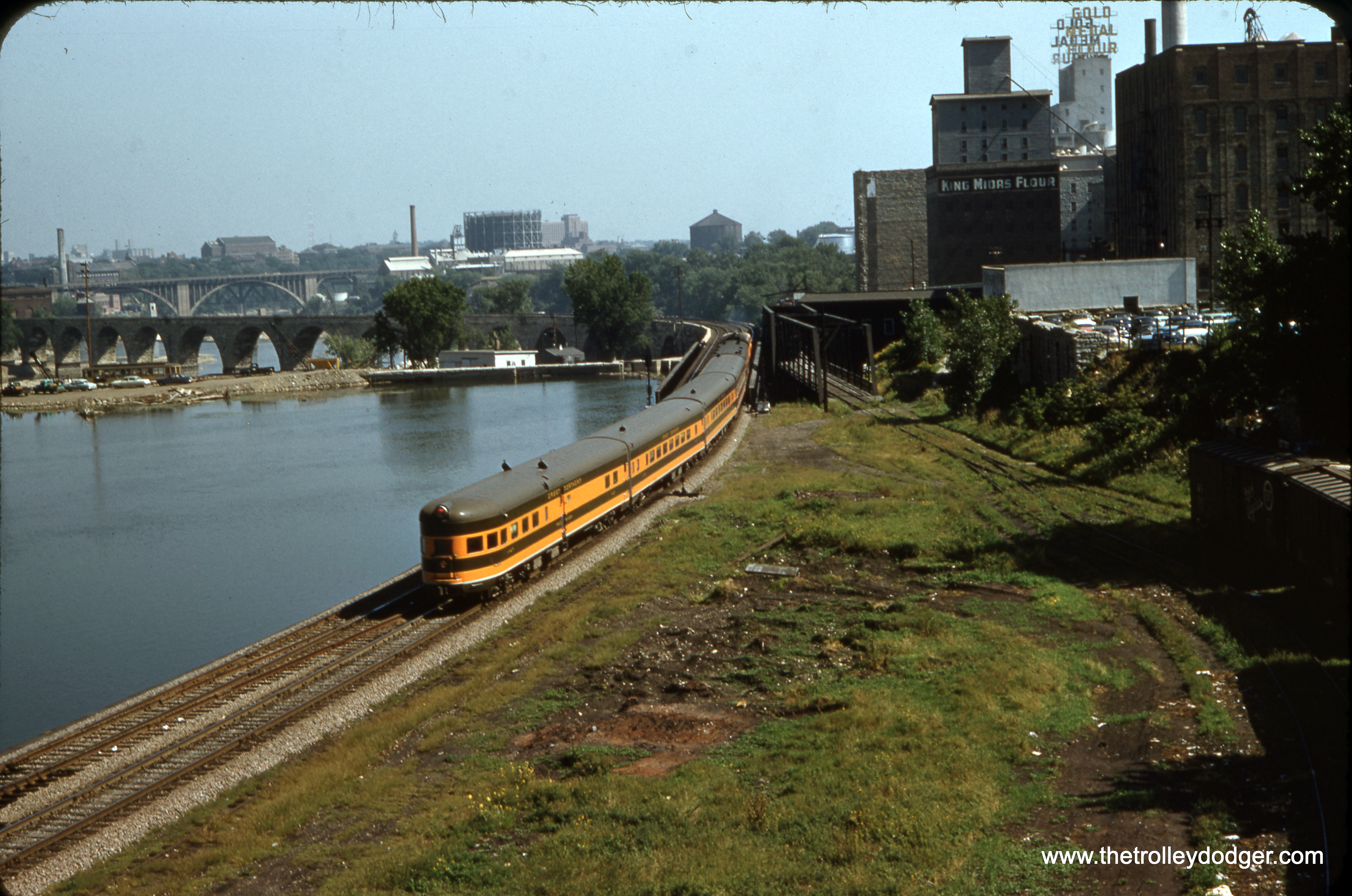
Great Northern Railway Red River 1954 Original 35mm Red Border Kodachrome Slide Subject: GNR 12 Location: Departing Minneapolis station for St. Paul Date: Fall 1954 Photographer: Unknown From the Wikipedia: The Red River was a passenger train operated by Great Northern Railway between Grand Forks, North Dakota, and Saint Paul, Minnesota (operating between 1950 and 1968). History Great Northern Railway's third new train set of 1950 was a new schedule named the Red River. The five-car streamliner built by American Car and Foundry Company began service June 25, 1950, operating a daily round trip 324 miles (521 km) each way between Grand Forks, North Dakota, and Saint Paul, Minnesota. The train went southbound in the morning returning northbound in the evening. The cars for the Red River streamliner were quite different than those built for the International (another 1950 introduction) in that the Red River's cars had extra insulation and the coaches were equipped with Baker Heaters as there was no steam heat available at the Grand Forks depot where the cars stood overnight. The locomotive was sent to the roundhouse each evening for any running repairs and service so the solution was the installation of the Baker Heaters in the cars. Link to eBay Listing

Great Northern Railway Red River 1954 Original 35mm Red Border Kodachrome Slide
Subject: GNR 12
Location: Departing Minneapolis station for St. Paul
Date: Fall 1954
Photographer: Unknown
From the Wikipedia:
The Red River was a passenger train operated by Great Northern Railway between Grand Forks, North Dakota, and Saint Paul, Minnesota (operating between 1950 and 1968).
History
Great Northern Railway’s third new train set of 1950 was a new schedule named the Red River. The five-car streamliner built by American Car and Foundry Company began service June 25, 1950, operating a daily round trip 324 miles (521 km) each way between Grand Forks, North Dakota, and Saint Paul, Minnesota. The train went southbound in the morning returning northbound in the evening.
The cars for the Red River streamliner were quite different than those built for the International (another 1950 introduction) in that the Red River’s cars had extra insulation and the coaches were equipped with Baker Heaters as there was no steam heat available at the Grand Forks depot where the cars stood overnight. The locomotive was sent to the roundhouse each evening for any running repairs and service so the solution was the installation of the Baker Heaters in the cars.
Link to eBay Listing

Amtrak RDC Train 1975 Original 35mm Kodachrome Slide Subject: Amtrak RDCs 30-32-15, Train 372 Blackhawk Location: Crawford (Chicago bound, between Dubuque and Chicago) Date: September 14, 1975 Photographer: James J. Buckley Link to eBay Listing

Amtrak RDC Train 1975 Original 35mm Kodachrome Slide
Subject: Amtrak RDCs 30-32-15, Train 372 Blackhawk
Location: Crawford (Chicago bound, between Dubuque and Chicago)
Date: September 14, 1975
Photographer: James J. Buckley
Link to eBay Listing

Milwaukee and Suburban Transport 1975 Original 35mm Kodachrome Slide Subject: M&ST 1466 Location: Wells-River (posed by the old Milwaukee Electric power plant) Date: June 29, 1975 Photographer: Jeff Wien Link to eBay Listing

Milwaukee and Suburban Transport 1975 Original 35mm Kodachrome Slide
Subject: M&ST 1466
Location: Wells-River (posed by the old Milwaukee Electric power plant)
Date: June 29, 1975
Photographer: Jeff Wien
Link to eBay Listing

Yakima Valley Transit Trolley 1975 Original 35mm Kodachrome Slide Subject: YVT 1776/1976 Location: 44th-Nob Hill, Yakima Date: June 1975 Photographer: Jeff Wien Link to eBay Listing

Yakima Valley Transit Trolley 1975 Original 35mm Kodachrome Slide
Subject: YVT 1776/1976
Location: 44th-Nob Hill, Yakima
Date: June 1975
Photographer: Jeff Wien
Link to eBay Listing

Our Latest Book, Now Available for Pre-Order:

The North Shore Line

Publication Date: February 20, 2023

FYI, my new Arcadia Publishing book The North Shore Line is now finished and has gone to press. My publisher decided to expand it to 160 pages, instead of the usual 128. That’s a 25% increase, without any change to the $23.99 price. I am quite pleased with how this turned out.

From the back cover:

As late as 1963, it was possible to board high-speed electric trains on Chicago’s famous Loop “L” that ran 90 miles north to Milwaukee. This was the Chicago North Shore & Milwaukee Railroad, commonly known as the North Shore Line. It rose from humble origins in the 1890s as a local streetcar line in Waukegan to eventually become America’s fastest interurban under the visionary management of Midwest utilities tycoon Samuel Insull. The North Shore Line, under Insull, became a worthy competitor to the established steam railroads. Hobbled by the Great Depression, the road fought back in 1941 with two streamlined, air-conditioned, articulated trains called Electroliners, which included dining service. It regained its popularity during World War II, when gasoline and tires were rationed, but eventually, it fell victim to highways and the automobile. The North Shore Line had intercity rail, commuter rail, electric freight, city streetcars, and even buses. It has been gone for nearly 60 years, but it will always remain the Road of Service.

Each copy purchased here will be signed by the author, and you will also receive a bonus North Shore Line map.  Books will ship by USPS Media Mail as soon as we receive them, on or before February 20, 2023.

Chapters:
01. Beginnings
02. The Milwaukee Division
03. The Shore Line Route
04. The Skokie Valley Route
05. The Mundelein Branch
06. On the “L”
07. City Streetcars
08. Trolley Freight
09. The Long Goodbye
10. The Legacy

Title The North Shore Line
Images of America
Author David Sadowski
Edition illustrated
Publisher Arcadia Publishing (SC), 2023
ISBN 1467108960, 978-1467108966
Length 160 pages

The price of $23.99 includes shipping within the United States.

For Shipping to US Addresses:

New Compact Disc, Now Available:

CTA-1
The Last Chicago Streetcars 1958
# of Discs – 1
Price: $15.99

Until now, it seemed as though audio recordings of Chicago streetcars were practically non-existent. For whatever reason, the late William A. Steventon does not appear to have made any for his Railroad Record Club, even though he did make other recordings in the Chicago area in 1956.

Now, audio recordings of the last runs of Chicago streetcars have been found, in the collections of the late Jeffrey L. Wien (who was one of the riders on that last car). We do not know who made these recordings, but this must have been done using a portable reel-to-reel machine.

These important recordings will finally fill a gap in transit history. The last Chicago Transit Authority streetcar finished its run in the early hours of June 21, 1958. Now you can experience these events just as Chicagoans did.

As a bonus, we have included Keeping Pace, a 1939 Chicago Surface Lines employee training program. This was digitally transferred from an original 16” transcription disc. These recordings were unheard for 80 years.

Total time – 74:38

Help Support The Trolley Dodger

This is our 295th post, and we are gradually creating a body of work and an online resource for the benefit of all railfans, everywhere. To date, we have received over 941,000 page views, for which we are very grateful.

You can help us continue our original transit research by checking out the fine products in our Online Store.
As we have said before, “If you buy here, we will be here.”

We thank you for your support.

DONATIONS

In order to continue giving you the kinds of historic railroad images that you have come to expect from The Trolley Dodger, we need your help and support. It costs money to maintain this website, and to do the sort of historic research that is our specialty.

Your financial contributions help make this web site better, and are greatly appreciated.


Shine a Light

Over the years, I have seen many poor quality duplicate slides with this view, looking to the northwest, with a Garfield Park "L" train crossing the Met bridge over the Chicago River, with Union Station in the background. However, this was scanned from an original red border Kodachrome slide, circa 1955-58. The name of the photographer is not known. This must be a Garfield train, and the results are stunning. Douglas cars were re-routed over the Lake Street "L" in 1954. Logan Square trains began running via the Milwaukee-Dearborn Subway in 1951.

Over the years, I have seen many poor quality duplicate slides with this view, looking to the northwest, with a Garfield Park “L” train crossing the Met bridge over the Chicago River, with Union Station in the background. However, this was scanned from an original red border Kodachrome slide, circa 1955-58. The name of the photographer is not known. This must be a Garfield train, and the results are stunning. Douglas cars were re-routed over the Lake Street “L” in 1954. Logan Square trains began running via the Milwaukee-Dearborn Subway in 1951.

Here we have another bevy of classic traction photos for your enjoyment. All are from our collections, and nearly all were scanned from the original slides and negatives. Then, they were painstakingly worked over in Photoshop to make them look their best.

These views shine a light on the past, but also help illuminate our present and our future. We chose these images because we think they are important. They show some things that still exist, and other things that don’t.

By studying the past, we can learn from it, and the lessons we learn will help us make the decisions that will determine what gets preserved and improved in the future– and what goes by the wayside, into the dustbin of history.

When faced with the darkness of the present times, we could all use more light.

We have an exciting new Compact Disc available now, with audio recorded on the last Chicago Streetcar in 1958. There is additional information about this towards the end of this post, and also in our Online Store.

Keep those cards and letters coming in, folks.

-David Sadowski

PS- You might also like our Trolley Dodger Facebook auxiliary, a private group that now has 931 members.

Our friend Kenneth Gear now has a Facebook group for the Railroad Record Club. If you enjoy listening to audio recordings of classic railroad trains, whether steam, electric, or diesel, you might consider joining.

Work on our North Shore Line book is ongoing. Donations are needed in order to bring this to a successful conclusion. You will find donation links at the top and bottom of each post. We thank you in advance for your time and consideration.

Recent Finds

A North Shore Line Electroliner stops on a curve during the early 1950s, while a woman wearing a long skirt and heels departs. This looks like North Chicago Junction.

A North Shore Line Electroliner stops on a curve during the early 1950s, while a woman wearing a long skirt and heels departs. This looks like North Chicago Junction.

Don's Rail Photos: (Caboose) "1003 was built by American Car & Foundry Co in 1926. It was rebuilt without a cupola but restored when it was acquired IRM." Here is how part of it looked in the early 1950s.

Don’s Rail Photos: (Caboose) “1003 was built by American Car & Foundry Co in 1926. It was rebuilt without a cupola but restored when it was acquired IRM.” Here is how part of it looked in the early 1950s.

One of the two ex-North Shore Line Electroliners is shown in Philadelphia in December 1963, prior to being repainted as a Red Arrow Liberty Liner.

One of the two ex-North Shore Line Electroliners is shown in Philadelphia in December 1963, prior to being repainted as a Red Arrow Liberty Liner.

Although this was scanned from a duplicate slide, this is an excellent and well known shot, showing the last day fantrip on the North Shore Line's Shore Line Route in July 1955. The location is Kenilworth, and we are looking mainly to the south, and a bit towards the west. The town's famous fountain, paid for by the Chicago and Milwaukee Electric, the NSL's predecessor, is at left. It was designed by noted architect George W. Maher (1864-1926), who lived in the area. The Chicago and North Western's tracks are at right (now Union Pacific).

Although this was scanned from a duplicate slide, this is an excellent and well known shot, showing the last day fantrip on the North Shore Line’s Shore Line Route in July 1955. The location is Kenilworth, and we are looking mainly to the south, and a bit towards the west. The town’s famous fountain, paid for by the Chicago and Milwaukee Electric, the NSL’s predecessor, is at left. It was designed by noted architect George W. Maher (1864-1926), who lived in the area. The Chicago and North Western’s tracks are at right (now Union Pacific).

A northbound Electroliner, just outside of Milwaukee in July 1962. (Jim Martin Photo)

A northbound Electroliner, just outside of Milwaukee in July 1962. (Jim Martin Photo)

Car 170 is an NSL Lake Bluff local at the east end of the line on December 23, 1962. The tracks going off to the right connected to what was left of the old Shore Line Route. After the 1955 abandonment, a single track was retained for freight and for access to the Highwood Shops. (Jim Martin Photo)

Car 170 is an NSL Lake Bluff local at the east end of the line on December 23, 1962. The tracks going off to the right connected to what was left of the old Shore Line Route. After the 1955 abandonment, a single track was retained for freight and for access to the Highwood Shops. (Jim Martin Photo)

Once the NSL abandonment was formally approved, in May 1962, there was a flurry of fantrip activity soon after. In June 1962, this trip was popular enough that two trains were used. Here they are on the Mundelein branch, posed side by side. One of the Liners made a rare appearance here. (Jim Martin Photo)

Once the NSL abandonment was formally approved, in May 1962, there was a flurry of fantrip activity soon after. In June 1962, this trip was popular enough that two trains were used. Here they are on the Mundelein branch, posed side by side. One of the Liners made a rare appearance here. (Jim Martin Photo)

An Electroliner has gone past the east end of the Mundelein branch on a June 1962 fantrip, and is now on the single remaining track of the old Shore Line Route, which continued to Highwood (and ended in Highland Park). (Jim Martin Photo)

An Electroliner has gone past the east end of the Mundelein branch on a June 1962 fantrip, and is now on the single remaining track of the old Shore Line Route, which continued to Highwood (and ended in Highland Park). (Jim Martin Photo)

A three-car North Shore Line train in Lake Bluff on a snowy day on December 23, 1962. (Jim Martin Photo)

A three-car North Shore Line train in Lake Bluff on a snowy day on December 23, 1962. (Jim Martin Photo)

North Shore Line car 714, freshly painted, is at the Milwaukee Terminal on June 16, 1962. (Richard H. Young Photo)

North Shore Line car 714, freshly painted, is at the Milwaukee Terminal on June 16, 1962. (Richard H. Young Photo)

The North Shore Line's Mundelein Terminal on September 7, 1959.

The North Shore Line’s Mundelein Terminal on September 7, 1959.

David A. Myers recently sent me this picture, which shows him making an audio recording during the last run of the North Shore Line, in the early morning hours of January 21, 1963. He still has the tape and I hope someday he will have it digitized.

David A. Myers recently sent me this picture, which shows him making an audio recording during the last run of the North Shore Line, in the early morning hours of January 21, 1963. He still has the tape and I hope someday he will have it digitized.

No information came with this black and white negative, but the location is Highwood. Diners 415 and 419 are present. 419 was out of service by 1949, and 415 was converted to a Silverliner the following year, so that helps date the picture. Car 150, built in 1915, is at the right, along with a Merchandise Despatch car. This picture could be from 1947 or even earlier.

No information came with this black and white negative, but the location is Highwood. Diners 415 and 419 are present. 419 was out of service by 1949, and 415 was converted to a Silverliner the following year, so that helps date the picture. Car 150, built in 1915, is at the right, along with a Merchandise Despatch car. This picture could be from 1947 or even earlier.

Jim Martin caught this meet between both Electroliners at North Chicago Junction in May 1962.

Jim Martin caught this meet between both Electroliners at North Chicago Junction in May 1962.

An Electroliner in Lake Bluff in January 1963. This and the following image were consecutive shots taken by the same (unknown) photographer.

An Electroliner in Lake Bluff in January 1963. This and the following image were consecutive shots taken by the same (unknown) photographer.

The photographer (possibly Emery Gulash) had but one chance to press the shutter button at precisely the right moment, and he nailed it with this classic view of westbound Electroliner train 803 at Lake Bluff in January 1963. This is what noted photographer Henri Cartier-Bresson had in mind when he wrote about the "decisive moment." Douglas Noble: "Northbound crossing Rockland Road / IL 176 in Lake Bluff."

The photographer (possibly Emery Gulash) had but one chance to press the shutter button at precisely the right moment, and he nailed it with this classic view of westbound Electroliner train 803 at Lake Bluff in January 1963. This is what noted photographer Henri Cartier-Bresson had in mind when he wrote about the “decisive moment.” Douglas Noble: “Northbound crossing Rockland Road / IL 176 in Lake Bluff.”

CTA 53 (originally 5003), seen here at Skokie Shops in July 1971, was one of four such articulated sets ordered by the Chicago Rapid Transit Company and delivered in 1947-48. They were the first tangible evidence of the postwar modernization yet to come, under the management of the new Chicago Transit Authority. They were important cars, as the bridge between the 4000 and 6000 series, but were not that successful operationally on their own, even though they were the first Chicago "L" cars to utilize PCC technology. As it turned out, articulation was more of a dead end than a new beginning here, but these cars did pave the way for further refinements that were realized in the 6000s. As oddball equipment, they were eventually relegated to the Skokie Swift, where they lived out their lives until their mid-1980s retirement.

CTA 53 (originally 5003), seen here at Skokie Shops in July 1971, was one of four such articulated sets ordered by the Chicago Rapid Transit Company and delivered in 1947-48. They were the first tangible evidence of the postwar modernization yet to come, under the management of the new Chicago Transit Authority. They were important cars, as the bridge between the 4000 and 6000 series, but were not that successful operationally on their own, even though they were the first Chicago “L” cars to utilize PCC technology. As it turned out, articulation was more of a dead end than a new beginning here, but these cars did pave the way for further refinements that were realized in the 6000s. As oddball equipment, they were eventually relegated to the Skokie Swift, where they lived out their lives until their mid-1980s retirement.

CTA trolleybus 9510 heads west on Roosevelt Road at Ogden Avenue at 6:50 pm on June 16, 1966.

CTA trolleybus 9510 heads west on Roosevelt Road at Ogden Avenue at 6:50 pm on June 16, 1966.

CTA trolleybus 9499 is southbound on Kedzie at 59th Street on September 10, 1963.

CTA trolleybus 9499 is southbound on Kedzie at 59th Street on September 10, 1963.

CTA 3311, a one-man car, is at the east end of one of the south side routes in the early 1950s. Andre Kristopans: "3311 is at 67th and South Shore on 67th/69th route."

CTA 3311, a one-man car, is at the east end of one of the south side routes in the early 1950s. Andre Kristopans: “3311 is at 67th and South Shore on 67th/69th route.”

A CTA single car unit heads north at Isabella Avenue in Evanston in September 1965. This station, closed in 1973, was a short distance from the end of the Evanston branch (Linden Avenue, Wilmette).

A CTA single car unit heads north at Isabella Avenue in Evanston in September 1965. This station, closed in 1973, was a short distance from the end of the Evanston branch (Linden Avenue, Wilmette).

CTA PCC 7101, a product of the St. Louis Car Company, on September 2, 1955. Not sure of the exact location. Our resident south side expert M.E. adds: "As for where this location is, I can more likely tell you where it isn't. It isn't on route 49, Western Ave., which was built up everywhere. It isn't on route 22, Clark-Wentworth, which was also built up everywhere. I thought it might be on route 4, Cottage Grove, just south of 95th, where the streetcar tracks ran in the street for a few blocks before entering private right-of-way. However, I see no sign of the Illinois Central railroad embankment that ran next to Cottage Grove Ave. So that leaves one possibility: Route 36, Broadway-State. Some of that route ran through sparse areas, particularly along 119th St. between Michigan Ave. and Morgan St. My best guess is that this view is on 119th St., looking east from east of Halsted St. Notice the building shadow at the bottom, which means the sun was behind the building, to the south. Ergo, the streetcar is going east. Another reason I think this is 119th St. is the presence of exactly one motor vehicle. 119th St. was far out in those days; buildings were few in number, not just along 119th St. but also route 8A South Halsted (bus). The only "bustling" area that far out was around 119th and Halsted (and west to Morgan), where there were industries like foundries, mills, etc. In fact, I think the only reasons the streetcar line continued to run that far south were (1) to accommodate the people who worked in those industries, and (2) to service the Roseland business district at 111th and Michigan."

CTA PCC 7101, a product of the St. Louis Car Company, on September 2, 1955. Not sure of the exact location. Our resident south side expert M.E. adds: “As for where this location is, I can more likely tell you where it isn’t. It isn’t on route 49, Western Ave., which was built up everywhere. It isn’t on route 22, Clark-Wentworth, which was also built up everywhere. I thought it might be on route 4, Cottage Grove, just south of 95th, where the streetcar tracks ran in the street for a few blocks before entering private right-of-way. However, I see no sign of the Illinois Central railroad embankment that ran next to Cottage Grove Ave. So that leaves one possibility: Route 36, Broadway-State. Some of that route ran through sparse areas, particularly along 119th St. between Michigan Ave. and Morgan St. My best guess is that this view is on 119th St., looking east from east of Halsted St. Notice the building shadow at the bottom, which means the sun was behind the building, to the south. Ergo, the streetcar is going east. Another reason I think this is 119th St. is the presence of exactly one motor vehicle. 119th St. was far out in those days; buildings were few in number, not just along 119th St. but also route 8A South Halsted (bus). The only “bustling” area that far out was around 119th and Halsted (and west to Morgan), where there were industries like foundries, mills, etc. In fact, I think the only reasons the streetcar line continued to run that far south were (1) to accommodate the people who worked in those industries, and (2) to service the Roseland business district at 111th and Michigan.”

CTA "L" car #1 is at the west end of the Green Line in Oak Park, probably in the 1990s. This car is now on display at the Chicago History Museum.

CTA “L” car #1 is at the west end of the Green Line in Oak Park, probably in the 1990s. This car is now on display at the Chicago History Museum.

CTA PCC 4385 is southbound on Clark Street at North Water Street in May 1958, running on Route 22A - Wentworth.

CTA PCC 4385 is southbound on Clark Street at North Water Street in May 1958, running on Route 22A – Wentworth.

A northbound CTA Englewood-Howard "A" train, made up of curved-door 6000-series "L" cars, heads into the State Street Subway at the south portal in August 1982.

A northbound CTA Englewood-Howard “A” train, made up of curved-door 6000-series “L” cars, heads into the State Street Subway at the south portal in August 1982.

A southbound CTA Ravenswood "B" train, made up of wooden "L" cars, approaches the Sedgwick station on April 10, 1957.

A southbound CTA Ravenswood “B” train, made up of wooden “L” cars, approaches the Sedgwick station on April 10, 1957.

A two-car mid-day CTA Evanston Express "L" train, made up of single-car units 39 and 47, heads east on Van Buren between LaSalle and State on August 14, 1964. During this period, Loop trains all ran counter-clockwise and there was a continuous platform running from LaSalle to State. The platform sections between stations were removed in 1968.

A two-car mid-day CTA Evanston Express “L” train, made up of single-car units 39 and 47, heads east on Van Buren between LaSalle and State on August 14, 1964. During this period, Loop trains all ran counter-clockwise and there was a continuous platform running from LaSalle to State. The platform sections between stations were removed in 1968.

A northbound CTA Evanston Express train, made up of 4000s, is north of Lawrence Avenue on July 22, 1968. Miles Beitler: "In photo aad017a, the Evanston Express is northbound on the local track between Rosemont Avenue and Sheridan Road (around 6300-6400 north). Granville tower is visible in the distance. PM northbound Evanston Express trains switched to the local track at Granville in order to serve Loyola and Morse stations. (AM trains did not do this.) I believe that sometime in the 1980s or 1990s, to speed up service, Loyola and Morse were no longer served by Evanston Expresses, and the trains remained on the outside express track all the way to Howard." Andre Kristopans adds, "For years after AM rush until noon Evanston trains used local tracks all the way as Granville tower only manned AM rush. Also AM rush expresses usually crossed over NB as express track was used to lay up trains midday south of Howard. SB expresses always used local tracks to Granville as SB express track did not have 3rd rail north of Granville until 1970s sometime." Miles Beitler replies, "That is not correct. Third rail was installed on the southbound express track between Howard and Granville at least by 1964, and even before that the expresses ran on that portion using overhead wire."

A northbound CTA Evanston Express train, made up of 4000s, is north of Lawrence Avenue on July 22, 1968. Miles Beitler: “In photo aad017a, the Evanston Express is northbound on the local track between Rosemont Avenue and Sheridan Road (around 6300-6400 north). Granville tower is visible in the distance. PM northbound Evanston Express trains switched to the local track at Granville in order to serve Loyola and Morse stations. (AM trains did not do this.) I believe that sometime in the 1980s or 1990s, to speed up service, Loyola and Morse were no longer served by Evanston Expresses, and the trains remained on the outside express track all the way to Howard.” Andre Kristopans adds, “For years after AM rush until noon Evanston trains used local tracks all the way as Granville tower only manned AM rush. Also AM rush expresses usually crossed over NB as express track was used to lay up trains midday south of Howard. SB expresses always used local tracks to Granville as SB express track did not have 3rd rail north of Granville until 1970s sometime.” Miles Beitler replies, “That is not correct. Third rail was installed on the southbound express track between Howard and Granville at least by 1964, and even before that the expresses ran on that portion using overhead wire.”

A close-up of the previous image, showing Granville Tower.

A close-up of the previous image, showing Granville Tower.

CTA PCC 7160 is northbound on Clark Street, approaching the loop at Howard Street, on July 5, 1957. (Edward S. Miller Photo)

CTA PCC 7160 is northbound on Clark Street, approaching the loop at Howard Street, on July 5, 1957. (Edward S. Miller Photo)

The Washington station in the State Street Subway in Chicago on July 6, 1975.

The Washington station in the State Street Subway in Chicago on July 6, 1975.

CTA single-car unit 39 is southbound at Isabella on August 13, 1964, operating on the Evanston Shuttle.

CTA single-car unit 39 is southbound at Isabella on August 13, 1964, operating on the Evanston Shuttle.

CTA red Pullman 281 is heading westbound into the turnaround loop at 63rd Place and Narragansett in early 1953. Towards the end of streetcar service on Route 63, older red cars replaced PCCs, which were shifted over to run on Cottage Grove. This residential neighborhood, sparsely populated then, is now completely built up.

CTA red Pullman 281 is heading westbound into the turnaround loop at 63rd Place and Narragansett in early 1953. Towards the end of streetcar service on Route 63, older red cars replaced PCCs, which were shifted over to run on Cottage Grove. This residential neighborhood, sparsely populated then, is now completely built up.

CTA salt car AA101 at South Shops, circa 1955-57. Don's Rail Photos: "AA101, salt car, was built by South Chicago City Ry in 1907 as SCCRy 335. It was rebuilt in 1907 and became C&SCRy 834 in 1908. It was renumbered 2849 in 1913 and became CSL 2849 in 1914. It was later converted as a salt car and renumbered AA101 in 1948. It was retired on December 14, 1956."

CTA salt car AA101 at South Shops, circa 1955-57. Don’s Rail Photos: “AA101, salt car, was built by South Chicago City Ry in 1907 as SCCRy 335. It was rebuilt in 1907 and became C&SCRy 834 in 1908. It was renumbered 2849 in 1913 and became CSL 2849 in 1914. It was later converted as a salt car and renumbered AA101 in 1948. It was retired on December 14, 1956.”

The view looking north along Halsted Street at 42nd Street on Chicago's south side, from a real photo postcard. The message on the back was dated August 24, 1910. Postal postcards were a new thing in the early 1900s and were very popular. Some, like this, were made by contact printing from the original photo negative. The Union Stock Yards were at left, and you can see the Halsted Station on then-new Stock Yards "L" branch (opened in 1908) in the distance. Automobiles were not yet common, and you can spot a man riding a horse to the left of streetcar 5150. This car was built by Brill in 1905, and was modernized in 1908. When this picture was taken, it was operated by the Chicago City Railway, as the Surface Lines did not come into existence until 1914.

The view looking north along Halsted Street at 42nd Street on Chicago’s south side, from a real photo postcard. The message on the back was dated August 24, 1910. Postal postcards were a new thing in the early 1900s and were very popular. Some, like this, were made by contact printing from the original photo negative. The Union Stock Yards were at left, and you can see the Halsted Station on then-new Stock Yards “L” branch (opened in 1908) in the distance. Automobiles were not yet common, and you can spot a man riding a horse to the left of streetcar 5150. This car was built by Brill in 1905, and was modernized in 1908. When this picture was taken, it was operated by the Chicago City Railway, as the Surface Lines did not come into existence until 1914.

A close-up from the previous photo.

A close-up from the previous photo.

This Skokie Swift sign graced the Dempster Street terminal of what is now the CTA Yellow Line for many years. It is now at the Illinois Railway Museum. Here is how it looked in September 1985. The original running time was more like 6 1/2 minutes when the line opened in 1964, but things got slowed down a bit in the interests of safety, since there are several grade crossings.

This Skokie Swift sign graced the Dempster Street terminal of what is now the CTA Yellow Line for many years. It is now at the Illinois Railway Museum. Here is how it looked in September 1985. The original running time was more like 6 1/2 minutes when the line opened in 1964, but things got slowed down a bit in the interests of safety, since there are several grade crossings.

CTA single-car unit #1 at the Skokie Swift terminal at Dempster on June 11, 1965. It was built by St. Louis Car Company in 1960 and had high-speed motors. It was sent to General Electric in 1974 and used to test equipment. Since 2016 it has been at the Seashore Trolley Museum in Maine, but it would require a lot of work (and parts) to restore.

CTA single-car unit #1 at the Skokie Swift terminal at Dempster on June 11, 1965. It was built by St. Louis Car Company in 1960 and had high-speed motors. It was sent to General Electric in 1974 and used to test equipment. Since 2016 it has been at the Seashore Trolley Museum in Maine, but it would require a lot of work (and parts) to restore.

We are looking east along the Indiana Avenue "L" station around 1955. The wooden "L" car at back is a spare, being stored on what had once been the main line track up until 1949. The Kenwood branch ran east from here until 1957. The Stockyards branch went west from here. (C. Foreman Photo)

We are looking east along the Indiana Avenue “L” station around 1955. The wooden “L” car at back is a spare, being stored on what had once been the main line track up until 1949. The Kenwood branch ran east from here until 1957. The Stockyards branch went west from here. (C. Foreman Photo)

We are looking east from the CTA's Indiana Avenue "L" station on September 2, 1955. A northbound Howard "B" train, made up of new curved-door 6000s, approaches on what had once been the middle express track. This was changed in 1949, when the CTA made a major revamp of north-south service. Numerous little-used stations were closed, and A/B "skip stop" service introduced, in an effort to speed things up. Since the express track was no longer needed, the CTA used part of it here to establish a pocket track for Kenwood branch trains, which became a shuttle operation. Sean Hunnicutt adds, "6405-06 are at the front." Andre Kristopans adds, "At Indiana the layup track was the old LOCAL track, the middle in use was the express." Northbound “L” trains switched over to what had been the express track (middle) just south of Indiana Avenue. I should have made that clear in the caption, thanks.

We are looking east from the CTA’s Indiana Avenue “L” station on September 2, 1955. A northbound Howard “B” train, made up of new curved-door 6000s, approaches on what had once been the middle express track. This was changed in 1949, when the CTA made a major revamp of north-south service. Numerous little-used stations were closed, and A/B “skip stop” service introduced, in an effort to speed things up. Since the express track was no longer needed, the CTA used part of it here to establish a pocket track for Kenwood branch trains, which became a shuttle operation. Sean Hunnicutt adds, “6405-06 are at the front.” Andre Kristopans adds, “At Indiana the layup track was the old LOCAL track, the middle in use was the express.” Northbound “L” trains switched over to what had been the express track (middle) just south of Indiana Avenue. I should have made that clear in the caption, thanks.

Milwaukee Electric articulated unit 1190 is on Main Street in Waukesha, Wisconsin on June 12, 1949. (William C. Hoffman Photo) One commenter adds, "Both photos taken by William C. Hoffman in Waukesha are actually on W. Broadway, just south of Main St. All buildings are still standing."

Milwaukee Electric articulated unit 1190 is on Main Street in Waukesha, Wisconsin on June 12, 1949. (William C. Hoffman Photo) One commenter adds, “Both photos taken by William C. Hoffman in Waukesha are actually on W. Broadway, just south of Main St. All buildings are still standing.”

Milwaukee Electric heavyweight car 1119 is on Main Street on June 12, 1949. (William C. Hoffman Photo) One commenter adds, "Both photos taken by William C. Hoffman in Waukesha are actually on W. Broadway, just south of Main St. All buildings are still standing."

Milwaukee Electric heavyweight car 1119 is on Main Street on June 12, 1949. (William C. Hoffman Photo) One commenter adds, “Both photos taken by William C. Hoffman in Waukesha are actually on W. Broadway, just south of Main St. All buildings are still standing.”

Milwaukee streetcar 972 at the Harwood Avenue terminal in Wauwatosa, circa 1955-58. (W. H. Higginbotham Photo)

Milwaukee streetcar 972 at the Harwood Avenue terminal in Wauwatosa, circa 1955-58. (W. H. Higginbotham Photo)

The Public Service Building in downtown Milwaukee, located at 4th and Michigan, had been the former rapid transit terminal until 1951. Here is how it appeared on August 23, 1964. (William C. Hoffman Photo) Larry Sakar: "this is the southeast corner of the PSB at 3rd (not 4th) and Michigan Sts. You are looking southeast. Greyhound would continue using the PSB until February, 1965 when it moved to its own, brand new terminal on the northeast corner of North 7th & W. Michigan Sts. In addition to the 3 story terminal on the Michigan St side (the station had about a dozen angled spaces that the buses pulled into. Spaces 1 and 2 were used solely by Wisconsin Coach Lines buses to Waukesha, Racine & Kenosha and for a short time Port Washington. Atop the bus terminal was (and still is) a 2 story parking garage. On the Wisconsin Avenue side Greyhound constructed a 20 story office building. In 2006 when the Amtrak station was remodeled and a bus area added to the west of it in what had been a freight yard (became) a new bus station (outdoor platforms only). Today the entire complex is the Milwaukee Intermodal station."

The Public Service Building in downtown Milwaukee, located at 4th and Michigan, had been the former rapid transit terminal until 1951. Here is how it appeared on August 23, 1964. (William C. Hoffman Photo) Larry Sakar: “this is the southeast corner of the PSB at 3rd (not 4th) and Michigan Sts. You are looking southeast. Greyhound would continue using the PSB until February, 1965 when it moved to its own, brand new terminal on the northeast corner of North 7th & W. Michigan Sts. In addition to the 3 story terminal on the Michigan St side (the station had about a dozen angled spaces that the buses pulled into. Spaces 1 and 2 were used solely by Wisconsin Coach Lines buses to Waukesha, Racine & Kenosha and for a short time Port Washington. Atop the bus terminal was (and still is) a 2 story parking garage. On the Wisconsin Avenue side Greyhound constructed a 20 story office building. In 2006 when the Amtrak station was remodeled and a bus area added to the west of it in what had been a freight yard (became) a new bus station (outdoor platforms only). Today the entire complex is the Milwaukee Intermodal station.”

Milwaukee streetcar 953 is at the west end of the long Wells Street viaduct (at 44th), circa 1955-58. (W. H. Higginbotham Photo)

Milwaukee streetcar 953 is at the west end of the long Wells Street viaduct (at 44th), circa 1955-58. (W. H. Higginbotham Photo)

A Milwaukee Route 10 streetcar is on the Wells Street viaduct on September 5, 1954. (William C. Hoffman Photo)

A Milwaukee Route 10 streetcar is on the Wells Street viaduct on September 5, 1954. (William C. Hoffman Photo)

A Miller Brewery Company beer wagon at the base of the Wells Street viaduct on September 6, 1954. (William C. Hoffman Photo)

A Miller Brewery Company beer wagon at the base of the Wells Street viaduct on September 6, 1954. (William C. Hoffman Photo)

Route 10 streetcar 953 heads east on Wells Street in Milwaukee, having just passed the Pabst theater, on June 25, 1956. (William C. Hoffman Photo)

Route 10 streetcar 953 heads east on Wells Street in Milwaukee, having just passed the Pabst theater, on June 25, 1956. (William C. Hoffman Photo)

The same location in 2019.

The same location in 2019.

The caption on this slide says, "M&S body replica at Fond du Lac station, August 4, 1957."

The caption on this slide says, “M&S body replica at Fond du Lac station, August 4, 1957.”

Two Milwaukee streetcars, including 861, on Howell during a National Railway Historical Society fantrip on September 3, 1955. (Paul Kutta Photo) Larry Sakar: "Photo aad021a is correct. That is Howell Avenue where the streetcar is laying over. More specifically, it is the intersection of South Howell Ave, and East Howard Ave which was the end of the line for Route 11 Vliet-Howell and later just Howell when streetcars came off of Vliet St. For a while in the 40's streetcars went about a mile farther south on Howell Avenue to the intersection of East Bolivar Ave. Before this became part of the city of Milwaukee this was the Town of Lake. This area was given the name Tippecanoe. If you would turn a bit more east, today on the southeast corner of Howell & Howard there is a branch of the Milwaukee Public Library appropriately called Tippecanoe. Library. MPL calls their branches, "Neighborhood libraries"."

Two Milwaukee streetcars, including 861, on Howell during a National Railway Historical Society fantrip on September 3, 1955. (Paul Kutta Photo) Larry Sakar: “Photo aad021a is correct. That is Howell Avenue where the streetcar is laying over. More specifically, it is the intersection of South Howell Ave, and East Howard Ave which was the end of the line for Route 11 Vliet-Howell and later just Howell when streetcars came off of Vliet St. For a while in the 40’s streetcars went about a mile farther south on Howell Avenue to the intersection of East Bolivar Ave. Before this became part of the city of Milwaukee this was the Town of Lake. This area was given the name Tippecanoe. If you would turn a bit more east, today on the southeast corner of Howell & Howard there is a branch of the Milwaukee Public Library appropriately called Tippecanoe. Library. MPL calls their branches, “Neighborhood libraries”.”

Milwaukee streetcar 903 is in white and green as the "Stay Alive" car on Route 10 on October 2, 1953. Larry Sakar: "This is car 943 the Milwaukee Safety Commission green and white car. Dave Stanley and some of the other Milwaukee TM fans I know have said that if streetcars had lasted until July of 1975 when the Milwaukee County Transit System took over M&STC this is what they'd have looked like sans the safety message. Here is the great irony involving car 943. It didn't practice what it preached. It was wrecked in 1955 at 4th & Wells Sts. downtown when it collided with a city of Milwaukee garbage truck. OOPS!"

Milwaukee streetcar 903 is in white and green as the “Stay Alive” car on Route 10 on October 2, 1953. Larry Sakar: “This is car 943 the Milwaukee Safety Commission green and white car. Dave Stanley and some of the other Milwaukee TM fans I know have said that if streetcars had lasted until July of 1975 when the Milwaukee County Transit System took over M&STC this is what they’d have looked like sans the safety message. Here is the great irony involving car 943. It didn’t practice what it preached. It was wrecked in 1955 at 4th & Wells Sts. downtown when it collided with a city of Milwaukee garbage truck. OOPS!”

A Milwaukee Road Hiawatha train in Milwaukee in 1954. Larry Sakar: "aad013a is the original Milwaukee Road station at North 4th & W. Everett Streets. The easternmost part of the trainshed was kiddie-corner from the southwest corner of the Public Service Bldg. but the station building was at 4th St. fAcing the park that is still there.Over the years that park has had lord knows how many different names. Today it is called Zeidler Union Park. However the Zeidler for whom it's named is not Frank who was Mayor of Milqwaukee from 1948-1960. The park is named for Frank's older brother, Carl who was Mayor for just two years 1940 to the outbreak of WWII on 12-7-41. He was in the U.S. Naval; Reserve and was called to Active Duty early in 1942. He was killed in action when the ship he was on was torpedoed and sunk by a Japanese submarine. in 1943. Carl was a Democrat. Frank was a Socialist. The site of the Everett St. Milwaukee Road station is now I794. That row of smaller buildings to the right of the train belonged to the Railway Express Agency. After he was no longer employed as a towerman, the late Don Ross went to work for REA. Remember, when express died out on passenger trains they became REA Air Express but they didn't last."

A Milwaukee Road Hiawatha train in Milwaukee in 1954. Larry Sakar: “aad013a is the original Milwaukee Road station at North 4th & W. Everett Streets. The easternmost part of the trainshed was kiddie-corner from the southwest corner of the Public Service Bldg. but the station building was at 4th St. fAcing the park that is still there.Over the years that park has had lord knows how many different names. Today it is called Zeidler Union Park. However the Zeidler for whom it’s named is not Frank who was Mayor of Milqwaukee from 1948-1960. The park is named for Frank’s older brother, Carl who was Mayor for just two years 1940 to the outbreak of WWII on 12-7-41. He was in the U.S. Naval; Reserve and was called to Active Duty early in 1942. He was killed in action when the ship he was on was torpedoed and sunk by a Japanese submarine. in 1943. Carl was a Democrat. Frank was a Socialist. The site of the Everett St. Milwaukee Road station is now I794. That row of smaller buildings to the right of the train belonged to the Railway Express Agency. After he was no longer employed as a towerman, the late Don Ross went to work for REA. Remember, when express died out on passenger trains they became REA Air Express but they didn’t last.”

A Chicago Aurora & Elgin freight train, led by electric locos 4005 and 4006, is at Lakewood on March 17, 1957. (James J. Buckley Photo)

A Chicago Aurora & Elgin freight train, led by electric locos 4005 and 4006, is at Lakewood on March 17, 1957. (James J. Buckley Photo)

Pacific Electric blimp car 401 is signed for San Pedro. We have no other information on this original red border Kodachrome slide, but PE service to San Pedro was replaced by bus on January 2, 1949.

Pacific Electric blimp car 401 is signed for San Pedro. We have no other information on this original red border Kodachrome slide, but PE service to San Pedro was replaced by bus on January 2, 1949.

The caption on this September 11, 1977 photo in New York City says, "Jamaica Avenue, 160th Street - Last train." Bill Wasik writes, "Re the 9/11/1977 NYC photo: Exploring New York City a few months after moving there in 1977, I entered an uptown-bound subway train at a station near the New York Stock Exchange, intending to take a short ride north to Midtown Manhattan. Minutes later, I had to change my plans when the train suddenly emerged in sunlight on the Lower East Side and began to cross the Williamsburg Bridge heading east to Brooklyn. With nothing better to do on a nice late summer afternoon, I decided to take this “J” train to the end of the line, which at the time was near where the car shown in this photo is stopped. The setting here was an ancient elevated structure that ran above the Jamaica Avenue shopping district in Queens, apparently on the day Jamaica Line service (once known as the Broadway Elevated) was cut back from 160th Street west to Queens Boulevard. The structure shown here was demolished around 1980, with bus service and the 1988 opening of the Archer Avenue rapid transit lines eventually replacing portions of the old Broadway El west to 121st Street in Queens."

The caption on this September 11, 1977 photo in New York City says, “Jamaica Avenue, 160th Street – Last train.” Bill Wasik writes, “Re the 9/11/1977 NYC photo: Exploring New York City a few months after moving there in 1977, I entered an uptown-bound subway train at a station near the New York Stock Exchange, intending to take a short ride north to Midtown Manhattan. Minutes later, I had to change my plans when the train suddenly emerged in sunlight on the Lower East Side and began to cross the Williamsburg Bridge heading east to Brooklyn. With nothing better to do on a nice late summer afternoon, I decided to take this “J” train to the end of the line, which at the time was near where the car shown in this photo is stopped. The setting here was an ancient elevated structure that ran above the Jamaica Avenue shopping district in Queens, apparently on the day Jamaica Line service (once known as the Broadway Elevated) was cut back from 160th Street west to Queens Boulevard. The structure shown here was demolished around 1980, with bus service and the 1988 opening of the Archer Avenue rapid transit lines eventually replacing portions of the old Broadway El west to 121st Street in Queens.”

Vintage District of Columbia streetcar 303 and trailer 1512 are on a May 1959 fantrip. There are no wires here, as underground conduit was used for power in DC. Don's Rail Photos: "303 was built by American Car Co in 1898 as Capital Traction Co 303. It is now at the Smithsonian."

Vintage District of Columbia streetcar 303 and trailer 1512 are on a May 1959 fantrip. There are no wires here, as underground conduit was used for power in DC. Don’s Rail Photos: “303 was built by American Car Co in 1898 as Capital Traction Co 303. It is now at the Smithsonian.”

Boston MTA PCC 3219 is about to descend into the Tremont subway entrance at Pleasant Street on April 23, 1960. This portal was closed on November 19, 1961 and sealed up. It is presently the location of Elliot Norton Park, although there have been proposals to reuse the portal.

Boston MTA PCC 3219 is about to descend into the Tremont subway entrance at Pleasant Street on April 23, 1960. This portal was closed on November 19, 1961 and sealed up. It is presently the location of Elliot Norton Park, although there have been proposals to reuse the portal.

The same location in 2020.

The same location in 2020.

Baltimore Transit PCC 7102 is on route 8 - Irvington on November 2, 1963, in a view taken out of the front window of a PCC going the opposite way. Streetcar service in Baltimore ended the next day, but light rail returned to the city in 1992.

Baltimore Transit PCC 7102 is on route 8 – Irvington on November 2, 1963, in a view taken out of the front window of a PCC going the opposite way. Streetcar service in Baltimore ended the next day, but light rail returned to the city in 1992.

One of the two Liberty Liners (ex-North Shore Line Electroliners) on the Red Arrow's Norristown High-Speed Line in March 1964. (David H. Cope Photo)

One of the two Liberty Liners (ex-North Shore Line Electroliners) on the Red Arrow’s Norristown High-Speed Line in March 1964. (David H. Cope Photo)

A two-car train of Bullets, near the Philadelphia city limits, in this October 26, 1946 photo by David H. Cope.

A two-car train of Bullets, near the Philadelphia city limits, in this October 26, 1946 photo by David H. Cope.

A Philadelphia and Western Bullet car is near the Norristown terminal on May 14, 1949.

A Philadelphia and Western Bullet car is near the Norristown terminal on May 14, 1949.

Open car 20 on the Five Mile Beach Electric Railway in Wildwood, New Jersey on August 26, 1934. This car still exists and is now owned by the Liberty Historic Railway. In 2019 the body of car 20 was sent to Gomaco for restoration, in hopes it can operation once again in the future.

Open car 20 on the Five Mile Beach Electric Railway in Wildwood, New Jersey on August 26, 1934. This car still exists and is now owned by the Liberty Historic Railway. In 2019 the body of car 20 was sent to Gomaco for restoration, in hopes it can operation once again in the future.

New Compact Disc, Now Available:

CTA-1
The Last Chicago Streetcars 1958
# of Discs – 1
Price: $15.99

Until now, it seemed as though audio recordings of Chicago streetcars were practically non-existent. For whatever reason, the late William A. Steventon does not appear to have made any for his Railroad Record Club, even though he did make other recordings in the Chicago area in 1956.

Now, audio recordings of the last runs of Chicago streetcars have been found, in the collections of the late Jeffrey L. Wien (who was one of the riders on that last car). We do not know who made these recordings, but this must have been done using a portable reel-to-reel machine.

These important recordings will finally fill a gap in transit history. The last Chicago Transit Authority streetcar finished its run in the early hours of June 21, 1958. Now you can experience these events just as Chicagoans did.

As a bonus, we have included Keeping Pace, a 1939 Chicago Surface Lines employee training program. This was digitally transferred from an original 16” transcription disc. These recordings were unheard for 80 years.

Total time – 74:38

Chicago’s Lost “L”s Online Presentation

We recently gave an online presentation about our book Chicago’s Lost “L”s for the Chicago Public Library, as part of their One Book, One Chicago series. You can watch it online by following this link.

The Trolley Dodger On the Air

We appeared on the Dave Plier Show on WGN radio on July 16, 2021, to discuss Chicago’s Lost “L”s. You can hear that discussion here.

Our Latest Book, Now Available:

Chicago’s Lost “L”s

From the back cover:

Chicago’s system of elevated railways, known locally as the “L,” has run continuously since 1892 and, like the city, has never stood still. It helped neighborhoods grow, brought their increasingly diverse populations together, and gave the famous Loop its name. But today’s system has changed radically over the years. Chicago’s Lost “L”s tells the story of former lines such as Garfield Park, Humboldt Park, Kenwood, Stockyards, Normal Park, Westchester, and Niles Center. It was once possible to take high-speed trains on the L directly to Aurora, Elgin, and Milwaukee, Wisconsin. The L started out as four different companies, two starting out using steam engines instead of electricity. Eventually, all four came together via the Union Loop. The L is more than a way of getting around. Its trains are a place where people meet and interact. Some say the best way to experience the city is via the L, with its second-story view. Chicago’s Lost “L”s is virtually a “secret history” of Chicago, and this is your ticket. David Sadowski grew up riding the L all over the city. He is the author of Chicago Trolleys and Building Chicago’s Subways and runs the online Trolley Dodger blog.

The Images of America series celebrates the history of neighborhoods, towns, and cities across the country. Using archival photographs, each title presents the distinctive stories from the past that shape the character of the community today. Arcadia is proud to play a part in the preservation of local heritage, making history available to all.

Title Chicago’s Lost “L”s
Images of America
Author David Sadowski
Edition illustrated
Publisher Arcadia Publishing (SC), 2021
ISBN 1467100007, 9781467100007
Length 128 pages

Chapters:
01. The South Side “L”
02. The Lake Street “L”
03. The Metropolitan “L”
04. The Northwestern “L”
05. The Union Loop
06. Lost Equipment
07. Lost Interurbans
08. Lost Terminals
09. Lost… and Found

Each copy purchased here will be signed by the author, and you will also receive a bonus facsimile of a 1926 Chicago Rapid Transit Company map, with interesting facts about the “L” on the reverse side.

The price of $23.99 includes shipping within the United States.

For Shipping to US Addresses:

For Shipping to Canada:

For Shipping Elsewhere:

Help Support The Trolley Dodger

This is our 291st post, and we are gradually creating a body of work and an online resource for the benefit of all railfans, everywhere. To date, we have received over 905,000 page views, for which we are very grateful.

You can help us continue our original transit research by checking out the fine products in our Online Store.
As we have said before, “If you buy here, we will be here.”

We thank you for your support.

DONATIONS

In order to continue giving you the kinds of historic railroad images that you have come to expect from The Trolley Dodger, we need your help and support. It costs money to maintain this website, and to do the sort of historic research that is our specialty.

Your financial contributions help make this web site better, and are greatly appreciated.


Borrowed Time

This January 1960 view, looking northeast, shows the temporary Central Avenue side platform station during construction of the Congress expressway. The CTA Congress median line had opened as far west as Cicero Avenue in June 1958, but farther west, used a series of temporary ground level alignments while highway work continue. The temporary station here was in use from October 1959 until October 1960, when the permanent center platform station opened. You can see a stairway for the new platform, built into the concrete wall of the Central Avenue underpass. The side platforms allowed for simultaneous construction of the new station. The expressway originally ended at Laramie Avenue (5200 W.), but was extended to Central (5600 W. ) in early 1960, and finally opened to Oak Park, Forest Park, and Maywood in October 1960. Newly delivered single car unit 22 heads up this westbound Congress-Milwaukee "A" train. East of here, the tracks curve off to go into the Lotus Tunnel, taking the line into the expressway median. Ultimately, this station did not develop much ridership, and closed in 1973, although it is still extant. (Jeffrey L. Wien Photo)

This January 1960 view, looking northeast, shows the temporary Central Avenue side platform station during construction of the Congress expressway. The CTA Congress median line had opened as far west as Cicero Avenue in June 1958, but farther west, used a series of temporary ground level alignments while highway work continue. The temporary station here was in use from October 1959 until October 1960, when the permanent center platform station opened. You can see a stairway for the new platform, built into the concrete wall of the Central Avenue underpass. The side platforms allowed for simultaneous construction of the new station. The expressway originally ended at Laramie Avenue (5200 W.), but was extended to Central (5600 W. ) in early 1960, and finally opened to Oak Park, Forest Park, and Maywood in October 1960. Newly delivered single car unit 22 heads up this westbound Congress-Milwaukee “A” train. East of here, the tracks curve off to go into the Lotus Tunnel, taking the line into the expressway median. Ultimately, this station did not develop much ridership, and closed in 1973, although it is still extant. (Jeffrey L. Wien Photo)

I was thinking about the expression “living on borrowed time” recently. I guess all of us are doing that, in a sense, but it occurred to me that when we look at old photographs, they can transport us back into the past. It’s almost as if by looking at them, we can borrow back some of the past.

Here are lots of photos that do just that. We also have some pictures from our recent trip to the East Troy Railroad Museum in Wisconsin. This was our first chance to see North Shore Line car 761 since it was restored by the museum.

I can’t say enough good things about the museum and its volunteers. We were treated to a tour of the barn where 761 and several other cars are stored. Even better, we ran into the Heinlein family who just happened to be there that day.

Keep those cards and letters coming in, folks. And thanks for lending us some of your time.

-David Sadowski

PS- You might also like our Trolley Dodger Facebook auxiliary, a private group that now has 835 members.

Our friend Kenneth Gear now has a Facebook group for the Railroad Record Club. If you enjoy listening to audio recordings of classic railroad trains, whether steam, electric, or diesel, you might consider joining.

Work on our North Shore Line book is ongoing. Donations are needed in order to bring this to a successful conclusion. You will find donation links at the top and bottom of each post. We thank you in advance for your time and consideration.

Recent Finds

New York Central loco 5287, a 4-6-4, heads south at Roosevelt Road on August 24, 1954. (David R. Sweetland Photo)

New York Central loco 5287, a 4-6-4, heads south at Roosevelt Road on August 24, 1954. (David R. Sweetland Photo)

I recently purchased this "real photo postcard," and the seller said this was the Harvard station on the Englewood branch of the "L". However, closer inspection of the photo shows that this is actually the Princeton station, which opened in 1905, and closed in 1949 as part of the CTA's restructuring of north-south service.

I recently purchased this “real photo postcard,” and the seller said this was the Harvard station on the Englewood branch of the “L”. However, closer inspection of the photo shows that this is actually the Princeton station, which opened in 1905, and closed in 1949 as part of the CTA’s restructuring of north-south service.

Electroliner 803-804 at Red Arrow's 69th Street Shops on November 10, 1963, shortly after arriving from Chicago. (Jeffrey L. Wien Photo)

Electroliner 803-804 at Red Arrow’s 69th Street Shops on November 10, 1963, shortly after arriving from Chicago. (Jeffrey L. Wien Photo)

Liberty Liner "Valley Forge," formerly North Shore Line Electroliner 801-802, being put into service on Red Arrow's Norristown line on January 26, 1964. (Jeffrey L. Wien Photo)

Liberty Liner “Valley Forge,” formerly North Shore Line Electroliner 801-802, being put into service on Red Arrow’s Norristown line on January 26, 1964. (Jeffrey L. Wien Photo)

SEPTA Liberty Liner "Valley Forge" crosses the Schuylkill River in September 1976, near the end of service on the Red Arrow line to Norristown. (Jeffrey L. Wien Photo)

SEPTA Liberty Liner “Valley Forge” crosses the Schuylkill River in September 1976, near the end of service on the Red Arrow line to Norristown. (Jeffrey L. Wien Photo)

Liberty Liner "Valley Forge," formerly North Shore Line Electroliner 801-802, just after delivery to the Illinois Railway Museum on May 9, 1982. (Jeffrey L. Wien Photo)

Liberty Liner “Valley Forge,” formerly North Shore Line Electroliner 801-802, just after delivery to the Illinois Railway Museum on May 9, 1982. (Jeffrey L. Wien Photo)

Liberty Liner "Valley Forge," aka Electroliner 801-802, at the Illinois Railway Museum on October 2, 1982. (Jeffrey L. Wien Photo)

Liberty Liner “Valley Forge,” aka Electroliner 801-802, at the Illinois Railway Museum on October 2, 1982. (Jeffrey L. Wien Photo)

North Shore Line wood car 134 is on a siding, and may be possibly be in New Trier school tripper service on the Shore Line Route, before the late 1930s Winnetka Grade Separation project. Don's Rail Photos: "134 was built by Jewett Car Co in 1907 as C&ME 134. It was rebuilt in 1914 retired in 1948. In 1936, the CA&E leased 11 surplus cars from the CNS&M. These cars were modified for service by raising the coupler height, installing electric heat instead of the coal-fired hot water heaters, modifying the control, and adding jumper receptacles and other minor fittings to allow them to train with the other CA&E cars. Since these were 50 mile per hour cars, and the CA&E cars were 60 MPH cars, they were soon operated only in trains of their own kind rather than mixed in with other cars. In 1945 they were returned to the North Shore where they operated briefly. They were purchased in 1946 and last ran in regular service in September, 1953."

North Shore Line wood car 134 is on a siding, and may be possibly be in New Trier school tripper service on the Shore Line Route, before the late 1930s Winnetka Grade Separation project. Don’s Rail Photos: “134 was built by Jewett Car Co in 1907 as C&ME 134. It was rebuilt in 1914 retired in 1948. In 1936, the CA&E leased 11 surplus cars from the CNS&M. These cars were modified for service by raising the coupler height, installing electric heat instead of the coal-fired hot water heaters, modifying the control, and adding jumper receptacles and other minor fittings to allow them to train with the other CA&E cars. Since these were 50 mile per hour cars, and the CA&E cars were 60 MPH cars, they were soon operated only in trains of their own kind rather than mixed in with other cars. In 1945 they were returned to the North Shore where they operated briefly. They were purchased in 1946 and last ran in regular service in September, 1953.”

CTA gate car 390. Don's Rail Photos: "390 was built by American Car & Foundry Co in 1905 as SSRT 390. It became CERy 390 in 1913 and became CRT 390 in 1923. It was retired on June 20, 1957." Andre Kristopans: "390 I think is at North/Halsted. At first thought Sedgwick, but background does not match."

CTA gate car 390. Don’s Rail Photos: “390 was built by American Car & Foundry Co in 1905 as SSRT 390. It became CERy 390 in 1913 and became CRT 390 in 1923. It was retired on June 20, 1957.” Andre Kristopans: “390 I think is at North/Halsted. At first thought Sedgwick, but background does not match.”

On March 29, 1943, the first official Chicago Rapid Transit Company train heads into the north portal of the new State Street Subway, then still under construction. Only one track was in service, and the south portal was still being built. Test rides were being given to servicemen and war bond buyers. The official opening was on October 17th.

On March 29, 1943, the first official Chicago Rapid Transit Company train heads into the north portal of the new State Street Subway, then still under construction. Only one track was in service, and the south portal was still being built. Test rides were being given to servicemen and war bond buyers. The official opening was on October 17th.

Shaker Heights Rapid Transit car 302, formerly of the Aurora, Elgin & Fox River Electric, is inbound at Woodhill Road on September 6, 1951. Don's Rail Photos: "302 was built by St Louis Car in 1924, #1308. In 1936 it was sold to CI/SHRT as 302 and in 1954 it was sold to Gerald Brookins for the Columbia Park & Southwestern aka Trolleyville." Sounds like it was scrapped there for parts.

Shaker Heights Rapid Transit car 302, formerly of the Aurora, Elgin & Fox River Electric, is inbound at Woodhill Road on September 6, 1951. Don’s Rail Photos: “302 was built by St Louis Car in 1924, #1308. In 1936 it was sold to CI/SHRT as 302 and in 1954 it was sold to Gerald Brookins for the Columbia Park & Southwestern aka Trolleyville.” Sounds like it was scrapped there for parts.

North Shore Line city streetcar 354 at the Illinois Railway Museum in September 1972.

North Shore Line city streetcar 354 at the Illinois Railway Museum in September 1972.

The conventional view of the North Shore Line station in Lake Forest.

The conventional view of the North Shore Line station in Lake Forest.

A different view of the large North Shore Line station in Lake Forest that served the Shore Line Route. This can't be later than 1916, as the railroad is identified by its previous name, the Chicago and Milwaukee Electric. The station survived the 1955 Shore Line abandonment, but was torn down around 1970.

A different view of the large North Shore Line station in Lake Forest that served the Shore Line Route. This can’t be later than 1916, as the railroad is identified by its previous name, the Chicago and Milwaukee Electric. The station survived the 1955 Shore Line abandonment, but was torn down around 1970.

I believe we are looking north at the Chicago and North Western commuter train station in Highland Park. If so, the North Shore Line's tracks for the Shore Line Route would be at right in the adjacent street. Apparently the station footprint here did not allow for sufficient space to locate the NSL tracks on private right-of-way.

I believe we are looking north at the Chicago and North Western commuter train station in Highland Park. If so, the North Shore Line’s tracks for the Shore Line Route would be at right in the adjacent street. Apparently the station footprint here did not allow for sufficient space to locate the NSL tracks on private right-of-way.

Another view of the C&NW Highland Park station, again looking north with the NSL Shore Line tracks in the street at right.

Another view of the C&NW Highland Park station, again looking north with the NSL Shore Line tracks in the street at right.

The entrance to Ravinia Park around 1915. It was built by the Chicago and Milwaukee Electric to help generate more ridership.

The entrance to Ravinia Park around 1915. It was built by the Chicago and Milwaukee Electric to help generate more ridership.

This shows the wooden "L" ramp under construction for the CTA's Garfield Park temporary trackage that ran east of here in Van Buren Street during construction of the Congress expressway. You can see where the temporary structure was going to turn and head south, to rejoin the existing Garfield Park "L" near Sacramento Boulevard. The new alignment was used starting in September 1953, so this is some time before then. (Henryk Shafer Photo)

This shows the wooden “L” ramp under construction for the CTA’s Garfield Park temporary trackage that ran east of here in Van Buren Street during construction of the Congress expressway. You can see where the temporary structure was going to turn and head south, to rejoin the existing Garfield Park “L” near Sacramento Boulevard. The new alignment was used starting in September 1953, so this is some time before then. (Henryk Shafer Photo)

Philadelphia Suburban Transportation Company (aka Red Arrow) cars 77 and 8 in Media, PA on April 25, 1954. Brilliner 8 is still in its original 1941 paint scheme. (Russell E. Jackson Photo)

Philadelphia Suburban Transportation Company (aka Red Arrow) cars 77 and 8 in Media, PA on April 25, 1954. Brilliner 8 is still in its original 1941 paint scheme. (Russell E. Jackson Photo)

Philadelphia Suburban Transportation Company (aka Red Arrow) car 83 on the West Chester line in 1954. Buses replaced trolleys on this long route the same year, as part of a highway widening project. Don's Rail Photos: "83 was built by Brill Car Co in March 1932, #22980. It became SEPTA 83 in 1970 and sold to Middletown & Hummelstown in 1982." The M&H actually purchased car 86 in 1982, which was found to have some damage. So car 83 was renumbered as 86 by SEPTA and sold to them that way. The original car 86 also went along and was scrapped for parts. M&H is a diesel-powered tourist operation and the Red Arrow car is in storage there.

Philadelphia Suburban Transportation Company (aka Red Arrow) car 83 on the West Chester line in 1954. Buses replaced trolleys on this long route the same year, as part of a highway widening project. Don’s Rail Photos: “83 was built by Brill Car Co in March 1932, #22980. It became SEPTA 83 in 1970 and sold to Middletown & Hummelstown in 1982.” The M&H actually purchased car 86 in 1982, which was found to have some damage. So car 83 was renumbered as 86 by SEPTA and sold to them that way. The original car 86 also went along and was scrapped for parts. M&H is a diesel-powered tourist operation and the Red Arrow car is in storage there.

Laurel Line (Lackawanna and Wyoming Valley Railroad) cars 38, 114, and 35. I assume this is in Scranton, PA. Interurban passenger service quit on December 31, 1952.

Laurel Line (Lackawanna and Wyoming Valley Railroad) cars 38, 114, and 35. I assume this is in Scranton, PA. Interurban passenger service quit on December 31, 1952.

Laurel Line car 32.

Laurel Line car 32.

Laurel Line car 32.

Laurel Line car 32.

Laurel Line car 19 looks like it has seen better days.

Laurel Line car 19 looks like it has seen better days.

Laurel Line car 35.

Laurel Line car 35.

Laurel Line car 32.

Laurel Line car 32.

Another view of Laurel Line car 19.

Another view of Laurel Line car 19.

CTA single car units 41 and 42, equipped with trolley poles for use on the Evanston branch, are posed at Sedgwick on the Ravenswood line. The date may be June 26, 1960. Sunday fantrips were popular, when Ravenswood trains only went as far as Armitage, and the fans could have lengthy photo stops without interfering with regular service. North Shore Line trains were routed via the outer tracks at this time. (Richard J. Anderson Photo)

CTA single car units 41 and 42, equipped with trolley poles for use on the Evanston branch, are posed at Sedgwick on the Ravenswood line. The date may be June 26, 1960. Sunday fantrips were popular, when Ravenswood trains only went as far as Armitage, and the fans could have lengthy photo stops without interfering with regular service. North Shore Line trains were routed via the outer tracks at this time. (Richard J. Anderson Photo)

A CTA single car unit heads south just north of South Boulevard in Evanston on May 26, 1963.

A CTA single car unit heads south just north of South Boulevard in Evanston on May 26, 1963.

A train of 4000s at Armitage.

A train of 4000s at Armitage.

4000s at Wellington.

4000s at Wellington.

6000s at Wellington.

6000s at Wellington.

CTA 2041 at Hamlin on the Lake Street "L", signed as a "B" train, sometime between 1964 and 1969.

CTA 2041 at Hamlin on the Lake Street “L”, signed as a “B” train, sometime between 1964 and 1969.

6000s at Wellington.

6000s at Wellington.

6000s at Wellington.

6000s at Wellington.

CTA single car unit #2 at the Skokie Swift terminal at Dempster, some time in the 1960s.

CTA single car unit #2 at the Skokie Swift terminal at Dempster, some time in the 1960s.

4000s at Wellington.

4000s at Wellington.

Brooklyn and Queens Transit PCC 1070 is at Park Circle on November 11, 1955, running on the 68-C 1 Ave line.

Brooklyn and Queens Transit PCC 1070 is at Park Circle on November 11, 1955, running on the 68-C 1 Ave line.

Brooklyn and Queens Transit PCC 1001 is at the Bristol Street loop on line 35 - Church on May 30, 1956. The auto at right is in the "bathtub" style that was briefly popular around 1950.

Brooklyn and Queens Transit PCC 1001 is at the Bristol Street loop on line 35 – Church on May 30, 1956. The auto at right is in the “bathtub” style that was briefly popular around 1950.

Brooklyn and Queens Transit PCC 1031 in May 30, 1956. This is a Church Avenue car entering the underpass at Ocean Parkway.

Brooklyn and Queens Transit PCC 1031 in May 30, 1956. This is a Church Avenue car entering the underpass at Ocean Parkway.

Chicago Surface Lines work car S-53 on October 21, 1940. Don's Rail Photos: "S53, supply car, was built by Chicago Railways in 1909 as 10. It was renumbered S53 in 1913 and became CSL S53 in 1914. It was retired on November 25, 1949."

Chicago Surface Lines work car S-53 on October 21, 1940. Don’s Rail Photos: “S53, supply car, was built by Chicago Railways in 1909 as 10. It was renumbered S53 in 1913 and became CSL S53 in 1914. It was retired on November 25, 1949.”

Chicago Transit Authority snow plow S-319 (ex-3146) at Skokie Shops in April 1955. Don's Rail Photos: "3146 was built by St. Louis Car in 1901 as Lake Street Elevated RR 146. It was renumbered 3146 in 1913 and became CRT 3146 in 1923." Not sure when it was converted into a work car.

Chicago Transit Authority snow plow S-319 (ex-3146) at Skokie Shops in April 1955. Don’s Rail Photos: “3146 was built by St. Louis Car in 1901 as Lake Street Elevated RR 146. It was renumbered 3146 in 1913 and became CRT 3146 in 1923.” Not sure when it was converted into a work car.

North Shore Line city streetcar 357 is in Waukegan in 1946, signed for the Naval Station. Streetcar service ended the following year. Don's Rail Photos: "357 was built by St Louis Car Co in January 1928, #1453. It was retired in 1948 and scrapped in 1950. The last city cars purchased new by the North Shore were cars 351 thru 360. They came from St. Louis Car in 1927 and 1928 and were designed to operate as one or two man cars. 351 thru 358 went to Milwaukee, and 359 and 360 went to Waukegan. In 1942, 353 thru 358 were sent to Waukegan for wartime service. It is said that 351 and 352 were also sent to Waukegan, but if so, their stay was short. In 1947, with the abandonment of the Waukegan lines, the entire group was sent to Milwaukee to replace the Birneys. They ran until abandonment on August 12, 1951."

North Shore Line city streetcar 357 is in Waukegan in 1946, signed for the Naval Station. Streetcar service ended the following year. Don’s Rail Photos: “357 was built by St Louis Car Co in January 1928, #1453. It was retired in 1948 and scrapped in 1950. The last city cars purchased new by the North Shore were cars 351 thru 360. They came from St. Louis Car in 1927 and 1928 and were designed to operate as one or two man cars. 351 thru 358 went to Milwaukee, and 359 and 360 went to Waukegan. In 1942, 353 thru 358 were sent to Waukegan for wartime service. It is said that 351 and 352 were also sent to Waukegan, but if so, their stay was short. In 1947, with the abandonment of the Waukegan lines, the entire group was sent to Milwaukee to replace the Birneys. They ran until abandonment on August 12, 1951.”

NSL loco 458 at the Pettibone Yard in North Chicago on July 16, 1960. (Gordon E. Lloyd Photo)

NSL loco 458 at the Pettibone Yard in North Chicago on July 16, 1960. (Gordon E. Lloyd Photo)

A North Shore Line freight train, headed by loco 456, at North Chicago Junction on March 2, 1946. (Gordon E. Lloyd Photo)

A North Shore Line freight train, headed by loco 456, at North Chicago Junction on March 2, 1946. (Gordon E. Lloyd Photo)

The North Shore Line headquarters in Highwood, IL. (Gordon E. Lloyd Photo)

The North Shore Line headquarters in Highwood, IL. (Gordon E. Lloyd Photo)

NSL Silverliner756 at Highwood on April 15, 1950. (Gordon E. Lloyd Photo)

NSL Silverliner756 at Highwood on April 15, 1950. (Gordon E. Lloyd Photo)

A three-car North Shore Line train on the "L". (Gordon E. Lloyd Photo)

A three-car North Shore Line train on the “L”. (Gordon E. Lloyd Photo)

NSL 411 at Highwood on June 12, 1949. Don's Rail Photos: "411 was built as a trailer observation car by Cincinnati Car in June 1923 #2640. It was out of service in 1932. It was rebuilt on February 25, 1943 as a two motor coach by closing in the open platform and changing the seating, and was sold to Trolley Museum of New York in 1963. It was sold to Wisconsin Electric Railway & Historical Society in 1973 and sold to the Escanaba & Lake Superior in 1989." (Gordon E. Lloyd Photo)

NSL 411 at Highwood on June 12, 1949. Don’s Rail Photos: “411 was built as a trailer observation car by Cincinnati Car in June 1923 #2640. It was out of service in 1932. It was rebuilt on February 25, 1943 as a two motor coach by closing in the open platform and changing the seating, and was sold to Trolley Museum of New York in 1963. It was sold to Wisconsin Electric Railway & Historical Society in 1973 and sold to the Escanaba & Lake Superior in 1989.” (Gordon E. Lloyd Photo)

A four-car NSL train on Greenleaf Avenue in Wilmette on February 11, 1939. (Gordon E. Lloyd Photo)

A four-car NSL train on Greenleaf Avenue in Wilmette on February 11, 1939. (Gordon E. Lloyd Photo)

We have several pictures from this fantrip, which covered the Shore Line Route and then continued north to Milwaukee. I bought this, as I thought it might shed some light on the photo stops. But this "timetable" only gives the starting time of the trip. It does list points of interest, route mileage, safety rules, and has a complete roster of the equipment as of late 1954... including which 15 cars had already been converted to Silverliners by that time. (I think the total had reached 30 by 1963.)

We have several pictures from this fantrip, which covered the Shore Line Route and then continued north to Milwaukee. I bought this, as I thought it might shed some light on the photo stops. But this “timetable” only gives the starting time of the trip. It does list points of interest, route mileage, safety rules, and has a complete roster of the equipment as of late 1954… including which 15 cars had already been converted to Silverliners by that time. (I think the total had reached 30 by 1963.)

Original 1920s artwork for four North Shore Line posters... in the collection of David A. Myers, who bought them when the railroad was going out of business in 1963.

Original 1920s artwork for four North Shore Line posters… in the collection of David A. Myers, who bought them when the railroad was going out of business in 1963.

The North Shore Line Mundelein Terminal in December 1962.

The North Shore Line Mundelein Terminal in December 1962.

The same location today, looking east. The old terminal was located just to the right of that telephone pole. You can see where the old right-of-way was in that clearing at rear.

The same location today, looking east. The old terminal was located just to the right of that telephone pole. You can see where the old right-of-way was in that clearing at rear.

A North Shore Line train heads north at North Chicago Junction in June 1961. The tracks at left led to the old Shore Line Route. After the 1955 abandonment, one track was kept in service to connect with the headquarters at Highwood (and also for freight use). (William Shapotkin Collection)

A North Shore Line train heads north at North Chicago Junction in June 1961. The tracks at left led to the old Shore Line Route. After the 1955 abandonment, one track was kept in service to connect with the headquarters at Highwood (and also for freight use). (William Shapotkin Collection)

The late William C. Hoffman took this picture of an Electroliner menu on November 12, 1962.

The late William C. Hoffman took this picture of an Electroliner menu on November 12, 1962.

The East Troy Railroad Museum

Milwaukee streetcar 846 at East Troy. Don's Rail Photos: "846 was built by St Louis Car Co in 1920, #1239. It was one-manned in 1925 and was donated to the Kentucky Railway Museum in 1958. After two floods it went to the Appleton Trolley Museum in 1983. It was found to be severely damaged and was finally restored in 1998. In October 2002, the ATM merged with the East Troy Electric Railroad Museum and 846 was the first car moved."

Milwaukee streetcar 846 at East Troy. Don’s Rail Photos: “846 was built by St Louis Car Co in 1920, #1239. It was one-manned in 1925 and was donated to the Kentucky Railway Museum in 1958. After two floods it went to the Appleton Trolley Museum in 1983. It was found to be severely damaged and was finally restored in 1998. In October 2002, the ATM merged with the East Troy Electric Railroad Museum and 846 was the first car moved.”

South Shore Line car 24. Don's Rail Photos: "24 was built by Pullman in 1927. It was lengthened and air conditioned, and got picture windows in 1947." East Troy has turned it into a dining car.

South Shore Line car 24. Don’s Rail Photos: “24 was built by Pullman in 1927. It was lengthened and air conditioned, and got picture windows in 1947.” East Troy has turned it into a dining car.

South Shore Line car 33. Don's Rail Photos: "33 was built by Standard Car in 1929, #P-3340. It was air-conditioned and sold to National Park Service in 1983."

South Shore Line car 33. Don’s Rail Photos: “33 was built by Standard Car in 1929, #P-3340. It was air-conditioned and sold to National Park Service in 1983.”

These stickers were applied to South Shore Line cars in the mid-1970s and became a rallying cry against abandonment.

These stickers were applied to South Shore Line cars in the mid-1970s and became a rallying cry against abandonment.

South Shore Line car 9. Don's Rail Photos: "9 was built by Pullman in 1926."

South Shore Line car 9. Don’s Rail Photos: “9 was built by Pullman in 1926.”

South Shore Line car 13. Don's Rail Photos: "13 was built by Pullman in 1926 and was rebuilt in 1946."

South Shore Line car 13. Don’s Rail Photos: “13 was built by Pullman in 1926 and was rebuilt in 1946.”

CTA 4453. Don's Rail Photos: "4453 was built by Cincinnati Car in 1924, #2860. It was acquired by Indiana Transportation Museum in 1974 and sold to East Troy Electric Ry in 1995." George Trapp adds: "Enjoyed your latest post, but have a correction on the build dates for CRT/CTA 4420 and 4453 at East Troy. This order #2860 for cars 4356-4455 was placed in December of 1924 but the cars were actually built in 1925, being delivered in late summer, August and September. Car #4422 was photographed on September 4, 1925 by Cincinnati Car. The only cars built in 1924 were 4351-4355, order #2715 ordered in 1923 by Chicago Elevated prior to merger of January, 1924 of Northwestern, Metropolitan and South Side into CRT. Bankrupt Chicago & Oak Park purchased at foreclosure later in January, 1924."

CTA 4453. Don’s Rail Photos: “4453 was built by Cincinnati Car in 1924, #2860. It was acquired by Indiana Transportation Museum in 1974 and sold to East Troy Electric Ry in 1995.” George Trapp adds: “Enjoyed your latest post, but have a correction on the build dates for CRT/CTA 4420 and 4453 at East Troy. This order #2860 for cars 4356-4455 was placed in December of 1924 but the cars were actually built in 1925, being delivered in late summer, August and September. Car #4422 was photographed on September 4, 1925 by Cincinnati Car. The only cars built in 1924 were 4351-4355, order #2715 ordered in 1923 by Chicago Elevated prior to merger of January, 1924 of Northwestern, Metropolitan and South Side into CRT. Bankrupt Chicago & Oak Park purchased at foreclosure later in January, 1924.”

Sheboygan Light, Power and Railway Company car 26. Don's Rail Photos: "Sheboygan 26 was built by Cincinnati Car in 1908, #835. It was converted to one man operation. It later was used as a lake cabin for many years and was given full restoration to its original condition." This car was added to the National Register of Historic Places in 2006.

Sheboygan Light, Power and Railway Company car 26. Don’s Rail Photos: “Sheboygan 26 was built by Cincinnati Car in 1908, #835. It was converted to one man operation. It later was used as a lake cabin for many years and was given full restoration to its original condition.” This car was added to the National Register of Historic Places in 2006.

Milwaukee Electric Railway & Light Company locomotive L-9. Don's Rail Photos: "L9 was built at Cold Spring in 1944. It became WEPCo L9 in 1963 and was acquired by WERHS in 1979. It became East Troy Electric Ry L9 in 1989."

Milwaukee Electric Railway & Light Company locomotive L-9. Don’s Rail Photos: “L9 was built at Cold Spring in 1944. It became WEPCo L9 in 1963 and was acquired by WERHS in 1979. It became East Troy Electric Ry L9 in 1989.”

South Shore Line car 30. Don's Rail Photos: "30 was built by Standard Car in 1929, #P-3340. It was air conditioned and sold to Wisconsin Electric Railway Museum in 1984. It was sold to East Troy Electric Ry in 1984. It was later rebuilt without the humps and renumbered 1130."

South Shore Line car 30. Don’s Rail Photos: “30 was built by Standard Car in 1929, #P-3340. It was air conditioned and sold to Wisconsin Electric Railway Museum in 1984. It was sold to East Troy Electric Ry in 1984. It was later rebuilt without the humps and renumbered 1130.”

South Shore Line car 25. Don's Rail Photos: "25 was built by Pullman in 1927. It was lengthened and air conditioned, and got picture windows in 1947." East Troy has turned it into a dining car.

South Shore Line car 25. Don’s Rail Photos: “25 was built by Pullman in 1927. It was lengthened and air conditioned, and got picture windows in 1947.” East Troy has turned it into a dining car.

North Shore Line car 761 has recently been restored by East Troy and looks beautiful. Don's Rail Photos: "761 was built by Standard Steel Car Co in 1930. It was modernized in 1949 and rebuilt as a Silverliner in October 11, 1957." It has had a number of owners since 1963 but came to East Troy from the Michigan Transit Museum in 2001.

North Shore Line car 761 has recently been restored by East Troy and looks beautiful. Don’s Rail Photos: “761 was built by Standard Steel Car Co in 1930. It was modernized in 1949 and rebuilt as a Silverliner in October 11, 1957.” It has had a number of owners since 1963 but came to East Troy from the Michigan Transit Museum in 2001.

Watch your step. The car could board on either high-level or low-level platforms.

Watch your step. The car could board on either high-level or low-level platforms.

761's cab area.

761’s cab area.

This would have been the smoking compartment back in the day.

This would have been the smoking compartment back in the day.

The museum is justifiably proud of their restoration work.

The museum is justifiably proud of their restoration work.

The ticket booth at East Troy.

The ticket booth at East Troy.

Bob Heinlein and his brother at East Troy.

Bob Heinlein and his brother at East Troy.

Aboard 4420.

Aboard 4420.

CTA 4420 at the Elegant Farmer store in Mukwonago. Don's Rail Photos: "4420 was built by Cincinnati Car in 1924, #2860. It was acquired by Wisconsin Electric Historical Society on February 11, 1975, and sold to East Troy Electric Ry in 1988." George Trapp adds: "Enjoyed your latest post, but have a correction on the build dates for CRT/CTA 4420 and 4453 at East Troy. This order #2860 for cars 4356-4455 was placed in December of 1924 but the cars were actually built in 1925, being delivered in late summer, August and September. Car #4422 was photographed on September 4, 1925 by Cincinnati Car. The only cars built in 1924 were 4351-4355, order #2715 ordered in 1923 by Chicago Elevated prior to merger of January, 1924 of Northwestern, Metropolitan and South Side into CRT. Bankrupt Chicago & Oak Park purchased at foreclosure later in January, 1924."

CTA 4420 at the Elegant Farmer store in Mukwonago. Don’s Rail Photos: “4420 was built by Cincinnati Car in 1924, #2860. It was acquired by Wisconsin Electric Historical Society on February 11, 1975, and sold to East Troy Electric Ry in 1988.” George Trapp adds: “Enjoyed your latest post, but have a correction on the build dates for CRT/CTA 4420 and 4453 at East Troy. This order #2860 for cars 4356-4455 was placed in December of 1924 but the cars were actually built in 1925, being delivered in late summer, August and September. Car #4422 was photographed on September 4, 1925 by Cincinnati Car. The only cars built in 1924 were 4351-4355, order #2715 ordered in 1923 by Chicago Elevated prior to merger of January, 1924 of Northwestern, Metropolitan and South Side into CRT. Bankrupt Chicago & Oak Park purchased at foreclosure later in January, 1924.”

Recent Correspondence

We recently received these two photos from our good friend David Harrison:

CTA 3311 on June 19, 2006 charter, paying tribute to the 2005 World Champion Chicago White Sox. (Bruce C. Nelson Photo, courtesy of David Harrison)

CTA 3311 on June 19, 2006 charter, paying tribute to the 2005 World Champion Chicago White Sox. (Bruce C. Nelson Photo, courtesy of David Harrison)

David Harrison in his CTA uniform, near Loomis, in a photo taken by his mother. I couldn't quite make the processing date out on the slide-- it was either December '65 or '66, although this picture was obviously taken at a different time of the year.

David Harrison in his CTA uniform, near Loomis, in a photo taken by his mother. I couldn’t quite make the processing date out on the slide– it was either December ’65 or ’66, although this picture was obviously taken at a different time of the year.

North Shore Line Mystery Photo

If anyone knows who took this picture, taken at the North Shore Line’s Milwaukee Terminal, please let me know. I checked with the Center for Railroad Photography and Art, and it apparently was not taken by the late John E. Gruber, although it does look similar to his work.

Now Available:

SGA-1
Stan Griffith Audio Recordings of the North Shore Line
# of Discs – 1
Price: $15.99

The late Stanwood C. Griffith (1926-2013) was an interesting character who is probably best known for building the two-foot gauge Rock River Valley Traction, a miniature electric railway that is large enough to ride on. He began building it on private property in a mysterious wooded area somewhere near Rockford, IL around 1950. Work continues on it to this day, and there are several videos of it on YouTube.

We only recently found out that he recorded some North Shore Line audio. Even better, what he did record is different than the other known recordings by William A. Steventon and Brad Miller.

Mr. Griffith made the only known recordings of the Shore Line Route, which quit in 1955. Steventon didn’t record NSL until the following year, and the Miller recordings are circa 1960.

This recording has some occasional narration. At one point, Griffith notes that the trolley bus wires in Kenosha are gone. Trolley buses ran there until 1952, so this dates the recordings to circa 1952-55.

He also recorded North Shore Line street running in Milwaukee, which is also unique as far as I am aware. There are also recordings of Milwaukee streetcars on this CD.

Total time – 52:36


Chicago’s Lost “L”s Online Presentation

We recently gave an online presentation about our book Chicago’s Lost “L”s for the Chicago Public Library, as part of their One Book, One Chicago series. You can watch it online by following this link.

The Trolley Dodger On the Air

We appeared on the Dave Plier Show on WGN radio on July 16, 2021, to discuss Chicago’s Lost “L”s. You can hear that discussion here.

Our Latest Book, Now Available:

Chicago’s Lost “L”s

From the back cover:

Chicago’s system of elevated railways, known locally as the “L,” has run continuously since 1892 and, like the city, has never stood still. It helped neighborhoods grow, brought their increasingly diverse populations together, and gave the famous Loop its name. But today’s system has changed radically over the years. Chicago’s Lost “L”s tells the story of former lines such as Garfield Park, Humboldt Park, Kenwood, Stockyards, Normal Park, Westchester, and Niles Center. It was once possible to take high-speed trains on the L directly to Aurora, Elgin, and Milwaukee, Wisconsin. The L started out as four different companies, two starting out using steam engines instead of electricity. Eventually, all four came together via the Union Loop. The L is more than a way of getting around. Its trains are a place where people meet and interact. Some say the best way to experience the city is via the L, with its second-story view. Chicago’s Lost “L”s is virtually a “secret history” of Chicago, and this is your ticket. David Sadowski grew up riding the L all over the city. He is the author of Chicago Trolleys and Building Chicago’s Subways and runs the online Trolley Dodger blog.

The Images of America series celebrates the history of neighborhoods, towns, and cities across the country. Using archival photographs, each title presents the distinctive stories from the past that shape the character of the community today. Arcadia is proud to play a part in the preservation of local heritage, making history available to all.

Title Chicago’s Lost “L”s
Images of America
Author David Sadowski
Edition illustrated
Publisher Arcadia Publishing (SC), 2021
ISBN 1467100007, 9781467100007
Length 128 pages

Chapters:
01. The South Side “L”
02. The Lake Street “L”
03. The Metropolitan “L”
04. The Northwestern “L”
05. The Union Loop
06. Lost Equipment
07. Lost Interurbans
08. Lost Terminals
09. Lost… and Found

Each copy purchased here will be signed by the author, and you will also receive a bonus facsimile of a 1926 Chicago Rapid Transit Company map, with interesting facts about the “L” on the reverse side.

The price of $23.99 includes shipping within the United States.

For Shipping to US Addresses:

For Shipping to Canada:

For Shipping Elsewhere:

Help Support The Trolley Dodger

This is our 289th post, and we are gradually creating a body of work and an online resource for the benefit of all railfans, everywhere. To date, we have received over 879,000 page views, for which we are very grateful.

You can help us continue our original transit research by checking out the fine products in our Online Store.
As we have said before, “If you buy here, we will be here.”

We thank you for your support.

DONATIONS

In order to continue giving you the kinds of historic railroad images that you have come to expect from The Trolley Dodger, we need your help and support. It costs money to maintain this website, and to do the sort of historic research that is our specialty.

Your financial contributions help make this web site better, and are greatly appreciated.


Seven Years of Good Luck

Now here's something you don't see every day... the 69th Street station on the Normal Park "L", in color. This short branch closed in 1954.

Now here’s something you don’t see every day… the 69th Street station on the Normal Park “L”, in color. This short branch closed in 1954.

For most Chicago-area railfans, January 21, 1963 is a day, to paraphrase Franklin D. Roosevelt, that will “live in infamy,” for that is when the Chicago North Shore and Milwaukee, the North Shore Line, breathed its last.

But January 21 is also the date when we started this blog in 2015. This is our seventh anniversary, and I think we have had seven full years of good luck.

In that time, our posts have received 841,000 page views, and over time we have become more and more of a resource for those who are interested in the history of electric traction.

As this is our anniversary post, we pulled out all the stops, and have lots of classic images for you to enjoy. As the 21st is also the 59th anniversary of the North Shore Line abandonment, we have plenty of pictures that pay tribute to that lost interurban.

As we have shared our images with you, you in turn have shared many things with us. We have learned a lot by working together. It has been a great ride here so far, and we can only hope that the next seven years will turn out as well.

Keep those cards and letters coming in, folks.

-David Sadowski

PS- You might also like our Trolley Dodger Facebook auxiliary, a private group that now has 689 members.

Our friend Kenneth Gear now has a Facebook group for the Railroad Record Club. If you enjoy listening to audio recordings of classic railroad trains, whether steam, electric, or diesel, you might consider joining.

Our Next Book

FYI, I recently made a new book proposal to my publisher and it has been accepted. I signed the agreement on the 18th, and with any luck, it will come out later this year.

There is still a lot of hard work to be done, but I will do my best to produce something that is new and different than that which is already out there, and makes a real contribution to our understanding of the past.

One thing working in my favor is there are plenty of great pictures to choose from, and the subject is already legendary.

Here is a summary:

The North Shore Line

As late as 1963, you could take a high-speed streamlined train from Chicago’s Loop elevated, 90 miles north to Milwaukee. This was the Chicago, North Shore and Milwaukee, commonly known as the North Shore Line.

From humble beginnings in the 1890s, as a streetcar line in Waukegan, Illinois, the North Shore Line grew to become, in the words of historian William D. Middleton, a “super interurban.” It reached its peak in the 1920s, under Samuel Insull, when the railroad won the prestigious Charles A. Coffin medal no less than three times.

Besides connecting Milwaukee and Chicago, the North Shore Line served Racine, Kenosha, Waukegan, Lake Bluff, Winnetka, Wilmette, and Evanston. A new Skokie Valley Route, built by Insull, opened in 1926 and helped establish Skokie, Glenview, Northfield, and Northbrook.

The railroad had a branch line serving Libertyville and Mundelein, city streetcars in Waukegan and Milwaukee, and was a pioneer in offering “piggyback” freight service.

Hobbled by the Depression and forced into bankruptcy, the North Shore Line rebounded during the war years with two fast new trains called “Electroliners.” It was finally done in by the automobile, highways, and a lack of government subsidies—but it left a remarkable legacy.

Our Annual Fundraiser

Since we started this blog in 2015, we have posted over 13,500 images. This is our 284th post.

Each year, around this time, we must renew our WordPress subscription, our domain registration, and pay other bills associated with maintaining this site, so it is time for our Annual Fundraiser.

The Trolley Dodger blog can only be kept going with the help of our devoted readers. Perhaps you count yourself among them.

If you have already contributed in the past, we thank you very much for your help. Meanwhile, our goal for this fundraiser is just $700, which is only a fraction of what it costs us each year. The rest is made up from either the profits from the items we sell, which are not large, or out of our own pocket, which is not very large either.

There are links at the top and bottom of this page, where you can click and make a donation that will help us meet our goal again for this coming year, so we can continue to offer you more classic images in the future, and keep this good thing we have going.

We thank you in advance for your time and consideration. To date, we have raised $350, which is halfway to our goal. We will also have considerable expenses coming up relating to research for our next book.

Recent Finds

On May 11, 1958, William C. Hoffman took this picture looking north along Halsted at the (then) Congress Expressway. Service on the Garfield Park "L" would continue until June 22nd, when it was replaced by the new Congress rapid transit line at left. A passerby admires the new, as-yet unopened station entrance. The Met "L" here had been four tracks, but two were removed by the time this picture was taken, as they were in the highway footprint. The expressway opened in late 1955 in this area.

On May 11, 1958, William C. Hoffman took this picture looking north along Halsted at the (then) Congress Expressway. Service on the Garfield Park “L” would continue until June 22nd, when it was replaced by the new Congress rapid transit line at left. A passerby admires the new, as-yet unopened station entrance. The Met “L” here had been four tracks, but two were removed by the time this picture was taken, as they were in the highway footprint. The expressway opened in late 1955 in this area.

The old and the new are on display in this 1958 view of the Halsted station on the CTA's Congress median line. In the background, the old Met "L" is still standing, but would soon be demolished.

The old and the new are on display in this 1958 view of the Halsted station on the CTA’s Congress median line. In the background, the old Met “L” is still standing, but would soon be demolished.

North Shore Line 458 heads up a southbound freight train, probably in the early-to-mid 1950s. At first, I thought this location was in Skokie, from the sign on the building. But further research shows this picture was taken in Waukegan, between Washington and Cornelia Streets. The building at right was a former North Shore Line merchandise dispatch (they spelled it "despatch") station, by this time being rented out to a produce dealer. Don's Rail Photos: "458 was built by the Spokane Portland & Seattle in January 1941 as Oregon Electric Ry. 50. It was purchased by the North Shore in December 1947 and was completed as 458 on January 27, 1948."

North Shore Line 458 heads up a southbound freight train, probably in the early-to-mid 1950s. At first, I thought this location was in Skokie, from the sign on the building. But further research shows this picture was taken in Waukegan, between Washington and Cornelia Streets. The building at right was a former North Shore Line merchandise dispatch (they spelled it “despatch”) station, by this time being rented out to a produce dealer. Don’s Rail Photos: “458 was built by the Spokane Portland & Seattle in January 1941 as Oregon Electric Ry. 50. It was purchased by the North Shore in December 1947 and was completed as 458 on January 27, 1948.”

A northbound Electroliner heading away from the photographer in Waukegan, most likely in the early-to-mid 1950s. In the distance, you can see another North Shore car on a side track.

A northbound Electroliner heading away from the photographer in Waukegan, most likely in the early-to-mid 1950s. In the distance, you can see another North Shore car on a side track.

A close-up of the previous image. Zach E. writes: "Regarding the two photos of 458 and the Electroliner at Washington St. in Waukegan. The cars in the background are standard coaches, not MD cars. There was a storage track there often occupied by cars laying over on the east side of the mainline there between Cornelia and Brookside Ave."

A close-up of the previous image. Zach E. writes: “Regarding the two photos of 458 and the Electroliner at Washington St. in Waukegan. The cars in the background are standard coaches, not MD cars. There was a storage track there often occupied by cars laying over on the east side of the mainline there between Cornelia and Brookside Ave.”

CTA PCC 4057 is heading northbound on Western Avenue near Roscoe in June 1956, passing by the entrance to Riverview Park, shortly before the end of streetcar service on Route 49. (Robert Selle Photo)

CTA PCC 4057 is heading northbound on Western Avenue near Roscoe in June 1956, passing by the entrance to Riverview Park, shortly before the end of streetcar service on Route 49. (Robert Selle Photo)

The Chicago and Milwaukee Electric was the predecessor of the North Shore Line. Car 133 is at the Kenosha station in this early 1900s view.

The Chicago and Milwaukee Electric was the predecessor of the North Shore Line. Car 133 is at the Kenosha station in this early 1900s view.

The Chicago Aurora and Elgin began using this off-street terminal in Aurora in 1939. This picture was taken from a nearby bridge in 1951.

The Chicago Aurora and Elgin began using this off-street terminal in Aurora in 1939. This picture was taken from a nearby bridge in 1951.

Look at what we have here-- the Turtle Wax Turtle, a local landmark that stood on top of a building at Madison, Ogden, and Ashland from 1956 to 1963. The slide mount dates it to the late 50s, probably 1956-58. And which "L" is this taken from? Well, since it is daylight and it is 9:13, I would say that is AM, and we are looking south from the Lake Street "L" at Ashland. It would have been visible from the Paulina "L", which had closed in 1951, and from the Garfield Park "L", but that structure had already been torn down by 1956. I remember seeing this thing any number of times when I was a kid.

Look at what we have here– the Turtle Wax Turtle, a local landmark that stood on top of a building at Madison, Ogden, and Ashland from 1956 to 1963. The slide mount dates it to the late 50s, probably 1956-58. And which “L” is this taken from? Well, since it is daylight and it is 9:13, I would say that is AM, and we are looking south from the Lake Street “L” at Ashland. It would have been visible from the Paulina “L”, which had closed in 1951, and from the Garfield Park “L”, but that structure had already been torn down by 1956. I remember seeing this thing any number of times when I was a kid.

The Turtle Wax Turtle.

The Turtle Wax Turtle.

One of the two Liberty Liners (ex-Electroliners) on the Norristown High-Speed Line, where they ran from 1964 to 1976.

One of the two Liberty Liners (ex-Electroliners) on the Norristown High-Speed Line, where they ran from 1964 to 1976.

Britton I. Budd (1871-1965) was a talented and able executive who held many responsible positions in the transit industry, including president of the North Shore Line. When Samuel Insull took over the North Shore Line, he tapped Budd to implement a modernization program. And when the line fell into bankruptcy in 1932, Budd became one of the receivers, a position he held until 1937.

Britton I. Budd (1871-1965) was a talented and able executive who held many responsible positions in the transit industry, including president of the North Shore Line. When Samuel Insull took over the North Shore Line, he tapped Budd to implement a modernization program. And when the line fell into bankruptcy in 1932, Budd became one of the receivers, a position he held until 1937.

The North Shore logo from a 1942 timetable.

The North Shore logo from a 1942 timetable.

This appeared on the cover of a 1921 issue of the North Shore Bulletin, a small magazine given out to riders.

This appeared on the cover of a 1921 issue of the North Shore Bulletin, a small magazine given out to riders.

This is part of a number of photos someone took out of the front window of a CTA "L" train in the 1950s, along the Garfield Park line. We have published some of these in previous posts. Not all of them seem to have been taken at the same time. This one appears to be circa 1957, and the location is along the temporary right-of-way in Van Buren Street.

This is part of a number of photos someone took out of the front window of a CTA “L” train in the 1950s, along the Garfield Park line. We have published some of these in previous posts. Not all of them seem to have been taken at the same time. This one appears to be circa 1957, and the location is along the temporary right-of-way in Van Buren Street.

Here, the "L" train the photographer was riding in was descending a ramp towards the ground-level trackage in Van Buren Street. The cross street in the distance is California Avenue. There is a sign on the front of the oncoming train, which I believe indicates which Chicago Aurora and Elgin connecting train riders could catch in Forest Park.

Here, the “L” train the photographer was riding in was descending a ramp towards the ground-level trackage in Van Buren Street. The cross street in the distance is California Avenue. There is a sign on the front of the oncoming train, which I believe indicates which Chicago Aurora and Elgin connecting train riders could catch in Forest Park.

The Garfield Park "L" on Van Buren Street at California Avenue, but this time, circa 1954. The old "L" has already been removed, except for the bridge over a nearby railroad.

The Garfield Park “L” on Van Buren Street at California Avenue, but this time, circa 1954. The old “L” has already been removed, except for the bridge over a nearby railroad.

A close-up of the previous image, showing construction on the nearby railroad embankment that crosses the highway at 2600 West. The old Met "L" bridge had not yet been dismantled.

A close-up of the previous image, showing construction on the nearby railroad embankment that crosses the highway at 2600 West. The old Met “L” bridge had not yet been dismantled.

On the Illinois Railway Museum main line, North Shore Line cars can operate in something approximating their former lives in revenue service prior to the 1963 abandonment. We see car 251 in February 1991. (Mike Raia Photo)

On the Illinois Railway Museum main line, North Shore Line cars can operate in something approximating their former lives in revenue service prior to the 1963 abandonment. We see car 251 in February 1991. (Mike Raia Photo)

Lehigh Valley Transit ran freight as well as passenger service between Allentown, PA and Philadelphia. Even after passenger service was cut back to Norristown in 1949, they continued to operate freight via the Philadelphia and Western. Here we see car C16 in 1950, near the end of its days. Interurban service was abandoned the following year. Don's Rail Photos: "C16 was built by Jewett Car in 1912 as 800. It was rebuilt as C16 in 1935."

Lehigh Valley Transit ran freight as well as passenger service between Allentown, PA and Philadelphia. Even after passenger service was cut back to Norristown in 1949, they continued to operate freight via the Philadelphia and Western. Here we see car C16 in 1950, near the end of its days. Interurban service was abandoned the following year. Don’s Rail Photos: “C16 was built by Jewett Car in 1912 as 800. It was rebuilt as C16 in 1935.”

Lehigh Valley Transit car 1002, circa 1950. Don's Rail Photos: "1002 was built by Cincinnati Car in June 1930, #3050, as C&LE 126. It was sold to LVT as 1002 in 1938 and scrapped in 1952."

Lehigh Valley Transit car 1002, circa 1950. Don’s Rail Photos: “1002 was built by Cincinnati Car in June 1930, #3050, as C&LE 126. It was sold to LVT as 1002 in 1938 and scrapped in 1952.”

A pair of Lehigh Valley Transit cars meet a Philadelphia Bullet car at the Norristown terminal, circa 1951. LVT ceased running their Liberty Bell Limited cars there in 1949, for a variety of reasons. It reduced their expenses, but it probably also reduced revenues as their riders now had to change trains at Norristown. But the LVT cars were getting worn out and there were problems with the motors on the lightweight high-speed interurban cars LVT had acquired from the Cleveland and Lake Erie in 1938. Towards the end, LVT had to rely more and more on their older cars, such as the 700-series ones seen here. To the left (north), there was a ramp descending to ground level. This terminal has since been replaced by a newer one nearby.

A pair of Lehigh Valley Transit cars meet a Philadelphia Bullet car at the Norristown terminal, circa 1951. LVT ceased running their Liberty Bell Limited cars there in 1949, for a variety of reasons. It reduced their expenses, but it probably also reduced revenues as their riders now had to change trains at Norristown. But the LVT cars were getting worn out and there were problems with the motors on the lightweight high-speed interurban cars LVT had acquired from the Cleveland and Lake Erie in 1938. Towards the end, LVT had to rely more and more on their older cars, such as the 700-series ones seen here. To the left (north), there was a ramp descending to ground level. This terminal has since been replaced by a newer one nearby.

The Chicago and North Western station in Evanston, during steam days in the early 1900s.

The Chicago and North Western station in Evanston, during steam days in the early 1900s.

We ran another picture of this scene in a previous post, taken from a different view. The occasion was a Chicago streetcar fantrip using car 2802, and the location is at 63rd and Halsted on the Englewood branch of the "L". There was an off-street area where riders could change for buses to different locations and, in an older era, interurbans as well. I do not know precisely when this picture was taken, but if I had to guess, I would say sometime in the 1940s.

We ran another picture of this scene in a previous post, taken from a different view. The occasion was a Chicago streetcar fantrip using car 2802, and the location is at 63rd and Halsted on the Englewood branch of the “L”. There was an off-street area where riders could change for buses to different locations and, in an older era, interurbans as well. I do not know precisely when this picture was taken, but if I had to guess, I would say sometime in the 1940s.

Here is the other picture we previously ran of car 2802:

C&IT stands for the Chicago & Interurban Traction Company. Don's Rail Photos says, "The Chicago & Interurban Traction Company was incorporated in February 1912, taking over all trackage outside Chicago in March 1912 (all trackage in the City of Chicago went to the Chicago City Railway Company). C&IT interurban service continued from the south side Engelwood Elevated Station at 63rd and Halsted (trackage in Chicago was leased along with the shops at 88th and Vincennes) to Kankakee." Samuel Insull took over the C&IT in 1922 and tried to revive the line, but when the competing Illinois Central elevated much of their line and electrified, the C&IT could not compete and interurban service was abandoned in 1927.

CSL 2802 on a charter, possibly a July 4, 1949 fantrip held by the Electric Railroaders’ Association on various south side lines. Bill Shapotkin writes: “Believe this pic is in the streetcar terminal next to the 63/Halsted ‘L’ station (where the C&IT cars and later busses of South Suburban Safeway and Suburban transit began their runs). View looks east.” M. E. adds, “Bill Shapotkin is correct. This view faces east along 63rd Place on the south side of the 63rd and Halsted (Englewood) L station, which was east of Halsted. One small nit about Bill’s text: The bus lines were named Suburban Transit System and South Suburban Safeway Lines.”
C&IT stands for the Chicago & Interurban Traction Company. Don’s Rail Photos says, “The Chicago & Interurban Traction Company was incorporated in February 1912, taking over all trackage outside Chicago in March 1912 (all trackage in the City of Chicago went to the Chicago City Railway Company). C&IT interurban service continued from the south side Engelwood Elevated Station at 63rd and Halsted (trackage in Chicago was leased along with the shops at 88th and Vincennes) to Kankakee.” Samuel Insull took over the C&IT in 1922 and tried to revive the line, but when the competing Illinois Central elevated much of their line and electrified, the C&IT could not compete and interurban service was abandoned in 1927.

A Wabash Railroad display at the 1948-49 Chicago Railroad Fair along the lakefront.

A Wabash Railroad display at the 1948-49 Chicago Railroad Fair along the lakefront.

The Chicago and Eastern Illinois exhibit at the 1948-49 Chicago Railroad Fair.

The Chicago and Eastern Illinois exhibit at the 1948-49 Chicago Railroad Fair.

North Shore Line combine 255. Don's Rail Photos: "255 was built by Jewett in 1917. It had all of the seats removed in the 1920s to provide a full length baggage car which ran in passenger trains. It was used for the Chicago Symphony Orchestra to move equipment to Ravinia. On July 2, 1942, the 40 seats were replaced. Then on December 1, 1946, the seats were again removed. In addition to the Symphony, the car was used for sailors' baggage from Great Lakes." As there are seats visible, this picture dates to circa 1942-46.

North Shore Line combine 255. Don’s Rail Photos: “255 was built by Jewett in 1917. It had all of the seats removed in the 1920s to provide a full length baggage car which ran in passenger trains. It was used for the Chicago Symphony Orchestra to move equipment to Ravinia. On July 2, 1942, the 40 seats were replaced. Then on December 1, 1946, the seats were again removed. In addition to the Symphony, the car was used for sailors’ baggage from Great Lakes.” As there are seats visible, this picture dates to circa 1942-46.

Atlantic City Brilliner 215 at a traffic signal, while on private right-of-way, on October 13, 1955, which must be shortly before streetcar service ended there.

Atlantic City Brilliner 215 at a traffic signal, while on private right-of-way, on October 13, 1955, which must be shortly before streetcar service ended there.

Pittsburgh Railways PCC 1262 is on Wood Street in downtown Pittsburgh on September 19, 1962.

Pittsburgh Railways PCC 1262 is on Wood Street in downtown Pittsburgh on September 19, 1962.

Chicago Transit Authority PCC 4321 is on 77th Street on July 30, 1948.

Chicago Transit Authority PCC 4321 is on 77th Street on July 30, 1948.

This is the Ballston Terminal Railroad, which Frank Hicks calls "a fairly unusual little interurban in upstate New York," in the early 1900s. More info here.

This is the Ballston Terminal Railroad, which Frank Hicks calls “a fairly unusual little interurban in upstate New York,” in the early 1900s. More info here.

Here, we see Frank Cheney on CA&E car 434 at the Seashore Trolley Museum on October 12, 1963. From their web site: "No. 434 of the Chicago, Aurora & Elgin - "The Great Third Rail" - was outshopped by the Cincinnati Car Company in 1927 as one of a group of 15 ordered shortly after Insull acquired control of the railway. Of all steel construction, the car is 55 feet long overall, is powered by four 140 horsepower motors, and has a seating capacity of 52, including 10 in a smoking compartment. Interior appointments include rotating bucket seats, toilet facilities and neatly finished paneling. The car is equipped with trolley poles that were primarily for yard service and limited street running on the CA&E, since the line used third rail current collection not only on the elevated, but on its own cross country surface routes as well. Moved on its own wheels coupled in a freight train from the CA&E shops in Wheaton, Illinois, to Kennebunk in the fall of 1962, No. 434 was trucked to the Museum in the spring of 1963 and was quickly readied for operation, given its good condition."

Here, we see Frank Cheney on CA&E car 434 at the Seashore Trolley Museum on October 12, 1963. From their web site: “No. 434 of the Chicago, Aurora & Elgin – “The Great Third Rail” – was outshopped by the Cincinnati Car Company in 1927 as one of a group of 15 ordered shortly after Insull acquired control of the railway. Of all steel construction, the car is 55 feet long overall, is powered by four 140 horsepower motors, and has a seating capacity of 52, including 10 in a smoking compartment. Interior appointments include rotating bucket seats, toilet facilities and neatly finished paneling. The car is equipped with trolley poles that were primarily for yard service and limited street running on the CA&E, since the line used third rail current collection not only on the elevated, but on its own cross country surface routes as well. Moved on its own wheels coupled in a freight train from the CA&E shops in Wheaton, Illinois, to Kennebunk in the fall of 1962, No. 434 was trucked to the Museum in the spring of 1963 and was quickly readied for operation, given its good condition.”

North Shore Line car 168 is in North Chicago, being stored after abandonment, on October 19, 1963. It was built by Jewett in 1917. It did not survive.

North Shore Line car 168 is in North Chicago, being stored after abandonment, on October 19, 1963. It was built by Jewett in 1917. It did not survive.

Some of these interurban cars sure got around after they were retired from their original roads. Here we see North Shore Line car 411 on the Long Island Railroad. Don's Rail Photos: "411 was built as a trailer observation car by Cincinnati Car in June 1923 #2640. It was out of service in 1932. 411 It was rebuilt as a two motor coach by closing in the open platform and changing the seating on February 25, 1943, and sold to Trolley Museum of New York in 1963. It was sold to Wisconsin Electric Railway & Historical Society in 1973 and sold to Escanaba & Lake Superior in 1989."

Some of these interurban cars sure got around after they were retired from their original roads. Here we see North Shore Line car 411 on the Long Island Railroad. Don’s Rail Photos: “411 was built as a trailer observation car by Cincinnati Car in June 1923 #2640. It was out of service in 1932. 411 It was rebuilt as a two motor coach by closing in the open platform and changing the seating on February 25, 1943, and sold to Trolley Museum of New York in 1963. It was sold to Wisconsin Electric Railway & Historical Society in 1973 and sold to Escanaba & Lake Superior in 1989.”

An 0-series Shinkansen "Bullet" train in Tokyo, Japan in June 1968. The North Shore Line's Electroliners influenced the design of these high-speed trains.

An 0-series Shinkansen “Bullet” train in Tokyo, Japan in June 1968. The North Shore Line’s Electroliners influenced the design of these high-speed trains.

This is the Downey's station (West Great Lakes) in October 1961.

This is the Downey’s station (West Great Lakes) in October 1961.

I assume this may also be at Downeys, in October 1961.

I assume this may also be at Downeys, in October 1961.

Sailors and others aboard a North Shore Line train in October 1961.

Sailors and others aboard a North Shore Line train in October 1961.

A builder's photo of Chicago and Milwaukee Electric (later the North Shore Line) car 305. Don's Rail Photos: "303 thru 305 were built by American Car in 1910 and were almost identical. In 1939 they became sleet cutters and were retired and scrapped in 1940."

A builder’s photo of Chicago and Milwaukee Electric (later the North Shore Line) car 305. Don’s Rail Photos: “303 thru 305 were built by American Car in 1910 and were almost identical. In 1939 they became sleet cutters and were retired and scrapped in 1940.”

North Shore Line streetcar 510. Don's Rail Photos: "510 and 511 were not really city cars, but were purchased for use on the Mundelein line. They were typical Cincinnati Car lightweights built in 1922. After more of the steel interurbans were received in the next few years, they were replaced by the heavy cars which were thru routed to Chicago. The cars were stored until they were scrapped in 1940."

North Shore Line streetcar 510. Don’s Rail Photos: “510 and 511 were not really city cars, but were purchased for use on the Mundelein line. They were typical Cincinnati Car lightweights built in 1922. After more of the steel interurbans were received in the next few years, they were replaced by the heavy cars which were thru routed to Chicago. The cars were stored until they were scrapped in 1940.”

North Shore Line wood car 301 at the Highwood Shops in the 1930s. Don's Rail Photos: "300 thru 302 were built by Jewett in 1909 as mainline coaches. As the steel cars arrived, they were downgraded to local and school tripper service. In 1936 they became sleet cutters. 301 and 302 were retired in 1939 and scrapped in 1940." (Edward Frank, Jr. Photo)

North Shore Line wood car 301 at the Highwood Shops in the 1930s. Don’s Rail Photos: “300 thru 302 were built by Jewett in 1909 as mainline coaches. As the steel cars arrived, they were downgraded to local and school tripper service. In 1936 they became sleet cutters. 301 and 302 were retired in 1939 and scrapped in 1940.” (Edward Frank, Jr. Photo)

North Shore Line Birney car 334 in Milwaukee. Don's Rail Photos: "334 was built by Cincinnati Car Co in December 1922, #2625. It was retired in 1947 and scrapped in April 1948." (Donald Ross Photo)

North Shore Line Birney car 334 in Milwaukee. Don’s Rail Photos: “334 was built by Cincinnati Car Co in December 1922, #2625. It was retired in 1947 and scrapped in April 1948.” (Donald Ross Photo)

North Shore Line electric loco 458 at the Highwood Shops on September 3, 1963, several months after abandonment. None of the NSL locos were saved, due to the high scrap value they had. (Bill Volkmer Photo)

North Shore Line electric loco 458 at the Highwood Shops on September 3, 1963, several months after abandonment. None of the NSL locos were saved, due to the high scrap value they had. (Bill Volkmer Photo)

Chicago Aurora & Elgin wood car 137 at the Wheaton Shops on August 6, 1939, during which time it was leased from the North Shore Line. There were several such cars that were purchased by the CA&E in 1946, making them the last passenger cars acquired by the interurban. It was built by the Jewett Car Company in 1907. (La Mar M. Kelley Photo)

Chicago Aurora & Elgin wood car 137 at the Wheaton Shops on August 6, 1939, during which time it was leased from the North Shore Line. There were several such cars that were purchased by the CA&E in 1946, making them the last passenger cars acquired by the interurban. It was built by the Jewett Car Company in 1907. (La Mar M. Kelley Photo)

Recent Correspondence

Doug Iverson writes:

David, just heard about your latest adventure into the publishing arena. Hope everything goes well. I would be honored and extremely pleased if you could use this photo of my dad heading to board the North Shore in Racine in the 1940s.

My dad’s name was Nathan Norman Iverson. He was born in Forks, Washington on the Olympic Peninsula and traveled to Racine on the Chicago, Milwaukee, St. Paul and Pacific Railroad better known as The Milwaukee Road. As he did most of his traveling during the depression he “rode the rails” trying to cure his wanderlust. In Racine he met my mother and she calmed his wandering spirit. He loved to travel. He always said “Traveling was always more fun than being there.”

I grew up in Racine with The North Shore flying through town in both directions every hour on the half hour.

Thanks for sharing! A remarkable story.

Marty Robinson writes:

Thanks David for your anniversary post. It elicited several memories for me: riding the North Shore Line from Downey into Chicago numerous times while at Great Lakes in 1950/51 at boot camp and electronics school. And a mention of the Railroad Fair, where I worked as a 16-year-old as a conductor on the Deadwood Central.

Glad you enjoyed it, thanks! Marty is front row, center in this 1948 photo from the Chicago Railroad Fair.

Did Not Win

Resources are limited, and we can’t win all the auctions for interesting pictures. Here are some that are still worth another look:

The interior of a Silverliner in 1963.

The interior of a Silverliner in 1963.

This is apparently a Chicago area train, but which one? The type of slide mount would indicate a date in the range 1955-58. But the headline visible, on a copy of the Chicago Daily News, refers to the selection of a site for the University of Illinois campus in Chicago. That determination was not made final until 1961. It's been suggested that this may be the GM&O, but it could also be a Chicago & North Western train known as The 400, which ran between Chicago and Minneapolis. The 400 got its name because the travel time between cities was about 400 minutes. At any rate, it's an air conditioned car. Mitch Markovitz: "Regarding the parlor car interior. It’s definitely the interior of GM&O parlor “Bloomington,” and not a C&NW parlor. C&NW parlors had parlor chairs from Coach and Car, and the chairs seen in the photo are those from Heywood-Wakefield, in the “Sleepy Hallow model.”"

This is apparently a Chicago area train, but which one? The type of slide mount would indicate a date in the range 1955-58. But the headline visible, on a copy of the Chicago Daily News, refers to the selection of a site for the University of Illinois campus in Chicago. That determination was not made final until 1961. It’s been suggested that this may be the GM&O, but it could also be a Chicago & North Western train known as The 400, which ran between Chicago and Minneapolis. The 400 got its name because the travel time between cities was about 400 minutes. At any rate, it’s an air conditioned car. Mitch Markovitz: “Regarding the parlor car interior. It’s definitely the interior of GM&O parlor “Bloomington,” and not a C&NW parlor. C&NW parlors had parlor chairs from Coach and Car, and the chairs seen in the photo are those from Heywood-Wakefield, in the “Sleepy Hallow model.””

The original Kedzie Avenue station on the Ravenswood "L" (today's CTA Brown Line) in the early 1970s, not long before it was damaged by fire. We are looking west.

The original Kedzie Avenue station on the Ravenswood “L” (today’s CTA Brown Line) in the early 1970s, not long before it was damaged by fire. We are looking west.

Trolleys to Milwaukee by John Gruber

A copy of this long out-of-print 32-page book is being offered for sale on eBay for $50. One of the fans on the Facebook North Shore Line group lives in Australia and is interested in this book, but international shipping is expensive. So I offered to scan my copy for their benefit. You might enjoy it too.

John E. Gruber (1936-2018) was a notable and very talented photographer, as evidenced in these very striking pictures.

A Guide to the Railroad Record Club E-Book

William A. Steventon recording the sounds of the North Shore Line in April 1956. (Kenneth Gear Collection)

William A. Steventon recording the sounds of the North Shore Line in April 1956. (Kenneth Gear Collection)

Our good friend Ken Gear has been hard at work on collecting all things related to the late William Steventon’s railroad audio recordings and releases. The result is a new book on disc, A Guide To the Railroad Record Club. This was quite a project and labor of love on Ken’s part!

Kenneth Gear has written and compiled a complete history of William Steventon‘s Railroad Record Club, which issued 42 different LPs of steam, electric, and diesel railroad audio, beginning with its origins in 1953.

This “book on disc” format allows us to present not only a detailed history of the club and an updated account of Kenneth Gear’s purchase of the William Steventon estate, but it also includes audio files, photo scans and movie files. Virtually all the Railroad Record Club archive is gathered in one place!

Price: $19.99

$10 from the sale of each RRC E-Book will go to Kenneth Gear to repay him for some of his costs in saving this important history.

Now Available on Compact Disc:

RRC08D
Railroad Record Club #08 Deluxe Edition: Canadian National: Canadian Railroading in the Days of Steam, Recorded by Elwin Purington
The Complete Recording From the Original Master Tapes
Price: $15.99

Kenneth Gear‘s doggedness and determination resulted in his tracking down and purchasing the surviving RRC master tapes a few years back, and he has been hard at work having them digitized, at considerable personal expense, so that you and many others can enjoy them with today’s technology. We have already released a few RRC Rarities CDs from Ken’s collection.

When Ken heard the digitized version of RRC LP #08, Canadian National: Canadian Railroading in the Days of Steam, recorded by the late Elwin Purington, he was surprised to find the original tapes were more than twice the length of the 10″ LP. The resulting LP had been considerably edited down to the limited space available, 15 minutes per side.

The scenes were the same, but each was greatly shortened. Now, on compact disc, it is possible to present the full length recordings of this classic LP, which was one of Steventon’s best sellers and an all-around favorite, for the very first time.

Canadian National. Steaming giants pound high iron on mountain trails, rumble over trestles, hit torpedos and whistle for many road crossings. Mountain railroading with heavy power and lingering whistles! Includes locomotives 3566, 4301, 6013, 3560.

Total time – 72:57

$5 from the sale of RRC08D CD will go to Kenneth Gear to repay him for some of his costs in saving this important history.

Chicago’s Lost “L”s Online Presentation

We recently gave an online presentation about our book Chicago’s Lost “L”s for the Chicago Public Library, as part of their One Book, One Chicago series. You can watch it online by following this link.

The Trolley Dodger On the Air

We appeared on the Dave Plier Show on WGN radio on July 16, 2021, to discuss Chicago’s Lost “L”s. You can hear that discussion here.

Our Latest Book, Now Available:

Chicago’s Lost “L”s

From the back cover:

Chicago’s system of elevated railways, known locally as the “L,” has run continuously since 1892 and, like the city, has never stood still. It helped neighborhoods grow, brought their increasingly diverse populations together, and gave the famous Loop its name. But today’s system has changed radically over the years. Chicago’s Lost “L”s tells the story of former lines such as Garfield Park, Humboldt Park, Kenwood, Stockyards, Normal Park, Westchester, and Niles Center. It was once possible to take high-speed trains on the L directly to Aurora, Elgin, and Milwaukee, Wisconsin. The L started out as four different companies, two starting out using steam engines instead of electricity. Eventually, all four came together via the Union Loop. The L is more than a way of getting around. Its trains are a place where people meet and interact. Some say the best way to experience the city is via the L, with its second-story view. Chicago’s Lost “L”s is virtually a “secret history” of Chicago, and this is your ticket. David Sadowski grew up riding the L all over the city. He is the author of Chicago Trolleys and Building Chicago’s Subways and runs the online Trolley Dodger blog.

The Images of America series celebrates the history of neighborhoods, towns, and cities across the country. Using archival photographs, each title presents the distinctive stories from the past that shape the character of the community today. Arcadia is proud to play a part in the preservation of local heritage, making history available to all.

Title Chicago’s Lost “L”s
Images of America
Author David Sadowski
Edition illustrated
Publisher Arcadia Publishing (SC), 2021
ISBN 1467100007, 9781467100007
Length 128 pages

Chapters:
01. The South Side “L”
02. The Lake Street “L”
03. The Metropolitan “L”
04. The Northwestern “L”
05. The Union Loop
06. Lost Equipment
07. Lost Interurbans
08. Lost Terminals
09. Lost… and Found

Each copy purchased here will be signed by the author, and you will also receive a bonus facsimile of a 1926 Chicago Rapid Transit Company map, with interesting facts about the “L” on the reverse side.

The price of $23.99 includes shipping within the United States.

For Shipping to US Addresses:

For Shipping to Canada:

For Shipping Elsewhere:

NEW DVD:

A Tribute to the North Shore Line

To commemorate the 50th anniversary of the demise of the fabled North Shore Line interurban in January 2013, Jeffrey L. Wien and Bradley Criss made a very thorough and professional video presentation, covering the entire route between Chicago and Milwaukee and then some. Sadly, both men are gone now, but their work remains, making this video a tribute to them, as much as it is a tribute to the Chicago North Shore & Milwaukee.

Jeff drew on his own vast collections of movie films, both his own and others such as the late William C. Hoffman, wrote and gave the narration. Bradley acted as video editor, and added authentic sound effects from archival recordings of the North Shore Line.

It was always Jeff’s intention to make this video available to the public, but unfortunately, this did not happen in his lifetime. Now, as the caretakers of Jeff’s railfan legacy, we are proud to offer this excellent two-hour program to you for the first time. The result is a fitting tribute to what Jeff called his “Perpetual Adoration,” which was the name of a stop on the interurban.

Jeff was a wholehearted supporter of our activities, and the proceeds from the sale of this disc will help defray some of the expenses of keeping the Trolley Dodger web site going.

Total time – 121:22

# of Discs – 1
Price: $19.99 (Includes shipping within the United States)

Help Support The Trolley Dodger

This is our 284th post, and we are gradually creating a body of work and an online resource for the benefit of all railfans, everywhere. To date, we have received over 841,000 page views, for which we are very grateful.

You can help us continue our original transit research by checking out the fine products in our Online Store.
As we have said before, “If you buy here, we will be here.”

We thank you for your support.

DONATIONS

In order to continue giving you the kinds of historic railroad images that you have come to expect from The Trolley Dodger, we need your help and support. It costs money to maintain this website, and to do the sort of historic research that is our specialty.

Your financial contributions help make this web site better, and are greatly appreciated.


Trick or Treat

Milwaukee Electric 948, as seen from the rear of car 900, on July 16, 1952. Darrick Vormann adds, "Great shot, looks like #10 turning off of 68th St. headed to West Allis." Larry Sakar: "Photo aaa756 showing the Wells-West Allis westbound streetcar completing the turn from southbound S. 68th Street onto the continuation of the private r.o.w. was also part of Phase III (in Milwaukee Rapid Transit construction in the late 1920s). The 68th Street Rapid Transit station would have been to the left of the streetcar atop the r.o.w. Where the streetcar is seen is today part of the 68th St. off ramp from eastbound I-94, the East-West Freeway. Look slightly left in the background and you can see a bit of the large abutment that carried the two bridges of the Rapid Transit line over S. 68th St. To the left of it, streetcars came down or climbed up a ramp on the embankment to or from the p.r.o.w. This was a favorite place for pranksters. They would soap or oil the track climbing up to the top of the embankment and then hide nearby and get their kicks watching the streetcar try to climb on the soaped or oiled rails."

Milwaukee Electric 948, as seen from the rear of car 900, on July 16, 1952. Darrick Vormann adds, “Great shot, looks like #10 turning off of 68th St. headed to West Allis.” Larry Sakar: “Photo aaa756 showing the Wells-West Allis westbound streetcar completing the turn from southbound S. 68th Street onto the continuation of the private r.o.w. was also part of Phase III (in Milwaukee Rapid Transit construction in the late 1920s). The 68th Street Rapid Transit station would have been to the left of the streetcar atop the r.o.w. Where the streetcar is seen is today part of the 68th St. off ramp from eastbound I-94, the East-West Freeway. Look slightly left in the background and you can see a bit of the large abutment that carried the two bridges of the Rapid Transit line over S. 68th St. To the left of it, streetcars came down or climbed up a ramp on the embankment to or from the p.r.o.w. This was a favorite place for pranksters. They would soap or oil the track climbing up to the top of the embankment and then hide nearby and get their kicks watching the streetcar try to climb on the soaped or oiled rails.”

As this is Halloween, we have lots of treats for you, and hopefully, not too many tricks. Our latest batch of classic traction pictures also features lots of trains in fall colors, both here in Chicago, and in Milwaukee.

-David Sadowski

PS- You might also like our Trolley Dodger Facebook auxiliary, a private group that now has 519 members.

Recent Finds

Chicago & West Towns car 161. The slide says this is in Brookfield.

Chicago & West Towns car 161. The slide says this is in Brookfield.

Chicago & West Towns 156. The slide says this is in Brookfield, but it looks like it could be on Woodside in Riverside.

Chicago & West Towns 156. The slide says this is in Brookfield, but it looks like it could be on Woodside in Riverside.

The caption on this slide mount says, "Dad, David, Bev and Mom entering the El on November 23, 1962." The location is the at 242-Van Cortlandt Park on the IRT Broadway Line in the Bronx. The station is still there.

The caption on this slide mount says, “Dad, David, Bev and Mom entering the El on November 23, 1962.” The location is the at 242-Van Cortlandt Park on the IRT Broadway Line in the Bronx. The station is still there.

Pittsburgh Railways 1693 on the Fineview line in September 1965.

Pittsburgh Railways 1693 on the Fineview line in September 1965.

A North Shore Line train at North Chicago Junction on January 20, 1963, the last full day of service before abandonment.

A North Shore Line train at North Chicago Junction on January 20, 1963, the last full day of service before abandonment.

The Aurora and Elgin station in Wheaton on June 14, 1960, nearly three years after passenger service ended, and a year after the last freight train ran.

The Aurora and Elgin station in Wheaton on June 14, 1960, nearly three years after passenger service ended, and a year after the last freight train ran.

The CA&E station at Lakewood on June 14, 1960. The line had been abandoned, but was still largely intact, yet could not be saved.

The CA&E station at Lakewood on June 14, 1960. The line had been abandoned, but was still largely intact, yet could not be saved.

One of the two former North Shore Line Electroliners, just after it had been delivered to the Red Arrow's Philadelphia & Western line at the 69th Street terminal. The slide was processed in January 1964, but by then, the two trainsets had been repainted and reconfigured into Liberty Liners and were put into service on the 13-mile line to Norristown. So this was taken a few months earlier. Notice the North Shore Line emblem on the front of the train has been removed.

One of the two former North Shore Line Electroliners, just after it had been delivered to the Red Arrow’s Philadelphia & Western line at the 69th Street terminal. The slide was processed in January 1964, but by then, the two trainsets had been repainted and reconfigured into Liberty Liners and were put into service on the 13-mile line to Norristown. So this was taken a few months earlier. Notice the North Shore Line emblem on the front of the train has been removed.

The interior of Milwaukee streetcar 918 on September 5, 1954. (William C. Hoffman Photo)

The interior of Milwaukee streetcar 918 on September 5, 1954. (William C. Hoffman Photo)

Milwaukee County Stadium on October 6, 1957, during Game 4 of the World Series between the Milwaukee Braves and New York Yankees. The Braves came from behind to win the game 7-5 in the bottom of the 10th inning, via what we now call a "walk off" home run by Eddie Mathews. Warren Spahn was the winning pitcher, and the Braves went on to win the series, four games to three. The same two teams faced off in the 1958 series, which was won by the Yankees in seven games. Attendance at this game was 45,804 and the park was still served by streetcars in 1957 (but not the following year). (William C. Hoffman Photo)

Milwaukee County Stadium on October 6, 1957, during Game 4 of the World Series between the Milwaukee Braves and New York Yankees. The Braves came from behind to win the game 7-5 in the bottom of the 10th inning, via what we now call a “walk off” home run by Eddie Mathews. Warren Spahn was the winning pitcher, and the Braves went on to win the series, four games to three. The same two teams faced off in the 1958 series, which was won by the Yankees in seven games. Attendance at this game was 45,804 and the park was still served by streetcars in 1957 (but not the following year). (William C. Hoffman Photo)

According to the slide mount, this shows an expansion joint in the streetcar tracks near County Stadium in Milwaukee, where several streetcars are parked during the fourth game of the World Series between the Milwaukee Braves and the New York Yankees on October 6, 1957. (William C. Hoffman Photo) Larry Sakar adds: "Great picture aaa732 of streetcars on the stadium spur in Calvary Cemetery cut. The cut was started in 1926 as part of Phase III of the Rapid Transit Line construction project officially known as the "Fairview Ave. Grade Separation Project." This phase was completed in late 1928, and construction on Phase IV The City of Milwaukee Rapid Transit Line between 8th & Hibernia Streets and 40th Street was started. It would take until 9-22-30 for it to be completed. As you know, Phase V, the subway to the Public Service Building had some preliminary work done but was never completed. Looking at the photo of the spur, I feel that the spur was a bit more to the south then when the Rapid Transit was running. The eastbound Rapid Transit track would have been next to the fence to the left but there doesn't look like there was enough room for a fourth track in this photo. The cut still exists but it is so overgrown with weeds and brush that it is barely recognizable. I have a photo taken by Mr. Dan Lee of the Milwaukee Public library Humanities Dept. in 2016 which I'll send you and you'll see what I mean about it being overgrown."

According to the slide mount, this shows an expansion joint in the streetcar tracks near County Stadium in Milwaukee, where several streetcars are parked during the fourth game of the World Series between the Milwaukee Braves and the New York Yankees on October 6, 1957. (William C. Hoffman Photo) Larry Sakar adds: “Great picture aaa732 of streetcars on the stadium spur in Calvary Cemetery cut. The cut was started in 1926 as part of Phase III of the Rapid Transit Line construction project officially known as the “Fairview Ave. Grade Separation Project.” This phase was completed in late 1928, and construction on Phase IV The City of Milwaukee Rapid Transit Line between 8th & Hibernia Streets and 40th Street was started. It would take until 9-22-30 for it to be completed. As you know, Phase V, the subway to the Public Service Building had some preliminary work done but was never completed. Looking at the photo of the spur, I feel that the spur was a bit more to the south then when the Rapid Transit was running. The eastbound Rapid Transit track would have been next to the fence to the left but there doesn’t look like there was enough room for a fourth track in this photo. The cut still exists but it is so overgrown with weeds and brush that it is barely recognizable. I have a photo taken by Mr. Dan Lee of the Milwaukee Public library Humanities Dept. in 2016 which I’ll send you and you’ll see what I mean about it being overgrown.”

A Milwaukee trolley bus is on National Avenue on May 30, 1963. We are looking north on 6th Street, where North Shore Line interurban trains had run until January 21, 1963. The last Milwaukee trolley bus operated in 1965. (William C. Hoffman Photo)

A Milwaukee trolley bus is on National Avenue on May 30, 1963. We are looking north on 6th Street, where North Shore Line interurban trains had run until January 21, 1963. The last Milwaukee trolley bus operated in 1965. (William C. Hoffman Photo)

Fans pushing bus 255 at the Cold Springs Shops at 35th and McKinley on November 4, 1962. (William C. Hoffman Photo)

Fans pushing bus 255 at the Cold Springs Shops at 35th and McKinley on November 4, 1962. (William C. Hoffman Photo)

Fans pushing bus 255 at the Cold Springs Shops at 35th and McKinley on November 4, 1962. (William C. Hoffman Photo)

Fans pushing bus 255 at the Cold Springs Shops at 35th and McKinley on November 4, 1962. (William C. Hoffman Photo)

"Streetliner" bus 886 at the National Railway Museum in Green Bay, WI on September 22, 1963. (William C. Hoffman Photo)

“Streetliner” bus 886 at the National Railway Museum in Green Bay, WI on September 22, 1963. (William C. Hoffman Photo)

The art glass window of the Flint and Pere Marquette Railroad at Fowler and Plankinton in Milwaukee on May 30, 1963. (William C. Hoffman Photo)

The art glass window of the Flint and Pere Marquette Railroad at Fowler and Plankinton in Milwaukee on May 30, 1963. (William C. Hoffman Photo)

On December 4, 1949, Milwaukee Electric car 1121 was operated on the North Shore Line for a fantrip. Here it is at the Oklahoma stop on an embankment in Milwaukee, WI. (William C. Hoffman Photo)

On December 4, 1949, Milwaukee Electric car 1121 was operated on the North Shore Line for a fantrip. Here it is at the Oklahoma stop on an embankment in Milwaukee, WI.
(William C. Hoffman Photo)

Speedrail car 66 at West Junction on June 14, 1951, not long before the entire interurban line was abandoned.

Speedrail car 66 at West Junction on June 14, 1951, not long before the entire interurban line was abandoned.

Speedrail car 66 in Milwaukee on June 14, 1951.  Larry Sakar adds, "car 66 is westbound about to cross the 8th Street bridge. Once across it will go down the ramp to the start of the private right of way."

Speedrail car 66 in Milwaukee on June 14, 1951. Larry Sakar adds, “car 66 is westbound about to cross the 8th Street bridge. Once across it will go down the ramp to the start of the private right of way.”

Speedrail car 66 at the Hales Corners loop on June 14, 1951. Larry Sakar: "It's hard to distinguish in this photo of car 66 rounding Hales Corners Hillcrest loop but in the right side background was the Hales Corners Speedway where they held car races well into the 70's and '80's. Today a Menards occupies the site of the HC loop."

Speedrail car 66 at the Hales Corners loop on June 14, 1951. Larry Sakar: “It’s hard to distinguish in this photo of car 66 rounding Hales Corners Hillcrest loop but in the right side background was the Hales Corners Speedway where they held car races well into the 70’s and ’80’s. Today a Menards occupies the site of the HC loop.”

Milwaukee Electric cars 979 and 914 on private right-of-way on the west side of Milwaukee on May 16, 1953. (William C. Hoffman Photo)

Milwaukee Electric cars 979 and 914 on private right-of-way on the west side of Milwaukee on May 16, 1953. (William C. Hoffman Photo)

Wisconsin Electric Power Company loco L-9 at the Lakeside power plant on June 12, 1955. (William C. Hoffman Photo)

Wisconsin Electric Power Company loco L-9 at the Lakeside power plant on June 12, 1955.
(William C. Hoffman Photo)

Milwaukee Rapid Transit and Speedrail articulated car 50 on Everett Street at the Milwaukee terminal on June 17, 1951. (William C. Hoffman Photo)

Milwaukee Rapid Transit and Speedrail articulated car 50 on Everett Street at the Milwaukee terminal on June 17, 1951.
(William C. Hoffman Photo)

Speedrail heavyweight cars 1193 and 1192 at the Milwaukee terminal on July 4, 1950. 1192 was wrecked less than two months later. The heavyweight cars were only used during rush hours. (William C. Hoffman Photo)

Speedrail heavyweight cars 1193 and 1192 at the Milwaukee terminal on July 4, 1950.
1192 was wrecked less than two months later. The heavyweight cars were only used during rush hours. (William C. Hoffman Photo)

The old interurban and rapid transit terminal at 2nd and Michigan Streets in Milwaukee on August 27, 1961. (William C. Hoffman Photo) Larry Sakar: "Great shot of the Public Service Building a decade after the Rapid Transit had been abandoned. I think you should say this is the southeast corner of N. 3rd & W. Michigan Streets. The caption gives the impression that it's 2nd Street. Greyhound would occupy the building for four more years before moving to its new terminal on the northeast corner of N. 7th & W. Michigan Streets in early February 1965. I don't know what's in there now. Greyhound moved to the new Intermodal station on the west end of the Amtrak station at 5th & St. Paul around 2006. Three years later Badger Coach which was directly across N. 7th Street. moved there in 2009. It is now the sole bus terminal in Milwaukee."

The old interurban and rapid transit terminal at 2nd and Michigan Streets in Milwaukee on August 27, 1961. (William C. Hoffman Photo) Larry Sakar: “Great shot of the Public Service Building a decade after the Rapid Transit had been abandoned. I think you should say this is the southeast corner of N. 3rd & W. Michigan Streets. The caption gives the impression that it’s 2nd Street. Greyhound would occupy the building for four more years before moving to its new terminal on the northeast corner of N. 7th & W. Michigan Streets in early February 1965. I don’t know what’s in there now. Greyhound moved to the new Intermodal station on the west end of the Amtrak station at 5th & St. Paul around 2006. Three years later Badger Coach which was directly across N. 7th Street. moved there in 2009. It is now the sole bus terminal in Milwaukee.”

Double-pole streetcar 801 is at the Fond Du Lac station in Milwaukee on May 4, 1958. (William C. Hoffman Photo)

Double-pole streetcar 801 is at the Fond Du Lac station in Milwaukee on May 4, 1958. (William C. Hoffman Photo)

On August 2, 1964, Milwaukee streetcar 978 is on static display at the Mid-Continent Railway Museum in North Freedom, WI. After moving around to several places after its 1958 retirement, car 978 is now at the East Troy Electric Railroad. (William C. Hoffman Photo)

On August 2, 1964, Milwaukee streetcar 978 is on static display at the Mid-Continent Railway Museum in North Freedom, WI. After moving around to several places after its 1958 retirement, car 978 is now at the East Troy Electric Railroad. (William C. Hoffman Photo)

The view west along the old Milwaukee Electric right-of-way over the North Shore Line in south Milwaukee on September 9, 1962. (William C. Hoffman Photo)

The view west along the old Milwaukee Electric right-of-way over the North Shore Line in south Milwaukee on September 9, 1962. (William C. Hoffman Photo)

Speedrail snow plow U-5 is at the Milwaukee terminal on June 17. 1951. (William C. Hoffman Photo)

Speedrail snow plow U-5 is at the Milwaukee terminal on June 17. 1951. (William C. Hoffman Photo)

Old heavyweight Milwaukee Electric steel car 1115, later operated under Speedrail, is shown at the Everett Street terminal in Milwaukee on June 17, 1951. (William C. Hoffman Photo)

Old heavyweight Milwaukee Electric steel car 1115, later operated under Speedrail, is shown at the Everett Street terminal in Milwaukee on June 17, 1951. (William C. Hoffman Photo)

On July 4, 1950, several Speedrail cars are shown at the Milwaukee terminal. Car 1192, at right, was involved in a head-on collision on September 2, 1950. (William C. Hoffman Photo)

On July 4, 1950, several Speedrail cars are shown at the Milwaukee terminal. Car 1192, at right, was involved in a head-on collision on September 2, 1950. (William C. Hoffman Photo)

Milwaukee Electric (aka Speedrail) car 1115 is at the Waukesha loop on July 16, 1950. Larry Sakar: "Car 1115 seen on the Waukesha loop on 7-16-50 was part two of a four-part fan trip. I do not know who sponsored it. The morning trip to Waukesha used lightweight duplex 31-32 to Waukesha. At Waukesha loop the fans boarded ex TM now Speedrail car 1115 for the return trip to Milwaukee. There are a number of pictures of it at West Junction, including that one I think I shared with you long ago where Speedrail VP of operations Ed Tennyson appears to be chewing out the conductor. The afternoon trip to Hales Corners Hillcrest loop used curved side car 65 to Hales Corners and ex AE&FR, ex SHRT 301 for the return to Milwaukee. While backing across the Honey Creek Parkway bridge for a photo run-by, the trolley pole came off the wire and struck the catenary arm, bending it like a pretzel. Those cars did not carry a spare pole. In fact, I'm not aware if TM or any of its successors ever did. They moved the front pole around and it got them back to the Public Service Building."

Milwaukee Electric (aka Speedrail) car 1115 is at the Waukesha loop on July 16, 1950. Larry Sakar: “Car 1115 seen on the Waukesha loop on 7-16-50 was part two of a four-part fan trip. I do not know who sponsored it. The morning trip to Waukesha used lightweight duplex 31-32 to Waukesha. At Waukesha loop the fans boarded ex TM now Speedrail car 1115 for the return trip to Milwaukee. There are a number of pictures of it at West Junction, including that one I think I shared with you long ago where Speedrail VP of operations Ed Tennyson appears to be chewing out the conductor. The afternoon trip to Hales Corners Hillcrest loop used curved side car 65 to Hales Corners and ex AE&FR, ex SHRT 301 for the return to Milwaukee. While backing across the Honey Creek Parkway bridge for a photo run-by, the trolley pole came off the wire and struck the catenary arm, bending it like a pretzel. Those cars did not carry a spare pole. In fact, I’m not aware if TM or any of its successors ever did. They moved the front pole around and it got them back to the Public Service Building.”

On June 14, 1951, Speedrail car 66 is at the Waukesha loop. Refurbishing this curved-sided car, originally built by the Cincinnati Car Company and purchased used from Lehigh Valley Transit, was a last-ditch effort to save the line. Unfortunately, this car only ran in Milwaukee for a few weeks before the line quit. Larry Sakar: "The caption says that car 66 operated for "just a few weeks" before the end of Speedrail on 6-30-51. The 66 made its debut on a fan trip on the Waukesha line on March 31, 1951. It operated in regular service over both the Waukesha and Hales Corners lines through the very last day. I have a color print from a slide of it stopping at Waukesha East Limits on 6-30-51. It is credited to the late George Krambles."

On June 14, 1951, Speedrail car 66 is at the Waukesha loop. Refurbishing this curved-sided car, originally built by the Cincinnati Car Company and purchased used from Lehigh Valley Transit, was a last-ditch effort to save the line. Unfortunately, this car only ran in Milwaukee for a few weeks before the line quit. Larry Sakar: “The caption says that car 66 operated for “just a few weeks” before the end of Speedrail on 6-30-51. The 66 made its debut on a fan trip on the Waukesha line on March 31, 1951. It operated in regular service over both the Waukesha and Hales Corners lines through the very last day. I have a color print from a slide of it stopping at Waukesha East Limits on 6-30-51. It is credited to the late George Krambles.”

Speedrail car 1192, which was heavily damaged in a horrific head-on collision, as it appeared in September 1951.

Speedrail car 1192, which was heavily damaged in a horrific head-on collision, as it appeared in September 1951.

Speedrail car 62 leaves the Milwaukee terminal on June 14, 1951.

Speedrail car 62 leaves the Milwaukee terminal on June 14, 1951.

Milwaukee Electric 801 is on the Wells Street trestle on May 6, 1950.

Milwaukee Electric 801 is on the Wells Street trestle on May 6, 1950.

Milwaukee Electric car 801, equipped with two trolley poles, is at the Fond Du Lac barns on September 5, 1954.

Milwaukee Electric car 801, equipped with two trolley poles, is at the Fond Du Lac barns on September 5, 1954.

On May 22, 1955, Milwaukee Electric loco L10 and some hopper cars are on the #10 route. Larry Sakar: "This is not the Route 10 line. No freight service ever crossed the Wells Street viaduct which I'm guessing is what whoever wrote the caption thought this was. It is actually the Lakeside Belt Line crossing South 60th Street, a short distance north of where I live. Today, you'd never know it was there!"

On May 22, 1955, Milwaukee Electric loco L10 and some hopper cars are on the #10 route. Larry Sakar: “This is not the Route 10 line. No freight service ever crossed the Wells Street viaduct which I’m guessing is what whoever wrote the caption thought this was. It is actually the Lakeside Belt Line crossing South 60th Street, a short distance north of where I live. Today, you’d never know it was there!”

On May 16, 1953, Milwaukee Electric 921 is on the long trestle on the line to Wauwatosa.

On May 16, 1953, Milwaukee Electric 921 is on the long trestle on the line to Wauwatosa.

Milwaukee Electric 994 is on the Howell line in Milwaukee on August 12, 1955.

Milwaukee Electric 994 is on the Howell line in Milwaukee on August 12, 1955.

Milwaukee streetcar 962 is on the West Allis route on September 14, 1953.

Milwaukee streetcar 962 is on the West Allis route on September 14, 1953.

Chicago Aurora and Elgin car 407 at Green Valley in Lombard at Brewster Avenue.

Chicago Aurora and Elgin car 407 at Green Valley in Lombard at Brewster Avenue.

CA&E car 411 heads up a train in Wheaton.

CA&E car 411 heads up a train in Wheaton.

CTA 2891 is heading west, crossing First Avenue in suburban Maywood in November 1951. The Refiner's Pride gas station at rear was run by "Montana Charlie" Reid. He operated a chain of such stations in the western suburbs here. He also owned Montana Charlie's Chuck Wagon, a restaurant in Villa Park. Although Charlie himself is long gone (he died in the early 1980s), his name is still used on a flea market in Bolingbrook, Montana Charlie's Little America. (Truman Hefner Photo)

CTA 2891 is heading west, crossing First Avenue in suburban Maywood in November 1951. The Refiner’s Pride gas station at rear was run by “Montana Charlie” Reid. He operated a chain of such stations in the western suburbs here. He also owned Montana Charlie’s Chuck Wagon, a restaurant in Villa Park. Although Charlie himself is long gone (he died in the early 1980s), his name is still used on a flea market in Bolingbrook, Montana Charlie’s Little America. (Truman Hefner Photo)

The Refiner's Pride gas station on first Avenue in Maywood was part of a chain that included this location in Forest Park, and included a small convenience store. The Forest Park location is still in business as Refiners Citgo. (Forest Park Review Photo)

The Refiner’s Pride gas station on first Avenue in Maywood was part of a chain that included this location in Forest Park, and included a small convenience store. The Forest Park location is still in business as Refiners Citgo. (Forest Park Review Photo)

From the Chicago Tribune, September 19, 2004: "As for the real Montana Charlie, he is described as an exciting character with a colorful, almost improbable background. Montana Charlie Reid "was born and raised on the North Side of Chicago but while in his early teens, during the previous turn of the century [19th to the 20th], he yearned to be a cowboy," Donahue says. "So he got on his horse and rode it all the way to Montana, where he got a job on a ranch. "He learned trick riding and became involved with traveling carnivals and circus acts. As he went through life, he tried his hand at various other things -- including chauffeuring an oil tycoon. When his employer died, he left his estate to Montana Charlie."

From the Chicago Tribune, September 19, 2004: “As for the real Montana Charlie, he is described as an exciting character with a colorful, almost improbable background. Montana Charlie Reid “was born and raised on the North Side of Chicago but while in his early teens, during the previous turn of the century [19th to the 20th], he yearned to be a cowboy,” Donahue says. “So he got on his horse and rode it all the way to Montana, where he got a job on a ranch.
“He learned trick riding and became involved with traveling carnivals and circus acts. As he went through life, he tried his hand at various other things — including chauffeuring an oil tycoon. When his employer died, he left his estate to Montana Charlie.”

CTA 2920 at the ground level Harrison Street station on the Westchester route in May 1951. (Truman Hefner Photo)

CTA 2920 at the ground level Harrison Street station on the Westchester route in May 1951.
(Truman Hefner Photo)

CTA 2889 heads south into an open cut near the Roosevelt Road station in March 1951, while passing several cars in storage nearby. (Truman Hefner Photo)

CTA 2889 heads south into an open cut near the Roosevelt Road station in March 1951, while passing several cars in storage nearby.
(Truman Hefner Photo)

CTA 2863 is at the Roosevelt Road station on the Westchester line in April 1951. (Truman Hefner Photo)

CTA 2863 is at the Roosevelt Road station on the Westchester line in April 1951. (Truman Hefner Photo)

CTA 2721 is eastbound, west of the DesPlaines Avenue station in April 1951. The gas holder at right was a longtime Forest Park landmark. (Truman Hefner Photo)

CTA 2721 is eastbound, west of the DesPlaines Avenue station in April 1951. The gas holder at right was a longtime Forest Park landmark. (Truman Hefner Photo)

CTA 2904 approaches the Roosevelt Road station in January 1951. (Truman Hefner Photo)

CTA 2904 approaches the Roosevelt Road station in January 1951. (Truman Hefner Photo)

CTA 2908 is eastbound, having crossed First Avenue in Maywood. The old Refiner's Pride gas station is in the background. The date given here (June 1952) must be wrong, as the Westchester branch quit in December 1951. (Truman Hefner Photo)

CTA 2908 is eastbound, having crossed First Avenue in Maywood. The old Refiner’s Pride gas station is in the background. The date given here (June 1952) must be wrong, as the Westchester branch quit in December 1951. (Truman Hefner Photo)

CTA 2823 is between First Avenue and DesPlaines Avenue, having just crossed over the DesPlaines River. The date given (October 1952) must be wrong, as the Westchester branch quit in December 1951. (Truman Hefner Photo)

CTA 2823 is between First Avenue and DesPlaines Avenue, having just crossed over the DesPlaines River. The date given (October 1952) must be wrong, as the Westchester branch quit in December 1951. (Truman Hefner Photo)

CTA 2922 crossing railroad tracks near DesPlaines Avenue. The date given is January 1952. (Truman Hefner Photo)

CTA 2922 crossing railroad tracks near DesPlaines Avenue. The date given is January 1952. (Truman Hefner Photo)

CTA 2859 and one additional car are southbound, having just stopped at the Roosevelt Road station on the Westchester route. The date given (March 1952) must be incorrect, as service on the Westchester "L" ended the previous December. Notice the two tracks went down to one here, for the rest of the line, which ended at Mannheim Road and 22nd Street. (Truman Hefner Photo)

CTA 2859 and one additional car are southbound, having just stopped at the Roosevelt Road station on the Westchester route. The date given (March 1952) must be incorrect, as service on the Westchester “L” ended the previous December. Notice the two tracks went down to one here, for the rest of the line, which ended at Mannheim Road and 22nd Street. (Truman Hefner Photo)

In April 1951, CTA 2731 heads south, about to cross Madison Street just west of Bellwood Avenue in suburban Bellwood. A black-and-white version of this picture appears in my book Chicago's Lost "L"s. Just north of here, the Westchester branch merged with the Chicago Aurora & Elgin main line. As far as I know, the house at right is still there.

In April 1951, CTA 2731 heads south, about to cross Madison Street just west of Bellwood Avenue in suburban Bellwood. A black-and-white version of this picture appears in my book Chicago’s Lost “L”s. Just north of here, the Westchester branch merged with the Chicago Aurora & Elgin main line. As far as I know, the house at right is still there.
(Truman Hefner Photo)

CTA 2820 is on the CA&E main line in Bellwood in February 1951. (Truman Hefner Photo)

CTA 2820 is on the CA&E main line in Bellwood in February 1951. (Truman Hefner Photo)

CTA 2834 is westbound, just west of DesPlaines Avenue, in April 1951. (Truman Hefner Photo)

CTA 2834 is westbound, just west of DesPlaines Avenue, in April 1951. (Truman Hefner Photo)

CTA 2899 is at the Roosevelt Road station in February 1951. (Truman Hefner Photo)

CTA 2899 is at the Roosevelt Road station in February 1951. (Truman Hefner Photo)

CTA 2806 and another car are in an open cut near the Roosevelt Road station in February 1951. (Truman Hefner Photo)

CTA 2806 and another car are in an open cut near the Roosevelt Road station in February 1951. (Truman Hefner Photo)

CTA 2814 crosses Harrison Street in April 1951. (Truman Hefner Photo)

CTA 2814 crosses Harrison Street in April 1951.
(Truman Hefner Photo)

This slide was definitely mislabeled. It was actually taken on the CA&E main line, just west of 25th Avenue. I believe the train is westbound. (Truman Hefner Photo)

This slide was definitely mislabeled. It was actually taken on the CA&E main line, just west of 25th Avenue. I believe the train is westbound. (Truman Hefner Photo)

CTA 2817 is just east of 25th Avenue, where the Chicago Great Western had a freight yard, on the CA&E main line. The train is eastbound. (Truman Hefner Photo)

CTA 2817 is just east of 25th Avenue, where the Chicago Great Western had a freight yard, on the CA&E main line. The train is eastbound. (Truman Hefner Photo)

Did Not Win

We have to compete with other people to purchase slides, prints, and negatives. As funds are always limited, we do not always win these auctions. Here are some photos that we did not win, but are still worth another look.

Here is a nice view of the Douglas Park yard at 54th Avenue in 1966, showing the old right-of-way that extended west of here until the line was cut back in 1952. The occasion was a fantrip.

Here is a nice view of the Douglas Park yard at 54th Avenue in 1966, showing the old right-of-way that extended west of here until the line was cut back in 1952. The occasion was a fantrip.

Here is an excellent early photo of the Met "L" station at Gunderson, courtesy of LeRoy Blommaert. Gunderson is a side street running north-south in Oak Park, located between East Avenue and Ridgeland. When the "L" came through here, it was a new development, and hence, got its own station. The East Avenue entrance to the Blue Line station at Oak Park Avenue is its nearest contemporary replacement.

Here is an excellent early photo of the Met “L” station at Gunderson, courtesy of LeRoy Blommaert. Gunderson is a side street running north-south in Oak Park, located between East Avenue and Ridgeland. When the “L” came through here, it was a new development, and hence, got its own station. The East Avenue entrance to the Blue Line station at Oak Park Avenue is its nearest contemporary replacement.

This real photo postcard recently sold for $60.99 on eBay. I did not win the auction. It shows a Chicago Union Traction streetcar signed for Evanston. Not sure if this was before or after service terminated at the city limits, so it could actually have terminated in Evanston itself.

This real photo postcard recently sold for $60.99 on eBay. I did not win the auction. It shows a Chicago Union Traction streetcar signed for Evanston. Not sure if this was before or after service terminated at the city limits, so it could actually have terminated in Evanston itself.

Here is a mystery photo for you. Where was this picture of North Shore Line car 420 taken? Zach E.: "The mystery photo of CNS&M 420 was taken at the Seashore Trolley Museum in Kennebunkport, Maine."

Here is a mystery photo for you. Where was this picture of North Shore Line car 420 taken? Zach E.: “The mystery photo of CNS&M 420 was taken at the Seashore Trolley Museum in Kennebunkport, Maine.”

There have been only a few times when "L" trains fell off the structure... this derailment, which happened on December 7, 1966, is one of them, at the curve near 40th and Indiana. David Harrison: "Yes... there were two things important about this incident... the last cars of an 8-car SB derailed. The two cars stayed on the structure for three blocks, after being derailed.... before they finally left the structure. That shows how 'L' cars are rather safe thanks to their weigh and low center of gravity, plus guard rails and timber guards. CTA rules at that time did not require to motorman to check his train after an emergency stop. The motorman testified he didn't feel his train's performance was different. Perhaps two blocks of running was at a low speed because of the curve at Wabash/40th. CTA rules were changed after this incident." Caron Stewart adds, "Two people died in this accident. The train was going southbound during the morning rush. If it was going north towards downtown during this time the injuries most likely would have been higher."

There have been only a few times when “L” trains fell off the structure… this derailment, which happened on December 7, 1966, is one of them, at the curve near 40th and Indiana. David Harrison: “Yes… there were two things important about this incident… the last cars of an 8-car SB derailed. The two cars stayed on the structure for three blocks, after being derailed…. before they finally left the structure. That shows how ‘L’ cars are rather safe thanks to their weigh and low center of gravity, plus guard rails and timber guards. CTA rules at that time did not require to motorman to check his train after an emergency stop. The motorman testified he didn’t feel his train’s performance was different. Perhaps two blocks of running was at a low speed because of the curve at Wabash/40th. CTA rules were changed after this incident.” Caron Stewart adds, “Two people died in this accident. The train was going southbound during the morning rush. If it was going north towards downtown during this time the injuries most likely would have been higher.”

Another slide I did not win. This was one of those fantrips held on the CA&E after passenger service was abandoned. Unfortunately the photographer used "grade Z" film (probably Anscochrome). Chicago Aurora and Elgin Electric Interurban Coach #453 Original Color Slide Photographer Credit: Unknown Maywood, Illinois 26 October 1958

Another slide I did not win. This was one of those fantrips held on the CA&E after passenger service was abandoned. Unfortunately the photographer used “grade Z” film (probably Anscochrome).
Chicago Aurora and Elgin Electric Interurban Coach #453
Original Color Slide Photographer Credit: Unknown
Maywood, Illinois 26 October 1958

Keep those cards and letters coming in, folks.

-David Sadowski

The Trolley Dodger On the Air

I recently appeared on the Dave Plier Show on WGN radio, to discuss Chicago’s Lost “L”s. You can hear that discussion here.

Our Latest Book, Now Available:

Chicago’s Lost “L”s

From the back cover:

Chicago’s system of elevated railways, known locally as the “L,” has run continuously since 1892 and, like the city, has never stood still. It helped neighborhoods grow, brought their increasingly diverse populations together, and gave the famous Loop its name. But today’s system has changed radically over the years. Chicago’s Lost “L”s tells the story of former lines such as Garfield Park, Humboldt Park, Kenwood, Stockyards, Normal Park, Westchester, and Niles Center. It was once possible to take high-speed trains on the L directly to Aurora, Elgin, and Milwaukee, Wisconsin. The L started out as four different companies, two starting out using steam engines instead of electricity. Eventually, all four came together via the Union Loop. The L is more than a way of getting around. Its trains are a place where people meet and interact. Some say the best way to experience the city is via the L, with its second-story view. Chicago’s Lost “L”s is virtually a “secret history” of Chicago, and this is your ticket. David Sadowski grew up riding the L all over the city. He is the author of Chicago Trolleys and Building Chicago’s Subways and runs the online Trolley Dodger blog.

The Images of America series celebrates the history of neighborhoods, towns, and cities across the country. Using archival photographs, each title presents the distinctive stories from the past that shape the character of the community today. Arcadia is proud to play a part in the preservation of local heritage, making history available to all.

Title Chicago’s Lost “L”s
Images of America
Author David Sadowski
Edition illustrated
Publisher Arcadia Publishing (SC), 2021
ISBN 1467100007, 9781467100007
Length 128 pages

Chapters:
01. The South Side “L”
02. The Lake Street “L”
03. The Metropolitan “L”
04. The Northwestern “L”
05. The Union Loop
06. Lost Equipment
07. Lost Interurbans
08. Lost Terminals
09. Lost… and Found

Each copy purchased here will be signed by the author, and you will also receive a bonus facsimile of a 1926 Chicago Rapid Transit Company map, with interesting facts about the “L” on the reverse side.

The price of $23.99 includes shipping within the United States.

For Shipping to US Addresses:

For Shipping to Canada:

For Shipping Elsewhere:

NEW DVD:

A Tribute to the North Shore Line

To commemorate the 50th anniversary of the demise of the fabled North Shore Line interurban in January 2013, Jeffrey L. Wien and Bradley Criss made a very thorough and professional video presentation, covering the entire route between Chicago and Milwaukee and then some. Sadly, both men are gone now, but their work remains, making this video a tribute to them, as much as it is a tribute to the Chicago North Shore & Milwaukee.

Jeff drew on his own vast collections of movie films, both his own and others such as the late William C. Hoffman, wrote and gave the narration. Bradley acted as video editor, and added authentic sound effects from archival recordings of the North Shore Line.

It was always Jeff’s intention to make this video available to the public, but unfortunately, this did not happen in his lifetime. Now, as the caretakers of Jeff’s railfan legacy, we are proud to offer this excellent two-hour program to you for the first time. The result is a fitting tribute to what Jeff called his “Perpetual Adoration,” which was the name of a stop on the interurban.

Jeff was a wholehearted supporter of our activities, and the proceeds from the sale of this disc will help defray some of the expenses of keeping the Trolley Dodger web site going.

Total time – 121:22

# of Discs – 1
Price: $19.99 (Includes shipping within the United States)

Help Support The Trolley Dodger

This is our 279th post, and we are gradually creating a body of work and an online resource for the benefit of all railfans, everywhere. To date, we have received over 815,000 page views, for which we are very grateful.

You can help us continue our original transit research by checking out the fine products in our Online Store.
As we have said before, “If you buy here, we will be here.”

We thank you for your support.

DONATIONS

In order to continue giving you the kinds of historic railroad images that you have come to expect from The Trolley Dodger, we need your help and support. It costs money to maintain this website, and to do the sort of historic research that is our specialty.

Your financial contributions help make this web site better, and are greatly appreciated.


Christmas in July

Santa Claus arrives by trolley at the Baltimore Streetcar Museum, sometime in the 1970s. It probably wasn't July, though. (John Engleman Photo)

Santa Claus arrives by trolley at the Baltimore Streetcar Museum, sometime in the 1970s. It probably wasn’t July, though. (John Engleman Photo)

It recently felt like Christmas in July, when I received a large batch of vintage 35mm color negatives taken by John Engleman of Maryland for scanning and sharing here. Even more fitting, Santa Claus actually does appear in some of the photos!

While we are based in Chicago, and most of our posts feature transit from this area, we do have many readers in other locales. This first installment of photos taken by Mr. Engleman is mainly from out east (Baltimore, Washington D.C., and Philadelphia) and dates to the 1970s. In addition there are some diesel photos, including passenger trains, and I strongly suspect some are from before the Amtrak era. There are also a few pictures of Seattle trolley buses.

Mr. Engleman is an excellent photographer and I hope you will enjoy the photos he has so generously shared with us. My personal favorites are the ones that show car 6119, the 1930 Baltimore Peter Witt. This was the state of the art in streetcar design, prior to development of the PCC car.

I would like to thank City Lit Books in Logan Square for inviting me to appear at their shop last Saturday to give a presentation about my new book Chicago’s Lost “L”s. I would also like to thank everyone who attended and purchased a copy.

-David Sadowski

PS- If you enjoy reading these posts, you might consider joining our Trolley Dodger Facebook Group as well. We currently have 401 members.

Recent Finds

As my friend J. J. Sedelmaier pointed out, this photo of a North Shore Line Electroliner on the north side "L" must have been taken in the early part of 1941, as it shows the train's pilot in its original configuration, prior to being enlarged.

As my friend J. J. Sedelmaier pointed out, this photo of a North Shore Line Electroliner on the north side “L” must have been taken in the early part of 1941, as it shows the train’s pilot in its original configuration, prior to being enlarged.

Eric Bronsky writes: "I own the original Kodachromes of two of the North Shore photos that appeared in the blog earlier this week. A while back, I enhanced and sharpened the attached image in Photoshop. The photographer was William E. Robertson. I cannot confirm the year because the slide mount is neither dated nor captioned. If you post it, please credit William E. Robertson photo, Eric Bronsky Collection. The other original I have is the Shore Line Route view looking south along St. Johns Ave. in Highland Park. David, a belated thank you for the copy of your Chicago's Lost "L's book. It is absolutely fascinating. Many of these places and things were gone before I became aware of them."

Eric Bronsky writes: “I own the original Kodachromes of two of the North Shore photos that appeared in the blog earlier this week. A while back, I enhanced and sharpened the attached image in Photoshop. The photographer was William E. Robertson. I cannot confirm the year because the slide mount is neither dated nor captioned. If you post it, please credit William E. Robertson photo, Eric Bronsky Collection.
The other original I have is the Shore Line Route view looking south along St. Johns Ave. in Highland Park.
David, a belated thank you for the copy of your Chicago’s Lost “L’s book. It is absolutely fascinating. Many of these places and things were gone before I became aware of them.”

I recently bought this early real photo postcard, showing a Jackson Park "L" train crossing the Illinois Central when it still used steam (pre-1926). This is the second one of these I have, and interestingly, it has less cropping than the first version I had (which is in my new book Chicago's Lost "L"s). Why is this? Well, this is a real photo made from the original negative, and not something made on a printing press. So every time a batch of these were produced, someone had to position the negative, and there was the potential to do it differently each batch. You can almost make out the car numbers here... 17, 274, and maybe 250.  Don's Rail Photos: "17 was built by Jackson & Sharpe in 1892 as SSRT 17 as a steam trailer. It was rebuilt as a MU motor car in 1898. It became CERy 17 in 1913 and retired on January 8, 1924." "274 was built by Jewett in 1905 as SSRT 274. It became CERy 274 in 1913 and became CRT 274 in 1924. It was retired on June 7, 1957." The South Side cars were not renumbered when the four "L" companies were consolidated.

I recently bought this early real photo postcard, showing a Jackson Park “L” train crossing the Illinois Central when it still used steam (pre-1926). This is the second one of these I have, and interestingly, it has less cropping than the first version I had (which is in my new book Chicago’s Lost “L”s). Why is this? Well, this is a real photo made from the original negative, and not something made on a printing press. So every time a batch of these were produced, someone had to position the negative, and there was the potential to do it differently each batch. You can almost make out the car numbers here… 17, 274, and maybe 250. Don’s Rail Photos: “17 was built by Jackson & Sharpe in 1892 as SSRT 17 as a steam trailer. It was rebuilt as a MU motor car in 1898. It became CERy 17 in 1913 and retired on January 8, 1924.” “274 was built by Jewett in 1905 as SSRT 274. It became CERy 274 in 1913 and became CRT 274 in 1924. It was retired on June 7, 1957.” The South Side cars were not renumbered when the four “L” companies were consolidated.

The Photography of John Engleman:

Red Arrow Lines in Media PA

Red Arrow car 73 (built by Brill in 1926) is now preserved at the Pennsylvania Trolley Museum. Their web site notes, “Car 73 was refurbished in 1972 by the transit authority (SEPTA) and the local business association as the centerpiece of a “Media Mall” promotion in that suburban community – the regular streetcar would turn back at the edge of town, and riders would transfer to 73 for the trip along State Street. After the novelty (and funding) wore off regular trolley service was resumed in Media and car 73 was retained for charter and work service until it was declared surplus by SEPTA and acquired by PTM in 1990.”

I think that is what we see here.

Philadelphia Streetcars

It is apparent that some sort of horsing around was going on with a PCC car on New Year’s Eve one year.

National Capital Trolley Museum (Silver Springs, MD)

Johnstown, PA was the smallest city to operate PCC streetcars in the classic era, and it ran streetcars until 1960. Johnstown Traction car 352, which appears in some of these pictures, was built by St. Louis Car Company in 1925 and preserved for many years at the National Capital Trolley Museum. Unfortunately, it was destroyed in an accidental fire in 2003, along with some of the other trams seen here.

Baltimore Streetcar Museum

Seattle Trolley Buses

M. E. writes, "A group of old (but still employed) and retired Seattle trolley bus drivers and mechanics has for many years maintained and offered rides on three trolley buses from the 1930s and 1940s. I rode on a couple of those trips. They were outstanding bargains, about $5 for several hours of touring many Seattle neighborhoods. It was much fun to see heads turn when the old buses went by. The web site for this group is http://www.mehva.org . Sad to report that it appears they ran into insurance liability problems and had to cancel their excursions in 2020. Nothing yet thus far in 2021. Seattle also had acquired several old trams from Melbourne, Australia (which still has a huge tram network), and ran those trams for about a mile underneath the elevated Aurora Freeway through downtown. Alas, maybe 10+ years ago they stopped running this service. More recently, Seattle tore down the freeway."

M. E. writes, “A group of old (but still employed) and retired Seattle trolley bus drivers and mechanics has for many years maintained and offered rides on three trolley buses from the 1930s and 1940s. I rode on a couple of those trips. They were outstanding bargains, about $5 for several hours of touring many Seattle neighborhoods. It was much fun to see heads turn when the old buses went by. The web site for this group is http://www.mehva.org . Sad to report that it appears they ran into insurance liability problems and had to cancel their excursions in 2020. Nothing yet thus far in 2021.
Seattle also had acquired several old trams from Melbourne, Australia (which still has a huge tram network), and ran those trams for about a mile underneath the elevated Aurora Freeway through downtown. Alas, maybe 10+ years ago they stopped running this service. More recently, Seattle tore down the freeway.”

Diesel Trains

It’s hard to tell when some of these were taken, but I did spot a 1969 license plate on a vehicle in a couple of shots.

This photo was taken at one of the two terminals in Seattle. It is probably the King St. station, the one that is still operating. The white building in the background is the Smith Tower, which was the tallest building west of the Mississippi when it was built in 1914. Although I don't know the situation today, several years ago the elevators in Smith Tower still had human operators in the cars. But all they did was push buttons for floors.

M. E. writes, “This photo was taken at one of the two terminals in Seattle. It is probably the King St. station, the one that is still operating. The white building in the background is the Smith Tower, which was the tallest building west of the Mississippi when it was built in 1914. Although I don’t know the situation today, several years ago the elevators in Smith Tower still had human operators in the cars. But all they did was push buttons for floors.”

Again, I would like to thank John Engleman for sharing all these great classic photos with our readers. Keep those cards and letters coming in, folks!

-David Sadowski

The Trolley Dodger On the Air

On July 16th, I was invited to appear on the Dave Plier Show on WGN radio, to discuss Chicago’s Lost “L”s. You can hear that discussion here.

Our Latest Book, Now Available:

Chicago’s Lost “L”s

From the back cover:

Chicago’s system of elevated railways, known locally as the “L,” has run continuously since 1892 and, like the city, has never stood still. It helped neighborhoods grow, brought their increasingly diverse populations together, and gave the famous Loop its name. But today’s system has changed radically over the years. Chicago’s Lost “L”s tells the story of former lines such as Garfield Park, Humboldt Park, Kenwood, Stockyards, Normal Park, Westchester, and Niles Center. It was once possible to take high-speed trains on the L directly to Aurora, Elgin, and Milwaukee, Wisconsin. The L started out as four different companies, two starting out using steam engines instead of electricity. Eventually, all four came together via the Union Loop. The L is more than a way of getting around. Its trains are a place where people meet and interact. Some say the best way to experience the city is via the L, with its second-story view. Chicago’s Lost “L”s is virtually a “secret history” of Chicago, and this is your ticket. David Sadowski grew up riding the L all over the city. He is the author of Chicago Trolleys and Building Chicago’s Subways and runs the online Trolley Dodger blog.

The Images of America series celebrates the history of neighborhoods, towns, and cities across the country. Using archival photographs, each title presents the distinctive stories from the past that shape the character of the community today. Arcadia is proud to play a part in the preservation of local heritage, making history available to all.

Title Chicago’s Lost “L”s
Images of America
Author David Sadowski
Edition illustrated
Publisher Arcadia Publishing (SC), 2021
ISBN 1467100007, 9781467100007
Length 128 pages

Chapters:
01. The South Side “L”
02. The Lake Street “L”
03. The Metropolitan “L”
04. The Northwestern “L”
05. The Union Loop
06. Lost Equipment
07. Lost Interurbans
08. Lost Terminals
09. Lost… and Found

Each copy purchased here will be signed by the author, and you will also receive a bonus facsimile of a 1926 Chicago Rapid Transit Company map, with interesting facts about the “L” on the reverse side.

The price of $23.99 includes shipping within the United States.

For Shipping to US Addresses:

For Shipping to Canada:

For Shipping Elsewhere:

NEW DVD:

A Tribute to the North Shore Line

To commemorate the 50th anniversary of the demise of the fabled North Shore Line interurban in January 2013, Jeffrey L. Wien and Bradley Criss made a very thorough and professional video presentation, covering the entire route between Chicago and Milwaukee and then some. Sadly, both men are gone now, but their work remains, making this video a tribute to them, as much as it is a tribute to the Chicago North Shore & Milwaukee.

Jeff drew on his own vast collections of movie films, both his own and others such as the late William C. Hoffman, wrote and gave the narration. Bradley acted as video editor, and added authentic sound effects from archival recordings of the North Shore Line.

It was always Jeff’s intention to make this video available to the public, but unfortunately, this did not happen in his lifetime. Now, as the caretakers of Jeff’s railfan legacy, we are proud to offer this excellent two-hour program to you for the first time.  The result is a fitting tribute to what Jeff called his “Perpetual Adoration,” which was the name of a stop on the interurban.

Jeff was a wholehearted supporter of our activities, and the proceeds from the sale of this disc will help defray some of the expenses of keeping the Trolley Dodger web site going.

Total time – 121:22

# of Discs – 1
Price: $19.99 (Includes shipping within the United States)

Help Support The Trolley Dodger

This is our 273rd post, and we are gradually creating a body of work and an online resource for the benefit of all railfans, everywhere. To date, we have received over 787,000 page views, for which we are very grateful.
You can help us continue our original transit research by checking out the fine products in our Online Store.
As we have said before, “If you buy here, we will be here.”
We thank you for your support.
DONATIONS
In order to continue giving you the kinds of historic railroad images that you have come to expect from The Trolley Dodger, we need your help and support. It costs money to maintain this website, and to do the sort of historic research that is our specialty.
Your financial contributions help make this web site better, and are greatly appreciated.

Independence

North Shore Line car 749 at the 50th Avenue station, Illinois Railway Museum, July 3, 2021.

North Shore Line car 749 at the 50th Avenue station, Illinois Railway Museum, July 3, 2021.

I could not think of a better place to be on July 3rd than at the Illinois Railway Museum, which I had not visited in nearly two years. Here are some pictures from that day.

Unfortunately I did not arrive in time for the annual reenactment of the sudden mid-day July 3, 1957 abandonment of passenger service by the Chicago Aurora & Elgin interurban, which stranded perhaps 3,500 riders. At the museum, museum visitors are taken to the end of the main line via a CA&E train, which then leaves them high and dry (only to be picked up by another train shortly thereafter).

I did not arrive until later in the afternoon. No CA&E cars were running, but I did capture lots of other action.

Every time I visit the museum, things are a little bit nicer, a little bit better, thanks to the dedication of their many volunteers. May it always be so.

Enjoy!

-David Sadowski

PS- We have already sent out over 100 copies of our new book Chicago’s Lost “L”s, which is available for immediate shipment. Ordering information can be found at the end of this post, and in our Online Store.

Although the 50th Avenue station was closed for renovations, North Shore Line car 749 was there for a fundraising event, where people could actually pilot the car for a brief period out on the line.

Although the 50th Avenue station was closed for renovations, North Shore Line car 749 was there for a fundraising event, where people could actually pilot the car for a brief period out on the line.

Dayton trolley bus 9809 joined the IRM fleet in 2020.

Dayton trolley bus 9809 joined the IRM fleet in 2020.

A Budd RDC (rail diesel car).

A Budd RDC (rail diesel car).

Metropolitan "L" car 2872 is under restoration. There is a picture of it in service on the Kenwood shuttle in my new book Chicago's Lost "L"s.

Metropolitan “L” car 2872 is under restoration. There is a picture of it in service on the Kenwood shuttle in my new book Chicago’s Lost “L”s.

Chicago Rapid Transit car 4146, a "Baldy," was built by Cincinnati Car Company in 1915 as one of our first all-steel "L" cars. The four separate "L" companies had come under joint operation a few years earlier, and previously just had wood-steel cars that were ordered for an individual line. The center doors on these cars were never used.

Chicago Rapid Transit car 4146, a “Baldy,” was built by Cincinnati Car Company in 1915 as one of our first all-steel “L” cars. The four separate “L” companies had come under joint operation a few years earlier, and previously just had wood-steel cars that were ordered for an individual line. The center doors on these cars were never used.

CTA PCC 4391 was operating on the streetcar loop that day.

CTA PCC 4391 was operating on the streetcar loop that day.

Neils No. 5 was one of two steam engines being used that day.

Neils No. 5 was one of two steam engines being used that day.

CTA single car units 41 and 30 were operating as a pair. The former with trolley poles, and the latter with a Skokie Swift pantograph.

CTA single car units 41 and 30 were operating as a pair. The former with trolley poles, and the latter with a Skokie Swift pantograph.

Car 30 looked resplendent in a new coat of paint.

Car 30 looked resplendent in a new coat of paint.

The singles were set up for one-person operation, where it was possible to have the operator collect fares on the train. They were used at night on the Evanston shuttle in this manner for some years, but it really slowed things down.

The singles were set up for one-person operation, where it was possible to have the operator collect fares on the train. They were used at night on the Evanston shuttle in this manner for some years, but it really slowed things down.

Frisco 1630, a 2-10-0, on the IRM main line.

Frisco 1630, a 2-10-0, on the IRM main line.

The 1630 at the passing siding near the end of the main line.

The 1630 at the passing siding near the end of the main line.

A close-up of CTA 41's third rail shoe.

A close-up of CTA 41’s third rail shoe.

CTA 6655-6656 were also running.

CTA 6655-6656 were also running.

An attractive "retro" sign has already gone up for what will eventually be a model train display (but not a hobby shop, apparently).

An attractive “retro” sign has already gone up for what will eventually be a model train display (but not a hobby shop, apparently).

Recent Finds

I recently acquired this 1893 map, showing the route of the Columbian Intramural Railway at the World's Fair here in Chicago. The Jackson Park "L" connected with the CIR at Chicago Junction (65th Street on this map), a few blocks south of where the "L" ran on 63rd Street.

I recently acquired this 1893 map, showing the route of the Columbian Intramural Railway at the World’s Fair here in Chicago. The Jackson Park “L” connected with the CIR at Chicago Junction (65th Street on this map), a few blocks south of where the “L” ran on 63rd Street.

A CTA Skokie Swift train crosses McCormick Boulevard on September 20, 1966. The tracks going under the Swift are from the Chicago & North Western's Weber Subdivision, which was abandoned in 1982. (James P. Marcus Photo)

A CTA Skokie Swift train crosses McCormick Boulevard on September 20, 1966. The tracks going under the Swift are from the Chicago & North Western’s Weber Subdivision, which was abandoned in 1982. (James P. Marcus Photo)

Philadelphia Suburban Transportation Company (aka Red Arrow) car 16 at the end of the Ardmore line on June 11, 1966, six months before trolleys were replaced by buses. (Allan H. Roberts Photo)

Philadelphia Suburban Transportation Company (aka Red Arrow) car 16 at the end of the Ardmore line on June 11, 1966, six months before trolleys were replaced by buses. (Allan H. Roberts Photo)

This picture of Chicago Surface Lines pre-PCC 7001 was taken in 1935, a year after it was built. Auto parts dealer Warshawsky & Co. was located at around 1900 S. State Street, which may be this location. The streetcar is heading north.

This picture of Chicago Surface Lines pre-PCC 7001 was taken in 1935, a year after it was built. Auto parts dealer Warshawsky & Co. was located at around 1900 S. State Street, which may be this location. The streetcar is heading north.

A three-car train of cable cars on Madison Street in the 1890s. This is a colorized photo.

A three-car train of cable cars on Madison Street in the 1890s. This is a colorized photo.

Cable car 1836 is part of a two-car train on Dearborn Street, circa the 1890s. This is a colorized photo.

Cable car 1836 is part of a two-car train on Dearborn Street, circa the 1890s. This is a colorized photo.

A Pittsburgh Railways employee works on a PCC wheel in August 1957.

A Pittsburgh Railways employee works on a PCC wheel in August 1957.

A 6-car Evanston Express train, made up of wood-steel cars, heads northbound approaching the Wilson Avenue station in August 1957. The Wilson Shops is in the background behind the train. At right, you can see the ramp that went down to Buena Yard.

A 6-car Evanston Express train, made up of wood-steel cars, heads northbound approaching the Wilson Avenue station in August 1957. The Wilson Shops is in the background behind the train. At right, you can see the ramp that went down to Buena Yard.

A westbound Garfield Park "L" train crosses Austin Boulevard in August 1957. That's Columbus Park in the background. This is now the site of I-290.

A westbound Garfield Park “L” train crosses Austin Boulevard in August 1957. That’s Columbus Park in the background. This is now the site of I-290.

In August 1957, an eastbound two-car train of 4000s is on the ground-level portion of the Lake Street "L", running parallel to South Boulevard in Oak Park. We are looking north. I am not sure of the exact side street here. Dan Cluley writes: "I think the picture of the Lake St L in Oak Park (pic 397) is S Kenilworth Ave. The house at right has been replaced with a parking lot, but the tops of the Post Office & First United Church seen through the trees seem to match up."

In August 1957, an eastbound two-car train of 4000s is on the ground-level portion of the Lake Street “L”, running parallel to South Boulevard in Oak Park. We are looking north. I am not sure of the exact side street here. Dan Cluley writes: “I think the picture of the Lake St. L in Oak Park (pic 397) is S Kenilworth Ave. The house at right has been replaced with a parking lot, but the tops of the Post Office & First United Church seen through the trees seem to match up.”

The same location today.

The same location today.

Michael Franklin writes: "This (aaa397) is looking north on Kenilworth. The twin spires in the background are the church on the NE corner of Kenilworth and Lake. The long gone Oak Leaves Offices are on the right. Building demolished in 1971." Here we see the same building from a different angle, looking to the southeast across the "L" right-of-way.

Michael Franklin writes: “This (aaa397) is looking north on Kenilworth. The twin spires in the background are the church on the NE corner of Kenilworth and Lake. The long gone Oak Leaves Offices are on the right. Building demolished in 1971.” Here we see the same building from a different angle, looking to the southeast across the “L” right-of-way.

A CTA fantrip was held on August 6, 1972, which took a four-car train down into the Lake Street "L"'s Hamlin Yard. Two single-car units flanked a pair of flat-door 6000s, all equipped with trolley poles. Shortly after this picture was taken, car 44, in the foreground, was detached from the rest of the train, and operated across Lake Street to West Shops. We have run other photos from this trip in previous posts. The ramp connecting Hamlin Yard to the Lake Street "L" was removed many years ago.

A CTA fantrip was held on August 6, 1972, which took a four-car train down into the Lake Street “L”‘s Hamlin Yard. Two single-car units flanked a pair of flat-door 6000s, all equipped with trolley poles. Shortly after this picture was taken, car 44, in the foreground, was detached from the rest of the train, and operated across Lake Street to West Shops. We have run other photos from this trip in previous posts. The ramp connecting Hamlin Yard to the Lake Street “L” was removed many years ago.

The same location today.

The same location today.

J. W. Vigrass took this picture in East Chicago, Indiana, on September 15, 1956, shortly before the South Shore Line in this area was relocated to run alongside the Indiana Toll Road. That's car 22 coming at us.

J. W. Vigrass took this picture in East Chicago, Indiana, on September 15, 1956, shortly before the South Shore Line in this area was relocated to run alongside the Indiana Toll Road. That’s car 22 coming at us.

The Last CA&E Train?

There is some question whether this photo does or does not actually show the last CA&E passenger train leaving DesPlaines Avenue without passengers on July 3, 1957, shortly after the interurban was given permission to abandon service by the courts. Some people think the photo was actually taken earlier.

There is some question whether this photo does or does not actually show the last CA&E passenger train leaving DesPlaines Avenue without passengers on July 3, 1957, shortly after the interurban was given permission to abandon service by the courts. Some people think the photo was actually taken earlier.

This is how the photo appeared in the July 4, 1957 issue of the Chicago Tribune.

This is how the photo appeared in the July 4, 1957 issue of the Chicago Tribune.

Recent Correspondence

This photo appeared in our recent post Reflections in a Golden Wye (June 24, 2021):

This photo, showing a mirror at the North Shore Line's Milwaukee terminal, was taken on January 21, 1963 (after abandonment) by Allan Y. Scott for the Milwaukee Journal. You can see the photographer in the picture, apparently using a Leica M2 or M3. This picture came from the collection of the late John Horachek. Rather than being a double exposure, it seems like the ghostly image of an Electroliner was applied to the mirror using a stencil and a product known as Glass Wax.

This photo, showing a mirror at the North Shore Line’s Milwaukee terminal, was taken on January 21, 1963 (after abandonment) by Allan Y. Scott for the Milwaukee Journal. You can see the photographer in the picture, apparently using a Leica M2 or M3. This picture came from the collection of the late John Horachek. Rather than being a double exposure, it seems like the ghostly image of an Electroliner was applied to the mirror using a stencil and a product known as Glass Wax.

John Nicholson writes:

Attached is a photo of the mirror in question at the Milwaukee terminal lunch counter on the last day of operation. I ate lunch there on the last day, wondering all the while who was going to grab that mirror once the line closed. Nobody seems to know what happened to it.

So, as you can see, all the photographer had to do was take a photo of the mirror with the waiting room reflected in the background.

(Ernie Maragos Photo, John Nicholson Collection)

(Ernie Maragos Photo, John Nicholson Collection)

Thanks for sharing those. At first, some people who saw that other picture thought it was a double exposure, but it was apparent to me that it wasn’t. I figure it was applied using Glass Wax and a stencil. My mother put some Christmas decorations on our window that way when I was a small child.

John replies:

I remember the Glass Wax stencils from Christmas 1957. Once they were removed after the holiday, at least your windows got a cleaning in the process.

Miles Beitler writes:

Your latest post included discussion of why the Congress line was constructed with room for a third track between the Lotus tunnel and the Forest Park terminal. I have attached a Tribune article from 1954 which gives the “official” reason (which essentially agrees with your post).

Thanks. You can read the article by clicking on the link given above.

The question came up recently, about whether the Congress rapid transit line was planned to have three tracks between Laramie and Forest Park, and what the third track was intended for. This Chicago Tribune article from January 6, 1954 provides the answer.

The third track was added to the plans at the insistence of Governor William Stratton, who wanted to make sure that the Chicago Aurora & Elgin could resume going downtown eventually. This is described as the final issue that needed to be settled in the overall deal whereby the CTA purchased CA&E’s fixed assets in this section for $1m. This process began when the CA&E announced that they could not afford to pay for new tracks in this stretch a few years earlier. State and county officials did not want the highway extension to be the cause of the interurban’s demise. Eventually the CTA came up with the proposal that they would purchase the CA&E’s fixed assets there, which naturally all would need to be replaced anyway. This gave the CTA “skin in the game” to continue offering rail service west of Laramie. CA&E made money from both the sale of the land for the highway and the sale of the tracks and signals to the CTA.

Suburban transit riders were unhappy with the need to transfer to the CTA at Forest Park for a slow ride downtown, starting in September 1953, and Gov. Stratton’s move was partly a response to that. The article says that the third track could be used by the CA&E or express trains (CTA’s), but the CTA did not have any interest in a third track, since they considered the new line an express service in itself. And the area that would have been occupied by this third CA&E track was left vacant. It runs north of the existing two tracks. That’s why there is a third portal in the Lotus Tunnel. The only place where this got fudged was the bridge over DesPlaines Avenue, where a tight curve got eased by using part of the area set aside for this third track.

Peter Korling writes:

I was looking for the layout of street cars and elevated trains in O scale on your website. Can you help? Or if you have other layouts help me use your search machine to find them- let me know.

Another question- do you have a picture of a streetcar in the layover at Oakenwald and 35th st? I’m not sure of the street the CTA used but the cross street was Oakenwald. Near the IC tracks. Circa 1940. the date doesn’t have to be exact. I searched CTA’s website with no success. This is for my interest only I am NOT a policeman solving a case.

I drove the L line for Muni in mid 60s. I have pics. PCC cars.

My father took this B&W photo in the early 40s.

I have original print w/his signature should you know somebody who would want to buy it.

The paintings are mine. peterkorling.com

SONY DSC

(FYI, Peter’s father was Torkel Korling, a famous photographer and inventor.)

Thanks for the photos. I actually met your father a couple of times in the 1980s. We had the chance to chat over a cup of coffee and he told me many interesting things.

I am not a model railroader myself, but perhaps some of my readers can help you with that.

As for a streetcar photo at the east end of the 35th Street line, I don’t recall seeing such a picture, but naturally I will check.

Jeremy Barnard writes:

I noticed you have a page dedicated to Capital Transit trolleys. I’m trying to find someone who may have some fleet roster information for capital-transit-company that might included buses from the early 1940s.

I have a couple photos from that era of White buses and have been trying to figure out exactly which model they were.

I saw David Sadowski’s name mentioned a few times. Do you think there would be a way to ask him as well?

I’d really appreciate any help in pointing me in the right direction.

Unfortunately I don’t have a Capital Transit bus roster, although there have been some books published about this operator. You might check those, in case you have not already done so.

As for David Sadowski, that’s me, so I guess you have killed two birds with one stone there.

Maybe some of our readers can assist you further.

Thanks.

Keep those cards and letters coming in, folks!

-David Sadowski

Our Latest Book, Now Available:

Chicago’s Lost “L”s

From the back cover:

Chicago’s system of elevated railways, known locally as the “L,” has run continuously since 1892 and, like the city, has never stood still. It helped neighborhoods grow, brought their increasingly diverse populations together, and gave the famous Loop its name. But today’s system has changed radically over the years. Chicago’s Lost “L”s tells the story of former lines such as Garfield Park, Humboldt Park, Kenwood, Stockyards, Normal Park, Westchester, and Niles Center. It was once possible to take high-speed trains on the L directly to Aurora, Elgin, and Milwaukee, Wisconsin. The L started out as four different companies, two starting out using steam engines instead of electricity. Eventually, all four came together via the Union Loop. The L is more than a way of getting around. Its trains are a place where people meet and interact. Some say the best way to experience the city is via the L, with its second-story view. Chicago’s Lost “L”s is virtually a “secret history” of Chicago, and this is your ticket. David Sadowski grew up riding the L all over the city. He is the author of Chicago Trolleys and Building Chicago’s Subways and runs the online Trolley Dodger blog.

The Images of America series celebrates the history of neighborhoods, towns, and cities across the country. Using archival photographs, each title presents the distinctive stories from the past that shape the character of the community today. Arcadia is proud to play a part in the preservation of local heritage, making history available to all.

Title Chicago’s Lost “L”s
Images of America
Author David Sadowski
Edition illustrated
Publisher Arcadia Publishing (SC), 2021
ISBN 1467100007, 9781467100007
Length 128 pages

Chapters:
01. The South Side “L”
02. The Lake Street “L”
03. The Metropolitan “L”
04. The Northwestern “L”
05. The Union Loop
06. Lost Equipment
07. Lost Interurbans
08. Lost Terminals
09. Lost… and Found

Each copy purchased here will be signed by the author, and you will also receive a bonus facsimile of a 1926 Chicago Rapid Transit Company map, with interesting facts about the “L” on the reverse side.

The price of $23.99 includes shipping within the United States.

For Shipping to US Addresses:

For Shipping to Canada:

For Shipping Elsewhere:

NEW DVD:

A Tribute to the North Shore Line

To commemorate the 50th anniversary of the demise of the fabled North Shore Line interurban in January 2013, Jeffrey L. Wien and Bradley Criss made a very thorough and professional video presentation, covering the entire route between Chicago and Milwaukee and then some. Sadly, both men are gone now, but their work remains, making this video a tribute to them, as much as it is a tribute to the Chicago North Shore & Milwaukee.

Jeff drew on his own vast collections of movie films, both his own and others such as the late William C. Hoffman, wrote and gave the narration. Bradley acted as video editor, and added authentic sound effects from archival recordings of the North Shore Line.

It was always Jeff’s intention to make this video available to the public, but unfortunately, this did not happen in his lifetime. Now, as the caretakers of Jeff’s railfan legacy, we are proud to offer this excellent two-hour program to you for the first time.  The result is a fitting tribute to what Jeff called his “Perpetual Adoration,” which was the name of a stop on the interurban.

Jeff was a wholehearted supporter of our activities, and the proceeds from the sale of this disc will help defray some of the expenses of keeping the Trolley Dodger web site going.

Total time – 121:22

# of Discs – 1
Price: $19.99 (Includes shipping within the United States)

Help Support The Trolley Dodger

This is our 271st post, and we are gradually creating a body of work and an online resource for the benefit of all railfans, everywhere. To date, we have received over 781,000 page views, for which we are very grateful.
You can help us continue our original transit research by checking out the fine products in our Online Store.
As we have said before, “If you buy here, we will be here.”
We thank you for your support.
DONATIONS
In order to continue giving you the kinds of historic railroad images that you have come to expect from The Trolley Dodger, we need your help and support. It costs money to maintain this website, and to do the sort of historic research that is our specialty.
Your financial contributions help make this web site better, and are greatly appreciated.

Loose Ends, Part One

On February 6, 1941, the North Shore Line ran some special trips to introduce its new, streamlined Electroliners. Here we see one of the two sets at the North Water Terminal on Chicago's "L" system.

On February 6, 1941, the North Shore Line ran some special trips to introduce its new, streamlined Electroliners. Here we see one of the two sets at the North Water Terminal on Chicago’s “L” system.

With this, and our next post, we are tying up some loose ends, so to speak. We have collected a great number of images over the last five years, and haven’t always had an opportunity to finish working on them and present them to you here. Just the caption writing alone takes a long time, and there is often research involved.

This is in addition to our usual work in scanning, cropping, straightening, color correction, spot removal, etc., which also takes a considerable effort. There are times when the images pile up, and there are various things that need to be done to them. We recently got around to some of those things.

We hope you enjoy the results, and if you have any questions or comments about these images, be sure to drop us a line. Be sure to refer to each image by its identifying file name. You can generally see what that is by moving your mouse over the image itself.

We also thank our various contributors to today’s post, Jeff Wien of the Wien-Criss Archive, Craig Berndt, and Bill Shapotkin, who have generously shared images from their collections.

I would also be remiss if I failed to note that July 15th was Ray DeGroote’s 90th birthday. Ray is a longtime friend and mentor. He is the dean of Chicago railfans, and has traveled all over, taking unforgettable pictures, sharing his wisdom and experience with others, for a lot longer than most of us have been alive. We wish him all the best.

-David Sadowski

Recent Finds

Through an act of serendipity, at almost the same time that we acquired the Electroliner picture above, we also obtained a souvenir ticket from that same event.

Through an act of serendipity, at almost the same time that we acquired the Electroliner picture above, we also obtained a souvenir ticket from that same event.

After the North Shore Line abandonment in 1963, the two Electroliners were purchased by the Philadelphia Suburban Transportation Company (aka Red Arrow), for use on their 13-mile-long Norristown High Speed Line. Liberty Liner "Valley Forge" at Bryn Mawr in September 1964. (Richard S. Short Photo)

After the North Shore Line abandonment in 1963, the two Electroliners were purchased by the Philadelphia Suburban Transportation Company (aka Red Arrow), for use on their 13-mile-long Norristown High Speed Line. Liberty Liner “Valley Forge” at Bryn Mawr in September 1964. (Richard S. Short Photo)

Although the Chicago Aurora & Elgin had an admirable safety record, I am sure, sometimes there were accidents. Here, we see cars 400 and 318 have collided. 318 must have been repaired, as it did survive the interurban, at least for a while. Don's Rail Photos notes: "318 was built by Jewett Car Co in 1914. It had steel sheating and was modernized in 1944. It was sold to Wisconsin Electric Raiway Historical Society in 1962. It was wrecked in transit and the parts were sold to IRM to restore 321." This picture was taken at Lockwood Yard, just west of Laramie, in June 1945. Not sure if the modernization was actually done prior to the crash, or as a result of it. Dates for these things are sometimes approximate. (Don Mac Bean Photo)

Although the Chicago Aurora & Elgin had an admirable safety record, I am sure, sometimes there were accidents. Here, we see cars 400 and 318 have collided. 318 must have been repaired, as it did survive the interurban, at least for a while. Don’s Rail Photos notes: “318 was built by Jewett Car Co in 1914. It had steel sheating and was modernized in 1944. It was sold to Wisconsin Electric Raiway Historical Society in 1962. It was wrecked in transit and the parts were sold to IRM to restore 321.” This picture was taken at Lockwood Yard, just west of Laramie, in June 1945. Not sure if the modernization was actually done prior to the crash, or as a result of it. Dates for these things are sometimes approximate. (Don Mac Bean Photo)

Here, we see the Chicago, South Shore & South Bend interurban (commonly known as the South Shore Line) running down the street in East Chicago, Indiana, in the late 1920s.

Here, we see the Chicago, South Shore & South Bend interurban (commonly known as the South Shore Line) running down the street in East Chicago, Indiana, in the late 1920s.

This is a Chicago & West Towns Railway streetcar, signed for the La Grange line, circa 1915.

This is a Chicago & West Towns Railway streetcar, signed for the La Grange line, circa 1915.

The names of the two C&WT employees shown in the previous photograph.

The names of the two C&WT employees shown in the previous photograph.

Here is a mystery photo, It was identified as Chicago "L" workers, but Andre Kristopans doubts that this is actually Chicago. Such vintage pictures usually have the employees wearing darker uniforms than this, and where would there have been such a structure as is shown here?

Here is a mystery photo, It was identified as Chicago “L” workers, but Andre Kristopans doubts that this is actually Chicago. Such vintage pictures usually have the employees wearing darker uniforms than this, and where would there have been such a structure as is shown here?

The lone gate car we see in this picture is identified as work car S-2, and the date is September 9, 1957. Can this be 61st Yard?

The lone gate car we see in this picture is identified as work car S-2, and the date is September 9, 1957. Can this be 61st Yard?

Our resident south side expert M.E. writes:

You might be correct that this is the 61st St. yard on the Jackson Park line. I didn’t ride that line very much, because I lived along the Englewood line, so I can’t be sure. If it is 61st St., the view looks southeast.

In the 61st St. yard, I recall the long diagonal track in your picture. I also remember this track seemed to cleave the yard into two parts, such that the trains stored in the northern part would first have to move to the southern part, then onto the diagonal track to reach the mainline. That was rather clumsy.

I tried to recollect the big building in the background on the right. Or maybe there are more than one building. Either way, I think the building(s) could have been low-income project buildings that showed up on the South Side in the 1950s. The building(s) in this picture would be located south of 63rd and west of South Park Way (now King Drive).

The most convincing reason this might be 61st St. yard is, believe it or not, the way the switch is set in the lower right. That switch is set for mainline operation, in particular the northbound track. With this in mind, everything else in this picture falls into place correctly.

UPDATE: After writing all the above, I consulted my Central Electric Railfans Association (CERA) bulletin 115, dated June 1976, which covers the L system between 1947 and 1976. In the back of that book are numerous trackage layouts, including — yes — the 61st St. yard. And that trackage looks exactly like what is in your picture.

You might wonder where the connection between the southbound mainline track and the yard is. According to CERA 115, it is right where the camera is. It is a switch from southbound to northbound mainline track. In fact, you can see part of that switch precisely where your trolleydodger label (watermark) starts.

Thanks for figuring that out.

From 1949 to 1957, the CTA operated the Kenwood branch of the "L" as a shuttle operation, and here we see three such cars at the Indiana Avenue station. By the mid-1950s, the older gate cars had been replaced by ones formerly used on the Met "L", as those lines were equipped with more modern steel cars. Not sure why there are three cars here-- Kenwood usually used one or two car trains in these days.

From 1949 to 1957, the CTA operated the Kenwood branch of the “L” as a shuttle operation, and here we see three such cars at the Indiana Avenue station. By the mid-1950s, the older gate cars had been replaced by ones formerly used on the Met “L”, as those lines were equipped with more modern steel cars. Not sure why there are three cars here– Kenwood usually used one or two car trains in these days.

M.E. writes:
I learned from this picture that the Kenwood stub at Indiana Ave. had room for three cars. I thought it was just two. I guess I never saw a third (idle) car sitting in that space, because the presence of an idle car meant the passengers had to walk farther to connect between Kenwood and mainline trains. (And if Kenwood passengers wanted to connect to southbound mainline trains, they also had to use the overhead bridge between the two mainline platforms.)

I also learned from CERA 115 that the Stock Yards line did have its own yard, east of the Halsted St. station, but that was way back in 1913. No wonder I never saw it.

There is some speculation that the Stock Yards yard from 1913 was never actually used.

Regarding three cars in the Kenwood stub, it’s possible that a portion of the rear car went past the platform, and they didn’t open the rear door, as was the practice at other stations, where the trains ended up being longer than the platforms. (This could also be done with the front door on the head car in other places, but not here.)

M.E. again:

More about your Kenwood stub picture:

Judging by the space between the two cars at the left, I’d have to say the leftmost car was not connected to the other two, and was in fact sitting idle. And, as you mentioned, perhaps the rightmost car isn’t fully next to the platform.

I’d have to agree with that, for another reason: I don’t know whether old wooden cars were ever upgraded to enable a single conductor (or maybe the motorman) to control all doors. If the old cars were not upgraded, then a three-car Kenwood train would need two conductors. The amount of business the Kenwood shuttle did would never justify two conductors. This fortifies my recollection that the Kenwood shuttle never ran with more than two cars, and ran most of the time with just one car.

This picture was taken from the old Halsted "L" station on the Met main line, which was just north of the Congress Expressway footprint. That station remained open until 1958, when the CTA Congress median line opened. I believe this picture was taken in 1954, but after the end of May, when buses replaced streetcars on Route 8 - Halsted. This section of highway opened in 1955. The two subway portals at right are used by the CTA Blue Line today, but the ones at left were never used. They were intended for use by Lake Street "L" trains, if that line had been re-routed onto the highway, and would have connected to a Clinton Street Subway, forming an underground "loop" along with the Lake, Dearborn, and Congress legs.

This picture was taken from the old Halsted “L” station on the Met main line, which was just north of the Congress Expressway footprint. That station remained open until 1958, when the CTA Congress median line opened. I believe this picture was taken in 1954, but after the end of May, when buses replaced streetcars on Route 8 – Halsted. This section of highway opened in 1955. The two subway portals at right are used by the CTA Blue Line today, but the ones at left were never used. They were intended for use by Lake Street “L” trains, if that line had been re-routed onto the highway, and would have connected to a Clinton Street Subway, forming an underground “loop” along with the Lake, Dearborn, and Congress legs. Steve D. points out that the sign has Richard J. Daley on it as mayor, which means it can’t be prior to April 20, 1955.

The old Cicero Avenue station on the Garfield Park "L" stood at regular height, but to the west, Laramie was at ground level, and to the east, the Kilbourn station was at a higher level, as the "L" crossed other railroads. Here, we are looking east around July 1, 1957. Kilbourn closed in 1953 to help speed up service on the rest of the line, which was slowed down once it started using temporary trackage in Van Buren Street, between Sacramento Avenue and Aberdeen, a distance of about two-and-a-half miles.

The old Cicero Avenue station on the Garfield Park “L” stood at regular height, but to the west, Laramie was at ground level, and to the east, the Kilbourn station was at a higher level, as the “L” crossed other railroads. Here, we are looking east around July 1, 1957. Kilbourn closed in 1953 to help speed up service on the rest of the line, which was slowed down once it started using temporary trackage in Van Buren Street, between Sacramento Avenue and Aberdeen, a distance of about two-and-a-half miles.

In this view, taken around July 1, 1957, we see a westbound Garfield Park train at the Kedzie station, which was not in the direct path of the Congress Expressway. The tall smokestack in the distance belonged to the old Garden City Laundry at 3333 W. Harrison. Here, the "L" was south of the expressway, and at other points, it was north of the highway. The station off in the distance is St. Louis (3500 W.). Both stations remained open until 1958.

In this view, taken around July 1, 1957, we see a westbound Garfield Park train at the Kedzie station, which was not in the direct path of the Congress Expressway. The tall smokestack in the distance belonged to the old Garden City Laundry at 3333 W. Harrison. Here, the “L” was south of the expressway, and at other points, it was north of the highway. The station off in the distance is St. Louis (3500 W.). Both stations remained open until 1958.

The former Garden City Laundry building today.

The former Garden City Laundry building today.

This picture, and the next one, were taken around July 1, 1957 from the Kedzie Avenue bridge over the then-Congress Expressway, looking east towards Sacramento Boulvard. Tracks are in place for the Congress median line, and in the distance, we can also see where the Garfield Park "L" crossed the highway. East of Sacramento, there was a ramp, leading down to Van Buren, where there was a temporary right-of-way at ground level. Tracks were in place for the new line at this time, but as you can see, there was no third rail yet. There is still a crossover at this location. Notice that there were support columns for the "L" right in the middle of the highway. It is inconceivable that this would be done today.

This picture, and the next one, were taken around July 1, 1957 from the Kedzie Avenue bridge over the then-Congress Expressway, looking east towards Sacramento Boulvard. Tracks are in place for the Congress median line, and in the distance, we can also see where the Garfield Park “L” crossed the highway. East of Sacramento, there was a ramp, leading down to Van Buren, where there was a temporary right-of-way at ground level. Tracks were in place for the new line at this time, but as you can see, there was no third rail yet. There is still a crossover at this location. Notice that there were support columns for the “L” right in the middle of the highway. It is inconceivable that this would be done today.

Around July 1, 1957, a westbound CTA Garfield Park "L" train is westbound on the Van Buren temporary trackage. I believe the cross street is California Avenue (2800 W.).

Around July 1, 1957, a westbound CTA Garfield Park “L” train is westbound on the Van Buren temporary trackage. I believe the cross street is California Avenue (2800 W.).

This is mid-1950s view of the then-Congress Expressway, looking east from Kedzie. We see the new CTA rapid transit line in the median, then under construction, and the old Garfield Park "L" in the distance. This portion of the highway opened in 1955 as far west as Laramie. I think this picture may have been taken before the other one in this post.

This is mid-1950s view of the then-Congress Expressway, looking east from Kedzie. We see the new CTA rapid transit line in the median, then under construction, and the old Garfield Park “L” in the distance. This portion of the highway opened in 1955 as far west as Laramie. I think this picture may have been taken before the other one in this post.

This view of the Congress Expressway looks east from Central Park (3600 W.) towards Homan (3400 W.). On the right, the smokestack closest to the highway belongs to the Garden City Laundry, which was located at 3333 W. Harrison Street, and is mentioned elsewhere in this post. This may be circa 1956, as the highway is open here, but tracks appear to only recently have been added to the median.

This view of the Congress Expressway looks east from Central Park (3600 W.) towards Homan (3400 W.). On the right, the smokestack closest to the highway belongs to the Garden City Laundry, which was located at 3333 W. Harrison Street, and is mentioned elsewhere in this post. This may be circa 1956, as the highway is open here, but tracks appear to only recently have been added to the median.

Chicago Surface Lines 3294 near the Ravenswood 'L' station at Montrose (today's CTA Brown Line)

Chicago Surface Lines 3294 near the Ravenswood ‘L’ station at Montrose (today’s CTA Brown Line)

From the Collections of Craig Berndt

Craig Berndt shared these really nice images, which he purchased from the estate of the late Ken Luttenbacher, who may be the photographer. All were taken on the north side, and many of these pictures were shot from the front of a train, looking out the window (which was most likely opened, since this was in the days before air conditioned rapid transit cars).

While we don’t see a lot of “L” cars, what we do see are some excellent shots of the rights-of-way on the Howard and Evanston lines (today’s Red and Purple Lines).

He adds:

I wrote a book about the Toledo & Chicago Interurban that operated the Ft. Wayne-Garrett-Kendallville-Waterloo line, part of which operated in freight service until May 1945. I made presentations about it at Hoosier Traction Meet a few years ago.

All the pictures in this section are from the Craig Berndt Collection.

This August 1963 view is just south of Lawrence, looking north. The overhead wire at left was used by CTA electric locomotives, a holdover from the days when the Milwaukee Road had service here, prior to this line being electrified and put up on an embankment. Apparently, North Shore Line trains sometimes used the overhead and switched over to third rail further south.

This August 1963 view is just south of Lawrence, looking north. The overhead wire at left was used by CTA electric locomotives, a holdover from the days when the Milwaukee Road had service here, prior to this line being electrified and put up on an embankment. Apparently, North Shore Line trains sometimes used the overhead and switched over to third rail further south.

Loyola, looking north, in August 1963.

North of Loyola, looking north, August 1963.

North of Loyola, looking north, August 1963.

Linden Terminal, Wilmette, in August 1963.

Linden Terminal, Wilmette, in August 1963.

Here, in August 1963, we are just north of the Berwyn station on the North-South main line. Off to the left, there was Lill Coal and Oil, which used freight service on the 'L' until 1973. In this photo, you can see part of their siding heading off from the freight track, which has overhead wire. Lill was the last freight customer the CTA had. Once they stopped using the service, the CTA was able to eliminate freight. This was a carryover from the days when this portion of the route started out as part of the Milwaukee Road. That railroad interchanged with the rapid transit just north of Irving Park Road. Freight cars were hauled by electric locomotives using overhead wire. There was a ramp up to the 'L' structure near Montrose.

Here, in August 1963, we are just north of the Berwyn station on the North-South main line. Off to the left, there was Lill Coal and Oil, which used freight service on the ‘L’ until 1973. In this photo, you can see part of their siding heading off from the freight track, which has overhead wire. Lill was the last freight customer the CTA had. Once they stopped using the service, the CTA was able to eliminate freight. This was a carryover from the days when this portion of the route started out as part of the Milwaukee Road. That railroad interchanged with the rapid transit just north of Irving Park Road. Freight cars were hauled by electric locomotives using overhead wire. There was a ramp up to the ‘L’ structure near Montrose.

The same location today.

The same location today.

Fullerton, looking north, in August 1963.

Fullerton, looking north, in August 1963.

Just south of Belmont, looking north, in August 1963.

Just south of Belmont, looking north, in August 1963.

Approaching Wilson, looking north . in August 1963. Wilson shops are visible.

Approaching Wilson, looking north . in August 1963. Wilson shops are visible.

Just south of Addison, looking north, in August 1963. You can see the Wrigley Field scoreboard at left.

Just south of Addison, looking north, in August 1963. You can see the Wrigley Field scoreboard at left.

Howard Terminal, August 1963. This station was completely redone in the early 2000s.

Howard Terminal, August 1963. This station was completely redone in the early 2000s.

Morse, looking north, in August 1963. The old No Exit Cafe, a Beatnik coffehouse established in 1958, was located not far from here, starting in 1967.

Morse, looking north, in August 1963. The old No Exit Cafe, a Beatnik coffehouse established in 1958, was located not far from here, starting in 1967.

Just north of Sheridan, looking north towards Wilson, in August 1963.

Just north of Sheridan, looking north towards Wilson, in August 1963.

We are looking south off the rear of a northbound Evanston train at Foster Station in August 1963. The station in the distance is Davis Street.

We are looking south off the rear of a northbound Evanston train at Foster Station in August 1963. The station in the distance is Davis Street.

Looking south from the old Isabella station on the Evanston line in August 1963. The bridge in the distance goes over the North Shore Channel.

Looking south from the old Isabella station on the Evanston line in August 1963. The bridge in the distance goes over the North Shore Channel.

The old Wilson Avenue Upper Yard in August 1963. The shops building burned in 1996 and was removed.

The old Wilson Avenue Upper Yard in August 1963. The shops building burned in 1996 and was removed.

This August 1963 shot shows the yard at Linden Avenue in Wilmette, at the north end of the Evanston branch. There are overhead wires at left because this branch did not use third rail until 1973 (although the yard did). The station was behind the photographer, since moved to the left (east), I believe. To the left was also where the North Shore Line continued north on its own tracks for about a block, before heading west on Greenleaf Avenue.

This August 1963 shot shows the yard at Linden Avenue in Wilmette, at the north end of the Evanston branch. There are overhead wires at left because this branch did not use third rail until 1973 (although the yard did). The station was behind the photographer, since moved to the left (east), I believe. To the left was also where the North Shore Line continued north on its own tracks for about a block, before heading west on Greenleaf Avenue.

DePaul University is near Fullerton Avenue on the North-South main line. There were four tracks north of Chicago Avenue on this line, with a few gaps between there and Howard Street, where the Evanston and Skokie branches begin. This August 1963 view, taken from out the window of a northbound train (as are some of the others) looks north to the Fullerton "L" station.

DePaul University is near Fullerton Avenue on the North-South main line. There were four tracks north of Chicago Avenue on this line, with a few gaps between there and Howard Street, where the Evanston and Skokie branches begin. This August 1963 view, taken from out the window of a northbound train (as are some of the others) looks north to the Fullerton “L” station.

The Sheridan Road CTA station in August 1963. It still looks much like this today.

The Sheridan Road CTA station in August 1963. It still looks much like this today.

The Ravenswood (today's Brown Line) terminal at Lawrence and Kimball, looking north, in January 1960.

The Ravenswood (today’s Brown Line) terminal at Lawrence and Kimball, looking north, in January 1960.

All the trains I see here in this July 1964 scene are Douglas Park ones, leading me to think this is the old Pulaski road yard on that line. This route is now called the Pink Line, but that yard has been removed. The configuration of tracks from a map I have looks like it fits what I see in the picture. On the other hand, Steve D. says this is Logan Square, due to the building in the back with a sign for the Hollander Storage & Moving Company, which is still there on Fullerton Avenue.

All the trains I see here in this July 1964 scene are Douglas Park ones, leading me to think this is the old Pulaski road yard on that line. This route is now called the Pink Line, but that yard has been removed. The configuration of tracks from a map I have looks like it fits what I see in the picture. On the other hand, Steve D. says this is Logan Square, due to the building in the back with a sign for the Hollander Storage & Moving Company, which is still there on Fullerton Avenue.

This is the bridge over the North Shore Channel on the Evanston route in August 1963. We are looking south, and the station in the distance is Central Street.

This is the bridge over the North Shore Channel on the Evanston route in August 1963. We are looking south, and the station in the distance is Central Street.

From the Wien-Criss Archive

All the images in this section were taken by the late Charles L. Tauscher, and are shared by Jeff Wien, of the Wien-Criss Archive. These pictures show Kenosha buses, most on a fantrip held by the Omnibus Society of America. Bill Shapotkin notes, “OSA Fantrip 33 operated on July 9, 1967. The carrier was then known as Lake Shore Transit/Kenosha. Two different buses where used during the trip- #705 and 709.”

I recognize the former Kenosha North Shore Line station, four years after abandonment. The building still exists, but has been altered. It served as a restaurant for many years, and is now a day car center.

There are also two pictures taken in Racine, with the Frank Lloyd Wright-designed Johnson Wax Building in the background.

The large Pepsi bottlecap ad on the front of one bus reminds me of the streetcars in Johnstown, Pennsylvania that had these too, in pictures taken near the end of service there in 1960.

If anyone can help identify the other locations, that would be greatly appreciated. Again, please refer to each image by file name, thanks.

Bill Shapotkin: "This photo looks east on 6th Street across Park Avenue in Racine, WI. Note that the Greyhound station is located on S/E corner of intersection. Aside from Greyhound, Wisconsin Coach (which operates a suburban bus service between Milwaukee and Kenosha) also served this station."

Bill Shapotkin: “This photo looks east on 6th Street across Park Avenue in Racine, WI. Note that the Greyhound station is located on S/E corner of intersection. Aside from Greyhound, Wisconsin Coach (which operates a suburban bus service between Milwaukee and Kenosha) also served this station.”

How this area looks today.

How this area looks today.

Bill Shapotkin: "This photo was taken in Racine, WI facing N/B on Main JUST NORTH of 5th Street. The view looks east."

Bill Shapotkin: “This photo was taken in Racine, WI facing N/B on Main JUST NORTH of 5th Street. The view looks east.”

Bill Shapotkin: "This photo was taken in ILLINOIS -- on SW corner of State Line (aka Russell) Road and Sheridan Road in Winthrop Harbor. View looks south (that is Sheridan Road at left)."

Bill Shapotkin: “This photo was taken in ILLINOIS — on SW corner of State Line (aka Russell) Road and Sheridan Road in Winthrop Harbor. View looks south (that is Sheridan Road at left).”

Bill Shapotkin: "This photo was taken in Kenosha, WI facing east in 57th Street between 6th and 7th Streets. The building behind the bus is still standing today!" On the other hand, Russ Schultz says this is 56th Street.

Bill Shapotkin: “This photo was taken in Kenosha, WI facing east in 57th Street between 6th and 7th Streets. The building behind the bus is still standing today!” On the other hand, Russ Schultz says this is 56th Street.

A contemporary view.

A contemporary view.

From the Collections of William Shapotkin

We will round out today’s post with four excellent images shared by Bill Shapotkin. More will follow in our next post, Loose Ends, Part Two.

This and the next image: Joseph Canfield took this picture of CTA PCCs at Western and Berwyn, the north end of Route 49, on June 13, 1956, just a few days before buses replaced streetcars on this line.

This and the next image: Joseph Canfield took this picture of CTA PCCs at Western and Berwyn, the north end of Route 49, on June 13, 1956, just a few days before buses replaced streetcars on this line.

CTA trolley bus 9300 at Grand and Nordica (west terminal of Route 65) in July 1969.

CTA trolley bus 9300 at Grand and Nordica (west terminal of Route 65) in July 1969.

CTA trolley buses 9300 and 9588 at Grand and Nordica in July 1969. This was my neighborhood, and I boarded buses here all the time back then. There was a supermarket next door (I think it was a national). In recent years this is now a resale shop.

CTA trolley buses 9300 and 9588 at Grand and Nordica in July 1969. This was my neighborhood, and I boarded buses here all the time back then. There was a supermarket next door (I think it was a national). In recent years this is now a resale shop.

Recent Correspondence

Barry S. writes:

With reference to your material on the launch of the Electroliner, I am passing along this contemporaneous promo /faux ticket. It’s about 30″ high. Due to my inept photo skills, it took three images to capture at least some details. Use and enjoy at your discretion. If any of your readers are interested, the item is for sale. It can be removed from its frame for easier/cheaper shipping.

I will make note of that, and if anyone wants to contact you, I will be sure to forward their info your way, thanks (using my ‘good offices,’ as opposed to my bad ones I guess).

Martin Baumann writes:

I recently discovered your very interesting website. In one post you said you are not sure what happened to Aurora Fox River and Elgin 305.

According to Cleveland’s Transit Vehicles: Equipment and Technology by James A. Toman and Blaine S. Hays it went to Cleveland with the rest of the batch and was retired in 1954 after its motors burned out during a blizzard at Thanksgiving.

That’s good to know, thanks!

Steve De Rose writes:

I am (still) Steve De Rose. If I did not previously mention this, I am also a member of the _American Breweriana Association_, which *just merged* with the East Coast Breweriana Association. Issue 226 of its journal arrived here very recently. John Warnik, of the sub-organization Chicagoland Breweriana Society has a fascinating story about the Yusay Brewery (formerly of 26th St. & Albany Ave). Yusay was one Chicago brewery which did a bunch of ads on transit vehicles. J. Warnik met someone who had seven medium-sized ads and he obtained them. Then came the questions of when these were used and where they appeared?

An ad for Dodge automobiles had Dodge’s 1953 slogan, “You’ve Got To Drive It To Believe It! 1953 Dodge”. This dated the signs to late 1952. He specifically focused on an ad for Yusay which illustrated its character ‘Local Boy’ at a banquet welcoming convention delegates to Chicago. As both the Democratic & Republican 1952 Presidential nomination conventions were held at the International Amphitheatre in Chicago, ‘Local Boy’ was seated between an elephant and a donkey on the dais. This more precisely identified the time frame. From your ‘Trolley Dodger’ weblog, he discerned a route 4 Cottage Grove streetcar, converted to one-man service (4056) with this ad in one of the outside slots near the front of the streetcar. He credits it to all three authors of *_Chicago Streetcar Pictorial, the PCC Car Era 1936-1958_*, including you. But the photograph he identifies and reproduces in this journal article is not the one on page 57 in the book. It looks like it is running southbound in downtown on Wabash between Wacker and Lake. (He shrewdly placed the top of the Yusay ad over the lower right corner of the photograph.)

What this informs us of is that 4056, converted to one-man service in May 1952, made many (if not all) of its runs on Cottage Grove. {Did Madison & Madison-Fifth CTA routes use one-man PCC Cars?}

Thanks for writing.

Looks like we have run two pictures of PCC 4056 with this ad, which probably dates both to the summer of 1952.

Madison and Madison-Fifth did not use one-man PCCs (and I do mean that literally, female bus operators weren’t hired until the 1970s). But after buses replaced streetcars on Madison in 1953, the branch on Fifth was operated briefly as a shuttle, using older red cars (1700-series) that were one-man.

Two-man cars, in any event, were required on any streetcar lines that crossed a railroad. The car would stop and the conductor would get out and look both ways before the car crossed the tracks.

CTA wanted to use one-man cars on 63rd Street, but first held two public hearings, and at one of them (the one on the west portion of the line), there was opposition to the plan, so the line was converted to buses instead. The one-man cars were used on Cottage Grove from 1952-55, and after that became a bus route, Western Avenue got them from 1955-56.

Another thing that CTA did was to substitute buses for PCCs on weekends. This had been a recommendation of a 1951 consultant report.

Keep those cards and letters coming in, folks.

-David Sadowski

St. Louis-built PCC 4056, signed for route 4 - Cottage Grove, has just crossed the Chicago River. While the iconic Wrigley Building and Tribune Tower are at rear, the Sun-Times building (1958) had not yet been built when this picture was taken. Note a Chicago Motor Coach bus at rear. CTA purchased Motor Coach's assets as of October 1, 1952, probably not too long after this picture was taken. In the 1950s, some Cottage Grove cars (usually signed as Route 38) went north of the river and terminated at Grand and Navy Pier. (Railway Negative Exchange Photo)

St. Louis-built PCC 4056, signed for route 4 – Cottage Grove, has just crossed the Chicago River. While the iconic Wrigley Building and Tribune Tower are at rear, the Sun-Times building (1958) had not yet been built when this picture was taken. Note a Chicago Motor Coach bus at rear. CTA purchased Motor Coach’s assets as of October 1, 1952, probably not too long after this picture was taken. In the 1950s, some Cottage Grove cars (usually signed as Route 38) went north of the river and terminated at Grand and Navy Pier. (Railway Negative Exchange Photo)

CTA 4056 is running on Route 4 - Cottage Grove in 1953. This is one of the postwar PCCs that was converted to one-man operation.

CTA 4056 is running on Route 4 – Cottage Grove in 1953. This is one of the postwar PCCs that was converted to one-man operation.

1939 Chicago Surface Lines Training Program

In 2016, we were fortunate to acquire a rare 16″ transcription disc, made in 1939 for the Chicago Surface Lines. This included an audio presentation called “Keeping Pace,” about 20 minutes long, that CSL used for employee training.

We were recently able to find someone who could play such a large disc, and now this program has been digitized and can be heard for the first time in more than 80 years. We have added it as a bonus feature to our Red Arrow Lines 1967 CD, available below and through our Online Store.

Screen Shot 03-16-16 at 06.58 PM.PNGScreen Shot 03-17-16 at 12.44 AM.PNG

RAL
Red Arrow Lines 1967: Straffords and Bullets
# of Discs – 1
Price: $14.99

This disc features rare, long out-of-print audio recordings of two 1967 round trips on the Philadelphia & Western (aka “Red Arrow Lines”) interurban between Philadelphia and Norristown, the famous third rail High-Speed Line.  One trip is by a Strafford car and the other by one of the beloved streamlined Bullets.  The line, about 13 miles long and still in operation today under SEPTA, bears many similarities to another former interurban line, the Chicago Transit Authority‘s Yellow Line (aka the “Skokie Swift”).  We have included two bonus features, audio of an entire ride along that five mile route, which was once part of the North Shore Line, and a 20-minute 1939 Chicago Surface Lines training program (“Keeping Pace”).  This was digitized from a rare original 16″ transcription disc and now can be heard again for the first time in over 80 years.

Total time – 73:32


The Trolley Dodger On the Air
We appeared on WGN radio in Chicago in November 2018, discussing our book Building Chicago’s Subways on the Dave Plier Show. You can hear our 19-minute conversation here.
Chicago, Illinois, December 17, 1938-- Secretary Harold Ickes, left, and Mayor Edward J. Kelly turn the first spadeful of earth to start the new $40,000,000 subway project. Many thousands gathered to celebrate the starting of work on the subway. Chicago, Illinois, December 17, 1938– Secretary Harold Ickes, left, and Mayor Edward J. Kelly turn the first spadeful of earth to start the new $40,000,000 subway project. Many thousands gathered to celebrate the starting of work on the subway.
Order Our New Book Building Chicago’s Subways

There were three subway anniversaries in 2018 in Chicago:
60 years since the West Side Subway opened (June 22, 1958)
75 years since the State Street Subway opened (October 17, 1943)
80 years since subway construction started (December 17, 1938)
To commemorate these anniversaries, we have written a new book, Building Chicago’s Subways.

While the elevated Chicago Loop is justly famous as a symbol of the city, the fascinating history of its subways is less well known. The City of Chicago broke ground on what would become the “Initial System of Subways” during the Great Depression and finished 20 years later. This gigantic construction project, a part of the New Deal, would overcome many obstacles while tunneling through Chicago’s soft blue clay, under congested downtown streets, and even beneath the mighty Chicago River. Chicago’s first rapid transit subway opened in 1943 after decades of wrangling over routes, financing, and logistics. It grew to encompass the State Street, Dearborn-Milwaukee, and West Side Subways, with the latter modernizing the old Garfield Park “L” into the median of Chicago’s first expressway. Take a trip underground and see how Chicago’s “I Will” spirit overcame challenges and persevered to help with the successful building of the subways that move millions. Building Chicago’s subways was national news and a matter of considerable civic pride–making it a “Second City” no more!

Bibliographic information:
Title Building Chicago’s Subways
Images of America
Author David Sadowski
Edition illustrated
Publisher Arcadia Publishing (SC), 2018
ISBN 1467129380, 9781467129381
Length 128 pages
Chapter Titles:
01. The River Tunnels
02. The Freight Tunnels
03. Make No Little Plans
04. The State Street Subway
05. The Dearborn-Milwaukee Subway
06. Displaced
07. Death of an Interurban
08. The Last Street Railway
09. Subways and Superhighways
10. Subways Since 1960
Building Chicago’s Subways is in stock and now available for immediate shipment. Order your copy today! All copies purchased through The Trolley Dodger will be signed by the author.
The price of $23.99 includes shipping within the United States.
For Shipping to US Addresses:

For Shipping to Canada:

For Shipping Elsewhere:

Redone tile at the Monroe and Dearborn CTA Blue Line subway station, showing how an original sign was incorporated into a newer design, May 25, 2018. (David Sadowski Photo) Redone tile at the Monroe and Dearborn CTA Blue Line subway station, showing how an original sign was incorporated into a newer design, May 25, 2018. (David Sadowski Photo)

Help Support The Trolley Dodger

gh1

This is our 252nd post, and we are gradually creating a body of work and an online resource for the benefit of all railfans, everywhere. To date, we have received over 644,000 page views, for which we are very grateful.

You can help us continue our original transit research by checking out the fine products in our Online Store.

As we have said before, “If you buy here, we will be here.”

We thank you for your support.

DONATIONS

In order to continue giving you the kinds of historic railroad images that you have come to expect from The Trolley Dodger, we need your help and support. It costs money to maintain this website, and to do the sort of historic research that is our specialty.

Your financial contributions help make this web site better, and are greatly appreciated.

Five Years (Part One)

You've probably seen "first day of issue" stamp covers before, but this is kind of the opposite. Some railfans mailed these commemorative envelopes to themselves on January 21, 1963, the day the North Shore Line finally passed into history.

You’ve probably seen “first day of issue” stamp covers before, but this is kind of the opposite. Some railfans mailed these commemorative envelopes to themselves on January 21, 1963, the day the North Shore Line finally passed into history.

January 21 has long been a sad day for railfans, as this was when the fabled North Shore Line ran its last interurban train between Chicago and Milwaukee in 1963, truly the end of an era in American transportation history.  To make things worse, that was a bitterly cold day.

But it is also the date when, five years ago, we started this blog.

As we celebrate that event, I thought it would be a good idea to offer a retrospective of some of our favorite images from our first 245 posts. That’s a lot to choose from, so we’re doing this in two installments. If you are a regular reader, no doubt you have your own favorites.  Today’s post covers 2015 and 2016.

We are currently in the middle of our annual fundraiser. Right now, we are only part way to our goal of raising $400 to cover our fees for the coming year. We have already received several contributions, and we thank everyone who has helped to date.

If you would like to see the Trolley Dodger continue for another year, I hope you will consider making a contribution (if you have not yet already done so). There are links at the bottom of this post you can follow, in addition to our usual Online Store.

Any additional funds received, beyond those needed for our goal, will be used to purchase more images for future blog posts.

It’s been a great five years. Thanks for being a part of it. We will be back in a few days with an all-new post.  Part Two of our “Best of” will appear early next month.

-David Sadowski

From 52 Years Ago Today… (January 21, 2015):

Electroliner 801-802 passes Tower 18 on Chicago's Loop.

Electroliner 801-802 passes Tower 18 on Chicago’s Loop.

Line car 606 at the Milwaukee terminal. According to Don's Rail Photos, "606 was built by Cincinnati in January 1923, (order) #2620. In 1963 it became Chicago Transit Authority S-606 and burned in 1978. The remains were sold to the Indiana Transportation Museum."

Line car 606 at the Milwaukee terminal. According to Don’s Rail Photos, “606 was built by Cincinnati in January 1923, (order) #2620. In 1963 it became Chicago Transit Authority S-606 and burned in 1978. The remains were sold to the Indiana Transportation Museum.”

From Chicago Streetcars in Black-and-White (January 23, 2015):

CSL 7001 northbound at State and Washington, 1934. This experimental pre-PCC car transported visitors back and forth to A Century of Progress. Note that there are only three stars on the Chicago flag. The fourth star, symbolizing Fort Dearborn, was added in 1939. (CSL Photo)

CSL 7001 northbound at State and Washington, 1934. This experimental pre-PCC car transported visitors back and forth to A Century of Progress. Note that there are only three stars on the Chicago flag. The fourth star, symbolizing Fort Dearborn, was added in 1939. (CSL Photo)

From CTA’s Westchester Branch – What Might Have Been (January 26, 2015):

I believe we are looking east near Central Avenue, where the Garfield Park line curved around the south end of Columbus Park. This is approximately where the CTA Blue Line goes through the Lotus Tunnel. A small portion of Columbus Park soon gave way to the Congress (now Eisenhower) expressway.

I believe we are looking east near Central Avenue, where the Garfield Park line curved around the south end of Columbus Park. This is approximately where the CTA Blue Line goes through the Lotus Tunnel. A small portion of Columbus Park soon gave way to the Congress (now Eisenhower) expressway.

From The CTA, the CA&E, and “Political Influence” (February 18, 2015):

Brand-new “flat door” cars 6003-6004 are shown to good advantage at the North Water Terminal in 1950. (Clark Equipment Co. Photo)

From Chicago Streetcars In Color (February 22, 2015):

Postwar PCC 7142 pulls into the Clark-Howard loop in the mid-1950s. The white line indicates the swing of the car.

Postwar PCC 7142 pulls into the Clark-Howard loop in the mid-1950s. The white line indicates the swing of the car.

West Chicago Street Railway #4 was pulled out for pictures on May 25, 1958, the occasion of the final fantrip on Chicago's streetcar system.

West Chicago Street Railway #4 was pulled out for pictures on May 25, 1958, the occasion of the final fantrip on Chicago’s streetcar system.

From Chicago Streetcars in Black-and-White, Part 2 (February 28, 2015):

Car 1821 passing under the Sacramento station on the old Garfield Park "L". The curve in the tracks is quite apparent here. (Joe L. Diaz Photo)

Car 1821 passing under the Sacramento station on the old Garfield Park “L”. The curve in the tracks is quite apparent here. (Joe L. Diaz Photo)

From Chicago Streetcars in Color, Part 2 (March 9, 2015):

CTA 4168, on diversion trackage, heads west on Chicago Avenue, near the landmark Montgomery Wards Company Complex.

CTA 4168, on diversion trackage, heads west on Chicago Avenue, near the landmark Montgomery Wards Company Complex.

From Chicago Streetcars in Black-and-White, Part 4 (April 1, 2015):

George Foelschow writes, CSL 2811 "is on page 29 of the Lind book, identified as 134th Street (where it ducks under the Illinois Central tracks)." (Joe L. Diaz Photo)

George Foelschow writes, CSL 2811 “is on page 29 of the Lind book, identified as 134th Street (where it ducks under the Illinois Central tracks).” (Joe L. Diaz Photo)

From Chicago Rapid Transit Mystery Photos – Solved (April 28, 2015):

Image #811, according to Andre Kristopans, shows a "Normal Park shuttle between Harvard Englewood and Stewart Jct – appears inbound." Edward Maurath notes that car "223 was made by Jewett in 1902 for the South Side Line, then known as the ”alley L’."

Image #811, according to Andre Kristopans, shows a “Normal Park shuttle between Harvard Englewood and Stewart Jct – appears inbound.” Edward Maurath notes that car “223 was made by Jewett in 1902 for the South Side Line, then known as the ”alley L’.”

Image #818 shows CTA 6066-6067 at Logan Square terminal, most likely in the early 1950s. (Charles K. Willhoft Photo)

Image #818 shows CTA 6066-6067 at Logan Square terminal, most likely in the early 1950s. (Charles K. Willhoft Photo)

From Electroliner Restoration Update (May 31, 2015):

An Electroliner at the Milwaukee terminal in 1949. (Trolley Dodger Collection - Photographer Unknown)

An Electroliner at the Milwaukee terminal in 1949. (Trolley Dodger Collection – Photographer Unknown)

From Chicago PCC Mystery Photos – Part 1 (June 20, 2015):

M. E. writes, "I am quite surprised that no one identified the location of photo #44. The photographer was on the westbound Englewood L platform at 63rd Place and Halsted, looking north to the heart of Englewood, 63rd and Halsted. The old red car on 63rd St. indicates that this photo was taken before the pre-war PCCs were transferred from Madison to 63rd. When this photo was taken, Englewood was almost certainly the largest commercial district outside the Loop. 63rd and Halsted was the center, but the Halsted business district ran from about 59th to 69th, and the 63rd business district ran from Wentworth west to Ashland. Things that are in this photo: -- The big building on the northeast corner is Sears Roebuck. In the basement was a Hillman's Pure Food grocery store. -- The three-story building on the northwest corner is the Ace department store. As I recall, it was rather dumpy. I distinctly remember all the ceiling fans that provided the only summertime ventilation -- NOT! -- On the southwest corner is S S Kresge, the forerunner of K Mart. Kresge and Woolworth's were 5-and-10-cent (a.k.a. dime) stores. The Kresge store had a doughnut manufacturing line in the windows along 63rd St. They made fresh doughnuts and sold them for 3 cents each. I also remember seeing a lot of store employees, unlike the ensuing K Mart and its ilk. -- See the small newsstand on the southeast corner? I helped an older man sell newspapers there. We sold the morning Tribune and Sun-Times for 4 cents, and the evening Daily News and Herald American for 5 cents. I think the Sunday Sun-Times and Herald American cost 15 cents, and the Trib was 20 cents. The Trib was so much fatter than the other two, it was worth the difference. (The Daily News published its weekend edition on Saturday.) We also sold the Southtown Economist, which today is the Southtown Star. Their printing plant was on Union Ave. (700 West) south of 65th St., not far from 63rd and Halsted. -- North of 63rd along Halsted are two movie theaters. On the east side of Halsted around Englewood Ave. (a.k.a. 62nd Place) is the Ace theater, a small old place. Across the street from the Ace is the Empress, a nicer newer place. Heading east on 63rd from Halsted, there were four more movie theaters. The easternmost was the Southtown Theater, which had a tall spire and an ornate lobby with a pond inhabited by swans. Its parking lot was surrounded by a cement Art Deco-style fence that was about a foot wide and easy to walk atop." Bill Wasik adds, "This appears to be the Christmas shopping season on S. Halsted, going by the display in the Sears/Hillman’s window at the right. If this was taken in 1952, the photo sadly was made only days or weeks before six persons were killed in a fire that destroyed the General Furniture store at 6155 S. Halsted. The huge General Furniture sign can be seen in the distance at the right of this photo." Jeff Wien adds, "Circa 1953, after pre-War PCCs were sent to Cottage Grove and post War PCCs were being sent to SLCC. Red Cars ran the last runs on 63rd Street."

M. E. writes, “I am quite surprised that no one identified the location of photo #44. The photographer was on the westbound Englewood L platform at 63rd Place and Halsted, looking north to the heart of Englewood, 63rd and Halsted. The old red car on 63rd St. indicates that this photo was taken before the pre-war PCCs were transferred from Madison to 63rd.
When this photo was taken, Englewood was almost certainly the largest commercial district outside the Loop. 63rd and Halsted was the center, but the Halsted business district ran from about 59th to 69th, and the 63rd business district ran from Wentworth west to Ashland.
Things that are in this photo:
— The big building on the northeast corner is Sears Roebuck. In the basement was a Hillman’s Pure Food grocery store.
— The three-story building on the northwest corner is the Ace department store. As I recall, it was rather dumpy. I distinctly remember all the ceiling fans that provided the only summertime ventilation — NOT!
— On the southwest corner is S S Kresge, the forerunner of K Mart. Kresge and Woolworth’s were 5-and-10-cent (a.k.a. dime) stores. The Kresge store had a doughnut manufacturing line in the windows along 63rd St. They made fresh doughnuts and sold them for 3 cents each. I also remember seeing a lot of
store employees, unlike the ensuing K Mart and its ilk.
— See the small newsstand on the southeast corner? I helped an older man sell newspapers there. We sold the morning Tribune and Sun-Times for 4 cents, and the evening Daily News and Herald American for 5 cents. I think the Sunday Sun-Times and Herald American cost 15 cents, and the Trib was 20 cents. The Trib was so much fatter than the other two, it was worth the difference. (The Daily News published its weekend edition on Saturday.) We also sold the Southtown
Economist, which today is the Southtown Star. Their printing plant was on Union
Ave. (700 West) south of 65th St., not far from 63rd and Halsted.
— North of 63rd along Halsted are two movie theaters. On the east side of Halsted around Englewood Ave. (a.k.a. 62nd Place) is the Ace theater, a small old place. Across the street from the Ace is the Empress, a nicer newer place. Heading east on 63rd from Halsted, there were four more movie theaters. The easternmost
was the Southtown Theater, which had a tall spire and an ornate lobby with a pond inhabited by swans. Its parking lot was surrounded by a cement Art Deco-style fence that was about a foot wide and easy to walk atop.” Bill Wasik adds, “This appears to be the Christmas shopping season on S. Halsted, going by the display in the Sears/Hillman’s window at the right. If this was taken in 1952, the photo sadly was made only days or weeks before six persons were killed in a fire that destroyed the General Furniture store at 6155 S. Halsted. The huge General Furniture sign can be seen in the distance at the right of this photo.”
Jeff Wien adds, “Circa 1953, after pre-War PCCs were sent to Cottage Grove and post War PCCs were being sent to SLCC. Red Cars ran the last runs on 63rd Street.”

#43 - Len Marcus says, "Westbound on Chicago Avenue turning south onto Halsted Street during Halsted Street reroute for bridge reconstruction on Halsted, north of Chicago Avenue." Bill Wasik adds, "This was a favorite spot for the tin sign brigade, with some rarities on display, especially the one for Nectar Beer." Bill Shapotkin: "A S/B Halsted car turning from W/B Chicago into S/B Halsted. Cars are being detoured due to bridgework on Halsted St. (Approx 40 years later, the Halsted busses would do the same detour for the same work on the same bridge -- damn, some things never change.)"

#43 – Len Marcus says, “Westbound on Chicago Avenue turning south onto Halsted Street during Halsted Street reroute for bridge reconstruction on Halsted, north of Chicago Avenue.” Bill Wasik adds, “This was a favorite spot for the tin sign brigade, with some rarities on display, especially the one for Nectar Beer.” Bill Shapotkin: “A S/B Halsted car turning from W/B Chicago into S/B Halsted. Cars are being detoured due to bridgework on Halsted St. (Approx 40 years later, the Halsted busses would do the same detour for the same work on the same bridge — damn, some things never change.)”

From CA&E Mystery Photos – Part 1 (July 14, 2015):

This picture was taken prior to September 20, 1953, looking east from the old DesPlaines Avenue station. The eastbound CA&E train is about to cross the B&O, a source of many delays. Due to expressway construction in the city, the CA&E stopped running east of here, and a new terminal facility was constructed to the west of this one, where riders could switch to CTA trains for the trip downtown. (Truman Hefner Photo)

This picture was taken prior to September 20, 1953, looking east from the old DesPlaines Avenue station. The eastbound CA&E train is about to cross the B&O, a source of many delays. Due to expressway construction in the city, the CA&E stopped running east of here, and a new terminal facility was constructed to the west of this one, where riders could switch to CTA trains for the trip downtown. (Truman Hefner Photo)

From The CA&E in Black-and-White (July 31, 2015):

#16 - CA&E 453 at Des Plaines Avenue terminal in August 1955. Cars 451-460 were ordered in 1941 but delayed by war. They were built by St. Louis Car Co. in 1945-46 and are considered the last "standard" interurban cars built in the US, although this is a somewhat debatable point.

#16 – CA&E 453 at Des Plaines Avenue terminal in August 1955. Cars 451-460 were ordered in 1941 More LVT Photos & Trolley Dodger Mailbag, 12-14-2015but delayed by war. They were built by St. Louis Car Co. in 1945-46 and are considered the last “standard” interurban cars built in the US, although this is a somewhat debatable point.

From Chicago PCC Updates (August 30, 2015):

A two-car train of "flat door" 6000-series cars at the ground-level Oak Park Avenue station on the Garfield Park "L" in the 1950s. These used PCC technology and were built with all new parts, unlike the later curved door cars that were partly built with parts salvaged from PCC streetcars. The building at rear, located at approximately 814 Harrison Street, is still standing in Oak Park. Sean Hunnicutt adds, "That's 6053-54."

A two-car train of “flat door” 6000-series cars at the ground-level Oak Park Avenue station on the Garfield Park “L” in the 1950s. These used PCC technology and were built with all new parts, unlike the later curved door cars that were partly built with parts salvaged from PCC streetcars. The building at rear, located at approximately 814 Harrison Street, is still standing in Oak Park. Sean Hunnicutt adds, “That’s 6053-54.”

From A North Shore Line Potpourri, Part Two (August 22, 2015):

A two-car (170-709) North Shore Line Chicago Express "at speed" (although most likely moving very slowly) at Fifth and Greenleaf Avenue in Wilmette on the Shore Line Route, October 24, 1948. (Richard H. Young Photo)

A two-car (170-709) North Shore Line Chicago Express “at speed” (although most likely moving very slowly) at Fifth and Greenleaf Avenue in Wilmette on the Shore Line Route, October 24, 1948. (Richard H. Young Photo)

From More Hoosier Traction (September 2, 2015):

Indiana Railroad lightweight high-speed interurban car 63 at Bluffton in 1936. (C. Edward Hedstrom, Sr. Photo) Car 65, a sister to this one, is preserved in operable condition at the Illinois Railway Museum.

Indiana Railroad lightweight high-speed interurban car 63 at Bluffton in 1936. (C. Edward Hedstrom, Sr. Photo) Car 65, a sister to this one, is preserved in operable condition at the Illinois Railway Museum.

From Traction in Milwaukee (September 16, 2015):

Milwaukee Electric car 1121 and an Electroliner near Racine on the 1949 North Shore Line fantrip. Don's Rail Photos adds, "1121 was built by Kuhlman Car in February 1909, #405. It was rebuilt in 1927. It was equipped with GE-207B motors to allow it to pull trailers. In 1949 it was found to have the best wheels, and thus it was selected for the fantrip on the North Shore Line to Green Bay Junction near Rondout. It was also used as a freight motor after the last regular freight motor was wrecked in 1950."

Milwaukee Electric car 1121 and an Electroliner near Racine on the 1949 North Shore Line fantrip. Don’s Rail Photos adds, “1121 was built by Kuhlman Car in February 1909, #405. It was rebuilt in 1927. It was equipped with GE-207B motors to allow it to pull trailers. In 1949 it was found to have the best wheels, and thus it was selected for the fantrip on the North Shore Line to Green Bay Junction near Rondout. It was also used as a freight motor after the last regular freight motor was wrecked in 1950.”

From More Chicago PCC Photos – Part Four (October 12, 2015):

CSL 7001 at the Brill plant in Philadelphia. (Historical Society of Pennsylvania Photo)

CSL 7001 at the Brill plant in Philadelphia. (Historical Society of Pennsylvania Photo)

From More Chicago PCC Photos – Part Six (November 30, 2015):

CSL 7034 eastbound at Madison and Hamlin in July 1937. The tall building at rear is still there. (CSL Photo) Marty Robinson adds, "The tall building is the Midwest Hotel, which housed the studio of WNIB in the attic. I was a program host there in 1957."

CSL 7034 eastbound at Madison and Hamlin in July 1937. The tall building at rear is still there. (CSL Photo) Marty Robinson adds, “The tall building is the Midwest Hotel, which housed the studio of WNIB in the attic. I was a program host there in 1957.”

From More LVT Photos & Trolley Dodger Mailbag, 12-14-2015 (December 14, 2015):

The final meet between two Liberty Bell Limited cars (1006 and 702), late in the night on September 6, 1951. The operators are F. Enters and C. Kistler. This was a press photo and appeared in newspapers. (Gerhard Solomon Photo)

The final meet between two Liberty Bell Limited cars (1006 and 702), late in the night on September 6, 1951. The operators are F. Enters and C. Kistler. This was a press photo and appeared in newspapers. (Gerhard Solomon Photo)

From Attention, Juice Fans! (January 22, 2016):

CA&E Car no. 20 meets a 450 series car at Geneva Junction on June 9, 1957. (William Barber Collection)

CA&E Car no. 20 meets a 450 series car at Geneva Junction on June 9, 1957. (William Barber Collection)

Another picture from the December 7, 1958 CA&E fantrip. Here, the snow has started falling and we are at the Elgin end of the line. (Mark LLanuza Collection)

Another picture from the December 7, 1958 CA&E fantrip. Here, the snow has started falling and we are at the Elgin end of the line. (Mark LLanuza Collection)

From Lost and Found (February 12, 2016):

CNS&M 150 in a night scene at Waukegan on January 26, 1962.

CNS&M 150 in a night scene at Waukegan on January 26, 1962.

A snowy view of the 144 in February 1960, less than two years after this car last ran on the streets of Chicago (in a May 1958 fantrip).

A snowy view of the 144 in February 1960, less than two years after this car last ran on the streets of Chicago (in a May 1958 fantrip).

The view looking south towards the Wilmette station on the CNS&M Shore Line Route, which was abandoned in 1955. For a view from the other end of the same station, look here. Northbound trains began street running on Greenleaf Avenue here.

The view looking south towards the Wilmette station on the CNS&M Shore Line Route, which was abandoned in 1955. For a view from the other end of the same station, look here. Northbound trains began street running on Greenleaf Avenue here.

From Chicago Rapid Transit Photos, Part Three (March 23, 2016):

The first train of new 6000s on display at the North Water Street terminal on August 17, 1950. This terminal provided a convenient place to display a train without interfering with regular service.

The first train of new 6000s on display at the North Water Street terminal on August 17, 1950. This terminal provided a convenient place to display a train without interfering with regular service.

CTA 5003 on the Met "L" near Throop Street Shops in 1948. (St. Louis Car Company Photo)

CTA 5003 on the Met “L” near Throop Street Shops in 1948. (St. Louis Car Company Photo)

From More Chicago PCC Photos – Part Eight (April 28, 2016):

Andre Kristopans comments on this 1930s photo: "Look carefully at the shot of 7003 – it is a posed picture. Probably everybody is a CSL engineering department employee. Several things of note: 1) That is not trolley bus overhead. It is two positive wires side by side. Look at the street carefully. That is gauntlet track. Most carbarns had a gauntlet track so there would be fewer switches in the normal running rail. Besides, the TB wire on Pulaski existed as far as Maypole, then turned east into the shops in 1936. 2) Behind is a southbound Kedzie car. 3) Street is way too narrow to be anywhere on Madison. Conclusion – this is on Kedzie in front of Kedzie carhouse, and indeed 7003 is on the yard lead, loading up “dignitaries” for an inspection trip."

Andre Kristopans comments on this 1930s photo: “Look carefully at the shot of 7003 – it is a posed picture. Probably everybody is a CSL engineering department employee. Several things of note:
1) That is not trolley bus overhead. It is two positive wires side by side. Look at the street carefully. That is gauntlet track. Most carbarns had a gauntlet track so there would be fewer switches in the normal running rail. Besides, the TB wire on Pulaski existed as far as Maypole, then turned east into the shops in 1936.
2) Behind is a southbound Kedzie car.
3) Street is way too narrow to be anywhere on Madison.
Conclusion – this is on Kedzie in front of Kedzie carhouse, and indeed 7003 is on the yard lead, loading up “dignitaries” for an inspection trip.”

From Spring Cleaning (May 16, 2016):

A couple of CA&E woods (including 308) head east, approaching the Des Plaines Avenue terminal in April 1957, a few months before abandonment of passenger service. Another CA&E train is in the terminal, while a train of CTA 4000s, including a "baldy" with the blocked-off center door, turns around on a wooden trestle. This arrangement began when the CA&E stopped running downtown in September 1953.

A couple of CA&E woods (including 308) head east, approaching the Des Plaines Avenue terminal in April 1957, a few months before abandonment of passenger service. Another CA&E train is in the terminal, while a train of CTA 4000s, including a “baldy” with the blocked-off center door, turns around on a wooden trestle. This arrangement began when the CA&E stopped running downtown in September 1953.

From Night Beat (June 21, 2016):

Feel the Birn(ey)! After service in Fort Collins ended in 1951, car 26 was sold to the Henry Ford Museum in Dearborn, Michigan. But prior to being put on static display, it operated in a Detroit parade of street railway equipment in August 1953. Don's Rail Photos: "26 was built by American Car Co. in November 1922, #1324 as CERy 7. It was sold as FCM 26 it in 1924. It was sold to Henry Ford Museum and moved to Michigan in 1953 where it is on static display. It was operated several times on the trackage of the Department of Street Railways." (C. Edward Hedstrom Photo) To read more about 26's Michigan sojourn, click here.

Feel the Birn(ey)! After service in Fort Collins ended in 1951, car 26 was sold to the Henry Ford Museum in Dearborn, Michigan. But prior to being put on static display, it operated in a Detroit parade of street railway equipment in August 1953. Don’s Rail Photos: “26 was built by American Car Co. in November 1922, #1324 as CERy 7. It was sold as FCM 26 it in 1924. It was sold to Henry Ford Museum and moved to Michigan in 1953 where it is on static display. It was operated several times on the trackage of the Department of Street Railways.” (C. Edward Hedstrom Photo) To read more about 26’s Michigan sojourn, click here.

In this classic July 1963 shot, South Shore Line car 25 is parked at the east end of the line in downtown South Bend, across from the Hotel LaSalle. Service was cut back to Bendix at the outskirts of town in 1970, and later extended to the local airport. Don's Rail Photos adds, "25 was built by Pullman in 1927. It was lengthened and air conditioned, and got picture windows in 1947."

In this classic July 1963 shot, South Shore Line car 25 is parked at the east end of the line in downtown South Bend, across from the Hotel LaSalle. Service was cut back to Bendix at the outskirts of town in 1970, and later extended to the local airport. Don’s Rail Photos adds, “25 was built by Pullman in 1927. It was lengthened and air conditioned, and got picture windows in 1947.”

From More Mystery Photos (July 29, 2016):

MBTA (Boston) PCC 3147 at an unidentified location in October 1966. Could this be the old Braves Field loop? Tunnelstation writes:"The Boston PCC picture is located at the end of the “C” line near the Chestnut Hill Reservoir off Beacon Street. The scene is the exit from the Reservoir Car yard out to the street which also serves as the end of the line return loop going to Downtown Boston. That is one of the oldest continuous running trolley lines in America and is still in service today using cars built in Japan." Beacon Street is the MBTA Green Line "C" branch.

MBTA (Boston) PCC 3147 at an unidentified location in October 1966. Could this be the old Braves Field loop? Tunnelstation writes:”The Boston PCC picture is located at the end of the “C” line near the Chestnut Hill Reservoir off Beacon Street. The scene is the exit from the Reservoir Car yard out to the street which also serves as the end of the line return loop going to Downtown Boston. That is one of the oldest continuous running trolley lines in America and is still in service today using cars built in Japan.” Beacon Street is the MBTA Green Line “C” branch.

From Some Thoughts on “Displaced” (August 30, 2016):

Originally, I thought this early 1960s night shot showed a CTA single-car unit in the 1-50 series, and those cars were used on the Congress-Douglas-Milwaukee line. But as Andre Kristopans has pointed out, the doors on those cars were closer to the ends than this one, which he identifies as being part of the 6511-6720 series. It just looks like there's one car, since the other "married pair" behind it is not illuminated. This picture was most likely taken at the end of the line at DesPlaines Avenue.

Originally, I thought this early 1960s night shot showed a CTA single-car unit in the 1-50 series, and those cars were used on the Congress-Douglas-Milwaukee line. But as Andre Kristopans has pointed out, the doors on those cars were closer to the ends than this one, which he identifies as being part of the 6511-6720 series. It just looks like there’s one car, since the other “married pair” behind it is not illuminated. This picture was most likely taken at the end of the line at DesPlaines Avenue.

From Red Arrow in West Chester (September 13, 2016):

Red Arrow Cars 14 and 15 at the West Chester end of the line on June 6, 1954.

Red Arrow Cars 14 and 15 at the West Chester end of the line on June 6, 1954.

From Chicago Rapid Transit Photos, Part Four (September 20, 2016):

Here is an example where even the CTA got it wrong with this caption, taken from a 1950s employee publication. This is not the center median strip for the Congress Expressway. It actually shows the CTA temporary right-of-way on Van Buren under construction circa 1952. The grade level had to be lowered at this point in order to clear the C&NW/PRR tracks, and this was done in the middle of the street, leaving only a small lane for other traffic to the north. There was also a small lane to the south, presumably to provide easy access to the construction site on both sides of the tracks. The railroad bridge was retained and is still in use today, but new supports were built under the south portion, as you will see in contemporary pictures. The actual expressway median at this point is located right where the Garfield Park "L" structure is at left. That is why it was necessary to build a temporary alignment for about 2.5 miles of the route. We are looking west.

Here is an example where even the CTA got it wrong with this caption, taken from a 1950s employee publication. This is not the center median strip for the Congress Expressway. It actually shows the CTA temporary right-of-way on Van Buren under construction circa 1952. The grade level had to be lowered at this point in order to clear the C&NW/PRR tracks, and this was done in the middle of the street, leaving only a small lane for other traffic to the north. There was also a small lane to the south, presumably to provide easy access to the construction site on both sides of the tracks. The railroad bridge was retained and is still in use today, but new supports were built under the south portion, as you will see in contemporary pictures. The actual expressway median at this point is located right where the Garfield Park “L” structure is at left. That is why it was necessary to build a temporary alignment for about 2.5 miles of the route. We are looking west.

From Chicago Rapid Transit Photos, Part Five (September 26, 2016):

Here, we have a difference of opinion. George Trapp: "2 car train on single track is probably circa 1938-1943 as the 4000 series is in Brown/Orange. Believe location is Emerson St. and bridge is being installed where none existed before." On the other hand, Brian M. Hicks says that this view "is from Central St. looking North. The 2700 Hampton Pkwy apartments can be seen in the background (1930-31)." (Allen T. Zagel Photo, George Trapp Collection) Andre Kristopans: "The shot at Central Street shows construction of the North Shore Channel underway. The embankment is being dug away and the big bridge will soon be going in."

Here, we have a difference of opinion. George Trapp: “2 car train on single track is probably circa 1938-1943 as the 4000 series is in Brown/Orange. Believe location is Emerson St. and bridge is being installed where none existed before.” On the other hand, Brian M. Hicks says that this view “is from Central St. looking North. The 2700 Hampton Pkwy apartments can be seen in the background (1930-31).” (Allen T. Zagel Photo, George Trapp Collection) Andre Kristopans: “The shot at Central Street shows construction of the North Shore Channel underway. The embankment is being dug away and the big bridge will soon be going in.”

From Chicago Rapid Transit Photos, Part Six (October 3, 2016):

This picture was taken at Wells and Van Buren, and shows the old connection between the Met lines and the Loop. The Insurance Exchange building is at right. In 1955, this connection was replaced by one that went right through the old Wells Street Terminal, last used by CA&E trains in 1953 (and CTA in 1951). The terminal can be seen in this picture on the left hand side, where there is a walkway connecting it to the Quincy and Wells station. Once the Congress median line opened in 1958, no such connections were needed, and they were removed by 1964. (Joe L. Diaz Photo, George Trapp Collection)

This picture was taken at Wells and Van Buren, and shows the old connection between the Met lines and the Loop. The Insurance Exchange building is at right. In 1955, this connection was replaced by one that went right through the old Wells Street Terminal, last used by CA&E trains in 1953 (and CTA in 1951). The terminal can be seen in this picture on the left hand side, where there is a walkway connecting it to the Quincy and Wells station. Once the Congress median line opened in 1958, no such connections were needed, and they were removed by 1964. (Joe L. Diaz Photo, George Trapp Collection)

From Chicago Streetcars in Color, Part Four (October 26, 2016):

CSL 1786 under the Lake Street "L" on November 23, 1952. Note the Chicago Motor Coach yard at right. CMC's assets had been purchased by CTA a few months earlier, and were gradually being integrated into regular CTA operations. Bill Shapotkin adds, "This pic is actually at Lake/Kenton (not Cicero). The car is E/B. This is the only such photo I have ever seen at this location."

CSL 1786 under the Lake Street “L” on November 23, 1952. Note the Chicago Motor Coach yard at right. CMC’s assets had been purchased by CTA a few months earlier, and were gradually being integrated into regular CTA operations. Bill Shapotkin adds, “This pic is actually at Lake/Kenton (not Cicero). The car is E/B. This is the only such photo I have ever seen at this location.”

From Chicago Rapid Transit Photos, Part Eight (November 16, 2016):

CTA high-speeds 3 and 4 at Kimball on the Ravenswood in 1961. (Pete Busack Photo, George Trapp Collection)

CTA high-speeds 3 and 4 at Kimball on the Ravenswood in 1961. (Pete Busack Photo, George Trapp Collection)

From Recent Finds (December 2, 2016):

The experimental CSL Brill-built pre-PCC 7001 as it appeared at 77th and Vincennes on September 10, 1959, shortly before it was scrapped. (Clark Frazier Photo)

The experimental CSL Brill-built pre-PCC 7001 as it appeared at 77th and Vincennes on September 10, 1959, shortly before it was scrapped. (Clark Frazier Photo)

From Under Our Tree (December 27, 2016):

I have wondered for some time where this picture of CTA 4389 was taken. I had a gut feeling it was somewhere on the south side. Turns out, this is Wentworth and 59th. There is a picture taken at this location on page 217 of CERA B-146. All the buildings on the left are gone now, as this is where the Dan Ryan expressway now runs. As for the date, that truck appears to have a 1955 Illinois license plate. M. E. writes: "When compared with the photo on p. 217 of B-146, this is indeed 59th and Wentworth. What confuses me is the trackage turning from westbound 59th onto southbound Wentworth. Lind says the 59th St. streetcar line converted to bus in 1948. So my guess is that the CTA wanted to keep trackage open on 59th between Wentworth and State St., and the CTA built the turning trackage at Wentworth after 59th went to bus."

I have wondered for some time where this picture of CTA 4389 was taken. I had a gut feeling it was somewhere on the south side. Turns out, this is Wentworth and 59th. There is a picture taken at this location on page 217 of CERA B-146. All the buildings on the left are gone now, as this is where the Dan Ryan expressway now runs. As for the date, that truck appears to have a 1955 Illinois license plate. M. E. writes: “When compared with the photo on p. 217 of B-146, this is indeed 59th and Wentworth. What confuses me is the trackage turning from westbound 59th onto southbound Wentworth. Lind says the 59th St. streetcar line converted to bus in 1948. So my guess is that the CTA wanted to keep trackage open on 59th between Wentworth and State St., and the CTA built the turning trackage at Wentworth after 59th went to bus.”

Now Available On Compact Disc
CDLayout33p85
RRCNSLR
Railroad Record Club – North Shore Line Rarities 1955-1963
# of Discs – 1
Price: $15.99

Railroad Record Club – North Shore Line Rarities 1955-1963
Newly rediscovered and digitized after 60 years, most of these audio recordings of Chicago, North Shore and Milwaukee interurban trains are previously unheard, and include on-train recordings, run-bys, and switching. Includes both Electroliners, standard cars, and locomotives. Recorded between 1955 and 1963 on the Skokie Valley Route and Mundelein branch. We are donating $5 from the sale of each disc to Kenneth Gear, who saved these and many other original Railroad Record Club master tapes from oblivion.
Total time – 73:14
[/caption]


Tape 4 switching at Roudout + Mundeline pic 3Tape 4 switching at Roudout + Mundeline pic 2Tape 4 switching at Roudout + Mundeline pic 1Tape 3 Mundeline Run pic 2Tape 3 Mundeline Run pic 1Tape 2 Mundeline pic 3Tape 2 Mundeline pic 2Tape 2 Mundeline pic 1Tape 1 ElectrolinerTape 1 Electroliner pic 3Tape 1 Electroliner pic 2Notes from tape 4Note from tape 2

RRC-OMTT
Railroad Record Club Traction Rarities – 1951-58
From the Original Master Tapes
# of Discs- 3
Price: $24.99


Railroad Record Club Traction Rarities – 1951-58
From the Original Master Tapes

Our friend Kenneth Gear recently acquired the original Railroad Record Club master tapes. These have been digitized, and we are now offering over three hours of 1950s traction audio recordings that have not been heard in 60 years.
Properties covered include:

Potomac Edison (Hagerstown & Frederick), Capital Transit, Altoona & Logan Valley, Shaker Heights Rapid Transit, Pennsylvania Railroad, Illinois Terminal, Baltimore Transit, Niagara St. Catharines & Toronto, St. Louis Public Transit, Queensboro Bridge, Third Avenue El, Southern Iowa Railway, IND Subway (NYC), Johnstown Traction, Cincinnati Street Railway, and the Toledo & Eastern
$5 from the sale of each set will go to Kenneth Gear, who has invested thousands of dollars to purchase all the remaining artifacts relating to William A. Steventon’s Railroad Record Club of Hawkins, WI. It is very unlikely that he will ever be able to recoup his investment, but we support his efforts at preserving this important history, and sharing it with railfans everywhere.
Disc One
Potomac Edison (Hagerstown & Frederick):
01. 3:45 Box motor #5
02. 3:32 Box motor #5, May 24, 1953
03. 4:53 Engine whistle signals, loco #12, January 17, 1954
04. 4:13 Loco #12
Capital Transit:
05. 0:56 PCC car 1557, Route 20 – Cabin John line, July 19, 1953
06. 1:43
Altoona & Logan Valley:
07. 4:00 Master Unit car #74, August 8, 1953
Shaker Heights Rapid Transit:
08. 4:17 Car 306 (ex-AE&FRE), September 27, 1953
09. 4:04
10. 1:39
Pennsylvania Railroad GG-1s:
11. 4:35 August 27, 1954
12. 4:51
Illinois Terminal:
13. 5:02 Streamliner #300, northward from Edwardsville, February 14, 1955
14. 12:40 Car #202 (ex-1202), between Springfield and Decatur, February 1955
Baltimore Transit:
15. 4:56 Car 5706, January 16, 1954
16. 4:45 Car 5727, January 16, 1954
Niagara, St. Catharines & Toronto:
17. 4:19 Interurbans #83 and #80, October 1954
18. 5:20 #80, October 1954
Total time: 79:30
Disc Two
St. Louis Public Service:
01. 4:34 PCCs #1708, 1752, 1727, 1739, December 6, 1953
Queensboro Bridge Company (New York City):
02. 5:37 Cars #606, 605, and 601, December 31, 1954
03. 5:17
Third Avenue El (New York City):
04. 5:07 December 31. 1954
05. 4:47 Cars #1797, 1759, and 1784 at 59th Street, December 31, 1954
Southern Iowa Railway:
06. 4:46 Loco #400, August 17, 1955
07. 5:09 Passenger interurban #9
IND Subway (New York City):
08. 8:40 Queens Plaza station, December 31, 1954
Last Run of the Hagerstown & Frederick:
09. 17:34 Car #172, February 20, 1954 – as broadcast on WJEJ, February 21, 1954, with host Carroll James, Sr.
Total time: 61:31
Disc Three
Altoona & Logan Valley/Johnstown Traction:
01. 29:34 (Johnstown Traction recordings were made August 9, 1953)
Cincinnati Street Railway:
02. 17:25 (Car 187, Brighton Car House, December 13, 1951– regular service abandoned April 29, 1951)
Toledo & Eastern:
03. 10:36 (recorded May 3-7, 1958– line abandoned July 1958)
Capital Transit:
04. 16:26 sounds recorded on board a PCC (early 1950s)
Total time: 74:02
Total time (3 discs) – 215:03


The Trolley Dodger On the Air
We appeared on WGN radio in Chicago in November 2018, discussing our book Building Chicago’s Subways on the Dave Plier Show. You can hear our 19-minute conversation here.
Chicago, Illinois, December 17, 1938-- Secretary Harold Ickes, left, and Mayor Edward J. Kelly turn the first spadeful of earth to start the new $40,000,000 subway project. Many thousands gathered to celebrate the starting of work on the subway. Chicago, Illinois, December 17, 1938– Secretary Harold Ickes, left, and Mayor Edward J. Kelly turn the first spadeful of earth to start the new $40,000,000 subway project. Many thousands gathered to celebrate the starting of work on the subway.
Order Our New Book Building Chicago’s Subways

There were three subway anniversaries in 2018 in Chicago:
60 years since the West Side Subway opened (June 22, 1958)
75 years since the State Street Subway opened (October 17, 1943)
80 years since subway construction started (December 17, 1938)
To commemorate these anniversaries, we have written a new book, Building Chicago’s Subways.

While the elevated Chicago Loop is justly famous as a symbol of the city, the fascinating history of its subways is less well known. The City of Chicago broke ground on what would become the “Initial System of Subways” during the Great Depression and finished 20 years later. This gigantic construction project, a part of the New Deal, would overcome many obstacles while tunneling through Chicago’s soft blue clay, under congested downtown streets, and even beneath the mighty Chicago River. Chicago’s first rapid transit subway opened in 1943 after decades of wrangling over routes, financing, and logistics. It grew to encompass the State Street, Dearborn-Milwaukee, and West Side Subways, with the latter modernizing the old Garfield Park “L” into the median of Chicago’s first expressway. Take a trip underground and see how Chicago’s “I Will” spirit overcame challenges and persevered to help with the successful building of the subways that move millions. Building Chicago’s subways was national news and a matter of considerable civic pride–making it a “Second City” no more!

Bibliographic information:
Title Building Chicago’s Subways
Images of America
Author David Sadowski
Edition illustrated
Publisher Arcadia Publishing (SC), 2018
ISBN 1467129380, 9781467129381
Length 128 pages
Chapter Titles:
01. The River Tunnels
02. The Freight Tunnels
03. Make No Little Plans
04. The State Street Subway
05. The Dearborn-Milwaukee Subway
06. Displaced
07. Death of an Interurban
08. The Last Street Railway
09. Subways and Superhighways
10. Subways Since 1960
Building Chicago’s Subways is in stock and now available for immediate shipment. Order your copy today! All copies purchased through The Trolley Dodger will be signed by the author.
The price of $23.99 includes shipping within the United States.
For Shipping to US Addresses:

For Shipping to Canada:

For Shipping Elsewhere:

Redone tile at the Monroe and Dearborn CTA Blue Line subway station, showing how an original sign was incorporated into a newer design, May 25, 2018. (David Sadowski Photo) Redone tile at the Monroe and Dearborn CTA Blue Line subway station, showing how an original sign was incorporated into a newer design, May 25, 2018. (David Sadowski Photo)

Help Support The Trolley Dodger

gh1

This is our 246th post, and we are gradually creating a body of work and an online resource for the benefit of all railfans, everywhere. To date, we have received over 584,000 page views, for which we are very grateful.

You can help us continue our original transit research by checking out the fine products in our Online Store.

As we have said before, “If you buy here, we will be here.”

We thank you for your support.

DONATIONS

In order to continue giving you the kinds of historic railroad images that you have come to expect from The Trolley Dodger, we need your help and support. It costs money to maintain this website, and to do the sort of historic research that is our specialty.

Your financial contributions help make this web site better, and are greatly appreciated.

101 Dalmatians

CSL prewar PCC 4022 heads west on Madison Street in the late 1940s. It is signed for the Madison-Fifth branch line. Fifth Avenue is an angle street that heads southwest. Service on the branch line terminated at the Garfield Park

CSL prewar PCC 4022 heads west on Madison Street in the late 1940s. It is signed for the Madison-Fifth branch line. Fifth Avenue is an angle street that heads southwest. Service on the branch line terminated at the Garfield Park “L” station at Pulaski Road. Several parts of Fifth Avenue have been truncated since streetcars stopped running there in early 1954. (Edward Frank, Jr. Photo)

It has been nearly two months since our last post, but we are back with a bevy of classic traction photos for your consideration.

Things have been quite busy of late, as we worked as an election judge for two recent elections (three in the last six months). Although you have not seen a new post for a while, work behind the scenes continued. We scanned hundreds of images, and many needed extra help in Photoshop.

When you see as post such as this, it is like the tip of an iceberg. For every image we share, there are others that, for whatever reason, do not make the grade, as well as others that are being stored up in an inventory of images, waiting for their moment in the sun.

Leopards, they say, never change their spots… but I assume you can identify certain breeds of dogs, such as Dalmatians, by the location of their spots. Spots factor into our images in any number of ways. Our readers often help us determine just which spot a picture was taken at. And we often have to do spot removal, a tedious practice, on old images.

Brian Wilson has his Pet Sounds, and we have our own pet images. Today’s batch are particular favorites, but each one is a different animal– a horse of a different color, you could say. You should have seen some of these pictures before we got hold of them and gave them triage. On second thought, just stick to the finished product you see here.

There are many, many hours of work that go into each post, and money too. When you see an image here, figure that it cost at least $10 on average to obtain it. We are fortunate that some of our readers have shared images from their extensive collections with us.

In particular, today’s post benefited tremendously from the generosity of both William Shapotkin and Jeffrey L. Wien, both of whom recently celebrated birthdays.

So, we are calling this post 101 Dalmatians, as we have at least that many new pictures here, and after working on them for so long, we are starting to see spots everywhere we look. We hope you will appreciate our modest efforts, and we will be back soon with more posts.

-David Sadowski

Our best wishes also go out to Ray DeGroote, the dean of Chicago railfans at age 88, who was recently injured in a fall. We wish him a speedy recovery. If anyone can do it at that age, Ray can.

Recent Finds

A bird's-eye view of the Wells Street Terminal used by the Chicago, Aurora and Elgin interurban on September 19, 1953. The following day, CA&E stopped running trains downtown, and their track connection with the CTA was severed forever in suburban Forest Park. There is a similar image, taken in 1960, showing the same terminal, or what was left after the CTA built a new track connection to the Loop elevated through it in 1955. You can find that in my book Building Chicago's Subways.

A bird’s-eye view of the Wells Street Terminal used by the Chicago, Aurora and Elgin interurban on September 19, 1953. The following day, CA&E stopped running trains downtown, and their track connection with the CTA was severed forever in suburban Forest Park. There is a similar image, taken in 1960, showing the same terminal, or what was left after the CTA built a new track connection to the Loop elevated through it in 1955. You can find that in my book Building Chicago’s Subways.

On July 27, 1962, a CTA Douglas Park “B” train pulls away from us at the Racine stop on the Congress rapid transit line., then only four years old. The train will go downtown through the Dearborn Subway, and then out to Logan Square via the Milwaukee Avenue tube.

On May 28, 1978, photographer William D. Lloyd caught this picture of CTA Historic cars 4271-4272 on the north side “L”. Now nearing the century mark, they are still on the property today. Here, they were only about five years out of regular service.

On January 26, 1964, approximately one year after the North Shore Line quit, the two Electroliners were rechristened as Liberty Liners on the Red Arrow's 13-mile line between Philadelphia and Norristown. In the distance, we see a pair of early 1930s Bullet cars, which had a storied history of their own.

On January 26, 1964, approximately one year after the North Shore Line quit, the two Electroliners were rechristened as Liberty Liners on the Red Arrow’s 13-mile line between Philadelphia and Norristown. In the distance, we see a pair of early 1930s Bullet cars, which had a storied history of their own.

MBTA (Boston) ex-Dallas double-end PCC 3336 at Mattapan yards on December 5, 1976. (Ed McKernan Photo)

MBTA (Boston) ex-Dallas double-end PCC 3336 at Mattapan yards on December 5, 1976. (Ed McKernan Photo)

picture255

Two CRT Met cars at the Laramie Shops in 1947. (John Gibb Smith, Jr. Photo)

In the last couple years of red car service in Chicago, which ended in 1954, the CTA painted a few of the older streetcars green. It was not an attractive color for them. Here, we see inbound car 6172 jogging from one side of Lake Street to another via Pine Avenue. To this day, tracks are still visible under the viaduct. At this point, streetcars crossed the Lake Street

In the last couple years of red car service in Chicago, which ended in 1954, the CTA painted a few of the older streetcars green. It was not an attractive color for them. Here, we see inbound car 6172 jogging from one side of Lake Street to another via Pine Avenue. To this day, tracks are still visible under the viaduct. At this point, streetcars crossed the Lake Street “L”, which ran on the ground here until 1962.

CSL 1466 was used as a training car for the three river tunnels. (Edward Frank, Jr. Photo)

CSL 1466 was used as a training car for the three river tunnels. (Edward Frank, Jr. Photo)

CSL 173X (full number not visible) is heading west on Madison Street in the 1930s. The Civic Opera House, built by Samuel Insull in 1929, is visible at rear. (Edward Frank, Jr. Photo)

CSL 173X (full number not visible) is heading west on Madison Street in the 1930s. The Civic Opera House, built by Samuel Insull in 1929, is visible at rear. (Edward Frank, Jr. Photo)

A maintenance of way car along the overhead section of the North Side “L”, exact date and location unknown. Jeff Wien adds that this is: “Wilson Avenue, freight connection to Buena Yards, probably in the early 50s.”

Laurel Line car 31 is at the Plains substation on August 3, 1952. Edward Skuchas writes: “I believe the locations of the two Laurel Line photos are incorrect. The top photo is Pittston. The lower photo may be the Plains sub-station. West Pittston is on the other side of the Susquehanna River, and the Laurel Line did not go there.”

Laurel Line car 39 is at the Plains sub-station on December 28, 1952, shortly before abandonment.

Laurel Line car 39 is at the Plains sub-station on December 28, 1952, shortly before abandonment.

The interior of Lehigh Valley Transit car 1007, showing its leather bucket seats, which were popular when this car was built for the Cincinnati and Lake Erie in the early 1930s.

The interior of Lehigh Valley Transit car 1007, showing its leather bucket seats, which were popular when this car was built for the Cincinnati and Lake Erie in the early 1930s.

Conductors on a Humboldt Park

Conductors on a Humboldt Park “L” train, circa 1907-15.

A Loop-bound Metropolitan

A Loop-bound Metropolitan “L” train, circa 1907-15.

The Chicago Surface Lines used trailers during the 1920s, as a way of dealing with increasing crowds of riders. But with the advent of the Great Depression, ridership fell sharply, and the trailers were no longer needed. Some thought was given to reviving them during World War II, but this did not happen. Here, 1756 pulls 8049. Don's Rail Photos notes,

The Chicago Surface Lines used trailers during the 1920s, as a way of dealing with increasing crowds of riders. But with the advent of the Great Depression, ridership fell sharply, and the trailers were no longer needed. Some thought was given to reviving them during World War II, but this did not happen. Here, 1756 pulls 8049. Don’s Rail Photos notes, “8056 was built by Brill in 1921, #21272. It became a shed at 77th and scrapped on July 17, 1957.” 1756 was a “169” or Broadway-State car. Again, Don Ross: “1756 was built by CSL in 1923. It was rebuilt as one-man in 1949.”

CTA prewar PCC 7028 on private right-of-way at the south end of Route 4 - Cottage Grove, in June 1953.

CTA prewar PCC 7028 on private right-of-way at the south end of Route 4 – Cottage Grove, in June 1953.

CTA Sedan (aka Peter Witt) 3848 on priate right-of-way at the south end of Route 4 - Cottage Grove in June 1952. Here, the line ran parallel to the Illinois Central Electric suburban service, now the Metra Electric.

CTA Sedan (aka Peter Witt) 3848 on priate right-of-way at the south end of Route 4 – Cottage Grove in June 1952. Here, the line ran parallel to the Illinois Central Electric suburban service, now the Metra Electric.

After the Chicago Transit Authority retired the last of the wooden

After the Chicago Transit Authority retired the last of the wooden “L” cars in 1957, some were used for a few more years in work service. Here, a Met car has been renumbered as S-308 at Skokie Shops.

CTA single cat unit 23 is outbound on the Skokie Swift at Niles Center Road on August 20, 1970.

CTA single cat unit 23 is outbound on the Skokie Swift at Niles Center Road on August 20, 1970.

CTA single car unit 26 on the open-cut section of the Skokie Swift in August 1978.

CTA single car unit 26 on the open-cut section of the Skokie Swift in August 1978.

CTA postwar PCC 4337, built by Pullman, heads south on State Street in the early 1950s.

CTA postwar PCC 4337, built by Pullman, heads south on State Street in the early 1950s.

An outbound CTA Douglas Park train ascends the ramp that will take from the Congress (now Eisenhower) Expressway to the old

An outbound CTA Douglas Park train ascends the ramp that will take from the Congress (now Eisenhower) Expressway to the old “L” structure in the mid-1960s. This ramp is not used much now, as Douglas trains, now renamed the Pink Line, have been rerouted to the Lake Street “L” via the Paulina Connector. (Mark D. Meyer Photo)

I ought this Red Border Kodachrome slide, which dates to the early 1950s, thinking perhaps it might e the old Park Theater on Chicago’s west side (on Lake near Austin). But after studying the image for a while, I am inclined to think it’s somewhere else. While the facade looks similar to the actual Park Theater, it is not identical. There should be streetcar tracks visible– the movie theater closed in 1952, about two years before the streetcar quit. And the theater on Lake Street at Austin Boulevard did not have a streetlight such as the one seen at right. There was a light attached to a line pole that held the trolley wire– a line pole not visible in this picture. That, plus the rounded nature of the signage, which I have never seen in any other pictures of the Park, tell me that this is not it. But we have in the past posted several pictures of streetcars near the actual theater. If you type “park theater” or “lake austin” in the search window on our page, these various pictures will come up.

CSL 1039 at Wabash and Lake in June 1947. Signed for the Indiana-Lincoln through route #3, it is southbound, and headed to Indiana and 51st.

CSL 1039 at Wabash and Lake in June 1947. Signed for the Indiana-Lincoln through route #3, it is southbound, and headed to Indiana and 51st.

CSL 6284 on Wabash at Roosevelt Road on June 13, 1947. Although the car is full of people, for some reason the side sign says Not In Service.

CSL 6284 on Wabash at Roosevelt Road on June 13, 1947. Although the car is full of people, for some reason the side sign says Not In Service.

A two-car CTA train of 4000s at right, in Evanston shuttle service, heads southbound approaching Howard in the 1950s.

A two-car CTA train of 4000s at right, in Evanston shuttle service, heads southbound approaching Howard in the 1950s.

TMER&T 1121, on a December 4, 1949 fantrip on the North Shore Line.

TMER&T 1121, on a December 4, 1949 fantrip on the North Shore Line.

CTA historic cars 4271-4272 at McCormick Boulevard (Yellow Line aka Skokie Swift) on July 16, 1989. (Bruce C. Nelson Photo)

CTA historic cars 4271-4272 at McCormick Boulevard (Yellow Line aka Skokie Swift) on July 16, 1989. (Bruce C. Nelson Photo)

The CTA has a yard for the Green Line (formerly the Lake Street

The CTA has a yard for the Green Line (formerly the Lake Street “L”) just west of the Harlem Avenue terminal in suburban Forest Park. Here, various cars in the 2000-series are seen, along with a Metra commuter train on the adjacent Union Pacific West Line. This picture was most likely taken during the 1990s. (Bruce C. Nelson Photo)

CTA gate car 2318 is parked along the outer portion of the Douglas Park line in February 1950.

CTA gate car 2318 is parked along the outer portion of the Douglas Park line in February 1950.

Chicago Rapid Transit Company gate car 305 is seen on the Loop

Chicago Rapid Transit Company gate car 305 is seen on the Loop “L” in the 1940s, signed as a Wilson Avenue Local.

The presence of double track would seem to indicate that this picture of a South Shore Line train was taken in East Chicago, Indiana in the 1950s. The street running through the middle of town was replaced by a new section running parallel to the Indiana Toll Road in 1956.

The presence of double track would seem to indicate that this picture of a South Shore Line train was taken in East Chicago, Indiana in the 1950s. The street running through the middle of town was replaced by a new section running parallel to the Indiana Toll Road in 1956.

CTA Holiday Trains have become an annual tradition. Photographer Bruce C. Nelson captured this one on December 2, 2017.

CTA Holiday Trains have become an annual tradition. Photographer Bruce C. Nelson captured this one on December 2, 2017.

Chicago Surface Lines red Pullman 426 is most likely running on Route 65 - Grand, as it is signed to go to Grand and Armitage. Chances are, this photo was taken circa 1939-40, and shows temporary trackage for construction of Chicago's first subways.

Chicago Surface Lines red Pullman 426 is most likely running on Route 65 – Grand, as it is signed to go to Grand and Armitage. Chances are, this photo was taken circa 1939-40, and shows temporary trackage for construction of Chicago’s first subways.

October 27, 1962 was the last day of ground-level operation on the CTA Lake Street

October 27, 1962 was the last day of ground-level operation on the CTA Lake Street “L”. The following day, service was relocated to the adjacent Chicago & North Western embankment. Here, we see a pair of 4000s heading west on South Boulevard at Kenilworth.

After serving Chicago for many years, some of the original CTA

After serving Chicago for many years, some of the original CTA “flat door” 6000s had a second life on Philadelphia’s Norristown High-Speed Line. 6089-6090 are approaching Radnor on April 10, 1987.

Here is a view of the old Tower 18 on Chicago's Loop

Here is a view of the old Tower 18 on Chicago’s Loop “L”, when this was the world’s busiest railroad crossing. The old Loop ran both tracks in only one direction, but this changed in 1969, when the CTA wanted to connect the Lake Street “L” with the new Dan Ryan line. Therefore, the old tower had to go, as it was situated right where the new tracks had to go.

Both CTA and CA&E trains are visible in this July 8, 1953 photo taken at Laramie on the Garfield Park

Both CTA and CA&E trains are visible in this July 8, 1953 photo taken at Laramie on the Garfield Park “L”. Just a little over two months later, the CA&E interurban cut back service to Forest Park, a few miles west of here (and behind the photographer).

The Milwaukee Rapid Transit & Speedrail Company's car 60, seen here in 1950, was a Cincinnati curved-side car. The ill-fated attempt to keep electric transit service going in Milwaukee was doomed to failure, once a horrific head-on collision took the lives of several people.

The Milwaukee Rapid Transit & Speedrail Company’s car 60, seen here in 1950, was a Cincinnati curved-side car. The ill-fated attempt to keep electric transit service going in Milwaukee was doomed to failure, once a horrific head-on collision took the lives of several people.

CA&E 425 is passing over Union Station in this undated photo. Trains going more or less straight would end up at the Wells Street Terminal, while the tracks in the background leading off to the right connected to the Loop

CA&E 425 is passing over Union Station in this undated photo. Trains going more or less straight would end up at the Wells Street Terminal, while the tracks in the background leading off to the right connected to the Loop “L” Van Buren. When Lower Wacker Drive was being built, this necessitated tearing down this second connection to thee Loop, and building a new one through the second floor of Wells Terminal. The switchover between the two took place in 1955.

Riders at the old Laramie stop on the CTA's Garfield Park

Riders at the old Laramie stop on the CTA’s Garfield Park “L” in 1947. Met cars are seen in storage in the background. (John Gibb Smith, Jr. Photo)

A CRT gate car, running in service on the old Garfield Park

A CRT gate car, running in service on the old Garfield Park “L” in 1947. This is the Laramie stop. (Charles R. Griffin Photo)

This CTA brochure, dated July 1949, explains the changes that were coming from the CTA's plan to revise north-south

This CTA brochure, dated July 1949, explains the changes that were coming from the CTA’s plan to revise north-south “L” and subway service. This included A/B “skip stop” service and making the Evanston branch a shuttle.

new935new936new937

From the Wien-Criss Archive:

One of the two North Shore Line Electroliners on Chicago's South Side

One of the two North Shore Line Electroliners on Chicago’s South Side “L” on February 17, 1962. (Wien-Criss Archive)

A North Shore Line Electroliner barrels through, having just crossed under the EJ&E, on January 12, 1963, a little over a week before the end of service. (Wien-Criss Archive)

A North Shore Line Electroliner barrels through, having just crossed under the EJ&E, on January 12, 1963, a little over a week before the end of service. (Wien-Criss Archive)

A North Shore Line Electroliner on June 1, 1962. (Wien-Criss Archive)

A North Shore Line Electroliner on June 1, 1962. (Wien-Criss Archive)

A North Shore Line Electroliner at Edison Court on February 17, 1962. (Wien-Criss Archive)

A North Shore Line Electroliner at Edison Court on February 17, 1962. (Wien-Criss Archive)

Chicago Surface Lines experimental pre-PCC car 7001 at 77th and Vincennes in October 1956. It is a shame that this historic car, which ran in Chicago from 1934 to 1944, was not saved. (Wien-Criss Archive)

Chicago Surface Lines experimental pre-PCC car 7001 at 77th and Vincennes in October 1956. It is a shame that this historic car, which ran in Chicago from 1934 to 1944, was not saved. (Wien-Criss Archive)

A Milwaukee streetcar, presumably on Route 10, in the 1950s. (Wien-Criss Archive)

A Milwaukee streetcar, presumably on Route 10, in the 1950s. (Wien-Criss Archive)

Interior shots were not easy for photographers on September 4, 1962, when Robert F. Collins took this picture of the North Shore Line's Milwaukee terminal. (Wien-Criss Archive)

Interior shots were not easy for photographers on September 4, 1962, when Robert F. Collins took this picture of the North Shore Line’s Milwaukee terminal. (Wien-Criss Archive)

Don's Rail Photos:

Don’s Rail Photos: “E223, sweeper, was built by McGuire-Cummings in 1908 as CCRys E23. It was renumbered E223 in 1913 and became CSL E223 in 1914. It was sold to Illinois Railway Museum on August 29, 1958.” (Wien-Criss Archive)

On March 17, 1957 the late James J. Buckley caught this terrific 3/4 view of a Chicago, Aurora & Elgin freight train at Lakewood. (Wien-Criss Archive)

On March 17, 1957 the late James J. Buckley caught this terrific 3/4 view of a Chicago, Aurora & Elgin freight train at Lakewood. (Wien-Criss Archive)

It's June 1963, several months after the CTA elevated the Lake Street

It’s June 1963, several months after the CTA elevated the Lake Street “L” onto the Chicago & North Western embankment. A four-car train made up of “circus wagons,” the fan’s name for experimental high-speed cars, is making a rare appearance at Harlem Avenue, the end of the line. This view looks east. (Wien-Criss Archive)

CTA postwar PCC 7237 is running southbound on Clark Street in the late 1950s. (Wien-Criss Archive)

CTA postwar PCC 7237 is running southbound on Clark Street in the late 1950s. (Wien-Criss Archive)

CTA postwar PCC 7196 is at 81st and Halsted, the southern end of Route 22 - Clark-Wentworth. (Wien-Criss Archive)

CTA postwar PCC 7196 is at 81st and Halsted, the southern end of Route 22 – Clark-Wentworth. (Wien-Criss Archive)

CTA 7195 is southbound on Clark at Washington. (Heier Industrial Photo, Wien-Criss Archive)

CTA 7195 is southbound on Clark at Washington. (Heier Industrial Photo, Wien-Criss Archive)

CTA red Pullman 144, which is now at the Illinois Railway Museum. (Wien-Criss Archive)

CTA red Pullman 144, which is now at the Illinois Railway Museum. (Wien-Criss Archive)

CTA red Pullman 144, which is now at the Illinois Railway Museum. (Wien-Criss Archive)

CTA red Pullman 144, which is now at the Illinois Railway Museum. (Wien-Criss Archive)

CTA PCC 7187 on Clark Street on September 6, 1957, the last day of street railway service on Chicago's north side. (Charles H. Thorpe Photo, Wien-Criss Archive)

CTA PCC 7187 on Clark Street on September 6, 1957, the last day of street railway service on Chicago’s north side. (Charles H. Thorpe Photo, Wien-Criss Archive)

On September 6, 1957, CTA 4372 pulls into the turnaround loop at Clark and Howard. (Charles H. Thorpe Photo, Wien-Criss Archive)

On September 6, 1957, CTA 4372 pulls into the turnaround loop at Clark and Howard. (Charles H. Thorpe Photo, Wien-Criss Archive)

CTA 7189 is southbound at Clark and Ohio on September 6, 1957. (Charles H. Thorpe Photo, Wien-Criss Archive) Daniel Joseph notes, "The Hotel Wacker was at Clark and Huron."

CTA 7189 is southbound at Clark and Ohio on September 6, 1957. (Charles H. Thorpe Photo, Wien-Criss Archive) Daniel Joseph notes, “The Hotel Wacker was at Clark and Huron.”

On September 6, 1957, Charles H. Thorpe took this picture of CTA 7139, the last pull-out from Devon Station (car barn). (Wien-Criss Archive)

On September 6, 1957, Charles H. Thorpe took this picture of CTA 7139, the last pull-out from Devon Station (car barn). (Wien-Criss Archive)

CTA 4379 is on north Clark Street on September 6, 1957. (Charles H. Thorpe Photo, Wien-Criss Archive) Daniel Joseph adds, "This streetcar is traveling southbound to 81st & Halsted (as the destination sign states) somewhere near Clark and Glenlake." (This is, however, on the northern portion of Clark Street as we stated.)

CTA 4379 is on north Clark Street on September 6, 1957. (Charles H. Thorpe Photo, Wien-Criss Archive) Daniel Joseph adds, “This streetcar is traveling southbound to 81st & Halsted (as the destination sign states) somewhere near Clark and Glenlake.” (This is, however, on the northern portion of Clark Street as we stated.)

CTA 7195 is on Halsted Street, near the south end of Route 22 - Clark-Wentworth. (Heier Industrial Photo, Wien-Criss Archive)

CTA 7195 is on Halsted Street, near the south end of Route 22 – Clark-Wentworth. (Heier Industrial Photo, Wien-Criss Archive)

CTA Sedan (aka Peter Witt) 3360 is running Route 4 - Cottage Grove, circa 1951-52. (Wien-Criss Archive)

CTA Sedan (aka Peter Witt) 3360 is running Route 4 – Cottage Grove, circa 1951-52. (Wien-Criss Archive)

CTA 7154 is near Limits Station (car barn), near 2700 N. Clark Street, on September 6, 1957. (Charles H. Thorpe Photo, Wien-Criss Archive)

CTA 7154 is near Limits Station (car barn), near 2700 N. Clark Street, on September 6, 1957. (Charles H. Thorpe Photo, Wien-Criss Archive)

CTA steeple cab S-343, a

CTA steeple cab S-343, a “yard shifter,” serving the rapid transit system, is at 64th and Prairie. Don’s Rail Photos notes, “S-343 was built by Chicago City Ry in 1909 as Chicago City Ry C50. It was renumbered L202 in 1913 and became CSL L202 in 1914. It was rebuilt as S-343 in 1959 and acquired by Railway Equipment Leasing & Investment Co in 1979. It was acquired by Fox River Trolley Museum in 1983 and restored as L202.” (Wien-Criss Archive)

Chicago Surface Lines crane car X-4 at the Illinois Railway Museum. Don's Rail Photos says,

Chicago Surface Lines crane car X-4 at the Illinois Railway Museum. Don’s Rail Photos says,”X4, derrick, was built by McGuire-Cummings in 1910 as CRys 2. It was renumbered N2 in 1913 and became CSL N2 in 1914. It was rebuilt as X4 in 1947 and rebuilt as S344 in 1958. It was sold to Electric Railway Historical Society in 1963 and donated to Illinois Railway Museum in 1973.” (Wien-Criss Archive)

CTA postwar PCC 7220, a product of the St. Louis Car Company, on Route 22. (Wien-Criss Archive)

CTA postwar PCC 7220, a product of the St. Louis Car Company, on Route 22. (Wien-Criss Archive)

From the William Shapotkin Collection:

CSL 5301 is at Lake and Ashland, running on Route 9, in April 1937. Streetcars were not permitted on boulevards, and the section of Ashland between Lake and Roosevelt was just such a boulevard. Therefore, in that stretch, Ashland streetcars jogged over the nearby Paulina. (William Shapotkin Collection)

CSL 5301 is at Lake and Ashland, running on Route 9, in April 1937. Streetcars were not permitted on boulevards, and the section of Ashland between Lake and Roosevelt was just such a boulevard. Therefore, in that stretch, Ashland streetcars jogged over the nearby Paulina. (William Shapotkin Collection)

This picture was taken on a Central Electric Railfans' Association fantrip on the Illinois Central Electric on April 24, 1966. (William Shapotkin Collection)

This picture was taken on a Central Electric Railfans’ Association fantrip on the Illinois Central Electric on April 24, 1966. (William Shapotkin Collection)

The slide mount for this had the word

The slide mount for this had the word “junk” written on it, but I don’t agree. This is also from that same April 24, 1966 fantrip. (William Shapotkin Collection)

picture056

A photo stop at Washington Park race track on the April 24, 1966 CERA fantrip on the IC. (William Shapotkin Collection)

Illinois Central Electric 1427 and 1186 on the Washington Park Branch on the April 24, 1966 CERA fantrip. Note that the motor unit in this pair faces north. (William Shapotkin Collection)

Illinois Central Electric 1427 and 1186 on the Washington Park Branch on the April 24, 1966 CERA fantrip. Note that the motor unit in this pair faces north. (William Shapotkin Collection)

The Illinois Central Electric at Blue Island in June 1978. (William Shapotkin Collection)

The Illinois Central Electric at Blue Island in June 1978. (William Shapotkin Collection)

This slide mount has George Strombeck written on it, but I am not sure whether that is the name of the photographer, or the man in the picture. Either way, this shows a Milwaukee Road commuter train in Downtown Chicago on April 21, 1973. (William Shapotkin Collection)

This slide mount has George Strombeck written on it, but I am not sure whether that is the name of the photographer, or the man in the picture. Either way, this shows a Milwaukee Road commuter train in Downtown Chicago on April 21, 1973. (William Shapotkin Collection)

The GM&O

The GM&O “Abe Lincoln” at 18th Street in Chicago on April 22, 1966. (William Shapotkin Collection)

Ryan Tower

Photos of Ryan Tower, where the North Shore Line crossed the Chicago & North Western, are scarce, as this was a somewhat remote location for fans. But thanks to the good offices of Bill Shapotkin, here are several such views, along with his usual contemporary photos showing what the area looks like today.

Milwaukee County, WI - A pair of CNS&M cars (the

Milwaukee County, WI – A pair of CNS&M cars (the “Silverliner” at left is on a fantrip) pass one another at Ryan Tower – crossing with the C&NW “New Line.” Note that the once-double-tracked C&NW is now ut a single-track line through here (the one-time westbound main has been removed). The view looks north. (William Shapotkin Collection)

Ryan Tower, WI - TM interurban #1121, in fantrip service, heads southbound on the CNS&M as it crosses over the C&NW

Ryan Tower, WI – TM interurban #1121, in fantrip service, heads southbound on the CNS&M as it crosses over the C&NW “New Line” at Ryan Tower on December 4, 1949. The view looks north. (William Shapotkin Collection)

Milwaukee County, WI - A southbound CNS&M

Milwaukee County, WI – A southbound CNS&M “Silverliner” (in fantrip service) is about to cross over the (now single-track) C&NW “New Line” at Ryan Tower. View looks north. (William Shapotkin Collection)

On the stretch between Milwaukee limits and Racine station, a North Shore train crosses North Western freight route at Ryan Road. (A. C. Kalmbach Photo, William Shapotkin Collection)

On the stretch between Milwaukee limits and Racine station, a North Shore train crosses North Western freight route at Ryan Road. (A. C. Kalmbach Photo, William Shapotkin Collection)

Milwaukee County, WI - In 1958, a southbound CNS&M passenger train approaches the crossing with C&NW

Milwaukee County, WI – In 1958, a southbound CNS&M passenger train approaches the crossing with C&NW “New Line” at Ryan Road (that’s Ryan Tower at left). The view looks north. (William Shapotkin Collection)

Near the Milwaukee County line, a North Shore car crosses the C&NW freight line at an acute angle. (A. C. Kalmbach Photo, William Shapotkin Collection)

Near the Milwaukee County line, a North Shore car crosses the C&NW freight line at an acute angle. (A. C. Kalmbach Photo, William Shapotkin Collection)

Milwaukee County, WI - Looking N/NW (timetable NB) on long-abandoned right-of-way of CNS&M from

Milwaukee County, WI – Looking N/NW (timetable NB) on long-abandoned right-of-way of CNS&M from “Old Ryan Road,” (formerly Ryan Road). The CNS&M once crossed the C&NW (now UP) “New Line” – visible at right at “Ryan Tower,” located behind the photographer on the south side of the road. Photo by William Shapotkin on September 20, 2003.

(William Shapotkin Photo)

(William Shapotkin Photo)

Milwaukee, WI - Looking SB on UP (ex-C&NW)

Milwaukee, WI – Looking SB on UP (ex-C&NW) “New Line” from “Old Ryan Road” (new Ryan Road is visible overhead in the distance). This once double-tracked line once crossed the long-abandoned CNS&M at “Ryan Tower,” located south of the Roadway. Photo by William Shapotkin on September 6, 2003.

C&WT 104 at the end of the line in LaGrange. (William Shapotkin Collection)

C&WT 104 at the end of the line in LaGrange. (William Shapotkin Collection)

C&WT 164 on Lake Street. (William Shapotkin Collection)

C&WT 164 on Lake Street. (William Shapotkin Collection)

C&WT 145 is westbound on Lake Street at Harlem Avenue. To the left is the Marshall Field & Company store, a local landmark. (William Shapotkin Collection)

C&WT 145 is westbound on Lake Street at Harlem Avenue. To the left is the Marshall Field & Company store, a local landmark. (William Shapotkin Collection)

This picture is not very sharp, but it does show a C&WT streetcar stopped at the south parking lot of Brookfield Zoo, sometime in the 1940s. (William Shapotkin Collection)

This picture is not very sharp, but it does show a C&WT streetcar stopped at the south parking lot of Brookfield Zoo, sometime in the 1940s. (William Shapotkin Collection)

C&WT 133 has changed ends at Madison and Austin, and is ready to head west. Across the street from Oak Park into Chicago, riders could change to a Chicago Surface Lines PCC for a fast ride into the city. (William Shapotkin Collection)

C&WT 133 has changed ends at Madison and Austin, and is ready to head west. Across the street from Oak Park into Chicago, riders could change to a Chicago Surface Lines PCC for a fast ride into the city. (William Shapotkin Collection)

This shows westbound C&WT car 108, signed Berwyn-Lyons, on Stanley having just passed Oak Park Avenue circa 1941. At right is the Berwyn stop on the Chicago Burlington & Quincy. Today, Pace bus route 302 runs here, and commuter train service is under the auspices of Metra. (William Shapotkin Collection)

This shows westbound C&WT car 108, signed Berwyn-Lyons, on Stanley having just passed Oak Park Avenue circa 1941. At right is the Berwyn stop on the Chicago Burlington & Quincy. Today, Pace bus route 302 runs here, and commuter train service is under the auspices of Metra. (William Shapotkin Collection)

I am not sure of where this C&WT photo was taken. (William Shapotkin Collection) Patrick Cunningham: “The unidentified C&WT photo looks like it was taken just east of the Stone Ave. station on the CB&Q in LaGrange. The view is east. If you look at the prior photo of the end of the C&WT in LaGrange (which was at Brainard Ave.), you’ll note that the line was single track. This appears to be a passing siding or layover point.” On the other hand. Michael Murray writes, “I believe the 7th C&WT picture is looking east at Harlem and Stanley Aves. Page 128 of the Buckley book shows the signal on the pole, the track alignment, the CBQ shelter, and the CBQ signal in a photo near where yours was taken. I originally thought the same about the C&WT picture, but it’s Berwyn, not La Grange. The Buckley book confirms the location. ” Charles R. Vlk: “The “I am not sure of where this C&WT photo was taken. (William Shapotkin Collection)” photo is looking East on Stanley Avenue where the single track line crossing the Burlington at Harlem Avenue goes to double track. Harlem Avenue is behind the camera to the West.”

C&WT 112 is eastbound at Stanley and Oak Park Avenue. The CB&Q Berwyn stop is at left. (William Shapotkin Collection)

C&WT 112 is eastbound at Stanley and Oak Park Avenue. The CB&Q Berwyn stop is at left. (William Shapotkin Collection)

We have seen this picture of C&WT 141 before (it is also in my book Chicago Trolleys), but why pass up another chance to see it again? This is the bridge where the LaGrange line crossed the DesPlaines River, and I believe we are looking the the southeast. (William Shapotkin Collection)

We have seen this picture of C&WT 141 before (it is also in my book Chicago Trolleys), but why pass up another chance to see it again? This is the bridge where the LaGrange line crossed the DesPlaines River, and I believe we are looking the the southeast. (William Shapotkin Collection)

I assume these are the C&WT tracks in LaGrange. (William Shapotkin Collection) Michael Murray: “I’m skeptical that photo 10 is on the La Grange line. There wasn’t any single track on the line similar to the one in the photo. My guess is perhaps the Berwyn-Lyons line? Ogden Ave. on the right, and this is the easternmost passing track, which, according to the Buckley book, was west of Harlem. Note that the line poles are only briefly wide of the main “march” of poles into the distance.”

A C&WT streetcar in LaGrange. (William Shapotkin Collection) Michael Murray: “Photo 11, which you have captioned as “A C&WT streetcar in LaGrange” is found on page 129 of the Buckley book, and is captioned: “Between Harlem Ave and the Des Plaines River, the Berwyn-Lyons streetcar line was built on private right-of-way on the south side of Ogden Ave. It was abandoned October 26, 1933 because the land was wanted to widen Ogden Ave. The railway here was single track with two passing sidings. Car 133 was photographed on the passing siding near the Des Plaines River in October 1933, a few days before abandonment.”

C&WT 111. (William Shapotkin Collection)

C&WT 111. (William Shapotkin Collection)

C&WT 105 on Cermak Road. (William Shapotkin Collection)

C&WT 105 on Cermak Road. (William Shapotkin Collection)

An unidentified C&WT car, probably in the 1930s. (William Shapotkin Collection)

An unidentified C&WT car, probably in the 1930s. (William Shapotkin Collection)

C&WT 107. (William Shapotkin Collection)

C&WT 107. (William Shapotkin Collection)

C&WT 165 is at Lake and Austin, the east end of the line, in suburban Oak Park. (William Shapotkin Collection)

C&WT 165 is at Lake and Austin, the east end of the line, in suburban Oak Park. (William Shapotkin Collection)

C&WT 158 in LaGrange. Not sure why this section of track is blocked off, except that perhaps it is due to the tracks being unstable, due to the nearby excavation going on. (William Shapotkin Collection) Patrick Cunningham adds, “C&WT 158 is just east of LaGrange Road. In the background, you can just make out the Jackson Moving and Storage sign on the building with the towers. The building is there, the towers are gone. Probably about here: https://www.google.com/maps/@41.8166104,-87.8687401,3a,75y,70.46h,80.48t/data=!3m6!1e1!3m4!1st0yuoCYe7FXm6EGEmBkuQA!2e0!7i16384!8i8192!5m1!1e1

From a high vantage point, here we see C&WT 112 has just turned from Ridgeland onto Stanley in suburban Berwyn, and is heading west, just north of the CB&Q, which it will cross at Harlem Avenue one mile west of here. (William Shapotkin Collection)

From a high vantage point, here we see C&WT 112 has just turned from Ridgeland onto Stanley in suburban Berwyn, and is heading west, just north of the CB&Q, which it will cross at Harlem Avenue one mile west of here. (William Shapotkin Collection)

C&WT 132 on Cermak Road in the late 1930s. (William Shapotkin Collection)

C&WT 132 on Cermak Road in the late 1930s. (William Shapotkin Collection)

C&WT 105 at the Harlem and Cermak car barn. (William Shapotkin Photo)

C&WT 105 at the Harlem and Cermak car barn. (William Shapotkin Photo)

C&WT 111 on Cermak Road. (William Shapotkin Photo)

C&WT 111 on Cermak Road. (William Shapotkin Photo)

The Trolley Dodger On the Air

We appeared on WGN radio in Chicago last November, discussing our book Building Chicago’s Subways on the Dave Plier Show. You can hear our 19-minute conversation here.

Order Our New Book Building Chicago’s Subways

There were three subway anniversaries in 2018 in Chicago:
60 years since the West Side Subway opened (June 22, 1958)
75 years since the State Street Subway opened (October 17, 1943)
80 years since subway construction started (December 17, 1938)

To commemorate these anniversaries, we have written a new book, Building Chicago’s Subways.

While the elevated Chicago Loop is justly famous as a symbol of the city, the fascinating history of its subways is less well known. The City of Chicago broke ground on what would become the “Initial System of Subways” during the Great Depression and finished 20 years later. This gigantic construction project, a part of the New Deal, would overcome many obstacles while tunneling through Chicago’s soft blue clay, under congested downtown streets, and even beneath the mighty Chicago River. Chicago’s first rapid transit subway opened in 1943 after decades of wrangling over routes, financing, and logistics. It grew to encompass the State Street, Dearborn-Milwaukee, and West Side Subways, with the latter modernizing the old Garfield Park “L” into the median of Chicago’s first expressway. Take a trip underground and see how Chicago’s “I Will” spirit overcame challenges and persevered to help with the successful building of the subways that move millions. Building Chicago’s subways was national news and a matter of considerable civic pride–making it a “Second City” no more!

Bibliographic information:

Title Building Chicago’s Subways
Images of America
Author David Sadowski
Edition illustrated
Publisher Arcadia Publishing (SC), 2018
ISBN 1467129380, 9781467129381
Length 128 pages

Chapter Titles:
01. The River Tunnels
02. The Freight Tunnels
03. Make No Little Plans
04. The State Street Subway
05. The Dearborn-Milwaukee Subway
06. Displaced
07. Death of an Interurban
08. The Last Street Railway
09. Subways and Superhighways
10. Subways Since 1960

Building Chicago’s Subways is in stock and now available for immediate shipment. Order your copy today! All copies purchased through The Trolley Dodger will be signed by the author.

The price of $23.99 includes shipping within the United States.

For Shipping to US Addresses:

For Shipping to Canada:

For Shipping Elsewhere:

Redone tile at the Monroe and Dearborn CTA Blue Line subway station, showing how an original sign was incorporated into a newer design, May 25, 2018. (David Sadowski Photo)

Redone tile at the Monroe and Dearborn CTA Blue Line subway station, showing how an original sign was incorporated into a newer design, May 25, 2018. (David Sadowski Photo)

Help Support The Trolley Dodger

gh1

This is our 228th post, and we are gradually creating a body of work and an online resource for the benefit of all railfans, everywhere. To date, we have received over 504,000 page views, for which we are very grateful.

You can help us continue our original transit research by checking out the fine products in our Online Store.

As we have said before, “If you buy here, we will be here.”

We thank you for your support.

DONATIONS

In order to continue giving you the kinds of historic railroad images that you have come to expect from The Trolley Dodger, we need your help and support. It costs money to maintain this website, and to do the sort of historic research that is our specialty.

Your financial contributions help make this web site better, and are greatly appreciated.