Our 225th Post

A Ravenswood "L" train at State and Lake in April 1964. Trains ran counter-clockwise around the Loop in one direction until the opening of the Dan Ryan line in 1969. Fritzel's restaurant is at left. At right, you can just make out one of those "praying mantis" street lights, installed in 1959. Steve Felsenthal adds, "Ravenswood trains switched to the inner track after stopping on the outer track at Randolph & Wells except during weekdays rush hours during the CTA era from sometime in the early to mid 50s until 1969 when the direction of the inner loop track was reversed."

A Ravenswood “L” train at State and Lake in April 1964. Trains ran counter-clockwise around the Loop in one direction until the opening of the Dan Ryan line in 1969. Fritzel’s restaurant is at left. At right, you can just make out one of those “praying mantis” street lights, installed in 1959. Steve Felsenthal adds, “Ravenswood trains switched to the inner track after stopping on the outer track at Randolph & Wells except during weekdays rush hours during the CTA era from sometime in the early to mid 50s until 1969 when the direction of the inner loop track was reversed.”

Happy New Year! We begin 2019 with classic traction photos for our 225th post. William Shapotkin has generously shared more with us, and we have some recent finds of our own to round things out.

It costs real money to bring you these fine images, and soon the bill will come due for maintaining this site. It’s the time of year for our annual fundraiser, and our goal is to raise $436, to keep the Trolley Dodger blog around for another year. Can you help us?

We thank you in advance for your generosity in helping to keep this site going and free of advertising.  If you wish to contribute, there are links at the end of this post.

We finished 2018 with 122,358 page views from 38,469 visitors.  Page views increased by nearly 3% from the year before, making this our second-best year to date.  We had about 10% more visitors than the year before, and in that category, it was our best year yet.

January 21 marks our fourth anniversary, and we will have another new post for you then.

During 2018, we made 22 posts in all. While this was less than in previous years, several of these posts had more than 100 images apiece (as does this one). With 225 posts, we have achieved our initial goal of creating an online archive and resource for people who are interested in vintage transit images. Our current goal is to keep the quality high while avoiding repeating ourselves.

We also published Building Chicago’s Subways, our second book in two years. Information on that book can be found at the end of this post.

Enjoy!

-David Sadowski

From the William Shapotkin Collection

Classic South Shore Line Photos

Here are 49 great South Shore Line images, all from the William Shapotkin Collection. We are very grateful to Mr. Shapotkin for his generosity in sharing these photos with our readers and the railfan community.

#8 heads up train #511 at Miller on May 30, 1988. (Gordon E. Lloyd Photo)

#8 heads up train #511 at Miller on May 30, 1988. (Gordon E. Lloyd Photo)

#44 at Dune Park, headquarters of the Northern Indiana Commuter Transit District that funded the electric operation and the new cars. This was a charter train. (Walter Veilbaum Photo)

#44 at Dune Park, headquarters of the Northern Indiana Commuter Transit District that funded the electric operation and the new cars. This was a charter train. (Walter Veilbaum Photo)

#3 at Michigan City in 1938. (C. V. Hess Photo)

#3 at Michigan City in 1938. (C. V. Hess Photo)

#4 at Gary on June 16, 1946. (Gordon E. Lloyd Photo)

#4 at Gary on June 16, 1946. (Gordon E. Lloyd Photo)

#6 at Michigan City in 1938. (C. V. Hess Photo)

#6 at Michigan City in 1938. (C. V. Hess Photo)

#12 at Michigan City in 1939. (C. V. Hess Photo)

#12 at Michigan City in 1939. (C. V. Hess Photo)

#22 in East Chicago, Indiana in 1953. (Richard Brown Photo)

#22 in East Chicago, Indiana in 1953. (Richard Brown Photo)

#26 in Gary on October 29, 1949. (Gordon E. Lloyd Photo)

#26 in Gary on October 29, 1949. (Gordon E. Lloyd Photo)

#30 at South Bend in August 1938. (C. V. Hess Photo)

#30 at South Bend in August 1938. (C. V. Hess Photo)

#30 at Tremont on May 17, 1941. (Charles Savage Photo)

#30 at Tremont on May 17, 1941. (Charles Savage Photo)

#32 at South Bend on September 15, 1948. (Paul Stringham Photo)

#32 at South Bend on September 15, 1948. (Paul Stringham Photo)

#34 at Michigan City in September 1953. That's the note that came with the photo... on the other hand, Spence Ziegler says, "Looks more like CSS&SB Car #34 is in the South Bend coach yard." (Richard Brown Photo)

#34 at Michigan City in September 1953. That’s the note that came with the photo… on the other hand, Spence Ziegler says, “Looks more like CSS&SB Car #34 is in the South Bend coach yard.” (Richard Brown Photo)

#100 at Chicago on February 8, 1944. The only patriotic car of CSS&SB. (Gordon E. Lloyd Photo) (Editor's note: there is a different picture of car 100 in this paint scheme in my book Chicago Trolleys.)

#100 at Chicago on February 8, 1944. The only patriotic car of CSS&SB. (Gordon E. Lloyd Photo) (Editor’s note: there is a different picture of car 100 in this paint scheme in my book Chicago Trolleys.)

#100 at South Bend, apparently in the 1940s. (Charles Savage Photo)

#100 at South Bend, apparently in the 1940s. (Charles Savage Photo)

Another photo of #100 at South Bend, but not taken at the same time. Note how the windows have been changed, with the installation of air conditioning. This photo appears to date to the early 1950s. (Charles Savage Photo)

Another photo of #100 at South Bend, but not taken at the same time. Note how the windows have been changed, with the installation of air conditioning. This photo appears to date to the early 1950s. (Charles Savage Photo)

#100 at Wagner Siding, east of Gary, on May 30, 1940. (Eugene Van Dusen Photo)

#100 at Wagner Siding, east of Gary, on May 30, 1940. (Eugene Van Dusen Photo)

#100 at Wagner Siding, east of Gary, on May 30, 1940. (Eugene Van Dusen Photo)

#100 at Wagner Siding, east of Gary, on May 30, 1940. (Eugene Van Dusen Photo)

#103 on September 20, 1942. (Paul Stringham Photo)

#103 on September 20, 1942. (Paul Stringham Photo)

#106A at Chicago on August 22, 1968. (Will Whittaker Photo)

#106A at Chicago on August 22, 1968. (Will Whittaker Photo)

#102 at South Bend on July 8, 1947. At right, the auto appears to be a 1947 Studebaker, known as the "which way is it going" model. (Charles Savage Photo)

#102 at South Bend on July 8, 1947. At right, the auto appears to be a 1947 Studebaker, known as the “which way is it going” model. (Charles Savage Photo)

#201 at Michigan City in September 1953. (Richard Brown Photo)

#201 at Michigan City in September 1953. (Richard Brown Photo)

Trailer #203 at South Bend in October 1938. (C. V. Hess Photo)

Trailer #203 at South Bend in October 1938. (C. V. Hess Photo)

Dining car #301 in 1939. (Photo by A. Q.)

Dining car #301 in 1939. (Photo by A. Q.)

Parlor car #352 at Lydick, Indiana on September 20, 1942. It appears to have been rebuilt later and gone to the Canada Gulf & Terminal Railway. See their car 504 for comparison. (Paul Stringham Photo)

Parlor car #352 at Lydick, Indiana on September 20, 1942. It appears to have been rebuilt later and gone to the Canada Gulf & Terminal Railway. See their car 504 for comparison. (Paul Stringham Photo)

#354 was built by Pullman in 1927 as a parlor car trailer, and rebuilt as a passenger car trailer in 1939.

#354 was built by Pullman in 1927 as a parlor car trailer, and rebuilt as a passenger car trailer in 1939.

Loco #802 at Fremont, Indiana in June 1956. (Will Whittaker Photo)

Loco #802 at Fremont, Indiana in June 1956. (Will Whittaker Photo)

Loco #701 at Michigan City on August 22, 1968. (Gordon E. Lloyd Photo)

Loco #701 at Michigan City on August 22, 1968. (Gordon E. Lloyd Photo)

Loco 702, lettered for South Shore RR.

Loco 702, lettered for South Shore RR.

Loco #900. (R. Biermann Photo)

Loco #900. (R. Biermann Photo)

Loco #903 (ex-IC), and #503 (ex-Indiana Railroad #375.

Loco #903 (ex-IC), and #503 (ex-Indiana Railroad #375.

Loco #1005 at Michigan City in April 1940.

Loco #1005 at Michigan City in April 1940.

Locos #1009 and 1004 at Michigan City in June 1939. (Birney Miller Photo)

Locos #1009 and 1004 at Michigan City in June 1939. (Birney Miller Photo)

Loco #1013 at Michigan City. (Gordon E. Lloyd Photo)

Loco #1013 at Michigan City. (Gordon E. Lloyd Photo)

Loco #1014 at Michigan City. (C. V. Hess Photo)

Loco #1014 at Michigan City. (C. V. Hess Photo)

Line car #1100. (Gus Wilson Photo)

Line car #1100. (Gus Wilson Photo)

Line car #1100 at Chicago on June 28, 1986 (for a fantrip, which I also attended). (Gordon E. Lloyd Photo)

Line car #1100 at Chicago on June 28, 1986 (for a fantrip, which I also attended). (Gordon E. Lloyd Photo)

#1100 in Chicago on June 28, 1986. (Gordon E. Lloyd Photo)

#1100 in Chicago on June 28, 1986. (Gordon E. Lloyd Photo)

Don's Rail Photos says, "73 was built by Niles in 1908. In 1927 it was rebuilt into work motor 1126. In 1941 it was sold and converted to a house. In 1994 it was purchased for restoration from a buyer who had picked it up the month before for back taxes. He really did not want the car, just the land. Bob Harris began restoration in 2005. There were delays when Bob had a heart attack. There is a recent report on June 17, 2017."

Don’s Rail Photos says, “73 was built by Niles in 1908. In 1927 it was rebuilt into work motor 1126. In 1941 it was sold and converted to a house. In 1994 it was purchased for restoration from a buyer who had picked it up the month before for back taxes. He really did not want the car, just the land. Bob Harris began restoration in 2005. There were delays when Bob had a heart attack. There is a recent report on June 17, 2017.”

#1100 at Hudson Lake on June 28, 1986. (Gordon E. Lloyd Photo)

#1100 at Hudson Lake on June 28, 1986. (Gordon E. Lloyd Photo)

#1100 at Dune Park on June 28, 1986. (Gordon E. Lloyd Photo)

#1100 at Dune Park on June 28, 1986. (Gordon E. Lloyd Photo)

Loco #1014A at New Carlisle, Indiana on August 7, 1938, during an Illinois Central excursion. (Eugene Van Dusen Photo)

Loco #1014A at New Carlisle, Indiana on August 7, 1938, during an Illinois Central excursion. (Eugene Van Dusen Photo)

Line car #1101, formerly a passenger car, at Michigan City in April 1940. (Eugene Van Dusen Photo)

Line car #1101, formerly a passenger car, at Michigan City in April 1940. (Eugene Van Dusen Photo)

#1126 in August 1938. (Photo by R. S.)

#1126 in August 1938. (Photo by R. S.)

CSS&SB combo, used by railfans at South Bend on March 22, 1938.

CSS&SB combo, used by railfans at South Bend on March 22, 1938.

An 8-car train at Lake Park in Fall 1940.

An 8-car train at Lake Park in Fall 1940.

RTA loco #126 heads a leased 10-car train, which supplemented electric service for a time due to a car shortage. It made one round-trip a day out of Michigan City.

RTA loco #126 heads a leased 10-car train, which supplemented electric service for a time due to a car shortage. It made one round-trip a day out of Michigan City.

Loco #2000 at Michigan City in May 1988. (Walter H. Vielbaum Photo)

Loco #2000 at Michigan City in May 1988. (Walter H. Vielbaum Photo)

#2004 and caboose #003 at Michigan City in May 1988. (Walter H. Veilbaum Photo)

#2004 and caboose #003 at Michigan City in May 1988. (Walter H. Veilbaum Photo)

Misc. Photos From the Shapotkin Collection

On July 25, 1943 several railfans posed on the northbound platform of the as-yet unopened State Street Subway station at North and Clybourn. From left to right, we have John Goehst, O. Scheer, George Krambles, N. Strodte, John R. Williams, J. E. Merriken Jr., R. Burns, J. Hughes, and R. E. Geis. (William Shapotkin Collection)

On July 25, 1943 several railfans posed on the northbound platform of the as-yet unopened State Street Subway station at North and Clybourn. From left to right, we have J. Goehst, O. Scheer, George Krambles, N. Strodte, John R. Williams, J. E. Merriken Jr., R. Burns, J. Hughes, and R. E. Geis. (William Shapotkin Collection)

A train station at an unidentified location in February 1970. (William Shapotkin Collection)

A train station at an unidentified location in February 1970. (William Shapotkin Collection)

This is car #202 of the Chippewa Valley Electric in Eau Claire, Wisconsin. (William Shapotkin Collection)

This is car #202 of the Chippewa Valley Electric in Eau Claire, Wisconsin. (William Shapotkin Collection)

Grand River Railway (Canada) baggage car 622. (William Shapotkin Collection)

Grand River Railway (Canada) baggage car 622. (William Shapotkin Collection)

Yakima (Washington) trolley #1776 in 1976. (William Shapotkin Collection)

Yakima (Washington) trolley #1776 in 1976. (William Shapotkin Collection)

Two CTA 4000-series "L" cars in Sylvania, Ohio in August 1976. (William Shapotkin Collection)

Two CTA 4000-series “L” cars in Sylvania, Ohio in August 1976. (William Shapotkin Collection)

Recent Finds

We have a picture of South Shore Line car 100 of our own. This one was taken on October 15, 1967 at the shops in Michigan City.

We have a picture of South Shore Line car 100 of our own. This one was taken on October 15, 1967 at the shops in Michigan City.

This picture shows CTA trolleybus 234 (prior to the renumbering, where a "9" was added before all TB #s) running on the 51st-55th line. Perhaps the machine at left is removing streetcar track. Presumably this is the early 1950s. (William Hoffman Photo, Wien-Criss Archive)

This picture shows CTA trolleybus 234 (prior to the renumbering, where a “9” was added before all TB #s) running on the 51st-55th line. Perhaps the machine at left is removing streetcar track. Presumably this is the early 1950s. (William Hoffman Photo, Wien-Criss Archive)

CTA trolleybus 9672 and red Pullman 685 are near the Montgomery Wards complex at Chicago and Larrabee. This would be a Halsted streetcar, running on diversion trackage via Division to Crosby and Larrabee, then Chicago to Halsted, when work was being done on the Halsted Street bridge over the Chicago River. That dates the picture to 1953-- after Marmon trolleybuses were delivered, but before streetcars stopped running on Halsted in 1954. (William Hoffman Photo, Wien-Criss Archive)

CTA trolleybus 9672 and red Pullman 685 are near the Montgomery Wards complex at Chicago and Larrabee. This would be a Halsted streetcar, running on diversion trackage via Division to Crosby and Larrabee, then Chicago to Halsted, when work was being done on the Halsted Street bridge over the Chicago River. That dates the picture to 1953– after Marmon trolleybuses were delivered, but before streetcars stopped running on Halsted in 1954. (William Hoffman Photo, Wien-Criss Archive)

Chicago's Initial System of Subways originally had parcel lockers for public use. This picture helps explain why they were eliminated. In this April 17, 1962 photo, bomb squad detectives are carefully removing some hand grenades that were found in just such a locker at State and Randolph, along with machine gun ammunition.

Chicago’s Initial System of Subways originally had parcel lockers for public use. This picture helps explain why they were eliminated. In this April 17, 1962 photo, bomb squad detectives are carefully removing some hand grenades that were found in just such a locker at State and Randolph, along with machine gun ammunition.

Jim Huffman: Pix #564 & 565 (below) are SB Cottages returning from Grand and State on Wabash. The #38 Indiana north terminal was Navy Pier via Wabash and Grand, when it ended as a route, the #4 Cottage took its place north to Grand on State & south on Wabash, for awhile.

CTA 4056 is running on Route 4 - Cottage Grove in 1953. This is one of the postwar PCCs that was converted to one-man operation.

CTA 4056 is running on Route 4 – Cottage Grove in 1953. This is one of the postwar PCCs that was converted to one-man operation.

CTA 7013 running on Route 4 - Cottage Grove in 1953.

CTA 7013 running on Route 4 – Cottage Grove in 1953.

A colorized postcard view of a two-car Lake Street train crossing the Chicago River in the early 1900s. The postcard itself was mailed in 1907.

A colorized postcard view of a two-car Lake Street train crossing the Chicago River in the early 1900s. The postcard itself was mailed in 1907.

This transit worker is wearing a Chicago Union Traction cap, and a Chicago Railways jacket. This may help date the photo, as Chicago Railways acquired Chicago Union Traction in 1908.

This transit worker is wearing a Chicago Union Traction cap, and a Chicago Railways jacket. This may help date the photo, as Chicago Railways acquired Chicago Union Traction in 1908.

CSL 7003 on Madison.

CSL 7003 on Madison.

CSL 4018 in experimental colors, at Kedzie Station circa 1945-46. It's signed for the Madison-Fifth branch line. (Joe L. Diaz Photo)

CSL 4018 in experimental colors, at Kedzie Station circa 1945-46. It’s signed for the Madison-Fifth branch line. (Joe L. Diaz Photo)

CTA 4012 and 4090 at Kedzie Station. Since neither PCC has a logo, this is probably early in the CTA era that started on October 1, 1947. Both cars would have been running on Route 20 - Madison. (Joe L. Diaz Photo)

CTA 4012 and 4090 at Kedzie Station. Since neither PCC has a logo, this is probably early in the CTA era that started on October 1, 1947. Both cars would have been running on Route 20 – Madison. (Joe L. Diaz Photo)

CTA prewar PCC 4047 is running on the 10-cent Madison Shuttle.

CTA prewar PCC 4047 is running on the 10-cent Madison Shuttle.

CSL 7053, 4145, and follower, at the Vincennes and 80th turning loop.

CSL 7053, 4145, and follower, at the Vincennes and 80th turning loop.

CSL 3300 on Montrose. Note the old Divco milk truck at left. Jim Hufman adds that we are "looking west on Montrose from Ashland, the building on the right is on the NW corner." (Joe L. Diaz Photo)

CSL 3300 on Montrose. Note the old Divco milk truck at left. Jim Hufman adds that we are “looking west on Montrose from Ashland, the building on the right is on the NW corner.” (Joe L. Diaz Photo)

CTA prewar PCC 4007 at 63rd Place and Narragansett, west end of Route 63, on September 11, 1948.

CTA prewar PCC 4007 at 63rd Place and Narragansett, west end of Route 63, on September 11, 1948.

CSL 2730 and 2728, among others, at an unknown location. Jim Huffman: "Seems to be a Riverview-Larrabee car, could be Wrightwood car barn." (Joe L. Diaz Photo)

CSL 2730 and 2728, among others, at an unknown location. Jim Huffman: “Seems to be a Riverview-Larrabee car, could be Wrightwood car barn.” (Joe L. Diaz Photo)

CSL 4080, a Pullman PCC newly delivered at South Shops.

CSL 4080, a Pullman PCC newly delivered at South Shops.

CSL 3210 on Montrose at Milwaukee, west end of the line. Streetcars were replaced by buses on July 29, 1946. Trolley buses ran west o here. The entire line was converted to trolley bus on April 19, 1948, and they continued in used until January 13, 1973. Jim Huffman adds, "car #3310 is behind the car waiting to go east. This was always a problem with PM pull-out trippers at the end of line crossovers. The regular cars would have a longer layover/recovery time than the pull-outs would have. Often the tripper would arrive after their follower, hence the follower at the extreme end with its leader squeezed in so as to leave first. If two followers were there first, one would have to take the crossover & back up on the adjacent track. This I learned from observation when I was younger & also from CSL family members. Buses do not have this problem, they just go around." (Joe L. Diaz Photo)

CSL 3210 on Montrose at Milwaukee, west end of the line. Streetcars were replaced by buses on July 29, 1946. Trolley buses ran west o here. The entire line was converted to trolley bus on April 19, 1948, and they continued in used until January 13, 1973. Jim Huffman adds, “car #3310 is behind the car waiting to go east. This was always a problem with PM pull-out trippers at the end of line crossovers. The regular cars would have a longer layover/recovery time than the pull-outs would have. Often the tripper would arrive after their follower, hence the follower at the extreme end with its leader squeezed in so as to leave first. If two followers were there first, one would have to take the crossover & back up on the adjacent track. This I learned from observation when I was younger & also from CSL family members. Buses do not have this problem, they just go around.” (Joe L. Diaz Photo)

CSL 3298 on Montrose. (Joe L. Diaz Photo)

CSL 3298 on Montrose. (Joe L. Diaz Photo)

CSL 5702 on Archer. (Joe L. Diaz Photo)

CSL 5702 on Archer. (Joe L. Diaz Photo)

CSL 5731 on Route 5, South Chicago Avenue. Note two fans on the railroad embankment, taking pictures. (Joe L. Diaz Photo)

CSL 5731 on Route 5, South Chicago Avenue. Note two fans on the railroad embankment, taking pictures. (Joe L. Diaz Photo)

CTA 4036 is turning westbound on 63rd Place at Central. There was a section of nearly a mile of private right-of-way west of here. (Joe L. Diaz Photo)

CTA 4036 is turning westbound on 63rd Place at Central. There was a section of nearly a mile of private right-of-way west of here. (Joe L. Diaz Photo)

CSL 3287 on Montrose near Kedzie. (Joe L. Diaz Photo)

CSL 3287 on Montrose near Kedzie. (Joe L. Diaz Photo)

CSL 3307 on Montrose. (Joe L. Diaz Photo)

CSL 3307 on Montrose. (Joe L. Diaz Photo)

CSL 2616, signed for 115th and Halsted. (Joe L. Diaz Photo)

CSL 2616, signed for 115th and Halsted. (Joe L. Diaz Photo)

CSL 2733, signed for Downtown. Jim Huffman: "Riverview-Larrabee." (Joe L. Diaz Photo)

CSL 2733, signed for Downtown. Jim Huffman: “Riverview-Larrabee.” (Joe L. Diaz Photo)

CSL 5073, signed for Archer and Western. (Joe L. Diaz Photo)

CSL 5073, signed for Archer and Western. (Joe L. Diaz Photo)

CSL 2754 on a wintry day, signed or Roscoe and Western. Andre Kristopans writes, "I strongly suspect (2754 is) northbound on Larrabee at Clybourn on Route 40 Riverview-Larrabee." (Joe L. Diaz Photo)

CSL 2754 on a wintry day, signed or Roscoe and Western. Andre Kristopans writes, “I strongly suspect (2754 is) northbound on Larrabee at Clybourn on Route 40 Riverview-Larrabee.” (Joe L. Diaz Photo)

CSL 3298 on Montrose. (Joe L. Diaz Photo)

CSL 3298 on Montrose. (Joe L. Diaz Photo)

CSL 2816, signed or Cottage Grove and 38th.

CSL 2816, signed or Cottage Grove and 38th.

CTA 4330, a Pullman PCC, heads south on Halsted, crossing a brand-new bridge over the Congress Expressway, then under construction, in 1950. In the background is the Met "L" main line, which remained in use at this location until June 1958. The PCC is signed for Route 42, Halsted-Downtown. M. E. adds, "The streetcar's destination sign reads route 42, but route 42 did not run when and where the picture was taken (Halsted at Congress). At that spot, only route 8 ran. The correct sign would have said 8 Halsted-79." Jim Huffman adds, "The motorman saw the 79th thru the little view window & stopped there."

CTA 4330, a Pullman PCC, heads south on Halsted, crossing a brand-new bridge over the Congress Expressway, then under construction, in 1950. In the background is the Met “L” main line, which remained in use at this location until June 1958. The PCC is signed for Route 42, Halsted-Downtown. M. E. adds, “The streetcar’s destination sign reads route 42, but route 42 did not run when and where the picture was taken (Halsted at Congress). At that spot, only route 8 ran. The correct sign would have said 8 Halsted-79.” Jim Huffman adds, “The motorman saw the 79th thru the little view window & stopped there.”

CTA 282 and 285 at 63rd and Kedzie in August 1953.

CTA 282 and 285 at 63rd and Kedzie in August 1953.

The same location today, looking north on Kedzie at 63rd Street.

The same location today, looking north on Kedzie at 63rd Street.

CTA 6101-6102 on the Paulina Connector, crossing the Congress rapid transit line, on April 21, 1991. This trackage is now used by the CTA Pink Line. Ater being stored at the Fox River Trolley Museum for many years, these cars are now back on CTA property as part of their historical collection and it is hoped they will someday run again. (Albert J. Reinschmidt Photo)

CTA 6101-6102 on the Paulina Connector, crossing the Congress rapid transit line, on April 21, 1991. This trackage is now used by the CTA Pink Line. Ater being stored at the Fox River Trolley Museum for many years, these cars are now back on CTA property as part of their historical collection and it is hoped they will someday run again. (Albert J. Reinschmidt Photo)

CTA red Pullman 225 and PCC 4406 on an October 21, 1956 fantrip. M. E. adds, "This picture is at 16th and Clark, facing north. Streetcars had their own private right-of-way west of Clark going under the two railroad viaducts located here."

CTA red Pullman 225 and PCC 4406 on an October 21, 1956 fantrip. M. E. adds, “This picture is at 16th and Clark, facing north. Streetcars had their own private right-of-way west of Clark going under the two railroad viaducts located here.”

CA&E #321 is at the rear of an outbound train at Marshfield Junction.

CA&E #321 is at the rear of an outbound train at Marshfield Junction.

A train of CA&E woods near Wells Street Terminal in downtown Chicago.

A train of CA&E woods near Wells Street Terminal in downtown Chicago.

CTA 2067-2068 head up a westbound Lake Street train in June 1965.

CTA 2067-2068 head up a westbound Lake Street train in June 1965.

CTA 2175-2176, a northbound Lake-Dan Ryan "B" train, near Adams and Wabash station on August 2, 1974. (Douglas N. Grotjahn Photo)

CTA 2175-2176, a northbound Lake-Dan Ryan “B” train, near Adams and Wabash station on August 2, 1974. (Douglas N. Grotjahn Photo)

Chicago, Aurora & Elgin wood car #30. Don's Rail Photos notes, "These 15 motor cars and 5 trailers were built by Stephenson Car Co. in 1903 and were part of the original stock. 30 was built by Stephenson in 1903. It was retired in 1959."

Chicago, Aurora & Elgin wood car #30. Don’s Rail Photos notes, “These 15 motor cars and 5 trailers were built by Stephenson Car Co. in 1903 and were part of the original stock. 30 was built by Stephenson in 1903. It was retired in 1959.”

North Shore Line city streetcar #354, which once ran on the streets of Milwaukee and Waukegan, at the Illinois Electric Railway Museum in North Chicago, September 15, 1957.

North Shore Line city streetcar #354, which once ran on the streets of Milwaukee and Waukegan, at the Illinois Electric Railway Museum in North Chicago, September 15, 1957.

CTA Pullman PCC 4111 heads west on Monroe Street in 1950, running on Route 20 - Madison.

CTA Pullman PCC 4111 heads west on Monroe Street in 1950, running on Route 20 – Madison.

A two-car train of CTA 6000s heads east on Garfield Park temporary trackage at Paulina on April 3, 1954. The photographer was standing on the platform of the Met "L" station at Marshfield Junction, then still in use or Douglas Park trains.

A two-car train of CTA 6000s heads east on Garfield Park temporary trackage at Paulina on April 3, 1954. The photographer was standing on the platform of the Met “L” station at Marshfield Junction, then still in use or Douglas Park trains.

Red Arrow Brilliner #9 at the end of the Ardmore line in May 1965.

Red Arrow Brilliner #9 at the end of the Ardmore line in May 1965.

Philadelphia Suburban Transportation Co. (aka Red Arrow) #17, a double-ended interurban car built by St. Louis Car Co. in 1949, is at the west end of the long West Chester line, which was bussed in 1954 to facilitate the widening of West Chester Pike.

Philadelphia Suburban Transportation Co. (aka Red Arrow) #17, a double-ended interurban car built by St. Louis Car Co. in 1949, is at the west end of the long West Chester line, which was bussed in 1954 to facilitate the widening of West Chester Pike.

Philadelphia Transportation Co. PCC #2031 is on a section of private right-of-way at the end of Route 6 in the early 1950s. That looks like aa 1953 Cadillac at right. This section of route was eventually cut back due to highway construction. (Walter Broschart Photo)

Philadelphia Transportation Co. PCC #2031 is on a section of private right-of-way at the end of Route 6 in the early 1950s. That looks like aa 1953 Cadillac at right. This section of route was eventually cut back due to highway construction. (Walter Broschart Photo)

Public Service #2695 is inbound on the Hudson line on the old Hoboken elevated near the Summit turnoff at Palisade Avenue.

Public Service #2695 is inbound on the Hudson line on the old Hoboken elevated near the Summit turnoff at Palisade Avenue.

A Brooklyn-Manhattan Transit articulated "Bluebird" set of cars, on its inaugural run in 1939.

A Brooklyn-Manhattan Transit articulated “Bluebird” set of cars, on its inaugural run in 1939.

A set of articulated Brooklyn-Manhattan Transit "Bluebird" cars on Fulton Street at Tompkins Avenue.

A set of articulated Brooklyn-Manhattan Transit “Bluebird” cars on Fulton Street at Tompkins Avenue.

We recently purchased some original plans from the Initial System of Subways, which detail where various utilities were intended to be relocated at the subway station at Grand and State. This just goes to show the incredible level of detail required for a project of this sort. Interestingly, these plans were in London, England and have now been repatriated back to Chicago. They are dated October 1939, and this document was voided out in December of that same year (and no doubt replaced with an updated version, based on the actual locations of utilities).

Recent Correspondence

Ashley Koda writes:

I came across your website while researching the history of my apartment building. I have the attached photo reflecting a Chicago Surface Line Car No. 3098 on the corner of Erie & Bishop. I understand that this line was in operation between 1913-1947. I found a photo on your website of a 3098 car at Erie & Racine which looks identical to the one attached, so I was hoping you could please help me narrow the time frame of this photo or perhaps point me to some resources that may assist.

Thanks for writing.

Your note doesn’t mention which route the streetcar is on, and neither does the caption on the picture you found on my blog. However, it is probably this one, although the dates don’t quite match up with 1913-1947 (information from www.chicagorailfan.com):

23 Morgan-Racine
Horse car route introduced by Chicago Passenger Railway
Streetcar route introduced by West Chicago Street Railroad/Chicago Railways (north of 21st St.)
Streetcar route introduced by Southern Street Railway (21st St. to Archer)
Streetcar route introduced by Chicago City Railway (south of Archer)

1886 – horse car service introduced primarily on Erie between downtown and Ashland
1886 – horse car service introduced on Racine between downtown and 21st St.
1896 – service on Erie and Racine converted to electric streetcar
1898 – Racine streetcar extended south via Throop and Morgan to Union Stockyards
12/1/12 – Through Route streetcar introduced, combining Erie and Racine routes
7/25/48 – streetcar route converted to buses
9/13/81 – discontinued

Through Route operated between Union Stockyards and near northwest side. Segment between 21st St. and Archer actually introduced by Chicago General Railway Co., acquired by Southern Street Railway Co. in 1905.

Midday service discontinued 9/10/61

Car House: Noble (until 8/31/47)
Blue Island (8/31/47-7/25/48)
Bus Garage: Blue Island (7/25/48-1/16/55)
Archer (1/16/55-9/13/81)

As for the streetcar itself, Don’s Rail Photos gives the following information:

3098 was built by CSL in 1922. It was scrapped in 1948.

More pictures of streetcars were taken by fans in the 1940s than in the 1930s, perhaps in part because it was widely known that the older ones would soon be disappearing. So while there may not be much in the picture that can help date it, chances are it is from the period 1940-1948 than anything earlier than that, just due to statistics.

I hope this helps.

-David Sadowski

PS- Here is the other picture of 3098 that we previously ran.

Andre Kristopans: "3098 SB turning off Erie into Racine." (Railway Negative Exchange Photo)

Andre Kristopans: “3098 SB turning off Erie into Racine.” (Railway Negative Exchange Photo)

The Trolley Dodger On the Air

We appeared on WGN radio in Chicago last November, discussing our book Building Chicago’s Subways on the Dave Plier Show. You can hear our 19-minute conversation here.

Order Our New Book Building Chicago’s Subways

There were three subway anniversaries in 2018 in Chicago:
60 years since the West Side Subway opened (June 22, 1958)
75 years since the State Street Subway opened (October 17, 1943)
80 years since subway construction started (December 17, 1938)

To commemorate these anniversaries, we have written a new book, Building Chicago’s Subways.

While the elevated Chicago Loop is justly famous as a symbol of the city, the fascinating history of its subways is less well known. The City of Chicago broke ground on what would become the “Initial System of Subways” during the Great Depression and finished 20 years later. This gigantic construction project, a part of the New Deal, would overcome many obstacles while tunneling through Chicago’s soft blue clay, under congested downtown streets, and even beneath the mighty Chicago River. Chicago’s first rapid transit subway opened in 1943 after decades of wrangling over routes, financing, and logistics. It grew to encompass the State Street, Dearborn-Milwaukee, and West Side Subways, with the latter modernizing the old Garfield Park “L” into the median of Chicago’s first expressway. Take a trip underground and see how Chicago’s “I Will” spirit overcame challenges and persevered to help with the successful building of the subways that move millions. Building Chicago’s subways was national news and a matter of considerable civic pride–making it a “Second City” no more!

Bibliographic information:

Title Building Chicago’s Subways
Images of America
Author David Sadowski
Edition illustrated
Publisher Arcadia Publishing (SC), 2018
ISBN 1467129380, 9781467129381
Length 128 pages

Chapter Titles:
01. The River Tunnels
02. The Freight Tunnels
03. Make No Little Plans
04. The State Street Subway
05. The Dearborn-Milwaukee Subway
06. Displaced
07. Death of an Interurban
08. The Last Street Railway
09. Subways and Superhighways
10. Subways Since 1960

Building Chicago’s Subways is in stock and now available for immediate shipment. Order your copy today! All copies purchased through The Trolley Dodger will be signed by the author.

The price of $23.99 includes shipping within the United States.

For Shipping to US Addresses:

For Shipping to Canada:

For Shipping Elsewhere:

Redone tile at the Monroe and Dearborn CTA Blue Line subway station, showing how an original sign was incorporated into a newer design, May 25, 2018. (David Sadowski Photo)

Redone tile at the Monroe and Dearborn CTA Blue Line subway station, showing how an original sign was incorporated into a newer design, May 25, 2018. (David Sadowski Photo)

Help Support The Trolley Dodger

gh1

This is our 225th post, and we are gradually creating a body of work and an online resource for the benefit of all railfans, everywhere. To date, we have received over 480,000 page views, for which we are very grateful.

You can help us continue our original transit research by checking out the fine products in our Online Store.

As we have said before, “If you buy here, we will be here.”

We thank you for your support.

DONATIONS

In order to continue giving you the kinds of historic railroad images that you have come to expect from The Trolley Dodger, we need your help and support. It costs money to maintain this website, and to do the sort of historic research that is our specialty.

Your financial contributions help make this web site better, and are greatly appreciated.

An Artist’s Impressions

-our Charter

-our Charter

Having been on lots of fantrips myself over the years, I have come to learn that sometimes numerous people on such trips end up with, essentially, the same pictures. Such is surely not the case for today’s guest contributor, photographer Laura Hedien, who promotes her work under the moniker Storm Clouds Photography.

The occasion was a recent fantrip to raise money for the Fox River Trolley Museum, which suffered a tremendous amount of damage earlier this year, due to the vandalism caused by two teenagers. While many people have already donated to help restore the museum’s priceless collection, the need is still great and ongoing. You can donate through their web page, linked above.

An artist can see things that most of us would pass by. Sometimes, we can all benefit by looking at the “same old, same old,” through another person’s eyes.

We are very grateful to Laura for sharing her great images with our readers. I regret that I could not attend the trip myself, as we were recently in the middle of moving. If you haven’t moved in several years, I am sure you can appreciate how much work that can be.

Laura is very active on Facebook, and when presenting her work, did not arrange these images in a chronological order. They are more like a succession of fleeting images than a standard narrative.  The captions are hers.

We hope that you will enjoy them as much as we have. After seeing Laura’s work, I will never look at fantrip photos the same way again, but will instead try to find something new and different to photograph, as she has so ably done. She looked at it as more than just an opportunity to photograph some railcars, but instead viewed the entire “L” in the context of the great city it passes through.

-David Sadowski

PS- Thanks to all of those who came out to meet us at last week’s event at Centuries and Sleuths bookstore in Forest Park.

-train tunnel just north of Linden Av Wilmette

-train tunnel just north of Linden Av Wilmette

sweeping into the City...

sweeping into the City…

-coming around the bend! heads up!

-coming around the bend! heads up!

-LOL.. now that I know how to shoot sun flares.. this won't happen again....

-LOL.. now that I know how to shoot sun flares.. this won’t happen again….

-steel of the city Not sure which wins out... a little of the wild and the city is a good mix I guess...

-steel of the city
Not sure which wins out… a little of the wild and the city is a good mix I guess…

-right behind us!

-right behind us!

-not just ANY fire escape.... but a RED one!!! LOL...

-not just ANY fire escape…. but a RED one!!! LOL…

-a shapely pic... all sorts of triangles...

-a shapely pic… all sorts of triangles…

Cityscape...

Cityscape…

-Howard Yard near Evanston -- at Chicago, Illinois

-Howard Yard near Evanston — at Chicago, Illinois

-stop near Evanston

-stop near Evanston

-we used eight of the 2400s cars....

-we used eight of the 2400s cars….

north Howard Yard

north Howard Yard

-Howard Yard

-Howard Yard

-Tom had more fun than the picture tells.. honest! LOL...

-Tom had more fun than the picture tells.. honest! LOL…

-CTA Yellow Line out of Howard St...

-CTA Yellow Line out of Howard St…

-more Howard Yard. Looks like the trains are charging but held in check by the curve... LOL...

-more Howard Yard. Looks like the trains are charging but held in check by the curve… LOL…

-oh no!! Not those again!

-oh no!! Not those again!

-Wilson Av stop... supposed to be redone in the old style of the '20s....

-Wilson Av stop… supposed to be redone in the old style of the ’20s….

-big curve

-big curve

-couple sweeping curves

-couple sweeping curves

-cemetery coming into the city..

-cemetery coming into the city..

Go Cubbies!!

Go Cubbies!!

-nothing special... just repeating forms, shapes....

-nothing special… just repeating forms, shapes….

-yikes

-yikes

-so many shapes... triangles, cures, squares, circles....

-so many shapes… triangles, cures, squares, circles….

-street view from the L

-street view from the L

-a curve on the L in the Loop...

-a curve on the L in the Loop…

-curve coming into the city...

-curve coming into the city…

-repeating lines, shapes.....

-repeating lines, shapes…..

-big sweeping arch.. and train tracks!!!

-big sweeping arch.. and train tracks!!!

-a people pic! And a child no less!!! LOL...

-a people pic! And a child no less!!! LOL…

-a lot of space in the front of this pic.... a lot going on in the back...

-a lot of space in the front of this pic…. a lot going on in the back…

-L train bridge... so happy to be able to take pics on the train without the third degree.... These fan trips are fun!

-L train bridge… so happy to be able to take pics on the train without the third degree…. These fan trips are fun!

-our Special comin' round the bend! They let us catch a train ahead of us so we could get off to shoot our train...

-our Special comin’ round the bend!
They let us catch a train ahead of us so we could get off to shoot our train…

-perspective is different... moody...

-perspective is different… moody…

-another long, sweeping curve....

-another long, sweeping curve….

-Chicago River on the L bridge

-Chicago River on the L bridge

-AUGH! Those damn fire escapes!!!!

-AUGH! Those damn fire escapes!!!!

-large walkway, concrete arch... angles....

-large walkway, concrete arch… angles….

-was trying to get pics of the motorman but the reflection was too strong... sometimes accidents are good.

-was trying to get pics of the motorman but the reflection was too strong… sometimes accidents are good.

-backwards shot in the Loop

-backwards shot in the Loop

-strange perspective with this.... wide angle lenses do that...

-strange perspective with this…. wide angle lenses do that…

-cityscape... never the same... be that good or bad...

-cityscape… never the same… be that good or bad…

The Trolley Dodger On the Air

We were recently asked by WGN radio here in Chicago to discuss our book Building Chicago’s Subways on the Dave Plier Show. You can hear our 19-minute conversation here.

Order Our New Book Building Chicago’s Subways

There are three subway anniversaries this year in Chicago:
60 years since the West Side Subway opened (June 22, 1958)
75 years since the State Street Subway opened (October 17, 1943)
80 years since subway construction started (December 17, 1938)

To commemorate these anniversaries, we have written a new book, Building Chicago’s Subways.

While the elevated Chicago Loop is justly famous as a symbol of the city, the fascinating history of its subways is less well known. The City of Chicago broke ground on what would become the “Initial System of Subways” during the Great Depression and finished 20 years later. This gigantic construction project, a part of the New Deal, would overcome many obstacles while tunneling through Chicago’s soft blue clay, under congested downtown streets, and even beneath the mighty Chicago River. Chicago’s first rapid transit subway opened in 1943 after decades of wrangling over routes, financing, and logistics. It grew to encompass the State Street, Dearborn-Milwaukee, and West Side Subways, with the latter modernizing the old Garfield Park “L” into the median of Chicago’s first expressway. Take a trip underground and see how Chicago’s “I Will” spirit overcame challenges and persevered to help with the successful building of the subways that move millions. Building Chicago’s subways was national news and a matter of considerable civic pride–making it a “Second City” no more!

Bibliographic information:

Title Building Chicago’s Subways
Images of America
Author David Sadowski
Edition illustrated
Publisher Arcadia Publishing (SC), 2018
ISBN 1467129380, 9781467129381
Length 128 pages

Chapter Titles:
01. The River Tunnels
02. The Freight Tunnels
03. Make No Little Plans
04. The State Street Subway
05. The Dearborn-Milwaukee Subway
06. Displaced
07. Death of an Interurban
08. The Last Street Railway
09. Subways and Superhighways
10. Subways Since 1960

Building Chicago’s Subways is in stock and now available for immediate shipment. Order your copy today! All copies purchased through The Trolley Dodger will be signed by the author.

The price of $23.99 includes shipping within the United States.

For Shipping to US Addresses:

For Shipping to Canada:

For Shipping Elsewhere:

Redone tile at the Monroe and Dearborn CTA Blue Line subway station, showing how an original sign was incorporated into a newer design, May 25, 2018. (David Sadowski Photo)

Redone tile at the Monroe and Dearborn CTA Blue Line subway station, showing how an original sign was incorporated into a newer design, May 25, 2018. (David Sadowski Photo)

Help Support The Trolley Dodger

gh1

This is our 224th post, and we are gradually creating a body of work and an online resource for the benefit of all railfans, everywhere. To date, we have received over 466,000 page views, for which we are very grateful.

You can help us continue our original transit research by checking out the fine products in our Online Store.

As we have said before, “If you buy here, we will be here.”

We thank you for your support.

DONATIONS

In order to continue giving you the kinds of historic railroad images that you have come to expect from The Trolley Dodger, we need your help and support. It costs money to maintain this website, and to do the sort of historic research that is our specialty.

Your financial contributions help make this web site better, and are greatly appreciated.

Never Too Late

Former Chicago Surface Lines mail car 6, built in 1891, as it looked on May 25, 1958. This car is now at the Fox River Trolley Museum, where it was recently vandalized. You can see a black-and-white photo of this car, taken at the same time as this one, in our previous post Throwback Thursday (January 7, 2016). To see a picture of West Chicago Street Railway car 4, also taken the same day, there's one in our post Chicago Streetcars In Color (February 22, 2015).

Former Chicago Surface Lines mail car 6, built in 1891, as it looked on May 25, 1958. This car is now at the Fox River Trolley Museum, where it was recently vandalized. You can see a black-and-white photo of this car, taken at the same time as this one, in our previous post Throwback Thursday (January 7, 2016). To see a picture of West Chicago Street Railway car 4, also taken the same day, there’s one in our post Chicago Streetcars In Color (February 22, 2015).

Recent news reports that eight historic railcars at the Fox River Trolley Museum were vandalized to the tune of perhaps as much as $150,000 brought back some memories.

Back in 1961, when I was six years old, my family took a Sunday drive out to the Chicago Aurora & Elgin’s Wheaton Yards to take one last look at their fleet. We had read in the news that efforts to save the CA&E had failed, and that the entire line was being abandoned forever.

I never did get to ride the CA&E, which stopped running passenger service in 1957. But I did at least get to see the railcars on their home turf in Wheaton. I distinctly recall being gratified that they did not appear to be vandalized. I did not see any broken windows.

Not all of these cars were saved, but some did make it off the property and several lived to run again in museum service in various parts of the country. (We ran some pictures of the “hospital train” in our post Trolley Dodger Mailbag, 1-29-2016.)

That anything at all got saved was, in my humble opinion, a miracle. Now it is true that in the waning days of traction, there were fans who “liberated” various bits and pieces of trolleys that were destined for the scrap heap. Their goal was to preserve history, not desecrate it. In some cases, these original parts have since been put back onto historic equipment, or are now in the collections of railroad museums. At least they were saved for future generations.

Railroad museums across the country depend on small groups of dedicated volunteers. Occasionally, entire museum operations have either failed or have been obliged to relocate. The sad situation faced by the Indiana Transportation Museum, which was recently evicted from its home in Noblesville, is but the latest example.

Let’s take a closer look at Aurora, Elgin & Fox River car 304. This fine specimen of a 1920s interurban car, which returned to run on the small surviving portion of its home rails at the Fox River Trolley Museum, was damaged by the two young vandals. It is not just a piece of equipment that was injured. This was a senseless attack on the history of an entire region.

While this blog is not affiliated with the Fox River Trolley Museum, we wholeheartedly support their efforts, and historic preservation. Insurance, unfortunately, will only cover a small portion of the cost of replacing all the broken glass and other damage. The bulk of funds will have to come from private donations.

The museum has begun a fundraising campaign, which must be successful. I realize many of us are angry about this senseless destruction, but let’s turn our anger into something constructive.

We are but the current caretakers of precious artifacts of the past. If we fail to preserve them, it will be a loss to all who come after us. We can all lament that a couple of young kids did a tremendous amount of harm here, but it’s never too late for the rest of us to do the right thing, right now.

-David Sadowski

The Toonerville Trolley That Meets All the Trains

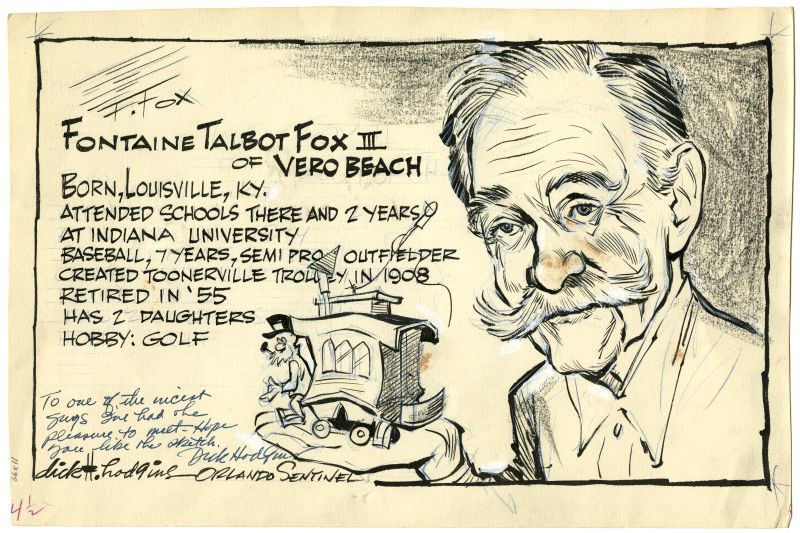
We recently acquired the original artwork for this January 17, 1938 Toonerville Trolley comic panel by the great Fontaine Fox (1884-1964).

We recently acquired the original artwork for this January 17, 1938 Toonerville Trolley comic panel by the great Fontaine Fox (1884-1964).

In a time when trolley lines criss-crossed this country, and were a part of everyday life for Americans, there was even a railfan comic strip. Or, better put, a comic strip by a railfan, Fontaine Fox.

His “Toonerville Trolley” comic ran in newspapers from 1913 until he retired in 1955. Over time, he even grew to resemble the “Skipper,” his own creation. Fox even answered his voluminous fan mail using letterhead he had printed up for the Toonerville Electric Railway Company.

Here is what the Filson (Kentucky) Historical Society has to say about Fontaine Fox:

Fontaine Talbot Fox III, creator of the famous Toonerville Trolley, was born in Louisville, Kentucky in 1884. He started his career as a reporter for the Louisville Herald, but soon abandoned this course to pursue his true passion of drawing cartoons. During a visit to the small town of Pelham, New York, Fox received inspiration for what would become one of the nation’s most beloved comics. While in Pelham, he rode on the local trolley car, where the conductor’s unhurried manner and penchant for gossiping with his passengers gave Fox the idea for his own comic strip. By 1915, the resulting comic series, Toonerville Folks, had come to the attention of the Wheeler Syndicate and was soon published in newspapers across the nation.

The Filson’s collections contain a number of items documenting the life and career of this celebrated cartoonist, including photographs of Fox and his family, as well as some of his correspondence and several scrapbooks with clippings of his cartoons. Notable among Fox’s papers are a collection of twenty-one original pen and ink cartoons from his beloved Toonerville Folks. Set in the fictional town of Toonerville, the single-paneled cartoon featured a rickety trolley car and a glimpse into suburban life in the early twentieth century. Fox created a cast of characters that charmed a nation: the Terrible-Tempered Mr. Bang, the Powerful Katrinka, Mickey (Himself) McGuire (the town bully), Aunt Eppie Hogg (the fattest woman in three counties), and of course the Skipper, who piloted the beloved trolley car. Toonerville Folks ran in hundreds of newspapers nationwide for over forty years, until Fox’s retirement in 1955. His comics would become an inspiration for a future generation of cartoonists.

Actually, it was a single panel cartoon six days a week. On Sunday, it was in color, in multiple panels. The strip had various names, including The Toonerville Trolley That Meets All the Trains and Toonerville Folks. Eventually, the adventures of the “Skipper” and his rickety trolley car only took up a part of the action, as Fox developed a variety of memorable characters for Toonerville.

Blake A. Bell
writes an excellent blog called Historic Pelham, and has written extensively about Fox, the Toonerville Trolley, and its connection to the area.

While the phrase “Toonerville Trolley” eventually became synonymous with any rural streetcar or interurban running on poorly maintained track, Pelham, NY, its inspiration, is actually a suburb, located 14 miles from Midtown Manhattan in Westchester County. It is near the city of New Rochelle, made famous as the home of Rob and Laura Petrie on the Dick Van Dyke Show (1961-1966).

The Toonerville Trolley ran in over 200 daily newspapers in its heyday, and was popular enough to inspire numerous motion pictures. The first series, circa 1920-21, was silent and produced by the Betzwood Studios in Montgomery County, Pennsylvania (more on that in our book review section). You can watch one of those films here.

Next, a young Mickey Rooney (1920-2014) later starred in 78 short films based on the Toonerville character Mickey McGuire, made between 1927 and 1934. This was Mickey Rooney’s first big break in show business. He even attempted, unsuccessfully, to legally change his name to Mickey McGuire.

There were also some Toonerville Trolley animated shorts, made in 1936 by Van Beuren Studios, which can be seen on Youtube. Here is one example:

By the late 1930s, trolley lines were starting to disappear from the American scene. On July 31, 1937 the Pelham Manor “H” trolley line ran its last. Fontaine Fox used the popularity of his comic strip to turn this into a major event.

From Historical Treasures of Westchester County:

On July 31, 1937, the H-Line Trolley that inspired Fontaine Fox was shut down for good – replaced by a bus line. That day the Village of Pelham Manor hosted a celebration attended by about 8,000 people for the last run of the “Toonerville Trolley”.

This “pass,” signed by Fontaine Fox who attended the event, entitled the bearer to ride the trolley car during its last trip. That trip took hours to travel only a couple of miles due to the crowds and the antics of local residents dressed as various characters from the “Toonerville Folks” comic strip.

The Hagerstown & Frederick interurban, which we have featured in a variety of posts, is an example of a country interurban that was frequently called a “Toonerville Trolley.” Its last passenger interurban ran on February 20, 1954.

Perhaps inspired by this, around this time Fontaine Fox bowed to the inevitable, and “retired” the trolley from his strip, replacing it with a bus. But such was the popularity of the old contraption that I believe he brought it back, prior to the strip’s demise in 1955 with Fox’s retirement. He donated some of his original artwork to a trolley museum.

As a tribute to Fontaine Fox, here we present an entire month’s worth of daily Toonerville panels, from June 1927. You will note that only some of the dailies include the trolley and Skipper (who, apparently, was based on real-life Pelham operator James (“Old Jim”) Bailey, who lived in the Bronx). Charles A. Lindbergh (1902-1974) made his historic non-stop flight from New YHork to Paris on May 20-21, 1927 and “Lindbergh mania” is reflected in many of the strips shown here, suggesting that Fox was working on some of these panels not long before they appeared in newspapers.

Fontaine Fox in retirement:

https://filsonhistorical.org/wp-content/uploads/Sketch-of-Fontaine-Fox_A_F791_1_web.jpg

Book Reviews


Montgomery County Trolleys
by Mike Szilagyi, with a Foreword by Andrew W. Maginnis
Arcadia Publishing, 2018

We recently received a copy of Montogomery County Trolleys from the author, as we had provided a couple of images he used in the book. Otherwise, chances are we might not have seen this fine addition to Arcadia’s Images of Rail series, which we are also involved with (see below for information on Building Chicago’s Subways, and our Online Store for copies of Chicago Trolleys).

Author Mike Szilagyi was no stranger to us, as we had corresponded concerning a different book project he was involved with as mapmaker. This was eventually published as Riding the Bell: Lehigh Valley Transit’s Liberty Bell Route by Ron Ruddell, Bulletin 147 of the Central Electric Railfans’ Association (2015).

Naturally, the maps Mr. Szilagyi made for this new book are excellent. But the entire thing is well done, from the scope the author set out to cover, the organization of the chapters, picture selection, text, and captions.

Here is a capsule description:

Montgomery County, Pennsylvania, was once served by 140 miles of trolley lines. In the first half of the 20th century, a wide array of trolley cars rolled over Montgomery County’s rails, from quaint open streetcars rumbling through borough streets to sleek 80-mile-an-hour trolleys sailing across open fields in Upper Gwynedd and Hatfield Townships. The cars had zero emissions, and some lines were powered by renewable hydroelectric power. Taking the trolley was a convenient, affordable option for those travelling and commuting in Montgomery County, nearby Philadelphia, and points beyond. Freight was also carried on board trolleys, with prompt parcel delivery service. Fortunately, many years ago, dedicated trolley fans had the foresight to aim their cameras at these unique vehicles, providing rare glimpses not just of the trolleys but also of Montgomery County’s rapidly changing landscapes.

Mike Szilagyi’s interest in trolleys was sparked at a young age by the sight of big green streamliners gliding down Old York Road near his grandmother’s house in the Logan neighborhood of Philadelphia. Today, Szilagyi lives and works in Montgomery County, where he plans and designs bicycle paths and serves on the North Wales Historic Commission.

This volume’s foreword was written by noted transit historian and longtime Montgomery County resident Andrew W. Maginnis.

In addition to detailed captions for each photograph, the book offers a brief history of transportation in Montgomery County, placing the trolley era in its historical context. The timeline of travel may be very generally summed up as:

dirt roads – canals – railroads – trolleys – motor vehicles

Rather than each mode supplanting the previous, there were varying degrees of overlap between them. That said, the use of animals for motive power was there from the beginning, only fading as motor vehicles gained prominence in the 1910s and 1920s. The bicycle came on the scene in a big way in the 1890s, never really completely disappeared, and is today enjoying widespread resurgence.

By concentrating on Montgomery County, the author is able to provide tremendous variety, as he was therefore able to include the Lehigh Valley Transit’s Liberty Bell interurban, the Philadelphia & Western High-Speed Line to Norristown, numerous small-town trolleys, and even a bit of Philadelphia streetcars (Route 6 went into the county). Although very little of this remains, back in the day I did manage to ride Bullets and Strafford cars on the Norristown line (which still operates, with more modern equipment) as well as PCCs on SEPTA’s Route 6, which was replaced by buses in January 1986, subjects covered in this book.

Montgomery County Trolleys is dedicated to the memory of the late Harry Foesig (1897-2003) whose long life spanned parts of three centuries. He was co-author, along with Dr. Harold E. Cox, of Trolleys of Montgomery County, Pennsylvania (1968). This was an obvious inspiration for this new volume, which can be thought of as a kind of “spiritual descendant” of that earlier tome. That book also included some excellent maps, rendered by Foesig.

Anyone who has an interest in the subject, and the rich heritage of Keystone-state traction, would do well to pick up copies of each. While the earlier book is long out of print, you should have little difficulty in finding a used copy at a reasonable price. Mine only cost about $10, which is perhaps about half what you should expect to pay for Montgomery County Trolleys.

Interestingly, longtime railfan Andrew W. Maginnis contributed to both books, 50 years apart. Perhaps the 50-year anniversary was also a factor that motivated the author to put this new collection together, just as I was inspired by some anniversaries to do my new book (see below).

-David Sadowski

Pre-Order Our New Book Building Chicago’s Subways

There are three subway anniversaries this year in Chicago:
60 years since the West Side Subway opened (June 22, 1958)
75 years since the State Street Subway opened (October 17, 1943)
80 years since subway construction started (December 17, 1938)

To commemorate these anniversaries, we have written a new book, Building Chicago’s Subways.

While the elevated Chicago Loop is justly famous as a symbol of the city, the fascinating history of its subways is less well known. The City of Chicago broke ground on what would become the “Initial System of Subways” during the Great Depression and finished 20 years later. This gigantic construction project, a part of the New Deal, would overcome many obstacles while tunneling through Chicago’s soft blue clay, under congested downtown streets, and even beneath the mighty Chicago River. Chicago’s first rapid transit subway opened in 1943 after decades of wrangling over routes, financing, and logistics. It grew to encompass the State Street, Dearborn-Milwaukee, and West Side Subways, with the latter modernizing the old Garfield Park “L” into the median of Chicago’s first expressway. Take a trip underground and see how Chicago’s “I Will” spirit overcame challenges and persevered to help with the successful building of the subways that move millions. Building Chicago’s subways was national news and a matter of considerable civic pride–making it a “Second City” no more!

Bibliographic information:

Title Building Chicago’s Subways
Images of America
Author David Sadowski
Edition illustrated
Publisher Arcadia Publishing (SC), 2018
ISBN 1467129380, 9781467129381
Length 128 pages

Chapter Titles:
01. The River Tunnels
02. The Freight Tunnels
03. Make No Little Plans
04. The State Street Subway
05. The Dearborn-Milwaukee Subway
06. Displaced
07. Death of an Interurban
08. The Last Street Railway
09. Subways and Superhighways
10. Subways Since 1960

Building Chicago’s Subways will be published on October 1, 2018. Order your copy today, and it will be shipped on or about that date. All copies purchased through The Trolley Dodger will be signed by the author.

The price of $23.99 includes shipping within the United States.

For Shipping to US Addresses:

For Shipping to Canada:

For Shipping Elsewhere:

Help Support The Trolley Dodger

gh1

This is our 215th post, and we are gradually creating a body of work and an online resource for the benefit of all railfans, everywhere. To date, we have received over 422,000 page views, for which we are very grateful.

You can help us continue our original transit research by checking out the fine products in our Online Store.

As we have said before, “If you buy here, we will be here.”

We thank you for your support.

DONATIONS

In order to continue giving you the kinds of historic railroad images that you have come to expect from The Trolley Dodger, we need your help and support. It costs money to maintain this website, and to do the sort of historic research that is our specialty.

Your financial contributions help make this web site better, and are greatly appreciated.

A New Year- A New Beginning

2017 in Review

Another year has come and gone.  How quickly time flies.  For this blog, it was another successful year, with 118,985 page views from 34,503 visitors.  These numbers are more than 2015, but less than 2016.

We made fewer posts last during 2017, but they tended to be longer overall.  Some had more than 100 images, and there are over 100 in this post.  To date, we have posted over 30gb of classic images via this blog. It’s no coincidence that when I do Google searches on traction subjects, it seems like half the “hits” that come up are from The Trolley Dodger.

One of our goals has always been to provide a resource where people can find this type of information. I believe we have succeeded, and will continue to build on that success. There are some who think our hobby is on the decline, but I believe we have shown just the opposite.

Our average number of page views per post has continued to increase.  In 2015, it was 995 per post; in 2016, this increased to 1744, and in 2017 we reached 3718 page views per post.

2017 was also notable for the publication of our book Chicago Trolleys, which has been very well received.

While at this stage, it is impossible to know how many posts we will have this year, we are committed to maintaining a high standard of quality on whatever we do present.

Among our other recent posts, we are particularly proud of The Fairmount Park Trolley (November 7, 2017), which included dozens of rare images, most from the original medium format negatives. It took us nearly three years to collect all this material, which probably represents a total cost of about $1000- and this was just one post.

As an example of how we have inspired additional research, I would point to our post The “Other” Penn Central (May 29, 2016), which has gradually gotten longer and longer, thanks to additions from our ever-inquisitive readers.

In addition, as time goes on, we have more and more friends who share their material with our readers.  Today we feature the contributions of noted author Larry Sakar. The pictures are his, unless otherwise noted.

Happy New Year! May you and your family have health, wealth, and happiness in 2018.

-David Sadowski

PS- In about 30 day’s time, our annual bill to fund this site and its web domain comes due.  That comes to $400, or just over $1 per day.  If you enjoy reading this blog, and want to see it continue, we hope you will consider supporting it via a donation.  You can also purchase items from our Online Store. With your help, we cannot fail.

Early Trolley Museum Visits

Larry Sakar writes:

You’ve been posting a lot of photos of CA&E cars of late, which reminded me of a day 47 1/2 years ago when I went to a trolley museum for the very first time. For several years, I would see the ads for IRM in Trains, Railroad (before it became Railfan & Railroad) and Model Railroader and I wanted to go there. Asking my father would have been useless. He wouldn’t have taken me in a million years. Neither of my parents approved of my interest in trolleys.

Luckily I had met Bill Beaudot in 1967, when he was the librarian in charge of the Local History Room at the Central Library downtown. My regular visits to read and reread CERA B-97, “The Electric Railways of Wisconsin” got him wondering what that was all about. All the remaining CERA Bulletins and other traction books had been removed from circulation, and placed under lock and key in the Local History Room.

And so it was that on a warm Saturday afternoon in August of 1970, I went with Bill and his family to my first trolley museum. But it was not IRM, well not initially anyway. The first museum we visited was then called RELIC in South Elgin, IL. RELIC was an acronym for the Railway Equipment Leasing and Investment Corp. Today we know it as the Fox River Trolley Museum.

CA&E wood car 20 was in operation that day, and we rode it from South Elgin to the end of the line at the I.C. bridge over the Fox River at Coleman. When they told the history of the line, I remembered that this was the line from which Speedrail cars 300 and 301 originated.

Of course, they spent 25 years in Cleveland operating on the Shaker Heights Rapid Transit, but so what? It was still nice to see where those cars began their service lives. And sitting on a side track was a car I had heard and read about innumerable times: NSL Tavern Lounge 415. Some years later they sold the car to Seashore Trolley Museum in Kennebunkport, Maine.

CA&E car 20 at the RELIC museum, August 1970.

CA&E car 20 at the RELIC museum, August 1970.

The interior of CA&E car 20 in August 1970.

The interior of CA&E car 20 in August 1970.

CA&E 300-series car at the RELIC museum in August 1970.

CA&E 300-series car at the RELIC museum in August 1970.

CA&E 300-series car at the RELIC museum in August 1970.

CA&E 300-series car at the RELIC museum in August 1970.

The Illinois Central interchange at Coleman with the ex-AE&FRE right-of-way, at the RELIC museum in August 1970.

The Illinois Central interchange at Coleman with the ex-AE&FRE right-of-way, at the RELIC museum in August 1970.

North Shore Line tavern-lounge car 415 at the RELIC museum in August 1970.

North Shore Line tavern-lounge car 415 at the RELIC museum in August 1970.

Leaving South Elgin and RELIC we headed for Union, Illinois and IRM. As we crossed the museum line and entered the grounds, I saw Milwaukee streetcar 972 with CSL 144 behind it loading at the station. Instantly, I felt like a kid again, when I would get excited as my grandfather drove my grandmother and me to the Harwood Avenue terminus of the No. 10 Wells Streetcar line in Wauwatosa.

In those days you turned from Wauwatosa Ave. west to Harwood. You found yourself at the top of a very steep hill that dropped down into the Menomonee River Valley, and crossed the Milwaukee Road mainline at grade. And on the west side of those tracks sat the Harwood terminal and the No. 10 Wells streetcar line. A 100-car plus Milwaukee Road freight would cause a monumental traffic jam on both sides of the Harwood hill. In the ’80’s a bypass was built, and traffic no longer has access via the old route. Just as well. Both the streetcar and terminal are long gone.

Anyway, I did get to ride 972 and it felt like 1957-58 all over again. I even made sure to relive my childhood memory of streetcar rides with my grandmother by walking to the opposite end of 972 and sitting in the motorman’s seat. The only difference was I no longer needed someone to boost me up and hold me in the seat!

So here are scans of the prints from the pictures I took that day. I had a great shot of TM 972 speeding down the mainline, but I gave it away about 10 years ago, unfortunately.

While looking through some other pictures, I came across four pictures I took at IRM sometime in the 1980s or ’90s. Two are of my favorite car (after TM 972) Indiana RR 65 and 2 are of AE&FR 306 currently undergoing restoration. Car 65 was flying white flags and was not in regular service. It had been taken out for use in some movie.

I don’t remember much of the detail I heard, but it involved George Krambles in some way. That’s as much as I can recall. 306 was in the car barn parked next to IT 101. I did ride 65 on a member’s weekend once years ago. We reached the end of the line at the Kishwaukee River crossing. They threw whatever electric switches they had to in order to put control over to the back-up controller in the rear of the car, but it refused to budge. Our motorman had to radio for a car to come to our rescue. They sent down C&ME 354.

That was my first and to date only ride on that car. I’ve heard that 65 does not operate very often. While going thru a large group of my slides last Thursday that I had marked as “unidentified,” I found the interior photo I knew I’d taken of CRANDIC 111 at Rio Vista in 2000. I need to look thru the slides I have in my metal slide box #2 of 3. I’m sure I took at least one exterior of CRANDIC 111 that day.

Aurora Elgin & Fox River Electric 306 at the Illinois Railway Museum in the 1980s or 90s.

Aurora Elgin & Fox River Electric 306 at the Illinois Railway Museum in the 1980s or 90s.

Aurora Elgin & Fox River Electric 306 at the Illinois Railway Museum in the 1980s or 90s.

Aurora Elgin & Fox River Electric 306 at the Illinois Railway Museum in the 1980s or 90s.

CSL 144 at the IRM depot in August 1970.

CSL 144 at the IRM depot in August 1970.

CSL 144 with TM 972 ahead, August 1970.

CSL 144 with TM 972 ahead, August 1970.

Illinois Terminal 415 at speed on the IRM main line in August 1970.

Illinois Terminal 415 at speed on the IRM main line in August 1970.

The interior of Illinois Terminal 415 at IRM in August 1970.

The interior of Illinois Terminal 415 at IRM in August 1970.

Illinois Terminal 415 at the IRM depot in August 1970.

Illinois Terminal 415 at the IRM depot in August 1970.

Indiana Railroad 65 at IRM in the 1980s or 90s.

Indiana Railroad 65 at IRM in the 1980s or 90s.

Indiana Railroad 65 at IRM in the 1980s or 90s.

Indiana Railroad 65 at IRM in the 1980s or 90s.

A North Shore Line 700-series car at IRM in August 1970.

A North Shore Line 700-series car at IRM in August 1970.

Following the RELIC and IRM pix are a set of pictures taken on a PA Transit PCC in Pittsburgh in the winter of 1971-72. I did not take these pictures. My good friend Bill did, and gave them to me because he knew I liked PCCs.

Because I have never been to Pittsburgh, I am unable to tell the readers where these pictures were taken. PA Transit, for anyone not familiar with it, was the municipal agency that took over the Pittsburgh Railways Co. in 1967. PA stands for Port Authority, not Pennsylvania.

It has always struck me as unusual that streetcar service would be run by the Port Authority, but the Port Authority of Allegheny County was given the task of transit operations, odd though that may seem.

I can still remember the controversy in Railroad Magazine over how the Pittsburgh PCCs were painted in the late ’60s and perhaps early ’70s. Many were painted in three colors, each color being placed on one-third of the car. In keeping with the times one PCC was painted in this wild looking paint scheme and dubbed the “Psychedelic trolley.”

PA Transit 1727 in 1972. (Bill Beaudot Photo)

PA Transit 1727 in 1972. (Bill Beaudot Photo)

PA Transit 1727 in 1972. (Bill Beaudot Photo)

PA Transit 1727 in 1972. (Bill Beaudot Photo)

The interior of PA Transit 1727. (Bill Beaudot Photo)

The interior of PA Transit 1727. (Bill Beaudot Photo)

A PA Transit PCC with the motorman using a switch iron in 1972. (Bill Beaudot Photo)A PA Transit PCC with the motorman using a switch iron in 1972. (Bill Beaudot Photo)

A PA Transit PCC with the motorman using a switch iron in 1972. (Bill Beaudot Photo)

I’ll finish up with a few shots of the Illinois Central Electric (later METRA Electric) Highliners taken mostly as 115th St. Kensington station around 1975. I remember when I.C. first got them, and now they too are history.

-Larry

An ICG Highliner at Randolph Street in 1975.

An ICG Highliner at Randolph Street in 1975.

An ICG Highliner at 115th in Kensington in 1975.

An ICG Highliner at 115th in Kensington in 1975.

Looking north at the Kensington station, as a South Shore Line train approaches in 1975.

Looking north at the Kensington station, as a South Shore Line train approaches in 1975.

Looking north along the northbound track at Kensington station in 1975.

Looking north along the northbound track at Kensington station in 1975.

Looking south from the Kensington ICG station, with the tower to the left.

Looking south from the Kensington ICG station, with the tower to the left.

ICG Highliner interior.

ICG Highliner interior.

An ICG Highliner at 115th Street in Kensington in 1975.

An ICG Highliner at 115th Street in Kensington in 1975.

Sunny California

For all readers of The Trolley Dodger who are shivering in this arctic cold here’s a posting that will let you temporarily escape to a much warmer place; sunny California. During the 50s, 60s and 70s, California (except for San Francisco) shed its electric traction lines as fast as they could.

Much of this was due to a company called National City Lines. In city after city they bought up the rail lines (San Diego Electric Railway, Los Angeles Railway, Pacific Electric, Key System Transit), abandoned all rail service and replaced it with Mack or GM Buses running on Firestone Tires and probably burning diesel fuel supplied by Phillips Petroleum. And they didn’t limit their destructive efforts to just California.

Then came the 1980s, and slowly California began to wake up from its love affair with freeways. And it all started with the San Diego Trolley in 1981. So, it’s only appropriate that we begin our look at traction in the Golden State there.

The San Diego Trolley's original cars were built by Duewag of Dusseldorf, Germany with help from Siemens.

The San Diego Trolley’s original cars were built by Duewag of Dusseldorf, Germany with help from Siemens.

Originally, the San Diego Trolley line to the Mexican border started here.

Originally, the San Diego Trolley line to the Mexican border started here.

Self-service. Passengers entered the car by pressing the black button, seen to the lower right of the door.

Self-service. Passengers entered the car by pressing the black button, seen to the lower right of the door.

Trains bound for the Mexican border had a San Ysidro destination sign.

Trains bound for the Mexican border had a San Ysidro destination sign.

The interior of the beautifully restored ex-Santa Fe (now Amtrak) San Diego station.

The interior of the beautifully restored ex-Santa Fe (now Amtrak) San Diego station.

Look at that beautiful tile work, including the Santa Fe logo on the wall.

Look at that beautiful tile work, including the Santa Fe logo on the wall.

Interior of a Duewag car - spartan, but functional.

Interior of a Duewag car – spartan, but functional.

No controller, no brake handle - computerized push-button control.

No controller, no brake handle – computerized push-button control.

A typical stop on city streets.

A typical stop on city streets.

The maintenance facility on the line to San Ysidro.

The maintenance facility on the line to San Ysidro.

A modern-day Southern California car barn, San Diego style.

A modern-day Southern California car barn, San Diego style.

More of the maintenance facility.

More of the maintenance facility.

City College stop. Fare checkers board here.

City College stop. Fare checkers board here.

Amtrak Redondo engine maintenance facility.

Amtrak Redondo engine maintenance facility.

Arrival at San Diego. looking toward the rear of the train.

Arrival at San Diego. looking toward the rear of the train.

Arrival at San Diego. looking forward toward the front of the train.

Arrival at San Diego. looking forward toward the front of the train.

Curving southeast through an industrial area. Note signal at right.

Curving southeast through an industrial area. Note signal at right.

Curving southeast through an industrial area.

Curving southeast through an industrial area.

Leaving LAUPT, passing Mission Tower.

Leaving LAUPT, passing Mission Tower.

Now you know why the line was renamed the San Diego Surfliner.

Now you know why the line was renamed the San Diego Surfliner.

Oceanside, CA - quite literally.

Oceanside, CA – quite literally.

I can’t think of a city that so completely turned its back on electric rail transit and embraced freeways the way Los Angeles did except for Milwaukee.

In her 1969 Grammy Award winning song, composed by the magnificent team of Burt Bacharach and Hal David, Dionne Warwick asked the question, “Do you know the way to San Jose?” One of the lines in the song says, “LA is a great big freeway. Put a hundred down and buy a car.”

I can’t speak to “putting a hundred down to buy a car,” other than to say perhaps in 1969, but very unlikely in 2018! But I can attest to the sentiment that LA was and still is “a great big freeway.” There are two Amtrak routes between San Francisco and LA. The Coast Starlight is a long-distance train operating once daily between Seattle and LA. But like any long-distance train, it is often subject to delays. Even on time, arrival in LA is not until 9:00 pm.

The other San Francisco to LA train is a corridor train called the San Joaquin, operating between Jack London Square station in Oakland and Bakersfield. All Amtrak service between San Francisco and other cities arrives and departs from either Jack London Square station in Oakland or Emeryville station. Emeryville is a separate city, 12 miles north of Oakland.

And yes, it is the Emeryville where the Key System had its shops.

Passengers going to San Francisco are bused across the San Francisco-Oakland Bay Bridge via Amtrak Thru-Way buses. In the golden age of rail passenger service, trains such as SP’s San Joaquin Daylight, the Lark and the Owl plied the tracks between San Francisco and LA. But when Amtrak took over in 1971 the SP and later UP which now owns the tracks forbade Amtrak trains to continue over the Tehachapi Mountains from Bakersfield to LA.

Therefore, passengers such as me boarded an LA bound Amtrak Thru-Way bus on August 7th at Bakersfield for the two-and-a-half hour ride down I5 and the Hollywood Freeway to LAUPT. This was not my first trip between Bakersfield and LA, so I knew what to expect the closer we got to LA. From the Magic Mountain Amusement park in Valencia to Glendale, where my bus was making a stop, I5 was a sea of cars in both directions.

As bad as that seemed, the Hwy 1012 Hollywood Freeway to downtown LA was even worse. It made rush hours on the Kennedy and Eisenhower look like child’s play! I kept asking myself, “How does anyone put up with this, on a daily basis?” And gas prices in California were at least $1.00 per gallon higher than here in the Midwest. In fact, I think it safe to say everything costs more out there!

So, what brought about this miraculous turnaround from asphalt and concrete to rail? I could tell you, but as the saying goes, a picture is worth a thousand words. I took this photo from the Griffith Park Observatory which is perched some 1300+ feet above LA in the summer of 1980 just before the rail renaissance began. Note that orange cloud on the far horizon. That is smog and it coats LA like a blanket daily. It is unhealthy to say the least and extremely bad for people with asthma and other respiratory problems. I can only guess that one day, someone woke up and pondered, “How did we get ourselves into this mess?” That’s easily answered. You allowed National City Lines and Metropolitan Coach Lines to take over and destroy Los Angeles Railways and Pacific Electric the system that literally helped build southern California.

The last PE line from LA to Long Beach was abandoned by the LAMTA– an agency formed to save remaining rail transit in LA but which, because it was controlled by some of the same people who ran Metropolitan Coach Lines, did the exact opposite. That was in April1961, but luckily the right of way between LA and Long Beach was saved, as parts of it were used by Southern Pacific (of which PE was a part) for freight service.

So, it was only fitting that after an absence of almost 30 years, electric transit service between LA and Long Beach was reborn in the form of the new LA Metro Blue Line on July 14, 1990. And just two-and-a-half years after that, the new LA Metro Red Line subway between downtown and North Hollywood opened for service.

Ironically, the new subway was built just one block (in places) from the old PE Belmont Subway. (Note: Though often referred to as the Hollywood subway because PE trains headed there and to other locations in and near the San Fernando Valley such as Universal City and North Hollywood as well as Glendale and Burbank) operated thru it. But its official name was the Belmont subway, no relation to Belmont Avenue in Chicago.

LA from the Griffith Park Observatory in 1980.

LA from the Griffith Park Observatory in 1980.

The LA Red Line subway at the 7th Street/Union Station stop in 2001. The LA Red Line subway is used by passengers to reach the Blue Line to Long Beach. Long Beach trains end in their own subway a few blocks from the Staples Center (LA's version of the United Center). I believe these are Japanese Kawasaki-built cars.

The LA Red Line subway at the 7th Street/Union Station stop in 2001. The LA Red Line subway is used by passengers to reach the Blue Line to Long Beach. Long Beach trains end in their own subway a few blocks from the Staples Center (LA’s version of the United Center). I believe these are Japanese Kawasaki-built cars.

Long before BART (Bay Area Rapid Transit) began service between Oakland and Fremont in 1972, there was the Key System. Started in 1903 by a man called “Borax” Smith, who became a millionaire mining Borax. If you’re around my age perhaps you remember the 19670’s TV show “Death Valley Days” hosted by actor Dale Robertson which was sponsored by 20 Nuke Team Borax.

The line got its name because, when viewed on a map, the 5 East Bay lines were designated by letters:
A: Downtown Oakland later extended to East Oakland on the tracks of the Interurban Electric Ry. an SP subsidiary which was abandoned in 1941
B: Lakeshore and Trestle Glen
C: Piedmont
D: Never used. Reserved for a line to Montclair alongside the Sacramento Northern Interurban which was never built
E:Claremont
F: Berkeley

They resembled the top part of a skeleton key, the straight bottom portion represented by the Key Pier, which jutted out into the Bay 1.3 miles from the Oakland shore. San Francisco-bound passengers transferred to Key System Ferry boats at the Key pier for the trip to the San Francisco Ferry Building at the foot of Market St.

In January 1939 Key System trains began using the newly constructed San Francisco-Oakland Bay Bridge. Tracks were laid on the lower deck of the bridge which was reserved for trucks and buses. A newly constructed terminal at 1st & Mission Streets in San Francisco (initially called the “East Bay Terminal” and then the “Trans Bay Transit Terminal”) served as the station for Key System trains, as well as Sacramento Northern and Interurban Electric. The latter two systems both abandoned service in 1941. Key took over some on the former IER trackage in and around Berkeley.

In 1938 newly-built articulated trains replaced the original wood center-entrance cars. As the saying goes, looks can be deceiving, and such was the case with the new articulated trains. They were, in fact, a new body placed atop salvaged components from the original wood cars, which consisted of everything from trucks to controllers. Worse yet, the new bodies had a major design flaw. They lacked proper ventilation. They were not air conditioned and did not have openable windows. Cars ran on third rail between the Trans Bay Terminal and the Key Bridge Yards in Oakland which abutted the Oakland toll plaza.

The Bay Bridge, like the Golden Gate Bridge and every Transbay bridge in San Francisco, is a toll bridge operated by the California Toll Bridge Authority. Each of the companies running trains across the Bay Bridge were required to deed a certain number of cars to Toll Bridge Authority ownership. This would prove fortuitous as the cars now preserved at the Western Railway Museum in Suisun City, CA and the Orange Empire Railway Museum in Riverside, CA were ones deeded to the Toll Bridge Authority.

Key System 187 at the Western Railway Museum in 2000.

Key System 187 at the Western Railway Museum in 2000.

A Key System Transit train in the Trans Bay Terminal in 1953.

A Key System Transit train in the Trans Bay Terminal in 1953.

Key System 182 at the Western Railway Museum in 2000.

Key System 182 at the Western Railway Museum in 2000.

Key System 182 at the Western Railway Museum in 2000.

Key System 182 at the Western Railway Museum in 2000.

The Trans Bay Transit Terminal at 1st and Mission in San Francisco, razed in 2011.

The Trans Bay Transit Terminal at 1st and Mission in San Francisco, razed in 2011.

In 1946, the Lundeberg management sold its interest in the Key System to National City lines. As was almost always the case with any rail lines acquired by NCL, the streetcar lines in and around Oakland, operated by Key subsidiary East Bay Transit Company, were converted to bus operation in 1948. Key trains operated until April 1958 when the last trains crossed the Bay Bridge for the final time. The State of California spent huge sums of money to remove the overhead wires and rails from the Bay Bridge and Trans Bay Terminal to accommodate Key System Transit’s new Mack and GM Buses.

In 1960 Key System was acquired by A.C. Transit which still operates buses across the Bay Bridge to East Bay points to this day. A.C. stands for the two counties who operate the bus line, Alameda and Contra Costa.

The Transbay Transit Terminal was razed in 2011 and is being replaced by a new facility a few blocks away on Folsom Street. Unfortunately, the new terminal, which had been due to be completed in 2017, has been stopped from completion by a lawsuit filed by the nearby Millennium Towers Condos Building. The 58-story building with luxury condos, selling for upwards of $3 million and home to celebrities such as Joe Montana, is sinking into its foundation at an alarming rate and is also tilting as a result.

Its developers blame the contractor building the new Trans Bay Terminal claiming he drained out too much of the ground water causing the Millennium building foundation to shift in the sands which anchor it. The contractor for the new Trans Bay Terminal has counter-sued claiming that the Millennium Tower’s builder should have anchored the building’s foundation in the bed rock 200 feet below. Until the issue is resolved, a temporary Transit Terminal is open at 200 Folsom Street.

Santa Clara Valley Transportation Authority operates buses and one light rail line from Santa Teresa to Alum Rock in the San Mateo-San Jose area. It will connect with BART when the line is extended into San Mateo County. At least three major Silicon Valley companies will be served: Cisco Systems, eBay and Adobe.

The light rail line operates between Santa Teresa and Alum Rock. The car seen here, and its mates, were sold to the Sacramento RTD when VTA purchased new low-floor cars.

An VTA Santa Clara Valley Transportation Authority LRV at Santa Teresa station in 2000.

An VTA Santa Clara Valley Transportation Authority LRV at Santa Teresa station in 2000.

Sacramento RTD at Roseville Yards in 2004.

Sacramento RTD at Roseville Yards in 2004.

Sacramento RTD at Roseville Yards in 2004.

Sacramento RTD at Roseville Yards in 2004.

Sacramento RTD at Roseville Yards in 2004.

Sacramento RTD at Roseville Yards in 2004.

Sacramento RTD at Roseville Yards in 2004.

Sacramento RTD at Roseville Yards in 2004.

Sacramento RTD service started between Watt I-80 and the Historic Folsom District on 3-12-87.Within the past year a branch to Consumes River College was opened. The maintenance facility for the Sacramento RTD is located in adjacent Roseville, north of Sacramento, a city located at the southern base of the Sierras. The four photos seen here were taken from Amtrak Train #5, the California Zephyr, on the way to Emeryville in 2004.

A year before the Key System abandoned rail service in April 1958, planning for some sort of new Transbay rail line was being contemplated. That became the Bay Area Rapid Transit district. This was a county-based, special-purpose district formed to construct and operate a rail transit system in the five counties that initially formed the district: The city and county of San Francisco, Alameda, Contra Costa, Marin and San Mateo.

Though invited to participate, Santa Clara county declined to join until 2018 when BART will enter San Mateo County, with the extension to Milpitas and Berryessa. In 1962 San Mateo County supervisors voted to leave BART, claiming their voters would be paying taxes for riders primarily from Santa Clara County. San Mateo eventually formed its own transit agency called SAMTRANS. The departure of San Mateo County lead to the departure of Marin County as well.

Construction of BART began in 1964, but it would not be until 1972 that the first trains operating between Fremont and Oakland would begin service. Initially, there was a debate about how BART trains would cross the Bay. Would it be an above ground crossing or a subway tube? The decision was made to dig a trench in the floor of San Francisco Bay and construct a subway tube between San Francisco and Oakland. All other parts of the system would be elevated (parts of Oakland immediately after trains leave the Transbay tube), subway (through Berkeley) or private right-of-way, often in the median of existing expressways.

Author Harre Demoro frequently insisted, in his books, that BART was neither the modern day Key System or Sacramento Northern. I disagree. In my opinion it is both. It serves many of the same cities served by Key or SN, and even utilizes parts of the old SN right of way in Concord, Rockridge, and West Pittsburg.

When I visited the Western Railway Museum for the first time in 1996, I rode an interurban saved from a system I’d never heard of, called the Peninsular Railway. A Google search revealed that the line had run in the San Mateo/San Jose area now known as “Silicon Valley”. One of the stations served by the Peninsular Railway was Berryessa. In 2018 the new BART extension into San Mateo County will provide service to two new stations; Milpitas and Berryessa. The Peninsular Railway abandoned service in 1934. It has taken 84 years, but electric rail transit is back in Berryessa. Let’s go for a ride on BART.

-Larry

Along the right of way to Milbrae and the SFO International Airport.

Along the right of way to Milbrae and the SFO International Airport.

Another view of the BART Oakland yards.

Another view of the BART Oakland yards.

Approaching the station loading area.

Approaching the station loading area.

A BART C train, built by Alstom circa 1995.

A BART C train, built by Alstom circa 1995.

The BART SFO International Airport station in 2004.

The BART SFO International Airport station in 2004.

A BART train arriving at the SFO International Airport in 2004.

A BART train arriving at the SFO International Airport in 2004.

C car interior. Note the blue colors, versus brown for the Rohr-built cars.

C car interior. Note the blue colors, versus brown for the Rohr-built cars.

The BART Concord station, on the former Sacramento Northern right-of-way.

The BART Concord station, on the former Sacramento Northern right-of-way.

Concord station, close-up of BART train.

Concord station, close-up of BART train.

A BART C train at Civic Center station.

A BART C train at Civic Center station.

The interior of a Rohr-built BART car.

The interior of a Rohr-built BART car.

The interior of a Rohr-built BART car.

The interior of a Rohr-built BART car.

Oakland Yards near the MacArthur station.

Oakland Yards near the MacArthur station.

The operator of a BART car signs in.

The operator of a BART car signs in.

The operator's cab in a BART car, all computer controlled, like San Diego.

The operator’s cab in a BART car, all computer controlled, like San Diego.

An original Rohr-built BART train at Balboa Park station.

An original Rohr-built BART train at Balboa Park station.

The people mover at the SFO International Airport.

The people mover at the SFO International Airport.

Pittsburg Bay Point station, the farthest east point on BART.

Pittsburg Bay Point station, the farthest east point on BART.

The BART Pittsburg Bay Point station passageway to the park and ride lot.

The BART Pittsburg Bay Point station passageway to the park and ride lot.

Reflections of a railfan taking a picture of the people mover at the SFO International Airport.

Reflections of a railfan taking a picture of the people mover at the SFO International Airport.

A view of the opposite end of the BART Pittsburg Bay Point station passageway.

A view of the opposite end of the BART Pittsburg Bay Point station passageway.

The rear of the same train at the Balboa Park station.

The rear of the same train at the Balboa Park station.

Chris Barney writes:

HISTORIC BRIDGE DEMOLISHED

The last identifiable bridge from TM interurban operations in Milwaukee County fell to the wrecking ball November 9, 2017. The 1905 Milwaukee Light, Heat & Traction (MLH&T) spandrel-arch bridge over the Root River, near 98th & Layton, met its end after efforts to attain historic status and raising funds to preserve it failed. Robert Roesler, Greenfield Historical Society president, made a concerted effort in this regard and should be commended for it. A We Energies representative even arranged to donate the bridge structure to anyone willing to preserve it, but no one came forward.

The bridge last handled interurban traffic on June 30, 1951, when Speedrail Car 63 made its last inbound run from Hales Corners. Since then, it has weathered 66 years and had deteriorated to the point of being a danger to bicyclists and walkers traversing its span.

I spoke to a dog walker on December 12th who told me he has lived in the area his entire life and remembers when the Brookdale Bridge, which crossed Root River Parkway, was still standing. He lamented the demolition of the Root River span. “It reminded me of a simpler time when things were different – and better.”

February 9, 2017. (Chris Barney Photo)

February 9, 2017. (Chris Barney Photo)

December 12, 2017. (Chris Barney Photo)

December 12, 2017. (Chris Barney Photo)

Recent Finds

Here are a couple of our recent acquisitions, two classic views from the Philadelphia & Western, today’s SEPTA “Red Arrow” Norristown High-Speed Line:

Philadelphia & Western "Strafford" car 170, coming into a station circa 1938. Kenneth Achtert adds, "The photo of Philadelphia & Western 170 is arriving at Villanova station, outbound. This is the last station before the split where the Norristown line diverged from the Strafford line. The small platform between the two tracks was used to allow passengers from an inbound Norristown car to transfer directly to an outbound Strafford car without having to go up and over the overpass shown. This would also work from an inbound Strafford car to an outbound Norristown car. I don’t know how many passengers actually made such a trip, but I do remember seeing such transfers made." The last train ran on the Strafford Branch on March 23, 1956.

Philadelphia & Western “Strafford” car 170, coming into a station circa 1938. Kenneth Achtert adds, “The photo of Philadelphia & Western 170 is arriving at Villanova station, outbound. This is the last station before the split where the Norristown line diverged from the Strafford line. The small platform between the two tracks was used to allow passengers from an inbound Norristown car to transfer directly to an outbound Strafford car without having to go up and over the overpass shown. This would also work from an inbound Strafford car to an outbound Norristown car. I don’t know how many passengers actually made such a trip, but I do remember seeing such transfers made.” The last train ran on the Strafford Branch on March 23, 1956.

Philadelphia & Western "Bullet" car 200 at Conshohocken Road on October 12, 1938, "showing line country and streamlined car stopping at station."

Philadelphia & Western “Bullet” car 200 at Conshohocken Road on October 12, 1938, “showing line country and streamlined car stopping at station.”

W. C. Fields Filming Locations

John Bengston has a great blog, where he writes in great detail about the filming locations used in classic silent films by comedians like Charlie Chaplin, Harold Lloyd, and Buster Keaton.

We recently suggested he might look into the locations used in the chase sequence during the 1941 W. C. Fields film Never Give a Sucker an Even Break. He took the ball and ran with it, and his findings will feature in two posts.

You can read the first installment here.

Here are a few screenshots of our own from that film, which show the Pacific Electric:

During the chase sequence of the picture, Fields' car passes by a new Pacific Electric double-end PCC car. Filming took place in July and August 1941. PE put the first of 30 such PCCs in service the previous November.

During the chase sequence of the picture, Fields’ car passes by a new Pacific Electric double-end PCC car. Filming took place in July and August 1941. PE put the first of 30 such PCCs in service the previous November.

The brand-new Hollywood Freeway shows up in the movie. This is the portion (Cahuenga Pass) where the Pacific Electric ran in the expressway median from 1940 to 1952.

The brand-new Hollywood Freeway shows up in the movie. This is the portion (Cahuenga Pass) where the Pacific Electric ran in the expressway median from 1940 to 1952.

Another section of the Pacific Electric visible in the film.

Another section of the Pacific Electric visible in the film.

We end this post on a hopeful note for 2018. Work on the Milwaukee streetcar project, now called “The Hop,” is ahead of schedule,and the first phase of the line is scheduled to open by year’s end:

Chicago Trolleys

On the Cover: Car 1747 was built between 1885 and 1893 by the Chicago City Railway, which operated lines on the South Side starting in April 1859. This is a single-truck (one set of wheels) open electric car; most likely a cable car, retrofitted with a trolley and traction motor. The man at right is conductor William Stevely Atchison (1861-1921), and this image came from his granddaughter. (Courtesy of Debbie Becker.)

On the Cover: Car 1747 was built between 1885 and 1893 by the Chicago City Railway, which operated lines on the South Side starting in April 1859. This is a single-truck (one set of wheels) open electric car; most likely a cable car, retrofitted with a trolley and traction motor. The man at right is conductor William Stevely Atchison (1861-1921), and this image came from his granddaughter. (Courtesy of Debbie Becker.)

Check out our new book Chicago Trolleys. Signed copies are available through our Online Store.

HOLIDAY SPECIAL! This book makes an excellent gift. For a limited time only, we have reduced the price to just $17.99 plus shipping. That’s $4.00 off the regular price.

Help Support The Trolley Dodger

gh1

This is our 204th post, and we are gradually creating a body of work and an online resource for the benefit of all railfans, everywhere. To date, we have received over 354,000 page views, for which we are very grateful.

You can help us continue our original transit research by checking out the fine products in our Online Store.

As we have said before, “If you buy here, we will be here.”

We thank you for your support.

DONATIONS

In order to continue giving you the kinds of historic railroad images that you have come to expect from The Trolley Dodger, we need your help and support. It costs money to maintain this website, and to do the sort of historic research that is our specialty.

Your financial contributions help make this web site better, and are greatly appreciated.

Reader Showcase, 12-11-17

Here's a mystery photo, showing a Birney car (#512) being worked on, signed for Fruitridge Avenue. My guess is this may be the Terre Haute Indianapolis & Eastern Traction Company in Indiana. If so, Don's Rail Photos says that Birneys 490 thru 514 were "built by American Car Co in December 1919, (order) #1228 as THI&E 490 thru 514." There is a Fruitridge Avenue in Terre Haute. (Kenneth Gear Collection)

Here’s a mystery photo, showing a Birney car (#512) being worked on, signed for Fruitridge Avenue. My guess is this may be the Terre Haute Indianapolis & Eastern Traction Company in Indiana. If so, Don’s Rail Photos says that Birneys 490 thru 514 were “built by American Car Co in December 1919, (order) #1228 as THI&E 490 thru 514.” There is a Fruitridge Avenue in Terre Haute. (Kenneth Gear Collection)

Here we are again, just in time for the holiday season, bringing many gifts. Like our last post (Reader Showcase, 11-30-17) we are featuring contributions recently sent in by our readers. These include some rare traction shots.

Again, our thanks go out to Jack Bejna, Kenneth Gear, and Larry Sakar for their great contributions and hard work.

In addition, just to keep a hand in, I have added some of our own recent finds that you may enjoy.

Keep those cards and letters coming in, folks!

-David Sadowski

Kenneth Gear shared some additional photos from the collections of the late William A. Steventon of the Railroad Record Club:

Salt Lake, Garfield and Western 401 was former Salt Lake and Utah 104. It changed hands in 1946, and is seen here in December 1952.

Salt Lake, Garfield and Western 401 was former Salt Lake and Utah 104. It changed hands in 1946, and is seen here in December 1952.

Niagara, St. Catharines and Toronto Railway locos 14 and 18.

Niagara, St. Catharines and Toronto Railway locos 14 and 18.

Niagara, St. Catharines and Toronto Railway 130.

Niagara, St. Catharines and Toronto Railway 130.

Altoona & Logan Valley Railway sweeper 50a in Altoona.

Altoona & Logan Valley Railway sweeper 50a in Altoona.

A North Shore Line Electroliner at the Milwaukee terminal.

A North Shore Line Electroliner at the Milwaukee terminal.

Chicago Aurora & Elgin freight locos 2001 and 2002.

Chicago Aurora & Elgin freight locos 2001 and 2002.

Jack Bejna writes:

Hi Dave,

I got back to work on my CA&E project and here are some shots of the final order of steel cars. In many cases I have more than one shot of individual cars so if you need any more images I may be able to help. This group of cars completes my coverage of CA&E’s fleet of passenger cars. I’ll move on to the freight motors and other miscellaneous cars that the railroad owned.

In 1941, CA&E ordered 10 new cars (451-460) from the St. Louis Car Company. This final order was not delivered until October 1945, after World War II ended. The new cars were compatible (and could train) with the Pullman and Cincinnati cars, and were used for all types of service. These cars were lighter and included many improvements.

I know our readers appreciate your fine work, and we will be glad to share any and all images you want to share with us.  Thanks again.

CA&E 451.

CA&E 451.

CA&E 452 as new.

CA&E 452 as new.

CA&E 453 plus one on a CERA inspection trip.

CA&E 453 plus one on a CERA inspection trip.

CA&E 454.

CA&E 454.

CA&E 455.

CA&E 455.

CA&E 456, eastbound at Lombard.

CA&E 456, eastbound at Lombard.

CA&E 457 and three more cars at Wheaton.

CA&E 457 and three more cars at Wheaton.

CA&E 457.

CA&E 457.

(See Comments section) Jack Bejna: "Here's the image that I started with, as found on one of my searches of the internet. As you can see, I just Photoshopped the end of the car so as to present a nice ¾ view. I never noticed the lettering was unusual and didn't do any work on it. In future posts, if I change/modify an image I will clearly label it as such!"

(See Comments section) Jack Bejna: “Here’s the image that I started with, as found on one of my searches of the internet. As you can see, I just Photoshopped the end of the car so as to present a nice ¾ view. I never noticed the lettering was unusual and didn’t do any work on it. In future posts, if I change/modify an image I will clearly label it as such!”

CA&E 458.

CA&E 458.

CA&E 459, eastbound at Wheaton.

CA&E 459, eastbound at Wheaton.

CA&E 460 at Collingbourne.

CA&E 460 at Collingbourne.

Larry Sakar writes:

TM 978 at San Francisco Muni's Geneva Yard in September 1983.

TM 978 at San Francisco Muni’s Geneva Yard in September 1983.

I was going thru my Milwaukee streetcar photos and ran across the one and only shot I got of the 978 in San Francisco. I had to climb on to this concrete wall in front of the yard and hold on to the cyclone fence with one hand and snap the picture with the other. The ledge was quite narrow.

Here is some valuable background for the Los Angeles streetcar and Pacific Electric Railway material. (Editor’s Note: See our previous post Reader Showcase, 11-30-17.

The Los Angeles Railway company operated a large network of streetcar Ines covering every part of Los Angeles. Los Angeles’ streetcar system was a cable railway in its early beginnings, which accounts for the fact that it was narrow gauge for its entire existence. On a number of streets in downtown LA, both the Pacific Electric and LARY operated on the same tracks. In those instances, there were three versus the standard two rails. Both lines shared the outer rail, but LA Railway cars had their own second rail “farther in”.

By the turnoff the 20th Century, the LA system was acquired by the great Henry Huntington. Huntington was the nephew of Collis P. Huntington, one of the big four involved in the creation of the transcontinental railway along with other eventual luminaries like Mark Hopkins, Leland Stanford, and Theodore Judah. Huntington headed the Central Pacific RR which ultimately became the Southern Pacific RR. The Pacific Electric RR was a wholly owned subsidiary of the SP, as were the Interurban Electric RR and Northwestern Pacific RR in the San Francisco Bay area. Henry Huntington transformed the former cable railway into the magnificent Los Angeles Railways Co. He was also the President and CEO of the Pacific Electric Railway, often referred to as “the interurban that helped build southern California.”

As was the case in so many cities, the rise of the private automobile began to take a toll on the streetcar lines, until the outbreak of WWII on December 7, 1941. Every available car was pressed into service. By the war’s end in 1945, the LA streetcar system was in need of renovation. Although both LARY and PE purchased new PCC cars, they could not overcome the post war turn towards freeways. PE’s right-of-way was beset with numerous additional grade crossings thus making the cars slower than competing automobiles and buses. By 1950 the LA Freeway system was knocking at PE’s door. there was little doubt of the eventual outcome. It remained only a matter of when PE would finally be killed off by the highway interests and one other well known menace, National City Lines.

First to succumb to the rail-destroying conglomerate (NCL) was LARY sold by Henry Huntington’s heirs in 1945. The company was renamed Los Angeles Transit Lines and equipment wore the well-known NCL “fruit salad” colors of yellow, green and white. Remarkably the LA system outlasted both Chicago and Milwaukee, abandoning the final five streetcar lines in March 1963. Some of the older equipment, like the sow bellies and Huntington Standard streetcars, were acquired by museums and one was “preserved” at the Travel Town Museum in LA’s Griffith Park. Several LARY PCCs also went to the Orange Empire Trolley Museum in Perris, CA. The remaining and newest PCCs were sold to Cairo, Egypt in 1963.

PE fared no better. Interurban lines on each of the four operating districts, as PE called them, (designated by direction) were abandoned even before the company was sold to bus operator Metropolitan Coach lines in 1953. Supposedly, MCL owner Jesse Haugh, a former officer with Pacific City lines (an NCL company), nearly had a heart attack when he saw the MCL emblem on the PE Interurban cars.

In 1958, both LATL and PE became part of the newly created Los Angeles Metropolitan Transit Authority. But the MTA was, in reality, nothing more than a continuation of the pro-bus MCL/LATL managements. The two-tone green colors of the MTA were the colors of Metropolitan Coach Lines. The last PE line (to Long Beach) went to its grave in April 1961.

As stated previously, streetcar service under the MTA continued until March of 1963. Some of PE’s older 1200-series interurbans and all 20 of the Pullman built PCCs were sold to the General Urguiza Railway in 1959. Four years of storage in the damp, abandoned Hollywood subway brought an early end to their second lives in Argentina.

But the worst insult to transit came next. In 1963, the LAMTA became the SCRTD, Southern California Rapid Transit District. Never has a bus system been so misnamed. There was absolutely nothing “rapid transit” about it!

But when all hoped for California to wake up and return to its past, a transit revolution took place down the California Coast. A brand new light rail line was opened in San Diego in 1980. Known as the San Diego Trolley, it would start a transit revolution that rocked California. True, BART started up in the San Francisco Bay area in 1972, but San Francisco never lost touch with the streetcar the way LA did.

By 1990, LA was beginning to rise out of the dense smog that blanketed the area on a daily basis. It was then that the newly formed Los Angeles County Metropolitan Transportation Commission opened its first light rail line, the Blue Line running between downtown LA and Long Beach via the right of way once used by the PE red cars. The line begins in a subway that one connects with via the LA METRO Red Line subway from LAUPT, Los Angeles Union Passenger Terminal (Amtrak and Metrolink Commuter Rail).

Since then, two additional former PE lines to Pasadena and Santa Monica have been rebuilt and placed in service. Diesel commuter rail service, operated by Metrolink, serves other points once served by PE such as Glendale and Burbank. The service extends all the way up the California Coast to San Luis Obispo and south to Oceanside. Here, one can take the frequent trains on Amtrak’s San Diego Surfliner route or the commuter train from Oceanside to San Diego known as the Coaster. The Coaster operates equipment that resembles Toronto’s GO Transit system. Perhaps they are the same type of cars. Somebody familiar with both systems will undoubtedly know.

I went into my timetables and documents collection and found the 1983 San Francisco Historic Streetcar Festival brochure which pictured the cars that were going to operate. You’ll see that TM 978 was one of them. I had to scan it in part and then move it slightly to get the rest of it scanned as it was too long for my screen. I found some interesting things in my timetables and transfers that you are welcome to post if you wish.

Thanks!

San Francisco MUNI Part 3 by Larry Sakar

(Editor’s note: Parts 1 and 2 appeared in our last post, referenced above.)

SAN FRANCISCO MUNICIPAL RAILWAY STREETCAR LINES

The San Francisco Municipal Railway operates 8 streetcar lines. Although that may seem like a substantial number of streetcar lines, it is a fraction of the streetcar lines that once operated in the city by the Golden Gate. The 8 lines serve nearly every part of San Francisco. Within the last few years MUNI was reorganized into the SFMTA –San Francisco Municipal Transit Agency. The Market Street Railway which owns the historic streetcars is not a part of MUNI and receives no transit funding.

The Municipal Railway or MUNI for short uses letters rather than route numbers to identify the streetcar lines. Of course with the exception of the F-Line all of the other routes used modern Light Rail Vehicles with brand new cars now arriving and undergoing testing. The 8 lines are as follows:

E-Embarcadero (south of Market to Cal Train station)
F-Market St. & Wharves
J-Church St.
K-Ingleside
L-Taraval
M-Ocean View
N-Judah
T-Third St.

All trains entering the “downtown” area operate in the Market Street subway (with the exception of the E, F & T lines) to the end of the MUNI subway at Embarcadero station. The Market Street subway is a two-level tube. MUNI streetcars operate on the upper level with BART trains running in the lower tube. The MUNI subway ends at Embarcadero station but BART continues across the bay in a subway laid on the floor of the bay. The tube runs relatively close to the Oakland-San Francisco Bay Bridge.

In the opposite direction BART turns off toward Daly City and eventually Milbrae and the line to San Francisco International Airport. However, they are still in close proximity at the BART Balboa Park station which is near the Curtis Green Light Rail facility. Let’s take a ride on MUNI:

Before the Market St. subway was built, streetcars operated down the center of Market St. from 1st to Duboce, where they turned off and entered the Twin Peaks tunnel. It is one of two streetcar tunnels, the other being the Sunset tunnel.

THE PHOTOS

1-3. I took the first three photos in late December 1973. If it looks like the car is running the wrong way that’s because it is. Long before passage of the Americans with Disabilities Act, protestors decided to call attention to their plight by blocking the tracks on Market Street. PCCs put up their rear poles and ran the wrong way back down Market Street. At least two of the cars seen here were the 1006 thru 1015, which were double ended cars. Note the differing paint schemes between the PCCs.

4. We have operated thru the Twin Peaks tunnel and have arrived at West Portal station. This was the point where the various routes diverged and remains so today. The station was completely rebuilt when the LRVs took over from the PCCs and no longer looks like this.

5. This is the interior of one of the double ended PCCs.

6-7: By 1983 when I took these next two pictures the PCCs had been replaced by new Boeing-Vertol LRVs. The Boeing cars had many problems. When the new F-Market surface line opened in 1995, commuters flocked to the surface cars to avoid the delays caused by malfunctioning Boeing cars in the subway.

8. An interior view of one of the Boeing LRVs, which were articulated. Unlike TMER&L, who assigned numbers to each car of their articulated streetcars and interurbans, MUNI LRVs carried the same car number on each end, with one designated as “A” and the other “B”.

9-10: The Boeing LRVs were replaced by new LRVs built by BREDA. I don’t especially like the boxy looking front end of these cars. When I was in San Francisco on August 5th & 6th of this year (2017), MUNI was testing brand new LRVs which will replace the BREDA cars.

11-13: Three interior views of the BREDA LRVs. Like the Boeing cars before them, these cars have a unique but necessary feature. While operating thru the Market Street subway, steps are not needed as the floors are at platform height. As the cars depart West Portal station a warning bell goes off and a red light begins to flash. The floor then descends to reveal the steps needed to enter the cars from the city streets over which they operate. The door in the rear car has permitted fare cheaters to escape paying a fare. I saw school kids at various stops watch for that door to open. One would then jump in, thus blocking it from closing, while his cohorts scrambled aboard without paying a fare. The motorman was probably well aware of it, but knew better than to challenge the cheaters and risk potential assault. It surprises me that MUNI does not assign undercover personnel to catch these brats in the act.

14-17: This is the Curtis Green Light Rail Center near Balboa Park.

18. A BREDA two-car train lays over in front of the old Geneva car house. Look between the UPS truck and the train, and you’ll see that the old car house is fenced off. The building suffered extensive damage in the 1989 earthquake. MUNI plans to restore it when funding permits. The M-Ocean View, K-Ingleside and J-Church light rail lines all meet here.

19-22: Without question is MUNI’s most scenic streetcar line is the J-Church. A portion of the line operates on private right-of-way along the western edge of Mission Dolores park providing a spectacular view of San Francisco.

Recent Finds

Postwar PCC 4300, heading northbound on Route 42 (which was an offshoot of the Halsted line), has just passed under the New York Central on its way towards Clark and Illinois Streets. That's a Rock Island train passing by, with a Railway Express car.

Postwar PCC 4300, heading northbound on Route 42 (which was an offshoot of the Halsted line), has just passed under the New York Central on its way towards Clark and Illinois Streets. That’s a Rock Island train passing by, with a Railway Express car.

Four CTA prewar PCCs, led by 7033, are lined up on Cottage Grove at 115th in the early 1950s.

Four CTA prewar PCCs, led by 7033, are lined up on Cottage Grove at 115th in the early 1950s.

This one is probably late 1960s, as buildings around the funicular have already been cleared away as part of the redevelopment of the Bunker Hill area.

This one is probably late 1960s, as buildings around the funicular have already been cleared away as part of the redevelopment of the Bunker Hill area.

This view of the Angel's Flight Railway looks more like the early 1950s.

This view of the Angel’s Flight Railway looks more like the early 1950s.

Angel's Flight in the mid-1960s.

Angel’s Flight in the mid-1960s.

Don's Rail Photos says, "707 was built by Alco-General Electric in June 1931, #68270, 11193, as NYC 1242, Class R-2. It was renumbered 342 in August 1936. In July 1967 it was rebuilt as CSS&SB 707. It was scrapped in April 1976." Here, we see it prior to the 1967 rebuilding.

Don’s Rail Photos says, “707 was built by Alco-General Electric in June 1931, #68270, 11193, as NYC 1242, Class R-2. It was renumbered 342 in August 1936. In July 1967 it was rebuilt as CSS&SB 707. It was scrapped in April 1976.” Here, we see it prior to the 1967 rebuilding.

South Shore Line 108 in Michigan City.

South Shore Line 108 in Michigan City.

South Shore Line 111 in Michigan City.

South Shore Line 111 in Michigan City.

South Shore Line 211.

South Shore Line 211.

South Shore Line 111 in the mid-1960s. Not sure if this is in Michigan City or South Bend.

South Shore Line 111 in the mid-1960s. Not sure if this is in Michigan City or South Bend.

To me, this looks like the CTA DesPlaines Avenue terminal as it appeared on April 4, 1959. Work was underway to both reconfigure the terminal and build the adjacent Congress expressway. We are looking east.

To me, this looks like the CTA DesPlaines Avenue terminal as it appeared on April 4, 1959. Work was underway to both reconfigure the terminal and build the adjacent Congress expressway. We are looking east.

North Shore Line 714 on January 20, 1963, the last full day of service before abandonment. 714 is now at the Illinois Railway Museum.

North Shore Line 714 on January 20, 1963, the last full day of service before abandonment. 714 is now at the Illinois Railway Museum.

North Shore Line cars 715 and 748 at the Milwaukee terminal on January 20, 1963. 715 is now preserved at the Fox River Trolley Museum.

North Shore Line cars 715 and 748 at the Milwaukee terminal on January 20, 1963. 715 is now preserved at the Fox River Trolley Museum.

CTA PCC 7215 on July 9, 1957. Notice the large dent on the front of the car. In our previous post One Good Turn (January 20, 2017), we ran another picture of this car taken on August 21, 1956 showing the same dent. Chances are, CTA chose not to repair this, as streetcar service was being phased out. This car was retired about two weeks before the Wentworth line was converted to bus on June 21, 1958.

CTA PCC 7215 on July 9, 1957. Notice the large dent on the front of the car. In our previous post One Good Turn (January 20, 2017), we ran another picture of this car taken on August 21, 1956 showing the same dent. Chances are, CTA chose not to repair this, as streetcar service was being phased out. This car was retired about two weeks before the Wentworth line was converted to bus on June 21, 1958.

CTA PCC 7184 is southbound on Clark Street on July 9, 1957. I realize that some people might not like this photo, since it is not perfect and part of the streetcar is blocked by a moving vehicle. But such pictures do give you a sense that these were vehicles in motion.

CTA PCC 7184 is southbound on Clark Street on July 9, 1957. I realize that some people might not like this photo, since it is not perfect and part of the streetcar is blocked by a moving vehicle. But such pictures do give you a sense that these were vehicles in motion.

This view of two Garfield Park "L" trains is somewhere west of the Loop and was taken on April 13, 1957.

This view of two Garfield Park “L” trains is somewhere west of the Loop and was taken on April 13, 1957.

Indiana Railroad 375, probably on a 1938-40 fantrip. Don's Rail Photos: "375 was built by St Louis Car Co in 1926 as Indiana Service Corp 375. It was ass1gned to IRR as 375 in 1932 and rebuilt as a RPO-combine in 1935. It was sold to Chicago South Shore & South Bend in 1941 as 503 and used as a straight baggage car. It was rebuilt in 1952 with windows removed and doors changed."

Indiana Railroad 375, probably on a 1938-40 fantrip. Don’s Rail Photos: “375 was built by St Louis Car Co in 1926 as Indiana Service Corp 375. It was ass1gned to IRR as 375 in 1932 and rebuilt as a RPO-combine in 1935. It was sold to Chicago South Shore & South Bend in 1941 as 503 and used as a straight baggage car. It was rebuilt in 1952 with windows removed and doors changed.”

From the picture, it's hard to tell, but this is either Indiana Railroad lightweight high-speed car 35 or 55. If it is 55, that later went to Lehigh Valley Transit and became their car 1030, which is now at the Seashore Trolley Museum. Again, this appears to be a late 1930s fantrip.

From the picture, it’s hard to tell, but this is either Indiana Railroad lightweight high-speed car 35 or 55. If it is 55, that later went to Lehigh Valley Transit and became their car 1030, which is now at the Seashore Trolley Museum. Again, this appears to be a late 1930s fantrip.

Indiana Railroad 375. This car has been preserved as South Shore Line baggage car 503 since 1996 in Scottsburg, Indiana.

Indiana Railroad 375. This car has been preserved as South Shore Line baggage car 503 since 1996 in Scottsburg, Indiana.

Chicago Rapid Transit Door Control on 4000s

As late as 1950, the Chicago Transit Authority, which took over the Chicago Rapid Transit Company in 1947, was still using a very old-fashioned and labor-intensive method of door control on its 4000-series “L” cars, which were built between 1913 and 1924.

CRT had been unable to invest in more modern methods, which had been introduced in New York in the early 1920s, due to its lack of capital. Ironically, such an investment in multiple-unit door control (with a starting signal supplied to the motorman) would have saved CRT a great deal in labor costs.

If you’ve ever wondered how the old system worked, here is a detailed explanation from a rare 1950 CTA training brochure.  Conductors rode outside between cars, even on some of the newer post-World War II rapid transit cars, before the conductor’s position was moved to a greater place of comfort and safety inside the new “married pairs” of cars.

This brochure suggests that as of March 1950, all 4000-series rapid transit cars had been made into semi-married pairs.  As built, they were all single-car units.  The last single car units (the 1-50 series) were built for the CTA in 1960.

Knittin’ Pretty

Here is a real curiosity. Reading this 1954 brochure through, you might at first think it is simply encouraging people to ride the CTA in order to save a few pennies.

However, as the text goes on, it becomes an argument in favor of the CTA’s “PCC Conversion Program,” whereby 570 fairly new postwar PCC streetcars were scrapped, and some of their parts were used to build a like number of 6000-series rapid transit cars.

The cost of a rapid transit car with all new parts is quoted as $50-60k, while St. Louis Car Company offered to build them for just $32,332 each. Thus a savings between $17-27k per car is implied.

After doing some research, I eventually found a CTA document that gives the actual costs incurred. The first 250 curved-door 6000s, with some recycled parts, actually cost the CTA $54,727.64 apiece.

From this, two conclusions can be drawn. First, that the contract between CTA and SLCC allowed for price adjustments that increased costs by more than 67% over the bid price.

Second, that the PCC Conversion Program did not actually save the CTA between $17-27k as was implied in this brochure (and similar figures claimed elsewhere). Since the cost of the previous order for one hundred 6000s with all new parts was $40,904.01, somehow the cost per car actually increased by nearly $14k per unit.

The difference can be explained in how the program worked. Over time, CTA sold 570 PCCs to SLCC for $14k each. This figure is confirmed on page 13 of the 1961 CTA Annual Report. Meanwhile, the cost for each new rapid transit car ordered appears to have increased by approximately the same amount, at least for the first 250 cars ordered under this arrangement.

The cost per car for subsequent rapid transit car orders, in general, shows a gradual increase. 120 cars purchased in 1957 had a cost of $59,368.84 per car, or $4,600 higher than the first 250.

Perhaps part of this increase is due to inflation, but it is likely that the age and condition of the parts being recycled was another factor.

In light of this, a case can be made that, from a materials standpoint in constructing 570 rapid transit cars, this program did not save any money at all, compared to what it would have cost to build the same number of vehicles with all new parts. In fact, since the recycled parts were not new, chances are the program was a disadvantage, as old parts cannot last as long, or serve as well, compared to new.

The actual goal, it would seem, of the PCC Conversion Program, was to get rid of the PCC streetcars in such a way as to take them off the books without showing a loss compared to their depreciated value. The 570 cars involved were between five and ten years old when scrapped. As we know, there are PCCs that are still being used in regular service by a few transit systems. The newest of these were built 65 years ago.

The CTA had other reasons for wanting to eliminate even the modern PCC streetcars. Curiously, the costs of maintaining track and wire were not cited in any of the various documents I have seen.

On the other hand, the 1951 DeLeuw, Cather consultant’s report recommended that CTA not buy any additional electric vehicles, streetcar or trolley bus, due to the supposed high cost of electricity purchased from Commonwealth Edison. As it turned out, no additional electric vehicles were purchased for the surface system until the recent experiments with battery powered buses.

CTA saved money by eliminating two-man streetcars, through reduced labor costs, but the CTA Board was told in 1954 not to expect any further savings in this regard (after the elimination of red car service). The reasons may be two-fold: in some cases, on the heaviest lines, it was likely advantageous to use two-man PCCs, and some PCCs had been converted to one-man operation, or could be used either way.

The Chicago Transit Authority had an decade-long flirtation with propane buses during the 1950s. Propane was then quite cheap, but the buses so used were severely under-powered and had difficulty maintaining schedules. The service thus provided on the surface system by such buses was of lower quality than the PCC streetcars and may have contributed to continued ridership losses on the surface system in the late 1950s.

One can argue that it might have actually worked to CTA’s advantage to continue operating the PCCs instead of scrapping them.

-David Sadowski

FYI, the above graph shows the costs for various rapid transit car orders placed between 1947 and 1958. A couple things are worth noting. The first four cars were the experimental articulated 5001-5004 units, which were each approximately equivalent in length to two standard "L" cars. This, and their experimental nature, helps explain the relatively high per-unit cost. The 1958 total includes the 50 single car units (#1-50), but does not break down the cost relative to the final 50 married-pair units it is lumped in with.

FYI, the above graph shows the costs for various rapid transit car orders placed between 1947 and 1958. A couple things are worth noting. The first four cars were the experimental articulated 5001-5004 units, which were each approximately equivalent in length to two standard “L” cars. This, and their experimental nature, helps explain the relatively high per-unit cost. The 1958 total includes the 50 single car units (#1-50), but does not break down the cost relative to the final 50 married-pair units it is lumped in with.

Railroad Record Club News

Additional tracks have been added to two of our Railroad Record Club CD releases, which are available through our Online Store.

An additional 11:24 has been added to this disc, which now has a running time of 75:41. Source: The Silverton Train (Your Sound of Steam Souvenir #2, 1964).

We recently obtained another handmade Railroad Record Club acetate disc with some new material on it, which has been added to our RRC Steam Rarities CD. One more track from the East Broad Top has been added, and the Illinois Central track has been improved. The new running time for this disc is 76:34.

Chicago Trolleys

On the Cover: Car 1747 was built between 1885 and 1893 by the Chicago City Railway, which operated lines on the South Side starting in April 1859. This is a single-truck (one set of wheels) open electric car; most likely a cable car, retrofitted with a trolley and traction motor. The man at right is conductor William Stevely Atchison (1861-1921), and this image came from his granddaughter. (Courtesy of Debbie Becker.)

On the Cover: Car 1747 was built between 1885 and 1893 by the Chicago City Railway, which operated lines on the South Side starting in April 1859. This is a single-truck (one set of wheels) open electric car; most likely a cable car, retrofitted with a trolley and traction motor. The man at right is conductor William Stevely Atchison (1861-1921), and this image came from his granddaughter. (Courtesy of Debbie Becker.)

Check out our new book Chicago Trolleys. Signed copies are available through our Online Store.

HOLIDAY SPECIAL! This book makes an excellent gift. For a limited time only, we have reduced the price to just $17.99 plus shipping. That’s $4.00 off the regular price.

Help Support The Trolley Dodger

gh1

This is our 202nd post, and we are gradually creating a body of work and an online resource for the benefit of all railfans, everywhere. To date, we have received over 347,000 page views, for which we are very grateful.

You can help us continue our original transit research by checking out the fine products in our Online Store.

As we have said before, “If you buy here, we will be here.”

We thank you for your support.

DONATIONS

In order to continue giving you the kinds of historic railroad images that you have come to expect from The Trolley Dodger, we need your help and support. It costs money to maintain this website, and to do the sort of historic research that is our specialty.

Your financial contributions help make this web site better, and are greatly appreciated.

More CA&E in Color

CA&E 410 (plus one), westbound at Fifth Avenue in Maywood.

CA&E 410 (plus one), westbound at Fifth Avenue in Maywood.

A friend recently gave me a stack of Chicago Aurora & Elgin slides, which make up the bulk of today’s post. Some we have run before, but I don’t think too many of you will mind seeing them again, this time from a different source. Others, you haven’t seen.

Scanning an image is just a starting point in this whole process. Mostly, these were dupe slides made using Kodachrome, which is not what commercial labs used for this purpose. A regular lab would have used special low-contrast Ektachrome duplicating film.

Contrast is your enemy when copying things film-to-film, and Kodachrome is contrasty– great for original slides, not as good for dupes. So these were likely homemade dupes, and a lot of them were not color-corrected. I spent a great deal of time working these over in Photoshop, but in some cases, imperfections remain.

I don’t think there is a single image that I didn’t try to improve in some way, and I included a few of the original scans, just to show you how some of them looked before corrections were applied.

As always, if you have location information, or other factual tidbits to share, don’t hesitate to either leave a Comment on this post, or drop us a line at:

thetrolleydodger@gmail.com

Enjoy!

-David Sadowski

PS- Each image has a unique number. When referring to individual images, please use the image name/number, i.e. pict763. To find this, hover your mouse over the image.

CA&E 456 on a snowy Chicago day. I'm wondering if this is Wells Street Terminal.

CA&E 456 on a snowy Chicago day. I’m wondering if this is Wells Street Terminal.

A CA&E train headed up by one of the ex-North Shore Line woods that CA&E purchased in 1946. This one could be car 141. The train is heading west, crossing over Union Station.

A CA&E train headed up by one of the ex-North Shore Line woods that CA&E purchased in 1946. This one could be car 141. The train is heading west, crossing over Union Station.

A six-car CA&E train at the Halsted curve.

A six-car CA&E train at the Halsted curve.

CA&E 428 plus one at Pulaski Road on the Garfield Park "L".

CA&E 428 plus one at Pulaski Road on the Garfield Park “L”.

A classic view of the CA&E in Elgin, with a beautiful reflection from the Fox River. A sign advertises the Rialto Theatre, which burned down in 1956. The fiim being advertised, The Big Sky starring Kirk Douglas, was released in August 1952, which is most likely when this picture was taken. George Foelschow adds: "Four cars at the Elgin terminal. This must be a fantrip, as single cars were the rule on the Elgin branch, except for weekday rush hours and Sunday afternoons for visitors to the Elgin State Hospital."

A classic view of the CA&E in Elgin, with a beautiful reflection from the Fox River. A sign advertises the Rialto Theatre, which burned down in 1956. The fiim being advertised, The Big Sky starring Kirk Douglas, was released in August 1952, which is most likely when this picture was taken. George Foelschow adds: “Four cars at the Elgin terminal. This must be a fantrip, as single cars were the rule on the Elgin branch, except for weekday rush hours and Sunday afternoons for visitors to the Elgin State Hospital.”

310 on a fantrip on the Mt. Carmel branch. I believe the date was 1955.

310 on a fantrip on the Mt. Carmel branch. I believe the date was 1955.

A westbound CA&E train crossing over the C&NW/PRR at Rockwell, shortly before sundown.

A westbound CA&E train crossing over the C&NW/PRR at Rockwell, shortly before sundown.

CA&E 426 near West Chicago, on its way to the Aurora terminal. (A. C. Kalmbach Photo)

CA&E 426 near West Chicago, on its way to the Aurora terminal. (A. C. Kalmbach Photo)

A CA&E train crossing over Route 83 in 1955. (A. C. Kalmbach Photo)

A CA&E train crossing over Route 83 in 1955. (A. C. Kalmbach Photo)

CA&E 403 at the Wheaton station. (Steven P. Hyett Photo)

CA&E 403 at the Wheaton station. (Steven P. Hyett Photo)

CA&E 415 at Wheaton Yard, in War Bond livery (probably during the Korean War). (Stephen P. Hyett Photo)

CA&E 415 at Wheaton Yard, in War Bond livery (probably during the Korean War). (Stephen P. Hyett Photo)

CA&E 20 at Wheaton Yard. This car is now at the Fox River Trolley Museum in South Elgin. (Stephen P. Hyett Photo)

CA&E 20 at Wheaton Yard. This car is now at the Fox River Trolley Museum in South Elgin. (Stephen P. Hyett Photo)

CA&E bus 101 at Wheaton Yard. (Stephen P. Hyett Photo)

CA&E bus 101 at Wheaton Yard. (Stephen P. Hyett Photo)

CA&E loco 2001 in Maywood. (Stephen P. Hyett Photo)

CA&E loco 2001 in Maywood. (Stephen P. Hyett Photo)

CA&E 427 at the Aurora Terminal. (Stephen P. Hyett Photo)

CA&E 427 at the Aurora Terminal. (Stephen P. Hyett Photo)

CA&E 421 at the Wheaton station. (Stephen P. Hyett Photo)

CA&E 421 at the Wheaton station. (Stephen P. Hyett Photo)

A CA&E train at the Sacramento curve on the Garfield Park "L". You can see that construction is already underway at left on a ramp that will connect with the temporary trackage in Van Buren Street, which was used from 1953-58 (but not by the interurban, which cut back service to Forest Park). The area to the right of the ramp is where the new Congress Expressway was to be built. This picture was probably taken circa 1952. George Foelschow: " The view is looking northeast, presumably from the Sacramento station platform, not southeast."

A CA&E train at the Sacramento curve on the Garfield Park “L”. You can see that construction is already underway at left on a ramp that will connect with the temporary trackage in Van Buren Street, which was used from 1953-58 (but not by the interurban, which cut back service to Forest Park). The area to the right of the ramp is where the new Congress Expressway was to be built. This picture was probably taken circa 1952. George Foelschow: ” The view is looking northeast, presumably from the Sacramento station platform, not southeast.”

This looks to be the same train as in the previous picture, taken a few seconds later. CA&E 460 is at the head of a westbound Aurora-Batavia Limited.

This looks to be the same train as in the previous picture, taken a few seconds later. CA&E 460 is at the head of a westbound Aurora-Batavia Limited.

CA&E 414 is at the head of a westbound Aurora-Batavia Limited train at one of the west side Garfield Park "L" stations. This and the next few pictures were all taken at this same location, a station near a curve. The consensus is this is the Kedzie station, which was near a curve. CA&E trains stopped there, which would have given the photographer more time to get a shot of each car. We are looking east, and the Sacramento curve is in the distance about two blocks away.

CA&E 414 is at the head of a westbound Aurora-Batavia Limited train at one of the west side Garfield Park “L” stations. This and the next few pictures were all taken at this same location, a station near a curve. The consensus is this is the Kedzie station, which was near a curve. CA&E trains stopped there, which would have given the photographer more time to get a shot of each car. We are looking east, and the Sacramento curve is in the distance about two blocks away.

CA&E wood car 34 heads up this westbound train.

CA&E wood car 34 heads up this westbound train.

CA&E 318 is at the front of a three-car westbound train.

CA&E 318 is at the front of a three-car westbound train.

Two "Roarin' Elgin" trains pass on the Garfield Park "L". Cliff W. says we are "looking east from Pulaski with the single crossover just east of the station visible."

Two “Roarin’ Elgin” trains pass on the Garfield Park “L”. Cliff W. says we are “looking east from Pulaski with the single crossover just east of the station visible.”

CA&E 457 heads a westbound train at Kilbourn.

CA&E 457 heads a westbound train at Kilbourn.

CA&E 458 heads westbound at Laramie, along with two other curved-sided cars, all built in 1945 by St. Louis Car Company.

CA&E 458 heads westbound at Laramie, along with two other curved-sided cars, all built in 1945 by St. Louis Car Company.

CA&E 459. George Foelschow: "This is the Collingbourne flag stop on a banked curve on the Elgin branch, presumably on a fantrip."

CA&E 459. George Foelschow: “This is the Collingbourne flag stop on a banked curve on the Elgin branch, presumably on a fantrip.”

CA&E 459 at Raymond Street in Elgin, June 9, 1957.

CA&E 459 at Raymond Street in Elgin, June 9, 1957.

CA&E 451. Mike Schattl: "The location is the bridge over the CNW in Wheaton."

CA&E 451. Mike Schattl: “The location is the bridge over the CNW in Wheaton.”

CA&E 423 (plus one) head east towards Chicago, while a freight is on a nearby spur line. Bill Shaptokin says this and the next two pictures are "at Renwick -- interchange with the MILW south of Elgin."

CA&E 423 (plus one) head east towards Chicago, while a freight is on a nearby spur line. Bill Shaptokin says this and the next two pictures are “at Renwick — interchange with the MILW south of Elgin.”

CA&E 3003 and 3004 hauling freight.

CA&E 3003 and 3004 hauling freight.

CA&E 3003 and 3004 hauling freight.

CA&E 3003 and 3004 hauling freight.

3003 and 3004 again, with a fairly substantial (for the CA&E) freight train.

3003 and 3004 again, with a fairly substantial (for the CA&E) freight train.

CA&E 421. Bill Shapotkin says this is "Dunham Rd on the Elgin Branch. The car is E/B."

CA&E 421. Bill Shapotkin says this is “Dunham Rd on the Elgin Branch. The car is E/B.”

The same picture as it looked before color restoration in Photoshop.

The same picture as it looked before color restoration in Photoshop.

A single CA&E car on a single-track right of way, which could mean the Aurora, Batavia, or Elgin branches west of Wheaton.

A single CA&E car on a single-track right of way, which could mean the Aurora, Batavia, or Elgin branches west of Wheaton.

A single car near the Fox River. Bill Shapotkin: "This pic is in Batavia (NOT Aurora). Shot is between Batavia Station and Glenwood Park." On the other hand, George Foelschow writes, "This is most assuredly on the south side of Elgin, near the point of changeover between trolley and third rail. Not for nothing is Elgin, my hometown, called “The Bluff City”, also the name of the municipal cemetery, served at one time by Grove Avenue streetcars."

A single car near the Fox River. Bill Shapotkin: “This pic is in Batavia (NOT Aurora). Shot is between Batavia Station and Glenwood Park.” On the other hand, George Foelschow writes, “This is most assuredly on the south side of Elgin, near the point of changeover between trolley and third rail. Not for nothing is Elgin, my hometown, called “The Bluff City”, also the name of the municipal cemetery, served at one time by Grove Avenue streetcars.”

Nancy Grove Mollenkamp: "This slide was identified by someone in a Wheaton FB group as being taken in 1952 at Jewell Road in Wheaton. Another person in the group said he believed it was looking south. He thinks that is Electric Avenue on the right or west."

Nancy Grove Mollenkamp: “This slide was identified by someone in a Wheaton FB group as being taken in 1952 at Jewell Road in Wheaton. Another person in the group said he believed it was looking south. He thinks that is Electric Avenue on the right or west.”

CA&E cars at Lockwood Yard, including 48 and 314. Cliff W.: "In the wide shot there are Met cars in the right background. This is the south storage track with Flournoy in the foreground."

CA&E cars at Lockwood Yard, including 48 and 314. Cliff W.: “In the wide shot there are Met cars in the right background. This is the south storage track with Flournoy in the foreground.”

CA&E 48 at Lockwood Yard.

CA&E 48 at Lockwood Yard.

CA&E 314 at Lockwood Yard.

CA&E 314 at Lockwood Yard.

This picture may possibly have been taken just west of Laramie.

This picture may possibly have been taken just west of Laramie.

CA&E 459 and 452 are part of an eastbound train somewhere in either Oak Park or Forest Park, where the B&OCT ran parallel to the interurban.

CA&E 459 and 452 are part of an eastbound train somewhere in either Oak Park or Forest Park, where the B&OCT ran parallel to the interurban.

Here, we are looking west along the CA&E right-of-way at possibly Central or Austin. In the rear, you can see a large gas holder in nearby Forest Park. Andre Kristopans: "Photo on ground level with middle track is at Gunderson station. Middle track was so CAE could pass L trains. Abandoned after Westchester L’s were dropped in 1951." Gunderson is a short distance west of Ridgeland. The street was named after the developer who first built homes in this area. The new (early 1900s) development explains why there was a rapid transit stop on a sidestreet. When the CTA rebuilt this line in the late 1950s, they chose not to put a stop at either Gunderson or Ridgeland. Instead, auxilliary entrances were added to the Oak Park and Austin stops, at East Avenue and Lombard, respectively.

Here, we are looking west along the CA&E right-of-way at possibly Central or Austin. In the rear, you can see a large gas holder in nearby Forest Park. Andre Kristopans: “Photo on ground level with middle track is at Gunderson station. Middle track was so CAE could pass L trains. Abandoned after Westchester L’s were dropped in 1951.” Gunderson is a short distance west of Ridgeland. The street was named after the developer who first built homes in this area. The new (early 1900s) development explains why there was a rapid transit stop on a sidestreet. When the CTA rebuilt this line in the late 1950s, they chose not to put a stop at either Gunderson or Ridgeland. Instead, auxilliary entrances were added to the Oak Park and Austin stops, at East Avenue and Lombard, respectively.

Westbound CA&E car 428 crosses the B&OCT in Forest Park. This was also where the Chicago Great Western, now long abandoned, branched off.

Westbound CA&E car 428 crosses the B&OCT in Forest Park. This was also where the Chicago Great Western, now long abandoned, branched off.

The same location as the previous picture, with the iconic gas holder visible. The crossing was located between Harlem and DesPlaines, at approximately the same location where there is now a flyover eliminating this bottleneck.

The same location as the previous picture, with the iconic gas holder visible. The crossing was located between Harlem and DesPlaines, at approximately the same location where there is now a flyover eliminating this bottleneck.

I believe this is DesPlaines Avenue, and we are looking west. This picture was taken before the station was reconfigured in 1953. At this time, the station was located on the east side of DesPlaines, behind the photographer. The Acme Feeds towers, located at 7715 W. Van Buren are visible at right. These towers caught fire in 1980 and were demolished.

I believe this is DesPlaines Avenue, and we are looking west. This picture was taken before the station was reconfigured in 1953. At this time, the station was located on the east side of DesPlaines, behind the photographer. The Acme Feeds towers, located at 7715 W. Van Buren are visible at right. These towers caught fire in 1980 and were demolished.

CA&E 418 is westbound approaching the DesPlaines River, passing by Concordia Cemetery.

CA&E 418 is westbound approaching the DesPlaines River, passing by Concordia Cemetery.

CA&E 454 is westbound, about to cross First Avenue in Maywood.

CA&E 454 is westbound, about to cross First Avenue in Maywood.

CA&E 429 heads east near Commonwealth Edison just west of the DesPlaines River. Meanwhile, 452 heads west.

CA&E 429 heads east near Commonwealth Edison just west of the DesPlaines River. Meanwhile, 452 heads west.

One of the St. Louis-built 1945 cars (454?) crosses First Avenue in Maywood, heading east. We are looking north. There was a Refiner's Pride gas station located between the CA&E and Chicago Great Western tracks, on the west side of First.

One of the St. Louis-built 1945 cars (454?) crosses First Avenue in Maywood, heading east. We are looking north. There was a Refiner’s Pride gas station located between the CA&E and Chicago Great Western tracks, on the west side of First.

Shapotkin: "Yes, this IS Glen Oak. If you look hard enough, you can see the house I grew up in (at right in the distance)."

A westbound six-car train of CA&E woods stops at Glen Oak. Bill
Shapotkin: “Yes, this IS Glen Oak. If you look hard enough, you can see the house I grew up in (at right in the distance).”

CA&E 310 on a fantrip at Glen Oak.

CA&E 310 on a fantrip at Glen Oak.

CA&E 422 and 434 at Wheaton station.

CA&E 422 and 434 at Wheaton station.

Not sure where this curved-sided CA&E car is. Cliff W.: "The single Saint Louis car going over the bridge is passing over Liberty Street in Wheaton directly north of the shops and approaching the bridge over the C&NW on the Elgin branch. If you look very closely at the far right of the picture you can see a CA&E car sitting in the yard." Bill Shapotkin: "This car is x/o Liberty Drive in Wheaton (on the Elgin Branch): (View looks E/B on Liberty)."

Not sure where this curved-sided CA&E car is. Cliff W.: “The single Saint Louis car going over the bridge is passing over Liberty Street in Wheaton directly north of the shops and approaching the bridge over the C&NW on the Elgin branch. If you look very closely at the far right of the picture you can see a CA&E car sitting in the yard.” Bill Shapotkin: “This car is x/o Liberty Drive in Wheaton (on the Elgin Branch): (View looks E/B on Liberty).”

CA&E 454 is westbound at the bridge over Winfield Creek (on the Elgin branch near Lincoln Avenue).

CA&E 454 is westbound at the bridge over Winfield Creek (on the Elgin branch near Lincoln Avenue).

A CA&E train passes a two-car train of CTA Met "L" cars at the Halsted Curve.

A CA&E train passes a two-car train of CTA Met “L” cars at the Halsted Curve.

The CA&E's Lockwood Yard, also known as "The Orchard," was a small storage area just west of Laramie. This view is looking northwest across the main line.

The CA&E’s Lockwood Yard, also known as “The Orchard,” was a small storage area just west of Laramie. This view is looking northwest across the main line.

CA&E 52 pilots a three-car train of woods on the old Met main line near Racine. You can see the new (in 1953) ramp at left, heading down to the Van Buren Street temporary trackage, which would shortly be put into use. It connected with the "L" structure at Aberdeen. Expressway construction is underway at right.

CA&E 52 pilots a three-car train of woods on the old Met main line near Racine. You can see the new (in 1953) ramp at left, heading down to the Van Buren Street temporary trackage, which would shortly be put into use. It connected with the “L” structure at Aberdeen. Expressway construction is underway at right.

Much the same location as the previous picture, but perhaps a year earlier in 1952, as construction of the ramp has just started. This was very late in the afternoon, and it was difficult to correct for the yellowish-reddish late afternoon light. But don't forget, they called it the "Sunset Lines" for a reason!

Much the same location as the previous picture, but perhaps a year earlier in 1952, as construction of the ramp has just started. This was very late in the afternoon, and it was difficult to correct for the yellowish-reddish late afternoon light. But don’t forget, they called it the “Sunset Lines” for a reason!

Racine station on the old Met main line, with the Throop Street Shops in the background. This picture was taken sometime between 1950 and 1953, as there are some "flat door" 6000s present (along with Met car 2880).

Racine station on the old Met main line, with the Throop Street Shops in the background. This picture was taken sometime between 1950 and 1953, as there are some “flat door” 6000s present (along with Met car 2880).

Throop Street Shops in its last days (1953)

Throop Street Shops in its last days (1953)

CA&E 404 eastbound at Marshfield Junction, where three different Met lines (Douglas, Garfield, Logan Square/Humboldt Park) came together. Note the CA&E-only platform at right.

CA&E 404 eastbound at Marshfield Junction, where three different Met lines (Douglas, Garfield, Logan Square/Humboldt Park) came together. Note the CA&E-only platform at right.

A train of CA&E woods, headed up by 302, goes up the ramp to cross over the C&NW/PRR right-of-way at Rockwell. The "L" was raised up when the line it crossed was elevated onto an embankment. That explains why there are brick bases for some of the "L" support columns.

A train of CA&E woods, headed up by 302, goes up the ramp to cross over the C&NW/PRR right-of-way at Rockwell. The “L” was raised up when the line it crossed was elevated onto an embankment. That explains why there are brick bases for some of the “L” support columns.

The CA&E crossing the C&NW/PRR at Rockwell.

The CA&E crossing the C&NW/PRR at Rockwell.

Not sure of this location. Cliff W. says this we are "at Prince Crossing on the Elgin branch looking west." Bill Shapotkin: "View looks N/W."

Not sure of this location. Cliff W. says this we are “at Prince Crossing on the Elgin branch looking west.” Bill Shapotkin: “View looks N/W.”

CA&E 454 is eastbound at Jewell Road in Wheaton on the Elgin branch.

CA&E 454 is eastbound at Jewell Road in Wheaton on the Elgin branch.

A line-up of cars at Wheaton Yard.

A line-up of cars at Wheaton Yard.

Wheaton yard.

Wheaton yard.

From left to right: 430, 315, 425, and 310 at Wheaton Yard.

From left to right: 430, 315, 425, and 310 at Wheaton Yard.

Some ex-North Shore Line woods are in dead storage at the west end of Wheaton Yard, circa 1954, shortly to be scrapped.

Some ex-North Shore Line woods are in dead storage at the west end of Wheaton Yard, circa 1954, shortly to be scrapped.

Cars 435 and 436, possibly in dead storage at the same location as the previous picture, circa 1953-57 when the CA&E no longer needed so many cars.

Cars 435 and 436, possibly in dead storage at the same location as the previous picture, circa 1953-57 when the CA&E no longer needed so many cars.

CA&E electric locos 2002, 2001, 3003 and 3004 in Wheaton.

CA&E electric locos 2002, 2001, 3003 and 3004 in Wheaton.

CA&E 310 on the west side of Mannheim Road near Roosevelt. The occasion was a fantrip.

CA&E 310 on the west side of Mannheim Road near Roosevelt. The occasion was a fantrip.

According to what's written on this slide, CA&E locos 4004 and 4005 are in North Aurora in August 1952. On the other hand, Bill Shapotkin writes: "This pic is Aurora Ave on the Aurora Branch."

According to what’s written on this slide, CA&E locos 4004 and 4005 are in North Aurora in August 1952. On the other hand, Bill Shapotkin writes: “This pic is Aurora Ave on the Aurora Branch.”

The same picture before color restoration in Photoshop.

The same picture before color restoration in Photoshop.

CA&E 310 in 1955 on the Mt. Carmel branch on a fantrip.

CA&E 310 in 1955 on the Mt. Carmel branch on a fantrip.

CA&E 310 on the same fantrip as the previous picture.

CA&E 310 on the same fantrip as the previous picture.

The previous picture as it appeared before color restoration.

The previous picture as it appeared before color restoration.

The 310 running along the west side of Mannheim near Roosevelt Road.

The 310 running along the west side of Mannheim near Roosevelt Road.

CA&E 406 in fantrip service at State Road on the Batavia branch. Due to the width of the crossing, trains switched from third rail to overhead wire at this location.

CA&E 406 in fantrip service at State Road on the Batavia branch. Due to the width of the crossing, trains switched from third rail to overhead wire at this location.

CA&E 406 and 418 at the end of the line in Aurora.

CA&E 406 and 418 at the end of the line in Aurora.

Loco 2001.

Loco 2001.

Locos 2001, 2002 and train.

Locos 2001, 2002 and train.

CA&E 453 is eastbound at Batavia Junction as a Chicago Local.

CA&E 453 is eastbound at Batavia Junction as a Chicago Local.

CA&E 458 eastbound at Warrenville.

CA&E 458 eastbound at Warrenville.

Recent Correspondence

Hundreds attempt to board the special train at Clark and Lake.

Hundreds attempt to board the special train at Clark and Lake.

Steve DeRose writes:

You have managed to get me in one of your photographs of the 4000s at Clark and Lake (see above).

Here is the shot I got from that image. I did not get a poster. If I had, I would have folded it flat to fit it in my satchel (which you can glimpse hanging from my left shoulder).

I did not ride the 4000s this day. I did ride the 2400s. Most of my photographs (and videos) were shot on the Inner Loop @ Quincy and Wells.

Also, after having a late lunch at Mr. Beef On Orleans, I was walking to the Chicago Brown Line “L” station and espied the 4000s deadheading back to Skokie Shops.

My images are Creative Commons – Noncommercial – Allow Derivative Works – Share Alike. I’m not a copyright czar.

-Steve De Rose 8=)}

My picture originally ran in our post Chicago’s “L” Turns 125 (June 7, 2017). I guess, by looking at your picture, that you are the guy in gray, kneeling behind the person with the white shirt.

Thanks for sharing these pictures with our readers. FYI, the CTA is still selling those same posters through their gift shop, so you still have a chance to get one.

New CD Releases

We are fortunate this time to have two new traction titles to go along with a new steam release:

DC
DC Transit, 1959
# of Discs – 1
Price: $14.95

DC Transit, 1959
Streetcars have now returned to Washington, D.C., but this vintage 1959 hi-fi recording reminds us of the system we once had. This excellent quality recording documents both PCCs and historic car 766 in action, with both trackside sounds and a night ride over private right-of-way to Cabin John. Capital Transit became DC Transit in 1955.

Total time – 49:47


SN
Sacramento Northern Electrics
Pacific Electric
# of Discs – 1
Price: $14.95

Sacramento Northern Electrics
The Sacramento Northern Railway (reporting mark SN) was a 183-mile (295 km) electric interurban railway that connected Chico in northern California with Oakland via the California capital, Sacramento. It ran directly on the streets of Oakland, Sacramento, Yuba City, Chico, and Woodland and ran passenger service until 1941 and freight service into the 1960s. Electric operation ceased in 1965.

These recordings, which make up the bulk of this CD, were made on the SN in 1962, and feature both trolley freight operations, mainly in city streets, plus fantrips using passenger combine 1005, which had been saved for use as a maintenance-of-way car. A very rare recording!

Pacific Electric
We hear the distinctive sounds of the Big Red Cars in their final days of operation on the 20-mile LA to Long Beach line in 1961. Who could have known that, 30 years later, this same line would be reincarnated as “light rail,” running in almost the same exact right-of-way? Pacific Electric may be long gone, but it is certainly not forgotten!

Total time – 49:11

Sacramento Northern Maintenance of Way car 302 at Mallard, California on November 29, 1953 on a Bay Area Electric Railroad Association fantrip. Don's Rail Photos says, "1020 was built by Hall-Scott Motor Car Co in 1913, as OA&E 1020. It became SF-S 1020 in 1920 and SN 1020 in 1928. It was renumbered as MW302 in 1941 and went to Western Railway Museum in 1962." (William R. Smith Photo)

Sacramento Northern Maintenance of Way car 302 at Mallard, California on November 29, 1953 on a Bay Area Electric Railroad Association fantrip. Don’s Rail Photos says, “1020 was built by Hall-Scott Motor Car Co in 1913, as OA&E 1020. It became SF-S 1020 in 1920 and SN 1020 in 1928. It was renumbered as MW302 in 1941 and went to Western Railway Museum in 1962.” (William R. Smith Photo)


NW
Norfolk & Western
Virginia Blue Ridge
# of Discs – 1
Price: $14.95

Norfolk & Western
The bulk of this record documents the final days of steam power on the Norfolk and Western in 1959, both freight operations and the final fantrip with the famous J-611 that truly signaled the end of an era. Except for the occasional fantrip now with the 611, steam may be long gone from the N&W, but it certainly went out in great style, as you will hear on these classic recordings.

The N&W did not even begin the transition to diesel until 1955, being the most notable proponent of steam in the 1950s.

Virginia Blue Ridge
The Virginia Blue Ridge Railway (reporting mark, VBR) was a small, historic short line system tucked away near the base of the Blue Ridge Mountains. Because of this, as well as the road’s secluded nature, it received little coverage and often went unnoticed by rail enthusiasts. However, the VBR offered all the things which made short lines fascinating; friendly service, a leisurely schedule, and small power. It also gained recognition for utilizing steam locomotives into the early 1960s. When first conceived the VBR was envisioned as a logging/timber operation. However, this traffic was short-lived and after nearly going under the railroad returned to prosperity beginning in the 1930s by hauling other natural resources. As the years passed, the VBR’s customer base dwindled and service was eventually discontinued in 1980. The recordings heard here were made in 1959.

Total time – 54:11


Pre-Order Our New Book Chicago Trolleys

On the Cover: Car 1747 was built between 1885 and 1893 by the Chicago City Railway, which operated lines on the South Side starting in April 1859. This is a single-truck (one set of wheels) open electric car; most likely a cable car, retrofitted with a trolley and traction motor. The man at right is conductor William Stevely Atchison (1861-1921), and this image came from his granddaughter. (Courtesy of Debbie Becker.)

On the Cover: Car 1747 was built between 1885 and 1893 by the Chicago City Railway, which operated lines on the South Side starting in April 1859. This is a single-truck (one set of wheels) open electric car; most likely a cable car, retrofitted with a trolley and traction motor. The man at right is conductor William Stevely Atchison (1861-1921), and this image came from his granddaughter. (Courtesy of Debbie Becker.)

We are pleased to report that our new book Chicago Trolleys will be released on September 25th by Arcadia Publishing. You can pre-order an autographed copy through us today (see below). Chicago Trolleys will also be available wherever Arcadia books are sold.

Overview

Chicago’s extensive transit system first started in 1859, when horsecars ran on rails in city streets. Cable cars and electric streetcars came next. Where new trolley car lines were built, people, businesses, and neighborhoods followed. Chicago quickly became a world-class city. At its peak, Chicago had over 3,000 streetcars and 1,000 miles of track—the largest such system in the world. By the 1930s, there were also streamlined trolleys and trolley buses on rubber tires. Some parts of Chicago’s famous “L” system also used trolley wire instead of a third rail. Trolley cars once took people from the Loop to such faraway places as Aurora, Elgin, Milwaukee, and South Bend. A few still run today.

The book features 226 classic black-and-white images, each with detailed captions, in 10 chapters:

1. Early Traction
2. Consolidation and Growth
3. Trolleys to the Suburbs
4. Trolleys on the “L”
5. Interurbans Under Wire
6. The Streamlined Era
7. The War Years
8. Unification and Change
9. Trolley Buses
10. Preserving History

Product Details

ISBN-13: 9781467126816
Publisher: Arcadia Publishing SC
Publication date: 09/25/2017
Series: Images of Rail
Pages: 128

Meet the Author

David Sadowski has been interested in streetcars ever since his father took him for a ride on one of the last remaining lines in 1958. He grew up riding trolley buses and “L” trains all over Chicago. He coauthored Chicago Streetcar Pictorial: The PCC Car Era, 1936–1958, and runs the online Trolley Dodger blog. Come along for the ride as we travel from one side of the city to the other and see how trolley cars and buses moved Chicago’s millions of hardworking, diverse people.

Images of Rail

The Images of Rail series celebrates the history of rail, trolley, streetcar, and subway transportation across the country. Using archival photographs, each title presents the people, places, and events that helped revolutionize transportation and commerce in 19th- and 20th-century America. Arcadia is proud to play a part in the preservation of local heritage, making history available to all.

The book costs just $21.99 plus shipping. Shipping within the US is included in the price. Shipping to Canada is just $5 additional, or $10 elsewhere.

Please note that Illinois residents must pay 10.00% sales tax on their purchases.

We appreciate your business!

For Shipping to US Addresses:

For Shipping to Canada:

For Shipping Elsewhere:

NEW – Chicago Trolleys Postcard Collection

We are pleased to report that selected images from our upcoming book Chicago Trolleys will be available on September 25th in a pack of 15 postcards, all for just $7.99. This is part of a series put out by Arcadia Publishing. Dimensions: 6″ wide x 4.25″ tall

The Postcards of America Series

Here in the 21st century, when everyone who’s anyone seems to do most of their communicating via Facebook and Twitter, it’s only natural to wax a little nostalgic when it comes to days gone by. What happened to more personal means of communication like hand-written letters on nice stationery? Why don’t people still send postcards when they move someplace new or go away on vacation?

If that line of thinking sounds familiar, then Arcadia Publishing’s Postcards of America was launched with you in mind. Each beautiful volume features a different collection of real vintage postcards that you can mail to your friends and family.

Pre-Order your Chicago Trolleys Postcard Pack today!

For Shipping to US Addresses:

For Shipping to Canada:

For Shipping Elsewhere:

street-railwayreview1895-002

Help Support The Trolley Dodger

gh1

This is our 192nd post, and we are gradually creating a body of work and an online resource for the benefit of all railfans, everywhere. To date, we have received over 314,000 page views, for which we are very grateful.

You can help us continue our original transit research by checking out the fine products in our Online Store.

As we have said before, “If you buy here, we will be here.”

We thank you for your support.

DONATIONS

In order to continue giving you the kinds of historic railroad images that you have come to expect from The Trolley Dodger, we need your help and support. It costs money to maintain this website, and to do the sort of historic research that is our specialty.

Your financial contributions help make this web site better, and are greatly appreciated.

Remembering Truman Hefner (1926-2017)

This picture was taken prior to September 20, 1953, looking east from the old DesPlaines Avenue station. The eastbound CA&E train is about to cross the B&O, a source of many delays. Due to expressway construction in the city, the CA&E stopped running east of here, and a new terminal facility was constructed to the west of this one, where riders could switch to CTA trains for the trip downtown. (Truman Hefner Photo)

This picture was taken prior to September 20, 1953, looking east from the old DesPlaines Avenue station. The eastbound CA&E train is about to cross the B&O, a source of many delays. Due to expressway construction in the city, the CA&E stopped running east of here, and a new terminal facility was constructed to the west of this one, where riders could switch to CTA trains for the trip downtown. (Truman Hefner Photo)

Recent Correspondence

Stewart Odell writes:

I’m hoping you can help clarify something for me.  A dear family friend of many years passed this weekend in OKC. In searching his official obit I have come across a reference to him in your August 2015 blog. Truman Hefner was from Cook County and lived with his family for many years in OKC, where I met him.

I’m trying to determine how he might have come to be mentioned in your column. The coincidence of 1) his birthplace- 2) His name and- 3) the fact that he was a miniature railroad enthusiast to the point where he built a miniature railroad in his back yard for his children and the neighborhood kids to enjoy, is uncanny to me. It only follows that he might have also been an amateur photographer.

Truman also traveled the state of Oklahoma (and probably the country) pursuing his enthusiasm for both miniature and full-size rail systems and their history.

Have you any idea how the lone reference on your site may have come to be? Not a show-stopper, just sentimental, and interested. Meanwhile, I’ve discovered your amazing site.

Thanks for writing. I am very sorry to hear that Truman Hefner has passed away.

I knew him as one of the very best railfan photographers, whose work has been widely distributed, including any number of books. When I was involved with putting together Central Electric Railfans’ Association bulletin 146, we used several of his color images of Chicago PCC streetcars.

I spoke to him on the phone several times, and he was always very cheerful, upbeat, enthusiastic, and generous.

In September 2014, when CERA held an event called the Chicago Streetcar Pictorial Round Table, we invited him to attend. He bought a plane ticket, but unfortunately there was some sort of computer problem at O’Hare that day that prevented flights from arriving or departing.

Still, he did participate in the meeting by telephone. At the time, he was about 88 or 89 years old.

He told me that he only took railfan photos for a few years, and described his camera to me. It was made in Germany and had an excellent quality lens. He still had the camera, but said it was no longer working.

I would imagine he was excited about the prospect of streetcars returning to Oklahoma City.

My sincere condolences go out to his family.

He’s mentioned in four of my blog posts.
The one titled CA&E Mystery Photos Answers – Part 1 has an image of his in it, taken from an original slide in my collection. The very first picture in the post titled The CTA, the CA&E, and “Political Influence” is Mr. Hefner’s.

He is also mentioned in a few posts on the blog I did before this one. That was in connection to the Chicago Streetcar Pictorial Round Table. For that event, I designed a poster that featured a photo of Mr. Hefner’s. It shows a Chicago PCC at the Museum Loop near Soldier Field, and was taken on April 26, 1951, the day that Gen. Douglas MacArthur spoke to a large crowd there.

From his Legacy remembrance page:

Truman Dale Hefner

October 24, 1926 – May 21, 2017

Truman passed away at his home in Oklahoma City. He was born in Lexington, Illinois to parents, Guy and Ferne Hefner. Most of his early life was in Berwyn, Illinois, where after graduating high school in 1944, he enlisted in the Air Force. He was called into the service in 1945, and was discharged at the end of the war. Truman continued his military service with the Air Force Reserves and reached the rank of first lieutenant. He received a bachelor’s degree in electrical engineering from the University of Illinois and went on to work for Motorola and Eureka Williams before transferring to Oklahoma City in 1958 to work for Western Electric where he remained until his retirement in 1989.

Truman’s lifelong interest in trains sparked his other interest of photography. He loved to travel with family and friends, always taking pictures and movies of their journeys. The 1/8 scale model train hobby was his true passion. He enjoyed traveling near and far visiting many club and friend’s tracks. He was one of the founding members of the Locomotive Operators of Central Oklahoma, a member of the Oklahoma Railroad Museum and many more railroad clubs over the years. Truman and his partner, Jim Murray, started a business, Cannonball, to supply hobbyists with railroad equipment.

Truman is survived by his wife of 69 years, Vera (Hoch) Hefner; daughters Trudy Hefner, Nancy and Herb Conley, Susan Carey and Marshall Lee, Barbara and Philo Hatch; daughter-in-law Ellyn Novak Hefner; 9 grandchildren; 6 great grandchildren. He was preceded in death by his parents, sister Anna Mae Meyer and his only son Jimmy Hefner.

Truman Hefner took many great pictures with a German Karomat camera similar to this one, which has a high-quality Schneider lens.

Truman Hefner took many great pictures with a German Karomat camera similar to this one, which has a high-quality Schneider lens.

CA&E 453 in a winter scene. Here, we are looking east from Halsted. (Truman Hefner Photo)

CA&E 453 in a winter scene. Here, we are looking east from Halsted. (Truman Hefner Photo)

CTA 586 at Milwaukee and Canal on route 56 in October 1951. (Truman Hefner Photo)

CTA 586 at Milwaukee and Canal on route 56 in October 1951. (Truman Hefner Photo)

This was perhaps Truman Hefner's best-known photograph. Please note, the Trolley Dodger blog is not affiliated with Central Electric Railfans' Association.

This was perhaps Truman Hefner’s best-known photograph. Please note, the Trolley Dodger blog is not affiliated with Central Electric Railfans’ Association.

I found two videos showing Mr. Hefner and his miniature railroad train.

Over the Years at Mexican Hat (the C&IG RR from April 1986 to May 2009) by Truman Hefner

Over the Years at Zuni by Truman Hefner

He will be missed by everyone in the railfan community.

Genevieve Heydt writes:

Dear Trolley Dodger,
While working on a group history project with some friends, I stumbled upon your website while tracking some train cars from the AE&FRE line that was shut down during the Great Depression and had some questions regarding some of these lines and what was going on with them in certain periods because I struggled to find answers myself online. I noticed a trend of cars being sold from CI/SHRT to Speedrail in 1950 to Speedrail and then being scrapped in 1952. Regarding these trends, I was wondering if you had any information or speculations around these events.

If you could, a response between now and Thursday night would be appreciated because we present on Friday and I would love to learn more before we present.

Thank you,
Genevieve Heydt
Sophomore of the Gifted Academy in Elgin Highschool

Thank you for writing.

To answer your question, it helps to know the history of the various properties involved.

The AE&FRE halted passenger service in 1935, so all their rolling stock would have been put up for sale. Lighweight interurban cars 300-304 and 306 (not sure what happened to 305, perhaps it was involved in a wreck or used for parts) were sold to the Shaker Heights Rapid Transit line, which still exists in Cleveland.

These fine cars (built by St. Louis Car Co.) were just over 10 years old at the time and were well suited for use on the SHRT, which was by then completely grade-separated and did not run in traffic on city streets at all.

SHRT also bought a half-dozen lightweight interurban cars of another type, known as “Cincinnati curved-side cars.” These were built by the Cincinnati Car Co. in 1928-29 and were a popular style, used by many properties across the country.

Between 1947 and 1953, SHRT modernized its fleet by purchasing PCC streetcars, which had become the industry standard. Some were bought new, and others second-hand.

Having newer equipment meant they no longer needed some of these older cars, which were put up for sale. By this time, streetcars and interurbans were getting to be fewer and fewer, and the market for such vehicles was shrinking.

The last new PCC car was built in 1952. It was nearly 25 years before another new American streetcar was built.

Meanwhile, in the Milwaukee area, the once mighty Milwaukee Electric interurban was in decline. Parts were abandoned and replaced by buses. By 1949, the last remaining segment, running from Milwaukee to Waukesha, was sold to Jay Maeder, who renamed it Speedrail.

As much as possible, he wanted to replace their heavyweight equipment with lighter cars that would use less electricity. Speedrail bought several of the Cincinnati curved-side cars from SHRT, and a couple from Lehigh Valley Transit.

These were refurbished and continued in use until 1951, when Speedrail shut down in the aftermath of a horrific head-on collision in which several people were killed. A heavy car struck a lighter one on a fantrip, with Jay Maeder at the controls.

The Speedrail cars were put up for sale, but there were no buyers and all were cut up for scrap in 1952.

In 1954, SHRT sold six cars (300-304, 306) to Gerald E. Brookins, a developer who had built a trailer park in the Cleveland suburbs. He built a streetcar line in this development to take people back and forth from their trailers to his general store.

This development was called Trolleyville, USA and continued in use for many years. The first car ran in 1963.

You could consider this something akin to an operating museum for trolleys.

After Mr. Brookins died, his family kept Trolleyville going for some time, but eventually decided to sell the trailer park. There was an attempt to create a museum operation that would run on the SHRT, and some of the Trolleyville cars did actually operate there briefly, but ultimately the plans came to naught and all their collection was sold to various trolley museums at an auction.

Fortunately, AE&FRE car 304 was purchased by the Fox River Trolley Museum in South Elgin, so it now operates on a small portion of its original tracks.

I have posted pictures of AE&FRE equipment on my blog, including passenger cars in service, and electric freight operations in South Elgin after 1935.

I hope this helps.

Good luck with your presentation.

PS- One of my posts has several pictures from Trolleyville USA.

Jack Bejna has shared more of his wonderful restoration work with us. This time, the pictures feature Chicago, Aurora & Elgin cars built by the Niles Car & Manufacturing Co. in 1902.

From Don’s Rail Photos:

Niles Cars 10 thru 28 even

These 10 motor cars were built by Niles Car & Mfg Co. in 1902 and were part of the original stock. 10 was rebuilt with a baggage compartment in 1910. It was later removed, but then reinstalled in April 1933 for funeral service. It was wrecked September 10, 1948, and scrapped. 12 was modernized in April 1940 and retired in 1955. 14 was modernized in December 1939 and retired in 1955. 16 was modernized in December 1939 and retired in 1959. 18 was modernized in March 1941 and retired in 1955. 20 is preserved at the R.E.L.I.C. museum at South Elgin. 22 was wrecked on October 12, 1911, at Waller Avenue, and scrapped. 24 was modernized in July 1943 and retired in 1959. 26 was modernized in June 1943 and retired in 1959. 28 was modernized at an unknown date and retired in 1959.

10 was built by Niles Car in 1902. It was rebuilt with a baggage compartment in 1910. It was later removed, but then reinstalled in April 1933 for funeral service. It was wrecked September 10, 1948, and scrapped.

CA&E Car 10 and trailer 5, CERA fantrip #12, August 6, 1939.

CA&E Car 10 and trailer 5, CERA fantrip #12, August 6, 1939.

CA&E Car 12.

CA&E Car 12.

CA&E Car 14.

CA&E Car 14.

CA&E Car 16.

CA&E Car 16.

CA&E Car 18.

CA&E Car 18.

CA&E Car 20.

CA&E Car 20.

CA&E Car 24.

CA&E Car 24.

CA&E Car 26.

CA&E Car 26.

CA&E Car 28 west of DesPlaines Avenue.

CA&E Car 28 west of DesPlaines Avenue.

Joe Kaczynski writes:

Hello David,

I was going thru some things and found the attached photo that I had gotten on E-Bay several years ago. It’s the West Town neighborhood where I grew up. I was born in ’57 and sadly missed the streetcar era. But fondly recall the Marmon-Herrington trolley buses that ran in their place until 1967.

In all probability the photo was taken from the Chicago Ave. El platform on the old Logan Square Line. It’s a westbound streetcar on Route #66 Chicago Ave., just having crossed Paulina St.

On the rear of the photo is written:

“CTA 3165
Chicago-Paulina
8-27-50
T.H. Desnoyers”

I don’t recall ever seeing this photo on your website.

Thanks! Thomas H. Desnoyers (1928-1977) took many great photographs, but unfortunately died before his time.

CTA 3165 at Chicago and Paulina, August 27, 1950. (Thomas H. Desnoyers Photo)

CTA 3165 at Chicago and Paulina, August 27, 1950. (Thomas H. Desnoyers Photo)

On a personal note, since this is Memorial Day, I thought I would share a blog post written about my uncle, Frank Sadowski, Jr. (1921-1945). The “Bobbie” mentioned there is my father, Edmund Robert Sadowski (1924-1996). Both served their country during World War II. My aunt Margaret (1922-2004), who drove an ambulance during the war, is also mentioned.

-David Sadowski

Chicago Trolleys

Work continues on our upcoming book Chicago Trolleys, which is now in the layout and proofreading stage. The expected publication date is September 25th of this year. We will keep you advised as things progress.

street-railwayreview1895-002

Help Support The Trolley Dodger

gh1

This is our 183rd post, and we are gradually creating a body of work and an online resource for the benefit of all railfans, everywhere. To date, we have received over 288,000 page views, for which we are very grateful.

You can help us continue our original transit research by checking out the fine products in our Online Store.

As we have said before, “If you buy here, we will be here.”

We thank you for your support.

DONATIONS

In order to continue giving you the kinds of historic railroad images that you have come to expect from The Trolley Dodger, we need your help and support. It costs money to maintain this website, and to do the sort of historic research that is our specialty.

Your financial contributions help make this web site better, and are greatly appreciated.

Under Our Tree

Here are some Christmas colors for you. On January 23, 1954, CTA 1782 passes 1774 at the west end of the Lake Street line near Austin Boulevard. Since 1782 has already been repainted green, it most likely could not have been the car in the 1780 series that was oddly renumbered as "78" on the Madison-Fifth shuttle a short time later (see a picture on our previous post Chicago Streetcars in Black-and-White (January 23, 2015). The Park Theater, by then already shuttered, was behind the two streetcars.

Here are some Christmas colors for you. On January 23, 1954, CTA 1782 passes 1774 at the west end of the Lake Street line near Austin Boulevard. Since 1782 has already been repainted green, it most likely could not have been the car in the 1780 series that was oddly renumbered as “78” on the Madison-Fifth shuttle a short time later (see a picture on our previous post Chicago Streetcars in Black-and-White (January 23, 2015). The Park Theater, by then already shuttered, was behind the two streetcars.

I'm having difficulty identifying this car. But note it has a "continental" spare tire, implying it is not one of the cheaper models. The newest it could be is a 1954. The 1955 models wouldn't have been on the market until some months after streetcars quit on Lake Street. So far, my best guess is this may be a 1953 Dodge Coronet. Gary Kleinedler: I believe that the CTA 1782 & 1774 photo shows a 1953 Dodge Coronet Diplomat 2-door hardtop. All 1952 Dodge models had separate, bolted-on rear fenders; the photo shows a straight fender sideline. The 1953 Coronet series was the top trim line (Meadowbrook--Coronet; Wayfarer models were discontinued after 1952), and a Coronet 2-door hardtop would have a three-piece wraparound rear window and V-8 Hemi engine. The 1954 Dodge Coronet (and new top-line Royal) models had the model name in script on the rear fenders, which doesn't seem to be present in the photo. A Continental spare wheel kit and wire wheels (which appear to be present) were both offered as factory options in 1953. I took the above info from the Standard Catalog of American Cars, 1946-1974, John Gunnel, ed.

I’m having difficulty identifying this car. But note it has a “continental” spare tire, implying it is not one of the cheaper models. The newest it could be is a 1954. The 1955 models wouldn’t have been on the market until some months after streetcars quit on Lake Street. So far, my best guess is this may be a 1953 Dodge Coronet.
Gary Kleinedler:

I believe that the CTA 1782 & 1774 photo shows a 1953 Dodge Coronet Diplomat 2-door hardtop. All 1952 Dodge models had separate, bolted-on rear fenders; the photo shows a straight fender sideline. The 1953 Coronet series was the top trim line (Meadowbrook–Coronet; Wayfarer models were discontinued after 1952), and a Coronet 2-door hardtop would have a three-piece wraparound rear window and V-8 Hemi engine. The 1954 Dodge Coronet (and new top-line Royal) models had the model name in script on the rear fenders, which doesn’t seem to be present in the photo. A Continental spare wheel kit and wire wheels (which appear to be present) were both offered as factory options in 1953. I took the above info from the Standard Catalog of American Cars, 1946-1974, John Gunnel, ed.

A 1953 Dodge Coronet.

A 1953 Dodge Coronet.

dodge-coronet-1953-7


There are lots of great photos under the Trolley Dodger tree this year. Besides the color shots, we have many rare, classic black-and-whites, which came out of one railfan’s scrapbook and were taken in the early-to-mid 1930s. Many of these were taken by one Earl W. McLaughlin of Chicago. There was a man by the same name who worked for the CTA in 1958 (and did some reporting for the Transit News, their employee publication), but I am not yet sure if they are one and the same.

Some railfans like to ride, and others prefer to take pictures. Edward Frank, Jr., whose work we have featured on many occasions, was in the latter category– he rode his bicycle everywhere instead of taking the streetcar, in order to save up money for film. Given the number of shots Mr. McLaughlin took at ends of various lines, I’d say he liked to ride as well as photograph.

As always, if you have any interesting tidbits of information to add to the discussion, after seeing these pictures, don’t hesitate to drop us a line at:

thetrolleydodger@gmail.com

Happy Holidays!

-David Sadowski

PS- So far, I have determined that Earl W. McLaughlin was born in 1915 and died in 1969. For much of his life, he lived on the north side of Chicago, and died in Des Plaines. In 1940, his profession was grading furs.

Illinois Central Electric car 1210 heads up a Randolph St. Express on September 9, 1959. Don's Rail Photos adds, "1100 thru 1239 were built by Pullman in 1929. 1198 went to Illinois Railway Museum in 1972." (Clark Frazier Photo) Andre Kristopans: "IC 1210 – arriving at 91st/South Chicago. Tracks on right were B&O. Note trailers were always at the NORTH end of an IC Electric train, as only a trailer would fit under the old South Water St entrance to Randolph St Station, so in order to use the full track length, trailers always had to lead north." Daniel Gornstein adds, "I'm not sure if anyone else has replied on the IC 91st St. photo yet, but the unquestionable answer is on the catenary pole. If you look closely on the macro view you will see, arranged vertically, this: "SC4-33," meaning South Chicago Subdistrict, located at MP 4.33. The 2 branches used to have independent MP's, but are now shown on Engineering Dept. files as the same distance to South Water St., as the Univ. Pk. mainline does. To the photographer's rear is 91st St. and in the distance, just north of 90th St., is NB signal 420, or approx. MP 4.2. IRM's operable "Suburban Unit" is motor 1198, as noted, and trailer 1380."

Illinois Central Electric car 1210 heads up a Randolph St. Express on September 9, 1959. Don’s Rail Photos adds, “1100 thru 1239 were built by Pullman in 1929. 1198 went to Illinois Railway Museum in 1972.” (Clark Frazier Photo) Andre Kristopans: “IC 1210 – arriving at 91st/South Chicago. Tracks on right were B&O. Note trailers were always at the NORTH end of an IC Electric train, as only a trailer would fit under the old South Water St entrance to Randolph St Station, so in order to use the full track length, trailers always had to lead north.” Daniel Gornstein adds, “I’m not sure if anyone else has replied on the IC 91st St. photo yet, but the unquestionable answer is on the catenary pole. If you look closely on the macro view you will see, arranged vertically, this: “SC4-33,” meaning South Chicago Subdistrict, located at MP 4.33. The 2 branches used to have independent MP’s, but are now shown on Engineering Dept. files as the same distance to South Water St., as the Univ. Pk. mainline does. To the photographer’s rear is 91st St. and in the distance, just north of 90th St., is NB signal 420, or approx. MP 4.2. IRM’s operable “Suburban Unit” is motor 1198, as noted, and trailer 1380.”

This picture, showing a Skokie Swift single car unit at the Dempster terminal, was taken on August 11, 1964. We see an interesting variety of 1960s cars in the parking lot, including a first-generation Corvair. The slide says this is car #30, but under magnification, the number looks more like 39. However, as far as I know, car 39 was then being used in Evanston service with trolley poles. So perhaps 30 is correct. That car is preserved at the Illinois Railway Museum. (Douglas N. Brotjahn Photo)

This picture, showing a Skokie Swift single car unit at the Dempster terminal, was taken on August 11, 1964. We see an interesting variety of 1960s cars in the parking lot, including a first-generation Corvair. The slide says this is car #30, but under magnification, the number looks more like 39. However, as far as I know, car 39 was then being used in Evanston service with trolley poles. So perhaps 30 is correct. That car is preserved at the Illinois Railway Museum. (Douglas N. Brotjahn Photo)

Here, we see MBTA (Boston) double-end PCC 3346 at the Ashmont end of the Ashmont-Mattapan line in November 1977. This picture has special significance to me, as I rode these cars for the first and only time just three months earlier. They were nearing the end of their service lives, however, and by the time I revisited, had been replaced by single-ended PCCs. Over time, the terminals at both ends of this feeder line have been changed, and I don't believe the cars run here any longer. I recall there was a sign somewhere in the vicinity, probably from the 1920s, calling this the "High Speed Trolley." I hope someone managed to save that sign.

Here, we see MBTA (Boston) double-end PCC 3346 at the Ashmont end of the Ashmont-Mattapan line in November 1977. This picture has special significance to me, as I rode these cars for the first and only time just three months earlier. They were nearing the end of their service lives, however, and by the time I revisited, had been replaced by single-ended PCCs. Over time, the terminals at both ends of this feeder line have been changed, and I don’t believe the cars run here any longer. I recall there was a sign somewhere in the vicinity, probably from the 1920s, calling this the “High Speed Trolley.” I hope someone managed to save that sign.

I have wondered for some time where this picture of CTA 4389 was taken. I had a gut feeling it was somewhere on the south side. Turns out, this is Wentworth and 59th. There is a picture taken at this location on page 217 of CERA B-146. All the buildings on the left are gone now, as this is where the Dan Ryan expressway now runs. As for the date, that truck appears to have a 1955 Illinois license plate. M. E. writes: "When compared with the photo on p. 217 of B-146, this is indeed 59th and Wentworth. What confuses me is the trackage turning from westbound 59th onto southbound Wentworth. Lind says the 59th St. streetcar line converted to bus in 1948. So my guess is that the CTA wanted to keep trackage open on 59th between Wentworth and State St., and the CTA built the turning trackage at Wentworth after 59th went to bus."

I have wondered for some time where this picture of CTA 4389 was taken. I had a gut feeling it was somewhere on the south side. Turns out, this is Wentworth and 59th. There is a picture taken at this location on page 217 of CERA B-146. All the buildings on the left are gone now, as this is where the Dan Ryan expressway now runs. As for the date, that truck appears to have a 1955 Illinois license plate. M. E. writes: “When compared with the photo on p. 217 of B-146, this is indeed 59th and Wentworth. What confuses me is the trackage turning from westbound 59th onto southbound Wentworth. Lind says the 59th St. streetcar line converted to bus in 1948. So my guess is that the CTA wanted to keep trackage open on 59th between Wentworth and State St., and the CTA built the turning trackage at Wentworth after 59th went to bus.”

Here is an enlargement of part of the 1952 CTA Surface System track map. It does show a track connection between Wentworth and State. Possibly some of these connections were kept for bypass use in case of flooded viaducts, such as the one that resulted in the infamous 1950 crash between a PCC car and a gasoline truck. M. E. writes: "The enlarged map you added of the 59th-Wentworth trackage made me think about how the 4 Cottage Grove cars got to the 69th and Ashland barn. Try this: Cottage Grove to 61st, west to State, north to 59th, west to Wentworth, south to 63rd, west to Ashland, south to 69th. You suggested that all this trackage was kept open (at least as late as 1952) to bypass flooded viaducts such as the one on State south of 63rd. This theory would also apply to the viaducts on the 63rd St. line. Much of that line between Wentworth and State consisted of viaducts for four passenger railroads (New York Central + Nickel Plate; Pennsylvania; and Rock Island), as well as Englewood Union Station. In fact, between the station and State St. there was a big yard for New York Central freight, which accounted for the majority of the viaduct over 63rd St. So, if the 63rd St. viaducts were to flood, the 63rd St. cars (let's say heading east) would turn north on Wentworth to 59th, east to State, south to 63rd, then east on 63rd.

Here is an enlargement of part of the 1952 CTA Surface System track map. It does show a track connection between Wentworth and State. Possibly some of these connections were kept for bypass use in case of flooded viaducts, such as the one that resulted in the infamous 1950 crash between a PCC car and a gasoline truck. M. E. writes: “The enlarged map you added of the 59th-Wentworth trackage made me think about how the 4 Cottage Grove cars got to the 69th and Ashland barn. Try this: Cottage Grove to 61st, west to State, north to 59th, west to Wentworth, south to 63rd, west to Ashland, south to 69th. You suggested that all this trackage was kept open (at least as late as 1952) to bypass flooded viaducts such as the one on State south of 63rd. This theory would also apply to the viaducts on the 63rd St. line. Much of that line between Wentworth and State consisted of viaducts for four passenger railroads (New York Central + Nickel Plate; Pennsylvania; and Rock Island), as well as Englewood Union Station. In fact, between the station and State St. there was a big yard for New York Central freight, which accounted for the majority of the viaduct over 63rd St. So, if the 63rd St. viaducts were to flood, the 63rd St. cars (let’s say heading east) would turn north on Wentworth to 59th, east to State, south to 63rd, then east on 63rd.

The same location today.

The same location today.

You might think, at first glance, that this picture of CSL 453 was taken downtown, but you would be wrong. This is the east end of the Lawrence line at Broadway in Chicago's Uptown neighborhood. The motorman and conductor are talking before making the trip west to Austin on August 4, 1934. (Earl W. McLaughlin Photo)

You might think, at first glance, that this picture of CSL 453 was taken downtown, but you would be wrong. This is the east end of the Lawrence line at Broadway in Chicago’s Uptown neighborhood. The motorman and conductor are talking before making the trip west to Austin on August 4, 1934. (Earl W. McLaughlin Photo)

The same location today.

The same location today.

On a foggy day in December 1932, we see CSL "maximum traction" car 6109 southbound at State and Wacker.

On a foggy day in December 1932, we see CSL “maximum traction” car 6109 southbound at State and Wacker.

This photo of CSL 6170 heading northbound, was taken at State and Wacker, probably also in December 1932.

This photo of CSL 6170 heading northbound, was taken at State and Wacker, probably also in December 1932.

This damaged photo of CSL 581 was taken at the Imlay Loop at the outer end of route 56 - Milwaukee, on August 4, 1935. (Earl W. McLaughlin Photo)

This damaged photo of CSL 581 was taken at the Imlay Loop at the outer end of route 56 – Milwaukee, on August 4, 1935. (Earl W. McLaughlin Photo)

Here, we see CSL 6176 on Broadway at Berwyn (5300 N.). This Broadway-Wabash car is going direct to the World's Fair gates at 18th and 23rd Streets on August 4, 1934. (Earl W. McLaughlin Photo)

Here, we see CSL 6176 on Broadway at Berwyn (5300 N.). This Broadway-Wabash car is going direct to the World’s Fair gates at 18th and 23rd Streets on August 4, 1934. (Earl W. McLaughlin Photo)

The same location today.

The same location today.

This picture of CSL 335 may have been taken on route 65 - Grand. If so, it is heading east.

This picture of CSL 335 may have been taken on route 65 – Grand. If so, it is heading east.

CSL 1333, built in 1908.

CSL 1333, built in 1908.

CSL 5383 is laying over at the north end of the Ashland line, at Southport and Clark, on August 4, 1934. Since the Ashland bridge over the Chicago River was not opened until 1936, this car would have crossed the river via Southport. (Earl W. McLaughlin Photo)

CSL 5383 is laying over at the north end of the Ashland line, at Southport and Clark, on August 4, 1934. Since the Ashland bridge over the Chicago River was not opened until 1936, this car would have crossed the river via Southport. (Earl W. McLaughlin Photo)

CSL 381. Andre Kristopans: "Probably somewhere in Devon Carbarn yard. Lawrence and Broadway/Wabash both ran out of there." George Trapp adds, "I am pretty sure the location is at the Devon Depot, the east end of the South open yard, the ladder track curves out into Schreiber Avenue behind the photographer. Car 381 is signed for Cottage Grove-Broadway TR#1. Car 3201 to it's left is signed for Lawrence which operated out of Devon in the 1930's, it is one of the two original MU cars, 3200-3201 with 4 motors. These cars operated on Broadway during the daytime as two man cars and as night cars on Lawrence as one man. The car barn structure also looks like Devon Depot."

CSL 381. Andre Kristopans: “Probably somewhere in Devon Carbarn yard. Lawrence and Broadway/Wabash both ran out of there.” George Trapp adds, “I am pretty sure the location is at the Devon Depot, the east end of the South open yard, the ladder track curves out into Schreiber Avenue behind the photographer. Car 381 is signed for Cottage Grove-Broadway TR#1. Car 3201 to it’s left is signed for Lawrence which operated out of Devon in the 1930’s, it is one of the two original MU cars, 3200-3201 with 4 motors. These cars operated on Broadway during the daytime as two man cars and as night cars on Lawrence as one man. The car barn structure also looks like Devon Depot.”

Caption: "Chicago Surface Lines #3284. i man car built by Lightweight Noiseless Car Co. in 1925. Taken: Chicago, Ill., 8-4-34. Former two-man (car) also in MU (multiple unit) service. Now equipped with stop light and foot brakes." The car is shown at the east end of the Montrose line, just west of Broadway. (Earl W. McLaughlin Photo)

Caption: “Chicago Surface Lines #3284. i man car built by Lightweight Noiseless Car Co. in 1925. Taken: Chicago, Ill., 8-4-34. Former two-man (car) also in MU (multiple unit) service. Now equipped with stop light and foot brakes.” The car is shown at the east end of the Montrose line, just west of Broadway. (Earl W. McLaughlin Photo)

This photo of CSL Sedan (Peter Witt) 3325, taken August 4, 1935, was a challenge to identify. These cars were being used exclusively on the Clark-Wentworth line then. The sign for the Heinsen Photo Studio (located at 6221 N. Clark) provided the necessary clue to ID this as Clark and Granville. The car is heading south. (Earl W. McLaughlin Photo)

This photo of CSL Sedan (Peter Witt) 3325, taken August 4, 1935, was a challenge to identify. These cars were being used exclusively on the Clark-Wentworth line then. The sign for the Heinsen Photo Studio (located at 6221 N. Clark) provided the necessary clue to ID this as Clark and Granville. The car is heading south. (Earl W. McLaughlin Photo)

Clark and Granville today. The building that once had a photo studio is still there.

Clark and Granville today. The building that once had a photo studio is still there.

CSL 1984, built by the Chicago Railways Company in 1913-1914, is shown at the east end of the North Avenue line on November 24, 1934. That's Clark Street in the rear. When route 72 was changed to trolley bus in 1949, buses continued to a new turnaround loop east of Clark. The building at rear is the old Plaza Hotel. To see it from another angle, check out our post Trolley Dodger Mailbag, 2-28-2016. (Earl W. McLaughlin Photo)

CSL 1984, built by the Chicago Railways Company in 1913-1914, is shown at the east end of the North Avenue line on November 24, 1934. That’s Clark Street in the rear. When route 72 was changed to trolley bus in 1949, buses continued to a new turnaround loop east of Clark. The building at rear is the old Plaza Hotel. To see it from another angle, check out our post Trolley Dodger Mailbag, 2-28-2016. (Earl W. McLaughlin Photo)

North and Clark today.

North and Clark today.

Here is an interesting photo of CSL one-man car 3110, taken on August 4, 1934. The location is Ashland and Irving Park Road, and the large building at rear is Lake View High School, where my mother graduated in 1946. Since this was two years before the north and south portions of Ashland were connected by a new bridge over the Chicago River, this is a North Ashland Shuttle car, running the two miles between Irving Park (4000 N.) and Fullerton (2400 N.). (Actually, the sign says the car is going to Clybourn, which is just south of Fullerton.) We ran another North Ashland Shuttle photo in our post Chicago Surface Lines Photos, Part Eleven (September 2, 2016). (Earl W. McLaughlin Photo)

Here is an interesting photo of CSL one-man car 3110, taken on August 4, 1934. The location is Ashland and Irving Park Road, and the large building at rear is Lake View High School, where my mother graduated in 1946. Since this was two years before the north and south portions of Ashland were connected by a new bridge over the Chicago River, this is a North Ashland Shuttle car, running the two miles between Irving Park (4000 N.) and Fullerton (2400 N.). (Actually, the sign says the car is going to Clybourn, which is just south of Fullerton.) We ran another North Ashland Shuttle photo in our post Chicago Surface Lines Photos, Part Eleven (September 2, 2016). (Earl W. McLaughlin Photo)

Ashland and Irving Park today.

Ashland and Irving Park today.

It's not easy to determine just where this picture of CSL 1589 was taken on August 4, 1934. The car is signed for Irving Park and Neenah, and with the track configuration, you would expect we are at the east end of the Irving Park line. However, according to my CSL track maps, the crossover was just west of Broadway. If so, that doesn't explain the traffic signal in the picture. Perhaps Irving Park cars turned back just east of Broadway? (Earl W. McLaughlin Photo) Andre Kristopans: "More likely Irving and Clark. Note cemetery behind car."

It’s not easy to determine just where this picture of CSL 1589 was taken on August 4, 1934. The car is signed for Irving Park and Neenah, and with the track configuration, you would expect we are at the east end of the Irving Park line. However, according to my CSL track maps, the crossover was just west of Broadway. If so, that doesn’t explain the traffic signal in the picture. Perhaps Irving Park cars turned back just east of Broadway? (Earl W. McLaughlin Photo) Andre Kristopans: “More likely Irving and Clark. Note cemetery behind car.”

Irving Park and Broadway today.

Irving Park and Broadway today.

CSL 6042 on the State route on November 24, 1934. The Broadway-State through-route did not start until August 19, 1937, so this is likely to be somewhere on the south side. (Earl W. McLaughlin Photo) Andre Kristopans: "I’d bet at the north end of the line, on Division east of Wells. Note car is switching back."

CSL 6042 on the State route on November 24, 1934. The Broadway-State through-route did not start until August 19, 1937, so this is likely to be somewhere on the south side. (Earl W. McLaughlin Photo) Andre Kristopans: “I’d bet at the north end of the line, on Division east of Wells. Note car is switching back.”

Chicago and West Towns car 156 on 22nd Street (or was it already called Cermak road) in Cicero, 1936. The car is heading west and we can just see a glimpse of the Douglas Park "L", which runs just north of Cermak. The car is signed to go to Riverside. Don's Rail Photos: "156 was built by Cummings Car Co in 1927. It was rebuilt in 1942 and scrapped in 1948."

Chicago and West Towns car 156 on 22nd Street (or was it already called Cermak road) in Cicero, 1936. The car is heading west and we can just see a glimpse of the Douglas Park “L”, which runs just north of Cermak. The car is signed to go to Riverside. Don’s Rail Photos: “156 was built by Cummings Car Co in 1927. It was rebuilt in 1942 and scrapped in 1948.”

Don's Rail Photos says Chicago & West Towns car 106 "was built by McGuire-Cummings in 1915. It was dismantled in 1943." Here, we see it heading north on Harlem and Stanley in 1936, having just crossed the Burlington RR.

Don’s Rail Photos says Chicago & West Towns car 106 “was built by McGuire-Cummings in 1915. It was dismantled in 1943.” Here, we see it heading north on Harlem and Stanley in 1936, having just crossed the Burlington RR.

C&WT 101 at the same location in 1936. Note the Harlem stop on the Burlington commuter line at right. Don's Rail Photos adds, "101 was built by McGuire-Cummings in 1917. It was scrapped in 1948."

C&WT 101 at the same location in 1936. Note the Harlem stop on the Burlington commuter line at right. Don’s Rail Photos adds, “101 was built by McGuire-Cummings in 1917. It was scrapped in 1948.”

Harlem and Stanley in Berwyn today. The Harlem stop on the Burlington has been updated, but is still in the same location as the 1936 picture.

Harlem and Stanley in Berwyn today. The Harlem stop on the Burlington has been updated, but is still in the same location as the 1936 picture.

This is not a very good picture, technically (it appears to be a double exposure) but it does show the North Shore Line in Milwaukee in 1934.

This is not a very good picture, technically (it appears to be a double exposure) but it does show the North Shore Line in Milwaukee in 1934.

South Shore Line cars 33, 24 and ? near Chicago's Art Institute on August 17, 1931.

South Shore Line cars 33, 24 and ? near Chicago’s Art Institute on August 17, 1931.

Caption: "Chicago, South Shore and South Bend trailer 207. Although this car has no motors, it has controls, and can be used as (the) head car in (a) train. These trains make the 90 miles to South Bend in 2 hours and go over 100 to keep up schedule, and they go through city streets in several cities, among them Gary. They use tracks of the Illinois Central out and in Chicago. Builder- Pullman."

Caption: “Chicago, South Shore and South Bend trailer 207. Although this car has no motors, it has controls, and can be used as (the) head car in (a) train. These trains make the 90 miles to South Bend in 2 hours and go over 100 to keep up schedule, and they go through city streets in several cities, among them Gary. They use tracks of the Illinois Central out and in Chicago. Builder- Pullman.”

Chicago, North Shore & Milwaukee dining car 417 at Highwood. Don's Rail Photos: "417 were built by Cincinnati Car in June 1924, #2905 as dining car trailer. It was rebuilt as a tavern-lounge on November 8, 1940. It was out service by 1951, retired on December 31, 1955, and scrapped in 1959."

Chicago, North Shore & Milwaukee dining car 417 at Highwood. Don’s Rail Photos: “417 were built by Cincinnati Car in June 1924, #2905 as dining car trailer. It was rebuilt as a tavern-lounge on November 8, 1940. It was out service by 1951, retired on December 31, 1955, and scrapped in 1959.”

This picture of CSS&SB 109 has been restored. The original was not properly fixed in development, and the print has continued to develop over the last 80 years. Eventually, it will fade out completely. Don's Rail Photos adds, "109 was built by Pullman in 1926. It was lengthened in 1944. Air conditioning and picture windows came in 1949." (James B. M. Johnson Photo)

This picture of CSS&SB 109 has been restored. The original was not properly fixed in development, and the print has continued to develop over the last 80 years. Eventually, it will fade out completely. Don’s Rail Photos adds, “109 was built by Pullman in 1926. It was lengthened in 1944. Air conditioning and picture windows came in 1949.” (James B. M. Johnson Photo)

This is another photo that was not properly fixed in development. Don's Rail Photos: "1126 was a work motor built by Niles in 1908 as CLS&SB 73. In 1927 it was rebuilt into work motor 1126. In 1941 it was sold and converted to a house. In 1994 it was purchased for restoration from a buyer who had picked it up the month before for back taxes. He really did not want the car, just the land. Bob Harris began restoration in 2005 and plans to complete it in 2009." (James B. M. Johnson Photo)

This is another photo that was not properly fixed in development. Don’s Rail Photos: “1126 was a work motor built by Niles in 1908 as CLS&SB 73. In 1927 it was rebuilt into work motor 1126. In 1941 it was sold and converted to a house. In 1994 it was purchased for restoration from a buyer who had picked it up the month before for back taxes. He really did not want the car, just the land. Bob Harris began restoration in 2005 and plans to complete it in 2009.” (James B. M. Johnson Photo)

South Shore Line car 37. Don's Rail Photos: "37 was built by Standard Car in 1929,, #P-3380. It was air conditioned and sold to IRM in 1983."

South Shore Line car 37. Don’s Rail Photos: “37 was built by Standard Car in 1929,, #P-3380. It was air conditioned and sold to IRM in 1983.”

Here is a rare picture. Don's Rail Photos notes, "222 was built by Kuhlman in 1908 for the CLS&SB and was numbered between 101 and 110. It was rebuilt in 1927 to a deluxe coach and numbered 222. Shortly afterwards, when the 200s arrived, it was used by the Way & Structures Dept. Later it was used as a newspaper car, and it was scrapped in 1941." It is identified in this picture as a maintenance of way car.

Here is a rare picture. Don’s Rail Photos notes, “222 was built by Kuhlman in 1908 for the CLS&SB and was numbered between 101 and 110. It was rebuilt in 1927 to a deluxe coach and numbered 222. Shortly afterwards, when the 200s arrived, it was used by the Way & Structures Dept. Later it was used as a newspaper car, and it was scrapped in 1941.” It is identified in this picture as a maintenance of way car.

Here is another rare photo of CSS&SB wooden combine car 1126.

Here is another rare photo of CSS&SB wooden combine car 1126.

Illinois Terminal car 121, as it appeared at Granite City on June 7, 1936. It was then being used in local service on the route between St. Louis and Alton. Don's Rail Photos adds, "121 was built by East St Louis & Suburban in 1924 as 5. It became StL&ARy 5 in 1930 and IT 121 in January 1931. It was sold for scrap to Hyman Michaels Co on July 23, 1953." (Glenn Niceley Photo)

Illinois Terminal car 121, as it appeared at Granite City on June 7, 1936. It was then being used in local service on the route between St. Louis and Alton. Don’s Rail Photos adds, “121 was built by East St Louis & Suburban in 1924 as 5. It became StL&ARy 5 in 1930 and IT 121 in January 1931. It was sold for scrap to Hyman Michaels Co on July 23, 1953.” (Glenn Niceley Photo)

Illinois Terminal car 273 in Bloomington in March 1936. (Robert M. Hanft Photo)

Illinois Terminal car 273 in Bloomington in March 1936. (Robert M. Hanft Photo)

Another rare photo. This is Aurora, Elgin & Fox River Electric "Birney" city car #72 in May 1934. Caption: "Color: Orange. 2 Motors. This system, which operated local cars in Aurora and Elgin, as well as an interurban line between those two cities, abandoned April 1, 1935." Actually, a small portion of the AE&FRE did survive in South Elgin as a freight line, which has now morphed into the Fox River trolley Museum. (Earl W. McLaughlin Photo)

Another rare photo. This is Aurora, Elgin & Fox River Electric “Birney” city car #72 in May 1934. Caption: “Color: Orange. 2 Motors. This system, which operated local cars in Aurora and Elgin, as well as an interurban line between those two cities, abandoned April 1, 1935.” Actually, a small portion of the AE&FRE did survive in South Elgin as a freight line, which has now morphed into the Fox River trolley Museum. (Earl W. McLaughlin Photo)

Again, a rare picture. This is AE&FRE car #206 in Aurora in May 1934. Color: Brown. (Earl W. McLaughlin Photo)

Again, a rare picture. This is AE&FRE car #206 in Aurora in May 1934. Color: Brown. (Earl W. McLaughlin Photo)

Chicago, Aurora & Elgin car 107 under trolley wire in downtown Aurora in 1936. Within a short period of time, the street running in Aurora was eliminated and replaced by a new terminal with private right-of-way. Don's Rail Photos: "107 was built by Stephenson in 1903. It was wrecked in 1914 and rebuilt as an express trailer. It was retired in 1937." I'm not sure if this is really car 107 (as the photo says it is), since this car looks like it can run under its own power, which an express trailer could not do. Andre Kristopans: "CAE car in Aurora – probably 407. 107 was a woodie to begin with!" Don's Rail Photos says, "407 was built by Pullman in 1923." Bill Shapotkin adds, "This pic is indeed in Broadway at the CB&Q overcrossing (just south of Benson). When the streetcars quit in Aurora, the car tracks (which had at one time gone under the CB&Q) were cut-back to this point. The view looks N/E."

Chicago, Aurora & Elgin car 107 under trolley wire in downtown Aurora in 1936. Within a short period of time, the street running in Aurora was eliminated and replaced by a new terminal with private right-of-way. Don’s Rail Photos: “107 was built by Stephenson in 1903. It was wrecked in 1914 and rebuilt as an express trailer. It was retired in 1937.” I’m not sure if this is really car 107 (as the photo says it is), since this car looks like it can run under its own power, which an express trailer could not do. Andre Kristopans: “CAE car in Aurora – probably 407. 107 was a woodie to begin with!” Don’s Rail Photos says, “407 was built by Pullman in 1923.” Bill Shapotkin adds, “This pic is indeed in Broadway at the CB&Q overcrossing (just south of Benson). When the streetcars quit in Aurora, the car tracks (which had at one time gone under the CB&Q) were cut-back to this point. The view looks N/E.”

Caption: "Chicago, Aurora & Elgin trailer 209. This car has controls (like CSS&SB 207) but no motors. Built by Niles." Don's Rail Photos: ""Carolyn" was built by Niles Car in 1904. It was rebuilt as 209, a trailer coach, in 1924 and rebuilt in May 1939. It was retired in 1959."

Caption: “Chicago, Aurora & Elgin trailer 209. This car has controls (like CSS&SB 207) but no motors. Built by Niles.” Don’s Rail Photos: “”Carolyn” was built by Niles Car in 1904. It was rebuilt as 209, a trailer coach, in 1924 and rebuilt in May 1939. It was retired in 1959.”

Caption: "Chicago, Aurora & Elgin 433, geared for 95 miles an hour." 433 was built by Cincinnati Car Co. in 1927. There is some debate as to just how fast CA&E cars ran. The general consensus is they could do at least 60 mph but that close proximity to nearby buildings might have inflated the "illusion of speed" relative to, say, the North Shore Line, which was in more open areas.

Caption: “Chicago, Aurora & Elgin 433, geared for 95 miles an hour.” 433 was built by Cincinnati Car Co. in 1927. There is some debate as to just how fast CA&E cars ran. The general consensus is they could do at least 60 mph but that close proximity to nearby buildings might have inflated the “illusion of speed” relative to, say, the North Shore Line, which was in more open areas.

Don's Rail Photos says CA&E car 20 "was built by Niles Car in 1902. It was preserved by Railway Electric Leasing & Investing Corp in 1962. It was then transferred to Fox River Trolley Museum in 1984. It is the oldest operating interurban in the United States."

Don’s Rail Photos says CA&E car 20 “was built by Niles Car in 1902. It was preserved by Railway Electric Leasing & Investing Corp in 1962. It was then transferred to Fox River Trolley Museum in 1984. It is the oldest operating interurban in the United States.”


Recent Correspondence

csl-5990-at-carbarn

John Smatlak writes:

I picked up this interesting shot of CSL 5990 at a swap meet. I was intrigued by the transfer table pit and the apartment buildings alongside; it’s obviously at one of the carbarns / shops, any idea of which one?

Before I could post this, John solved his own riddle:

Mystery solved, the photo was taken at West Shops.

That’s incredible detective work… how did you figure it out?

Just looking at the B&W photo one day and got the idea that I’d seen the location in another one of my photos, and upon checking, sure enough that was it.

Always enjoy the Trolley Dodger site, keep up the good work!

Thanks!

cta-west-shops-yesterday-and-7-88


Book Review

The book's cover shows the Hagerstown & Frederick, a Maryland interurban. Ironically, considering the title, it had very few riders.

The book’s cover shows the Hagerstown & Frederick, a Maryland interurban. Ironically, considering the title, it had very few riders.

Electric Interurbans and the American People
By H. Roger Grant, with an introduction by Norman Carlson
Published by Indiana University Press

Here his how the publisher describes this book:

One of the most intriguing yet neglected pieces of American transportation history, electric interurban railroads were designed to assist shoppers, salesmen, farmers, commuters, and pleasure-seekers alike with short distance travel. At a time when most roads were unpaved and horse and buggy travel were costly and difficult, these streetcar-like electric cars were essential to economic growth. But why did interurban fever strike so suddenly and extensively in the Midwest and other areas? Why did thousands of people withdraw their savings to get onto what they believed to be a “gravy train?” How did officials of competing steam railroads respond to these challenges to their operations? H. Roger Grant explores the rise and fall of this fleeting form of transportation that started in the early 1900s and was defunct just 30 years later. Perfect for railfans, Electric Interurbans and the American People is a comprehensive contribution for those who love the flanged wheel.

At its core, the word “interurban” means between cities. The definition of an interurban railway has always been a bit difficult to pin down. Some say it should not include suburbs, or lines that were shorter than 15 miles, or that originated with steam railroads.

No matter what definition you might accept, however, you are likely to find exceptions to all of these rules that still seem “interurban-ish” in character. The Philadelphia & Western is not quite 15 miles long, and yet it was always considered an interurban. The Erie Lackawanna’s Gladstone Branch began life as a steam railroad, yet has always seemed like an interurban at heart.

George Hilton and John Due, in their book The Electric Interurban Railways in America, first published in 1964, declared the interurban era at an end with the demise of the Pacific Electric and North Shore Line. Yet while there are remnants of that era all over this country, they are no longer considered “interurbans.”

Everyone agrees that the Chicago, South Shore & South Bend (now operated by NICTD) is the last surviving major interurban in America. But I would bet that 90% or more of its riders think of it as a commuter rail line today.

Likewise, there is the Blue Line, which runs 22 miles between Los Angeles and Long Beach, much of it in the exact same right-of-way that a Pacific Electric interurban line used until 1961. But the Blue Line is not considered an interurban– it is “light rail.”

There are other latter-day interurbans, such as BART, which runs between San Francisco, Oakland, and other places. In any other era, the PATCO Speedline, which runs between Philadelphia and New Jersey, would likewise be called an interurban and not “rapid transit.”

With all this in mind, I welcome the publication of Electric Interurbans and the American People by H. Roger Grant, simply because its focus is largely on people, and people have often been left out of many such previous books on this subject.* Investing in an interurban railway was always a very risky and speculative venture. But for a time in the early 1900s, thousands of miles of such lines were built.

While Hilton and Due considered the interurban era to have been practically an accident of history, noting that had autos and paved roads been available just a few short years earlier, it might not have happened at all, its effects on America were beneficial and long-lasting. While interurban stockholders may have been caught short in the long run, the connections that these railroads made between cities and communities have been permanent and long-lasting.

With the development of new rail lines, whether called rapid transit, light rail, or high-speed rail, interurbans have made a bit of a comeback in the US, and this seems likely to continue into the future.

The best parts of this book are the ones that deal with various interurban abandonments. I am particularly fond of how the late Maurice Klebolt organized the last passenger trip on the Illinois Terminal interurbans in 1956. Entire towns along the way turned out to pay tribute, many dressed in period costume. We ran a picture of Mr. Klebolt in a recent post.

At just 192 pages, this book, while a welcome addition, just scratches the surface in examining the sociological dimensions of the interurban era. I highly recommend this book to anyone with such an interest. We can only hope that this rich historical vein will continue to be mined by other authors in the future.

-David Sadowski

*I can think of many books where the author seemed to think that people just get in the way of a good photo of an empty railcar.


Marx Trains

Louis Marx and Company was a major toymaker when I was growing up, but they went out of business in 1980. They made a number of metal train sets, and during the 1990s, another firm (Marx Trains) made some interesting O-scale tribute vehicles that I’ve just recently learned about.

These trains aren’t easy to find now, and they don’t come cheap– expect to pay somewhere in the range of $500-750 a set.

This is one car from a three-car CTA "4500s" powered train set that will actually operate on a layout and has sound effects and lights. This was obviously patterned after the 6000s but with only one set of "blinker" doors.

This is one car from a three-car CTA “4500s” powered train set that will actually operate on a layout and has sound effects and lights. This was obviously patterned after the 6000s but with only one set of “blinker” doors.

marxtrainirt4

marxtrainirt6

marxtrainirt9

marxtrainirt2


New Book Project

We are now working on a new paperback book Chicago Trolleys, that we expect will be published in 2017. Original research does cost money, so please consider making a donation to cover our costs. We will keep you updated as we progress, and thank you in advance for your help.


Help Support The Trolley Dodger

gh1

This is our 171st post, and we are gradually creating a body of work and an online resource for the benefit of all railfans, everywhere. To date, we have received over 232,000 page views, for which we are very grateful.

You can help us continue our original transit research by checking out the fine products in our Online Store. You can make a contribution there as well.

As we have said before, “If you buy here, we will be here.”

We thank you for your support.

Night Beat

In this classic July 1963 shot, South Shore Line car 25 is parked at the east end of the line in downtown South Bend, across from the Hotel LaSalle. Service was cut back to Bendix at the outskirts of town in 1970, and later extended to the local airport. Don's Rail Photos adds, "25 was built by Pullman in 1927. It was lengthened and air conditioned, and got picture windows in 1947."

In this classic July 1963 shot, South Shore Line car 25 is parked at the east end of the line in downtown South Bend, across from the Hotel LaSalle. Service was cut back to Bendix at the outskirts of town in 1970, and later extended to the local airport. Don’s Rail Photos adds, “25 was built by Pullman in 1927. It was lengthened and air conditioned, and got picture windows in 1947.”

nightbeat

Chicagoans of a certain age might recall Night Beat, a WGN-TV late night news show that aired after the Late Movie between 1958 and 1983. For much of that time, baritone Carl Greyson was the announcer.*

We begin today’s post with our very own Night Beat of sorts, an exhibit of some fine night photography from the early 1960s. We rightly celebrate 3/4 views of streetcars taken on days with bright sunshine and cloudless skies, but there is also something to be said for those few railfan shutterbugs who experimented and documented what some cities call “Owl Service.”

Back in the days of film and manually set cameras, many photographers operated using the “sunny f/16” rule, or some variation thereof, where your shutter speed corresponds to the film speed, and your lens opening is f/16 on a bright sunny day. So, with ISO 64 film, this gives a setting of 1/60th of a second at f/16, and you can extrapolate from there (i.e., this is equivalent to 1/125th at f/11, 1/250th at f/8, etc.).

But this relationship begins to fail when you are talking about longer exposures. It is an effect called “reciprocity failure.” Now, your general idea of reciprocity might be that if I scratch your back, you’ll scratch mine. But for our purposes, this means that photographic materials may not behave in a predictable manner when used outside of the norm.

So, long exposure times of several seconds may not give predictable results. There are other problems with night shots, including the different colors of mixed light sources (incandescent plus fluorescent), and problems with determining the proper exposure when light sources have such a wide range of brightness.

This means you really can’t follow any special rule for available light photography at night; it’s really a matter of trial and error. The best method is to steady your camera on a tripod and experiment with different exposures, in hopes that perhaps one image out of the lot might turn out really well.

What we have here are some excellent shots, taken by an unknown photographer who was good at this sort of thing and was willing to travel the country. Chances are, for every acceptable photo, there were several that ended up in the circular file.

Here’s to those unnamed Night Owls who prowled around in the 1960s and covered the traction Night Beat.

-David Sadowski

*You can hear the classic 1970s Night Beat theme here. A fuller version of the theme, which many associate with Chicago night life, can be heard in a 1977 special that featured actor Bill Bixby. Supposedly, the music was composed by Dave Grusin, although nobody seems to know for sure what the piece was called, or where it originated.**

**It’s been identified!  The piece is called “Gadabout,” composed by William Loose and Emil Cadkin.  It was part of the CPM (Carlin Production Music) Library of music licensed to television broadcasters and producers who needed themes and incidental music.  In turn, it may previously have been part of the Capitol Hi-“Q” Library that preceded it.  The details, and some alternate versions, are in this Facebook video.

A two-car train of 6000s prepares to head east from the DesPlaines Avenue terminal on the CTA Congress branch in April 1964. This was the station arrangement from 1959 until the early 1980s. As I recall, the entrance at right in front of the train led to a narrow sidewalk where you had to cross the tracks in order to access the platform, hardly an ideal setup. At right there was a parking lot, and a few streaks of light show you where I-290 is located. The tracks today are in pretty much the same exact location, however.

A two-car train of 6000s prepares to head east from the DesPlaines Avenue terminal on the CTA Congress branch in April 1964. This was the station arrangement from 1959 until the early 1980s. As I recall, the entrance at right in front of the train led to a narrow sidewalk where you had to cross the tracks in order to access the platform, hardly an ideal setup. At right there was a parking lot, and a few streaks of light show you where I-290 is located. The tracks today are in pretty much the same exact location, however.

I believe this July 1963 picture shows the South Shore Line station at Roosevelt Road. Frank Hicks writes, "Chicago South Shore & South Bend 504. This interurban freight trailer has a more unusual history than most. It was built for ISC as an interurban combine, and ran on that system's lines in Indiana for five years until ISC became part of the great Indiana Railroad system. IR rebuilt the three cars of the 375-377 series into railway post office cars and put them to use in this unusual capacity. The three RPO's survived on IR until the end of interurban service in 1941, at which time all three were sold to the only other interurban line then operating in Indiana: the South Shore. The South Shore converted 376 into a line car while 375 and 377 became express package trailers. These cars were designed to run in passenger trains and had control lines so that they could be run mid-train; they were often used to transport newspapers. Car 504 was retired in 1975 and acquired by IRM, which has repainted it and put it on display." (Editor's Note: car 377 became 504.)

I believe this July 1963 picture shows the South Shore Line station at Roosevelt Road. Frank Hicks writes, “Chicago South Shore & South Bend 504. This interurban freight trailer has a more unusual history than most. It was built for ISC as an interurban combine, and ran on that system’s lines in Indiana for five years until ISC became part of the great Indiana Railroad system. IR rebuilt the three cars of the 375-377 series into railway post office cars and put them to use in this unusual capacity. The three RPO’s survived on IR until the end of interurban service in 1941, at which time all three were sold to the only other interurban line then operating in Indiana: the South Shore. The South Shore converted 376 into a line car while 375 and 377 became express package trailers. These cars were designed to run in passenger trains and had control lines so that they could be run mid-train; they were often used to transport newspapers. Car 504 was retired in 1975 and acquired by IRM, which has repainted it and put it on display.” (Editor’s Note: car 377 became 504.)

This slide showing one of the North Shore Line Electroliners is dated January 1963, and who knows, it may have been taken on that last frigid night. Jerry Wiatrowski writes, "The unidentified picture of the Electroliner was taken at North Chicago Junction. The train is Southbound coming off of the Waukegan bypass to Edison Court and Milwaukee."

This slide showing one of the North Shore Line Electroliners is dated January 1963, and who knows, it may have been taken on that last frigid night. Jerry Wiatrowski writes, “The unidentified picture of the Electroliner was taken at North Chicago Junction. The train is Southbound coming off of the Waukegan bypass to Edison Court and Milwaukee.”

When this April 1964 picture was taken at the 69th Street Terminal in Upper Darby, Pennsylvania, the Red Arrow Lines were still privately held, and the Ardmore trolley was still running. Two and a half years later, it would be replaced by bus service. 1941-era Brilliner #1, a Sharon Hill car, is in the station.

When this April 1964 picture was taken at the 69th Street Terminal in Upper Darby, Pennsylvania, the Red Arrow Lines were still privately held, and the Ardmore trolley was still running. Two and a half years later, it would be replaced by bus service. 1941-era Brilliner #1, a Sharon Hill car, is in the station.

It's August 1963 in Boston, and MTA PCC 3243 stands ready for another trip on the Green Line. Phil Bergen writes, "The night view of the Boston PCC that appears in today’s posting was taken at Riverside terminal. Although picture window PCCs were originally used on this line, other PCCs were added to meet the demand. The side roll sign, once enlarged, indicates this is a Riverside car, and the terminal itself is the only place where there were multiple tracks." The Riverside line started running on July 4, 1959 and occupies a right-of-way once used by a steam commuter railroad. It is considered a pioneer in what we today call "light rail."

It’s August 1963 in Boston, and MTA PCC 3243 stands ready for another trip on the Green Line. Phil Bergen writes, “The night view of the Boston PCC that appears in today’s posting was taken at Riverside terminal. Although picture window PCCs were originally used on this line, other PCCs were added to meet the demand. The side roll sign, once enlarged, indicates this is a Riverside car, and the terminal itself is the only place where there were multiple tracks.” The Riverside line started running on July 4, 1959 and occupies a right-of-way once used by a steam commuter railroad. It is considered a pioneer in what we today call “light rail.”

From 1949 until 1963, the North Shore Line had the CTA's Roosevelt Road station all to itself, as this July 1962 picture of car 752 shows. Don's Rail Photos: "752 was built by Standard Steel Car in 1930. It was modernized in 1940."

From 1949 until 1963, the North Shore Line had the CTA’s Roosevelt Road station all to itself, as this July 1962 picture of car 752 shows. Don’s Rail Photos: “752 was built by Standard Steel Car in 1930. It was modernized in 1940.”

The North Shore Line terminal in Milwaukee in January 1963.

The North Shore Line terminal in Milwaukee in January 1963.

A North Shore Line train stops at Edison Court in January 1963.

A North Shore Line train stops at Edison Court in January 1963.

A Toronto subway train in August 1963.

A Toronto subway train in August 1963.

Toronto Peter Witt 2766 at Vincent Loop in November 1964. (R. McMann Photo)

Toronto Peter Witt 2766 at Vincent Loop in November 1964. (R. McMann Photo)

TTC crane C-2 at work at Queen Street and Eastern Avenue in October 1966. (R. McMann Photo)

TTC crane C-2 at work at Queen Street and Eastern Avenue in October 1966. (R. McMann Photo)

A postcard view of C-2 at work in 1967.

A postcard view of C-2 at work in 1967.

Originally, I thought this was early 1960s night shot showed a CTA single-car unit in the 1-50 series, and those cars were used on the Congress-Douglas-Milwaukee line. But as Andre Kristopans has pointed out, the doors on those cars were closer to the ends than this one, which he identifies as being part of the 6511-6720 series. It just looks like there's one car, since the other "married pair" behind it is not illuminated. This picture was most likely taken at the end of the line at DesPlaines Avenue.

Originally, I thought this was early 1960s night shot showed a CTA single-car unit in the 1-50 series, and those cars were used on the Congress-Douglas-Milwaukee line. But as Andre Kristopans has pointed out, the doors on those cars were closer to the ends than this one, which he identifies as being part of the 6511-6720 series. It just looks like there’s one car, since the other “married pair” behind it is not illuminated. This picture was most likely taken at the end of the line at DesPlaines Avenue.

From left to right, we see New Orleans Public Service cars 930, 934, and 900 in the barn. All were built by Perley-Thomas Car Co in 1924, and are signed for the St. Charles line. New Orleans is practically unique in North America, in that it never modernized its fleet with PCCs, yet has maintained uninterrupted service with vintage equipment. (Even the newer cars New Orleans has now are "retro" styled.) The date of this photo is not known.

From left to right, we see New Orleans Public Service cars 930, 934, and 900 in the barn. All were built by Perley-Thomas Car Co in 1924, and are signed for the St. Charles line. New Orleans is practically unique in North America, in that it never modernized its fleet with PCCs, yet has maintained uninterrupted service with vintage equipment. (Even the newer cars New Orleans has now are “retro” styled.) The date of this photo is not known.

A South Shore Line train at the old Gary station in August 1970.

A South Shore Line train at the old Gary station in August 1970.

South Shore Line car 110 laying over at South Bend, Indiana in July 1963. This was the east end of the line until 1970, when service was cut back to the outskirts of town, and South Bend street running was eliminated. In 1992, service was extended to the South Bend International Airport, 3 miles northwest of downtown South Bend.

South Shore Line car 110 laying over at South Bend, Indiana in July 1963. This was the east end of the line until 1970, when service was cut back to the outskirts of town, and South Bend street running was eliminated. In 1992, service was extended to the South Bend International Airport, 3 miles northwest of downtown South Bend.

This remarkable picture was taken at the North Shore Line's Milwaukee terminal in January 1963. For all we know, this may be the last night of operation. If so, the temperature was below zero.

This remarkable picture was taken at the North Shore Line’s Milwaukee terminal in January 1963. For all we know, this may be the last night of operation. If so, the temperature was below zero.

A Dayton (Ohio) trolley bus at night in September 1972.

A Dayton (Ohio) trolley bus at night in September 1972.

This is another remarkable photograph, showing Monongahela West Penn car 320 at night in June 1946. Such night shots were very difficult to achieve back then, due to the slow film speed of the time (this is Kodachrome 10, as in ASA/ISO 10). About the only way to take such a picture would have been with a very long exposure, with the camera resting on a tripod. (Dr. H. Blackbunn Photo)

This is another remarkable photograph, showing Monongahela West Penn car 320 at night in June 1946. Such night shots were very difficult to achieve back then, due to the slow film speed of the time (this is Kodachrome 10, as in ASA/ISO 10). About the only way to take such a picture would have been with a very long exposure, with the camera resting on a tripod. (Dr. H. Blackbunn Photo)

Another great night shot, this time it's Illinois Terminal 473 on the line that ran from St. Louis to Granite City in the 1950s. This was IT's final passenger line and was abandoned in June 1958, on the same weekend that the last Chicago streetcar ran.

Another great night shot, this time it’s Illinois Terminal 473 on the line that ran from St. Louis to Granite City in the 1950s. This was IT’s final passenger line and was abandoned in June 1958, on the same weekend that the last Chicago streetcar ran.

BTC Baltimore Streetcar Trolley #3738 Location: Baltimore, Maryland (Route 8 - Gilmore Street) Date: May 19, 1961 Photographer: Jeffrey L. Wien Here, we see a classic night shot of an ancient Baltimore streetcar, most likely built around 1900. It does not appear to have survived to the present day.

BTC Baltimore Streetcar Trolley #3738
Location: Baltimore, Maryland (Route 8 – Gilmore Street)
Date: May 19, 1961
Photographer: Jeffrey L. Wien
Here, we see a classic night shot of an ancient Baltimore streetcar, most likely built around 1900. It does not appear to have survived to the present day.


pic304.png

The next three photos have been added to our previous post Love For Selle (June 8, 2016):

Caption: "3 cars on North Shore Line northbound at Kenilworth (714 on rear of train), July 13, 1955. This was shortly before the end of service on the Shore Line Route. (Bob Selle Photo) Don's Rail Photos: "714 was built by Cincinnati Car Co in 1926, #2890. It is modernized in 1939 and preserved in 1963 by the Illinois Railway Museum."

Caption: “3 cars on North Shore Line northbound at Kenilworth (714 on rear of train), July 13, 1955. This was shortly before the end of service on the Shore Line Route. (Bob Selle Photo) Don’s Rail Photos: “714 was built by Cincinnati Car Co in 1926, #2890. It is modernized in 1939 and preserved in 1963 by the Illinois Railway Museum.”

This looks like a 1952 Chevrolet 4-door Fleetline fastback to me, which would be a somewhat rare model with only a few thousand produced. The fastback, which had enjoyed a brief vogue starting around 1941, was dropped for the 1953 model year.

This looks like a 1952 Chevrolet 4-door Fleetline fastback to me, which would be a somewhat rare model with only a few thousand produced. The fastback, which had enjoyed a brief vogue starting around 1941, was dropped for the 1953 model year.

It's May 30, 1958 and Chicago Surface Lines car 1467 (former CTA salt car AA72) is at the Electric Railway Historical Society site on Plainfield Road in Downer's Grove. Don's Rail Photos says this "Bowling Alley" car "was built by CUTCo in 1900 as CUT 4516. It was rebuilt as 1467 in 1911 and became CSL 1467 in 1914. It was rebuilt as salt car and renumbered AA72 on April 15, 1948. It was retired on February 28, 1958. It was sold to Electric Railway Historical Society in 1959 and went to Illinois Railway Museum in 1973." Actually it must have been sold earlier, as the negative envelope has written on it "owned now by ERHS!" (Bob Selle Photo)

It’s May 30, 1958 and Chicago Surface Lines car 1467 (former CTA salt car AA72) is at the Electric Railway Historical Society site on Plainfield Road in Downer’s Grove. Don’s Rail Photos says this “Bowling Alley” car “was built by CUTCo in 1900 as CUT 4516. It was rebuilt as 1467 in 1911 and became CSL 1467 in 1914. It was rebuilt as salt car and renumbered AA72 on April 15, 1948. It was retired on February 28, 1958. It was sold to Electric Railway Historical Society in 1959 and went to Illinois Railway Museum in 1973.” Actually it must have been sold earlier, as the negative envelope has written on it “owned now by ERHS!” (Bob Selle Photo)

North Shore Line cars 411 and 715 at an unidentified location. Don's Rail Photos says, "411 was built as a trailer observation car by Cincinnati Car in June 1923 #2640. It was out of service in 1932. 411 got the same treatment on February 25, 1943, and sold to Trolley Museum of New York in 1963. It was sold to Wisconsin Electric Railway & Historical Society in 1973 and sold to Escanaba & Lake Superior in 1989." As for the other car, Don says, "715 was built by Cincinnati Car Co in 1926, #2890. It is modernized in 1939 and purchased by Mid-Continent Railroad Museum in 1963. It was sold to Wisconsin Electric Railway Museum in 1967 and then sold to Fox River Trolley in 1988."

North Shore Line cars 411 and 715 at an unidentified location. Don’s Rail Photos says, “411 was built as a trailer observation car by Cincinnati Car in June 1923 #2640. It was out of service in 1932. 411 got the same treatment on February 25, 1943, and sold to Trolley Museum of New York in 1963. It was sold to Wisconsin Electric Railway & Historical Society in 1973 and sold to Escanaba & Lake Superior in 1989.” As for the other car, Don says, “715 was built by Cincinnati Car Co in 1926, #2890. It is modernized in 1939 and purchased by Mid-Continent Railroad Museum in 1963. It was sold to Wisconsin Electric Railway Museum in 1967 and then sold to Fox River Trolley in 1988.”

North Shore Line car 255 is laying over on middle storage track at the Roosevelt Road station on the Chicago "L". Don's Rail Photos": "255 was built by Jewett in 1917. It had all of the seats removed in the 1920s to provide a full length baggage car which ran in passenger trains. It was used for the Chicago Symphony Orchestra to move equipment to Ravinia. On July 2, 1942, the 40 seats were replaced. Then on December 1, 1946, the seats were again removed. In addition to the Symphony, the car was used for sailors' baggage from Great Lakes." (C. Edward Hedstrom, Jr. Photo)

North Shore Line car 255 is laying over on middle storage track at the Roosevelt Road station on the Chicago “L”. Don’s Rail Photos”: “255 was built by Jewett in 1917. It had all of the seats removed in the 1920s to provide a full length baggage car which ran in passenger trains. It was used for the Chicago Symphony Orchestra to move equipment to Ravinia. On July 2, 1942, the 40 seats were replaced. Then on December 1, 1946, the seats were again removed. In addition to the Symphony, the car was used for sailors’ baggage from Great Lakes.” (C. Edward Hedstrom, Jr. Photo)

CSL "Little" Pullman 985 at Wabash and Roosevelt in September 1936. It was built in 1910. It appears to be on through route 3 - Lincoln-Indiana, which operated from 1912 to 1951.

CSL “Little” Pullman 985 at Wabash and Roosevelt in September 1936. It was built in 1910. It appears to be on through route 3 – Lincoln-Indiana, which operated from 1912 to 1951.

CSL "Big" Pullman 144 on Cermak Road, September 19, 1934. Don's Rail Photos: "144 was built by Pullman in 1908. It was acquired by Illinois Railway Museum in 1959." It is rare to find pictures of the 144 in actual service as opposed to some 1950s fantrip.

CSL “Big” Pullman 144 on Cermak Road, September 19, 1934. Don’s Rail Photos: “144 was built by Pullman in 1908. It was acquired by Illinois Railway Museum in 1959.” It is rare to find pictures of the 144 in actual service as opposed to some 1950s fantrip.

A close-up of the car in the last photo. It closely resembles two very similar, low-production front wheel drive cars on the market circa 1930, the Cord L-29 and the even rarer Ruxton. However, Dan Cluley seems to have correctly identified this as a 1930 Checker Model M. The auto on the other side of the streetcar looks like an early 1930s Auburn, which was also built by Auburn-Cord-Duesenberg, headquartered in Auburn, Indiana.

A close-up of the car in the last photo. It closely resembles two very similar, low-production front wheel drive cars on the market circa 1930, the Cord L-29 and the even rarer Ruxton. However, Dan Cluley seems to have correctly identified this as a 1930 Checker Model M. The auto on the other side of the streetcar looks like an early 1930s Auburn, which was also built by Auburn-Cord-Duesenberg, headquartered in Auburn, Indiana.

The 1930 Checker Model M.

The 1930 Checker Model M.

This is a 1929 Ruxton Model A Baker-Raulang Roadster.

This is a 1929 Ruxton Model A Baker-Raulang Roadster.

And this is a 1930 Cord L-29 Convertible.

And this is a 1930 Cord L-29 Convertible.

An early 1930s Auburn with fancy hood ornament.

An early 1930s Auburn with fancy hood ornament.

Chicago Surface Lines 5241 on 111th Street near Vincennes on August 3, 1947. The sign on the front of the car indicates this was on through route 8. According to www.chicagrailfan.com, "Various Through Route combinations existed throughout the early history of this route. Original Through Route operated between Grace/Halsted and 63rd/Stony Island via Halsted and 63rd St. Beginning in 1912, some Halsted service, mainly route 42 Halsted-Downtown service, began operating south of 79th St. via Vincennes and 111th St. to Sacramento, over what now is the 112 route. While for most of through service continuing north on Halsted, the south terminal remained 79th St. Effective 5/24/31, the through Halsted service generally turned around at 111th/Sacramento, with the downtown service generally turning at 79th St. Through service south of 79th St. discontinued 12/4/49, when segment south of 79th St. was converted to buses." (John F. Bromley Collection) Our resident South Side expert M. E. adds, "The caption begins: "Chicago Surface Lines 5241 on 111th Street near Vincennes on August 3, 1947." Not quite. 111th St. approaches Vincennes Ave. only from the east. The car line on 111th St. was not route 8. Instead, route 8 was on Vincennes. Vincennes Ave. continued south of 111th one block to Monterey Ave., whereupon route 8 cars turned right onto Monterey, then about three blocks later, onto 111th St. heading west. (To see all this on a map, use maps.google.com and plug in '60643 post office'.) As for the photo, I'd say this car is on Vincennes, heading south, anywhere between 109th and Monterey. I say 109th because route 8 left its private right-of-way (which started at 89th St.) at 107th St. and ran south from 107th on the street."

Chicago Surface Lines 5241 on 111th Street near Vincennes on August 3, 1947. The sign on the front of the car indicates this was on through route 8. According to http://www.chicagrailfan.com, “Various Through Route combinations existed throughout the early history of this route. Original Through Route operated between Grace/Halsted and 63rd/Stony Island via Halsted and 63rd St. Beginning in 1912, some Halsted service, mainly route 42 Halsted-Downtown service, began operating south of 79th St. via Vincennes and 111th St. to Sacramento, over what now is the 112 route. While for most of through service continuing north on Halsted, the south terminal remained 79th St. Effective 5/24/31, the through Halsted service generally turned around at 111th/Sacramento, with the downtown service generally turning at 79th St. Through service south of 79th St. discontinued 12/4/49, when segment south of 79th St. was converted to buses.” (John F. Bromley Collection) Our resident South Side expert M. E. adds, “The caption begins: “Chicago Surface Lines 5241 on 111th Street near Vincennes on August 3, 1947.” Not quite. 111th St. approaches Vincennes Ave. only from the east. The car line on 111th St. was not route 8. Instead, route 8 was on Vincennes. Vincennes Ave. continued south of 111th one block to Monterey Ave., whereupon route 8 cars turned right onto Monterey, then about three blocks later, onto 111th St. heading west. (To see all this on a map, use maps.google.com and plug in ‘60643 post office’.) As for the photo, I’d say this car is on Vincennes, heading south, anywhere between 109th and Monterey. I say 109th because route 8 left its private right-of-way (which started at 89th St.) at 107th St. and ran south from 107th on the street.”

This July 1963 view shows the Wabash leg of Chicago's Loop "L" between Van Buren and Jackson. We are looking north, so the buildings behind the train of CTA 4000s are on the west side of the street. As you can see by the sign advertising Baldwin pianos and organs, this was once Chicago's "Music Row." The flagship Rose Records location was near here, as were Carl Fischer, the Guitar Gallery, American Music World and many others. The Chicago Symphony is still nearby, but nearly all the other music-related retailers are now gone from this area. You can just catch a glimpse of the iconic Kodak sign that still graces Central Camera under the "L". The old North Shore Line station, which closed about six months before this picture was taken, would have been up the street on the right just out of view. Until 1969 trains operated counterclockwise around the Loop on both tracks, so we are looking at the back end of this Lake Street "B" train. Adams and Wabash station is at the far right of the picture.

This July 1963 view shows the Wabash leg of Chicago’s Loop “L” between Van Buren and Jackson. We are looking north, so the buildings behind the train of CTA 4000s are on the west side of the street. As you can see by the sign advertising Baldwin pianos and organs, this was once Chicago’s “Music Row.” The flagship Rose Records location was near here, as were Carl Fischer, the Guitar Gallery, American Music World and many others. The Chicago Symphony is still nearby, but nearly all the other music-related retailers are now gone from this area. You can just catch a glimpse of the iconic Kodak sign that still graces Central Camera under the “L”. The old North Shore Line station, which closed about six months before this picture was taken, would have been up the street on the right just out of view. Until 1969 trains operated counterclockwise around the Loop on both tracks, so we are looking at the back end of this Lake Street “B” train. Adams and Wabash station is at the far right of the picture.

Enlarging a small section of the slide shows the Kodak sign in front of Central Camera at 230 S. Wabash.

Enlarging a small section of the slide shows the Kodak sign in front of Central Camera at 230 S. Wabash.

Central Camera today. The Kodak sign is still there.

Central Camera today. The Kodak sign is still there.

The corner of Wabash and Jackson today.

The corner of Wabash and Jackson today.

Two of the buildings in the 1963 photograph were torn down to make a parking lot, while the building to their right is still there.

Two of the buildings in the 1963 photograph were torn down to make a parking lot, while the building to their right is still there.

If you are curious about just what a Birney car is, you can read the definitive account by Dr. Harold E. Cox here.

Fort Collins Municipal Railway Birney car 20 in Colorado. There were three lines, and all three cars met in the town center once an hour so riders could transfer. Service ended in 1951, but a portion of one line was restored to service in the 1980s. Don's Rail Photos says, "20 was built by American Car Co. in April 1919, #1184. It was sold in 1951 and moved to the Stuhr Museum of the Prairie Pioneer in Minden, NE. and has been on static display there ever since." (Joseph P. Saitta Photo)

Fort Collins Municipal Railway Birney car 20 in Colorado. There were three lines, and all three cars met in the town center once an hour so riders could transfer. Service ended in 1951, but a portion of one line was restored to service in the 1980s. Don’s Rail Photos says, “20 was built by American Car Co. in April 1919, #1184. It was sold in 1951 and moved to the Stuhr Museum of the Prairie Pioneer in Minden, NE. and has been on static display there ever since.” (Joseph P. Saitta Photo)

Feel the Birn(ey)! After service in Fort Collins ended in 1951, car 26 was sold to the Henry Ford Museum in Dearborn, Michigan. But prior to being put on static display, it operated in a Detroit parade of street railway equipment in August 1953. Don's Rail Photos: "26 was built by American Car Co. in November 1922, #1324 as CERy 7. It was sold as FCM 26 it in 1924. It was sold to Henry Ford Museum and moved to Michigan in 1953 where it is on static display. It was operated several times on the trackage of the Department of Street Railways." (C. Edward Hedstrom Photo) To read more about 26's Michigan sojourn, click here.

Feel the Birn(ey)! After service in Fort Collins ended in 1951, car 26 was sold to the Henry Ford Museum in Dearborn, Michigan. But prior to being put on static display, it operated in a Detroit parade of street railway equipment in August 1953. Don’s Rail Photos: “26 was built by American Car Co. in November 1922, #1324 as CERy 7. It was sold as FCM 26 it in 1924. It was sold to Henry Ford Museum and moved to Michigan in 1953 where it is on static display. It was operated several times on the trackage of the Department of Street Railways.” (C. Edward Hedstrom Photo) To read more about 26’s Michigan sojourn, click here.

Laurel Line (Lackawanna and Wyoming Valley Railroad) car 37 at the G.E. plant on the Minooka branch on May 9, 1948. The occasion was an ERA (Electric Railroader's Association) fantrip. Nearly all this Scranton, Pennsylvania interurban was third-rail operated on private right-of-way, something it had in common with the Chicago, Aurora & Elgin. Some have wondered if the Laurel Line's fleet of steel cars, which ended service at the end of 1952, could have been used on the CA&E. They appear to have been too long to operate on the Chicago "L" system, but I do not know if such clearance issues would have kept them from running west of Forest Park. As it was, all these cars were scrapped, and ironically, some thought was given later to restoring a CA&E curved-side car as an ersatz Laurel Line replica. Wisely, it was decided against this.

Laurel Line (Lackawanna and Wyoming Valley Railroad) car 37 at the G.E. plant on the Minooka branch on May 9, 1948. The occasion was an ERA (Electric Railroader’s Association) fantrip. Nearly all this Scranton, Pennsylvania interurban was third-rail operated on private right-of-way, something it had in common with the Chicago, Aurora & Elgin. Some have wondered if the Laurel Line’s fleet of steel cars, which ended service at the end of 1952, could have been used on the CA&E. They appear to have been too long to operate on the Chicago “L” system, but I do not know if such clearance issues would have kept them from running west of Forest Park. As it was, all these cars were scrapped, and ironically, some thought was given later to restoring a CA&E curved-side car as an ersatz Laurel Line replica. Wisely, it was decided against this.

The next three photos have been added to our earlier post Chicago’s Pre-PCCs (May 5, 2015):

Scranton Transit 508, an "Electromobile," was built by Osgood-Bradley Co in 1929. It was another attempt at a modern standardized streetcar in the pre-PCC era.

Scranton Transit 508, an “Electromobile,” was built by Osgood-Bradley Co in 1929. It was another attempt at a modern standardized streetcar in the pre-PCC era.

Baltimore Peter Witt 6146. Don's Rail Photos says it was "built by Brill in 1930 and retired in 1955." Sister car 6119 is at the Baltimore Streetcar Museum, while 6144 is at Seashore. These were some of the most modern cars around, prior to the PCCs.

Baltimore Peter Witt 6146. Don’s Rail Photos says it was “built by Brill in 1930 and retired in 1955.” Sister car 6119 is at the Baltimore Streetcar Museum, while 6144 is at Seashore. These were some of the most modern cars around, prior to the PCCs.

Indianapolis Railways 146, shown here on a special run in 1949, was a Brill "Master Unit" but appears very similar to the Baltimore Peter Witts. This car was built in 1933, one of the last streetcars built before the PCC era. Brill tried to sell street railways on standardized cars (hence the name "Master Units") but as you might expect, no two orders were identical.

Indianapolis Railways 146, shown here on a special run in 1949, was a Brill “Master Unit” but appears very similar to the Baltimore Peter Witts. This car was built in 1933, one of the last streetcars built before the PCC era. Brill tried to sell street railways on standardized cars (hence the name “Master Units”) but as you might expect, no two orders were identical.

We’ve added this next picture to our post Ringing the Bell (December 7, 2015):

Lehigh Valley Transit's Liberty Bell Limited lightweight high-speed car 1001 (ex-Cincinnati & Lake Erie 128) at the 69th Street Terminal on the Philadelphia & Western, September 21, 1949. Soon after this picture was taken, LVT passenger service was cut back to Norristown.

Lehigh Valley Transit’s Liberty Bell Limited lightweight high-speed car 1001 (ex-Cincinnati & Lake Erie 128) at the 69th Street Terminal on the Philadelphia & Western, September 21, 1949. Soon after this picture was taken, LVT passenger service was cut back to Norristown.

PE double-end PCCs 5006 and 5012 at West Hollywood car house on September 8, 1946. These were used on the Glendale-Burbank line, which was "light rail" before the term ever existed. Service was abandoned in 1955 and I'll bet Angelinos wish they had it back today. (Norman Rolfe Photo)

PE double-end PCCs 5006 and 5012 at West Hollywood car house on September 8, 1946. These were used on the Glendale-Burbank line, which was “light rail” before the term ever existed. Service was abandoned in 1955 and I’ll bet Angelinos wish they had it back today. (Norman Rolfe Photo)

Pacific Electric double-end PCC 502x is boarded up for a trip to Buenos Aires, Argentina. Don's Rail Photos says this car was "built by Pullman-Standard in October 1940, #W6642. It was retired in 1956 and was sold as FGU M.1523 and made modifications in 1959. It was retired in short time." You can see some additional pictures of these cars as they appeared in 1959 after being damaged by dripping lime deposits in the damp PE Subway here.

Pacific Electric double-end PCC 502x is boarded up for a trip to Buenos Aires, Argentina. Don’s Rail Photos says this car was “built by Pullman-Standard in October 1940, #W6642. It was retired in 1956 and was sold as FGU M.1523 and made modifications in 1959. It was retired in short time.” You can see some additional pictures of these cars as they appeared in 1959 after being damaged by dripping lime deposits in the damp PE Subway here.

Brilliner 9 on the Red Arrow's Ardmore line in May 1965. About 18 months later, this line was converted to bus.

Brilliner 9 on the Red Arrow’s Ardmore line in May 1965. About 18 months later, this line was converted to bus.

A Septa Bullet car at the Norristown (Pennsylvania) terminal in August 1986.

A Septa Bullet car at the Norristown (Pennsylvania) terminal in August 1986.

Not all Bullets were double-ended, or built for the Philadelphia & Western. Here we see Bamberger Railroad car 125 in Salt Lake City on September 4, 1950. A single-end Bullet car, it originally came from the Fonda Johnstown & Gloversville. Don's Rail Photos says, "125 was built by Brill in 1932, #22961. It was sold as Bamberger RR 125 in 1939 and retired in 1952. The body was sold to Utah Pickle Co." We ran a picture of sister car 129 in our previous post Trolley Dodgers (January 15, 2016).

Not all Bullets were double-ended, or built for the Philadelphia & Western. Here we see Bamberger Railroad car 125 in Salt Lake City on September 4, 1950. A single-end Bullet car, it originally came from the Fonda Johnstown & Gloversville. Don’s Rail Photos says, “125 was built by Brill in 1932, #22961. It was sold as Bamberger RR 125 in 1939 and retired in 1952. The body was sold to Utah Pickle Co.” We ran a picture of sister car 129 in our previous post Trolley Dodgers (January 15, 2016).

Here is another photo of Chicago, Aurora & Elgin wood car 315. Don's Rail Photos says, "315 was built by Kuhlman Car Co in 1909, #404. It was modernized at an unknown date and sold to Rockhill Trolley Museum in 1962."

Here is another photo of Chicago, Aurora & Elgin wood car 315. Don’s Rail Photos says, “315 was built by Kuhlman Car Co in 1909, #404. It was modernized at an unknown date and sold to Rockhill Trolley Museum in 1962.”

D. C. Transit 1484 on route 30. Streetcar service in Washington ended in 1962, but recently started up again.

D. C. Transit 1484 on route 30. Streetcar service in Washington ended in 1962, but recently started up again.

Capital Transit Company PCC 1101 in Washington, D. C., with the U. S. Capitol in the background. From the looks of the car in the background, this picture was probably taken in the mid1950s. Don't ask me why there are two different spellings of capitol/capital.

Capital Transit Company PCC 1101 in Washington, D. C., with the U. S. Capitol in the background. From the looks of the car in the background, this picture was probably taken in the mid1950s. Don’t ask me why there are two different spellings of capitol/capital.


WGN's Late Movie "open," seen above, used a simple title image and not the sophisticated graphics of today. If you heard Dave Brubeck's "Take Five" coming out of your TV set in the 1960s or 70s, that most likely meant you were about to watch the Late Movie. (The afternoon "Early Show" movie on our local CBS station WBBM-TV used Leroy Anderson's "The Syncopated Clock" as their theme.) To see a clip of what the Late Movie open looked and sounded like, click here. Take Five was written by Paul Desmond, alto sax player in Brubeck's combo. If you are wondering who the man in the kaleidoscope image is, that's British actor/comedian Terry-Thomas.

WGN’s Late Movie “open,” seen above, used a simple title image and not the sophisticated graphics of today. If you heard Dave Brubeck‘s “Take Five” coming out of your TV set in the 1960s or 70s, that most likely meant you were about to watch the Late Movie. (The afternoon “Early Show” movie on our local CBS station WBBM-TV used Leroy Anderson‘s “The Syncopated Clock” as their theme.) To see a clip of what the Late Movie open looked and sounded like, click here. Take Five was written by Paul Desmond, alto sax player in Brubeck’s combo. If you are wondering who the man in the kaleidoscope image is, that’s British actor/comedian Terry-Thomas.

In the days before 24 hour a day television, most stations went off the air late at night. Some went completely off the air, leaving nothing but static and white noise, while others broadcast test patterns. This was perhaps the most popular type used and should be familiar to anyone of a certain age.

In the days before 24 hour a day television, most stations went off the air late at night. Some went completely off the air, leaving nothing but static and white noise, while others broadcast test patterns. This was perhaps the most popular type used and should be familiar to anyone of a certain age.


Recent Correspondence

IMG_0108

IMG_0107

Barry Shanoff writes:

I was born and raised in Chicago, and left in 1975, at age 32, for the Washington, DC area where I have lived ever since. I recently discovered your website, and I enjoy what you have posted.

I have an extensive collection of Chicago transit memorabilia, including vintage CSL, CA&E and CNS&M items, that I am interested in selling. In particular, I have a CTA Rapid Transit sign roll as pictured and described in the attachments to this message.

Rather than posting the items on eBay or consigning them to an auction firm, I’d like to first offer them to Chicago area enthusiasts.

The price sign roll is $325 plus shipping. My guess is that it weighs about four pounds with the mailing tube. Shipping costs will depend on the destination. Best if a would-be buyer contacts me and we complete the arrangements via e-mail or phone.

As for my CTA and interurban material, I don’t have photos of the timetables and brochures, but I can put together a list with prices. Discounts for multi-item purchases. Anyone interested in this or that item can contact me and I will provide a cover photo.

You can contact Barry at: barry_5678@yahoo.com

Screen Shot 06-20-16 at 12.49 AM.PNG

Phil Bergen writes:

Big fan of your site, though I’ve only been to Chicago once (1973) and am fascinated by the multiplicity of transit historically and today in Chicago.

Long-time subscriber to First & Fastest. several years ago I wrote to then-editor Roy Benedict suggesting an article for a fictional one-day fan trip around Chicago in a past year of his choice, for an out-of-towner, one that would show a variety of neighborhoods, equipment, and could be done in a day. I created one myself for Boston that ran in Roll Sign.

Mr. Benedict replied with interest in my proposal, but I never heard more about it. With your knowledge and wealth of photos, it might be something to try.

Thanks for your work. I belong to CERA and have enjoyed your PCC book very much. So full of material that it is sometime hard to hold such a tome!!

Glad you like the site and the PCC book. I’ll give your article proposal some thought.

Sometimes these things come together in unusual ways. There are times when I don’t really know what a post is about until it’s finished. Take this one, for example. On the one hand, it’s mainly about night photography, but the additional pictures, oddly enough seem to include quite a lot of preserved equipment, more so than you would expect. You could make quite a list of them. Then again, there are many things in this post that are “paired.” There is a picture of a North Shore car at Roosevelt Road at night, but also one in the day, and so on.

My general idea is to use pictures to tell a story. Often times, the individual pictures are like pieces of a mosaic or jigsaw puzzle. I fiddle around with them and rearrange them until they seem to fit together, and hopefully have some deeper meaning.

My understanding is that Roy Benedict does not have any current involvement with First & Fastest and has not for some years, although naturally I don’t speak for him. The current person to talk to regarding article ideas for that magazine would be Norm Carlson, who does excellent work. It’s a fine publication and sets a high standard for others to follow.

The Chicago PCC book was a labor of love for everyone who collaborated on it. At first, the idea was just for a standard-length picture book, but after we had collected a lot of material, we realized that quite a lot would have to be left out. So, the book grew in length, and at the same time we gradually decided there were other things that needed to go into the book, in order to tell the whole story.

So, the final product is twice standard length, and includes a lot of the history and background material that helps the reader put Chicago’s PCC era into context. It’s somewhere in between a picture book and a more scholarly text, and it seems a very worthwhile addition to the slim shelf of Chicago streetcar books. In the year since its release, it appears to have found an audience.

-David Sadowski

PS- Keep those cards and letters coming in, folks. You can either leave a Comment directly on this post, or contact us at:

thetrolleydodger@gmail.com


Help Support The Trolley Dodger

gh1

This is our 142nd post, and we are gradually creating a body of work and an online resource for the benefit of all railfans, everywhere. To date, we have received over 171,000 page views, for which we are very grateful.

You can help us continue our original transit research by checking out the fine products in our Online Store.

As we have said before, “If you buy here, we will be here.”

We thank you for your support.

Trolley Dodger Mailbag, 4-20-2016

As a shout-out to Joel Salomon of the Rockhill Trolley Museum, here is a picture of Chicago, Aurora & Elgin 315 in service on the old Garfield Park "L". 315 is now part of their collection and they are always on the lookout for pictures of that car. (Joe L. Diaz Photo) This picture was taken somewhere west of Paulina Junction, but not as far west as Western Avenue.

As a shout-out to Joel Salomon of the Rockhill Trolley Museum, here is a picture of Chicago, Aurora & Elgin 315 in service on the old Garfield Park “L”. 315 is now part of their collection and they are always on the lookout for pictures of that car. (Joe L. Diaz Photo) This picture was taken somewhere west of Paulina Junction, but not as far west as Western Avenue.

This post was delayed when I came down with the flu last week. But we’re back on our feet in a big way today, with lots of interesting photos, which even include a few mysteries, and plenty of reader correspondence. Keep those cards and letters coming in, folks.

-David Sadowski


Help Support The Trolley Dodger

gh1

This is our 134th post, and we are gradually creating a body of work and an online resource for the benefit of all railfans, everywhere. To date, we have received over 149,000 page views, for which we are very grateful.

You can help us continue our original transit research by checking out the fine products in our Online Store.

As we have said before, “If you buy here, we will be here.”

We thank you for your support.


Hi-res scans of eight more documents have been added to our E-book collection The “New Look” in Chicago Transit: 1938-1973, available in our Online Store. This includes CSL Service News from April 17 and May 17, 1930, and the CTA Rider's Readers from March 1951, August 1951, January 1952, July 1952, August 1952, and December 1952.

Hi-res scans of eight more documents have been added to our E-book collection The “New Look” in Chicago Transit: 1938-1973, available in our Online Store. This includes CSL Service News from April 17 and May 17, 1930, and the CTA Rider’s Readers from March 1951, August 1951, January 1952, July 1952, August 1952, and December 1952.

More World’s Fair Buses

Regarding our post Following Up (April 6, 2016), another tidbit of information has come to light regarding the disposition of 60 buses used by Greyhound to transport visitors at the 1933-34 Chicago World’s Fair (A Century of Progress). We previously reported how it appears at least a dozen of these ended up at the Texas Centennial Exhibition in 1936 with slightly different sheetmetal. Now, it seems that at least four of these buses were used in Michigan to bring people to a tourist attraction:

This 1930s postcard shows at least four former Chicago World's Fair buses being used by the House of David in Benton Harbor, Michigan, a religious community that operated a popular zoo and amusement park. I'm not sure of the connection between Enders Greyhound Lines and the parent Greyhound company, which began as a number of separate firms that were eventually consolidated. You will note the buses still say "World's Fair."

This 1930s postcard shows at least four former Chicago World’s Fair buses being used by the House of David in Benton Harbor, Michigan, a religious community that operated a popular zoo and amusement park. I’m not sure of the connection between Enders Greyhound Lines and the parent Greyhound company, which began as a number of separate firms that were eventually consolidated. You will note the buses still say “World’s Fair.”

Looks like new buses were used at the 1935-36 California Pacific Exposition in San Diego.

Looks like new buses were used at the 1935-36 California Pacific Exposition in San Diego.

35exposd

Screen Shot 04-22-16 at 08.04 AM.PNG

Torkel Korling, Renaissance Man

Peter Korling writes:

I was a streetcar operator for the MUNI of SF during the 60’s and I took the streetcar a block off the tracks-which was a long standing record. I have a picture of me departing the car after the incident. The slip-up was attributed to faulty brakes. I could be more specific- for it was an interesting story- streetcar wise.

I lived on the Southside of Chicago as a child so I love the pics of your streetcars. As all Chicagoans I rode them a lot. I also have made paintings and drawings of elevated trains, subways and interurbans. My father was a noted photographer of Chicago-maybe you heard of him: Torkel Korling.

Torkel Korling (1903-1998) was a true renaissance man. He invented the automatic diaphragm mechanism that made the SLR camera practical. He also invented the collapsing “Tiltall” type tripod.

In addition to this, he was one of the leading industrial and commercial photographers from the 1920s to the 1950s, and later in life, an expert nature photographer who published many books. He did at least one cover shot for Life magazine, and convinced them for just that one time only to leave their large logo off the front cover.

I am fortunate to have met your father when he was 85 and trying to market his latest invention, the “Optipivot.” We discussed photography, and he had nothing but disdain for the methods used by contemporary commercial shooters.

The would waste hundreds of pictures in the hopes of finding something usable. His method, he said, was to carefully set up a “master shot,” and then he would take one or two pictures at the most. Once he got what he wanted, there was no need, he felt, to take another picture.

He also complained to me about how the various Japanese camera manufacturers refused to pay him any royalties for his automatic diaphragm patent, which made the 35mm single lens reflex camera practical. Instead, they waited until his patent expired in the 1950s and then they all came out with such cameras.

He applied for this patent in 1933 and it was awarded three years later. He told me the idea came to him when he was photographing children. They moved around so much that he did not have time to focus his camera with the lens wide open, then reset his aperture to take the picture. His invention allowed viewing with the lens wide open, and then the aperture would automatically change back to its preset f/stop once the shutter was pressed to take the picture.

His invention was licensed by Graflex and first used on their Super D model reflex cameras. According to Camerapedia, “The RB Super D, which features a semi-automatic diaphragm, was produced in 3¼×4¼ (1941-1963) and 4 x 5 (1948-1957) formats.”

Photos taken by Torkel Korling are now in the collections of many museums around the world, and have been featured in several exhibitions. Anyone who has ever used an SLR camera owes Mr. Korling a debt of gratitude.

The Graflex RB Super D camera, which was the first to use Torkel Korling’s patented automatic diaphragm invention:

http://collectiblend.com/Cameras/images/Graflex-Revolving-Back-%28RB%29-Super-Graflex-Series-D.jpg

The April 26, 1937 cover of LIFE magazine featured a picture by Torkel Korling.

The April 26, 1937 cover of LIFE magazine featured a picture by Torkel Korling.

optipivot

optipivot2

L. Demery writes:

The blurb for “Chicago Surface Lines: The Big 5 Routes and 5 Others” (published by the Shore Line Interurban Historical Society) begins as follows:

“In 1931, the five largest Chicago Surface Lines routes, in terms of originating revenue passengers, were Ashland, Clark-Wentworth, Halsted, Madison and Milwaukee. The combined riding on these routes was greater than the total riding in many medium-sized American cities. CSL also had some very small routes in terms of ridership and they demonstrate the diversity of CSL’s operations.”

Does anyone have, or know where to find, a list of annual ridership statistics for individual CSL / CTA lines?

CSL (and other streetcar companies) did compile such statistics, no doubt about that. However, much information of this type (for US systems in general) has been lost or destroyed. Any information or “leads” re. CSL would be greatly appreciated.

Perhaps you can look at the yearly reports issued by the Board of Supervising Engineers during the CSL era?  Or, maybe our readers might have some suggestions.

Christopher J Lemm writes:

After reading your January 2015 story on the CTA Westchester Branch, the picture of the train crossing Madison street in Bellwood brought back some great memories, I grew up in that house, my grandfather was Clarence Lemm, track foreman for the Aurora and Elgin Railroad, he died in 1936. My father followed in grandpa’s footsteps, he worked at CTA 43 years, he started as a clerk and retired as the head of insurance and pensions. When my brother and I were very young my dad would take us for rides on the Aurora and Elgin, he used grandpa’s Sunset Lines employee pin and we all road free of charge. Thank you for some great memories!

Thanks for sharing those reminiscences with us. It’s great when we can help people make these sorts of connections.

John Smatlak writes:

David- Enjoyed your coverage of the former Chicago City Railway Building on South Wabash. I remember seeing one of those same CSL cast iron call boxes on the wall at Limits garage (photos attached).

Speaking of former CSL carhouses that survived into the modern era, I’d love to see some photos of the Lincoln-Wrightwood carhouse. I worked nearby around 1978-79 and went inside the building a few times. At the time it was used by the City as a garage for garbage trucks. The tracks were still in the floor and the repair bay for the streetcars was still very much intact (I even found some old CSL requisition paperwork scattered around on the floor). Sadly I never took any pictures of the building, and of course one day it was gone! I have a few images from when it was used as the temporary home for the CTA’s historic collection, but would love to see some more photos.

Keep up the good work.

CTA Limits Carhouse 8-13-86 3

CTA Limits Carhouse 8-13-86 4

Thanks. FYI, Bill Shapotkin has generously shared some photos he took in 2004 showing a 100-year-old substation originally used by the Chicago City Railway Company, which was then still being used for the Chicago Transit Authority’s South Side “L”:

A CTA substation located on the southwest corner of 42nd and Wabash, as it appeared on July 30, 2004. Constructed under authority of the Board of Supervising Engineers, Chicago Traction, it originally fed power to the streetcars. It now services the "L". View looks southwest. (William Shapotkin Photo)

A CTA substation located on the southwest corner of 42nd and Wabash, as it appeared on July 30, 2004. Constructed under authority of the Board of Supervising Engineers, Chicago Traction, it originally fed power to the streetcars. It now services the “L”. View looks southwest. (William Shapotkin Photo)

Another view of the same building looking east/southeast along the south side of 42nd Street at the back end of the building. (William Shapotkin Photo)

Another view of the same building looking east/southeast along the south side of 42nd Street at the back end of the building. (William Shapotkin Photo)

In this 2004 view, there are street signs still visible on the BOSE-built substation located on the southwest corner of 42nd and Wabash. (William Shapotkin Photo)

In this 2004 view, there are street signs still visible on the BOSE-built substation located on the southwest corner of 42nd and Wabash. (William Shapotkin Photo)

In this 2004 view, we see a Chicago Transit Authority manhole cover, located along the south side of 42nd Street between State and Wabash, in front of a still-in-service BOSE-built substation. (William Shapotkin Photo)

In this 2004 view, we see a Chicago Transit Authority manhole cover, located along the south side of 42nd Street between State and Wabash, in front of a still-in-service BOSE-built substation. (William Shapotkin Photo)

This century-old manhole cover, in the same general area as the previous pictire, still reads Chicago City Railway Company. (William Shapotkin Photo)

This century-old manhole cover, in the same general area as the previous pictire, still reads Chicago City Railway Company. (William Shapotkin Photo)

Scott Greig adds a postscript:

The pictured substation building at 42nd and Wabash is no longer an active substation. I was in there maybe 7-8 years ago, and there was no substation equipment left except the empty shells of some newer equipment. At the time it was being used for storage by CTA’s Power & Way department.


Interesting Photos

Here is a rare color shot of Chicago, South Shore & South Bend car 15, after it had been modernized in 1942. According to CERA Bulletin 41, the car had a red roof, but it looks more purple in this picture. I think the photo shows the accurate color, since a red roof would not have provided contrast with the maroon car body. I'm not sure what date the car was repainted to the much more familiar South Shore Line traction orange, but it may have been shortly after World War II. The car was originally built by Pullman in 1926.

Here is a rare color shot of Chicago, South Shore & South Bend car 15, after it had been modernized in 1942. According to CERA Bulletin 41, the car had a red roof, but it looks more purple in this picture. I think the photo shows the accurate color, since a red roof would not have provided contrast with the maroon car body. I’m not sure what date the car was repainted to the much more familiar South Shore Line traction orange, but it may have been shortly after World War II. The car was originally built by Pullman in 1926.

This rare photo of South Shore Line car 1126, signed "To Chicago, the Boulevardier," is dated February 14, 1939, although I do not know whether that is the date the picture was taken, or when it was printed. Incredibly, this car survives. As Don's Rail Photos notes, "1126 was a work motor built by Niles in 1908 as CLS&SB 73. In 1927 it was rebuilt into work motor 1126. In 1941 it was sold and converted to a house. In 1994 it was purchased for restoration from a buyer who had picked it up the month before for back taxes. He really did not want the car, just the land. Bob Harris began restoration in 2005..." According to a 2015 Chicago Tribune article, the car is now in Murphysboro, Illinois, and is 80% restored.

This rare photo of South Shore Line car 1126, signed “To Chicago, the Boulevardier,” is dated February 14, 1939, although I do not know whether that is the date the picture was taken, or when it was printed. Incredibly, this car survives. As Don’s Rail Photos notes, “1126 was a work motor built by Niles in 1908 as CLS&SB 73. In 1927 it was rebuilt into work motor 1126. In 1941 it was sold and converted to a house. In 1994 it was purchased for restoration from a buyer who had picked it up the month before for back taxes. He really did not want the car, just the land. Bob Harris began restoration in 2005…” According to a 2015 Chicago Tribune article, the car is now in Murphysboro, Illinois, and is 80% restored.

The coming of summer also means more construction and demolition projects. A four-car CA&E train is seen on the old CTA Garfield Park "L" at Ogden on October 19, 1952. Demolition of buildings for the Congress Expressway is well underway.

The coming of summer also means more construction and demolition projects. A four-car CA&E train is seen on the old CTA Garfield Park “L” at Ogden on October 19, 1952. Demolition of buildings for the Congress Expressway is well underway.

CTA red Pullman 144, long a mainstay at the Illinois Railway Museum, is shown on the Wentworth line on a May 25, 1958 CERA fantrip, less than a month before the end of all streetcar service on Chicago. (Homer G. Benton Photo) That's a 1956 Oldsmobile at left. M. E. writes, "This picture faces northwest and was taken at about 16th and Clark. The rail embankment on the left is the main line into LaSalle St. Station, at that time used by the New York Central, Nickel Plate and Rock Island. Today that line is the Metra Rock Island. The railroad viaduct crossing Clark St. behind car 144 is the Saint. Charles Air Line of the Illinois Central, which ran due west from the IC main line near the lake. Just north of that viaduct is the viaduct for the main line into Dearborn Station, which crossed Clark St. on a southwest / northeast angle before turning due north into the station. The streetcar tracks went under both viaducts on private right-of-way adjacent to the west side of Clark St. Car 144's destination sign says Vincennes - 77th, where the South Shops were then and still are today."

CTA red Pullman 144, long a mainstay at the Illinois Railway Museum, is shown on the Wentworth line on a May 25, 1958 CERA fantrip, less than a month before the end of all streetcar service on Chicago. (Homer G. Benton Photo) That’s a 1956 Oldsmobile at left. M. E. writes, “This picture faces northwest and was taken at about 16th and Clark. The rail embankment on the left is the main line into LaSalle St. Station, at that time used by the New York Central, Nickel Plate and Rock Island. Today that line is the Metra Rock Island. The railroad viaduct crossing Clark St. behind car 144 is the Saint. Charles Air Line of the Illinois Central, which ran due west from the IC main line near the lake. Just north of that viaduct is the viaduct for the main line into Dearborn Station, which crossed Clark St. on a southwest / northeast angle before turning due north into the station. The streetcar tracks went under both viaducts on private right-of-way adjacent to the west side of Clark St. Car 144’s destination sign says Vincennes – 77th, where the South Shops were then and still are today.”

Summer is coming, and along with it, summer music festivals. Here, North Shore Line car 167 is shown at the entrance to Ravinia Park. This was part of the old Shore Line Route, abandoned in 1955. There is a parking lot where the tracks used to be, although you can still ride Metra trains there. Perhaps the festival dates can help determine what year this picture was taken.

Summer is coming, and along with it, summer music festivals. Here, North Shore Line car 167 is shown at the entrance to Ravinia Park. This was part of the old Shore Line Route, abandoned in 1955. There is a parking lot where the tracks used to be, although you can still ride Metra trains there. Perhaps the festival dates can help determine what year this picture was taken.

According to Don's Rail Photos, Chicago North Shore & Milwaukee 213 "was built by Cincinnati in March 1920, #2445, as a merchandise despatch car. In 1940 it was rebuilt as a disc harrow ice cutter. It was retired in 1955 and sold to CHF as their 242. It was donated to Illinois Railway Museum in 1964." This photo by the late Bob Selle shows it newly delivered to the Chicago Hardware Foundry in North Chicago on August 7, 1955.

According to Don’s Rail Photos, Chicago North Shore & Milwaukee 213 “was built by Cincinnati in March 1920, #2445, as a merchandise despatch car. In 1940 it was rebuilt as a disc harrow ice cutter. It was retired in 1955 and sold to CHF as their 242. It was donated to Illinois Railway Museum in 1964.” This photo by the late Bob Selle shows it newly delivered to the Chicago Hardware Foundry in North Chicago on August 7, 1955.

The late Bob Selle took this great shot of an outbound Milwaukee Road commuter train leaving Union Station in Chicago on August 8, 1958. These were some of the consists I saw as a child, since I lived very close to what is now the Metra Milwaukee District West Line. Ridership was nothing compared to what it is today, and I believe bi-levels were not introduced here until around 1961-62. That's the Merchandise Mart across the Chicago River. This picture was taken from the Lake Street overpass. That looks like a 1957 Oldsmobile convertible at left.

The late Bob Selle took this great shot of an outbound Milwaukee Road commuter train leaving Union Station in Chicago on August 8, 1958. These were some of the consists I saw as a child, since I lived very close to what is now the Metra Milwaukee District West Line. Ridership was nothing compared to what it is today, and I believe bi-levels were not introduced here until around 1961-62. That’s the Merchandise Mart across the Chicago River. This picture was taken from the Lake Street overpass. That looks like a 1957 Oldsmobile convertible at left.

This photo of a Chicago & North Western train of bi-levels was taken by Al Clum in June 1962. But where? One reader writes, "The descending tracks in the foreground of the photo are leading to the North Shore Line's North Chicago Junction Station. The CNW train is on the CNW embankment between Great Lakes to the south and North Chicago to the north. Since the headlights are not turned on on the locomotive, one would presume that the train is a push-pull heading south."

This photo of a Chicago & North Western train of bi-levels was taken by Al Clum in June 1962. But where? One reader writes, “The descending tracks in the foreground of the photo are leading to the North Shore Line’s North Chicago Junction Station. The CNW train is on the CNW embankment between Great Lakes to the south and North Chicago to the north. Since the headlights are not turned on on the locomotive, one would presume that the train is a push-pull heading south.”

Former Chicago Surface Lines mail car 6, built in 1891, as it looked on May 25, 1958. This car is now at the Fox River Trolley Museum. You can see a black-and-white photo of this car, taken at the same time as this one, in our previous post Throwback Thursday (January 7, 2016). To see a picture of West Chicago Street Railway car 4, also taken the same day, there's one in our post Chicago Streetcars In Color (February 22, 2015).

Former Chicago Surface Lines mail car 6, built in 1891, as it looked on May 25, 1958. This car is now at the Fox River Trolley Museum. You can see a black-and-white photo of this car, taken at the same time as this one, in our previous post Throwback Thursday (January 7, 2016). To see a picture of West Chicago Street Railway car 4, also taken the same day, there’s one in our post Chicago Streetcars In Color (February 22, 2015).

Busy action at an Illinois Terminal station, but where? Perhaps the bus sign might be a clue. This type of scene was once commonplace in American life during the first half of the 20th century. PS- Don Ross says this is Springfield.

Busy action at an Illinois Terminal station, but where? Perhaps the bus sign might be a clue. This type of scene was once commonplace in American life during the first half of the 20th century. PS- Don Ross says this is Springfield.

My guess is that this picture shows the final interurban run on the Illinois Terminal, and this man may be the president of the railroad. If so, the date is March 3, 1956. (Glenn L. Sticken Photo) There is another photo of that same train, taken by the same photographer, in our earlier post Historic Chicago Buses, Part Three (November 23, 2015). Update: The young man at rear in the photo (Carter Morris, Sr.) informs me that the man in the foreground is none other than Maury Klebolt (1930-1988), head of the Illini Railroad Club, who organized many fantrips in the 1950s (and who later helped start the San Francisco Trolley Festival). The man standing behind him is Howard B. Morris (1909-1993), his father.

My guess is that this picture shows the final interurban run on the Illinois Terminal, and this man may be the president of the railroad. If so, the date is March 3, 1956. (Glenn L. Sticken Photo) There is another photo of that same train, taken by the same photographer, in our earlier post Historic Chicago Buses, Part Three (November 23, 2015). Update: The young man at rear in the photo (Carter Morris, Sr.) informs me that the man in the foreground is none other than Maury Klebolt (1930-1988), head of the Illini Railroad Club, who organized many fantrips in the 1950s (and who later helped start the San Francisco Trolley Festival). The man standing behind him is Howard B. Morris (1909-1993), his father.

Illinois Terminal car 241 at the Museum of Transportation in St. Louis in February 1958. Don's Rail Photos says, "241 was built by American Car & Foundry in July 1907, #5080. It went to the National Museum of Transport on July 25, 1950."

Illinois Terminal car 241 at the Museum of Transportation in St. Louis in February 1958. Don’s Rail Photos says, “241 was built by American Car & Foundry in July 1907, #5080. It went to the National Museum of Transport on July 25, 1950.”

The last run of the Illinois Terminal interurban, shown here in Carlinville, took place on March 3, 1956. Older equipment like car 284 was used instead of the railroad's relatively new streamliners. The black bunting draped on this car is now at the Illinois Railway Museum.

The last run of the Illinois Terminal interurban, shown here in Carlinville, took place on March 3, 1956. Older equipment like car 284 was used instead of the railroad’s relatively new streamliners. The black bunting draped on this car is now at the Illinois Railway Museum.

Illinois Terminal 276 and 530 on a 1955 fantrip in Urbana.

Illinois Terminal 276 and 530 on a 1955 fantrip in Urbana.

The final passenger train on the Illinois Terminal Railroad makes a station stop in Girard, March 2, 1956. (Dale Jenkins Collection)

The final passenger train on the Illinois Terminal Railroad makes a station stop in Girard, March 2, 1956. (Dale Jenkins Collection)

This old postcard photo, which shows obvious signs of being retouched, shows the Fifth Avenue station on the AE&C (later CA&E), most likely in the early 1900s when it was new. We are looking west, and it appears the area was not that built up yet. Contrast this with pictures of the same station in the interurban's waning days, in our post A Cold Last Ride (January 25, 2016). The postcard itself was printed by William G. Hoffman of 4340 Jackson Boulevard in Chicago, apparently no relation to the late railfan photographer Bill Hoffman.

This old postcard photo, which shows obvious signs of being retouched, shows the Fifth Avenue station on the AE&C (later CA&E), most likely in the early 1900s when it was new. We are looking west, and it appears the area was not that built up yet. Contrast this with pictures of the same station in the interurban’s waning days, in our post A Cold Last Ride (January 25, 2016). The postcard itself was printed by William G. Hoffman of 4340 Jackson Boulevard in Chicago, apparently no relation to the late railfan photographer Bill Hoffman.

New Site Additions

This picture has been added to our previous post West Towns Streetcars in Black-and-White (August 4, 2015):

Chicago & West Towns 142 at the east end of the Lake Street line at Austin Boulevard on July 4, 1946. The building at right is the old Park Theatre. This is a "sister" car to the 141, now preserved in operating condition at the Illinois Railway Museum.

Chicago & West Towns 142 at the east end of the Lake Street line at Austin Boulevard on July 4, 1946. The building at right is the old Park Theatre. This is a “sister” car to the 141, now preserved in operating condition at the Illinois Railway Museum.

This photo has been added to our post West Towns Streetcars in Color (February 10, 2015):

Chicago & West Towns Railways car 112 heads south at Harlem and Cermak on August 17, 1947.

Chicago & West Towns Railways car 112 heads south at Harlem and Cermak on August 17, 1947.