Lost and Found

A close-up of Columbia Park & Southwestern 306 on the "Mobile Home Route."

A close-up of Columbia Park & Southwestern 306 on the “Mobile Home Route.”

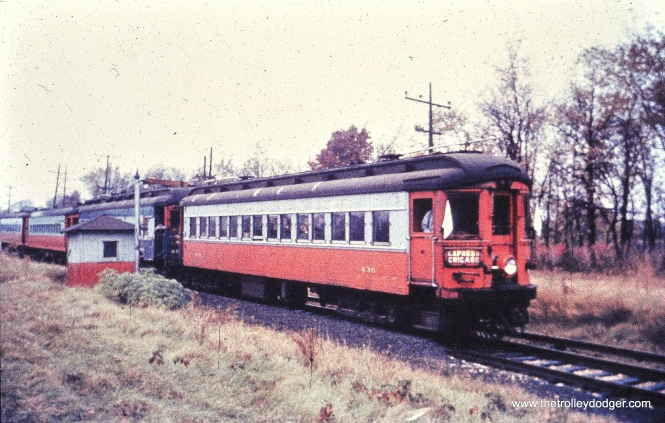
Today’s post ties a number of photos together under the heading “Lost and Found.” There are images from the Chicago, Aurora & Elgin, the North Shore Line, and various early preservation efforts. Two of the three great Chicago-area interurbans are lost to history.

Interestingly, among the “saved” equipment shown in these early photos, none of these cars is still at the same location where the pictures were taken. In the case of Milwaukee Electric car 882, it was still in use at a Wisconsin electric power plant as late as 1961, three years after the last Milwaukee streetcar ran on the streets. Yet, oddly enough, it does not appear to have been preserved.

While many of these early museum-type operations such as Trolleyville USA* are no longer with us, they should not be regarded as failures. They played a crucial role in saving many electric railcars from the dustbin of history, and provided a “bridge” to a welcome home in some of today’s more durable institutions.

So, while much of our transit history has been lost, thanks to a few dedicated individuals, not all of it was lost. And despite all the travails and convoluted ways that various cars were saved, there is still a rich history that survives to be found by future generations.

-David Sadowski

PS- Trolleyville USA in Olmstead Township, Ohio, which I visited in 1984, was part trolley museum, and part common carrier. It provided much-needed transportation between a trailer park and general store, both of which were owned by the late Gerald E. Brookins. It is thanks to him that many unique pieces of equipment were saved.

Let me take this opportunity to clear up a Trolleyville “factoid” that has circulated.

Cleveland was where Peter Witt developed his namesake streetcar design, but it is one of the ironies of history that none were saved. A solitary Cleveland Peter Witt car lasted until 1962 before it too was unfortunately scrapped.

Don’s Rail Photos reports, “4144 was built by Kuhlman Car Co in August 1929, (order) #951. It was retired in 1954 and sold to an individual in Lorain. It was lettered as Arlington Traction Co 4144.” Owner Norman Muller had the car in his yard with an organ installed inside.

Some have pondered why Gerald E. Brookins did not save the car. Some have speculated that he was tapped out after purchasing four of the curved-side CA&E cars or that Mrs. Brookins would not let him buy another car.

In 2014, author Blaine Hays told me the real story. He says Brookins had plenty of money and could easily have afforded to purchase the 4144. However, in general his interest in trolley cars was limited to purchasing ones that could be readily run on his short railroad. By 1962, the 4144 did not fit into this category and after having been changed around and stored outside for years, would have required a substantial amount of restoration work, in any case a lot more than Brookins wanted to do.

Thanks to Brookins, four of the ten Ca&E St. Louis-built cars from 1945 were saved. But of fate had turned a different way, all ten cars might have ended up in service on the Cleveland rapid on the airport extension. In the early 1960s, Cleveland transit officials were planning to build this extension “on the cheap,” using local funds. If they had, the CA&E cars would likely have provided the original rolling stock. As things turned out, the project got put off for a few years until Federal funds were available. It opened in 1968 with new equipment.

Ironically, at least one CA&E car (303) did eventually run on the Cleveland system. The Lake Shore Electric Railway was a short-lived successor to Trolleyville that planned to operate in Cleveland. Ultimately, the effort failed due to lack of funding, and the cars in the Brookins collection were sold at auction. Some ended up at the Illinois Railway Museum and the Fox River Trolley Museum, but I have seen pictures of the 303 running in Cleveland in the early 21st century with a pantograph installed.

Who’da thunk it?


Help Support The Trolley Dodger

gh1

This is our 119th post, and we are gradually creating a body of work and an online resource for the benefit of all railfans, everywhere. To date, we have received over 123,000 page views, for which we are very grateful.

You can help us continue our original transit research by checking out the fine products in our Online Store. You can make a donation there as well.

As we have said before, “If you buy here, we will be here.”

We thank you for your support.


img994srpo1

American Streetcar R.P.O.s

Mainline Railway Post Offices were in use in the United States from 1862 to 1978 (with the final year being operated by boat instead of on rails), but for a much briefer era, cable cars and streetcars were also used for mail handling in the following 15 cities*:

Baltimore
Boston
Brooklyn
Chicago
Cincinnati
Cleveland
New Bedford, Massachusetts
New York City
Philadelphia
Pittsburgh
Rochester, New York
St. Louis
San Francisco
Seattle
Washington, D.C.


*As noted by some of our readers, this list does not include interurban RPOs.

Our latest E-book American Streetcar R.P.O.s collects 12 books on this subject (nearly 1000 pages in all) onto a DVD data disc that can be read on any computer using Adobe Acrobat Reader, which is free software. All have been out of print for decades and are hard to find. In addition, there is an introductory essay by David Sadowski.

The rolling stock, routes, operations, and cancellation markings of the various American street railway post office systems are covered in detail. The era of the streetcar R.P.O. was relatively brief, covering 1893 to 1929, but it represented an improvement in mail handling over what came before, and it moved a lot of mail. In many places, it was possible to deposit a letter into a mail slot on a streetcar or cable car and have it delivered across town within a short number of hours.

These operations present a very interesting history, but are not well-known to railfans. We feel they deserve greater scrutiny, and therefore we are donating $1 from each sale of this item to the Mobile Post Office Society, in support of their efforts.

# of Discs – 1
Price: $19.95


CA&E 423 and 433 have just passed each other just west of the Forest Park terminal at DesPlaines Avenue in October 1953. Concordia cemetery is to the left. This is now the site of I-290.

CA&E 423 and 433 have just passed each other just west of the Forest Park terminal at DesPlaines Avenue in October 1953. Concordia cemetery is to the left. This is now the site of I-290.

Don's Rail Photos says CA&E 18 was "built by Niles Car in 1902. It was modernized in March 1941 and retired in 1955." Here it is at Wheaton on March 15, 1952.

Don’s Rail Photos says CA&E 18 was “built by Niles Car in 1902. It was modernized in March 1941 and retired in 1955.” Here it is at Wheaton on March 15, 1952.

Curved-sided CA&E car 455, built by St. Louis Car Company in 1945, at Wheaton on July 7, 1954.

Curved-sided CA&E car 455, built by St. Louis Car Company in 1945, at Wheaton on July 7, 1954.

Don's Rail Photos says CA&E merchandise express car 9 was "built by Niles Car in 1907. It was scrapped in 1959." It is shown here at Wheaton in August 1948.

Don’s Rail Photos says CA&E merchandise express car 9 was “built by Niles Car in 1907. It was scrapped in 1959.” It is shown here at Wheaton in August 1948.

CA&E 427 parked at Laramie Avenue in August 1948. It was built by the Cincinnati Car Company in 1927.

CA&E 427 parked at Laramie Avenue in August 1948. It was built by the Cincinnati Car Company in 1927.

The view looking south towards the Wilmette station on the CNS&M Shore Line Route, which was abandoned in 1955. For a view from the other end of the same station, look here. Northbound trains began street running on Greenleaf Avenue here.

The view looking south towards the Wilmette station on the CNS&M Shore Line Route, which was abandoned in 1955. For a view from the other end of the same station, look here. Northbound trains began street running on Greenleaf Avenue here.

The same location today, where the North Shore Line curved to the right to head west on Greenleaf.

The same location today, where the North Shore Line curved to the right to head west on Greenleaf.

Once the North shore Line entered Greenleaf, the street widened. We are looking west.

Once the North shore Line entered Greenleaf, the street widened. We are looking west.

Perhaps one of our keen-eyed readers can tell us if this photo of car 158 was also taken along Greenleaf Avenue in Wilmette.

Perhaps one of our keen-eyed readers can tell us if this photo of car 158 was also taken along Greenleaf Avenue in Wilmette.

Don's Rail Photos says that North Shore Line caboose 1003 "was built by American Car & Foundry Co in 1926. It was rebuilt without a cupola but restored when it was acquired by IRM." There was some discussion recently on a Yahoo group concerning CNS&M cabooses. Someone was interested in making a model, and this nice side view should help determine the dimensions.

Don’s Rail Photos says that North Shore Line caboose 1003 “was built by American Car & Foundry Co in 1926. It was rebuilt without a cupola but restored when it was acquired by IRM.” There was some discussion recently on a Yahoo group concerning CNS&M cabooses. Someone was interested in making a model, and this nice side view should help determine the dimensions.

An Electroliner at speed near Crawford looking west. This picture was taken from a passing train in 1960, three years before the North Shore Line quit. CTA's Skokie Swift began running in 1964. (Richard H. Young Photo)

An Electroliner at speed near Crawford looking west. This picture was taken from a passing train in 1960, three years before the North Shore Line quit. CTA’s Skokie Swift began running in 1964. (Richard H. Young Photo)

Today's CTA Yellow Line looking west from Crawford.

Today’s CTA Yellow Line looking west from Crawford.

CNS&M Silverliner 738 heads up a four-car special train making a station stop at Northbrook during a snowstorm in February 1960. (Richard H. Young Photo)

CNS&M Silverliner 738 heads up a four-car special train making a station stop at Northbrook during a snowstorm in February 1960. (Richard H. Young Photo)

CNS&M 150 in a night scene at Waukegan on January 26, 1962.

CNS&M 150 in a night scene at Waukegan on January 26, 1962.

Electroliner 804-803 at the CTA Roosevelt Road "L" station in Chicago on February 17, 1957.

Electroliner 804-803 at the CTA Roosevelt Road “L” station in Chicago on February 17, 1957.

CNS&M Electroliner 803-804 at Deerpath, Illinois, February 17, 1957. Could be the photographer boarded the train in the previous picture at Roosevelt road and got off here.

CNS&M Electroliner 803-804 at Deerpath, Illinois, February 17, 1957. Could be the photographer boarded the train in the previous picture at Roosevelt road and got off here.

Columbia Park and Southwestern 306, ex-Aurora, Elgin & Fox River Electric, ex-Shaker Heights Rapid Transit, at Gerald E. Brookins' Trolleyville USA in 1962. Electric operations appear to be underway already, or nearly so.

Columbia Park and Southwestern 306, ex-Aurora, Elgin & Fox River Electric, ex-Shaker Heights Rapid Transit, at Gerald E. Brookins’ Trolleyville USA in 1962. Electric operations appear to be underway already, or nearly so.

Don's Rail Photos says, "306 was built by St Louis Car in 1924, #1306. In 1936 it was sold to CI/SHRT as 306 and in 1954 it was sold to CP&SW as 306. It was transferred to the Illinois Railway Museum in 1984 where it is being restored as AE&FRECo 306."

Don’s Rail Photos says, “306 was built by St Louis Car in 1924, #1306. In 1936 it was sold to CI/SHRT as 306 and in 1954 it was sold to CP&SW as 306. It was transferred to the Illinois Railway Museum in 1984 where it is being restored as AE&FRECo 306.”

photo089

CTA Red Pullman 144 and Milwaukee streetcar 972 at the Illinois Electric Railway Museum in North Chicago, February 1960.

CTA Red Pullman 144 and Milwaukee streetcar 972 at the Illinois Electric Railway Museum in North Chicago, February 1960.

A snowy view of the 144 in February 1960, less than two years after this car last ran on the streets of Chicago (in a May 1958 fantrip).

A snowy view of the 144 in February 1960, less than two years after this car last ran on the streets of Chicago (in a May 1958 fantrip).

Indiana Railroad lightweight high-speed interurban car 65 at IERM in February 1960.

Indiana Railroad lightweight high-speed interurban car 65 at IERM in February 1960.

Don's Rail Photos says Milwaukee electric car 882 "was built by St Louis Car Co in 1920, (order) #1239. It was one manned in 1926 and rebuilt in 1954 with a plow on one end and a pilot on the other for use at the Lakeside Power Plant of WEPCo. It also had interurban headlights added. It ran until May 8, 1961." Unfortunately, it does not appear this car was saved.

Don’s Rail Photos says Milwaukee electric car 882 “was built by St Louis Car Co in 1920, (order) #1239. It was one manned in 1926 and rebuilt in 1954 with a plow on one end and a pilot on the other for use at the Lakeside Power Plant of WEPCo. It also had interurban headlights added. It ran until May 8, 1961.” Unfortunately, it does not appear this car was saved.

The two North Shore Line Electroliner sets had a second life for a while as Liberty Liners on the Red Arrow line between Philadelphia and Norristown. Red Arrow President Merritt H. Taylor Jr. (1922-2010) was a closet railfan, and the pride he took in saving these fine streamlined cars is clearly evident in the picture on this 1964 timetable, when they were put into service. This was a morale booster for both the railroad and its riders after enduring a 34-day strike in 1963, the only one in its history.

The two North Shore Line Electroliner sets had a second life for a while as Liberty Liners on the Red Arrow line between Philadelphia and Norristown. Red Arrow President Merritt H. Taylor Jr. (1922-2010) was a closet railfan, and the pride he took in saving these fine streamlined cars is clearly evident in the picture on this 1964 timetable, when they were put into service. This was a morale booster for both the railroad and its riders after enduring a 34-day strike in 1963, the only one in its history.

CNS&M 162 at the American Museum of Electricity in Schenectady, New York in 1968. Don's Rail Photos says, "162 was built by Brill in 1915, #19605. It was acquired by American Museum of Electricity in 1963 and resold to Connecticut Trolley Museum."

CNS&M 162 at the American Museum of Electricity in Schenectady, New York in 1968. Don’s Rail Photos says, “162 was built by Brill in 1915, #19605. It was acquired by American Museum of Electricity in 1963 and resold to Connecticut Trolley Museum.”

This 1968 photo presents a bit of a mystery. The only other North Shore car owned by the American Museum of Electricity was 710, sold along with the 162 to the Connecticut Trolley Museum in 1971. But there are other cars shown in this line-up, and the partial number for this one looks like it's in the 750-series. Stephen B. Rudolph adds, "I just dug up an identical print of the photo of the boarded-up CNS&M 755. The back of my print is machine-dated by the photofinisher "JUNE 64." This wasn't somebody's rubber date stamper, so I think it's correct. Consequently, I believe the 1968 date stated above is incorrect."

This 1968 photo presents a bit of a mystery. The only other North Shore car owned by the American Museum of Electricity was 710, sold along with the 162 to the Connecticut Trolley Museum in 1971. But there are other cars shown in this line-up, and the partial number for this one looks like it’s in the 750-series. Stephen B. Rudolph adds, “I just dug up an identical print of the photo of the boarded-up CNS&M 755. The back of my print is machine-dated by the photofinisher “JUNE 64.” This wasn’t somebody’s rubber date stamper, so I think it’s correct. Consequently, I believe the 1968 date stated above is incorrect.”

The Rider’s Reader

The Rider's Reader was a small four page periodical put out by CTA and distributed via buses, streetcars, and "L" cars between 1948 and 1951.

The Rider’s Reader was a small four page periodical put out by CTA and distributed via buses, streetcars, and “L” cars between 1948 and 1951.

One of the advantages of an electronic book, besides the ease of use on your home computer, is that it can easily be updated when new information becomes available. We have recently obtained14 additional issues of the CTA Rider’s Reader, which was published from 1948 to 1951. In addition, we now have the 1964 CTA rapid transit system track map.

Since we already had two copies of Rider’s Reader before, this brings our collection to 16 out of what appear to be 18 issues in all:

Volume 1, Number 1 – March 1948
Volume 1, Number 2 -May 1948
Volume 1, Number 3 – July-August 1948
Volume 1, Number 4 – October 1948
Volume 1, Number 5 – December 1948
Volume 2, Number 1 – March 1949
Volume 3, Number 1 – May 1949
(appears to be a numbering error– should be Volume 2, Number 2)
Volume 2, Number 3 – August 1949
Volume 2, Number 4 – November 1949
Volume 2, Number 5 – December 1949
Volume 2, Number 6 – February 1950
Volume 3, Number 1 – May 1950
Volume 3, Number 2 – July 1950
Volume 3, Number 3 – October 1950
Volume 3, Number 5 – February 1951
Volume 4, Number 1 – June 1951

The final issue has a very different format than the others, de-emphasizing the Rider’s Reader name, probably suggesting a change in direction at CTA that led to this publication being discontinued. Perhaps it was felt preferable to use flyers that were targeted to more specific topics. It’s been our experience that such publications often include a lot of useful tidbits of information not found elsewhere.

We are still in need of Volume 3, Number 4 – late 1950 or early 1951. If any of our readers can help us fill out our collection, we would be greatly appreciative. (We’re not entirely sure, but there may also have been a Volume 3, Number 6 in early 1951, which would make 19 issues in all. If so, we need that one too.)

High-resolution scans have been made of these issues, and the 14 additional ones have now been added our two E-books that cover the CTA:

Chicago’s PCC Streetcars: The Rest of the Story – DVD02
The “New Look” in Chicago Transit: 1938-1973 – DVD03

While most of the material on these discs is unique, there is inevitably some overlap between them, there is inevitably some overlap, since CTA publications often covered both the surface system and rapid transit. But in general, DVD02 concentrates on streetcars, while DVD03 favors the rapid transit and buses.

You will find these and other fine products in our Online Store.

Update Service

We haven’t forgotten those who have already purchased these DVD data discs from us. If you bought one of these before, and now wish to have an updated disc, we can send you one for just $5.00 within the United States. Just drop us a line and we can send you an online invoice.

Your other alternative is to download the updated files via Dropbox, a cloud-based file sharing service that you can use for free. That is usually the preferred alternative if you live outside the US.

We will continue to add to both these titles in the future.


Help Support The Trolley Dodger

gh1

This is our 116th post, and we are gradually creating a body of work and an online resource for the benefit of all railfans, everywhere. To date, we have received over 118,000 page views, for which we are very grateful.

You can help us continue our original transit research by checking out the fine products in our Online Store. You can make a donation there as well.

As we have said before, “If you buy here, we will be here.”

We thank you for your support.


Some highlights from the Rider’s Reader:

CTA surface system improvements for the second quarter of 1948 included putting PCC streetcars on Madison and 63rd Street. They were already running on Clark-Wentworth and Broadway-State. They would be put on Western Avenue in the third quarter, which involved a partial substitution by buses on the outer ends of the route.

CTA surface system improvements for the second quarter of 1948 included putting PCC streetcars on Madison and 63rd Street. They were already running on Clark-Wentworth and Broadway-State. They would be put on Western Avenue in the third quarter, which involved a partial substitution by buses on the outer ends of the route.

"Another New CTA Bus," in this case, is a trolley bus. These were put into service on Montrose Avenue in late March, 1948.

“Another New CTA Bus,” in this case, is a trolley bus. These were put into service on Montrose Avenue in late March, 1948.

CTA A/B "skip stop" service, introduced on the Lake Street "L" in April 1948, may very well have saved this line from eventual elimination. A/B service was soon expanded to other routes but has since been discontinued.

CTA A/B “skip stop” service, introduced on the Lake Street “L” in April 1948, may very well have saved this line from eventual elimination. A/B service was soon expanded to other routes but has since been discontinued.

The #97 was CTA's first suburban bus route and replaced the Niles Center "L" service on March 27, 1948. Just over 16 years later, however, CTA introduced the Skokie Swift over the same trackage. The #97 bus continued in service.

The #97 was CTA’s first suburban bus route and replaced the Niles Center “L” service on March 27, 1948. Just over 16 years later, however, CTA introduced the Skokie Swift over the same trackage. The #97 bus continued in service.

Artist's rendering of a "flat door" 6000-series "L" car. These were needed to begin service in the Dearborn-Milwaukee subway. As it turned out, deliveries did not begin until 1950 and the subway opened in February 1951.

Artist’s rendering of a “flat door” 6000-series “L” car. These were needed to begin service in the Dearborn-Milwaukee subway. As it turned out, deliveries did not begin until 1950 and the subway opened in February 1951.

Once A/B service was put into effect on the LakeStreet "L" in 1948, CTA considered the Market Street stub terminal unnecessary and it was torn down. At the time, it was also reported that the City of Chicago wanted it removed, probably because it stood in the way of eventual construction of Lower Wacker Drive, which was related to the Congress Expressway project.

Once A/B service was put into effect on the LakeStreet “L” in 1948, CTA considered the Market Street stub terminal unnecessary and it was torn down. At the time, it was also reported that the City of Chicago wanted it removed, probably because it stood in the way of eventual construction of Lower Wacker Drive, which was related to the Congress Expressway project.

9763, the CTA's first and only articulated trolley bus, was termed the "Queen Mary" by fans. It seems to have been a semi-official name since it is called that in an issue of the Rider's Reader. It has since been preserved at the Illinois Railway Museum.

9763, the CTA’s first and only articulated trolley bus, was termed the “Queen Mary” by fans. It seems to have been a semi-official name since it is called that in an issue of the Rider’s Reader. It has since been preserved at the Illinois Railway Museum.

In this 1950 diagram, CTA explained why it was sometimes necessary to use switchbacks to prevent the bunching up of streetcars.

In this 1950 diagram, CTA explained why it was sometimes necessary to use switchbacks to prevent the bunching up of streetcars.

The Rider's Reader gave a rundown on the Met "L" bridge over the Chicago River, which was actually two bridges with a total of four tracks. Since this bridge served three lines, service could continue to operate even if something happened to one of the bridges. This river bridge, unlike the others, was operated by CTA and not the city.

The Rider’s Reader gave a rundown on the Met “L” bridge over the Chicago River, which was actually two bridges with a total of four tracks. Since this bridge served three lines, service could continue to operate even if something happened to one of the bridges. This river bridge, unlike the others, was operated by CTA and not the city.

CTA reproduced this Minneapolis Star editorial cartoon in July 1950. We will let the readers decide whether this was indicative of an increasing anti-streetcar sentiment on the part of CTA.

CTA reproduced this Minneapolis Star editorial cartoon in July 1950. We will let the readers decide whether this was indicative of an increasing anti-streetcar sentiment on the part of CTA.

The first train of new 6000-series cars put into service in 1950.

The first train of new 6000-series cars put into service in 1950.

CTA streetcars in the winter of 1950-51. One of our readers says this is "Clark Street looking north around Hubbard."

CTA streetcars in the winter of 1950-51. One of our readers says this is “Clark Street looking north around Hubbard.”

We have three of the four 1948 issues.

We have three of the four 1948 issues.

Five issues came out in 1949.

Five issues came out in 1949.

We have four out of the five issues from 1950.

We have four out of the five issues from 1950.

Only two issues appear to have come out in 1951. The final issue has a completely different format.

Only two issues appear to have come out in 1951. The final issue has a completely different format.

The October 1964 CTA rapid transit track map joins the June 1958 version in two of our publications.

The October 1964 CTA rapid transit track map joins the June 1958 version in two of our publications.

Mystery Photos

Finally, here are a couple of “mystery photos” from downtown Chicago in the late 1920s or early 1930s. If you can help us figure out the locations and what event this might have been, we would appreciate it:

This picture, and the next, appear to have been taken in the late 1920s or early 1930s. The banners would indicate an event, but we are not sure of the occasion. One of our readers says this is "State and Washington looking south." This could also be circa 1926 at the time of the Eucharistic Congress.

This picture, and the next, appear to have been taken in the late 1920s or early 1930s. The banners would indicate an event, but we are not sure of the occasion. One of our readers says this is “State and Washington looking south.” This could also be circa 1926 at the time of the Eucharistic Congress.

Our readers have identified this as being "Holy Name Cathedral at State and Chicago." The occasion may be the Eucharistic Congress in 1926.

Our readers have identified this as being “Holy Name Cathedral at State and Chicago.” The occasion may be the Eucharistic Congress in 1926.

Recently, there was another such mystery posed to the Chicagotransit Yahoo group by P. Chavin:

Roughly a quarter of the way down on the web page linked below, at “May 23, 2015 – 6:24 pm”, is a color photo of a streetcar and a wide boulevard. The caption reads: “PHOTO – CHICAGO – DOUGLAS PARK – PULLMAN STREETCAR – 1951 – EDITED FROM AN AL CHIONE IMAGE”

I assume this photo shows a westbound Ogden Ave. car at about S. California Ave. and that the view is northeasterly down Ogden Ave. (Blvd.).

If anyone can confirm or correct my assumption, I’d appreciate it.

https://chuckmanchicagonostalgia.wordpress.com/2015/05/


That sounds plausible. There is some evidence in the picture that we are near a park. But what is the explanation for the streetcar taking a jog at this point?

If this is Ogden and California, then there don’t appear to be any of the old buildings left that could be checked against the picture. (PS- I note there are a few pictures on that page that could have been lifted from The Trolley Dodger, but that’s OK.)

P. Chavin:

Thanks, David, for giving it a shot. At least I know my query wasn’t completely underwhelming to the group. The explanation for the streetcar taking a jog could well be that the car was coming off tracks that were on the sides of the wide boulevard but at this point, they were narrowing to a normal middle-of-the-street double track layout.


Later, Dennis McClendon came up with a very good answer:

The sun angle, the US34 and US66 signs, the view of the Board of Trade, and the park benches on the left all make me think we’re indeed looking northeast across California. The four-story round-cornered apartment building on the corner matches the fire insurance map.

Why are the tracks shifting from the service drives to the center roadway? My only theory is that the Park District was in charge of the service drives through Douglas Park, but not the original width of Ogden (which predated establishment of the West Parks Commission), and declined to permit the streetcar line to occupy the park service drives. The 1938 and 1953 aerial photos aren’t clear enough to show the tracks.


Daniel Joseph
writes:

I rode this part of the Ogden streetcar line many times as a child and can explain the “what” but not the “why”. North east of the location of this photo (which is about mid way between Sacramento and California) the streetcar tracks were in the service drive until Roosevelt Road. East of Ogden on Roosevelt the tracks continued in the service drive until Ashland. On Ogden. west of the location of the photo, the track continued in the center of the street and the service drive was a boulevard until the end at Albany.


Ogden and California Avenue today, looking to the northeast.

Ogden and California Avenue today, looking to the northeast.

Keep those cards and letters coming in, folks. You can leave a comment on this or any other post directly, or you can drop us a line at:

thetrolleydodger@gmail.com

-David Sadowski


PS- Thanks to the generosity of Mark Llanuza, we have added a few more pictures to our previous post Trolley Dodger Mailbag, 1-29-2016:

The CERA fantrip train in Lombard, still just three cars at this point. The date is October 26, 1958. (Mark Llanuza Collection)

The CERA fantrip train in Lombard, still just three cars at this point. The date is October 26, 1958. (Mark Llanuza Collection)

The four-car CERA fantrip train at Raymond Street in Elgin. Mark Llanuza says the entire day was cold and rainy, and they had to add a fourth car at Wheaton because of the large number of people on this trip. (Mark Llanuza Collection)

The four-car CERA fantrip train at Raymond Street in Elgin. Mark Llanuza says the entire day was cold and rainy, and they had to add a fourth car at Wheaton because of the large number of people on this trip. (Mark Llanuza Collection)

This must be the April 1962 train taking CA&E equipment purchased by RELIC, the predecessor to the Fox River Trolley Museum. According to Don’s Rail Photos, “11 was built by Brill in 1910, (order) #16483. It was rebuilt to a line car in 1947 and replaced 45. It was acquired by Railway Equipment Leasing & Investment Co in 1962 and came to Fox River Trolley Museum in 1984. It was lettered as Fox River & Eastern." This picture was taken in Glen Ellyn along the C&NW. (Mark Llanuza Collection)

This must be the April 1962 train taking CA&E equipment purchased by RELIC, the predecessor to the Fox River Trolley Museum. According to Don’s Rail Photos, “11 was built by Brill in 1910, (order) #16483. It was rebuilt to a line car in 1947 and replaced 45. It was acquired by Railway Equipment Leasing & Investment Co in 1962 and came to Fox River Trolley Museum in 1984. It was lettered as Fox River & Eastern.” This picture was taken in Glen Ellyn along the C&NW. (Mark Llanuza Collection)

The rescue train taking CA&E cars purchased by RELIC through Glen Ellyn. (Mark Llanuza Collection)

The rescue train taking CA&E cars purchased by RELIC through Glen Ellyn. (Mark Llanuza Collection)

Trolley Dodger Mailbag, 1-29-2016

Our previous post Trolley Dodgers (January 15, 2016) included a photo of the old Market Street stub terminal in downtown Chicago. Here is another view, probably from the late 1930s. It was torn down in 1948 after the CTA introduced A/B "skip-stop" service on the Lake Street "L", which rendered it unnecessary. (Chicago Transit Authority Photo)

Our previous post Trolley Dodgers (January 15, 2016) included a photo of the old Market Street stub terminal in downtown Chicago. Here is another view, probably from the late 1930s. It was torn down in 1948 after the CTA introduced A/B “skip-stop” service on the Lake Street “L”, which rendered it unnecessary. (Chicago Transit Authority Photo)

The Trolley Dodger mailbag is pretty full today, since we have received a lot of interesting correspondence lately. Mark Llanuza writes:

How did you get so interested in the CA&E?

I have lived in Chicago’s western suburbs pretty much my entire life. I was born in 1954 and therefore never rode the CA&E. As it was, my mother says she only rode it once, in 1946 as part of an outing with other people from the office she worked in downtown.

I know my mother took the Garfield Park “L” downtown when she worked there in 1952-53, after she married to my dad. They lived in Forest Park for a time.

In general, however, after my parents moved to the Mont Clare neighborhood, we took either the Lake Street “L” or the Logan Square line. (Although we lived very close to the Milwaukee Road commuter train, we didn’t ride it that much.)

When it was reported in the press in 1961 that the CA&E would be dismantled forever, my family took a Sunday drive out to Wheaton, where we looked forlornly at the cars in dead storage in the yard. I recall being glad at the time that they had not been vandalized.

When the Illinois Railway Museum began rail operations around 1966, we drove out there to ride the trains. And I have been back many, many times since.

As I grew up, I learned more and more about the CA&E, and am still learning.

Mark continues:

There were three final passenger trips that took place at year’s end in 1958. On Oct 26th the Central Electric Railfans’ Association chartered three cars (with a fourth car added later due to extra loading). It was listed as the last steel car trip and went to Elgin .

The second trip was charted on Nov 21st by a church group, and went from Glen Ellyn to Clintonville station, to the Fox Valley RR club.

The final one was on December 7th 1958, which I sent you many photos of, but I may have some more.

Mark did in fact send us more images, reproduced below. The ones from the final fantrip have also been added to our previous post A Cold Last Ride (January 25, 2016). We thank him for his generosity in sharing them with our readers.

Mark Llanuza's collection of CA&E slides include Kodachromes and Ektachromes. Kodachrome II was an improved version (with the film speed increased to ISO 25) released near the end of 1961. The original photographer's name is not known. (Mark Llanuza Photo)

Mark Llanuza’s collection of CA&E slides include Kodachromes and Ektachromes. Kodachrome II was an improved version (with the film speed increased to ISO 25) released near the end of 1961. The original photographer’s name is not known. (Mark Llanuza Photo)

The CERA fantrip train on the CA&E at Raymond Street, October 26, 1958. (Mark Llanuza Collection) This is the same curve where several photos were taken during the December trip, where we got them identified as near the Corrugated Box Company.

The CERA fantrip train on the CA&E at Raymond Street, October 26, 1958. (Mark Llanuza Collection) This is the same curve where several photos were taken during the December trip, where we got them identified as near the Corrugated Box Company.

The CERA fantrip train at 5th Avenue in Maywood, looking east, still just three cars at this point. The date is October 26, 1958 and the photographer was standing at the end of the platform, which is why the position is slightly elevated. (Mark Llanuza Collection)

TThe CERA fantrip train at 5th Avenue in Maywood, looking east, still just three cars at this point. The date is October 26, 1958 and the photographer was standing at the end of the platform, which is why the position is slightly elevated. (Mark Llanuza Collection)

Fifth Avenue in Maywood as it looks today. We are facing east.

Fifth Avenue in Maywood as it looks today. We are facing east.

The four-car CERA fantrip train at Raymond Street in Elgin. Mark Llanuza says the entire day was cold and rainy, and they had to add a fourth car at Wheaton because of the large number of people on this trip. (Mark Llanuza Collection)

The four-car CERA fantrip train at Raymond Street in Elgin. Mark Llanuza says the entire day was cold and rainy, and they had to add a fourth car at Wheaton because of the large number of people on this trip. (Mark Llanuza Collection)

320-319 near the Corrugated Box Company on the Elgin branch, December 7, 1958. (Mark Llanuza Collection)

320-319 near the Corrugated Box Company on the Elgin branch, December 7, 1958. (Mark Llanuza Collection)

320 and engineer at the Lakewood station in West Chicago, December 7, 1958. As the CA&E operations wound down, starting with the abandonment of passenger service in 1957, employees were retained on the basis of seniority. Newer ones were let go while the oldest and longest serving employees remained. (Mark Llanuza Collection)

320 and engineer at the Lakewood station in West Chicago, December 7, 1958. As the CA&E operations wound down, starting with the abandonment of passenger service in 1957, employees were retained on the basis of seniority. Newer ones were let go while the oldest and longest serving employees remained. (Mark Llanuza Collection)

319-320 near the Clintonville Station on the Elgin branch, December 7, 1958. (Mark Llanuza Collection)

319-320 near the Clintonville Station on the Elgin branch, December 7, 1958. (Mark Llanuza Collection)

Mark also sent us a couple of before and after pictures:

1953 and 2015 compared in South Elgin. (Mark Llanuza Photo)

1953 and 2015 compared in South Elgin. (Mark Llanuza Photo)

1953 and 2015 at Lakewood. (Mark Llanuza Photo)

1953 and 2015 at Lakewood. (Mark Llanuza Photo)


We also came across some CA&E ephemera:

Lucian C. Sprague (1882-1960) was president of the Minneapolis and St. Louis Railway from 1935 to 1954, and received this pass from the Chicago, Aurora & Elgin. Officials from various railroads gave each other these sorts of passes as a professional courtesy. The Chicago & North Western bought the Minneapolis and St. Louis in 1960.

Lucian C. Sprague (1882-1960) was president of the Minneapolis and St. Louis Railway from 1935 to 1954, and received this pass from the Chicago, Aurora & Elgin. Officials from various railroads gave each other these sorts of passes as a professional courtesy. The Chicago & North Western bought the Minneapolis and St. Louis in 1960.

There was recently some discussion on Facebook regarding CA&E’s extensive use of uncovered third rail without fencing. It was noted that this arrangement had been in place since 1902 and residents of Chicago’s western suburbs were used to it. However, there were various signs warning of the dangers. If the CA&E had survived to the present time, no doubt there would be more protections in place.

This metal sign, said to have been used on the Chicago, Aurora & Elgin, recently sold on eBay for $280.

This metal sign, said to have been used on the Chicago, Aurora & Elgin, recently sold on eBay for $280.

caesign2


The CA&E 315 Story

Joel Salomon writes:

Thanks for the recent posting of all the great CA&E pictures on The Trolley Dodger blog. Some really fascinating images in that post.

I am a member and long time volunteer at the Rockhill Trolley Museum in Rockhill Furnace, PA. We have CA&E 315 at our museum and we are in the process of restoring the car to its original condition as built in 1909,or as close as we can make it.

One question that had always wondered me and others at the museum is how did 315 get out of Chicago and are there any photos of the car after the CA&E abandoned operations? We know the car was stored in a CN&W roundhouse for nearly a year and copies of that invoice are enclosed. But the big question is when did 315 leave the CA&E for the last time and are there any photos of that move? We do know when the car was ready to be moved to Pennsylvania the car was placed on a depressed flatcar and the trucks placed in a gondola car and moved to Mt. Union, PA. It was moved by a highway truck 11 miles to the museum site.

Do you know anyone that I might contact to help with this unknown part of the 315 story? I would appreciate knowing anyone that might be able to answer some of these questions or have pictures of 315 during its years on the CA&E as well as after abandonment.

Thanks for your help with these questions.

Thanks for writing. If, as I suspect, you are related to the late Gerhard Salomon, you might like to know I regard him as a hero for all his preservation efforts over the decades. I can only wish I had met the man to thank him personally.

While I do not have immediate answers to your various questions, I am confidant that I can help you find out, with the help of our readers.

One of my recent blog posts mentioned how the 320 (now at Mt. Pleasant) was the only car taken off the property that did not leave via a temporary interchange track with the C&NW.

It may very well be that the 315 left at the same time as some other cars that were saved, especially the ones that were heading east.

With any luck, I hope it will be possible to visit your fine museum sometime this year.

-David Sadowski

Joel Salomon is too modest. He is in fact the president of the museum. The images that follow are courtesy of Joel Salomon and the Rockhill Trolley Museum:

Screen Shot 01-29-16 at 05.59 AM.PNG

Screen Shot 01-29-16 at 05.59 AM 001.PNG

RTY-PP CAE 315 184

315 flatcar side

RTY 315 Moving to RTM 038

Perhaps somewhat coincidentally, Mark Llaunza writes:

Here are some interesting last CA&E moves from April 1962. An interchange track was built at Wheaton to pick up cars from the yards. Trains were bought over to West Chicago to run around them, and they then headed back to Chicago.

While these photos do not necessarily help answer Mr. Salomon’s question, they do show seven CA&E cars being moved off the property in April 1962. If there were, as I have read, three such trains of cars, with the 320 being handled separately, then perhaps we have a one in three chance that the 315 was part of this train movement.

Since one of the invoices shown above pro-rated the cost for moving the 315 as 1/7th of the total, that would be another indication that it may have been in the group shown in these pictures. There most likely could not have been three such trains, as I recall only around 19 cars were saved. Maybe that improves our odds to 50% or perhaps greater.

The only car whose number I can recognize in these photos is the 303, which originally went to Trolleyville USA in Ohio. However, none of the cars in this photo have curved sides, so the four cars from the 451-460 series, which also went to the Gerald E. Brookins operation, are not among them and would have been moved in a different trip.

The 303 is preserved today at the Connecticut Trolley Museum. The 315 has been owned by the Rockhill group all along.

Update:

Frank Hicks writes:

IRM and RELIC each had their own “hospital train” and the 320 left separately so, by process of elimination, we can figure that the 315 was indeed in the seven-car “eastern museums” train in Mark’s photos. It looks to me like the order was 303-409-319-36-315-308-318.

BINGO! Thanks so much.

PS- The Railway Equipment Leasing and Investment Co. was the predecessor of the Fox River Trolley Museum.

Leaving the Wheaton interchange with the C&NW, April 1962. (Mark Llanuza Collection)

Leaving the Wheaton interchange with the C&NW, April 1962. (Mark Llanuza Collection)

On the C&NW at Wheaton in April 1962. (Mark Llanuza Collection)

On the C&NW at Wheaton in April 1962. (Mark Llanuza Collection)

The saved CA&E cars on the C&NW in West Chicago, April 1962. (Mark Llanuza Collection)

The saved CA&E cars on the C&NW in West Chicago, April 1962. (Mark Llanuza Collection)

The saved CA&E cars on the C&NW in West Chicago, April 1962. (Mark Llanuza Collection)

The saved CA&E cars on the C&NW in West Chicago, April 1962. (Mark Llanuza Collection)

On the C&NW at Western Avenue in April 1962. (Mark Llanuza Collection)

On the C&NW at Western Avenue in April 1962. (Mark Llanuza Collection)

This must be the March 24, 1962 train taking CA&E equipment purchased by RELIC, the predecessor to the Fox River Trolley Museum. According to Don’s Rail Photos, “11 was built by Brill in 1910, (order) #16483. It was rebuilt to a line car in 1947 and replaced 45. It was acquired by Railway Equipment Leasing & Investment Co in 1962 and came to Fox River Trolley Museum in 1984. It was lettered as Fox River & Eastern." This picture was taken in Glen Ellyn along the C&NW. (Mark Llanuza Collection)

This must be the March 24, 1962 train taking CA&E equipment purchased by RELIC, the predecessor to the Fox River Trolley Museum. According to Don’s Rail Photos, “11 was built by Brill in 1910, (order) #16483. It was rebuilt to a line car in 1947 and replaced 45. It was acquired by Railway Equipment Leasing & Investment Co in 1962 and came to Fox River Trolley Museum in 1984. It was lettered as Fox River & Eastern.” This picture was taken in Glen Ellyn along the C&NW. (Mark Llanuza Collection)

From www.thegreatthirdrail.org: The end has come for the Roarin’ Elgin. The rails have rusted over and the hallmark of the railroad, the third rail, has already been taken off of the third rail chairs. Fortunately all isn’t lost. On March 24, 1962, we see EJ&E 212 hauling several CA&E cars past the Wheaton station and Main Street to be preserved at RELIC (today’s Fox River Trolley Museum). Photo by TH Desnoyers, from the Krambles-Peterson Archive

From http://www.thegreatthirdrail.org: The end has come for the Roarin’ Elgin. The rails have rusted over and the hallmark of the railroad, the third rail, has already been taken off of the third rail chairs. Fortunately all isn’t lost. On March 24, 1962, we see EJ&E 212 hauling several CA&E cars past the Wheaton station and Main Street to be preserved at RELIC (today’s Fox River Trolley Museum).
Photo by TH Desnoyers, from the Krambles-Peterson Archive

The rescue train taking CA&E cars purchased by RELIC through Glen Ellyn. (Mark Llanuza Collection)

The rescue train taking CA&E cars purchased by RELIC through Glen Ellyn. (Mark Llanuza Collection)


The Trolley Motel

Ruth Morgan writes:

There is a thesis at Mississippi State University on Land Use in Starkville. It is about 4 inches thick. I am attaching the pages on a trolley motel which is thought to have been the largest in the world. The trolleys were purchased by Vernon Chesteen from Birmingham and made into his motel prior to building one. It had a nice gas island with a streetcar diner. I located an aerial photo. I write an article for the Starkville paper entitled From Days Past and am trying to verify information. What I send you is true. The motel was on Highway 182 about a block west of town.

I wasn’t able to come up with anything about this Trolley Motel via a Google search. Perhaps my readers might know something more.

On Don’s Rail Photos, there is a page with information on the Birmingham streetcars themselves. Note this part:

Then, in August, 1941, cars 812, 816, 817, 830 thru 833, 835, and 838 were scrapped. A number of these car bodies were saved for non rail use, such as sheds and cabins.

Chances are those were the nine cars that were used for the Trolley Motel and associated diner. There is a picture of one such type car, which is known as a double-truck Birney. These cars were built in 1919 and 1920 by the Cincinnati Car Company, and were originally double-ended. They were eventually converted into single-end cars.

When these trolley cars were taken out of service, the motors, wheels, seats and control equipment would have been removed and saved for use on the remaining cars in that series. The car bodies would have been offered for sale, and would have been especially desirable in the immediate post-WWII era, when there was a housing shortage.

Back in those days, postcards were made of just about anything. It’s quite possible that a picture postcard may exist somewhere showing the Trolley Motel. Perhaps our readers may know something.

Ruth replies:

According to the thesis Lucille Liston Mitlin submitted to MSU to receive her master’s in geology and geography in August 1975, entitled “The Historical Development of Land Use in Starkville Mississippi, a Small University City,” it shows there was not much in the area during her days on campus.

The Trolley Motel was replaced by the University Motel about 1960 and all the “stars” who performed at MSU stayed there, including Johnny Cash. The motel no longer exists. Thank you so much for your research.

(Images below are courtesy of Ruth Morgan.)

This section of a 1975 dissertation describes how nine streetcar bodies from Birmingham, Alabama were used in a "Trolley Motel" in Mississippi. Eight were used as cabins and the ninth was a diner.

This section of a 1975 dissertation describes how nine streetcar bodies from Birmingham, Alabama were used in a “Trolley Motel” in Mississippi. Eight were used as cabins and the ninth was a diner.

An aerial photo, probably from the late 1940s, where you can just barely make out (at right) some of the streetcars in the Trolley Motel.

An aerial photo, probably from the late 1940s, where you can just barely make out (at right) some of the streetcars in the Trolley Motel.

Above is a 1952 MSU annual showing ads for the Gas Island, mentioning the diner and tourists.

Above is a 1952 MSU annual showing ads for the Gas Island, mentioning the diner and tourists.

Ruth sent us another note after this was posted:

THANK YOU! You are to be commended for the excellent job you do. This is the most reliable website I have seen. I talked to Mrs. V. J. Robinson, the sister-in-law of Mrs. Vernon Chesteen (about 90 years old). She remembers the trolley car motel. She said each trolley had 2 rooms so that would have been 16 rooms for the motel. Her two sisters worked in the trolley that was the diner. She is searching for old photos. Her mind is still clear as can be She has fond memories of the trolley car motel. Our town was crowded with students coming to Mississippi State University after the war. We had our largest increase in students during this time. Thank you again.

We are only too glad to help out. It’s worth pointing out that calling a double-truck Birney streetcar the largest in the world is a bit of hyperbole. I’m sure it was large, but of the same general size as plenty of other streetcars.


North Shore Line Abandoned Track?

Our youthful railfan Joey Morrow writes:

Does the North Shore Line have any abandoned track? The Skokie Valley doesn’t count because it was not abandoned when the NSL closed it’s doors. But I’ve found some track from the late 90’s though:

image1

image1-1

Skokie Valley? Nope that track was used after the abandonment. But the Shore Line might have some abandoned platforms– the Winnetka platform was still there in 2014. According to (http://www.sarahrothschild.com/real-estate–history-blog/archives/12-2014). The Indian Hill platform was still there in the late 90’s according to http://www.chicagorailfan.com/mpupn.html.
But the tracks… To find both the southbound and the northbound tracks, they weren’t dug up. They were surrounded in concrete almost impossible to notice. But… On 27 Ct. and 52 St. you will see them!

index

image3

(Be aware this is in July 2012 not 2016) I was so happy I almost started crying! To know that the fate of a few yards of track on the Chicago Aurora and Elgin, would be the same for a few yards of track on the Chicago North Shore and Milwaukee! North of this location but before the line turns towards Racine, there might be some more. North of 45th St. I want to check it out, but I don’t live in Kenosha anymore, not even in the Midwest. No where near where I want to be.

Good work, Joey. Perhaps one of our readers can tell us whether your detective work is correct. And in the meantime, keep trying to turn your dreams into your realities. That’s what life is all about.

-David Sadowski

Keep those cards and letters coming in, folks. You can either leave a comment on this or any other post, or reach us at:

thetrolleydodger@gmail.com


Help Support The Trolley Dodger

gh1

This is our 115th post, and we are gradually creating a body of work and an online resource for the benefit of all railfans, everywhere. To date, we have received over 117,000 page views, for which we are very grateful.

You can help us continue our original transit research by checking out the fine products in our Online Store. You can make a donation there as well.

As we have said before, “If you buy here, we will be here.”

We thank you for your support.


Attention, Juice Fans!

Ephemera from a 1957 CA&E fantrip organized by the late Maury Klebolt. He later moved to San Francisco and was instrumental in starting the historic trolley operations that continue to this day. (William Barber Collection)

Ephemera from a 1957 CA&E fantrip organized by the late Maury Klebolt. He later moved to San Francisco and was instrumental in starting the historic trolley operations that continue to this day. (William Barber Collection)

Back in the 1930s and 40s, railfans were sometimes referred to as “juice fans,” since they liked electric trains. I suppose this was a derisive term, at first, coined by outsiders to the hobby. But like many such nicknames, it was gradually embraced by the fans, who eventually wore it as a badge of honor. This explains its use in a 1957 flyer advertising a fantrip on the Chicago, Aurora & Elgin in its last weeks of passenger operation, reproduced above.

Eventually, the term fell out of favor, and is about as common today as “Oh, you kid” or “23 Skidoo.”

Some months back, William Barber shared with us a picture taken on a 1957 Chicago, Aurora & Elgin fantrip. There was some question about the location, which our readers eventually identified as being on the Batavia branch, in the section between the old power house and the Batavia terminal.

One of the CA&E pictures in our last post Tokens of Our Esteem (January 20th) got Mr. Barber interested in sharing some additional CA&E pictures with us:

This 1955 photo's a bit of a mystery. Could this be Wheaton? William Barber: "Yes, this is Wheaton at the grade crossing immediately east of the depot." The location is Main Street looking east.

This 1955 photo’s a bit of a mystery. Could this be Wheaton? William Barber: “Yes, this is Wheaton at the grade crossing immediately east of the depot.” The location is Main Street looking east.

Main street looking east on Wheaton as it looks today.

Main street looking east on Wheaton as it looks today.

Bill Barber:

Reference this photo from the 01/20/16 Trolley Dodger. Yes, this is Wheaton at the grade crossing immediately east of the depot. Below are several photos that I took around 1959 or 1960. I apologize for the poor quality. The first one was taken from the upper platform of the tower looking east. Note the same building in the background and the the dead end switch leading from the eastbound main just before the next grade crossing. I have also attached some photos that my dad took on a 1957 Illini Railroad Club excursion.

The photos of cars 20 and 459 as well as the other operating equipment were all taken on an Illini Railroad Club fan trip on June 9, 1957. Attached are copies of a portion of the flyer for the trip and our ticket stubs. In the July 2015 issue of the Trolley Dodger, you posted another photo of mine from that same trip showing car no. 20 at a rural grade crossing which I thought was Prince’s Crossing. However, your readers corrected my comment and I think they finally identified it as near the Elgin terminal. (Editor’s note: It was actually identified as being on the Batavia branch, as you will see in the photo captions that follow below.) My other comments with that first post describe the events of that trip fairly well. Here they are again:

“As a 14 year old, I had the pleasure of riding the CA&E with my late father in June 9, 1957 on a Illini Railroad Club fan trip. At that time, the CA&E terminated at the Forest Park loop where our fan trip started. We covered the entire railroad from there to Wheaton, Elgin, Batavia and Aurora. We started with car #459 and would have used it for the entire trip except for a mishap that occurred while we were traveling up the Mt. Carmel Branch along Mannheim.

One of the third rail shoes struck a pile of gravel in the stone quarry and was damaged. We were able to operate to Wheaton with one shoe, but the Railroad decided that we should change cars there. This was a fine turn of events and significantly improved the trip for most of the passengers. Hopefully, someone else will respond who was on the same trip. I would like to hear from them. I am guessing that there were probably 40 people on that trip.”

The other four photos of the railroad at Wheaton after the shut down. Several friends and I drove over to the railroad during 1959 or 1960, from Downers Grove where we lived. At that time, of course, nothing was running, but most of the equipment was still held at the shop.

I just found the ticket stubs and part of the flyer for that trip, copy attached. I have also attached a copy of a flyer from another trip, but I don’t know if it ran or not. If it ran, we did not ride that trip.


Yes, the December 7, 1958 fantrip did take place, and was actually the last passenger train to ever run on the CA&E. Wood cars 319 and 320 were operated that day. We have previously posted a picture taken from that wintry day, and will include it in this post as well.

Interestingly, both cars were saved. 319 is at the Illinois Railway Museum, while 320 is in Mt. Pleasant, Iowa. 320 had a notable distinction as, I believe, the last car ever to leave the CA&E property in April 1962, just prior to the complete dismantling of the railroad.

As Larry Plachno has written:

A special note must be made of car 320 which assumed some special importance. The car had been sold to the Iowa Railway Historical Museum in Centerville, Iowa. On Friday, April 6, 1962, Jim and Bob Lewis of the Museum and V. Allan Vaughn of the Iowa Chapter of the NRHS were in Wheaton to prepare 320 for movement to Iowa.

That morning was spent oiling journals and motors, removing motor brushes, and boarding up the car for movement. Arrangements had already been made with Walter Schneider, head of the Commercial Metals scrapping operation, for a special movement of this car. At 1:00 P.M. the Commercial Metals EJ&E switcher 212 came up to the car and was coupled up with an adapter coupler. By 1:30, the diesel and car 320 headed down the Aurora branch. By 2:30 P.M. the diesel and car reached the CB&Q interchange at Aurora. After arriving in Aurora, additional work was done on boarding up the windows for the trip west.

On Sunday, a CB&Q switcher pulled 320 to the Eola Yard where it was placed on a flat car for shipment to Centerville, Iowa. Only days later the Commercial Metals locomotive would return to Aurora to start ripping up rail. However, 320 arrived safely in Centerville and began museum operations on June 9 and 10, 1962. Consequently, 320 was the last car to operate over CA&E mainline rail. It was also the first museum car to operate after the abandonment of the CA&E. In all, 12 wooden passenger cars, seven steel passenger cars, one line car, and one flat car were saved. As far as is known, all but one car (320) left Wheaton through a temporary interchange track installed by the C&NW in Wheaton.


Chicago Aurora & Elgin 320 on CB&Q flat car 94027 at Eola, Illinois on May 12, 1962. (Chuck Zeiler Photo)

Chicago Aurora & Elgin 320 on CB&Q flat car 94027 at Eola, Illinois on May 12, 1962. (Chuck Zeiler Photo)

We thank Mr. Barber for sharing these great pictures with us.

I actually enjoy seeing the ones that have motion blur in them. They remind us that the “Roarin’ Elgin” wasn’t a static or slow-moving affair. It was all about SPEED and these pictures demonstrate that quite well, showing things in motion. I assume that several of these photos have not been published before.

CA&E car 20 is preserved in operable condition at the Fox River Trolley Museum in South Elgin.

-David Sadowski

CA&E ROW at Wheaton Looking East from the gate tower. (William Barber Collection)

CA&E ROW at Wheaton Looking East from the gate tower. (William Barber Collection)

CA&E Wheaton Station, which was eventually torn down. (William Barber Collection)

CA&E Wheaton Station, which was eventually torn down. (William Barber Collection)

SF108 CA&E Wheaton Station

SF107 CA&E Wheaton Station

Main street looking west in Wheaton, the site of the old CA&E station.

Main street looking west in Wheaton, the site of the old CA&E station.

CA&E Motor 3003 at Wheaton Shops. (William Barber Collection)

CA&E Motor 3003 at Wheaton Shops. (William Barber Collection)

CA&E Motors 2001, 2002 and 3003 at Wheaton Shops. (William Barber Collection)

CA&E Motors 2001, 2002 and 3003 at Wheaton Shops. (William Barber Collection)

CA&E Motor 4006 at Wheaton Shops. (William Barber Collection)

CA&E Motor 4006 at Wheaton Shops. (William Barber Collection)

CA&E Motor no. 7 at Wheaton Shops. (William Barber Collection)

CA&E Motor no. 7 at Wheaton Shops. (William Barber Collection)

In a previous post, our readers identified the location of this June 9, 1957 fantrip photo as being on the CA&E Batavia branch, between the power house and the Batavia terminal. This was one of but two sections on this branch that used overhead wire. (William Barber Collection)

In a previous post, our readers identified the location of this June 9, 1957 fantrip photo as being on the CA&E Batavia branch, between the power house and the Batavia terminal. This was one of but two sections on this branch that used overhead wire. (William Barber Collection)

As this enlargement from Roy Benedict's 1957 track map shows, there were but two places on the CA&E Batavia branch under trolley wire. Having eliminated State Road as a possibility, that pretty much decides it as the stretch between the Power House and the end of the line.

As this enlargement from Roy Benedict’s 1957 track map shows, there were but two places on the CA&E Batavia branch under trolley wire. Having eliminated State Road as a possibility, that pretty much decides it as the stretch between the Power House and the end of the line.

CA&E Car no. 459 on the Mannheim Spur, June 9, 1957. (William Barber Collection)

CA&E Car no. 459 on the Mannheim Spur, June 9, 1957. (William Barber Collection)

CA&E Car no. 20 Elgin, IL Station, June 9, 1957. (William Barber Collection)

CA&E Car no. 20 Elgin, IL Station, June 9, 1957. (William Barber Collection)

CA&E Car no. 20 meets a 450 series car at Geneva Junction on June 9, 1957. (William Barber Collection)

CA&E Car no. 20 meets a 450 series car at Geneva Junction on June 9, 1957. (William Barber Collection)

CA&E Motors 4005 & 4006 EJ&E interchange at Wayne, June 9, 1957. (William Barber Collection)

CA&E Motors 4005 & 4006 EJ&E interchange at Wayne, June 9, 1957. (William Barber Collection)

CA&E Car no. 459 End of Track 12th St., Hillside, IL, June 9, 1957. (William Barber Collection)

CA&E Car no. 459 End of Track 12th St., Hillside, IL, June 9, 1957. (William Barber Collection)

CA&E Car no. 20 taken from the EJ&E Bridge, June 9, 1957. (William Barber Collection)

CA&E Car no. 20 taken from the EJ&E Bridge, June 9, 1957. (William Barber Collection)

CA&E Car no. 20 on the Aurora Branch, June 9, 1957. (William Barber Collection)

CA&E Car no. 20 on the Aurora Branch, June 9, 1957. (William Barber Collection)

CA&E 459 at Raymond Street in Elgin, June 9, 1957. (Mark Llanuza Collection)

CA&E 459 at Raymond Street in Elgin, June 9, 1957. (Mark Llanuza Collection)

The flyer for what became the final passenger movement on the CA&E. Freight service lasted a few months into 1959 before it too was abandoned. Various efforts to revive the interurban failed, and it received government permission for complete abandonment in 1961. (William Barber Collection)

The flyer for what became the final passenger movement on the CA&E. Freight service lasted a few months into 1959 before it too was abandoned. Various efforts to revive the interurban failed, and it received government permission for complete abandonment in 1961. (William Barber Collection)

On December 7, 1958, CA&E wood cars 319 and 320 operated the last passenger train on that venerable railroad as a charter. Here, we are at Fifth Avenue station looking east. After the CTA abandoned the Westchester branch, this station was repainted in CA&E colors, and the interurban took over all service here from 1951-57.

On December 7, 1958, CA&E wood cars 319 and 320 operated the last passenger train on that venerable railroad as a charter. Here, we are at Fifth Avenue station looking east. After the CTA abandoned the Westchester branch, this station was repainted in CA&E colors, and the interurban took over all service here from 1951-57.

Another picture from the December 7, 1958 CA&E fantrip. Here, the snow has started falling and we are at the Elgin end of the line. (Mark LLanuza Collection)

Another picture from the December 7, 1958 CA&E fantrip. Here, the snow has started falling and we are at the Elgin end of the line. (Mark LLanuza Collection)


Help Support The Trolley Dodger

gh1

This is our 113th post, and we are gradually creating a body of work and an online resource for the benefit of all railfans, everywhere. During our first 365 days of operation, we received 114,587 page views for which we are very grateful.

You can help us continue our original transit research by checking out the fine products in our Online Store. You can make a donation there as well.

As we have said before, “If you buy here, we will be here.”

We thank you for your support.

Yesterday was The Trolley Dodger's first birthday, and that's the one that usually gets the most attention from the parents. They make a big fuss over the infant, throw a party, and take lots of pictures. Then, gradually, less and less pictures are taken of the brat and eventually he ends up in reform school. Anyway, we're off to a good start thanks to your help. Let's hope we don't get the "terrible twos."

Yesterday was The Trolley Dodger’s first birthday, and that’s the one that usually gets the most attention from the parents. They make a big fuss over the infant, throw a party, and take lots of pictures. Then, gradually, less and less pictures are taken of the brat and eventually he ends up in reform school. Anyway, we’re off to a good start thanks to your help. Let’s hope we don’t get the “terrible twos.”


Joey Morrow, one of our younger railfans, writes:

It’s the North Shore’s 53/100th anniversary!!!

Happy Birthday NSL, I thank the the world that I learned about the NSL and I think people should take a moment to look a how the railroads shaped America, and how the Chicago North Shore & Milwaukee Railroad shaped high speed rail operation. 100 years ago the Chicago and Milwaukee electric was renamed into the Chicago North Shore & Milwaukee Railroad, what it would remain for the last 47 years of service. 53 years ago (in about 2 1/2 hours). The railroad that shaped the awesome interurban era, will be the one to end it. It will ride the rails into heaven right behind her sister, the Chicago Aurora & Elgin, and it will show everyone the power of highways and what they can do to a railroad that shaped an era that could have been the railroads we see today.

Now the NSL shall sadly end what it has started. This railroad tops my list of favorite railroads. I watched the Amtrak HHP-8’s come to an end before I knew about the ACS-64’s. The awful story of Grand Trunk Western 5629 and 5632 scared me, to know the awesome steam power can’t stop a company to get it’s property. They shall join the other lost sister interurban roads that got lost from their southern sister. And the South Shore Line shall carry on the legacy of the interurban. The Iowa electric shall carry on last non-private electric freight operation, with their newest locomotives from 1923, these trains need help, help them. These stories of trains are what shape my life, and the adventure inside my soul to find remains of the NSL. Trains are what fuel me, it pumps steam powered pistons in my heart and turns drive wheels so I can walk. It’s what makes my life as a 13 year old in 7th grade possible. Please everyone, take trains into consideration, if there were no trains, then there will be no America. Trains are big, important, beautiful, behemoths on rails.


Thanks, Joey. Keep up the good work. Also keep in mind that, many times, when one door closes, another opens. While for many years there was one electric railway abandonment after another, now it is generally the reverse, with more and more new lines being built all the time.

Joey also asked if anyone can identify what railroad used to run in the shadow of the Manhattan Bridge in New York, on Plymouth Street. He is not sure whether these were freight tracks or streetcar. In the close-up view, you can see an overhead wire support:

image

joey02

So, let’s see if we can help out an aspiring (not expiring) railfan.

Dick Myers replies:

I have a possible answer to the question posed by Joey in your Trolley Dodger blog posting. I posed the question to another email group, and received the following reply:

That’s the Brooklyn Bridge you see in the photos and the tracks may have been those of the B.E.D.T. (Brooklyn Eastern District Terminal) which serviced the piers along the East River Brooklyn waterfront into the 1960s. They had a fleet of 0-4-0T locomotives. Steve Hayes

The Wikipedia article on this railroad indicates they only used steam and diesel locomotives.


Thanks, however further research has shown it was not the B. E. D. T. (PS- The 3-CD collection Twilight of Steam, available via our Online Store, has audio recordings on it of steam locomotives on the Brooklyn East District Terminal not long before they switched to diesel in 1963.)

Looks like both Seth (see comments section below) and Bill Wall have the correct answer:

The section of track you are looking at was formerly operated by the Jay Street Connecting RR, abandoned in 1959. It was never electrified. What you see there sticking out from the warehouse is most likely either an awning or some kind of hoist for unloading. Find attached another photo of the area from 1944:


Daniel Joseph has some additional information to share with us regarding off-street bus loops (mostly regarding Evanston):

The #202 and Saturday #203 short turns used Sherman-Davis as a terminal until those routes were discontinued. My memory fails me as to the location of the terminal for the #204.

If my memory is still working correctly, during Sunday Chicago Bears football games at Soldiers Field in the late 1980s, the left northbound lane of Lake Shore Drive south of Balbo was used by southbound #128 Soldiers Field buses. This will need verification.

The southbound contraflow bus lane in the left northbound lane in Lake Shore Drive from Balbo to Soldiers Field for Sunday Bears football games was confirmed by Robert Bourine and David L. Phillips. Unknown how the buses existed this lane.

Also the bus lane at Linden Purple Line is always used for bus replacement shuttles.

Weekday afternoons CTA operated a bus from Skokie Shops south on Crawford/Pulaski to Foster. In the morning a north bound trip may also have been provided.

Sherman & Davis bus bay was confirmed by Robert Bourine and David L. Philips. it was separated from Sherman by an Island with pillars supporting the parking garage.The city of Evanston has a photo.

Skokie Shops bus boarding in the parking lot was confirmed by Walter Keevil and David L. Phillips. In the afternoon it traveled south on Crawford/Pulaski to Foster. Technically this route would accept regular passengers at the parking lot. We cannot determine if a corresponding morning northbound trip existed.


Andre Kristopans adds:

It did turn into shop property. Routing at least until the 1970’s was Oakton-Dodge/California-Foster-Pulaski, I gather to make more connections. Also Sherman/Davis turn-in was used by all four Evanston routes until the big rearrangement when 202 and 203 went away and 205/206 started.


Model of North Shore Line Milwaukee Terminal

Yesterday, I noticed some interesting photos online in an e-mail distributed by Terrell Colson, posted by Jim Rindt:

There has recently been interest in the Depots by John “Midwest Interurban Terminal” which is, of course,The North Shore Line’s Milwaukee Terminal in HO scale. I built one for a customer a number of years ago but I cannot remember if I ever posted pics of it here or not. So here it is, enjoy!


After seeing the pictures of the model, I contacted Jim Rindt and asked if he would let us post them here.

He replied:

Thanks for your note. I would be glad to have you to post the pics of it on your blog. Your blog is one I enjoy.

My website is http://www.rindtsrelics.com and I have several other North Shore items available and soon the Insull Spanish depots in N, HO & O scales. By the Summer I am hoping to have HO kits available for the Dempster, Kenosha and Mundelein.

The Terminal kit came from John Dornfeld of Depots by John.


The original North Shore Line terminal in Milwaukee sat vacant for more than a year before it was torn down in the summer of 1964. Another building occupies the site at 6th and Michigan today, with nary a trace of traction heritage to be found. But model-making presents an opportunity to preserve history in another way, one that builds things instead of tearing them down.

That made it especially appealing to me yesterday, the 53rd anniversary of the North Shore Line’s demise. It is no coincidence that this is the same date I picked to launch The Trolley Dodger. I would like January 21st to be associated with new beginnings and not just sad endings.

There is a large North Shore Line sign very much like this one on display at the Illinois Railway Museum, although I do not know for certain whether it actually came from the Milwaukee terminal.

-David Sadowski

IMG_2537 Terminal Front - Side Street View

IMG_2531 Terminal Front Roof & Sign

IMG_2530 Terminal Rear Roof & Sign

IMG_2526 Terminal Rear Passenger Entrance

IMG_2525 Terminal Front Entrance

IMG_2524 Terminal Front Entrance

IMG_2518 Terminal Rear with Platforms

IMG_2517 Terminal Rear Entrance

IMG_2516 Terminal Front - Side Street View

IMG_2510 Terminal Rear Overhead

IMG_2552 Terminal Platforms

Throwback Thursday

A recent post mentioned a May 25, 1958 CERA fantrip, where Chicago Transit Authority personnel brought out cars from their historical collection to pose for photographs. Here is another such car taken out that day, Chicago street railway post office #6, built in 1891 and currently preserved at the Fox River Trolley Museum in South Elgin.

A recent post mentioned a May 25, 1958 CERA fantrip, where Chicago Transit Authority personnel brought out cars from their historical collection to pose for photographs. Here is another such car taken out that day, Chicago street railway post office #6, built in 1891 and currently preserved at the Fox River Trolley Museum in South Elgin.

This is “Throwback Thursday,” so rather than have an over-arching theme, we present several interesting photos spanning the 1940s to the 1970s that we hope you will enjoy.

Happy New Year!

-David Sadowski


Help Support The Trolley Dodger

gh1

This is our 110th post, and we are gradually creating a body of work and an online resource for the benefit of all railfans, everywhere.

You can help us continue our original transit research by checking out the fine products in our Online Store. You can make a donation there as well.

As we have said before, “If you buy here, we will be here.”

We thank you for your support.

PS- As we approach our one-year anniversary this month, the deadline for renewing our premium WordPress account comes due in less than ten days. This includes out Internet domain www.thetrolleydodger.com, much of the storage space we use for the thousands of files posted here, and helps keep this an ads-free experience for our readers. Your contributions towards this goal are greatly appreciated, in any amount.


Updates

George Foelschow writes:

Some time ago, I mentioned that I had two CSL/CTA surface track maps and offered to scan them for The Trolley Dodger. Well, I am confined at home today thanks to an El Nino storm and finally got around to it.

I think the CSL 1939 map is notable in that it probably represents the maximum extent of surface track in Chicago. It includes the Roosevelt and Cermak extensions into Burnham Park, 47th Street into the same park, and the full extent of 87th Street. Add in improbable and early abandonments like Franklin/Elm, Erie, and Fulton. The only stretch already gone is the Chicago Avenue line along Lake Shore Drive and into the Navy Pier area. There is even a stretch of dead track on Jefferson Street between VanBuren and Jefferson, which showed up on a photo published on your blog recently. Maybe sharp eyes can detect other anomalies.

I just received the long-awaited “New Look” data disc and am looking forward to settling down with that.

We thank Mr. Foelschow for his generosity. Both of these supervisor’s maps have been added to our E-book Chicago’s PCC Streetcars: The Rest of the Story, available from our Online Store. Now, our unique collection includes the track maps from 1939, 1941, 1946, 1948, 1949, 1952, and 1954.


Recent Correspondence

Olin Anderson of Walla Walla, Washington, who worked for the Chicago Area Transportation Study in the 1990s, asked if we could clear up some mysteries regarding track arrangements on the CTA Congress rapid transit line (featured in our recent E-Book The “New Look” in Chicago Transit: 1938-1973, which you can also find in our Online Store.

Here is what I believe at present:

1. The third track planned for Congress between DesPlaines and Laramie was intended to be used by CA&E as an express track that would keep CA&E and CTA trains separated.

2. The original transfer point between the two railroads was intended to be Laramie, where CA&E’s tracks ended and CTA’s began. These plans were eventually changed and DesPlaines became the transfer point. Meanwhile, CTA paid $1m to CA&E for their “infrastructure” between Laramie and DesPlaines Avenue, even though all this was due to be replaced soon anyway.

3. CA&E went back and forth on whether they would run their trains downtown even after completion of the new right-of-way. They made statements at varying times both ways.

4. CTA’s general preference would have been for CA&E to not run downtown since this would have complicated their operation of the line. They also felt that with the speed improvement of the new route, even if CA&E riders had to change to CTA they would still get downtown faster.

5. Expansion of the DesPlaines yard was an afterthought. The original plans envisioned a track connection to the old Laramie Yard. I have read that this was to be a flyover, but it would have made more sense to have a subway under the highway.

6. The City wanted Lake to be routed onto Congress via a new elevated connection. The location of this changed over the years, from about 3200 W. to 4400 W.

7. From the point where Lake was to be routed onto Congress there would have been four tracks. The two extra subway portals near Halsted were intended for use by Lake trains, as they would have gone into a new “distributor” subway.

8. CTA kept a portion of the old Humboldt Park branch until late 1961 as a potential storage area for CA&E trains.

9. There was talk right near the end (1957) of building a ramp for CA&E trains to connect with the “L” system. Presumably this would have been on the other side of the ramp that was built, and would have permitted CA&E trains to run downtown via the Paulina Connector and the Lake line to circle the Loop.

10. In 1953, when the track connection between CTA and CA&E was severed, that was fine with both of them, because they did not want to have to pay each other to run on each other’s tracks.

Thanks.

In the Comments section of a recent post, Jeff Weiner and I corresponded about the CTA’s PCC Conversion Program, a subject also covered in Chicago’s PCC Streetcars: The Rest of the Story. Thanks to Phil Becker, here are a couple of his photos showing cars going back and forth between CTA and St. Louis Car Company in 1957:

(Phil Becker Photo)

(Phil Becker Photo)

Here is a postwar Chicago PCC streetcar in the Streator Yard of the Santa Fe, on its way to St. Louis Car Company as part of the CTA's "conversion program." (Phil Becker Photo)

Here is a postwar Chicago PCC streetcar in the Streator Yard of the Santa Fe, on its way to St. Louis Car Company as part of the CTA’s “conversion program.” (Phil Becker Photo)


Again, thanks to Phil Becker, here are some of his pictures from a Central Electric Railfans’ Association fantrip held on May 27, 1973 using 4000-series “L” cars which were just being retired around this time. The occasion was CERA’s 35th anniversary.

Two 4000s remain on CTA property more than 90 years after they were put into service and are operated on special occasions.

(Phil Becker Photo)

(Phil Becker Photo)

(Phil Becker Photo)

(Phil Becker Photo)

(Phil Becker Photo)

(Phil Becker Photo)

(Phil Becker Photo)

(Phil Becker Photo)

(Phil Becker Photo)

(Phil Becker Photo)

(Phil Becker Photo)

(Phil Becker Photo)


Off-Street Chicago Bus and Streetcar Loops

Andre Kristopans has updated and expanded the list of off-street loops he recently shared with us:

Limits Garage 1860’s out 7/3/94
Root/Halsted 1/1895 out 8/9/53
Cable Ct/Harper 7/08 out 6/21/59
Wentworth/63 11/08 out 6/22/58
Western/Flournoy 6/09 out 7/18/65
Cottage Grove/72 11/10 out 9/28/56
State/63 1/11 out 1/9/57
Western/Roscoe 7/11 out 1/24/51
Vincennes/80 8/11 out 1990’s
Clark/Arthur 11/11 active
Halsted/79 12/12 active
63/King 6/13 out 6/28/69 (temporarily reactivated circa 1977 when Ryan L out of service at 18th)
Halsted/Waveland 3/15 active
Clark/Howard 4/15 out 12/3/61
75/Lakefront 5/15 active (cul-de-sac)
Broadway/Ardmore 12/15 out 12/26/63
Torrence/112 3/17 active
Devon/Sheridan 5/17 (CMC) out 10/18/53
Archer/Cicero 12/17 active (relocated 1955)
Navy Pier 6/21 active (relocated 1959, relocated again 1990’s)
Madison/Austin 7/21 active
Milwaukee/Imlay 9/27 active
Montrose/Milwaukee 1/25/31 out 9/23/78
Montrose/Narragansett 1/25/31 out 9/3/78
Belmont/Pacific 5/30/31 out 1/9/49
18th/Lake Shore 6/33 out 3/9/49
Roosevelt/Columbus 8/33 out 4/11/53
Hamlin/Fulton (CMC) 6/35 out 2/11/53
Belmont/Central 5/30/31 out 1/9/49 (relocated across street 9/16/35)
Diversey/Western 9/12/35 out 7/1/55
Diversey/Neva 10/4/38 active
Caldwell/Central 8/39 (relocated 10/29/61)
83/Green Bay 5/13/40 out 10/30/63
Bell & Howell 12/5/42 out 03/08/87
76/Keeler 7/26/43 out 3/16/53
76/Kilpatrick 7/26/43 out 6/21/59
Pershing/Western Blvd parking lot east of intersection 8/28/45 out 2/14/48
Pershing/Ashland parking lot west of intersection 8/28/45 out 1947
115/Cottage Grove 9/23/45 out 6/16/63 (south of 115th)
Montrose/Broadway 7/29/46 out 6/22/80
Monroe Parking Lot (CMC) 8/15/46 out 1972
Soldier Field Parking Lot (CMC) 8/15/46 out 9/12/83
Merchandise Mart Plaza 9/16/46 out 1987
Torrence/128 10/21/46 relocated to 130th west of Torrence 6/21/78, out 9/11/81
Torrence/112 10/21/46 out 4/25/48 (south of RR)
74/Damen 11/1/46 active
Irving Park/Cumberland 2/4/47 active (moved 1/24/64)
87/Western 5/22/47 active
Damen/Elston 6/19/47 out 9/30/63
84/State 6/28/47 out 11/26/58
116/Burley (Republic Steel) 6/30/47 out 11/30/86
Cortland/Paulina 8/31/47 out 4/17/59
31/Ellis 2/29/48 out 9/27/56
Narragansett/63 Pl 4/25/48 active
63/Archer 4/25/48 active (relocated 1990’s)
Harlem/64 Pl 6/15/48 active
Western/79 7/31/48 active
Devon/Kedzie 9/13/48 active
Irving Pk/Neenah 11/17/48 (moved from S to N of Irving Pk 7/9/58) out 1/24/88
16th/47th Ct 12/12/48 active
Belmont/Halsted 1/9/49 active
Belmont/Cumberland 1/9/49 active
Belmont/Octavia 1/9/49 active
Western/Berwyn 1/10/49 active
Western/Howard 2/17/49 active
North/Clybourn 7/3/49 out 12/28/08
Lehigh/Touhy 7/14/49 out 2/20/55
Cermak/Harlem (West Towns Garage) 8/13/49 out 1/16/57
Harrison/Central 8/14/49 active
Addison/Pontiac (CMC) 8/17/49 active
Western/Leland 11/14/49 active
Fullerton/Parkside 12/4/49 out 9/8/85
North/Clark 12/4/49 active
North/Narragansett 12/4/49 active
Jersey/Peterson 5/13/50 out 9/7/73
31/California 5/17/50 out 9/2/80
111/Harding 10/21/50 active
Central/Milwaukee 11/17/50 out 9/24/70
Grand/Nordica 4/1/51 active
47/Lake Park 4/15/51 active (moved from W of Lake Park to E 7/26/66)
Cicero/Pensacola 5/10/51 active
Lincoln/Wrightwood 7/2/51 out 4/27/60
Elston/Kentucky 7/19/51 out 7/8/55
Pulaski/Peterson 7/20/51 active
Archer/Neva 11/2/51 active
Lincoln Village 11/13/51 out 1/30/55 (McCormick N of Lincoln)
Lincoln/Whipple 11/23/51 out 4/9/84
Cicero/24 Pl 11/25/51 active
31/Komensky 12/6/51 active
Logan Square 12/19/51 out 1/31/70
North/Winchester 5/5/52 out 9/7/73
Grand/Latrobe 5/24/52 active
Cermak/54 Av 5/25/52 active (moved 8/18/03)
Fairbanks/Ontario 7/20/52 out 1990’s, new built 2000’s
79/Lakefront 8/11/52 relocated 2012
Roosevelt/Monitor 9/7/52 out 2000’s
Pulaski/Foster 9/8/52 out 1990’s
95/Western Evergreen Plaza 9/28/52 out 12/20/15
Chicago/Mayfield 12/13/52 active (moved to Austin 11/21/88)
Roosevelt/Wabash 5/12/53 out 4/15/73
Racine/87 5/28/53 active
26/Kenton 6/18/53 out 6/12/77
Desplaines/Congress 10/9/53 active relocated numerous times until 2/23/81
Jackson/Central Fieldhouse 10/29/53 out 7/8/55
Niles Center/Pratt 11/15/53 out 1/15/54
Kedzie/63 Pl 12/15/53 active
42/Packers 2/14/54 out 11/9/70 (moved 4/22/63)
87/Cicero 8/13/54 active moved to shopping center across Cicero 12/29/96
Ashland/95 11/4/54 active
California/Addison 11/26/54 out 3/31/13
Grand/Natchez 12/20/54 out 2/22/67
Western/119 2/9/55 active
Cermak/47 Av 4/17/55 out 6/29/86
Jackson/Austin 7/8/55 active
Forest Glen Garage 12/4/55 active
Damen/87 12/9/55 active
North Park Garage 12/4/55 no longer used as turnaround since 1/31/92
Cottage Grove/Burnside 8/22/56 out 4/1/91 (reactivated 6/17/07 to 8/23/10)
Brother Rice High School 9/10/56 active
Cermak Plaza 1/14/57 out 11/30/75
59/Keating 5/5/57 out 9/6/87
Howard/Kedzie 1/26/58 out 11/19/60 (east of Channel)
Jackson/Kedzie Garage 7/3/58 not used as turnaround since 1990’s
83/Wentworth 7/14/58 out 3/7/86
Teletype Corp 9/8/58 out 6/26/81
Pulaski/104 9/17/58 active
Cicero/64 11/27/58 out 11/7/93
Pulaski/77 6/21/59 out 6/1/62
79/Kilpatrick (Scottsdale) 6/21/58 out 3/5/00
Indianapolis/101 7/5/59 out 1970’s
Cumberland/Montrose 8/3/59 out 7/13/64
Howard/McCormick 11/3/60 active
Cermak/State 11/19/60 out 9/28/69
McCormick Place 11/19/60 out 1/16/67 account McCormick Place burned down
115/Pulaski 12/4/60 out 8/3/64
67/Oglesby 12/15/60 active
Howard/Hermitage 12/3/61 replaced 3/22/02
Pulaski/75 6/1/62 out 7/21/63
Pulaski/81 7/21/63 active
Beverly Garage 2/10/64 not used as turnaround after 11/19/03 (unofficially several years earlier)
Skokie Swift 4/19/64 active
Old Orchard 4/20/64 relocated to west mall entrance 2/11/74
Marist High School 8/24/64 out 8/30/07
Randolph/Lake Shore (Outer Drive East Apts) 9/14/64 out 3/7/75
55/St Louis 11/11/64 active replaced 2000’s
51/St Louis 1/13/65 out 11/7/93
115/Springfield 5/10/65 active
King Dr/Burnside 6/20/65 out 11/12/72
Ford City 8/12/65 active relocated 11/29/87
Luther High School (87/Sacramento) 11/24/65 out 1990’s
Pratt/Kedzie 8/1/66 out 6/23/03
Mercy Hospital 2/1/68 out 6/29/04?
Ashland/63 5/6/69 active
95/Dan Ryan 9/28/69 active
79/Perry 9/28/69 active
69/Dan Ryan 9/28/69 active
Cermak/Clark 9/28/69 out 12/10/76
Jefferson Park 2/1/70 active
Irving Park/Keystone 2/1/70 active
Belmont/Kimball 2/1/70 active
Logan Square 2/1/70 active
McCormick Place 1/2/71 out 1/80 account McCormick Place expansion
Olive/Harvey 2/8/71 active relocated 8/3/81 to west side of main bldg and 8/20/82 to s side of bldg
International Towers (Bryn Mawr/Delphia) 6/7/71 out 5/29/73
Wilson/E Ravenswood 1970’s out 12/15/12
King Dr/96 11/12/72 out 7/30/73 temporary Chicago State terminal
Pavilion Apts – 5/29/73 active (relocated to N side of complex 2/28/83)
Clark/Wisconsin 6/18/73 out 9/8/96
95/St Lawrence 7/30/73 active (not used 6/17/07 to 8/23/10 because of dispute with CSU)
South Blvd/Sheridan 09/10/73 out 6/20/03 inherited from Evanston Bus Co
Touhy/Overhill 10/25/74 – CTA has not used since 12/15/12 (replaced last Y terminal)
Randolph/Harbor (Harbor Point Apts) 3/7/75 active
North Riverside Park Mall 11/30/75 active (relocated closer to entrance 7/9/81)
Division/Austin 2/16/76 active
Lincoln Village (Lincoln/Jersey) 4/2/78 out 2/3/80
73/Oak Park 4/2/78 out 12/31/81
Field Museum turn-in on McFetridge 6/18/78 active
Chicago-Read Hospital 9/3/78 out 9/6/15 (relocated across Oak Park Av 10/6/96)
71/Pulaski (Shopping center parking lot) 6/22/80 active
Pratt/Central Park 12/8/80 out 3/8/87
Central/77 (St Laurence HS) 1980’s active
Evanston Twp High School Parking Lot 1/3/82 out 6/20/03
Harlem/Higgins 2/27/83 active
Cumberland/Bryn Mawr – 2/27/83 active
River Rd/Kennedy 2/27/83 – CTA stopped using 1/23/88
47/Laramie (trucking company parking lot) 7/2/84 out 6/21/92
Riverside Square (Archer/Ashland) 12/1/86 out 11/4/97
Skokie Courthouse 1/25/88 active
103rd Garage 6/26/88 active
Grand/Columbus 12/27/88 out 2/28/93
Church/Lamon (Skokie) (JCC) 6/25/90 out 6/21/91
Bryn Mawr/Lake Shore 7/19/93 active
Wright College 8/22/93 active
Archer/Halsted 10/31/93 active
Archer/Ashland 10/31/93 active
Western/49 10/31/93 active
Archer/Leavitt 10/31/93 active
Kedzie/49 10/31/93 active
Pulaski/51 10/31/93 active
59/Kilpatrick 10/31/93 active
King/24th Pl 10/30/94 active but no scheduled service since 12/14/12
McCormick Place South driveway 2/8/97 out ca 1998 as impractical
Desplaines/Harrison 3/9/97 active
Nature Museum (Cannon/Fullerton) 12/12/99 active
Kostner/74 6/25/00 active
Golf/Waukegan (Avon Corp parking lot) 6/24/02 active
Central Park/Cleveland (Rand-McNally Skokie) 6/23/03 out 9/5/09
Lincolnwood Town Center Mall 6/19/06 active
Pullman Plaza parking lot (Doty W/109) 9/11/13
74th Garage first used as turnaround 3/30/14 active


More “Throwback” Photos:

Indiana Railroad car 65 at the Illinois Electric Railway Museum in North Chicago. The date given for this picture is 1955. Behind it is, I think, North Shore Line city streetcar 354. To the right is North Shore Line 161, which presents somewhat of a mystery since this car was not preserved after abandonment. The original museum site, however, was adjacent to the North Shore Line, so this must be an in-service car and not part of the museum's collection.

Indiana Railroad car 65 at the Illinois Electric Railway Museum in North Chicago. The date given for this picture is 1955. Behind it is, I think, North Shore Line city streetcar 354. To the right is North Shore Line 161, which presents somewhat of a mystery since this car was not preserved after abandonment. The original museum site, however, was adjacent to the North Shore Line, so this must be an in-service car and not part of the museum’s collection.

An interior view of a Red Arrow Bullet car in 1960. Note the similarity of these bucket seats and those on Indiana Railroad car 65, built around the same time as this car (1931).

An interior view of a Red Arrow Bullet car in 1960. Note the similarity of these bucket seats and those on Indiana Railroad car 65, built around the same time as this car (1931).

North Shore Line city streetcar 356 in Milwaukee on May 13, 1951. Sister car 354 is preserved at the Illinois Railway Museum.

North Shore Line city streetcar 356 in Milwaukee on May 13, 1951. Sister car 354 is preserved at the Illinois Railway Museum.

A sign advertising South Shore Line interurban service to the Indiana Dunes at Howard Street in Chicago, 1949.

A sign advertising South Shore Line interurban service to the Indiana Dunes at Howard Street in Chicago, 1949.

In this July1947 view, photographer Perry Frank Johnson captured Chicago South Shore & South Bend freight locomotive #1002 on busy Franklin Street in Michigan City, Indiana.

In this July1947 view, photographer Perry Frank Johnson captured Chicago South Shore & South Bend freight locomotive #1002 on busy Franklin Street in Michigan City, Indiana.

With the recent news that the new but long-delayed Washington, DC streetcar may open by the end of February, we thought we would post this view of DC Transit #1512, the air conditioned "Silver Sightseer" near the Capital Building on August 22, 1961.

With the recent news that the new but long-delayed Washington, DC streetcar may open by the end of February, we thought we would post this view of DC Transit #1512, the air conditioned “Silver Sightseer” near the Capital Building on August 22, 1961.

Chicago & West Towns cars 153, 140, and 119 on the busy LaGrange line.

Chicago & West Towns cars 153, 140, and 119 on the busy LaGrange line.

Chicago & West Towns 155 on the LaGrange line in 1941.

Chicago & West Towns 155 on the LaGrange line in 1941.

C&WT cars 128, 104,122, and 152 at the car barn at Harlem and Cermak in 1941.

C&WT cars 128, 104,122, and 152 at the car barn at Harlem and Cermak in 1941.

Chicago & West Towns 140, sister car to the 141 now operating at the Illinois Railway Museum, at the south parking lot of the Brookfield Zoo in the 1940s.

Chicago & West Towns 140, sister car to the 141 now operating at the Illinois Railway Museum, at the south parking lot of the Brookfield Zoo in the 1940s.

A pair of CTA 6000s head north from the Merchandise Mart in this wintry 1963 scene.

A pair of CTA 6000s head north from the Merchandise Mart in this wintry 1963 scene.

A two-car train of CTA 6000s heads west at Lake and LaSalle in April 1964. Below the "L" at right, we see the Loop location of Discount Records, a local chain who once had a great selection of LPs.

A two-car train of CTA 6000s heads west at Lake and LaSalle in April 1964. Below the “L” at right, we see the Loop location of Discount Records, a local chain who once had a great selection of LPs.

In July 1963, a two-car CTA Ravenswood train of 6000s approaches Adams and Wabash from the south. When this picture was taken, both tracks on the Loop "L" ran in the same direction. At right we can see Carl Fischer's, sellers of sheet music for many years, at 312 S. Wabash.

In July 1963, a two-car CTA Ravenswood train of 6000s approaches Adams and Wabash from the south. When this picture was taken, both tracks on the Loop “L” ran in the same direction. At right we can see Carl Fischer’s, sellers of sheet music for many years, at 312 S. Wabash.

PCC Side Roll Signs

Kenosha PCC 4617, the SF Muni 1950s-style tribute car. (John DeLamater Photo)

Kenosha PCC 4617, the SF Muni 1950s-style tribute car. (John DeLamater Photo)

John DeLamater writes:

I found a sign shop here in Madison that made a nice replica of a vintage MUNI side roll sign for 4617. We installed it yesterday and it looks great. Photo attached. I am wondering if CTA PCCS in the 50s had side roll signs in a standee window, and if so, what destinations were listed. Do you happen to have any sources for that information?

Thanks for writing. That San Francisco tribute car sure looks good.

Yes, the Chicago PCCs had side roll signs, both prewar and postwar, as did both experimental cars (4001 and 7001). The postwar cars had them in a standee window.

You will find many, many pictures of these signs among the Chicago PCC pictures posted here on this web site.

Presumably, such signs were somewhat simpler in wording than the front signs, which were naturally a lot larger. In addition, I would imagine there were variations.

These signs were made via a silk-screening process in segments that were then stitched together. So, parts of a sign could be added and subtracted.

Offhand, I couldn’t say whether all PCCs had the same set of signs, or if the signs a car had were based on which Station (car barn) it ran out of. Perhaps our readers can enlighten us on that point. Surely there are fans out there who have such side rolls signs in their collections, and there is also the 4391 that can be checked at IRM.

One of our readers notes:

The side signs of the Post War PCCs differed between those built by Pullman-Standard and St Louis Car Company. The readings were probably the same, but the layouts were different. Pullman side signs were straight across with the route names such as CLARK-WENTWORTH. SLCC were often in two rows such as
CLARK
WENTWORTH.

It appears that there were three different sets of side signs based upon the car stations (Kedzie, 69th/Devon/77th, 38th-Cottage). Kedzie served Madison, Madison-Fifth; 69th/Devon/77th served Halsted, Clark-Wentworth, Broadway-State, Western and 63rd; 38th-Cottage served Cottage Grove.

The side signs for 69th/Devon/77th read as follows:

CHARTERED
BROADWAY-STATE
BROADWAY (added in 1955)
BROADWAY-WABASH
STATE
CLARK-WENTWORTH
CLARK
WENTWORTH
HALSTED
HALSTED-ARCHER-CLARK
WESTERN
63RD STREET
NOT IN SERVICE

The above readings were from a SLCC PCC.

George Trapp adds:

Actually the difference was not between Pullman and St.Louis but rather between first 200 cars 4052-4171, 7035-7114 which originally had route name such as CLARK-WENTWORTH squeezed into one line. The 400 cars of the second order 4172-4411, 7115-7274 had the route name on two lines.

Front signs between the two orders differed as well as built. On the front signs the style of the route numbers were more simplified on the second order and destinations with numbered streets showed 79th, 81st, 119th on first order versus 79, 81, 119 on second.

Thanks for this great information.

-D. S.

The CTA sign shop at work in the 1950s.

The CTA sign shop at work in the 1950s.

The CSL Sedans

CSL 3375 northbound on Clark just south of Wacker Drive in 1934. In fact, that's a 1934 Ford, possibly a V-8, at left. (Edward Frank, Jr. Photo)

CSL 3375 northbound on Clark just south of Wacker Drive in 1934. In fact, that’s a 1934 Ford, possibly a V-8, at left. (Edward Frank, Jr. Photo)

Thanks to the generosity of George Trapp, here is a Christmas Eve helping of classic Chicago Surface Lines streetcar photos from his wonderful collection. (To see additional photos he has already shared with us, just type “George Trapp” into the search window at the top of this page. Several other posts will come up.)

Today we feature the 100 “Sedans” (aka Peter Witts) that ran in Chicago from 1929 to 1952.

As always, if you can help identify locations, or have interesting facts or reminiscences to add, don’t hesitate to drop us a line. You can leave comments on this post, or write us directly at:

thetrolleydodger@gmail.com

FYI there will be additional posts in this series coming up in the near future, so watch this space.

The Peter Witts in Chicago

A Peter Witt streetcar (also known here as a “Sedan”), a very popular car type, was introduced in many North American cities around 1915 to 1930. Peter Witt himself (1869-1948) was a commissioner of the Cleveland Railway Company, and developed the design of these cars there.

The advantage of the Witts was to reduce dwell time at stops. Passengers boarded at the front of these two-man cars and exited at the center door after paying on their way out. Peter Witt received U. S. Patent 1,180,900 for this improvement in streetcar design.

Witt cars were popular in large cities like Cleveland and Toronto. They are still in use in Milan, Italy.

As Railroad Model Craftsman magazine noted:

The Chicago Surface Lines Peter Witt cars were known locally as “Sedans” and were 49′ long. These 100 cars were numbered 3322-3381 and 6280-6319. They had three folding doors at the front and three sliding doors, separated by a window for the conductor’s station, at the center. The front-end dash was rounded.

The Chicago order was split between Cummings, Brill, and CSL as follows:

3322-3341, 6280-6293 – CSL (34 cars)

3342-3361, 6294-6306 – Brill (33 cars)

3362-3381, 6307-6319 – Cummings Car (33 cars)

I’m not sure whether all three batches had the same trucks and motors. A list of Brill work orders indicates theirs had Brill 76E2 trucks.

It wasn’t that unusual back then for transit operators to build some of their own cars. Starting in 1929, CSL was a very active participant in the Electric Railway Presidents’ Conference Committee, whose work developed the standardized PCC car, which soon dominated the industry.

The PCC patents were assigned to the Transit Research Corporation, whose stock was owned by the various transit operators who took part in the program. CSL apparently owned the largest amount of stock, which in turn was owned by the Chicago Transit Authority starting in 1947. Eventually Walter J. McCarter, first general manager of CTA, became the head of TRC, which I think has since been disbanded.

The Witts were speedy and attractive cars with leather seats, certainly the most modern things CSL had prior to the two experimental units and the PCCs. When considered with these, Chicago had a total of 785 modern cars.

The Sedans were mainly used on the busy Clark-Wentworth line. After the 83 prewar PCCs came on the scene in 1936-37, they also helped fill out schedules on Madison. After World War II, they eventually made their way to Cottage Grove before being retired in 1952.

They certainly could have been used longer than 23 years. Toronto had 350 Witts, built between 1921 and 1923, and the last of these was retired in 1965– more than 40 years of service.

To this day, Toronto still has one Peter Witt (#2766) on the property in operable condition, and it is brought out for special occasions.

Once the Chicago Transit Authority took over the surface and rapid transit lines in 1947, the mantra became, “get rid of all the old red streetcars.” And since the Witts were not PCCs, they got lumped into that category as well. Some were slated for conversion to one-man around 1951, but I am not certain whether any were operated in this way prior to retirement. I have seen photos showing how the door configuration on at least one car was so changed.

All 100 Sedans were scrapped in 1952. None were saved for museums, which is a real shame. Unfortunately, the Sedans were scrapped just before a museum movement started here. The Illinois Electric Railway Museum was founded in 1953, and their first purchase was Indiana Railroad car 65. The first Chicago streetcar acquired by the museum was red Pullman 144.

Likewise, the preservation efforts of the Electric Railway Historical Society did not begin until a few years later. Ultimately, ERHS saved several Chicago trolleys, all of which made their way to IRM in 1973. Additional cars were saved by CTA and made their way to IRM and the Fox River Trolley Museum in the mid-1980s.

J. G. Brill was the preeminent American streetcar manufacturer before the PCC era. While they were involved in the development of the PCC, and built experimental car 7001 for Chicago in 1934, they made a fateful decision not to pay royalties on the PCC patents, and their attempts to compete with the PCC were largely a failure. Fewer than 50 “Brilliners” (their competing model) were built, the last in 1941.

Around 1930, Brill promoted another type of standardized car called a Master Unit. However, as built, I don’t believe any two orders of Master Units were exactly the same.

There is some dispute as to whether Baltimore’s Peter Witts also qualify as Master Units. However, what defines a Witt is the manner of fare collection, and not the overall style of the car or its mechanical equipment.

As the same magazine referenced above explains:

Peter Witt was the very efficient city clerk in the administration of Cleveland, OH mayor Tom Johnson in the 1900s. In 1912, subsequent mayor Newton Baker appointed him as Street Railway Commissioner. Witt became concerned with the inefficiencies of fare collection in streetcars. Many systems still relied on the old horse car era scheme of having the conductor squeeze through the crowded car to collect fares from newly boarded passengers. After 1905, many systems adopted the “pay-as-you-enter” (PAYE) car design, with the conductor stationed at a fixed location on the rear platform to collect fares as passengers boarded and moved forward to find seats in the car interior. On busy lines, this resulted in delays while enough new passengers paid their fares to allow the last waiting passenger to find room on the rear platform so the doors could be closed and the conductor could give a two-bell signal for the motorman to proceed.

Peter Witt’s innovation was the “pay-as-you-pass” fare collection system, using a front entrance and center exit streetcar configuration. The section of the car forward of the center doors had longitudinal “bowling alley” seats to allow abundant space for newly boarded standees. The conductor was stationed just ahead of the center exit doors, and collected fares while the car was in motion either as patrons prepared to exit the car, or as they moved aft to find more comfortable seating in the rear section of the car. This greatly expedited the loading process at busy stops, and improved efficiency. The first Cleveland cars modified to Witt’s design entered service in December 1914, and were an immediate success, resulting in orders for new cars built to this design in Cleveland and in many other cities. The Peter Witt type of car remained very popular until the advent of the PCC streetcar in the 1930’s. The standard PCC used the same proven front entrance-center exit configuration, and many two-man PCCs used the Peter Witt fare collection scheme.

Before the PCC, most streetcar systems ordered unique cars specified to meet local needs and traditions. While many cities used Peter Witt type streetcars, the cars were not of the same design from city to city…

In doing the research for this review, one question remains unanswered: were the Baltimore Peter Witts Master Units? The Seashore Trolley Museum website describes the Baltimore #6144 in their collection as a “Brill Master Unit Peter Witt”. In “PCC – The Car That Fought Back”, Carlson and Schneider describe the 90 Indianapolis cars as Master Units. The Brill Master Unit was intended to be a flexible design based on standardized components, including single or double-ended single or double truck cars. The Master Unit product line also included a double truck front entrance-center exit design shown in an artist’s illustration in a Brill advertisement in the February 9, 1929 Electric Railway Journal. On the other hand Debra Brill in her History of the J.G. Brill Company states that only 78 Master Units were constructed (20 for Lima Peru, 20 for Brazil, 20 for Lynchburg, 13 for Youngstown, 3 for Yakima, 1 for Louisville, and 1 single trucker for TARS in New York). Ms. Brill does not count the 32 similar cars for Wilmington ordered before the official introduction of the Master Unit, or the single car built for a cancelled Lynchburg order and used by Brill for testing. She recognizes that the TARS and Louisville cars were the only ones that fully conformed to Brill’s Master Unit design.

Likewise, the definition of what constitutes a PCC streetcar is also a bit fluid, as detailed by noted transit historian Dr. Harold E. Cox in this article.

Several models of the Chicago Peter Witts have been produced by various firms, including the excellent St. Petersburg Tram Collection.

Each year, the holiday season creates a warm and generous feeling towards other people, and this year is no exception. Now that we are truly at our “Witt’s End,” we hope that you will enjoy these photographic gifts in the spirit in which they are intended.

Happy Holidays!

-David Sadowski


gh1

    Help Support The Trolley Dodger

This is our 106th post, and we are gradually creating a body of work and an online resource for the benefit of all railfans, everywhere. To date, we have received 105,000 page views from 30,000 individuals.

You can help us continue our original transit research by checking out the fine products in our Online Store. You can make a donation there as well.

As we have said before, “If you buy here, we will be here.”

We thank you for your support.

PS- As we approach our one-year anniversary next month, the deadline for renewing our premium WordPress account comes due in less than 30 days. This includes out domain name www.thetrolleydodger.com, much of the storage space we use for the thousands of files posted here, and helps keep this an ads-free experience for our readers. Your contributions towards this goal are greatly appreciated, in any amount.


Updates

Our E-book Chicago’s PCC Streetcars: The Rest of the Story, available through our Online Store, has been updated with the addition of about 12 minutes of public domain color video showing Chicago PCCs in action. These films were mainly taken on route 36 – Broadway, with a date of October 9, 1956. However, some portions of the film may have been shot earlier, since there are a couple of prewar cars seen. These were last used on route 49 – Western on June 17, 1956.

This video portion can be viewed on any computer using media player software.

PS- Several additional photos have been added to our previous post Chicago Surface Lines Photos, Part Five (December 11th).


Fred J. Borchert

Fred J. Borchert (1889-1951), some of whose work appears on this blog, was an early railfan photographer in Chicago. His work predated other early fans such as Edward Frank, Jr. (1911-1992). There are Ed Frank pictures here from as early as 1934, but Borchert’s work goes back even further than that.

I haven’t been able to find much information on Borchert, but I do know that during WWI, he drove a taxicab, and later, worked for the US Post Office. Ed Frank must have acquired at least some of Borchert’s negatives after his death, since he made prints. If anyone can provide further information on either of these gentlemen, I would appreciate it. I did at least meet Ed Frank since he used to sell his black-and-white photos at CERA meetings many years ago.


CSL Sedan 6315 is southbound on Clark at Wells on January 21, 1945. (Thomas H. Desnoyers Photo, Krambles-Peterson Archive)

CSL Sedan 6315 is southbound on Clark at Wells on January 21, 1945. (Thomas H. Desnoyers Photo, Krambles-Peterson Archive)

CTA 6309 is southbound on Cottage Grove at Cermak on August 1, 1950. (Thomas H. Desnoyers Photo, Krambles-Peterson Archive)

CTA 6309 is southbound on Cottage Grove at Cermak on August 1, 1950. (Thomas H. Desnoyers Photo, Krambles-Peterson Archive)

CSL 6307 and crew at the Clark-Devon loop. (Krambles-Peterson Archive) One of our readers writes, "Where was this photo taken? It says Clark-Devon Loop. That was the designation for the Clark-Arthur Loop, but this photo does not appear to be taken there. The reason that I say that is because of all of the tracks in the foreground. Too many to be Clark-Arthur Loop. My guess is that it really was taken at the back of the 77th Street Station (west end of the barn) because the tracks are set in paving blocks and appear to be curved for entering the bays of the barn. The street was called "Wentworth Avenue" even though it was not a dedicated street to the public."

CSL 6307 and crew at the Clark-Devon loop. (Krambles-Peterson Archive) One of our readers writes, “Where was this photo taken? It says Clark-Devon Loop. That was the designation for the Clark-Arthur Loop, but this photo does not appear to be taken there. The reason that I say that is because of all of the tracks in the foreground. Too many to be Clark-Arthur Loop. My guess is that it really was taken at the back of the 77th Street Station (west end of the barn) because the tracks are set in paving blocks and appear to be curved for entering the bays of the barn. The street was called “Wentworth Avenue” even though it was not a dedicated street to the public.”

CSL 6308 southbound on Clark at Armitage. (Krambles-Peterson Archive)

CSL 6308 southbound on Clark at Armitage. (Krambles-Peterson Archive)

CSL 6297 at Vincennes and 78th.

CSL 6297 at Vincennes and 78th.

CSL 6296 on Vincennes at 79th. (Edward Frank, Jr. Photo)

CSL 6296 on Vincennes at 79th. (Edward Frank, Jr. Photo)

CSL 6295 at Vincennes and 80th. (Fred J. Borchert Photo, Edward Frank, Jr. Collection)

CSL 6295 at Vincennes and 80th. (Fred J. Borchert Photo, Edward Frank, Jr. Collection)

CSL 6301, southbound on Clark Street north of Randolph. (Edward Frank, Jr. Photo)

CSL 6301, southbound on Clark Street north of Randolph. (Edward Frank, Jr. Photo)

CSL 6307.

CSL 6307.

From the numbers on this photo, I'd say it shows one of the CSL Sedan frames at the J. G. Brill factory in 1929.

From the numbers on this photo, I’d say it shows one of the CSL Sedan frames at the J. G. Brill factory in 1929.

The interior of CSL 6294 as new, in a 1929 photo at the J. G. Brill plant. Brill built 33 of the 100 "Sedans," aka Peter Witts.

The interior of CSL 6294 as new, in a 1929 photo at the J. G. Brill plant. Brill built 33 of the 100 “Sedans,” aka Peter Witts.

Presumably another interior photo of 6294. These cars had leather seats. The "bucket" seats remind me a bit of those on Indiana Railroad lightweight high-speed interurban car 65, built two years after this car.

Presumably another interior photo of 6294. These cars had leather seats. The “bucket” seats remind me a bit of those on Indiana Railroad lightweight high-speed interurban car 65, built two years after this car.

CSL 6305 shiny and new at the Brill plant in Philadelphia. (J. G. Brill Photo, Historical Society of Pennsylvania Collection)

CSL 6305 shiny and new at the Brill plant in Philadelphia. (J. G. Brill Photo, Historical Society of Pennsylvania Collection)

As delivered, the 33 Sedans made for Chicago by J. G. Brill came with 76E2 trucks. However, that was job #22768, which does not match the number in this photo. The Brill list of work orders I consulted does not have a job #22770 on it.

As delivered, the 33 Sedans made for Chicago by J. G. Brill came with 76E2 trucks. However, that was job #22768, which does not match the number in this photo. The Brill list of work orders I consulted does not have a job #22770 on it.

CSL 6294, built for the Chicago City Railway, at the Brill plant in 1929. Surface Lines was an "umbrella" that presented a unified transit operator to the public, but it was actually made up of constituent companies. Of the 33 Brill Sedans, 20 were purchased by Chicago Railways and 13 by the Chicago City Railway. This balkanized arrangement continued until the Chicago Transit Authority took over in 1947.

CSL 6294, built for the Chicago City Railway, at the Brill plant in 1929. Surface Lines was an “umbrella” that presented a unified transit operator to the public, but it was actually made up of constituent companies. Of the 33 Brill Sedans, 20 were purchased by Chicago Railways and 13 by the Chicago City Railway. This balkanized arrangement continued until the Chicago Transit Authority took over in 1947.

CSL 6280 southbound at Clark and Southport. (Edward Frank, Jr. Photo)

CSL 6280 southbound at Clark and Southport. (Edward Frank, Jr. Photo)

CTA 3381 at Cottage Grove and 111th, near the south end of route 4, on February 2, 1952. The landmark Hotel Florence is in the background, in Chicago's Pullman neighborhood. (Thomas H. Desnoyers Photo, Krambles-Peterson Archive)

CTA 3381 at Cottage Grove and 111th, near the south end of route 4, on February 2, 1952. The landmark Hotel Florence is in the background, in Chicago’s Pullman neighborhood. (Thomas H. Desnoyers Photo, Krambles-Peterson Archive)

CTA 3381 at Cottage Grove and 115th, south end of route 4, on April 2, 1952. (Thomas H. Desnoyers Photo, Krambles-Peterson Archive)

CTA 3381 at Cottage Grove and 115th, south end of route 4, on April 2, 1952. (Thomas H. Desnoyers Photo, Krambles-Peterson Archive)

CSL 3377 is southbound on Clark north of Huron in the 1936 scene. (Edward Frank, Jr. Photo)

CSL 3377 is southbound on Clark north of Huron in the 1936 scene. (Edward Frank, Jr. Photo)

A southbound Sedan has just passed CSL car 5250 on Clark just south of Wacker Drive in 1935. According to Don's Rail Photos, "1st 5201 thru 5250 were built by Brill-American Car Co in 1906, #15365, for CCRy as 5201 thru 5250, but it was shipped to United Railroads of San Francisco due to the earthquake. 2nd 5201 thru 5250 were built by Brill-American Car Co in 1906, #15365, to replace the orignal order. They were rebuilt in 1909 to bring them up to the standard of the later cars."

A southbound Sedan has just passed CSL car 5250 on Clark just south of Wacker Drive in 1935. According to Don’s Rail Photos, “1st 5201 thru 5250 were built by Brill-American Car Co in 1906, #15365, for CCRy as 5201 thru 5250, but it was shipped to United Railroads of San Francisco due to the earthquake. 2nd 5201 thru 5250 were built by Brill-American Car Co in 1906, #15365, to replace the orignal order. They were rebuilt in 1909 to bring them up to the standard of the later cars.”

CSL 3375 at Kedzie Station on February 14, 1946. Besides Clark-Wentworth, the Sedans helped fill out schedules on Madison, since the 83 prewar PCCs were not enough for the route, which probably needed about 100 cars at the time. The speedy Witts were able to keep up with the PCCs. (Robert W. Gibson Photo)

CSL 3375 at Kedzie Station on February 14, 1946. Besides Clark-Wentworth, the Sedans helped fill out schedules on Madison, since the 83 prewar PCCs were not enough for the route, which probably needed about 100 cars at the time. The speedy Witts were able to keep up with the PCCs. (Robert W. Gibson Photo)

CSL 3371. (Krambles-Peterson Archive)

CSL 3371. (Krambles-Peterson Archive)

Clark Street north of LaSalle circa 1930. (Fred J. Borchert Photo, Edward J. Frank Collection)

Clark Street north of LaSalle circa 1930. (Fred J. Borchert Photo, Edward J. Frank Collection)

CSL 5209 and 3367 pass on Clark just north of Madison in 1935. That is the famous Clark Theatre in the background, later made famous in the song "Werewolves of London" by Warren Zevon. (Edward Frank, Jr. Photo)

CSL 5209 and 3367 pass on Clark just north of Madison in 1935. That is the famous Clark Theatre in the background, later made famous in the song “Werewolves of London” by Warren Zevon. (Edward Frank, Jr. Photo)

CSL 3365 in the "open air" portion of Devon car barn, which was damaged in a 1922 fire. They never did put a roof back on. (Krambles-Peterson Archive)

CSL 3365 in the “open air” portion of Devon car barn, which was damaged in a 1922 fire. They never did put a roof back on. (Krambles-Peterson Archive)

CSL 3367 on Clark at Armitage. (Krambles-Peterson Archive)

CSL 3367 on Clark at Armitage. (Krambles-Peterson Archive)

CSL 3356 at the Devon car barn (station). (Krambles-Peterson Archive)

CSL 3356 at the Devon car barn (station). (Krambles-Peterson Archive)

One of our readers writes, "The reason that this is Wentworth & 65th rather than Devon and Ravenswood is for two reasons. The first is because the railroad viaduct in the background is at an angle as it passed over the street which was the Rock Island RR, probably looks the same today although now Metra. Also, the curb on the west side of the street is raised, whereas Devon is flat at Ravenswood with no raised curbs."

Here we have a real difference of opinion. On the back of this photo, it says that CSL 3354 is at Wentworth and 65th. We have another opinion that says it’s Devon and Ravenswood. (Krambles-Peterson Archive)
One of our readers writes, “The reason that this is Wentworth & 65th rather than Devon and Ravenswood is for two reasons. The first is because the railroad viaduct in the background is at an angle as it passed over the street which was the Rock Island RR, probably looks the same today although now Metra. Also, the curb on the west side of the street is raised, whereas Devon is flat at Ravenswood with no raised curbs.”

Wentworth and 65th today. As you can see, this matches the view in the previous picture.

Wentworth and 65th today. As you can see, this matches the view in the previous picture.

A southbound Sedan at Clark and Rogers. (George Krambles Photo, Krambles-Peterson Archive)

A southbound Sedan at Clark and Rogers. (George Krambles Photo, Krambles-Peterson Archive)

CSL 3342 at the Clark-Arthur loop, looking east from the second floor of Devon Station. (Chicago Surface Lines Photo, Krambles-Peterson Archive) We posted a very similar (but not identical) photo here: http://thetrolleydodger.com/2015/11/03/chicago-surface-lines-photos-part-one/

CSL 3342 at the Clark-Arthur loop, looking east from the second floor of Devon Station. (Chicago Surface Lines Photo, Krambles-Peterson Archive) We posted a very similar (but not identical) photo here: http://thetrolleydodger.com/2015/11/03/chicago-surface-lines-photos-part-one/

CSL 3337 at Devon Station (car barn). (Krambles-Peterson Archive)

CSL 3337 at Devon Station (car barn). (Krambles-Peterson Archive)

CSL 3349 at Vincennes and 80th. (Fred J. Borchert Photo, Edward Frank, Jr. Collection)

CSL 3349 at Vincennes and 80th. (Fred J. Borchert Photo, Edward Frank, Jr. Collection)

Looking north from Clark and Van Buren circa 1930. (Fred J. Borchert Photo, Edward Frank, Jr. Collection)

Looking north from Clark and Van Buren circa 1930. (Fred J. Borchert Photo, Edward Frank, Jr. Collection)

Bill Robb writes:

Toronto had 350 Peter Witt cars and 225 similar trailers. The motor cars had even numbers and the trailers had odd numbers.

Attached is a Ray F Corley TTC document on the Peter Witt design.

But Philadelphia had a larger fleet. Philadelphia also had 535 Peter Witt cars purchased in three orders during the 1920s, which were locally known as Eighty Hundreds. The last PTC 8000s ran in December 1957. More on the Philadelphia orders:

https://archive.org/stream/electricrailwayj612mcgrrich#page/433/mode/1up

https://archive.org/stream/electricrailwayj61mcgrrich#page/1073/mode/1up

Remembering Don L. Leistikow

speedraillogo

Don L. Leistikow (1928-2015)

Noted Wisconsin railfan Don L. Leistikow, a co-founder of both the Wisconsin Electric Railway Historical Society and East Troy Trolley Museum, passed away on November 4th at age 87. He was also one of the last living links to Milwaukee’s Speedrail interurban, having worked on that ill-fated line as a motorman.

You can read his obituary here.

Perhaps the best way of remembering Don Leistikow is in his own words.  Here is a sampling of his writing, taken from public forums and private correspondence with this author:

About growing up:

I grew up in Wauwatosa, a close suburb of Milwaukee.

68th and Bluemound Road, is midway between the Route 10 and its split destinations in Wauwatosa and West Allis. My Father lost his automobile and never bought another one. Therefore, as a Great Depression child, I grew up riding streetcars. Local Transit was just too good.

My favorite cars were the big 50 foot, Deck Roofed 500’s, weighing in at 59000 lbs. They were assigned to Routes 10, 14 and 15. Base service on Route 10 were cars 530-549, with some variation from time to time, however, supplementing them, were cars 500-510 and 586-599, as rush-hour Trippers.

We knew of the Rapid Transit westside lines but, were unaware of their Local Service until relatives told us of it. So, we began to ride the Rapid Transit with a running time 68th to Downtown in only eleven minutes, compared with the surface lines schedule of some 25 minutes.

Transportation in those days was largely inbound in the morning and outbound in the late afternoon. I once rode downtown on an errand for my Mother and came back on an empty 1100 class car. With only 7 blocks of street running before achieving the private right of way, I disembarked at 68th street, in seven minutes, flat. Those big 1100’s would top out at some 75 mph and did have Field Tappers to achieve that speed.

My stories about the Rapid Transit Lines, and its history, are without end. It was the third fastest scheduled interurban line in the US. Wish it was still around, today!

About being a Speedrail motorman:

My interests are in rolling stock which ran in Milwaukee. I spotted an EASTON LIMITED pix in your email. As you may be aware, two of them (1100 and 1102) came to Milwaukee’s last interurban operation, SPEEDRAIL.

The 1102 was refurbished in the backshop of the Terminal and was repainted at the then TMER&T Cold Spring Shops.

Actually, I did hire out as a motorman during SPEEDRAIL’s operation. As Badge 9 (missing from my home) I was the last Operator to be trained on the old 1100 heavyweights of TMER&L Rapid Transit Lines. I did put in some time on the D 21 Line Car and the then Carload Freight motor, 1142.

Am always looking for more pix, sometimes finding me, in the photo.

About the Speedrail collision:

Briefly, Trackage Rights were held by schedules. Any crew retained those rights for up to, five minutes later than the scheduled time. Being later than that, required the crew to ‘phone-in’, on Company private phone lines. strung along the tracks. All other (Extra) trains, were required to obtain ‘Train Orders’ from the Dispatcher, located in the PSB Terminal in Milwaukee.

Early on, the then popular Nachod Signal Company of Louisville, set up their White and Red illuminated signals, to provide additional protection on single track lines. These were not Block Signals but were Permissive or Stop signal aspects.

This system was in place between passing sidings, which were ‘Home Free’ spaces. Company phones were installed at each and every siding. For the record, these Nachod Signals could hold 12 counts meaning that following cars could enter a WHITE permissive signal block by counting in, and then as each car was counted out at the next Siding, no cars waiting in said siding, could enter in the opposiite direction, until all opposing counts were satisfied.

When no cars were in the single track block, the Nachod Signals were DARK, at both ends.

Such was the setting, on the day of the most horrible accident. Neither train saw the other as they met on a reverse and elevated curve, centered on National Avenue, former STH 15.

As that date was my day off, 9/2/50, I hurried out there to observe the situation. From the Greenfield Avenue bridge over the mainline double tracks, I could see the first Nachod Signal, just past the West Junction landing, where the single track HC line began. It was WHITE.

That meant that the companion opposing signal at Oklahoma Siding was RED.

After the accident was cleaned up, various persons of knowledge were on hand to test the Nachod Signals. They were found to be in perfect working order.

Not generally known, is that when a car enters a RED Nachod Block, a count must be entered. Physically, the RED aspect will drop out, a WHITE aspect will appear as the count was recorded. Then the WHITE aspect will drop out and the former RED aspect will return.

Testimony in court substantiated a WHITE aspect was observed. True, but that WHITE did not stay lit. It dropped out.

Speedrail did have insurance, expensive as it was.

About how interurbans reached Kenosha:

The original Kenosha Electric Street Railway was Chartered in 1892. Although some rail had been laid, the company failed in 1897 and the existing rails were torn up. In 1900, Bion J. Arnold, an electrical engineer, obtained a franchise in the name of the Kenosha Street Railway for a new line, and construction began.

On June 19th, 1901, the Chicago, Kenosha & Milwaukee Electric Railway Company (a subsidiary of C&ME) and B. J. Arnold, President of the Kenosha Street Railway, signed an agreement making KSR a subsidiary of CK&MERy.

In November 1905, the C&ME (North Shore) purchased the Kenosha Electric Railway from Bion J. Arnold, thus securing the Kenosha operation to the parent company. TMER&L then acquired the Kenosha property from the C&ME in 1912, thus securing it as a TMER&L entity and anchoring Kenosha to their system.

This short history is no less complicated. The original MR&K was chartered on January 15th of 1896. Articles of Incorporation were filed on August 8th of 1896 in Racine County. On March 1st of 1899, North American, the holding company which included TMER&L, purchased the line and assigned it to the Milwaukee Light, Heat & Traction Company. This was the entity that was to build the far reaching Interurban lines emanating from Milwaukee. Sometime later, this regional property came under the purview of Wisconsin Gas & Electric Company.

About TMER&L:

As for TMER&L Company, about 1938, they split the operations into Wisconsin Electric Power Company (electric power generation and distribution) and The Milwaukee Electric Railway & Transport Company (TMER&T), a wholly owned subsidiary which, although available for sale, had no buyers.

Said arrangement continued through WW 2 and TMER&T became available again thereafter, finally being sold off to an industrialist operating city transit services in Indianapolis and Louisville. Said property then became the Milwaukee & Suburban Transport Company (M&ST).

Somewhere along the line of mergers, the Milwaukee Gas Light Company was acquired by WEPCO.

Today, WEPCO is known as WeEnergies.

About highways and transit:

The attitude up here in Wisconsin about funding for Transit appears to be, “We’ll study it” whereas, funding for Highways appears to be, “How much do you want”?

The ironic part of funding for Highways and Freeways is that there is no way to account for Origin & Destination of all of that traffic. Several times, I have related that Highways/Freeways induce population sprawl. In areas where Rail Transit Systems exist, the findings are that the public is attracted to Central Business Districts which in turn, bring development and monetary flow remaining in the immediate area.

Furthermore, studies of ground traffic have found that the highest cost of surface transportation is; a lone driver, in his automobile, on a Freeway.

Conversely, the cost of transportation by area Rail Transit comes in at 70% of the above and has a life expectancy of some 50 years before replacement.

Wisconsin remains dedicated to the Automobile and Truck vehicles and its fuel supply, as Gasoline and Diesel fuel costs remain uncontrollable. Meanwhile, across America, Rail Transit programs continue to surface as the return on investment is staking their economy.

He continued:

There is an old saying which I quote:

“If all possible objections must first be overcome, nothing will ever be accomplished”.

Cities all across our Country, are moving toward Electric Rail Transit. When will Milwaukee and Wisconsin, join the march of transit progress?

Don’s account of how some North Shore Line cars were saved after the line’s abandonment in 1963:

CNS&M 757 and 763 were purchased off the scrap line at Rondout, Illinois by my longtime friend, Richard Kratsch.

He telephoned me, confirming his activity then stated; “What are we going to do with them”? To which I replied; “What’s this we stuff”?

After some verbal exchanges, I agreed to help and made contact with Wisconsin Electric Power HQ (ex TMER&L) and found assistance for storage at the Cold Spring Shops.

Inclusion in this activity came from Richard Heinbaugh, of the Mid-Continent Railway Museum at North Freedom, Wisconsin. They (he) had purchased CNS&M 715 and were also interested in accompanying the movement of their car to Milwaukee and beyond.

Arrangements were quickly put together to move the now three cars into Milwaukee then sending the 715 onward to North Freedom.  All of this transportation would be ‘on own wheels’.

Of course, no movement of them could be entertained without an inspection by the MILW Railroad, getting their acceptance and notifying the C&NW for their clearance beyond to North Freedom.

Next, I heard from the MILW Car Department that the couplers were too low and that the wide swing of them would have to be restricted for ‘over the road’ transport. A followup conversation with their Car Inspector was to inform me that large blocks of Iron would be bolted to the circle irons and that two idler cars (which turned out to be two elderly Stock Cars, diverted from their scrap line) would be necessary to accommodate the low height of the North Shore cars.

However, an end of each car had to be dropped by four inches to meet the NSL drawbars. This was accomplished by cutting down the truck springs on one end of each Stock Car thus accommodating rules of movement.

All was not in order though, as the Terminal Superintendent in Milwaukee had not been notified of this Hospital Movement and stopped the cut of cars south of the Terminal District. Acceptance was accomplished and the movement continued into Milwaukee’s Davies Yard (the Running Repair Yard) in the Terminal close by the Falk Company in the Valley.

More special movements were made without breaking the five car string. The block of cars was sent to the lower Cold Spring Yard, intact. A cut was made to deliver the 757 and 763 which were then shoved into the entrance hold track. Then the 715 and its companion idler car were reconnected and the now 3 car cut was returned to Davies Yard.

At this point, the MILW confirmed arrangements to deliver the 715 and idler cars to the C&NW via the Menomonee Belt to Mitchell Yard. The balance of the movement to North Freedom was underway. The two idler cars were donated to Mid-Continent by the MILW.

All three cars have been preserved. Here are their histories, from the Branford Electric Railway Association web site:

Chicago North Shore & Milwaukee #715 1926-1963 / 1st preserved by Mid-Continent Railroad Museum 1963-1967 / later preserved by The Wisconsin Electric Railway Historical Society 1967-1988 / Fox River Trolley Museum (South Elgin, Illinois) 1988-present

Chicago North Shore & Milwaukee #757 1930-1963 / 1st preserved by The Wisconsin Electric Railway Historical Society ?-1988 / Illinois Railway Museum (Union, Illinois) 1988-present

Chicago North Shore & Milwaukee #763 1930-1963 / 1st preserved by The Wisconsin Electric Railway Historical Society ?-1988 / Illinois Railway Museum (Union, Illinois) 1988-present

About the North Shore Line abandonment:

As a life-long resident of the greater Milwaukee area, I too wish that somehow, the NSL could have remained in service.

However, passenger traffic was waning. The usual four car trains, in and out of the Milwaukee Terminal, were shrinking dramatically. Off rush-hour trains were shrinking as I was witnessing single car departures, southbound. Passenger counts would attest to that as factual information, if available anywhere by anyone.

Generally, they found it necessary to cut or fill cars at Edison Court, a testimonial that ridership remained strong south of the Wisconsin-Illinois State Line. Why then, was service not retained by simply abandoning the Milwaukee Division?

Another thought; nothing was said about the Carload Freight operation. How much revenue was that service bringing in? As my career was in Industrial Traffic Management, I did route some carload freight onto the North Shore Line via Racine Junction to Waukegan and connections around Chicago, just to buy time to accommodate customer’s delivery specification while balancing production. In example, CMStP&P (Racine) CNS&M (Waukegan) EJ&E – CSS&SB – PRR to destination.

IMHO, I believe that by cutting off the Milwaukee Division, the NSL could have remained profitable, for some additional years though.  Passenger counts and revenue receipts, from Edison Court and Mundelein into Chicago, would be an interesting study, even at this late date.

He continued:

The North Shore Line was literally starving in Wisconsin.

Four car+ trains continued to operate after WW 2 but, as Freeways grew, North Shore revenues declined. However, revenues derived from WW 2, provided a cushion for their post war operations. As time passed, non-rush hour trains were finally operated with but one car hourly to and from Milwaukee.

Enter the Susquahanna Corp., a financial investment group, which bought into the CNS&M line. Eventually controlling the finances, those funds went into S Corp’s coffers and were used for their investment purposes, as I recall. That left day-to-day operations over budget.

Actually, had the CNS&M cut off the Wisconsin segment and continued operations from Edison Court and Mundelein, it could well have remained in business during the foreseeable future.

The final blow was it’s quick demise. As I recall, the CNS&M car 722 was undergoing a General Overhaul at that time in their Highwood Shops. That’s not something that you do, while expecting abandonment.

About the East Troy Electric Railroad:

Some confusion about the East Troy Electric Railroad. It connects with the Canadian National (former Soo Line) at Mukwonago. This is the last remaining segment of the once great TMER&L Rapid Transit Lines that hosted some 250+ miles of track on five lines. Destinations were Sheboygan, Watertown, East Troy, Burlington and Kenosha.

Because of online industries in East Troy which shipped or received Carload Freight, it was operated by ‘TM’ after the passenger service ended in 1939. Box Motor M 15, was refitted with snow plows permanently affixed on each end, plus a wooden platform centered on the roof, to service maintenance of the overhead wire.

A detailed history of the remaining Carload services and the Industries, can be found in the CERA Bulletin 112, titled “TM“.

If it is true that the Canadian National has removed the interchange switch in Mukwonago, that would be a mistake as, the East Troy Industrial Park (on a branch line) hosts several Buildings that would be quite useful as, Industries would find the Labor Market more reasonable for Carloading,  Containerization and/or over the highway Trucking.

Although the East Troy Electric Railroad now owns the property, it must have inherited some form of Interstate and Wisconsin State Commerce authority, to move Freight Shipments on its tracks.

I never met Don in person, but oddly enough, I actually took a picture of him once without even realizing it, fittingly when he was buying a ticket at the East Troy Electric Railroad in 2013. You can see that picture here. He later saw it online and recognized himself.

He will be missed by all who care about the future of railroads and public transit.

-David Sadowski

PS- You can read another of Don’s stories about the classic days of steam railroading here.

Milwaukee Electric Railway (The Milwaukee Electric Railway & Transport Co.) car 1137, westbound on the Rapid Transit Line, 68th Street Bridge, July 22, 1949.

Milwaukee Electric Railway (The Milwaukee Electric Railway & Transport Co.) car 1137, westbound on the Rapid Transit Line, 68th Street Bridge, July 22, 1949.

The tragic result of a head-on collision between two Speedrail cars on a blind curve on September 2, 1950. Heavyweight cars 1192-1193, at left, ran into lightweight articulated cars 39-40. Ten people were killed and dozens were injured.

The tragic result of a head-on collision between two Speedrail cars on a blind curve on September 2, 1950. Heavyweight cars 1192-1193, at left, ran into lightweight articulated cars 39-40. Ten people were killed and dozens were injured.

Speedrail car 66, shown here on the Waukesha loop, was a Cincinnati “curved-side” car. It had formerly been used by both Lehigh Valley Transit and the Dayton and Troy. This car, after having been refurbished for Speedrail, was only in service for a short period of time before the line quit in 1951.

Chicago Surface Lines Work Cars – Part 2

Work car AA59 at Devon Station (car house) on November 15, 1953. Andre Kristopans gives a scrap date of 1956 for this car. Don’s Rail Photos says, “These cars were built by St. Louis Car in 1903 and 1906 for Chicago Union Traction Co. They are similar to the Robertson design without the small windows. Cars of this series were converted to one man operation in later years and have a wide horizontal stripe on the front to denote this. A number of these cars were converted to sand and salt service and as flangers.” The “Matchbox” 1374 at IRM is part of this same series (1101-1425). Looks like a Postwar PCC behind it.

Celebrating Labor Day, here is the second in a two-part series featuring Chicago Surface Lines work cars. You can find part one here.

Much of what we know about these cars comes from Don’s Rail Photos, a very comprehensive source of information.

As always, if you know more than we do, please share it with us, so we can improve our efforts. You can leave a comment on this post, or e-mail us directly at: thetrolleydodger@gmail.com

We asked Andre Kristopans if it might be possible that CSL streetcar RPO (railway post office) car H2, shown in our previous post, may be the same car also pictured later as money car M201.

Here is his reply:

CSL did a lot of scrapping in the late 30’s, partially in order to “balance the books” after the pre-war PCC’s came. They had to retire an “equivalent value”, which is why a lot of Matchboxes (1100-1400’s) were scrapped around then, along with old work cars, and interestingly some old single-truckers that had been in storage since about 1918 as what would now be called a “contingency fleet”. More than likely H2 went in that purge, though I can’t say for sure.

Sometimes the Surface Lines kept cars in storage for decades, just in case they might be usable for some purpose in the future.

Sweeper E223 is one of the very few pieces of CSL work equipment that have survived. It was purchased by Dick Lukin in 1956 and eventually made its way to the Illinois Railway Museum.

You can read the story of how that came to be here on the excellent Hicks Car Works blog.

Thanks.

-David Sadowski

You can help support our original transit research by checking out the fine products in our Online Store. You can make a donation there as well.

As we have said before, “If you buy here, we will be here.”

We thank you for your support.

This former mail car ended its days as a CSL supply car. Not sure if this is the same car as H201 in our previous post. (Joe L. Diaz Photo)

This former mail car ended its days as a CSL supply car. Not sure if this is the same car as H201 in our previous post. (Joe L. Diaz Photo)

SS1 appears to be a portable substation. (Joe L. Diaz Photo)

SS1 appears to be a portable substation. (Joe L. Diaz Photo)

Don’s Rail Photos says, “S3 was built by Chicago Rys in 1911 as 3. It was renumbered S3 in 1913 and became CSL S3 in 1914.” Note the trolley coach at rear.

Don’s Rail Photos says, “L202 was built by Chicago City Ry in 1909 as CCRy C50. It was renumbered L202 in 1913 and became CSL L202 in 1914. It was rebuilt as S343 in 1959 and acquired by Railway Equipment Leasing & Investment Co in 1979. It was acquired by Fox River Trolley Museum in 1983 and restored as L202.”

Sweeper E18 in action. From the Park Theatre in the background, we can tell that this is Lake Street at Austin Boulevard, the west city limits and end of the #16 Lake Street route. There are a couple more photos of the same movie theater in our earlier post West Towns Streetcars in Black-and-White.

Sweeper E18 in action. From the Park Theatre in the background, we can tell that this is Lake Street at Austin Boulevard, the west city limits and end of the #16 Lake Street route. There are a couple more photos of the same movie theater in our earlier post West Towns Streetcars in Black-and-White.

E304 at work.

E304 at work.

E209 at 69th yards in January 1941. (Vic Wagner Photo)

E209 at 69th yards in January 1941. (Vic Wagner Photo)

Sweeper E215.

Sweeper E215.

Sweepers E8 and E7. (Stephen D. Maguire Photo)

Sweepers E8 and E7. (Stephen D. Maguire Photo)

Plow E6 on January 9, 1954. (Gordon E. Lloyd Photo)

Plow E6 on January 9, 1954. (Gordon E. Lloyd Photo)

CSL 701, built by the Pressed Steel Company in 1909. According to Don’s Rail Photos, “These cars were built to the same design as the Pullmans.” (Earl Clark Photo)

Snow plow F305.

Snow plow F305.

Sand car/snow plow D212 at 70th and Ashland.

Sand car/snow plow D212 at 70th and Ashland.

Home-made snow plows F301 and F304. Chances are these were scrapped prior to the 1947 CTA takeover of CSL.

Home-made snow plows F301 and F304. Chances are these were scrapped prior to the 1947 CTA takeover of CSL.

Don’s Rail Photos says , “E57 was built by Russell in 1930.” (Stephen D. Maguire Photo)

Sweepers E27, E221, “Matchbox” 1362, and sprinkler/plow D4. Don’s Rail Photos says, “E27 was built by McGuire-Cummings as CRys E27. It became CSL E27 in 1914.”

Sweeper E227 in action.

Sweeper E227 in action.

Sweeper E234.

Sweeper E234.

Sweeper E205.

Sweeper E205.

Apparently this photo, which was mis-marked as Chicago, must be from somewhere else. As Andre Kristopans points out, Chicago's sweepers were all in an E or F series, and the paint scheme of the streetcar at right is not CSL. Perhaps one of our readers can help us figure out where this is from. (Roy Bruce Photo)

Apparently this photo, which was mis-marked as Chicago, must be from somewhere else. As Andre Kristopans points out, Chicago’s sweepers were all in an E or F series, and the paint scheme of the streetcar at right is not CSL. Perhaps one of our readers can help us figure out where this is from. (Roy Bruce Photo)

Heavy duty sweeper E18 in action. (Stephen D. Maguire Photo)

Heavy duty sweeper E18 in action. (Stephen D. Maguire Photo)

Sweeper E25 in action on February 5, 1942. (Robert S. Crockett Photo)

Sweeper E25 in action on February 5, 1942. (Robert S. Crockett Photo)

L201.

L201.

Sand car R202 at South Shops in March 1948. (C. Edward Hedstrom, Sr. Photo)

Sand car R202 at South Shops in March 1948. (C. Edward Hedstrom, Sr. Photo)

Sweeper E40 awaiting scrapping at South Shops, with L201 at rear, on February 22, 1955. (C. Edward Hedstrom, Sr. Photo)

Sweeper E40 awaiting scrapping at South Shops, with L201 at rear, on February 22, 1955. (C. Edward Hedstrom, Sr. Photo)

Sweeper 0103 on Sloane Avenue in 1941.

Sweeper 0103 on Sloane Avenue in 1941.

While not Surface Lines equipment, electric loco S-104, which CTA inherited from the Chicago Rapid Transit Company, does fit in with the overall theme of this post (labor). Don’s Rail Photos says, “S-104 was built by Baldwin-Westinghouse in August 1920, #53555, as Northwestern Elevated RR S-104. In 1923 it became CRT S-104 and CTA S-104 in 1948. In 1978 it was sold to Toledo Edison Co as 4. It was sold to Rail Foundation in 1996.” This photo was taken in April 1955.

Chicago Surface Lines Work Cars – Part 1

Don’s Rail Photos says, “X4 was built by McGuire-Cummings in 1910 as CRys 2. It was renumbered N2 in 1913 and became CSL N2 in 1914. It was rebuilt as X4 in 1946 and rebuilt as S344 in 1958. It was sold to Electric Railway Historical Society in 1963 and donated to Illinois Railway Museum in 1973.” (Joe L. Diaz Photo)

This is Labor Day weekend, and we could think of no better way to celebrate this than to feature some classic photos of Chicago Surface Lines work cars. We salute both the cars and the hard working employees of the Chicago Surface Lines, who helped make Chicago the world-class city it is today.

This is part one of two parts. We will post another batch of work car photos later this weekend, so watch this space.

CSL was, at its peak, the largest street railway system in the world, and this is reflected in the wide variety of equipment seen here.

While the passenger cars usually get the bulk of attention, any functioning railroad depends on its work cars. Some of these were hand-me-downs, leftovers from a much earlier era that were kept on the property a long time after they were no longer needed for revenue service. In many cases, they were modified over time. One car could have many different careers in its lifetime.

In some cases, cars were saved from the scrap heap simply because they were converted to work service as salt spreaders and the like. Occasionally, such cars have been restored to their former glory by railway museums. An example is the “Matchbox” 1374, which became salt spreader AA63 in 1947. It lasted long enough to be bought by the Electric Railway Historical Society in 1958 and came to the Illinois Railway Museum in 1973, where you can ride it today.

Most of the pictures in today’s post were taken by the late Joe L. Diaz (1924-2002), who worked for the Chicago Surface Lines and did his best to document its operations for posterity.

Joe Diaz was a fixture at Central Electric Railfans’ Association meetings and the like and I remember him well. He was quite a character with his pipe and beret. According to his obituary, he was a veteran who served his country and participated in the D-Day invasion in 1944.

We can be thankful for individuals like Mr. Diaz and others like George Krambles and Bill Hoffman who, through their cameras, did so much to preserve bits of transit history for future generations.

We have tracked down information on some of these cars. Much of what we do know comes from Don’s Rail Photos, a tremendous resource of information that keeps getting better and better.

As always, if you know more than we do, please share it with us, so we can improve our efforts. You can leave a comment on this post, or e-mail us directly at: thetrolleydodger@gmail.com

Some of these cars have already appeared in our earlier blog posts. For example, crane car X3 shows up in Track Work @Clark & Van Buren, 1954 (Feburary 12).

Have a safe and relaxing weekend with your family and friends.

-David Sadowski

PS- Since we began this venture on January 21, we have published 74 posts. Occasionally, we add material to earlier articles. We’ve just added a photo showing construction of the turnback loop at Howard Yard, circa 1949, to our recent post Railfan Ephemera (August 26). There is some interesting correspondence that goes with it.

Over time, we are creating a body of work that people can refer to in the future. This site is run for the benefit of all railfans, everywhere. Your help and your participation is an important part of what we do here.

You can help support our original transit research by checking out the fine products in our Online Store. You can make a donation there as well.

As we have said before, “If you buy here, we will be here.”

We thank you for your support.

Andre Krostopans writes:

I am sending you a file copied from CTA accounting records which is a complete listing of streetcar work cars that CTA took over from CSL (on October 1, 1947), along with known retirements. For reasons unknown, the salt cars only had years disposed of listed. (There were also a few transfers.)

    Car# – Builder – Year – Built – Date Retired (or scrapped) – Work Order#

ST= Single Truck

Concrete Mixer ST

A1 – CRys – 08 – 01/12/55 – 16389R

Concrete Mixer Trailer

A202 – Drake – 08 – 05/xx/48 – 10345R

Newspaper ST

B201 – CCRy – 96 – 06/08/50 – 12286R

Coal Trailer ST

C52 – CUT – 01 – 10/12/49 – 11312R
C54 – CUT – 01 – 10/12/49 – 11312R
C61 – CRys – 09 – 11/10/49 – 11526R
C62 – CRys – 09 – 11/10/49 – 11526R
C63 – CRys – 09 – 10/11/49 – 11312R

Sprinkler/Plow

D1 – McGC – 09 – 05/17/58 – 19141R
D2 – McGC – 09 – 12/27/55 – 17266R
D3 – McGC – 09 – 12/14/56 – 18181R
D4 – McGC – 09 – 03/11/59 – 10218R
D5 – McGC – 09 – 12/14/56 – 18181R
D6 – McGC – 09 – 03/19/56 – 17266R
D7 – McGC – 09 – 12/14/56 – 18181R
D8 – McGC – 09 – 12/14/56 – 18181R
D9 – McGC – 09 – 06/18/53 – 15231R
D10 – McGC – 09 – 06/18/53 – 15231R
D201 – McGC – 09 – 03/19/56 – 17266R
D202 – McGC – 09 – 12/14/56 – 18181R
D203 – McGC – 09 – 05/17/58 – 19141R
D204 – McGC – 09 – 05/17/58 – 19141R
D205 – McGC – 09 – 05/17/58 – 19141R
D206 – McGC – 09 – 12/14/56 – 18181R
D207 – McGC – 09 – 03/20/56 – 17266R
D208 – McGC – 09 – 05/17/58 – 19141R
D209 – McGC – 09 – 03/11/59 – 10218R
D210 – McGC – 09 – 12/14/56 – 18181R
D211 – McGC – 09 – 12/14/56 – 18181R
D212 – McGC – 09 – 12/14/56 – 18181R
D213 – McGC – 09 – 11/24/50 – 12556R
D302 – CE – 09 – 07/02/48 – 10483R
D304 – McGC – 09 – 03/19/56 – 17266R

Sweeper ST

E1 – L&F – 95 – 11/24/50 – 12556R
E2 – L&F – 95 – 12/06/51 – 13266R
E3 – L&F – 95 – 11/29/51 – 13266R
E4 – Brill – 95 – 11/16/51 – 13266R
E5 – Brill – 95 – 08/10/51 – 13266R
E6 – Brill – 95 – xx/xx/56 – 18181R
E7 – Brill – 95 – 11/21/51 – 13266R
E8 – Brill – 95 – 11/16/51 – 13266R
E9 – Brill – 95 – 11/21/51 – 13266R
E10 – Brill – 95 – 11/21/51 – 13266R
E11 – Brill – 95 – 07/20/51 – 13266R
E12 – Brill – 95 – 07/20/51 – 13266R
E13 – Brill – 95 – 11/21/51 – 13266R
E14 – Brill – 95 – 07/20/51 – 13266R
E15 – Brill – 95 – 11/21/51 – 13266R
E16 – Brill – 95 – 11/21/51 – 13266R
E17 – McG – 95 – 08/12/51 – 13266R
E18 – McG – 95 – 01/25/52 – 13266R
E19 – McG – 95 – 12/27/55 – 17266R
E20 – McG – 96 – 07/26/51 – 13266R
E21 – McG – 96 – 02/29/52 – 13266R
E22 – McG – 96 – 11/16/51 – 13266R
E23 – McG – 96 – 03/11/59 – 10218R
E24 – McGC – 06 – 12/23/52 – 14430R
E25 – McGC – 06 – 09/27/56 – 18181R
E26 – McGC – 06 – 09/08/55 – 16283R
E27 – McGC – 06 – 03/11/59 – 10218R
E28 – McGC – 06 – 05/17/58 – 19141R
E29 – McGC – 08 – 12/17/55 – 17266R
E30 – McGC – 08 – 12/27/55 – 17266R
E31 – McGC – 08 – 09/27/56 – 18181R
E32 – McGC – 08 – 05/17/58 – 19141R
E33 – McGC – 08 – 08/02/51 – 13266R
E34 – McGC – 08 – 09/27/56 – 18181R
E35 – McGC – 08 – 03/30/59 – 10218R
E36 – McGC – 08 – 09/27/56 – 18181R
E37 – McGC – 22 – 12/27/55 – 17266R
E38 – McGC – 08 – 12/27/55 – 17266R
E39 – McGC – 08 – 09/27/56 – 18181R
E40 – McGC – 08 – 12/27/55 – 17266R
E41 – McGC – 08 – 09/27/56 – 18181R
E42 – McGC – 08 – 09/27/56 – 18181R
E43 – McGC – 08 – 05/17/58 – 19209R
E44 – McGC – 10 – 02/28/51 – 13011R
E45 – McGC – 20 – 09/27/56 – 18181R
E46 – McGC – 20 – 09/27/56 – 17266R
E47 – McGC – 14 – 09/27/56 – 18181R
E48 – McGC – 14 – 09/27/56 – 17266R
E49 – McGC – 14 – 12/27/55 – 17266R
E50 – McGC – 14 – 09/27/56 – 18181R
E51 – McGC – 14 – 09/08/55 – 16283R
E52 – McGC – 14 – 05/17/58 – 19141R
E53 – McGC – 20 – 09/08/55 – 16283R
E54 – McGC – 20 – 09/08/55 – 16283R
E55 – McGC – 20 – 09/08/55 – 16283R
E56 – McGC – 20 – 09/08/55 – 16283R
E57 – Russell – 30 – 03/11/59 – 10218R
E58 – Russell – 30 – 03/11/59 – 10218R
E201 – McGC – 07 – 08/10/51 – 13266R
E202 – McGC – 07 – 08/10/51 – 13266R
E203 – McGC – 07 – 11/10/51 – 13266R
E204 – McGC – 07 – 12/23/52 – 14430R
E205 – McG – 95 – 02/09/52 – 13266R
E206 – McG – 95 – 08/10/51 – 13266R
E207 – McG – 95 – 07/20/51 – 13266R
E208 – McG – 96 – 09/27/56 – 18181R
E209 – McG – 96 – 08/10/51 – 13266R
E210 – McG – 96 – 01/25/52 – 13266R
E211 – McG – 96 – 11/21/51 – 13266R
E212 – McG – 96 – 12/27/55 – 17266R
E213 – McG – 96 – 09/17/56 – 18181R
E214 – McG – 96 – 08/10/51 – 13266R
E215 – McG – 96 – 11/10/51 – 13266R
E216 – McG – 97 – xx/xx/51 – 13266R
E217 – McG – 97 – 12/27/55 – 17266R
E218 – McG – 97 – 09/15/51 – 13266R
E219 – McG – 97 – 09/08/55 – 16283R
E220 – McG – 97 – 09/27/56 – 18181R
E221 – McGC – 08 – 09/08/55 – 16283R
E222 – McGC – 08 – 03/30/59 – 10218R
E223 – McGC – 08 – 08/29/58 – 10218R
E224 – McGC – 08 – 09/27/56 – 18181R
E225 – McGC – 08 – 09/27/56 – 18181R
E226 – McGC – 08 – 09/27/56 – 18181R
E227 – McGC – 08 – 09/27/56 – 18181R
E228 – McGC – 08 – 09/27/56 – 18181R
E229 – McGC – 08 – 09/08/55 – 16283R
E230 – McGC – 08 – 05/17/58 – 19141R
E233 – McGC – 11 – 09/27/56 – 18181R
E234 – McGC – 11 – 12/24/52 – 14430R
E235 – McGC – 20 – 05/20/59 – 10218R
E236 – McGC – 20 – 05/20/59 – 10218R
E301 – CE – 93 – 06/08/50 – 12286R
E302 – McG – 94 – 01/25/52 – 13266R
E303 – McG – 95 – 11/16/51 – 13266R
E305 – McGC – 09 – 08/10/51 – 13266R
E306 – McGC – 09 – 09/15/51 – 13266R
E307 – McGC – 11 – 02/09/52 – 13266R
E308 – McGC – 11 – 05/17/58 – 19141R
E309 – McGC – 13 – 09/27/56 – 17266R
E331 – McGC – 07 – 09/15/51 – 13266R
E332 – McG – 96 – 09/27/56 – 18181R

Sweeper

E237 – Russell – 30 – 03/20/59 – 10218R

Plow

F28 – McGC – 24 – 12/14/56 – 18181R
F29 – McGC – 24 – 12/14/56 – 18181R
F30 – CSL – 30 – 05/17/58 – 19209R
F305 – CSL – 30 – 04/28/60 – 10218R

Mail ST

H7 – CUT – 00 – 05/16/49 – 11233R
H201 – CCRy – 07 – 07/02/48 – 10483R
H204 – ? – xx/xx/56 – 16389R

Dirt Trailer ST

I201 – CCRy – 09 – 06/06/56 – 16389R
I202 – CCRy – 09 – 12/26/52 – 14443R
I203 – CCRy – 09 – 06/16/50 – 12286R
I204 – CCRy – 09 – 12/26/52 – 14443R
I205 – CCRy – 09 – 05/27/52 – 14175R
I206 – CCRy – 09 – 06/05/50 – 12286R
I207 – CCRy – 09 – 12/22/55 – 16389R
I208 – ? – 06/16/50 – 12286R
I209 – ? – 06/05/50 – 12286R
I211 – CCRy – 02 – 12/26/52 – 14443R
I212 – CCRy – 02 – 05/27/52 – 14175R
I213 – CCRy – 02 – 12/26/52 – 14443R
I214 – CCRy – 00 – 05/27/52 – 14175R
I215 – ? – 06/05/50 – 12286R
I216 – ? – 05/27/52 – 14175R
I217 – ? – 12/26/52 – 14443R
I218 – ? – 07/02/48 – 10483R

Electric Shovel

J1 – Thew 16 – xx/xx/48 – 10345R

Crane

J201 – ? – 08 – 11/12/56 – 18219R
J202 – ? – 08 – xx/xx/73 – 8262G
J203 – ? – 08 – xx/xx/64 – 8946

Crane – Crawler

J2 – Brownhoist – 22 – xx/xx/56 – ?
J205 – Thew – xx/xx/48 – 10345R

Lumber ST

K201 – CCRy – 08 – 12/27/55 – 16389R

Lumber Trailer ST

K251 – CCRy – 08 – 12/27/55 – 16389R
K252 – CCRy – 08 – 06/08/50 – 12286R
K253 – CCRy – 08 – 06/05/50 – 12286R
K254 – CCRy – 08 – 06/05/50 – 12286R
K255 – CCRy – 08 – 12/27/55 – 16389R

Locomotive ST

L1 – CRys – 08 – 06/18/53 – 15231R
L204 – CCRy – 08 – 07/02/48 – 10483R

Locomotive

L201 – CCRy – 08 – 10/02/61 – 11239R
L202 – CCRy – 08 – 06/09/58 to S343 T158
L203 – CCRy – 08 – 05/20/59 – 10218R

Money ST

M201 – CCRy – 07 – 06/16/50 – 12286R

Dump

N1 – Koppel – 11 – 03/17/61 – 10821R
N3 – Diff – 18 – 06/08/50 – 12286R
N4 – Diff – 18 – 06/08/50 – 12286R
N5 – Diff – 18 – 06/08/50 – 12286R
N201 – Diff – 18 – 06/08/50 – 12286R
N202 – Diff – 18 – 06/08/50 – 12286R

Dump Trailer

N51 – OA – 16 – 05/13/58 – 10158R
N52 – OA – 16 – 05/31/55 – 16389R
N53 – OA – 16 – 05/13/58 – 10158R
N54 – OA – 16 – 05/13/58 – 10158R
N55 – OA – 16 – 05/13/58 – 10158R

Meter Test

O1 – CRys – 12 – 06/08/50 – 12286R

Wreck ST

P4 – CUT – ? – 07/02/48 – 10483R
P5 – CUT – 00 – 02/09/51 – 13011R

Wreck Trailer ST

P251 – CCRy – 03 – 05/27/52 – 14175R

Sand ST

R201 – CCRy – 11 – 06/18/53 – 15231R
R202 – CCRy – 11 – 06/18/53 – 15231R

Supply

S1 – CRys – 09 – 12/27/55 – 16389R
S2 – CRys – 09 – 06/18/53 – 15231R
S3 – CRys – 11 – 09/02/55 – 16389R
S4 – CRys – 11 – 06/18/53 – 15231R

S201 – CCRy – 08 – 09/27/56 – 18181R

Supply ST

S51 – CUT – 06 – 10/26/49 – 11312R
S53 – CUT – 06 – 11/25/49 – 11312R
S54 – CUT – 06 – 05/14/51 – 13134R

Cupola Trailer ST

U251 – CCRy – ? – 06/16/50 – 12286R

Line

V201 – CCRy – 07 – 12/14/56 – 18181R

Work

W1 – CUT – 05 – 09/08/55 – 16389R
W3 – CRys – 08 – 01/12/55 – 16389R
W4 – CRys – 08 – 05/17/58 – 19141R
W5 – CRys – 08 – 06/18/53 – 15231R
W6 – CRys – 08 – 05/17/58 – 19141R
W7 – CRys – 08 – 11/10/54 – 16389R
W8 – CRys – 08 – 06/18/53 – 15231R
W9 – CRys – 09 – 06/18/53 – 15231R
W10 – CRys – 09 – 12/14/56 – 16389R
W11 – CRys – 09 – 11/10/54 – 16389R
W12 – CRys – 09 – 11/10/54 – 16389R
W13 – CRys – 09 – 05/27/52 – 14175R
W14 – CRys – 09 – 11/10/54 – 16389R
W15 – CRys – 09 – 06/18/53 – 15231R
W17 – CRys – 09 – 06/18/53 – 15231R
W18 – CSL – 46 – (1609) 04/03/55 – 16389R
W201 – CCRy – 07 – 10/21/54 to S317 T63
W202 – CCRy – 07 – 05/17/58 – 19141R
W203 – CCRy – 07 – 01/12/55 – 16389R
W204 – CCRy – 07 – 05/17/58 – 19141R
W205 – CCRy – 07 – 05/17/58 – 19141R
W206 – CCRy – 07 – 11/10/54 – 16389R
W207 – CCRy – 07 – 12/27/55 – 16389R
W208 – CCRy – 07 – 12/27/55 – 16389R
W209 – CCRy – 07 – 11/10/54 – 16389R
W210 – CCRy – 07 – 12/27/55 – 16389R
W211 – CCRy – 07 – 12/27/55 – 16389R
W212 – CCRy – 07 – 11/10/54 – 16389R
W213 – CCRy – 07 – 12/27/55 – 16389R
W214 – CCRy – 07 – 01/12/55 – 16389R
W215 – CCRy – 07 – 12/11/54 – 16389R
W216 – CCRy – 08 – 12/27/55 – 16389R
W217 – CCRy – 08 – 05/08/51 – 13135R
W218 – CRy – 08 – 12/11/54 – 16389R
W219 – CCRy – 08 – 12/11/54 – 16389R
W220 – CCRy – 08 – 11/10/54 – 16389R
W221 – CCRy – 08 – 11/10/54 – 16389R
W222 – CCRy – 08 – 11/10/54 – 16389R
W223 – CCRy – 08 – 12/31/52 to S309
W224 – CCRy – 08 – 03/11/59 – 10218R
W225 – CCRy – 08 – 11/10/54 – 16389R
W226 – CCRy – 08 – 01/12/55 – 16389R
W227 – CCRy – 08 – 01/12/55 – 16389R
W230 – CCRy – 01 – 06/18/53 – 15231R
W301 – CCRy – 07 – 11/20/53 to S314 T61
W302 – CCRy – 07 – 12/11/54 – 16389R

Work Trailer

W51 – CRys – ? – 01/12/55 – 16389R
W52 – CRys – ? – 06/18/53 – 15231R
W53 – CRys – ? – 06/18/53 – 15231R
W54 – CRys – ? – 06/18/53 – 15231R
W56 – CSL – 46 – (1636) 12/11/54 – 16389R
W251 – CCRy – ? – xx/xx/55 – 16389R
W252 – CCRy – 07 – 12/11/54 – 16389R

Work ST

W33 – CRys – 07 – 12/26/52 – 14443R

Work Trailer ST

W61 – CRys – 07 – 06/05/50 – 12286R
W62 – CRys – 07 – 01/12/55 – 16389R
W63 – CRys – 08 – 12/26/52 – 14433R
W64 – CRys – 08 – 06/05/50 – 12286R
W65 – CRys – 08 – 02/09/52 – 13266R
W66 – CRys – 08 – 01/12/55 – 16389R
W67 – CRys – 08 – 05/17/58 – 19141R
W68 – CRys – 08 – 01/12/55 – 16389R
W71 – CRys – 08 – 06/05/50 – 12286R
W72 – CRys – 08 – 06/12/50 – 12286R
W73 – CRys – 08 – 06/05/50 – 12286R
W74 – CRys – 11 – 06/05/50 – 12286R
W77 – CRys – 07 – 01/12/55 – 16389R
W78 – CRys – ? – 06/05/50 – 12286R
W79 – CRys – ? – 06/08/50 – 12286R
W80 – CRys – ? – 06/08/50 – 12286R
W81 – CRys – ? – 12/14/56 – 16389R
W82 – CRys – 13 – 06/08/50 – 12286R
W83 – CRys – 13 – 01/12/55 – 16389R
W84 – CRys – ? – 06/05/50 – 12286R
W85 – CRys – ? – 06/05/50 – 12286R
W86 – CRys – ? – 06/05/50 – 12286R
W87 – CRys – ? – 12/27/55 – 16389R
W89 – CRys – ? – 10/26/49 – 11312R
W90 – CRys – ? – 06/05/50 – 12286R
W91 – CRys – ? – 06/05/50 – 12286R
W92 – CRys – 08 – 01/12/55 – 16389R
W93 – CRys – ? – 05/14/51 – 13134R
W94 – CRys – ? – 12/26/52 – 14433R
W95 – CRys – ? – 06/05/50 – 12286R
W96 – CRys – ? – 06/05/50 – 12286R
W97 – CRys – ? – 07/02/48 – 10483R
W98 – CRys – 10 – 10/12/49 – 11312R
W99 – CRys – 13 – 06/05/50 – 12286R
W100 – CRys – ? – 12/14/56 – 16389R
W101 – CRys – ? – 06/08/50 – 12286R
W102 – CRys – ? – 12/14/56 – 16389R
W261 – CCRy – ? – 06/08/50 – 12286R
W262 – CCRy – 02 – 06/05/50 – 12286R
W263 – CCRy – 00 – 12/27/55 – 16389R
W264 – CCRy – 00 – 12/27/55 – 16389R
W265 – CCRy – 00 – 06/08/50 – 12286R
W268 – CCRy – 00 – 12/27/55 – 16389R
W269 – CCRy – 00 – 12/27/55 – 16389R
W270 – CCRy – 00 – 06/08/50 – 12286R
W271 – CCRy – ? – 06/08/50 – 12286R
W299 – CCRy – ? – 07/02/48 – 10483R
W316 – CSC – ? – 07/02/48 – 10483R
W317 – CSL – ? – 06/05/50 – 12286R

Derrick

X1 – CRys – 10 – 03/11/59 – 10218R
X2 – CSL – 17 – 12/27/55 – 16389R
X3 – CSL – 10 – 04/10/59 – 10218R
X4 – CSL – 47 – (N2) 06/09/58 to S344 T158
X201 – CCRy – 07 – 03/30/59 – 10218R

Baggage

Y303 – CE – 11 – 09/27/56 – 18181R

Sweeper Trailer

no# – CSL – ? – xx/xx/56 – 18181R

Salt Cars

AA1 – 17266 – /55
AA2 – 17266 – /55
AA3 – 13266 – /52
AA4 – 13266 – /52
AA5 – 13266 – /52
AA6 – 13266 – /52
AA7 – 17266 – /55
AA8 – 19141 – /58
AA9 – 18181 – /56
AA10 – 16283 – /55
AA11 – 13266 – /52
AA12 – 16283 – /54
AA13 – 16283 – /54
AA14 – 16283 – /54
AA15 – 13266 – /52
AA16 – 13266 – /52
AA17 – 13266 – /52
AA18 – 13266 – /52
AA19 – 13266 – /52
AA20 – 16283 – /54
AA21 – 16283 – /55
AA22 – 13266 – /52
AA23 – 16283 – /54
AA24 – 16283 – /54
AA25 – 17266 – /55
AA26 – 19141 – /58
AA27 – 19141 – /58
AA28 – 18181 – /56
AA29 – 18181 – /56
AA30 – 17266 – /55
AA31 – 17266 – /55
AA32 – 18181 – /56
AA33 – 17266 – /55
AA34 – 16283 – /54
AA35 – 12603 – /52
AA36 – 19141 – /58
AA37 – 19141 – /58
AA38 – 18181 – /56
AA39 – 16283 – /54
AA40 – 13266 – /52
AA41 – 13266 – /52
AA42 – 13266 – /52
AA43 – 16283 – /54
AA44 – 13266 – /52
AA45 – 12391 – /50
AA46 – 17266 – /55
AA47 – 13266 – /52
AA48 – 13266 – /52
AA49 – 14175 – /52
AA50 – 17266 – /55
AA51 – 17266 – /55
AA52 – 17266 – /55
AA53 – 19141 – /58
AA54 – 18181 – /56
AA55 – 16283 – /54
AA56 – 17266 – /55
AA57 – 18181 – /56
AA58 – 18181 – /56
AA59 – 18181 – /56
AA60 – 17266 – /55
AA61 – 18181 – /56
AA62 – 18181 – /56
AA63 – 10218 – /59
AA64 – 16283 – /54
AA65 – 15451 – /54
AA66 – 19141 – /58
AA67 – 13266 – /52
AA68 – 13266 – /52
AA69 – 18181 – /56
AA70 – 15451 – /54
AA71 – 13266 – /52
AA72 – 19209 – /58
AA73 – 16283 – /54
AA74 – 16283 – /54
AA75 – 18181 – /56
AA76 – 19141 – /58
AA77 – 18181 – /56
AA78 – 17266 – /55
AA79 – 15451 – /54
AA80 – 16283 – /54
AA81 – 18181 – /56
AA82 – 13266 – /52
AA83 – 16283 – /54
AA84 – 15451 – /54
AA85 – 18181 – /56
AA86 – 18181 – /56
AA87 – 13266 – /52
AA88 – 13266 – /52
AA89 – 16283 – /54
AA90 – 18181 – /56
AA91 – 17266 – /55 – x-1545 – /48 – 10143
AA92 – 17266 – /55
AA93 – 19141 – /58
AA94 – 13266 – /52
AA95 – 10218 – /59
AA96 – 17266 – /55
AA97 – 19141 – /58
AA98 – 10218 – /58
AA99 – 18181 – /56
AA100 – 13266 – /52
AA101 – 18181 – /56
AA102 – 13266 – /52
AA103 – 15451 – /54
AA104 – 18181 – /56
AA105 – 15451 – /54
AA106 – 13266 – /52
AA107 – 13266 – /52

1466 – 13059 – /51
2626 – 13059 – /51
4001 – T12 /53 to shed; from Pass 1948 S10143
7001 – T12 /53 to shed; from Pass 1948 S10143

Thanks, Andre, for sharing that with us. This blog is a collaborative effort with our readers. We share the information that we have, and you in turn have been kind enough to share some things with us. The result is that we all know more than we did before.

Don’s Rail Photos says, “L201 was built by Chicago City Ry in 1909 as CCRy C49. It was renumbered L201 in 1913 and became CSL L201 in 1914.”

Although not marked, this may be L203. Don’s Rail Photos says, “L203 was rebuilt from a passenger car.” (Joe L. Diaz Photo)

3286 shares the repair bay with two other cars at Noble Station (car house). (Joe L. Diaz Photo)

3286 shares the repair bay with two other cars at Noble Station (car house). (Joe L. Diaz Photo)

Instruction car 1466 on Franklin at Congress. Don’s Rail Photos says, “1466 was built by CUT in 1890 as CUT 4509. It was rebuilt as 1467 in 1911 and became CSL 1466 in 1914. It was converted to a training car. It was used on the grade out of the Washington St. tunnel to help students learn car control on hills. It was scrapped on March 9, 1951.” One of our earliest posts showed a similar car engaged in just such tunnel training. (Joe L. Diaz Photo)

Don’s Rail Photos notes, “X3 was built by Chicago Rys in 1909 as CRys 66. It was renumbered W16 in 1913 and became CSL W16 in 1914. It was rebuilt as X3 in 1928.” (Joe L. Diaz Photo)

Crane X2. (Joe L. Diaz Photo)

Crane X2. (Joe L. Diaz Photo)

Don’s Rail Photos says, “L203 was rebuilt from a passenger car.” (Joe L. Diaz Photo)

Don’s Rail Photos says the “Sunbeam” was built by Pullman in 1891. It was used as a party car, later for storage. (Joe L. Diaz Photo)

Sprinkler D61. (Joe L. Diaz Photo)

Sprinkler D61. (Joe L. Diaz Photo)

D201. (Joe L. Diaz Photo)

D201. (Joe L. Diaz Photo)

Sprinkler D4. (Joe L. Diaz Photo)

Sprinkler D4. (Joe L. Diaz Photo)

A snow plow, converted from two sprinkler cars, at Elston Avenue Station (car house). (Joe L. Diaz Photo)

A snow plow, converted from two sprinkler cars, at Elston Avenue Station (car house). (Joe L. Diaz Photo)

H201. (Joe L. Diaz Photo)

H201. (Joe L. Diaz Photo)

W227 with short, single-truck trailer carrying a load of motor armetures at Burnside Station (car house). (Joe L. Diaz Photo)

W227 with short, single-truck trailer carrying a load of motor armetures at Burnside Station (car house). (Joe L. Diaz Photo)

A closeup view of the tracks around Burnside Station circa 1946.

A closeup view of the tracks around Burnside Station circa 1946.

S1. (Joe L. Diaz Photo)

S1. (Joe L. Diaz Photo)

Supply car 2765.

Supply car 2765.

Sand car R201 at South Shops. (Joe L. Diaz Photo)

Sand car R201 at South Shops. (Joe L. Diaz Photo)

Money car M201. Its days as a US Mail car long gone, M201 has traded its resplendent white livery for utilitarian green paint. At South Shops. (Joe L. Diaz Photo)

Money car M201. Its days as a US Mail car long gone, M201 has traded its resplendent white livery for utilitarian green paint. At South Shops. (Joe L. Diaz Photo)

S4. (Joe L. Diaz Photo)

S4. (Joe L. Diaz Photo)

5404 at South Shops, loaded with transfers printed there, bound for Noble Street Station. Though just rebuilt, this car is in work service, not passenger service. (Joe L. Diaz Photo)

5404 at South Shops, loaded with transfers printed there, bound for Noble Street Station. Though just rebuilt, this car is in work service, not passenger service. (Joe L. Diaz Photo)

E53 at North Avenue Station (car barn). (Joe L. Diaz Photo)

E53 at North Avenue Station (car barn). (Joe L. Diaz Photo)

Plow/sprinkler D205. (Joe L. Diaz Photo)

Plow/sprinkler D205. (Joe L. Diaz Photo)

W-203 northbound on a curve north of 104th Street, about to pass 6248 outbound on South Deering to 112th and Torrence. (Joe L. Diaz Photo)

W-203 northbound on a curve north of 104th Street, about to pass 6248 outbound on South Deering to 112th and Torrence. (Joe L. Diaz Photo)

S-53 at West Shops. An unusual 3/4 closed, 1/4 open car. (Joe L. Diaz Photo)

S-53 at West Shops. An unusual 3/4 closed, 1/4 open car. (Joe L. Diaz Photo)

Sweeper E27. Don’s Rail Photos says, “E27 was built by McGuire-Cummings as CRys E27. It became CSL E27 in 1914.” Joe L. Diaz Photo)

S2. (Joe L. Diaz Photo)

S2. (Joe L. Diaz Photo)

Don’s Rail Photos says, “1457 was built by CUTCo in 1900 as CUT 4500. It was rebuilt as 1457 in 1911 and became CSL 1457 in 1914. It was rebuilt as salt car AA68 in 1948.”

Dump car N201. According to Don’s Rail Photos, “N201 was built by Arthur Koppel Car Co in 1915.” (Joe L. Diaz Photo)

S4.

S4.

Crane car X201 passes by the Hotel Luzerne, which was located at 2004 N. Clark. The cigar store on the corner urges you to “call for Philip Morris.” Johnny Roventini (1910-1998) played the part of Johnny the Bellboy for the cigarette brand for more than 40 years, issuing this famous call more than one million times by his own estimation. This pitchman became one of the first “living trademarks.” (Joe L. Diaz Photo)

hotelluzerne

hotelluzerne2

morris_41

Except for a ceremonial event in 1946, the era of Chicago streetcar RPOs ended on November 21, 1915, less than two years into the CSL era. This photo was taken on October 14, 1938 by Edward Frank Jr., who described the car’s colors as tannish yellow gold with gold letters and trimmings. The location is the Lincoln Avenue car barn (aka “station”). According to Don’s Rail Photos, “H2 was built by West Chicago Street Ry in 1895 as 3. It became CRys 3 and renumbered H2 in 1913. It became CSL H2 in 1914.” Presumably it survived at least until 1938 as some sort of work car.

A North Shore Line Potpourri, Part One

Electroliner set 803-804 departs Kenosha in January 1963, shortly before the end of service.

Electroliner set 803-804 departs Kenosha in January 1963, shortly before the end of service.

Our very first post (January 21st) featured the Chicago, North Shore and Milwaukee railroad, and it is high time for another look at that storied interurban.

Last month was the 60th anniversary of the abandonment of the Shore Line portion of the North Shore Line system, but since we showcased the Chicago, Aurora & Elgin in several posts last month, we did not have the opportunity to commemorate that. In the first of two posts, we offer a potpourri of classic North Shore Line scenes for your enjoyment.

CNS&M line car 606 at Kelly Siding on July 14, 1959. The colors on this slide have been digitally restored, after having been shifted to red. The original slide must have been one of the early Ektachromes or Agfachromes that turned out not to have stable dyes.

CNS&M line car 606 at Kelly Siding on July 14, 1959. The colors on this slide have been digitally restored, after having been shifted to red. The original slide must have been one of the early Ektachromes or Agfachromes that turned out not to have stable dyes.

CNS&M 159, 169, and 175 heading southbound from Milwaukee at the Racine Quarry siding on April 19, 1959. Fans today sometimes refer to these as "Greenliners."

CNS&M 159, 169, and 175 heading southbound from Milwaukee at the Racine Quarry siding on April 19, 1959. Fans today sometimes refer to these as “Greenliners.”

NSL 711 passing a CTA gate car at Jarvis looking south in the 1950s, headed for the Mundelein branch.

NSL 711 passing a CTA gate car at Jarvis looking south in the 1950s, headed for the Mundelein branch.

A snowy Skokie Valley Route photo run-by during a North Shore Line fantrip on February 21, 1960.

A snowy Skokie Valley Route photo run-by during a North Shore Line fantrip on February 21, 1960.

NSL 167 is at the tail end of a northbound two-car train approaching the CTA Sheridan Road station on July 6, 1955. This was a Chicago Express on the Shore Line Route during its final weeks of service.

NSL 167 is at the tail end of a northbound two-car train approaching the CTA Sheridan Road station on July 6, 1955. This was a Chicago Express on the Shore Line Route during its final weeks of service.

A single car NSL Chicago Limited crosses the Chicago River heading south on Chicago’s “L” system.

CNS&M 182 heads up an eastbound train at St. Mary's Road in the Thornbury Village subdivision (Glen Oaks,IL) on the Mundelein branch on May 31, 1962.

CNS&M 182 heads up an eastbound train at St. Mary’s Road in the Thornbury Village subdivision (Glen Oaks,IL) on the Mundelein branch on May 31, 1962.

A three-car North Shore Line train heads north on Chicago’s north side “L”, signed for Highwood on the Shore Line Route. Cliff Burnstein adds, “The train is passing Swift School, the only Chicago grade school with an Olympic-sized swimming pool (at the time, at least). The school is still there, approx. 5600 North Winthrop. I attended Swift 1949-1951 and remember well the distraction of passing “L” trains and the NSL. I was probably the only kid in class thus distracted.”

CNS&M Diner-Lounge car 415.

CNS&M Diner-Lounge car 415.

Limited/Special Train Consists

Kyle V. writes:

I am seeking your assistance in figuring this out, as you seem to be particularly knowledgeable in matters pertaining to Chicago interurban history, and your blog posts have been filled with helpful resources.

For a while now (and to no avail) I have been trying to determine what a typical consist would have been on one of the CNS&M Limited/Special trains (e.g. the Prairie State Limited, the Badger Special, Gold Coast Limited etc.) in the Insull years.

I am currently attempting to model one of these trains (though not any one in particular) in N scale, and I have so far acquired both a steel coach and a parlor-observation car (#420). Unfortunately, I cannot seem to find any resource that would let me know what other coaches to acquire for this purpose.

Most photographs (that I have come across) featuring these trains focus primarily on the parlor-observation car, and are taken at such an angle that the numbers and window configurations of the other coaches cannot be determined with any accuracy. I have thus far been unable to find any sort of car assignment records from this era.

I come to you with this in the hopes that perhaps you are privy to some sort of documentation, photographic or otherwise, that could help me solve this issue once and for all (Or could perhaps point me in the direction where I could find this information myself).

Thank you.

We will do my best to help you out, thanks.  I posted your request to various online discussion groups, where people who might know the answer would read it.  Here are the responses:

Randy Stahl:

Two coaches from the 737-776 Pullman or Standard cars , followed by the 418 or 419 diner and on the tail end you can use your 420.

If you want to back date the train a few years use the 409, 414-416 diners and some coaches from the last order from Cincinnati along with Observation cars from the 410-413 group.

I don’t think the train length ever or rarely exceeded 4-5 cars on the name trains. I have seen pictures of North Shore trains with 6-7 cars and two diners but I don’t believe they were name trains.

I wanted to model these trains too, I couldn’t make up my mind which ones so I am modeling all of them!!

Scott Greig:

It’s been a long time since I looked at any of my CNS&M timetables, let alone any from the name train era…but I want to say that you would see a diner OR an obs car on a given name train, but not both. To a certain degree, that would be duplicating services, as both types of equipment had parlor and/or meal service.

Randy Stahl:

I assumed the diners were for the coach passengers on the named trains?

Seth Bramson:

I believe that the name trains in those days, pre-Electroliners (and maybe some even after the E-liners) carried a dining car.

Lynn Willer:

The North Shore used to be able to loop in Milwaukee so the parlor open end cars could turn easily. North Shore used to terminate further north until the new station was built.

Obviously pre-Electroliner. The Liner solved turning trains.

The Limiteds could have the usual coach cars, the diner and the Parlor.

Probably if you can find the CERA books on the North Shore you may have good info there.

Mitch Markovitz:

The parlors were deadheaded to Harrison to use the wye and be re-stocked.

There would only be coach passengers on a train with diners. I believe for a very short time the noon train, The Cream City, carried both a diner and a parlor.

After the work rule of one trainman per car was changed diners ran second out in a consist leaving the hind end free for making adds and cuts. The kitchen was generally placed facing the rear so the conductor who worked the head 2 cars would not have to continually pass through the corridor into the dining room.

After 1932 when full parlors were discontinued some of the diners had two rows of tables and chairs removed which were replaced by parlor chairs taken from the full parlors. Thus we see printed materials referring to “Parlor-Dining” service with the admonition, “Parlor chairs may be occupied for the service of meals. Patrons occupying chairs beyond the service will be charged the regular fixed rate for such service.”

That (a diner car and a parlor car) makes a nice looking train but I don’t think it’s prototypical. I note in another email that only one train for a very short time carried both.

Diners didn’t provide parlor accommodations until after ’32 when the full parlors were discontinued. Parlor meal service remains a mystery to me. I’ve never seen a photo of the kitchen or a menu. 1923 – 1930 was still in the prohibition era so all my imagination tells me is lemonade and a sandwich.

Parlors ran in non-meal time periods.

As for diners during the ’20s during breakfast departures, the lunch departures of 11am, noon, ans 1pm, and dinner time diners were in consists of non-name trains and I’m not sure they were mentioned in the timetables (CERA Bulletins.)

Joseph Hazinski:

If you look at the track diagrams, the observation cars could also be wyed downtown at 2nd and Wells St. on the streetcar line, a much shorter deadhead then Harrison Avenue. I don’t know if they were but it was possible. The first dinner-parlor cars operated from this location when the terminal was located there before the 6th and Michigan location was built. Also I think restocking took place at the 6th and Michigan terminal. Harrison Avenue shops did not seem to have a place for a commissary while there was food service in the downtown station.

Joe Stupar:

Employee timetable 23, from June 05, 1926, lists the train numbers of trains carrying dining and parlor cars. They are:

Dining cars: Daily; 901, 415, 905, 900, 414, and 906. Daily, except Sunday; 405, 413, 429, 412, 904, and 426.

Parlor Cars: 915, 903, 415, 421, 900, 902, 420, and 916.

The two trains that had both, 415 and 900, the 415 was the Cream City Special departing 63rd-Dorchester at 11:33am for Milwaukee via the Skokie Valley Route, arriving Milwaukee at 2:05 PM. The 900 was the Interstate Limited, departing Milwaukee at 7:15 AM and operating via Skokie Valley to 63-Dorchester, arriving 9:46.

These are the named trains listed in that timetable, with direction and departure time:
900 – Interstate Limited (SB) 7:15 AM (possible misprint, also labeled Badger Limited)
901 – Badger Limited (NB) 6:48 AM
902 – Eastern Limited (SB) 10:00 AM
903 – Eastern Limited (NB) 9:23 AM
414 – Cream City Special (SB) 12:00 Noon
415 – Cream City Special (NB) 11:33 AM
420 – Prairie State Special (SB) 3:00PM
421 – Prairie State Special (NB) 2:33PM
916 – Metropolitan (SB) 3:55 PM
905 – Interstate Limited (NB) 4:26 PM
904 – Illinois Limited (SB) 4:45 PM
906 – Badger Limited (SB) 5:15 PM

Hope this is helpful. Of course, I’m sure it changed from timetable to timetable.

Mitch Markovitz:

That diner and parlor consist didn’t last long. Hard to find in timetables. The thought of it fascinated me for many decades.

On the South Shore after the arrival of the short parlors, Diner + parlor consist existed on 3 round trips with the long parlors appearing only mid-morning and mid-afternoon. I’ve seen photos of the kitchen in a long South Shore parlor and it had a broiler arrangement similar to Pullman broiler buffet cars indicating some form of hot meal service.

I wasn’t there, and I can only report on histories I’ve read. Yes, physically you could tote a parlor with a motor on to the street, then shove the thing all the way in to the midst of downtown Milwaukee streetcar traffic, both NSL and Milwaukee Electric, cross over to the opposite main for the return to the depot, and then re-stock, clean and prepare for the return trip in an hour.

The prospect of that move in my mind as an operating railroader is questionable.

Joe Stupar:

It is also interesting that in 1923 there were no trains with both (dining cars and parlor cars). Timetable 18 lists:

Dining Cars: Daily; 901, 415, 905, 900, 414, 904. Monday only; 921. Saturday only; 417. Daily except Sun; 413, 427, 412, 426. Daily except Sat/Sun; 436.

Parlor Cars: 903, 421, 431, 902, 420, 430.

I have not scanned all of the timetables yet, it jumps from 23 to 52 which was in 1942. This does not tell much about the consist, but I would have to guess the cars other than dining or parlor cars would be however many motors they needed. Perhaps 3 or 4 given the publicity photos I have seen from the 1920s.

George Campbell:

In addition to handling of diners and observation cars in Milwaukee, before the new terminal how did the NSL handle empty incoming cars after passengers were unloaded?

Chuck (mr600v):

Although dining and/or parlor/observation cars sometimes were wyed at Harrison, it was much shorter and easier to wye them at 2nd and Wells.

After unloading, the last coach (motor car) and the parlor/ob could have been cut from the train, backed into the intersection, changed ends then proceeded to 2nd and Wells with the motor car leading. There it would likely pull south on 2nd, then back across Wells, then headed west on Wells again with the motor car leading.

At the station, the two cars could be backed into the station and additional cars added to the front to make up the next train out.

If they were wyed at Harrison, a motor car would have been added to the rear of the parlor/ob to pull it through the city, not push it.

Mitch Markovitz:

Do you have direct evidence that this was the way? I know in Campbell’s book he says he saw the cars taken to Harrison.

After service terminated at 6th and Michigan my opinion, and it’s merely my opinion that making a move with those cars into downtown traffic (streetcar, pedestrian, and other) along with trying to fit the move on Wells Street where the tracks were also used by Transport Company streetcars, along with presenting limited train equipment in the area where the old depot was would be questionable. The distance may be shorter to run up, but my opinion is that the safer. Most efficient route would be down to Harrison.

Before the new depot opened and the trains went to 2nd and Grand (Wisconsin I believe) there were no obs cars. There were the parlor diners.
My opinion, and it’s merely my opinion, is that the consist changed ends, crossed over and waited to depart.

I think we can consult some early timetables to see the times and frequencies.

It was that very short span in 1926 where there was a consist with both.

The brochure “A Trip on the North Shore Line” discusses a train with both and there’s an illustration showing the obs platform with a drum sign reading, “Cream City.”

Randy Stahl:

I based my consist info on that very article (business trip on the Cream City Special). I also know that in the old footage of the Eucharistic Congress they clearly show not only a parlor obs but the sharp viewer will also spot a 404-406 (I think) parlor diner made up as a full parlor car.

I think that there were plenty of instances and opportunity where the two were used together, granted perhaps not on a scheduled train.

I am thinking about the number of cars they had after 1928.

404, 405 and 406 were converted to coaches by Cincinnati in 1923 (734, 735 and 736).

407-408-409, 414-417, 418,419. I think some were stored in 1928 (maybe the 407 and 408), I don’t know how many were still in use by the time the 418, 419 and 420 were delivered in 1928 but it could be as many as seven diners.

410-413 and 420. So there were enough parlor obs and dining cars cars to cover at least 5 trains a day in both directions.

I spoke to George Campbell (years ago) and he was very certain the cars were towed to Harrison St. to be turned and serviced.

Lynn Willer:

That makes the best sense, to clean them up after every run, check the cars out, keep them hot and ready.

Milwaukee had lots of street trackage and the new depot existed then during the parlor years. NS had only recently exited the older terminal.
I found a timetable in the North Shore Memories book listing the parlor trains.

Mitch Markovitz:

The first parlor train of the day arrived in Milwaukee at 10am. The next parlor departure was at 3pm.

That’s a gap of 5 hours. So there was no rush to make a difficult move up to Wells Street.

We haven’t discussed the need to wash a limited train. The line, in competition with and in good operation wouldn’t receive passengers, let alone parlor passengers in a soiled car.

I’ve done a lot of research on the Eucharistic consist. The diners were very new 416 and 417. Indeed the car closest to the obs was stripped of tables and chairs and replaced by parlor chairs. The car was returned to its diner self right after the move. All cars on the train were brand new except the obs which I believe we determined was 413 as it had just been painted.

Lynn Willer:

I was just reading something of that, the tables removed from one end of the diner and chairs placed, parlor seating charged and food was served.

Some limiteds made zero stops between Milwaukee and Evanston.

Just a reminder, the Milwaukee station had pits to service. If you could loop the Parlors around in Milwaukee and spot them at the station that’s a possibility, not that they didn’t or wouldn’t, but when that might have been lost, they would have to run to Harrison.

But the Station may not have had heavy service tools if needed. Quick lubes possible tho. The main roster cars obviously could use it.

I don’t know of many steam road passenger stations having drop pits right at the station…

Mitch Markovitz:

All I’m saying as a former operating guy from the South Shore is that me, Mitch, would not run a 3 car consist into a busy area clogged with traffic and trolleys to turn equipment not needed for another 5 hours or so, only to leave it sit, unwashed, in the depot. That is only my opinion, not specific knowledge or a directive. It’s merely my opinion that a consist in limited train service in those highly competitive years would warrant more of a detailing sort of washing aside from washing the windows as the South Shore used to do at Randolph Street.

Wells Street on the CA&E had pits. Other than that I know of no other operation that had that at terminals.

My years of looking tells me, and again this is only what I gleaned from looking as no one has ever told me directly that after the full parlors were removed several of the diners (one of the 418-419 class or both) had the 4 tables at the vestibule end (2 2-tops and 2 4-tops) removed and replaced with parlor chairs. As the Volstead Act (prohibition) had been repealed the railroad was no free to serve booze. Alcohol was (and remains to be) very profitable. We see parlor car cash fare receipts that may be punched for incremental amounts indicating a revised seat charge plan instead of the flat 50 cent fare with the notation that if you sit in that chair longer than for a meal or beverages you have to pay the “regular fixed charge for such accommodations.” I have seen advertisements showing a female model having a
meal, served on a tray, sitting in a parlor seat, with chairs and tables behind her in what could only be a diner.

Public timetables listed “Parlor-dining car.” The arrangement seemed to be the base for converting 2 cars to “Tavern lounges.”

If you have the book “Route of the Electroliners” and you go to the equipment section under the 418-419 dining cars there’s a broadside photo. One can see in the location I mentioned the backs of several parlor chairs. Something I had always wondered about until I started looking deeper into the matter.

Randy Stahl:

I’m with Mitch , as a current railroad employee I would not want to do switching on city streets either. What a hassle that would be with single point switches and high potential for a high profile derailment and employee injury. Harrison Street is the safe course.

This is a VERY interesting conversation.

Charlie Pitts:

If the comment about washing the exterior of the train was valid, Harrison Street it is.

Randy Stahl:

I don’t believe the North Shore wheels worked well on TMER&L street track so I wouldn’t risk damage or derailment.

That brings up another issue. In CERA 112 it does talk about the North Shore’s display at the Wisconsin State fair and states that the wheels had some damage from this incompatible wheel rail interface. George Campbell also adds that Tony Bauer recalled it in George’s book “North Shore Line Memories”.

How did the somewhat well documented special trains to St. John’s military academy (with a diner) make it to Delafield without wheel damage? I believe this was before the rapid transit line so some TMER&L street running had to happen?

Joseph Hazinski:

It is my understanding that on that portion of Wells Street the track belonged to the North Shore as it was part of their city line which started before the interurban service started as by franchise they had to provide local city service for entry into Milwaukee. This was also true for the Milwaukee Northern which also had its own city service as well.

I suspect the issue with wheels was tread width with the North Shore using a “railroad” wheel and the TM which used a compromise wheel with a somewhat narrower tread.

Don Ross:

North Shore used a standard width wheel while TM were narrower. When we ran TM 1121 to Green Bay Junction it was the only car accepted.

There was a festival which included a race using pump cars between Milwaukee Road and North Western on Wisconsin Road. One of them had the flanges cut back and the race became a joke. I don’t remember which one but it was a toot.

In addition, North Shore wheels were different than standard wheels. North Shore wheels didn’t have a slant, instead they were even. They felt they would be smoother.

I don’t think the turned cars were done at 2nd but rather to Harrison. It was a lot easier and other services were there.

Mitch Markovitz:

We know that standard NSL equipment used that route until 1920. That of course would include the early steel cars. But this was before the NSL changed the wheel profiles that were the result of movies made of what has been described as “nosing,” or lateral motion (CERA bulletin.)

The tracks on Wells Street in question were the property of Chicago and Milwaukee (NSL.) But in order to make a wye move, and this is a question, wouldn’t part of the wye move be made on ME trackage, and disrupt their car service?

If I were a betting guy I’d bet the equipment was washed thoroughly, and they may have even given the brass railing a dab of polish.

Chuck (mr600v):

The trackage on Wells between 5th and 2nd was NSL (C&ME). TMER&L later got permission to use it, connecting to its own tracks on each end.

The wye was made using trackage on Wells west of 2nd, trackage on 2nd south of Wells (old station), and trackage on 2nd north of Wells. This would have been all NSL trackage.

Although turning the parlor/ob cars at 2nd and Wells would have meant several blocks of running through downtown traffic, it still would have been much quicker than running all the way to Harrison and back.

Mitch Markovitz:

If street traffic was clear I guess it would be. But the consist had to be washed and the first parlor arriving in Milwaukee showed up at 10am and didn’t have to go out until 3pm. So, again, what’s the rush?

Kyle V.:

Thank you to David and all of the list members who contributed information to the discussion.

I do believe I now have enough information to determine my consist, and I will upload images of the finished product at some point down the line.

Our thanks to the members of the North Shore Line Railroad Yahoo Group who contributed to this discussion. Hopefully this provides the requested information.

In 1940, car 415 was converted to a “tavern lounge.” June 4, 1949 was the last day of dining car service on the North Shore Line, except for the Electroliners. By October 1950, car 415 had been repainted as a “Silverliner,” and was used on the ‘substitute Liner’ when those cars were in the shop for regular service.

After CNS&M abandoned service on January 21, 1963, car 415 was sold to the Railway Equipment Leasing & Investment Corporation, which was associated with what we now know as the Fox River Trolley Museum in South Elgin, Illinois. The car was then sold to Seashore Trolley Museum in 1977 where it remains today.

-David Sadowski