Chicago Surface Lines Photos, Part Nine

We can be very thankful that enterprising photographers took great pictures like this one. Practically everything we see here is gone now. This picture shows the end of the Normal Park "L" on 69th Street between Parnell and Normal, at about 526 West. CSL 6226 and 6236 are running on the 67-69-71 route. (Edward Frank, Jr. Photo) As you can see, the Normal Park "L" was built with the intention of extending it south of 69th, but this did not happen. This short and lightly used branch was abandoned in 1954, and "L" service did not go south of 63rd again until the opening of the Dan Ryan line in 1969. This picture looks to have been taken sometime around 1940. Starting in 1949, CTA began to operate the Normal Park branch as a shuttle operation using one or two wood cars. Eventually, the intermediate stations were gutted and conductors collected fares at those stations on the train. By 1954, ridership was so slight that no replacement service was needed.

We can be very thankful that enterprising photographers took great pictures like this one. Practically everything we see here is gone now. This picture shows the end of the Normal Park “L” on 69th Street between Parnell and Normal, at about 526 West. CSL 6226 and 6236 are running on the 67-69-71 route. (Edward Frank, Jr. Photo) As you can see, the Normal Park “L” was built with the intention of extending it south of 69th, but this did not happen. This short and lightly used branch was abandoned in 1954, and “L” service did not go south of 63rd again until the opening of the Dan Ryan line in 1969. This picture looks to have been taken sometime around 1940. Starting in 1949, CTA began to operate the Normal Park branch as a shuttle operation using one or two wood cars. Eventually, the intermediate stations were gutted and conductors collected fares at those stations on the train. By 1954, ridership was so slight that no replacement service was needed.

Here's how 526 W. 69th Street looks today.

Here’s how 526 W. 69th Street looks today.

Here is another sampling of classic Chicago Surface Lines photos from the collections of George Trapp, who has generously shared them with us. If you would like to see other pictures in this series, please use the search window at the top of this page. Watch this space for more CSL pictures in the near future.

As always, if you know some useful tidbit of information about these images and would like to share them with us, you can either leave a comment on this post, or contact us directly at:

thetrolleydodger@gmail.com

Thanks.

-David Sadowski

PS- We hope you will join us in wishing Jeff Wien, co-author of CERA Bulletin 146, a happy 75th birthday.


Easter Parade in Toronto

Our previous post Trolley Dodger Mailbag, 3-27-2016 showed pictures of Toronto Peter Witt car 2766 being readied for the Easter parade. Here are some videos showing five generations of Toronto streetcars in that parade:


Chicago or Philadelphia?

luzernedepot1913

This 1913 picture was recently sold on eBay, identified as being Chicago. Having our doubts, we asked the members of the Philadelphia Transit discussion group on Yahoo to weigh in with their opinions. Several people identified it as being the west apron of Luzerne Depot.

Michael T. Greene wrote:

It’s Luzerne Depot in Philadelphia. BTW, this isn’t the first time that I’ve seen a Philadelphia photo mislabeled as a Chicago photo. In 2003, there was a photo from the Bob Redden Archives that showed a touring London RT bus in what was billed as “Chicago”…until I noticed a Mack C-41-GT in a 1500-series, signed for a line lettered “C”. In addition, there were streetlights I never knew existed in Chicago, but did see use on Broad Street in Philadelphia. It turned out that the photo was Broad Street, between South Penn Square and Chestnut.

Doing further research, I determined that the photo was taken March 25, 1952, and the London bus was part of a nationwide tour to promote the UK as a tourist destination. Another photo was shown of the RT passing an old-ish building that looked suspiciously similar to Broad Street Station…it was Broad Street Station, taken the same day as the first photo. (We are talking the Bob Redden Archives, so either version of “taken” might apply here.) Now, if we had a skyline shot, we’d be able to determine awfully fast…most US cities have a “signature” tall building where you can tell what city a picture was taken.

Interestingly, since J. G. Brill was located in Philadelphia, many Chicago streetcars were built there, and today’s post includes a few pictures of CSL streetcars at the factory in Philly. Luzerne Depot was used from 1913 to 1997.


Help Support The Trolley Dodger

gh1

This is our 131st post, and we are gradually creating a body of work and an online resource for the benefit of all railfans, everywhere. To date, we have received over 143,000 page views, for which we are very grateful.

You can help us continue our original transit research by checking out the fine products in our Online Store.

As we have said before, “If you buy here, we will be here.”

We thank you for your support.


DONATIONS

In order to continue giving you the kinds of historic railroad images that you have come to expect from The Trolley Dodger, we need your help and support. It costs money to maintain this website, and to do the sort of historic research that is our specialty. Your financial contributions help make this possible and are greatly appreciated.


CSL Sedan 3342 is southbound on Clark just north of North Avenue, probably in the 1930s. (Edward Frank, Jr. Photo)

CSL Sedan 3342 is southbound on Clark just north of North Avenue, probably in the 1930s. (Edward Frank, Jr. Photo)

CSL 3341 at South Shops on October 23, 1938. This was the day of a famous Surface Lines fantrip, instrumental in recruiting a lot of new members for Central Electric Railfans' Association, which was just getting on its feet. You can read more about that here (just disregard the error message that might come up). (Krambles-Peterson Archive)

CSL 3341 at South Shops on October 23, 1938. This was the day of a famous Surface Lines fantrip, instrumental in recruiting a lot of new members for Central Electric Railfans’ Association, which was just getting on its feet. You can read more about that here (just disregard the error message that might come up). (Krambles-Peterson Archive)

The back end of CSL 3341 at Devon Station (car barn). (Krambles-Peterson Archive)

The back end of CSL 3341 at Devon Station (car barn). (Krambles-Peterson Archive)

CSL Pullman 149 and Sedan 6280 at Devon Station (car barn) in the 1930s. 6280 was built by CSL in 1929. This building was built by the Chicago Union Traction Co. in 1900. (Edward Frank, Jr. Photo)

CSL Pullman 149 and Sedan 6280 at Devon Station (car barn) in the 1930s. 6280 was built by CSL in 1929. This building was built by the Chicago Union Traction Co. in 1900. (Edward Frank, Jr. Photo)

CSL 3327 is southbound, most likely on route 22 Clark-Wentworth, in this 1930s scene. It's possible this may be north Clark Street just south of Birchwood, where there is a curve. That is just a few blocks south of Howard, which was the end of the line. There is a building at Clark and Howard that resembles the one at right. (Edward Frank, Jr. Photo)

CSL 3327 is southbound, most likely on route 22 Clark-Wentworth, in this 1930s scene. It’s possible this may be north Clark Street just south of Birchwood, where there is a curve. That is just a few blocks south of Howard, which was the end of the line. There is a building at Clark and Howard that resembles the one at right. (Edward Frank, Jr. Photo)

The building at Clark and Howard as it looks today. We are facing north.

The building at Clark and Howard as it looks today. We are facing north.

CSL Sedan 3323 is southbound on Clark at Sheffield. The rather odd building at right is still there. (Edward Frank, Jr. Photo)

CSL Sedan 3323 is southbound on Clark at Sheffield. The rather odd building at right is still there. (Edward Frank, Jr. Photo)

Clark and Sheffield today.

Clark and Sheffield today.

A closer up view of that triangular-shaped building. In this photo, it is being renovated. These type of structures were often hamburger stands back in the 1930s.

A closer up view of that triangular-shaped building. In this photo, it is being renovated. These type of structures were often hamburger stands back in the 1930s.

CSL 3322 on route 22 - Clark-Wentworth. (Joe L. Diaz Photo)

CSL 3322 on route 22 – Clark-Wentworth. (Joe L. Diaz Photo)

CSL 3322, heading southbound on Clark at Lincoln. (Edward Frank, Jr. Photo)

CSL 3322, heading southbound on Clark at Lincoln. (Edward Frank, Jr. Photo)

Clark and Lincoln today.

Clark and Lincoln today.

CSL 3303 on the 59-61st Street route. Andre Kristopans: "3303 on 59/61 is just east of Western. These days CSX’s big intermodal terminal is overhead where the S2 is." (Joe L. Diaz Photo) 3303 was part of a series known as Multiple Unit cars. According to Don's Rail Photos, "These cars were built by CSL and have the same body style as the 1923 12-window cars, but were built with maximum traction trucks. A number were converted to one man operation as indicated by the white stripe on the ends. 3203 was built by CSL in 1924. It was rebuilt (for) one man service in 1932."

CSL 3303 on the 59-61st Street route. Andre Kristopans: “3303 on 59/61 is just east of Western. These days CSX’s big intermodal terminal is overhead where the S2 is.” (Joe L. Diaz Photo) 3303 was part of a series known as Multiple Unit cars. According to Don’s Rail Photos, “These cars were built by CSL and have the same body style as the 1923 12-window cars, but were built with maximum traction trucks. A number were converted to one man operation as indicated by the white stripe on the ends. 3203 was built by CSL in 1924. It was rebuilt (for) one man service in 1932.”

59th Street just east of Western Avenue today.

59th Street just east of Western Avenue today.

CTA 3321 at Chicago's lakefront in the early 1950s. Andre Kristopans: "3321 is on 67th just west of Oglesby. LSD in background."

CTA 3321 at Chicago’s lakefront in the early 1950s. Andre Kristopans: “3321 is on 67th just west of Oglesby. LSD in background.”

CSL 32XX in a rather contrasty picture. Andre Kristopans: "The 3200 with unknown exact number is EB on Montrose at Lincoln. Welles Park in background."

CSL 32XX in a rather contrasty picture. Andre Kristopans: “The 3200 with unknown exact number is EB on Montrose at Lincoln. Welles Park in background.”

According to Andre Kristopans, CSL 3304 is "EB on Montrose at Elston."

According to Andre Kristopans, CSL 3304 is “EB on Montrose at Elston.”

CTA 6233 on the 67-69-71 route. May Motor Sales had two locations, and this one is 501 E. 69th Street. If so, this is where the Chicago Skyway runs today. (Joe L. Diaz Collection) Andre Kristopans: "6233 is westbound, so indeed this is Keefe/Anthony/69th right were the Skyway now is."

CTA 6233 on the 67-69-71 route. May Motor Sales had two locations, and this one is 501 E. 69th Street. If so, this is where the Chicago Skyway runs today. (Joe L. Diaz Collection) Andre Kristopans: “6233 is westbound, so indeed this is Keefe/Anthony/69th right were the Skyway now is.”

The same location today, where the Chicago Skyway now runs. We are looking east at about 501 W. 69th.

The same location today, where the Chicago Skyway now runs. We are looking east at about 501 W. 69th.

CSL 3311 in a McGuire-Cummings builder's photo, taken at Paris, Illinois. Don's Rail Photos says, "3311 was built by Cummings Car Co in 1926. It was rebuilt as one man service in 1932."

CSL 3311 in a McGuire-Cummings builder’s photo, taken at Paris, Illinois. Don’s Rail Photos says, “3311 was built by Cummings Car Co in 1926. It was rebuilt as one man service in 1932.”

Another builder's photo of CSL 3311.

Another builder’s photo of CSL 3311.

CSL 3306 is heading west on route 73 - Armitage, and is about ready to turn south on Racine. (Ed Frank, Jr. Photo) We ran a photo taken around the corner from here in our earlier post Chicago Surface Lines Photos, Part Three (November 21, 2015). Andre Kristopans adds, "note that north of Armitage Racine had southbound track only all the way from Webster – that had not seen any regular service since the teens but was retained for emergency use."

CSL 3306 is heading west on route 73 – Armitage, and is about ready to turn south on Racine. (Ed Frank, Jr. Photo) We ran a photo taken around the corner from here in our earlier post Chicago Surface Lines Photos, Part Three (November 21, 2015). Andre Kristopans adds, “note that north of Armitage Racine had southbound track only all the way from Webster – that had not seen any regular service since the teens but was retained for emergency use.”

CSL Multiple Unit cars 6272 and 6270, apparently being operated that way sometime between 1923, when they were built, and 1932, the date they were converted to one-man operation. (Krambles-Peterson Archive)

CSL Multiple Unit cars 6272 and 6270, apparently being operated that way sometime between 1923, when they were built, and 1932, the date they were converted to one-man operation. (Krambles-Peterson Archive)

CSL 3320 and 3314 connected for multiple unit operation, most likely in the 1920s. The need for MU disappeared after the 1929 stock market crash. Andre Kristopans adds, "while they are signed for Grand, most likely they are at South Shops."

CSL 3320 and 3314 connected for multiple unit operation, most likely in the 1920s. The need for MU disappeared after the 1929 stock market crash. Andre Kristopans adds, “while they are signed for Grand, most likely they are at South Shops.”

I'm not sure why CSL 3288 is hanging over the edge in this photo, or what building is being constructed behind it. Andre Kristopans: "3288 was built by St Louis Car. It is obviously brand new, so it can be assumed to be at St. Louis’s plant. It would appear the plant is being expanded."

I’m not sure why CSL 3288 is hanging over the edge in this photo, or what building is being constructed behind it. Andre Kristopans: “3288 was built by St Louis Car. It is obviously brand new, so it can be assumed to be at St. Louis’s plant. It would appear the plant is being expanded.”

CSL 6247 at South Shops, signed for Halsted-Archer-Clark. This was another Multiple Unit type car. Don's Rail Photos says, "6247 was built by Brill Car Co in 1926, #22417. It was rebuilt as one man service in 1932. It was returned as two man service in 1948 and back to one man in 1949." (Chicago Surface Lines Photo)

CSL 6247 at South Shops, signed for Halsted-Archer-Clark. This was another Multiple Unit type car. Don’s Rail Photos says, “6247 was built by Brill Car Co in 1926, #22417. It was rebuilt as one man service in 1932. It was returned as two man service in 1948 and back to one man in 1949.” (Chicago Surface Lines Photo)

Another CSL picture showing 6247 at South Shops.

Another CSL picture showing 6247 at South Shops.

The as-built interior of CSL 3279. Don's Rail Photos says, "3279 was built by Brill Car Co in 1926 #22417. It was rebuilt as one man service in 1932. It was returned as two man serive in 1948 and back as one man in 1949." (J. G. Brill Photo, Historical Society of Pennsylvania Collection)

The as-built interior of CSL 3279. Don’s Rail Photos says, “3279 was built by Brill Car Co in 1926 #22417. It was rebuilt as one man service in 1932. It was returned as two man serive in 1948 and back as one man in 1949.” (J. G. Brill Photo, Historical Society of Pennsylvania Collection)

Another 1926 builder's photo of 3279 at the Brill plant in Philadelphia. (J. G. Brill Photo, Historical Society of Philadelphia Collection)

Another 1926 builder’s photo of 3279 at the Brill plant in Philadelphia. (J. G. Brill Photo, Historical Society of Philadelphia Collection)

CSL 6222 at Clark and Chicago. (George Krambles Photo, Edward Frank, Jr. Collection) Another Multiple Unit type car, Don's Rail Photos says, "6222 was built by Lightweight Noiseless Streetcar Co in 1924. It was rebuilt as one man service in 1932."

CSL 6222 at Clark and Chicago. (George Krambles Photo, Edward Frank, Jr. Collection) Another Multiple Unit type car, Don’s Rail Photos says, “6222 was built by Lightweight Noiseless Streetcar Co in 1924. It was rebuilt as one man service in 1932.”

Reader Mailbag, 1-3-2016

CSL Brill 188 is southbound on Central Ave at North Ave, with a westbound streetcar in the background on North Ave. You can see that trolley buses shared wire on North with streetcars-- an unusual occurrence in Chicago, although it was common in other cities. Photo courtesy the Illinois Railway Museum Strahorn Library and the Scalzo collection, caption help courtesy of Roy Benedict.)

CSL Brill 188 is southbound on Central Ave at North Ave, with a westbound streetcar in the background on North Ave. You can see that trolley buses shared wire on North with streetcars– an unusual occurrence in Chicago, although it was common in other cities. Photo courtesy the Illinois Railway Museum Strahorn Library and the Scalzo collection, caption help courtesy of Roy Benedict.)

Chicago Trolley Buses and Shared Wire

One of our readers recently brought our lead photo (from http://www.trolleybuses.net) to our attention:

Very good example of streetcars and trolley buses using a shared wire in Chicago. Not very common here.

My first thought was that this picture may have been taken in 1949, when CTA switched route 72 – North Avenue from streetcar to trolley bus.

North Avenue was converted to trolley bus between the west end and North and Clybourn in 1949. A streetcar shuttle continued between Clybourn and Clark until they extended the line to Clark with the loop by the Chicago Historical Society (now the Chicago History Museum).

The photo is not dated, so I can’t comment about what was going on at the time that it was taken. I only mentioned it because shared wire was not common in Chicago unlike other cities (i.e. Milwaukee). I believe that the CSL logo is on the Brill trolley bus, but we know that CTA was slow to apply their decals on various surface vehicles in their early years so it could be a 1949 photo. I believe the conversion was in December 1949.

I looked up the conversion date on http://www.chicagorailfan.com and they give it as July 3, 1949. Having done additional research, it looks like the photo is most likely from the CSL era after all.

This enlargement (below) of part of a 1946 CSL supervisor’s map shows that trolley buses could run west on North Avenue from the garage at Cicero all the way to Narragansett, where they could then turn north. (The solid lines are streetcar routes, the dashed lines trolley buses, and the others represent gas buses.)

I am sure that most Chicago transit historians don’t know of that shared wire for 2 miles. In the past the only shared wire that I knew about was on Chicago Avenue from Larrabee to Halsted, a very short distance in comparison to what existed on North Avenue.

If you study those maps you might find other examples of shared wire.

Looking at this map, the shared wire on North Avenue was probably a matter of necessity in 1930, when CSL’s first trolley bus routes began service on Chicago’s northwest side. I suppose there was little choice but to string wire on two miles of North Avenue to connect the barn with these routes, even though North Avenue was not yet served by trolley coaches. It probably helped tip the scale in favor of the later conversion, since they had already done part of it.

Trolley buses ran on Narragansett between 1930 and 1953, when the line was consolidated with the one mile extension of the North Avenue route. Rather than extend wire to North and Harlem, CTA substituted gas or propane buses on all of route 86. (By then, Cicero Avenue was likely the preferred means of moving trolley buses north and south from the North Avenue garage, so Narragansett was superfluous.)

Starting in 1949, the 72 trolley bus used the wire between Narragansett and Cicero that had presumably been put up in 1930.

Interestingly, in 1959 Oak Park village officials wrote to the CTA requesting extension of trolley bus service on North Avenue between Narragansett and Harlem Avenue. While I have not read CTA’s reply, they probably said no funds were available for such an extension. By 1959, it would seem that a decision had already been made to gradually phase out trolley bus service as the fleet aged and reached the end of their service lives (although some of these buses ran for many additional years after 1973 in Mexico).

It would seem that 1958 was the pivotal year for CTA to decide that it was going to eventually do away with all surface electric vehicles. It probably was a subtle decision because of course the focus had been on the removal of streetcars entirely by 1957/1958. After the streetcars were gone, they came to the realization that a lot of the overhead infrastructure and substations would have to be upgraded to maintain trolley buses indefinitely. Always being the ones to cut costs without any concern for the environment except in the use of propane buses, CTA sought to trim everything to the best of their ability. It is interesting how different their approach was to surface electric transit than that of the Toronto Transit Commission which was already going full speed ahead with the building of subways while at the same time retaining streetcars and trolley buses.

I think that you can pretty well establish the beginning of the end of the trolley bus era in Chicago when the streetcar wire on 79th Street and Halsted was taken down, I believe in 1958. Both lines had been converted to motor bus in the early 50s, but the overhead wire was kept up with the anticipation of converting them to trolley bus. Andre Kristopans, the source of unbounding transit trivia, might be able to tell you when those wires were finally taken down. Unfortunately, I did not take any photos of the wire on Halsted, but I do have photos of the 79th Street wire at Vincennes/79th where the Clark-Wentworth cars crossed 79th Street. CTA took out the crossing, but used the 79th Street wire to hold up the streetcar wire at the crossing on Vincennes.

The 1951 DeLeuw, Cather and Company consultant’s report for CTA recommended against buying any more electric surface vehicles, due to the high cost of power purchased from Com Ed. As it happens, CTA entered into a new 10-year contract with Com Ed in 1958, which went into effect just after the last streetcar ran. The rate was a small increase over the prior agreement.

One possibility is that the trolley buses were kept until they were fully depreciated. CTA got the streetcars off the books before they were fully depreciated through their PCC Conversion Program, where 570 of the 600 postwar PCCs were sold to St. Louis Car Company for scrapping and parts reuse in a like number of rapid transit cars.

These issues are discussed in detail in our E-book Chicago’s PCC Streetcars: The Rest of the Story, available in our Online Store. You will also find CSL/CTA supervisor’s track maps from 1941, 1946, 1948, 1952, and 1954 in the same publication, along with the complete text of the 1951 DeLeuw, Cather consultant report and much more.

An enlargement from a 1946 CSL supervisor's map shows how streetcars and trolley buses had two miles of shared wire between Cicero and Narragansett.

An enlargement from a 1946 CSL supervisor’s map shows how streetcars and trolley buses had two miles of shared wire between Cicero and Narragansett.

More Grand and Nordica

FYI, we’ve added these two photos of trolley buses near Grand and Nordica to our recent post Chicago Surface Lines Photos, Part Five:

This image from www.trolleybuses.net, credited to the Scalzo collection, shows a Grand trolleybus, Marmon 9437, at Grand and Nordica on October 12, 1968. There was a grocery east of the loop, which later became a thrift store.

This image from http://www.trolleybuses.net, credited to the Scalzo collection, shows a Grand trolleybus, Marmon 9437, at Grand and Nordica on October 12, 1968. There was a grocery east of the loop, which later became a thrift store.

Marmon 9437 westbound on Grand at Newland on September 7, 1969, again from www.trolleybuses.net and the Scalzo collection. From 1954 to 1964, my family lived just south of here on Medill. The Rambler dealer later became AMC, then Jeep, Chrysler-Jeep and is now demolished. We are a short distance from the Grand-Nordica loop.

Marmon 9437 westbound on Grand at Newland on September 7, 1969, again from http://www.trolleybuses.net and the Scalzo collection. From 1954 to 1964, my family lived just south of here on Medill. The Rambler dealer later became AMC, then Jeep, Chrysler-Jeep and is now demolished. We are a short distance from the Grand-Nordica loop.

Thomas Wozniak writes:

Thank you for sending out your very informative DVD so fast. I’m really enjoying all the history and rare photos that are included in it. I wish there were more photos of the construction of the Congress St. Expressway and the dismantling of the West Side, Humboldt Park, Kenwood, Stock Yards, and Normal Park branches. Did you work for the CTA?

No, I never worked for the CTA, although I certainly have used it a lot my entire life. I guess I will just have to remain an “Ownerider,” thanks.

However, we have already posted lots of pictures of the Metropolitan and Garfield Park “L”s, as well as the construction of the Congress rapid transit line, on the previous blog we were involved with. You can use keyword searches to find those posts.

From a CTA brochure, distributed on October 1, 1947.

From a CTA brochure, distributed on October 1, 1947.

Chicago CB&Q Suburban Stations

Charlie Vlk writes:

While I am a CB&Q researcher I do have interest in Chicago Traction, having worked at All Nations Hobby Shop with “Traction Ted” Seifert and knew George Trapp, Joe Diaz, Rich Boszak, George Clark, Bob Kutella and other customers “back in the day”.

I am researching pre-1900 CB&Q Chicago suburban stations. I have shots of Millard Avenue/Shedd Park and Crawford Avenue. I would like an image of the Douglas Park Station and am hoping it might show up in construction photos of the Douglas Park “L” bridge over the Q or maybe during the track elevation raising of that bridge.

I am also interested in the Chicago (14th Street) Union Avenue, Ashland, Blue Island, and Western Avenue and Panhandle Crossing stations that existed before track elevation. Perhaps some of these were adjacent to streetcar lines and show up in pictures?

PS- I used to ride the North Shore Line from Milwaukee to Chicago and would connect with the Bluebird bus to Brookfield, 31st, and Prairie to get home on weekend leave from St John’s Military Academy 1958-1963. Of course, I never took even one picture in those five years!!!

You might find the attached pdfs from the Chicago Tribune about the Suburban Railroad and Chicago, Hammond & Western disputing their crossing at the Brookfield/La Grange Park border interesting.

Chicago Tribune, July 12, 1897
Chicago Tribune, July 13, 1897

We’ll see what our readers might know, thanks.


Book Review

text068

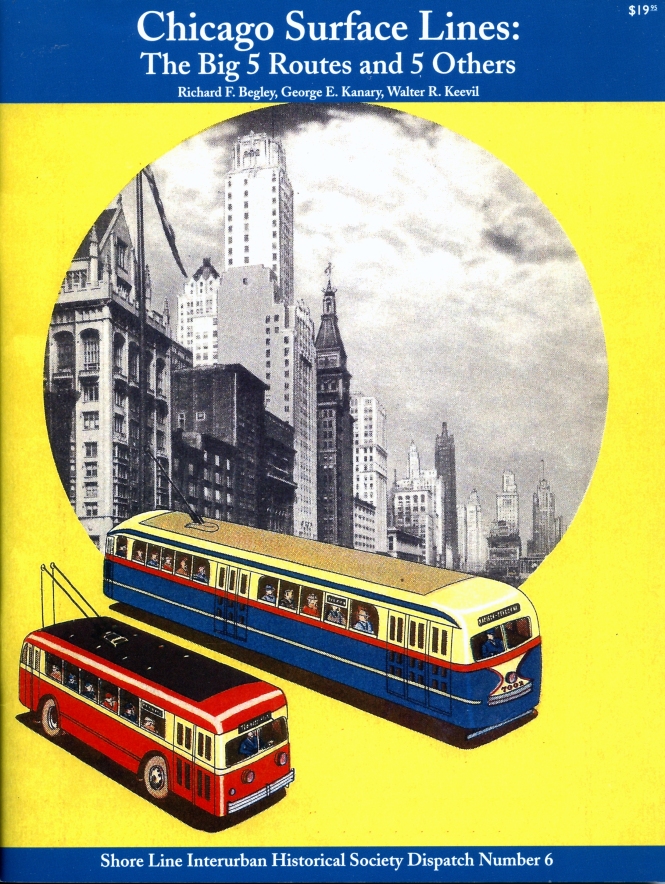
Chicago Surface Lines: The Big 5 Routes and 5 Others
by Richard F. Begley, George E. Kanary, and Walter R. Keevil
Dispatch Number 6 of the Shore Line Interurban Historical Society

While I certainly do appreciate full-length railfan books, I am also very much in favor of shorter ones, such as this new 100-page volume from the Shore Line group. The Chicago Surface Lines is a vast subject, since it was, in its heyday, the largest and most extensive street railway system in the world. Here, the focus is on the five biggest CSL routes, plus five small ones.

This book is a welcome addition to the admittedly slim shelf of Chicago streetcar tomes. The three authors are all very experienced, and their reputations precede them. They are that rare combination, being both gentlemen as well as scholars.

While there is a goodly amount of informative text herein, for most readers, the main interest will be in the photographs, almost all of which are in classic black-and-white. The overall format should be familiar to anyone who has read previous CSL articles in First & Fastest, Shore Line’s quarterly magazine. If the result here seems like several such articles strung together, there’s nothing wrong with such an approach. I have enjoyed those articles too.

As far as I know, most of the pictures here have not previously appeared elsewhere. Many are from collections acquired by the authors over the years, and are reproduced from the original negatives, often from film formats larger than 35mm. The photos themselves are excellent, as is the quality of their reproduction.

The general approach is not altogether different from our own CSL posts. Naturally, in our case, when we get things wrong, our readers help point out these mistakes (sometimes within a few hours) and we make the necessary corrections.

In the case of a printed book, such an approach is impossible. Everything needs to be corrected and fact-checked ahead of time. Since the authors are seasoned veterans of this sort of thing, the chance of finding any factual errors is very slim indeed.

Of course, the three authors have an advantage in years over this writer. They experienced many of these things first-hand, while we merely strive to learn about them after the fact. We are doing our best to educate ourselves and get caught up.

There is value in both approaches, the permanence of a book, and the immediacy of a blog.

Any criticisms I might make would be very minor in nature and would seem like nit-picking. I won’t even bother mentioning them.

It’s safe to say that anyone who appreciates seeing Chicago streetcar pictures on this blog would also like this book, which is available directly from Shore Line using the link given above. It is highly recommended.

-David Sadowski

PS- Please note that Trolley Dodger Press is not affiliated with the Shore Line Interurban Historical Society.


Help Support The Trolley Dodger

gh1

This is our 109th post, and we are gradually creating a body of work and an online resource for the benefit of all railfans, everywhere.

You can help us continue our original transit research by checking out the fine products in our Online Store. You can make a donation there as well.

As we have said before, “If you buy here, we will be here.”

We thank you for your support.

PS- As we approach our one-year anniversary this month, the deadline for renewing our premium WordPress account comes due in less than two weeks. This includes out Internet domain www.thetrolleydodger.com, much of the storage space we use for the thousands of files posted here, and helps keep this an ads-free experience for our readers. Your contributions towards this goal are greatly appreciated, in any amount.


2015 Annual Report

We thank our readers for making our first year such a success. We received 107,460 page views in all, from 30,743 individuals.

The WordPress.com stats helper monkeys prepared a 2015 annual report for this blog.

Here's an excerpt:

The Louvre Museum has 8.5 million visitors per year. This blog was viewed about 110,000 times in 2015. If it were an exhibit at the Louvre Museum, it would take about 5 days for that many people to see it.

Click here to see the complete report.

The back cover of Shore Line Dispatch Number 6.

The back cover of Shore Line Dispatch Number 6.

The CSL Sedans

CSL 3375 northbound on Clark just south of Wacker Drive in 1934. In fact, that's a 1934 Ford, possibly a V-8, at left. (Edward Frank, Jr. Photo)

CSL 3375 northbound on Clark just south of Wacker Drive in 1934. In fact, that’s a 1934 Ford, possibly a V-8, at left. (Edward Frank, Jr. Photo)

Thanks to the generosity of George Trapp, here is a Christmas Eve helping of classic Chicago Surface Lines streetcar photos from his wonderful collection. (To see additional photos he has already shared with us, just type “George Trapp” into the search window at the top of this page. Several other posts will come up.)

Today we feature the 100 “Sedans” (aka Peter Witts) that ran in Chicago from 1929 to 1952.

As always, if you can help identify locations, or have interesting facts or reminiscences to add, don’t hesitate to drop us a line. You can leave comments on this post, or write us directly at:

thetrolleydodger@gmail.com

FYI there will be additional posts in this series coming up in the near future, so watch this space.

The Peter Witts in Chicago

A Peter Witt streetcar (also known here as a “Sedan”), a very popular car type, was introduced in many North American cities around 1915 to 1930. Peter Witt himself (1869-1948) was a commissioner of the Cleveland Railway Company, and developed the design of these cars there.

The advantage of the Witts was to reduce dwell time at stops. Passengers boarded at the front of these two-man cars and exited at the center door after paying on their way out. Peter Witt received U. S. Patent 1,180,900 for this improvement in streetcar design.

Witt cars were popular in large cities like Cleveland and Toronto. They are still in use in Milan, Italy.

As Railroad Model Craftsman magazine noted:

The Chicago Surface Lines Peter Witt cars were known locally as “Sedans” and were 49′ long. These 100 cars were numbered 3322-3381 and 6280-6319. They had three folding doors at the front and three sliding doors, separated by a window for the conductor’s station, at the center. The front-end dash was rounded.

The Chicago order was split between Cummings, Brill, and CSL as follows:

3322-3341, 6280-6293 – CSL (34 cars)

3342-3361, 6294-6306 – Brill (33 cars)

3362-3381, 6307-6319 – Cummings Car (33 cars)

I’m not sure whether all three batches had the same trucks and motors. A list of Brill work orders indicates theirs had Brill 76E2 trucks.

It wasn’t that unusual back then for transit operators to build some of their own cars. Starting in 1929, CSL was a very active participant in the Electric Railway Presidents’ Conference Committee, whose work developed the standardized PCC car, which soon dominated the industry.

The PCC patents were assigned to the Transit Research Corporation, whose stock was owned by the various transit operators who took part in the program. CSL apparently owned the largest amount of stock, which in turn was owned by the Chicago Transit Authority starting in 1947. Eventually Walter J. McCarter, first general manager of CTA, became the head of TRC, which I think has since been disbanded.

The Witts were speedy and attractive cars with leather seats, certainly the most modern things CSL had prior to the two experimental units and the PCCs. When considered with these, Chicago had a total of 785 modern cars.

The Sedans were mainly used on the busy Clark-Wentworth line. After the 83 prewar PCCs came on the scene in 1936-37, they also helped fill out schedules on Madison. After World War II, they eventually made their way to Cottage Grove before being retired in 1952.

They certainly could have been used longer than 23 years. Toronto had 350 Witts, built between 1921 and 1923, and the last of these was retired in 1965– more than 40 years of service.

To this day, Toronto still has one Peter Witt (#2766) on the property in operable condition, and it is brought out for special occasions.

Once the Chicago Transit Authority took over the surface and rapid transit lines in 1947, the mantra became, “get rid of all the old red streetcars.” And since the Witts were not PCCs, they got lumped into that category as well. Some were slated for conversion to one-man around 1951, but I am not certain whether any were operated in this way prior to retirement. I have seen photos showing how the door configuration on at least one car was so changed.

All 100 Sedans were scrapped in 1952. None were saved for museums, which is a real shame. Unfortunately, the Sedans were scrapped just before a museum movement started here. The Illinois Electric Railway Museum was founded in 1953, and their first purchase was Indiana Railroad car 65. The first Chicago streetcar acquired by the museum was red Pullman 144.

Likewise, the preservation efforts of the Electric Railway Historical Society did not begin until a few years later. Ultimately, ERHS saved several Chicago trolleys, all of which made their way to IRM in 1973. Additional cars were saved by CTA and made their way to IRM and the Fox River Trolley Museum in the mid-1980s.

J. G. Brill was the preeminent American streetcar manufacturer before the PCC era. While they were involved in the development of the PCC, and built experimental car 7001 for Chicago in 1934, they made a fateful decision not to pay royalties on the PCC patents, and their attempts to compete with the PCC were largely a failure. Fewer than 50 “Brilliners” (their competing model) were built, the last in 1941.

Around 1930, Brill promoted another type of standardized car called a Master Unit. However, as built, I don’t believe any two orders of Master Units were exactly the same.

There is some dispute as to whether Baltimore’s Peter Witts also qualify as Master Units. However, what defines a Witt is the manner of fare collection, and not the overall style of the car or its mechanical equipment.

As the same magazine referenced above explains:

Peter Witt was the very efficient city clerk in the administration of Cleveland, OH mayor Tom Johnson in the 1900s. In 1912, subsequent mayor Newton Baker appointed him as Street Railway Commissioner. Witt became concerned with the inefficiencies of fare collection in streetcars. Many systems still relied on the old horse car era scheme of having the conductor squeeze through the crowded car to collect fares from newly boarded passengers. After 1905, many systems adopted the “pay-as-you-enter” (PAYE) car design, with the conductor stationed at a fixed location on the rear platform to collect fares as passengers boarded and moved forward to find seats in the car interior. On busy lines, this resulted in delays while enough new passengers paid their fares to allow the last waiting passenger to find room on the rear platform so the doors could be closed and the conductor could give a two-bell signal for the motorman to proceed.

Peter Witt’s innovation was the “pay-as-you-pass” fare collection system, using a front entrance and center exit streetcar configuration. The section of the car forward of the center doors had longitudinal “bowling alley” seats to allow abundant space for newly boarded standees. The conductor was stationed just ahead of the center exit doors, and collected fares while the car was in motion either as patrons prepared to exit the car, or as they moved aft to find more comfortable seating in the rear section of the car. This greatly expedited the loading process at busy stops, and improved efficiency. The first Cleveland cars modified to Witt’s design entered service in December 1914, and were an immediate success, resulting in orders for new cars built to this design in Cleveland and in many other cities. The Peter Witt type of car remained very popular until the advent of the PCC streetcar in the 1930’s. The standard PCC used the same proven front entrance-center exit configuration, and many two-man PCCs used the Peter Witt fare collection scheme.

Before the PCC, most streetcar systems ordered unique cars specified to meet local needs and traditions. While many cities used Peter Witt type streetcars, the cars were not of the same design from city to city…

In doing the research for this review, one question remains unanswered: were the Baltimore Peter Witts Master Units? The Seashore Trolley Museum website describes the Baltimore #6144 in their collection as a “Brill Master Unit Peter Witt”. In “PCC – The Car That Fought Back”, Carlson and Schneider describe the 90 Indianapolis cars as Master Units. The Brill Master Unit was intended to be a flexible design based on standardized components, including single or double-ended single or double truck cars. The Master Unit product line also included a double truck front entrance-center exit design shown in an artist’s illustration in a Brill advertisement in the February 9, 1929 Electric Railway Journal. On the other hand Debra Brill in her History of the J.G. Brill Company states that only 78 Master Units were constructed (20 for Lima Peru, 20 for Brazil, 20 for Lynchburg, 13 for Youngstown, 3 for Yakima, 1 for Louisville, and 1 single trucker for TARS in New York). Ms. Brill does not count the 32 similar cars for Wilmington ordered before the official introduction of the Master Unit, or the single car built for a cancelled Lynchburg order and used by Brill for testing. She recognizes that the TARS and Louisville cars were the only ones that fully conformed to Brill’s Master Unit design.

Likewise, the definition of what constitutes a PCC streetcar is also a bit fluid, as detailed by noted transit historian Dr. Harold E. Cox in this article.

Several models of the Chicago Peter Witts have been produced by various firms, including the excellent St. Petersburg Tram Collection.

Each year, the holiday season creates a warm and generous feeling towards other people, and this year is no exception. Now that we are truly at our “Witt’s End,” we hope that you will enjoy these photographic gifts in the spirit in which they are intended.

Happy Holidays!

-David Sadowski


gh1

    Help Support The Trolley Dodger

This is our 106th post, and we are gradually creating a body of work and an online resource for the benefit of all railfans, everywhere. To date, we have received 105,000 page views from 30,000 individuals.

You can help us continue our original transit research by checking out the fine products in our Online Store. You can make a donation there as well.

As we have said before, “If you buy here, we will be here.”

We thank you for your support.

PS- As we approach our one-year anniversary next month, the deadline for renewing our premium WordPress account comes due in less than 30 days. This includes out domain name www.thetrolleydodger.com, much of the storage space we use for the thousands of files posted here, and helps keep this an ads-free experience for our readers. Your contributions towards this goal are greatly appreciated, in any amount.


Updates

Our E-book Chicago’s PCC Streetcars: The Rest of the Story, available through our Online Store, has been updated with the addition of about 12 minutes of public domain color video showing Chicago PCCs in action. These films were mainly taken on route 36 – Broadway, with a date of October 9, 1956. However, some portions of the film may have been shot earlier, since there are a couple of prewar cars seen. These were last used on route 49 – Western on June 17, 1956.

This video portion can be viewed on any computer using media player software.

PS- Several additional photos have been added to our previous post Chicago Surface Lines Photos, Part Five (December 11th).


Fred J. Borchert

Fred J. Borchert (1889-1951), some of whose work appears on this blog, was an early railfan photographer in Chicago. His work predated other early fans such as Edward Frank, Jr. (1911-1992). There are Ed Frank pictures here from as early as 1934, but Borchert’s work goes back even further than that.

I haven’t been able to find much information on Borchert, but I do know that during WWI, he drove a taxicab, and later, worked for the US Post Office. Ed Frank must have acquired at least some of Borchert’s negatives after his death, since he made prints. If anyone can provide further information on either of these gentlemen, I would appreciate it. I did at least meet Ed Frank since he used to sell his black-and-white photos at CERA meetings many years ago.


CSL Sedan 6315 is southbound on Clark at Wells on January 21, 1945. (Thomas H. Desnoyers Photo, Krambles-Peterson Archive)

CSL Sedan 6315 is southbound on Clark at Wells on January 21, 1945. (Thomas H. Desnoyers Photo, Krambles-Peterson Archive)

CTA 6309 is southbound on Cottage Grove at Cermak on August 1, 1950. (Thomas H. Desnoyers Photo, Krambles-Peterson Archive)

CTA 6309 is southbound on Cottage Grove at Cermak on August 1, 1950. (Thomas H. Desnoyers Photo, Krambles-Peterson Archive)

CSL 6307 and crew at the Clark-Devon loop. (Krambles-Peterson Archive) One of our readers writes, "Where was this photo taken? It says Clark-Devon Loop. That was the designation for the Clark-Arthur Loop, but this photo does not appear to be taken there. The reason that I say that is because of all of the tracks in the foreground. Too many to be Clark-Arthur Loop. My guess is that it really was taken at the back of the 77th Street Station (west end of the barn) because the tracks are set in paving blocks and appear to be curved for entering the bays of the barn. The street was called "Wentworth Avenue" even though it was not a dedicated street to the public."

CSL 6307 and crew at the Clark-Devon loop. (Krambles-Peterson Archive) One of our readers writes, “Where was this photo taken? It says Clark-Devon Loop. That was the designation for the Clark-Arthur Loop, but this photo does not appear to be taken there. The reason that I say that is because of all of the tracks in the foreground. Too many to be Clark-Arthur Loop. My guess is that it really was taken at the back of the 77th Street Station (west end of the barn) because the tracks are set in paving blocks and appear to be curved for entering the bays of the barn. The street was called “Wentworth Avenue” even though it was not a dedicated street to the public.”

CSL 6308 southbound on Clark at Armitage. (Krambles-Peterson Archive)

CSL 6308 southbound on Clark at Armitage. (Krambles-Peterson Archive)

CSL 6297 at Vincennes and 78th.

CSL 6297 at Vincennes and 78th.

CSL 6296 on Vincennes at 79th. (Edward Frank, Jr. Photo)

CSL 6296 on Vincennes at 79th. (Edward Frank, Jr. Photo)

CSL 6295 at Vincennes and 80th. (Fred J. Borchert Photo, Edward Frank, Jr. Collection)

CSL 6295 at Vincennes and 80th. (Fred J. Borchert Photo, Edward Frank, Jr. Collection)

CSL 6301, southbound on Clark Street north of Randolph. (Edward Frank, Jr. Photo)

CSL 6301, southbound on Clark Street north of Randolph. (Edward Frank, Jr. Photo)

CSL 6307.

CSL 6307.

From the numbers on this photo, I'd say it shows one of the CSL Sedan frames at the J. G. Brill factory in 1929.

From the numbers on this photo, I’d say it shows one of the CSL Sedan frames at the J. G. Brill factory in 1929.

The interior of CSL 6294 as new, in a 1929 photo at the J. G. Brill plant. Brill built 33 of the 100 "Sedans," aka Peter Witts.

The interior of CSL 6294 as new, in a 1929 photo at the J. G. Brill plant. Brill built 33 of the 100 “Sedans,” aka Peter Witts.

Presumably another interior photo of 6294. These cars had leather seats. The "bucket" seats remind me a bit of those on Indiana Railroad lightweight high-speed interurban car 65, built two years after this car.

Presumably another interior photo of 6294. These cars had leather seats. The “bucket” seats remind me a bit of those on Indiana Railroad lightweight high-speed interurban car 65, built two years after this car.

CSL 6305 shiny and new at the Brill plant in Philadelphia. (J. G. Brill Photo, Historical Society of Pennsylvania Collection)

CSL 6305 shiny and new at the Brill plant in Philadelphia. (J. G. Brill Photo, Historical Society of Pennsylvania Collection)

As delivered, the 33 Sedans made for Chicago by J. G. Brill came with 76E2 trucks. However, that was job #22768, which does not match the number in this photo. The Brill list of work orders I consulted does not have a job #22770 on it.

As delivered, the 33 Sedans made for Chicago by J. G. Brill came with 76E2 trucks. However, that was job #22768, which does not match the number in this photo. The Brill list of work orders I consulted does not have a job #22770 on it.

CSL 6294, built for the Chicago City Railway, at the Brill plant in 1929. Surface Lines was an "umbrella" that presented a unified transit operator to the public, but it was actually made up of constituent companies. Of the 33 Brill Sedans, 20 were purchased by Chicago Railways and 13 by the Chicago City Railway. This balkanized arrangement continued until the Chicago Transit Authority took over in 1947.

CSL 6294, built for the Chicago City Railway, at the Brill plant in 1929. Surface Lines was an “umbrella” that presented a unified transit operator to the public, but it was actually made up of constituent companies. Of the 33 Brill Sedans, 20 were purchased by Chicago Railways and 13 by the Chicago City Railway. This balkanized arrangement continued until the Chicago Transit Authority took over in 1947.

CSL 6280 southbound at Clark and Southport. (Edward Frank, Jr. Photo)

CSL 6280 southbound at Clark and Southport. (Edward Frank, Jr. Photo)

CTA 3381 at Cottage Grove and 111th, near the south end of route 4, on February 2, 1952. The landmark Hotel Florence is in the background, in Chicago's Pullman neighborhood. (Thomas H. Desnoyers Photo, Krambles-Peterson Archive)

CTA 3381 at Cottage Grove and 111th, near the south end of route 4, on February 2, 1952. The landmark Hotel Florence is in the background, in Chicago’s Pullman neighborhood. (Thomas H. Desnoyers Photo, Krambles-Peterson Archive)

CTA 3381 at Cottage Grove and 115th, south end of route 4, on April 2, 1952. (Thomas H. Desnoyers Photo, Krambles-Peterson Archive)

CTA 3381 at Cottage Grove and 115th, south end of route 4, on April 2, 1952. (Thomas H. Desnoyers Photo, Krambles-Peterson Archive)

CSL 3377 is southbound on Clark north of Huron in the 1936 scene. (Edward Frank, Jr. Photo)

CSL 3377 is southbound on Clark north of Huron in the 1936 scene. (Edward Frank, Jr. Photo)

A southbound Sedan has just passed CSL car 5250 on Clark just south of Wacker Drive in 1935. According to Don's Rail Photos, "1st 5201 thru 5250 were built by Brill-American Car Co in 1906, #15365, for CCRy as 5201 thru 5250, but it was shipped to United Railroads of San Francisco due to the earthquake. 2nd 5201 thru 5250 were built by Brill-American Car Co in 1906, #15365, to replace the orignal order. They were rebuilt in 1909 to bring them up to the standard of the later cars."

A southbound Sedan has just passed CSL car 5250 on Clark just south of Wacker Drive in 1935. According to Don’s Rail Photos, “1st 5201 thru 5250 were built by Brill-American Car Co in 1906, #15365, for CCRy as 5201 thru 5250, but it was shipped to United Railroads of San Francisco due to the earthquake. 2nd 5201 thru 5250 were built by Brill-American Car Co in 1906, #15365, to replace the orignal order. They were rebuilt in 1909 to bring them up to the standard of the later cars.”

CSL 3375 at Kedzie Station on February 14, 1946. Besides Clark-Wentworth, the Sedans helped fill out schedules on Madison, since the 83 prewar PCCs were not enough for the route, which probably needed about 100 cars at the time. The speedy Witts were able to keep up with the PCCs. (Robert W. Gibson Photo)

CSL 3375 at Kedzie Station on February 14, 1946. Besides Clark-Wentworth, the Sedans helped fill out schedules on Madison, since the 83 prewar PCCs were not enough for the route, which probably needed about 100 cars at the time. The speedy Witts were able to keep up with the PCCs. (Robert W. Gibson Photo)

CSL 3371. (Krambles-Peterson Archive)

CSL 3371. (Krambles-Peterson Archive)

Clark Street north of LaSalle circa 1930. (Fred J. Borchert Photo, Edward J. Frank Collection)

Clark Street north of LaSalle circa 1930. (Fred J. Borchert Photo, Edward J. Frank Collection)

CSL 5209 and 3367 pass on Clark just north of Madison in 1935. That is the famous Clark Theatre in the background, later made famous in the song "Werewolves of London" by Warren Zevon. (Edward Frank, Jr. Photo)

CSL 5209 and 3367 pass on Clark just north of Madison in 1935. That is the famous Clark Theatre in the background, later made famous in the song “Werewolves of London” by Warren Zevon. (Edward Frank, Jr. Photo)

CSL 3365 in the "open air" portion of Devon car barn, which was damaged in a 1922 fire. They never did put a roof back on. (Krambles-Peterson Archive)

CSL 3365 in the “open air” portion of Devon car barn, which was damaged in a 1922 fire. They never did put a roof back on. (Krambles-Peterson Archive)

CSL 3367 on Clark at Armitage. (Krambles-Peterson Archive)

CSL 3367 on Clark at Armitage. (Krambles-Peterson Archive)

CSL 3356 at the Devon car barn (station). (Krambles-Peterson Archive)

CSL 3356 at the Devon car barn (station). (Krambles-Peterson Archive)

One of our readers writes, "The reason that this is Wentworth & 65th rather than Devon and Ravenswood is for two reasons. The first is because the railroad viaduct in the background is at an angle as it passed over the street which was the Rock Island RR, probably looks the same today although now Metra. Also, the curb on the west side of the street is raised, whereas Devon is flat at Ravenswood with no raised curbs."

Here we have a real difference of opinion. On the back of this photo, it says that CSL 3354 is at Wentworth and 65th. We have another opinion that says it’s Devon and Ravenswood. (Krambles-Peterson Archive)
One of our readers writes, “The reason that this is Wentworth & 65th rather than Devon and Ravenswood is for two reasons. The first is because the railroad viaduct in the background is at an angle as it passed over the street which was the Rock Island RR, probably looks the same today although now Metra. Also, the curb on the west side of the street is raised, whereas Devon is flat at Ravenswood with no raised curbs.”

Wentworth and 65th today. As you can see, this matches the view in the previous picture.

Wentworth and 65th today. As you can see, this matches the view in the previous picture.

A southbound Sedan at Clark and Rogers. (George Krambles Photo, Krambles-Peterson Archive)

A southbound Sedan at Clark and Rogers. (George Krambles Photo, Krambles-Peterson Archive)

CSL 3342 at the Clark-Arthur loop, looking east from the second floor of Devon Station. (Chicago Surface Lines Photo, Krambles-Peterson Archive) We posted a very similar (but not identical) photo here: http://thetrolleydodger.com/2015/11/03/chicago-surface-lines-photos-part-one/

CSL 3342 at the Clark-Arthur loop, looking east from the second floor of Devon Station. (Chicago Surface Lines Photo, Krambles-Peterson Archive) We posted a very similar (but not identical) photo here: http://thetrolleydodger.com/2015/11/03/chicago-surface-lines-photos-part-one/

CSL 3337 at Devon Station (car barn). (Krambles-Peterson Archive)

CSL 3337 at Devon Station (car barn). (Krambles-Peterson Archive)

CSL 3349 at Vincennes and 80th. (Fred J. Borchert Photo, Edward Frank, Jr. Collection)

CSL 3349 at Vincennes and 80th. (Fred J. Borchert Photo, Edward Frank, Jr. Collection)

Looking north from Clark and Van Buren circa 1930. (Fred J. Borchert Photo, Edward Frank, Jr. Collection)

Looking north from Clark and Van Buren circa 1930. (Fred J. Borchert Photo, Edward Frank, Jr. Collection)

Bill Robb writes:

Toronto had 350 Peter Witt cars and 225 similar trailers. The motor cars had even numbers and the trailers had odd numbers.

Attached is a Ray F Corley TTC document on the Peter Witt design.

But Philadelphia had a larger fleet. Philadelphia also had 535 Peter Witt cars purchased in three orders during the 1920s, which were locally known as Eighty Hundreds. The last PTC 8000s ran in December 1957. More on the Philadelphia orders:

https://archive.org/stream/electricrailwayj612mcgrrich#page/433/mode/1up

https://archive.org/stream/electricrailwayj61mcgrrich#page/1073/mode/1up

Chicago Surface Lines Photos, Part Four

CSL 3167 on Broadway at Sheridan. The old Granada Theatre, one of Chicago's lost movie palaces, is visible at rear. It was located at 6427 North Sheridan Road. (Railway Negative Exchange Photo) George Trapp adds: "CSL #3167 is on Broadway between Rosemont and Devon-Sheridan, photo dates to around 1930. Note that car 3167 is the last car in a line of six 169 class cars as is the southbound Broadway car. These cars ran on Broadway and it's variants from 1923 until early 1948. Building at far right next to Kushler Chevrolet is the Rosemont Garage of the Chicago Motor Coach Company."

CSL 3167 on Broadway at Sheridan. The old Granada Theatre, one of Chicago’s lost movie palaces, is visible at rear. It was located at 6427 North Sheridan Road. (Railway Negative Exchange Photo) George Trapp adds: “CSL #3167 is on Broadway between Rosemont and Devon-Sheridan, photo dates to around 1930. Note that car 3167 is the last car in a line of six 169 class cars as is the southbound Broadway car. These cars ran on Broadway and it’s variants from 1923 until early 1948. Building at far right next to Kushler Chevrolet is the Rosemont Garage of the Chicago Motor Coach Company.”

Thanksgiving is a time to share the abundance of life with family and friends. During this past year, our readers have shared many things with us. In keeping with the holiday spirit, we present a “feast for the eyes.”

Thanks to the generosity of George Trapp, here is another abundant helping of classic Chicago Surface Lines streetcar photos from his collection. (To see additional photos he has already shared with us, just type “George Trapp” into the search window at the top of this page. Several other posts should come up.)

Most of these pictures date to the “red car” era in Chicago, which began in the early 1920s and ended in 1954.

As always, if you can help identify locations, or have interesting facts or reminiscences to add, don’t hesitate to drop us a line. You can leave comments on this post, or write us directly at:

thetrolleydodger@gmail.com

FYI there will be additional posts in this series coming up in the near future, so watch this space.

Happy Holidays!

-David Sadowski


gh1

Help Support The Trolley Dodger

This is our 99th post, and we are gradually creating a body of work and an online resource for the benefit of all railfans, everywhere. To date, we have received 95,000 page views from nearly 28,000 individuals.

You can help us continue our original transit research by checking out the fine products in our Online Store. You can make a donation there as well.

As we have said before, “If you buy here, we will be here.”

We thank you for your support.


CSL 2733, signed for 79th and Brandon. (Heier Industrial Photo) Chuck Amstein writes, "79th St. and just east of Emerald Ave., looking NW. The buildings to the left of #2733 are still there."

CSL 2733, signed for 79th and Brandon. (Heier Industrial Photo) Chuck Amstein writes, “79th St. and just east of Emerald Ave., looking NW. The buildings to the left of #2733 are still there.”

George Trapp: "CSL #6055 is on Route 17 in front of Kedzie Depot." (Heier Industrial Photo) Through route 17 was Kedzie and ran from 1911 to 1949.

George Trapp: “CSL #6055 is on Route 17 in front of Kedzie Depot.” (Heier Industrial Photo) Through route 17 was Kedzie and ran from 1911 to 1949.

George Trapp: "CSL #872 on Through Route 3, Lincoln-Indiana is on the North approach to the Wabash Avenue bridge. Note the Chicago Motor Coach 45-passenger GM bus on the Michigan Avenue Blvd. bridge." (Heier Industrial Photo)

George Trapp: “CSL #872 on Through Route 3, Lincoln-Indiana is on the North approach to the Wabash Avenue bridge. Note the Chicago Motor Coach 45-passenger GM bus on the Michigan Avenue Blvd. bridge.” (Heier Industrial Photo)

CSL salt spreader AA102, formerly car #2851, retired on 8/10/1951 and scrapped in 1952. (Heier Industrial Photo)

CSL salt spreader AA102, formerly car #2851, retired on 8/10/1951 and scrapped in 1952. (Heier Industrial Photo)

George Trapp: "CSL Brill #5349 is eastbound on 63rd Street near State judging from the address of Indian Trailer." (Heier Industrial Photo)

George Trapp: “CSL Brill #5349 is eastbound on 63rd Street near State judging from the address of Indian Trailer.” (Heier Industrial Photo)

CSL 426, is on Armitage, signed to go downtown. Milwaukee Avenue cars also used these signs for North Western Station. (Heier Industrial Photo) George Trapp: "CSL #426 is on the Armitage-Downtown line, which was almost a branch of the Milwaukee Avenue line."

CSL 426, is on Armitage, signed to go downtown. Milwaukee Avenue cars also used these signs for North Western Station. (Heier Industrial Photo) George Trapp: “CSL #426 is on the Armitage-Downtown line, which was almost a branch of the Milwaukee Avenue line.”

CSL 3093, a one-man car, signed for Morgan and Pershing. (Railway Negative Exchange Photo) George Trapp: "CSL #3093 is on Erie at Ashland."

CSL 3093, a one-man car, signed for Morgan and Pershing. (Railway Negative Exchange Photo) George Trapp: “CSL #3093 is on Erie at Ashland.”

3093 again, this time signed for Erie and Ashland. Andre Kristopans: "3093 on Bridge is on the old Throop St bridge over the Sanitary & Ship Canal." (Railway Negative Exchange Photo)

3093 again, this time signed for Erie and Ashland. Andre Kristopans: “3093 on Bridge is on the old Throop St bridge over the Sanitary & Ship Canal.” (Railway Negative Exchange Photo)

3093 turning at 21st. Note the late 1930s Packard at left. (Railway Negative Exchange Photo)

3093 turning at 21st. Note the late 1930s Packard at left. (Railway Negative Exchange Photo)

Close-up of the Packard. The trim design on the side of the engine compartment makes this a 1938 model. (Railway Negative Exchange Photo)

Close-up of the Packard. The trim design on the side of the engine compartment makes this a 1938 model. (Railway Negative Exchange Photo)

Andre Kristopans says, "2909/1419 on 87th are just west of Commercial Av, the east end of the route." (Railway Negative Exchange Photo)

Andre Kristopans says, “2909/1419 on 87th are just west of Commercial Av, the east end of the route.” (Railway Negative Exchange Photo)

Andre Kristopans: "2918 is at Pershing and Western – McKinley Park in background. Note side sign “35-PERSHING”. Most of time West Pershing was a shuttle between Western and Ashland, but rush hours cars ran thru via Ashland and 35th to Cottage Grove." (Railway Negative Exchange Photo)

Andre Kristopans: “2918 is at Pershing and Western – McKinley Park in background. Note side sign “35-PERSHING”. Most of time West Pershing was a shuttle between Western and Ashland, but rush hours cars ran thru via Ashland and 35th to Cottage Grove.” (Railway Negative Exchange Photo)

CSL 204 on Western Avenue. (Railway Negative Exchange Photo)

CSL 204 on Western Avenue. (Railway Negative Exchange Photo)

CSL modernized small Pullman 804 on south Cicero Avenue, near Midway Airport (which may have been called Chicago Municipal Airport when this picture was taken). (Railway Negative Exchange Photo)

CSL modernized small Pullman 804 on south Cicero Avenue, near Midway Airport (which may have been called Chicago Municipal Airport when this picture was taken). (Railway Negative Exchange Photo)

CSL Big Pullman 204 signed for route 22 - Clark-Wentworth. (Railway Negative Exchange Photo)

CSL Big Pullman 204 signed for route 22 – Clark-Wentworth. (Railway Negative Exchange Photo)

CSL 453 northbound on Clark. (Railway Negative Exchange Photo)

CSL 453 northbound on Clark. (Railway Negative Exchange Photo)

CSL 3041 on Montrose in winter. Jim Huffman writes, "Photo #936 shows two Montrose cars, waiting their time, about to go EB at Milwaukee Av. Note that the 1st car is a two-man car & the following car is a one-man car. On Lawrence Av after it went to one-man cars, on certain nights when the Aragon ballroom let out, two-man cars would be used at that time for the crowds." (Railway Negative Exchange Photo) Streetcar service on Montrose ended on 7/29/46. The entire route was converted to trolley buses as of 4/19/48, which continued to 1973.

CSL 3041 on Montrose in winter. Jim Huffman writes, “Photo #936 shows two Montrose cars, waiting their time, about to go EB at Milwaukee Av. Note that the 1st car is a two-man car & the following car is a one-man car. On Lawrence Av after it went to one-man cars, on certain nights when the Aragon ballroom let out, two-man cars would be used at that time for the crowds.” (Railway Negative Exchange Photo) Streetcar service on Montrose ended on 7/29/46. The entire route was converted to trolley buses as of 4/19/48, which continued to 1973.

CSL 459 heading towards Soldier Field and the Field Museum of Natural History, crossing over the Illinois Central right-of-way. (Railway Negative Exchange Photo)

CSL 459 heading towards Soldier Field and the Field Museum of Natural History, crossing over the Illinois Central right-of-way. (Railway Negative Exchange Photo)

Andre Kristopans: "3098 SB turning off Erie into Racine." (Railway Negative Exchange Photo)

Andre Kristopans: “3098 SB turning off Erie into Racine.” (Railway Negative Exchange Photo)

3096 signed for Morgan and Pershing, heads through some backyard private right-of-way. (Railway Negative Exchange Photo)

3096 signed for Morgan and Pershing, heads through some backyard private right-of-way. (Railway Negative Exchange Photo)

CSL 3295 has just gone under an "L" storage yard. (Railway Negative Exchange Photo) George Trapp: "CSL #3295 is on Montrose just west of North Side "L", (with the) south end of Wilson Avenue shop storage yard in background."

CSL 3295 has just gone under an “L” storage yard. (Railway Negative Exchange Photo) George Trapp: “CSL #3295 is on Montrose just west of North Side “L”, (with the) south end of Wilson Avenue shop storage yard in background.”

CSL 1784, in WWII garb supporting the Women's Army Corps on route 22 - Clark-Wentworth. That's the Ridge Theatre at right. (Railway Negative Exchange Photo)

CSL 1784, in WWII garb supporting the Women’s Army Corps on route 22 – Clark-Wentworth. That’s the Ridge Theatre at right. (Railway Negative Exchange Photo)

CSL 1776 in patriotic garb during World War II, on through route 1 (Cottage Grove-Broadway). (Railway Negative Exchange Photo) George Trapp: "CSL #1776 is on Broadway just south of Devon."

CSL 1776 in patriotic garb during World War II, on through route 1 (Cottage Grove-Broadway). (Railway Negative Exchange Photo) George Trapp: “CSL #1776 is on Broadway just south of Devon.”

George Trapp: "Photo of car 204 with new Twin Coach buses in background, it appears car is in process of being converted to a salt spreader, cars last assignment was on Western after PCC's bumped it from Clark-Wentworth." (Railway Negative Exchange Photo) I'm not sure about a salt car, since 204 does not appear on the list of conversions we got from Andre Kristopans, which you can read here: http://thetrolleydodger.com/2015/10/04/trolley-dodger-mailbag-10-4-2015-etc/ George Trapp adds, "It seems to be a mystery what the bracket on the side of car 204 is for nor the location, is it South Shops property? This car was extensively modernized after a fire in the early 1930's."

George Trapp: “Photo of car 204 with new Twin Coach buses in background, it appears car is in process of being converted to a salt spreader, cars last assignment was on Western after PCC’s bumped it from Clark-Wentworth.” (Railway Negative Exchange Photo) I’m not sure about a salt car, since 204 does not appear on the list of conversions we got from Andre Kristopans, which you can read here:
http://thetrolleydodger.com/2015/10/04/trolley-dodger-mailbag-10-4-2015-etc/
George Trapp adds, “It seems to be a mystery what the bracket on the side of car 204 is for nor the location, is it South Shops property? This car was extensively modernized after a fire in the early 1930’s.”

CSL 2909, signed for Division and Grand. Since it is on an angle street, this may be Grand Avenue. (Railway Negative Exchange Photo)

CSL 2909, signed for Division and Grand. Since it is on an angle street, this may be Grand Avenue. (Railway Negative Exchange Photo)

CSL 2907, at the west end of the 87th Street route. Jon Habermaas writes: "The line ended east of the Rock Island viaduct, and there was no connection to the tracks on Vincennes. The car has changed ends and is ready for a new trip eastbound on 87th." (Railway Negative Exchange Photo) M. E. adds, "The 87th St. streetcar line's west end was on the east side of the Rock Island main line. Therefore, the streetcar shown has ended its run on the westbound track, switched trolleys, and is ready to head back east. On the west side of the railroad viaduct is Vincennes Ave., on which is a Halsted-Vincennes car. Just to the east of this view on 87th St. is Halsted St."

CSL 2907, at the west end of the 87th Street route. Jon Habermaas writes: “The line ended east of the Rock Island viaduct, and there was no connection to the tracks on Vincennes. The car has changed ends and is ready for a new trip eastbound on 87th.” (Railway Negative Exchange Photo) M. E. adds, “The 87th St. streetcar line’s west end was on the east side of the Rock Island main line. Therefore, the streetcar shown has ended its run on the westbound track, switched trolleys, and is ready to head back east. On the west side of the railroad viaduct is Vincennes Ave., on which is a Halsted-Vincennes car. Just to the east of this view on 87th St. is Halsted St.”

CSL 2859 at Southport and Clark, the north terminus of route 9 - Ashland. (Railway Negative Exchange Photo)

CSL 2859 at Southport and Clark, the north terminus of route 9 – Ashland. (Railway Negative Exchange Photo)

George Trapp: "CSL #3168 is at Devon and Kedzie," signed for route 36 - Broadway-State. He continues, "photo taken after CTA takeover as evidenced by ad on 3168, probably just before Broadway-State cut back to Ravenswood Avenue. Notice all the open land in the area, CTA could have built a loop for PCC cars if they had wanted." (Railway Negative Exchange Photo)

George Trapp: “CSL #3168 is at Devon and Kedzie,” signed for route 36 – Broadway-State. He continues, “photo taken after CTA takeover as evidenced by
ad on 3168, probably just before Broadway-State cut back to Ravenswood Avenue. Notice all the open land in the area, CTA could have built a loop for PCC cars if they had wanted.” (Railway Negative Exchange Photo)

CSL 230 crosses the old Milwaukee Road freight tracks near Wrigley Field. (Railway Negative Exchange Photo)

CSL 230 crosses the old Milwaukee Road freight tracks near Wrigley Field. (Railway Negative Exchange Photo)

CSL 1759 on through route 1, Cottage Grove-Broadway. (Railway Negative Exchange Photo) George Trapp: "CSL #1759 is on Devon approaching Kedzie."

CSL 1759 on through route 1, Cottage Grove-Broadway. (Railway Negative Exchange Photo) George Trapp: “CSL #1759 is on Devon approaching Kedzie.”

CSL 5279, signed for Halsted and Waveland, north terminus of route 8. However, this looks more like Clark Street near Lincoln Park. (Railway Negative Exchange Photo) George Trapp: "CSL #5279 is on Route 42, which ran through to Halsted-Waveland via Clark and Halsted returning via Broadway and Clark until late 1947." (I assume the route was changed once PCCs began running on route 8 - Halsted.)

CSL 5279, signed for Halsted and Waveland, north terminus of route 8. However, this looks more like Clark Street near Lincoln Park. (Railway Negative Exchange Photo) George Trapp: “CSL #5279 is on Route 42, which ran through to Halsted-Waveland via Clark and Halsted returning via Broadway and Clark until late 1947.” (I assume the route was changed once PCCs began running on route 8 – Halsted.)

CSL 3120 in the same location as the previous picture. (Railway Negative Exchange Photo)

CSL 3120 in the same location as the previous picture. (Railway Negative Exchange Photo)

CSL 209, westbound on route 72 - North Avenue, prepares to cross the north branch of the Chicago River near Goose Island. (Railway Negative Exchange Photo)

CSL 209, westbound on route 72 – North Avenue, prepares to cross the north branch of the Chicago River near Goose Island. (Railway Negative Exchange Photo)

CSL 117 has just left the Cermak loop near the lakefront, added for the 1933-34 World's Fair (A Century of Progress) (Railway Negative Exchange Photo)

CSL 117 has just left the Cermak loop near the lakefront, added for the 1933-34 World’s Fair (A Century of Progress) (Railway Negative Exchange Photo)

CSL 113 crosses the Milwaukee Road freight tracks that used to go by Wrigley Field. This was originally their main line. The large sign indicates a "through route," in this case 22 - Clark-Wentworth. (Railway Negative Exchange Photo)

CSL 113 crosses the Milwaukee Road freight tracks that used to go by Wrigley Field. This was originally their main line. The large sign indicates a “through route,” in this case 22 – Clark-Wentworth. (Railway Negative Exchange Photo)

CSL 1775 during WWII, promoting the Navy, is signed for Broadway. At right there is one of those supervisor's shantys that used to dot the Chicago landscape. (Railway Negative Exchange Photo) George Trapp: "CSL #1775 turning from Clark onto Devon."

CSL 1775 during WWII, promoting the Navy, is signed for Broadway. At right there is one of those supervisor’s shantys that used to dot the Chicago landscape. (Railway Negative Exchange Photo) George Trapp: “CSL #1775 turning from Clark onto Devon.”

CSL 1775 again. (Railway Negative Exchange Photo)

CSL 1775 again. (Railway Negative Exchange Photo)

CSL 1775 on route 22, this time promoting the Merchant Marine. Folksinger Woody Guthrie was a member of the Merchant Marine during World War II. (Railway Negative Exchange Photo) George Trapp: "CSL #1775 Merchant Marine is northbound on Clark at Devon."

CSL 1775 on route 22, this time promoting the Merchant Marine. Folksinger Woody Guthrie was a member of the Merchant Marine during World War II. (Railway Negative Exchange Photo) George Trapp: “CSL #1775 Merchant Marine is northbound on Clark at Devon.”

CSL 1784 signed for Broadway-State during WWII, advertising the U. S. Maritime Service. (Railway Negative Exchange Photo) George Trapp: "CSL #1784 is on Schreiber alongside Devon Depot."

CSL 1784 signed for Broadway-State during WWII, advertising the U. S. Maritime Service. (Railway Negative Exchange Photo) George Trapp: “CSL #1784 is on Schreiber alongside Devon Depot.”

George Trapp: "CSL #3157 is at 77th Street Depot." (Railway Negative Exchange Photo)

George Trapp: “CSL #3157 is at 77th Street Depot.” (Railway Negative Exchange Photo)

CSL 577 and 536 pass each other near downtown. Bill Shapotkin writes, "Believe this pic looks S-S/E on Milwaukee Ave from approx Des Plaines. The bridge x/o the joint MILW/PRR tracks." (Railway Negative Exchange Photo)

CSL 577 and 536 pass each other near downtown. Bill Shapotkin writes, “Believe this pic looks S-S/E on Milwaukee Ave from approx Des Plaines. The bridge x/o the joint MILW/PRR tracks.” (Railway Negative Exchange Photo)

CSL 5012. The sign "Stock Yards Direct" may provide a clue as to which route this is. (Railway Negative Exchange Photo) M. E. writes, "Magnifying the picture twice, the destination sign reads Racine - Downtown. Also, the side roller sign says Racine. Because of the Santa Fe in the background, and because the streetcar appears to be on a diagonal street, I think the streetcar is on Archer Ave. heading northeast. It will turn left (north) on either Clark St. or State St. to get downtown. As for the Stock Yards Direct sign, the Stock Yards are in the opposite direction. Heading southwest on Archer, the Racine car line went south on Wallace (600 West) to Root (4132 South), west to Halsted (800 West), south to 47th St., west to Racine (1200 West), south to 87th St. The Stock Yards were in the square mile bordered by Pershing, Halsted, 47th and Ashland, so the Racine car ran alongside the Stock Yards from Root and Halsted to 47th and Racine."

CSL 5012. The sign “Stock Yards Direct” may provide a clue as to which route this is. (Railway Negative Exchange Photo) M. E. writes, “Magnifying the picture twice, the destination sign reads Racine – Downtown. Also, the side roller sign says Racine. Because of the Santa Fe in the background, and because the streetcar appears to be on a diagonal street, I think the streetcar is on Archer Ave. heading northeast. It will turn left (north) on either Clark St. or State St. to get downtown. As for the Stock Yards Direct sign, the Stock Yards are in the opposite direction. Heading southwest on Archer, the Racine car line went south on Wallace (600 West) to Root (4132 South), west to Halsted (800 West), south to 47th St., west to Racine (1200 West), south to 87th St. The Stock Yards were in the square mile bordered by Pershing, Halsted, 47th and Ashland, so the Racine car ran alongside the Stock Yards from Root and Halsted to 47th and Racine.”

CSL 3154 at the Clark-Arthur loop. (Railway Negative Exchange Photo)

CSL 3154 at the Clark-Arthur loop. (Railway Negative Exchange Photo)

CSL 1457, during its days as a salt spreader. (Railway Negative Exchange Photo) George Trapp: "CSL #1457 is in Devon Depot open South Yard, note Pullman PCC in 4300's alongside."

CSL 1457, during its days as a salt spreader. (Railway Negative Exchange Photo) George Trapp: “CSL #1457 is in Devon Depot open South Yard, note Pullman PCC in 4300’s alongside.”

CSL 3134, southbound on Broadway-State. (Railway Negative Exchange Photo)

CSL 3134, southbound on Broadway-State. (Railway Negative Exchange Photo)

CSL modernized small Pullman 804 on south Cicero Avenue near Midway Airport. (Railway Negative Exchange Photo)

CSL modernized small Pullman 804 on south Cicero Avenue near Midway Airport. (Railway Negative Exchange Photo)

CSL 5915. (Heier Industrial Photo) Patrick writes, "Photos 953, 952 and 947 are taken in front of the Eighth Street Theater http://www.artic.edu/aic/resources/resource/2002?search_id=1&index=0 , which was home of the WLS National Barn dance as can be seen on the marquee in 947. The featured streetcars are southbound on Wabash. The taller building to the left still exists. The theater and the nearer tall building were demolished for exposition space for the Hilton (former Stevens) Hotel."

CSL 5915. (Heier Industrial Photo) Patrick writes, “Photos 953, 952 and 947 are taken in front of the Eighth Street Theater http://www.artic.edu/aic/resources/resource/2002?search_id=1&index=0 , which was home of the WLS National Barn dance as can be seen on the marquee in 947. The featured streetcars are southbound on Wabash. The taller building to the left still exists. The theater and the nearer tall building were demolished for exposition space for the Hilton (former Stevens) Hotel.”

CSL 5777. (Heier Industrial Photo)

CSL 5777. (Heier Industrial Photo)

CSL Sedan 3351. Note the marquee on the Eighth Street Theater at right, advertising the WLS National Barn Dance, which was broadcast "every Saturday." George Trapp: "(The) three shots on Wabash at Eighth were probably taken in Summer of 1947 when the Sedans were beginning to replace the Nearsides on Routes 4 and 5 after being bumped off of Route 22 by new PCC's." (Heier Industrial Photo)

CSL Sedan 3351. Note the marquee on the Eighth Street Theater at right, advertising the WLS National Barn Dance, which was broadcast “every Saturday.” George Trapp: “(The) three shots on Wabash at Eighth were probably taken in Summer of 1947 when the Sedans were beginning to replace the Nearsides on Routes 4 and 5 after being bumped off of Route 22 by new PCC’s.” (Heier Industrial Photo)

CSL 3100. If the sign at right is any indication, that is probably the South Side Park "L" at rear. (Railway Negative Exchange Photo) M. E. thinks this streetcar is on the 18th Street line, which "started at Leavitt (2200 West) and Blue Island, went north on Leavitt to 18th St., then east to probably Michigan Ave." George Foelschow: "I believe 3100 is eastbound on 18th Street crossing South Clark Street. There was a Catholic church at 18th and Clark. The 18th St. line ended at State. Track on 18th east of State and Wabash turned south on Indiana and was used by Indiana and Cottage Grove cars."

CSL 3100. If the sign at right is any indication, that is probably the South Side Park “L” at rear. (Railway Negative Exchange Photo) M. E. thinks this streetcar is on the 18th Street line, which “started at Leavitt (2200 West) and Blue Island, went north on Leavitt to 18th St., then east to probably Michigan Ave.”
George Foelschow: “I believe 3100 is eastbound on 18th Street crossing South Clark Street. There was a Catholic church at 18th and Clark. The 18th St. line ended at State. Track on 18th east of State and Wabash turned south on Indiana and was used by Indiana and Cottage Grove cars.”

Historic Chicago Buses, Part Three

CTA trolley bus 374 at Montrose and Narrangansett in 1948, "Another New CTA Bus." (Railway Negative Exchange Photo)

CTA trolley bus 374 at Montrose and Narrangansett in 1948, “Another New CTA Bus.” (Railway Negative Exchange Photo)

We generally don’t feature buses on this blog, since our main interest is in streetcars, light rail, and electric rail transit. But we do get requests to post more bus photos, and we are fortunate to have some excellent ones to show you today, thanks to the incredible generosity of George Trapp. Mr. Trapp has been collecting these type of pictures for nearly the last 50 years, and we thank him for sharing them with us. Some of these pictures also have streetcars in them.

To see additional photos he has already shared with us, just type “George Trapp” into the search window at the top of this page. Several other posts should come up.

For the streetcar fans, we have also included several additional trolley pictures from our own collections, featuring the Chicago & West Towns Railways, Illinois Terminal Railroad, and its subsidiary the Chicago, Ottawa & Peoria.

As always, if you can help identify locations, or have interesting facts or reminiscences to add, don’t hesitate to drop us a line. You can leave comments on this post, or write us directly at:

thetrolleydodger@gmail.com

-David Sadowski

gh1


Help Support The Trolley Dodger

This is our 98th post, and we are gradually creating a body of work and an online resource for the benefit of all railfans, everywhere. To date, we received more than 93,000 page views from nearly 27,500 individuals.

You can help us continue our original transit research by checking out the fine products in our Online Store. You can make a donation there as well.

As we have said before, “If you buy here, we will be here.”

We thank you for your support.


Bill Robb: "Chicago City Railway 430 is a 1938 ACF H-13-S. These units lasted unit 1953-55."

Bill Robb: “Chicago City Railway 430 is a 1938 ACF H-13-S. These units lasted unit 1953-55.”

CSL buses 6515 and 6407 at South Shops. The destinations signs on 6515 do not match. George Trapp: "CSL bus 6515 built by GM model TD-4506 built in 1946 is newly delivered and photo most likely taken by CSL."

CSL buses 6515 and 6407 at South Shops. The destinations signs on 6515 do not match. George Trapp: “CSL bus 6515 built by GM model TD-4506 built in 1946 is newly delivered and photo most likely taken by CSL.”

Bill Robb: "Chicago City Railways 402 is a 1934 ACF H-13-S."

Bill Robb: “Chicago City Railways 402 is a 1934 ACF H-13-S.”

Andre Kristopans: "The Diversey TB shot is eb at Kimball. Large building across street still there." Trolley bus service on Diversey ended in 1955 once the route was consolidated with former Chicago Motor Coach route 134. Ray Piesciuk: "The Diversey TB route was extended to Harlem (actually a wye at Neva) on 06/19/1932." (Railway Negative Exchange Photo)

Andre Kristopans: “The Diversey TB shot is eb at Kimball. Large building across street still there.” Trolley bus service on Diversey ended in 1955 once the route was consolidated with former Chicago Motor Coach route 134. Ray Piesciuk: “The Diversey TB route was extended to Harlem (actually a wye at Neva) on 06/19/1932.” (Railway Negative Exchange Photo)

CSL bus 825, signed for Peterson. Bill Robb: "Calumet & South Chicago 825 is a 1939 White 805M which ran until a general purge of obsolete buses in 1949." Andre Kristopans: "Most likely turning from north on Catalpa to west on Hollywood. Loop at the time was Bryn Mawr-Catalpa-Hollywood-Broadway."

CSL bus 825, signed for Peterson. Bill Robb: “Calumet & South Chicago 825 is a 1939 White 805M which ran until a general purge of obsolete buses in 1949.” Andre Kristopans: “Most likely turning from north on Catalpa to west on Hollywood. Loop at the time was Bryn Mawr-Catalpa-Hollywood-Broadway.”

CSL bus 6520 on extension route 103A. The original version of this route operated between 1930 and 1941. (Railway Negative Exchange Photo)

CSL bus 6520 on extension route 103A. The original version of this route operated between 1930 and 1941. (Railway Negative Exchange Photo)

CTA trolley bus 465. (Railway Negative Exchange Photo)

CTA trolley bus 465. (Railway Negative Exchange Photo)

Another new trolley bus being delivered to Chicago by rail. (Railway Negative Exchange Photo) George Trapp: "New St. Louis trolley bus #411 on flatcar in a freight train in April of 1948 on Illinois Terminal, note catenary."

Another new trolley bus being delivered to Chicago by rail. (Railway Negative Exchange Photo) George Trapp: “New St. Louis trolley bus #411 on flatcar in a freight train in April of 1948 on Illinois Terminal, note catenary.”

CTA trolley buses 570 and 571 being delivered on Illinois Central flatcars.

CTA trolley buses 570 and 571 being delivered on Illinois Central flatcars.

North and Lamon was the approximate location of CTA North Avenue garage, so presumably that is where this picture of trolley bus 403 was taken. (Railway Negative Exchange Photo) George Trapp: "St. Louis trolley bus 403 is next to Pullman-Standard trolley bus 344 built at Worcester plant. Both delivered in 1948, St. Louis unit in March-April, Pullman in Nov.-Dec."

North and Lamon was the approximate location of CTA North Avenue garage, so presumably that is where this picture of trolley bus 403 was taken. (Railway Negative Exchange Photo) George Trapp: “St. Louis trolley bus 403 is next to Pullman-Standard trolley bus 344 built at Worcester plant. Both delivered in
1948, St. Louis unit in March-April, Pullman in Nov.-Dec.”

A St. Louis Car Company builder's photo of trolley bus 172. (Railway Negative Exchange Photo)

A St. Louis Car Company builder’s photo of trolley bus 172. (Railway Negative Exchange Photo)

CSL had an open-air trolleybus yard at Central and Avondale, adjacent to the Chicago & North Western. The Kennedy expressway now occupies this location. (Railway Negative Exchange Photo) Ray Piesciuk: "The open air TB yard at Central-Avondale shows two buses with poles that are not trolley buses. They are work motor buses BA-106 & BA-115 outfitted with sleet scraping poles." Another reader writes: "Note the "Marmon-Herrington" builder's plate on the front of the bus. When the buses were retired, there were no such builder's plates to be found under the advertising holders that had existed at that location for most of the lives of the coaches. "

CSL had an open-air trolleybus yard at Central and Avondale, adjacent to the Chicago & North Western. The Kennedy expressway now occupies this location. (Railway Negative Exchange Photo) Ray Piesciuk: “The open air TB yard at Central-Avondale shows two buses with poles that are not trolley buses. They are work motor buses BA-106 & BA-115 outfitted with sleet scraping poles.”
Another reader writes: “Note the “Marmon-Herrington” builder’s plate on the front of the bus. When the buses were retired, there were no such builder’s plates to be found under the advertising holders that had existed at that location for most of the lives of the coaches. “

Another view of the old Central and Avondale yard. (Railway Negative Exchange Photo)

Another view of the old Central and Avondale yard. (Railway Negative Exchange Photo)

Here is a 1940s map of the area around Central and Avondale on Chicago's northwest side, where the Surface Lines had a temporary open-air trolley bus yard parallel to the Chicago & North Western starting in 1943. It was replaced by the Forest Glen garage in 1955. This area is now occupied by the Kennedy expressway.

Here is a 1940s map of the area around Central and Avondale on Chicago’s northwest side, where the Surface Lines had a temporary open-air trolley bus yard parallel to the Chicago & North Western starting in 1943. It was replaced by the Forest Glen garage in 1955. This area is now occupied by the Kennedy expressway.

George Trapp: "CSL #3226 is at South end of South Damen streetcar line, bus 6805 is on the shuttle bus extension to 87th Street." (Railway Negative Exchange Photo)

George Trapp: “CSL #3226 is at South end of South Damen streetcar line, bus 6805 is on the shuttle bus extension to 87th Street.” (Railway Negative Exchange Photo)

CSL 6153 on a charter, eastbound at Washington and State. Meanwhile, a suburban bus bound for the Brookfield Zoo approaches. (Edward Frank, Jr. Photo) Andre Kristopans: "The Brookfield Zoo bus is Bluebird Coach Lines. Route was from downtown out Randolph, Ogden, 26th Desplaines, with most trips continuing out 31st, LaGrange, Ogden to Aurora."

CSL 6153 on a charter, eastbound at Washington and State. Meanwhile, a suburban bus bound for the Brookfield Zoo approaches. (Edward Frank, Jr. Photo) Andre Kristopans: “The Brookfield Zoo bus is Bluebird Coach Lines. Route was from downtown out Randolph, Ogden, 26th Desplaines, with most trips continuing out 31st, LaGrange, Ogden to Aurora.”

CSL 3189, northbound at State and Lake, on August 29, 1947. Note the Greyhound bus at right. (Thomas H, Desnoyers Photo, Krambles-Peterson Archive)

CSL 3189, northbound at State and Lake, on August 29, 1947. Note the Greyhound bus at right. (Thomas H, Desnoyers Photo, Krambles-Peterson Archive)

CSL Sedan 3332 southbound at Wabash and Roosevelt on September 27, 1947. Note the Greyhound bus at right. (Thomas H. Desnoyers Photo, Krambles-Peterson Archive) Allen Breyer: "Also shows the old Union Bus Terminal behind the Greyhound."

CSL Sedan 3332 southbound at Wabash and Roosevelt on September 27, 1947. Note the Greyhound bus at right. (Thomas H. Desnoyers Photo, Krambles-Peterson Archive) Allen Breyer: “Also shows the old Union Bus Terminal behind the Greyhound.”

CSL 5289 passes some CSL buses at 78th and Vincennes, looking NE. According to Don's Rail Photos, "5251 thru 5300 were built by Brill in 1906, #15365, for CCRy. They were brought up to higher standards in 1909." (Gordon Lloyd Photo) This CSL bus photo is not part of the Trapp collection. Chuck Amstein: "The South Shops building in the background is still there." Another reader notes, "The two Yellow Coach gas buses in the background were purchased by CSL and are painted in the pre-Mercury Green CSL motor bus colors of Red and Cream with Black Striping as found on CSL 3407 at the Illinois Railway Museum today."

CSL 5289 passes some CSL buses at 78th and Vincennes, looking NE. According to Don’s Rail Photos, “5251 thru 5300 were built by Brill in 1906, #15365, for CCRy. They were brought up to higher standards in 1909.” (Gordon Lloyd Photo) This CSL bus photo is not part of the Trapp collection. Chuck Amstein: “The South Shops building in the background is still there.”
Another reader notes, “The two Yellow Coach gas buses in the background were purchased by CSL and are painted in the pre-Mercury Green CSL motor bus colors of Red and Cream with Black Striping as found on CSL 3407 at the Illinois Railway Museum today.”

Chicago & West Towns Railways

FYI, we have also added these two pictures to our earlier post West Towns Streetcars in Black-and-White (August 4th).

C&WT 104 at the Harlem and Cermak car barn on April 3, 1948, less than two before the end of streetcar service. One of the replacement buses is at right. (C. Edward Hedstrom Photo)

C&WT 104 at the Harlem and Cermak car barn on April 3, 1948, less than two before the end of streetcar service. One of the replacement buses is at right. (C. Edward Hedstrom Photo)

C&WT line car 15, with its famous bent pole.The defect was apparently accidental, but it was certainly distinctive.

C&WT line car 15, with its famous bent pole.The defect was apparently accidental, but it was certainly distinctive.

Illinois Terminal Railroad

IT 273.

IT 273.

According to Don's Rail Photos, IT 104 "was built by American Car in 1917 as AG&StL 64. In 1926 it became StL&ARy 64 and in 1930 it became IT 104." This picture was taken in Granite City on August 14, 1956.

According to Don’s Rail Photos, IT 104 “was built by American Car in 1917 as AG&StL 64. In 1926 it became StL&ARy 64 and in 1930 it became IT 104.” This picture was taken in Granite City on August 14, 1956.

IT 284, decked in bunting, on what must have been the final revenue trip on this portion of the interurban in 1955. If anyone can identify the exact date or the location, please let me know. (Glenn L. Sticken Photo) You can see a picture of the same bunting applied to IT 277 at the Illinois Railway Museum in 2011 here: http://hickscarworks.blogspot.com/2011/04/illinois-terminal-society-meet.html

IT 284, decked in bunting, on what must have been the final revenue trip on this portion of the interurban in 1955. If anyone can identify the exact date or the location, please let me know. (Glenn L. Sticken Photo) You can see a picture of the same bunting applied to IT 277 at the Illinois Railway Museum in 2011 here:
http://hickscarworks.blogspot.com/2011/04/illinois-terminal-society-meet.html

IT double-end PCC 455 at speed in St. Louis on May 18, 1951.

IT double-end PCC 455 at speed in St. Louis on May 18, 1951.

Chicago, Ottawa & Peoria

Here are four rare photos of the CO&P. Since it was abandoned in 1934, photos are scarce. We previously posted a few more here.

CO&P freight motor 1523 at the Ottawa Shops in 1934, presumably around the time of abandonment.

CO&P freight motor 1523 at the Ottawa Shops in 1934, presumably around the time of abandonment.

CO&P express freight car 301 in November 1910.

CO&P express freight car 301 in November 1910.

CO&P first #60 at Depue in 1910, a product of the Danville Car Company.

CO&P first #60 at Depue in 1910, a product of the Danville Car Company.

CO&P #66 at the Ottawa Shops in 1934, presumably at the time of abandonment. It was built by St. Louis Car Company in 1924. Some cars in this series were rebuilt for use on the rest of the Illinois Terminal system, including IT 415 (former CO&P 64) which is now at the Illinois Railway Museum.

CO&P #66 at the Ottawa Shops in 1934, presumably at the time of abandonment. It was built by St. Louis Car Company in 1924. Some cars in this series were rebuilt for use on the rest of the Illinois Terminal system, including IT 415 (former CO&P 64) which is now at the Illinois Railway Museum.

Chicago Surface Lines Photos, Part Three

Bill Shapotkin writes: "This pic is on the Riverdale line. The location is JUST SOUTH of 130th St (the tracks on the embankment are the IC). View looks E-N/E." George Trapp: "CSL #2595 is on Riverdale line, side sign reads Michigan-Indiana." M. E. writes: "The first picture is on the Riverdale line, which ran south along the west side of the Illinois Central main line, then under the IC, then south to Riverdale." The car number looks like 2595, making this a "Robertson" car, built by St. Louis Car Company in 1901. Robert Leffingwell writes: "(This) picture is most likely Indiana Ave between 130th and 134th where it ran on private right of way along side the IC tracks. (The tracks on 134th are still clearly visible to this day)." Andre Kristopans: "2595 is on 34-Riverdale (sign would say Michigan-Indiana) along the IC between 127th and 134th."

Bill Shapotkin writes: “This pic is on the Riverdale line. The location is JUST SOUTH of 130th St (the tracks on the embankment are the IC). View looks E-N/E.” George Trapp: “CSL #2595 is on Riverdale line, side sign reads Michigan-Indiana.” M. E. writes: “The first picture is on the Riverdale line, which ran south along the west side of the Illinois Central main line, then under the IC, then south to Riverdale.”
The car number looks like 2595, making this a “Robertson” car, built by St. Louis Car Company in 1901.
Robert Leffingwell writes: “(This) picture is most likely Indiana Ave between 130th and 134th where it ran on private right of way along side the IC tracks. (The tracks on 134th are still clearly visible to this day).”
Andre Kristopans: “2595 is on 34-Riverdale (sign would say Michigan-Indiana) along the IC between 127th and 134th.”

Thanks to the generosity of George Trapp, here is another generous helping of classic Chicago Surface Lines streetcar photos from his collection. (To see additional photos he has already shared with us, just type “George Trapp” into the search window at the top of this page. Several other posts should come up.)

Most of these pictures date to the “red car” era in Chicago, which began in the early 1920s and ended in 1954. Some are even older than that.

As always, if you can help identify locations, or have interesting facts or reminiscences to add, don’t hesitate to drop us a line. You can leave comments on this post, or write us directly at:

thetrolleydodger@gmail.com

FYI there will be several additional posts in this series coming up in the near future, so watch this space.

-David Sadowski

PS- We’ve already received a lot of excellent comments on this post. I will incorporate them into the photo captions later this evening. We thank all our contributors.

M. E. writes:

More thoughts about CSL Photos part 3:

Using the map at http://chicagoinmaps.com/chicagostreetcars.html I make the assumption that the carbarn at 93rd and Drexel serviced all these east/west lines: 87th St., 93rd/95th St., 103rd St., 111th/115th St., 119th/Vincennes. All these lines likely used Cottage Grove to get to and from the carbarn.

Several of the pictures are of cars 3100 and 3113. The one captioned “CSL 3113, signed for 93rd and Drexel” seems to be in the carbarn at that location.

I think the one captioned “CSL 3100, signed for 103rd and Vincennes” was taken at 103rd and Michigan. The destination sign reads 103rd and Vincennes, so the view must be looking east from Michigan. Notice the man standing in front of the Buy Now sign.

This could be the same man who “has just taken a picture” in the photo captioned “CSL 3100, probably on the south side …” In the distance in this picture is the Illinois Central main line paralleling Cottage Grove Ave. The IC right-of-way was above ground at that point.

Next, the picture captioned “CSL 3100 again, possibly getting ready to change ends”. The destination sign reads 103rd and Vincennes, which is where this photo was taken, facing northeast.

Next, the picture captioned “CSL 3100, signed to go to 103rd and Vincennes”, was taken just east of the last one I mentioned.

Next, the picture captioned “CSL 3100 at the end of the 103rd Street line”, was taken from the same spot as the first one I cited.

All of these CSL 3100 shots at Vincennes must have been taken at the same time.

Finally, “CSL 3113. The sign at rear, advertising the Beverly Bakery” is at the same spot but a different car.

In this 1941 CSL map, which you can find in Chicago's PCC Streetcars: The Rest of the Story, you can see how the 103rd route ended east of Vincennes and the Rock Island (although there was a single track connection with Vincennes).

In this 1941 CSL map, which you can find in Chicago’s PCC Streetcars: The Rest of the Story, you can see how the 103rd route ended east of Vincennes and the Rock Island (although there was a single track connection with Vincennes).

Unrelated, but interesting: In the map, on the 93rd St. line, west of Stony Island, notice that the track goes almost back to 95th St. This was a prime viewing site for streetcars and trains. There was a busy north/south railroad, and an east/west railroad, that crossed just north of 95th St. The streetcar line ran along the north side of the east/west railroad. The streetcar line crossed the north/south railroad at grade. I do not remember whether there were crossing gates over the streetcar tracks. If not, then each streetcar would have required a two-man crew so the conductor could act as lookout before the motorman crossed the railroad track.

CSL streetcar service on route 103, subject of several pictures in this post, was replaced by buses on October 13, 1941. Chances are theses photos were taken shortly before that early abandonment.


Help Support The Trolley Dodger

This is our 97th post, and we are gradually creating a body of work and an online resource for the benefit of all railfans, everywhere. To date, we received more than 91,000 page views from nearly 27,500 individuals.

You can help us continue our original transit research by checking out the fine products in our Online Store. You can make a donation there as well.

As we have said before, “If you buy here, we will be here.”

We thank you for your support.


A map of the area around 103rd and Vincennes, as it looked in the 1940s when these streetcar pictures were taken. Vincennes is the angle street that runs parallel to the Rock Island, which heads to the southwest.

A map of the area around 103rd and Vincennes, as it looked in the 1940s when these streetcar pictures were taken. Vincennes is the angle street that runs parallel to the Rock Island, which heads to the southwest.

CSL 3100 at 103rd and Vincennes, the west end of this line. Bill Shapotkin writes, "The pic below, looking N-N/W (and a few feet west of the above photo) is indeed a car at the west end of (revenue) trackage. (a single track, normally not used in revenue service, did x/o the ROCK and connected with trackage on Vincennes Ave). I have a contemporary photo of a CTA bus at this same location. The building on the north side of the street remains standing (at least as of six months ago)." M. E. writes: "The last picture is likely at 103rd and Vincennes, on the east side of the Rock Island main line. I say this because it looks like the end of the line, where the streetcar tracks merge."

CSL 3100 at 103rd and Vincennes, the west end of this line. Bill Shapotkin writes, “The pic below, looking N-N/W (and a few feet west of the above photo) is indeed a car at the west end of (revenue) trackage. (a single track, normally not used in revenue service, did x/o the ROCK and connected with trackage on Vincennes Ave). I have a contemporary photo of a CTA bus at this same location. The building on the north side of the street remains standing (at least as of six months ago).”
M. E. writes: “The last picture is likely at 103rd and Vincennes, on the east side of the Rock Island main line. I say this because it looks like the end of the line, where the streetcar tracks merge.”

103rd and Vincennes today. We are looking west.

103rd and Vincennes today. We are looking west.

CSL 2006 in storage, apparently having last been used on one of the light far south side lines.

CSL 2006 in storage, apparently having last been used on one of the light far south side lines.

CSL 3100, signed to go to 103rd and Vincennes. According to M. E., this picture was taken just east of 103rd and Michigan. Chuck Amstein: "103rd and Eberhart Ave., looking NE. The building just to the right of #3100 is still there, and matches the one in the background in misc831."

CSL 3100, signed to go to 103rd and Vincennes. According to M. E., this picture was taken just east of 103rd and Michigan. Chuck Amstein: “103rd and Eberhart Ave., looking NE. The building just to the right of #3100 is still there, and matches the one in the background in misc831.”

103rd and Eberhart Avenue today. We are looking east.

103rd and Eberhart Avenue today. We are looking east.

CSL 3093 at Erie and Ashland, signed to go to Morgan and Pershing.

CSL 3093 at Erie and Ashland, signed to go to Morgan and Pershing.

CSL 2910 heading west (signed for Austin, the city limits) in the 1940s. George Trapp: "CSL 2910 is on West Division line, Destination reads Division-Austin, this type of car a regular on this route." From our comments section: "CSL 2910 is signed DIVISION-AUSTIN. Short line operated on Division between Grand and Austin until it was through routed by bus to California until it was further through routed to downtown." "CSL 2910 heading west (signed for Austin, the city limits) possibly Division / Austin … location is possibly on Division just east of Grand ave." Andre Kristopans: "2910 is most likely on West Division St, California to Austin, as it is a small one-man car." Mike Franklin: "CSL 2910 heading west and the two flats are located on the 5000 block of Division."

CSL 2910 heading west (signed for Austin, the city limits) in the 1940s. George Trapp: “CSL 2910 is on West Division line, Destination reads Division-Austin, this type of car a regular on this route.”
From our comments section: “CSL 2910 is signed DIVISION-AUSTIN. Short line operated on Division between Grand and Austin until it was through routed by bus to California until it was further through routed to downtown.” “CSL 2910 heading west (signed for Austin, the city limits) possibly Division / Austin … location is possibly on Division just east of Grand ave.”
Andre Kristopans: “2910 is most likely on West Division St, California to Austin, as it is a small one-man car.”
Mike Franklin: “CSL 2910 heading west and the two flats are located on the 5000 block of Division.”

The 5000 block on west Division street today.

The 5000 block on west Division street today.

Chicago City Railway 2503.

Chicago City Railway 2503.

CSL 2910, signed for Pershing. (Edward Frank, Jr. photo)

CSL 2910, signed for Pershing. (Edward Frank, Jr. photo)

CSL "Little" Pullman 810, built in 1910, on route 10. George Trapp: "CSL 810 is at Western-Howard."

CSL “Little” Pullman 810, built in 1910, on route 10. George Trapp: “CSL 810 is at Western-Howard.”

Andre Kristopans writes, "3236 looks like nb on Racine about to turn east into Armitage. Building to right is the Maud St wreck truck house, part of CUT’s North Shops complex, most of which was closed when West Shop opened in the teens."

Andre Kristopans writes, “3236 looks like nb on Racine about to turn east into Armitage. Building to right is the Maud St wreck truck house, part of CUT’s North Shops complex, most of which was closed when West Shop opened in the teens.”

Racine and Armitage today. We are looking north.

Racine and Armitage today. We are looking north.

CSL Birney 2901, also seen in another picture elsewhere in this post.

CSL Birney 2901, also seen in another picture elsewhere in this post.

George Trapp: "CSL Trailer 8050 is also at Devon Depot, Note new track in foreground, car is sandwiched between a Big Pullman and a 169 class car." The trailer was built in 1921.

George Trapp: “CSL Trailer 8050 is also at Devon Depot, Note new track in foreground, car is sandwiched between a Big Pullman and a 169 class car.” The trailer was built in 1921.

CSL 3298 on, I believe, route 73. If so, we are most likely at about 600 West Armitage. (Edward Frank, Jr. Photo)

CSL 3298 on, I believe, route 73. If so, we are most likely at about 600 West Armitage. (Edward Frank, Jr. Photo)

Chicago Union Traction 4776, signed for Van Buren. I believe this may have been renumbered as CSL 1247 later on. The sign advertises a ferry across Lake Michigan to Grand Rapids for $1.50. Michael Franklin adds: "This location is looking west on Van Buren just east of Kedzie. Car house in background. Wm. A. Lavin Saloon sat on the NE corner of Van Buren and Kedzie."

Chicago Union Traction 4776, signed for Van Buren. I believe this may have been renumbered as CSL 1247 later on. The sign advertises a ferry across Lake Michigan to Grand Rapids for $1.50. Michael Franklin adds: “This location is looking west on Van Buren just east of Kedzie. Car house in background. Wm. A. Lavin Saloon sat on the NE corner of Van Buren and Kedzie.”

CSL trailer 8027, built by the Surface Lines in 1921 during a time when ridership was greatly increasing. Trailers were no longer needed in the 1930s due to the Depression, and while they were considered for use during World War II they ended up as storage sheds such as this one. According to George Trapp, this photo was taken at the Devon Depot. Andre Kristopans: "As for the trailers, all were sheds by 1930 or so. Some were fixed up to go back into service about 1942, but never did, and these were the ones scrapped in 1944-45."

CSL trailer 8027, built by the Surface Lines in 1921 during a time when ridership was greatly increasing. Trailers were no longer needed in the 1930s due to the Depression, and while they were considered for use during World War II they ended up as storage sheds such as this one. According to George Trapp, this photo was taken at the Devon Depot.
Andre Kristopans: “As for the trailers, all were sheds by 1930 or so. Some were fixed up to go back into service about 1942, but never did, and these were the ones scrapped in 1944-45.”

CSL 3100 again, possibly getting ready to change ends. M. E. writes: "The destination sign reads 103rd and Vincennes, which is where this photo was taken, facing northeast."

CSL 3100 again, possibly getting ready to change ends. M. E. writes: “The destination sign reads 103rd and Vincennes, which is where this photo was taken, facing northeast.”
Chuck Amstein: ” 103rd near Vincennes, just east of the Rock Island tracks, looking ENE. The building with the “MEATS” sign is still there.”

103rd just east of Vincennes today. Note the same building as in the previous picture.

103rd just east of Vincennes today. Note the same building as in the previous picture.

CSL 3100 on 103rd. Looks like the man at right has just taken a picture. Chuck Amstein writes: " 103rd St. just west of Vernon Ave., looking ENE. The 3-story apartment bldg. (approx. 10235 S. Vernon) and the building just to the right of #3100 in the distance, are still there."

CSL 3100 on 103rd. Looks like the man at right has just taken a picture.
Chuck Amstein writes: ” 103rd St. just west of Vernon Ave., looking ENE. The 3-story apartment bldg. (approx. 10235 S. Vernon) and the building just to the right of #3100 in the distance, are still there.”

The three-flat at 10235 S. Vernon today.

The three-flat at 10235 S. Vernon today.

CSL 3113, signed for 93rd and Drexel. M. E. writes: "The destination 93rd and Drexel (900 east) is a block east of Cottage Grove Ave. According to Wikipedia, "Burnside car barn at 93rd and Drexel is still basically intact." So Cottage Grove cars and 93rd/95th cars could be signed for 93rd and Drexel. (It) seems to be in the carbarn at that location."

CSL 3113, signed for 93rd and Drexel. M. E. writes: “The destination 93rd and Drexel (900 east) is a block east of Cottage Grove Ave. According to Wikipedia, “Burnside car barn at 93rd and Drexel is still basically intact.” So Cottage Grove cars and 93rd/95th cars could be signed for 93rd and Drexel. (It) seems to be in the carbarn at that location.”

CSL 3100, signed for 103rd and Vincennes. M. E. writes: "I think the one captioned "CSL 3100, signed for 103rd and Vincennes" was taken at 103rd and Michigan. The destination sign reads 103rd and Vincennes, so the view must be looking east from Michigan. Notice the man standing in front of the Buy Now sign. This could be the same man who "has just taken a picture" (in another photo in this post). In the distance in this picture is the Illinois Central main line paralleling Cottage Grove Ave. The IC right-of-way was above ground at that point." Chuck Amstein writes: "103rd and Michigan, looking ESE. The house just to the right of #3100 is still there."

CSL 3100, signed for 103rd and Vincennes. M. E. writes: “I think the one captioned “CSL 3100, signed for 103rd and Vincennes” was taken at 103rd and Michigan. The destination sign reads 103rd and Vincennes, so the view must be looking east from Michigan. Notice the man standing in front of the Buy Now sign.
This could be the same man who “has just taken a picture” (in another photo in this post). In the distance in this picture is the Illinois Central main line paralleling Cottage Grove Ave. The IC right-of-way was above ground at that point.”
Chuck Amstein writes: “103rd and Michigan, looking ESE. The house just to the right of #3100 is still there.”

While lightweight single-truck Birney cars were successful in many smaller cities and towns, such as Fort Collins, Colorado, they were not successful in Chicago. Here we see a rare shot of CSL 2901 at 71st and State in 1924.

While lightweight single-truck Birney cars were successful in many smaller cities and towns, such as Fort Collins, Colorado, they were not successful in Chicago. Here we see a rare shot of CSL 2901 at 71st and State in 1924.

An early Chicago City Railway streetcar at 75th Street and Manhattan Beach. According to the Encyclopedia of Chicago History, "Located near Windsor Bathing Beach, Manhattan Beach (later Rainbow Beach) was a popular spot for middle-class boys and girls to meet in the early decades of the twentieth century. Some religious leaders and conservative politicians opposed this and other private beaches, claiming that they encouraged sexual promiscuity and the consumption of alcohol among minors. Rainbow Beach was also reclaimed by the city and operated as a municipal beach in the 1920s. "

An early Chicago City Railway streetcar at 75th Street and Manhattan Beach. According to the Encyclopedia of Chicago History, “Located near Windsor Bathing Beach, Manhattan Beach (later Rainbow Beach) was a popular spot for middle-class boys and girls to meet in the early decades of the twentieth century. Some religious leaders and conservative politicians opposed this and other private beaches, claiming that they encouraged sexual promiscuity and the consumption of alcohol among minors. Rainbow Beach was also reclaimed by the city and operated as a municipal beach in the 1920s. “

CSL 2832 signed for a charter. From the autos, it would appear this picture was taken in the 1940s.

CSL 2832 signed for a charter. From the autos, it would appear this picture was taken in the 1940s.

CTA 1722 at Western and Howard on May 22, 1948. The northernmost portion of route 49 was bussed on August 1, 1948. At the same time, streetcar service was cut back to 79th on the south end, via a new loop there. George Trapp writes: "On Aug. 1, 1948 north terminal changed to Schreiber loop at Devon Depot also shared with Route 36 cars. Berwyn loop opened Dec. 12, 1948."

CTA 1722 at Western and Howard on May 22, 1948. The northernmost portion of route 49 was bussed on August 1, 1948. At the same time, streetcar service was cut back to 79th on the south end, via a new loop there.
George Trapp writes: “On Aug. 1, 1948 north terminal changed to Schreiber loop at Devon Depot also shared with Route 36 cars. Berwyn loop opened Dec. 12, 1948.”

CSL 1457 and 3193. The former car appears to be in work service. According to Don's Rail Photos, it was "rebuilt as salt car AA68 in 1948." George Trapp writes: "CSL #1457 and 3193 are in the South open yard of the Devon Depot, open area to left later used for additional storage tracks added in mid 1940's for PCC's which included an additional single track repair bay added to the south side of the existing building and a stand alone single track brick building along the south property line which housed an automatic car washer." Another reader: "Devon Station (Clark and Schreiber)." Andre Kristopans: "1457 was a salt car in the 30″s. When the 36 PCC’s came, many 13-1400’s were made into salters. Some went back to passenger service during WW2, rest were r# AA’s either by CSL after the war or CTA in 1948. "

CSL 1457 and 3193. The former car appears to be in work service. According to Don’s Rail Photos, it was “rebuilt as salt car AA68 in 1948.” George Trapp writes: “CSL #1457 and 3193 are in the South open yard of the Devon Depot, open area to left later used for additional storage tracks added in mid 1940’s for PCC’s which included an additional single track repair bay added to the south side of the existing building and a stand alone single track brick building along the south property line which housed an automatic car washer.”
Another reader: “Devon Station (Clark and Schreiber).”
Andre Kristopans: “1457 was a salt car in the 30″s. When the 36 PCC’s came, many 13-1400’s were made into salters. Some went back to passenger service during WW2, rest were r# AA’s either by CSL after the war or CTA in 1948. “

CSL 5659 at 95th, the south end of the #9 Ashland through-route. We previously posted some photos of this same location here: http://thetrolleydodger.com/2015/03/20/chicago-streetcars-in-color-part-3/ George Foelschow: "According to Lind, this was a Crete single-end suburban car acquired from Chicago & Southern Traction Company. I would guess that the wide space denotes a smoking compartment in its first life."

CSL 5659 at 95th, the south end of the #9 Ashland through-route. We previously posted some photos of this same location here:
http://thetrolleydodger.com/2015/03/20/chicago-streetcars-in-color-part-3/
George Foelschow: “According to Lind, this was a Crete single-end suburban car acquired from Chicago & Southern Traction Company. I would guess that the wide space denotes a smoking compartment in its first life.”

CSL 1210 on the Webster and Racine route, which was single track with one passing siding. There are several other pictures of this seldom photographed line in our previous post: http://thetrolleydodger.com/2015/11/16/chicago-surface-lines-photos-part-two/

CSL 1210 on the Webster and Racine route, which was single track with one passing siding. There are several other pictures of this seldom photographed line in our previous post:
http://thetrolleydodger.com/2015/11/16/chicago-surface-lines-photos-part-two/

CSL 1531 on July 14, 1947. George Trapp writes: "CSL 1531 is at North end of Taylor-Sedgewick-Sheffield line at Sheffield and Clark a month before conversion to bus." Another reader writes: "Sheffield at Clark (looks the same today, no transit service on Sheffield anymore), was the Taylor-Sedgwick-Sheffield car line." (Gordon Lloyd Photo)

CSL 1531 on July 14, 1947. George Trapp writes: “CSL 1531 is at North end of Taylor-Sedgewick-Sheffield line at Sheffield and Clark a month before conversion to bus.” Another reader writes: “Sheffield at Clark (looks the same today, no transit service on Sheffield anymore), was the Taylor-Sedgwick-Sheffield car line.” (Gordon Lloyd Photo)

CSL 2721 signed for Cicero Avenue. (Edward Frank, Jr. Photo)

CSL 2721 signed for Cicero Avenue. (Edward Frank, Jr. Photo)

CSL 3113. M. E. writes: "As for Beverly Bakery: On 103rd, south side, just west of Vincennes was a bus barn, then the Beverly Bank. So it's logical to assume that Beverly stretched east of Vincennes, at least as far as the bakery. However, the Rock Island commuter station at 103rd and Vincennes is called Washington Heights." Chuck Amstein: "103rd and just west of Elizabeth St., looking ENE. The 2 buildings just left of #3113 are still there. They can also be seen in the background in misc832. The track layout agrees with the CSL 1941 track map, conveniently included in “Chicago’s PCC Streetcars: The Rest of the Story”."

CSL 3113. M. E. writes: “As for Beverly Bakery: On 103rd, south side, just west of Vincennes was a bus barn, then the Beverly Bank. So it’s logical to assume that Beverly stretched east of Vincennes, at least as far as the bakery. However, the Rock Island commuter station at 103rd and Vincennes is called Washington Heights.”
Chuck Amstein: “103rd and just west of Elizabeth St., looking ENE. The 2 buildings just left of #3113 are still there. They can also be seen in the background in misc832. The track layout agrees with the CSL 1941 track map, conveniently included in “Chicago’s PCC Streetcars: The Rest of the Story”.”

103rd Street just west of Elizabeth, looking east, as it appears today. Note that the two buildings match the previous photo.

103rd Street just west of Elizabeth, looking east, as it appears today. Note that the two buildings match the previous photo.

CSL 2859 northbound on the Broadway-State route, preparing to cross the Chicago River. George Trapp: "CSL Car #2859, this car was the only modern steel car owned by the Calumet & South Chicago, it was a four motored two man car with a body constructed like an MU car with same trucks as 169 Class. Northbound on Broadway-State before old State Street bridge taken out of service during 1939." (Edward Frank, Jr. Photo)

CSL 2859 northbound on the Broadway-State route, preparing to cross the Chicago River. George Trapp: “CSL Car #2859, this car was the only modern steel car owned by the Calumet & South Chicago, it was a four motored two man car with a body constructed like an MU car with same trucks as 169 Class. Northbound on Broadway-State before old State Street bridge taken out of service during 1939.” (Edward Frank, Jr. Photo)

Chicago Surface Lines Photos, Part Two

A Pullman emerges from one of the downtown streetcar tunnels that went under the Chicago River, but which one? George Trapp says "car 558 (is) emerging from the East end of the Washington Tunnel at Franklin on an inbound Milwaukee Avenue run." Andre Kristopans notes that the grades in these tunnels were "VERY steep - something close to 10%. They had very strict rules regarding following distance and speed."

A Pullman emerges from one of the downtown streetcar tunnels that went under the Chicago River, but which one? George Trapp says “car 558 (is) emerging from the East end of the Washington Tunnel at Franklin on an inbound Milwaukee Avenue run.” Andre Kristopans notes that the grades in these tunnels were “VERY steep – something close to 10%. They had very strict rules regarding following distance and speed.”

Thanks to the generosity of George Trapp, here is another generous helping of classic Chicago Surface Lines streetcar photos from his collection. (To see additional photos he has already shared with us, just type “George Trapp” into the search window at the top of this page. Several other posts should come up.)

These pictures date to the “red car” era in Chicago, which began in the early 1920s and ended in 1954. A particular highlight is a half-dozen shots of CSL streetcar 1415 shown in various places along the same route, in pictures taken by the late Joe L. Diaz.

George Trapp notes, “Car #2908 and all of the shots of #1415 were taken on the Webster-Racine line before it’s abandonment on August 30, 1947. Elevated station is the Webster Station closed in 1949 used by Wilson Avenue locals. Webster-Racine was single track with a passing siding under the “L”.” (Bill Shapotkin also identified this as the Webster station.)

My guess is Joe Diaz set out to document this line just prior to the end of streetcar service, judging by the age of the various autos shown in the pictures. The date of abandonment predated the official takeover of CSL by the Chicago Transit Authority by one month.

Bill Shapotkin writes:

Webster/Racine was not widely photographed. As I understand it (from conversation with Roy Benedict), the line operated with one car — two in the “rush.” The two cars would pass under the ‘L’ at Sheffield (only passing track on the otherwise single-track line).

The 1415 was part of the same series as car 1374, the “Matchbox,” which as been restored to operating condition at the Illinois Railway Museum. Earlier this year, the body of car 1137, also part of this series, was unearthed in Wisconsin, although we do not know its ultimate fate.

According to Don’s Rail Photos:

Small St. Louis Cars 1101-1425

These cars were built by St. Louis Car in 1903 and 1906 for Chicago Union Traction Co. They are similar to the Robertson design without the small windows. Cars of this series were converted to one man operation in later years and have a wide horizontal stripe on the front to denote this. A number of these cars were converted to sand and salt service and as flangers.

We also have some interesting street scenes from around 1928 showing various “L” lines in the city. These have a fascination in their own right, especially comparing the “then and now.”

One photo in particular shows the Lindy Theatre, which somehow seems to have escaped the notice of the otherwise very thorough Cinema Treasures web site. Photos posted here would seem to indicate the Lindy was in operation on Madison at Paulina from around 1928 to at least 1937. Cinema Treasures has a different location for this movie theater.

As always, if you can help identify locations, or have interesting facts or reminiscences to add, don’t hesitate to drop us a line. You can leave comments on this post, or write us directly at:

thetrolleydodger@gmail.com

FYI there will be several additional posts in this series coming up in the near future, so watch this space.

-David Sadowski

George Trapp notes:

Notice that in the two photos of Sedans, cars 3340 and 3332 that neither car is going to the South end of the line. Car 3340 is only going as far as Wentworth-Cermak looping via Clark, Cermak, Wentworth and Archer back to Clark Northbound. Car 3332 is a Clark local only going as far as Downtown (Van Buren?). It is followed by a small St. Louis car in salt service. Only cars 1398-1423 were one manned in the early 1920’s; the rest remained two man until stored in the Depression with approximately 85 being scrapped along with Brill built 1424-1428 after arrival of 1936 PCC’s in 1937.

Some thought on the Franklin and Elm trackage, looking at the photo of curve, it may have been impossible for double truck cars to pass on that curve, it may have never been upgraded for double truck cars in the 1908-1914 period.

CSL Sedan 3340 crosses the old Milwaukee Road freight tracks near Wrigley Field. (Joe L. Diaz Photo)

CSL Sedan 3340 crosses the old Milwaukee Road freight tracks near Wrigley Field. (Joe L. Diaz Photo)

George Trapp: "Car 5913 at South shops freshly painted signed for the old designation for Western Avenue as Through Route #10." (Joe L. Diaz Photo)

George Trapp: “Car 5913 at South shops freshly painted signed for the old designation for Western Avenue as Through Route #10.” (Joe L. Diaz Photo)

CSL 561 and 1466 at the entrance to the Van Buren streetcar tunnel. 1466 is signed as a demonstration car, i.e. training. You can see another view of this tunnel, taken from the opposite direction, in a previous post: http://thetrolleydodger.com/2015/02/28/chicago-streetcars-in-black-and-white-part-2/ (Joe L. Diaz Photo)

CSL 561 and 1466 at the entrance to the Van Buren streetcar tunnel. 1466 is signed as a demonstration car, i.e. training. You can see another view of this tunnel, taken from the opposite direction, in a previous post:
http://thetrolleydodger.com/2015/02/28/chicago-streetcars-in-black-and-white-part-2/ (Joe L. Diaz Photo)

CSL 2908 near the old Webster "L" station, on the Webster-Racine line.  (Joe L. Diaz Photo)

CSL 2908 near the old Webster “L” station, on the Webster-Racine line. (Joe L. Diaz Photo)

The site of the old Webster "L" station as it appears today, at approximately 950 West Webster. Until the Webster-Racine streetcar line was abandoned in 1947, there was a passing siding here.

The site of the old Webster “L” station as it appears today, at approximately 950 West Webster. Until the Webster-Racine streetcar line was abandoned in 1947, there was a passing siding here.

CSL 1415 near the Webster "L" station, on the Webster-Racine streetcar line. (Joe L. Diaz Photo)

CSL 1415 near the Webster “L” station, on the Webster-Racine streetcar line. (Joe L. Diaz Photo)

CSL 1415 on Webster-Racine. (Joe L. Diaz Photo)

CSL 1415 on Webster-Racine. (Joe L. Diaz Photo)

CSL 1415 near rowhouses, on the Webster-Racine line. Can that be a vaulted sidewalk? Perhaps that might be a clue as to the location. (Joe L. Diaz Photo) Rob L. Segal says this location, "is on Webster just west of Lincoln Avenue. Many of the rowhouses in the background are still there on the north side of Webster (652 W. Webster, for example) across from Oz Park."

CSL 1415 near rowhouses, on the Webster-Racine line. Can that be a vaulted sidewalk? Perhaps that might be a clue as to the location. (Joe L. Diaz Photo) Rob L. Segal says this location, “is on Webster just west of Lincoln Avenue. Many of the rowhouses in the background are still there on the north side of Webster (652 W. Webster, for example) across from Oz Park.”

1415 yet again, on the Webster-Racine route. This time the destination is clearly visible as Racine and Fullerton. Bill Shapotkin writes, "Believe this photo is taken at Webster/Lincoln (view looks east) -- which was the east (south(?)) end-of-the-line. (Note that the cross-street is an angular street. The streetcar (left) would be heading S/B in Lincoln." (Joe L. Diaz Photo)

1415 yet again, on the Webster-Racine route. This time the destination is clearly visible as Racine and Fullerton. Bill Shapotkin writes, “Believe this photo is taken at Webster/Lincoln (view looks east) — which was the east (south(?)) end-of-the-line. (Note that the cross-street is an angular street. The streetcar (left) would be heading S/B in Lincoln.”
(Joe L. Diaz Photo)

1415 on the Webster-Racine line, near the Webster "L" station on the north-south main line.  (Joe L. Diaz Photo)

1415 on the Webster-Racine line, near the Webster “L” station on the north-south main line. (Joe L. Diaz Photo)

1415 again, on the Webster-Racine route. (Joe L. Diaz Photo)

1415 again, on the Webster-Racine route. (Joe L. Diaz Photo)

According to George Trapp, this is the Webster "L" station, where there was a passing siding, near the midpoint of the Webster-Racine streetcar line. (Joe L. Diaz Photo)

According to George Trapp, this is the Webster “L” station, where there was a passing siding, near the midpoint of the Webster-Racine streetcar line. (Joe L. Diaz Photo)

929 and 1077. The former is signed to go to Dearborn and Polk. (Joe L. Diaz Photo)

929 and 1077. The former is signed to go to Dearborn and Polk. (Joe L. Diaz Photo)

George Trapp says, "Small Pullman #1039 is Southbound on (the) Lincoln-Rosehill line," signed to go to Dearborn and Polk. Another writer says 1039 is southbound on Wells at North Avenue, an area now known as Old Town. (Joe L. Diaz Photo)

George Trapp says, “Small Pullman #1039 is Southbound on (the) Lincoln-Rosehill line,” signed to go to Dearborn and Polk. Another writer says 1039 is southbound on Wells at North Avenue, an area now known as Old Town. (Joe L. Diaz Photo)

North and Wells today.

North and Wells today.

Geroge Trapp writes, "Car #1744 (is) on Western at Ravenswood "L" just south of Leland." This station was completely rebuilt circa 1979-81.

Geroge Trapp writes, “Car #1744 (is) on Western at Ravenswood “L” just south of Leland.” This station was completely rebuilt circa 1979-81.

CSL 1739 heads southwest on Ogden, having just passed under the Douglas Park “L”.

CSL 6181, southbound on Halsted. Michael D. Franklin adds, "This picture shows 6181 heading south on Larrabee St between Crosby St and Kingsbury Street. Building with 'Adams Mfg. Co.' is still standing at 907 N. Larrabee Ave."

CSL 6181, southbound on Halsted. Michael D. Franklin adds, “This picture shows 6181 heading south on Larrabee St between Crosby St and Kingsbury Street. Building with ‘Adams Mfg. Co.’ is still standing at 907 N. Larrabee Ave.”

CSL 1416 at Laramie and Harrison. The Chicago Rapid Transit Company's Laramie Yard is visible at rear. We are looking to the southwest. The building at rear is still there today.

CSL 1416 at Laramie and Harrison. The Chicago Rapid Transit Company’s Laramie Yard is visible at rear. We are looking to the southwest. The building at rear is still there today.

Harrison today. The Eisenhower expressway is a short distance south of this location.

A view of the same scene at Laramie and Harrison today. The Eisenhower expressway is a short distance south of this location.

The sign on the train station identifies it as Fernwood. That should help us determine the location of CSL 3100. Bill Shapotkin writes, "This picture is on 103rd St (I believe looking east). The car is W/B and about to x/o the C&WI."

The sign on the train station identifies it as Fernwood. That should help us determine the location of CSL 3100. Bill Shapotkin writes, “This picture is on 103rd St (I believe looking east). The car is W/B and about to x/o the C&WI.”

CSL Birney car 2001. Don's Rail Photos notes that sister car 2003 was

CSL Birney car 2001. Don’s Rail Photos notes that sister car 2003 was ” was built by Brill Car Co in October 1920, (order) #21211. It was retired in 1932 and scrapped in March 1937.” Chances are the same is true of this car. Birneys were generally used in very small cities and were not very successful in Chicago.

CSL 4000 on a charter. The side sign says Cicero (Avenue).

CSL 4000 on a charter. The side sign says Cicero (Avenue).

This picture must have been taken during World War II, since this car advertises recruitment in the WACs (Women's Army Corps). George Trapp adds, "1721-1785 class car painted for WAC is southbound on Clark at Devon signed for Route 22."

This picture must have been taken during World War II, since this car advertises recruitment in the WACs (Women’s Army Corps). George Trapp adds, “1721-1785 class car painted for WAC is southbound on Clark at Devon signed for Route 22.”

This picture is identified as Ashland north of Roscoe on January 23, 1929. This would be the Ravenswood “L” (today’s Brown Line), and the “L” station one block west is Paulina. We are looking north.

Ashland just north of Roscoe today.

Ashland just north of Roscoe today.

This is identified as Elm Street looking west at Franklin on December 28, 1928, which makes this the mainline Northside "L". George Trapp notes, "Tracks on Franklin and Elm were not in regular service since at least 1924 if not before, once used as an alternate route for the old Southport-Downtown route. Work cars did use the tracks and had to jump the tracks on Sedgwick and Orleans."

This is identified as Elm Street looking west at Franklin on December 28, 1928, which makes this the mainline Northside “L”. George Trapp notes, “Tracks on Franklin and Elm were not in regular service since at least 1924 if not before, once used as an alternate route for the old Southport-Downtown route. Work cars did use the tracks and had to jump the tracks on Sedgwick and Orleans.”

Here is a view of the "L" looking east from Orleans and Elm. Franklin Street no longer goes through this area and dead-ends at Walton. So, this is a view of the same general area as the previous picture, but looking at it from the other side.

Here is a view of the “L” looking east from Orleans and Elm. Franklin Street no longer goes through this area and dead-ends at Walton. So, this is a view of the same general area as the previous picture, but looking at it from the other side.

Lincoln Avenue just north of Addison, as it looked on January 28, 1929. That’s the Ravenswood “L” in the background with the Chicago & North Western in the foreground.

Madison and Paulina on November 26, 1928. That is the Logan Square “L”, now part of the CTA Pink Line. You can see a picture taken 9 years later from the station platform here:
http://thetrolleydodger.com/2015/10/12/more-chicago-pcc-photos-part-four/
Comparing the two pictures, we find the same pawn shop in both, along with the Lindy Theatre, here showing Cecil B. De Mille’s 1927 silent film King of Kings, starring H. B. Warner. That would mean we are looking west here instead of east.

Jefferson Street and Van Buren on December 19, 1928. That’s the old Met “L” in the background, which was replaced by the Congress rapid transit line nearly 30 years later.

Lincoln Avenue just south of Sheffield on January 8, 1929.

Lincoln Avenue just south of Sheffield on January 8, 1929.

The same general location today (intersection of Lincoln, Wrightwood, and Sheffiled, looking SE).

The same general location today (intersection of Lincoln, Wrightwood, and Sheffiled, looking SE).

Franklin Street looking south at Chestnut on February 20, 1928. In the background, we see the “L” station at Chicago Avenue on what was then the north-south main line.

Franklin looking south from Chestnut today.

Franklin looking south from Chestnut today.

As winter approaches, we bid you adieu with this snowy scene showing CSL Peter Witt (aka Sedan) 3332 heading south on Clark at at Menomonee near Lincoln Park; note snow plow behind Sedan with wing extended. (Edward Frank, Jr. Photo)

As winter approaches, we bid you adieu with this snowy scene showing CSL Peter Witt (aka Sedan) 3332 heading south on Clark at at Menomonee near Lincoln Park; note snow plow behind Sedan with wing extended. (Edward Frank, Jr. Photo)


Help Support The Trolley Dodger

This is our 95th post, and we are gradually creating a body of work and an online resource for the benefit of all railfans, everywhere. To date, we received more than 90,000 page views from more than 26,500 individuals.

You can help us continue our original transit research by checking out the fine products in our Online Store. You can make a donation there as well.

As we have said before, “If you buy here, we will be here.”

We thank you for your support.


Two New CD Collections of Vintage Steam Train Audio Are Now Available

Here are two new additions to our catalog of vintage train sounds on Compact Disc available in our Online Store. Additional titles, including some rare traction audio CDs, are in the pipeline and will be available soon. We are well on the way towards fulfilling our goal of making the entire Railroad Record Club collection available once again to the public, after being out of print for so many years.

We thank Kenneth Gear for lending us these and many other original LPs from his collection. Thanks to his generosity, you too can now hear these public domain “orphan works” put out by long-gone obscure record labels 40 or 50 years ago.

There is a lot of hard work involved in digitizing these classic recordings, but with the use of modern technology and a lot of plain old hard work, these recordings are sounding better than ever.


Screen Shot 11-12-15 at 10.43 PM.PNG

TOS-12
Twilight of Steam
# of Discs – 2
Price: $19.95

Record #TOS-12:
The long out-of-print, thrilling audio counterpart to the exciting and controversial 1963 book The Twilight of Steam Locomotives by Ron Ziel. (Book not included.)

Railroads covered include the Reader, Virginia Blue Ridge, Southern Pacific, Bevier & Southern, Mobile & Gulf, Kentucky & Tennessee, Magma Arizona, the Mississippian, Graham County Railroad, Brooklyn Eastern District Terminal, Denver & Rio Grande, East Broad Top, Reading, Canadian Northern, the Strasburg, the Burlington, Buffalo Creek & Gauley, Grand Trunk Western, Alabama Central, Valle de Mexico, Rockton & Rion, Duluth Missabe & Iron Range, and Great Western. These were among the last steam locos in regular service on North American railroads, in recordings made between 1958 and 1966.

Total time – 130:51


FFRCover

FFR
Fast Freight Rolling
# of Discs – 1
Price: $14.95

Record #FFR:
This album represents the ultimate audio documentation of the grand age of the iron horse on the Western Maryland Railway, in recordings made circa 1952-53.

These are the only known audio recordings of the Western Maryland Railway. Every major class of steam motive power operated by the Western Maryland is included. It also includes Western Maryland #6, the last and most modern Shay-type locomotive ever built.

From the Wikipedia:

The Western Maryland Railway (reporting mark WM) was an American Class I railroad which operated in Maryland, West Virginia, and Pennsylvania. It was primarily a coal hauling and freight railroad, with a small passenger train operation. The WM became part of the Chessie System in 1973, although it continued independent operations until May 1975 after which time many of its lines were abandoned in favor of parallel Baltimore and Ohio Railroad lines. In 1983 it was fully merged into the Baltimore & Ohio Railroad, which later was also merged into the Chessie System with the former Chesapeake and Ohio Railroad, which is now CSX Transportation.

Total time – 67:38


Chicago Surface Lines Photos, Part One

CSL 6313 heads north past the Balaban & Katz Century Theater, located at 2828 N. Clark. The theater was later gutted and replaced by an indoor mall, but it has since been turned back into a movie theater. According to http://www.cinematreasures.org:
“The Century opened as the Diversey Theater in 1924 at the busy intersection of Clark and Diversey Streets in Lakeview, designed in Spanish Baroque style by architect Edward Eichenbaum of the firm of Levy & Klein, whose work also included the Granada in Rogers Park and the Marbro in Garfield Park. The theater was remodeled in the Art Deco style in the early 1930s, when it was renamed the Century, in honor of the Century of Progress World’s Fair that was held in Chicago during 1933 and 1934.
In 1973, the Century was closed, the interior was completely gutted, and the theater was rebuilt as the Century Shopping Centre, a multi-level shopping mall.
In 2000, the struggling mall gave its uppermost levels over, ironically, to a new seven-screen art house cinema, operated by the Landmark Theatres chain. The small auditoriums were decorated in a neo-Art Deco style, and the ornate Baroque terra-cotta facade was cleaned and restored and given new signage.” (Robert V. Mehlenbeck Photo, Joe L. Diaz Collection)

Thanks to the generosity of George Trapp, here is another generous helping of classic Chicago Surface Lines streetcar photos from his collection. (To see additional photos he has already shared with us, just type “George Trapp” into the search window at the top of this page. Several other posts should come up.)

The great majority of today’s pictures are from the far north side of Chicago. Clicking on each picture with your mouse should bring up a larger version in your browser for closer scrutiny.

Most of these pictures date to the “red car” era in Chicago, which began in the early 1920s and ended in 1954. But a few images are even older than that.

As always, if you can help identify locations, or have interesting facts or reminiscences to add, don’t hesitate to drop us a line. You can leave comments on this post, or write us directly at:

thetrolleydodger@gmail.com

FYI there will be several additional posts in this series coming up in the near future, so watch this space.

-David Sadowski

PS- According to www.chicagorailfan.com:

Devon Station (Car Barn)

6454 N. Clark St. (at Devon Ave.)
Opened in 1901
Capacity in 1911: 180 cars
Capacity in 1943: 112 cars inside/144 cars outside
Also administered buses based at Ardmore Garage
Closed September 7, 1957
Operations consolidated into North Park Garage
Building demolished, police station presently occupies location


Help Support The Trolley Dodger

This is our 92nd post, and we are gradually creating a body of work and an online resource for the benefit of all railfans, everywhere. To date, we received more than 86,000 page views from more than 25,000 individuals.

You can help us continue our original transit research by checking out the fine products in our Online Store. You can make a donation there as well.

As we have said before, “If you buy here, we will be here.”

We thank you for your support.


Today's Landmark Century Theatres, a multiplex on the site of a former movie palace.

Today’s Landmark Century Theatres, a multiplex on the site of a former movie palace.

CSL 6167 on the Broadway route. (Robert V. Mehlenbeck Photo, Joe L. Diaz Collection)

CSL 6167 on the Broadway route. (Robert V. Mehlenbeck Photo, Joe L. Diaz Collection)

The extension of the Ashland streetcar across a new bridge over the Chicago River in 1936 was one of the last such line extensions by CSL. We previously posted a photo of the parade celebrating this line extension here: http://thetrolleydodger.com/2015/02/28/chicago-streetcars-in-black-and-white-part-2/ (Edward Frank, Jr. Photo) Bill Shapotkin adds, "This pic was taken from the Clybourn C&NW passenger station (the platform for the S/B (timetable E/B) North Line (then Milwaukee Division) is visible at left) looking N/B on Ashland. Great pic!"

The extension of the Ashland streetcar across a new bridge over the Chicago River in 1936 was one of the last such line extensions by CSL. We previously posted a photo of the parade celebrating this line extension here:
http://thetrolleydodger.com/2015/02/28/chicago-streetcars-in-black-and-white-part-2/ (Edward Frank, Jr. Photo) Bill Shapotkin adds, “This pic was taken from the Clybourn C&NW passenger station (the platform for the S/B (timetable E/B) North Line (then Milwaukee Division) is visible at left) looking N/B on Ashland. Great pic!”

Clark and Devon in early days.

Clark and Devon in early days.

The east end of Navy Pier in early days, showing how streetcars originally ran on an upper level.

The east end of Navy Pier in early days, showing how streetcars originally ran on an upper level.

The old Windsor Theatre, which was located at 1225 N. Clark. The film Mary Burns, Fugitive (starring Sylvia Sidney and Melvyn Douglas) was released on November 15, 1935. The theatre is also advertising a “Bank Nite” raffle on Tuesdays. This was a Depression-era promotion that helped bring in customers.
Here is a plot summary of Mary Burns, Fugitive:
“A young woman who owns a coffee shop falls for a handsome young customer, unaware that he is a gangster. The association results in her being tried and sentenced to a long prison term. However, the authorities permit her to escape, hoping that she will lead them to her boyfriend.”
Sounds like a plot inspired at least in part by the story of how John Dillinger was fingered by the “Lady in Red” on July 22, 1934.
According to http://www.cinematreasures.org, “The Windsor Theatre was opened September 20, 1886. The theatre suffered two major fires, and was rebuilt in 1914, opening as part of the Lubliner & Trinz circuit on May 9, 1914. It was one of the earliest projects from the architectural firm of Rapp & Rapp. The theatre was later run by the H & E Balaban chain. It was located on Clark Street near Division Street, in the Gold Coast neighborhood.
The Windsor Theatre was remodeled by the architectural firm Pereira & Pereira in 1936. The Windsor Theatre operated into the late-1950’s, and was razed by 1961.
Today the site is occupied by condominiums and retail.” The scaffolding in this photo would indicate renovations were already underway when this photo was taken. (Edward Frank, Jr. Photo)

A Chicago streetcar railway post office car at Broadway and Ardmore. Such services ended in 1915, early in the CSL era. (Fred Borchert Photo)

A Chicago streetcar railway post office car at Broadway and Ardmore. Such services ended in 1915, early in the CSL era. (Fred Borchert Photo)

Devon Station at Clark and Schreiber. Officially opened for business on April 1, 1901 by the Chicago Union Traction Company, predecessor to the Chicago Railways Company.

Devon Station at Clark and Schreiber. Officially opened for business on April 1, 1901 by the Chicago Union Traction Company, predecessor to the Chicago Railways Company.

CSL 230 crosses the old Milwaukee Road freight tracks, southbound on Clark Street near Wrigley Field.

CSL 230 crosses the old Milwaukee Road freight tracks, southbound on Clark Street near Wrigley Field.

CTA 310 and 150 at the Museum Loop in Grant Park in 1950. (Robert W. Gibson Photo)

CTA 310 and 150 at the Museum Loop in Grant Park in 1950. (Robert W. Gibson Photo)

CSL 403 at Broadway and Victoria in 1938. (Edward Frank, Jr. Photo)

CSL 403 at Broadway and Victoria in 1938. (Edward Frank, Jr. Photo)

Broadway and Victoria (approx. 5744 N.) today. We are looking north.

Broadway and Victoria (approx. 5744 N.) today. We are looking north.

CSL 1008 at Western and Howard.

CSL 1008 at Western and Howard.

Western and Howard today, looking north into Evanston. At one time, many Chicago streetcar lines ended at the city limits, and cars simply stopped in the middle of the street, changed ends, and switched over to the other track to head on their way.

Western and Howard today, looking north into Evanston. At one time, many Chicago streetcar lines ended at the city limits, and cars simply stopped in the middle of the street, changed ends, and switched over to the other track to head on their way.

George Trapp writes, "875 on Devon followed by 169 class, both cars are pull outs from Devon barn for Western shortly before Western route shortened in Aug. 1948. 169 class cars used as two man on Western, Halsted and Ashland after being displaced by PCC's on Broadway-State until CTA one manned them." This is the corner of Devon and Western, because the Devon-North Town State Bank was then located at 2345 W. Devon. We are looking east. (Edward Frank, Jr. Photo)

George Trapp writes, “875 on Devon followed by 169 class, both cars are pull outs from Devon barn for Western shortly before Western route shortened in Aug. 1948. 169 class cars used as two man on Western, Halsted and Ashland after being displaced by PCC’s on Broadway-State until CTA one manned them.” This is the corner of Devon and Western, because the Devon-North Town State Bank was then located at 2345 W. Devon. We are looking east. (Edward Frank, Jr. Photo)

Devon at Western today.

Devon at Western today.

CSL 1665 is eastbound at Irving Park and Southport. You can see the corner of the New Deal-era Lakeview post office at left.

CSL 1665 is eastbound at Irving Park and Southport. You can see the corner of the New Deal-era Lakeview post office at left.

Irving Park and Southport today , we are looking west.

Irving Park and Southport today , we are looking west.

The Lakeview post office at 1343 W. Irving Park Road.

The Lakeview post office at 1343 W. Irving Park Road.

CSL 3353 at Clark and Rogers. (Edward Frank, Jr. Photo)

CSL 3353 at Clark and Rogers. (Edward Frank, Jr. Photo)

Clark and Rogers today, looking north.

Clark and Rogers today, looking north.

The area around Clark, Arthur, and Schreiber.

The area around Clark, Arthur, and Schreiber.

The Clark-Arthur loop, looking northeast. (Chicago Surface Lines Photo, Krambles-Peterson Archive)

The Clark-Arthur loop, looking northeast. (Chicago Surface Lines Photo, Krambles-Peterson Archive)

“Sedans” at Clark and Arthur. (Edward Frank, Jr. Photo)

CSL 3343 at Clark and Devon. (Krambles-Peterson Archive)

CSL 3343 at Clark and Devon. (Krambles-Peterson Archive)

CSL 3342 at the Clark-Arthur loop. We are looking east. (Chicago Surface Lines Photo, Krambles-Peterson Archive)

CSL 3342 at the Clark-Arthur loop. We are looking east. (Chicago Surface Lines Photo, Krambles-Peterson Archive)

CSL 3362 and 3327. A view of the Clark-Schreiber loop, looking west from Ashland and Arthur. George Trapp writes, "The Schreiber loop was the loop via Ravenswood and Schreiber along the South side of the car barn yard generally used by Broadway-State cars after PCC's replaced the 169 class and the route cut back from Kedzie in Dec. 1947." (Chicago Surface Lines Photo, Krambles-Peterson Archive)

CSL 3362 and 3327. A view of the Clark-Schreiber loop, looking west from Ashland and Arthur. George Trapp writes, “The Schreiber loop was the loop via Ravenswood and Schreiber along the South side of the car barn yard generally used by
Broadway-State cars after PCC’s replaced the 169 class and the route cut back from Kedzie in Dec. 1947.” (Chicago Surface Lines Photo, Krambles-Peterson Archive)

CSL 1772 and 1771 at Devon and Ravenswood. (Krambles-Peterson Archive)

CSL 1772 and 1771 at Devon and Ravenswood. (Krambles-Peterson Archive)

CSL 1770 and Peter Witt 3337 at Clark and Schreiber. (Joe L. Diaz Photo)

CSL 1770 and Peter Witt 3337 at Clark and Schreiber. (Joe L. Diaz Photo)

CSL 804 appears to be a Broadway-State car on Devon westbound at Clark, with the old Ridge Theater (1554 W. Devon) in the background. According to http://www.cinematreasures.org, “This Edgewater neighorhood theatre, while under management of the Lubliner & Trinz theatre chain, was originally known as the Ellantee Theatre and opened in 1919. The theatre was later renamed the Ridge Theatre. Long ago closed as a movie house, today the building houses a hardware store.” (Joe L. Diaz Photo)

The former Ridge Theater as it appears today.

The former Ridge Theater as it appears today.

CSL 977. This, and the next few pictures, were all taken at Ravenswood and Rosehill, by the Rosehill Cemetery. The building at left is a commuter rail station. (Joe L. Diaz Photo)

CSL 977. This, and the next few pictures, were all taken at Ravenswood and Rosehill, by the Rosehill Cemetery. The building at left is a commuter rail station. (Joe L. Diaz Photo)

CSL 977 begins its trip south to Dearborn and Polk. (Joe L. Diaz Photo)

CSL 977 begins its trip south to Dearborn and Polk. (Joe L. Diaz Photo)

Ravenswood and Rosehill today. The building at right is still there, but the train station is long gone.

Ravenswood and Rosehill today. The building at right is still there, but the train station is long gone.

CSL 1080. (Joe L. Diaz Photo)

CSL 1080. (Joe L. Diaz Photo)

More Chicago PCC Photos – Part Five

CTA 7208 southbound on Clark at Van Buren, a view from the Loop “L”, on August 15, 1956. (John F. Bromley Photo, M. D. McCarter Collection)

We recently presented four installments of Chicago PCC pictures from the collections of George Trapp. Today we offer another batch made up of our own recent acquisitions for your enjoyment.

To see the previous four posts, and another featuring Mr. Trapp’s pictures of historic Chicago buses, just type “George Trapp” in the search window on this page. Links to these should come right up.

Some of these pictures show prewar Chicago PCCs in experimental paint schemes. These were tried out by the Chicago Surface Lines in 1945-46 before settling on the well-known combination of Mercury Green, Croydon Cream, and Swamp Holly Orange for the 600 postwar cars that were on order.

We found this online about the development of Swamp Holly Orange:

Yellow (truck lines) commissioned DuPont to determine what color was most visible from the greatest distance for the fleet. After careful research, DuPont presented a color, dubbed “Swamp Holly Orange.” And so the company named Yellow had an official color—orange—the safest color on the road.

All of the pictures in today’s post are being added to our E-book Chicago’s PCC Streetcars: The Rest of the Story, available through our Online Store.

Over the next few weeks, we will post some of George Trapp’s pictures of red Chicago streetcars, so watch this space.

We also wish to thank the great photographers who took these pictures originally. We have provided attribution for each photo where we have the information. The two pictures taken by John F. Bromley in 1956 are presented with his permission.

He writes:

I was still a teenager with a Voightlander camera and was on a trip with my parents at the time. I recall riding the 36 up to the carhouse, and I think I came back on the 22.

Mr. Bromley is a well known historian and is the author of two books on the Toronto transit system.

Of course, the deluxe hardcover book Chicago Streetcar Pictorial: The PCC Car Era 1936-1958, published in June by Central Electric Railfans’ Association, is the premier volume covering the rise and fall of the modern streetcar in the Windy City. That book contains hundreds of great color photos and is a must-have for anyone who is interested in the subject, or even anyone who is interested in knowing what Chicago’s disparate neighborhoods looked like in a bygone era. While I am proud to be a co-author of that work, B-146 is available directly from the publisher. I would be remiss if I did not mention that Trolley Dodger Press is not affiliated with CERA.

In my humble opinion, B-146 is a fantastic bargain and a great value for the money, and I urge you to get a copy if you have not already done so.

My more recent E-book, available on a data disc in PDF format, is intended as a very unofficial supplement and companion to that noble work. One advantage that an electronic book has over a printed one is that more information can be added to it as things become available. We have already added numerous photos, maps, etc. to it, and the material from the Trapp Collection is a tremendous addition, which we are very grateful to have.

On top of that, we have now added another section of photographs to the book covering Chicago’s rapid transit system as it appeared early in the CTA era. That will give the reader a very clear idea of how badly the system was in need of improvement and modernization, a factor in the process by which CTA ultimately decided to eliminate streetcars.

With the E-book, we are not attempting to duplicate anything covered in B-146, which mainly showcases color photography. But there are still lots of great black-and-white photos that deserve to be seen, and lots of other information which could not be included even in a 448-page book. Chicago once had the largest streetcar system in the world, and chances are it will be a long time, if ever, before anyone has the “last word” about it.

If you have already purchased our E-book, and wish to get an updated copy with the additional information, this can be done at little or no cost to you. We always intended that it would be improved over time and offer an upgrade service to our purchasers on an ongoing basis.

As always, clicking on each photo with your mouse should bring up a larger version of the picture in your browser. You may be able to magnify this if you then see a “+” on your screen.

Finally, if you have any interesting tidbits of information to share about the photos you see here, don’t hesitate to let us know, either by making a comment on this post, or by dropping us a line to:

thetrolleydodger@gmail.com

Thanks.

-David Sadowski

PS- We have just added a couple more pictures to our post Railfan Ephemera (August 26th). One shows the interior of Chicago, Aurora & Elgin car 300 shortly before it was scrapped in 1962. The other is of CA&E car 36 in action.

All of the photos in today's post are being added to our E-book Chicago's PCC Streetcars: The Rest of the Story.

All of the photos in today’s post are being added to our E-book Chicago’s PCC Streetcars: The Rest of the Story.

CSL 4160 is westbound on Madison near Central Park in this 1947 Surface Lines photo.

CSL 4160 is westbound on Madison near Central Park in this 1947 Surface Lines photo.

CSL 4020 leaves the Madison-Austin loop for a trip eastbound on November 7, 1945. (Joe L. Diaz Photo)

CSL 4020 leaves the Madison-Austin loop for a trip eastbound on November 7, 1945. (Joe L. Diaz Photo)

CSL 4022 at Kedzie and Van Buren on July 22, 1946. (Thomas H. Desnoyers Photo, Krambles-Peterson Archive)

CSL 4022 at Kedzie and Van Buren on July 22, 1946. (Thomas H. Desnoyers Photo, Krambles-Peterson Archive)

CSL 4027 at Fifth Avenue and Pulaski, the west end of the Madison-Fifth branch line. (Joe L. Diaz Photo)

CSL 4027 at Fifth Avenue and Pulaski, the west end of the Madison-Fifth branch line. (Joe L. Diaz Photo)

CSL 4062 eastbound on Madison at Central Park, with the Garfield Park fieldhouse in the background. This CSL photo most likely dates to September 1946, when this car was new.

CSL 4062 eastbound on Madison at Central Park, with the Garfield Park fieldhouse in the background. This CSL photo most likely dates to September 1946, when this car was new.

A close-up of the preceding photo, showing what appears to be a 1940 Packard.

A close-up of the preceding photo, showing what appears to be a 1940 Packard.

CTA 4022, with some obvious front end damage, eastbound on the 63rd Street line. There is an ad on the side of the car promoting Hawthorne Race Course, which opened in 1891. One of our readers writes, "I believe that this car is laying over on the wye at 63rd and Central Park waiting to head east to Stony Island. The car was still two man at the time, but being in Everglade Green, I would date it as mid 1952 before the cars were sent to Cottage Grove after being converted to one-man operation." (R. Alexander Photo, Krambles-Peterson Archive)

CTA 4022, with some obvious front end damage, eastbound on the 63rd Street line. There is an ad on the side of the car promoting Hawthorne Race Course, which opened in 1891. One of our readers writes, “I believe that this car is laying over on the wye at 63rd and Central Park waiting to head east to Stony Island. The car was still two man at the time, but being in Everglade Green, I would date it as mid 1952 before the cars were sent to Cottage Grove after being converted to one-man operation.” (R. Alexander Photo, Krambles-Peterson Archive)

CTA 4085 westbound at Fifth Avenue and Pulaski on August 9, 1950. Madison-Fifth was a branch line from route 20. Today, this location is just south of the Eisenhower expressway. Thomas H. Desnoyers Photo, Krambles-Peterson Archive)

CTA 4085 westbound at Fifth Avenue and Pulaski on August 9, 1950. Madison-Fifth was a branch line from route 20. Today, this location is just south of the Eisenhower expressway. Thomas H. Desnoyers Photo, Krambles-Peterson Archive)

CSL 4018 at Madison and Austin on November 2, 1946. (Harold A. Smith Photo)

CSL 4018 at Madison and Austin on November 2, 1946. (Harold A. Smith Photo)

CTA 7006 at 63rd and Wolcott on January 4, 1951.

CTA 7006 at 63rd and Wolcott on January 4, 1951.

CTA 7070 southbound on the then-new State Street bridge over the Chicago River on February 25, 1950.

CTA 7070 southbound on the then-new State Street bridge over the Chicago River on February 25, 1950.

A “blind side” view of CSL 4051 at Kedzie and Van Buren on May 24, 1939. (CSL Photo)

CSL 4002 is eastbound at Madison and Paulina on July 4, 1941. (M. D. McCarter Collection)

CSL 4002 is eastbound at Madison and Paulina on July 4, 1941. (M. D. McCarter Collection)

CSL 4010 at Madison and Austin in November 1945. (Joe L. Diaz Photo)

CSL 4010 at Madison and Austin in November 1945. (Joe L. Diaz Photo)

CTA 4151, still wearing a CSL badge, heads south on the Clark Street bridge over the Chicago River in March 1948. (Harold A. Smith Photo)

CTA 4151, still wearing a CSL badge, heads south on the Clark Street bridge over the Chicago River in March 1948. (Harold A. Smith Photo)

Riders are exiting from the middle door in this view of 7101 at State and Roosevelt taken on October 24, 1948. These concrete platforms were called Safety Islands and once dotted the city.

Riders are exiting from the middle door in this view of 7101 at State and Roosevelt taken on October 24, 1948. These concrete platforms were called Safety Islands and once dotted the city.

CTA 4165 southbound at Halsted and Congress on shoofly trackage, September 15, 1950. This was the beginnings of construction of the Congress (now Eisenhower) expressway, which opened in this area late in 1955. (Thomas H. Desnoyers Photo, Krambles-Peterson Archive)

CTA 4165 southbound at Halsted and Congress on shoofly trackage, September 15, 1950. This was the beginnings of construction of the Congress (now Eisenhower) expressway, which opened in this area late in 1955. (Thomas H. Desnoyers Photo, Krambles-Peterson Archive)

The caption on this picture of CTA 7136, taken in August 1954, says it is at the end of the Western Avenue line, but does not say which end. George Trapp writes, "I believe car 7136 is a pull out from Devon Depot slightly north of the Berwyn loop, pull outs did carry passengers." Another reader says this car is southbound on Western at Winona, which is one block south of Foster (and a few blocks south of the Berwyn loop).

The caption on this picture of CTA 7136, taken in August 1954, says it is at the end of the Western Avenue line, but does not say which end. George Trapp writes, “I believe car 7136 is a pull out from Devon Depot slightly north of the Berwyn loop, pull outs did carry passengers.” Another reader says this car is southbound on Western at Winona, which is one block south of Foster (and a few blocks south of the Berwyn loop).

One of our readers thinks that CTA 7217 is likely eastbound on 78th pulling off of Vincennes Avenue in this December 1953 view. They continue, "Since the sun is obviously in the east, this appears to be a route 22 pull-in after the AM rush." (Harold A. Smith Photo)

One of our readers thinks that CTA 7217 is likely eastbound on 78th pulling off of Vincennes Avenue in this December 1953 view. They continue, “Since the sun is obviously in the east, this appears to be a route 22 pull-in after the AM rush.” (Harold A. Smith Photo)

A close-up of the last shot. According to William Barber, this is a 1954 Chevrolet model 210.

A close-up of the last shot. According to William Barber, this is a 1954 Chevrolet model 210.

CSL 4047 is eastbound on Madison near Canal, with the landmark Chicago Daily News building (1928) at rear. (George Krambles Photo, Krambles-Peterson Archive)

CSL 4047 is eastbound on Madison near Canal, with the landmark Chicago Daily News building (1928) at rear. (George Krambles Photo, Krambles-Peterson Archive)

Prewar PCC 4013 on private right-of-way near the western end of the 63rd Street route, between Central and Narragansett. I think the car is heading west. This is now a completely built up residential area today. Most likely we are early in the CTA era. (Joe L. Diaz Photo)

Prewar PCC 4013 on private right-of-way near the western end of the 63rd Street route, between Central and Narragansett. I think the car is heading west. This is now a completely built up residential area today. Most likely we are early in the CTA era. (Joe L. Diaz Photo)

63rd Place and Austin today. We are facing west.

63rd Place and Austin today. We are facing west.

CSL 4035 at the Madison-Austin loop on November 7, 1945. (Joe L. Diaz Photo)

CSL 4035 at the Madison-Austin loop on November 7, 1945. (Joe L. Diaz Photo)

CSL 4018 at the Madison-Austin loop in February 1946. (Joe L. Diaz Photo)

CSL 4018 at the Madison-Austin loop in February 1946. (Joe L. Diaz Photo)

CTA 4400 southbound on Clark at Arthur, August 15, 1956. (John F. Bromley Photo, M. D. McCarter Collection)

CTA 4400 southbound on Clark at Arthur, August 15, 1956. (John F. Bromley Photo, M. D. McCarter Collection)

Riders are about to board via the rear on postwar PCC 4257, "Another New CTA Streetcar," southbound at State and Roosevelt in 1948.

Riders are about to board via the rear on postwar PCC 4257, “Another New CTA Streetcar,” southbound at State and Roosevelt in 1948.

More Chicago PCC Photos – Part Four

4051 at the Imlay loop at the outer end of route 56 - Milwaukee, during the 1940-41 experiment with door arrangement. (Edward Frank, Jr. Photo)

4051 at the Imlay loop at the outer end of route 56 – Milwaukee, during the 1940-41 experiment with door arrangement. (Edward Frank, Jr. Photo)

This is our fourth and last blog post featuring Chicago PCC pictures from the collections of George Trapp. To see the previous three posts, and another featuring Mr. Trapp’s pictures of historic Chicago buses, just type “George Trapp” in the search window on this page. Links to these various posts should come up.

Since this is our 86th post, you can also use the search window to find other topics that interest you.

Today’s photos are mostly comprised of the 83 prewar Chicago PCCs delivered in 1936-37 and retired in 1956. Of these, all were scrapped except for car 4021, which is preserved on static display at the Illinois Railway Museum.

In addition, there are pictures of the two 1934 experimental pre-PCC cars (4001 and 7001), plus the PCC Model B. That car was built by Pullman-Standard and was tested in Chicago during 1934. It later went to Brooklyn, where its brakes failed and it was involved in an accident with a truck. Although the body damage was repaired, the car never ran again and was eventually scrapped in the 1950s.

Both 4001 and 7001 were taken out of service in the 1940s and were used as sheds at South Shops. 7001 was scrapped in 1959, but the aluminum body shell of 4001 is now at IRM.

Interestingly, we have several early photos of PCC 7002, the first prewar car delivered to Chicago Surface Lines in 1936. In addition, there are various photos of car 4051 taken circa 1940-41 when it was tested on route 56 – Milwaukee Avenue, with an experimental door arrangement that was adopted for use on the 600 postwar cars. The design for these cars was finalized by 1941 but they were not ordered until 1945 due to outbreak of World War II.

Thanks to Mr. Trapp’s generosity, we now have at least another 150 additional images of Chicago PCC streetcars. Nearly all of these are previously unknown to me. Mr. Trapp has been collecting these type of pictures for nearly the last 50 years, and has let us borrow some of them so that we might feature them here and add them to our electronic book Chicago’s PCC Streetcars: The Rest of the Story, available through our Online Store.

In the near future, we will post some of Mr. Trapp’s red car pictures of Chicago streetcars, so watch this space.

We also wish to thank the great photographers who took these pictures originally. We have provided attribution for each photo where we have the information.

Of course, the deluxe hardcover book Chicago Streetcar Pictorial: The PCC Car Era 1936-1958, published in June by Central Electric Railfans’ Association, is the premier volume covering the rise and fall of the modern streetcar in the Windy City. That book contains hundreds of great color photos and is a must-have for anyone who is interested in the subject, or even anyone who is interested in knowing what Chicago’s disparate neighborhoods looked like in a bygone era. While I am proud to be a co-author of that work, B-146 is available directly from the publisher. I would be remiss if I did not mention that Trolley Dodger Press is not affiliated with CERA.

In my humble opinion, B-146 is a fantastic bargain and a great value for the money, and I urge you to get a copy if you have not already done so.

My more recent E-book, available on a data disc in PDF format, is intended as a very unofficial supplement and companion to that noble work. One advantage that an electronic book has over a printed one is that more information can be added to it as things become available. We have already added numerous photos, maps, etc. to it, and the material from the Trapp Collection is a tremendous addition, which we are very grateful to have.

On top of that, we are adding another section of photographs to the book covering Chicago’s rapid transit system as it appeared early in the CTA era. That will give the reader a very clear idea of how badly the system was in need of improvement and modernization, a factor in the process by which CTA ultimately decided to eliminate streetcars.

With the E-book, we are not attempting to duplicate anything covered in B-146, which mainly showcases color photography. But there are still lots of great black-and-white photos that deserve to be seen, and lots of other information which could not be included even in a 448-page book. Chicago once had the largest streetcar system in the world, and chances are it will be a long time, if ever, before anyone has the “last word” about it.

If you have already purchased our E-book, and wish to get an updated copy with the additional information, this can be done at little or no cost to you. We always intended that it would be improved over time and offer an upgrade service to our purchasers on an ongoing basis.

As always, clicking on each photo with your mouse should bring up a larger version of the picture in your browser. You may be able to magnify this if you then see a “+” on your screen.

Finally, if you have any interesting tidbits of information to share about the photos you see here, don’t hesitate to let us know, either by making a comment on this post, or by dropping us a line to:

thetrolleydodger@gmail.com

Thanks.

-David Sadowski

PS- One of the photos in today’s post features the old Lindy Theatre. For more information, go here.

I think it’s a safe guess that the Lindy was named after Charles Lindbergh (1902-1974), who became an international celebrity with his 1927 solo flight from New York to Paris.

The marquee in this circa-1937 photo advertises the film Hell’s Angels (1930) starring Jean Harlow. She died from kidney failure on June 7, 1937 aged 26, which may explain why the film was being revived here.

Round Up Time in Texas is a 1937 Western starring Gene Autry. Despite the title, most of the film takes place in South Africa.

Dick Tracy is also mentioned on the marquee, and this would have been the 1937 Republic serial starring Ralph Byrd.

Thanks to the generosity of George Trapp, all of the photos in today's post are being added to our E-book Chicago's PCC Streetcars: The Rest of the Story.

Thanks to the generosity of George Trapp, all of the photos in today’s post are being added to our E-book Chicago’s PCC Streetcars: The Rest of the Story.

4051 with experimental door arrangement (1940-41), stopped at Washington and Clark, on route 56 - Milwaukee. (Edward Frank, Jr. Photo)

4051 with experimental door arrangement (1940-41), stopped at Washington and Clark, on route 56 – Milwaukee. (Edward Frank, Jr. Photo)

CSL 4051 southbound at Milwaukee and Thomas, during the 1940-41 door experiment that led to the configuration used on the postwar cars. Note the West Chicago Street Railway Company building at left. Perhaps the photographer wanted to contrast the old with the new. (Edward Frank, Jr. Photo)

CSL 4051 southbound at Milwaukee and Thomas, during the 1940-41 door experiment that led to the configuration used on the postwar cars. Note the West Chicago Street Railway Company building at left. Perhaps the photographer wanted to contrast the old with the new. (Edward Frank, Jr. Photo)

Milwaukee and Thomas as it appears today.

Milwaukee and Thomas as it appears today.

CSL 4051 at Kedzie Station circa 1940-41. (CSL Photo)

CSL 4051 at Kedzie Station circa 1940-41. (CSL Photo)

4051 on route 56 - Milwaukee. (Edward Frank, Jr. Photo)

4051 on route 56 – Milwaukee. (Edward Frank, Jr. Photo)

4050, in experimental garb, at Madison and Austin circa 1945-46. (Edward Frank, Jr. Photo)

4050, in experimental garb, at Madison and Austin circa 1945-46. (Edward Frank, Jr. Photo)

CTA 4050, with advertising signs on its side, at Kedzie Station (car house). John Marshall High School, located at 3250 West Adams, is visible in the background. (CTA Photo)

CTA 4050, with advertising signs on its side, at Kedzie Station (car house). John Marshall High School, located at 3250 West Adams, is visible in the background. (CTA Photo)

4041 eastbound on Madison. (Edward Frank, Jr. Photo)

4041 eastbound on Madison. (Edward Frank, Jr. Photo)

4038 at Madison and Austin. (Edward Frank, Jr. Photo)

4038 at Madison and Austin. (Edward Frank, Jr. Photo)

CSL 4021, the only prewar Chicago PCC saved, prepares to leave the Madison and Austin loop on August 27, 1940. This car is now at the Illinois Railway Museum. (Chicago Surface Lines Photo, Chicago Historical Society)

CSL 4021, the only prewar Chicago PCC saved, prepares to leave the Madison and Austin loop on August 27, 1940. This car is now at the Illinois Railway Museum. (Chicago Surface Lines Photo, Chicago Historical Society)

CSL 4006 in charter service, possibly on Western. (Krambles-Peterson Archive)

CSL 4006 in charter service, possibly on Western. (Krambles-Peterson Archive)

4018 in experimental colors, circa 1945-46, at Madison and Austin. (Edward Frank, Jr. Photo)

4018 in experimental colors, circa 1945-46, at Madison and Austin. (Edward Frank, Jr. Photo)

CSL 4005, eastbound on Madison. Perhaps it is July 4th. (Edward Frank, Jr. Photo)

CSL 4005, eastbound on Madison. Perhaps it is July 4th. (Edward Frank, Jr. Photo)

CSL 4030 at the Madison-Austin loop. (Edward Frank, Jr. Photo)

CSL 4030 at the Madison-Austin loop. (Edward Frank, Jr. Photo)

CSL 7007 on Madison along Garfield Park in 1937. (St. Louis Car Company Photo)

CSL 7007 on Madison along Garfield Park in 1937. (St. Louis Car Company Photo)

PCC 7026, fitted with experimental roof-mounted forced air ventilation, of a type that was used in Boston, but did not find favor in Chicago. (Krambles-Peterson Archive)

PCC 7026, fitted with experimental roof-mounted forced air ventilation, of a type that was used in Boston, but did not find favor in Chicago. (Krambles-Peterson Archive)

CSL 7002 at Kedzie Station (car house) as new. (CSL Photo)

CSL 7002 at Kedzie Station (car house) as new. (CSL Photo)

Prewar car 7004 and postwar 7148 rub shoulders at Devon Station (car barn) circa 1955. (Charlie Preston Photo)

Prewar car 7004 and postwar 7148 rub shoulders at Devon Station (car barn) circa 1955. (Charlie Preston Photo)

Prewar car 7002, as new, at South Shops. (Edward Frank, Jr. Photo)

Prewar car 7002, as new, at South Shops. (Edward Frank, Jr. Photo)

CSL 7002, possibly on a 1936 inspection trip prior to being put into service. Note the 1934 Ford. (Edward Frank, Jr. Photo)

CSL 7002, possibly on a 1936 inspection trip prior to being put into service. Note the 1934 Ford. (Edward Frank, Jr. Photo)

A builder's photo of CSL PCC 7002, the first car delivered in 1936.

A builder’s photo of CSL PCC 7002, the first car delivered in 1936.

CSL 7002 at the St. Louis Car Company plant.

CSL 7002 at the St. Louis Car Company plant.

The interior of PCC 7002 as delivered. (St. Louis Car Company Photo)

The interior of PCC 7002 as delivered. (St. Louis Car Company Photo)

The interior of PCC 7002. (St. Louis Car Company Photo)

The interior of PCC 7002. (St. Louis Car Company Photo)

CSL 4001 at South Shops. (CSL Photo)

CSL 4001 at South Shops. (CSL Photo)

CSL 4001 at the Vincennes and 80th loop. (Edward Frank, Jr. Photo)

CSL 4001 at the Vincennes and 80th loop. (Edward Frank, Jr. Photo)

CSL 7001 on Schreiber alongside Devon Station (car barn). (CSL Photo)

CSL 7001 on Schreiber alongside Devon Station (car barn). (CSL Photo)

CSL 7001 at Clark and North Avenues, with the Chicago Historical Society building at rear (now the Chicago History Museum). (Edward Frank, Jr. Photo)

CSL 7001 at Clark and North Avenues, with the Chicago Historical Society building at rear (now the Chicago History Museum). (Edward Frank, Jr. Photo)

CSL 7001 at the Brill plant in Philadelphia. (Historical Society of Pennsylvania Photo)

CSL 7001 at the Brill plant in Philadelphia. (Historical Society of Pennsylvania Photo)

CSL 4001 may be on non-revenue trackage at the north end of South Shops. (Edward Frank, Jr. Photo)

CSL 4001 may be on non-revenue trackage at the north end of South Shops. (Edward Frank, Jr. Photo)

Red car 5549 and a couple of PCCs are on Clark and Armitage. (Edward Frank, Jr. Photo)

Red car 5549 and a couple of PCCs are on Clark and Armitage. (Edward Frank, Jr. Photo)

Red car 967 and a postwar PCC are at Lawrence and Clark. (Edward Frank, Jr. Photo)

Red car 967 and a postwar PCC are at Lawrence and Clark. (Edward Frank, Jr. Photo)

CTA salt spreader AA90, flanked by prewar and postwar PCCs. This work car, originally #1504, was scrapped on September 27, 1956.

CTA salt spreader AA90, flanked by prewar and postwar PCCs. This work car, originally #1504, was scrapped on September 27, 1956.

CSL cars 5324 and 4008 on 64th just west of Stony Island in the 1940s. This was the east end of the 63rd Street line. (Joe L. Diaz Photo)

CSL cars 5324 and 4008 on 64th just west of Stony Island in the 1940s. This was the east end of the 63rd Street line. (Joe L. Diaz Photo)

CSL cars 4008 and 6202 on 64th just west of Stony Island in the 1940s. This was the east end of the 63rd Street line. (Joe L. Diaz Photo)

CSL cars 4008 and 6202 on 64th just west of Stony Island in the 1940s. This was the east end of the 63rd Street line. (Joe L. Diaz Photo)

There were three experimental streetcars built during the development of the PCC car, the CSL 4001 and 7001 and this car, the PCC Model B, shown here being tested in Chicago. The destination sign says South Chicago and 93rd. (Railway Negative Exchange Photo)

There were three experimental streetcars built during the development of the PCC car, the CSL 4001 and 7001 and this car, the PCC Model B, shown here being tested in Chicago. The destination sign says South Chicago and 93rd. (Railway Negative Exchange Photo)

Red Pullman 225, with a postwar PCC follwing behind, on a circa 1956-57 fantrip on State Street. That looks like a 1953 Cadillac at left. The building at rear with the flags is Marshall Field's. (Railway Negative Exchange Photo)

Red Pullman 225, with a postwar PCC follwing behind, on a circa 1956-57 fantrip on State Street. That looks like a 1953 Cadillac at left. The building at rear with the flags is Marshall Field’s. (Railway Negative Exchange Photo)

CSL 7018 eastbound on the west end of Madison, where the street was wider and diagonal parking was allowed. (Heier Industrial Photo)

CSL 7018 eastbound on the west end of Madison, where the street was wider and diagonal parking was allowed. (Heier Industrial Photo)

Postwar PCC 7102 southbound on Clark along Lincoln Park. (Heier Industrial Photo)

Postwar PCC 7102 southbound on Clark along Lincoln Park. (Heier Industrial Photo)

A mid-1940s lineup of cars at Kedzie Station (car house) includes prewar PCC 7019 (in “tiger stripes”), some “Sedans,” and other red cars. (Robert V. Mehlenbeck Photo, Joe L. Diaz Collection)

The general consensus is this PCC, towed northbound at Kedzie and Harrison in 1947, may be going to West Shops for repairs. Note that the Kedzie “L” station on the Garfield Park line also served Chicago, Aurora & Elgin interurban trains. (Joe L. Diaz Photo)

The general consensus is this PCC, towed northbound at Kedzie and Harrison in 1947, may be going to West Shops for repairs. Note that the Kedzie “L” station on the Garfield Park line also served Chicago, Aurora & Elgin interurban trains. (Joe L. Diaz Photo)

Red Pullman 144 (or, perhaps, 225 masquerading as 144) on a fantrip, followed by postwar PCC 7236. Maurice Klebolt of the Illini Railroad Club promised fans that 144 would be used on a December 1956 fantrip, and 225 was substituted instead, with a piece of red olicloth used to change its number to 144. (Charlie Preston Photo)

Red Pullman 144 (or, perhaps, 225 masquerading as 144) on a fantrip, followed by postwar PCC 7236. Maurice Klebolt of the Illini Railroad Club promised fans that 144 would be used on a December 1956 fantrip, and 225 was substituted instead, with a piece of red olicloth used to change its number to 144. (Charlie Preston Photo)

Big Pullman 225 is shown here on an October 21, 1956 fantrip, followed by postwar PCC 4406. By this time, red cars ddi not run in regular service, and PCCs were only used on weekdays on routes like Clark-Wentworth. Car 225 is preserved at the Seashore Trolley Museum in Maine.

Big Pullman 225 is shown here on an October 21, 1956 fantrip, followed by postwar PCC 4406. By this time, red cars ddi not run in regular service, and PCCs were only used on weekdays on routes like Clark-Wentworth. Car 225 is preserved at the Seashore Trolley Museum in Maine.

In this view of Kedzie Station (car house), CSL Peter Witt “Sedan” 3368, at left, was built by Cummings Car Company in 1929. At right we see prewar PCC 4006. When delivered in 1936-37, the first 83 PCCs were not enough to run the busy Madison route. (Joe L. Diaz Photo)

Prewar PCC 4016, circa 1951, may very well be the first of the one-man conversions. The rear door here is completely blocked off, but soon the City of Chicago insisted on the addition of a rear emergency exit door. This was only a year after the terrible accident where a PCC collided with a gas truck and 33 people were killed. Notice how the middle door (for exit only) has been narrowed to try and keep people from sneaking on without paying. The location is Kedzie Station (car house). (Chicago Transit Authority Photo)

Prewar PCC 4016, circa 1951, may very well be the first of the one-man conversions. The rear door here is completely blocked off, but soon the City of Chicago insisted on the addition of a rear emergency exit door. This was only a year after the terrible accident where a PCC collided with a gas truck and 33 people were killed. Notice how the middle door (for exit only) has been narrowed to try and keep people from sneaking on without paying. The location is Kedzie Station (car house). (Chicago Transit Authority Photo)

Andre Kristopans writes, “The last shot is indeed looking east on Madison from the Madison station of the Logan Square L. The big building in the background is in the triangle of Ogden-Ashland-Madison and later had the Turtle Wax Turtle on top of it.”
This is apparently a different Lindy Theatre than the one the Cinema Treasures web site says was located at 3437 West Odgen Avenue between 1930 and 1950. Must have been two Lindy Theatres.
The various films advertised on the marquee, and the automobiles, date this picture to circa 1937. The prewar PCC, heading east, may be car 4012. (Edward Frank, Jr. Photo)