Chicago Surface Lines Photos, Part Twelve

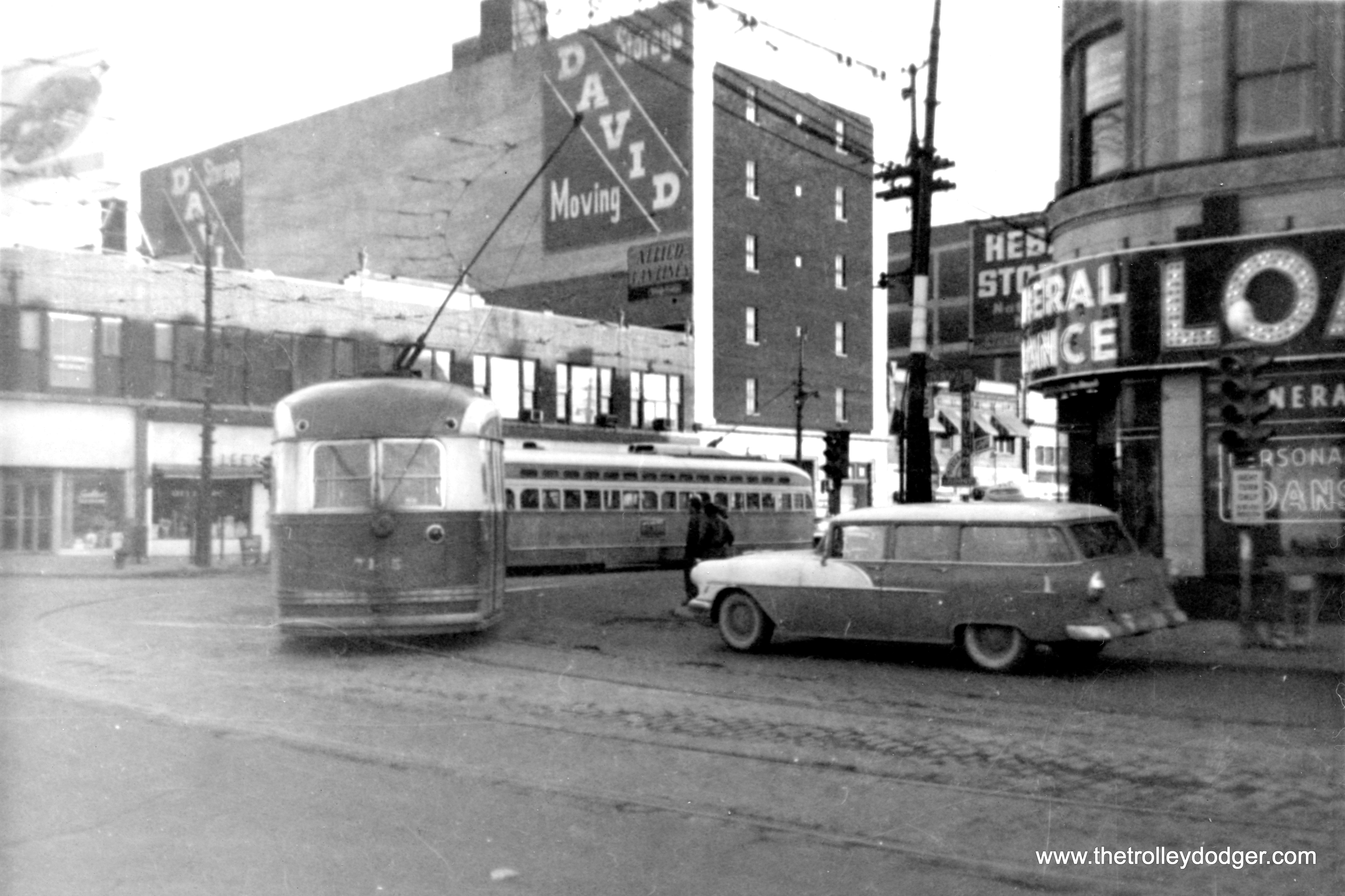
CSL 6149, an Odd 17 car built by CSL in 1919, is on through route 1 (Cottage Grove-Broadway), which ran from 1912 until October 7, 1946. The bicycle at right is very likely the photographer's. Ed Frank rode his bike all over the city instead of taking the streetcar, so he could save money to buy film. (Edward Frank, Jr. Photo)

CSL 6149, an Odd 17 car built by CSL in 1919, is on through route 1 (Cottage Grove-Broadway), which ran from 1912 until October 7, 1946. The bicycle at right is very likely the photographer’s. Ed Frank rode his bike all over the city instead of taking the streetcar, so he could save money to buy film. (Edward Frank, Jr. Photo)

Today’s post features the final batch of Chicago Surface Lines photos from the George Trapp collection. To find earlier posts in this series, just type “George Trapp” into the search window at the top of this page.

As always, if you can help us with locations and other tidbits of information about what you see here, don’t hesitate to let us know so we can update the captions and share the information with our readers. You can comment on this post, or write us directly at:

thetrolleydodger@gmail.com

We are very grateful for the generosity of George Trapp in sharing these great classic images with us. We also wish to thank the original photographers who took these pictures.

The good news is that George Trapp is going to share his extensive collection of Chicago rapid transit photos with us. Watch this space.

-David Sadowski


CSL 1457. Don's Rail Photos: "1457 was built by CUT in 1900 as CUT 4505. It was rebuilt as 1457 in 1911 and became CSL 1457 in 1914. It was rebuilt as (a) salt car and renumbered AA68 on April 15, 1948. It was retired on December 17, 1958." (Joe L. Diaz Photo)

CSL 1457. Don’s Rail Photos: “1457 was built by CUT in 1900 as CUT 4505. It was rebuilt as 1457 in 1911 and became CSL 1457 in 1914. It was rebuilt as (a) salt car and renumbered AA68 on April 15, 1948. It was retired on December 17, 1958.” (Joe L. Diaz Photo)

CSL/CTA Calt Car AA17. Don's Rail Photos: "AA17, salt car, was built by CUTCo in 1900 as CUT 4523. It was rebuilt as 1475 in 1911 and became CSL 1475 in 1914. It was rebuilt as salt car in 1930 and renumbered AA17 on October 1, 1941. It was retired on October 30, 1951." (Joe L. Diaz Photo)

CSL/CTA Calt Car AA17. Don’s Rail Photos: “AA17, salt car, was built by CUTCo in 1900 as CUT 4523. It was rebuilt as 1475 in 1911 and became CSL 1475 in 1914. It was rebuilt as salt car in 1930 and renumbered AA17 on October 1, 1941. It was retired on October 30, 1951.” (Joe L. Diaz Photo)

CSL 2605, a Robertson Rebuild car. Don's Rail Photos: "2605 was built by St Louis Car Co in 1901. It was stored at Devon Barn in 1948 and scrapped there in 1954." (Joe L. Diaz Photo)

CSL 2605, a Robertson Rebuild car. Don’s Rail Photos: “2605 was built by St Louis Car Co in 1901. It was stored at Devon Barn in 1948 and scrapped there in 1954.” (Joe L. Diaz Photo)

An early photo of CSL 1494 in charter service. This was called a "Bowling Alley" car due to the sideways seating. Don's Rail Photos: "1494 was built by CUTCo in 1900 as CUT 4543. It was rebuilt as 1494 n 1911 and became CSL 1494 in 1914. It was rebuilt as salt car and renumbered AA83 on April 15, 1948. It was retired on October 7, 1954."

An early photo of CSL 1494 in charter service. This was called a “Bowling Alley” car due to the sideways seating. Don’s Rail Photos: “1494 was built by CUTCo in 1900 as CUT 4543. It was rebuilt as 1494 n 1911 and became CSL 1494 in 1914. It was rebuilt as salt car and renumbered AA83 on April 15, 1948. It was retired on October 7, 1954.”

CSL Pullman 362 on the trestle over the Illinois Central at Roosevelt Road, heading to the Museum Loop.

CSL Pullman 362 on the trestle over the Illinois Central at Roosevelt Road, heading to the Museum Loop.

A 1910 builder's photo of Chicago Railways Pullman 751. (Krambles-Peterson Archive)

A 1910 builder’s photo of Chicago Railways Pullman 751. (Krambles-Peterson Archive)

A close-up of the Chicago Railways logo.

A close-up of the Chicago Railways logo.

CSL Pullman 870 is at Devon and Western. One of our keen-eyed readers notes, "I believe that this photo was actually taken in the Summer of 1948, rather than 1946 as stated in your caption. The reason that I say that is because the ACF-Brill bus seen at the curb on the left hand side of the photo was most likely operating on route 36A which was a shuttle on Devon from Kedzie to Broadway and Ardmore Loop. It was started on 12/15/1947 when route 36 - Broadway-State was cutback to Devon-Ravenswood when PCCs were instituted. PCCs were introduced on Western Avenue on August 1, 1948 which explains why Small Pullmans are shown running on Western Avenue in the photo. The car is heading west on Devon. In the distance, you can see the slight rise to Ridge Avenue near Misericordia." (Edward Frank, Jr. Photo)

CSL Pullman 870 is at Devon and Western. One of our keen-eyed readers notes, “I believe that this photo was actually taken in the Summer of 1948, rather than 1946 as stated in your caption. The reason that I say that is because the ACF-Brill bus seen at the curb on the left hand side of the photo was most likely operating on route 36A which was a shuttle on Devon from Kedzie to Broadway and Ardmore Loop. It was started on 12/15/1947 when route 36 – Broadway-State was cutback to Devon-Ravenswood when PCCs were instituted. PCCs were introduced on Western Avenue on August 1, 1948 which explains why Small Pullmans are shown running on Western Avenue in the photo. The car is heading west on Devon. In the distance, you can see the slight rise to Ridge Avenue near Misericordia.” (Edward Frank, Jr. Photo)

CSL 903 at the same location as the last photo, probably taken at the same time. Another factor, weighing in favor of a 1948 date, is the CTA recruitment poster on the front of the car. In its early days, the agency had quite a labor shortage. (Edward Frank, Jr. Photo)

CSL 903 at the same location as the last photo, probably taken at the same time. Another factor, weighing in favor of a 1948 date, is the CTA recruitment poster on the front of the car. In its early days, the agency had quite a labor shortage. (Edward Frank, Jr. Photo)

Although not identical, here is a similar sign on another Western Avenue streetcar, in a photo taken on May 22, 1948. That is probably not much different than when the previous two pictures were taken. The CTA had a lot of different signs like this, and many were variations on the same theme. To see the original picture, go to our post Chicago Surface Lines Photos, Part Three (November 21, 2015).

Although not identical, here is a similar sign on another Western Avenue streetcar, in a photo taken on May 22, 1948. That is probably not much different than when the previous two pictures were taken. The CTA had a lot of different signs like this, and many were variations on the same theme. To see the original picture, go to our post Chicago Surface Lines Photos, Part Three (November 21, 2015).

CSL Small St. Louis 1412. Andre Kristopans says it is at Noble Station (car house). Don's Rail Photos: "These cars were built by St. Louis Car in 1903 and 1906 for Chicago Union Traction Co. They are similar to the Robertson design without the small windows. Cars of this series were converted to one man operation in later years and have a wide horizontal stripe on the front to denote this. Two were used for an experimental articulated train. A number of these cars were converted to sand and salt service and as flangers." The 1374, which has been restored to operating condition at the Illinois Railway Museum, is part of this same series. Here is what www.chicagorailfan.com says about Noble Station: NOBLE 1901 N. Hermitage Ave. (at Cortland Ave.) Opened before 1908 Capacity in 1911: 18 cars inside/60 cars outside Capacity in 1943: 17 cars inside/103 cars outside Closed August 31, 1947 Building demolished (Joe L. Diaz Photo)

CSL Small St. Louis 1412. Andre Kristopans says it is at Noble Station (car house). Don’s Rail Photos: “These cars were built by St. Louis Car in 1903 and 1906 for Chicago Union Traction Co. They are similar to the Robertson design without the small windows. Cars of this series were converted to one man operation in later years and have a wide horizontal stripe on the front to denote this. Two were used for an experimental articulated train. A number of these cars were converted to sand and salt service and as flangers.” The 1374, which has been restored to operating condition at the Illinois Railway Museum, is part of this same series. Here is what http://www.chicagorailfan.com says about Noble Station:
NOBLE
1901 N. Hermitage Ave. (at Cortland Ave.)
Opened before 1908
Capacity in 1911: 18 cars inside/60 cars outside
Capacity in 1943: 17 cars inside/103 cars outside
Closed August 31, 1947
Building demolished
(Joe L. Diaz Photo)

CSL 1353, shown on the 14th-16th Street route, was part of this same series. (Joe L. Diaz Photo)

CSL 1353, shown on the 14th-16th Street route, was part of this same series. (Joe L. Diaz Photo)

CSL 1422, also a Small St. Louis car, signed for 14-Canal-Fulton.

CSL 1422, also a Small St. Louis car, signed for 14-Canal-Fulton.

CSL 1348, again part of the same series as the "Matchbox" at IRM.

CSL 1348, again part of the same series as the “Matchbox” at IRM.

CSL 1427. Frank Hicks: "Cars 1427 and 1428 weren’t Bowling Alleys; they were part of a series of five cars, 1424-1428, that were built in 1903 by Brill and were very similar overall to the Matchboxes. The car ends and St Louis 47 trucks match the St Louis-built Matchboxes but the side windows are different. I’m not sure what the backstory with this series is, as it’s unusual that Brill would build cars with St Louis trucks. These cars were numbered below the Matchboxes on CUT but above them on CSL." It was retired on April 30, 1937. (Edward Frank, Jr. Photo)

CSL 1427. Frank Hicks: “Cars 1427 and 1428 weren’t Bowling Alleys; they were part of a series of five cars, 1424-1428, that were built in 1903 by Brill and were very similar overall to the Matchboxes. The car ends and St Louis 47 trucks match the St Louis-built Matchboxes but the side windows are different. I’m not sure what the backstory with this series is, as it’s unusual that Brill would build cars with St Louis trucks. These cars were numbered below the Matchboxes on CUT but above them on CSL.” It was retired on April 30, 1937. (Edward Frank, Jr. Photo)

CSL 1428 was retired on May 10, 1937. See the caption for the previous picture for a description of this series. (Edward Frank, Jr. Photo)

CSL 1428 was retired on May 10, 1937. See the caption for the previous picture for a description of this series. (Edward Frank, Jr. Photo)

CSL 2816 was a Calumet Electric Railway car. Don's Rail Photos: "2816 was built by Brill Car Co in 1902, #12109, as Calumet Electric Ry 110. It became Calumet & Street Chicago Ry 801 in 1908 and rebuilt from single end to double end in 1910. It was renumbered 2816 in 1913. It became CSL 2816 in 1914 and scrapped in 1946."

CSL 2816 was a Calumet Electric Railway car. Don’s Rail Photos: “2816 was built by Brill Car Co in 1902, #12109, as Calumet Electric Ry 110. It became Calumet & Street Chicago Ry 801 in 1908 and rebuilt from single end to double end in 1910. It was renumbered 2816 in 1913. It became CSL 2816 in 1914 and scrapped in 1946.”

CSL 1584 was a Chicago Railways car, built in 1912. Don's Rail Photos: "These cars were improved versions of the Pullmans of a couple years earlier." It's odd that the car body would appear so light. It would have been dark green originally, then red starting in the early 1920s. Even if orthochromatic film had been used, this would have rendered the red darker than usual, not lighter. Perhaps it is just a "trick of the light."

CSL 1584 was a Chicago Railways car, built in 1912. Don’s Rail Photos: “These cars were improved versions of the Pullmans of a couple years earlier.” It’s odd that the car body would appear so light. It would have been dark green originally, then red starting in the early 1920s. Even if orthochromatic film had been used, this would have rendered the red darker than usual, not lighter. Perhaps it is just a “trick of the light.”

CSL 1592 was another Chicago Railways car, built in 1912. Andre Kristopans says 1592 is "on Division just west of California, by Humboldt Park." (Joe L. Diaz Photo)

CSL 1592 was another Chicago Railways car, built in 1912. Andre Kristopans says 1592 is “on Division just west of California, by Humboldt Park.” (Joe L. Diaz Photo)

CSL 5704 was a Nearside or Muzzleloader car. Don's Rail Photos:" 5704 was built by Brill Car Co. in 1912, #18322. It was rebuilt as one man/two man service in 1933."

CSL 5704 was a Nearside or Muzzleloader car. Don’s Rail Photos: “5704 was built by Brill Car Co. in 1912, #18322. It was rebuilt as one man/two man service in 1933.”

CSL 5983 at Broadway and Wilson. (Fred J. Borchert Photo, Edward Frank, Jr. Collection)

CSL 5983 at Broadway and Wilson. (Fred J. Borchert Photo, Edward Frank, Jr. Collection)

CSL 3091, signed for Elston, was called an "Odd 17" car, although there were actually 19. It was built by CSL in 1919.

CSL 3091, signed for Elston, was called an “Odd 17” car, although there were actually 19. It was built by CSL in 1919.

CSL 6152, an Odd 17 car, on through route 1, Cottage Grove-Broadway. This picture was taken at the same location as another we previously posted, which George Trapp identified as Devon and Glenwood (1400 W). The car is heading westbound. You can find that photo in our post Chicago Surface Lines Photos, Part Ten (May 6, 2016). (Krambles-Peterson Archive)

CSL 6152, an Odd 17 car, on through route 1, Cottage Grove-Broadway. This picture was taken at the same location as another we previously posted, which George Trapp identified as Devon and Glenwood (1400 W). The car is heading westbound. You can find that photo in our post Chicago Surface Lines Photos, Part Ten (May 6, 2016). (Krambles-Peterson Archive)

The two buildings in the previous picture are still there today.

The two buildings in the previous picture are still there today.

CSL 6153, another Odd 17 car, circa 1933-34. Our regular reader M. E. has identified the location as being Devon, just west of Western. He adds, "route 1 ran to Devon and Kedzie starting in 1932." So, this car is heading east on Devon, which explains why it is signed for Lake Park and 55th. (Krambles-Peterson Archive)

CSL 6153, another Odd 17 car, circa 1933-34. Our regular reader M. E. has identified the location as being Devon, just west of Western. He adds, “route 1 ran to Devon and Kedzie starting in 1932.” So, this car is heading east on Devon, which explains why it is signed for Lake Park and 55th. (Krambles-Peterson Archive)

The same location today.

The same location today.

CSL 6148, another Odd 17 car, is sporting an NRA (National Recovery Administration) sticker, which dates it to 1933-1935. (Edward Frank, Jr. Photo)

CSL 6148, another Odd 17 car, is sporting an NRA (National Recovery Administration) sticker, which dates it to 1933-1935. (Edward Frank, Jr. Photo)

CSL 3092 was known as a "Sewing Machine" or Safety car. Don's Rail Photos: "3092 was built by CSL in 1921. It was scrapped in 1946." The lower part of this car, which is probably red, may appear darker due to the use of orthochromatic film. This may show the car as new. (Krambles-Peterson Archive)

CSL 3092 was known as a “Sewing Machine” or Safety car. Don’s Rail Photos: “3092 was built by CSL in 1921. It was scrapped in 1946.” The lower part of this car, which is probably red, may appear darker due to the use of orthochromatic film. This may show the car as new. (Krambles-Peterson Archive)

We featured previously featured Birney cars in Our 150th Post (August 6, 2016). Birneys were not very successful in large cities such as Chicago, but had a long life in some smaller cities like Ft. Collins, Colorado. Don's Rail Photos does not list information on CSL 2000, but like the other Birneys he mentions, it was "built by Brill Car Co in October 1920, #21211. It was retired in 1932 and scrapped in March 1937." Since it looks in pretty good shape in this photo, this photo probably dates to 1932 or earlier. Andre Kristopans: "2000 also at Noble carhouse – note car signed for the north end of the 46-Noble route!"

We featured previously featured Birney cars in Our 150th Post (August 6, 2016). Birneys were not very successful in large cities such as Chicago, but had a long life in some smaller cities like Ft. Collins, Colorado. Don’s Rail Photos does not list information on CSL 2000, but like the other Birneys he mentions, it was “built by Brill Car Co in October 1920, #21211. It was retired in 1932 and scrapped in March 1937.” Since it looks in pretty good shape in this photo, this photo probably dates to 1932 or earlier. Andre Kristopans: “2000 also at Noble carhouse – note car signed for the north end of the 46-Noble route!”

Another view of CSL 3109 at Devon station (car house). (Krambles-Peterson Archive)

CSL 3109 at Clark and Devon. (Krambles-Peterson Archive)

CSL 3109 at Devon station (car house). Not sure what those sheets are doing hanging in the windows. (Krambles-Peterson Archive)

CSL 3109 at Devon station (car house). Not sure what those sheets are doing hanging in the windows. (Krambles-Peterson Archive)

Another view of CSL 3109 at Devon station (car house). (Krambles-Peterson Archive)

Another view of CSL 3109 at Devon station (car house). (Krambles-Peterson Archive)

An Evanston Railways car on Dempster Street, with the "L" in the background. We are looking west from the corner of Dempster and Chicago. Evanston Railways pictures are as scarce as hen's teeth. The "L" was elevated between 1908 and 1910. This picture was taken sometime between 1913, when ER got these cars, and 1935, when streetcars were replaced by buses.

An Evanston Railways car on Dempster Street, with the “L” in the background. We are looking west from the corner of Dempster and Chicago. Evanston Railways pictures are as scarce as hen’s teeth. The “L” was elevated between 1908 and 1910. This picture was taken sometime between 1913, when ER got these cars, and 1935, when streetcars were replaced by buses.

The same location today.

The same location today.


Recent Additions

An improved scan of this photo has been added to our post Trolley Dodger Mailbag, 2-28-2016:

In 1957, CTA PCC 7271 and 7215 pass on Clark Street, just north of North Avenue. The old Plaza Hotel, located at 59 W. North Avenue, is in the background. A Hasty Tasty restaurant was located in the building, with a Pixley and Ehler's across the street. These were "greasy spoon" chains that were known for offering cheap eats. Local mobsters were known to hang out at the Plaza. The Chicago Historical Society, now known as the Chicago History Museum, would be just to the left, out of view in this picture. The Moody Bible Institute would be out of view on the right. (Russel Kriete Photo)

In 1957, CTA PCC 7271 and 7215 pass on Clark Street, just north of North Avenue. The old Plaza Hotel, located at 59 W. North Avenue, is in the background. A Hasty Tasty restaurant was located in the building, with a Pixley and Ehler’s across the street. These were “greasy spoon” chains that were known for offering cheap eats. Local mobsters were known to hang out at the Plaza. The Chicago Historical Society, now known as the Chicago History Museum, would be just to the left, out of view in this picture. The Moody Bible Institute would be out of view on the right. (Russel Kriete Photo)

In this close-up, that looks like 7215 at right. Photographer Russel A. Kreite (1923-2015), of Downers Grove, Illinois, was a member of the Photographic Society of America and had many of his photos published in books and magazines.

In this close-up, that looks like 7215 at right. Photographer Russel A. Kreite (1923-2015), of Downers Grove, Illinois, was a member of the Photographic Society of America and had many of his photos published in books and magazines.


Help Support The Trolley Dodger

gh1

This is our 155th post, and we are gradually creating a body of work and an online resource for the benefit of all railfans, everywhere. To date, we have received over 195,000 page views, for which we are very grateful.

You can help us continue our original transit research by checking out the fine products in our Online Store. You can make a contribution there as well.

As we have said before, “If you buy here, we will be here.”

We thank you for your support.

Chicago Surface Lines Photos, Part Eleven

In this scene at Kedzie station (car house), we have CSL prewar PCC 7019, along with cars 3376, 3381, 3355, 6076, 3007, and 6072, with another PCC behind it. PCC service on busy route 20 - Madison was supplemented with some of the 1929 Sedans since the 83 cars purchased in 1936 were not enough for the line, which needed about 100 cars total in the late 1930s. (Robert V. Mehlenbeck Photo, Joe L. Diaz Collection)

In this scene at Kedzie station (car house), we have CSL prewar PCC 7019, along with cars 3376, 3381, 3355, 6076, 3007, and 6072, with another PCC behind it. PCC service on busy route 20 – Madison was supplemented with some of the 1929 Sedans since the 83 cars purchased in 1936 were not enough for the line, which needed about 100 cars total in the late 1930s. (Robert V. Mehlenbeck Photo, Joe L. Diaz Collection)

For today’s post, we offer another ample selection of Chicago Surface Lines photos from the George Trapp collection. To find earlier posts in this series, just type “George Trapp” into the search window at the top of this page.

As always, if you can help us with locations and other tidbits of information about what you see here, don’t hesitate to let us know so we can update the captions and share the information with our readers. You can comment on this post, or write us directly at:

thetrolleydodger@gmail.com

We are very grateful for the generosity of George Trapp in sharing these great classic images with us. We also wish to thank the original photographers who took these pictures, most notably the late Edward Frank, Jr. and Joe Diaz, who tirelessly roamed the streets of Chicago in the 1930s and 1940s to document what was then the largest streetcar system in the world. In addition, we should also thank Fred J. Borchert, who took similar photos going back to the 1910s and 1920s, Robert V. Mehlenbeck, and George Krambles, who got a very early start as a railfan, as you can see in some of these pictures.

Unfortunately, all five of these individuals are gone from the scene, but fortunately, we can still benefit from all their hard work in taking these wonderful old photographs. Let us never forget that we are, as Sir Issac Newton said, “standing on the shoulders of giants.”

Since Monday is Labor Day, we have been sure to include some photos of CSL work cars too.

-David Sadowski


CSL 1767 on Broadway-State. One of our regular readers writes, "On Broadway SB near Surf Street (my best guess) post 1937." (Robert V. Mehlenbeck Photo, Joe L. Diaz Collection)

CSL 1767 on Broadway-State. One of our regular readers writes, “On Broadway SB near Surf Street (my best guess) post 1937.” (Robert V. Mehlenbeck Photo, Joe L. Diaz Collection)

This sure looks like the same building as in the previous picture. It's around 2883 N. Broadway, which is just north of Surf.

This sure looks like the same building as in the previous picture. It’s around 2883 N. Broadway, which is just north of Surf.

CSL 6211 on the Hammond, Whiting and East Chicago (Indiana) route, which was jointly operated as a through-route with, logically enough, the Hammond, Whiting and East Chicago Railway. As the Shore Line Interurban Historical Society notes, "Common ownership with the South Chicago City Railway Company brought through operation into Chicago as early as 1896. Similarly, Chicago cars ran to Hammond and East Chicago. However, each company advertised the service on its side of the state line as a local route, retaining the fares from that portion." Service ended in 1940. (Robert V. Mehlenbeck Photo, Joe L. Diaz Collection)

CSL 6211 on the Hammond, Whiting and East Chicago (Indiana) route, which was jointly operated as a through-route with, logically enough, the Hammond, Whiting and East Chicago Railway. As the Shore Line Interurban Historical Society notes, “Common ownership with the South Chicago City Railway Company brought through operation into Chicago as early as 1896. Similarly, Chicago cars ran to Hammond and East Chicago. However, each company advertised the service on its side of the state line as a local route, retaining the fares from that portion.” Service ended in 1940. (Robert V. Mehlenbeck Photo, Joe L. Diaz Collection)

The presence of Chicago's famous Como Inn restaurant (which closed in 2001, after being in business for 77 years) helps identify this location as the "six corners" intersection of Halsted, Milwaukee and Grand. Andre Kristopans: "The street you are looking down is Milwaukee, cars could be Milwaukee, Elston, or Division routes. The 1900 on the left in the first photo is on Grand, and Halsted crosses both left to right." Scott writes, "The photographer is looking northwest up Milwaukee Avenue; the “turtleback” car at the left in the first picture is on Grand. The block in the background (with the corner bar and Schlitz billboard) was recently torn down for new construction; the buildings had all been painted a bluish-gray and left to deteriorate for years." We posted a later photo showing a PCC car at this location in our post Chicago PCC Updates (August 30, 2015). (Robert V. Mehlenbeck Photo, Joe L. Diaz Collection)

The presence of Chicago’s famous Como Inn restaurant (which closed in 2001, after being in business for 77 years) helps identify this location as the “six corners” intersection of Halsted, Milwaukee and Grand. Andre Kristopans: “The street you are looking down is Milwaukee, cars could be Milwaukee, Elston, or Division routes. The 1900 on the left in the first photo is on Grand, and Halsted crosses both left to right.” Scott writes, “The photographer is looking northwest up Milwaukee Avenue; the “turtleback” car at the left in the first picture is on Grand. The block in the background (with the corner bar and Schlitz billboard) was recently torn down for new construction; the buildings had all been painted a bluish-gray and left to deteriorate for years.” We posted a later photo showing a PCC car at this location in our post Chicago PCC Updates (August 30, 2015). (Robert V. Mehlenbeck Photo, Joe L. Diaz Collection)

CSL 3058 passes car 687 on Milwaukee at the intersection with Grand and Halsted. (Robert V. Mehlenbeck Photo, Joe L. Diaz Collection)

CSL 3058 passes car 687 on Milwaukee at the intersection with Grand and Halsted. (Robert V. Mehlenbeck Photo, Joe L. Diaz Collection)

The same location today. Grand is on the left, Milwaukee on the right.

The same location today. Grand is on the left, Milwaukee on the right.

CSL 6259 at the Imlay loop, the north end of the Milwaukee Avenue route. (Robert V. Mehlenbeck Photo, Joe L. Diaz Collection)

CSL 6259 at the Imlay loop, the north end of the Milwaukee Avenue route. (Robert V. Mehlenbeck Photo, Joe L. Diaz Collection)

CSL Sedan (Peter Witt) 3367 in service on the Cottage Grove route. Andre Kristopans: "Sedan 3367 is turning west to north at 95th and Cottage Grove." M. E. writes, "The photo titled “CSL Sedan (Peter Witt) 3367 in service on the Cottage Grove route” must have been taken at 95th and Cottage Grove, because the streetcar is turning from one road to another. At 95th St. there were actually two Cottage Grove Aves.– one heading north along the west side of the Illinois Central main line, the other heading south along the east side of the IC main line. To connect from one Cottage Grove to the other (whether north- or southbound), the streetcars turned left onto 95th St., went under the IC, then turned right on the other Cottage Grove. As for which side of the IC this picture depicts, I believe it is the west side, because I recall a wall along the south side of 95th St. Ergo, this view is west on 95th and the streetcar is heading north." (Robert V. Mehlenbeck Photo, Joe L. Diaz Collection)

CSL Sedan (Peter Witt) 3367 in service on the Cottage Grove route. Andre Kristopans: “Sedan 3367 is turning west to north at 95th and Cottage Grove.” M. E. writes, “The photo titled “CSL Sedan (Peter Witt) 3367 in service on the Cottage Grove route” must have been taken at 95th and Cottage Grove, because the streetcar is turning from one road to another. At 95th St. there were actually two Cottage Grove Aves.– one heading north along the west side of the Illinois Central main line, the other heading south along the east side of the IC main line. To connect from one Cottage Grove to the other (whether north- or southbound), the streetcars turned left onto 95th St., went under the IC, then turned right on the other Cottage Grove. As for which side of the IC this picture depicts, I believe it is the west side, because I recall a wall along the south side of 95th St. Ergo, this view is west on 95th and the streetcar is heading north.” (Robert V. Mehlenbeck Photo, Joe L. Diaz Collection)

The same location today. We are looking west along 95th, and Cottage Grove is to the right.

The same location today. We are looking west along 95th, and Cottage Grove is to the right.

CSL 3113 on the Ashland route. Andre Kristopans: "3113 is at Ashland and Irving Park, on the NORTH ASHLAND shuttle route between Irving Park and Fullerton. It was made part of the main route in the 1930’s when the Ashland bridge over the North Branch was built." (Robert V. Mehlenbeck Photo, Joe L. Diaz Collection)

CSL 3113 on the Ashland route. Andre Kristopans: “3113 is at Ashland and Irving Park, on the NORTH ASHLAND shuttle route between Irving Park and Fullerton. It was made part of the main route in the 1930’s when the Ashland bridge over the North Branch was built.” (Robert V. Mehlenbeck Photo, Joe L. Diaz Collection)

Ashland and Irving Park today. We are looking east.

Ashland and Irving Park today. We are looking east.

CSL 1260 on Montrose. Andre Kristopans: "1260 on Montrose might be at Knox. Does not appear to be at Milwaukee, but that was a 1930 extension, and this is likely before then." (Robert V. Mehlenbeck Photo, Joe L. Diaz Collection)

CSL 1260 on Montrose. Andre Kristopans: “1260 on Montrose might be at Knox. Does not appear to be at Milwaukee, but that was a 1930 extension, and this is likely before then.” (Robert V. Mehlenbeck Photo, Joe L. Diaz Collection)

One of our regular readers says that CSL Pullman 184 is in the Clark-Arthur Loop, across the street from Devon Station. (Robert V. Mehlenbeck Photo, Joe L. Diaz Collection)

One of our regular readers says that CSL Pullman 184 is in the Clark-Arthur Loop, across the street from Devon Station. (Robert V. Mehlenbeck Photo, Joe L. Diaz Collection)

Motion blur makes it hard to read the car number, but this is a Pullman in the (natch) "Pullman green" color scheme prior to the adoption of red in the 1920s. One of our regular readers writes, "Chicago Railways Pullman No. 191. Note the Chicago Railways logo on the side of the car. The CRys logo was very similar to the CSL logo. This photo was probably taken between 1908 and 1914 when CSL started operations. The cars were not painted red and cream until the early 1920s when CSL adopted that color scheme." (Fred J. Borchert Photo, Edward Frank, Jr. Collection)

Motion blur makes it hard to read the car number, but this is a Pullman in the (natch) “Pullman green” color scheme prior to the adoption of red in the 1920s. One of our regular readers writes, “Chicago Railways Pullman No. 191. Note the Chicago Railways logo on the side of the car. The CRys logo was very similar to the CSL logo. This photo was probably taken between 1908 and 1914 when CSL started operations. The cars were not painted red and cream until the early 1920s when CSL adopted that color scheme.” (Fred J. Borchert Photo, Edward Frank, Jr. Collection)

This is a circa 1940 view taken by Edward Frank, Jr. showing the old Edgewater car house. We previously posted a Fred J. Borchert photo showing a street railway post office car at this location, in Chicago Surface Lines Photos, Part One (November 3, 2015). Such services ended in 1915. According to www.chicagorailfan.com: CHICAGO NORTH SHORE STREET RAILWAY EDGEWATER 5847 N. Broadway (near Ardmore Ave.) Opened in 1893 Replaced by Devon car house in 1901 Used as Ardmore bus garage 1937-1950 Building remains standing, abandoned except for CTA substation within northwest corner. Chicago North Shore Street Railway Co. was sold in 1894 to North Chicago Electric Railway Co., and merged in 1899 into Chicago Consolidated Traction Co.

This is a circa 1940 view taken by Edward Frank, Jr. showing the old Edgewater car house. We previously posted a Fred J. Borchert photo showing a street railway post office car at this location, in Chicago Surface Lines Photos, Part One (November 3, 2015). Such services ended in 1915. According to www.chicagorailfan.com:

CHICAGO NORTH SHORE STREET RAILWAY
EDGEWATER
5847 N. Broadway (near Ardmore Ave.)
Opened in 1893
Replaced by Devon car house in 1901
Used as Ardmore bus garage 1937-1950
Building remains standing, abandoned except for CTA substation within northwest corner.
Chicago North Shore Street Railway Co. was sold in 1894 to North Chicago Electric Railway Co., and merged in 1899 into Chicago Consolidated Traction Co.


5847 N. Broadway today.

5847 N. Broadway today.

I'm not sure of the exact location of this car at Chicago's lakefront. Is this Navy Pier? Oak Street beach? Or somewhere else entirely? Andre Kristopans: "The lakefront shot is indeed Oak St, the Chicago Ave loop which was on the NORTH side of Grand about where the entrance to the water filtration plant now is." George Foelschow: "The lakefront picture features the Furniture Mart at Lake Shore Drive at Erie Street, built in 1926 and the largest building in Chicago for a time. The tiny beach would be at Ohio Street. The Chicago Avenue line approached Navy Pier until the drive was “improved”, though I believe its tracks were separate from the Grand Avenue line." M. E. writes, "The photo titled “I’m not sure of the exact location of this car at Chicago’s lakefront” is probably, as you surmise, at Navy Pier. There was a huge building on the west side of Lake Shore Drive, which I think was the Furniture Mart. That would have been only a block north of Grand Ave., where Navy Pier is. There were no streetcars anywhere near the Oak St. beach."

I’m not sure of the exact location of this car at Chicago’s lakefront. Is this Navy Pier? Oak Street beach? Or somewhere else entirely? Andre Kristopans: “The lakefront shot is indeed Oak St, the Chicago Ave loop which was on the NORTH side of Grand about where the entrance to the water filtration plant now is.” George Foelschow: “The lakefront picture features the Furniture Mart at Lake Shore Drive at Erie Street, built in 1926 and the largest building in Chicago for a time. The tiny beach would be at Ohio Street. The Chicago Avenue line approached Navy Pier until the drive was “improved”, though I believe its tracks were separate from the Grand Avenue line.” M. E. writes, “The photo titled “I’m not sure of the exact location of this car at Chicago’s lakefront” is probably, as you surmise, at Navy Pier. There was a huge building on the west side of Lake Shore Drive, which I think was the Furniture Mart. That would have been only a block north of Grand Ave., where Navy Pier is. There were no streetcars anywhere near the Oak St. beach.”

The number on this car at Navy Pier looks like 3010, which would make it a Brill. Andre Kristopans: "3010 at Navy Pier is probably working Stony Island-Wabash. This was the “short loop” roughly in the middle of Navy Pier Park, surrounded by Streeter Drive. Grand cars turned back next to the ramp on the left, which had once had streetcar track going to the upper level of the pier, but by this point was for truck access. The short loop was paved for trolley bus use in 1951, and by 1955 or so replaced by a new TT loop which was accessed from Streeter & Illinois, which lasted until the complete rebuilding of the area in the 1990’s." (Edward Frank, Jr. Photo)

The number on this car at Navy Pier looks like 3010, which would make it a Brill. Andre Kristopans: “3010 at Navy Pier is probably working Stony Island-Wabash. This was the “short loop” roughly in the middle of Navy Pier Park, surrounded by Streeter Drive. Grand cars turned back next to the ramp on the left, which had once had streetcar track going to the upper level of the pier, but by this point was for truck access. The short loop was paved for trolley bus use in 1951, and by 1955 or so replaced by a new TT loop which was accessed from Streeter & Illinois, which lasted until the complete rebuilding of the area in the 1990’s.” (Edward Frank, Jr. Photo)

This is the old LaSalle Street streetcar tunnel, seen here north of Randolph. The tunnel was in use from 1871 until 1939, when it became an access point for construction of the Dearborn-Milwaukee subway. (Fred J. Borchert Photo, Edward Frank, Jr. Collection)

This is the old LaSalle Street streetcar tunnel, seen here north of Randolph. The tunnel was in use from 1871 until 1939, when it became an access point for construction of the Dearborn-Milwaukee subway. (Fred J. Borchert Photo, Edward Frank, Jr. Collection)

The old LaSalle Street streetcar tunnel, north of Randolph. (Fred J. Borchert Photo, Edward Frank, Jr. Collection)

The old LaSalle Street streetcar tunnel, north of Randolph. (Fred J. Borchert Photo, Edward Frank, Jr. Collection)

Perhaps one of our readers can help identify this bridge. Andre Kristopans: "The first bridge photo is Kedzie across the Sanitary & Ship Canal. The IC bridge in the background is still there, the Kedzie bridge was replaced mid-1960’s, which caused the conversion of the Kedzie-California trolley bus route to motor buses, because CTA did not want to put wires on the shoo-fly." Bill Shapotkin adds, "This is the Kedzie Ave bridge over the river south of 31st St. View looks E-N/E. Note the still-in-service IC bridge in background (which I did ride over under Amtrak)." (Edward Frank, Jr. Photo)

Perhaps one of our readers can help identify this bridge. Andre Kristopans: “The first bridge photo is Kedzie across the Sanitary & Ship Canal. The IC bridge in the background is still there, the Kedzie bridge was replaced mid-1960’s, which caused the conversion of the Kedzie-California trolley bus route to motor buses, because CTA did not want to put wires on the shoo-fly.” Bill Shapotkin adds, “This is the Kedzie Ave bridge over the river south of 31st St. View looks E-N/E. Note the still-in-service IC bridge in background (which I did ride over under Amtrak).” (Edward Frank, Jr. Photo)

Again, maybe one of our readers can help identify this bridge. Andre Kristopans: "The second bridge photo is much harder to ID. However, notice that while the bridge is for lanes, the streetcar is on the “wrong side”, as both tracks are on the near half of the bridge!" Perhaps the bridge was expanded at some point, and the car tracks were left on the one side only. (Edward Frank, Jr. Photo)

Again, maybe one of our readers can help identify this bridge. Andre Kristopans: “The second bridge photo is much harder to ID. However, notice that while the bridge is for lanes, the streetcar is on the “wrong side”, as both tracks are on the near half of the bridge!” Perhaps the bridge was expanded at some point, and the car tracks were left on the one side only. (Edward Frank, Jr. Photo)

Eric Bronsky writes:

This photo shows a car operating northbound on South Western Ave. Bridge over the Chicago Drainage Canal (known today as the Sanitary & Ship Canal), probably in the 1930s. This center pier swing bridge was built in 1906 and removed in 1939. Actually this bridge carried two separate thoroughfares – S. Western Ave. and S. Western Blvd., the latter being a component of Chicago’s historic boulevard system with limited access to local streets between 31st Blvd. and 54th St. Then as now, both thoroughfares were bi-directional. The car tracks were on the avenue (westernmost) side of the bridge.

The main problems with the old swing bridge were its low clearance and the center pier obstructing river traffic. The current bridge, originally completed in 1940 as a fixed span, was soon converted to a vertical lift bridge to accommodate WWII traffic from a shipyard along the canal. It was later converted back to a fixed span.

I have attached a photo which you may use in the blog. Dated Sept. 8, 1938, it looks north. Evidently S. Western Ave. was widened at some point after the bridge was built, but the car tracks were not relocated to the center of the rebuilt roadway, which would explain the offset on the curved approach to the bridge. Please credit Eric Bronsky Collection.

Thanks very much, Eric. There were other places along Western Avenue where the streetcar tracks ended up being offset after the street was widened. You can see such pictures, and a variety of pictures showing the 1940 replacement bridge, in Central Electric Railfans’ Association Bulletin 146, Chicago Streetcar Pictorial: the PCC Car Era 1936-1958.

S Western Ave Br Over S&S Canal lkg N 9-8-039

According to the caption on this Chicago Historical Society photo, we are looking east at Devon station on September 23, 1923. This is a new repair bay at teh west end of the new pit, after much of the building here was destroyed by fire in early 1922.

According to the caption on this Chicago Historical Society photo, we are looking east at Devon station on September 23, 1923. This is a new repair bay at teh west end of the new pit, after much of the building here was destroyed by fire in early 1922.

Looking east at Clark and north of Schreiber, this February 10, 1922 Chicago Historical Society photo shows the aftermath of the fire that burned down half of Devon station (car house).

Looking east at Clark and north of Schreiber, this February 10, 1922 Chicago Historical Society photo shows the aftermath of the fire that burned down half of Devon station (car house).

One of our regular readers thinks this photo shows Evanston Avenue (now Broadway) between Devon and Lawrence. "I believe that the streetcar is a Chicago Union Traction car, but it is too far away in the photo to identify. I believe that the view is looking north somewhere in Edgewater."

One of our regular readers thinks this photo shows Evanston Avenue (now Broadway) between Devon and Lawrence. “I believe that the streetcar is a Chicago Union Traction car, but it is too far away in the photo to identify. I believe that the view is looking north somewhere in Edgewater.”

CSL Snow Plow F28. Don's Rail Photos says, "F28, plow, was built by McGuire-Cummings in 1924. It was retired on December 14, 1956." (Joe L. Diaz Photo)

CSL Snow Plow F28. Don’s Rail Photos says, “F28, plow, was built by McGuire-Cummings in 1924. It was retired on December 14, 1956.” (Joe L. Diaz Photo)

Don's Rail Photos says, "E57, sweeper, was built by Russell in 1930. It was retired on March 11, 1959." (Joe L. Diaz Photo)

Don’s Rail Photos says, “E57, sweeper, was built by Russell in 1930. It was retired on March 11, 1959.” (Joe L. Diaz Photo)

This, and the series of photos that follow, were taken between 1930 and 1932 by George Krambles at the Devon car house, where a lot of very old equipment (including single-truck streetcars) was stored. Since GK was born in 1915, he would have been in high school at this time. CSL often kept obsolete equipment for decades. Some of these cars were used for work service. Another reason for keeping them was their potential sale as assets, in case transit unification came to pass. The young man at left is unidentified. (George Krambles Photo, Edward Frank, Jr. Collection)

This, and the series of photos that follow, were taken between 1930 and 1932 by George Krambles at the Devon car house, where a lot of very old equipment (including single-truck streetcars) was stored. Since GK was born in 1915, he would have been in high school at this time. CSL often kept obsolete equipment for decades. Some of these cars were used for work service. Another reason for keeping them was their potential sale as assets, in case transit unification came to pass. The young man at left is unidentified. (George Krambles Photo, Edward Frank, Jr. Collection)

CSL Sand Car R4 at Clark and Devon, circa 1930-32. Don's Rail Photos says, "R4, sand car, was rebuilt by Chicago Rys in 1913 as M4. It came from 5569, passenger car. It was renumbered R4 in 1913 and became CSL R4 in 1914. It was retired in 1942." (George Krambles Photo, Edward Frank, Jr. Collection)

CSL Sand Car R4 at Clark and Devon, circa 1930-32. Don’s Rail Photos says, “R4, sand car, was rebuilt by Chicago Rys in 1913 as M4. It came from 5569, passenger car. It was renumbered R4 in 1913 and became CSL R4 in 1914. It was retired in 1942.” (George Krambles Photo, Edward Frank, Jr. Collection)

Ancient CSL car 2144 at Clark and Devon, c1930-32. The side sign reads, "Base Ball." (George Krambles Photo, Edward Frank, Jr. Collection)

Ancient CSL car 2144 at Clark and Devon, c1930-32. The side sign reads, “Base Ball.” (George Krambles Photo, Edward Frank, Jr. Collection)

CSL 1142 at Devon car house. Many cars in this series were sold in 1946 for use as temporary housing. I am not sure if this picture was taken around 1930-32 like the few that precede it. (George Krambles Photo, Edward Frank, Jr. Collection)

CSL 1142 at Devon car house. Many cars in this series were sold in 1946 for use as temporary housing. I am not sure if this picture was taken around 1930-32 like the few that precede it. (George Krambles Photo, Edward Frank, Jr. Collection)

CSL Supply Car S201. Don's Rail Photos: "S201, supply car, was built by Chicago City Ry in 1908 as CCRy C45. It was renumbered S201 in 1913 and became CSL S201 in 1914. It was retired on September 27, 1956." (Joe L. Diaz Photo)

CSL Supply Car S201. Don’s Rail Photos: “S201, supply car, was built by Chicago City Ry in 1908 as CCRy C45. It was renumbered S201 in 1913 and became CSL S201 in 1914. It was retired on September 27, 1956.” (Joe L. Diaz Photo)

CSL 1465 was called a "Bowling Alley" car due to its sideways seating. Don's Rail Photos says, "1465 was built by CUT in 1900 as CUT 4514. It was rebuilt as 1465 in 1911 and became CSL 1465 in 1914. It was rebuilt as (a) salt car and renumbered AA71 on April 15, 1948. It was retired on August 2, 1951." (Joe L. Diaz Photo)

CSL 1465 was called a “Bowling Alley” car due to its sideways seating. Don’s Rail Photos says, “1465 was built by CUT in 1900 as CUT 4514. It was rebuilt as 1465 in 1911 and became CSL 1465 in 1914. It was rebuilt as (a) salt car and renumbered AA71 on April 15, 1948. It was retired on August 2, 1951.” (Joe L. Diaz Photo)

As we near the end of summer here in Chicago, we will leave you with this wintry scene of CSL 1455. Don's Rail Photos says, "1455 was built by CUT in 1900 as CUT 4504. It was rebuilt as 1455 in 1911 and became CSL 1455 in 1914. It was rebuilt as (a) salt car and renumbered AA67 on April 15, 1948. It was retired on August 17, 1951." (Joe L. Diaz Photo)

As we near the end of summer here in Chicago, we will leave you with this wintry scene of CSL 1455. Don’s Rail Photos says, “1455 was built by CUT in 1900 as CUT 4504. It was rebuilt as 1455 in 1911 and became CSL 1455 in 1914. It was rebuilt as (a) salt car and renumbered AA67 on April 15, 1948. It was retired on August 17, 1951.” (Joe L. Diaz Photo)


Help Support The Trolley Dodger

gh1

This is our 154th post, and we are gradually creating a body of work and an online resource for the benefit of all railfans, everywhere. To date, we have received over 193,000 page views, for which we are very grateful.

You can help us continue our original transit research by checking out the fine products in our Online Store. You can make a contribution there as well.

As we have said before, “If you buy here, we will be here.”

We thank you for your support.

Around Town

Here is CSL 2802 on a July 13, 1941 CERA fantrip alongside the South Chicago branch of the Illinois Central Electric suburban service. That nattily dressed man has been identified as none other than George Krambles (1915-1998). We ran another picture from this trip in an earlier post Chicago Surface Lines Photos, Part Six (February 22, 2016). Known as a Robertson Rebuild, Don's Rail Photos says, "2802 was built by St Louis Car Co in 1901 as CCRy 2554. It was sold as C&CS 702 in 1908 and renumbered 2802 in 1913. It became CSL 2802 in 1914." A circa-1940 Packard prepares to go around the car. (Hochner Photo)

Here is CSL 2802 on a July 13, 1941 CERA fantrip alongside the South Chicago branch of the Illinois Central Electric suburban service. That nattily dressed man has been identified as none other than George Krambles (1915-1998). We ran another picture from this trip in an earlier post Chicago Surface Lines Photos, Part Six (February 22, 2016). Known as a Robertson Rebuild, Don’s Rail Photos says, “2802 was built by St Louis Car Co in 1901 as CCRy 2554. It was sold as C&CS 702 in 1908 and renumbered 2802 in 1913. It became CSL 2802 in 1914.” A circa-1940 Packard prepares to go around the car. (Hochner Photo)

Today, we’ve assembled some of our recent photo finds into this post, which takes us north, south, east, and west around the Chicago area. As always, if you have any interesting tidbits of information to share regarding these pictures, don’t hesitate to either leave a Comment on this post, or contact us directly at:

thetrolleydodger@gmail.com

Thanks.

-David Sadowski

GK.

GK.

CSL/CTA Sedan 3327 is shown in the late 1940s at Cottage Grove and 115th, south end of route 4. The Illinois Central Electric suburban service is at left on an embankment.

CSL/CTA Sedan 3327 is shown in the late 1940s at Cottage Grove and 115th, south end of route 4. The Illinois Central Electric suburban service is at left on an embankment.

CSL 5197 was a Brill-American-Kuhlman car. Don's Rail Photos notes, "5001 thru 5200 were built by Brill in 1905, #14318, for the Chicago City Ry. where they carried the same numbers. They were rebuilt in 1908 to bring them up to the standard of the later cars." This photo was taken at 31st and Lake Park. On the back of this photo, it notes, "Abandoned 2/28/48." That's when route 31 was "bustituted."

CSL 5197 was a Brill-American-Kuhlman car. Don’s Rail Photos notes, “5001 thru 5200 were built by Brill in 1905, #14318, for the Chicago City Ry. where they carried the same numbers. They were rebuilt in 1908 to bring them up to the standard of the later cars.” This photo was taken at 31st and Lake Park. On the back of this photo, it notes, “Abandoned 2/28/48.” That’s when route 31 was “bustituted.”

CSL Sedan 3332 is southbound at Lincoln Park on the Clark-Wentworth line, where they ran from 1929 until 1946, when they were replaced by PCCs. As this is a Tom Desnoyers photo, it is probably from the 1940s.

CSL Sedan 3332 is southbound at Lincoln Park on the Clark-Wentworth line, where they ran from 1929 until 1946, when they were replaced by PCCs. As this is a Tom Desnoyers photo, it is probably from the 1940s.

Evanston Railways car #5 after abandonment. Although this picture is undated, streetcar service was replaced by buses in 1935, so chances are this is the late 1930s. To the best of my knowledge, this was part of an order for 12 cars placed with the St. Louis Car Company in late 1913. The late James J. Buckley wrote a short (40 pages) book The Evanston Railway Company, published in 1958 as Bulletin #28 of the Electric Railway Historical Society. This has been long out-of-print, but it is now available as part of The Complete ERHS Collection, an E-book put out by the Central Electric Railfans' Association in 2014 (which I edited). The Diner Grill (at 1635 W. Irving Park Road in Chicago) is said to be built around the bodies of two Evanston streetcars.

Evanston Railways car #5 after abandonment. Although this picture is undated, streetcar service was replaced by buses in 1935, so chances are this is the late 1930s. To the best of my knowledge, this was part of an order for 12 cars placed with the St. Louis Car Company in late 1913. The late James J. Buckley wrote a short (40 pages) book The Evanston Railway Company, published in 1958 as Bulletin #28 of the Electric Railway Historical Society. This has been long out-of-print, but it is now available as part of The Complete ERHS Collection, an E-book put out by the Central Electric Railfans’ Association in 2014 (which I edited). The Diner Grill (at 1635 W. Irving Park Road in Chicago) is said to be built around the bodies of two Evanston streetcars.

dinergrill

CSL/CTA Pullman 441 on Roosevelt Road, west of the Illinois Central station, circa the 1940s. Not sure what the bus is at rear.

CSL/CTA Pullman 441 on Roosevelt Road, west of the Illinois Central station, circa the 1940s. Not sure what the bus is at rear.

CSL/CTA 5357 at 63rd Place and Oak Park Avenue. As www.chicagrailfan.com notes, "The 63rd St. and the Argo streetcar routes were split at Oak Park Ave. And when the Argo streetcar route was replaced with the West 63rd bus route, the split point was relocated east to Narragansett Ave. Narragansett Ave. remained the split point after the main 63rd St. route was converted to buses. After opening of rapid transit line to Midway Airport, 63rd St. service restructured to terminate at Midway Airport terminal, with new route 63W operating west of Cicero Ave." Therefore, this picture cannot date later than April 11, 1948, when the Argo streetcar route was replaced by the route 63A bus. (Charles Able Photo)

CSL/CTA 5357 at 63rd Place and Oak Park Avenue. As http://www.chicagrailfan.com notes, “The 63rd St. and the Argo streetcar routes were split at Oak Park Ave. And when the Argo streetcar route was replaced with the West 63rd bus route, the split point was relocated east to Narragansett Ave. Narragansett Ave. remained the split point after the main 63rd St. route was converted to buses. After opening of rapid transit line to Midway Airport, 63rd St. service restructured to terminate at Midway Airport terminal, with new route 63W operating west of Cicero Ave.” Therefore, this picture cannot date later than April 11, 1948, when the Argo streetcar route was replaced by the route 63A bus. (Charles Able Photo)

This photo shows CSL work car N5 on December 27, 1940. (Max Miller Photo)

This photo shows CSL work car N5 on December 27, 1940. (Max Miller Photo)

On November 29, 1949 it was reported: "At least 14 persons were reported injured, one critically, when two streetcars crashed at a busy intersection on the south side this afternoon. Several pedestrians were among the injured." You can just barely see a CTA wrecker in the lower right corner of the picture. M. E. writes: "The smashup dated 29 November 1949 is at 63rd and Halsted, looking northwest at the Ace department store. About that store, I remember it was rather dowdy and had no air conditioning. It had lots of ceiling fans instead. So it was hot in summer. On the southwest corner was an SS Kresge dime store. In the window was a doughnut-making machine, which was probably 15 feet long, most of which was a chute in which the donuts took shape. The price was 3 cents per doughnut. Kresge was predecessor to K-Mart. On the southeast corner were small stores, the largest of which was a Stineway drug store. Notice the spelling: Stineway rather than Steinway as in pianos. On the northeast corner was a big Sears department store, with a Hillman's grocery in the basement. I think I heard once that this Sears was the largest in Chicago other than the downtown Sears at State and Van Buren."

On November 29, 1949 it was reported: “At least 14 persons were reported injured, one critically, when two streetcars crashed at a busy intersection on the south side this afternoon. Several pedestrians were among the injured.” You can just barely see a CTA wrecker in the lower right corner of the picture.
M. E. writes: “The smashup dated 29 November 1949 is at 63rd and Halsted, looking northwest at the Ace department store. About that store, I remember it was rather dowdy and had no air conditioning. It had lots of ceiling fans instead. So it was hot in summer. On the southwest corner was an SS Kresge dime store. In the window was a doughnut-making machine, which was probably 15 feet long, most of which was a chute in which the donuts took shape. The price was 3 cents per doughnut. Kresge was predecessor to K-Mart. On the southeast corner were small stores, the largest of which was a Stineway drug store. Notice the spelling: Stineway rather than Steinway as in pianos. On the northeast corner was a big Sears department store, with a Hillman’s grocery in the basement. I think I heard once that this Sears was the largest in Chicago other than the downtown Sears at State and Van Buren.”

This looks like an even more serious accident. The caption from this November 15, 1954 photo reads, "One person was killed and about 30 others injured here when this streetcar collided with a furniture truck on south Western Avenue. Dead man identified as James K. Siegler, 2534 W. 68th Street, a CTA bus driver who was a passenger in the streetcar." I do not know which car this was, or whether it was ever repaired.

This looks like an even more serious accident. The caption from this November 15, 1954 photo reads, “One person was killed and about 30 others injured here when this streetcar collided with a furniture truck on south Western Avenue. Dead man identified as James K. Siegler, 2534 W. 68th Street, a CTA bus driver who was a passenger in the streetcar.” I do not know which car this was, or whether it was ever repaired.

I have seen similar publicity photos taken in 1948 for the Chicago & West Towns Railways. On the back of this print, it was dated Spring 1954, but one of our regular readers thinks otherwise: "Starting in 1950, CTA only purchased propane buses, most of which were built by Fageol Twin Coach or Flxible Twin Coach. 50 were built by ACF-Brill in 1951 and another 100 by Mack in 1957. The old look GM bus on the right is number 6618 which was built by GM in 1948. It was part of a group of diesel buses ordered by CSL and delivered to the CTA. They were used on the lighter CTA bus lines like 115th, 111th. The photo appears to be at South Shops and the year would seem to be 1948, not 1954." (Library of Congress Photo) (Editor's note- 111th and 115th were converted to bus as of 9/23/45.)

I have seen similar publicity photos taken in 1948 for the Chicago & West Towns Railways. On the back of this print, it was dated Spring 1954, but one of our regular readers thinks otherwise: “Starting in 1950, CTA only purchased propane buses, most of which were built by Fageol Twin Coach or Flxible Twin Coach. 50 were built by ACF-Brill in 1951 and another 100 by Mack in 1957. The old look GM bus on the right is number 6618 which was built by GM in 1948. It was part of a group of diesel buses ordered by CSL and delivered to the CTA. They were used on the lighter CTA bus lines like 115th, 111th. The photo appears to be at South Shops and the year would seem to be 1948, not 1954.” (Library of Congress Photo) (Editor’s note- 111th and 115th were converted to bus as of 9/23/45.)

CTA 5259 is at Waveland and Broadway, northern end of route 8 - Halsted. This was a Brill-American-Kuhlman car. Don's Rail Photos says, "5251 thru 5300 were built by Brill in 1906, #15365, for CCRy. They were brought up to higher standards in 1909." This photo was likely taken just prior to PCCs replacing older cars on Halsted. (Edward Frank, Jr. Photo)

CTA 5259 is at Waveland and Broadway, northern end of route 8 – Halsted. This was a Brill-American-Kuhlman car. Don’s Rail Photos says, “5251 thru 5300 were built by Brill in 1906, #15365, for CCRy. They were brought up to higher standards in 1909.” This photo was likely taken just prior to PCCs replacing older cars on Halsted. (Edward Frank, Jr. Photo)

CSL Pullman 335 at Jefferson and 14th, probably in the mid-1930s. (Edward Frank, Jr. Photo)

CSL Pullman 335 at Jefferson and 14th, probably in the mid-1930s. (Edward Frank, Jr. Photo)

Before experimental CSL car 4001, there was this articulated "duplex" car 4000. Don's Rail Photos says, "4000 was built by St Louis Car Co in 1903 as Chicago Union Traction Co as 4633 and 4634. They were renumbered 1104 and 1105 in 1913 and became CSL 1104 and 1105 in 1914. They were renumbered 1101 and 1102 in 1925. They were rebuilt as an articulated train using a Cincinnati Car steel vestibule drum between the bodies. It was completed on August 3, 1925, and scrapped on March 30, 1937." (CSL Photo, car shown on Cicero Avenue.)

Before experimental CSL car 4001, there was this articulated “duplex” car 4000. Don’s Rail Photos says, “4000 was built by St Louis Car Co in 1903 as Chicago Union Traction Co as 4633 and 4634. They were renumbered 1104 and 1105 in 1913 and became CSL 1104 and 1105 in 1914. They were renumbered 1101 and 1102 in 1925. They were rebuilt as an articulated train using a Cincinnatii Car steel vestibule drum between the bodies. It was completed on August 3, 1925, and scrapped on March 30, 1937.” (CSL Photo, car shown on Cicero Avenue.)

CSL/CTA 1142, a Small St. Louis car, as it appeared on April 7, 1946. Don's Rail Photos adds, "1142 was built by St Louis Car Co in 1903 as CUT 4671. It was renumbered 1142 in 1913 and became CSL 1145 in 1914. It was rebuilt as a salt car in 1930 and renumbered AA27 on April 15, 1948. It was retired on May 17, 1958." This was a sister car to 1137, which was recently rediscovered after having been converted to housing in Wisconsin. We wrote about that in our post Lost and Found: Chicago Streetcar #1137 (June 3, 2015). (Meyer Photo)

CSL/CTA 1142, a Small St. Louis car, as it appeared on April 7, 1946. Don’s Rail Photos adds, “1142 was built by St Louis Car Co in 1903 as CUT 4671. It was renumbered 1142 in 1913 and became CSL 1145 in 1914. It was rebuilt as a salt car in 1930 and renumbered AA27 on April 15, 1948. It was retired on May 17, 1958.” This was a sister car to 1137, which was recently rediscovered after having been converted to housing in Wisconsin. We wrote about that in our post Lost and Found: Chicago Streetcar #1137 (June 3, 2015). (Meyer Photo)

The old Lake Transfer station was unique in that one "L" branch crossed over another. Here, a Met train is at top, passing over the Lake Street "L", in this circa 1914 postcard view.

The old Lake Transfer station was unique in that one “L” branch crossed over another. Here, a Met train is at top, passing over the Lake Street “L”, in this circa 1914 postcard view.

Marshfield Junction looking east, from a circa 1909 postcard. Three Metropolitan "L" branches converged here-- from left to right, the Logan Square/Humboldt Park, Garfield Park, and Douglas Park branches. Although an expressway now occupies this site, depressed in an open cut, there is still a track connection here (via a ramp) between the former Douglas branch (today's Pink Line) and the Blue Line.

Marshfield Junction looking east, from a circa 1909 postcard. Three Metropolitan “L” branches converged here– from left to right, the Logan Square/Humboldt Park, Garfield Park, and Douglas Park branches. Although an expressway now occupies this site, depressed in an open cut, there is still a track connection here (via a ramp) between the former Douglas branch (today’s Pink Line) and the Blue Line.

Gate car 2705 is signed for both Douglas Park and the old Wells Street terminal, where Chicago, Aurora & Elgin service terminated. That would seem to date this picture to before December 9, 1951, when CTA trains stopped using the Wells terminal, which continued to be used by CA&E until September 1953. Of this class of rapid transit car, Don's Rail Photos notes, "2701 thru 2756 were built by Barney & Smith in 1895 as M-WSER 701 thru 756. In 1913 they were renumbered 2701 thru 2756 and in 1923 they became CRT 2701 thru 2756." (Joe L. Diaz Photo)

Gate car 2705 is signed for both Douglas Park and the old Wells Street terminal, where Chicago, Aurora & Elgin service terminated. That would seem to date this picture to before December 9, 1951, when CTA trains stopped using the Wells terminal, which continued to be used by CA&E until September 1953. Of this class of rapid transit car, Don’s Rail Photos notes, “2701 thru 2756 were built by Barney & Smith in 1895 as M-WSER 701 thru 756. In 1913 they were renumbered 2701 thru 2756 and in 1923 they became CRT 2701 thru 2756.” (Joe L. Diaz Photo)

Wooden "L" cars are still in use on the Lake Street "L" in this July 1951 view. The outer 2.5 miles of line ran on the ground, alongside auto traffic next to the Chicago & North Western embankment, where the tracks were relocated in 1962. The last woods ran on this line circa 1955. The distinctive old fashioned street lights and the Brooks Laundry and Dry Cleaning company peg this as Oak Park, but not all the right-of-way through the village was fenced off as we see here. Overhead wire was used. (Subsequent research shows that the Brooks Laundry was located at the corner of North Boulevard and East Avenue, so we are a block or two west of there along South Boulevard.)

Wooden “L” cars are still in use on the Lake Street “L” in this July 1951 view. The outer 2.5 miles of line ran on the ground, alongside auto traffic next to the Chicago & North Western embankment, where the tracks were relocated in 1962. The last woods ran on this line circa 1955. The distinctive old fashioned street lights and the Brooks Laundry and Dry Cleaning company peg this as Oak Park, but not all the right-of-way through the village was fenced off as we see here. Overhead wire was used. (Subsequent research shows that the Brooks Laundry was located at the corner of North Boulevard and East Avenue, so we are a block or two west of there along South Boulevard.)

Here is a contemporary view, looking east along South Boulevard, just east of Euclid. Note the relative position of the tree at right (quite close to the sidewalk) and compare that to the 1951 picture. Could be the same tree.

Here is a contemporary view, looking east along South Boulevard, just east of Euclid. Note the relative position of the tree at right (quite close to the sidewalk) and compare that to the 1951 picture. Could be the same tree.

Oak Park in Vintage Postcards, by Douglas Deuchler, says: "Designed in 1903, the Vogue Shirt Factory, 600 North Boulevard at East Avenue, cost $18,000 to construct and was one of Oak Park's few industrial ventures. Later occupied by Brooks Laundry, the E. E. Roberts building was demolished in the 1950s." The same author, speaking of the early 1900s, "One popular option was sending clothes out to "power laundries," such as the Brooks Laundry on North Boulevard at East Avenue. Their delivery wagons would pick up your laundry for you. Brooks charged a nickel a pound. Their ads indicated that since the "average family washing weighs 7 pounds, your laundry will cost you but 35 cents.""

Oak Park in Vintage Postcards, by Douglas Deuchler, says: “Designed in 1903, the Vogue Shirt Factory, 600 North Boulevard at East Avenue, cost $18,000 to construct and was one of Oak Park’s few industrial ventures. Later occupied by Brooks Laundry, the E. E. Roberts building was demolished in the 1950s.” The same author, speaking of the early 1900s, “One popular option was sending clothes out to “power laundries,” such as the Brooks Laundry on North Boulevard at East Avenue. Their delivery wagons would pick up your laundry for you. Brooks charged a nickel a pound. Their ads indicated that since the “average family washing weighs 7 pounds, your laundry will cost you but 35 cents.””

A wood CA&E car in the 140-series heads west of the Loop on the four-track section of the Met "L" in the early 1950s. Below the "L", you see the Union Station train sheds where the Burlington Northern commuter trains run.

A wood CA&E car in the 140-series heads west of the Loop on the four-track section of the Met “L” in the early 1950s. Below the “L”, you see the Union Station train sheds where the Burlington Northern commuter trains run.

Here is a very interesting photograph that could only have been taken in a limited time period. It shows the 4-track Met "L" right-of-way looking east from Marshfield, with a train of newish flat-door 6000s assigned to Douglas. The street at left is Van Buren, and while the area has been cleared out for construction of the Congress (now Eisenhower) expressway (I290), work has not yet begun on the temporary right-of-way that would replace the "L" structure in this area starting in September 1953. I believe this work began in late 1951, shortly after streetcar service on Van Buren was replaced by buses. The first 6000s assigned to Douglas were sent there between September and December 1951. Since this is a wintry scene, chances are the date of this photo is circa December 1951. The building protruding at the center is the old Throop Street Shops.

Here is a very interesting photograph that could only have been taken in a limited time period. It shows the 4-track Met “L” right-of-way looking east from Marshfield, with a train of newish flat-door 6000s assigned to Douglas. The street at left is Van Buren, and while the area has been cleared out for construction of the Congress (now Eisenhower) expressway (I290), work has not yet begun on the temporary right-of-way that would replace the “L” structure in this area starting in September 1953. I believe this work began in late 1951, shortly after streetcar service on Van Buren was replaced by buses. The first 6000s assigned to Douglas were sent there between September and December 1951. Since this is a wintry scene, chances are the date of this photo is circa December 1951. The building protruding at the center is the old Throop Street Shops.

There is only a limited time when this picture could have been shot. It shows the temporary Harlem station on today's CTA Blue Line in suburban Oak Park, during construction of what is now I290. These are the permanent tracks, still in use today, but the new Harlem station was still under construction, so this temporary one, on the east side of Harlem, was used from March 19 to July 29, 1960. The freight tracks to the right of the CTA belong to the B&OCT. Incredibly, the highway opened in this area on October 12, 1960, just months after this picture was taken. The single car units making up the two-car train were first put in service in 1959, and have provisions for trolley poles. These were intended for use on the Evanston branch, although they did not run there until 1961. The temporary station was built on top of a crossover, which cannot be seen in this view.

There is only a limited time when this picture could have been shot. It shows the temporary Harlem station on today’s CTA Blue Line in suburban Oak Park, during construction of what is now I290. These are the permanent tracks, still in use today, but the new Harlem station was still under construction, so this temporary one, on the east side of Harlem, was used from March 19 to July 29, 1960. The freight tracks to the right of the CTA belong to the B&OCT. Incredibly, the highway opened in this area on October 12, 1960, just months after this picture was taken. The single car units making up the two-car train were first put in service in 1959, and have provisions for trolley poles. These were intended for use on the Evanston branch, although they did not run there until 1961. The temporary station was built on top of a crossover, which cannot be seen in this view.

This composite photograph shows I290 under construction just east of Oak Park Avenue, circa 1959-60. The permanent CTA station at left does not appear to be in service yet. It opened on March 19, 1960.

This composite photograph shows I290 under construction just east of Oak Park Avenue, circa 1959-60. The permanent CTA station at left does not appear to be in service yet. It opened on March 19, 1960.

A four-car CA&E train gives a nice reflection in the Fox River at the Elgin terminal in the 1950s.

A four-car CA&E train gives a nice reflection in the Fox River at the Elgin terminal in the 1950s.

The CA&E yard in Wheaton in the early 1900s, when the railroad was still called the AE&C.

The CA&E yard in Wheaton in the early 1900s, when the railroad was still called the AE&C.


The Chicago & West Towns Railways:

Chicago & West Towns Railways line car #15. I believe this is crossing the DesPlaines River, possibly on a 1948 fantrip just prior to abandonment, and the buildings shown are on the east bank. Don Ross: "15 was built by Pullman Car in 1897 as Suburban RR 512. It was renumbered 515 and rebuilt as 15 in 1927. It was rebuilt in 1940 and scrapped in 1948." (Charles Able Photo)

Chicago & West Towns Railways line car #15. I believe this is crossing the DesPlaines River, possibly on a 1948 fantrip just prior to abandonment, and the buildings shown are on the east bank. Don Ross: “15 was built by Pullman Car in 1897 as Suburban RR 512. It was renumbered 515 and rebuilt as 15 in 1927. It was rebuilt in 1940 and scrapped in 1948.” (Charles Able Photo)

C&WT 101 on the Madison line. Don Ross: "101 was built by McGuire-Cummings in 1917. It was scrapped in 1948." Our reader mdfranklinnascar writes: "This is looking north on 19th St across the C&NW tracks in Melrose Park, IL."

C&WT 101 on the Madison line. Don Ross: “101 was built by McGuire-Cummings in 1917. It was scrapped in 1948.” Our reader mdfranklinnascar writes: “This is looking north on 19th St across the C&NW tracks in Melrose Park, IL.”

C&WT 106, signed for the Brookfield Zoo. Don Ross: "106 was built by McGuire-Cummings in 1915. It was dismantled in 1943."

C&WT 106, signed for the Brookfield Zoo. Don Ross: “106 was built by McGuire-Cummings in 1915. It was dismantled in 1943.”

C&WT 111 at the Harlem and 22nd car barn. Don Ross: "111 was built by McGuire-Cummings in 1912. It was scrapped in 1948."

C&WT 111 at the Harlem and 22nd car barn. Don Ross: “111 was built by McGuire-Cummings in 1912. It was scrapped in 1948.”

C&WT 157 was built by Cummings Car Co. in 1927 and I assume it was scrapped in 1948. It is shown here on the LaGrange line.

C&WT 157 was built by Cummings Car Co. in 1927 and I assume it was scrapped in 1948. It is shown here on the LaGrange line.

C&WT 106 again, at the same location.

C&WT 106 again, at the same location.


Recent Additions:

FYI, this photo has been added to Our 150th Post (August 6, 2016), joining two other pictures of the same car:

Here is Johnstown 311 on June 30, 1957.

Here is Johnstown 311 on June 30, 1957.


A Fare Exchange

We had some recent discussion about Chicago Surface Lines (and Chicago Transit Authority) fares recently on the Chicagotransit Yahoo discussion group. I’ll reproduce some of that here. It also prompted some reminiscences from one of our regular readers.

I wrote:

Someone has written me, regarding how her aged mother, who can no longer answer such questions, would have used transit in Chicago in 1932. I still don’t know where she lived, or where she was going.

But how much was the CSL fare back then? Was it a nickel? And how much for a transfer?

(The transfer would only have worked on the Surface Lines, since transfers to the “L” only began in 1935. I think the date was even later if you include the Chicago Motor Coach company.)

robyer2000:

I have a question too. When did the L stop using fare tickets?

I replied:

The only fare tickets I have seen pictures of were from the World War I era…

robyer2000:

I know there were CRT‎ tickets because I saw images of them in the L book that came out several years ago and I know they used tickets at Howard street because it operated with open platforms, perhaps into the CTA era. I have a duplex ticket of unknown vintage but issued by cRT, one coupon valid In the inner zone and the other valid in the outer zone. I believe the company was already in receivership when the form was printed.

Dennis McClendon:

Surface Lines fare was 7 cents from 1919 to 1942. See Bill Vandervoort’s website http://www.chicagorailfan.com/fares.html

A more detailed history of CTA transit fares was on Andre Kristopans’s now-defunct WebTV website. Luckily, it is preserved at
http://utahrails.net/ajkristopans/CHICAGOTRANSIT.php

I replied:

Thanks… there are still some things missing in the information provided on these two comprehensive sites.

For example, when did reduced fares for students begin? I am sure they would have started in the CSL era.

(Those proponents of privatized transit ought to know that the private operators were often bitterly opposed to such things as reduced fares for students.)

Transfer regulations are also not fully sketched out. I get the impression that at one time, by reading these articles, that at one time CSL transfers did not cost anything? Andre mentions that they cost a nickel starting in 1961. Nothing before that?

When I was growing up, a paper transfer could be used twice within two hours, and each time it would be punched by the operator on the new vehicle. Reverse riding was prohibited, meaning you generally had to pay a second full fare for your return trip, unless there was a creative way of doing it.

For example, someone could head south to downtown on route 22 (Clark) and head north on 36 (Broadway), since as long as you were going only as far as Diversey, they were going over much the same route. This you could do with a paper transfer.

There was also a thing called a “Supertransfer” for a while, that allowed unlimited rides (but cost more money).

Reverse riding on the same route is permitted today under transfer regulations.

Andre’s article does not mention that at some point in the early CTA era, when they were trying to put pressure on the Chicago Motor Coach company, you had to pay a fare differential when transferring from CMC to the CTA.

I think the CMC fare was 15c, CTA 20c. So if you went from CMC to CTA, you had to pay an additional 5c. (CTA and CMC sued each other over stuff like this, and both lawsuits were dropped when CMC sold out.)

This went away, of course, as of 10-1-1952, when CTA purchased the CMC assets (but not the name, which is why there is a different Chicago Motor Coach bus operation today). At that point, all former CMC routes began charging CTA fares, which must have been quite a jolt for regular riders.

CTA had tried to soften the blow by selling tokens in packs of 10 at a discount.

robyer2000:

Before 1961 transfers were free. I don’t know about transfers to the CRT from CSL where there was a fare differential as that was before my time on this earth.

Me:

I would think that CSL-CRT transfers (which started in 1935) were free. This was a step in the City of Chicago’s path towards transit unification. To some extent, the two systems competed with each other, and it was realized that eventually, they were going to be joined and would have to operate in a more rational and cooperative fashion.

Transfers to CMC came later (1943?).

George Foelschow:

In the late CSL/CRT and into the CTA era, the principle followed was “one city – one fare”. I don’t recall a maximum number of rides on one transfer. You could go from the far Northwest Side at the border with Park Ridge to the Indiana state line on one fare. A trip starting on the surface (white paper) permitted more than one ride, punched each time, a transfer to rapid transit, changing routes if needed within the paid area, and transfer back to surface lines for one or more rides, punching the time when leaving the rapid transit system. A trip starting on rapid transit (blue paper) was valid for the surface after a time punch, and back to rapid transit, but not again on the surface.

I would do this by boarding a Garfield Park train at Desplaines after a CA&E ride from Elgin, transfer to a trolley bus on Central, Cicero, Pulaski, or Kedzie, and board a Lake Street train for the Loop, avoiding the slow trip on VanBuren Street, in the same amount of time. I remember passengers form a Central Avenue bus literally throwing pennies at the “L” agent and running for the train.

Reverse riding could be successful with advance planning. I recall taking the Milwaukee Avenue subway from downtown to Division and transferring to a eastbound 70-Division bus for the return trip downtown.

M. E. adds:

Regarding your recent discussion on Yahoo groups about CSL and CRT, and some of the replies:

I confirm that a free CSL transfer could be used on three conveyances maximum. That includes either three CSL lines; or CSL + CRT + another CSL. Using free connections on the CRT, it was indeed possible to go from the northwest corner of Chicago to the Indiana state line on a single transfer. I think, though, there were extra fares on the CRT Evanston and Niles Center lines because they entered suburbs. I don’t know whether there were extra fares outside Chicago on the Lake St., Garfield Park or Douglas Park CRT lines.

CRT transfers were also free, issued at the start of a trip. But as I recall, they were not blue, they were dark green. Sorry, I don’t remember whether a station agent had to punch a CRT transfer before issuing it.

To transfer from CRT to CSL, the user had to insert the left side of a CRT transfer into a time validation machine at the conclusion of the CRT trip. The validation machine was located at ground level just before exiting the pay area. I’m not certain whether in the three-conveyance scenario (CSL then CRT then CSL), the CSL transfer had to be time-stamped before exiting the CRT. I don’t recall seeing any space for a time validation on a CSL transfer. The left side of a CSL transfer was where a clock was printed; the CSL bus driver or streetcar conductor punched that clock before issuing the transfer at the start of the first CSL trip.

I never did a trip CRT then CSL then CRT, so I don’t know how the CRT transfers worked in that situation. Your other responders who did this kind of trip may know.

In the early 1950s, I wasn’t yet age 12, so I traveled using kids’ fares. I think the kids’ fare on the CRT was 10 cents cash, but 8 cents with a ticket. I distinctly remember buying five tickets for 40 cents. The tickets were orange, with black print.

As for reverse-direction travel on a single fare, the L system made it easy. oarding at 63rd and Halsted, I could travel either to Lawrence and Kimball, cross the platform, and board the next departure south; or I could travel as far north as Jarvis, cross the platform, and return. During my lifetime, the Englewood L first ran to Ravenswood, while the Jackson Park L ran to Howard. Later, both the Englewood and Jackson Park ran to Howard.

Off-topic somewhat: BART in San Francisco told people they could board at one
station, travel the system, and return to the original station for a fixed price. It wasn’t cheap. But, where stations were close together, it was much cheaper to board at one station, travel the system, and return to a station close to, but not, the original. The fare software calculated all this travel as just a short trip between the original and final stations. This was a long time ago. Maybe by now BART has caught on and eliminated this possibility.

Another off-topic: Using Wikipedia, I see that the date was January 1, 1952 when the Post Office raised the price of postcards 100%, from 1 to 2 cents. People used postcards a lot back then. Compounding the price increase, the Post Office began charging $1.10 for 50 postcards pre-wrapped. People quickly caught on and asked for 49. The Post Office didn’t take long to rescind the premium charge.

Me:

Thanks! Since you mention the 1950s, I assume you are writing about the Chicago Transit Authority, even though you refer to CSL and CRT.

Andre Kristopans adds:

Child fares (7-11 years old) apparently date back to at least 1908. Rate was 3 cents, two kids for 5 cents. High school students were added to the half-fare rate September 1956.

CMC-CSL transfers started 10/1/43. CSL to CMC were salmon, CMC to CSL were green. I believe CMC-CRT started at the same time.

Supertransfers were indeed Sundays (and holidays) only. Started June 1974. Ended about 1996.

Transfers were free until 7/23/61, then a 5 cent rate was started. Increased to 10 cents 7/8/70.

Paper transfers as we knew them were replaced by magnetic transfer cards 6-15-97, when magnetic fare cards went into general use.

Keep those cards and letters coming in, folks.

-The Editor


Help Support The Trolley Dodger

gh1

This is our 152nd post, and we are gradually creating a body of work and an online resource for the benefit of all railfans, everywhere. To date, we have received over 188,000 page views, for which we are very grateful.

You can help us continue our original transit research by checking out the fine products in our Online Store. You can make a contribution there as well.

As we have said before, “If you buy here, we will be here.”

We thank you for your support.

Love for Selle

Chicago & North Western loco 608, a 4-6-2, heads an eastbound commuter train at Oak Park Avenue on March 23, 1955. This shows how the wide C&NW embankment made it possible, within a few years, to elevate the outer end of CTA's Lake Street "L". In the process, several close-in C&NW stations were closed. (Bob Selle Photo)

Chicago & North Western loco 608, a 4-6-2, heads an eastbound commuter train at Oak Park Avenue on March 23, 1955. This shows how the wide C&NW embankment made it possible, within a few years, to elevate the outer end of CTA’s Lake Street “L”. In the process, several close-in C&NW stations were closed. (Bob Selle Photo)

The building shown in the previous picture still stands on North Boulevard, just east of Oak Park Avenue, in Oak Park.

The building shown in the previous picture still stands on North Boulevard, just east of Oak Park Avenue, in Oak Park.

The late Robert A. Selle (1929-2013) was a notable railfan photographer who seems to have worked exclusively in black-and-white throughout his career. After his passing, his photo collection was sold, and recently some of his original negatives have hit the open market, where we have been fortunate enough to buy a few of them.

I know there are many people who are only interested in color photography, but personally, I appreciate great black-and-white work every bit as much. If you want to see pictures that date to before the 1940s or 1950s, that pretty much eliminates color. Even then, the early versions of Kodachrome were much more limited in how they could be used– after all, the original film speed was ISO 10.

By comparison, black-and-white films were “high speed” with ratings like 32, 64, or even 100. By the late 1950s, Kodak put out Super-XX which had a film speed of perhaps 200, depending on who you talk to.

We ran a couple of Bob Selle photos in older posts, which we are including here along with the others. We also posted a few some time back on the CERA Members Blog. To find those, just type “Selle” in the search window at the top of the page and the posts that include them will come up.

Anyhow, while I did not know the man personally, all the Bob Selle photos that I have seen have been pretty great, and I hope you think so too. Along with our tribute to Bob Selle, I am including some of our other recent photo finds that you may find interesting.

As always, if you have additional questions, comments, or other information you can add regarding what you see here, don’t hesitate to let us know. You can either leave a Comment on this post, or write us directly at:

thetrolleydodger@gmail.com

In addition to his shutterbug work, Bob Selle was also one of the founding members of the Electric Railway Historical Society, which published 49 important historical publications and preserved several electric railcars that are now at the Illinois Railway Museum. In 2014 I helped put together The Complete ERHS Collection, an E-book that includes all 49 publications. It is available from Central Electric Railfans Assocation.*

Keep those cards and letters coming in, folks.

-David Sadowski

PS- While in a sense it is a shame that when many railfan photographers pass on, their collections get scattered to the four winds, or determined by the highest bidder, that also presents us with an opportunity to try and collect some of these great images and pass them on to you. How many pictures we can save this way, and the quality of the ones we do present, is largely determined by the amount of financial support we can get from our readers.

*Trolley Dodger Press is not affiliated with Central Electric Railfans’ Association.


Help Support The Trolley Dodger

gh1

This is our 140th post, and we are gradually creating a body of work and an online resource for the benefit of all railfans, everywhere. To date, we have received over 167,000 page views, for which we are very grateful.

You can help us continue our original transit research by checking out the fine products in our Online Store.

As we have said before, “If you buy here, we will be here.”

We thank you for your support.

In the twilight days of steam, C&NW locomotive 532, a 4-6-2, heads a commuter train in February 1956. Although this negative is marked as having been taken at Euclid Avenue in Oak Park, where UP freight and Metra commuter trains now share space with the CTA's Green Line rapid transit, this certainly looks like it was taken somewhere else at ground level. (Bob Selle Photo) Andre Kristopans: "The CNW “Euclid Ave” shot most likely is about where Kilpatrick Av now crosses the tracks. If one blows up the photo, you see a railroad overpass in the background that certainly looks like the BRC bridge at Kenton. Box cars on right would be on one of the tracks at 40th St Yard, while the lower-level track in foreground would be an industrial lead. Train would be EB."

In the twilight days of steam, C&NW locomotive 532, a 4-6-2, heads a commuter train in February 1956. Although this negative is marked as having been taken at Euclid Avenue in Oak Park, where UP freight and Metra commuter trains now share space with the CTA’s Green Line rapid transit, this certainly looks like it was taken somewhere else at ground level. (Bob Selle Photo) Andre Kristopans: “The CNW “Euclid Ave” shot most likely is about where Kilpatrick Av now crosses the tracks. If one blows up the photo, you see a railroad overpass in the background that certainly looks like the BRC bridge at Kenton. Box cars on right would be on one of the tracks at 40th St Yard, while the lower-level track in foreground would be an industrial lead. Train would be EB.”

CTA salt spreader AA98 was former "Interstate" car 2846, shown here being operated for probably the last time ever on May 25, 1958 at CTA's South Shops. The occasion was a CERA fantrip on the last remaining Chicago streetcar line, so everything old that could run was trotted out for pictures. This car was soon purchased by the Electric Railway Historical Society, and eventually made its way to the Illinois Railway Museum, where it is preserved. (Bob Selle Photo)

CTA salt spreader AA98 was former “Interstate” car 2846, shown here being operated for probably the last time ever on May 25, 1958 at CTA’s South Shops. The occasion was a CERA fantrip on the last remaining Chicago streetcar line, so everything old that could run was trotted out for pictures. This car was soon purchased by the Electric Railway Historical Society, and eventually made its way to the Illinois Railway Museum, where it is preserved. (Bob Selle Photo)

There are a lot of pictures like this, showing CTA PCC 7142 and locomotive L-201 at South Shops on May 25, 1958. This was the occasion of one of the final fantrips on Chicago's last remaining streetcar line, organized by the Central Electric Railfans' Association, which was abandoned less than one month later. 7142 was on its way down to the St. Louis Car Company for scrapping so that parts could be reused in Chicago rapid transit cars. (Bob Selle Photo)

There are a lot of pictures like this, showing CTA PCC 7142 and locomotive L-201 at South Shops on May 25, 1958. This was the occasion of one of the final fantrips on Chicago’s last remaining streetcar line, organized by the Central Electric Railfans’ Association, which was abandoned less than one month later. 7142 was on its way down to the St. Louis Car Company for scrapping so that parts could be reused in Chicago rapid transit cars. (Bob Selle Photo)

CTA two-man arch roof 6141 coing off the south end of the Halsted Street bridge over the Milwaukee Road on November 16, 1953. This car was known as one of the "Odd 17" (actually 19), probably because it did not fit into some other series. Don's Rail Photos says, "6141 was built by American Car Co in February 1918, #1079." (Bob Selle Photo)

CTA two-man arch roof 6141 coing off the south end of the Halsted Street bridge over the Milwaukee Road on November 16, 1953. This car was known as one of the “Odd 17” (actually 19), probably because it did not fit into some other series. Don’s Rail Photos says, “6141 was built by American Car Co in February 1918, #1079.” (Bob Selle Photo)

CTA "Big Pullman" 511 at Lake and Paulina Streets on the Ashland Avenue line on August 26, 1953. (Bob Selle Photo)

CTA “Big Pullman” 511 at Lake and Paulina Streets on the Ashland Avenue line on August 26, 1953. (Bob Selle Photo)

It's the evening rush hour on June 3rd, 1959, and North Shore Line car 161 is on the tail end of a northbound train at Chicago Avenue on the "L". (Bob Selle Photo)

It’s the evening rush hour on June 3rd, 1959, and North Shore Line car 161 is on the tail end of a northbound train at Chicago Avenue on the “L”. (Bob Selle Photo)

The experimental pre-PCC car 4001 ended its days on CTA property as a storage shed. It is shown here at South Shops on December 18, 1955. The body shell of 4001 is now preserved at the Illinois Railway Museum. (Bob Selle Photo)

The experimental pre-PCC car 4001 ended its days on CTA property as a storage shed. It is shown here at South Shops on December 18, 1955. The body shell of 4001 is now preserved at the Illinois Railway Museum. (Bob Selle Photo)

The late Bob Selle took this great shot of an outbound Milwaukee Road commuter train leaving Union Station in Chicago on August 8, 1958. These were some of the consists I saw as a child, since I lived very close to what is now the Metra Milwaukee District West Line. Ridership was nothing compared to what it is today, and I believe bi-levels were not introduced here until around 1961-62. That's the Merchandise Mart across the Chicago River. This picture was taken from the Lake Street overpass. That looks like a 1957 Oldsmobile convertible at left.

The late Bob Selle took this great shot of an outbound Milwaukee Road commuter train leaving Union Station in Chicago on August 8, 1958. These were some of the consists I saw as a child, since I lived very close to what is now the Metra Milwaukee District West Line. Ridership was nothing compared to what it is today, and I believe bi-levels were not introduced here until around 1961-62. That’s the Merchandise Mart across the Chicago River. This picture was taken from the Lake Street overpass. That looks like a 1957 Oldsmobile convertible at left.

According to Don's Rail Photos, Chicago North Shore & Milwaukee 213 "was built by Cincinnati in March 1920, #2445, as a merchandise dispatch car. In 1940 it was rebuilt as a disc harrow ice cutter. It was retired in 1955 and sold to CHF as their 242. It was donated to Illinois Railway Museum in 1964." This photo by the late Bob Selle shows it newly delivered to the Chicago Hardware Foundry in North Chicago on August 7, 1955.

According to Don’s Rail Photos, Chicago North Shore & Milwaukee 213 “was built by Cincinnati in March 1920, #2445, as a merchandise dispatch car. In 1940 it was rebuilt as a disc harrow ice cutter. It was retired in 1955 and sold to CHF as their 242. It was donated to Illinois Railway Museum in 1964.” This photo by the late Bob Selle shows it newly delivered to the Chicago Hardware Foundry in North Chicago on August 7, 1955.

Caption: "3 cars on North Shore Line northbound at Kenilworth (714 on rear of train), July 13, 1955. This was shortly before the end of service on the Shore Line Route. (Bob Selle Photo) Don's Rail Photos: "714 was built by Cincinnati Car Co in 1926, #2890. It is modernized in 1939 and preserved in 1963 by the Illinois Railway Museum."

Caption: “3 cars on North Shore Line northbound at Kenilworth (714 on rear of train), July 13, 1955. This was shortly before the end of service on the Shore Line Route. (Bob Selle Photo) Don’s Rail Photos: “714 was built by Cincinnati Car Co in 1926, #2890. It is modernized in 1939 and preserved in 1963 by the Illinois Railway Museum.”

This looks like a 1952 Chevrolet 4-door Fleetline fastback to me, which would be a somewhat rare model with only a few thousand produced. The fastback, which had enjoyed a brief vogue starting around 1941, was dropped for the 1953 model year.

This looks like a 1952 Chevrolet 4-door Fleetline fastback to me, which would be a somewhat rare model with only a few thousand produced. The fastback, which had enjoyed a brief vogue starting around 1941, was dropped for the 1953 model year.

It's May 30, 1958 and Chicago Surface Lines car 1467 (former CTA salt car AA72) is at the Electric Railway Historical Society site on Plainfield Road in Downer's Grove. Don's Rail Photos says this "Bowling Alley" car "was built by CUTCo in 1900 as CUT 4516. It was rebuilt as 1467 in 1911 and became CSL 1467 in 1914. It was rebuilt as salt car and renumbered AA72 on April 15, 1948. It was retired on February 28, 1958. It was sold to Electric Railway Historical Society in 1959 and went to Illinois Railway Museum in 1973." Actually it must have been sold earlier, as the negative envelope has written on it "owned now by ERHS!" (Bob Selle Photo)

It’s May 30, 1958 and Chicago Surface Lines car 1467 (former CTA salt car AA72) is at the Electric Railway Historical Society site on Plainfield Road in Downer’s Grove. Don’s Rail Photos says this “Bowling Alley” car “was built by CUTCo in 1900 as CUT 4516. It was rebuilt as 1467 in 1911 and became CSL 1467 in 1914. It was rebuilt as salt car and renumbered AA72 on April 15, 1948. It was retired on February 28, 1958. It was sold to Electric Railway Historical Society in 1959 and went to Illinois Railway Museum in 1973.” Actually it must have been sold earlier, as the negative envelope has written on it “owned now by ERHS!” (Bob Selle Photo)

CTA 3025 is running inbound on Elston on June 30, 1949. (Bob Selle Photo) Neil Arsenty adds, "Although this is the Elston Avenue line, this is actually taken at Milwaukee and Kinzie going southeast. The building behind the streetcar still stands at the Northwest corner."

CTA 3025 is running inbound on Elston on June 30, 1949. (Bob Selle Photo) Neil Arsenty adds, “Although this is the Elston Avenue line, this is actually taken at Milwaukee and Kinzie going southeast. The building behind the streetcar still stands at the Northwest corner.”

Milwaukee and Kinzie today.

Milwaukee and Kinzie today.

CTA Pullman 144 is heading southwest on Archer approaching Wentworth on June 15, 1958. This was four years after red cars were retired from active service, and less than a week before the end of all Chicago streetcars. The occasion was a fantrip sponsored by the Electric Railway Historical Society (ERHS). (Bob Selle Photo)

CTA Pullman 144 is heading southwest on Archer approaching Wentworth on June 15, 1958. This was four years after red cars were retired from active service, and less than a week before the end of all Chicago streetcars. The occasion was a fantrip sponsored by the Electric Railway Historical Society (ERHS). (Bob Selle Photo)

On Sunday, September 13, 1953, CTA one-man shuttle car 3175 is on Fifth Avenue at Pulaski (Crawford), the west end of the Fifth Avenue line. This had been a branch line from route 20 - Madison. From this point, the cars looped via Pulaski and Harrison before going back NE on Fifth. The photographer was on the Garfield Park "L" at Pulaski. The "L" was heading east and west at this point, just south of where the Eisenhower expressway is today. This "L" station remained in use until June 1958. Streetcar service on Fifth Avenue continued into early 1954. (Bob Selle Photo)

On Sunday, September 13, 1953, CTA one-man shuttle car 3175 is on Fifth Avenue at Pulaski (Crawford), the west end of the Fifth Avenue line. This had been a branch line from route 20 – Madison. From this point, the cars looped via Pulaski and Harrison before going back NE on Fifth. The photographer was on the Garfield Park “L” at Pulaski. The “L” was heading east and west at this point, just south of where the Eisenhower expressway is today. This “L” station remained in use until June 1958. Streetcar service on Fifth Avenue continued into early 1954. (Bob Selle Photo)

An overview of the Fifth-Pulaski-Harrison area as it appears today. When the Congress (now Eisenhower) expressway was built, Fifth Avenue was cut off at this point just out of the right of the picture. The Garfield Park "L", which ran east and west at this point, was replaced by the Congress median rapid transit line in 1958.

An overview of the Fifth-Pulaski-Harrison area as it appears today. When the Congress (now Eisenhower) expressway was built, Fifth Avenue was cut off at this point just out of the right of the picture. The Garfield Park “L”, which ran east and west at this point, was replaced by the Congress median rapid transit line in 1958.

On August 9, 1955 CTA wooden "L" car 345 is at the front of a northbound Ravenswood "A" train at Chicago Avenue. (Bob Selle Photo)

On August 9, 1955 CTA wooden “L” car 345 is at the front of a northbound Ravenswood “A” train at Chicago Avenue. (Bob Selle Photo)

Here, we see the lineup at 71st and Ashland on May 23, 1953. From left to rigth, we have CTA 572, sprinklers D-210, D-212, D-203 and 504. (Bob Selle Photo)

Here, we see the lineup at 71st and Ashland on May 23, 1953. From left to rigth, we have CTA 572, sprinklers D-210, D-212, D-203 and 504. (Bob Selle Photo)


Recent Photo Finds

CTA 7095 heads south on State Street on route 36 Broadway-State on August 18, 1954. You can see the Mandel Brothers department store in the background. We discussed this retailer in our previous post Lifting the Lid in the Loop (April 12, 2016), which makes Madison the cross street. Mandel Brothers was bought out by Wieboldt's in 1960, and their store occupied this site into the 1980s. This image was taken on size 828 film, which was meant to be Kodak's answer to 35mm starting in the late 1930s. It offered 8 pictures on a roll, with an image area nearly 30% bigger than 35mm, and had notches in the film so that cameras could use an automatic frame counter/spacer, potentially eliminating the troublesome little red window on the back of the camera. Although Kodak promoted this format in the stylish Art Deco Bantam series of cameras, it did not catch on and 828 film was discontinued by Kodak in 1985. However, the technology behind 828 was later used in the very much more successful 126 cartridge format starting in 1963. It is actually still possible to get 828 film today that has been respooled and cut to size from larger formats.

CTA 7095 heads south on State Street on route 36 Broadway-State on August 18, 1954. You can see the Mandel Brothers department store in the background. We discussed this retailer in our previous post Lifting the Lid in the Loop (April 12, 2016), which makes Madison the cross street. Mandel Brothers was bought out by Wieboldt’s in 1960, and their store occupied this site into the 1980s. This image was taken on size 828 film, which was meant to be Kodak’s answer to 35mm starting in the late 1930s. It offered 8 pictures on a roll, with an image area nearly 30% bigger than 35mm, and had notches in the film so that cameras could use an automatic frame counter/spacer, potentially eliminating the troublesome little red window on the back of the camera. Although Kodak promoted this format in the stylish Art Deco Bantam series of cameras, it did not catch on and 828 film was discontinued by Kodak in 1985. However, the technology behind 828 was later used in the very much more successful 126 cartridge format starting in 1963. It is actually still possible to get 828 film today that has been respooled and cut to size from larger formats.

A comparison of a standard 35mm Kodachrome slide with a "superslide" in 828 film format. At 28x40mm as opposed to 24x36mm, the superslide has a nearly 30% larger surface area. Despite the different style of these two slide mounts, these pictures were taken only about one year apart (left 1956, right 1955). There were also 40x40mm superslides using size 127 roll film, taking up nearly the entire area of a standard 2x2" slide mount, but as far as I know Kodachrome was never made in that format, although Ektachrome certainly was. So, the term superslide can refer to either size 828 or 127 transparencies.

A comparison of a standard 35mm Kodachrome slide with a “superslide” in 828 film format. At 28x40mm as opposed to 24x36mm, the superslide has a nearly 30% larger surface area. Despite the different style of these two slide mounts, these pictures were taken only about one year apart (left 1956, right 1955). There were also 40x40mm superslides using size 127 roll film, taking up nearly the entire area of a standard 2×2″ slide mount, but as far as I know Kodachrome was never made in that format, although Ektachrome certainly was. So, the term superslide can refer to either size 828 or 127 transparencies.

CTA postwar PCC 7236 is shown northbound at Clark and Armitage on Sunday, December 18, 1955 in fantrip service. It was preferable in this period to run fantrips on weekends, since regular service on these lines was now being operated by buses, such as the ones shown in the background. We have run three other photos from this same fantrip in previous posts. Red car 225 was used ahead of this car. Since the trip organizers had advertised that car 144 would be used, they put a piece of oilcloth with that number on it over the Pullman's actual number. I also wrote about this same trip in the post The Old Math (144 = 225) March 13, 2013 on the CERA Members Blog. At that time, I thought the date of the trip was 1956, but a variety of sources since then say it was actually 1955. George Foelschow adds, "The tan building directly behind the car is the North Park Hotel, the apex of the Old Town Triangle, site of the Chandelier Room, where I cast my first vote in 1960, since I lived just south of there on Lincoln Avenue. Sadly, the streetcars and trolley wires were gone by then, and only the tracks remained for a time."

CTA postwar PCC 7236 is shown northbound at Clark and Armitage on Sunday, December 18, 1955 in fantrip service. It was preferable in this period to run fantrips on weekends, since regular service on these lines was now being operated by buses, such as the ones shown in the background. We have run three other photos from this same fantrip in previous posts. Red car 225 was used ahead of this car. Since the trip organizers had advertised that car 144 would be used, they put a piece of oilcloth with that number on it over the Pullman’s actual number. I also wrote about this same trip in the post The Old Math (144 = 225) March 13, 2013 on the CERA Members Blog. At that time, I thought the date of the trip was 1956, but a variety of sources since then say it was actually 1955. George Foelschow adds, “The tan building directly behind the car is the North Park Hotel, the apex of the Old Town Triangle, site of the Chandelier Room, where I cast my first vote in 1960, since I lived just south of there on Lincoln Avenue. Sadly, the streetcars and trolley wires were gone by then, and only the tracks remained for a time.”

CTA one-man prewar PCC 4032 is shown southbound on route 4 - Cottage Grove in the early 1950s, where the line ran parallel to the Illinois Central's electric suburban commuter service.

CTA one-man prewar PCC 4032 is shown southbound on route 4 – Cottage Grove in the early 1950s, where the line ran parallel to the Illinois Central’s electric suburban commuter service.

CTA 7012 at the Narragansett Loop on the west end of route 63. Tony Waller adds, "In image 257, the pre-war PCC must have been photographed in December 1951. All pre-war PCCs were removed from 63rd St. in Spring 1952 and rebuilt for one man operations (with elimination of one of the center doors). They were then assigned to Cottage Grove."

CTA 7012 at the Narragansett Loop on the west end of route 63. Tony Waller adds, “In image 257, the pre-war PCC must have been photographed in December 1951. All pre-war PCCs were removed from 63rd St. in Spring 1952 and rebuilt for one man operations (with elimination of one of the center doors). They were then assigned to Cottage Grove.”

Chicago, Aurora & Elgin wood car 318 under wire on a July 4, 1949 fantrip. The index card with this negative reads: Monitor roof double end steel interurban. Builder: Jewett 1909; Weight 100,000 lbs.; Motors 4 GE 66 HP 500; Seats 52; Length 54' Width 8' 8" Height 13' 6". On the same day, the New York-based Electric Railroader's Association held a Chicago fantrip on south side streetcar lines that were soon to be abandoned. You can see a picture from that trip in our post Chicago Surface Lines Photos, Part Five.

Chicago, Aurora & Elgin wood car 318 under wire on a July 4, 1949 fantrip. The index card with this negative reads: Monitor roof double end steel interurban. Builder: Jewett 1909; Weight 100,000 lbs.; Motors 4 GE 66 HP 500; Seats 52; Length 54′ Width 8′ 8″ Height 13′ 6″. On the same day, the New York-based Electric Railroader’s Association held a Chicago fantrip on south side streetcar lines that were soon to be abandoned. You can see a picture from that trip in our post Chicago Surface Lines Photos, Part Five.

Chicago, Aurora & Elgin wood car 319 heads west, having just left the CTA's Wells Street Terminal, sometime prior to the end of CA&E service downtown in September 1953. This was a stub-end terminal, and the tracks at right curved around to Van Buren and connected to the southwest corner of the Loop "L". In 1955, that connecting track was removed as part of the construction of lower Wacker Drive. A new connection to the Loop was made by extending two tracks through the old Wells Street Terminal, which was by then no longer in use. The CTA's Garfield Park trains continued to use this connection until June 1958, when the Congress median line opened. Parts of the old "L" structure here were not demolished until the early 1960s.

Chicago, Aurora & Elgin wood car 319 heads west, having just left the CTA’s Wells Street Terminal, sometime prior to the end of CA&E service downtown in September 1953. This was a stub-end terminal, and the tracks at right curved around to Van Buren and connected to the southwest corner of the Loop “L”. In 1955, that connecting track was removed as part of the construction of lower Wacker Drive. A new connection to the Loop was made by extending two tracks through the old Wells Street Terminal, which was by then no longer in use. The CTA’s Garfield Park trains continued to use this connection until June 1958, when the Congress median line opened. Parts of the old “L” structure here were not demolished until the early 1960s.

"Congress St. expressway under construction with rapid transit tracks in center strip, October 8, 1955." The Garfield Park "L" tracks, whether temporary or existing, are not visible in this picture. The first tracks in the median line were laid on July 28, 1955 at Pulaski Road, with Mayor Richard J. Daley driving the first spike. Matt Cajda adds, "In the Congress Expressway photo, the elevated Garfield Park tracks look visible to me just above the two bridges over the expressway. This would indicate that the photo could possibly be taken from the Homan Ave. or Kedzie Ave. bridge." Andre Kristopans: "The Congress construction is looking east at Kostner. Remember, Kostner station came later." (Yes, the short-lived Kostner station, built on a curve, opened in 1962 as the result of lobbying by three local aldermen whose wards were nearby. It closed in 1973.)

“Congress St. expressway under construction with rapid transit tracks in center strip, October 8, 1955.” The Garfield Park “L” tracks, whether temporary or existing, are not visible in this picture. The first tracks in the median line were laid on July 28, 1955 at Pulaski Road, with Mayor Richard J. Daley driving the first spike. Matt Cajda adds, “In the Congress Expressway photo, the elevated Garfield Park tracks look visible to me just above the two bridges over the expressway. This would indicate that the photo could possibly be taken from the Homan Ave. or Kedzie Ave. bridge.” Andre Kristopans: “The Congress construction is looking east at Kostner. Remember, Kostner station came later.” (Yes, the short-lived Kostner station, built on a curve, opened in 1962 as the result of lobbying by three local aldermen whose wards were nearby. It closed in 1973.)

This photo was marked as being taken in April 1951. Unfortunately, what the picture shows makes that date impossible. The buildings behind the ground level "L" show that this is Western Avenue at Van Buren, during the 1953-58 rerouting of part of the Garfield Park "L". Red car 473 is on a curve because the tracks are on a shoo-fly while the bridge that would go over the Congress (now Eisenhower) expressway was under construction to the left of this view, which looks north. This phase of construction, and the presence of car 473, would imply that this picture actually dates to May 16, 1954, when this car and 479 were used on a CERA "farewell to red cars" fantrip on Chicago's streetcar system. Meanwhile, a two-car train of flat door 6000-series "L" cars (6049-6050), with numbers painted on their roofs, proceeds on the ponderously slow 2.5 mile temporary trackage.

This photo was marked as being taken in April 1951. Unfortunately, what the picture shows makes that date impossible. The buildings behind the ground level “L” show that this is Western Avenue at Van Buren, during the 1953-58 rerouting of part of the Garfield Park “L”. Red car 473 is on a curve because the tracks are on a shoo-fly while the bridge that would go over the Congress (now Eisenhower) expressway was under construction to the left of this view, which looks north. This phase of construction, and the presence of car 473, would imply that this picture actually dates to May 16, 1954, when this car and 479 were used on a CERA “farewell to red cars” fantrip on Chicago’s streetcar system. Meanwhile, a two-car train of flat door 6000-series “L” cars (6049-6050), with numbers painted on their roofs, proceeds on the ponderously slow 2.5 mile temporary trackage.

Although CTA postwar PCC 4400 is not front and center in this September 1, 1955 press photograph, taken at Clark and Leland, looking northeast, that is actually part of its charm. This was part of a series showing neighborhood life in Uptown, during a time when streetcars were still a part of everyday life in Chicago. (Ralph Arvidson Photo)

Although CTA postwar PCC 4400 is not front and center in this September 1, 1955 press photograph, taken at Clark and Leland, looking northeast, that is actually part of its charm. This was part of a series showing neighborhood life in Uptown, during a time when streetcars were still a part of everyday life in Chicago. (Ralph Arvidson Photo)

The same location today. Leland is a block south of Lawrence.

The same location today. Leland is a block south of Lawrence.

Chicago Surface Lines "Sedan" (Peter Witt) 6281, southbound on route 22 - Clark-Wentworth, most likely in the late 1930s.

Chicago Surface Lines “Sedan” (Peter Witt) 6281, southbound on route 22 – Clark-Wentworth, most likely in the late 1930s.

CTA 4026 is eastbound on private right-of-way at the west end of route 63.

CTA 4026 is eastbound on private right-of-way at the west end of route 63.

Chicago Surface Lines Brill car 6072 at Kedzie Station on January 28, 1942. (John F. Bromley Collection) I believe this car was built in 1914. You can see part of a Sedan in the background. These were used for fill-in service on Madison along with the prewar PCCs.

Chicago Surface Lines Brill car 6072 at Kedzie Station on January 28, 1942. (John F. Bromley Collection) I believe this car was built in 1914. You can see part of a Sedan in the background. These were used for fill-in service on Madison along with the prewar PCCs.

The interior of CSL Pullman 616 during Surface Lines days. (Joe L. Diaz Collection)

The interior of CSL Pullman 616 during Surface Lines days. (Joe L. Diaz Collection)

CSL 2779 in a wintry scene, probably in the 1940s. The location is unknown, as the roll sign on the car simply reads "Downtown." According to Don's Rail Photos, this car was part of a series known as Robertson Rebuilds, built by St. Louis Car Company in 1903. Don Ross: "These cars were similar to 2501-2625 but were longer and heavier. They were built with McGuire 10-A trucks but were replaced with Brill 51-E-1 trucks in 1918. An additional 20 cars were ordered, 2781-2800, but they were delivered to St Louis & Suburban Ry as 600-619. It replaced most of their cars in a carbarn fire that destroyed most of their equipment." (Joe L. Diaz Photo) Michael Franklin: "Headed south on Damen Ave with Roscoe St. in the distance."

CSL 2779 in a wintry scene, probably in the 1940s. The location is unknown, as the roll sign on the car simply reads “Downtown.” According to Don’s Rail Photos, this car was part of a series known as Robertson Rebuilds, built by St. Louis Car Company in 1903. Don Ross: “These cars were similar to 2501-2625 but were longer and heavier. They were built with McGuire 10-A trucks but were replaced with Brill 51-E-1 trucks in 1918. An additional 20 cars were ordered, 2781-2800, but they were delivered to St Louis & Suburban Ry as 600-619. It replaced most of their cars in a carbarn fire that destroyed most of their equipment.” (Joe L. Diaz Photo) Michael Franklin: “Headed south on Damen Ave with Roscoe St. in the distance.”

I believe this is CSL car 2811 on the Riverdale line. If so, this car is part of a series (2801-2815) built by St. Louis Car Company in 1901. Don's Rail Photos says, "These cars were built for Chicago City Ry and sold to Calumet & South Chicago Railway in 1908. 2811 was built by St Louis Car Co in 1901 as CCRy 2586. It was sold as C&CS 711 in 1908 and renumbered 2811 in 1913. It became CSL 2811 in 1914." (Joe L. Diaz Photo) Michael Franklin: "Northbound on Indiana Ave turning west on 134th St."

I believe this is CSL car 2811 on the Riverdale line. If so, this car is part of a series (2801-2815) built by St. Louis Car Company in 1901. Don’s Rail Photos says, “These cars were built for Chicago City Ry and sold to Calumet & South Chicago Railway in 1908. 2811 was built by St Louis Car Co in 1901 as CCRy 2586. It was sold as C&CS 711 in 1908 and renumbered 2811 in 1913. It became CSL 2811 in 1914.” (Joe L. Diaz Photo) Michael Franklin: “Northbound on Indiana Ave turning west on 134th St.”

This photo is supposed to show the traction motor in CTA trolley bus 370. If so, it was built by St. Louis Car Company in 1948. This bus would have been renumbered to 9370 in 1952, to avoid duplication with bus numbers from the Chicago Motor Coach Company, which CTA purchased that year. A while back I asked our readers whether the North Shore Line Electroliner was fitted with trolley bus motors. I don't think I got a definitive answer, although in some sense, a traction motor is a traction motor.

This photo is supposed to show the traction motor in CTA trolley bus 370. If so, it was built by St. Louis Car Company in 1948. This bus would have been renumbered to 9370 in 1952, to avoid duplication with bus numbers from the Chicago Motor Coach Company, which CTA purchased that year. A while back I asked our readers whether the North Shore Line Electroliner was fitted with trolley bus motors. I don’t think I got a definitive answer, although in some sense, a traction motor is a traction motor.

CTA 384, a Pullman, sits at the west end of route 66 at Chicago Avenue and Austin Boulevard. That looks like a West Towns bus across the way in suburban Oak Park in the background.

CTA 384, a Pullman, sits at the west end of route 66 at Chicago Avenue and Austin Boulevard. That looks like a West Towns bus across the way in suburban Oak Park in the background.


Updates

It’s conclusively been shown that the following two “mystery” photos below show the Hammond, Whiting & East Chicago Railway, which operated a through service to Chicago with the Chicago Surface Lines. In its final years, the Indiana half of this operation was under the management of Chicago & Calumet District Transit. Chicago cars ran into Indiana, and Indiana cars ran into Illinois, up until the cessation of streetcar service in 1940. Operators were changed at the state line, and each car had two sets of fare boxes.

According to Don’s Rail Photos:

HW&EC was formed in 1892 in Hammond where 2 miles of track were built. It was then extended through East Chicago and Whiting to the state line and a connection to the South Chicago City Railway. It came under SCCRy control and service was extended to 63rd and Stony Island. In 1901 a fire destroyed the Hammond Packing Co which caused such a financial impact that all but 12 cars were sold. In 1908 the SCCRy merged with the Calumet Electric Street Ry as the Calumet & South Chicago Ry which retained control of the HW&EC. Joint service was maintained using cars of both companies. After World War I the line was plagued by private auto and jitney competition and finally filed for abandonment in 1929. A new company, Calumet Railways was formed, but it failed and was replaced by C&CDT. The Indiana Harbor line was abandoned in 1934 and the remainder of the system on June 9, 1940.

PS- Coincidentally, Frank Hicks has just posted an article called THE INTERSTATE: CSL 2846 and the Streetcar Service to Indiana on the excellent Hicks Car Works blog. It’s well worth reading, and we contributed a couple of pictures as well.

This is a higher-res version of a photo that originally appeared in our post The “Other” Penn Central (May 29, 2016). Bob Lalich writes, "The location of photo csl127 is East Chicago, IN. The road is Indianapolis Blvd and the bridge spans the west leg of the Indiana Harbor Canal. The car is SB."

This is a higher-res version of a photo that originally appeared in our post The “Other” Penn Central (May 29, 2016). Bob Lalich writes, “The location of photo csl127 is East Chicago, IN. The road is Indianapolis Blvd and the bridge spans the west leg of the Indiana Harbor Canal. The car is SB.”

A close-up of the previous photo. This appears to be Chicago and Calumet District car 78, built by American in 1919.

A close-up of the previous photo. This appears to be Chicago and Calumet District car 78, built by American in 1919.

This is a higher-res version of a photo that originally appeared in our post The “Other” Penn Central (May 29, 2016). Bob Lalich writes, "After studying photo csl26 several more times and the HW&EC map in James Buckley’s book I am convinced the location is Schrage Ave near Steiber St in Whiting. The car is SB and the crossing track is the IHB branch which connected to the B&OCT Whiting Branch, seen in the background. Everything fits."

This is a higher-res version of a photo that originally appeared in our post The “Other” Penn Central (May 29, 2016). Bob Lalich writes, “After studying photo csl26 several more times and the HW&EC map in James Buckley’s book I am convinced the location is Schrage Ave near Steiber St in Whiting. The car is SB and the crossing track is the IHB branch which connected to the B&OCT Whiting Branch, seen in the background. Everything fits.”

A close-up of the previous photo. This appears to be Chicago and Calumet District car 78, built by American in 1919.

A close-up of the previous photo. This appears to be Chicago and Calumet District car 78, built by American in 1919.

We previously ran another version of this photograph in our post Chicago Streetcars in Black-and-White, Part 3 (March 29, 2015), although that version was cropped somewhat. There, the caption read as follows: CSL 6200 by Hammond Station (car house), 1939. According to Andre Kristopans, this street is called Gostlin. (M.D. McCarter Collection)

We previously ran another version of this photograph in our post Chicago Streetcars in Black-and-White, Part 3 (March 29, 2015), although that version was cropped somewhat. There, the caption read as follows: CSL 6200 by Hammond Station (car house), 1939. According to Andre Kristopans, this street is called Gostlin. (M.D. McCarter Collection)

This is a higher-res version of a photo that originally appeared in our post The “Other” Penn Central (May 29, 2016). It shows Chicago Surface Lines prewar PCC 4003 at the Madison-Austin Loop.

This is a higher-res version of a photo that originally appeared in our post The “Other” Penn Central (May 29, 2016). It shows Chicago Surface Lines prewar PCC 4003 at the Madison-Austin Loop.

We now have a nearly complete set of hi-res scans of the CTA Transit News, an employee publication, covering the years from 1947 to 1973. That's an amazing 282 issues in all, on average 24 pages per copy. It's a wealth of information, covering several thousand pages of material, added to our E-Book The “New Look” in Chicago Transit: 1938-1973, available through our Online Store.

We now have a nearly complete set of hi-res scans of the CTA Transit News, an employee publication, covering the years from 1947 to 1973. That’s an amazing 282 issues in all, on average 24 pages per copy. It’s a wealth of information, covering several thousand pages of material, added to our E-Book The “New Look” in Chicago Transit: 1938-1973, available through our Online Store.

These issues of the CTA Transit News are full of interesting tidbits of information contained in theses publications, some of which are not to be found anywhere else.

The June 1956 issue, published 60 years ago, is no exception.

On page 20 of the June 1956 issue, we find the following:

On the preceding day, Sunday, June 17, the Western avenue one-man streetcar line was converted to bus operation… The conversion from streetcars to buses on Western was necessary to clear the way for the City of Chicago to proceed with its program of building vehicular traffic grade separations in heavily used intersections.

That was written 60 years ago, and the grade separation project they refer to was the flyover at Western, Belmont and Clybourn, which opened on November 22, 1961. This was mainly built due to traffic congestion from nearby Riverview amusement park, but that closed after the 1967 season. The flyover has long outlived its usefulness and was recently demolished.

On page 3, we find:

GARFIELD PARK TRACKS RELOCATED AGAIN– HERE’S WHY

In order to speed up construction work on the Congress street expressway, the section of CTA tracks on the Garfield Park line of the rapid transit system from east of Central avenue to Austin boulevard that was relocated last year has again been relocated and will be cut into service sometime in June.

This speed-up program will permit the highway building agencies to prepare simultaneously the permanent right-of-way and necessary facilities for CTA and B & O CT and the Chicago Great Western R. R. operations in this area. Originally the highway building agencies had planned to construct these permanent facilities in two stages, one after the other. This would have consumed considerably more time than the revised plan will require, even though this seems to duplicate the temporary work that was done a year ago.

Both of the temporary routings for CTA operations, as well as CTA permanent right-of-way and station facilities, are being paid for by the public agencies that are constructing the Congress street expressway.

The second relocation project involved the laying of two additional tracks approximately 40 feet to the north between Central avenue and Austin boulevard, It also involved the construction of a new station at Central avenue and alterations to the Austin boulevard station.

Work has already been completed on all operating facilities required for this relocation. The actual cutting in of service is contingent upon completion of new water main facilities through Oak Park and Forest Park.

After CTA service has been diverted to the temporary tracks, the existing CTA tracks will be taken over and used by the other two railroads in accomplishing their temporary relocation.

On page 7, some CTA employees were asked about their plans for the summer. Edward T. Mizerocki, a repairman at Wilson shops, replied:

Since I’m a rail fan, I will devote much of my spare time at the Illinois Electrical (sic) Railway Museum in North Chicago taking a lot of pictures. Another of my aims will be to help restore and preserve old streetcars and other electric railway equipment.

Ed Mizerocki is mentioned a couple of times in the June 2013 issue of Rail and Wire, the magazine of the Illinois Railway Museum, which you can read here.

We salute all those who helped to preserve transit history over the years, whether we know their names or not.

-David Sadowski

Upgrade Service

We strive to improve our E-books whenever we can, with the addition of new material. If you have already purchased a copy, and want to obtain the latest version, we would be happy to send you a new disc for just $5.00 within the United States. Drop us a line at thetrolleydodger@gmail.com for further details.

Bonus Feature:

The Bantamweight Division

A compendium of Kodak Bantam cameras and the size 828 roll film they used.

kodakflashbantam1

ek828c

ek828b-001

ek828

kodakbantam3

kodakbantam2

kodakbantam1

kodakbantam

k828b

k828a

k828

ekbantam1

Chicago Surface Lines Photos, Part Ten

CSL 1744 and 830 at Western and Howard. The sign on the diner advertises a "small fry lunch," perhaps for children, unless they had a tiny griddle. Another sign at rear promotes the Howard business district. George Trapp: "The Small Fry Restaurant was a full restaurant that lasted into the 1960's under that name. I believe it was renamed the Small Chalet sometime in the late 1960's."

CSL 1744 and 830 at Western and Howard. The sign on the diner advertises a “small fry lunch,” perhaps for children, unless they had a tiny griddle. Another sign at rear promotes the Howard business district. George Trapp: “The Small Fry Restaurant was a full restaurant that lasted into the 1960’s under that name. I believe it was renamed the Small Chalet sometime in the late 1960’s.”

7555 N. Western today. The Small Fry/Chalet has been replaced by a Wintrust Bank.

7555 N. Western today. The Small Fry/Chalet has been replaced by a Wintrust Bank.

For our latest post, we offer another ample selection of Chicago Surface Lines photos from the George Trapp collection. To find earlier posts in this series, just type “George Trapp” into the search window at the top of this page.

Sometimes, the photos organize themselves into “themes,” and today’s batch features a lot of Broadway-State cars on the northern part of that route. Don’s Rail Photos has an excellent page with additional information on this type of car here.

Don Ross says:

When the various Chicago street railways were consolidated as Chicago Surface Lines, there were still vestiges of prior ownership which is why this group of cars is divided into various number groups. The CSL shops and other manufacturers turned out a number of cars for the various divisions including this group in 1923. There were also some smaller 10 window cars which are covered on another page. Some of the cars were converted to one man service in later years as indicated by the horizontal white stripe on the front dash.

Technically speaking, CSL was a unified operating entity made up of several underlying companies,  the Chicago City Railway, Chicago Railways Company, Calumet and South Chicago Railway, and the Southern Street Railway.  Of the four, the first two companies were by far the largest.  All continued to exist, at least on paper, until the Chicago Transit Authority bought out the various bond holders on October 1, 1947, after which they were liquidated.

As always, if you can help us with locations and other tidbits of information about what you see here, don’t hesitate to let us know so we can update the captions and share the information with our readers. You can comment on this post, or write us directly at:

thetrolleydodger@gmail.com

We are very grateful for the generosity of George Trapp in sharing these great classic images with us. We also wish to thank the original photographers who took these pictures, most notably the late Edward Frank, Jr. and Joe Diaz, who tirelessly roamed the streets of Chicago in the 1930s and 1940s to document what was then the largest streetcar system in the world.

-David Sadowski


Help Support The Trolley Dodger

gh1

This is our 136th post, and we are gradually creating a body of work and an online resource for the benefit of all railfans, everywhere. To date, we have received over 154,000 page views, for which we are very grateful.

You can help us continue our original transit research by checking out the fine products in our Online Store.

As we have said before, “If you buy here, we will be here.”

We thank you for your support.


CSL 3367 and 3111 at Devon Station. (Krambles-Peterson Archive)

CSL 3367 and 3111 at Devon Station. (Krambles-Peterson Archive)

CSL 3111 at Devon Station. (Krambles-Peterson Archive)

CSL 3111 at Devon Station. (Krambles-Peterson Archive)

CSL 3111, signed for Devon and Kedzie. George Trapp: "Cars 3111 and 3118 are westbound and eastbound respectfully at Devon and Glenwood (1400 west ) sometime prior to July 10, 1932 when the Devon shuttle was replaced by the extension of the Broadway and Through Route 1 cars to Devon-Kedzie. Both are 45 class small safety cars."

CSL 3111, signed for Devon and Kedzie. George Trapp: “Cars 3111 and 3118 are westbound and eastbound respectfully at Devon and Glenwood (1400 west ) sometime prior to July 10, 1932 when the Devon shuttle was replaced by the extension of the Broadway and Through Route 1 cars to Devon-Kedzie. Both are 45 class small safety cars.”

CSL 3118, signed for Devon, in the mid-1930s. George Trapp: "Cars 3111 and 3118 are westbound and eastbound respectfully at Devon and Glenwood (1400 west ) sometime prior to July 10, 1932 when the Devon shuttle was replaced by the extension of the Broadway and Through Route 1 cars to Devon-Kedzie. Both are 45 class small safety cars."

CSL 3118, signed for Devon, in the mid-1930s. George Trapp: “Cars 3111 and 3118 are westbound and eastbound respectfully at Devon and Glenwood (1400 west ) sometime prior to July 10, 1932 when the Devon shuttle was replaced by the extension of the Broadway and Through Route 1 cars to Devon-Kedzie. Both are 45 class small safety cars.”

CSL 3191 in the 1940s. The old Cine Theater, at rear, was located at 2516 W. Devon. According to Cinema Treasures, "The Rapp & Rapp-designed Cine was opened in 1937 in the neighborhood of West Rogers Park, on Devon Avenue at Maplewood Avenue. The Cine closed in 1953 and was converted into a clothing store. The former theater has housed an Indian restaurant for many years." (Edward Frank, Jr. Photo)

CSL 3191 in the 1940s. The old Cine Theater, at rear, was located at 2516 W. Devon. According to Cinema Treasures, “The Rapp & Rapp-designed Cine was opened in 1937 in the neighborhood of West Rogers Park, on Devon Avenue at Maplewood Avenue. The Cine closed in 1953 and was converted into a clothing store. The former theater has housed an Indian restaurant for many years.” (Edward Frank, Jr. Photo)

CSL 1750 near the Cine Theater, at about 2560 W. Devon. Don's Rail Photos says, "1750 was built by CSL in 1923. It was rebuilt as one-man in 1949." (Edward Frank, Jr. Photo)

CSL 1750 near the Cine Theater, at about 2560 W. Devon. Don’s Rail Photos says, “1750 was built by CSL in 1923. It was rebuilt as one-man in 1949.” (Edward Frank, Jr. Photo)

Devon and Maplewood today.

Devon and Maplewood today.

There is a nearly identical picture of CSL 1775 in our earlier post Chicago Surface Lines Photos, Part Four (November 27, 2015), which we reproduce below. However, careful examination shows that they are two different photos taken at nearly the same time. They were so similar that I even tried using photo stitching software to see if they could be the same. The program said there is no overlap. Notice how the front trolley pole is in a slightly different position than in the other photo, which must have been taken seconds before this one. (Joe L. Diaz Photo)

There is a nearly identical picture of CSL 1775 in our earlier post Chicago Surface Lines Photos, Part Four (November 27, 2015), which we reproduce below. However, careful examination shows that they are two different photos taken at nearly the same time. They were so similar that I even tried using photo stitching software to see if they could be the same. The program said there is no overlap. Notice how the front trolley pole is in a slightly different position than in the other photo, which must have been taken seconds before this one. (Joe L. Diaz Photo)

CSL 1775 during WWII, promoting the Navy, is signed for Broadway. At right there is one of those supervisor's shantys that used to dot the Chicago landscape. (Railway Negative Exchange Photo) George Trapp: "CSL #1775 turning from Clark onto Devon."

CSL 1775 during WWII, promoting the Navy, is signed for Broadway. At right there is one of those supervisor’s shantys that used to dot the Chicago landscape. (Railway Negative Exchange Photo) George Trapp: “CSL #1775 turning from Clark onto Devon.”

CSL 1784 at Devon and Western in the 1940s. That's a 1938-40 Cadillac at right. This William L. Mitchell design did much to catapult Cadillac to the forefront of the luxury car market. (Joe L. Diaz Photo)

CSL 1784 at Devon and Western in the 1940s. That’s a 1938-40 Cadillac at right. This William L. Mitchell design did much to catapult Cadillac to the forefront of the luxury car market. (Joe L. Diaz Photo)

CSL 1741 at Devon and Western in the 1940s. (Edward Frank, Jr. Photo)

CSL 1741 at Devon and Western in the 1940s. (Edward Frank, Jr. Photo)

CSL 1750. Perhaps the Sinclair gas station and the gas tank can help identify the location. (Edward Frank, Jr. Photo) Rex Nelson says it's Devon and Kedzie. George Trapp: "Side shot of 1750 is at Devon and Kedzie, gas holder with red and white checkerboard located a couple of blocks North of Devon."

CSL 1750. Perhaps the Sinclair gas station and the gas tank can help identify the location. (Edward Frank, Jr. Photo) Rex Nelson says it’s Devon and Kedzie. George Trapp: “Side shot of 1750 is at Devon and Kedzie, gas holder with red and white checkerboard located a couple of blocks North of Devon.”

CSL 1725 on the Broadway-State route. Perhaps the buildings at left can help identify the location. (Edward Frank, Jr. Photo) Rex Nelson identifies this as Devon just west of Ridge. (Edward Frank, Jr. Photo) George Trapp: "CSL 1725 is westbound on Devon at Damen, Angel Guardian Orphanage is located on South Side of Devon. Old St. Henry's Church is in background at Ridge Blvd."

CSL 1725 on the Broadway-State route. Perhaps the buildings at left can help identify the location. (Edward Frank, Jr. Photo) Rex Nelson identifies this as Devon just west of Ridge. (Edward Frank, Jr. Photo) George Trapp: “CSL 1725 is westbound on Devon at Damen, Angel Guardian Orphanage is located on South Side of Devon. Old St. Henry’s Church is in background at Ridge Blvd.”

CSL 1725. Same location information as above. (Edward Frank, Jr. Photo)

CSL 1725. Same location information as above. (Edward Frank, Jr. Photo)

Devon west of Ridge today. You can recognize the same church building as in the 1940s pictures, even though the orphanage just to the west of the cemetery has been replaced by Misericordia, another Catholic institution (out of this picture).

Devon west of Ridge today. You can recognize the same church building as in the 1940s pictures, even though the orphanage just to the west of the cemetery has been replaced by Misericordia, another Catholic institution (out of this picture).

A Brill builder's photo of CSL 3119. Don's Rail Photos says, "3119 was built by Brill Car Co in December 1922, #21686. It was rebuilt as one-man in 1949." This was part of a series known as the 169 or Broadway-State cars. (Historical Society of Pennsylvania Photo)

A Brill builder’s photo of CSL 3119. Don’s Rail Photos says, “3119 was built by Brill Car Co in December 1922, #21686. It was rebuilt as one-man in 1949.” This was part of a series known as the 169 or Broadway-State cars. (Historical Society of Pennsylvania Photo)

The as-new interior of CSL 3119 at the Brill plant in 1922. (Historical Society of Pennsylvania Photo)

The as-new interior of CSL 3119 at the Brill plant in 1922. (Historical Society of Pennsylvania Photo)

George Trapp: "Car 3120 and others of it's class are actually in the Clark-Arthur loop, materials stockpiled for rebuilding of Devon Depot which was being rebuilt at the time." Half of Devon Station burned down in a 1922 fire. (Fred Borchert Photo, printed by Edward Frank, Jr.)

George Trapp: “Car 3120 and others of it’s class are actually in the Clark-Arthur loop, materials stockpiled for rebuilding of Devon Depot which was being rebuilt at the time.” Half of Devon Station burned down in a 1922 fire. (Fred Borchert Photo, printed by Edward Frank, Jr.)

CSL 3124 being delivered. Don's Rail Photos says, "3124 was built by Brill Car Co. in December 1922, #21686. It was rebuilt as one-man in 1949." (Krambles-Peterson Archive)

CSL 3124 being delivered. Don’s Rail Photos says, “3124 was built by Brill Car Co. in December 1922, #21686. It was rebuilt as one-man in 1949.” (Krambles-Peterson Archive)

CSL 3137 at Clark and Devon. (William C. Janssen Collection)

CSL 3137 at Clark and Devon. (William C. Janssen Collection)

An early photo of CSL 3161. Don's Rail Photos says, "3161 was built by Cummings Car Co in 1923. It was rebuilt as one-man in 1949." This may be a builder's photo at the Cummings plant.

An early photo of CSL 3161. Don’s Rail Photos says, “3161 was built by Cummings Car Co in 1923. It was rebuilt as one-man in 1949.” This may be a builder’s photo at the Cummings plant.

CSL 3161 as new at the McGuire-Cummings plant in 1923. This same builder also made Chicago and West Towns car 141, now restored to running condition at the Illinois Railway Museum. (Edward Frank, Jr. Collection)

CSL 3161 as new at the McGuire-Cummings plant in 1923. This same builder also made Chicago and West Towns car 141, now restored to running condition at the Illinois Railway Museum. (Edward Frank, Jr. Collection)

You might wonder if both poles are up in this 1930s picture of CSL 3178. But there is another car behind this one. I would assume this picture was taken on Clark Street near Lincoln Park, and 3178 is operating as a Broadway car. (Edward Frank, Jr. Photo) George Trapp: "Car 3178 on Broadway line not Broadway-State in the early 1930's before two lines combined in August of 1937."

You might wonder if both poles are up in this 1930s picture of CSL 3178. But there is another car behind this one. I would assume this picture was taken on Clark Street near Lincoln Park, and 3178 is operating as a Broadway car. (Edward Frank, Jr. Photo) George Trapp: “Car 3178 on Broadway line not Broadway-State in the early 1930’s before two lines combined in August of 1937.”

CSL 6158 and followers at Devon and Kedzie. Don's Rail Photos says, "6158 was built by CSL in 1923. It was rebuilt as one-man in 1949." This was another Broadway-State car. (Joe L. Diaz Photo)

CSL 6158 and followers at Devon and Kedzie. Don’s Rail Photos says, “6158 was built by CSL in 1923. It was rebuilt as one-man in 1949.” This was another Broadway-State car. (Joe L. Diaz Photo)

CSL 1745 at Devon and Sacramento. As another "169" or Broadway-State car, Don's Rail Photos adds, "1745 was built by CSL in 1923. It was rebuilt as one-man in 1949." This photo predates the rebuilding since a one-man car of this type would have a white stripe on the front. (Edward Frank, Jr. Photo)

CSL 1745 at Devon and Sacramento. As another “169” or Broadway-State car, Don’s Rail Photos adds, “1745 was built by CSL in 1923. It was rebuilt as one-man in 1949.” This photo predates the rebuilding since a one-man car of this type would have a white stripe on the front. (Edward Frank, Jr. Photo)

CSL 1750 at Devon and Kedzie, north end of the long Broadway-State route. As you can see, the area here was not yet built up. (Edward Frank, Jr. Photo)

CSL 1750 at Devon and Kedzie, north end of the long Broadway-State route. As you can see, the area here was not yet built up. (Edward Frank, Jr. Photo)

CSL 1745, presumably near Devon and Kedzie. (Edward Frank, Jr. Photo)

CSL 1745, presumably near Devon and Kedzie. (Edward Frank, Jr. Photo)

CSL 1725 on the Clark-Wentworth route. (Edward Frank, Jr. Photo) George Trapp: "CSL 1725 is at Vincennes and 79th with coupler reattached at one end for possible use of trailers during World War II, which never took place."

CSL 1725 on the Clark-Wentworth route. (Edward Frank, Jr. Photo) George Trapp: “CSL 1725 is at Vincennes and 79th with coupler reattached at one end for possible use of trailers during World War II, which never took place.”

CSL 3201 is northbound at State on the Broadway route. That's Tribune Tower and the Wrigley Building at rear. (Edward Frank, Jr. Photo) George Trapp: "CSL 3201 is on State not Wabash sometime between 7/10/32 and 8/19/37. Car is one of two experimental MU cars built by CSL in 1924 with the 23 class cars. Cars ran mainly on Broadway after their first year." Broadway-State cars ran on Wabash from 1939 to 1949, when the State Street bridge was being rebuilt.

CSL 3201 is northbound at State on the Broadway route. That’s Tribune Tower and the Wrigley Building at rear. (Edward Frank, Jr. Photo) George Trapp: “CSL 3201 is on State not Wabash sometime between 7/10/32 and 8/19/37. Car is one of two experimental MU cars built by CSL in 1924 with the 23 class cars. Cars ran mainly on Broadway after their first year.” Broadway-State cars ran on Wabash from 1939 to 1949, when the State Street bridge was being rebuilt.

George Trapp: "CSL 2859, built in 1924 by CSL for the Calumet & South Chicago to replace a wrecked car." This is typed as a "169" or Broadway-State car.

George Trapp: “CSL 2859, built in 1924 by CSL for the Calumet & South Chicago to replace a wrecked car.” This is typed as a “169” or Broadway-State car.

CSL 3246 and 3247 operating in tandem in the 1920s. Andre Kristopans has pointed out that two cars would have used but a single trolley pole in order to avoid having the second car run afoul of switches. The location is given as Maypole and Springfield. (CSL Photo)

CSL 3246 and 3247 operating in tandem in the 1920s. Andre Kristopans has pointed out that two cars would have used but a single trolley pole in order to avoid having the second car run afoul of switches. The location is given as Maypole and Springfield. (CSL Photo)

CSL 6222 signed for Devon and Kedzie. One of our readers says this car is going westbound on Chicago Avenue at Clark.

CSL 6222 signed for Devon and Kedzie. One of our readers says this car is going westbound on Chicago Avenue at Clark.

More Chicago PCC Photos – Part Eight

On June 19, 1953, CTA Pullman-built PCC 4337 is at the Halsted and 79th loop, south end of route 8. But the car is signed for route 42, Halsted-Downtown, which was a variant on the line. CTA bus 2581 is at left. Soon, the Pullmans would begin disappearing from this route as they were sent off to St. Louis Car Company for scrapping in the "PCC Conversion Program." There are very few photos of PCCs on route 42, making this one a rarity.

On June 19, 1953, CTA Pullman-built PCC 4337 is at the Halsted and 79th loop, south end of route 8. But the car is signed for route 42, Halsted-Downtown, which was a variant on the line. CTA bus 2581 is at left. Soon, the Pullmans would begin disappearing from this route as they were sent off to St. Louis Car Company for scrapping in the “PCC Conversion Program.” There are very few photos of PCCs on route 42, making this one a rarity.

Also, in the early photo, all buses and cars went around the block via 79th and Emerald, and exited westbound. Later there was a large section added in the back, behind the buildings you see, so buses could enter directly off Halsted, loop around, and come back out onto Halsted."

The bus loop at Halsted and 79th as it appears today. Andre Kristopans: “Regarding 79th/Halsted loop, the driveway is actually just as wide in both photos. It is an optical illusion because where once there were three lanes, now there are only two, wider, lanes, and a single, wide, platform.
Also, in the early photo, all buses and cars went around the block via 79th and Emerald, and exited westbound. Later there was a large section added in the back, behind the buildings you see, so buses could enter directly off Halsted, loop around, and come back out onto Halsted.”

Here we have another bevy of Chicago PCC streetcar photos for your enjoyment. To see previous installments in this series, just use the search window at the top of this page.

As always, if you have interesting tidbits of information to add to what we have written here, don’t hesitate to add your comments or drop us a line to:

thetrolleydodger@gmail.com

-David Sadowski

PS- These photos are also being added to our E-book collection Chicago’s PCC Streetcars: The Rest of the Story, available in our Online Store.

If you are interested in PCC trucks, the motors that make these things go, there is an interesting article you can read about them, written by Bill Becwar, who is one of our readers. It explains how trucks from actual Chicago streetcars came to power ones used now In Kenosha, by way of scrapped 6000-series “L” cars.


Help Support The Trolley Dodger

gh1

This is our 135th post, and we are gradually creating a body of work and an online resource for the benefit of all railfans, everywhere. To date, we have received over 151,000 page views, for which we are very grateful.

You can help us continue our original transit research by checking out the fine products in our Online Store.

As we have said before, “If you buy here, we will be here.”

We thank you for your support.


Now Updated with 46 Pages of New Material:

StitchSCAN0109-SCAN0114rapidtransitnews1

Lifting the Lid in the Loop, 1915
The Chicago Freight Tunnels, 1928
Chicago Elevated Railroads Consolidation of Operations, 1913

The Chicago Tunnel Company (1906-1959) operated an elaborate network of 2 ft (610 mm) narrow gauge track in 7.5-by-6-foot (2.3 m × 1.8 m) tunnels running under the streets throughout the central business district including and surrounding the Loop, delivering freight, parcels, and coal, and disposed of ash and excavation debris.

Our E-book collection includes two short books issued by the Tunnel Company, detailing their operations. Lifting the Lid in the Loop is 46 pages long, has many great illustrations, and was published in 1915. To this we add a different 32-page illustrated book from 1928.

The third volume in this collection, Chicago Elevated Railroads Consolidation of Operations (60 pages) was published in 1913 to help facilitate the through-routing of the South Side and Northwestern elevated lines. As Britton I. Budd wrote in the introduction, “This book of instructions is issued for the purpose of familiarizing the employees of the South Side Elevated Railroad with the character, service, track arrangement, and general features of the system of the Northwestern Elevated Railroad, and to familiarize the employees of the Northwestern elevated Railroad with the same details of the South Side Elevated Railroad, before through-routed operation of cars is begun.”

Now The Trolley Dodger is making all three of these long-out-of-print works available once again on a single DVD data disc. Includes a Tribute to the late bookseller Owen Davies, who reprinted the “L” book in 1967, a 1966 Chicago Tribune profile of Davies, and reproductions of several Davies flyers. 177 pages in all.

This collection is a tremendous value, since an original copy of Lifting the Lid in the Loop alone recently sold for over $200 on eBay.

# of Discs – 1
Price: $14.95


It's November 14, 1948, and CTA PCC 4341 and its follower are on Southport at Clark Street, the north end of the #9 Ashland route-- a very unusual place for PCCs to be. That's Graceland cemetery on the east side of Clark. Andre Kristopans writes, "The Clark PCC’s parked on Southport are Cubs extras. Would have come down from Devon (note CLARK-LAWRENCE sign), and would be put away on normally-unused track on Southport. When game would let out, they would be backed back out onto Clark, and sent south." Which all sounds very plausible except for the date of the photograph. But as Andre pointed out in a later note, on November 14, 1948 the Chicago Bears played the Green Bay Packers, and that game took place in Wrigley Field. So these PCCs are being held back until the end of the game. The Bears won that day, 7-6.

It’s November 14, 1948, and CTA PCC 4341 and its follower are on Southport at Clark Street, the north end of the #9 Ashland route– a very unusual place for PCCs to be. That’s Graceland cemetery on the east side of Clark. Andre Kristopans writes, “The Clark PCC’s parked on Southport are Cubs extras. Would have come down from Devon (note CLARK-LAWRENCE sign), and would be put away on normally-unused track on Southport. When game would let out, they would be backed back out onto Clark, and sent south.” Which all sounds very plausible except for the date of the photograph. But as Andre pointed out in a later note, on November 14, 1948 the Chicago Bears played the Green Bay Packers, and that game took place in Wrigley Field. So these PCCs are being held back until the end of the game. The Bears won that day, 7-6.

Clark and Southport today.

Clark and Southport today.

Someone's just gotten off CTA PCC 4246 via the middle door on October 8, 1948. The car is heading southbound on route 36 - Broadway-State and is just north of Lake Street in this Mervin E. Borgnis photo. Borgnis wrote a number of different railfan books, and at one time worked as a motorman for the Lehigh Valley Transit Company in Allentown, Pennsylvania. Jim Huffman writes: "It does not look like State St, to me it looks like Wabash. The Broadway-State route used Wabash as a detour until the State St bridge was constructed. The new bridge was Dedicated on 5/28/1949, which precludes it being on State."

Someone’s just gotten off CTA PCC 4246 via the middle door on October 8, 1948. The car is heading southbound on route 36 – Broadway-State and is just north of Lake Street in this Mervin E. Borgnis photo. Borgnis wrote a number of different railfan books, and at one time worked as a motorman for the Lehigh Valley Transit Company in Allentown, Pennsylvania. Jim Huffman writes: “It does not look like State St, to me it looks like Wabash. The Broadway-State route used Wabash as a detour until the State St bridge was constructed. The new bridge was Dedicated on 5/28/1949, which precludes it being on State.”

Wabash and Lake today. We are looking north.

Wabash and Lake today. We are looking north.

CTA PCCS 4372 and 7261 are at 81st and Halsted, the south end of the busy Clark-Wentworth line.

CTA PCCS 4372 and 7261 are at 81st and Halsted, the south end of the busy Clark-Wentworth line.

CTA pre-war PCC 4007 speeds east on private right-of-way near the Narragansett terminal of the 63rd Street line. (Joe L. Diaz Photo)

CTA pre-war PCC 4007 speeds east on private right-of-way near the Narragansett terminal of the 63rd Street line. (Joe L. Diaz Photo)

CSL pre-war PCC 7002 is in the Madison-Austin loop, at the west end of busy route 20, circa 1945-46 in "tiger stripes" livery.

CSL pre-war PCC 7002 is in the Madison-Austin loop, at the west end of busy route 20, circa 1945-46 in “tiger stripes” livery.

In this posed press photo, probably taken in late 1936, two well-dressed models show how easy it is to get on the new "streamliners." This may be car 7002. (Chicago Architectural Photographing Company)

In this posed press photo, probably taken in late 1936, two well-dressed models show how easy it is to get on the new “streamliners.” This may be car 7002. (Chicago Architectural Photographing Company)

CSL PCC 4062, the first postwar car delivered, heads west on Madison just east of Laramie, probably in the fall of 1946. (Joe L. Diaz Photo)

CSL PCC 4062, the first postwar car delivered, heads west on Madison just east of Laramie, probably in the fall of 1946. (Joe L. Diaz Photo)

5146 W. Madison today.

5146 W. Madison today.

CTA 4010 and 4035 lay over at the expansive loop at 63rd Place and Narragansett in December 1952.

CTA 4010 and 4035 lay over at the expansive loop at 63rd Place and Narragansett in December 1952.

CTA 4029 lays over on 64th Street near Stony Island on March 10, 1952. This was the east end of route 63.

CTA 4029 lays over on 64th Street near Stony Island on March 10, 1952. This was the east end of route 63.

Dave Carlson asks:

Great pics, as always. What was that interesting building on the left side of the photo at 63rd and Stony? Is it still there?

63rd and Stony Island was once the eastern terminus of the Jackson Park branch of the South Side “L”, so it was an important transfer point to other places. Greyhound had a terminal there, and there were various other retail businesses.

However, now the Jackson Park “L” has been cut back to Cottage Grove and, in a reversal of sorts, part of the abandonment involved a local group who argued that removing the “L” would actually stimulate economic growth. Usually, it’s the opposite.

The first cutback of this branch involved the bridge over the Illinois Central, which was not as well built as some others. It was declared unsafe and the first cutback was supposed to be just west of the IC, where there was to be a transfer point with what is now the Metra Electric.

Some work was done on this station, using federal money, but ultimately it was never used as the line was cut back even further. Not sure whether CTA had to pay back the government for this.

So, no, the large retail building in the picture, which took up a square block, is gone. Besides the Greyhound station there was a golf shop (still in business, but elsewhere) and I think a bowling alley among other things.  A YMCA now occupies the site.

64th and Stony Island today. Jackson Park, site of the 1893 World's Columbian Exposition, is east of here. The "L", which once ran here, has been cut back to Cottage Grove. If anything is still here, it's probably the tracks under the pavement.

64th and Stony Island today. Jackson Park, site of the 1893 World’s Columbian Exposition, is east of here. The “L”, which once ran here, has been cut back to Cottage Grove. If anything is still here, it’s probably the tracks under the pavement.

It's winter, and CTA 7272 heads south. The local movie theater is showing The King and I, a musical starring Yul Brynner that was first released in June 1956. This picture probably dates to the winter of 1956-57, and there is a 1957 Plymouth visible at rear. One of our readers notes: "The movie theater was the CALO THEATER at Clark and Balmoral. It is now occupied by a thrift store called The Brown Elephant. Photo was probably taken in December 1956 because of the Christmas decorations hanging on the line poles. Car is heading south on Clark." You can read more about the Calo Theater here.

It’s winter, and CTA 7272 heads south. The local movie theater is showing The King and I, a musical starring Yul Brynner that was first released in June 1956. This picture probably dates to the winter of 1956-57, and there is a 1957 Plymouth visible at rear. One of our readers notes: “The movie theater was the CALO THEATER at Clark and Balmoral. It is now occupied by a thrift store called The Brown Elephant. Photo was probably taken in December 1956 because of the Christmas decorations hanging on the line poles. Car is heading south on Clark.” You can read more about the Calo Theater here.

Clark and Balmoral today. We are looking north.

Clark and Balmoral today. We are looking north.

CTA PCC 7174 heads south on route 36 at Broadway amd Wilson, with a three-car train of wooden "L" cars up above, probably in Evanston Express service. This historic Uptown "L" station also served the North Shore Line.

CTA PCC 7174 heads south on route 36 at Broadway amd Wilson, with a three-car train of wooden “L” cars up above, probably in Evanston Express service. This historic Uptown “L” station also served the North Shore Line.

Broadway and Wilson today. The CTA station is being completely rebuilt, at substantial cost. To read more about architect Arthur U. Gerber, who designed the original rapid transit station and many others, go here.

Broadway and Wilson today. The CTA station is being completely rebuilt, at substantial cost. To read more about architect Arthur U. Gerber, who designed the original rapid transit station and many others, go here.

CTA prewar PCC 4021, last survivor of its type, in dead storage at South Shops in the late 1950s. This car is now preserved at the Illinois Railway Museum.

CTA prewar PCC 4021, last survivor of its type, in dead storage at South Shops in the late 1950s. This car is now preserved at the Illinois Railway Museum.

We are looking north on Clark and Devon in 1957, and a southbound route 22 - Clark-Wentworth car heads our way. It's difficult to make out the car number, but this may be 4390.

We are looking north on Clark and Devon in 1957, and a southbound route 22 – Clark-Wentworth car heads our way. It’s difficult to make out the car number, but this may be 4390.

Clark and Devon today, looking north.

Clark and Devon today, looking north.

CTA 7165 at Broadway and Devon, circa 1956-57. (Jay Viena Photo)

CTA 7165 at Broadway and Devon, circa 1956-57. (Jay Viena Photo)

Broadway and Devon today. We are facing south.

Broadway and Devon today. We are facing south.

CTA 7169 at Clark and Schubert. (Jay Viena Photo)

CTA 7169 at Clark and Schubert. (Jay Viena Photo)

CTA 7142 is on a flatcar in August 1958, ready to be pulled by locomotive L-201 to an interchange for its trip to St. Louis for scrapping and parts recycling for rapid transit cars. (Jay Viena Photo)

CTA 7142 is on a flatcar in August 1958, ready to be pulled by locomotive L-201 to an interchange for its trip to St. Louis for scrapping and parts recycling for rapid transit cars. (Jay Viena Photo)

CTA 7189 at the Clark-Howard loop, circa 1956-57, northern terminus of busy route 22. (Jay Viena Photo)

CTA 7189 at the Clark-Howard loop, circa 1956-57, northern terminus of busy route 22. (Jay Viena Photo)

In this fantrip photo, which I believe is from December 1955, PCC 7236 follows red Pullman 225, which has been temporarily renumbered as 144 just for the day, thanks to the Illini Railroad Club. To read more about this fantrip, go here. This location may be on Irving Park just west of Sheridan Road.

In this fantrip photo, which I believe is from December 1955, PCC 7236 follows red Pullman 225, which has been temporarily renumbered as 144 just for the day, thanks to the Illini Railroad Club. To read more about this fantrip, go here. This location may be on Irving Park just west of Sheridan Road.

The St. Petersburg Tram Collection is now producing a very handsome model of the 1934 Chicago Surface Lines experimental pre-PCC car 4001.

The St. Petersburg Tram Collection is now producing a very handsome model of the 1934 Chicago Surface Lines experimental pre-PCC car 4001.

CTA 4377, a product of the St. Louis Car Company, is southbound on Clark Street at Harrison in June 1958. (Joe Testagrose Collection)

CTA 4377, a product of the St. Louis Car Company, is southbound on Clark Street at Harrison in June 1958. (Joe Testagrose Collection)

Andre Kristopans comments on this 1930s photo: "Look carefully at the shot of 7003 – it is a posed picture. Probably everybody is a CSL engineering department employee. Several things of note: 1) That is not trolley bus overhead. It is two positive wires side by side. Look at the street carefully. That is gauntlet track. Most carbarns had a gauntlet track so there would be fewer switches in the normal running rail. Besides, the TB wire on Pulaski existed as far as Maypole, then turned east into the shops in 1936. 2) Behind is a southbound Kedzie car. 3) Street is way too narrow to be anywhere on Madison. Conclusion – this is on Kedzie in front of Kedzie carhouse, and indeed 7003 is on the yard lead, loading up “dignitaries” for an inspection trip."

Andre Kristopans comments on this 1930s photo: “Look carefully at the shot of 7003 – it is a posed picture. Probably everybody is a CSL engineering department employee. Several things of note:
1) That is not trolley bus overhead. It is two positive wires side by side. Look at the street carefully. That is gauntlet track. Most carbarns had a gauntlet track so there would be fewer switches in the normal running rail. Besides, the TB wire on Pulaski existed as far as Maypole, then turned east into the shops in 1936.
2) Behind is a southbound Kedzie car.
3) Street is way too narrow to be anywhere on Madison.
Conclusion – this is on Kedzie in front of Kedzie carhouse, and indeed 7003 is on the yard lead, loading up “dignitaries” for an inspection trip.”

About the above picture, Bill Shapotkin writes:

This pic of a W/B Madison St car is unidentified. Believe view may be WB at Pulaski (note trolley bus wire overhead). Would this have been for pull-outs on Pulaski (from West Shops?). Do not see a corresponding trackless wire for E/B Madison.

Any such shared wire, between trolley buses and streetcars, does not seem to be noted on the track maps in my possession.  Perhaps one of our readers will know more, thanks.

Stan Nettis adds:

The picture of the pre war PCC is not at Pulaski. It is probably at Cicero as I don’t recognize any of those buildings at Pulaski.

Looks like Andre Kristopans has hit upon the answer (see the revised photo caption above).

CTA rapid transit cars 6199-6200, also known as "flat door" PCCs, were the final pair built with all-new parts before the wholesale recycling of Chicago's PCC streetcar fleet began. (St. Louis Car Company Photo)

CTA rapid transit cars 6199-6200, also known as “flat door” PCCs, were the final pair built with all-new parts before the wholesale recycling of Chicago’s PCC streetcar fleet began. (St. Louis Car Company Photo)

A St. Louis Car Company photo of CTA 4381. But you can't exactly call this a "builder's photo," since this car was sent to St. Louis in October 1952 to see if it would be feasible to convert streetcars into "L" cars. As it turned out, there were too many differences, in floor height for example. Thus it was decided to simply scrap the cars and reuse as many of the parts as possible, or, in some cases, resell them, as SLCC did with some of the backup controllers, which went to St. Louis Public Service.

A St. Louis Car Company photo of CTA 4381. But you can’t exactly call this a “builder’s photo,” since this car was sent to St. Louis in October 1952 to see if it would be feasible to convert streetcars into “L” cars. As it turned out, there were too many differences, in floor height for example. Thus it was decided to simply scrap the cars and reuse as many of the parts as possible, or, in some cases, resell them, as SLCC did with some of the backup controllers, which went to St. Louis Public Service.

Another shot of CTA 4381 at the St. Louis Car Company plant. This car was not officially retired by CTA until April 15, 1953. Another car was sent to Pullman for similar experiments.

Another shot of CTA 4381 at the St. Louis Car Company plant. This car was not officially retired by CTA until April 15, 1953. Another car was sent to Pullman for similar experiments.

CTA PCC 4094 near downtown. George Foelschow: "Car 4094 is making the turn from northbound Dearborn Street into Kinzie Street. When Clark and Dearborn were made one-way, northbound cars on Dearborn used the former southbound track. I have heard that after both Broadway and Clark were abandoned and only Wentworth remained, CTA briefly considered turning cars on Randolph Street, but the two river crossings persisted until the end."

CTA PCC 4094 near downtown. George Foelschow: “Car 4094 is making the turn from northbound Dearborn Street into Kinzie Street. When Clark and Dearborn were made one-way, northbound cars on Dearborn used the former southbound track. I have heard that after both Broadway and Clark were abandoned and only Wentworth remained, CTA briefly considered turning cars on Randolph Street, but the two river crossings persisted until the end.”

Dearborn and Kinzie today. We are looking south.

Dearborn and Kinzie today. We are looking south.

It's hard to make out the location of this Pullman-built postwar PCC. One of our readers writes: "I believe that this photo was taken on Dearborn Street just north of Adams. The building in the background on the far left looks like the Marquette Building. The front destination sign reads 42 and the side sign reads Halsted-Archer-Clark."

It’s hard to make out the location of this Pullman-built postwar PCC. One of our readers writes: “I believe that this photo was taken on Dearborn Street just north of Adams. The building in the background on the far left looks like the Marquette Building. The front destination sign reads 42 and the side sign reads Halsted-Archer-Clark.”

PCCs and buses share State Street in December 1954. The former State-Lake theater is now used by ABC station WLS-TV to tape live performances.

PCCs and buses share State Street in December 1954. The former State-Lake theater is now used by ABC station WLS-TV to tape live performances.

Trolley Dodger Mailbag, 4-20-2016

As a shout-out to Joel Salomon of the Rockhill Trolley Museum, here is a picture of Chicago, Aurora & Elgin 315 in service on the old Garfield Park "L". 315 is now part of their collection and they are always on the lookout for pictures of that car. (Joe L. Diaz Photo) This picture was taken somewhere west of Paulina Junction, but not as far west as Western Avenue.

As a shout-out to Joel Salomon of the Rockhill Trolley Museum, here is a picture of Chicago, Aurora & Elgin 315 in service on the old Garfield Park “L”. 315 is now part of their collection and they are always on the lookout for pictures of that car. (Joe L. Diaz Photo) This picture was taken somewhere west of Paulina Junction, but not as far west as Western Avenue.

This post was delayed when I came down with the flu last week. But we’re back on our feet in a big way today, with lots of interesting photos, which even include a few mysteries, and plenty of reader correspondence. Keep those cards and letters coming in, folks.

-David Sadowski


Help Support The Trolley Dodger

gh1

This is our 134th post, and we are gradually creating a body of work and an online resource for the benefit of all railfans, everywhere. To date, we have received over 149,000 page views, for which we are very grateful.

You can help us continue our original transit research by checking out the fine products in our Online Store.

As we have said before, “If you buy here, we will be here.”

We thank you for your support.


Hi-res scans of eight more documents have been added to our E-book collection The “New Look” in Chicago Transit: 1938-1973, available in our Online Store. This includes CSL Service News from April 17 and May 17, 1930, and the CTA Rider's Readers from March 1951, August 1951, January 1952, July 1952, August 1952, and December 1952.

Hi-res scans of eight more documents have been added to our E-book collection The “New Look” in Chicago Transit: 1938-1973, available in our Online Store. This includes CSL Service News from April 17 and May 17, 1930, and the CTA Rider’s Readers from March 1951, August 1951, January 1952, July 1952, August 1952, and December 1952.

More World’s Fair Buses

Regarding our post Following Up (April 6, 2016), another tidbit of information has come to light regarding the disposition of 60 buses used by Greyhound to transport visitors at the 1933-34 Chicago World’s Fair (A Century of Progress). We previously reported how it appears at least a dozen of these ended up at the Texas Centennial Exhibition in 1936 with slightly different sheetmetal. Now, it seems that at least four of these buses were used in Michigan to bring people to a tourist attraction:

This 1930s postcard shows at least four former Chicago World's Fair buses being used by the House of David in Benton Harbor, Michigan, a religious community that operated a popular zoo and amusement park. I'm not sure of the connection between Enders Greyhound Lines and the parent Greyhound company, which began as a number of separate firms that were eventually consolidated. You will note the buses still say "World's Fair."

This 1930s postcard shows at least four former Chicago World’s Fair buses being used by the House of David in Benton Harbor, Michigan, a religious community that operated a popular zoo and amusement park. I’m not sure of the connection between Enders Greyhound Lines and the parent Greyhound company, which began as a number of separate firms that were eventually consolidated. You will note the buses still say “World’s Fair.”

Looks like new buses were used at the 1935-36 California Pacific Exposition in San Diego.

Looks like new buses were used at the 1935-36 California Pacific Exposition in San Diego.

35exposd

Screen Shot 04-22-16 at 08.04 AM.PNG

Torkel Korling, Renaissance Man

Peter Korling writes:

I was a streetcar operator for the MUNI of SF during the 60’s and I took the streetcar a block off the tracks-which was a long standing record. I have a picture of me departing the car after the incident. The slip-up was attributed to faulty brakes. I could be more specific- for it was an interesting story- streetcar wise.

I lived on the Southside of Chicago as a child so I love the pics of your streetcars. As all Chicagoans I rode them a lot. I also have made paintings and drawings of elevated trains, subways and interurbans. My father was a noted photographer of Chicago-maybe you heard of him: Torkel Korling.

Torkel Korling (1903-1998) was a true renaissance man. He invented the automatic diaphragm mechanism that made the SLR camera practical. He also invented the collapsing “Tiltall” type tripod.

In addition to this, he was one of the leading industrial and commercial photographers from the 1920s to the 1950s, and later in life, an expert nature photographer who published many books. He did at least one cover shot for Life magazine, and convinced them for just that one time only to leave their large logo off the front cover.

I am fortunate to have met your father when he was 85 and trying to market his latest invention, the “Optipivot.” We discussed photography, and he had nothing but disdain for the methods used by contemporary commercial shooters.

The would waste hundreds of pictures in the hopes of finding something usable. His method, he said, was to carefully set up a “master shot,” and then he would take one or two pictures at the most. Once he got what he wanted, there was no need, he felt, to take another picture.

He also complained to me about how the various Japanese camera manufacturers refused to pay him any royalties for his automatic diaphragm patent, which made the 35mm single lens reflex camera practical. Instead, they waited until his patent expired in the 1950s and then they all came out with such cameras.

He applied for this patent in 1933 and it was awarded three years later. He told me the idea came to him when he was photographing children. They moved around so much that he did not have time to focus his camera with the lens wide open, then reset his aperture to take the picture. His invention allowed viewing with the lens wide open, and then the aperture would automatically change back to its preset f/stop once the shutter was pressed to take the picture.

His invention was licensed by Graflex and first used on their Super D model reflex cameras. According to Camerapedia, “The RB Super D, which features a semi-automatic diaphragm, was produced in 3¼×4¼ (1941-1963) and 4 x 5 (1948-1957) formats.”

Photos taken by Torkel Korling are now in the collections of many museums around the world, and have been featured in several exhibitions. Anyone who has ever used an SLR camera owes Mr. Korling a debt of gratitude.

The Graflex RB Super D camera, which was the first to use Torkel Korling’s patented automatic diaphragm invention:

http://collectiblend.com/Cameras/images/Graflex-Revolving-Back-%28RB%29-Super-Graflex-Series-D.jpg

The April 26, 1937 cover of LIFE magazine featured a picture by Torkel Korling.

The April 26, 1937 cover of LIFE magazine featured a picture by Torkel Korling.

optipivot

optipivot2

L. Demery writes:

The blurb for “Chicago Surface Lines: The Big 5 Routes and 5 Others” (published by the Shore Line Interurban Historical Society) begins as follows:

“In 1931, the five largest Chicago Surface Lines routes, in terms of originating revenue passengers, were Ashland, Clark-Wentworth, Halsted, Madison and Milwaukee. The combined riding on these routes was greater than the total riding in many medium-sized American cities. CSL also had some very small routes in terms of ridership and they demonstrate the diversity of CSL’s operations.”

Does anyone have, or know where to find, a list of annual ridership statistics for individual CSL / CTA lines?

CSL (and other streetcar companies) did compile such statistics, no doubt about that. However, much information of this type (for US systems in general) has been lost or destroyed. Any information or “leads” re. CSL would be greatly appreciated.

Perhaps you can look at the yearly reports issued by the Board of Supervising Engineers during the CSL era?  Or, maybe our readers might have some suggestions.

Christopher J Lemm writes:

After reading your January 2015 story on the CTA Westchester Branch, the picture of the train crossing Madison street in Bellwood brought back some great memories, I grew up in that house, my grandfather was Clarence Lemm, track foreman for the Aurora and Elgin Railroad, he died in 1936. My father followed in grandpa’s footsteps, he worked at CTA 43 years, he started as a clerk and retired as the head of insurance and pensions. When my brother and I were very young my dad would take us for rides on the Aurora and Elgin, he used grandpa’s Sunset Lines employee pin and we all road free of charge. Thank you for some great memories!

Thanks for sharing those reminiscences with us. It’s great when we can help people make these sorts of connections.

John Smatlak writes:

David- Enjoyed your coverage of the former Chicago City Railway Building on South Wabash. I remember seeing one of those same CSL cast iron call boxes on the wall at Limits garage (photos attached).

Speaking of former CSL carhouses that survived into the modern era, I’d love to see some photos of the Lincoln-Wrightwood carhouse. I worked nearby around 1978-79 and went inside the building a few times. At the time it was used by the City as a garage for garbage trucks. The tracks were still in the floor and the repair bay for the streetcars was still very much intact (I even found some old CSL requisition paperwork scattered around on the floor). Sadly I never took any pictures of the building, and of course one day it was gone! I have a few images from when it was used as the temporary home for the CTA’s historic collection, but would love to see some more photos.

Keep up the good work.

CTA Limits Carhouse 8-13-86 3

CTA Limits Carhouse 8-13-86 4

Thanks. FYI, Bill Shapotkin has generously shared some photos he took in 2004 showing a 100-year-old substation originally used by the Chicago City Railway Company, which was then still being used for the Chicago Transit Authority’s South Side “L”:

A CTA substation located on the southwest corner of 42nd and Wabash, as it appeared on July 30, 2004. Constructed under authority of the Board of Supervising Engineers, Chicago Traction, it originally fed power to the streetcars. It now services the "L". View looks southwest. (William Shapotkin Photo)

A CTA substation located on the southwest corner of 42nd and Wabash, as it appeared on July 30, 2004. Constructed under authority of the Board of Supervising Engineers, Chicago Traction, it originally fed power to the streetcars. It now services the “L”. View looks southwest. (William Shapotkin Photo)

Another view of the same building looking east/southeast along the south side of 42nd Street at the back end of the building. (William Shapotkin Photo)

Another view of the same building looking east/southeast along the south side of 42nd Street at the back end of the building. (William Shapotkin Photo)

In this 2004 view, there are street signs still visible on the BOSE-built substation located on the southwest corner of 42nd and Wabash. (William Shapotkin Photo)

In this 2004 view, there are street signs still visible on the BOSE-built substation located on the southwest corner of 42nd and Wabash. (William Shapotkin Photo)

In this 2004 view, we see a Chicago Transit Authority manhole cover, located along the south side of 42nd Street between State and Wabash, in front of a still-in-service BOSE-built substation. (William Shapotkin Photo)

In this 2004 view, we see a Chicago Transit Authority manhole cover, located along the south side of 42nd Street between State and Wabash, in front of a still-in-service BOSE-built substation. (William Shapotkin Photo)

This century-old manhole cover, in the same general area as the previous pictire, still reads Chicago City Railway Company. (William Shapotkin Photo)

This century-old manhole cover, in the same general area as the previous pictire, still reads Chicago City Railway Company. (William Shapotkin Photo)

Scott Greig adds a postscript:

The pictured substation building at 42nd and Wabash is no longer an active substation. I was in there maybe 7-8 years ago, and there was no substation equipment left except the empty shells of some newer equipment. At the time it was being used for storage by CTA’s Power & Way department.


Interesting Photos

Here is a rare color shot of Chicago, South Shore & South Bend car 15, after it had been modernized in 1942. According to CERA Bulletin 41, the car had a red roof, but it looks more purple in this picture. I think the photo shows the accurate color, since a red roof would not have provided contrast with the maroon car body. I'm not sure what date the car was repainted to the much more familiar South Shore Line traction orange, but it may have been shortly after World War II. The car was originally built by Pullman in 1926.

Here is a rare color shot of Chicago, South Shore & South Bend car 15, after it had been modernized in 1942. According to CERA Bulletin 41, the car had a red roof, but it looks more purple in this picture. I think the photo shows the accurate color, since a red roof would not have provided contrast with the maroon car body. I’m not sure what date the car was repainted to the much more familiar South Shore Line traction orange, but it may have been shortly after World War II. The car was originally built by Pullman in 1926.

This rare photo of South Shore Line car 1126, signed "To Chicago, the Boulevardier," is dated February 14, 1939, although I do not know whether that is the date the picture was taken, or when it was printed. Incredibly, this car survives. As Don's Rail Photos notes, "1126 was a work motor built by Niles in 1908 as CLS&SB 73. In 1927 it was rebuilt into work motor 1126. In 1941 it was sold and converted to a house. In 1994 it was purchased for restoration from a buyer who had picked it up the month before for back taxes. He really did not want the car, just the land. Bob Harris began restoration in 2005..." According to a 2015 Chicago Tribune article, the car is now in Murphysboro, Illinois, and is 80% restored.

This rare photo of South Shore Line car 1126, signed “To Chicago, the Boulevardier,” is dated February 14, 1939, although I do not know whether that is the date the picture was taken, or when it was printed. Incredibly, this car survives. As Don’s Rail Photos notes, “1126 was a work motor built by Niles in 1908 as CLS&SB 73. In 1927 it was rebuilt into work motor 1126. In 1941 it was sold and converted to a house. In 1994 it was purchased for restoration from a buyer who had picked it up the month before for back taxes. He really did not want the car, just the land. Bob Harris began restoration in 2005…” According to a 2015 Chicago Tribune article, the car is now in Murphysboro, Illinois, and is 80% restored.

The coming of summer also means more construction and demolition projects. A four-car CA&E train is seen on the old CTA Garfield Park "L" at Ogden on October 19, 1952. Demolition of buildings for the Congress Expressway is well underway.

The coming of summer also means more construction and demolition projects. A four-car CA&E train is seen on the old CTA Garfield Park “L” at Ogden on October 19, 1952. Demolition of buildings for the Congress Expressway is well underway.

CTA red Pullman 144, long a mainstay at the Illinois Railway Museum, is shown on the Wentworth line on a May 25, 1958 CERA fantrip, less than a month before the end of all streetcar service on Chicago. (Homer G. Benton Photo) That's a 1956 Oldsmobile at left. M. E. writes, "This picture faces northwest and was taken at about 16th and Clark. The rail embankment on the left is the main line into LaSalle St. Station, at that time used by the New York Central, Nickel Plate and Rock Island. Today that line is the Metra Rock Island. The railroad viaduct crossing Clark St. behind car 144 is the Saint. Charles Air Line of the Illinois Central, which ran due west from the IC main line near the lake. Just north of that viaduct is the viaduct for the main line into Dearborn Station, which crossed Clark St. on a southwest / northeast angle before turning due north into the station. The streetcar tracks went under both viaducts on private right-of-way adjacent to the west side of Clark St. Car 144's destination sign says Vincennes - 77th, where the South Shops were then and still are today."

CTA red Pullman 144, long a mainstay at the Illinois Railway Museum, is shown on the Wentworth line on a May 25, 1958 CERA fantrip, less than a month before the end of all streetcar service on Chicago. (Homer G. Benton Photo) That’s a 1956 Oldsmobile at left. M. E. writes, “This picture faces northwest and was taken at about 16th and Clark. The rail embankment on the left is the main line into LaSalle St. Station, at that time used by the New York Central, Nickel Plate and Rock Island. Today that line is the Metra Rock Island. The railroad viaduct crossing Clark St. behind car 144 is the Saint. Charles Air Line of the Illinois Central, which ran due west from the IC main line near the lake. Just north of that viaduct is the viaduct for the main line into Dearborn Station, which crossed Clark St. on a southwest / northeast angle before turning due north into the station. The streetcar tracks went under both viaducts on private right-of-way adjacent to the west side of Clark St. Car 144’s destination sign says Vincennes – 77th, where the South Shops were then and still are today.”

Summer is coming, and along with it, summer music festivals. Here, North Shore Line car 167 is shown at the entrance to Ravinia Park. This was part of the old Shore Line Route, abandoned in 1955. There is a parking lot where the tracks used to be, although you can still ride Metra trains there. Perhaps the festival dates can help determine what year this picture was taken.

Summer is coming, and along with it, summer music festivals. Here, North Shore Line car 167 is shown at the entrance to Ravinia Park. This was part of the old Shore Line Route, abandoned in 1955. There is a parking lot where the tracks used to be, although you can still ride Metra trains there. Perhaps the festival dates can help determine what year this picture was taken.

According to Don's Rail Photos, Chicago North Shore & Milwaukee 213 "was built by Cincinnati in March 1920, #2445, as a merchandise despatch car. In 1940 it was rebuilt as a disc harrow ice cutter. It was retired in 1955 and sold to CHF as their 242. It was donated to Illinois Railway Museum in 1964." This photo by the late Bob Selle shows it newly delivered to the Chicago Hardware Foundry in North Chicago on August 7, 1955.

According to Don’s Rail Photos, Chicago North Shore & Milwaukee 213 “was built by Cincinnati in March 1920, #2445, as a merchandise despatch car. In 1940 it was rebuilt as a disc harrow ice cutter. It was retired in 1955 and sold to CHF as their 242. It was donated to Illinois Railway Museum in 1964.” This photo by the late Bob Selle shows it newly delivered to the Chicago Hardware Foundry in North Chicago on August 7, 1955.

The late Bob Selle took this great shot of an outbound Milwaukee Road commuter train leaving Union Station in Chicago on August 8, 1958. These were some of the consists I saw as a child, since I lived very close to what is now the Metra Milwaukee District West Line. Ridership was nothing compared to what it is today, and I believe bi-levels were not introduced here until around 1961-62. That's the Merchandise Mart across the Chicago River. This picture was taken from the Lake Street overpass. That looks like a 1957 Oldsmobile convertible at left.

The late Bob Selle took this great shot of an outbound Milwaukee Road commuter train leaving Union Station in Chicago on August 8, 1958. These were some of the consists I saw as a child, since I lived very close to what is now the Metra Milwaukee District West Line. Ridership was nothing compared to what it is today, and I believe bi-levels were not introduced here until around 1961-62. That’s the Merchandise Mart across the Chicago River. This picture was taken from the Lake Street overpass. That looks like a 1957 Oldsmobile convertible at left.

This photo of a Chicago & North Western train of bi-levels was taken by Al Clum in June 1962. But where? One reader writes, "The descending tracks in the foreground of the photo are leading to the North Shore Line's North Chicago Junction Station. The CNW train is on the CNW embankment between Great Lakes to the south and North Chicago to the north. Since the headlights are not turned on on the locomotive, one would presume that the train is a push-pull heading south."

This photo of a Chicago & North Western train of bi-levels was taken by Al Clum in June 1962. But where? One reader writes, “The descending tracks in the foreground of the photo are leading to the North Shore Line’s North Chicago Junction Station. The CNW train is on the CNW embankment between Great Lakes to the south and North Chicago to the north. Since the headlights are not turned on on the locomotive, one would presume that the train is a push-pull heading south.”

Former Chicago Surface Lines mail car 6, built in 1891, as it looked on May 25, 1958. This car is now at the Fox River Trolley Museum. You can see a black-and-white photo of this car, taken at the same time as this one, in our previous post Throwback Thursday (January 7, 2016). To see a picture of West Chicago Street Railway car 4, also taken the same day, there's one in our post Chicago Streetcars In Color (February 22, 2015).

Former Chicago Surface Lines mail car 6, built in 1891, as it looked on May 25, 1958. This car is now at the Fox River Trolley Museum. You can see a black-and-white photo of this car, taken at the same time as this one, in our previous post Throwback Thursday (January 7, 2016). To see a picture of West Chicago Street Railway car 4, also taken the same day, there’s one in our post Chicago Streetcars In Color (February 22, 2015).

Busy action at an Illinois Terminal station, but where? Perhaps the bus sign might be a clue. This type of scene was once commonplace in American life during the first half of the 20th century. PS- Don Ross says this is Springfield.

Busy action at an Illinois Terminal station, but where? Perhaps the bus sign might be a clue. This type of scene was once commonplace in American life during the first half of the 20th century. PS- Don Ross says this is Springfield.

My guess is that this picture shows the final interurban run on the Illinois Terminal, and this man may be the president of the railroad. If so, the date is March 3, 1956. (Glenn L. Sticken Photo) There is another photo of that same train, taken by the same photographer, in our earlier post Historic Chicago Buses, Part Three (November 23, 2015). Update: The young man at rear in the photo (Carter Morris, Sr.) informs me that the man in the foreground is none other than Maury Klebolt (1930-1988), head of the Illini Railroad Club, who organized many fantrips in the 1950s (and who later helped start the San Francisco Trolley Festival). The man standing behind him is Howard B. Morris (1909-1993), his father.

My guess is that this picture shows the final interurban run on the Illinois Terminal, and this man may be the president of the railroad. If so, the date is March 3, 1956. (Glenn L. Sticken Photo) There is another photo of that same train, taken by the same photographer, in our earlier post Historic Chicago Buses, Part Three (November 23, 2015). Update: The young man at rear in the photo (Carter Morris, Sr.) informs me that the man in the foreground is none other than Maury Klebolt (1930-1988), head of the Illini Railroad Club, who organized many fantrips in the 1950s (and who later helped start the San Francisco Trolley Festival). The man standing behind him is Howard B. Morris (1909-1993), his father.

Illinois Terminal car 241 at the Museum of Transportation in St. Louis in February 1958. Don's Rail Photos says, "241 was built by American Car & Foundry in July 1907, #5080. It went to the National Museum of Transport on July 25, 1950."

Illinois Terminal car 241 at the Museum of Transportation in St. Louis in February 1958. Don’s Rail Photos says, “241 was built by American Car & Foundry in July 1907, #5080. It went to the National Museum of Transport on July 25, 1950.”

The last run of the Illinois Terminal interurban, shown here in Carlinville, took place on March 3, 1956. Older equipment like car 284 was used instead of the railroad's relatively new streamliners. The black bunting draped on this car is now at the Illinois Railway Museum.

The last run of the Illinois Terminal interurban, shown here in Carlinville, took place on March 3, 1956. Older equipment like car 284 was used instead of the railroad’s relatively new streamliners. The black bunting draped on this car is now at the Illinois Railway Museum.

Illinois Terminal 276 and 530 on a 1955 fantrip in Urbana.

Illinois Terminal 276 and 530 on a 1955 fantrip in Urbana.

The final passenger train on the Illinois Terminal Railroad makes a station stop in Girard, March 2, 1956. (Dale Jenkins Collection)

The final passenger train on the Illinois Terminal Railroad makes a station stop in Girard, March 2, 1956. (Dale Jenkins Collection)

This old postcard photo, which shows obvious signs of being retouched, shows the Fifth Avenue station on the AE&C (later CA&E), most likely in the early 1900s when it was new. We are looking west, and it appears the area was not that built up yet. Contrast this with pictures of the same station in the interurban's waning days, in our post A Cold Last Ride (January 25, 2016). The postcard itself was printed by William G. Hoffman of 4340 Jackson Boulevard in Chicago, apparently no relation to the late railfan photographer Bill Hoffman.

This old postcard photo, which shows obvious signs of being retouched, shows the Fifth Avenue station on the AE&C (later CA&E), most likely in the early 1900s when it was new. We are looking west, and it appears the area was not that built up yet. Contrast this with pictures of the same station in the interurban’s waning days, in our post A Cold Last Ride (January 25, 2016). The postcard itself was printed by William G. Hoffman of 4340 Jackson Boulevard in Chicago, apparently no relation to the late railfan photographer Bill Hoffman.

New Site Additions

This picture has been added to our previous post West Towns Streetcars in Black-and-White (August 4, 2015):

Chicago & West Towns 142 at the east end of the Lake Street line at Austin Boulevard on July 4, 1946. The building at right is the old Park Theatre. This is a "sister" car to the 141, now preserved in operating condition at the Illinois Railway Museum.

Chicago & West Towns 142 at the east end of the Lake Street line at Austin Boulevard on July 4, 1946. The building at right is the old Park Theatre. This is a “sister” car to the 141, now preserved in operating condition at the Illinois Railway Museum.

This photo has been added to our post West Towns Streetcars in Color (February 10, 2015):

Chicago & West Towns Railways car 112 heads south at Harlem and Cermak on August 17, 1947.

Chicago & West Towns Railways car 112 heads south at Harlem and Cermak on August 17, 1947.

Chicago Surface Lines Photos, Part Nine

We can be very thankful that enterprising photographers took great pictures like this one. Practically everything we see here is gone now. This picture shows the end of the Normal Park "L" on 69th Street between Parnell and Normal, at about 526 West. CSL 6226 and 6236 are running on the 67-69-71 route. (Edward Frank, Jr. Photo) As you can see, the Normal Park "L" was built with the intention of extending it south of 69th, but this did not happen. This short and lightly used branch was abandoned in 1954, and "L" service did not go south of 63rd again until the opening of the Dan Ryan line in 1969. This picture looks to have been taken sometime around 1940. Starting in 1949, CTA began to operate the Normal Park branch as a shuttle operation using one or two wood cars. Eventually, the intermediate stations were gutted and conductors collected fares at those stations on the train. By 1954, ridership was so slight that no replacement service was needed.

We can be very thankful that enterprising photographers took great pictures like this one. Practically everything we see here is gone now. This picture shows the end of the Normal Park “L” on 69th Street between Parnell and Normal, at about 526 West. CSL 6226 and 6236 are running on the 67-69-71 route. (Edward Frank, Jr. Photo) As you can see, the Normal Park “L” was built with the intention of extending it south of 69th, but this did not happen. This short and lightly used branch was abandoned in 1954, and “L” service did not go south of 63rd again until the opening of the Dan Ryan line in 1969. This picture looks to have been taken sometime around 1940. Starting in 1949, CTA began to operate the Normal Park branch as a shuttle operation using one or two wood cars. Eventually, the intermediate stations were gutted and conductors collected fares at those stations on the train. By 1954, ridership was so slight that no replacement service was needed.

Here's how 526 W. 69th Street looks today.

Here’s how 526 W. 69th Street looks today.

Here is another sampling of classic Chicago Surface Lines photos from the collections of George Trapp, who has generously shared them with us. If you would like to see other pictures in this series, please use the search window at the top of this page. Watch this space for more CSL pictures in the near future.

As always, if you know some useful tidbit of information about these images and would like to share them with us, you can either leave a comment on this post, or contact us directly at:

thetrolleydodger@gmail.com

Thanks.

-David Sadowski

PS- We hope you will join us in wishing Jeff Wien, co-author of CERA Bulletin 146, a happy 75th birthday.


Easter Parade in Toronto

Our previous post Trolley Dodger Mailbag, 3-27-2016 showed pictures of Toronto Peter Witt car 2766 being readied for the Easter parade. Here are some videos showing five generations of Toronto streetcars in that parade:


Chicago or Philadelphia?

luzernedepot1913

This 1913 picture was recently sold on eBay, identified as being Chicago. Having our doubts, we asked the members of the Philadelphia Transit discussion group on Yahoo to weigh in with their opinions. Several people identified it as being the west apron of Luzerne Depot.

Michael T. Greene wrote:

It’s Luzerne Depot in Philadelphia. BTW, this isn’t the first time that I’ve seen a Philadelphia photo mislabeled as a Chicago photo. In 2003, there was a photo from the Bob Redden Archives that showed a touring London RT bus in what was billed as “Chicago”…until I noticed a Mack C-41-GT in a 1500-series, signed for a line lettered “C”. In addition, there were streetlights I never knew existed in Chicago, but did see use on Broad Street in Philadelphia. It turned out that the photo was Broad Street, between South Penn Square and Chestnut.

Doing further research, I determined that the photo was taken March 25, 1952, and the London bus was part of a nationwide tour to promote the UK as a tourist destination. Another photo was shown of the RT passing an old-ish building that looked suspiciously similar to Broad Street Station…it was Broad Street Station, taken the same day as the first photo. (We are talking the Bob Redden Archives, so either version of “taken” might apply here.) Now, if we had a skyline shot, we’d be able to determine awfully fast…most US cities have a “signature” tall building where you can tell what city a picture was taken.

Interestingly, since J. G. Brill was located in Philadelphia, many Chicago streetcars were built there, and today’s post includes a few pictures of CSL streetcars at the factory in Philly. Luzerne Depot was used from 1913 to 1997.


Help Support The Trolley Dodger

gh1

This is our 131st post, and we are gradually creating a body of work and an online resource for the benefit of all railfans, everywhere. To date, we have received over 143,000 page views, for which we are very grateful.

You can help us continue our original transit research by checking out the fine products in our Online Store.

As we have said before, “If you buy here, we will be here.”

We thank you for your support.


DONATIONS

In order to continue giving you the kinds of historic railroad images that you have come to expect from The Trolley Dodger, we need your help and support. It costs money to maintain this website, and to do the sort of historic research that is our specialty. Your financial contributions help make this possible and are greatly appreciated.


CSL Sedan 3342 is southbound on Clark just north of North Avenue, probably in the 1930s. (Edward Frank, Jr. Photo)

CSL Sedan 3342 is southbound on Clark just north of North Avenue, probably in the 1930s. (Edward Frank, Jr. Photo)

CSL 3341 at South Shops on October 23, 1938. This was the day of a famous Surface Lines fantrip, instrumental in recruiting a lot of new members for Central Electric Railfans' Association, which was just getting on its feet. You can read more about that here (just disregard the error message that might come up). (Krambles-Peterson Archive)

CSL 3341 at South Shops on October 23, 1938. This was the day of a famous Surface Lines fantrip, instrumental in recruiting a lot of new members for Central Electric Railfans’ Association, which was just getting on its feet. You can read more about that here (just disregard the error message that might come up). (Krambles-Peterson Archive)

The back end of CSL 3341 at Devon Station (car barn). (Krambles-Peterson Archive)

The back end of CSL 3341 at Devon Station (car barn). (Krambles-Peterson Archive)

CSL Pullman 149 and Sedan 6280 at Devon Station (car barn) in the 1930s. 6280 was built by CSL in 1929. This building was built by the Chicago Union Traction Co. in 1900. (Edward Frank, Jr. Photo)

CSL Pullman 149 and Sedan 6280 at Devon Station (car barn) in the 1930s. 6280 was built by CSL in 1929. This building was built by the Chicago Union Traction Co. in 1900. (Edward Frank, Jr. Photo)

CSL 3327 is southbound, most likely on route 22 Clark-Wentworth, in this 1930s scene. It's possible this may be north Clark Street just south of Birchwood, where there is a curve. That is just a few blocks south of Howard, which was the end of the line. There is a building at Clark and Howard that resembles the one at right. (Edward Frank, Jr. Photo)

CSL 3327 is southbound, most likely on route 22 Clark-Wentworth, in this 1930s scene. It’s possible this may be north Clark Street just south of Birchwood, where there is a curve. That is just a few blocks south of Howard, which was the end of the line. There is a building at Clark and Howard that resembles the one at right. (Edward Frank, Jr. Photo)

The building at Clark and Howard as it looks today. We are facing north.

The building at Clark and Howard as it looks today. We are facing north.

CSL Sedan 3323 is southbound on Clark at Sheffield. The rather odd building at right is still there. (Edward Frank, Jr. Photo)

CSL Sedan 3323 is southbound on Clark at Sheffield. The rather odd building at right is still there. (Edward Frank, Jr. Photo)

Clark and Sheffield today.

Clark and Sheffield today.

A closer up view of that triangular-shaped building. In this photo, it is being renovated. These type of structures were often hamburger stands back in the 1930s.

A closer up view of that triangular-shaped building. In this photo, it is being renovated. These type of structures were often hamburger stands back in the 1930s.

CSL 3322 on route 22 - Clark-Wentworth. (Joe L. Diaz Photo)

CSL 3322 on route 22 – Clark-Wentworth. (Joe L. Diaz Photo)

CSL 3322, heading southbound on Clark at Lincoln. (Edward Frank, Jr. Photo)

CSL 3322, heading southbound on Clark at Lincoln. (Edward Frank, Jr. Photo)

Clark and Lincoln today.

Clark and Lincoln today.

CSL 3303 on the 59-61st Street route. Andre Kristopans: "3303 on 59/61 is just east of Western. These days CSX’s big intermodal terminal is overhead where the S2 is." (Joe L. Diaz Photo) 3303 was part of a series known as Multiple Unit cars. According to Don's Rail Photos, "These cars were built by CSL and have the same body style as the 1923 12-window cars, but were built with maximum traction trucks. A number were converted to one man operation as indicated by the white stripe on the ends. 3203 was built by CSL in 1924. It was rebuilt (for) one man service in 1932."

CSL 3303 on the 59-61st Street route. Andre Kristopans: “3303 on 59/61 is just east of Western. These days CSX’s big intermodal terminal is overhead where the S2 is.” (Joe L. Diaz Photo) 3303 was part of a series known as Multiple Unit cars. According to Don’s Rail Photos, “These cars were built by CSL and have the same body style as the 1923 12-window cars, but were built with maximum traction trucks. A number were converted to one man operation as indicated by the white stripe on the ends. 3203 was built by CSL in 1924. It was rebuilt (for) one man service in 1932.”

59th Street just east of Western Avenue today.

59th Street just east of Western Avenue today.

CTA 3321 at Chicago's lakefront in the early 1950s. Andre Kristopans: "3321 is on 67th just west of Oglesby. LSD in background."

CTA 3321 at Chicago’s lakefront in the early 1950s. Andre Kristopans: “3321 is on 67th just west of Oglesby. LSD in background.”

CSL 32XX in a rather contrasty picture. Andre Kristopans: "The 3200 with unknown exact number is EB on Montrose at Lincoln. Welles Park in background."

CSL 32XX in a rather contrasty picture. Andre Kristopans: “The 3200 with unknown exact number is EB on Montrose at Lincoln. Welles Park in background.”

According to Andre Kristopans, CSL 3304 is "EB on Montrose at Elston."

According to Andre Kristopans, CSL 3304 is “EB on Montrose at Elston.”

CTA 6233 on the 67-69-71 route. May Motor Sales had two locations, and this one is 501 E. 69th Street. If so, this is where the Chicago Skyway runs today. (Joe L. Diaz Collection) Andre Kristopans: "6233 is westbound, so indeed this is Keefe/Anthony/69th right were the Skyway now is."

CTA 6233 on the 67-69-71 route. May Motor Sales had two locations, and this one is 501 E. 69th Street. If so, this is where the Chicago Skyway runs today. (Joe L. Diaz Collection) Andre Kristopans: “6233 is westbound, so indeed this is Keefe/Anthony/69th right were the Skyway now is.”

The same location today, where the Chicago Skyway now runs. We are looking east at about 501 W. 69th.

The same location today, where the Chicago Skyway now runs. We are looking east at about 501 W. 69th.

CSL 3311 in a McGuire-Cummings builder's photo, taken at Paris, Illinois. Don's Rail Photos says, "3311 was built by Cummings Car Co in 1926. It was rebuilt as one man service in 1932."

CSL 3311 in a McGuire-Cummings builder’s photo, taken at Paris, Illinois. Don’s Rail Photos says, “3311 was built by Cummings Car Co in 1926. It was rebuilt as one man service in 1932.”

Another builder's photo of CSL 3311.

Another builder’s photo of CSL 3311.

CSL 3306 is heading west on route 73 - Armitage, and is about ready to turn south on Racine. (Ed Frank, Jr. Photo) We ran a photo taken around the corner from here in our earlier post Chicago Surface Lines Photos, Part Three (November 21, 2015). Andre Kristopans adds, "note that north of Armitage Racine had southbound track only all the way from Webster – that had not seen any regular service since the teens but was retained for emergency use."

CSL 3306 is heading west on route 73 – Armitage, and is about ready to turn south on Racine. (Ed Frank, Jr. Photo) We ran a photo taken around the corner from here in our earlier post Chicago Surface Lines Photos, Part Three (November 21, 2015). Andre Kristopans adds, “note that north of Armitage Racine had southbound track only all the way from Webster – that had not seen any regular service since the teens but was retained for emergency use.”

CSL Multiple Unit cars 6272 and 6270, apparently being operated that way sometime between 1923, when they were built, and 1932, the date they were converted to one-man operation. (Krambles-Peterson Archive)

CSL Multiple Unit cars 6272 and 6270, apparently being operated that way sometime between 1923, when they were built, and 1932, the date they were converted to one-man operation. (Krambles-Peterson Archive)

CSL 3320 and 3314 connected for multiple unit operation, most likely in the 1920s. The need for MU disappeared after the 1929 stock market crash. Andre Kristopans adds, "while they are signed for Grand, most likely they are at South Shops."

CSL 3320 and 3314 connected for multiple unit operation, most likely in the 1920s. The need for MU disappeared after the 1929 stock market crash. Andre Kristopans adds, “while they are signed for Grand, most likely they are at South Shops.”

I'm not sure why CSL 3288 is hanging over the edge in this photo, or what building is being constructed behind it. Andre Kristopans: "3288 was built by St Louis Car. It is obviously brand new, so it can be assumed to be at St. Louis’s plant. It would appear the plant is being expanded."

I’m not sure why CSL 3288 is hanging over the edge in this photo, or what building is being constructed behind it. Andre Kristopans: “3288 was built by St Louis Car. It is obviously brand new, so it can be assumed to be at St. Louis’s plant. It would appear the plant is being expanded.”

CSL 6247 at South Shops, signed for Halsted-Archer-Clark. This was another Multiple Unit type car. Don's Rail Photos says, "6247 was built by Brill Car Co in 1926, #22417. It was rebuilt as one man service in 1932. It was returned as two man service in 1948 and back to one man in 1949." (Chicago Surface Lines Photo)

CSL 6247 at South Shops, signed for Halsted-Archer-Clark. This was another Multiple Unit type car. Don’s Rail Photos says, “6247 was built by Brill Car Co in 1926, #22417. It was rebuilt as one man service in 1932. It was returned as two man service in 1948 and back to one man in 1949.” (Chicago Surface Lines Photo)

Another CSL picture showing 6247 at South Shops.

Another CSL picture showing 6247 at South Shops.

The as-built interior of CSL 3279. Don's Rail Photos says, "3279 was built by Brill Car Co in 1926 #22417. It was rebuilt as one man service in 1932. It was returned as two man serive in 1948 and back as one man in 1949." (J. G. Brill Photo, Historical Society of Pennsylvania Collection)

The as-built interior of CSL 3279. Don’s Rail Photos says, “3279 was built by Brill Car Co in 1926 #22417. It was rebuilt as one man service in 1932. It was returned as two man serive in 1948 and back as one man in 1949.” (J. G. Brill Photo, Historical Society of Pennsylvania Collection)

Another 1926 builder's photo of 3279 at the Brill plant in Philadelphia. (J. G. Brill Photo, Historical Society of Philadelphia Collection)

Another 1926 builder’s photo of 3279 at the Brill plant in Philadelphia. (J. G. Brill Photo, Historical Society of Philadelphia Collection)

CSL 6222 at Clark and Chicago. (George Krambles Photo, Edward Frank, Jr. Collection) Another Multiple Unit type car, Don's Rail Photos says, "6222 was built by Lightweight Noiseless Streetcar Co in 1924. It was rebuilt as one man service in 1932."

CSL 6222 at Clark and Chicago. (George Krambles Photo, Edward Frank, Jr. Collection) Another Multiple Unit type car, Don’s Rail Photos says, “6222 was built by Lightweight Noiseless Streetcar Co in 1924. It was rebuilt as one man service in 1932.”

Chicago Surface Lines Photos, Part Eight

CTA 192 at 63rd Place and Major (5700 W.) in June 1952, after the prewar PCCs had been removed from the 63rd Street route. Some postwar PCCs would also be used on this line before streetcars were abandoned in 1953. Major was the end of the private right-of-way on the west end of this route.

CTA 192 at 63rd Place and Major (5700 W.) in June 1952, after the prewar PCCs had been removed from the 63rd Street route. Some postwar PCCs would also be used on this line before streetcars were abandoned in 1953. Major was the end of the private right-of-way on the west end of this route.

63rd Place and Major today. After streetcars were abandoned, bus service on this portion of the line was relocated to 63rd Street. The same terminal at Narragansett and 63rd Place remained in use, however. We are looking west.

63rd Place and Major today. After streetcars were abandoned, bus service on this portion of the line was relocated to 63rd Street. The same terminal at Narragansett and 63rd Place remained in use, however. We are looking west.

The older house in the middle of the picture (5714 W. 63rd Place) also appears in the 1952 image.

The older house in the middle of the picture (5714 W. 63rd Place) also appears in the 1952 image.

Here is another generous helping of classic Chicago streetcar photos from the latter part of the Chicago Surface Lines era as well as the early days of its successor, the Chicago Transit Authority. We even have one picture from before CSL days.

As always, if you can help identify locations, or have interesting facts or reminiscences to add, don’t hesitate to drop us a line. You can leave comments on this post, or write us directly at:

thetrolleydodger@gmail.com

FYI, there will be additional posts in this series coming up in the near future, so watch this space. To see previous posts, use the search window on this page.

-David Sadowski


Help Support The Trolley Dodger

gh1

This is our 126th post, and we are gradually creating a body of work and an online resource for the benefit of all railfans, everywhere. To date, we have received over 134,000 page views, for which we are very grateful.

You can help us continue our original transit research by checking out the fine products in our Online Store. You can make a donation there as well.

As we have said before, “If you buy here, we will be here.”

We thank you for your support.


CSL 1812 at Harrison and Central, ready to head back downtown. That's Columbus Park at rear. (Joe L. Diaz Photo)

CSL 1812 at Harrison and Central, ready to head back downtown. That’s Columbus Park at rear. (Joe L. Diaz Photo)

Harrison and Central today. Now there is a turnaround loop for CTA buses just west of Central.

Harrison and Central today. Now there is a turnaround loop for CTA buses just west of Central.

75th and Vincennes in the 1940s. At left, CSL 241 heads south on through route 22 - Clark-Wentworth, while 2774 heads west on the 74-75 route. (Joe L. Diaz Photo)

75th and Vincennes in the 1940s. At left, CSL 241 heads south on through route 22 – Clark-Wentworth, while 2774 heads west on the 74-75 route. (Joe L. Diaz Photo)

Vincennes and 75th today. We are looking northeast.

Vincennes and 75th today. We are looking northeast.

CSL 3304 is heading westbound at Armitage and Cicero on route 73. This picture was originally identified as being at Grand, but the buildings do not match up, and there actually was no direct track connection between the Armitage and Grand streetcar lines. (Joe L. Diaz Photo)

CSL 3304 is heading westbound at Armitage and Cicero on route 73. This picture was originally identified as being at Grand, but the buildings do not match up, and there actually was no direct track connection between the Armitage and Grand streetcar lines. (Joe L. Diaz Photo)

Armitage and Cicero today. We are facing east.

Armitage and Cicero today. We are facing east.

CSL 3278 is identified as being at 51st and Western, on the 51-55 line. (Joe L. Diaz Photo)

CSL 3278 is identified as being at 51st and Western, on the 51-55 line. (Joe L. Diaz Photo)

CSL 2904, 3110, and 2908 at the Blue Island Station (car house), showing its fireproof concrete and brick construction. (Joe L. Diaz Photo)

CSL 2904, 3110, and 2908 at the Blue Island Station (car house), showing its fireproof concrete and brick construction. (Joe L. Diaz Photo)

CSL 5998 on the Archer line.

CSL 5998 on the Archer line.

This photo of CSL 2589 is at Michigan and 121st on the Riverdale line, crossing the Blue Island branch of the Illinois Central electric suburban service (today's Metra Electric). There is another picture of the same car in our post Chicago Streetcars in Black-and-White, Part 6 (May 11, 2015), which explains why 2589 has "keep to right" scrawled on it. That was to warn drivers not to try passing the car on the left while on the bridge over the Little Calumet River, where the line was single track. 2589 was a so-called "Robertson" car, built by St. Louis Car Company in 1901. (Joe L. Diaz Photo)

This photo of CSL 2589 is at Michigan and 121st on the Riverdale line, crossing the Blue Island branch of the Illinois Central electric suburban service (today’s Metra Electric). There is another picture of the same car in our post Chicago Streetcars in Black-and-White, Part 6 (May 11, 2015), which explains why 2589 has “keep to right” scrawled on it. That was to warn drivers not to try passing the car on the left while on the bridge over the Little Calumet River, where the line was single track. 2589 was a so-called “Robertson” car, built by St. Louis Car Company in 1901. (Joe L. Diaz Photo)

Michigan and 121st today.

Michigan and 121st today.

The interior of CTA 3034 as it appeared in March 1951. This car was built by Brill in 1914. You will find more than a dozen copies of the Rider's Reader in our E-book The “New Look” in Chicago Transit: 1938-1973, available in our Online Store. (Chicago Transit Authority Photo)

The interior of CTA 3034 as it appeared in March 1951. This car was built by Brill in 1914. You will find more than a dozen copies of the Rider’s Reader in our E-book The “New Look” in Chicago Transit: 1938-1973, available in our Online Store. (Chicago Transit Authority Photo)

CSL 3304 is westbound at Armitage and Campbell on route 73, having just passed under the Logan Square branch on the "L". That looks like a Model A Ford at left.

CSL 3304 is westbound at Armitage and Campbell on route 73, having just passed under the Logan Square branch on the “L”. That looks like a Model A Ford at left.

CSL 3111 is westbound at 18th and State, just west of the South Side "L". I see a 1940s Cadillac at left. Andre Kristopans: "Note also the nominal WB track has no overhead!" (Joe L. Diaz Photo) M. E. adds, "Andre Kristopans points out the westbound track has no trolley wire. That is because this photo shows the eastern terminal of the 18th St. line. The streetcar will switch over to the westbound track to continue west. Behind the streetcar is the 18th St. station on the South Side L. The streetcar's destination sign says Leavitt - Blue Island, which was the sign on a streetcar in an photo posted previously. You also have a photo at 18th and Sangamon. Together with your earlier photos, It seems the photographer was all over the 18th St. line that day."

CSL 3111 is westbound at 18th and State, just west of the South Side “L”. I see a 1940s Cadillac at left. Andre Kristopans: “Note also the nominal WB track has no overhead!” (Joe L. Diaz Photo) M. E. adds, “Andre Kristopans points out the westbound track has no trolley wire. That is because this photo shows the eastern terminal of the 18th St. line. The streetcar will switch over to the westbound track to continue west. Behind the streetcar is the 18th St. station on the South Side L. The streetcar’s destination sign says Leavitt – Blue Island, which was the sign on a streetcar in an photo posted previously. You also have a photo at 18th and Sangamon. Together with your earlier photos, It seems the photographer was all over the 18th St. line that day.”

CSL 1520 is southbound on Sheffield at Belmont. It's hard to make out the sign, but that's the Hotel Sheffield Manor. (Joe L. Diaz Photo) Steve adds, "Photograph chicago160 with car 1520, faces northwest from the southeast corner of Belmont and Sheffield; a location with which I am very familiar. "Ben Hartman Drugs" is now "Big City Tap" (a 4:00 am bar), occupies the edifice on the northwest corner there. A particularly intriguing bar, "Trader Todd’s", with a fun karaoke night, is on the ground floor of the Sheffield Manor hotel. The car is signed for Taylor-Western, which I believe means it is on the Taylor-Sedgwick-Sheffield line."

CSL 1520 is southbound on Sheffield at Belmont. It’s hard to make out the sign, but that’s the Hotel Sheffield Manor. (Joe L. Diaz Photo) Steve adds, “Photograph chicago160 with car 1520, faces northwest from the southeast corner of Belmont and Sheffield; a location with which I am very familiar. “Ben Hartman Drugs” is now “Big City Tap” (a 4:00 am bar), occupies the edifice on the northwest corner there. A particularly intriguing bar, “Trader Todd’s”, with a fun karaoke night, is on the ground floor of the Sheffield Manor hotel. The car is signed for Taylor-Western, which I believe means it is on the Taylor-Sedgwick-Sheffield line.”

Belmont and Sheffield today. We are looking northwest.

Belmont and Sheffield today. We are looking northwest.

CSL 3304 passes 3310 at Montrose and Western. (Joe L. Diaz Photo)

CSL 3304 passes 3310 at Montrose and Western. (Joe L. Diaz Photo)

CSL 2808 on the 74th-75th Street route. I spy a 1940s Ford at left. Andre Kristopans: "2808 is at 75th and Exchange. IC South Chicago branch is in background." (Joe L. Diaz Photo)

CSL 2808 on the 74th-75th Street route. I spy a 1940s Ford at left. Andre Kristopans: “2808 is at 75th and Exchange. IC South Chicago branch is in background.” (Joe L. Diaz Photo)

CSL 3192 is heading south on Wabash on route 4 - Cottage Grove. We are just south of Harrison. The building to the right of the streetcar has an interesting ironwork facade. It is now the Leviton Gallery, and is located at 619 S. Wabash. Jeff Wien adds, "CSL through Route Number 1 was BROADWAY-COTTAGE GROVE which terminated at Lake Park and 55th. CSL Route 4 was COTTAGE GROVE and it terminated at Cottage Grove and 115th. Prior to the CTA, many of the cars ran without route numbers, just route names and destinations. Since car 3192 is signed up to go to Lake Park & 55th, I would say that it is a Route 1 car, not a Route 4. I realize that I am being very trivial on this point. Meanwhile, the streetcar behind it is a Nearside which would be running on Route 4 Cottage Grove."

CSL 3192 is heading south on Wabash on route 4 – Cottage Grove. We are just south of Harrison. The building to the right of the streetcar has an interesting ironwork facade. It is now the Leviton Gallery, and is located at 619 S. Wabash. Jeff Wien adds, “CSL through Route Number 1 was BROADWAY-COTTAGE GROVE which terminated at Lake Park and 55th. CSL Route 4 was COTTAGE GROVE and it terminated at Cottage Grove and 115th. Prior to the CTA, many of the cars ran without route numbers, just route names and destinations. Since car 3192 is signed up to go to Lake Park & 55th, I would say that it is a Route 1 car, not a Route 4. I realize that I am being very trivial on this point. Meanwhile, the streetcar behind it is a Nearside which would be running on Route 4 Cottage Grove.”

Wabash just south of Harrison today. The "L" has been relocated just north of here to soften out a curve.

Wabash just south of Harrison today. The “L” has been relocated just north of here to soften out a curve.

CSL 3095 is heading west on the 18th Street line at Jefferson. (Joe L. Diaz Photo)

CSL 3095 is heading west on the 18th Street line at Jefferson. (Joe L. Diaz Photo)

CSL 3116 on the 18th Street line. Andre Kristopans: "3116 is at 18th and Sangamon. The railroad is a Burlington branch from the main at 15th down to the “Lumber District” branch along Blue island and Cermak, and was very recently (2015) torn out." (Joe L. Diaz Photo)

CSL 3116 on the 18th Street line. Andre Kristopans: “3116 is at 18th and Sangamon. The railroad is a Burlington branch from the main at 15th down to the “Lumber District” branch along Blue island and Cermak, and was very recently (2015) torn out.” (Joe L. Diaz Photo)

18th and Sangamon today. We are looking northeast.

18th and Sangamon today. We are looking northeast.

Chicago City Railway car 2169 on the 75th Street route. According to Central Electric Railfans' Association bulletin 27 (July 1941), this car was part of an order of 69 closed cable trailer cars (with double door in bulkheads) built by Wells-French in 1896. These cars were electrified in 1908, and most were renumbered. My guess is we are at 75th and South Chicago. This picture would have been taken between 1908 and 1914, when CCR became part of the Chicago Surface Lines. If I am reading B-27 correctly, this car would originally have been numbered 2129. It was scrapped after CSL was formed. Bob Lalich adds, "I agree, Chicago City Railway car 2169 is at 75th and South Chicago Ave. It appears that the Grand Crossing grade separation project was underway, judging by the construction shacks."

Chicago City Railway car 2169 on the 75th Street route. According to Central Electric Railfans’ Association bulletin 27 (July 1941), this car was part of an order of 69 closed cable trailer cars (with double door in bulkheads) built by Wells-French in 1896. These cars were electrified in 1908, and most were renumbered. My guess is we are at 75th and South Chicago. This picture would have been taken between 1908 and 1914, when CCR became part of the Chicago Surface Lines. If I am reading B-27 correctly, this car would originally have been numbered 2129. It was scrapped after CSL was formed. Bob Lalich adds, “I agree, Chicago City Railway car 2169 is at 75th and South Chicago Ave. It appears that the Grand Crossing grade separation project was underway, judging by the construction shacks.”

75th and South Chicago today.

75th and South Chicago today.

CTA 6167 on the 67-69-71 line. Andre Kristopans: "6167 is at (the) 71st/California terminal."

CTA 6167 on the 67-69-71 line. Andre Kristopans: “6167 is at (the) 71st/California terminal.”

CSL 3314 on the 67-69-71 line. Andre Kristopans: "3314 (is) WB at 67th at Rhodes."

CSL 3314 on the 67-69-71 line. Andre Kristopans: “3314 (is) WB at 67th at Rhodes.”

CSL 5637 on Stony Island on December 1, 1946. Bob Lalich: "CSL 5637 is a little north of 93rd St. The open space immediately east of Stony Island was a small quarry. CVS high school at 87th and Jeffery can be seen in the background to the right of the car."

CSL 5637 on Stony Island on December 1, 1946. Bob Lalich: “CSL 5637 is a little north of 93rd St. The open space immediately east of Stony Island was a small quarry. CVS high school at 87th and Jeffery can be seen in the background to the right of the car.”

CSL 2755 clatters over the Illinois Central's South Chicago branch at 79th and Exchange. (Joe L. Diaz Photo)

CSL 2755 clatters over the Illinois Central’s South Chicago branch at 79th and Exchange. (Joe L. Diaz Photo)

CSL 1401 on the 87th Street line by the Gresham station on the Rock Island. The line ended east of the station and there was no direct track connection to Vincennes on the other side of the RI. We published another photo taken at the same location in our previous post Chicago Surface Lines Photos, Part Four (November 27, 2015) (Joe L. Diaz Photo)

CSL 1401 on the 87th Street line by the Gresham station on the Rock Island. The line ended east of the station and there was no direct track connection to Vincennes on the other side of the RI. We published another photo taken at the same location in our previous post Chicago Surface Lines Photos, Part Four (November 27, 2015) (Joe L. Diaz Photo)

More Chicago PCC Photos – Part Seven

Pullman-built CTA PCC 4148 southbound at Clark and Thome on May 13, 1950. That is a safety island at right, to protect passengers from errant vehicles. (John D. Koschwanez Photo, John F. Bromley Collection)

Pullman-built CTA PCC 4148 southbound at Clark and Thome on May 13, 1950. That is a safety island at right, to protect passengers from errant vehicles. (John D. Koschwanez Photo, John F. Bromley Collection)

As a way of saying thank you to our readers, we have decided to pull out all the stops for this, our 125th Trolley Dodger blog post, with a bevy of Chicago PCC photos. We have been saving some up for a while now in anticipation of this milestone, and rather than break this batch into two, we have decided to give them all to you at once. Along with the prewar and postwar Chicago streamliners, we have thrown in a few rare shots of pre-PCCs and even a couple of Sedans as well.

The Sedans are sometimes overlooked, but these 100 cars, built in 1929, were fast and modern, and could have continued to serve alongside the PCCs for some years past their 1952 retirement date. They provided Chicago with a total of 785 modern cars, including the two experimental units.

This is part of a series of Chicago PCC posts, and to see the earlier ones, please use the search window on this page.

I would also like to thank all the photographers (including some of the greats) who took these great photos so that we could enjoy them today. Thanks also to John F. Bromley for sharing some excellent color photos from his vast collection with us.

As we look ahead to what will hopefully be our next 125 posts, keep in mind that “from little trees, do big acorns grow.” Or maybe it was the other way around?

-David Sadowski

PS- These photos are being added to our E-book collection Chicago’s PCC Streetcars: The Rest of the Story, available through our Online Store. If you have already purchased a copy, we offer a low-cost updating service. Write us at thetrolleydodger@gmail.com for more details.


Help Support The Trolley Dodger

gh1

This is our 125th post, and we are gradually creating a body of work and an online resource for the benefit of all railfans, everywhere. To date, we have received over 132,000 page views, for which we are very grateful.

You can help us continue our original transit research by checking out the fine products in our Online Store. You can make a donation there as well.

As we have said before, “If you buy here, we will be here.”

We thank you for your support.


New From Trolley Dodger Press:

P1060517

American Streetcar R.P.O.s: 1893-1929

Mainline Railway Post Offices were in use in the United States from 1862 to 1978 (with the final year being operated by boat instead of on rails), but for a much briefer era, cable cars and streetcars were also used for mail handling in the following 15 cities*:

Baltimore
Boston
Brooklyn
Chicago
Cincinnati
Cleveland
New Bedford, Massachusetts
New York City
Philadelphia
Pittsburgh
Rochester, New York
St. Louis
San Francisco
Seattle
Washington, D.C.


*As noted by some of our readers, this list does not include interurban RPOs.

Our latest E-book American Streetcar R.P.O.s collects 12 books on this subject (over 1000 pages in all) onto a DVD data disc that can be read on any computer using Adobe Acrobat Reader, which is free software. All have been out of print for decades and are hard to find. In addition, there is an introductory essay by David Sadowski.

The rolling stock, routes, operations, and cancellation markings of the various American street railway post office systems are covered in detail. The era of the streetcar R.P.O. was relatively brief, covering 1893 to 1929, but it represented an improvement in mail handling over what came before, and it moved a lot of mail. In many places, it was possible to deposit a letter into a mail slot on a streetcar or cable car and have it delivered across town within a short number of hours.

These operations present a very interesting history, but are not well-known to railfans. We feel they deserve greater scrutiny, and therefore we are donating $1 from each sale of this item to the Mobile Post Office Society, in support of their efforts.

# of Discs – 1
Price: $19.95


CTA 4409 and 4390 at the beautifully landscaped Western-Berwyn loop on May 13, 1950. (John D. Koschwanez Photo, John F. Bromley Collection)

CTA 4409 and 4390 at the beautifully landscaped Western-Berwyn loop on May 13, 1950. (John D. Koschwanez Photo, John F. Bromley Collection)

Prewar CTA PCC 7020, now converted to one-man operation, is southbound at Western and Maypole in May 1956, about a month before the end of streetcar service on route 49. The prewar cars were used for 364 days on this line. In the back, that is the Lake Street "L", which, oddly enough, does not have a stop on this busy street. (John F. Bromley Collection)

Prewar CTA PCC 7020, now converted to one-man operation, is southbound at Western and Maypole in May 1956, about a month before the end of streetcar service on route 49. The prewar cars were used for 364 days on this line. In the back, that is the Lake Street “L”, which, oddly enough, does not have a stop on this busy street. (John F. Bromley Collection)

Western and Maypole today. We are looking north.

Western and Maypole today. We are looking north.

CTA Sedan 3377, showing the original door configuration, southbound on Cottage Grove at 95th Street on May 6, 1951. (John D. Koschwanez Photo, John F. Bromley Collection)

CTA Sedan 3377, showing the original door configuration, southbound on Cottage Grove at 95th Street on May 6, 1951. (John D. Koschwanez Photo, John F. Bromley Collection)

CTA Sedans (Peter Witts) 3360 and 3347 are shown here at south Shops in 1952, having been converted to one-man with the removal of some center doors. There were 25 cars so modified, but as far as I know, only one ran in service in this setup. (Robert W. Gibson Photo, John F. Bromley Collection)

CTA Sedans (Peter Witts) 3360 and 3347 are shown here at south Shops in 1952, having been converted to one-man with the removal of some center doors. There were 25 cars so modified, but as far as I know, only one ran in service in this setup. (Robert W. Gibson Photo, John F. Bromley Collection)

CTA 4317 on Route 36 Broadway-State in March 1952.

CTA 4317 on Route 36 Broadway-State in March 1952.

CTA 7080 at State and 62nd in June 1950, near the site of the tragic collision between car 7078 and a gasoline truck, which took place on May 25.

CTA 7080 at State and 62nd in June 1950, near the site of the tragic collision between car 7078 and a gasoline truck, which took place on May 25.

The same general area today.

The same general area today.

This picture is a bit blurred due to motion, but it does show prewar CTA PCC in July 1948, heading west at Englewood Union Station, at that time an important train hub. M. E. writes: "Actually, the westbound streetcar is in the process of passing the Englewood Union Station, which is the building on the right. Behind the streetcar is the platform for New York Central and Nickel Plate trains. Behind the photographer is the platform for Rock Island trains. To the right of the station is the platform for Pennsylvania Railroad trains."

This picture is a bit blurred due to motion, but it does show prewar CTA PCC in July 1948, heading west at Englewood Union Station, at that time an important train hub. M. E. writes: “Actually, the westbound streetcar is in the process of passing the Englewood Union Station, which is the building on the right. Behind the streetcar is the platform for New York Central and Nickel Plate trains. Behind the photographer is the platform for Rock Island trains. To the right of the station is the platform for Pennsylvania Railroad trains.”

PCC 4393, "Another New CTA Streetcar," at the 79th and Western loop in 1948.

PCC 4393, “Another New CTA Streetcar,” at the 79th and Western loop in 1948.

According to George Trapp, CTA 7113 "appears to be at Devon Station at the southwest end of the south yard."

According to George Trapp, CTA 7113 “appears to be at Devon Station at the southwest end of the south yard.”

CTA 4031 in the wye at 63rd and Central Park, ready to head east.

CTA 4031 in the wye at 63rd and Central Park, ready to head east.

George Trapp: "CTA 7242 is on Schreiber just west of Clark laying over at the north end of Route 36."

George Trapp: “CTA 7242 is on Schreiber just west of Clark laying over at the north end of Route 36.”

This picture, most likely taken from an "L" platform, gives an excellent view contrasting the roof treatments on these two PCCs. 7203 is at right, in regular service, while the other car is being towed.

This picture, most likely taken from an “L” platform, gives an excellent view contrasting the roof treatments on these two PCCs. 7203 is at right, in regular service, while the other car is being towed.

Pullman-built CTA 4132 at the Madison-Austin loop on July 6, 1949.

Pullman-built CTA 4132 at the Madison-Austin loop on July 6, 1949.

CTA 4358 is on route 8 - Halsted at Congress in June 1952, during construction of the bridge that will go over the Congress expressway. The car at rear is on a shoo-fly.

CTA 4358 is on route 8 – Halsted at Congress in June 1952, during construction of the bridge that will go over the Congress expressway. The car at rear is on a shoo-fly.

CTA 7148 is next to sprinkler/plow D3 at Devon Station on May 16, 1954. D3 was scrapped on December 14, 1956.

CTA 7148 is next to sprinkler/plow D3 at Devon Station on May 16, 1954. D3 was scrapped on December 14, 1956.

Here is a rare shot of CSL experimental pre-PCC 7001 at 81st and Halsted, most likely in the 1930s.

Here is a rare shot of CSL experimental pre-PCC 7001 at 81st and Halsted, most likely in the 1930s.

In this November 1945 view at Kedzie Station (car barn), six cars in experimental paint schemes are lined up. From left, we have 4050, 4020, 4022, 4035, 4010, and 4018. To see what the color schemes were, go to page 12 of CERA Bulletin 146. (CSL Photo)

In this November 1945 view at Kedzie Station (car barn), six cars in experimental paint schemes are lined up. From left, we have 4050, 4020, 4022, 4035, 4010, and 4018. To see what the color schemes were, go to page 12 of CERA Bulletin 146. (CSL Photo)

A side view of the six experimental CSL paint schemes in November 1945. (CSL Photo)

A side view of the six experimental CSL paint schemes in November 1945. (CSL Photo)

Again, the six experimental paint schemes at Kedzie and Van Buren in November 1945. The eventual choice for the new postwar PCCs was not exactly like any of these, but fairly close to one. (CSL Photo)

Again, the six experimental paint schemes at Kedzie and Van Buren in November 1945. The eventual choice for the new postwar PCCs was not exactly like any of these, but fairly close to one. (CSL Photo)

CSL 7003 in front of the old Chicago & North Western station on Madison on July 25, 1939. In an earlier post, we have another picture of the same car at nearly the same location, taken around this time, but it has a different run number. (Charles A. Brown Photo)

CSL 7003 in front of the old Chicago & North Western station on Madison on July 25, 1939. In an earlier post, we have another picture of the same car at nearly the same location, taken around this time, but it has a different run number. (Charles A. Brown Photo)

CSL 7001 on route 22 at Clark and Adams. The Banker's Building at rear, now known as the Clark-Adams building, is located at 105 W. Adams. 476 feet tall, it is the tallest building ever built in Chicago to be clad entirely in brick. It was built in 1927 and this photo was probably taken in the 1930s.

CSL 7001 on route 22 at Clark and Adams. The Banker’s Building at rear, now known as the Clark-Adams building, is located at 105 W. Adams. 476 feet tall, it is the tallest building ever built in Chicago to be clad entirely in brick. It was built in 1927 and this photo was probably taken in the 1930s.

CSL 4037 is at Madison and Laramie. (Joe L. Diaz Photo)

CSL 4037 is at Madison and Laramie. (Joe L. Diaz Photo)

Brand-new PCC 7003 at Kedzie and Van Buren on November 23, 1936. (General Electric Photo)

Brand-new PCC 7003 at Kedzie and Van Buren on November 23, 1936. (General Electric Photo)

CSL 4098 at South Shops on January 8, 1947. (General Electric Photo)

CSL 4098 at South Shops on January 8, 1947. (General Electric Photo)

CSL 7029 at Madison and Austin on July 16, 1938. (M. D. McCarter Collection)

CSL 7029 at Madison and Austin on July 16, 1938. (M. D. McCarter Collection)

CSL 4051 at Kedzie and Van Buren on May 24, 1939. This is part of a series of photos of this car taken by CSL, possibly in preparation for the experimental modification of the doors on this car in 1940-41. This car helped determine the door arrangement used on the postwar PCCs. You will find another picture from this series in one of our earlier posts.

CSL 4051 at Kedzie and Van Buren on May 24, 1939. This is part of a series of photos of this car taken by CSL, possibly in preparation for the experimental modification of the doors on this car in 1940-41. This car helped determine the door arrangement used on the postwar PCCs. You will find another picture from this series in one of our earlier posts.

CSL 4051 is shown at Kedzie and Van Buren with an experimental door arrangement, which was tested on the busy Milwaukee Avenue car line. We ran another version of this same photo in a previous post, but this one has less cropping. (CSL Photo)

CSL 4051 is shown at Kedzie and Van Buren with an experimental door arrangement, which was tested on the busy Milwaukee Avenue car line. We ran another version of this same photo in a previous post, but this one has less cropping. (CSL Photo)

CSL 4051 at Madison and Austin, always a favorite spot for photographers. This photo was probably taken circa 1945-46 and by this time, the car had been returned to its original door arrangement. (Joe L. Diaz Photo)

CSL 4051 at Madison and Austin, always a favorite spot for photographers. This photo was probably taken circa 1945-46 and by this time, the car had been returned to its original door arrangement. (Joe L. Diaz Photo)

CSL 4051 at Milwaukee and Central on August 4, 1940, during the door arrangement test. This was the only PCC to run in regular service on route 56 - Milwaukee. (Frank E. Butts Collection)

CSL 4051 at Milwaukee and Central on August 4, 1940, during the door arrangement test. This was the only PCC to run in regular service on route 56 – Milwaukee. (Frank E. Butts Collection)

CTA 4120 eastbound at Madison and Franklin circa 1952-53. The newspaper trucks are advertising Lucille Ball and Desi Arnaz, then at the height of their popularity on I Love Lucy. (Roy W. Bruce Photo)

CTA 4120 eastbound at Madison and Franklin circa 1952-53. The newspaper trucks are advertising Lucille Ball and Desi Arnaz, then at the height of their popularity on I Love Lucy. (Roy W. Bruce Photo)

CTA 4106 at the same location. (Roy W. Bruce Photo)

CTA 4106 at the same location. (Roy W. Bruce Photo)

CTA 4071 at Madison and Franklin, circa 1952-53. (Roy W. Bruce Photo)

CTA 4071 at Madison and Franklin, circa 1952-53. (Roy W. Bruce Photo)

Since CTA 4109 is westbound in this Loop photo, it is most likely on either Dearborn, Washington, Franklin, or Monroe. (Eastbound cars used Madison.)

Since CTA 4109 is westbound in this Loop photo, it is most likely on either Dearborn, Washington, Franklin, or Monroe. (Eastbound cars used Madison.)

CTA 4125 is eastbound at Harrison and Fifth Avenue. We posted a different picture taken at this location here. This car was on the Madison-Fifth branch line on route 20. Oddly enough, streetcar service on the branch line lasted longer than the main line. The building behind the streetcar is the Kux Machine Company, located at 3924-44 W. Harrison St. We are facing west, and everything on the right side of the picture was cleared away in the early 1950s to build the Congress (Eisenhower) expressway. (Roy W. Bruce Photo)

CTA 4125 is eastbound at Harrison and Fifth Avenue. We posted a different picture taken at this location here. This car was on the Madison-Fifth branch line on route 20. Oddly enough, streetcar service on the branch line lasted longer than the main line. The building behind the streetcar is the Kux Machine Company, located at 3924-44 W. Harrison St. We are facing west, and everything on the right side of the picture was cleared away in the early 1950s to build the Congress (Eisenhower) expressway. (Roy W. Bruce Photo)

The same location today. Fifth Avenue is cut off by the expressway, probably because it would have crossed at an angle and wasn't considered that major of a street. It only goes just over a mile west of here anyway. Fifth Avenue has also been truncated at Madison Street, reducing its importance even further.

The same location today. Fifth Avenue is cut off by the expressway, probably because it would have crossed at an angle and wasn’t considered that major of a street. It only goes just over a mile west of here anyway. Fifth Avenue has also been truncated at Madison Street, reducing its importance even further.

This photo was marked as being at Cottage Grove and 103rd, but it is actually at 113th. By blowing up the image, I was able to read the street signs. CTA prewar car 4050 is shown in May 1953, after having been converted to one-man.

This photo was marked as being at Cottage Grove and 103rd, but it is actually at 113th. By blowing up the image, I was able to read the street signs. CTA prewar car 4050 is shown in May 1953, after having been converted to one-man.

Cottage Grove and 113th today.

Cottage Grove and 113th today.

CTA 4101 heads east on Madison after having crossed the Chicago River during construction of Lower Wacker Drive. That's the former Chicago Daily News building at rear. The date is July 4, 1951.

CTA 4101 heads east on Madison after having crossed the Chicago River during construction of Lower Wacker Drive. That’s the former Chicago Daily News building at rear. The date is July 4, 1951.

In this July 4, 1951 photo taken on Madison near Wacker, car 4132 is described as having a new paint job, the upper portion of which was different than any other car. There is a color picture of it in one of our previous posts.

In this July 4, 1951 photo taken on Madison near Wacker, car 4132 is described as having a new paint job, the upper portion of which was different than any other car. There is a color picture of it in one of our previous posts.

This picture of 7001 at Clark and Schreiber, with Devon Station at left, was taken just a few seconds after one you will find here. The pre-PCC car is in the same position in both shots but the automobile at left has pulled up in the other photo. That version gives the photo credit to R. J. Anderson, while this one gives the date-- February 29, 1940. The car's colors are listed as their original silver and green.

This picture of 7001 at Clark and Schreiber, with Devon Station at left, was taken just a few seconds after one you will find here. The pre-PCC car is in the same position in both shots but the automobile at left has pulled up in the other photo. That version gives the photo credit to R. J. Anderson, while this one gives the date– February 29, 1940. The car’s colors are listed as their original silver and green.

CSL's other experimental pre-PCC was streamlined car 4001, shown here at South Shops in 1936. Its colors are described as silver and blue. This car's aluminum body shell is preserved at the Illinois Railway Museum in Union.

CSL’s other experimental pre-PCC was streamlined car 4001, shown here at South Shops in 1936. Its colors are described as silver and blue. This car’s aluminum body shell is preserved at the Illinois Railway Museum in Union.

This picture is a bit blurred due to motion, but it does show prewar CTA PCC in July 1948, heading west after having just passed Englewood Union Station, at that time an important train hub.

This picture is a bit blurred due to motion, but it does show prewar CTA PCC in July 1948, heading west after having just passed Englewood Union Station, at that time an important train hub.

Although CSL prewar car 7008 is signed for Madison-Fifth, this photo appears to show the Madison-Austin loop. PCCs are probably being phased in late 1936 or early 1937, as evidenced by the older cars in the photo. Once the route was equipped with 83 PCCs, they still required a number of the fast 1929 Sedans to fill out the schedules. Those buildings in back are still there today. Maybe it's just a pull-in heading back to Kedzie Station. The car still has some shine on it.

Although CSL prewar car 7008 is signed for Madison-Fifth, this photo appears to show the Madison-Austin loop. PCCs are probably being phased in late 1936 or early 1937, as evidenced by the older cars in the photo. Once the route was equipped with 83 PCCs, they still required a number of the fast 1929 Sedans to fill out the schedules. Those buildings in back are still there today. Maybe it’s just a pull-in heading back to Kedzie Station. The car still has some shine on it.

The houses behind the Madison-Austin loop as they appear today.

The houses behind the Madison-Austin loop as they appear today.

CSL 4044 at Madison and Austin. The picture is dated 1941, but the "tiger stripes" on the car at rear would indicate it may be more like 1945-46.

CSL 4044 at Madison and Austin. The picture is dated 1941, but the “tiger stripes” on the car at rear would indicate it may be more like 1945-46.

CTA 4406, a product of St. Louis Car Company, in charter service on Clark Street north of Cermak Road, October 21, 1956. This may or may not be the same photo we posted here, it's hard to tell. However, this was apparently a photo stop on a fantrip where the PCC followed red Pullman 225, and it's likely there were a bunch of people taking this same photo. (Roy W. Bruce Photo)

CTA 4406, a product of St. Louis Car Company, in charter service on Clark Street north of Cermak Road, October 21, 1956. This may or may not be the same photo we posted here, it’s hard to tell. However, this was apparently a photo stop on a fantrip where the PCC followed red Pullman 225, and it’s likely there were a bunch of people taking this same photo. (Roy W. Bruce Photo)

In this August 1955 view, CTA 7106 is apparently heading northbound on route 36 - Broadway-State. Andre Kristopans adds, "7106 is NB at State and 91st about to go under C&WI/BRC/RI bridges. Note how street slopes downward. Everything on the right is gone, replaced by Dan Ryan Expressway." (Roy W. Bruce Photo)

In this August 1955 view, CTA 7106 is apparently heading northbound on route 36 – Broadway-State. Andre Kristopans adds, “7106 is NB at State and 91st about to go under C&WI/BRC/RI bridges. Note how street slopes downward. Everything on the right is gone, replaced by Dan Ryan Expressway.” (Roy W. Bruce Photo)

State and 91st today. We are looking south.

State and 91st today. We are looking south.

CTA 4203 at the Vincennes and 80th loop on May 20, 1951.

CTA 4203 at the Vincennes and 80th loop on May 20, 1951.

CTA 4228 at the Vincennes and 80th loop on May 20, 1951.

CTA 4228 at the Vincennes and 80th loop on May 20, 1951.

The location of the 80th and Vincennes loop today.

The location of the 80th and Vincennes loop today.

PS- Here is a short video showing Chicago PCCs in action in 1955-56. While this also purports to show red Pullman #144, it’s actually a fantrip with 225. Since the trip organizers had advertised that 144 would be used, they placed a piece of oilcloth with 144 on it over the car’s actual number. Fortunately, both cars were preserved, 144 at the Illinois Railway Museum and 225 at the Seashore Trolley Museum.