Surface Service

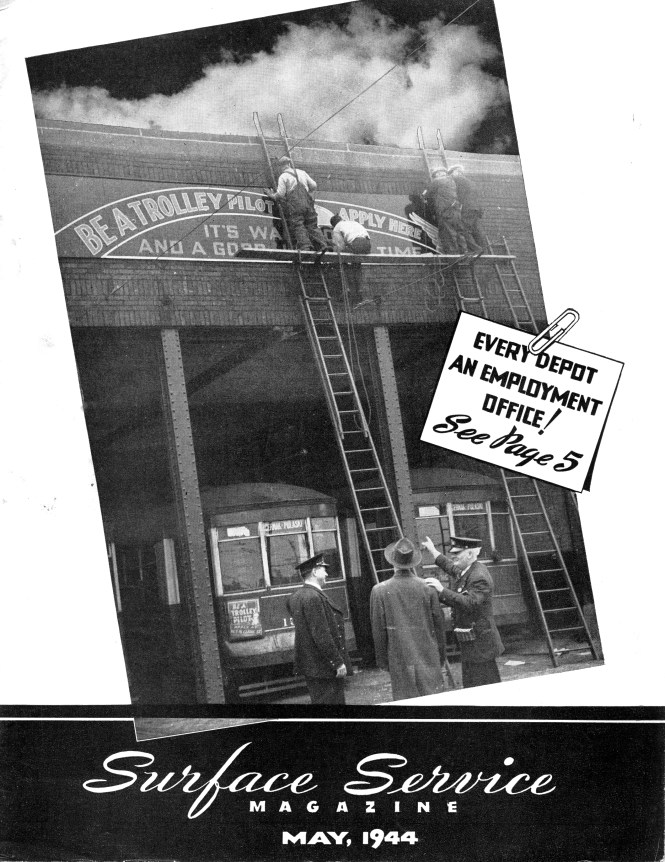
FYI, we recently acquired 41 more copies of Surface Service, the Chicago Surface Lines employee magazine that was published from 1923 to 1947. Here are the front and back covers from these issues. (Back covers are missing from two issues. We will eventually find replacements.)

Surface Service is full of interesting tidbits of information on CSL operations. Many individual employees are mentioned, especially old-timers and retirees. They frequently ran old photos sent in by current or former employees. Back in CSL days, there was no mandatory retirement age, and some employees worked well into their 70s.

There are perhaps 700 pages of material in these 41 issues, and all this is being added to our E-book Chicago’s PCC Streetcars: The Rest of the Story, available in our Online Store. This joins 34 issues of Surface Service that we had previously scanned.

In addition, this post features more recent photo finds, and another great batch of classic Chicago Aurora & Elgin pictures courtesy of Jack Bejna.

-Enjoy!

-David Sadowski

Recent Finds

We ran this photo some time ago in Chicago Surface Lines Photos, Part Seven (February 26, 2016):

CTA 5565 on September 10, 1949. This was known as a Brill-American-Kuhlman car. M. E. writes, "Methinks this photo is at Root St. (4130 South) and Halsted. Under that assumption, the view faces north, the L is the Stock Yards L, and the streetcar is on the 44 Wallace-Racine line, heading from westbound on Root to southbound on Halsted."

CTA 5565 on September 10, 1949. This was known as a Brill-American-Kuhlman car. M. E. writes, “Methinks this photo is at Root St. (4130 South) and Halsted. Under that assumption, the view faces north, the L is the Stock Yards L, and the streetcar is on the 44 Wallace-Racine line, heading from westbound on Root to southbound on Halsted.”

Now we have another picture, taken at the same location:

CSL 5094 is clearly a Wallce-Racine car in this picture, which supports the idea that this is Root and Halsted, with the Stock Yards "L" in the background. Note the old Bowman dailry milk truck at right. (Joe L. Diaz Photo)

CSL 5094 is clearly a Wallce-Racine car in this picture, which supports the idea that this is Root and Halsted, with the Stock Yards “L” in the background. Note the old Bowman dailry milk truck at right. (Joe L. Diaz Photo)

I would say this photo of prewar PCC 4047 was taken circa 1948, when the loop at 63rd Place and Narragansett was brand new. Formerly, double-ended cars ran to Oak Park Avenue a half-mile west of here.

I would say this photo of prewar PCC 4047 was taken circa 1948, when the loop at 63rd Place and Narragansett was brand new. Formerly, double-ended cars ran to Oak Park Avenue a half-mile west of here.

CTA 4019 is westbound on private right-of-way on 63rd Place, near the Narragansett loop. You would hardly recognize the location today, as it is in the middle of a quiet residential neighborhood. This prewar PCC, in "tiger stripes," still has a CSL logo on it.

CTA 4019 is westbound on private right-of-way on 63rd Place, near the Narragansett loop. You would hardly recognize the location today, as it is in the middle of a quiet residential neighborhood. This prewar PCC, in “tiger stripes,” still has a CSL logo on it.

CTA 4023 at 63rd and Narragansett.

CTA 4023 at 63rd and Narragansett.

CTA postwar PCC 7261 at the west end of the 63rd Street line (63rd Place and Narragansett).

CTA postwar PCC 7261 at the west end of the 63rd Street line (63rd Place and Narragansett).

This picture (and the previous one) appears to have been taken in the latter days of streetcar service on 63rd. By then, most service was provided by red Pullmans, but some two-man postwar PCC cars were there too (such as 7261, seen here). The prewar PCCs had by this time been converted to one-man and were moved over to Cottage Grove.

This picture (and the previous one) appears to have been taken in the latter days of streetcar service on 63rd. By then, most service was provided by red Pullmans, but some two-man postwar PCC cars were there too (such as 7261, seen here). The prewar PCCs had by this time been converted to one-man and were moved over to Cottage Grove.

This picture of South Shore Line cars 25 and 38 at Randolph Street is dated 1954, but an earlier date seems likely as there is no sign of the Prudential Building. Construction began on August 12, 1952, and the building was topped off on November 16, 1954. There was also a large sign advertising Pabst beer, not visible in this picture. Perhaps it had already been removed by the time this picture was taken. (Walter Hulseweder Photo)

This picture of South Shore Line cars 25 and 38 at Randolph Street is dated 1954, but an earlier date seems likely as there is no sign of the Prudential Building. Construction began on August 12, 1952, and the building was topped off on November 16, 1954. There was also a large sign advertising Pabst beer, not visible in this picture. Perhaps it had already been removed by the time this picture was taken. (Walter Hulseweder Photo)

Recent Correspondence

Jack Bejna writes:

Here’s the latest, The Chicago Aurora & Elgin Railway ordered 10 cars to be built by the Niles Car Company in 1906, numbered 300-308 plus a parlor-buffet to be named Florence. CA&E 305 was rebuilt as parlor-buffet 600 in 1929, later rebuilt again and renumbered 436 Florence Florence was rebuilt into parlor car 601 in 1923 no image found. Florence was rebuilt again in 1929 and renumbered 435. Thanks again for your website and all of the interesting stories within.

We are very appreciative of all the great pictures that Mr. Bejna shares with out readers.

Car 600 (ex-305).

Car 600 (ex-305).

Car 436 at the Wheaton Shops (ex-car 600).

Car 436 at the Wheaton Shops (ex-car 600).

Car 435 at Wheaton Shops (ex-parlor car 601).

Car 435 at Wheaton Shops (ex-parlor car 601).

Car 308 (Niles, 1906). This picture looks like it was taken near Laramie on Chicago's west side.

Car 308 (Niles, 1906). This picture looks like it was taken near Laramie on Chicago’s west side.

Car 307 (Niles, 1906).

Car 307 (Niles, 1906).

Car 306 (Niles, 1906) at the Elgin terminal.

Car 306 (Niles, 1906) at the Elgin terminal.

Car 304 (Niles, 1906).

Car 304 (Niles, 1906).

Car 303 (Niles, 1906).

Car 303 (Niles, 1906).

Car 302 (Niles, 1906).

Car 302 (Niles, 1906).

Car 301 (Niles, 1906).

Car 301 (Niles, 1906).

Car 300 (Niles, 1906).

Car 300 (Niles, 1906).

Car 32 (Stephenson, 1902) at Glen Ellyn.

Car 32 (Stephenson, 1902) at Glen Ellyn.

Pre-Order Our New Book Chicago Trolleys

On the Cover: Car 1747 was built between 1885 and 1893 by the Chicago City Railway, which operated lines on the South Side starting in April 1859. This is a single-truck (one set of wheels) open electric car; most likely a cable car, retrofitted with a trolley and traction motor. The man at right is conductor William Stevely Atchison (1861-1921), and this image came from his granddaughter. (Courtesy of Debbie Becker.)

On the Cover: Car 1747 was built between 1885 and 1893 by the Chicago City Railway, which operated lines on the South Side starting in April 1859. This is a single-truck (one set of wheels) open electric car; most likely a cable car, retrofitted with a trolley and traction motor. The man at right is conductor William Stevely Atchison (1861-1921), and this image came from his granddaughter. (Courtesy of Debbie Becker.)

We are pleased to report that our new book Chicago Trolleys will be released on September 25th by Arcadia Publishing. You can pre-order an autographed copy through us today (see below). Chicago Trolleys will also be available wherever Arcadia books are sold.

Overview

Chicago’s extensive transit system first started in 1859, when horsecars ran on rails in city streets. Cable cars and electric streetcars came next. Where new trolley car lines were built, people, businesses, and neighborhoods followed. Chicago quickly became a world-class city. At its peak, Chicago had over 3,000 streetcars and 1,000 miles of track—the largest such system in the world. By the 1930s, there were also streamlined trolleys and trolley buses on rubber tires. Some parts of Chicago’s famous “L” system also used trolley wire instead of a third rail. Trolley cars once took people from the Loop to such faraway places as Aurora, Elgin, Milwaukee, and South Bend. A few still run today.

The book features 221 classic black-and-white images, each with detailed captions, in 10 chapters:

1. Early Traction
2. Consolidation and Growth
3. Trolleys to the Suburbs
4. Trolleys on the “L”
5. Interurbans under Wire
6. The Streamlined Era
7. The War Years
8. Unification and Change
9. Trolley Buses
10. Preserving History

Product Details

ISBN-13: 9781467126816
Publisher: Arcadia Publishing SC
Publication date: 09/25/2017
Series: Images of Rail
Pages: 128

Meet the Author

David Sadowski has been interested in streetcars ever since his father took him for a ride on one of the last remaining lines in 1958. He grew up riding trolley buses and “L” trains all over Chicago. He coauthored Chicago Streetcar Pictorial: The PCC Car Era, 1936–1958, and runs the online Trolley Dodger blog. Come along for the ride as we travel from one side of the city to the other and see how trolley cars and buses moved Chicago’s millions of hardworking, diverse people.

Images of Rail

The Images of Rail series celebrates the history of rail, trolley, streetcar, and subway transportation across the country. Using archival photographs, each title presents the people, places, and events that helped revolutionize transportation and commerce in 19th- and 20th-century America. Arcadia is proud to play a part in the preservation of local heritage, making history available to all.

The book costs just $21.99 plus shipping. Shipping within the US is included in the price. Shipping to Canada is just $5 additional, or $10 elsewhere.

Please note that Illinois residents must pay 10.00% sales tax on their purchases.

We appreciate your business!

For Shipping to US Addresses:

For Shipping to Canada:

For Shipping Elsewhere:

NEW – Chicago Trolleys Postcard Collection

We are pleased to report that selected images from our upcoming book Chicago Trolleys will be available on September 25th in a pack of 15 postcards, all for just $7.99. This is part of a series put out by Arcadia Publishing. Dimensions: 6″ wide x 4.25″ tall

The Postcards of America Series

Here in the 21st century, when everyone who’s anyone seems to do most of their communicating via Facebook and Twitter, it’s only natural to wax a little nostalgic when it comes to days gone by. What happened to more personal means of communication like hand-written letters on nice stationery? Why don’t people still send postcards when they move someplace new or go away on vacation?

If that line of thinking sounds familiar, then Arcadia Publishing’s Postcards of America was launched with you in mind. Each beautiful volume features a different collection of real vintage postcards that you can mail to your friends and family.

Pre-Order your Chicago Trolleys Postcard Pack today!

For Shipping to US Addresses:

For Shipping to Canada:

For Shipping Elsewhere:

street-railwayreview1895-002

Help Support The Trolley Dodger

gh1

This is our 188th post, and we are gradually creating a body of work and an online resource for the benefit of all railfans, everywhere. To date, we have received over 301,000 page views, for which we are very grateful.

You can help us continue our original transit research by checking out the fine products in our Online Store.

As we have said before, “If you buy here, we will be here.”

We thank you for your support.

DONATIONS

In order to continue giving you the kinds of historic railroad images that you have come to expect from The Trolley Dodger, we need your help and support. It costs money to maintain this website, and to do the sort of historic research that is our specialty.

Your financial contributions help make this web site better, and are greatly appreciated.

Points East, West and South

This remarkable Kodachrome image was taken on Canal Street in New Orleans on June 19, 1940. It was shot on size 828 film, which has an image area of 28x40mm, about 30% larger than 35mm. (828 film, which Kodak introduced in the late 1930s, was essentially 35mm film without sprocket holes, but with a paper backing like other roll film formats.) One of our regular readers writes, "The 4 tracks were taken out about 1948 when a number of the car lines that operated off of Canal were converted to trolley bus." The location is the intersection of Canal and St. Charles. Car 444 is looping at the end of the St. Charles route and will be turning to the left in the picture. WSMB (now WWWL) was an AM radio station at 1350 on the dial. Its old call letters reflect its original ownership by the Saenger theater chain and Maison Blanche department store. Its studios were located in the Maison Blanche department store building at right, now the Ritz-Carlton hotel. The Saenger Theatre, another local landmark, is also on the right side of the picture. In the days before air conditioning, men used to wear white suits, as you see here, since white reflects more heat than darker clothing. When this picture was taken, France had just fallen to Nazi Germany. The US did not enter World War II directly until 18 months later.

This remarkable Kodachrome image was taken on Canal Street in New Orleans on June 19, 1940. It was shot on size 828 film, which has an image area of 28x40mm, about 30% larger than 35mm. (828 film, which Kodak introduced in the late 1930s, was essentially 35mm film without sprocket holes, but with a paper backing like other roll film formats.)
One of our regular readers writes, “The 4 tracks were taken out about 1948 when a number of the car lines that operated off of Canal were converted to trolley bus.” The location is the intersection of Canal and St. Charles. Car 444 is looping at the end of the St. Charles route and will be turning to the left in the picture.
WSMB (now WWWL) was an AM radio station at 1350 on the dial. Its old call letters reflect its original ownership by the Saenger theater chain and Maison Blanche department store. Its studios were located in the Maison Blanche department store building at right, now the Ritz-Carlton hotel.
The Saenger Theatre, another local landmark, is also on the right side of the picture.
In the days before air conditioning, men used to wear white suits, as you see here, since white reflects more heat than darker clothing. When this picture was taken, France had just fallen to Nazi Germany. The US did not enter World War II directly until 18 months later.

Our theme today is points east, west, and south. We’re going off in three directions, every which way but north.

We are especially glad to feature both the Chicago & West Towns Railways and Gary Railways. These photos have been generously shared by George Trapp, long a friend of this blog.

The West Towns map and photos of other properties come from our own collections. As always, to see a larger version of each photo, just click on it with your mouse. And, if you have useful information to add, please be sure to contact us.

Enjoy!

-David Sadowski

NOLA

A streamlined Kodak Bantam camera, using size 828 roll film, of a type that may have taken the New Orleans picture.

A streamlined Kodak Bantam camera, using size 828 roll film, of a type that may have taken the New Orleans picture.

The same location today. The St. Charles line still loops as it did in the 1940 picture. Streetcars were absent from Canal Street for 40 years starting in 1964, but have returned. There is a crossover track, visible in this picture, connecting the two lines.

The same location today. The St. Charles line still loops as it did in the 1940 picture. Streetcars were absent from Canal Street for 40 years starting in 1964, but have returned. There is a crossover track, visible in this picture, connecting the two lines.

This close-up shows New Orleans Public Service car 444. One of our regular readers says, "It is not a Perley-Thomas built car but rather a Southern Car Company car built in 1914. Starting in 1914, all of the car bodies appeared the same starting with car #400 even though they were not all built by Perley-Thomas." It was part of a group of 50 cars, numbered 400-449. Behind the streetcar, you can see part of the marquee for the Loew's State Theatre (also known as the State Palace), at 1108 Canal Street. It opened in 1926, but is currently closed and awaiting restoration. You can see some pictures of that theater's interior here.

This close-up shows New Orleans Public Service car 444. One of our regular readers says, “It is not a Perley-Thomas built car but rather a Southern Car Company car built in 1914. Starting in 1914, all of the car bodies appeared the same starting with car #400 even though they were not all built by Perley-Thomas.” It was part of a group of 50 cars, numbered 400-449.
Behind the streetcar, you can see part of the marquee for the Loew’s State Theatre (also known as the State Palace), at 1108 Canal Street. It opened in 1926, but is currently closed and awaiting restoration. You can see some pictures of that theater’s interior here.

A bus crosses Canal.

A bus crosses Canal.

Loew's State circa 1930. From the Wikipedia: "The Rogue Song is a 1930 romantic musical film which tells the story of a Russian bandit who falls in love with a princess, but takes his revenge on her when her brother rapes and kills his sister. The Metro-Goldwyn-Mayer production was directed by Lionel Barrymore and released in two versions, with and without sound. Hal Roach wrote and directed the Laurel and Hardy sequences and was not credited. The film stars Metropolitan Opera singer Lawrence Tibbett— who was nominated for an Academy Award for Best Actor for his performance— and Catherine Dale Owen. Laurel and Hardy were third-billed; their sequences were filmed at the last minute and interspersed throughout the film in an attempt to boost its potential box office appeal. This film, which was MGM's first all-talking (two-color) Technicolor film, is partially lost, as there are no known complete prints of this film. Fragments do exist."

Loew’s State circa 1930. From the Wikipedia: “The Rogue Song is a 1930 romantic musical film which tells the story of a Russian bandit who falls in love with a princess, but takes his revenge on her when her brother rapes and kills his sister. The Metro-Goldwyn-Mayer production was directed by Lionel Barrymore and released in two versions, with and without sound. Hal Roach wrote and directed the Laurel and Hardy sequences and was not credited. The film stars Metropolitan Opera singer Lawrence Tibbett— who was nominated for an Academy Award for Best Actor for his performance— and Catherine Dale Owen. Laurel and Hardy were third-billed; their sequences were filmed at the last minute and interspersed throughout the film in an attempt to boost its potential box office appeal. This film, which was MGM’s first all-talking (two-color) Technicolor film, is partially lost, as there are no known complete prints of this film. Fragments do exist.”

Loew's circa 1940, showing I Love You Again, an MGM comedy starring William Powell and Myrna Loy, directed by W. S. Van Dyke. All three were associated with the Thin Man series of films, which were very popular.

Loew’s circa 1940, showing I Love You Again, an MGM comedy starring William Powell and Myrna Loy, directed by W. S. Van Dyke. All three were associated with the Thin Man series of films, which were very popular.

A postcard view of Canal Street, showing the same general area as the 1940 slide, but looking from the opposite direction.

A postcard view of Canal Street, showing the same general area as the 1940 slide, but looking from the opposite direction.

Chicago & West Towns

A Chicago & West Towns route map, from April 1942. By this time, only three streetcar lines were left: LaGrange, Lake, and Madison. The owner of the map crossed out (with hash marks) some routes that were abandoned later. There was, by 1942, no track connection between the two north side lines and the LaGrange line. When the Lake and Madison lines were finally bustituted, the remaining streetcar fleet was moved at night in 1947 on a circuitous route via Chicago Surface Lines trackage.

A Chicago & West Towns route map, from April 1942. By this time, only three streetcar lines were left: LaGrange, Lake, and Madison. The owner of the map crossed out (with hash marks) some routes that were abandoned later. There was, by 1942, no track connection between the two north side lines and the LaGrange line. When the Lake and Madison lines were finally bustituted, the remaining streetcar fleet was moved at night in 1947 on a circuitous route via Chicago Surface Lines trackage.

The Chicago & West Towns was a major streetcar operator in Chicago’s western suburbs until April 1948, when the last line was converted to bus. Bus operation continues today as part of Pace, a public agency.

C&WT 127 and 104 in Maywood. The grade crossing at rear may be a clue as to the exact location. Don's Rail Photos notes: "104 was built by McGuire-Cummings in 1917. It was scrapped in 1948." The 127 looks to be the older of the pair, built by McGuire-Cummings in 1914. (Joe L. Diaz Photo) Joe writes: "The photo of C&WT cars 127 and 104 is in Maywood at 19th and Railroad Avenue looking north."

C&WT 127 and 104 in Maywood. The grade crossing at rear may be a clue as to the exact location. Don’s Rail Photos notes: “104 was built by McGuire-Cummings in 1917. It was scrapped in 1948.” The 127 looks to be the older of the pair, built by McGuire-Cummings in 1914. (Joe L. Diaz Photo) Joe writes: “The photo of C&WT cars 127 and 104 is in Maywood at 19th and Railroad Avenue looking north.”

C&WT 135, making a turn, is signed for Melrose Park, possibly on the Lake or Madison lines. Don's Rail Photos: "135 was built by McGuire-Cummings in 1919. It was scrapped in 1947." (Joe L. Diaz Photo) Joe writes: "The photo of C&WT car 135 is looking east at Madison and 19th in Maywood. The apartment building is still there." Andre Kristopans: "CWT 135 turning from W on Madison to N on 19th Ave."

C&WT 135, making a turn, is signed for Melrose Park, possibly on the Lake or Madison lines. Don’s Rail Photos: “135 was built by McGuire-Cummings in 1919. It was scrapped in 1947.” (Joe L. Diaz Photo) Joe writes: “The photo of C&WT car 135 is looking east at Madison and 19th in Maywood. The apartment building is still there.” Andre Kristopans: “CWT 135 turning from W on Madison to N on 19th Ave.”

C&WT 134 at the North Riverside barn. (Joe L. Diaz Photo)

C&WT 134 at the North Riverside barn. (Joe L. Diaz Photo)

C&WT 153, 140 and 119 on the LaGrange line. Comparison with some other photos in this series shows this location is DesPlaines Avenue just south of 26th Street in Riverside. We are looking north. Don's Rail Photos: "153 was built by Cummings Car Co in 1927. It was scrapped in 1948. 140 was built by McGuire-Cummings in 1924. It was rebuilt in 1939 and scrapped in 1948. 119 was built by McGuire-Cummings in 1912. It was scrapped in 1948." (Joe L. Diaz Photo)

C&WT 153, 140 and 119 on the LaGrange line. Comparison with some other photos in this series shows this location is DesPlaines Avenue just south of 26th Street in Riverside. We are looking north. Don’s Rail Photos: “153 was built by Cummings Car Co in 1927. It was scrapped in 1948. 140 was built by McGuire-Cummings in 1924. It was rebuilt in 1939 and scrapped in 1948. 119 was built by McGuire-Cummings in 1912. It was scrapped in 1948.” (Joe L. Diaz Photo)

C&WT 116, 115, and 158 at Cermak and Kenton, east end of the LaGrange line. Riders heading east could change here for Chicago Surface Lines route 21 streetcars like the one shown at rear. (Joe L. Diaz Photo)

C&WT 116, 115, and 158 at Cermak and Kenton, east end of the LaGrange line. Riders heading east could change here for Chicago Surface Lines route 21 streetcars like the one shown at rear. (Joe L. Diaz Photo)

C&WT 152 is heading east on private right-of-way on the busy LaGrange route. The exact location is about 82 Park Place in Riverside. Car 152 has just crossed the DesPlaines River, passing through the Forest Preserves after stopping at the Brookfield Zoo. From here, it will turn north on Woodside Drive, which changes into DesPlaines Avenue, before heading east on 26th Street. (Joe L. Diaz Photo)

C&WT 152 is heading east on private right-of-way on the busy LaGrange route. The exact location is about 82 Park Place in Riverside. Car 152 has just crossed the DesPlaines River, passing through the Forest Preserves after stopping at the Brookfield Zoo. From here, it will turn north on Woodside Drive, which changes into DesPlaines Avenue, before heading east on 26th Street. (Joe L. Diaz Photo)

The same location today.

The same location today.

C&WT 112 crosses the Indiana Harbor Belt on the LaGrange line, with a steam train off in the distance. Don's Rail Photos: "112 was built by McGuire-Cummings in 1912. It was scrapped in 1948." (Joe L. Diaz Photo)

C&WT 112 crosses the Indiana Harbor Belt on the LaGrange line, with a steam train off in the distance. Don’s Rail Photos: “112 was built by McGuire-Cummings in 1912. It was scrapped in 1948.” (Joe L. Diaz Photo)

C&WT 101 is turning from 26th Street onto DesPlaines Avenue in Riverside on the LaGrange line. Don's Rail Photos: "101 was built by McGuire-Cummings in 1917. It was scrapped in 1948." (Joe L. Diaz Photo)

C&WT 101 is turning from 26th Street onto DesPlaines Avenue in Riverside on the LaGrange line. Don’s Rail Photos: “101 was built by McGuire-Cummings in 1917. It was scrapped in 1948.” (Joe L. Diaz Photo)

C&WT 134 and 124 meet at Madison and Harlem. Note how Madison took a jog when crossing between Oak Park and Forest Park. We are looking east. Don's Rail Photos: "124 was built by McGuire-Cummings in 1914. It was rebuilt in 1936 and scrapped in 1948." (Joe L. Diaz Photo)

C&WT 134 and 124 meet at Madison and Harlem. Note how Madison took a jog when crossing between Oak Park and Forest Park. We are looking east. Don’s Rail Photos: “124 was built by McGuire-Cummings in 1914. It was rebuilt in 1936 and scrapped in 1948.” (Joe L. Diaz Photo)

Madison and Harlem today. A route 318 Pace bus is turning from Harlem onto Madison. Pace is the successor to the West Towns. At some point, it appears that Madison was widened to eliminate the jog seen in the earlier photo.

Madison and Harlem today. A route 318 Pace bus is turning from Harlem onto Madison. Pace is the successor to the West Towns. At some point, it appears that Madison was widened to eliminate the jog seen in the earlier photo.

C&WT 101 is at Lake and Austin in Oak Park, the east end of its route. Two Chicago Surface Lines streetcars, including 1743, are across Austin Boulevard at the west end of route 16. Don's Rail Photos: "101 was built by McGuire-Cummings in 1917. It was scrapped in 1948. 1743 was built by CSL in 1923. It was rebuilt as one-man in 1949." The car at left looks like a 1941 Packard model One Twenty-- very stylish. (Joe L. Diaz Photo)

C&WT 101 is at Lake and Austin in Oak Park, the east end of its route. Two Chicago Surface Lines streetcars, including 1743, are across Austin Boulevard at the west end of route 16. Don’s Rail Photos: “101 was built by McGuire-Cummings in 1917. It was scrapped in 1948. 1743 was built by CSL in 1923. It was rebuilt as one-man in 1949.” The car at left looks like a 1941 Packard model One Twenty– very stylish. (Joe L. Diaz Photo)

A 1941 Packard One Twenty sedan.

A 1941 Packard One Twenty sedan.

C&WT 136 and 132 on Lake Street just west of Austin Boulevard in suburban Oak Park. This was the east end of the line. (Joe L. Diaz Photo)

C&WT 136 and 132 on Lake Street just west of Austin Boulevard in suburban Oak Park. This was the east end of the line. (Joe L. Diaz Photo)

Lake Street just west of Austin Boulevard today.

Lake Street just west of Austin Boulevard today.

Here, C&WT 119 appears to be crossing the Illinois Central at 26th Street, since that is an IC caboose at the rear of the passing freight train. Don's Rail Photos: "119 was built by McGuire-Cummings in 1912. It was scrapped in 1948." (Joe L. Diaz Photo)

Here, C&WT 119 appears to be crossing the Illinois Central at 26th Street, since that is an IC caboose at the rear of the passing freight train. Don’s Rail Photos: “119 was built by McGuire-Cummings in 1912. It was scrapped in 1948.” (Joe L. Diaz Photo)

Here, we are looking north along DesPlaines Avenue just south of 26th Street in Riverside. Cars from the LaGrange line turned east on 26th to Harlem, where they continued north to Cermak Road. Cars may be operating on a single track here due to track work. Southbound C&WT 107 waits for 161 to cross over to the northbound track, while a work car is on 26th. Don's Rail Photos: "107 was built by McGuire-Cummings in 1912. It was scrapped in 1948. 161 was built by Cummings Car Co in 1927. It was scrapped in 1948." (Joe L. Diaz Photo)

Here, we are looking north along DesPlaines Avenue just south of 26th Street in Riverside. Cars from the LaGrange line turned east on 26th to Harlem, where they continued north to Cermak Road. Cars may be operating on a single track here due to track work. Southbound C&WT 107 waits for 161 to cross over to the northbound track, while a work car is on 26th. Don’s Rail Photos: “107 was built by McGuire-Cummings in 1912. It was scrapped in 1948. 161 was built by Cummings Car Co in 1927. It was scrapped in 1948.” (Joe L. Diaz Photo)

A close-up of the previous image. This may be C&WT work car 12. Don's Rail Photos says, "12 was built by McGuire-Cummings in 1912. It was scrapped in 1948."

A close-up of the previous image. This may be C&WT work car 12. Don’s Rail Photos says, “12 was built by McGuire-Cummings in 1912. It was scrapped in 1948.”

The top of this building, on 26th Street just east of DesPlaines Avenue in North Riverside, has been altered, but it is still recognizable as the same building in the previous picture.

The top of this building, on 26th Street just east of DesPlaines Avenue in North Riverside, has been altered, but it is still recognizable as the same building in the previous picture.

C&WT 152 on the LaGrange line. (Joe L. Diaz Photo)

C&WT 152 on the LaGrange line. (Joe L. Diaz Photo)

C&WT 144 at the North Riverside car barn. Don's Rail Photos: "144 was built by McGuire-Cummings in 1924. It was scrapped in 1947." (Joe L. Diaz Photo)

C&WT 144 at the North Riverside car barn. Don’s Rail Photos: “144 was built by McGuire-Cummings in 1924. It was scrapped in 1947.” (Joe L. Diaz Photo)

C&WT 164 on Lake Street just west of Austin Boulevard in Oak Park. (Joe L. Diaz Photo)

C&WT 164 on Lake Street just west of Austin Boulevard in Oak Park. (Joe L. Diaz Photo)

C&WT 107 and a work car (12 or 13, hard to tell) plus a flat car on DesPlaines Avenue just south of 26th Street in Riverside. Don's Rail Photos: "107 was built by McGuire-Cummings in 1912. It was scrapped in 1948." (Joe L. Diaz Photo)

C&WT 107 and a work car (12 or 13, hard to tell) plus a flat car on DesPlaines Avenue just south of 26th Street in Riverside. Don’s Rail Photos: “107 was built by McGuire-Cummings in 1912. It was scrapped in 1948.” (Joe L. Diaz Photo)

C&WT 158 crossing the Illinois Central at 26th Street in Riverside. I believe the car is heading east. If it was heading west, the sign on the front of the car would probably advertise service direct to the Brookfield Zoo. (Joe L. Diaz Photo)

C&WT 158 crossing the Illinois Central at 26th Street in Riverside. I believe the car is heading east. If it was heading west, the sign on the front of the car would probably advertise service direct to the Brookfield Zoo. (Joe L. Diaz Photo)

C&WT 158 and 157 cross on the bridge over the DesPlaines River (LaGrange line). I believe we are looking south. (Joe L. Diaz Photo)

C&WT 158 and 157 cross on the bridge over the DesPlaines River (LaGrange line). I believe we are looking south. (Joe L. Diaz Photo)

C&WT 100, most likely at the North Riverside car barn. Car 130 is at right. Don's Rail Photos: "100 was built by McGuire-Cummings in 1917. It was scrapped in 1948. 130 was built by McGuire-Cummings in 1914. It was scrapped in 1948." (Joe L. Diaz Photo)

C&WT 100, most likely at the North Riverside car barn. Car 130 is at right. Don’s Rail Photos: “100 was built by McGuire-Cummings in 1917. It was scrapped in 1948. 130 was built by McGuire-Cummings in 1914. It was scrapped in 1948.” (Joe L. Diaz Photo)

C&WT 141 at the North Riverside car barn. Don's Rail Photos: "141 was built by McGuire-Cummings in 1924. It was rebuilt in 1939 and the body sold as a shed in 1948. It was purchased by Electric Railway Historical Society in 1958. It went to Illinois Railway Museum in 1973 and began restoring." The 141 is now in operating condition. (Joe L. Diaz Photo)

C&WT 141 at the North Riverside car barn. Don’s Rail Photos: “141 was built by McGuire-Cummings in 1924. It was rebuilt in 1939 and the body sold as a shed in 1948. It was purchased by Electric Railway Historical Society in 1958. It went to Illinois Railway Museum in 1973 and began restoring.” The 141 is now in operating condition. (Joe L. Diaz Photo)

C&WT 157 and 155 meet on DesPlaines Avenue and 26th street. Single track operation is in effect due to track work. (Joe L. Diaz Photo)

C&WT 157 and 155 meet on DesPlaines Avenue and 26th street. Single track operation is in effect due to track work. (Joe L. Diaz Photo)

C&WT line car 15 at an undetermined location. Don's Rail Photos: "15 was built by Pullman Car in 1897 as Suburban RR 512. It was renumbered 515 and rebuilt as 15 in 1927. It was rebuilt in 1940 and scrapped in 1948." (Joe L. Diaz Photo)

C&WT line car 15 at an undetermined location. Don’s Rail Photos: “15 was built by Pullman Car in 1897 as Suburban RR 512. It was renumbered 515 and rebuilt as 15 in 1927. It was rebuilt in 1940 and scrapped in 1948.” (Joe L. Diaz Photo)

C&WT 156 is on Cermak at Cicero Avenue. The Pinkert State Bank (built in 1919) at rear was located at 4810-12 W. Cerak (22nd Street) in Cicero. It featured prominently in the government's tax evasion cases against Al and Ralph Capone. Don's Rail Photos: "156 was built by Cummings Car Co in 1927. It was rebuilt in 1942 and scrapped in 1948." (Joe L. Diaz Photo)

C&WT 156 is on Cermak at Cicero Avenue. The Pinkert State Bank (built in 1919) at rear was located at 4810-12 W. Cerak (22nd Street) in Cicero. It featured prominently in the government’s tax evasion cases against Al and Ralph Capone. Don’s Rail Photos: “156 was built by Cummings Car Co in 1927. It was rebuilt in 1942 and scrapped in 1948.” (Joe L. Diaz Photo)

C&WT 140 on the LaGrange line. Don's Rail Photos: "140 was built by McGuire-Cummings in 1924. It was rebuilt in 1939 and scrapped in 1948." (Joe L. Diaz Photo)

C&WT 140 on the LaGrange line. Don’s Rail Photos: “140 was built by McGuire-Cummings in 1924. It was rebuilt in 1939 and scrapped in 1948.” (Joe L. Diaz Photo)

C&WT 136 and 132 are eastbound on one of the lines that terminated at Austin Boulevard (either Lake or Madison). (Joe L. Diaz Photo) Joe writes: "The photo of C&WT cars 132 and 136 may have been taken at Lake and 25th, the west end of the Lake Street line." Andre Kristopans: "CWT 132, 136 at west end of Lake St line at 25th Ave."

C&WT 136 and 132 are eastbound on one of the lines that terminated at Austin Boulevard (either Lake or Madison). (Joe L. Diaz Photo) Joe writes: “The photo of C&WT cars 132 and 136 may have been taken at Lake and 25th, the west end of the Lake Street line.” Andre Kristopans: “CWT 132, 136 at west end of Lake St line at 25th Ave.”

Three C&WT streetcars, including 103 and 104, are on Lake Street at Austin Boulevard. We are looking to the east, which explains why the head car is signed for Maywood. According to Don's Rail Photos, both 103 and 104 were built by McGuire-Cummings in 1917 and scrapped in 1948. (Joe L. Diaz Photo)

Three C&WT streetcars, including 103 and 104, are on Lake Street at Austin Boulevard. We are looking to the east, which explains why the head car is signed for Maywood. According to Don’s Rail Photos, both 103 and 104 were built by McGuire-Cummings in 1917 and scrapped in 1948. (Joe L. Diaz Photo)

The laundry in the previous photo is now a beauty parlor.

The laundry in the previous photo is now a beauty parlor.

C&WT 141 is westbound, crossing the DesPlaines River on the LaGrange line. This car, sole survivor of the fleet, has been restored and you can ride it at the Illinois Railway Museum. (Joe L. Diaz Photo)

C&WT 141 is westbound, crossing the DesPlaines River on the LaGrange line. This car, sole survivor of the fleet, has been restored and you can ride it at the Illinois Railway Museum. (Joe L. Diaz Photo)

C&WT 128, on either the Madison or Lake lines, is signed for Melrose Park. Not sure which railroad that tower belongs to. (Joe L. Diaz Photo) Andre Kristopans: "CWT 128 is crossing the Soo Line on Madison west of Jackson (a half mile west of Desplaines Av.)."

C&WT 128, on either the Madison or Lake lines, is signed for Melrose Park. Not sure which railroad that tower belongs to. (Joe L. Diaz Photo) Andre Kristopans: “CWT 128 is crossing the Soo Line on Madison west of Jackson (a half mile west of Desplaines Av.).”

C&WT snow sweepers 9 and 5 in their element at the North Riverside car barn. Don's Rail Photso: "5 was built by McGuire-Cummings in 1913. It was scrapped in 1948. 9 was built by McGuire-Cummings in 1928. It was sold to Sand Springs Ry in 1948." (Joe L. Diaz Photo)

C&WT snow sweepers 9 and 5 in their element at the North Riverside car barn. Don’s Rail Photso: “5 was built by McGuire-Cummings in 1913. It was scrapped in 1948. 9 was built by McGuire-Cummings in 1928. It was sold to Sand Springs Ry in 1948.” (Joe L. Diaz Photo)

C&WT 156 is eastbound on Cermak at Ridgeland in front of the old Berwyn Theatre, which opened in 1924. It was damaged by fire in 1990 and demolished. This picture was probably taken not long after the theatre was modernized in 1936. Don's Rail Photos: "156 was built by Cummings Car Co in 1927. It was rebuilt in 1942 and scrapped in 1948." (Edward Frank, Jr. Photo)

C&WT 156 is eastbound on Cermak at Ridgeland in front of the old Berwyn Theatre, which opened in 1924. It was damaged by fire in 1990 and demolished. This picture was probably taken not long after the theatre was modernized in 1936. Don’s Rail Photos: “156 was built by Cummings Car Co in 1927. It was rebuilt in 1942 and scrapped in 1948.” (Edward Frank, Jr. Photo)

C&WT 151 on the Lake line, possibly at the west end. Don's Rail Photos: "151 was built by McGuire and Cummings in 1924. It was scrapped in 1947." (Edward Frank, Jr. Photo)

C&WT 151 on the Lake line, possibly at the west end. Don’s Rail Photos: “151 was built by McGuire and Cummings in 1924. It was scrapped in 1947.” (Edward Frank, Jr. Photo)

C&WT 151 on the Lake Street line. Don's Rail Photos: "151 was built by McGuire and Cummings in 1924. It was scrapped in 1947." (Edward Frank, Jr. Photo)

C&WT 151 on the Lake Street line. Don’s Rail Photos: “151 was built by McGuire and Cummings in 1924. It was scrapped in 1947.” (Edward Frank, Jr. Photo)

South Shore Line

CSS&SB 10, signed for South Bend. (Photo by Anderson)

CSS&SB 10, signed for South Bend. (Photo by Anderson)

CSS&SB 24. Don's Rail Photos: "24 was built by Pullman in 1927. It was lengthened and air conditioned, and got picture windows in 1947." (Photo by Anderson)

CSS&SB 24. Don’s Rail Photos: “24 was built by Pullman in 1927. It was lengthened and air conditioned, and got picture windows in 1947.” (Photo by Anderson)

CSS&SB 109 in the yard at Chicago in the mid-1960s. Don's Rail Photos: "109 was built by Pullman in 1926. It was lengthened in 1944. Air conditioning and picture windows came in 1949." (Walter Broschart Photo)

CSS&SB 109 in the yard at Chicago in the mid-1960s. Don’s Rail Photos: “109 was built by Pullman in 1926. It was lengthened in 1944. Air conditioning and picture windows came in 1949.” (Walter Broschart Photo)

The way to distinguish South Shore Line street running photos from one city to another usually includes counting the number of tracks. Only East Chicago was double tracked. However, this is Michigan City, as there are two tracks for a short distance near the station seen at rear, since many runs begin and end here. This picture, showing car 105 and train, was taken on August 6, 1948. The station building still exists but is no longer in use.

The way to distinguish South Shore Line street running photos from one city to another usually includes counting the number of tracks. Only East Chicago was double tracked. However, this is Michigan City, as there are two tracks for a short distance near the station seen at rear, since many runs begin and end here. This picture, showing car 105 and train, was taken on August 6, 1948. The station building still exists but is no longer in use.

CSS&SB cars 2 and 504 at the Michigan City station on August 30, 1960 (note the 1960 Ford at left). Don's Rail Photos: "2 was built by Pullman in 1926." Frank Hicks writes: "This interurban freight trailer has a more unusual history than most. It was built for ISC as an interurban combine, and ran on that system's lines in Indiana for five years until ISC became part of the great Indiana Railroad system. IR rebuilt the three cars of the 375-377 series into railway post office cars and put them to use in this unusual capacity. The three RPO's survived on IR until the end of interurban service in 1941, at which time all three were sold to the only other interurban line then operating in Indiana: the South Shore. The South Shore converted 376 into a line car while 375 and 377 became express package trailers. These cars were designed to run in passenger trains and had control lines so that they could be run mid-train; they were often used to transport newspapers. Car 504 was retired in 1975 and acquired by IRM, which has repainted it and put it on display." (Photo by Meyer)

CSS&SB cars 2 and 504 at the Michigan City station on August 30, 1960 (note the 1960 Ford at left). Don’s Rail Photos: “2 was built by Pullman in 1926.” Frank Hicks writes: “This interurban freight trailer has a more unusual history than most. It was built for ISC as an interurban combine, and ran on that system’s lines in Indiana for five years until ISC became part of the great Indiana Railroad system. IR rebuilt the three cars of the 375-377 series into railway post office cars and put them to use in this unusual capacity. The three RPO’s survived on IR until the end of interurban service in 1941, at which time all three were sold to the only other interurban line then operating in Indiana: the South Shore. The South Shore converted 376 into a line car while 375 and 377 became express package trailers. These cars were designed to run in passenger trains and had control lines so that they could be run mid-train; they were often used to transport newspapers. Car 504 was retired in 1975 and acquired by IRM, which has repainted it and put it on display.” (Photo by Meyer)

Chicago Lake Shore & South Bend Ry. (predecessor of the South Shore Line) car 68 at an unknown location near a wooden Chicago "L" car. This photo is a real mystery, since, as far as I know, this car has not been preserved (although car 73 is being restored). Joe writes: "Car 68 is Lake Shore Electric, not CLS&SB, built by Brill in 1903. The car behind it is one of the LSE’s Barney & Smith interurban cars." That clears up the mystery. The information that came with this negative was incorrect.

Chicago Lake Shore & South Bend Ry. (predecessor of the South Shore Line) car 68 at an unknown location near a wooden Chicago “L” car. This photo is a real mystery, since, as far as I know, this car has not been preserved (although car 73 is being restored). Joe writes: “Car 68 is Lake Shore Electric, not CLS&SB, built by Brill in 1903. The car behind it is one of the LSE’s Barney & Smith interurban cars.” That clears up the mystery. The information that came with this negative was incorrect.

CSS&SB 27 near the Art Institute of Chicago on May 7, 1963. (Photo by Anderson)

CSS&SB 27 near the Art Institute of Chicago on May 7, 1963. (Photo by Anderson)

CSS&SB 111 at Randolph Street Terminal in downtown Chicago in May 1953. This station has since been rebuilt and is now underneath Millennium Park.

CSS&SB 111 at Randolph Street Terminal in downtown Chicago in May 1953. This station has since been rebuilt and is now underneath Millennium Park.

A three-car CSS&SB train, including car 31, makes a photo stop on an early Central Electric Railfans' Association fantrip near Wilson, Indiana.

A three-car CSS&SB train, including car 31, makes a photo stop on an early Central Electric Railfans’ Association fantrip near Wilson, Indiana.

CSS&SB 105 heads up a six-car train near Miller, Indiana on June 1, 1939. This appears to be a photo stop on a fantrip. (Photo by Anderson)

CSS&SB 105 heads up a six-car train near Miller, Indiana on June 1, 1939. This appears to be a photo stop on a fantrip. (Photo by Anderson)

Chicago, South Shore & South Bend freight locos 902 and 903 in Michigan City, Indiana. (Photo by Anderson)

Chicago, South Shore & South Bend freight locos 902 and 903 in Michigan City, Indiana. (Photo by Anderson)

Gary Railways

Even the city trolley lines of Gary Railways, operating between 1908 and 1947, had an interurbanish character. Industrial development in the area meant there were large tracts of land reserved for future use. In 1938-39, Central Electric Railfans’ Association (CERA) ran three fantrips on Gary Railways interurbans in their waning days. We have run pictures from some of those trips in previous posts.

Here is a timeline of transit developments in the Gary area.

Gary Railways 101. The sign says street railway service in Gary was inaugurated 21 years ago with this car. If service began in 1912, that would date this photo to 1933.

Gary Railways 101. The sign says street railway service in Gary was inaugurated 21 years ago with this car. If service began in 1912, that would date this photo to 1933.

Gary Railways 24.

Gary Railways 24.

Gary Railways 128.

Gary Railways 128.

Gary Railways 120.

Gary Railways 120.

Gary Railways 15 at Kennedy siding on the Hammond line on March 9, 1941. According to the photo information, this car was built by Cummings in 1926.

Gary Railways 15 at Kennedy siding on the Hammond line on March 9, 1941. According to the photo information, this car was built by Cummings in 1926.

Gary Railways 16, signed for Hammond.

Gary Railways 16, signed for Hammond.

Gary Railways 14, at a loop on the Hammond line, on October 27, 1940. According to the photo information, it was built by Cummings in 1926.

Gary Railways 14, at a loop on the Hammond line, on October 27, 1940. According to the photo information, it was built by Cummings in 1926.

Gary Railways 19 at Tolleston, with both poles up. This lightweight safety car was built by Cummings Car & Coach in 1927. This car body, sole survivor of the fleet, is now at the Illinois Railway Museum.

Gary Railways 19 at Tolleston, with both poles up. This lightweight safety car was built by Cummings Car & Coach in 1927. This car body, sole survivor of the fleet, is now at the Illinois Railway Museum.

Gary Railways 27.

Gary Railways 27.

Gary Railways 22 on May 16, 1940. (Gordon E. Lloyd Photo)

Gary Railways 22 on May 16, 1940. (Gordon E. Lloyd Photo)

Gary Railways 20 on July 21, 1946.

Gary Railways 20 on July 21, 1946.

Gary Railways 22.

Gary Railways 22.

Gary Railways 12. Don's Rail Photos: "12 was built by Cummings Car Co in 1926. It was scrapped in 1946." (Jack Beers Photo)

Gary Railways 12. Don’s Rail Photos: “12 was built by Cummings Car Co in 1926. It was scrapped in 1946.” (Jack Beers Photo)

Gary Railways car 19, the only car preserved, on a Central Electric Railfans' Association fantrip. This matches a picture we previously published in our previous post More Hoosier Traction (September 2, 2015). Bill Shapotkin said that other picture was taken "taken on March 19, 1939 -- the day AFTER the last day of service on the Indiana Harbor (and Hobart) lines." The difference in tonality between the two pictures may simply be the difference between panchromatic and orthochromatic film.

Gary Railways car 19, the only car preserved, on a Central Electric Railfans’ Association fantrip. This matches a picture we previously published in our previous post More Hoosier Traction (September 2, 2015). Bill Shapotkin said that other picture was taken “taken on March 19, 1939 — the day AFTER the last day of service on the Indiana Harbor (and Hobart) lines.” The difference in tonality between the two pictures may simply be the difference between panchromatic and orthochromatic film.

A close-up of the previous picture.

A close-up of the previous picture.

Gary Railways 9 at Hobart, Indiana in 1934.

Gary Railways 9 at Hobart, Indiana in 1934.

Gary Railways cars 12 and 9.

Gary Railways cars 12 and 9.

Gary Railways 14.

Gary Railways 14.

Gary Railways 19.

Gary Railways 19.

Gary Railways 17 at the North Broadway loop.

Gary Railways 17 at the North Broadway loop.

Gary Railways 51.

Gary Railways 51.

Birney Cars

Johnston Traction 311, a double-truck Birney car (ex-Bangor, Maine) on June 24, 1956. Don's Rail Photos: " 307 thru 311 came from Bangor Hydro Electric in 1941 where they were 10, 12, 14, 16, and 18. They were scrapped in 1957 except for 311 which was preserved at Rockhill Trolley Museum which acquired it in 1960." Audio recordings of car 311 in service in Johnstown are included on Railroad Record Club LP #23.

Johnston Traction 311, a double-truck Birney car (ex-Bangor, Maine) on June 24, 1956. Don’s Rail Photos: ” 307 thru 311 came from Bangor Hydro Electric in 1941 where they were 10, 12, 14, 16, and 18. They were scrapped in 1957 except for 311 which was preserved at Rockhill Trolley Museum which acquired it in 1960.” Audio recordings of car 311 in service in Johnstown are included on Railroad Record Club LP #23.

Fort Collins Municipal Railway Birney car 25 in October 1950. Don's Rail Photos: "2nd 25 was built by Brill Car Co in December 1922, #21530, as VR&P 1520. It was sold as FCM 25 in 1946. It was sold to James Stitzel in 1953 and resided next to the former Midland Terminal depot in Victor, CO, until it was sold to a South Carolina party about 1980. It was cosmetically restored. In 1998 it was sold to the Charlotte Trolley painted as South Carolina Public Service Co 407. It was sold to Fort Colins Municipal in 2008 and is being restored as 25." (Robert C. Gray Photo)

Fort Collins Municipal Railway Birney car 25 in October 1950. Don’s Rail Photos: “2nd 25 was built by Brill Car Co in December 1922, #21530, as VR&P 1520. It was sold as FCM 25 in 1946. It was sold to James Stitzel in 1953 and resided next to the former Midland Terminal depot in Victor, CO, until it was sold to a South Carolina party about 1980. It was cosmetically restored. In 1998 it was sold to the Charlotte Trolley painted as South Carolina Public Service Co 407. It was sold to Fort Colins Municipal in 2008 and is being restored as 25.” (Robert C. Gray Photo)

Fort Collins Municipal Railway 24 on the Mountain Street line in October 1950. Don's Rail Photos: "2nd 24 was built by Brill Car Co in December 1922, #21530, as Virginia Railway & Power Co 1530 It was sold as FCM 24 in 1946 but seldom operated. Parts kept second Car 25 operating." (Robert C. Gray Photo)

Fort Collins Municipal Railway 24 on the Mountain Street line in October 1950. Don’s Rail Photos: “2nd 24 was built by Brill Car Co in December 1922, #21530, as Virginia Railway & Power Co 1530 It was sold as FCM 24 in 1946 but seldom operated. Parts kept second Car 25 operating.” (Robert C. Gray Photo)

Fort Collins Municipal Railway 26 in 1946. Don's Rail Photos: "26 was built by American Car Co. in November 1922, #1324 as CERy 7. It was sold as FCM 26 it in 1924. It was sold to Henry Ford Museum and moved to Michigan in 1953 where it is on static display. It was operated several times on the trackage of the Department of Street Railways." (Richard H. Young Photo)

Fort Collins Municipal Railway 26 in 1946. Don’s Rail Photos: “26 was built by American Car Co. in November 1922, #1324 as CERy 7. It was sold as FCM 26 it in 1924. It was sold to Henry Ford Museum and moved to Michigan in 1953 where it is on static display. It was operated several times on the trackage of the Department of Street Railways.” (Richard H. Young Photo)

Keystone-State Traction

Lehigh Valley Transit 702 and 812 on a fantrip. Don's Rail Photos: "702 was built by Southern Car Co in 1916. It was rebuilt on August 8, 1931 and scrapped on January 8, 1952. 812 was built by St Louis Car in 1901 as 159. It was rebuilt as 999 in 1914 and rebuilt as 812 in 1921. It was scrapped in November 1951."

Lehigh Valley Transit 702 and 812 on a fantrip. Don’s Rail Photos: “702 was built by Southern Car Co in 1916. It was rebuilt on August 8, 1931 and scrapped on January 8, 1952. 812 was built by St Louis Car in 1901 as 159. It was rebuilt as 999 in 1914 and rebuilt as 812 in 1921. It was scrapped in November 1951.”

Lehigh Valley Transit 702 and 812 on a Liberty Bell route fantrip, probably not long before service ended in 1951. Ed Skuchas adds, "The LVT fan trip cars are sitting on the spur at the LVT station in Perkasie at Walnut and Penn St."

Lehigh Valley Transit 702 and 812 on a Liberty Bell route fantrip, probably not long before service ended in 1951. Ed Skuchas adds, “The LVT fan trip cars are sitting on the spur at the LVT station in Perkasie at Walnut and Penn St.”

The former LVT station in Perkasie is now the headquarters for the local historical society.

The former LVT station in Perkasie is now the headquarters for the local historical society.

Not sure offhand where this picture was taken, along the LVT Liberty Bell interurban route between Philadelphia and Allentown. Ed Skuchas: "The "tunnel" photo is the underpass in Perkasie under the Reading tracks. Location is Walnut and 7th. The photo was taken from a block back at about 6th and Walnut."

Not sure offhand where this picture was taken, along the LVT Liberty Bell interurban route between Philadelphia and Allentown. Ed Skuchas: “The “tunnel” photo is the underpass in Perkasie under the Reading tracks. Location is Walnut and 7th. The photo was taken from a block back at about 6th and Walnut.”

A close-up of the previous picture.

A close-up of the previous picture.

The former LVT underpass in Perkasie today.

The former LVT underpass in Perkasie today.

The ramp you see is at Norristown, and shows how Lehigh Valley Transit interurban cars descended to street level to continue north to Allentown. Service on the Liberty Bell Limited ended in September 1951. Service between Philadelphia and Norristown, started by the Philadelphia & Western, continues today under SEPTA.

The ramp you see is at Norristown, and shows how Lehigh Valley Transit interurban cars descended to street level to continue north to Allentown. Service on the Liberty Bell Limited ended in September 1951. Service between Philadelphia and Norristown, started by the Philadelphia & Western, continues today under SEPTA.

Philadelphia & West Chester Traction (later Philadelphia Suburban Transportation Co.) cars 86, 73 and 83 at 69th Street Terminal in 1936. Don's Rail Photos: "73 was built by Brill Car Co in April 1927, #22212. It became SEPTA 73 in 1970 and sold to Pennsylvania Trolley Museum in 1990. 83 was built by Brill Car Co in March 1932, #22980. It became SEPTA 83 in 1970 and sold to Middletown & Hummelstown in 1982."

Philadelphia & West Chester Traction (later Philadelphia Suburban Transportation Co.) cars 86, 73 and 83 at 69th Street Terminal in 1936. Don’s Rail Photos: “73 was built by Brill Car Co in April 1927, #22212. It became SEPTA 73 in 1970 and sold to Pennsylvania Trolley Museum in 1990. 83 was built by Brill Car Co in March 1932, #22980. It became SEPTA 83 in 1970 and sold to Middletown & Hummelstown in 1982.”

Philadelphia Suburban Transportation car 84, a 1932 Brill "Master Unit," on the West Chester line. This long line was mainly single-track with occasional passing siidngs such as this one.

Philadelphia Suburban Transportation car 84, a 1932 Brill “Master Unit,” on the West Chester line. This long line was mainly single-track with occasional passing siidngs such as this one.

Philadelphia Suburban double-end cars 14 and 18 on West Chester Pike, April 25, 1954. Buses replaced trolley cars in June so that West Chester Pike could be widened.

Philadelphia Suburban double-end cars 14 and 18 on West Chester Pike, April 25, 1954. Buses replaced trolley cars in June so that West Chester Pike could be widened.

Brilliner 10 is on side-of-the-road trackage on the Philadelphia Suburban's West Chester line, which was bustituted in 1954.

Brilliner 10 is on side-of-the-road trackage on the Philadelphia Suburban’s West Chester line, which was bustituted in 1954.

A close-up of the previous photo.

A close-up of the previous photo.

Philadelphia Suburban Transportation Co. double-ended car 12 at 69th Street and Garrett Road on April 14, 1951. It is outbound on the Ardmore line.

Philadelphia Suburban Transportation Co. double-ended car 12 at 69th Street and Garrett Road on April 14, 1951. It is outbound on the Ardmore line.

Lehigh Valley Transit high-speed, lightweight interurban car 1000 at the 69th Street Terminal in 1947. This car, formerly Cincinnati & Lake Erie 125, was sold to LVT in 1938 for use on the Liberty Bell Limited line between Philadelphia and Allentown, and was scrapped in 1952. (Cliff Scholes Photo)

Lehigh Valley Transit high-speed, lightweight interurban car 1000 at the 69th Street Terminal in 1947. This car, formerly Cincinnati & Lake Erie 125, was sold to LVT in 1938 for use on the Liberty Bell Limited line between Philadelphia and Allentown, and was scrapped in 1952. (Cliff Scholes Photo)

The double-end Bullet cars on the Philadelphia & Western were not the only Bullets. There were also some single-ended cars such as Bamberger 125, shown here in Ogden, Utah. Don's Rail Photos: "125 was built by Brill in 1932, #22961, as Fonda Johnstown & Gloversville 125. It was sold as Bamberger 125 in 1939 and retired in 1952. The body was sold to Utah Pickle Co."

The double-end Bullet cars on the Philadelphia & Western were not the only Bullets. There were also some single-ended cars such as Bamberger 125, shown here in Ogden, Utah. Don’s Rail Photos: “125 was built by Brill in 1932, #22961, as Fonda Johnstown & Gloversville 125. It was sold as Bamberger 125 in 1939 and retired in 1952. The body was sold to Utah Pickle Co.”

Boston

Boston double-end PCC 3327, signed for Heath on the MBTA Green Line "E" branch (formerly called Arborway), is heading up the Northeastern Incline from the Huntington Avenue Subway in this March 1974 view.

Boston double-end PCC 3327, signed for Heath on the MBTA Green Line “E” branch (formerly called Arborway), is heading up the Northeastern Incline from the Huntington Avenue Subway in this March 1974 view.

MBTA double-end PC 3346 at Mattapan on March 31, 1978. These cars were painted red, since the Ashmont-Mattapan branch line is considered an extension of the Red Line subway.

MBTA double-end PC 3346 at Mattapan on March 31, 1978. These cars were painted red, since the Ashmont-Mattapan branch line is considered an extension of the Red Line subway.

Outbound double-end PCC 3345 at Ashmont in August 1968.

Outbound double-end PCC 3345 at Ashmont in August 1968.

3345 at Ashmont in August 1968 with a standing room crowd. Despite the roll sign, the Ashmont-Mattapan tracks are separate from Boston's Green Line system.

3345 at Ashmont in August 1968 with a standing room crowd. Despite the roll sign, the Ashmont-Mattapan tracks are separate from Boston’s Green Line system.

3330 at Ashmont in August 1968.

3330 at Ashmont in August 1968.

MBTA 3296, operated in multiple units, at the old North Station on September 28, 1970.

MBTA 3296, operated in multiple units, at the old North Station on September 28, 1970.

Boston stretcar 5202 at Valley Road on the Ashmont-Mattapan line on February 11, 1935. This "light rail" line continues in service with PCC cars. (M. L. Young Photo)

Boston stretcar 5202 at Valley Road on the Ashmont-Mattapan line on February 11, 1935. This “light rail” line continues in service with PCC cars. (M. L. Young Photo)

Odds and Ends

A view of the Seattle monorail at its downtown terminal in 1975. The monorail was built to serve the 1962 Seattle World's Fair. (Walter Broschart Photo)

A view of the Seattle monorail at its downtown terminal in 1975. The monorail was built to serve the 1962 Seattle World’s Fair. (Walter Broschart Photo)

This 1958 picture shows the old Garfield Park "L" crossing the area now occupied by the Kennedy expressway. The "L" was replaced by the Congress Expressway median line on June 22, 1958, after which these tracks were removed. But prior to that, they had to be shored up with new supports due to excavation work for the new highway, which opened on November 5, 1960. We ran another picture taken at this location in our previous post Some Thoughts on “Displaced” (August 30, 2016). You can also see a 1957 Chevy in the picture, plus an early Volkswagen. The last year for the split rear window Beetles was 1953, so this one is later.

This 1958 picture shows the old Garfield Park “L” crossing the area now occupied by the Kennedy expressway. The “L” was replaced by the Congress Expressway median line on June 22, 1958, after which these tracks were removed. But prior to that, they had to be shored up with new supports due to excavation work for the new highway, which opened on November 5, 1960. We ran another picture taken at this location in our previous post Some Thoughts on “Displaced” (August 30, 2016). You can also see a 1957 Chevy in the picture, plus an early Volkswagen. The last year for the split rear window Beetles was 1953, so this one is later.

This picture of various Chicago, Aurora & Elgin trains was taken around September 1953 at DesPlaines Avenue in Forest Park. Construction is underway to reconfigure the terminal for a new track arrangement, where CA&E trains will no longer head downtown, but will terminate and loop here. The wooden ramp in the background was built so that CTA trains could loop without crossing CA&E tracks, which were no longer going to be connected to the CTA. This new arrangement continued until the CA&E quit operating passenger service on July 3, 1957.

This picture of various Chicago, Aurora & Elgin trains was taken around September 1953 at DesPlaines Avenue in Forest Park. Construction is underway to reconfigure the terminal for a new track arrangement, where CA&E trains will no longer head downtown, but will terminate and loop here. The wooden ramp in the background was built so that CTA trains could loop without crossing CA&E tracks, which were no longer going to be connected to the CTA. This new arrangement continued until the CA&E quit operating passenger service on July 3, 1957.

The three Chicago Rapid Transit cars shown here are at 22nd and Mannheim, the end of the Westchester branch. The occasion was a February 12, 1939 Central Electric Railfans' Association fantrip. We have posted other photos from this excursion in previous posts. There was a photo stop scheduled at this location from 1:15 to 1:30 p.m.

The three Chicago Rapid Transit cars shown here are at 22nd and Mannheim, the end of the Westchester branch. The occasion was a February 12, 1939 Central Electric Railfans’ Association fantrip. We have posted other photos from this excursion in previous posts. There was a photo stop scheduled at this location from 1:15 to 1:30 p.m.

Illinois Terminal 273 in Springfield. (Walter Broschart Photo)

Illinois Terminal 273 in Springfield. (Walter Broschart Photo)

Illinois Terminal 274 in Decatur at 9:25 a.m. on August 10, 1954. This interurban combine car was built by the St. Louis Car Company in 1913. This was westbound train #61. This picture was taken using Kodak Super-XX film (4" x 5" size). (John A. Rehor Photo)

Illinois Terminal 274 in Decatur at 9:25 a.m. on August 10, 1954. This interurban combine car was built by the St. Louis Car Company in 1913. This was westbound train #61. This picture was taken using Kodak Super-XX film (4″ x 5″ size). (John A. Rehor Photo)

Recent Correspondence

Jack Bejna writes:

Hi David, Here are two images that I think you’ll like. First, an eastbound CA&E train passes the tower at Laramie. In the left background is the CA&E freight station (I think), and the CA&E storage yard. The second image is a shot of CA&E 304 at the freight station after quite a bit of creative Photoshopping to improve an otherwise so so image taken in the 1920s. Enjoy, Jack

PS- My never ending search for CA&E was rewarded with this route map (circa 1940) that I had never seen before.

Recent Additions

We are pleased to report that hi-resolutions scans for 12 more issues* of Surface Service, the Chicago Surface Lines emplyee magazine, have been added to our E-book Chicago’s PCC Streetcars: The Rest of the Story (available in our Online Store). This totals 200 additional pages of information.

*October and November 1942, February and March 1943, October, November and December 1944, May, July and August 1945, April and May 1946

Chicago Trolleys

Work continues on our upcoming book Chicago Trolleys, which is now in the layout and proofreading stage. The expected publication date is September 25th of this year. We will keep you advised as things progress.

street-railwayreview1895-002

Help Support The Trolley Dodger

gh1

This is our 182nd post, and we are gradually creating a body of work and an online resource for the benefit of all railfans, everywhere. To date, we have received over 284,000 page views, for which we are very grateful.

You can help us continue our original transit research by checking out the fine products in our Online Store.

As we have said before, “If you buy here, we will be here.”

We thank you for your support.

DONATIONS

In order to continue giving you the kinds of historic railroad images that you have come to expect from The Trolley Dodger, we need your help and support. It costs money to maintain this website, and to do the sort of historic research that is our specialty.

Your financial contributions help make this web site better, and are greatly appreciated.

Odds and Ends

CTA Prewar PCC 4041 is northbound on Western Avenue near Fulton Street on July 7, 1955. (Chuck Wlodarczyk Photo)

CTA Prewar PCC 4041 is northbound on Western Avenue near Fulton Street on July 7, 1955. (Chuck Wlodarczyk Photo)

Here in Chicago, April showers (and there were many) have finally given way to May flowers. What better time to do some late Spring cleaning, and sort out a bunch of recently acquired material to share with you, our readers.

In spite of the lack of an overall theme, somehow this post grew like Topsy, to the point where it now has more images in it (100+) than any of our previous installments.

Enjoy!

-David Sadowski

In the 1950s, CTA PCC 7125 is heading southbound at State and Kinzie while track work is underway nearby.

In the 1950s, CTA PCC 7125 is heading southbound at State and Kinzie while track work is underway nearby.

We've run a couple pictures from this, the first Omnibus Society of America fantrip, in previous posts (Tip of the Iceberg, March 10, 2017 and Chicago Surface Lines Photos, Part Six, February 22, 2016), but this one actually provides the date, March 2, 1958. CTA trolley bus 9193 is heading south on Kedzie at the Congress (now Eisenhower) Expressway. As you can see, the entrance to the Kedzie rapid transit station is not quite finished. The line would open on June 22, 1958, replacing the old Garfield Park "L".

We’ve run a couple pictures from this, the first Omnibus Society of America fantrip, in previous posts (Tip of the Iceberg, March 10, 2017 and Chicago Surface Lines Photos, Part Six, February 22, 2016), but this one actually provides the date, March 2, 1958. CTA trolley bus 9193 is heading south on Kedzie at the Congress (now Eisenhower) Expressway. As you can see, the entrance to the Kedzie rapid transit station is not quite finished. The line would open on June 22, 1958, replacing the old Garfield Park “L”.

On May 16, 1954, two weeks before the end of Red Car service, the Central Electric Railfans' Association held a fantrip on several lines. Here, we see fantrip car 479 at right and regular service car 1758 on the left. The location is Lake and Laramie, as you can see the ramp that brought the Lake Street "L" down to street level for the last 2.5 miles of its route. Car 473 also took part in the excursion.

On May 16, 1954, two weeks before the end of Red Car service, the Central Electric Railfans’ Association held a fantrip on several lines. Here, we see fantrip car 479 at right and regular service car 1758 on the left. The location is Lake and Laramie, as you can see the ramp that brought the Lake Street “L” down to street level for the last 2.5 miles of its route. Car 473 also took part in the excursion.

The same location today. The Lake Street "L" (today's CTA Green Line) was relocated onto the nearby Chicago & North Western embankment in 1962, and a new structure replaced the former ramp. Steel support columns were relocated to the curb. We are facing west.

The same location today. The Lake Street “L” (today’s CTA Green Line) was relocated onto the nearby Chicago & North Western embankment in 1962, and a new structure replaced the former ramp. Steel support columns were relocated to the curb. We are facing west.

This picture of CTA 473 was also taken on the May 16, 1954 fantrip, during a photo stop at 79th Place and Emerald.

This picture of CTA 473 was also taken on the May 16, 1954 fantrip, during a photo stop at 79th Place and Emerald.

Westbound CTA 1758 is turning from Lake onto Pine. This picture may also have been taken on May 16, 1954, as the same car shows up in some of the fantrip pictures. That looks like a 1953 Kaiser at left. Kaiser was an upstart automaker that got started after WWII and ceased American car production in 1955 to concentrate on making Jeeps. Kaisers had nice styling and interiors, but were underpowered compared to the Buicks and Oldsmobiles they competed against, lacking a V-8 engine.

Westbound CTA 1758 is turning from Lake onto Pine. This picture may also have been taken on May 16, 1954, as the same car shows up in some of the fantrip pictures. That looks like a 1953 Kaiser at left. Kaiser was an upstart automaker that got started after WWII and ceased American car production in 1955 to concentrate on making Jeeps. Kaisers had nice styling and interiors, but were underpowered compared to the Buicks and Oldsmobiles they competed against, lacking a V-8 engine.

CTA PCC 7170 is heading southbound at Clark and Granville in this wintry 1950s scene. The Kroger grocery store was located at 6157 N. Clark, in a building now occupied by the Raven Theatre Company.

CTA PCC 7170 is heading southbound at Clark and Granville in this wintry 1950s scene. The Kroger grocery store was located at 6157 N. Clark, in a building now occupied by the Raven Theatre Company.

Photo caption: "Chicago, North Shore & Milwaukee RR 352 passenger interurban (Built Cincinnati). Only car on Mundelein branch." Don's Rail Photos: "352 was built by St Louis Car Co in January 1928, #1453. It was retired and scrapped in 1951."

Photo caption: “Chicago, North Shore & Milwaukee RR 352 passenger interurban (Built Cincinnati). Only car on Mundelein branch.” Don’s Rail Photos: “352 was built by St Louis Car Co in January 1928, #1453. It was retired and scrapped in 1951.”

A Dayton (Ohio) trolley bus at night in September 1972.

A Dayton (Ohio) trolley bus at night in September 1972.

A Lehigh Valley Transit Liberty Bell Limited interurban car in Lansdale (note the nearby Reading catenary). While the interurban quit in 1951, electric commuter rail service to Lansdale continues under the auspices of SEPTA. Between 1949 and 1951, LVT considered terminating the interurban here instead of continuing to Norristown. This would have involved building a loop to turn the single-ended cars. Ultimately, this was not done.

A Lehigh Valley Transit Liberty Bell Limited interurban car in Lansdale (note the nearby Reading catenary). While the interurban quit in 1951, electric commuter rail service to Lansdale continues under the auspices of SEPTA. Between 1949 and 1951, LVT considered terminating the interurban here instead of continuing to Norristown. This would have involved building a loop to turn the single-ended cars. Ultimately, this was not done.

Lehigh Valley Transit 1100 on a New York Central flat car at Riverside Yard in Allentown PA. Don's Rail Photos: "1100 was built by Cincinnati Car in August 1929, #3025, as Dayton & Troy Ry 201. It was returned to Cincinnati Car in 1932, and in 1938 it was sold to LVT as 1100. In 1949 it was sold to Milwaukee Rapid Transit & Speedrail. It was in such bad condition that it was not rehabilitated and was scrapped in 1952." It seems likely that the 1100 was sold to Speedrail for use as a parts car. The photo date is given as February 14, 1948, but this may be wrong, as this was more than a year prior to the abandonment of the Easton Limited interurban line, where this car ran. However, it may have been out of service for some time.

Lehigh Valley Transit 1100 on a New York Central flat car at Riverside Yard in Allentown PA. Don’s Rail Photos: “1100 was built by Cincinnati Car in August 1929, #3025, as Dayton & Troy Ry 201. It was returned to Cincinnati Car in 1932, and in 1938 it was sold to LVT as 1100. In 1949 it was sold to Milwaukee Rapid Transit & Speedrail. It was in such bad condition that it was not rehabilitated and was scrapped in 1952.” It seems likely that the 1100 was sold to Speedrail for use as a parts car. The photo date is given as February 14, 1948, but this may be wrong, as this was more than a year prior to the abandonment of the Easton Limited interurban line, where this car ran. However, it may have been out of service for some time.

Lehigh Valley Transit 1102 loaded on an Lehigh Valley RR flat car in Allentown, PA (November 1949). Don's Rail Photos: "1102 was built by Cincinnati Car in August 1929, #3025, as D&TRy 203. It was returned to Cincinnati Car in 1932, and in 1938 it was sold to LVT as 1102. In 1949 it was sold to Speedrail, but was not rehabilitated until March 1951. But it only ran for 3 months as 66 before the line was abandoned and then scrapped in 1952."

Lehigh Valley Transit 1102 loaded on an Lehigh Valley RR flat car in Allentown, PA (November 1949). Don’s Rail Photos: “1102 was built by Cincinnati Car in August 1929, #3025, as D&TRy 203. It was returned to Cincinnati Car in 1932, and in 1938 it was sold to LVT as 1102. In 1949 it was sold to Speedrail, but was not rehabilitated until March 1951. But it only ran for 3 months as 66 before the line was abandoned and then scrapped in 1952.”

"LVT 1102 loaded on an NYC flat car at Riverside to be shipped to Milwaukee, Wisconsin."

“LVT 1102 loaded on an NYC flat car at Riverside to be shipped to Milwaukee, Wisconsin.”

Chicago Streetcar R.P.O. (Railway Post Office)

We recently acquired this envelope, and enclosures, that were cancelled in 1946 on an old Chicago streetcar. Streetcars had last been used to sort and transport mail in 1915. The event was a stamp collector’s convention.

Don's Rail Photos: "H7, mail car, was built by American Car Co in 1891, as a C&PS (Cicero & Proviso Street Ry) passenger car. It was rebuilt as CUT 8 in 1900 as a mail car and as CRys 8 in 1903. It was renumbered H7 in 1913 and became CSL H7 in 1914. It was retired on May 16, 1949."

Don’s Rail Photos: “H7, mail car, was built by American Car Co in 1891, as a C&PS (Cicero & Proviso Street Ry) passenger car. It was rebuilt as CUT 8 in 1900 as a mail car and as CRys 8 in 1903. It was renumbered H7 in 1913 and became CSL H7 in 1914. It was retired on May 16, 1949.”

Hagerstown & Frederick (Potomac Edison)

We recently purchased a number of rare photos showing the Hagerstown & Frederick, a Maryland interurban. This was a real-lie “Toonerville Trolley,” which, despite not having a lot of ridership, somehow managed to survive into the 1950s.

Here is what Don’s Rail Photos says about the H&F:

It’s hard to describe the H&F since it seems to be more of a country trolley than an interurban line. Yet they did operate freight service and covered some 76 miles of line in western Maryland. It was the last passenger interurban east of Chicago. The H&F was a consolidation of several lines dating back to 1902. They joined together in 1913. Abandonments began in 1932. In 1938 the main line was cut so that there were two separate sections, one at Hagerstown, and the other at Frederick. The Hagerstown line finally quit in 1947, but the Frederick to Thurmont passenger service lasted until February 20, 1954. Freight service was later dieselized but lasted only until 1958. I was fortunate enough to visit Frederick the year after passenger service ended, but some of the freight equipment was still around.

Interestingly, some of these pictures were part of a set produced by the Railroad Record Club. I had no idea that the RRC sold sets of photos, but apparently they did. This is only part of one such set, #12. That would imply there are more RRC photo sets out there waiting to be rediscovered.

There is a Railroad Record Club discs featuring the H&F, but it is disc #6 and not 12. RRC #6 is one of the ones we have already digitized.

H&F car 48 on May 18, 1941. "Wood steel sheathed city car. Green and cream." Don's Rail Photos adds, "48 was built by Brill in 1926. It came from the CG&W, also, since they were owned by Potomac Edison, too. It was retired in 1949 and disposition is unknown."

H&F car 48 on May 18, 1941. “Wood steel sheathed city car. Green and cream.” Don’s Rail Photos adds, “48 was built by Brill in 1926. It came from the CG&W, also, since they were owned by Potomac Edison, too. It was retired in 1949 and disposition is unknown.”

H&F 151.

H&F 151.

The last passenger trolley (1947) on the Hagerstown-Williamsport line.

The last passenger trolley (1947) on the Hagerstown-Williamsport line.

The last passenger trolley (1947) on the Hagerstown-Williamsport line.

The last passenger trolley (1947) on the Hagerstown-Williamsport line.

H&F 169 in Hagerstown. Don's Rail Photos: "169 was built by Brill in 1917 and was sold for other uses in 1947."

H&F 169 in Hagerstown. Don’s Rail Photos: “169 was built by Brill in 1917 and was sold for other uses in 1947.”

H&F 172 in Braddock Heights, Maryland. Don's Rail Photos: "172 was built by Brill in 1921. It was retired in 1954. The disposition is unknown."

H&F 172 in Braddock Heights, Maryland. Don’s Rail Photos: “172 was built by Brill in 1921. It was retired in 1954. The disposition is unknown.”

H&F 49 at Hagerstown on May 29, 1938. On the back of the photo, it says this car was built by Brill in 1924.

H&F 49 at Hagerstown on May 29, 1938. On the back of the photo, it says this car was built by Brill in 1924.

The Union Street Substation in Cumberland, MD, installed prior to 1900.

The Union Street Substation in Cumberland, MD, installed prior to 1900.

H&F in downtown Hagerstown.

H&F in downtown Hagerstown.

Williamsport, Maryland about 1944. That looks like a 1934 Ford at left.

Williamsport, Maryland about 1944. That looks like a 1934 Ford at left.

H&F 31.

H&F 31.

H&F freight loco 12 in Frederick about 1947. Don's Rail Photos adds, "12 was built by General Electric, December, 1917, #6238, as Chicago North Shore & Milwaukee 452, but was diverted to the government for use as Watervliet Arsenal E-2. It came to the H&F in 1947. Disposition is unknown."

H&F freight loco 12 in Frederick about 1947. Don’s Rail Photos adds, “12 was built by General Electric, December, 1917, #6238, as Chicago North Shore & Milwaukee 452, but was diverted to the government for use as Watervliet Arsenal E-2. It came to the H&F in 1947. Disposition is unknown.”

"Potomac Edison Co. Car #48 at Cumberland in 1926, on Greene Street at the Dingle intersection with Fayette Street. (Note: House on the left, at 903 Fayette Street, still existed in 1997.) Don's Rail Photos: "48 was built by Brill in 1926. It came from the CG&W, also, since they were owned by Potomac Edison, too. It was retired in 1949 and disposition is unknown."

“Potomac Edison Co. Car #48 at Cumberland in 1926, on Greene Street at the Dingle intersection with Fayette Street. (Note: House on the left, at 903 Fayette Street, still existed in 1997.) Don’s Rail Photos: “48 was built by Brill in 1926. It came from the CG&W, also, since they were owned by Potomac Edison, too. It was retired in 1949 and disposition is unknown.”

H&F #9. Don's Rail Photos: "9 was built by the Washington & Old Dominion in 1918 as their 25. It came to the H&F in 1944. It was retired in 1955 and the disposition is unknown."

H&F #9. Don’s Rail Photos: “9 was built by the Washington & Old Dominion in 1918 as their 25. It came to the H&F in 1944. It was retired in 1955 and the disposition is unknown.”

H&F 171. Don's Rail Photos adds, "171 was built by Brill in 1919. It was retired in 1954 and became a private residence. It is now a fishing cabin." The car body has been preserved in Mountaindale, Maryland.

H&F 171. Don’s Rail Photos adds, “171 was built by Brill in 1919. It was retired in 1954 and became a private residence. It is now a fishing cabin.” The car body has been preserved in Mountaindale, Maryland.

H&F #3 (left) and 15 (right). Don's Rail Photos: "3 was built by H&F in 1914. It was retired in 1945. 15 was built by the Chambersburg Greencastle & Waynesboro Street Ry. in 1917 as their 15. It came to the H&F from this line which was a connection at Shady Grove, Pa. in 1932. Disposition is unknown."(Railroad Record Club photo #12-107)

H&F #3 (left) and 15 (right). Don’s Rail Photos: “3 was built by H&F in 1914. It was retired in 1945. 15 was built by the Chambersburg Greencastle & Waynesboro Street Ry. in 1917 as their 15. It came to the H&F from this line which was a connection at Shady Grove, Pa. in 1932. Disposition is unknown.”(Railroad Record Club photo #12-107)

H&F 178 on a fantrip, probably circa 1954. (Railroad Record Club photo #12-129)

H&F 178 on a fantrip, probably circa 1954. (Railroad Record Club photo #12-129)

(Railroad Record Club photo #12-138)

(Railroad Record Club photo #12-138)

H&F 164. Don's Rail Photos: "164 was built by Brill in 1910 as Frederick RR 32 and scrapped in 1945." (Railroad Record Club photo #12-101)

H&F 164. Don’s Rail Photos: “164 was built by Brill in 1910 as Frederick RR 32 and scrapped in 1945.” (Railroad Record Club photo #12-101)

H&F #12. Don's Rail Photos: "12 was built by General Electric, December, 1917, #6238, as Chicago North Shore & Milwaukee 452, but was diverted to the government for use as Watervliet Arsenal E-2. It came to the H&F in 1947. Disposition is unknown." (Railroad Record Club photo #12-120)

H&F #12. Don’s Rail Photos: “12 was built by General Electric, December, 1917, #6238, as Chicago North Shore & Milwaukee 452, but was diverted to the government for use as Watervliet Arsenal E-2. It came to the H&F in 1947. Disposition is unknown.” (Railroad Record Club photo #12-120)

(Railroad Record Club photo #12-162)

(Railroad Record Club photo #12-162)

H&F #160. Don's Rail Photos: "160 was built by Cincinnati in 1909 as Hagerstown Ry. 45. Disposition is unknown." (Railroad Record Club photo #12-100)

H&F #160. Don’s Rail Photos: “160 was built by Cincinnati in 1909 as Hagerstown Ry. 45. Disposition is unknown.” (Railroad Record Club photo #12-100)

H&F 178 (Railroad Record Club photo #12-112)

H&F 178 (Railroad Record Club photo #12-112)

Looks like fantrip time in Thurmont, possibly in 1954, with H&F 171 at the head of the line. (Railroad Record Club photo #12-127)

Looks like fantrip time in Thurmont, possibly in 1954, with H&F 171 at the head of the line. (Railroad Record Club photo #12-127)

H&F work car #7 at Frederick, Maryland, on April 11, 1954. It was built in the H&F shops in 1927 and had four Westinghouse 101B2 motors. On the other hand, Don's Rail Photos says, "7 was acquired in 1918 from an unknown source. Other information showed it as being built in the company shop in 1927. It served double duty in the winter as a plow. The disposition is unknown." (Gene Connelly Photo)

H&F work car #7 at Frederick, Maryland, on April 11, 1954. It was built in the H&F shops in 1927 and had four Westinghouse 101B2 motors. On the other hand, Don’s Rail Photos says, “7 was acquired in 1918 from an unknown source. Other information showed it as being built in the company shop in 1927. It served double duty in the winter as a plow. The disposition is unknown.” (Gene Connelly Photo)

H&F 167 at Frederick Yard in June, 1945. Don's Rail Photos: "167 was built by Brill in 1914. It was wrecked in 1946." (Walter Hulseweder Photo)

H&F 167 at Frederick Yard in June, 1945. Don’s Rail Photos: “167 was built by Brill in 1914. It was wrecked in 1946.” (Walter Hulseweder Photo)

Upstate New York

We received these pictures recently as a gift. They are all from upstate New York. Otherwise, we don’t profess to know much about these properties. Perhaps some of our knowledgeable readers can help us fill in the blanks.

Photo caption: "Franklin Sqaure is one block south of (the )railroad crossing on River Street. Troy (NY)."

Photo caption: “Franklin Sqaure is one block south of (the )railroad crossing on River Street. Troy (NY).”

United Traction Co. - Franklin Square, Troy, NY.

United Traction Co. – Franklin Square, Troy, NY.

United Traction Co. - Franklin Square, Troy, NY.

United Traction Co. – Franklin Square, Troy, NY.

United Traction Co. - Franklin Square, Troy, NY. Don's Rail Photos: "The company was formed in 1899 as a consolidated of various street railway properties in Albany NY and surrounding cities. The last car operated in Albany in 1946."

United Traction Co. – Franklin Square, Troy, NY. Don’s Rail Photos: “The company was formed in 1899 as a consolidated of various street railway properties in Albany NY and surrounding cities. The last car operated in Albany in 1946.”

Schenectady Railway - State Street from Park.

Schenectady Railway – State Street from Park.

"650 type entering Saratoga terminal. Taken during last days of operation- H. V. (Hudson Valley?) tracks removed in 1929- was once 4-track far out at this point."

“650 type entering Saratoga terminal. Taken during last days of operation- H. V. (Hudson Valley?) tracks removed in 1929- was once 4-track far out at this point.”

Schenectady Railway #53. "Wood suburban car, built by St. Louis Car Co. in 1901 as part of the 50-55 series. Renumbered 550-555, Albany car." According to Dr. Harold E. Cox, the renumbering took place in 1902 and the series was converted to PAYE (pay as you enter) in 1915.

Schenectady Railway #53. “Wood suburban car, built by St. Louis Car Co. in 1901 as part of the 50-55 series. Renumbered 550-555, Albany car.” According to Dr. Harold E. Cox, the renumbering took place in 1902 and the series was converted to PAYE (pay as you enter) in 1915.

Surface Service

We recently acquired 14 more copies of Surface Service, the Chicago Surface Lines employee magazine, with the following dates:

1942 – May, June, August
1943 – December
1944 – January, March, May, June
1945 – January, February, March
1946 – February, August, September

Surface Service was published from the early 1920s until CSL became part of the Chicago Transit Authority on October 1, 1947, a period of about 25 years. These magazines are full of interesting tidbits of information that are invaluable for historical research.

In particular, most of these issues cover the World War II era, and show the various way the CSL helped support the war effort. For example, unless you read one of these magazines, you would have no way of knowing that the War Bond car, shown on the August, 1942 cover, was used on 17 different routes throughout the city, one week at a time. The routes and dates are listed, and this information can be used to date photographs showing the car, a “rolling billboard,” in service.

These 14 issues are each 16 pages, meaning we have added 224 additional pages of information to our E-Book, Chicago’s PCC Streetcars: The Rest of the Story, which is available through our Online Store.

The June 1942 cover is quite interesting, as it features a rare “bird’s eye view” of the loop at Madison and Austin, with no less than five pre-war PCCs on hand. The radio tower was a recent addition. Radio communications back then did not involve streetcar or bus operators, but were used by supervisors.

The radio tower is still there in the middle of the loop, which has since been shortened by lopping off the portion to the west. Now, buses turn north on Austin Boulevard before entering the loop, which is no longer “U” shaped, but more like an “L”.

Adventures in Restoration

We recently purchased an original Ektachrome slide shot in December, 1960 by Earl W. Clark, which has faded badly to red. It turned out that some of the dye layers on early Ektachrome films were very unstable. (A similar problem, interestingly, also happened to some pre-1940 Kodachrome slides.)

The dye layers on today’s slide films have excellent longevity.

The late Bradley Criss was an expert at restoring these types of images. He once gave me some advice on how to best approach this.

Most people would probably scan the slide, then try to color correct it. But since there is such an extreme amount of correction involved, he recommended color correcting in the scanning stage as a first step.

Here are some pictures showing the various steps along the way towards restoring this slide to something like its original appearance. I’m not saying that the results are perfect by any means, but they are a vast improvement.

Before tools like scanners and Photoshop were available, about the best you could do with an image like this was to convert it to black-and-white.

Often, a photographer’s slides don’t come up on the open market until they have passed from the scene. I was hoping this was not the case for Earl W. Clark. I made some inquiries, and it appears that Mr. Clark, the dean of Cincinnati railfans, is still very much on the scene, as this report from last Fall would indicate.

I would imagine Mr. Clark is overjoyed that streetcars have returned to Cincinnati.

-David Sadowski

This is an early Ektachrome slide that has faded badly over the years due to having unstable dyes. They longevity of such dyes has been greatly improved since. The green and blue layers have badly faded, leaving very little but the red. This is how the slide scanned without any color correction.

This is an early Ektachrome slide that has faded badly over the years due to having unstable dyes. They longevity of such dyes has been greatly improved since. The green and blue layers have badly faded, leaving very little but the red. This is how the slide scanned without any color correction.

Before scanning the slide again, this time I manipulated the colors using adjustments in the scanning software. This gave me a "leg up" when starting work in Photoshop, which was the next step.

Before scanning the slide again, this time I manipulated the colors using adjustments in the scanning software. This gave me a “leg up” when starting work in Photoshop, which was the next step.

Here is what the slide looked like after using Photoshop's Auto Color feature. The color is still not right, having a rather magenta (red-blue) cast. Green is the opposite of magenta. You can either reduce the amount of magenta or increase the amount of green-- it all amounts to the same thing.

Here is what the slide looked like after using Photoshop’s Auto Color feature. The color is still not right, having a rather magenta (red-blue) cast. Green is the opposite of magenta. You can either reduce the amount of magenta or increase the amount of green– it all amounts to the same thing.

Here, in Photoshop, I am adjusting the color by using the sliders until the overall color looks right. Notice there are three sets of color opposites.

Here, in Photoshop, I am adjusting the color by using the sliders until the overall color looks right. Notice there are three sets of color opposites.

Here, I am increasing the color saturation in Photoshop to make up for dye fading.

Here, I am increasing the color saturation in Photoshop to make up for dye fading.

Since 2/3rds of the dye layers on this slide have faded badly, the overall level of color saturation has to be increased in order to restore the proper amount of contrast.

Since 2/3rds of the dye layers on this slide have faded badly, the overall level of color saturation has to be increased in order to restore the proper amount of contrast.

The slide has bee brightened up somewhat and I have removed some of the crud that has accumulated on it over the decades. However, ultimately I decided this was slightly too light.

The slide has bee brightened up somewhat and I have removed some of the crud that has accumulated on it over the decades. However, ultimately I decided this was slightly too light.

The end result. This photo of Chicago, Aurora & Elgin wood car 315 was taken by Earl W. Clark in December 1960. Don's Rail Photos: "315 was built by Kuhlman Car Co in 1909, #404. It was modernized at an unknown date and sold to Rockhill Trolley Museum in 1962."

The end result. This photo of Chicago, Aurora & Elgin wood car 315 was taken by Earl W. Clark in December 1960. Don’s Rail Photos: “315 was built by Kuhlman Car Co in 1909, #404. It was modernized at an unknown date and sold to Rockhill Trolley Museum in 1962.”

Charles L. Tauscher in Memoriam

FYI, sad news to report. Charles L. Tauscher‘s niece Jennifer Fulbrook wrote on Facebook that he passed away on April 21st:

Hello. I am sorry for this somewhat off topic post. I know some of you were friends with my uncle (Chuck Tauscher) I wanted to let you know he passed away today after suffering a massive stroke last week.

We do not have any public memorials planned as of yet. Please share this post as you see fit.

Tauscher had a keen interest in history. He was one of the founders of the Omnibus Society of America and was also an excellent photographer. We used several of his pictures in CERA Bulletin 146.

My upcoming book Chicago Trolleys will also have a number of his pictures in it.

I believe he was about 76 years old.

Recent Correspondence

Greg Ross writes:

I’m a student at the University of Chicago, and I am currently working on a story for our student paper, the Chicago Maroon. The story is about the history of the former Garfield Green Line station, the oldest standing L station in the city. I’m writing to ask if you have any information about either the station of the Green Line (the Alley “L”) that I could use in my story. I’ve browsed your blog and would love to see any pictures you may have of the station as well. Please let me know if you would be available to talk.

Thank you for your time, and I hope to hear back!

I posted a picture of the Garfield station to the blog I did before this one (see CTA Red Line Reroute, July 13, 2013), but that is a picture anybody could take today. I am assuming you have already read the station history on Graham Garfield’s excellent web site www.chicago-l.org?

Perhaps some of our readers might have additional information that can help you.

Bill Downes writes:

This is way off the topic, but anyone have a link to an authoritative source regarding the issue dates of some West Towns transfers I have?? There are rather large numerals “22” and “23” superimposed on the body of transfer which shows direction of travel, month, route etc but no date or day of week!! If I had day of week and date could look at calendar and approximate year. Thanks.

An interesting question. Unfortunately, I do not know the answer. Perhaps one of our readers might be able to help, thanks.

Kenneth Muellner writes:

Just wanted to say how much I am enjoying your website. I’ve always had a soft spot for streetcars, interurbans, trolley buses and the like, and really enjoy your site. You mentioned that you grew up near Grand and Harlem, and I grew up not too far away at Addison and Oak Park. We had lots of family that lived over on Mont Clare Ave., just south of Diversey, and we were in the area a lot. I still remember being with my grandfather, waiting for my mother shopping in High Low on Harlem Avenue, and going over with him over to Caputo’s, which was just a garage at that time, with my grandfather telling him how to run his business!

My dumb question is about streetcars. I have a lot of books about them, but one thing I am unclear on is how did the streetcars turn at switches? Did the motorman have to go out of the car and manually move the switch, or was there some sort of remote control where they could switch the track, and then back again for cars following? I never have really understood how that worked.

Thanks again.

There are no dumb questions in my book. Thanks for asking.

Track switches can be hand thrown by the conductor or operator, who would have to stop, get off the streetcar in traffic, and use a long metal rod called a “switch iron.”  Eventually, motorized switches were developed for use in places where route changes were frequent.

Here’s an excellent explanation of such switches, written about the Brooklyn system, but I would imagine applicable elsewhere:

ELECTRIC TRACK SWITCHES

To avoid delaying service, electric track switches were installed at busy intersections. These switches were set by the Motorman while the car was in motion. The current in a contactor located on the trolley wire controlled the track switch. A car coasting under the contactor set the switch for the straight route. If the car’s controller was set on the first point when it passed under the contactor, the switch was set for the diverging route. Because the PCCs had high acceleration, their high starting current would have burned up the contactor. To correct this condition, a switch and a resistor was installed on a separate circuit. Therefore, all PCCs coasted when they approached an electric track switch. For the diverging route, the Motorman actuated this special switch on his desk.

-From the ERA Bulletin (Electric Railroader’s Association) , February 2009.

Max Hoffman writes:

Is Iowa Traction 727 serviceable at Mason City? Is it running in 2017? I would love to photograph it. We have a sister car at Illinois Railway Museum.

That’s an excellent question. Hopefully one of our readers may have an answer.

The Iowa Traction Railway, as it is now called, is a subsidiary of Progressive Rail. You might try contacting them directly.  To the best of my knowledge, ITR owns North Shore 727, but I do not know who maintains it or handles its use on charters.

Miles Beitler writes:

I attached three photos (originally color slides) of CTA trains. The 1972 Halsted photo shows a 2200 series train at the UIC-Halsted station. Note the Sears Tower under construction in the background. The 1972 Morgan photo shows a 6000 series train eastbound at Morgan siding. The last photo shows a 2000 series train in its original paint scheme at Wabash near Randolph. I took all of these photos so feel free to post them to your blog and you may use my name as well.

Thanks for sharing these with our readers.

One of our readers, who prefers to remain anonymous, writes:

I noticed that you recently posted about the CA&E and the North Shore Line, so I attached some old photos which might interest you.

The first three attached photos are from an old North Shore Line calendar. The first photo (CER-NSL Church St) was taken by Fred Borchert probably in the early 1920s and shows the NSL Evanston terminal with the Evanston L station in the background. The other two photos have self-explanatory captions.

I have no copyright information about these photos, but you know that Fred Borchert died long ago. The calendar was “produced by Joe L. Diaz, editor and publisher of The Street Railway Review, 1414 Elmdale, Chicago 60660”.

The fourth photo is of the Wells Street Bridge and the last photo is a CA&E train running on the old Garfield Park line. I’m not sure of the location but it could be the St Louis Avenue curve. These are from Model Transport magazine, June 1982. I did not find any copyright notice in this railfan publication.

Wells St Bridge — from the Chicago Dept of Public Works archives (so this should be public domain)

CA&E on Garfield Pk elevated circa 1940 — photographer unknown

Unfortunately, Joe L. Diaz is also no longer with us. Thanks for sharing!

Jack Bejna writes:

Hi David, Here are a few images of the CA&E ex WB&A trailers, except for 600 and 702 (I can’t find any images so far). I’ve always wondered why CA&E didn’t use them as motors instead of rebuilding them as trailers. Also, I’ve also sent an image of a CA&E caboose with part of the original dispatcher’s office in the background….still looking for s good shot! Thanks for the excellent Easter post; most enjoyable; another winner!

Many of our readers will recognize Mr. Bejna’s fantastic work from previous posts. We all appreciate seeing these great images that he has made look as if they were shot yesterday, through his hard work and talent.

Kenneth Gear writes:

Hi David,

The post office did a good job today and delivered the package containing the April 1982 issue of Traction & Models. That is two days earlier than expected. This is the issue with William Steventon’s article about recording railroad sounds. I’m sending it to you quickly so you can use it in the next Trolley Dodger post, if that was your intention.

The article does, as I had hoped, contain a photo of him trackside making a recording, three actually. It has a lot of very interesting information in it, some of which is about the Railroad Record Club specifically . Steventon tells of a few things that happened to him out in the field while recording sounds that were used on RRC LPs, how he recorded certain sounds, and why he chose the locations he recorded at. He talks about sounds recorded for records numbers 7, 4, and 18, and a few others.

He also talks about recording the sounds of CSS&SB locomotive number 1013. I think the recording should be on one of the LPs that you were just given.

Two of the photos show him and his group trackside getting ready to record the H&F at Lewistown, MD on January 3, 1954, could you have recently purchased the photos taken this day?

He also writes about recording sounds of the New York City subway, another recording that never made it to vinyl.

It is interesting to read that he felt that sound recordings were a valuable historic record, he was so right. Without his work, I would never had been able to hear the sounds of most of the railroad equipment he captured on tape.

Here is a PDF of the Steventon article mentioned above. Traction and Models magazine is long defunct (I could not find any record of issues after 1984.) As always, we are very grateful to Ken for tracking this down and making it available to our readers.

William A Steventon recording the compressor operation on North Shore car number 724 at Mundelein Station.

William A Steventon recording the compressor operation on North Shore car number 724 at Mundelein Station.

William Steventon and friends waiting to record the passing of a car on the Hagerstown & Frederick (Potomac Edison) near Bethel, MD Jan. 3 1954.

William Steventon and friends waiting to record the passing of a car on the Hagerstown & Frederick (Potomac Edison) near Bethel, MD Jan. 3 1954.

Kenneth Gear also writes:

I was thinking it might help our RRC info collecting efforts if you were to ask the readers of the blog to contribute any Railroad Record Club materials they may have. Ask if they would scan any newsletters, catalogs, advertisements, or correspondence and Email it to you or as comments to the post. You might also mention that we still need 3 of the records (#22 Buffalo Creek & Gauley, #31 Sound Scrapbook, Steam & #32 New York Central) and all of the samplers. With luck, this may bare some fruit.

As some of you may know, Kenneth Gear, a great friend of this blog, has been very helpful in tracking down many of the Railroad Record Club LPs and ephemera in our joint quest to document, as completely as possible, the RRC’s output and activities. Of the 42 or so different recordings issued by the RRC, we need only the three titles mentioned above to complete our efforts at digitally remastering them for a whole new generation of railfans.

We recently acquired three RRC titles (#19, 33 and 34), fully half the ones we were missing, and two of the three are traction recordings, which are far less numerous than steam. More details on these new CDs appear in the section below.

PS- We are also looking for the Sacramento Northern Electrics LP, and any other important out-of-print, “orphan works” traction recordings that we don’t already have.

Sacramento Northern Maintenance of Way car 302 at Mallard, California on November 29, 1953 on a Bay Area Electric Railroad Association fantrip. Don's Rail Photos says, "1020 was built by Hall-Scott Motor Car Co in 1913, as OA&E 1020. It became SF-S 1020 in 1920 and SN 1020 in 1928. It was renumbered as MW302 in 1941 and went to Western Railway Museum in 1962." (William R. Smith Photo)

Sacramento Northern Maintenance of Way car 302 at Mallard, California on November 29, 1953 on a Bay Area Electric Railroad Association fantrip. Don’s Rail Photos says, “1020 was built by Hall-Scott Motor Car Co in 1913, as OA&E 1020. It became SF-S 1020 in 1920 and SN 1020 in 1928. It was renumbered as MW302 in 1941 and went to Western Railway Museum in 1962.” (William R. Smith Photo)

Three New CD Collections

FYI, we have three new CD collections available:


RRC #19
Duluth, Missabe and Iron Range
# of Discs – 1
Price: $12.95

In steam days, the DM&IR was controlled by the U.S. Steel Co., and its main activity was the haulage of iron ore from the Missabe iron mines to the docks at Two Harbors and Duluth, Minnesota. The Iron Range 2-8-8-4 locomotives, simple articulated “Yellowstone” types, were among the largest U.S. locomotive designs. As with the Nickel Plate, the Iron Range used steam power long into the diesel era. The last revenue steam run took place in 1961, and these recordings were made between 1958 and 1960. Includes a very interesting sequence in a dispatcher’s office. Besides RRC #19, this disc includes the EP Sounds of Steam on the Iron Range.

Total time – 49:48


RRC #33 and 34
Chicago, South Shore & South Bend
(South Shore Line) Electric Freight
# of Discs – 1
Price: $14.95

Railroad Record Club #33 and 34
On September 14, 1962, William A. Steventon recorded South Shore Line electric freight locomotives 1012 and 1013 on a run between Michigan City and South Bend, Indiana. Originally, this was planned as a single LP disc with a switching scene on one side, and a road run on the other. As it turned out, the two locos, although similar, made substantially different sounds, so it was decided to issue two discs instead. Both are now included on a single compact disc, along with the original liner notes for each. Since Diesel replaced electric freight on the South Shore Line in 1981, these are sounds that are impossible to duplicate today.

Total time – 62:04


HC-FFNP
Steam in the High Country
Fast Freight on the Nickel Plate
# of Discs – 1
Price: $14.95

Steam in the High Country:
The land of mile high prairies and shining snow-capped mountains formed a dramatic backdrop for the sight and sound of the steam locomotive in action. Here is a tremendous contrast in power, from the giant Union Pacific #4-8-8-4, to the Denver and Rio Grande Western miniature Mikado, in a symphony of steam, steel and cinders. Featuring steam locomotives of the Union Pacific, Colorado & Southern, Great Western, Denver & Rio Grande Western, and the Burlington, recorded between 1957 and 1962.

Fast Freight on the Nickel Plate:
The New York, Chicago and St. Louis Railroad is perhaps better known by its official nickname, “The Nickel Plate Road.” The road’s main line ran from Buffalo to Chicago, with numerous branches into southern Ohio coal fields and a line to St. Louis. The main line closely paralleled the route of the New York Central, so the Nickel Plate had to offer superior service to attract business from the lines of the neighboring giant. The road lived up to its motto “Nickel Plate for high speed service.” Until early 1958 this line was serviced by a fleet of modern 2-8-4 Berkshire steam locomotives, being one of the last important main line jobs for steam power in the U.S. Anyone who has watched these fine engines in action, as they moved 100 plus cars of freight at a mile a minute or better speed, can attest to the fine job they did. It was only after many refinements and improvements that diesel locomotives became worthy replacements of the famous Berkshires heard here in recordings made in the early part of 1958.

Total time – 75:34

Chicago Trolleys

Work continues on our upcoming book Chicago Trolleys, which is now in the layout and proofreading stage. The expected publication date is September 25th of this year. We will keep you advised as things progress.

street-railwayreview1895-002

Help Support The Trolley Dodger

gh1

This is our 181st post, and we are gradually creating a body of work and an online resource for the benefit of all railfans, everywhere. To date, we have received over 280,000 page views, for which we are very grateful.

You can help us continue our original transit research by checking out the fine products in our Online Store.

As we have said before, “If you buy here, we will be here.”

We thank you for your support.

DONATIONS

In order to continue giving you the kinds of historic railroad images that you have come to expect from The Trolley Dodger, we need your help and support. It costs money to maintain this website, and to do the sort of historic research that is our specialty.

Your financial contributions help make this web site better, and are greatly appreciated.

An Easter Parade of Traction

The throngs of people in this June 1926 photograph were attending the Catholic Church's 28th International Eucharistic Congress in Mundelein. Note the variety of rail cars being used to move the masses. After the Congress ended, ridership on the North Shore Line's Mundelein-Libertyville branch was sparse enough that service was provided by a single city streetcar.

The throngs of people in this June 1926 photograph were attending the Catholic Church’s 28th International Eucharistic Congress in Mundelein. Note the variety of rail cars being used to move the masses. After the Congress ended, ridership on the North Shore Line’s Mundelein-Libertyville branch was sparse enough that service was provided by a single city streetcar.

As this is Easter weekend, here is a veritable “Easter Parade” of Illinois traction pictures for your enjoyment. No matter what your religious preference may be, we hope that you will not pass over them.

-David Sadowski

CTA 1767, signed for Route 58 - Ogden, is actually heading east on Randolph at Green Street in this early 1950s view.

CTA 1767, signed for Route 58 – Ogden, is actually heading east on Randolph at Green Street in this early 1950s view.

Randolph and Green Streets today.

Randolph and Green Streets today.

CSL 5644 is on Lincoln Avenue and signed to go to both Riverview Park and Harrison and State. 5644 was known as a Brill-American-Kuhlman car. Don's Rail Photos says, "5622 thru 5650 were built by Brill in 1909, #16952, for Southern Street Ry which was a subsidiary." (Southern Street Railway was one of the underlying companies that formed CSL.) Jim Huffman adds, "Probably a Riverview-Larrabee or aka Lincoln-Riverview car. Route Western & Roscoe crossover (later a loop west side of Western), EB to Damen, SB to Belmont, EB to Lincoln, SB to Larrabee thence into Downtown. Ended Sept 1947. A shuttle bus service on Roscoe to the Lincoln Ravenswood station remained for many years. Clybourn was another route that also at times that loop on Western, Clybourn’s actual crossover was at Western, but tracks continued north onto Western with switches into that loop. Western NB short turn cars also used that loop. At times there were cars from three routes in that loop. There were not that many turn-around loops with that many routes." (Joe L. Diaz Photo) Mike Franklin adds, "Looking NW on Clybourn Ave from the NE side of North Ave. The gasometer in the distance was one of two located between Marcey and Kingsbury Sts, just north of Willow St. Everything in this photo was razed sometime between 1955 and 1960. (Vol. 2 [various years] of Sanborn Fire Insurance Maps accounts for every building in the photo.) Thanks to Jim Huffman for his detailed explanation of the various routes."

CSL 5644 is on Lincoln Avenue and signed to go to both Riverview Park and Harrison and State. 5644 was known as a Brill-American-Kuhlman car. Don’s Rail Photos says, “5622 thru 5650 were built by Brill in 1909, #16952, for Southern Street Ry which was a subsidiary.” (Southern Street Railway was one of the underlying companies that formed CSL.) Jim Huffman adds, “Probably a Riverview-Larrabee or aka Lincoln-Riverview car. Route Western & Roscoe crossover (later a loop west side of Western), EB to Damen, SB to Belmont, EB to Lincoln, SB to Larrabee thence into Downtown. Ended Sept 1947. A shuttle bus service on Roscoe to the Lincoln Ravenswood station remained for many years. Clybourn was another route that also at times that loop on Western, Clybourn’s actual crossover was at Western, but tracks continued north onto Western with switches into that loop. Western NB short turn cars also used that loop. At times there were cars from three routes in that loop. There were not that many turn-around loops with that many routes.” (Joe L. Diaz Photo) Mike Franklin adds, “Looking NW on Clybourn Ave from the NE side of North Ave. The gasometer in the distance was one of two located between Marcey and Kingsbury Sts, just north of Willow St. Everything in this photo was razed sometime between 1955 and 1960. (Vol. 2 [various years] of Sanborn Fire Insurance Maps accounts for every building in the photo.) Thanks to Jim Huffman for his detailed explanation of the various routes.”

CSL 7005, still looking shiny, at the Madison-Austin loop. I would date this picture to circa 1937 as the paint has not yet dulled on the car.

CSL 7005, still looking shiny, at the Madison-Austin loop. I would date this picture to circa 1937 as the paint has not yet dulled on the car.

The same buildings are across the street from the east side of the Madison-Austin loop even today. But the flow of vehicles through the loop has been reversed, compared to how it was in streetcar days.

The same buildings are across the street from the east side of the Madison-Austin loop even today. But the flow of vehicles through the loop has been reversed, compared to how it was in streetcar days.

CTA Pullman 691 at Belmont and Central in November 1948. (Jack Gervais Photo)

CTA Pullman 691 at Belmont and Central in November 1948. (Jack Gervais Photo)

CSL 6200 on the Windsor Park line. This was a Multiple-Unit car. Don's Rail Photos adds, "6200 was built by CSL in 1924. It was rebuilt as one man service in 1932." Andre Kristopans adds, "One funny thing about this location, when the CTA started the automated stop announcements on the buses, the southbound stop, which is where the B&O crossing was a bit south of 83rd Place, is announced as “Commercial Avenue at Railroad crossing”, even though the tracks have been gone since the 1970’s sometime!" (Joe L. Diaz Photo)

CSL 6200 on the Windsor Park line. This was a Multiple-Unit car. Don’s Rail Photos adds, “6200 was built by CSL in 1924. It was rebuilt as one man service in 1932.” Andre Kristopans adds, “One funny thing about this location, when the CTA started the automated stop announcements on the buses, the southbound stop, which is where the B&O crossing was a bit south of 83rd Place, is announced as “Commercial Avenue at Railroad crossing”, even though the tracks have been gone since the 1970’s sometime!” (Joe L. Diaz Photo)

Here, CSL 2811 is outbound on the Riverdale line private right-of-way, headed for Michigan and 119th. (Joe L. Diaz Photo)

Here, CSL 2811 is outbound on the Riverdale line private right-of-way, headed for Michigan and 119th. (Joe L. Diaz Photo)

CSL 6238 on the 67-69-71 line. This was known as a Multiple-Unit car. Don's Rail Photos adds, "6238 was built by Lightweight Noiseless Streetcar Co in 1924. It was rebuilt (for) one man service in 1932."

CSL 6238 on the 67-69-71 line. This was known as a Multiple-Unit car. Don’s Rail Photos adds, “6238 was built by Lightweight Noiseless Streetcar Co in 1924. It was rebuilt (for) one man service in 1932.”

CTA Marmon trolley buses 9586 and 9594 at the North Avenue garage.

CTA Marmon trolley buses 9586 and 9594 at the North Avenue garage.

CTA Marmon trolley bus on North Avenue.

CTA Marmon trolley bus on North Avenue.

CTA trolley bus 9462 at the Cicero and Montrose loop. The McDonald's at rear says 9 billion hamburgers have been sold, which would help date this photo to perhaps the mid-1960s. I believe this was the first McDonald's in the City of Chicago.

CTA trolley bus 9462 at the Cicero and Montrose loop. The McDonald’s at rear says 9 billion hamburgers have been sold, which would help date this photo to perhaps the mid-1960s. I believe this was the first McDonald’s in the City of Chicago.

CTA trolley bus 9631 is westbound on Belmont at Cicero circa 1970.

CTA trolley bus 9631 is westbound on Belmont at Cicero circa 1970.

9462 at the Cicero and Montrose loop.

9462 at the Cicero and Montrose loop.

Illinois Central electric suburban cars 1125 and 1226 in downtown Chicago on July 17, 1965.

Illinois Central electric suburban cars 1125 and 1226 in downtown Chicago on July 17, 1965.

Don's Rail Photos says: "415 was built by St Louis Car Co in 1924, #1324, as CO&P (Chicago, Ottawa & Peoria) 64. It became C&IV (Chicago & Illinois Valley) 64 in 1929. It was rebuilt as IT (Illinois Terminal) 415 on September 16, 1934. and sold to Illinois Electric Railway Museum on October 19, 1956."

Don’s Rail Photos says: “415 was built by St Louis Car Co in 1924, #1324, as CO&P (Chicago, Ottawa & Peoria) 64. It became C&IV (Chicago & Illinois Valley) 64 in 1929. It was rebuilt as IT (Illinois Terminal) 415 on September 16, 1934. and sold to Illinois Electric Railway Museum on October 19, 1956.”

Chicago and Joliet Electric car 242, known as the "Ottawa," after the 1934 abandonment.

Chicago and Joliet Electric car 242, known as the “Ottawa,” after the 1934 abandonment.

As Loop ridership increased, platforms were extended to create more room to berth trains. Eventually, some stations on the Van Buren and Wells legs of the Loop had continuous platforms connecting them—which may have inspired continuous platforms in Chicago’s two first subways. Here, Randolph and Wells is being extended in the early 1920s to connect with Madison and Wells. We are looking north.

As Loop ridership increased, platforms were extended to create more room to berth trains. Eventually, some stations on the Van Buren and Wells legs of the Loop had continuous platforms connecting them—which may have inspired continuous platforms in Chicago’s two first subways. Here, Randolph and Wells is being extended in the early 1920s to connect with Madison and Wells. We are looking north.

Here, we are looking north on Wabash at Van Buren, near Tower 12, circa the 1940s.

Here, we are looking north on Wabash at Van Buren, near Tower 12, circa the 1940s.

This is the old State and Van Buren station on the Loop "L", looking east towards Tower 12. This station was closed in 1972 and demolished. It has since been replaced, due to its proximity to the Harold Washington Library.

This is the old State and Van Buren station on the Loop “L”, looking east towards Tower 12. This station was closed in 1972 and demolished. It has since been replaced, due to its proximity to the Harold Washington Library.

A snowy scene at Wabash and Lake, site of the tightest curve on the "L".

A snowy scene at Wabash and Lake, site of the tightest curve on the “L”.

CTA gate car 1050 at Howard on the Evanston shuttle.

CTA gate car 1050 at Howard on the Evanston shuttle.

We originally ran another version of this photo in our post Chicago Rapid Transit Photos, Part Five (Spetember 26, 2016), where it was identified as Noyes Street in Evanston looking south. This version of the photo has less cropping and is dated August 10, 1928. Work is underway on elevating this portion of the Evanston "L".

We originally ran another version of this photo in our post Chicago Rapid Transit Photos, Part Five (Spetember 26, 2016), where it was identified as Noyes Street in Evanston looking south. This version of the photo has less cropping and is dated August 10, 1928. Work is underway on elevating this portion of the Evanston “L”.

This is an inspection train at the Lake Street Transfer "L" station, which provided connections between the Lake Street "L", on the lower level, and the Metropolitan above. The higher level station was closed in February 1951, when the Dearborn-Milwaukee subway opened.

This is an inspection train at the Lake Street Transfer “L” station, which provided connections between the Lake Street “L”, on the lower level, and the Metropolitan above. The higher level station was closed in February 1951, when the Dearborn-Milwaukee subway opened.

CRT 1715 at Marion Street in Oak Park on the ground-level portion of the Lake Street "L". It is signed as a local and is about to head east. This car was originally built by St. Louis Car Conpany in 1903 for the Northwestern Elevated Railway as car 715 and was renumbered to 1715 in 1913.

CRT 1715 at Marion Street in Oak Park on the ground-level portion of the Lake Street “L”. It is signed as a local and is about to head east. This car was originally built by St. Louis Car Conpany in 1903 for the Northwestern Elevated Railway as car 715 and was renumbered to 1715 in 1913.

CTA 1780 heads up an "A" train at Marion Street in Oak Park. The ground-level portion of the Lake Street "L" was relocated onto the nearby C&NW embankment in 1962. This picture was probably taken between 1948 and 1955.

CTA 1780 heads up an “A” train at Marion Street in Oak Park. The ground-level portion of the Lake Street “L” was relocated onto the nearby C&NW embankment in 1962. This picture was probably taken between 1948 and 1955.

A CRT gate car on the Stock Yards branch of the "L".

A CRT gate car on the Stock Yards branch of the “L”.

This picture, taken on May 21, 1934, shows how the CRT Stock Yards "L" branch was extensively damaged by fire two days earlier. Service west of Halsted did not resume until January 16, 1935.

This picture, taken on May 21, 1934, shows how the CRT Stock Yards “L” branch was extensively damaged by fire two days earlier. Service west of Halsted did not resume until January 16, 1935.

The single-track Stock Yards loop.

The single-track Stock Yards loop.

CRT 4318 is headed for Westchester, a branch off the Garfield Park "L". This appears to be the 11th Avenue station in Maywood, and most likely, prior to 1943, when all the CRT's steel cars were diverted to run in the new State Street Subway.

CRT 4318 is headed for Westchester, a branch off the Garfield Park “L”. This appears to be the 11th Avenue station in Maywood, and most likely, prior to 1943, when all the CRT’s steel cars were diverted to run in the new State Street Subway.

CA&E 46 on the west end of a six-car train at Laramie Yards.

CA&E 46 on the west end of a six-car train at Laramie Yards.

CA&E 424 loops at DesPlaines Avenue circa 1953-57, with a Chicago Great Western freight train in the background. We are looking north.

CA&E 424 loops at DesPlaines Avenue circa 1953-57, with a Chicago Great Western freight train in the background. We are looking north.

The CA&E off-street terminal at Aurora. There is a sign indicating this is the new terminal, opening on December 31st (1939). Since there are trains in the station, I would date this picture to circa 1940. Previously, trains ran on city streets in downtown Aurora.

The CA&E off-street terminal at Aurora. There is a sign indicating this is the new terminal, opening on December 31st (1939). Since there are trains in the station, I would date this picture to circa 1940. Previously, trains ran on city streets in downtown Aurora.

This view of the CA&E Aurora terminal is from the early 1950s.

This view of the CA&E Aurora terminal is from the early 1950s.

The CA&E Wheaton station in the early 1950s.

The CA&E Wheaton station in the early 1950s.

A view of the CA&E Wheaton Yards.

A view of the CA&E Wheaton Yards.

This picture shows CA&E car 425 at Glen Oak on a Central Electric Railfans' Association fantrip. The date was September 2, 1940.

This picture shows CA&E car 425 at Glen Oak on a Central Electric Railfans’ Association fantrip. The date was September 2, 1940.

CA&E wood car 318, at right, is making a photo stop at Clintonville on the Elgin branch, during an early Central Electric Railfans' Association fantrip. Presumably the 415 at left is a regular service car.

CA&E wood car 318, at right, is making a photo stop at Clintonville on the Elgin branch, during an early Central Electric Railfans’ Association fantrip. Presumably the 415 at left is a regular service car.

A close-up of the previous picture.

A close-up of the previous picture.

Not-So-Recent Correspondence

We recently acquired a letter and some photographs that were sent by the late William E. Robertson (1920-2003) of Wilmette, Illinois to George (Campbell?):

Sep/22/1951

Dear George,

Here are a few photographs taken on the North Shore Line some years ago, hope they will be of general interest. Regret delay in posting them to you, after your promptness in (sending) Fort Dodge photos to me!

In two weeks I am taking a big eastern trip through Canada and New England where I hope to get many electric railway pictures. Will not be home until the opening of November, but still look for(ward to) your visit here. No other news for now.

Sincerely, Bill

Bill Robertson was part of the “Greatest Generation” of early railfans.  The letter does not say whether Mr. Robertson took these photos, but that’s a good inference.

Among other things, Bill Robertson was an inventor, and had a few patents in his name, including one for a “High-Speed Transportation System.” This must have had some utility, as it has been cited by several other later patents.

Chances are, Bill Robertson took all six pictures. The captions shown are his:

#1 Sweeper on Greenleaf Avenue in Wilmette, Ill., Shore Line Route. Jan/31/1940.

#1 Sweeper on Greenleaf Avenue in Wilmette, Ill., Shore Line Route. Jan/31/1940.

#2 Waukegan city car barn, North Chicago, Ill. This car long since scrapped, photo taken in September 1939.

#2 Waukegan city car barn, North Chicago, Ill. This car long since scrapped, photo taken in September 1939.

#3 Shore Line train, Greenleaf Avenue, Wilmette, Ill. Taken about 1944. Southbound.

#3 Shore Line train, Greenleaf Avenue, Wilmette, Ill. Taken about 1944. Southbound.

#4 North Chicago barns, Birney car that later went to Milwaukee, Wis. Scrapped in 1947. Photo taken in September 1939. Car shown in 2 at left.

#4 North Chicago barns, Birney car that later went to Milwaukee, Wis. Scrapped in 1947. Photo taken in September 1939. Car shown in 2 at left.

#5 Chicago Limited in Milwaukee, date unknown, but after 1939.

#5 Chicago Limited in Milwaukee, date unknown, but after 1939.

#6 Worst North Shore wreck, at Burlington Road, Kenosha, Wis. Sunday night, Feb. 23, 1930. 11 killed, 100 injured and one car so smashed it was never returned to service (No. 745).

#6 Worst North Shore wreck, at Burlington Road, Kenosha, Wis. Sunday night, Feb. 23, 1930. 11 killed, 100 injured and one car so smashed it was never returned to service (No. 745).

Recent Correspondence

Jack Bejna writes:

Hi Dave,

Another great post! I can’t imagine how you find the time to put these excellent posts together; I’m just glad you do! If your readers haven’t sat in front of a computer Photoshopping for hours on end to improve a single image they can’t possibly know how much work goes into your posts. I’m sending along some images of the Wheaton depot and shop areas.

Thanks for all the wonderful photos you have shared with our readers. You do a fantastic job! I appreciate your kind words.

North Shore Line Abandonment Petition

In 1962, the Chicago, North Shore & Milwaukee Railway petitioned the Interstate Commerce Commission to abandon the entire interurban. The railroad convinced the ICC that there was no hope to restore profitability in this era before government subsidies. The last trains ran in the early hours of January 21, 1963.

There were various groups trying to save the railroad. This document, published by the North Shore Line, tends to undercut various arguments made by these outside groups. An impression is conveyed that operations were already quite lean, and that further significant cost savings were not realistic.

In sum, the only thing that could have saved the interurban at this stage would have been subsidies. That shouldn’t be much of a surprise. The Chicago Transit Authority had reached the same conclusion in the late 1950s, and it is only due to such subsidies, staring in the mid-1960s, that we have any public transit to speak of in this country today.

At any rate, this makes fascinating reading for North Shore Line fans.

-David Sadowski

Finally, Tom Morrow writes:

An Electric Transit Easter Parade cannot be complete without Pullman 441 from Dayton. Circa 1962.

Photo by Cliff Scholes.

Take care.

Chicago Trolleys

Work continues on our upcoming book Chicago Trolleys, which is now in the layout and proofreading stage. Lots of work has been done on the text, and the final selection of photos has been made. We will keep you advised as things progress.

street-railwayreview1895-002

Help Support The Trolley Dodger

gh1

This is our 180th post, and we are gradually creating a body of work and an online resource for the benefit of all railfans, everywhere. To date, we have received over 272,000 page views, for which we are very grateful.

You can help us continue our original transit research by checking out the fine products in our Online Store.

As we have said before, “If you buy here, we will be here.”

We thank you for your support.

DONATIONS

In order to continue giving you the kinds of historic railroad images that you have come to expect from The Trolley Dodger, we need your help and support. It costs money to maintain this website, and to do the sort of historic research that is our specialty.

Your financial contributions help make this web site better, and are greatly appreciated.

Recent Finds

On August 1, 1951, CTA surface system fares were increased to 17 cents. Here, on two-man PCC 4188, Miss Elma Parrssinen dutifully pays her fare to conductor James Long. According to information provided by Andre Kristopans, which we ran in a previous post, car 4188 had a retirement date of June 9, 1953, making it one of the first postwar cars scrapped as part of the so-called "PCC Conversion Program," whereby some parts from these cars were recycled into new 6000-series "L" cars.

On August 1, 1951, CTA surface system fares were increased to 17 cents. Here, on two-man PCC 4188, Miss Elma Parrssinen dutifully pays her fare to conductor James Long. According to information provided by Andre Kristopans, which we ran in a previous post, car 4188 had a retirement date of June 9, 1953, making it one of the first postwar cars scrapped as part of the so-called “PCC Conversion Program,” whereby some parts from these cars were recycled into new 6000-series “L” cars.

Here are lots of “new” old photos that we have recently unearthed for your viewing pleasure. As always, if you have interesting tidbits of information to add, including locations, do not hesitate to drop us a line, either by leaving a Comment on this post, or by writing us directly at:

thetrolleydodger@gmail.com

Thanks.

-David Sadowski


Chicago Transit

This photo of CTA streetcar 6149 was taken from an original red-border Kodachrome, which identifies the location as the "Campbell Avenue barn yard." However, to me it looks like 69th and Ashland. The slide mount is of a type used by Kodak between 1950 and 1955. I would say this is closer in date the the former.

This photo of CTA streetcar 6149 was taken from an original red-border Kodachrome, which identifies the location as the “Campbell Avenue barn yard.” However, to me it looks like 69th and Ashland. The slide mount is of a type used by Kodak between 1950 and 1955. I would say this is closer in date the the former.

M. E. writes:

Regarding https://thetrolleydodger.com/wp-content/uploads/2016/12/dave4891.jpg
which was labelled “Campbell Av. barn yard” but you think it is the 69th and Ashland carbarn:

Campbell is 2500 West, which puts it a block west of Western (2400 West). Suppose the original location statement was a mile off. Paulina is 1700 West, a block west of Ashland (1600 West), and at 69th St., Paulina was just west of the carbarn. So I agree with you that this is probably the 69th and Ashland carbarn.

As confirmation, the 67th-69th-71st St. line (route 67) went right past the carbarn, and the destination sign aboard the route 67 car says 71st and California, the western terminus, where the route 67 car will go after leaving the barn.

However, I cannot explain the presence of route 4 Cottage Grove cars at the 69th and Ashland carbarn. The readable destination sign on car 6149 says Cottage Grove and 79th, which is a lot closer to the big carbarn at 77th and Vincennes than it is to 69th and Ashland.

I consulted my Lind book to find out when the 79th Street line and the 67th-69th-71st Street line were converted to buses. Lind says 79th was converted in September 1951 and 67th-69th-71st was converted in May 1953.

So I think this photo was taken after September 1951 and before May 1953. Somehow Cottage Grove cars were able to get to the 69th and Ashland carbarn, even though the trackage diagrams in the Lind book show no switches at 67th and Cottage Grove. Maybe the CTA built switches at 67th and Cottage Grove after September 1951 just for this purpose.

The 69th and Ashland carbarn also housed Western Ave. cars. But that carbarn must have closed soon after May 1953, because after that date, PCC cars on Western used 69th St. trackage to go east to Wentworth, south to Vincennes, and southwest to the 77th and Vincennes carbarn. That lasted until Western was converted to buses in 1956.

Thanks… I will have to look up the closing date for the 69th station (car house).
M. E. replied:
As I recall, the 69th and Ashland carbarn served these lines in the 1950s:
 9 Ashland
49 Western
63 63rd
67 67th-69th-71stLind says both lines 63 and 67 converted to buses in May 1953. But Ashland did not convert until February 1954. And as I said earlier, Western converted in 1956.Therefore, the 69th and Ashland carbarn closed in February 1954, after which Western cars lived at 77th and Vincennes until 1956.

I looked it up on the Internet, and after streetcars left, 69th and Ashland continued to handle buses for many years:

69TH STREET
1601 W. 69th St. (at Ashland Ave.)
Opened in 1908
Capacity in 1911: 191 cars inside/25 cars outside
Capacity in 1943: 191 cars inside/133 cars outside
First used for buses in 1953
Used for propane buses 1953-1973
Last used for streetcars 1954
First diesel buses 1973
Closed June 18, 1995
Replaced by 74th Street Garage
Building demolished in 1998

Source: www.chicagorailfan.com

M. E.:

I moved out of Englewood in November 1954. I wasn’t aware that the 69th and Ashland carbarn became a bus barn and lasted another four decades. Live and learn.

The fact that the 69th and Ashland barn stayed open after May 1954 begs this question: Why didn’t the Western Ave. streetcars continue to use it, rather than travel all the way to 77th and Vincennes?

I think I have an answer. After May 1954 there were only a few remaining streetcar lines:

4 Cottage Grove
22 Clark-Wentworth
36 Broadway-State
49 Western

The CTA probably wanted to consolidate all streetcar operations in one or two barns. The 22 line ran right past the 77th and Vincennes barn; the 36 line was half a mile away; and the 49 line used 69th St. to reach the 77th and Vincennes barn. The 4 line continued to use the 38th and Cottage Grove barn until the 4 line was converted to bus in June 1955. (I found this on the same Web page you cited: http://chicagorailfan.com/rosctaxh.html .)

But herein lies a further question: If 38th and Cottage Grove was kept open until the Cottage Grove line was converted, then why were Cottage Grove cars in the photo of 69th and Ashland? I already mentioned that I saw no trackage that would allow Cottage Grove cars to reach 69th and Ashland.

I had the radical notion that perhaps the photo was not of 69th and Ashland, but instead of 38th and Cottage Grove. But then why would a 67 route streetcar be there? And the same lack of switches at 67th and Cottage Grove would preclude allowing 67th-69th-71st cars to travel to 38th and Cottage Grove.

All told, a mystery.

A mystery alright, and one that perhaps our readers might help solve, thanks.

CTA red cars 612 and 407 at 95th and Ashland in December 1951.

CTA red cars 612 and 407 at 95th and Ashland in December 1951.

Ashland and 95th today, looking north.

Ashland and 95th today, looking north.

In this September 14, 1960 view, we see a pair of CTA 4000s heading east on the ground-level portion of the Lake Street "L", running alongside South Boulevard just west of Oak Park Avenue in suburban Oak Park. Just over two years later, this portion of the line would be relocated to the adjacent Chicago & North Western embankment, where it continues to run today as the Green Line. (Clark Frazier Photo)

In this September 14, 1960 view, we see a pair of CTA 4000s heading east on the ground-level portion of the Lake Street “L”, running alongside South Boulevard just west of Oak Park Avenue in suburban Oak Park. Just over two years later, this portion of the line would be relocated to the adjacent Chicago & North Western embankment, where it continues to run today as the Green Line. (Clark Frazier Photo)

Here is what South Boulevard looks like today, at approximately the same spot.

Here is what South Boulevard looks like today, at approximately the same spot.

Here, we see CTA red Pullman 165 heading west on the private right-of-way portion of the 63rd Street route, a few blocks west of Central Avenue. The date is given as August 17, 1951, although some might argue for 1952 instead. These tracks ran in 63rd Place, which is now a completely built-up residential area a short distance south of 63rd Street.

Here, we see CTA red Pullman 165 heading west on the private right-of-way portion of the 63rd Street route, a few blocks west of Central Avenue. The date is given as August 17, 1951, although some might argue for 1952 instead. These tracks ran in 63rd Place, which is now a completely built-up residential area a short distance south of 63rd Street.

63rd Place today. After streetcars quit, the CTA bus was re-routed onto 63rd Street in this area.

63rd Place today. After streetcars quit, the CTA bus was re-routed onto 63rd Street in this area.

This picture of a 1926-vintage Illinois Central Electric suburban train was taken on September 9, 1959. I am not sure of the location, but it is marked as a Randolph Street Express, and the smokestack at right belongs to a laundry. Service continues today under the aegis of Metra Electric with modern bi-level cars. David Vartanoff writes: "The IC Electric pic is likely Kensington. Look at extreme magnification and one sees the r-o-w expand to 4 tracks." Jack Ferry adds: "The IC Suburban Train is heading northbound at 115th St. Kensington." This would be the same station near where the CTA route 4 - Cottage Grove streetcar ended. That was the site of many pictures over the years.(Clark Frazier Photo)

This picture of a 1926-vintage Illinois Central Electric suburban train was taken on September 9, 1959. I am not sure of the location, but it is marked as a Randolph Street Express, and the smokestack at right belongs to a laundry. Service continues today under the aegis of Metra Electric with modern bi-level cars. David Vartanoff writes: “The IC Electric pic is likely Kensington. Look at extreme magnification and one sees the r-o-w expand to 4 tracks.” Jack Ferry adds: “The IC Suburban Train is heading northbound at 115th St. Kensington.” This would be the same station near where the CTA route 4 – Cottage Grove streetcar ended. That was the site of many pictures over the years.(Clark Frazier Photo)

Here, we are at Cottage Grove and 115th, the south end of route 4. CTA red cars 3182 and 660 are visible. The date given is December 1952, but some might argue for an earlier date than that since there are no PCCs in sight here. The line ran parallel to the Illinois Central Electric suburban service embankment.

Here, we are at Cottage Grove and 115th, the south end of route 4. CTA red cars 3182 and 660 are visible. The date given is December 1952, but some might argue for an earlier date than that since there are no PCCs in sight here. The line ran parallel to the Illinois Central Electric suburban service embankment.

Cottage Grove and 115th today.

Cottage Grove and 115th today.

This wintry scene shows CTA red Pullman 636 on Cottage Grove near the 115th Street end of the line. The date is given as December 1952 but some might argue it should be earlier.

This wintry scene shows CTA red Pullman 636 on Cottage Grove near the 115th Street end of the line. The date is given as December 1952 but some might argue it should be earlier.

It's June 10, 1951, and CTA red Pullman 230 is heading west on Chicago Avenue in this view taken from the Ravenswood "L".

It’s June 10, 1951, and CTA red Pullman 230 is heading west on Chicago Avenue in this view taken from the Ravenswood “L”.

A contemporary view of Chicago Avenue looking east from the "L".

A contemporary view of Chicago Avenue looking east from the “L”.

Here, CSL car 19xx is heading eastbound on Chicago Avenue, having passed the north-south "L" and a safety island.

Here, CSL car 19xx is heading eastbound on Chicago Avenue, having passed the north-south “L” and a safety island.

Chicago Avenue looking west toward the "L".

Chicago Avenue looking west toward the “L”.

CSL 1433.

CSL 1433.

CSL 1724. I'm wondering if this is on Wabash, just north of the Chicago River. (Joe L. Diaz Photo)

CSL 1724. I’m wondering if this is on Wabash, just north of the Chicago River. (Joe L. Diaz Photo)

CSL 1856. Not sure of the exact location, but it appears to be one of Chicago's angle streets. Patrick writes: "CSL 1856 looks to be eastbound on Harrison (it appears signed for Harrison), crossing Ogden. The building on the northeast corner is still there." (Joe L. Diaz Photo)

CSL 1856. Not sure of the exact location, but it appears to be one of Chicago’s angle streets. Patrick writes: “CSL 1856 looks to be eastbound on Harrison (it appears signed for Harrison), crossing Ogden. The building on the northeast corner is still there.” (Joe L. Diaz Photo)

The J.L. Higgie building, at Ogden and Harrison, as it appears today.

The J.L. Higgie building, at Ogden and Harrison, as it appears today.

CSL 1300, signed for Cicero Avenue. (Edward Frank, Jr. Photo)

CSL 1300, signed for Cicero Avenue. (Edward Frank, Jr. Photo)

CSL 1301 on the 14-16th Street line. (Edward Frank, Jr. Photo)

CSL 1301 on the 14-16th Street line. (Edward Frank, Jr. Photo)

Madison and Wells in the early 1900s. Not sure if we are looking east or west. Mike Payne writes, "I believe the picture on Madison and Wells is looking west; in the distance you can see Market St, and the weird “L” stub structure ending on the south side of Madison."

Madison and Wells in the early 1900s. Not sure if we are looking east or west. Mike Payne writes, “I believe the picture on Madison and Wells is looking west; in the distance you can see Market St, and the weird “L” stub structure ending on the south side of Madison.”

The old Market Street stub-end "L" terminal, which was used by Lake Street trains until the late 1940s. It was demolished shortly thereafter, and Market Street itself was turned into the north-south portion of Wacker Drive in the 1950s.

The old Market Street stub-end “L” terminal, which was used by Lake Street trains until the late 1940s. It was demolished shortly thereafter, and Market Street itself was turned into the north-south portion of Wacker Drive in the 1950s.

CSL 1371, signed for Taylor-Sedgwick-Sheffield.

CSL 1371, signed for Taylor-Sedgwick-Sheffield.

CTA 1693 on the Division route, probably in the late 1940s. (Edward Frank, Jr. Photo)

CTA 1693 on the Division route, probably in the late 1940s. (Edward Frank, Jr. Photo)

CSL 1885 southbound on the Kedzie line. From the street addresses, I'd say we are on California Avenue. The sign on the from of the car advertises "1275 New Streetcars and Buses - Soon," so perhaps this is circa 1945-46. I recently came across a CTA document advertising the 1275 figure, and it was dated January 1946. (Joe L. Diaz Photo)

CSL 1885 southbound on the Kedzie line. From the street addresses, I’d say we are on California Avenue. The sign on the from of the car advertises “1275 New Streetcars and Buses – Soon,” so perhaps this is circa 1945-46. I recently came across a CTA document advertising the 1275 figure, and it was dated January 1946. (Joe L. Diaz Photo)

CSL 1459. (Edward Frank, Jr. Photo)

CSL 1459. (Edward Frank, Jr. Photo)

CSL 1076 is southbound in the 1940s, but on which line? Perhaps the sign, indicating a route via Larrabee and Wells, offers a clue. Phil Oellrich says, "CSL car 1076 is southbound on Damen Avenue about to turn south on Lincoln Avenue at Irving Park Blvd. The route is Lincoln-Rosehill . On August 1, 1948, the CTA discontinued Lincoln-Rosehill service, while extending the North Damen Bus to follow roughly the same route north of Irving Park. The white Terra-Cotta building behind car 1076 housed the North Center Theatre at 4031 N Lincoln, which opened on February 3, 1926 and closed in 1963. The building was demolished in 1966-67." (Edward Frank, Jr. Photo)

CSL 1076 is southbound in the 1940s, but on which line? Perhaps the sign, indicating a route via Larrabee and Wells, offers a clue. Phil Oellrich says, “CSL car 1076 is southbound on Damen Avenue about to turn south on Lincoln Avenue at Irving Park Blvd. The route is Lincoln-Rosehill . On August 1, 1948, the CTA discontinued Lincoln-Rosehill service, while extending the North Damen Bus to follow roughly the same route north of Irving Park. The white Terra-Cotta building behind car 1076 housed the North Center Theatre at 4031 N Lincoln, which opened on February 3, 1926 and closed in 1963. The building was demolished in 1966-67.” (Edward Frank, Jr. Photo)

The same corner today. Lincoln is to the left, Damen to the right, and Irving Park would be right behind us. We are looking north.

The same corner today. Lincoln is to the left, Damen to the right, and Irving Park would be right behind us. We are looking north.

CSL 3106. But which line is this, and which "L" is in the background? It's hard to make out for sure, but the side sign may say 18th Street. Patrick writes: "CSL 3106 is on Leavitt, northbound, at 21st Street. The buildings are still there. The Douglas L is in the background." (Joe L. Diaz Photo)

CSL 3106. But which line is this, and which “L” is in the background? It’s hard to make out for sure, but the side sign may say 18th Street. Patrick writes: “CSL 3106 is on Leavitt, northbound, at 21st Street. The buildings are still there. The Douglas L is in the background.” (Joe L. Diaz Photo)

21st and Leavitt today.

21st and Leavitt today.

CSL Pullman 620 is southbound on Western Avenue, while some track work goes on nearby. (Joe L. Diaz Photo)

CSL Pullman 620 is southbound on Western Avenue, while some track work goes on nearby. (Joe L. Diaz Photo)

The caption on this photo reads, "Westbound car 2623 passes under the Illinois Central main line at 75th and South Chicago Avenue, over the diagonal tracks of the busy South Chicago line." Bill Shapotkin notes, "Indeed, this car is on 75th St and has just x/o UNDER the IC. The car is W/B (note platform of IC's Grand Crossing station at left atop embankment)." (Joe L. Diaz Photo)

The caption on this photo reads, “Westbound car 2623 passes under the Illinois Central main line at 75th and South Chicago Avenue, over the diagonal tracks of the busy South Chicago line.” Bill Shapotkin notes, “Indeed, this car is on 75th St and has just x/o UNDER the IC. The car is W/B (note platform of IC’s Grand Crossing station at left atop embankment).” (Joe L. Diaz Photo)

CSL 2813 on the Hammond, Whiting, and East Chicago line, which was jointly through-routed by both the Surface Lines and the aforementioned Indiana operator. Streetcar service was eliminated on this line in 1940, but this picture looks older than that. Bill Shapotkin: "This picture (of which I have a copy myself) was taken in Exchange (JUST EAST of Indianapolis Blvd) looking west in East Chicago. Note the "Y" in the wire behind the car. As an aside, the tracks in Exchange are still in-place. David Stanley and I JUST HAPPENED to visit here when Exchange was being repaved. The pavement was removed up to the railhead -- with the rails left in-place and (within a few days) paved over AGAIN."

CSL 2813 on the Hammond, Whiting, and East Chicago line, which was jointly through-routed by both the Surface Lines and the aforementioned Indiana operator. Streetcar service was eliminated on this line in 1940, but this picture looks older than that. Bill Shapotkin: “This picture (of which I have a copy myself) was taken in Exchange (JUST EAST of Indianapolis Blvd) looking west in East Chicago. Note the “Y” in the wire behind the car. As an aside, the tracks in Exchange are still in-place. David Stanley and I JUST HAPPENED to visit here when Exchange was being repaved. The pavement was removed up to the railhead — with the rails left in-place and (within a few days) paved over AGAIN.”

The photo caption reads, "The open fields behind car 2701 notwithstanding, the corner of 79th and State was a busy transfer point. This eastbound 79th Street car clatters over the CSL tracks on State." (Joe L. Diaz Photo)

The photo caption reads, “The open fields behind car 2701 notwithstanding, the corner of 79th and State was a busy transfer point. This eastbound 79th Street car clatters over the CSL tracks on State.” (Joe L. Diaz Photo)

It's October 1871, shortly after the Great Chicago Fire. The view is of State and Madison, looking northeast. The various horse cars we see are serving the Madison, Blue Island, and State Street lines.

It’s October 1871, shortly after the Great Chicago Fire. The view is of State and Madison, looking northeast. The various horse cars we see are serving the Madison, Blue Island, and State Street lines.

Here, the caption reads, "43rd-Root. Westbound car 3280, about to cross Halsted Street to reach its west terminal at the Stock Yards. This line competed with the Stock Yards "L" and lasted until 1953." Andre Kristopans adds, "3280 turning from nb State into wb Root. Old Bowman dairy bldg still there." (Joe L. Diaz Photo)

Here, the caption reads, “43rd-Root. Westbound car 3280, about to cross Halsted Street to reach its west terminal at the Stock Yards. This line competed with the Stock Yards “L” and lasted until 1953.” Andre Kristopans adds, “3280 turning from nb State into wb Root. Old Bowman dairy bldg still there.” (Joe L. Diaz Photo)

The old Bowman Dairy building at 43rd and Root as it looks today.

The old Bowman Dairy building at 43rd and Root as it looks today.


Chicago Buses

CTA trolley bus 9713 is shown heading westbound on North Avenue at Cicero on April 26, 1970. The last Chicago trolley bus ran in 1973.

CTA trolley bus 9713 is shown heading westbound on North Avenue at Cicero on April 26, 1970. The last Chicago trolley bus ran in 1973.

CTA Flxible propane bus 8050, shown here on Central Avenue near the end of its service life in 1971, was part of a series delivered in 1956-57. These buses replaced some of the last Chicago streetcars, but they were woefully underpowered for the job they had to do. I believe we are just south of Belmont Avenue. Trolley buses last ran on Central on January 7, 1970. The old street lamps were holdovers from an earlier era, and were retained in some shopping areas of the city for some time, even after more modern lights were installed.

CTA Flxible propane bus 8050, shown here on Central Avenue near the end of its service life in 1971, was part of a series delivered in 1956-57. These buses replaced some of the last Chicago streetcars, but they were woefully underpowered for the job they had to do. I believe we are just south of Belmont Avenue. Trolley buses last ran on Central on January 7, 1970. The old street lamps were holdovers from an earlier era, and were retained in some shopping areas of the city for some time, even after more modern lights were installed.

The same area today. We are looking south on Central Avenue, just south of Belmont.

The same area today. We are looking south on Central Avenue, just south of Belmont.

After the Chicago Cubs won their first world championship since 1908, the Chicago Transit Authority put a special "wrap" on one bus (I think the number is 8305) for a limited time, and ran it on Addison, which passes right by Wrigley Field. The following two pictures were taken there on November 9, 2016. Bill Shapotkin adds, "While the Cub's victory was the first in 108 years, it was also the first since moving to Wrigley Field (formerly Weegman Park). When the Cub's won the 1908 series, they were still playing on the West Side grounds (roughly Wood/Polk, if I recall the location correctly)." Yes, that is also where games for the 1906 WS between the Cubs and White Sox were played (the Sox won, 4 games to 2). Legend has it there was an insane asylum located near West Side Grounds, which is supposedly the origin of the expression, "from out of left field."

After the Chicago Cubs won their first world championship since 1908, the Chicago Transit Authority put a special “wrap” on one bus (I think the number is 8305) for a limited time, and ran it on Addison, which passes right by Wrigley Field. The following two pictures were taken there on November 9, 2016.
Bill Shapotkin adds, “While the Cub’s victory was the first in 108 years, it was also the first since moving to Wrigley Field (formerly Weegman Park). When the Cub’s won the 1908 series, they were still playing on the West Side grounds (roughly Wood/Polk, if I recall the location correctly).” Yes, that is also where games for the 1906 WS between the Cubs and White Sox were played (the Sox won, 4 games to 2). Legend has it there was an insane asylum located near West Side Grounds, which is supposedly the origin of the expression, “from out of left field.”

Here, 8305 heads west on Addison. There is a lot of construction around the ballpark these days, as entire blocks have been cleared, and a couple of large hotels are going up.

Here, 8305 heads west on Addison. There is a lot of construction around the ballpark these days, as entire blocks have been cleared, and a couple of large hotels are going up.

I was lucky to get all of 8305 in the frame here, as it was "at speed" and I had to dodge traffic in the middle of the busy street to get this unobstructed shot.

I was lucky to get all of 8305 in the frame here, as it was “at speed” and I had to dodge traffic in the middle of the busy street to get this unobstructed shot.

CTA bus 700 is powered by Lithium batteries, and is one of two currently owned by the authority, although there are plans for 20 or 30 more. These are the first electric buses the CTA has had since the last trolley bus ran in 1973. I did not board this bus, but would expect it to provide a ride similar to a trolley bus.

CTA bus 700 is powered by Lithium batteries, and is one of two currently owned by the authority, although there are plans for 20 or 30 more. These are the first electric buses the CTA has had since the last trolley bus ran in 1973. I did not board this bus, but would expect it to provide a ride similar to a trolley bus.

CTA electric bus 700 at the west end of route 21 (Cermak), which is the North Riverside Mall, on November 29, 2016.

CTA electric bus 700 at the west end of route 21 (Cermak), which is the North Riverside Mall, on November 29, 2016.


Interurbans

It's June 1962 at Rondout, and we see a North Shore Line freight train, headed up by electric loco 455.

It’s June 1962 at Rondout, and we see a North Shore Line freight train, headed up by electric loco 455.

This June 1962 North Shore Line photo looks like it was taken at about the same time as one in our previous post More Color Restorations (August 9, 2016). As you can see from the sign on car 744, the occasion was a Central Electric Railfans' Association fantrip. This may be the excursion on June 22, 1962, which was billed as a farewell trip. As it turned out, a few additional fantrips were held before the interurban was abandoned on January 21, 1963. Don's Rail Photos says, "744 was built by Pullman in 1928. It was modernized in 1940." This car is on the wye at the Harrison Street Shops in Milwaukee.

This June 1962 North Shore Line photo looks like it was taken at about the same time as one in our previous post More Color Restorations (August 9, 2016). As you can see from the sign on car 744, the occasion was a Central Electric Railfans’ Association fantrip. This may be the excursion on June 22, 1962, which was billed as a farewell trip. As it turned out, a few additional fantrips were held before the interurban was abandoned on January 21, 1963. Don’s Rail Photos says, “744 was built by Pullman in 1928. It was modernized in 1940.” This car is on the wye at the Harrison Street Shops in Milwaukee.

cerafantrip2

This photo of North Shore Line 774 plus 3 looks to have been taken where the line shifted from 5th to 6th Street in Milwaukee. The date is January 13, 1963, just eight days before service ended. (J. W. Vigrass Photo)

This photo of North Shore Line 774 plus 3 looks to have been taken where the line shifted from 5th to 6th Street in Milwaukee. The date is January 13, 1963, just eight days before service ended. (J. W. Vigrass Photo)

A photo stop on the same January 13, 1963 fantrip. Perhaps one of our keen-eyed readers can help identify the location. Don's Rail Photos says, "774 was built by Standard Steel Car Co in 1930, It was rebuilt as Silverliner on May 9, 1950." Joey Morrow writes: "NSL 774 is west of Green Bay Jct. The line to the west leads to the Highwood shops and offices. In the distance you can see the bridge that is currently used by the Metra UP-N. You can still see where the NSL once ran under the bridge. The line to the east leads to The Lake Bluff station just across the street out of the shot. Not totally sure if the cement that once held the catenary supports is still there or not, but the telephone POLES behind the camera man are still there." (J. W. Vigrass Photo)

A photo stop on the same January 13, 1963 fantrip. Perhaps one of our keen-eyed readers can help identify the location. Don’s Rail Photos says, “774 was built by Standard Steel Car Co in 1930, It was rebuilt as Silverliner on May 9, 1950.” Joey Morrow writes: “NSL 774 is west of Green Bay Jct. The line to the west leads to the Highwood shops and offices. In the distance you can see the bridge that is currently used by the Metra UP-N. You can still see where the NSL once ran under the bridge. The line to the east leads to The Lake Bluff station just across the street out of the shot. Not totally sure if the cement that once held the catenary supports is still there or not, but the telephone POLES behind the camera man are still there.” (J. W. Vigrass Photo)

It's April 1964, more than a year after North Shore Line service ended. Car 251 is at the head of the line here, and has already been sold to the Illinois Railway Museum, where she runs today. This may also be a J. W. Vigrass photo, but it is not marked as such.

It’s April 1964, more than a year after North Shore Line service ended. Car 251 is at the head of the line here, and has already been sold to the Illinois Railway Museum, where she runs today. This may also be a J. W. Vigrass photo, but it is not marked as such.

A close-up of the last picture shows a sign: "Acq'd for Ill. Ry. Museum. Do not climb, tamper with, or remove parts from this car." Sound advice, indeed!

A close-up of the last picture shows a sign: “Acq’d for Ill. Ry. Museum. Do not climb, tamper with, or remove parts from this car.” Sound advice, indeed!

Our previous post The Littlest Hobo (November 27, 2016), which featured some pictures of scrapped Pacific Electric “Hollywood” cars stacked up like cordwood, inspired me to run this photo, showing one of the cars that actually was saved:

Pacific Electric "Hollywood" car 5112 in Watts local service on April 9, 1958. By then, the service was being operated by the Los Angeles Metropolitan Transit Authority. Don's Rail Photos says, "637 was built by St Louis Car Co in 1922. It was rebuilt in 1939 and rebuilt in 1950 as 5112. It became LAMTA 1801 in 1958. It was retired and restored as 637 at Orange Empire Railway Museum in March 1960."

Pacific Electric “Hollywood” car 5112 in Watts local service on April 9, 1958. By then, the service was being operated by the Los Angeles Metropolitan Transit Authority. Don’s Rail Photos says, “637 was built by St Louis Car Co in 1922. It was rebuilt in 1939 and rebuilt in 1950 as 5112. It became LAMTA 1801 in 1958. It was retired and restored as 637 at Orange Empire Railway Museum in March 1960.”

The following photo has been added to our post Red Arrow in Westchester (September 13, 2016):

Although the late Merritt Taylor, Jr. may have been, in some fashion, a "closet railfan," he was also responsible for the ill-fated Railbus experiment on the Red Arrow Lines in 1967-68. This was an attempt to replace rail with buses that could also run on railroad tracks. Fortunately, the effort proved to be a failure. Taylor had found that he couldn't simply convert all his rail lines to bus service, without losing much of the rights-of-way in turn due to the terms under which rail service had started many years earlier. It turns out that the requirements of a railcar and a bus are too much different to be combined into a single vehicle. Within a couple years of this experiment, Taylor sold Red Arrow to SEPTA, and the Norristown, Media and Sharon Hill lines remain rail to this day.

Although the late Merritt Taylor, Jr. may have been, in some fashion, a “closet railfan,” he was also responsible for the ill-fated Railbus experiment on the Red Arrow Lines in 1967-68. This was an attempt to replace rail with buses that could also run on railroad tracks. Fortunately, the effort proved to be a failure. Taylor had found that he couldn’t simply convert all his rail lines to bus service, without losing much of the rights-of-way in turn due to the terms under which rail service had started many years earlier. It turns out that the requirements of a railcar and a bus are too much different to be combined into a single vehicle. Within a couple years of this experiment, Taylor sold Red Arrow to SEPTA, and the Norristown, Media and Sharon Hill lines remain rail to this day.

PS- Here is a video with many additional pictures of the Red Arrow Railbus:


Recent Correspondence

The experimental Brill-built pre-PCC 7001 as it appeared at 77th and Vincennes on September 10, 1959, shortly before it was scrapped. (Clark Frazier Photo)

The experimental Brill-built pre-PCC 7001 as it appeared at 77th and Vincennes on September 10, 1959, shortly before it was scrapped. (Clark Frazier Photo)

Hampton Wayt writes:

I am trying to research the history of the design (industrial design or “styling”) of the PCC streetcars. Over the years, two different people have independently indicated to me that industrial designer Donald R. Dohner was responsible for the design of the PCC, but I have been unable to verify it. Dohner was the head of design for Westinghouse Electric and Manufacturing Company from 1930 through 1934 and would work on many transportation designs while employed there. He also had an industrial design firm in Pittsburgh after leaving Westinghouse.

Dohner was the unrecognized primary designer of the Pennsylvania Railroad’s iconic GG-1 electric locomotive for which Raymond Loewy got (or should I say, “took”) full credit. For years, retired industrial designers that I met told me that Dohner designed the GG-1 despite what Loewy claimed, and after doing some serious in depth research I was finally able to prove they were right (Loewy made some very minor changes to the GG-1 prior to manufacturing, but would take credit for much, much more than he actually did). Dohner never received credit for the design during his lifetime, and only began to receive recognition for it for the first time 75 years later after the fact, thanks to an article I wrote on the matter for Classic Trains magazine in 2009.

A couple of years ago I was also able to verify that Dohner designed the New Haven Comet Train with the Goodyear Zeppelin Corporation, his having worked heavily on the design in 1933. He never received credit for the design of this train either.

Neither of the two individuals who credited Dohner with the PCC design knew the name of the streetcar, but both stated that it was a design that was used universally all over the country. One of the men also stated that the cars were in Brooklyn first and then “all over.” That suggests the PCC to me, but I do not know where to begin to research it.

Do you happen to know if any of the original paperwork for the Presidents Conference Committee exists for researchers? If so, I would love visit the archives and take a close look and see if Dohner’s name appears anywhere in the record as it did in Pennsylvania Railroad paperwork found during my research on the GG-1.

It also occurred to me that Dohner could have been involved in the design of the experimental CSL 4001 car, which was developed with Westinghouse. Do you happen to know if there is any documentation on the development of this unit?

Any guidance you can give me would be greatly appreciated, and I look forward to your response.

Best Regards,
Hampton C. Wayt
http://www.hamptoncwayt.com

Thanks for writing. In one of my previous blog posts, I note the following:

Starting in 1929, CSL* was a very active participant in the Electric Railway Presidents’ Conference Committee, whose work developed the standardized PCC car, which soon dominated the industry.

The PCC patents were assigned to the Transit Research Corporation, whose stock was owned by the various transit operators who took part in the program. CSL apparently owned the largest amount of stock, which in turn was owned by the Chicago Transit Authority starting in 1947. Eventually Walter J. McCarter, first general manager of CTA, became the head of TRC, which I think has since been disbanded.

*Chicago Surface Lines

TRC’s successor, in turn, was the Institute for Rapid Transit, which merged with the American Public Transit Association, and is now called the American Public Transportation Association. So, you might try contacting them to see what they may know.

However, if Dr. Harold E. Cox is to be believed, TRC’s main focus was technical patents involving components such as truck and wheel design. (See his 1965 article, “What is a PCC Car?”)

Dr. Cox is, as far as I know, still living, so you might try contacting him as well. However, according to this news story from 2015, Dr. Cox is fighting a courageous public battle with Alzheimer’s.

It may be that a lot of the familiar PCC design “look” came from each individual car manufacturer, building on previous work done by others. The progression would be from the 1934 Brill car 7001, built for the Chicago Surface Lines, to the very similar cars built for Washington, D.C. in 1935 (the order split between Brill and St. Louis Car Company), to the 1936 PCCs from SLCC (Brooklyn, Chicago, et al) and the one car built by the Clark Equipment Co. (which has standee windows, not seen on many cars prior to the end of WWII).

The efforts from various manufacturers to develop a “type car” preceded the PCC effort, as can be seen in the Brill “Master Units” circa 1932. But these efforts were never 100% successful, although the PCC car did come the closest. Still, there were numerous variations between cities, Chicago’s being the most different of them all.

Even after the concept of a “standard” PCC car became the norm for North American cities, the PCCs made by SLCC competitor Pullman have subtle differences in styling, including a somewhat boxier overall appearance. This may have been the result of differences in manufacturing techniques between the two companies.

So, chances are the styling of the PCC cars cannot be ascribed to a single individual, but it is certainly possible that one person, such as your candidate, may have played a very important part.

There is also a complicating factor regarding Brill. While Brill built the CSL 7001, and part of the 1935 order for DC, the company had a policy of not paying any patent royalties to other firms. Thus, they parted ways with the PCC project at this point.

However, they did come up with their own PCC knock-off, which was called the Brilliner. They first started marketing these in 1938, and the last ones were sold in 1941. Very few were sold.

The Brilliner came too late to save Brill. By then, St. Louis Car Company had the bulk of the streetcar market to themselves, with Pullman taking a much smaller share.

Brill exited the streetcar market at this point, and merged with ACF in 1944 to form ACF-Brill. They made buses, including some trolley buses.

I hope other people who read this may be able to offer additional insights of their own. I am assuming you are familiar with the available literature, which includes various books such as PCC From Coast to Coast. There is at least one book about the St. Louis Car Company, written by the late Alan R. Lind. Some of the other PCC books, which you might find for cheap or in public libraries, include PCC: The Car That Fought Back, An American Original: The PCC Car, and Dr. Cox’s PCC Cars of North America.

Thanks.


Jay Maeder, Sr.

John Edward Maeder's 1925 high school yearbook picture. Hawken School is located in Cleveland, Ohio, and was founded in 1915.

John Edward Maeder’s 1925 high school yearbook picture. Hawken School is located in Cleveland, Ohio, and was founded in 1915.

We have written about the short-lived and ill-fated Speedrail project before. This was a 1949-51 attempt to continue interurban service between Milwaukee and Waukesha, Wisconsin, led by Jay Maeder, Sr. (1908-1975).

This was a noble effort. Maeder grew up in Cleveland, Ohio, where a former interurban still runs today as the Shaker Heights Rapid Transit line.

Milwaukee’s TMER&L (aka TMER&T) west line was known locally as the “Rapid Transit” line, and with a little less bad luck, could have evolved into something akin to what Cleveland has today. But alas, it was not to be, due to a horrific head-on collision in 1950 that killed several people.

Jay Maeder, Sr. was at the controls of one of the two cars involved in the collision, which remains controversial to this day. The question recently came up on one of the online transit forums I belong to, as to what Maeder’s background was. I did manage to come up with a few things:

His real name was John Edward Maeder. Jay was a nickname. In the 1930 census, the family was living in South Euclid, Ohio.

In a 1949 newspaper article, regarding the Speedrail purchase, Maeder is referred to as a “Cleveland industrial engineer.” Apparently, he was an efficiency expert.

“Jay” probably was a nickname based on his first initial. Perhaps, like many other people, he did not like his first name (cf. James Paul McCartney).

Here is his high school yearbook from 1925:

Click to access misc_112653.pdf

At that time, John Edward Maeder was nicknamed “Ed,” which is how they had him in some of the census records. Apparently, he did not like his first name.

John Edward Maeder’s birth certificate gives the same date of birth as that given for Jay Edward Maeder (March 11, 1908).

The 1910 US census says there was a two-year-old child named Edward in the household, but does not mention other siblings. Since his father’s name was also John, that may be why they were calling him Edward from an early age.

The 1920 census has him as J. Edward, but again mentions no siblings.

In the 1930 census, they have him as Edward J., but again there are no siblings listed. He was 22 years old then, and his occupation is listed as a newspaper solicitor (salesman?).

So, everything seems to indicate he was an only child. Haven’t found an obit for Jay Maeder Sr. yet though.

Jay Maeder Sr.’s wife Catherine died in Houston, Texas in 2009, aged about 99.

I don’t know if Jay Maeder Sr. ever lived in Texas, or if, sometime after the 1950 crash, he reverted to using John, his real name.  His son, Jay Maeder, Jr. lived from 1947 to 2014, and was the last writer for the Little Orphan Annie cartoon strip before it was retired in 2010.

If Speedrail had survived, it surely would have received a shot in the arm from the opening of County Stadium along its route in 1953. The Boston Braves moved to Milwaukee that year, and had good attendance for several years before moving to Atlanta in 1965. The Braves were in the World Series two years running (1957-58), winning the world championship in 1957 over the New York Yankees.


Bonus Photo

Pictures of the Grand Rapids (Michigan) streetcar system are rare, as it quit in 1935. Creating a roster would be difficult, as the cars had names rather than numbers. Here, we see the "F. W. Wurtzburg," built by St. Louis Car Company in 1926. This type of lightweight city car helped the Grand Rapids Railroad win the prestigious Coffin Medal in 1926. (James B. M. Johnson Photo)

Pictures of the Grand Rapids (Michigan) streetcar system are rare, as it quit in 1935. Creating a roster would be difficult, as the cars had names rather than numbers. Here, we see the “F. W. Wurtzburg,” built by St. Louis Car Company in 1926. This type of lightweight city car helped the Grand Rapids Railroad win the prestigious Coffin Medal in 1926. (James B. M. Johnson Photo)


New Book Project

We are now working on a new paperback book Chicago Trolleys, that we expect will be published in 2017. Original research does cost money, so please consider making a donation to cover our costs. We will keep you updated as we progress, and thank you in advance for your help.


Help Support The Trolley Dodger

gh1

This is our 168th post, and we are gradually creating a body of work and an online resource for the benefit of all railfans, everywhere. To date, we have received over 224,000 page views, for which we are very grateful.

You can help us continue our original transit research by checking out the fine products in our Online Store. You can make a contribution there as well.

As we have said before, “If you buy here, we will be here.”

We thank you for your support.

Chicago Rapid Transit Photos, Part Eight

This famous photo shows Tower 18 at Lake and Wells in 1917, a very busy intersection indeed. We are looking north along Wells. In 1969, the tower was torn down and replaced in a slightly different location, so that Lake Street trains could continue directly east instead of having to turn south on Wells. This was done to facilitate pairing the Lake line with the new Dan Ryan service. (George Trapp collection)

This famous photo shows Tower 18 at Lake and Wells in 1917, a very busy intersection indeed. We are looking north along Wells. In 1969, the tower was torn down and replaced in a slightly different location, so that Lake Street trains could continue directly east instead of having to turn south on Wells. This was done to facilitate pairing the Lake line with the new Dan Ryan service. (George Trapp collection)

I apologize for the 16-day gap since our last post, but I recently worked 15 straight days as an election judge. It usually takes me a while to recover when I do this. On the other hand, I have friends who say it will take them the next four years to recover from this election, so I should consider myself fortunate.

Today we have another generous selection of Chicago rapid transit photos from the collections of George Trapp. We thank him again for sharing these with our readers.

Today, we are mainly featuring the South Side “L”, used by today’s CTA Green Line, plus Howard Street on the North side, and the Niles Center/Skokie branch, today’s Yellow Line.

As always, if you have anything interesting to add to the discussion, you can either leave a comment here on this post, or contact us directly at:

thetrolleydodger@gmail.com

Thanks.

-David Sadowski

PS- To find earlier posts in our series, just type “Chicago rapid transit” in the search window at the top of the page.


CTA hi-speed 6129 at Chicago Avenue on the Ravenswood (today's Brown Line) in 1961. (Pete Busack Photo, George Trapp Collection)

CTA hi-speed 6129 at Chicago Avenue on the Ravenswood (today’s Brown Line) in 1961. (Pete Busack Photo, George Trapp Collection)

CTA high-speeds 32 and 4 at Kimball on the Ravenswood in 1961. (Pete Busack Photo, George Trapp Collection)

CTA high-speeds 32 and 4 at Kimball on the Ravenswood in 1961. (Pete Busack Photo, George Trapp Collection)

CTA high-speed 3 at Kimball in 1961. (Pete Busack Photo, George Trapp Collection)

CTA high-speed 3 at Kimball in 1961. (Pete Busack Photo, George Trapp Collection)

This look like the Linden Yard in Wilmette to me. The date is 1957-58. George Trapp: "Linden Yard but looking North toward Linden Station." (Allen T. Zagel Photo, George Trapp Collection) This and the other photos taken at the same time are "Kodachrome prints" (see the next picture).

This look like the Linden Yard in Wilmette to me. The date is 1957-58. George Trapp: “Linden Yard but looking North toward Linden Station.” (Allen T. Zagel Photo, George Trapp Collection) This and the other photos taken at the same time are “Kodachrome prints” (see the next picture).

The phrase "Kodachrome print" has gone by the wayside. But back in the old days, there were two different ways to make color prints-- a Type C print from a negative, and a Type R print from a slide. You could also have a C print made from a slide by way of an internegative, which somewhat reduced the inevitable buildup in contrast printing direct, but also sacrificed some sharpness. Scanning and modern color printing has replaced much of this.

The phrase “Kodachrome print” has gone by the wayside. But back in the old days, there were two different ways to make color prints– a Type C print from a negative, and a Type R print from a slide. You could also have a C print made from a slide by way of an internegative, which somewhat reduced the inevitable buildup in contrast printing direct, but also sacrificed some sharpness. Scanning and modern color printing has replaced much of this.

A pair of flat-door 6000s at Howard Yard circa 1957-58. (Allen T. Zagel Photo, George Trapp Collection)

A pair of flat-door 6000s at Howard Yard circa 1957-58. (Allen T. Zagel Photo, George Trapp Collection)

Howard Yard, 1957-58. This was taken at the same time as the previous photo. (Allen T. Zagel Photo, George Trapp Collection)

Howard Yard, 1957-58. This was taken at the same time as the previous photo. (Allen T. Zagel Photo, George Trapp Collection)

THe view looking north from the transfer bridge at Howard in 1957-58. The tracks going to the north are Evanston; at left, the North Shore Line's Skokie Valley Route, site of today's Yellow Line. (Allen T. Zagel Photo, George Trapp Collection)

THe view looking north from the transfer bridge at Howard in 1957-58. The tracks going to the north are Evanston; at left, the North Shore Line’s Skokie Valley Route, site of today’s Yellow Line. (Allen T. Zagel Photo, George Trapp Collection)

In response to demands that the struggling Chicago Rapid Transit Company replace their aging fleet of wooden cars with modern ones, the company had a mock-up built for a proposed 5000-series car at Skokie Shops. This shows some influence from New York City cars. The 5001-5004 articulated cars that were eventually built in 1947-48 were patterned after the Brooklyn-Manhattan Transit "Bluebirds," but styling from this mock-up does seem to be reflected in the 6000s that followed in 1950. (George Trapp Collection)

In response to demands that the struggling Chicago Rapid Transit Company replace their aging fleet of wooden cars with modern ones, the company had a mock-up built for a proposed 5000-series car at Skokie Shops. This shows some influence from New York City cars. The 5001-5004 articulated cars that were eventually built in 1947-48 were patterned after the Brooklyn-Manhattan Transit “Bluebirds,” but styling from this mock-up does seem to be reflected in the 6000s that followed in 1950. (George Trapp Collection)

CRT gate car 2509, shown here coupled to 4395, is signed for Westchester, so this may be Laramie Yard on the Garfield Park "L". (Joe L. Diaz Photo, George Trapp Collection)

CRT gate car 2509, shown here coupled to 4395, is signed for Westchester, so this may be Laramie Yard on the Garfield Park “L”. (Joe L. Diaz Photo, George Trapp Collection)

A Niles Center car at Main Street in Skokie. (George Trapp Collection)

A Niles Center car at Main Street in Skokie. (George Trapp Collection)

When the Niles Center branch ran (1925-1948), Chicago's rapid transit lines depended on a lot of walk-in riders from the neighborhoods. Unfortunately, large parts of Skokie were not built up until after World War II. (George Trapp Collection)

When the Niles Center branch ran (1925-1948), Chicago’s rapid transit lines depended on a lot of walk-in riders from the neighborhoods. Unfortunately, large parts of Skokie were not built up until after World War II. (George Trapp Collection)

CRT 1804, shown here at Crawford, has just changed over from overhead wire to third rail on its inbound journey. George Trapp: "This car, built by A. C. F., was originally a trailer as were all the cars from 1789-1815. These cars are quite similar to the 1769-1788 built by Pullman in 1909." (George Trapp Collection)

CRT 1804, shown here at Crawford, has just changed over from overhead wire to third rail on its inbound journey. George Trapp: “This car, built by A. C. F., was originally a trailer as were all the cars from 1789-1815. These cars are quite similar to the 1769-1788 built by Pullman in 1909.” (George Trapp Collection)

CRT 1807 in the pocket track at Dempster, northern end of the Niles Center branch. (George Trapp Collection)

CRT 1807 in the pocket track at Dempster, northern end of the Niles Center branch. (George Trapp Collection)

A train of CRT 4000s on the North Shore Line. (George Trapp Collection)

A train of CRT 4000s on the North Shore Line. (George Trapp Collection)

The north end of Howard Yard in CRT days. (George Trapp Collection)

The north end of Howard Yard in CRT days. (George Trapp Collection)

The north end of Howard Yard in CRT days. George Trapp: "Note cars 1776 and 1779, which head up the two trains at right. Built by Pullman in 1909, these were the last wooden cars built new in Chicago." (George Trapp Collection)

The north end of Howard Yard in CRT days. George Trapp: “Note cars 1776 and 1779, which head up the two trains at right. Built by Pullman in 1909, these were the last wooden cars built new in Chicago.” (George Trapp Collection)

Construction at Skokie Shops. By comparing this photo to a similar one on Graham Garfield's web site, we can date this to about 1930. George Trapp: "Construction at Skokie (Niles Center at time of photo) is late 1920's or early 1930's. Wood cars at right are in CRT Green and Orange scheme." (Allen T. Zagel Photo, George Trapp Collection)

Construction at Skokie Shops. By comparing this photo to a similar one on Graham Garfield’s web site, we can date this to about 1930. George Trapp: “Construction at Skokie (Niles Center at time of photo) is late 1920’s or early 1930’s. Wood cars at right are in CRT Green and Orange scheme.” (Allen T. Zagel Photo, George Trapp Collection)

The view looking north from Howard Street. George Trapp dates this to the "late 1920's - 1930's." (Allen T. Zagel Photo, George Trapp Collection)

The view looking north from Howard Street. George Trapp dates this to the “late 1920’s – 1930’s.” (Allen T. Zagel Photo, George Trapp Collection)

The Ravenswood terminal at Lawrence and Kimball in CRT days. (George Trapp Collection)

The Ravenswood terminal at Lawrence and Kimball in CRT days. (George Trapp Collection)

CTA high-speed car 4, built by St. Louis Car Company in 1960, at Skokie Shops in December 1962. (George Trapp Photo)

CTA high-speed car 4, built by St. Louis Car Company in 1960, at Skokie Shops in December 1962. (George Trapp Photo)

CTA 29 outbound from Howard on the new Skokie Swift in 1964. (George Trapp Photo)

CTA 29 outbound from Howard on the new Skokie Swift in 1964. (George Trapp Photo)

CTA high-speed car 2 at Skokie Shops in June 1962. (George Trapp Photo)

CTA high-speed car 2 at Skokie Shops in June 1962. (George Trapp Photo)

CTA car 4 near Howard in 1964. (George Trapp Photo)

CTA car 4 near Howard in 1964. (George Trapp Photo)

CTA car 2 near Howard in 1964. (George Trapp Photo)

CTA car 2 near Howard in 1964. (George Trapp Photo)

CRT 4320 at Skokie Shops, freshly repainted. George Trapp: "CRT 4320 not CTA, car is freshly painted in CRT Green and Orange and is a Met assigned car note position of safety springs and Van Dorn coupler." Comparison with a similar photograph dates this one to 1937. (Allen T. Zagel Photo, George Trapp Collection)

CRT 4320 at Skokie Shops, freshly repainted. George Trapp: “CRT 4320 not CTA, car is freshly painted in CRT Green and Orange and is a Met assigned car note position of safety springs and Van Dorn coupler.” Comparison with a similar photograph dates this one to 1937. (Allen T. Zagel Photo, George Trapp Collection)

Gate cars at Howard. (George Trapp Collection)

Gate cars at Howard. (George Trapp Collection)

A CTA single car unit at Howard on the Evanston shuttle. (Lou Gerard Photo, George Trapp Collection)

A CTA single car unit (28) at Howard on the Evanston shuttle. (Lou Gerard Photo, George Trapp Collection)

George Trapp: "Car 2788 is probably at 54th Avenue yard on Douglas Park branch as that is what rear side sign says." (Joe L. Diaz Photo, George Trapp Collection)

George Trapp: “Car 2788 is probably at 54th Avenue yard on Douglas Park branch as that is what rear side sign says.” (Joe L. Diaz Photo, George Trapp Collection)

An old postcard view of the Wells Street bridge over the Chicago River. I assume we are looking north. The clock tower is part of the old Chicago & North Western station. It would be nice to see this one in color. (George Trapp Collection)

An old postcard view of the Wells Street bridge over the Chicago River. I assume we are looking north. The clock tower is part of the old Chicago & North Western station. It would be nice to see this one in color. (George Trapp Collection)

Metropolitan Elevated Railway car 800 heads up a train in the early 1900s at the old Glenwood amusement park in Batavia on the Aurora, Elgin & Chicago (later the CA&E). That's the branch's large powerhouse in the background. Circa 1960, this was considered (but rejected) as the new home for the fledgling Illinois Electric Railway Museum. (George Trapp Collection)

Metropolitan Elevated Railway car 800 heads up a train in the early 1900s at the old Glenwood amusement park in Batavia on the Aurora, Elgin & Chicago (later the CA&E). That’s the branch’s large powerhouse in the background. Circa 1960, this was considered (but rejected) as the new home for the fledgling Illinois Electric Railway Museum. (George Trapp Collection)

Unlike this one, most 4000-series "L" cars did not have giant thumbprints on them. So, either the Cardiff Giant has paid a visit, or someone put their thumb onto a wet print or negative. (Joe L. Diaz Photo, George Trapp Collection)

Unlike this one, most 4000-series “L” cars did not have giant thumbprints on them. So, either the Cardiff Giant has paid a visit, or someone put their thumb onto a wet print or negative. (Joe L. Diaz Photo, George Trapp Collection)

This photo of two gate cars on the Loop "L" is a bit scratchy, but I think I recognize the Insurance Exchange Building at right, which would make this the Wells leg of the Loop, looking north. (George Trapp Collection)

This photo of two gate cars on the Loop “L” is a bit scratchy, but I think I recognize the Insurance Exchange Building at right, which would make this the Wells leg of the Loop, looking north. (George Trapp Collection)

The South Side "L" crossing Garfield Boulevard (55th), circa the 1920s. (George Trapp Collection)

The South Side “L” crossing Garfield Boulevard (55th), circa the 1920s. (George Trapp Collection)

CRT gate car 50. Don's Rail Photos says, "50 was built by Jackson & Sharpe in 1892 as SSRT 50. It became CERy 50 in 1913 and CRT 50 in 1923. It was rebuilt as S2 in 1939." (George Trapp Collection)

CRT gate car 50. Don’s Rail Photos says, “50 was built by Jackson & Sharpe in 1892 as SSRT 50. It became CERy 50 in 1913 and CRT 50 in 1923. It was rebuilt as S2 in 1939.” (George Trapp Collection)

CRT 4265 heads up a northbound train going into the State Street subway not far south of Roosevelt Road. It is signed as going to both Howard and Skokie. This picture must have been taken between 1943 and 1948. (Joe L. Diaz Photo, George Trapp Collection)

CRT 4265 heads up a northbound train going into the State Street subway not far south of Roosevelt Road. It is signed as going to both Howard and Skokie. This picture must have been taken between 1943 and 1948. (Joe L. Diaz Photo, George Trapp Collection)

61st Street on the South Side "L". (George Trapp Collection)

61st Street on the South Side “L”. (George Trapp Collection)

M. E. says this is "the view facing west at Indiana, again while the Kenwood line was a through line." George Trapp: "The center-door steel car is a loop-bound Kenwood train, shown at the junction with the main South Side "L". The 4-car train is a north-south through train. The wood train about to cross in front of the Kenwood train is probably a Loop-bound Englewood train." The tracks at right were used for freight. This photo was taken from the roof of the building shown on the left of the next picture that follows. Contrast this with a photo taken circa 1955-57 at much the same spot in our previous post Chicago Rapid Transit Photos, Part Three (March 23, 2016). (George Trapp Collection)

M. E. says this is “the view facing west at Indiana, again while the Kenwood line was a through line.” George Trapp: “The center-door steel car is a loop-bound Kenwood train, shown at the junction with the main South Side “L”. The 4-car train is a north-south through train. The wood train about to cross in front of the Kenwood train is probably a Loop-bound Englewood train.” The tracks at right were used for freight. This photo was taken from the roof of the building shown on the left of the next picture that follows. Contrast this with a photo taken circa 1955-57 at much the same spot in our previous post Chicago Rapid Transit Photos, Part Three (March 23, 2016). (George Trapp Collection)

I thought perhaps this was a Stock Yards train, but close examination of the sign seems to indicate it's a Kenwood instead. If you zoom in, you can also see freight tracks at left, which paralleled the Kenwood line on an embankment. If so, we are looking east from where the Kenwood branch met the South Side main line near Indiana Avenue. (George Trapp Collection)

I thought perhaps this was a Stock Yards train, but close examination of the sign seems to indicate it’s a Kenwood instead. If you zoom in, you can also see freight tracks at left, which paralleled the Kenwood line on an embankment. If so, we are looking east from where the Kenwood branch met the South Side main line near Indiana Avenue. (George Trapp Collection)

An enlargement of the previous photo, showing the Kenwood right-of-way adjacent to freight tracks on an embankment. I am not sure which movie theater that is in the background-- the only Park Theater I know of was located at Lake and Austin. This picture was probably taken in Kenwood shuttle days on the CTA (1949-1957), since there is only the one track connecting it with the main line. Two tracks were visible in the earlier picture taken from the roof of a nearby building. Chris Cole adds, "The Park Theater is listed in Cinema Treasures at 3955 S King Dr. That matches the location in the picture."

An enlargement of the previous photo, showing the Kenwood right-of-way adjacent to freight tracks on an embankment. I am not sure which movie theater that is in the background– the only Park Theater I know of was located at Lake and Austin. This picture was probably taken in Kenwood shuttle days on the CTA (1949-1957), since there is only the one track connecting it with the main line. Two tracks were visible in the earlier picture taken from the roof of a nearby building. Chris Cole adds, “The Park Theater is listed in Cinema Treasures at 3955 S King Dr. That matches the location in the picture.”

The facade of the old Park Theater, located at 3955 S. Dr. Marin Luther King Jr. Drive, is still there, next to the abandoned embankment that once housed the Kenwood "L".

The facade of the old Park Theater, located at 3955 S. Dr. Marin Luther King Jr. Drive, is still there, next to the abandoned embankment that once housed the Kenwood “L”.

M. E. writes: "The sign says Kenwood to Indiana Ave., which was the shuttle service."

M. E. writes: “The sign says Kenwood to Indiana Ave., which was the shuttle service.”

We are looking east from the Indiana Avenue station. Off in the distance, more or less straight ahead, is the Kenwood branch of the "L". The north-south main line heads off to the right (south) at this point, and Stock Yards service would go behind us to the west. M. E. adds: "The caption also says Stock Yards service is behind the photographer. It would be more accurate to say the Stock Yards L used the south side of the south platform, which is visible in the picture. From there the Stock Yards L headed west (behind the photographer) to Halsted, then into the stock yards. This picture was taken while the Kenwood line was still a through line into the Loop (and possibly north to Wilson). The same view after the Kenwood line was cut back to a shuttle is in photo dave408." George Trapp adds: "straight ahead with jog is the Kenwood Branch, which shared embankment with Chicago Junction Ry." (George Trapp Collection)

We are looking east from the Indiana Avenue station. Off in the distance, more or less straight ahead, is the Kenwood branch of the “L”. The north-south main line heads off to the right (south) at this point, and Stock Yards service would go behind us to the west. M. E. adds: “The caption also says Stock Yards service is behind the photographer. It would be more accurate to say the Stock Yards L used the south side of the south platform, which is visible in the picture. From there the Stock Yards L headed west (behind the photographer) to Halsted, then into the stock yards. This picture was taken while the Kenwood line was still a through line into the Loop (and possibly north to Wilson). The same view after the Kenwood line was cut back to a shuttle is in photo dave408.” George Trapp adds: “straight ahead with jog is the Kenwood Branch, which shared embankment with Chicago Junction Ry.” (George Trapp Collection)

David Vartanoff noticed that this Chicago Blues LP features a cover shot of the "L", taken where Kenwood branched off from the main line.

David Vartanoff noticed that this Chicago Blues LP features a cover shot of the “L”, taken where Kenwood branched off from the main line.

61st Street on the South side "L". (George Trapp Collection)

61st Street on the South side “L”. (George Trapp Collection)

George Trapp: "The pair of South Side gate cars are at Lake between State and Wabash on a Wilson Ave. Local, probably originating on the Kenwood Branch." (Joe L. Diaz Photo, George Trapp Collection)

George Trapp: “The pair of South Side gate cars are at Lake between State and Wabash on a Wilson Ave. Local, probably originating on the Kenwood Branch.” (Joe L. Diaz Photo, George Trapp Collection)

This old photo shows South Side Rapid Transit car 131 at 63rd Street in 1899. (George Trapp Collection)

This old photo shows South Side Rapid Transit car 131 at 63rd Street in 1899. (George Trapp Collection)

South Side Rapid Transit car 139 rounding the curve at Harrison and State, probably in the late 1890s. George Foelschow: "The photo of South Side car 139 on the Harrison curve April 16, 1898 appears on page 35 of CERA B-131, authored by Bruce Moffat. Multiple-unit inventor Frank Sprague may be at the controls, since he is pictured on the following page the next day on an M-U test at 61st Street yard. These tests presaged the steam to electric conversion on the South Side “L”." (George Trapp Collection)

South Side Rapid Transit car 139 rounding the curve at Harrison and State, probably in the late 1890s. George Foelschow: “The photo of South Side car 139 on the Harrison curve April 16, 1898 appears on page 35 of CERA B-131, authored by Bruce Moffat. Multiple-unit inventor Frank Sprague may be at the controls, since he is pictured on the following page the next day on an M-U test at 61st Street yard. These tests presaged the steam to electric conversion on the South Side “L”.” (George Trapp Collection)

It is not widely known, but during its first few years, the South side "L" was powered by steam. This picture was taken at Indiana Avenue in the 1890s. (George Trapp Collection)

It is not widely known, but during its first few years, the South side “L” was powered by steam. This picture was taken at Indiana Avenue in the 1890s. (George Trapp Collection)

Finally, here are a few more pictures from a 4000s fantrip on the Skokie Swift in the late 1970s or early 1980s:

(George Trapp Photo)

(George Trapp Photo)

(George Trapp Photo)

(George Trapp Photo)

(George Trapp Photo)

(George Trapp Photo)

(George Trapp Photo)

(George Trapp Photo)

(George Trapp Photo)

(George Trapp Photo)

(George Trapp Photo)

(George Trapp Photo)


Recent Correspondence

Adam Platt from Minneapolis writes:

Hello David… very much enjoy the blog and look forward to your posts.

A couple of notes regarding the current post.

—Re Kenwood shuttle–The Park theater at 40th and Grand Blvd opened as the Grand Oak, a vaudeville house, but became the Park during the period 1937-1958.

—The single unit at Howard NB on Evanston shuttle is car 28. Throughout the late 1960s and 70s, the car assignments on Evanston (still hard to think of it as the Purple Line) were single units 27, 28, 39-50. I practically lived on these cars growing up in east Wilmette. Later the CTA moved single units 5-22 and 31-38 from the Ravenswood to Linden and they operated in rush hour Evanston Express service, but I believe lacking fireboxes, they did not run in shuttle service.

1-4 were retired early, though I remember riding 4 on Skokie in the 1970s, in normal green/white CTA paint, though service there was held down mostly by cars 23-26, 29-30, which had pan trolleys, with doodlebugs 51-54 running in rush hour. Ultimately all 5-50 finished their lives on Evanston, I believe, though perhaps the Skokie cars migrated straight to the scrapper.

The Evanston shuttle operation was really one of the most interesting in the system because it ran one-man with the motorman collecting fares from many of the low volume Evanston stations until approx 1980. And notably, these motormen managed to collect fares, operate the doors, and run the line faster than most current CTA one-man operators. And Evanston ran one-man all but roughly 35 hours a week, which is amazing when you consider today’s volumes, though I think there are half as many off peak runs on Evanston than there were back in single unit days. I recall 4 cars typically active at once (but don’t hold me to it). Of course, some stations had agents in rush hours, some in middays. I do believe around 1980 CTA went to mostly two-car trains on Evanston shuttle and this unique operation was history.

Adam adds:

And of course after I sent this I discovered that all the 5-50 cars ended their life running infrequently on weekends on the Blue Line, as the CTA could not retire them due to the constraints of a federally funded rehab.


Stephen M. Scalzo, In Memoriam

We are shocked by the news that long-time railfan historian Stephen M. Scalzo has died at the age of 73.  His family has graciously shared the notice they have prepared with us. You can read it here.

Steve was a long-time member of the Chicagotransit Yahoo discussion group, and had a background as a railfan journalist and historian going back more than 50 years. He will be sorely missed by all of us.

-David Sadowski


Another Milestone

In the first few days of November, we passed last year’s total of 107,460 page views, even though there have been fewer posts (57 vs. 108). This year’s posts, on the other hand, are longer and contain more pictures. Our current total of 218,332 page views in less than two years now exceeds that of the previous blog we worked on, and we have done this in a shorter period of time.

We must be doing something right, eh?


New Book Project

We are now working on a new paperback book Chicago Trolleys, that we expect will be published in 2017. Original research does cost money, so please consider making a donation to cover our costs. We will keep you updated as we progress, and thank you in advance for your help.


Help Support The Trolley Dodger

gh1

This is our 165th post, and we are gradually creating a body of work and an online resource for the benefit of all railfans, everywhere. To date, we have received over 218,000 page views, for which we are very grateful.

You can help us continue our original transit research by checking out the fine products in our Online Store. You can make a contribution there as well.

As we have said before, “If you buy here, we will be here.”

We thank you for your support.

Chicago Rapid Transit Photos, Part Seven

CTA 6000s and gate cars in the early 1950s at Lawrence and Kimball, the terminus for Ravenswood trains. (Allen T. Zagel Photo, George Trapp Collection)

CTA 6000s and gate cars in the early 1950s at Lawrence and Kimball, the terminus for Ravenswood trains. (Allen T. Zagel Photo, George Trapp Collection)

Our latest post features another generous selection of Chicago rapid transit photos from the collections of George Trapp. We thank him again for sharing these with our readers.

There will be additional installments in this series. Today, we are featuring the North Side “L”, used by today’s CTA Red, Brown, and Purple lines.

As always, if you have anything interesting to add to the discussion, you can either leave a comment here on this post, or contact us directly at:

thetrolleydodger@gmail.com

Thanks.

-David Sadowski

PS- To find earlier posts in our series, just type “Chicago rapid transit” in the search window at the top of the page.


CTA single-car unit car 7 at Lawrence and Kimball. (Terrell Colson Photo, George Trapp Collection)

CTA single-car unit car 7 at Lawrence and Kimball. (Terrell Colson Photo, George Trapp Collection)

Using information on the back of the North Side "L" photo, we originally identified the train on the left as North Shore Line. But as Allen Breyer points out, " I think there may be an error on the caption of the 3rd photo in installment number 7. I think the train on the left is CRT 4000s, not a North Shore train. It would be unusual for a North Shore train to be using one of the inside tracks and there seem to be route sign(s) on the LH side of the front of the car, whereas North Shore steel cars have built-in signs on the right front." The train at right is a CRT wood car. (Allen T. Zagel Photo, George Trapp Collection)

Using information on the back of the North Side “L” photo, we originally identified the train on the left as North Shore Line. But as Allen Breyer points out, ” I think there may be an error on the caption of the 3rd photo in installment number 7. I think the train on the left is CRT 4000s, not a North Shore train. It would be unusual for a North Shore train to be using one of the inside tracks and there seem to be route sign(s) on the LH side of the front of the car, whereas North Shore steel cars have built-in signs on the right front.” The train at right is a CRT wood car. (Allen T. Zagel Photo, George Trapp Collection)

A close-up of the previous picture.

A close-up of the previous picture.

Ex-North Shore Line line car, here renumbered as S-606, on the CTA in early 1966. Don's Rail Photos: "S-606 was built by Cincinnati in January 1923, #2620, as Chicago North Shore & Milwaukee 606. In 1963 it became CTA S-606 and burned in 1978. The remains were sold to the Indiana Transportation Museum." (George Trapp Photo)

Ex-North Shore Line line car, here renumbered as S-606, on the CTA in early 1966. Don’s Rail Photos: “S-606 was built by Cincinnati in January 1923, #2620, as Chicago North Shore & Milwaukee 606. In 1963 it became CTA S-606 and burned in 1978. The remains were sold to the Indiana Transportation Museum.” (George Trapp Photo)

This photo shows the Wilson Avenue yard circa 1900, when it was the original northern terminal for the Northwestern Elevated Railway. Wilson Shops, shown here under construction, opened in 1901 and burned down on October 26, 1996. (George Trapp Collection)

This photo shows the Wilson Avenue yard circa 1900, when it was the original northern terminal for the Northwestern Elevated Railway. Wilson Shops, shown here under construction, opened in 1901 and burned down on October 26, 1996. (George Trapp Collection)

CTA single car unit 4 changing directions near Howard, in Skokie Swift service circa 1964. (George Trapp Photo)

CTA single car unit 4 changing directions near Howard, in Skokie Swift service circa 1964. (George Trapp Photo)

CTA S-354 and other work equipment at Howard in early 1966. It was rebuilt from a 1922-vintage 4000-series "L" car in 1965. (George Trapp Photo)

CTA S-354 and other work equipment at Howard in early 1966. It was rebuilt from a 1922-vintage 4000-series “L” car in 1965. (George Trapp Photo)

CTA 6554 at Loyola in its original paint, in December 1962. (George Trapp Photo)

CTA 6554 at Loyola in its original paint, in December 1962. (George Trapp Photo)

This photo of a CRT train was taken at the Willow station on the north side main line. This small station opened in 1905 and was one of the only stations that CRT ever closed. It was located just south of where the State Street Subway connection to the "L" was built, which necessitated Willow's closure on May 17, 1942 and subsequent demolition. (Allen T. Zagel Photo, George Trapp Collection)

This photo of a CRT train was taken at the Willow station on the north side main line. This small station opened in 1905 and was one of the only stations that CRT ever closed. It was located just south of where the State Street Subway connection to the “L” was built, which necessitated Willow’s closure on May 17, 1942 and subsequent demolition. (Allen T. Zagel Photo, George Trapp Collection)

A CTA Evanston Express train, made up from cars in the 25-28/39-50 series, at Loyola in December 1962. That's the Granada Theatre at rear. (George Trapp Photo)

A CTA Evanston Express train, made up from cars in the 25-28/39-50 series, at Loyola in December 1962. That’s the Granada Theatre at rear. (George Trapp Photo)

This photo, taken circa 1942-43, shows the "L" connection to the State Street Subway under construction. (George Trapp Collection)

This photo, taken circa 1942-43, shows the “L” connection to the State Street Subway under construction. (George Trapp Collection)

The subway ramp, just south of Armitage. (George Trapp Collection)

The subway ramp, just south of Armitage. (George Trapp Collection)

The North Side "L". Not sure of the exact location. (George Trapp Collection)

The North Side “L”. Not sure of the exact location. (George Trapp Collection)

Here, we are looking south from Wilson in early days. There is a ramp going down to ground level at right. Those tracks were part of the freight operations that CRT took over from the Milwaukee Road. Fantrip trains sometimes made it down to street level there. (George Trapp Collection)

Here, we are looking south from Wilson in early days. There is a ramp going down to ground level at right. Those tracks were part of the freight operations that CRT took over from the Milwaukee Road. Fantrip trains sometimes made it down to street level there. (George Trapp Collection)

Crane S-201 at Wilson. (George Trapp Collection)

Crane S-201 at Wilson. (George Trapp Collection)

Wilson Shops, showing the Lower Yard tracks. (George Trapp Collection)

Wilson Shops, showing the Lower Yard tracks. (George Trapp Collection)

Wilson Avenue looking west from Broadway on January 21, 1929. The track in the background was used for freight. (George Trapp Collection)

Wilson Avenue looking west from Broadway on January 21, 1929. The track in the background was used for freight. (George Trapp Collection)

The North Side "L", north of Lawrence Avenue. (George Trapp Collection)

The North Side “L”, north of Lawrence Avenue. (George Trapp Collection)

Eight cars of 4000s at Wilson. The head car (4439) is signed as an Evanston Express, but in actual practice, platform length limited those trains to six cars. (Allen T. Zagel Photo)

Eight cars of 4000s at Wilson. The head car (4439) is signed as an Evanston Express, but in actual practice, platform length limited those trains to six cars. (Allen T. Zagel Photo)

CTA S-104 and S-105 on the ground level Buena trackage south of Wilson. (Joe L. Diaz Photo, George Trapp Collection)

CTA S-104 and S-105 on the ground level Buena trackage south of Wilson. (Joe L. Diaz Photo, George Trapp Collection)

Wilson Avenue in early days. We are looking north. (Allen T. Zagel Photo, George Trapp Collection)

Wilson Avenue in early days. We are looking north. (Allen T. Zagel Photo, George Trapp Collection)

CRT 1149 is in the lead on a Howard-bound train that was also destined for the Niles Center (Skokie) branch. That probably dates this photo to the 1940s, prior to 1948 when the CTA abandoned the Niles Center branch. (Joe L. Diaz Photo)

CRT 1149 is in the lead on a Howard-bound train that was also destined for the Niles Center (Skokie) branch. That probably dates this photo to the 1940s, prior to 1948 when the CTA abandoned the Niles Center branch. (Joe L. Diaz Photo)

CRT 1813 is part of a two-car train at Sedgwick. The flags may indicate this was a fantrip. (George Trapp Collection)

CRT 1813 is part of a two-car train at Sedgwick. The flags may indicate this was a fantrip. (George Trapp Collection)

The Merchandise Mart station, looking south, on September 26, 1944. Those tracks at left went to the old North Water Terminal. (Allen T. Zagel Photo, George Trapp Collection)

The Merchandise Mart station, looking south, on September 26, 1944. Those tracks at left went to the old North Water Terminal. (Allen T. Zagel Photo, George Trapp Collection)

The Merchandise Mart station under construction on October 22, 1930. It opened on December 5th the same year. We are looking north. (George Trapp Collection)

The Merchandise Mart station under construction on October 22, 1930. It opened on December 5th the same year. We are looking north. (George Trapp Collection)

A northbound Ravenswood train comes out of the subway near Armitage in the 1940s. This picture had to have been taken between 1943 and 1949. (Joe L. Diaz Photo, George Trapp Collection)

A northbound Ravenswood train comes out of the subway near Armitage in the 1940s. This picture had to have been taken between 1943 and 1949. (Joe L. Diaz Photo, George Trapp Collection)

The old "L" station at Larrabee, Ogden and North Avenue, which closed in 1949 as part of the CTA's revision of North-South service. This was a "local" station, and did not fit in with the changeover to A/B "skip stop" service. (Allen T. Zagel Photo, George Trapp Collection)

The old “L” station at Larrabee, Ogden and North Avenue, which closed in 1949 as part of the CTA’s revision of North-South service. This was a “local” station, and did not fit in with the changeover to A/B “skip stop” service. (Allen T. Zagel Photo, George Trapp Collection)

A three-car "L" train at Sedgwick. (George Trapp Collection)

A three-car “L” train at Sedgwick. (George Trapp Collection)

Here, CRT 1790 is part of a Jackson Park Express at Addison. (George Trapp Collection)

Here, CRT 1790 is part of a Jackson Park Express at Addison. (George Trapp Collection)

Northwestern elevated Railroad car 755. Don's Rail Photos: "1755 was built by Jewett Car in 1903 as NWERy 755. It was renumbered 1755 in 1913 and became CRT 1755 in 1923. It was rebuilt as S-330 in June 1956." (George Trapp Collection)

Northwestern elevated Railroad car 755. Don’s Rail Photos: “1755 was built by Jewett Car in 1903 as NWERy 755. It was renumbered 1755 in 1913 and became CRT 1755 in 1923. It was rebuilt as S-330 in June 1956.” (George Trapp Collection)

CRT 4082 was part of the earlier batch of 4000s, built in 1913 by Cincinnati Car Company. They were originally intended to have a center door, but this was apparently considered unnecessary by the time they were put into service. The center doors on these cars were covered up and seating was increased instead. Fans called them the "baldys." (George Trapp Collection)

CRT 4082 was part of the earlier batch of 4000s, built in 1913 by Cincinnati Car Company. They were originally intended to have a center door, but this was apparently considered unnecessary by the time they were put into service. The center doors on these cars were covered up and seating was increased instead. Fans called them the “baldys.” (George Trapp Collection)

CRT 4138 is part of a Ravenswood Local train at Western. (George Trapp Collection)

CRT 4138 is part of a Ravenswood Local train at Western. (George Trapp Collection)

S-105 in CTA days. (Allen T. Zagel Photo, George Trapp Collection)

S-105 in CTA days. (Allen T. Zagel Photo, George Trapp Collection)

Here, a CRT 4000-series car is being used to haul a flatcar of some sort in work train service on the North Side, probably in the 1940s. (George Trapp Collection)

Here, a CRT 4000-series car is being used to haul a flatcar of some sort in work train service on the North Side, probably in the 1940s. (George Trapp Collection)

A close-up of the last picture.

A close-up of the last picture.

A nice side view of CRT 4406. Most of the signs identify it as a Howard Street Express, although one has it as a 61st Street Local. (Allen T. Zagel Photo, George Trapp Collection)

A nice side view of CRT 4406. Most of the signs identify it as a Howard Street Express, although one has it as a 61st Street Local. (Allen T. Zagel Photo, George Trapp Collection)

This picture is a bit washed out, but shows a two-car train of CTA "flat door" 6000s in Ravenswood service. (Allen T. Zagel Photo, George Trapp Collection)

This picture is a bit washed out, but shows a two-car train of CTA “flat door” 6000s in Ravenswood service. (Allen T. Zagel Photo, George Trapp Collection)

CTA articulated 5004 at Lawrence and Kimball. This predates when the four cars in this series were retrofitted with pan trolleys and assigned to the Skokie Swift. (Edward Frank, Jr. Photo, George Trapp Collection)

CTA articulated 5004 at Lawrence and Kimball. This predates when the four cars in this series were retrofitted with pan trolleys and assigned to the Skokie Swift. (Edward Frank, Jr. Photo, George Trapp Collection)

CTA 5004 being rebuilt at Skokie Shops for Swift service in February 1966. (George Trapp Photo)

CTA 5004 being rebuilt at Skokie Shops for Swift service in February 1966. (George Trapp Photo)

Experimental running gear under CTA single car unit 27, shown here at Wilson on March 27, 1961. Some improvements tried out on on some of the 6000s were later used on the 2000-series in 1964. (George Trapp Photo)

Experimental running gear under CTA single car unit 27, shown here at Wilson on March 27, 1961. Some improvements tried out on on some of the 6000s were later used on the 2000-series in 1964. (George Trapp Photo)

By the time this picture was taken (February 1966), the original "baldy" 4000s had been taken out of service and replaced by 2000s. (George Trapp Photo)

By the time this picture was taken (February 1966), the original “baldy” 4000s had been taken out of service and replaced by 2000s. (George Trapp Photo)

Here. we see CTA 5001, renumbered as 51, in Skokie Swift service in 1966. (George Trapp Photo)

Here. we see CTA 5001, renumbered as 51, in Skokie Swift service in 1966. (George Trapp Photo)

The remaining pair of 4000s kept by CTA after the rest were taken out of service in 1973, shown here at Wilson on a fantrip (probably in the late 1970s or early 1980s). We are looking south. (George Trapp Photo)

The remaining pair of 4000s kept by CTA after the rest were taken out of service in 1973, shown here at Wilson on a fantrip (probably in the late 1970s or early 1980s). We are looking south. (George Trapp Photo)

Another shot from the same trip. (George Trapp Photo)

Another shot from the same trip. (George Trapp Photo)

CTA 6279 and 6280 as delivered. These curved-door 6000s included some parts from scrapped Chicago PCC streetcars. (George Trapp Collection)

CTA 6279 and 6280 as delivered. These curved-door 6000s included some parts from scrapped Chicago PCC streetcars. (George Trapp Collection)

Don's Rail Photos: "S-105 was built by Baldwin-Westinghouse in August 1920, #53556, as NWER S-105. In 1923 it became CRT S-105 and CTA S-105 in 1948. In 1982 it was sold to TECo for parts and was sold to East Troy Electric RR in 1997. It was sold to Illinois Railway Museum in 2007." It is shown at the Wilson Avenue Yards on the north side. (George Trapp Collection)

Don’s Rail Photos: “S-105 was built by Baldwin-Westinghouse in August 1920, #53556, as NWER S-105. In 1923 it became CRT S-105 and CTA S-105 in 1948. In 1982 it was sold to TECo for parts and was sold to East Troy Electric RR in 1997. It was sold to Illinois Railway Museum in 2007.” It is shown at the Wilson Avenue Yards on the north side. (George Trapp Collection)

S-104 in CTA days. (George Trapp Collection)

S-104 in CTA days. (George Trapp Collection)

Another photo of S-104. (George Trapp Collection)

Another photo of S-104. (George Trapp Collection)

Don's Rail Photos says, "S-104 was built by Baldwin-Westinghouse in August 1920, #53555, as Northwestern Elevated RR S-104. In 1923 it became CRT S-104 and CTA S-104 in 1948. In 1978 it was sold to Toledo Edison Co as 4. It was sold to Rail Foundation in 1996." (Allen T. Zagel Photo, George Trapp Collection)

Don’s Rail Photos says, “S-104 was built by Baldwin-Westinghouse in August 1920, #53555, as Northwestern Elevated RR S-104. In 1923 it became CRT S-104 and CTA S-104 in 1948. In 1978 it was sold to Toledo Edison Co as 4. It was sold to Rail Foundation in 1996.” (Allen T. Zagel Photo, George Trapp Collection)

A CRT station on the North Side. Not sure of the exact location. I'm wondering of it could be Lawrence? (Allen T. Zagel Photo, George Trapp Collection) Miles Beitler writes, "this photo does appear to be Lawrence Ave station looking south. The ramp down to Buena yard appears on the far right, as well as the merging of four tracks into two on the approach to Wilson station."

A CRT station on the North Side. Not sure of the exact location. I’m wondering of it could be Lawrence? (Allen T. Zagel Photo, George Trapp Collection) Miles Beitler writes, “this photo does appear to be Lawrence Ave station looking south. The ramp down to Buena yard appears on the far right, as well as the merging of four tracks into two on the approach to Wilson station.”

An enlargement of the previous picture, showing a penny scale similar to one that was at the Laramie station on the Garfield Park "L".

An enlargement of the previous picture, showing a penny scale similar to one that was at the Laramie station on the Garfield Park “L”.


Recent Additions:

This picture has been added to our previous post Chicago Rapid Transit Photos, Part Four (September 20, 2016):

A two-car Met "L" train crosses the Chicago River just west of the Loop in July 1951.

A two-car Met “L” train crosses the Chicago River just west of the Loop in July 1951.

Here, we added this one to Chicago Rapid Transit Photos, Part Five (September 26, 2016):

On May 26, 1963, a Central Electric Railfans' Association fantrip train makes a photo stop on the CTA team track at South Boulevard in Evanston. This train consisted of 4259-4260 and 4287-4288. By this time, the 4000-series cars, which were originally designed to operate individually as well as in multiple units, were being used as semi-married pairs.

On May 26, 1963, a Central Electric Railfans’ Association fantrip train makes a photo stop on the CTA team track at South Boulevard in Evanston. This train consisted of 4259-4260 and 4287-4288. By this time, the 4000-series cars, which were originally designed to operate individually as well as in multiple units, were being used as semi-married pairs.

Finally, this one’s been added to More CA&E Jewels (February 9, 2016):

The CA&E station at Spring Road in Elmhurst in the 1950s.

The CA&E station at Spring Road in Elmhurst in the 1950s.


New From Trolley Dodger Press

VIDEOS ON DVD:

DVD05CoverA.pmd

The Guy Wicksall Traction Collection (1963-1975)

Our latest release, by special arrangement with Guy Wicksall, features video transfers of rare, high quality 16mm color films of electric railroads taken across the country between 1963 and 1975. These are much better quality than the more typical 8mm films railfans used back then. If you like classic railfan videos, you are sure to enjoy this collection, which features narration by the photographer. Mr. Wicksall receives a royalty on each disc sold.

Disc 1: 38 Chicago and New York Commuter Trains, 1963-1964 (18:24)
Includes Illinois Central Electric, South Shore Line, Chicago Transit Authority “L” trains in the Loop, on Lake Street, Howard, and Evanston lines, Chicago & North Western and Milwaukee Road commuters, Pennsylvania Railroad, New York Central, Long Island Rail Road, New Haven, and New York elevated trains.

Disc 2: 48 Commuter Trains, 1968-1975 (57:22)
Includes San Francisco Municipal Railway (Muni) PCCs (some double-ended), trolley buses, and cable cars, Philadelphia Suburban (Red Arrow Lines), including Straffords and Bullets), Penn Central, New Haven, Erie Lackawanna, South Shore Line, Illinois Central Electric, and more.

Total time – 75:46

# of Discs – 2
Price: $24.95


Help Support The Trolley Dodger

gh1

This is our 162nd post, and we are gradually creating a body of work and an online resource for the benefit of all railfans, everywhere. To date, we have received over 209,000 page views, for which we are very grateful.

You can help us continue our original transit research by checking out the fine products in our Online Store. You can make a contribution there as well.

As we have said before, “If you buy here, we will be here.”

We thank you for your support.

Chicago Rapid Transit Photos, Part Six

This could be an "as new" photo showing Metropolitan West Side "L" car 876. Don's Rail Photos: "2873 thru 2887 were built by Pullman in 1906 as M-WSER 873 thru 887. In 1913 they were renumbered 2873 thru 2887 and in 1923 they became CRT 2873 thru 2987." (George Trapp Collection)

This could be an “as new” photo showing Metropolitan West Side “L” car 876. Don’s Rail Photos: “2873 thru 2887 were built by Pullman in 1906 as M-WSER 873 thru 887. In 1913 they were renumbered 2873 thru 2887 and in 1923 they became CRT 2873 thru 2987.” (George Trapp Collection)

Our latest post features another generous selection of Chicago rapid transit photos from the collections of George Trapp. We thank him again for sharing these with our readers.

There will be additional installments in this series. Today, we go back to the west side for some classic shots of the Lake Street and Metropolitan “L” branches, forerunners of today’s CTA Green, Blue and Pink Lines.

As always, if you have anything interesting to add to the discussion, you can either leave a comment here on this post, or contact us directly at:

thetrolleydodger@gmail.com

Thanks.

-David Sadowski

PS- To find earlier posts in our series, just type “Chicago rapid transit” in the search window at the top of the page.


The Metropolitan “L”:

This picture was taken at Wells and Van Buren, and shows the old connection between the Met lines and the Loop. The Insurance Exchange building is at right. In 1955, this connection was replaced by one that went right through the old Wells Street Terminal, last used by CA&E trains in 1953 (and CTA in 1951). The terminal can be seen in this picture on the left hand side, where there is a walkway connecting it to the Quincy and Wells station. Once the Congress median line opened in 1958, no such connections were needed, and they were removed by 1964. (Joe L. Diaz Photo, George Trapp Collection)

This picture was taken at Wells and Van Buren, and shows the old connection between the Met lines and the Loop. The Insurance Exchange building is at right. In 1955, this connection was replaced by one that went right through the old Wells Street Terminal, last used by CA&E trains in 1953 (and CTA in 1951). The terminal can be seen in this picture on the left hand side, where there is a walkway connecting it to the Quincy and Wells station. Once the Congress median line opened in 1958, no such connections were needed, and they were removed by 1964. (Joe L. Diaz Photo, George Trapp Collection)

I've zoomed in to show the old Wells Street Terminal.

I’ve zoomed in to show the old Wells Street Terminal.

This photo is rather curious, as a blow-up on the section behind CTA 6097-6098 (a Douglas Park train) appears to show tracks leading off to the right. That could possibly be the track connection, used from 1955-58, that ran through the old location of Wells Street Terminal. On the other hand, Myron Moyano says, "the shot was taken from the LaSalle and Van Buren platform, looking west towards the junction at Wells and Van Buren. The platform furthest away after the junction was Franklin Street." George Trapp adds, "6097-6098, photo is at LaSalle and Van Buren, Insurance Exchange Building is above car 6097 and rear half of 6098. Junction is with Wells Street leg of Loop "L" and station in distance is Franklin and Van Buren used by Met trains." He guesses the photo dates to about 1952. (Allen T. Zagel Photo, George Trapp Collection)

This photo is rather curious, as a blow-up on the section behind CTA 6097-6098 (a Douglas Park train) appears to show tracks leading off to the right. That could possibly be the track connection, used from 1955-58, that ran through the old location of Wells Street Terminal. On the other hand, Myron Moyano says, “the shot was taken from the LaSalle and Van Buren platform, looking west towards the junction at Wells and Van Buren. The platform furthest away after the junction was Franklin Street.” George Trapp adds, “6097-6098, photo is at LaSalle and Van Buren, Insurance Exchange Building is above car 6097 and rear half of 6098. Junction is with Wells Street leg of Loop “L” and station in distance is Franklin and Van Buren used by Met trains.” He guesses the photo dates to about 1952. (Allen T. Zagel Photo, George Trapp Collection)

A close-up of the previous picture.  Are those tracks leading off to the right?  Apparently they are, but just the ones leading to the Wells leg of the "L".  The station further in the distance is part of the Met main line.

A close-up of the previous picture. Are those tracks leading off to the right? Apparently they are, but just the ones leading to the Wells leg of the “L”. The station further in the distance is part of the Met main line.

CTA 6113-6114, signed for Douglas, on the Loop "L". If I had to guess, I would say this might be the Van Buren leg, but I'm not 100% sure about that. George Trapp: "6113-6114 at same location and probably same day (as photo with 6097-6098, which is on the Van Buren leg), further east closer to Clark Street. My guess is photo probably dates to 1952." (George Trapp Collection)

CTA 6113-6114, signed for Douglas, on the Loop “L”. If I had to guess, I would say this might be the Van Buren leg, but I’m not 100% sure about that. George Trapp: “6113-6114 at same location and probably same day (as photo with 6097-6098, which is on the Van Buren leg), further east closer to Clark Street. My guess is photo probably dates to 1952.” (George Trapp Collection)

CRT 4102 and its "plus one" are heading west, just after having crossed the Chicago River on the four-track Met main line. They are serving both Logan Square and Humboldt Park, meaning this two-car train will be split at Damen and North. The station is Canal, which also had walkways connecting directly to Union Station. It closed in June 1958 when the Congress median line opened. (George Trapp Collection)

CRT 4102 and its “plus one” are heading west, just after having crossed the Chicago River on the four-track Met main line. They are serving both Logan Square and Humboldt Park, meaning this two-car train will be split at Damen and North. The station is Canal, which also had walkways connecting directly to Union Station. It closed in June 1958 when the Congress median line opened. (George Trapp Collection)

The four-track Met bridge over the Chicago River (actually, two two-track bridges).

The four-track Met bridge over the Chicago River (actually, two two-track bridges).

This certainly has the appearance of a Met station. Looking at this photo under magnification shows the bridge in the background, and some of the buildings, match up with the old station at Madison and Paulina. The presence of 6000s here would date the picture to late 1950 or early 1951, before the Dearborn-Milwaukee subway went into service. We are looking north. We posted another photo taken towards the north end of this station in our post Chicago Rapid Transit Photos, Part Four (September 20, 2016). (George Trapp Collection)

This certainly has the appearance of a Met station. Looking at this photo under magnification shows the bridge in the background, and some of the buildings, match up with the old station at Madison and Paulina. The presence of 6000s here would date the picture to late 1950 or early 1951, before the Dearborn-Milwaukee subway went into service. We are looking north. We posted another photo taken towards the north end of this station in our post Chicago Rapid Transit Photos, Part Four (September 20, 2016). (George Trapp Collection)

A close-up of the previous picture. Note how there is something covering over the coupler. George Trapp: "6000's at Madison-Paulina, cars fitted with gloves over couplers like Illinois Terminal's PCC's to protect electrical contacts. By the time 6131-6200 series delivered, hinged covers were fitted."

A close-up of the previous picture. Note how there is something covering over the coupler. George Trapp: “6000’s at Madison-Paulina, cars fitted with gloves over couplers like Illinois Terminal’s PCC’s to protect electrical contacts. By the time 6131-6200 series delivered, hinged covers were fitted.”

Don's Rail Photos: "2756 was built by Barney & Smith in 1895 as M-WSERy 756. In 1913 it was renumbered 756. It became CRT 2756 in 1923. At an unknown date it was rebuilt as a medical car. It was primarily used for physical exams for employees, and occasionally even made it to Milwaukee on the CNS&M." This picture would seem to show it in funeral car configuration. (George Trapp Collection)

Don’s Rail Photos: “2756 was built by Barney & Smith in 1895 as M-WSERy 756. In 1913 it was renumbered 756. It became CRT 2756 in 1923. At an unknown date it was rebuilt as a medical car. It was primarily used for physical exams for employees, and occasionally even made it to Milwaukee on the CNS&M.” This picture would seem to show it in funeral car configuration. (George Trapp Collection)

Don's Rail Photos says, "2281 was built by Pullman in 1900 as M-WSER 281. It was rebuilt in 1912 and in 1913 it was renumbered 2281. It became CRT 2281 in 1923." The car is signed for 5th Avenue. This was the original name of Wells Street until 1916. So it is that 5th Avenue and not one of the stops used by Westchester Branch trains from 1926 to 1951 on the CA&E main line. Therefore, the picture dates to between 1913 and 1916. (George Trapp Collection)

Don’s Rail Photos says, “2281 was built by Pullman in 1900 as M-WSER 281. It was rebuilt in 1912 and in 1913 it was renumbered 2281. It became CRT 2281 in 1923.” The car is signed for 5th Avenue. This was the original name of Wells Street until 1916. So it is that 5th Avenue and not one of the stops used by Westchester Branch trains from 1926 to 1951 on the CA&E main line. Therefore, the picture dates to between 1913 and 1916. (George Trapp Collection)

CRT 2705, signed for Wells Street, so we know the photo is from 1916 or later. This picture was probably taken at Laramie Yard in the 1940s. Don's Rail Photos: "2701 thru 2756 were built by Barney & Smith in 1895 as M-WSER 701 thru 756. In 1913 they were renumbered 2701 thru 2756 and in 1923 they became CRT 2701 thru 2756." (Joe L. Diaz Photo, George Trapp Collection)

CRT 2705, signed for Wells Street, so we know the photo is from 1916 or later. This picture was probably taken at Laramie Yard in the 1940s. Don’s Rail Photos: “2701 thru 2756 were built by Barney & Smith in 1895 as M-WSER 701 thru 756. In 1913 they were renumbered 2701 thru 2756 and in 1923 they became CRT 2701 thru 2756.” (Joe L. Diaz Photo, George Trapp Collection)

Met car 2730, again signed for 5th Avenue, which limits this photo to 1916 or earlier. This time we are at the Logan Square yard. (George Trapp Collection)

Met car 2730, again signed for 5th Avenue, which limits this photo to 1916 or earlier. This time we are at the Logan Square yard. (George Trapp Collection)

CRTR 2866, most likely t Laramie Yard in the 1940s. Don's Rail Photos says, "2859 thru 2871 were built by Pullman in 1906 as M-WSER 859 thru 871. In 1913 they were renumbered 2859 thru 2871 and in 1923 they became CRT 2859 thru 2871." (Joe L. Diaz Photo, George Trapp Collection)

CRTR 2866, most likely t Laramie Yard in the 1940s. Don’s Rail Photos says, “2859 thru 2871 were built by Pullman in 1906 as M-WSER 859 thru 871. In 1913 they were renumbered 2859 thru 2871 and in 1923 they became CRT 2859 thru 2871.” (Joe L. Diaz Photo, George Trapp Collection)

CRT 2802, signed for 5th Avenue, which would date this picture to no later than 1916. (George Trapp Collection)

CRT 2802, signed for 5th Avenue, which would date this picture to no later than 1916. (George Trapp Collection)

Don's Rail Photos says, "2721 was built by Barney & Smith in 1895 as Metropolitan-West Side Elevated Ry 721. In 1913 it was renumbered 721. In 1919 it was rebuilt as a merchandise dispatch car to be leased to the North Shore line. After a short time it was replaced by new and similar MD cars built for the North Shore. It was then returned to the CRT and used in work service. It became CRT 2721 in 1923." The location is likely Laramie Yard. (Joe L. Diaz Photo, George Trapp Collection) We ran a different picture of 2721 in our post Chicago Rapid Transit Photos, Part Four (September 20, 2016).

Don’s Rail Photos says, “2721 was built by Barney & Smith in 1895 as Metropolitan-West Side Elevated Ry 721. In 1913 it was renumbered 721. In 1919 it was rebuilt as a merchandise dispatch car to be leased to the North Shore line. After a short time it was replaced by new and similar MD cars built for the North Shore. It was then returned to the CRT and used in work service. It became CRT 2721 in 1923.” The location is likely Laramie Yard. (Joe L. Diaz Photo, George Trapp Collection) We ran a different picture of 2721 in our post Chicago Rapid Transit Photos, Part Four (September 20, 2016).

CRT 4383 is signed as going to Maywood and Westchester via the Garfield Park "L". It is coupled to an older gate car. We are at one of the ground-level stations. (George Trapp Collection)

CRT 4383 is signed as going to Maywood and Westchester via the Garfield Park “L”. It is coupled to an older gate car. We are at one of the ground-level stations. (George Trapp Collection)

The Douglas Park Yards at 54th Avenue in the 1950s. (George Trapp Collection)

The Douglas Park Yards at 54th Avenue in the 1950s. (George Trapp Collection)

One of the 5001-5004 "doodlebugs" and a Met car at Logan Square along with a work car. George Trapp: "One of the Pullman built doodlebugs, 5001-5002 at Logan Square appears to be coupled to the Met's original steel dreadnought #2717. Odd for doodlebug to be at Logan Square at this time, 6000's in background with cream roofs date photo to 1950-51. Doodlebugs had been assigned to Evanston for over a year by this time." Coupling modern equipment to 2717, and the timeframe, may provide an answer. Perhaps these cars were being used for testing in the Dearborn-Milwaukee subway, which opened in February 1951. Wood cars were banned from the subway by city ordinance, due to fire safety concerns, but this did not apply to 2717, as it was an early experiment with an all-steel car. (Edward Frank, Jr. Photo, George Trapp Collection)

One of the 5001-5004 “doodlebugs” and a Met car at Logan Square along with a work car. George Trapp: “One of the Pullman built doodlebugs, 5001-5002 at Logan Square appears to be coupled to the Met’s original steel dreadnought #2717. Odd for doodlebug to be at Logan Square at this time, 6000’s in background with cream roofs date photo to 1950-51. Doodlebugs had been assigned to Evanston for over a year by this time.” Coupling modern equipment to 2717, and the timeframe, may provide an answer. Perhaps these cars were being used for testing in the Dearborn-Milwaukee subway, which opened in February 1951. Wood cars were banned from the subway by city ordinance, due to fire safety concerns, but this did not apply to 2717, as it was an early experiment with an all-steel car. (Edward Frank, Jr. Photo, George Trapp Collection)

CTA "flat door" cars 6003-6004 at Logan Square in the 1950s. Note the slightly different paint scheme compared to later cars in this series. George Trapp: "6003-6004 at Logan Square, in addition to the different paint scheme from 6005-6130, notice extra metal sheets riveted to large window posts between 1st and 2nd windows from each end. Only 6001-6004 had them." (George Trapp Collection)

CTA “flat door” cars 6003-6004 at Logan Square in the 1950s. Note the slightly different paint scheme compared to later cars in this series. George Trapp: “6003-6004 at Logan Square, in addition to the different paint scheme from 6005-6130, notice extra metal sheets riveted to large window posts between 1st and 2nd windows from each end. Only 6001-6004 had them.” (George Trapp Collection)

CTA 6007-6008. Note how the ends of these cars were painted differently than 6001-6004. (George Trapp Collection)

CTA 6007-6008. Note how the ends of these cars were painted differently than 6001-6004. (George Trapp Collection)

We have restored these four badly faded color prints as best we could. This one shows CTA single car unit 41 in 1959, as new, at Logan Square. Note it has not yet been fitted with trolley poles, which this car used when put into service in Evanston in 1961. (Robert Geis Photo, George Trapp Collection)

We have restored these four badly faded color prints as best we could. This one shows CTA single car unit 41 in 1959, as new, at Logan Square. Note it has not yet been fitted with trolley poles, which this car used when put into service in Evanston in 1961. (Robert Geis Photo, George Trapp Collection)

A lineup of 6000s at Logan Square in 1959. (Robert Geis Photo, George Trapp Collection)

A lineup of 6000s at Logan Square in 1959. (Robert Geis Photo, George Trapp Collection)

CTA 6151-6152, 17, and 18 at the Logan Square bumper post in 1959. The greenish blob in the lower left corner of the picture is lens flare caused by the sun, essentially internal reflections of the glass elements of the lens that occur when you shoot into the light. (Robert Geis Photo, George Trapp Collection)

CTA 6151-6152, 17, and 18 at the Logan Square bumper post in 1959. The greenish blob in the lower left corner of the picture is lens flare caused by the sun, essentially internal reflections of the glass elements of the lens that occur when you shoot into the light. (Robert Geis Photo, George Trapp Collection)

Brand new CTA single car unit 18 at Logan Square in 1959. (Robert Geis Photo, George Trapp Collection)

Brand new CTA single car unit 18 at Logan Square in 1959. (Robert Geis Photo, George Trapp Collection)


The Lake Street “L”:

CRT 3042 was a Lake Street car. According to Don's Rail Photos, "3001 thru 3100 were built by Gilbert in 1893 as Lake Street Elevated RR 1 thru 100. In 1913 they were renumbered 3001 thru 3100 and became Chicago Rapid Transit 3001 thru 3100 in 1923." (George Trapp Collection)

CRT 3042 was a Lake Street car. According to Don’s Rail Photos, “3001 thru 3100 were built by Gilbert in 1893 as Lake Street Elevated RR 1 thru 100. In 1913 they were renumbered 3001 thru 3100 and became Chicago Rapid Transit 3001 thru 3100 in 1923.” (George Trapp Collection)

A two-car Lake Street "A" train (one car is numbered 1708) on the Loop "L". Not sure of the exact location, but as you can see in back, this is an area where there was a continuous platform connection stations. This allowed for more trains to stop at the same time, and was likely the inspiration for the continuous platforms in Chicago's downtown subways. Myron Moyano adds, "Car 1708 under the Lake Street section is at Madison and Wells." (George Trapp Collection)

A two-car Lake Street “A” train (one car is numbered 1708) on the Loop “L”. Not sure of the exact location, but as you can see in back, this is an area where there was a continuous platform connection stations. This allowed for more trains to stop at the same time, and was likely the inspiration for the continuous platforms in Chicago’s downtown subways. Myron Moyano adds, “Car 1708 under the Lake Street section is at Madison and Wells.” (George Trapp Collection)

Brand new CTA cars 2003-2004 (paired with 2001-2002) in demonstration service at Randolph and Wabash in 1964. (George Trapp Photo)

Brand new CTA cars 2003-2004 (paired with 2001-2002) in demonstration service at Randolph and Wabash in 1964. (George Trapp Photo)

CTA 2003-4 and 2001-2 on demonstration runs on the Wabash leg of the Loop "L" in 1964. This was the first series of rapid transit cars to come with air conditioning as standard equipment, something we take for granted today. Unfortunately, the AC was underpowered for the job it had to do, and the ceiling-mounted units tended to drip water on people. (George Trapp Photo)

CTA 2003-4 and 2001-2 on demonstration runs on the Wabash leg of the Loop “L” in 1964. This was the first series of rapid transit cars to come with air conditioning as standard equipment, something we take for granted today. Unfortunately, the AC was underpowered for the job it had to do, and the ceiling-mounted units tended to drip water on people. (George Trapp Photo)

An ancient view of Lake and Market, showing where the Market Street stub branched off. (George Trapp Collection)

An ancient view of Lake and Market, showing where the Market Street stub branched off. (George Trapp Collection)

A rare photo of the old Market Street stub terminal, where some Lake Street "L" trains terminated in the days before A/B "skip stop" service. It was torn down in the late 1940s. (George Trapp Collection)

A rare photo of the old Market Street stub terminal, where some Lake Street “L” trains terminated in the days before A/B “skip stop” service. It was torn down in the late 1940s. (George Trapp Collection)

The old Lake Street "L" bridge over the Chicago River. (George Trapp Collection)

The old Lake Street “L” bridge over the Chicago River. (George Trapp Collection)

A pair of shiny new 5000s (first pair is 5001-5002) on the Lake Street "L" bridge over the Chicago River, circa 1947-48. (Allen T. Zagel Photo, George Trapp Collection)

A pair of shiny new 5000s (first pair is 5001-5002) on the Lake Street “L” bridge over the Chicago River, circa 1947-48. (Allen T. Zagel Photo, George Trapp Collection)

Here is the Lake Street view of Lake Transfer, with two woods in the station. Riders could change here for the Met "L" Logan Square and Humboldt Park trains. (George Trapp Collection)

Here is the Lake Street view of Lake Transfer, with two woods in the station. Riders could change here for the Met “L” Logan Square and Humboldt Park trains. (George Trapp Collection)

CRT 4338 heads up a Lake Street Local train somewhere on the west side. This photo is probably no later than 1943, since all the 4000s were shifted to the State Street subway then. (Allen T. Zagel Photo, George Trapp Collection)

CRT 4338 heads up a Lake Street Local train somewhere on the west side. This photo is probably no later than 1943, since all the 4000s were shifted to the State Street subway then. (Allen T. Zagel Photo, George Trapp Collection)

CRT S-200 in the Lake and Hamlin yard. Don's Rail Photos says, "S-200 was built by Barney & Smith in 1901 at M-WSER 783. It was renumbered in 1913 as 2783. In 1916 it was rebuilt as a work motor and numbered S-200. It became CRT S-200 in 1923." In this photo, it looks like it is being used to string trolley wire. You can see the ramp leading up to the "L" at right. (George Trapp Collection)

CRT S-200 in the Lake and Hamlin yard. Don’s Rail Photos says, “S-200 was built by Barney & Smith in 1901 at M-WSER 783. It was renumbered in 1913 as 2783. In 1916 it was rebuilt as a work motor and numbered S-200. It became CRT S-200 in 1923.” In this photo, it looks like it is being used to string trolley wire. You can see the ramp leading up to the “L” at right. (George Trapp Collection)

There was a short stretch, less than half a mile actually, where Lake Street trains ran parallel under wire right next to streetcars, as you can see here. The trolley is heading west, while the train of wood cars is going east, and just starting to head up the ramp. Route 16 streetcars crossed the "L" and turned north a block east of Central Avenue. (George Trapp Collection)

There was a short stretch, less than half a mile actually, where Lake Street trains ran parallel under wire right next to streetcars, as you can see here. The trolley is heading west, while the train of wood cars is going east, and just starting to head up the ramp. Route 16 streetcars crossed the “L” and turned north a block east of Central Avenue. (George Trapp Collection)

Editor’s note: Lake and Pine is perhaps the only place left in Chicago where streetcar tracks are still visible. Here are four pictures that I took there on July 7, 2016. The view is looking south:

p1070069

p1070068

p1070064

p1070063

Here's an interesting streetscape that could not be duplicated today. According to the back of the picture, it shows the view looking east from South Boulevard and Austin, on the eastern edge of Oak Park. The Lake Street "L", where it ran on the ground, had a very narrow right-of-way that the 6000s, with their bulging sides, could not fit in. So, looking for a place to build space for CRT/CTA employee use, there was nowhere to go but up. Not sure which bus routes are there in back, but this was the Chicago side of the street, which would argue against West Towns. It must be Chicago, since Oak Park was "dry" at the time and liquor is being sold. Bill Shapotkin adds: "If this is indeed at Austin (and I believe it is), the street is still called Lake (NOT South Blvd -- as I understand that is strictly an Oak Park name). There were de facto two Lake Streets at this point-- one north of the C&NW and one south of the C&NW. The name "Corcoran" (again as I understand it) did not come along until possibly the time the 'L' was rerouted onto the C&NW embankment). As for the bus -- probably a W/B E16 -- Lake. The bus looped via W/B Lake-N/B Austin-E/B Lake-S/B Mayfield-E/B Lake. That said, there appears to be a bus heading E/B as well -- and that I cannot explain." George Trapp adds, "Lake Street photo at South Blvd. and Austin, buses are Chicago Motor Coach TD-4502's at terminal of Route 31 Washington Blvd. Buses are in their original 1940 paint jobs so photo dates to 1940's." (George Trapp Collection)

Here’s an interesting streetscape that could not be duplicated today. According to the back of the picture, it shows the view looking east from South Boulevard and Austin, on the eastern edge of Oak Park. The Lake Street “L”, where it ran on the ground, had a very narrow right-of-way that the 6000s, with their bulging sides, could not fit in. So, looking for a place to build space for CRT/CTA employee use, there was nowhere to go but up. Not sure which bus routes are there in back, but this was the Chicago side of the street, which would argue against West Towns. It must be Chicago, since Oak Park was “dry” at the time and liquor is being sold. Bill Shapotkin adds: “If this is indeed at Austin (and I believe it is), the street is still called Lake (NOT South Blvd — as I understand that is strictly an Oak Park name). There were de facto two Lake Streets at this point– one north of the C&NW and one south of the C&NW. The name “Corcoran” (again as I understand it) did not come along until possibly the time the ‘L’ was rerouted onto the C&NW embankment). As for the bus — probably a W/B E16 — Lake. The bus looped via W/B Lake-N/B Austin-E/B Lake-S/B Mayfield-E/B Lake. That said, there appears to be a bus heading E/B as well — and that I cannot explain.” George Trapp adds, “Lake Street photo at South Blvd. and Austin, buses are Chicago Motor Coach TD-4502’s at terminal of Route 31 Washington Blvd. Buses are in their original 1940 paint jobs so photo dates to 1940’s.” (George Trapp Collection)

In this current map, it appears that Lake Street crosses over from south of the UP embankment to the north at Pine, where the CSL/CTA route 16 streetcar did. West of Pine, the street on the south side of the embankment is called Corcoran Place. (West of Austin, in suburban Oak Park, this is South Boulevard.) However, there is some question as to when the name was changed to Corcoran Place (see the next map).

In this current map, it appears that Lake Street crosses over from south of the UP embankment to the north at Pine, where the CSL/CTA route 16 streetcar did. West of Pine, the street on the south side of the embankment is called Corcoran Place. (West of Austin, in suburban Oak Park, this is South Boulevard.) However, there is some question as to when the name was changed to Corcoran Place (see the next map).

In this early 1940s Chicago street map, the street south of the embankment is labelled as Lake all the way to Austin Boulevard, where it apparently crosses over to the north of the embankment in Oak park. There is no sign of any Corcoran Place. The solid line, shown crossing over from north to the south of the tracks at Pine Street, is the route of the route 16 - Lake streetcar. However, the map does not really make it clear whether, technically, the street to the north of the tracks was called Lake in this section, or was a continuation of Kinzie, as it was east of Pine. Were there in fact two Lake Streets in this section? There wouldn't have been duplicate street numbers, since in this area, each half would've only had buildings on one side of the street. Perhaps a map expert can clarify all this.

In this early 1940s Chicago street map, the street south of the embankment is labelled as Lake all the way to Austin Boulevard, where it apparently crosses over to the north of the embankment in Oak park. There is no sign of any Corcoran Place. The solid line, shown crossing over from north to the south of the tracks at Pine Street, is the route of the route 16 – Lake streetcar. However, the map does not really make it clear whether, technically, the street to the north of the tracks was called Lake in this section, or was a continuation of Kinzie, as it was east of Pine. Were there in fact two Lake Streets in this section? There wouldn’t have been duplicate street numbers, since in this area, each half would’ve only had buildings on one side of the street. Perhaps a map expert can clarify all this.

The same view today.

The same view today.

This is a Lake Street local train, heading west on the ground level section, which was elevated in 1962. Since this photo predates A/B "skip stop" service, it must date to before April 5, 1948. (George Trapp Collection)

This is a Lake Street local train, heading west on the ground level section, which was elevated in 1962. Since this photo predates A/B “skip stop” service, it must date to before April 5, 1948. (George Trapp Collection)

A westbound Lake "A" train in 1950s Oak Park. (Joe L. Diaz Photo, George Trapp Collection)

A westbound Lake “A” train in 1950s Oak Park. (Joe L. Diaz Photo, George Trapp Collection)

An inbound Lake Street Local somewhere in Oak Park prior to the adoption of A/B service in 1948. The outer portion of the line, from about Oak Park Avenue west, did not have fencing. There were numerous manually operated grade crossings along the 2 1/2 miles where trains ran on the ground. (George Trapp Collection)

An inbound Lake Street Local somewhere in Oak Park prior to the adoption of A/B service in 1948. The outer portion of the line, from about Oak Park Avenue west, did not have fencing. There were numerous manually operated grade crossings along the 2 1/2 miles where trains ran on the ground. (George Trapp Collection)

Here, we see some Met cars in service on the Lake Street "L". In the days when the outer portion ran on the ground, there was a short stretch just west of Harlem Avenue, which is what we see here. There was actually a station just west of Harlem, which was not used very much, compared to the one at Harlem and Marion. Wood cars last ran on Lake on July 5, 1954. In 1962, the nearby embankment was expanded by CTA to create a new yard. (Joe L. Diaz Photo, George Trapp Collection)

Here, we see some Met cars in service on the Lake Street “L”. In the days when the outer portion ran on the ground, there was a short stretch just west of Harlem Avenue, which is what we see here. There was actually a station just west of Harlem, which was not used very much, compared to the one at Harlem and Marion. Wood cars last ran on Lake on July 5, 1954. In 1962, the nearby embankment was expanded by CTA to create a new yard. (Joe L. Diaz Photo, George Trapp Collection)


Bonus Photo:

This picture is not from George Trapp, but we thought you might find it interesting anyway:

In this 1950s photo, CTA bus 5602 is on route 6. Meanwhile, we see trains of 4000s and 6000s on the "L" at Wabash and Lake. From 1913 to 1969, trains on both tracks ran in a counterclockwise direction. George Trapp: "Bus 5602 is on route 6, Garfield Blvd not Van Buren. The 5500 series propane buses didn't start to arrive until late 1953. Garfield route was one of the first routes transferred away from a former CMC garage, 52nd to Ashland-69th. Propane 5500's were a downgrade from CMC Diesels which were faster, easier to see out of and had more comfortable mohair plush seats."

In this 1950s photo, CTA bus 5602 is on route 6. Meanwhile, we see trains of 4000s and 6000s on the “L” at Wabash and Lake. From 1913 to 1969, trains on both tracks ran in a counterclockwise direction. George Trapp: “Bus 5602 is on route 6, Garfield Blvd not Van Buren. The 5500 series propane buses didn’t start to arrive until late 1953. Garfield route was one of the first routes transferred away from a former CMC garage, 52nd to Ashland-69th. Propane 5500’s were a downgrade from CMC Diesels which were faster, easier to see out of and had more comfortable mohair plush seats.”


Recent Additions:

Here’s one more that we added to our previous post Chicago Rapid Transit Photos, Part Five (September 26, 2016):

CRT/CTA 1757, signed as an Evanston local. Don's Rail Photos: "1756 thru 1768 were built by Jewett Car in 1903 as NWERy 756 thru 768. They were renumbered 1756 thru 1768 in 1913 and became CRT 1756 thru 1768 in 1923." (Allen T. Zagel Photo, George Trapp Collection)

CRT/CTA 1757, signed as an Evanston local. Don’s Rail Photos: “1756 thru 1768 were built by Jewett Car in 1903 as NWERy 756 thru 768. They were renumbered 1756 thru 1768 in 1913 and became CRT 1756 thru 1768 in 1923.” (Allen T. Zagel Photo, George Trapp Collection)


Help Support The Trolley Dodger

gh1

This is our 160th post, and we are gradually creating a body of work and an online resource for the benefit of all railfans, everywhere. To date, we have received over 203,000 page views, for which we are very grateful.

You can help us continue our original transit research by checking out the fine products in our Online Store. You can make a contribution there as well.

As we have said before, “If you buy here, we will be here.”

We thank you for your support.

Chicago Rapid Transit Photos, Part Five

A grade separation project in Evanston. Brian M. Hicks: "This is Foster Station in Evanston, looking north in Fall 1929." (Allen T. Zagel Photo, George Trapp Collection)

A grade separation project in Evanston. Brian M. Hicks: “This is Foster Station in Evanston, looking north in Fall 1929.” (Allen T. Zagel Photo, George Trapp Collection)

Our latest post features another generous selection of Chicago rapid transit photos from the collections of George Trapp. We thank him again for sharing these with our readers.

There will be additional installments in this series. Today, we have concentrated on the Evanston branch, today’s CTA Purple Line.

As always, if you have anything interesting to add to the discussion, you can either leave a comment here on this post, or contact us directly at:

thetrolleydodger@gmail.com

Thanks.

-David Sadowski

PS- To find earlier posts in our series, just type “Chicago rapid transit” in the search window at the top of the page. To find more Evanston pictures, type “Evanston” in the search window.

A map of the CTA Purple Line (Evanston) branch.

A map of the CTA Purple Line (Evanston) branch.


Wood cars under wire in Evanston in the 1950s. Howard yard is at left. George Trapp: "Note the variety of car types in the yard: 1000 series NW gate car at far left next to a St. Louis built Articulated with a Pullman unit coupled to it, Baldy 4000 in CTA Green, 6001-6130 series and two rows of Plushie 4000's one in CTA Green the other in CRT Brown. You can also make out 1st and 2nd series of flat door 6000's in station. Photo probably dates to 1952-53." (Allen T. Zagel Photo, George Trapp Collection)

Wood cars under wire in Evanston in the 1950s. Howard yard is at left. George Trapp: “Note the variety of car types in the yard: 1000 series NW gate car at far left next to a St. Louis built Articulated with a Pullman unit coupled to it, Baldy 4000 in CTA Green, 6001-6130 series and two rows of Plushie 4000’s one in CTA Green the other in CRT Brown. You can also make out 1st and 2nd series of flat door 6000’s in station. Photo probably dates to 1952-53.” (Allen T. Zagel Photo, George Trapp Collection)

The North Shore Channel bridge in 1961. (George Trapp Photo)

The North Shore Channel bridge in 1961. (George Trapp Photo)

During World War II, CRT 4427 was done up in patriotic garb to support the WAVES (Women Accepted for Volunteer Emergency Service). It is signed as a Jackson Park Express via the subway, so this probably dates the picture to 1943-44. (Joe L. Diaz Photo, George Trapp Collection)

During World War II, CRT 4427 was done up in patriotic garb to support the WAVES (Women Accepted for Volunteer Emergency Service). It is signed as a Jackson Park Express via the subway, so this probably dates the picture to 1943-44. (Joe L. Diaz Photo, George Trapp Collection)

Here, we have a difference of opinion. George Trapp: "2 car train on single track is probably circa 1938-1943 as the 4000 series is in Brown/Orange. Believe location is Emerson St. and bridge is being installed where none existed before." On the other hand, Brian M. Hicks says that this view "is from Central St. looking North. The 2700 Hampton Pkwy apartments can be seen in the background (1930-31)." (Allen T. Zagel Photo, George Trapp Collection)

Here, we have a difference of opinion. George Trapp: “2 car train on single track is probably circa 1938-1943 as the 4000 series is in Brown/Orange. Believe location is Emerson St. and bridge is being installed where none existed before.” On the other hand, Brian M. Hicks says that this view “is from Central St. looking North. The 2700 Hampton Pkwy apartments can be seen in the background (1930-31).” (Allen T. Zagel Photo, George Trapp Collection)

A close-up of the previous picture, showing the apartments in question.

A close-up of the previous picture, showing the apartments in question.

The viaduct at Emerson, which is between the Foster and Davis stations.

The viaduct at Emerson, which is between the Foster and Davis stations.

A one-man CTA car crosses the North Shore Channel in 1961. This view is from Central Street. (George Trapp Photo)

A one-man CTA car crosses the North Shore Channel in 1961. This view is from Central Street. (George Trapp Photo)

This appears to show a grade separation project in Evanston. Brian M. Hicks: "Noyes street looking south in the Fall of 1929." (Allen T. Zagel Photo, George Trapp Collection)

This appears to show a grade separation project in Evanston. Brian M. Hicks: “Noyes street looking south in the Fall of 1929.” (Allen T. Zagel Photo, George Trapp Collection)

Northwestern car 5 (later CRT 1005) at the Central Street yard, sometime between 1908 and 1912. (George Trapp Collection)

Northwestern car 5 (later CRT 1005) at the Central Street yard, sometime between 1908 and 1912. (George Trapp Collection)

The old Central Street yard in Evanston. According to www.chicago-l.org: "The Central Street terminal consisted of a simple high-level wooden island platform and small headhouse at the north end of the platform near the street. The tracks and station were at ground-level, as was the entire Evanston extension of the Northwestern, as the "L" simply electrified the existing ground-level steam railroad's tracks. A small yard was built at Central Street, south of the station, for car storage, although its capacity was modest. Central Street also served as the main transfer point between the "L" and the Chicago & Milwaukee Electric interurban (ancestor of the North Shore Line). The C&ME had already been leasing the St. Paul's tracks for a few years from Linden Avenue in Wilmette to Church Street in downtown Evanston, where their terminal was located just a block from the "L"'s Davis Street station. Transfer was also available to the Evanston Electric Railway Company's streetcar line, which ran along Central and then south on Sherman to downtown Evanston. (Later converted to motor buses, the line essentially became the Evanston Bus Company's Route #1, then the CTA's #201 Central-Sherman bus, now the #201 Central-Ridge.) By 1912, the Northwestern had outgrown its terminal at Central Street. There were also new riders to be had in the nearby suburb to the north, Wilmette. In February 1912, Northwestern President Britton I. Budd notified Wilmette officials of his extension intentions and, despite opposition that quickly developed, the line was extended on April 1, 1912. The Central Avenue yard was soon closed and the station's island platform was eventually replaced with a set of side platforms. A station house was located at the north end of the inbound platform." (George Trapp Collection)

The old Central Street yard in Evanston. According to http://www.chicago-l.org: “The Central Street terminal consisted of a simple high-level wooden island platform and small headhouse at the north end of the platform near the street. The tracks and station were at ground-level, as was the entire Evanston extension of the Northwestern, as the “L” simply electrified the existing ground-level steam railroad’s tracks. A small yard was built at Central Street, south of the station, for car storage, although its capacity was modest. Central Street also served as the main transfer point between the “L” and the Chicago & Milwaukee Electric interurban (ancestor of the North Shore Line). The C&ME had already been leasing the St. Paul’s tracks for a few years from Linden Avenue in Wilmette to Church Street in downtown Evanston, where their terminal was located just a block from the “L”‘s Davis Street station. Transfer was also available to the Evanston Electric Railway Company’s streetcar line, which ran along Central and then south on Sherman to downtown Evanston. (Later converted to motor buses, the line essentially became the Evanston Bus Company’s Route #1, then the CTA’s #201 Central-Sherman bus, now the #201 Central-Ridge.)
By 1912, the Northwestern had outgrown its terminal at Central Street. There were also new riders to be had in the nearby suburb to the north, Wilmette. In February 1912, Northwestern President Britton I. Budd notified Wilmette officials of his extension intentions and, despite opposition that quickly developed, the line was extended on April 1, 1912. The Central Avenue yard was soon closed and the station’s island platform was eventually replaced with a set of side platforms. A station house was located at the north end of the inbound platform.” (George Trapp Collection)

The Evanston embankment under construction. Brian M. Hicks says this is "the intersection of Lincoln and Ridge looking North in 1930." According to www.chicago-l.org: "The Purple Line shuttle is the suburban portion of the Northwestern Elevated Railroad, which opened an extension from Wilson Avenue in Chicago to Central Street, Evanston in 1908. In 1912, the line was extended to its current terminus at Linden Avenue, Wilmette. The extension opened as a ground-level line, but was elevated in sections over several decades. Of the portion of the extension now on the Purple Line, the section from Howard to University Place was elevated in 1908-10 and the remaining portion to Isabella Avenue on the Evanston-Wilmette city limits was raised in 1928-31. Unlike most parts of the "L", the Purple Line is elevated on a solid-fill embankment with concrete retaining walls." (George Trapp Collection)

The Evanston embankment under construction. Brian M. Hicks says this is “the intersection of Lincoln and Ridge looking North in 1930.” According to http://www.chicago-l.org: “The Purple Line shuttle is the suburban portion of the Northwestern Elevated Railroad, which opened an extension from Wilson Avenue in Chicago to Central Street, Evanston in 1908. In 1912, the line was extended to its current terminus at Linden Avenue, Wilmette. The extension opened as a ground-level line, but was elevated in sections over several decades. Of the portion of the extension now on the Purple Line, the section from Howard to University Place was elevated in 1908-10 and the remaining portion to Isabella Avenue on the Evanston-Wilmette city limits was raised in 1928-31. Unlike most parts of the “L”, the Purple Line is elevated on a solid-fill embankment with concrete retaining walls.” (George Trapp Collection)

One of the 5001-5004 "Doodlebugs" in Evanston. George Trapp says this is "car 5003, one of the St. Louis built pair. Compare with photo of car 5001 and notice different trolley shrouds, roof air intakes, end windows, end door windows and destination sign windows. St. Louis cars also had stainless steel grab irons as did 6001-6200." (Allen T. Zagel Photo, George Trap Collection)

One of the 5001-5004 “Doodlebugs” in Evanston. George Trapp says this is “car 5003, one of the St. Louis built pair. Compare with photo of car 5001 and notice different trolley shrouds, roof air intakes, end windows, end door windows and destination sign windows. St. Louis cars also had stainless steel grab irons as did 6001-6200.” (Allen T. Zagel Photo, George Trap Collection)

Two 4000s in Evanston, one repainted in CTA colors, and the other still in CRT brown. George Trapp says the repaintings began around 1952. (Allen T. Zagel Photo, George Trapp Collection)

Two 4000s in Evanston, one repainted in CTA colors, and the other still in CRT brown. George Trapp says the repaintings began around 1952. (Allen T. Zagel Photo, George Trapp Collection)

4000s near Howard. (Edward Frank, Jr. Photo, George Trapp Collection)

4000s near Howard. (Edward Frank, Jr. Photo, George Trapp Collection)

CTA 4447 plus one at Main Street in Evanston. (Edward Frank, Jr. Photo, George Trapp Collection)

CTA 4447 plus one at Main Street in Evanston. (Edward Frank, Jr. Photo, George Trapp Collection)

4000s on the Evanston Express. This looks like State and Lake to me. (Edward Frank, Jr. Photo, George Trapp Collection)

4000s on the Evanston Express. This looks like State and Lake to me. (Edward Frank, Jr. Photo, George Trapp Collection)

4000s in work car service on the old siding near South Boulevard. (Edward Frank, Jr. Photo, George Trapp Collection)

4000s in work car service on the old siding near South Boulevard. (Edward Frank, Jr. Photo, George Trapp Collection)

4000s downtown. (Edward Frank, Jr. Photo, George Trapp Collection)

4000s downtown. (Edward Frank, Jr. Photo, George Trapp Collection)

Miles Beitler writes: “Although these three photos are undated in your blog, I believe that the presence of trolley wire over the streetcar tracks dates the photos to 1935 or earlier. As far as I know, the Evanston streetcar line was abandoned in 1935, and while the tracks remained for some time, the trolley wire was likely removed soon after service ended.”

Dempster station in Evanston. (Edward Frank, Jr. Photo, George Trapp Collection)

Dempster station in Evanston. (Edward Frank, Jr. Photo, George Trapp Collection)

Chicago Avenue in Evanston. Bill Shapotkin adds, "Nice view of the Calvary C&NW passenger station in these two pix (this one and the next). Note that there was an elevator (not for ADA, but for funeral caskets)." (Edward Frank, Jr. Photo, George Trapp Collection) Miles Beitler adds,"This photo shows a four car CRT train."

Chicago Avenue in Evanston. Bill Shapotkin adds, “Nice view of the Calvary C&NW passenger station in these two pix (this one and the next). Note that there was an elevator (not for ADA, but for funeral caskets).” (Edward Frank, Jr. Photo, George Trapp Collection) Miles Beitler adds,”This photo shows a four car CRT train.”

Chicago Avenue in Evanston. (Edward Frank, Jr. Photo, George Trapp Collection) Miles Beitler adds, "This photo shows a two car North Shore Line train on the Shore Line route."

Chicago Avenue in Evanston. (Edward Frank, Jr. Photo, George Trapp Collection) Miles Beitler adds, “This photo shows a two car North Shore Line train on the Shore Line route.”

Dempster Street in Evanston in the 1930s. (Edward Frank, Jr. Photo, George Trapp Collection)

Dempster Street in Evanston in the 1930s. (Edward Frank, Jr. Photo, George Trapp Collection)

CTA 4441 at the front of a train of 4000s in Evanston Express service. Can this be Howard? (Edward Frank, Jr. Photo, George Trapp Collection)

CTA 4441 at the front of a train of 4000s in Evanston Express service. Can this be Howard? (Edward Frank, Jr. Photo, George Trapp Collection)

CTA 4296 heads up an Evanston Express train at Randolph and Wabash. (Edward Frank, Jr. Photo, George Trapp Collection)

CTA 4296 heads up an Evanston Express train at Randolph and Wabash. (Edward Frank, Jr. Photo, George Trapp Collection)

CTA single car unit #2 near Howard in 1964. George Trapp (this and next picture): "Cars 2 and 3 are Skokie Swift cars on Howard turn back loop going into service." (George Trapp Photo)

CTA single car unit #2 near Howard in 1964. George Trapp (this and next picture): “Cars 2 and 3 are Skokie Swift cars on Howard turn back loop going into service.” (George Trapp Photo)

CTA single car unit #2 on the turnback loop in Skokie service near Howard in 1964. (George Trapp Photo)

CTA single car unit #2 on the turnback loop in Skokie service near Howard in 1964. (George Trapp Photo)

CRT/CTA 5001 in Evanston shuttle service. Brian M. Hicks says that this is a southbound train at Dempster. He adds, "The dip in the platform canopy still exists!" (George Trapp Collection)

CRT/CTA 5001 in Evanston shuttle service. Brian M. Hicks says that this is a southbound train at Dempster. He adds, “The dip in the platform canopy still exists!” (George Trapp Collection)

A 1961 view of the North Shore Channel bridge from Isabella Street. (George Trapp Photo)

A 1961 view of the North Shore Channel bridge from Isabella Street. (George Trapp Photo)

CTA car 50 at South Boulevard in 1962. (George Trapp Photo)

CTA car 50 at South Boulevard in 1962. (George Trapp Photo)

An Evanston Express train at Loyola in December 1962. (George Trapp Photo)

An Evanston Express train at Loyola in December 1962. (George Trapp Photo)

The bridge over the North Shore Channel in July 1961. (George Trapp Photo)

The bridge over the North Shore Channel in July 1961. (George Trapp Photo)

CTA 5004 is shown northbound on the Evanston shuttle at Howard Street, in its original aluminum and red paint scheme. It was built by St. Louis Car company in 1948. George Trapp adds, "note row of 6000's is led by 6001-6004 with unique end paint jobs from later cars in series. Photo probably dates to late 1952 - 1953." (George Trapp Collection)

CTA 5004 is shown northbound on the Evanston shuttle at Howard Street, in its original aluminum and red paint scheme. It was built by St. Louis Car company in 1948. George Trapp adds, “note row of 6000’s is led by 6001-6004 with unique end paint jobs from later cars in series. Photo probably dates to late 1952 – 1953.” (George Trapp Collection)

This picture shows the old Central St. Evanston terminal. Note the large number of trailers. At the station, you can see a Chicago & Milwaukee Electric wood interurban. This was the predecessor of the North Shore Line. (George Trapp Collection)

This picture shows the old Central St. Evanston terminal. Note the large number of trailers. At the station, you can see a Chicago & Milwaukee Electric wood interurban. This was the predecessor of the North Shore Line. (George Trapp Collection)

CRT 1029, originally numbered 29, was built by Pullman in 1899 for the Northwestern Electric Railway. It is seen here on the Evanston branch. Brian M. Hicks says this is a southbound train at Dempster. (George Trapp Collection)

CRT 1029, originally numbered 29, was built by Pullman in 1899 for the Northwestern Electric Railway. It is seen here on the Evanston branch. Brian M. Hicks says this is a southbound train at Dempster. (George Trapp Collection)

CRT/CTA 1757, signed as an Evanston local. Don's Rail Photos: "1756 thru 1768 were built by Jewett Car in 1903 as NWERy 756 thru 768. They were renumbered 1756 thru 1768 in 1913 and became CRT 1756 thru 1768 in 1923." (Allen T. Zagel Photo, George Trapp Collection)

CRT/CTA 1757, signed as an Evanston local. Don’s Rail Photos: “1756 thru 1768 were built by Jewett Car in 1903 as NWERy 756 thru 768. They were renumbered 1756 thru 1768 in 1913 and became CRT 1756 thru 1768 in 1923.” (Allen T. Zagel Photo, George Trapp Collection)

Finally, here are some photos George Trapp took at the Linden terminal in Wilmette, on a 4000s fantrip. It looks like a trip I remember being on. This would have been after 1975 or so, since the two historic cars here have already been renovated:

dave240

dave241

dave242

dave243

dave244

FYI, that's the late Bill Hoffman at left. In his photographs and films, he preserved a great deal of transit history. There are many Hoffman photographs in CERA Bulletin 146.

FYI, that’s the late Bill Hoffman at left. In his photographs and films, he preserved a great deal of transit history. There are many Hoffman photographs in CERA Bulletin 146.

dave246

dave247

dave248

dave249


Bonus Photo:

Here is one from our own collections:

On May 26, 1963, a Central Electric Railfans' Association fantrip train makes a photo stop on the CTA team track at South Boulevard in Evanston. This train consisted of 4259-4260 and 4287-4288. By this time, the 4000-series cars, which were originally designed to operate individually as well as in multiple units, were being used as semi-married pairs.

On May 26, 1963, a Central Electric Railfans’ Association fantrip train makes a photo stop on the CTA team track at South Boulevard in Evanston. This train consisted of 4259-4260 and 4287-4288. By this time, the 4000-series cars, which were originally designed to operate individually as well as in multiple units, were being used as semi-married pairs.


Extracurricular Activity

FYI, we have started a new blog devoted to the old Clark Theater, which ran two different movies every day of the year from more than 20 years. To film buffs, it was sort of like the Ebbets Field of revival movie houses, something long gone but fondly remembered, an important part of the old Chicago Loop:

https://theclarktheater.wordpress.com/

Thanks.

-David Sadowski


Help Support The Trolley Dodger

gh1

This is our 159th post, and we are gradually creating a body of work and an online resource for the benefit of all railfans, everywhere. To date, we have received over 201,000 page views, for which we are very grateful.

You can help us continue our original transit research by checking out the fine products in our Online Store. You can make a contribution there as well.

As we have said before, “If you buy here, we will be here.”

We thank you for your support.

Chicago Rapid Transit Photos, Part Four

CRT/CTA Met car 2865, a Douglas Park local on the Loop "L". (George Trapp Collection)

CRT/CTA Met car 2865, a Douglas Park local on the Loop “L”. (George Trapp Collection)

Today, we offer a generous selection of Chicago rapid transit photos, mainly from the collections of George Trapp. We thank him for his continued generosity in sharing these with our readers.

There will be additional installments in this series. Here, we have concentrated on the Garfield Park and Westchester branches. We have supplemented George Trapp’s photos with a few from our own collections.

As always, if you have anything interesting to add to the discussion, you can either leave a comment here on this post, or contact us directly at:

thetrolleydodger@gmail.com

Thanks.

-David Sadowski

PS- To find earlier posts in our series, just type “Chicago rapid transit” in the search window at the top of the page. We featured many additional pictures of the Westchester branch in a previous post.


Here, we have the old four-track Canal Street station on the Met "L" main line, which served Union Station. We are looking east. The tracks took a jog slightly to the north at this point. Behind the station, tracks continued straight east to the old Wells Street terminal, with a separate connection to the Loop "L". This station continued in use until June 22, 1958 and therefore was not affected by expressway construction. (Allen T. Zagel Photo, George Trapp Collection)

Here, we have the old four-track Canal Street station on the Met “L” main line, which served Union Station. We are looking east. The tracks took a jog slightly to the north at this point. Behind the station, tracks continued straight east to the old Wells Street terminal, with a separate connection to the Loop “L”. This station continued in use until June 22, 1958 and therefore was not affected by expressway construction. (Allen T. Zagel Photo, George Trapp Collection)

We are at the east end of the Van Buren trackage, which connected to the old "L" structure at Aberdeen (1100 W.). That is the Racine station at left. Service on a portion of the old "L" would have continued until the Spring 1954, until a new connection was built to allow Douglas Park trains to access the Loop via the Lake Street "L". We are looking west. This area is now occupied by the Eisenhower Expressway. (Allen T. Zagel Photo, George Trapp Collection)

We are at the east end of the Van Buren trackage, which connected to the old “L” structure at Aberdeen (1100 W.). That is the Racine station at left. Service on a portion of the old “L” would have continued until the Spring 1954, until a new connection was built to allow Douglas Park trains to access the Loop via the Lake Street “L”. We are looking west. This area is now occupied by the Eisenhower Expressway. (Allen T. Zagel Photo, George Trapp Collection)

A mid-1950s view of the CTA's Van Buren Street temporary alignment. We are facing west, most likely at Racine (1200 W.). The signals at each intersection made trains come to a complete stop before crossing. That may be a 1956 Chevrolet at right. (George Trapp Collection)

A mid-1950s view of the CTA’s Van Buren Street temporary alignment. We are facing west, most likely at Racine (1200 W.). The signals at each intersection made trains come to a complete stop before crossing. That may be a 1956 Chevrolet at right. (George Trapp Collection)

In the mid-1950s, a two-car train of flat door 6000s heads west at Paulina (1700 W.), about to cross under tracks now used by the CTA's Pink Line. The building with the tower is located at 333 S. Ashland. (Allen T. Zagel Photo, George Trapp Collection)

In the mid-1950s, a two-car train of flat door 6000s heads west at Paulina (1700 W.), about to cross under tracks now used by the CTA’s Pink Line. The building with the tower is located at 333 S. Ashland. (Allen T. Zagel Photo, George Trapp Collection)

Workers United Hall at 333 S. Ashland Avenue, was built in 1928, and designed by Walter Ahlschlager. Home of the Chicago Joint Board of the Amalgamated Clothing Workers of America, which became part of a growing group of other labor organizations who established offices in the neighborhood, known as Union Row.

Workers United Hall at 333 S. Ashland Avenue, was built in 1928, and designed by Walter Ahlschlager. Home of the Chicago Joint Board of the Amalgamated Clothing Workers of America, which became part of a growing group of other labor organizations who established offices in the neighborhood, known as Union Row.  The building became, and remained, the most prominent union hall structure in the area, which grew to include over 30 labor unions and locals by the 1950s.

Marshfield Junction, looking east. The Logan Square/Humboldt Park, Garfield Park, and Douglas Park branches converged here onto the Met main line. (George Trapp Collection)

Marshfield Junction, looking east. The Logan Square/Humboldt Park, Garfield Park, and Douglas Park branches converged here onto the Met main line. (George Trapp Collection)

This is a Logan Square branch station along Paulina Street, looking north. It cannot be Marshfield, since the tracks went off from that point via a curve. In the background, we see the bridge over the Milwaukee Road and Chicago & North Western tracks. This bridge is still there, used for signals. The old Lake Transfer station is just south of the bridge. Therefore, by a process of elimination, I'd say this is most likely the old Madison Street station. There is no station at this location now (although some would like to see one built, to serve the nearby United Center), but the tracks are still in place for use by the CTA Pink Line. (George Trapp Collection)

This is a Logan Square branch station along Paulina Street, looking north. It cannot be Marshfield, since the tracks went off from that point via a curve. In the background, we see the bridge over the Milwaukee Road and Chicago & North Western tracks. This bridge is still there, used for signals. The old Lake Transfer station is just south of the bridge. Therefore, by a process of elimination, I’d say this is most likely the old Madison Street station. There is no station at this location now (although some would like to see one built, to serve the nearby United Center), but the tracks are still in place for use by the CTA Pink Line. (George Trapp Collection)

A blow-up of the previous picture shows Lake Transfer station in the distance. This is where the Met "L" along Paulina crossed over the Lake Street line, before continuing north over the bridge shown in the background. The tracks north of Lake were removed in 1964, but the bridge was kept in place for use by signals on the Milwaukee Road and C&NW tracks below. (George Trapp Collection)

A blow-up of the previous picture shows Lake Transfer station in the distance. This is where the Met “L” along Paulina crossed over the Lake Street line, before continuing north over the bridge shown in the background. The tracks north of Lake were removed in 1964, but the bridge was kept in place for use by signals on the Milwaukee Road and C&NW tracks below. (George Trapp Collection)

The same bridge today.

The same bridge today.

This map shows how the Douglas Park "L" was rerouted as of April 4, 1954. The old routing brought trains into the Loop via the Mat main line (Garfield branch on this map). In September 1953, the Garfield trains themselves were using a 2.5m temporary right-of-way in the south half of Van Buren Street. In order to facilitate the removal of that portion of "L" structure that remained between Paulina and Racine, a new north-south span was built crossing the expressway footprint (there should be a straight line on this map, but there isn't), allowing Douglas trains to continue north along Paulina, to a new connection with the Lake Street "L". That was a connection which had not previously existed, since previously the only service on these tracks (Logan Square and Humboldt Park trains, which stopped using these tracks in February 1951) crossed over the Lake Street "L". As it turns out, this is the same route now followed by today's CTA Pink Line (which replaced Douglas) after a hiatus of more than 50 years.

This map shows how the Douglas Park “L” was rerouted as of April 4, 1954. The old routing brought trains into the Loop via the Mat main line (Garfield branch on this map). In September 1953, the Garfield trains themselves were using a 2.5m temporary right-of-way in the south half of Van Buren Street. In order to facilitate the removal of that portion of “L” structure that remained between Paulina and Racine, a new north-south span was built crossing the expressway footprint (there should be a straight line on this map, but there isn’t), allowing Douglas trains to continue north along Paulina, to a new connection with the Lake Street “L”. That was a connection which had not previously existed, since previously the only service on these tracks (Logan Square and Humboldt Park trains, which stopped using these tracks in February 1951) crossed over the Lake Street “L”. As it turns out, this is the same route now followed by today’s CTA Pink Line (which replaced Douglas) after a hiatus of more than 50 years.

This 1954 picture, taken from Marshfield Junction, shows the Douglas Park "L" in transition. The 6000s in the foreground are on the old Met "L" alignment, while the train in the background is on a new portion of structure, allowing a direct connection to the Logan Square portion to the north. In turn, a new connection was built allowing Douglas trains to proceed downtown over the Lake Street "L", which is the alignment now used once again by today's CTA Pink Line. Andre Kristopans: "In the shot of old and new at Marshfield Jct, the 6000 is a regular Douglas train, while the woods on the connector are a work train. There was never service simultaneously on both routings."

This 1954 picture, taken from Marshfield Junction, shows the Douglas Park “L” in transition. The 6000s in the foreground are on the old Met “L” alignment, while the train in the background is on a new portion of structure, allowing a direct connection to the Logan Square portion to the north. In turn, a new connection was built allowing Douglas trains to proceed downtown over the Lake Street “L”, which is the alignment now used once again by today’s CTA Pink Line. Andre Kristopans: “In the shot of old and new at Marshfield Jct, the 6000 is a regular Douglas train, while the woods on the connector are a work train. There was never service simultaneously on both routings.”

A Douglas Park train crosses the Van Buren right-of-way near Paulina (1700 W.). We are facing east. This may be circa 1954, as the old "L" structure is still in place east of here. It could not be torn down as long as Douglas Park trains needed it to access the Loop. Notice how one of the Garfield tracks makes a dog-leg around the "L" supports. Sean Hunnicutt adds, "this is 6001-6002."

A Douglas Park train crosses the Van Buren right-of-way near Paulina (1700 W.). We are facing east. This may be circa 1954, as the old “L” structure is still in place east of here. It could not be torn down as long as Douglas Park trains needed it to access the Loop. Notice how one of the Garfield tracks makes a dog-leg around the “L” supports. Sean Hunnicutt adds, “this is 6001-6002.”

A current view. The Paulina Connector has been rebuilt and is now part of today's Pink Line.

A current view. The Paulina Connector has been rebuilt and is now part of today’s Pink Line.

Here is an example where even the CTA got it wrong with this caption, taken from a 1950s employee publication. This is not the center median strip for the Congress Expressway. It actually shows the CTA temporary right-of-way on Van Buren under construction circa 1952. The grade level had to be lowered at this point in order to clear the C&NW/PRR tracks, and this was done in the middle of the street, leaving only a small lane for other traffic to the north. There was also a small lane to the south, presumably to provide easy access to the construction site on both sides of the tracks. The railroad bridge was retained and is still in use today, but new supports were built under the south portion, as you will see in contemporary pictures. The actual expressway median at this point is located where the Garfield Park "L" structure is at left. That is why it was necessary to build a temporary alignment for about 2.5 miles of the route. We are looking west.

Here is an example where even the CTA got it wrong with this caption, taken from a 1950s employee publication. This is not the center median strip for the Congress Expressway. It actually shows the CTA temporary right-of-way on Van Buren under construction circa 1952. The grade level had to be lowered at this point in order to clear the C&NW/PRR tracks, and this was done in the middle of the street, leaving only a small lane for other traffic to the north. There was also a small lane to the south, presumably to provide easy access to the construction site on both sides of the tracks. The railroad bridge was retained and is still in use today, but new supports were built under the south portion, as you will see in contemporary pictures. The actual expressway median at this point is located where the Garfield Park “L” structure is at left. That is why it was necessary to build a temporary alignment for about 2.5 miles of the route. We are looking west.

The Van Buren trackage at Rockwell, showing the underpass trains used to clear the C&NW/PRR trackage. Notice how here, the CTA tracks are in the middle of Van Buren, instead of simply taking up the south half. This permitted a narrow lane on each side of the "L". To the south, this allowed construction workers access to both sides of the railroad embankment. We are looking east. (George Trapp Collection)

The Van Buren trackage at Rockwell, showing the underpass trains used to clear the C&NW/PRR trackage. Notice how here, the CTA tracks are in the middle of Van Buren, instead of simply taking up the south half. This permitted a narrow lane on each side of the “L”. To the south, this allowed construction workers access to both sides of the railroad embankment. We are looking east. (George Trapp Collection)

The same location today.

The same location today.

A close-up of the railroad bridge at about 2600 W. Van Buren, showing how the supports on one side had to be replaced.

A close-up of the railroad bridge at about 2600 W. Van Buren, showing how the supports on one side had to be replaced.

This September 1953 view of the new Van Buren trackage looks east from (I think) California Avenue (2800 W.). The photo caption reads, "CTA Elevated tracks on surface (due to) construction (of the) Congress St. expressway. At time of photo trains still using El structure at right of picture."

This September 1953 view of the new Van Buren trackage looks east from (I think) California Avenue (2800 W.). The photo caption reads, “CTA Elevated tracks on surface (due to) construction (of the) Congress St. expressway. At time of photo trains still using El structure at right of picture.”

I am not sure why the motorman of this 1951 train of CA&E woods is gesturing. Perhaps he is waving at the photographers below. My guess is this picture was taken at the Sacramento curve. If this was the Halsted curve, I would expect the buildings to be larger.

I am not sure why the motorman of this 1951 train of CA&E woods is gesturing. Perhaps he is waving at the photographers below. My guess is this picture was taken at the Sacramento curve. If this was the Halsted curve, I would expect the buildings to be larger.

In this late 1950s photo, we see the Garfield Park "L" crossing the Congress Expressway at Sacramento. We are looking to the south. The "L" continued to use the old alignment in those places where it was not directly in the expressway footprint. Between Sacramento (3000 W.) and Kostner (4400 W.), the "L" actually ran to the south of the expressway. At Kostner, the "L" again crossed the highway, this time at an angle, taking it to the north. North of this picture location would have been the Sacramento curve and a ramp connection to the Van Buren trackage. Andre Kristopans adds, "The shot at Sacramento also shows how different things were then. Note there are pilings holding up the L structure BETWEEN expressway lanes. You couldn’t imagine doing that today, but in the 1950’s there was much more of a tendency to say if you weren’t watching and hit something, it was your fault, not the fault of what you hit." (George Trapp Collection)

In this late 1950s photo, we see the Garfield Park “L” crossing the Congress Expressway at Sacramento. We are looking to the south. The “L” continued to use the old alignment in those places where it was not directly in the expressway footprint. Between Sacramento (3000 W.) and Kostner (4400 W.), the “L” actually ran to the south of the expressway. At Kostner, the “L” again crossed the highway, this time at an angle, taking it to the north. North of this picture location would have been the Sacramento curve and a ramp connection to the Van Buren trackage. Andre Kristopans adds, “The shot at Sacramento also shows how different things were then. Note there are pilings holding up the L structure BETWEEN expressway lanes. You couldn’t imagine doing that today, but in the 1950’s there was much more of a tendency to say if you weren’t watching and hit something, it was your fault, not the fault of what you hit.” (George Trapp Collection)

No, these two cars are not going downhill. But if you level out the picture, you can't see the sign identifying this as the Pulaski Road station on the Garfield Park "L". Based on the sign on this car, I would say the train is heading west. (Joe L. Diaz Photo, George Trapp Collection)

No, these two cars are not going downhill. But if you level out the picture, you can’t see the sign identifying this as the Pulaski Road station on the Garfield Park “L”. Based on the sign on this car, I would say the train is heading west. (Joe L. Diaz Photo, George Trapp Collection)

Now we are on the level. (Joe L. Diaz Photo, George Trapp Collection)

Now we are on the level. (Joe L. Diaz Photo, George Trapp Collection)

I don't know the exact location of this westbound Garfield Park train. But my gut instinct is this was taken at the same general location as the previous photo, which would make it the east end of the Pulaski station. (Joe L. Diaz Photo, George Trapp Collection)

I don’t know the exact location of this westbound Garfield Park train. But my gut instinct is this was taken at the same general location as the previous photo, which would make it the east end of the Pulaski station. (Joe L. Diaz Photo, George Trapp Collection)

CRT 4318 and 2190, running in express service along the Garfield Park "L". Not sure which station this is. (Joe L. Diaz Photo, George Trapp Collection)

CRT 4318 and 2190, running in express service along the Garfield Park “L”. Not sure which station this is. (Joe L. Diaz Photo, George Trapp Collection)

A view of the Laramie Yard, looking east from the walkway that allowed you to cross over between platforms. Much of this area is now occupied by Michelle Clark Magnet High School, and the area to the right of the picture is taken up by the Eisenhower (formerly Congress) Expressway. Note one of the four "Doodlebugs" in the yard. (Allen T. Zagel Photo, George Trapp Ciollection)

A view of the Laramie Yard, looking east from the walkway that allowed you to cross over between platforms. Much of this area is now occupied by Michelle Clark Magnet High School, and the area to the right of the picture is taken up by the Eisenhower (formerly Congress) Expressway. Note one of the four “Doodlebugs” in the yard. (Allen T. Zagel Photo, George Trapp Ciollection)

You hardly ever see any pictures of the ramp that brought the Garfield line from grade level to the "L" structure between Laramie and Cicero. This is an enlargement of the previous picture. (Allen T. Zagel Photo, George Trapp Ciollection)

You hardly ever see any pictures of the ramp that brought the Garfield line from grade level to the “L” structure between Laramie and Cicero. This is an enlargement of the previous picture. (Allen T. Zagel Photo, George Trapp Ciollection)

The old ground-level Laramie station on the Garfield Park "L". The woman on the platform may be using the scale (shown in another picture taken at this station) to weigh herself. These generally cost a penny. On some of these, if you could successfully guess your weight, you got your penny back. We are looking east. The "L" went up a ramp from here to reach the Cicero station. The water tank at right shows up in a lot of these pictures, and is often useful in telling which way we are facing. (Allen T. Zagel Photo, George Trapp Collection)

The old ground-level Laramie station on the Garfield Park “L”. The woman on the platform may be using the scale (shown in another picture taken at this station) to weigh herself. These generally cost a penny. On some of these, if you could successfully guess your weight, you got your penny back. We are looking east. The “L” went up a ramp from here to reach the Cicero station. The water tank at right shows up in a lot of these pictures, and is often useful in telling which way we are facing. (Allen T. Zagel Photo, George Trapp Collection)

An enlargement of the previous photo. Is this the same penny scale shown on the platform in the next picture?

An enlargement of the previous photo. Is this the same penny scale shown on the platform in the next picture?

CRT 2896 is westbound at Laramie. You can plainly see the penny scale on the platform. (Joe L. Diaz Photo, George Trapp Collection)

CRT 2896 is westbound at Laramie. You can plainly see the penny scale on the platform. (Joe L. Diaz Photo, George Trapp Collection)

CRT 2721was a tool car, shown here at the Laramie Yards on the Garfield Park branch. According to Don's Rail Photos, "2701 thru 2756 were built by Barney & Smith in 1895 as M-WSER 701 thru 756. In 1913 they were renumbered 2701 thru 2756 and in 1923 they became CRT 2701 thru 2756. 2721 was rebuilt in 1921." (George Trapp Collection)

CRT 2721was a tool car, shown here at the Laramie Yards on the Garfield Park branch. According to Don’s Rail Photos, “2701 thru 2756 were built by Barney & Smith in 1895 as M-WSER 701 thru 756. In 1913 they were renumbered 2701 thru 2756 and in 1923 they became CRT 2701 thru 2756. 2721 was rebuilt in 1921.” (George Trapp Collection)

At first, I had difficulty determining this location, but soon figured out that the station at rear is Laramie on the old Garfield Park "L". I believe we are looking east from Lockwood, where there was a grade crossing. The bulk of the yard was to the east of Laramie, although there were storage tracks for some cars west of Laramie, such as a small area that was once used for mid-day storage of CA&E trains. On the left of the picture, we see CTA buses along Harrison, and the gas station was located at the intersection of Harrison and Laramie. The Eisenhower Expressway is now to the right of this picture. The growth along some of these tracks would seem to indicate they were not being used much for storage by the time this picture was taken in the 1950s. (Allen T. Zagel Photo, George Trapp Collection)

At first, I had difficulty determining this location, but soon figured out that the station at rear is Laramie on the old Garfield Park “L”. I believe we are looking east from Lockwood, where there was a grade crossing. The bulk of the yard was to the east of Laramie, although there were storage tracks for some cars west of Laramie, such as a small area that was once used for mid-day storage of CA&E trains. On the left of the picture, we see CTA buses along Harrison, and the gas station was located at the intersection of Harrison and Laramie. The Eisenhower Expressway is now to the right of this picture. The growth along some of these tracks would seem to indicate they were not being used much for storage by the time this picture was taken in the 1950s. (Allen T. Zagel Photo, George Trapp Collection)

A close-up of the previous picture, showing the intersection of Laramie and Harrison. (Allen T. Zagel Photo, George Trapp Collection)

A close-up of the previous picture, showing the intersection of Laramie and Harrison. (Allen T. Zagel Photo, George Trapp Collection)

Laramie and Harrison today. We are looking north.

Laramie and Harrison today. We are looking north.

I believe this photo shows the view looking west from Oak Park Avenue along the old Garfield Park "L". The B&OCT tracks were to the south of the "L", and we can even see a steam locomotive on a siding in the distance, serving businesses to the south. The eastbound and westbound "L" platforms here were on different sides of Oak Park Avenue. In the distance, we can see the next station west at Home Avenue. This is now the location of the Eisenhower Expressway, and all these tracks are now on the south side of the highway at this location, in an open cut. The only freight siding still in use along here is the Ferrara Pan Candy Company in Forest Park, about a mile west of here. (George Trapp Collection)

I believe this photo shows the view looking west from Oak Park Avenue along the old Garfield Park “L”. The B&OCT tracks were to the south of the “L”, and we can even see a steam locomotive on a siding in the distance, serving businesses to the south. The eastbound and westbound “L” platforms here were on different sides of Oak Park Avenue. In the distance, we can see the next station west at Home Avenue. This is now the location of the Eisenhower Expressway, and all these tracks are now on the south side of the highway at this location, in an open cut. The only freight siding still in use along here is the Ferrara Pan Candy Company in Forest Park, about a mile west of here. (George Trapp Collection)

A close-up of the previous picture, showing a steam locomotive coming off a siding on the B&OCT. (George Trapp Collection)

A close-up of the previous picture, showing a steam locomotive coming off a siding on the B&OCT. (George Trapp Collection)

There isn't a lot of freight traffic on the B&OCT these days, but I did catch this short train near the Oak Park CTA station on June 30, 2016.

There isn’t a lot of freight traffic on the B&OCT these days, but I did catch this short train near the Oak Park CTA station on June 30, 2016.

(Photo by David Sadowski)

(Photo by David Sadowski)

The CTA's Garfield Park "L" trains crossed the B&OCT freight tracks at grade between Harlem Avenue and DesPlaines in Forest Park. We are looking west, and the large "gas holder" tank at left was a local landmark for many years. Now, these tracks are grade separated along the Eisenhower Expressway right-of-way. (Allen T. Zagel Photo, George Trapp Collection) Sean Hunnicutt adds, "Cars 6227-6228."

The CTA’s Garfield Park “L” trains crossed the B&OCT freight tracks at grade between Harlem Avenue and DesPlaines in Forest Park. We are looking west, and the large “gas holder” tank at left was a local landmark for many years. Now, these tracks are grade separated along the Eisenhower Expressway right-of-way. (Allen T. Zagel Photo, George Trapp Collection) Sean Hunnicutt adds, “Cars 6227-6228.”

The CTA Blue Line and B&OCT cross each other today at more or less the same location they did before the expressway was built, but their tracks are grade separated. The CTA goes under the freight line, then up a ramp to cross over the highway and DesPlaines Avenue before reaching the terminal.

The CTA Blue Line and B&OCT cross each other today at more or less the same location they did before the expressway was built, but their tracks are grade separated. The CTA goes under the freight line, then up a ramp to cross over the highway and DesPlaines Avenue before reaching the terminal.

This photo shows an eastbound two-car Met "L" train at the old DesPlaines Avenue station, which was actually owned by the Chicago, Aurora & Elgin. The station was on the east side of the street, in an area now occupied by the Eisenhower Expressway. (George Trapp Collection)

This photo shows an eastbound two-car Met “L” train at the old DesPlaines Avenue station, which was actually owned by the Chicago, Aurora & Elgin. The station was on the east side of the street, in an area now occupied by the Eisenhower Expressway. (George Trapp Collection)

More or less the same location today. The old DesPlaines station would be somewhere in today's highway, off to the right. Today's Blue Line crosses the highway and goes off a bit to the north to its present-day terminal. West of here, the expressway crosses over the DesPlaines River using an expanded version of the old Chicago, Aurora & Elgin interurban right-of-way. As part of construction, the CA&E trackage was moved slightly to the north, and work was completed by 1959 but the new tracks were never used.

More or less the same location today. The old DesPlaines station would be somewhere in today’s highway, off to the right. Today’s Blue Line crosses the highway and goes off a bit to the north to its present-day terminal. West of here, the expressway crosses over the DesPlaines River using an expanded version of the old Chicago, Aurora & Elgin interurban right-of-way. As part of construction, the CA&E trackage was moved slightly to the north, and work was completed by 1959 but the new tracks were never used.

This picture may show where the Westchester branch diverged from the CA&E main line (here running parallel to the CGW) in Bellwood. If so, we are looking east. (Allen T. Zagel Photo, George Trapp Collection)

This picture may show where the Westchester branch diverged from the CA&E main line (here running parallel to the CGW) in Bellwood. If so, we are looking east. (Allen T. Zagel Photo, George Trapp Collection)

mdfranklinnascar writes: "The white house in the background is still there at 3510 St Paul Ave, Bellwood."

mdfranklinnascar writes: “The white house in the background is still there at 3510 St Paul Ave, Bellwood.”

The CRT Westchester branch at Roosevelt Road, circa 1929-1930. Service along this line opened in 1926, and when the line was extended, local officials insisted that tracks not cross Roosevelt at grade, thereby necessitating this grade separation project. The platform at left was later moved into the open cut, although the original station house was retained. Service to Mannheim began in 1930. The line was abandoned in 1951. We are looking north. (Allen T. Zagel Photo, George Trapp Collection)

The CRT Westchester branch at Roosevelt Road, circa 1929-1930. Service along this line opened in 1926, and when the line was extended, local officials insisted that tracks not cross Roosevelt at grade, thereby necessitating this grade separation project. The platform at left was later moved into the open cut, although the original station house was retained. Service to Mannheim began in 1930. The line was abandoned in 1951. We are looking north. (Allen T. Zagel Photo, George Trapp Collection)

In this April 28, 1929 view, a steam shovel is digging out an underpass for Westchester trains at the Roosevelt Road station. We are looking north. (George Trapp Collection)

In this April 28, 1929 view, a steam shovel is digging out an underpass for Westchester trains at the Roosevelt Road station. We are looking north. (George Trapp Collection)

Westchester trains in storage at the Roosevelt end of the line, circa 1929. (George Trapp Collection)

Westchester trains in storage at the Roosevelt end of the line, circa 1929. (George Trapp Collection)

The CRT Westchester branch, just south of the Roosevelt Road underpass. (Joe L. Diaz Photo, George Trapp Collection)

The CRT Westchester branch, just south of the Roosevelt Road underpass. (Joe L. Diaz Photo, George Trapp Collection)

This appears to show the CRT Westchester right of way, looking south from Roosevelt Road, where the line extension to Mannheim and 22nd was single track. (George Trapp Collection)

This appears to show the CRT Westchester right of way, looking south from Roosevelt Road, where the line extension to Mannheim and 22nd was single track. (George Trapp Collection)

Westchester trains changing ends south of the Roosevelt Road station. (Allen T. Zagel Photo, George Trapp Collection)

Westchester trains changing ends south of the Roosevelt Road station. (Allen T. Zagel Photo, George Trapp Collection)

Since this two-car train of 4000s is using overhead wire and not third rail, this appears to be a Central Electric Railfans' Association fantrip along the CA&E's Mt. Carmel Branch on February 12, 1939. If so, one of the two cars used was 4317. (Edward Frank, Jr. Photo, George Trapp Collection)

Since this two-car train of 4000s is using overhead wire and not third rail, this appears to be a Central Electric Railfans’ Association fantrip along the CA&E’s Mt. Carmel Branch on February 12, 1939. If so, one of the two cars used was 4317. (Edward Frank, Jr. Photo, George Trapp Collection)

CTA experimental high-speed cars 6129-6130 in the "Morgan middle" tracks on the Congress line circa 1960. Fans referred to the cars in this paint scheme as "circus wagons." (George Trapp Collection)

CTA experimental high-speed cars 6129-6130 in the “Morgan middle” tracks on the Congress line circa 1960. Fans referred to the cars in this paint scheme as “circus wagons.” (George Trapp Collection)

CTA high-speed cars 1-3 and 6129-6130 on a test run along the Congress line, circa 1960. (George Trapp Collection)

CTA high-speed cars 1-3 and 6129-6130 on a test run along the Congress line, circa 1960. (George Trapp Collection)

CTA 6698 at DesPlaines Avenue terminal in June 1963. The track at right, where an old wooden "L" car is being used as an office, was originally intended for use by CA&E trains, if service could have resumed in 1959. (George Trapp Photo)

CTA 6698 at DesPlaines Avenue terminal in June 1963. The track at right, where an old wooden “L” car is being used as an office, was originally intended for use by CA&E trains, if service could have resumed in 1959. (George Trapp Photo)

DesPlaines Avenue in June 1963. (George Trapp Photo)

DesPlaines Avenue in June 1963. (George Trapp Photo)

CTA 6698 at DesPlaines Avenue terminal in June 1963. (George Trapp Photo)

CTA 6698 at DesPlaines Avenue terminal in June 1963. (George Trapp Photo)

CTA single-car unit 8 at Logan Square terminal in the Fall of 1963. (George Trapp Photo)

CTA single-car unit 8 at Logan Square terminal in the Fall of 1963. (George Trapp Photo)

In this 1963 view at Logan Square, we see cars in the 6551-6600 series at left, in fresh paint, next to others from the 6601-6670 series at right in their original paint. (George Trapp Photo)

In this 1963 view at Logan Square, we see cars in the 6551-6600 series at left, in fresh paint, next to others from the 6601-6670 series at right in their original paint. (George Trapp Photo)

CTA 6705-6706 at Logan Square in 1963. (George Trapp Photo)

CTA 6705-6706 at Logan Square in 1963. (George Trapp Photo)


Bonus Photo:

This picture is not from the George Trapp Collection, but we thought it would fit in well with the others here nonetheless:

A two-car Met "L" train crosses the Chicago River just west of the Loop in July 1951.

A two-car Met “L” train crosses the Chicago River just west of the Loop in July 1951.


Help Support The Trolley Dodger

gh1

This is our 158th post, and we are gradually creating a body of work and an online resource for the benefit of all railfans, everywhere. To date, we have received over 199,000 page views, for which we are very grateful.

You can help us continue our original transit research by checking out the fine products in our Online Store. You can make a contribution there as well.

As we have said before, “If you buy here, we will be here.”

We thank you for your support.