Welcome 2023

An early (turn of the century) view of passengers boarding an Illinois Central Suburban train before the line was converted from steam to electric in 1926. I am not certain of the location, but it may be in Hyde Park.

An early (turn of the century) view of passengers boarding an Illinois Central Suburban train before the line was converted from steam to electric in 1926. I am not certain of the location, but it may be in Hyde Park.

Today, we are ringing in 2023 with a bevy of classic traction images from many far-flung places for your enjoyment.

Later this month, the Trolley Dodger blog will begin its ninth year. This year, we expect to make our 300th post, and will reach one million page views. When we began this journey, these things hardly seemed possible, but here we are, in large part thanks to you, our readers.

January is traditionally the month when we ask our readers for donations to keep this site going. If you enjoy what you see here, we hope you will consider making a contribution via the link at the end of this post. The expenses we incur, in order to bring you the finest and most interesting traction pictures, are considerable and ongoing. Our research costs a lot, but you see the results here and in our four Arcadia Publishing books, which we hope make a modest contribution to society. If you have contributed to our efforts, we are most appreciative, and if you have not, we hope you will consider it.

We are pleased to report that our latest book The North Shore Line is now 100% complete and has gone to press. The publication date is February 20, 2023, and we are now taking pre-orders. You will find more information about that at the end of this post (and our Online Store).  To date, we have received orders for 102 copies.

Keep those cards and letters coming in, folks.

-David Sadowski

PS- You might also like our Trolley Dodger Facebook auxiliary, a private group that now has 1,040 members.

Our friend Kenneth Gear now has a Facebook group for the Railroad Record Club. If you enjoy listening to audio recordings of classic railroad trains, whether steam, electric, or diesel, you might consider joining.

FYI, the Hoosier Traction Facebook Group celebrates electric transit in Indiana and the Midwest. It also supports the activities of the annual Hoosier Traction Meet in Dayton, OH (although not affiliated with the North American Transit Historical Society, which organizes that event).

Indiana Railroad lightweight high-speed car 71 is at the Indianapolis Terminal on August 11, 1940.

Indiana Railroad lightweight high-speed car 71 is at the Indianapolis Terminal on August 11, 1940.

Indiana Railroad high-speed car 58 (described as a "parlor car") is at the Indianapolis Terminal yards on August 11, 1940.

Indiana Railroad high-speed car 58 (described as a “parlor car”) is at the Indianapolis Terminal yards on August 11, 1940.

Philadelphia streetcar 8026 is at Church Road in Glenside, PA on February 22, 1941, operating on Route 6.

Philadelphia streetcar 8026 is at Church Road in Glenside, PA on February 22, 1941, operating on Route 6.

CTA/CSL 7001 and 4001 at South Shops, circa 1958. This was scanned from a red border Kodachrome slide, and by early 1958, those mounts were replaced by more modern ones. In the last days of Chicago streetcars, there were some PCCs in dead storage due to accidents or mechanical issues. The red car at right is a trailer in the 8000-series. The body of 4001 is now at the Illinois Railway Museum, but 7001 was scrapped in 1959.

CTA/CSL 7001 and 4001 at South Shops, circa 1958. This was scanned from a red border Kodachrome slide, and by early 1958, those mounts were replaced by more modern ones. In the last days of Chicago streetcars, there were some PCCs in dead storage due to accidents or mechanical issues. The red car at right is a trailer in the 8000-series. The body of 4001 is now at the Illinois Railway Museum, but 7001 was scrapped in 1959.

North shore Line 721 is at the back end of a Central Electric Railfans' Association fantrip that is making a photo stop at the Zion station.

North shore Line 721 is at the back end of a Central Electric Railfans’ Association fantrip that is making a photo stop at the Zion station.

North Shore Line freight loco 451. Don's Rail Photos notes, "451 was built in 1907 by Alco, #44387, and General Electric, #2697. It was retired in February 1948 and sold for scrap in March 1949."

North Shore Line freight loco 451. Don’s Rail Photos notes, “451 was built in 1907 by Alco, #44387, and General Electric, #2697. It was retired in February 1948 and sold for scrap in March 1949.”

Ravinia Park was built by the Chicago and Milwaukee Electric, predecessor of the North Shore Line. Here is a view of the original music pavilion.

Ravinia Park was built by the Chicago and Milwaukee Electric, predecessor of the North Shore Line. Here is a view of the original music pavilion.

There was once an A branch on the MBTA Green Line in Boston-- the Watertown line, which shared some trackage with the B branch to Boston College. PCC streetcars were replaced by buses on June 20, 1969, and this photo by Robert A. Newbegin was taken that same month. Various reasons have been cited for the change, including an equipment shortage. But this view in the Newton Corner neighborhood shows another issue-- the inbound PCC, shown crossing over a highway, is going against the flow of one way traffic. Still, this trackage remained in place until 1994, for non-revenue streetcar access to Watertown Yard.

There was once an A branch on the MBTA Green Line in Boston– the Watertown line, which shared some trackage with the B branch to Boston College. PCC streetcars were replaced by buses on June 20, 1969, and this photo by Robert A. Newbegin was taken that same month. Various reasons have been cited for the change, including an equipment shortage. But this view in the Newton Corner neighborhood shows another issue– the inbound PCC, shown crossing over a highway, is going against the flow of one way traffic. Still, this trackage remained in place until 1994, for non-revenue streetcar access to Watertown Yard.

Kansas City Public Service PCC 535 on the Dodson line. The type of slide mount for this red border Kodachrome dates it to circa 1955-57. Car 535 was built by the St. Louis Car Company in 1947, and Kansas City abandoned streetcars in 1957. They have since opened modern streetcar lines.

Kansas City Public Service PCC 535 on the Dodson line. The type of slide mount for this red border Kodachrome dates it to circa 1955-57. Car 535 was built by the St. Louis Car Company in 1947, and Kansas City abandoned streetcars in 1957. They have since opened modern streetcar lines.

Illinois Terminal car 415 at the Illinois Electric Railway Museum in North Chicago on February 21, 1960.

Illinois Terminal car 415 at the Illinois Electric Railway Museum in North Chicago on February 21, 1960.

The view looking west along Van Bure Street under the Loop "L" on July 24, 1957. The "L" went further west from here until 1955, when a new connection was built through the old Wells Street Terminal a short distance north of here. The Insurance Exchange building is at right.

The view looking west along Van Bure Street under the Loop “L” on July 24, 1957. The “L” went further west from here until 1955, when a new connection was built through the old Wells Street Terminal a short distance north of here. The Insurance Exchange building is at right.

Philadelphia Suburban Transportation Company (aka Red Arrow) car 63 has turned north at Llanerch Junction on May 30, 1964.  It was most likely operating on the Ardmore line, which was converted to bus on December 30, 1966.  Kenneth Achtert adds, "PSTC #63 is indeed on the Ardmore Division (having just turned off of West Chester Pike) probably on a fantrip, as May 30, 1964, was a Saturday (and Memorial Day weekend)."

Philadelphia Suburban Transportation Company (aka Red Arrow) car 63 has turned north at Llanerch Junction on May 30, 1964. It was most likely operating on the Ardmore line, which was converted to bus on December 30, 1966. Kenneth Achtert adds, “PSTC #63 is indeed on the Ardmore Division (having just turned off of West Chester Pike) probably on a fantrip, as May 30, 1964, was a Saturday (and Memorial Day weekend).”

SEPTA (Red Arrow) double-ended car 19 at the 69th Street Terminal storage yard on August 9, 1971. It was built by the St. Louis Car Company in 1949, and although it looks like a PCC car, it is not considered one, as it has standard motor components.

SEPTA (Red Arrow) double-ended car 19 at the 69th Street Terminal storage yard on August 9, 1971. It was built by the St. Louis Car Company in 1949, and although it looks like a PCC car, it is not considered one, as it has standard motor components.

A North Shore Line Electroliner heads southbound at North Chicago Junction on January 12, 1963, just over a week prior to abandonment.

A North Shore Line Electroliner heads southbound at North Chicago Junction on January 12, 1963, just over a week prior to abandonment.

Chicago Aurora and Elgin freight loco 2002 at Wheaton on August 6, 1939. Scanned from the original negative. (LaMar M. Kelley Photo)

Chicago Aurora and Elgin freight loco 2002 at Wheaton on August 6, 1939. Scanned from the original negative. (LaMar M. Kelley Photo)

Chicago Aurora and Elgin car 130 (ex-North shore Line) on April 13, 1943. (Malcolm D. McCarter Photo)

Chicago Aurora and Elgin car 130 (ex-North shore Line) on April 13, 1943. (Malcolm D. McCarter Photo)

Chicago Aurora and Elgin 600 (ex-Washington, Baltimore & Annapolis) and line car 5, on a Central Electric Railfans' Association fantrip.

Chicago Aurora and Elgin 600 (ex-Washington, Baltimore & Annapolis) and line car 5, on a Central Electric Railfans’ Association fantrip.

This time card for the Batavia branch of the Aurora, Eglin and Chicago (predecessor of the CA&E) dates to 1905, when the interurban began running trains to downtown Chicago over the Metropolitan West side "L".

This time card for the Batavia branch of the Aurora, Eglin and Chicago (predecessor of the CA&E) dates to 1905, when the interurban began running trains to downtown Chicago over the Metropolitan West side “L”.

Chicago Aurora and Elgin steel cars 412 and 416 are at the DesPlaines Avenue Terminal in Forest Park on July 23, 1955. After CA&E cut back service to here in 1953, riders could make a cross-platform change to ride the CTA Garfield Park "L" downtown, after paying another fare.

Chicago Aurora and Elgin steel cars 412 and 416 are at the DesPlaines Avenue Terminal in Forest Park on July 23, 1955. After CA&E cut back service to here in 1953, riders could make a cross-platform change to ride the CTA Garfield Park “L” downtown, after paying another fare.

Chicago Aurora and Elgin 416 at the DesPlaines Avenue Terminal in Forest Park on July 23, 1955. This is the view from the opposite direction as the last photo. There were two sets of platforms. The CA&E dropped off passengers at one platform, then traveled a short distance to pick others up at the other platform. CTA trains looped via a wooden trestle that went over the CA&E just west of here. This arrangement continued until the CA&E abruptly abandoned passenger service in the middle of the day on July 3, 1957. The CTA reconfigured the terminal and yard area in 1959, in conjunction with construction of the nearby expressway.

Chicago Aurora and Elgin 416 at the DesPlaines Avenue Terminal in Forest Park on July 23, 1955. This is the view from the opposite direction as the last photo. There were two sets of platforms. The CA&E dropped off passengers at one platform, then traveled a short distance to pick others up at the other platform. CTA trains looped via a wooden trestle that went over the CA&E just west of here. This arrangement continued until the CA&E abruptly abandoned passenger service in the middle of the day on July 3, 1957. The CTA reconfigured the terminal and yard area in 1959, in conjunction with construction of the nearby expressway.

Lehigh Valley Transit

During the first half of the 20th century, Lehigh Valley Transit operated an interurban line known as teh Liberty Bell route between Allentown, Pennsylvania and Philadelphia. 42 miles of the route were on LVT trackage, with the remaining 13 miles going into Philadelphia via shared trackage on the Philadelphia and Western.

The line ran through a lot of farmland and open areas, with numerous stops in small towns along the way. Several of the station buildings still exist.

The Liberty Bell line is considered one of the classic American interurbans, and had somewhat of a Midwestern character despite being located in Pennsylvania. Like many other interurbans, it fell into a decline due to the Great Depression and the rise of the automobile, but rather than pack it in, LVT decided to modernize in 1938. Several lightweight high speed cars were purchased second hand and helped keep the line going for more than a dozen additional years.

Traffic was good during World War II, but went into an irreversible decline after the war. With new highways siphoning off traffic, the interurban had no future and was abandoned in 1951. Even the replacement bus service did not last.

Here are some classic views of LVT interurbans and city streetcars. Nearly all were scanned from original negatives or slides.

A Lehigh Valley Transit lightweight high-speed car is southbound on the Philadelphia and Western, crossing over Matson Ford Road, approaching Conshohocken Road station in January 1947. (David H. Cope Photo)

A Lehigh Valley Transit lightweight high-speed car is southbound on the Philadelphia and Western, crossing over Matson Ford Road, approaching Conshohocken Road station in January 1947. (David H. Cope Photo)

A Liberty Bell Limited train leaving Allentown, PA. The interurban ran to Philadelphia until 1949, partially via the Philadelphia and Western. For the last two years, service was cut back to Norristown until the 1951 abandonment.

A Liberty Bell Limited train leaving Allentown, PA. The interurban ran to Philadelphia until 1949, partially via the Philadelphia and Western. For the last two years, service was cut back to Norristown until the 1951 abandonment.

Some Lehigh Valley Transit freight motors are at the Philadelphia and Western's Norristown Terminal on a foggy day. The P&W connected with the Liberty Bell interurban route that continued to Allentown until 1951.

Some Lehigh Valley Transit freight motors are at the Philadelphia and Western’s Norristown Terminal on a foggy day. The P&W connected with the Liberty Bell interurban route that continued to Allentown until 1951.

LVT 1023 (at left) has just passed another car on the streets of Norristown. The Pennsylvania license plate on the auto would indicate we are in an odd-numbered year (1947, 1949, or 1951). Kenneth Achtert: "#1023 is on Marshall siding with the Reading Railroad Elm Street yard to the right."

LVT 1023 (at left) has just passed another car on the streets of Norristown. The Pennsylvania license plate on the auto would indicate we are in an odd-numbered year (1947, 1949, or 1951). Kenneth Achtert: “#1023 is on Marshall siding with the Reading Railroad Elm Street yard to the right.”

LVT 1030 at the Allentown depot.

LVT 1030 at the Allentown depot.

LVT 1023 at the Allentown depot.

LVT 1023 at the Allentown depot.

Lehigh Valley Transit's Liberty Bell interurban was abandoned in September 1951, but the company still had various streetcar lines in the Allentown and Bethlehem area that continued. Here, we see LVT 357, operating on a stretch of Gillmore Street line private right of way known as the "Race Track." This picture was taken on October 26, 1952, the last day of streetcar service on the South Bethlehem Division (and there is a notice of the service change on the telephone pole at right). The last LVT streetcar ran in 1953.

Lehigh Valley Transit’s Liberty Bell interurban was abandoned in September 1951, but the company still had various streetcar lines in the Allentown and Bethlehem area that continued. Here, we see LVT 357, operating on a stretch of Gillmore Street line private right of way known as the “Race Track.” This picture was taken on October 26, 1952, the last day of streetcar service on the South Bethlehem Division (and there is a notice of the service change on the telephone pole at right). The last LVT streetcar ran in 1953.

LVT 963 passes a Liberty Bell car at the Allentown depot, while passengers board for the trip to Philadelphia.

LVT 963 passes a Liberty Bell car at the Allentown depot, while passengers board for the trip to Philadelphia.

An LVT Liberty Bell car is on a passing siding in Norristown, adjacent to a Reading Railroad yard for its electrified commuter rail service to Philadelphia. While the Liberty Bell line is long gone, commuter rail service to Norristown continues under SEPTA. Kenneth Achtert adds, "on Marshall siding NB with (Reading Railroad) Elm Street yard to the right."

An LVT Liberty Bell car is on a passing siding in Norristown, adjacent to a Reading Railroad yard for its electrified commuter rail service to Philadelphia. While the Liberty Bell line is long gone, commuter rail service to Norristown continues under SEPTA. Kenneth Achtert adds, “on Marshall siding NB with (Reading Railroad) Elm Street yard to the right.”

LVT city streetcar 908, signed for Fullerton. Don's Rail Photos: "908 was built by Brill Car Co in February 1917, #20206. It was rebuilt."

LVT city streetcar 908, signed for Fullerton. Don’s Rail Photos: “908 was built by Brill Car Co in February 1917, #20206. It was rebuilt.”

LVT 917, signed for the South Bethlehem route. Don's Rail Photos: "917 was built by Brill Car Co in February 1917, #20206. It was rebuilt."

LVT 917, signed for the South Bethlehem route. Don’s Rail Photos: “917 was built by Brill Car Co in February 1917, #20206. It was rebuilt.”

A southbound LVT Liberty Bell car on 8th Street crosses Walnut Street in Allentown.

A southbound LVT Liberty Bell car on 8th Street crosses Walnut Street in Allentown.

LVT Liberty Bell car 1005. Don's Rail Photos: "1005 was built by Cincinnati Car in June 1930, #3050, as C&LE 123. It was sold to LVT as 1005 in 1938 and scrapped in 1952."

LVT Liberty Bell car 1005. Don’s Rail Photos: “1005 was built by Cincinnati Car in June 1930, #3050, as C&LE 123. It was sold to LVT as 1005 in 1938 and scrapped in 1952.”

LVT city streetcar 924. It was built by Brill, around the time 1917-1919.

LVT city streetcar 924. It was built by Brill, around the time 1917-1919.

LVT city streetcar 927, signed for Albright. Don's Rail Photos: "927 was built by Brill Car Co in February 1919, #20706. It was rebuilt."

LVT city streetcar 927, signed for Albright. Don’s Rail Photos: “927 was built by Brill Car Co in February 1919, #20706. It was rebuilt.”

LVT city streetcars 908 (at right), and possibly 413 at left.

LVT city streetcars 908 (at right), and possibly 413 at left.

LVT city streetcar 908, signed for Albright.

LVT city streetcar 908, signed for Albright.

This is an amazing photograph. LVT 1001 is northbound in Norristown, passing the Rambo House Hotel. I assume this was a short distance from where the Liberty Bell met the Philadelphia and Western line. There is a circa 1950-51 Ford parked at right. The car sign just says Express instead of Philadelphia Express, as LVT cut back passenger service to Norristown in 1949. Their fleet of second-hand high speed cars was wearing out, in part due to having to climb hills in Pennsylvania, instead of the flat Midwest prairies they were designed to traverse. The car at left may have a 1951 Pennsylvania license plate, indicating this picture may have been taken shortly before the abandonment of rail service.

This is an amazing photograph. LVT 1001 is northbound in Norristown, passing the Rambo House Hotel. I assume this was a short distance from where the Liberty Bell met the Philadelphia and Western line. There is a circa 1950-51 Ford parked at right. The car sign just says Express instead of Philadelphia Express, as LVT cut back passenger service to Norristown in 1949. Their fleet of second-hand high speed cars was wearing out, in part due to having to climb hills in Pennsylvania, instead of the flat Midwest prairies they were designed to traverse. The car at left may have a 1951 Pennsylvania license plate, indicating this picture may have been taken shortly before the abandonment of rail service.

This picture was taken at the same location, and same time, as the previous image. We are in Norristown on Swede St. with Airy St. in the background, not far from the point where the LVT Liberty Bell line met the Philadelphia and Western. LVT 1002 is an outbound Allentown Limited. Kenneth Achtert: "#1002 is not yet headed to Allentown, but is backing up on Swede St. about to turn onto Airy St. (note that the front-end pole is up). These single-ended cars would unload at the Norristown Terminal (after through operation was halted) then would back up the 3-4 blocks on Swede and Airy Streets to Rink Loop, back around the loop, then back to the Terminal (now facing north) for the trip to Allentown."

This picture was taken at the same location, and same time, as the previous image. We are in Norristown on Swede St. with Airy St. in the background, not far from the point where the LVT Liberty Bell line met the Philadelphia and Western. LVT 1002 is an outbound Allentown Limited. Kenneth Achtert: “#1002 is not yet headed to Allentown, but is backing up on Swede St. about to turn onto Airy St. (note that the front-end pole is up). These single-ended cars would unload at the Norristown Terminal (after through operation was halted) then would back up the 3-4 blocks on Swede and Airy Streets to Rink Loop, back around the loop, then back to the Terminal (now facing north) for the trip to Allentown.”

LVT 1021 is operating as a northbound Allentown Limited. Most of the Liberty Bell route was single tracked, with passing sidings. This is Acorn Siding, located by Normandy Farms in Blue Bell, PA.

LVT 1021 is operating as a northbound Allentown Limited. Most of the Liberty Bell route was single tracked, with passing sidings. This is Acorn Siding, located by Normandy Farms in Blue Bell, PA.

The photographer took this picture while riding in a southbound Liberty Bell train on Markley Street in Norristown. Most of this was single track and we are on a passing siding. The northbound car approaching us could be 1021, and the picture probably dates to 1949-51, as the sign on the approaching car does not say Philadelphia. The Reading Company's Elm Street commuter train station is off to the right.

The photographer took this picture while riding in a southbound Liberty Bell train on Markley Street in Norristown. Most of this was single track and we are on a passing siding. The northbound car approaching us could be 1021, and the picture probably dates to 1949-51, as the sign on the approaching car does not say Philadelphia. The Reading Company’s Elm Street commuter train station is off to the right.

This LVT Philadelphia Limited car is at Nace Siding, which Wikipedia says was "in open country just north of Souderton and the Souderton carbarn."

This LVT Philadelphia Limited car is at Nace Siding, which Wikipedia says was “in open country just north of Souderton and the Souderton carbarn.”

Another picture at Nace Siding. The car is LVT 1008.

Another picture at Nace Siding. The car is LVT 1008.

This LVT car is signed as a Norristown Local, which dates the picture to circa 1949-51. Not sure of the exact house number location on Airy Street in Norristown, but it has just crossed Cherry Street.

This LVT car is signed as a Norristown Local, which dates the picture to circa 1949-51. Not sure of the exact house number location on Airy Street in Norristown, but it has just crossed Cherry Street.

A rear end view of LVT 1030 on Airy Street in Norristown, about to turn onto Swede Street towards the Philadelphia and Western station. As this car originally came from the Indiana Railroad, it was slightly different than the other lightweight high-speed cars, which started out as Cincinnati and Lake Erie "Red Devils." The IR cars were designed for multiple-unit operation, while the C&LE cars were not. Therefore, car 1030 had a more squared off back end. The C&LE cars were more rounded.

A rear end view of LVT 1030 on Airy Street in Norristown, about to turn onto Swede Street towards the Philadelphia and Western station. As this car originally came from the Indiana Railroad, it was slightly different than the other lightweight high-speed cars, which started out as Cincinnati and Lake Erie “Red Devils.” The IR cars were designed for multiple-unit operation, while the C&LE cars were not. Therefore, car 1030 had a more squared off back end. The C&LE cars were more rounded.

Another shot of LVT 908, signed for Fullerton.

Another shot of LVT 908, signed for Fullerton.

Original Slides For Sale

My friend Jeff Wien passed away nearly two years ago, and I inherited his extensive slide collection, which takes up a lot of space. His interests were very wide-ranging, far more so than mine. One of my resolutions for 2023 is to start going through this collection systematically and decide what to keep, and add to my own collection. Simply leaving all these slides in boxes does not do anyone any good.

It is a fact of life that you can’t keep everything and you can’t take it with you. Since the Trolley Dodger blog has ongoing expenses, and my book projects cost real money, I have decided to sell some of these slides to help defray expenses and de-clutter. Here are the first 30 slides I have listed on eBay. The process of going through these will take several years. I can still post the scanned images to the blog, as I have done below.

Most of the slides below were taken by the late James J. Buckley (1918-1994), who was an excellent photographer.

We continue to purchase prints, slides, and negatives for what we consider our core collection, which we hope will eventually end up at a proper institution that can make good use of it. Those things that do not fit into our core collection can be sold, and the proceeds will help in our overall efforts.

-David Sadowski

Chicago, Rock Island and Pacific Railroad 1974 Original 35mm Kodachrome Slide Subject: CRI&P 652-610-654 and 14 cars on train 5, intercity service to Rock Island, IL Location: Chicago IL Date: May 4, 1974 Photographer: James J. Buckley This is slide EBA030 in our internal filing system. From the Wikipedia: By the time Amtrak was formed in 1971, the once-proud Rock Island was down to just two intercity trains, the Chicago-Peoria Peoria Rocket and the Chicago-Rock Island Quad Cities Rocket, both of which now operated entirely within the borders of Illinois. However, the Rock Island opted against joining Amtrak, in part because the government assessed the Amtrak entrance fee based upon passenger miles operated in 1970. After concluding that the cost of joining would be greater than remaining in the passenger business, the railroad decided to "perform a public service for the state of Illinois" and continue intercity passenger operations. To help manage the service, the Rock Island hired National Association of Railroad Passengers founder Anthony Haswell as managing director of passenger services. The last two trains plied the Rock Island's Illinois Division as the track quality declined from 1971 through 1977. The transit times, once a speedy 2½ hours in the 1950s, had lengthened to a 4½ hour run by 1975. The State of Illinois continued to subsidize the service to keep it running. The track program of 1978 helped with main-line timekeeping, although the Rock Island's management decreed that the two trains were not to delay freight traffic on the route. By this time, both once-proud trains were down to just two coaches, powered by EMD E8 locomotives entering their second decade of service. With the trains frequently running with as many paying passengers as coaches in the train, Illinois withdrew its subsidy, and the two trains made their final runs on December 31, 1978. Link to eBay Listing

Chicago, Rock Island and Pacific Railroad 1974 Original 35mm Kodachrome Slide
Subject: CRI&P 652-610-654 and 14 cars on train 5, intercity service to Rock Island, IL
Location: Chicago IL
Date: May 4, 1974
Photographer: James J. Buckley
This is slide EBA030 in our internal filing system.
From the Wikipedia:
By the time Amtrak was formed in 1971, the once-proud Rock Island was down to just two intercity trains, the Chicago-Peoria Peoria Rocket and the Chicago-Rock Island Quad Cities Rocket, both of which now operated entirely within the borders of Illinois. However, the Rock Island opted against joining Amtrak, in part because the government assessed the Amtrak entrance fee based upon passenger miles operated in 1970. After concluding that the cost of joining would be greater than remaining in the passenger business, the railroad decided to “perform a public service for the state of Illinois” and continue intercity passenger operations. To help manage the service, the Rock Island hired National Association of Railroad Passengers founder Anthony Haswell as managing director of passenger services.
The last two trains plied the Rock Island’s Illinois Division as the track quality declined from 1971 through 1977. The transit times, once a speedy 2½ hours in the 1950s, had lengthened to a 4½ hour run by 1975. The State of Illinois continued to subsidize the service to keep it running. The track program of 1978 helped with main-line timekeeping, although the Rock Island’s management decreed that the two trains were not to delay freight traffic on the route. By this time, both once-proud trains were down to just two coaches, powered by EMD E8 locomotives entering their second decade of service. With the trains frequently running with as many paying passengers as coaches in the train, Illinois withdrew its subsidy, and the two trains made their final runs on December 31, 1978.
Link to eBay Listing

Santa Teresa Tram Rio de Janeiro Original 1974 35mm Kodachrome Slide Subject: CTCG 6 Location: Carioca (R10) Date: March 17, 1974 Photographer: James J. Buckley Link to eBay Listing

Santa Teresa Tram Rio de Janeiro Original 1974 35mm Kodachrome Slide
Subject: CTCG 6
Location: Carioca (R10)
Date: March 17, 1974
Photographer: James J. Buckley
Link to eBay Listing

Amtrak Conrail Train Valpo Local 1971 Original 35mm Kodachrome Slide Subject: CR 5780-5603 plus 3 commuter train to Valparaiso, IN Location: Chicago IL Date: May 14, 1977 Photographer: James J. Buckley From the Wikipedia: The Calumet, also commonly called the Valpo Local, was a 43.6-mile (70.2 km) passenger train route operated by Amtrak between Chicago and Valparaiso, Indiana. Despite Amtrak's mandate to provide only intercity service, the Calumet was a commuter train. Transferred from Conrail in 1979, the full route was shared with Amtrak's Broadway Limited until 1990; the Calumet was discontinued the next year. Link to eBay Listing

Amtrak Conrail Train Valpo Local 1971 Original 35mm Kodachrome Slide
Subject: CR 5780-5603 plus 3 commuter train to Valparaiso, IN
Location: Chicago IL
Date: May 14, 1977
Photographer: James J. Buckley
From the Wikipedia:
The Calumet, also commonly called the Valpo Local, was a 43.6-mile (70.2 km) passenger train route operated by Amtrak between Chicago and Valparaiso, Indiana. Despite Amtrak’s mandate to provide only intercity service, the Calumet was a commuter train. Transferred from Conrail in 1979, the full route was shared with Amtrak’s Broadway Limited until 1990; the Calumet was discontinued the next year.
Link to eBay Listing

Bolton Tram 66 Original 1985 35mm Kodachrome Slide UK Subject: Bolton Tram 66 Location: Fleetwood (on Blackpool Tramway, UK) Date: July 14, 1985 Photographer: James J. Buckley From The Bolton News: The Bolton 66 tramcar was built in 1901 as an open top eight-wheel double deck bogie tram by the Electric Railway and Tramway Carriage Works in Preston. Bolton 66, the only tram in Blackpool Transport's Heritage Tramcar fleet which does not originate in Blackpool, is well over one hundred years old and is still in good running order but that has not always been the case. At the beginning of the 1960's, Alan Ralphs and Bolton-born Derek Shepherd took the decision to attempt to restore the Bolton tramcar. After more than 40 years serving the people of Bolton, the tramcar spent twenty years as a semi derelict bodyshell on a farm on the moors above Bolton. However, with lots of enthusiasm, a group led by the duo, professional electrical engineer Derek Shepherd and supported by Alan Ralphs, spent many hours to completely restore the tram to a new condition taking them 18 years to complete. In June 1981 the tram was moved to Blackpool and started to operate on the seafront, where it has remained for the last 41 years, due to Covid the 40th anniversary was postponed until this year. Link to eBay Listing

Bolton Tram 66 Original 1985 35mm Kodachrome Slide UK
Subject: Bolton Tram 66
Location: Fleetwood (on Blackpool Tramway, UK)
Date: July 14, 1985
Photographer: James J. Buckley
From The Bolton News:
The Bolton 66 tramcar was built in 1901 as an open top eight-wheel double deck bogie tram by the Electric Railway and Tramway Carriage Works in Preston.
Bolton 66, the only tram in Blackpool Transport’s Heritage Tramcar fleet which does not originate in Blackpool, is well over one hundred years old and is still in good running order but that has not always been the case.
At the beginning of the 1960’s, Alan Ralphs and Bolton-born Derek Shepherd took the decision to attempt to restore the Bolton tramcar.
After more than 40 years serving the people of Bolton, the tramcar spent twenty years as a semi derelict bodyshell on a farm on the moors above Bolton.
However, with lots of enthusiasm, a group led by the duo, professional electrical engineer Derek Shepherd and supported by Alan Ralphs, spent many hours to completely restore the tram to a new condition taking them 18 years to complete.
In June 1981 the tram was moved to Blackpool and started to operate on the seafront, where it has remained for the last 41 years, due to Covid the 40th anniversary was postponed until this year.
Link to eBay Listing

Chicago, Rock Island and Pacific Railroad 1971 Original 35mm Kodachrome Slide Subject: CRI&P 664 and 6 cars, commuter train to Blue Island Location: 47th Street, Chicago IL Date: September 8, 1971 Photographer: James J. Buckley From the Wikipedia: Chicago commuter service The Rock Island also operated an extensive commuter train service in the Chicago area. The primary route ran from LaSalle Street Station to Joliet along the main line, and a spur line, known as the "Suburban Line" to Blue Island. The main-line trains supplanted the long-distance services that did not stop at the numerous stations on that route. The Suburban Line served the Beverly Hills area of Chicago as a branch leaving the main line at Gresham and heading due west, paralleling the Baltimore and Ohio Chicago Terminal Railroad passenger line before turning south. The Suburban Line made stops every four blocks along the way before rejoining the main line at Western Avenue Junction in Blue Island. From the 1920s on, the suburban services were operated using Pacific-type 4-6-2 locomotives and specially designed light-heavyweight coaches that with their late 1920s build dates became known as the "Capone" cars. The suburban service became well known in the diesel era, as the steam power was replaced, first with new EMD FP7s and ALCO RS-3s, with two Fairbanks-Morse units added later. In 1949, Pullman-built 2700-series cars arrived as the first air-conditioned commuter cars on the line. In the 1960s, the Rock Island tried to upgrade the suburban service with newer equipment at lower cost. Second-hand Aerotrains, while less than successful in intercity service, were purchased to provide further air-conditioned accommodations that had proven popular with the 2700 series cars. When the Milwaukee Road purchased new Budd Company stainless-steel, bilevel cars in 1961, the Rock Island elected to add to a subsequent order and took delivery of its first bilevel equipment in 1964. Power for these new cars was provided by orphaned passenger units: three EMD F7s, an EMD E6, and the two EMD AB6s. The engines were rebuilt with head end power to provide heat, air conditioning, and lighting for the new cars. In 1970, another order, this time for Pullman-built bilevel cars arrived to further supplement the fleet. To provide the power for these cars, several former Union Pacific EMD E8 and EMD E9 diesels were also rebuilt with head end power and added to the commuter pool. The outdoor passenger concourse and platforms of LaSalle Street Station as built and operated by Metra. The trains shown are commuter runs to Blue Island and Joliet, Illinois. The commuter service was not exempt from the general decline of the Rock Island through the 1970s. Over time, deferred maintenance took its toll on both track and rolling stock. On the Rock Island, the Capone cars were entering their sixth decade of service and the nearly 30-year-old 2700s suffered from severe corrosion due to the steel used in their construction. LaSalle Street Station, the service's downtown terminal, suffered from neglect and urban decay with the slab roof of the train shed literally falling apart, requiring its removal. By this time, the Rock Island could not afford to replace the clearly worn-out equipment. In 1976, the entire Chicago commuter rail system began to receive financial support from the state of Illinois through the Regional Transportation Authority. Operating funds were disbursed to all commuter operators, and the Rock Island was to be provided with new equipment to replace the tired 2700 series and Capone cars. New Budd bilevels that were near copies of the 1961 Milwaukee Road cars arrived in 1978. New EMD F40PH units arrived in late 1977 and, in summer, 1978, briefly could be seen hauling Capone cars. The Rock Island's commuter F and E units were relegated to freight service or the scrapyard. With the 1980 end of the Rock Island, the RTA purchased the suburban territory and remaining Rock Island commuter equipment from the estate, while the Chicago and North Western Railway took over operations for a year before the RTA began operating it directly in 1981. LaSalle Street Station was torn down and replaced with the Chicago Stock Exchange building, with a smaller commuter station located one block south of the old station. The RTA gradually rebuilt the track and added more new equipment to the service, leaving the property in better shape than it was in the Rock Island's heyday, albeit with less track. The Rock Island District, as the Rock Island's suburban service is now known, now operates as part of Metra, the Chicago commuter rail agency. Our resident South Side expert M.E. adds, "Your (or maybe the Wikipedia) text says "The Suburban Line served the Beverly Hills area of Chicago as a branch leaving the main line at Gresham and heading due west, paralleling the Baltimore and Ohio Chicago Terminal Railroad passenger line before turning south." The wording "paralleling the B&OCT RR passenger line" is not precise. On a sheet of paper, maybe the CRI&P and the B&OCT ran parallel, but in reality, they shared the ground-level trackage for about a mile. The CRI&P's first station on the Suburban Line (after leaving the Main Line) was at 89th and Loomis (1400 W.). It was (and still is) called Brainerd. One block of Loomis, between 89th and 90th Sts., became a business district. Just as the commuter lines to the north and west saw the development of business districts around commuter train stations, the CRI&P Suburban Line brought about business districts at Brainerd, 95th St., 99th St., 103rd St., and 111th St. At the western end of that shared mile, about a block west of Ashland Ave. (1600 W.), the B&OCT turned north while the CRI&P turned south. At the eastern end of the shared mile, a few blocks west of Vincennes (which at that point was about 1000 W.), the B&OCT kept going east while the CRI&P Suburban Line ascended to the Main Line and turned north. Way back (I'm talking about 1950 and earlier), the Halsted St. streetcar line went south on Vincennes, eventually ending at 111th and Sacramento (3000 W.) where it served a row of cemeteries along 111th. Southbound along Vincennes, at 89th St., having just gone under the CRI&P overhead Suburban Line junction with the Main Line, the streetcar line diverged from the street itself onto its own private right-of-way adjacent to the CRI&P Main Line. So 89th and Vincennes was at one time a nice place to watch railroad and streetcar activity." Link to eBay Listing

Chicago, Rock Island and Pacific Railroad 1971 Original 35mm Kodachrome Slide
Subject: CRI&P 664 and 6 cars, commuter train to Blue Island
Location: 47th Street, Chicago IL
Date: September 8, 1971
Photographer: James J. Buckley
From the Wikipedia:
Chicago commuter service
The Rock Island also operated an extensive commuter train service in the Chicago area. The primary route ran from LaSalle Street Station to Joliet along the main line, and a spur line, known as the “Suburban Line” to Blue Island. The main-line trains supplanted the long-distance services that did not stop at the numerous stations on that route. The Suburban Line served the Beverly Hills area of Chicago as a branch leaving the main line at Gresham and heading due west, paralleling the Baltimore and Ohio Chicago Terminal Railroad passenger line before turning south. The Suburban Line made stops every four blocks along the way before rejoining the main line at Western Avenue Junction in Blue Island.
From the 1920s on, the suburban services were operated using Pacific-type 4-6-2 locomotives and specially designed light-heavyweight coaches that with their late 1920s build dates became known as the “Capone” cars. The suburban service became well known in the diesel era, as the steam power was replaced, first with new EMD FP7s and ALCO RS-3s, with two Fairbanks-Morse units added later. In 1949, Pullman-built 2700-series cars arrived as the first air-conditioned commuter cars on the line.
In the 1960s, the Rock Island tried to upgrade the suburban service with newer equipment at lower cost. Second-hand Aerotrains, while less than successful in intercity service, were purchased to provide further air-conditioned accommodations that had proven popular with the 2700 series cars.
When the Milwaukee Road purchased new Budd Company stainless-steel, bilevel cars in 1961, the Rock Island elected to add to a subsequent order and took delivery of its first bilevel equipment in 1964. Power for these new cars was provided by orphaned passenger units: three EMD F7s, an EMD E6, and the two EMD AB6s. The engines were rebuilt with head end power to provide heat, air conditioning, and lighting for the new cars. In 1970, another order, this time for Pullman-built bilevel cars arrived to further supplement the fleet. To provide the power for these cars, several former Union Pacific EMD E8 and EMD E9 diesels were also rebuilt with head end power and added to the commuter pool.
The outdoor passenger concourse and platforms of LaSalle Street Station as built and operated by Metra. The trains shown are commuter runs to Blue Island and Joliet, Illinois.
The commuter service was not exempt from the general decline of the Rock Island through the 1970s. Over time, deferred maintenance took its toll on both track and rolling stock. On the Rock Island, the Capone cars were entering their sixth decade of service and the nearly 30-year-old 2700s suffered from severe corrosion due to the steel used in their construction. LaSalle Street Station, the service’s downtown terminal, suffered from neglect and urban decay with the slab roof of the train shed literally falling apart, requiring its removal. By this time, the Rock Island could not afford to replace the clearly worn-out equipment.
In 1976, the entire Chicago commuter rail system began to receive financial support from the state of Illinois through the Regional Transportation Authority. Operating funds were disbursed to all commuter operators, and the Rock Island was to be provided with new equipment to replace the tired 2700 series and Capone cars. New Budd bilevels that were near copies of the 1961 Milwaukee Road cars arrived in 1978. New EMD F40PH units arrived in late 1977 and, in summer, 1978, briefly could be seen hauling Capone cars. The Rock Island’s commuter F and E units were relegated to freight service or the scrapyard.
With the 1980 end of the Rock Island, the RTA purchased the suburban territory and remaining Rock Island commuter equipment from the estate, while the Chicago and North Western Railway took over operations for a year before the RTA began operating it directly in 1981. LaSalle Street Station was torn down and replaced with the Chicago Stock Exchange building, with a smaller commuter station located one block south of the old station. The RTA gradually rebuilt the track and added more new equipment to the service, leaving the property in better shape than it was in the Rock Island’s heyday, albeit with less track. The Rock Island District, as the Rock Island’s suburban service is now known, now operates as part of Metra, the Chicago commuter rail agency.
Our resident South Side expert M.E. adds, “Your (or maybe the Wikipedia) text says
“The Suburban Line served the Beverly Hills area of Chicago as a branch leaving the main line at Gresham and heading due west, paralleling the Baltimore and Ohio Chicago Terminal Railroad passenger line before turning south.” The wording “paralleling the B&OCT RR passenger line” is not precise. On a sheet of paper, maybe the CRI&P and the B&OCT ran parallel, but in reality, they shared the ground-level trackage for about a mile. The CRI&P’s first station on the Suburban Line (after leaving the Main Line) was at 89th and Loomis (1400 W.). It was (and still is) called Brainerd. One block of Loomis, between 89th and 90th Sts., became a business district. Just as the commuter lines to the north and west saw the development of business districts around commuter train stations, the CRI&P Suburban Line brought about business districts at Brainerd, 95th St., 99th St., 103rd St., and 111th St.
At the western end of that shared mile, about a block west of Ashland Ave. (1600 W.), the B&OCT turned north while the CRI&P turned south. At the eastern end of the shared mile, a few blocks west of Vincennes (which at that point was about 1000 W.), the B&OCT kept going east while the CRI&P Suburban Line ascended to the Main Line and turned north.
Way back (I’m talking about 1950 and earlier), the Halsted St. streetcar line went south on Vincennes, eventually ending at 111th and Sacramento (3000 W.) where it served a row of cemeteries along 111th. Southbound along Vincennes, at 89th St., having just gone under the CRI&P overhead Suburban Line junction with the Main Line, the streetcar line diverged from the street itself onto its own private right-of-way adjacent to the CRI&P Main Line. So 89th and Vincennes was at one time a nice place to watch railroad and streetcar activity.”
Link to eBay Listing

Amtrak Turboliner RTG 1978 Original 35mm Kodachrome Slide Subject: Amtrak RTG 6715, train 334 Location: Chicago, IL on route to Milwaukee Date: April 15, 1978 Photographer: James J. Buckley Link to eBay Listing

Amtrak Turboliner RTG 1978 Original 35mm Kodachrome Slide
Subject: Amtrak RTG 6715, train 334
Location: Chicago, IL on route to Milwaukee
Date: April 15, 1978
Photographer: James J. Buckley
Link to eBay Listing

mtrak RDC Train 1974 Original 35mm Kodachrome Slide Subject: Amtrak RDCs 31-30-10, Train 370 Location: Cicero, IL (between Dubuque and Chicago) Date: June 24, 1974 Photographer: James J. Buckley Link to eBay Listing

mtrak RDC Train 1974 Original 35mm Kodachrome Slide
Subject: Amtrak RDCs 31-30-10, Train 370
Location: Cicero, IL (between Dubuque and Chicago)
Date: June 24, 1974
Photographer: James J. Buckley
Link to eBay Listing

Santa Teresa Tram Rio de Janeiro Original 1974 35mm Kodachrome Slide Subject: CTCG 7 Location: Carioca (R10) Date: March 17, 1974 Photographer: James J. Buckley From the Wikipedia: The Santa Teresa Tram, or Tramway (Portuguese: Bonde de Santa Teresa, IPA: [bõˈdʒi dʒi ˈsɐ̃tɐ teˈɾezɐ]), is a historic tram line in Rio de Janeiro, Brazil. It connects the city centre with the primarily residential, inner-city neighbourhood of Santa Teresa, in the hills immediately southwest of downtown. It is mainly maintained as a tourist attraction and is nowadays considered a heritage tramway system, having been designated a national historic monument in 1985. The line has a very unusual gauge: 1,100 mm (3 ft 7+5⁄16 in). The main line is 6.0 kilometres (3.7 miles) long. Having run continuously since its opening in 1877 (except for a 2011–15 suspension), it is one of the oldest street railway lines in the world and having been electrically powered since 1896, it is the oldest electric railway in all of Latin America. For many years it was also the only remaining metropolitan tram system in Brazil. The only other original tram systems in the country to have survived past 1971 are the Campos do Jordão interurban tram/light rail line, which continues to operate today, and the Itatinga line (near Bertioga), a rural and non-public tram line which had ceased operation as a tramway by 2017. All other cities closed their systems by 1971 (Santos being the last), but since that time, three towns, Belém, Campinas and Santos, have reinstated trams as heritage services. Rio de Janeiro opened a modern light rail/tram system in 2016. Link to eBay Listing

Santa Teresa Tram Rio de Janeiro Original 1974 35mm Kodachrome Slide
Subject: CTCG 7
Location: Carioca (R10)
Date: March 17, 1974
Photographer: James J. Buckley
From the Wikipedia:
The Santa Teresa Tram, or Tramway (Portuguese: Bonde de Santa Teresa, IPA: [bõˈdʒi dʒi ˈsɐ̃tɐ teˈɾezɐ]), is a historic tram line in Rio de Janeiro, Brazil. It connects the city centre with the primarily residential, inner-city neighbourhood of Santa Teresa, in the hills immediately southwest of downtown. It is mainly maintained as a tourist attraction and is nowadays considered a heritage tramway system, having been designated a national historic monument in 1985. The line has a very unusual gauge: 1,100 mm (3 ft 7+5⁄16 in). The main line is 6.0 kilometres (3.7 miles) long.
Having run continuously since its opening in 1877 (except for a 2011–15 suspension), it is one of the oldest street railway lines in the world and having been electrically powered since 1896, it is the oldest electric railway in all of Latin America. For many years it was also the only remaining metropolitan tram system in Brazil. The only other original tram systems in the country to have survived past 1971 are the Campos do Jordão interurban tram/light rail line, which continues to operate today, and the Itatinga line (near Bertioga), a rural and non-public tram line which had ceased operation as a tramway by 2017. All other cities closed their systems by 1971 (Santos being the last), but since that time, three towns, Belém, Campinas and Santos, have reinstated trams as heritage services. Rio de Janeiro opened a modern light rail/tram system in 2016.
Link to eBay Listing

Pittsburgh PAT PCC 1751 1974 35mm Kodachrome Slide Subject: Pittsburgh PAT PCC 1751 Location: Broadway near Neeld, Beechview, 42/38 route Date: May 21, 1974 Photographer: James J. Buckley Link to eBay Link

Pittsburgh PAT PCC 1751 1974 35mm Kodachrome Slide
Subject: Pittsburgh PAT PCC 1751
Location: Broadway near Neeld, Beechview, 42/38 route
Date: May 21, 1974
Photographer: James J. Buckley
Link to eBay Link

Santos Tramways São Paulo Brazil Original 1965 35mm Kodachrome Slide Subject: Serviço Municipal de Transportes Coletivos car 216 Location: Santos Date: March 12, 1965 Photographer: James J. Buckley Link to eBay Listing

Santos Tramways São Paulo Brazil Original 1965 35mm Kodachrome Slide
Subject: Serviço Municipal de Transportes Coletivos car 216
Location: Santos
Date: March 12, 1965
Photographer: James J. Buckley
Link to eBay Listing

Amtrak Turboliner RTG 1974 Original 35mm Kodachrome Slide Subject: Amtrak RTG 63-95-94-93-62 Location: Bloomington IL (on Chicago-St. Louis route) Date: November 2, 1974 Photographer: James J. Buckley Amtrak took over much of the nation's rail passenger service in 1971, and the Turboliners were an attempt to modernize. Ultimately, they proved unsuccessful for a variety of reasons, and were withdrawn from service in 1981. Some were rebuilt and were used in the Northeast Corridor from 1988-1994. Link to eBay Listing

Amtrak Turboliner RTG 1974 Original 35mm Kodachrome Slide
Subject: Amtrak RTG 63-95-94-93-62
Location: Bloomington IL (on Chicago-St. Louis route)
Date: November 2, 1974
Photographer: James J. Buckley
Amtrak took over much of the nation’s rail passenger service in 1971, and the Turboliners were an attempt to modernize. Ultimately, they proved unsuccessful for a variety of reasons, and were withdrawn from service in 1981. Some were rebuilt and were used in the Northeast Corridor from 1988-1994.
Link to eBay Listing

Milwaukee Road Electrification E71 1970 Original 35mm Kodachrome Slide Subject: Milwaukee Road E71 Location: East end of Butte, MT yard Date: October 2, 1970 Photographer: Unknown The Milwaukee Road operated an extensive system of electric freight in its Pacific Extension in the northwestern United States between 1914 and 1974. Link to eBay Listing

Milwaukee Road Electrification E71 1970 Original 35mm Kodachrome Slide
Subject: Milwaukee Road E71
Location: East end of Butte, MT yard
Date: October 2, 1970
Photographer: Unknown
The Milwaukee Road operated an extensive system of electric freight in its Pacific Extension in the northwestern United States between 1914 and 1974.
Link to eBay Listing

Southern Pacific 4449 Steam Loco "Daylight" 1991 Original 35mm Kodachrome Slide Subject: SP 4449 Location: Benecia Date: May 17, 1991 Photographer: Unknown From the Wikipedia: Southern Pacific 4449, also known as the Daylight, is the only surviving example of Southern Pacific Railroad's "GS-4" class of 4-8-4 "Northern" type steam locomotives and one of only two GS-class locomotives surviving, the other being "GS-6" 4460 at the National Museum of Transportation in St. Louis, Missouri. GS is an abbreviation of "General Service" or "Golden State," a nickname for California (where the locomotive was operated in regular service). The locomotive was built by Lima Locomotive Works in Lima, Ohio for the Southern Pacific in May 1941; it received the red-and-orange "Daylight" paint scheme for the passenger trains of the same name which it hauled for most of its service career. No. 4449 was retired from revenue service in 1956 and put into storage. In 1958, the Southern Pacific donated the locomotive to the City of Portland, Oregon. The City then put the locomotive on static display in Oaks Amusement Park, where it remained until 1974. After this, No. 4449 was then restored to operation for use in the American Freedom Train, which toured the 48 contiguous United States as part of the nation's 1976 Bicentennial celebration. The locomotive has operated in excursion service throughout that area since 1984. The locomotive's operations are based at the Oregon Rail Heritage Center in Portland, Oregon where it is maintained by a group of volunteers named the Friends of SP 4449. In 1983, a poll of Trains magazine readers selected 4449 as being the most popular locomotive in the United States. Link to eBay Listing

Southern Pacific 4449 Steam Loco “Daylight” 1991 Original 35mm Kodachrome Slide
Subject: SP 4449
Location: Benecia
Date: May 17, 1991
Photographer: Unknown
From the Wikipedia:
Southern Pacific 4449, also known as the Daylight, is the only surviving example of Southern Pacific Railroad’s “GS-4” class of 4-8-4 “Northern” type steam locomotives and one of only two GS-class locomotives surviving, the other being “GS-6” 4460 at the National Museum of Transportation in St. Louis, Missouri. GS is an abbreviation of “General Service” or “Golden State,” a nickname for California (where the locomotive was operated in regular service).
The locomotive was built by Lima Locomotive Works in Lima, Ohio for the Southern Pacific in May 1941; it received the red-and-orange “Daylight” paint scheme for the passenger trains of the same name which it hauled for most of its service career. No. 4449 was retired from revenue service in 1956 and put into storage. In 1958, the Southern Pacific donated the locomotive to the City of Portland, Oregon. The City then put the locomotive on static display in Oaks Amusement Park, where it remained until 1974.
After this, No. 4449 was then restored to operation for use in the American Freedom Train, which toured the 48 contiguous United States as part of the nation’s 1976 Bicentennial celebration. The locomotive has operated in excursion service throughout that area since 1984.
The locomotive’s operations are based at the Oregon Rail Heritage Center in Portland, Oregon where it is maintained by a group of volunteers named the Friends of SP 4449. In 1983, a poll of Trains magazine readers selected 4449 as being the most popular locomotive in the United States.
Link to eBay Listing

Southern Pacific 4449 Steam Loco "Daylight" 1984 Original 35mm Kodachrome Slide Subject: SP 4449 Location: Unknown Date: May 8, 1984 Photographer: Unknown Link to eBay Listing

Southern Pacific 4449 Steam Loco “Daylight” 1984 Original 35mm Kodachrome Slide
Subject: SP 4449
Location: Unknown
Date: May 8, 1984
Photographer: Unknown
Link to eBay Listing

Illinois Central City of New Orleans 1966 Original 35mm Kodachrome Slide Subject: IC 4020-4015 Location: Chicago IL Date: July 10, 1966 Photographer: James J. Buckley From the Wikipedia: The City of New Orleans is an Amtrak passenger train which operates on an overnight schedule between Chicago and New Orleans. The train is a successor to the Illinois Central Railroad's Panama Limited. The original City of New Orleans began in 1947 as part of the Illinois Central Railroad, and was the longest daylight run in the United States. The daylight train under that name ran through 1971, when it was moved to an overnight schedule as the Panama Limited. The present name was brought back in 1981, still on an overnight schedule. The train is the subject of the bittersweet 1971 song "City of New Orleans", written by Steve Goodman. The train operates along a route that has been served in one form or another for over a century. The Panama Limited originally ran from 1911 to 1971, though the IC ran Chicago-New Orleans trains since the turn of the century. Additional corridor service is provided between Chicago and Carbondale, Illinois–the northern leg of the route–by the Illini and Saluki. Link to eBay Listing

Illinois Central City of New Orleans 1966 Original 35mm Kodachrome Slide
Subject: IC 4020-4015
Location: Chicago IL
Date: July 10, 1966
Photographer: James J. Buckley
From the Wikipedia:
The City of New Orleans is an Amtrak passenger train which operates on an overnight schedule between Chicago and New Orleans. The train is a successor to the Illinois Central Railroad’s Panama Limited.
The original City of New Orleans began in 1947 as part of the Illinois Central Railroad, and was the longest daylight run in the United States. The daylight train under that name ran through 1971, when it was moved to an overnight schedule as the Panama Limited. The present name was brought back in 1981, still on an overnight schedule. The train is the subject of the bittersweet 1971 song “City of New Orleans”, written by Steve Goodman.
The train operates along a route that has been served in one form or another for over a century. The Panama Limited originally ran from 1911 to 1971, though the IC ran Chicago-New Orleans trains since the turn of the century. Additional corridor service is provided between Chicago and Carbondale, Illinois–the northern leg of the route–by the Illini and Saluki.
Link to eBay Listing

Sao Paulo Brazil CMTC Tram 1807 ex-NYC 1965 Original 35mm Kodachrome Slide Subject: CMTC 807 (ex-Third Avenue Railway System, NYC) Location: Sao Paulo, Brazil Date: March 11, 1965 Photographer: James J. Buckley From www.tramz.com: Additions in later years included 75 center-door cars, called centex in São Paulo, acquired second-hand in 1947 from the Third Avenue Transit System in New York. Third Avenue Railway had built them for conduit operation in 1938; trolley poles were added in São Paulo, doors were removed on one side and they were numbered 1701-1849. These "Huffliners" ran twice as long in São Paulo as in New York. In 1947 the São Paulo tramway system had 689 trams: 252 single-truck open motors, 28 single-truck open trailers, 153 double-truck open motors, In 1960 CMTC announced that it would rid the city completely of trams by 1968. The Santa Amaro route, which ran mostly on private right-of-way, would be converted to rapid transit. Several short routes were abandoned in the early 1960s: Barra Funda, Vila Prudente, Brésser, Bosque, Jardim Paulista. After 1963 open trams ran only on the Belém line - it had no turning loop, so required double-end cars. July and August 1966 saw the abandonment of most of the major tram routes in the city: Lapa, Penha, Belém, Pinheiros, Perdizes, Angélica, São Judas Tadeu. In January 1967 the end came to the others: Ipiranga, Fábrica, Casa Verde and Alto da Vila Maria. Only the Santo Amaro line remained. Its inner terminus was cut back to Vila Mariana and henceforth São Paulo, like Rio de Janeiro, had only one standard-gauge trolley line running in an obscure area at the edge of town. On 27 March 1968, with thousands of weeping paulistas lining the route, a cortège of 12 camarões made a final roundtrip to Santo Amaro and ended 96 years of tram service in the city. Link to eBay Listing

Sao Paulo Brazil CMTC Tram 1807 ex-NYC 1965 Original 35mm Kodachrome Slide
Subject: CMTC 807 (ex-Third Avenue Railway System, NYC)
Location: Sao Paulo, Brazil
Date: March 11, 1965
Photographer: James J. Buckley
From http://www.tramz.com:
Additions in later years included 75 center-door cars, called centex in São Paulo, acquired second-hand in 1947 from the Third Avenue Transit System in New York. Third Avenue Railway had built them for conduit operation in 1938; trolley poles were added in São Paulo, doors were removed on one side and they were numbered 1701-1849. These “Huffliners” ran twice as long in São Paulo as in New York. In 1947 the São Paulo tramway system had 689 trams: 252 single-truck open motors, 28 single-truck open trailers, 153 double-truck open motors,
In 1960 CMTC announced that it would rid the city completely of trams by 1968. The Santa Amaro route, which ran mostly on private right-of-way, would be converted to rapid transit. Several short routes were abandoned in the early 1960s: Barra Funda, Vila Prudente, Brésser, Bosque, Jardim Paulista. After 1963 open trams ran only on the Belém line – it had no turning loop, so required double-end cars. July and August 1966 saw the abandonment of most of the major tram routes in the city: Lapa, Penha, Belém, Pinheiros, Perdizes, Angélica, São Judas Tadeu. In January 1967 the end came to the others: Ipiranga, Fábrica, Casa Verde and Alto da Vila Maria. Only the Santo Amaro line remained. Its inner terminus was cut back to Vila Mariana and henceforth São Paulo, like Rio de Janeiro, had only one standard-gauge trolley line running in an obscure area at the edge of town. On 27 March 1968, with thousands of weeping paulistas lining the route, a cortège of 12 camarões made a final roundtrip to Santo Amaro and ended 96 years of tram service in the city.
Link to eBay Listing

Toronto Streetcar TTC ALRV 4201 1988 Original 35mm Kodachrome Slide Subject: TTC ALRV 4201 Location: Lake Shore and Symons, Etibicoke, Ontario Date: May 30, 1988 Photographer: James J. Buckley Link to eBay Listing

Toronto Streetcar TTC ALRV 4201 1988 Original 35mm Kodachrome Slide
Subject: TTC ALRV 4201
Location: Lake Shore and Symons, Etibicoke, Ontario
Date: May 30, 1988
Photographer: James J. Buckley
Link to eBay Listing

Illinois Central City of New Orleans 1966 Original 35mm Kodachrome Slide Subject: IC 4039-4104-4031-4021 Location: Chicago IL Date: July 10, 1966 Photographer: James J. Buckley Link to eBay Listing

Illinois Central City of New Orleans 1966 Original 35mm Kodachrome Slide
Subject: IC 4039-4104-4031-4021
Location: Chicago IL
Date: July 10, 1966
Photographer: James J. Buckley
Link to eBay Listing

Santa Teresa Open Tram 4 Rio de Janeiro Brazil Original 1974 35mm Kodachrome Slide Subject: CTCG 4 Location: Carioca, Rio de Janeiro Date: March 17, 1974 Photographer: James J. Buckley Link to eBay Listing

Santa Teresa Open Tram 4 Rio de Janeiro Brazil Original 1974 35mm Kodachrome Slide
Subject: CTCG 4
Location: Carioca, Rio de Janeiro
Date: March 17, 1974
Photographer: James J. Buckley
Link to eBay Listing

Baltimore and Ohio Capitol Limited 1967 Original 35mm Kodachrome Slide Subject: B&O 1419-2415/8 Location: Capitol Limited Train 6 departing Chicago Date: September 16, 1967 Photographer: James J. Buckley From the Wikipedia: The Capitol Limited was an American passenger train run by the Baltimore and Ohio Railroad, originally between New York City and Grand Central Station in Chicago, Illinois, via Union Station, Washington, D.C., Baltimore and Pittsburgh. For almost 48 years, it was the B&O's flagship passenger train, noted for personalized service and innovation. At the time of its discontinuation on May 1, 1971, when Amtrak took over most rail passenger service in the U.S., the Capitol Limited operated between Washington and Chicago. Link to eBay Listing

Baltimore and Ohio Capitol Limited 1967 Original 35mm Kodachrome Slide
Subject: B&O 1419-2415/8
Location: Capitol Limited Train 6 departing Chicago
Date: September 16, 1967
Photographer: James J. Buckley
From the Wikipedia:
The Capitol Limited was an American passenger train run by the Baltimore and Ohio Railroad, originally between New York City and Grand Central Station in Chicago, Illinois, via Union Station, Washington, D.C., Baltimore and Pittsburgh. For almost 48 years, it was the B&O’s flagship passenger train, noted for personalized service and innovation. At the time of its discontinuation on May 1, 1971, when Amtrak took over most rail passenger service in the U.S., the Capitol Limited operated between Washington and Chicago.
Link to eBay Listing

Santos Tramways São Paulo Brazil Original 1965 35mm Kodachrome Slide Subject: Serviço Municipal de Transportes Coletivos cars 90-223 Location: Santos Date: March 12, 1965 Photographer: James J. Buckley Link to eBay Listing

Santos Tramways São Paulo Brazil Original 1965 35mm Kodachrome Slide
Subject: Serviço Municipal de Transportes Coletivos cars 90-223
Location: Santos
Date: March 12, 1965
Photographer: James J. Buckley
Link to eBay Listing

Santa Teresa Tram Rio de Janeiro Original 1974 35mm Kodachrome Slide Subject: CTCG 18 Location: Carioca (R10) Date: March 17, 1974 Photographer: James J. Buckley Link to eBay Listing

Santa Teresa Tram Rio de Janeiro Original 1974 35mm Kodachrome Slide
Subject: CTCG 18
Location: Carioca (R10)
Date: March 17, 1974
Photographer: James J. Buckley
Link to eBay Listing

Santa Teresa Tram Rio de Janeiro Original 1974 35mm Kodachrome Slide Subject: CTCG 17 Location: Carioca (R10) Date: March 17, 1974 Photographer: James J. Buckley From the Wikipedia: The Santa Teresa Tram, or Tramway (Portuguese: Bonde de Santa Teresa, IPA: [bõˈdʒi dʒi ˈsɐ̃tɐ teˈɾezɐ]), is a historic tram line in Rio de Janeiro, Brazil. It connects the city centre with the primarily residential, inner-city neighbourhood of Santa Teresa, in the hills immediately southwest of downtown. It is mainly maintained as a tourist attraction and is nowadays considered a heritage tramway system, having been designated a national historic monument in 1985. The line has a very unusual gauge: 1,100 mm (3 ft 7+5⁄16 in). The main line is 6.0 kilometres (3.7 miles) long. Having run continuously since its opening in 1877 (except for a 2011–15 suspension), it is one of the oldest street railway lines in the world and having been electrically powered since 1896, it is the oldest electric railway in all of Latin America. For many years it was also the only remaining metropolitan tram system in Brazil. The only other original tram systems in the country to have survived past 1971 are the Campos do Jordão interurban tram/light rail line, which continues to operate today, and the Itatinga line (near Bertioga), a rural and non-public tram line which had ceased operation as a tramway by 2017. All other cities closed their systems by 1971 (Santos being the last), but since that time, three towns, Belém, Campinas and Santos, have reinstated trams as heritage services. Rio de Janeiro opened a modern light rail/tram system in 2016. Link to eBay Listing

Santa Teresa Tram Rio de Janeiro Original 1974 35mm Kodachrome Slide
Subject: CTCG 17
Location: Carioca (R10)
Date: March 17, 1974
Photographer: James J. Buckley
From the Wikipedia:
The Santa Teresa Tram, or Tramway (Portuguese: Bonde de Santa Teresa, IPA: [bõˈdʒi dʒi ˈsɐ̃tɐ teˈɾezɐ]), is a historic tram line in Rio de Janeiro, Brazil. It connects the city centre with the primarily residential, inner-city neighbourhood of Santa Teresa, in the hills immediately southwest of downtown. It is mainly maintained as a tourist attraction and is nowadays considered a heritage tramway system, having been designated a national historic monument in 1985. The line has a very unusual gauge: 1,100 mm (3 ft 7+5⁄16 in). The main line is 6.0 kilometres (3.7 miles) long.
Having run continuously since its opening in 1877 (except for a 2011–15 suspension), it is one of the oldest street railway lines in the world and having been electrically powered since 1896, it is the oldest electric railway in all of Latin America. For many years it was also the only remaining metropolitan tram system in Brazil. The only other original tram systems in the country to have survived past 1971 are the Campos do Jordão interurban tram/light rail line, which continues to operate today, and the Itatinga line (near Bertioga), a rural and non-public tram line which had ceased operation as a tramway by 2017. All other cities closed their systems by 1971 (Santos being the last), but since that time, three towns, Belém, Campinas and Santos, have reinstated trams as heritage services. Rio de Janeiro opened a modern light rail/tram system in 2016.
Link to eBay Listing

Shaker Heights Rapid Transit PCC 41 Original 1968 35mm Kodachrome Slide Subject: SHRT PCC 41 Location: 55th Street, Cleveland OH Date: May 25, 1968 Photographer: James J. Buckley From Don's Rail Photos: "41 was built by St. Louis Car (Company) in 1946, #1655, as SLPS (St. Louis Public Service) 1766. It was sold as SHRT 41 in 1959 and converted to MU (multiple unit) operation after purchase. It was sold to Buckeye Lake Trolley in 1984." Link to eBay Listing

Shaker Heights Rapid Transit PCC 41 Original 1968 35mm Kodachrome Slide
Subject: SHRT PCC 41
Location: 55th Street, Cleveland OH
Date: May 25, 1968
Photographer: James J. Buckley
From Don’s Rail Photos: “41 was built by St. Louis Car (Company) in 1946, #1655, as SLPS (St. Louis Public Service) 1766. It was sold as SHRT 41 in 1959 and converted to MU (multiple unit) operation after purchase. It was sold to Buckeye Lake Trolley in 1984.”
Link to eBay Listing

Blackpool Tramway 40 Original 1985 35mm Kodachrome Slide UK Subject: Blackpool Tramway 40 Location: Fleetwood UK Date: July 14, 1985 Photographer: James J. Buckley Blackpool Tramway 40 was built in 1926 and retired in 1963. It has since been part of the collection at the Crich Tramway Village museum. Here, it is shown operating briefly once again on the Blackpool Tramway in 1985. Link to eBay Listing

Blackpool Tramway 40 Original 1985 35mm Kodachrome Slide UK
Subject: Blackpool Tramway 40
Location: Fleetwood UK
Date: July 14, 1985
Photographer: James J. Buckley
Blackpool Tramway 40 was built in 1926 and retired in 1963. It has since been part of the collection at the Crich Tramway Village museum. Here, it is shown operating briefly once again on the Blackpool Tramway in 1985.
Link to eBay Listing

Glasgow Tram 1297 Original 1985 35mm Kodachrome Slide UK Subject: Glasgow Tram 1297 Location: Fleetwood (on Blackpool Tramway, UK) Date: July 14, 1985 Photographer: James J. Buckley Glasgow Tram 1297 was built in 1948 and retired in 1962. It is part of the collection at the Crich Tramway Village museum. Here, it is shown operating on the Blackpool Tramway briefly in 1985. Link to eBay Listing

Glasgow Tram 1297 Original 1985 35mm Kodachrome Slide UK
Subject: Glasgow Tram 1297
Location: Fleetwood (on Blackpool Tramway, UK)
Date: July 14, 1985
Photographer: James J. Buckley
Glasgow Tram 1297 was built in 1948 and retired in 1962. It is part of the collection at the Crich Tramway Village museum. Here, it is shown operating on the Blackpool Tramway briefly in 1985.
Link to eBay Listing
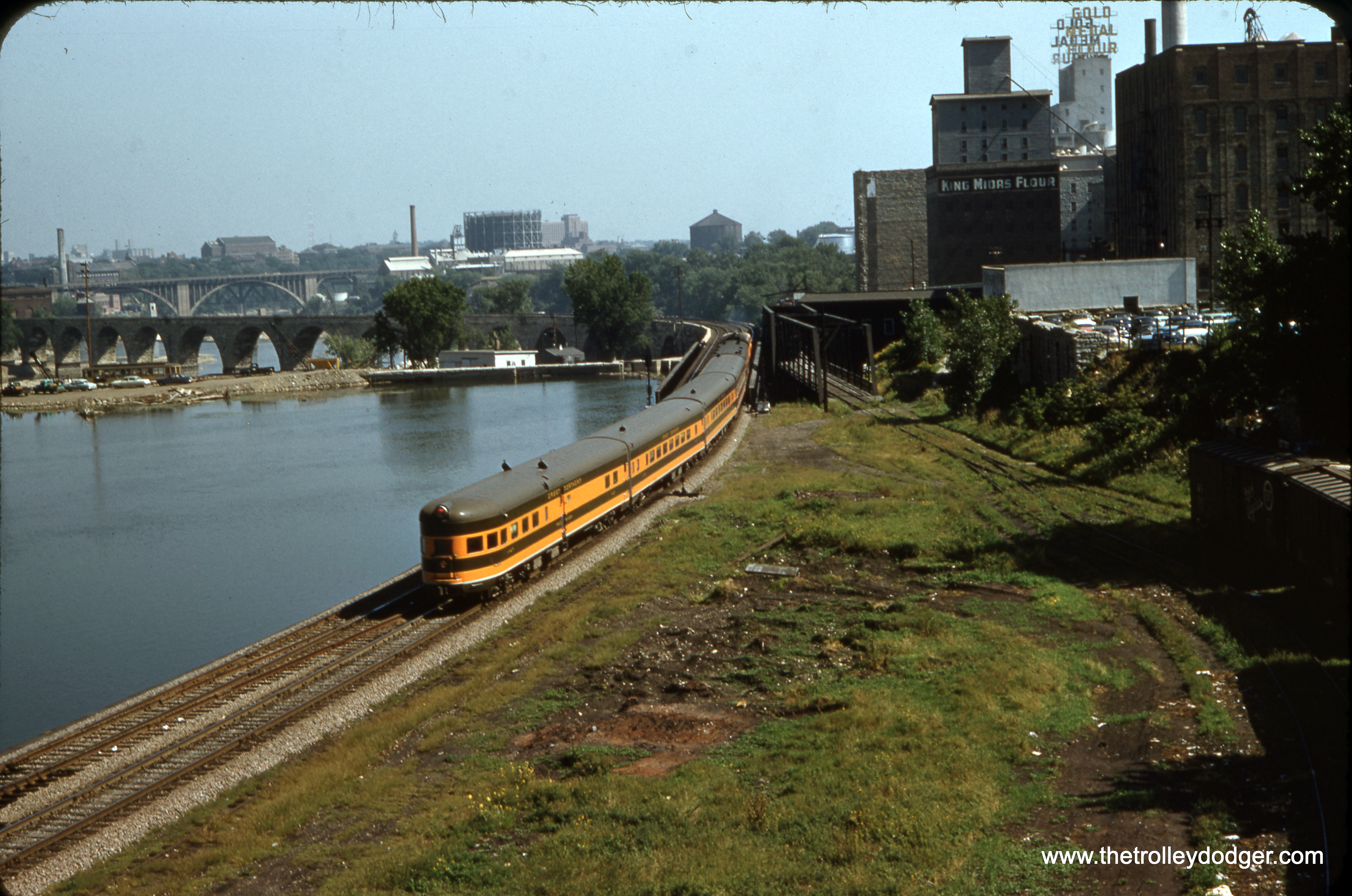
Great Northern Railway Red River 1954 Original 35mm Red Border Kodachrome Slide Subject: GNR 12 Location: Departing Minneapolis station for St. Paul Date: Fall 1954 Photographer: Unknown From the Wikipedia: The Red River was a passenger train operated by Great Northern Railway between Grand Forks, North Dakota, and Saint Paul, Minnesota (operating between 1950 and 1968). History Great Northern Railway's third new train set of 1950 was a new schedule named the Red River. The five-car streamliner built by American Car and Foundry Company began service June 25, 1950, operating a daily round trip 324 miles (521 km) each way between Grand Forks, North Dakota, and Saint Paul, Minnesota. The train went southbound in the morning returning northbound in the evening. The cars for the Red River streamliner were quite different than those built for the International (another 1950 introduction) in that the Red River's cars had extra insulation and the coaches were equipped with Baker Heaters as there was no steam heat available at the Grand Forks depot where the cars stood overnight. The locomotive was sent to the roundhouse each evening for any running repairs and service so the solution was the installation of the Baker Heaters in the cars. Link to eBay Listing

Great Northern Railway Red River 1954 Original 35mm Red Border Kodachrome Slide
Subject: GNR 12
Location: Departing Minneapolis station for St. Paul
Date: Fall 1954
Photographer: Unknown
From the Wikipedia:
The Red River was a passenger train operated by Great Northern Railway between Grand Forks, North Dakota, and Saint Paul, Minnesota (operating between 1950 and 1968).
History
Great Northern Railway’s third new train set of 1950 was a new schedule named the Red River. The five-car streamliner built by American Car and Foundry Company began service June 25, 1950, operating a daily round trip 324 miles (521 km) each way between Grand Forks, North Dakota, and Saint Paul, Minnesota. The train went southbound in the morning returning northbound in the evening.
The cars for the Red River streamliner were quite different than those built for the International (another 1950 introduction) in that the Red River’s cars had extra insulation and the coaches were equipped with Baker Heaters as there was no steam heat available at the Grand Forks depot where the cars stood overnight. The locomotive was sent to the roundhouse each evening for any running repairs and service so the solution was the installation of the Baker Heaters in the cars.
Link to eBay Listing

Amtrak RDC Train 1975 Original 35mm Kodachrome Slide Subject: Amtrak RDCs 30-32-15, Train 372 Blackhawk Location: Crawford (Chicago bound, between Dubuque and Chicago) Date: September 14, 1975 Photographer: James J. Buckley Link to eBay Listing

Amtrak RDC Train 1975 Original 35mm Kodachrome Slide
Subject: Amtrak RDCs 30-32-15, Train 372 Blackhawk
Location: Crawford (Chicago bound, between Dubuque and Chicago)
Date: September 14, 1975
Photographer: James J. Buckley
Link to eBay Listing

Milwaukee and Suburban Transport 1975 Original 35mm Kodachrome Slide Subject: M&ST 1466 Location: Wells-River (posed by the old Milwaukee Electric power plant) Date: June 29, 1975 Photographer: Jeff Wien Link to eBay Listing

Milwaukee and Suburban Transport 1975 Original 35mm Kodachrome Slide
Subject: M&ST 1466
Location: Wells-River (posed by the old Milwaukee Electric power plant)
Date: June 29, 1975
Photographer: Jeff Wien
Link to eBay Listing

Yakima Valley Transit Trolley 1975 Original 35mm Kodachrome Slide Subject: YVT 1776/1976 Location: 44th-Nob Hill, Yakima Date: June 1975 Photographer: Jeff Wien Link to eBay Listing

Yakima Valley Transit Trolley 1975 Original 35mm Kodachrome Slide
Subject: YVT 1776/1976
Location: 44th-Nob Hill, Yakima
Date: June 1975
Photographer: Jeff Wien
Link to eBay Listing

Our Latest Book, Now Available for Pre-Order:

The North Shore Line

Publication Date: February 20, 2023

FYI, my new Arcadia Publishing book The North Shore Line is now finished and has gone to press. My publisher decided to expand it to 160 pages, instead of the usual 128. That’s a 25% increase, without any change to the $23.99 price. I am quite pleased with how this turned out.

From the back cover:

As late as 1963, it was possible to board high-speed electric trains on Chicago’s famous Loop “L” that ran 90 miles north to Milwaukee. This was the Chicago North Shore & Milwaukee Railroad, commonly known as the North Shore Line. It rose from humble origins in the 1890s as a local streetcar line in Waukegan to eventually become America’s fastest interurban under the visionary management of Midwest utilities tycoon Samuel Insull. The North Shore Line, under Insull, became a worthy competitor to the established steam railroads. Hobbled by the Great Depression, the road fought back in 1941 with two streamlined, air-conditioned, articulated trains called Electroliners, which included dining service. It regained its popularity during World War II, when gasoline and tires were rationed, but eventually, it fell victim to highways and the automobile. The North Shore Line had intercity rail, commuter rail, electric freight, city streetcars, and even buses. It has been gone for nearly 60 years, but it will always remain the Road of Service.

Each copy purchased here will be signed by the author, and you will also receive a bonus North Shore Line map.  Books will ship by USPS Media Mail as soon as we receive them, on or before February 20, 2023.

Chapters:
01. Beginnings
02. The Milwaukee Division
03. The Shore Line Route
04. The Skokie Valley Route
05. The Mundelein Branch
06. On the “L”
07. City Streetcars
08. Trolley Freight
09. The Long Goodbye
10. The Legacy

Title The North Shore Line
Images of America
Author David Sadowski
Edition illustrated
Publisher Arcadia Publishing (SC), 2023
ISBN 1467108960, 978-1467108966
Length 160 pages

The price of $23.99 includes shipping within the United States.

For Shipping to US Addresses:

New Compact Disc, Now Available:

CTA-1
The Last Chicago Streetcars 1958
# of Discs – 1
Price: $15.99

Until now, it seemed as though audio recordings of Chicago streetcars were practically non-existent. For whatever reason, the late William A. Steventon does not appear to have made any for his Railroad Record Club, even though he did make other recordings in the Chicago area in 1956.

Now, audio recordings of the last runs of Chicago streetcars have been found, in the collections of the late Jeffrey L. Wien (who was one of the riders on that last car). We do not know who made these recordings, but this must have been done using a portable reel-to-reel machine.

These important recordings will finally fill a gap in transit history. The last Chicago Transit Authority streetcar finished its run in the early hours of June 21, 1958. Now you can experience these events just as Chicagoans did.

As a bonus, we have included Keeping Pace, a 1939 Chicago Surface Lines employee training program. This was digitally transferred from an original 16” transcription disc. These recordings were unheard for 80 years.

Total time – 74:38

Help Support The Trolley Dodger

This is our 295th post, and we are gradually creating a body of work and an online resource for the benefit of all railfans, everywhere. To date, we have received over 941,000 page views, for which we are very grateful.

You can help us continue our original transit research by checking out the fine products in our Online Store.
As we have said before, “If you buy here, we will be here.”

We thank you for your support.

DONATIONS

In order to continue giving you the kinds of historic railroad images that you have come to expect from The Trolley Dodger, we need your help and support. It costs money to maintain this website, and to do the sort of historic research that is our specialty.

Your financial contributions help make this web site better, and are greatly appreciated.


The Photography of Roger Puta

A Christmas Present While I was scanning some slides of Roger Puta's the other evening, I came upon this one. I fell in love with it immediately. It sure isn't one of your run-of-the-mill train pictures. Roger took it in November 1978 at the Lackawanna RR station in Newark, NJ. In thinking about it, I feel my high school buddy and railfan friend has sent me a Christmas present across the miles and the 25 years he has been gone. So I'm sharing his present with you. Enjoy, Marty Bernard (2015)

A Christmas Present
While I was scanning some slides of Roger Puta’s the other evening, I came upon this one. I fell in love with it immediately. It sure isn’t one of your run-of-the-mill train pictures. Roger took it in November 1978 at the Lackawanna RR station in Newark, NJ.
In thinking about it, I feel my high school buddy and railfan friend has sent me a Christmas present across the miles and the 25 years he has been gone. So I’m sharing his present with you.
Enjoy,
Marty Bernard (2015)

We have lots of gifts for you under the Trolley Dodger tree this season. Most feature the exceptional photography of the late, but very prolific Roger Puta (1944-1990). His friend Marty Bernard has scanned many of these and has generously uploaded them to a Flickr album that has, at last count, 929 public domain images.

Here is what Marty Bernard has written about Roger Puta:

Who Was Roger Puta? (2016)

I am asked that question often. Here is a short bio.

Roger and I went to High School together. He was a good friend and railfan buddy. We grew up in nearby towns along the CB&Q in the Chicago western suburbs. We railfanned together through college, often with our railfan friends from the Chicago area. He worked for the Santa Fe and Western Pacific and lived in the Washington DC area and San Francisco in the 1970s and 80s. He was a rare mileage freak, a prolific and darn good train photographer, and focused considerable attention on passenger trains. He traveled widely in the U.S., Canada, and Mexico to meet those interests. If it ran on rails, or was related to something that ran on rails, he photographed it. Thus his collection of thousands of slides includes many of streetcars, depots, and railroad graphics. He was known for his slides shows, some of which were at Winter Rail. In 1990 he caught a train to the Pearly Gates.

I am now scanning and posting his slides. I continue to be surprised how many railfans knew him and respond to my posts of his slides. He did many railfan trips of multiple days with one or more of his fellow foamers.

We have selected over 100 of these images for today’s post, following our usual Recent Finds. I believe it is important to pay tribute to those fans who have gone before us, for we are truly “standing on the shoulders of giants.”

Happy Holidays!

-David Sadowski

PS- The Trolley Dodger is now on Facebook too.

Recent Finds

July 30, 1953: "North Shore Line northbound train leaving Randolph St. station on Wabash, from Marshall Field's window." (Glenn S. Moe Photo)

July 30, 1953: “North Shore Line northbound train leaving Randolph St. station on Wabash, from Marshall Field’s window.” (Glenn S. Moe Photo)

A close-up view of the previous picture.

A close-up view of the previous picture.

CTA 1024 and work car S-340 were used on a fantrip for the Illinois Electric Railway Museum on April 20, 1958. The location is the old Church Street freight yard near Northwestern University. After the fantrip, car 1024 went to the museum's location in North Chicago under its own power. It has since been restored to its as-delivered appearance as car 24. Don's Rail Photos: "1024 was built by Pullman in 1899 as NWERy 24. It was renumbered 1024 in 1913 and became CRT 1024 in 1923. It was rebuilt as 1st S-111 on March 19, 1955, and sold to Illinois Railway Museum as 1024 in 1958. S-340 was rebuilt from a 1700 series car." In this case, the "rebuilding" appears limited to a new coat of yellow paint. Information from Andre Kristopans shows that S-340 was originally car 1815, retired on January 9, 1958. It lasted into the mid-1960s.

CTA 1024 and work car S-340 were used on a fantrip for the Illinois Electric Railway Museum on April 20, 1958. The location is the old Church Street freight yard near Northwestern University. After the fantrip, car 1024 went to the museum’s location in North Chicago under its own power. It has since been restored to its as-delivered appearance as car 24. Don’s Rail Photos: “1024 was built by Pullman in 1899 as NWERy 24. It was renumbered 1024 in 1913 and became CRT 1024 in 1923. It was rebuilt as 1st S-111 on March 19, 1955, and sold to Illinois Railway Museum as 1024 in 1958. S-340 was rebuilt from a 1700 series car.” In this case, the “rebuilding” appears limited to a new coat of yellow paint. Information from Andre Kristopans shows that S-340 was originally car 1815, retired on January 9, 1958. It lasted into the mid-1960s.

CTA work car S-340, taken at the same location, and on the same IERM fantrip, as the previous picture. The date is April 20, 1958.

CTA work car S-340, taken at the same location, and on the same IERM fantrip, as the previous picture. The date is April 20, 1958.

CTA gate car 390 is part of a two-car Central Electric Railfans' Association fantrip train at the Ravenswood terminal at Kimball and Lawrence in April 1957. Note the original station entrance, then nearly 50 years old, which had a green roof at this time. Sean Hunnicutt: "That is 6062 on the left."

CTA gate car 390 is part of a two-car Central Electric Railfans’ Association fantrip train at the Ravenswood terminal at Kimball and Lawrence in April 1957. Note the original station entrance, then nearly 50 years old, which had a green roof at this time. Sean Hunnicutt: “That is 6062 on the left.”

This is the same fantrip train as in the picture taken at Kimball and Lawrence. Two wooden "L" CTA cars, including 390, are posed for a photo stop at Sedgwick in April 1957. The occasion was a Central Electric Railfans' Association fantrip. Many of these trips took place on Sundays, when Ravenswood trains did not run on this part of the "L", so there could be leisurely photo stops. At night and on Sundays, the Rave operated as a shuttle, starting in 1949, going only as far as Armitage. In 1963, after the North Shore Line quit, the Ravenswood shuttle ended at Belmont. The shuttle operation ended in 2000, as ridership on the renamed Brown Line had greatly increased. Now all Brown Line trains go to the Loop.

This is the same fantrip train as in the picture taken at Kimball and Lawrence. Two wooden “L” CTA cars, including 390, are posed for a photo stop at Sedgwick in April 1957. The occasion was a Central Electric Railfans’ Association fantrip. Many of these trips took place on Sundays, when Ravenswood trains did not run on this part of the “L”, so there could be leisurely photo stops. At night and on Sundays, the Rave operated as a shuttle, starting in 1949, going only as far as Armitage. In 1963, after the North Shore Line quit, the Ravenswood shuttle ended at Belmont. The shuttle operation ended in 2000, as ridership on the renamed Brown Line had greatly increased. Now all Brown Line trains go to the Loop.

A six-car North Shore Line special train. This picture may date to the 1930s. I am not sure of the location, but this may also be where many of the cars were lined up for scrapping after the interurban was abandoned in 1963.

A six-car North Shore Line special train. This picture may date to the 1930s. I am not sure of the location, but this may also be where many of the cars were lined up for scrapping after the interurban was abandoned in 1963.

Chicago Aurora & Elgin 459 is westbound at Lakewood station on August 8, 1954, during a fantrip for the Central Electric Railfans' Association. (Bob Selle Photo)

Chicago Aurora & Elgin 459 is westbound at Lakewood station on August 8, 1954, during a fantrip for the Central Electric Railfans’ Association. (Bob Selle Photo)

This photo was taken by Steve Carter sometime during the last year of operation of the CA&E (1957), at the intersection of York Road and Vallette Street (Elmhurst), looking north.

This photo was taken by Steve Carter sometime during the last year of operation of the CA&E (1957), at the intersection of York Road and Vallette Street (Elmhurst), looking north.

CTA PCC 4113, a product of the Pullman company, heads west on a shoo-fly at Madison and Wacker Drive on March 30, 1950. This was during construction of Lower Wacker Drive, which began in 1949 and moved south at the rate of about one block per year.

CTA PCC 4113, a product of the Pullman company, heads west on a shoo-fly at Madison and Wacker Drive on March 30, 1950. This was during construction of Lower Wacker Drive, which began in 1949 and moved south at the rate of about one block per year.

CTA PCC 4169 (a Pullman) is eastbound at 119th Street, near the south end of Route 36 - Broadway-State, as it crosses over the Pennsylvania Railroad's "Panhandle" route.

CTA PCC 4169 (a Pullman) is eastbound at 119th Street, near the south end of Route 36 – Broadway-State, as it crosses over the Pennsylvania Railroad’s “Panhandle” route.

Chicago Rapid Transit car 4293 at University on the Jackson Park "L". If not for the sign on the platform, I would've hard a difficult time identifying this location. The car is flying American flags, which may mean this picture was taken on July 4th or some other holiday.

Chicago Rapid Transit car 4293 at University on the Jackson Park “L”. If not for the sign on the platform, I would’ve hard a difficult time identifying this location. The car is flying American flags, which may mean this picture was taken on July 4th or some other holiday.

The City of Chicago hired professional photographers to shoot various scenes of the new State Street Subway around the time it opened in 1943. Some of these were issued in a series of postcards. Here, we see the new north portal, just south of Armitage.

The City of Chicago hired professional photographers to shoot various scenes of the new State Street Subway around the time it opened in 1943. Some of these were issued in a series of postcards. Here, we see the new north portal, just south of Armitage.

A close-up view of the previous picture.

A close-up view of the previous picture.

There must be a story behind this picture, showing an observation car on a mainline railroad. There were a number of lines that had a Chicago Limited.

There must be a story behind this picture, showing an observation car on a mainline railroad. There were a number of lines that had a Chicago Limited.

The observation car pictured above does bear some resemblance to ones used on the North Shore Line:

North Shore Line observation parlor car 420.

North Shore Line observation parlor car 420.

CTA PCC 7180 is at South Shops on February 12, 1956, near work cars E-208 and F-29. Don's Rail Photos: "E208, sweeper, was built by McGuire in 1895 as CCRys E8. It was renumbered E208 in 1913 and became CSL E208 in 1914. It was retired on September 27, 1956. F29, plow, was built by McGuire-Cummings in 1924. It was retired on December 14, 1956."

CTA PCC 7180 is at South Shops on February 12, 1956, near work cars E-208 and F-29. Don’s Rail Photos: “E208, sweeper, was built by McGuire in 1895 as CCRys E8. It was renumbered E208 in 1913 and became CSL E208 in 1914. It was retired on September 27, 1956. F29, plow, was built by McGuire-Cummings in 1924. It was retired on December 14, 1956.”

A four-car Evanston Shopper's Special. The front car is 1269. Don's Rail Photos: "1269 was a trailer built by American Car & Foundry in 1907, #5098, as NWERy 269. It was renumbered 269 in 1913 and became CRT 1269 in 1923." This picture was taken on August 6, 1937 by Otto C. Perry. A version with less cropping is on Don's Rail Photos.

A four-car Evanston Shopper’s Special. The front car is 1269. Don’s Rail Photos: “1269 was a trailer built by American Car & Foundry in 1907, #5098, as NWERy 269. It was renumbered 269 in 1913 and became CRT 1269 in 1923.” This picture was taken on August 6, 1937 by Otto C. Perry. A version with less cropping is on Don’s Rail Photos.

Aurora, Elgin & Fox River Electric car 49 in South Elgin, IL on August 6, 1944.

Aurora, Elgin & Fox River Electric car 49 in South Elgin, IL on August 6, 1944.

The Photography of Roger Puta

The earliest photos here date to about 1962, when Roger Puta was 18 years old. By then, the CA&E had stopped running, but the rolling stock was still awaiting final disposition in Wheaton. That was also the last full year of service for the North Shore Line.

There are many pictures of the Chicago Transit Authority, including the western end of the Lake Street “L”, still running at ground level until the end of October 1962. The Evanston branch still used overhead wire until 1973, operating 4000-series “L” cars as well as 6000s and the 1-50 single car units. The new high-speed Skokie Swift began running in April 1964, just over a year after the demise of the North Shore Line.

The South Shore Line continued operating 1920s-era cars until the early 1980s, as the last surviving Chicago interurban. Those venerable orange interurban cars ran on South Bend streets until 1970. We have also included some pictures from the Erie Lackawanna’s Gladstone branch, which also used equipment of the same vintage, and seems very interurban-ish even though for some reason, it is not usually classified as one.

Midwest traction is well represented by photos from the Southern Iowa Railway and Iowa Terminal, including former Waterloo, Cedar Falls & Northern car 100, newly repainted just prior to being tragically destroyed in a 1967 fire.

To round out our feature of classic railcars, there are some pictures of Bullet cars on the former Red Arrow line between Philadelphia and Norristown, aka the Philadelphia & Western, now operated by SEPTA.

The captions are by Marty Bernard. I corrected a few minor typos.

1 of 2 Photos. On the slide mount Roger wrote, "CTA Lake St. B-train racing C&NW freight near Laramie Ave., Chicago, IL in May 1967." Before October 28, 1962 the Lake St. "L" ran at street level next to the C&NW's elevated embankment through far western Chicago and Oak Park after it dismounted its "L" structure above Lake Street. It was slow running with lots of grade crossings. On that date the trains shifted to new tracks up on the embankment. Roger's photo shows the results. At the right you can see the structure over Lake Street and see the tracks shift to the left (north) on to the C&NW embankment. And I really like this photo. Why? It's the pigeons. Four of them.

1 of 2 Photos. On the slide mount Roger wrote, “CTA Lake St. B-train racing C&NW freight near Laramie Ave., Chicago, IL in May 1967.”
Before October 28, 1962 the Lake St. “L” ran at street level next to the C&NW’s elevated embankment through far western Chicago and Oak Park after it dismounted its “L” structure above Lake Street. It was slow running with lots of grade crossings. On that date the trains shifted to new tracks up on the embankment. Roger’s photo shows the results. At the right you can see the structure over Lake Street and see the tracks shift to the left (north) on to the C&NW embankment. And I really like this photo. Why? It’s the pigeons. Four of them.

2 of 2 Photos. Roger wrote on the slide mount, "CTA eastbound Lake St. "L" taking down trolley pole at the station near N. Parkside Ave. and W. Lake St. in Chicago on August 14, 1962." At street level the trains drew their power from the trolley wire overhead -- on the "L" structure from a third rail. This is the last station before this eastbound train mounts the "L" structure. Above the old station, up on the embankment, is the nearly completed new station. The elimination of trolley pole running on the western end of the Lake Street "L" allowed the CTA to modernize its fleet without the cost of trolley poles.

2 of 2 Photos. Roger wrote on the slide mount, “CTA eastbound Lake St. “L” taking down trolley pole at the station near N. Parkside Ave. and W. Lake St. in Chicago on August 14, 1962.”
At street level the trains drew their power from the trolley wire overhead — on the “L” structure from a third rail. This is the last station before this eastbound train mounts the “L” structure. Above the old station, up on the embankment, is the nearly completed new station.
The elimination of trolley pole running on the western end of the Lake Street “L” allowed the CTA to modernize its fleet without the cost of trolley poles.

CTA Eastbound Lake St. "L" going past the pedestrian-only grade crossing at Elmwood Ave in Oak Park, IL on August 14, 1962

CTA Eastbound Lake St. “L” going past the pedestrian-only grade crossing at Elmwood Ave in Oak Park, IL on August 14, 1962

CTA Lake Street "L" trains meeting near N. Long Ave and W. Lake Street in Chicago, Il. on August 14, 1962

CTA Lake Street “L” trains meeting near N. Long Ave and W. Lake Street in Chicago, Il. on August 14, 1962

CTA Westbound Lake Street L approaching the Oak Park Ave. station while crossing the Euclid Ave. grade crossing in Oak Park, IL on August 14, 1962

CTA Westbound Lake Street L approaching the Oak Park Ave. station while crossing the Euclid Ave. grade crossing in Oak Park, IL on August 14, 1962

CTA Westbound Lake Street L in Oak Park, IL on August 14, 1962

CTA Westbound Lake Street L in Oak Park, IL on August 14, 1962

CTA Lake Street L coming down to street level off elevated track at N. Long Ave and W. Lake St. in Chicago, IL on August 14, 1962

CTA Lake Street L coming down to street level off elevated track at N. Long Ave and W. Lake St. in Chicago, IL on August 14, 1962

CTA Ravenswood B train on outer loop at Randolph and Wells station, Chicago, IL on June 13, 1968

CTA Ravenswood B train on outer loop at Randolph and Wells station, Chicago, IL on June 13, 1968

CTA L cars in storage at Logan Square terminal, Chicago, IL on April 5, 1969. Sean Hunnicutt adds, "6629-30 on the outside corner. Funny note about this: my ex-girlfriend was born in Manila on this day."

CTA L cars in storage at Logan Square terminal, Chicago, IL on April 5, 1969. Sean Hunnicutt adds, “6629-30 on the outside corner. Funny note about this: my ex-girlfriend was born in Manila on this day.”

CTA interlocking tower at Logan Square Terminal, Chicago, IL on April 9, 1966 Roger Puta photograph Roger wrote, "The last mechanical interlocking on the CTA and will be replaced with a new tower."

CTA interlocking tower at Logan Square Terminal, Chicago, IL on April 9, 1966
Roger Puta photograph
Roger wrote, “The last mechanical interlocking on the CTA and will be replaced with a new tower.”

CTA Logan Square Terminal and Yards Before the Kennedy Extension, 5 Photos The Logan Square station served the CTA as the terminal of the Milwaukee (Ave.) "L" until February 1, 1970 when the Kennedy Extension to Jefferson Park (and later to O'Hare) opened. But on May 30, 1966, a new all-electric interlocking was placed in service at Logan Square tower. Roger Puta and Rick Burn had just visited Logan Square the month before and took these photos. These are Roger Puta's photos except for Photo 2. 5. Yard at Logan Square from the unfinished tower. Sean Hunnicutt notes, "2153-54 (resting up for a long career) and 6615."

CTA Logan Square Terminal and Yards Before the Kennedy Extension, 5 Photos
The Logan Square station served the CTA as the terminal of the Milwaukee (Ave.) “L” until February 1, 1970 when the Kennedy Extension to Jefferson Park (and later to O’Hare) opened. But on May 30, 1966, a new all-electric interlocking was placed in service at Logan Square tower. Roger Puta and Rick Burn had just visited Logan Square the month before and took these photos. These are Roger Puta’s photos except for Photo 2.
5. Yard at Logan Square from the unfinished tower. Sean Hunnicutt notes, “2153-54 (resting up for a long career) and 6615.”

CTA Logan Square Terminal and Yards Before the Kennedy Extension, 5 Photos The Logan Square station served the CTA as the terminal of the Milwaukee (Ave.) "L" until February 1, 1970 when the Kennedy Extension to Jefferson Park (and later to O'Hare) opened. But on May 30, 1966, a new all-electric interlocking was placed in service at Logan Square tower. Roger Puta and Rick Burn had just visited Logan Square the month before and took these photos. These are Roger Puta's photos except for Photo 2. 3. A Congress-Milwaukee A Train going through Logan Square Yard taken from Douglas-Milwaukee B train.

CTA Logan Square Terminal and Yards Before the Kennedy Extension, 5 Photos
The Logan Square station served the CTA as the terminal of the Milwaukee (Ave.) “L” until February 1, 1970 when the Kennedy Extension to Jefferson Park (and later to O’Hare) opened. But on May 30, 1966, a new all-electric interlocking was placed in service at Logan Square tower. Roger Puta and Rick Burn had just visited Logan Square the month before and took these photos. These are Roger Puta’s photos except for Photo 2.
3. A Congress-Milwaukee A Train going through Logan Square Yard taken from Douglas-Milwaukee B train.

CTA Logan Square Terminal and Yards Before the Kennedy Extension, 5 Photos The Logan Square station served the CTA as the terminal of the Milwaukee (Ave.) "L" until February 1, 1970 when the Kennedy Extension to Jefferson Park (and later to O'Hare) opened. But on May 30, 1966, a new all-electric interlocking was placed in service at Logan Square tower. Roger Puta and Rick Burn had just visited Logan Square the month before and took these photos. These are Roger Puta's photos except for Photo 2. 1. Control panel in the unfinished tower at Logan Square on April 9. 1966.

CTA Logan Square Terminal and Yards Before the Kennedy Extension, 5 Photos
The Logan Square station served the CTA as the terminal of the Milwaukee (Ave.) “L” until February 1, 1970 when the Kennedy Extension to Jefferson Park (and later to O’Hare) opened. But on May 30, 1966, a new all-electric interlocking was placed in service at Logan Square tower. Roger Puta and Rick Burn had just visited Logan Square the month before and took these photos. These are Roger Puta’s photos except for Photo 2.
1. Control panel in the unfinished tower at Logan Square on April 9. 1966.

CTA Logan Square Terminal and Yards Before the Kennedy Extension, 5 Photos The Logan Square station served the CTA as the terminal of the Milwaukee (Ave.) "L" until February 1, 1970 when the Kennedy Extension to Jefferson Park (and later to O'Hare) opened. But on May 30, 1966, a new all-electric interlocking was placed in service at Logan Square tower. Roger Puta and Rick Burn had just visited Logan Square the month before and took these photos. These are Roger Puta's photos except for Photo 2. 4. A Douglas Park bound B train crossing over just outside Logan Square terminal while Congress-Milwaukee A train waits. Taken from unfinished tower. Sean Hunnicutt adds, "2153-54 still on break at the right."

CTA Logan Square Terminal and Yards Before the Kennedy Extension, 5 Photos
The Logan Square station served the CTA as the terminal of the Milwaukee (Ave.) “L” until February 1, 1970 when the Kennedy Extension to Jefferson Park (and later to O’Hare) opened. But on May 30, 1966, a new all-electric interlocking was placed in service at Logan Square tower. Roger Puta and Rick Burn had just visited Logan Square the month before and took these photos. These are Roger Puta’s photos except for Photo 2.
4. A Douglas Park bound B train crossing over just outside Logan Square terminal while Congress-Milwaukee A train waits. Taken from unfinished tower. Sean Hunnicutt adds, “2153-54 still on break at the right.”

CTA Logan Square Terminal and Yards Before the Kennedy Extension, 5 Photos The Logan Square station served the CTA as the terminal of the Milwaukee (Ave.) "L" until February 1, 1970 when the Kennedy Extension to Jefferson Park (and later to O'Hare) opened. But on May 30, 1966, a new all-electric interlocking was placed in service at Logan Square tower. Roger Puta and Rick Burn had just visited Logan Square the month before and took these photos. These are Roger Puta's photos except for Photo 2. 2. The old and new tower (correct me if I'm wrong). Rick's photo. Sean Hunnicutt: "6587-88."

CTA Logan Square Terminal and Yards Before the Kennedy Extension, 5 Photos
The Logan Square station served the CTA as the terminal of the Milwaukee (Ave.) “L” until February 1, 1970 when the Kennedy Extension to Jefferson Park (and later to O’Hare) opened. But on May 30, 1966, a new all-electric interlocking was placed in service at Logan Square tower. Roger Puta and Rick Burn had just visited Logan Square the month before and took these photos. These are Roger Puta’s photos except for Photo 2.
2. The old and new tower (correct me if I’m wrong). Rick’s photo. Sean Hunnicutt: “6587-88.”

CTA 6000s, Ravenswood Train, July 1965 These were early 6000 series cars with double headlights and a top center rollsign. The 6000s were rebuilt PCC streetcars. Roger's photo show them holding down a Ravenswood run in July, 1965. For more on these cars see: www.chicago-l.org/trains/roster/6000.html

CTA 6000s, Ravenswood Train, July 1965
These were early 6000 series cars with double headlights and a top center rollsign. The 6000s were rebuilt PCC streetcars. Roger’s photo show them holding down a Ravenswood run in July, 1965. For more on these cars see: http://www.chicago-l.org/trains/roster/6000.html

Chicago Transit Authority's Evanston Shuttle at Isabella station in Evanston, IL on May 26, 1962

Chicago Transit Authority’s Evanston Shuttle at Isabella station in Evanston, IL on May 26, 1962

CTA Skokie Swift, Skokie, IL May 1964

CTA Skokie Swift, Skokie, IL May 1964

Chicago Transit Authority "jitterbug" Skokie Swift car northbound on curve south of Oakton St., Skokie, IL on April 12, 1966

Chicago Transit Authority “jitterbug” Skokie Swift car northbound on curve south of Oakton St., Skokie, IL on April 12, 1966

Chicago Transit Authority 4000s as an Evanston Express (signed Evanston-Wilmette) leaving Isabella Station in Evanston, IL, April 12, 1966. Sean Hunnicutt adds, "4447."

Chicago Transit Authority 4000s as an Evanston Express (signed Evanston-Wilmette) leaving Isabella Station in Evanston, IL, April 12, 1966. Sean Hunnicutt adds, “4447.”

Chicago Transit Authority southbound Skokie Swift car south of Oakton St. in Skokie, IL on ex-CNS&M track on April 12, 1966

Chicago Transit Authority southbound Skokie Swift car south of Oakton St. in Skokie, IL on ex-CNS&M track on April 12, 1966

CTA 2240 at Laramie on the Douglas Line in April 1985

CTA 2240 at Laramie on the Douglas Line in April 1985

CTA O'Hare Station, April 1985

CTA O’Hare Station, April 1985

CTA Laramie stop on the Douglas (Pink) Line in April 1985

CTA Laramie stop on the Douglas (Pink) Line in April 1985

CTA 2292 at Laramie on the Douglas (Pink) Line in April 1985

CTA 2292 at Laramie on the Douglas (Pink) Line in April 1985

CTA 6-car 4000 series Ravenswood A train near Grand Ave. Station, Chicago, IL om February 2, 1968

CTA 6-car 4000 series Ravenswood A train near Grand Ave. Station, Chicago, IL om February 2, 1968

CTA 2-car train approaching Belmont Ave. Station on April 9, 1966 Roger Puta photograph Roger wrote, "Note doors and windows signify early L car." Sean Hunnicutt: "6057-58."

CTA 2-car train approaching Belmont Ave. Station on April 9, 1966
Roger Puta photograph
Roger wrote, “Note doors and windows signify early L car.” Sean Hunnicutt: “6057-58.”

Chicago Transit Authority Evanston Express with 4000 series cars at Clark Junction near the Belmont Station, Chicago, IL on February 2, 1968.

Chicago Transit Authority Evanston Express with 4000 series cars at Clark Junction near the Belmont Station, Chicago, IL on February 2, 1968.

CTA Evanston Express near Wellington station, Chicago, IL in February, 1968

CTA Evanston Express near Wellington station, Chicago, IL in February, 1968

CTA B Douglas-Milwaukee and A Congress-Milwaukee trains at end of track, Logan Square Terminal on April 9, 1966

CTA B Douglas-Milwaukee and A Congress-Milwaukee trains at end of track, Logan Square Terminal on April 9, 1966

These articulated cars were called "jitterbugs". There were only 4. Roger's photo is of CTA 54 as southbound Skokie Swift train south of Oakton St. in Skokie, IL on ex-CNS&M trackage on April 12, 1966. For more on these cars see: www.chicago-l.org/trains/roster/5000.html

These articulated cars were called “jitterbugs”.
There were only 4. Roger’s photo is of CTA 54 as southbound Skokie Swift train south of Oakton St. in Skokie, IL on ex-CNS&M trackage on April 12, 1966. For more on these cars see: http://www.chicago-l.org/trains/roster/5000.html

CTA (left to right) at Belmont Ave. Station, Ravenswood 2-car SB, B Jackson Park - Howard 6 car NB, A Englewood - Howard 6 car NB, in distance 2-car NB Ravenswood on April 9, 1966

CTA (left to right) at Belmont Ave. Station, Ravenswood 2-car SB, B Jackson Park – Howard 6 car NB, A Englewood – Howard 6 car NB, in distance 2-car NB Ravenswood on April 9, 1966

CTA 4-car Evanston Express approaching Isabella Ave. station with 4 trolley poles up, Evanston, IL, North Shore Channel bridge in background on April 12, 1966 These are single man cars used individually as shuttles on the Evanston Line during off hours.

CTA 4-car Evanston Express approaching Isabella Ave. station with 4 trolley poles up, Evanston, IL, North Shore Channel bridge in background on April 12, 1966
These are single man cars used individually as shuttles on the Evanston Line during off hours.

CTA Howard - Englewood A Train southbound at Addison, Chicago, IL on August 25, 1962

CTA Howard – Englewood A Train southbound at Addison, Chicago, IL on August 25, 1962

CTA A train Englewood - Howard L approaching Belmont Ave. station on Saturday evening rush hour, Chicago, IL on April 9, 1966. Sean Hunnicutt: "6286."

CTA A train Englewood – Howard L approaching Belmont Ave. station on Saturday evening rush hour, Chicago, IL on April 9, 1966. Sean Hunnicutt: “6286.”

CTA 4-car Evanston Express approaching Isabella Ave. station, Evanston, IL, April 12, 1966

CTA 4-car Evanston Express approaching Isabella Ave. station, Evanston, IL, April 12, 1966

CTA Skokie Swift, Skokie, IL in May 1964 Crawford looking east

CTA Skokie Swift, Skokie, IL in May 1964 Crawford looking east

CTA 8127 Evanston Express on Outer Loop at Randolph and Wells Note only one pair of poles -- permanently coupled cars. June 13, 1968

CTA 8127 Evanston Express on Outer Loop at Randolph and Wells
Note only one pair of poles — permanently coupled cars. June 13, 1968

CTA 4-car Evanston Express leaving Isabella Ave. station, Wilmette, IL on April 12, 1966

CTA 4-car Evanston Express leaving Isabella Ave. station, Wilmette, IL on April 12, 1966

CTA Evanston Express train approaching the Merchandise Mart station, Chicago, IL on June 13, 1968

CTA Evanston Express train approaching the Merchandise Mart station, Chicago, IL on June 13, 1968

The Skokie Swift Over the North Shore Cannel Roger Puta took this photo in May of 1964 in Skokie. (This appears to be the uncropped version of this photo.)

The Skokie Swift Over the North Shore Cannel
Roger Puta took this photo in May of 1964 in Skokie. (This appears to be the uncropped version of this photo.)

The Skokie Swift Over the North Shore Cannel Roger Puta took this photo in May of 1964 in Skokie. He didn't have a telephoto lens at that time. So I cropped the photo much tighter just to see what it would look like. This allowed me to eliminate much of the uninteresting sky and get the photo closer to obeying the Rule of Thirds. It also shows that the car is slightly burred which does not show in the original size photo.

The Skokie Swift Over the North Shore Cannel
Roger Puta took this photo in May of 1964 in Skokie. He didn’t have a telephoto lens at that time. So I cropped the photo much tighter just to see what it would look like. This allowed me to eliminate much of the uninteresting sky and get the photo closer to obeying the Rule of Thirds. It also shows that the car is slightly burred which does not show in the original size photo.

CA&E 427 stored at Wheaton, IL Shops, April 25, 1962

CA&E 427 stored at Wheaton, IL Shops, April 25, 1962

CA&E 429 stored at Wheaton, IL shops, April 25, 1962

CA&E 429 stored at Wheaton, IL shops, April 25, 1962

3 More About Electroliners from Roger Puta's Camera CNS&M herald on the Electroliner at station in Milwaukee, WI on October 21, 1962.

3 More About Electroliners from Roger Puta’s Camera
CNS&M herald on the Electroliner at station in Milwaukee, WI on October 21, 1962.

North Shore Facilities in Milwaukee -- 4 Photos These are scans of Roger Puta's slides taken October 12, 1962 in Milwaukee, WI. CNS&M Passenger Terminal at 6th St. and W. Clybourn Ave.

North Shore Facilities in Milwaukee — 4 Photos
These are scans of Roger Puta’s slides taken October 12, 1962 in Milwaukee, WI.
CNS&M Passenger Terminal at 6th St. and W. Clybourn Ave.

North Shore Facilities in Milwaukee -- 4 Photos These are scans of Roger Puta's slides taken October 12, 1962 in Milwaukee, WI. Lower yard east of the Terminal on W. Clybourn St. down toward the Milwaukee Road Passenger Station. (I once knew what that second car in was. Please remind me.) Sean Hunnicutt: "The first car is 170."

North Shore Facilities in Milwaukee — 4 Photos
These are scans of Roger Puta’s slides taken October 12, 1962 in Milwaukee, WI.
Lower yard east of the Terminal on W. Clybourn St. down toward the Milwaukee Road Passenger Station. (I once knew what that second car in was. Please remind me.) Sean Hunnicutt: “The first car is 170.”

An Electroliner on the Milwaukee Streets -- 4 Photos I don't know how Roger Puta did it, but he photographed the same northbound Electroliner both on 5th and 6th Streets on October 21, 1962 only a couple blocks apart. Here are his captions. 1. CNS&M Train 805, The Electroliner on S. 5th St. approaching W. Orchard St. 2. CNS&M Train 805, The Electroliner on S. 5th St. near W. Orchard St. 3. CNS&M Train 805, The Electroliner coming out of private right-of-way onto S. 6th St. at W. Scott Ave. [Look who has the railfan seats. I don't remember. Are they looking at a blank wall?]

An Electroliner on the Milwaukee Streets — 4 Photos
I don’t know how Roger Puta did it, but he photographed the same northbound Electroliner both on 5th and 6th Streets on October 21, 1962 only a couple blocks apart. Here are his captions.
1. CNS&M Train 805, The Electroliner on S. 5th St. approaching W. Orchard St.
2. CNS&M Train 805, The Electroliner on S. 5th St. near W. Orchard St.
3. CNS&M Train 805, The Electroliner coming out of private right-of-way onto S. 6th St. at W. Scott Ave. [Look who has the railfan seats. I don’t remember. Are they looking at a blank wall?]

An Electroliner on the Milwaukee Streets -- 4 Photos I don't know how Roger Puta did it, but he photographed the same northbound Electroliner both on 5th and 6th Streets on October 21, 1962 only a couple blocks apart. Here are his captions. CNS&M Train 805, The Electroliner coming out of private right-of-way onto S. 6th St. at W. Scott Ave. [Look who has the railfan seats. I don't remember. Are they looking at a blank wall?]

An Electroliner on the Milwaukee Streets — 4 Photos
I don’t know how Roger Puta did it, but he photographed the same northbound Electroliner both on 5th and 6th Streets on October 21, 1962 only a couple blocks apart. Here are his captions.
CNS&M Train 805, The Electroliner coming out of private right-of-way onto S. 6th St. at W. Scott Ave. [Look who has the railfan seats. I don’t remember. Are they looking at a blank wall?]

3 More About Electroliners from Roger Puta's Camera The last CNS&M Tavern - Lounge car on the substitute Electroliner that day. See previous photo.

3 More About Electroliners from Roger Puta’s Camera
The last CNS&M Tavern – Lounge car on the substitute Electroliner that day. See previous photo.

North Shore Facilities in Milwaukee -- 4 Photos These are scans of Roger Puta's slides taken October 12, 1962 in Milwaukee, WI. CNS&M Yards and Shops at Harrison Street.

North Shore Facilities in Milwaukee — 4 Photos
These are scans of Roger Puta’s slides taken October 12, 1962 in Milwaukee, WI.
CNS&M Yards and Shops at Harrison Street.

An Electroliner on the Milwaukee Streets -- 4 Photos I don't know how Roger Puta did it, but he photographed the same northbound Electroliner both on 5th and 6th Streets on October 21, 1962 only a couple blocks apart. Here are his captions. CNS&M Train 805, The Electroliner on S. 5th St. near W. Orchard St.

An Electroliner on the Milwaukee Streets — 4 Photos
I don’t know how Roger Puta did it, but he photographed the same northbound Electroliner both on 5th and 6th Streets on October 21, 1962 only a couple blocks apart. Here are his captions.
CNS&M Train 805, The Electroliner on S. 5th St. near W. Orchard St.

An Electroliner on the Milwaukee Streets -- 4 Photos I don't know how Roger Puta did it, but he photographed the same northbound Electroliner both on 5th and 6th Streets on October 21, 1962 only a couple blocks apart. Here are his captions. CNS&M Train 805, The Electroliner on S. 6th St. between W. Washington Ave. and Scott Ave. [Love the marked lights!]

An Electroliner on the Milwaukee Streets — 4 Photos
I don’t know how Roger Puta did it, but he photographed the same northbound Electroliner both on 5th and 6th Streets on October 21, 1962 only a couple blocks apart. Here are his captions.
CNS&M Train 805, The Electroliner on S. 6th St. between W. Washington Ave. and Scott Ave. [Love the marked lights!]

CNS&M Train 415 starting to move on W. National Ave. on S. 6th St. in Milwaukee, WI on October 12, 1962

CNS&M Train 415 starting to move on W. National Ave. on S. 6th St. in Milwaukee, WI on October 12, 1962

CNS&M Train 422 on S. 5th St. at W. Rogers Ave. in Milwaukee, WI on October 21, 1962

CNS&M Train 422 on S. 5th St. at W. Rogers Ave. in Milwaukee, WI on October 21, 1962

3 More About Electroliners from Roger Puta's Camera Each of the two Electroliner had a day off each week for maintenance and repair. So on every Tuesday and Thursday the substitute Electroliner would run. Roger caught the substitute in this photo. Here is his caption: CNS&M NB Train 803, The Electriliner, consisting of Silverliner 769, Tavern - Lounge 415 (upper window sash and trailer trucks), and Silverliner 76? stopped at the Racine, WI depot on October 21, 1962.

3 More About Electroliners from Roger Puta’s Camera
Each of the two Electroliner had a day off each week for maintenance and repair. So on every Tuesday and Thursday the substitute Electroliner would run. Roger caught the substitute in this photo. Here is his caption: CNS&M NB Train 803, The Electriliner, consisting of Silverliner 769, Tavern – Lounge 415 (upper window sash and trailer trucks), and Silverliner 76? stopped at the Racine, WI depot on October 21, 1962.

North Shore Facilities in Milwaukee -- 4 Photos These are scans of Roger Puta's slides taken October 12, 1962 in Milwaukee, WI. I blew up the sign on the roof of the canopy.

North Shore Facilities in Milwaukee — 4 Photos
These are scans of Roger Puta’s slides taken October 12, 1962 in Milwaukee, WI.
I blew up the sign on the roof of the canopy.

A Surprise South Shore Shot Roger Puta and I railfanned the South Shore a lot during College (Christmas, semester, and Easter break). As I was scanning his South Shore slides yesterday I was surprised by this one. I have near duplicates of most of his South Shore slides because I was standing next to him. Not this one. It looks like it may have been a grab shot. Here is his caption: CSS&SB going down grade from Pennsylvania - Wabash Bridge in Gary, Indiana on February 10, 1963.

A Surprise South Shore Shot
Roger Puta and I railfanned the South Shore a lot during College (Christmas, semester, and Easter break). As I was scanning his South Shore slides yesterday I was surprised by this one. I have near duplicates of most of his South Shore slides because I was standing next to him. Not this one. It looks like it may have been a grab shot.
Here is his caption: CSS&SB going down grade from Pennsylvania – Wabash Bridge in Gary, Indiana on February 10, 1963.

CNS&M Glenayre passenger station in Glenview, Illinois. This slide was taken on January 24, 1963 three days after the North Shore abandoned service. It is one of nine Mediterranean Revival Style built by Samuel Insull. Only two still exist: Beverly Shores on the South Shore Line and Briergate on the North Shore Line.

CNS&M Glenayre passenger station in Glenview, Illinois. This slide was taken on January 24, 1963 three days after the North Shore abandoned service. It is one of nine Mediterranean Revival Style built by Samuel Insull. Only two still exist: Beverly Shores on the South Shore Line and Briergate on the North Shore Line.

CNS&M Train 409 northbound south of the Northbrook, Illinois station on the Skokie Valley Route on May 26, 1962.

CNS&M Train 409 northbound south of the Northbrook, Illinois station on the Skokie Valley Route on May 26, 1962.

CNS&M southbound Train 216 from Waukeegan, IL approaching the former Asbury Ave. station in Skokie, Ill. CERA Railfan Special in Car 720 was first train to stop at Asbury Ave since 1941, August 25, 1962.

CNS&M southbound Train 216 from Waukeegan, IL approaching the former Asbury Ave. station in Skokie, Ill. CERA Railfan Special in Car 720 was first train to stop at Asbury Ave since 1941, August 25, 1962.

CNS&M way freight on the team track between Northfield and Northbrook, Illinois on May 26, 1962.

CNS&M way freight on the team track between Northfield and Northbrook, Illinois on May 26, 1962.

Just an Electroliner I don't remember ever seeing a photo of an Electroliner from the Ridge Ave. (called Ridge Blvd. in Chicago) Bridge in Evanston, IL. But my friend Roger Puta took one on November 3, 1962, a little over 2 1/2 months before they ceased to run because the North Shore ended operations. Here is his caption on the slide mount, "CNS&M Train 802, the Electroliner taken from Ridge Blvd. bridge in Evanston, IL. Ridge Blvd. had been a stop on the old Skokie "L" and the station is still standing." The 3rd rails are have a slight layer of rust. Both Electroliners were saved. The one at the Illinois Ry Museum at Union, IL is being fully renovated. The one at Rockhill Trolley Museum, Rockhill Furnace, PA is in SEPTA (Red Arrow) colors.

Just an Electroliner
I don’t remember ever seeing a photo of an Electroliner from the Ridge Ave. (called Ridge Blvd. in Chicago) Bridge in Evanston, IL. But my friend Roger Puta took one on November 3, 1962, a little over 2 1/2 months before they ceased to run because the North Shore ended operations. Here is his caption on the slide mount, “CNS&M Train 802, the Electroliner taken from Ridge Blvd. bridge in Evanston, IL. Ridge Blvd. had been a stop on the old Skokie “L” and the station is still standing.”
The 3rd rails are have a slight layer of rust.
Both Electroliners were saved. The one at the Illinois Ry Museum at Union, IL is being fully renovated. The one at Rockhill Trolley Museum, Rockhill Furnace, PA is in SEPTA (Red Arrow) colors.

CSS&SD 105 at Gary, IN on January 27, 1964 Chicago South Shore and South Bend

CSS&SD 105 at Gary, IN on January 27, 1964
Chicago South Shore and South Bend

CSS&SB 801 in Hegewisch (Burnham Yard) in Chicago on January 27, 1964.

CSS&SB 801 in Hegewisch (Burnham Yard) in Chicago on January 27, 1964.

CSS&SB 106 at the Kensington stop in Chicago, IL in September 1963. This is where the South Shore diverts on to its own track and heads east.

CSS&SB 106 at the Kensington stop in Chicago, IL in September 1963. This is where the South Shore diverts on to its own track and heads east.

I posted the second photo a while back. Thought it was neat. Today I found the one Roger Puta took a few seconds earlier while the train was on the bridge. And he managed to avoid getting the headight hidden behind a structure member! This is a CSS&SB eastbound (to Chicago) going over Pennsylvania - Wabash RR bridge in Gary, Ind. on February 10, 1963.

I posted the second photo a while back. Thought it was neat. Today I found the one Roger Puta took a few seconds earlier while the train was on the bridge. And he managed to avoid getting the headight hidden behind a structure member! This is a CSS&SB eastbound (to Chicago) going over Pennsylvania – Wabash RR bridge in Gary, Ind. on February 10, 1963.

CSS&SB 11 at Gary, Ind. in July, 1979. That hand railing at the left is 802's.

CSS&SB 11 at Gary, Ind. in July, 1979. That hand railing at the left is 802’s.

CSS&SB 802 in the double track pocket at Gary, Ind. in July, 1979.

CSS&SB 802 in the double track pocket at Gary, Ind. in July, 1979.

CSS&SB 109 going up grade to Pennsylvania - Wabash bridge in Gary, Ind. on February 10, 1963.

CSS&SB 109 going up grade to Pennsylvania – Wabash bridge in Gary, Ind. on February 10, 1963.

CSS&SB 107 eastbound at the Hegewisch stop in Chicago, IL on December 31, 1965. (That's my wonderful Plymouth. Roger and I were in our senior year of college.)

CSS&SB 107 eastbound at the Hegewisch stop in Chicago, IL on December 31, 1965. (That’s my wonderful Plymouth. Roger and I were in our senior year of college.)

CSS&SB 801 in January 1964, location not recorded.

CSS&SB 801 in January 1964, location not recorded.

Two CSS&SB 700s (ex-NYC) on a caboose hop approaching the Gary, Ind. depot in January 1964.

Two CSS&SB 700s (ex-NYC) on a caboose hop approaching the Gary, Ind. depot in January 1964.

Chicago South Shore & South Bend 707 in Burnham Yard, January 1972

Chicago South Shore & South Bend 707 in Burnham Yard, January 1972

Chicago South Shore & South Bend 705 coming westbound into Hammond. The Indiana Toll Road is in the background in February 1972.

Chicago South Shore & South Bend 705 coming westbound into Hammond. The Indiana Toll Road is in the background in February 1972.

Chicago South Shore & south Bend 702 Burnham Yard, January 1972

Chicago South Shore & south Bend 702 Burnham Yard, January 1972

CSS&SB 32 in Hammond, IN on January 27, 1964

CSS&SB 32 in Hammond, IN on January 27, 1964

CSS&SB 106 in South Bend, Ind. on January 27, 1964 02

CSS&SB 106 in South Bend, Ind. on January 27, 1964 02

CSS&SB Train 320 boarding passengers in street at South Bend, Indiana station on April 9, 1966. Rick Burn and Steve Sumner at right

CSS&SB Train 320 boarding passengers in street at South Bend, Indiana station on April 9, 1966. Rick Burn and Steve Sumner at right

CSS&SB 104 in Michigan City, IN on January 27, 1964

CSS&SB 104 in Michigan City, IN on January 27, 1964

Roger Puta found CSS&SB 106 being loaded in South Bend, Ind. on January 27, 1964

Roger Puta found CSS&SB 106 being loaded in South Bend, Ind. on January 27, 1964

Erie-Lackawanna EMUs in Orange, NJ on November 1978

Erie-Lackawanna EMUs in Orange, NJ on November 1978

Erie-Lackawanna EMUs at Hoboken Terminal, December 1978

Erie-Lackawanna EMUs at Hoboken Terminal, December 1978

Erie-Lackawanna EMUs at Hoboken Terminal, December 1978

Erie-Lackawanna EMUs at Hoboken Terminal, December 1978

EL EMU Train on the Gladstone Branch from Pill Hill Road in November 1978

EL EMU Train on the Gladstone Branch from Pill Hill Road in November 1978

EL Montclair Station Depot in November 1978 R24 Building exists. Tracks gone.

EL Montclair Station Depot in November 1978 R24
Building exists. Tracks gone.

From the end of a platform in the Erie-Lackwanna Terminal at Hoboken, NJ in November 1978

From the end of a platform in the Erie-Lackwanna Terminal at Hoboken, NJ in November 1978

Erie Lackwanna Montclair Depot in November 1978 -- 3 Photos Building exists. Tracks gone.

Erie Lackwanna Montclair Depot in November 1978 — 3 Photos
Building exists. Tracks gone.

Lackawanna Railroad Freight House at Morristown NJ on Morristown Line former M&E Division of Lackawanna RR in November 1978 R26

Lackawanna Railroad Freight House at Morristown NJ on Morristown Line former M&E Division of Lackawanna RR in November 1978 R26

ex-DL&W Tower located eastbound side at Orange NJ station on Morristown Line in November 1978

ex-DL&W Tower located eastbound side at Orange NJ station on Morristown Line in November 1978

EL Signal P389 on Gladstone Branch. P is for Passaic & Delaware, former name of Gladstone Branch. Signal is west of Far Hills, NJ in November 1978

EL Signal P389 on Gladstone Branch. P is for Passaic & Delaware, former name of Gladstone Branch. Signal is west of Far Hills, NJ in November 1978

EL Chatham NJ station on former DL&W Morris & Essex, later EL Morristown Line in November 1978 B22

EL Chatham NJ station on former DL&W Morris & Essex, later EL Morristown Line in November 1978 B22

EL EMU Train on the Gladstone Branch from Pill Hill Road in November 1978

EL EMU Train on the Gladstone Branch from Pill Hill Road in November 1978

EL EMU interior in November 1978

EL EMU interior in November 1978

EL EMUs at Hoboken in November 1978

EL EMUs at Hoboken in November 1978

EL EMU westbound to Gladstone, NJ MU train on Gladstone branch... note parlor car in consist. Eastbound train # was 412 Gladstone to Hoboken weekdays only in November 1978

EL EMU westbound to Gladstone, NJ MU train on Gladstone branch… note parlor car in consist. Eastbound train # was 412 Gladstone to Hoboken weekdays only in November 1978

Iowa Terminal Railroad Car 101 at Charles City Photograph taken by Roger Puta the weekend of August 12th and 13th, 1967 in Iowa.

Iowa Terminal Railroad Car 101 at Charles City
Photograph taken by Roger Puta the weekend of August 12th and 13th, 1967 in Iowa.

Iowa Terminal Railroad Car 100 on MILW interchange tracks Mason City Photograph taken by Roger Puta the weekend of August 12th and 13th, 1967 in Iowa.

Iowa Terminal Railroad Car 100 on MILW interchange tracks Mason City
Photograph taken by Roger Puta the weekend of August 12th and 13th, 1967 in Iowa.

Iowa Terminal Railroad Car 100 at Emery Shops Photograph taken by Roger Puta the weekend of August 12th and 13th, 1967 in Iowa.

Iowa Terminal Railroad Car 100 at Emery Shops
Photograph taken by Roger Puta the weekend of August 12th and 13th, 1967 in Iowa.

Iowa Terminal Railroad Car 100 at West Mason City Photograph taken by Roger Puta the weekend of August 12th and 13th, 1967 in Iowa.

Iowa Terminal Railroad Car 100 at West Mason City
Photograph taken by Roger Puta the weekend of August 12th and 13th, 1967 in Iowa.

Roger Puta took these August 12 and 13 of 1967. Freight Motors 80 and 81 at the shops, Emery, IA

Roger Puta took these August 12 and 13 of 1967.
Freight Motors 80 and 81 at the shops, Emery, IA

Iowa Terminal Railroad Car 101 near Oakwood Photograph taken by Roger Puta the weekend of August 12th and 13th, 1967 in Iowa.

Iowa Terminal Railroad Car 101 near Oakwood
Photograph taken by Roger Puta the weekend of August 12th and 13th, 1967 in Iowa.

Iowa Terminal Railroad shops and substation at Emery Photograph taken by Roger Puta the weekend of August 12th and 13th, 1967 in Iowa.

Iowa Terminal Railroad shops and substation at Emery
Photograph taken by Roger Puta the weekend of August 12th and 13th, 1967 in Iowa.

Iowa Terminal Railroad Car 100 at shops at Emery Photograph taken by Roger Puta the weekend of August 12th and 13th, 1967 in Iowa.

Iowa Terminal Railroad Car 100 at shops at Emery
Photograph taken by Roger Puta the weekend of August 12th and 13th, 1967 in Iowa.

Southern Iowa Railway Freight Motor 101 -- 3 Photos Roger Puta took these during a railfan weekend in June 1963. Near Maine, IA

Southern Iowa Railway Freight Motor 101 — 3 Photos
Roger Puta took these during a railfan weekend in June 1963.
Near Maine, IA

Roger Puta took these August 12 and 13 of 1967. Box Motor 31 (ex-Chicago, North Shore & Milwaukee) and Passenger Car 100 (ex-Waterloo, Cedar Falls and Northern Railway) near Mason City.

Roger Puta took these August 12 and 13 of 1967.
Box Motor 31 (ex-Chicago, North Shore & Milwaukee) and Passenger Car 100 (ex-Waterloo, Cedar Falls and Northern Railway) near Mason City.

Southern Iowa Railway Freight Motor 101 -- 3 Photos Roger Puta took these during a railfan weekend in June 1963. At the Moravia, IA depot.

Southern Iowa Railway Freight Motor 101 — 3 Photos
Roger Puta took these during a railfan weekend in June 1963.
At the Moravia, IA depot.

Iowa Terminal Railroad Car 101 near Roseville Siding Photograph taken by Roger Puta the weekend of August 12th and 13th, 1967 in Iowa.

Iowa Terminal Railroad Car 101 near Roseville Siding
Photograph taken by Roger Puta the weekend of August 12th and 13th, 1967 in Iowa.

Iowa Terminal Railroad right of way just east of Emery taken from Box Motor with Passenger Car 100 ahead Photograph taken by Roger Puta the weekend of August 12th and 13th, 1967 in Iowa.

Iowa Terminal Railroad right of way just east of Emery taken from Box Motor with Passenger Car 100 ahead
Photograph taken by Roger Puta the weekend of August 12th and 13th, 1967 in Iowa.

Iowa Terminal Railroad Car 100 near Clear Lake Photograph taken by Roger Puta the weekend of August 12th and 13th, 1967 in Iowa.

Iowa Terminal Railroad Car 100 near Clear Lake
Photograph taken by Roger Puta the weekend of August 12th and 13th, 1967 in Iowa.

Iowa Terminal Railroad Car 100 near Clear Lake Photograph taken by Roger Puta the weekend of August 12th and 13th, 1967 in Iowa.

Iowa Terminal Railroad Car 100 near Clear Lake
Photograph taken by Roger Puta the weekend of August 12th and 13th, 1967 in Iowa.

Southern Iowa Railway Freight Motor 101 -- 3 Photos Roger Puta took these during a railfan weekend in June 1963. South of the Moravia Iowa depot. Iowa Southern Utilities (former owner of the railroad) substation at left.

Southern Iowa Railway Freight Motor 101 — 3 Photos
Roger Puta took these during a railfan weekend in June 1963.
South of the Moravia Iowa depot. Iowa Southern Utilities (former owner of the railroad) substation at left.

Some Iowa Terminal Railroad Freight Motors -- 4 Photos Roger Puta took these August 12 and 13 of 1967. Steeple Cab 30 in yards at Charles City, IA

Some Iowa Terminal Railroad Freight Motors — 4 Photos
Roger Puta took these August 12 and 13 of 1967.
Steeple Cab 30 in yards at Charles City, IA

Some Iowa Terminal Railroad Freight Motors -- 4 Photos Roger Puta took these August 12 and 13 of 1967. Freight Motor 61 at the shops, Emery, IA

Some Iowa Terminal Railroad Freight Motors — 4 Photos
Roger Puta took these August 12 and 13 of 1967.
Freight Motor 61 at the shops, Emery, IA

6 Brill Bullet Photos Roger Puta took these six photos of SEPTA Brill Bullet 200 at 69th Street Terminal in Upper Darby, PA in May 1983. I rode these cars and stupidly never took interior shots. Thanks Roger for helping me remember. Note: Brill made transit cars.

6 Brill Bullet Photos
Roger Puta took these six photos of SEPTA Brill Bullet 200 at 69th Street Terminal in Upper Darby, PA in May 1983. I rode these cars and stupidly never took interior shots. Thanks Roger for helping me remember.
Note: Brill made transit cars.

6 Brill Bullet Photos Roger Puta took these six photos of SEPTA Brill Bullet 200 at 69th Street Terminal in Upper Darby, PA in May 1983. I rode these cars and stupidly never took interior shots. Thanks Roger for helping me remember. Note: Brill made transit cars.

6 Brill Bullet Photos
Roger Puta took these six photos of SEPTA Brill Bullet 200 at 69th Street Terminal in Upper Darby, PA in May 1983. I rode these cars and stupidly never took interior shots. Thanks Roger for helping me remember.
Note: Brill made transit cars.

6 Brill Bullet Photos Roger Puta took these six photos of SEPTA Brill Bullet 200 at 69th Street Terminal in Upper Darby, PA in May 1983. I rode these cars and stupidly never took interior shots. Thanks Roger for helping me remember. Note: Brill made transit cars.

6 Brill Bullet Photos
Roger Puta took these six photos of SEPTA Brill Bullet 200 at 69th Street Terminal in Upper Darby, PA in May 1983. I rode these cars and stupidly never took interior shots. Thanks Roger for helping me remember.
Note: Brill made transit cars.

6 Brill Bullet Photos Roger Puta took these six photos of SEPTA Brill Bullet 200 at 69th Street Terminal in Upper Darby, PA in May 1983. I rode these cars and stupidly never took interior shots. Thanks Roger for helping me remember. Note: Brill made transit cars.

6 Brill Bullet Photos
Roger Puta took these six photos of SEPTA Brill Bullet 200 at 69th Street Terminal in Upper Darby, PA in May 1983. I rode these cars and stupidly never took interior shots. Thanks Roger for helping me remember.
Note: Brill made transit cars.

6 Brill Bullet Photos Roger Puta took these six photos of SEPTA Brill Bullet 200 at 69th Street Terminal in Upper Darby, PA in May 1983. I rode these cars and stupidly never took interior shots. Thanks Roger for helping me remember. Note: Brill made transit cars.

6 Brill Bullet Photos
Roger Puta took these six photos of SEPTA Brill Bullet 200 at 69th Street Terminal in Upper Darby, PA in May 1983. I rode these cars and stupidly never took interior shots. Thanks Roger for helping me remember.
Note: Brill made transit cars.

Roger Puta took these six photos of SEPTA Brill Bullet 200 at 69th Street Terminal in Upper Darby, PA in May 1983. I rode these cars and stupidly never took interior shots. Thanks Roger for helping me remember. Note: Brill made transit cars. And yes, that's Roger Puta.

Roger Puta took these six photos of SEPTA Brill Bullet 200 at 69th Street Terminal in Upper Darby, PA in May 1983. I rode these cars and stupidly never took interior shots. Thanks Roger for helping me remember.
Note: Brill made transit cars.
And yes, that’s Roger Puta.

FYI, a Google search brought up additional info on the life of Roger Puta here.

Keep those cards and letters coming in, folks!

-David Sadowski

New Steam Audio CD:

FYI, we have digitally remastered another classic steam railroad audio LP to Compact Disc. Many additional titles, including the complete output of the Railroad Record Club, in our Online Store.

misc676-001

STEAM CDs:

RGTS
Rio Grande to Silverton:
A Sound Portrait of Mountain Railroading
Price: $14.99

These are vintage 1960 narrow gauge steam train recordings, in true stereo, and originally released on LP in 1961.  It is long out of print.
Includes:
01. Riding The Train To Silverton
02. Photo Run At Elk Park
03. Arriving At Silverton
04. Train Time At La Jara
05. Illini Special At Cumbres Pass
06. Doubleheader Starting At Monero
07. Eastbound Freight
08. Arriving At Chama
09. Whistles At Coxo
10. Freight With Pusher At Coxo

Gone are the nostalgic sounds of steam echoes and thundering exhausts, but the memory is immortal. May they live on in the locomotive lexicon, as a monument to the era when trains were pulled by STEAM POWER.

As with all of our recordings, this CD comes with the complete, original liner notes.

Total time – 45:49

The Trolley Dodger On the Air
We appeared on WGN radio in Chicago in November 2018, discussing our book Building Chicago’s Subways on the Dave Plier Show. You can hear our 19-minute conversation here.

Chicago, Illinois, December 17, 1938-- Secretary Harold Ickes, left, and Mayor Edward J. Kelly turn the first spadeful of earth to start the new $40,000,000 subway project. Many thousands gathered to celebrate the starting of work on the subway.

Chicago, Illinois, December 17, 1938– Secretary Harold Ickes, left, and Mayor Edward J. Kelly turn the first spadeful of earth to start the new $40,000,000 subway project. Many thousands gathered to celebrate the starting of work on the subway.
Order Our New Book Building Chicago’s Subways

There were three subway anniversaries in 2018 in Chicago:
60 years since the West Side Subway opened (June 22, 1958)
75 years since the State Street Subway opened (October 17, 1943)
80 years since subway construction started (December 17, 1938)
To commemorate these anniversaries, we have written a new book, Building Chicago’s Subways. While the elevated Chicago Loop is justly famous as a symbol of the city, the fascinating history of its subways is less well known. The City of Chicago broke ground on what would become the “Initial System of Subways” during the Great Depression and finished 20 years later. This gigantic construction project, a part of the New Deal, would overcome many obstacles while tunneling through Chicago’s soft blue clay, under congested downtown streets, and even beneath the mighty Chicago River. Chicago’s first rapid transit subway opened in 1943 after decades of wrangling over routes, financing, and logistics. It grew to encompass the State Street, Dearborn-Milwaukee, and West Side Subways, with the latter modernizing the old Garfield Park “L” into the median of Chicago’s first expressway. Take a trip underground and see how Chicago’s “I Will” spirit overcame challenges and persevered to help with the successful building of the subways that move millions. Building Chicago’s subways was national news and a matter of considerable civic pride–making it a “Second City” no more!

Bibliographic information:
Title Building Chicago’s Subways
Images of America
Author David Sadowski
Edition illustrated
Publisher Arcadia Publishing (SC), 2018
ISBN 1467129380, 9781467129381
Length 128 pages
Chapter Titles:
01. The River Tunnels
02. The Freight Tunnels
03. Make No Little Plans
04. The State Street Subway
05. The Dearborn-Milwaukee Subway
06. Displaced
07. Death of an Interurban
08. The Last Street Railway
09. Subways and Superhighways
10. Subways Since 1960
Building Chicago’s Subways is in stock and now available for immediate shipment. Order your copy today! All copies purchased through The Trolley Dodger will be signed by the author.
The price of $23.99 includes shipping within the United States.
For Shipping to US Addresses:

For Shipping to Canada:

For Shipping Elsewhere:

Redone tile at the Monroe and Dearborn CTA Blue Line subway station, showing how an original sign was incorporated into a newer design, May 25, 2018. (David Sadowski Photo) Redone tile at the Monroe and Dearborn CTA Blue Line subway station, showing how an original sign was incorporated into a newer design, May 25, 2018. (David Sadowski Photo)
Help Support The Trolley Dodger
gh1
This is our 260th post, and we are gradually creating a body of work and an online resource for the benefit of all railfans, everywhere. To date, we have received over 704,000 page views, for which we are very grateful.
You can help us continue our original transit research by checking out the fine products in our Online Store.
As we have said before, “If you buy here, we will be here.”
We thank you for your support.
DONATIONS
In order to continue giving you the kinds of historic railroad images that you have come to expect from The Trolley Dodger, we need your help and support. It costs money to maintain this website, and to do the sort of historic research that is our specialty.
Your financial contributions help make this web site better, and are greatly appreciated.

Points East, West and South

This remarkable Kodachrome image was taken on Canal Street in New Orleans on June 19, 1940. It was shot on size 828 film, which has an image area of 28x40mm, about 30% larger than 35mm. (828 film, which Kodak introduced in the late 1930s, was essentially 35mm film without sprocket holes, but with a paper backing like other roll film formats.) One of our regular readers writes, "The 4 tracks were taken out about 1948 when a number of the car lines that operated off of Canal were converted to trolley bus." The location is the intersection of Canal and St. Charles. Car 444 is looping at the end of the St. Charles route and will be turning to the left in the picture. WSMB (now WWWL) was an AM radio station at 1350 on the dial. Its old call letters reflect its original ownership by the Saenger theater chain and Maison Blanche department store. Its studios were located in the Maison Blanche department store building at right, now the Ritz-Carlton hotel. The Saenger Theatre, another local landmark, is also on the right side of the picture. In the days before air conditioning, men used to wear white suits, as you see here, since white reflects more heat than darker clothing. When this picture was taken, France had just fallen to Nazi Germany. The US did not enter World War II directly until 18 months later.

This remarkable Kodachrome image was taken on Canal Street in New Orleans on June 19, 1940. It was shot on size 828 film, which has an image area of 28x40mm, about 30% larger than 35mm. (828 film, which Kodak introduced in the late 1930s, was essentially 35mm film without sprocket holes, but with a paper backing like other roll film formats.)
One of our regular readers writes, “The 4 tracks were taken out about 1948 when a number of the car lines that operated off of Canal were converted to trolley bus.” The location is the intersection of Canal and St. Charles. Car 444 is looping at the end of the St. Charles route and will be turning to the left in the picture.
WSMB (now WWWL) was an AM radio station at 1350 on the dial. Its old call letters reflect its original ownership by the Saenger theater chain and Maison Blanche department store. Its studios were located in the Maison Blanche department store building at right, now the Ritz-Carlton hotel.
The Saenger Theatre, another local landmark, is also on the right side of the picture.
In the days before air conditioning, men used to wear white suits, as you see here, since white reflects more heat than darker clothing. When this picture was taken, France had just fallen to Nazi Germany. The US did not enter World War II directly until 18 months later.

Our theme today is points east, west, and south. We’re going off in three directions, every which way but north.

We are especially glad to feature both the Chicago & West Towns Railways and Gary Railways. These photos have been generously shared by George Trapp, long a friend of this blog.

The West Towns map and photos of other properties come from our own collections. As always, to see a larger version of each photo, just click on it with your mouse. And, if you have useful information to add, please be sure to contact us.

Enjoy!

-David Sadowski

NOLA

A streamlined Kodak Bantam camera, using size 828 roll film, of a type that may have taken the New Orleans picture.

A streamlined Kodak Bantam camera, using size 828 roll film, of a type that may have taken the New Orleans picture.

The same location today. The St. Charles line still loops as it did in the 1940 picture. Streetcars were absent from Canal Street for 40 years starting in 1964, but have returned. There is a crossover track, visible in this picture, connecting the two lines.

The same location today. The St. Charles line still loops as it did in the 1940 picture. Streetcars were absent from Canal Street for 40 years starting in 1964, but have returned. There is a crossover track, visible in this picture, connecting the two lines.

This close-up shows New Orleans Public Service car 444. One of our regular readers says, "It is not a Perley-Thomas built car but rather a Southern Car Company car built in 1914. Starting in 1914, all of the car bodies appeared the same starting with car #400 even though they were not all built by Perley-Thomas." It was part of a group of 50 cars, numbered 400-449. Behind the streetcar, you can see part of the marquee for the Loew's State Theatre (also known as the State Palace), at 1108 Canal Street. It opened in 1926, but is currently closed and awaiting restoration. You can see some pictures of that theater's interior here.

This close-up shows New Orleans Public Service car 444. One of our regular readers says, “It is not a Perley-Thomas built car but rather a Southern Car Company car built in 1914. Starting in 1914, all of the car bodies appeared the same starting with car #400 even though they were not all built by Perley-Thomas.” It was part of a group of 50 cars, numbered 400-449.
Behind the streetcar, you can see part of the marquee for the Loew’s State Theatre (also known as the State Palace), at 1108 Canal Street. It opened in 1926, but is currently closed and awaiting restoration. You can see some pictures of that theater’s interior here.

A bus crosses Canal.

A bus crosses Canal.

Loew's State circa 1930. From the Wikipedia: "The Rogue Song is a 1930 romantic musical film which tells the story of a Russian bandit who falls in love with a princess, but takes his revenge on her when her brother rapes and kills his sister. The Metro-Goldwyn-Mayer production was directed by Lionel Barrymore and released in two versions, with and without sound. Hal Roach wrote and directed the Laurel and Hardy sequences and was not credited. The film stars Metropolitan Opera singer Lawrence Tibbett— who was nominated for an Academy Award for Best Actor for his performance— and Catherine Dale Owen. Laurel and Hardy were third-billed; their sequences were filmed at the last minute and interspersed throughout the film in an attempt to boost its potential box office appeal. This film, which was MGM's first all-talking (two-color) Technicolor film, is partially lost, as there are no known complete prints of this film. Fragments do exist."

Loew’s State circa 1930. From the Wikipedia: “The Rogue Song is a 1930 romantic musical film which tells the story of a Russian bandit who falls in love with a princess, but takes his revenge on her when her brother rapes and kills his sister. The Metro-Goldwyn-Mayer production was directed by Lionel Barrymore and released in two versions, with and without sound. Hal Roach wrote and directed the Laurel and Hardy sequences and was not credited. The film stars Metropolitan Opera singer Lawrence Tibbett— who was nominated for an Academy Award for Best Actor for his performance— and Catherine Dale Owen. Laurel and Hardy were third-billed; their sequences were filmed at the last minute and interspersed throughout the film in an attempt to boost its potential box office appeal. This film, which was MGM’s first all-talking (two-color) Technicolor film, is partially lost, as there are no known complete prints of this film. Fragments do exist.”

Loew's circa 1940, showing I Love You Again, an MGM comedy starring William Powell and Myrna Loy, directed by W. S. Van Dyke. All three were associated with the Thin Man series of films, which were very popular.

Loew’s circa 1940, showing I Love You Again, an MGM comedy starring William Powell and Myrna Loy, directed by W. S. Van Dyke. All three were associated with the Thin Man series of films, which were very popular.

A postcard view of Canal Street, showing the same general area as the 1940 slide, but looking from the opposite direction.

A postcard view of Canal Street, showing the same general area as the 1940 slide, but looking from the opposite direction.

Chicago & West Towns

A Chicago & West Towns route map, from April 1942. By this time, only three streetcar lines were left: LaGrange, Lake, and Madison. The owner of the map crossed out (with hash marks) some routes that were abandoned later. There was, by 1942, no track connection between the two north side lines and the LaGrange line. When the Lake and Madison lines were finally bustituted, the remaining streetcar fleet was moved at night in 1947 on a circuitous route via Chicago Surface Lines trackage.

A Chicago & West Towns route map, from April 1942. By this time, only three streetcar lines were left: LaGrange, Lake, and Madison. The owner of the map crossed out (with hash marks) some routes that were abandoned later. There was, by 1942, no track connection between the two north side lines and the LaGrange line. When the Lake and Madison lines were finally bustituted, the remaining streetcar fleet was moved at night in 1947 on a circuitous route via Chicago Surface Lines trackage.

The Chicago & West Towns was a major streetcar operator in Chicago’s western suburbs until April 1948, when the last line was converted to bus. Bus operation continues today as part of Pace, a public agency.

C&WT 127 and 104 in Maywood. The grade crossing at rear may be a clue as to the exact location. Don's Rail Photos notes: "104 was built by McGuire-Cummings in 1917. It was scrapped in 1948." The 127 looks to be the older of the pair, built by McGuire-Cummings in 1914. (Joe L. Diaz Photo) Joe writes: "The photo of C&WT cars 127 and 104 is in Maywood at 19th and Railroad Avenue looking north."

C&WT 127 and 104 in Maywood. The grade crossing at rear may be a clue as to the exact location. Don’s Rail Photos notes: “104 was built by McGuire-Cummings in 1917. It was scrapped in 1948.” The 127 looks to be the older of the pair, built by McGuire-Cummings in 1914. (Joe L. Diaz Photo) Joe writes: “The photo of C&WT cars 127 and 104 is in Maywood at 19th and Railroad Avenue looking north.”

C&WT 135, making a turn, is signed for Melrose Park, possibly on the Lake or Madison lines. Don's Rail Photos: "135 was built by McGuire-Cummings in 1919. It was scrapped in 1947." (Joe L. Diaz Photo) Joe writes: "The photo of C&WT car 135 is looking east at Madison and 19th in Maywood. The apartment building is still there." Andre Kristopans: "CWT 135 turning from W on Madison to N on 19th Ave."

C&WT 135, making a turn, is signed for Melrose Park, possibly on the Lake or Madison lines. Don’s Rail Photos: “135 was built by McGuire-Cummings in 1919. It was scrapped in 1947.” (Joe L. Diaz Photo) Joe writes: “The photo of C&WT car 135 is looking east at Madison and 19th in Maywood. The apartment building is still there.” Andre Kristopans: “CWT 135 turning from W on Madison to N on 19th Ave.”

C&WT 134 at the North Riverside barn. (Joe L. Diaz Photo)

C&WT 134 at the North Riverside barn. (Joe L. Diaz Photo)

C&WT 153, 140 and 119 on the LaGrange line. Comparison with some other photos in this series shows this location is DesPlaines Avenue just south of 26th Street in Riverside. We are looking north. Don's Rail Photos: "153 was built by Cummings Car Co in 1927. It was scrapped in 1948. 140 was built by McGuire-Cummings in 1924. It was rebuilt in 1939 and scrapped in 1948. 119 was built by McGuire-Cummings in 1912. It was scrapped in 1948." (Joe L. Diaz Photo)

C&WT 153, 140 and 119 on the LaGrange line. Comparison with some other photos in this series shows this location is DesPlaines Avenue just south of 26th Street in Riverside. We are looking north. Don’s Rail Photos: “153 was built by Cummings Car Co in 1927. It was scrapped in 1948. 140 was built by McGuire-Cummings in 1924. It was rebuilt in 1939 and scrapped in 1948. 119 was built by McGuire-Cummings in 1912. It was scrapped in 1948.” (Joe L. Diaz Photo)

C&WT 116, 115, and 158 at Cermak and Kenton, east end of the LaGrange line. Riders heading east could change here for Chicago Surface Lines route 21 streetcars like the one shown at rear. (Joe L. Diaz Photo)

C&WT 116, 115, and 158 at Cermak and Kenton, east end of the LaGrange line. Riders heading east could change here for Chicago Surface Lines route 21 streetcars like the one shown at rear. (Joe L. Diaz Photo)

C&WT 152 is heading east on private right-of-way on the busy LaGrange route. The exact location is about 82 Park Place in Riverside. Car 152 has just crossed the DesPlaines River, passing through the Forest Preserves after stopping at the Brookfield Zoo. From here, it will turn north on Woodside Drive, which changes into DesPlaines Avenue, before heading east on 26th Street. (Joe L. Diaz Photo)

C&WT 152 is heading east on private right-of-way on the busy LaGrange route. The exact location is about 82 Park Place in Riverside. Car 152 has just crossed the DesPlaines River, passing through the Forest Preserves after stopping at the Brookfield Zoo. From here, it will turn north on Woodside Drive, which changes into DesPlaines Avenue, before heading east on 26th Street. (Joe L. Diaz Photo)

The same location today.

The same location today.

C&WT 112 crosses the Indiana Harbor Belt on the LaGrange line, with a steam train off in the distance. Don's Rail Photos: "112 was built by McGuire-Cummings in 1912. It was scrapped in 1948." (Joe L. Diaz Photo)

C&WT 112 crosses the Indiana Harbor Belt on the LaGrange line, with a steam train off in the distance. Don’s Rail Photos: “112 was built by McGuire-Cummings in 1912. It was scrapped in 1948.” (Joe L. Diaz Photo)

C&WT 101 is turning from 26th Street onto DesPlaines Avenue in Riverside on the LaGrange line. Don's Rail Photos: "101 was built by McGuire-Cummings in 1917. It was scrapped in 1948." (Joe L. Diaz Photo)

C&WT 101 is turning from 26th Street onto DesPlaines Avenue in Riverside on the LaGrange line. Don’s Rail Photos: “101 was built by McGuire-Cummings in 1917. It was scrapped in 1948.” (Joe L. Diaz Photo)

C&WT 134 and 124 meet at Madison and Harlem. Note how Madison took a jog when crossing between Oak Park and Forest Park. We are looking east. Don's Rail Photos: "124 was built by McGuire-Cummings in 1914. It was rebuilt in 1936 and scrapped in 1948." (Joe L. Diaz Photo)

C&WT 134 and 124 meet at Madison and Harlem. Note how Madison took a jog when crossing between Oak Park and Forest Park. We are looking east. Don’s Rail Photos: “124 was built by McGuire-Cummings in 1914. It was rebuilt in 1936 and scrapped in 1948.” (Joe L. Diaz Photo)

Madison and Harlem today. A route 318 Pace bus is turning from Harlem onto Madison. Pace is the successor to the West Towns. At some point, it appears that Madison was widened to eliminate the jog seen in the earlier photo.

Madison and Harlem today. A route 318 Pace bus is turning from Harlem onto Madison. Pace is the successor to the West Towns. At some point, it appears that Madison was widened to eliminate the jog seen in the earlier photo.

C&WT 101 is at Lake and Austin in Oak Park, the east end of its route. Two Chicago Surface Lines streetcars, including 1743, are across Austin Boulevard at the west end of route 16. Don's Rail Photos: "101 was built by McGuire-Cummings in 1917. It was scrapped in 1948. 1743 was built by CSL in 1923. It was rebuilt as one-man in 1949." The car at left looks like a 1941 Packard model One Twenty-- very stylish. (Joe L. Diaz Photo)

C&WT 101 is at Lake and Austin in Oak Park, the east end of its route. Two Chicago Surface Lines streetcars, including 1743, are across Austin Boulevard at the west end of route 16. Don’s Rail Photos: “101 was built by McGuire-Cummings in 1917. It was scrapped in 1948. 1743 was built by CSL in 1923. It was rebuilt as one-man in 1949.” The car at left looks like a 1941 Packard model One Twenty– very stylish. (Joe L. Diaz Photo)

A 1941 Packard One Twenty sedan.

A 1941 Packard One Twenty sedan.

C&WT 136 and 132 on Lake Street just west of Austin Boulevard in suburban Oak Park. This was the east end of the line. (Joe L. Diaz Photo)

C&WT 136 and 132 on Lake Street just west of Austin Boulevard in suburban Oak Park. This was the east end of the line. (Joe L. Diaz Photo)

Lake Street just west of Austin Boulevard today.

Lake Street just west of Austin Boulevard today.

Here, C&WT 119 appears to be crossing the Illinois Central at 26th Street, since that is an IC caboose at the rear of the passing freight train. Don's Rail Photos: "119 was built by McGuire-Cummings in 1912. It was scrapped in 1948." (Joe L. Diaz Photo)

Here, C&WT 119 appears to be crossing the Illinois Central at 26th Street, since that is an IC caboose at the rear of the passing freight train. Don’s Rail Photos: “119 was built by McGuire-Cummings in 1912. It was scrapped in 1948.” (Joe L. Diaz Photo)

Here, we are looking north along DesPlaines Avenue just south of 26th Street in Riverside. Cars from the LaGrange line turned east on 26th to Harlem, where they continued north to Cermak Road. Cars may be operating on a single track here due to track work. Southbound C&WT 107 waits for 161 to cross over to the northbound track, while a work car is on 26th. Don's Rail Photos: "107 was built by McGuire-Cummings in 1912. It was scrapped in 1948. 161 was built by Cummings Car Co in 1927. It was scrapped in 1948." (Joe L. Diaz Photo)

Here, we are looking north along DesPlaines Avenue just south of 26th Street in Riverside. Cars from the LaGrange line turned east on 26th to Harlem, where they continued north to Cermak Road. Cars may be operating on a single track here due to track work. Southbound C&WT 107 waits for 161 to cross over to the northbound track, while a work car is on 26th. Don’s Rail Photos: “107 was built by McGuire-Cummings in 1912. It was scrapped in 1948. 161 was built by Cummings Car Co in 1927. It was scrapped in 1948.” (Joe L. Diaz Photo)

A close-up of the previous image. This may be C&WT work car 12. Don's Rail Photos says, "12 was built by McGuire-Cummings in 1912. It was scrapped in 1948."

A close-up of the previous image. This may be C&WT work car 12. Don’s Rail Photos says, “12 was built by McGuire-Cummings in 1912. It was scrapped in 1948.”

The top of this building, on 26th Street just east of DesPlaines Avenue in North Riverside, has been altered, but it is still recognizable as the same building in the previous picture.

The top of this building, on 26th Street just east of DesPlaines Avenue in North Riverside, has been altered, but it is still recognizable as the same building in the previous picture.

C&WT 152 on the LaGrange line. (Joe L. Diaz Photo)

C&WT 152 on the LaGrange line. (Joe L. Diaz Photo)

C&WT 144 at the North Riverside car barn. Don's Rail Photos: "144 was built by McGuire-Cummings in 1924. It was scrapped in 1947." (Joe L. Diaz Photo)

C&WT 144 at the North Riverside car barn. Don’s Rail Photos: “144 was built by McGuire-Cummings in 1924. It was scrapped in 1947.” (Joe L. Diaz Photo)

C&WT 164 on Lake Street just west of Austin Boulevard in Oak Park. (Joe L. Diaz Photo)

C&WT 164 on Lake Street just west of Austin Boulevard in Oak Park. (Joe L. Diaz Photo)

C&WT 107 and a work car (12 or 13, hard to tell) plus a flat car on DesPlaines Avenue just south of 26th Street in Riverside. Don's Rail Photos: "107 was built by McGuire-Cummings in 1912. It was scrapped in 1948." (Joe L. Diaz Photo)

C&WT 107 and a work car (12 or 13, hard to tell) plus a flat car on DesPlaines Avenue just south of 26th Street in Riverside. Don’s Rail Photos: “107 was built by McGuire-Cummings in 1912. It was scrapped in 1948.” (Joe L. Diaz Photo)

C&WT 158 crossing the Illinois Central at 26th Street in Riverside. I believe the car is heading east. If it was heading west, the sign on the front of the car would probably advertise service direct to the Brookfield Zoo. (Joe L. Diaz Photo)

C&WT 158 crossing the Illinois Central at 26th Street in Riverside. I believe the car is heading east. If it was heading west, the sign on the front of the car would probably advertise service direct to the Brookfield Zoo. (Joe L. Diaz Photo)

C&WT 158 and 157 cross on the bridge over the DesPlaines River (LaGrange line). I believe we are looking south. (Joe L. Diaz Photo)

C&WT 158 and 157 cross on the bridge over the DesPlaines River (LaGrange line). I believe we are looking south. (Joe L. Diaz Photo)

C&WT 100, most likely at the North Riverside car barn. Car 130 is at right. Don's Rail Photos: "100 was built by McGuire-Cummings in 1917. It was scrapped in 1948. 130 was built by McGuire-Cummings in 1914. It was scrapped in 1948." (Joe L. Diaz Photo)

C&WT 100, most likely at the North Riverside car barn. Car 130 is at right. Don’s Rail Photos: “100 was built by McGuire-Cummings in 1917. It was scrapped in 1948. 130 was built by McGuire-Cummings in 1914. It was scrapped in 1948.” (Joe L. Diaz Photo)

C&WT 141 at the North Riverside car barn. Don's Rail Photos: "141 was built by McGuire-Cummings in 1924. It was rebuilt in 1939 and the body sold as a shed in 1948. It was purchased by Electric Railway Historical Society in 1958. It went to Illinois Railway Museum in 1973 and began restoring." The 141 is now in operating condition. (Joe L. Diaz Photo)

C&WT 141 at the North Riverside car barn. Don’s Rail Photos: “141 was built by McGuire-Cummings in 1924. It was rebuilt in 1939 and the body sold as a shed in 1948. It was purchased by Electric Railway Historical Society in 1958. It went to Illinois Railway Museum in 1973 and began restoring.” The 141 is now in operating condition. (Joe L. Diaz Photo)

C&WT 157 and 155 meet on DesPlaines Avenue and 26th street. Single track operation is in effect due to track work. (Joe L. Diaz Photo)

C&WT 157 and 155 meet on DesPlaines Avenue and 26th street. Single track operation is in effect due to track work. (Joe L. Diaz Photo)

C&WT line car 15 at an undetermined location. Don's Rail Photos: "15 was built by Pullman Car in 1897 as Suburban RR 512. It was renumbered 515 and rebuilt as 15 in 1927. It was rebuilt in 1940 and scrapped in 1948." (Joe L. Diaz Photo)

C&WT line car 15 at an undetermined location. Don’s Rail Photos: “15 was built by Pullman Car in 1897 as Suburban RR 512. It was renumbered 515 and rebuilt as 15 in 1927. It was rebuilt in 1940 and scrapped in 1948.” (Joe L. Diaz Photo)

C&WT 156 is on Cermak at Cicero Avenue. The Pinkert State Bank (built in 1919) at rear was located at 4810-12 W. Cerak (22nd Street) in Cicero. It featured prominently in the government's tax evasion cases against Al and Ralph Capone. Don's Rail Photos: "156 was built by Cummings Car Co in 1927. It was rebuilt in 1942 and scrapped in 1948." (Joe L. Diaz Photo)

C&WT 156 is on Cermak at Cicero Avenue. The Pinkert State Bank (built in 1919) at rear was located at 4810-12 W. Cerak (22nd Street) in Cicero. It featured prominently in the government’s tax evasion cases against Al and Ralph Capone. Don’s Rail Photos: “156 was built by Cummings Car Co in 1927. It was rebuilt in 1942 and scrapped in 1948.” (Joe L. Diaz Photo)

C&WT 140 on the LaGrange line. Don's Rail Photos: "140 was built by McGuire-Cummings in 1924. It was rebuilt in 1939 and scrapped in 1948." (Joe L. Diaz Photo)

C&WT 140 on the LaGrange line. Don’s Rail Photos: “140 was built by McGuire-Cummings in 1924. It was rebuilt in 1939 and scrapped in 1948.” (Joe L. Diaz Photo)

C&WT 136 and 132 are eastbound on one of the lines that terminated at Austin Boulevard (either Lake or Madison). (Joe L. Diaz Photo) Joe writes: "The photo of C&WT cars 132 and 136 may have been taken at Lake and 25th, the west end of the Lake Street line." Andre Kristopans: "CWT 132, 136 at west end of Lake St line at 25th Ave."

C&WT 136 and 132 are eastbound on one of the lines that terminated at Austin Boulevard (either Lake or Madison). (Joe L. Diaz Photo) Joe writes: “The photo of C&WT cars 132 and 136 may have been taken at Lake and 25th, the west end of the Lake Street line.” Andre Kristopans: “CWT 132, 136 at west end of Lake St line at 25th Ave.”

Three C&WT streetcars, including 103 and 104, are on Lake Street at Austin Boulevard. We are looking to the east, which explains why the head car is signed for Maywood. According to Don's Rail Photos, both 103 and 104 were built by McGuire-Cummings in 1917 and scrapped in 1948. (Joe L. Diaz Photo)

Three C&WT streetcars, including 103 and 104, are on Lake Street at Austin Boulevard. We are looking to the east, which explains why the head car is signed for Maywood. According to Don’s Rail Photos, both 103 and 104 were built by McGuire-Cummings in 1917 and scrapped in 1948. (Joe L. Diaz Photo)

The laundry in the previous photo is now a beauty parlor.

The laundry in the previous photo is now a beauty parlor.

C&WT 141 is westbound, crossing the DesPlaines River on the LaGrange line. This car, sole survivor of the fleet, has been restored and you can ride it at the Illinois Railway Museum. (Joe L. Diaz Photo)

C&WT 141 is westbound, crossing the DesPlaines River on the LaGrange line. This car, sole survivor of the fleet, has been restored and you can ride it at the Illinois Railway Museum. (Joe L. Diaz Photo)

C&WT 128, on either the Madison or Lake lines, is signed for Melrose Park. Not sure which railroad that tower belongs to. (Joe L. Diaz Photo) Andre Kristopans: "CWT 128 is crossing the Soo Line on Madison west of Jackson (a half mile west of Desplaines Av.)."

C&WT 128, on either the Madison or Lake lines, is signed for Melrose Park. Not sure which railroad that tower belongs to. (Joe L. Diaz Photo) Andre Kristopans: “CWT 128 is crossing the Soo Line on Madison west of Jackson (a half mile west of Desplaines Av.).”

C&WT snow sweepers 9 and 5 in their element at the North Riverside car barn. Don's Rail Photso: "5 was built by McGuire-Cummings in 1913. It was scrapped in 1948. 9 was built by McGuire-Cummings in 1928. It was sold to Sand Springs Ry in 1948." (Joe L. Diaz Photo)

C&WT snow sweepers 9 and 5 in their element at the North Riverside car barn. Don’s Rail Photso: “5 was built by McGuire-Cummings in 1913. It was scrapped in 1948. 9 was built by McGuire-Cummings in 1928. It was sold to Sand Springs Ry in 1948.” (Joe L. Diaz Photo)

C&WT 156 is eastbound on Cermak at Ridgeland in front of the old Berwyn Theatre, which opened in 1924. It was damaged by fire in 1990 and demolished. This picture was probably taken not long after the theatre was modernized in 1936. Don's Rail Photos: "156 was built by Cummings Car Co in 1927. It was rebuilt in 1942 and scrapped in 1948." (Edward Frank, Jr. Photo)

C&WT 156 is eastbound on Cermak at Ridgeland in front of the old Berwyn Theatre, which opened in 1924. It was damaged by fire in 1990 and demolished. This picture was probably taken not long after the theatre was modernized in 1936. Don’s Rail Photos: “156 was built by Cummings Car Co in 1927. It was rebuilt in 1942 and scrapped in 1948.” (Edward Frank, Jr. Photo)

C&WT 151 on the Lake line, possibly at the west end. Don's Rail Photos: "151 was built by McGuire and Cummings in 1924. It was scrapped in 1947." (Edward Frank, Jr. Photo)

C&WT 151 on the Lake line, possibly at the west end. Don’s Rail Photos: “151 was built by McGuire and Cummings in 1924. It was scrapped in 1947.” (Edward Frank, Jr. Photo)

C&WT 151 on the Lake Street line. Don's Rail Photos: "151 was built by McGuire and Cummings in 1924. It was scrapped in 1947." (Edward Frank, Jr. Photo)

C&WT 151 on the Lake Street line. Don’s Rail Photos: “151 was built by McGuire and Cummings in 1924. It was scrapped in 1947.” (Edward Frank, Jr. Photo)

South Shore Line

CSS&SB 10, signed for South Bend. (Photo by Anderson)

CSS&SB 10, signed for South Bend. (Photo by Anderson)

CSS&SB 24. Don's Rail Photos: "24 was built by Pullman in 1927. It was lengthened and air conditioned, and got picture windows in 1947." (Photo by Anderson)

CSS&SB 24. Don’s Rail Photos: “24 was built by Pullman in 1927. It was lengthened and air conditioned, and got picture windows in 1947.” (Photo by Anderson)

CSS&SB 109 in the yard at Chicago in the mid-1960s. Don's Rail Photos: "109 was built by Pullman in 1926. It was lengthened in 1944. Air conditioning and picture windows came in 1949." (Walter Broschart Photo)

CSS&SB 109 in the yard at Chicago in the mid-1960s. Don’s Rail Photos: “109 was built by Pullman in 1926. It was lengthened in 1944. Air conditioning and picture windows came in 1949.” (Walter Broschart Photo)

The way to distinguish South Shore Line street running photos from one city to another usually includes counting the number of tracks. Only East Chicago was double tracked. However, this is Michigan City, as there are two tracks for a short distance near the station seen at rear, since many runs begin and end here. This picture, showing car 105 and train, was taken on August 6, 1948. The station building still exists but is no longer in use.

The way to distinguish South Shore Line street running photos from one city to another usually includes counting the number of tracks. Only East Chicago was double tracked. However, this is Michigan City, as there are two tracks for a short distance near the station seen at rear, since many runs begin and end here. This picture, showing car 105 and train, was taken on August 6, 1948. The station building still exists but is no longer in use.

CSS&SB cars 2 and 504 at the Michigan City station on August 30, 1960 (note the 1960 Ford at left). Don's Rail Photos: "2 was built by Pullman in 1926." Frank Hicks writes: "This interurban freight trailer has a more unusual history than most. It was built for ISC as an interurban combine, and ran on that system's lines in Indiana for five years until ISC became part of the great Indiana Railroad system. IR rebuilt the three cars of the 375-377 series into railway post office cars and put them to use in this unusual capacity. The three RPO's survived on IR until the end of interurban service in 1941, at which time all three were sold to the only other interurban line then operating in Indiana: the South Shore. The South Shore converted 376 into a line car while 375 and 377 became express package trailers. These cars were designed to run in passenger trains and had control lines so that they could be run mid-train; they were often used to transport newspapers. Car 504 was retired in 1975 and acquired by IRM, which has repainted it and put it on display." (Photo by Meyer)

CSS&SB cars 2 and 504 at the Michigan City station on August 30, 1960 (note the 1960 Ford at left). Don’s Rail Photos: “2 was built by Pullman in 1926.” Frank Hicks writes: “This interurban freight trailer has a more unusual history than most. It was built for ISC as an interurban combine, and ran on that system’s lines in Indiana for five years until ISC became part of the great Indiana Railroad system. IR rebuilt the three cars of the 375-377 series into railway post office cars and put them to use in this unusual capacity. The three RPO’s survived on IR until the end of interurban service in 1941, at which time all three were sold to the only other interurban line then operating in Indiana: the South Shore. The South Shore converted 376 into a line car while 375 and 377 became express package trailers. These cars were designed to run in passenger trains and had control lines so that they could be run mid-train; they were often used to transport newspapers. Car 504 was retired in 1975 and acquired by IRM, which has repainted it and put it on display.” (Photo by Meyer)

Chicago Lake Shore & South Bend Ry. (predecessor of the South Shore Line) car 68 at an unknown location near a wooden Chicago "L" car. This photo is a real mystery, since, as far as I know, this car has not been preserved (although car 73 is being restored). Joe writes: "Car 68 is Lake Shore Electric, not CLS&SB, built by Brill in 1903. The car behind it is one of the LSE’s Barney & Smith interurban cars." That clears up the mystery. The information that came with this negative was incorrect.

Chicago Lake Shore & South Bend Ry. (predecessor of the South Shore Line) car 68 at an unknown location near a wooden Chicago “L” car. This photo is a real mystery, since, as far as I know, this car has not been preserved (although car 73 is being restored). Joe writes: “Car 68 is Lake Shore Electric, not CLS&SB, built by Brill in 1903. The car behind it is one of the LSE’s Barney & Smith interurban cars.” That clears up the mystery. The information that came with this negative was incorrect.

CSS&SB 27 near the Art Institute of Chicago on May 7, 1963. (Photo by Anderson)

CSS&SB 27 near the Art Institute of Chicago on May 7, 1963. (Photo by Anderson)

CSS&SB 111 at Randolph Street Terminal in downtown Chicago in May 1953. This station has since been rebuilt and is now underneath Millennium Park.

CSS&SB 111 at Randolph Street Terminal in downtown Chicago in May 1953. This station has since been rebuilt and is now underneath Millennium Park.

A three-car CSS&SB train, including car 31, makes a photo stop on an early Central Electric Railfans' Association fantrip near Wilson, Indiana.

A three-car CSS&SB train, including car 31, makes a photo stop on an early Central Electric Railfans’ Association fantrip near Wilson, Indiana.

CSS&SB 105 heads up a six-car train near Miller, Indiana on June 1, 1939. This appears to be a photo stop on a fantrip. (Photo by Anderson)

CSS&SB 105 heads up a six-car train near Miller, Indiana on June 1, 1939. This appears to be a photo stop on a fantrip. (Photo by Anderson)

Chicago, South Shore & South Bend freight locos 902 and 903 in Michigan City, Indiana. (Photo by Anderson)

Chicago, South Shore & South Bend freight locos 902 and 903 in Michigan City, Indiana. (Photo by Anderson)

Gary Railways

Even the city trolley lines of Gary Railways, operating between 1908 and 1947, had an interurbanish character. Industrial development in the area meant there were large tracts of land reserved for future use. In 1938-39, Central Electric Railfans’ Association (CERA) ran three fantrips on Gary Railways interurbans in their waning days. We have run pictures from some of those trips in previous posts.

Here is a timeline of transit developments in the Gary area.

Gary Railways 101. The sign says street railway service in Gary was inaugurated 21 years ago with this car. If service began in 1912, that would date this photo to 1933.

Gary Railways 101. The sign says street railway service in Gary was inaugurated 21 years ago with this car. If service began in 1912, that would date this photo to 1933.

Gary Railways 24.

Gary Railways 24.

Gary Railways 128.

Gary Railways 128.

Gary Railways 120.

Gary Railways 120.

Gary Railways 15 at Kennedy siding on the Hammond line on March 9, 1941. According to the photo information, this car was built by Cummings in 1926.

Gary Railways 15 at Kennedy siding on the Hammond line on March 9, 1941. According to the photo information, this car was built by Cummings in 1926.

Gary Railways 16, signed for Hammond.

Gary Railways 16, signed for Hammond.

Gary Railways 14, at a loop on the Hammond line, on October 27, 1940. According to the photo information, it was built by Cummings in 1926.

Gary Railways 14, at a loop on the Hammond line, on October 27, 1940. According to the photo information, it was built by Cummings in 1926.

Gary Railways 19 at Tolleston, with both poles up. This lightweight safety car was built by Cummings Car & Coach in 1927. This car body, sole survivor of the fleet, is now at the Illinois Railway Museum.

Gary Railways 19 at Tolleston, with both poles up. This lightweight safety car was built by Cummings Car & Coach in 1927. This car body, sole survivor of the fleet, is now at the Illinois Railway Museum.

Gary Railways 27.

Gary Railways 27.

Gary Railways 22 on May 16, 1940. (Gordon E. Lloyd Photo)

Gary Railways 22 on May 16, 1940. (Gordon E. Lloyd Photo)

Gary Railways 20 on July 21, 1946.

Gary Railways 20 on July 21, 1946.

Gary Railways 22.

Gary Railways 22.

Gary Railways 12. Don's Rail Photos: "12 was built by Cummings Car Co in 1926. It was scrapped in 1946." (Jack Beers Photo)

Gary Railways 12. Don’s Rail Photos: “12 was built by Cummings Car Co in 1926. It was scrapped in 1946.” (Jack Beers Photo)

Gary Railways car 19, the only car preserved, on a Central Electric Railfans' Association fantrip. This matches a picture we previously published in our previous post More Hoosier Traction (September 2, 2015). Bill Shapotkin said that other picture was taken "taken on March 19, 1939 -- the day AFTER the last day of service on the Indiana Harbor (and Hobart) lines." The difference in tonality between the two pictures may simply be the difference between panchromatic and orthochromatic film.

Gary Railways car 19, the only car preserved, on a Central Electric Railfans’ Association fantrip. This matches a picture we previously published in our previous post More Hoosier Traction (September 2, 2015). Bill Shapotkin said that other picture was taken “taken on March 19, 1939 — the day AFTER the last day of service on the Indiana Harbor (and Hobart) lines.” The difference in tonality between the two pictures may simply be the difference between panchromatic and orthochromatic film.

A close-up of the previous picture.

A close-up of the previous picture.

Gary Railways 9 at Hobart, Indiana in 1934.

Gary Railways 9 at Hobart, Indiana in 1934.

Gary Railways cars 12 and 9.

Gary Railways cars 12 and 9.

Gary Railways 14.

Gary Railways 14.

Gary Railways 19.

Gary Railways 19.

Gary Railways 17 at the North Broadway loop.

Gary Railways 17 at the North Broadway loop.

Gary Railways 51.

Gary Railways 51.

Birney Cars

Johnston Traction 311, a double-truck Birney car (ex-Bangor, Maine) on June 24, 1956. Don's Rail Photos: " 307 thru 311 came from Bangor Hydro Electric in 1941 where they were 10, 12, 14, 16, and 18. They were scrapped in 1957 except for 311 which was preserved at Rockhill Trolley Museum which acquired it in 1960." Audio recordings of car 311 in service in Johnstown are included on Railroad Record Club LP #23.

Johnston Traction 311, a double-truck Birney car (ex-Bangor, Maine) on June 24, 1956. Don’s Rail Photos: ” 307 thru 311 came from Bangor Hydro Electric in 1941 where they were 10, 12, 14, 16, and 18. They were scrapped in 1957 except for 311 which was preserved at Rockhill Trolley Museum which acquired it in 1960.” Audio recordings of car 311 in service in Johnstown are included on Railroad Record Club LP #23.

Fort Collins Municipal Railway Birney car 25 in October 1950. Don's Rail Photos: "2nd 25 was built by Brill Car Co in December 1922, #21530, as VR&P 1520. It was sold as FCM 25 in 1946. It was sold to James Stitzel in 1953 and resided next to the former Midland Terminal depot in Victor, CO, until it was sold to a South Carolina party about 1980. It was cosmetically restored. In 1998 it was sold to the Charlotte Trolley painted as South Carolina Public Service Co 407. It was sold to Fort Colins Municipal in 2008 and is being restored as 25." (Robert C. Gray Photo)

Fort Collins Municipal Railway Birney car 25 in October 1950. Don’s Rail Photos: “2nd 25 was built by Brill Car Co in December 1922, #21530, as VR&P 1520. It was sold as FCM 25 in 1946. It was sold to James Stitzel in 1953 and resided next to the former Midland Terminal depot in Victor, CO, until it was sold to a South Carolina party about 1980. It was cosmetically restored. In 1998 it was sold to the Charlotte Trolley painted as South Carolina Public Service Co 407. It was sold to Fort Colins Municipal in 2008 and is being restored as 25.” (Robert C. Gray Photo)

Fort Collins Municipal Railway 24 on the Mountain Street line in October 1950. Don's Rail Photos: "2nd 24 was built by Brill Car Co in December 1922, #21530, as Virginia Railway & Power Co 1530 It was sold as FCM 24 in 1946 but seldom operated. Parts kept second Car 25 operating." (Robert C. Gray Photo)

Fort Collins Municipal Railway 24 on the Mountain Street line in October 1950. Don’s Rail Photos: “2nd 24 was built by Brill Car Co in December 1922, #21530, as Virginia Railway & Power Co 1530 It was sold as FCM 24 in 1946 but seldom operated. Parts kept second Car 25 operating.” (Robert C. Gray Photo)

Fort Collins Municipal Railway 26 in 1946. Don's Rail Photos: "26 was built by American Car Co. in November 1922, #1324 as CERy 7. It was sold as FCM 26 it in 1924. It was sold to Henry Ford Museum and moved to Michigan in 1953 where it is on static display. It was operated several times on the trackage of the Department of Street Railways." (Richard H. Young Photo)

Fort Collins Municipal Railway 26 in 1946. Don’s Rail Photos: “26 was built by American Car Co. in November 1922, #1324 as CERy 7. It was sold as FCM 26 it in 1924. It was sold to Henry Ford Museum and moved to Michigan in 1953 where it is on static display. It was operated several times on the trackage of the Department of Street Railways.” (Richard H. Young Photo)

Keystone-State Traction

Lehigh Valley Transit 702 and 812 on a fantrip. Don's Rail Photos: "702 was built by Southern Car Co in 1916. It was rebuilt on August 8, 1931 and scrapped on January 8, 1952. 812 was built by St Louis Car in 1901 as 159. It was rebuilt as 999 in 1914 and rebuilt as 812 in 1921. It was scrapped in November 1951."

Lehigh Valley Transit 702 and 812 on a fantrip. Don’s Rail Photos: “702 was built by Southern Car Co in 1916. It was rebuilt on August 8, 1931 and scrapped on January 8, 1952. 812 was built by St Louis Car in 1901 as 159. It was rebuilt as 999 in 1914 and rebuilt as 812 in 1921. It was scrapped in November 1951.”

Lehigh Valley Transit 702 and 812 on a Liberty Bell route fantrip, probably not long before service ended in 1951. Ed Skuchas adds, "The LVT fan trip cars are sitting on the spur at the LVT station in Perkasie at Walnut and Penn St."

Lehigh Valley Transit 702 and 812 on a Liberty Bell route fantrip, probably not long before service ended in 1951. Ed Skuchas adds, “The LVT fan trip cars are sitting on the spur at the LVT station in Perkasie at Walnut and Penn St.”

The former LVT station in Perkasie is now the headquarters for the local historical society.

The former LVT station in Perkasie is now the headquarters for the local historical society.

Not sure offhand where this picture was taken, along the LVT Liberty Bell interurban route between Philadelphia and Allentown. Ed Skuchas: "The "tunnel" photo is the underpass in Perkasie under the Reading tracks. Location is Walnut and 7th. The photo was taken from a block back at about 6th and Walnut."

Not sure offhand where this picture was taken, along the LVT Liberty Bell interurban route between Philadelphia and Allentown. Ed Skuchas: “The “tunnel” photo is the underpass in Perkasie under the Reading tracks. Location is Walnut and 7th. The photo was taken from a block back at about 6th and Walnut.”

A close-up of the previous picture.

A close-up of the previous picture.

The former LVT underpass in Perkasie today.

The former LVT underpass in Perkasie today.

The ramp you see is at Norristown, and shows how Lehigh Valley Transit interurban cars descended to street level to continue north to Allentown. Service on the Liberty Bell Limited ended in September 1951. Service between Philadelphia and Norristown, started by the Philadelphia & Western, continues today under SEPTA.

The ramp you see is at Norristown, and shows how Lehigh Valley Transit interurban cars descended to street level to continue north to Allentown. Service on the Liberty Bell Limited ended in September 1951. Service between Philadelphia and Norristown, started by the Philadelphia & Western, continues today under SEPTA.

Philadelphia & West Chester Traction (later Philadelphia Suburban Transportation Co.) cars 86, 73 and 83 at 69th Street Terminal in 1936. Don's Rail Photos: "73 was built by Brill Car Co in April 1927, #22212. It became SEPTA 73 in 1970 and sold to Pennsylvania Trolley Museum in 1990. 83 was built by Brill Car Co in March 1932, #22980. It became SEPTA 83 in 1970 and sold to Middletown & Hummelstown in 1982."

Philadelphia & West Chester Traction (later Philadelphia Suburban Transportation Co.) cars 86, 73 and 83 at 69th Street Terminal in 1936. Don’s Rail Photos: “73 was built by Brill Car Co in April 1927, #22212. It became SEPTA 73 in 1970 and sold to Pennsylvania Trolley Museum in 1990. 83 was built by Brill Car Co in March 1932, #22980. It became SEPTA 83 in 1970 and sold to Middletown & Hummelstown in 1982.”

Philadelphia Suburban Transportation car 84, a 1932 Brill "Master Unit," on the West Chester line. This long line was mainly single-track with occasional passing siidngs such as this one.

Philadelphia Suburban Transportation car 84, a 1932 Brill “Master Unit,” on the West Chester line. This long line was mainly single-track with occasional passing siidngs such as this one.

Philadelphia Suburban double-end cars 14 and 18 on West Chester Pike, April 25, 1954. Buses replaced trolley cars in June so that West Chester Pike could be widened.

Philadelphia Suburban double-end cars 14 and 18 on West Chester Pike, April 25, 1954. Buses replaced trolley cars in June so that West Chester Pike could be widened.

Brilliner 10 is on side-of-the-road trackage on the Philadelphia Suburban's West Chester line, which was bustituted in 1954.

Brilliner 10 is on side-of-the-road trackage on the Philadelphia Suburban’s West Chester line, which was bustituted in 1954.

A close-up of the previous photo.

A close-up of the previous photo.

Philadelphia Suburban Transportation Co. double-ended car 12 at 69th Street and Garrett Road on April 14, 1951. It is outbound on the Ardmore line.

Philadelphia Suburban Transportation Co. double-ended car 12 at 69th Street and Garrett Road on April 14, 1951. It is outbound on the Ardmore line.

Lehigh Valley Transit high-speed, lightweight interurban car 1000 at the 69th Street Terminal in 1947. This car, formerly Cincinnati & Lake Erie 125, was sold to LVT in 1938 for use on the Liberty Bell Limited line between Philadelphia and Allentown, and was scrapped in 1952. (Cliff Scholes Photo)

Lehigh Valley Transit high-speed, lightweight interurban car 1000 at the 69th Street Terminal in 1947. This car, formerly Cincinnati & Lake Erie 125, was sold to LVT in 1938 for use on the Liberty Bell Limited line between Philadelphia and Allentown, and was scrapped in 1952. (Cliff Scholes Photo)

The double-end Bullet cars on the Philadelphia & Western were not the only Bullets. There were also some single-ended cars such as Bamberger 125, shown here in Ogden, Utah. Don's Rail Photos: "125 was built by Brill in 1932, #22961, as Fonda Johnstown & Gloversville 125. It was sold as Bamberger 125 in 1939 and retired in 1952. The body was sold to Utah Pickle Co."

The double-end Bullet cars on the Philadelphia & Western were not the only Bullets. There were also some single-ended cars such as Bamberger 125, shown here in Ogden, Utah. Don’s Rail Photos: “125 was built by Brill in 1932, #22961, as Fonda Johnstown & Gloversville 125. It was sold as Bamberger 125 in 1939 and retired in 1952. The body was sold to Utah Pickle Co.”

Boston

Boston double-end PCC 3327, signed for Heath on the MBTA Green Line "E" branch (formerly called Arborway), is heading up the Northeastern Incline from the Huntington Avenue Subway in this March 1974 view.

Boston double-end PCC 3327, signed for Heath on the MBTA Green Line “E” branch (formerly called Arborway), is heading up the Northeastern Incline from the Huntington Avenue Subway in this March 1974 view.

MBTA double-end PC 3346 at Mattapan on March 31, 1978. These cars were painted red, since the Ashmont-Mattapan branch line is considered an extension of the Red Line subway.

MBTA double-end PC 3346 at Mattapan on March 31, 1978. These cars were painted red, since the Ashmont-Mattapan branch line is considered an extension of the Red Line subway.

Outbound double-end PCC 3345 at Ashmont in August 1968.

Outbound double-end PCC 3345 at Ashmont in August 1968.

3345 at Ashmont in August 1968 with a standing room crowd. Despite the roll sign, the Ashmont-Mattapan tracks are separate from Boston's Green Line system.

3345 at Ashmont in August 1968 with a standing room crowd. Despite the roll sign, the Ashmont-Mattapan tracks are separate from Boston’s Green Line system.

3330 at Ashmont in August 1968.

3330 at Ashmont in August 1968.

MBTA 3296, operated in multiple units, at the old North Station on September 28, 1970.

MBTA 3296, operated in multiple units, at the old North Station on September 28, 1970.

Boston stretcar 5202 at Valley Road on the Ashmont-Mattapan line on February 11, 1935. This "light rail" line continues in service with PCC cars. (M. L. Young Photo)

Boston stretcar 5202 at Valley Road on the Ashmont-Mattapan line on February 11, 1935. This “light rail” line continues in service with PCC cars. (M. L. Young Photo)

Odds and Ends

A view of the Seattle monorail at its downtown terminal in 1975. The monorail was built to serve the 1962 Seattle World's Fair. (Walter Broschart Photo)

A view of the Seattle monorail at its downtown terminal in 1975. The monorail was built to serve the 1962 Seattle World’s Fair. (Walter Broschart Photo)

This 1958 picture shows the old Garfield Park "L" crossing the area now occupied by the Kennedy expressway. The "L" was replaced by the Congress Expressway median line on June 22, 1958, after which these tracks were removed. But prior to that, they had to be shored up with new supports due to excavation work for the new highway, which opened on November 5, 1960. We ran another picture taken at this location in our previous post Some Thoughts on “Displaced” (August 30, 2016). You can also see a 1957 Chevy in the picture, plus an early Volkswagen. The last year for the split rear window Beetles was 1953, so this one is later.

This 1958 picture shows the old Garfield Park “L” crossing the area now occupied by the Kennedy expressway. The “L” was replaced by the Congress Expressway median line on June 22, 1958, after which these tracks were removed. But prior to that, they had to be shored up with new supports due to excavation work for the new highway, which opened on November 5, 1960. We ran another picture taken at this location in our previous post Some Thoughts on “Displaced” (August 30, 2016). You can also see a 1957 Chevy in the picture, plus an early Volkswagen. The last year for the split rear window Beetles was 1953, so this one is later.

This picture of various Chicago, Aurora & Elgin trains was taken around September 1953 at DesPlaines Avenue in Forest Park. Construction is underway to reconfigure the terminal for a new track arrangement, where CA&E trains will no longer head downtown, but will terminate and loop here. The wooden ramp in the background was built so that CTA trains could loop without crossing CA&E tracks, which were no longer going to be connected to the CTA. This new arrangement continued until the CA&E quit operating passenger service on July 3, 1957.

This picture of various Chicago, Aurora & Elgin trains was taken around September 1953 at DesPlaines Avenue in Forest Park. Construction is underway to reconfigure the terminal for a new track arrangement, where CA&E trains will no longer head downtown, but will terminate and loop here. The wooden ramp in the background was built so that CTA trains could loop without crossing CA&E tracks, which were no longer going to be connected to the CTA. This new arrangement continued until the CA&E quit operating passenger service on July 3, 1957.

The three Chicago Rapid Transit cars shown here are at 22nd and Mannheim, the end of the Westchester branch. The occasion was a February 12, 1939 Central Electric Railfans' Association fantrip. We have posted other photos from this excursion in previous posts. There was a photo stop scheduled at this location from 1:15 to 1:30 p.m.

The three Chicago Rapid Transit cars shown here are at 22nd and Mannheim, the end of the Westchester branch. The occasion was a February 12, 1939 Central Electric Railfans’ Association fantrip. We have posted other photos from this excursion in previous posts. There was a photo stop scheduled at this location from 1:15 to 1:30 p.m.

Illinois Terminal 273 in Springfield. (Walter Broschart Photo)

Illinois Terminal 273 in Springfield. (Walter Broschart Photo)

Illinois Terminal 274 in Decatur at 9:25 a.m. on August 10, 1954. This interurban combine car was built by the St. Louis Car Company in 1913. This was westbound train #61. This picture was taken using Kodak Super-XX film (4" x 5" size). (John A. Rehor Photo)

Illinois Terminal 274 in Decatur at 9:25 a.m. on August 10, 1954. This interurban combine car was built by the St. Louis Car Company in 1913. This was westbound train #61. This picture was taken using Kodak Super-XX film (4″ x 5″ size). (John A. Rehor Photo)

Recent Correspondence

Jack Bejna writes:

Hi David, Here are two images that I think you’ll like. First, an eastbound CA&E train passes the tower at Laramie. In the left background is the CA&E freight station (I think), and the CA&E storage yard. The second image is a shot of CA&E 304 at the freight station after quite a bit of creative Photoshopping to improve an otherwise so so image taken in the 1920s. Enjoy, Jack

PS- My never ending search for CA&E was rewarded with this route map (circa 1940) that I had never seen before.

Recent Additions

We are pleased to report that hi-resolutions scans for 12 more issues* of Surface Service, the Chicago Surface Lines emplyee magazine, have been added to our E-book Chicago’s PCC Streetcars: The Rest of the Story (available in our Online Store). This totals 200 additional pages of information.

*October and November 1942, February and March 1943, October, November and December 1944, May, July and August 1945, April and May 1946

Chicago Trolleys

Work continues on our upcoming book Chicago Trolleys, which is now in the layout and proofreading stage. The expected publication date is September 25th of this year. We will keep you advised as things progress.

street-railwayreview1895-002

Help Support The Trolley Dodger

gh1

This is our 182nd post, and we are gradually creating a body of work and an online resource for the benefit of all railfans, everywhere. To date, we have received over 284,000 page views, for which we are very grateful.

You can help us continue our original transit research by checking out the fine products in our Online Store.

As we have said before, “If you buy here, we will be here.”

We thank you for your support.

DONATIONS

In order to continue giving you the kinds of historic railroad images that you have come to expect from The Trolley Dodger, we need your help and support. It costs money to maintain this website, and to do the sort of historic research that is our specialty.

Your financial contributions help make this web site better, and are greatly appreciated.

Spring Cleaning

A couple of CA&E woods (including 308) head east, approaching the Des Plaines Avenue terminal in April 1957, a few months before abandonment of passenger service. Another CA&E train is in the terminal, while a train of CTA 4000s, including a "baldy" with the blocked-off center door, turns around on a wooden trestle. This arrangement began when the CA&E stopped running downtown in September 1953.

A couple of CA&E woods (including 308) head east, approaching the Des Plaines Avenue terminal in April 1957, a few months before abandonment of passenger service. Another CA&E train is in the terminal, while a train of CTA 4000s, including a “baldy” with the blocked-off center door, turns around on a wooden trestle. This arrangement began when the CA&E stopped running downtown in September 1953.

April showers have given way to May flowers, and it is high time here at Trolley Dodger HQ for a little spring cleaning.

A long time ago, railfans would put together dossiers on various subjects. Our own method, we confess, is to do something similar. We collect photographs and artifacts on various subjects, and after we have collected a sufficiency, that provides enough material for a blog post.

Inevitably, however, there are some odds and ends left over. So, this weekend we have cleaned out our closets, so to speak, and have rounded up some interesting classic images that we are adding to previous posts. People do look at our older posts, and when we can improve them, we do so. After all, we want this site to be an online resource for information that people will use as much in the future as they do today.

To this, we have added some recent correspondence and even a few interesting eBay items for your enjoyment. Add a few “mystery photos” to the mix, and you’ll have a complete feast for the eyes to rival anything put on a plate by the old Holloway House cafeteria.

Enjoy!

-David Sadowski

hollowayhouse


Help Support The Trolley Dodger

gh1

This is our 137th post, and we are gradually creating a body of work and an online resource for the benefit of all railfans, everywhere. To date, we have received over 157,000 page views, for which we are very grateful.

You can help us continue our original transit research by checking out the fine products in our Online Store.

As we have said before, “If you buy here, we will be here.”

We thank you for your support.


The eBay Beat

berwynexpress1

berwynexpress2

This old metal sign dates to the 1940s or early 50s and was used on Douglas Park “L” trains prior to the introduction of A/B “skip stop” service, which started in December 1951. It’s remarkable that this sign, obsolete for more than 64 years, still exists. It was recently offered for sale on eBay, but the seller was asking about $500 for it and it did not sell.

You can see pictures of similar signs in use in our earlier post Chicago Rapid Transit Photos, Part Three (March 23, 2016). In practice, a train that was not an express would simply flip the sign over and become a local, unless it was a “short turn” going to Lawndale only, to be put into storage, which involved a different sign.

The seller says:

The sign is made by the Chicago Veribrite sign company that was very well know in sign making and went out of business in 1965. Sign measures about 19.5 x 11 in size.

I found a list of sign manufacturers online that says the Veribrite Sign Company was in business from 1915 to 1965.

There were other signs used that were not metal. Some paper signs were used to identify Garfield Park trains in the 1950s, and a few of these have also survived.

Mystery Photos

The three photos below are listed for sale on eBay as being from Chicago, but this is obviously in error. Perhaps some of our keen-eyed readers can tell us where they actually do come from. If we can determine the real locations, we will contact the seller so they can update their listings accordingly. (See the Comments section for the answers.)

mystery1

mystery2

mystery3

Englewood “L” Extension

Prior to the construction of the CTA Orange Line, which opened in 1993, the City of Chicago and CTA seemed more interested in tearing down elevated lines than in building them. However, the 1969 two-block extension of the Englewood branch of the South Side “L” (part of today’s Green Line) was an exception to this. It was even thought there might be further extensions of this branch all the way to Midway airport, but that is now served by the Orange Line. There was only a brief period of time when these construction pictures could have been taken. According to Graham Garfield’s excellent web site, the extension opened on May 6, 1969. At this time the new Ashland station, with more convenient interchange with buses, replaced the old Loomis terminal.

FYI, we posted another photo of the Englewood extension construction in our previous post Chicago Rapid Transit Photos, Part Three (March 23, 2016).

pic171

pic172

pic173

pic174

pic175


Farewell to Red Cars Fantrip

This picture has been added to our post Chicago Surface Lines Photos, Part Five (December 11, 2015), which featured another photo taken at the same location, on the same fantrip:

CTA regular service car 3167, painted green, is at Cermak and Kenton, west end of route 21. Red cars 479 and 473, at the rear, are on the famous CERA "farewell to red cars" fantrip. The date is May 16, 1954, two weeks before the end of red car service in Chicago.

CTA regular service car 3167, painted green, is at Cermak and Kenton, west end of route 21. Red cars 479 and 473, at the rear, are on the famous CERA “farewell to red cars” fantrip. The date is May 16, 1954, two weeks before the end of red car service in Chicago.


LVT on the P&W

We’ve added another photo showing Lehigh Valley Transit freight operations on the Philadelphia and Western after (passenger service there was abandoned) to our post Alphabet Soup (March 15, 2016), which already had a similar picture:

LVT freight motor C-17 approaches Norristown terminal ion the Philadelphia and Western in January 1951. Although the Liberty Bell Limited cars stopped running on the P&W in 1949, freight operations continued right up to the time of the September 1951 abandonment.

LVT freight motor C-17 approaches Norristown terminal ion the Philadelphia and Western in January 1951. Although the Liberty Bell Limited cars stopped running on the P&W in 1949, freight operations continued right up to the time of the September 1951 abandonment.


More CA&E Action

The Chicago, Aurora & Elgin picture at the top of this page, plus these two others, have been added to our previous post More CA&E Jewels (February 9, 2016).

This undated 1950s photo shows a westbound Chicago, Aurora & Elgin train (cars 406 and 41x) at the Villa Park station. According to the Great Third Rail web site, "The station was rebuilt again in 1929. During this reconstruction, the eastbound platform was moved to the west side of Villa Avenue with the construction of an expansive Tudor Revival station designed by Samuel Insull’s staff architect, Arthur U. Gerber. The westbound platform remained in place and was outfitted with a flat roofed wooden passenger shelter. Villa Park was one of a few stations to survive the demise of the Chicago, Aurora and Elgin. Both it and Ardmore (the next station west) were purchased by the village of Villa Park and refurbished with an official dedication by the Villa Park Bicentennial Commission on July 5, 1976. It is now home to the Villa Park Historical Society which hosts an annual ice cream social on July 3, the anniversary of the day the CA&E ended passenger service."

This undated 1950s photo shows a westbound Chicago, Aurora & Elgin train (cars 406 and 41x) at the Villa Park station. According to the Great Third Rail web site, “The station was rebuilt again in 1929. During this reconstruction, the eastbound platform was moved to the west side of Villa Avenue with the construction of an expansive Tudor Revival station designed by Samuel Insull’s staff architect, Arthur U. Gerber. The westbound platform remained in place and was outfitted with a flat roofed wooden passenger shelter. Villa Park was one of a few stations to survive the demise of the Chicago, Aurora and Elgin. Both it and Ardmore (the next station west) were purchased by the village of Villa Park and refurbished with an official dedication by the Villa Park Bicentennial Commission on July 5, 1976. It is now home to the Villa Park Historical Society which hosts an annual ice cream social on July 3, the anniversary of the day the CA&E ended passenger service.”

I believe this photo shows CA&E freight loco 4006 on the Mt. Carmel branch.

I believe this photo shows CA&E freight loco 4006 on the Mt. Carmel branch.

Here is Lackawana & Wyoming Valley 31 as it appeared on August 3, 1952. Passenger service ended on this third-rail line at the end of that year. Some have wondered if the LL rolling stock could have benefited the Chicago, Aurora & Elgin, but the general consensus is these cars would have been too long to navigate the tight curves on the Loop "L", although perhaps they could have been used west of Forest Park. As it was, there were no takers and all were scrapped. Ironically, some thought was later given by a museum of adapting a CA&E curved-side car into an ersatz Laurel Line replica, but this idea was dropped.

Here is Lackawana & Wyoming Valley 31 as it appeared on August 3, 1952. Passenger service ended on this third-rail line at the end of that year. Some have wondered if the LL rolling stock could have benefited the Chicago, Aurora & Elgin, but the general consensus is these cars would have been too long to navigate the tight curves on the Loop “L”, although perhaps they could have been used west of Forest Park. As it was, there were no takers and all were scrapped. Ironically, some thought was later given by a museum of adapting a CA&E curved-side car into an ersatz Laurel Line replica, but this idea was dropped.

The next photo has been added to our post The Mass Transit Special (February 4, 2016):

pic209


North Shore Line Action

These Chicago, North Shore & Milwaukee photos have been added to our post A North Shore Line Potpourri, Part Two (August 22, 2015):

A northbound CNS&M Shore Line Route train, headed up by 413, at the downtown Wilmette station in June 1954. The Shore Line was abandoned not much more than one year later. We are looking to the southeast.

A northbound CNS&M Shore Line Route train, headed up by 413, at the downtown Wilmette station in June 1954. The Shore Line was abandoned not much more than one year later. We are looking to the southeast.

A current view of where the North Shore Line station in downtown Wilmette was once located. We are at the corner of Wilmette Avenue and Poplar Drive, looking to the southeast. The station was located in what is now the parking lot of a strip mall. The storefronts at rear are on Greenleaf Avenue, where the CNS&M Shore Line Route turned east for some slow street running before connecting up with the CRT/CTA at Linden Avenue.

A current view of where the North Shore Line station in downtown Wilmette was once located. We are at the corner of Wilmette Avenue and Poplar Drive, looking to the southeast. The station was located in what is now the parking lot of a strip mall. The storefronts at rear are on Greenleaf Avenue, where the CNS&M Shore Line Route turned east for some slow street running before connecting up with the CRT/CTA at Linden Avenue.

CNS&M line car 606 on October 12, 1961. Don's Rail Photos says, "606 was built by Cincinnati in January 1923, #2620. In 1963 it became Chicago Transit Authority S-606 and burned in 1978. The remains were sold to the Indiana Transportation Museum." Joseph Hazinski writes, "The picture of North Shore Line car 606 is Northbound at Harrison Avenue on the mainline just before entering S. 5th Street. After adjustments are made to the overhead 606 will continue its patrol to the downtown Milwaukee terminal and lunch before returning south to Highwood."

CNS&M line car 606 on October 12, 1961. Don’s Rail Photos says, “606 was built by Cincinnati in January 1923, #2620. In 1963 it became Chicago Transit Authority S-606 and burned in 1978. The remains were sold to the Indiana Transportation Museum.” Joseph Hazinski writes, “The picture of North Shore Line car 606 is Northbound at Harrison Avenue on the mainline just before entering S. 5th Street. After adjustments are made to the overhead 606 will continue its patrol to the downtown Milwaukee terminal and lunch before returning south to Highwood.”

The North Shore Line's Silverliners, when freshly painted and seen in bright sunlight, positively gleamed.

The North Shore Line’s Silverliners, when freshly painted and seen in bright sunlight, positively gleamed.


More South Shore Line Action

These Chicago, South Shore and South Bend interurban photos have been added to our post Tokens of Our Esteem (January 20, 2016):

CSS&SB 106 heads up a two-car train going east from the South Shore's old South Bend terminal. This street running was eliminated in 1970 when the line was cut back to Bendix at the outskirts of town. Since then, it has been extended to the local airport.

CSS&SB 106 heads up a two-car train going east from the South Shore’s old South Bend terminal. This street running was eliminated in 1970 when the line was cut back to Bendix at the outskirts of town. Since then, it has been extended to the local airport.

George Foelschow: "The latest Trolley Dodger installment, which included a photo of a South Shore Line train on East LaSalle Avenue in South Bend, reminded me of a watercolor painting I acquired before moving from Chicago in 1978. The artist is David Tutwiler and the painting is dated (19)77. It depicts a similar scene. I thought you may want to share it with Trolley Dodger readers." Thanks, George!

George Foelschow: “The latest Trolley Dodger installment, which included a photo of a South Shore Line train on East LaSalle Avenue in South Bend, reminded me of a watercolor painting I acquired before moving from Chicago in 1978. The artist is David Tutwiler and the painting is dated (19)77. It depicts a similar scene. I thought you may want to share it with Trolley Dodger readers.” Thanks, George!

The same location today.

The same location today.

South Shore Line cars 28 and 19 at the Randolph Street station in downtown Chicago in March 1978. By then, these cars were more than 50 years old and had but a few more years to run. That's the Prudential Building in the background. Since then, this station has been rebuilt and is now underneath Millennium Park.

South Shore Line cars 28 and 19 at the Randolph Street station in downtown Chicago in March 1978. By then, these cars were more than 50 years old and had but a few more years to run. That’s the Prudential Building in the background. Since then, this station has been rebuilt and is now underneath Millennium Park.


Whither Watertown

On my first trip to Boston in 1967 I rode all the lines, including the Watertown trolley which briefly was designated as the A line (although I don’t recall ever seeing any photos of that designation on roll signs. I’ve read that officially, Watertown was “temporarily” bussed in 1969 due to a shortage of PCCs for the other lines. The tracks and wire were retained until about 1994 for access to Watertown Yard, where some maintenance work was done.

Recently, I found a blog post that offers perhaps the best explanation of why the Watertown trolley was replaced by buses. Starting in 1964, a choke point got added to the Watertown trackage in the form of an on ramp for the Mass Pike highway, which was one way. So, streetcars had not only to fight massive traffic congestion at this one point, but going against the regular traffic flow as well. Therefore, the MBTA decided to replace the Watertown trolley with buses (the 57) that were re-routed around this choke point.

Here are some pictures showing a 1988 fantrip on the Watertown line, which had by then not seen regular revenue service with streetcars in nearly 20 years. How I wish I was on that trip.

Three generations of Boston streetcars on a June 12, 1988 Watertown fantrip. That's a Type 5 car (5734) behind PCC 3295, with Boeing-Vertol LRV 3404 behind it. (Clark Frazier Photo)

Three generations of Boston streetcars on a June 12, 1988 Watertown fantrip. That’s a Type 5 car (5734) behind PCC 3295, with Boeing-Vertol LRV 3404 behind it. (Clark Frazier Photo)

MBTA LRV 3404, signed as an instruction car (probably so regular passengers would not try to board it) on a June 12, 1988 fantrip on Boston's former Watertown line. (Clark Frazier Photo)

MBTA LRV 3404, signed as an instruction car (probably so regular passengers would not try to board it) on a June 12, 1988 fantrip on Boston’s former Watertown line. (Clark Frazier Photo)


Recent Correspondence

Railroad Record Club Audition Records

rrcauditionlabel

Kenneth Gear writes:

Hi David. Recently there was an auction on eBay for 4 RRC LPs. Interestingly each of the album jackets have a rubber stamping on them. It reads: THIS IS AN AUDITION SET RECORD AND IS THE PROPERTY OF THE RAILROAD RECORD CLUB HAWKINS, WI 54530.

The person selling these LPs offered no explanation but I can only conclude that these records were (or were planned to be) played on the radio or sent to a railroad or audiophile magazine for review. If they were played on air, wouldn’t it be great to know where and when. Perhaps the broadcast included an interview with Mr. Steventon. Have you ever seen a review of a RRC record in any magazine or newspaper archive?

I saw that too, thanks. One possibility is that these were demonstration records to be played in booths at record stores. Or perhaps they were used to try and drum up orders from people who had no idea what a railroad record was like?

Maybe the radio station idea is best… in any event, these must have been at least at one time owned by Steventon. Perhaps one of our readers might have a better idea what such audition records were used for.

We have written about the Railroad Record Club several times before. Don’t forget that we offer more than 80% of their entire output on CDs, attractively priced and digitally remastered, in our Online Store.


Farnham Third Rail System

Charlie Vlk writes:

Does anyone know the origin/disposition of the experimental interurban car used by Farnham in his demonstration of the Farnham Third Rail System? A section of side track at Hawthorne on the CB&Q was modified with Farnham’s third rail which was an under-running system that was only energized when the car was collecting power in a segment. Variations of this system were used by the NYC and other railroads. The trial took place in 1897 and he car looks similar to, but not identical, to Suburban Railroad (West Towns) equipment but had different trucks and slightly different window spacing.

Let’s hope there is someone out there who will have an answer for you, thanks.


St. Louis PCC Will Run Again

Steve Binning writes:

Hi, just thought that you might like to know about the PCC restoration at Museum of Transportation in St. Louis.

On May 21, 50 years to the day from the last streetcar operation in St. Louis, the Museum will present to the public a restored and operational PCC. We will be giving rides all day long. This car will be added to the other 3 cars operating at the Museum.

StL PS 1743


Green Hornet Streetcar Disaster

greenhornetcrash1950

greenhornetcrash1950a

Finally, there was some interesting correspondence regarding the Green Hornet Streetcar Disaster, which we wrote about on May 19, 2015.

Jeff Wilson writes:

The driver of the gasoline truck, Melvin (Mel) Wilson was my paternal grandfather who left behind a wife and four young boys.

It was a horrible tragedy that should never be forgotten.

Craig Cleve, author of The Green Hornet Streetcar Disaster added:

Jeff,

I regret not being able to find more information about your grandfather when I wrote my book about the accident. Obviously, you didn’t know him. But what can you tell us about him?

Jeff Wilson replied:

Like you said, I never met him. My father told me stories and I’ve seen many pictures of Mel. After Pearl Harbor Mel enlisted in the Navy and served during WWII. He died on my father’s 8th grade graduation night. My Dad had asked Mel to stay at home that evening to attend his graduation ceremony. Mel knowing he had 4 boys to support decided that he would drive that evening and earn some extra money to buy his boy’s new shoes. They never saw him alive again.

I am gratified that we are helping to make these personal connections. It is important that the personal stories behind this tragedy be told.

Keep those cards and letters coming in, folks.

Trolley Dodger Mailbag, 3-27-2016

cop1923

Chicago, Ottawa & Peoria

Tim McGuire writes:

I’m attaching a photo of my grandfather, Arthur Defenbaugh from Streator, who was a conductor on the Streator to Ottawa branch, with his engineer, standing in front of their trolley. I don’t know when or where the picture was taken. We think it was Streator. I believe it was in the late 20’s as this is a metal trolley car. The trolley car number appears to be 18. I read on your website that you don’t have many operational era photos for the CO&P. I thought you would enjoy it.

If you have information about my grandfather or the other gentleman, please let me know.


Arthur Ingram Defenbaugh was born on October 6, 1881, and died in July 1972, aged 90. It appears he spent most of his working life as a farmer. His wife died in 1926 and it does not appear he ever remarried.

If any of our readers have additional information, please let us know, thanks.


Toronto Peter Witt Car 2766

Dave Barrett recently did some volunteer work on Toronto’s sole remaining Peter Witt streetcar (whiich is now 93 years old) at Hillcrest shops, to get the car ready for the annual Beaches Easter parade. He has generously shared his photos of car 2766 with us:

Mar.24-16 -a

Mar.24-16 -b

Mar.24-16 -d

Mar.24-16 -e

Mar.24-16 -f

Mar.24-16 -g


CTA Kenwood, Stock Yards and Normal Park Shuttles

M. E. writes:

In this note I want to comment about photos of Indiana Ave. and Harvard Ave. in Chicago Rapid Transit Photos, Part Three (March 23, 2016).

You show the South Side L Indiana Ave. station in two pictures. I saw Andre Kristopans’ comment at the bottom, and I learned something from his comment: I had no idea the middle track west of the station was used for storing spare Stock Yards L cars. But I am sure Andre is correct.

The first photo shows a bigger scope. Let me start with the platform at the right.

Notice that the section of wood nearest the track looks newer than the wood under the cover. This is because the newer wood was constructed over the third track that went through the station. Yes, there were three tracks on the north / south main. The three tracks actually continued east of the station, then south on the north / south main to just north of the 43rd St. station, where the easternmost track merged into the middle track.

Also, prior to (I think) 1949, the Kenwood L did not end at Indiana Ave. Instead, it went downtown onto the Loop. I’m not sure where it went from the Loop — some sources say to Ravenswood, others say to Wilson. My own experience is that the Englewood ran to Ravenswood, and the Jackson Park ran to Howard, through the State St. subway. And I think the Kenwood ran to Wilson. There were several smaller stations north of Indiana that were serviced by the Kenwood L. The Englewood and Jackson Park were supposed to be express through that area but were frequently delayed by being behind Kenwood trains.

Back at the Indiana station, both the Kenwood trains and the Englewood / Jackson Park trains used the two outer tracks of the three-track main. South/east-bound Kenwood trains crossed over from the southernmost main track to the Kenwood L structure to head east.

Later, when the Kenwood was cut back to shuttle service from Indiana to 42nd Place, the wood was added to cover most of the north/westernmost outer main track, leaving (at the east end of the platform) the terminal for the Kenwood shuttle. As I recall, that space could accommodate two cars. When Kenwood cars needed service, they turned south onto the easternmost main track, merged into the northbound main near 43rd St., switched over to the southbound main, and made their way to the Jackson Park yards at 61st St. and lower 63rd St.

So the photo shows two main tracks through the station, which had been the middle and south/westernmost tracks of the three-track setup.

Regarding the platform at the left, you see that the Stock Yards L terminated on the south side of that platform. Its only connection to the rest of the L system was the set of switches west of the Indiana station.

The Indiana station had an overhead bridge connecting the two platforms, thus enabling north/west-bound customers to access the Stock Yards L, and south/east-bound customers to access the Kenwood shuttle.

Now, on to the picture showing the Normal Park L shuttle. I think it was in 1949 that the CTA relegated the Normal Park line to shuttle service. Before that, the Normal Park cars were hitched onto the rear of Englewood trains. So people riding the Englewood L southbound had to be alert that the last car would be split off and go to 69th and Normal. If someone was in the wrong car, he/she could move between cars, which is apparently taboo today.

The structures along the sides of the L track are where the connections were made and unmade. Workers were stationed there to do this. Yes, even in frigid weather. And with live third rails. OSHA would have had a fit. The motormen of northbound Normal Park trains rode the trains into the Harvard station, then down and under to the southbound platform, then onto the last car of incoming southbound trains.

You also see in the distance the switch tower where the Normal Park line branched off to the south.

When the Normal Park line became shuttle service, northbound trains went into the Harvard station. The motorman quickly changed ends, then immediately (so as not to delay northbound Englewood trains) proceeded to the switch over to the south/west-bound track. You can see this switch next to the bigger structure.

In the photo, I have no idea why the motorman of the Normal Park car is standing in the walkway between the tracks. Perhaps this picture was deliberately posed.

This photo was taken from the southwest end of the south/west-bound L platform at Harvard. The address on the food shop below is 6316 S. Harvard. Busy 63rd St. was just to the right, and a block south at 64th St. and Harvard Ave. was St. Bernard’s Hospital, which I believe is still there. Two blocks east of the Harvard L station was Englewood Union Station (New York Central, Nickel Plate, Pennsylvania, Rock Island), and three blocks west was the other Englewood train station (Erie, Monon, Wabash, Chicago and Eastern Illinois, Chicago and Western Indiana). Plus, there were several streetcar lines. All told, for a fan of anything on rails, it was nirvana.


Chicago or Copenhagen?

copenhagen1

I recently wrote to the Chicagotransit Yahoo discussion group about the above photo:

There’s a photo negative on eBay that is identified as showing a couple streetcars at the 1933-34 Chicago World’s Fair. Yet I don’t recognize where this could have been taken there.

I know that Chicago Surface Lines had a couple of line extensions built to bring people to the fair, but was not aware of any trolleys on the grounds themselves.

Is the photo misidentified, and if so, what does it actually show? To me, it looks like it could have been taken in Europe.

Dennis McClendon wrote:

The famous Copenhagen church (Grundtvigskirke) just behind the trams might be a good clue.

Pardon my stupidity, but I assume you mean the famous Copenhagen church in Copenhagen, and not one that was moved, brick by brick, to the 1933-34 Chicago World’s Fair?

I wonder what it was about this picture that made the seller guess that it was taken in Chicago. For transit on the fair grounds themselves, I am pretty sure they used buses of a type similar to those used at the 1939-40 New York World’s Fair.

Dennis McClendon replied:

The Century of Progress grounds stretched for three miles along the lakefront, from Roosevelt to 39th. Greyhound got the concession for motorized transport within the fairgrounds, driving these open-air trailer conveyances along a portion of Leif Eriksen Drive that later was part of South Lake Shore Drive.

Within the exhibits area, where motorized vehicles weren’t allowed, you could ride in a pushchair, providing summer employment to dozens of high school and college students.


Cent of Progress buses

Similar buses (actually, they look more like trucks) were also used at the 1939-40 NY World’s Fair. As it tuns out, they were not the same vehicles. This is explained in an article from Hemmings Motor News.

Apparently, the Chicago buses used at the fair were one-offs made by General Motors.

There were at least two types of buses used at the New York World’s Fair, a “tractor train” and a more streamlined bus. Neither looks much like the ones used in Chicago. The streamlined buses were made by Yellow Coach.

ny1939a

ny1939b

ny1939c

nyworldsfairbus

After the fair ended in 1940, some of the streamlined buses were used to transport WAACs.

After the fair ended in 1940, some of the streamlined buses were used to transport WAACs.

The question has been raised as to whether or not the Chicago buses were then sold to Bowen Motor Coach for use at the Texas Centennial Exposition in 1936. You can see pictures of the Texas buses below, and there is also a quick view of them in a video clip here.

At this point, it’s not clear whether they were the same buses that were used in Chicago with a bit of new sheet metal attached, or simply similar buses built later by General Motors.

1933bus2

A Greyhound Bus' tram drives in front of Chrysler motors Building at the Chicago World's Fair. (Photographer Unknown/www.bcpix.com)

A Greyhound Bus’ tram drives in front of Chrysler motors Building at the Chicago World’s Fair. (Photographer Unknown/www.bcpix.com)

1933bus4

1933bus5

1933bus1

Buses purported to be those from the 1933-34 World's Fair, shown in Texas in 1939, where they were owned by the Bowen Bus Company.

Buses purported to be those from the 1933-34 World’s Fair, shown in Texas in 1939, where they were owned by the Bowen Bus Company.

A Bowen bus at the Texas Centennial Exposition in 1936. (J. Elmore Hudson Photo)

A Bowen bus at the Texas Centennial Exposition in 1936. (J. Elmore Hudson Photo)

The west facade of Grundtvigskirken today. Photo by Hans Andersen - Own work, CC BY-SA 3.0, https://commons.wikimedia.org/w/index.php?curid=266140

The west facade of Grundtvigskirken today. Photo by Hans AndersenOwn work, CC BY-SA 3.0, https://commons.wikimedia.org/w/index.php?curid=266140


FYI, we have added another Liberty Bell Limited photo to our recent post Alphabet Soup (March 15, 2016):

LVT 1006 heads from Norristown to Philadelphia over the P&W in June 1949.

LVT 1006 heads from Norristown to Philadelphia over the P&W in June 1949.


“Keeping Pace” – A Rare Chicago Surface Lines Recording

csl04

We have a unique opportunity to buy a 16″ transcription disc made by the Chicago Surface Lines‘ public relations department in 1939. Chances are, this is a 30-minute radio program promoting CSL, most likely played a few times on local radio stations, and has been unheard since then. The script was written by Hollis Farley Peck (1909-1971).

For all we know, this recording may include the sounds of Chicago streetcars, which would be very rare.

It will not be easy to play this record due to the large (16″) size. Although this is a 33 1/3 rpm record, it used the same technology as the 78 rpm records of its time. The current LP system of vinyl records did not come about until 1948.

Such large recordings were necessary to provide a longer running time than a standard 78 rpm record, which could only last about 3:20. I assume that each side of this transcription disc has 15 minutes on it.

Once I have the record, I plan to consult with the Museum of Broadcast Communications here in Chicago. Possibly they may have the necessary equipment for playing it. If a successful recording can be made, we will digitally remaster it and issue it on a compact disc.

If MBC can help us, we may donate the original disc to the museum for their collection. After all, this is local history.

However, before we can do that, we first have to complete the purchase. If you can help contribute to the $60 cost of this rare recording, your donation will be greatly appreciated.

Thanks.

-David Sadowski


DONATIONS

In order to continue giving you the kinds of historic railroad images that you have come to expect from The Trolley Dodger, we need your help and support. It costs money to maintain this website, and to do the sort of historic research that is our specialty. Your financial contributions help make this possible and are greatly appreciated.

csl06

csl07

csl08

csl09

csl10

csl11

csl05

Specialized equipment is required to play a 16" transcription disc. This is one such turntable made by Esoteric Sound.

Specialized equipment is required to play a 16″ transcription disc. This is one such turntable made by Esoteric Sound.

A 1936 phonograph for playing transcription discs. This one played records from the inside out, with a maximum running time of one hour per side.

A 1936 phonograph for playing transcription discs. This one played records from the inside out, with a maximum running time of one hour per side.


Help Support The Trolley Dodger

gh1

This is our 130th post, and we are gradually creating a body of work and an online resource for the benefit of all railfans, everywhere. To date, we have received over 141,000 page views, for which we are very grateful.

You can help us continue our original transit research by checking out the fine products in our Online Store. You can make a donation there as well.

As we have said before, “If you buy here, we will be here.”

We thank you for your support.


Tokens of Our Esteem

The North Shore Line Milwaukee terminal in January 1963.

The North Shore Line Milwaukee terminal in January 1963.

We’ve reached our one-year anniversary, and have successfully renewed our Internet domain for another year, thanks to your generous contributions. Over the past year, many people have made contributions here, and not always financial.

I like to think of The Trolley Dodger as a place where we can all share information, discuss various topics and learn things together. As I’ve said before, I learn a lot from our readers and the things they choose to share with us. Coming here is like taking a stroll through a curiosity shop, and today we have lots of curios to share with you.

With the 53rd anniversary of the abandonment of the North Shore Line coming up on Thursday (the 21st), we have included a few pictures from the final days of that great electric interurban railway that once ran between Chicago and Milwaukee.

If you can shed any light on some of today’s mysteries, we would love to hear from you. You can make a comment on this page or drop us a line directly at:

thetrolleydodger@gmail.com

Thanks.

-David Sadowski

PS- We will continue our birthday celebration with another collection of great images in our next post, so watch this space.

Thanks to the generous donations from our readers, we have renewed our domain for another year. The various photos in today's post are but tokens of our esteem.

Thanks to the generous donations from our readers, we have renewed our domain for another year. The various photos in today’s post are but tokens of our esteem.


Help Support The Trolley Dodger

gh1

This is our 112th post, and we are gradually creating a body of work and an online resource for the benefit of all railfans, everywhere. To date we have received 114,000 page views from over 32,000 visitors.

You can help us continue our original transit research by checking out the fine products in our Online Store. You can make a donation there as well.

As we have said before, “If you buy here, we will be here.”

We thank you for your support.


More Off-Street Loops

Andre Kristopans has a few additions to the very comprehensive list of Chicago’s off-street streetcar and bus turnaround loops he shared with us recently:

A few additions:

Roosevelt/Monitor – abandoned 09/28/08 when lease expired and renewal could not be negotiated

Madison/Springfield – 07/16/1890 out 12/13/53 originally for cable cars

118th/Burley – 4/8/45 to 7/1/47 – this was an odd situation. Both 118th and Burley were “dedicated streets”, but only Burley was paved. the “terminal” which had been a passing siding, was thus on open track. In addition, after 10/21/46, when Ewing-Brandon was bussed, only the South Chicago cars ended there, basically in the middle of nowhere, next to a tavern.

Canal between Harrison and Polk – 2/7/72 to 10/1/81 – an exclusive counterflow lane for Taylor/Sedgwick buses after the Polk St bridge was closed.

Cortland/Paulina – 9/1/47 to 4/17/59 – apron of old Noble Carhouse used by Southport buses until it was about to be torn down

Pulaski/21st – 4/26/04 to 6/16/08 – part of rebuilt Pulaski L station, not used after Ogden bus cut back to California

Blue Island/Leavitt 7/27/1893 to 7/20/06 – terminal for Blue Island cable cars adjacent to Blue Island carhouse

Corcoran/Menard – 10/26/27 to 5/19/47 – CMC is said to have had an off-street terminal here for Washington buses, but no good description has survived. 1938 aerial photo shows nothing obvious, so it might have involved wyeing by backing into a driveway.

Another subcategory– Counterflow lanes:

Madison between Desplaines and Michigan, Washington between Michigan and Jefferson 9/13/81 to 9/8/85

Adams between Jefferson and Michigan, Jackson between Michigan and Jefferson 8/31/80 to 4/20/86 (note – one block on Adams between Jefferson and Clinton not put into use until 2/1/81 account construction at the corner of Jefferson and Adams)

Canal between Randolph and Washington (NW Station) 6/22/64, extended to Lake St 7/20/81 to 8/5/87

Canal between Adams and Jackson (Union Station) 5/14/69, moved to NB exclusive lane on east side of Canal 8/31/80, returned to SB on west side of Canal 4/20/86. (note – replaced use of River Drive between Adams and Jackson which had been used since 6/22/64, however River Drive was actually a cab drive and therefore not an “off street terminal” in the strict sense, even though cars were not supposed to use it.


About that previous list, Daniel Joseph writes:

The only addition I can add to this complete list is the terminal on Sherman between Church and Davis inherited from Evanston Bus Company.


Andre replies:

Don’t know much about it. Basically, EBC loaded along regular curb until city of Evanston “streetscaped” the street in late 60’s or so, leaving a short piece of original curb for buses to load while rest of street in the two blocks between Clark and Davis was substantially narrowed and sidewalks widened. Orrington was done at the same time, as were parts of Church and Davis. Last buses that could have used the cut-out would have been the N201. Sort of what was done much later to Benson between Church and Davis. The “bus lane” is the original right lane.


The North Shore Line in January 1963, shortly before the end.

The North Shore Line in January 1963, shortly before the end.

North Shore Line freight loco 459 heads up a train in January 1963.

North Shore Line freight loco 459 heads up a train in January 1963.

A Silverliner and an Electroliner at the North Shore Line's Milwaukee terminal in January 1963.

A Silverliner and an Electroliner at the North Shore Line’s Milwaukee terminal in January 1963.

An Electroliner on the Chicago "L" in July 1962. Not sure of the exact location, but I assume this is Roosevelt Road where the NSL had free reign between 1949 and 1963 (CTA trains ran through the nearby subway then).

An Electroliner on the Chicago “L” in July 1962. Not sure of the exact location, but I assume this is Roosevelt Road where the NSL had free reign between 1949 and 1963 (CTA trains ran through the nearby subway then).

CNS&M electric locos 458 and 455 in July 1962.

CNS&M electric locos 458 and 455 in July 1962.

North Shore Line 712 at Roosevelt Road in July 1962.

North Shore Line 712 at Roosevelt Road in July 1962.

Ad touting 349 new trolley coaches ordered for the Chicago Transit Authority, 1951.

Ad touting 349 new trolley coaches ordered for the Chicago Transit Authority, 1951.

An unusual Chicago Surface Lines supervisor's badge just sold for $80 on eBay. I was not the buyer.

An unusual Chicago Surface Lines supervisor’s badge just sold for $80 on eBay. I was not the buyer.

cslbadge2

cslbadge3

cslbadge4

This 1886 trade magazine includes an article detailing how the LaSalle Street cable car tunnel under the Chicago River was being expanded and upgraded.

This 1886 trade magazine includes an article detailing how the LaSalle Street cable car tunnel under the Chicago River was being expanded and upgraded.

lasalletunnel2

lasalletunnel3

San Francisco cable car 524 at the Chicago Railroad Fair on June 21, 1949. (Jeff Marinoff Collection) One of our readers notes, "Most of the gentlemen shown in transit uniforms appear to be wearing caps that have the Chicago Surface Lines cap badge on them in spite of the fact that according to the date on the photo the CTA had been in existence for almost two years. The guy with the coin changer might be wearing a CTA cap badge of the period." Interesting. Guess things didn't get replaced immediately. "They were also slow to slap the CTA decals on some of the streetcars too."

San Francisco cable car 524 at the Chicago Railroad Fair on June 21, 1949. (Jeff Marinoff Collection) One of our readers notes, “Most of the gentlemen shown in transit uniforms appear to be wearing caps that have the Chicago Surface Lines cap badge on them in spite of the fact that according to the date on the photo the CTA had been in existence for almost two years. The guy with the coin changer might be wearing a CTA cap badge of the period.” Interesting. Guess things didn’t get replaced immediately. “They were also slow to slap the CTA decals on some of the streetcars too.”

A Marion (Indiana) Birney car circa 1940.

A Marion (Indiana) Birney car circa 1940.

South Shore Line #15 in an unusual paint scheme on a 1954 fantrip.

South Shore Line #15 in an unusual paint scheme on a 1954 fantrip.

CSS&SB 106 heads up a two-car train going east from the South Shore's old South Bend terminal. This street running was eliminated in 1970 when the line was cut back to Bendix at the outskirts of town. Since then, it has been extended to the local airport.

CSS&SB 106 heads up a two-car train going east from the South Shore’s old South Bend terminal. This street running was eliminated in 1970 when the line was cut back to Bendix at the outskirts of town. Since then, it has been extended to the local airport.

George Foelschow: "The latest Trolley Dodger installment, which included a photo of a South Shore Line train on East LaSalle Avenue in South Bend, reminded me of a watercolor painting I acquired before moving from Chicago in 1978. The artist is David Tutwiler and the painting is dated (19)77. It depicts a similar scene. I thought you may want to share it with Trolley Dodger readers." Thanks, George!

George Foelschow: “The latest Trolley Dodger installment, which included a photo of a South Shore Line train on East LaSalle Avenue in South Bend, reminded me of a watercolor painting I acquired before moving from Chicago in 1978. The artist is David Tutwiler and the painting is dated (19)77. It depicts a similar scene. I thought you may want to share it with Trolley Dodger readers.” Thanks, George!

The same location today.

The same location today.

South Shore Line cars 28 and 19 at the Randolph Street station in downtown Chicago in March 1978. By then, these cars were more than 50 years old and had but a few more years to run. That's the Prudential Building in the background. Since then, this station has been rebuilt and is now underneath Millennium Park.

South Shore Line cars 28 and 19 at the Randolph Street station in downtown Chicago in March 1978. By then, these cars were more than 50 years old and had but a few more years to run. That’s the Prudential Building in the background. Since then, this station has been rebuilt and is now underneath Millennium Park.

This is where the Lehigh Valley Transit’s Liberty Bell Limited interurban cars went up a ramp to an elevated connection with the Philadelphia & Western in Norristown. This photo of car 710 is from 1944. The ramp, a few blocks long, was torn down in 1954. The interurban quit in 1951, which made it superfluous.

This is where the Lehigh Valley Transit’s Liberty Bell Limited interurban cars went up a ramp to an elevated connection with the Philadelphia & Western in Norristown. This photo of car 710 is from 1944. The ramp, a few blocks long, was torn down in 1954. The interurban quit in 1951, which made it superfluous.

As you can see from this current photo of Swede Street in Norristown, the elevated section in the previous picture continued a few blocks from the present terminus of the former P&W, running all the way to the domed building at rear. Once the LVT interurban quit in 1951, it was no longer needed and was torn down a few years later.

As you can see from this current photo of Swede Street in Norristown, the elevated section in the previous picture continued a few blocks from the present terminus of the former P&W, running all the way to the domed building at rear. Once the LVT interurban quit in 1951, it was no longer needed and was torn down a few years later.

An interesting and unusual fate for a Philadelphia PCC-- being turned into an ice cream stand. This picture was taken in 2002. Jeff Marinoff adds, "The Philadelphia PCC car is still at the Trolley Car Diner on Germantown Avenue in Mt. Airy. The car is not a diner, however. The car is an ice cream stand. You don't sit on the car, you walk up to a window and get your order."

An interesting and unusual fate for a Philadelphia PCC– being turned into an ice cream stand. This picture was taken in 2002. Jeff Marinoff adds, “The Philadelphia PCC car is still at the Trolley Car Diner on Germantown Avenue in Mt. Airy. The car is not a diner, however. The car is an ice cream stand. You don’t sit on the car, you walk up to a window and get your order.”

Gwen Deanne writes: "My mother wearing the most fabulous shoes ever, and my brother exercising his "open carry" rights as a youngster bringing a BB gun on the train. This is 100% Chicago, but which station, I don't now. Perhaps you can figure it out. They lived on North Talman at the time, but Nana lived in Wicker Park. They could have been going anywhere. Taken by my Dad. The next brother was born, and not pictured. He may be with Nana, or Auntie Olga." Mike Murray: " That's the Ardmore station of the Chicago, Aurora, & Elgin Railroad, facing east in Villa Park. The station is still there, but the railroad quit passenger service on July 3, 1957. Much of the route is now the Prairie Path. The silver water tower in the distance is the Ovaltine Factory." Here is another picture of the same station: http://www.greatthirdrail.org/stations/main/ardmore.html (Photo from the Gwen Deanne Collection, used by permission)

Gwen Deanne writes: “My mother wearing the most fabulous shoes ever, and my brother exercising his “open carry” rights as a youngster bringing a BB gun on the train. This is 100% Chicago, but which station, I don’t now. Perhaps you can figure it out. They lived on North Talman at the time, but Nana lived in Wicker Park. They could have been going anywhere. Taken by my Dad. The next brother was born, and not pictured. He may be with Nana, or Auntie Olga.” Mike Murray: ” That’s the Ardmore station of the Chicago, Aurora, & Elgin Railroad, facing east in Villa Park. The station is still there, but the railroad quit passenger service on July 3, 1957. Much of the route is now the Prairie Path. The silver water tower in the distance is the Ovaltine Factory.” Here is another picture of the same station:
http://www.greatthirdrail.org/stations/main/ardmore.html (Photo from the Gwen Deanne Collection, used by permission)

This 1955 photo's a bit of a mystery. Could this be Wheaton? William Barber: "Yes, this is Wheaton at the grade crossing immediately east of the depot." Bill Shapotkin: "This pic is Cross St, Wheaton. View looks east."

This 1955 photo’s a bit of a mystery. Could this be Wheaton? William Barber: “Yes, this is Wheaton at the grade crossing immediately east of the depot.” Bill Shapotkin: “This pic is Cross St, Wheaton. View looks east.”

CA&E freight and passenger trains in Elmhurst in this November 5, 1949 view. (Gordon E. Lloyd Photo) Bill Shapotkin: "This pic is just east of Mannhiem Rd. The frt locos are on the CA&E/IHB interchange. While technically near Butterfield Rd, it is nowhere near Roosevelt Rd." (Roosevelt and Butterfield was written on the back of the photo, apparently in error. This was not uncommon when the photographer was from out of town.)

CA&E freight and passenger trains in Elmhurst in this November 5, 1949 view. (Gordon E. Lloyd Photo) Bill Shapotkin: “This pic is just east of Mannhiem Rd. The frt locos are on the CA&E/IHB interchange. While technically near Butterfield Rd, it is nowhere near Roosevelt Rd.” (Roosevelt and Butterfield was written on the back of the photo, apparently in error. This was not uncommon when the photographer was from out of town.)

The CA&E Wheaton Yard. This photo was dated as the 1950s but looks to be earlier.

The CA&E Wheaton Yard. This photo was dated as the 1950s but looks to be earlier.

The CA&E Elgin terminal.

The CA&E Elgin terminal.

The same location as the previous photo, early 1950s.

The same location as the previous photo, early 1950s.

CA&E 405 at Spring Road in Elmhurst. Dig that phone booth.

CA&E 405 at Spring Road in Elmhurst. Dig that phone booth.

CA&E 406, in this 1957 picture, is identified as being at Fifth Avenue in Maywood. Perhaps one of our keen-eyed readers can confirm this. Bill Shapotkin: "This pic NOT anywhere near Maywood. It is WEST of Hill Ave (aka Glen Oak Rd) in Glen Ellyn. Beyond the bridge is the Glen Oak station. View looks east."

CA&E 406, in this 1957 picture, is identified as being at Fifth Avenue in Maywood. Perhaps one of our keen-eyed readers can confirm this. Bill Shapotkin: “This pic NOT anywhere near Maywood. It is WEST of Hill Ave (aka Glen Oak Rd) in Glen Ellyn. Beyond the bridge is the Glen Oak station. View looks east.”

A CA&E pocket map made by Roy G. Benedict in 1958, when the "Roarin' Elgin" had already abandoned passenger service (except for charters) but was still running freight. Roy mimeographed these and sold them to aspiring railfans. He has made many additional maps since, and has had a successful career in the publishing industry. The Forest Park loop shown at the bottom of this page is where the next picture in this post was taken.

A CA&E pocket map made by Roy G. Benedict in 1958, when the “Roarin’ Elgin” had already abandoned passenger service (except for charters) but was still running freight. Roy mimeographed these and sold them to aspiring railfans. He has made many additional maps since, and has had a successful career in the publishing industry. The Forest Park loop shown at the bottom of this page is where the next picture in this post was taken.

photo016

CA&E 409 and 414 on the turnback loop in Forest Park in 1957.

CA&E 409 and 414 on the turnback loop in Forest Park in 1957.

More LVT Photos & Trolley Dodger Mailbag, 12-14-2015

LVT 1006 making a backup move, which these single-ended cars had to do on a regular basis in Allentown. This must be near the end of service in 1951 as evidenced by the premature corrosion on the car (caused by electrolysis between the steel and aluminum plates it was built with).

LVT 1006 making a backup move, which these single-ended cars had to do on a regular basis in Allentown. This must be near the end of service in 1951 as evidenced by the premature corrosion on the car (caused by electrolysis between the steel and aluminum plates it was built with).

Our recent post about the Lehigh Valley Transit’s Liberty Bell Limited interurban (December 7) prompted us to dig around for some additional photos to share with you. In addition, we have some recent selections from the Trolley Dodger mailbag. Keep those cards and letters coming in, folks, either as comments, or to:

thetrolleydodger@gmail.com

-David Sadowski

LVT 1002 on the Philadelphia & Western in 1940. The straight track heading behind us is the original main line that went to Strafford (and gave the Strafford cars their name). It was eventually eclipsed by the extension to Norristown and was abandoned in 1956.

LVT 1002 on the Philadelphia & Western in 1940. The straight track heading behind us is the original main line that went to Strafford (and gave the Strafford cars their name). It was eventually eclipsed by the extension to Norristown and was abandoned in 1956.

In a 1951 snow scene, LVT 702 meets a 1000-series car.

In a 1951 snow scene, LVT 702 meets a 1000-series car.

LVT 702 and 812 on November 12, 1939.

LVT 702 and 812 on November 12, 1939.

An LVT 1000-series lightweight high-speed car on the Philadelphia & Western in the 1940s. According to Jim Graebner, the siding is "a yard track of the Millbourne Mills shop area. The long straight stretch of double track leads to the first station stop at West Overbrook, which is just over the hill out of sight."

An LVT 1000-series lightweight high-speed car on the Philadelphia & Western in the 1940s. According to Jim Graebner, the siding is “a yard track of the Millbourne Mills shop area.
The long straight stretch of double track leads to the first station stop at West Overbrook, which is just over the hill out of sight.”

LVT's Souderton car barn in 1951.

LVT’s Souderton car barn in 1951.

LVT 702 at Rink Siding in Norristown in 1951.

LVT 702 at Rink Siding in Norristown in 1951.

LVT 1020 and 1002 on Washington Street on an April 1, 1951 fantrip.  If you look closely, you will see lots of fans with their cameras on both cars.

LVT 1020 and 1002 on Washington Street on an April 1, 1951 fantrip. If you look closely, you will see lots of fans with their cameras on both cars.

LVT 704 and 1020 taking their last trip on the way to the Bethlehem Steel scrap line, on New Street near 3rd Street in Bethlehem on January 8, 1952, four months after service ended on the Liberty Bell Limited interurban. Some cars had to be towed, but these at least were still able to move on their own.

LVT 704 and 1020 taking their last trip on the way to the Bethlehem Steel scrap line, on New Street near 3rd Street in Bethlehem on January 8, 1952, four months after service ended on the Liberty Bell Limited interurban. Some cars had to be towed, but these at least were still able to move on their own.

Prior to being put into service on the Liberty Bell Limited in September 1941, LVT 1030 made the rounds throughout the system.  Note the sign advertising this new club car.  This may be Easton, usually the territory of the Easton Limited, LVT's other interurban.  Notice the difference in the shape of the rear end (curved) vs. that of the ex-Cincinnati & Lake Erie cars that LVT had (squared off).  That is because 1030 was originally Indiana Railroad car 55, and the IR lightweight high-speeds could be operated in multiple units and hence needed more clearance in back for turns.

Prior to being put into service on the Liberty Bell Limited in September 1941, LVT 1030 made the rounds throughout the system. Note the sign advertising this new club car. This may be Easton, usually the territory of the Easton Limited, LVT’s other interurban. Notice the difference in the shape of the rear end (curved) vs. that of the ex-Cincinnati & Lake Erie cars that LVT had (squared off). That is because 1030 was originally Indiana Railroad car 55, and the IR lightweight high-speeds could be operated in multiple units and hence needed more clearance in back for turns.

Lehigh Valley Transit Co. Liberty Bell Route right-of-way at Acorn Siding one year after abandonment, looking north in 1952.

Lehigh Valley Transit Co. Liberty Bell Route right-of-way at Acorn Siding one year after abandonment, looking north in 1952.

The Lehigh Valley Transit Co. Aineyville Viaduct over the Reading Railroad East Penn Junction in Allentown, PA in 1951.

The Lehigh Valley Transit Co. Aineyville Viaduct over the Reading Railroad East Penn Junction in Allentown, PA in 1951.

LVT built the Eighth Street Bridge in Allentown, which charged tolls. This vintage postcard was mailed in 1919.

LVT built the Eighth Street Bridge in Allentown, which charged tolls. This vintage postcard was mailed in 1919.

An LVT local car (yes, the interurban had locals as well as expresses) in Norristown in 1934, on the ramp up to the Philadelphia & Western terminal.

An LVT local car (yes, the interurban had locals as well as expresses) in Norristown in 1934, on the ramp up to the Philadelphia & Western terminal.

A Liberty Bell Limited saucer.

A Liberty Bell Limited saucer.

The LVT crockware was made in Allentown. According to author Ron Ruddell, these were custom-fired in 1914 for use on car 999.

The LVT crockware was made in Allentown. According to author Ron Ruddell, these were custom-fired in 1914 for use on car 999.

This vintage liberty Bell Limited mustard pot recently sold on eBay for $429.99, although not to me (my finances don't cut the mustard for stuff like this).

This vintage liberty Bell Limited mustard pot recently sold on eBay for $429.99, although not to me (my finances don’t cut the mustard for stuff like this).

Jamestown (NY) Street Railway car 82, built by St. Louis Car Company in 1917, was sold to Lehigh Valley Transit in 1938 as part of their modernization program, where it was renumbered into the 400-series.

Jamestown (NY) Street Railway car 82, built by St. Louis Car Company in 1917, was sold to Lehigh Valley Transit in 1938 as part of their modernization program, where it was renumbered into the 400-series.

A vintage uniform patch.

A vintage uniform patch.

A P&W "Bullet" car side by side with the LVT at the 69th Street Terminal in 1948. The following year, Liberty Bell Limited service would be cut back to Norristown.

A P&W “Bullet” car side by side with the LVT at the 69th Street Terminal in 1948. The following year, Liberty Bell Limited service would be cut back to Norristown.

A rear view of two Lehigh Valley Transit ex-Cincinnati & Lake Erie "Red Devils" shows how their squared-off ends were not designed for multiple-unit operation. By comparison, car 1030, adapted from Indiana Railroad car 55, had a rounded end and was designed for multiple unit operation. Presumably, this is the Fairview car barn in Allentown. Liberty Bell Limited interurban service ended in 1951.

A rear view of two Lehigh Valley Transit ex-Cincinnati & Lake Erie “Red Devils” shows how their squared-off ends were not designed for multiple-unit operation. By comparison, car 1030, adapted from Indiana Railroad car 55, had a rounded end and was designed for multiple unit operation. Presumably, this is the Fairview car barn in Allentown. Liberty Bell Limited interurban service ended in 1951.

The final meet between two Liberty Bell Limited cars (1006 and 702), late in the night on September 6, 1951. The operators are F. Enters and C. Kistler. This was a press photo and appeared in newspapers. (Gerhard Solomon Photo)

The final meet between two Liberty Bell Limited cars (1006 and 702), late in the night on September 6, 1951. The operators are F. Enters and C. Kistler. This was a press photo and appeared in newspapers. (Gerhard Solomon Photo)

Recent Correspondence

Joey Morrow writes:

On this link there are 2 photos that show the northbound (outbound) platform directly north of Elm street east of the (North Shore Line) Winnetka Station which would have been on the modernized section of the Shore Line route. The only thing remaining are the cement blocks that supported the platform structure. The platform is long gone, but the cement supports are still fighting trees and other greenery from taking out the last known platform (that I know of) from America’s fastest interurban era. The strange thing is that this platform was abandoned in 1955.

Obviously it’s either gone (let’s hope not), or it’s so hidden you can’t see it. But it’s pretty clear that those photo’s are not old. I’m pretty sure that one of them is still there, or at least the foundation of the platform.

P.S. Thank you so very much for posting my email on your blog, you totally made my day!

The Shore Line was abandoned in 1955 since it was a lot slower than the Skokie Valley route and presumably had a lot fewer passengers. It also had a lot more direct competition. Of course, their eventual goal was to abandon everything, which did happen in 1963.

Around 1950, the CTA proposed turning over the Evanston/Wilmette service to the North Shore Line, in exchange for having all their trains terminate at Howard. I am sure some people at the CTA regarded the interurban operations on their tracks as an inconvenience that created various operating complications. With the CTA’s attempts to speed up service, at first by using A/B skip-stop service, then later high speed motors, they felt that reasonable times to downtown could still be achieved even if interurban passengers had to change trains at Howard (or Forest Park).

This did not work out so well for the Chicago, Aurora & Elgin in 1953-57 but that was mainly due to the very slow temporary trackage on Van Buren Street (2 1/2 miles). Who knows how things would have worked out if CA&E had survived after the new Congress rapid transit line had opened in June 1958?

Riley O’Connor writes (in reference to our recent post about the Ken Kidder O-scale model of CSL 7001):

Thanks for the reference to the CSL car. It sometimes seems that the best we can do is get “close enough” for colors. And, sometimes an educated guess is closer to reality than the rivet counters want to admit.

I follow a seller on eBay who operates out of Waukesha and he seems to be knowledgeable about the Kidder 0-Scale production. There appear to have been quite a number of these short production run cars in addition to your CSL car. I just haven’t had time to sit down and pick his brain about them. Kidder specialized in this sort of thing, and these cars appear to be at the direction of a buyer or two, with an additional unknown number of “spec” cars. No telling where he got the drawings of the different cars; perhaps Wagner.

From what I’ve seen, Kidder did, among other things, an Electroliner body (four cars, but no floor or mechanism) and a number of interurbans. Also at least one city car in 0-Scale.

By the way, I’ve read your blog on many occasions and I thank you for doing it. It’s very interesting.

One possible source for the 7001 blueprint would be Car Plans of the Chicago Surface Lines (1962), published by the Electric Railway Historical Society as their 38th bulletin. All 49 ERHS bulletins have been reissued by Central Electric Railfans’ Association on a DVD data disc in PDF form, and are available directly from them or their dealers.

I’ve seen Ken Kidder brass Birney cars for sale on eBay, both single and double truck. The double truck Birney would be the same type of car (Johnstown 311) featured on Railroad Record Club LP #23, Pennsylvania Trolleys, available on CD via our Online Store. This car still exists and was the first one acquired by the Rockhill Trolley Museum in Pennsylvania.

birney1

birney2

birney3

Kenneth Gear writes:

I started buying RRC LPs from Mr. Steventon back when I was in high school (Mid-1970s) My uncle had RRC 10 PRR and he loaned it to me and I enjoyed it very much. In spite of the fact that this record was almost fifteen years old, I wanted to find out if the other LPs (I knew there had to be at least nine others) were still available. I wrote a letter to the Railroad Record Club thinking that I’d never get a reply. Could the post office even deliver a letter addressed simply Hawkins, Wisconsin? A few weeks later I got a nice handwritten note from Mr. Steventon (I sure wish I had saved it) explaining that RCA had lost or destroyed his master discs that the LPs were made from. He was in the process of having new masters made using good copies of the 10″ LPs. He would then start selling the remastered records as 12″ discs.

I would end up buying eight LPs over the next couple of years, but for a while my interest faded. By the time I wanted to start buying more, it was all over.

Just one of the reasons I enjoy these records (CDs) so much.

Awhile ago I sent a few Railroad LPs to a company I found online. I spoke to the sound engineer on the phone before I sent any thing to them. He admitted that he had no idea what to do with locomotive sound recordings but he agreed to make simple transfers to CD without attempting any restoration or track dividing. The results were CDs that sounded exactly like playing the LPs. Your work is so much better that there is no comparing them.

So far, I haven’t been able to find anything to indicate that Steventon (1921-1993) had any children. His wife’s name was Mary (née Witt) (1921-2003) and they got married in Washington, D. C. in 1954, when they were in their early 30s.

She outlived him by ten years and it looks like someone else helped clean out their house after she died. His own personal collection of RRC LPs ended up getting sold one-by-one on eBay.

I would like to think that we are continuing to carry out Mr. Steventon’s life mission by making these fine recordings available once again in modern form as compact discs.

Dennis Kern writes:

I wrote you a while back asking if anyone might have photos/plans of interurban stations/depots specifically ones like the ones on Northern Indiana Power. This was the line that ran from Marion, Indiana to Frankfort, Indiana and more specifically like the depot in CERA book bulletin 102, 1958 on pg 55 of Michigantown – Bottom right. The depot in this photo is very like the one we are working on in Russiaville, Indiana. I know you indicated you might ask around however since I have not heard anything more I assume you did not find anything. You will recall we want to restore the Waiting room in the depot. We did find one photo of the Agents office which is attached for you.

!. Can you tell me your opinion of generally what a waiting room would be like. I am thinking a lot of depots had vertical siding about 3 feet up from the floor covering the lower portion of the plaster. This wood was like box car siding I think. Would appreciate any suggestions you might have because if we can not find anything specific we will just make it look like a generic depot interior.

2. Could you look at the photo – Questions; the two men in uniform – one is an agent. The uniforms are different i.e. one has a dark shirt – other has a white shirt also different hats – we have talked about trying to obtain some uniforms like these and putting some “dummies” in the depot agents office. Any idea where we might obtain uniforms like these. Also any idea on the route map on the wall above the desk, Also the telephone. Also would you say what I think is a window – to the left of door in the back – might be a ticket window – what do you think. Also any comments you might have about the other objects in the office.

Thanks for your time in looking at this.

interurban station

Let me ask the readers of my blog and also some of the railroad discussion groups I belong to. I apologize for not following through on your previous request. Chances are some of our readers will offer some excellent ideas.

Thanks.

Andre Kristopans writes:

I have a series of huge sheets from1939 that detail car equipments. Would have to scan in three sections to send, and right now scanner is acting up anyway. However, let me give you some interesting tidbits regarding the Odd 17 (actually 19) cars:

6138-6146, 3090 built 1918

11’8-3/16″ high

6138-6142 Brill 27GE1 trucks, 4’10” wheelbase, 4 GE 226-A 45hp motors weight 46700

6143-6145 MCGMCB A/Brill 27FE1 trucks, 6′ wheelbase, 4 GE 80-A 40hp motors, weight 51600

6146 Brill 39E trucks, 4’10” wheelbase, 2 GE 242-B 65hp motors, weight 40600

3090 Brill 39E-1 trucks, 4’10” wheelbase, 2 GE 242-B 65hp motors, weight 41100

6147-6154, 3091 built 1919

11’9-3/8″ high

6147-6153 Brill 27GE1 trucks, 4’10” wheelbase, 4 GE 226-A 45hp motors, weight 46100

6154 Brill 51-E2 trucks, 4’10” wheelbase, 4 GE 80-A 40hp motors, weight 51150

3091 Brill 39E-1 trucks, 4’10” wheelbase, 2 GE 242-B 65hp motors, weight 41800

27GE1 trucks with 226A motors (12) almost certainly came from 1429-1526 series cars, of which many were sold 1914-1916

MCB 10A trucks (the 6-foot wheelbase ones) with 80A motors would have come from 5001-5200 series, though trucks were apparently rebuilt by Brill as “27FE-1″ as MCB 10A trucks were only 4’10” wheelbase.
There were three cars burned 1916, 5169, 5194,5303.

39Ewith 242-B motors would have come from 5701?

39E1 with 242-B motors on 3090-3091 might have been new purchases as no other cars with 242-B motors were retired by 1918-19

Here is some more info on these 19 cars. Officially, 6138-6142 replaced 2520, 2526, 2584, 2597, 2621, 6147-6150 replaced 2515, 2546, 2565, 2585, 6151 replaced 2777, 6152 replaced 5239, 6153 replaced 5765, and 6154 replaced 2561. However, the reality is a bit different.

2500’s had 4 GE 67 40hp motors and 6′ wheelbase St Louis MCB trucks. Very different from 226-A’s and 27GE-1 trucks.

2777 had again 4 GE 67 40hp motors and Brill 51-E-2 trucks

5239 GE 80A 40hp motors and Brill 27FE trucks

Possibly 2777’s trucks ended up under 6154, with 5239’s motors?

6143-6146 do appear to have the equipments of 5169,5194,5303,5701 which they “replaced”. However, note that 1927 inventory shows 6143-6145 with GE 80 (not 80-A) motors. This might be an error, though.

It would appear that 6138-6142 and 6147-6153 did not have the equipments from the cars they “replaced” at all, but instead had trucks and motors from entirely different cars, the 1409-1505 series Bowling Alleys. One wonders if the 2500’s trucks went with the 1400’s bodies when they were sold off?

In addition 3090-3091 “replaced” 1405 and 1360, Matchboxes. Again, no equipment match. St Louis 47A trucks with GE 80A 40hp motors vs Brill 39E-1 trucks and 242-B motors. In 1927, though, 3090 is shown with GE 80A motors, which were apparently from the Matchbox, but by 1939 has 242-B’s.

Here is an interesting tabulation. One-man conversions over the years.

1994-1999 to convertibles (can be operated one or two man) 1936
2841,2842,2845 to one-man 1926-27
5703-5722 to convertibles 1933
5723-5731 to convertibles 1935
6000-6019 to one-man 1945, back to 2-man 1946
6061-6065 to convertibles 1936
1721-1726,1728-1737,1739-1753,1755-1762,1764-1769,1771-1785, 6155-6158 to one-man 1949-50
3119-3129,3131-3132,3134-3149,3151,3153,3154,3156-3158,3160, 6159-6186 to one-man 1949-50
3161-3169,3171-3175,3177,3178,6187-6196,6198 to one-man 1949-50
3179 to convertible 1935
3200-3201 to convertibles 1936
3202-3231,6199-6218,3232-3261,6219-6238 to one-man 1932
3204-3206,3210-3216,3220,3222-3224,3227,3229,3244,6219-6221,6223-6227,6229,6235 return to 2-man 1948, back again to 1-man 1949
3262-3281,6240-6252 to one-man 1932
3262,3264,3265,3267-3270,3275,3276,3278,3279,6241-6252 return to 2-man 1948, back again to 1-man 1949
3282-3301,6253-6265 to one-man 1932
6253,6255,6257,6258,6261,6264,6265 return to 2-man 1948, back again to 1-man 1949
3302-3321,6266-6279 to one-man 1932
3319,3321 return to 2-man 1948, back again to 1-man 1949
3325,3347-3349,3351,3352,3354,3355,3357,3360,3361-3363,3368,3372,3378,3379,6303,6305,6310,6319 to one-man 1952, never operated as such
4002-4051,7002-7034 to one-man 1952
4052-4061 to one-man 1952, 4059-4061 back to 2-man 1954, then all 4052-4061 to convertibles 1955
7035-7044 to one-man 1952, back to 2-man 1954, to convertibles 1955
7049,7052,7053,7057,7058,7060,7062,7064,7066,7067,7070-7074 to one-man 1952, but back to 2-man same year
7235-7249,7251,7253-7259 to convertibles 1955

Thanks!!

Ron Ruddell writes:

The China shown on your blog embossed with the Liberty Bell was not used in any depot restaurant. It was custom-fired in 1914 for Liberty Bell Car 999. Please see my book “Riding on the Bell” – page 78 for further information. I have a pickle dish of the same pattern.

Thanks for the correction.

Nice to hear from you again. Congratulations on the successful completion of your excellent and very definitive work on the Liberty Bell interurban.


In the News

Upcoming Exhibition at Grohmann Museum in Milwaukee

Jan. 22 – April 24, 2016
Art of the North Shore Line

With its rapid expansion in the 1920s, the Chicago North Shore and Milwaukee Railroad set the standard for electric interurban transit in America; no railway could compare to the North Shore Line. The North Shore Line also established itself as a leader in marketing with a highly successful print ad and poster campaign featuring the work of designers Willard Frederic Elmes, Oscar Rabe Hanson and Ervine Metzl, among others. Assembled from the collection of the Milwaukee Public Library and a number of private collections, this exhibition features many of these memorable posters along with photographs, prints and ephemera from the height of the North Shore Line’s success. Curated by photographer John Gruber and J.J. Sedelmaier, world-renowned artist, designer and animator of Saturday Night Live’s TV Funhouse.

Gallery Night and Day
Friday, Jan. 22, 5 to 9 p.m. – Free admission
(Presentation by John Gruber and J.J. Sedelmaier, guest curators, at 7 p.m.)
Saturday, Jan. 23, Noon to 6 p.m. – Free admission

Grohmann Museum
1000 N. Broadway
Milwaukee, WI 53202
(414) 277-2300
grohmannmuseum@msoe.edu


Help Support The Trolley Dodger

This is our 104th post, and we are gradually creating a body of work and an online resource for the benefit of all railfans, everywhere. To date, we have received 101,000 page views from over 29,000 individuals.

You can help us continue our original transit research by checking out the fine products in our Online Store. You can make a donation there as well.

As we have said before, “If you buy here, we will be here.”

We thank you for your support.