Recent Finds, 10-14-2017

You would be forgiven if you think this is CTA red Pullman 144 heading north on Wentworth Avenue at Cermak Road in Chicago's Chinatown neighborhood. But it is actually car 225 with its number hidden by a piece of red oilcloth. This was a fantrip organized by the late Maury Klebolt in 1955. He had promised the fans that car 144 would be used. Car 225 was built in 1908 and was sold to Seashore Trolley Museum in 1957. I previously wrote a post about this fantrip in 2013.

You would be forgiven if you think this is CTA red Pullman 144 heading north on Wentworth Avenue at Cermak Road in Chicago’s Chinatown neighborhood. But it is actually car 225 with its number hidden by a piece of red oilcloth. This was a fantrip organized by the late Maury Klebolt in 1955. He had promised the fans that car 144 would be used. Car 225 was built in 1908 and was sold to Seashore Trolley Museum in 1957. I previously wrote a post about this fantrip in 2013.

This close-up of the previous picture shows how the "144" is on an oilcloth patch over the actual number 225.

This close-up of the previous picture shows how the “144” is on an oilcloth patch over the actual number 225.

Today, we are featuring many rare transit photographs that we recently collected. Most are from the Chicagoland area, but some are from Milwaukee and Philadelphia.

What they all have in common is I think they are interesting. I hope that you will agree.

October 17 is the 74th anniversary of the opening of Chicago’s first subway. We have included a few subway pictures to help commemorate that historic event.

-David Sadowski

PS- I will be making a personal appearance at 1:00 pm on Saturday, October 21, 2017 at The Museums at Lisle Station Park in Lisle, IL. This presentation is for my new book Chicago Trolleys, from Arcadia Publishing. You can purchase an autographed copy via our Online Store. We look forward to seeing you there.

Recent Finds

This is a very unusual picture. At first, I thought it might show the ramp at Sacramento on the Garfield Park "L", where the line descended to temporary trackage in Van Buren Street. Then, I noticed that this is single track. This makes it the loop at the west end of the line at DesPlaines Avenue, as it was configured in 1953 to allow the CA&E (not seen here) to pass underneath. There are lots of pictures showing this ramp taken from the ground. But to take this picture, the photographer either had to be in another railcar, or was standing on the walkway. At left, you can see the Altenhiem building, described in the next picture. The DesPlaines Avenue yard was reconfigured again in 1959 and this ramp was eliminated. We previously posted another picture of this crossover here.

This is a very unusual picture. At first, I thought it might show the ramp at Sacramento on the Garfield Park “L”, where the line descended to temporary trackage in Van Buren Street. Then, I noticed that this is single track. This makes it the loop at the west end of the line at DesPlaines Avenue, as it was configured in 1953 to allow the CA&E (not seen here) to pass underneath. There are lots of pictures showing this ramp taken from the ground. But to take this picture, the photographer either had to be in another railcar, or was standing on the walkway. At left, you can see the Altenhiem building, described in the next picture. The DesPlaines Avenue yard was reconfigured again in 1959 and this ramp was eliminated. We previously posted another picture of this crossover here.

Altenhiem, described here as an "old people's home," is still in business today.

Altenhiem, described here as an “old people’s home,” is still in business today.

Once CA&E trains were cut back to Forest Park in September 1953, joint timetables were issued for the benefit of passengers who wanted to continue to the Loop. These schedules were changed several times over the nearly four years before the CA&E abandoned passenger service. This is the 14th, and perhaps last such timetable. Over time, I assume there were fewer CA&E trains as ridership was declining. We previously posted timetable #7 here.

Once CA&E trains were cut back to Forest Park in September 1953, joint timetables were issued for the benefit of passengers who wanted to continue to the Loop. These schedules were changed several times over the nearly four years before the CA&E abandoned passenger service. This is the 14th, and perhaps last such timetable. Over time, I assume there were fewer CA&E trains as ridership was declining. We previously posted timetable #7 here.

WORK ON CHICAGO'S SUBWAY STARTED Chicago, Ill.: Above photo shows crowd on North State Street at Chicago Avenue during ceremonies marking the start of work on the new subway, which will run under State Street. Mayor Edward Kelly and Secy. of the Interior Harold Ickes used pneumatic spades to start the project. (Acme Press Photo, December 17, 1938)

WORK ON CHICAGO’S SUBWAY STARTED
Chicago, Ill.: Above photo shows crowd on North State Street at Chicago Avenue during ceremonies marking the start of work on the new subway, which will run under State Street. Mayor Edward Kelly and Secy. of the Interior Harold Ickes used pneumatic spades to start the project. (Acme Press Photo, December 17, 1938)

STREET CARS CRASH IN TUNNEL; 7 INJURED Chicago - Its brakes failing to hold as it attempted up-grade run in Chicago street car tunnel, trolley at left slid backward down incline, crashed into front end of following car. Seven passengers were taken to hospital, 100 others shaken up. (Acme Press Photo, November 6, 1941)

STREET CARS CRASH IN TUNNEL; 7 INJURED
Chicago – Its brakes failing to hold as it attempted up-grade run in Chicago street car tunnel, trolley at left slid backward down incline, crashed into front end of following car. Seven passengers were taken to hospital, 100 others shaken up. (Acme Press Photo, November 6, 1941)

AT LAST -- THE CHICAGO SUBWAY All-steel cars from the elevated lines enter the tubes on the north side near Armitage and Sheffield Avenues, about 2 1/2 miles north of the Loop. Overhead is the existing elevated structure still used by local trains. Hard rubber plates have been placed between the ties and the steel rails to cushion the subway ride. (Acme Press Photo, October 21, 1943)

AT LAST — THE CHICAGO SUBWAY
All-steel cars from the elevated lines enter the tubes on the north side near Armitage and Sheffield Avenues, about 2 1/2 miles north of the Loop. Overhead is the existing elevated structure still used by local trains. Hard rubber plates have been placed between the ties and the steel rails to cushion the subway ride. (Acme Press Photo, October 21, 1943)

NO AN ART GALLERY--BUT PART OF MOSCOW'S SUBWAY LINE Moscow, Russia-- Beautiful inverted bowls throw light to the paneled ceiling of this archway part of the lighting system of the Sokolniki station of Moscow's new subway. Indirect light is used in many parts of the system. The subway, thrown open to the public amidst scenes of great jubilation, is called the "Metro." All Moscow went joy riding on opening day. (Acme Press Photo, May 17, 1935) What interested me about his photo was how the general configuration looks a lot like the Chicago subway, which was built a few years later. Is it possible that the design was influenced by Moscow's?

NO AN ART GALLERY–BUT PART OF MOSCOW’S SUBWAY LINE
Moscow, Russia– Beautiful inverted bowls throw light to the paneled ceiling of this archway part of the lighting system of the Sokolniki station of Moscow’s new subway. Indirect light is used in many parts of the system. The subway, thrown open to the public amidst scenes of great jubilation, is called the “Metro.” All Moscow went joy riding on opening day. (Acme Press Photo, May 17, 1935) What interested me about his photo was how the general configuration looks a lot like the Chicago subway, which was built a few years later. Is it possible that the design was influenced by Moscow’s?

The interior of DC Transit car 766, during an October 8, 1961 fantrip just a few months before Washington's streetcar system was abandoned. This car is now preserved at the National Capital Trolley Museum as Capital Traction Company 27 (its original umber). We have an excellent CD featuring audio recordings of 766 in operation in Washington, DC in our Online Store.

The interior of DC Transit car 766, during an October 8, 1961 fantrip just a few months before Washington’s streetcar system was abandoned. This car is now preserved at the National Capital Trolley Museum as Capital Traction Company 27 (its original umber). We have an excellent CD featuring audio recordings of 766 in operation in Washington, DC in our Online Store.

This picture was taken on the Wells leg of Chicago's Loop on April 16, 1926. If this is Quincy and Wells, the scaffolding at left may be related to work being done on the nearby Wells Street Terminal, which started at this time. The terminal got a new facade and was expanded, reopening on August 27, 1927.

This picture was taken on the Wells leg of Chicago’s Loop on April 16, 1926. If this is Quincy and Wells, the scaffolding at left may be related to work being done on the nearby Wells Street Terminal, which started at this time. The terminal got a new facade and was expanded, reopening on August 27, 1927.

This picture shows the old Wells Street bridge, carrying the "L" across the Chicago River as it heads north-south in the early 1900s.

This picture shows the old Wells Street bridge, carrying the “L” across the Chicago River as it heads north-south in the early 1900s.

This is Racine Avenue on the Metropolitan "L" main line. The autos below the "L" would suggest this picture was taken in the 1940s.

This is Racine Avenue on the Metropolitan “L” main line. The autos below the “L” would suggest this picture was taken in the 1940s.

"L" trains at the north State Street subway portal, probably in the 1940s.

“L” trains at the north State Street subway portal, probably in the 1940s.

The view looking north from the Howard "L" station. We ran a very similar picture to this in a previous post Chicago Rapid Transit Photos, Part Eight (November 16, 2016), where George Trapp suggested in was taken in the late 1920s or 1930s. This photo is dated December 17, 1930.

The view looking north from the Howard “L” station. We ran a very similar picture to this in a previous post Chicago Rapid Transit Photos, Part Eight (November 16, 2016), where George Trapp suggested in was taken in the late 1920s or 1930s. This photo is dated December 17, 1930.

Michael Franklin has identified this picture as showing the Armour station on the Stock Yards branch. He notes, "(the) clue was a station on one side but not one on the other." See below for another view of the same station.

Michael Franklin has identified this picture as showing the Armour station on the Stock Yards branch. He notes, “(the) clue was a station on one side but not one on the other.” See below for another view of the same station.

http://www.chicago-l.org/operations/lines/images/StockYards/cta2906%40armour.jpg

The above image is from Graham Garfield’s excellent web site, and looks to the northeast. The original www.chicago-l.org caption reads:

Looking north on September 28, 1957, ex-Metropolitan Elevated car 2906 has left Armour station (seen at right) and it about to rejoin the Stock Yards main line to head east to its terminal at Indiana. The Sock Yards branch is only a week away from abandonment at this time. (Photo from the IRM Collection, courtesy of Peter Vesic)

This picture was taken on the Evanston branch of the "L", and the wooden "L" car is signed "Howard Only," which suggests this was taken during the CTA era. Previously, all Evanston trains continued south into the city. The nearby curve would indicate that this picture was taken just north of Howard, and may show the viaduct where the line crossed Chicago Avenue, which is a continuation of Clark Street.

This picture was taken on the Evanston branch of the “L”, and the wooden “L” car is signed “Howard Only,” which suggests this was taken during the CTA era. Previously, all Evanston trains continued south into the city. The nearby curve would indicate that this picture was taken just north of Howard, and may show the viaduct where the line crossed Chicago Avenue, which is a continuation of Clark Street.

This picture is identified as showing Chicago streetcar conductors and motormen, and probably dates to the early 1900s.

This picture is identified as showing Chicago streetcar conductors and motormen, and probably dates to the early 1900s.

Here, we have a westbound train of wooden Met cars at Laramie on the old Garfield Park line. This was replaced by the Congress line in 1958.

Here, we have a westbound train of wooden Met cars at Laramie on the old Garfield Park line. This was replaced by the Congress line in 1958.

Chicago Surface Lines 2779 at Cicero and Montrose in 1934. This was the north end of the Cicero Avenue line. This car is part of a series known as "Robertson Rebuilds," and was built by St. Louis Car Co. in 1903. (Edward Frank, Jr. Photo)

Chicago Surface Lines 2779 at Cicero and Montrose in 1934. This was the north end of the Cicero Avenue line. This car is part of a series known as “Robertson Rebuilds,” and was built by St. Louis Car Co. in 1903. (Edward Frank, Jr. Photo)

CSL 970 on Waveland between Broadway and Halsted in 1936. This was the north end of the Halsted line. 970 was part of a series known as the "little" Pullmans, since they were slightly shorter than cars 101-750. It was built in 1910. (Edward Frank, Jr. Photo)

CSL 970 on Waveland between Broadway and Halsted in 1936. This was the north end of the Halsted line. 970 was part of a series known as the “little” Pullmans, since they were slightly shorter than cars 101-750. It was built in 1910. (Edward Frank, Jr. Photo)

CSL experimental pre-PCC car 7001 is shown heading south on Clark Street at North Avenue, across the street from the Chicago Historical Society (now the Chicago History Museum). This picture was probably taken in the 1930s. 7001 went into service in 1934 and was repainted in 1941 before being retired around 1944. (Edward Frank, Jr. Photo)

CSL experimental pre-PCC car 7001 is shown heading south on Clark Street at North Avenue, across the street from the Chicago Historical Society (now the Chicago History Museum). This picture was probably taken in the 1930s. 7001 went into service in 1934 and was repainted in 1941 before being retired around 1944. (Edward Frank, Jr. Photo)

The view looking east at Lake Street and Ridgeland, when the Lake Street "L" ran on the ground. Many years ago, the Rapid Transit Company put advertisements on the steps leading into such ground-level stations. The "L" was relocated onto the nearby C&NW embankment in 1962. This picture may be circa 1930.

The view looking east at Lake Street and Ridgeland, when the Lake Street “L” ran on the ground. Many years ago, the Rapid Transit Company put advertisements on the steps leading into such ground-level stations. The “L” was relocated onto the nearby C&NW embankment in 1962. This picture may be circa 1930.

The north end of the Merchandise Mart "L" station. This has since been rebuilt and the curved area of the platform has been eliminated.

The north end of the Merchandise Mart “L” station. This has since been rebuilt and the curved area of the platform has been eliminated.

We are looking west along Harrison at Wabash on November 12, 1928. In 2003, the Chicago Transit Authority straightened out this jog with a section of new "L" structure, occupying the area where the building at left once was.

We are looking west along Harrison at Wabash on November 12, 1928. In 2003, the Chicago Transit Authority straightened out this jog with a section of new “L” structure, occupying the area where the building at left once was.

Oakton Street in Skokie on December 11, 1931. The tracks with overhead wire were used by the North Shore Line and the Chicago Rapid Transit Company's Niles Center branch. Both were running on the NSL's Skokie Valley Route, built in 1925. The other set of tracks belong to the Chicago & North Western and were used for freight.

Oakton Street in Skokie on December 11, 1931. The tracks with overhead wire were used by the North Shore Line and the Chicago Rapid Transit Company’s Niles Center branch. Both were running on the NSL’s Skokie Valley Route, built in 1925. The other set of tracks belong to the Chicago & North Western and were used for freight.

CSL 2601 was a Robertson Rebuild car built in 1901 by St. Louis Car Company. In this wintry scene, it is signed for the 111th Street route, presumably in the 1940s. (Joe L. Diaz Photo)

CSL 2601 was a Robertson Rebuild car built in 1901 by St. Louis Car Company. In this wintry scene, it is signed for the 111th Street route, presumably in the 1940s. (Joe L. Diaz Photo)

Here is an unusual view. This shows the ramp taking the Garfield Park "L" down to grade level between Cicero Avenue and Laramie. It must be an early picture, since the area around the "L" seems largely unbuilt. The Laramie Yard would be to the right just out of view. This "L" was torn down shortly after the CTA opened the Congress line in 1958.

Here is an unusual view. This shows the ramp taking the Garfield Park “L” down to grade level between Cicero Avenue and Laramie. It must be an early picture, since the area around the “L” seems largely unbuilt. The Laramie Yard would be to the right just out of view. This “L” was torn down shortly after the CTA opened the Congress line in 1958.

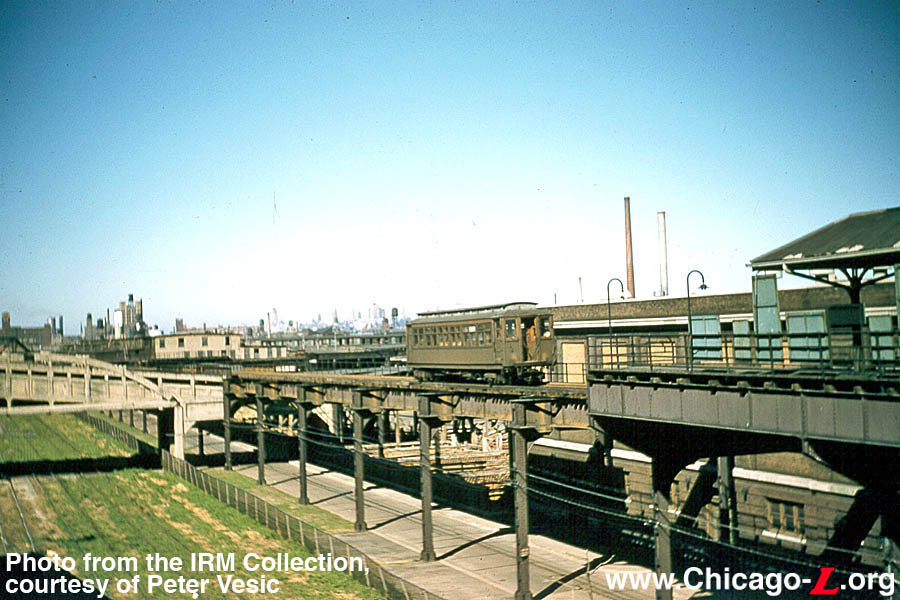
The old Cermak Road station on the south Side "L". Note there are three tracks here. This station was closed in 1977 and removed. A new station replaced it in 2015.

The old Cermak Road station on the south Side “L”. Note there are three tracks here. This station was closed in 1977 and removed. A new station replaced it in 2015.

Here. a wooden "L" car train descends the ramp near Laramie on the Lake Street "L". This must be an early photo, as it looks like Lake Street is unpaved. Streetcar service was extended west to Harlem Avenue here by the Cicero & Proviso in 1891. Chicago Railways took over the city portion in 1910. Service west of Austin Boulevard was provided by the West Towns Railways.

Here. a wooden “L” car train descends the ramp near Laramie on the Lake Street “L”. This must be an early photo, as it looks like Lake Street is unpaved. Streetcar service was extended west to Harlem Avenue here by the Cicero & Proviso in 1891. Chicago Railways took over the city portion in 1910. Service west of Austin Boulevard was provided by the West Towns Railways.

Wooden gate car 3105 and train in the Loop. This was originally built for the Lake Street "L". Don's Rail Photos says, "3103 thru 3118 were built by McGuire-Cummings in 1893 as LSERR 103 thru 118. In 1913 they were renumbered 3103 thru 3118 and became CRT 3103 thru 3118 in 1923."

Wooden gate car 3105 and train in the Loop. This was originally built for the Lake Street “L”. Don’s Rail Photos says, “3103 thru 3118 were built by McGuire-Cummings in 1893 as LSERR 103 thru 118. In 1913 they were renumbered 3103 thru 3118 and became CRT 3103 thru 3118 in 1923.”

The view looking west along the Douglas Park "L" at 49th Avenue in Cicero on February 4, 1944. The station we see in the background is 50th Avenue. After it closed in 1978, this station was moved to the Illinois Railway Museum in Union, where it is used to board the museum's fleet of retired "L" cars.

The view looking west along the Douglas Park “L” at 49th Avenue in Cicero on February 4, 1944. The station we see in the background is 50th Avenue. After it closed in 1978, this station was moved to the Illinois Railway Museum in Union, where it is used to board the museum’s fleet of retired “L” cars.

Here, we are looking south from Garfield (55th Street) on the South Side "L".

Here, we are looking south from Garfield (55th Street) on the South Side “L”.

61st Street on the South Side "L", looking north on November 13, 1944.

61st Street on the South Side “L”, looking north on November 13, 1944.

Photos of the old Humboldt Park "L" branch are quite rare. This photo looks west from Western Avenue on January 26, 1931. This branch closed in 1952, although portions of the structure remained into the early 1960s.

Photos of the old Humboldt Park “L” branch are quite rare. This photo looks west from Western Avenue on January 26, 1931. This branch closed in 1952, although portions of the structure remained into the early 1960s.

This picture looks south from Randolph and Wells on the Loop "L". The date is not known, but the construction of the building at right may provide a clue. Andre Kristopans writes, "The overhead shot on Wells showing platform construction is early 20’s, when platforms were extended to accommodate longer trains. For instance Randolph/Wells and Madison/Wells were once separate platforms, after the early 20’s they were a continuous platform. Also at that time, LaSalle/Van Buren and State/Van Buren were connected and the separate station at Dearborn/Van Buren became an auxiliary entrance to State, until a building next to it blew up in the very early 60’s and destroyed the Outer Loop side."

This picture looks south from Randolph and Wells on the Loop “L”. The date is not known, but the construction of the building at right may provide a clue. Andre Kristopans writes, “The overhead shot on Wells showing platform construction is early 20’s, when platforms were extended to accommodate longer trains. For instance Randolph/Wells and Madison/Wells were once separate platforms, after the early 20’s they were a continuous platform. Also at that time, LaSalle/Van Buren and State/Van Buren were connected and the separate station at Dearborn/Van Buren became an auxiliary entrance to State, until a building next to it blew up in the very early 60’s and destroyed the Outer Loop side.”

North Shore Line 156 and several others at Waukegan in December 1962. Since there are about a dozen cars visible, they are being stored on a siding which you will note is outside the area of the catenary. (George Niles, Jr. Photo)

North Shore Line 156 and several others at Waukegan in December 1962. Since there are about a dozen cars visible, they are being stored on a siding which you will note is outside the area of the catenary. (George Niles, Jr. Photo)

This shows TMER&T 1121 running on a 1949 fantrip on the North Shore Line at the Kenosha station. We ran a similar picture in our previous post Traction in Milwaukee (September 16, 2015).

This shows TMER&T 1121 running on a 1949 fantrip on the North Shore Line at the Kenosha station. We ran a similar picture in our previous post Traction in Milwaukee (September 16, 2015).

Speedrail car 60 at the Waukesha Quarry, date unknown but circa 1949-51.

Speedrail car 60 at the Waukesha Quarry, date unknown but circa 1949-51.


Larry Sakar
writes:

The photo of Speedrail car 60 in your latest postings at the Waukesha Gravel pit was taken on 10-16-49. The occasion was the inaugural fan trip using a 60-series curved side car. It was sponsored by the short lived Milwaukee Division of the Electric Railroaders Association and was run by Milwaukeean James P. Harper who authored CERA Bulletin 97, “The Electric Railways of Wisconsin” published in 1952.

At the start of the private right-of-way at 8th St., the motors on the rear truck began having problems. At Waukesha, the car pulled onto one of the 2 side tracks leading back into the gravel pit. George Krambles accessed the rear trucks via a panel in the floor and disconnected the motor leads to the troublesome rear trucks. From that point forward the car ran on only 2 motors for the remainder of the fan trip. Car 65 had been the car originally intended to do the trip, but it was down with mechanical problems of its own. This caused the trip to be postponed for a week and the substitution of car 60.

When the car pulled into gravel pit siding one of the fans on board remarked, “Wow, look at this. They’ve got it in the scrap line already!”.

In addition to George Krambles, Al Kalmbach was on the trip, as was well-known railfan and photographer Barney Neuberger. He can be seen siting in about the 4th row of the car on the left side wearing a pork pie hat.

I’ve attached a few items related to that fan trip including a photo of Jay Maeder walking alongside car 60. This was taken at the first photo stop which was 44th St. where Milwaukee County Stadium would be built starting a year later. Car 60 was doing a photo run-by by backing down the line. The fans formed a photo line facing the car.

Philadelphia Stories

Philadelphia Peter Witt 8534 in July 1996. Don's Rail Photos: "8534 was built by Brill Car in 1926, #22353." It is part of the Electric City Trolley Museum collection in Scranton, PA. Here, it is shown in Philadelphia, during the time it was leased to SEPTA for trolley tours.

Philadelphia Peter Witt 8534 in July 1996. Don’s Rail Photos: “8534 was built by Brill Car in 1926, #22353.” It is part of the Electric City Trolley Museum collection in Scranton, PA. Here, it is shown in Philadelphia, during the time it was leased to SEPTA for trolley tours.

SEPTA 2750 and 8534 on a fantrip in August 1996. Apparently 8534 has broken down and is being towed.

SEPTA 2750 and 8534 on a fantrip in August 1996. Apparently 8534 has broken down and is being towed.

SEPTA 2785 in November 2002.

SEPTA 2785 in November 2002.

SEPTA 2750 and 8534 in August 1996.

SEPTA 2750 and 8534 in August 1996.

Three generations of Philadelphia streetcars in May 1999.

Three generations of Philadelphia streetcars in May 1999.

2785 in November 2002.

2785 in November 2002.

SEPTA 2785 in November 2002, with a commuter train nearby. Kenneth Achtert writes, "The shot of SEPTA #2785 with the commuter train that you presumed to be in Chestnut Hill is actually approaching 11th and Susquehanna,southbound, a cut-back location for which the car is signed in the picture. The commuter train would be inbound toward Center City."

SEPTA 2785 in November 2002, with a commuter train nearby. Kenneth Achtert writes, “The shot of SEPTA #2785 with the commuter train that you presumed to be in Chestnut Hill is actually approaching 11th and Susquehanna,southbound, a cut-back location for which the car is signed in the picture. The commuter train would be inbound toward Center City.”

SEPTA 2785 in November 2002.

SEPTA 2785 in November 2002.

SEPTA PCC 2785 on the truncated route 23 in November 2002.

SEPTA PCC 2785 on the truncated route 23 in November 2002.

8534 in August 1996. Kenneth Achtert: "The view of #8534 being “manually switched” three photos later shows 8534 being coupled to its leader (2750) after apparently becoming disabled. Several of your other photos show the subsequent towing operation."

8534 in August 1996. Kenneth Achtert: “The view of #8534 being “manually switched” three photos later shows 8534 being coupled to its leader (2750) after apparently becoming disabled. Several of your other photos show the subsequent towing operation.”

The fantrip train is having trouble clearing this auto in August 1996.

The fantrip train is having trouble clearing this auto in August 1996.

Looks like an attempt was made to move the offending car out of the way. August 1996.

Looks like an attempt was made to move the offending car out of the way. August 1996.

Recent Correspondence

Kenneth Gear writes:

Look who is in the new HISTORIC RAIL & ROADS catalog!

Thanks!

In case you missed it, here is Kenneth Gear’s review of the book:

I just finished reading your book and I enjoyed it very much. Good, clear, concise, and informative writing.

I must compliment you on the choice and presentation of the photographs. It is obvious that you spent much time and effort to present these wonderful photos as perfectly restored as possible.

So many times the authors of books that are primarily “picture books” seem to have a complete disregard for the condition of the photos reproduced. I’ve often seen photos that are yellowed with age, water stained, ripped, folded, and scratched. Other times a book might contain photos that are not properly exposed, are crooked, out of focus, or the composition could have been easily corrected with a little cropping.

The photos in your book are absolutely fantastic! They are pristine, sharp, and have absolutely no blemishes at all. You also packed a lot of information into the captions as well. It’s a fine book and you should be proud, as I’m sure you are, to have your name on the cover.

Another reader writes:

Your book arrived and it is JUST AWESOME. I am completely taken by some of the imagery, and of course enjoy the way you seem to simplify historical writing. VERY nice work!! THANK YOU!!!

Help Support The Trolley Dodger

gh1

This is our 197th post, and we are gradually creating a body of work and an online resource for the benefit of all railfans, everywhere. To date, we have received over 329,000 page views, for which we are very grateful.

You can help us continue our original transit research by checking out the fine products in our Online Store.

As we have said before, “If you buy here, we will be here.”

We thank you for your support.

DONATIONS

In order to continue giving you the kinds of historic railroad images that you have come to expect from The Trolley Dodger, we need your help and support. It costs money to maintain this website, and to do the sort of historic research that is our specialty.

Your financial contributions help make this web site better, and are greatly appreciated.

A Shoebox Full of Dreams

A two-car train of PCCs near North Station in Boston August 31, 1976. The nearby Boston Garden has since been torn down and rebuilt.

A two-car train of PCCs near North Station in Boston August 31, 1976. The nearby Boston Garden has since been torn down and rebuilt.

One of my brothers called me recently from a garage sale, and asked if I had any interest in a shoebox full of train pictures. The cost was just $10. I figured it would have to be worth at least that much, so I said sure.

I went through the box when I got it, and discovered most of the pictures were faded color snapshots from the 1970s, probably taken with a Kodak Instamatic camera on size 126 film. Worse yet, nearly all the pictures have a textured surface.

However, it sure seems the photographer got around. He visited train museums all over the country. He went on steam train excursions. He took pictures of streetcars.

Eventually, I figured out who he was– Marvin C. Kruse.

Although, in looking up information on Mr. Kruse, I somehow got the mistaken idea he was deceased, his son wrote to me (see the Comments section below) and informs us that he is alive and well, aged 96! In fact, he has seen this post and enjoyed it. Nothing could make me happier.

When someone dies, or has to downsize, it is often up to their loved ones to go through their things and decide what to do with them. This can be a very traumatic process, for you feel as if you are dismantling someone’s life, piece by piece. And yet that is the way of the world, for life goes on. People’s belongings are often scattered to the four winds.

I decided to give an extra special effort to restore some of Mr. Kruse’s photos for the railfan community, to honor his efforts, and the sacrifices he made. I hope you like the results. They are mementos of someone’s life, from someone who should not be so easily forgotten.

-David Sadowski

PS- By the time you read this, we will have received a substantial shipment of our new book Chicago Trolleys (see below). It should only take us a short time to mail out books to all who have pre-ordered them, plus complementary copies for important contributors. We thank you all for your support. The book was completed on time and is now available for immediate shipment.

Picture caption: "1947 snow (2 ft.). This taken off Monongahela tracks just below our house. B&O yards across river."

Picture caption: “1947 snow (2 ft.). This taken off Monongahela tracks just below our house. B&O yards across river.”

Winter 1947-48. "Same as other, only vertical. Big building, left foreground, is Interstate Construction & Engineers... build coal tipples."

Winter 1947-48. “Same as other, only vertical. Big building, left foreground, is Interstate Construction & Engineers… build coal tipples.”

Photo caption: "New Have R. R. diesel passing Providence, RI engine house 12/21/47 with New York-bound train."

Photo caption: “New Have R. R. diesel passing Providence, RI engine house 12/21/47 with New York-bound train.”

A photo stop on a steam excursion, May 1961.

A photo stop on a steam excursion, May 1961.

South Shore Line "Little Joe" 801 in October 1960.

South Shore Line “Little Joe” 801 in October 1960.

South Shore Line electric locos 703 and 704 in October 1960.

South Shore Line electric locos 703 and 704 in October 1960.

This looks like Chicago Surface Lines red Pullman 144 at the Illinois Electric Railway Museum (North Chicago) in June 1961.

This looks like Chicago Surface Lines red Pullman 144 at the Illinois Electric Railway Museum (North Chicago) in June 1961.

Another scene from IERM in July 1961. At left is Milwaukee streetcar 966, built by St. Louis Car Company in 1927. At right is ex-CTA/CSL sweeper E223, which was purchased for the museum by Dick Lukin in 1956.

Another scene from IERM in July 1961. At left is Milwaukee streetcar 966, built by St. Louis Car Company in 1927. At right is ex-CTA/CSL sweeper E223, which was purchased for the museum by Dick Lukin in 1956.

Two 900-series South Shore Line freight locos in October 1960.

Two 900-series South Shore Line freight locos in October 1960.

Always remember...never step on any rails. Right? (Photo stop bedlam, September 1958.)

Always remember…never step on any rails. Right? (Photo stop bedlam, September 1958.)

If you've ever tried taking a picture at a photo stop on a fantrip, this is what happens. Invariably, someone runs right in front of you, oblivious to the fact you are trying to take a picture.

If you’ve ever tried taking a picture at a photo stop on a fantrip, this is what happens. Invariably, someone runs right in front of you, oblivious to the fact you are trying to take a picture.

People used to climb on just about anything, in their quest to take a picture.

People used to climb on just about anything, in their quest to take a picture.

This is the view from an engine cab... which makes sense, if you think about it, as the engine in front of you is massive.

This is the view from an engine cab… which makes sense, if you think about it, as the engine in front of you is massive.

I think what we are seeing here is new commuter rail bi-levels on display, probably the Milwaukee Road, in July 1961. The sign at left says, "Entrance," implying that they wanted you to walk through the cars in one direction only. At right are some vehicles from the Railway Express Agency (REA), which delivered small packages via the railway system between 1917 and the late 1960s. It was a national monopoly formed by the federal government during the First World War.

I think what we are seeing here is new commuter rail bi-levels on display, probably the Milwaukee Road, in July 1961. The sign at left says, “Entrance,” implying that they wanted you to walk through the cars in one direction only. At right are some vehicles from the Railway Express Agency (REA), which delivered small packages via the railway system between 1917 and the late 1960s. It was a national monopoly formed by the federal government during the First World War.

A Milwaukee Road commuter train in July 1961. This is about the time the railroad began introducing bi-levels, which the Chicago & North Western had been using for some years. I'd bet this is the same scene as in the previous picture, but from the other end. The train is on display at a station.

A Milwaukee Road commuter train in July 1961. This is about the time the railroad began introducing bi-levels, which the Chicago & North Western had been using for some years. I’d bet this is the same scene as in the previous picture, but from the other end. The train is on display at a station.

There wasn't much I could do about the scratches on this picture, but how often have you witnessed a steam locomotive on a turntable? (November 1958)

There wasn’t much I could do about the scratches on this picture, but how often have you witnessed a steam locomotive on a turntable? (November 1958)

Not sure of the location, but it's June 1958, and steam is still active here.

Not sure of the location, but it’s June 1958, and steam is still active here.

Several steam locos are on this property in June 1958, wherever it was.

Several steam locos are on this property in June 1958, wherever it was.

One thing about steam... as the song goes, smoke gets in your eyes. Note the small twin-lens reflex camera this shutterbug is holding. Perhaps a grey "Baby" Rolleiflex, which took size 127 film? (On the other hand, Carl Lantz thinks thinks he's holding a movie camera.)

One thing about steam… as the song goes, smoke gets in your eyes. Note the small twin-lens reflex camera this shutterbug is holding. Perhaps a grey “Baby” Rolleiflex, which took size 127 film? (On the other hand, Carl Lantz thinks thinks he’s holding a movie camera.)

More steam fantrip action.

More steam fantrip action.

There were many such excursions in the waning days of steam (late 1950s to early 1960s).

There were many such excursions in the waning days of steam (late 1950s to early 1960s).

Evidence of a Toronto trip in June 1959. This may be part of a PCC car.

Evidence of a Toronto trip in June 1959. This may be part of a PCC car.

The Mt. Washington Cog Railway still operates.

The Mt. Washington Cog Railway still operates.

CTA 6000s in Forest Park , December 22, 1976.

CTA 6000s in Forest Park , December 22, 1976.

The CTA DesPlaines Avenue yard in Forest Park, December 22, 1976. This was the 1959 configuration that was in use until the station was rebuilt circa 1980.

The CTA DesPlaines Avenue yard in Forest Park, December 22, 1976. This was the 1959 configuration that was in use until the station was rebuilt circa 1980.

CTA 6000s interior, December 22, 1976.

CTA 6000s interior, December 22, 1976.

Central City, Colorado, August 15, 1977.

Central City, Colorado, August 15, 1977.

What was a PCC doing in Golden, Colorado on July 8, 1976.

What was a PCC doing in Golden, Colorado on July 8, 1976.

My previous post did not mention the ill-fated Boston LRVs. But here is one of their SF Muni counterparts, being tested by the DOT at Pueblo on July 7, 1976.

My previous post did not mention the ill-fated Boston LRVs. But here is one of their SF Muni counterparts, being tested by the DOT at Pueblo on July 7, 1976.

North Shore Line car 160 at the Illinois Railway Museum in the mid-1970s.

North Shore Line car 160 at the Illinois Railway Museum in the mid-1970s.

Chicago red Pullman 144 at IRM, 1970s.

Chicago red Pullman 144 at IRM, 1970s.

Chicago Aurora & Elgin 431 at IRM, August 8, 1976.

Chicago Aurora & Elgin 431 at IRM, August 8, 1976.

Chicago postwar PCC 4391 at IRM in September 1975.

Chicago postwar PCC 4391 at IRM in September 1975.

Chicago postwar PCC 4391 at IRM in September 1975.

Chicago postwar PCC 4391 at IRM in September 1975.

San Francisco cable car 16(?) on May 27, 1974.

San Francisco cable car 16(?) on May 27, 1974.

Los Angeles streetcar 665 at Perris, California.

Los Angeles streetcar 665 at Perris, California.

North Shore Line city streetcar 354 at IRM in September 1975.

North Shore Line city streetcar 354 at IRM in September 1975.

North Shore Line city streetcar 354 at IRM in September 1975.

North Shore Line city streetcar 354 at IRM in September 1975.

North Shore Line city streetcar 354 at IRM on August 8, 1976.

North Shore Line city streetcar 354 at IRM on August 8, 1976.

North Shore Line city streetcar 354 at IRM on August 8, 1976.

North Shore Line city streetcar 354 at IRM on August 8, 1976.

SF cable car 4 on May 27, 1974.

SF cable car 4 on May 27, 1974.

SF cable car 4 on May 27, 1974.

SF cable car 4 on May 27, 1974.

BART on May 27, 1974.

BART on May 27, 1974.

When did they stop letting the passengers turn cable cars around in San Francisco? They were still doing it on May 27, 1974.

When did they stop letting the passengers turn cable cars around in San Francisco? They were still doing it on May 27, 1974.

BART at Balboa Park on May 27, 1974.

BART at Balboa Park on May 27, 1974.

BART at Balboa Park on May 27, 1974.

BART at Balboa Park on May 27, 1974.

An SF Muni PCC on Market Street, May 27, 1974.

An SF Muni PCC on Market Street, May 27, 1974.

An SF Muni PCC on Market Street, May 27, 1974.

An SF Muni PCC on Market Street, May 27, 1974.

An SF Muni trolley bus on Market Street, May 27, 1974. Looks like construction may already have been underway on the Muni Metro subway.

An SF Muni trolley bus on Market Street, May 27, 1974. Looks like construction may already have been underway on the Muni Metro subway.

An SF Muni PCC on Market Street, May 27, 1974.

An SF Muni PCC on Market Street, May 27, 1974.

An SF Muni PCC on Market Street, May 27, 1974.

An SF Muni PCC on Market Street, May 27, 1974.

Don's Rail Photos: "717 was built by Brill Co in 1925. It was rebuilt in 1939 and rebuilt in 1951 as 5167. It became LAMTA 1815 in 1958, It was retired and restored as717 at OERM in March 1960." Here, we see it at Orange Empire on May 31, 1974. Was it ever used in service with this color scheme?

Don’s Rail Photos: “717 was built by Brill Co in 1925. It was rebuilt in 1939 and rebuilt in 1951 as 5167. It became LAMTA 1815 in 1958, It was retired and restored as717 at OERM in March 1960.” Here, we see it at Orange Empire on May 31, 1974. Was it ever used in service with this color scheme?

I'm wondering if the streetcar at right is Key System 987. The steam loco is Western Pacific 334, a 2-8-2 built in 1929 by American Locomotive. We see both at the Western Railway Museum on May 26, 1972.

I’m wondering if the streetcar at right is Key System 987. The steam loco is Western Pacific 334, a 2-8-2 built in 1929 by American Locomotive. We see both at the Western Railway Museum on May 26, 1972.

A Toronto Peter Witt at Trolleyville USA, Olmstead Falls, Ohio, on August 23, 1975.

A Toronto Peter Witt at Trolleyville USA, Olmstead Falls, Ohio, on August 23, 1975.

A Toronto Peter Witt at Trolleyville USA, Olmstead Falls, Ohio, on August 23, 1975.

A Toronto Peter Witt at Trolleyville USA, Olmstead Falls, Ohio, on August 23, 1975.

I assume this is probably an ex-PE car at the Orange Empire Railway Museum on May 31, 1974.

I assume this is probably an ex-PE car at the Orange Empire Railway Museum on May 31, 1974.

A Los Angeles streetcar at OERM, Perris, California on July 6, 1976.

A Los Angeles streetcar at OERM, Perris, California on July 6, 1976.

Here, we see Brooklyn car 4573 at the Branford Trolley Museum. It was built by the Laconia Car Company in 1906 and was acquired by the museum on 1947. Here is how it looked on August 31, 1976.

Here, we see Brooklyn car 4573 at the Branford Trolley Museum. It was built by the Laconia Car Company in 1906 and was acquired by the museum on 1947. Here is how it looked on August 31, 1976.

Marvin C. Kruse on the Queen Mary in Long Beach, California on May 24, 1974.

Marvin C. Kruse on the Queen Mary in Long Beach, California on May 24, 1974.

Marvin C. Kruse at the Andrews Raiders Memorial in the Chattanooga Military Cemetery on October 23, 1907. According to Find-a-Grave: :"Memorial erected by the State of Ohio to the Andrews Raiders. In early April, 1862, a band of Union soldiers lead by civilian James Andrews infiltrated south from the Union lines near Shelbyville, Tennessee and met at Big Shanty, Georgia (near Marietta). On the morning of April 12, 1862, 20 of them (2 raiders never arrived and 2 others overslept and missed the adventure) stole the passenger train "The General" during its morning breakfast stop. With the farms and factories of Georgia supplying the Confederate Army fighting further west, the Raiders' mission was to burn the railroad bridges between Atlanta and Chattanooga, thus isolating the Confederate Armies from their supply sources and enabling the Union Army to seize Chattanooga. Due primarily to the persistency of William Fuller, conductor of the stolen train, and, secondarily to the rainy weather and unlucky miscoordination with the Union Army to the west, the Raiders failed. All 22 at Big Shanty that morning were captured. Eight, including James Andrews, were tried and hanged by the Confederate Army in Atlanta. In 1866, after the war, they were reburied in a semi-circle at the Chattanooga National Cemetery. On the imposing granite monument, erected in 1891, are the names of 22 of the raiders. The memorial is topped by a bronze likeness of the "General"." This story inspired the classic 1927 Buster Keaton film The General.

Marvin C. Kruse at the Andrews Raiders Memorial in the Chattanooga Military Cemetery on October 23, 1907. According to Find-a-Grave: :”Memorial erected by the State of Ohio to the Andrews Raiders. In early April, 1862, a band of Union soldiers lead by civilian James Andrews infiltrated south from the Union lines near Shelbyville, Tennessee and met at Big Shanty, Georgia (near Marietta). On the morning of April 12, 1862, 20 of them (2 raiders never arrived and 2 others overslept and missed the adventure) stole the passenger train “The General” during its morning breakfast stop. With the farms and factories of Georgia supplying the Confederate Army fighting further west, the Raiders’ mission was to burn the railroad bridges between Atlanta and Chattanooga, thus isolating the Confederate Armies from their supply sources and enabling the Union Army to seize Chattanooga. Due primarily to the persistency of William Fuller, conductor of the stolen train, and, secondarily to the rainy weather and unlucky miscoordination with the Union Army to the west, the Raiders failed. All 22 at Big Shanty that morning were captured. Eight, including James Andrews, were tried and hanged by the Confederate Army in Atlanta. In 1866, after the war, they were reburied in a semi-circle at the Chattanooga National Cemetery. On the imposing granite monument, erected in 1891, are the names of 22 of the raiders. The memorial is topped by a bronze likeness of the “General”.” This story inspired the classic 1927 Buster Keaton film The General.

Philadelphia PCC 2278, in bicentennial garb, on Route 53, September 2, 1976.

Philadelphia PCC 2278, in bicentennial garb, on Route 53, September 2, 1976.

SEPTA Red Arrow cars at 69th Street Terminal on September 2, 1976.

SEPTA Red Arrow cars at 69th Street Terminal on September 2, 1976.

An Amtrak GG-1 in Baltimore on August 31, 1977.

An Amtrak GG-1 in Baltimore on August 31, 1977.

This is not a very good picture, but it does show a Liberty Liner (ex-North Shore Line Electroliner) on September 2, 1976.

This is not a very good picture, but it does show a Liberty Liner (ex-North Shore Line Electroliner) on September 2, 1976.

SEPTA Red Arrow car 13, built by St. Louis Car Company in 1949, as it looked on September 2, 1976.

SEPTA Red Arrow car 13, built by St. Louis Car Company in 1949, as it looked on September 2, 1976.

Red Arrow car 18, also built in 1949. These double-ended interurban cars closely resembled PCCs but did not use PCC trucks.

Red Arrow car 18, also built in 1949. These double-ended interurban cars closely resembled PCCs but did not use PCC trucks.

A Washington, D.C. subway car at the Rhode Island Avenue station on September 1, 1977.

A Washington, D.C. subway car at the Rhode Island Avenue station on September 1, 1977.

A PCC car at the Roanoke, Virginia Transportation Museum on August 27, 1975.

A PCC car at the Roanoke, Virginia Transportation Museum on August 27, 1975.

A PCC car at the Virginia Museum of Transportation in Roanoke on August 27, 1975. This is DC Transit 1470, built by St. Louis Car Company in 1945.

A PCC car at the Virginia Museum of Transportation in Roanoke on August 27, 1975. This is DC Transit 1470, built by St. Louis Car Company in 1945.

J. G. Brill built car 249 for Oporto, Portugal in 1904 and features maximum traction trucks. It was retired in 1972 and is shown at the Rockhill Trolley Museum on August 24, 1975.

J. G. Brill built car 249 for Oporto, Portugal in 1904 and features maximum traction trucks. It was retired in 1972 and is shown at the Rockhill Trolley Museum on August 24, 1975.

A Washington, D.C. subway car at the Rhode Island Avenue station on September 1, 1977.

A Washington, D.C. subway car at the Rhode Island Avenue station on September 1, 1977.

A Washington, D.C. subway car at the Rhode Island Avenue station on September 1, 1977.

A Washington, D.C. subway car at the Rhode Island Avenue station on September 1, 1977.

A PCC car at the Virginia Museum of Transportation in Roanoke on August 27, 1975. This is DC Transit 1470, built by St. Louis Car Company in 1945.

A PCC car at the Virginia Museum of Transportation in Roanoke on August 27, 1975. This is DC Transit 1470, built by St. Louis Car Company in 1945.

This is Sacramento Northern 62, a Birney car built in 1920 by American Car Company. We see it here at the Western Railway Museum on May 26, 1974.

This is Sacramento Northern 62, a Birney car built in 1920 by American Car Company. We see it here at the Western Railway Museum on May 26, 1974.

San Francisco Municipal Railway "Magic Carpet" carr 1003 was one of five experimental double-end cars built in 1939 by the St. Louis Car Company. This lone survivor is seen at the Western Railway Museum on May 26, 1974.

San Francisco Municipal Railway “Magic Carpet” carr 1003 was one of five experimental double-end cars built in 1939 by the St. Louis Car Company. This lone survivor is seen at the Western Railway Museum on May 26, 1974.

At left, we see Muni car 178, and next to it is "Magic Carpet" car 1003, at the Western Railway Museum on May 26, 1974.

At left, we see Muni car 178, and next to it is “Magic Carpet” car 1003, at the Western Railway Museum on May 26, 1974.

This open car was built by Brill in 1912 and was used in Rio De Janeiro. It's shown at the Rockhill Trolley Museum on August 24, 1975.

This open car was built by Brill in 1912 and was used in Rio De Janeiro. It’s shown at the Rockhill Trolley Museum on August 24, 1975.

This looks like a Sacramento Northern electric freight loco (Western Railway Museum, May 26, 1974).

This looks like a Sacramento Northern electric freight loco (Western Railway Museum, May 26, 1974).

This San Francisco cable car was on display at the Santa Clara County Fairgrounds on May 26, 1973. Many children played on this car over the years. It was originally a California Street car using a side grip and was not updated when Muni took over the line. I read that in 2005 it was in storage, listed as being in poor condition with a broken frame. I am not sure if it still exists.

This San Francisco cable car was on display at the Santa Clara County Fairgrounds on May 26, 1973. Many children played on this car over the years. It was originally a California Street car using a side grip and was not updated when Muni took over the line. I read that in 2005 it was in storage, listed as being in poor condition with a broken frame. I am not sure if it still exists.

This equipment is at the Travel Town Museum at Griffith Park in Los Angeles on August 26, 1977.

This equipment is at the Travel Town Museum at Griffith Park in Los Angeles on August 26, 1977.

A Los Angeles streetcar and a Pacific electric "Blimp" interurban at Griffith Park on July 5, 1977.

A Los Angeles streetcar and a Pacific electric “Blimp” interurban at Griffith Park on July 5, 1977.

In the distance, we see a pair of Key System bridge units at the Western Railway Museum on May 26, 1974. These ran in Oakland over the bay Bridge, and were retired in 1958.

In the distance, we see a pair of Key System bridge units at the Western Railway Museum on May 26, 1974. These ran in Oakland over the bay Bridge, and were retired in 1958.

Toronto PCC 4394 on October 25, 1973.

Toronto PCC 4394 on October 25, 1973.

North Shore Line car 757 at East Troy, Wisconsin on June 23, 1974. This car has since gone to the Illinois Railway Museum.

North Shore Line car 757 at East Troy, Wisconsin on June 23, 1974. This car has since gone to the Illinois Railway Museum.

The East Troy Trolley Museum, June 23, 1974.

The East Troy Trolley Museum, June 23, 1974.

A Chicago Transit Authority 4000-series "L" car in Louisville, Kentucky on June 3, 1974.

A Chicago Transit Authority 4000-series “L” car in Louisville, Kentucky on June 3, 1974.

A pair of 700-series South Shore Line freight locos at the Gary, Indiana station in 1974.

A pair of 700-series South Shore Line freight locos at the Gary, Indiana station in 1974.

Chattanooga, Tennessee on June 2, 1974.

Chattanooga, Tennessee on June 2, 1974.

A New Orleans streetcar at Union Station in Chattanooga, June 2, 1974.

A New Orleans streetcar at Union Station in Chattanooga, June 2, 1974.

A New Orleans streetcar at Union Station in Chattanooga, June 2, 1974.

A New Orleans streetcar at Union Station in Chattanooga, June 2, 1974.

A pair of 700-series South Shore Line freight locos at the Gary, Indiana station in 1974.

A pair of 700-series South Shore Line freight locos at the Gary, Indiana station in 1974.

Steam at Union, Illinois, August 8, 1976.

Steam at Union, Illinois, August 8, 1976.

The Burlington Zephyr at IRM, 1976.

The Burlington Zephyr at IRM, 1976.

IRM, August 8, 1976.

IRM, August 8, 1976.

South Shore Line cars in storage at Michigan City, Indiana on July 17, 1977.

South Shore Line cars in storage at Michigan City, Indiana on July 17, 1977.

A "Little Joe" in Michigan City, July 17, 1977.

A “Little Joe” in Michigan City, July 17, 1977.

Illinois Terminal cars at IRM, July 1977.

Illinois Terminal cars at IRM, July 1977.

IRM, June 23, 1974.

IRM, June 23, 1974.

IRM, June 23, 1974.

IRM, June 23, 1974.

Illinois Terminal cars at IRM, June 23, 1974.

Illinois Terminal cars at IRM, June 23, 1974.

IRM, August 8, 1976.

IRM, August 8, 1976.

IRM, September 1975.

IRM, September 1975.

IRM, August 8, 1976.

IRM, August 8, 1976.

IRM, August 8, 1976.

IRM, August 8, 1976.

IRM, August 8, 1976.

IRM, August 8, 1976.

IRM, September 1975.

IRM, September 1975.

Recent Finds

Boston MTA 3292, signed for Braves Field, is on a double-track loop with the ball park at the right. The Boston Braves played there last game here on September 21, 1952 (exactly 65 years ago today), after which the team was moved to Milwaukee. Following the 1965 season, they became the Atlanta Braves. A portion of Braves Field still exists as part of Boston College's Nickerson Field. We discussed streetcar service to Braves Field in our previous post More Mystery Photos (July 29, 2016).

Boston MTA 3292, signed for Braves Field, is on a double-track loop with the ball park at the right. The Boston Braves played there last game here on September 21, 1952 (exactly 65 years ago today), after which the team was moved to Milwaukee. Following the 1965 season, they became the Atlanta Braves. A portion of Braves Field still exists as part of Boston College’s Nickerson Field. We discussed streetcar service to Braves Field in our previous post More Mystery Photos (July 29, 2016).

Hammond, Whiting & East Chicago car 67 was built by American Car in 1917 and was converted to one-man operation in 1932. Streetcar service ended in 1940. Notice how similar this car is to some operated by the Chicago Surface Lines. For much of its history, the HW&EC was run by the Calumet & South Chicago Railway, which became part of CSL in 1914.

Hammond, Whiting & East Chicago car 67 was built by American Car in 1917 and was converted to one-man operation in 1932. Streetcar service ended in 1940. Notice how similar this car is to some operated by the Chicago Surface Lines. For much of its history, the HW&EC was run by the Calumet & South Chicago Railway, which became part of CSL in 1914.

Chicago Surface Lines crane X-3 at Dearborn and Washington in 1942. Tracks were being put back in the street after construction of the Dearborn Subway, which was 80% completed when work stopped due to wartime materials shortages. The subway did not open until 1951.

Chicago Surface Lines crane X-3 at Dearborn and Washington in 1942. Tracks were being put back in the street after construction of the Dearborn Subway, which was 80% completed when work stopped due to wartime materials shortages. The subway did not open until 1951.

New Castle (Pennsylvania) Electric Street Railway "Birney" car 363 at Cascade Park loop on August 24, 1941. Streetcar service was abandoned on December 11th of that year. This car was formerly Penn-Ohio Power & Light 363 and was painted orange. (John A. Clark Photo)

New Castle (Pennsylvania) Electric Street Railway “Birney” car 363 at Cascade Park loop on August 24, 1941. Streetcar service was abandoned on December 11th of that year. This car was formerly Penn-Ohio Power & Light 363 and was painted orange. (John A. Clark Photo)

New Castle (Pennsylvania) Electric Street Railway "Birney" car 359 at Cascade Park loop on August 24, 1941. This car was ex=Penn-Ohio Power and Light 359, and was painted orange and cream. (John A. Clark Photo)

New Castle (Pennsylvania) Electric Street Railway “Birney” car 359 at Cascade Park loop on August 24, 1941. This car was ex=Penn-Ohio Power and Light 359, and was painted orange and cream. (John A. Clark Photo)

This odd, boxy streetcar is Black River Traction car #1 in Watertown, New York. This was a 1906 product of the Barber Car Co. Some consider this an ugly design, but apparently these cars were well-built. Apparently this line abandoned streetcar service on August 17, 1937, but this negative is dated June 20, 1938. The sign on the side of the car doesn't really solve this mystery-- there were two championship heavyweight bouts between Joe Louis and Max Schmeling, and these took place on June 19, 1936 and June 22, 1938. For more information on the Barber Car Company, click here.

This odd, boxy streetcar is Black River Traction car #1 in Watertown, New York. This was a 1906 product of the Barber Car Co. Some consider this an ugly design, but apparently these cars were well-built. Apparently this line abandoned streetcar service on August 17, 1937, but this negative is dated June 20, 1938. The sign on the side of the car doesn’t really solve this mystery– there were two championship heavyweight bouts between Joe Louis and Max Schmeling, and these took place on June 19, 1936 and June 22, 1938. For more information on the Barber Car Company, click here.

Black River Traction car 5, with a date given of June 20, 1938. Not sure whether this car was also built by the Barber Car Company.

Black River Traction car 5, with a date given of June 20, 1938. Not sure whether this car was also built by the Barber Car Company.

Recent Correspondence

Jack Bejna writes:

I recently came across this photo, and, after looking at it awhile I realized that this is an image of the CA&E crossing the Chicago River. It appears to have been taken from Franklin Street looking generally northeast. The train appears to be an eastbound train just entering the Wells Street Terminal. Look at the two cars and you’ll see Car 436 leading trailer 603. In addition, below the El structure there is the substation that provided the power for the terminal area. The picture was taken in 1939.

Jack continues:

I enjoyed your latest post about Boston’s great trolleys. Keep up the great work.

Here is the latest stuff, the CA&E and the CNS&M woodies. As usual, some of the images aren’t the best, but it’s all I could find in my continuing search for the best of the CA&E!

Increasing suburban traffic found the CA&E short of cars. In 1936, the CNS&M came to the rescue by making some of their older wooden cars available for lease.

In 1936, cars 129, 130, 133, 134, 137 (Jewett 1907), cars 138, 139, 140, 141, 144 (American 1910) and cars 142 and 143 (Jewett 1907) were leased for suburban service and returned to the CNS&M after World War II. These cars were later purchased in 1946 and finished their long careers in suburban work on the CA&E.

I know our readers appreciate your efforts in restoring and sharing these rare pictures with us. Thanks to you, they are looking better than ever.

After CA&E service was cut back to Forest Park in 1953, these cars were no longer needed and were soon scrapped. Interestingly, these old woods were the last passenger cars bought by the Aurora & Elgin.

CA&E 129.

CA&E 129.

CA&E 130.

CA&E 130.

CA&E 133.

CA&E 133.

CA&E 134.

CA&E 134.

CA&E 137.

CA&E 137.

CA&E 138.

CA&E 138.

CA&E 139.

CA&E 139.

CA&E 140.

CA&E 140.

CA&E 141 at Batavia Junction.

CA&E 141 at Batavia Junction.

CA&E 142 at the Wheaton Shops.

CA&E 142 at the Wheaton Shops.

CA&E 143.

CA&E 143.

CA&E 144.

CA&E 144.

Our New Book Chicago Trolleys— Now In Stock!

On the Cover: Car 1747 was built between 1885 and 1893 by the Chicago City Railway, which operated lines on the South Side starting in April 1859. This is a single-truck (one set of wheels) open electric car; most likely a cable car, retrofitted with a trolley and traction motor. The man at right is conductor William Stevely Atchison (1861-1921), and this image came from his granddaughter. (Courtesy of Debbie Becker.)

On the Cover: Car 1747 was built between 1885 and 1893 by the Chicago City Railway, which operated lines on the South Side starting in April 1859. This is a single-truck (one set of wheels) open electric car; most likely a cable car, retrofitted with a trolley and traction motor. The man at right is conductor William Stevely Atchison (1861-1921), and this image came from his granddaughter. (Courtesy of Debbie Becker.)

We are pleased to report that our new book Chicago Trolleys will be released on September 25th by Arcadia Publishing. You can pre-order an autographed copy through us today (see below). Chicago Trolleys will also be available wherever Arcadia books are sold.

Overview

Chicago’s extensive transit system first started in 1859, when horsecars ran on rails in city streets. Cable cars and electric streetcars came next. Where new trolley car lines were built, people, businesses, and neighborhoods followed. Chicago quickly became a world-class city. At its peak, Chicago had over 3,000 streetcars and 1,000 miles of track—the largest such system in the world. By the 1930s, there were also streamlined trolleys and trolley buses on rubber tires. Some parts of Chicago’s famous “L” system also used trolley wire instead of a third rail. Trolley cars once took people from the Loop to such faraway places as Aurora, Elgin, Milwaukee, and South Bend. A few still run today.

The book features 226 classic black-and-white images, each with detailed captions, in 10 chapters:

1. Early Traction
2. Consolidation and Growth
3. Trolleys to the Suburbs
4. Trolleys on the “L”
5. Interurbans Under Wire
6. The Streamlined Era
7. The War Years
8. Unification and Change
9. Trolley Buses
10. Preserving History

Product Details

ISBN-13: 9781467126816
Publisher: Arcadia Publishing SC
Publication date: 09/25/2017
Series: Images of Rail
Pages: 128

Meet the Author

David Sadowski has been interested in streetcars ever since his father took him for a ride on one of the last remaining lines in 1958. He grew up riding trolley buses and “L” trains all over Chicago. He coauthored Chicago Streetcar Pictorial: The PCC Car Era, 1936–1958, and runs the online Trolley Dodger blog. Come along for the ride as we travel from one side of the city to the other and see how trolley cars and buses moved Chicago’s millions of hardworking, diverse people.

Images of Rail

The Images of Rail series celebrates the history of rail, trolley, streetcar, and subway transportation across the country. Using archival photographs, each title presents the people, places, and events that helped revolutionize transportation and commerce in 19th- and 20th-century America. Arcadia is proud to play a part in the preservation of local heritage, making history available to all.

The book costs just $21.99 plus shipping.

Please note that Illinois residents must pay 10.00% sales tax on their purchases.

We appreciate your business!

For Shipping to US Addresses:

For Shipping to Canada:

For Shipping Elsewhere:

NEW – Chicago Trolleys Postcard Collection

We are pleased to report that selected images from our upcoming book Chicago Trolleys will be available on September 25th in a pack of 15 postcards, all for just $7.99. This is part of a series put out by Arcadia Publishing. Dimensions: 6″ wide x 4.25″ tall

The Postcards of America Series

Here in the 21st century, when everyone who’s anyone seems to do most of their communicating via Facebook and Twitter, it’s only natural to wax a little nostalgic when it comes to days gone by. What happened to more personal means of communication like hand-written letters on nice stationery? Why don’t people still send postcards when they move someplace new or go away on vacation?

If that line of thinking sounds familiar, then Arcadia Publishing’s Postcards of America was launched with you in mind. Each beautiful volume features a different collection of real vintage postcards that you can mail to your friends and family.

Pre-Order your Chicago Trolleys Postcard Pack today!

For Shipping to US Addresses:

For Shipping to Canada:

For Shipping Elsewhere:

street-railwayreview1895-002

Help Support The Trolley Dodger

gh1

This is our 195th post, and we are gradually creating a body of work and an online resource for the benefit of all railfans, everywhere. To date, we have received over 322,000 page views, for which we are very grateful.

You can help us continue our original transit research by checking out the fine products in our Online Store.

As we have said before, “If you buy here, we will be here.”

We thank you for your support.

DONATIONS

In order to continue giving you the kinds of historic railroad images that you have come to expect from The Trolley Dodger, we need your help and support. It costs money to maintain this website, and to do the sort of historic research that is our specialty.

Your financial contributions help make this web site better, and are greatly appreciated.

More CA&E in Color

CA&E 410 (plus one), westbound at Fifth Avenue in Maywood.

CA&E 410 (plus one), westbound at Fifth Avenue in Maywood.

A friend recently gave me a stack of Chicago Aurora & Elgin slides, which make up the bulk of today’s post. Some we have run before, but I don’t think too many of you will mind seeing them again, this time from a different source. Others, you haven’t seen.

Scanning an image is just a starting point in this whole process. Mostly, these were dupe slides made using Kodachrome, which is not what commercial labs used for this purpose. A regular lab would have used special low-contrast Ektachrome duplicating film.

Contrast is your enemy when copying things film-to-film, and Kodachrome is contrasty– great for original slides, not as good for dupes. So these were likely homemade dupes, and a lot of them were not color-corrected. I spent a great deal of time working these over in Photoshop, but in some cases, imperfections remain.

I don’t think there is a single image that I didn’t try to improve in some way, and I included a few of the original scans, just to show you how some of them looked before corrections were applied.

As always, if you have location information, or other factual tidbits to share, don’t hesitate to either leave a Comment on this post, or drop us a line at:

thetrolleydodger@gmail.com

Enjoy!

-David Sadowski

PS- Each image has a unique number. When referring to individual images, please use the image name/number, i.e. pict763. To find this, hover your mouse over the image.

CA&E 456 on a snowy Chicago day. I'm wondering if this is Wells Street Terminal.

CA&E 456 on a snowy Chicago day. I’m wondering if this is Wells Street Terminal.

A CA&E train headed up by one of the ex-North Shore Line woods that CA&E purchased in 1946. This one could be car 141. The train is heading west, crossing over Union Station.

A CA&E train headed up by one of the ex-North Shore Line woods that CA&E purchased in 1946. This one could be car 141. The train is heading west, crossing over Union Station.

A six-car CA&E train at the Halsted curve.

A six-car CA&E train at the Halsted curve.

CA&E 428 plus one at Pulaski Road on the Garfield Park "L".

CA&E 428 plus one at Pulaski Road on the Garfield Park “L”.

A classic view of the CA&E in Elgin, with a beautiful reflection from the Fox River. A sign advertises the Rialto Theatre, which burned down in 1956. The fiim being advertised, The Big Sky starring Kirk Douglas, was released in August 1952, which is most likely when this picture was taken. George Foelschow adds: "Four cars at the Elgin terminal. This must be a fantrip, as single cars were the rule on the Elgin branch, except for weekday rush hours and Sunday afternoons for visitors to the Elgin State Hospital."

A classic view of the CA&E in Elgin, with a beautiful reflection from the Fox River. A sign advertises the Rialto Theatre, which burned down in 1956. The fiim being advertised, The Big Sky starring Kirk Douglas, was released in August 1952, which is most likely when this picture was taken. George Foelschow adds: “Four cars at the Elgin terminal. This must be a fantrip, as single cars were the rule on the Elgin branch, except for weekday rush hours and Sunday afternoons for visitors to the Elgin State Hospital.”

310 on a fantrip on the Mt. Carmel branch. I believe the date was 1955.

310 on a fantrip on the Mt. Carmel branch. I believe the date was 1955.

A westbound CA&E train crossing over the C&NW/PRR at Rockwell, shortly before sundown.

A westbound CA&E train crossing over the C&NW/PRR at Rockwell, shortly before sundown.

CA&E 426 near West Chicago, on its way to the Aurora terminal. (A. C. Kalmbach Photo)

CA&E 426 near West Chicago, on its way to the Aurora terminal. (A. C. Kalmbach Photo)

A CA&E train crossing over Route 83 in 1955. (A. C. Kalmbach Photo)

A CA&E train crossing over Route 83 in 1955. (A. C. Kalmbach Photo)

CA&E 403 at the Wheaton station. (Steven P. Hyett Photo)

CA&E 403 at the Wheaton station. (Steven P. Hyett Photo)

CA&E 415 at Wheaton Yard, in War Bond livery (probably during the Korean War). (Stephen P. Hyett Photo)

CA&E 415 at Wheaton Yard, in War Bond livery (probably during the Korean War). (Stephen P. Hyett Photo)

CA&E 20 at Wheaton Yard. This car is now at the Fox River Trolley Museum in South Elgin. (Stephen P. Hyett Photo)

CA&E 20 at Wheaton Yard. This car is now at the Fox River Trolley Museum in South Elgin. (Stephen P. Hyett Photo)

CA&E bus 101 at Wheaton Yard. (Stephen P. Hyett Photo)

CA&E bus 101 at Wheaton Yard. (Stephen P. Hyett Photo)

CA&E loco 2001 in Maywood. (Stephen P. Hyett Photo)

CA&E loco 2001 in Maywood. (Stephen P. Hyett Photo)

CA&E 427 at the Aurora Terminal. (Stephen P. Hyett Photo)

CA&E 427 at the Aurora Terminal. (Stephen P. Hyett Photo)

CA&E 421 at the Wheaton station. (Stephen P. Hyett Photo)

CA&E 421 at the Wheaton station. (Stephen P. Hyett Photo)

A CA&E train at the Sacramento curve on the Garfield Park "L". You can see that construction is already underway at left on a ramp that will connect with the temporary trackage in Van Buren Street, which was used from 1953-58 (but not by the interurban, which cut back service to Forest Park). The area to the right of the ramp is where the new Congress Expressway was to be built. This picture was probably taken circa 1952. George Foelschow: " The view is looking northeast, presumably from the Sacramento station platform, not southeast."

A CA&E train at the Sacramento curve on the Garfield Park “L”. You can see that construction is already underway at left on a ramp that will connect with the temporary trackage in Van Buren Street, which was used from 1953-58 (but not by the interurban, which cut back service to Forest Park). The area to the right of the ramp is where the new Congress Expressway was to be built. This picture was probably taken circa 1952. George Foelschow: ” The view is looking northeast, presumably from the Sacramento station platform, not southeast.”

This looks to be the same train as in the previous picture, taken a few seconds later. CA&E 460 is at the head of a westbound Aurora-Batavia Limited.

This looks to be the same train as in the previous picture, taken a few seconds later. CA&E 460 is at the head of a westbound Aurora-Batavia Limited.

CA&E 414 is at the head of a westbound Aurora-Batavia Limited train at one of the west side Garfield Park "L" stations. This and the next few pictures were all taken at this same location, a station near a curve. The consensus is this is the Kedzie station, which was near a curve. CA&E trains stopped there, which would have given the photographer more time to get a shot of each car. We are looking east, and the Sacramento curve is in the distance about two blocks away.

CA&E 414 is at the head of a westbound Aurora-Batavia Limited train at one of the west side Garfield Park “L” stations. This and the next few pictures were all taken at this same location, a station near a curve. The consensus is this is the Kedzie station, which was near a curve. CA&E trains stopped there, which would have given the photographer more time to get a shot of each car. We are looking east, and the Sacramento curve is in the distance about two blocks away.

CA&E wood car 34 heads up this westbound train.

CA&E wood car 34 heads up this westbound train.

CA&E 318 is at the front of a three-car westbound train.

CA&E 318 is at the front of a three-car westbound train.

Two "Roarin' Elgin" trains pass on the Garfield Park "L". Cliff W. says we are "looking east from Pulaski with the single crossover just east of the station visible."

Two “Roarin’ Elgin” trains pass on the Garfield Park “L”. Cliff W. says we are “looking east from Pulaski with the single crossover just east of the station visible.”

CA&E 457 heads a westbound train at Kilbourn.

CA&E 457 heads a westbound train at Kilbourn.

CA&E 458 heads westbound at Laramie, along with two other curved-sided cars, all built in 1945 by St. Louis Car Company.

CA&E 458 heads westbound at Laramie, along with two other curved-sided cars, all built in 1945 by St. Louis Car Company.

CA&E 459. George Foelschow: "This is the Collingbourne flag stop on a banked curve on the Elgin branch, presumably on a fantrip."

CA&E 459. George Foelschow: “This is the Collingbourne flag stop on a banked curve on the Elgin branch, presumably on a fantrip.”

CA&E 459 at Raymond Street in Elgin, June 9, 1957.

CA&E 459 at Raymond Street in Elgin, June 9, 1957.

CA&E 451. Mike Schattl: "The location is the bridge over the CNW in Wheaton."

CA&E 451. Mike Schattl: “The location is the bridge over the CNW in Wheaton.”

CA&E 423 (plus one) head east towards Chicago, while a freight is on a nearby spur line. Bill Shaptokin says this and the next two pictures are "at Renwick -- interchange with the MILW south of Elgin."

CA&E 423 (plus one) head east towards Chicago, while a freight is on a nearby spur line. Bill Shaptokin says this and the next two pictures are “at Renwick — interchange with the MILW south of Elgin.”

CA&E 3003 and 3004 hauling freight.

CA&E 3003 and 3004 hauling freight.

CA&E 3003 and 3004 hauling freight.

CA&E 3003 and 3004 hauling freight.

3003 and 3004 again, with a fairly substantial (for the CA&E) freight train.

3003 and 3004 again, with a fairly substantial (for the CA&E) freight train.

CA&E 421. Bill Shapotkin says this is "Dunham Rd on the Elgin Branch. The car is E/B."

CA&E 421. Bill Shapotkin says this is “Dunham Rd on the Elgin Branch. The car is E/B.”

The same picture as it looked before color restoration in Photoshop.

The same picture as it looked before color restoration in Photoshop.

A single CA&E car on a single-track right of way, which could mean the Aurora, Batavia, or Elgin branches west of Wheaton.

A single CA&E car on a single-track right of way, which could mean the Aurora, Batavia, or Elgin branches west of Wheaton.

A single car near the Fox River. Bill Shapotkin: "This pic is in Batavia (NOT Aurora). Shot is between Batavia Station and Glenwood Park." On the other hand, George Foelschow writes, "This is most assuredly on the south side of Elgin, near the point of changeover between trolley and third rail. Not for nothing is Elgin, my hometown, called “The Bluff City”, also the name of the municipal cemetery, served at one time by Grove Avenue streetcars."

A single car near the Fox River. Bill Shapotkin: “This pic is in Batavia (NOT Aurora). Shot is between Batavia Station and Glenwood Park.” On the other hand, George Foelschow writes, “This is most assuredly on the south side of Elgin, near the point of changeover between trolley and third rail. Not for nothing is Elgin, my hometown, called “The Bluff City”, also the name of the municipal cemetery, served at one time by Grove Avenue streetcars.”

Nancy Grove Mollenkamp: "This slide was identified by someone in a Wheaton FB group as being taken in 1952 at Jewell Road in Wheaton. Another person in the group said he believed it was looking south. He thinks that is Electric Avenue on the right or west."

Nancy Grove Mollenkamp: “This slide was identified by someone in a Wheaton FB group as being taken in 1952 at Jewell Road in Wheaton. Another person in the group said he believed it was looking south. He thinks that is Electric Avenue on the right or west.”

CA&E cars at Lockwood Yard, including 48 and 314. Cliff W.: "In the wide shot there are Met cars in the right background. This is the south storage track with Flournoy in the foreground."

CA&E cars at Lockwood Yard, including 48 and 314. Cliff W.: “In the wide shot there are Met cars in the right background. This is the south storage track with Flournoy in the foreground.”

CA&E 48 at Lockwood Yard.

CA&E 48 at Lockwood Yard.

CA&E 314 at Lockwood Yard.

CA&E 314 at Lockwood Yard.

This picture may possibly have been taken just west of Laramie.

This picture may possibly have been taken just west of Laramie.

CA&E 459 and 452 are part of an eastbound train somewhere in either Oak Park or Forest Park, where the B&OCT ran parallel to the interurban.

CA&E 459 and 452 are part of an eastbound train somewhere in either Oak Park or Forest Park, where the B&OCT ran parallel to the interurban.

Here, we are looking west along the CA&E right-of-way at possibly Central or Austin. In the rear, you can see a large gas holder in nearby Forest Park. Andre Kristopans: "Photo on ground level with middle track is at Gunderson station. Middle track was so CAE could pass L trains. Abandoned after Westchester L’s were dropped in 1951." Gunderson is a short distance west of Ridgeland. The street was named after the developer who first built homes in this area. The new (early 1900s) development explains why there was a rapid transit stop on a sidestreet. When the CTA rebuilt this line in the late 1950s, they chose not to put a stop at either Gunderson or Ridgeland. Instead, auxilliary entrances were added to the Oak Park and Austin stops, at East Avenue and Lombard, respectively.

Here, we are looking west along the CA&E right-of-way at possibly Central or Austin. In the rear, you can see a large gas holder in nearby Forest Park. Andre Kristopans: “Photo on ground level with middle track is at Gunderson station. Middle track was so CAE could pass L trains. Abandoned after Westchester L’s were dropped in 1951.” Gunderson is a short distance west of Ridgeland. The street was named after the developer who first built homes in this area. The new (early 1900s) development explains why there was a rapid transit stop on a sidestreet. When the CTA rebuilt this line in the late 1950s, they chose not to put a stop at either Gunderson or Ridgeland. Instead, auxilliary entrances were added to the Oak Park and Austin stops, at East Avenue and Lombard, respectively.

Westbound CA&E car 428 crosses the B&OCT in Forest Park. This was also where the Chicago Great Western, now long abandoned, branched off.

Westbound CA&E car 428 crosses the B&OCT in Forest Park. This was also where the Chicago Great Western, now long abandoned, branched off.

The same location as the previous picture, with the iconic gas holder visible. The crossing was located between Harlem and DesPlaines, at approximately the same location where there is now a flyover eliminating this bottleneck.

The same location as the previous picture, with the iconic gas holder visible. The crossing was located between Harlem and DesPlaines, at approximately the same location where there is now a flyover eliminating this bottleneck.

I believe this is DesPlaines Avenue, and we are looking west. This picture was taken before the station was reconfigured in 1953. At this time, the station was located on the east side of DesPlaines, behind the photographer. The Acme Feeds towers, located at 7715 W. Van Buren are visible at right. These towers caught fire in 1980 and were demolished.

I believe this is DesPlaines Avenue, and we are looking west. This picture was taken before the station was reconfigured in 1953. At this time, the station was located on the east side of DesPlaines, behind the photographer. The Acme Feeds towers, located at 7715 W. Van Buren are visible at right. These towers caught fire in 1980 and were demolished.

CA&E 418 is westbound approaching the DesPlaines River, passing by Concordia Cemetery.

CA&E 418 is westbound approaching the DesPlaines River, passing by Concordia Cemetery.

CA&E 454 is westbound, about to cross First Avenue in Maywood.

CA&E 454 is westbound, about to cross First Avenue in Maywood.

CA&E 429 heads east near Commonwealth Edison just west of the DesPlaines River. Meanwhile, 452 heads west.

CA&E 429 heads east near Commonwealth Edison just west of the DesPlaines River. Meanwhile, 452 heads west.

One of the St. Louis-built 1945 cars (454?) crosses First Avenue in Maywood, heading east. We are looking north. There was a Refiner's Pride gas station located between the CA&E and Chicago Great Western tracks, on the west side of First.

One of the St. Louis-built 1945 cars (454?) crosses First Avenue in Maywood, heading east. We are looking north. There was a Refiner’s Pride gas station located between the CA&E and Chicago Great Western tracks, on the west side of First.

Shapotkin: "Yes, this IS Glen Oak. If you look hard enough, you can see the house I grew up in (at right in the distance)."

A westbound six-car train of CA&E woods stops at Glen Oak. Bill
Shapotkin: “Yes, this IS Glen Oak. If you look hard enough, you can see the house I grew up in (at right in the distance).”

CA&E 310 on a fantrip at Glen Oak.

CA&E 310 on a fantrip at Glen Oak.

CA&E 422 and 434 at Wheaton station.

CA&E 422 and 434 at Wheaton station.

Not sure where this curved-sided CA&E car is. Cliff W.: "The single Saint Louis car going over the bridge is passing over Liberty Street in Wheaton directly north of the shops and approaching the bridge over the C&NW on the Elgin branch. If you look very closely at the far right of the picture you can see a CA&E car sitting in the yard." Bill Shapotkin: "This car is x/o Liberty Drive in Wheaton (on the Elgin Branch): (View looks E/B on Liberty)."

Not sure where this curved-sided CA&E car is. Cliff W.: “The single Saint Louis car going over the bridge is passing over Liberty Street in Wheaton directly north of the shops and approaching the bridge over the C&NW on the Elgin branch. If you look very closely at the far right of the picture you can see a CA&E car sitting in the yard.” Bill Shapotkin: “This car is x/o Liberty Drive in Wheaton (on the Elgin Branch): (View looks E/B on Liberty).”

CA&E 454 is westbound at the bridge over Winfield Creek (on the Elgin branch near Lincoln Avenue).

CA&E 454 is westbound at the bridge over Winfield Creek (on the Elgin branch near Lincoln Avenue).

A CA&E train passes a two-car train of CTA Met "L" cars at the Halsted Curve.

A CA&E train passes a two-car train of CTA Met “L” cars at the Halsted Curve.

The CA&E's Lockwood Yard, also known as "The Orchard," was a small storage area just west of Laramie. This view is looking northwest across the main line.

The CA&E’s Lockwood Yard, also known as “The Orchard,” was a small storage area just west of Laramie. This view is looking northwest across the main line.

CA&E 52 pilots a three-car train of woods on the old Met main line near Racine. You can see the new (in 1953) ramp at left, heading down to the Van Buren Street temporary trackage, which would shortly be put into use. It connected with the "L" structure at Aberdeen. Expressway construction is underway at right.

CA&E 52 pilots a three-car train of woods on the old Met main line near Racine. You can see the new (in 1953) ramp at left, heading down to the Van Buren Street temporary trackage, which would shortly be put into use. It connected with the “L” structure at Aberdeen. Expressway construction is underway at right.

Much the same location as the previous picture, but perhaps a year earlier in 1952, as construction of the ramp has just started. This was very late in the afternoon, and it was difficult to correct for the yellowish-reddish late afternoon light. But don't forget, they called it the "Sunset Lines" for a reason!

Much the same location as the previous picture, but perhaps a year earlier in 1952, as construction of the ramp has just started. This was very late in the afternoon, and it was difficult to correct for the yellowish-reddish late afternoon light. But don’t forget, they called it the “Sunset Lines” for a reason!

Racine station on the old Met main line, with the Throop Street Shops in the background. This picture was taken sometime between 1950 and 1953, as there are some "flat door" 6000s present (along with Met car 2880).

Racine station on the old Met main line, with the Throop Street Shops in the background. This picture was taken sometime between 1950 and 1953, as there are some “flat door” 6000s present (along with Met car 2880).

Throop Street Shops in its last days (1953)

Throop Street Shops in its last days (1953)

CA&E 404 eastbound at Marshfield Junction, where three different Met lines (Douglas, Garfield, Logan Square/Humboldt Park) came together. Note the CA&E-only platform at right.

CA&E 404 eastbound at Marshfield Junction, where three different Met lines (Douglas, Garfield, Logan Square/Humboldt Park) came together. Note the CA&E-only platform at right.

A train of CA&E woods, headed up by 302, goes up the ramp to cross over the C&NW/PRR right-of-way at Rockwell. The "L" was raised up when the line it crossed was elevated onto an embankment. That explains why there are brick bases for some of the "L" support columns.

A train of CA&E woods, headed up by 302, goes up the ramp to cross over the C&NW/PRR right-of-way at Rockwell. The “L” was raised up when the line it crossed was elevated onto an embankment. That explains why there are brick bases for some of the “L” support columns.

The CA&E crossing the C&NW/PRR at Rockwell.

The CA&E crossing the C&NW/PRR at Rockwell.

Not sure of this location. Cliff W. says this we are "at Prince Crossing on the Elgin branch looking west." Bill Shapotkin: "View looks N/W."

Not sure of this location. Cliff W. says this we are “at Prince Crossing on the Elgin branch looking west.” Bill Shapotkin: “View looks N/W.”

CA&E 454 is eastbound at Jewell Road in Wheaton on the Elgin branch.

CA&E 454 is eastbound at Jewell Road in Wheaton on the Elgin branch.

A line-up of cars at Wheaton Yard.

A line-up of cars at Wheaton Yard.

Wheaton yard.

Wheaton yard.

From left to right: 430, 315, 425, and 310 at Wheaton Yard.

From left to right: 430, 315, 425, and 310 at Wheaton Yard.

Some ex-North Shore Line woods are in dead storage at the west end of Wheaton Yard, circa 1954, shortly to be scrapped.

Some ex-North Shore Line woods are in dead storage at the west end of Wheaton Yard, circa 1954, shortly to be scrapped.

Cars 435 and 436, possibly in dead storage at the same location as the previous picture, circa 1953-57 when the CA&E no longer needed so many cars.

Cars 435 and 436, possibly in dead storage at the same location as the previous picture, circa 1953-57 when the CA&E no longer needed so many cars.

CA&E electric locos 2002, 2001, 3003 and 3004 in Wheaton.

CA&E electric locos 2002, 2001, 3003 and 3004 in Wheaton.

CA&E 310 on the west side of Mannheim Road near Roosevelt. The occasion was a fantrip.

CA&E 310 on the west side of Mannheim Road near Roosevelt. The occasion was a fantrip.

According to what's written on this slide, CA&E locos 4004 and 4005 are in North Aurora in August 1952. On the other hand, Bill Shapotkin writes: "This pic is Aurora Ave on the Aurora Branch."

According to what’s written on this slide, CA&E locos 4004 and 4005 are in North Aurora in August 1952. On the other hand, Bill Shapotkin writes: “This pic is Aurora Ave on the Aurora Branch.”

The same picture before color restoration in Photoshop.

The same picture before color restoration in Photoshop.

CA&E 310 in 1955 on the Mt. Carmel branch on a fantrip.

CA&E 310 in 1955 on the Mt. Carmel branch on a fantrip.

CA&E 310 on the same fantrip as the previous picture.

CA&E 310 on the same fantrip as the previous picture.

The previous picture as it appeared before color restoration.

The previous picture as it appeared before color restoration.

The 310 running along the west side of Mannheim near Roosevelt Road.

The 310 running along the west side of Mannheim near Roosevelt Road.

CA&E 406 in fantrip service at State Road on the Batavia branch. Due to the width of the crossing, trains switched from third rail to overhead wire at this location.

CA&E 406 in fantrip service at State Road on the Batavia branch. Due to the width of the crossing, trains switched from third rail to overhead wire at this location.

CA&E 406 and 418 at the end of the line in Aurora.

CA&E 406 and 418 at the end of the line in Aurora.

Loco 2001.

Loco 2001.

Locos 2001, 2002 and train.

Locos 2001, 2002 and train.

CA&E 453 is eastbound at Batavia Junction as a Chicago Local.

CA&E 453 is eastbound at Batavia Junction as a Chicago Local.

CA&E 458 eastbound at Warrenville.

CA&E 458 eastbound at Warrenville.

Recent Correspondence

Hundreds attempt to board the special train at Clark and Lake.

Hundreds attempt to board the special train at Clark and Lake.

Steve DeRose writes:

You have managed to get me in one of your photographs of the 4000s at Clark and Lake (see above).

Here is the shot I got from that image. I did not get a poster. If I had, I would have folded it flat to fit it in my satchel (which you can glimpse hanging from my left shoulder).

I did not ride the 4000s this day. I did ride the 2400s. Most of my photographs (and videos) were shot on the Inner Loop @ Quincy and Wells.

Also, after having a late lunch at Mr. Beef On Orleans, I was walking to the Chicago Brown Line “L” station and espied the 4000s deadheading back to Skokie Shops.

My images are Creative Commons – Noncommercial – Allow Derivative Works – Share Alike. I’m not a copyright czar.

-Steve De Rose 8=)}

My picture originally ran in our post Chicago’s “L” Turns 125 (June 7, 2017). I guess, by looking at your picture, that you are the guy in gray, kneeling behind the person with the white shirt.

Thanks for sharing these pictures with our readers. FYI, the CTA is still selling those same posters through their gift shop, so you still have a chance to get one.

New CD Releases

We are fortunate this time to have two new traction titles to go along with a new steam release:

DC
DC Transit, 1959
# of Discs – 1
Price: $14.95

DC Transit, 1959
Streetcars have now returned to Washington, D.C., but this vintage 1959 hi-fi recording reminds us of the system we once had. This excellent quality recording documents both PCCs and historic car 766 in action, with both trackside sounds and a night ride over private right-of-way to Cabin John. Capital Transit became DC Transit in 1955.

Total time – 49:47


SN
Sacramento Northern Electrics
Pacific Electric
# of Discs – 1
Price: $14.95

Sacramento Northern Electrics
The Sacramento Northern Railway (reporting mark SN) was a 183-mile (295 km) electric interurban railway that connected Chico in northern California with Oakland via the California capital, Sacramento. It ran directly on the streets of Oakland, Sacramento, Yuba City, Chico, and Woodland and ran passenger service until 1941 and freight service into the 1960s. Electric operation ceased in 1965.

These recordings, which make up the bulk of this CD, were made on the SN in 1962, and feature both trolley freight operations, mainly in city streets, plus fantrips using passenger combine 1005, which had been saved for use as a maintenance-of-way car. A very rare recording!

Pacific Electric
We hear the distinctive sounds of the Big Red Cars in their final days of operation on the 20-mile LA to Long Beach line in 1961. Who could have known that, 30 years later, this same line would be reincarnated as “light rail,” running in almost the same exact right-of-way? Pacific Electric may be long gone, but it is certainly not forgotten!

Total time – 49:11

Sacramento Northern Maintenance of Way car 302 at Mallard, California on November 29, 1953 on a Bay Area Electric Railroad Association fantrip. Don's Rail Photos says, "1020 was built by Hall-Scott Motor Car Co in 1913, as OA&E 1020. It became SF-S 1020 in 1920 and SN 1020 in 1928. It was renumbered as MW302 in 1941 and went to Western Railway Museum in 1962." (William R. Smith Photo)

Sacramento Northern Maintenance of Way car 302 at Mallard, California on November 29, 1953 on a Bay Area Electric Railroad Association fantrip. Don’s Rail Photos says, “1020 was built by Hall-Scott Motor Car Co in 1913, as OA&E 1020. It became SF-S 1020 in 1920 and SN 1020 in 1928. It was renumbered as MW302 in 1941 and went to Western Railway Museum in 1962.” (William R. Smith Photo)


NW
Norfolk & Western
Virginia Blue Ridge
# of Discs – 1
Price: $14.95

Norfolk & Western
The bulk of this record documents the final days of steam power on the Norfolk and Western in 1959, both freight operations and the final fantrip with the famous J-611 that truly signaled the end of an era. Except for the occasional fantrip now with the 611, steam may be long gone from the N&W, but it certainly went out in great style, as you will hear on these classic recordings.

The N&W did not even begin the transition to diesel until 1955, being the most notable proponent of steam in the 1950s.

Virginia Blue Ridge
The Virginia Blue Ridge Railway (reporting mark, VBR) was a small, historic short line system tucked away near the base of the Blue Ridge Mountains. Because of this, as well as the road’s secluded nature, it received little coverage and often went unnoticed by rail enthusiasts. However, the VBR offered all the things which made short lines fascinating; friendly service, a leisurely schedule, and small power. It also gained recognition for utilizing steam locomotives into the early 1960s. When first conceived the VBR was envisioned as a logging/timber operation. However, this traffic was short-lived and after nearly going under the railroad returned to prosperity beginning in the 1930s by hauling other natural resources. As the years passed, the VBR’s customer base dwindled and service was eventually discontinued in 1980. The recordings heard here were made in 1959.

Total time – 54:11


Pre-Order Our New Book Chicago Trolleys

On the Cover: Car 1747 was built between 1885 and 1893 by the Chicago City Railway, which operated lines on the South Side starting in April 1859. This is a single-truck (one set of wheels) open electric car; most likely a cable car, retrofitted with a trolley and traction motor. The man at right is conductor William Stevely Atchison (1861-1921), and this image came from his granddaughter. (Courtesy of Debbie Becker.)

On the Cover: Car 1747 was built between 1885 and 1893 by the Chicago City Railway, which operated lines on the South Side starting in April 1859. This is a single-truck (one set of wheels) open electric car; most likely a cable car, retrofitted with a trolley and traction motor. The man at right is conductor William Stevely Atchison (1861-1921), and this image came from his granddaughter. (Courtesy of Debbie Becker.)

We are pleased to report that our new book Chicago Trolleys will be released on September 25th by Arcadia Publishing. You can pre-order an autographed copy through us today (see below). Chicago Trolleys will also be available wherever Arcadia books are sold.

Overview

Chicago’s extensive transit system first started in 1859, when horsecars ran on rails in city streets. Cable cars and electric streetcars came next. Where new trolley car lines were built, people, businesses, and neighborhoods followed. Chicago quickly became a world-class city. At its peak, Chicago had over 3,000 streetcars and 1,000 miles of track—the largest such system in the world. By the 1930s, there were also streamlined trolleys and trolley buses on rubber tires. Some parts of Chicago’s famous “L” system also used trolley wire instead of a third rail. Trolley cars once took people from the Loop to such faraway places as Aurora, Elgin, Milwaukee, and South Bend. A few still run today.

The book features 226 classic black-and-white images, each with detailed captions, in 10 chapters:

1. Early Traction
2. Consolidation and Growth
3. Trolleys to the Suburbs
4. Trolleys on the “L”
5. Interurbans Under Wire
6. The Streamlined Era
7. The War Years
8. Unification and Change
9. Trolley Buses
10. Preserving History

Product Details

ISBN-13: 9781467126816
Publisher: Arcadia Publishing SC
Publication date: 09/25/2017
Series: Images of Rail
Pages: 128

Meet the Author

David Sadowski has been interested in streetcars ever since his father took him for a ride on one of the last remaining lines in 1958. He grew up riding trolley buses and “L” trains all over Chicago. He coauthored Chicago Streetcar Pictorial: The PCC Car Era, 1936–1958, and runs the online Trolley Dodger blog. Come along for the ride as we travel from one side of the city to the other and see how trolley cars and buses moved Chicago’s millions of hardworking, diverse people.

Images of Rail

The Images of Rail series celebrates the history of rail, trolley, streetcar, and subway transportation across the country. Using archival photographs, each title presents the people, places, and events that helped revolutionize transportation and commerce in 19th- and 20th-century America. Arcadia is proud to play a part in the preservation of local heritage, making history available to all.

The book costs just $21.99 plus shipping. Shipping within the US is included in the price. Shipping to Canada is just $5 additional, or $10 elsewhere.

Please note that Illinois residents must pay 10.00% sales tax on their purchases.

We appreciate your business!

For Shipping to US Addresses:

For Shipping to Canada:

For Shipping Elsewhere:

NEW – Chicago Trolleys Postcard Collection

We are pleased to report that selected images from our upcoming book Chicago Trolleys will be available on September 25th in a pack of 15 postcards, all for just $7.99. This is part of a series put out by Arcadia Publishing. Dimensions: 6″ wide x 4.25″ tall

The Postcards of America Series

Here in the 21st century, when everyone who’s anyone seems to do most of their communicating via Facebook and Twitter, it’s only natural to wax a little nostalgic when it comes to days gone by. What happened to more personal means of communication like hand-written letters on nice stationery? Why don’t people still send postcards when they move someplace new or go away on vacation?

If that line of thinking sounds familiar, then Arcadia Publishing’s Postcards of America was launched with you in mind. Each beautiful volume features a different collection of real vintage postcards that you can mail to your friends and family.

Pre-Order your Chicago Trolleys Postcard Pack today!

For Shipping to US Addresses:

For Shipping to Canada:

For Shipping Elsewhere:

street-railwayreview1895-002

Help Support The Trolley Dodger

gh1

This is our 192nd post, and we are gradually creating a body of work and an online resource for the benefit of all railfans, everywhere. To date, we have received over 314,000 page views, for which we are very grateful.

You can help us continue our original transit research by checking out the fine products in our Online Store.

As we have said before, “If you buy here, we will be here.”

We thank you for your support.

DONATIONS

In order to continue giving you the kinds of historic railroad images that you have come to expect from The Trolley Dodger, we need your help and support. It costs money to maintain this website, and to do the sort of historic research that is our specialty.

Your financial contributions help make this web site better, and are greatly appreciated.

Remembering Truman Hefner (1926-2017)

This picture was taken prior to September 20, 1953, looking east from the old DesPlaines Avenue station. The eastbound CA&E train is about to cross the B&O, a source of many delays. Due to expressway construction in the city, the CA&E stopped running east of here, and a new terminal facility was constructed to the west of this one, where riders could switch to CTA trains for the trip downtown. (Truman Hefner Photo)

This picture was taken prior to September 20, 1953, looking east from the old DesPlaines Avenue station. The eastbound CA&E train is about to cross the B&O, a source of many delays. Due to expressway construction in the city, the CA&E stopped running east of here, and a new terminal facility was constructed to the west of this one, where riders could switch to CTA trains for the trip downtown. (Truman Hefner Photo)

Recent Correspondence

Stewart Odell writes:

I’m hoping you can help clarify something for me.  A dear family friend of many years passed this weekend in OKC. In searching his official obit I have come across a reference to him in your August 2015 blog. Truman Hefner was from Cook County and lived with his family for many years in OKC, where I met him.

I’m trying to determine how he might have come to be mentioned in your column. The coincidence of 1) his birthplace- 2) His name and- 3) the fact that he was a miniature railroad enthusiast to the point where he built a miniature railroad in his back yard for his children and the neighborhood kids to enjoy, is uncanny to me. It only follows that he might have also been an amateur photographer.

Truman also traveled the state of Oklahoma (and probably the country) pursuing his enthusiasm for both miniature and full-size rail systems and their history.

Have you any idea how the lone reference on your site may have come to be? Not a show-stopper, just sentimental, and interested. Meanwhile, I’ve discovered your amazing site.

Thanks for writing. I am very sorry to hear that Truman Hefner has passed away.

I knew him as one of the very best railfan photographers, whose work has been widely distributed, including any number of books. When I was involved with putting together Central Electric Railfans’ Association bulletin 146, we used several of his color images of Chicago PCC streetcars.

I spoke to him on the phone several times, and he was always very cheerful, upbeat, enthusiastic, and generous.

In September 2014, when CERA held an event called the Chicago Streetcar Pictorial Round Table, we invited him to attend. He bought a plane ticket, but unfortunately there was some sort of computer problem at O’Hare that day that prevented flights from arriving or departing.

Still, he did participate in the meeting by telephone. At the time, he was about 88 or 89 years old.

He told me that he only took railfan photos for a few years, and described his camera to me. It was made in Germany and had an excellent quality lens. He still had the camera, but said it was no longer working.

I would imagine he was excited about the prospect of streetcars returning to Oklahoma City.

My sincere condolences go out to his family.

He’s mentioned in four of my blog posts.
The one titled CA&E Mystery Photos Answers – Part 1 has an image of his in it, taken from an original slide in my collection. The very first picture in the post titled The CTA, the CA&E, and “Political Influence” is Mr. Hefner’s.

He is also mentioned in a few posts on the blog I did before this one. That was in connection to the Chicago Streetcar Pictorial Round Table. For that event, I designed a poster that featured a photo of Mr. Hefner’s. It shows a Chicago PCC at the Museum Loop near Soldier Field, and was taken on April 26, 1951, the day that Gen. Douglas MacArthur spoke to a large crowd there.

From his Legacy remembrance page:

Truman Dale Hefner

October 24, 1926 – May 21, 2017

Truman passed away at his home in Oklahoma City. He was born in Lexington, Illinois to parents, Guy and Ferne Hefner. Most of his early life was in Berwyn, Illinois, where after graduating high school in 1944, he enlisted in the Air Force. He was called into the service in 1945, and was discharged at the end of the war. Truman continued his military service with the Air Force Reserves and reached the rank of first lieutenant. He received a bachelor’s degree in electrical engineering from the University of Illinois and went on to work for Motorola and Eureka Williams before transferring to Oklahoma City in 1958 to work for Western Electric where he remained until his retirement in 1989.

Truman’s lifelong interest in trains sparked his other interest of photography. He loved to travel with family and friends, always taking pictures and movies of their journeys. The 1/8 scale model train hobby was his true passion. He enjoyed traveling near and far visiting many club and friend’s tracks. He was one of the founding members of the Locomotive Operators of Central Oklahoma, a member of the Oklahoma Railroad Museum and many more railroad clubs over the years. Truman and his partner, Jim Murray, started a business, Cannonball, to supply hobbyists with railroad equipment.

Truman is survived by his wife of 69 years, Vera (Hoch) Hefner; daughters Trudy Hefner, Nancy and Herb Conley, Susan Carey and Marshall Lee, Barbara and Philo Hatch; daughter-in-law Ellyn Novak Hefner; 9 grandchildren; 6 great grandchildren. He was preceded in death by his parents, sister Anna Mae Meyer and his only son Jimmy Hefner.

Truman Hefner took many great pictures with a German Karomat camera similar to this one, which has a high-quality Schneider lens.

Truman Hefner took many great pictures with a German Karomat camera similar to this one, which has a high-quality Schneider lens.

CA&E 453 in a winter scene. Here, we are looking east from Halsted. (Truman Hefner Photo)

CA&E 453 in a winter scene. Here, we are looking east from Halsted. (Truman Hefner Photo)

CTA 586 at Milwaukee and Canal on route 56 in October 1951. (Truman Hefner Photo)

CTA 586 at Milwaukee and Canal on route 56 in October 1951. (Truman Hefner Photo)

This was perhaps Truman Hefner's best-known photograph. Please note, the Trolley Dodger blog is not affiliated with Central Electric Railfans' Association.

This was perhaps Truman Hefner’s best-known photograph. Please note, the Trolley Dodger blog is not affiliated with Central Electric Railfans’ Association.

I found two videos showing Mr. Hefner and his miniature railroad train.

Over the Years at Mexican Hat (the C&IG RR from April 1986 to May 2009) by Truman Hefner

Over the Years at Zuni by Truman Hefner

He will be missed by everyone in the railfan community.

Genevieve Heydt writes:

Dear Trolley Dodger,
While working on a group history project with some friends, I stumbled upon your website while tracking some train cars from the AE&FRE line that was shut down during the Great Depression and had some questions regarding some of these lines and what was going on with them in certain periods because I struggled to find answers myself online. I noticed a trend of cars being sold from CI/SHRT to Speedrail in 1950 to Speedrail and then being scrapped in 1952. Regarding these trends, I was wondering if you had any information or speculations around these events.

If you could, a response between now and Thursday night would be appreciated because we present on Friday and I would love to learn more before we present.

Thank you,
Genevieve Heydt
Sophomore of the Gifted Academy in Elgin Highschool

Thank you for writing.

To answer your question, it helps to know the history of the various properties involved.

The AE&FRE halted passenger service in 1935, so all their rolling stock would have been put up for sale. Lighweight interurban cars 300-304 and 306 (not sure what happened to 305, perhaps it was involved in a wreck or used for parts) were sold to the Shaker Heights Rapid Transit line, which still exists in Cleveland.

These fine cars (built by St. Louis Car Co.) were just over 10 years old at the time and were well suited for use on the SHRT, which was by then completely grade-separated and did not run in traffic on city streets at all.

SHRT also bought a half-dozen lightweight interurban cars of another type, known as “Cincinnati curved-side cars.” These were built by the Cincinnati Car Co. in 1928-29 and were a popular style, used by many properties across the country.

Between 1947 and 1953, SHRT modernized its fleet by purchasing PCC streetcars, which had become the industry standard. Some were bought new, and others second-hand.

Having newer equipment meant they no longer needed some of these older cars, which were put up for sale. By this time, streetcars and interurbans were getting to be fewer and fewer, and the market for such vehicles was shrinking.

The last new PCC car was built in 1952. It was nearly 25 years before another new American streetcar was built.

Meanwhile, in the Milwaukee area, the once mighty Milwaukee Electric interurban was in decline. Parts were abandoned and replaced by buses. By 1949, the last remaining segment, running from Milwaukee to Waukesha, was sold to Jay Maeder, who renamed it Speedrail.

As much as possible, he wanted to replace their heavyweight equipment with lighter cars that would use less electricity. Speedrail bought several of the Cincinnati curved-side cars from SHRT, and a couple from Lehigh Valley Transit.

These were refurbished and continued in use until 1951, when Speedrail shut down in the aftermath of a horrific head-on collision in which several people were killed. A heavy car struck a lighter one on a fantrip, with Jay Maeder at the controls.

The Speedrail cars were put up for sale, but there were no buyers and all were cut up for scrap in 1952.

In 1954, SHRT sold six cars (300-304, 306) to Gerald E. Brookins, a developer who had built a trailer park in the Cleveland suburbs. He built a streetcar line in this development to take people back and forth from their trailers to his general store.

This development was called Trolleyville, USA and continued in use for many years. The first car ran in 1963.

You could consider this something akin to an operating museum for trolleys.

After Mr. Brookins died, his family kept Trolleyville going for some time, but eventually decided to sell the trailer park. There was an attempt to create a museum operation that would run on the SHRT, and some of the Trolleyville cars did actually operate there briefly, but ultimately the plans came to naught and all their collection was sold to various trolley museums at an auction.

Fortunately, AE&FRE car 304 was purchased by the Fox River Trolley Museum in South Elgin, so it now operates on a small portion of its original tracks.

I have posted pictures of AE&FRE equipment on my blog, including passenger cars in service, and electric freight operations in South Elgin after 1935.

I hope this helps.

Good luck with your presentation.

PS- One of my posts has several pictures from Trolleyville USA.

Jack Bejna has shared more of his wonderful restoration work with us. This time, the pictures feature Chicago, Aurora & Elgin cars built by the Niles Car & Manufacturing Co. in 1902.

From Don’s Rail Photos:

Niles Cars 10 thru 28 even

These 10 motor cars were built by Niles Car & Mfg Co. in 1902 and were part of the original stock. 10 was rebuilt with a baggage compartment in 1910. It was later removed, but then reinstalled in April 1933 for funeral service. It was wrecked September 10, 1948, and scrapped. 12 was modernized in April 1940 and retired in 1955. 14 was modernized in December 1939 and retired in 1955. 16 was modernized in December 1939 and retired in 1959. 18 was modernized in March 1941 and retired in 1955. 20 is preserved at the R.E.L.I.C. museum at South Elgin. 22 was wrecked on October 12, 1911, at Waller Avenue, and scrapped. 24 was modernized in July 1943 and retired in 1959. 26 was modernized in June 1943 and retired in 1959. 28 was modernized at an unknown date and retired in 1959.

10 was built by Niles Car in 1902. It was rebuilt with a baggage compartment in 1910. It was later removed, but then reinstalled in April 1933 for funeral service. It was wrecked September 10, 1948, and scrapped.

CA&E Car 10 and trailer 5, CERA fantrip #12, August 6, 1939.

CA&E Car 10 and trailer 5, CERA fantrip #12, August 6, 1939.

CA&E Car 12.

CA&E Car 12.

CA&E Car 14.

CA&E Car 14.

CA&E Car 16.

CA&E Car 16.

CA&E Car 18.

CA&E Car 18.

CA&E Car 20.

CA&E Car 20.

CA&E Car 24.

CA&E Car 24.

CA&E Car 26.

CA&E Car 26.

CA&E Car 28 west of DesPlaines Avenue.

CA&E Car 28 west of DesPlaines Avenue.

Joe Kaczynski writes:

Hello David,

I was going thru some things and found the attached photo that I had gotten on E-Bay several years ago. It’s the West Town neighborhood where I grew up. I was born in ’57 and sadly missed the streetcar era. But fondly recall the Marmon-Herrington trolley buses that ran in their place until 1967.

In all probability the photo was taken from the Chicago Ave. El platform on the old Logan Square Line. It’s a westbound streetcar on Route #66 Chicago Ave., just having crossed Paulina St.

On the rear of the photo is written:

“CTA 3165
Chicago-Paulina
8-27-50
T.H. Desnoyers”

I don’t recall ever seeing this photo on your website.

Thanks! Thomas H. Desnoyers (1928-1977) took many great photographs, but unfortunately died before his time.

CTA 3165 at Chicago and Paulina, August 27, 1950. (Thomas H. Desnoyers Photo)

CTA 3165 at Chicago and Paulina, August 27, 1950. (Thomas H. Desnoyers Photo)

On a personal note, since this is Memorial Day, I thought I would share a blog post written about my uncle, Frank Sadowski, Jr. (1921-1945). The “Bobbie” mentioned there is my father, Edmund Robert Sadowski (1924-1996). Both served their country during World War II. My aunt Margaret (1922-2004), who drove an ambulance during the war, is also mentioned.

-David Sadowski

Chicago Trolleys

Work continues on our upcoming book Chicago Trolleys, which is now in the layout and proofreading stage. The expected publication date is September 25th of this year. We will keep you advised as things progress.

street-railwayreview1895-002

Help Support The Trolley Dodger

gh1

This is our 183rd post, and we are gradually creating a body of work and an online resource for the benefit of all railfans, everywhere. To date, we have received over 288,000 page views, for which we are very grateful.

You can help us continue our original transit research by checking out the fine products in our Online Store.

As we have said before, “If you buy here, we will be here.”

We thank you for your support.

DONATIONS

In order to continue giving you the kinds of historic railroad images that you have come to expect from The Trolley Dodger, we need your help and support. It costs money to maintain this website, and to do the sort of historic research that is our specialty.

Your financial contributions help make this web site better, and are greatly appreciated.

Points East, West and South

This remarkable Kodachrome image was taken on Canal Street in New Orleans on June 19, 1940. It was shot on size 828 film, which has an image area of 28x40mm, about 30% larger than 35mm. (828 film, which Kodak introduced in the late 1930s, was essentially 35mm film without sprocket holes, but with a paper backing like other roll film formats.) One of our regular readers writes, "The 4 tracks were taken out about 1948 when a number of the car lines that operated off of Canal were converted to trolley bus." The location is the intersection of Canal and St. Charles. Car 444 is looping at the end of the St. Charles route and will be turning to the left in the picture. WSMB (now WWWL) was an AM radio station at 1350 on the dial. Its old call letters reflect its original ownership by the Saenger theater chain and Maison Blanche department store. Its studios were located in the Maison Blanche department store building at right, now the Ritz-Carlton hotel. The Saenger Theatre, another local landmark, is also on the right side of the picture. In the days before air conditioning, men used to wear white suits, as you see here, since white reflects more heat than darker clothing. When this picture was taken, France had just fallen to Nazi Germany. The US did not enter World War II directly until 18 months later.

This remarkable Kodachrome image was taken on Canal Street in New Orleans on June 19, 1940. It was shot on size 828 film, which has an image area of 28x40mm, about 30% larger than 35mm. (828 film, which Kodak introduced in the late 1930s, was essentially 35mm film without sprocket holes, but with a paper backing like other roll film formats.)
One of our regular readers writes, “The 4 tracks were taken out about 1948 when a number of the car lines that operated off of Canal were converted to trolley bus.” The location is the intersection of Canal and St. Charles. Car 444 is looping at the end of the St. Charles route and will be turning to the left in the picture.
WSMB (now WWWL) was an AM radio station at 1350 on the dial. Its old call letters reflect its original ownership by the Saenger theater chain and Maison Blanche department store. Its studios were located in the Maison Blanche department store building at right, now the Ritz-Carlton hotel.
The Saenger Theatre, another local landmark, is also on the right side of the picture.
In the days before air conditioning, men used to wear white suits, as you see here, since white reflects more heat than darker clothing. When this picture was taken, France had just fallen to Nazi Germany. The US did not enter World War II directly until 18 months later.

Our theme today is points east, west, and south. We’re going off in three directions, every which way but north.

We are especially glad to feature both the Chicago & West Towns Railways and Gary Railways. These photos have been generously shared by George Trapp, long a friend of this blog.

The West Towns map and photos of other properties come from our own collections. As always, to see a larger version of each photo, just click on it with your mouse. And, if you have useful information to add, please be sure to contact us.

Enjoy!

-David Sadowski

NOLA

A streamlined Kodak Bantam camera, using size 828 roll film, of a type that may have taken the New Orleans picture.

A streamlined Kodak Bantam camera, using size 828 roll film, of a type that may have taken the New Orleans picture.

The same location today. The St. Charles line still loops as it did in the 1940 picture. Streetcars were absent from Canal Street for 40 years starting in 1964, but have returned. There is a crossover track, visible in this picture, connecting the two lines.

The same location today. The St. Charles line still loops as it did in the 1940 picture. Streetcars were absent from Canal Street for 40 years starting in 1964, but have returned. There is a crossover track, visible in this picture, connecting the two lines.

This close-up shows New Orleans Public Service car 444. One of our regular readers says, "It is not a Perley-Thomas built car but rather a Southern Car Company car built in 1914. Starting in 1914, all of the car bodies appeared the same starting with car #400 even though they were not all built by Perley-Thomas." It was part of a group of 50 cars, numbered 400-449. Behind the streetcar, you can see part of the marquee for the Loew's State Theatre (also known as the State Palace), at 1108 Canal Street. It opened in 1926, but is currently closed and awaiting restoration. You can see some pictures of that theater's interior here.

This close-up shows New Orleans Public Service car 444. One of our regular readers says, “It is not a Perley-Thomas built car but rather a Southern Car Company car built in 1914. Starting in 1914, all of the car bodies appeared the same starting with car #400 even though they were not all built by Perley-Thomas.” It was part of a group of 50 cars, numbered 400-449.
Behind the streetcar, you can see part of the marquee for the Loew’s State Theatre (also known as the State Palace), at 1108 Canal Street. It opened in 1926, but is currently closed and awaiting restoration. You can see some pictures of that theater’s interior here.

A bus crosses Canal.

A bus crosses Canal.

Loew's State circa 1930. From the Wikipedia: "The Rogue Song is a 1930 romantic musical film which tells the story of a Russian bandit who falls in love with a princess, but takes his revenge on her when her brother rapes and kills his sister. The Metro-Goldwyn-Mayer production was directed by Lionel Barrymore and released in two versions, with and without sound. Hal Roach wrote and directed the Laurel and Hardy sequences and was not credited. The film stars Metropolitan Opera singer Lawrence Tibbett— who was nominated for an Academy Award for Best Actor for his performance— and Catherine Dale Owen. Laurel and Hardy were third-billed; their sequences were filmed at the last minute and interspersed throughout the film in an attempt to boost its potential box office appeal. This film, which was MGM's first all-talking (two-color) Technicolor film, is partially lost, as there are no known complete prints of this film. Fragments do exist."

Loew’s State circa 1930. From the Wikipedia: “The Rogue Song is a 1930 romantic musical film which tells the story of a Russian bandit who falls in love with a princess, but takes his revenge on her when her brother rapes and kills his sister. The Metro-Goldwyn-Mayer production was directed by Lionel Barrymore and released in two versions, with and without sound. Hal Roach wrote and directed the Laurel and Hardy sequences and was not credited. The film stars Metropolitan Opera singer Lawrence Tibbett— who was nominated for an Academy Award for Best Actor for his performance— and Catherine Dale Owen. Laurel and Hardy were third-billed; their sequences were filmed at the last minute and interspersed throughout the film in an attempt to boost its potential box office appeal. This film, which was MGM’s first all-talking (two-color) Technicolor film, is partially lost, as there are no known complete prints of this film. Fragments do exist.”

Loew's circa 1940, showing I Love You Again, an MGM comedy starring William Powell and Myrna Loy, directed by W. S. Van Dyke. All three were associated with the Thin Man series of films, which were very popular.

Loew’s circa 1940, showing I Love You Again, an MGM comedy starring William Powell and Myrna Loy, directed by W. S. Van Dyke. All three were associated with the Thin Man series of films, which were very popular.

A postcard view of Canal Street, showing the same general area as the 1940 slide, but looking from the opposite direction.

A postcard view of Canal Street, showing the same general area as the 1940 slide, but looking from the opposite direction.

Chicago & West Towns

A Chicago & West Towns route map, from April 1942. By this time, only three streetcar lines were left: LaGrange, Lake, and Madison. The owner of the map crossed out (with hash marks) some routes that were abandoned later. There was, by 1942, no track connection between the two north side lines and the LaGrange line. When the Lake and Madison lines were finally bustituted, the remaining streetcar fleet was moved at night in 1947 on a circuitous route via Chicago Surface Lines trackage.

A Chicago & West Towns route map, from April 1942. By this time, only three streetcar lines were left: LaGrange, Lake, and Madison. The owner of the map crossed out (with hash marks) some routes that were abandoned later. There was, by 1942, no track connection between the two north side lines and the LaGrange line. When the Lake and Madison lines were finally bustituted, the remaining streetcar fleet was moved at night in 1947 on a circuitous route via Chicago Surface Lines trackage.

The Chicago & West Towns was a major streetcar operator in Chicago’s western suburbs until April 1948, when the last line was converted to bus. Bus operation continues today as part of Pace, a public agency.

C&WT 127 and 104 in Maywood. The grade crossing at rear may be a clue as to the exact location. Don's Rail Photos notes: "104 was built by McGuire-Cummings in 1917. It was scrapped in 1948." The 127 looks to be the older of the pair, built by McGuire-Cummings in 1914. (Joe L. Diaz Photo) Joe writes: "The photo of C&WT cars 127 and 104 is in Maywood at 19th and Railroad Avenue looking north."

C&WT 127 and 104 in Maywood. The grade crossing at rear may be a clue as to the exact location. Don’s Rail Photos notes: “104 was built by McGuire-Cummings in 1917. It was scrapped in 1948.” The 127 looks to be the older of the pair, built by McGuire-Cummings in 1914. (Joe L. Diaz Photo) Joe writes: “The photo of C&WT cars 127 and 104 is in Maywood at 19th and Railroad Avenue looking north.”

C&WT 135, making a turn, is signed for Melrose Park, possibly on the Lake or Madison lines. Don's Rail Photos: "135 was built by McGuire-Cummings in 1919. It was scrapped in 1947." (Joe L. Diaz Photo) Joe writes: "The photo of C&WT car 135 is looking east at Madison and 19th in Maywood. The apartment building is still there." Andre Kristopans: "CWT 135 turning from W on Madison to N on 19th Ave."

C&WT 135, making a turn, is signed for Melrose Park, possibly on the Lake or Madison lines. Don’s Rail Photos: “135 was built by McGuire-Cummings in 1919. It was scrapped in 1947.” (Joe L. Diaz Photo) Joe writes: “The photo of C&WT car 135 is looking east at Madison and 19th in Maywood. The apartment building is still there.” Andre Kristopans: “CWT 135 turning from W on Madison to N on 19th Ave.”

C&WT 134 at the North Riverside barn. (Joe L. Diaz Photo)

C&WT 134 at the North Riverside barn. (Joe L. Diaz Photo)

C&WT 153, 140 and 119 on the LaGrange line. Comparison with some other photos in this series shows this location is DesPlaines Avenue just south of 26th Street in Riverside. We are looking north. Don's Rail Photos: "153 was built by Cummings Car Co in 1927. It was scrapped in 1948. 140 was built by McGuire-Cummings in 1924. It was rebuilt in 1939 and scrapped in 1948. 119 was built by McGuire-Cummings in 1912. It was scrapped in 1948." (Joe L. Diaz Photo)

C&WT 153, 140 and 119 on the LaGrange line. Comparison with some other photos in this series shows this location is DesPlaines Avenue just south of 26th Street in Riverside. We are looking north. Don’s Rail Photos: “153 was built by Cummings Car Co in 1927. It was scrapped in 1948. 140 was built by McGuire-Cummings in 1924. It was rebuilt in 1939 and scrapped in 1948. 119 was built by McGuire-Cummings in 1912. It was scrapped in 1948.” (Joe L. Diaz Photo)

C&WT 116, 115, and 158 at Cermak and Kenton, east end of the LaGrange line. Riders heading east could change here for Chicago Surface Lines route 21 streetcars like the one shown at rear. (Joe L. Diaz Photo)

C&WT 116, 115, and 158 at Cermak and Kenton, east end of the LaGrange line. Riders heading east could change here for Chicago Surface Lines route 21 streetcars like the one shown at rear. (Joe L. Diaz Photo)

C&WT 152 is heading east on private right-of-way on the busy LaGrange route. The exact location is about 82 Park Place in Riverside. Car 152 has just crossed the DesPlaines River, passing through the Forest Preserves after stopping at the Brookfield Zoo. From here, it will turn north on Woodside Drive, which changes into DesPlaines Avenue, before heading east on 26th Street. (Joe L. Diaz Photo)

C&WT 152 is heading east on private right-of-way on the busy LaGrange route. The exact location is about 82 Park Place in Riverside. Car 152 has just crossed the DesPlaines River, passing through the Forest Preserves after stopping at the Brookfield Zoo. From here, it will turn north on Woodside Drive, which changes into DesPlaines Avenue, before heading east on 26th Street. (Joe L. Diaz Photo)

The same location today.

The same location today.

C&WT 112 crosses the Indiana Harbor Belt on the LaGrange line, with a steam train off in the distance. Don's Rail Photos: "112 was built by McGuire-Cummings in 1912. It was scrapped in 1948." (Joe L. Diaz Photo)

C&WT 112 crosses the Indiana Harbor Belt on the LaGrange line, with a steam train off in the distance. Don’s Rail Photos: “112 was built by McGuire-Cummings in 1912. It was scrapped in 1948.” (Joe L. Diaz Photo)

C&WT 101 is turning from 26th Street onto DesPlaines Avenue in Riverside on the LaGrange line. Don's Rail Photos: "101 was built by McGuire-Cummings in 1917. It was scrapped in 1948." (Joe L. Diaz Photo)

C&WT 101 is turning from 26th Street onto DesPlaines Avenue in Riverside on the LaGrange line. Don’s Rail Photos: “101 was built by McGuire-Cummings in 1917. It was scrapped in 1948.” (Joe L. Diaz Photo)

C&WT 134 and 124 meet at Madison and Harlem. Note how Madison took a jog when crossing between Oak Park and Forest Park. We are looking east. Don's Rail Photos: "124 was built by McGuire-Cummings in 1914. It was rebuilt in 1936 and scrapped in 1948." (Joe L. Diaz Photo)

C&WT 134 and 124 meet at Madison and Harlem. Note how Madison took a jog when crossing between Oak Park and Forest Park. We are looking east. Don’s Rail Photos: “124 was built by McGuire-Cummings in 1914. It was rebuilt in 1936 and scrapped in 1948.” (Joe L. Diaz Photo)

Madison and Harlem today. A route 318 Pace bus is turning from Harlem onto Madison. Pace is the successor to the West Towns. At some point, it appears that Madison was widened to eliminate the jog seen in the earlier photo.

Madison and Harlem today. A route 318 Pace bus is turning from Harlem onto Madison. Pace is the successor to the West Towns. At some point, it appears that Madison was widened to eliminate the jog seen in the earlier photo.

C&WT 101 is at Lake and Austin in Oak Park, the east end of its route. Two Chicago Surface Lines streetcars, including 1743, are across Austin Boulevard at the west end of route 16. Don's Rail Photos: "101 was built by McGuire-Cummings in 1917. It was scrapped in 1948. 1743 was built by CSL in 1923. It was rebuilt as one-man in 1949." The car at left looks like a 1941 Packard model One Twenty-- very stylish. (Joe L. Diaz Photo)

C&WT 101 is at Lake and Austin in Oak Park, the east end of its route. Two Chicago Surface Lines streetcars, including 1743, are across Austin Boulevard at the west end of route 16. Don’s Rail Photos: “101 was built by McGuire-Cummings in 1917. It was scrapped in 1948. 1743 was built by CSL in 1923. It was rebuilt as one-man in 1949.” The car at left looks like a 1941 Packard model One Twenty– very stylish. (Joe L. Diaz Photo)

A 1941 Packard One Twenty sedan.

A 1941 Packard One Twenty sedan.

C&WT 136 and 132 on Lake Street just west of Austin Boulevard in suburban Oak Park. This was the east end of the line. (Joe L. Diaz Photo)

C&WT 136 and 132 on Lake Street just west of Austin Boulevard in suburban Oak Park. This was the east end of the line. (Joe L. Diaz Photo)

Lake Street just west of Austin Boulevard today.

Lake Street just west of Austin Boulevard today.

Here, C&WT 119 appears to be crossing the Illinois Central at 26th Street, since that is an IC caboose at the rear of the passing freight train. Don's Rail Photos: "119 was built by McGuire-Cummings in 1912. It was scrapped in 1948." (Joe L. Diaz Photo)

Here, C&WT 119 appears to be crossing the Illinois Central at 26th Street, since that is an IC caboose at the rear of the passing freight train. Don’s Rail Photos: “119 was built by McGuire-Cummings in 1912. It was scrapped in 1948.” (Joe L. Diaz Photo)

Here, we are looking north along DesPlaines Avenue just south of 26th Street in Riverside. Cars from the LaGrange line turned east on 26th to Harlem, where they continued north to Cermak Road. Cars may be operating on a single track here due to track work. Southbound C&WT 107 waits for 161 to cross over to the northbound track, while a work car is on 26th. Don's Rail Photos: "107 was built by McGuire-Cummings in 1912. It was scrapped in 1948. 161 was built by Cummings Car Co in 1927. It was scrapped in 1948." (Joe L. Diaz Photo)

Here, we are looking north along DesPlaines Avenue just south of 26th Street in Riverside. Cars from the LaGrange line turned east on 26th to Harlem, where they continued north to Cermak Road. Cars may be operating on a single track here due to track work. Southbound C&WT 107 waits for 161 to cross over to the northbound track, while a work car is on 26th. Don’s Rail Photos: “107 was built by McGuire-Cummings in 1912. It was scrapped in 1948. 161 was built by Cummings Car Co in 1927. It was scrapped in 1948.” (Joe L. Diaz Photo)

A close-up of the previous image. This may be C&WT work car 12. Don's Rail Photos says, "12 was built by McGuire-Cummings in 1912. It was scrapped in 1948."

A close-up of the previous image. This may be C&WT work car 12. Don’s Rail Photos says, “12 was built by McGuire-Cummings in 1912. It was scrapped in 1948.”

The top of this building, on 26th Street just east of DesPlaines Avenue in North Riverside, has been altered, but it is still recognizable as the same building in the previous picture.

The top of this building, on 26th Street just east of DesPlaines Avenue in North Riverside, has been altered, but it is still recognizable as the same building in the previous picture.

C&WT 152 on the LaGrange line. (Joe L. Diaz Photo)

C&WT 152 on the LaGrange line. (Joe L. Diaz Photo)

C&WT 144 at the North Riverside car barn. Don's Rail Photos: "144 was built by McGuire-Cummings in 1924. It was scrapped in 1947." (Joe L. Diaz Photo)

C&WT 144 at the North Riverside car barn. Don’s Rail Photos: “144 was built by McGuire-Cummings in 1924. It was scrapped in 1947.” (Joe L. Diaz Photo)

C&WT 164 on Lake Street just west of Austin Boulevard in Oak Park. (Joe L. Diaz Photo)

C&WT 164 on Lake Street just west of Austin Boulevard in Oak Park. (Joe L. Diaz Photo)

C&WT 107 and a work car (12 or 13, hard to tell) plus a flat car on DesPlaines Avenue just south of 26th Street in Riverside. Don's Rail Photos: "107 was built by McGuire-Cummings in 1912. It was scrapped in 1948." (Joe L. Diaz Photo)

C&WT 107 and a work car (12 or 13, hard to tell) plus a flat car on DesPlaines Avenue just south of 26th Street in Riverside. Don’s Rail Photos: “107 was built by McGuire-Cummings in 1912. It was scrapped in 1948.” (Joe L. Diaz Photo)

C&WT 158 crossing the Illinois Central at 26th Street in Riverside. I believe the car is heading east. If it was heading west, the sign on the front of the car would probably advertise service direct to the Brookfield Zoo. (Joe L. Diaz Photo)

C&WT 158 crossing the Illinois Central at 26th Street in Riverside. I believe the car is heading east. If it was heading west, the sign on the front of the car would probably advertise service direct to the Brookfield Zoo. (Joe L. Diaz Photo)

C&WT 158 and 157 cross on the bridge over the DesPlaines River (LaGrange line). I believe we are looking south. (Joe L. Diaz Photo)

C&WT 158 and 157 cross on the bridge over the DesPlaines River (LaGrange line). I believe we are looking south. (Joe L. Diaz Photo)

C&WT 100, most likely at the North Riverside car barn. Car 130 is at right. Don's Rail Photos: "100 was built by McGuire-Cummings in 1917. It was scrapped in 1948. 130 was built by McGuire-Cummings in 1914. It was scrapped in 1948." (Joe L. Diaz Photo)

C&WT 100, most likely at the North Riverside car barn. Car 130 is at right. Don’s Rail Photos: “100 was built by McGuire-Cummings in 1917. It was scrapped in 1948. 130 was built by McGuire-Cummings in 1914. It was scrapped in 1948.” (Joe L. Diaz Photo)

C&WT 141 at the North Riverside car barn. Don's Rail Photos: "141 was built by McGuire-Cummings in 1924. It was rebuilt in 1939 and the body sold as a shed in 1948. It was purchased by Electric Railway Historical Society in 1958. It went to Illinois Railway Museum in 1973 and began restoring." The 141 is now in operating condition. (Joe L. Diaz Photo)

C&WT 141 at the North Riverside car barn. Don’s Rail Photos: “141 was built by McGuire-Cummings in 1924. It was rebuilt in 1939 and the body sold as a shed in 1948. It was purchased by Electric Railway Historical Society in 1958. It went to Illinois Railway Museum in 1973 and began restoring.” The 141 is now in operating condition. (Joe L. Diaz Photo)

C&WT 157 and 155 meet on DesPlaines Avenue and 26th street. Single track operation is in effect due to track work. (Joe L. Diaz Photo)

C&WT 157 and 155 meet on DesPlaines Avenue and 26th street. Single track operation is in effect due to track work. (Joe L. Diaz Photo)

C&WT line car 15 at an undetermined location. Don's Rail Photos: "15 was built by Pullman Car in 1897 as Suburban RR 512. It was renumbered 515 and rebuilt as 15 in 1927. It was rebuilt in 1940 and scrapped in 1948." (Joe L. Diaz Photo)

C&WT line car 15 at an undetermined location. Don’s Rail Photos: “15 was built by Pullman Car in 1897 as Suburban RR 512. It was renumbered 515 and rebuilt as 15 in 1927. It was rebuilt in 1940 and scrapped in 1948.” (Joe L. Diaz Photo)

C&WT 156 is on Cermak at Cicero Avenue. The Pinkert State Bank (built in 1919) at rear was located at 4810-12 W. Cerak (22nd Street) in Cicero. It featured prominently in the government's tax evasion cases against Al and Ralph Capone. Don's Rail Photos: "156 was built by Cummings Car Co in 1927. It was rebuilt in 1942 and scrapped in 1948." (Joe L. Diaz Photo)

C&WT 156 is on Cermak at Cicero Avenue. The Pinkert State Bank (built in 1919) at rear was located at 4810-12 W. Cerak (22nd Street) in Cicero. It featured prominently in the government’s tax evasion cases against Al and Ralph Capone. Don’s Rail Photos: “156 was built by Cummings Car Co in 1927. It was rebuilt in 1942 and scrapped in 1948.” (Joe L. Diaz Photo)

C&WT 140 on the LaGrange line. Don's Rail Photos: "140 was built by McGuire-Cummings in 1924. It was rebuilt in 1939 and scrapped in 1948." (Joe L. Diaz Photo)

C&WT 140 on the LaGrange line. Don’s Rail Photos: “140 was built by McGuire-Cummings in 1924. It was rebuilt in 1939 and scrapped in 1948.” (Joe L. Diaz Photo)

C&WT 136 and 132 are eastbound on one of the lines that terminated at Austin Boulevard (either Lake or Madison). (Joe L. Diaz Photo) Joe writes: "The photo of C&WT cars 132 and 136 may have been taken at Lake and 25th, the west end of the Lake Street line." Andre Kristopans: "CWT 132, 136 at west end of Lake St line at 25th Ave."

C&WT 136 and 132 are eastbound on one of the lines that terminated at Austin Boulevard (either Lake or Madison). (Joe L. Diaz Photo) Joe writes: “The photo of C&WT cars 132 and 136 may have been taken at Lake and 25th, the west end of the Lake Street line.” Andre Kristopans: “CWT 132, 136 at west end of Lake St line at 25th Ave.”

Three C&WT streetcars, including 103 and 104, are on Lake Street at Austin Boulevard. We are looking to the east, which explains why the head car is signed for Maywood. According to Don's Rail Photos, both 103 and 104 were built by McGuire-Cummings in 1917 and scrapped in 1948. (Joe L. Diaz Photo)

Three C&WT streetcars, including 103 and 104, are on Lake Street at Austin Boulevard. We are looking to the east, which explains why the head car is signed for Maywood. According to Don’s Rail Photos, both 103 and 104 were built by McGuire-Cummings in 1917 and scrapped in 1948. (Joe L. Diaz Photo)

The laundry in the previous photo is now a beauty parlor.

The laundry in the previous photo is now a beauty parlor.

C&WT 141 is westbound, crossing the DesPlaines River on the LaGrange line. This car, sole survivor of the fleet, has been restored and you can ride it at the Illinois Railway Museum. (Joe L. Diaz Photo)

C&WT 141 is westbound, crossing the DesPlaines River on the LaGrange line. This car, sole survivor of the fleet, has been restored and you can ride it at the Illinois Railway Museum. (Joe L. Diaz Photo)

C&WT 128, on either the Madison or Lake lines, is signed for Melrose Park. Not sure which railroad that tower belongs to. (Joe L. Diaz Photo) Andre Kristopans: "CWT 128 is crossing the Soo Line on Madison west of Jackson (a half mile west of Desplaines Av.)."

C&WT 128, on either the Madison or Lake lines, is signed for Melrose Park. Not sure which railroad that tower belongs to. (Joe L. Diaz Photo) Andre Kristopans: “CWT 128 is crossing the Soo Line on Madison west of Jackson (a half mile west of Desplaines Av.).”

C&WT snow sweepers 9 and 5 in their element at the North Riverside car barn. Don's Rail Photso: "5 was built by McGuire-Cummings in 1913. It was scrapped in 1948. 9 was built by McGuire-Cummings in 1928. It was sold to Sand Springs Ry in 1948." (Joe L. Diaz Photo)

C&WT snow sweepers 9 and 5 in their element at the North Riverside car barn. Don’s Rail Photso: “5 was built by McGuire-Cummings in 1913. It was scrapped in 1948. 9 was built by McGuire-Cummings in 1928. It was sold to Sand Springs Ry in 1948.” (Joe L. Diaz Photo)

C&WT 156 is eastbound on Cermak at Ridgeland in front of the old Berwyn Theatre, which opened in 1924. It was damaged by fire in 1990 and demolished. This picture was probably taken not long after the theatre was modernized in 1936. Don's Rail Photos: "156 was built by Cummings Car Co in 1927. It was rebuilt in 1942 and scrapped in 1948." (Edward Frank, Jr. Photo)

C&WT 156 is eastbound on Cermak at Ridgeland in front of the old Berwyn Theatre, which opened in 1924. It was damaged by fire in 1990 and demolished. This picture was probably taken not long after the theatre was modernized in 1936. Don’s Rail Photos: “156 was built by Cummings Car Co in 1927. It was rebuilt in 1942 and scrapped in 1948.” (Edward Frank, Jr. Photo)

C&WT 151 on the Lake line, possibly at the west end. Don's Rail Photos: "151 was built by McGuire and Cummings in 1924. It was scrapped in 1947." (Edward Frank, Jr. Photo)

C&WT 151 on the Lake line, possibly at the west end. Don’s Rail Photos: “151 was built by McGuire and Cummings in 1924. It was scrapped in 1947.” (Edward Frank, Jr. Photo)

C&WT 151 on the Lake Street line. Don's Rail Photos: "151 was built by McGuire and Cummings in 1924. It was scrapped in 1947." (Edward Frank, Jr. Photo)

C&WT 151 on the Lake Street line. Don’s Rail Photos: “151 was built by McGuire and Cummings in 1924. It was scrapped in 1947.” (Edward Frank, Jr. Photo)

South Shore Line

CSS&SB 10, signed for South Bend. (Photo by Anderson)

CSS&SB 10, signed for South Bend. (Photo by Anderson)

CSS&SB 24. Don's Rail Photos: "24 was built by Pullman in 1927. It was lengthened and air conditioned, and got picture windows in 1947." (Photo by Anderson)

CSS&SB 24. Don’s Rail Photos: “24 was built by Pullman in 1927. It was lengthened and air conditioned, and got picture windows in 1947.” (Photo by Anderson)

CSS&SB 109 in the yard at Chicago in the mid-1960s. Don's Rail Photos: "109 was built by Pullman in 1926. It was lengthened in 1944. Air conditioning and picture windows came in 1949." (Walter Broschart Photo)

CSS&SB 109 in the yard at Chicago in the mid-1960s. Don’s Rail Photos: “109 was built by Pullman in 1926. It was lengthened in 1944. Air conditioning and picture windows came in 1949.” (Walter Broschart Photo)

The way to distinguish South Shore Line street running photos from one city to another usually includes counting the number of tracks. Only East Chicago was double tracked. However, this is Michigan City, as there are two tracks for a short distance near the station seen at rear, since many runs begin and end here. This picture, showing car 105 and train, was taken on August 6, 1948. The station building still exists but is no longer in use.

The way to distinguish South Shore Line street running photos from one city to another usually includes counting the number of tracks. Only East Chicago was double tracked. However, this is Michigan City, as there are two tracks for a short distance near the station seen at rear, since many runs begin and end here. This picture, showing car 105 and train, was taken on August 6, 1948. The station building still exists but is no longer in use.

CSS&SB cars 2 and 504 at the Michigan City station on August 30, 1960 (note the 1960 Ford at left). Don's Rail Photos: "2 was built by Pullman in 1926." Frank Hicks writes: "This interurban freight trailer has a more unusual history than most. It was built for ISC as an interurban combine, and ran on that system's lines in Indiana for five years until ISC became part of the great Indiana Railroad system. IR rebuilt the three cars of the 375-377 series into railway post office cars and put them to use in this unusual capacity. The three RPO's survived on IR until the end of interurban service in 1941, at which time all three were sold to the only other interurban line then operating in Indiana: the South Shore. The South Shore converted 376 into a line car while 375 and 377 became express package trailers. These cars were designed to run in passenger trains and had control lines so that they could be run mid-train; they were often used to transport newspapers. Car 504 was retired in 1975 and acquired by IRM, which has repainted it and put it on display." (Photo by Meyer)

CSS&SB cars 2 and 504 at the Michigan City station on August 30, 1960 (note the 1960 Ford at left). Don’s Rail Photos: “2 was built by Pullman in 1926.” Frank Hicks writes: “This interurban freight trailer has a more unusual history than most. It was built for ISC as an interurban combine, and ran on that system’s lines in Indiana for five years until ISC became part of the great Indiana Railroad system. IR rebuilt the three cars of the 375-377 series into railway post office cars and put them to use in this unusual capacity. The three RPO’s survived on IR until the end of interurban service in 1941, at which time all three were sold to the only other interurban line then operating in Indiana: the South Shore. The South Shore converted 376 into a line car while 375 and 377 became express package trailers. These cars were designed to run in passenger trains and had control lines so that they could be run mid-train; they were often used to transport newspapers. Car 504 was retired in 1975 and acquired by IRM, which has repainted it and put it on display.” (Photo by Meyer)

Chicago Lake Shore & South Bend Ry. (predecessor of the South Shore Line) car 68 at an unknown location near a wooden Chicago "L" car. This photo is a real mystery, since, as far as I know, this car has not been preserved (although car 73 is being restored). Joe writes: "Car 68 is Lake Shore Electric, not CLS&SB, built by Brill in 1903. The car behind it is one of the LSE’s Barney & Smith interurban cars." That clears up the mystery. The information that came with this negative was incorrect.

Chicago Lake Shore & South Bend Ry. (predecessor of the South Shore Line) car 68 at an unknown location near a wooden Chicago “L” car. This photo is a real mystery, since, as far as I know, this car has not been preserved (although car 73 is being restored). Joe writes: “Car 68 is Lake Shore Electric, not CLS&SB, built by Brill in 1903. The car behind it is one of the LSE’s Barney & Smith interurban cars.” That clears up the mystery. The information that came with this negative was incorrect.

CSS&SB 27 near the Art Institute of Chicago on May 7, 1963. (Photo by Anderson)

CSS&SB 27 near the Art Institute of Chicago on May 7, 1963. (Photo by Anderson)

CSS&SB 111 at Randolph Street Terminal in downtown Chicago in May 1953. This station has since been rebuilt and is now underneath Millennium Park.

CSS&SB 111 at Randolph Street Terminal in downtown Chicago in May 1953. This station has since been rebuilt and is now underneath Millennium Park.

A three-car CSS&SB train, including car 31, makes a photo stop on an early Central Electric Railfans' Association fantrip near Wilson, Indiana.

A three-car CSS&SB train, including car 31, makes a photo stop on an early Central Electric Railfans’ Association fantrip near Wilson, Indiana.

CSS&SB 105 heads up a six-car train near Miller, Indiana on June 1, 1939. This appears to be a photo stop on a fantrip. (Photo by Anderson)

CSS&SB 105 heads up a six-car train near Miller, Indiana on June 1, 1939. This appears to be a photo stop on a fantrip. (Photo by Anderson)

Chicago, South Shore & South Bend freight locos 902 and 903 in Michigan City, Indiana. (Photo by Anderson)

Chicago, South Shore & South Bend freight locos 902 and 903 in Michigan City, Indiana. (Photo by Anderson)

Gary Railways

Even the city trolley lines of Gary Railways, operating between 1908 and 1947, had an interurbanish character. Industrial development in the area meant there were large tracts of land reserved for future use. In 1938-39, Central Electric Railfans’ Association (CERA) ran three fantrips on Gary Railways interurbans in their waning days. We have run pictures from some of those trips in previous posts.

Here is a timeline of transit developments in the Gary area.

Gary Railways 101. The sign says street railway service in Gary was inaugurated 21 years ago with this car. If service began in 1912, that would date this photo to 1933.

Gary Railways 101. The sign says street railway service in Gary was inaugurated 21 years ago with this car. If service began in 1912, that would date this photo to 1933.

Gary Railways 24.

Gary Railways 24.

Gary Railways 128.

Gary Railways 128.

Gary Railways 120.

Gary Railways 120.

Gary Railways 15 at Kennedy siding on the Hammond line on March 9, 1941. According to the photo information, this car was built by Cummings in 1926.

Gary Railways 15 at Kennedy siding on the Hammond line on March 9, 1941. According to the photo information, this car was built by Cummings in 1926.

Gary Railways 16, signed for Hammond.

Gary Railways 16, signed for Hammond.

Gary Railways 14, at a loop on the Hammond line, on October 27, 1940. According to the photo information, it was built by Cummings in 1926.

Gary Railways 14, at a loop on the Hammond line, on October 27, 1940. According to the photo information, it was built by Cummings in 1926.

Gary Railways 19 at Tolleston, with both poles up. This lightweight safety car was built by Cummings Car & Coach in 1927. This car body, sole survivor of the fleet, is now at the Illinois Railway Museum.

Gary Railways 19 at Tolleston, with both poles up. This lightweight safety car was built by Cummings Car & Coach in 1927. This car body, sole survivor of the fleet, is now at the Illinois Railway Museum.

Gary Railways 27.

Gary Railways 27.

Gary Railways 22 on May 16, 1940. (Gordon E. Lloyd Photo)

Gary Railways 22 on May 16, 1940. (Gordon E. Lloyd Photo)

Gary Railways 20 on July 21, 1946.

Gary Railways 20 on July 21, 1946.

Gary Railways 22.

Gary Railways 22.

Gary Railways 12. Don's Rail Photos: "12 was built by Cummings Car Co in 1926. It was scrapped in 1946." (Jack Beers Photo)

Gary Railways 12. Don’s Rail Photos: “12 was built by Cummings Car Co in 1926. It was scrapped in 1946.” (Jack Beers Photo)

Gary Railways car 19, the only car preserved, on a Central Electric Railfans' Association fantrip. This matches a picture we previously published in our previous post More Hoosier Traction (September 2, 2015). Bill Shapotkin said that other picture was taken "taken on March 19, 1939 -- the day AFTER the last day of service on the Indiana Harbor (and Hobart) lines." The difference in tonality between the two pictures may simply be the difference between panchromatic and orthochromatic film.

Gary Railways car 19, the only car preserved, on a Central Electric Railfans’ Association fantrip. This matches a picture we previously published in our previous post More Hoosier Traction (September 2, 2015). Bill Shapotkin said that other picture was taken “taken on March 19, 1939 — the day AFTER the last day of service on the Indiana Harbor (and Hobart) lines.” The difference in tonality between the two pictures may simply be the difference between panchromatic and orthochromatic film.

A close-up of the previous picture.

A close-up of the previous picture.

Gary Railways 9 at Hobart, Indiana in 1934.

Gary Railways 9 at Hobart, Indiana in 1934.

Gary Railways cars 12 and 9.

Gary Railways cars 12 and 9.

Gary Railways 14.

Gary Railways 14.

Gary Railways 19.

Gary Railways 19.

Gary Railways 17 at the North Broadway loop.

Gary Railways 17 at the North Broadway loop.

Gary Railways 51.

Gary Railways 51.

Birney Cars

Johnston Traction 311, a double-truck Birney car (ex-Bangor, Maine) on June 24, 1956. Don's Rail Photos: " 307 thru 311 came from Bangor Hydro Electric in 1941 where they were 10, 12, 14, 16, and 18. They were scrapped in 1957 except for 311 which was preserved at Rockhill Trolley Museum which acquired it in 1960." Audio recordings of car 311 in service in Johnstown are included on Railroad Record Club LP #23.

Johnston Traction 311, a double-truck Birney car (ex-Bangor, Maine) on June 24, 1956. Don’s Rail Photos: ” 307 thru 311 came from Bangor Hydro Electric in 1941 where they were 10, 12, 14, 16, and 18. They were scrapped in 1957 except for 311 which was preserved at Rockhill Trolley Museum which acquired it in 1960.” Audio recordings of car 311 in service in Johnstown are included on Railroad Record Club LP #23.

Fort Collins Municipal Railway Birney car 25 in October 1950. Don's Rail Photos: "2nd 25 was built by Brill Car Co in December 1922, #21530, as VR&P 1520. It was sold as FCM 25 in 1946. It was sold to James Stitzel in 1953 and resided next to the former Midland Terminal depot in Victor, CO, until it was sold to a South Carolina party about 1980. It was cosmetically restored. In 1998 it was sold to the Charlotte Trolley painted as South Carolina Public Service Co 407. It was sold to Fort Colins Municipal in 2008 and is being restored as 25." (Robert C. Gray Photo)

Fort Collins Municipal Railway Birney car 25 in October 1950. Don’s Rail Photos: “2nd 25 was built by Brill Car Co in December 1922, #21530, as VR&P 1520. It was sold as FCM 25 in 1946. It was sold to James Stitzel in 1953 and resided next to the former Midland Terminal depot in Victor, CO, until it was sold to a South Carolina party about 1980. It was cosmetically restored. In 1998 it was sold to the Charlotte Trolley painted as South Carolina Public Service Co 407. It was sold to Fort Colins Municipal in 2008 and is being restored as 25.” (Robert C. Gray Photo)

Fort Collins Municipal Railway 24 on the Mountain Street line in October 1950. Don's Rail Photos: "2nd 24 was built by Brill Car Co in December 1922, #21530, as Virginia Railway & Power Co 1530 It was sold as FCM 24 in 1946 but seldom operated. Parts kept second Car 25 operating." (Robert C. Gray Photo)

Fort Collins Municipal Railway 24 on the Mountain Street line in October 1950. Don’s Rail Photos: “2nd 24 was built by Brill Car Co in December 1922, #21530, as Virginia Railway & Power Co 1530 It was sold as FCM 24 in 1946 but seldom operated. Parts kept second Car 25 operating.” (Robert C. Gray Photo)

Fort Collins Municipal Railway 26 in 1946. Don's Rail Photos: "26 was built by American Car Co. in November 1922, #1324 as CERy 7. It was sold as FCM 26 it in 1924. It was sold to Henry Ford Museum and moved to Michigan in 1953 where it is on static display. It was operated several times on the trackage of the Department of Street Railways." (Richard H. Young Photo)

Fort Collins Municipal Railway 26 in 1946. Don’s Rail Photos: “26 was built by American Car Co. in November 1922, #1324 as CERy 7. It was sold as FCM 26 it in 1924. It was sold to Henry Ford Museum and moved to Michigan in 1953 where it is on static display. It was operated several times on the trackage of the Department of Street Railways.” (Richard H. Young Photo)

Keystone-State Traction

Lehigh Valley Transit 702 and 812 on a fantrip. Don's Rail Photos: "702 was built by Southern Car Co in 1916. It was rebuilt on August 8, 1931 and scrapped on January 8, 1952. 812 was built by St Louis Car in 1901 as 159. It was rebuilt as 999 in 1914 and rebuilt as 812 in 1921. It was scrapped in November 1951."

Lehigh Valley Transit 702 and 812 on a fantrip. Don’s Rail Photos: “702 was built by Southern Car Co in 1916. It was rebuilt on August 8, 1931 and scrapped on January 8, 1952. 812 was built by St Louis Car in 1901 as 159. It was rebuilt as 999 in 1914 and rebuilt as 812 in 1921. It was scrapped in November 1951.”

Lehigh Valley Transit 702 and 812 on a Liberty Bell route fantrip, probably not long before service ended in 1951. Ed Skuchas adds, "The LVT fan trip cars are sitting on the spur at the LVT station in Perkasie at Walnut and Penn St."

Lehigh Valley Transit 702 and 812 on a Liberty Bell route fantrip, probably not long before service ended in 1951. Ed Skuchas adds, “The LVT fan trip cars are sitting on the spur at the LVT station in Perkasie at Walnut and Penn St.”

The former LVT station in Perkasie is now the headquarters for the local historical society.

The former LVT station in Perkasie is now the headquarters for the local historical society.

Not sure offhand where this picture was taken, along the LVT Liberty Bell interurban route between Philadelphia and Allentown. Ed Skuchas: "The "tunnel" photo is the underpass in Perkasie under the Reading tracks. Location is Walnut and 7th. The photo was taken from a block back at about 6th and Walnut."

Not sure offhand where this picture was taken, along the LVT Liberty Bell interurban route between Philadelphia and Allentown. Ed Skuchas: “The “tunnel” photo is the underpass in Perkasie under the Reading tracks. Location is Walnut and 7th. The photo was taken from a block back at about 6th and Walnut.”

A close-up of the previous picture.

A close-up of the previous picture.

The former LVT underpass in Perkasie today.

The former LVT underpass in Perkasie today.

The ramp you see is at Norristown, and shows how Lehigh Valley Transit interurban cars descended to street level to continue north to Allentown. Service on the Liberty Bell Limited ended in September 1951. Service between Philadelphia and Norristown, started by the Philadelphia & Western, continues today under SEPTA.

The ramp you see is at Norristown, and shows how Lehigh Valley Transit interurban cars descended to street level to continue north to Allentown. Service on the Liberty Bell Limited ended in September 1951. Service between Philadelphia and Norristown, started by the Philadelphia & Western, continues today under SEPTA.

Philadelphia & West Chester Traction (later Philadelphia Suburban Transportation Co.) cars 86, 73 and 83 at 69th Street Terminal in 1936. Don's Rail Photos: "73 was built by Brill Car Co in April 1927, #22212. It became SEPTA 73 in 1970 and sold to Pennsylvania Trolley Museum in 1990. 83 was built by Brill Car Co in March 1932, #22980. It became SEPTA 83 in 1970 and sold to Middletown & Hummelstown in 1982."

Philadelphia & West Chester Traction (later Philadelphia Suburban Transportation Co.) cars 86, 73 and 83 at 69th Street Terminal in 1936. Don’s Rail Photos: “73 was built by Brill Car Co in April 1927, #22212. It became SEPTA 73 in 1970 and sold to Pennsylvania Trolley Museum in 1990. 83 was built by Brill Car Co in March 1932, #22980. It became SEPTA 83 in 1970 and sold to Middletown & Hummelstown in 1982.”

Philadelphia Suburban Transportation car 84, a 1932 Brill "Master Unit," on the West Chester line. This long line was mainly single-track with occasional passing siidngs such as this one.

Philadelphia Suburban Transportation car 84, a 1932 Brill “Master Unit,” on the West Chester line. This long line was mainly single-track with occasional passing siidngs such as this one.

Philadelphia Suburban double-end cars 14 and 18 on West Chester Pike, April 25, 1954. Buses replaced trolley cars in June so that West Chester Pike could be widened.

Philadelphia Suburban double-end cars 14 and 18 on West Chester Pike, April 25, 1954. Buses replaced trolley cars in June so that West Chester Pike could be widened.

Brilliner 10 is on side-of-the-road trackage on the Philadelphia Suburban's West Chester line, which was bustituted in 1954.

Brilliner 10 is on side-of-the-road trackage on the Philadelphia Suburban’s West Chester line, which was bustituted in 1954.

A close-up of the previous photo.

A close-up of the previous photo.

Philadelphia Suburban Transportation Co. double-ended car 12 at 69th Street and Garrett Road on April 14, 1951. It is outbound on the Ardmore line.

Philadelphia Suburban Transportation Co. double-ended car 12 at 69th Street and Garrett Road on April 14, 1951. It is outbound on the Ardmore line.

Lehigh Valley Transit high-speed, lightweight interurban car 1000 at the 69th Street Terminal in 1947. This car, formerly Cincinnati & Lake Erie 125, was sold to LVT in 1938 for use on the Liberty Bell Limited line between Philadelphia and Allentown, and was scrapped in 1952. (Cliff Scholes Photo)

Lehigh Valley Transit high-speed, lightweight interurban car 1000 at the 69th Street Terminal in 1947. This car, formerly Cincinnati & Lake Erie 125, was sold to LVT in 1938 for use on the Liberty Bell Limited line between Philadelphia and Allentown, and was scrapped in 1952. (Cliff Scholes Photo)

The double-end Bullet cars on the Philadelphia & Western were not the only Bullets. There were also some single-ended cars such as Bamberger 125, shown here in Ogden, Utah. Don's Rail Photos: "125 was built by Brill in 1932, #22961, as Fonda Johnstown & Gloversville 125. It was sold as Bamberger 125 in 1939 and retired in 1952. The body was sold to Utah Pickle Co."

The double-end Bullet cars on the Philadelphia & Western were not the only Bullets. There were also some single-ended cars such as Bamberger 125, shown here in Ogden, Utah. Don’s Rail Photos: “125 was built by Brill in 1932, #22961, as Fonda Johnstown & Gloversville 125. It was sold as Bamberger 125 in 1939 and retired in 1952. The body was sold to Utah Pickle Co.”

Boston

Boston double-end PCC 3327, signed for Heath on the MBTA Green Line "E" branch (formerly called Arborway), is heading up the Northeastern Incline from the Huntington Avenue Subway in this March 1974 view.

Boston double-end PCC 3327, signed for Heath on the MBTA Green Line “E” branch (formerly called Arborway), is heading up the Northeastern Incline from the Huntington Avenue Subway in this March 1974 view.

MBTA double-end PC 3346 at Mattapan on March 31, 1978. These cars were painted red, since the Ashmont-Mattapan branch line is considered an extension of the Red Line subway.

MBTA double-end PC 3346 at Mattapan on March 31, 1978. These cars were painted red, since the Ashmont-Mattapan branch line is considered an extension of the Red Line subway.

Outbound double-end PCC 3345 at Ashmont in August 1968.

Outbound double-end PCC 3345 at Ashmont in August 1968.

3345 at Ashmont in August 1968 with a standing room crowd. Despite the roll sign, the Ashmont-Mattapan tracks are separate from Boston's Green Line system.

3345 at Ashmont in August 1968 with a standing room crowd. Despite the roll sign, the Ashmont-Mattapan tracks are separate from Boston’s Green Line system.

3330 at Ashmont in August 1968.

3330 at Ashmont in August 1968.

MBTA 3296, operated in multiple units, at the old North Station on September 28, 1970.

MBTA 3296, operated in multiple units, at the old North Station on September 28, 1970.

Boston stretcar 5202 at Valley Road on the Ashmont-Mattapan line on February 11, 1935. This "light rail" line continues in service with PCC cars. (M. L. Young Photo)

Boston stretcar 5202 at Valley Road on the Ashmont-Mattapan line on February 11, 1935. This “light rail” line continues in service with PCC cars. (M. L. Young Photo)

Odds and Ends

A view of the Seattle monorail at its downtown terminal in 1975. The monorail was built to serve the 1962 Seattle World's Fair. (Walter Broschart Photo)

A view of the Seattle monorail at its downtown terminal in 1975. The monorail was built to serve the 1962 Seattle World’s Fair. (Walter Broschart Photo)

This 1958 picture shows the old Garfield Park "L" crossing the area now occupied by the Kennedy expressway. The "L" was replaced by the Congress Expressway median line on June 22, 1958, after which these tracks were removed. But prior to that, they had to be shored up with new supports due to excavation work for the new highway, which opened on November 5, 1960. We ran another picture taken at this location in our previous post Some Thoughts on “Displaced” (August 30, 2016). You can also see a 1957 Chevy in the picture, plus an early Volkswagen. The last year for the split rear window Beetles was 1953, so this one is later.

This 1958 picture shows the old Garfield Park “L” crossing the area now occupied by the Kennedy expressway. The “L” was replaced by the Congress Expressway median line on June 22, 1958, after which these tracks were removed. But prior to that, they had to be shored up with new supports due to excavation work for the new highway, which opened on November 5, 1960. We ran another picture taken at this location in our previous post Some Thoughts on “Displaced” (August 30, 2016). You can also see a 1957 Chevy in the picture, plus an early Volkswagen. The last year for the split rear window Beetles was 1953, so this one is later.

This picture of various Chicago, Aurora & Elgin trains was taken around September 1953 at DesPlaines Avenue in Forest Park. Construction is underway to reconfigure the terminal for a new track arrangement, where CA&E trains will no longer head downtown, but will terminate and loop here. The wooden ramp in the background was built so that CTA trains could loop without crossing CA&E tracks, which were no longer going to be connected to the CTA. This new arrangement continued until the CA&E quit operating passenger service on July 3, 1957.

This picture of various Chicago, Aurora & Elgin trains was taken around September 1953 at DesPlaines Avenue in Forest Park. Construction is underway to reconfigure the terminal for a new track arrangement, where CA&E trains will no longer head downtown, but will terminate and loop here. The wooden ramp in the background was built so that CTA trains could loop without crossing CA&E tracks, which were no longer going to be connected to the CTA. This new arrangement continued until the CA&E quit operating passenger service on July 3, 1957.

The three Chicago Rapid Transit cars shown here are at 22nd and Mannheim, the end of the Westchester branch. The occasion was a February 12, 1939 Central Electric Railfans' Association fantrip. We have posted other photos from this excursion in previous posts. There was a photo stop scheduled at this location from 1:15 to 1:30 p.m.

The three Chicago Rapid Transit cars shown here are at 22nd and Mannheim, the end of the Westchester branch. The occasion was a February 12, 1939 Central Electric Railfans’ Association fantrip. We have posted other photos from this excursion in previous posts. There was a photo stop scheduled at this location from 1:15 to 1:30 p.m.

Illinois Terminal 273 in Springfield. (Walter Broschart Photo)

Illinois Terminal 273 in Springfield. (Walter Broschart Photo)

Illinois Terminal 274 in Decatur at 9:25 a.m. on August 10, 1954. This interurban combine car was built by the St. Louis Car Company in 1913. This was westbound train #61. This picture was taken using Kodak Super-XX film (4" x 5" size). (John A. Rehor Photo)

Illinois Terminal 274 in Decatur at 9:25 a.m. on August 10, 1954. This interurban combine car was built by the St. Louis Car Company in 1913. This was westbound train #61. This picture was taken using Kodak Super-XX film (4″ x 5″ size). (John A. Rehor Photo)

Recent Correspondence

Jack Bejna writes:

Hi David, Here are two images that I think you’ll like. First, an eastbound CA&E train passes the tower at Laramie. In the left background is the CA&E freight station (I think), and the CA&E storage yard. The second image is a shot of CA&E 304 at the freight station after quite a bit of creative Photoshopping to improve an otherwise so so image taken in the 1920s. Enjoy, Jack

PS- My never ending search for CA&E was rewarded with this route map (circa 1940) that I had never seen before.

Recent Additions

We are pleased to report that hi-resolutions scans for 12 more issues* of Surface Service, the Chicago Surface Lines emplyee magazine, have been added to our E-book Chicago’s PCC Streetcars: The Rest of the Story (available in our Online Store). This totals 200 additional pages of information.

*October and November 1942, February and March 1943, October, November and December 1944, May, July and August 1945, April and May 1946

Chicago Trolleys

Work continues on our upcoming book Chicago Trolleys, which is now in the layout and proofreading stage. The expected publication date is September 25th of this year. We will keep you advised as things progress.

street-railwayreview1895-002

Help Support The Trolley Dodger

gh1

This is our 182nd post, and we are gradually creating a body of work and an online resource for the benefit of all railfans, everywhere. To date, we have received over 284,000 page views, for which we are very grateful.

You can help us continue our original transit research by checking out the fine products in our Online Store.

As we have said before, “If you buy here, we will be here.”

We thank you for your support.

DONATIONS

In order to continue giving you the kinds of historic railroad images that you have come to expect from The Trolley Dodger, we need your help and support. It costs money to maintain this website, and to do the sort of historic research that is our specialty.

Your financial contributions help make this web site better, and are greatly appreciated.

An Easter Parade of Traction

The throngs of people in this June 1926 photograph were attending the Catholic Church's 28th International Eucharistic Congress in Mundelein. Note the variety of rail cars being used to move the masses. After the Congress ended, ridership on the North Shore Line's Mundelein-Libertyville branch was sparse enough that service was provided by a single city streetcar.

The throngs of people in this June 1926 photograph were attending the Catholic Church’s 28th International Eucharistic Congress in Mundelein. Note the variety of rail cars being used to move the masses. After the Congress ended, ridership on the North Shore Line’s Mundelein-Libertyville branch was sparse enough that service was provided by a single city streetcar.

As this is Easter weekend, here is a veritable “Easter Parade” of Illinois traction pictures for your enjoyment. No matter what your religious preference may be, we hope that you will not pass over them.

-David Sadowski

CTA 1767, signed for Route 58 - Ogden, is actually heading east on Randolph at Green Street in this early 1950s view.

CTA 1767, signed for Route 58 – Ogden, is actually heading east on Randolph at Green Street in this early 1950s view.

Randolph and Green Streets today.

Randolph and Green Streets today.

CSL 5644 is on Lincoln Avenue and signed to go to both Riverview Park and Harrison and State. 5644 was known as a Brill-American-Kuhlman car. Don's Rail Photos says, "5622 thru 5650 were built by Brill in 1909, #16952, for Southern Street Ry which was a subsidiary." (Southern Street Railway was one of the underlying companies that formed CSL.) Jim Huffman adds, "Probably a Riverview-Larrabee or aka Lincoln-Riverview car. Route Western & Roscoe crossover (later a loop west side of Western), EB to Damen, SB to Belmont, EB to Lincoln, SB to Larrabee thence into Downtown. Ended Sept 1947. A shuttle bus service on Roscoe to the Lincoln Ravenswood station remained for many years. Clybourn was another route that also at times that loop on Western, Clybourn’s actual crossover was at Western, but tracks continued north onto Western with switches into that loop. Western NB short turn cars also used that loop. At times there were cars from three routes in that loop. There were not that many turn-around loops with that many routes." (Joe L. Diaz Photo) Mike Franklin adds, "Looking NW on Clybourn Ave from the NE side of North Ave. The gasometer in the distance was one of two located between Marcey and Kingsbury Sts, just north of Willow St. Everything in this photo was razed sometime between 1955 and 1960. (Vol. 2 [various years] of Sanborn Fire Insurance Maps accounts for every building in the photo.) Thanks to Jim Huffman for his detailed explanation of the various routes."

CSL 5644 is on Lincoln Avenue and signed to go to both Riverview Park and Harrison and State. 5644 was known as a Brill-American-Kuhlman car. Don’s Rail Photos says, “5622 thru 5650 were built by Brill in 1909, #16952, for Southern Street Ry which was a subsidiary.” (Southern Street Railway was one of the underlying companies that formed CSL.) Jim Huffman adds, “Probably a Riverview-Larrabee or aka Lincoln-Riverview car. Route Western & Roscoe crossover (later a loop west side of Western), EB to Damen, SB to Belmont, EB to Lincoln, SB to Larrabee thence into Downtown. Ended Sept 1947. A shuttle bus service on Roscoe to the Lincoln Ravenswood station remained for many years. Clybourn was another route that also at times that loop on Western, Clybourn’s actual crossover was at Western, but tracks continued north onto Western with switches into that loop. Western NB short turn cars also used that loop. At times there were cars from three routes in that loop. There were not that many turn-around loops with that many routes.” (Joe L. Diaz Photo) Mike Franklin adds, “Looking NW on Clybourn Ave from the NE side of North Ave. The gasometer in the distance was one of two located between Marcey and Kingsbury Sts, just north of Willow St. Everything in this photo was razed sometime between 1955 and 1960. (Vol. 2 [various years] of Sanborn Fire Insurance Maps accounts for every building in the photo.) Thanks to Jim Huffman for his detailed explanation of the various routes.”

CSL 7005, still looking shiny, at the Madison-Austin loop. I would date this picture to circa 1937 as the paint has not yet dulled on the car.

CSL 7005, still looking shiny, at the Madison-Austin loop. I would date this picture to circa 1937 as the paint has not yet dulled on the car.

The same buildings are across the street from the east side of the Madison-Austin loop even today. But the flow of vehicles through the loop has been reversed, compared to how it was in streetcar days.

The same buildings are across the street from the east side of the Madison-Austin loop even today. But the flow of vehicles through the loop has been reversed, compared to how it was in streetcar days.

CTA Pullman 691 at Belmont and Central in November 1948. (Jack Gervais Photo)

CTA Pullman 691 at Belmont and Central in November 1948. (Jack Gervais Photo)

CSL 6200 on the Windsor Park line. This was a Multiple-Unit car. Don's Rail Photos adds, "6200 was built by CSL in 1924. It was rebuilt as one man service in 1932." Andre Kristopans adds, "One funny thing about this location, when the CTA started the automated stop announcements on the buses, the southbound stop, which is where the B&O crossing was a bit south of 83rd Place, is announced as “Commercial Avenue at Railroad crossing”, even though the tracks have been gone since the 1970’s sometime!" (Joe L. Diaz Photo)

CSL 6200 on the Windsor Park line. This was a Multiple-Unit car. Don’s Rail Photos adds, “6200 was built by CSL in 1924. It was rebuilt as one man service in 1932.” Andre Kristopans adds, “One funny thing about this location, when the CTA started the automated stop announcements on the buses, the southbound stop, which is where the B&O crossing was a bit south of 83rd Place, is announced as “Commercial Avenue at Railroad crossing”, even though the tracks have been gone since the 1970’s sometime!” (Joe L. Diaz Photo)

Here, CSL 2811 is outbound on the Riverdale line private right-of-way, headed for Michigan and 119th. (Joe L. Diaz Photo)

Here, CSL 2811 is outbound on the Riverdale line private right-of-way, headed for Michigan and 119th. (Joe L. Diaz Photo)

CSL 6238 on the 67-69-71 line. This was known as a Multiple-Unit car. Don's Rail Photos adds, "6238 was built by Lightweight Noiseless Streetcar Co in 1924. It was rebuilt (for) one man service in 1932."

CSL 6238 on the 67-69-71 line. This was known as a Multiple-Unit car. Don’s Rail Photos adds, “6238 was built by Lightweight Noiseless Streetcar Co in 1924. It was rebuilt (for) one man service in 1932.”

CTA Marmon trolley buses 9586 and 9594 at the North Avenue garage.

CTA Marmon trolley buses 9586 and 9594 at the North Avenue garage.

CTA Marmon trolley bus on North Avenue.

CTA Marmon trolley bus on North Avenue.

CTA trolley bus 9462 at the Cicero and Montrose loop. The McDonald's at rear says 9 billion hamburgers have been sold, which would help date this photo to perhaps the mid-1960s. I believe this was the first McDonald's in the City of Chicago.

CTA trolley bus 9462 at the Cicero and Montrose loop. The McDonald’s at rear says 9 billion hamburgers have been sold, which would help date this photo to perhaps the mid-1960s. I believe this was the first McDonald’s in the City of Chicago.

CTA trolley bus 9631 is westbound on Belmont at Cicero circa 1970.

CTA trolley bus 9631 is westbound on Belmont at Cicero circa 1970.

9462 at the Cicero and Montrose loop.

9462 at the Cicero and Montrose loop.

Illinois Central electric suburban cars 1125 and 1226 in downtown Chicago on July 17, 1965.

Illinois Central electric suburban cars 1125 and 1226 in downtown Chicago on July 17, 1965.

Don's Rail Photos says: "415 was built by St Louis Car Co in 1924, #1324, as CO&P (Chicago, Ottawa & Peoria) 64. It became C&IV (Chicago & Illinois Valley) 64 in 1929. It was rebuilt as IT (Illinois Terminal) 415 on September 16, 1934. and sold to Illinois Electric Railway Museum on October 19, 1956."

Don’s Rail Photos says: “415 was built by St Louis Car Co in 1924, #1324, as CO&P (Chicago, Ottawa & Peoria) 64. It became C&IV (Chicago & Illinois Valley) 64 in 1929. It was rebuilt as IT (Illinois Terminal) 415 on September 16, 1934. and sold to Illinois Electric Railway Museum on October 19, 1956.”

Chicago and Joliet Electric car 242, known as the "Ottawa," after the 1934 abandonment.

Chicago and Joliet Electric car 242, known as the “Ottawa,” after the 1934 abandonment.

As Loop ridership increased, platforms were extended to create more room to berth trains. Eventually, some stations on the Van Buren and Wells legs of the Loop had continuous platforms connecting them—which may have inspired continuous platforms in Chicago’s two first subways. Here, Randolph and Wells is being extended in the early 1920s to connect with Madison and Wells. We are looking north.

As Loop ridership increased, platforms were extended to create more room to berth trains. Eventually, some stations on the Van Buren and Wells legs of the Loop had continuous platforms connecting them—which may have inspired continuous platforms in Chicago’s two first subways. Here, Randolph and Wells is being extended in the early 1920s to connect with Madison and Wells. We are looking north.

Here, we are looking north on Wabash at Van Buren, near Tower 12, circa the 1940s.

Here, we are looking north on Wabash at Van Buren, near Tower 12, circa the 1940s.

This is the old State and Van Buren station on the Loop "L", looking east towards Tower 12. This station was closed in 1972 and demolished. It has since been replaced, due to its proximity to the Harold Washington Library.

This is the old State and Van Buren station on the Loop “L”, looking east towards Tower 12. This station was closed in 1972 and demolished. It has since been replaced, due to its proximity to the Harold Washington Library.

A snowy scene at Wabash and Lake, site of the tightest curve on the "L".

A snowy scene at Wabash and Lake, site of the tightest curve on the “L”.

CTA gate car 1050 at Howard on the Evanston shuttle.

CTA gate car 1050 at Howard on the Evanston shuttle.

We originally ran another version of this photo in our post Chicago Rapid Transit Photos, Part Five (Spetember 26, 2016), where it was identified as Noyes Street in Evanston looking south. This version of the photo has less cropping and is dated August 10, 1928. Work is underway on elevating this portion of the Evanston "L".

We originally ran another version of this photo in our post Chicago Rapid Transit Photos, Part Five (Spetember 26, 2016), where it was identified as Noyes Street in Evanston looking south. This version of the photo has less cropping and is dated August 10, 1928. Work is underway on elevating this portion of the Evanston “L”.

This is an inspection train at the Lake Street Transfer "L" station, which provided connections between the Lake Street "L", on the lower level, and the Metropolitan above. The higher level station was closed in February 1951, when the Dearborn-Milwaukee subway opened.

This is an inspection train at the Lake Street Transfer “L” station, which provided connections between the Lake Street “L”, on the lower level, and the Metropolitan above. The higher level station was closed in February 1951, when the Dearborn-Milwaukee subway opened.

CRT 1715 at Marion Street in Oak Park on the ground-level portion of the Lake Street "L". It is signed as a local and is about to head east. This car was originally built by St. Louis Car Conpany in 1903 for the Northwestern Elevated Railway as car 715 and was renumbered to 1715 in 1913.

CRT 1715 at Marion Street in Oak Park on the ground-level portion of the Lake Street “L”. It is signed as a local and is about to head east. This car was originally built by St. Louis Car Conpany in 1903 for the Northwestern Elevated Railway as car 715 and was renumbered to 1715 in 1913.

CTA 1780 heads up an "A" train at Marion Street in Oak Park. The ground-level portion of the Lake Street "L" was relocated onto the nearby C&NW embankment in 1962. This picture was probably taken between 1948 and 1955.

CTA 1780 heads up an “A” train at Marion Street in Oak Park. The ground-level portion of the Lake Street “L” was relocated onto the nearby C&NW embankment in 1962. This picture was probably taken between 1948 and 1955.

A CRT gate car on the Stock Yards branch of the "L".

A CRT gate car on the Stock Yards branch of the “L”.

This picture, taken on May 21, 1934, shows how the CRT Stock Yards "L" branch was extensively damaged by fire two days earlier. Service west of Halsted did not resume until January 16, 1935.

This picture, taken on May 21, 1934, shows how the CRT Stock Yards “L” branch was extensively damaged by fire two days earlier. Service west of Halsted did not resume until January 16, 1935.

The single-track Stock Yards loop.

The single-track Stock Yards loop.

CRT 4318 is headed for Westchester, a branch off the Garfield Park "L". This appears to be the 11th Avenue station in Maywood, and most likely, prior to 1943, when all the CRT's steel cars were diverted to run in the new State Street Subway.

CRT 4318 is headed for Westchester, a branch off the Garfield Park “L”. This appears to be the 11th Avenue station in Maywood, and most likely, prior to 1943, when all the CRT’s steel cars were diverted to run in the new State Street Subway.

CA&E 46 on the west end of a six-car train at Laramie Yards.

CA&E 46 on the west end of a six-car train at Laramie Yards.

CA&E 424 loops at DesPlaines Avenue circa 1953-57, with a Chicago Great Western freight train in the background. We are looking north.

CA&E 424 loops at DesPlaines Avenue circa 1953-57, with a Chicago Great Western freight train in the background. We are looking north.

The CA&E off-street terminal at Aurora. There is a sign indicating this is the new terminal, opening on December 31st (1939). Since there are trains in the station, I would date this picture to circa 1940. Previously, trains ran on city streets in downtown Aurora.

The CA&E off-street terminal at Aurora. There is a sign indicating this is the new terminal, opening on December 31st (1939). Since there are trains in the station, I would date this picture to circa 1940. Previously, trains ran on city streets in downtown Aurora.

This view of the CA&E Aurora terminal is from the early 1950s.

This view of the CA&E Aurora terminal is from the early 1950s.

The CA&E Wheaton station in the early 1950s.

The CA&E Wheaton station in the early 1950s.

A view of the CA&E Wheaton Yards.

A view of the CA&E Wheaton Yards.

This picture shows CA&E car 425 at Glen Oak on a Central Electric Railfans' Association fantrip. The date was September 2, 1940.

This picture shows CA&E car 425 at Glen Oak on a Central Electric Railfans’ Association fantrip. The date was September 2, 1940.

CA&E wood car 318, at right, is making a photo stop at Clintonville on the Elgin branch, during an early Central Electric Railfans' Association fantrip. Presumably the 415 at left is a regular service car.

CA&E wood car 318, at right, is making a photo stop at Clintonville on the Elgin branch, during an early Central Electric Railfans’ Association fantrip. Presumably the 415 at left is a regular service car.

A close-up of the previous picture.

A close-up of the previous picture.

Not-So-Recent Correspondence

We recently acquired a letter and some photographs that were sent by the late William E. Robertson (1920-2003) of Wilmette, Illinois to George (Campbell?):

Sep/22/1951

Dear George,

Here are a few photographs taken on the North Shore Line some years ago, hope they will be of general interest. Regret delay in posting them to you, after your promptness in (sending) Fort Dodge photos to me!

In two weeks I am taking a big eastern trip through Canada and New England where I hope to get many electric railway pictures. Will not be home until the opening of November, but still look for(ward to) your visit here. No other news for now.

Sincerely, Bill

Bill Robertson was part of the “Greatest Generation” of early railfans.  The letter does not say whether Mr. Robertson took these photos, but that’s a good inference.

Among other things, Bill Robertson was an inventor, and had a few patents in his name, including one for a “High-Speed Transportation System.” This must have had some utility, as it has been cited by several other later patents.

Chances are, Bill Robertson took all six pictures. The captions shown are his:

#1 Sweeper on Greenleaf Avenue in Wilmette, Ill., Shore Line Route. Jan/31/1940.

#1 Sweeper on Greenleaf Avenue in Wilmette, Ill., Shore Line Route. Jan/31/1940.

#2 Waukegan city car barn, North Chicago, Ill. This car long since scrapped, photo taken in September 1939.

#2 Waukegan city car barn, North Chicago, Ill. This car long since scrapped, photo taken in September 1939.

#3 Shore Line train, Greenleaf Avenue, Wilmette, Ill. Taken about 1944. Southbound.

#3 Shore Line train, Greenleaf Avenue, Wilmette, Ill. Taken about 1944. Southbound.

#4 North Chicago barns, Birney car that later went to Milwaukee, Wis. Scrapped in 1947. Photo taken in September 1939. Car shown in 2 at left.

#4 North Chicago barns, Birney car that later went to Milwaukee, Wis. Scrapped in 1947. Photo taken in September 1939. Car shown in 2 at left.

#5 Chicago Limited in Milwaukee, date unknown, but after 1939.

#5 Chicago Limited in Milwaukee, date unknown, but after 1939.

#6 Worst North Shore wreck, at Burlington Road, Kenosha, Wis. Sunday night, Feb. 23, 1930. 11 killed, 100 injured and one car so smashed it was never returned to service (No. 745).

#6 Worst North Shore wreck, at Burlington Road, Kenosha, Wis. Sunday night, Feb. 23, 1930. 11 killed, 100 injured and one car so smashed it was never returned to service (No. 745).

Recent Correspondence

Jack Bejna writes:

Hi Dave,

Another great post! I can’t imagine how you find the time to put these excellent posts together; I’m just glad you do! If your readers haven’t sat in front of a computer Photoshopping for hours on end to improve a single image they can’t possibly know how much work goes into your posts. I’m sending along some images of the Wheaton depot and shop areas.

Thanks for all the wonderful photos you have shared with our readers. You do a fantastic job! I appreciate your kind words.

North Shore Line Abandonment Petition

In 1962, the Chicago, North Shore & Milwaukee Railway petitioned the Interstate Commerce Commission to abandon the entire interurban. The railroad convinced the ICC that there was no hope to restore profitability in this era before government subsidies. The last trains ran in the early hours of January 21, 1963.

There were various groups trying to save the railroad. This document, published by the North Shore Line, tends to undercut various arguments made by these outside groups. An impression is conveyed that operations were already quite lean, and that further significant cost savings were not realistic.

In sum, the only thing that could have saved the interurban at this stage would have been subsidies. That shouldn’t be much of a surprise. The Chicago Transit Authority had reached the same conclusion in the late 1950s, and it is only due to such subsidies, staring in the mid-1960s, that we have any public transit to speak of in this country today.

At any rate, this makes fascinating reading for North Shore Line fans.

-David Sadowski

Finally, Tom Morrow writes:

An Electric Transit Easter Parade cannot be complete without Pullman 441 from Dayton. Circa 1962.

Photo by Cliff Scholes.

Take care.

Chicago Trolleys

Work continues on our upcoming book Chicago Trolleys, which is now in the layout and proofreading stage. Lots of work has been done on the text, and the final selection of photos has been made. We will keep you advised as things progress.

street-railwayreview1895-002

Help Support The Trolley Dodger

gh1

This is our 180th post, and we are gradually creating a body of work and an online resource for the benefit of all railfans, everywhere. To date, we have received over 272,000 page views, for which we are very grateful.

You can help us continue our original transit research by checking out the fine products in our Online Store.

As we have said before, “If you buy here, we will be here.”

We thank you for your support.

DONATIONS

In order to continue giving you the kinds of historic railroad images that you have come to expect from The Trolley Dodger, we need your help and support. It costs money to maintain this website, and to do the sort of historic research that is our specialty.

Your financial contributions help make this web site better, and are greatly appreciated.

A Tale of Two Cities

This remarkable picture was taken at the North Shore Line's Milwaukee terminal in January 1963. for all we know, this may be the last night of operation. If so, the temperature was below zero.

This remarkable picture was taken at the North Shore Line’s Milwaukee terminal in January 1963. for all we know, this may be the last night of operation. If so, the temperature was below zero.

Today, we feature color slides taken in Chicago and Philadelphia. Those are the “two cities” in our title, but we also make brief side trips to Los Angeles and Mexico City. Somehow, though A Tale of Four Cities just doesn’t have the same ring.

Come to think of it, some of these pictures were taken in Milwaukee and South Bend, so that’s even more cities.

Chicago’s transit system and Philadelphia’s have shared a few things in common over the years. After the North Shore Line quit in 1963, the two articulated Electroliners (see one in our lead picture) were bought by the Philadelphia Suburban Transportation Company, better known as the Red Arrow Lines. Rechristened Liberty Liners, they continued in service from 1964 until about 1976.

Dr. Thomas Conway, Jr., who helped modernize the Chicago, Aurora & Elgin interurban in the 1920s, did the same with the Philadelphia & Western, which later became part of Red Arrow.

In the late 1980s, Red Arrow’s successor SEPTA purchased several pairs of used Chicago Transit Authority rapid transit cars (from the 6001-6200 series) to help keep service going, as their existing equipment (Bullets and Strafford cars) was really showing its age.

While the CA&E’s 1953 cutback in service to Forest Park helped speed its demise but a few years later, the P&W Norristown line, which survives today, has never had direct service to downtown Philly.

The CA&E’s 10 curved-sided cars, built in 1945, are often cited as the last “standard” interurbans built in this country. Depending on how you define the word standard, some double-ended cars built for Red Arrow by St. Louis Car Company (they also built the CA&E cars) in 1949 might take the prize instead. These closely resemble PCC cars but don’t qualify as “true” PCCs because they used standard trucks and motors.

The other contenders for last standard interurban are two series built for the Illinois Terminal in the late 1940s. Double-end PCCs were purchased for the St. Louis to Granite City line, and streamliners for longer inter-city use.

For that matter, Pittsburgh Railways used PCC cars (built in the late 1940s) on their interurban lines to Washington and Charleroi. These cars continued in service in Pittsburgh for many years after the last interurban ran in 1953.

Scanning these images was just a starting point. I put in many hours of work in Photoshop to remove imperfections and improve the color. As always, if you have location information you can give us, don’t hesitate to drop us a line.

We salute the many fine photographers, whose names are unfortunately not known to us, who took these exceptional pictures. It is important to give credit where credit is due, but in too many cases, when we receive a slide, negative, or print, there isn’t a name associated with it. We wish it were otherwise, but we are grateful that so many fine images have survived the decades in order to be shared with you. Our intentions are always to give these images, and the people who took them, the respect they deserve. When we have such information, we always give proper credit.

Enjoy!

-David Sadowski

PS- You can see more great night shots in our previous post Night Beat (June 21, 2016).

Chicago Area

South Shore Line car 110 laying over at South Bend, Indiana in July 1963. This was the east end of the line until 1970, when service was cut back to the outskirts of town, and South Bend street running was eliminated. In 1992, service was extended to the South Bend International Airport, 3 miles northwest of downtown South Bend.

South Shore Line car 110 laying over at South Bend, Indiana in July 1963. This was the east end of the line until 1970, when service was cut back to the outskirts of town, and South Bend street running was eliminated. In 1992, service was extended to the South Bend International Airport, 3 miles northwest of downtown South Bend.

Sailors board a North Shore Line train at Great Lakes on June 1, 1962. Car 751 is at rear.

Sailors board a North Shore Line train at Great Lakes on June 1, 1962. Car 751 is at rear.

North Shore Line 731 is at Libertyville on the Mundelein branch. We featured another picture at this location, taken in warmer weather, in Our 150th Post (August 6, 2016).

North Shore Line 731 is at Libertyville on the Mundelein branch. We featured another picture at this location, taken in warmer weather, in Our 150th Post (August 6, 2016).

North Shore Line 723 at the front of a three-car train at an unidentified location. Andre Kristopans: "NSL 723 is on the Evanston L, I would say between Central and Noyes." George Trapp: " I believe the train is Northbound on the Evanston "L" somewhere between the Foster Street and Central Street stations, probably closer to the latter on the last section of the line to be elevated starting in 1928."

North Shore Line 723 at the front of a three-car train at an unidentified location. Andre Kristopans: “NSL 723 is on the Evanston L, I would say between Central and Noyes.” George Trapp: ” I believe the train is Northbound on the Evanston “L” somewhere between the Foster Street and Central Street stations, probably closer to the latter on the last section of the line to be elevated starting in 1928.”

North Shore Line car 773 and train on the Loop "L". The car is signed as a Chicago Express on the Shore Line Route, which was abandoned in July 1955.

North Shore Line car 773 and train on the Loop “L”. The car is signed as a Chicago Express on the Shore Line Route, which was abandoned in July 1955.

We ran another version of this image in a previous post, but this one is better because there is less cropping. A northbound CNS&M Shore Line Route train, headed up by 413, at the downtown Wilmette station in June 1954. The Shore Line was abandoned not much more than one year later. We are looking to the southeast.

We ran another version of this image in a previous post, but this one is better because there is less cropping. A northbound CNS&M Shore Line Route train, headed up by 413, at the downtown Wilmette station in June 1954. The Shore Line was abandoned not much more than one year later. We are looking to the southeast.

An Illinois Central Electric suburban commuter train in 1963. (Fred Byerly Collection)

An Illinois Central Electric suburban commuter train in 1963. (Fred Byerly Collection)

This picture, taken in September 1958, appears to show the back end of a CTA Congress branch train heading east over temporary trackage just east of DesPlaines Avenue, where there was a crossing at grade. Construction work was underway for I290, and the previous June, the new rapid transit line in the Congress expressway median had opened as far west as Cicero Avenue.

This picture, taken in September 1958, appears to show the back end of a CTA Congress branch train heading east over temporary trackage just east of DesPlaines Avenue, where there was a crossing at grade. Construction work was underway for I290, and the previous June, the new rapid transit line in the Congress expressway median had opened as far west as Cicero Avenue.

CTA Pullman-built PCC 4223 on a shoo-fly at Halsted and Congress circa 1952. The Congress expressway was under construction, and the first thing built were the bridges. That is the Garfield Park "L" in the background, which continued to operate until June 1958. The temporary trackage in Van Buren Street was a short distance west of here. We are facing north. Those lines on the car are shadows from nearby telephone wires.

CTA Pullman-built PCC 4223 on a shoo-fly at Halsted and Congress circa 1952. The Congress expressway was under construction, and the first thing built were the bridges. That is the Garfield Park “L” in the background, which continued to operate until June 1958. The temporary trackage in Van Buren Street was a short distance west of here. We are facing north. Those lines on the car are shadows from nearby telephone wires.

A two-car train of CTA 4000s goes up the ramp toward the Laramie station on the Lake Street "L" on July 5, 1960. The portion of the line west of here was relocated onto the nearby Chicao & North Western embankment on October 28, 1962. Earlier that year, power on the ramp was changed from overhead wire to third rail, to facilitate the transition.

A two-car train of CTA 4000s goes up the ramp toward the Laramie station on the Lake Street “L” on July 5, 1960. The portion of the line west of here was relocated onto the nearby Chicao & North Western embankment on October 28, 1962. Earlier that year, power on the ramp was changed from overhead wire to third rail, to facilitate the transition.

CTA Red Pullmans 532 and 153 pass each other on Route 8 - Halsted at Chicago. We are looking north.

CTA Red Pullmans 532 and 153 pass each other on Route 8 – Halsted at Chicago. We are looking north.

A train of CTA 4000s on a fantrip on the Skokie Swift (today's Yellow Line). These were last used in regular service in 1973, but this slide is dated March 1975. (Rex K. Nelson Photo)

A train of CTA 4000s on a fantrip on the Skokie Swift (today’s Yellow Line). These were last used in regular service in 1973, but this slide is dated March 1975. (Rex K. Nelson Photo)

CTA prewar PCC 4018 on Cottage Grove at 13th in February 1955. (William C. Janssen Photo)

CTA prewar PCC 4018 on Cottage Grove at 113th in February 1955. (William C. Janssen Photo)

CTA Red Pullman 109 is heading westbound on Blue Island at Western.

CTA Red Pullman 109 is heading westbound on Blue Island at Western.

CA&E 422 at the head of a four-car train.

CA&E 422 at the head of a four-car train.

CA&E 317 and 316 on an Illini Railroad Club fantrip in the 1950s.

CA&E 317 and 316 on an Illini Railroad Club fantrip in the 1950s.

CA&E 432 in winter.

CA&E 432 in winter.

CA&E 317.

CA&E 317.

CA&E 406 at State Road on the Batavia branch.

CA&E 406 at State Road on the Batavia branch.

To me, this looks like CA&E 419 is approaching the Forest Park terminal at DesPlaines Avenue. CTA Garfield Park "L" trains would loop via the wooden flyover at rear. Construction is underway at the station, which make me wonder if this picture was taken around the time of the September 1953 cutback.

To me, this looks like CA&E 419 is approaching the Forest Park terminal at DesPlaines Avenue. CTA Garfield Park “L” trains would loop via the wooden flyover at rear. Construction is underway at the station, which make me wonder if this picture was taken around the time of the September 1953 cutback.

CA&E 454. Methinks this is Bellwood, near 25th Avenue, where the nearby Chicago Great Western had a freight yard.

CA&E 454. Methinks this is Bellwood, near 25th Avenue, where the nearby Chicago Great Western had a freight yard.

CA&E 430 at Batavia Junction in 1957. (Fred Byerly Collection)

CA&E 430 at Batavia Junction in 1957. (Fred Byerly Collection)

CA&E 319 heads up a train of woods.

CA&E 319 heads up a train of woods.

CA&E 316 and 317 have just departed Forest Park and are heading west in the 1950s. CTA Garfield Park "L" cars would loop using the wooden trestle at rear. This is the approximate location of I290 today.

CA&E 316 and 317 have just departed Forest Park and are heading west in the 1950s. CTA Garfield Park “L” cars would loop using the wooden trestle at rear. This is the approximate location of I290 today.

CA&E 406 on a 1950s fantrip, most likely on the Batavia branch.

CA&E 406 on a 1950s fantrip, most likely on the Batavia branch.

CA&E 314 is at the rear of a two-car train that has just crossed the B&OCT tracks just east of DesPlaines Avenue. The station at left would be DesPlaines Avenue, so we are looking to the west. Note the large gas holder that was a local landmark for years.

CA&E 314 is at the rear of a two-car train that has just crossed the B&OCT tracks just east of DesPlaines Avenue. The station at left would be DesPlaines Avenue, so we are looking to the west. Note the large gas holder that was a local landmark for years.

CA&E 402 and train.

CA&E 402 and train.

CA&E 307 at the Wheaton Shops.

CA&E 307 at the Wheaton Shops.

If I had to guess, I would say this picture of a CTA wooden "L" car and CA&E 422 was taken at DesPlaines Avenue, shortly before the September 1953 cutback in service. The old station was on the east side of DesPlaines Avenue.

If I had to guess, I would say this picture of a CTA wooden “L” car and CA&E 422 was taken at DesPlaines Avenue, shortly before the September 1953 cutback in service. The old station was on the east side of DesPlaines Avenue.

A short CA&E freight train, complete with caboose. Some other interurbans did not use cabooses.

A short CA&E freight train, complete with caboose. Some other interurbans did not use cabooses.

CA&E 408 heads up a train that appears to be heading eastbound, possibly just west of DesPlaines Avenue.

CA&E 408 heads up a train that appears to be heading eastbound, possibly just west of DesPlaines Avenue.

CA&E 316 and 317, possibly on the same Illini Railroad Club fantrip shown in a few other pictures in this post. The location may perhaps be the Mt. Carmel branch, which operated on overhead wire instead of third rail.

CA&E 316 and 317, possibly on the same Illini Railroad Club fantrip shown in a few other pictures in this post. The location may perhaps be the Mt. Carmel branch, which operated on overhead wire instead of third rail.

CA&E 460 is at Fifth Avenue in Maywood on March 6, 1958. This was one of a handful of fantrips that were run after passenger service was abandoned on July 3, 1957. The second car may be 417. This was about as far east as trains could go at this point, as the CA&E's suspension of service had facilitated construction of what we now know as I290 near the DesPlaines River. The CA&E tracks were relocated slightly north of where they had crossed the river, and were ready for service again in 1959, but by then the railroad had abandoned all service and no trains were run on the new alignment.

CA&E 460 is at Fifth Avenue in Maywood on March 6, 1958. This was one of a handful of fantrips that were run after passenger service was abandoned on July 3, 1957. The second car may be 417. This was about as far east as trains could go at this point, as the CA&E’s suspension of service had facilitated construction of what we now know as I290 near the DesPlaines River. The CA&E tracks were relocated slightly north of where they had crossed the river, and were ready for service again in 1959, but by then the railroad had abandoned all service and no trains were run on the new alignment.

A CA&E freight train. Tom writes: "The Unknown CAE with the two freight motors is an Eastbound Freight at Berkeley under the I 294 / Eisenhower Expressway . I grew up a block away from there in Elmhurst."

A CA&E freight train. Tom writes: “The Unknown CAE with the two freight motors is an Eastbound Freight at Berkeley under the I 294 / Eisenhower Expressway . I grew up a block away from there in Elmhurst.”

A pair of curved-sided CA&E cars, headed up by 452.

A pair of curved-sided CA&E cars, headed up by 452.

CA&E 452 at the DesPlaines Avenue Terminal in Forest Park, where passengers could transfer to eastbound CTA trains from 1953 to 1957.

CA&E 452 at the DesPlaines Avenue Terminal in Forest Park, where passengers could transfer to eastbound CTA trains from 1953 to 1957.

CA&E 432 and 459 on the Met "L" just west of the Loop, prior to the September 20, 1953 cutback in service to Forest Park.

CA&E 432 and 459 on the Met “L” just west of the Loop, prior to the September 20, 1953 cutback in service to Forest Park.

This picture may show CA&E 319 and 320 on a December 7, 1958 fantrip. This was the last passenger operation on the railroad. Freight service continued for a few more months before it too was abandoned.

This picture may show CA&E 319 and 320 on a December 7, 1958 fantrip. This was the last passenger operation on the railroad. Freight service continued for a few more months before it too was abandoned.

CA&E electric locos 2001 and 2002 and train.

CA&E electric locos 2001 and 2002 and train.

Looks like CA&E 458 and (I think) 434.

Looks like CA&E 458 and (I think) 434.

A CA&E freight train on the Mt. Carmel branch. I can't quite make out the loco's number (400x).

A CA&E freight train on the Mt. Carmel branch. I can’t quite make out the loco’s number (400x).

Philadelphia Area

SEPTA car 15 picks up a passenger across from the Media Theater (which is showing the film Taxi Driver) in May 1976.

SEPTA car 15 picks up a passenger across from the Media Theater (which is showing the film Taxi Driver) in May 1976.

A close-up of the previous picture. We are facing east.

A close-up of the previous picture. We are facing east.

SEPTA 19 on the Sharon Hill line in May 1976. Kenneth Achtert adds, "SEPTA 19 on the Sharon Hill line is outbound at Drexel Hill Junction."

SEPTA 19 on the Sharon Hill line in May 1976. Kenneth Achtert adds, “SEPTA 19 on the Sharon Hill line is outbound at Drexel Hill Junction.”

SEPTA double-ended car 15, built in 1949, in May 1976. Not sure whether this is the Media or the Sharon Hill line. Kenneth Achtert: "Car 15 is on the Media line at the east end of the Media street-running, crossing Providence Road about to reach Bowling Green station."

SEPTA double-ended car 15, built in 1949, in May 1976. Not sure whether this is the Media or the Sharon Hill line. Kenneth Achtert: “Car 15 is on the Media line at the east end of the Media street-running, crossing Providence Road about to reach Bowling Green station.”

SEPTA 22 near the 69th Street Terminal in May 1976.

SEPTA 22 near the 69th Street Terminal in May 1976.

SEPTA Brilliner 4, signed as an instruction vehicle, in downtown Media in May 1976. These cars continued in service into the early 1980s, when they were replaced by the current fleet of double-ended Kawasaki LRVs.

SEPTA Brilliner 4, signed as an instruction vehicle, in downtown Media in May 1976. These cars continued in service into the early 1980s, when they were replaced by the current fleet of double-ended Kawasaki LRVs.

A SEPTA Bullet car crosses the Schuylkill River in May 1976.

A SEPTA Bullet car crosses the Schuylkill River in May 1976.

SEPTA "Master Unit" 83 (left) and Brilliner 8 meet at Drexel Hill Junction on August 16, 1981. Kenneth Achtert: "The shot of 83 and 8 at Drexel Hill Junction is on a fantrip, with 83 inbound from Media and 8 on the pocket track."

SEPTA “Master Unit” 83 (left) and Brilliner 8 meet at Drexel Hill Junction on August 16, 1981. Kenneth Achtert: “The shot of 83 and 8 at Drexel Hill Junction is on a fantrip, with 83 inbound from Media and 8 on the pocket track.”

SEPTA Strafford car 160 in May 1976. This looks like the Norrsitown Terminal.

SEPTA Strafford car 160 in May 1976. This looks like the Norrsitown Terminal.

One of the Liberty Liners on the Schuylkill River bridge in May 1976.

One of the Liberty Liners on the Schuylkill River bridge in May 1976.

A berthed Liberty Liner in May 1976.

A berthed Liberty Liner in May 1976.

SEPTA Bullet car 7 (207?) in May 1976. Kenneth Achtert adds, "Bullet car 7 in May 1976 is, in fact, #207. The ten bullets were always numbered 200-209, but carried the single last digit on the roof over the ventilation scoop as an aid for the dispatcher located at Bryn Mawr above the track area. (The tracks were in a cut at that location.) The older cars also carried numbers on the roof, but this practice was discontinued on all but the bullets, no doubt since the bullets had no other number visible from the front."

SEPTA Bullet car 7 (207?) in May 1976. Kenneth Achtert adds, “Bullet car 7 in May 1976 is, in fact, #207. The ten bullets were always numbered 200-209, but carried the single last digit on the roof over the ventilation scoop as an aid for the dispatcher located at Bryn Mawr above the track area. (The tracks were in a cut at that location.) The older cars also carried numbers on the roof, but this practice was discontinued on all but the bullets, no doubt since the bullets had no other number visible from the front.”

SEPTA Brill Master Units 82 and 86 in May 1976. This may be the storage tracks near 69th Street Terminal, which are a short vestige of the old West Chester line. Kenneth Achtert: "82 and 86 are indeed on the storage tracks on West Chester Pike west of 69th St. Terminal."

SEPTA Brill Master Units 82 and 86 in May 1976. This may be the storage tracks near 69th Street Terminal, which are a short vestige of the old West Chester line. Kenneth Achtert: “82 and 86 are indeed on the storage tracks on West Chester Pike west of 69th St. Terminal.”

A "railfan seat" view out the front or back window of a Norristown train on the Schuylkill River bridge in May 1976.

A “railfan seat” view out the front or back window of a Norristown train on the Schuylkill River bridge in May 1976.

A Liberty Liner crosses the Schuylkill River on February 16, 1964, about a month after they were put in service on the Norristown line.

A Liberty Liner crosses the Schuylkill River on February 16, 1964, about a month after they were put in service on the Norristown line.

One of the SEPTA Liberty Liners in February 1972. Kenneth Achtert: "The Liberty Liner in February 1972 appears to be southbound leaving Wynnewood Road."

One of the SEPTA Liberty Liners in February 1972. Kenneth Achtert: “The Liberty Liner in February 1972 appears to be southbound leaving Wynnewood Road.”

Red Arrow car 24 at the 69th Street Terminal in August 1960.

Red Arrow car 24 at the 69th Street Terminal in August 1960.

Red Arrow Bullet car 8 on the Norristown High Speed Line. I'm not sure at what point this car was renumbered to 208. This picture may have been taken shortly after the SEPTA takeover in 1970. Kenneth Achtert: "Bullet car 8 was always 208 (see previous), and the picture was definitely after the SEPTA takeover as evidenced by the blue-backed patches for the logos."

Red Arrow Bullet car 8 on the Norristown High Speed Line. I’m not sure at what point this car was renumbered to 208. This picture may have been taken shortly after the SEPTA takeover in 1970. Kenneth Achtert: “Bullet car 8 was always 208 (see previous), and the picture was definitely after the SEPTA takeover as evidenced by the blue-backed patches for the logos.”

The control cab of one of the two Liberty Liners, as it looked in May 1976, near the end of service.

The control cab of one of the two Liberty Liners, as it looked in May 1976, near the end of service.

The interior of a Liberty Liner in May 1976.

The interior of a Liberty Liner in May 1976.

Bullet car 208 (left) and Strafford car 160 (right) in May 1976. I was fortunate to ride both such cars on this line in 1985.

Bullet car 208 (left) and Strafford car 160 (right) in May 1976. I was fortunate to ride both such cars on this line in 1985.

Red Arrow car 13 in downtown Media in May 1976.

Red Arrow car 13 in downtown Media in May 1976.

A SEPTA Bullet car crosses the Schuylkill River in May 1976.

A SEPTA Bullet car crosses the Schuylkill River in May 1976.

Besides the Brilliners and postwar St. Louis cars, older equipment continued in use on Red Arrow into the early 1980s. Here, we see Brill "Master Unit" 80, built in 1932, in SEPTA colors in May 1976 near the 69th Street Terminal.

Besides the Brilliners and postwar St. Louis cars, older equipment continued in use on Red Arrow into the early 1980s. Here, we see Brill “Master Unit” 80, built in 1932, in SEPTA colors in May 1976 near the 69th Street Terminal.

The next two scenes are from medium format transparancies, which were mounted in oversized mounts as seen here. Standard 35mm slide mounts are 2" x 2", and these are 2.75" x 2.75". I don't know if slide projectors were made that could handle these giants. You wouldn't exactly call these "super slides," since that term refers to size 127 or 828 film (which is larger than 35mm) mounted in 2x2 mounts.

The next two scenes are from medium format transparancies, which were mounted in oversized mounts as seen here. Standard 35mm slide mounts are 2″ x 2″, and these are 2.75″ x 2.75″. I don’t know if slide projectors were made that could handle these giants. You wouldn’t exactly call these “super slides,” since that term refers to size 127 or 828 film (which is larger than 35mm) mounted in 2×2 mounts.

SEPTA Brilliner 5 in February 1971. Kenneth Achtert: "Brilliner #5 in the medium format transparency is just past the Naylor’s Run trestle approaching the Congress Ave. stop."

SEPTA Brilliner 5 in February 1971. Kenneth Achtert: “Brilliner #5 in the medium format transparency is just past the Naylor’s Run trestle approaching the Congress Ave. stop.”

SEPTA Brilliners 9 and 3 meet in February 1971. Kenneth Achtert: "Brilliners 9 and 3 are at Lansdowne Ave. (#9 outbound). The teenagers are students from Monsignor Bonner HS (boys) and Archbishop Prendergast HS (girls), out of view to the left. The schools have since been combined."

SEPTA Brilliners 9 and 3 meet in February 1971. Kenneth Achtert: “Brilliners 9 and 3 are at Lansdowne Ave. (#9 outbound). The teenagers are students from Monsignor Bonner HS (boys) and Archbishop Prendergast HS (girls), out of view to the left. The schools have since been combined.”

A close-up of the previous scene.

A close-up of the previous scene.

Angel’s Flight (Los Angeles)

We have posted several pictures of Angel’s Flight before. To find those, type Angel’s Flight in the search window at the top of this page.

The view looking down the Angel's Flight Railway in August 1966. Nearby buildings had already been torn down as part of the redevelopment of this area, which included leveling part of Bunker Hill.

The view looking down the Angel’s Flight Railway in August 1966. Nearby buildings had already been torn down as part of the redevelopment of this area, which included leveling part of Bunker Hill.

A family rides the Angel's Flight funicular in Los Angeles' Bunker Hill neighborhood in May 1969. Service ended later that year, and Angel's Flight was dismantled and put into storage for many years before being reopened a short distance from here.

A family rides the Angel’s Flight funicular in Los Angeles’ Bunker Hill neighborhood in May 1969. Service ended later that year, and Angel’s Flight was dismantled and put into storage for many years before being reopened a short distance from here.

Angel's Flight, May 1969.

Angel’s Flight, May 1969.

Angel's Flight, May 1969.

Angel’s Flight, May 1969.

Angel's Flight, May 1969.

Angel’s Flight, May 1969.

Mexico City

This, and the three pictures that follow, were taken in Mexico City in May 1957, apparently by a pretty good photographer. Mexico's last remaining streetcar line (Tasqueña–Xochimilco) was converted to light rail in 1986. The PCCs were purchased second-hand from North American properties, including Detroit.

This, and the three pictures that follow, were taken in Mexico City in May 1957, apparently by a pretty good photographer. Mexico’s last remaining streetcar line (Tasqueña–Xochimilco) was converted to light rail in 1986. The PCCs were purchased second-hand from North American properties, including Detroit.

2017 Hoosier Traction Meet

Bill Shapotkin writes:

On September 8th-9th, a group of men and women will converge upon Indianapolis, IN for the annual gathering of the Hoosier Traction Meet. Considered by many to be the premier event of its kind, this conference of interested enthusiasts, historians, published authors and rail and transit professions consists of two complete days of audio/visual presentations on the history, operation and technology of electric railway and transit operations throughout the Midwest. In addition to the numerous auditorium events, there is an exhibition of electric rail and transit, where items of interest from transfers and photographs to fare boxes and operating models are for sale.

This year marks the 34th annual Hoosier Traction Meet. Founded by Dr. Howard Blackburn, the Hoosier Traction Meet features, in addition to its auditorium events and exhibition hall, a opportunity for those interested in electric railway and transit to exchange ideas and swap stories with old acquaintances and meet new friends.

Allow me to take this opportunity to cordially invite each and every one of you to this special event — an event which has been the rail and transit highlight of my year for nearly twenty years.

Click here for a Prospectus.

Note that by mailing in your reservation in advance, the admission price is half that paid at the door — now that’s a bargain in anybody’s book! In addition, there are numerous restaurants and shops nearby, allowing plenty of opportunities to and have lunch or supper with your fellow enthusiasts.

Please consider joining us for this year’s event.

Wm Shapotkin
Auditorium Manager
Hoosier Traction Meet

Chicago Trolleys

Work continues on our upcoming book Chicago Trolleys, which is now in the layout and proofreading stage. Lots of work has been done on the text, and the final selection of photos has been made. We will keep you advised as things progress.

street-railwayreview1895-002

Help Support The Trolley Dodger

gh1

This is our 179th post, and we are gradually creating a body of work and an online resource for the benefit of all railfans, everywhere. To date, we have received over 267,000 page views, for which we are very grateful.

You can help us continue our original transit research by checking out the fine products in our Online Store.

As we have said before, “If you buy here, we will be here.”

We thank you for your support.

DONATIONS

In order to continue giving you the kinds of historic railroad images that you have come to expect from The Trolley Dodger, we need your help and support. It costs money to maintain this website, and to do the sort of historic research that is our specialty.

Your financial contributions will help make this web site better, and are greatly appreciated.

Tip of the Iceberg

A remarkable photograph, this shows a group of early Chicago streetcar conductors and motormen, some displaying the tools of their trade (controller handles and switch irons). I am sure it was a tough job, and they look like a bunch of tough men. While Chicago's population has always been diverse, integration did not come to their ranks until October 1943, thanks in part to wartime manpower shortages. (And I do mean "manpower," since the CTA did not hire its first female bus driver until 1974.) I am wondering if this photo shows employees of the Chicago City Railway. If anyone can shed light on this photo, please let us know.

A remarkable photograph, this shows a group of early Chicago streetcar conductors and motormen, some displaying the tools of their trade (controller handles and switch irons). I am sure it was a tough job, and they look like a bunch of tough men. While Chicago’s population has always been diverse, integration did not come to their ranks until October 1943, thanks in part to wartime manpower shortages. (And I do mean “manpower,” since the CTA did not hire its first female bus driver until 1974.) I am wondering if this photo shows employees of the Chicago City Railway. If anyone can shed light on this photo, please let us know.

Lately, we have been hard at work on our upcoming book Chicago Trolleys. Meanwhile, new images have been piling up. It’s about time we started sharing them with you. Today’s batch is just the “tip of the iceberg,” so to speak.

The group picture above is just such an image. It came to us by way of a very large 11″ x 14″ negative. This in itself is rather remarkable. It was too big to scan all at once, but necessity is the mother of invention.

I scanned the image in quarters, and then discovered free software from Microsoft that flawlessly “stitched” the four back together. As old as this negative seems to be, it may not be the original. I have a feeling this neg was made from a glass plate.

Glass plate negatives are fragile, and there was some damage to the image, which I corrected using Photoshop. This took many hours of work, but the results speak for themselves. Chances are, this picture was taken between 1895 and 1915.

There are eight million stories in Railfan City.

-David Sadowski

Here is how the image originally looked, before I spent several hours eliminating the scratch using Photoshop.

Here is how the image originally looked, before I spent several hours eliminating the scratch using Photoshop.

The man in the middle not only has pointy shoes, but holds a switch iron.

The man in the middle not only has pointy shoes, but holds a switch iron.

Note the controller handle.

Note the controller handle.

Perhaps this badge may offer a clue as to which private operator these men may have worked for. One of our readers thinks the badge might say "C & S C," which could stand for the Calumet and South Chicago Railway Company, which was formed in 1908 through a merger of the South Chicago City Railway Co., and Calumet Electric Street Railway Co. It operated on the far south side of Chicago. In 1914, it became one of the underlying companies that formed the Chicago Surface Lines. Of course, it's pretty hard to make out. On the other hand, James Fahlstedt writes: "My take on the hat badge is that it reads CCSR. For what it is worth, it is put on the hat with and band or strap rather than fastened directly to the hat with split pins or similar device. The thing that I do not understand is that it is a metal badge. My CCR badge is leather. Could it read CGSR? Another thing I noticed is that there is something on the left side of the badge on the same line as the mystery letters that is totally illegible. Is a puzzlement." CCSR probably stands for Chicago City Street Railway. Perhaps the mystery has been solved.

Perhaps this badge may offer a clue as to which private operator these men may have worked for. One of our readers thinks the badge might say “C & S C,” which could stand for the Calumet and South Chicago Railway Company, which was formed in 1908 through a merger of the South Chicago City Railway Co., and Calumet Electric Street Railway Co. It operated on the far south side of Chicago. In 1914, it became one of the underlying companies that formed the Chicago Surface Lines. Of course, it’s pretty hard to make out. On the other hand, James Fahlstedt writes: “My take on the hat badge is that it reads CCSR. For what it is worth, it is put on the hat with and band or strap rather than fastened directly to the hat with split pins or similar device. The thing that I do not understand is that it is a metal badge. My CCR badge is leather. Could it read CGSR? Another thing I noticed is that there is something on the left side of the badge on the same line as the mystery letters that is totally illegible. Is a puzzlement.” CCSR probably stands for Chicago City Street Railway. Perhaps the mystery has been solved.

Recent Finds

CTA PCC 7256 heads south on State Street at Van Buren in the 1950s.

CTA PCC 7256 heads south on State Street at Van Buren in the 1950s.

This mid-1950s view of PCC 4406 is at Clark and Birchwood, it having just left Howard Street, north end of Route 22.

This mid-1950s view of PCC 4406 is at Clark and Birchwood, it having just left Howard Street, north end of Route 22.

CTA trolley bus 9193 on a March 2, 1958 Omnibus Society of America fantrip, at Kedzie Garage. Andre Kristopans: "This is in BACK of Kedzie, facing south. The wire came in off Kedzie between the carhouse and the washhouse, looped around in back and split into the three wired bays."

CTA trolley bus 9193 on a March 2, 1958 Omnibus Society of America fantrip, at Kedzie Garage. Andre Kristopans: “This is in BACK of Kedzie, facing south. The wire came in off Kedzie between the carhouse and the washhouse, looped around in back and split into the three wired bays.”

CTA Marmon-Herrington trolley bus 9737 heads east at Lawrence and Austin in August 1969. (Gerald H. Landau Photo)

CTA Marmon-Herrington trolley bus 9737 heads east at Lawrence and Austin in August 1969. (Gerald H. Landau Photo)

On January 1, 1954, eastbound CTA 1769 turns from Pine onto Lake Street, crossing the Lake Street "L" at grade. Streetcars were replaced by buses on May 30 that same year.

On January 1, 1954, eastbound CTA 1769 turns from Pine onto Lake Street, crossing the Lake Street “L” at grade. Streetcars were replaced by buses on May 30 that same year.

CTA Pullman PCC 4169 at the south end of Route 36 - Broadway-State, near 119th and Morgan, probably in the early 1950s. (Eugene Van Dusen Photo)

CTA Pullman PCC 4169 at the south end of Route 36 – Broadway-State, near 119th and Morgan, probably in the early 1950s. (Eugene Van Dusen Photo)

Passengers get off CTA trolley bus 9514, which is heading eastbound on Roosevelt at State in April 1964. The Roosevelt Road station on the South Side "L" was closed as of January 1963, when the North Shore Line quit. From 1949-63, NSL had exclusive use as N-S trains were routed through the State Street subway. These tracks were put back into regular service in 1969, with the opening of the Dan Ryan line, but the station was demolished and was not replaced by a new one until 1993, with the opening of the Orange Line.

Passengers get off CTA trolley bus 9514, which is heading eastbound on Roosevelt at State in April 1964. The Roosevelt Road station on the South Side “L” was closed as of January 1963, when the North Shore Line quit. From 1949-63, NSL had exclusive use as N-S trains were routed through the State Street subway. These tracks were put back into regular service in 1969, with the opening of the Dan Ryan line, but the station was demolished and was not replaced by a new one until 1993, with the opening of the Orange Line.

Roosevelt and State today.

Roosevelt and State today.

This photo shows the Kilbourn station on the Garfield Park "L" around 1954. By then, the station had been closed, and the stairways removed, in order to reduce running time due to the slow 2.5 mile temporary trackage at ground level east of Sacramento. The two-car train of CTA 4000s is about to cross the Congress Expressway, but the highway does not appear to be open yet. The "L" tracks were higher than normal at this location to cross railroad tracks just west of here. The line was relocated into the expressway median in 1958.

This photo shows the Kilbourn station on the Garfield Park “L” around 1954. By then, the station had been closed, and the stairways removed, in order to reduce running time due to the slow 2.5 mile temporary trackage at ground level east of Sacramento. The two-car train of CTA 4000s is about to cross the Congress Expressway, but the highway does not appear to be open yet. The “L” tracks were higher than normal at this location to cross railroad tracks just west of here. The line was relocated into the expressway median in 1958.

The CRT 42nd Place Yard, the end of the line for the Kenwood "L" branch, probably in the late 1920s.

The CRT 42nd Place Yard, the end of the line for the Kenwood “L” branch, probably in the late 1920s.

The Stock Yards "L" branch, looking east to Exchange, as it appeared on June 7, 1927.

The Stock Yards “L” branch, looking east to Exchange, as it appeared on June 7, 1927.

The North Side "L", looking south from Montrose. On the right, you see the ramp leading down to the Buena Yard.

The North Side “L”, looking south from Montrose. On the right, you see the ramp leading down to the Buena Yard.

CRT trailer 3237, possibly at Skokie Shops.

CRT trailer 3237, possibly at Skokie Shops.

CA&E 315 at an unknown location.

CA&E 315 at an unknown location.

Chicago, Aurora & Elgin cars 407 and 432 at the Forest Park terminal in September 1955. CA&E service was cut back to here two years earlier. 407 was a Pullman, built in 1923, while 432 was a 1927 product of the Cincinnati Car Company. Riders could change here "cross platform" for CTA Garfield Park "L" trains.

Chicago, Aurora & Elgin cars 407 and 432 at the Forest Park terminal in September 1955. CA&E service was cut back to here two years earlier. 407 was a Pullman, built in 1923, while 432 was a 1927 product of the Cincinnati Car Company. Riders could change here “cross platform” for CTA Garfield Park “L” trains.

CTA PCC 4265, a Pullman product, heads north on State at Lake circa 1948, while Alfred Hitchcock's film Rope plays at the State-Lake Theater. This has since been converted into production facilities for WLS-TV.

CTA PCC 4265, a Pullman product, heads north on State at Lake circa 1948, while Alfred Hitchcock’s film Rope plays at the State-Lake Theater. This has since been converted into production facilities for WLS-TV.

Here is a nice side view of CSL 4005 at Kedzie Station (car barn). At this time, the 83 Prewar PCCs were assigned to Route 20 - Madison.

Here is a nice side view of CSL 4005 at Kedzie Station (car barn). At this time, the 83 Prewar PCCs were assigned to Route 20 – Madison.

Faced with a manpower shortage during World War II, some transit lines hired female operators (although the Chicago Surface Lines did not). Here, we see Mrs. Cleo Rigby (left) and Mrs. Katherine Tuttle training in North Chicago on June 25, 1943. That would be for the North Shore Line's city streetcar operations, which were mainly in Waukegan.

Faced with a manpower shortage during World War II, some transit lines hired female operators (although the Chicago Surface Lines did not). Here, we see Mrs. Cleo Rigby (left) and Mrs. Katherine Tuttle training in North Chicago on June 25, 1943. That would be for the North Shore Line’s city streetcar operations, which were mainly in Waukegan.

A northbound two-car Evanston shuttle train is held up momentarily at Howard in the 1950s, as track work is going on up ahead. The rear car is 1766. Don's Rail Photos says, "1756 thru 1768 were built by Jewett Car in 1903 as Northwestern Elevated Railway 756 thru 768. They were renumbered 1756 thru 1768 in 1913 and became CRT 1756 thru 1768 in 1923." Wood cars last ran on Evanston in 1957. Notice that the station is also being painted.

A northbound two-car Evanston shuttle train is held up momentarily at Howard in the 1950s, as track work is going on up ahead. The rear car is 1766. Don’s Rail Photos says, “1756 thru 1768 were built by Jewett Car in 1903 as Northwestern Elevated Railway 756 thru 768. They were renumbered 1756 thru 1768 in 1913 and became CRT 1756 thru 1768 in 1923.” Wood cars last ran on Evanston in 1957. Notice that the station is also being painted.

CTA postwar PCC 4404 is heading south, turning from Archer onto Wentworth on June 20, 1958, the last full day of streetcar service in Chicago. This was the last photo of a Chicago streetcar taken by the late Bob Selle.

CTA postwar PCC 4404 is heading south, turning from Archer onto Wentworth on June 20, 1958, the last full day of streetcar service in Chicago. This was the last photo of a Chicago streetcar taken by the late Bob Selle.

A close-up of the previous photo shows some evidence of Bondo-type patch work on 4404.

A close-up of the previous photo shows some evidence of Bondo-type patch work on 4404.

CTA 7051 is southbound at State and Delaware on route 36 Broadway-State in the early 1950s. We ran another picture taken at this location in our post Recent Finds, Part 2 (December 12, 2016), showing a PCC going the other way. (Walter Hulseweder Photo)

CTA 7051 is southbound at State and Delaware on route 36 Broadway-State in the early 1950s. We ran another picture taken at this location in our post Recent Finds, Part 2 (December 12, 2016), showing a PCC going the other way. (Walter Hulseweder Photo)

The controller car of CTA Red Pullman 144, as it looked on a mid-1950s fantrip. This car is preserved at the Illinois Railway Museum. (Chuck Wlodarczyk Photo)

The controller car of CTA Red Pullman 144, as it looked on a mid-1950s fantrip. This car is preserved at the Illinois Railway Museum. (Chuck Wlodarczyk Photo)

CTA Red Pullman 225 at 77th and Vincennes on a mid-1950s fantrip. This car is preserved at Seashore Trolley Museum in Maine. (Chuck Wlodarczyk Photo)

CTA Red Pullman 225 at 77th and Vincennes on a mid-1950s fantrip. This car is preserved at Seashore Trolley Museum in Maine. (Chuck Wlodarczyk Photo)

CTA Red Pullman 445 is on Route 21 - Cermak circa 1950. Behind it, you see the Lakeside Diner and Boulevard Buick, the latter located at 230 E. Cermak. Today, this is near the location of McCormick Place.

CTA Red Pullman 445 is on Route 21 – Cermak circa 1950. Behind it, you see the Lakeside Diner and Boulevard Buick, the latter located at 230 E. Cermak. Today, this is near the location of McCormick Place.

CTA Red Pullman 104 is at Cermak and Prairie, east end of Route 21. This was just a few blocks away from Kodak's Prairie Avenue processing plant, located at 1712 S. Prairie Avenue. Many a railfan's Kodachrome slides were developed and mounted there, until the facility closed in the mid-1980s. You can read more about it here. The landmark R.R. Donnelley and Sons Co. Calumet Plant, also known as the Lakeside Plant, is at rear. The plant closed in 1993, after Sears discontinued their catalog, and the building is now used as a data center.

CTA Red Pullman 104 is at Cermak and Prairie, east end of Route 21. This was just a few blocks away from Kodak’s Prairie Avenue processing plant, located at 1712 S. Prairie Avenue. Many a railfan’s Kodachrome slides were developed and mounted there, until the facility closed in the mid-1980s. You can read more about it here. The landmark R.R. Donnelley and Sons Co. Calumet Plant, also known as the Lakeside Plant, is at rear. The plant closed in 1993, after Sears discontinued their catalog, and the building is now used as a data center.

CSL “Big” Pullman 183 is eastbound on Roosevelt at Ashland on January 15, 1937, while 5502, an Ashland car, is turning west onto Roosevelt to jog over to Paulina. That’s Immanuel Lutheran Church in the background.

CSL “Big” Pullman 183 is eastbound on Roosevelt at Ashland on January 15, 1937, while 5502, an Ashland car, is turning west onto Roosevelt to jog over to Paulina. That’s Immanuel Lutheran Church in the background.

CTA 7238 on State street in the early 1950s. The clock at right belongs to C. D. Peacock jewelers, a Chicago institution since 1837. (Water Hulseweder Photo)

CTA 7238 on State street in the early 1950s. The clock at right belongs to C. D. Peacock jewelers, a Chicago institution since 1837. (Water Hulseweder Photo)

Chicago, South Shore & South Bend car 31 and train at Wilson, Indiana, on an early CERA fantrip (possibly September 20, 1942). Mitch adds, "The photo of the South Shore Line fan trip, 1942 in this episode of “The Trolley Dodger,” appears to be at Power Siding, between Sheridan and the Highway 12 crossing west of Michigan City."

Chicago, South Shore & South Bend car 31 and train at Wilson, Indiana, on an early CERA fantrip (possibly September 20, 1942). Mitch adds, “The photo of the South Shore Line fan trip, 1942 in this episode of “The Trolley Dodger,” appears to be at Power Siding, between Sheridan and the Highway 12 crossing west of Michigan City.”

Here, we see a rare shot of a CSL trolley bus on North Avenue in 1940. While route 72 - North was not converted to trolley bus until July 3, 1949, there was wire between the garage near Cicero Avenue and Narragansett. TBs ran on Narragansett until 1953, when route 86 was combined with the one-mile extension of North between Narragansett and Harlem. This TB is signed for route 76 (Diversey), which used TBs until 1955. The destination sign also says North-Lamon, site of the garage, but the slope of the street would indicate the bus is actually heading west. There is TB wire special work turning off to the right in the background, perhaps indicating that the bus has just left the garage. Andre Kristopans: "I THINK WB about Lavergne, pulling out." There would be streetcar tracks on this section. Andre again: "There are car tracks. You can barely see a couple of hangers to the right of the bus. North Av is very wide at this point, almost 6 lanes, and TT's did not share wire."

Here, we see a rare shot of a CSL trolley bus on North Avenue in 1940. While route 72 – North was not converted to trolley bus until July 3, 1949, there was wire between the garage near Cicero Avenue and Narragansett. TBs ran on Narragansett until 1953, when route 86 was combined with the one-mile extension of North between Narragansett and Harlem. This TB is signed for route 76 (Diversey), which used TBs until 1955. The destination sign also says North-Lamon, site of the garage, but the slope of the street would indicate the bus is actually heading west. There is TB wire special work turning off to the right in the background, perhaps indicating that the bus has just left the garage. Andre Kristopans: “I THINK WB about Lavergne, pulling out.” There would be streetcar tracks on this section. Andre again: “There are car tracks. You can barely see a couple of hangers to the right of the bus. North Av is very wide at this point, almost 6 lanes, and TT’s did not share wire.”

North Shore Line wood car 300, during its time as the Central Electric Railfans' Association club car, probably circa 1939-40.

North Shore Line wood car 300, during its time as the Central Electric Railfans’ Association club car, probably circa 1939-40.

Don's Rail Photos says, "300 thru 302 were built by Jewett in 1909 as mainline coaches. As the steel cars arrived, they were downgraded to local and school tripper service. In 1936 they became sleet cutters. In 1939 300 was turned over to the Central Electric Railfans Association as a private car. The ownership remained with the CNS&M, but the maintenance was taken over by CERA. During the war, with many members in service, CERA relinquished control, and the car was scrapped in 1947. 301 and 302 were retired in 1939 and scrapped in 1940."

Don’s Rail Photos says, “300 thru 302 were built by Jewett in 1909 as mainline coaches. As the steel cars arrived, they were downgraded to local and school tripper service. In 1936 they became sleet cutters. In 1939 300 was turned over to the Central Electric Railfans Association as a private car. The ownership remained with the CNS&M, but the maintenance was taken over by CERA. During the war, with many members in service, CERA relinquished control, and the car was scrapped in 1947. 301 and 302 were retired in 1939 and scrapped in 1940.”

Perhaps someone can help us identify the location of car 300, somewhere along the Shore Line Route.

Perhaps someone can help us identify the location of car 300, somewhere along the Shore Line Route.

New Site Additions

This picture has been added to our post The Great Chicago Interurbans – Part Two (CNS&M) (February 5, 2017):

The Angel's Flight funicular on June 13, 1961. (George Basch Photo)

The Angel’s Flight funicular on June 13, 1961. (George Basch Photo)

This one’s been added to Night Beat (June 21, 2016):

A South Shore Line train at the old Gary station in August 1970.

A South Shore Line train at the old Gary station in August 1970.

Here’s another one for More LVT Photos & Trolley Dodger Mailbag, 12-14-2015:

A rear view of two Lehigh Valley Transit ex-Cincinnati & Lake Erie "Red Devils" shows how their squared-off ends were not designed for multiple-unit operation. By comparison, car 1030, adapted from Indiana Railroad car 55, had a rounded end and was designed for multiple unit operation. Presumably, this is the Fairview car barn in Allentown. Liberty Bell Limited interurban service ended in 1951.

A rear view of two Lehigh Valley Transit ex-Cincinnati & Lake Erie “Red Devils” shows how their squared-off ends were not designed for multiple-unit operation. By comparison, car 1030, adapted from Indiana Railroad car 55, had a rounded end and was designed for multiple unit operation. Presumably, this is the Fairview car barn in Allentown. Liberty Bell Limited interurban service ended in 1951.

Recent Correspondence

Jack Bejna writes:

Hi Dave, here’s a few more of my CA&E images. All of these shots were cleaned up with Photoshop.

PS: The Julie Johnson collection website is back on line as of this morning (March 2). Great collection and I’m in it all the time.

Thanks very much!

Here's a head-on shot of CA&E cars 48 (Stephenson 1902) & 316 (Jewett 1913).

Here’s a head-on shot of CA&E cars 48 (Stephenson 1902) & 316 (Jewett 1913).

CA&E 30, my shot near the shops circa 1955.

CA&E 30, my shot near the shops circa 1955.

CA&E 18 looking good in this shot.

CA&E 18 looking good in this shot.

A train of the first cars with just the top of the old dispatcher tower in the background.

A train of the first cars with just the top of the old dispatcher tower in the background.

Here is an image of the old tower, just about the only one from this angle.

Here is an image of the old tower, just about the only one from this angle.

This is my shot of the new Dispatchers tower, circa 1955.

This is my shot of the new Dispatchers tower, circa 1955.

Here's one more that I think you'll like. It looks like CA&E 310 (Hicks 1908) just came out of the paint shop, and boy did they do a nice job!

Here’s one more that I think you’ll like. It looks like CA&E 310 (Hicks 1908) just came out of the paint shop, and boy did they do a nice job!

One more for you that I completed this morning. It's CA&E 319 (Jewett 1914) heading a line of cars. I got the original from Hicks Car Works, which is the JJ collection. It was a really bad picture and it took about 4 hours to complete.

One more for you that I completed this morning. It’s CA&E 319 (Jewett 1914) heading a line of cars. I got the original from Hicks Car Works, which is the JJ collection. It was a really bad picture and it took about 4 hours to complete.

James Fahlstedt writes:

I just recently discovered your blog and really enjoy it. First of all, I do not know much regarding Chicago traction, but have always been a fan. I love the city, I loved the interurbans (I was fortunate to have ridden all three of the big ones) and I even love the buses. I have made a small purchase of your books and videos and plan to buy more as my finances allow.

Second, I like the way those who know things seem to be willing to share their knowledge. I firmly believe that knowledge is something to be shared, not hidden.

Third, I like that the photos on the blog are of a sufficient resolution that they can actually be seen and enjoyed.

Anyway, if I know anything appropriate, I will pitch in.

Great, thanks! Glad you like the site.

Eric Miller writes:

I am looking for a photographer named C. Scholes to return some photo prints.

We posted a 1952 photo by a C. R. Scholes in One Good Turn (January 20, 2017).  That’s all the information we have.  Perhaps one of our readers can help further, thanks.

Mr. Miller replies:

That would be great!

Here are some shots of “Betty” making the rounds in Uptown, Dallas for you.

(Editor’s note: This is the the McKinney Avenue trolley, aka the M-Line.)

Scans of several new publications have been added to our E-book Chicago’s PCC Streetcars: The Rest of the Story, available in our Online Store. These include:

Surface Service (CSL employee magazine), February 1942, March 1942, July 1943, June 1945, and June 1946

CTA brochure advertising National Transportation Week, May 1960

Hi-res scan of 1957 CTA Annual Report

Gorilla My Dreams

While this isn’t transit related, I figured our readers might enjoy seeing these pictures, which show a publicity float for the 1949 film Mighty Joe Young. This was a sort-of remake of King Kong, which reunited much of the same creative team involved with the 1933 original, including Merian C. Cooper, Ernest B. Schoedsack, Robert Armstrong. Ruth Rose, Marcel Delgado, and Willis O’Brien. If anyone knows where this parade may have taken place, please let me know.

-David Sadowski

street-railwayreview1895-002

Help Support The Trolley Dodger

gh1

This is our 177th post, and we are gradually creating a body of work and an online resource for the benefit of all railfans, everywhere. To date, we have received over 259,000 page views, for which we are very grateful.

You can help us continue our original transit research by checking out the fine products in our Online Store.

As we have said before, “If you buy here, we will be here.”

We thank you for your support.

DONATIONS

In order to continue giving you the kinds of historic railroad images that you have come to expect from The Trolley Dodger, we need your help and support. It costs money to maintain this website, and to do the sort of historic research that is our specialty.

As we mentioned in a previous post, we also are on a tight deadline to finish our new book Chicago Trolleys. Your financial contributions will help make this book better, and are greatly appreciated.

Chicago Rapid Transit Photos, Part Four

CRT/CTA Met car 2865, a Douglas Park local on the Loop "L". (George Trapp Collection)

CRT/CTA Met car 2865, a Douglas Park local on the Loop “L”. (George Trapp Collection)

Today, we offer a generous selection of Chicago rapid transit photos, mainly from the collections of George Trapp. We thank him for his continued generosity in sharing these with our readers.

There will be additional installments in this series. Here, we have concentrated on the Garfield Park and Westchester branches. We have supplemented George Trapp’s photos with a few from our own collections.

As always, if you have anything interesting to add to the discussion, you can either leave a comment here on this post, or contact us directly at:

thetrolleydodger@gmail.com

Thanks.

-David Sadowski

PS- To find earlier posts in our series, just type “Chicago rapid transit” in the search window at the top of the page. We featured many additional pictures of the Westchester branch in a previous post.


Here, we have the old four-track Canal Street station on the Met "L" main line, which served Union Station. We are looking east. The tracks took a jog slightly to the north at this point. Behind the station, tracks continued straight east to the old Wells Street terminal, with a separate connection to the Loop "L". This station continued in use until June 22, 1958 and therefore was not affected by expressway construction. (Allen T. Zagel Photo, George Trapp Collection)

Here, we have the old four-track Canal Street station on the Met “L” main line, which served Union Station. We are looking east. The tracks took a jog slightly to the north at this point. Behind the station, tracks continued straight east to the old Wells Street terminal, with a separate connection to the Loop “L”. This station continued in use until June 22, 1958 and therefore was not affected by expressway construction. (Allen T. Zagel Photo, George Trapp Collection)

We are at the east end of the Van Buren trackage, which connected to the old "L" structure at Aberdeen (1100 W.). That is the Racine station at left. Service on a portion of the old "L" would have continued until the Spring 1954, until a new connection was built to allow Douglas Park trains to access the Loop via the Lake Street "L". We are looking west. This area is now occupied by the Eisenhower Expressway. (Allen T. Zagel Photo, George Trapp Collection)

We are at the east end of the Van Buren trackage, which connected to the old “L” structure at Aberdeen (1100 W.). That is the Racine station at left. Service on a portion of the old “L” would have continued until the Spring 1954, until a new connection was built to allow Douglas Park trains to access the Loop via the Lake Street “L”. We are looking west. This area is now occupied by the Eisenhower Expressway. (Allen T. Zagel Photo, George Trapp Collection)

A mid-1950s view of the CTA's Van Buren Street temporary alignment. We are facing west, most likely at Racine (1200 W.). The signals at each intersection made trains come to a complete stop before crossing. That may be a 1956 Chevrolet at right. (George Trapp Collection)

A mid-1950s view of the CTA’s Van Buren Street temporary alignment. We are facing west, most likely at Racine (1200 W.). The signals at each intersection made trains come to a complete stop before crossing. That may be a 1956 Chevrolet at right. (George Trapp Collection)

In the mid-1950s, a two-car train of flat door 6000s heads west at Paulina (1700 W.), about to cross under tracks now used by the CTA's Pink Line. The building with the tower is located at 333 S. Ashland. (Allen T. Zagel Photo, George Trapp Collection)

In the mid-1950s, a two-car train of flat door 6000s heads west at Paulina (1700 W.), about to cross under tracks now used by the CTA’s Pink Line. The building with the tower is located at 333 S. Ashland. (Allen T. Zagel Photo, George Trapp Collection)

Workers United Hall at 333 S. Ashland Avenue, was built in 1928, and designed by Walter Ahlschlager. Home of the Chicago Joint Board of the Amalgamated Clothing Workers of America, which became part of a growing group of other labor organizations who established offices in the neighborhood, known as Union Row.

Workers United Hall at 333 S. Ashland Avenue, was built in 1928, and designed by Walter Ahlschlager. Home of the Chicago Joint Board of the Amalgamated Clothing Workers of America, which became part of a growing group of other labor organizations who established offices in the neighborhood, known as Union Row.  The building became, and remained, the most prominent union hall structure in the area, which grew to include over 30 labor unions and locals by the 1950s.

Marshfield Junction, looking east. The Logan Square/Humboldt Park, Garfield Park, and Douglas Park branches converged here onto the Met main line. (George Trapp Collection)

Marshfield Junction, looking east. The Logan Square/Humboldt Park, Garfield Park, and Douglas Park branches converged here onto the Met main line. (George Trapp Collection)

This is a Logan Square branch station along Paulina Street, looking north. It cannot be Marshfield, since the tracks went off from that point via a curve. In the background, we see the bridge over the Milwaukee Road and Chicago & North Western tracks. This bridge is still there, used for signals. The old Lake Transfer station is just south of the bridge. Therefore, by a process of elimination, I'd say this is most likely the old Madison Street station. There is no station at this location now (although some would like to see one built, to serve the nearby United Center), but the tracks are still in place for use by the CTA Pink Line. (George Trapp Collection)

This is a Logan Square branch station along Paulina Street, looking north. It cannot be Marshfield, since the tracks went off from that point via a curve. In the background, we see the bridge over the Milwaukee Road and Chicago & North Western tracks. This bridge is still there, used for signals. The old Lake Transfer station is just south of the bridge. Therefore, by a process of elimination, I’d say this is most likely the old Madison Street station. There is no station at this location now (although some would like to see one built, to serve the nearby United Center), but the tracks are still in place for use by the CTA Pink Line. (George Trapp Collection)

A blow-up of the previous picture shows Lake Transfer station in the distance. This is where the Met "L" along Paulina crossed over the Lake Street line, before continuing north over the bridge shown in the background. The tracks north of Lake were removed in 1964, but the bridge was kept in place for use by signals on the Milwaukee Road and C&NW tracks below. (George Trapp Collection)

A blow-up of the previous picture shows Lake Transfer station in the distance. This is where the Met “L” along Paulina crossed over the Lake Street line, before continuing north over the bridge shown in the background. The tracks north of Lake were removed in 1964, but the bridge was kept in place for use by signals on the Milwaukee Road and C&NW tracks below. (George Trapp Collection)

The same bridge today.

The same bridge today.

This map shows how the Douglas Park "L" was rerouted as of April 4, 1954. The old routing brought trains into the Loop via the Mat main line (Garfield branch on this map). In September 1953, the Garfield trains themselves were using a 2.5m temporary right-of-way in the south half of Van Buren Street. In order to facilitate the removal of that portion of "L" structure that remained between Paulina and Racine, a new north-south span was built crossing the expressway footprint (there should be a straight line on this map, but there isn't), allowing Douglas trains to continue north along Paulina, to a new connection with the Lake Street "L". That was a connection which had not previously existed, since previously the only service on these tracks (Logan Square and Humboldt Park trains, which stopped using these tracks in February 1951) crossed over the Lake Street "L". As it turns out, this is the same route now followed by today's CTA Pink Line (which replaced Douglas) after a hiatus of more than 50 years.

This map shows how the Douglas Park “L” was rerouted as of April 4, 1954. The old routing brought trains into the Loop via the Mat main line (Garfield branch on this map). In September 1953, the Garfield trains themselves were using a 2.5m temporary right-of-way in the south half of Van Buren Street. In order to facilitate the removal of that portion of “L” structure that remained between Paulina and Racine, a new north-south span was built crossing the expressway footprint (there should be a straight line on this map, but there isn’t), allowing Douglas trains to continue north along Paulina, to a new connection with the Lake Street “L”. That was a connection which had not previously existed, since previously the only service on these tracks (Logan Square and Humboldt Park trains, which stopped using these tracks in February 1951) crossed over the Lake Street “L”. As it turns out, this is the same route now followed by today’s CTA Pink Line (which replaced Douglas) after a hiatus of more than 50 years.

This 1954 picture, taken from Marshfield Junction, shows the Douglas Park "L" in transition. The 6000s in the foreground are on the old Met "L" alignment, while the train in the background is on a new portion of structure, allowing a direct connection to the Logan Square portion to the north. In turn, a new connection was built allowing Douglas trains to proceed downtown over the Lake Street "L", which is the alignment now used once again by today's CTA Pink Line. Andre Kristopans: "In the shot of old and new at Marshfield Jct, the 6000 is a regular Douglas train, while the woods on the connector are a work train. There was never service simultaneously on both routings."

This 1954 picture, taken from Marshfield Junction, shows the Douglas Park “L” in transition. The 6000s in the foreground are on the old Met “L” alignment, while the train in the background is on a new portion of structure, allowing a direct connection to the Logan Square portion to the north. In turn, a new connection was built allowing Douglas trains to proceed downtown over the Lake Street “L”, which is the alignment now used once again by today’s CTA Pink Line. Andre Kristopans: “In the shot of old and new at Marshfield Jct, the 6000 is a regular Douglas train, while the woods on the connector are a work train. There was never service simultaneously on both routings.”

A Douglas Park train crosses the Van Buren right-of-way near Paulina (1700 W.). We are facing east. This may be circa 1954, as the old "L" structure is still in place east of here. It could not be torn down as long as Douglas Park trains needed it to access the Loop. Notice how one of the Garfield tracks makes a dog-leg around the "L" supports. Sean Hunnicutt adds, "this is 6001-6002."

A Douglas Park train crosses the Van Buren right-of-way near Paulina (1700 W.). We are facing east. This may be circa 1954, as the old “L” structure is still in place east of here. It could not be torn down as long as Douglas Park trains needed it to access the Loop. Notice how one of the Garfield tracks makes a dog-leg around the “L” supports. Sean Hunnicutt adds, “this is 6001-6002.”

A current view. The Paulina Connector has been rebuilt and is now part of today's Pink Line.

A current view. The Paulina Connector has been rebuilt and is now part of today’s Pink Line.

Here is an example where even the CTA got it wrong with this caption, taken from a 1950s employee publication. This is not the center median strip for the Congress Expressway. It actually shows the CTA temporary right-of-way on Van Buren under construction circa 1952. The grade level had to be lowered at this point in order to clear the C&NW/PRR tracks, and this was done in the middle of the street, leaving only a small lane for other traffic to the north. There was also a small lane to the south, presumably to provide easy access to the construction site on both sides of the tracks. The railroad bridge was retained and is still in use today, but new supports were built under the south portion, as you will see in contemporary pictures. The actual expressway median at this point is located where the Garfield Park "L" structure is at left. That is why it was necessary to build a temporary alignment for about 2.5 miles of the route. We are looking west.

Here is an example where even the CTA got it wrong with this caption, taken from a 1950s employee publication. This is not the center median strip for the Congress Expressway. It actually shows the CTA temporary right-of-way on Van Buren under construction circa 1952. The grade level had to be lowered at this point in order to clear the C&NW/PRR tracks, and this was done in the middle of the street, leaving only a small lane for other traffic to the north. There was also a small lane to the south, presumably to provide easy access to the construction site on both sides of the tracks. The railroad bridge was retained and is still in use today, but new supports were built under the south portion, as you will see in contemporary pictures. The actual expressway median at this point is located where the Garfield Park “L” structure is at left. That is why it was necessary to build a temporary alignment for about 2.5 miles of the route. We are looking west.

The Van Buren trackage at Rockwell, showing the underpass trains used to clear the C&NW/PRR trackage. Notice how here, the CTA tracks are in the middle of Van Buren, instead of simply taking up the south half. This permitted a narrow lane on each side of the "L". To the south, this allowed construction workers access to both sides of the railroad embankment. We are looking east. (George Trapp Collection)

The Van Buren trackage at Rockwell, showing the underpass trains used to clear the C&NW/PRR trackage. Notice how here, the CTA tracks are in the middle of Van Buren, instead of simply taking up the south half. This permitted a narrow lane on each side of the “L”. To the south, this allowed construction workers access to both sides of the railroad embankment. We are looking east. (George Trapp Collection)

The same location today.

The same location today.

A close-up of the railroad bridge at about 2600 W. Van Buren, showing how the supports on one side had to be replaced.

A close-up of the railroad bridge at about 2600 W. Van Buren, showing how the supports on one side had to be replaced.

This September 1953 view of the new Van Buren trackage looks east from (I think) California Avenue (2800 W.). The photo caption reads, "CTA Elevated tracks on surface (due to) construction (of the) Congress St. expressway. At time of photo trains still using El structure at right of picture."

This September 1953 view of the new Van Buren trackage looks east from (I think) California Avenue (2800 W.). The photo caption reads, “CTA Elevated tracks on surface (due to) construction (of the) Congress St. expressway. At time of photo trains still using El structure at right of picture.”

I am not sure why the motorman of this 1951 train of CA&E woods is gesturing. Perhaps he is waving at the photographers below. My guess is this picture was taken at the Sacramento curve. If this was the Halsted curve, I would expect the buildings to be larger.

I am not sure why the motorman of this 1951 train of CA&E woods is gesturing. Perhaps he is waving at the photographers below. My guess is this picture was taken at the Sacramento curve. If this was the Halsted curve, I would expect the buildings to be larger.

In this late 1950s photo, we see the Garfield Park "L" crossing the Congress Expressway at Sacramento. We are looking to the south. The "L" continued to use the old alignment in those places where it was not directly in the expressway footprint. Between Sacramento (3000 W.) and Kostner (4400 W.), the "L" actually ran to the south of the expressway. At Kostner, the "L" again crossed the highway, this time at an angle, taking it to the north. North of this picture location would have been the Sacramento curve and a ramp connection to the Van Buren trackage. Andre Kristopans adds, "The shot at Sacramento also shows how different things were then. Note there are pilings holding up the L structure BETWEEN expressway lanes. You couldn’t imagine doing that today, but in the 1950’s there was much more of a tendency to say if you weren’t watching and hit something, it was your fault, not the fault of what you hit." (George Trapp Collection)

In this late 1950s photo, we see the Garfield Park “L” crossing the Congress Expressway at Sacramento. We are looking to the south. The “L” continued to use the old alignment in those places where it was not directly in the expressway footprint. Between Sacramento (3000 W.) and Kostner (4400 W.), the “L” actually ran to the south of the expressway. At Kostner, the “L” again crossed the highway, this time at an angle, taking it to the north. North of this picture location would have been the Sacramento curve and a ramp connection to the Van Buren trackage. Andre Kristopans adds, “The shot at Sacramento also shows how different things were then. Note there are pilings holding up the L structure BETWEEN expressway lanes. You couldn’t imagine doing that today, but in the 1950’s there was much more of a tendency to say if you weren’t watching and hit something, it was your fault, not the fault of what you hit.” (George Trapp Collection)

No, these two cars are not going downhill. But if you level out the picture, you can't see the sign identifying this as the Pulaski Road station on the Garfield Park "L". Based on the sign on this car, I would say the train is heading west. (Joe L. Diaz Photo, George Trapp Collection)

No, these two cars are not going downhill. But if you level out the picture, you can’t see the sign identifying this as the Pulaski Road station on the Garfield Park “L”. Based on the sign on this car, I would say the train is heading west. (Joe L. Diaz Photo, George Trapp Collection)

Now we are on the level. (Joe L. Diaz Photo, George Trapp Collection)

Now we are on the level. (Joe L. Diaz Photo, George Trapp Collection)

I don't know the exact location of this westbound Garfield Park train. But my gut instinct is this was taken at the same general location as the previous photo, which would make it the east end of the Pulaski station. (Joe L. Diaz Photo, George Trapp Collection)

I don’t know the exact location of this westbound Garfield Park train. But my gut instinct is this was taken at the same general location as the previous photo, which would make it the east end of the Pulaski station. (Joe L. Diaz Photo, George Trapp Collection)

CRT 4318 and 2190, running in express service along the Garfield Park "L". Not sure which station this is. (Joe L. Diaz Photo, George Trapp Collection)

CRT 4318 and 2190, running in express service along the Garfield Park “L”. Not sure which station this is. (Joe L. Diaz Photo, George Trapp Collection)

A view of the Laramie Yard, looking east from the walkway that allowed you to cross over between platforms. Much of this area is now occupied by Michelle Clark Magnet High School, and the area to the right of the picture is taken up by the Eisenhower (formerly Congress) Expressway. Note one of the four "Doodlebugs" in the yard. (Allen T. Zagel Photo, George Trapp Ciollection)

A view of the Laramie Yard, looking east from the walkway that allowed you to cross over between platforms. Much of this area is now occupied by Michelle Clark Magnet High School, and the area to the right of the picture is taken up by the Eisenhower (formerly Congress) Expressway. Note one of the four “Doodlebugs” in the yard. (Allen T. Zagel Photo, George Trapp Ciollection)

You hardly ever see any pictures of the ramp that brought the Garfield line from grade level to the "L" structure between Laramie and Cicero. This is an enlargement of the previous picture. (Allen T. Zagel Photo, George Trapp Ciollection)

You hardly ever see any pictures of the ramp that brought the Garfield line from grade level to the “L” structure between Laramie and Cicero. This is an enlargement of the previous picture. (Allen T. Zagel Photo, George Trapp Ciollection)

The old ground-level Laramie station on the Garfield Park "L". The woman on the platform may be using the scale (shown in another picture taken at this station) to weigh herself. These generally cost a penny. On some of these, if you could successfully guess your weight, you got your penny back. We are looking east. The "L" went up a ramp from here to reach the Cicero station. The water tank at right shows up in a lot of these pictures, and is often useful in telling which way we are facing. (Allen T. Zagel Photo, George Trapp Collection)

The old ground-level Laramie station on the Garfield Park “L”. The woman on the platform may be using the scale (shown in another picture taken at this station) to weigh herself. These generally cost a penny. On some of these, if you could successfully guess your weight, you got your penny back. We are looking east. The “L” went up a ramp from here to reach the Cicero station. The water tank at right shows up in a lot of these pictures, and is often useful in telling which way we are facing. (Allen T. Zagel Photo, George Trapp Collection)

An enlargement of the previous photo. Is this the same penny scale shown on the platform in the next picture?

An enlargement of the previous photo. Is this the same penny scale shown on the platform in the next picture?

CRT 2896 is westbound at Laramie. You can plainly see the penny scale on the platform. (Joe L. Diaz Photo, George Trapp Collection)

CRT 2896 is westbound at Laramie. You can plainly see the penny scale on the platform. (Joe L. Diaz Photo, George Trapp Collection)

CRT 2721was a tool car, shown here at the Laramie Yards on the Garfield Park branch. According to Don's Rail Photos, "2701 thru 2756 were built by Barney & Smith in 1895 as M-WSER 701 thru 756. In 1913 they were renumbered 2701 thru 2756 and in 1923 they became CRT 2701 thru 2756. 2721 was rebuilt in 1921." (George Trapp Collection)

CRT 2721was a tool car, shown here at the Laramie Yards on the Garfield Park branch. According to Don’s Rail Photos, “2701 thru 2756 were built by Barney & Smith in 1895 as M-WSER 701 thru 756. In 1913 they were renumbered 2701 thru 2756 and in 1923 they became CRT 2701 thru 2756. 2721 was rebuilt in 1921.” (George Trapp Collection)

At first, I had difficulty determining this location, but soon figured out that the station at rear is Laramie on the old Garfield Park "L". I believe we are looking east from Lockwood, where there was a grade crossing. The bulk of the yard was to the east of Laramie, although there were storage tracks for some cars west of Laramie, such as a small area that was once used for mid-day storage of CA&E trains. On the left of the picture, we see CTA buses along Harrison, and the gas station was located at the intersection of Harrison and Laramie. The Eisenhower Expressway is now to the right of this picture. The growth along some of these tracks would seem to indicate they were not being used much for storage by the time this picture was taken in the 1950s. (Allen T. Zagel Photo, George Trapp Collection)

At first, I had difficulty determining this location, but soon figured out that the station at rear is Laramie on the old Garfield Park “L”. I believe we are looking east from Lockwood, where there was a grade crossing. The bulk of the yard was to the east of Laramie, although there were storage tracks for some cars west of Laramie, such as a small area that was once used for mid-day storage of CA&E trains. On the left of the picture, we see CTA buses along Harrison, and the gas station was located at the intersection of Harrison and Laramie. The Eisenhower Expressway is now to the right of this picture. The growth along some of these tracks would seem to indicate they were not being used much for storage by the time this picture was taken in the 1950s. (Allen T. Zagel Photo, George Trapp Collection)

A close-up of the previous picture, showing the intersection of Laramie and Harrison. (Allen T. Zagel Photo, George Trapp Collection)

A close-up of the previous picture, showing the intersection of Laramie and Harrison. (Allen T. Zagel Photo, George Trapp Collection)

Laramie and Harrison today. We are looking north.

Laramie and Harrison today. We are looking north.

I believe this photo shows the view looking west from Oak Park Avenue along the old Garfield Park "L". The B&OCT tracks were to the south of the "L", and we can even see a steam locomotive on a siding in the distance, serving businesses to the south. The eastbound and westbound "L" platforms here were on different sides of Oak Park Avenue. In the distance, we can see the next station west at Home Avenue. This is now the location of the Eisenhower Expressway, and all these tracks are now on the south side of the highway at this location, in an open cut. The only freight siding still in use along here is the Ferrara Pan Candy Company in Forest Park, about a mile west of here. (George Trapp Collection)

I believe this photo shows the view looking west from Oak Park Avenue along the old Garfield Park “L”. The B&OCT tracks were to the south of the “L”, and we can even see a steam locomotive on a siding in the distance, serving businesses to the south. The eastbound and westbound “L” platforms here were on different sides of Oak Park Avenue. In the distance, we can see the next station west at Home Avenue. This is now the location of the Eisenhower Expressway, and all these tracks are now on the south side of the highway at this location, in an open cut. The only freight siding still in use along here is the Ferrara Pan Candy Company in Forest Park, about a mile west of here. (George Trapp Collection)

A close-up of the previous picture, showing a steam locomotive coming off a siding on the B&OCT. (George Trapp Collection)

A close-up of the previous picture, showing a steam locomotive coming off a siding on the B&OCT. (George Trapp Collection)

There isn't a lot of freight traffic on the B&OCT these days, but I did catch this short train near the Oak Park CTA station on June 30, 2016.

There isn’t a lot of freight traffic on the B&OCT these days, but I did catch this short train near the Oak Park CTA station on June 30, 2016.

(Photo by David Sadowski)

(Photo by David Sadowski)

The CTA's Garfield Park "L" trains crossed the B&OCT freight tracks at grade between Harlem Avenue and DesPlaines in Forest Park. We are looking west, and the large "gas holder" tank at left was a local landmark for many years. Now, these tracks are grade separated along the Eisenhower Expressway right-of-way. (Allen T. Zagel Photo, George Trapp Collection) Sean Hunnicutt adds, "Cars 6227-6228."

The CTA’s Garfield Park “L” trains crossed the B&OCT freight tracks at grade between Harlem Avenue and DesPlaines in Forest Park. We are looking west, and the large “gas holder” tank at left was a local landmark for many years. Now, these tracks are grade separated along the Eisenhower Expressway right-of-way. (Allen T. Zagel Photo, George Trapp Collection) Sean Hunnicutt adds, “Cars 6227-6228.”

The CTA Blue Line and B&OCT cross each other today at more or less the same location they did before the expressway was built, but their tracks are grade separated. The CTA goes under the freight line, then up a ramp to cross over the highway and DesPlaines Avenue before reaching the terminal.

The CTA Blue Line and B&OCT cross each other today at more or less the same location they did before the expressway was built, but their tracks are grade separated. The CTA goes under the freight line, then up a ramp to cross over the highway and DesPlaines Avenue before reaching the terminal.

This photo shows an eastbound two-car Met "L" train at the old DesPlaines Avenue station, which was actually owned by the Chicago, Aurora & Elgin. The station was on the east side of the street, in an area now occupied by the Eisenhower Expressway. (George Trapp Collection)

This photo shows an eastbound two-car Met “L” train at the old DesPlaines Avenue station, which was actually owned by the Chicago, Aurora & Elgin. The station was on the east side of the street, in an area now occupied by the Eisenhower Expressway. (George Trapp Collection)

More or less the same location today. The old DesPlaines station would be somewhere in today's highway, off to the right. Today's Blue Line crosses the highway and goes off a bit to the north to its present-day terminal. West of here, the expressway crosses over the DesPlaines River using an expanded version of the old Chicago, Aurora & Elgin interurban right-of-way. As part of construction, the CA&E trackage was moved slightly to the north, and work was completed by 1959 but the new tracks were never used.

More or less the same location today. The old DesPlaines station would be somewhere in today’s highway, off to the right. Today’s Blue Line crosses the highway and goes off a bit to the north to its present-day terminal. West of here, the expressway crosses over the DesPlaines River using an expanded version of the old Chicago, Aurora & Elgin interurban right-of-way. As part of construction, the CA&E trackage was moved slightly to the north, and work was completed by 1959 but the new tracks were never used.

This picture may show where the Westchester branch diverged from the CA&E main line (here running parallel to the CGW) in Bellwood. If so, we are looking east. (Allen T. Zagel Photo, George Trapp Collection)

This picture may show where the Westchester branch diverged from the CA&E main line (here running parallel to the CGW) in Bellwood. If so, we are looking east. (Allen T. Zagel Photo, George Trapp Collection)

mdfranklinnascar writes: "The white house in the background is still there at 3510 St Paul Ave, Bellwood."

mdfranklinnascar writes: “The white house in the background is still there at 3510 St Paul Ave, Bellwood.”

The CRT Westchester branch at Roosevelt Road, circa 1929-1930. Service along this line opened in 1926, and when the line was extended, local officials insisted that tracks not cross Roosevelt at grade, thereby necessitating this grade separation project. The platform at left was later moved into the open cut, although the original station house was retained. Service to Mannheim began in 1930. The line was abandoned in 1951. We are looking north. (Allen T. Zagel Photo, George Trapp Collection)

The CRT Westchester branch at Roosevelt Road, circa 1929-1930. Service along this line opened in 1926, and when the line was extended, local officials insisted that tracks not cross Roosevelt at grade, thereby necessitating this grade separation project. The platform at left was later moved into the open cut, although the original station house was retained. Service to Mannheim began in 1930. The line was abandoned in 1951. We are looking north. (Allen T. Zagel Photo, George Trapp Collection)

In this April 28, 1929 view, a steam shovel is digging out an underpass for Westchester trains at the Roosevelt Road station. We are looking north. (George Trapp Collection)

In this April 28, 1929 view, a steam shovel is digging out an underpass for Westchester trains at the Roosevelt Road station. We are looking north. (George Trapp Collection)

Westchester trains in storage at the Roosevelt end of the line, circa 1929. (George Trapp Collection)

Westchester trains in storage at the Roosevelt end of the line, circa 1929. (George Trapp Collection)

The CRT Westchester branch, just south of the Roosevelt Road underpass. (Joe L. Diaz Photo, George Trapp Collection)

The CRT Westchester branch, just south of the Roosevelt Road underpass. (Joe L. Diaz Photo, George Trapp Collection)

This appears to show the CRT Westchester right of way, looking south from Roosevelt Road, where the line extension to Mannheim and 22nd was single track. (George Trapp Collection)

This appears to show the CRT Westchester right of way, looking south from Roosevelt Road, where the line extension to Mannheim and 22nd was single track. (George Trapp Collection)

Westchester trains changing ends south of the Roosevelt Road station. (Allen T. Zagel Photo, George Trapp Collection)

Westchester trains changing ends south of the Roosevelt Road station. (Allen T. Zagel Photo, George Trapp Collection)

Since this two-car train of 4000s is using overhead wire and not third rail, this appears to be a Central Electric Railfans' Association fantrip along the CA&E's Mt. Carmel Branch on February 12, 1939. If so, one of the two cars used was 4317. (Edward Frank, Jr. Photo, George Trapp Collection)

Since this two-car train of 4000s is using overhead wire and not third rail, this appears to be a Central Electric Railfans’ Association fantrip along the CA&E’s Mt. Carmel Branch on February 12, 1939. If so, one of the two cars used was 4317. (Edward Frank, Jr. Photo, George Trapp Collection)

CTA experimental high-speed cars 6129-6130 in the "Morgan middle" tracks on the Congress line circa 1960. Fans referred to the cars in this paint scheme as "circus wagons." (George Trapp Collection)

CTA experimental high-speed cars 6129-6130 in the “Morgan middle” tracks on the Congress line circa 1960. Fans referred to the cars in this paint scheme as “circus wagons.” (George Trapp Collection)

CTA high-speed cars 1-3 and 6129-6130 on a test run along the Congress line, circa 1960. (George Trapp Collection)

CTA high-speed cars 1-3 and 6129-6130 on a test run along the Congress line, circa 1960. (George Trapp Collection)

CTA 6698 at DesPlaines Avenue terminal in June 1963. The track at right, where an old wooden "L" car is being used as an office, was originally intended for use by CA&E trains, if service could have resumed in 1959. (George Trapp Photo)

CTA 6698 at DesPlaines Avenue terminal in June 1963. The track at right, where an old wooden “L” car is being used as an office, was originally intended for use by CA&E trains, if service could have resumed in 1959. (George Trapp Photo)

DesPlaines Avenue in June 1963. (George Trapp Photo)

DesPlaines Avenue in June 1963. (George Trapp Photo)

CTA 6698 at DesPlaines Avenue terminal in June 1963. (George Trapp Photo)

CTA 6698 at DesPlaines Avenue terminal in June 1963. (George Trapp Photo)

CTA single-car unit 8 at Logan Square terminal in the Fall of 1963. (George Trapp Photo)

CTA single-car unit 8 at Logan Square terminal in the Fall of 1963. (George Trapp Photo)

In this 1963 view at Logan Square, we see cars in the 6551-6600 series at left, in fresh paint, next to others from the 6601-6670 series at right in their original paint. (George Trapp Photo)

In this 1963 view at Logan Square, we see cars in the 6551-6600 series at left, in fresh paint, next to others from the 6601-6670 series at right in their original paint. (George Trapp Photo)

CTA 6705-6706 at Logan Square in 1963. (George Trapp Photo)

CTA 6705-6706 at Logan Square in 1963. (George Trapp Photo)


Bonus Photo:

This picture is not from the George Trapp Collection, but we thought it would fit in well with the others here nonetheless:

A two-car Met "L" train crosses the Chicago River just west of the Loop in July 1951.

A two-car Met “L” train crosses the Chicago River just west of the Loop in July 1951.


Help Support The Trolley Dodger

gh1

This is our 158th post, and we are gradually creating a body of work and an online resource for the benefit of all railfans, everywhere. To date, we have received over 199,000 page views, for which we are very grateful.

You can help us continue our original transit research by checking out the fine products in our Online Store. You can make a contribution there as well.

As we have said before, “If you buy here, we will be here.”

We thank you for your support.

Some Thoughts on “Displaced”

Some railfans would not have taken this picture, due to the position of the signal, which obstructs the view of the train. But it does give you an idea of how "L" train movements were hampered during the nearly five years of operation on temporary trackage along Van Buren Street from 1953 to 1958. As the expressway, to the left, appears unfinished, I would guess this picture dates to around 1954. All trains had to come to a complete stop at each intersection, which is likely how that signal operates. I believe the cross street here is Western Avenue, and we are facing west. (Walter Hulseweder Photo)

Some railfans would not have taken this picture, due to the position of the signal, which obstructs the view of the train. But it does give you an idea of how “L” train movements were hampered during the nearly five years of operation on temporary trackage along Van Buren Street from 1953 to 1958. As the expressway, to the left, appears unfinished, I would guess this picture dates to around 1954. All trains had to come to a complete stop at each intersection, which is likely how that signal operates. I believe the cross street here is Western Avenue, and we are facing west. (Walter Hulseweder Photo)

Chicago author Robert Loerzel has written an article for Chicago public radio about the people who were displaced by the construction of the Eisenhower (formerly Congress) expressway.  (It’s also a podcast, which you can listen to here.)

Several of the images used in “Displaced” were sourced from a series of blog posts I wrote for the CERA Members Blog a few years ago. My focus was on how the expressway project transformed the old Garfield Park “L” into today’s median rapid transit line.  Robert’s piece takes a different tack, but is fascinating nonetheless.

Here are links to some of those posts:

Somewhere West of Laramie (March 22, 2013)

The Great Subway Flood of 1957 (April 24, 2013)

CA&E Mystery Photos Contest Answers (May 19, 2013)

Scenes Along the Garfield Park “L” (July 31, 2013)

From Garfield “L” to Congress Median Part 4, Part 5, and Part 6 (August 22 to December 1, 2013) – Some of the articles listed above make up the first three posts in this series.

You can also find additional pictures of expressway construction in previous Trolley Dodger posts. Just type “Congress” or “Garfield” into the search window at the top of this page, and links to these things will come up.

A Few Thoughts on “Displaced”

Although the article doesn’t mention it, some buildings that were in the way of the expressway were moved rather than torn down. House moving, and building moving, seems to be a long Chicago tradition. (In 1929, Our Lady of Lourdes church at 1601 W. Leland was moved, lock stock and barrel, across the street to permit the widening of Ashland.)

In the old CERA blog, I posted pictures of a five-story building being moved near downtown, and a brick apartment building further west.

I know that there were houses moved as far west as Maywood during the expressway construction. Of course, since that was an area with lower density, it would have been easy to find empty lots.

I am pretty sure some buildings in Oak Park were also moved. Contemporary newspaper accounts say so.

As for where the people went who were displaced by the highway, my guess is they were dispersed all over the place, and some moved to other parts of the city and not just to the suburbs as the article implies. Most likely, a majority of displaced residents remained in the city.

Keep in mind that in the period after WWII, when construction began, there were still areas of the city that had not yet been developed.

During WWII, in the area of Galewood where I used to live, fully half the lots were still vacant. In the early 1960s, the last of these vacant lots got developed. (We did not get paved alleys until 1964. I was surprised recently when in Edgebrook to see that there are still unpaved alleys in that otherwise built-up neighborhood.)

And while I am sure that some of the Italians from the old neighborhood ended up in Elmwood Park, when my family moved there in 1964, it was still largely German. It became a lot more Italian after 1964, more than 10 years after people in the expressway’s path would have been displaced.

Although “Displaced” implies that expressway construction was responsible for the Jewish migration from the west side to the north side, I believe this trend was already occurring, going back to the 1930s.

As for the “Burnham connection” between his 1909 Plan of Chicago and the Congress expressway, there is a connection, but it’s more of a zig-zag line than a straight line.

Yes, Daniel Burnham envisioned an improved roadway along Congress, but this would have been more of a landscaped boulevard than a modern expressway. There weren’t a lot of automobiles in 1909, and the idea of such a highway didn’t exist yet. However, with publication of the plan, speculators bought up land along its path, and as time went on, wanted to cash in.

While the old Main Post Office building, as expanded in 1932, left a space for Burnham’s Congress parkway, as late as 1937, the roadway’s future was in considerable doubt.

It did not appear in highway plans proposed in 1937 by Mayor Edward J. Kelly, which favored turning several of Chicago’s “L”s (the Douglas, Humboldt Park, and Lake Street lines) into a disconnected series of elevated highways, which would have resembled New York’s ill-fated West Side Elevated Highway.

Chances are, this plan would have been a disaster. It would have decimated large parts of our rapid transit system, without really solving the highway problem as a whole. Since the City sought federal money for the project, as a works project, it needed the approval of FDR’s Harold L. Ickes. He did not like the plan.

Ickes put his clout behind a Congress parkway expressway, plans for which were finally approved in 1939.

We are gratified that posts we have made in this, and in our previous blog, are being used by researchers looking for source material. That has always been our goal.

For Further Reading

Of particular interest is a 1952 letter, sent by the Chicago, Aurora & Elgin interurban to their shareholders, detailing the railroad’s position at the beginnings of the expressway construction project.

If any of you have read Cooperation Moves the Public (Dispatch 1 of the Shore Line Interurban Historical Society) by Bruce Moffat, you know how CA&E operations on the CTA’s Garfield Park “L” depended on a high degree of professionalism and split-second timing. Once service on the “L” was shifted to the slow and ponderous temporary trackage on Van Buren Street, this level of service became impossible.

Whatever difficulties the CTA experienced from 1953 to 1958 with this operation would have been exacerbated by the additional of CA&E trains. The interurban was truly put into an impossible situation, which left them with little choice but to either sell out to another entity such as the CTA, or liquidate entirely.

Once the expressway portion crossing the DesPlaines River opened in October 1960, there would have been additional ridership losses on the CA&E, which was also facing stiff competition from the Chicago & North Western, which had by then put new air-conditioned bi-levels into service.

In the long run, if CA&E had survived, ridership would eventually have bounced back. But the railroad was unable to survive the many lean times that would have been ahead. The CA&E’s main interest in the 1950s became a gradual liquidation of assets, with the proceeds being distributed among their shareholders.

My conclusion is that the CA&E could only have been saved through a pro-active plan adopted at the beginnings of highway construction, and not the last-ditch efforts at the end.  (See also our earlier post The CTA, the CA&E, and “Political Influence”, February 18, 2015).

Here is the original agreement between Oak Park and the State of Illinois for the construction of the expressway.

Plans were changed as they went along. Oak Park had the highway reduced by one lane in each direction, because of the number of buildings that would need to be demolished. Entrance and exit ramps at East Avenue were cancelled, after the village objected. They thought that this would detract from the quiet residential nature of the neighborhood, and would also lead to the widening of East Avenue.

Through Oak Park, both the rapid transit line and the B&O CT freight line were originally intended to run in the middle of the highway, but this would have cut off several local businesses from rail service, probably putting them out of business.  Therefore, plans were changed so that the rail lines were put to the south of expressway traffic.  There were a couple ramps along the freight line that connected to sidings.  One was just east of Austin Boulevard, the other east of Harlem Avenue.  Those are no longer in use.

Today, the only customer that still uses the freight line in this area is the Ferrara Candy Company in Forest Park.

Here are some Oak Park newspaper articles, covering the period from 1945 to 1960 concerning expressway construction:

Pages 1-10

Pages 11-19

In 2010, the Village of Oak Park proposed making the unusual left-hand exit and entrance ramps at Harlem and Austin landmarks. You can read some of that correspondence here.

-David Sadowski

It's 1953, and just prior to the opening of the temporary Van Buren trackage, we see a test train crossing Paulina. The streetcar tracks are for CTA route 9 - Ashland, which was still in service until early 1954. The photographer was standing on the platform at Marshfield Junction. The tracks veering off to the right, where Logan Square and Humboldt Park trains once ran, had been out of service since 1951. Garfield and Douglas trains were still running on the "L" when this picture was taken.

It’s 1953, and just prior to the opening of the temporary Van Buren trackage, we see a test train crossing Paulina. The streetcar tracks are for CTA route 9 – Ashland, which was still in service until early 1954. The photographer was standing on the platform at Marshfield Junction. The tracks veering off to the right, where Logan Square and Humboldt Park trains once ran, had been out of service since 1951. Garfield and Douglas trains were still running on the “L” when this picture was taken.

The Van Buren Street temporary trackage as it appeared on July 17, 1954. The two-car train of flat-door 6000s may be 6071-6072. As for the cross street, my guess is California Avenue (2800 W.) meaning we are near the west end of the 2 1/2 miles of temporary right-of-way. There is a CTA bus just barely visible behind the train. Since the "L" made no stops along this section, bus service continued on Van Buren, even though it was only half a street for five years. Just to the left of the train, you can see streetcar trackage that would have been used until 1951. (Ed Malloy Photo)

The Van Buren Street temporary trackage as it appeared on July 17, 1954. The two-car train of flat-door 6000s may be 6071-6072. As for the cross street, my guess is California Avenue (2800 W.) meaning we are near the west end of the 2 1/2 miles of temporary right-of-way. There is a CTA bus just barely visible behind the train. Since the “L” made no stops along this section, bus service continued on Van Buren, even though it was only half a street for five years. Just to the left of the train, you can see streetcar trackage that would have been used until 1951. (Ed Malloy Photo)

Van Buren at California today. We are looking to the east.

Van Buren at California today. We are looking to the east.

Another view of the Van Buren trackage, circa 1953 since the old "L" is still extant at right.

Another view of the Van Buren trackage, circa 1953 since the old “L” is still extant at right.

In this March 17, 1958 photo by Kelly Powell, I think we are looking at construction just west of the Loop related to the Northwest expressway, and not Congress. By 1958, any such work for Congress had been taken care of years earlier. On the other hand, as of this date, CTA service was still running on the old Met "L" east of Aberdeen Street (1100 West), and would have crossed the NW highway footprint just east of Halsted. Once service in this area was shifted to the new expressway median line in June 1958, this section of "L" was removed.

In this March 17, 1958 photo by Kelly Powell, I think we are looking at construction just west of the Loop related to the Northwest expressway, and not Congress. By 1958, any such work for Congress had been taken care of years earlier. On the other hand, as of this date, CTA service was still running on the old Met “L” east of Aberdeen Street (1100 West), and would have crossed the NW highway footprint just east of Halsted. Once service in this area was shifted to the new expressway median line in June 1958, this section of “L” was removed.

CA&E 430 heads up a two car train at DesPlaines Avenue in the 1950s, while some CTA 6000s are at right.

CA&E 430 heads up a two car train at DesPlaines Avenue in the 1950s, while some CTA 6000s are at right.

To show you just how bad Chicago's postwar housing shortage was, some people purchased surplus streetcar bodies for use as temporary homes. The caption on this press photo reads, "OVER-AGE STREET CAR BECOMES FAMILY'S HOME. CHICAGO- Mrs. Edith Sands prepares dinner on the small stove in the over-age streetcar where she and her husband, Arthur, and their five-month-old son, Jimmy, have just moved. The trolley car, which has seen nearly 50 years of service on Chicago streets, was purchased by the Sands at a recent public sale and propped up on a 5-acre site near Chicago's southern edge. The car is lighted by gasoline lamps." (April 16, 1946) In our post Lost and Found: Chicago Streetcar #1137 (June 5, 2015), we wrote about how one of these old streetcars, once used for housing, was recently discovered in Wisconsin. It has since been moved to a museum where it will hopefully be preserved.

To show you just how bad Chicago’s postwar housing shortage was, some people purchased surplus streetcar bodies for use as temporary homes. The caption on this press photo reads, “OVER-AGE STREET CAR BECOMES FAMILY’S HOME. CHICAGO- Mrs. Edith Sands prepares dinner on the small stove in the over-age streetcar where she and her husband, Arthur, and their five-month-old son, Jimmy, have just moved. The trolley car, which has seen nearly 50 years of service on Chicago streets, was purchased by the Sands at a recent public sale and propped up on a 5-acre site near Chicago’s southern edge. The car is lighted by gasoline lamps.” (April 16, 1946)
In our post Lost and Found: Chicago Streetcar #1137 (June 5, 2015), we wrote about how one of these old streetcars, once used for housing, was recently discovered in Wisconsin. It has since been moved to a museum where it will hopefully be preserved.

If you've ever wondered where the old and new CTA tracks converged between 1958 and 1960, this blow-up of an old Roy Benedict map (dated May 15, 1959) shows how it was done. Service east of here began running in the new expressway median as of June 22, 1958, but construction between here and Forest Park was still ongoing, and there were various temporary rights-of-way involved. A track connection was retained to the old Laramie Yard for nearly a year, to permit shop work. This map shows a barrier where the old track connection would have been, probably indicating it had just been cut off. The median line made a turn to the north, immediately after leaving the Lotus Tunnel, to connect up with the old ground-level alignment west of here. All this would have been in the way of extending the Congress expressway west of Central. Once the old tracks connecting with Laramie Yard were removed in mid-1959, the expressway was opened to Central in early 1960. After CTA tracks were put into their current alignment south of the highway, roadwork proceeded quickly and the highway opened as far as First Avenue on October 12, 1960, essentially connecting all the separate links that had been built. On this map, there are diversions where both Central and Austin cross the CTA tracks. At Austin, a bridge was under construction, and at Central, it was an underpass. Regular traffic was routed around this.

If you’ve ever wondered where the old and new CTA tracks converged between 1958 and 1960, this blow-up of an old Roy Benedict map (dated May 15, 1959) shows how it was done. Service east of here began running in the new expressway median as of June 22, 1958, but construction between here and Forest Park was still ongoing, and there were various temporary rights-of-way involved. A track connection was retained to the old Laramie Yard for nearly a year, to permit shop work. This map shows a barrier where the old track connection would have been, probably indicating it had just been cut off. The median line made a turn to the north, immediately after leaving the Lotus Tunnel, to connect up with the old ground-level alignment west of here. All this would have been in the way of extending the Congress expressway west of Central. Once the old tracks connecting with Laramie Yard were removed in mid-1959, the expressway was opened to Central in early 1960. After CTA tracks were put into their current alignment south of the highway, roadwork proceeded quickly and the highway opened as far as First Avenue on October 12, 1960, essentially connecting all the separate links that had been built. On this map, there are diversions where both Central and Austin cross the CTA tracks. At Austin, a bridge was under construction, and at Central, it was an underpass. Regular traffic was routed around this.

Originally, I thought this was early 1960s night shot showed a CTA single-car unit in the 1-50 series, and those cars were used on the Congress-Douglas-Milwaukee line. But as Andre Kristopans has pointed out, the doors on those cars were closer to the ends than this one, which he identifies as being part of the 6511-6720 series. It just looks like there's one car, since the other "married pair" behind it is not illuminated. This picture was most likely taken at the end of the line at DesPlaines Avenue. Anyway, this prompted some interesting correspondence with Andre Kristopans on the Philly Traction Yahoo Group.

Originally, I thought this was early 1960s night shot showed a CTA single-car unit in the 1-50 series, and those cars were used on the Congress-Douglas-Milwaukee line. But as Andre Kristopans has pointed out, the doors on those cars were closer to the ends than this one, which he identifies as being part of the 6511-6720 series. It just looks like there’s one car, since the other “married pair” behind it is not illuminated. This picture was most likely taken at the end of the line at DesPlaines Avenue. Anyway, this prompted some interesting correspondence with Andre Kristopans on the Philly Traction Yahoo Group.

I wrote:

Were the CTA’s single car units (first delivered in 1959), which were designed for one-man operation, ever used as one-car trains on any line besides Evanston or Skokie? I have seen a picture* of a single car on West-Northwest, but that was at the end of the line.

It was my impression that one-car trains were limited to certain lines due to labor union agreements. So, in general, on lines other than Skokie or Evanston, they were run in trains of two cars or longer.

Andre replied:

It COULD have been done, but wasn’t. The 1-50 series of 50 cars were bought with the intent they would be one-man operated. Obviously 50 was way too many for Evanston, in fact only 12 came with trolley poles (39-50) intended for Evanston. Skokie wasn’t even thought of in 1959. The rest were intended apparently for overnight and weekend West-Northwest service, where riding at the time (1959) was quite light. In fact the west side lines had been running single cars since the late 1940’s on some services, such as the Westchester non-rush service where a car was cut off WB from a Forest Park train at Laramie, ran to Westchester and back, then was added back to a Forest Park train. Normal Park on the south side was also a single car cut off an Englewood train at Harvard. Skokie before 1949 was a single woodie, too. But CTA quickly realized that if you had to have a 2-man crew, why not run a 2 car train, so the 1-50 cars always were in pairs on WNW, and used almost exclusively in rush hours.

Me again:

So, in the PCC era, it would have been possible to operate a one-car train on other lines than Evanston or Skokie, but only with a two-man crew?

Andre:

Correct. In the PCC era, single cars were only on Evanston and Skokie. In wood car days, they were used on practically all lines except North-South at one time or another, but with 2-man crews.

*I thought I had seen a picture… see the photo caption above.


The Van Buren Signal System

At intersections, the CTA used an innovative electric eye beam to make sure that stoplights did not change while trains were in the crossing. There were about 15 such cross streets along the 2.5 miles of this surface operation.

At intersections, the CTA used an innovative electric eye beam to make sure that stoplights did not change while trains were in the crossing. There were about 15 such cross streets along the 2.5 miles of this surface operation.

In the Comments section for this post, Jeff Weiner and I discussed whether the train signal system on the Van Buren temporary trackage interfaced with the stoplights at the various intersections. I did some research and here’s what I found:

Chicago Tribune
, December 14, 1952:

ELECTRIC EYE PLAN PROPOSED FOR C. A. & E.

Aid for Traffic in Van Buren St.

An electronics expert last week put his stamp of approval on the electric eye traffic control system proposed by the city during the temporary operation of Chicago transit authority and Chicago, Aurora and Elgin railway trains at grade level in Van Buren st., pending completion of the Congress st. expressway.

Dean Charles C. Caveny of the Chicago branch of the University of Illinois, an engineer and physical scientist, told the Illinois commerce commission the photo-electric cell system will be satisfactory if properly installed. He said it will probably be as reliable as the more conventional track circuit system.

Testifies at Hearing

The educator testified at a hearing on the Aurora and Elgin petition to suspend rail operations and substitute buses. He said the photoelectric cell system of control is unconventional as far as the proposed type of operation is concerned, but it has been used successfully at the approaches to railroad tunnels.

The city proposes electric eyes at both sides of Van Buren st. intersections. The devices would control north-south traffic signals and would prevent north-south traffic from entering the intersections while trains are in the intersections. The track circuit system does the same thing, but is a much more expensive device.

The city also amended its Van Buren st, operation plan by eliminating five of the 15 intersections crossed by the grade level operations between Sacramento blvd. and Racine av.

Richard A. Walons, a city traffic engineer, testified that CTA officials had said their trains would be unable to maintain a consistent schedule unless the number of intersections was cut down.

Average 11.5 M. P. H.

Walons said that when the grade level operation begins, probably in the spring. Campbell, Washtenaw, and Hoyne avs., and Throop and Laflin sts. will be barricaded to north-south traffic. The move is designed to allow trains to average 11.5 miles per hour in the street.

Under questioning by Joseph T. Zoline, attorney for the Aurora and Elgin, Walons said this was about the sixth plan the city has proposed for the operation. The Aurora and Elgin contended any Van Buren st. operation would not be safe.

Then, on August 14, 1953, the Tribune reported:

Electronic Signal Protection on Ground Level L

A modern electronic signal system has been installed for the operation of Garfield Park elevated trains in temporary tracks at ground level between Racine and Sacramento avs., Walter J. McCarter, general manager of the Chicago transit authority, announced yesterday.

The signal system will govern the operation of trains at 10 street intersections along the temporary route in Van Buren st. All trains will stop at all crossings, with the electronic system providing special signals to instruct the motormen. Electric “eyes” at the intersections will hold traffic lights at red until the trains have cleared the crossings.

The temporary tracks at grade level were necessitated by the construction of the Congress st. super-highway, which requires razing of the elevated tracks. Regular use of the new route is scheduled to begin Sept. 15. The CTA will begin experimenting with the temporary route next week.

So, trains of the Van Buren trackage probably followed this procedure:

1. Trains pull up to a signal at each intersection, come to a complete stop, and look both ways for oncoming traffic
2. If the light is green, proceed with caution. The train breaks an electric eye beam, and as long as it is still in the intersection, the traffic light is prevented from turning green for north-south traffic.
3. If the light is red, wait for it to cycle and see step 2.

When I was a kid, the old High-Low grocery store in my neighborhood had an electric eye beam that opened the door automatically. This is not all that different from the technology used on the Van Buren operation.

I imagine CTA was naturally concerned that you could have a situation where the train started to cross the street, the light changed to green for cross traffic, and a vehicle, having the right-of-way, would try to cut in front of the train, potentially causing an accident. Without some way to change the regular sequence of red and green lights, this was a possibility, which the addition of the electric eye system helped prevent.

A wooden "Met" car was one of the first test trains on the CTA's Van Buren temporary trackage. The date is August 18, 1953. Testing continued for a month to familiarize pedestrians and motorists with the operation.

A wooden “Met” car was one of the first test trains on the CTA’s Van Buren temporary trackage. The date is August 18, 1953. Testing continued for a month to familiarize pedestrians and motorists with the operation.


Recent Additions

An improved scan of the following picture has been added to our previous post Around Town (August 19, 2016):

Here is a very interesting photograph that could only have been taken in a limited time period. It shows the 4-track Met "L" right-of-way looking east from Marshfield, with a train of newish flat-door 6000s assigned to Douglas. The street at left is Van Buren, and while the area has been cleared out for construction of the Congress (now Eisenhower) expressway (I290), work has not yet begun on the temporary right-of-way that would replace the "L" structure in this area starting in September 1953. I believe this work began in late 1951, shortly after streetcar service on Van Buren was replaced by buses. The first 6000s assigned to Douglas were sent there between September and December 1951. Since this is a wintry scene, chances are the date of this photo is circa December 1951. The building protruding at the center is the old Throop Street Shops.

Here is a very interesting photograph that could only have been taken in a limited time period. It shows the 4-track Met “L” right-of-way looking east from Marshfield, with a train of newish flat-door 6000s assigned to Douglas. The street at left is Van Buren, and while the area has been cleared out for construction of the Congress (now Eisenhower) expressway (I290), work has not yet begun on the temporary right-of-way that would replace the “L” structure in this area starting in September 1953. I believe this work began in late 1951, shortly after streetcar service on Van Buren was replaced by buses. The first 6000s assigned to Douglas were sent there between September and December 1951. Since this is a wintry scene, chances are the date of this photo is circa December 1951. The building protruding at the center is the old Throop Street Shops.

These three images have been added to our post Night Beat (June 21, 2016):

Toronto Peter Witt 2766 at Vincent Loop in November 1964. (R. McMann Photo)

Toronto Peter Witt 2766 at Vincent Loop in November 1964. (R. McMann Photo)

TTC crane C-2 at work at Queen Street and Eastern Avenue in October 1966. (R. McMann Photo)

TTC crane C-2 at work at Queen Street and Eastern Avenue in October 1966. (R. McMann Photo)

A postcard view of C-2 at work in 1967.

A postcard view of C-2 at work in 1967.

And for our friends at the Illinois Railway Museum, here are four classic views of Chicago red Pullman 144, one of the earliest additions to the museum’s collection:

CTA red Pullman 144, as it looked at 77th and Vincennes in 1958, just prior to the abandonment of streetcar service in Chicago. The occasion was most likely the final red car fantrip, which took place on May 25th.

CTA red Pullman 144, as it looked at 77th and Vincennes in 1958, just prior to the abandonment of streetcar service in Chicago. The occasion was most likely the final red car fantrip, which took place on May 25th.

144, looking somewhat worse for the wear, at the Illinois Railway Museum in Union on May 15, 1967. (K. C. Henkels Photo)

144, looking somewhat worse for the wear, at the Illinois Railway Museum in Union on May 15, 1967. (K. C. Henkels Photo)

Another view of 144 on May 15, 1967. Some makeshift repairs are in evidence on this car, nine years after it last operated in Chicago. It has since been one of IRM's mainstays. (K. C. Henkels Photo)

Another view of 144 on May 15, 1967. Some makeshift repairs are in evidence on this car, nine years after it last operated in Chicago. It has since been one of IRM’s mainstays. (K. C. Henkels Photo)

144 at the Illinois Railway Museum, probably in the 1980s.

144 at the Illinois Railway Museum, probably in the 1980s.


E-Book Additions

dave063

FYI, a seven page article from the January 1939 of Mass Transportation, taking an in-depth look at the entire Chicago public transit system, has been added to our E-books The “New Look” in Chicago Transit: 1938-1973 and Chicago’s PCC Streetcars: The Rest of the Story. Both are available via our Online Store.

If you have already purchased one of these discs, an updated version is available for just $5, with free shipping withing the United States. Contact us at thetrolleydodger@gmail.com for further details.

Concerning CSL's Madison route, the article notes that "this operation is conducted entirely with P.C.C. cars of a type representing nearly as great an advance over the standard P.C.C. car as that car was an advance over the types previously operated."

Concerning CSL’s Madison route, the article notes that “this operation is conducted entirely with P.C.C. cars of a type representing nearly as great an advance over the standard P.C.C. car as that car was an advance over the types previously operated.”

Andre Kristopans: "#4 is at McCormick Blvd on the Skokie branch, the bridge over the North Shore Channel, etc. #5 is an EB? train at Sacramento on the Garfield line."

Andre Kristopans: “#4 is at McCormick Blvd on the Skokie branch, the bridge over the North Shore Channel, etc. #5 is an EB? train at Sacramento on the Garfield line.”


Help Support The Trolley Dodger

gh1

This is our 153rd post, and we are gradually creating a body of work and an online resource for the benefit of all railfans, everywhere. To date, we have received over 192,000 page views, for which we are very grateful.

You can help us continue our original transit research by checking out the fine products in our Online Store. You can make a contribution there as well.

As we have said before, “If you buy here, we will be here.”

We thank you for your support.