Five Years (Part One)

You've probably seen "first day of issue" stamp covers before, but this is kind of the opposite. Some railfans mailed these commemorative envelopes to themselves on January 21, 1963, the day the North Shore Line finally passed into history.

You’ve probably seen “first day of issue” stamp covers before, but this is kind of the opposite. Some railfans mailed these commemorative envelopes to themselves on January 21, 1963, the day the North Shore Line finally passed into history.

January 21 has long been a sad day for railfans, as this was when the fabled North Shore Line ran its last interurban train between Chicago and Milwaukee in 1963, truly the end of an era in American transportation history.  To make things worse, that was a bitterly cold day.

But it is also the date when, five years ago, we started this blog.

As we celebrate that event, I thought it would be a good idea to offer a retrospective of some of our favorite images from our first 245 posts. That’s a lot to choose from, so we’re doing this in two installments. If you are a regular reader, no doubt you have your own favorites.  Today’s post covers 2015 and 2016.

We are currently in the middle of our annual fundraiser. Right now, we are only part way to our goal of raising $400 to cover our fees for the coming year. We have already received several contributions, and we thank everyone who has helped to date.

If you would like to see the Trolley Dodger continue for another year, I hope you will consider making a contribution (if you have not yet already done so). There are links at the bottom of this post you can follow, in addition to our usual Online Store.

Any additional funds received, beyond those needed for our goal, will be used to purchase more images for future blog posts.

It’s been a great five years. Thanks for being a part of it. We will be back in a few days with an all-new post.  Part Two of our “Best of” will appear early next month.

-David Sadowski

From 52 Years Ago Today… (January 21, 2015):

Electroliner 801-802 passes Tower 18 on Chicago's Loop.

Electroliner 801-802 passes Tower 18 on Chicago’s Loop.

Line car 606 at the Milwaukee terminal. According to Don's Rail Photos, "606 was built by Cincinnati in January 1923, (order) #2620. In 1963 it became Chicago Transit Authority S-606 and burned in 1978. The remains were sold to the Indiana Transportation Museum."

Line car 606 at the Milwaukee terminal. According to Don’s Rail Photos, “606 was built by Cincinnati in January 1923, (order) #2620. In 1963 it became Chicago Transit Authority S-606 and burned in 1978. The remains were sold to the Indiana Transportation Museum.”

From Chicago Streetcars in Black-and-White (January 23, 2015):

CSL 7001 northbound at State and Washington, 1934. This experimental pre-PCC car transported visitors back and forth to A Century of Progress. Note that there are only three stars on the Chicago flag. The fourth star, symbolizing Fort Dearborn, was added in 1939. (CSL Photo)

CSL 7001 northbound at State and Washington, 1934. This experimental pre-PCC car transported visitors back and forth to A Century of Progress. Note that there are only three stars on the Chicago flag. The fourth star, symbolizing Fort Dearborn, was added in 1939. (CSL Photo)

From CTA’s Westchester Branch – What Might Have Been (January 26, 2015):

I believe we are looking east near Central Avenue, where the Garfield Park line curved around the south end of Columbus Park. This is approximately where the CTA Blue Line goes through the Lotus Tunnel. A small portion of Columbus Park soon gave way to the Congress (now Eisenhower) expressway.

I believe we are looking east near Central Avenue, where the Garfield Park line curved around the south end of Columbus Park. This is approximately where the CTA Blue Line goes through the Lotus Tunnel. A small portion of Columbus Park soon gave way to the Congress (now Eisenhower) expressway.

From The CTA, the CA&E, and “Political Influence” (February 18, 2015):

Brand-new “flat door” cars 6003-6004 are shown to good advantage at the North Water Terminal in 1950. (Clark Equipment Co. Photo)

From Chicago Streetcars In Color (February 22, 2015):

Postwar PCC 7142 pulls into the Clark-Howard loop in the mid-1950s. The white line indicates the swing of the car.

Postwar PCC 7142 pulls into the Clark-Howard loop in the mid-1950s. The white line indicates the swing of the car.

West Chicago Street Railway #4 was pulled out for pictures on May 25, 1958, the occasion of the final fantrip on Chicago's streetcar system.

West Chicago Street Railway #4 was pulled out for pictures on May 25, 1958, the occasion of the final fantrip on Chicago’s streetcar system.

From Chicago Streetcars in Black-and-White, Part 2 (February 28, 2015):

Car 1821 passing under the Sacramento station on the old Garfield Park "L". The curve in the tracks is quite apparent here. (Joe L. Diaz Photo)

Car 1821 passing under the Sacramento station on the old Garfield Park “L”. The curve in the tracks is quite apparent here. (Joe L. Diaz Photo)

From Chicago Streetcars in Color, Part 2 (March 9, 2015):

CTA 4168, on diversion trackage, heads west on Chicago Avenue, near the landmark Montgomery Wards Company Complex.

CTA 4168, on diversion trackage, heads west on Chicago Avenue, near the landmark Montgomery Wards Company Complex.

From Chicago Streetcars in Black-and-White, Part 4 (April 1, 2015):

George Foelschow writes, CSL 2811 "is on page 29 of the Lind book, identified as 134th Street (where it ducks under the Illinois Central tracks)." (Joe L. Diaz Photo)

George Foelschow writes, CSL 2811 “is on page 29 of the Lind book, identified as 134th Street (where it ducks under the Illinois Central tracks).” (Joe L. Diaz Photo)

From Chicago Rapid Transit Mystery Photos – Solved (April 28, 2015):

Image #811, according to Andre Kristopans, shows a "Normal Park shuttle between Harvard Englewood and Stewart Jct – appears inbound." Edward Maurath notes that car "223 was made by Jewett in 1902 for the South Side Line, then known as the ”alley L’."

Image #811, according to Andre Kristopans, shows a “Normal Park shuttle between Harvard Englewood and Stewart Jct – appears inbound.” Edward Maurath notes that car “223 was made by Jewett in 1902 for the South Side Line, then known as the ”alley L’.”

Image #818 shows CTA 6066-6067 at Logan Square terminal, most likely in the early 1950s. (Charles K. Willhoft Photo)

Image #818 shows CTA 6066-6067 at Logan Square terminal, most likely in the early 1950s. (Charles K. Willhoft Photo)

From Electroliner Restoration Update (May 31, 2015):

An Electroliner at the Milwaukee terminal in 1949. (Trolley Dodger Collection - Photographer Unknown)

An Electroliner at the Milwaukee terminal in 1949. (Trolley Dodger Collection – Photographer Unknown)

From Chicago PCC Mystery Photos – Part 1 (June 20, 2015):

M. E. writes, "I am quite surprised that no one identified the location of photo #44. The photographer was on the westbound Englewood L platform at 63rd Place and Halsted, looking north to the heart of Englewood, 63rd and Halsted. The old red car on 63rd St. indicates that this photo was taken before the pre-war PCCs were transferred from Madison to 63rd. When this photo was taken, Englewood was almost certainly the largest commercial district outside the Loop. 63rd and Halsted was the center, but the Halsted business district ran from about 59th to 69th, and the 63rd business district ran from Wentworth west to Ashland. Things that are in this photo: -- The big building on the northeast corner is Sears Roebuck. In the basement was a Hillman's Pure Food grocery store. -- The three-story building on the northwest corner is the Ace department store. As I recall, it was rather dumpy. I distinctly remember all the ceiling fans that provided the only summertime ventilation -- NOT! -- On the southwest corner is S S Kresge, the forerunner of K Mart. Kresge and Woolworth's were 5-and-10-cent (a.k.a. dime) stores. The Kresge store had a doughnut manufacturing line in the windows along 63rd St. They made fresh doughnuts and sold them for 3 cents each. I also remember seeing a lot of store employees, unlike the ensuing K Mart and its ilk. -- See the small newsstand on the southeast corner? I helped an older man sell newspapers there. We sold the morning Tribune and Sun-Times for 4 cents, and the evening Daily News and Herald American for 5 cents. I think the Sunday Sun-Times and Herald American cost 15 cents, and the Trib was 20 cents. The Trib was so much fatter than the other two, it was worth the difference. (The Daily News published its weekend edition on Saturday.) We also sold the Southtown Economist, which today is the Southtown Star. Their printing plant was on Union Ave. (700 West) south of 65th St., not far from 63rd and Halsted. -- North of 63rd along Halsted are two movie theaters. On the east side of Halsted around Englewood Ave. (a.k.a. 62nd Place) is the Ace theater, a small old place. Across the street from the Ace is the Empress, a nicer newer place. Heading east on 63rd from Halsted, there were four more movie theaters. The easternmost was the Southtown Theater, which had a tall spire and an ornate lobby with a pond inhabited by swans. Its parking lot was surrounded by a cement Art Deco-style fence that was about a foot wide and easy to walk atop." Bill Wasik adds, "This appears to be the Christmas shopping season on S. Halsted, going by the display in the Sears/Hillman’s window at the right. If this was taken in 1952, the photo sadly was made only days or weeks before six persons were killed in a fire that destroyed the General Furniture store at 6155 S. Halsted. The huge General Furniture sign can be seen in the distance at the right of this photo." Jeff Wien adds, "Circa 1953, after pre-War PCCs were sent to Cottage Grove and post War PCCs were being sent to SLCC. Red Cars ran the last runs on 63rd Street."

M. E. writes, “I am quite surprised that no one identified the location of photo #44. The photographer was on the westbound Englewood L platform at 63rd Place and Halsted, looking north to the heart of Englewood, 63rd and Halsted. The old red car on 63rd St. indicates that this photo was taken before the pre-war PCCs were transferred from Madison to 63rd.
When this photo was taken, Englewood was almost certainly the largest commercial district outside the Loop. 63rd and Halsted was the center, but the Halsted business district ran from about 59th to 69th, and the 63rd business district ran from Wentworth west to Ashland.
Things that are in this photo:
— The big building on the northeast corner is Sears Roebuck. In the basement was a Hillman’s Pure Food grocery store.
— The three-story building on the northwest corner is the Ace department store. As I recall, it was rather dumpy. I distinctly remember all the ceiling fans that provided the only summertime ventilation — NOT!
— On the southwest corner is S S Kresge, the forerunner of K Mart. Kresge and Woolworth’s were 5-and-10-cent (a.k.a. dime) stores. The Kresge store had a doughnut manufacturing line in the windows along 63rd St. They made fresh doughnuts and sold them for 3 cents each. I also remember seeing a lot of
store employees, unlike the ensuing K Mart and its ilk.
— See the small newsstand on the southeast corner? I helped an older man sell newspapers there. We sold the morning Tribune and Sun-Times for 4 cents, and the evening Daily News and Herald American for 5 cents. I think the Sunday Sun-Times and Herald American cost 15 cents, and the Trib was 20 cents. The Trib was so much fatter than the other two, it was worth the difference. (The Daily News published its weekend edition on Saturday.) We also sold the Southtown
Economist, which today is the Southtown Star. Their printing plant was on Union
Ave. (700 West) south of 65th St., not far from 63rd and Halsted.
— North of 63rd along Halsted are two movie theaters. On the east side of Halsted around Englewood Ave. (a.k.a. 62nd Place) is the Ace theater, a small old place. Across the street from the Ace is the Empress, a nicer newer place. Heading east on 63rd from Halsted, there were four more movie theaters. The easternmost
was the Southtown Theater, which had a tall spire and an ornate lobby with a pond inhabited by swans. Its parking lot was surrounded by a cement Art Deco-style fence that was about a foot wide and easy to walk atop.” Bill Wasik adds, “This appears to be the Christmas shopping season on S. Halsted, going by the display in the Sears/Hillman’s window at the right. If this was taken in 1952, the photo sadly was made only days or weeks before six persons were killed in a fire that destroyed the General Furniture store at 6155 S. Halsted. The huge General Furniture sign can be seen in the distance at the right of this photo.”
Jeff Wien adds, “Circa 1953, after pre-War PCCs were sent to Cottage Grove and post War PCCs were being sent to SLCC. Red Cars ran the last runs on 63rd Street.”

#43 - Len Marcus says, "Westbound on Chicago Avenue turning south onto Halsted Street during Halsted Street reroute for bridge reconstruction on Halsted, north of Chicago Avenue." Bill Wasik adds, "This was a favorite spot for the tin sign brigade, with some rarities on display, especially the one for Nectar Beer." Bill Shapotkin: "A S/B Halsted car turning from W/B Chicago into S/B Halsted. Cars are being detoured due to bridgework on Halsted St. (Approx 40 years later, the Halsted busses would do the same detour for the same work on the same bridge -- damn, some things never change.)"

#43 – Len Marcus says, “Westbound on Chicago Avenue turning south onto Halsted Street during Halsted Street reroute for bridge reconstruction on Halsted, north of Chicago Avenue.” Bill Wasik adds, “This was a favorite spot for the tin sign brigade, with some rarities on display, especially the one for Nectar Beer.” Bill Shapotkin: “A S/B Halsted car turning from W/B Chicago into S/B Halsted. Cars are being detoured due to bridgework on Halsted St. (Approx 40 years later, the Halsted busses would do the same detour for the same work on the same bridge — damn, some things never change.)”

From CA&E Mystery Photos – Part 1 (July 14, 2015):

This picture was taken prior to September 20, 1953, looking east from the old DesPlaines Avenue station. The eastbound CA&E train is about to cross the B&O, a source of many delays. Due to expressway construction in the city, the CA&E stopped running east of here, and a new terminal facility was constructed to the west of this one, where riders could switch to CTA trains for the trip downtown. (Truman Hefner Photo)

This picture was taken prior to September 20, 1953, looking east from the old DesPlaines Avenue station. The eastbound CA&E train is about to cross the B&O, a source of many delays. Due to expressway construction in the city, the CA&E stopped running east of here, and a new terminal facility was constructed to the west of this one, where riders could switch to CTA trains for the trip downtown. (Truman Hefner Photo)

From The CA&E in Black-and-White (July 31, 2015):

#16 - CA&E 453 at Des Plaines Avenue terminal in August 1955. Cars 451-460 were ordered in 1941 but delayed by war. They were built by St. Louis Car Co. in 1945-46 and are considered the last "standard" interurban cars built in the US, although this is a somewhat debatable point.

#16 – CA&E 453 at Des Plaines Avenue terminal in August 1955. Cars 451-460 were ordered in 1941 More LVT Photos & Trolley Dodger Mailbag, 12-14-2015but delayed by war. They were built by St. Louis Car Co. in 1945-46 and are considered the last “standard” interurban cars built in the US, although this is a somewhat debatable point.

From Chicago PCC Updates (August 30, 2015):

A two-car train of "flat door" 6000-series cars at the ground-level Oak Park Avenue station on the Garfield Park "L" in the 1950s. These used PCC technology and were built with all new parts, unlike the later curved door cars that were partly built with parts salvaged from PCC streetcars. The building at rear, located at approximately 814 Harrison Street, is still standing in Oak Park. Sean Hunnicutt adds, "That's 6053-54."

A two-car train of “flat door” 6000-series cars at the ground-level Oak Park Avenue station on the Garfield Park “L” in the 1950s. These used PCC technology and were built with all new parts, unlike the later curved door cars that were partly built with parts salvaged from PCC streetcars. The building at rear, located at approximately 814 Harrison Street, is still standing in Oak Park. Sean Hunnicutt adds, “That’s 6053-54.”

From A North Shore Line Potpourri, Part Two (August 22, 2015):

A two-car (170-709) North Shore Line Chicago Express "at speed" (although most likely moving very slowly) at Fifth and Greenleaf Avenue in Wilmette on the Shore Line Route, October 24, 1948. (Richard H. Young Photo)

A two-car (170-709) North Shore Line Chicago Express “at speed” (although most likely moving very slowly) at Fifth and Greenleaf Avenue in Wilmette on the Shore Line Route, October 24, 1948. (Richard H. Young Photo)

From More Hoosier Traction (September 2, 2015):

Indiana Railroad lightweight high-speed interurban car 63 at Bluffton in 1936. (C. Edward Hedstrom, Sr. Photo) Car 65, a sister to this one, is preserved in operable condition at the Illinois Railway Museum.

Indiana Railroad lightweight high-speed interurban car 63 at Bluffton in 1936. (C. Edward Hedstrom, Sr. Photo) Car 65, a sister to this one, is preserved in operable condition at the Illinois Railway Museum.

From Traction in Milwaukee (September 16, 2015):

Milwaukee Electric car 1121 and an Electroliner near Racine on the 1949 North Shore Line fantrip. Don's Rail Photos adds, "1121 was built by Kuhlman Car in February 1909, #405. It was rebuilt in 1927. It was equipped with GE-207B motors to allow it to pull trailers. In 1949 it was found to have the best wheels, and thus it was selected for the fantrip on the North Shore Line to Green Bay Junction near Rondout. It was also used as a freight motor after the last regular freight motor was wrecked in 1950."

Milwaukee Electric car 1121 and an Electroliner near Racine on the 1949 North Shore Line fantrip. Don’s Rail Photos adds, “1121 was built by Kuhlman Car in February 1909, #405. It was rebuilt in 1927. It was equipped with GE-207B motors to allow it to pull trailers. In 1949 it was found to have the best wheels, and thus it was selected for the fantrip on the North Shore Line to Green Bay Junction near Rondout. It was also used as a freight motor after the last regular freight motor was wrecked in 1950.”

From More Chicago PCC Photos – Part Four (October 12, 2015):

CSL 7001 at the Brill plant in Philadelphia. (Historical Society of Pennsylvania Photo)

CSL 7001 at the Brill plant in Philadelphia. (Historical Society of Pennsylvania Photo)

From More Chicago PCC Photos – Part Six (November 30, 2015):

CSL 7034 eastbound at Madison and Hamlin in July 1937. The tall building at rear is still there. (CSL Photo) Marty Robinson adds, "The tall building is the Midwest Hotel, which housed the studio of WNIB in the attic. I was a program host there in 1957."

CSL 7034 eastbound at Madison and Hamlin in July 1937. The tall building at rear is still there. (CSL Photo) Marty Robinson adds, “The tall building is the Midwest Hotel, which housed the studio of WNIB in the attic. I was a program host there in 1957.”

From More LVT Photos & Trolley Dodger Mailbag, 12-14-2015 (December 14, 2015):

The final meet between two Liberty Bell Limited cars (1006 and 702), late in the night on September 6, 1951. The operators are F. Enters and C. Kistler. This was a press photo and appeared in newspapers. (Gerhard Solomon Photo)

The final meet between two Liberty Bell Limited cars (1006 and 702), late in the night on September 6, 1951. The operators are F. Enters and C. Kistler. This was a press photo and appeared in newspapers. (Gerhard Solomon Photo)

From Attention, Juice Fans! (January 22, 2016):

CA&E Car no. 20 meets a 450 series car at Geneva Junction on June 9, 1957. (William Barber Collection)

CA&E Car no. 20 meets a 450 series car at Geneva Junction on June 9, 1957. (William Barber Collection)

Another picture from the December 7, 1958 CA&E fantrip. Here, the snow has started falling and we are at the Elgin end of the line. (Mark LLanuza Collection)

Another picture from the December 7, 1958 CA&E fantrip. Here, the snow has started falling and we are at the Elgin end of the line. (Mark LLanuza Collection)

From Lost and Found (February 12, 2016):

CNS&M 150 in a night scene at Waukegan on January 26, 1962.

CNS&M 150 in a night scene at Waukegan on January 26, 1962.

A snowy view of the 144 in February 1960, less than two years after this car last ran on the streets of Chicago (in a May 1958 fantrip).

A snowy view of the 144 in February 1960, less than two years after this car last ran on the streets of Chicago (in a May 1958 fantrip).

The view looking south towards the Wilmette station on the CNS&M Shore Line Route, which was abandoned in 1955. For a view from the other end of the same station, look here. Northbound trains began street running on Greenleaf Avenue here.

The view looking south towards the Wilmette station on the CNS&M Shore Line Route, which was abandoned in 1955. For a view from the other end of the same station, look here. Northbound trains began street running on Greenleaf Avenue here.

From Chicago Rapid Transit Photos, Part Three (March 23, 2016):

The first train of new 6000s on display at the North Water Street terminal on August 17, 1950. This terminal provided a convenient place to display a train without interfering with regular service.

The first train of new 6000s on display at the North Water Street terminal on August 17, 1950. This terminal provided a convenient place to display a train without interfering with regular service.

CTA 5003 on the Met "L" near Throop Street Shops in 1948. (St. Louis Car Company Photo)

CTA 5003 on the Met “L” near Throop Street Shops in 1948. (St. Louis Car Company Photo)

From More Chicago PCC Photos – Part Eight (April 28, 2016):

Andre Kristopans comments on this 1930s photo: "Look carefully at the shot of 7003 – it is a posed picture. Probably everybody is a CSL engineering department employee. Several things of note: 1) That is not trolley bus overhead. It is two positive wires side by side. Look at the street carefully. That is gauntlet track. Most carbarns had a gauntlet track so there would be fewer switches in the normal running rail. Besides, the TB wire on Pulaski existed as far as Maypole, then turned east into the shops in 1936. 2) Behind is a southbound Kedzie car. 3) Street is way too narrow to be anywhere on Madison. Conclusion – this is on Kedzie in front of Kedzie carhouse, and indeed 7003 is on the yard lead, loading up “dignitaries” for an inspection trip."

Andre Kristopans comments on this 1930s photo: “Look carefully at the shot of 7003 – it is a posed picture. Probably everybody is a CSL engineering department employee. Several things of note:
1) That is not trolley bus overhead. It is two positive wires side by side. Look at the street carefully. That is gauntlet track. Most carbarns had a gauntlet track so there would be fewer switches in the normal running rail. Besides, the TB wire on Pulaski existed as far as Maypole, then turned east into the shops in 1936.
2) Behind is a southbound Kedzie car.
3) Street is way too narrow to be anywhere on Madison.
Conclusion – this is on Kedzie in front of Kedzie carhouse, and indeed 7003 is on the yard lead, loading up “dignitaries” for an inspection trip.”

From Spring Cleaning (May 16, 2016):

A couple of CA&E woods (including 308) head east, approaching the Des Plaines Avenue terminal in April 1957, a few months before abandonment of passenger service. Another CA&E train is in the terminal, while a train of CTA 4000s, including a "baldy" with the blocked-off center door, turns around on a wooden trestle. This arrangement began when the CA&E stopped running downtown in September 1953.

A couple of CA&E woods (including 308) head east, approaching the Des Plaines Avenue terminal in April 1957, a few months before abandonment of passenger service. Another CA&E train is in the terminal, while a train of CTA 4000s, including a “baldy” with the blocked-off center door, turns around on a wooden trestle. This arrangement began when the CA&E stopped running downtown in September 1953.

From Night Beat (June 21, 2016):

Feel the Birn(ey)! After service in Fort Collins ended in 1951, car 26 was sold to the Henry Ford Museum in Dearborn, Michigan. But prior to being put on static display, it operated in a Detroit parade of street railway equipment in August 1953. Don's Rail Photos: "26 was built by American Car Co. in November 1922, #1324 as CERy 7. It was sold as FCM 26 it in 1924. It was sold to Henry Ford Museum and moved to Michigan in 1953 where it is on static display. It was operated several times on the trackage of the Department of Street Railways." (C. Edward Hedstrom Photo) To read more about 26's Michigan sojourn, click here.

Feel the Birn(ey)! After service in Fort Collins ended in 1951, car 26 was sold to the Henry Ford Museum in Dearborn, Michigan. But prior to being put on static display, it operated in a Detroit parade of street railway equipment in August 1953. Don’s Rail Photos: “26 was built by American Car Co. in November 1922, #1324 as CERy 7. It was sold as FCM 26 it in 1924. It was sold to Henry Ford Museum and moved to Michigan in 1953 where it is on static display. It was operated several times on the trackage of the Department of Street Railways.” (C. Edward Hedstrom Photo) To read more about 26’s Michigan sojourn, click here.

In this classic July 1963 shot, South Shore Line car 25 is parked at the east end of the line in downtown South Bend, across from the Hotel LaSalle. Service was cut back to Bendix at the outskirts of town in 1970, and later extended to the local airport. Don's Rail Photos adds, "25 was built by Pullman in 1927. It was lengthened and air conditioned, and got picture windows in 1947."

In this classic July 1963 shot, South Shore Line car 25 is parked at the east end of the line in downtown South Bend, across from the Hotel LaSalle. Service was cut back to Bendix at the outskirts of town in 1970, and later extended to the local airport. Don’s Rail Photos adds, “25 was built by Pullman in 1927. It was lengthened and air conditioned, and got picture windows in 1947.”

From More Mystery Photos (July 29, 2016):

MBTA (Boston) PCC 3147 at an unidentified location in October 1966. Could this be the old Braves Field loop? Tunnelstation writes:"The Boston PCC picture is located at the end of the “C” line near the Chestnut Hill Reservoir off Beacon Street. The scene is the exit from the Reservoir Car yard out to the street which also serves as the end of the line return loop going to Downtown Boston. That is one of the oldest continuous running trolley lines in America and is still in service today using cars built in Japan." Beacon Street is the MBTA Green Line "C" branch.

MBTA (Boston) PCC 3147 at an unidentified location in October 1966. Could this be the old Braves Field loop? Tunnelstation writes:”The Boston PCC picture is located at the end of the “C” line near the Chestnut Hill Reservoir off Beacon Street. The scene is the exit from the Reservoir Car yard out to the street which also serves as the end of the line return loop going to Downtown Boston. That is one of the oldest continuous running trolley lines in America and is still in service today using cars built in Japan.” Beacon Street is the MBTA Green Line “C” branch.

From Some Thoughts on “Displaced” (August 30, 2016):

Originally, I thought this early 1960s night shot showed a CTA single-car unit in the 1-50 series, and those cars were used on the Congress-Douglas-Milwaukee line. But as Andre Kristopans has pointed out, the doors on those cars were closer to the ends than this one, which he identifies as being part of the 6511-6720 series. It just looks like there's one car, since the other "married pair" behind it is not illuminated. This picture was most likely taken at the end of the line at DesPlaines Avenue.

Originally, I thought this early 1960s night shot showed a CTA single-car unit in the 1-50 series, and those cars were used on the Congress-Douglas-Milwaukee line. But as Andre Kristopans has pointed out, the doors on those cars were closer to the ends than this one, which he identifies as being part of the 6511-6720 series. It just looks like there’s one car, since the other “married pair” behind it is not illuminated. This picture was most likely taken at the end of the line at DesPlaines Avenue.

From Red Arrow in West Chester (September 13, 2016):

Red Arrow Cars 14 and 15 at the West Chester end of the line on June 6, 1954.

Red Arrow Cars 14 and 15 at the West Chester end of the line on June 6, 1954.

From Chicago Rapid Transit Photos, Part Four (September 20, 2016):

Here is an example where even the CTA got it wrong with this caption, taken from a 1950s employee publication. This is not the center median strip for the Congress Expressway. It actually shows the CTA temporary right-of-way on Van Buren under construction circa 1952. The grade level had to be lowered at this point in order to clear the C&NW/PRR tracks, and this was done in the middle of the street, leaving only a small lane for other traffic to the north. There was also a small lane to the south, presumably to provide easy access to the construction site on both sides of the tracks. The railroad bridge was retained and is still in use today, but new supports were built under the south portion, as you will see in contemporary pictures. The actual expressway median at this point is located right where the Garfield Park "L" structure is at left. That is why it was necessary to build a temporary alignment for about 2.5 miles of the route. We are looking west.

Here is an example where even the CTA got it wrong with this caption, taken from a 1950s employee publication. This is not the center median strip for the Congress Expressway. It actually shows the CTA temporary right-of-way on Van Buren under construction circa 1952. The grade level had to be lowered at this point in order to clear the C&NW/PRR tracks, and this was done in the middle of the street, leaving only a small lane for other traffic to the north. There was also a small lane to the south, presumably to provide easy access to the construction site on both sides of the tracks. The railroad bridge was retained and is still in use today, but new supports were built under the south portion, as you will see in contemporary pictures. The actual expressway median at this point is located right where the Garfield Park “L” structure is at left. That is why it was necessary to build a temporary alignment for about 2.5 miles of the route. We are looking west.

From Chicago Rapid Transit Photos, Part Five (September 26, 2016):

Here, we have a difference of opinion. George Trapp: "2 car train on single track is probably circa 1938-1943 as the 4000 series is in Brown/Orange. Believe location is Emerson St. and bridge is being installed where none existed before." On the other hand, Brian M. Hicks says that this view "is from Central St. looking North. The 2700 Hampton Pkwy apartments can be seen in the background (1930-31)." (Allen T. Zagel Photo, George Trapp Collection) Andre Kristopans: "The shot at Central Street shows construction of the North Shore Channel underway. The embankment is being dug away and the big bridge will soon be going in."

Here, we have a difference of opinion. George Trapp: “2 car train on single track is probably circa 1938-1943 as the 4000 series is in Brown/Orange. Believe location is Emerson St. and bridge is being installed where none existed before.” On the other hand, Brian M. Hicks says that this view “is from Central St. looking North. The 2700 Hampton Pkwy apartments can be seen in the background (1930-31).” (Allen T. Zagel Photo, George Trapp Collection) Andre Kristopans: “The shot at Central Street shows construction of the North Shore Channel underway. The embankment is being dug away and the big bridge will soon be going in.”

From Chicago Rapid Transit Photos, Part Six (October 3, 2016):

This picture was taken at Wells and Van Buren, and shows the old connection between the Met lines and the Loop. The Insurance Exchange building is at right. In 1955, this connection was replaced by one that went right through the old Wells Street Terminal, last used by CA&E trains in 1953 (and CTA in 1951). The terminal can be seen in this picture on the left hand side, where there is a walkway connecting it to the Quincy and Wells station. Once the Congress median line opened in 1958, no such connections were needed, and they were removed by 1964. (Joe L. Diaz Photo, George Trapp Collection)

This picture was taken at Wells and Van Buren, and shows the old connection between the Met lines and the Loop. The Insurance Exchange building is at right. In 1955, this connection was replaced by one that went right through the old Wells Street Terminal, last used by CA&E trains in 1953 (and CTA in 1951). The terminal can be seen in this picture on the left hand side, where there is a walkway connecting it to the Quincy and Wells station. Once the Congress median line opened in 1958, no such connections were needed, and they were removed by 1964. (Joe L. Diaz Photo, George Trapp Collection)

From Chicago Streetcars in Color, Part Four (October 26, 2016):

CSL 1786 under the Lake Street "L" on November 23, 1952. Note the Chicago Motor Coach yard at right. CMC's assets had been purchased by CTA a few months earlier, and were gradually being integrated into regular CTA operations. Bill Shapotkin adds, "This pic is actually at Lake/Kenton (not Cicero). The car is E/B. This is the only such photo I have ever seen at this location."

CSL 1786 under the Lake Street “L” on November 23, 1952. Note the Chicago Motor Coach yard at right. CMC’s assets had been purchased by CTA a few months earlier, and were gradually being integrated into regular CTA operations. Bill Shapotkin adds, “This pic is actually at Lake/Kenton (not Cicero). The car is E/B. This is the only such photo I have ever seen at this location.”

From Chicago Rapid Transit Photos, Part Eight (November 16, 2016):

CTA high-speeds 3 and 4 at Kimball on the Ravenswood in 1961. (Pete Busack Photo, George Trapp Collection)

CTA high-speeds 3 and 4 at Kimball on the Ravenswood in 1961. (Pete Busack Photo, George Trapp Collection)

From Recent Finds (December 2, 2016):

The experimental CSL Brill-built pre-PCC 7001 as it appeared at 77th and Vincennes on September 10, 1959, shortly before it was scrapped. (Clark Frazier Photo)

The experimental CSL Brill-built pre-PCC 7001 as it appeared at 77th and Vincennes on September 10, 1959, shortly before it was scrapped. (Clark Frazier Photo)

From Under Our Tree (December 27, 2016):

I have wondered for some time where this picture of CTA 4389 was taken. I had a gut feeling it was somewhere on the south side. Turns out, this is Wentworth and 59th. There is a picture taken at this location on page 217 of CERA B-146. All the buildings on the left are gone now, as this is where the Dan Ryan expressway now runs. As for the date, that truck appears to have a 1955 Illinois license plate. M. E. writes: "When compared with the photo on p. 217 of B-146, this is indeed 59th and Wentworth. What confuses me is the trackage turning from westbound 59th onto southbound Wentworth. Lind says the 59th St. streetcar line converted to bus in 1948. So my guess is that the CTA wanted to keep trackage open on 59th between Wentworth and State St., and the CTA built the turning trackage at Wentworth after 59th went to bus."

I have wondered for some time where this picture of CTA 4389 was taken. I had a gut feeling it was somewhere on the south side. Turns out, this is Wentworth and 59th. There is a picture taken at this location on page 217 of CERA B-146. All the buildings on the left are gone now, as this is where the Dan Ryan expressway now runs. As for the date, that truck appears to have a 1955 Illinois license plate. M. E. writes: “When compared with the photo on p. 217 of B-146, this is indeed 59th and Wentworth. What confuses me is the trackage turning from westbound 59th onto southbound Wentworth. Lind says the 59th St. streetcar line converted to bus in 1948. So my guess is that the CTA wanted to keep trackage open on 59th between Wentworth and State St., and the CTA built the turning trackage at Wentworth after 59th went to bus.”

Now Available On Compact Disc
CDLayout33p85
RRCNSLR
Railroad Record Club – North Shore Line Rarities 1955-1963
# of Discs – 1
Price: $15.99

Railroad Record Club – North Shore Line Rarities 1955-1963
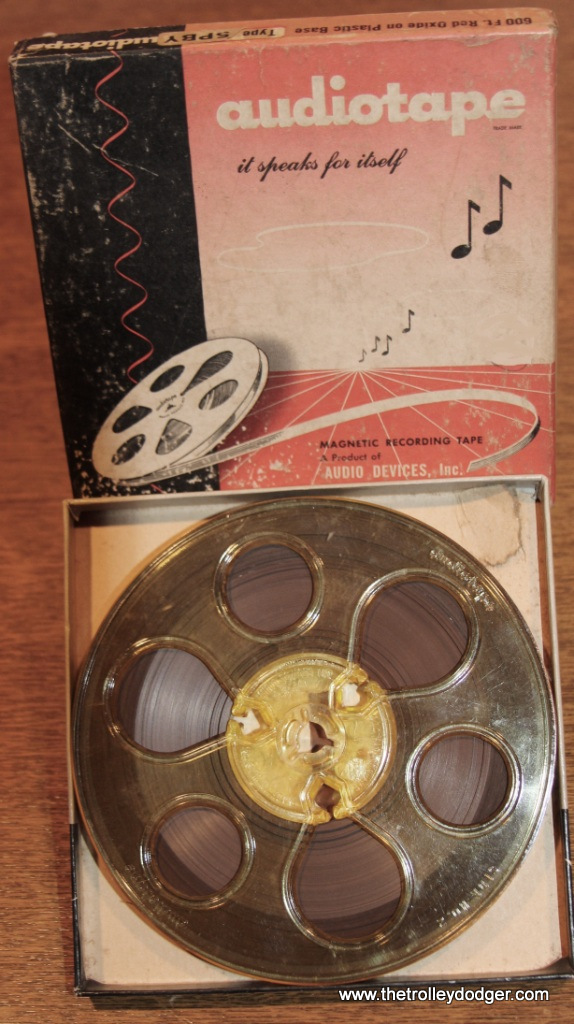
Newly rediscovered and digitized after 60 years, most of these audio recordings of Chicago, North Shore and Milwaukee interurban trains are previously unheard, and include on-train recordings, run-bys, and switching. Includes both Electroliners, standard cars, and locomotives. Recorded between 1955 and 1963 on the Skokie Valley Route and Mundelein branch. We are donating $5 from the sale of each disc to Kenneth Gear, who saved these and many other original Railroad Record Club master tapes from oblivion.
Total time – 73:14
[/caption]


Tape 4 switching at Roudout + Mundeline pic 3Tape 4 switching at Roudout + Mundeline pic 2Tape 4 switching at Roudout + Mundeline pic 1Tape 3 Mundeline Run pic 2Tape 3 Mundeline Run pic 1Tape 2 Mundeline pic 3Tape 2 Mundeline pic 2Tape 2 Mundeline pic 1Tape 1 ElectrolinerTape 1 Electroliner pic 3Tape 1 Electroliner pic 2Notes from tape 4Note from tape 2

RRC-OMTT
Railroad Record Club Traction Rarities – 1951-58
From the Original Master Tapes
# of Discs- 3
Price: $24.99


Railroad Record Club Traction Rarities – 1951-58
From the Original Master Tapes

Our friend Kenneth Gear recently acquired the original Railroad Record Club master tapes. These have been digitized, and we are now offering over three hours of 1950s traction audio recordings that have not been heard in 60 years.
Properties covered include:

Potomac Edison (Hagerstown & Frederick), Capital Transit, Altoona & Logan Valley, Shaker Heights Rapid Transit, Pennsylvania Railroad, Illinois Terminal, Baltimore Transit, Niagara St. Catharines & Toronto, St. Louis Public Transit, Queensboro Bridge, Third Avenue El, Southern Iowa Railway, IND Subway (NYC), Johnstown Traction, Cincinnati Street Railway, and the Toledo & Eastern
$5 from the sale of each set will go to Kenneth Gear, who has invested thousands of dollars to purchase all the remaining artifacts relating to William A. Steventon’s Railroad Record Club of Hawkins, WI. It is very unlikely that he will ever be able to recoup his investment, but we support his efforts at preserving this important history, and sharing it with railfans everywhere.
Disc One
Potomac Edison (Hagerstown & Frederick):
01. 3:45 Box motor #5
02. 3:32 Box motor #5, May 24, 1953
03. 4:53 Engine whistle signals, loco #12, January 17, 1954
04. 4:13 Loco #12
Capital Transit:
05. 0:56 PCC car 1557, Route 20 – Cabin John line, July 19, 1953
06. 1:43
Altoona & Logan Valley:
07. 4:00 Master Unit car #74, August 8, 1953
Shaker Heights Rapid Transit:
08. 4:17 Car 306 (ex-AE&FRE), September 27, 1953
09. 4:04
10. 1:39
Pennsylvania Railroad GG-1s:
11. 4:35 August 27, 1954
12. 4:51
Illinois Terminal:
13. 5:02 Streamliner #300, northward from Edwardsville, February 14, 1955
14. 12:40 Car #202 (ex-1202), between Springfield and Decatur, February 1955
Baltimore Transit:
15. 4:56 Car 5706, January 16, 1954
16. 4:45 Car 5727, January 16, 1954
Niagara, St. Catharines & Toronto:
17. 4:19 Interurbans #83 and #80, October 1954
18. 5:20 #80, October 1954
Total time: 79:30
Disc Two
St. Louis Public Service:
01. 4:34 PCCs #1708, 1752, 1727, 1739, December 6, 1953
Queensboro Bridge Company (New York City):
02. 5:37 Cars #606, 605, and 601, December 31, 1954
03. 5:17
Third Avenue El (New York City):
04. 5:07 December 31. 1954
05. 4:47 Cars #1797, 1759, and 1784 at 59th Street, December 31, 1954
Southern Iowa Railway:
06. 4:46 Loco #400, August 17, 1955
07. 5:09 Passenger interurban #9
IND Subway (New York City):
08. 8:40 Queens Plaza station, December 31, 1954
Last Run of the Hagerstown & Frederick:
09. 17:34 Car #172, February 20, 1954 – as broadcast on WJEJ, February 21, 1954, with host Carroll James, Sr.
Total time: 61:31
Disc Three
Altoona & Logan Valley/Johnstown Traction:
01. 29:34 (Johnstown Traction recordings were made August 9, 1953)
Cincinnati Street Railway:
02. 17:25 (Car 187, Brighton Car House, December 13, 1951– regular service abandoned April 29, 1951)
Toledo & Eastern:
03. 10:36 (recorded May 3-7, 1958– line abandoned July 1958)
Capital Transit:
04. 16:26 sounds recorded on board a PCC (early 1950s)
Total time: 74:02
Total time (3 discs) – 215:03


The Trolley Dodger On the Air
We appeared on WGN radio in Chicago in November 2018, discussing our book Building Chicago’s Subways on the Dave Plier Show. You can hear our 19-minute conversation here.
Chicago, Illinois, December 17, 1938-- Secretary Harold Ickes, left, and Mayor Edward J. Kelly turn the first spadeful of earth to start the new $40,000,000 subway project. Many thousands gathered to celebrate the starting of work on the subway. Chicago, Illinois, December 17, 1938– Secretary Harold Ickes, left, and Mayor Edward J. Kelly turn the first spadeful of earth to start the new $40,000,000 subway project. Many thousands gathered to celebrate the starting of work on the subway.
Order Our New Book Building Chicago’s Subways

There were three subway anniversaries in 2018 in Chicago:
60 years since the West Side Subway opened (June 22, 1958)
75 years since the State Street Subway opened (October 17, 1943)
80 years since subway construction started (December 17, 1938)
To commemorate these anniversaries, we have written a new book, Building Chicago’s Subways.

While the elevated Chicago Loop is justly famous as a symbol of the city, the fascinating history of its subways is less well known. The City of Chicago broke ground on what would become the “Initial System of Subways” during the Great Depression and finished 20 years later. This gigantic construction project, a part of the New Deal, would overcome many obstacles while tunneling through Chicago’s soft blue clay, under congested downtown streets, and even beneath the mighty Chicago River. Chicago’s first rapid transit subway opened in 1943 after decades of wrangling over routes, financing, and logistics. It grew to encompass the State Street, Dearborn-Milwaukee, and West Side Subways, with the latter modernizing the old Garfield Park “L” into the median of Chicago’s first expressway. Take a trip underground and see how Chicago’s “I Will” spirit overcame challenges and persevered to help with the successful building of the subways that move millions. Building Chicago’s subways was national news and a matter of considerable civic pride–making it a “Second City” no more!

Bibliographic information:
Title Building Chicago’s Subways
Images of America
Author David Sadowski
Edition illustrated
Publisher Arcadia Publishing (SC), 2018
ISBN 1467129380, 9781467129381
Length 128 pages
Chapter Titles:
01. The River Tunnels
02. The Freight Tunnels
03. Make No Little Plans
04. The State Street Subway
05. The Dearborn-Milwaukee Subway
06. Displaced
07. Death of an Interurban
08. The Last Street Railway
09. Subways and Superhighways
10. Subways Since 1960
Building Chicago’s Subways is in stock and now available for immediate shipment. Order your copy today! All copies purchased through The Trolley Dodger will be signed by the author.
The price of $23.99 includes shipping within the United States.
For Shipping to US Addresses:

For Shipping to Canada:

For Shipping Elsewhere:

Redone tile at the Monroe and Dearborn CTA Blue Line subway station, showing how an original sign was incorporated into a newer design, May 25, 2018. (David Sadowski Photo) Redone tile at the Monroe and Dearborn CTA Blue Line subway station, showing how an original sign was incorporated into a newer design, May 25, 2018. (David Sadowski Photo)

Help Support The Trolley Dodger

gh1

This is our 246th post, and we are gradually creating a body of work and an online resource for the benefit of all railfans, everywhere. To date, we have received over 584,000 page views, for which we are very grateful.

You can help us continue our original transit research by checking out the fine products in our Online Store.

As we have said before, “If you buy here, we will be here.”

We thank you for your support.

DONATIONS

In order to continue giving you the kinds of historic railroad images that you have come to expect from The Trolley Dodger, we need your help and support. It costs money to maintain this website, and to do the sort of historic research that is our specialty.

Your financial contributions help make this web site better, and are greatly appreciated.

More Railroad Record Club Rarities

Waterloo Cedar Falls and Northern car 100. This car is featured on Railroad Record Club LP #2. Don’s Rail Photos: “100 was built by McGuire-Cummings in 1914. It was built as a second motor to operate behind the 140s as a two car train. The baggage compartment was a kitchen, and the rear end was an open platform observation. The buffet section was replaced with coach seats in 1918. The car was then rebuilt with a control station and baggage compartment in 1928 and the rear platform was enclosed at that time. It was the last interurban left on the WCF&N when it became diesel freight, and it was donated to the Iowa Chapter of the NRHS in 1956. It was moved to Centerville and operated on the Southern Iowa Ry. When the SI cut back its operation and dieselized, the Iowa Chapter transferred the car to the Iowa Terminal RR in 1966. Shortly after it was repainted and put into charter service, it was destroyed in the carbarn fire early November 24, 1967. It had been the only car saved from the WCF&N roundhouse fire on October 31, 1954, when the other two cars of its class burned.”

No one person has been more responsible for preserving the historic artifacts connected with William A. Steventon‘s Railroad Record Club than our good friend Kenneth Gear. A while back, Ken acquired many of the original RRC tape recordings, some of which were never issued.

I have referred before to the RRC output being the “tip of the iceberg,” so to speak, and thanks to Ken, we are beginning to see what the rest of the RRC archive consisted of. While we had already issued some “new” RRC recordings, taken from discs found in the Steventon archive, we have something even more exciting to announce today– newly uncovered audio recordings of the Chicago, North Shore and Milwaukee interurban, the fabled North Shore Line, unheard for perhaps as much as 60 years.

These recordings have been digitized from original RRC tapes that Ken purchased, and are now available for the first time on compact disc. More details about that will be found at the end of this post.

Because we feel it is important for Ken to get back at least some of the substantial investment he has made, in order to preserve these and other historic materials, we are paying Ken a royalty of $5 for each disc sold. Our humble offerings are already reasonably priced, and we don’t make much money from them. On top of that, the Trolley Dodger has, to date, operated at a loss for every year. Our original losses were in excess of $10k per year. This was reduced to $6k in 2017, and we recently did our taxes and are pleased to report that we cut the loss to just $1400 in 2018.

Our goal with this enterprise is historic preservation and education, to provide an archive where people can get, and exchange information about electric railways. In some ways it is the modern equivalent of what my friend Ray DeGroote calls the “intelligence network” of railfans, which has been around since the 1930s or even earlier, just updated for the Internet age.

It used to be that you had to know somebody to be part of this intelligence network, and information was passed from one person to another. Now, it is accessible to anyone and everyone who wants it, via the world wide web.

With that in mind, our goal has always been to break even, in order to make the Trolley Dodger a self-sustaining enterprise.

But we have to give credit where credit is due. Without Kenneth Gear’s personal sacrifices, it’s possible that these materials would have been lost forever, and would have ended up in a dumpster somewhere. You never would even have known they existed.

That’s why I hope you will help support Ken’s gallant efforts by purchasing a copy of this new CD offering.

Because we are not entirely mercenary, Ken is also sharing dozens of classic railfan photos which he purchased as part of the Railroad Record Club archive. Presumably, all or nearly all of these were taken by the late William A. Steventon (1921-1993) himself, as many reflect the areas he lived, worked, and traveled to in his career.

A few of these we already published, but most of these appear here for the first time.

As always, if you can help provide any additional information about these photos, we would love to hear from you.

Enjoy!

-David Sadowski

Altoona and Logan Valley car 74. Don’s Rail Photos: “74 was built by Osgood-Bradley Car Co in 1930.”

This photo was originally misidentified, but actually shows Indianapolis Railways Peter Witt car #132, apparently on a fantrip, probably circa 1950. The streetcar was a Master Unit (that was a Brill trade name), built circa 1932-33, making it one of the last such orders before the PCC era. Master Units were supposed to be a standardized car, but in actuality I believe no two orders were exactly the same.

This photo was originally misidentified, but actually shows Indianapolis Railways Peter Witt car #132, apparently on a fantrip, probably circa 1950. The streetcar was a Master Unit (that was a Brill trade name), built circa 1932-33, making it one of the last such orders before the PCC era. Master Units were supposed to be a standardized car, but in actuality I believe no two orders were exactly the same.

A Chicago, Aurora & Elgin train street running in Aurora in 1931. The CA&E was relocated off-street here in 1939.

A Chicago, Aurora & Elgin train street running in Aurora in 1931. The CA&E was relocated off-street here in 1939.

A Capital Transit PCC and bus at Catholic University in the Washington, DC area.

A Capital Transit PCC and bus at Catholic University in the Washington, DC area.

Denver and Rio Grande Western 476, which was featured on Railroad Record Club LP SP-1.

Denver and Rio Grande Western 476, which was featured on Railroad Record Club LP SP-1.

Denver and Rio Grande Western 481.

Denver and Rio Grande Western 481.

Des Moines and Central Iowa cars #1701 and 1704 in the scrap line, November 19, 1939.

Des Moines and Central Iowa cars #1701 and 1704 in the scrap line, November 19, 1939.

Des Moines and Central Iowa #1705 in October 1938.

Des Moines and Central Iowa #1705 in October 1938.

Des Moines and Central Iowa car 1710.

Des Moines and Central Iowa car 1710.

East Broad Top #15 on a rainy day, very likely while Railroad Record Club LP #3 was being recorded.

East Broad Top #15 on a rainy day, very likely while Railroad Record Club LP #3 was being recorded.

Evansville and Ohio Valley car #134.

Evansville and Ohio Valley car #134.

Hagerstown and Frederick #19 in Frederick, MD on May 30, 1939.

Hagerstown and Frederick #19 in Frederick, MD on May 30, 1939.

The same picture cropped.

The same picture cropped.

A Hagerstown and Frederick work car in Fredercik, MD on May 30, 1939.

A Hagerstown and Frederick work car in Fredercik, MD on May 30, 1939.

Hagerstown and Frederick 164.

Hagerstown and Frederick 164.

Illinois Terminal car 285. Don’s rail Photos: “285 was built by St Louis Car in 1914. It was rebuilt as a parlor car in 1024 and as a coach in December 1928. It was air conditioned in August 1938 and got new seating in December 1952. It was sold for scrap to Hyman Michaels Co. on May 16, 1956.”

An Illinois Terminal local on Caldwell Hill in East Peoria about 1936.

An Illinois Terminal local on Caldwell Hill in East Peoria about 1936.

A fuzzy picture of Illinois Power Company loco #1551.

A fuzzy picture of Illinois Power Company loco #1551.

A builder's photo of Illinois Terminal #207.

A builder’s photo of Illinois Terminal #207.

Illinois Terminal 1201 at Peoria. Don’s Rail Photos: “1201 was built by McGuire-Cummings in 1910 as an express motor with 20 seats at the rear. In 1919 it was rebuilt with a small baggage section at the front and the trucks were changed from Curtis to Baldwin.”

Indiana Railroad box car #550.

Indiana Railroad box car #550.

Indiana Railroad loco #752 waiting for loads at a mine scale.

Indiana Railroad loco #752 waiting for loads at a mine scale.

Indiana Railroad lightweight high-speed car #64. Howard Pletcher adds, “Indiana Railroad lightweight high-speed car #64 is at the Fort Wayne passenger terminal.”

The Indiana Railroad passenger terminal in Fort Wayne. (Howard Pletcher Collection)

The Indiana Railroad passenger terminal in Fort Wayne. (Howard Pletcher Collection)

Indiana Railroad #93 at Anderson, IN on September 4, 1938.

Indiana Railroad #93 at Anderson, IN on September 4, 1938.

Indiana Railroad box motor #722.

Indiana Railroad box motor #722.

Indiana Railroad lightweight high-speed car #80 on an Indianapolis local. It was built by Pullman in 1931 and scrapped in 1941.

Indiana Railroad lightweight high-speed car #80 on an Indianapolis local. It was built by Pullman in 1931 and scrapped in 1941.

Indiana Railroad box motor #115.

Indiana Railroad box motor #115.

Indiana Railroad car #375. Don’s Rail Photos: “375 was built by St Louis Car Co in 1926 as Indiana Service Corp 375. It was ass1gned to IRR as 375 in 1932 and rebuilt as a RPO-combine in 1935. It was sold to Chicago South Shore & South Bend in 1941 as 503 and used as a straight baggage car. It was rebuilt in 1952 with windows removed and doors changed.”

Indiana Railroad car #446.

Indiana Railroad car #446.

Indiana Railroad car #730.

Indiana Railroad car #730.

Indiana Railroad loco #792.

Indiana Railroad loco #792.

The same picture, restored.

The same picture, restored.

Indiana Railroad Vigo with rails ripped out.

Indiana Railroad Vigo with rails ripped out.

Indiana Service Corp., looking forward from car at speed on Spy Run Avenue showing car on #6 line, May 22, 1939.

Indiana Service Corp., looking forward from car at speed on Spy Run Avenue showing car on #6 line, May 22, 1939.

Indiana Service Corporation #820 at Wabash station on August 3, 1936.

Indiana Service Corporation #820 at Wabash station on August 3, 1936.

Indiana Service Corp View across the Broadway bridge, showing double truck car in distance, August 18, 1940. (But what city is this?) Mike Peters writes: “he ISC city car is in Fort Wayne, a block away from the south end of the Broadway line. The bridge carries Bluffton Road and the ISC interurban to Bluffton over the Saint Marys River. A good map of the Ft. Wayne system can be found in “Fort Wayne’s Trolleys” (George Bradley). ISC did provide service in several smaller cities, but these lines did not survive the 1930’s.”

Interstate car #711, ex-Indiana Public Service Corporation 427, on September 3, 1939.

Interstate car #711, ex-Indiana Public Service Corporation 427, on September 3, 1939.

Interstate car 711 on shop siding west of Greencastle on June 3 1939.

Interstate car 711 on shop siding west of Greencastle on June 3 1939.

Indiana Railroad lightweight car #94. Don’s Rail Photos: “90 thru 99 were built by Cummings in 1930 as Northern Indiana Ry 350 thru 359. In 1935, they were returned to Cummings, who rebuilt them and sold them to the IRR. They were retired in 1940.”

Indiana Railroad line car 763 at the Muncie station on May 19, 1940.

Indiana Railroad line car 763 at the Muncie station on May 19, 1940.

Indiana Railroad lightweight car 96.

Indiana Railroad lightweight car 96.

Indiana Railroad lightweight car #90 at New Castle, IN on July 4, 1936. Note the Woolworth's at right.

Indiana Railroad lightweight car #90 at New Castle, IN on July 4, 1936. Note the Woolworth’s at right.

Indiana Railroad lightweight car #95 at the Indianapolis terminal.

Indiana Railroad lightweight car #95 at the Indianapolis terminal.

Indiana Railroad lightweight car #99.

Indiana Railroad lightweight car #99.

Indiana Railroad #787.

Indiana Railroad #787.

Lake Erie and Northern car #795.

Lake Erie and Northern car #795.

Lake Erie and Northern car #797.

Lake Erie and Northern car #797.

Lake Erie and Northern car #939.

Lake Erie and Northern car #939.

A Lehigh Valley Transit Allentown Limited on the Liberty Bell Route, descending the ramp at Norristown (where LVT shared tracks with the Philadelphia & Western for access to Philadelphia, at least until 1949).

A Lehigh Valley Transit Allentown Limited on the Liberty Bell Route, descending the ramp at Norristown (where LVT shared tracks with the Philadelphia & Western for access to Philadelphia, at least until 1949).

Lehigh Valley Transit lightweight high-speed car 1002, presumably in Allentown PA.

Lehigh Valley Transit lightweight high-speed car 1002, presumably in Allentown PA.

Mason City and Clear Lake car #34 (photo restored).

Mason City and Clear Lake car #34 (photo restored).

Mason City and Clear Lake car #34 (unrestored photo).

Mason City and Clear Lake car #34 (unrestored photo).

Mason City and Clear Lake car #106.

Mason City and Clear Lake car #106.

Mason City and Clear Lake car #14.

Mason City and Clear Lake car #14.

Mason City and Clear Lake steeple cab #52.

Mason City and Clear Lake steeple cab #52.

Niagara St. Catharines and Toronto Railway yard.

Niagara St. Catharines and Toronto Railway yard.

A Niagara St. Catharines and Toronto Railway snow plow.

A Niagara St. Catharines and Toronto Railway snow plow.

A Niagara St. Catharines and Toronto Railway trolley.

A Niagara St. Catharines and Toronto Railway trolley.

A nice right-of-way photo with no information, other than the date-- March 31, 1936.

A nice right-of-way photo with no information, other than the date– March 31, 1936.

Jeff Wien: “TMER&T, route 13: Clybourn Downtown Milwaukee.”
.

No information.

No information.

This is a three-car train of Indiana Railroad lightweight high-speeds in multiple-unit service on a fantrip, circa 1938-40.

This is a three-car train of Indiana Railroad lightweight high-speeds in multiple-unit service on a fantrip, circa 1938-40.

No information (photo restored).

No information (photo restored).

No information (unrestored photo).

No information (unrestored photo).

Does ST F Co RR stand for Santa Fe? At any rate, this is car #54 at Farmington, MO.

Does ST F Co RR stand for Santa Fe? At any rate, this is car #54 at Farmington, MO.

Salt Lake and Utah loco #101.

Salt Lake and Utah loco #101.

Sand Springs Railway (Oklahoma) loco #1001.

Sand Springs Railway (Oklahoma) loco #1001.

Unidentified car and person. Mike Peters: “The photo of 817 and employee would also be Fort Wayne. After passenger operations ceased, this motor was retained for switching the Spy Run power plant and several nearby industries. The roster in “Fort Wayne and Wabash Valley Trolleys” (CERA #122) shows the 817 as being retired in 1952.”

Unidentified steeple cab locomotive.

Unidentified steeple cab locomotive.

Unidentified steeple cab locomotive.

Unidentified steeple cab locomotive.

Union Electric Railway loco #80.

Union Electric Railway loco #80.

Utah Idaho Central #905 in June 1945.

Utah Idaho Central #905 in June 1945.

Utah Idaho Central #905 in June 1945.

Utah Idaho Central #905 in June 1945.

Washington and Old Dominion car #44 and a Railway Express Agency truck in Rosslyn VA.

Washington and Old Dominion car #44 and a Railway Express Agency truck in Rosslyn VA.

A Washington and Old Dominion locomotive.

A Washington and Old Dominion locomotive.

A Washington and Old Dominion RPO (Railway Post Office) on a mail run outside Rosslyn VA.

A Washington and Old Dominion RPO (Railway Post Office) on a mail run outside Rosslyn VA.

The Washington and Old Dominion shops.

The Washington and Old Dominion shops.

Recent Finds

The CTA DesPlaines Avenue terminal in Forest Park in July 1955. This is an unusal view, looking west from Desplaines Avenue. At left, you can just barely see some streetcar tracks, which were used by West Towns Railways trolleys no later than 1948. That could be a CTA Route 17 bus, and you can also see some Chicago, Aurora & Elgin interurban cars in the station. The CA&E cut back service to here in 1953.

The CTA DesPlaines Avenue terminal in Forest Park in July 1955. This is an unusal view, looking west from Desplaines Avenue. At left, you can just barely see some streetcar tracks, which were used by West Towns Railways trolleys no later than 1948. That could be a CTA Route 17 bus, and you can also see some Chicago, Aurora & Elgin interurban cars in the station. The CA&E cut back service to here in 1953.

CTA 1775 at Cermak and Kostner on March 21, 1954, about two months before streetcar service ended on Route 21.

CTA 1775 at Cermak and Kostner on March 21, 1954, about two months before streetcar service ended on Route 21.

CTA 7213 on Route 49 - Western on August 2, 1949. This car would later become the last Chicago streetcar to operate.

CTA 7213 on Route 49 – Western on August 2, 1949. This car would later become the last Chicago streetcar to operate.

North Shore Line 254

North Shore Line 254 “at freight station on “L”structure near Loop – January 27, 1962.”

The North Shore Line shops interior in Milwaukee, September 24, 1961.

The North Shore Line shops interior in Milwaukee, September 24, 1961.

Chicago Surface Lines 5258 at Lowe Avenue in the 1940s (not sure of main street, perhaps 79th?).

Chicago Surface Lines 5258 at Lowe Avenue in the 1940s (not sure of main street, perhaps 79th?).

CTA 6180, a one-man car, picks up passengers at an

CTA 6180, a one-man car, picks up passengers at an “L” station in the early 1950s.

CTA 7216, a St. Louis Car Company PCC, is northbound on Route 36 – Broadway in the 1950s. Jeff Wien: “Cars laying over on 119th at Morgan.”

CTA 4362, a Pullman PCC, on Route 8 – Halsted, most likely in the late 1940s. Jeff Wien adds, “Rt. 8 car has just pulled off of Broadway onto Waveland to head south on Halsted to 79th Street loop. Photo ca 1951 when Halsted was operated with PCCs, most Pullmans.”

TRACTION AUDIO, NOW AVAILABLE ON COMPACT DISC:

CDLayout33p85

RRCNSLR
Railroad Record Club – North Shore Line Rarities 1955-1963
# of Discs – 1
Price: $15.99

Railroad Record Club – North Shore Line Rarities 1955-1963

Newly rediscovered and digitized after 60 years, most of these audio recordings of Chicago, North Shore and Milwaukee interurban trains are previously unheard, and include on-train recordings, run-bys, and switching. Includes both Electroliners, standard cars, and locomotives. Recorded between 1955 and 1963 on the Skokie Valley Route and Mundelein branch. We are donating $5 from the sale of each disc to Kenneth Gear, who saved these and many other original Railroad Record Club master tapes from oblivion.

Total time – 73:14


Tape 4 switching at Roudout + Mundeline pic 3Tape 4 switching at Roudout + Mundeline pic 2Tape 4 switching at Roudout + Mundeline pic 1Tape 3 Mundeline Run pic 2Tape 3 Mundeline Run pic 1Tape 2 Mundeline pic 3Tape 2 Mundeline pic 2Tape 2 Mundeline pic 1Tape 1 ElectrolinerTape 1 Electroliner pic 3Tape 1 Electroliner pic 2Notes from tape 4Note from tape 2

The Trolley Dodger On the Air

We appeared on WGN radio in Chicago last November, discussing our book Building Chicago’s Subways on the Dave Plier Show. You can hear our 19-minute conversation here.

Order Our New Book Building Chicago’s Subways

There were three subway anniversaries in 2018 in Chicago:
60 years since the West Side Subway opened (June 22, 1958)
75 years since the State Street Subway opened (October 17, 1943)
80 years since subway construction started (December 17, 1938)

To commemorate these anniversaries, we have written a new book, Building Chicago’s Subways.

While the elevated Chicago Loop is justly famous as a symbol of the city, the fascinating history of its subways is less well known. The City of Chicago broke ground on what would become the “Initial System of Subways” during the Great Depression and finished 20 years later. This gigantic construction project, a part of the New Deal, would overcome many obstacles while tunneling through Chicago’s soft blue clay, under congested downtown streets, and even beneath the mighty Chicago River. Chicago’s first rapid transit subway opened in 1943 after decades of wrangling over routes, financing, and logistics. It grew to encompass the State Street, Dearborn-Milwaukee, and West Side Subways, with the latter modernizing the old Garfield Park “L” into the median of Chicago’s first expressway. Take a trip underground and see how Chicago’s “I Will” spirit overcame challenges and persevered to help with the successful building of the subways that move millions. Building Chicago’s subways was national news and a matter of considerable civic pride–making it a “Second City” no more!

Bibliographic information:

Title Building Chicago’s Subways
Images of America
Author David Sadowski
Edition illustrated
Publisher Arcadia Publishing (SC), 2018
ISBN 1467129380, 9781467129381
Length 128 pages

Chapter Titles:
01. The River Tunnels
02. The Freight Tunnels
03. Make No Little Plans
04. The State Street Subway
05. The Dearborn-Milwaukee Subway
06. Displaced
07. Death of an Interurban
08. The Last Street Railway
09. Subways and Superhighways
10. Subways Since 1960

Building Chicago’s Subways is in stock and now available for immediate shipment. Order your copy today! All copies purchased through The Trolley Dodger will be signed by the author.

The price of $23.99 includes shipping within the United States.

For Shipping to US Addresses:

For Shipping to Canada:

For Shipping Elsewhere:

Redone tile at the Monroe and Dearborn CTA Blue Line subway station, showing how an original sign was incorporated into a newer design, May 25, 2018. (David Sadowski Photo)

Redone tile at the Monroe and Dearborn CTA Blue Line subway station, showing how an original sign was incorporated into a newer design, May 25, 2018. (David Sadowski Photo)

Help Support The Trolley Dodger

gh1

This is our 229th post, and we are gradually creating a body of work and an online resource for the benefit of all railfans, everywhere. To date, we have received over 507,000 page views, for which we are very grateful.

You can help us continue our original transit research by checking out the fine products in our Online Store.

As we have said before, “If you buy here, we will be here.”

We thank you for your support.

DONATIONS

In order to continue giving you the kinds of historic railroad images that you have come to expect from The Trolley Dodger, we need your help and support. It costs money to maintain this website, and to do the sort of historic research that is our specialty.

Your financial contributions help make this web site better, and are greatly appreciated.

101 Dalmatians

CSL prewar PCC 4022 heads west on Madison Street in the late 1940s. It is signed for the Madison-Fifth branch line. Fifth Avenue is an angle street that heads southwest. Service on the branch line terminated at the Garfield Park

CSL prewar PCC 4022 heads west on Madison Street in the late 1940s. It is signed for the Madison-Fifth branch line. Fifth Avenue is an angle street that heads southwest. Service on the branch line terminated at the Garfield Park “L” station at Pulaski Road. Several parts of Fifth Avenue have been truncated since streetcars stopped running there in early 1954. (Edward Frank, Jr. Photo)

It has been nearly two months since our last post, but we are back with a bevy of classic traction photos for your consideration.

Things have been quite busy of late, as we worked as an election judge for two recent elections (three in the last six months). Although you have not seen a new post for a while, work behind the scenes continued. We scanned hundreds of images, and many needed extra help in Photoshop.

When you see as post such as this, it is like the tip of an iceberg. For every image we share, there are others that, for whatever reason, do not make the grade, as well as others that are being stored up in an inventory of images, waiting for their moment in the sun.

Leopards, they say, never change their spots… but I assume you can identify certain breeds of dogs, such as Dalmatians, by the location of their spots. Spots factor into our images in any number of ways. Our readers often help us determine just which spot a picture was taken at. And we often have to do spot removal, a tedious practice, on old images.

Brian Wilson has his Pet Sounds, and we have our own pet images. Today’s batch are particular favorites, but each one is a different animal– a horse of a different color, you could say. You should have seen some of these pictures before we got hold of them and gave them triage. On second thought, just stick to the finished product you see here.

There are many, many hours of work that go into each post, and money too. When you see an image here, figure that it cost at least $10 on average to obtain it. We are fortunate that some of our readers have shared images from their extensive collections with us.

In particular, today’s post benefited tremendously from the generosity of both William Shapotkin and Jeffrey L. Wien, both of whom recently celebrated birthdays.

So, we are calling this post 101 Dalmatians, as we have at least that many new pictures here, and after working on them for so long, we are starting to see spots everywhere we look. We hope you will appreciate our modest efforts, and we will be back soon with more posts.

-David Sadowski

Our best wishes also go out to Ray DeGroote, the dean of Chicago railfans at age 88, who was recently injured in a fall. We wish him a speedy recovery. If anyone can do it at that age, Ray can.

Recent Finds

A bird's-eye view of the Wells Street Terminal used by the Chicago, Aurora and Elgin interurban on September 19, 1953. The following day, CA&E stopped running trains downtown, and their track connection with the CTA was severed forever in suburban Forest Park. There is a similar image, taken in 1960, showing the same terminal, or what was left after the CTA built a new track connection to the Loop elevated through it in 1955. You can find that in my book Building Chicago's Subways.

A bird’s-eye view of the Wells Street Terminal used by the Chicago, Aurora and Elgin interurban on September 19, 1953. The following day, CA&E stopped running trains downtown, and their track connection with the CTA was severed forever in suburban Forest Park. There is a similar image, taken in 1960, showing the same terminal, or what was left after the CTA built a new track connection to the Loop elevated through it in 1955. You can find that in my book Building Chicago’s Subways.

On July 27, 1962, a CTA Douglas Park “B” train pulls away from us at the Racine stop on the Congress rapid transit line., then only four years old. The train will go downtown through the Dearborn Subway, and then out to Logan Square via the Milwaukee Avenue tube.

On May 28, 1978, photographer William D. Lloyd caught this picture of CTA Historic cars 4271-4272 on the north side “L”. Now nearing the century mark, they are still on the property today. Here, they were only about five years out of regular service.

On January 26, 1964, approximately one year after the North Shore Line quit, the two Electroliners were rechristened as Liberty Liners on the Red Arrow's 13-mile line between Philadelphia and Norristown. In the distance, we see a pair of early 1930s Bullet cars, which had a storied history of their own.

On January 26, 1964, approximately one year after the North Shore Line quit, the two Electroliners were rechristened as Liberty Liners on the Red Arrow’s 13-mile line between Philadelphia and Norristown. In the distance, we see a pair of early 1930s Bullet cars, which had a storied history of their own.

MBTA (Boston) ex-Dallas double-end PCC 3336 at Mattapan yards on December 5, 1976. (Ed McKernan Photo)

MBTA (Boston) ex-Dallas double-end PCC 3336 at Mattapan yards on December 5, 1976. (Ed McKernan Photo)

picture255

Two CRT Met cars at the Laramie Shops in 1947. (John Gibb Smith, Jr. Photo)

In the last couple years of red car service in Chicago, which ended in 1954, the CTA painted a few of the older streetcars green. It was not an attractive color for them. Here, we see inbound car 6172 jogging from one side of Lake Street to another via Pine Avenue. To this day, tracks are still visible under the viaduct. At this point, streetcars crossed the Lake Street

In the last couple years of red car service in Chicago, which ended in 1954, the CTA painted a few of the older streetcars green. It was not an attractive color for them. Here, we see inbound car 6172 jogging from one side of Lake Street to another via Pine Avenue. To this day, tracks are still visible under the viaduct. At this point, streetcars crossed the Lake Street “L”, which ran on the ground here until 1962.

CSL 1466 was used as a training car for the three river tunnels. (Edward Frank, Jr. Photo)

CSL 1466 was used as a training car for the three river tunnels. (Edward Frank, Jr. Photo)

CSL 173X (full number not visible) is heading west on Madison Street in the 1930s. The Civic Opera House, built by Samuel Insull in 1929, is visible at rear. (Edward Frank, Jr. Photo)

CSL 173X (full number not visible) is heading west on Madison Street in the 1930s. The Civic Opera House, built by Samuel Insull in 1929, is visible at rear. (Edward Frank, Jr. Photo)

A maintenance of way car along the overhead section of the North Side “L”, exact date and location unknown. Jeff Wien adds that this is: “Wilson Avenue, freight connection to Buena Yards, probably in the early 50s.”

Laurel Line car 31 is at the Plains substation on August 3, 1952. Edward Skuchas writes: “I believe the locations of the two Laurel Line photos are incorrect. The top photo is Pittston. The lower photo may be the Plains sub-station. West Pittston is on the other side of the Susquehanna River, and the Laurel Line did not go there.”

Laurel Line car 39 is at the Plains sub-station on December 28, 1952, shortly before abandonment.

Laurel Line car 39 is at the Plains sub-station on December 28, 1952, shortly before abandonment.

The interior of Lehigh Valley Transit car 1007, showing its leather bucket seats, which were popular when this car was built for the Cincinnati and Lake Erie in the early 1930s.

The interior of Lehigh Valley Transit car 1007, showing its leather bucket seats, which were popular when this car was built for the Cincinnati and Lake Erie in the early 1930s.

Conductors on a Humboldt Park

Conductors on a Humboldt Park “L” train, circa 1907-15.

A Loop-bound Metropolitan

A Loop-bound Metropolitan “L” train, circa 1907-15.

The Chicago Surface Lines used trailers during the 1920s, as a way of dealing with increasing crowds of riders. But with the advent of the Great Depression, ridership fell sharply, and the trailers were no longer needed. Some thought was given to reviving them during World War II, but this did not happen. Here, 1756 pulls 8049. Don's Rail Photos notes,

The Chicago Surface Lines used trailers during the 1920s, as a way of dealing with increasing crowds of riders. But with the advent of the Great Depression, ridership fell sharply, and the trailers were no longer needed. Some thought was given to reviving them during World War II, but this did not happen. Here, 1756 pulls 8049. Don’s Rail Photos notes, “8056 was built by Brill in 1921, #21272. It became a shed at 77th and scrapped on July 17, 1957.” 1756 was a “169” or Broadway-State car. Again, Don Ross: “1756 was built by CSL in 1923. It was rebuilt as one-man in 1949.”

CTA prewar PCC 7028 on private right-of-way at the south end of Route 4 - Cottage Grove, in June 1953.

CTA prewar PCC 7028 on private right-of-way at the south end of Route 4 – Cottage Grove, in June 1953.

CTA Sedan (aka Peter Witt) 3848 on priate right-of-way at the south end of Route 4 - Cottage Grove in June 1952. Here, the line ran parallel to the Illinois Central Electric suburban service, now the Metra Electric.

CTA Sedan (aka Peter Witt) 3848 on priate right-of-way at the south end of Route 4 – Cottage Grove in June 1952. Here, the line ran parallel to the Illinois Central Electric suburban service, now the Metra Electric.

After the Chicago Transit Authority retired the last of the wooden

After the Chicago Transit Authority retired the last of the wooden “L” cars in 1957, some were used for a few more years in work service. Here, a Met car has been renumbered as S-308 at Skokie Shops.

CTA single cat unit 23 is outbound on the Skokie Swift at Niles Center Road on August 20, 1970.

CTA single cat unit 23 is outbound on the Skokie Swift at Niles Center Road on August 20, 1970.

CTA single car unit 26 on the open-cut section of the Skokie Swift in August 1978.

CTA single car unit 26 on the open-cut section of the Skokie Swift in August 1978.

CTA postwar PCC 4337, built by Pullman, heads south on State Street in the early 1950s.

CTA postwar PCC 4337, built by Pullman, heads south on State Street in the early 1950s.

An outbound CTA Douglas Park train ascends the ramp that will take from the Congress (now Eisenhower) Expressway to the old

An outbound CTA Douglas Park train ascends the ramp that will take from the Congress (now Eisenhower) Expressway to the old “L” structure in the mid-1960s. This ramp is not used much now, as Douglas trains, now renamed the Pink Line, have been rerouted to the Lake Street “L” via the Paulina Connector. (Mark D. Meyer Photo)

I ought this Red Border Kodachrome slide, which dates to the early 1950s, thinking perhaps it might e the old Park Theater on Chicago’s west side (on Lake near Austin). But after studying the image for a while, I am inclined to think it’s somewhere else. While the facade looks similar to the actual Park Theater, it is not identical. There should be streetcar tracks visible– the movie theater closed in 1952, about two years before the streetcar quit. And the theater on Lake Street at Austin Boulevard did not have a streetlight such as the one seen at right. There was a light attached to a line pole that held the trolley wire– a line pole not visible in this picture. That, plus the rounded nature of the signage, which I have never seen in any other pictures of the Park, tell me that this is not it. But we have in the past posted several pictures of streetcars near the actual theater. If you type “park theater” or “lake austin” in the search window on our page, these various pictures will come up.

CSL 1039 at Wabash and Lake in June 1947. Signed for the Indiana-Lincoln through route #3, it is southbound, and headed to Indiana and 51st.

CSL 1039 at Wabash and Lake in June 1947. Signed for the Indiana-Lincoln through route #3, it is southbound, and headed to Indiana and 51st.

CSL 6284 on Wabash at Roosevelt Road on June 13, 1947. Although the car is full of people, for some reason the side sign says Not In Service.

CSL 6284 on Wabash at Roosevelt Road on June 13, 1947. Although the car is full of people, for some reason the side sign says Not In Service.

A two-car CTA train of 4000s at right, in Evanston shuttle service, heads southbound approaching Howard in the 1950s.

A two-car CTA train of 4000s at right, in Evanston shuttle service, heads southbound approaching Howard in the 1950s.

TMER&T 1121, on a December 4, 1949 fantrip on the North Shore Line.

TMER&T 1121, on a December 4, 1949 fantrip on the North Shore Line.

CTA historic cars 4271-4272 at McCormick Boulevard (Yellow Line aka Skokie Swift) on July 16, 1989. (Bruce C. Nelson Photo)

CTA historic cars 4271-4272 at McCormick Boulevard (Yellow Line aka Skokie Swift) on July 16, 1989. (Bruce C. Nelson Photo)

The CTA has a yard for the Green Line (formerly the Lake Street

The CTA has a yard for the Green Line (formerly the Lake Street “L”) just west of the Harlem Avenue terminal in suburban Forest Park. Here, various cars in the 2000-series are seen, along with a Metra commuter train on the adjacent Union Pacific West Line. This picture was most likely taken during the 1990s. (Bruce C. Nelson Photo)

CTA gate car 2318 is parked along the outer portion of the Douglas Park line in February 1950.

CTA gate car 2318 is parked along the outer portion of the Douglas Park line in February 1950.

Chicago Rapid Transit Company gate car 305 is seen on the Loop

Chicago Rapid Transit Company gate car 305 is seen on the Loop “L” in the 1940s, signed as a Wilson Avenue Local.

The presence of double track would seem to indicate that this picture of a South Shore Line train was taken in East Chicago, Indiana in the 1950s. The street running through the middle of town was replaced by a new section running parallel to the Indiana Toll Road in 1956.

The presence of double track would seem to indicate that this picture of a South Shore Line train was taken in East Chicago, Indiana in the 1950s. The street running through the middle of town was replaced by a new section running parallel to the Indiana Toll Road in 1956.

CTA Holiday Trains have become an annual tradition. Photographer Bruce C. Nelson captured this one on December 2, 2017.

CTA Holiday Trains have become an annual tradition. Photographer Bruce C. Nelson captured this one on December 2, 2017.

Chicago Surface Lines red Pullman 426 is most likely running on Route 65 - Grand, as it is signed to go to Grand and Armitage. Chances are, this photo was taken circa 1939-40, and shows temporary trackage for construction of Chicago's first subways.

Chicago Surface Lines red Pullman 426 is most likely running on Route 65 – Grand, as it is signed to go to Grand and Armitage. Chances are, this photo was taken circa 1939-40, and shows temporary trackage for construction of Chicago’s first subways.

October 27, 1962 was the last day of ground-level operation on the CTA Lake Street

October 27, 1962 was the last day of ground-level operation on the CTA Lake Street “L”. The following day, service was relocated to the adjacent Chicago & North Western embankment. Here, we see a pair of 4000s heading west on South Boulevard at Kenilworth.

After serving Chicago for many years, some of the original CTA

After serving Chicago for many years, some of the original CTA “flat door” 6000s had a second life on Philadelphia’s Norristown High-Speed Line. 6089-6090 are approaching Radnor on April 10, 1987.

Here is a view of the old Tower 18 on Chicago's Loop

Here is a view of the old Tower 18 on Chicago’s Loop “L”, when this was the world’s busiest railroad crossing. The old Loop ran both tracks in only one direction, but this changed in 1969, when the CTA wanted to connect the Lake Street “L” with the new Dan Ryan line. Therefore, the old tower had to go, as it was situated right where the new tracks had to go.

Both CTA and CA&E trains are visible in this July 8, 1953 photo taken at Laramie on the Garfield Park

Both CTA and CA&E trains are visible in this July 8, 1953 photo taken at Laramie on the Garfield Park “L”. Just a little over two months later, the CA&E interurban cut back service to Forest Park, a few miles west of here (and behind the photographer).

The Milwaukee Rapid Transit & Speedrail Company's car 60, seen here in 1950, was a Cincinnati curved-side car. The ill-fated attempt to keep electric transit service going in Milwaukee was doomed to failure, once a horrific head-on collision took the lives of several people.

The Milwaukee Rapid Transit & Speedrail Company’s car 60, seen here in 1950, was a Cincinnati curved-side car. The ill-fated attempt to keep electric transit service going in Milwaukee was doomed to failure, once a horrific head-on collision took the lives of several people.

CA&E 425 is passing over Union Station in this undated photo. Trains going more or less straight would end up at the Wells Street Terminal, while the tracks in the background leading off to the right connected to the Loop

CA&E 425 is passing over Union Station in this undated photo. Trains going more or less straight would end up at the Wells Street Terminal, while the tracks in the background leading off to the right connected to the Loop “L” Van Buren. When Lower Wacker Drive was being built, this necessitated tearing down this second connection to thee Loop, and building a new one through the second floor of Wells Terminal. The switchover between the two took place in 1955.

Riders at the old Laramie stop on the CTA's Garfield Park

Riders at the old Laramie stop on the CTA’s Garfield Park “L” in 1947. Met cars are seen in storage in the background. (John Gibb Smith, Jr. Photo)

A CRT gate car, running in service on the old Garfield Park

A CRT gate car, running in service on the old Garfield Park “L” in 1947. This is the Laramie stop. (Charles R. Griffin Photo)

This CTA brochure, dated July 1949, explains the changes that were coming from the CTA's plan to revise north-south

This CTA brochure, dated July 1949, explains the changes that were coming from the CTA’s plan to revise north-south “L” and subway service. This included A/B “skip stop” service and making the Evanston branch a shuttle.

new935new936new937

From the Wien-Criss Archive:

One of the two North Shore Line Electroliners on Chicago's South Side

One of the two North Shore Line Electroliners on Chicago’s South Side “L” on February 17, 1962. (Wien-Criss Archive)

A North Shore Line Electroliner barrels through, having just crossed under the EJ&E, on January 12, 1963, a little over a week before the end of service. (Wien-Criss Archive)

A North Shore Line Electroliner barrels through, having just crossed under the EJ&E, on January 12, 1963, a little over a week before the end of service. (Wien-Criss Archive)

A North Shore Line Electroliner on June 1, 1962. (Wien-Criss Archive)

A North Shore Line Electroliner on June 1, 1962. (Wien-Criss Archive)

A North Shore Line Electroliner at Edison Court on February 17, 1962. (Wien-Criss Archive)

A North Shore Line Electroliner at Edison Court on February 17, 1962. (Wien-Criss Archive)

Chicago Surface Lines experimental pre-PCC car 7001 at 77th and Vincennes in October 1956. It is a shame that this historic car, which ran in Chicago from 1934 to 1944, was not saved. (Wien-Criss Archive)

Chicago Surface Lines experimental pre-PCC car 7001 at 77th and Vincennes in October 1956. It is a shame that this historic car, which ran in Chicago from 1934 to 1944, was not saved. (Wien-Criss Archive)

A Milwaukee streetcar, presumably on Route 10, in the 1950s. (Wien-Criss Archive)

A Milwaukee streetcar, presumably on Route 10, in the 1950s. (Wien-Criss Archive)

Interior shots were not easy for photographers on September 4, 1962, when Robert F. Collins took this picture of the North Shore Line's Milwaukee terminal. (Wien-Criss Archive)

Interior shots were not easy for photographers on September 4, 1962, when Robert F. Collins took this picture of the North Shore Line’s Milwaukee terminal. (Wien-Criss Archive)

Don's Rail Photos:

Don’s Rail Photos: “E223, sweeper, was built by McGuire-Cummings in 1908 as CCRys E23. It was renumbered E223 in 1913 and became CSL E223 in 1914. It was sold to Illinois Railway Museum on August 29, 1958.” (Wien-Criss Archive)

On March 17, 1957 the late James J. Buckley caught this terrific 3/4 view of a Chicago, Aurora & Elgin freight train at Lakewood. (Wien-Criss Archive)

On March 17, 1957 the late James J. Buckley caught this terrific 3/4 view of a Chicago, Aurora & Elgin freight train at Lakewood. (Wien-Criss Archive)

It's June 1963, several months after the CTA elevated the Lake Street

It’s June 1963, several months after the CTA elevated the Lake Street “L” onto the Chicago & North Western embankment. A four-car train made up of “circus wagons,” the fan’s name for experimental high-speed cars, is making a rare appearance at Harlem Avenue, the end of the line. This view looks east. (Wien-Criss Archive)

CTA postwar PCC 7237 is running southbound on Clark Street in the late 1950s. (Wien-Criss Archive)

CTA postwar PCC 7237 is running southbound on Clark Street in the late 1950s. (Wien-Criss Archive)

CTA postwar PCC 7196 is at 81st and Halsted, the southern end of Route 22 - Clark-Wentworth. (Wien-Criss Archive)

CTA postwar PCC 7196 is at 81st and Halsted, the southern end of Route 22 – Clark-Wentworth. (Wien-Criss Archive)

CTA 7195 is southbound on Clark at Washington. (Heier Industrial Photo, Wien-Criss Archive)

CTA 7195 is southbound on Clark at Washington. (Heier Industrial Photo, Wien-Criss Archive)

CTA red Pullman 144, which is now at the Illinois Railway Museum. (Wien-Criss Archive)

CTA red Pullman 144, which is now at the Illinois Railway Museum. (Wien-Criss Archive)

CTA red Pullman 144, which is now at the Illinois Railway Museum. (Wien-Criss Archive)

CTA red Pullman 144, which is now at the Illinois Railway Museum. (Wien-Criss Archive)

CTA PCC 7187 on Clark Street on September 6, 1957, the last day of street railway service on Chicago's north side. (Charles H. Thorpe Photo, Wien-Criss Archive)

CTA PCC 7187 on Clark Street on September 6, 1957, the last day of street railway service on Chicago’s north side. (Charles H. Thorpe Photo, Wien-Criss Archive)

On September 6, 1957, CTA 4372 pulls into the turnaround loop at Clark and Howard. (Charles H. Thorpe Photo, Wien-Criss Archive)

On September 6, 1957, CTA 4372 pulls into the turnaround loop at Clark and Howard. (Charles H. Thorpe Photo, Wien-Criss Archive)

CTA 7189 is southbound at Clark and Ohio on September 6, 1957. (Charles H. Thorpe Photo, Wien-Criss Archive) Daniel Joseph notes, "The Hotel Wacker was at Clark and Huron."

CTA 7189 is southbound at Clark and Ohio on September 6, 1957. (Charles H. Thorpe Photo, Wien-Criss Archive) Daniel Joseph notes, “The Hotel Wacker was at Clark and Huron.”

On September 6, 1957, Charles H. Thorpe took this picture of CTA 7139, the last pull-out from Devon Station (car barn). (Wien-Criss Archive)

On September 6, 1957, Charles H. Thorpe took this picture of CTA 7139, the last pull-out from Devon Station (car barn). (Wien-Criss Archive)

CTA 4379 is on north Clark Street on September 6, 1957. (Charles H. Thorpe Photo, Wien-Criss Archive) Daniel Joseph adds, "This streetcar is traveling southbound to 81st & Halsted (as the destination sign states) somewhere near Clark and Glenlake." (This is, however, on the northern portion of Clark Street as we stated.)

CTA 4379 is on north Clark Street on September 6, 1957. (Charles H. Thorpe Photo, Wien-Criss Archive) Daniel Joseph adds, “This streetcar is traveling southbound to 81st & Halsted (as the destination sign states) somewhere near Clark and Glenlake.” (This is, however, on the northern portion of Clark Street as we stated.)

CTA 7195 is on Halsted Street, near the south end of Route 22 - Clark-Wentworth. (Heier Industrial Photo, Wien-Criss Archive)

CTA 7195 is on Halsted Street, near the south end of Route 22 – Clark-Wentworth. (Heier Industrial Photo, Wien-Criss Archive)

CTA Sedan (aka Peter Witt) 3360 is running Route 4 - Cottage Grove, circa 1951-52. (Wien-Criss Archive)

CTA Sedan (aka Peter Witt) 3360 is running Route 4 – Cottage Grove, circa 1951-52. (Wien-Criss Archive)

CTA 7154 is near Limits Station (car barn), near 2700 N. Clark Street, on September 6, 1957. (Charles H. Thorpe Photo, Wien-Criss Archive)

CTA 7154 is near Limits Station (car barn), near 2700 N. Clark Street, on September 6, 1957. (Charles H. Thorpe Photo, Wien-Criss Archive)

CTA steeple cab S-343, a

CTA steeple cab S-343, a “yard shifter,” serving the rapid transit system, is at 64th and Prairie. Don’s Rail Photos notes, “S-343 was built by Chicago City Ry in 1909 as Chicago City Ry C50. It was renumbered L202 in 1913 and became CSL L202 in 1914. It was rebuilt as S-343 in 1959 and acquired by Railway Equipment Leasing & Investment Co in 1979. It was acquired by Fox River Trolley Museum in 1983 and restored as L202.” (Wien-Criss Archive)

Chicago Surface Lines crane car X-4 at the Illinois Railway Museum. Don's Rail Photos says,

Chicago Surface Lines crane car X-4 at the Illinois Railway Museum. Don’s Rail Photos says,”X4, derrick, was built by McGuire-Cummings in 1910 as CRys 2. It was renumbered N2 in 1913 and became CSL N2 in 1914. It was rebuilt as X4 in 1947 and rebuilt as S344 in 1958. It was sold to Electric Railway Historical Society in 1963 and donated to Illinois Railway Museum in 1973.” (Wien-Criss Archive)

CTA postwar PCC 7220, a product of the St. Louis Car Company, on Route 22. (Wien-Criss Archive)

CTA postwar PCC 7220, a product of the St. Louis Car Company, on Route 22. (Wien-Criss Archive)

From the William Shapotkin Collection:

CSL 5301 is at Lake and Ashland, running on Route 9, in April 1937. Streetcars were not permitted on boulevards, and the section of Ashland between Lake and Roosevelt was just such a boulevard. Therefore, in that stretch, Ashland streetcars jogged over the nearby Paulina. (William Shapotkin Collection)

CSL 5301 is at Lake and Ashland, running on Route 9, in April 1937. Streetcars were not permitted on boulevards, and the section of Ashland between Lake and Roosevelt was just such a boulevard. Therefore, in that stretch, Ashland streetcars jogged over the nearby Paulina. (William Shapotkin Collection)

This picture was taken on a Central Electric Railfans' Association fantrip on the Illinois Central Electric on April 24, 1966. (William Shapotkin Collection)

This picture was taken on a Central Electric Railfans’ Association fantrip on the Illinois Central Electric on April 24, 1966. (William Shapotkin Collection)

The slide mount for this had the word

The slide mount for this had the word “junk” written on it, but I don’t agree. This is also from that same April 24, 1966 fantrip. (William Shapotkin Collection)

picture056

A photo stop at Washington Park race track on the April 24, 1966 CERA fantrip on the IC. (William Shapotkin Collection)

Illinois Central Electric 1427 and 1186 on the Washington Park Branch on the April 24, 1966 CERA fantrip. Note that the motor unit in this pair faces north. (William Shapotkin Collection)

Illinois Central Electric 1427 and 1186 on the Washington Park Branch on the April 24, 1966 CERA fantrip. Note that the motor unit in this pair faces north. (William Shapotkin Collection)

The Illinois Central Electric at Blue Island in June 1978. (William Shapotkin Collection)

The Illinois Central Electric at Blue Island in June 1978. (William Shapotkin Collection)

This slide mount has George Strombeck written on it, but I am not sure whether that is the name of the photographer, or the man in the picture. Either way, this shows a Milwaukee Road commuter train in Downtown Chicago on April 21, 1973. (William Shapotkin Collection)

This slide mount has George Strombeck written on it, but I am not sure whether that is the name of the photographer, or the man in the picture. Either way, this shows a Milwaukee Road commuter train in Downtown Chicago on April 21, 1973. (William Shapotkin Collection)

The GM&O

The GM&O “Abe Lincoln” at 18th Street in Chicago on April 22, 1966. (William Shapotkin Collection)

Ryan Tower

Photos of Ryan Tower, where the North Shore Line crossed the Chicago & North Western, are scarce, as this was a somewhat remote location for fans. But thanks to the good offices of Bill Shapotkin, here are several such views, along with his usual contemporary photos showing what the area looks like today.

Milwaukee County, WI - A pair of CNS&M cars (the

Milwaukee County, WI – A pair of CNS&M cars (the “Silverliner” at left is on a fantrip) pass one another at Ryan Tower – crossing with the C&NW “New Line.” Note that the once-double-tracked C&NW is now ut a single-track line through here (the one-time westbound main has been removed). The view looks north. (William Shapotkin Collection)

Ryan Tower, WI - TM interurban #1121, in fantrip service, heads southbound on the CNS&M as it crosses over the C&NW

Ryan Tower, WI – TM interurban #1121, in fantrip service, heads southbound on the CNS&M as it crosses over the C&NW “New Line” at Ryan Tower on December 4, 1949. The view looks north. (William Shapotkin Collection)

Milwaukee County, WI - A southbound CNS&M

Milwaukee County, WI – A southbound CNS&M “Silverliner” (in fantrip service) is about to cross over the (now single-track) C&NW “New Line” at Ryan Tower. View looks north. (William Shapotkin Collection)

On the stretch between Milwaukee limits and Racine station, a North Shore train crosses North Western freight route at Ryan Road. (A. C. Kalmbach Photo, William Shapotkin Collection)

On the stretch between Milwaukee limits and Racine station, a North Shore train crosses North Western freight route at Ryan Road. (A. C. Kalmbach Photo, William Shapotkin Collection)

Milwaukee County, WI - In 1958, a southbound CNS&M passenger train approaches the crossing with C&NW

Milwaukee County, WI – In 1958, a southbound CNS&M passenger train approaches the crossing with C&NW “New Line” at Ryan Road (that’s Ryan Tower at left). The view looks north. (William Shapotkin Collection)

Near the Milwaukee County line, a North Shore car crosses the C&NW freight line at an acute angle. (A. C. Kalmbach Photo, William Shapotkin Collection)

Near the Milwaukee County line, a North Shore car crosses the C&NW freight line at an acute angle. (A. C. Kalmbach Photo, William Shapotkin Collection)

Milwaukee County, WI - Looking N/NW (timetable NB) on long-abandoned right-of-way of CNS&M from

Milwaukee County, WI – Looking N/NW (timetable NB) on long-abandoned right-of-way of CNS&M from “Old Ryan Road,” (formerly Ryan Road). The CNS&M once crossed the C&NW (now UP) “New Line” – visible at right at “Ryan Tower,” located behind the photographer on the south side of the road. Photo by William Shapotkin on September 20, 2003.

(William Shapotkin Photo)

(William Shapotkin Photo)

Milwaukee, WI - Looking SB on UP (ex-C&NW)

Milwaukee, WI – Looking SB on UP (ex-C&NW) “New Line” from “Old Ryan Road” (new Ryan Road is visible overhead in the distance). This once double-tracked line once crossed the long-abandoned CNS&M at “Ryan Tower,” located south of the Roadway. Photo by William Shapotkin on September 6, 2003.

C&WT 104 at the end of the line in LaGrange. (William Shapotkin Collection)

C&WT 104 at the end of the line in LaGrange. (William Shapotkin Collection)

C&WT 164 on Lake Street. (William Shapotkin Collection)

C&WT 164 on Lake Street. (William Shapotkin Collection)

C&WT 145 is westbound on Lake Street at Harlem Avenue. To the left is the Marshall Field & Company store, a local landmark. (William Shapotkin Collection)

C&WT 145 is westbound on Lake Street at Harlem Avenue. To the left is the Marshall Field & Company store, a local landmark. (William Shapotkin Collection)

This picture is not very sharp, but it does show a C&WT streetcar stopped at the south parking lot of Brookfield Zoo, sometime in the 1940s. (William Shapotkin Collection)

This picture is not very sharp, but it does show a C&WT streetcar stopped at the south parking lot of Brookfield Zoo, sometime in the 1940s. (William Shapotkin Collection)

C&WT 133 has changed ends at Madison and Austin, and is ready to head west. Across the street from Oak Park into Chicago, riders could change to a Chicago Surface Lines PCC for a fast ride into the city. (William Shapotkin Collection)

C&WT 133 has changed ends at Madison and Austin, and is ready to head west. Across the street from Oak Park into Chicago, riders could change to a Chicago Surface Lines PCC for a fast ride into the city. (William Shapotkin Collection)

This shows westbound C&WT car 108, signed Berwyn-Lyons, on Stanley having just passed Oak Park Avenue circa 1941. At right is the Berwyn stop on the Chicago Burlington & Quincy. Today, Pace bus route 302 runs here, and commuter train service is under the auspices of Metra. (William Shapotkin Collection)

This shows westbound C&WT car 108, signed Berwyn-Lyons, on Stanley having just passed Oak Park Avenue circa 1941. At right is the Berwyn stop on the Chicago Burlington & Quincy. Today, Pace bus route 302 runs here, and commuter train service is under the auspices of Metra. (William Shapotkin Collection)

I am not sure of where this C&WT photo was taken. (William Shapotkin Collection) Patrick Cunningham: “The unidentified C&WT photo looks like it was taken just east of the Stone Ave. station on the CB&Q in LaGrange. The view is east. If you look at the prior photo of the end of the C&WT in LaGrange (which was at Brainard Ave.), you’ll note that the line was single track. This appears to be a passing siding or layover point.” On the other hand. Michael Murray writes, “I believe the 7th C&WT picture is looking east at Harlem and Stanley Aves. Page 128 of the Buckley book shows the signal on the pole, the track alignment, the CBQ shelter, and the CBQ signal in a photo near where yours was taken. I originally thought the same about the C&WT picture, but it’s Berwyn, not La Grange. The Buckley book confirms the location. ” Charles R. Vlk: “The “I am not sure of where this C&WT photo was taken. (William Shapotkin Collection)” photo is looking East on Stanley Avenue where the single track line crossing the Burlington at Harlem Avenue goes to double track. Harlem Avenue is behind the camera to the West.”

C&WT 112 is eastbound at Stanley and Oak Park Avenue. The CB&Q Berwyn stop is at left. (William Shapotkin Collection)

C&WT 112 is eastbound at Stanley and Oak Park Avenue. The CB&Q Berwyn stop is at left. (William Shapotkin Collection)

We have seen this picture of C&WT 141 before (it is also in my book Chicago Trolleys), but why pass up another chance to see it again? This is the bridge where the LaGrange line crossed the DesPlaines River, and I believe we are looking the the southeast. (William Shapotkin Collection)

We have seen this picture of C&WT 141 before (it is also in my book Chicago Trolleys), but why pass up another chance to see it again? This is the bridge where the LaGrange line crossed the DesPlaines River, and I believe we are looking the the southeast. (William Shapotkin Collection)

I assume these are the C&WT tracks in LaGrange. (William Shapotkin Collection) Michael Murray: “I’m skeptical that photo 10 is on the La Grange line. There wasn’t any single track on the line similar to the one in the photo. My guess is perhaps the Berwyn-Lyons line? Ogden Ave. on the right, and this is the easternmost passing track, which, according to the Buckley book, was west of Harlem. Note that the line poles are only briefly wide of the main “march” of poles into the distance.”

A C&WT streetcar in LaGrange. (William Shapotkin Collection) Michael Murray: “Photo 11, which you have captioned as “A C&WT streetcar in LaGrange” is found on page 129 of the Buckley book, and is captioned: “Between Harlem Ave and the Des Plaines River, the Berwyn-Lyons streetcar line was built on private right-of-way on the south side of Ogden Ave. It was abandoned October 26, 1933 because the land was wanted to widen Ogden Ave. The railway here was single track with two passing sidings. Car 133 was photographed on the passing siding near the Des Plaines River in October 1933, a few days before abandonment.”

C&WT 111. (William Shapotkin Collection)

C&WT 111. (William Shapotkin Collection)

C&WT 105 on Cermak Road. (William Shapotkin Collection)

C&WT 105 on Cermak Road. (William Shapotkin Collection)

An unidentified C&WT car, probably in the 1930s. (William Shapotkin Collection)

An unidentified C&WT car, probably in the 1930s. (William Shapotkin Collection)

C&WT 107. (William Shapotkin Collection)

C&WT 107. (William Shapotkin Collection)

C&WT 165 is at Lake and Austin, the east end of the line, in suburban Oak Park. (William Shapotkin Collection)

C&WT 165 is at Lake and Austin, the east end of the line, in suburban Oak Park. (William Shapotkin Collection)

C&WT 158 in LaGrange. Not sure why this section of track is blocked off, except that perhaps it is due to the tracks being unstable, due to the nearby excavation going on. (William Shapotkin Collection) Patrick Cunningham adds, “C&WT 158 is just east of LaGrange Road. In the background, you can just make out the Jackson Moving and Storage sign on the building with the towers. The building is there, the towers are gone. Probably about here: https://www.google.com/maps/@41.8166104,-87.8687401,3a,75y,70.46h,80.48t/data=!3m6!1e1!3m4!1st0yuoCYe7FXm6EGEmBkuQA!2e0!7i16384!8i8192!5m1!1e1

From a high vantage point, here we see C&WT 112 has just turned from Ridgeland onto Stanley in suburban Berwyn, and is heading west, just north of the CB&Q, which it will cross at Harlem Avenue one mile west of here. (William Shapotkin Collection)

From a high vantage point, here we see C&WT 112 has just turned from Ridgeland onto Stanley in suburban Berwyn, and is heading west, just north of the CB&Q, which it will cross at Harlem Avenue one mile west of here. (William Shapotkin Collection)

C&WT 132 on Cermak Road in the late 1930s. (William Shapotkin Collection)

C&WT 132 on Cermak Road in the late 1930s. (William Shapotkin Collection)

C&WT 105 at the Harlem and Cermak car barn. (William Shapotkin Photo)

C&WT 105 at the Harlem and Cermak car barn. (William Shapotkin Photo)

C&WT 111 on Cermak Road. (William Shapotkin Photo)

C&WT 111 on Cermak Road. (William Shapotkin Photo)

The Trolley Dodger On the Air

We appeared on WGN radio in Chicago last November, discussing our book Building Chicago’s Subways on the Dave Plier Show. You can hear our 19-minute conversation here.

Order Our New Book Building Chicago’s Subways

There were three subway anniversaries in 2018 in Chicago:
60 years since the West Side Subway opened (June 22, 1958)
75 years since the State Street Subway opened (October 17, 1943)
80 years since subway construction started (December 17, 1938)

To commemorate these anniversaries, we have written a new book, Building Chicago’s Subways.

While the elevated Chicago Loop is justly famous as a symbol of the city, the fascinating history of its subways is less well known. The City of Chicago broke ground on what would become the “Initial System of Subways” during the Great Depression and finished 20 years later. This gigantic construction project, a part of the New Deal, would overcome many obstacles while tunneling through Chicago’s soft blue clay, under congested downtown streets, and even beneath the mighty Chicago River. Chicago’s first rapid transit subway opened in 1943 after decades of wrangling over routes, financing, and logistics. It grew to encompass the State Street, Dearborn-Milwaukee, and West Side Subways, with the latter modernizing the old Garfield Park “L” into the median of Chicago’s first expressway. Take a trip underground and see how Chicago’s “I Will” spirit overcame challenges and persevered to help with the successful building of the subways that move millions. Building Chicago’s subways was national news and a matter of considerable civic pride–making it a “Second City” no more!

Bibliographic information:

Title Building Chicago’s Subways
Images of America
Author David Sadowski
Edition illustrated
Publisher Arcadia Publishing (SC), 2018
ISBN 1467129380, 9781467129381
Length 128 pages

Chapter Titles:
01. The River Tunnels
02. The Freight Tunnels
03. Make No Little Plans
04. The State Street Subway
05. The Dearborn-Milwaukee Subway
06. Displaced
07. Death of an Interurban
08. The Last Street Railway
09. Subways and Superhighways
10. Subways Since 1960

Building Chicago’s Subways is in stock and now available for immediate shipment. Order your copy today! All copies purchased through The Trolley Dodger will be signed by the author.

The price of $23.99 includes shipping within the United States.

For Shipping to US Addresses:

For Shipping to Canada:

For Shipping Elsewhere:

Redone tile at the Monroe and Dearborn CTA Blue Line subway station, showing how an original sign was incorporated into a newer design, May 25, 2018. (David Sadowski Photo)

Redone tile at the Monroe and Dearborn CTA Blue Line subway station, showing how an original sign was incorporated into a newer design, May 25, 2018. (David Sadowski Photo)

Help Support The Trolley Dodger

gh1

This is our 228th post, and we are gradually creating a body of work and an online resource for the benefit of all railfans, everywhere. To date, we have received over 504,000 page views, for which we are very grateful.

You can help us continue our original transit research by checking out the fine products in our Online Store.

As we have said before, “If you buy here, we will be here.”

We thank you for your support.

DONATIONS

In order to continue giving you the kinds of historic railroad images that you have come to expect from The Trolley Dodger, we need your help and support. It costs money to maintain this website, and to do the sort of historic research that is our specialty.

Your financial contributions help make this web site better, and are greatly appreciated.

Traction Valentines

I believe this photo postcard of Chicago Surface Lines 5812 was taken at the 72nd and Cottage Grove loop. Don's Rail Photos says, "5712 was built by Brill Car Co in 1912, #18322. It was rebuilt as one man/two man service in 1933 and retired on August 25, 1947." This picture appears to date between 1914 and 1933.

I believe this photo postcard of Chicago Surface Lines 5812 was taken at the 72nd and Cottage Grove loop. Don’s Rail Photos says, “5712 was built by Brill Car Co in 1912, #18322. It was rebuilt as one man/two man service in 1933 and retired on August 25, 1947.” This picture appears to date between 1914 and 1933.

Valentine’s Day is fast approaching, and here we have some tasty traction Valentines for your consideration. First, we have some recent finds of our own, followed by many generously shared from the collections of William Shapotkin. We finish this post with an important find from J. J. Sedelmaier.

-David Sadowski

Recent Finds

LVT 812 in front of the Easton car barn on a June 30, 1947 fantrip. (James Maloney, Jr. Photo)

LVT 812 in front of the Easton car barn on a June 30, 1947 fantrip. (James Maloney, Jr. Photo)

LVT 710 at Philadelphia, PA on August 19, 1945. (James Maloney, Jr. Photo)

LVT 710 at Philadelphia, PA on August 19, 1945. (James Maloney, Jr. Photo)

LVT 1000 is on an ERA fantrip, "at the east end of the Ham Street Bridge," in Allentown on October 29, 1950. (James Maloney, Jr. Photo)

LVT 1000 is on an ERA fantrip, “at the east end of the Ham Street Bridge,” in Allentown on October 29, 1950. (James Maloney, Jr. Photo)

LVT 1003 is at the Allentown car barn in September, 1940. (James Maloney, Jr. Photo)

LVT 1003 is at the Allentown car barn in September, 1940. (James Maloney, Jr. Photo)

LVT 1004 in Allentown, October 1939. (James Maloney, Jr. Photo)

LVT 1004 in Allentown, October 1939. (James Maloney, Jr. Photo)

LT 1006 at Allentown on January 23, 1943. (James Maloney, Jr. Photo)

LT 1006 at Allentown on January 23, 1943. (James Maloney, Jr. Photo)

LVT 803, in dead storage awaiting scrapping in Allentown, on November 8, 1939. (James Maloney, Jr. Photo)

LVT 803, in dead storage awaiting scrapping in Allentown, on November 8, 1939. (James Maloney, Jr. Photo)

A single-car CTA Skokie Swift train leaves Howard Street in June 1977.

A single-car CTA Skokie Swift train leaves Howard Street in June 1977.

An artist's rendering of the high-level us subway the CTA envisioned for Washington Street between Canal and Michigan, 1961.

An artist’s rendering of the high-level us subway the CTA envisioned for Washington Street between Canal and Michigan, 1961.

Indiana Railroad #1150 is southbound at Springport station on the New Castle line on January 1, 1941 in the waning days of that storied Hoosier interurban. (Eugene Van Dusen Photo)

Indiana Railroad #1150 is southbound at Springport station on the New Castle line on January 1, 1941 in the waning days of that storied Hoosier interurban. (Eugene Van Dusen Photo)

SF Muni cable car 524 is at Powell and Market at 1 am on September 2, 1956.

SF Muni cable car 524 is at Powell and Market at 1 am on September 2, 1956.

SF Muni cable car 503 at Washington and Octavia on September 1, 1956.

SF Muni cable car 503 at Washington and Octavia on September 1, 1956.

Cable car track work at Powell and California on October 31, 1957.

Cable car track work at Powell and California on October 31, 1957.

Red Arrow Lines Brilliner #7 is running on the street, presumably on the Sharon Hill branch, on November 27, 1960.

Red Arrow Lines Brilliner #7 is running on the street, presumably on the Sharon Hill branch, on November 27, 1960.

On June 3, 1962 Red Arrow car 20 is turning onto a cobblestone street on the Sharon Hill line.

On June 3, 1962 Red Arrow car 20 is turning onto a cobblestone street on the Sharon Hill line.

At first, you might think this lineup of NSL cars in dead storage at Highwood (headed up by 158) is post-abandonment, but apparently not. The slide not only has a 1/20/63 date stamped on it (last full day of operations), the slide was processed by Kodak in January 1963.

At first, you might think this lineup of NSL cars in dead storage at Highwood (headed up by 158) is post-abandonment, but apparently not. The slide not only has a 1/20/63 date stamped on it (last full day of operations), the slide was processed by Kodak in January 1963.

In this April 11, 1964 view, one of the former North Shore Line Electroliners has been rechristened as a Red Arrow Liberty Liner on the Norristown High Speed Line in Philadelphia's suburbs. I would expect that the abandoned right-of-way at left is where the Strafford branch once was.

In this April 11, 1964 view, one of the former North Shore Line Electroliners has been rechristened as a Red Arrow Liberty Liner on the Norristown High Speed Line in Philadelphia’s suburbs. I would expect that the abandoned right-of-way at left is where the Strafford branch once was.

North Shore Line electric loco 456 heads up a short freight train on January 20, 1963-- the last full day of operations prior to abandonment.

North Shore Line electric loco 456 heads up a short freight train on January 20, 1963– the last full day of operations prior to abandonment.

CTA 7108, already signed for its northbound trip on Route 36, is near 120th and Halsted in the 1950s.

CTA 7108, already signed for its northbound trip on Route 36, is near 120th and Halsted in the 1950s.

CTA 4095 is eastbound at Lake and Ashland on June 24, 1961. In the background, you can see the old Lake Transfer station, where riders could change (up until February 1951) for Logan Square and Humboldt Park trains.

CTA 4095 is eastbound at Lake and Ashland on June 24, 1961. In the background, you can see the old Lake Transfer station, where riders could change (up until February 1951) for Logan Square and Humboldt Park trains.

A CTA two-car Lake Street "L" train heads east in this 1960 photo by Al Holtz.

A CTA two-car Lake Street “L” train heads east in this 1960 photo by Al Holtz.

April 1963.

April 1963.

From the Collections of William Shapotkin

CTA trolley us 9377 is at Irving Park and Neenah. This bus turnaround is no longer in use by CTA, and has now become part of a driveway for a development.

CTA trolley us 9377 is at Irving Park and Neenah. This bus turnaround is no longer in use by CTA, and has now become part of a driveway for a development.

At right, 2411-2412 are on the same fantrip mentioned in the revious photo. At left, a southbound Howard-Dan Ryan train passes the Diversey station on the Ravenswood "L". William Shapotkin took this picture on December 13, 1998.

At right, 2411-2412 are on the same fantrip mentioned in the revious photo. At left, a southbound Howard-Dan Ryan train passes the Diversey station on the Ravenswood “L”. William Shapotkin took this picture on December 13, 1998.

At right, CTA cars 2411-2412 are on an NRHS (National Railway Historical Society) fantrip. At left, a southbound Howard-Dan Ryan train blasts by the Armitage station on the Ravenswood "L". William Shapotkin took this photo on December 13, 1998.

At right, CTA cars 2411-2412 are on an NRHS (National Railway Historical Society) fantrip. At left, a southbound Howard-Dan Ryan train blasts by the Armitage station on the Ravenswood “L”. William Shapotkin took this photo on December 13, 1998.

CTA 2177 heads up an Evanston Express train at Armitage on July 10, 1989.

CTA 2177 heads up an Evanston Express train at Armitage on July 10, 1989.

CTA bus 8413 is southbound on Broadway at Lawrence in October 1973, running on Route 36. (Ronald J. Sullivan Photo)

CTA bus 8413 is southbound on Broadway at Lawrence in October 1973, running on Route 36. (Ronald J. Sullivan Photo)

CTA 3140, working a southbound trip on CTA Route 38 - Indiana, heads southbound on Wabash Avenue, crossing Roosevelt Road. Visible above the red car at right is the one-time Union Bus Deport. The view looks north.

CTA 3140, working a southbound trip on CTA Route 38 – Indiana, heads southbound on Wabash Avenue, crossing Roosevelt Road. Visible above the red car at right is the one-time Union Bus Deport. The view looks north.

CTA trolley bus 9537, working Route 12 - Roosevelt Road, departs its east end terminal at Roosevelt Road east of Wabash Avenue. the view looks north.

CTA trolley bus 9537, working Route 12 – Roosevelt Road, departs its east end terminal at Roosevelt Road east of Wabash Avenue. the view looks north.

CSL 5925 heads southbound on Wabash Avenue and crosses Roosevelt Road. The Union Bus Depot is on the northeast corner. The view looks northeast.

CSL 5925 heads southbound on Wabash Avenue and crosses Roosevelt Road. The Union Bus Depot is on the northeast corner. The view looks northeast.

CTA trolley bus 9453, working a westbound trip on Route 12 - Roosevelt Road, has just crossed Wabash Avenue. (The building on the northeast corner is the one-time Union Bus Depot.) The view looks northeast on May 27, 1967, taken from the CTA Roosevelt Road station.) Jeffrey L. Wien Photo, Wien-Criss Archive)

CTA trolley bus 9453, working a westbound trip on Route 12 – Roosevelt Road, has just crossed Wabash Avenue. (The building on the northeast corner is the one-time Union Bus Depot.) The view looks northeast on May 27, 1967, taken from the CTA Roosevelt Road station.) Jeffrey L. Wien Photo, Wien-Criss Archive)

A northbound Lake-Englewood "A" train of 2000-series cars approaches the "L" station at 40th and Indiana in September 1993. (Myron Lane Photo)

A northbound Lake-Englewood “A” train of 2000-series cars approaches the “L” station at 40th and Indiana in September 1993. (Myron Lane Photo)

A northbound CTA train approaches the Indiana "L" station on the south side of Chicago on June 28, 1992. The occasion was a Central Electric Railfans' Association fantrip, celebrating a century of rapid transit. (Jim Arvites Photo)

A northbound CTA train approaches the Indiana “L” station on the south side of Chicago on June 28, 1992. The occasion was a Central Electric Railfans’ Association fantrip, celebrating a century of rapid transit. (Jim Arvites Photo)

CTA 2821, a wooden Met car running northbound on the Kenwood shuttle circa 1956-57. These were the last type of cars used for that service, which ended in 1957.

CTA 2821, a wooden Met car running northbound on the Kenwood shuttle circa 1956-57. These were the last type of cars used for that service, which ended in 1957.

We are looking east off the CTA's Indiana Avenue "L" station in the early 1950s. At left, a Kenwood train has just departed en route to 42nd Place. At right, two 200-series cars (used as equipment on the Kenwood line) are in storage on what once had been the northbound local track of the South Side "L".

We are looking east off the CTA’s Indiana Avenue “L” station in the early 1950s. At left, a Kenwood train has just departed en route to 42nd Place. At right, two 200-series cars (used as equipment on the Kenwood line) are in storage on what once had been the northbound local track of the South Side “L”.

CTA gate car 268 at the Indiana Avenue station "pocket."

CTA gate car 268 at the Indiana Avenue station “pocket.”

CTA 268 is a Kenwood local, at the Indiana Avenue station.

CTA 268 is a Kenwood local, at the Indiana Avenue station.

A two-car train, including #227, is being stored for Kenwood service, on what had once been the northbound local track on the South Side "L", in the early 1950s.

A two-car train, including #227, is being stored for Kenwood service, on what had once been the northbound local track on the South Side “L”, in the early 1950s.

CTA 385 is at the Indiana Avenue station in July 1948,signed as a Wilson Avenue local via the elevated (instead of the State Street subway, which opened in 1943). The following year, the CTA introduced A/B "skip stop" service to North-South and the Kenwood and Stockyards branches became shuttles.

CTA 385 is at the Indiana Avenue station in July 1948,signed as a Wilson Avenue local via the elevated (instead of the State Street subway, which opened in 1943). The following year, the CTA introduced A/B “skip stop” service to North-South and the Kenwood and Stockyards branches became shuttles.

CTA car #273, working the Kenwood "L" shuttle, is seen at the 40th and Indiana Avenue station. The view looks northeast.

CTA car #273, working the Kenwood “L” shuttle, is seen at the 40th and Indiana Avenue station. The view looks northeast.

Once the Kenwood and Stockyards ranch lines became full-time shuttle operations, the CTA station at 40th and Indiana Avenue was reconfigured. Here is a Kenwood car in the "pocket."

Once the Kenwood and Stockyards ranch lines became full-time shuttle operations, the CTA station at 40th and Indiana Avenue was reconfigured. Here is a Kenwood car in the “pocket.”

Looking west from the west end of the Indiana Avenue "L" station, 4000-series "L" cars are laying over on the Stockyards "L". 4000s were used on this branch during the 1952 and 1956 political conventions held at the International Amphitheater. (Joseph N. Canfield Photo)

Looking west from the west end of the Indiana Avenue “L” station, 4000-series “L” cars are laying over on the Stockyards “L”. 4000s were used on this branch during the 1952 and 1956 political conventions held at the International Amphitheater. (Joseph N. Canfield Photo)

The Indiana Avenue station on the South Side "L" circa 1956. A northbound Englewood-Howard train departs the station, while a Stockyards shuttle train awaits departure time. The view looks east. (Joseph N. Canfield Photo)

The Indiana Avenue station on the South Side “L” circa 1956. A northbound Englewood-Howard train departs the station, while a Stockyards shuttle train awaits departure time. The view looks east. (Joseph N. Canfield Photo)

Looking east (timetable south) into 63rd and Cottage Grove station on the Jackson Park "L" on May 12, 1996. (William Shapotkin Photo)

Looking east (timetable south) into 63rd and Cottage Grove station on the Jackson Park “L” on May 12, 1996. (William Shapotkin Photo)

A Lake-Jackson Park train approaching 63rd and Cottage Grove on May 12, 1996. The train has crossed over to the northbound track and is arriving at the station. (William Shapotkin Photo)

A Lake-Jackson Park train approaching 63rd and Cottage Grove on May 12, 1996. The train has crossed over to the northbound track and is arriving at the station. (William Shapotkin Photo)

A southbound Jackson Park train approaches 63rd and Cottage Grove on May 12, 1996. The train is about to cross over and arrive at the station. The view looks west (timetable north) from the north platform. (William Shapotkin Photo)

A southbound Jackson Park train approaches 63rd and Cottage Grove on May 12, 1996. The train is about to cross over and arrive at the station. The view looks west (timetable north) from the north platform. (William Shapotkin Photo)

Chicago, IL. Looking westbound on O'Neil Street (now 23rd Place) from Halsted Street. Well into the 1900s, this was an important terminal/transfer point. Note cable slots-- the West Chicago Street Railroad Company's Halsted-Van Buren cable line terminated in the carbarn at left. This was also the south terminal of Chicago Union Traction's Halsted line. CUT car #4171 (Pullman 1898) prepares for its northward journey. (Fred J. Borchert Photo)

Chicago, IL. Looking westbound on O’Neil Street (now 23rd Place) from Halsted Street. Well into the 1900s, this was an important terminal/transfer point. Note cable slots– the West Chicago Street Railroad Company’s Halsted-Van Buren cable line terminated in the carbarn at left. This was also the south terminal of Chicago Union Traction’s Halsted line. CUT car #4171 (Pullman 1898) prepares for its northward journey. (Fred J. Borchert Photo)

Chicago, IL. Looking westbound on 23rd (O'Neil) Street from Halsted Street, once a busy street-- once a busy streetcar/cable car terminal (with a carbarn). The rails (along with a crossover) are still intact and visible in this July 30, 2004 photo by William Shapotkin.

Chicago, IL. Looking westbound on 23rd (O’Neil) Street from Halsted Street, once a busy street– once a busy streetcar/cable car terminal (with a carbarn). The rails (along with a crossover) are still intact and visible in this July 30, 2004 photo by William Shapotkin.

(William Shapotkin Photo)

(William Shapotkin Photo)

Bus stop sign at the northwest corner of 23rd (O'Neil) Street and Halsted Street. The view looks northeast on July 30, 2004. (William Shapotkin Photo)

Bus stop sign at the northwest corner of 23rd (O’Neil) Street and Halsted Street. The view looks northeast on July 30, 2004. (William Shapotkin Photo)

Chicago, IL. Looking eastbound on 3rd (O'Neil) Street towards Halsted Street, once a busy streetcar/cable car terminal. Both sets of rails (which head onto northbound Halsted) are still visible (as of July 30, 2004) lo these many years since the discontinuance of streetcar service. (William Shapotkin Photo)

Chicago, IL. Looking eastbound on 3rd (O’Neil) Street towards Halsted Street, once a busy streetcar/cable car terminal. Both sets of rails (which head onto northbound Halsted) are still visible (as of July 30, 2004) lo these many years since the discontinuance of streetcar service. (William Shapotkin Photo)

Indiana Avenue station on the South Side "L". Left-- a northbound Kenwood train arrives, while at right, a westbound Howard train also arrives. The view looks east off the overhead transfer ridge in 1950. (Joseph N. Canfield Photo)

Indiana Avenue station on the South Side “L”. Left– a northbound Kenwood train arrives, while at right, a westbound Howard train also arrives. The view looks east off the overhead transfer ridge in 1950. (Joseph N. Canfield Photo)


Another North Shore Line Poster

Following up on our previous post Anniversaries (January 24, 2019), here is an interesting find, courtesy of our friend J. J. Sedelmaier.

Looking north on Chicago's Michigan Avenue at Ohio Street circa mid-late 1920s. BTW - the billboard on the right was originally produced in 1925 as a South Shore Line one-sheet poster. (J. J. Sedelmaier Collection)

Looking north on Chicago’s Michigan Avenue at Ohio Street circa mid-late 1920s. BTW – the billboard on the right was originally produced in 1925 as a South Shore Line one-sheet poster. (J. J. Sedelmaier Collection)

The Trolley Dodger On the Air

We appeared on WGN radio in Chicago last November, discussing our book Building Chicago’s Subways on the Dave Plier Show. You can hear our 19-minute conversation here.

Order Our New Book Building Chicago’s Subways

There were three subway anniversaries in 2018 in Chicago:
60 years since the West Side Subway opened (June 22, 1958)
75 years since the State Street Subway opened (October 17, 1943)
80 years since subway construction started (December 17, 1938)

To commemorate these anniversaries, we have written a new book, Building Chicago’s Subways.

While the elevated Chicago Loop is justly famous as a symbol of the city, the fascinating history of its subways is less well known. The City of Chicago broke ground on what would become the “Initial System of Subways” during the Great Depression and finished 20 years later. This gigantic construction project, a part of the New Deal, would overcome many obstacles while tunneling through Chicago’s soft blue clay, under congested downtown streets, and even beneath the mighty Chicago River. Chicago’s first rapid transit subway opened in 1943 after decades of wrangling over routes, financing, and logistics. It grew to encompass the State Street, Dearborn-Milwaukee, and West Side Subways, with the latter modernizing the old Garfield Park “L” into the median of Chicago’s first expressway. Take a trip underground and see how Chicago’s “I Will” spirit overcame challenges and persevered to help with the successful building of the subways that move millions. Building Chicago’s subways was national news and a matter of considerable civic pride–making it a “Second City” no more!

Bibliographic information:

Title Building Chicago’s Subways
Images of America
Author David Sadowski
Edition illustrated
Publisher Arcadia Publishing (SC), 2018
ISBN 1467129380, 9781467129381
Length 128 pages

Chapter Titles:
01. The River Tunnels
02. The Freight Tunnels
03. Make No Little Plans
04. The State Street Subway
05. The Dearborn-Milwaukee Subway
06. Displaced
07. Death of an Interurban
08. The Last Street Railway
09. Subways and Superhighways
10. Subways Since 1960

Building Chicago’s Subways is in stock and now available for immediate shipment. Order your copy today! All copies purchased through The Trolley Dodger will be signed by the author.

The price of $23.99 includes shipping within the United States.

For Shipping to US Addresses:

For Shipping to Canada:

For Shipping Elsewhere:

Redone tile at the Monroe and Dearborn CTA Blue Line subway station, showing how an original sign was incorporated into a newer design, May 25, 2018. (David Sadowski Photo)

Redone tile at the Monroe and Dearborn CTA Blue Line subway station, showing how an original sign was incorporated into a newer design, May 25, 2018. (David Sadowski Photo)

Help Support The Trolley Dodger

gh1

This is our 227th post, and we are gradually creating a body of work and an online resource for the benefit of all railfans, everywhere. To date, we have received over 488,000 page views, for which we are very grateful.

You can help us continue our original transit research by checking out the fine products in our Online Store.

As we have said before, “If you buy here, we will be here.”

We thank you for your support.

DONATIONS

In order to continue giving you the kinds of historic railroad images that you have come to expect from The Trolley Dodger, we need your help and support. It costs money to maintain this website, and to do the sort of historic research that is our specialty.

Your financial contributions help make this web site better, and are greatly appreciated.

The Magic of Jack Bejna

CA&E Car 52 (Stephenson, 1902).

CA&E Car 52 (Stephenson, 1902).

Some of you have a device called a Magic Jack to make telephone calls using your home computer. But as many of our readers know, this blog also has a “Magic Jack” all of its own.

Today’s post features the work of Jack Bejna, whose pictures have been featured here many times previously. He loves finding old photographs and works his own brand of magic on them, making them look better using Photoshop.

We thank him for sharing these great images with our readers. The comments that follow, in this section, are Jack’s. Just to keep a hand in, we also have a few additional photos of our own that follow.

Enjoy!

-David Sadowski

Chicago Aurora & Elgin at Laramie Avenue

Here are a few shots of the yard at Laramie Avenue. The first shows the yard looking east with the freight shed at the right, and at the left a CTA train heads west. The second shot features a CA&E train heading west (not sure but looks like a motorman in the front window). The third shot is at the freight house looking west. The tracks in the foreground were used to store CA&E trains when not needed, and many photographs of CA&E cars were taken at this location through the years. The fourth shot shows a CA&E freight at Flournoy Street heading west. In the background can be seen the mid-day storage tracks for CA&E cars.

CA&E Lockwood Yard at Laramie.

CA&E Lockwood Yard at Laramie.

CA&E Laramie Yard overview.

CA&E Laramie Yard overview.

CA&E Laramie Ave freight house.

CA&E Laramie Ave freight house.

CA&E 7 at Flournoy Street, Laramie Yard.

CA&E 7 at Flournoy Street, Laramie Yard.

Chicago Aurora & Elgin Wheaton Yards

CA&E car 18 (Niles 1902), plus cars 44 and 423.

CA&E car 18 (Niles 1902), plus cars 44 and 423.

CA&E car 24 (Niles 1902).

CA&E car 24 (Niles 1902).

CA&E car 26 (Niles 1902).

CA&E car 26 (Niles 1902).

CA&E car 28 (Niles 1902).

CA&E car 28 (Niles 1902).

CA&E Car 34 end view (Stephenson, 1902).

CA&E Car 34 end view (Stephenson, 1902).

CA&E Car 34 (Stephenson, 1902).

CA&E Car 34 (Stephenson, 1902).

CA&E Car 36 (Stephenson, 1902).

CA&E Car 36 (Stephenson, 1902).

CA&E Car 48 (Stephenson, 1902).

CA&E Car 48 (Stephenson, 1902).

CA&E Car 52 (Stephenson, 1902).

CA&E Car 52 (Stephenson, 1902).

Detroit Jackson & Chicago

I believe that all of these pictures were taken in or near Jackson, Michigan. The Jackson depot is lettered Michigan United Railways in one picture, Michigan United Traction Comapny in another, and the cars are lettered Michigan Railway Lines, all as a result of several changes of ownership of the Detroit Jackson and Chicago lines. Also included is a map of downtown Jackson.

Jackson Interurban Station postcard.

Jackson Interurban Station postcard.

Jackson Interurban Station.

Jackson Interurban Station.

Jackson, Michigan Traction Map.

Jackson, Michigan Traction Map.

Michigan Railway Lines - Car 1.

Michigan Railway Lines – Car 1.

Michigan Railway Lines - Car 2.

Michigan Railway Lines – Car 2.

Michigan Railway Lines - Car 3.

Michigan Railway Lines – Car 3.

Michigan Railway Lines - Car 16.

Michigan Railway Lines – Car 16.

Michigan Railway Lines - Cars 27 and 64.

Michigan Railway Lines – Cars 27 and 64.

Michigan Railway Lines - Car 65.

Michigan Railway Lines – Car 65.

Michigan Railway Lines - Car 85.

Michigan Railway Lines – Car 85.

Michigan Railway Lines - Car 647.

Michigan Railway Lines – Car 647.

Detroit United Railway

Some years ago a friend of mine told me that her uncle had died and left a lot of railroadiana behind, and I could have a look and take anything I wanted. Most of the stuff was not worth anything but I did come across two small (4”x 6”) two ring binders that were full of Detroit United Railways and Michigan Interurban equipment photos. The DUR photos had in-depth tech specs on the photo back for the particular car pictured. The pre-printed tech spec info form was dated: Rep cost 10-1-1921. I believe these photos were part of an audit for an upcoming fare increase request. I therefore believe that the photos were taken circa 1921.

I kept the binders and several years ago I started scanning them and Photoshopping them when I had time to spare. The quality of the pictures (i.e., exposure, lighting, etc.) varies but there are a number that are fine following a lot of Photoshop work.

Most of the photos don’t include the location where the photo were taken, and, since I’m not familiar with Michigan towns and cities, I don’t have any idea where the pictures were taken, with some exceptions.

I hope that readers of your fine blog may help to identify locations of some of the photographs.

DUR Car 1026

DUR Car 1026

DUR Car 1857

DUR Car 1857

DUR Car 1939

DUR Car 1939

DUR Car 2004

DUR Car 2004

DUR Car 2046

DUR Car 2046

DUR Car 2105

DUR Car 2105

DUR Car 5200

DUR Car 5200

DUR Car 5623

DUR Car 5623

DUR Car 7001

DUR Car 7001

DUR Car 7051

DUR Car 7051

DUR Car 13

DUR Car 13

DUR Car 1861

DUR Car 1861

DUR Car 7053.

DUR Car 7053.

DUR Car 7067.

DUR Car 7067.

DUR Car 7081.

DUR Car 7081.

DUR Car 7103.

DUR Car 7103.

DUR Car 7105.

DUR Car 7105.

DUR Car 7256.

DUR Car 7256.

DUR Car 7263.

DUR Car 7263.

DUR Car 7272.

DUR Car 7272.

DUR Car 7288.

DUR Car 7288.

DUR Car 7292.

DUR Car 7292.

DUR Car 7312.

DUR Car 7312.

Recent Finds

CTA wooden "L" car 1024 at the Illinois Electric Railway Museum in North Chicago, February 1960. The original museum location was at the Chicago Hardware Foundry Company, adjacent to the North Shore Line tracks. Some of the wooden "L" cars were operated under their own power to North Chicago. This car, originally built by Pullman in 1898 as Northwestern Elevated Railroad 24, has since been restored to its original condition at IRM in Union.

CTA wooden “L” car 1024 at the Illinois Electric Railway Museum in North Chicago, February 1960. The original museum location was at the Chicago Hardware Foundry Company, adjacent to the North Shore Line tracks. Some of the wooden “L” cars were operated under their own power to North Chicago. This car, originally built by Pullman in 1898 as Northwestern Elevated Railroad 24, has since been restored to its original condition at IRM in Union.

Illinois Terminal Railroad line car 1702, built by that operator in 1922, at North Chicago in February 1960.

Illinois Terminal Railroad line car 1702, built by that operator in 1922, at North Chicago in February 1960.

Illinois Terminal car 101 at IERM in North Chicago in February 1960. Don's Rail Photos: "101 was built by American Car in 1917 as AG&StL 61. In 1926 the car became StL&ARy 61 and in 1930 it became IT 101. On March 9, 1956, it was sold to the Illinois Electric Railway Museum and is now at Union, IL." This car ran between St. Louis and Alton.

Illinois Terminal car 101 at IERM in North Chicago in February 1960. Don’s Rail Photos: “101 was built by American Car in 1917 as AG&StL 61. In 1926 the car became StL&ARy 61 and in 1930 it became IT 101. On March 9, 1956, it was sold to the Illinois Electric Railway Museum and is now at Union, IL.” This car ran between St. Louis and Alton.

Don's Rail Photos says, (North Shore Line) "213 was built by Cincinnati in March 1920, #2445, as a merchandise despatch car. In 1940 it was rebuilt as a disc harrow ice cutter. It was retired in 1955 and sold to CHF as their 242. It was donated to Illinois Railway Museum in 1964." Here, we see the car at the Chicago Hardware Foundry Company in February 1960. This was also then the location of the Illinois Electric Railway Museum.

Don’s Rail Photos says, (North Shore Line) “213 was built by Cincinnati in March 1920, #2445, as a merchandise despatch car. In 1940 it was rebuilt as a disc harrow ice cutter. It was retired in 1955 and sold to CHF as their 242. It was donated to Illinois Railway Museum in 1964.” Here, we see the car at the Chicago Hardware Foundry Company in February 1960. This was also then the location of the Illinois Electric Railway Museum.

Chicago Aurora & Elgin car 419 is eastbound west of DesPlaines Avenue in Forest Park in November 1951. The gas holder, at right, was a local landmark for many years.

Chicago Aurora & Elgin car 419 is eastbound west of DesPlaines Avenue in Forest Park in November 1951. The gas holder, at right, was a local landmark for many years.

This photo appears to have been taken on Clark Street across from Lincoln Park during one of those late 1950s Chicago streetcar fantrips (possibly October 21, 1956). I thought this one was intersesting, since the man at left may very well be noted railfan William Hoffman, whose films and slides are now part of the Wien-Criss Archive.

This photo appears to have been taken on Clark Street across from Lincoln Park during one of those late 1950s Chicago streetcar fantrips (possibly October 21, 1956). I thought this one was interesting, since the man at left may very well be noted railfan William C. Hoffman, whose films and slides are now part of the Wien-Criss Archive.

I realize this is not the greatest quality picture, but it does appear to show the late Bill Hoffman shooting film using a tripod to steady his camera.

I realize this is not the greatest quality picture, but it does appear to show the late Bill Hoffman shooting film using a tripod to steady his camera.

Bill Hoffman and his sister Dorothy at their home at 6622 S. Maplewood Avenue in Chicago on December 26, 1981. Two nicer people, you will never meet. Both are sadly long gone. (Wien-Criss Archive)

Bill Hoffman and his sister Dorothy at their home at 6622 S. Maplewood Avenue in Chicago on December 26, 1981. Two nicer people, you will never meet. Both are sadly long gone. (Wien-Criss Archive)

More about the Hoffmans from Jeff Wien:

Dorothy and Bill were twins. They were born on May 15, 1910. Bill was 78 when he died (July 5, 1988) and Dorothy was 88 when she died. Dorothy died on May 10, 1999, five days short of her 89th birthday.

Dorothy was a wonderful person. Very generous in her donations to the Illinois Railway Museum in Bill’s memory. She funded the Hoffman Garage and other motor bus related projects. Dorothy donated over $800,000 to IRM, mostly motor bus related.

The Chicago Transit Authority, whose operating area covers most of Cook County, added the words "Metropolitan Transit" to its logo around 1958. This image was made from an original Kodalith originally in the collections of the late Robert Selle. My guess is he obtained it from the CTA back in the late 1950s. A Kodalith uses graphic arts film, and was likely made from the original logo artwork. Graphic arts film renders things in either black or white, and does not include gray tones as would conventional film. This image was not made by taking a picture of a logo on the side of a bus or "L" car. (Wien-Criss Archive)

The Chicago Transit Authority, whose operating area covers most of Cook County, added the words “Metropolitan Transit” to its logo around 1958. This image was made from an original Kodalith originally in the collections of the late Robert Selle. My guess is he obtained it from the CTA back in the late 1950s. A Kodalith uses graphic arts film, and was likely made from the original logo artwork. Graphic arts film renders things in either black or white, and does not include gray tones as would conventional film. This image was not made by taking a picture of a logo on the side of a bus or “L” car. (Wien-Criss Archive)

Don's Rail Photos says that North Shore Line car 231 "was built by Cincinnati in May 1924, #2720, as a merchandise despatch car. It was rebuilt as a plow in 1949." That's the configuration we see it in here. It does not appear to have been saved.

Don’s Rail Photos says that North Shore Line car 231 “was built by Cincinnati in May 1924, #2720, as a merchandise despatch car. It was rebuilt as a plow in 1949.” That’s the configuration we see it in here. It does not appear to have been saved.

This interesting scene shows North Shore Line car 413 (and train) turning off street running on Greenleaf Avenue in Wilmette on the Shore Line Route, which uit in 1955. The building at right is still standing.

This interesting scene shows North Shore Line car 413 (and train) turning off street running on Greenleaf Avenue in Wilmette on the Shore Line Route, which uit in 1955. The building at right is still standing.

The same location today. We are looking east. North Shore Line cars turned into what is now the parking lot at left, before running north parallel to the Chicago & North Western tracks.

The same location today. We are looking east. North Shore Line cars turned into what is now the parking lot at left, before running north parallel to the Chicago & North Western tracks.

Lehigh Valley Transit 812 is shown running a special at Souderton PA on May 14, 1951. Service on the Liberty Bell interurban ended in September 1951, and unfortunately, this car was not saved.

Lehigh Valley Transit 812 is shown running a special at Souderton PA on May 14, 1951. Service on the Liberty Bell interurban ended in September 1951, and unfortunately, this car was not saved.

Baltimore Transit Company "Peter Witt" car 6076 is on Route 8 on Fayette. Don's Rail Photos adds, "6051 thru 6100 were built by Cincinnati in 1930 and retired in 1955." I thought of this since the body of a similar 1930s Peter Witt car from Indianapolis was being stored at the ill-fated Indiana Transportation Museum in Noblesville. Hopefully, it can be saved. (Walter Broschart Photo)

Baltimore Transit Company “Peter Witt” car 6076 is on Route 8 on Fayette. Don’s Rail Photos adds, “6051 thru 6100 were built by Cincinnati in 1930 and retired in 1955.” I thought of this since the body of a similar 1930s Peter Witt car from Indianapolis was being stored at the ill-fated Indiana Transportation Museum in Noblesville. Hopefully, it can be saved. (Walter Broschart Photo)

Chicago Aurora & Elgin wood car 301 at the Wheaton Yards on July 8, 1955. Don's Rail Photos: "301 was built by Niles Car & Mfg Co in 1906. It was modernized in December 1940." As part of this modernization, the car's stained glass windows were covered up. Unfortunately, this car was not saved.

Chicago Aurora & Elgin wood car 301 at the Wheaton Yards on July 8, 1955. Don’s Rail Photos: “301 was built by Niles Car & Mfg Co in 1906. It was modernized in December 1940.” As part of this modernization, the car’s stained glass windows were covered up. Unfortunately, this car was not saved.

Chicago Aurora & Elgin 138 at Laramie Yards on May 17, 1948. Don's Rail Photos: "138 was built by American Car Co in March 1910, #844, as C&ME 138. It was rebuilt in 1914 and no retired date." Starting in 1936, the CA&E leased several wood cars from the North Shore Line, including this one. They were returned to the NSL in 1945 and operated there briefly before being purchased by CA&E the following year. These cars were no longer needed after the September 1953 cutback in service to Forest Park and were scrapped. I believe we are looking to the west. (Richard J. Anderson Photo)

Chicago Aurora & Elgin 138 at Laramie Yards on May 17, 1948. Don’s Rail Photos: “138 was built by American Car Co in March 1910, #844, as C&ME 138. It was rebuilt in 1914 and no retired date.” Starting in 1936, the CA&E leased several wood cars from the North Shore Line, including this one. They were returned to the NSL in 1945 and operated there briefly before being purchased by CA&E the following year. These cars were no longer needed after the September 1953 cutback in service to Forest Park and were scrapped. I believe we are looking to the west. (Richard J. Anderson Photo)

This three-car train of Chicago Transit Authority 4000-series "L" cars is signed as a Howard Street Express in June 1949. (L. L. Bonney Photo) Our resident south side expert M. E. adds, "Methinks this photo was taken looking west at the Indiana Av. (at 40th St.) station. Because the train destination sign says Howard Express, the location has to be on the main north/south line. (Plus, this train had to originate on the Jackson Park branch, because Englewood trains at that time ran to Ravenswood.) Also, I don't recall any other three-track main anywhere else on the north/south line. Also, Indiana Ave. had the overhead walkway to get to and from the Stock Yards L, which terminated to the left of the left-hand platform in the photo. When this photo was taken, the Kenwood L ran as through service from 42nd Place, through Indiana Ave., up to Wilson Ave. Later in 1949, the Kenwood service was cut back to a shuttle ending at Indiana Ave. The inbound station platform was extended over the northernmost track, then mainline north/south service used the middle track heading downtown. A fuller explanation is at https://www.chicago-l.org/operations/lines/kenwood.html . Also of interest is that this photo shows a three-car train. Before the advent of new equipment in 1950 there were no "married pairs" of cars. Trains could be as small as a single car, which I recall seeing on the Englewood branch on Sunday mornings. Plus, the three-car train shown in the photo would have had two conductors whose job was to open the passenger entry doors (which were on the sides, at the ends of the cars) using controls situated between the cars. So conductor #1 operated the doors at the rear of car 1 and the front of car 2. Conductor #2 operated the doors at the rear of car 2 and the front of car 3. Side doors at the front of car 1 and the rear of car 3 were not used by passengers. To operate his side doors, a conductor had to stand between the cars. (Yes, in any weather.) And the conductors had to notify the motorman when to proceed. To do this, the conductors had to observe when there was no more boarding or alighting at their doors. They used a bell system to notify the motorman. Two dings meant "proceed". One ding meant "hold". The rearmost conductor started with his bell, then the next rearmost, etc., until two dings rang in the motorman's compartment, his signal to go. The longer the train, the longer it took to leave the station."

This three-car train of Chicago Transit Authority 4000-series “L” cars is signed as a Howard Street Express in June 1949. (L. L. Bonney Photo) Our resident south side expert M. E. adds, “Methinks this photo was taken looking west at the Indiana Av. (at 40th St.) station.
Because the train destination sign says Howard Express, the location has to be on the main north/south line. (Plus, this train had to originate on the Jackson Park branch, because Englewood trains at that time ran to Ravenswood.) Also, I don’t recall any other three-track main anywhere else on the north/south line. Also, Indiana Ave. had the overhead walkway to get to and from the Stock Yards L, which terminated to the left of the left-hand platform in the photo.
When this photo was taken, the Kenwood L ran as through service from 42nd Place, through Indiana Ave., up to Wilson Ave. Later in 1949, the Kenwood service was cut back to a shuttle ending at Indiana Ave. The inbound station platform was extended over the northernmost track, then mainline north/south service used the middle track heading downtown. A fuller explanation is at
https://www.chicago-l.org/operations/lines/kenwood.html .
Also of interest is that this photo shows a three-car train. Before the advent of new equipment in 1950 there were no “married pairs” of cars. Trains could be as small as a single car, which I recall seeing on the Englewood branch on Sunday mornings.
Plus, the three-car train shown in the photo would have had two conductors whose job was to open the passenger entry doors (which were on the sides, at the ends of the cars) using controls situated between the cars. So conductor #1 operated the doors at the rear of car 1 and the front of car 2. Conductor #2 operated the doors at the rear of car 2 and the front of car 3. Side doors at the front of car 1 and the rear of car 3 were not used by passengers. To operate his side doors, a conductor had to stand between the cars. (Yes, in any weather.)
And the conductors had to notify the motorman when to proceed. To do this, the conductors had to observe when there was no more boarding or alighting at their doors. They used a bell system to notify the motorman. Two dings meant “proceed”. One ding meant “hold”. The rearmost conductor started with his bell, then the next rearmost, etc., until two dings rang in the motorman’s compartment, his signal to go. The longer the train, the longer it took to leave the station.”

The late photographer Robert Selle writes, "CTA one-man car 6180 turning north onto State Street from 43rd Street (43rd Street line), August 1, 1953."

The late photographer Robert Selle writes, “CTA one-man car 6180 turning north onto State Street from 43rd Street (43rd Street line), August 1, 1953.”

The Chicago Surface Lines decorated several of its streetcars for patriotic purposes during World War II, but here we see 1741 postwar on March 19, 1946, promoting the American Red Cross. I believe this southbound Broadway-State car is operating on Wabash just north of the Chicago River, as the new State Street bridge did not open until 1949.

The Chicago Surface Lines decorated several of its streetcars for patriotic purposes during World War II, but here we see 1741 postwar on March 19, 1946, promoting the American Red Cross. I believe this southbound Broadway-State car is operating on Wabash just north of the Chicago River, as the new State Street bridge did not open until 1949.

Bob Selle: "CTA car 115 northbound on Kedzie Street line at 35th and Kedzie, July 23, 1953." Daniel Joseph adds, "I do not believe this photo is at Kedzie & 35th Street. 35th Street never went to Kedzie and 36th Street had street car tracks."

Bob Selle: “CTA car 115 northbound on Kedzie Street line at 35th and Kedzie, July 23, 1953.” Daniel Joseph adds, “I do not believe this photo is at Kedzie & 35th Street. 35th Street never went to Kedzie and 36th Street had street car tracks.”

Philadelphia Transportation Company 2023 was one of only three "Brilliners" in its fleet. Don's Rail Photos: '2023 was built by Brill Car Co in April 1939, #23763-006. It was scrapped in August 1956." Presumably PTC did not purchase any additional Brilliners, as it considered them inferior in some ways to PCC cars. Here we see 2023 at an unknown location on July 23, 1950. Jeff Wien adds, "The Philadelphia Rapid Transit Company, predecessor to PTC, purchased three Brilliners (2021-2023) in 1939. Thus, PRT/PTC owned more than one Brilliner. Brilliner 2021-2023 3 Brill *1939 **1956 GE 1198G1 * Date Acquired **Date Retired They were unpopular with operators because they were not PCC cars and there were only 3 of them in the fleet. They looked like PCC cars to the naked eye, which the riding public probably assumed they were."

Philadelphia Transportation Company 2023 was one of only three “Brilliners” in its fleet. Don’s Rail Photos: ‘2023 was built by Brill Car Co in April 1939, #23763-006. It was scrapped in August 1956.” Presumably PTC did not purchase any additional Brilliners, as it considered them inferior in some ways to PCC cars. Here we see 2023 at an unknown location on July 23, 1950. Jeff Wien adds, “The Philadelphia Rapid Transit Company, predecessor to PTC, purchased three Brilliners (2021-2023) in 1939. Thus, PRT/PTC owned more than one Brilliner.
Brilliner 2021-2023 3 Brill *1939 **1956 GE 1198G1
* Date Acquired **Date Retired
They were unpopular with operators because they were not PCC cars and there were only 3 of them in the fleet. They looked like PCC cars to the naked eye, which the riding public probably assumed they were.”

California Street Cable RR car 41 is on Hyde Street at Union Street in San Francisco in 1947. (W. Sievert Photo)

California Street Cable RR car 41 is on Hyde Street at Union Street in San Francisco in 1947. (W. Sievert Photo)

Recent Correspondence


Miles Beitler writes:

I have seen the attached photo in various sites on the internet. The photo shows a Lake Street train which apparently failed to stop at the Market Street terminal at Madison Street and ran through the bumper at the end of the line, derailing the first car which hangs over the edge of the structure. I thought the purpose of the bumper was to prevent a train from running beyond the end of the line, but it apparently didn’t work too well in this case.

The date would appear to be the late 1930s or 1940s (pre-CTA), but I have not found any information or newspaper articles describing what happened. I assume that means there were no deaths or injuries. It could even have been an empty train. Do you have any information about this?

I continue to enjoy your blog — keep it up!

I reached out to Andre Kristopans, who replied:

Not seeing the photo in question makes it harder, but this is what I can say. In wood car days, a wood car could take a pretty bad hit and survive to see service again. CRT was so broke that they were forced to fix anything that wasn’t totally destroyed as they could not afford to replace anything. That said, this is a possible list of candidates it the car in question was totaled:

3055 (trailer) 1929
1732 1944

Other early retirements are all shown as “fire”, so not likely. However, there were about a dozen cars that CTA retired in 1948 which were apparently in wrecked or burned condition before 10/1/47 but still on the books that were simply written off without any actual scrapping dates recorded. Lake St cars on this list were trailers trailers, so not likely.

As far as Market St service, it was thought that three AM trains circled the loop and then backed into Market St. This is not correct. Three trains left Austin at 656, 709, 727AM making all stops to Hamlin, then Oakley and all stops to Madison/Market and laid up. There might have been additional layups coming off the loop, however. Then they left between 507 and 613PM (6.5 to 12 min headway, so more than three trains) making all stops to Oakley, then Hamlin and all stops to Forest Park.

Sorry, I thought the photo would come across. At any rate, it does look like a trailer, and the number is 3053, although it desn’t appear to be wrecked, really.

The picture certainly does look like the 1940s, though.

Thanks.

Andre replied:

Well, this explains a lot. 3053 lasted until 4/51, so it certainly survived. Also, it was not a control trailer, so the motorman was at the other end of the train, backing in, and overshot his stopping point.

Pittsburgh Mystery Photo

Jeff Wien recently obtained this photo processed in September 1965, but without any other information, noting, “The photo was taken after route 55 was converted to motor bus, so it is not route 55 streetcars that we see in the photo.”

Jeff contacted James B. Holland, who writes:

It is at the Flood Control Barrier (one can see track goes single immediately right of PCCs) on the 55 line and within ‘eye+sight’ of E. Pittsburgh, except for the curve in the road!!! It is worked by an extended 65-line: Lincoln Place (loop on 56) to Homestead Loop on 8th. The 65-line loop in Homestead (also shared by former 60-line shuttle to East Liberty) was just west of Rankin Bridge. The 55-line shared track with 65 thru Homestead on 8th between Amity and 60/65 Loop and beyond to Rankin Bridge which 55 crossed to East Pittsburgh. Thus, with demise of 55, the 65 was extended from Homestead to E. Pittsburgh for ‘some time.’ The 60/65 line loop in Homestead was used by the 55A, a rush Hour tripper To/From downtown Pittsburgh.

The Carlson PCC book Coast To Coast lists both 65 and 55 as ending on the same date, 5 September 1965. A note in the table (Pgs168-169) indicates: “[55] Hays to Pittsburgh (including 57) abandoned 04 Jul 1964 balance [worked by extended 65 abandoned] by PAT modernization on [09 Sep] 1965.” Thus It Seems the 65 line was extended for 1 year plus two months. Many are not aware of this. I have pictures distinctly signed 65 also distinctly working the 55.

With Glenwood Car House closed in 1961 and routes operated from South Hills, several years before PAT, and with Glenwood Bridge banned to trolleys, 65 line left South Hills and probably used Forbes and Braddock to Rankin Jct and ‘to extended route’ from there. (Interesting to note: 55 Owl terminal was Rankin Bridge, at least post-rebuild.)

I do not know if the extended 65 used the old dedicated loop in East Pittsburgh which was not quite in “downtown E. Pittsburgh”. The 65 line may have looped in E. Pittsburgh proper on Braddock to Electric, Linden, Beech and Braddock.

In case any of our readers have additional information, Jeff is still trying to find out the name of the steel mill shown in the photo. (Editor’s note: John Suhayda adds, “The Pittsburgh Mystery Photo shows the Edgar Thomson Steel Works in Braddock, east of Pittsburgh, along the Monongahela River.”)

Richard Wilke
writes:

What a wonderful website! Thank you for all the information I was able locate about the CA&E! I am looking for any photo of the last stop at Mannheim & 22nd Street on the Westchester branch. My uncle lived in Wheaton on Electric Avenue. He somehow acquired the station signage from that last stop, and I have yet to confirm that the sign that I now have, as being from that end of line stop! Is there someone in your organization that might be able to confirm its existence with a picture of said sign? It’s a 14″ x 7′, deep blue with white block lettering, reading, MANNHEIM-22nd. Would appreciate any information to find its true history!

I found a picture of that station on Graham Garfield’s excellent web site. It is dated 1951, which was when service ended, and although it is not very sharp, you can see two signs.  The photo is credited to Bernard L. Stone:

https://www.chicago-l.org/stations/images/Westchester/mannheim-22nd01.jpg

On the other hand, Mitch Markovitz writes:

I saw the photo of the sign that reads “MANNHEIM 22nd STREET” in the latest Dodger. I don’t think it’s authentic at all. The type is way too contemporary, and doesn’t match anything else the “L” did as far as signs. Including the photos with the two signs at the platform. The blue is way too light as well.

Keep those cards and letters coming in, folks.

-David Sadowski

Finally, Jack Bejna writes:

Thanks for the kind comments and the forum to share my photographic efforts with the interurban/streetcar community. It’s nice to know that someday when I’m gone my collection will have been shared with the electric railroad enthusiasts that remain.

There are more Detroit United Railway photos to be posted as well as photographs from the Michigan interurbans that vanished long ago so stay tuned to this great blog!

Pre-Order Our New Book Building Chicago’s Subways

There are three subway anniversaries this year in Chicago:
60 years since the West Side Subway opened (June 22, 1958)
75 years since the State Street Subway opened (October 17, 1943)
80 years since subway construction started (December 17, 1938)

To commemorate these anniversaries, we have written a new book, Building Chicago’s Subways.

While the elevated Chicago Loop is justly famous as a symbol of the city, the fascinating history of its subways is less well known. The City of Chicago broke ground on what would become the “Initial System of Subways” during the Great Depression and finished 20 years later. This gigantic construction project, a part of the New Deal, would overcome many obstacles while tunneling through Chicago’s soft blue clay, under congested downtown streets, and even beneath the mighty Chicago River. Chicago’s first rapid transit subway opened in 1943 after decades of wrangling over routes, financing, and logistics. It grew to encompass the State Street, Dearborn-Milwaukee, and West Side Subways, with the latter modernizing the old Garfield Park “L” into the median of Chicago’s first expressway. Take a trip underground and see how Chicago’s “I Will” spirit overcame challenges and persevered to help with the successful building of the subways that move millions. Building Chicago’s subways was national news and a matter of considerable civic pride–making it a “Second City” no more!

Bibliographic information:

Title Building Chicago’s Subways
Images of America
Author David Sadowski
Edition illustrated
Publisher Arcadia Publishing (SC), 2018
ISBN 1467129380, 9781467129381
Length 128 pages

Chapter Titles:
01. The River Tunnels
02. The Freight Tunnels
03. Make No Little Plans
04. The State Street Subway
05. The Dearborn-Milwaukee Subway
06. Displaced
07. Death of an Interurban
08. The Last Street Railway
09. Subways and Superhighways
10. Subways Since 1960

Building Chicago’s Subways will be published on October 1, 2018. Order your copy today, and it will be shipped on or about that date. All copies purchased through The Trolley Dodger will be signed by the author.

The price of $23.99 includes shipping within the United States.

For Shipping to US Addresses:

For Shipping to Canada:

For Shipping Elsewhere:

Redone tile at the Monroe and Dearborn CTA Blue Line subway station, showing how an original sign was incorporated into a newer design, May 25, 2018. (David Sadowski Photo)

Redone tile at the Monroe and Dearborn CTA Blue Line subway station, showing how an original sign was incorporated into a newer design, May 25, 2018. (David Sadowski Photo)

Help Support The Trolley Dodger

gh1

This is our 217th post, and we are gradually creating a body of work and an online resource for the benefit of all railfans, everywhere. To date, we have received over 428,000 page views, for which we are very grateful.

You can help us continue our original transit research by checking out the fine products in our Online Store.

As we have said before, “If you buy here, we will be here.”

We thank you for your support.

DONATIONS

In order to continue giving you the kinds of historic railroad images that you have come to expect from The Trolley Dodger, we need your help and support. It costs money to maintain this website, and to do the sort of historic research that is our specialty.

Your financial contributions help make this web site better, and are greatly appreciated.

Spring Forward

CTA 6151 is southbound at Halsted and Congress on October 5, 1953 running on Route 8. The bridge 6151 is on spanned the Congress Expressway construction site. The highway was not yet open, and service continued on the Halsted "L" station at rear (with two tracks instead of the original four) until June 1958. (William Shapotkin Collection)

CTA 6151 is southbound at Halsted and Congress on October 5, 1953 running on Route 8. The bridge 6151 is on spanned the Congress Expressway construction site. The highway was not yet open, and service continued on the Halsted “L” station at rear (with two tracks instead of the original four) until June 1958. (William Shapotkin Collection)

Spring is here again, at least sort of, since we are expecting snow today here in Chicago. It’s been some time since our last post, but we have been busy collecting more streetcar and interurban pictures for your enjoyment. Plus, there are important contributions from some of our readers, for which we are thankful.

Each year, we turn our clocks forward one hour in the spring. But many of us wish we could simply turn back the clock instead, although hindsight is always 20/20 and we should always keep our eyes on the future.

But regardless, let’s “spring forward” with some great traction images from days gone by! We also have a few bonus images for our bus and diesel fans as well.

-David Sadowski

PS- We are gratified that despite not having a new post for two months, our readers have continued to support us. In fact, we are still very much on track to show a 15% increase in page views this year.

Waterloo, Cedar Falls & Northern car 100 on the Southern Iowa Railway on October 13, 1963. Don's Rail Photos: "100 was built by McGuire-Cummings in 1914. It was built as a second motor to operate behind the 140s as a two car train. The baggage compartment was a kitchen, and the rear end was an open platform observation. The buffet section was replaced with coach seats in 1918. The car was then rebuilt with a control station and baggage compartment in 1928 and the rear platform was enclosed at that time. It was the last interurban left on the WCF&N when it became diesel freight, and it was donated to the Iowa Chapter of the NRHS in 1956. It was moved to Centerville and operated on the Southern Iowa Ry. When the SI cut back its operation and dieselized, the Iowa Chapter transferred the car to the Iowa Terminal RR in 1966. Shortly after it was repainted and put into charter service, it was destroyed in the carbarn fire early November 24, 1967. It had been the only car saved from the WCF&N roundhouse fire on October 31, 1954, when the other two cars of its class burned." This slide has "Q transfer" noted on it-- not sure what that means. (James J. Buckley Photo)

Waterloo, Cedar Falls & Northern car 100 on the Southern Iowa Railway on October 13, 1963. Don’s Rail Photos: “100 was built by McGuire-Cummings in 1914. It was built as a second motor to operate behind the 140s as a two car train. The baggage compartment was a kitchen, and the rear end was an open platform observation. The buffet section was replaced with coach seats in 1918. The car was then rebuilt with a control station and baggage compartment in 1928 and the rear platform was enclosed at that time. It was the last interurban left on the WCF&N when it became diesel freight, and it was donated to the Iowa Chapter of the NRHS in 1956. It was moved to Centerville and operated on the Southern Iowa Ry. When the SI cut back its operation and dieselized, the Iowa Chapter transferred the car to the Iowa Terminal RR in 1966. Shortly after it was repainted and put into charter service, it was destroyed in the carbarn fire early November 24, 1967. It had been the only car saved from the WCF&N roundhouse fire on October 31, 1954, when the other two cars of its class burned.” This slide has “Q transfer” noted on it– not sure what that means. (James J. Buckley Photo)

The new and the old. CTA 5007 and 2269 at Rosemont on August 26, 2010. The 2200s have since been retired. (Bruce Nelson Photo)

The new and the old. CTA 5007 and 2269 at Rosemont on August 26, 2010. The 2200s have since been retired. (Bruce Nelson Photo)

An Oshawa steeple cab with a Philadelphia & Reading coach at the Connecticut Trolley Museum in May 1967. (Gerald H. Landau Photo)

An Oshawa steeple cab with a Philadelphia & Reading coach at the Connecticut Trolley Museum in May 1967. (Gerald H. Landau Photo)

An Oshawa steeple cab at the Connecticut Trolley Museum in May 1967. (Gerald H. Landau Photo)

An Oshawa steeple cab at the Connecticut Trolley Museum in May 1967. (Gerald H. Landau Photo)

Montreal observation car #4 at the Connecticut Trolley Museum in May 1967. (Gerald H. Landau Photo)

Montreal observation car #4 at the Connecticut Trolley Museum in May 1967. (Gerald H. Landau Photo)

Connecticut Company Birney car 3001 at the Connecticut Trolley Museum in May 1967. (Gerald H. Landau Photo)

Connecticut Company Birney car 3001 at the Connecticut Trolley Museum in May 1967. (Gerald H. Landau Photo)

Illinois Terminal double-ended PCC 451 at the Connecticut Trolley Museum in May 1967. (Gerald H. Landau Photo)

Illinois Terminal double-ended PCC 451 at the Connecticut Trolley Museum in May 1967. (Gerald H. Landau Photo)

New Orleans #836 and Rio car #1850 at the Connecticut Trolley Museum in May 1967. (Gerald H. Landau Photo)

New Orleans #836 and Rio car #1850 at the Connecticut Trolley Museum in May 1967. (Gerald H. Landau Photo)

Rio car #1850 at the Connecticut Trolley Museum in May 1967. (Gerald H. Landau Photo)

Rio car #1850 at the Connecticut Trolley Museum in May 1967. (Gerald H. Landau Photo)

Connecticut Company open car 1414 was built by Osgood Bradley in 1911. Here, we see it at the Shore Line Trolley Museum located at Branford, Connecticut on June 18, 1966. (William C. Janssen Photo)

Connecticut Company open car 1414 was built by Osgood Bradley in 1911. Here, we see it at the Shore Line Trolley Museum located at Branford, Connecticut on June 18, 1966. (William C. Janssen Photo)

Connecticut Company open car 1414 at Branford on May 30, 1964. (J. W. Vigrass Photo)

Connecticut Company open car 1414 at Branford on May 30, 1964. (J. W. Vigrass Photo)

Connecticut Company open car 1414 was built by Osgood Bradley in 1911. Here, we see it at the Shore Line Trolley Museum located at Branford, Connecticut on June 18, 1966. (William C. Janssen Photo)

Connecticut Company open car 1414 was built by Osgood Bradley in 1911. Here, we see it at the Shore Line Trolley Museum located at Branford, Connecticut on June 18, 1966. (William C. Janssen Photo)

You would be forgiven for thinking this December 18, 1955 photo shows CTA Pullman 144. But this was actually the excursion where car 144 was promised, but 225 was substituted in its place-- renumbered with the help of a few pieces of oilcloth. Here, the fantrip car is seen at Broadway and Devon.

You would be forgiven for thinking this December 18, 1955 photo shows CTA Pullman 144. But this was actually the excursion where car 144 was promised, but 225 was substituted in its place– renumbered with the help of a few pieces of oilcloth. Here, the fantrip car is seen at Broadway and Devon.

CTA PCC 7138, a product of the St. Louis Car Company, at the State Street loop near 84th on February 11, 1950. This location is now occupied by the Dan Ryan expressway.

CTA PCC 7138, a product of the St. Louis Car Company, at the State Street loop near 84th on February 11, 1950. This location is now occupied by the Dan Ryan expressway.

CTA PCC 7070 at the Clark and Howard loop on July 4, 1954.

CTA PCC 7070 at the Clark and Howard loop on July 4, 1954.

Philadelphia & Western (aka Red Arrow) Bullet car 202 at Norristown in 1949. Behind 202, you can see the ramp leading down to street level, used by Lehigh Valley Transit's Liberty Bell route trains. (S. Bogen Photo)

Philadelphia & Western (aka Red Arrow) Bullet car 202 at Norristown in 1949. Behind 202, you can see the ramp leading down to street level, used by Lehigh Valley Transit’s Liberty Bell route trains. (S. Bogen Photo)

By May 1961, when this photo was taken in Norristown, Liberty Bell Limited trains had been gone for nearly a decade. As you can see at left, the ramp leading down to ground level was removed and blocked off with an advertising sign.

By May 1961, when this photo was taken in Norristown, Liberty Bell Limited trains had been gone for nearly a decade. As you can see at left, the ramp leading down to ground level was removed and blocked off with an advertising sign.

Philadelphia Suburban (aka Red Arrow) Brilliner car 3 at Gay and High Streets in West Chester on June 6, 1954, at the end of trolley service on this route. The longest Red Arrow line was mainly a single-track side-of-the-road operation, which had to give way for the widening of West Chester Pike. (Edward S. Miller Photo)

Philadelphia Suburban (aka Red Arrow) Brilliner car 3 at Gay and High Streets in West Chester on June 6, 1954, at the end of trolley service on this route. The longest Red Arrow line was mainly a single-track side-of-the-road operation, which had to give way for the widening of West Chester Pike. (Edward S. Miller Photo)

Philadelphia Suburban (aka Red Arrow) car 78 at Larchmont Station on West Chester Pike at Media Line Road, Newtown Township, PA on May 9, 1954. Photographer Edward S. Miller noted that he later operated this car at the Arden trolley museum.

Philadelphia Suburban (aka Red Arrow) car 78 at Larchmont Station on West Chester Pike at Media Line Road, Newtown Township, PA on May 9, 1954. Photographer Edward S. Miller noted that he later operated this car at the Arden trolley museum.

Philadelphia Suburban double-end car 19, which looked like a PCC but does not technically qualify as one, since it had standard interurban trucks and motors. It is captured on May 9, 1954 at Broomall Station on West Chester Pike at Sproul Road in Marple Township, PA. (Edward S. Miller Photo)

Philadelphia Suburban double-end car 19, which looked like a PCC but does not technically qualify as one, since it had standard interurban trucks and motors. It is captured on May 9, 1954 at Broomall Station on West Chester Pike at Sproul Road in Marple Township, PA. (Edward S. Miller Photo)

A pair of Bullet cars running in multiple units on the Red Arrow Norristown High Speed Line on September 9, 1958. (Clark Frazier Photo)

A pair of Bullet cars running in multiple units on the Red Arrow Norristown High Speed Line on September 9, 1958. (Clark Frazier Photo)

Philadelphia Suburban (aka red Arrow) car 11 at the end of the line on the short Ardmore branch on September 9, 1958. (Clark Frazier Photo)

Philadelphia Suburban (aka red Arrow) car 11 at the end of the line on the short Ardmore branch on September 9, 1958. (Clark Frazier Photo)

Philadelphia Suburban (aka red Arrow) car 13, a product of the St. Louis Car Company, on the Media line on September 9, 1958. Garrett Patterson says the location is "Drexelbrook, inbound." (Clark Frazier Photo)

Philadelphia Suburban (aka red Arrow) car 13, a product of the St. Louis Car Company, on the Media line on September 9, 1958. Garrett Patterson says the location is “Drexelbrook, inbound.” (Clark Frazier Photo)

Philadelphia Suburban double-ended car 15, built by St. Louis Car Company in 1949, is seen at Gay and High Streets in West Chester, at the end of the long West Chester trolley line.

Philadelphia Suburban double-ended car 15, built by St. Louis Car Company in 1949, is seen at Gay and High Streets in West Chester, at the end of the long West Chester trolley line.

To see many more Philadelphia pictures like the ones above,take a look at our previous post Red Arrow in West Chester (September 13, 2016).

Fairmount Park Transit closed car #1 on May 19, 1935.

Fairmount Park Transit closed car #1 on May 19, 1935.

Fairmount Park Transit open car 18 at the car barn.

Fairmount Park Transit open car 18 at the car barn.

For more pictures like the two above, check out our previous post The Fairmount Park Trolley (November 7, 2017).

CTA one-man car 1743 (signed for Route 21 - Cermak, but the photographer has written "Lake Street") entering Kedzie Station at 5th Avenue and Jackson Boulevard on July 21, 1952. This picture looks to have been taken at about the same time as another, which shows a PCC car, on page 102 of my book Chicago Trolleys. (Robert Selle Photo)

CTA one-man car 1743 (signed for Route 21 – Cermak, but the photographer has written “Lake Street”) entering Kedzie Station at 5th Avenue and Jackson Boulevard on July 21, 1952. This picture looks to have been taken at about the same time as another, which shows a PCC car, on page 102 of my book Chicago Trolleys. (Robert Selle Photo)

Indianapolis Railways "Peter Witt" car 173 is shown at the Broad Ripple loop on June 6, 1951. Broad Ripple Village is an Indy neighborhood that was once an independent municipality. It was annexed into Indianapolis in 1922. (Robert Selle Photo)

Indianapolis Railways “Peter Witt” car 173 is shown at the Broad Ripple loop on June 6, 1951. Broad Ripple Village is an Indy neighborhood that was once an independent municipality. It was annexed into Indianapolis in 1922. (Robert Selle Photo)

CSL "Matchbox" 1169 at Damen and Taylor on June 2, 1945. Don's Rail Photos says, "1169 was built by St Louis Car Co in 1903 as CUT 4698. It was renumbered 1169 in 1913 and became CSL 1169 in 1914. It was retired on September 16, 1944." Not sure about the discrepancy in dates, but some renumbering of these cars did take place.

CSL “Matchbox” 1169 at Damen and Taylor on June 2, 1945. Don’s Rail Photos says, “1169 was built by St Louis Car Co in 1903 as CUT 4698. It was renumbered 1169 in 1913 and became CSL 1169 in 1914. It was retired on September 16, 1944.” Not sure about the discrepancy in dates, but some renumbering of these cars did take place.

Chicago Aurora & Elgin cars 401 and 431 are crossing the DesPlaines River westbound on August 29, 1953, about a half mile west of the DesPlaines Avenue station. This is now the site of I-290. The CA&E tracks and bridge were moved north of the highway in 1959 but were never used by the interurban, which was subsequently abandoned. In this section, the CA&E ran parallel to Harrison Street, which has also been taken up by the highway. (Robert Selle Photo)

Chicago Aurora & Elgin cars 401 and 431 are crossing the DesPlaines River westbound on August 29, 1953, about a half mile west of the DesPlaines Avenue station. This is now the site of I-290. The CA&E tracks and bridge were moved north of the highway in 1959 but were never used by the interurban, which was subsequently abandoned. In this section, the CA&E ran parallel to Harrison Street, which has also been taken up by the highway. (Robert Selle Photo)

Three CTA arch-roof cars awaiting scrapping on May 16, 1954: two-man 6141, one-man cars 6167 and 3128 at South Shops. This was just two weeks before the end of all red car service in Chicago, and was also the date of a fantrip that ran on all the lines that were about to be "bustituted." (Robert Selle Photo)

Three CTA arch-roof cars awaiting scrapping on May 16, 1954: two-man 6141, one-man cars 6167 and 3128 at South Shops. This was just two weeks before the end of all red car service in Chicago, and was also the date of a fantrip that ran on all the lines that were about to be “bustituted.” (Robert Selle Photo)

Images From the Wien-Criss Archive

Our thanks to Jeffrey L. Wien for sharing these classic pictures with our readers.

A three-car train of Boston MTA PCCs, running on Commonwealth Avenue east of Summit Avenue on May 31, 1961. (Clark Frazier Photo, Wien-Criss Archive)

A three-car train of Boston MTA PCCs, running on Commonwealth Avenue east of Summit Avenue on May 31, 1961. (Clark Frazier Photo, Wien-Criss Archive)

The Chicago Great Western Railway merged with the Chicago & North Western in 1968, and most of its trackage was thereafter abandoned. But on February 21, 1965, we see CGW freight #91, running westbound on Baltimore & Ohio Chicago Terminal tracks, parallel to I-290 just west of Lombard in suburban Oak Park, Illinois. The motive power consisted of 104A, 105B, 106C, 116F, 1100, 112C, and 177. At right, you can see the secondary entrance to the CTA's Congress rapid transit line at Lombard. The main entrance at Austin Boulevard is two blocks east of there. The CGW split off from the B&OCT in Forest Park a few miles west of here, and then ran parallel to the Chicago Aurora & Elgin interurban through Bellwood. (James J. Buckley Photo, Wien-Criss Archive)

The Chicago Great Western Railway merged with the Chicago & North Western in 1968, and most of its trackage was thereafter abandoned. But on February 21, 1965, we see CGW freight #91, running westbound on Baltimore & Ohio Chicago Terminal tracks, parallel to I-290 just west of Lombard in suburban Oak Park, Illinois. The motive power consisted of 104A, 105B, 106C, 116F, 1100, 112C, and 177. At right, you can see the secondary entrance to the CTA’s Congress rapid transit line at Lombard. The main entrance at Austin Boulevard is two blocks east of there. The CGW split off from the B&OCT in Forest Park a few miles west of here, and then ran parallel to the Chicago Aurora & Elgin interurban through Bellwood. (James J. Buckley Photo, Wien-Criss Archive)

Kansas City Public Service PCCs 712 and 796 at the 48th and Harrison yard on October 16, 1956. PCCs last ran in Kansas City in 1957, but streetcars returned to Kansas City in 2016. (Robert Selle Photo, Wien-Criss Archive)

Kansas City Public Service PCCs 712 and 796 at the 48th and Harrison yard on October 16, 1956. PCCs last ran in Kansas City in 1957, but streetcars returned to Kansas City in 2016. (Robert Selle Photo, Wien-Criss Archive)

Chicago North Shore & Milwaukee city car 360 on Glen Flora Avenue in Waukegan, Illinois. This picture could not have been taken after 1947. (Robert Selle Photo, Wien-Criss Archive)

Chicago North Shore & Milwaukee city car 360 on Glen Flora Avenue in Waukegan, Illinois. This picture could not have been taken after 1947. (Robert Selle Photo, Wien-Criss Archive)

CTA Pullman 529, as seen from the Ashland station on the Lake Street "L", on May 7, 1953. (Robert Selle Photo, Wien-Criss Archive)

CTA Pullman 529, as seen from the Ashland station on the Lake Street “L”, on May 7, 1953. (Robert Selle Photo, Wien-Criss Archive)

CTA 1725 is operating as a one-man shuttle car on the Madison-Fifth branch line on Route 20 on February 15, 1953. The car is heading southwest on Fifth Avenue approaching Harrison Street and Pulaski Avenue, which was the end of the line near the adjacent Garfield Park "L" station. I thought at first that the date might actually have been 1954, but subsequent research shows the 1953 date to be correct (see correspondence with Tony Waller below). (Robert Selle Photo, Wien-Criss Archive)

CTA 1725 is operating as a one-man shuttle car on the Madison-Fifth branch line on Route 20 on February 15, 1953. The car is heading southwest on Fifth Avenue approaching Harrison Street and Pulaski Avenue, which was the end of the line near the adjacent Garfield Park “L” station. I thought at first that the date might actually have been 1954, but subsequent research shows the 1953 date to be correct (see correspondence with Tony Waller below). (Robert Selle Photo, Wien-Criss Archive)

CTA Pullman 540 at 70th and Ashland (69th Street Station) on May 23, 1953. The sign above the streetcar bays is now at the Illinois Railway Museum. (Robert Selle Photo, Wien-Criss Archive)

CTA Pullman 540 at 70th and Ashland (69th Street Station) on May 23, 1953. The sign above the streetcar bays is now at the Illinois Railway Museum. (Robert Selle Photo, Wien-Criss Archive)

Chicago Surface Lines 4118, built by Pullman, heads southbound on Clark at Wacker on June 13, 1947. We ran a version of this picture before, in our post More Chicago PCC Photos - Part Six (November 30, 2015), but this one is better, as it is a scan from the original medium format negative. (Wien-Criss Archive)

Chicago Surface Lines 4118, built by Pullman, heads southbound on Clark at Wacker on June 13, 1947. We ran a version of this picture before, in our post More Chicago PCC Photos – Part Six (November 30, 2015), but this one is better, as it is a scan from the original medium format negative. (Wien-Criss Archive)

CTA Pullman 230 is southbound on Clark Street, having just crossed the bridge over the Chicago River on May 18, 1954. This was less than two weeks before the end of red car service in Chicago. (Robert Selle Photo, Wien-Criss Archive)

CTA Pullman 230 is southbound on Clark Street, having just crossed the bridge over the Chicago River on May 18, 1954. This was less than two weeks before the end of red car service in Chicago. (Robert Selle Photo, Wien-Criss Archive)

In this November 4, 1952 view, CTA 593 is on Clark Street, heading south to the Limits car barn, while car 562 is on Southport, the north end of the Ashland route. (Robert Selle Photo, Wien-Criss Archive)

In this November 4, 1952 view, CTA 593 is on Clark Street, heading south to the Limits car barn, while car 562 is on Southport, the north end of the Ashland route. (Robert Selle Photo, Wien-Criss Archive)

On August 7, 1952, CTA 452 is at the north end of Route #9 - Ashland, on Southport just north of Irving Park Road. (Robert Selle Photo, Wien-Criss Archive)

On August 7, 1952, CTA 452 is at the north end of Route #9 – Ashland, on Southport just north of Irving Park Road. (Robert Selle Photo, Wien-Criss Archive)

On May 24, 1958 the Central Electric Railfans' Association operated a fantrip on the South Shore Line, using Illinois Central equipment. Normally, South Shore cars ran on the IC, but not the other way around. Here, they are having a photo stop at the "new" East Chicago station, parallel to the Indiana Toll Road, which opened in 1956. It replaced street running in East Chicago. The view looks east. (Robert Selle Photo, Wien-Criss Archive)

On May 24, 1958 the Central Electric Railfans’ Association operated a fantrip on the South Shore Line, using Illinois Central equipment. Normally, South Shore cars ran on the IC, but not the other way around. Here, they are having a photo stop at the “new” East Chicago station, parallel to the Indiana Toll Road, which opened in 1956. It replaced street running in East Chicago. The view looks east. (Robert Selle Photo, Wien-Criss Archive)

On July 13, 1955, a 700-series North Shore Line car is being converted into a Silverliner, while flanked by cars 419 and 746 at the Highwood Shops. (Robert Selle Photo, Wien-Criss Archive)

On July 13, 1955, a 700-series North Shore Line car is being converted into a Silverliner, while flanked by cars 419 and 746 at the Highwood Shops. (Robert Selle Photo, Wien-Criss Archive)

Clark in December 1951. Note the outdoor scale at left. (Robert Selle Photo, Wien-Criss Archive)

CTA one-man car 6171 is at Lawrence and Clark in December 1951. Note the outdoor scale at left. (Robert Selle Photo, Wien-Criss Archive)

CTA one-man car 1784 is heading southwest on Ogden (Route 58) at Van Buren and Honore. To the right, buildings are being cleared away for the Congress Expressway. To the north, you can see a Wieboldt's department store, which was located on Adams between Ogden and Ashland. The "L" to the rear is the Met branch leading to Logan Suare, already out of service for several months when this picture was taken in August 1951. The Garfield Park "L" would have been directly behind the photographer, smack dab in the middle of what became the expressway footprint. (Robert Selle Photo, Wien-Criss Archive)

CTA one-man car 1784 is heading southwest on Ogden (Route 58) at Van Buren and Honore. To the right, buildings are being cleared away for the Congress Expressway. To the north, you can see a Wieboldt’s department store, which was located on Adams between Ogden and Ashland. The “L” to the rear is the Met branch leading to Logan Suare, already out of service for several months when this picture was taken in August 1951. The Garfield Park “L” would have been directly behind the photographer, smack dab in the middle of what became the expressway footprint. (Robert Selle Photo, Wien-Criss Archive)

CTA Pullmans 546 and 553 cross near a safety island at 71st and Ashland on June 29, 1953. (Robert Selle Photo, Wien-Criss Archive)

CTA Pullmans 546 and 553 cross near a safety island at 71st and Ashland on June 29, 1953. (Robert Selle Photo, Wien-Criss Archive)

In this amazing June 22, 1953 view of the junction at Tower 18, on Chicago's Loop "L" at Lake and Wells, we see CTA Evanston Express and Garfield Park trains, with a North Shore Line train in the background. Until 1969, both Loop tracks ran in the same direction, so the two cars are heading towards the photographer, while the North Shore Line train is going away. The photographer was standing on the Randolph and Wells platform. That station has since been replaced by Washington and Wells. (Robert Selle Photo, Wien-Criss Archive)

In this amazing June 22, 1953 view of the junction at Tower 18, on Chicago’s Loop “L” at Lake and Wells, we see CTA Evanston Express and Garfield Park trains, with a North Shore Line train in the background. Until 1969, both Loop tracks ran in the same direction, so the two cars are heading towards the photographer, while the North Shore Line train is going away. The photographer was standing on the Randolph and Wells platform. That station has since been replaced by Washington and Wells. (Robert Selle Photo, Wien-Criss Archive)

On November 9, 1952, a two-car CTA "L" train, headed by car 1019, is on the trestle at Central on the Evanston branch. (Robert Selle Photo, Wien-Criss Archive)

On November 9, 1952, a two-car CTA “L” train, headed by car 1019, is on the trestle at Central on the Evanston branch. (Robert Selle Photo, Wien-Criss Archive)

CTA Pullman 643 is westbound at North and Halsted on August 14, 1948. That section of "L" at the rear, part of a section known as the "triple curve," is still there today, and is used by Brown and Purple Line trains. (Robert Selle Photo, Wien-Criss Archive)

CTA Pullman 643 is westbound at North and Halsted on August 14, 1948. That section of “L” at the rear, part of a section known as the “triple curve,” is still there today, and is used by Brown and Purple Line trains. (Robert Selle Photo, Wien-Criss Archive)

CTA Clark Street PCC 4361 and Broadway PCC 7175 meet at Clark, Broadway, and Diversey on November 8, 1953. (Robert Selle Photo, Wien-Criss Archive)

CTA Clark Street PCC 4361 and Broadway PCC 7175 meet at Clark, Broadway, and Diversey on November 8, 1953. (Robert Selle Photo, Wien-Criss Archive)

CTA Pullman 558, turning onto Ashland from Irving Park Road on May 19, 1953. (Robert Selle Photo, Wien-Criss Archive)

CTA Pullman 558, turning onto Ashland from Irving Park Road on May 19, 1953. (Robert Selle Photo, Wien-Criss Archive)

CTA one-man car 3276 on Route 50 - Damen at about 2300 North. (Robert Selle Photo, Wien-Criss Archive)

CTA one-man car 3276 on Route 50 – Damen at about 2300 North. (Robert Selle Photo, Wien-Criss Archive)

CTA 926 is a Lincoln-Peterson car at Division and Clark in June 1951. (Robert Selle Photo, Wien-Criss Archive)

CTA 926 is a Lincoln-Peterson car at Division and Clark in June 1951. (Robert Selle Photo, Wien-Criss Archive)

CTA Pullman 58 is running as a "tripper" on Broadway-State on May 18, 1954. Here, we see it southbound on State Street, crossing the Chicago River over the bridge that was put into service in 1949. (Robert Selle Photo, Wien-Criss Archive)

CTA Pullman 58 is running as a “tripper” on Broadway-State on May 18, 1954. Here, we see it southbound on State Street, crossing the Chicago River over the bridge that was put into service in 1949. (Robert Selle Photo, Wien-Criss Archive)

CTA 575 is southbound on Paulina near Washington Boulevard, running on Route 9 - Ashland on September 15, 1953. (Robert Selle Photo, Wien-Criss Archive)

CTA 575 is southbound on Paulina near Washington Boulevard, running on Route 9 – Ashland on September 15, 1953. (Robert Selle Photo, Wien-Criss Archive)

A green and cream "L" car passes a green and cream trolley. CTA 4327 is at the front of a Lake Street "L" train, running at ground level under trolley wire at Pine Street, while CTA 3141 prepares to turn and cross the tracks, heading to the other side of the Chicago & North Western embankment on September 26, 1953. (Robert Selle Photo, Wien-Criss Archive)

A green and cream “L” car passes a green and cream trolley. CTA 4327 is at the front of a Lake Street “L” train, running at ground level under trolley wire at Pine Street, while CTA 3141 prepares to turn and cross the tracks, heading to the other side of the Chicago & North Western embankment on September 26, 1953. (Robert Selle Photo, Wien-Criss Archive)

Trolley scrapping: except for a few stragglers, nearly all red cars were scrapped by the CTA after being taken out of regular service on May 30, 1954. On November 6, 1954, we see Big Pullmans 248 and 585 at right, and one of the cars at left is 604 in this scene at South Shops. (Robert Selle Photo, Wien-Criss Archive)

Trolley scrapping: except for a few stragglers, nearly all red cars were scrapped by the CTA after being taken out of regular service on May 30, 1954. On November 6, 1954, we see Big Pullmans 248 and 585 at right, and one of the cars at left is 604 in this scene at South Shops. (Robert Selle Photo, Wien-Criss Archive)

The late Robert Selle, a very gifted photographer, took his own picture inside CTA streetcar 3217 at 69th Street Station on July 12, 1952. (Wien-Criss Archive)

The late Robert Selle, a very gifted photographer, took his own picture inside CTA streetcar 3217 at 69th Street Station on July 12, 1952. (Wien-Criss Archive)

Bob Selle took a "fast shot" of CTA 681 just inside the gates at Limits Station on June 28, 1952. Limits was located at 2650 North Clark Street, which was the city limits in the late 1800s. (Wien-Criss Archive)

Bob Selle took a “fast shot” of CTA 681 just inside the gates at Limits Station on June 28, 1952. Limits was located at 2650 North Clark Street, which was the city limits in the late 1800s. (Wien-Criss Archive)

In this September 5, 1953 view, looking west from the CTA Racine Avenue station on the old Metropolitan main line, we see the Throop Street Shops at right. A CA&E train is approaching us, heading toward the Loop. (Robert Selle Photo, Wien-Criss Archive)

In this September 5, 1953 view, looking west from the CTA Racine Avenue station on the old Metropolitan main line, we see the Throop Street Shops at right. A CA&E train is approaching us, heading toward the Loop. (Robert Selle Photo, Wien-Criss Archive)

A 6-car CTA Ravenswood "A" train, made up of 200 and 300-series "L" cars, approaches Clark and Lake on September 15, 1953. (Robert Selle Photo, Wien-Criss Archive)

A 6-car CTA Ravenswood “A” train, made up of 200 and 300-series “L” cars, approaches Clark and Lake on September 15, 1953. (Robert Selle Photo, Wien-Criss Archive)

Chicago & North Western steam loco 555, a 4-6-2, heads up a northwest line commuter train at Kinzie and 400 West on August 20, 1953. (Robert Selle Photo, Wien-Criss Archive)

Chicago & North Western steam loco 555, a 4-6-2, heads up a northwest line commuter train at Kinzie and 400 West on August 20, 1953. (Robert Selle Photo, Wien-Criss Archive)

A two-car CTA train of railroad-roof cars is on the bridge over the North Shore Channel on the Evanston line on November 29, 1952. (Robert Selle Photo, Wien-Criss Archive)

A two-car CTA train of railroad-roof cars is on the bridge over the North Shore Channel on the Evanston line on November 29, 1952. (Robert Selle Photo, Wien-Criss Archive)

A view of the first 6400-series CTA "L" cars head into Chicago on a North Shore Line freight train on February 19, 1955. The location is just south of the Highmoor, Illinois station. Some of the parts used on these cars were recycled from scrapped CTA PCCs that had less than 10 years' service. (Robert Selle Photo, Wien-Criss Archive)

A view of the first 6400-series CTA “L” cars head into Chicago on a North Shore Line freight train on February 19, 1955. The location is just south of the Highmoor, Illinois station. Some of the parts used on these cars were recycled from scrapped CTA PCCs that had less than 10 years’ service. (Robert Selle Photo, Wien-Criss Archive)

CTA Pullman PCC 4063 is turning from Madison Street onto Franklin on its way into the Loop, running on Route 20 - Madison. In this September 16, 1953 view, car 4063 appears to have suffered some front-end damage that has gone unrepaired. This is probably due to the CTA's desire to scrap these cars within the next year or so. (Robert Selle Photo, Wien-Criss Archive)

CTA Pullman PCC 4063 is turning from Madison Street onto Franklin on its way into the Loop, running on Route 20 – Madison. In this September 16, 1953 view, car 4063 appears to have suffered some front-end damage that has gone unrepaired. This is probably due to the CTA’s desire to scrap these cars within the next year or so. (Robert Selle Photo, Wien-Criss Archive)

CTA PCC 4081, heading south on Route 22 - Clark-Wentworth, proceeds slowly through a work zone at Clark and Van Buren on July 17, 1954. For more pictures of this, see our previous post Track Work @Clark & Van Buren, 1954 (February 1, 2015). This negative was apparently sold by an "RJA" at one point, which may mean the photo was taken by railfan Richard J. Anderson. This track work was related to the conversion of Clark and Dearborn into one-way streets downtown. (Wien-Criss Archive)

CTA PCC 4081, heading south on Route 22 – Clark-Wentworth, proceeds slowly through a work zone at Clark and Van Buren on July 17, 1954. For more pictures of this, see our previous post Track Work @Clark & Van Buren, 1954 (February 1, 2015). This negative was apparently sold by an “RJA” at one point, which may mean the photo was taken by railfan Richard J. Anderson. This track work was related to the conversion of Clark and Dearborn into one-way streets downtown. (Wien-Criss Archive)

From the Collections of William Shapotkin

Again, our tanks to Bill for sharing these with us.

CTA PCCs 7182 and 4380 (or is it 4390?) are turning from Wentworth onto Vincennes at 73rd Street on Route 22. From the looks of the automobiles, this picture may have been taken in 1958. (William Shapotkin Collection)

CTA PCCs 7182 and 4380 (or is it 4390?) are turning from Wentworth onto Vincennes at 73rd Street on Route 22. From the looks of the automobiles, this picture may have been taken in 1958. (William Shapotkin Collection)

CSL/CTA 6213 at 93rd and Exchange Avenue. The slide said the cross street was Anthony, but as Tony Waller points out, "The photo of the red streetcar on route 95 captioned as being at 93rd and Anthony Ave. is actually at 93rd and Exchange Ave. The streetcar line westbound turned from Exchange onto 93rd. Anthony Ave. parallels the PRR/NYC viaducts (and now the Skyway bridge alignment) that is in the near distance; crossing the streetcar line at a perpendicular angle." (William Shapotkin Collection)

CSL/CTA 6213 at 93rd and Exchange Avenue. The slide said the cross street was Anthony, but as Tony Waller points out, “The photo of the red streetcar on route 95 captioned as being at 93rd and Anthony Ave. is actually at 93rd and Exchange Ave. The streetcar line westbound turned from Exchange onto 93rd. Anthony Ave. parallels the PRR/NYC viaducts (and now the Skyway bridge alignment) that is in the near distance; crossing the streetcar line at a perpendicular angle.” (William Shapotkin Collection)

CSL 5130, signed for 31st and Lake Park. Bill Shapotkin says this car "is at Archer/Pitney. The view looks N-N/W on Pitney. The car has just changed ends and will take the crossover to head east." (William Shapotkin Collection)

CSL 5130, signed for 31st and Lake Park. Bill Shapotkin says this car “is at Archer/Pitney. The view looks N-N/W on Pitney. The car has just changed ends and will take the crossover to head east.” (William Shapotkin Collection)

CSL 5083 is signed for Pitney and Archer. Bill Shapotkin say this location "is E/B in 31st, the car has just x/o South Park (now King Dr). The church on the S/E corner is still-standing and either is or has just undergone renovation." (William Shapotkin Collection)

CSL 5083 is signed for Pitney and Archer. Bill Shapotkin say this location “is E/B in 31st, the car has just x/o South Park (now King Dr). The church on the S/E corner is still-standing and either is or has just undergone renovation.” (William Shapotkin Collection)

CSL 5147, signed for Pitney and Archer. Bill Shapotkin says this location "is W/B at Wallace (note address of 556 on building at left and car tracks in Wallace). View looks E-N/E." (William Shapotkin Collection)

CSL 5147, signed for Pitney and Archer. Bill Shapotkin says this location “is W/B at Wallace (note address of 556 on building at left and car tracks in Wallace). View looks E-N/E.” (William Shapotkin Collection)

CTA 6199 is signed for Route 87A. (William Shapotkin Collection)

CTA 6199 is signed for Route 87A. (William Shapotkin Collection)

This close-up from the previous image, although not very sharp, does show that this car is a Frazer, a product of the Kaiser-Frazer company, If I had to guess, I would say it's a 1947 model, possibly a Frazer Manhattan. Most of the styling on this car is attributed to "Dutch" Darrin. Kaiser-Frazer was an independent automaker between 1946 and 1954, started by aluminum magnate Henry J. Kaiser.

This close-up from the previous image, although not very sharp, does show that this car is a Frazer, a product of the Kaiser-Frazer company, If I had to guess, I would say it’s a 1947 model, possibly a Frazer Manhattan. Most of the styling on this car is attributed to “Dutch” Darrin. Kaiser-Frazer was an independent automaker between 1946 and 1954, started by aluminum magnate Henry J. Kaiser.

CTA one-man car 3224 is at 92nd and Baltimore. That's a bus trailing behind. (William Shapotkin Collection)

CTA one-man car 3224 is at 92nd and Baltimore. That’s a bus trailing behind. (William Shapotkin Collection)

CTA Pullman 144, possibly on a late 1950s fantrip. This car is now at the Illinois Railway Museum. (William Shapotkin Collection)

CTA Pullman 144, possibly on a late 1950s fantrip. This car is now at the Illinois Railway Museum. (William Shapotkin Collection)

CTA one-man car 3219 is at 87th and Escanaba in May 1950, at the end of the line for Route 87A. The operator is changing ends. (William Shapotkin Collection)

CTA one-man car 3219 is at 87th and Escanaba in May 1950, at the end of the line for Route 87A. The operator is changing ends. (William Shapotkin Collection)

CTA one-man car 3220 is at 67th and Oglesby in June 1952, on Route 67. (William Shapotkin Collection)

CTA one-man car 3220 is at 67th and Oglesby in June 1952, on Route 67. (William Shapotkin Collection)

CTA 6153. (William Shapotkin Collection)

CTA 6153. (William Shapotkin Collection)

CTA 7191 is at 81st and Wallace on Route - Clark-Wentworth. (Robert W. Gibson Photo, William Shapotkin collection)

CTA 7191 is at 81st and Wallace on Route – Clark-Wentworth. (Robert W. Gibson Photo, William Shapotkin collection)

CTA Pullman 459 is at Ashland and 27th Street on Route 9 in February 1951. (William Shapotkin Collection)

CTA Pullman 459 is at Ashland and 27th Street on Route 9 in February 1951. (William Shapotkin Collection)

CSL 5147, signed for Pitney and Archer. Michael D. Franklin adds, "This picture shows 6181 heading south on Larrabee St between Crosby St and Kingsbury Street. Building with 'Adams Mfg. Co.' is still standing at 907 N. Larrabee Ave." (William Shapotkin Collection)

CSL 5147, signed for Pitney and Archer. Michael D. Franklin adds, “This picture shows 6181 heading south on Larrabee St between Crosby St and Kingsbury Street. Building with ‘Adams Mfg. Co.’ is still standing at 907 N. Larrabee Ave.” (William Shapotkin Collection)

CSL 5154, signed for Piney and Archer. Bill Shapotkin says, "This car is at East end-of-line in 26th east of Lake Park Ave -- note IC catenary in background. View looks N/E." (William Shapotkin Collection)

CSL 5154, signed for Piney and Archer. Bill Shapotkin says, “This car is at East end-of-line in 26th east of Lake Park Ave — note IC catenary in background. View looks N/E.” (William Shapotkin Collection)

CTA 5278 at 79th and Western in March 1948 on Route 79. (William Shapotkin Collection)

CTA 5278 at 79th and Western in March 1948 on Route 79. (William Shapotkin Collection)

CTA one-man car 6224 is at 92nd and Commercial in April 1948. (William Shapotkin Collection)

CTA one-man car 6224 is at 92nd and Commercial in April 1948. (William Shapotkin Collection)

CTA one-man car 6272 is at 89th and Buffalo on Route 93 in April 1948. (William Shapotkin Collection)

CTA one-man car 6272 is at 89th and Buffalo on Route 93 in April 1948. (William Shapotkin Collection)

CSL one-man car 6213 is at 89th and Avenue O in October 1946, on Route 93-95. (William Shapotkin Collection)

CSL one-man car 6213 is at 89th and Avenue O in October 1946, on Route 93-95. (William Shapotkin Collection)

CTA 6209 is at 94th on July 2, 1949, running on Route 93-95. (William Shapotkin Collection)

CTA 6209 is at 94th on July 2, 1949, running on Route 93-95. (William Shapotkin Collection)

CTA Pullman 677 is at Pulaski and Bryn Mawr in 1949 on Route 53. (William Shapotkin Collection)

CTA Pullman 677 is at Pulaski and Bryn Mawr in 1949 on Route 53. (William Shapotkin Collection)

Bill Shapotkin writes:

All the pix of a ‘GM&O” passenger train are of the southbound “Plug,” the Chicago-Joliet suburban train. Even after the ICG merger, the train continued to operate with GM&O equipment — and indeed, the loco (do not recall if it was 880-B or not), even got a new GM&O logo stenciled onto its nose. Bi-level equipment arrived (I believe) circa 1977-79, when a second “Plug” was added to the schedule.

A Gulf, Mobile & Ohio passenger train near Chicago's Loop. This slide was process in August 1972, right around the time that the GM&O was merged into the Illinois Central. (William Shapotkin Collection)

A Gulf, Mobile & Ohio passenger train near Chicago’s Loop. This slide was process in August 1972, right around the time that the GM&O was merged into the Illinois Central. (William Shapotkin Collection)

A GM&O diesel in August 1972, near some Penn Central motive power. (William Shapotkin Collection)

A GM&O diesel in August 1972, near some Penn Central motive power. (William Shapotkin Collection)

A diesel loco, still in GM&O colors, on August 15, 1978. (William Shapotkin Collection)

A diesel loco, still in GM&O colors, on August 15, 1978. (William Shapotkin Collection)

A GM&O loco heads up a passenger train in August 1975 and prepares to pass an Amtrak train. (William Shapotkin Collection)

A GM&O loco heads up a passenger train in August 1975 and prepares to pass an Amtrak train. (William Shapotkin Collection)

A Chicago & North Western commuter train near Chicago's Loop in August 1970. (William Shapotkin Collection)

A Chicago & North Western commuter train near Chicago’s Loop in August 1970. (William Shapotkin Collection)

A Chicago & North Western commuter train in Maywood on August 4, 1969. (William Shapotkin Collection)

A Chicago & North Western commuter train in Maywood on August 4, 1969. (William Shapotkin Collection)

CTA "Fishbowl" bus 1253 at Jefferson Park on June 25, 1978, running on Route 81. (Ronald J. Sullivan Photo, William Shapotkin Collection)

CTA “Fishbowl” bus 1253 at Jefferson Park on June 25, 1978, running on Route 81. (Ronald J. Sullivan Photo, William Shapotkin Collection)

CTA "Fishbowl" 1178 leaving Jefferson Park on Route 81 on March 10, 1980. (William Shapotkin Collection)

CTA “Fishbowl” 1178 leaving Jefferson Park on Route 81 on March 10, 1980. (William Shapotkin Collection)

CTA bus 6286 is turning from Clark onto Southport in April 2008. This is the north end for Route 9 - Ashland. (John J. Le Beau Photo, William Shapotkin Collection)

CTA bus 6286 is turning from Clark onto Southport in April 2008. This is the north end for Route 9 – Ashland. (John J. Le Beau Photo, William Shapotkin Collection)

Milwaukee County Transit System 4718 at the Mitchell International Airport cell phone parking lot on September 30, 2016. (William Shapotkin Collection)

Milwaukee County Transit System 4718 at the Mitchell International Airport cell phone parking lot on September 30, 2016. (William Shapotkin Collection)

Milwaukee County Transit System 5612 at the Mitchell International Airport cell phone parking lot on April 26, 2017. (William Shapotkin Collection)

Milwaukee County Transit System 5612 at the Mitchell International Airport cell phone parking lot on April 26, 2017. (William Shapotkin Collection)

Milwaukee County Transit System 5180 at the Bayshore loop on February 20, 2012, running the Green Line to Mitchell Airport. (William Shapotkin Collection)

Milwaukee County Transit System 5180 at the Bayshore loop on February 20, 2012, running the Green Line to Mitchell Airport. (William Shapotkin Collection)

Milwaukee County Transit System 5174 at the 60th and Vliet loop on May 27, 2012, running Route 33. (William Shapotkin Collection)

Milwaukee County Transit System 5174 at the 60th and Vliet loop on May 27, 2012, running Route 33. (William Shapotkin Collection)

Milwaukee County Transit System 5129 at 35th and Silver Spring on June 9, 2012, running Route 19. (William Shapotkin Collection)

Milwaukee County Transit System 5129 at 35th and Silver Spring on June 9, 2012, running Route 19. (William Shapotkin Collection)

Milwaukee County Transit System 5162 at the 60th and Vliet loop on February 19, 2012, running Route 33. (William Shapotkin Collection)

Milwaukee County Transit System 5162 at the 60th and Vliet loop on February 19, 2012, running Route 33. (William Shapotkin Collection)

Milwaukee County Transit System 5137 at the 60th and Vliet loop on March 5, 2012, running Route 33. (William Shapotkin Collection)

Milwaukee County Transit System 5137 at the 60th and Vliet loop on March 5, 2012, running Route 33. (William Shapotkin Collection)

Railroad Record Club News

From Kenneth Gear:

I just found an interesting RRC document on line. It is a list of all RRC records available at the time of RRC 12 the DM&IR record’s release. I found it on a British vinyl record website but the copy of RRC 12 it came with was already sold. Unfortunately the scan is low res and there wasn’t much I could do to fix it. I color corrected it and sharpened the image. It is readable and contains a little bit of info about the club membership.

Recent Correspondence

Barry Shanoff writes:

I haven’t seen any updates in a while. I hope all is well.

Thanks for writing.

I worked 15 out of 16 days in a row last month as an election judge, and that pretty much wore me out for a while. After that, it took me a couple weeks to get back up to speed.

Meanwhile, I have also been working hard on my next book, now scheduled for publication on October 1st. It’s close to being finished. I am also collecting material for what I hope will be next year’s book.

I have also been collecting lots of new images for the blog (see this post!).  There’s a major article coming soon by Larry Sakar about Milwaukee streetcars, plus lots of images that other people have shared with me, in addition to ones I have purchased.

So although there hasn’t been a post in a while, a lot of work, as always, has been going on behind the scenes.

Charlie Vlk writes:

In case you haven’t come across this site the Indiana Historical Society has photos of 4200s being built and North Shore and South Shore items.

http://images.indianahistory.org/cdm/search/collection/p16797coll21/searchterm/chicago/order/title

There is an excellent film of a North Shore Line wreck filmed on February 24, 1930 at https://mirc.sc.edu/islandora/object/usc%3A48292

PS- Still looking for photos of the Douglas Park CB&Q / El stations.

Thanks very much for sharing these links!

Thomas Kruse writes, regarding our previous post A Shoebox Full of Dreams (September 21, 2017)

A caregiver for my father sent this to me. My father is the Marvin C. Kruse you cited. A few corrections. My dad just celebrated his 96th birthday a few weeks ago, alive and well. Also he never said he was POW.

I LOVE what you have done with his photos that my brother sold. This is a real benefit for all. Very good memories; Dad enjoyed this blog, too.

Looks like some of the information I dug up applied to a different Marvin C. Kruse. We have corrected the post, thanks. Glad he likes it.

Jack Bejna writes:

Another great post! The time you spend in preparation of these posts has to be enormous and just want you to know that your efforts are appreciated!

More CA&E images to come!

Tony Waller writes:

While I commend you for keeping up the great work, I believe I detected some errors in your photos. In the photo of the Fifth Avenue shuttle’s one-man red car that you said must be 1954 and not the cited 1953. It could well have been 1953. When streetcars were replaced by weekend/holiday buses on Route 20 Madison and Madison/Fifth in March 1952, buses ran on the Fifth Avenue branch only on Saturdays (through to the Loop). One-man red cars instituted the shuttle service on Fifth Avenue on Sundays and major holidays. Following complete bus substitution on the main line of Madison in December 1953, the one-man red car shuttle provided all service (seven days per week) on Fifth Avenue until February 1954 when the branch was discontinued without replacement.

The photo of the IC electric suburban train does not appear to me to be at Halsted (West Pullman) station on the Blue Island branch. I can’t say where it is, however.

The photo of the two wooden “railroad roof” Chicago Rapid Transit cars are not on the Central St., Evanston elevation; but are on the bridge over the nearby North Shore Channel waterway.

The photo of the red streetcar on route 95 captioned as being at 93rd and Anthony Ave. is actually at 93rd and Exchange Ave. The streetcar line westbound turned from Exchange onto 93rd. Anthony Ave. parallels the PRR/NYC viaducts (and now the Skyway bridge alignment) that is in the near distance; crossing the streetcar line at a perpendicular angle.

But as I said above, keep up your great work!

Thanks for the corrections. I did already fix the caption for the IC picture, which was the result of the neg envelopes getting switched between two negs. Not sure whether Bob Selle did this, but in any event I purchased one neg and Jeff Wien the other. Once we swap neg envelopes, order will be restored in the universe.

The www.chicagorailfan.com web site gives May 11, 1952 as the date when buses were substituted for streetcars on weekends for Route 20, but did not say anything about the Madison-Fifth branch line still being operated with trolleys as a shuttle until December 13, 1953.  Admittedly, some of this minutiae does get a bit confusing.

However, this is all clarified on page 284 of Chicago Surface Lines: An Illustrated History (Third Edition), where author Alan R. Lind notes:

“CTA substituted buses for the Madison main line cars on weekends only starting May 11, 1952… (regarding the Madison-Fifth branch) On May 11, 1952 it remained a two-man car route on weekdays to downtown, but became a bus route to downtown on Saturdays only, and a one-man shuttle car route on Sundays only.”

One reason Madison-Fifth was eventually discontinued without bus replacement was the construction of the Congress (now Eisenhower) expressway. It was decided to simply truncate Fifth Avenue at the highway and no bridge was built crossing it. Other cutbacks to that street have followed, to the point where today it is perhaps a vestige of what it once was.

The other thing that cinches it is the calendar. February 15, 1953 was a Sunday, when shuttle cars would have been running, while the following year the 15th was a Monday.  Since Bob Selle marked on his neg envelope that this was a Sunday, the 1953 date must be correct after all.

Our resident South Side expert M. E. writes:

Missed you, wondered where you went. Glad you’re back.

https://thetrolleydodger.com/wp-content/uploads/2018/04/image616.jpg
Your caption says “signed for route 1 – Cermak.” Cermak was — and still is — route 21, as is displayed on the streetcar’s front sign.

https://thetrolleydodger.com/wp-content/uploads/2018/04/image742.jpg
The reason the original year given was 1953 is simple — everyone forgets to adjust for a new year until a few months into the new year. I’m sure you have written checks with the prior year’s date.

https://thetrolleydodger.com/wp-content/uploads/2018/04/image691.jpg
Behind the streetcar you see the tracks and the trolley wires curving to the left. Also, this streetcar is crossing a railroad. Also, the sign indicates the car is westbound to 95th and State. All of this tells me this is the area west of Stony Island Ave. where the 93rd/95th streetcar wiggled through several streets, heading west and south, before crossing the railroad seen in the picture. I also think the person in the front left window of the streetcar is its conductor. When the streetcar approached the railroad crossing, it stopped. The conductor had to get out of the streetcar, walk up to the railroad track, look both ways for trains, and then signal to the motorman if it was okay to cross the railroad tracks. The conductor probably re-boarded the streetcar at the front. He could stay there a while because the next streetcar stop was a fair distance west. By the way, this crossing required a two-man crew, which otherwise would have been only one man because of relatively light patronage on that line. The customers on this particular run were most likely steelworkers heading home.

https://thetrolleydodger.com/wp-content/uploads/2018/04/image688.jpg
I wondered why there was a Gulf, Mobile and Ohio passenger train in 1972, because most passenger railroads yielded to Amtrak in April 1971 (the only exceptions being the Rock Island, Southern, and Rio Grande). So I guessed this picture has to depict a commuter train. I looked up “GM&O commuter train” in Google, and sure enough, it was GM&O’s only commuter train of the day, called the Plug.

The “2” key on my computer keyboard has been malfunctioning recently, which explains why I typed 1 instead of 21.

Additional research seems to show the 1953 date is correct for image742. See my correspondence with Tony Waller, which I have posted to the main body of the post.

I will post your other corrections later today, thanks! Always great to hear from you.

George Trapp writes:

Great to see your latest post. I do have one small correction on one photo and a couple of observations on another.

The June 22, 1953 view of Tower 18 on the Loop Elevated: The train approaching on the left is an Evanston Express not a Ravenswood. The lead car is a former Northwestern Elevated 1000 series gate car, note left hand cab and trolley poles. The Ravenswood used former South Side gate cars that had been used on the Wilson-Kenwood locals at this time in addition to new 6000’s.. Also, run #509 is an Evanston run number, Ravenswood’s were in the 400’s. Train behind is a Ravenswood at Merchandise Mart with 6131-6200 series cars.

Photo of Air-Door Pullman #528 on State Street bridge running as a Broadway-State tripper on May 18, 1954. Interesting because some of these cars were retained for emergencies after Ashland was converted to bus in Feb., 1954. In your CERA bulletin 146, there’s a photo of a line of them at Devon next to PCC #7195. By May 1954 the Post War PCC fleet was down to 347 cars. One other thing is the former Chicago Motor Coach 1001-1008 series Mack C-50 on the Wabash bridge. Unusual because they were not GM’s CMC’s usual supplier. They were probably purchased at GM’s encouragement because of anti-trust pressure GM was feeling. CMC reverted back to GM for 50 more TDH5103’s delivered four months after the Macks.

It’s great to hear from you; thanks for writing.

Ravenswood was what Bob Selle, the photographer, wrote on his negative envelope, so I went with that. But as we know, no one is infallible, and sometimes what’s written on a neg, slide, or print can turn out to be wrong.

Mr. Selle was a stickler for details, often putting down the day of the week and even the time of day when his pictures were taken, so for him, it’s a rare mistake. I will correct the caption, thanks.

We have written about the last few red cars before, the ones that were kept after May 30, 1954 for emergency use. I am pretty sure we were able to determine which cars they were, and how many.

Adam Platt writes:

Thanks again for the wonderful posts. They keep me up way too late some nights.

You’re welcome!

Wally Weart writes:

A home run, really one of the best so far.

Thanks!!

Glad you like this post.  Again, special thanks to Jeff Wien and Bill Shapotkin for their contributions.

-David Sadowski

Chicago Trolleys

On the Cover: Car 1747 was built between 1885 and 1893 by the Chicago City Railway, which operated lines on the South Side starting in April 1859. This is a single-truck (one set of wheels) open electric car; most likely a cable car, retrofitted with a trolley and traction motor. The man at right is conductor William Stevely Atchison (1861-1921), and this image came from his granddaughter. (Courtesy of Debbie Becker.)

On the Cover: Car 1747 was built between 1885 and 1893 by the Chicago City Railway, which operated lines on the South Side starting in April 1859. This is a single-truck (one set of wheels) open electric car; most likely a cable car, retrofitted with a trolley and traction motor. The man at right is conductor William Stevely Atchison (1861-1921), and this image came from his granddaughter. (Courtesy of Debbie Becker.)

Check out our new book Chicago Trolleys. Signed copies are available through our Online Store.

This book makes an excellent gift and costs just $17.99 plus shipping. That’s $4.00 off the list price.

Help Support The Trolley Dodger

gh1

This is our 210th post, and we are gradually creating a body of work and an online resource for the benefit of all railfans, everywhere. To date, we have received over 395,000 page views, for which we are very grateful.

You can help us continue our original transit research by checking out the fine products in our Online Store.

As we have said before, “If you buy here, we will be here.”

We thank you for your support.

DONATIONS

In order to continue giving you the kinds of historic railroad images that you have come to expect from The Trolley Dodger, we need your help and support. It costs money to maintain this website, and to do the sort of historic research that is our specialty.

Your financial contributions help make this web site better, and are greatly appreciated.

Recent Finds, 1-12-2018

Lehigh Valley Transit express freight car C7. built by Jewett in 1913, is seen here at the Fairview car barn in the 1940s.

Lehigh Valley Transit express freight car C7. built by Jewett in 1913, is seen here at the Fairview car barn in the 1940s.

Here are some of our recent photographic finds, which include some very rare scenes. In addition, we have some interesting correspondence, and great Chicago Aurora & Elgin pictures courtesy of Jack Bejna.

Enjoy!

-David Sadowski

PS- We note with great regret the passing of Al Reinschmidt, who was an occasional poster on the Chicagotransit Yahoo discussion group (as “Buslist”), and also left a few comments on this blog. We learned of his passing from the Illinois Railway Museum Facebook page:

We are saddened to report the passing of one of our regular volunteers, Al Reinschmidt. Al was a civil engineer known as one of the foremost experts on rail design and performance and worked on high speed rail projects around the world. At IRM he volunteered in our restoration shop and as a streetcar motorman but he was probably best known to visitors as one of the regular announcers at our Day Out With Thomas event and as the reader of “‘Twas the Night Before Christmas” during Happy Holiday Railway. His kindness, geniality and vast store of knowledge will be missed.

Our deepest condolences go out to his family and friends. He will be missed by all who knew him.

Annual Fundraiser

In about 20 day’s time, our annual bill to fund this site and its web domain comes due.  That comes to $400, or just over $1 per day for the entire year.  So far, we have collected $60 of the required amount. If you have already contributed, we are particularly grateful.

If you enjoy reading this blog, and want to see it continue, we hope you will consider supporting it via a donation.  You can also purchase items from our Online Store. With your help, we cannot fail.

Recent Finds

Lehigh Valley Transit cars 701 (left) and 812 (right) on a fantrip, some time prior to the 1951 abandonment of interurban service on the Liberty Bell route.

Lehigh Valley Transit cars 701 (left) and 812 (right) on a fantrip, some time prior to the 1951 abandonment of interurban service on the Liberty Bell route.

CSL 6268 is at the east end of the 43rd - Root line (approximately 1146 E. 43rd Street) in the 1940s. In the background, you can see a pedestrian bridge over the nearby Illinois Central Electric tracks. 6268 was known as a Multiple Unit caar. Don's Rail Photos says, "6268 was built by Cummings Car Co in 1926. It was rebuilt as one man service in 1932." (Joe L. Diaz Photo)

CSL 6268 is at the east end of the 43rd – Root line (approximately 1146 E. 43rd Street) in the 1940s. In the background, you can see a pedestrian bridge over the nearby Illinois Central Electric tracks. 6268 was known as a Multiple Unit caar. Don’s Rail Photos says, “6268 was built by Cummings Car Co in 1926. It was rebuilt as one man service in 1932.” (Joe L. Diaz Photo)

The same location today.

The same location today.

John Smatlak writes:

I really enjoyed seeing that photo of CSL 6268 is at the east end of the 43rd – Root line. This location was of course just a block away from the terminus of the Kenwood branch of the L. Here is a photo your readers may enjoy taken 11-12-28 of the L terminal and the Chicago Junction freight tracks that passed under the L at that location. Thanks!

"Though still carrying a faded passenger car paint scheme, and sporting a South Chicago - Sheffield route sign, CSL #2828 has long since entered work service to pull cars around the shops." Don's Rail Photos: "2828 was built by Kuhlman Car Co in July 1904, #242, as CERy 123. It became C&SC Ry 813 in 1908 and renumbered 2828 in 1913. It became CSL 2828 in 1914 and scrapped in 1946." (Joe L. Diaz Photo)

“Though still carrying a faded passenger car paint scheme, and sporting a South Chicago – Sheffield route sign, CSL #2828 has long since entered work service to pull cars around the shops.” Don’s Rail Photos: “2828 was built by Kuhlman Car Co in July 1904, #242, as CERy 123. It became C&SC Ry 813 in 1908 and renumbered 2828 in 1913. It became CSL 2828 in 1914 and scrapped in 1946.” (Joe L. Diaz Photo)

CTA prewar PCC 7033 at 115th and Cottage Grove, the south end of Route 4, circa 1952-55. In the background, you can see the adjacent Illinois Central Electric embankment.

CTA prewar PCC 7033 at 115th and Cottage Grove, the south end of Route 4, circa 1952-55. In the background, you can see the adjacent Illinois Central Electric embankment.

CTA prewar PCC 4034, presumably at 71st and Ashland.

CTA prewar PCC 4034, presumably at 71st and Ashland.

The old Larrabee "L" station at North Avenue. This station was also called Larrabee and Ogden, after Ogden was extended north between 1926 and 1930. It was closed by the CTA in 1949 as part of a service revision.

The old Larrabee “L” station at North Avenue. This station was also called Larrabee and Ogden, after Ogden was extended north between 1926 and 1930. It was closed by the CTA in 1949 as part of a service revision.

These old wooden "L" cars may be in storage at Skokie Shops, before the facilities were expanded.

These old wooden “L” cars may be in storage at Skokie Shops, before the facilities were expanded.

This view looks north towards the Wilson "L" yard and shops. You can see the interlocking tower, and at left, part of the ramp down to Buena Yard, which was used for freight. Dan Cluley writes, "Looking at the Wilson Shops photo, am I correct that those are some of the piggyback flat cars in between the grass and the L structure?" I asked an expert. Here’s what J. J. Sedelmaier says: “It’s absolutely the NSL Ferry-Truck equipment! That’s the old Wilson Shops building in the background and that’s the north end of Montrose Yards and transfer station.” Bill Shapotkin says this is Montrose Tower.

This view looks north towards the Wilson “L” yard and shops. You can see the interlocking tower, and at left, part of the ramp down to Buena Yard, which was used for freight. Dan Cluley writes, “Looking at the Wilson Shops photo, am I correct that those are some of the piggyback flat cars in between the grass and the L structure?” I asked an expert. Here’s what J. J. Sedelmaier says: “It’s absolutely the NSL Ferry-Truck equipment! That’s the old Wilson Shops building in the background and that’s the north end of Montrose Yards and transfer station.” Bill Shapotkin says this is Montrose Tower.

Wilson Yard and Shops. Note the North Shore Line freight station at lower left. (J. J. Sedelmaier Collection)

Wilson Yard and Shops. Note the North Shore Line freight station at lower left. (J. J. Sedelmaier Collection)

Although this is not the sharpest picture, it does show the Austin Boulevard station on the Garfield park "L", probably circa 1954. We are looking east. To the left, you can see the southern edge of Columbus Park. At the far left, temporary tracks are already being built, which the "L" would shift to in this area on August 29, 1954. This is the present site of the Eisenhower Expressway.

Although this is not the sharpest picture, it does show the Austin Boulevard station on the Garfield park “L”, probably circa 1954. We are looking east. To the left, you can see the southern edge of Columbus Park. At the far left, temporary tracks are already being built, which the “L” would shift to in this area on August 29, 1954. This is the present site of the Eisenhower Expressway.

Here, we are looking east along Van Buren, just west of Paulina. The tracks in the foreground are the temporary Garfield Park "L" right of way. The Congress (later Eisenhower) expressway is under construction to the right, with the Douglas Park "L" in the background. This photo was probably taken in early 1954. The Garfield Park "L" west of Paulina has already been demolished, but the Marshfield station still appears intact. This could not be removed until the Douglas line was re-reouted over the Lake Street "L".

Here, we are looking east along Van Buren, just west of Paulina. The tracks in the foreground are the temporary Garfield Park “L” right of way. The Congress (later Eisenhower) expressway is under construction to the right, with the Douglas Park “L” in the background. This photo was probably taken in early 1954. The Garfield Park “L” west of Paulina has already been demolished, but the Marshfield station still appears intact. This could not be removed until the Douglas line was re-reouted over the Lake Street “L”.

CTA 6123-6124 on the outer end of the Douglas Park line, probably in the early 1950s.

CTA 6123-6124 on the outer end of the Douglas Park line, probably in the early 1950s.

This is an unusual picture, as it shows the Calvary "L" station in Evanston, which was a flag stop in both directions. Located opposite the entrance to Calvary cemetery, this station closed in 1931 and was replaced by South Boulevard a few blocks north. This view looks north from the southern edge of the cemetery. As you can see, the platforms appear relatively short. They were removed in the 1930s, but the rest of the station was not demolished until 1995. This photo probably dates to around 1930.

This is an unusual picture, as it shows the Calvary “L” station in Evanston, which was a flag stop in both directions. Located opposite the entrance to Calvary cemetery, this station closed in 1931 and was replaced by South Boulevard a few blocks north. This view looks north from the southern edge of the cemetery. As you can see, the platforms appear relatively short. They were removed in the 1930s, but the rest of the station was not demolished until 1995. This photo probably dates to around 1930.

A close-up of the Calvary station.

A close-up of the Calvary station.

J.J. Sedelmaier writes:

Does ANYone have shots of the Calvary stop on the “L” while still in service, prior to the opening of South Boulevard in 1930?

I think we may have something (see above).

J.J. replies:

YES !! I saw this last week ! So exciting ! The best shot so far, and I’ve been searching for decades !! Thanks for the heads-up David !!

The funny thing is, the photographer, whoever it was, doesn’t seem to have been trying to take a picture of the Calvary station at all. Otherwise, they surely would have moved in a lot closer first. It is a picture of a largely empty street, that just happens to show the station in the distance, which at the time was probably considered fairly unimportant.

J.J. continues:

Here are the shots I have here. I took the 1970’s pics. Bruce Moffat took the 1994 pics. The 1931 shot is a company photo that I got from Malcolm D. MacCarter in the mid-90s.

This January 12, 1931 photo shows the South Boulevard station under construction. It was in a better location from the standpoint of patronage, and replaced the Calvary station a few blocks away (which you can see in the distance). (Chicago Rapid Transit Company Photo)

This January 12, 1931 photo shows the South Boulevard station under construction. It was in a better location from the standpoint of patronage, and replaced the Calvary station a few blocks away (which you can see in the distance). (Chicago Rapid Transit Company Photo)

A close-up of the previous image, showing the Calvary station in the distance.

A close-up of the previous image, showing the Calvary station in the distance.

The entrance to the former Calvary station, as it appeared in 1970 when it was being used by a monument company. (J. J. Sedelmaier Photo)

The entrance to the former Calvary station, as it appeared in 1970 when it was being used by a monument company. (J. J. Sedelmaier Photo)

A side view of the former Calvary station in 1970. The platforms were removed in the 1930s and hardly any photos exist showing them in service. (J. J. Sedelmaier Photo)

A side view of the former Calvary station in 1970. The platforms were removed in the 1930s and hardly any photos exist showing them in service. (J. J. Sedelmaier Photo)

Bruce Moffat took this picture on February 15, 1994 just before the station entrance was demolished.

Bruce Moffat took this picture on February 15, 1994 just before the station entrance was demolished.

The interior of the former Calvary "L" station as it appeared on February 15, 1994. (Bruce Moffat Photo)

The interior of the former Calvary “L” station as it appeared on February 15, 1994. (Bruce Moffat Photo)

In addition, here is a classic shot that Mr. Sedelmaier shared with us:

On July 23, 1955, John D. Emery, then president of the Evanston Historical Society, purchased the last Shore Line ticket sold at the Church Street station from agent George Kennedy. The ticket window was closed the following day (Sunday), and the last Shore Line train ran in the early hours of July 25 (Monday). The ticket remains in the Historical Society collection. Emery was later (1962-1970) the mayor of Evanston, during which time he vetoed an anti-discrimination housing ordinance. (Evanston Photographic Service/J.J. Sedelmaier Collection Photo)

On July 23, 1955, John D. Emery, then president of the Evanston Historical Society, purchased the last Shore Line ticket sold at the Church Street station from agent George Kennedy. The ticket window was closed the following day (Sunday), and the last Shore Line train ran in the early hours of July 25 (Monday). The ticket remains in the Historical Society collection. Emery was later (1962-1970) the mayor of Evanston, during which time he vetoed an anti-discrimination housing ordinance. (Evanston Photographic Service/J.J. Sedelmaier Collection Photo)

(J.J. Sedelmaier Collection)

(J.J. Sedelmaier Collection)

Chicago & Calumet District Transit Company (aka Hammond, Whiting & East chicago) car 70 in Hammond. In our post More Hoosier Traction (September 2, 2015), we ran another photo that appears to have been taken at the same time as this. If so, the date is February 1939. There is some damage to this old print, in the area around car 70's headlight. Trolley service here ended in 1940. (Richard J. Anderson Photo)

Chicago & Calumet District Transit Company (aka Hammond, Whiting & East chicago) car 70 in Hammond. In our post More Hoosier Traction (September 2, 2015), we ran another photo that appears to have been taken at the same time as this. If so, the date is February 1939. There is some damage to this old print, in the area around car 70’s headlight. Trolley service here ended in 1940. (Richard J. Anderson Photo)

Chicago North Shore and Milwaukee wood car 300 on a fantrip on the streets of Waukegan circa 1940. From 1939 until 1942, the North Shore Line allowed Central Electric Railfans' Association to use 300 as their "club car." Here, we see it parked in front of Immaculate Conception school.

Chicago North Shore and Milwaukee wood car 300 on a fantrip on the streets of Waukegan circa 1940. From 1939 until 1942, the North Shore Line allowed Central Electric Railfans’ Association to use 300 as their “club car.” Here, we see it parked in front of Immaculate Conception school.

North Shore Line car 731 (and train) at the Wisconsin State Fair, possibly circa 1930. In order to access the fairgrounds, North Shore Line cars had to get there via the Milwaukee Electric. Incompatibilities between the two interurbans' wheel profiles resulted in wheel damage to the NSL.

North Shore Line car 731 (and train) at the Wisconsin State Fair, possibly circa 1930. In order to access the fairgrounds, North Shore Line cars had to get there via the Milwaukee Electric. Incompatibilities between the two interurbans’ wheel profiles resulted in wheel damage to the NSL.

The North Shore Line in Highland Park, circa 1930. Here, we are looking north along the Shore Line Route, which quit in 1955. NSL tracks ran parallel to the nearby Chicago & North Western commuter line, which would be to the left of this view.

The North Shore Line in Highland Park, circa 1930. Here, we are looking north along the Shore Line Route, which quit in 1955. NSL tracks ran parallel to the nearby Chicago & North Western commuter line, which would be to the left of this view.

The information on the back of this picture says we are looking south from Central Avenue in Highland Park. At right, there are North Shore Line tracks on the old Shore Line Route. A small shelter is visible at right. This picture is circa 1930. The area the North Shore Line once occupied is now a parking lot.

The information on the back of this picture says we are looking south from Central Avenue in Highland Park. At right, there are North Shore Line tracks on the old Shore Line Route. A small shelter is visible at right. This picture is circa 1930. The area the North Shore Line once occupied is now a parking lot.

The same location today.

The same location today.

These photos have been added to our post The Fairmount Park Trolley (November 7, 2017), which included several other photos of the Five Mile Beach Electric Railway in Wildwood, New Jersey:

Five Mile Beach electric Railway car 27 at Atlantic and Oak Avenues in Wildwood, on the Angelsea-Crest line, June 1945. A bus is also visible. (Walter Hulseweder Photo)

Five Mile Beach electric Railway car 27 at Atlantic and Oak Avenues in Wildwood, on the Angelsea-Crest line, June 1945. A bus is also visible. (Walter Hulseweder Photo)

Five Mile Beach electric Railway cars 22 and 27 at the Wildwood carhouse on May 30, 1945, shortly before abandonment. (Walter Hulseweder Photo)

Five Mile Beach electric Railway cars 22 and 27 at the Wildwood carhouse on May 30, 1945, shortly before abandonment. (Walter Hulseweder Photo)

Five Mile Beach Electric Railway car 30 in the car barn, circa the mid-1940s. (Walter Broschart Photo)

Five Mile Beach Electric Railway car 30 in the car barn, circa the mid-1940s. (Walter Broschart Photo)

Recent Correspondence

On June 26, 1960 a pair of CTA single-car units went out on a portion of the Lake Street "L", but apparently did not go on the ground-level portion of the route. Here, we see the train heading westbound at Clinton and Lake. (Charles L. Tauscher Photo)

On June 26, 1960 a pair of CTA single-car units went out on a portion of the Lake Street “L”, but apparently did not go on the ground-level portion of the route. Here, we see the train heading westbound at Clinton and Lake. (Charles L. Tauscher Photo)

Miles Beitler writes:

I was doing some online research recently and followed a link to a photo on your blog. The photo was posted under “Chicago Rapid Transit Photos, Part 6” and included the following in the caption:

“Here’s an interesting streetscape that could not be duplicated today. According to the back of the picture, it shows the view looking east from South Boulevard and Austin, on the eastern edge of Oak Park. The Lake Street “L”, where it ran on the ground, had a very narrow right-of-way that the 6000s, with their bulging sides, could not fit in.”

I have read similar comments posted by others, i.e., that the reason no 6000s were used on the Lake Street “L” is that the cars were too wide. While it’s true that the curved body 6000s were wider than the 4000s and wood cars, the difference was slight — not more than a foot at their widest point. So I don’t think that would explain why they weren’t used. I think a more logical explanation is that the ground level portion of the Lake Street “L” used trolley wire, and none of the original 6000s had trolley poles. (I believe that the only exception was one experimental high performance trainset (6127-6130) that was used in Evanston Express service.) You will note that the original “baldy” 4000s also were not used in Lake Street service for the same reason. The steel roofs of those 4000s made it very difficult to retrofit them with trolley poles.

By the time the western portion of the line was elevated and converted to third rail in 1962, the high performance 2000s were already ordered. So the CTA probably decided to just keep using the older cars until the 2000s arrived. Cars 1-50 did have trolley poles, but those cars were not received until shortly before the elevation of the Lake Street “L” at which time they would not have been needed anyway, so they were used on the Evanston line instead, and later some were used on the Skokie Swift.

Does this make sense, or am I all wet?

Either way, keep up your fantastic blog!

Thanks for writing. You have made an interesting hypothesis, which deserves consideration.

First of all, I have heard enough stories regarding the tight clearances on the ground-level portion of Lake to believe there was some sort of clearance problem that prevented the use of curved-sided rapid transit cars there. The most logical explanation so far is that this involved the gatemen’s shantys.

Having ridden the Lake Street “L” numerous times prior to the October 28, 1962 relocation of the outer portion of the route onto the C&NW embankment, I can assure you that clearances were very tight, as two tracks and platforms were shoehorned into a side street, which continued to have two-way auto traffic.

There was a fantrip on Lake during 1960 using one of the single-car units in the 1-50 series, and while this train did venture down to the lower level of Hamlin Yard, it apparently made no effort to go west of Laramie. You would think they would have done so had this been possible. (See photo above.)

Similar clearance restrictions have existed on other parts of the system. Skokie Swift cars that had pan trolleys fitted were not allowed to go downtown, and cars with poles cannot go into the Kimball subway. (At the moment, this restriction would only apply to 4271-4272.)

That being said, let us take a step back and review how the Lake Street “L” fit in with the strategic thinking of various planners over the decades.

In 1937, the City of Chicago proposed building an aerial highway on the Lake Street “L” structure, and some other “L”s such as Humboldt Park. In theory this would have been something like the West Side Elevated Highway in New York City, which was built between 1929 and 1951 and which partially collapsed in 1973.

Express bus service would have replaced the rapid transit line, as would have a beefed-up Garfield Park “L” in this plan. We can be glad this was not built.

By 1939, this plan was abandoned in favor of the Congress Parkway Expressway that was built starting a decade later, and opened in stages between 1955 and 1960.

The City was proposing various subways all over town, in addition to the State Street and Dearborn-Milwaukee tubes that were built starting in 1938. One goal was to tear down the Loop “L”, starting with the Lake and Wabash legs.

The Lake Street “L” would have been diverted into a subway connection just west of the Loop that of course was never built. Neither was a connection built to divert the Lake “L” into the Congress line via an elevated connection near Kedzie, or Kostner, although the CTA was still intent on doing these things as of 1948.

There is some question whether the entire Lake Street “L” might have been abandoned early in the CTA era, if not for the innovation of A/B “skip stop” service that was begun in 1948. This was so successful that it was gradually used on other parts of the CTA system.

When and how were curved-side “L” cars developed? It seems likely this idea, like many others, came from New York, where some experimental 1930s BMT railcars such as the so-called “Green Hornet” had mildly curved sides.

In Chicago, curved sides appeared on ten interurbans, #451-460 for the Chicago Aurora & Elgin, designed in 1941 but not built by St. Louis Car Company until 1945, as well as the two North Shore Line Electroliners.

These were followed by four experimental sets of articulated rapid transit cars $5001-5004, delivered in 1947-48. Except for the curved sides, largely patterned after the BMT “Bluebirds: from 1939-40.

Chicago’s Initial System of Subways was designed to allow for longer and wider cars, closer to New York standards. The City may have hoped these standards could gradually be applied to the entire system, but it was not to be.

When the Chicago Transit Authority took over from the Chicago Rapid Transit Company in 1947, one primary goal was to purchase enough new steel railcars to allow the Dearborn-Milwaukee subway to open. Another goal was to get rid of the wooden “L” cars, which were getting very old and were not permitted in the subways.

When the first 6000s were delivered starting in 1950, they were first used on Douglas, but that was for test purposes. After another year or two, CTA switched things around, so the new 6000s were used in the State Street subway, and the 4000s on the more lightly used Dearborn-Milwaukee.

Meanwhile, the last wood cars were used on Lake around 1955. The last wooden :”L” cars were used in service in 1957, by which time there were enough new 6000s on hand to permit their retirements.

But else what was happening on Lake during the 1950s? By 1951-5, CTA appears to have figured out that the “problem” portion of Lake was the outer end, not the parts east of Laramie. The first suggestion was to truncate the line to Laramie, but this did not go over well in Oak Park, so the various parties got together, and the embankment plan was the result.

These plans were finalized around 1958. The relocation took place in 1962, at which time the CTA probably hoped to have taken delivery on what became the 2000-series. But there were so many changes and innovations in these cars that delivery did not occur until 1964.

So yes, it does not appear that it was ever a high priority for the CTA to use 6000s on the ground-level portion of Lake. Wood cars were replaced by 4000s around 1955, which was considered a service improvement, and within three years from that, plans were afoot to relocate service anyway.

However, if the CTA had really wanted to run 6000s on Lake, I expect changes could have been made in the locations of whatever obstacles prevented it, and additional cars could have been equipped with trolley poles, as was done for Evanston.

I doubt these would have been single-car units, though, since those were intended for “off peak” one-man operation on Evanston, something which I don’t think would have been suitable on Lake.

As it was, I don’t recall seeing 6000s on Lake much before 1979. In the wake of that year’s blizzard, which shut down the line west of Laramie for a week, so many of the newer cars had burned-out motors that it became necessary to use the older 6000s.

I hope this answers your questions.

-David Sadowski

Miles Beitler again:

Dave, you obviously know FAR more about Chicago transit than I do. You could probably give Graham Garfield some stiff competition.

I believe you recently wrote a book about trolleys. I grew up not far from the terminal of the Clark Street car line at Howard Street and I remember riding the Green Hornets to the local branch of the Chicago public library. I also remember visiting my cousins who lived a block away from the Devon car barn and seeing all of the streetcars stored there. However, I’m more interested in the “L” and interurban history. I spent my childhood watching the North Shore Line trains, and I was fortunate enough to ride an Electroliner to Racine, Wisconsin about a year before the NSL folded.

Have you given or considered giving presentations about Chicago transit at schools, libraries, etc.? WTTW channel 11 might also like to use you as a resource on Chicago transit history or for the production of programs on the subject, similar to the ones produced by Geoffrey Baer over the past 25 years.

There are a number of people, several in fact, who qualify as experts on Chicago transit. We all tend to know each other to some extent, as we’re interested in many of the same things.

I don’t feel like I am competing with any of the other “experts.” We have each found our own niche, and have different contributions to make. In fact, this blog is only successful because it is based on sharing and cooperation.

Actually, I have given a number of presentations to various groups over the years.

WTTW actually did feature the Chicago PCC book I co-authored once on Chicago Tonight. You can read about it in our post A Window to the World of Streetcars (June 2, 2016).

Our pictures do get around. Several photos that I posted to the Internet ended up being featured in an article called Displaced, which tried to determine what happened to the people who were living in the path of the Congress expressway when it was built. (See our post Some Thoughts on Displaced, August 30, 2016.)

Who knows when or where our stuff will show up in the future. We’ll just have to wait and see.

Thanks.

Ron Smolen adds:

In your last post this comment was posted in the sections about 6000s on Lake street:

“You will note that the original “baldy” 4000s also were not used in Lake Street service for the same reason. The steel roofs of those 4000s made it very difficult to retrofit them with trolley poles.”

TRUE… however, near the end of the Baldies operations, I do recall seeing LIVE and in photos
some single baldies that were placed in trains with 4000 pole equipped cars that DID operate in regular service to Harlem under wire.

Ron adds that, according to www.chicago-l.org, “baldy” 4000s ran on Lake from 1959 to 1964, paired with pole-equipped “plushies.”

Jack Bejna writes:

A Tale of Two Pictures

A short time ago there was a question raised by a reader about changing original photographs with Photoshop, thereby eliminating the original intent of the image. As an example of what I do, refer to the first image of CA&E 209. From my experience of working with CA&E images, I believe that the image was captured at the Laramie Freight House area, but of course that is only a guess. My goal is to try to improve the original image and enhance the background while preserving the original intent of the photographer when the image was captured. With this image I decided to place Car 209 in a typical situation, that is, on one of the storage tracks behind the freight house. Further, I like the look of the Niles wood cars so I added the front of sister car 207 to present an unblocked image of Car 209. I spent the rest of my efforts on improving the photograph itself with Photoshop. The final result is pretty much the way I think it looked at the time and represents a cleaner roster shot of a classic Niles interurban.


Moving right along with the CA&E roster, here are some images of the work cars and locomotives that kept the railroad running.
-Jack

CA&E Express Cars – Line Cars – Locomotives – Tool Cars

CA&E rostered a variety of Motors to fit the job at hand. First, the Newspaper Special, obviously a motor that probably spent time doing whatever job was needed in addition to delivering newspapers. I’ve never found a number for this car or any record of when or how it was retired.

Next, express cars 9, 11, & 15 illustrate the differences in length, configuration, etc., in the CA&E roster. Line cars 11 and 45 are next. Car 45 was purchased from the Chicago & Interurban Traction when the line quit in 1927. When Car 45 was retired it was replaced by car 11, rebuilt as a line car.

Locomotive 3 was built as a double ended plow and was used as a work motor by removing the plows.

Next up are the CA&E locomotives, including 2001-2002 built by GE in 1920, 3003-3004 built by BLW-WH in 1923-4, and 4005-4006 built by Oklahoma Railway in 1929.

Finally, Tool Cars 7 and B are shown. Tool Car B was rebuilt from a boxcar.

Here are a few more CA&E freight motors. First is an image of 5-15 in a winter scene. Before the railroad purchased 2001-2002 these two cars were commonly used as locomotives on the freight trains. Second is tool car in an unusual paint scheme. I’m glad they didn’t paint all the motors like this! Finally, here is a scene of Line Car 45 in action on a line relocation in Aurora.

Here’s a real gem that I came across searching the Internet. CA&E had a fire in the early days that destroyed many of their records, photographs, etc., so much of the early days is lost forever. Somehow this image survived somewhere, and we are able to see what express car 4 looked like, albeit with a lot of Photoshop help. I have no idea who built it or when, and how long it lasted.

Enjoy!

Jack

As always, we thank Jack for sharing these wonderful photos.

Fernandes writes:

Hello. I’m doing some reading about bus history. In 1921, Fageol launched Safety Coach and then, Model 20 and 40. Then the Twin Coach style.

I found it very interesting that they always adopted a design style similar to trains and not cars.

Well, we are the product of our time. Back in 1920 when the Fageols designed their first bus, what style reference did they have? Trains, of course.

But it’s interesting because their first “bus”, the Safety Coach, had a vehicle body. Not related to train. Some years later, they created the Twin Coach with a train looking style.

Would you provide me some info about bus/train design inspiration?

I forwarded this to Andre Kristopans, who knows much more than I ever could about bus history. Here is his reply:

At least part of the deal was that early intercity coaches often replaced branch line trains or directly competed with them. So, why not make something sort of train-like? As for the 40s, they sort of mimic what a “modern” streetcar looked like in the 1920s. Why not? Imitation can be a big compliment. By the 930s some elements of streetcar design such as rear door in very rear were replaced by designs more practical for a bus like a rear door 3/4 way back. But then new streetcars like PCCs started mimicking buses!

Kenneth Gear writes:

Another Railroad Record Club mystery solved!

Remember a year or so ago we saw RRC records for sale on eBay that were stamped “This is an audition set record and is the property of the Railroad Record Club?” We speculated that Steventon may have sent records to radio stations in an attempt to get them played on air. Well, that was not the case.

Along with the RRC catalog I received with the RRC #10 record I recently purchased was a two page notice of an “audition set program” the club was offering. The notice explains the whole program so I won’t go into detail about it since you can read it right from the notice. Interesting stuff and another RRC question answered!

The catalog was the same one that you posted in the Trolley Dodger.

This audition thing couldn’t have worked out very well. For every new order that it generated, there were likely problems with people not returning the records or paying for them.

I can see how Steventon wanted to bend over backwards to get people to hear these things, but this seems like a lot of extra work, with probably not enough reward.

Thanks very much for your detective work.

Frank Kennedy writes:

Thank you so much for the trolley book, David. Not only is it a great gift, it is a work of such devotional power. There looks to be years of searching for appropriate photographs in all of this. I really don’t know what to say except thank you for the hours future spent in great reading.

This is probably the nicest thing anyone has ever said about me. I didn’t respond right away, because it left me speechless.

Work on the book, from the initial proposal to the book being published, was actually less than a year. But if I think about it, I spent much of my life preparing to write such a book.

-David Sadowski

PS- Frank Kennedy is the founder of the Chicagotransit Yahoo discussion group.

Chicago Trolleys

On the Cover: Car 1747 was built between 1885 and 1893 by the Chicago City Railway, which operated lines on the South Side starting in April 1859. This is a single-truck (one set of wheels) open electric car; most likely a cable car, retrofitted with a trolley and traction motor. The man at right is conductor William Stevely Atchison (1861-1921), and this image came from his granddaughter. (Courtesy of Debbie Becker.)

On the Cover: Car 1747 was built between 1885 and 1893 by the Chicago City Railway, which operated lines on the South Side starting in April 1859. This is a single-truck (one set of wheels) open electric car; most likely a cable car, retrofitted with a trolley and traction motor. The man at right is conductor William Stevely Atchison (1861-1921), and this image came from his granddaughter. (Courtesy of Debbie Becker.)

Check out our new book Chicago Trolleys. Signed copies are available through our Online Store.

This book makes an excellent gift and costs just $17.99 plus shipping. That’s $4.00 off the list price.

Help Support The Trolley Dodger

gh1

This is our 205th post, and we are gradually creating a body of work and an online resource for the benefit of all railfans, everywhere. To date, we have received over 358,000 page views, for which we are very grateful.

You can help us continue our original transit research by checking out the fine products in our Online Store.

As we have said before, “If you buy here, we will be here.”

We thank you for your support.

DONATIONS

In order to continue giving you the kinds of historic railroad images that you have come to expect from The Trolley Dodger, we need your help and support. It costs money to maintain this website, and to do the sort of historic research that is our specialty.

Your financial contributions help make this web site better, and are greatly appreciated.

Holiday Spirit

Here's Eric Bronsky's 2017 holiday card. Alluding to some Comments that were made about a different picture in our last post (Reader Showcase, 12-11-2017), we are certain that this image of the new Chicago Transit Authority "L" station at Washington and Wabash has been worked over in Photoshop. But such is our desire to see North Shore Line trains running again, that we freely admit we believe it must be true!*

Here’s Eric Bronsky’s 2017 holiday card. Alluding to some Comments that were made about a different picture in our last post (Reader Showcase, 12-11-2017), we are certain that this image of the new Chicago Transit Authority “L” station at Washington and Wabash has been worked over in Photoshop. But such is our desire to see North Shore Line trains running again, that we freely admit we believe it must be true!*

Christmas Eve is here once again, and we’re sharing some holiday joy from our readers. Thanks to everyone who let us use their pictures. Whatever your beliefs, we hope for a joyous holiday season for all.

-David Sadowski

From John F. Bromley:

From Kenneth Gear:

From Alan Wickens:

Alan Wickens produces a monthly magazine about Wellington, New Zealand’s (now former) trolleybus system. This was the November ‘special’ to mark the very last day of trolleybus operation there. Click this link to read it.

From Bob Carroll:

Pittsburgh, 1975.

Pittsburgh, 1975.

From Charles Seims:

Jack Bejna writes:

Here’s an early Xmas present for the blog. My favorite CA&E cars are by far the original several orders of woodies, especially before they lost their original window configuration. It’s too bad we didn’t have modern cameras to capture these wooden beauties in all their original configuration. Merry Christmas and a great New Year as well.

And I know I join our readers in wishing the same to you as well, thanks!

CA&E 12 was built by Niles in 1902.

CA&E 12 was built by Niles in 1902.

CA&E 14, built by Niles in 1902.

CA&E 14, built by Niles in 1902.

CA&E 24, built by Niles in 1902.

CA&E 24, built by Niles in 1902.

CA&E 26, built by Niles in 1902.

CA&E 26, built by Niles in 1902.

CA&E 30, built by Stephenson in 1902.

CA&E 30, built by Stephenson in 1902.

CA&E 34, built by Stephenson in 1902.

CA&E 34, built by Stephenson in 1902.

CA&E 46, built by Stephenson in 1902.

CA&E 46, built by Stephenson in 1902.

CA&E 48 as new. It was built by Stephenson in 1902.

CA&E 48 as new. It was built by Stephenson in 1902.

CA&E 54 was built by Stephenson in 1902.

CA&E 54 was built by Stephenson in 1902.

CA&E 103, a trailer, was built by Stephenson in 1902.

CA&E 103, a trailer, was built by Stephenson in 1902.

Recent Finds

Here are three Red Border Kodachrome slides we recently acquired, plus one circular:

A train of CTA 4000s prepares to head east at DesPlaines Avenue, west end of the Garfield Park "L", on May 26, 1956.

A train of CTA 4000s prepares to head east at DesPlaines Avenue, west end of the Garfield Park “L”, on May 26, 1956.

A two-car Chicago Aurora & Elgin train loops at DesPlaines Avenue in Forest Park on May 26, 1956, while a CTA Route 17 bus waits in the background. That was the replacement service for the Westchester branch of the "L", which uit in 1951.

A two-car Chicago Aurora & Elgin train loops at DesPlaines Avenue in Forest Park on May 26, 1956, while a CTA Route 17 bus waits in the background. That was the replacement service for the Westchester branch of the “L”, which uit in 1951.

On July 4, 1953, we are looking north from the stairway to the CTA's "L" station at State and Van Buren. Streetcars are still running on State Street, via tracks laid in concrete about ten years before when the State Street subway was built. The nearby subway entrances are in their original configuration. State did not get those "preying mantis" street lights until 1959.

On July 4, 1953, we are looking north from the stairway to the CTA’s “L” station at State and Van Buren. Streetcars are still running on State Street, via tracks laid in concrete about ten years before when the State Street subway was built. The nearby subway entrances are in their original configuration. State did not get those “preying mantis” street lights until 1959.

Unfortunately, one tour that you can't take via interurban any longer...

Unfortunately, one tour that you can’t take via interurban any longer…

Santa Is Coming…

The Santa Maria Valley Railroad, that is, in vintage 1959 recordings prepared for the Railroad Record Club of Hawkins, Wisconsin, but previously unissued, now digitally remastered for your enjoyment on compact disc:

From the introduction to the record:

This is Pete Brett. What you are about to hear is a recording of the Santa Maria Valley Railroad in 1959. Engine number 21, Mikado type, 2-8-2, oil burning.

Regular service in 1959, on the Santa Maria Valley, freight only. My recording depicts a composite of different recordings, of different operations. Our train switches in Santa Maria, some switching operation at the John Inglis Frozen Food Company, just outside Santa Maria, which we’ll hear some sounds of mechanical reefers, along with whistles.

Some on-line recordings, as the train proceeds to Betteravia Junction. There, some of the cars are cut out, the engine backs up to Betteravaia, switches, drops off some cars, picks some up, goes back to Betteravia Junction, picks up the rest of the train; we proceed on to Guadalupe, and our junction with the Southern Pacific. There, some switching operations, as some cars are dropped off, others picked up. Later on, the train returns to Betteravaia Junction. Once again, the train splits in two, part of it going to Betteravia, the switching operation there, the train then proceeding on to Santa Maria.

Santa Maria Valley Railroad, 1959.

The remainder of the CD includes 14 additional steam railroad tracks recorded by William A. Steventon, for use in a presentation he gave, demonstrating various types of sounds involved in basic railroad operations.

Total Time: 70:26

A History of the Santa Maria Valley Railroad

From the railroad’s website:

The Santa Maria Valley Railroad (SMVRR.com) has a rich and interesting history, and can be credited, at least in large part, with the Santa Maria Valley becoming an economic powerhouse by building up primarily the agricultural and industrial segments of its economy.

The Santa Maria Valley Railroad commenced construction on July 11, 1911 by an English oil syndicate to haul oil and asphalt from Roadamite to Guadalupe. The SMVRR reached Santa Maria on October 7, 1911 and was completed to Roadamite on November 5, 1911. The SMVRR took over switching operations for Union Sugar Plant. The railroad was initially successful but in the 1920s the sugar plant closed and the railroad drifted into bankruptcy in 1925.

Captain G. Allan Hancock purchased the railroad in 1925 in a bankruptcy auction on the steps of the Santa Barbara County Courthouse and proceeded to build many industries which complemented the railroad. Captain Hancock built a state of the art, fully-equipped engine house to maintain his locomotives and equipment. He invested heavily in the railroad, installing new ties and new rail, and buying locomotives. Captain Hancock developed agriculture in the Santa Maria Valley, introducing new irrigation methods, and invested heavily in packing sheds, an ice plant, and Rosemary Farms. By the mid 1930s the SMVRR was hauling many carloads of sugar beets to the Union Sugar Plant in Betteravia, and crude oil and vegetables out of the valley. The SMVRR was one of the busiest shortline railroads on the west, hauling over 20,000 carloads per year.

At the start of World War II, the SMVRR purchased the old Pacific Coast (narrow gauge) Railroad right-of-way to the Airbase, now the location of the Santa Maria Airport. The Airbase Branch is actually the oldest railroad right-of-way on the SMVRR system, originally constructed in April 1882. In fact, the Airbase Branch is the only Pacific Coast right-of-way still in operation as a railroad.

Roadamite ceased operations in the late 1940s and the line was abandoned from Sisquoc to Roadamite in 1949. The last major track construction was in 1950 when the Battles Branch was built to service a refinery.

The SMVRR was one of the last railroads on the West Coast to run main line steam locomotives. On February 24, 1962, the last run of steam engine 21, with Captain Hancock at the throttle and Walt Disney in the cab, occurred. The SMVRR had purchased its first diesel-electric locomotives, the GE 70-tonners, in 1948. The GE 70-tonners proved to be excellent work horses for the SMVRR and they eventually displaced the steam locomotives.

Captain Hancock passed away in 1965. Two Hancock family trusts took over the SMVRR: the Marian Mullen Trust, controlled by Hancock’s third wife Marian Hancock; and the Rosemary Trust, the descendants of Rosemary, Hancock’s only daughter. Through the years many of the loose carload merchandise business went to trucking and by the late 1970s the fresh vegetable market was gone. Oil produced in the valley eventually left the rails. In August 1993, Holly Sugar closed down the sugar plant in Betteravia. This resulted in the loss of 90% of the railroad’s remaining traffic. The Hancock Trusts eventually concentrated on their more lucrative real estate holdings and the railroad continued to lose its customer base.

The Rosemary Trust took complete control of the railroad in 1999 and worked to turn the fortunes around for the railroad. An intense marketing campaign brought some new customers aboard. The railroad divested its right-of-way east of Highway 101 in Santa Maria and the main line trackage was reduced to 14 miles.

In October 2006 the SMVRR was purchased by the Coast Belle Rail Corporation from the descendants of the Hancock family, ending more than 80 years of control by the Hancock Family. New ownership embarked on a daunting task of rebuilding the line and rebuilding the customer base. To raise public and customer awareness and to raise much needed capital, the SMVRR hosted special events and dinner excursions.

On November 9, 2006 the SMVRR chartered the private car Silver Lariat for a freight customer appreciation excursion. That night was the first public excursion since 1962. On December 9, 2006 the SMVRR held its first ever public open house, the first of several events to reintroduce the public to the railroad. On the weekend of April 5, 2008 the former SMVRR Railbus No. 9 made a cameo appearance during a Motorcar Operators West excursion.

In September 2008 the SMVRR moved its yard and office facilities out of downtown Santa Maria and relocated at the former sugar plant in Betteravia. The new location offers full transload services with team track, dock track and ramp track as well as many acres of on-ground storage.

In July 2016, the SMVRR Headquarters relocates to its new Osburn Yard.

Today, history continues to be made. The past two years were the busiest since the sugar beet plant closed in 1993. New customers have come on board as well as current customers increasing their carloadings. The SMVRR is now a full-service shortline railroad company, performing contract switching, contract track repairs and inspections, and car repairs.

Friends of the Santa Maria Valley Railroad

The Friends of the Santa Maria Valley Railroad (Friends-SMVRR.org) was formed in 2007 to preserve the history of the Santa Maria Valley Railroad and to educate its members on the current railroad industry. Tours and lectures cover the current railroad business, railroad safety, as well as the history of the railroad.

On May 13, 2017, the San Luis Obispo Railroad Museum opened an exhibit entitled, “Two Centuries…One Dream”, the story of the Santa Maria Valley Railroad.

Here are some pictures taken on the occasion of the last steam operation on the Santa Maria Valley on February 24, 1962. I would expect that the “Ward” in one picture was Ward Kimball (1914-2002), one of Disney’s “Nine Old Men”:

A dream that fortunately did not come true: CHICAGO'S LOOP ELEVATED TRACKS TO GO January 4, 1974 - This is a view looking south of the Elevated tracks of Chicago's CTA system on Wabash Avenue. This section along with other portions that formed "The Loop" is scheduled to be taken down sometime in the future with the building of a subway that is to take its place.

A dream that fortunately did not come true:

CHICAGO’S LOOP ELEVATED TRACKS TO GO
January 4, 1974 – This is a view looking south of the Elevated tracks of Chicago’s CTA system on Wabash Avenue. This section along with other portions that formed “The Loop” is scheduled to be taken down sometime in the future with the building of a subway that is to take its place.

*Here’s the original message Eric sent out with his card:

40 years ago, who would have imagined that Chicago’s Loop ‘L,’ long reviled as an eyesore and a deterrent to urban revitalization, would one day be viewed as an iconic landmark? The turnaround began soon after the city axed a harebrained scheme to tear down the ‘L’ and replace it with a single subway route under Franklin Street. Property values adjacent to the structure have since risen, and in mild weather you can even dine at a sidewalk café in the shadow of the ‘L’ (Mort’s Deli once offered “‘L’-egant dining under the cars”).

To date, the 120-year-old Loop ‘L’ structure has been restored and all except two of the aging stations have been renovated or replaced. Most recently, Washington/Wabash, a completely new and accessible ‘L’ station with wide platforms beneath a striking glass-and-steel canopy with LED lighting replaced two historic but obsolete stations at Randolph and Madison Streets.

In the spirit of CTA’s annual Holiday Train and Elves’ Workshop Train, and also the “Heritage Fleet,” we digitally enhanced the new Washington/Wabash station with some red-and-green stuff. The North Shore train is grafted from an original photo by William E. Robertson. The elf (someone you know?) is waiting for the train to Santa’s workshop. You might need to enlarge the image to spot some of the other oddities. It’s sort of like a “What’s wrong with this picture” … or should we say, “What’s right with this picture?”

— Eric

Chicago Trolleys

On the Cover: Car 1747 was built between 1885 and 1893 by the Chicago City Railway, which operated lines on the South Side starting in April 1859. This is a single-truck (one set of wheels) open electric car; most likely a cable car, retrofitted with a trolley and traction motor. The man at right is conductor William Stevely Atchison (1861-1921), and this image came from his granddaughter. (Courtesy of Debbie Becker.)

On the Cover: Car 1747 was built between 1885 and 1893 by the Chicago City Railway, which operated lines on the South Side starting in April 1859. This is a single-truck (one set of wheels) open electric car; most likely a cable car, retrofitted with a trolley and traction motor. The man at right is conductor William Stevely Atchison (1861-1921), and this image came from his granddaughter. (Courtesy of Debbie Becker.)

Check out our new book Chicago Trolleys. Signed copies are available through our Online Store.

HOLIDAY SPECIAL! This book makes an excellent gift. For a limited time only, we have reduced the price to just $17.99 plus shipping. That’s $4.00 off the regular price.

Help Support The Trolley Dodger

gh1

This is our 203rd post, and we are gradually creating a body of work and an online resource for the benefit of all railfans, everywhere. To date, we have received over 351,000 page views, for which we are very grateful.

You can help us continue our original transit research by checking out the fine products in our Online Store.

As we have said before, “If you buy here, we will be here.”

We thank you for your support.

DONATIONS

In order to continue giving you the kinds of historic railroad images that you have come to expect from The Trolley Dodger, we need your help and support. It costs money to maintain this website, and to do the sort of historic research that is our specialty.

Your financial contributions help make this web site better, and are greatly appreciated.

Our 200th Post

CTA Pullman-built PCC 4281 on Route 36 - Broadway-State. Andre Kristopans: "4281 is on 119th east of Morgan."

CTA Pullman-built PCC 4281 on Route 36 – Broadway-State. Andre Kristopans: “4281 is on 119th east of Morgan.”

It is fitting that our 200th Trolley Dodger blog post should appear on Thanksgiving weekend. There is always so much in life to be thankful for.

We are thankful for our relative good health (knock on wood), and thankful for friends and family. Since we began this venture in January 2015, we have made many new friends among our readers.

I am thankful to be able to share these classic images with you.

After wandering far afield recently to such exotic places as Milwaukee and Fairmount Park in Philadelphia, we are home for the holidays with an all-new post chock full of Chicago transit pictures.

We wanted to make this one something special. But that is our goal with every post… we want #199 to be as good as #200, and #201 to be as good as this one. We may not always succeed, but it is not for lack of trying.

Enjoy!

-David Sadowski

PS- We threw in a few shots from outside the Chicago area, just because we liked them.

Meet the Author

Incredibly, this building, which served as the terminal for the Logan Square branch of Chicago's "L" until 1970, is still there, although heavily modified, and now serves as the home of City Lit Books at 2523 N. Kedzie. (Chicago Transit Authority Photo)

Incredibly, this building, which served as the terminal for the Logan Square branch of Chicago’s “L” until 1970, is still there, although heavily modified, and now serves as the home of City Lit Books at 2523 N. Kedzie. (Chicago Transit Authority Photo)

FYI, this Saturday at 5 pm (11-25) I will be at City Lit Books (2523 N. Kedzie Blvd., Chicago) to discuss my new book Chicago Trolleys. Additional authors will be there as well. Their books are Cycling in Chicago and The Great Chicago Fire. I hope to see you there.

More information here.

Recent Correspondence

Wally Weart writes:

David, I want to let you know how much I enjoy your postings. I grew up in Chicago during and after World War II and was able to ride a lot of the streetcar and “L” lines as well as those interurbans still in operation through the 50s and 60s.

Your pictures bring back a lot of memories and show me things that I missed during that period of time as well. Please do know how much your work is appreciated and keep it going.

I appreciate that, thanks! I will do my best.

Another of our regular readers writes:

Creative writing has always been your skill, whether it was the CERA blog, the Trolley Dodger blog, as well as several CERA publications. Some of your postings on the Trolley Dodger blog are mini stories in themselves. Writing seems to come easily to you and you do it well. Such has never been the case for me. Although I have done some writing, maintaining a blog like you do would be boring to me.

I was extremely impressed with your postings on the Fairmount Trolley, the CA&E 400 series Pullmans, and Andre Kristopan’s analysis of the end of the Red streetcars (see our post The Fairmount Park Trolley, November 7, 2017).

Thanks… I think that everyone has a unique contribution to make in life, and we all need to find that “niche” for ourselves. I seem to have found mine with this type of work. No doubt there are other things you excel at that would leave me clueless.

While some might think working on a blog such as this would be a burden, I consider it a privilege and a responsibility. Like many other things in life, you get back out of it what you put in. I hear from so many people who are grateful to see our posts. Like The Beatles famously sang, “And in the end, the love you take is equal to the love you make.”

It’s anything but boring to me, because in the process of researching these articles, I always learn so much. And when I do get things wrong, which does happen, our readers are quick to point that out, and I learn from that too. So, we all learn together and I feel that our readers are an integral part of what goes on here. So again, I am thankful to you.

If you challenge yourself to “think outside the box,” you can achieve more in life than you ever dreamed possible. There is so much to learn in life that I don’t see how it would ever be possible to be bored. There simply aren’t enough hours in the day to take it all in.

Recent Finds

A westbound Garfield Park "Met" car crosses the B&OCT tracks in Forest Park.

A westbound Garfield Park “Met” car crosses the B&OCT tracks in Forest Park.

In July 1965, a two-car train of flat-door CTA 6000s is on the ground-level portion of the Ravenswood route, todays' Brown Line. (Roger Puta Photo)

In July 1965, a two-car train of flat-door CTA 6000s is on the ground-level portion of the Ravenswood route, todays’ Brown Line. (Roger Puta Photo)

CSL Small Pullman 891 is on north Lincoln Avenue, running on Through route 3 (Lincoln-Indiana). Cliff Burnstein adds, "The CSL small Pullman 891 is on the northbound track at the end of the line on Lincoln at Peterson near Kedzie. . The poles have been reversed and 891 will shortly cross over to the southbound track. The north suburban gas tower is seen in the distance to the right."

CSL Small Pullman 891 is on north Lincoln Avenue, running on Through route 3 (Lincoln-Indiana). Cliff Burnstein adds, “The CSL small Pullman 891 is on the northbound track at the end of the line on Lincoln at Peterson near Kedzie. . The poles have been reversed and 891 will shortly cross over to the southbound track. The north suburban gas tower is seen in the distance to the right.”

CTA "Turtleback" 1702 is at Division and California.

CTA “Turtleback” 1702 is at Division and California.

CSL 584, a Milwaukee Avenue car, is at Madison and Canal, in front of the Chicago Daily News building.

CSL 584, a Milwaukee Avenue car, is at Madison and Canal, in front of the Chicago Daily News building.

CTA 6152 at Waveland and Halsted, north end of the Halsted car line in April 1952.

CTA 6152 at Waveland and Halsted, north end of the Halsted car line in April 1952.

CTA 1801 at Kedzie and 67th Streets on March 28, 1948.

CTA 1801 at Kedzie and 67th Streets on March 28, 1948.

CTA 407, signed for the Museum Loop, is on Roosevelt Road in August 1949.

CTA 407, signed for the Museum Loop, is on Roosevelt Road in August 1949.

CTA535 on Milwaukee at Paulina in April 1951 (this is the date that I received with this negative, however it must be wrong). Milwaukee was converted to buses on May 11, 1952. George Trapp: "The photo at Milwaukee and Paulina looks to me to be earlier than 1951, auto at far right looks like it dates to late 1920’s early 1930’s and no post war autos are in sight so I guess the photo is from the late 1930’s early 1940’s."

CTA535 on Milwaukee at Paulina in April 1951 (this is the date that I received with this negative, however it must be wrong). Milwaukee was converted to buses on May 11, 1952. George Trapp: “The photo at Milwaukee and Paulina looks to me to be earlier than 1951, auto at far right looks like it dates to late 1920’s early 1930’s and no post war autos are in sight so I guess the photo is from the late 1930’s early 1940’s.”

CTA 363 at the Pennsylvania Railroad viaduct at Ashland and Arbor in March 1951. Andre Kristopans notes, "363 Ashland north of Fulton – bridge has three railroads over it, closer behind car is PRR with Milwaukee Road also using the same tracks, beyond is C&NW. Note that street under bridge is much narrower than rest of street. Ashland was widened relatively late, and the bridges were never widened out to this day."

CTA 363 at the Pennsylvania Railroad viaduct at Ashland and Arbor in March 1951. Andre Kristopans notes, “363 Ashland north of Fulton – bridge has three railroads over it, closer behind car is PRR with Milwaukee Road also using the same tracks, beyond is C&NW. Note that street under bridge is much narrower than rest of street. Ashland was widened relatively late, and the bridges were never widened out to this day.”

CTA 415 at Cermak and Kenton. The date given is August 2, 1949, but that must be wrong, since there is a Chicago & West Towns streetcar at left and the 415 still has a CSL logo. So perhaps 1947 would be more like it as the West Towns streetcars quit in April 1948.

CTA 415 at Cermak and Kenton. The date given is August 2, 1949, but that must be wrong, since there is a Chicago & West Towns streetcar at left and the 415 still has a CSL logo. So perhaps 1947 would be more like it as the West Towns streetcars quit in April 1948.

CTA Sedan 3358, still sporting a CSL logo, is at Cottage Grove and 115th, south end of the Cottage Grove line, in May 1948.

CTA Sedan 3358, still sporting a CSL logo, is at Cottage Grove and 115th, south end of the Cottage Grove line, in May 1948.

CTA 6168, signed for Route 38, is on the Wabash Avenue bridge in October 1951.

CTA 6168, signed for Route 38, is on the Wabash Avenue bridge in October 1951.

CSL Sedan 6316 is on Wentworth and 73rd Street, running on Route 22, Clark-Wentworth.

CSL Sedan 6316 is on Wentworth and 73rd Street, running on Route 22, Clark-Wentworth.

CSL 3318 is at Damen and 74th on November 28, 1946.

CSL 3318 is at Damen and 74th on November 28, 1946.

CTA Pullman 585 is signed for Halsted and Waveland in February 1954, which suggests it is running on Route 8 - Halsted, which was bussed three months later. Andre Kristopans: "585 is on Emerald south of 79th."

CTA Pullman 585 is signed for Halsted and Waveland in February 1954, which suggests it is running on Route 8 – Halsted, which was bussed three months later. Andre Kristopans: “585 is on Emerald south of 79th.”

CTA 6172 is at Lawrence and Austin on February 26, 1950, running on Route 81.

CTA 6172 is at Lawrence and Austin on February 26, 1950, running on Route 81.

Some passengers are getting off CSL 3312, which is running on the Damen Avenue extension. This gives you an idea of how some men dressed back in the 1940s when it was cold out.

Some passengers are getting off CSL 3312, which is running on the Damen Avenue extension. This gives you an idea of how some men dressed back in the 1940s when it was cold out.

CSL work car S-53. Not sure of the location.

CSL work car S-53. Not sure of the location.

CTA 4380, signed for Clark-Wentworth, on June 30, 1955. This may be South Shops.

CTA 4380, signed for Clark-Wentworth, on June 30, 1955. This may be South Shops.

CTA Postwar PCC 7053 is signed for Route 38 in this November 1952 view. This designation was used for Route 4 - Cottage Grove cars to indicate they were terminating at Grand and Wabash. As you can see, some postwar cars were used on Cottage, and this one appears to have been converted to one-man operation.

CTA Postwar PCC 7053 is signed for Route 38 in this November 1952 view. This designation was used for Route 4 – Cottage Grove cars to indicate they were terminating at Grand and Wabash. As you can see, some postwar cars were used on Cottage, and this one appears to have been converted to one-man operation.

CSL 7054 in the late 1940s, running on Route 22, probably near the south end of the line. Andre Kristopans: "7054 is AT the south end of 22 – 81st and Halsted about to turn north into Halsted."

CSL 7054 in the late 1940s, running on Route 22, probably near the south end of the line. Andre Kristopans: “7054 is AT the south end of 22 – 81st and Halsted about to turn north into Halsted.”

CTA 4008, in "tiger stripes," is on Route 20 - Madison in March 1948. Notice the sign advertising the Chicago Herald-American, which at this time was owned by the Hearst Corporation. It was sold to the Chicago Tribune in 1956.

CTA 4008, in “tiger stripes,” is on Route 20 – Madison in March 1948. Notice the sign advertising the Chicago Herald-American, which at this time was owned by the Hearst Corporation. It was sold to the Chicago Tribune in 1956.

North Shore Line wood car 300,in the days circa 1939-42 when it was used as the "club car" for the fledgling Central Electric Railfans' Association.

North Shore Line wood car 300,in the days circa 1939-42 when it was used as the “club car” for the fledgling Central Electric Railfans’ Association.

North Shore Line "Birney" car 333 circa 1947. (Donald Ross Photo) Larry Sakar says this is "southbound at 5th & Chase."

North Shore Line “Birney” car 333 circa 1947. (Donald Ross Photo) Larry Sakar says this is “southbound at 5th & Chase.”

North Shore Line wood car 201, which looks like it is headed for the scrapper (probably in the late 1940s). (Donald Ross Photo)

North Shore Line wood car 201, which looks like it is headed for the scrapper (probably in the late 1940s). (Donald Ross Photo)

South Shore Line car 107 at the South Bend terminal near the LaSalle Hotel in 1954. (Walter Hulseweder Photo)

South Shore Line car 107 at the South Bend terminal near the LaSalle Hotel in 1954. (Walter Hulseweder Photo)

Chicago Rapid Transit Company "L" car 328 at Indiana Avenue in September 1936. It is signed as a Stock Yards local.

Chicago Rapid Transit Company “L” car 328 at Indiana Avenue in September 1936. It is signed as a Stock Yards local.

CRT "Met" car 2847 at Canal in August 1938. Riders could change here for Union Station. This station remained in service until June 1958, when the Congress rapid transit line opened.

CRT “Met” car 2847 at Canal in August 1938. Riders could change here for Union Station. This station remained in service until June 1958, when the Congress rapid transit line opened.

CTA Pullman 908 is at Navy Pier, east end of Route 65 - Grand.

CTA Pullman 908 is at Navy Pier, east end of Route 65 – Grand.

South Shore Line car 110 is in South Bend, not far from the LaSalle Hotel which was its east terminus until 1970. I presume it is heading into a storage yard.

South Shore Line car 110 is in South Bend, not far from the LaSalle Hotel which was its east terminus until 1970. I presume it is heading into a storage yard.

CSL experimental pre-PCC 4001 at South Shops in 1934. Like its counterpart 7001, it was used in service that year to bring people to A Century of Progress, the Chicago World's Fair.

CSL experimental pre-PCC 4001 at South Shops in 1934. Like its counterpart 7001, it was used in service that year to bring people to A Century of Progress, the Chicago World’s Fair.

CTA PCC 4168 is seen in 1949, signed for Route 42 - Halsted-Downtown (note the side sign says Halsted-Archer-Clark). There is a Route 8 - Halsted car behind it. The location is on Emerald south of 79th.

CTA PCC 4168 is seen in 1949, signed for Route 42 – Halsted-Downtown (note the side sign says Halsted-Archer-Clark). There is a Route 8 – Halsted car behind it. The location is on Emerald south of 79th.

CTA 7052 appears to be in dead storage at South Shops on June 30, 1955. Note the lack of overhead wire.

CTA 7052 appears to be in dead storage at South Shops on June 30, 1955. Note the lack of overhead wire.

CTA 4025 at South Shops on June 30, 1955.

CTA 4025 at South Shops on June 30, 1955.

A train of CRT steel 4000s emerges from the brand-new State Street subway in late 1943.

A train of CRT steel 4000s emerges from the brand-new State Street subway in late 1943.

Cable cars are shown here using the LaSalle Street tunnel under the Chicago River some time before they were replaced by streetcars in 1906.

Cable cars are shown here using the LaSalle Street tunnel under the Chicago River some time before they were replaced by streetcars in 1906.

CTA 4035 on Cottage Grove in 1953. Not sure of the exact location. (Walter Hulseweder Photo)

CTA 4035 on Cottage Grove in 1953. Not sure of the exact location. (Walter Hulseweder Photo)

CTA 4004 running on State Street, signed for Route 4 - Cottage Grove, in the early 1950s. (Walter Broschart Photo)

CTA 4004 running on State Street, signed for Route 4 – Cottage Grove, in the early 1950s. (Walter Broschart Photo)

CSL 4039 at the Madison and Austin Loop in August 1941.

CSL 4039 at the Madison and Austin Loop in August 1941.

CSL 7018, a Madison-Fifth car, heads west near Union Station in August 1941.

CSL 7018, a Madison-Fifth car, heads west near Union Station in August 1941.

CTA 7067 at South Shops on June 30, 1955. The "Enter at Rear" sign indicates this was a two-man car and was thus not one that had recently been assigned to Western Avenue. However, chances are the date I received is wrong, since George Trapp notes: " The photo of PCC #7067 at South Shops shows the car brand new, note CSL logo, so should be dated around May 18, 1947 when that car was delivered, for some reason St. Louis Car cranked the side signs to HALSTED on there first order of Post War cars when shipping. I have a photo of car #7089 just delivered with same side sign."

CTA 7067 at South Shops on June 30, 1955. The “Enter at Rear” sign indicates this was a two-man car and was thus not one that had recently been assigned to Western Avenue. However, chances are the date I received is wrong, since George Trapp notes: ” The photo of PCC #7067 at South Shops shows the car brand new, note CSL logo, so should be dated around May 18, 1947 when that car was delivered, for some reason St. Louis Car cranked the side signs to HALSTED on there first order of Post War cars when shipping. I have a photo of car #7089 just delivered with same side sign.”

CTA 7225 at South Shops in 1956.

CTA 7225 at South Shops in 1956.

Don's Rail Photos says that North shore Line wood car 131 "was built by Jewett Car in 1907. It was rebuilt in 1914 and rebuilt as a plow in 1930. It was retired in 1935 and scrapped in 1942."

Don’s Rail Photos says that North shore Line wood car 131 “was built by Jewett Car in 1907. It was rebuilt in 1914 and rebuilt as a plow in 1930. It was retired in 1935 and scrapped in 1942.”

CTA 7060 on June 30, 1955, possibly in dead storage.

CTA 7060 on June 30, 1955, possibly in dead storage.

CTA 7041, possibly in dead storage at South Shops on June 30, 1955.

CTA 7041, possibly in dead storage at South Shops on June 30, 1955.

CSL 7025 is downtown and signed for Madison-Fifth, which was a branch line of Route 20.

CSL 7025 is downtown and signed for Madison-Fifth, which was a branch line of Route 20.

CSL 7090 is at 81st and Halsted, south end of Route 22, in the late 1940s.

CSL 7090 is at 81st and Halsted, south end of Route 22, in the late 1940s.

CTA 7156 is signed as a one-man car (but appears to be convertible to two-man) at South Shops in October 1956. (Walter Hulseweder Photo)

CTA 7156 is signed as a one-man car (but appears to be convertible to two-man) at South Shops in October 1956. (Walter Hulseweder Photo)

CTA 4022 heading east on 63rd Street in the early 1950s.

CTA 4022 heading east on 63rd Street in the early 1950s.

CTA 4094 in dead storage at South Shops on June 30, 1955. Postwar Pullmans were an endangered species by then, practically all having been scrapped as part of the CTA's "PCC Conversion Program." I believe the date is correct; however George Trapp says, "Last Pullman PCC’s to be sent off to St. Louis were the oldest while the newest were sent first, 150 cars in series 4172-4371 went in 1953 with the rest in early 1954."

CTA 4094 in dead storage at South Shops on June 30, 1955. Postwar Pullmans were an endangered species by then, practically all having been scrapped as part of the CTA’s “PCC Conversion Program.” I believe the date is correct; however George Trapp says, “Last Pullman PCC’s to be sent off to St. Louis were the oldest while the newest were sent first, 150 cars in series 4172-4371 went in 1953 with the rest in early 1954.”

CTA 4401 on October 21, 1950.

CTA 4401 on October 21, 1950.

CTA 4401, with 4376 trailing, is heading north on Dearborn via Route 22 in 1955.

CTA 4401, with 4376 trailing, is heading north on Dearborn via Route 22 in 1955.

CTA 7268 is signed for Route 36 - Broadway-State and appears to be near Devon Station (car barn) in 1955. (Walter Hulseweder Photo)

CTA 7268 is signed for Route 36 – Broadway-State and appears to be near Devon Station (car barn) in 1955. (Walter Hulseweder Photo)

CTA side dump car N-1 at South Shops on May 16, 1954. A CERA fantrip was held on that day, over the last remaining streetcar lines that used the old red cars, which were retired from service two weeks later. (James C. Barrick Photo)

CTA side dump car N-1 at South Shops on May 16, 1954. A CERA fantrip was held on that day, over the last remaining streetcar lines that used the old red cars, which were retired from service two weeks later. (James C. Barrick Photo)

CTA side dump car N-1 at South Shops in October 1956. (Walter Hulseweder Photo)

CTA side dump car N-1 at South Shops in October 1956. (Walter Hulseweder Photo)

Capital Transit Company pre-PCC 1053 is on line 42 - Mt. Pleasant in Washington, D. C. on September 26, 1948. This was probably on a fantrip.

Capital Transit Company pre-PCC 1053 is on line 42 – Mt. Pleasant in Washington, D. C. on September 26, 1948. This was probably on a fantrip.

CTA 6163 is at Lake and Austin in the early 1950s. The Park Theater has already been closed, which would probably date this to circa 1952-54. (Walter Hulseweder Photo)

CTA 6163 is at Lake and Austin in the early 1950s. The Park Theater has already been closed, which would probably date this to circa 1952-54. (Walter Hulseweder Photo)

Lehigh Valley Transit car 702 is part of a three-car fantrip circa 1950 or 51 at stop #96 in Quakertown, Pennsylvania. This was in the waning days of the Liberty Bell Limited interurban between Allentown and Norristown. The "Bell" stopped running on the Philadelphia & Western's Norristown High-Speed Line in 1949.

Lehigh Valley Transit car 702 is part of a three-car fantrip circa 1950 or 51 at stop #96 in Quakertown, Pennsylvania. This was in the waning days of the Liberty Bell Limited interurban between Allentown and Norristown. The “Bell” stopped running on the Philadelphia & Western’s Norristown High-Speed Line in 1949.

CTA salt spreader AA-105 (ex-2854) at the North Avenue car barn in February 1952. Don's Rail Photos: "2854 was built by South Chicago City Ry in 1907 as SCCRy 340. It was rebuilt in 1907 and became C&SCRy 839 in 1908. It was renumbered 2854 in 1913 and became CSL 2854 in 1914. It was later converted as a salt car and renumbered AA105 in 1948. It was retired on February 17, 1954."

CTA salt spreader AA-105 (ex-2854) at the North Avenue car barn in February 1952. Don’s Rail Photos: “2854 was built by South Chicago City Ry in 1907 as SCCRy 340. It was rebuilt in 1907 and became C&SCRy 839 in 1908. It was renumbered 2854 in 1913 and became CSL 2854 in 1914. It was later converted as a salt car and renumbered AA105 in 1948. It was retired on February 17, 1954.”

CTA Pullmans 482, 584, and 518 on the scrap line at South Shops in March 1955. (Walter Hulseweder Photo)

CTA Pullmans 482, 584, and 518 on the scrap line at South Shops in March 1955. (Walter Hulseweder Photo)

CSL R-202 was a single-truck sand car. It is seen here on February 20, 1943.

CSL R-202 was a single-truck sand car. It is seen here on February 20, 1943.

CSL 4000 was a 1920s experiment in articulation that did not work out. It is seen here on the scrap track in the early 1940s.

CSL 4000 was a 1920s experiment in articulation that did not work out. It is seen here on the scrap track in the early 1940s.

With gas and tire rationing during World War II, CSL 2840, which had been in storage for ten years, was put back into service. Here, we see it on September 13, 1942.

With gas and tire rationing during World War II, CSL 2840, which had been in storage for ten years, was put back into service. Here, we see it on September 13, 1942.

CSL 2779 at South Shops on October 23, 1938. On this day, the Surface Lines held a fantrip that helped garner new members to the Central Electric Railfans' Association, which was just getting started. (LaMar M. Kelley Photo)

CSL 2779 at South Shops on October 23, 1938. On this day, the Surface Lines held a fantrip that helped garner new members to the Central Electric Railfans’ Association, which was just getting started. (LaMar M. Kelley Photo)

Chicago Aurora & Elgin 407 and 432 in Forest Park in April 1955.

Chicago Aurora & Elgin 407 and 432 in Forest Park in April 1955.

CA&E 413 at Wheaton on July 26, 1942.

CA&E 413 at Wheaton on July 26, 1942.

South Shore Line cars 109, 39, 353, and 103 are on west Chicago Avenue at Northcote Avenue in East Chicago, Indiana on July 16, 1956. Not long after this, street running in East Chicago came to an end, as the South Shore began using a new bypass route parallel to the Indiana Toll Road. (James C. Barrick Photo)

South Shore Line cars 109, 39, 353, and 103 are on west Chicago Avenue at Northcote Avenue in East Chicago, Indiana on July 16, 1956. Not long after this, street running in East Chicago came to an end, as the South Shore began using a new bypass route parallel to the Indiana Toll Road. (James C. Barrick Photo)

South Shore Line "Little Joe" freight loco 803, with a train of 25 cars, is in the 1100 block of west Chicago in East Chicago on July 9, 1956. (James C. Barrick Photo)

South Shore Line “Little Joe” freight loco 803, with a train of 25 cars, is in the 1100 block of west Chicago in East Chicago on July 9, 1956. (James C. Barrick Photo)

South Shore Line cars 107, 37, 27, and 5 are on east Chicago Avenue at Whiteoak Avenue in East Chicago on July 16, 1956. (James C. Barrick Photo)

South Shore Line cars 107, 37, 27, and 5 are on east Chicago Avenue at Whiteoak Avenue in East Chicago on July 16, 1956. (James C. Barrick Photo)

CRT 294 is signed as a Kenwood Local on July 21, 1934.

CRT 294 is signed as a Kenwood Local on July 21, 1934.

CTA 4109 at Madison and Austin in August 1948.

CTA 4109 at Madison and Austin in August 1948.

CTA 4383, I would assume, is turning from Clark onto westbound Devon as it is to run on Route 49 - Western.

CTA 4383, I would assume, is turning from Clark onto westbound Devon as it is to run on Route 49 – Western.

CTA Sedan 6317 is running on Route 4 - Cottage Grove in the south Loop.

CTA Sedan 6317 is running on Route 4 – Cottage Grove in the south Loop.

CSL Birney car 2000 in 1927.

CSL Birney car 2000 in 1927.

CRT 1048 is a Jackson Park Local on July 21, 1934.

CRT 1048 is a Jackson Park Local on July 21, 1934.

CRT 1763 is at Cermak Road on September 19, 1934.

CRT 1763 is at Cermak Road on September 19, 1934.

CRT 337 at Indiana Avenue in September 1936.

CRT 337 at Indiana Avenue in September 1936.

Queensboro Bridge car 534 on January 16, 1949.

Queensboro Bridge car 534 on January 16, 1949.

Queensboro Bridge car 534 on January 16, 1949.

Queensboro Bridge car 534 on January 16, 1949.

North Shore Line 719 is northbound on the Loop "L" at Adams and Wabash in June 1940.

North Shore Line 719 is northbound on the Loop “L” at Adams and Wabash in June 1940.

North Shore Line car 181 in Winnetka.

North Shore Line car 181 in Winnetka.

North Shore Line car 409 at the Milwaukee terminal yard in February 1952. (Donald Ross Photo) Don Ross adds, "North Shore 409 at the Milwaukee station yard is interesting. That car had no smoking area and it was completely open. We used that car for our ERA meetings and the North Shore people helped to make sure it was set up."

North Shore Line car 409 at the Milwaukee terminal yard in February 1952. (Donald Ross Photo) Don Ross adds, “North Shore 409 at the Milwaukee station yard is interesting. That car had no smoking area and it was completely open. We used that car for our ERA meetings and the North Shore people helped to make sure it was set up.”

North Shore Line cars 720 and 747 in Milwaukee on October 12, 1941.

North Shore Line cars 720 and 747 in Milwaukee on October 12, 1941.

North Shore Line car 725 in Milwaukee in June 1940.

North Shore Line car 725 in Milwaukee in June 1940.

North Shore Line 170 at the Highwood Shops on July 5, 1949.

North Shore Line 170 at the Highwood Shops on July 5, 1949.

North Shore Line 250 in Wilmette on July 11, 1939.

North Shore Line 250 in Wilmette on July 11, 1939.

CSL 3210 on the 51st-55th route, probably in the late 1930s.

CSL 3210 on the 51st-55th route, probably in the late 1930s.

North Shore Line Electroliner 803-804, which was new at the time, on a February 8, 1941 fantrip, making a photo stop at South Upton Junction.

North Shore Line Electroliner 803-804, which was new at the time, on a February 8, 1941 fantrip, making a photo stop at South Upton Junction.

Updated Posts

FYI, new material has been added to our post The Other Penn Central (May 9, 2016). Several additional pictures have also been added to The Fairmount Park Trolley (November 7, 2017).

Chicago Trolleys

On the Cover: Car 1747 was built between 1885 and 1893 by the Chicago City Railway, which operated lines on the South Side starting in April 1859. This is a single-truck (one set of wheels) open electric car; most likely a cable car, retrofitted with a trolley and traction motor. The man at right is conductor William Stevely Atchison (1861-1921), and this image came from his granddaughter. (Courtesy of Debbie Becker.)

On the Cover: Car 1747 was built between 1885 and 1893 by the Chicago City Railway, which operated lines on the South Side starting in April 1859. This is a single-truck (one set of wheels) open electric car; most likely a cable car, retrofitted with a trolley and traction motor. The man at right is conductor William Stevely Atchison (1861-1921), and this image came from his granddaughter. (Courtesy of Debbie Becker.)

Check out our new book Chicago Trolleys. Signed copies are available through our Online Store.

-David Sadowski

Help Support The Trolley Dodger

gh1

This is our 200th post, and we are gradually creating a body of work and an online resource for the benefit of all railfans, everywhere. To date, we have received over 341,000 page views, for which we are very grateful.

You can help us continue our original transit research by checking out the fine products in our Online Store.

As we have said before, “If you buy here, we will be here.”

We thank you for your support.

DONATIONS

In order to continue giving you the kinds of historic railroad images that you have come to expect from The Trolley Dodger, we need your help and support. It costs money to maintain this website, and to do the sort of historic research that is our specialty.

Your financial contributions help make this web site better, and are greatly appreciated.

Milwaukee Rapid Transit

SR 60 laying over @ Waukesha loop Spring, 1950

SR 60 laying over @ Waukesha loop Spring, 1950

With construction well underway on the new Milwaukee streetcar, and Milwaukee Transit Day (October 7th) fast approaching at the Illinois Railway Museum, this seems like an opportune time for guest contributor Larry Sakar to share more of his research with us.

Larry is the author of Speedrail: Milwaukee’s Last Rapid Transit? We thank him for his generosity in sharing these pictures and information with our readers.

-David Sadowski

PS- FYI, all copies of Chicago Trolleys that were purchased during the pre-order have been mailed. Yesterday was the official release date for the book, and it is now in stock and autographed copies are available for immediate shipment. We hope that you will enjoy this new work (more information at the end of this post).

Larry Sakar writes:

The Trolley Dodger is getting a lot of notice. A friend of mine who does not have a computer has heard about it, most likely from Bill Shapotkin or Andre Kristopans. When something is well done, people notice, so I’m not surprised.

I promised you some pictures of the former TM station in Kenosha at 8th Ave. & 55th St. These 2 photos were taken by Ray DeGroote in September 1963 probably just days before the building was torn down. The passageway beneath the portico was where TM interurbans pulled in. They then curved to the right in the photo, on their way back to Milwaukee crossed Sheridan Rd. on the long elevated trestle, and then came parallel to the C&NW RR’s mainline between Chicago & Milwaukee. From around 1952 or ’53 to the end in Sept.’63 the former waiting room was a pizza restaurant – Vena’s Pizzeria.

Former TM Kenosha station 9-63 Ray DeGroote

Former TM Kenosha station 9-63 Ray DeGroote

Former TM Kenosha Station 9-63 Ray DeGroote note freight tracks.

Former TM Kenosha Station 9-63 Ray DeGroote note freight tracks.

When Speedrail acquired the 6-60 series curved side lightweight cars from Shaker Heights Rapid Transit in October 1949, they were shipped to Milwaukee via the Nickel Plate Road (CMSTP&STL) to Chicago, where the NKP flat cars were interchanged with the Milwaukee Road. The MILW brought them to The Transport Co.’s. Cold Spring shops where they were unloaded and given a thorough inspection. First to arrive was car 65 on 10-6-49. Shaker Heights had painted it in an experimental green and yellow paint scheme to improve visibility at grade crossings. Sometime between 10-7-49 and 10-23-49 someone repainted the front end of car 65 in an obvious effort to emulate the “Liberty Bell Limited” design on the LVT 1000 series high speed cars. No one knows who did it or when. First we see 65 coming down the Michigan St. hill eastbound on the shakedown runs over both the Waukesha & Hales Corners lines on 10-7-49. In the second shot, note that the front has been repainted white with the quasi-LVT design and air horns placed where they are on an LVT 1000 series car. The second shot is in the 25th St. curve next to the tanks of the Milwaukee Gas Light Co. Today I-94 the East-West Freeway occupies the r.o.w.

SHRT60 arriving from Cleveland 10-49 Lew Martin

SHRT60 arriving from Cleveland 10-49 Lew Martin

SR 65 @ 6th & Michigan on 10-7-49 shakedown trip.

SR 65 @ 6th & Michigan on 10-7-49 shakedown trip.

SR 65 @ 25th St, curve 10-23-49

SR 65 @ 25th St, curve 10-23-49

Harper SR fan trip 10-49 schedule

Harper SR fan trip 10-49 schedule

I believe car 60 was the last to arrive from Shaker Heights. First we see it on the Milwaukee Division ERA fan trip of 10-16-49 crossing Brookdale Dr. In 2016 my friend and colleague Chris Barney took these 2 photos of Brookdale Dr. as it looks today.

SR 60 inaugural fan trip Brookdale 10-16-49

SR 60 inaugural fan trip Brookdale 10-16-49

Brookdale Dr xing on H.C. line in 2016 C.N.Barney

Brookdale Dr xing on H.C. line in 2016 C.N.Barney

Lots of absolutely fantastic material in this collection I just inherited. Look at these 2 documents. Without saying a word, there’s a very clear picture of the way things were being run at Speedrail in April of 1950! Owing $8000+ to TMER&T was definitely not the way to go!

Collection Letter from TMER&T attys against MRT&S 4-5-50

Collection Letter from TMER&T attys against MRT&S 4-5-50

Dunning letter to MRT&S from TMER&T re: overdue payments 3-8-50

Dunning letter to MRT&S from TMER&T re: overdue payments 3-8-50

Talk about valuable information, in this collection I just inherited was a list, no actually there were 2 lists. A railfan but not too likely the friend who gave me the collection walked down the scrap line out at the Waukesha gravel pit on March 1, 1952 and again two weeks later March 16, 1952. He wrote down the number of every car in the scrap line. This info is valuable because a year earlier the trustee sold 13 of the TM 1100 series heavy interurban cars to Afram Brothers Scrap Metal Co. in Milwaukee. Obviously, Speedrail was desperate for money so why not sell off what was no longer being used? $2,000 (approximate figure) went to pay for the transformation of LVT 1102 into Milwaukee Rapid Transit 66, the so-called, “last hope car.”

Notice, I did not say Speedrail 66. Legally, it was still The Milwaukee Rapid Transit & Speedrail Company but when Bruno V. Bitker took over as the court-appointed trustee, he ordered the Speedrail name painted out on the curved-side lightweight (60 series) car as well as removed from all timetables and tickets. He made it very clear that the Speedrail name immediately brought to mind the 9-2-50 fatal accident. That is also one of the reasons Jay Maeder was dismissed. From then on everything just said “Rapid Transit 234 W. Everett St.”

You may notice, by the way, that when I write the Speedrail corporate name I always capitalize “THE.” Maeder insisted on it because “The” in TMER&L was always capitalized and anything TM did was what he wanted to do as well. There is no better evidence of that than the first Speedrail timetable dated `10-16-49 which said “TM Speedrail”. Here are the covers of Speedrail’s very first and very last timetables, and for the Waukesha Transit Lines bus which replaced it, a fact you’ll notice they made sure to put on their timetable. Waukesha Transit Lines eventually became Wisconsin Coach Lines. They are still in business but are now part of the Coach USA system.

TM SR Timetable 10-16-49

TM SR Timetable 10-16-49

Rapid Transit TT West Jct. 6-4-51

Rapid Transit TT West Jct. 6-4-51

WTL Replacing the SR 7-1-51

WTL Replacing the SR 7-1-51

WTL Bus schedule 7-1-51

WTL Bus schedule 7-1-51

Here are the pictures I took at both the TM and North Shore stations on 4-5-72. I mentioned in a previous post that for many years after the TM M-R-K – Milwaukee-Racine-Kenosha was abandoned in 1947 the freight tracks used by Motor Transport Co. were still embedded in pavement. Here they are on 4-5-72.

TM Kenosha Station looking north 4-5-72

TM Kenosha Station looking north 4-5-72

Motor Transport Co. tracks TM Kenosha Sta. 4-5-72

Motor Transport Co. tracks TM Kenosha Sta. 4-5-72

The next 2 photos at the TM Kenosha station site show the point where the long elevated bridge over Sheridan Rd. began. The large building to the left was the Barr Furniture Co. which has since been torn down. The very last photo I just scanned shows the sign created by Kenosha radio broadcaster Lou Rugani to commemorate where TM’s Kenosha station used to stand at 8th Ave. & 55th St. Just one problem with the sign. The Don Ross photo on the sign shows the Racine, not the Kenosha station.

TM Kenosha Station next to Barr Furniture 4-5-72

TM Kenosha Station next to Barr Furniture 4-5-72

Sign commemorating TM Kenosha station

Sign commemorating TM Kenosha station

From the TM station I walked out to the North Shore Line’s Kenosha station which is on 22nd Ave & 63rd St. if I recall correctly. I knew it was still standing but I didn’t expect it to be behind a stockade fence. I do not know why it was fenced off on 3 sides.

The first photo shows the northbound platform looking northeast. You can see the fence. The track area had been paved with asphalt but other than that the station appeared unchanged in the 9 years since abandonment.

NSL Kenosha Station 4-5-72 northbound platform

NSL Kenosha Station 4-5-72 northbound platform

I then snapped a series of 3 pictures of the southbound platform starting at it’s north end, then the middle of it and last the south end of that southbound platform. All of that changed some years later when the station became a restaurant. They added a banquet room to the north end of the station which ruined its historic Arthur U. Gerber appearance. Then they extended the restaurant over the track area and removed the southbound platform entirely.

NSL Kenosha Station south end southbound platform 4-5-72

NSL Kenosha Station south end southbound platform 4-5-72

NSL Kenosha Station Southbound platform 4-5-72

NSL Kenosha Station Southbound platform 4-5-72

NSL Kenosha Station 4-5-72 Southbound platform

NSL Kenosha Station 4-5-72 Southbound platform

The last NSL picture shows the abandoned NSL r.o.w. just north of Ryan Rd. I had just taken the picture when I noticed a large building in the distance. It turned out to be the Carrollville substation.

Abandoned NSL r.o.w. north of Ryan Road Carrollville substation distant 1971

Abandoned NSL r.o.w. north of Ryan Road Carrollville substation distant 1971

Here is something I think you will enjoy. This picture appeared in a much smaller version in the Speedrail book. This is a much larger, more detailed print. These seats were installed by Shaker Heights when they acquired the curved side cars from Inter City Rapid Transit in 1940. They had purchased some of the very first Cincinnati curved side lightweights built from Kentucky Traction & Terminal but never placed them in service because their small motors made them unable to maintain the speed necessary for the 2 SHRT lines. They were kept on a storage track at Shaker’s Kingsbury Run shops and used for spare parts when the ICT cars arrived. That included these seats.

Interior SR 63

Interior SR 63

But there was one exception. Car 64 had green plush seats according to several people I spoke to who rode these cars on Speedrail. The Speedrail riders did not like these cars. They were glad Jay Maeder had saved the Waukesha line from the impending abandonment being sought by Northland-Greyhound but they wanted the TM 1100’s to remain in service.

Maeder became quite angry when he found out the Waukesha riders were complaining about the 60 series cars and he ran this ad in the Waukesha Freeman. Somebody should have told him you don’t bite the hand that feeds you. You never start off a communication with, “We all know…” Yes, he knew, and the railfans knew, but the average everyday rider thought these were new cars when they first saw them. One look at the interiors told them otherwise.

Maeder response to 60 series cars complaints

Maeder response to 60 series cars complaints

To give you an example of just how much the 60’s were disliked, the late Len Garver told me that one day he and his friend Jerry Fisher were riding a 60-series car to Waukesha. A lady getting off the car near Waukesha East Limits turned to the motorman and said, “Do all of these cars ride this way? I feel like I’ve just ridden over Niagara Falls in a barrel!”

Much of it had to do with car weight and height of the car above the rail. This photo from the collection of Herb Danneman illustrated the problem. Note the height of car 1138 at left with car 60 at right. This photo was taken on the Milwaukee Division ERA fan trip of 10-16-49 and is at 46th St.

TM 1138 & SR 60 meet @ 46thSt. 10-16-49. Herb Danneman coll.

TM 1138 & SR 60 meet @ 46thSt. 10-16-49. Herb Danneman coll.

Two of these pictures are ones I sent previously, but they were not the best quality. Two are ones you might never have seen before. One is pretty dramatic. Lew Martin took a picture as car 39 was rolling down the embankment of the r.o.w. after the 9-2-50 wreck. The other is of 1192 as it looked after the accident. Note how badly the front end was caved in. The photo was taken at the Waukesha Gravel pit. The car was towed out there once the investigation of the crash had been completed.

SR39 rolling off embankment 9-2-50 Lew Martin

SR39 rolling off embankment 9-2-50 Lew Martin

SR 40 after push off embankment 9-2-50

SR 40 after push off embankment 9-2-50

SR 1192 at Wauk. Grvl pit after 9-50 wreck

SR 1192 at Wauk. Grvl pit after 9-50 wreck

Remains of SR 39 dumped off r.o.w. 9-2-50 (color)

Remains of SR 39 dumped off r.o.w. 9-2-50 (color)

The one picture of the Speedrail crash that I did have showed the wreck before the cars were rolled off the right-of-way. How long was it before the tracks were cleared? A few hours, perhaps?

I don’t recall any of the newspapers giving specifics as to how long it took to clear the wreck, much less to cut apart what was left of car 39 and all of car 40. I believe one account did say the tracks had been cleared by late afternoon which to me means about 4:00 or 5:00 pm. The biggest problem they had was trying to get the cars separated. Trip #5, the last one of the day with duplex 1184-85 hooked up to 1193, the rear car of the heavy duplex, attempted to pull them apart but couldn’t. A heavy duty National Guard wrecker was then brought in and it was able to do it. Ironic, isn’t it that when Hyman-Michaels was scrapping the cars at the gravel pit in 1952 they used 1184-85 as their office car. It’s the one with the sign saying attached to its front that said “No Trespassing. Property of Milwaukee Rapid Transit and Speed Rail Co.”  Someone recently asked me why they separated the Speedrail name into two words. I guess only Hyman-Michaels Co. would have known.

Firemen trying to pry wrecked SR cars apart on 9-2-50 from MJ 9-3-50

Firemen trying to pry wrecked SR cars apart on 9-2-50 from MJ 9-3-50

I know they were serious about prosecuting anyone caught trespassing on the property. Al Buetschle, whom I mentioned in a recent post as the person who saved Milwaukee streetcar 978 went out to the gravel pit soon after scrapping began. He tried to get close enough to where the scrappers were working so he could get some good pictures. He tried hiding in the brush and weeds close to the tracks and they caught him. He was warned that if they ever caught him again he would be turned over to the Waukesha County Sheriff. After that, he discovered that walking up the C&NW RR tracks west from Springdale Rd. which were adjacent to the gravel pit was the “safe” way to gain entry without detection. The other was by going out there on Sundays. The scrappers did not work on Sundays and the place was pretty much deserted. It was on one of these “hunts” that he “saved” the roll sign from Car 66 as well as an Ohio Brass trolley retriever. The problem with the retriever was that it was rather cumbersome. He did not drive a car in 1952 so he had to take the replacement for Speedrail “Waukesha Transit Lines” bus to and from. He was afraid if the bus driver saw it he would report him so he hid the retriever under a log. Regrettably, it wasn’t there the next time he came back. When he moved to California in 1961 the roll sign found its way to someone else and from him to the person who owns it today. I have a color slide of it taken at a train show where it was on display back in the ’80’s or ’90’s.

Springdale Road. on Waukesha Line looking east in TM days Ed Wilson

Springdale Road. on Waukesha Line looking east in TM days Ed Wilson

Abandoned TM ROW Looking east to Springdale Rd. 4-14-71 LAS

Abandoned TM ROW Looking east to Springdale Rd. 4-14-71 LAS

We have a new TM/Speedrail mystery on our hands. This is a photo of a TM or Speedrail 1100 series car eastbound on the Waukesha line at Sunny Slope Rd. The date of the photo is unknown as is the photographer. My friend and colleague Chris Barney obtained this from the Waukesha Freeman newspaper. The car is headed east on the eastbound track but look at the car. It’s running backwards!

The "mystery photo." A TM or Speedrail 1100 poss. 1142 is running backwards EB on the eastbound track at Sunny Slope Rd. J.G. Van Holten plant at right. Collection of C.N. Barney.

#1 – The “mystery photo.” A TM or Speedrail 1100 poss. 1142 is running backwards EB on the eastbound track at Sunny Slope Rd. J.G. Van Holten plant at right. Collection of C.N. Barney.

The streamlined modern type building to the right was the J.G. Van Holten Vinegar works along the westbound track. TM had a siding into the plant and delivered a brine car at least once a month. That continued into the Speedrail era. There were 2 crossover tracks both west of the crossing which the grainy quality of the photo makes impossible to see. That was where the Speedrail accident of 2-8-50 took place.

I’d like to ask my fellow TM fans for any information as to why a car would be running backwards. The switch into the plant was from the westbound track so even if the car had been switching a car in or out there would be no reason for it to be running backwards on the eastbound track.

Chris’ and my friend, Herb Danneman came up with what may be the explanation. On 2-29-52 Hyman-Michaels, the scrapper who dismantled Speedrail moved all of the cars in storage in Milwaukee to the Waukesha gravel pit for scrapping. We know for a fact that the cars operated in trains of 2 or 3 cars. TM 1142 which had been Speedrail’s freight motor from 12/50 to the end of service hauled a number of out of service 1100’s to the gravel pit. The “scrap trains” were operated westbound on the eastbound track as demonstrated in this photo by George Gloff. This is car 66 being towed by car 63. 1100’s could not couple onto curved side cars because of the difference in floor heights. That might be what’s going on here. It might have been easier just to run backwards to Milwaukee than wyeing at the gravel pit if they still could. We tried enlarging the photo to 8x`10 to see if the person standing on the rear platform is wearing a uniform which he would if this was some sort of unusual TM or Speedrail move but it only made him a shadow. We can’t tell.

The photo of 66 being towed is at Calhoun Rd. Some present-day photos at Sunny Slope and one I took there in 1971 are also included. J.G. Van Holten moved to Waterloo, Wisconsin in 1956 after a dispute with the then Town of New Berlin (now city). Seems the Van Holten company was disposing of its waste (they made both pickles and sauerkraut) in a retention pond west of the plant. That must have been a smell you’d never forget!

#2 - The Sunny Slope Rd. xing lkg. west in 5/71. Former J.G. Van Holten plant @ right. Note: power lines not in same place as #1.

#2 – The Sunny Slope Rd. xing lkg. west in 5/71. Former J.G. Van Holten plant @ right. Note: power lines not in same place as #1.

#3 – Speedrail 1115 arr. @ Waukesha Gravel pit. C. N. Barney collection. Larry Sakar adds: “The car was on the 7/15/50 fan trip. The guys in the background were railfans who had come out on curved side car 60. They met 1115 at Waukesha loop. The fans returned on 1115 and 60 went into regular service for the return to Milwaukee. Each segment of the charter used a different car. The morning trip to Waukesha loop used lightweight duplex 31-32. Car 1115 had taken its place on the regular trip. 31-32 pulled into the loop behind 1115. 1115 obviously departed first though I’ve no idea how far ahead and the Milwaukee or intermediate stops crowd got 31-32. The afternoon trip to Hales Corners Hillcrest loop used curved side car 65 on the outbound trip and car 300 for the return. It was on that trip that the trolley pole rewired as they were crossing the Honey Creek Pkwy. bridge, hit the arm holding the trolley wire which jutted out from the right and bent like a pretzel. What to do? Somebody came up with the idea of turning the front trolley pole around and see if they could operate the car that way though obviously a lot slower than would otherwise have been the case. It worked. It would be the last successful fan trip on Speedrail. A month and a half later came the 9-2-50 disaster at Oklahoma Ave.”

#3 – Speedrail 1115 arr. @ Waukesha Gravel pit. C. N. Barney collection. Larry Sakar adds: “The car was on the 7/15/50 fan trip. The guys in the background were railfans who had come out on curved side car 60. They met 1115 at Waukesha loop. The fans returned on 1115 and 60 went into regular service for the return to Milwaukee. Each segment of the charter used a different car. The morning trip to Waukesha loop used lightweight duplex 31-32. Car 1115 had taken its place on the regular trip. 31-32 pulled into the loop behind 1115. 1115 obviously departed first though I’ve no idea how far ahead and the Milwaukee or intermediate stops crowd got 31-32. The afternoon trip to Hales Corners Hillcrest loop used curved side car 65 on the outbound trip and car 300 for the return. It was on that trip that the trolley pole rewired as they were crossing the Honey Creek Pkwy. bridge, hit the arm holding the trolley wire which jutted out from the right and bent like a pretzel. What to do? Somebody came up with the idea of turning the front trolley pole around and see if they could operate the car that way though obviously a lot slower than would otherwise have been the case. It worked. It would be the last successful fan trip on Speedrail. A month and a half later came the 9-2-50 disaster at Oklahoma Ave.”

#4 - SR 66 being towed to Wauk. Gravel Pit passing Kuney's at Calhoun Rd. 2-29-52 George Gloff photo.

#4 – SR 66 being towed to Wauk. Gravel Pit passing Kuney’s at Calhoun Rd. 2-29-52 George Gloff photo.

#5 - Calhoun Rd. xing lkg west. Part of Kuney's bldg. at left. 2013 photo by C.N. Barney

#5 – Calhoun Rd. xing lkg west. Part of Kuney’s bldg. at left. 2013 photo by C.N. Barney

#6 - Sunny Slope Rd. xing lkg west 2013. That's me in the photo. C.N. Barney photo

#6 – Sunny Slope Rd. xing lkg west 2013. That’s me in the photo. C.N. Barney photo

#7 - Lkg. east from west of Sunny Slope Rd. xing 2013. C;N. Barney

#7 – Lkg. east from west of Sunny Slope Rd. xing 2013. C;N. Barney

#8 - Ex J.G. Van Holten plant hidden in the brush as seen from the U.P. RR (ex C&NW) r.o.w. 2013 C. N. Barney photo

#8 – Ex J.G. Van Holten plant hidden in the brush as seen from the U.P. RR (ex C&NW) r.o.w. 2013 C. N. Barney photo

#9 - Literal end of track on Lincoln Ave. (Waukesha East Limits), 9-26-52. Note track has been cut. John Schoenknecht collection.

#9 – Literal end of track on Lincoln Ave. (Waukesha East Limits), 9-26-52. Note track has been cut. John Schoenknecht collection.

#10 - Newspaper clipping showing 2-8-50 Speedrail accident at Sunny Slope Rd. Larry Sakar collection.

#10 – Newspaper clipping showing 2-8-50 Speedrail accident at Sunny Slope Rd. Larry Sakar collection.

Have you ever studied a picture and not noticed something obvious? I was thinking of the “mystery” photo I just sent you and that’s when it hit me. This can’t be any kind of normal passenger run. Because the car is running backwards on the eastbound track the entry door is on the wrong side. How would they board or discharge passengers? The left side of the 1100’s didn’t have any doors!

If this car was heading back to 25th St. to pick up more 1100’s for transport to the Waukesha Gravel pit, you’d want it to be backwards so you could couple to another set of cars. Then you’d be position correctly for the reverse trip to Waukesha. Running backwards like that there was absolutely no place to turn the car around except West Junction loop. They’d have run backwards to the switch that took cars from the Waukesha to the Hales Corners line which was a short distance north of the West Jct. station, then switched to the Hales Corners line where they’d now be facing south, gone around the loop and then you’d be facing north frontwards). They could not have gone all the way to the Public Service Building. First, there was no way to turn a car around there and second by Feb. 29 of 1952 the rails had tar put over them and the trolley wire had been removed from the trainshed.

I think Herb Danneman was right. This is 2-29-52 and that is car 1142.

-Larry Sakar

Postscript

Scott Greig (see Comments section below) was wondering if there was any sort of listing of which Speedrail cars went to the Waukesha Gravel Pit for scrapping. He is in luck. Among the many great documents I found in that collection Herb Danneman so generously gave me were 2 lists of cars that were in the scrap line and elsewhere on the Speedrail property on March 1, 1952 and March 16, 1952. The list was written in pencil and hard to read so I typed it up and scanned in both lists

Thanks Scott, Charles and Robert for the great comments and superb information.

-Larry

Recent Finds

CTA PCC 7199, a product of the St. Louis Car Company, is eastbound on 120th near Halsted circa 1952-55. This was the south end of Route 36 - Broadway-State. (Eugene Van Dusen Photo)

CTA PCC 7199, a product of the St. Louis Car Company, is eastbound on 120th near Halsted circa 1952-55. This was the south end of Route 36 – Broadway-State. (Eugene Van Dusen Photo)

CTA 6148, and "Odd 17" car, was built by the Surface Lines in 1919. Here we see it southbound, turning from Clark onto Halsted.

CTA 6148, and “Odd 17” car, was built by the Surface Lines in 1919. Here we see it southbound, turning from Clark onto Halsted.

CTA 1750 heads west on Randolph Street, signed for Route 16 - Lake Street, circa 1952-54. In the background, we see the Sherman House Hotel, the old Greyhound Bus Terminal, and the Garrick Television Center.

CTA 1750 heads west on Randolph Street, signed for Route 16 – Lake Street, circa 1952-54. In the background, we see the Sherman House Hotel, the old Greyhound Bus Terminal, and the Garrick Television Center.

CTA 1775 heads west on Cermak Road at Kostner circa 1952-54. This photo gives you a good view of a Chicago safety island.

CTA 1775 heads west on Cermak Road at Kostner circa 1952-54. This photo gives you a good view of a Chicago safety island.

CTA 1728 and 3127 on Route 21 - Cermak, just east of Kenton, circa 1952-54.

CTA 1728 and 3127 on Route 21 – Cermak, just east of Kenton, circa 1952-54.

Chicago Aurora & Elgin 310 and follower (309?) are on the west side of Mannheim road near Roosevelt Road on a 1950s fantrip.

Chicago Aurora & Elgin 310 and follower (309?) are on the west side of Mannheim road near Roosevelt Road on a 1950s fantrip.

CA&E 310 on a 1955 fantrip on the Mt. Carmel branch.

CA&E 310 on a 1955 fantrip on the Mt. Carmel branch.

Marion (Indiana) Railways Birney car 8. It was probably built by St. Louis Car Company circa 1922-23, and scrapped in 1947.

Marion (Indiana) Railways Birney car 8. It was probably built by St. Louis Car Company circa 1922-23, and scrapped in 1947.

Marion Railways 8 circa World War II.

Marion Railways 8 circa World War II.

New Washington and Wabash “L” Station

The new Chicago Transit Authority “L” station at Washington and Wabash recently opened. It replaces two stations, at Madison and Randolph. Having one station instead of two speeds up service on the Loop. The Madison station was closed at the beginning of the project, while Randolph remained open until the new one was ready.

This new station is very attractive and seems designed well to handle large crowds. The old Randolph station was already being cut up for scrap when I took these pictures. Not sure what happened to the large CTA logo that was added when that station was renovated in 1954.

Washington and Wabash is conveniently located near Millennium Park, and also provides easy transfer to CTA buses heading east and west.

-David Sadowski

Charlie On the M.T.A.

A period illustration for the M.T.A. song (aka Charlie on the M.T.A.).

A period illustration for the M.T.A. song (aka Charlie on the M.T.A.).

After purchasing a “Charlie Ticket” on our recent trip to Boston (see Back in Boston, September 15, 2017), that got us to thinking about the song that inspired it, generally known as Charlie On the M.T.A. We spent some time recently looking into the origins of this iconic song.

It all started in 1949, when the late Walter O’Brien ran for Mayor of Boston on the Progressive Party ticket. He had no money for advertising, but he did have some folksinging friends, who recorded several songs for his campaign, including The People’s Choice, The O’Brien Train, We Want Walter A. O’Brien, and The M.T.A. Song.

These had new lyrics set to old melodies that the folksingers, who included Bess Lomax Hawes, Al Katz, Sam Berman, Al Berman, and Jackie Steiner, were already familiar with. The M.T.A. song was set to the tune of The Ship That Never Returned, written in 1865 by Henry Clay Work.

The same song also inspired The Wreck of the Old 97.

Fare hikes were a reason to protest the newly formed M.T.A. The Massachusetts legislature had allowed the Boston Elevated Railway Company to absorb its competitors in 1922, creating a monopoly. When the company went bankrupt in 1947, the legislature bought the company, bailing out the shareholders, and formed the Massachusetts Transportation Authority (now called the MBTA).

As a result, a five cent surcharge was added to the existing ten cent fare. Since it was not easy to adapt existing fare collection equipment, riders had to pay an extra nickel when getting off the train– hence the theme of the song.

Bess Lomax Hawes, who had been in the Almanac Singers, picked the tune, while most of the new lyrics were written by Jackie Steiner. It was Hawes, however, who wrote the memorable verse about how Charlie’s wife brought him a sandwich every day and handed it to him through the window of the train as it rumbled by.

The newly recorded song made its debut on October 24, 1949. O’Brien hired a truck with a PA system and had it drive around the city, playing his campaign songs. Of these, M.T.A. was by far the most popular and enduring.

O’Brien got very few votes, but Charlie gained Boston immortality in the process.

Cut to 1955. Folksinger Richard “Specs” Simmons taught the song to Will Holt, who recorded his own version in 1957. This was on its way toward being a hit when his record company began getting complaints from the Boston area, accusing Holt of promoting a radical.

Not knowing the true origin of the song, Holt had no idea that Walter A. O’Brien was a real person.

An edited version was issued, but the damage was done. It was left to the Kingston Trio to record the best and by far most famous version of the song in 1959. They avoided controversy by changing the name of the mayoral candidate to the fictional George O’Brien.

Reportedly, when Will Holt recorded his version, he cut in Richard “Specs” Simmons for one-third of the publishing, which eventually provided him the cash to purchase a bar in San Francisco’s North Beach area, now known as Specs’ Twelve Adler Museum Cafe. He died at age 86 in October 2016.

Most other people involved with the song are no longer with us. Walter O’Brien has died. Bess Lomax Hawes, sister of Alan Lomax and daughter of John Lomax, passed away in 2009. However, Sam Berman, who sang lead on the original 1949 version, lives in Lexington and is in his early 90s. His brother Arnold, also in his 90s, may still be alive. Lyricist Jackie Steiner is also still with us.

You can listen to several versions of the song, including the 1949 original and Will Holt’s, here.

-David Sadowski

Recent Correspondence

A model of GM&O 1900.

A model of GM&O 1900.

Charles Harris of New Zealand writes:

In 1946 Ingalls Iron Works manufactured the one and only Ingalls 4-S diesel loco, tested on several railroads and then sold to GM&O. Used until 1966 and then scrapped. Used a Superior marine engine, with apparently a distinctive sound.

Do any of your recordings feature the Ingalls 4-S? and or film etc.


Kenneth Gear
replies:

I am unaware of any sound recordings of the Ingalls 4-S diesel locomotive. Since it was a one of a kind loco and surely sought out by fans, and considering it lasted to the mid-sixties, the possibility exists that someone recorded it. I’ll keep an eye (and ear) out for it, I would watch for DVDs of vintage GM&O Diesels, perhaps it was filmed at some point with a sound movie camera. If so, the footage and sound track may have ended up on a DVD release.

You might also contact the Meridian Railroad Museum in Meridian, Mississippi: 1805 Front Street, Meridian, MS 39301, phone: (601) 485-7245.

GM&O was one of the local railroads here and the staff there my know of something.

By the way, on the Yahoo Group RAILROAD RECORD FANCLUB I’ve conversed with a person named Doug Harris who also lives in New Zealand. Any relation?

Our New Book Chicago Trolleys— Now In Stock!

On the Cover: Car 1747 was built between 1885 and 1893 by the Chicago City Railway, which operated lines on the South Side starting in April 1859. This is a single-truck (one set of wheels) open electric car; most likely a cable car, retrofitted with a trolley and traction motor. The man at right is conductor William Stevely Atchison (1861-1921), and this image came from his granddaughter. (Courtesy of Debbie Becker.)

On the Cover: Car 1747 was built between 1885 and 1893 by the Chicago City Railway, which operated lines on the South Side starting in April 1859. This is a single-truck (one set of wheels) open electric car; most likely a cable car, retrofitted with a trolley and traction motor. The man at right is conductor William Stevely Atchison (1861-1921), and this image came from his granddaughter. (Courtesy of Debbie Becker.)

We are pleased to report that our new book Chicago Trolleys was released on September 25, 2017 by Arcadia Publishing. You can order an autographed copy through us (see below). Chicago Trolleys is also available wherever Arcadia books are sold.

Overview

Chicago’s extensive transit system first started in 1859, when horsecars ran on rails in city streets. Cable cars and electric streetcars came next. Where new trolley car lines were built, people, businesses, and neighborhoods followed. Chicago quickly became a world-class city. At its peak, Chicago had over 3,000 streetcars and 1,000 miles of track—the largest such system in the world. By the 1930s, there were also streamlined trolleys and trolley buses on rubber tires. Some parts of Chicago’s famous “L” system also used trolley wire instead of a third rail. Trolley cars once took people from the Loop to such faraway places as Aurora, Elgin, Milwaukee, and South Bend. A few still run today.

The book features 230 classic black-and-white images, each with detailed captions, in 10 chapters:

1. Early Traction
2. Consolidation and Growth
3. Trolleys to the Suburbs
4. Trolleys on the “L”
5. Interurbans Under Wire
6. The Streamlined Era
7. The War Years
8. Unification and Change
9. Trolley Buses
10. Preserving History

Product Details

ISBN-13: 9781467126816
Publisher: Arcadia Publishing SC
Publication date: 09/25/2017
Series: Images of Rail
Pages: 128

Meet the Author

David Sadowski has been interested in streetcars ever since his father took him for a ride on one of the last remaining lines in 1958. He grew up riding trolley buses and “L” trains all over Chicago. He coauthored Chicago Streetcar Pictorial: The PCC Car Era, 1936–1958, and runs the online Trolley Dodger blog. Come along for the ride as we travel from one side of the city to the other and see how trolley cars and buses moved Chicago’s millions of hardworking, diverse people.

Images of Rail

The Images of Rail series celebrates the history of rail, trolley, streetcar, and subway transportation across the country. Using archival photographs, each title presents the people, places, and events that helped revolutionize transportation and commerce in 19th- and 20th-century America. Arcadia is proud to play a part in the preservation of local heritage, making history available to all.

The book costs just $21.99 plus shipping.

We appreciate your business!

For Shipping to US Addresses:

For Shipping to Canada:

For Shipping Elsewhere:

Praise for Chicago Trolleys

Kenneth Gear writes:

I just finished reading your book and I enjoyed it very much. Good, clear, concise, and informative writing.

I must compliment you on the choice and presentation of the photographs. It is obvious that you spent much time and effort to present these wonderful photos as perfectly restored as possible.

So many times the authors of books that are primarily “picture books” seem to have a complete disregard for the condition of the photos reproduced. I’ve often seen photos that are yellowed with age, water stained, ripped, folded, and scratched. Other times a book might contain photos that are not properly exposed, are crooked, out of focus, or the composition could have been easily corrected with a little cropping.

The photos in your book are absolutely fantastic! They are pristine, sharp, and have absolutely no blemishes at all. You also packed a lot of information into the captions as well. It’s a fine book and you should be proud, as I’m sure you are, to have your name on the cover.

NEW – Chicago Trolleys Postcard Collection

Selected images from Chicago Trolleys are now available in a pack of 15 postcards, all for just $7.99. This is part of a series put out by Arcadia Publishing. Dimensions: 6″ wide x 4.25″ tall

The Postcards of America Series

Here in the 21st century, when everyone who’s anyone seems to do most of their communicating via Facebook and Twitter, it’s only natural to wax a little nostalgic when it comes to days gone by. What happened to more personal means of communication like hand-written letters on nice stationery? Why don’t people still send postcards when they move someplace new or go away on vacation?

If that line of thinking sounds familiar, then Arcadia Publishing’s Postcards of America was launched with you in mind. Each beautiful volume features a different collection of real vintage postcards that you can mail to your friends and family.

Order your Chicago Trolleys Postcard Pack today!

For Shipping to US Addresses:

For Shipping to Canada:

For Shipping Elsewhere:

street-railwayreview1895-002

Help Support The Trolley Dodger

gh1

This is our 196th post, and we are gradually creating a body of work and an online resource for the benefit of all railfans, everywhere. To date, we have received over 324,000 page views, for which we are very grateful.

You can help us continue our original transit research by checking out the fine products in our Online Store.

As we have said before, “If you buy here, we will be here.”

We thank you for your support.

DONATIONS

In order to continue giving you the kinds of historic railroad images that you have come to expect from The Trolley Dodger, we need your help and support. It costs money to maintain this website, and to do the sort of historic research that is our specialty.

Your financial contributions help make this web site better, and are greatly appreciated.