Chicago’s “L” Turns 125

Chicago’s famous “L” service first began on June 6, 1892, 125 years ago. The Chicago Transit Authority celebrated that anniversary this Tuesday with two special trains going around the Loop. A lucky few also received a commemorative poster (see above).

The event was well publicized. By the time I got to Clark and Lake around noon, there were hundreds of people waiting to ride historic cars 4271 and 4273, which were built in 1923. There was another train of 2400-series cars, which were retired a few years ago, but a lot fewer people were riding them.

In fact, some riders tried to board them without even realizing they were historic cars. They look very similar to current equipment.

This reminded me of stores I have heard about late 1950s streetcar fantrips here in Chicago. Although red cars were last used in regular service in 1954, they were such a familiar sight to Chicagoans that some tried to board the fantrip cars without realizing these type of cars were no longer being used.

On the way downtown via the Blue Line, I noticed a freight train running on the B&OCT, a rare occurrence nowadays. I also saw a work train, where a flatcar was being hauled by six 2400s. Using retired equipment in work service is a practice railroads have done for a long time.

When the CTA retired the last 4000s in 1973, only two cars were kept. In retrospect, it would have been preferable to have saved more, as evidenced by the large crowds yesterday. But at least something was saved.

Unfortunately, when the iconic 6000s were retired in the 1990s, none were retained as historic cars. The same is true of the 2200s, the last series with “blinker doors.” To see examples of these cars, you will need to visit a trolley museum.

I was one of the lucky few who snagged a poster, but there was no way I could get on the 4000s train at Clark and Lake. So I rode a few stops down, got some pictures, and crowded into the train, which had a “crush load.”

4271-4272 are part of a series of 455 “L” cars built between 1913 and 1924. In their time, they were “state of the art,” and provided good service for about 50 years.

To me, the best part of the 4000s is the gear noise they make when accelerating. While I did not shoot any video yesterday, figuring many other people would fill that gap, I did make some audio recordings, which I hope to post at a future date.

After riding to LaSalle and Van Buren, I got off for some more pictures, before riding the 2400s back to Clark and Lake. A fine, if crowded, time was had by all.

-David Sadowski

A rare freight on the B&OCT in Oak Park.

A rare freight on the B&OCT in Oak Park.

Clark and Lake.

Clark and Lake.

Hundreds attempt to board the special train at Clark and Lake.

Hundreds attempt to board the special train at Clark and Lake.

Clark and Lake.

Clark and Lake.

Clark and Lake.

Clark and Lake.

Between Clark and State.

Between Clark and State.

Randolph and Wabash.

Randolph and Wabash.

Randolph and Wabash.

Randolph and Wabash.

The interior of 4271.

The interior of 4271.

LaSalle and Van Buren.

LaSalle and Van Buren.

The 2400s train.

The 2400s train.

An out of service train passes while we wait for the 4000s.

An out of service train passes while we wait for the 4000s.

4000s between Library and LaSalle.

4000s between Library and LaSalle.

4000s between Library and LaSalle.

4000s between Library and LaSalle.

LaSalle and Van Buren.

LaSalle and Van Buren.

2400s interior.

2400s interior.

2400s at Clark and Lake.

2400s at Clark and Lake.

Riders on the historic train also received vintage paper transfers, which are no longer in use.

Riders on the historic train also received vintage paper transfers, which are no longer in use.

Omnibus Society Trolley Bus Fantrips, 1972-73

North Avenue at the Kennedy Expressway, April 1, 1973.

North Avenue at the Kennedy Expressway, April 1, 1973.

Here are some photos from the last Chicago trolley bus fantrips, sponsored by the Omnibus Society of America. The April 1, 1973 trip took place one week after the last regular trolley bus runs on the CTA. Immediately after this trip, the last two trolley buses to run in Chicago were towed to the Illinois Railway Museum, which now has an operating trolley bus loop. The buses used were all built by Marmon-Herrington.

According to one of the participants on the April 1, 1973 trip, in the week since regular TB service had quit, wires were already removed from a short stretch on North Avenue, near the Kennedy Expressway. Chances are, this was done to provide trucks with greater clearance.

Central at North, northbound, December 3, 1972.

Central at North, northbound, December 3, 1972.

Belmont at Nagle westbound, December 3, 1972.

Belmont at Nagle westbound, December 3, 1972.

Belmont at Kimball eastbound, December 3, 1972.

Belmont at Kimball eastbound, December 3, 1972.

Pulaski at Diversey southbound, December 3, 1972.

Pulaski at Diversey southbound, December 3, 1972.

Belmont at Cumberland, eastbound, December 3, 1972.

Belmont at Cumberland, eastbound, December 3, 1972.

Belmont at Cumberland, eastbound, December 3, 1972.

Belmont at Cumberland, eastbound, December 3, 1972.

Central Avenue at North Avenue, northbound, December 3, 1972.

Central Avenue at North Avenue, northbound, December 3, 1972.

Pulaski Road, April 1, 1973.

Pulaski Road, April 1, 1973.

Pulaski Road, April 1, 1973.

Pulaski Road, April 1, 1973.

Pulaski Road at Diversey, with the old Marshall Fields man-made waterfall in the background, December 3, 1972.

Pulaski Road at Diversey, with the old Marshall Fields man-made waterfall in the background, December 3, 1972.

Central at North Avenue, December 3, 1972.

Central at North Avenue, December 3, 1972.

North and Narragansett, eastbound, April 1, 1973.

North and Narragansett, eastbound, April 1, 1973.

Wires down, at the Kennedy Expressway, April 1, 1973.

Wires down, at the Kennedy Expressway, April 1, 1973.

Fullerton at Parkside, April 1, 1973. This bus turnaround has since been removed.

Fullerton at Parkside, April 1, 1973. This bus turnaround has since been removed.

Belmont at Kimball westbound, April 1, 1973.

Belmont at Kimball westbound, April 1, 1973.

Fullerton at Orchard, westbound, April 1, 1973.

Fullerton at Orchard, westbound, April 1, 1973.

Fullerton at Orchard, westbound, April 1, 1973.

Fullerton at Orchard, westbound, April 1, 1973.

Fullerton Avenue eastbound, April 1, 1973.

Fullerton Avenue eastbound, April 1, 1973.

Chicago Trolleys

Work continues on our upcoming book Chicago Trolleys, which is now in the layout and proofreading stage. The expected publication date is September 25th of this year. We will keep you advised as things progress.

street-railwayreview1895-002

Help Support The Trolley Dodger

gh1

This is our 184th post, and we are gradually creating a body of work and an online resource for the benefit of all railfans, everywhere. To date, we have received over 291,000 page views, for which we are very grateful.

You can help us continue our original transit research by checking out the fine products in our Online Store.

As we have said before, “If you buy here, we will be here.”

We thank you for your support.

DONATIONS

In order to continue giving you the kinds of historic railroad images that you have come to expect from The Trolley Dodger, we need your help and support. It costs money to maintain this website, and to do the sort of historic research that is our specialty.

Your financial contributions help make this web site better, and are greatly appreciated.

Odds and Ends

CTA Prewar PCC 4041 is northbound on Western Avenue near Fulton Street on July 7, 1955. (Chuck Wlodarczyk Photo)

CTA Prewar PCC 4041 is northbound on Western Avenue near Fulton Street on July 7, 1955. (Chuck Wlodarczyk Photo)

Here in Chicago, April showers (and there were many) have finally given way to May flowers. What better time to do some late Spring cleaning, and sort out a bunch of recently acquired material to share with you, our readers.

In spite of the lack of an overall theme, somehow this post grew like Topsy, to the point where it now has more images in it (100+) than any of our previous installments.

Enjoy!

-David Sadowski

In the 1950s, CTA PCC 7125 is heading southbound at State and Kinzie while track work is underway nearby.

In the 1950s, CTA PCC 7125 is heading southbound at State and Kinzie while track work is underway nearby.

We've run a couple pictures from this, the first Omnibus Society of America fantrip, in previous posts (Tip of the Iceberg, March 10, 2017 and Chicago Surface Lines Photos, Part Six, February 22, 2016), but this one actually provides the date, March 2, 1958. CTA trolley bus 9193 is heading south on Kedzie at the Congress (now Eisenhower) Expressway. As you can see, the entrance to the Kedzie rapid transit station is not quite finished. The line would open on June 22, 1958, replacing the old Garfield Park "L".

We’ve run a couple pictures from this, the first Omnibus Society of America fantrip, in previous posts (Tip of the Iceberg, March 10, 2017 and Chicago Surface Lines Photos, Part Six, February 22, 2016), but this one actually provides the date, March 2, 1958. CTA trolley bus 9193 is heading south on Kedzie at the Congress (now Eisenhower) Expressway. As you can see, the entrance to the Kedzie rapid transit station is not quite finished. The line would open on June 22, 1958, replacing the old Garfield Park “L”.

On May 16, 1954, two weeks before the end of Red Car service, the Central Electric Railfans' Association held a fantrip on several lines. Here, we see fantrip car 479 at right and regular service car 1758 on the left. The location is Lake and Laramie, as you can see the ramp that brought the Lake Street "L" down to street level for the last 2.5 miles of its route. Car 473 also took part in the excursion.

On May 16, 1954, two weeks before the end of Red Car service, the Central Electric Railfans’ Association held a fantrip on several lines. Here, we see fantrip car 479 at right and regular service car 1758 on the left. The location is Lake and Laramie, as you can see the ramp that brought the Lake Street “L” down to street level for the last 2.5 miles of its route. Car 473 also took part in the excursion.

The same location today. The Lake Street "L" (today's CTA Green Line) was relocated onto the nearby Chicago & North Western embankment in 1962, and a new structure replaced the former ramp. Steel support columns were relocated to the curb. We are facing west.

The same location today. The Lake Street “L” (today’s CTA Green Line) was relocated onto the nearby Chicago & North Western embankment in 1962, and a new structure replaced the former ramp. Steel support columns were relocated to the curb. We are facing west.

This picture of CTA 473 was also taken on the May 16, 1954 fantrip, during a photo stop at 79th Place and Emerald.

This picture of CTA 473 was also taken on the May 16, 1954 fantrip, during a photo stop at 79th Place and Emerald.

Westbound CTA 1758 is turning from Lake onto Pine. This picture may also have been taken on May 16, 1954, as the same car shows up in some of the fantrip pictures. That looks like a 1953 Kaiser at left. Kaiser was an upstart automaker that got started after WWII and ceased American car production in 1955 to concentrate on making Jeeps. Kaisers had nice styling and interiors, but were underpowered compared to the Buicks and Oldsmobiles they competed against, lacking a V-8 engine.

Westbound CTA 1758 is turning from Lake onto Pine. This picture may also have been taken on May 16, 1954, as the same car shows up in some of the fantrip pictures. That looks like a 1953 Kaiser at left. Kaiser was an upstart automaker that got started after WWII and ceased American car production in 1955 to concentrate on making Jeeps. Kaisers had nice styling and interiors, but were underpowered compared to the Buicks and Oldsmobiles they competed against, lacking a V-8 engine.

CTA PCC 7170 is heading southbound at Clark and Granville in this wintry 1950s scene. The Kroger grocery store was located at 6157 N. Clark, in a building now occupied by the Raven Theatre Company.

CTA PCC 7170 is heading southbound at Clark and Granville in this wintry 1950s scene. The Kroger grocery store was located at 6157 N. Clark, in a building now occupied by the Raven Theatre Company.

Photo caption: "Chicago, North Shore & Milwaukee RR 352 passenger interurban (Built Cincinnati). Only car on Mundelein branch." Don's Rail Photos: "352 was built by St Louis Car Co in January 1928, #1453. It was retired and scrapped in 1951."

Photo caption: “Chicago, North Shore & Milwaukee RR 352 passenger interurban (Built Cincinnati). Only car on Mundelein branch.” Don’s Rail Photos: “352 was built by St Louis Car Co in January 1928, #1453. It was retired and scrapped in 1951.”

A Dayton (Ohio) trolley bus at night in September 1972.

A Dayton (Ohio) trolley bus at night in September 1972.

A Lehigh Valley Transit Liberty Bell Limited interurban car in Lansdale (note the nearby Reading catenary). While the interurban quit in 1951, electric commuter rail service to Lansdale continues under the auspices of SEPTA. Between 1949 and 1951, LVT considered terminating the interurban here instead of continuing to Norristown. This would have involved building a loop to turn the single-ended cars. Ultimately, this was not done.

A Lehigh Valley Transit Liberty Bell Limited interurban car in Lansdale (note the nearby Reading catenary). While the interurban quit in 1951, electric commuter rail service to Lansdale continues under the auspices of SEPTA. Between 1949 and 1951, LVT considered terminating the interurban here instead of continuing to Norristown. This would have involved building a loop to turn the single-ended cars. Ultimately, this was not done.

Lehigh Valley Transit 1100 on a New York Central flat car at Riverside Yard in Allentown PA. Don's Rail Photos: "1100 was built by Cincinnati Car in August 1929, #3025, as Dayton & Troy Ry 201. It was returned to Cincinnati Car in 1932, and in 1938 it was sold to LVT as 1100. In 1949 it was sold to Milwaukee Rapid Transit & Speedrail. It was in such bad condition that it was not rehabilitated and was scrapped in 1952." It seems likely that the 1100 was sold to Speedrail for use as a parts car. The photo date is given as February 14, 1948, but this may be wrong, as this was more than a year prior to the abandonment of the Easton Limited interurban line, where this car ran. However, it may have been out of service for some time.

Lehigh Valley Transit 1100 on a New York Central flat car at Riverside Yard in Allentown PA. Don’s Rail Photos: “1100 was built by Cincinnati Car in August 1929, #3025, as Dayton & Troy Ry 201. It was returned to Cincinnati Car in 1932, and in 1938 it was sold to LVT as 1100. In 1949 it was sold to Milwaukee Rapid Transit & Speedrail. It was in such bad condition that it was not rehabilitated and was scrapped in 1952.” It seems likely that the 1100 was sold to Speedrail for use as a parts car. The photo date is given as February 14, 1948, but this may be wrong, as this was more than a year prior to the abandonment of the Easton Limited interurban line, where this car ran. However, it may have been out of service for some time.

Lehigh Valley Transit 1102 loaded on an Lehigh Valley RR flat car in Allentown, PA (November 1949). Don's Rail Photos: "1102 was built by Cincinnati Car in August 1929, #3025, as D&TRy 203. It was returned to Cincinnati Car in 1932, and in 1938 it was sold to LVT as 1102. In 1949 it was sold to Speedrail, but was not rehabilitated until March 1951. But it only ran for 3 months as 66 before the line was abandoned and then scrapped in 1952."

Lehigh Valley Transit 1102 loaded on an Lehigh Valley RR flat car in Allentown, PA (November 1949). Don’s Rail Photos: “1102 was built by Cincinnati Car in August 1929, #3025, as D&TRy 203. It was returned to Cincinnati Car in 1932, and in 1938 it was sold to LVT as 1102. In 1949 it was sold to Speedrail, but was not rehabilitated until March 1951. But it only ran for 3 months as 66 before the line was abandoned and then scrapped in 1952.”

"LVT 1102 loaded on an NYC flat car at Riverside to be shipped to Milwaukee, Wisconsin."

“LVT 1102 loaded on an NYC flat car at Riverside to be shipped to Milwaukee, Wisconsin.”

Chicago Streetcar R.P.O. (Railway Post Office)

We recently acquired this envelope, and enclosures, that were cancelled in 1946 on an old Chicago streetcar. Streetcars had last been used to sort and transport mail in 1915. The event was a stamp collector’s convention.

Don's Rail Photos: "H7, mail car, was built by American Car Co in 1891, as a C&PS (Cicero & Proviso Street Ry) passenger car. It was rebuilt as CUT 8 in 1900 as a mail car and as CRys 8 in 1903. It was renumbered H7 in 1913 and became CSL H7 in 1914. It was retired on May 16, 1949."

Don’s Rail Photos: “H7, mail car, was built by American Car Co in 1891, as a C&PS (Cicero & Proviso Street Ry) passenger car. It was rebuilt as CUT 8 in 1900 as a mail car and as CRys 8 in 1903. It was renumbered H7 in 1913 and became CSL H7 in 1914. It was retired on May 16, 1949.”

Hagerstown & Frederick (Potomac Edison)

We recently purchased a number of rare photos showing the Hagerstown & Frederick, a Maryland interurban. This was a real-lie “Toonerville Trolley,” which, despite not having a lot of ridership, somehow managed to survive into the 1950s.

Here is what Don’s Rail Photos says about the H&F:

It’s hard to describe the H&F since it seems to be more of a country trolley than an interurban line. Yet they did operate freight service and covered some 76 miles of line in western Maryland. It was the last passenger interurban east of Chicago. The H&F was a consolidation of several lines dating back to 1902. They joined together in 1913. Abandonments began in 1932. In 1938 the main line was cut so that there were two separate sections, one at Hagerstown, and the other at Frederick. The Hagerstown line finally quit in 1947, but the Frederick to Thurmont passenger service lasted until February 20, 1954. Freight service was later dieselized but lasted only until 1958. I was fortunate enough to visit Frederick the year after passenger service ended, but some of the freight equipment was still around.

Interestingly, some of these pictures were part of a set produced by the Railroad Record Club. I had no idea that the RRC sold sets of photos, but apparently they did. This is only part of one such set, #12. That would imply there are more RRC photo sets out there waiting to be rediscovered.

There is a Railroad Record Club discs featuring the H&F, but it is disc #6 and not 12. RRC #6 is one of the ones we have already digitized.

H&F car 48 on May 18, 1941. "Wood steel sheathed city car. Green and cream." Don's Rail Photos adds, "48 was built by Brill in 1926. It came from the CG&W, also, since they were owned by Potomac Edison, too. It was retired in 1949 and disposition is unknown."

H&F car 48 on May 18, 1941. “Wood steel sheathed city car. Green and cream.” Don’s Rail Photos adds, “48 was built by Brill in 1926. It came from the CG&W, also, since they were owned by Potomac Edison, too. It was retired in 1949 and disposition is unknown.”

H&F 151.

H&F 151.

The last passenger trolley (1947) on the Hagerstown-Williamsport line.

The last passenger trolley (1947) on the Hagerstown-Williamsport line.

The last passenger trolley (1947) on the Hagerstown-Williamsport line.

The last passenger trolley (1947) on the Hagerstown-Williamsport line.

H&F 169 in Hagerstown. Don's Rail Photos: "169 was built by Brill in 1917 and was sold for other uses in 1947."

H&F 169 in Hagerstown. Don’s Rail Photos: “169 was built by Brill in 1917 and was sold for other uses in 1947.”

H&F 172 in Braddock Heights, Maryland. Don's Rail Photos: "172 was built by Brill in 1921. It was retired in 1954. The disposition is unknown."

H&F 172 in Braddock Heights, Maryland. Don’s Rail Photos: “172 was built by Brill in 1921. It was retired in 1954. The disposition is unknown.”

H&F 49 at Hagerstown on May 29, 1938. On the back of the photo, it says this car was built by Brill in 1924.

H&F 49 at Hagerstown on May 29, 1938. On the back of the photo, it says this car was built by Brill in 1924.

The Union Street Substation in Cumberland, MD, installed prior to 1900.

The Union Street Substation in Cumberland, MD, installed prior to 1900.

H&F in downtown Hagerstown.

H&F in downtown Hagerstown.

Williamsport, Maryland about 1944. That looks like a 1934 Ford at left.

Williamsport, Maryland about 1944. That looks like a 1934 Ford at left.

H&F 31.

H&F 31.

H&F freight loco 12 in Frederick about 1947. Don's Rail Photos adds, "12 was built by General Electric, December, 1917, #6238, as Chicago North Shore & Milwaukee 452, but was diverted to the government for use as Watervliet Arsenal E-2. It came to the H&F in 1947. Disposition is unknown."

H&F freight loco 12 in Frederick about 1947. Don’s Rail Photos adds, “12 was built by General Electric, December, 1917, #6238, as Chicago North Shore & Milwaukee 452, but was diverted to the government for use as Watervliet Arsenal E-2. It came to the H&F in 1947. Disposition is unknown.”

"Potomac Edison Co. Car #48 at Cumberland in 1926, on Greene Street at the Dingle intersection with Fayette Street. (Note: House on the left, at 903 Fayette Street, still existed in 1997.) Don's Rail Photos: "48 was built by Brill in 1926. It came from the CG&W, also, since they were owned by Potomac Edison, too. It was retired in 1949 and disposition is unknown."

“Potomac Edison Co. Car #48 at Cumberland in 1926, on Greene Street at the Dingle intersection with Fayette Street. (Note: House on the left, at 903 Fayette Street, still existed in 1997.) Don’s Rail Photos: “48 was built by Brill in 1926. It came from the CG&W, also, since they were owned by Potomac Edison, too. It was retired in 1949 and disposition is unknown.”

H&F #9. Don's Rail Photos: "9 was built by the Washington & Old Dominion in 1918 as their 25. It came to the H&F in 1944. It was retired in 1955 and the disposition is unknown."

H&F #9. Don’s Rail Photos: “9 was built by the Washington & Old Dominion in 1918 as their 25. It came to the H&F in 1944. It was retired in 1955 and the disposition is unknown.”

H&F 171. Don's Rail Photos adds, "171 was built by Brill in 1919. It was retired in 1954 and became a private residence. It is now a fishing cabin." The car body has been preserved in Mountaindale, Maryland.

H&F 171. Don’s Rail Photos adds, “171 was built by Brill in 1919. It was retired in 1954 and became a private residence. It is now a fishing cabin.” The car body has been preserved in Mountaindale, Maryland.

H&F #3 (left) and 15 (right). Don's Rail Photos: "3 was built by H&F in 1914. It was retired in 1945. 15 was built by the Chambersburg Greencastle & Waynesboro Street Ry. in 1917 as their 15. It came to the H&F from this line which was a connection at Shady Grove, Pa. in 1932. Disposition is unknown."(Railroad Record Club photo #12-107)

H&F #3 (left) and 15 (right). Don’s Rail Photos: “3 was built by H&F in 1914. It was retired in 1945. 15 was built by the Chambersburg Greencastle & Waynesboro Street Ry. in 1917 as their 15. It came to the H&F from this line which was a connection at Shady Grove, Pa. in 1932. Disposition is unknown.”(Railroad Record Club photo #12-107)

H&F 178 on a fantrip, probably circa 1954. (Railroad Record Club photo #12-129)

H&F 178 on a fantrip, probably circa 1954. (Railroad Record Club photo #12-129)

(Railroad Record Club photo #12-138)

(Railroad Record Club photo #12-138)

H&F 164. Don's Rail Photos: "164 was built by Brill in 1910 as Frederick RR 32 and scrapped in 1945." (Railroad Record Club photo #12-101)

H&F 164. Don’s Rail Photos: “164 was built by Brill in 1910 as Frederick RR 32 and scrapped in 1945.” (Railroad Record Club photo #12-101)

H&F #12. Don's Rail Photos: "12 was built by General Electric, December, 1917, #6238, as Chicago North Shore & Milwaukee 452, but was diverted to the government for use as Watervliet Arsenal E-2. It came to the H&F in 1947. Disposition is unknown." (Railroad Record Club photo #12-120)

H&F #12. Don’s Rail Photos: “12 was built by General Electric, December, 1917, #6238, as Chicago North Shore & Milwaukee 452, but was diverted to the government for use as Watervliet Arsenal E-2. It came to the H&F in 1947. Disposition is unknown.” (Railroad Record Club photo #12-120)

(Railroad Record Club photo #12-162)

(Railroad Record Club photo #12-162)

H&F #160. Don's Rail Photos: "160 was built by Cincinnati in 1909 as Hagerstown Ry. 45. Disposition is unknown." (Railroad Record Club photo #12-100)

H&F #160. Don’s Rail Photos: “160 was built by Cincinnati in 1909 as Hagerstown Ry. 45. Disposition is unknown.” (Railroad Record Club photo #12-100)

H&F 178 (Railroad Record Club photo #12-112)

H&F 178 (Railroad Record Club photo #12-112)

Looks like fantrip time in Thurmont, possibly in 1954, with H&F 171 at the head of the line. (Railroad Record Club photo #12-127)

Looks like fantrip time in Thurmont, possibly in 1954, with H&F 171 at the head of the line. (Railroad Record Club photo #12-127)

H&F work car #7 at Frederick, Maryland, on April 11, 1954. It was built in the H&F shops in 1927 and had four Westinghouse 101B2 motors. On the other hand, Don's Rail Photos says, "7 was acquired in 1918 from an unknown source. Other information showed it as being built in the company shop in 1927. It served double duty in the winter as a plow. The disposition is unknown." (Gene Connelly Photo)

H&F work car #7 at Frederick, Maryland, on April 11, 1954. It was built in the H&F shops in 1927 and had four Westinghouse 101B2 motors. On the other hand, Don’s Rail Photos says, “7 was acquired in 1918 from an unknown source. Other information showed it as being built in the company shop in 1927. It served double duty in the winter as a plow. The disposition is unknown.” (Gene Connelly Photo)

H&F 167 at Frederick Yard in June, 1945. Don's Rail Photos: "167 was built by Brill in 1914. It was wrecked in 1946." (Walter Hulseweder Photo)

H&F 167 at Frederick Yard in June, 1945. Don’s Rail Photos: “167 was built by Brill in 1914. It was wrecked in 1946.” (Walter Hulseweder Photo)

Upstate New York

We received these pictures recently as a gift. They are all from upstate New York. Otherwise, we don’t profess to know much about these properties. Perhaps some of our knowledgeable readers can help us fill in the blanks.

Photo caption: "Franklin Sqaure is one block south of (the )railroad crossing on River Street. Troy (NY)."

Photo caption: “Franklin Sqaure is one block south of (the )railroad crossing on River Street. Troy (NY).”

United Traction Co. - Franklin Square, Troy, NY.

United Traction Co. – Franklin Square, Troy, NY.

United Traction Co. - Franklin Square, Troy, NY.

United Traction Co. – Franklin Square, Troy, NY.

United Traction Co. - Franklin Square, Troy, NY. Don's Rail Photos: "The company was formed in 1899 as a consolidated of various street railway properties in Albany NY and surrounding cities. The last car operated in Albany in 1946."

United Traction Co. – Franklin Square, Troy, NY. Don’s Rail Photos: “The company was formed in 1899 as a consolidated of various street railway properties in Albany NY and surrounding cities. The last car operated in Albany in 1946.”

Schenectady Railway - State Street from Park.

Schenectady Railway – State Street from Park.

"650 type entering Saratoga terminal. Taken during last days of operation- H. V. (Hudson Valley?) tracks removed in 1929- was once 4-track far out at this point."

“650 type entering Saratoga terminal. Taken during last days of operation- H. V. (Hudson Valley?) tracks removed in 1929- was once 4-track far out at this point.”

Schenectady Railway #53. "Wood suburban car, built by St. Louis Car Co. in 1901 as part of the 50-55 series. Renumbered 550-555, Albany car." According to Dr. Harold E. Cox, the renumbering took place in 1902 and the series was converted to PAYE (pay as you enter) in 1915.

Schenectady Railway #53. “Wood suburban car, built by St. Louis Car Co. in 1901 as part of the 50-55 series. Renumbered 550-555, Albany car.” According to Dr. Harold E. Cox, the renumbering took place in 1902 and the series was converted to PAYE (pay as you enter) in 1915.

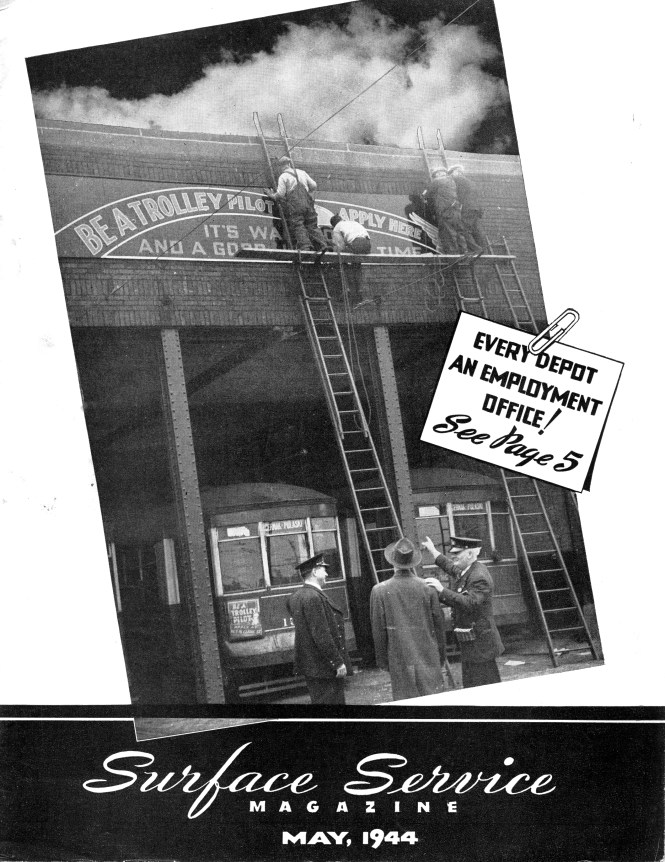
Surface Service

We recently acquired 14 more copies of Surface Service, the Chicago Surface Lines employee magazine, with the following dates:

1942 – May, June, August
1943 – December
1944 – January, March, May, June
1945 – January, February, March
1946 – February, August, September

Surface Service was published from the early 1920s until CSL became part of the Chicago Transit Authority on October 1, 1947, a period of about 25 years. These magazines are full of interesting tidbits of information that are invaluable for historical research.

In particular, most of these issues cover the World War II era, and show the various way the CSL helped support the war effort. For example, unless you read one of these magazines, you would have no way of knowing that the War Bond car, shown on the August, 1942 cover, was used on 17 different routes throughout the city, one week at a time. The routes and dates are listed, and this information can be used to date photographs showing the car, a “rolling billboard,” in service.

These 14 issues are each 16 pages, meaning we have added 224 additional pages of information to our E-Book, Chicago’s PCC Streetcars: The Rest of the Story, which is available through our Online Store.

The June 1942 cover is quite interesting, as it features a rare “bird’s eye view” of the loop at Madison and Austin, with no less than five pre-war PCCs on hand. The radio tower was a recent addition. Radio communications back then did not involve streetcar or bus operators, but were used by supervisors.

The radio tower is still there in the middle of the loop, which has since been shortened by lopping off the portion to the west. Now, buses turn north on Austin Boulevard before entering the loop, which is no longer “U” shaped, but more like an “L”.

Adventures in Restoration

We recently purchased an original Ektachrome slide shot in December, 1960 by Earl W. Clark, which has faded badly to red. It turned out that some of the dye layers on early Ektachrome films were very unstable. (A similar problem, interestingly, also happened to some pre-1940 Kodachrome slides.)

The dye layers on today’s slide films have excellent longevity.

The late Bradley Criss was an expert at restoring these types of images. He once gave me some advice on how to best approach this.

Most people would probably scan the slide, then try to color correct it. But since there is such an extreme amount of correction involved, he recommended color correcting in the scanning stage as a first step.

Here are some pictures showing the various steps along the way towards restoring this slide to something like its original appearance. I’m not saying that the results are perfect by any means, but they are a vast improvement.

Before tools like scanners and Photoshop were available, about the best you could do with an image like this was to convert it to black-and-white.

Often, a photographer’s slides don’t come up on the open market until they have passed from the scene. I was hoping this was not the case for Earl W. Clark. I made some inquiries, and it appears that Mr. Clark, the dean of Cincinnati railfans, is still very much on the scene, as this report from last Fall would indicate.

I would imagine Mr. Clark is overjoyed that streetcars have returned to Cincinnati.

-David Sadowski

This is an early Ektachrome slide that has faded badly over the years due to having unstable dyes. They longevity of such dyes has been greatly improved since. The green and blue layers have badly faded, leaving very little but the red. This is how the slide scanned without any color correction.

This is an early Ektachrome slide that has faded badly over the years due to having unstable dyes. They longevity of such dyes has been greatly improved since. The green and blue layers have badly faded, leaving very little but the red. This is how the slide scanned without any color correction.

Before scanning the slide again, this time I manipulated the colors using adjustments in the scanning software. This gave me a "leg up" when starting work in Photoshop, which was the next step.

Before scanning the slide again, this time I manipulated the colors using adjustments in the scanning software. This gave me a “leg up” when starting work in Photoshop, which was the next step.

Here is what the slide looked like after using Photoshop's Auto Color feature. The color is still not right, having a rather magenta (red-blue) cast. Green is the opposite of magenta. You can either reduce the amount of magenta or increase the amount of green-- it all amounts to the same thing.

Here is what the slide looked like after using Photoshop’s Auto Color feature. The color is still not right, having a rather magenta (red-blue) cast. Green is the opposite of magenta. You can either reduce the amount of magenta or increase the amount of green– it all amounts to the same thing.

Here, in Photoshop, I am adjusting the color by using the sliders until the overall color looks right. Notice there are three sets of color opposites.

Here, in Photoshop, I am adjusting the color by using the sliders until the overall color looks right. Notice there are three sets of color opposites.

Here, I am increasing the color saturation in Photoshop to make up for dye fading.

Here, I am increasing the color saturation in Photoshop to make up for dye fading.

Since 2/3rds of the dye layers on this slide have faded badly, the overall level of color saturation has to be increased in order to restore the proper amount of contrast.

Since 2/3rds of the dye layers on this slide have faded badly, the overall level of color saturation has to be increased in order to restore the proper amount of contrast.

The slide has bee brightened up somewhat and I have removed some of the crud that has accumulated on it over the decades. However, ultimately I decided this was slightly too light.

The slide has bee brightened up somewhat and I have removed some of the crud that has accumulated on it over the decades. However, ultimately I decided this was slightly too light.

The end result. This photo of Chicago, Aurora & Elgin wood car 315 was taken by Earl W. Clark in December 1960. Don's Rail Photos: "315 was built by Kuhlman Car Co in 1909, #404. It was modernized at an unknown date and sold to Rockhill Trolley Museum in 1962."

The end result. This photo of Chicago, Aurora & Elgin wood car 315 was taken by Earl W. Clark in December 1960. Don’s Rail Photos: “315 was built by Kuhlman Car Co in 1909, #404. It was modernized at an unknown date and sold to Rockhill Trolley Museum in 1962.”

Charles L. Tauscher in Memoriam

FYI, sad news to report. Charles L. Tauscher‘s niece Jennifer Fulbrook wrote on Facebook that he passed away on April 21st:

Hello. I am sorry for this somewhat off topic post. I know some of you were friends with my uncle (Chuck Tauscher) I wanted to let you know he passed away today after suffering a massive stroke last week.

We do not have any public memorials planned as of yet. Please share this post as you see fit.

Tauscher had a keen interest in history. He was one of the founders of the Omnibus Society of America and was also an excellent photographer. We used several of his pictures in CERA Bulletin 146.

My upcoming book Chicago Trolleys will also have a number of his pictures in it.

I believe he was about 76 years old.

Recent Correspondence

Greg Ross writes:

I’m a student at the University of Chicago, and I am currently working on a story for our student paper, the Chicago Maroon. The story is about the history of the former Garfield Green Line station, the oldest standing L station in the city. I’m writing to ask if you have any information about either the station of the Green Line (the Alley “L”) that I could use in my story. I’ve browsed your blog and would love to see any pictures you may have of the station as well. Please let me know if you would be available to talk.

Thank you for your time, and I hope to hear back!

I posted a picture of the Garfield station to the blog I did before this one (see CTA Red Line Reroute, July 13, 2013), but that is a picture anybody could take today. I am assuming you have already read the station history on Graham Garfield’s excellent web site www.chicago-l.org?

Perhaps some of our readers might have additional information that can help you.

Bill Downes writes:

This is way off the topic, but anyone have a link to an authoritative source regarding the issue dates of some West Towns transfers I have?? There are rather large numerals “22” and “23” superimposed on the body of transfer which shows direction of travel, month, route etc but no date or day of week!! If I had day of week and date could look at calendar and approximate year. Thanks.

An interesting question. Unfortunately, I do not know the answer. Perhaps one of our readers might be able to help, thanks.

Kenneth Muellner writes:

Just wanted to say how much I am enjoying your website. I’ve always had a soft spot for streetcars, interurbans, trolley buses and the like, and really enjoy your site. You mentioned that you grew up near Grand and Harlem, and I grew up not too far away at Addison and Oak Park. We had lots of family that lived over on Mont Clare Ave., just south of Diversey, and we were in the area a lot. I still remember being with my grandfather, waiting for my mother shopping in High Low on Harlem Avenue, and going over with him over to Caputo’s, which was just a garage at that time, with my grandfather telling him how to run his business!

My dumb question is about streetcars. I have a lot of books about them, but one thing I am unclear on is how did the streetcars turn at switches? Did the motorman have to go out of the car and manually move the switch, or was there some sort of remote control where they could switch the track, and then back again for cars following? I never have really understood how that worked.

Thanks again.

There are no dumb questions in my book. Thanks for asking.

Track switches can be hand thrown by the conductor or operator, who would have to stop, get off the streetcar in traffic, and use a long metal rod called a “switch iron.”  Eventually, motorized switches were developed for use in places where route changes were frequent.

Here’s an excellent explanation of such switches, written about the Brooklyn system, but I would imagine applicable elsewhere:

ELECTRIC TRACK SWITCHES

To avoid delaying service, electric track switches were installed at busy intersections. These switches were set by the Motorman while the car was in motion. The current in a contactor located on the trolley wire controlled the track switch. A car coasting under the contactor set the switch for the straight route. If the car’s controller was set on the first point when it passed under the contactor, the switch was set for the diverging route. Because the PCCs had high acceleration, their high starting current would have burned up the contactor. To correct this condition, a switch and a resistor was installed on a separate circuit. Therefore, all PCCs coasted when they approached an electric track switch. For the diverging route, the Motorman actuated this special switch on his desk.

-From the ERA Bulletin (Electric Railroader’s Association) , February 2009.

Max Hoffman writes:

Is Iowa Traction 727 serviceable at Mason City? Is it running in 2017? I would love to photograph it. We have a sister car at Illinois Railway Museum.

That’s an excellent question. Hopefully one of our readers may have an answer.

The Iowa Traction Railway, as it is now called, is a subsidiary of Progressive Rail. You might try contacting them directly.  To the best of my knowledge, ITR owns North Shore 727, but I do not know who maintains it or handles its use on charters.

Miles Beitler writes:

I attached three photos (originally color slides) of CTA trains. The 1972 Halsted photo shows a 2200 series train at the UIC-Halsted station. Note the Sears Tower under construction in the background. The 1972 Morgan photo shows a 6000 series train eastbound at Morgan siding. The last photo shows a 2000 series train in its original paint scheme at Wabash near Randolph. I took all of these photos so feel free to post them to your blog and you may use my name as well.

Thanks for sharing these with our readers.

One of our readers, who prefers to remain anonymous, writes:

I noticed that you recently posted about the CA&E and the North Shore Line, so I attached some old photos which might interest you.

The first three attached photos are from an old North Shore Line calendar. The first photo (CER-NSL Church St) was taken by Fred Borchert probably in the early 1920s and shows the NSL Evanston terminal with the Evanston L station in the background. The other two photos have self-explanatory captions.

I have no copyright information about these photos, but you know that Fred Borchert died long ago. The calendar was “produced by Joe L. Diaz, editor and publisher of The Street Railway Review, 1414 Elmdale, Chicago 60660”.

The fourth photo is of the Wells Street Bridge and the last photo is a CA&E train running on the old Garfield Park line. I’m not sure of the location but it could be the St Louis Avenue curve. These are from Model Transport magazine, June 1982. I did not find any copyright notice in this railfan publication.

Wells St Bridge — from the Chicago Dept of Public Works archives (so this should be public domain)

CA&E on Garfield Pk elevated circa 1940 — photographer unknown

Unfortunately, Joe L. Diaz is also no longer with us. Thanks for sharing!

Jack Bejna writes:

Hi David, Here are a few images of the CA&E ex WB&A trailers, except for 600 and 702 (I can’t find any images so far). I’ve always wondered why CA&E didn’t use them as motors instead of rebuilding them as trailers. Also, I’ve also sent an image of a CA&E caboose with part of the original dispatcher’s office in the background….still looking for s good shot! Thanks for the excellent Easter post; most enjoyable; another winner!

Many of our readers will recognize Mr. Bejna’s fantastic work from previous posts. We all appreciate seeing these great images that he has made look as if they were shot yesterday, through his hard work and talent.

Kenneth Gear writes:

Hi David,

The post office did a good job today and delivered the package containing the April 1982 issue of Traction & Models. That is two days earlier than expected. This is the issue with William Steventon’s article about recording railroad sounds. I’m sending it to you quickly so you can use it in the next Trolley Dodger post, if that was your intention.

The article does, as I had hoped, contain a photo of him trackside making a recording, three actually. It has a lot of very interesting information in it, some of which is about the Railroad Record Club specifically . Steventon tells of a few things that happened to him out in the field while recording sounds that were used on RRC LPs, how he recorded certain sounds, and why he chose the locations he recorded at. He talks about sounds recorded for records numbers 7, 4, and 18, and a few others.

He also talks about recording the sounds of CSS&SB locomotive number 1013. I think the recording should be on one of the LPs that you were just given.

Two of the photos show him and his group trackside getting ready to record the H&F at Lewistown, MD on January 3, 1954, could you have recently purchased the photos taken this day?

He also writes about recording sounds of the New York City subway, another recording that never made it to vinyl.

It is interesting to read that he felt that sound recordings were a valuable historic record, he was so right. Without his work, I would never had been able to hear the sounds of most of the railroad equipment he captured on tape.

Here is a PDF of the Steventon article mentioned above. Traction and Models magazine is long defunct (I could not find any record of issues after 1984.) As always, we are very grateful to Ken for tracking this down and making it available to our readers.

William A Steventon recording the compressor operation on North Shore car number 724 at Mundelein Station.

William A Steventon recording the compressor operation on North Shore car number 724 at Mundelein Station.

William Steventon and friends waiting to record the passing of a car on the Hagerstown & Frederick (Potomac Edison) near Bethel, MD Jan. 3 1954.

William Steventon and friends waiting to record the passing of a car on the Hagerstown & Frederick (Potomac Edison) near Bethel, MD Jan. 3 1954.

Kenneth Gear also writes:

I was thinking it might help our RRC info collecting efforts if you were to ask the readers of the blog to contribute any Railroad Record Club materials they may have. Ask if they would scan any newsletters, catalogs, advertisements, or correspondence and Email it to you or as comments to the post. You might also mention that we still need 3 of the records (#22 Buffalo Creek & Gauley, #31 Sound Scrapbook, Steam & #32 New York Central) and all of the samplers. With luck, this may bare some fruit.

As some of you may know, Kenneth Gear, a great friend of this blog, has been very helpful in tracking down many of the Railroad Record Club LPs and ephemera in our joint quest to document, as completely as possible, the RRC’s output and activities. Of the 42 or so different recordings issued by the RRC, we need only the three titles mentioned above to complete our efforts at digitally remastering them for a whole new generation of railfans.

We recently acquired three RRC titles (#19, 33 and 34), fully half the ones we were missing, and two of the three are traction recordings, which are far less numerous than steam. More details on these new CDs appear in the section below.

PS- We are also looking for the Sacramento Northern Electrics LP, and any other important out-of-print, “orphan works” traction recordings that we don’t already have.

Sacramento Northern Maintenance of Way car 302 at Mallard, California on November 29, 1953 on a Bay Area Electric Railroad Association fantrip. Don's Rail Photos says, "1020 was built by Hall-Scott Motor Car Co in 1913, as OA&E 1020. It became SF-S 1020 in 1920 and SN 1020 in 1928. It was renumbered as MW302 in 1941 and went to Western Railway Museum in 1962." (William R. Smith Photo)

Sacramento Northern Maintenance of Way car 302 at Mallard, California on November 29, 1953 on a Bay Area Electric Railroad Association fantrip. Don’s Rail Photos says, “1020 was built by Hall-Scott Motor Car Co in 1913, as OA&E 1020. It became SF-S 1020 in 1920 and SN 1020 in 1928. It was renumbered as MW302 in 1941 and went to Western Railway Museum in 1962.” (William R. Smith Photo)

Three New CD Collections

FYI, we have three new CD collections available:


RRC #19
Duluth, Missabe and Iron Range
# of Discs – 1
Price: $12.95

In steam days, the DM&IR was controlled by the U.S. Steel Co., and its main activity was the haulage of iron ore from the Missabe iron mines to the docks at Two Harbors and Duluth, Minnesota. The Iron Range 2-8-8-4 locomotives, simple articulated “Yellowstone” types, were among the largest U.S. locomotive designs. As with the Nickel Plate, the Iron Range used steam power long into the diesel era. The last revenue steam run took place in 1961, and these recordings were made between 1958 and 1960. Includes a very interesting sequence in a dispatcher’s office. Besides RRC #19, this disc includes the EP Sounds of Steam on the Iron Range.

Total time – 49:48


RRC #33 and 34
Chicago, South Shore & South Bend
(South Shore Line) Electric Freight
# of Discs – 1
Price: $14.95

Railroad Record Club #33 and 34
On September 14, 1962, William A. Steventon recorded South Shore Line electric freight locomotives 1012 and 1013 on a run between Michigan City and South Bend, Indiana. Originally, this was planned as a single LP disc with a switching scene on one side, and a road run on the other. As it turned out, the two locos, although similar, made substantially different sounds, so it was decided to issue two discs instead. Both are now included on a single compact disc, along with the original liner notes for each. Since Diesel replaced electric freight on the South Shore Line in 1981, these are sounds that are impossible to duplicate today.

Total time – 62:04


HC-FFNP
Steam in the High Country
Fast Freight on the Nickel Plate
# of Discs – 1
Price: $14.95

Steam in the High Country:
The land of mile high prairies and shining snow-capped mountains formed a dramatic backdrop for the sight and sound of the steam locomotive in action. Here is a tremendous contrast in power, from the giant Union Pacific #4-8-8-4, to the Denver and Rio Grande Western miniature Mikado, in a symphony of steam, steel and cinders. Featuring steam locomotives of the Union Pacific, Colorado & Southern, Great Western, Denver & Rio Grande Western, and the Burlington, recorded between 1957 and 1962.

Fast Freight on the Nickel Plate:
The New York, Chicago and St. Louis Railroad is perhaps better known by its official nickname, “The Nickel Plate Road.” The road’s main line ran from Buffalo to Chicago, with numerous branches into southern Ohio coal fields and a line to St. Louis. The main line closely paralleled the route of the New York Central, so the Nickel Plate had to offer superior service to attract business from the lines of the neighboring giant. The road lived up to its motto “Nickel Plate for high speed service.” Until early 1958 this line was serviced by a fleet of modern 2-8-4 Berkshire steam locomotives, being one of the last important main line jobs for steam power in the U.S. Anyone who has watched these fine engines in action, as they moved 100 plus cars of freight at a mile a minute or better speed, can attest to the fine job they did. It was only after many refinements and improvements that diesel locomotives became worthy replacements of the famous Berkshires heard here in recordings made in the early part of 1958.

Total time – 75:34

Chicago Trolleys

Work continues on our upcoming book Chicago Trolleys, which is now in the layout and proofreading stage. The expected publication date is September 25th of this year. We will keep you advised as things progress.

street-railwayreview1895-002

Help Support The Trolley Dodger

gh1

This is our 181st post, and we are gradually creating a body of work and an online resource for the benefit of all railfans, everywhere. To date, we have received over 280,000 page views, for which we are very grateful.

You can help us continue our original transit research by checking out the fine products in our Online Store.

As we have said before, “If you buy here, we will be here.”

We thank you for your support.

DONATIONS

In order to continue giving you the kinds of historic railroad images that you have come to expect from The Trolley Dodger, we need your help and support. It costs money to maintain this website, and to do the sort of historic research that is our specialty.

Your financial contributions help make this web site better, and are greatly appreciated.

An Easter Parade of Traction

The throngs of people in this June 1926 photograph were attending the Catholic Church's 28th International Eucharistic Congress in Mundelein. Note the variety of rail cars being used to move the masses. After the Congress ended, ridership on the North Shore Line's Mundelein-Libertyville branch was sparse enough that service was provided by a single city streetcar.

The throngs of people in this June 1926 photograph were attending the Catholic Church’s 28th International Eucharistic Congress in Mundelein. Note the variety of rail cars being used to move the masses. After the Congress ended, ridership on the North Shore Line’s Mundelein-Libertyville branch was sparse enough that service was provided by a single city streetcar.

As this is Easter weekend, here is a veritable “Easter Parade” of Illinois traction pictures for your enjoyment. No matter what your religious preference may be, we hope that you will not pass over them.

-David Sadowski

CTA 1767, signed for Route 58 - Ogden, is actually heading east on Randolph at Green Street in this early 1950s view.

CTA 1767, signed for Route 58 – Ogden, is actually heading east on Randolph at Green Street in this early 1950s view.

Randolph and Green Streets today.

Randolph and Green Streets today.

CSL 5644 is on Lincoln Avenue and signed to go to both Riverview Park and Harrison and State. 5644 was known as a Brill-American-Kuhlman car. Don's Rail Photos says, "5622 thru 5650 were built by Brill in 1909, #16952, for Southern Street Ry which was a subsidiary." (Southern Street Railway was one of the underlying companies that formed CSL.) Jim Huffman adds, "Probably a Riverview-Larrabee or aka Lincoln-Riverview car. Route Western & Roscoe crossover (later a loop west side of Western), EB to Damen, SB to Belmont, EB to Lincoln, SB to Larrabee thence into Downtown. Ended Sept 1947. A shuttle bus service on Roscoe to the Lincoln Ravenswood station remained for many years. Clybourn was another route that also at times that loop on Western, Clybourn’s actual crossover was at Western, but tracks continued north onto Western with switches into that loop. Western NB short turn cars also used that loop. At times there were cars from three routes in that loop. There were not that many turn-around loops with that many routes." (Joe L. Diaz Photo) Mike Franklin adds, "Looking NW on Clybourn Ave from the NE side of North Ave. The gasometer in the distance was one of two located between Marcey and Kingsbury Sts, just north of Willow St. Everything in this photo was razed sometime between 1955 and 1960. (Vol. 2 [various years] of Sanborn Fire Insurance Maps accounts for every building in the photo.) Thanks to Jim Huffman for his detailed explanation of the various routes."

CSL 5644 is on Lincoln Avenue and signed to go to both Riverview Park and Harrison and State. 5644 was known as a Brill-American-Kuhlman car. Don’s Rail Photos says, “5622 thru 5650 were built by Brill in 1909, #16952, for Southern Street Ry which was a subsidiary.” (Southern Street Railway was one of the underlying companies that formed CSL.) Jim Huffman adds, “Probably a Riverview-Larrabee or aka Lincoln-Riverview car. Route Western & Roscoe crossover (later a loop west side of Western), EB to Damen, SB to Belmont, EB to Lincoln, SB to Larrabee thence into Downtown. Ended Sept 1947. A shuttle bus service on Roscoe to the Lincoln Ravenswood station remained for many years. Clybourn was another route that also at times that loop on Western, Clybourn’s actual crossover was at Western, but tracks continued north onto Western with switches into that loop. Western NB short turn cars also used that loop. At times there were cars from three routes in that loop. There were not that many turn-around loops with that many routes.” (Joe L. Diaz Photo) Mike Franklin adds, “Looking NW on Clybourn Ave from the NE side of North Ave. The gasometer in the distance was one of two located between Marcey and Kingsbury Sts, just north of Willow St. Everything in this photo was razed sometime between 1955 and 1960. (Vol. 2 [various years] of Sanborn Fire Insurance Maps accounts for every building in the photo.) Thanks to Jim Huffman for his detailed explanation of the various routes.”

CSL 7005, still looking shiny, at the Madison-Austin loop. I would date this picture to circa 1937 as the paint has not yet dulled on the car.

CSL 7005, still looking shiny, at the Madison-Austin loop. I would date this picture to circa 1937 as the paint has not yet dulled on the car.

The same buildings are across the street from the east side of the Madison-Austin loop even today. But the flow of vehicles through the loop has been reversed, compared to how it was in streetcar days.

The same buildings are across the street from the east side of the Madison-Austin loop even today. But the flow of vehicles through the loop has been reversed, compared to how it was in streetcar days.

CTA Pullman 691 at Belmont and Central in November 1948. (Jack Gervais Photo)

CTA Pullman 691 at Belmont and Central in November 1948. (Jack Gervais Photo)

CSL 6200 on the Windsor Park line. This was a Multiple-Unit car. Don's Rail Photos adds, "6200 was built by CSL in 1924. It was rebuilt as one man service in 1932." Andre Kristopans adds, "One funny thing about this location, when the CTA started the automated stop announcements on the buses, the southbound stop, which is where the B&O crossing was a bit south of 83rd Place, is announced as “Commercial Avenue at Railroad crossing”, even though the tracks have been gone since the 1970’s sometime!" (Joe L. Diaz Photo)

CSL 6200 on the Windsor Park line. This was a Multiple-Unit car. Don’s Rail Photos adds, “6200 was built by CSL in 1924. It was rebuilt as one man service in 1932.” Andre Kristopans adds, “One funny thing about this location, when the CTA started the automated stop announcements on the buses, the southbound stop, which is where the B&O crossing was a bit south of 83rd Place, is announced as “Commercial Avenue at Railroad crossing”, even though the tracks have been gone since the 1970’s sometime!” (Joe L. Diaz Photo)

Here, CSL 2811 is outbound on the Riverdale line private right-of-way, headed for Michigan and 119th. (Joe L. Diaz Photo)

Here, CSL 2811 is outbound on the Riverdale line private right-of-way, headed for Michigan and 119th. (Joe L. Diaz Photo)

CSL 6238 on the 67-69-71 line. This was known as a Multiple-Unit car. Don's Rail Photos adds, "6238 was built by Lightweight Noiseless Streetcar Co in 1924. It was rebuilt (for) one man service in 1932."

CSL 6238 on the 67-69-71 line. This was known as a Multiple-Unit car. Don’s Rail Photos adds, “6238 was built by Lightweight Noiseless Streetcar Co in 1924. It was rebuilt (for) one man service in 1932.”

CTA Marmon trolley buses 9586 and 9594 at the North Avenue garage.

CTA Marmon trolley buses 9586 and 9594 at the North Avenue garage.

CTA Marmon trolley bus on North Avenue.

CTA Marmon trolley bus on North Avenue.

CTA trolley bus 9462 at the Cicero and Montrose loop. The McDonald's at rear says 9 billion hamburgers have been sold, which would help date this photo to perhaps the mid-1960s. I believe this was the first McDonald's in the City of Chicago.

CTA trolley bus 9462 at the Cicero and Montrose loop. The McDonald’s at rear says 9 billion hamburgers have been sold, which would help date this photo to perhaps the mid-1960s. I believe this was the first McDonald’s in the City of Chicago.

CTA trolley bus 9631 is westbound on Belmont at Cicero circa 1970.

CTA trolley bus 9631 is westbound on Belmont at Cicero circa 1970.

9462 at the Cicero and Montrose loop.

9462 at the Cicero and Montrose loop.

Illinois Central electric suburban cars 1125 and 1226 in downtown Chicago on July 17, 1965.

Illinois Central electric suburban cars 1125 and 1226 in downtown Chicago on July 17, 1965.

Don's Rail Photos says: "415 was built by St Louis Car Co in 1924, #1324, as CO&P (Chicago, Ottawa & Peoria) 64. It became C&IV (Chicago & Illinois Valley) 64 in 1929. It was rebuilt as IT (Illinois Terminal) 415 on September 16, 1934. and sold to Illinois Electric Railway Museum on October 19, 1956."

Don’s Rail Photos says: “415 was built by St Louis Car Co in 1924, #1324, as CO&P (Chicago, Ottawa & Peoria) 64. It became C&IV (Chicago & Illinois Valley) 64 in 1929. It was rebuilt as IT (Illinois Terminal) 415 on September 16, 1934. and sold to Illinois Electric Railway Museum on October 19, 1956.”

Chicago and Joliet Electric car 242, known as the "Ottawa," after the 1934 abandonment.

Chicago and Joliet Electric car 242, known as the “Ottawa,” after the 1934 abandonment.

As Loop ridership increased, platforms were extended to create more room to berth trains. Eventually, some stations on the Van Buren and Wells legs of the Loop had continuous platforms connecting them—which may have inspired continuous platforms in Chicago’s two first subways. Here, Randolph and Wells is being extended in the early 1920s to connect with Madison and Wells. We are looking north.

As Loop ridership increased, platforms were extended to create more room to berth trains. Eventually, some stations on the Van Buren and Wells legs of the Loop had continuous platforms connecting them—which may have inspired continuous platforms in Chicago’s two first subways. Here, Randolph and Wells is being extended in the early 1920s to connect with Madison and Wells. We are looking north.

Here, we are looking north on Wabash at Van Buren, near Tower 12, circa the 1940s.

Here, we are looking north on Wabash at Van Buren, near Tower 12, circa the 1940s.

This is the old State and Van Buren station on the Loop "L", looking east towards Tower 12. This station was closed in 1972 and demolished. It has since been replaced, due to its proximity to the Harold Washington Library.

This is the old State and Van Buren station on the Loop “L”, looking east towards Tower 12. This station was closed in 1972 and demolished. It has since been replaced, due to its proximity to the Harold Washington Library.

A snowy scene at Wabash and Lake, site of the tightest curve on the "L".

A snowy scene at Wabash and Lake, site of the tightest curve on the “L”.

CTA gate car 1050 at Howard on the Evanston shuttle.

CTA gate car 1050 at Howard on the Evanston shuttle.

We originally ran another version of this photo in our post Chicago Rapid Transit Photos, Part Five (Spetember 26, 2016), where it was identified as Noyes Street in Evanston looking south. This version of the photo has less cropping and is dated August 10, 1928. Work is underway on elevating this portion of the Evanston "L".

We originally ran another version of this photo in our post Chicago Rapid Transit Photos, Part Five (Spetember 26, 2016), where it was identified as Noyes Street in Evanston looking south. This version of the photo has less cropping and is dated August 10, 1928. Work is underway on elevating this portion of the Evanston “L”.

This is an inspection train at the Lake Street Transfer "L" station, which provided connections between the Lake Street "L", on the lower level, and the Metropolitan above. The higher level station was closed in February 1951, when the Dearborn-Milwaukee subway opened.

This is an inspection train at the Lake Street Transfer “L” station, which provided connections between the Lake Street “L”, on the lower level, and the Metropolitan above. The higher level station was closed in February 1951, when the Dearborn-Milwaukee subway opened.

CRT 1715 at Marion Street in Oak Park on the ground-level portion of the Lake Street "L". It is signed as a local and is about to head east. This car was originally built by St. Louis Car Conpany in 1903 for the Northwestern Elevated Railway as car 715 and was renumbered to 1715 in 1913.

CRT 1715 at Marion Street in Oak Park on the ground-level portion of the Lake Street “L”. It is signed as a local and is about to head east. This car was originally built by St. Louis Car Conpany in 1903 for the Northwestern Elevated Railway as car 715 and was renumbered to 1715 in 1913.

CTA 1780 heads up an "A" train at Marion Street in Oak Park. The ground-level portion of the Lake Street "L" was relocated onto the nearby C&NW embankment in 1962. This picture was probably taken between 1948 and 1955.

CTA 1780 heads up an “A” train at Marion Street in Oak Park. The ground-level portion of the Lake Street “L” was relocated onto the nearby C&NW embankment in 1962. This picture was probably taken between 1948 and 1955.

A CRT gate car on the Stock Yards branch of the "L".

A CRT gate car on the Stock Yards branch of the “L”.

This picture, taken on May 21, 1934, shows how the CRT Stock Yards "L" branch was extensively damaged by fire two days earlier. Service west of Halsted did not resume until January 16, 1935.

This picture, taken on May 21, 1934, shows how the CRT Stock Yards “L” branch was extensively damaged by fire two days earlier. Service west of Halsted did not resume until January 16, 1935.

The single-track Stock Yards loop.

The single-track Stock Yards loop.

CRT 4318 is headed for Westchester, a branch off the Garfield Park "L". This appears to be the 11th Avenue station in Maywood, and most likely, prior to 1943, when all the CRT's steel cars were diverted to run in the new State Street Subway.

CRT 4318 is headed for Westchester, a branch off the Garfield Park “L”. This appears to be the 11th Avenue station in Maywood, and most likely, prior to 1943, when all the CRT’s steel cars were diverted to run in the new State Street Subway.

CA&E 46 on the west end of a six-car train at Laramie Yards.

CA&E 46 on the west end of a six-car train at Laramie Yards.

CA&E 424 loops at DesPlaines Avenue circa 1953-57, with a Chicago Great Western freight train in the background. We are looking north.

CA&E 424 loops at DesPlaines Avenue circa 1953-57, with a Chicago Great Western freight train in the background. We are looking north.

The CA&E off-street terminal at Aurora. There is a sign indicating this is the new terminal, opening on December 31st (1939). Since there are trains in the station, I would date this picture to circa 1940. Previously, trains ran on city streets in downtown Aurora.

The CA&E off-street terminal at Aurora. There is a sign indicating this is the new terminal, opening on December 31st (1939). Since there are trains in the station, I would date this picture to circa 1940. Previously, trains ran on city streets in downtown Aurora.

This view of the CA&E Aurora terminal is from the early 1950s.

This view of the CA&E Aurora terminal is from the early 1950s.

The CA&E Wheaton station in the early 1950s.

The CA&E Wheaton station in the early 1950s.

A view of the CA&E Wheaton Yards.

A view of the CA&E Wheaton Yards.

This picture shows CA&E car 425 at Glen Oak on a Central Electric Railfans' Association fantrip. The date was September 2, 1940.

This picture shows CA&E car 425 at Glen Oak on a Central Electric Railfans’ Association fantrip. The date was September 2, 1940.

CA&E wood car 318, at right, is making a photo stop at Clintonville on the Elgin branch, during an early Central Electric Railfans' Association fantrip. Presumably the 415 at left is a regular service car.

CA&E wood car 318, at right, is making a photo stop at Clintonville on the Elgin branch, during an early Central Electric Railfans’ Association fantrip. Presumably the 415 at left is a regular service car.

A close-up of the previous picture.

A close-up of the previous picture.

Not-So-Recent Correspondence

We recently acquired a letter and some photographs that were sent by the late William E. Robertson (1920-2003) of Wilmette, Illinois to George (Campbell?):

Sep/22/1951

Dear George,

Here are a few photographs taken on the North Shore Line some years ago, hope they will be of general interest. Regret delay in posting them to you, after your promptness in (sending) Fort Dodge photos to me!

In two weeks I am taking a big eastern trip through Canada and New England where I hope to get many electric railway pictures. Will not be home until the opening of November, but still look for(ward to) your visit here. No other news for now.

Sincerely, Bill

Bill Robertson was part of the “Greatest Generation” of early railfans.  The letter does not say whether Mr. Robertson took these photos, but that’s a good inference.

Among other things, Bill Robertson was an inventor, and had a few patents in his name, including one for a “High-Speed Transportation System.” This must have had some utility, as it has been cited by several other later patents.

Chances are, Bill Robertson took all six pictures. The captions shown are his:

#1 Sweeper on Greenleaf Avenue in Wilmette, Ill., Shore Line Route. Jan/31/1940.

#1 Sweeper on Greenleaf Avenue in Wilmette, Ill., Shore Line Route. Jan/31/1940.

#2 Waukegan city car barn, North Chicago, Ill. This car long since scrapped, photo taken in September 1939.

#2 Waukegan city car barn, North Chicago, Ill. This car long since scrapped, photo taken in September 1939.

#3 Shore Line train, Greenleaf Avenue, Wilmette, Ill. Taken about 1944. Southbound.

#3 Shore Line train, Greenleaf Avenue, Wilmette, Ill. Taken about 1944. Southbound.

#4 North Chicago barns, Birney car that later went to Milwaukee, Wis. Scrapped in 1947. Photo taken in September 1939. Car shown in 2 at left.

#4 North Chicago barns, Birney car that later went to Milwaukee, Wis. Scrapped in 1947. Photo taken in September 1939. Car shown in 2 at left.

#5 Chicago Limited in Milwaukee, date unknown, but after 1939.

#5 Chicago Limited in Milwaukee, date unknown, but after 1939.

#6 Worst North Shore wreck, at Burlington Road, Kenosha, Wis. Sunday night, Feb. 23, 1930. 11 killed, 100 injured and one car so smashed it was never returned to service (No. 745).

#6 Worst North Shore wreck, at Burlington Road, Kenosha, Wis. Sunday night, Feb. 23, 1930. 11 killed, 100 injured and one car so smashed it was never returned to service (No. 745).

Recent Correspondence

Jack Bejna writes:

Hi Dave,

Another great post! I can’t imagine how you find the time to put these excellent posts together; I’m just glad you do! If your readers haven’t sat in front of a computer Photoshopping for hours on end to improve a single image they can’t possibly know how much work goes into your posts. I’m sending along some images of the Wheaton depot and shop areas.

Thanks for all the wonderful photos you have shared with our readers. You do a fantastic job! I appreciate your kind words.

North Shore Line Abandonment Petition

In 1962, the Chicago, North Shore & Milwaukee Railway petitioned the Interstate Commerce Commission to abandon the entire interurban. The railroad convinced the ICC that there was no hope to restore profitability in this era before government subsidies. The last trains ran in the early hours of January 21, 1963.

There were various groups trying to save the railroad. This document, published by the North Shore Line, tends to undercut various arguments made by these outside groups. An impression is conveyed that operations were already quite lean, and that further significant cost savings were not realistic.

In sum, the only thing that could have saved the interurban at this stage would have been subsidies. That shouldn’t be much of a surprise. The Chicago Transit Authority had reached the same conclusion in the late 1950s, and it is only due to such subsidies, staring in the mid-1960s, that we have any public transit to speak of in this country today.

At any rate, this makes fascinating reading for North Shore Line fans.

-David Sadowski

Finally, Tom Morrow writes:

An Electric Transit Easter Parade cannot be complete without Pullman 441 from Dayton. Circa 1962.

Photo by Cliff Scholes.

Take care.

Chicago Trolleys

Work continues on our upcoming book Chicago Trolleys, which is now in the layout and proofreading stage. Lots of work has been done on the text, and the final selection of photos has been made. We will keep you advised as things progress.

street-railwayreview1895-002

Help Support The Trolley Dodger

gh1

This is our 180th post, and we are gradually creating a body of work and an online resource for the benefit of all railfans, everywhere. To date, we have received over 272,000 page views, for which we are very grateful.

You can help us continue our original transit research by checking out the fine products in our Online Store.

As we have said before, “If you buy here, we will be here.”

We thank you for your support.

DONATIONS

In order to continue giving you the kinds of historic railroad images that you have come to expect from The Trolley Dodger, we need your help and support. It costs money to maintain this website, and to do the sort of historic research that is our specialty.

Your financial contributions help make this web site better, and are greatly appreciated.

Chicago Surface Lines Photos, Part Six

The date is October 21, 1956, and the occasion is a weekend fantrip using red Pullman 225 and postwar PCC 4406. We have posted other photos from this fantrip before. By this time, Chicago only had two streetcar lines left, and they only operated on weekdays. Car 225 is one of three Pullmans that were saved, and it is now at the Seashore Trolley Museum in Maine. Bob Lalich adds, "The photo of red Pullman 225 on a fan trip was taken at 18th and Clark. The car is SB." The church was called Old St. John's, and was demolished around 1962.

The date is October 21, 1956, and the occasion is a weekend fantrip using red Pullman 225 and postwar PCC 4406. We have posted other photos from this fantrip before. By this time, Chicago only had two streetcar lines left, and they only operated on weekdays. Car 225 is one of three Pullmans that were saved, and it is now at the Seashore Trolley Museum in Maine.
Bob Lalich adds, “The photo of red Pullman 225 on a fan trip was taken at 18th and Clark. The car is SB.” The church was called Old St. John’s, and was demolished around 1962.

The same location today. The large shadow is from an "L" extension that did not exist when the previous picture was taken. It was built in 1969 for the Dan Ryan line and is now used by the Orange Line.

The same location today. The large shadow is from an “L” extension that did not exist when the previous picture was taken. It was built in 1969 for the Dan Ryan line and is now used by the Orange Line.

Here is another generous helping of classic Chicago streetcar photos. They date to the latter part of the CSL era as well as the early days of its successor, the Chicago Transit Authority. (We also have a trolley bus photo.)

As always, if you can help identify locations, or have interesting facts or reminiscences to add, don’t hesitate to drop us a line. You can leave comments on this post, or write us directly at:

thetrolleydodger@gmail.com

FYI, there will be additional posts in this series coming up in the near future, so watch this space. To see previous posts, use the search window on this page.

-David Sadowski


Help Support The Trolley Dodger

gh1

This is our 122nd post, and we are gradually creating a body of work and an online resource for the benefit of all railfans, everywhere. To date, we have received over 128,000 page views, for which we are very grateful.

You can help us continue our original transit research by checking out the fine products in our Online Store. You can make a donation there as well.

As we have said before, “If you buy here, we will be here.”

We thank you for your support.


New From Trolley Dodger Press:

P1060517

American Streetcar R.P.O.s: 1893-1929

Mainline Railway Post Offices were in use in the United States from 1862 to 1978 (with the final year being operated by boat instead of on rails), but for a much briefer era, cable cars and streetcars were also used for mail handling in the following 15 cities*:

Baltimore
Boston
Brooklyn
Chicago
Cincinnati
Cleveland
New Bedford, Massachusetts
New York City
Philadelphia
Pittsburgh
Rochester, New York
St. Louis
San Francisco
Seattle
Washington, D.C.


*As noted by some of our readers, this list does not include interurban RPOs.

Our latest E-book American Streetcar R.P.O.s collects 12 books on this subject (over 1000 pages in all) onto a DVD data disc that can be read on any computer using Adobe Acrobat Reader, which is free software. All have been out of print for decades and are hard to find. In addition, there is an introductory essay by David Sadowski.

The rolling stock, routes, operations, and cancellation markings of the various American street railway post office systems are covered in detail. The era of the streetcar R.P.O. was relatively brief, covering 1893 to 1929, but it represented an improvement in mail handling over what came before, and it moved a lot of mail. In many places, it was possible to deposit a letter into a mail slot on a streetcar or cable car and have it delivered across town within a short number of hours.

These operations present a very interesting history, but are not well-known to railfans. We feel they deserve greater scrutiny, and therefore we are donating $1 from each sale of this item to the Mobile Post Office Society, in support of their efforts.

# of Discs – 1
Price: $19.95


CTA 9193 is on what is billed as "Chicago's first trackless trolley special," March 2, 1958. Andre Kristopans: "Trolleybus 9193 is on Kedzie just north of the Sanitary & Ship Canal (about 33rd). Bridge is IC Iowa Division, background bridge is Chicago & Illinois Western. Clue was the big tank to the right. 1938 aerial photo shows this tank. Note how little traffic there is on Sunday!" The occasion was the very first Omnibus Society of America fantrip, which used a prewar trolley bus on south side areas where they had not been used in service.

CTA 9193 is on what is billed as “Chicago’s first trackless trolley special,” March 2, 1958. Andre Kristopans: “Trolleybus 9193 is on Kedzie just north of the Sanitary & Ship Canal (about 33rd). Bridge is IC Iowa Division, background bridge is Chicago & Illinois Western. Clue was the big tank to the right. 1938 aerial photo shows this tank. Note how little traffic there is on Sunday!” The occasion was the very first Omnibus Society of America fantrip, which used a prewar trolley bus on south side areas where they had not been used in service.

The same location today, approximately 3374 S. Kedzie. There is an incline at this point leading up a bridge, behind the photographer, going over the Sanitary & Ship Canal.

The same location today, approximately 3374 S. Kedzie. There is an incline at this point leading up a bridge, behind the photographer, going over the Sanitary & Ship Canal.

CTA 5426 is on route 8 at Halsted and Lake, having just passed the "L". The National Cash Register Company was located at 178 N. Halsted, just south of the "L", so we are looking north.

CTA 5426 is on route 8 at Halsted and Lake, having just passed the “L”. The National Cash Register Company was located at 178 N. Halsted, just south of the “L”, so we are looking north.

The same scene today is almost unrecognizable.  National Cash Register's former location is now a parking lot.  The "L" station at Halsted was closed in 1994, during the Green Line rebuild, and demolished in 1996.  It was replaced, more or less, by the Morgan station two blocks west, which opened in 2012.  Chicago's downtown is moving west and this area is undergoing rapid change.

The same scene today is almost unrecognizable. National Cash Register’s former location is now a parking lot. The “L” station at Halsted was closed in 1994, during the Green Line rebuild, and demolished in 1996. It was replaced, more or less, by the Morgan station two blocks west, which opened in 2012. Chicago’s downtown is moving west and this area is undergoing rapid change.

Chicago and Calumet District Transit Company car 59, built by St. Louis Car Company in 1901. Joint service to Hammond, Whiting, and East Chicago, Indiana was operated with the Chicago Surface Lines until June 9, 1940.

Chicago and Calumet District Transit Company car 59, built by St. Louis Car Company in 1901. Joint service to Hammond, Whiting, and East Chicago, Indiana was operated with the Chicago Surface Lines until June 9, 1940.

CTA Sedan 3337 is southbound on Wabash for route 4 - Cottage Grove in the early 1950s.

CTA Sedan 3337 is southbound on Wabash for route 4 – Cottage Grove in the early 1950s.

CTA 1771 says it is on route 60 - Blue Island in this early 1950s photo. But, as Andre Kristopans notes, "Look carefully – this is on Lake near Austin! Destination sign reads “Lake-Austin”, route # sign is set wrong!" (Walter Hulseweder Photo)

CTA 1771 says it is on route 60 – Blue Island in this early 1950s photo. But, as Andre Kristopans notes, “Look carefully – this is on Lake near Austin! Destination sign reads “Lake-Austin”, route # sign is set wrong!” (Walter Hulseweder Photo)

The same location today. This is around 5994 W. Lake.

The same location today. This is around 5994 W. Lake.

CTA 5304 is eastbound on the private right-of-way at the west end of route 63, followed by prewar PCC 4002. Note how 5304 is using the front trolley pole, reversed. (R. J. Anderson Photo)

CTA 5304 is eastbound on the private right-of-way at the west end of route 63, followed by prewar PCC 4002. Note how 5304 is using the front trolley pole, reversed. (R. J. Anderson Photo)

The same location today. This is about 5938 W. 63rd Place. As you can see, the middle building, once a storefront, has been converted to residential. That explains why it goes all the way out to the sidewalk. The bungalow at right looks much as it did, while the building at left has had its top redone at some point, due to deterioration of the brick, as you can see on the side of the building.

The same location today. This is about 5938 W. 63rd Place. As you can see, the middle building, once a storefront, has been converted to residential. That explains why it goes all the way out to the sidewalk. The bungalow at right looks much as it did, while the building at left has had its top redone at some point, due to deterioration of the brick, as you can see on the side of the building.

CTA 928 is on route 47 in this September 2, 1949 view. Andre Kristopans: "at end of line at 47th and Kedzie."

CTA 928 is on route 47 in this September 2, 1949 view. Andre Kristopans: “at end of line at 47th and Kedzie.”

47th and Kedzie today. One building is still there, but the top has been redone.

47th and Kedzie today. One building is still there, but the top has been redone.

CTA salt spreader AA105, formerly car 2854, at 69th and Ashland. This car was scrapped on February 17, 1954. (C. Edward Hedstrom Collection)

CTA salt spreader AA105, formerly car 2854, at 69th and Ashland. This car was scrapped on February 17, 1954. (C. Edward Hedstrom Collection)

#28 Stony Island cars also went to the Pier at times. After Indiana & Stony went Bus, Cottage (for awhile) was extended to Grand & Wabash to State, but not to the Pier.

In this September 12, 1951 view, CTA 982 is heading south at about 400 N. Wabash, approaching the bridge over the Chicago River. The Silver Frolics nightclub at rear, said to be run by The Outfit, closed in the early 1960s and became the second location of the famous Chez Paree. (C. Edward Hedstrom, Jr. Photo) Jim writes: ‘This is a route #38 Indiana car from Navy Pier to 51st Street its south terminal. It is not a 51st St car.
#28 Stony Island cars also went to the Pier at times. After Indiana & Stony went Bus, Cottage (for awhile) was extended to Grand & Wabash to State, but not to the Pier.
Cottage used the #38 Short turn front roll sign for Wabash-Grand & PCC cars were used.”

There is a modern parking garage on the site of the old Silver Frolics on Wabash today.

There is a modern parking garage on the site of the old Silver Frolics on Wabash today.

CTA 6180 is at 43rd and Oakenwald on August 8, 1953, the last day of streetcar service on the 43rd-Root Street line. Note the Illinois Central station at rear. (C. Edward Hedstrom Photo)

CTA 6180 is at 43rd and Oakenwald on August 8, 1953, the last day of streetcar service on the 43rd-Root Street line. Note the Illinois Central station at rear. (C. Edward Hedstrom Photo)

43rd and Oakenwald today.

43rd and Oakenwald today.

CTA 5508 at 79th and Western on May 29, 1949. That looks like a 1948-50 Packard at left, which some have nicknamed the "pregnant elephant" styling. We can catch a glimpse of the nearby CTA turnback loop for route 49 - Western at right. (John F. Bromley Collection)

CTA 5508 at 79th and Western on May 29, 1949. That looks like a 1948-50 Packard at left, which some have nicknamed the “pregnant elephant” styling. We can catch a glimpse of the nearby CTA turnback loop for route 49 – Western at right. (John F. Bromley Collection)

CTA 6236 at 71st and California on the 67-69-71 route on May 29, 1949. (John F. Bromley Collection)

CTA 6236 at 71st and California on the 67-69-71 route on May 29, 1949. (John F. Bromley Collection)

CTA 3266 at 71st and California on the 67-69-71 route on May 29, 1949. (John F. Bromley Collection)

CTA 3266 at 71st and California on the 67-69-71 route on May 29, 1949. (John F. Bromley Collection)

CTA work car R202 at 93rd and Drexel on December 30, 1947. (J. William Vigrass Photo) Andre Kristopans: "R202 is a sand car. It was used to deliver sand to the sand boxes that were located at most terminals and other places where streetcars might encounter slippery conditions. Remember, in the 1950’s streets were not salted, and all that was plowed was basically the car tracks, using mostly sweepers."

CTA work car R202 at 93rd and Drexel on December 30, 1947. (J. William Vigrass Photo) Andre Kristopans: “R202 is a sand car. It was used to deliver sand to the sand boxes that were located at most terminals and other places where streetcars might encounter slippery conditions. Remember, in the 1950’s streets were not salted, and all that was plowed was basically the car tracks, using mostly sweepers.”

CSL 2802 is on Anthony Avenue at Commercial Avenue in this July 13, 1941 photo. Note the Pennsylvania Railroad station at rear. (John F. Bromley Collection) Bob Laich: "The building immediately behind CSL 2802 on Anthony Avenue was PRR’s South Chicago freight station, which was built at street level. The platform for the South Chicago passenger station can be seen on the elevation in the right background." Andre Kristopans adds, "something odd here – note “Special” sign in front window. Appears to be a charter waiting for its party off the PRR." This must be Central Electric Railfans' Association fantrip #35, which used this car on that date.

CSL 2802 is on Anthony Avenue at Commercial Avenue in this July 13, 1941 photo. Note the Pennsylvania Railroad station at rear. (John F. Bromley Collection) Bob Laich: “The building immediately behind CSL 2802 on Anthony Avenue was PRR’s South Chicago freight station, which was built at street level. The platform for the South Chicago passenger station can be seen on the elevation in the right background.” Andre Kristopans adds, “something odd here – note “Special” sign in front window. Appears to be a charter waiting for its party off the PRR.” This must be Central Electric Railfans’ Association fantrip #35, which used this car on that date.

CSL 3212 heads up the line-up at Archer Station (car house) on October 16, 1946. (John F. Bromley Collection)

CSL 3212 heads up the line-up at Archer Station (car house) on October 16, 1946. (John F. Bromley Collection)

CSL 3217 is on route 73 - Armitage on July 1, 1946. (John F. Bromley Collection) Andre Kristopans: "EB passing Mozart Park at Armitage and Avers."

CSL 3217 is on route 73 – Armitage on July 1, 1946. (John F. Bromley Collection) Andre Kristopans: “EB passing Mozart Park at Armitage and Avers.”

CSL 5814 (route 4 - Cottage Grove) is southbound on Wabash at Roosevelt Road on June 13, 1947. At rear, you can see where the Roosevelt Road streetcar line was extended to the Museum Loop for the 1933-34 world's fair (A Century of Progress). (J. William Vigrass Photo)

CSL 5814 (route 4 – Cottage Grove) is southbound on Wabash at Roosevelt Road on June 13, 1947. At rear, you can see where the Roosevelt Road streetcar line was extended to the Museum Loop for the 1933-34 world’s fair (A Century of Progress). (J. William Vigrass Photo)

Wabash and Roosevelt Road today. Since the previous picture was taken, Roosevelt was extended east, in roughly the same location as the old CSL viaduct over the Illinois Central.

Wabash and Roosevelt Road today. Since the previous picture was taken, Roosevelt was extended east, in roughly the same location as the old CSL viaduct over the Illinois Central.

CTA 6034 is at Kedzie and Bryn Mawr, the north end of route 17, on April 16, 1949. (John F. Bromley Collection)

CTA 6034 is at Kedzie and Bryn Mawr, the north end of route 17, on April 16, 1949. (John F. Bromley Collection)

CTA 5802 in August 1948 at one of the Stations (car houses) serving the Cottage Grove line. As you can see, at one time CSL (and CTA) were very much interested in landscaping and beautification. (Carl Hehl Photo) Bob Lalich: "CTA 5802 in August 1948 was taken at the Burnside car barn. The IC tracks can be seen in the background. There was an article about the Burnside car barn gardens in First & Fastest a couple of years ago." Andre Kristopans adds, "definitely the back yard at Burnside."

CTA 5802 in August 1948 at one of the Stations (car houses) serving the Cottage Grove line. As you can see, at one time CSL (and CTA) were very much interested in landscaping and beautification. (Carl Hehl Photo) Bob Lalich: “CTA 5802 in August 1948 was taken at the Burnside car barn. The IC tracks can be seen in the background. There was an article about the Burnside car barn gardens in First & Fastest a couple of years ago.” Andre Kristopans adds, “definitely the back yard at Burnside.”

CSL 1933 at Chicago Avenue and Lake Shore Drive on May 12, 1947. (John F. Bromley Collection)

CSL 1933 at Chicago Avenue and Lake Shore Drive on May 12, 1947. (John F. Bromley Collection)

CSL 287 on route 52, Kedzie-California. (John Buff Photo) Andre Kristopans: "287 looks like Kedzie at Marquette. Note trolley wire tensioners behind car that would indicate near a terminal."

CSL 287 on route 52, Kedzie-California. (John Buff Photo) Andre Kristopans: “287 looks like Kedzie at Marquette. Note trolley wire tensioners behind car that would indicate near a terminal.”

Although the photo says this is Madison, that sure looks like Chicago Union Station, which means car 701 is probably on Adams instead, heading east. (B. H. Nichols Photo) Bob Lalich: "I agree with your comment, car 701 is passing CUS on Adams." Andre Kristopans: "701 should be on Adams EB at Canal."

Although the photo says this is Madison, that sure looks like Chicago Union Station, which means car 701 is probably on Adams instead, heading east. (B. H. Nichols Photo) Bob Lalich: “I agree with your comment, car 701 is passing CUS on Adams.” Andre Kristopans: “701 should be on Adams EB at Canal.”

Adams and Canal today.

Adams and Canal today.

CTA 3250 is at the end of the line on route 67. The presence of "wings" on this car would indicate this car has probably been repainted green. (John Buff Photo)

CTA 3250 is at the end of the line on route 67. The presence of “wings” on this car would indicate this car has probably been repainted green. (John Buff Photo)

CSL Sedan 3343 at around 7740 S. Vincennes Avenue on December 1, 1940, passing South Shops.

CSL Sedan 3343 at around 7740 S. Vincennes Avenue on December 1, 1940, passing South Shops.

The same area today.

The same area today.

CSL Red Cross tribute car near the Wrigley Building in June 1944. This car was in the 1700-series. (Gordon Lloyd Photo)

CSL Red Cross tribute car near the Wrigley Building in June 1944. This car was in the 1700-series. (Gordon Lloyd Photo)

CTA 5421 at South Shops on May 20, 1951.

CTA 5421 at South Shops on May 20, 1951.

CTA Pullman 848 at South Shops on May 20, 1951

CTA Pullman 848 at South Shops on May 20, 1951.

CSL 3132 on Broadway-State. Andre Kristopans adds, "just a feeling based on background buildings, but I’ll bet it’s on 119th between Halsted and Michigan." (Comparison with other photos indicates the location is most likely 119th and Morgan.)

CSL 3132 on Broadway-State. Andre Kristopans adds, “just a feeling based on background buildings, but I’ll bet it’s on 119th between Halsted and Michigan.” (Comparison with other photos indicates the location is most likely 119th and Morgan.)

Tokens of Our Esteem

The North Shore Line Milwaukee terminal in January 1963.

The North Shore Line Milwaukee terminal in January 1963.

We’ve reached our one-year anniversary, and have successfully renewed our Internet domain for another year, thanks to your generous contributions. Over the past year, many people have made contributions here, and not always financial.

I like to think of The Trolley Dodger as a place where we can all share information, discuss various topics and learn things together. As I’ve said before, I learn a lot from our readers and the things they choose to share with us. Coming here is like taking a stroll through a curiosity shop, and today we have lots of curios to share with you.

With the 53rd anniversary of the abandonment of the North Shore Line coming up on Thursday (the 21st), we have included a few pictures from the final days of that great electric interurban railway that once ran between Chicago and Milwaukee.

If you can shed any light on some of today’s mysteries, we would love to hear from you. You can make a comment on this page or drop us a line directly at:

thetrolleydodger@gmail.com

Thanks.

-David Sadowski

PS- We will continue our birthday celebration with another collection of great images in our next post, so watch this space.

Thanks to the generous donations from our readers, we have renewed our domain for another year. The various photos in today's post are but tokens of our esteem.

Thanks to the generous donations from our readers, we have renewed our domain for another year. The various photos in today’s post are but tokens of our esteem.


Help Support The Trolley Dodger

gh1

This is our 112th post, and we are gradually creating a body of work and an online resource for the benefit of all railfans, everywhere. To date we have received 114,000 page views from over 32,000 visitors.

You can help us continue our original transit research by checking out the fine products in our Online Store. You can make a donation there as well.

As we have said before, “If you buy here, we will be here.”

We thank you for your support.


More Off-Street Loops

Andre Kristopans has a few additions to the very comprehensive list of Chicago’s off-street streetcar and bus turnaround loops he shared with us recently:

A few additions:

Roosevelt/Monitor – abandoned 09/28/08 when lease expired and renewal could not be negotiated

Madison/Springfield – 07/16/1890 out 12/13/53 originally for cable cars

118th/Burley – 4/8/45 to 7/1/47 – this was an odd situation. Both 118th and Burley were “dedicated streets”, but only Burley was paved. the “terminal” which had been a passing siding, was thus on open track. In addition, after 10/21/46, when Ewing-Brandon was bussed, only the South Chicago cars ended there, basically in the middle of nowhere, next to a tavern.

Canal between Harrison and Polk – 2/7/72 to 10/1/81 – an exclusive counterflow lane for Taylor/Sedgwick buses after the Polk St bridge was closed.

Cortland/Paulina – 9/1/47 to 4/17/59 – apron of old Noble Carhouse used by Southport buses until it was about to be torn down

Pulaski/21st – 4/26/04 to 6/16/08 – part of rebuilt Pulaski L station, not used after Ogden bus cut back to California

Blue Island/Leavitt 7/27/1893 to 7/20/06 – terminal for Blue Island cable cars adjacent to Blue Island carhouse

Corcoran/Menard – 10/26/27 to 5/19/47 – CMC is said to have had an off-street terminal here for Washington buses, but no good description has survived. 1938 aerial photo shows nothing obvious, so it might have involved wyeing by backing into a driveway.

Another subcategory– Counterflow lanes:

Madison between Desplaines and Michigan, Washington between Michigan and Jefferson 9/13/81 to 9/8/85

Adams between Jefferson and Michigan, Jackson between Michigan and Jefferson 8/31/80 to 4/20/86 (note – one block on Adams between Jefferson and Clinton not put into use until 2/1/81 account construction at the corner of Jefferson and Adams)

Canal between Randolph and Washington (NW Station) 6/22/64, extended to Lake St 7/20/81 to 8/5/87

Canal between Adams and Jackson (Union Station) 5/14/69, moved to NB exclusive lane on east side of Canal 8/31/80, returned to SB on west side of Canal 4/20/86. (note – replaced use of River Drive between Adams and Jackson which had been used since 6/22/64, however River Drive was actually a cab drive and therefore not an “off street terminal” in the strict sense, even though cars were not supposed to use it.


About that previous list, Daniel Joseph writes:

The only addition I can add to this complete list is the terminal on Sherman between Church and Davis inherited from Evanston Bus Company.


Andre replies:

Don’t know much about it. Basically, EBC loaded along regular curb until city of Evanston “streetscaped” the street in late 60’s or so, leaving a short piece of original curb for buses to load while rest of street in the two blocks between Clark and Davis was substantially narrowed and sidewalks widened. Orrington was done at the same time, as were parts of Church and Davis. Last buses that could have used the cut-out would have been the N201. Sort of what was done much later to Benson between Church and Davis. The “bus lane” is the original right lane.


The North Shore Line in January 1963, shortly before the end.

The North Shore Line in January 1963, shortly before the end.

North Shore Line freight loco 459 heads up a train in January 1963.

North Shore Line freight loco 459 heads up a train in January 1963.

A Silverliner and an Electroliner at the North Shore Line's Milwaukee terminal in January 1963.

A Silverliner and an Electroliner at the North Shore Line’s Milwaukee terminal in January 1963.

An Electroliner on the Chicago "L" in July 1962. Not sure of the exact location, but I assume this is Roosevelt Road where the NSL had free reign between 1949 and 1963 (CTA trains ran through the nearby subway then).

An Electroliner on the Chicago “L” in July 1962. Not sure of the exact location, but I assume this is Roosevelt Road where the NSL had free reign between 1949 and 1963 (CTA trains ran through the nearby subway then).

CNS&M electric locos 458 and 455 in July 1962.

CNS&M electric locos 458 and 455 in July 1962.

North Shore Line 712 at Roosevelt Road in July 1962.

North Shore Line 712 at Roosevelt Road in July 1962.

Ad touting 349 new trolley coaches ordered for the Chicago Transit Authority, 1951.

Ad touting 349 new trolley coaches ordered for the Chicago Transit Authority, 1951.

An unusual Chicago Surface Lines supervisor's badge just sold for $80 on eBay. I was not the buyer.

An unusual Chicago Surface Lines supervisor’s badge just sold for $80 on eBay. I was not the buyer.

cslbadge2

cslbadge3

cslbadge4

This 1886 trade magazine includes an article detailing how the LaSalle Street cable car tunnel under the Chicago River was being expanded and upgraded.

This 1886 trade magazine includes an article detailing how the LaSalle Street cable car tunnel under the Chicago River was being expanded and upgraded.

lasalletunnel2

lasalletunnel3

San Francisco cable car 524 at the Chicago Railroad Fair on June 21, 1949. (Jeff Marinoff Collection) One of our readers notes, "Most of the gentlemen shown in transit uniforms appear to be wearing caps that have the Chicago Surface Lines cap badge on them in spite of the fact that according to the date on the photo the CTA had been in existence for almost two years. The guy with the coin changer might be wearing a CTA cap badge of the period." Interesting. Guess things didn't get replaced immediately. "They were also slow to slap the CTA decals on some of the streetcars too."

San Francisco cable car 524 at the Chicago Railroad Fair on June 21, 1949. (Jeff Marinoff Collection) One of our readers notes, “Most of the gentlemen shown in transit uniforms appear to be wearing caps that have the Chicago Surface Lines cap badge on them in spite of the fact that according to the date on the photo the CTA had been in existence for almost two years. The guy with the coin changer might be wearing a CTA cap badge of the period.” Interesting. Guess things didn’t get replaced immediately. “They were also slow to slap the CTA decals on some of the streetcars too.”

A Marion (Indiana) Birney car circa 1940.

A Marion (Indiana) Birney car circa 1940.

South Shore Line #15 in an unusual paint scheme on a 1954 fantrip.

South Shore Line #15 in an unusual paint scheme on a 1954 fantrip.

CSS&SB 106 heads up a two-car train going east from the South Shore's old South Bend terminal. This street running was eliminated in 1970 when the line was cut back to Bendix at the outskirts of town. Since then, it has been extended to the local airport.

CSS&SB 106 heads up a two-car train going east from the South Shore’s old South Bend terminal. This street running was eliminated in 1970 when the line was cut back to Bendix at the outskirts of town. Since then, it has been extended to the local airport.

George Foelschow: "The latest Trolley Dodger installment, which included a photo of a South Shore Line train on East LaSalle Avenue in South Bend, reminded me of a watercolor painting I acquired before moving from Chicago in 1978. The artist is David Tutwiler and the painting is dated (19)77. It depicts a similar scene. I thought you may want to share it with Trolley Dodger readers." Thanks, George!

George Foelschow: “The latest Trolley Dodger installment, which included a photo of a South Shore Line train on East LaSalle Avenue in South Bend, reminded me of a watercolor painting I acquired before moving from Chicago in 1978. The artist is David Tutwiler and the painting is dated (19)77. It depicts a similar scene. I thought you may want to share it with Trolley Dodger readers.” Thanks, George!

The same location today.

The same location today.

South Shore Line cars 28 and 19 at the Randolph Street station in downtown Chicago in March 1978. By then, these cars were more than 50 years old and had but a few more years to run. That's the Prudential Building in the background. Since then, this station has been rebuilt and is now underneath Millennium Park.

South Shore Line cars 28 and 19 at the Randolph Street station in downtown Chicago in March 1978. By then, these cars were more than 50 years old and had but a few more years to run. That’s the Prudential Building in the background. Since then, this station has been rebuilt and is now underneath Millennium Park.

This is where the Lehigh Valley Transit’s Liberty Bell Limited interurban cars went up a ramp to an elevated connection with the Philadelphia & Western in Norristown. This photo of car 710 is from 1944. The ramp, a few blocks long, was torn down in 1954. The interurban quit in 1951, which made it superfluous.

This is where the Lehigh Valley Transit’s Liberty Bell Limited interurban cars went up a ramp to an elevated connection with the Philadelphia & Western in Norristown. This photo of car 710 is from 1944. The ramp, a few blocks long, was torn down in 1954. The interurban quit in 1951, which made it superfluous.

As you can see from this current photo of Swede Street in Norristown, the elevated section in the previous picture continued a few blocks from the present terminus of the former P&W, running all the way to the domed building at rear. Once the LVT interurban quit in 1951, it was no longer needed and was torn down a few years later.

As you can see from this current photo of Swede Street in Norristown, the elevated section in the previous picture continued a few blocks from the present terminus of the former P&W, running all the way to the domed building at rear. Once the LVT interurban quit in 1951, it was no longer needed and was torn down a few years later.

An interesting and unusual fate for a Philadelphia PCC-- being turned into an ice cream stand. This picture was taken in 2002. Jeff Marinoff adds, "The Philadelphia PCC car is still at the Trolley Car Diner on Germantown Avenue in Mt. Airy. The car is not a diner, however. The car is an ice cream stand. You don't sit on the car, you walk up to a window and get your order."

An interesting and unusual fate for a Philadelphia PCC– being turned into an ice cream stand. This picture was taken in 2002. Jeff Marinoff adds, “The Philadelphia PCC car is still at the Trolley Car Diner on Germantown Avenue in Mt. Airy. The car is not a diner, however. The car is an ice cream stand. You don’t sit on the car, you walk up to a window and get your order.”

Gwen Deanne writes: "My mother wearing the most fabulous shoes ever, and my brother exercising his "open carry" rights as a youngster bringing a BB gun on the train. This is 100% Chicago, but which station, I don't now. Perhaps you can figure it out. They lived on North Talman at the time, but Nana lived in Wicker Park. They could have been going anywhere. Taken by my Dad. The next brother was born, and not pictured. He may be with Nana, or Auntie Olga." Mike Murray: " That's the Ardmore station of the Chicago, Aurora, & Elgin Railroad, facing east in Villa Park. The station is still there, but the railroad quit passenger service on July 3, 1957. Much of the route is now the Prairie Path. The silver water tower in the distance is the Ovaltine Factory." Here is another picture of the same station: http://www.greatthirdrail.org/stations/main/ardmore.html (Photo from the Gwen Deanne Collection, used by permission)

Gwen Deanne writes: “My mother wearing the most fabulous shoes ever, and my brother exercising his “open carry” rights as a youngster bringing a BB gun on the train. This is 100% Chicago, but which station, I don’t now. Perhaps you can figure it out. They lived on North Talman at the time, but Nana lived in Wicker Park. They could have been going anywhere. Taken by my Dad. The next brother was born, and not pictured. He may be with Nana, or Auntie Olga.” Mike Murray: ” That’s the Ardmore station of the Chicago, Aurora, & Elgin Railroad, facing east in Villa Park. The station is still there, but the railroad quit passenger service on July 3, 1957. Much of the route is now the Prairie Path. The silver water tower in the distance is the Ovaltine Factory.” Here is another picture of the same station:
http://www.greatthirdrail.org/stations/main/ardmore.html (Photo from the Gwen Deanne Collection, used by permission)

This 1955 photo's a bit of a mystery. Could this be Wheaton? William Barber: "Yes, this is Wheaton at the grade crossing immediately east of the depot." Bill Shapotkin: "This pic is Cross St, Wheaton. View looks east."

This 1955 photo’s a bit of a mystery. Could this be Wheaton? William Barber: “Yes, this is Wheaton at the grade crossing immediately east of the depot.” Bill Shapotkin: “This pic is Cross St, Wheaton. View looks east.”

CA&E freight and passenger trains in Elmhurst in this November 5, 1949 view. (Gordon E. Lloyd Photo) Bill Shapotkin: "This pic is just east of Mannhiem Rd. The frt locos are on the CA&E/IHB interchange. While technically near Butterfield Rd, it is nowhere near Roosevelt Rd." (Roosevelt and Butterfield was written on the back of the photo, apparently in error. This was not uncommon when the photographer was from out of town.)

CA&E freight and passenger trains in Elmhurst in this November 5, 1949 view. (Gordon E. Lloyd Photo) Bill Shapotkin: “This pic is just east of Mannhiem Rd. The frt locos are on the CA&E/IHB interchange. While technically near Butterfield Rd, it is nowhere near Roosevelt Rd.” (Roosevelt and Butterfield was written on the back of the photo, apparently in error. This was not uncommon when the photographer was from out of town.)

The CA&E Wheaton Yard. This photo was dated as the 1950s but looks to be earlier.

The CA&E Wheaton Yard. This photo was dated as the 1950s but looks to be earlier.

The CA&E Elgin terminal.

The CA&E Elgin terminal.

The same location as the previous photo, early 1950s.

The same location as the previous photo, early 1950s.

CA&E 405 at Spring Road in Elmhurst. Dig that phone booth.

CA&E 405 at Spring Road in Elmhurst. Dig that phone booth.

CA&E 406, in this 1957 picture, is identified as being at Fifth Avenue in Maywood. Perhaps one of our keen-eyed readers can confirm this. Bill Shapotkin: "This pic NOT anywhere near Maywood. It is WEST of Hill Ave (aka Glen Oak Rd) in Glen Ellyn. Beyond the bridge is the Glen Oak station. View looks east."

CA&E 406, in this 1957 picture, is identified as being at Fifth Avenue in Maywood. Perhaps one of our keen-eyed readers can confirm this. Bill Shapotkin: “This pic NOT anywhere near Maywood. It is WEST of Hill Ave (aka Glen Oak Rd) in Glen Ellyn. Beyond the bridge is the Glen Oak station. View looks east.”

A CA&E pocket map made by Roy G. Benedict in 1958, when the "Roarin' Elgin" had already abandoned passenger service (except for charters) but was still running freight. Roy mimeographed these and sold them to aspiring railfans. He has made many additional maps since, and has had a successful career in the publishing industry. The Forest Park loop shown at the bottom of this page is where the next picture in this post was taken.

A CA&E pocket map made by Roy G. Benedict in 1958, when the “Roarin’ Elgin” had already abandoned passenger service (except for charters) but was still running freight. Roy mimeographed these and sold them to aspiring railfans. He has made many additional maps since, and has had a successful career in the publishing industry. The Forest Park loop shown at the bottom of this page is where the next picture in this post was taken.

photo016

CA&E 409 and 414 on the turnback loop in Forest Park in 1957.

CA&E 409 and 414 on the turnback loop in Forest Park in 1957.

Reader Mailbag, 1-3-2016

CSL Brill 188 is southbound on Central Ave at North Ave, with a westbound streetcar in the background on North Ave. You can see that trolley buses shared wire on North with streetcars-- an unusual occurrence in Chicago, although it was common in other cities. Photo courtesy the Illinois Railway Museum Strahorn Library and the Scalzo collection, caption help courtesy of Roy Benedict.)

CSL Brill 188 is southbound on Central Ave at North Ave, with a westbound streetcar in the background on North Ave. You can see that trolley buses shared wire on North with streetcars– an unusual occurrence in Chicago, although it was common in other cities. Photo courtesy the Illinois Railway Museum Strahorn Library and the Scalzo collection, caption help courtesy of Roy Benedict.)

Chicago Trolley Buses and Shared Wire

One of our readers recently brought our lead photo (from http://www.trolleybuses.net) to our attention:

Very good example of streetcars and trolley buses using a shared wire in Chicago. Not very common here.

My first thought was that this picture may have been taken in 1949, when CTA switched route 72 – North Avenue from streetcar to trolley bus.

North Avenue was converted to trolley bus between the west end and North and Clybourn in 1949. A streetcar shuttle continued between Clybourn and Clark until they extended the line to Clark with the loop by the Chicago Historical Society (now the Chicago History Museum).

The photo is not dated, so I can’t comment about what was going on at the time that it was taken. I only mentioned it because shared wire was not common in Chicago unlike other cities (i.e. Milwaukee). I believe that the CSL logo is on the Brill trolley bus, but we know that CTA was slow to apply their decals on various surface vehicles in their early years so it could be a 1949 photo. I believe the conversion was in December 1949.

I looked up the conversion date on http://www.chicagorailfan.com and they give it as July 3, 1949. Having done additional research, it looks like the photo is most likely from the CSL era after all.

This enlargement (below) of part of a 1946 CSL supervisor’s map shows that trolley buses could run west on North Avenue from the garage at Cicero all the way to Narragansett, where they could then turn north. (The solid lines are streetcar routes, the dashed lines trolley buses, and the others represent gas buses.)

I am sure that most Chicago transit historians don’t know of that shared wire for 2 miles. In the past the only shared wire that I knew about was on Chicago Avenue from Larrabee to Halsted, a very short distance in comparison to what existed on North Avenue.

If you study those maps you might find other examples of shared wire.

Looking at this map, the shared wire on North Avenue was probably a matter of necessity in 1930, when CSL’s first trolley bus routes began service on Chicago’s northwest side. I suppose there was little choice but to string wire on two miles of North Avenue to connect the barn with these routes, even though North Avenue was not yet served by trolley coaches. It probably helped tip the scale in favor of the later conversion, since they had already done part of it.

Trolley buses ran on Narragansett between 1930 and 1953, when the line was consolidated with the one mile extension of the North Avenue route. Rather than extend wire to North and Harlem, CTA substituted gas or propane buses on all of route 86. (By then, Cicero Avenue was likely the preferred means of moving trolley buses north and south from the North Avenue garage, so Narragansett was superfluous.)

Starting in 1949, the 72 trolley bus used the wire between Narragansett and Cicero that had presumably been put up in 1930.

Interestingly, in 1959 Oak Park village officials wrote to the CTA requesting extension of trolley bus service on North Avenue between Narragansett and Harlem Avenue. While I have not read CTA’s reply, they probably said no funds were available for such an extension. By 1959, it would seem that a decision had already been made to gradually phase out trolley bus service as the fleet aged and reached the end of their service lives (although some of these buses ran for many additional years after 1973 in Mexico).

It would seem that 1958 was the pivotal year for CTA to decide that it was going to eventually do away with all surface electric vehicles. It probably was a subtle decision because of course the focus had been on the removal of streetcars entirely by 1957/1958. After the streetcars were gone, they came to the realization that a lot of the overhead infrastructure and substations would have to be upgraded to maintain trolley buses indefinitely. Always being the ones to cut costs without any concern for the environment except in the use of propane buses, CTA sought to trim everything to the best of their ability. It is interesting how different their approach was to surface electric transit than that of the Toronto Transit Commission which was already going full speed ahead with the building of subways while at the same time retaining streetcars and trolley buses.

I think that you can pretty well establish the beginning of the end of the trolley bus era in Chicago when the streetcar wire on 79th Street and Halsted was taken down, I believe in 1958. Both lines had been converted to motor bus in the early 50s, but the overhead wire was kept up with the anticipation of converting them to trolley bus. Andre Kristopans, the source of unbounding transit trivia, might be able to tell you when those wires were finally taken down. Unfortunately, I did not take any photos of the wire on Halsted, but I do have photos of the 79th Street wire at Vincennes/79th where the Clark-Wentworth cars crossed 79th Street. CTA took out the crossing, but used the 79th Street wire to hold up the streetcar wire at the crossing on Vincennes.

The 1951 DeLeuw, Cather and Company consultant’s report for CTA recommended against buying any more electric surface vehicles, due to the high cost of power purchased from Com Ed. As it happens, CTA entered into a new 10-year contract with Com Ed in 1958, which went into effect just after the last streetcar ran. The rate was a small increase over the prior agreement.

One possibility is that the trolley buses were kept until they were fully depreciated. CTA got the streetcars off the books before they were fully depreciated through their PCC Conversion Program, where 570 of the 600 postwar PCCs were sold to St. Louis Car Company for scrapping and parts reuse in a like number of rapid transit cars.

These issues are discussed in detail in our E-book Chicago’s PCC Streetcars: The Rest of the Story, available in our Online Store. You will also find CSL/CTA supervisor’s track maps from 1941, 1946, 1948, 1952, and 1954 in the same publication, along with the complete text of the 1951 DeLeuw, Cather consultant report and much more.

An enlargement from a 1946 CSL supervisor's map shows how streetcars and trolley buses had two miles of shared wire between Cicero and Narragansett.

An enlargement from a 1946 CSL supervisor’s map shows how streetcars and trolley buses had two miles of shared wire between Cicero and Narragansett.

More Grand and Nordica

FYI, we’ve added these two photos of trolley buses near Grand and Nordica to our recent post Chicago Surface Lines Photos, Part Five:

This image from www.trolleybuses.net, credited to the Scalzo collection, shows a Grand trolleybus, Marmon 9437, at Grand and Nordica on October 12, 1968. There was a grocery east of the loop, which later became a thrift store.

This image from http://www.trolleybuses.net, credited to the Scalzo collection, shows a Grand trolleybus, Marmon 9437, at Grand and Nordica on October 12, 1968. There was a grocery east of the loop, which later became a thrift store.

Marmon 9437 westbound on Grand at Newland on September 7, 1969, again from www.trolleybuses.net and the Scalzo collection. From 1954 to 1964, my family lived just south of here on Medill. The Rambler dealer later became AMC, then Jeep, Chrysler-Jeep and is now demolished. We are a short distance from the Grand-Nordica loop.

Marmon 9437 westbound on Grand at Newland on September 7, 1969, again from http://www.trolleybuses.net and the Scalzo collection. From 1954 to 1964, my family lived just south of here on Medill. The Rambler dealer later became AMC, then Jeep, Chrysler-Jeep and is now demolished. We are a short distance from the Grand-Nordica loop.

Thomas Wozniak writes:

Thank you for sending out your very informative DVD so fast. I’m really enjoying all the history and rare photos that are included in it. I wish there were more photos of the construction of the Congress St. Expressway and the dismantling of the West Side, Humboldt Park, Kenwood, Stock Yards, and Normal Park branches. Did you work for the CTA?

No, I never worked for the CTA, although I certainly have used it a lot my entire life. I guess I will just have to remain an “Ownerider,” thanks.

However, we have already posted lots of pictures of the Metropolitan and Garfield Park “L”s, as well as the construction of the Congress rapid transit line, on the previous blog we were involved with. You can use keyword searches to find those posts.

From a CTA brochure, distributed on October 1, 1947.

From a CTA brochure, distributed on October 1, 1947.

Chicago CB&Q Suburban Stations

Charlie Vlk writes:

While I am a CB&Q researcher I do have interest in Chicago Traction, having worked at All Nations Hobby Shop with “Traction Ted” Seifert and knew George Trapp, Joe Diaz, Rich Boszak, George Clark, Bob Kutella and other customers “back in the day”.

I am researching pre-1900 CB&Q Chicago suburban stations. I have shots of Millard Avenue/Shedd Park and Crawford Avenue. I would like an image of the Douglas Park Station and am hoping it might show up in construction photos of the Douglas Park “L” bridge over the Q or maybe during the track elevation raising of that bridge.

I am also interested in the Chicago (14th Street) Union Avenue, Ashland, Blue Island, and Western Avenue and Panhandle Crossing stations that existed before track elevation. Perhaps some of these were adjacent to streetcar lines and show up in pictures?

PS- I used to ride the North Shore Line from Milwaukee to Chicago and would connect with the Bluebird bus to Brookfield, 31st, and Prairie to get home on weekend leave from St John’s Military Academy 1958-1963. Of course, I never took even one picture in those five years!!!

You might find the attached pdfs from the Chicago Tribune about the Suburban Railroad and Chicago, Hammond & Western disputing their crossing at the Brookfield/La Grange Park border interesting.

Chicago Tribune, July 12, 1897
Chicago Tribune, July 13, 1897

We’ll see what our readers might know, thanks.


Book Review

text068

Chicago Surface Lines: The Big 5 Routes and 5 Others
by Richard F. Begley, George E. Kanary, and Walter R. Keevil
Dispatch Number 6 of the Shore Line Interurban Historical Society

While I certainly do appreciate full-length railfan books, I am also very much in favor of shorter ones, such as this new 100-page volume from the Shore Line group. The Chicago Surface Lines is a vast subject, since it was, in its heyday, the largest and most extensive street railway system in the world. Here, the focus is on the five biggest CSL routes, plus five small ones.

This book is a welcome addition to the admittedly slim shelf of Chicago streetcar tomes. The three authors are all very experienced, and their reputations precede them. They are that rare combination, being both gentlemen as well as scholars.

While there is a goodly amount of informative text herein, for most readers, the main interest will be in the photographs, almost all of which are in classic black-and-white. The overall format should be familiar to anyone who has read previous CSL articles in First & Fastest, Shore Line’s quarterly magazine. If the result here seems like several such articles strung together, there’s nothing wrong with such an approach. I have enjoyed those articles too.

As far as I know, most of the pictures here have not previously appeared elsewhere. Many are from collections acquired by the authors over the years, and are reproduced from the original negatives, often from film formats larger than 35mm. The photos themselves are excellent, as is the quality of their reproduction.

The general approach is not altogether different from our own CSL posts. Naturally, in our case, when we get things wrong, our readers help point out these mistakes (sometimes within a few hours) and we make the necessary corrections.

In the case of a printed book, such an approach is impossible. Everything needs to be corrected and fact-checked ahead of time. Since the authors are seasoned veterans of this sort of thing, the chance of finding any factual errors is very slim indeed.

Of course, the three authors have an advantage in years over this writer. They experienced many of these things first-hand, while we merely strive to learn about them after the fact. We are doing our best to educate ourselves and get caught up.

There is value in both approaches, the permanence of a book, and the immediacy of a blog.

Any criticisms I might make would be very minor in nature and would seem like nit-picking. I won’t even bother mentioning them.

It’s safe to say that anyone who appreciates seeing Chicago streetcar pictures on this blog would also like this book, which is available directly from Shore Line using the link given above. It is highly recommended.

-David Sadowski

PS- Please note that Trolley Dodger Press is not affiliated with the Shore Line Interurban Historical Society.


Help Support The Trolley Dodger

gh1

This is our 109th post, and we are gradually creating a body of work and an online resource for the benefit of all railfans, everywhere.

You can help us continue our original transit research by checking out the fine products in our Online Store. You can make a donation there as well.

As we have said before, “If you buy here, we will be here.”

We thank you for your support.

PS- As we approach our one-year anniversary this month, the deadline for renewing our premium WordPress account comes due in less than two weeks. This includes out Internet domain www.thetrolleydodger.com, much of the storage space we use for the thousands of files posted here, and helps keep this an ads-free experience for our readers. Your contributions towards this goal are greatly appreciated, in any amount.


2015 Annual Report

We thank our readers for making our first year such a success. We received 107,460 page views in all, from 30,743 individuals.

The WordPress.com stats helper monkeys prepared a 2015 annual report for this blog.

Here's an excerpt:

The Louvre Museum has 8.5 million visitors per year. This blog was viewed about 110,000 times in 2015. If it were an exhibit at the Louvre Museum, it would take about 5 days for that many people to see it.

Click here to see the complete report.

The back cover of Shore Line Dispatch Number 6.

The back cover of Shore Line Dispatch Number 6.

More Historic Chicago Buses

A lineup of CSL trolley buses purchased in 1937 from Brill. The location probably Central and Avondale, now the site of the Kennedy expressway.

A lineup of CSL trolley buses purchased in 1937 from Brill. The location probably Central and Avondale, now the site of the Kennedy expressway.

We generally don’t feature buses on this blog, since our main interest is in streetcars, light rail, and electric rail transit. But we do get requests to post more bus photos, and we are fortunate to have some excellent ones to show you today, thanks to the incredible generosity of George Trapp. Mr. Trapp has been collecting these type of pictures for nearly the last 50 years, and we thank him for sharing them with us.

We featured some of Mr. Trapp’s PCC pictures in our last post, and there will be several more such posts to come in the near future. Watch this space for more great Chicago PCC pictures.

From 1930 to 1947, the Chicago Surface Lines had an operating philosophy called “Balanced Transit,” whereby streetcars were for the ehaviest lines, trolley buses for the medium-sized routes, and gas or diesel buses for the lightest lines. Trolley buses were first used on new routes that went into the northwest side of Chicago, which was then developing rapidly.

There had been a competition between CSL and the Chicago Motor Coach Company to see which firm would get these routes, and CSL won out. While it may be that their intention was to eventually convert trolley bus lines to streetcar once they had developed sufficient ridership, in actual practice, this never happened.

The Chicago Transit Authority took over from CSL on October 1, 1947, and converted some additional streetcar lines to trolley bus. But the last such vehicles were purchased circa 1951 and by 1959, one year after streetcar service ended in Chicago, began a gradual phase-out of trolley buses in Chicago. The last one ran in 1973.

A 1951 CTA consultant’s report, the full text of which is included in out E-book Chicago’s PCC Streetcars: The Rest of the Story (available in our Online Store), recommended that the agency not purchase any more electric vehicles, due to the cost of electric power purchased fro Commonwealth Edison. A 1954 study by CTA Board member Werner W. Schroeder (which is also included in our E-book) said that trolley buses were the most profitable vehicles used by the CTA, but explained this away by saying they were being used on the cream of the routes.

During the 1950s, CTA’s preferred type of surface vehicle was the propane-powered bus. Propane was very cheap for most of the decade, but by 1960 costs had risen to the point where there was no cost advantage over diesels. There were many operational problems with propane buses, which were underpowered, sluggish, and had difficulty maintaining schedules. There were also a few spectacular fires and explosions involving propane.

The propane vs. diesel debate prompted a rare public spat between Chicago Transit Board members, which was settled when the CTA began purchasing GM diesel buses in 1961. The heyday of the propane bus, once the CTA’s darling, proved to be much shorter and less successful than that of the trolley bus (aka trolley coach or trackless trolley), which was fast, quiet, efficient, and very popular with the riding public.

Trolley buses are still being used in a half dozen North American cities, more than 40 years after Chicago stopped using them. Today, the only electric buses on the CTA system are a couple of battery-powered ones recently put into use.

Most of today’s pictures feature buses purchased by the Chicago Surface Lines prior to the 1947 CTA takeover.

As always, if you have any interesting tidbits of information to share about the photos you see here, don’t hesitate to let us know, either by making a comment on this post, or by dropping us a line to:

thetrolleydodger@gmail.com

Thanks.

-David Sadowski

PS- Today (September 30th), The Trolley Dodger blog reaches another milestone with 75,000 page views, and has been read by over 22,000 individuals. We thank you for your continued support.

CTA trolley bus 116.

CTA trolley bus 116.

CSL 1602. (CSL Photo, Krambles-Peterson Archive)

CSL 1602. (CSL Photo, Krambles-Peterson Archive)

CSL 6518. (CSL Photo, Krambles-Peterson Archive)

CSL 6518. (CSL Photo, Krambles-Peterson Archive)

CTA 6615 and 6622.

CTA 6615 and 6622.

CTA 6410.

CTA 6410.

CTA 6830 - March 1951. (Chicago Transit Authority Photo)

CTA 6830 – March 1951. (Chicago Transit Authority Photo)

CSL 6410, a General Motors gas bus from the 6401-6410 series, on March 5, 1944.

CSL 6410, a General Motors gas bus from the 6401-6410 series, on March 5, 1944.

CSL 448. (CSL Photo, Krambles-Peterson Archive)

CSL 448. (CSL Photo, Krambles-Peterson Archive)

CTA 6206, a GM gas bus, built in 1942, in March 1951. The photo caption says that one bus in this series, #6306, was a diesel, used on 115th Street. Andre Kristopans adds, "In March 1951 CTA sent a photographer out to shoot exteriors and interiors of every bus and trolley bus series in the city. Most of the GM/Yellows were at Beverly Garage at the time. The 6200 photo caption is a bit incorrect. The 6201-6220 series were gas TG-3205’s, while the 6301-6306 were indeed diesels, TG-3605’s, one window and four seats longer." (Chicago Transit Authority Photo)

CTA 6206, a GM gas bus, built in 1942, in March 1951. The photo caption says that one bus in this series, #6306, was a diesel, used on 115th Street. Andre Kristopans adds, “In March 1951 CTA sent a photographer out to shoot exteriors and interiors of every bus and trolley bus series in the city. Most of the GM/Yellows were at Beverly Garage at the time. The 6200 photo caption is a bit incorrect. The 6201-6220 series were gas TG-3205’s, while the 6301-6306 were indeed diesels, TG-3605’s, one window and four seats longer.” (Chicago Transit Authority Photo)

CSL 3444. (CSL Photo, Krambles-Peterson Archive)

CSL 3444. (CSL Photo, Krambles-Peterson Archive)

White-built CSL bus 3426 in 1945. (CSL Photo)

White-built CSL bus 3426 in 1945. (CSL Photo)

An ACF builder's photo of CSL 507. (Railway Negative Exchange)

An ACF builder’s photo of CSL 507. (Railway Negative Exchange)

CSL 506, an ACF gas bus, in 1935.

CSL 506, an ACF gas bus, in 1935.

CTA 9763, dubbed the "Queen Mary" by fans, was an experimental articulated bus that was converted to a trolley coach. It is now preserved at the Illinois Railway Museum. (Krambles-Peterson Archive)

CTA 9763, dubbed the “Queen Mary” by fans, was an experimental articulated bus that was converted to a trolley coach. It is now preserved at the Illinois Railway Museum. (Krambles-Peterson Archive)

A CTA trolley bus used on route 80 - Irving Park.

A CTA trolley bus used on route 80 – Irving Park.

CTA trolley bus 192, signed for route 72 - North Avenue.

CTA trolley bus 192, signed for route 72 – North Avenue.

CSL trolley bus 198.

CSL trolley bus 198.

CSL trolley bus 184. Interestingly, a sign on the front urges people to ride streetcars for short and long trips. (CSL Photo, Krambles-Peterson Archive)

CSL trolley bus 184. Interestingly, a sign on the front urges people to ride streetcars for short and long trips. (CSL Photo, Krambles-Peterson Archive)

CTA trolley bus 176, signed for route 77 - Belmont.

CTA trolley bus 176, signed for route 77 – Belmont.

CSL trolley bus 173, built by St. Louis Car Company in 1935, signed for route 86 - Narragansett. (CSL Photo, Krambles-Peterson Archive)

CSL trolley bus 173, built by St. Louis Car Company in 1935, signed for route 86 – Narragansett. (CSL Photo, Krambles-Peterson Archive)

CSL 177, signed for route 76 - Diversey. (CSL Photo, Krambles-Peterson Archive)

CSL 177, signed for route 76 – Diversey. (CSL Photo, Krambles-Peterson Archive)

CSL trolley bus 165 on route 76 - Diversey. (CSL Photo, Krambles-Peterson Archive)

CSL trolley bus 165 on route 76 – Diversey. (CSL Photo, Krambles-Peterson Archive)

CSL trolley bus 106 on route 76 - Diversey on November 14, 1930. (Railway Negative Exchange)

CSL trolley bus 106 on route 76 – Diversey on November 14, 1930. (Railway Negative Exchange)

CSL trolley bus 80.

CSL trolley bus 80.

CSL trolley bus 116, signed for route 85 - Central Avenue.

CSL trolley bus 116, signed for route 85 – Central Avenue.

A 1931 CSL trolley bus equipped with a snow plow. (CSL Photo, Krambles-Peterson Archive)

A 1931 CSL trolley bus equipped with a snow plow. (CSL Photo, Krambles-Peterson Archive)